News

Frameline is underway! Plus: crooners, ping-pong champs, and more, in new movies

0

Frameline 38, the San Francisco International LGBT Film Festival, kicked off last night and runs through June 29; check out our big list o’ blurbs right here. Elsewhere, Clint Eastwood directs a musical, Guy Pearce prowls the outback, a very good suburban noir emerges from the Netherlands, a documentary takes on the cost of higher education, and more! Read on for the goods (and bads). 

https://www.youtube.com/watch?v=j-VBgShBKlY

 Borgman Popping out from his underground hidey hole, narrowly escaping organized armed vigilantes — indicating an ongoing, possibly global secret battle this movie is content to leave entirely unexplained — the titular figure (Jan Bijvoet) shambles to a nearby home and demands comfort. Refused, he persists, and housewife Marina (Hadewych Minis) acquiesces — at first on the sly, as husband Richard (Jeroen Perceval) has already beaten their paunchy, disheveled, weird would-be guest. But soon Borgman is insinuating himself with the well-off suburban couple’s three children, gradually warping the family dynamic until he has everyone under his power. You’ve seen this kind of “Enigmatic stranger invades complacent bourgeoisie home, wreaks liberating and/or terrifying havoc” thing before, both in thrillers and in artier parables from Teorema (1968) to The King (2005). There is nothing wildly original about Dutch filmmaker Alex van Warmerdam’s seductive, macabre black comedy in outline, not its satire of oblivious upper-middle-class entitlement or even (perhaps especially) when the too-generous hosts and any unlucky interlopers start getting killed off one by one. You can debate Borgman’s precise point, or whether it has one at all. But there’s a tart, bracing quality to this cruel absurdist joke that is as perversely delightful as the film is utterly misanthropic. (1:53) (Dennis Harvey)

A Coffee in Berlin How do you say “mumblecore” in German? Jan Ole Gerster’s debut feature has certain arty pretensions — it’s shot in black-and-white, and scored with peppy jazz — but it’s more or less a rambling day in the life of law school dropout Niko (Tom Schilling). It happens to be the very day Niko’s golf-loving father decides to stop funding his shiftless son’s slacker lifestyle, though that crisis (which, you know, Lena Dunham built an entire HBO comedy around) receives nearly equal heft as a cutesy ongoing gimmick that sees Niko incapable of getting a cup of coffee anywhere in Berlin. Hipster ennui can be compelling if it has some underlying energy and purpose (see: 2013’s Frances Ha, to which this film has been compared), but A Coffee in Berlin comes up short on both. That said, it does offer an intriguing portrayal of Berlin — a city whose modern-chic façade barely contains the history that haunts it — and some of its supporting characters, particularly Friederike Kempter as a former schoolmate of Niko’s who has outgrown him emotionally by about one thousand percent, provide pleasant enough distractions. (1:28) (Cheryl Eddy)

Fateful Findings Oh my. With the technical sophistication of Birdemic (2008), Doris Wishman-worthy attention to superfluous detail, and the obliviousness of The Room (2008) toward any semblance of narrative or character continuity, this supernatural drama — or, uh, something like that — is making a bid to be the latest so-bad-it’s-surreal midnight movie hit. Writer-director-producer-editor-star Neil Breen, a man of many hats if no apparent talents, plays Dylan, a writer. As a child, he and friend Leah had found a mushroom that turned into a jewelry box (““Look what I found! A treasure! It’s a magical day!”), and which will come to effect their lives in ways that never make any sense whatsoever. They reunite as re-infatuated adults (Jennifer Autry now playing Leah), which is bad news for the pill-popping wife (Klara Landrat) Dylan is kinda over anyway. Meanwhile, their friends Jim (David Silva) and Amy (Victoria Valene) fight a lot, because he drinks to compensate for their nonexistent sex life, and she’s just incredibly bitchy. Eventually we realize that Dylan is working on a new book that will shockingly expose the rampant global corporate and political corruption that apparently no one has ever noticed before. The climax, which must be seen to be believed, has him triumphantly announcing these (extremely vague) revelations to the cheers of invisible thousands, while disgraced officials are seen committing suicide en masse rather than, you know, retiring to the Canary Islands. There’s a fine line between the hilarious and tortuous that is exactly where Fateful Findings lives. With its flatlined pacing, not-from-this-planet dialogue (Dylan straight facedly tells a dead body “I can’t help you outta this one”), gratuitous nudity, and curious insistence that its characters express emotions by throwing things (laptops, pieces of meat, etc.), this inscrutable vanity project is indeed unique. What it lacks to get you through the (many) boring parts is the compelling personality of a Tommy Wiseau — Breen is (like everyone here) awful, but he’s just a zero onscreen, not a fascinating weirdo. You will want to be drunk for this movie. (1:40) Clay. (Dennis Harvey)

Ivory Tower The latest “issue doc” to come down the pipeline is this very timely and incisive look at the cost of higher education from director Andrew Rossi (2011’s Page One: Inside the New York Times). Rossi is a Yale and Harvard Law grad, and he begins his film in the hallowed halls of the latter to frame the question: In the era of skyrocketing tuition, and with the student loan debt hovering at a trillion bucks, is college still worth it? The answer is left open-ended, though with the very strong suggestion that nontraditional education (including community colleges, online learning, and the Silicon Valley-spawned “uncollege” movement) is certainly something worth exploring, particularly for the non-wealthy. Along the way, we do see some positive tales (a kid from the mean streets of Cleveland gets a full-ride scholarship to Harvard; students at rural Deep Springs College follow philosophy discussions with farm work; African American women at Spelman College thrive in an empowering environment), but there’s a fair amount of cynicism here, too, with a hard look at how certain state schools are wooing deep-pocketed out-of-staters with fancy athletic stadiums, luxurious amenities, and a willingness to embrace, however unofficially, their hard-partying reputations. Segments following a student protest at New York’s Cooper Union, a formerly free school forced to consider collecting tuition after a string of financial troubles, echo Frederick Wiseman’s epic At Berkeley (2013), a thematically similar if stylistically very different work. (1:37) (Cheryl Eddy)

Jersey Boys The musical that turned the back story of Frankie Valli and the Four Seasons — the 1960s hit making machines behind upbeat doo-wop ditties like “Sherry,” “Big Girls Don’t Cry,” “Walk Like a Man,” and a zillion more; you will recognize all of them — into Broadway gold ascends to the big screen thanks to director Clint Eastwood, a seemingly odd choice until you consider Eastwood’s own well-documented love of music. Jersey Boys weaves a predictable tale of show biz dreams realized and then nearly dashed, with a gangster element that allows for some Goodfellas-lite action (a pre-fame Joe Pesci is a character here; he was actually from the same ‘hood, and was instrumental in the group’s formation). With songs recorded live on-set, à la 2012’s Les Misérables, there’s some spark to the musical numbers, but Eastwood’s direction is more solid than spontaneous, with zero surprises (even the big finale, clearly an attempt at a fizzy, feel-good farewell, seems familiar). Still, the cast — including Tony winner John Lloyd Young as Valli, and Christopher Walken as a sympathetic mobster — is likable, with Young in particular turning in a textured performance that speaks to his years of experience with the role. Interview with cast members Young, Michael Lomenda (who plays original Four Season Nick Massi), and Erich Bergen (as Bob Gaudio, the member who wrote most of the group’s hits), right here. (2:14) (Cheryl Eddy)

Ping Pong Summer Eighties teen flicks of the My Bodyguard (1980), smart-dweebs-beat-the-bullies ilk are paid homage in Michael Tully’s deadpan satire, which is closer in spirit to the Comedy of Lameness school whose patron saint is Napoleon Dynamite. Radley (Marcello Conte) is an average teen so excited to be spending the summer of 1985 in Ocean City, Md. with his family that he renames himself “Rad Miracle.” He acquires a new best friend in Teddy (Myles Massey), who as the whitest black kid imaginable might make even Rad look cool by comparison. However, they are both dismayed to discover the local center for video gaming and everything else they like is ruled by bigger, older, cuter, and snottier douchebag Lyle Ace (Joseph McCaughtry) and his sidekick. Only kicking Lyle’s ass at ping pong — with some help from a local weirdo (a miscast Susan Sarandon, apparently here because she’s an off screen ping pong enthusiast) — can save Rad’s wounded dignity, and the summer in general. A big step up from Tully’s odd but pointless prior Septien (2011), this has all the right stuff (including a soundtrack packed with the likes of the Fat Boys, Mary Jane Girls, New Edition, Whodini, and Night Ranger) to hilariously parody the era’s inanities. But it’s just mildly amusing — a droll attitude with lots of period detail but not much bite. (1:32) Roxie. (Dennis Harvey)

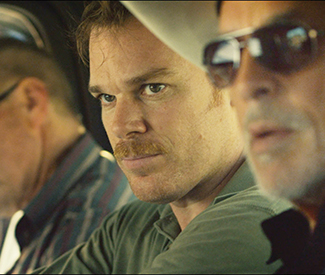
The Rover Future days have never seemed quite so bleak as they are depicted in the wild, wild Aussie west of The Rover — rendered by Animal Kingdom (2010) director David Michod, who co-wrote The Rover with Joel Edgerton. Let’s just say we’re probably not going to see any primo Burner ensembles inspired by this post-apocalyptic yarn: Michod ventures to a plausible future only a decade out, after a global economic collapse, and breaks down the brooding road trip to its hard-boiled bones, setting it in a beauteous, lawless, and unceasingly violent outback. A heist gone wrong leads a small gang of robbers to steal the car belonging to monosyllabic, ruthless mystery man Eric (Guy Pearce). The latter wants his boxy little sedan back, badly, and, in the cat and mouse game that ensues, seems willing to die for the trouble. Meanwhile, one of the gang of thieves — the slow, dreamy Rey (Robert Pattinson), who has been left to die of a gunshot wound in the dirt — turns out to be more of a survivor than anyone imagined when he tracks down the tracker hunting for his brother and cohorts. Michod seems most interested in examining and turning over the ties that bind, in a mean time, an eminently absurdist moment, when everything else has fallen away in the face of sheer survival. Cineastes, however, will appreciate the elemental, existential pleasures of this dog-eat-dog Down Under out-Western, not the least of which include the performances. Pearce’s rework of the Man With No Name exudes intention in the very forward thrust of his stance, and Pattinson breaks his cool — and the confines of typecasting — as a blubbering, babbling, thin-skinned man-child. Clad in the mystic expanses of the South Australia desert, which tip a hat to John Ford Westerns as well as scorched-earth-of-the-mind movies such as El Topo (1970) and Paris, Texas (1984), The Rover is taken to the level of tone poem by the shuddering, moaning cellos of Antony Partos’s impressive, atonal electroacoustic score. (1:42) (Kimberly Chun)

Think Like a Man Too Kevin Hart and company head to Vegas in this sequel to the 2012 hit comedy based on Steve Harvey’s best-selling relationship tome. (2:02)


Picture of SF’s extreme income equality worth thousands of words

53

Sometimes visuals paint a picture in a visceral way that mere numbers can’t, and that was the case when the Anti-Eviction Mapping Project recently released a graph highlighting the magnitude of San Francisco’s high rate of income inequality growth and how it compares to other major cities around the country. San Francisco’s purple bubble is floating way up, all alone, above Atlanta, Georgia’s orange bubble and everyone else closely grouped together. 

The graph’s findings reveal the sad but well-known fact that San Francisco is widely unequal, and it comes as little surprise that from 2007 to 2012, SF saw its income gap grow faster than any other major city in the United States.

The visualization cited a Brookings Institute report on income inequality released in February, which found the income of San Francisco’s low-earning residents (more specifically, those in the 20th percentile of yearly income) dropped by an average of $4,000 during that timespan, while the highest-earning residents (the 95th percentile) saw their income jump by an average of $28,000 over the same period. The latter figure was the largest gain in any American city, and it affirms what’s already clear to city residents: The rich are getting richer while the poor continue to get poorer.

That message might seem like old news to those familiar with San Francisco’s income inequality issues, but the truly alarming part of the study is the rate at which the trend is occurring. Though it provides further confirmation of an unpleasant fact that has plagued San Francisco residents for years, the unprecedented speed of the income gap’s increase is especially startling given the efforts to rectify the issue. As the mapping project pointed out, “trickle-down economics does not appear to be working” in San Francisco.

The gap has become so pronounced that the city’s 2012 GINI Coefficient (which measures income distribution) of .523 would make it the 14th-most economically unequal country in the world if San Francisco were its own nation. That’s right in line with countries that are widely known for their income inequality, like Paraguay and Chile, and more than twice as unequal as top-ranked Sweden.

Perhaps the best indication of this growing division has been the drastic increase in evictions throughout the city. The Anti-Eviction Mapping Project has worked to shed light on the issue, releasing time lapses showing the evictions while making it clear that seniors and disabled people aren’t immune to the trend either.

The Anti-Eviction Mapping Project is probably best known for protesting the Google tech buses, whose effects on local communities they’ve researched extensively. The organizations’ maps showlinks between the location of bus stops and a large number of evictions in the same areas.

Developing nations with income gaps akin to San Francisco’s don’t have tech buses driving around their streets, so it’s no surprise that the buses’ unpaid use of public bus stops hasn’t left residents of lower income areas particularly thrilled, especially with the tech sector pushing up the price of housing in those areas while contributing heavily to the results of the Brookings Institute report.

Extra! Extra! Sunshine advocates beat the Anti-Sunshine Gang in City Hall

27

 By Bruce B. Brugmann

And so the  Anti-Sunshine Gang in City Hall, which for two years has been conducting a nasty vendetta against the Sunshine Ordinance Task Force,  capitulated quietly at Tuesday’s Board of Supervisors meeting without a fight or even a whimper.

The capitulation came in a two line phrase  buried in item 28 in the middle of the board’s agenda.  It was a report from the rules committee recommending  the Board of Supervisors approve a motion for  unnamed nominees to the Sunshine Ordinance Task Force. “Question:  Shall this Motion be approved.”

Board Chair David Chiu asked for approval in his usual board meeting monotone. And the approval came unanimously, with no dissent and no roll call vote and not a word spoken by anybody.  He banged the gavel and that was that. And only a few veteran board watchers knew that this was the astonishing  end to a crucial battle that pitted the powerfuf Anti-Sunshine Gangs against the sunshine forces and the citizens of San Francisco. It was a battle that would decide whether the task force would remain an independent people’s court that would hear and rule on public access complaints.  Sunshine won.

It was ironic and fitting that Chiu presided over the capitulation. For it was Chiu as board president who orchestrated  the deal to demolish Park Merced and then orchestrated the  infamous 6-5 board vote  in September 2010 approving  a monstrous redevelopment  project that would evict lots of tenants, and destroy most of the affordable housing. This was a big deal because the housing crisis was heating up and Park Merced was the largest affordable community in the city and one of the largest In the nation. This is where tens of thousands of young people, young married couples, students and faculty at nearby San Francisco State, older people, and middle class people had come for generations with their families to live in affordable housing in an  “urban park,” as Park Merced promo once put it.

And it was Chiu as board president who was charged by the Sunshine Task Force, along with Supervisors Scott Wiener, Malia Cohen, and Eric Mar with violating the Sunshine Ordinance and the state’s open meeting law (Brown Act) when they approved the project with blazing speed.. 

Wiener, Cohen, and Mar were on the board’s Land Use and Economic Development Committee when they voted on the contract. Literally minutes before the committee vote, Chiu introduced 14 pages of amendments to the contract. The deputy city attorney at the meeting blessed the amendments by saying, gosh, golly, gee, no problem, the amendments do  not substantially alter the contract and therefore the description of the item on the agenda was still apt and the committee could act on it. Bombs away! The full board approved the contract the same day by one vote.

This sleight of hand and pellmell approval process meant that Park Merced was going,going, gone and in its place would be a project that “has no hindsight, no insight, or foresight,” as Planning Commissioner Kathryn Moore was quoted as saying in a scathing Westside Observer column by landscape architect Glenn Rogers. “It is not a project of the 21st century.  It is the agenda of a self-serving developer.”

 The Observer, to its immense credit, was the only media in town to blast away at the project. (Read its coverage and weep, starting with a June piece by Pastor Lynn Gavin who wrote that the Park Merced owners did not disclose to her or her family that they “were going to demolish the garden apartment that was our home.”)  Gavin and her neighbors took the formal complaint to the Sunshine Ordinance Task Force and got a unanimous 8-0  ruling condemning Chiu, Wiener, Cohen, and Mar for open government violations.

It was a historic ruling by the task force and demonstrated once again in 96 point tempo bold the irreplaceable value of the people’s court.  The ruling also had impact because it amounted to a stinging  expose of how government often works in San Francisco with big money and big development and how one vote can add gallons of high octane petrol to the housing crisis. It angered the hell out of the six supervisors who voted for the project.

 And in effect, it gave rise to what I call the Anti-Sunshine Gang in City Hall whose response to the ruling was, not to apologize and change their illegal ways, but to start a vicious vendetta against the task force for doing the right thing at the right time.  The six votes were David Chiu, Scott Wiener, Malia Cohen, Mark Farrell, Sean Elsbernd, and Carmen Chu. Elsbernd has gone on to Sen. Diane Feinstein’s office in San Francisco and Chu to becoming assessor. But the gang picked up other allies along the way, notably the city attorney’s office.

Two years ago, when the task force members came to the board for reappointment, the Anti-Sunshine Gang retaliated and swung into action by “launching a smear campaign aimed at purging the eight task force members who had unanimously voted to find the violations,” according to Richard Knee, a 12 year veteran of the task force, in a June column in the Observer.  Knee, who represents the local chapter of the Society of Professonal Journalists, also wrote that “the mayor and the Board of Supervisors…made sure that the panel gets minimal funding, staffing and resources, and the board has refused to fill two long standing vacancies, making It difficult at times to muster a quorum since task force members are volunteers with outside responsibilities such as family and work.

“Two year ago, the board’s failure to appoint a physically disabled member forced the task force to take a five month hiatus, exacerbating a backlog of complaints filed by members of the public.This year, Knee wrote,  the start of the appointment process was “farcical and ominous.”  He explained that, at the May 15 meeting of the board’s rules committee, which vets applicants for city bodies, the two supervisors present chair Norman Yee and Katy Tang (David Campos had an excused absence) “complained that there weren’t enough racial/ethnic diversity among the 13 candidates. “That didn’t deter them from recommending the reappointments of Todd David, Louise Fischer, and David Pilpel, all Anglos.”

Before the full board five days later, Yee complained again, “this time that lack of a regular schedule and frequent switching of meeting dates were making attendance difficult for task force members. Either Yee had no clue of the facts or he was lying.” Knee explained that the task force normally meets the first Wednesday of each month and its subcommittees usually meet during the third week of the month.

“Meeting postponements and cancellations are the result, not the cause, of difficulties in mustering a quorum, due to the vacancies—which now number three.

“In gushing over David, Fischer, and Pilpel, at the board’s May 20 meeting, Wiener offered no evidence or detail of their alleged accomplishments and ignored the fact that David has missed six task force meetings since March 2013, including those of last February and April. Until the board fills the other seats, the five remaining incumbents—Chris Hyland, Bruce Oka, David Sims, Allyson Washburn, and yours truly—stay on as ‘holdover’ members.”

Meanwhile, by the next session of the Rules Committee on June 5, the sunshine advocates had rallied and put together an impressive mass of sunshine power. Testifying at the hearing were representatives from SPJ and the journalism community, the League of Women Voters, the ACLU, the sunshine posse, the Library Users Association, the Bay Area News Group, the Inter-American Press Asociation, the Center for Investigative Reporting, the UC-Berkeley Graduate School of Journalism, the First Amendment Coalition, the  Electronic Frontier Foundation, the Observer and neighborhood activists, and other sunshine allies and FOI groupies. It was quite a show of force. 

SPJ placed a pointed, timely op ed in the Chronicle (“SF Supervisors block Sunshine Ordinance Task Force,” good of the Chron/Hearst to run it but better if the paper didn’t black out local sunshine issues.) Members of the posse peppered the gang with public record requests aimed at tracking skullduggery and they found it. Reps from the groups lobbied the supervisors by email, phone, and personal office visits. And the word that the Anti-Sunshine Gang was back and on the gallop shot through the neighborhoods and around town and into election campaigns and among constituents of the gang.

SPJ and its vigorous Freedom of Information Committee under co-chairs Journalist Thomas Peele, of Chauncey Bailey fame, and Attorney Geoff King  were particularly effective. Peele is an investigative reporter with the Bay Area Newspaper Group, a lecturer on public records at the UC-Berkeley Graduate School of Journalism, and author of a respected book on Chauncey Bailey, a black journalist murdered on his way to work.

The word got around that the supervisors were blocking strong pro-sunshine candidates for the task force and that their first three nominees were the weakest of the lot. Campos, a stellar sunshine advocate, was back at the committee meeting, making the right calls and shepherding the strong nominees along through the committee and the Board of Supervisors.  Great job.

The cumulative weight and force  of the presentations of the nominees and the sunshine advocates made the proper political point:  any supervisor who voted with the Anti-Sunshine Gang was going to face their constituents and voters with the brand of being anti-sunshine and anti- government accountability.  More: they would have to answer some embarrassing questions: Who lost Park Merced? Who voted to turbo charge evictions and middle class flight from the city for years to come? Who tried to cover up the outrage and who did it? And who led the retaliatory vendetta against the Sunshine Ordinance Task Force for doing the right thing on behalf of sunshine in San Francisco?

And so the Board of Supervisors was dragged kicking and screaming into the sunshine of June 2014 and beyond. The supervisors ended up nominating what looks to be one of the strongest pro-sunshine task forces: Attorney  Mark Rumold and journalist Ali Winston from SPJ, Allyson Washburn from the League of Women Voters, Attorney Lee Hepner, Journalist Josh Wolf, and holdover Chris Hyland. Plus Bruce Oka who looks to be a late holdover in the disabled seat. Congratulations for hanging in and winning, hurray for the power of sunshine, on guard,  B3

P.S. l: PG&E institutionalizes City Hall secrecy and corruption:  The pernicious influence of the Anti-Sunshine gang hung heavy over the rules committee.  Tang tried to force every candidate to take a pledge of allegiance to the city attorney. Tang is the kind of neighborhood supervisor (Sunset) who has a 100 per cent Chamber of Commerce voting record. Her city attorney pledge demand was laughable on its face, given the fact that the city attorney refuses to move on the PG&E/Raker Act scandal and thus has helped institutionalize secrecy and corruption in City Hall on a multi-million dollar scale for decades. Which is reason enough for the city to always maintain a strong, enduring Sunshine Ordinance Task Force, to help keep tabs on how PG&E keeps City Hall safe for PG&E and its allies. (See Guardian stories and editorials since 1969.)  

Tang and Yee continued the gang’s hammering on Bruce Wolfe, a worthy candidate for the disabled seat whose main sin was that he was one of the Honorable Eight who voted condemnation.  The gang knocked out Wolfe as a holdover candidate the first time around and they were at it again at the committee meeting. Oka says he wants to resign from the task force but only when the board finds a good replacement. Wolfe, who was an effective and knowledgeable sunshine task force member, is the obvious replacement but he is still on the purge list.  Stay tuned on this one. . 

There are three things that no one can do to the entire satisfaction of anyone else: make love, poke the fire, and run a newspaper. William Allen White, 1917, line atop the editorial page of the Durango Herald, Durango, Colorado. 

City College’s accreditors bow to pressure, amend rules to save CCSF

18

Keep City College of San Francisco open, or else.

That’s the message local and federal officials have drilled into City College’s accreditors in recent weeks. Representatives Nancy Pelosi and Jackie Speier; Assemblymembers Tom Ammiano and Phil Ting; and the state’s community college government have all publicly pressured the Accrediting Commission for Community and Junior Colleges to give City College an extension to prove its worth.

Finally bowing to pressure, the ACCJC may soon chang their own rules to save City College.

Today the ACCJC announced changes in its policy exclusively for colleges with terminated accreditation, granting a chance for such colleges to request a new “accreditation restoration status.”

“This is new for the ACCJC, but I don’t know if its new for other institutions,” Dave Hyams, a spokesperson for the ACCJC told us. But this new policy may offer new hope for City College.

In 2012 the ACCJC told City College its accreditation would be terminated, putting the school in the fight of its life. A loss of accreditation would mean its degrees are worthless, and the school would lose government funding. Notably, the school has not lost its accreditation yet.

The ACCJC’s policy change is not yet final, as the agency is allowing two weeks for the public to weigh in. The changes will be finalized on June 25, the commission said.

If the policy is adopted though, it means City College would be able to apply for a lifeline.

“If this policy is adopted as expected,” the ACCJC wrote in their statement to the press, “CCSF would have the opportunity to take steps to be designated as being in restoration status.”

Hyams denied the decision has anything to do with the very recent, and very public, emails from Nancy Pelosi and other politicians to demanding the ACCJC give City College more time.

“The ACCJC was looking for a way to balance the impact of termination on students,” he said, “with the needs for the college to meet basic standards.”

The college would need to file its application for restoration status by July 2014, City College’s originally announced accreditation termination date. This may all be moot, however, as City Attorney Dennis Herrera filed for an injunction to stall the college’s closure until the conclusion of the city’s lawsuit against the ACCJC. Legal proceedings are expected to begin in October.

Sara Eisenberg, the deputy city attorney leading the case against the ACCJC, told us this doesn’t affect the case at all.

Our lawsuit is about the ACCJC’s bad acts, which go to the heart of the fairness and accuracy of the accreditation evaluation process,” she told the Guardian. “These violations of law, policy and fundamental fairness require that the ACCJC’s past decisions concerning City College be vacated and that City College be reevaluated on a clean slate using a fair process.”

Interestingly, the announcement of restoration status by the ACCJC contains a caveat: they will not extend CCSF’s appeal unless the US Department of Education gives them the go-ahead. Hyams said the ACCJC developed this plan while consulting the USDOE, so it may be a slam dunk.

Need some context on the City College fight? Check out the video above for a basic overview.

“The commission and the department had very recent meetings that have been constructive and productive, they’re fully aware of this proposal,” he told us.

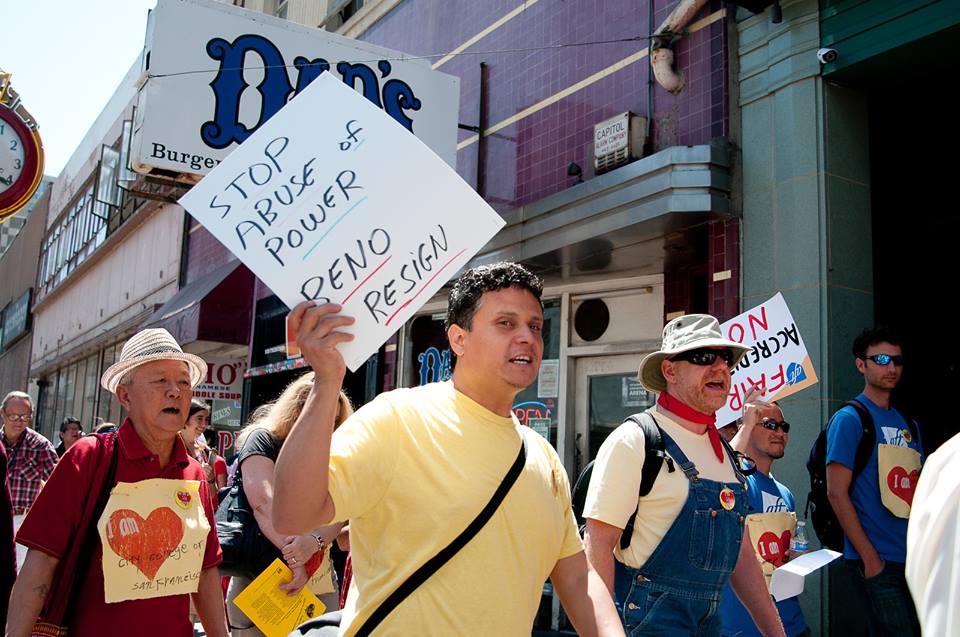
One of those meetings was not so peaceful, however, as over 200 City College supporters rallied outside the ACCJC’s semi-annual meeting in Sacramento, demanding the organization rescind its decision to revoke the college’s accreditation. The protest was led by the California Federation of Teachers, the local AFT 2121 and attended by teachers and students alike.

Tim Killikelly, the president of the AFT 2121 had questions about the new policy.

“I’m not sure how this restoration status is different than what appeals already existed,” he said. “The students need to be sure about their academic future, and this doesn’t do that. The students need to breathe a sigh of relief.”

He’s referring to the college’s recent drop in enrollment. At its height City College had over 100,000 students enrolled. But, due in part to its accreditation struggles and (some have said) the economy’s mild upswing, the enrollment has recently dropped to under 80,000 students. 

Killikelly laid much of the blame for that enrollment drop at the feet of the ACCJC. “They should’ve sent a team to verify we’re in compliance,” he said. Instead of this middling compromise, if the ACCJC had instead granted full accreditation Killikelly thinks confidence in the college could be restored.

City College Trustee Rafael Mandelman was also cautious about the decision.

“Its good news,”  he said, but, “the powers that be have rallied and persuaded the ACCJC that they cannot shut City College down now. The ACCJC are not pulling their claws out of the college. We will continue this terrible dance unless the City Attorney wins his lawsuit.”

The college may already have bounced back. California Community College Chancellor Brice Harris and City College Chancellor Arthur Tyler have publicly stated the school is 95 percent done addressing all of the concerns the ACCJC wanted to see fixed.

Mandelman contends the ACCJC’s move to terminate City College’s accreditation did more harm than good. “This whole process has been incredibly and unnecessarily disruptive on City College,” he said. “It’s a horrendous way to reform an institution.”

It should be noted that City College is still open, and remains accredited. For a look at the new policy from the ACCJC, click here.

Invisible no more

9

We all want to be responsible for our environment. We sort our trash. We put the right things into the right containers, and feel good when we see them at the curb on trash pickup day.

Then the trash disappears. End of story.

But really, it’s not the end. Not only does the trash go somewhere, but people still have to sort through what we’ve thrown away. In a society full of people doing work that’s unacknowledged, and often out of sight, those who deal with our recycled trash are some of the most invisible of all.

Sorting trash is dangerous and dirty work. In 2012 two East Bay workers were killed in recycling facilities. With some notable exceptions, putting your hands into fast moving conveyor belts filled with cardboard and cans does not pay well — much less, for instance, than the jobs of the drivers who pick up the containers at the curb. And the sorting is done almost entirely by women of color; in the Bay Area, they are mostly immigrants from Mexico and Central America, as well as some African Americans.

This spring, one group of recycling workers, probably those with the worst conditions of all, finally had enough. Their effort to attain higher wages, particularly after many were fired for their immigration status, began to pull back recycling’s cloak of invisibility. Not only did they become visible activists in a growing movement of East Bay recycling workers, but their protests galvanized public action to stop the firings of undocumented workers.


ILLEGAL WAGES FOR “TEMPORARY” WORKERS

Alameda County Industries occupies two big, nondescript buildings at the end of a cul-de-sac in a San Leandro industrial park. Garbage trucks with recycled trash pull in every minute, dumping their fragrant loads gathered on routes in Livermore, Alameda, and San Leandro. These cities contract with ACI to process the trash. In the Bay Area, only one city, Berkeley, picks up its own garbage. All the rest sign contracts with private companies. Even Berkeley contracts recycling to an independent sorter.

At ACI, the company contracts out its own sorting work. A temp agency, Select Staffing, hires and employs the workers on the lines. As at most temp agencies, this means sorters have no health insurance, no vacations, and no holidays. It also means wages are very low, even for recycling. After a small raise two years ago, sorters began earning $8.30 per hour during the day shift, and $8.50 at night.

Last winter, workers discovered this was an illegal wage.

Because ACI has a contract with the city of San Leandro to process its recycling, it is covered by the city’s Living Wage Ordinance, passed in 2007. Under that law, as of July 2013: “Covered businesses are required to pay no less than $14.17 per hour or $12.67 with health benefits valued at least $1.50 per hour, subject to annual CPI [consumer price index] adjustment.”

There is no union for recycling workers at ACI, but last fall some of the women on the lines got a leaflet advertising a health and safety training workshop for recycling workers, put on by Local 6 of the International Longshore and Warehouse Union. There, they met the union’s organizing director, Agustin Ramirez. “Sorting trash is not a clean or easy job anywhere,” he recalls, “but what they described was shocking. And when they told me what they were paid, I knew something was very wrong.”

Ramirez put them in touch with a lawyer. In January, the lawyer sent ACI and Select a letter stating workers’ intention to file suit to reclaim the unpaid wages. ACI has about 70 sorters. At 2,000 work hours per year each, and a potential discrepancy of almost $6 per hour, that adds up to a lot of money in back wages.

The response by ACI and Select was quick. In early February, 18 workers — including all but one who’d signed onto the initial suit — were called into the Select office. They were told the company had been audited by the Immigration and Customs Enforcement agency of the Department of Homeland Security a year before, and that ICE had questioned their immigration status. Unless they could provide a good Social Security number and valid work authorization within a few days, they’d be terminated.

Instead of quietly disappearing, though, about half the sorters walked off the lines on Feb. 27, protesting the impending firings and asking for more time from the company and ICE. Faith leaders and members of Alameda County United for Immigrant Rights joined them in front of the ACI office. Workers came from other recycling facilities. Jack in the Box workers, some of whom were fired after last fall’s fast-food strikes, marched down the cul-de-sac carrying their banner of the East Bay Organizing Committee. Even San Leandro City Councilman Jim Prola showed up.

“The company told us they’d fire anyone who walked out,” said sorter Ignacia Garcia. But after a confrontation at the gate, with trucks full of recycled trash backed up for a block, Select and ACI managers agreed the strikers could return to work the following day. The next week, however, all 18 accused of being undocumented were fired. “Some of us have been there 14 years, so why now?” wondered Garcia.

In the weeks that followed, East Bay churches, which earlier called ICE to try to stop the firings, collected more than $6,500 to pay rent for nine families. According to Rev. Deborah Lee, director of the Interfaith Coalition for Immigrant Rights, “after they had a chance to meet the fired workers and hear their stories, their hearts went out to these hardworking workers and parents, who had no warning, and no safety net.” Money is still coming in, she says.


ONE OF MANY BATTLES

Because cities give contracts for recycling services, they indirectly control how much money is available for workers’ wages. But a lot depends on the contractor. San Francisco workers have the gold standard. Recology, whose garbage contract is written into the city charter, has a labor contract with the Teamsters Union. Under it, workers on its recycle lines are guaranteed to earn $21 an hour.

Across the bay, wages are much lower.

ACI is one battle among many taking place among recycling workers concerning low wages. In 1998, Ramirez and the ILWU began organizing sorters. That year 70 workers struck California Waste Solutions, which received a contract for half of Oakland’s recycling in 1992. As at ACI, workers were motivated by a living wage ordinance. At the time, Oakland mandated $8 an hour plus $2.40 for health insurance. Workers were only paid $6, and the city had failed to monitor the company for seven years, until the strike.

Finally, the walkout was settled for increases that eventually brought CWS into compliance. During the conflict, however, it became public (through the Bay Guardian in particular) that Councilman Larry Reid had a financial interest in the business, and that CWS owner David Duong was contributing thousands of dollars in city election races.

Waste Management, Inc., holds the Oakland city garbage contract. While garbage haulers have been Teamster members for decades, when Waste Management took over Oakland’s recycling contract in 1991 it signed an agreement with ILWU Local 6. Here too workers faced immigration raids. In 1998, sorters at Waste Management’s San Leandro facility staged a wildcat work stoppage over safety issues, occupying the company’s lunchroom. Three weeks later immigration agents showed up, audited company records, and eventually deported eight of them. And last year another three workers were fired from Waste Management, accused of not having legal immigration status.

Today Waste Management sorters are paid $12.50 under the ILWU contract — more than ACI, but a long way from the hourly wage Recology pays in San Francisco. Furthermore, the union contracts with both CWS and Waste Management expired almost two years ago. The union hasn’t signed new ones, because workers are tired of the second-class wage standard.

To increase wages, union recycling workers in the East Bay organized a coalition to establish a new standard — not just for wages, but safety and working conditions — called the Campaign for Sustainable Recycling. Two dozen organizations belong to it in addition to the union, including the Sierra Club, the Global Alliance for Incinerator Alternatives, Movement Generation, the Justice and Ecology Project, the East Bay Alliance for a Sustainable Economy, and the Faith Alliance for a Moral Economy.

ILWU researcher Amy Willis points out, “San Francisco, with a $21 wage, charges garbage rates to customers of $34 a month. East Bay recyclers pay half that wage, but East Bay ratepayers still pay $28-30 for garbage, recycling included. So where’s the money going? Not to the workers, clearly.”

Fremont became the test for the campaign’s strategy of forcing cities to mandate wage increases. Last December the Fremont City Council passed a 32-cent rate increase with the condition that its recycler, BLT, agree to provide raises. The union contract there now mandates $14.59 per hour for sorters in 2014, finally reaching $20.94 in 2019. Oakland has followed, requiring wage increases for sorters as part of the new recycling contract that’s currently up for bid.

Good news for those still working. But even for people currently on the job, and certainly for the 18 workers fired at ACI, raising wages only addresses part of the problem. Even more important is the ability to keep working and earn that paycheck.


CRIMINALIZING IMMIGRANT WORKERS

When ACI and Select told workers they’d be fired if they couldn’t produce good Social Security numbers and proof of legal immigration status, they were only “obeying the law.” Since 1986, U.S. immigration law has prohibited employers from hiring undocumented workers. Yet according to the Pew Hispanic Trust, 11-12 million people without papers live in the U.S. — and not only do the vast majority of them work, they have to work as a matter of survival. Without papers people can’t collect unemployment benefits, family assistance or almost any other public benefit.

To enforce the law, all job applicants must fill out an I-9 form, provide a Social Security number and show the employer two pieces of ID. Since 1986 immigration authorities have audited the I-9 forms in company personnel records to find workers with bad Social Security numbers or other ID problems. Immigration and Customs Enforcement (ICE) then sends the employer a letter, demanding that it fire those workers.

According to ICE, last year the agency audited over 2,000 employers, and similar numbers in previous years. One of the biggest mass firings took place in San Francisco in 2010, when 475 janitors cleaning office buildings for ABM Industries lost their jobs. Olga Miranda, president of Service Employees Local 87, the city’s janitors union, charges: “You cannot kill a family quicker than by taking away their right to find employment. The I-9 audits, the workplace raids, E-Verify, make workers fear to speak out against injustices, that because of their immigration status they have no standing in this country. They have criminalized immigrants. They have dehumanized them.”

One fired janitor, Teresa Mina, said at the time, “This law is very unjust. We’re doing jobs that are heavy and dirty, to help our children have a better life, or just to eat. Now my children won’t have what they need.”

Similar I-9 audits have taken place in the past two years at the Pacific Steel foundry in Berkeley, at Silicon Valley cafeterias run by Bon Appetit, at South Bay building contractor Albanese Construction, and at the Dobake bakery, where workers prepare food for many Bay Area schools. All are union employers.

Sometimes the audits take place where workers have no union, but are protesting wages and conditions. Like the ACI workers, in 2006 employees at the Woodfin Suites hotel in Emeryville asked their employer to raise their wages to comply with the city’s living wage ordinance. Twenty-one housekeepers were then fired for not having papers. Emeryville finally collected over $100,000 in back pay on their behalf, but the workers were never able to return to their jobs.

Last fall, as fast-food workers around the country were demanding $15 an hour, several were fired at an Oakland Jack in the Box for being undocumented. “They knew that when they hired us,” said Diana Rivera. “I don’t believe working is a crime. What we’re doing is something normal — we’re not hurting anyone.” The Mi Pueblo Mexican market chain also fired many workers in an immigration audit, during a union organizing drive.

Because the audits are not public, no exact total of the number of workers fired is available. ICE spokesperson Virginia Kice would not comment on the audit at ACI. In response to an information request, she stated: “To avoid negatively impacting the reputation of law-abiding businesses, we do not release information or confirm an audit unless the investigation results in a fine or the filing of criminal charges.” Neither ACI nor Select Staffing responded to requests for comment.

San Francisco became a leader in opposing the firings in January, when the Board of Supervisors passed unanimously a resolution calling on the Obama administration to implement a moratorium on the audits and on deportations. Other cities, like Los Angeles, have also opposed deportations, but San Francisco added: “End the firings of undocumented workers by ending the I-9 audits and the use of the E-Verify system.”

Gordon Mar, of Jobs with Justice, urged the board to act at a rally in front of City Hall. “When hundreds of workers are fired from their jobs,” he declared, “the damage is felt far beyond the workers themselves. Many communities have voiced their opposition to these ‘silent raids’ because they hurt everyone. Making it a crime to work drives people into poverty, and drives down workplace standards for all people.” Like many Bay Area progressive immigrant rights activists, Mar calls for repealing the section of immigration law that prohibits the undocumented from working.

The Board of Supervisors urged President Obama to change the way immigration law is enforced, in part because Congress has failed to pass immigration reform that would protect immigrants’ rights. The Senate did pass a bill a year ago, but although it might eventually bring legal status to some of the undocumented, other provisions would increase firings and deportations.

Like the Board of Supervisors, therefore, the California Legislature has also passed measures that took effect Jan. 1, to ameliorate the consequences of workplace immigration enforcement: AB 263, AB 524, and SB 666. Retaliation is now illegal against workers who complain they are owed unpaid wages, or who testify about an employer’s violation of a statute or regulation. Employers can have their business licenses suspended if they threaten to report the immigration status of workers who exercise their rights. Lawyers who do so can be disbarred. And threats to report immigration status can be considered extortion.

It’s too early to know how effective these new measures will be in protecting workers like the 18 who were fired at ACI. While a memorandum of understanding between ICE and the Department of Labor bars audits or other enforcement actions in retaliation for enforcing wage and hour laws, ICE routinely denies it engages in such retaliation.

Yet, as difficult as their situation is, the fired recyclers don’t seem to regret having filed the suit and standing up for their rights. Meanwhile, the actions by the cities of Oakland and Fremont hold out the promise of a better standard of living for those still laboring on the lines.


Norman Solomon: Obama escalates his war on journalism

2

By Norman Solomon

 (Norman Solomon is executive director of the Institute for Public Accuracy and co-founder of RootsAction.org. His books include “War Made Easy: How Presidents and Pundits Keep Spinning Us to Death.” Information about the documentary based on the book is at www.WarMadeEasyTheMovie.org.)

In a memoir published this year, the CIA’s former top legal officer John Rizzo says that on the last day of 2005 a panicky White House tried to figure out how to prevent the distribution of a book by New York Times reporter James Risen. Officials were upset because Risen’s book, State of War, exposed what — in his words — “may have been one of the most reckless operations in the modern history of the CIA.”

The book told of a bungled CIA attempt to set back Iran’s nuclear program in 2000 by supplying the Iranian government with flawed blueprints for nuclear-bomb design. The CIA’s tactic might have actually aided Iranian nuclear development.

When a bootlegged copy of State of War reached the National Security Council, a frantic meeting convened in the Situation Room, according to Rizzo. “As best anyone could tell, the books were printed in bulk and stacked somewhere in warehouses.” The aspiring censors hit a wall. “We arrived at a rueful consensus: game over as far as any realistic possibility to keep the book, and the classified information in it, from getting out.”

But more than eight years later, the Obama White House is seeking a different form of retribution. The people running the current administration don’t want to pulp the book — they want to put its author in jail.

The Obama administration is insisting that Risen name his confidential source — or face imprisonment. Risen says he won’t capitulate.

The Freedom of the Press Foundation calls the government’s effort to force Risen to reveal a source “one of the most significant press freedom cases in decades.”

Pentagon Papers whistleblower Daniel Ellsberg says: “The pursuit of Risen is a warning to potential sources that journalists cannot promise them confidentiality for disclosing Executive Branch criminality, recklessness, deception, unconstitutional policies or lying us into war. Without protecting confidentiality, investigative journalism required for accountability and democracy will wither and disappear.”

A recent brief from the Obama administration to the nation’s top court “is unflinchingly hostile to the idea of the Supreme Court creating or finding protections for journalists,” Politico reported. The newspaper added that Risen “might be sent to jail or fined if he refuses to identify his sources or testify about other details of his reporting.”

This threat is truly ominous. As Ellsberg puts it, “We would know less than we do now about government abuses, less than we need to know to hold officials accountable and to influence policy democratically.”

So much is at stake: for whistleblowers, freedom of the press and the public’s right to know. For democracy.

That’s why five organizations — RootsAction.org, The Nation, the Center for Media and Democracy / The Progressive, Fairness & Accuracy In Reporting (FAIR) and the Freedom of the Press Foundation — have joined together to start a campaign for protecting the confidentiality of journalists’ sources. So far, in May, about 50,000 people have signed a petition telling President Obama and Attorney General Eric Holder to end legal moves against Risen.

Charging that the administration has launched “an assault on freedom of the press,” the petition tells Obama and Holder: “We urge you in the strongest terms to halt all legal action against Mr. Risen and to safeguard the freedom of journalists to maintain the confidentiality of their sources.”

The online petition — “We Support James Risen Because We Support a Free Press” — includes thousands of personal comments from signers. Here’s a sampling of what they had to say:

“Freedom of the press and freedom of speech are the cornerstones of our democracy. Stop trying to restrict them.”  Jim T., Colorado Springs, Colorado

“Protected sources are essential to a real democracy. Without whistleblowers, there is no truth.”  Jo Ellen K., San Francisco, California

“Enough of the government assault on freedom of the press! Whistleblowers are heroes to the American people.”  Paul D., Keaau, Hawaii

“It seems our government is out of control. The premise of deriving power from the people would appear to be a quaint notion to most within the three branches. Instead they now view us as subjects that must bend to their will rather than the other way around.”  Gary J., Liberty Township, Ohio

“‘Journalism is printing what someone else does not want printed. Everything else is public relations.’ — George Orwell”  Todd J., Oxford, Michigan

“As a writer, I support freedom of the press around the world as a vital first step toward regaining control of our compromised democracies.”  Patricia R., Whitehorse, YT, Canada

“You promised an open and transparent administration. Please keep that promise.”  Willard S., Cary, North Carolina

“Without a free press, we really have nothing.”  Robin H., Weehawken, New Jersey

“The Obama administration’s attack on press freedom is an issue of grave concern. Why are we spending billions of dollars going after supposed ‘terrorists’ when the greatest threat to democracy resides right here in Washington, DC.”  Karen D., Detroit, Michigan

“Damn you, Obama! You become more like Nixon daily!”  Leonard H., Manchester, Michigan

“Congratulations, Mr. Risen!”  Marian C., Hollister, California

“The U.S. is becoming an increasingly frightening place to live, more than a little like a police state. President Obama, you have been a huge disappointment. I expected better from you.”  Barbara R., Newport, Rhode Island

“Come on, President Obama… you’re a Constitutional scholar. You know better than this. Knock it off.”  James S., Burbank, California

“There can be no true freedom of the press unless the confidentiality of sources is protected. Without this, no leads, informants or whistleblowers will be motivated to come forward. Reporters should not be imprisoned for doing their job.”  Chris R., North Canton, Ohio

“You took an oath to ‘preserve, protect and defend the Constitution of the United States,’ freedom of the press!”  Diane S., San Jose, California

“Whatever became of the progressive Obama and the change you promised? Evidently it was a load of campaign bull puckey, making you just another politician who says whatever it takes to get elected. In other words, you and your administration are a complete sham. As for your constitutional scholarship, it would appear to be in the service of undermining the Constitution a la Bush and Cheney.”  Barry E., Bryn Mawr, Pennsylvani

“Without a free press, our republic is paper-mache. Remember John Peter Zenger! We must not shoot the messenger — we must raise the bar for conduct and probity!”  Lance K., Chelsea, Massachusetts

“A free press is the only counterbalance to crony capitalism, corrupt legislators, and a pitifully partisan Supreme Court, that continues to destroy our Constitutional protections.”  Dion B., Cathedral City, California

“I implore you to RESPECT THE FIRST AMENDMENT.”  Glen A., Lacey, Washington

“Did you not learn in grade school that freedom of the press is essential to a free country?”  Joanne D., Colorado Springs, Colorado

“We’ve been down this road before. What amazes me is that we condemn other countries for stifling freedom of the press, then turn around and do the same thing to advance our own purposes. Are we proponents of democracy and a free press or not?”  William M., Whittier, California

“Journalism is a vital component of a democracy, and it is a core function protected by the freedom of expression enshrined in both international and domestic law. You must stop harassing and persecuting journalists and their sources who are providing a vital public service in prying open the activities of governments that are illegitimately concealed from the public. If the public is not informed of state actions executed in their name, they cannot evaluate and render consent to those actions through the vote. This secrecy therefore subverts democracy, and you must stop using police powers to destroy the whistleblowers who enable government accountability to the public.”  Jim S., Gatlinburg, Tennessee

“I support freedom of the press, not the attorney general’s vicious abuse of his position!”  Bettemae J., Albuquerque, New Mexico

“Compelling reporters to reveal their sources just means that sources will stop talking to reporters. That will cripple the free press. If you think that’s not important, please resign immediately.”  Stephen P., Gresham, Oregon

“As an old woman who remembers the lies of Lyndon Johnson, Richard Nixon, Ronald Reagan, Bill Clinton, George W. Bush (especially) and the current administration, I do not trust my own government to tell me the truth anymore.  Freedom of the press is my only chance [to] find out what the truth is. Protect reporters’ sources!”  Monica O., Lomita, California

“Without freedom of the press, we might as well kiss democracy goodbye!”  Melvin M., Vashon, Washington

“I am ashamed of this administration, its policies and its Department of Justice — what a travesty of criminal turpitude and mass media complicity. ‘Transparency’ — hah! Cheap campaign rhetoric.”  Mitch L., Los Altos Hills, California

“Walk the walk or stop talking about democracy. Free press is the basis of our constitution.”  Carl D., Manassas, Virginia

“No free press, no democracy!”  James F., Moab, Utah

“If you force the media to reveal its sources, no one will ever come forth with a news story or lead again. I’m sure this is precisely what the politicians and big business want. Then there’d be absolutely no accountability. We need an effective shield law rather than persecuting journalists and news organizations for reporting the news.”  Jim S., Ladera Ranch, California

“Freedom of the Press is the hallmark of a free society. Your administration has done everything in its power to subvert Freedom of the Press by jailing whistleblowers and reporters who uncover wrong doing. This must stop!”  Ed A., Queens, New York

“We have very few real journalists left. Let’s not jail them!”  Karen H., West Grove, Pennsylvania

“As the press goes, so goes citizens’ rights.”  Kathy F., West Bend, Wisconsin

“I have been shocked at how this administration has treated the American people’s right to know, prosecuting reporters, whistleblowers, and others who have had the temerity to cast light into the dark corners of our government. You bring the whole concept of democracy into disrepute and set a bad example for the rest of the world.”  Marjorie P., Montpelier, Vermont

“We need our investigative reporters more now than ever in history. Keep our press free.”  Joan R., Novato, California

“Investigative reporting is becoming too rare in the U.S., and compelling J. Risen to reveal his sources will only make such reporting even rarer. Is this your deliberate intent?”  Elaine L., Elk Grove, California

“I am responding in support of James Risen. Freedom of the press is one of the cornerstones of our democracy and should never be trampled on by government.”  Lois D., San Jacinto, California

“Freedom of the press is more important than some stinking government attempt to find out how bad shenanigans made it into the press. Quit this crap about trying to make a reporter reveal his or her sources. We need good reporting a lot more than lousy stinking politicians trying to shut up the truth.”  Ralph M., Bakerstown, Pennsylvania

“Without a free press tyranny will ensue.”  Bob P., Holland, Pennsylvania

“I thought Mr. Obama was supposed to be a Constitutional lawyer and swore to uphold it. I thought the Attorney General was supposed to also protect the Constitution. It seems you both have abandoned those duties. Prove you hold the Constitution as the authority from which you derive your own and cease this persecution of a reporter who epitomizes one of the crucial things the Constitution stands for — a truly free press.”  Michael S., Tukwila, Washington

“I’ve seen mud more transparent than the Obama admin.”  Paul H., Carlton, Oregon

“Wow, this coming from the Obama administration who supposedly is for open govt. Isn’t it a police state when the govt cracks down on reporters for telling the truth? James Risen is a hero who will go to jail before revealing his source and the fact that you want to throw him in jail is the real crime here.”  Gayle J., Seattle, Washington

“Shocking.”  Peggy K., Soldiers Grove, Wisconsin

“You have way overstepped your authority. I consider myself a moderate, but your aggressive pursuit of journalists and whistleblowers strikes fear in my heart. Your use of intimidation to weaken the press is contributing to the dismantling of our democracy.”  Marcia B., Pittsburgh, Pennsylvania

“Quit trying to silence journalists! This is a Vladimir Putin approach to government. Hope and Change? Get Real!”  Rich W., Grass Valley, California

“Stop destroying our heroes, the courageous whistleblowers and journalists, including Risen and others who should be thanked, not prosecuted! You know damn well that the People want these people honored!”  Nancy G., Palm Desert, California

“Please recognize the need for a journalist to be free of coercion to reveal confidential sources. Bravo to James Risen for having the courage to resist this onerous government intimidation.”  Thomas S., Pittsburgh, Pennsylvania

“We are already seeing freedom of the press undermined by consolidation of media ownership. The founding fathers believed that we could only keep this republic if we have free press and an informed public. Stop the suppression of information. Free access to information is not an optional ingredient.”  Janelle J., Buffalo, Missouri

“Stop persecuting journalists and whistleblowers. Information is the lifeblood of a democracy.”  William C., Sherman Oaks, California

“Our government has become big brother. Journalists must not be forced to name their sources if we are to know the truth.”  Carolyn S., Los Angeles, California

“A free press is gone if confidential sources are revealed.”  Vincent H., Rutledge, Tennessee

“Frankly, Mr. President, I’m surprised at you, and I have to say, disappointed. This seems like something that happens in totalitarian countries.”  Karen B., Felton, California

“Freedom of the press is already under siege because big business controls so much of the message. The Obama administration must respect James Risen’s right to withhold his source.”  Patricia B., Marco Island, Florida

“Whistleblowers are vital to keeping our democracy from turning into a police state. And a free press is vital to keeping us informed. Drop this case, and uphold the principles of our Constitution.”  Cynthia D., E. Boston, MA

“The press should be free to do its job! How about some of that ‘most transparent administration’ stuff. If an administration has nothing to hide it has nothing to fear.”  Mike H., Terre Haute, Indiana

“James Risen is an investigative reporter of high repute who should not be subjected to state harassment and punishment for upholding his pledge of confidentiality to his sources. These encroachments on our Fourth Estate’s watchdog function as a check on the abuse of power must not stand.”  Barbara K., Santa Fe, New Mexico

“You both have to stop talking out of both sides of your mouth, i.e. lying. We are fighting for freedom of the press. Stop being enemies to us people.”  Judith N., North Bonneville, Washington

“Please don’t trash the Bill of Rights. Protect the freedom and independence of the press. Drop the case against James Risen.”  Andrew M., Lower Gwynedd, Pennsylvania

“Daniel Ellsberg was right. James Risen is right.”  Leonore J., Toledo, Ohio

“When the light of free press is no more, darkness prevails and evildoers flourish. I know this is what this corrupt government wants but over our dead bodies.”  Felix C., San Antonio, Texas

“What Mr. Risen did in this instance, was not criminal. Rather it was EXACTLY what a free press should do, without fear of reprisal. Stop the strong arm tactics.”  John S., Trumbull, Connecticut

“The investigative work of journalists sheds light on the world and what is happening. The increasing punishment of journalists is pushing our world and news into a scary age of non-information. Safeguard the confidentiality of journalists and their sources.”  Christin B., Barnegat Light, New Jersey

“Stop persecuting journalists and truth tellers.”  Phyllis B., Desert Hot Springs, California

Norman Solomon is executive director of the Institute for Public Accuracy and co-founder of RootsAction.org. His books include “War Made Easy: How Presidents and Pundits Keep Spinning Us to Death.” Information about the documentary based on the book is at www.WarMadeEasyTheMovie.org.

(The Bruce blog is written and edited by Bruce B. Brugmann, editor at large of the San Francisco Bay Guardian. He is the former co-founder and co-publisher with his wife Jean Dibble, 1966-2012.)

James Risen is printing the news and raising hell for a damn good cause in the best jounalistic tradition. He needs our support. B3

Tune in to SFBG’s Alternative Ink, sickout edition! LISTEN NOW

0

Spend your Sunday night with the dedicated staff here at the Bay Guardian, for two hours of local music and lively, information talk during our bi-weekly Alternative Ink radio show from 6-8pm Sunday, June 8, on BFF.fm. UPDATE: Listen to the show here

This week will be our sickout labor edition, where we talk Muni and the Bay Area labor movement. We’ll probably toast a few brews to Harry Bridges while we’re at it. 

Music Editor Emma Silvers will be laying down the tracks and checking our levels, so to speak, while News Editor Rebecca Bowe and Staff Writer Joe Fitzgerald Rodriguez provide the inside scoops.

We’ll also be talking about the newest developments with Ryan Chamberlain, who allegedly posessed explosives, the brewing battle between Uber and SFO, as well as the big fight over City College of San Francisco. And whatever else springs to mind. So tune in or check back later to this post to listen to the audio link. 

The anti-sunshine gang intensifies its attacks on the Sunshine Ordinance Task Force in City Hall

15

By Bruce B. Brugmann   (with special sunshine vendetta chronology by Richard Knee) 

The Guardian story in the current issue demonstrates in 96 point tempo bold how important the glare of sunshine and publicity is in City Hall in keeping the public’s business public. Yet, the anti-sunshine gang in City Hall is intensifying  its savage attack on the Sunshine Ordinance Task Force.

The Sunshine Ordinance established the Sunshine Task Force to serve as the people’s court for hearing citizen complaints on public access, thus giving  citizens a way to get secret records, open secret meetings, and hold government officials accountable. It empowers citizens to be watchdogs on issues they care about.  It is the first and best ordinance of its kind in the country, if not in the world, and its effectiveness is shown by the fact that the anti-sunshine gang regularly tries  to bounce strong members and gut the task force.

Terry Francke, then the executive director of the California First Amendment Coalition and author of the ordinance, and I as a founder anticipated this problem in trhe early 1990s and put a mandate  into the original ordinance for the task force to have representatives from the local chapter of the Society of Professional Journalists (a journalist and media attorney) and the San Francisco League of Women Voters, two organizations with experience and tradition with open government issues. Later, the mandate included a representative from New America Media, to insure a member of color for the task force.

 I served for 10 years on the task force and then Mayor Willie Brown made the point about City Hall interference by targeting me for extinction.  He tried several times  to kick me off the task force.  I refused to budge, on the principle that neither the mayor nor any other city official should be able to arbitrarily kick off a member of the task force for doing his/her job. When Willie left office, I left the task force when my term was up  and the principle was intact.

Today, as Richard Knee writes in his timeline and chronology below, the principle is once again under city hall attack. Knee replaced me as the journalist representative  of SPJ and has served under fire  for a record 12 years. He writes that the latest attack is retaliation for a unanimous finding by the task force in September 2011 when Board President David Chiu and Supervisors Scott Wiener, Malia Cohen, and Eric Mar violated  local and state open meeting laws by ramming through the monstrous Park Merced redevelopment contract with 14 pages of amendments that Chiu slipped in “literally minutes” before the committee vote.

This was a historic task force vote in the public interest, and a historic vote for open government and for all the good causes. But instead it prompted a smear- dilute-and- ouster campaign by the Board of Supervisors, with timely assists from the city attorney’s office.  The ugly play by play follows. The good news is  that the sunshine forces inside and outside city hall are fighting back, hard and fast, and with a keen eye on all upcoming elections.   Stay tuned. On guard. :

 Special  chronology and timeline detailing the anti-sunshine gang attack on  the Sunshine Ordinance Task Force. By Richard Knee)

1. In April 2011, the Task Force voted to change its bylaws to declare that approval of substantive motions required “yes” votes from a simple majority of members present rather than a simple majority of all members, as long as a quorum was present. The quorum threshold remained at six. The bylaws change went against the advice of the city attorney’s office, which pointed to city Charter Sec. 4.104. Suzanne Cauthen and I cast dissenting votes on the bylaw change. David Snyder was absent from that meeting but made it clear that, reluctantly, he could find no reason to disagree with the city attorney’s opinion.

2. In September 2011, the Task Force voted, 8-0, to find that Board of Supervisors President David Chiu and Supervisors Eric Mar, Scott Wiener and Malia Cohen had violated the Sunshine Ordinance and the state’s open-meeting law (Brown Act). Mar, Wiener and Cohen served on the board’s Land Use and Economic Development Committee, which voted to recommend approval of a Parkmerced redevelopment contract. Literally minutes before the committee voted, Chiu introduced 14 pages of amendments to the contract. The deputy city attorney at the meeting opined that the amendments did not substantially alter the contract and therefore the description of the item on the meeting agenda was still apt and the committee could act on it. The full board approved the contract the same day.

Wiener tried to intimidate the Task Force from hearing the case. His legislative aide Gillian Gillette (now the mayor’s director of transportation policy) told us we had no business telling the board how to vote and that in taking up the matter, we would be overstepping our authority. Her tone of voice, facial expression and body language were clearly confrontational. We pushed back. Bruce Wolfe told her it was inappropriate to prejudge the Task Force’s vote before the hearing had begun. I told her that we were not interested in the LUED Committee’s or the board’s substantive vote on the contract, but we were concerned about the procedural aspect. A complaint alleging sunshine violations had been brought before us and we were duty-bound to hear it. I pointedly suggested she review the ordinance, especially Sec. 67.30, which defines the Task Force’s, duties, powers and composition. She skulked back to her seat, seething.

Chiu’s legislative aide Judson True told us that Chiu’s office had made a mad scramble to get the amendments printed and properly distributed to allow enough time for review by the supervisors and members of the public before the committee’s vote. He and Gillette, citing the city attorney’s opinion, reiterated that the committee and the board had followed proper procedure.

We were incredulous toward their claims that (a) 14 pages of amendments did not substantially alter the contract and (b) there was sufficient time to review the amendments before the committee’s vote. We consensed that there was no reason the committee could not have delayed its vote in order to allow adequate review time.

3. Wiener surreptitiously asked the Budget and Legislative Analyst in late 2011 to survey every city department on how much sunshine compliance was costing it. When we learned about it, Task Force Chair Hope Johnson sent a strongly worded letter objecting to the attempt at secrecy and to the form that the survey took; we felt many of the questions were vague or vacuous.

4. In May 2012, the Rules Committee (Jane Kim, Mark Farrell, David Campos) interviewed Task Force applicants. Committee members pointedly asked incumbents Suzanne Manneh (New America Media’s nominee), Allyson Washburn (League of Women Voters’ nominee), Hanley Chan, Jay Costa and Bruce Wolfe if it wouldn’t have been wise to follow the city attorney’s advice in order to avoid violating the Charter. They responded that while they deeply appreciated having a deputy city attorney at Task Force meetings and certainly gave due weight to the DCA’s counsel, such advice did not have the force of law, they had a right to disagree with it and they believed the bylaw change they had enacted in April 2011 did not violate the Charter.

The Rules Committee voted unanimously to recommend the appointments of newcomers Kitt Grant, David Sims, Chris Hyland and Louise Fischer, and returnee David Pilpel. Campos and Kim voted to recommend Wolfe’s reappointment; Farrell dissented.

Then, citing concerns about lack of “diversity,” Farrell and Kim said the Society of Professional Journalists, NAM and the LWV should have submitted multiple nominations for each of their designated seats. They pointed to language in ordinance Sec. 67.30(a) stipulating that the respective members “shall be appointed from … names” – and they emphasized the plural, “names” – “submitted by” the organizations. And the committee voted unanimously to continue those four appointments to the call of the chair.

It is important to note that this was the first time ever that the committee had made a multiple-nominations demand. Previously, the committee and the board had invariably accepted the single nominations from the three organizations.

The “diversity” argument was a smokescreen. They had already voted to bounce Chan, who is Chinese-American, and Manneh is a Palestinian-American fluent in Arabic and Spanish.

The truth was, they didn’t like the nominees. SPJ had nominated attorney Ben Rosenfeld and Westside Observer editor Doug Comstock. Both as a Task Force member and as a political consultant, Comstock had been a thorn in lots of local politicians’ and bureaucrats’ sides. And Manneh and Washburn had participated in the Task Force’s unanimous finding of violation against Chiu, Wiener, Mar and Cohen.

Upshot: By continuing those appointments, the committee and the board ensured that Manneh, Washburn and I would remain as “holdovers” and the SPJ-nominated attorney’s seat would stay vacant (Snyder had formally resigned). Manneh, citing an increased professional and academic workload, stepped aside a few months later, meaning two of the 11 seats were vacant, and it now took only four absences instead of five to kill a quorum.

5. At the subsequent meeting of the full board, after Campos moved to reappoint Wolfe, Wiener moved to replace his name with that of Todd David. In making his motion, Wiener delivered a scorching, mendacious attack on what was then the current Task Force. Details of the tirade are available on request. The board voted, 6-5, in favor of Wiener’s motion (ayes: Wiener, Chiu, Farrell, Cohen, Carmen Chu and Sean Elsbernd; noes: Campos, Kim, Mar, John Avalos and Christina Olague). The board then voted unanimously to appoint Grant, Sims, Hyland, Fischer, Pilpel and David.

6. Ordinance Sec. 67.30(a) stipulates that the Task Force shall at all times have at least one member with a physical disability. Wolfe was the only applicant in 2012 to meet that criterion. So when the board ousted him, the Task Force no longer had a physically disabled member. The city attorney advised the new Task Force that to take any actions before a new physically disabled member was appointed could land land the Task Force and its individual members in serious legal trouble. So the Task Force was sidelined for five months, finally resuming business in November 2012 following the appointment of Bruce Oka — who, by the way, is solidly pro-sunshine.

            7. After interviewing 12 of the 13 task force applicants on May 15, 2014, Rules Committee members Norman Yee and Katy Tang complained about a lack of racial/ethnic diversity among the candidates, but that didn’t stop them from voting to recommend the reappointments of members David, Fischer and Pilpel, all Anglos (Campos was absent). Nor were they deterred by the fact that David has missed six task force meetings since March 2013, including those of last January, February and April. They continued consideration of additional appointments to a future meeting, possibly June 5.

At the board meeting on May 20, Wiener repeated his slander of the 2012-14 task force and heaped praise on David, Fischer and Pilpel without offering a shred of corroborating evidence. The board voted to confirm their reappointments, again ignoring David’s porous attendance record.

8. To be seen: whether Rules and/or the board will continue insisting on multiple nominations, and whether it will move forward on other possible appointments. Including Grant’s resignation and the possibility of holdovers, there is a risk that as few as eight of the 11 seats will be filled, meaning three absences would kill a quorum. Sims is moving to Los Angeles but remaining as a holdover for the moment. If he resigns, that could pull the number of fill seats down to seven, meaning two absences would kill a quorum.

The foregoing commentary is strictly personal and not intended to reflect the views of any other individual or organization.

Respectfully submitted,

Richard Knee

Member (since July 2002) and past chairman of the Sunshine Ordinance Task Force

Member of the Society of Professional Journalists, Northern California Chapter, Freedom of Information Committee

San Francisco-based freelance journalist

(The Bruce blog is written and edited by Bruce B. Brugmann, editor at large of the San Francisco Bay Guardian. He is the former editor and co-founder and co-publisher of the Guardian with his wife Jean Dibble, 1966-2012). In San Francisco, the citizens are generally safe, except when the mayor is in his office and the board of supervisors is in session. You can quote me.  B3

Where evil grows

0

cheryl@sfbg.com

FILM For film fans, there’s a delight that comes from charting a talented director’s progress from obscurity to cult fame to “next-big-thing” status. I remember settling in to watch Jim Mickle’s 2010 breakout Stake Land (his first feature was 2006’s micro-budget creature feature Mulberry Street, which played multiple festivals on the genre circuit). I knew it was a vampire movie, a weary subject thanks to Twilight mania, but it soon became clear that Stake Land was not a by-the-numbers affair: Within the first five minutes, a crusty fang-slinger devours a human infant. “This is not a film to be fucked with,” I scribbled in my review, and filed away the name “Jim Mickle” for future consideration.

Last year, he returned with We Are What We Are, a remake of a Mexican chiller about cannibals fighting to keep their secret traditions alive despite pesky interference from the modern world. It was his third film with writing partner Nick Damici — also the lead in Mickle’s first two films, though he moved to a supporting role in We Are, which focused mostly on the teen sisters at its core. Set in rural upstate New York, We Are had its share of gore, but it also went deeper, teasing out a macabre and surprisingly detailed history of its flesh-eating family.

“To me, it’s more of a dark story about faith and religion,” he told me in an interview at the time. “I was much more interested in the girls’ story, and the story of a family trying to hold together after a tragic event.”

Now comes Mickle’s most accomplished film to date, and it’s even less overtly horror (though it contains a multitude of terrifying moments): Cold in July, a thriller ranging across East Texas, circa 1989. The script by Team Mickle-Damici is adapted from the novel by Joe R. Lansdale, who — buckle up, cultists — also penned the short story which spawned 2002’s Bubba Ho-Tep. That said, there are no supernatural elements afoot here; all darkness springs entirely from the coal-black hearts beating in its characters.

Well, some of its characters. Cold in July begins with a killing, but the trigger hand is attached to mild-mannered frame-store owner Richard Dane (Dexter‘s Michael C. Hall, rocking a splendid mullet). The masked man he shot was breaking into the Dane family home; Richard was just protecting his wife (Vinessa Shaw) and young son (Brogan Hall). That he accidentally, kinda, nailed the burglar — spraying brains everywhere, necessitating amusing later scenes of weary clean-up and furniture replacement — is breezed over by the police (including a cowboy-hatted Damici). “Sometimes, the good guy wins,” they assure him.

The good guy/bad guy dynamic is twisted, tested, and taken to extremes as Cold in July continues; it’s the sort of film best viewed without much knowledge of its plot twists, which are numerous and cleverly plotted. (Which is to say: You may read on, genre junkie, without fear of spoilers, because I don’t wanna ruin anyone’s viewing enjoyment.) The day after his run-in with vigilante justice, Richard realizes he’s the number one conversation topic in his small town, and his shiny local-hero status has attracted the attention of the dead robber’s father (Sam Shepard), just out of the clink and skilled in the art of Cape Fear-style menace.

What happens next is best left a surprise, though it does involve Don Johnson as a flamboyant, convertible-driving pig farmer; plenty more bloodshed; a meeting at a drive-in that just happens to be screening Night of the Living Dead (1968); and the line “You don’t wanna fuck with the Dixie Mafia.” Throughout, Cold in July expertly works its 1980s setting as both homage to and embodiment of the era’s gritty thrillers; its synth-heavy score and neo-noir lensing (by frequent Mickle collaborators Jeff Grace and Ryan Samul, respectively) and the casting of Wyatt Russell (son of Kurt; he was also in We Are What We Are) in a key role add to the feeling that Cold in July was crafted after much time spent in the church of St. John Carpenter. There’s humor, too, deployed with careful timing that doesn’t compromise the slow-burning tension that builds throughout — as when Richard celebrates some good news by headbanging to period-perfect power rock in his enormous, wood-paneled station wagon.

Most intriguingly, and for all its retro trappings, Cold in July offers a very modern exploration of masculinity via all of its leads, though Richard is obviously the embodiment of this theme. “I’ve been waiting for something big like this,” he says to his wife before slithering away on a secret road trip (she thinks he’s talking about landing an important new client). Unlike Viggo Mortensen’s secret gangster in 2005’s A History of Violence, which begins with a similar premise (family guy shoots someone in self-defense, opening a can of worms in the process), Richard has zero past aggression to draw on; dude’s got a history of mildness — with a heretoforth untapped curiosity about the wilder side of life awakened by a sudden bloody act. Once again, Mickle has delivered an unfuck-with-able film. Can’t wait to see what he does next. *


COLD IN JULY opens Fri/30 in Bay Area theaters.

Bay Guardian Community Forum! Bikes, buses, and budgets: How to create the transportation system San Franciscans need

58

Join the San Francisco Bay Guardian as we explore the current swirl of challenges and initiatives that will determine how people get around San Francisco. We’ll discuss transportation funding measures recently placed on the fall ballots this year and in 2016, big ideas such as tearing down I-280 and taking a Bay Bridge deck for bikes and buses, and the gap between political rhetoric and realities on the street along with a panel of key experts and activists. This is a free community event, and attendees will be entered into a raffle for an A2B electric bicycle, with a winner selected at the end of the event.

Panelists:

Supervisor Scott Wiener — Wiener represents San Francisco’s Supervisorial District 8 (Castro, Upper Market) and he has taken the lead role on the Board of Supervisors and Metropolitan Transportation Commission in advocating for dedicated funding sources for transportation project and challenging his colleagues to get serious about the challenges we face.

Professor Jason Henderson — As a geography professor at San Francisco State University, Henderson has focused his research and teaching on urban transportation issues. He’s also the author of Street Fight: The Politics of Mobility in San Francisco and he writes the Guardian’s popular and controversial monthly Street Fight column.

Chema Hernández Gil — Hernández Gil is a community organizer with the San Francisco Bicycle Coalition, San Francisco largest member-based grassroots advocacy organization, which has recently been highlighting funding shortfalls in creating the bicycling infrastructure needed to accommodate a growing number of cyclists. 

Susan King — King coordinates the popular Sunday Streets program, which creates temporary car-free spaces in San Francisco, the latest endeavor in a long history of transportation activism ranging from working for Livable City to helping found WalkSF to serving on the city’s Bicycle Advisory Committee to working on transit justice campaigns.


Moderators: Guardian Editor-in-Chief Steven T. Jones and News Editor Rebecca Bowe


Agenda:

6-7pm: Panel discussion — Prompted by questions from the moderators, panelists will share their insights into what kind of the transportation system San Francisco needs to address a growing population amid global warming and other environmental challenges, how to overcome the multi-billion-dollar funding shortfalls that have been identified, the political/ideological context of this debate, and other issues.

7-7:15pm: Break and networking — Stretch your legs, meet fellow concerned citizens, enjoy snacks provided by the Guardian, sign up for the A2B bike raffle, and prepare your remarks

7:15-8pm: Comments and questions: What do you think San Francisco needs from its transportation system and how do we get it? This is your chance to offer your ideas and/or ask questions of our panelists (note: Wiener has a prior engagement and will only be there for first hour, sorry). This is also a time for panelists to raise big, thought-provoking ideas and get audience feedback.

8pm-?: Haven’t had enough? Join the diehards over at Zeitgeist to continue the discussion over pitchers of beer and burgers. 


Memorial Day: Remembering the good old days in Rock Rapids, Iowa, circa 1940s to 1950s

0

 Bruce B. Brugmann

(Reprinted and updated by popular demand)

When I was growing up in my hometown of Rock Rapids, Iowa, a farming community of 2,800 in the northwest corner of the state, Memorial Day was the official start of summer.

We headed off to YMCA camp at Camp Foster on West Okiboji Lake and Boy Scout camp at Lake Shetek in southwestern Minnesota. The less fortunate were trundled off to Bible School at the Methodist Church.

As I remember it, Memorial Day always seemed to be a glorious sunny day and full of action for Rock Rapids. The high school band in black and white uniform would march down Main Street under the baton of the local high school band teacher (in my day, Jim White.) A parade would feature floats carrying our town’s veterans of the First and Second World wars, young men I knew who suddenly were wearing their old uniforms. And there was for many years a veteran of the Spanish American War named Jess Callahan prominently displayed in a convertible. Lots of flags would be flying and the Rex Strait American Legion Post and Veterans of Foreign Wars would be out in force. We never really knew who Rex Strait was, except that he was said to be the first Rock Rapids boy to die in World War I and the post was named after him.

After the parade, we would make our way to our picture post card cemetery, atop a knoll just south of town overlooking the lush green of the trees and the fields along the lazy Rock River.A local dignitary would give a blazing patriotic speech. A color guard of veterans would move the flags into position and then at the command fire their rifles off toward the river. I remember this was the first time I ever saw a color guard in action, with a sergeant who moved his men with rifles into position with strange “hut, hut, hut” commands.

After the ceremony, everyone would go to the graves of their family and friends and people they knew and look at the flowers that would be sitting in bouquets and little pots by the headstones. The cemetery was and is a beautiful spot and many of us who are natives have parents, friends, and relatives buried here. It is one of the wonderful things that connects us to the town, no matter where we end up.

And so this year I got my annual telephone call from Dorothy Bosch, at the Flower Village florist in Rock Rapids, reminding me about the flowers I always place on Memorial Day  on the graves of my relatives in the Brugmann plot. I always get a kick out of doing business with Flower Village because it once was in the Brugmann Drugstore building on Main Street that had housed our family drug store. (“C.C. Brugmann and Son, where drugs and gold are fairly sold, since 1902.”)  Flower Village  later moved across the street to the building that once housed the Bernstein Department store and is now known as Home-ology.  Dorothy always fills me in on the latest Rock Rapids news, which is particularly important this year because I will be back in Rock Rapids in June for Heritage Days, the annual celebraton for the town and county and the alumni for high school reunions Last year was my 60th reunion of the dream class of 1953, a class of 32 with 16 girls and 16 boys. 

I always ask Dorothy to get the most colorful flowers of the season and she then sees that they are displayed near the headstones in the Brugmann plot a couple of days ahead of Memorial Day. This year, I called Pauline Knobloch to pick up the flowers and put them in her garden.  Pauline and I go back to 1947, when she was a young clerk, just in from Lester, in the store.  I started clerking at age 12  that year, selling stamps and peanuts in the front of the store.  Pauline and I worked together all my school years and she continued on until my dad sold the store in the late 1970s. Pauline at 92 is still going strong, as they say in Rock Rapids.

Ours is an unusual plot, because it holds the graves of my four grandparents, my parents, my aunt and uncle and someday my wife and I. My grandfather C.C.Brugmann and my father C.B.Brugmann spent their entire working lives in Brugmann’s drugstore, which my grandfather started in l902. My father (and my mother Bonnie) came into the store shortly after the depression.
My grandfather A. R. Rice (and his wife Allie) was an eloquent Congregational minister who had parishes throughout Iowa in Waverly, Eldora, Parkersburg,  and Rowan. He retired in Clarion. My aunt Mary was my father’s sister and her husband was her Rock Rapids high school classmate, Clarence Schmidt. He was a veterinarian and a reserve army officer who was called up immediately after Pearl Harbor and ordered to report to Camp Dodge in Des Moines within 48 hours. He did and served in Calcutta, India, as an inspector of meat that was flown over the hump to supply the Chinese forces under Generalissimo Chiang Kai-Shek in Kunming. 

Through the years, Elmer “Shinny” Sheneberger, the police chief when I was in school, would say to me, “Well, Bruce, you and I have to get along. We’ll be spending lots of time together someday.” I never knew what he meant until one day, visiting the Brugmann plot, I noticed that the Sheneberger family plot was next to the Brugmann plot. Every Memorial Day, Shinny took pictures in color of the flowers on the Brugmann and Sheneberger family graves and would send them to me in San Francisco.  I would send on them on to my sister Brenda in Sun City, Arizona, and the families of the three Schmidt boys John in Cedar Falls, Iowa, and Conrad and Robert in Worthington, Minnesota. Well, Shinny died three years ago and alas I no longer get his annual batch of pictures. But he was right. We will be together for a long, long time.

Every year the rep from our American Legion Post puts a small American flag on the grave of every person buried in the cemetery who served in the Armed Forces. Chip Berg, who was three years ahead of me in school, performed this chore every year. My uncle gets one. And, Chip assured me, I will get one someday. I earned it, I am happy to report, as an unhappy ROTC soldier for two years at the University of Nebraska at Lincoln (1953-55), as a cold war veteran (1958-60), as an advanced infantryman at Ft. Carson, Colorado, as a survivor of two weeks of miserable winter bivouac in the foothills of the Rockies, and as bureau chief of the Korea Bureau of Stars and Stripes (carrying my favorite byline: SP5 Bruce B. Brugmann,  S and S Korea bureau, Yongdongpo, Korea.) I am proud of the flag already. B3, who never forgets how lucky he is to come from the best small town in the country.

P.S.1: As the years went by, I became more curious about how my uncle Schmitty, as he was known, could leave his three young boys and his veterinary practice in nearby Worthington, Minnesota,  and get to Camp  Dodge so fast and serve throughout the entire war. I asked him lots of questions. How, for example, did he handle his veterinary practice? Simple, he said, “my partner just said let’s split our salaries. You give me half of what you make in the Army and I’ll give you half of what I make in veterinary practice.” And that’s what they did and that’s how the veterinary practice kept going throughout the war. Schmitty returned to a healthy practice, retired in the 1960s, and turned it over to his second son Conrad.

P.S.2: Confession: I was not drafted. I enlisted in the federal reserve in the summer of 1958, which amounted to the same thing. Two years of active duty, two years of active reserve, and two years of inactive reserve. I did this maneuver so that I could formally say that I beat Elmer Wohlers. Elmer was the local draft board chief who had spent a little time in World War I, “the big one,” as he would say. The word around town was that he never got out of Camp Dodge in Des Moines but you would never know it by his rhetoric. He had a bit of black humor about his job and we had a running skirmish for years.

Whenever he would see me on the street in Rock Rapids, he would say, ” Bruce, I’m going to get you, I’m going to get you.” And I would reply, “No, no, Elmer, you’ll never get me.”  I think he was particularly annoyed when I escaped his grasp and went off for a year to graduate school at the Columbia University Graduate School of Journalism in New York City. I would send him cards through the years, from an ATO  fraternity party at the University of Nebraska, or from my hangout bar in New York City (the West End Bar, across from the Columbia Journalism building.) I would write in effect, but with elegant variations, “Elmer, having a wonderful time. Keep up the good work. Wish you were here.” When I was in town and we would spar on the street,  I would invite Elmer over to the Sportsmen’s Club for a martini, but he always refused, most testily. 

And so I joined the federal reserve and ended up with the initials FR instead of  US on my dog tags that hung around my neck for two years. I was officially FR17507818 and rose from lowly  recruit in the 60th infantry at Ft Carson, Colorado, to the lofty position of  E-5 and bureau chief of the Korea edition of Stars and Stripes bureau. But my big accomplishment was that Elmer didn’t get me. I still feel good about beating Elmer at his own game.

P.S. 3 Here’s how things work in Rock Rapids.  One year, in sending my annual Memorial Day drill in an email note to Rock Rapids alumni of my era,  I recounted the Shinny anecdote and placed the Brugmann and Sheneberger plots in the southeastern corner of the cemetery. I promptly got an email note back from Joanne Schubert Vogel (class of ’49). She wrote that she had sent my note to her brother Dale Schubert in Rock Rapids (class of ’55, who was a halfback when I was a quarterback on the celebrated Rock Rapids Lions football team. Dale called her and said that I had made an error and that the Brugmann and Sheneberger plots were in the southwestern corner of the cemetery, not in the southeast corner. Amazing. He was right and I was wrong. Joanne softened the blow by saying she was sure that this was the first error I had ever made.

(Bruce B. Brugmann, or B3 as he signs his emails and blogs, writes and edits the Bruce Blog on the Guardian website at SFBG.com   He is the editor at large of the San Francisco Bay Guardian and the editor and co-founder and co-publisher of the Bay Guardian with his wife Jean Dibble, 1966-2012, now retired. He can be contacted atBruce@sfbg.com [1].)

Source URL: http://www.sfbg.com/bruce/2013/05/26/memorial-day-remembering-good-old-days-rock-rapids-iowa-circa-1940s-1950s

Links:
[1] mailto:Bruce@sfbg.com

This Week’s Picks: May 28 – June 3, 2014

0

WEDNESDAY 21


Brody Dalle

There is a serious deficit of female fierceness in punk rock at the moment. The music industry as a whole is a boys’ club, and it’s incredibly difficult for women to make a name for themselves in rock. Not only has Brody Dalle done this, she’s done it three times over, fronting beloved LA punk bands the Distillers and Spinnerette, and now as a solo artist, with her new record Diploid Love. She’s an inspiration in many ways — as a formidable frontperson, gifted musician, badass artist, and mother — and now, over 15 years since the Distillers began writing and performing, her work is tighter than ever. Diploid Love is a departure from the straightforward punk aesthetic of the Distillers and the pure rock ‘n’ roll of Spinnerette — the songs range from ballads and torch songs to angry rockers, all of them solid and heartfelt. Dalle’s versatility is impressive, but I’m happy to say that through it all she manages to keep her trademarked sonic sneer that made us fall in love with her to begin with. (Haley Zaremba)

$14, 8pm

Slim’s

333 11th St, SF

(415) 255-0333

www.slimspresents.com


‘Milk’

On May 21, 1979, Dan White was convicted of manslaughter and sentenced to just seven years in jail for assassinating Mayor George Moscone and Supervisor Harvey Milk. Thirty-five years ago today, the city took to the streets in outrage over the lenient sentence of a murderer. The White Night riots began with a march down Castro Street, continued into violent protests at City Hall and finished with police retaliation, tear gas, vandalization, and injury. Needless to say, Harvey Milk lived on as a hero of the gay rights movement in San Francisco and around the country. In honor of this anniversary, the Castro Theatre is celebrating Milk’s legacy with a special screening of Gus Van Sant’s Academy Award-winning Milk, starring Sean Penn as our favorite gay rights activist. The film chronicles the last eight years of Milk’s life, and how he changed this city for the better. (Laura B. Childs)

5:30pm and 8pm, $11

Castro Theatre

429 Castro, SF

(415) 621-6350

www.castrotheatre.com


THURSDAY 22


The Acro-Cats

If you attended either the Roxie’s or Oakland’s cat video festival a couple weeks ago and have been in feline withdrawal ever since, have no fear — the cat circus is here. Yes, it’s the Acro-Cats, an all-kitty circus troupe, complete with a cat rock band, that’s touring the country. Feats of derring-do will include cats jumping through hoops, cats jumping on tightropes, cats riding on skateboards, cats balancing on balls…you get the idea. They also arrive in a “Cat Car.” Founder Samantha Martin has taken in over a dozen stray or orphaned cats and found homes for 130 more in her lifetime; a percentage of ticket sales will go to kitty rescue programs. Sounds like a purrr-fect evening to me. (Emma Silvers)

Through Sun/25, 8:30pm, $24

The Southside Theatre at Fort Mason Center, SF

www.circuscats.com


Black Flag

Legendary punk band Black Flag blazed the path for underground music in the United States during the 1970s and ’80s with its rigorous work ethic, groundbreaking recordings, and relentless touring that built a network and foundation for independent artists that still exists today. Recently resurrected by Greg Ginn, the founder-guitarist-primary songwriter and sole continuous member, the band released its first new record in nearly two decades last year, and is once again hitting the road and ripping through the new tunes along with old favorites like “TV Party,” “Six Pack” and “Rise Above.” (Sean McCourt)

With HOR, Cinema Cinema and Violence Creeps

8pm, $20-$25

Brick and Mortar Music Hall

1710 Mission, SF

(415) 800-8782

www.brickandmortarmusic.com


Rock ‘n’ roll history: ‘American Jukebox’

“Plug into this jukebox and see the face and figures behind the greatest American Music,” says the co-founder of City Lights Bookstore, Lawrence Ferlinghetti, about American Jukebox. For Christopher Felver’s newest photography book, 240 photographs from tours and encounters with musicians over the past 25 years have been compiled into a photographic journey chronicling the heritage of American music and capturing its lively spirit. Scattered between playlists, autographed lyrics, record sleeves, and anecdotes are portraits of musicians caught in action on stage or posed under Felver’s lens. From Doc Watson to John Cage and Sonny Rollins to Patti Smith, American Jukebox celebrates the vitality of the music industry and its rich history. The photographer will appear in person to read and sign books. (Childs)

7pm, free

Books Inc. Bookstore Opera Plaza

601 Van Ness, SF

(415) 776-1111

www.booksinc.net


FRIDAY 23


The Avengers

One of the best bands to come out of the San Francisco punk scene in the late 1970s, the Avengers mixed impassioned politics and social commentary into their potent blend of dynamic and invigorated music. Fronted by singer Penelope Houston, they secured themselves a place in history when they opened for the Sex Pistols’ final gig at Winterland in January of ’78 and threatened to steal the show. Though they lasted only a couple of years before they broke up, the group made a lasting impression — and now, 35 years later, Houston and original guitarist Greg Ingraham are back and better than ever. (McCourt)

With Kicker and California

9pm, $15

The Chapel

777 Valencia, SF

(415) 551-5157

www.thechapelsf.com


Rocketship

They might not have ever achieved widespread mainstream success, but the Sacramento-based band Rocketship had enough of a devoted following in the ’90s that news of their reunion for this year’s Popfest caused more than a little ripple of excitement among indie-pop lovers. This Slumberland Records showcase, part of the little indie-fest-that-could’s special weekend of bringing fuzz- and grunge-pop favorites from the ’90s and aughts back together, has a pretty stellar lineup from start to finish — you’re sure to see some cardigan-sporting superfans out in full force. (Emma Silvers)

With The Mantles, Bouracer, and The Softies

8pm, $18-$20

Rickshaw Stop

155 Fell, Sf

www.rickshawstop.com


SATURDAY 24

“The Hop”

Looking for a blast from the past party for this holiday weekend? Then check out Handsome Hawk Valentine’s “The Hop,” which will feature rockabilly bands including guitar slinger extraordinaire Deke Dickerson and his Ecco-Fonics and Kay Marie, along with Sin Sisters Burlesque. Slick back that pomp or put on those stilettos and get gone — but if you don’t have time before you get there, don’t worry: You can get in on some free retro hairstyling and photos, and then hoot and holler for the Bettie Page Clothing “Rockabilly Prom King and Queen” contest before you dance the night away. (McCourt)

9pm, $12

Elbo Room

647 Valencia, SF

(415) 552-7788

www.elbo.com


International Beer Festival

In the 30 years since the first International Beer Festival, a lot has changed. It all began with a selection of five beers (Pabst being one of the highlights) to now over 100 international and local craft brewers. Expect local brews from SF staples and Bay Area bites from local gems like the O-inducing Pizza Orgasmica. For over three decades, this beer festival has served as the perfect excuse to drink for a good cause — two birds, one stone — since the festival is entirely organized and staffed by parents of Telegraph Hill Cooperative Nursery School students. The proceeds are donated to Tel-Hi’s preschool, which will fund the school’s programs for the entire year. Now that’s drinking responsibly. (Childs)

7pm, $75

Festival Pavilion

Fort Mason Center, SF

www.sfbeerfest.com


SUNDAY 25


‘Grease’ Sing-A-Long

Whether you’re more of a fast-talkin’, gum-smackin’ Pink Lady or a dead ringer for Olivia Newton-John’s good girl Sandy, your stylistic choices will be welcome at this Castro Theatre tradition. Get ready for “Summer Lovin’,” “Greased Lightnin’,” “Beauty School Dropout,” and boatloads more overt sexual innuendo — a lot of which sounds pretty damn un-PC by today’s standards (“Tell me more, tell me more, did she put up a fight? Wait, what?!”) — than you probably noticed when you and your friends were all obsessed with this movie and crushing hard on John Travolta back at theater camp. The good news: Frankie Avalon was a teen-dream idol for a reason, Stockard Channing’s Rizzo is still the coolest of them all, and your hair goop is safe here. (Silvers)

2:30pm and 7pm, $16

Castro Theatre

429 Castro, SF

(415) 621-6350

www.castrotheatre.com


MONDAY 26


Perfect Pussy

One of the buzziest bands of 2014, frenetic Syracuse-based punk rockers Perfect Pussy didn’t need the shock-value band name to make headlines — but it hasn’t hurt. The hype around the five-piece reached a fever pitch sometime around SXSW, when it became clear that vocalist Meredith Graves’ unusually confessional, literate writing (for noise punk) and take-no-bullshit delivery translated into a seriously mind-screwing live show, music blog darlings or no. She’s also been pretty articulate about feminism in interviews. In short: probably not a flash in the pan, and well worth seeing live. (Silvers)  

With Potty Mouth, Wild Moth, Crabapple

8pm, $10-$12, all ages

Rickshaw Stop 155 Fell, SF

www.rickshawstop.com


The Guardian listings deadline is two weeks prior to our Wednesday publication date. To submit an item for consideration, please include the title of the event, a brief description of the event, date and time, venue name, street address (listing cross streets only isn’t sufficient), city, telephone number readers can call for more information, telephone number for media, and admission costs. Send information to Listings, the Guardian, 225 Bush, 17th Flr., SF, CA 94105; or e-mail (paste press release into e-mail body — no attachments, please) to listings@sfbg.com. Digital photos may be submitted in jpeg format; the image must be at least 240 dpi and four inches by six inches in size. We regret we cannot accept listings over the phone.

Neighborhood papers tell the story of SF

1


By Jessica Lipsky

news@sfbg.com

Before many San Francisco residents traded their newspaper subscriptions for Internet media, a dozen monthly papers covered the beat of the city’s distinct neighborhoods. Nine of these papers, whose heyday came with radical changes in the ’70s and ’80s, are being digitally archived by local historical organization Found SF.

“The papers all have their own personalities,” said Found SF organizer LisaRuth Elliott. “You get a sense of even how those change over time too, whether it’s a hard hitting article or it’s talking about the evolution of how the street businesses changed in Noe Valley. Archiving these papers opens up the gates for all the stuff we don’t know, and that you want to find out about, in San Francisco.”

Over the course of six months, Found SF volunteers will archive two decades’ worth of content from papers published throughout the city — the Noe Valley Voice, Tenderloin Times, Visitation Valley Grapevine, Richmond ReView, Potrero View, the New Fillmore, El Tecolote, North Mission News, and the Glen Park Perspective — in partnership with the Internet Archive and San Francisco Public Library. Since beginning the project in January, Found SF has scanned over 200 issues and tagged each with searchable keywords.


BILINGUAL VOICES

While several of the papers have come and gone, the publication that inspired the project is still going strong. Born from 1968 riots at San Francisco State for relevant ethnic education, the Mission’s El Tecolote was founded in 1970 as a bilingual paper dedicated to social activism. The paper made great inroads in the mid-’70s fighting for equitable health services, such as a bilingual emergency phone system, while covering Latino arts and civil wars in Nicaragua and El Salvador.

“We started El Tecolote to fill the gap of the mainstream media, which wasn’t covering this neighborhood with any real consistency; if it did it was often times negative news,” founder Juan Gonzales said. “The mission was to really be a voice for the neighborhood and hopefully move the spirit of organizing ahead to make some social change.”

In addition to taking a hard line on local politics and immigrant issues, the archives document the evolution of San Francisco from various perspectives. Residents of lower-income neighborhoods were displaced, and many districts leveled, during urban renewal projects in the 1950s and 1960s, while a 1973-75 recession caused further damages. The resulting plight set the stage for journalism driven by demand for hyper-local coverage of LGBT and feminist rights, gentrification, and third-world issues.

“In the mid-’70s there was consciousness around neighborhoods as social centers and places where community organizing was happening,” Elliott said. “People are facing eviction, they’re protesting, there are these vigils happening, and people talking about gaining rights for long-term things. We’re still working with the legacy of some of the housing decisions [San Francisco] made around that time due to the activism,” she added, citing the Tenderloin Times’ advocacy for SROs in the face of hotel development west of Union Square.


RESILIENCE IN HARD TIMES

The New Fillmore — established in 1986 as the city became inflicted with crack and AIDS epidemics, just as Reaganism swept in — was at the heart of socioeconomic changes that transformed parts of San Francisco from what felt like a blue-collar town to an increasingly white-collar city. Approximately 30 blocks in the Fillmore and Western Addition were leveled and left vacant until the ’80s, and the monthly paper played an important role in chronicling the return of businesses to the once thriving neighborhood.

“We ended up with the worst of both worlds in the Fillmore,” said Thomas Reynolds, who took over publishing the New Fillmore in 2006. Redevelopment efforts initially provoked no organized public protest, he said, but later “generated a lot of activism. The New Fillmore managed to capture a lot of the change that was coming to the neighborhood, and a lot of the flavor and history of the neighborhood that was being lost.” The paper encouraged civic engagement through a regular architecture column that featured local homes and helped owners register their historic buildings.

Several papers served neighborhoods with large refugee and immigrant populations, many of whom didn’t speak or read English. The Tenderloin Times promoted social services and encouraged activism through coverage of Southeast Asian and local politics, while publishing simultaneously in English, Lao, Cambodian, and Vietnamese over its two-decade run. Others chronicled changes in demographics, including an influx of Chinese residents into Visitation Valley and a population shift in the Mission from predominately Chicano to more Central Americans.

The Noe Valley Voice also took an international turn when escaped Irish prisoner Liam Carl toured the U.S. to expose harsh conditions in British jails. Carl entered the country illegally and was housed in a Noe Valley home in the fall of 1980, telling the Voice, “If [prisoners] thought that perhaps there was a chance that they could be heard through less drastic measures … and maybe bring about some change without so many people having to die, perhaps I can save lives.”

While the newspapers often differed in their coverage, each featured complementary stories chronicling the 1989 Loma Prieta earthquake. Common features included how to check for damage, profiles on restaurants that fed the neighborhood or, as one Noe Valley Voice headline described the experience of meeting neighbors during a power outage: “We Could See the Stars.” Ahead of the 25th anniversary in October, Found SF has examples of quake coverage online.

“It makes me think that the city is comprised of all these little villages and it’s a little hard to say San Francisco has one direction, one value system,” Elliott said. “The papers show the wide variety of people who live in the city … but it’s all very much at a very personal level. They know each other. They’re telling stories about each other.”

For more information on the neighborhood newspaper archiving project, or to volunteer, visit foundsf.org.