News

Don’t take the knee

1

le.chicken.farmer@gmail.com

CHEAP EATS And then one day my left foot stuck to the planet and my left knee, under the influence of the opposing team’s cornerback, bent backwards. First, two of my teammates tried to help me off the field, and both of them are med students but one is much shorter than me and the other much taller, so the refs tapped us all on the shoulder and said “here. Let us.”

They made a kind of a chairlift out of their arms and carted me away. “The fireman’s carry,” they called this, but I knew that it was not.

“You realize,” I said, with an arm around each of these tall dudes’ shoulders, “how embarrassing this is going to be when I come running back on the field two plays later.”

“That’s okay,” they said, depositing me on the sideline, and they mentioned a famous basketball player who famously did the same.

I pretended I knew what they were talking about, but basketball is not my sport.

Anyway, it took more than two plays; it took 10 plays, and all of halftime, but I did make it back onto the field, and played the whole second half. Adrenalin is like this.

On the last play of the game, which sealed our victory, I intercepted a pass over the middle, and very foolishly tried to run it back.

Well, there was one woman between me and six (unnecessary) points, and when I made my cut: boom. That same damn knee wasn’t there for me. Strangely, it didn’t hurt; it just wasn’t exactly there.

So I went about my business as usual, give or take ice and Ibuprofen, and a hot bath asizzle with Epsom salts.

I drove to Berkeley, played with the Chunks de la Cooter, helped Crawdad hang some lights over their patio, smoked a slab of ribs, made a homemade barbecue sauce for them, coleslaw like I like it, and played with the kids some more.

Hedgehog, Sal the Pork Chop, and the Jungle Boy were on their way. What was special about this night: Hedgehog’s cowrote episode of Treme was coming on, and the de la Cooters have HBO.

Now, I’m not a TV reviewer. I’m a sportswriter reviewer, and I think someone owes us a retraction. Or . . .

CHEAP SPORTS

by Hedgehog

So the Giants done got their shit together in the 25th hour of the NLCS and pulled a trip to the World Series out of their collective ass. Anything to make me look bad, huh?

I admit it was fun to watch them win those last three games — over pork tacos and natchez at Southpaw (with Long Tall Philip), in the Lost Weekend basement cave (on my way to barbecued ribs with Chicken Farmer and the Family de la Cooter), and again at Southpaw, over smoked goat and fry bread (with the Chicken Farmer herself.)

Despite South Paw winning my NLCS comeback mini-series 2-1, I’m going to declare my post-season MVP to be Lost Weekend’s basement cave by a landslide. Here’s why: movie theater seating for about 30 and the baseball projected on the wall with the sound — all for the price of a suggested donation. There’s no waitperson in your face trying to guilt you into drinking more empty calories or giving you the stink-eye.

In the cave, you just sit and cheer. And clap and high five. And listen to baseball nerds wax rhapsodic about who’s breaking ball is on and which sportscaster needs to retire already. It’s a done deal — they are sweeping my World Series viewing this year.

And since by the time you read this it will be too late for you to join me, fear not: I will donate early and often, so that the tradition will be in place next year, in time for us to watch the A’s go all the way together.

Cheap Eats continued

You should of seen her episode! I was never more proud of my sportswriter truly, until last night when she played soccer for the first time since sixth grade. And all I could do was watch. Medically, the news had been good, considering: nothing torn, two weeks.

New favorite restaurant? Trust the name, go for the pho, and avoid lunch specials:

GOOD NOODLE RESTAURANT

Open daily: 10 am-10 pm

239 Clement, SF

(415) 379-9008

MC, V

Beer and wine


Halloween 1951: Fast times in Rock Rapids, Iowa

1

The tale of what really happened on Halloween Eve in 1951 in Rock Rapids, Iowa.  (Reprinted by popular demand.)

As I was preparing to update my annual Halloween blog, I checked Tuesday’s San Francisco Chronicle to see what the action looked like for Halloween on Wednesday.

The Giants had just swept the World Series and Kevin Fagan’s front page story caught the spirit of  Wednesday’s parade and celebration, “We’re No. 1, let’s party, Celebration likely to bring a million to downtown SF.”  There was no mention of Halloween in his story and the only reference to mischief on Halloween was a dire warning from Police Chief Gregg Suhr.  “If you’re coming (to San Francisco) to do mischief, don’t come.”
Well, back where I come from in the Halloweens of my youth, we didn’t have parades on Halloween and the cops never issued any public warnings about mischief. But we did have some fast times and created some almost famous smalltown  legends on Halloween. This was in my hometown of Rock Rapids, a small farming community nestled along the Rock River in northwest Iowa. I can speak for a generation or two back in the early 1950s when Halloween was the one night of the year when we could raise a little hell and and hope to stay one step ahead of the cops.

Or, in the case of Rock Rapids, the one and only cop, who happened to be Elmer “Shinny” Sheneberger. Shinny had the unenviable job of trying to keep some semblance of law and order during an evening when the Hermie Casjens gang was on the loose. Somehow through the years, nobody remembered exactly when, the tradition was born that the little kids would go house to house trick and treating but the older boys could roam the town looking to make trouble and pull off some pranks.

It was all quite civilized.

The Casjens gang would gather (no girls allowed) and set out about our evening’s business, being careful to stay away from the houses of watchful parents and Shinny on patrol. Dave Dietz and I specialized in finding cars with keys in the ignition and driving them to the other end of town and just leaving them. We tipped over an outhouse or two, the small town cliche, but one time we thought there was someone inside. We never hung around to find out. There was some mischief with fences and shrubs and lawn sprinklers and potted plants on porches.

After an evening of such lusty adventures, we would go home about 11 p.m. and tell our parents what we had been up to and how we evaded Shinny the whole evening and they would (generally) be relieved. Shinny would just drive around in his patrol car and shine his lights here and there and do some honking. But somehow he never caught anybody or made any serious followup investigation. And the targets of our pranks never seemed to make police complaints. I once asked Paul Smith, the editor of the celebrated Lyon County Reporter, why he never wrote up this bit of zesty small town lore. “Bruce,” he said, “I don’t want things to get out of hand.” During my era, they never did. As a Rock Rapids reporter on special assignment, I feel an obligation to retell this story on Halloween and bring some Rock Rapids values to San Francisco.

Nonetheless, the city elders decided to keep Halloween devastation to a minimum and scheduled a dance in the Community Building, with the misbegotten idea the pranksters would give up their errant ways and come to the dance. The Casjens Gang would have none of this. In fact it was the year of the dance diversion that we made our most culturally significant contribution to Halloween lore in Rock Rapids. We happened upon a boxcar, loaded with coal, parked on a siding a block or so from Main Street, which also served as a busy main arterial highway for cars coming across northwest Iowa.

It is not clear to this day who came up with the idea of rolling the boxcar across Main Street and blocking all traffic coming from both directions. We massed behind the car and pushed and pushed but it wouldn’t budge. Then Bob Babl came up with a brilliant idea:  to use a special lever his dad used to move boxcars full of lumber for his nearby lumberyard. Bob slipped through a fence behind the yard and somehow managed to find the lever in the dark.

We massed again, now some 20 or so strong, behind the car and waited for the signal to push. Willie Ver Meer climbed to the top of the car and wrenched the wheel that loosened the brakes. We heaved in unison and the car moved slowly on the tracks until it reached the middle of Main Street. Willie gave a mighty heave and ground the car to a dead stop, bang, square in the middle of the street. Almost immediately, the cars started lining up on both sides of the car, honking away. Grace under pressure. An historic event. Man, were we proud.

We slipped away and from a safe distance watched the fruits of our labor unfold. Shinny, the ever resourceful police chief, soon came upon the scene. He strode into the dance in the nearby Community Building and commandeered enough of the dancers to come out and help him move the car back onto its siding. We bided our time and then went back and pushed the car once again into the middle of the street. Jerry Prahl added a nice touch by rolling out a batch of Firestone tires onto the street from his Dad’s nearby store. Suddenly, Main Street was a boxcar- blocked, tire-ridden mess. Again, the cars started lining up, honking away. Then we fled, figuring we were now wanted pranksters and needed to be on the lam.

The Casjens gang and groupies have retold the story through the years at our regular get togethers at the Sportsmen Club bar at Heritage Days in Rock Rapids and at our all-Rock Rapids Cocktail Party and Beer Kegger held for years in a Long Beach park and then in the back lawn of the Mary Rose Babl Hindt house in Cupertino. We would jokingly say that the statute of limitations never runs out in Rock Rapids and so we needed to be careful what we said and ought not to disclose fully the involvement of Dave Dietz, Hermie Casjens, Ted Fisch, Ken Roach, Jerry Prahl, Bob Babl, Romain Hahn, Willie Ver Meer, and lots of others, some who were there working in peril, others who declared they were there safely after the fact.

A few years ago, just before Halloween, I was invited back to Rock Rapids to speak to a fund-raising event for the local high school. It was a a crisp clear night just like the night of Halloween in l95l and a perfect setting to tell the story publicly in town for the first time. The event was at the new community building, on Main Street, just a block or so from the old Community Building, and a block or so from the siding where we found the boxcar. I told the audience that Shinny had assured me the statute of limitations had run out in Rock Rapids and that I could now,  five decades later, tell the boxcar- across -Main -Street caper with no fear of prosecution. And so I did, with relish.

Chuck Telford was in the audience and I recalled that he had driven up to us that night, as part of a civilian patrol, and inquired as to what we were doing. When he could see what we were doing, he just quietly drove off. “Very civilized behavior,” I told the audience.  Afterward, I told Chuck I would back him for mayor, on the basis of that incident alone. Craig Vinson, then the highway patrolman for the area, came up to me and said he remembered the incident vividly because he was on duty that night and came upon the boxcar blocking the highway with long lines of honking cars. “I got ahold of Shinny that night and told him it was his job to move the boxcar and get it off the highway,” he said. Others in attendance said they had gotten a whiff of the story but were never able to pin it down and were glad to get the real story.  The high school principal and superintendent didn’t say much and, I suspect, were worried my tale might lead to the Rock Rapids version of the movie “Ferris Buhler Takes A Day Off.”

For years, I said in my talk, I didn’t think that Shinny ever knew exactly what happened or who was involved in the caper or how we pulled it off, twice, almost before his very eyes. Shinny retired in Rock Rapids and I saw him twice a year when I came back to visit my parents. But I never said anything and he never said anything but I finally found the right moment and cautiously filled him in. He chuckled and said, “Let’s drink to it.”  And we did,  for years.

At the 55th reunion of the famous Dream Class of l953, I invited Shinny to sit in with us. He was still going strong at 89. He assured us once again that the statute of limitations had run out and we could speak openly about the Halloween caper in his presence and in front of witnesses. So Dave Dietz and I retold the story with expansiveness and gusto. Shinny supplied some key missing details. For example, he said that he didn’t get his troops out of the dance but out of the nearby movie theater with the threat that he would arrest them if they didn’t help him move the boxcar. However, Dave and I didn’t pin down some key details, such as how Shinny got someone nimble and brave enough to undo the work of Willie Ver Meer, climb to the top of the boxcar, twice, and wrench loose the brake. The boxcar would not budge until that brake was undone. That would have required some  expertise with boxcars, plus some physical skills, and would have been quite a feat to do at night with a gallery of a crowd and honking cars. Thus, there are some tantalizing questions that may never get answered.

So there we were, five decades later, working to make the fast times even faster on Halloween in Rock Rapids. Did Shinny  ever arrest anybody on Halloween? “No,” he said. “I would just shine my car lights and honk my horn and everybody would run.” Any hard feelings? Shinny chuckled. “Naw,” he replied. “Let’s drink to Halloween in the good old days.”

And so we did. Shinny often called me at my office in San Francisco and he always told  the receptionist, “Tell Bruce, it’s Shinny. I’m his parole officer in Rock Rapids.”  I”m glad that we were able to confess properly to the top cop of Rock Rapids in l951 and to hear Shinny’s side of the story.  We plan to go over the story again at our 60th class reunion, coming up next June at the country club in Rock Rapids. Alas, Shinny has died, but his fame as an enlightened, humane, non-arresting peace officer continues on and we will remember him and toast him properly.

Those were the days, my friends. The days of fast times and safe Halloweens in Rock Rapids, Iowa. Let’s hope they never end.  B3

P.S.: Ted Fisch, a key conspirator, and I talk regularly about Rock Rapids. He was the center and I was the left-handed quarterback on our 195l football  team. He became a colonel in the Air Force and loved to say that he was the only field grade officer he knew of who was a solid Democrat. He lives in Redondo Beach and we talk often on the phone and I visit him and and the rest of the Casjens gang now living in Southern California. We discuss Obama’s prospects and the campaign in detail and the eternal question why there are so few Democrats in Rock Rapids. In  one conversation, he said, Bruce, a friend of mine googled my name the other day and found that I was mentioned in your Halloween story. How could that be? Does that mean I am up there forever? Does that mean the boxcar story will be up there forever? Somehow, the news made me feel good.

P.S.1 I love smalltown lore and from time to time lay out the life and fast times and wild adventures of my hometown, the best little town in the territory. I invite others to do the same. B3

Hurricane Sandy and climate change

14

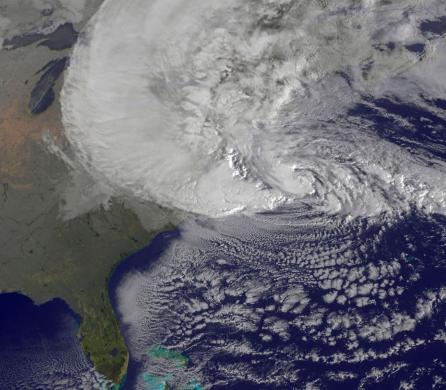
I guess it’s no surprise that most of the news media coverage of Hurricane Sandy was focused on the immediate — when you have six million people without power and transit systems paralyzed and at least 38 deaths, you deal with that stuff first. There will be plenty of time later to talk about causes and preparadness and what to do next time.

But I expected a little more mainstream coverage of the clear and obvious fact that this storm — and the many more severe storms that are likely to follow in places that aren’t used to seeing this type of weather — is the result of climate change caused by humans. 

The scientists — at least, all but the looney ones — are not in denial. The oceans are warmer than they were 20 years ago, and the warm water extends farther north. Warmer oceans mean more, and stornger, hurricanes:

Scientists have long taken a similarly cautious stance, but more are starting to drop the caveat and link climate change directly to intense storms and other extreme weather events, such as the warm 2012 winter in the eastern U.S. and the frigid one in Europe at the same time.

There have been three presidential debates. Both candidates have suspended campaigning because of Sandy. Mitt Romney’s out collecting cans of food that the Red Cross doesn’t want.But at no point in this campaign has climate change been a serious issue.

Maybe people will start paying attention now. Maybe a $20 billion hit to the heavily populated East Coast areas where the heart of the nation’s banking and politics business are will wake up the White House and Congress. Because this ship has sailed — the damage already done is serious and can’t easily be repaired. And preventing serious from becoming catastrophic is now our only option, and we’re running out of time.

Most of Manhattan and Long Island is less than two feet about sea level. Unless you’re going to build massive dikes around both of them, those places are going to be worse off than south Florida in a few years. Sandy was a Category 1 when it hit the Jersey shore; in a few years, that region is going to be dealing with Category 3 and 4 storms and the flooding will be devastating.

Can we please talk about this?

Dick Meister: A Halloween invasion from Mars!

0

By Dick Meister

Dick Meister is a longtime San Francisco-based journalist and writer. Contact him through his website,  www.dickmeister.com

“2X2L calling CQ … 2X2L calling CQ, New York…. Isn’t there anyone on the air?  Isn’t there anyone on the air?  Isn’t there anyone?

Millions of Americans – panic-stricken, many of them – waited anxiously for a response to the message, delivered over the CBS radio network in slow flat, mournful tones on a crisp Halloween eve. It was Oct. 30, 1938.

“Isn’t … there … anyone?”

There wasn’t. Listeners heard only the slapping sounds of the Hudson River.

Many of New York’s residents were dead.  The others had fled in panic from “five great machines,” as tall as the tallest of the city’s skyscrapers, that the radio announcer had described in the last words he would ever utter. The metallic monsters had crossed the Hudson “like a man wading a brook,” destroying all who stood in their way.

“Our army is wiped out, artillery, air force – everything wiped out,” gasped the announcer.

It was the War of the Worlds, Mars versus Earth, and the Martians were winning with horrifying ease. Their giant machines had landed in the New Jersey village of Grovers Mill, and soon they would be coming to your town, too – and yours … and yours.  Nothing could stop them.

The War of the Worlds had sprung with frightening clarity from the extremely fertile imagination of Orson Welles and the other young members of the Mercury Theater of the Air who adopted H.G. Wells’ novel of that name and dramatized it so brilliantly – and believably – from the CBS radio studios on that long ago Halloween eve.

Their use of realistic sounding bulletins and other tools of radio news departments made it sound as if Martian machines truly were everywhere, and everywhere invincible.

Studies done at the time show that at least one million of the program’s estimated six million listeners panicked.

“People all over the United States were praying, crying, fleeing frantically to escape death from the Martians,” noted Hadley Cantril, an actual Princeton professor who directed the most detailed study of the panic that was caused in part by the pronouncements of “Richard Pierson,” a bogus Princeton professor played by Welles.

“Some ran to rescue loved ones. Others telephoned farewells or warnings, hurried to inform neighbors … summoned ambulances and police cars…. For weeks after the broadcast, newspapers carried human interest stories relating the shock and terror of local citizens.”

“When the Martians started coming north from Trenton we really got scared,” a New Jerseyian told one of Professor Cantril’s interviewers. “They would soon be in our town. I drove right through Newberg and never even knew I went through it … I was going eighty miles an hour most of the way. I remember not giving a damn, as what difference did it make which way I’d get killed.”

Those who didn’t join the streams of cars that clogged the highways clogged the phone lines or huddled in cellars and living rooms to await the end, some with pitchfork, shotgun or Bible in hand.

“I knew it was something terrible and I was frightened,” a woman recalled. “When they told us what road to take, and to get up over the hills, and the children began to cry, the family decided to go. We took blankets and my granddaughter wanted to take the cat and the canary.”

It was an extremely rare occurrence, as Cantril noted:  “Probably never before have so many people in all walks of life and in all parts of the country become so suddenly and so intensely disturbed.”

And never since then has the country experienced such deep and widespread fear and anxiety. Not even after Japan’s surprise attack on Pearl Harbor three years later. Not even in the wake of the terrorist attacks of Sept. 11, 2001.   It was a unique display of widespread panic. Many people actually believed their very world was coming to an end and there was nothing anyone could do to stop it.

Welles had made clear at the start that the presentation was fictional. But radio listeners generally paid little attention to opening announcements, and many Sunday night listeners commonly turned first to the very popular Edgar Bergen-Charley McCarthy show that was broadcast over another network in the same 8 p.m. time slot, turning to the Mercury Theater out of curiosity only later.

What they heard that Sunday Halloween eve were primarily news reports and commentaries ingeniously patterned on the real reports and commentaries that were constantly interrupting programs to report the aggressive actions of Nazi Germany and other events that would shortly lead to the outbreak of World War II.

People expected to hear the worst. Most also expected that what they heard would be accurate, radio having supplanted newspapers as the most trusted and relied upon of the mass media.

It helped, too, that much of the information was presented by “experts” – Welles and other make-believe professors from universities around the world, supposed astronomers, army officers and Red Cross officials, even the otherwise unidentified “Secretary of the Interior.”

“I believed the broadcast as soon as I heard the professor from Princeton and the officials in Washington,” as one listener recalled.

Even relatively sophisticated and well-informed listeners were fooled by what Cantril cited as the program’s “sheer dramatic excellence.”

Events developed slowly, starting with the relatively credible – brief news bulletins calmly reporting some “atmospheric disturbances,” later some “explosions of incandescent gas,” and finally the discovery of what appeared to be a large meteorite. Only then came the incredible – the discovery that the “meteorite” was a Martian spaceship, reported in a halting, incredulous manner by the “reporter” supposedly broadcasting live from Grovers Mill.

The police, the New Jersey State Guard, the army – none could subdue the invaders. Finally, the “secretary of the interior” announced that man could do no more, that the only hope for deliverance from the Martians was to ”place our faith in God.”

Few listeners were in a position to make independent judgments about matters Martian. Few knew astronomy, and what standard does one use to judge an invasion from Mars anyway?

Listeners could easily have turned to other radio networks for the truth, of course, but many were too caught up in the masterful drama of the CBS program to think of that.

Even some people who lived near the alleged invasion site were fooled. “I looked out the window and everything was the same as usual,” said one, “so I thought it hadn’t reached our section yet.”

The second half of the hour-long broadcast, with “Professor Pierson” wandering dazedly through the deserted and ravaged streets of New York, should have made it obvious to even the most gullible that they had been listening to drama rather than news. At the program’s end, Welles, shocked and shaken by the listener response,  quickly voiced an ad-libbed assurance that it had all been make-believe.

But by then, many people had left their radios. They had other ways in which to spend their last hours on Earth.

Dick Meister is a longtime San Francisco-based journalist and writer. Contact him through his website,  www.dickmeister.com

Paul Addis, playwright and Burning Man arsonist, dies

55

UPDATED Paul Addis – the San Francisco playwright and performer best known for igniting Burning Man’s eponymous central symbol early in the 2007 event, a crime for which he served two years in a Nevada prison – died Saturday night after jumping in front of a BART train in Embarcadero station. He was 42.

His friend Amacker Bullwinkle told us she was shocked and saddened by the news, first reported by the SF Appeal and confirmed to us by the San Francisco Medical Examiner’s Office, which contacted Addis’ mother. Bullwinkle said she wasn’t sure if there was a suicide note, but given his prolific writings, “I can’t imagine he wouldn’t want to write something.”

After Addis was released from prison in 2010, he came to the Guardian for a three-hour interview to discuss how and why he torched the Man during a Monday night lunar eclipse, another pair of bizarre arrests that followed, and the San Francisco debut of latest one-man play, Dystopian Veneer, which he wrote in prison. That interview was the basis of two Guardian articles and an extended telling of his story in my book, The Tribes of Burning Man, which also draws from an earlier interview with Addis.

“It’s a brand new life and I’ve got all this potential and I want to make the most out of it,” Addis told me in a hopeful moment. But he was also clearly a troubled soul, deeply unhappy with what Burning Man and San Francisco had become and resentful of the role that Burning Man organizers played in supporting his prosecution.

But his frustrations seemed to stem from a desire shake up the city and Burning Man, an event that was personally transformative for him, “to bring back that level of unpredictable excitement, that verve, that ‘what’s going to happen next?’ feeling, because it had gotten orchestrated and scripted.”

Services for Addis are pending.

UPDATE 11/2: Sup. John Avalos adjourned this week’s Board of Supervisors meeting in the memory of Paul Addis and made the following comments about him:

·        Addis was a San Francisco performance artist and playwright who was best known from 2007’s Burning Man when he lit the Man on fire.
·        Addis wrote and performed several one-man plays, including Dystopian Veneerand Gonzo, A Brutal Chrysalis.
·        After years of struggling with mental health issues, Addis took his own life the past weekend. He was forty-two.
·        Addis’ controversial act was viewed by some as a dangerous act of arson and by others as a subversive protest of how Burning Man had strayed from its core principles.
·        Addis served two years in a Nevada prison for burning the Man.
·        On this day when we’re commemorating Mental Health Awareness month, I think it’s appropriate to recognize the loss of Paul Addis, and recognize how our mental health and criminal justice systems failed him, and how they fail so many others who struggle with mental health issues.


The Clear and Present Danger to Prop. 30 (and all of us)

36

This is suddenly getting serious, very serious. A secretive super PCA out of Arizona, where all bad things seem to originate, just put $11 million into a No on 30/Yes on 32 operation, and while it’s likely not enough to pass 32, which is trailing pretty far behind in the polls — and might actually benefit from news that a group allegedly pushing for campaign transparency is living off shadowy money, the money’s already hurting 30.

Let us remember: If Prop. 30 goes down, the state goes off a fiscal cliff. Schools get his with cuts so brutal that the school year my have to be cut by a couple of weeks or more. The University of California and California State University systems will cease to function in anything remotely resembling their current state, which is already a disaster. Cities and counties will get hit, social services will suffer, more parks will close — it’s almost too awful to think about.

I didn’t write Prop. 30; I would have left out the sales tax and hiked the rate even more on the wealthiest. But it’s a compromise deal, and it’s not only good for the state it’s absolutely essential. And the Big Boys out of the state of Joe Arpaio are trying to undermine it.

Add that in to Molly Munger’s unconscionable efforts to take down Prop. 30 (at this point, it seems like nothing but sour grapes since her Prop. 38 is clearly going to lose) and you have a recipe for disaster.

Look, we all know Obama’s going to win California, and some of us don’t have a contested supervisorial election. But there’s lots of stuff on the local ballot that matters — and if Prop. 30 goes down, nothing else is going to matter because (unless by some miracle the Dems get a two-thirds majority in both houses and can pass other taxes) this state’s going down the tubes.

So go vote Yes on 30. Vote yes on 38, too, if you want, although a lot of people are mad enough at Munger to vote no. But 30 is the one that matters. Vote early and often.


CELLSpace becomes Inner Mission

1

steve@sfbg.com

For the last 17 years, CELLspace has been a hub for unique cultural, artistic, and community events in the heart of the Mission. The bad news is that CELLspace is losing its lease, but the good news is it’s being taken over by creative, resourceful people from its community who plan maintain and expand its mission.

In the process, CELLspace is undergoing a renovation and, beginning in early December, getting a new name: Inner Mission.

"We’re calling it an evolution, and we’re trying to hold to that because the CELLspace has an important history and community," says Eric Reid, one of the four new owners. "We’re drawing from a well that we didn’t dig, so we’re trying to keep the neighborhood involved."

So Inner Mission will continue to offer community-based classes such as tango, Aztec dance, and yoga; and evening gatherings by community groups. But along with its recently upgraded sound and lighting systems and well-done new bar, Inner Mission will draw from the creative projects of its new owners and become a nightclub available to host events by outside promoters.

Reid (who sometimes dons clown makeup as his alter ego Manaze) runs Mad Cap Productions, while co-owner Adrian Zelkski runs New Earth Music, co-owner Zach Carson directs the Sustainable Living Road Show, and co-owner Mike Gaines heads the Vau de Vire Society (see "Cue the clowns," 12/3/08), which has been rehearsing and performing at CELLspace in recent years.

"We want to be a constantly throbbing venue as far as the art is concerned, a place for people to explore their creativity," Gaines told us. "We’ve always had the intention of opening up a venue for ourselves, and we want to really accommodate the community as well."

They plan to activate the space for longer hours, including more active curation of the art gallery space in the front of the venue and adding a daytime smoothie and kombucha bar, while also making the overall venue a better nightclub with more regular events — including experimental dinner theater that Reid is excited about producing — rather than the isolated special events that CELLspace has generally done.

While Inner Mission won’t have the nonprofit designation that CELLspace does, the new owners have incorporated as a Certified B Corporation, or Benefit Corporation, a new designation that carries the expectation of greater environmental sustainability, stronger worker protections, and returning more profits and benefits to the community.

"We are going to be the first B Corporation nightclub in the country," Reid said. "We think this is the way things are going."

Gaines also cited the work that Carson does with Sustainable Living Road Show — entertainers and educators in an "old timey carnival road show" that tour in renewable fuel vehicles to teach sustainability — as a key part of their new ethos.

The stated mission of CELLspace is "to provide a safe and supportive public environment for the exploration of art, education, performance and community building. Through cooperative relationships, CELLspace encourages the celebration of intergenerational, cross-cultural collaborations and the promotion of social justice."

Reid and Gaines say they are committed to that same mission even as they seek to make the space more vibrant and accessible, and with a greater focus on the emerging new global consciousness.
Sup. David Campos, who represents the Mission, said CELLspace is an important community institution and he’s happy to hear the new owners plan to continue its current programming. "It sounds like it’s a positive thing, we’ll reach out to them and get more specifics and see how we can work with them."

Life-and-death decision

7

news@sfbg.com

Proposition 34, the initiative to end the death penalty in California, is trailing in the polls, but proponents are focusing on a surprisingly large voting block that could still put it over the top: undecided voters.

“Anything can happen on Election Day,” said Natasha Minsker, campaign manager for Yes on 34. “I think what this election comes down to is who’s able to reach the undecided voter.”

The Los Angeles Times reports the race is 38-51 against the measure, while the Field Poll survey has it at 42-45 against. Both polls report that 11-13 percent of voters were undecided, and a more recent poll conducted by SurveyUSA shows the undecided vote may have grown to 20 percent.

Those large numbers, with less than two weeks until the election, raise an interesting and troubling question: on a decision as serious as whether we allow the state to kill someone in our name — a practice that is as costly to state finances as it may be to our very souls — why have so many voters failed to form an opinion?

REACHING VOTERS

Leading the charge to win over these ambivalent voters is a coalition of justice organizations, supported by prominent individuals and groups such as the American Civil Liberties Union (ACLU) and Amnesty International.

The campaign has raised more than $6 million in less than a year, outspending the opposition 35-to-1. Minsker told us the campaign is focusing hard on undecided minority voters, devoting most of its resources to an area they believe will help them win.

“We have more of a focus on young Latino, Asian, and African American voters, specifically in LA County,” she said. “These are voters who, once they hear about the facts of the proposition, they vote for it.”

Prop. 34 would replace California’s death penalty with a maximum sentence of life in prison with no chance of parole. The proposition would also make convicted felons work to pay restitution to their victims’ families.

The Field Poll reports that of all the regions surveyed, Los Angeles County contains the highest percentage of undecided voters, at 17 percent. Once voters learn that executions don’t prevent murders (numerous studies show it doesn’t act as a deterrent to crime) or save money (life-in-prison is cheaper than housing someone on Death Row and hearing legal appeals), support for capital punishment falls.

The Field Poll reports that 15 percent of voters aged18-39 are undecided, while minority voters (Latino, Asian and African American) contain even higher rates of undecided voters, ranging from 16-19 percent, higher than undecided white voters, at 11 percent.

Unlike on many liberal-leaning campaigns, this one also has strong support from the Catholic Church.

“The energy the Catholic community has brought to the initiative has been fantastic,” Minsker said. “It is certainly one of the few issues to bring together the ACLU and the Catholic Church, but it’s just wonderful to see.”

But in order for the proposition to pass, undecided voters must decide soon.

Field Poll Director Mark Dicamillo said that at this stage in the contest, the team that is leading in the polls usually wins.

“In our experience, with [two] weeks left, undecided voters usually vote no, if they haven’t figured out where they stand yet,” he said.

But Jeanne Woodford, executive director of Death Penalty Focus, a nonprofit group dedicated to educating the public about capital punishment, says these undecided voters are taking their time to get the facts straight before they decide.

“I think that [undecided voters] are very thoughtful voters who are not going to vote on this issue from a moral perspective,” she said. “Those are voters who are going to want to know the facts.”

DECIDING ISSUES

With the election just around the corner, why are so many “thoughtful voters” still undecided about ending the death penalty?

UC Berkeley Public Policy Professor Bruce Cain attributes the undecided electorate to the state’s inconsistency toward capital punishment.

“Historically, the state of California has flipped on its [death penalty] policy,” he said. “My guess is that it is a little bit hard for voters to navigate through now.”

But at a time when California is in a fiscal crisis and federal judges have ordered the state to substantially reduce the population in its overcrowded prison system, Prop. 34 proponents have been making fiscal arguments more than moral ones.

According to the state’s Legislative Analyst’s Office, ending the Death Penalty would save taxpayers $130 million a year, and set aside a $100 million annual fund for law enforcement agencies to use in solving homicide and rape cases.

Prop 36, reform of the harsh Three Strikes and You’re Out law, is the other big sentencing reform initiative on the ballot. Prop 36 would save taxpayers about $100 million a year, yet it is a 3-1 favorite in the polls, a stark contrast to Prop 34.

“The death penalty has been overshadowed by the Three Strikes prop, and that’s possibly another aspect of the undecided voters,” Cain said. “But remember people that are undecided at the end are the people that only get information from their TV.”

That’s something that Yes on 34 is well aware of and about to address.

The campaign has reported spending more than $3 million since July producing television and cable ads, which are launching this week.

“You’ll be seeing TV and radio which will provide much more information to the public, and when they have that information, the facts speak for themselves,” Woodford said.

But No of 34 campaign has fear and emotional arguments on its side. Spokesperson Peter Demarco told us, “Prop 34 isn’t about saving money. It’s the centerpiece of the liberal ACLU’s agenda to weaken California’s public safety laws.”

Cain thinks Prop 34 has a chance, but the real test is yet to come.

“If indeed the no people plan to throw money into this and really land some hard-hitting emotional ads, then you could see voters being moved dramatically,” he said. “If people see these emotional ads and don’t move, then that tells you that the electorate has changed.”

LONG ROAD

Executions in California go back to its earliest settlements, and it was first authorized in the state’s penal code in 1872.

In 1972, the California Supreme Court ruled the death penalty cruel and unusual punishment in violation of the state’s constitution, commuting more than 100 death sentences to life in the prison without the possibility of parole.

Cain says that during the 1970s and ’80s, when California’s rising crime rate was making big news, the public began to embrace capital punishment.

“There were more violent murders, there was crack cocaine, there was a sense that people were going way over the line, and it was very much a moral issue,” he said.

In 1977, the California Legislature re-enacted the death penalty in first-degree murders only. In 1978, California voters broadened the number of crimes eligible for the death penalty. But polls show the pendulum swinging back.

“We haven’t seen a vote like this to abolish the death penalty in about 40 years,” said Richard Dieter, executive director of Death Penalty Information Center. “Just the fact that it’s happening is indicative to the growing skepticism toward the death penalty.”

The number of countries that have abolished the death penalty has doubled to more than 120 the past 25 years. In the US, Connecticut recently became the 17th state to abolish the death penalty, not including the District of Columbia. Will California be next?

“Ten years ago, it was 70-30 against ending the death penalty in California, but that’s changed and it’s closer now. The information is going to make a difference for undecided voters,” said Dieter.

Among that information, Minsker said, is the fact that “with the death penalty, we sometimes sentence innocent people.”

The University of Michigan Law School and the Center on Wrongful Convictions at Northwestern University School of Law reports that in the last 23 years, more than 2,000 people convicted of serious crimes were exonerated in the US.

The Innocence Project, which assists prisoners using DNA testing, found that 18 people previously sentenced to death in the US have been exonerated.

“We have learned that innocent people have been sentenced to death,” said Innocence Project Policy Director Stephen Saloom. “States are increasingly abolishing the death penalty because it’s just not worth it.” According to the Death Penalty Information Center, since 1978 California has executed 13 out of 725 death row inmates, costing California taxpayers $4 billion. “It’s not worth keeping this lengthy, costly process any longer,” Saloom said, “and I think people are more likely to see that it’s not a very good government program.”

Appetite: Tasting spirits

0

An array of new liquor tastes, and a Whiskyfest recap

NAVY STRENGTH GIN REACHES US SHORES

Unforgettable: my journey to the south of England town of Plymouth and its legendary distillery with Master Distiller Sean Harrison. Possibly the most beautiful distillery I’ve yet visited. I relished drinking Plymouth Navy Strength ($34.99) while in the UK, a bracing version of their classic gin at 57% ABV/114 proof, the preferred gin of the British Royal Navy.

Though still smooth like Plymouth gin, Navy Strength packs a greater botanical punch, enlivening cocktails. The good news is it finally arrived to the US merely weeks ago in September so drink up.

It’s radiant in a classic Pink Gin (2 parts Plymouth Navy Strength, 3-4 dashes of Angostura bitters, lemon twist to garnish), which I enjoyed in the hills above Plymouth made by Harrison using fresh drops of reservoir water from the reservoir we enjoyed tea alongside.

www.plymouthgin.com

RECAPPING WHISKYFEST 2012

This year’s WhiskyFest was another memorable one. The hilarious Martin Daraz of Highland Park and the uber cool Beer Chicks, Christina Perozzi and Hallie Beaune (their book, The Naked Brewer, just released), killed it with their laughter-packed seminar. There wasn’t enough room for all who wanted to attend their tasting pairing Highland Park whiskies, all the way up to the glorious 30 year, with well-chosen craft beers selected by the Beer Chicks – a number of pairings went shockingly well together. This seminar should definitely return next year, giving all those who missed it a chance to partake of the joys.

Digging further into the independent distillery line of BenRiach whiskies with international Brand Ambassador Stewart Buchanan was a highlight, whether the affordable steal of 10 year Curiositas, a robust, elegant 1995 Pedro Ximenez Cask #7165 (at cask strength, 52.3%) or the otherworldly, perfectly balanced 25 yr. The BenRiach line is a nuanced alternative to an Islay Scotch. Though peaty, these whiskies corner balance, letting the peat shine alongside other layers.

On the American side, the standout was St. George’s 30th Anniversary XXX Single Malt Blend, a layered blend of whiskies from three generations of St. George distillers, Jörg Rupf, Lance Winters, Dave Smith. This new release (only 715 bottles) is a rare blend of whiskies: Winters’ first single malt distillation, his 1999 single malt aged in Rupf’s pear brandy barrels, a small portion of Lot 12 whiskey, and a whiskey distilled in 2007, aged in a port cask made of French oak. Pear notes shine in this bright whiskey as does ginger, butter, banana, hazelnut and orange peel.

Another Scotch standout was Classic Malts’ Glen Spey 21 year, a limited edition whisky maintaining a lively profile in spite of age from bourbon casks with notes of coconut, caramel, toffee.

THE FIRST SF CRAFT SPIRITS CARNIVAL

Held this past weekend in the massive Fort Mason, the first SF Craft Spirits Carnival was yet another opportunity for the consumer and industry to sample a wide range of international spirits. Though burlesque felt off in the middle of the vast space, acrobatics were more in line as we explored a US craft spirits-heavy selection with a good mix of Scotch, tequila, rum and the like from around the globe surrounded by gorgeous Bay and Golden Gate Bridge views.

While a number of my usual favorites were there (Highland Park, St. George, Old World Spirits, Charbay, Rhum Clement), there were quite a few new releases to taste. Charbay started importing beloved Tapatio tequila earlier this year, one of the best values out there for quality tequila, and at the Carnival, poured Tapatio’s just-imported Reposado and Anejo tequilas. Finally in the States, both are green, bright beauties thankfully allowing the agave to dominate over barrel wood.

Local distiller Don Pilar just released a refined Extra Anejo (aged a minimum of three years). Though I am typically not a big Extra Anejo – or sometimes even Anejo – fan when it masks agave properties with too much oak, Don Pilar manages complexity with agave liveliness.

Greenbar Collective’s http://www.greenbar.biz/ (aka Modern Spirits) spiced rum ($30) from downtown Los Angeles could have been too sweet – as their fruit liqueurs were for me – but the spiced rum is subtle, nearly dry, aromatic with allspice, clove, cinnamon, vanilla, and orange zest, redolent of fall.

Michter’s from Kentucky (I’ve long appreciated their 10 year bourbon and their rye) poured their two brand new releases out this month, a decent Sour Mash (86.6%) aged over 4 years, mixable more than sippable, and a robust, cask strength (114.2%) 20 year single barrel bourbon, aged over 20 years with a definite rye spice, although they can’t disclose any information whatsoever on the grain make-up or distilling location.

The tasting highlight of the weekend belonged to Rhum Clément. Already a fan of their elegant rhum agricoles from Martinique, I was pleased to see they just released a fresh, smoky 6 year old ($56), and a cinnamon, wood, vanilla-inflected 10 year old ($73), both aged in virgin and re-charred oak.

In addition, Rhum Cément Cuvee Homere is aged in French Limousin barriques and re-charred bourbon barrels, smooth with tastes of biscuits, almond butter, hazelnut, chocolate, black pepper, while the stately, pricey Clément XO Rhum, is a Cognac-reminiscent treat blending rhums from highly regarded vintages, like 1952, 1970, 1976, complex with fruitcake, toffee, tobacco, leather. My favorite ended up being a cask strength (though still reasonable under 100 proof) 10 year old Rhum J.M. Millesime 1997, unfolding with toasted nut, lemon, sage, passion fruit, white pepper, cinnamon.

Subscribe to Virgina’s twice-monthly newsletter, The Perfect Spot, www.theperfectspotsf.com

Stage Listings

0

Stage listings are compiled by Guardian staff. Performance times may change; call venues to confirm. Reviewers are Robert Avila, Rita Felciano, and Nicole Gluckstern. Submit items for the listings at listings@sfbg.com. For further information on how to submit items for the listings, see Picks.

THEATER

OPENING

And That’s What Little Girls Are Made Of Tides Theatre, 533 Sutter, SF; www.whatgirlsaremadeof.com. $20-30. Opens Thu/19, 8pm. Runs Thu-Sat, 8pm; Sun, 2pm. Through Nov 4. Jennifer Wilson’s multimedia play chronicles her attempts to break into the male-dominated world of venture capital funds.

Fat Pig Boxcar Theatre Studio, 125A Hyde, SF; www.brownpapertickets.com. $20. Opens Thu/18, 8pm. Runs Thu-Sat, 8pm. Through Nov 10. Theater Toda presents Neil LaBute’s dark comedy about a man who faces scrutiny from his friends when he falls for a plus-sized woman.

Fierce Love: Stories From Black Gay Life New Conservatory Theatre Center, 25 Van Ness, SF; www.nctcsf.org. $25-37. Previews Wed/17-Thu/18, 8pm. Opens Fri/19, 8pm. Runs Wed-Sat, 8pm; Sun, 2pm. Through Oct 28. Pomo Afro Homos performs a revival of of its 1991 hit about the struggles of African American gay men in America.

BAY AREA

Richard III Live Oak Theatre, 1301 Shattuck, Berk; www.aeofberkeley.org. $12-15. Opens Fri/19, 8pm. Runs Fri-Sat, 8pm. Through Nov 17. Actors Ensemble of Berkeley performs the Shakespeare classic.

Within the Wheel Live Oak Park, 1301 Shattuck, Berk; www.raggedwing.org. Free. Previews Wed/17, 6pm. Opens Thu/18, 6pm. Runs Thu-Sat, 6pm (last entry 7:30pm; special Halloween show Oct 31). Through Nov 3. Ragged Wing Ensemble presents an immersive performance experience inspired by the Tibetan Book of the Dead.

ONGOING

Bound By Blood Boxcar Theatre Playhouse, 505 Natoma, SF; www.ianiroproductions.com. $20. Thu-Sat, 8pm. Through Oct 27. Opening on the heels of ACT’s production of The Normal Heart, local theater-maker Eric Inman’s Bound By Blood also explores the devastating human fallout of the AIDS crisis as experienced by the two families — one of blood relations and one of chosen friends — of a young gay man, whose death affects them all. Appearing onstage both as a ghost and in a series of flashbacks, Justin Walker (played by Inman) deals with his fear of dying by ditching his meds in favor of drink, and his fear of coming out to his conservative family by postponing the inevitable until it’s too late, leaving his friends holding the burden of his inconvenient truth in their unwilling hands. Awkward moments abound as Justin’s buddies ponder the ethics of outing him posthumously, as his mother (Sally Hogarty) and sister (CC Sheldon) bicker incessantly and his erstwhile "beard" Alice (Abigail Edber) pluckily spearheads the funeral planning. This is Inman’s first full-length play, which helps to explain the often-clunky dialogue and under-developed characters that unfortunately obscure the play’s dramatic potential, but the ideals he champions within — tolerance, self-acceptance, integrity, loyalty, love — are ones well worth exploring, even imperfectly. (Gluckstern)

Elect to Laugh Marsh San Francisco, 1062 Valencia, SF; www.themarsh.org. Tue, 8pm. Through Nov 6. $15-50. Veteran political comedian Will Durst emphasizes he’s watching the news and keeping track of the presidential race "so you don’t have to." No kidding, it sounds like brutal work for anyone other than a professional comedian — for whom alone it must be Willy Wonka’s edible Eden of delicious material. Durst deserves thanks for ingesting this material and converting it into funny, but between the ingesting and out-jesting there’s the risk of turning too palatable what amounts to a deeply offensive excuse for a democratic process, as we once again hurtle and are herded toward another election-year November, with its attendant massive anticlimax and hangover already so close you can touch them. Durst knows his politics and comedy backwards and forwards, and the evolving show, which pops up at the Marsh every Tuesday in the run-up to election night, offers consistent laughs born on his breezy, infectious delivery. One just wishes there were some alternative political universe that also made itself known alongside the deft two-party sportscasting. (Avila)

The Fifth Element: Live! Dark Room Theater, 2263 Mission, SF; www.darkroomsf.com. Fri-Sat, 8pm. Through Oct 27. Comedic adaptation of the 1997 Luc Besson sci-fi epic.

Foodies! The Musical Shelton Theater, 533 Sutter, SF; www.foodiesthemusical.com. $30-34. Fri-Sat, 8pm (no show Nov 17). Open-ended. AWAT Productions presents Morris Bobrow’s musical comedy revue all about food.

Geezer Marsh San Francisco, 1062 Valencia, SF; www.themarsh.org. $30-100. Sat, 8pm; Sun, 7pm. Through Nov 18. Geoff Hoyle’s popular solo show about aging returns.

Love in the Time of Zombies Café Royale, 800 Post, SF; sftheaterpub.wordpress.com. Free ($5 donation suggested). Mon-Tue, 8pm. Through Oct 30. San Francisco Theater Pub performs Kirk Shimano’s "rom-zom-com."

Of Thee I Sing Eureka Theatre, 215 Jackson, SF; www.42ndstmoon.org. $25-75. Wed, 7pm; Thu-Fri, 8pm; Sat, 6pm; Sun, 3pm. Through Oct 21. 42nd Street Moon performs George and Ira Gershwin’s classic political satire.

The Real Americans Marsh San Francisco, 1062 Valencia, SF; www.themarsh.org. $25-50. Fri, 8pm; Sat, 8:30pm. Extended through Oct 27. Dan Hoyle’s hit show, inspired by the people and places he encountered during his 100-day road trip across America in 2009, continues.

Roseanne: Live! Rebel, 1760 Market, SF; www.brownpapertickets.com. $25. Wed, 7 and 9pm (no shows Oct 31). Through Nov 14. Lady Bear, Heklina, D’Arcy Drollinger, and more star in this tribute to the long-running sitcom.

The Scotland Company Exit Theatre, 156 Eddy, SF; www.thunderbirdtheatre.com. $15-25. Thu-Sat, 8pm; Sun, 3pm. Through Oct 27. Thunderbird Theatre Company performs Jake Rosenberg’s new comedy.

Shocktoberfest 13: The Bride of Death Hypnodrome, 575 10th St, SF; www.thrillpeddlers.com. $25-35. Thu-Sat, 8pm. Through Nov 17. Thrillpeddlers’ seasonal assortment of yeasty Grand Guignol playlets is a mixed bag of treats, but it all goes so nicely with the autumnal slink into early nights and dark cravings. Fredrick Whitney’s Coals of Fire is lightly amusing, if far from smoking, as a two-hander about a blind older matron (Leigh Crow) who discovers her young companion (Zelda Koznofski, alternating nights with Nancy French) has been secretly schtupping her husband. I’m a Mummy is a short, not very effective musical interlude by Douglas Byng, featuring the bright pair of Jim Jeske and Annie Larson as Mr. and Mrs., respectively. The titular feature, The Bride of Death, written by Michael Phillis and directed by Russell Blackwood, proves a worthy centerpiece, unfolding an intriguing, well-acted tale about a reporter (Phillis) and his photographer (Flynn DeMarco) arriving at a stormy castle to interview a strangely youthful Grand Guignol stage star (Bonni Suval) making her film debut. After another, this time more rousing musical number, Those Beautiful Ghouls (with music and lyrics by Scrumbly Koldewyn; directed and choreographed by D’Arcy Drollinger), comes the evening’s real high point, The Twisted Pair by Rob Keefe, acted to the bloody hilt by leads Blackwood and DeMarco as the titular duo of scientists driven mad by an experimental batch of ‘crazy’ glue. All of it comes capped, of course, by the company’s signature lights-out spook show. (Avila)

"Strindberg Cycle: The Chamber Plays in Rep" Exit on Taylor, 277 Taylor, SF; www.cuttingball.com. $10-50 (festival pass, $75). Previews Oct 25, 7:30pm and Oct 26, 8pm (part two); Nov 1, 7:30pm and Nov 2, 8pm (part three). Opens Thu/18, 7:30pm (part one); Oct 27, 8pm (part two); and Nov 3, 8pm (part three). Runs Thu, 7:30pm; Fri-Sat, 8pm (also Sat, 2pm); Sun, 5pm. Through Nov 18. Cutting Ball performs a festival of August Strindberg in three parts: The Ghost Sonata, The Pelican and The Black Glove, and Storm and Burned House.

The Waiting Period Marsh San Francisco, 1062 Valencia, SF; www.themarsh.org. $15-50. Thu-Fri, 8pm; Sat, 5pm. Extended through Oct 27. Brian Copeland (comedian, TV and radio personality, and creator-performer of the long-running solo play Not a Genuine Black Man) returns to the Marsh with a new solo, this one based on more recent and messier events` in Copeland’s life. The play concerns an episode of severe depression in which he considered suicide, going so far as to purchase a handgun — the title coming from the legally mandatory 10-day period between purchasing and picking up the weapon, which leaves time for reflections and circumstances that ultimately prevent Copeland from pulling the trigger. A grim subject, but Copeland (with co-developer and director David Ford) ensures there’s plenty of humor as well as frank sentiment along the way. The actor peoples the opening scene in the gun store with a comically if somewhat stereotypically rugged representative of the Second Amendment, for instance, as well as an equally familiar "doood" dude at the service counter. Afterward, we follow Copeland, a just barely coping dad, home to the house recently abandoned by his wife, and through the ordinary routines that become unbearable to the clinically depressed. Copeland also recreates interviews he’s made with other survivors of suicidal depression. Telling someone about such things is vital to preventing their worst outcomes, says Copeland, and telling his own story is meant to encourage others. It’s a worthy aim but only a fitfully engaging piece, since as drama it remains thin, standing at perhaps too respectful a distance from the convoluted torment and alienation at its center. (Avila)

BAY AREA

Acid Test: The Many Incarnations of Ram Dass Marsh Berkeley, 2120 Allston, Berk; www.themarsh.org. $15-50. Thu-Fri, 8pm; Sat, 5pm. Through Nov 24. Lynne Kaufman’s new play stars Warren David Keith as the noted spiritual figure.

Assassins Ashby Stage, 1901 Ashby, Berk; www.shotgunplayers.org. $20-30. Wed-Thu, 7pm; Fri-Sat, 8pm; Sun, 5pm. Through Nov 4. Shotgun Players interrupts this season of dreary electoral debates with an important announcement about the country you live in, as the sure and provocative 1990 musical by Stephen Sondheim (music and lyrics) and John Weidman (book) stitches together American history’s odd assortment of successful and failed presidential assassins to explore the darker recesses of the national mythos. Through an eclectic score of deft period-specific songs and the narrative framework of a feverish carnival shooting gallery — overseen by a nefarious proprietor (Jeff Garrett) — a pageant of kooks and rebels parades, beginning with pioneer assassin John Wilkes Booth (an aptly imposing Galen Murphy-Hoffman). He, in turn, acts as a sort of patron saint to those that follow in his footsteps — including Charles Guiteau (Steven Hess), Leon Czolgosz (Dan Saski), Giuseppe Zangara (Aleph Ayin), John Hinckley (Danny Cozart), Sam Byck (Ryan Drummond), Sara Jane Moore (Rebecca Castelli), Squeaky Fromme (Cody Metzger), and of course Lee Harvey Oswald (Kevin Singer, in a part that doubles with that of the Balladeer). Throughout, director Susannah Martin’s strong cast and musical director David Möschler’s lively eight-piece band insure a raucous, thoughtful, and intimate American fever dream. (Avila)

An Iliad Berkeley Repertory Theatre, Roda Theatre, 2015 Addison, Berk; www.berkeleyrep.org. $14.50-77. Opens Wed/17, 8pm. Runs Tue and Thu-Sat, 8pm (also Sat, 2pm); Wed and Sun, 7pm (also Sun, 2pm). Through Nov 11. Berkeley Rep performs Lisa Peterson and Denis O’Hare’s Homer-inspired tale.

The Kipling Hotel: True Misadventures of the Electric Pink ’80s Marsh Berkeley, 2120 Allston, Berk; www.themarsh.org. $20-50. Sat, 8:30pm; Sun, 7pm. Extended through Dec 16. This new autobiographical solo show by Don Reed, writer-performer of the fine and long-running East 14th, is another slice of the artist’s journey from 1970s Oakland ghetto to comedy-circuit respectability — here via a partial debate-scholarship to UCLA. The titular Los Angeles residency hotel was where Reed lived and worked for a time in the 1980s while attending university. It’s also a rich mine of memory and material for this physically protean and charismatic comic actor, who sails through two acts of often hilarious, sometimes touching vignettes loosely structured around his time on the hotel’s young wait staff, which catered to the needs of elderly patrons who might need conversation as much as breakfast. On opening night, the episodic narrative seemed to pass through several endings before settling on one whose tidy moral was delivered with too heavy a hand, but if the piece runs a little long, it’s only the last 20 minutes that noticeably meanders. And even with some awkward bumps along the way, it’s never a dull thing watching Reed work. (Avila)

Richard the First: Part One, Part Two, Part Three Berkeley City Club, 2315 Durant, Berk; www.centralworks.org. $14-25. Opens Thu/18, 8pm (part one); Fri/19, 8pm (part two); and Sat/20, 8pm (part three). Runs Thu-Sat, 8pm; Sun, 5pm (three-part marathon Sundays, Nov 11 and 18, 2, 5, 8pm). Through Nov 18. This Central Works Method Trilogy presents a rotating schedule of three plays by Gary Graves about the king known as "the Lionheart."

Sex, Slugs and Accordion Marsh Berkeley, 2120 Allston, Berk; www.themarsh.org. $10. Wed, 8pm. Through Nov 14. Jetty Swart, a.k.a. Jet Black Pearl, stars in this "wild and exotic evening of song."

33 Variations TheatreWorks at the Mountain View Center for the Performing Arts, 500 Castro, Mtn View; www.theatreworks.org. $23-73. Tue-Wed, 7:30pm; Thu-Sat, 8pm (also Sat, 2pm); Sun, 2 and 7pm. Through Oct 28. TheatreWorks performs Moisés Kaufman’s drama about a contemporary musicologist struggling to solve one of Beethoven’s greatest mysteries, and a connecting story about the composer himself.

Topdog/Underdog Marin Theatre Company, 397 Miller, Mill Valley; www.marintheatre.org. $36-57. Wed/17, 7:30pm; Thu/18-Sat/20, 8pm (also Sat/20, 2pm); Sun/21, 2 and 7pm. Marin Theatre Company performs Suzan-Lori Parks’ Pulitzer Prize winner about a contentious pair of brothers.

The World’s Funniest Bubble Show Marsh Berkeley, 2120 Allston, Berk; www.themarsh.org. $8-50. Sun, 11am; Nov 23-25, 11am. Through Nov 25. Louis "The Amazing Bubble Man" Pearl brings his lighter-than-air show back to the Marsh.

PERFORMANCE/DANCE

Alonzo King LINES Ballet Yerba Buena Center for the Arts Theater, 700 Howard, SF; www.ybca.org. Fri/19-Sat/20 and Oct 24-27, 8pm; Sun, 5pm. Through Oct 28. The company celebrates 30 years with its fall home season.

BATS Improv Bayfront Theater, B350 Fort Mason Center, SF; www.improv.org. Fri, 8pm, through Oct 26: "This Just In!," $20. Sat, 8pm, through Oct 27: "Improvised Horror Musical," $20.

"Comedy Bodega" Esta Noche Nightclub, 3079 16th St, SF; www.comedybodega.com. Thu, 8pm. Ongoing. No cover (one drink minumum). This week: Amy Miller, Kurt Weitzmann, Martini Paratore, and Jessica Sele.

"Comikaze Lounge" Café Royale, 800 Post, SF; www.comikazelounge.com. Wed/17, 8pm. Free. Stand-up with Casey Ley and more.

"Crooked Little Hearts" Dance Mission Theater, 3316 24th St, SF; www.brownpapertickets.com. Fri/19-Sat/20, 8pm. $20. The Ananta Project’s home season includes a world premiere that uses dance to explore the nuances of human intimacy.

"Gravity (and other large things)" NOHspace, 2840 Mariposa, SF; www.performancelab.org. Fri/19-Sat/20, 8pm; Sun/21, 4pm. $12-25. Right Brain Performancelab present this evening-length dance-theater piece.

"Halloween! The Ballad of Michele Myers" CounterPULSE, 1310 Mission, SF; michelemyers2012.eventbrite.com. Fri-Sun and Oct 31, 8pm. Through Oct 31. $25. Drag superstar Raya Light returns in the seasonally-appropriate horror musical.

"The Hula Show 2012" Palace of Fine Arts, 3301 Lyon, SF; www.naheihulu.org. Sat/20 and Oct 26-27, 8pm; Sun/21 and Oct 28, 8pm (children’s matinee Oct 28, noon). $35-90. Na Lei Hulu I Ka Wekiu performs its annual show, featuring a hula satirizing President Obama’s birth certificate controversy.

"Let Us Find the Words" Contemporary Jewish Museum, 736 Mission, SF; www.thecjm.org. Thu/18, 6:30pm; Fri.19, 1pm. Free with museum admission ($5-12). Actors Dominique Frot and Alexander Muheum present a dramatic reading of letters between poets Ingeborg Bachmann and Paul Celan.

"Perverts Put Out: The Election Erection Edition" Center for Sex and Culture, 1369 Mission, SF; www.sexandculture.org. Sat/20, 7:30. $10-20. Dr. Carol Queen and Simon Sheppard host performances by Jen Cross, Greta Cristina, Gina de Vries, and more.

"San Francisco Magic Parlor" Chancellor Hotel Union Square, 433 Powell, SF; www.sfmagicparlor.com. $40. Thu-Sat, 8pm. Ongoing. Magic vignettes with conjurer and storyteller Walt Anthony.

"San Francisco Trolley Dances 2012" 925 Mission, SF; www.epiphanydance.org. Sat/20-Sun/21, tours leave at 11am, 11:45am, 12:30pm, 1:15pm, 2pm, and 2:45pm. Free with Muni fare ($2). Climb aboard Muni for a unique performance experience at this annual event presented by Kim Epifano’s Epiphany Productions.

ShadowLight Theatre St. Cyprian’s Church, 2097 Turk, SF; www.noevalleymusicseries.com. Sat/20, 8pm. $15. Balinese shadow puppet theater with live gamelan accompaniment.

"Smack Dab" Magnet, 4122 18th St, SF; www.magnetsf.org. Wed/17, 8pm. Free. Open mic featuring local authors Belo Cipriani and Jim Provenzano.

"Times Bones" Kanbar Hall, Jewish Community Center of San Francisco, 3200 California, SF; www.mjdc.org. Thu/18-Sat/20, 8pm; Sun/21, 7pm. $18-31. Margaret Jenkins Dance Company previews a new work that will premiere in 2013.

San Francisco Stories: The literary life

9

tredmond@sfbg.com

A few months before I graduated from college, a group of Distinguished Literary Figures came to my Fancy Eastern University and gave a special seminar on careers in literature. At least 150 of my classmates showed up in their $80 Frye boots and their shirts with the alligators on them and the attitudes they’d carefully honed during a life in which things pretty much went their way.

After an erudite discussion of the lofty (the philosophy of writing) and the mundane (write every day and don’t send bad photocopies of your manuscript to your publisher), one of the DLF’s asked for a show of hands: How many of you are planning a career as a writer?

Every hand in the room shot up. And I looked around and said to myself:

No you aren’t.

No, most of you people will never be writers. Because you’re too fucking happy. Because you’re all well-adjusted young men and women with real futures, who will want jobs that pay and apartments with heat and decent food and cars that start and clothes that look cool, and cappuccino that someone else makes for you, and vacations in nice places where the sun always shines.

You’ll never be writers. You don’t know enough about life.

*****

A year or so later, I was sitting in the makeshift loft of my $175-a-month illegal storefront apartment, and my fingers were so cold that I couldn’t work the cheap and nasty typewriter very well, and there wasn’t any heat and the only way to get rid of the chill was to turn on the oven, which was a very bad idea because a banged-up British motorcycle shared the concrete floor of my room with me and the gas tank leaked, not enough to spill but enough that after five or six hours the collected aromatic hydrocarbons in the air were probably enough to ignite and consume me and half the neighborhood in a cataclysmic fireball. So: we sat in the cold.

My girlfriend had left me; her cat was gone but the place was full of fleas, and I’d picked one out of my mustache that morning when I tried to shave. I was finishing a story about antinuclear protests for a magazine that would soon fold, but maybe not before I got my $200 check, and all I could think about was:

I still have a couple cold beers, and Brian Eno on the box, the toilet hadn’t overflowed yet this week — and fuck: This is about as good as it gets.

This is how young writers live.

We don’t ask for much, writers. We don’t need better iPhones or wifi at Union Square or tax breaks. What we need, and have always needed, is chaos, misery, and grit. We need places where money doesn’t rule and where everything isn’t comfortable. We need, more than anything, a kind of cheap that isn’t cool.

You go to the Salvation Army or Goodwill these days and you don’t see many writers who have day jobs as temps in the Zone buying the crummiest suits and ties they can get away with; it’s all, like, hipster fashion.

Writers need real cheap. They need $2 beers and $4 burritos and crappy places to live that cost less than you can make selling a story or two a month. They need to exist, for real, not just for fun, in a world outside the bubble — and they need a city that makes room for that to happen.

I love where I live, but it’s failing me. And I sometimes think that nobody in charge really cares.

*****

The Bay Guardian turns 46 this week. I’ve been part of it for more than half its life, since I sold my first story to the paper in 1982, a shocking expose about police harassing homeless people for sitting on the sidewalk. I got paid $50. It was a huge deal. I ran right out and bought a bottle of whiskey.

The Guardian was always more of a reporter’s paper than a writer’s paper — we wanted news, facts, information more than we wanted flair. And that’s as it should be in a newspaper. But we’ve also always appreciated the local literary scene, and have always been a place where young (and old) writers could find their voices and tell stories.

Now the paper’s under new ownership, and for our birthday, we contacted some of the best writers we could find in town and asked them to tell us their San Francisco story. What is the city’s literary narrative? What, to use a horrible cliché, do we talk about when we talk about San Francisco?

I’m not surprised that some of what we got was about rent — about the fact that nobody like us can live here anymore without rent control, that the housing crisis brought on by the latest tech boom has made it a terribly unfriendly city for writers.

But they also talked about beauty and passion and the reasons that, despite it all, we remain.

*****

One day after I’d been in San Francisco a few years, my brother called me from Boulder, Colorado, where he’d enrolled as a University of Colorado student. “I can’t stand it here,” he said. “There aren’t any fucking problems.”

Yep — everyone he saw in Boulder was rich and white and clean and educated and healthy. He dropped out pretty quickly, and went back to his America, where it’s nasty and you fight for every scrap and life sucks and then you die — but along the way, you meet the greatest people in the world and you live and love and get in some awesome kicks.

Me, I stayed in my city, a place worth fighting for.

I spent my childhood and college years in New York and Connecticut; I grew up in San Francisco. This is my place in the world, and, as the late great John D. MacDonald said of Florida, “It is where I am and where I will stay, right up to the point where the Neptune Society sprinkles me into the dilute sewage off the Fun Coast.”

And for better and for worse, San Francisco is a great story, a world of love and hope and fear and greed and all these people who wake up every morning and try to make it and the world a better place, often against the greatest possible odds.

Herb Caen said it once: “Love makes this town go ’round. Love and hate, pot and booze, despair and buckets of coffee, most of it stale.” We are strange, and we are proud, and we are freaks, and while our local politicians try to tamp us down and make us normal, the rest of the world treats us as special because of who and what we are.

We are immigrants, most of us, and we all love the city we once knew, and those of us who have been here a while are the worst kind of radicals, the ones who hate change … but inside us, inside the ones who know and care and believe, there’s a heartbeat that says: We have something special here, and part of it comes from tradition, and part of it comes from the shabby underclass side of life, from the fight against greed and landlords and smart-eyed speculators who want to charge for what San Francisco once gave away free.

And that’s a kind of style and class that doesn’t fit into anyone’s portfolio of stock options.

I can talk about policy options all night. It’s a disease you get when writing becomes journalism and the fight goes out of the pen in your hand and into the pen where the decisions that change your life get made. I could tell you a thousand ways that San Francisco can stop becoming a city of the rich and too fucking cool for words and could give a little, tiny bit of its soul to the population that made it great.

I could say that the dot.com booms that ruined so much of this city’s crazy madness would never have happened without the Beats and the Summer of Love, and that we ought to honor our ancestors — even if it means the newcomers have to do what everyone else did, and live a little lower for a while.

I could make the case that housing in San Francisco ought to be treated like a public utility, dispensed by seniority, so the folks who worked for 30 years trying to build community without making a lot of cash get priority over the ones who arrived yesterday, with gobs of money and no concept of what the people who came before them did to make this city great.

But mostly I want to say this:

It’s not pretty, being a writer. The ones who succeed are few, and the ones who fail are many, and the city’s poorer for every one who is force to give up because the city would rather have rich people than people who live on the edge.

But in my San Francisco, some people still make it. I love them all. It gives me hope.

Guess who pornographers are voting for in November

0

Surprise! It’s Obama, by a whopping 55 percentage point differential.

Porn PR conglomerator Xbiz conducted the poll of adult filmmakers (details are hazy regarding when and by what method the poll was administered), whose results says that only 13 percent of the XXX-ers asked would be voting for Mitt Romney, compared to Obama’s 68 percent.

The news here being that 13 percent of pornographers would vote for a guy who signed an anti-porn pledge and appears to be deadset on curtailing access to adult material by the “promotion of parental software controls” and “strict enforcement of our nation’s obscenity laws.”

Said Morality in the Media president Patrick Trueman in a press release, “the porn industry is flourishing because the Obama Administration has given it a green light to distribute hardcore porn to every man, woman, and child in America.

[h/t Morality in the Media (scary ones!)]

Fukushima controversies that the mainstream media ignores

11

This week, we wrote our annual analysis of the list of censored stories released by Project Censored. We wrote that “in one study that got little attention, scientists Joseph Mangano and Janette Sherman found that in the period following the Fukushima meltdowns, 14,000 more deaths than average were reported in the US, mostly among infants.”

It’s true that the study got little attention in mainstream media, with a few exceptions including coverage in Al Jazeera. It was, however, the subject of scrutiny from multiple sources.

Sherman is a physician and former advisory board member for the Environmental Protection Agency (EPA) Toxic Substances Control Act, and Mangano is an epidemiologist and public health administrator and researcher.

The debate that followed the release of their study got into important issues of the health effects of the Fukushima Daiichi nuclear disaster. Both those defending and attacking the study, and the general principle of the health impacts of nuclear energy, had their say. But all this happened outside mainstream media, and in the wake of Fukushima, mainstream media has largely ignored health implications. That’s why the story was highlighted by Project Censored, which explores stories underreported by the mainstream media, in their book Censored 2013: Dispatched from the Media Revolution.

An article by Sherman and Mangano about their research was first published in June 2011 in Counterpunch, a left-leaning political newsletter. It was criticized then. Counterpunch came back with a response from their “statistical consultant” Pierre Sprey, who found that there was an increase in infant deaths, although not as stark as the increase Sherman and Mangano found. He found that the increase was amplified by including other cities in the Pacific Northwest in the set.

An updated version of the study was published in a peer-reviewed journal, the Journal of International Health Services, in December.

Sherman and Mangano came to their conclusions by comparing deaths in a set of US cities during a 28-week period during which the meltdown occurred on March 11 to the same 28-week period in 2010. They found that in the 14 weeks before March 11, deaths were up 2.34 percent in 2011, but in the period after the Fukushima disaster, they were up by 4.46 percent. They extrapolated this data and determined a “a projected 13,983 excess U.S. deaths”

Again, the study was widely criticized. One source of critique was Michael Moyer, who wrote an article in Scientific American lambasting the study. He said that the authors cherry-picked the data they used. Moyer wrote that “No attempt is made at providing systematic error estimates, or error estimates of any kind. No attempt is made to catalog any biases that may have crept into the analysis, though a cursory look finds biases a-plenty (the authors are anti-nuclear activists unaffiliated with any research institution).”

But aside from the Scientific American article and a few other instances of mainstream coverage, the critical response to Sherman and Mangano’s story was also underreported. The people who took another look at their numbers were writing for alternative press. Websites like nuclearpoweryesplease.org, whose creators are “are convinced that nuclear power is vital to securing energy production in a sustainable way until science can provide us with a truly limitless source of power.” and atomicinsights.com, written by self-described “pro-nuclear advocate” Rod Adams.

The whole incident raises interesting questions about what constitutes mainstream media and alternative media, the value of peer-review and fact-checking, and the way that corporate interests control news stories. Almost every person who weighed in on this story was likely biased in some way, from the researchers who set out to see if there was a correlation between US deaths and the Fukushima meltdown to the pro-nuclear activists who attacked their study.

The nuclear industry has plenty of mouthpieces. The Nuclear Energy Institute, a lobbying group for nuclear companies, releases its own press statements. A blog associated with the NEI, neinuclearnotes.blogspot.com, has been a part of the online debunking frenzy surrounding Sherman and Mangano’s work.

Does being associated with the nuclear industry make critiques incorrect? In this situation, it seems clear that the refutations are credible.

It does make them suspicious, as the nuclear industry’s profits rely on the belief that nuclear energy is perfectly safe.

Mainstream news is supposed to serve as a credible and reliable source of information. But coverage of the effects of the Fukushima Daiichi disaster have been mostly left up to bloggers and activists. And Sherman and Mangano’s flawed study is far from the only outcry. In Canada, concerns were raised about radiation levels in rainwater. A series of investigations into RadNet, the EPA’s radiological detection network, found that the system suffers from maintenance and reliability issues, and may have reported false low levels of radiation in the weeks following Fukushima.

In Japan, a strong protest movement insists that they and their children aren’t safe following the meltdown. The country announced plans to phase out nuclear power by 2040 following Fukushima. Strong anti-nuclear sentiment also exists in Germany, where the government has plans to phase out nuclear energy by 2022.

In the United States, the controversy over nuclear energy rages on. The nuclear industry is a powerful corporate interest, and likely has something to do with the suppression of mainstream coverage of nuclear hazards. At the same time, corporate flaks are just as capable of creating “alternative” media sources that twist stories to reflect a pro-nuclear agenda. Of course, so are anti-nuclear advocates, who may be equally willing to ignore facts to promote their agenda.
As Censored 2013 points out, that debate is largely underreported by the mainstream media. Nuclear power may not have led to 14,000 excess deaths in the US following the Fukushima disaster. But it has certainly led to a confused circus of less than reliable sources, competing to be believed as truth, while traditional credible reporting falls away.

The rescuer

1

cheryl@sfbg.com

FILM A decade or so ago, Ben Affleck was drowning in Bennifer mania and starring in schlock like Daredevil (2003) and Gigli (2003). Rumors percolated that Affleck and Matt Damon hadn’t really written that Oscar-winning script for 1997’s Good Will Hunting — though Damon’s career was bearing more fruit at the time (see: 2002’s The Bourne Identity), the “Jenny From the Block” video was nauseating enough to make anyone question the authenticity of anything Affleck-associated up to that point.

But in 2012, it’s clear the guy who was able to balance being a Kevin Smith muse with getting pumped up to star in Armageddon (1998) was all along plotting the oldest show biz career trajectory in the book: he really wanted to direct. And thank goodness for that.

Argo opens with a vintage Warner Bros. logo and offers a quick history lesson via storyboards and old news footage. If you don’t know the particulars of the 1979 Iranian Revolution, you won’t be an expert after Argo, but the film does a good job of capturing America’s fearful reaction to the events that followed it — particularly the hostage crisis at the US embassy in Tehran. Argo zeroes in on the fate of six embassy staffers who managed to flee to the home of the sympathetic Canadian ambassador (Victor Garber).

Back in Washington, short-tempered CIA agents (including a top-notch Bryan Cranston) cast about for ways to rescue them. Most of the standby “exfil” tactics (give ’em fake identities as English teachers!) are out of the question given the political climate in Iran. Crazier ideas begin to surface. Could the staffers, uh, ride bikes to the Turkish border, maybe? Three hundred miles…in the winter?

Enter Tony Mendez (Affleck), exfil specialist and father to a youngster wrapped up in the era’s sci-fi craze (21st century Jedi will weep at the boy’s mint-condition toy collection). It’s while watching 1973’s Battle for the Planet of the Apes on TV that Tony comes up with what Cranston’s character calls “the best bad idea we have:” the CIA will fund a phony Canadian movie production (corny, intergalactic, and titled Argo) and pretend the six are part of the crew, visiting Iran for a few days on a location shoot. Tony will sneak in, deliver the necessary fake-ID documents, and escort them out. Neither his superiors, nor the six in hiding, have much faith in the idea. (“Is this the part where we say, ‘It’s so crazy it just might work?'” someone asks, beating the cliché to the punch.)

Argo never lets you forget that lives are at stake; we see the Ayatollah’s men scrambling to piece together the identities of the embassy workers even as Tony arrives in Tehran, where he observes a victim of mob justice swinging from a noose over a main street. Every painstakingly forged form, every bluff past a checkpoint official, the anxiety increases, to the point of being laid on a bit thick by the end.

The film has the benefit of being both timely (with US-Iran relations stormy as ever) and entertaining, and though it’s not a masterpiece, it’s Affleck’s best directorial effort to date. He’s capable with the secret-agent suspense stuff, and is careful not to make generalizations about the Iranians depicted in the film. But, appropriately enough given the source, Argo comes alive in its Hollywood scenes. As show-biz veterans who mull over Tony’s plan with a mix of Tinseltown cynicism and patriotic duty, John Goodman and Alan Arkin practically burst with in-joke brio. I could have watched an entire movie just about those two.

Argo is Affleck’s third film — the first not set in Boston, and the second that Affleck himself stars in. Though he cast his brother, Casey Affleck, in 2007’s Gone Baby Gone, he gave himself the lead in 2010’s The Town, a decision that ended up being one of the film’s weak links. (“Oh look,” my movie going companion pointed out during The Town‘s forced-soulful denouement. “He escaped to Beardlandia!”) But his turn in Argo is, refreshingly, more or less vanity-free — just one gratuitous shirtless scene! — a hopeful sign that Affleck the actor may finally be giving Affleck the director the upper hand.


ARGO opens Fri/12 in Bay Area theaters.

Medical marijuana is over

4

caitlin@sfbg.com

HERBWISE Hey potheads, welcome to what figures to be the last Herbwise column for the time being.

But we’ve had some good sessions together, no? Over the course of a very eventful year in marijuana, we spoke with Roseanne Barr, Black Panthers, oncologists, tax attorneys, Coral Reefer. Snoop Dogg, Fiona Apple, Pat Robertson, the president of Uruguay, and an actress from the Blair Witch Project all made our news call. They all do the weed, or support such things, and that list alone should serve as proof that cannabis has irrevocably entered the mainstream.

We went around the world to see how pot was faring in other corners. Seattle’s medical marijuana champion-DIY pop star Lisa Dank reported back from South By Southwest. I chatted with the author of medical marijuana legislation in Washington, DC, dropped in on a Berlin head shop employee, and took a walk with a small town politician up in the Marin County hills of Fairfax.

Honestly, I didn’t want to write about politics at all when we started the column. Boring! Fake! Politricks! Etcetera. But then last September, the IRS intensified its hounding of several major Bay Area dispensaries, cheating them out of perfectly reasonable tax exemptions. Then, at an October 7 press conference in Sacramento, US Attorneys let us know they were going to start being a bummer.

A year later, we’re short a whole bunch of places to get marijuana, including no less than two of the clubs I personally depended on. Hiss. Against my best intentions, current events necessitated that Herbwise focus on law and order, from time to time.

But there’s been good moments (the week I wrote Herbwise high as hell in my cubicle on Amoré, the cannabis aphrodisiac shot), just like the especially-bad moments (the week I bore the tidings that major credit card companies would no longer process sale of marijuana and that beloved local dispensary Vapor Room was closing due to threatening letters from federal agencies. That week I wrote about Lady Gaga.) I’m privileged to have been able to weigh in on a year that will surely change the future of cannabis, for better or worse.

Some words on words: I got told 800 times to not call it “pot” or “weed.” One person wrote to say “flower” was better terminology. Please don’t mix us up with the recreational users, some card carrying marijuana users told me. You’re hurting our quest to be taken seriously.

But I need my synonyms. Nah, more importantly, I think this not-mixing is the problem. Focusing the movement for increased access to cannabis on the medical marijuana industry isn’t working. Drop the pretense, I say. The notion that weed can only be prescribed by a medical professional is not just dumb, it’s also not gonna get us anywhere. The longer we stigmatize recreational users, the longer people (and by people I mean young men of color, because that’s who our racist prison system is filled with) are going to be sent to jail for a stupid reason. And less people will feel connected enough to the movement to create the kind of buzz that will eventually change public opinion. And prisonmakers and anti-drug warriors will continue to get the money that should be going to our schools and to our public library flag burning sessions where everyone is handed a pink thong to wear at the outset and ordered to chant baby-killing nursery rhymes in Spanish. Broadcast on PBS.

Obviously, I’m not saying that cannabis doesn’t have medical usages. Studies have recently emerged that suggest it stops the spread of cancer in the body, and any patient that has AIDS or another wasting, awful, strength-sapping disease can tell you that cannabis can be a literal life saver when it comes to stimulating appetite and general pain management.

But the ways in which people use cannabis are multitudinous, and the only reason it’s regulated differently than tobacco, wine, liquor, McDonald’s, and the thousand other things you can abuse out of moderation is because of government and corporate control. You smoke to relax after a hard day, you smoke to bond with friends, you smoke to have fun.

Herbwise bids you adieu. We’ll still be covering cannabis in the Guardian, of course, and like a phoenix, I’ll be rising from this spent bowl with Street Seen, a new column focusing on all the rad things happening in street art, and fashion, and other founts of alternative Bay Area culture.

Thanks for being there. Stay high.

Psychic Dream Astrology: October 10-16, 2012

0

Oct. 10-16, 2012

ARIES

March 21-April 19

This is not the time to figure your life out or to ruminate on how things came to be. Look for potential and opportunity all around you instead of wasting energy on wallowing in the past or trying to predict the future. There is much more possible than you are seeing this week, so open up your viewfinder.

TAURUS

April 20-May 20

I would never tell you to risk it all, but this week it’s a good idea to put at least a little bit on the line. Strive to be careful without being overprotective, Taurus. Your life is ready for some heartfelt action, and to pull this off you’re gonna need to be able to act in spite of your fears, no matter how pragmatic they are.

GEMINI

May 21-June 21

The secret to your success this week is in going with the flow. You are meant to put your plans aside and to affix your attention in the direction that your life is pointing you. Be willing to meet your circumstances, relationships or even health where they’re at, instead of trying to force them into someplace “better”.

CANCER

June 22-July 22

Sometimes it’s the stuff that feels like your biggest problems that turn out to be your greatest assets, Cancer. If you can get some perspective on what’s troubling you it’s likely that you’ll see opportunity developing right in front of your eyes. Don’t confuse feeling stuck with actually being trapped this week.

LEO

July 23-Aug. 22

Practice living in the moment this week, Leo. Nothing is permanent, and whether that’s good news or bad, you are meant to stop fiddling with things and just be where you’re at. Don’t let your present circumstances define you; learn from whatever you have going on, and be open to what comes next revealing itself to you.

VIRGO

Aug. 23-Sept. 22

You have to go through it to get to it. Strive to meet your demons head-on, because otherwise they will chase you down, Virgo. You’ll go farther by dealing honestly and directly with your life than by digging your heels in or throwing blame around. Get your hands dirty this week for best results.

LIBRA

Sept. 23-Oct. 22

You have to wrestle with your fears and pin them to the ground, Libra, there’s no way around it. Decide to take control of the part of your life that feels the most chaotic this week. You are capable of change but it won’t happen without a little elbow grease and a whole lot of willingness.

SCORPIO

Oct. 23-Nov. 21

No matter how engaging your relationships are and no matter what you’ve got going on, you need some downtime, Scorpio. Watch out for feeling that creepy crawly feeling that compels you to look for evidence of your life being crappy. Accept your feelings and support yourself through them this week.

SAGITTARIUS

Nov. 22-Dec. 21

Do not try to control, contain or commit to anything new this week, Sagittarius. If you are overwhelmed, the best course to take is to slow down and get a better assessment of what’s happening. If you know the nuances of where you’re at you, you will be better poised to avoid useless drama and pain.

CAPRICORN

Dec. 22-Jan. 19

Lucky you, Capricorn! This week you get to stare the things you’re oh-so-very scared of in the eyes and make them bow down to you. OK, not so much that, but you can make great headway if you deal directly with your troubles. Let your fears point you towards where you need to embody the most courage.

AQUARIUS

Jan. 20-Feb. 18

You should strive to understand what you need instead of expecting others to read your mind, or for the Universe to provide that insight, pal. Look at the places inside of yourself that you feel disconnected from your wants and intentions, Aquarius. Embody your truth without apologies this week.

PISCES

Feb. 19-March 20

Don’t panic! There’s a world of possibility and limitless options, Pisces. You should not try to fix or even make sense of things while you’re feeling anxious this week. Try to sit in whatever you’re feeling, even if it sucks. There is no escaping things, so deal with them only when you can, so you do it smartly.

Jessica Lanyadoo has been a Psychic Dreamer for 18 years. Check out her website at www.lovelanyadoo.com to contact her for an astrology or intuitive reading.


Local censored 2012

0


BEHIND THE MIRKARIMI CASE

In early January, details from the police investigation of then-Sheriff-elect Ross Mirkarimi bruising his wife’s arm during an argument were leaked to the San Francisco Chronicle and other news outlets. The key piece of evidence was a 45-second video that Mirkarimi’s wife, Eliana Lopez, made with her neighbor, Ivory Madison, displaying the bruise and saying she wanted to document the incident in case of a child custody battle. That video convinced many of Mirkarimi’s guilt, and a majority of Ethics Commissioners say they found it to be the main evidence on which Mirkarimi should be removed from office on official misconduct charges (the Board of Supervisors was scheduled to vote on Mirkarimi’s removal on Oct. 9, after Guardian press time).

But that video was only a small part of the overwhelming and expensive case that Mayor Ed Lee brought against Mirkarimi, including the more serious charges of abuse of power, witness dissuasion, and impeding a police investigation, all of which go more directly to a sheriff’s official duties. All of those charges got lots of media coverage and they helped cement the view of many San Franciscans that Mirkarimi engaged in a pattern of inappropriate behavior, rather than making a big momentary mistake. Yet most of the media coverage during the six months of Ethics Commission proceedings ignored the fact that none of the evidence that was being gathered supported those charges. Indeed, all those charges were unanimously rejected by the commission on Aug. 16, a startling rebuke of Lee’s case but one that was not highlighted in many media reports, which focused on the one charge the commission did uphold: the initial arm grab.


THE NEXT DOT-BOMB

In the late 1990s, San Francisco was in a very similar place to where it is now. The first dot-com boom was full bloom, driving the local economy and creating countless young millionaires — but also rapidly gentrifying the city and driving commercial and residential rents through the roof (great for the landlords, bad for everyone else). And then, the bubble popped, instantly erasing billions of dollars in speculative paper wealth and leaving this a changed city. The city’s working and creative classes suffered, but the political backlash gave rise to a decade with a progressive majority on the Board of Supervisors.

The era ended in 2010 when Ed Lee was appointed mayor, and he began ambitious agenda of pumping up a new dot-com bubble using tax breaks, public subsidies, and relentless official boosterism to lure more tech companies to San Francisco. Lee has been successful in his approach, in the process driving up commercial rents and housing prices. By some estimates, about 30 percent of the city’s economy is now driven by technology companies.

Yet there have been few voices in the local media raising questions about this risky, costly, and self-serving economic development strategy. The Bay Citizen did a story about Conway’s self interested advice, the New York Times did a front page story raising these issues, and San Francisco Magazine just last month did a long cover story questioning how much tech is enough. But most local media voices have been silent on the issue, and much of the damage has already been done.


OLD POWERBROKERS RETURN TO CITY HALL

More than a decade ago, then-Mayor Willie Brown and Chinatown power broker Rose Pak worked together to empower big business, corrupt local politics, and clear the path for rampant development — an approach that progressives on the Board of Supervisors repudiated and slowed from 2000-2010. But Brown, Pak, and a new generation of their allies have returned in power in City Hall, and it’s as bad as it ever was.

Many San Franciscans know of their high-profile role appointing Lee to office in early 2011. But their influence and tentacles have extended far beyond what we read in the papers and watch on television, starting in 2010 when their main political operatives David Ho and Enrique Pearce ran Jane Kim’s supervisorial campaign, beating Debra Walker, a veteran of the fights against Brown’s remaking of the city.

Now, this crew has the run of City Hall, meeting regularly with Mayor Lee and twisting the arms of supervisors on key votes. Pearce and Ho persuaded longtime progressive Christina Olague to co-chair the scandal-plagued Run Ed Run campaign last year, she was rewarded this year with Lee appointing her to the Board of Supervisors. Pearce has been her close adviser, and most of her campaign cash has been raised by Brown and Pak. Even progressive Sup. Eric Mar admits that Pak in raising money for him, a troubling sign of things to come.


THE REAL OCCUPY STORY

The Occupy San Francisco camp that was cleared by police last week may have been mostly homeless people. And major news media outlets from the start reported that Occupy was dangerous, filthy, and a civic eyesore.

But last fall, the camps were comprised of a huge variety of people that chose to live part or full time on the streets. Students, people with 9-5 jobs, people with service jobs, and the unemployed were all represented. Wealthy people who lived in the financial districts where camps popped up mixed with working-class people who came from suburbs and small towns. Families came out, welcomed in the “child spaces” set up in many Occupy camps throughout the country. Most camps also boasted libraries, free classes, kitchens, food distribution, and medical tents.

As news media focused on gross-out stories of pee on the streets and graphic descriptions of drunk occupiers, they managed to ignore the complex systems that were built in the camps. Nor did anyone mention that homeless people have the right to protest, too.

Stage Listings

0

Stage listings are compiled by Guardian staff. Performance times may change; call venues to confirm. Reviewers are Robert Avila, Rita Felciano, and Nicole Gluckstern. Submit items for the listings at listings@sfbg.com. For further information on how to submit items for the listings, see Picks.

THEATER

OPENING

Love in the Time of Zombies Café Royale, 800 Post, SF; sftheaterpub.wordpress.com. Free ($5 donation suggested). Opens Mon/15, 8pm. Runs Mon-Tue, 8pm. Through Oct 30. San Francisco Theater Pub performs Kirk Shimano’s “rom-zom-com.”

The Scotland Company Exit Theatre, 156 Eddy, SF; www.thunderbirdtheatre.com. $15-25. Opens Thu/12, 8pm. Runs Thu-Sat, 8pm; Sun, 3pm. Through Oct 27. Thunderbird Theatre Company performs Jake Rosenberg’s new comedy.

“Strindberg Cycle: The Chamber Plays in Rep” Exit on Taylor, 277 Taylor, SF; www.cuttingball.com. $10-50 (festival pass, $75). Previews Fri/12-Sat/13, 8pm; Sun/14, 5pm (part one); Oct 25, 7:30pm and Oct 26, 8pm (part two); Nov 1, 7:30pm and Nov 2, 8pm (part three). Opens Oct 18, 7:30pm (part one); Oct 27, 8pm (part two); and Nov 3, 8pm (part three). Runs Thu, 7:30pm; Fri-Sat, 8pm (also Sat, 2pm); Sun, 5pm. Through Nov 18. Cutting Ball performs a festival of August Strindberg in three parts: The Ghost Sonata, The Pelican and The Black Glove, and Storm and Burned House.

BAY AREA

An Iliad Berkeley Repertory Theatre, Roda Theatre, 2015 Addison, Berk; www.berkeleyrep.org. $14.50-77. Previews Fri/12-Sat/13 and Tue/16, 8pm; Sun/14, 7pm. Opens Oct 17, 8pm. Runs Tue and Thu-Sat, 8pm (also Sat, 2pm); Wed and Sun, 7pm (also Sun, 2pm). Through Nov 11. Berkeley Rep performs Lisa Peterson and Denis O’Hare’s Homer-inspired tale.

Richard the First: Part One, Part Two, Part Three Berkeley City Club, 2315 Durant, Berk; www.centralworks.org. $14-25. Previews Fri/12, 8pm (part one); Sat/13, 8pm (part two); and Sun/14, 5pm (part three). Opens Oct 18, 8pm (part one); Oct 19, 8pm (part two); and Oct 20, 8pm (part three). Runs Thu-Sat, 8pm; Sun, 5pm (three-part marathon Sundays, Nov 11 and 18, 2, 5, 8pm). Through Nov 18. This Central Works Method Trilogy presents a rotating schedule of three plays by Gary Graves about the king known as “the Lionheart.”

ONGOING

Elect to Laugh Marsh San Francisco, 1062 Valencia, SF; www.themarsh.org. Tue, 8pm. Through Nov 6. $15-50. Veteran political comedian Will Durst emphasizes he’s watching the news and keeping track of the presidential race “so you don’t have to.” No kidding, it sounds like brutal work for anyone other than a professional comedian — for whom alone it must be Willy Wonka’s edible Eden of delicious material. Durst deserves thanks for ingesting this material and converting it into funny, but between the ingesting and out-jesting there’s the risk of turning too palatable what amounts to a deeply offensive excuse for a democratic process, as we once again hurtle and are herded toward another election-year November, with its attendant massive anticlimax and hangover already so close you can touch them. Durst knows his politics and comedy backwards and forwards, and the evolving show, which pops up at the Marsh every Tuesday in the run-up to election night, offers consistent laughs born on his breezy, infectious delivery. One just wishes there were some alternative political universe that also made itself known alongside the deft two-party sportscasting. (Avila)

Family Programming: An Evening of Short Comedic Plays Shelton Theater, 533 Sutter, SF; www.brownpapertickets.com. $20. Thu/11-Sat/13, 8pm. Left Coast Theatre Company performs short plays about gay and alternative families.

The Fifth Element: Live! Dark Room Theater, 2263 Mission, SF; www.darkroomsf.com. Fri-Sat, 8pm. Through Oct 27. Comedic adaptation of the 1997 Luc Besson sci-fi epic.

Foodies! The Musical Shelton Theater, 533 Sutter, SF; www.foodiesthemusical.com. $30-34. Fri-Sat, 8pm (no show Nov 17). Open-ended. AWAT Productions presents Morris Bobrow’s musical comedy revue all about food.

Geezer Marsh San Francisco, 1062 Valencia, SF; www.themarsh.org. $30-100. Sat, 8pm; Sun, 7pm. Through Nov 18. Geoff Hoyle’s popular solo show about aging returns.

Of Thee I Sing Eureka Theatre, 215 Jackson, SF; www.42ndstmoon.org. $25-75. Wed, 7pm; Thu-Fri, 8pm; Sat, 6pm (also Sat/13, 1pm); Sun, 3pm. Through Oct 21. 42nd Street Moon performs George and Ira Gershwin’s classic political satire.

The Play About the Baby Gough Street Playhouse, 1620 Gough, SF; www.custommade.org. $30. Thu/11-Sat/13, 8pm; Sun/14, 7pm. Custom Made Theatre presents Edward Albee’s devilishly funny 1998 play, an intriguing and gleefully idiosyncratic work about the brutality to which innocence is invariably subjected in this world. In a formal and thematic reshuffling of the Albee deck (from which he drew earlier gems like Who’s Afraid of Virginia Woolf? or The American Dream), the play offers two couples: Boy (Shane Rhoades) and Girl (Anya Kazimierski) — two innocents in the blush of first love who have just had a baby — and Man (Richard Aiello) and Woman (Linda Ayres-Frederick), a quippy, slightly sinister pair who intrude on the younger couple for initially undisclosed reasons. As much propositions as people (albeit lively ones), the characters move around a stage backed by a wall-full of assorted chairs (in Sarah Phykitt’s somewhat enigmatic scenic design) addressing each other and the audience by turns, the older ones prone to digressive monologues, the younger to ingenuous rapture, confusion, and finally (as their predicament becomes clear) anguish. The play’s oddball dialogue and intentional repetition demand a lot from a cast, however, and director Brian Katz gets uneven results from his. While Kazimierski offers a sure, buoyant performance as Girl, Rhodes wavers in his delivery, proving only occasionally convincing as Boy. Ayres-Frederickson exudes a nice, saucy, indomitable air as Woman, and Aiello is a pretty good match for her, despite a somewhat stilted start. But the effect overall is a little too erratic to avoid turning the play’s intentional repetitions into a slow-growing tedium. (Avila)

The Real Americans Marsh San Francisco, 1062 Valencia, SF; www.themarsh.org. $25-50. Fri, 8pm; Sat, 8:30pm. Extended through Oct 27. Dan Hoyle’s hit show, inspired by the people and places he encountered during his 100-day road trip across America in 2009, continues.

Roseanne: Live! Rebel, 1760 Market, SF; www.brownpapertickets.com. $25. Wed, 7 and 9pm (no shows Oct 31). Through Nov 14. Lady Bear, Heklina, D’Arcy Drollinger, and more star in this tribute to the long-running sitcom.

Shocktoberfest 13: The Bride of Death Hypnodrome, 575 10th St, SF; www.thrillpeddlers.com. $25-35. Thu-Sat, 8pm. Through Nov 17. Thrillpeddlers’ annual Halloween horror extravaganza features a classic Grand Guignol one-act and two world premiere one-acts, plus a blackout spook show finale.

The Strange Case of Citizen de la Cruz Bindlestiff Studio, 185 Sixth St, SF; www.bindlestiffstudio.org. Thu/11-Sat/13, 8pm. Bindlestiff Studio presents Luis Francia’s political thriller.

Twelfth Night San Francisco Maritime National Historic Park, Hyde Street Pier, 2905 Hyde, SF; www.weplayers.org. $30-80. Sat/13, 5:30pm. After spending the summer on Angel Island with their epic-scale production of The Odyssey, the We Players have scaled back with a lo-key rendition of Shakespeare’s Twelfth Night on Hyde Street Pier. Of course when it comes to the We Players, “scaled-back” still means a two-and-a-half hour long participatory jaunt taking place mainly along the length of the pier and aboard the historic ferryboat, the Eureka, which serves primarily as the residence of the grieving Illyrian Countess, Olivia (Clara Kamunde) around whose favors much of the plot revolves. Highlights of the experience include the opportunity to visit historic Hyde Street Pier, a gypsy-jazzy score directed by Charlie Gurke (who also plays the lovelorn Duke Orsino), and the rascally quartet of the prankish Maria (Caroline Parsons), jocular drunk Toby Belch (Dhira Rauch), clueless doofus Andrew Augecheek (Benjamin Stowe), and wise fool Feste (John Hadden). But as We Players productions go, this one feels less inspired in its staging, and much of the action merely shuffles back and forth on the Eureka without incorporating many of the intriguing nooks and views the Hyde Street Pier offers, despite a promising opening scene involving a beach and a rowboat. Also, uncharacteristically for We, the comic timing seemed to be off the evening I saw it, although both Stowe and Hadden ably conveyed their wit without a flaw. Dress warmly, carry a big flask, and you’ll be fine. (Gluckstern)

The Waiting Period Marsh San Francisco, 1062 Valencia, SF; www.themarsh.org. $15-50. Thu-Fri, 8pm; Sat, 5pm. Extended through Oct 27. Brian Copeland (comedian, TV and radio personality, and creator-performer of the long-running solo play Not a Genuine Black Man) returns to the Marsh with a new solo, this one based on more recent and messier events` in Copeland’s life. The play concerns an episode of severe depression in which he considered suicide, going so far as to purchase a handgun — the title coming from the legally mandatory 10-day period between purchasing and picking up the weapon, which leaves time for reflections and circumstances that ultimately prevent Copeland from pulling the trigger. A grim subject, but Copeland (with co-developer and director David Ford) ensures there’s plenty of humor as well as frank sentiment along the way. The actor peoples the opening scene in the gun store with a comically if somewhat stereotypically rugged representative of the Second Amendment, for instance, as well as an equally familiar “doood” dude at the service counter. Afterward, we follow Copeland, a just barely coping dad, home to the house recently abandoned by his wife, and through the ordinary routines that become unbearable to the clinically depressed. Copeland also recreates interviews he’s made with other survivors of suicidal depression. Telling someone about such things is vital to preventing their worst outcomes, says Copeland, and telling his own story is meant to encourage others. It’s a worthy aim but only a fitfully engaging piece, since as drama it remains thin, standing at perhaps too respectful a distance from the convoluted torment and alienation at its center. (Avila)

BAY AREA

Acid Test: The Many Incarnations of Ram Dass Marsh Berkeley, 2120 Allston, Berk; www.themarsh.org. $15-50. Thu-Fri, 8pm; Sat, 5pm. Through Nov 24. Lynne Kaufman’s new play stars Warren David Keith as the noted spiritual figure.

Assassins Ashby Stage, 1901 Ashby, Berk; www.shotgunplayers.org. $20-30. Wed-Thu, 7pm; Fri-Sat, 8pm; Sun, 5pm. Through Nov 11. Shotgun Players performs the Sondheim musical about John Wilkes Booth, Lee Harvey Oswald, and other famous Presidential killers (and would-be killers).

Hamlet Bruns Amphitheater, 100 California Shakespeare Theater Way, Orinda; www.calshakes.org. $35-71. Wed/10-Thu/11, 7:30pm; Fri/12-Sat/13, 8pm; Sun/14, 4pm. Liesl Tommy directs this season closer for Cal Shakes, a decidedly uneven and overall surprisingly bland production of one of Shakespeare’s most fascinating, affecting, and endlessly rich works. The best part of Tommy’s less-than-inspired hodgepodge production (summed up by the dry and cluttered swimming-pool set, albeit very nicely designed by Clint Ramos) is lead Leroy McClain, whose Hamlet is a vibrantly intelligent and charismatic force most of the time. He gets some fine support from Dan Hiatt as a comically pedantic but still sympathetically paternal Polonius, but there is precious little chemistry with either Ophelia (a nonetheless striking Zainab Jah) or faithless queen mother Gertrude (Julie Eccles). The rest of the cast is rarely more than dutiful. Meanwhile, the staging comes laden with some awkward and/or tired conceits: a small fish tank-like landscape inset into the back wall for an unraveling Ophelia; a gore-covered zombie-esque ghost (a flat Adrian Roberts, who also plays Claudius); or guards sporting submachine guns, which always looks ridiculous. Moreover, the language comes awkwardly modernized in places —substituting “dagger” for “bodkin” in a rather famous soliloquy, for example, seems unnecessary and is definitely distracting. Why not “submachine gun”? (Avila)

The Kipling Hotel: True Misadventures of the Electric Pink ’80s Marsh Berkeley, 2120 Allston, Berk; www.themarsh.org. $20-50. Sat/13, 8:30pm; Sun/14, 7pm. This new autobiographical solo show by Don Reed, writer-performer of the fine and long-running East 14th, is another slice of the artist’s journey from 1970s Oakland ghetto to comedy-circuit respectability — here via a partial debate-scholarship to UCLA. The titular Los Angeles residency hotel was where Reed lived and worked for a time in the 1980s while attending university. It’s also a rich mine of memory and material for this physically protean and charismatic comic actor, who sails through two acts of often hilarious, sometimes touching vignettes loosely structured around his time on the hotel’s young wait staff, which catered to the needs of elderly patrons who might need conversation as much as breakfast. On opening night, the episodic narrative seemed to pass through several endings before settling on one whose tidy moral was delivered with too heavy a hand, but if the piece runs a little long, it’s only the last 20 minutes that noticeably meanders. And even with some awkward bumps along the way, it’s never a dull thing watching Reed work. (Avila)

Sex, Slugs and Accordion Marsh Berkeley, 2120 Allston, Berk; www.themarsh.org. $10. Wed, 8pm. Through Nov 14. Jetty Swart, a.k.a. Jet Black Pearl, stars in this “wild and exotic evening of song.”

33 Variations TheatreWorks at the Mountain View Center for the Performing Arts, 500 Castro, Mtn View; www.theatreworks.org. $23-73. Tue-Wed, 7:30pm; Thu-Sat, 8pm (also Sat, 2pm); Sun, 2 and 7pm. Through Oct 28. TheatreWorks performs Moisés Kaufman’s drama about a contemporary musicologist struggling to solve one of Beethoven’s greatest mysteries, and a connecting story about the composer himself.

Topdog/Underdog Marin Theatre Company, 397 Miller, Mill Valley; www.marintheatre.org. $36-57. Tue and Thu-Sat, 8pm (also Thu/11, 1pm; Oct 20, 2pm); Wed, 7:30pm; Sun, 2 and 7pm. Through Oct 21. Marin Theatre Company performs Suzan-Lori Parks’ Pulitzer Prize winner about a contentious pair of brothers.

The World’s Funniest Bubble Show Marsh Berkeley, 2120 Allston, Berk; www.themarsh.org. $8-50. Sun, 11am; Nov 23-25, 11am. Through Nov 25. Louis “The Amazing Bubble Man” Pearl brings his lighter-than-air show back to the Marsh.

PERFORMANCE/DANCE

“Bi Curious Comedy Night” Deco Lounge, 510 Larkin, SF; www.decosf.com. Sun/14, 8pm. $10. With Nick Leonard, Kate Willet, Nicole Calasich, and more.

“Comedy Bodega” Esta Noche Nightclub, 3079 16th St, SF; www.comedybodega.com. Thu, 8pm. Ongoing. No cover (one drink minumum). This week: the San Francisco Comedy Burrito Festival.

“Gravity (and other large things)” NOHspace, 2840 Mariposa, SF; www.performancelab.org. Wed/10, Fri/12-Sat/13, and Oct 19-20, 8pm; Sun/14 and Oct 21, 4pm. $12-25. Right Brain Performancelab present this evening-length dance-theater piece.

“A New Anthropology of Asian-Black Relations” Garage, 715 Bryant, SF; www.brownpapertickets.com. Wed-Thu, 8pm. $10-20. Mash-up poetry installation, plus performance, by Kevin Simmonds.

Smuin Ballet Palace of Fine Arts Theatre, 3301 Lyon, SF; www.smuinballet.org. Thu/11-Sat/13, 8pm (also Sat/13, 2pm); Sun/14, 2pm. $25-65. The company performs its fall program, including West Coast premiere Cold Virtues.

“The Spooky Cabaret” Stage Werx, 446 Valencia, SF; www.wilywestproductions.com. Wed/10, 7:30pm. $10. ‘Tis the season for this fest of three full-length and five one-act plays with horror themes.

“Theatecture on UN Plaza” Civic Center, UN Plaza, Seventh St at Market, SF; www.ftloose.org. Tue/16, noon-2pm. Free. Outdoor performance of Mary Alice Fry’s Honeycomb Zone as part of the “24 Days of Central Market Arts Festival.”

PROJECT CENSORED 2012

6

yael@sfbg.com

People who get their information exclusively from mainstream media sources may be surprised at the lack of enthusiasm on the left for President Barack Obama in this crucial election. But that’s probably because they weren’t exposed to the full online furor sparked by Obama’s continuation of his predecessor’s overreaching approach to national security, such as signing the 2012 National Defense Authorization Act, which allows the indefinite detention of those accused of supporting terrorism, even US citizens.

We’ll never know how this year’s election would be different if the corporate media adequately covered the NDAA’s indefinite detention clause and many other recent attacks on civil liberties. What we can do is spread the word and support independent media sources that do cover these stories. That’s where Project Censored comes in.

Project Censored has been documenting inadequate media coverage of crucial stories since it began in 1967 at Sonoma State University. Each year, the group considers hundreds of news stories submitted by readers, evaluating their merits. Students search Lexis Nexis and other databases to see if the stories were underreported, and if so, the stories are fact-checked by professors and experts in relevant fields.

A panel of academics and journalists chooses the Top 25 stories and rates their significance. The project maintains a vast online database of underreported news stories that it has “validated” and publishes them in an annual book. Censored 2013: Dispatches from the Media Revolution will be released Oct. 30.

For the second year in row, Project Censored has grouped the Top 25 list into topical “clusters.” This year, categories include “Human cost of war and violence” and “Environment and health.” Project Censored director Mickey Huff told us the idea was to show how various undercovered stories fit together into an alternative narrative, not to say that one story was more censored than another.

“The problem when we had just the list was that it did imply a ranking,” Huff said. “It takes away from how there tends to be a pattern to the types of stories they don’t cover or underreport.”

In May, while Project Censored was working on the list, another 2012 list was issued: the Fortune 500 list of the biggest corporations, whose influence peppers the Project Censored list in a variety of ways.

Consider this year’s top Fortune 500 company: ExxonMobil. The oil company pollutes everywhere it goes, yet most stories about its environmental devastation go underreported. Weapons manufacturers Lockheed Martin (58 on the Fortune list), General Dynamics (92), and Raytheon (117) are tied into stories about US prisoners in slavery conditions manufacturing parts for their weapons and the underreported war crimes in Afghanistan and Libya.

These powerful corporations work together more than most people think. In the chapter exploring the “Global 1 percent,” writers Peter Phillips and Kimberly Soeiro explain how a small number of well-connected people control the majority of the world’s wealth. In it, they use Censored story number 6, “Small network of corporations run the global economy,” to describe how a network of transnational corporations are deeply interconnected, with 147 of them controlling 40 percent of the global economy’s total wealth.

For example, Philips and Soeiro write that in one such company, BlackRock Inc., “The eighteen members of the board of directors are connected to a significant part of the world’s core financial assets. Their decisions can change empires, destroy currencies, and impoverish millions.”

Another cluster of stories, “Women and Gender, Race and Ethnicity,” notes a pattern of underreporting stories that affect a range of marginalized groups. This broad category includes only three articles, and none are listed in the top 10. The stories reveal mistreatment of Palestinian women in Israeli prisons, including being denied medical care and shackled during childbirth, and the rape and sexual assault of women soldiers in the US military. The third story in the category concerns an Alabama anti-immigration bill, HB56, that caused immigrants to flee Alabama in such numbers that farmers felt a dire need to “help farms fill the gap and find sufficient labor.” So the Alabama Department of Agriculture and Industries approached the state’s Department of Corrections about making a deal where prisoners would replace the fleeing farm workers.

But with revolutionary unrest around the world, and the rise of a mass movement that connects disparate issues together into a simple, powerful class analysis — the 99 percent versus the 1 percent paradigm popularized by Occupy Wall Street — this year’s Project Censored offers an element of hope.

It’s not easy to succeed at projects that resist corporate dominance, and when it does happen, the corporate media is sometimes reluctant to cover it. Number seven on the Top 25 list is the story of how the United Nations designated 2012 the International Year of the Cooperative, recognizing the rapid growth of co-op businesses, organizations that are part-owned by all members and whose revenue is shared equitably among members. One billion people worldwide now work in co-ops.

The Year of the Cooperative is not the only good-news story discussed by Project Censored this year. In Chapter 4, Yes! Magazine‘s Sarah Van Gelder lists “12 ways the Occupy movement and other major trends have offered a foundation for a transformative future.” They include a renewed sense of “political self-respect” and fervor to organize in the United States, debunking of economic myths such as the “American dream,” and the blossoming of economic alternatives such as community land trusts, time banking, and micro-energy installations.

They also include results achieved from pressure on government, like the delay of the Keystone Pipeline project, widespread efforts to override the US Supreme Court’s Citizens United ruling, the removal of dams in Washington state after decades of campaigning by Native American and environmental activists, and the enactment of single-payer healthcare in Vermont.

As Dr. Nafeez Mosaddeq Ahmed writes in the book’s foreword, “The majority of people now hold views about Western governments and the nature of power that would have made them social pariahs 10 or 20 years ago.”

Citing polls from the corporate media, Ahmed writes: “The majority are now skeptical of the Iraq War; the majority want an end to US military involvement in Afghanistan; the majority resent the banks and financial sector, and blame them for the financial crisis; most people are now aware of environmental issues, more than ever before, and despite denialist confusion promulgated by fossil fuel industries, the majority in the United States and Britain are deeply concerned about global warming; most people are wary of conventional party politics and disillusioned with the mainstream parliamentary system.”

“In other words,” he writes, “there has been a massive popular shift in public opinion toward a progressive critique of the current political economic system.”

And ultimately, it’s the public — not the president and not the corporations—that will determine the future. There may be hope after all. Here’s Project Censored’s Top 10 list for 2013:


1. SIGNS OF AN EMERGING POLICE STATE

President George W. Bush is remembered largely for his role in curbing civil liberties in the name of his “war on terror.” But it’s President Obama who signed the 2012 NDAA, including its clause allowing for indefinite detention without trial for terrorism suspects. Obama promised that “my Administration will interpret them to avoid the constitutional conflict” — leaving us adrift if and when the next administration chooses to interpret them otherwise. Another law of concern is the National Defense Resources Preparedness Executive Order that Obama issued in March 2012. That order authorizes the President, “in the event of a potential threat to the security of the United States, to take actions necessary to ensure the availability of adequate resources and production capability, including services and critical technology, for national defense requirements.” The president is to be advised on this course of action by “the National Security Council and Homeland Security Council, in conjunction with the National Economic Council.” Journalist Chris Hedges, along with co-plaintiffs including Noam Chomsky and Daniel Ellsberg, won a case challenging the NDAA’s indefinite detention clause on Sept. 1, when a federal judge blocked its enforcement, but her ruling was overturned on Oct. 3, so the clause is back.


2. OCEANS IN PERIL

Big banks aren’t the only entities that our country has deemed “too big to fail.” But our oceans won’t be getting a bailout anytime soon, and their collapse could compromise life itself. In a haunting article highlighted by Project Censored, Mother Jones reporter Julia Whitty paints a tenuous seascape — overfished, acidified, warming — and describes how the destruction of the ocean’s complex ecosystems jeopardizes the entire planet, not just the 70 percent that is water. Whitty compares ocean acidification, caused by global warming, to acidification that was one of the causes of the “Great Dying,” a mass extinction 252 million years ago. Life on earth took 30 million years to recover. In a more hopeful story, a study of 14 protected and 18 non-protected ecosystems in the Mediterranean Sea showed dangerous levels of biomass depletion. But it also showed that the marine reserves were well-enforced, with five to 10 times larger fish populations than in unprotected areas. This encourages establishment and maintenance of more reserves.


3. US DEATHS FROM FUKUSHIMA

A plume of toxic fallout floated to the US after Japan’s tragic Fukushima nuclear disaster on March 11, 2011. The US Environmental Protection Agency found radiation levels in air, water, and milk that were hundreds of times higher than normal across the United States. One month later, the EPA announced that radiation levels had declined, and they would cease testing. But after making a Freedom of Information Act request, journalist Lucas Hixson published emails revealing that on March 24, 2011, the task of collecting nuclear data had been handed off from the US Nuclear Regulatory Commission to the Nuclear Energy Institute, a nuclear industry lobbying group. And in one study that got little attention, scientists Joseph Mangano and Janette Sherman found that in the period following the Fukushima meltdowns, 14,000 more deaths than average were reported in the US, mostly among infants. Later, Mangano and Sherman updated the number to 22,000.


4. FBI AGENTS RESPONSIBLE FOR TERRORIST PLOTS

We know that FBI agents go into communities such as mosques, both undercover and in the guise of building relationships, quietly gathering information about individuals. This is part of an approach to finding what the FBI now considers the most likely kind of terrorists, “lone wolves.” Its strategy: “seeking to identify those disgruntled few who might participate in a plot given the means and the opportunity. And then, in case after case, the government provides the plot, the means, and the opportunity,” writes Mother Jones journalist Trevor Aaronson. The publication, along with the Investigative Reporting Program at the University of California-Berkeley, examined the results of this strategy, 508 cases classified as terrorism-related that have come before the US Department of Justice since the 9/11 terrorist attacks of 2001. In 243 of these cases, an informant was involved; in 49 cases, an informant actually led the plot. And “with three exceptions, all of the high-profile domestic terror plots of the last decade were actually FBI stings.”


5. FEDERAL RESERVE LOANED TRILLIONS TO MAJOR BANKS

The Federal Reserve, the US’s quasi-private central bank, was audited for the first time in its history this year. The audit report states, “From late 2007 through mid-2010, Reserve Banks provided more than a trillion dollars… in emergency loans to the financial sector to address strains in credit markets and to avert failures of individual institutions believed to be a threat to the stability of the financial system.” These loans had significantly less interest and fewer conditions than the high-profile TARP bailouts, and were rife with conflicts of internet. Some examples: the CEO of JP Morgan Chase served as a board member of the New York Federal Reserve at the same time that his bank received more than $390 billion in financial assistance from the Fed. William Dudley, who is now the New York Federal Reserve president, was granted a conflict of interest waiver to let him keep investments in AIG and General Electric at the same time the companies were given bailout funds. The audit was restricted to Federal Reserve lending during the financial crisis. On July 25, 2012, a bill to audit the Fed again, with fewer limitations, authored by Rep. Ron Paul, passed the House of Representatives. HR459 expected to die in the Senate, but the movement behind Paul and his calls to hold the Fed accountable, or abolish it altogether, seem to be growing.


6. SMALL NETWORK OF CORPORATIONS RUN THE GLOBAL ECONOMY

Reporting on a study by researchers from the Swiss Federal Institute in Zurich didn’t make the rounds nearly enough, according to Censored 2013. They found that, of 43,060 transnational companies, 147 control 40 percent of total global wealth. The researchers also built a model visually demonstrating how the connections between companies — what it calls the “super entity” — works. Some have criticized the study, saying control of assets doesn’t equate to ownership. True, but as we clearly saw in the 2008 financial collapse, corporations are capable of mismanaging assets in their control to the detriment of their actual owners. And a largely unregulated super entity like this is vulnerable to global collapse.


7. THE INTERNATIONAL YEAR OF COOPERATIVE

Can something really be censored when it’s straight from the United Nations? According to Project Censored evaluators, the corporate media underreported the UN declaring 2012 to be the International Year of the Cooperative, based on the coop business model’s stunning growth. The UN found that, in 2012, one billion people worldwide are coop member-owners, or one in five adults over the age of 15. The largest is Spain’s Mondragon Corporation, with more than 80,000 member-owners. The UN predicts that by 2025, worker-owned coops will be the world’s fastest growing business model. Worker-owned cooperatives provide for equitable distribution of wealth, genuine connection to the workplace, and, just maybe, a brighter future for our planet.


8. NATO WAR CRIMES IN LIBYA

In January 2012, the BBC “revealed” how British Special Forces agents joined and “blended in” with rebels in Libya to help topple dictator Muammar Gadaffi, a story that alternative media sources had reported a year earlier. NATO admits to bombing a pipe factory in the Libyan city of Brega that was key to the water supply system that brought tap water to 70 percent of Libyans, saying that Gadaffi was storing weapons in the factory. In Censored 2013, writer James F. Tracy makes the point that historical relations between the US and Libya were left out of mainstream news coverage of the NATO campaign; “background knowledge and historical context confirming Al-Qaeda and Western involvement in the destabilization of the Gadaffi regime are also essential for making sense of corporate news narratives depicting the Libyan operation as a popular ‘uprising.'”


9. PRISON SLAVERY IN THE US

On its website, the UNICOR manufacturing corporation proudly proclaims that its products are “made in America.” That’s true, but they’re made in places in the US where labor laws don’t apply, with workers often paid just 23 cents an hour to be exposed to toxic materials with no legal recourse. These places are US prisons. Slavery conditions in prisons aren’t exactly news. It’s literally written into the Constitution; the 13th Amendment, which abolished slavery, outlaws  slavery nor involuntary servitude, except as a punishment for crime whereof the party shall have been duly convicted.” But the article highlighted by Project Censored this year reveal the current state of prison slavery industries, and its ties to war. The majority of products manufactured by inmates are contracted to the Department of Defense. Inmates make complex parts for missile systems, battleship anti-aircraft guns, and landmine sweepers, as well as night-vision goggles, body army, and camouflage uniforms. Of course, this is happening in the context of record high imprisonment in the US, where grossly disproportionate numbers of African Americans and Latinos are imprisoned, and can’t vote even after they’re freed. As psychologist Elliot D. Cohen puts it in this year’s book: “This system of slavery, like that which existed in this country before the Civil War, is also racist, as more than 60 percent of US prisoners are people of color.”


10. HR 347 CRIMINALIZES PROTEST

HR 347, sometimes called the “criminalizing protest” or “anti-Occupy” bill, made some headlines. But concerned lawyers and other citizens worry that it could have disastrous effects for the First Amendment right to protest. Officially called the Federal Restricted Grounds Improvement Act, the law makes it a felony to “knowingly” enter a zone restricted under the law, or engage in “disorderly or disruptive” conduct in or near the zones. The restricted zones include anywhere the Secret Service may be — places such as the White House, areas hosting events deemed “National Special Security Events,” or anywhere visited by the president, vice president, and their immediate families; former presidents, vice presidents, and certain family members; certain foreign dignitaries; major presidential and vice presidential candidates (within 120 days of an election); and other individuals as designated by a presidential executive order. These people could be anywhere, and NSSEs have notoriously included the Democratic and Republican National Conventions, Super Bowls, and the Academy Awards. So far, it seems the only time HR 347 has kicked in is with George Clooney’s high-profile arrest outside the Sudanese embassy. Clooney ultimately was not detained without trial — information that would be almost impossible to censor — but what about the rest of us who exist outside of the mainstream media’s spotlight? A book release party will be held at Moe’s Books, 2476 Telegraph, in Berkeley, on Nov. 3. You can listen to Huff’s radio show Friday morning at 8pm on KPFA.

Is Obama in trouble?

7

There’s no doubt that Mitt Romney got a nice, juicy bounce from the first presidential debate. There’s no doubt that President Obama’s performance was so bad that even his friends call it a world-class fuckup.

Is it time to seriously start believing that if we don’t all get our shit together, we could be looking at this?

Well, yes and no.

Yes in the sense that momentum is a huge deal in a presidential race — the more it appears Obama might lose, the more money pours into the Romney camp and the more Romney partisans get active and the more the reluctant right that never really trusted him starts to perk up. The Obama folks hope the opposite happens — that fear will motivate a lot of progressives who’ve been pissed at the president to get back into the game.

But let’s remember — the winner in November will not be the one who finished first in the Gallup poll. This is not a national election. It’s a state-by-state election, for better or for worse, and the polling we ought to be looking at is in the swing states. And so far — even in the days right after the debae, when Romney was seeing the most dramatic improvement — the swing states are looking okay. Not great, but not a disaster.:

In what were the worst polling days for the president all cycle, the GOP’s hack pollster Rasmussen found Nevada tied 47-47, Obama up in Iowa 49-47, Obama up in Colorado 49-48, and Obama up in Ohio 50-49. He also found Romney up 49-47 in Florida and 49-48 in Virginia. PPP found Obama winning Virginia 50-47 and Wisconsin 49-47. Ann Selzer, one of the best pollsters in the biz, found Obama leading in Colorado 47-43.

Yes, the polls in Texas show even more support for Romney, and Obama’s support in California has softened a little, but that’s irrelevant — the only way the solid-color states are shifting columns is if something really cataclysmic happens.

Fox News thinks Romney has already won — but check out the popular vote v. the electoral vote rundown here. Romney’s got a nearly 50-50 chance of winning the popular vote — but his odds of winning the election are stil below 30 percent.

Just for fun, check out the second map here, which shows a plausible scenario for a deah heat, a tie that would be broken by the House of Representatives. Plausible, but pretty unlikely.

So don’t file your application for Canadian residency yet; Obama needs to fight back a little more and realize that this isn’t a time for nonpartisanship, but he’s still the odds-on favorite to win.


Former girlfriend defends Mirkarimi

39

By Evelyn Nieves

For months, I’ve watched as Ross Mirkarimi has been slandered as a “wife beater”—by the mayor of San Francisco, no less—and vilified in the press based on lies, half-truths and innuendo.  It has been heart-breaking, nauseating, to witness.

I know for a fact that Ross is no abuser. He and I were a couple for eight years. For most of that time, we lived together. Not once did Ross even come close to making me feel unsafe in his presence. He never threatened me. He would walk away or cry “uncle” rather than argue. He simply had no stomach for it.

When the news broke last January that Ross, newly elected as San Francisco’s Sheriff but not yet sworn in, might be arrested on domestic violence charges, I was sure the accusation wouldn’t stick. Not once people knew the facts.

I was naïve.

By now, everyone knows that Ross and his wife, Eliana Lopez, got in an argument in their car on New Year’s Eve. She wanted to take their toddler to her native Venezuela, and Ross, bereft the last time a one-month trip to Venezuela stretched into several, balked. Eliana moved to exit the car and Ross held her, a second too long, causing a bruise. Eliana called a friend and made a videotape of the bruise the next day in case she and Ross ended up in a custody battle. Four days later, without Ross’s wife knowing, the friend called police.

The hell that broke loose is worthy of an Errol Morris documentary. The San Francisco District Attorney, a political opponent, sent four investigators to interview all of Ross’s neighbors. That never happens in a misdemeanor case–it costs too much time and money. Anti-domestic violence advocates began calling for Ross’s head even before he was charged.

We all want to stop abusers in their tracks. But let’s make sure we are properly identifying the abuser.

Early on, in January, the Bay Citizen interviewed me. I expected the other local newspapers to contact me or pick up my quotes, which essentially said that Ross never, ever came close to abusing me. But no reporter from the local dailies that were splashing all kinds of hearsay on their front pages ever contacted me. This even after I contacted them to try to correct falsehoods being reported as fact.

I was fully prepared to testify had Ross’s case gone to trial. I knew facts that would contradict lies made to condemn him.  I still wish the case had gone to trial. But at the time that Ross pled guilty to “false imprisonment”–for turning his car around to go home when the argument threatened to spill out into a restaurant he and his wife planned to enter–his lawyer told me she believed that Ross could not get a fair trial. The last straw was when the judge refused a change of venue.

So Ross pleaded guilty so he could have his wife and son back, end the hysteria and try to go and do his job.

Instead, the mayor used Ross’s guilty plea as an excuse to suspend him without pay—without any due process—starting several more months’ of investigation, interrogation and character assassination at Ethics Commission hearings. And for what? In the end, the five-member Ethics Commission, three of whom are appointed by the Mayor, found Ross guilty of only one charge: grabbing his wife’s arm. One member wondered what the people would say if they decided not to uphold the Mayor’s rash suspension and declaration of “official misconduct.” Well, in the few times that I’ve met with Ross in the last few months, he was stopped everywhere by people of every demographic group. Old, young, progressive, moderate, and of every ethnicity. All wanted to express their support and their contempt for what has happened to him. All blamed politics.

I had not seen Ross much in the years since we parted. I moved to another side of the city, moved in different circles. But, in essence, he has not changed much.

The last time I saw him before this case exploded was before Christmas. On a Saturday morning, Ross was in his District Five supervisor uniform—gray suit, white shirt, wingtips. He had already gone to one neighborhood meeting and was on his way to another, even though his official duties as supervisor were over and he was supposed to be on vacation. I kidded him about this, and he shrugged and said, “Well, you know me.”

I do.  And so I’ll say with confidence that Ross does not deserve what he has endured. He deserves vindication, and the chance to do the job he was elected to do.

Evelyn Nieves is a longtime journalist and former New York Times bureau chief.