News

Obamacare works — up to a point

23

The good news, as supporters of the president have been happy to point out, is that the insurance figures the state has released for the Obamacare benefits plans aren’t really that awful. The naysayers were wrong; the Affordable Care Act almost seems …. affordable. Gee, a 40-year-old single person could get basic insurance for $332 a month.

Which is true, but younger, single people have always had better rates. I went to the calculator to see what I would have to pay to cover myself and my two kids, and it was closer to $1,000 a month. And that’s for a plan that includes a $2,000 deductible, $250 emergency-room co-pays and $45 primary-care co-pays. Not all that “affordable” — unless your kids never, say, get injured playing football or doing gymnastics, and you never break your hand doing martial arts, and you never need surgery. In other words, not so fine for my family (or most families).

And that’s the first year out; rates are going to keep going up. In theory, if the insurers raise rates more than 10 percent a year, they’ll have to justify the increases — but you know that’s not going to be a problem at the federal level. And 10 percent a year for a few years makes even the low-end plans too expensive for most people.

Yes, there are subsidies for low-income people, and that’s the best part of this plan — but either those will have to go up every year to match the rate hikes or everyone’s going to be hurting.

Here’s the problem: The feds have mandated everyone gets insurance — but California doesn’t have the right to regulate rates. And the rates aren’t regulated in Washington.

Remember what happened in California when the state (quite properly) mandated in the early 1980s that everyone with a car buy insurance — but then did nothing to control rates? Insurance companies made a fortune, and consumers got screwed, until Prop. 103 passed.

Now it’s pretty clear that we need the same thing for health insurance. That’s what Consumer Watchdog is pushing for — and once the real sticker shock hits, this initiative’s going to pass, just as Prop. 103 did.


Justice For Trayvon — maybe?

38

Summer’s here and the time is right for neither dancing nor fighting in the streets down in Florida. George Zimmerman–accused of second degree murder in the killing of Trayvon Martin--is about to go on trial for same.

For the 7 people in America that don’t know the story, On February 26th, 2012, Martin, an African American teenager, left his dad’s house to go to the store to buy an iced tea and a bag of Skittles. Zimmerman, a self proclaimed but not actual member of the local Neighborhood Watch, started following Martin by car and then foot–for reasons not ever fully explained anywhere. What happened next is the crux of the trial, but what is known is that a police dispatcher suggested to Zimmerman not to follow Martin, Martin did phone a girlfriend to tell her he was being followed and Zimmerman did shoot Martin dead.

That Martin was unarmed and did not approach an armed man that shot him first would tend to indicate that this is an open and shut case. But because Florida has a “stand your ground” law, that will be Zimmerman’s defense, even though he has waived the right to a hearing before a judge on whether or not that statute applies–Zimmerman’s attorneys feel that the “stand your ground” defense is better argued in front of a jury than a judge and so off to trial they go.

Zimmerman’s defense got some rather bad news right from the git-go. Judge Debra Nelson has ruled that Zimmerman’s attorneys won’t be able to mention Trayvon Martin’s drug use, suspension from school and past fighting during opening statements (as Zimmerman himself knew none of this as he was following Martin and Martin isn’t on trial, Zimmerman is). This is an enormous blow to Zimmerman’s defense.

Why would something as utterly irrelevant as Martin’s pot smoking (pot makes whom more violent, exactly?) suspensions from school (not at the time) and fighting (common among teens) be an issue when Martin had no criminal record? Jeez, Louise, I wonder what on earth they would use such information for?

Let’s cut the shit once and for all here–Zimmerman’s defense begins and ends on the idea that Trayvon Martin was the stereotypical caraicature of an African American teenaged male. A dangerous, hip hop lovin’, chronic-huffin’, pants on the ground gang bangin’ thug. Which means that any “clear thinking person” would be terrified of same and have the right to ventilate same by firearm.

In short—1)George Zimmerman, like any sane person, would be scared of this kid and 2) Being scared really sucks and makes you feel awful, so 3) Of course it’s OK to shoot the kid. In the minds of the terrified reactionary, “being frightened” justifies “standing your ground”, even when you are chasing someone, not standing anywhere.

Fact is, Trayvon could have been 7” tall and weighed 400 pounds and out on parole and Zimmerman still wouldn’t have a case. But because he and his attorneys are banking on at least a few people in the jury being scared ninnies, that’s the defense. And as Zimmerman found out when he raised a ton of money for his “defense”, this kind of thinking is endemic to people that react to information as opposed to absorbing it.

That America’s “conservatives” lined up behind Zimmerman in near lockstep speaks volumes about the tie that binds them. 

Armed man shoots unarmed man that he was clealry stalking. Can’t get more cut and dried than that. But when the victim is part of a population segment that has another population segment pooping its Depends, it is not. This is gonna be an interesting, if possibly revolting summer in the USA. 

Memorial Day: Remembering the good old days in Rock Rapids, Iowa, circa 1940s to 1950s

2

 Bruce B. Brugmann

(Reprinted and updated by popular demand)

When I was growing up in my hometown of Rock Rapids, Iowa, a farming community of 2,800 in the northwest corner of the state, Memorial Day was the official start of summer.

We headed off to YMCA camp at Camp Foster on West Okiboji Lake and Boy Scout camp at Lake Shetek in southwestern Minnesota. The less fortunate were trundled off to Bible School at the Methodist Church.

As I remember it, Memorial Day always seemed to be a glorious sunny day and full of action for Rock Rapids. The high school band in black and white uniform would march down Main Street under the baton of the local high school band teacher (in my day, Jim White.) A parade would feature floats carrying our town’s veterans of the First and Second World wars, young men I knew who suddenly were wearing their old uniforms. And there was for many years a veteran of the Spanish American War named Jess Callahan prominently displayed in a convertible. Lots of flags would be flying and the Rex Strait American Legion Post and Veterans of Foreign Wars would be out in force. We never really knew who Rex Strait was, except that he was said to be the first Rock Rapids boy to die in World War I and the post was named after him.

After the parade, we would make our way to our picture post card cemetery, atop a knoll just south of town overlooking the lush green of the trees and the fields along the lazy Rock River.A local dignitary would give a blazing patriotic speech. A color guard of veterans would move the flags into position and then at the command fire their rifles off toward the river. I remember this was the first time I ever saw a color guard in action, with a sergeant who moved his men with rifles into position with strange “hut, hut, hut” commands.

After the ceremony, everyone would go to the graves of their family and friends and people they knew and look at the flowers that would be sitting in bouquets and little pots by the headstones. The cemetery was and is a beautiful spot and many of us who are natives have parents, friends, and relatives buried here. It is one of the wonderful things that connects us to the town, no matter where we end up.

And so this year I got my annual telephone call from Dorothy Bosch, at the Flower Village florist in Rock Rapids, reminding me about the flowers I always place on Memorial Day  on the graves of my relatives in the Brugmann plot. I always get a kick out of doing business with Flower Village because it once was in the Brugmann Drugstore building on Main Street that had housed our family drug store. (“C.C. Brugmann and Son, where drugs and gold are fairly sold, since 1902.”)  Flower Village  later moved across the street to the building that once housed the Bernstein Department store and is now known as Home-ology.  Dorothy always fills me in on the latest Rock Rapids news, which is particularly important this year because I will be back in Rock Rapids on June 14th for my 60th high school class  reunion of the dream class of 1953.

I always ask Dorothy to get the most colorful flowers of the season and she then sees that they are displayed near the headstones in the Brugmann plot a couple of days ahead of Memorial Day. This year, I called Pauline Knobloch to pick up the flowers and put them in her garden.  Pauline and I go back to 1947, when she was a young clerk, just in from Lester, in the store.  I started clerking at age 12  that year, selling stamps and peanuts in the front of the store.  Pauline and I worked together all my school years and she continued on until my dad sold the store in the late 1970s. Pauline is still going strong, as they say in Rock Rapids.

Ours is an unusual plot, because it holds the graves of my four grandparents, my parents, my aunt and uncle and someday my wife and I. My grandfather C.C.Brugmann and my father C.B.Brugmann spent their entire working lives in Brugmann’s drugstore, which my grandfather started in l902. My father (and my mother Bonnie) came into the store shortly after the depression.
My grandfather A. R. Rice (and his wife Allie) was an eloquent Congregational minister who had parishes throughout Iowa in Waverly, Eldora, Parkersburg,  and Rowan. He retired in Clarion. My aunt Mary was my father’s sister and her husband was her Rock Rapids high school classmate, Clarence Schmidt. He was a veterinarian and a reserve army officer who was called up immediately after Pearl Harbor and ordered to report to Camp Dodge in Des Moines within 48 hours. He did and served in Calcutta, India, as an inspector of meat that was flown over the hump to supply the Chinese forces under Generalissimo Chiang Kai-Shek.

Through the years, Elmer “Shinny” Sheneberger, the police chief when I was in school, would say to me, “Well, Bruce, you and I have to get along. We’ll be spending lots of time together someday.” I never knew what he meant until one day, visiting the Brugmann plot, I noticed that the Sheneberger family plot was next to the Brugmann plot. Every Memorial Day, Shinny took pictures in color of the flowers on the Brugmann and Sheneberger family graves and would send them to me in San Francisco.  I would them on to my sister Brenda in Sun City, Arizona, and the families of the three Schmidt boys John in Cedar Falls, Iowa, and Conrad and Robert in Worthington, Minnesota. Well, Shinny died two years ago and alas I no longer get his annual batch of pictures. But he was right. We will be together for a long, long time.

Every year the rep from our American Legion Post puts a small American flag on the grave of every person buried in the cemetery who served in the Armed Forces. Chip Berg, who was three years ahead of me in school, performed this chore every year. My uncle gets one. And, Chip assured me, I will get one someday. I earned it, I am happy to report, as an unhappy ROTC soldier for two years at the University of Nebraska at Lincoln (1953-55), as a cold war veteran (1958-60), as an advanced infantryman at Ft. Carson, Colorado, as a survivor of two weeks of miserable winter bivouac in the foothills of the Rockies, and as bureau chief of the Korea Bureau of Stars and Stripes (carrying my favorite byline: SP5 Bruce B. Brugmann,  S and S Korea bureau, Yongdongpo, Korea.) I am proud of the flag already. B3, who never forgets how lucky he is to come from the best small town in the country.

P.S. As the years went by, I became more curious about how my uncle Schmitty, as he was known, could leave his three young boys and his veterinary practice in nearby Worthington, Minnesota,  and get to Camp  Dodge so fast and serve throughout the entire war. I asked him lots of questions. How, for example, did he handle his veterinary practice? Simple, he said, “my partner just said let’s split our salaries. You give me half of what you make in the Army and I’ll give you half of what I make in veterinary practice.” And that’s what they did and that’s how the veterinary practice kept going throughout the war. Schmitty returned to a healthy practice, retired in the 1960s, and turned it over to his second son Conrad.

P.S. 1: Confession: I was not drafted. I enlisted in the federal reserve in the summer of 1958, which amounted to the same thing. Two years of active duty, two years of active reserve, and two years of inactive reserve. I did this maneuver so that I could formally say that I beat Elmer Wohlers. Elmer was the local draft board chief who had spent a little time in World War I, “the big one,” as he would say. The word around town was that he never got out of Camp Dodge in Des Moinesm but you would never know it by his rhetoric. He had a bit of black humor about his job and we had a running skirmish for years.

Whenever he would see me on the street in Rock Rapids, he would say, ” Bruce, I’m going to get you, I’m going to get you.” And I would reply, “No, no, Elmer, you’ll never get me.”  I think he was particularly annoyed when I escaped his grasp and went off for a year to graduate school at the Columbia University Graduate School of Journalism in New York City. I would send him cards through the years, from an ATO  fraternity party at the University of Nebraska, or from my hangout bar in New York City (the West End Bar, across from the Columbia Journalism building.) I would write in effect, but with elegant variations, “Elmer, having a wonderful time. Keep up the good work. Wish you were here.” When I was in town and we would spar on the street,  I would invite Elmer over to the Sportsmen’s Club for a martini, but he always refused, most testily. 

And so I joined the federal reserve and ended up with the initials FR instead of  US on my dog tags that hung around my neck for two years. I was officially FR17507818 and rose from lowly  recruit in the 60th infantry at Ft Carson, Colorado, to the lofty position of  E-5 and bureau chief of the Korea edition of Stars and Stripes bureau. But my big accomplishment was that Elmer didn’t get me. I still feel good about beating Elmer at his own game.

P.S. 2: Here’s how things work in Rock Rapids.  One year, in sending my annual Memorial Day drill in an email note to Rock Rapids alumni of my era,  I recounted the Shinny anecdote and placed the Brugmann and Sheneberger plots in the southeastern corner of the cemetery. I promptly got an email note back from Joanne Schubert Vogel (class of ’49). She wrote that she had sent my note to her brother Dale Schubert in Rock Rapids (class of ’55, who was a halfback when I was a quarterback on the celebrated Rock Rapids Lions football team. Dale called her and said that I had made an error and that the Brugmann and Sheneberger plots were in the southwestern corner of the cemetery, not in the southeast corner. Amazing. He was right and I was wrong. Joanne softened the blow by saying she was sure that this was the first error I had ever made.


(Bruce B. Brugmann, or B3 as he signs his emails and blogs, writes and edits the Bruce Blog on the Guardian website at SFBG.com   He is the editor at large of the San Francisco Bay Guardian and the editor and co-founder and co-publisher of the Bay Guardian with his wife Jean Dibble, 1966-2012, now retired. He can be contacted at Bruce@sfbg.com.)

Because they’re assholes

56

Yesterday, Business Insider, the bastion of leftist socialism, reported that the Republican Party’s negatives are polling at an all time high. 59% of the public disapproves of the GOP. That number has only been this high once before.

The piece and a companion on Yahoo attributes the dissatisfaction to over-reach on the IRS/Benghazi issues mostly. Also the phenomena of “gerrymandering as electoral poison”, where congress-people from safe districts reflect their constituents’ views and those constituents are way out of America’s mainstream. Logical reasons, all of them.

I disagree. How many people really follow these scandals that closely? 40% of the people that thought Benghazi was a major issue can’t even find it on a map and they care about it. Imagine the people that hear “Benghazi” and think of the actor with the similar name or the tiger with the similar name. Most people don’t care at all about these matters, so why would they dislike the GOP that much?

The reason is painfully obvious and is not a surprise. But no one wants to say it aloud. I will, though–while many Republicans are indeed wonderful people (and relatives), most of them in 2013 are just plain assholes.

They’re assholes. The kind of unpleasant, red-eyed, mouth-foaming obsessives whose every thought centers around partisan politics and how every news item can be determined as good or bad. Not “true” or “false”, mind you. And this monomaniacal focus means that dealing with them in person is a drag and on the Internet, a nightmare. Any buzz word, anything they heard in their hermetically-sealed-off-from-reality echo chamber is barfed back onto the rest of us in a technicolor spew of incomprehensible talking points. Conversations with them have to be carefully parsed so as not to set them off. That may be OK when dealing with a child with an emotional issue, but these are technically adults. Who wants to self-censor everything lest they get a torrent of twittery back?

It’s like the guy on the bus that hasn’t bathed in a month. No one wants to sit near him. And the guy on the bus may be a great guy. But at that moment, he stinks. That’s how Republicans have become on the issue of politics. Keep them away from the topic and they may be OK, but because so many of them live for the stimulating rush of “telling off the libs”, they’re basically, well, assholes.

The worst part of this is that their hapless and cowardly adversaries, the Democratic Party, now need do almost nothing to win elections. All a Democrat has to be is “not them” in a fair part of the country to be competitive. Smile a lot, seem reasonable and speak calmly even as you do awful shit (see “drones”) or nothing (see “Gitmo” or “non prosecution of Wall Street”). (See Obama, Barack).

This was not the case in my youth. Republicans were generally the thoughful, prudent careful ones and even if they were still Tory-like, they weren’t aggressive about it and saw the other person’s point of view. Today’s Republican politician and their enablers bellow out inane Heritage Foundation horseshit and with a patina of smug contempt for the uncoverted, not unlike the above it all hippies post-Altamont. Their leaders and pundits wonder what might win people over to them? Simple. Stop catering to and being assholes. After that, you’ll be fine.

Talk Radio’s Funny Secret

39

Most folks do one thing for a living and are happy that way. I’m not. I need a lot of challenges that change all the time. I have a lot of different occupations, acting, playing music, writing and talk radio host on an LA station.Of the latter, I knew nothing about the genre at all when I got into it 10 1/2 years ago. Never listened to it and still don’t. News stations occasionally, but generally, the sound in the car is music.I found that there are a lot of people that just love talk radio and in all walks of life. Most remarkably, lots of fellow musicians. They’re addicted to it, the raving and the story-telling, the “painting a picture with words”. And many talk show hosts are “lifers” that dread being “on the beach“. It’s a massive rush to keep spieling, as Mike Watt would say and it is a rare skill. As I have never had a problem freely offering an opinion (asked for or not) or at a loss for words, it was a natural fit.Thing is, talk radio is really not at all what it appears to be. On the surface, it is the voice of outrage, the sound of angry people, villagers rising up with pitchforks to the sound of their leader’s voice, pure populism. And that’s what many successful hosts do. They represent for the little person–or so it seems.

In reality, no. If one listens closely to what 95% of talk hosts actually say, it’s fairly clear that they are not challenging the audience’s ideas, but bolstering them for the most part. Picking a common enemy and railing on same for hours–the voices inside the heads of the listener are congruent with what the show host is saying–he or she isn’t even articulating it half the time but spitting out time worn cliches.Ask yourself–when was the last time you heard a talk show host take a completely unexpected turn? As almost all news/talk is rightist, when was the last time you heard a private entity (not owned by a liberal) railed on? The government is fair game, but as right-wing Americans have been trained since diapers to hate the government (while mooching off same), who cares? Or suggested that nationalism (ours and the Muslims) is the root cause of terrorism. Or that the NRA are conmen. Or…….Also, the hatred of the government seems to abate on the airwaves five minutes after a Republican is elected. Which makes sense as a lot of talk shows hosts see themselves as indispensable parts of the GOP’s machine.This isn’t news to anyone, really. But the idea that the talk show host is the valiant bearer of the torch of freedom is pure fantasy. When was the last time a talk host was hauled off the air by the government for saying anything? Yes, profanity brings high fines. But all action against talk hosts comes from the public, generally in the form of embargoes or from stations afraid of a backlash fomented by the same public.

That the genre is getting beaten up on badly of late has a few proximate causes. An aging base of fans is one reason. Another is the sheer tedium of predictability–a road trip from Portland Me to Portland OR would be about 4 days long and there is almost no chance you’d ever hear anything on AM that’s different one city from another. That means dullness and laziness and copycatting, 

The irony is that when AM talk stations–supposedly moribund–go back to their roots and go local and social and personal, they thrive. In California, KMJ in Fresno and KFI in Los Angeles are the prime examples. Limited national babble and lots of local means the hosts can’t lean on talking points or be completely predictable (as the audience is right there in the center of the topics, not distant from DC). It helps that in the latter station’s case, their morning and afternoon shows have hosts whose politics are wildly unpredictable. KFI is the nation’s #1 talk station and since KMJ became privately owned, its ratings have soared. What does that tell you?

Yes, saying shit on the air to piss people off on purpose sounds like it would work, but it never does. Conversely, kissing the audience’s ass for three hours at a time is just as bad. If talk really were the voice of the people, it would be impossible to suss what it would do, just as it’s impossible to figure out what people (us) do. Simple, huh?

Enough already

106

The gruesome and sordid attack in Woolwich, UK has alarmed and horrified that nation and a fair amount of the world. An unprovoked beheading by cleaver of the 25 year old Afghanistan war vet has stunned London and in the wake of the killing, reprisals have been carried out against Muslims in the UK as well. There have been heroes in this story as well, but it is impossible to imagine that anything would balance off this lunatic brutality. 

As has become almost rote in the wake of these events, both sides in this battle are already fully engaged. I don’t mean the British military and local terrorists. I mean the dildos and dildettes of the Net, who regard every news story no matter what it is as vindication or repudiation of their cause.

When it became clear that the attackers were Muslims, you could almost hear the Pamela Geller’s and Steven Emerson’s of the world climaxing in sexual ecstasy over the intertubes. Their “opposition”, the people that trot out Tim McVeigh as the “white Christian terrorist” by way of “everyone does it” when these attacks occur were silent–they’d lost this one. Better luck next time, I suppose.

Which isn’t quite as sickening as the violence itself, but shit: What is wrong with these people? A dad had his head lopped off and for all the expressed sorrow by Islamophobes, they were actually pretty jazzed. Whether they admit it or not, what’s one dead dude you never met compared to the thrill of rubbing it in some “dumb lib’s” face? You were right and what’s better than that? Nothing!

It’s just as bad when it’s some white supremacist asshole and the “I told you so” palaver comes from the left. 

Thing is, the idea that “my team won, yay!” over this story and other negates the painfully obvious. This is a complex issue. It doesn’t boil down to “see, I told you the Islamofascists were crazy/No, they aren’t”. Imperialism, propping up bogus sheikdoms, coups, invasions, nationalism–a melange of those plus the asymetricality of terrorism is complicated. Nobody wants to delve too deeply into the actual cause. They just wanna be the “right person at the water cooler this morning”. To which I say enough already. Really. 


Activists’ zine documents violent arrests at SF State

Emotions ran high at San Francisco State University on May 21, where a group of activists held a rally decrying police officers’ excessive use of force in an incident that occurred last Thursday, May 16. Five arrests were made that night outside a student dormitory. YouTube videos showing police officers tackling the arrestees to the ground, as onlookers cry out in dismay, have drawn thousands of hits.

The five young people were arraigned May 21 and face charges of misdemeanor trespassing, with some facing additional charges of resisting and obstructing an officer. Resham MacFarlane, a friend of the arrestees who accompanied them to the university, said they had all been on campus as guests of SF State students who reside in the dorm.

Officially, the arrests were made by San Francisco State University Police Department. However, individuals who were at the scene told the Bay Guardian that SFPD officers were responsible for injuring several arrestees to the point of requiring them to be transported off the scene by ambulance. According news reports, a campus police officer also sustained minor injuries. 

At the rally yesterday, supporters of the five arrestees distributed a zine they’d created to document the events, including detailed descriptions of the injuries sustained. Melissa Nahlen, 25, reportedly wound up with “cuts near her eyes, a bruised and swollen lip, a swollen left hand … and cannot bend her neck downward due to being stomped on by the police.” Since she cannot afford to hire an attorney, Nahlen is being represented by the San Francisco Public Defender’s Office.

Another arrestee, Carlos Cruz, was transported from the scene in an ambulance and brought to a hospital before being taken to jail at 850 Bryant. Cruz was reportedly released yesterday, May 21. During the arraignment hearing, the court appointed defense attorney Stuart Hanlon to represent him, since he was unable to afford an attorney, and the San Francisco Public Defender’s Office cannot legally represent multiple co-defendants. 

“Carlos almost immediately received a blow to the head after being told he was trespassing,” according to activists’ written account. He was “Hit on head multiple times … Large bruise on shoulder, swollen wrists, loss of feeling in his thumb and forefinger in his right hand, bruises all over shins and knees, laceration on ear.” MacFarlane, a friend of Cruz’s, said that when she visited him in jail “he had a bruise on his sternum.”

Reached by phone, SFPD spokesperson Albie Esparza said he could not offer detailed comment on the incident because it was under SF State’s jurisdiction. “It’s not our investigation,” Esparza said. “We made no arrests. It would be inappropriate to comment on someone else’s jurisdiction.” SFPD only responded at the behest of SF State, he said, and were called in because “it was a chaotic scene.” 

Nan Broadman, a spokesperson at SF State, said campus police initially reported to the dorm because “an unidentified caller said a drunk male was harassing passersby” outsidethe building. A friend of the arrestees noted that they had been drinking earlier on that night. Broadman said a police report for the incident was not publicly available, and did not know whether a formal investigation of officer misconduct was underway.

MacFarlane and another friend of the arrestees, who gave her name as Natasha Noel, both said the trouble started when Cruz and a friend went outside to smoke a cigarrette and encountered police, who immediately pursued them upstairs into the dormitory. The physical clash between officers and arrestees is reflected in the YouTube videos, which Natasha recorded with her cell phone. Someone pulled the fire alarm during the incident, and the building was evacuated. 

A day earlier, on May 15, SFPD’s tactical unit conducted an early morning raid at an abandoned building at 200 Broad Street, where some 30 people had been living for months. Esparza said the building’s owner initally contacted police for assistance with removing the squatters. Because the abandoned building had been occupied for so long, police sought guidance from the San Francisco City Attorney’s office as to whether they should proceed, since it was unclear whether the squatters’ presence constituted a civil, or criminal matter. The City Attorney ultimately determined that because it wasn’t a residential property, they could be removed on criminal trespassing charges rather than evicted in a civil proceeding.

A handful of those squatters, including Cruz, MacFarlane, Nahlen and some others, wound up making their way to friends’ dorm rooms at SF State. The arrests occurred just hours after their arrival on campus, according to MacFarlane.

A detailed narrative included as part of the zine notes that the squatted building was known as “the SF Commune, a community center and social space for organizers in the Ocean View district of the city.” According to this account, squatters took over the property, which had been abandoned for several years, in April of 2012. “The building was filled with needles, broken glass, and buckets of human feces. The group worked for weeks cleaning up the building, moving out all the hazardous materials and disposing of them properly, and turning the building into a livable home and organizing space.”

MacFarlane said she had been staying at the squat. “I had another place to stay, but I chose to stay at the commune,” she explained, adding that she found it to be a positive and constructive atmosphere. “There was lots of music and art every day.”

For No God’s Sake

21

The nightmarish aftermath of the Moore, Oklahoma EF-5 tornado is in rebuilding and rebounding mode. People are digging out of the mess. Survivors located. Businesses re-opening.

And the stories emanating from the Prairie are running the gamut. From heart warming to predictably dire. The human spirit seems both undaunted and inexplicable. 

But because the world we live in now has around the clock news cycles and a plethora of channels devoted to same, sometimes the mavens of media reveal themselves to be a sorry lot. So was the case of Wolf Blitzer–a CNN talking head of much experience–and his interview with a local named Rebecca Vitsmun whose response to a question posed by Blitzer threw him.

Blitzer asked Vitsmun if she thanked the Lord for presumably sparing her life and that of her baby. She replied (nervously) that she didn’t as she was an atheist, quickly adding that she didn’t blame people that did.  

It was quick and she was good humored about it. But there’s something really rancid about Blitzer’s question. The subtext isn’t theological or even sociological. It’s bigotry–Oklahoma is a deeply religious state with an enormous Evangelical community, so Blitzer assumed without asking that this woman must be one of those people.

This is no different than asking someone with an Irish surname what beer they drink, or a Mexican their favorite recipe for salsa or any number of stereotypes. The presumption that this woman is religious without asking (did the same question arise in New Jersey after Sandy?) pigeonholes Oklahomans as one-dimensional fanatics.

If you are a person over a certain age (40 say), ask yourself if newsmen asked these questions in our long gone youths. They didn’t. It would have been seen as trivial, leading and out of place. But because our culture has been “Tebowed” to death by loud public declarations of fealty to the Lord, this kind of piffle is not only manistream, it’s encouraged.

The moment passed, but it seems to have ignited the standard back and forth over the existance of a God or not. Not the issue (although asking someone whose home was razed if they thank the presumable force behind the razing does seem a little absurd). Religion is a matter of faith, conjecture and wishful thinking/culture. The news is supposed to be facts. I know that Blitzer has to filibuster to fill space, but c’mon, man–everything has its place. 


Heads Up: 7 must-see concerts this week

4

Bjork is coming! She’ll bring Biophilia’s ambitiously in-the-round and touch screen app-filled show to Richmond, Calif. this week. Plus, the educational component of that tour will make its way to the Exploratorium via a handful of science and sound experiments.

The sparkly avant-pop star is the major music news this week in the Bay, however there also is the annual (and reliably well-curated) SF Popfest, plus a bunch of other shows you should be checking out as well, like Japanese doom masters Boris, Swedish indie popsters the Shout Out Louds, the gritty B-side soul goodness of the Detroit Cobras, and local rock’n’roller Mikal Cronin — high on the release of a celebrated new solo album, MCII.

Here are your must-see Bay Area concerts this week/end:

Boris
The experimental Japanese drone legends are playing two shows at the Rickshaw Stop this week — only one of those is sold out (that would be Tuesday). At Wednesday’s show, Boris will perform the four song, 70-minute masterpiece/“cult classic” album Flood, in its entirety. The ‘00 sludge-rock album hovers between psychedelic and doomy in all the right ways.
With deafheaven
Wed/22, 8pm, $18
Rickshaw Stop
155 Fell, SF
www.rickshawstop.com
http://www.youtube.com/watch?v=CvCLhq8okxc

Mortar and Pestle
On its self-titled new full-length, Oakland’s Mortar and Pestle sounds something like a trippier Little Dragon. There are bouncy keyboard lines and scattered upbeat found-sound touches boosted by the lush and dreamy vocals of lead singer Janaysa Lambert. On first single “U.V” there’s even the familiar ping-ping-ping of a classic pinball game, forcing you to picture the full Mortar and Pestle set-up placed neatly between games in a 1980s arcade. The tropical synth-pop trio is also one of the first acts to see release on Metal Mother’s new label-collective, Post Primal, so you know it has her stamp of approval.
With the Visibles (Record Release), Great Spirits
Wed/22, 9pm, $8
Brick and Mortar
1710 Mission, SF
www.brickandmortarmusic.com
http://www.youtube.com/watch?v=wqEGK6li2rE

Bjork
Can you even recall your first run-in with the mythic, boundary-less creature that is Björk? Perhaps it was bounding through the forest with crystals underneath her eyes as a giant paper-mache bear chased her through Michel Gondry’s video for “Human Behaviour,” off 1993 solo album Debut. Or maybe it was poised for the tabloids in an elegant swan dress, holding a large egg purse at the ’01 Academy Awards after her devastating performance in Dancer in the Dark (2000). Those long obsessed will likely point to first hearing ’88’s “Birthday” by the Sugarcubes, her early Icelandic act (post teenage punk bands), on international radio. Whenever — and however — it went down, it left a lasting impression, the stunning shock of that otherworldly voice tends to permeate memories. Solo, Bjork has long coupled that voice with innovation, always grasping at new objects and sounds, or as she described it to me in conversation, she’s “like a kid in a toy shop.”
Wed/22, Sat/25, Tue/28, 8:30pm, $75
Craneway Pavilion
1414 Harbour Way, Richmond
www.craneway.com
http://www.youtube.com/watch?v=MvaEmPQnbWk

Shout Out Louds
“My favorite songs by this Swedish pop group have clear antecedents in ’80s New Wave. With Our Ill WIlls (2007) opener “Tonight I Have To Leave It” singer Adam Olenius was a ringer for Robert Smith at his most ebullient (read: “Just Like Heaven”) and “Impossible” hit on the Human League and Simple Minds. It could be derivative, but with the Joy Division via Interpol meets the B-52s sound of “Glasgow” on its latest album Optica, the system the group has is working, particularly the sparkling production. Opening band Haerts seems a perfect match, as its slick debut single “Wings” sees the SOLs referent for referent, and adds in some Spandau Ballet and Stevie Nicks vocals to great effect.” — Ryan Prendiville
With Haerts
Wed/22, 8pm, $19
Great American Music Hall
859 O’Farrell, SF
(415) 885-0750
www.slimspresents.com
http://www.youtube.com/watch?v=4dXpmbZDnRk

The Detroit Cobras
“Some bands you’ll just never be able to judge by their album cover(s). Some bands just don’t have time for all that studio nonsense. They wanna rock — and they wanna rock with you. Up close and personal. In your face. Get it? That pretty much describes the rough-and-ready Detroit Cobras method, after releasing a scant handful of albums, they’ve continued to tour extensively, bringing the husky, tough-girl vocals of Rachel Nagy and the gritty, jangling guitar riffs of Mary Ramirez to the people. Their reinterpretations of vintage, B-side rock, soul, and Motown give songs that could have been contenders a brash new life, while their relentless stage show gives their adoring fans a good, old-fashioned, foot-stomping workout.” — Nicole Gluckstern
With Pangea, the Chaw
Thu/23, 9pm, $16
Slims
333 11th St., SF
(415) 255-0333
www.slimspresents.com
http://www.youtube.com/watch?v=v8ZhLBO9NZY

Sea Lions
The pizza-loving Sea Lions (think a more beachy Vaselines) come to the Bay via Oxnard, Calif. courtesy of this weekend’s SF Popfest. And that fest lineup for the evening is rather ingenious, bookended with the awesome “stoner-punk” LA shredder Colleen Green — go now and check fuzzy “Heavy Shit” — along with distorted-pop maker Permanent Collection, and more.
With Still Flyin’, Burnt Palms
Fri/24, 9pm, $12
Café Du Nord
2170 Market, SF
www.cafedunord.com
http://www.youtube.com/watch?v=ko_FxbKq9PM

Mikal Cronin
“Mikal Cronin has been bouncing around the San Francisco music scene for a couple of years as an unsung hometown hero, collaborating with Thee Oh Sees, recording with Ty Segall and performing in the Ty Segall Band, while quietly releasing his own solo records and singles. Finally, Cronin is no longer sidekicking. This year’s full-length MCII has received rave reviews from major music publications (SPIN and Pitchfork have labeled it among the best new music of the year) and Cronin is enjoying a headlining slot on a national tour. Tonight’s gig at the Rickshaw Stop is a much-deserved album release-party, and I wouldn’t be too surprised if Cronin pulls up some old friends to help him celebrate.”  — Haley Zaremba
With Audacity, Michael Stasis
Sat/25, 9pm, $12
Rickshaw Stop
155 Fell, SF
(415) 861-2011
www.rickshawstop.com
http://www.youtube.com/watch?v=0S2eTV2v3V0

“One powerful newsroom” pulls back from its San Francisco roots

22

Locally focused journalism in San Francisco took another big hit today with the announcement that The Bay Citizen — which was founded by the late Warren Hellman in 2009 specifically to augment declining reporting on San Francisco and the Bay Area — is being folded into Center for Investigative Reporting [Updated below].

When the two entities merged last year, Bay Guardian and others raised concerns that local accountability journalism in San Francisco would suffer and that the strong donor base that Hellman developed to support Bay Citizen was being used to support CIR, whose board is chaired by former San Francisco Chronicle Editor Phil Bronstein, who engineered the deal.

“It’s exciting for us to be able to address what has been a vacuum in San Francisco for a long time,” CIR Executive Director Robert Rosenthal, addressing the need to strengthen local coverage, told us last year.

But today, in an upbeat press release and blog post announcing The Bay Citizen’s demise entitled “One Powerful Newsroom,” Rosenthal seems to dismiss the importance of San Francisco City Hall coverage and other locally based reporting in justifying CIR’s flip to a more national focus.  

“We know that as long as we are telling the right stories – the stories that no one else is covering, the stories that reveal deeply hidden information, the stories that actually make a difference in people’s lives – it doesn’t matter if they are about San Francisco or Sacramento or Washington, D.C.,” wrote Rosenthal, who has not yet returned our call to discuss the issue [see below].

For anyone who cares about journalism and accountability in San Francisco, where wealthy interests have essentially partnered with the Mayor’s Office on an ambitious agenda that is changing the face and future of the city, it does matter where reporters focus their time and energies.

CIR Editorial Director Mark Katches also wrote today that in addition to less coverage of San Francisco, the merged organization will do fewer overall stories: “First and foremost, we have rededicated ourselves to high-impact investigative reporting – stories that matter. We’ve largely stopped covering routine stories and breaking news, which got in the way of this core mission. Last year, we generated about 1,000 stories. By choice, we expect to produce about 200 stories this year. But the stories we go after will be the ones we think can make a difference.

“The newsroom will also rethink the scope of its coverage: Last year, about 95 percent of the stories generated out of this newsroom were either focused on the Bay Area or the state of California. That left a small fraction of our work focused on national or international issues or produced in a way that would appeal to an audience outside California’s borders,” wrote Katches, who also hasn’t yet returned our call (we’ll update this post if and when we hear back from Rosenethal and Katches).

While it’s always good to have more quality journalism focused on national and international issues, San Francisco needs more accountability journalism, not less, particularly when the Chronicle newsroom has been decimated and the stories that its reporters are doing are now stuck behind an online paywall, further reducing readership.

That dearth of San Francisco-based reporting is why Hellman created The Bay Citizen, as he told me while he was conceiving the concept and shortly after it was created. “It will focus on local news events, including politics and the arts, the kind of thing that is just dying at the Chronicle,” Hellman told me.

And now, just as we feared, two of the Chronicle editors who oversaw that demise — Bronstein and Rosenthal — are killing off the once-successful local newsroom that was created to shine a critical light on what’s happening in San Francisco and around the Bay Area.

We certainly wish CIR well and we hope that this “one powerful newsroom” will continue to devote some reporting resources to San Francisco, as they did most recently in exposing radioactive contamination at Treasure Island. But this is still a sad day for the Fourth Estate in the rapidly evolving city of St. Francis.

Update: Rosenthal just got back to me and expressed the hope that San Francisco won’t suffer from this latest move: “We’re going to continue doing what we hope will be stories that make a difference in San Francisco and the Bay Area.”

But as a longtime newspaper editor who also values local reporters working beats to hold powerful people and entities accountable and to inform local citizens about issues that affect them, Rosenthal said that he understands the Guardian’s concerns.

“I love beat reporting, and yes, beat reporting will suffer,” Rosenthal said, decrying the newsroom cutbacks in communities across the country. “At the same time, we’re the only news organization, if you can call us that, in the country that has been adding staff in the last five years.”

Rosenthal emphasized that there were no layoffs during last year’s merger or as part of this current move, and in the always challenging modern media environment, he said the question he wrestles with is: “How do we keep the whole organization alive?”

Rosenthal also said CIR plans to expand its investigative reporting on the technology industry and its impact on San Francisco and other cities, which should benefit the need for accountability journalism here.

“We don’t want to abandon the Bay Area or the Bay Area media,” he said, citing recent coverage of Bay Area pedestrian deaths as an example the kind of stories that can make a difference locally.

As for Hellman’s vision of The Bay Citizen as a local news outlet, Rosenthal said, “It evolved.”

Rep Clock

0

Schedules are for Wed/15-Tue/21 except where noted. Director and year are given when available. Double and triple features marked with a •. All times pm unless otherwise specified.

ARTISTS’ TELEVISION ACCESS 992 Valencia, SF; www.atasite.org. $6. "Other Cinema:" "Notebook Filmmaking," book release party and screening with Bill Brown, Sat, 8:30.

BALBOA 3630 Balboa, SF; www.cinemasf.com/balboa. $7.50-10. Rockshow: Paul McCartney and Wings (1980), Thu, 7:30.

CASTRO 429 Castro, SF; (415) 621-6120, www.castrotheatre.com. $8.50-13. "Harvey Milk 2013: Living the Legacy," free discussion and performance by the SF Gay Men’s Chorus, Wed, 7. •Happy Together (Wong, 1997), Thu, 7, and Fallen Angels (Wong, 1996), Thu, 8:55. "Midnites for Maniacs: Dirty Little Munchkins Triple Bill:" •The Bad News Bears (Ritchie, 1976), Fri, 7:30; Gummo (Korine, 1997), Fri, 9:30; and The Garbage Pail Kids Movie (Amateau, 1987), Fri, 11:30. Tickets are $13 for one or all three films. •Rear Window (Hitchcock, 1954), Sat, 2, 4:30, 7, and Body Double (De Palma, 1984), Sat, 9:10. Oz: The Great and Powerful (Raimi, 2013), Sun, 2, 5, 8. •Stoker (Park, 2013), Tue, 7, and Shadow of a Doubt (Hitchcock, 1943), Tue, 8:55.

CHRISTOPHER B. SMITH RAFAEL FILM CENTER 1118 Fourth St, San Rafael; (415) 454-1222, www.cafilm.org. $6.75-$10.25. The Angels’ Share (Loach, 2012), call for dates and times. Blancanieves (Berger, 2012), call for dates and times. In the House (Ozon, 2012), call for dates and times. The Reluctant Fundamentalist (Nair, 2012), call for dates and times. Renoir (Bourdos, 2012), call for dates and times. Rockshow: Paul McCartney and Wings (1980), Thu, 7, and Sat, 1. This event, $15. Midnight’s Children (Mehta, 2012), May 17-23, call for times. Stories We Tell (Polley, 2012), May 17-23, call for times. "World Ballet on the Big Screen:" Giselle, from the Royal Ballet, London, Sun, 1; Tue, 6:30.

"HIMALAYAN FILM FESTIVAL" Various SF and East Bay venues; www.himalayanfilmfest.com. $8-25. First annual festival featuring narrative and documentary "films from the roof of the world," Wed-Sun.

JOE GOODE ANNEX 401 Alabama, SF; www.rawdance.org. $5-10. "One Night, Three RAWdance Films," dance films, Thu, 7:30.

MECHANICS’ INSTITUTE 57 Post, SF; (415) 393-0100, milibrary.org/events. $10 (reservations required as seating is limited). "CinemaLit Film Series: Paddy Chayefsky: Scenes from American Lives:" The Goddess (Cromwell, 1958), Fri, 6.

NEW PARKWAY 474 24th St, Oakl; www.thenewparkway.com. $6-10. "New Parkway Classics:" Shaun of the Dead (Wright, 2004), Thu, 9pm. "Thrillville:" Foxy Brown (Hill, 1974), Sun, 6.

NINTH STREET INDEPENDENT FILM CENTER 145 Ninth St, SF; www.thespaceinvaders.org. $10. The Space Invaders: In Search of Lost Time (Von Ward, 2012), Sat, 8.

"PLAYGROUND FILM FESTIVAL" Various Bay Area venues; playground-sf.org/filmfest. $10-25. Showcasing Bay Area filmmakers and writers and their short work. Through May 25.

PACIFIC FILM ARCHIVE 2575 Bancroft, Berk; (510) 642-5249, bampfa.berkeley.edu. $5.50-9.50. PFA closed through June 5.

ROXIE 3117 and 3125 16th St, SF; (415) 863-1087, www.roxie.com. $6.50-11. The Source Family (Demopoulos and Wille, 2012), Wed-Thu, 7. Upstream Color (Carruth, 2013), Wed-Thu, 9. "I Wake Up Dreaming 2013:" •Bewitched (Oboler, 1945), Wed, 6:30, 9:45, and Five (Oboler, 1951), Wed, 8; •Undertow (Castle, 1949), Thu, 6:30, 9:40, and Shakedown (Pevney, 1950), Thu, 8; •Pickup (Haas, 1951), Fri, 6:15, 9:45, and Wicked Woman (Rouse, 1953), Fri, 8; •All Night Long (Dearden, 1961), Sat, 1:30, 5:30, 9:30, and Sweet Smell of Success (Mackendrick, 1957), Sat, 3:30, 7:30; •Female on the Beach (Pevney, 1955), Sun, 1:15, 5:30, 9:30, and Autumn Leaves (Aldrich, 1956), Sun, 3:15, 7:30; •Killer at Large (Beaudine, 1947), Mon, 6:40, 9:30, and Key Witness (Lederman, 1947), Mon, 8; •The Tattooed Stranger (Montagne, 1950), Tue, 6:40, 9:45, and My Gun is Quick (Victor and White, 1957), Tue, 8. Sun Don’t Shine (Seimetz, 2012), May 17-23, 7:15, 9:15 (also Sat-Sun, 5).

SAN FRANCISCO STATE UNIVERSITY McKenna Theater, Creative Arts Building, 1600 Holloway, SF; www.sffilmfinals.com. Free. "53rd Film Finals," Fri, 7. Award ceremony and reception follows.

YERBA BUENA CENTER FOR THE ARTS 701 Mission, SF; www.ybca.org. $8-10. "Girls! Guns! Ghosts! The Sensational Films of Shintoho:" The Horizon Glitters (Doi, 1960), Thu, 7:30; •Vampire Bride (Namiki, 1960), Sun, 2, and Ghost Cat of Otama Pond (Ishikawa, 1960), Sun, 3:45.

Psychic Dream Astrology: May 15-21, 2013

0

ARIES

March 21-April 19

If you can’t connect with what motivates you won’t have the energy to pull off your plans in the long term, no matter how awesome your potential is, or how tight your preparations are. Realign yourself with your values and it will remind you of why you’re trying so hard to get where you wanna go this week.

TAURUS

April 20-May 20

It doesn’t matter how awesome your life is, if you feel crappy than everything is tinged with crap. Don’t fix yourself, ’cause you’re not broken, Taurus. You need a little time out so you can recuperate and rejuvenate this week. Work on getting your insides to better match your outsides, pal.

GEMINI

May 21-June 21

The line between play and chaos is a fine one, Gem. You may find yourself struggling with mental blocks this week, but the good news is that you can handle it. Take responsibility for how you participate, ’cause that’s the only thing you have control over. Let everyone else do what they’ve gotta do, you just do you.

CANCER

June 22-July 22

Vulnerability is sweet on puppies but can be wicked uncomfortable for us humans. Don’t let your sensitivities weave a narrative wherein you’re screwed and everyone is against you, Moonchild. Take a deep breathe and notice the difference between what you fear and what’s actually happening this week.

LEO

July 23-Aug. 22

Dealing with your emotions constructively isn’t always easy. This week you may find yourself flooded with feelings and not be sure what to do with them. Find healthy outlets so you don’t make proclamations of love you can’t live with, or buy a years’ membership at a gym you’ll never go to. Sit on what comes up and see if it sticks.

VIRGO

Aug. 23-Sept. 22

It’s hard to think creatively when you’re shaking in your booties, Virgo. Don’t let your anxieties make you feel trapped in a corner this week. You may have to ask others for help, but be on the look out for the creative potential in front of you, even if it’s for something as simple as letting go gracefully.

LIBRA

Sept. 23-Oct. 22

Don’t act like everything is peachy-keen if inside you’re broiling with frustration. While it is good to be diplomatic it is not good to be inauthentic. You may be battling with some hard emotions this week but it’s not the end of the world! Take some time alone with yourself to better cope with what’s upsetting you.

SCORPIO

Oct. 23-Nov. 21

Stay true to what you’re feeling, Scorpio. The best way to enjoy the present is by staying here. Instead of obsessing on the past or projecting into the future, sink your feelers into what you’ve got going for you now. This week it’s important to rejoice where you can and seek to bring pleasure where there is none.

SAGITTARIUS

Nov. 22-Dec. 21

If you act impulsively you might create a firestorm of reactions unintentionally this week. Check in with others before you go making huge changes, Sagittarius. You may feel intuitively certain of a thing but there’s nothing wrong with a little fact checking. Be as considerate to others as you would have them be to you.

CAPRICORN

Dec. 22-Jan. 19

Instead of grabbing hold of your situations and trying to manipulate the people and circumstances around you, you should stay focused on your own crabby self, Capricorn. Strive to embody the changes you’ve been working towards and don’t succumb to fears of failure. Focus on possibilities this week.

AQUARIUS

Jan. 20-Feb. 18

There’s a battle between your anxieties and compulsions, Aquarius. In order to see what’s wrong in your situation you need to challenge your willingness to deal directly with your life. Get systematic. Break your troubles up into bite-sized pieces and deal with them bit by bit. Planning and perseverance will bring you where you need to be this week.

PISCES

Feb. 19-March 20

It’s not your troubles that define you as much as what you make of them, Pisces. Expand your willingness to stay present with your sad, bad, and mad feelings this week. It is only by tolerating your unpleasant emotions that you can see what’s underneath them. In order to take care of yourself you need to better understand what’s wrong.

Jessica Lanyadoo has been a Psychic Dreamer for 18 years. Check out her website at www.lovelanyadoo.com to contact her for an astrology or intuitive reading.


Changing the metaphor

2

news@sfbg.com

With my partner-in-crime Keith Chandler at the wheel, we’re driving through San Francisco on our way to Stanford University Law School for the Three Strikes Summit, a deeply personal topic to both of us. Three Strikes is partly why I served 15 years in prison, and Stanford’s Three Strikes Project is a big reason why I was released earlier this year.

Chandler is a renowned activist, ex-lifer, and my comrade in the struggle to reintegrate inmates back into life in the outside world. I have become a fanatic on a mission, and this May 2 event will feature many of the top criminal justice players responsible for last year’s Three Strikes reform measure, from Attorney General Kamala Harris to San Francisco District Attorney George Gascon.

So the path we carve through the City takes us deep into the heart of the reform movement that changed my life. Change is in the air, and I’m following the scent back to its roots.

POSTER CHILD

Three Strikes as a metaphor made perfect sense. In the 1980s, the justice system was a revolving door. Relatively short sentences for serious and/or violent crimes were the norm, sentences often cut in half by parole. Lengthy records of arrests and convictions fueled a movement to get tough on crime.

As per usual, bad things happened. In 1993, sexual predator Richard Allen Davis killed Polly Klaas, a 12-year-old girl from Petaluma. A general consensus formed that repeat offenders needed to be punished to the fullest. So prison industrialists came up with a catchy solution: three strikes and you’re out. Commit three violent crimes, the authors sold to the public in 1994, and you’ll serve 25 years to life.

However, the fine print expanded the concept to any third felony — even crimes that would be misdemeanors to non-parolees — and California’s prisons swelled.

In many ways, I was a Three Strikes poster child. As a wild youngster in Sacramento, I was a menace. At 18 in 1984, I began a four-year spree of crimes that included armed robbery, assault with a deadly weapon, and residential burglary. For those transgressions, among others, I received a 12-year sentence in 1988.

I embraced sobriety, college, and writing as I served six discipline-free years. Back then, we had a right to participate in rehabilitative endeavors. Effective programs like cognitive restructuring and life-skills classes might have been foreign concepts, but I benefitted from college, weight training, and family visiting.

But I was still trapped by my criminal thinking — plagued by my nefarious associations. Though I hid it well, I was all fucked up.

In 1994, I was paroled into a whole new ball game: the era of three strikes. As soon as the law passed, the horror stories began to amass. Guys were being struck out for stealing from stores or possessing small amounts of drugs. California became the republic of the intolerant. Mired by myriad imperfections, I stepped up to the plate and swung for the fences.

A 28-year-old undergraduate with a range of goals, I started a construction company and contemplated graduate school. And instead of taking my construction company seriously, or even finishing my undergraduate education, I started using and selling meth — partying like there was no tomorrow.

In my broken way of thinking, I convinced myself that supplementing my income made perfect sense. In reality, it was an excuse to get high for free and it all fell apart. Two parole violations for drug cases seamlessly lead to a felony drug case in 1999. I went from baller to squalor, and hit a line drive right to the catcher. I struck out and faced a lifetime behind bars.

When my life came to an end, I chose to change the rules of my game. I found purpose by advocating for my demographic. As the system began to shift towards smart-on-crime principles in the mid-’00s, I managed to shift with it. My two-pronged litigious and literary activism — a lifestyle that regularly put me at odds with my captors — morphed into rehabilitative advocacy.

As a result of voters approving Prop 36 last fall, my life sentence was lifted on March 22. The merits of my rehabilitative record coalesced with a successful one-time review. As I walked out of prison a week later and jumped into the arms of my childhood sweetheart, I told Charlotte, “Let’s get the hell out of here before they change their minds.”

ROAD TO REFORM

After all the craziness of 15 years of incarceration, I have been decompressing in a transitional housing program. With a bachelor’s degree and multiple drug counseling certifications, I’m establishing myself as rehabilitative consultant. Moreover, I received the ultimate welcome home gift when The Sacramento Bee covered my reentry.

As we arrived on the Stanford campus, I thought of the friends and foes I left behind in prison. To me, this is serious business, a personal progression of nonstop advocacy. Keith’s gig as a criminal justice consultant now includes a new task — delivering me into the apex of reform.

Stanford Law School started the Three Strikes Project in 2006. The human lessons learned from securing the release of 26 three strikers motivated project director and law professor Mike Romano to shift tactics. He decided to take a bigger swing at a very bad law. By avoiding the mistakes from a catastrophic 2004 reform initiative, Romano could secure the release of thousands rather than dozens.

The project decided a narrowly drafted initiative would have the best chance for success. To qualify for a reduced sentence, minor third strikers without murder or sex offenses in their backgrounds would be vetted by the courts to determine whether they currently posed an unreasonable risk to public safety. He took down one of the nation’s toughest laws with 69 percent of the vote.

Of the 9,000 three strikers in California prisons, Prop. 36 made nearly 3,000 eligible for review. On the day of the summit, a prison official reported 460 had already been released — a number that will climb daily. While most counties have over 100 candidates — and some hotly contested cases are on the horizon — Los Angeles has a staggering 1,325 cases. San Francisco, by contrast, only has two, the result of SF’s sober, compassionate approach to charging three strikes cases.

Hearing the statewide cries from their landmark measure, Stanford invited all relevant parties to discuss how to move forward. Harris, the keynote speaker, wrapped her entire speech around a unique prosecutorial career that began in San Francisco.

As the author of Smart on Crime: A Career Prosecutor’s Plan To Make Us Safer, Harris models cutting-edge thinking as the state’s top cop. She pursued data-driven policies as she learned to look at “other issues through the lens of public safety.” By doing so, Harris avoided the sensationalism mentality that leads to hyper-incarceration.

Her successor, Gascon, followed her approach. Research showed Gascon that “higher levels of incarceration don’t translate into increased public safety.” So he teamed up with Stanford, the NAACP, and other like-minded officials as early supporters of the Three Strikes Reform Act of 2012.

Overall, the summit included a range of panelists who discussed a number of relevant topics. But how to adjudicate all these cases was juxtaposed by the need to find resources for reentry services. Stanford professor Joan Petersilia has been instrumental in every recent criminal justice policy change in California, and she warned of the need for more reentry programs.

“What goes down can easily go up,” Petersilia said, warning the crowd about prison populations and crime rates. “Roughly $1 million is being spent on the average three striker, and zero is being spend on their reentry.”

FREEDOM

Most of us are being released without any supervision or any type of state or county funds associated with probation or parole. Since we have far exceeded our sentences, the average three striker is leaving prison with little to no resources, let alone being able to tap into existing programs. I’m paying for my program out of my own pocket.

While it took decades to create the worst justice and prison system in the country, it’s definitely going to take years to correct. I advocated for more than a decade while buried under draconian measures buttressed by dreadful prison policies. Thus, I am excited groundbreaking issues are being discussed by people like this.

For those officials still trapped in their broken thinking, I also know how hard it is to abandon criminal thinking. However, like Gascon said, “Prop 36 is changing the metaphor.”

Seated in Keith’s sports car with the top down, we are making our way up 280 towards the city. Heading back home to Sacramento, I felt like a passenger on the Titanic with an alternate ending. While I am still in the honeymoon stage of my reentry — and reluctant to let this feeling go — I am at the beginning of a new era. We all have work to do.

My life of crime and activism has been an open book — and so is my reentry. After spending the day with journalists and actors in the field of justice, now I feel an even greater obligation to repay my debts. For the first time the light at the end of the tunnel is no longer blurred by the cold hard steel of the penitentiary, or maintained by tone-deaf policy-makers.

I still can’t believe it — I am free.

From Lick to Main: Noah Veltman on his amazing interactive SF street name history map

0

When I saw Noah Veltman’s interactive SF street (and landmark) name history map pop up on feed last week, I was instantly engrossed. (It was especially refreshing after staring at this depressing interactive map of Ellis evictions.) Of course I looked up my own street immediately, duh.

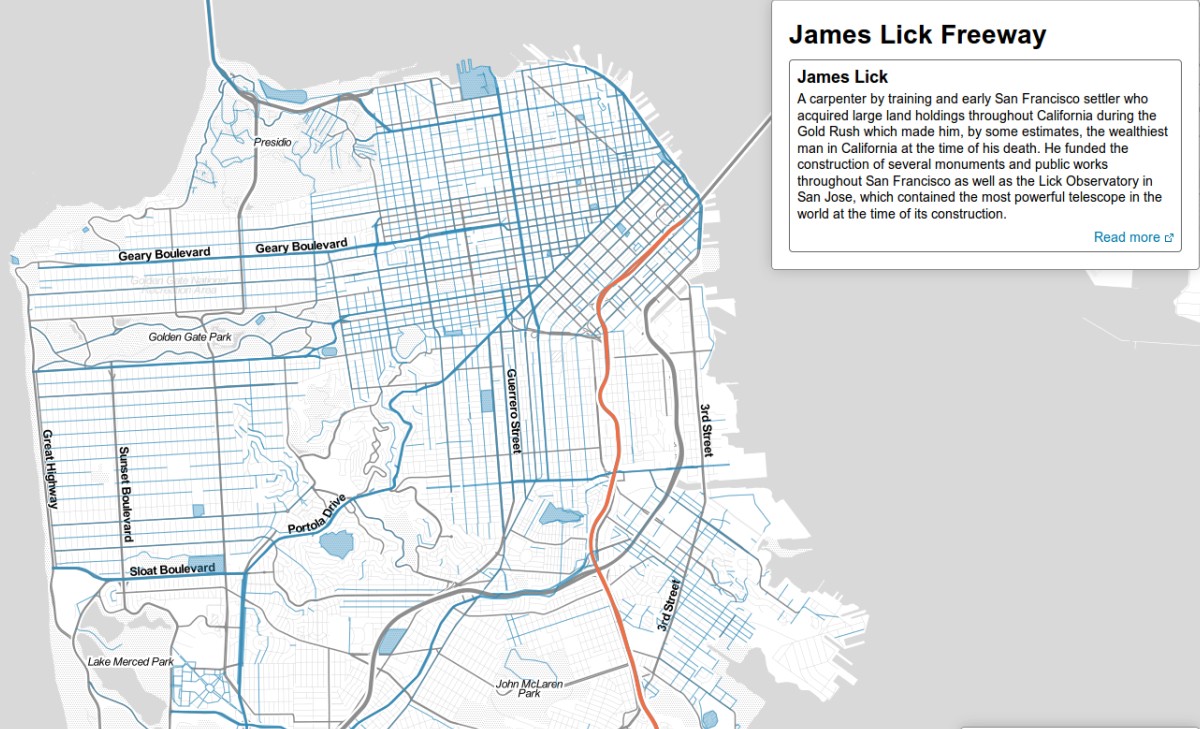
Many of us have encountered various bits of street name history along our travels, but here was a comprehensive aggregator that was fun to play with, and covered James Lick Freeway to Main Street, all in one handy spot. Did you know that Baker street was named after Edward Dickinson Baker, the lawyer who defended accused US Marshal killer Charles Cora, before Cora was lynched by the Vigilance Commitee in 1856? Or that Moraga was named for José Joaquín Moraga, founder of San Jose? Or how about Germania — it’s actually named after German people!

(One thing you do realize after a couple of minutes is that most of the streets are named after dudes, both military and wealthy. Maybe going forward, SF will institute gender parity naming regulations, like Berlin just did.)

I wanted to talk to Noah more about what inspired him to make the map, where he got his info from, and if the SF map — and the mapping project as a whole — would continue to grow. So I sent him an email. Here are the smart, and smartly civic, things he had to say

“I’m a Web developer by trade, I’ve always made interactive graphics like this for fun, although this is probably my most ambitious (you can see some of my other side projects here). I grew up on the peninsula, and lived in San Francisco for the last 4 years, but I moved to London in January for a one-year fellowship doing interactive graphics and data journalism at the BBC.

“I made the map because I thought it would be a neat way to take San Francisco’s colorful history and connect to everyday experience, give you a new sense of your neighborhood and your city. I used to walk down these streets all the time and never had any idea that they all pointed to so many larger-than-life characters and pivotal events. The names tell stories that you couldn’t make up if you tried: duels,
saloon shootouts, mob justice, espionage, overnight millionaires, explorers, tycoons, battles, rebellions. They also give you a lot of insight into people who in some cases literally built the city, people who created its skyscrapers or its railroads or its parks. That kind of local history has an immediacy you don’t get when you’re learning about something like the Founding Fathers. You walk past it on your way to work every day.

“There were a number of surprising histories to me, like the fact that Main Street isn’t a generic name, it’s named after Charles Main. I also never knew Crissy Field used to be a military airfield – I’m sure there’s a plaque explaining that somewhere but I had never come across it. Some other favorites:

Green Street
Broderick Street
Woodward Street
Guerrero Street


“I got the information from lots of places — a few different books, but also old news clippings, military records, historical society sites, that sort of thing. Usually I would start with a claim that a street was named for somebody, and then find as much corroborating evidence as I could, and if it seemed solid, research for other colorful details about the person’s life. Needless to say it was a time-intensive process.

“I’ll definitely be adding more to the map over time, there are lots of histories missing, and I’ve gotten lots of helpful tips from others since posting the map. Some streets are left out by design though. Many are self-explanatory or don’t have a historical component (for example, lots of names are just Spanish words or trees or foreign cities), I wanted to focus on ones that would be interesting and not clutter up the map with the rest. I also had to leave out a lot of ones with potentially interesting histories that were hard to verify. I wanted to be careful about not presenting rumor as fact, and there’s plenty of rumor to go around when it comes to how the streets got their names. It’s a tough balancing act, a lot of judgment calls, and I’m sure I still got a few wrong.

“This wasn’t originally meant to be a larger project, but once I got deeper into it I realized that I’d really like to expand it to other cities, so I’m going to be working on that in the coming weeks. I’d like to work on additional cities myself (maybe LA and London next) but I’d also like to generalize the template and create blank versions for lots of cities in the world and open them up for others to work on. I’ve gotten tons of feedback from folks who would be excited to make something similar for their home cities, and I’d love to help make that happen.

“As far as other upcoming projects, in addition my work at the BBC and taking the street name map beyond San Francisco, I’m hoping to start on a project to visualize diasporas from different countries around the world.”

More SF restaurants settle with the city over fraudulent employee health surcharges

12

City Attorney Dennis Herrera today announced another batch of settlements with restaurants that have been fraudulently using surcharges on customers’ bills to cover their city-required employee health coverage and using some of that money to simply pad their profits.

Seventeen San Francisco restaurants that took advantage of Herrera’s partial amnesty offer — settlements are half of what the violators should owe, based on voluntarily submitting records by last month’s deadline — will be paying tens of thousands of dollars each to the employees’ they ostensibly collected the money for, joining two other restaurants that had settled with the city earlier this year.

Among this latest batch of restaurants is Burgermeister, whose $134,088 settlement is the largest of this group; and Burma Superstar, whose $10,045 is the smallest. Other restaurants paying up as part of the settlement are 5A5 Steak Lounge, Amber India, B Star, Bix, Cafe Bellini, Calibri Mexican Bistro, Citizen’s Band, Cafe Flore, Fresca, MarketBar, Nob Hill Café, Press Club, Skool, Tony’s Pizza Napoletana, and Venticello Ristorante.

In total, Herrera’s office has recovered about $844,000 that will be split among about 1,500 employees.

Another dozen restaurants suspected of misusing the surcharges were given a clean bill of health: Bluestem Brasserie, Cafe Claude, Cupola Pizzeria, Firefly Restaurant, Gitane Restaurant and Bar, Lark Creek Management LLC, Lark Creek Steak, NOPA, One Market Restaurant, Plant Cafe, Ristobar, and Twenty Five Lusk.

There are still more than 30 restaurants that responded to the amnesty offer that remain in negotiates with Deputy City Attorney Sara Eisenberg, with more settlements expected in the coming weeks and the possibility of lawsuits being filed against restaurants that won’t settle.  

The full press release follows:


Restaurant workers net $844K restitution in 19 surcharge enforcement settlements so far

Herrera praises good faith efforts by restaurants ‘to do right by their employees’; announces ‘clean bills of health’ for 12 other establishments targeted in investigation

SAN FRANCISCO (May 8, 2014) — City Attorney Dennis Herrera today announced settlement agreements with 18 local restaurant businesses that voluntarily took part in his office’s surcharge enforcement and amnesty program, which seeks to remedy shortfalls between amounts collected from customers to cover the cost of complying with San Francisco’s universal healthcare law, and funds actually expended to provide health care benefits to employees.  Together with an earlier settlement announced in January, Herrera’s restaurant surcharge enforcement effort has now netted a total $844,644 to be distributed among approximately 1,500 eligible employees by 19 different companies.

The program announced in January included a one-time 50 percent amnesty offer for establishments with significant shortfalls — provided they fully cooperate with city investigators; agree to good faith compliance with the employer spending requirement of San Francisco’s Health Care Security Ordinance moving forward; and directly compensate their current and former employees who were the intended beneficiaries of the surcharges paid by customers.  All agreements announced today resolve potential disputes with the City over collected surcharges without admissions of liability.  

“I commend these businesses for working cooperatively with us so early in the process, and for understanding our duty to enforce the law even-handedly,” said Herrera.  “Today’s settlements reflect good faith efforts by restaurant owners and managers to do right by their employees, and to honor the intent of fees charged to their customers.  I recognize that complying with groundbreaking programs like Healthy San Francisco can sometimes present new and unique challenges.  So, I’m grateful to these businesses for their cooperation in reaching settlement agreements with us.  I’m glad to continue patronizing these establishments, and I hope other San Franciscans and visitors will join me in doing so, too.”

Some of the 19 establishments that reached settlements under the program include: 5A5 Steak Lounge, Amber India, B Star, Bix, Bugermeister, Burma Superstar, Cafe Bellini, Cafe Flore, MarketBar, Mina Group, Nob Hill Cafe, Patxi’s Chicago Pizza (announced in January), Press Club, Skool, and Tony’s Pizza Napoletana.

Twelve establishments receive ‘Clean Bills of Health’ following investigation
Herrera also announced that 12 businesses targeted for investigation on the basis of the health care expenditure shortfalls they reported to San Francisco’s Office of Labor Standards Enforcement had received “clean bills of health.”  Recipients of such letters were informed by Herrera’s office that after extensive review of additional evidence provided in the course of the City Attorney’s investigation, surcharge-related consumer fraud did not appear to have been committed during the relevant time periods.  In most instances, shortfalls reported to OLSE by businesses that received “clean bills of health” were attributable to their inadvertent reporting or accounting errors.

Establishments so far issued “clean bills of health” are: Bluestem Brasserie, Cafe Claude, Cupola Pizzeria, Firefly Restaurant, Gitane Restaurant and Bar, Lark Creek Management LLC, Lark Creek Steak, NOPA, One Market Restaurant, Plant Cafe, Ristobar, and Twenty Five Lusk.

Surcharge Fraud Enforcement Program background
Herrera announced the program at a City Hall news conference on Jan. 25 with Assemblymember Tom Ammiano, Supervisors David Campos and David Chiu, and representatives from San Francisco restaurants and the Office of Labor Standards Enforcement.  Ammiano first authored legislation in 2005 as a member of the Board of Supervisors that would ultimately lead to the City’s Health Care Security Ordinance, or HCSO, which passed in 2007 with policy input from then-Mayor Gavin Newsom.  Board President Chiu and Supervisor Campos have both been active in subsequent proposed amendments to strengthen and improve the law.  In launching the enforcement and amnesty program, Herrera lauded the Golden Gate Restaurant Association for working productively to share its helpful input, even after years of legal disputes over the law that ultimately ended in the U.S. Supreme Court.  

Status of enforcement efforts and investigation
In addition to the establishments involved with today’s announcement, more than 30 other businesses applied for Herrera’s amnesty program before the April 10, 2013 deadline.  The City Attorney’s Office expects a significant number of additional settlement agreements in the coming weeks, pending further analysis of surcharge funds that establishments collected and expended over the relevant time period.    

Herrera’s one-time offer of 50 percent amnesty has now expired, and the favorable settlement terms are no longer guaranteed to non-participating establishments with significant shortfalls between health care-related collections and expenditures.  Announcing his enforcement and amnesty program in January, Herrera said that restaurants and other businesses found to have committed HCSO-related surcharge fraud during the years 2009 to 2011 that failed to come forward before the deadline voluntarily would risk being sued for full restitution of the amount of surcharges collected during that period, together with potentially substantial penalties, costs and attorneys’ fees.  A small number of defiant, non-participating businesses remain under consideration by the City Attorney for further enforcement action or litigation.

“For restaurants that haven’t yet come forward, it’s still very much in their interest to do so voluntarily,” Herrera said.  “I can’t guarantee the same favorable terms reflected in today’s settlements, but cooperative engagement is better and more cost-effective than lawsuits.”  

The Pulitzer Prize Board surrender – and how the New York Times blew the Ed Kennedy story (Part l)

10

In the May 19, 1945 edition of the New Yorker magazine, the legendary press critic A. J. Liebling wrote a prescient article on what happened when Edward Kennedy, an Associated Press combat correspondent, defied military censorship to break one of the century’s biggest and most important stories.

His lead said that “the great row over Edward Kennedy’s Associated Press story of the signing of the German surrender at Reims served to point up the truth that if you are smart enough you can kick yourself in the seat of the pants, grab yourself by the back of the collar and throw yourself out on the sidewalk. This is an axiom that I hope will be taught to future students of journalism as Liebling’s Law.” Liebling titled his piece, “The AP surrender,” because AP, caving in to government pressure, led the attack on its own reporter by publicly censuring and then firing him. He cited the New York Times as leading the charge with a nasty editorial blasting Kennedy only two days after it had splashed Kennedy’s story on the front page with huge heads. Kennedy, the editorial intoned solemnly, had done a “grave disservice to the newspaper profession.”

Liebling, a mid-1920s  student at the Graduate School of Journalism at Columbia University in New York City, was presumably aiming his axiom at his alma mater, which was in a building endowed by Joseph Pulitzer, a crusading liberal publisher in New York at the turn of the century.  Pulitzer also endowed the prestigious Pulitzer Prizes, which are housed in the school and administered by a senior member of the faculty.

I especially enjoyed Liebling’s Law as a Columbia journalism graduate (’58) and as a charter member of the committee working to get Kennedy a posthumous Pulitzer prize this year for his story. The axiom was timely because my wife Jean and I were at the journalism school in April to attend my 55th class reunion and the school’s centennial celebration. The event was full of Pulitzer references and remembrances, highlighted by an address by James McGrath Morris, a respected Pulitzer biographer, speaking in the World room, named after Pulitzer’s newspaper.

The day after the centennial weekend, the Pulitzer Prize Board announced its Pulitzers and rejected the two Kennedy nominations without comment. One nomination was for his story, the other for a previously unpublished book by Kennedy on his career as a WWII foreign correspondent. The rejections demonstrated a serious flaw in the Pulitzer Prize process.

The point of quoting Liebling today, in May of 2013, is that almost seven decades after his article, the Pulitzer Prize Board and the New York Times have once again left Kennedy out on the sidewalk for doing his job as a reporter who, in a favorite Pulitzer phrase, knew “the  right and had the courage to do it.” Since this is a historic story of military censorship for political reasons, it is as timely and relevant now as it was then, since the Pulitzer Board and the Times still do not get the point.

So let me put the issue in context. Let me start by quoting Liebling’s main arguments and link his full six page piece, written in the heat of the censorship battle.

Liebling, who was himself a distinguished World War II correspondent, wrote,  ”The important aspect of the story of the row, I am sure, is not that Kennedy got his dispatch out of Europe before the SHAEF Public Relations bosses wanted him to but that only three representatives of the American press were admitted to one of the memorable scenes in the history of man, and only on condition that they promise not to tell about it until the brigadier general in charge of public relations gave them permission.

“No correspondent of a newspaper published in the United States was invited to the signing; besides Kennedy, Boyd Lewis of United Press, and James Kilgallen, of Hearst’s International News Service, the official list included four radio men, an enlisted correspondent for the Stars and Stripes, and a collection of French, Russian, Australian, and Canadian correspondents.

“Whether a promise extorted as this one was, in an airplane several thousand feet up, has any moral force is a question for theologians…I suppose Kennedy should have refused to promise anything and thus made sure of missing an event that no newspaperman in the world would want to miss, but I can’t imagine any correspondent doing it.

“I do not think Kennedy imperiled the lives of any Allied soldiers by sending the story, as some of his critics   have charged. He probably saved a few, because by withholding the announcement of an armistice you prolong the shooting, and, conversely, by announcing it promptly you make the shooting stop. Moreover, the Germans had broadcast the news of the armistice several hours before Kennedy’s story appeared on the streets of New York, and Alsie, the OWI’s American Broadcasting Station in Europe, broadcast it in 24 languages, including English, within an hour after.”

Liebling noted that the Russians “had their own surrender show in Berlin, and probably had a better publicity break on it than they would have had if the two surrenders has been announced simultaneously… One unconditional surrender of the Reich a day is as much as the public can absorb.” 

Liebling brought out the crucial political censorship point. “Moreover, the row can do a lot of good if it brings into the clear the whole disturbing question of military censorship imposed for political, personal, or merely capricious reasons and reveals the history of the prodigious amount of pure poodle-faking that has gone under the name of Army Public Relations.” Liebling was right on because it later turned out that a secret agreement between Stalin, Roosevelt, and Churchill had imposed a 24 hour embargo on the surrender story so the Russians could announce it the next day in Berlin. Kennedy’s story was in effect the start of the Cold War.

Last year, almost 70 years later,  Tom Curley, as president and CEO of AP,  backed up Liebling’s Law and apologized publicly on behalf of  AP. for the way it treated Kennedy. “tt was a terrible day for AP,” he was quoted as saying on the AP wire.  “It was handled in the worst possible way,.” He wrote a strong  defense of Kennedy in an introduction to a book published last year by the Lousiana State University Press,  titled “Ed Kennedy’s War: V-E Day, Censorship & the Associated Press.” The book was a personal account by Kennedy of his career as a foreign correspondent and a detailed account of his side of the controversy. His daughter, Julia Kennedy Cochran, found Kennedy’s manuscript in his papers after he died in a pedestrian accident in Monterey in 1963 at age 58 where he was editing the Monterey Peninsula  Herald. 

Curley wrote that “Kennedy and his editors performed superbly. They delivered one of the most significant scoops in journalism history. They did four things right. A great correspondent was assigned to the story. He kept reporting even after the censors tried to shut him down. The London desk moved the news without hesitation. The correspondent and editors adhered to the wartime rules as they knew them.  Finally, Kennedy wins the argument on a technicality. With the signing of a surrender treaty, there was no longer a war in Europe and not any excuse to submit to censors.”

Curley said “the book matches the best memoirs by World War II combat reporters for the quality of writing and telling detail, some of it gripping.  And in one way it surpasses the others. Not only does Kennedy give his final, thoughtful explanation for what happened on May 7, 1945. In describing his struggles with censorship and bureaucratic red tape and stupidity over many months, not just on May 7, he provides the fullest first-person account we have of the difficulties World War II correspondents encountered every day trying to do their jobs.

“Perhaps in some small way we bring posthumous recognition to an American hero and embrace – too belatedly – what McClean and Cooper (B3: AP executives) and the AP board could not admit. Edward Kennedy was the embodiment of the highest aspirations of the Associated Press and American journalism.” Curley said his account drew upon newly available records held in the Associated Press Corporate Archives.

Curley’s co-author was John Maxwell Hamilton, founding dean of the Manship School of Mass Communications at LSU.  He is the editor of “From Our Correspondent,” a series of books that features forgotten works and unpublished memoirs by pioneering foreign correspondents and illuminates “the development of foreign news gathering at a time when it has never been more important.” Hamilton, once a foreign correspondent himself, is currently the executive vice chancellor and provost of LSU. The book was submitted by LSU Press for a Pulitzer in the book category but the board rejected the nomination and, in keeping with tradition, rejected it without comment.

Following V-E Day, Kennedy was out at AP and the big  mainstream dailies. He became a managing editor for two years at the Santa Barbara News-Press and then edited the Monterey County Herald, later the Monterey Peninsula Herald.   The Herald won lots of journalism awards under Kennedy and he wrote many international commentaries under the initials E.K. He loved his community and he loved his job. .A memorial to Kennedy stands in the form of a sundial in Laguna Grande Park in nearby Seaside. It reads: “He saved the world an extra day of happiness.”

Meanwhile, Ray March, editor of the Modoc (Calif.) Independent News  and a former reporter under Kennedy on the Herald, decided it was time to nominate Kennedy for a posthumous Pulitzer prize and help right a historic journalistic and public policy wrong. With the help of Eric Brazil, a former Examiner editor and reporter, he put together a committee and petition.  I signed up immediately when Brazil called me.  And I helped put together the first ever panel anywhere on the Kennedy story for last year’s annual meeting of the California Press Association. It featured as moderator Ward Bushee, the Chronicle editor whose father had been recruited by Kennedy to work on the Herald. (He turned down the offer.)  Ward’s father had earlier won a Pulitzer as editor of the Watsonville Register-Pajaronian for exposing corruption involving the local district attorney.

The historic panel included March, Kennedy’s daughter, and Dave Perlman, a Chronicle reporter at 93, who was in Paris as a reporter at the time of the surrender. Jim Ewert, general counsel of the California Newspaper Publishers Association, drafted  a stirring resolution supporting the nomination and the members approved it unanimously.  It was submitted as part of the nomination package, put together by the Chronicle’s promotion department. March, Brazil, and  Frank McCulloch, former bureau chief for Time magazine in Vietnam who later held top editorial positions at the LA Times, the Sacramento Bee, and the old San Francisco Chronicle, wrote the nomination letter. It stressed that Kennedy had been the victim of military censorship for political reasons.  Meanwhile, the nomination got much media coverage, including the Chronicle, Washington Post, Sacramento Bee, Atlantic Magazine, Portland Oregonian, Editor and Publisher, and many other print and online venues.

When the New York Times announced this year’s Pulitzers, the paper gushed that  it got four Pulitzers, giving it a total of 112 Pulitzers, ”far more than any other newspaper,” as trumpeted in full page promotion ads. Margaret Sullivan, the public editor, was even more glowing in her Sunday column (4/21/2013). Her lead:  “The Times, it is safe to say, had a very good week. On Monday, it won four Pulitzer prizes – “the third most in its history and twice a many as any other news organization this year.”  (She also quite properly gave credit to the Times for its coverage of the Boston bombings and in particular for staying on the safe side of the “Rubicon of inaccuracy” by not reporting that an arrest had been made and a suspect was in custody.) She concluded her appraisal by saying that “The Times is far from perfect.  But last week, in its intelligent and restrained handling both of images and facts, it looked like a newspaper worthy of this year’s Pulitzer glory.”

However,  I and many others weren’t as smitten by Pulitzer glory. We were disappointed to see that the Pulitzer Board  not only rejected a Pulitzer for Kennedy, but that it did so without reference or mention of the Kennedy nominations, made no special citation (such as the special citation to the late Chronicle columnist Herb Caen) and gave no reasons nor acknowledgment of any kind for the rejections or to the historic importance of righting a major  journalistic and public policy wrong on one of the most crucial issues of our time:  military censorship for political reasons of news the public needs to know. I couldn’t find any evidence that the Times ever changed its editorial opposition to Kennedy and that it ever properly covered Kennedy’s side of the story. And the Times, unlike AP and so many other papers, didn’t cover the current story of the nominations to award Kennedy a posthumous Pulitzer prize or the censorship issues, before or after the Pulitzer awards were announced. Will it do so now? I am sending this report to the public editor and other Times editors and public  for comment.

I emailed Sig Gissler, the former Milwaukee Journal editor who now administers the Pulitzers.as a journalism professor. I put the above points to him and asked why the committee “instead of coming down on the side of the free press that Pulitzer and his school and prizes represented, the committee in effect came down on the side of government censorship for political reasons and supported a politically charged embargo agreement that would allow Stalin to catch up on the surrender announcement and hold his own press conference in Berlin.” 

Specifically, I asked Gissler  “was there any discussion on the Kennedy nominations, was there a vote and what was it, who voted for and against, what were the reasons for the rejection, was there any real internal debate on the importance and timeliness of this issue, and anything else that you or the Columbia officials (Outgoing Dean Nicholas Lemann or incoming Dean Steve  Coll, President Lee Bollinger) or the committee chairs or member would like to add. Is there a spokeperson I can talk to?”  I also asked for the names and contact information of the full Pulitzer committee and subcommittees and the appropriate Columbia spokespeople.

Gissler is a good man in a tough job burdened with honoring a dated policy. He emailed me back promptly and thanked me for my “interesting note.”  He said that, “regarding Kennedy, your desire for an explanation is testimony to your earnestness. However, each year the Pulitzer process produces many similar situations. Entrants desire to know why they did not become finalists. Finalists desire to know why they didn’t become winners. Petitioners for special citations desire to know why no special citations were bestowed. The Board declines to provide explanatory details, consistent with its tradition of basically not discussing, debating or defending its decisions.

“I understand your disappointment. However, at the risk of eternal irritation, I can only reiterate that the request for a special citation for Ed Kennedy was duly considered and that we do not issue statements when a request does not result in a citation.” He didn’t send me the names or contact information of the board or Columbia spokespeople. 

To give Gissler every opportunity to explain, I emailed him again and asked more questions: “So, after all these years, are you saying that the Pulitzer Board has no way for anyone (entrants or journalists or the public) to comment on the awards or the contest or the process? If not, why not?” I also asked again how the Kennedy nominating committee and others could make comments this year, right now. I ended by saying there was now much interest in “making the Pulitzer process more transparent, representative, and accountable.” I hope you agree, I told Gissler, and that you “at least present the issue to the board and the proper Columbia officials.”  I got no further comment from Gissler.

The Pulitzer School of Journalism and the Pulitzer prizes are endowed by Joseph Pulitzer. The school has the venerable Columbia Journalism Review magazine with a mission to “encourage excellence in journalism in the service of a free society.” And it has the excellent  CJR.org website that “weighs in daily, hosting a conversation that is open to all who share a commitment to high journalistic standards in the U.S. and around the world” and that could, let me suggest,  display the Pulitzer winners properly and host a lively forum for congratulations and comment  on the Pulitzers and the Pulitzer process,  It has a large and distinguished faculty and hosts a wide array of newsworthy panels and programs. It attracts each year an excellent class of students. It has a huge statue of Thomas Jefferson, paid for by Pulitzer, standing as a beacon of press freedom in front of the entrance to the journalism building. It is situated in the media capital of the world and promotes itself as the best journalism school in the country and a source of many of the country’s best journalists. It can do better, much better, with the prizes that the New York Times proclaimed, in its full page ad promoting its four Pulitzers, as “widely considered journalism’s highest honor.” .

And so I recommend that Columbia, the Graduate School of Journalism, and its Pulitzer Prize Board use the rejected nominations of Edward Kennedy, the reporter who was tarred and feathered for the crime of committing journalism, as the catalyst for major Pulitzer reforms. I recommend making the Pulitzer process more transparent, more responsive, and more prepared in our militarized age to fight government censorship and more prepared to promote and defend the First Amendment values of free speech and free press.

I will keep you posted. B3

POSTSCRIPT:  THE RUSSIAN PLAN TO PREEMPT THE SURRENDER STORY:   Ed Kennedy writes in his book that in the turmoil over his dispatch the correspondents overlooked another story almost as big as the surrender story. It came from  “no less august an official spokesman”  than Brig. Gen. Frank A. Allen Jr., the SHAEF commanding officer,  who told the corresponents in a May 8 meeting that “the official announcement might be delayed even further beyond the time set for it–3 p.m., Paris time.  He revealed that the Russians, having induced Washington and London to hold up the announcement, until the hour set for their own ceremony in Berlin, now were asking that news of the real surrender at Reims be suppressed until some hours after the phony surrender of Berlin. HIs disclosure was ‘off the record’ at the moment but could have been legitimately been reported the following day. It never was. 

“The sole purpose of the Soviet request, it was later established–and even then was obvious–was to convince a large part of the world that the Russians had obtained the surrender of Germany, with but contributory help from the Western Allies, whom they had generously invited to share in the final honor.  The Berlin ceremony was staged purely for Soviet propaganda purposes. Although a Russian correspondent was one of those whom General Allen had invited to Reims to the exclusion of any reporter of an American newspaper, no word of the Reims surrender appeared in the Russian press. So far as I know, none has to this day.

“The Russian action was the inauguration of the propaganda build-up for the course of expansion on which the Soviet Union was shortly to embark in Europe. Its importance as news was that it was the first clue to Moscow’s postwar policy.  But it went unreported at that time.”

Bruce B, Brugmann, writing as editor at large of the San Francisco Bay Guardian, as editor and co-founder and co-publisher of the Guardian with his wife Jean Dibble (1966-2012, now  retired), as a graduate of the Columbia Graduate School of Journalism (’58), as a recipient of  the Columbia Journalism School’s  Distinguished Alumnus award (2011), as a former bureau chief of the Korea Bureau of the Pacific edition of Stars and Stripes who encountered milItary censorship  (1959-60), and as a charter member of the Kennedy nominating committee. 


Behind the attacks on City College

17

OPINION Last year the Accrediting Commission for Community and Junior Colleges harshly sanctioned City College of San Francisco and gave us just nine months to shape up or face the consequences. This was pushed on the community even though the quality of education provided at City College was never in question.

Since then, CCSF has changed student assessment metrics and addressed the governance, institutional planning, and enrollment management issues cited. We have done so even as we have also documented disquieting information about the ACCJC’s damaging role at CCSF and at community colleges throughout California.

Our research into ACCJC found that the commission failed to respect the law and public policy of the state and violated federal common-law due process and California common-law fair procedure. Further, at CCSF and in districts around the state, the ACCJC often acts arbitrarily, capriciously, unfairly, and inconsistently in evaluating colleges, thereby harming the schools and their communities.

San Francisco has shown valiant support for City College despite the drumbeat of negative publicity around our accreditation status.

Recently, the San Francisco Board of Supervisors voted unanimously in support of preserving the quality and diversity of education at City College of San Francisco, of tackling the achievement gap and ensuring equitable opportunities for students, and of utilizing Proposition A funds as intended.

In the age of the 24-7 corporate news cycle, educators and unions are too often portrayed as the opposition in attempts to push austerity, undermine the public sector, and efface the important educational work we do for students. We will not apologize for resisting the downsizing of our students’ educations, for saving jobs, and for protecting educational programs that benefit our students—particularly our most vulnerable students. We will not apologize for attempting to sustain employees’ health, working conditions, and well-being.

When San Franciscans passed Proposition A overwhelmingly last November, it was a ray of light for those of us who have devoted our lives to City College and its students. Providing $15.2 million, the tax was designed to reverse the cuts to classes and employees in our starved public educational system, helping sustain our college for San Franciscans. Now the administration is diverting millions of these dollars and pumping additional money into consultants, lawyers, computers, and maintenance. Under the administration plan, next year less than a third of that money will go toward the educational purposes voters were promised.

Meanwhile, the race to downsize continues. At the negotiating table and in the press, the administration uses the need to retain the college’s accreditation—something all of us agree is crucial—as reason, excuse, and threat. It has shirked its duties at the bargaining table, imposing pay cuts and implementing premature and damaging layoffs of staff and faculty.

We face a host of other dramatic changes that cut into our ability to serve student needs, including a reorganization that pushes faculty expertise and voices further into the background and a shocking lack of substantive dialogue or transparent processes. Our trustees now preside over meetings that squelch public speech, restricting access to a too-small meeting room with the windows literally papered over so that no one can see in or out.

Thankfully, we are not alone in this fight. In Chicago, in Seattle, and in communities around the country afflicted with disingenuous “reforms” and diminished access, we are gathering strength and allies and standing up for the principles that inform our work as educators, responsible for defending and improving quality, accessible public education for the public good.

To join the fight to save our City College, email aft@aft2121.org

Alisa Messer is an English instructor at City College of San Francisco and president of AFT Local 2121, which represents instructors, counselors, and librarians at the college.


Assembly committee OKs moratorium on fracking in California

Three bills seeking to impose moratoriums on fracking in California won approval at the California Assembly Natural Resources Committee in Sacramento on April 29, an important milestone for environmentalists who ultimately plan to push for a permanent ban on the practice.

Assembly Bill 1301, introduced by Assembly Member Richard Bloom (D-Santa Monica), is backed by a host of statewide environmental organizations including the Center for Biological Diversity, Food & Water Watch, and Clean Water Action. That bill and AB 1323, similar legislation sponsored by Holly Mitchell of Culver City, seek to halt the controversial oil-and-gas extraction method in California until possible health and environmental impacts have been adequately reviewed.

“It’s an important step,” notes Adam Scow, California campaigns director for Food & Water Watch in San Francisco. “In theory, the quickest timeline the bill could pass is [sometime] this year.” He added, “Gov. Jerry Brown has the power to issue a moratorium now,” but “Brown is repeating industry talking points that fracking can be done safely.”

A third bill, AB 649, would create moratoriums on fracking only nearby sensitive sites such as aquifers or agricultural lands, but that proposal received less support from fracking opponents who believe it should be subjected to a blanket moratorium and ultimately banned. All three bills won approval from the Natural Resources Committee, and are now headed for the Assembly Appropriations Committee.

Short for hydraulic fracturing, fracking is an oil and gas extraction method that utilizes high-pressure water and toxic chemicals to fracture shale deep underground. It’s prompted fierce opposition in New York, Pennsylvania and throughout western states, where fears about groundwater contamination and long-term ecological impacts are growing as the practice is more widely adopted.

“It uses huge amounts of water,” Wenonah Hauter, executive director of Food & Water Watch, told the Bay Guardian in an interview. “It pollutes the water with chemicals that don’t even have to be disclosed, and the wastewater either stays underground and we don’t really know what happens to it, or it has to be disposed of through injection wells that are associated with earthquakes.”

And yet, powerful momentum is building in the petroleum industry around oil extraction from the Monterey Shale, a geologic formation estimated to contain 15 billion barrels of oil that would have been inaccessible but for technological advancements in fracking. The Western States Petroleum Association, a powerful industry lobby, placed the vast California fossil fuel reserve in the crosshairs in a mid-March report, along with the outright giddy pronouncement that “this oil, if prudently and safely developed, could dramatically change our state’s energy security picture for decades to come and usher in an era of unprecedented prosperity.”

All of which amounts to stringent opposition to bills that would impose a moratorium until health and environmental impacts can be carefully evaluated. According to this article in High Country News, that industry association spent $8.5 million last year lobbying state government.

While things still hang in the balance in California as far as fracking is concerned, the mad dash for shale oil has already transformed vast swaths of rural landscape in North Dakota, where oil production has shot up dramatically in recent years. According to a study released by the Western Organization of Resource Councils, fracking and other oil and gas extraction practices result in the permanent removal of seven billion gallons of water from the hydrologic cycle each year in North Dakota, Montana, Wyoming, and Colorado.

Teachers try to dis-accredit accreditation group

14

The union representing teachers at San Francisco City College have fired back at the accreditation commission that’s threatened to shut the school down and forced dramatic changes in its mission. The California Federation of Teachers and AFT Local 2121 filed a legal complaint May 1 charging the Accrediting Commission for Community and Junior Colleges with violating its own rules and federal law — and the complaint asks the federal Department of Education to withdraw the accreditation of the accreditation commission.

The language of the 260-page complaint is harsh:

The Commission has violated nearly every Federal regulation which guides it, disregards its own policies, misrepresents
its actions or legal requirements, fails to respect the law and public policy of the State,violates Federal common law due process and California common law fir procedure, and acts arbitrarily, capaciously, unfairly and inconsistently in evaluating colleges and
districts throughout the State, thereby harming colleges, students, faculty and staff, boards of trustees and ultimately the People.

But in the end, union members on a conference call noted, the big issue is whether the ACCJC ought to be evaluating classroom instruction and offering constructive criticisms (which is what these panels have tended to do in the past) — or ought to be looking at overall college finances, including retirement costs and management structure.

For example, the ACCJC wants City College to pre-fund some of its retiree health-care benefits — diverting money that could be used right now in classrooms. “Accreditation agencies shouldn’t be looking at [those types of] finances,” union spokesperson Fred Glass said.

Alisa Messer, president of the Local 2121, said that the commission’s threat to withdraw accreditation from City College “has thrown the college into turmoil,” which is hardly news. Jim Mahler, president of the CFT Community College Council, took the broader view, saying that schools are now so afraid of the ACCJC that they’re spending disproportionate amounts of money and time just trying to please the agency.

CFT President Joshua Pechthalt said the goal of the legal filing was to get the ACCJC to withdraw its “show cause” order at City College — and the change the overall approach the accreditors are taking. “No other body operates like this,” he said. The Department of Education has to accredit the accreditors, and the ACCJC comes up for review this year — so in a sense, the unions want to put the oversight agency under the same type of scrutiny the schools are enduring.

So far, no response from ACCJC.

UPDATE: ACCJC posted the following on its website:

While we understand there is interest in obtaining information in this regard directly from the ACCJC,
the Commission will maintain its normal practice of reviewing third party comment and communicating
about that comment directly to the affected member institution. Further, complaints against the ACCJC
are treated formally, in accordance with policy; comment from the organization or its officers is limited
during this time.


Stage Listings

0

Stage listings are compiled by Guardian staff. Performance times may change; call venues to confirm. Reviewers are Robert Avila, Rita Felciano, and Nicole Gluckstern. Submit items for the listings at listings@sfbg.com.

THEATER

OPENING

Dirty Dancing: Live! Dark Room, 2263 Mission, SF; dirtydancinglive-fbe.eventbrite.com. $20. Opens Fri/3, 8pm. Runs Fri-Sat, 8pm. Through May 25. Watermelons will be carried, lifts will be attempted, eyes will be hungry, and nobody better put Baby in a corner.

Last Love Mojo Theatre, 2940 16th St, SF; www.mojotheatre.com. $30. Opens Thu/2, 8pm. Runs Thu-Sun, 8pm. Through May 19. Mojo Theatre performs Peter Papadopoulos’ play about two couples struggling through “the landmines of love.”

Little Me Eureka Theatre, 215 Jackson, SF; www.42ndstreetmoon.org. $25-75. Previews Wed/1, 7pm; Thu/2-Fri/3, 8pm. Opens Sat/4, 6pm. Runs Wed, 7pm; Thu-Fri, 8pm; Sat, 6pm. Through May 19. 42nd Street Moon performs Neil Simon’s outrageous musical.

The Merry Wives of Windsor Buriel Clay Theater, African American Art and Culture Complex, 762 Fulton, SF; www.african-americanshakes.org. $10-35. Opens Sat/4, 8pm. Runs Sat, 8pm; Sun, 3pm. Through May 26. African-American Shakespeare Company performs a twist on the Shakespeare classic, set in an urban neighborhood in the 1950s.

“PlayGround Festival of New Works” Various venues, SF and Berk; www.playground-sf.org. $15-40. May 1-26. The 17th fest presented by “San Francisco’s incubator for a new generation of playwrights” includes the PlayGround Film Festival, staged readings of four new full-length plays, a fully-produced program of six short plays, panel discussions, and more.

ONGOING

Acid Test: The Many Incarnations of Ram Dass Marsh San Francisco, 1062 Valencia, SF; www.themarsh.org. $15-50. Fri, 8pm; Sat, 5pm (May 11, show at 8pm). Through May 18. Playwright Lynne Kaufman invites you to take a trip with Richard Alpert, a.k.a. Ram Dass (Warren David Keith), as he recounts times high and low in this thoughtful, funny, and sometimes unexpected biographical rumination on the quest for truth and meaning in a seemingly random life by one of the big wigs of the psychedelic revolution and (with his classic book, Be Here Now) contemporary Eastern-looking spirituality. Directed by Joel Mullennix, the narrative begins with Ram Dass today, in his Hawaiian home and partly paralyzed from a stroke, but Keith (one of the Bay Area’s best stage actors, who is predictably sure and engagingly multilayered in the role) soon shakes off the stiff arm and strained speech and springs to his feet to continue the narrative as the ideal self perhaps only transcendental consciousness and theater allow. Nevertheless, Kaufman’s fun-loving and extroverted Alpert is no saint and no model of perfection, which is the refreshing truth explored in the play, but rather a seeker still, ever imperfect and ever trying for greater perfection or at least the wisdom of acceptance. As the privileged queer child of a wealthy Jewish lawyer and industrialist, Alpert was both insider and outsider from the get-go, and that tension and ambiguity makes for an interesting angle on his life as well as the complexities of his relationships with a homophobic Leary, for instance, and his conservative but ultimately loving father. Perfection aside, the beauty in the subject and the play is the subtle, shrewd cherishing of what remains unfinished. (Avila)

Boomeraging: From LSD to OMG Marsh San Francisco, 1062 Valencia, SF; www.themarsh.org. $15-50. Tue, 8pm. Through May 28. Comedian Will Durst performs his brand-new solo show.

The Expulsion of Malcolm X Southside Theatre, Fort Mason Center, Marina at Laguna, SF; www.fortmason.org. $30-42.50. Fri/3-Sat/4, 8pm; Sun/5, 3pm. Colors of Vision Entertainment and GO Productions present Larry Americ Allen’s drama about the relationship between Malcolm X and Elijah Muhammad.

Foodies! The Musical Shelton Theater, 533 Sutter, SF; www.foodiesthemusical.com. $30-34. Fri-Sat, 8pm. Open-ended. AWAT Productions presents Morris Bobrow’s musical comedy revue all about food.

How To Make Your Bitterness Work For You Stage Werx Theatre, 446 Valencia, SF; www.bitternesstobetterness.com. $15-25. Sun/5, 2pm. Fred Raker performs his comedy about the self-help industry.

I’m Not OK, Cupid 🙁 Shelton Theatre, 533 Sutter, SF; www.leftcoasttheatreco.org. $15-35. Thu/2-Sat/4, 8pm. Left Coast Theatre Co., a new company formed in 2012 from the gay men’s writing group GuyWriters Playwrights, offers this rocky but sometimes clever evening of seven short gay comedies about love, relationships, getting it on, getting it off, and so forth. The evening begins with Andrew Black’s A Small Fishing Village Wedged Between Estonia and Latvia, set in the Castro, where a gay couple (Chris Maltby and Dene Larson) try to foil a mixed couple of would-be robbers (Laura Espino and Richard Sargent) by injecting some homoerotic tension between their otherwise heterosexual vibe. Directed by ShawnJ West, it’s drolly if inconsistently acted, but never very funny, and followed by three more non-starters: James A. Martin’s Lollipops, Rodney “Rhoda” Taylor’s Goodbye, Cupid, and Black’s verse-bound Arlecchino’s Last Prank. The second half of the bill proves more satisfying overall — Rich Orloff’s Chekhov-inspired That Bitch, directed by Joseph Frank and featuring the able trio of Hayley Saccomano, Laura Espino, and Danielle O’Dea; Joseph Frank’s wacky The Parenthetical Trap, directed by Frank and Saccomano, wherein sibling rivalry (i.e., the amusingly puerile duo of Kyle Glasow and Dawson Montoya) meets dysfunctional family (rounded out by Gabrielle Motarjemi and Frank) reunited in musical harmony; and Alex Dremann’s randy and well-acted Four Dry Tongues, directed by ShawnJ West, in which friends Ginny (Angela Chandra) and Tristan (Michael Erickson) compete for the affection of guest Matt (Robert Rushin) by flirting with his gorgeously haughty lesbian friend Laura (Danielle O’Dea). (Avila)

The Lost Folio: Shakespeare’s Musicals Un-Scripted Theater, 533 Sutter, Second Flr, SF; www.un-scripted.com. $10-20. Thu-Sat, 8pm. Through May 18. Un-Scripted Theater Company performs a fully-improvised, full-length musical inspired by Shakespeare.

The Lullaby Tree Phoenix Theater, 414 Mason, SF; www.secondwind.8m.com. $15-35. Thu/2-Sat/4, 8pm. In the face of the ever more extensive and controversial spread of GMO foods worldwide — not to mention last year’s state battle over Prop 37 — Second Wind premieres founding member and playwright Ian Walker’s half-whimsical, half-hardheaded drama about a boy searching for his mother in the underworld and a small band of lawyers and environmentalists going toe-to-toe with a multinational over the ownership of a mysterious crop of genetically engineered corn. It will eventually become plain that the two stories are linked, but first a ten-year-old boy (Samuel Berston) befriends a somewhat shrunken giant (Davern Wright) in an attempt to find his mother (Evangeline Crittenden) in an enchanted and hostile land of dragons. Elsewhere, Tim (Walker) and law partner Nod (Wright) prepare to do legal battle with a modern-day dragon, in the person of a corporate attorney (Cheryl Smith) for the ominous Mendes Corporation (read: Monsanto). They will argue over the ownership of the corn that has sprung up on the banks of a drowned town, and which may spell environmental disaster for the nature preserve surrounding it. In this fight Tim and Nod are in uneasy, ultimately disastrous alliance with activist Callie (Crittenden), whom Nod distrusts and with whom Tim is hopelessly smitten. The result is a convoluted plot and a fitful production (co-directed by Walker and Misha Hawk-Wyatt) in which a three-pronged story precariously balances the fairy tale, the romance, and the legal battle. It’s the last prong that offers the more interesting if formulaic scenes, in which the politics of GMOs mesh with the swashbuckling machinations of the attorneys. But the less compelling strands converge and take precedence, forcing things down a sentimental and forgettable road. (Avila)

reasons to be pretty San Francisco Playhouse, 450 Post, Second Flr, SF; www.sfplayhouse.org. $30-100. Tue-Thu, 7pm; Fri-Sat, 8pm (also Sat, 3pm). Through May 11. Completing a trilogy of plays about body awareness and self-image (along with The Shape of Things and Fat Pig), Neil LaBute’s reasons to be pretty begins with a misconstrued remark that quickly gathers enough weight and momentum to tear three sets of relationships apart in the span of a two-hour play. The SF Playhouse production begins with a bang, or rather an awesomely knock-down, blow-out breakup fight between a righteously pissed-off Steph (Lauren English) and her awkwardly passive boyfriend Greg (Craig Marker), who has inadvertently referred to her as “regular” in a conversation with his jerkish buddy Kent (Patrick Russell), which she takes to mean he finds her ugly. English’s Steph is at turns ferocious and fragile, and her comic timing as she eviscerates Greg’s looks in a mall food court zings, while the hyperkinetic Russell elevates the condition of noxiously irredeemable douchebag to an art form. But terrific acting and polished design can only make up so much for a script that feels not only flawed, barely scratching the surface of the whys and wherefores each character has internalized an unrealistic view of the importance of conventional beauty standards, but also already dated, with its circa-2008 pop culture references. Ultimately it gives the impression of being a rerun of a Lifetime television drama that wraps itself up into a too-neat package just in time for the final credits to roll to its admittedly kickass soundtrack (provided by Billie Cox). (Gluckstern)

Sam I Am: A Processional of Short Plays and Prose About Samuel Beckett Bindlestiff Studio, 185 Sixth St, SF; www.pustheatre.com. $10-20. Fri-Sat, 8pm; Sun, 2pm. Through May 11. Performers Under Stress remounts and revamps its series of short plays and pieces by Samuel Beckett, this time staging it throughout the basement quarters of Bindlestiff Studio, where audiences are led around an economical maze of performance spaces. Opening weekend consisted of too much text and too little in way of staging ideas, especially with several spoken selections of Beckett prose (which have reportedly since been dropped from the program). The best of what remains (in a program of six short plays total) includes Valerie Fachman’s respectable performance as the disembodied “mouth” of the brilliant Not I; and James Udom and Geo Epsilany’s duet in Rough for Theatre I, in which a wheelchair-bound food-hoarder (a softly eccentric Epsilany) strikes up a doomed friendship with a blind beggar (a solid Udom) amid a colorless and barren landscape. The bucket of Beckett dreary gets less satisfying from there, though director Scott Baker’s wordless performance as the titular Joe in Eh Joe proves poised and the doubled voices in his head (by Melissa Clason and Allison Hunter Blackwell) both haunting and intriguing. (Avila)

Sex and the City: LIVE! Rebel, 1760 Market, SF; trannyshack.com/sexandthecity. $25. Wed, 7 and 9pm. Open-ended. It seems a no-brainer. Not just the HBO series itself — that’s definitely missing some gray matter — but putting it onstage as a drag show. Mais naturellement! Why was Sex and the City not conceived of as a drag show in the first place? Making the sordid not exactly palatable but somehow, I don’t know, friendlier (and the canned a little cannier), Velvet Rage Productions mounts two verbatim episodes from the widely adored cable show, with Trannyshack’s Heklina in a smashing portrayal of SJP’s Carrie; D’Arcy Drollinger stealing much of the show as ever-randy Samantha (already more or less a gay man trapped in a woman’s body); Lady Bear as an endearingly out-to-lunch Miranda; and ever assured, quick-witted Trixxie Carr as pent-up Charlotte. There’s also a solid and enjoyable supporting cast courtesy of Cookie Dough, Jordan Wheeler, and Leigh Crow (as Mr. Big). That’s some heavyweight talent trodding the straining boards of bar Rebel’s tiny stage. The show’s still two-dimensional, even in 3D, but noticeably bigger than your 50″ plasma flat panel. (Avila)

Steve Seabrook: Better Than You Marsh San Francisco, 1062 Valencia, SF; www.themarsh.org. $15-50. Thu, 8pm; Sat, 8:30pm. Extended through May 18. Self-awareness, self-actualization, self-aggrandizement — for these things we turn to the professionals: the self-empowerment coaches, the self-help authors and motivational speakers. What’s the good of having a “self” unless someone shows you how to use it? Writer-performer Kurt Bodden’s Steve Seabrook wants to sell you on a better you, but his “Better Than You” weekend seminar (and tie-in book series, assorted CDs, and other paraphernalia) belies a certain divided loyalty in its own self-flattering title. The bitter fruit of the personal growth industry may sound overly ripe for the picking, but Bodden’s deftly executed “seminar” and its behind-the-scenes reveals, directed by Mark Kenward, explore the terrain with panache, cool wit, and shrewd characterization. As both writer and performer, Bodden keeps his Steve Seabrook just this side of overly sensational or maudlin, a believable figure, finally, whose all-too-ordinary life ends up something of a modest model of its own. (Avila)

Talk Radio Actors Theatre of San Francisco, 855 Bush, SF; www.actorstheatresf.org. $26-38. Wed-Sat, 8pm. Through June 15. Actors Theatre of San Francisco performs Eric Bogosian’s breakthrough 1987 drama.

Tinsel Tarts in a Hot Coma: The Next Cockettes Musical Hypnodrome, 575 10th St, SF; www.thrillpeddlers.com. $30-35. Thu-Sat, 8pm. Through June 1. Thrillpeddlers and director Russell Blackwood continue their Theatre of the Ridiculous series with this 1971 musical from San Francisco’s famed glitter-bearded acid queens, the Cockettes, revamped with a slew of new musical material by original member Scrumbly Koldewyn, and a freshly re-minted book co-written by Koldewyn and “Sweet Pam” Tent — both of whom join the large rotating cast of Thrillpeddler favorites alongside a third original Cockette, Rumi Missabu (playing diner waitress Brenda Breakfast like a deliciously unhinged scramble of Lucille Ball and Bette Davis). This is Thrillpeddlers’ third Cockettes revival, a winning streak that started with Pearls Over Shanghai. While not quite as frisky or imaginative as the production of Pearls, it easily charms with its fine songs, nifty routines, exquisite costumes, steady flashes of wit, less consistent flashes of flesh, and de rigueur irreverence. The plot may not be very easy to follow, but then, except perhaps for the bubbly accounting of the notorious New York flop of the same show 42 years ago by Tent (as poisoned-pen gossip columnist Vedda Viper), it hardly matters. (Avila)

The Waiting Period Marsh San Francisco, 1062 Valencia, SF; www.themarsh.org. $25-50. Fri, 8pm; Sat, 5pm. Through May 18. Brian Copeland (comedian, TV and radio personality, and creator-performer of the long-running solo play Not a Genuine Black Man) returns to the Marsh with a new solo, this one based on more recent and messier events` in Copeland’s life. The play concerns an episode of severe depression in which he considered suicide, going so far as to purchase a handgun — the title coming from the legally mandatory 10-day period between purchasing and picking up the weapon, which leaves time for reflections and circumstances that ultimately prevent Copeland from pulling the trigger. A grim subject, but Copeland (with co-developer and director David Ford) ensures there’s plenty of humor as well as frank sentiment along the way. The actor peoples the opening scene in the gun store with a comically if somewhat stereotypically rugged representative of the Second Amendment, for instance, as well as an equally familiar “doood” dude at the service counter. Afterward, we follow Copeland, a just barely coping dad, home to the house recently abandoned by his wife, and through the ordinary routines that become unbearable to the clinically depressed. Copeland also recreates interviews he’s made with other survivors of suicidal depression. Telling someone about such things is vital to preventing their worst outcomes, says Copeland, and telling his own story is meant to encourage others. It’s a worthy aim but only a fitfully engaging piece, since as drama it remains thin, standing at perhaps too respectful a distance from the convoluted torment and alienation at its center. Note: review from an earlier run of the same production. (Avila)

The World’s Funniest Bubble Show Marsh San Francisco, 1062 Valencia, SF; www.themarsh.org. $8-50. Sun, 11am. Through July 21. Louis “The Amazing Bubble Man” Pearl returns after a month-long hiatus with his popular, kid-friendly bubble show.

BAY AREA

The Arsonists Aurora Theatre, 2081 Addison, Berk; www.auroratheatre.org. $35-60. Tue and Sun, 7pm (also Sun, 2pm); Wed-Sat, 8pm. Through May 12. There’s a lot of humor to be found in Alistair Beaton’s crackling translation of Max Frisch’s The Arsonists, playing now at the Aurora Theatre, but much of the laughter it elicits is of the nervous variety, as the play’s mostly protagonist, the effete, bourgeois Herr Biedermann (Dan Hiatt) inadvertently signs off on his own destruction when he invites an uncouth arsonist to come and stay in his attic (Michael Ray Wisely). “If we assume everyone is an arsonist, where does that get us?” becomes his standard deflection, as one arsonist becomes two (adding in the unctuous, nihilistic Tim Kniffin), and the empty attic a repository for giant drums of gasoline, a detonator, and fuse wire — arousing the suspicions of a chorus of firefighters (Kevin Clarke, Tristan Cunningham, Michael Uy Kelly), who act as the conscience and guardians of the township. Although on the surface the scenario is patently absurd, the message that passivity in the face of evil is like helping to measure out the fuse wire that will eventually claim your life, is relatively clear. “Not every fire is determined by fate,” point out the firefighters right in the first act. Hiatt, as Biedermann, strikes an admirable balance between loathsome and powerless, while Gwen Loeb shines as his socialite wife, Babette, as does Dina Percia as his agitated housemaid, Anna. (Gluckstern)

The Coast of Utopia: Voyage & Shipwreck Ashby Stage, 1901 Ashby, Berk; www.shotgunplayers.org. $20-35. Shipwreck runs Wed/1-Thu/2, 7pm; Fri/3-Sat/4, 8pm; Sun/5, 5pm. Voyage runs Sat/4, 3pm. Last year in the Shotgun Players’ production of Voyage, the first part of Tom Stoppard’s The Coast of Utopia trilogy (also playing in repertory through May 4), we were introduced to a tight circle of Russian thinkers and dreamers, chafing against the oppressive regime of Nicholas I. In the second part, Shipwrecked, we find them older, perhaps wiser, struggling to keep their revolutionary ideals alive while also juggling familial concerns and personal passions. Focused mainly on Alexander Herzen (Patrick Kelley Jones) and family, Shipwrecked travels from Russia to Germany, France, Italy, and the English Channel, buffeted from all directions by the forces of the uprisings and burgeoning political consciousness of the European proletariat. It’s an unwieldy, sprawling world that Stoppard, and history, have built (made somewhat more so by the Shotgun production’s strangely languid pace during even the most dramatic sequences) but it’s worth making the effort to spend time absorbing the singular world views of Russian émigré Herzen, his impulsively passionate wife Natalie (Caitlyn Louchard), the cantankerous, influential critic Vissarion Belinsky (Nick Medina), professional rabble-rouser Michael Bakunin (Joseph Salazar) and up-and-coming writer Ivan Turgenev (Richard Reinholdt) as they desperately seek to carve out both their personal identities and a greater, cohesive Russian one from the imperfect turmoil of Western philosophy. (Gluckstern)

The Dead Girl Avant Garde, 1328 Fourth St, San Rafael; www.altertheater.org. $25. Wed, 7:30pm; Fri-Sat, 8pm; Sun, 3pm. Through May 19. AlterTheater performs 90-year-old playwright Ann Brebner’s new family drama.

A Killer Story Marsh Berkeley, 2120 Allston, Berk; www.themarsh.org. $20-50. Thu-Sat, 8pm (pre-show cabaret at 7:15pm). Through May 18. Dan Harder’s film noir-inspired detective tale premieres at the Marsh Berkeley.

Pericles, Prince of Tyre Berkeley Repertory Theatre, 2025 Addison, Berk; www.berkeleyrep.org. $29-77. Tue, Thu-Sat, 8pm (also Sat and May 23, 2pm; no show May 24); Wed and Sun, 7pm (also Sun, 2). Through May 26. Mark Wing-Davey directs Berkeley Rep’s take on the Bard.

PERFORMANCE/DANCE

Simon Amstell Brava Theater, 2781 24th St, SF; www.brava.org. Sat/4, 8 and 10pm. $31. The British comedian performs.

“Baasics.3: The Deep End” ODC Theater, 3153 17th St, SF; www.baasics.com. Mon/6, 7pm. Free (limited seating). Bay Area Art and Science Interdisciplinary Collaborative Sessions produces its third program, featuring artists and scientists discussing and presenting, via artistic methods, various neurodiversities.

“Baile en la Calle: The Mural Dances” Brava Theater, 2781 24th St, SF; www.brava.org. Sun/5, 11:30am, 12:15pm, 1pm, and 1:45pm. Free. Four free dance performances in a variety of styles, presented in front of five Mission District murals. Guided walking tours start at Brava.

“Bound for Glory” Marsh San Francisco, 1062 Valencia, SF; www.themarsh.org. Sat/4, 5pm; Sun/5, 3pm; May 10, 7:30pm; May 11, 2pm. $8-50. Marsh Youth Theater’s MainStage Performance Ensemble presents a musical (written by the ensemble with director Lisa Quoresimo) about a Dust Bowl-era family.

“Cabaret Showcase Showdown: Best Female Crooner” Martuni’s, 4 Valencia, SF; (415) 241-0205. Sun/5, 7pm. $7. With guest judge Linda Kosut and guest entertainer Sabrina Chap.

Caroline Lugo and Carolé Acuña’s Ballet Flamenco Peña Pachamama, 1630 Powell, SF; www.carolinalugo.com. Sat, 6:15pm. Through May 18. $15-19. Flamenco performance by the mother-daughter dance company, featuring live musicians.

“Comedy Stars Showcase” Neck of the Woods, 406 Clement, SF; www.dannydechi.com. Tue/7, 8pm. $10. With host Danny Dechi and guests Bobby Salem, Charlie Ballard, and more.

Company C Contemporary Ballet Z Space, 450 Florida, SF; www.companyballet.org/performances. Thu/2-Sat/4, 8pm. $23-45. Also May 9-11, 8pm; May 12, 1pm, Lesher Center for the Arts, 1601 Civic, Walnut Creek; www.lesherartscenter.org. The company’s spring program features Natoma, a world premiere by Company C dancer David von Ligon.

Hope Mohr Dance ODC Theater, 3153 17th St, SF; www.odcdance.org. Fri/3-Sat/4, 8pm; Sun/5, 2pm. $20-30. The company presents its sixth home season, including the world premiere of Hope Mohr’s Failure of the Sign is the Sign.

Kunst-Stoff Dance Company Old Mint, 88 Fifth St, SF; www.kunst-stoff.org. Wed/1-Thu/2, 7pm, 7:40pm, and 8:20pm. Free. Yannis Adoniou and company celebrate 15 years of Kunst-Stoff with the world premiere of Rapport, presented at the historic Old Mint Building.

“May Day 2013” CounterPULSE, 1310 Mission, SF; www.counterpulse.org. Fri/3-Sun/5, 8pm. $35-5000. Three nights of performances benefit CounterPULSE. The line-up includes Keith Hennessy, Sean Dorsey, Jess Curtis/Gravity, DavEnd, Marc Bamutho Joseph, Monique Jenkinson, and more.

“Mission Position Live” Cinecave, 1034 Valencia, SF; www.missionpositionlive.com. Thu, 8pm. Ongoing. $10. Stand-up comedy with rotating performers.

“Mutiny Radio Comedy Showcase” Mutiny Radio, 2781 21st St, SF; www.mutinyradio.org. Fri/3, 8:30pm. $5-20. Podcast Pamtastic’s Comedy Clubhouse presents this showcase of local comics.

“The News” SOMArts Cultural Center, 934 Brannan, SF; somarts.com/thenews. Tue/7, 7:30pm. $5. This month’s installment in the new and experimental performance series previews four shows from the upcoming National Queer Arts Festival.

Paul Taylor Dance Company Lam Research Theater, Yerba Buena Center for the Arts, 700 Howard, SF; www.sfperformances.org. Wed/1-Sat/4, 8pm; Sun/5, 2pm. $35-60. Local premieres include Kith and Kin, To Make Crops Grow, and The Uncommitted.

“Picklewater Clown Cabaret Benefit for the Medical Clown Project” Stage Werx Theatre, 446 Valencia, SF; ww.brownpapertickets.com. Mon/6, 8pm. $25. Picklewater Clown Cabaret performs to raise money for an ongoing project providing therapeutic clowning for adult and pediatric patients in Bay Area hospitals.

Red Hots Burlesque El Rio, 3158 Mission, SF; www.redhotsburlesque.com. Wed, 7:30-9pm. Ongoing. $5-10. Come for the burlesque show, stay for OMG! Karaoke starting at 8pm (no cover for karaoke).

“Rotunda Dance Series: Chitresh Das Dance Company” San Francisco City Hall, Grove at Van Ness, SF; www.dancersgroup.org. Fri/3, noon. Free. Free performance by the acclaimed Kathak dance troupe under the rotunda at City Hall.

San Francisco Ballet War Memorial Opera House, 301 Van Ness, SF; www.sfballet.org. Fri-Sat, Tue/7, and May 9, 8pm (also May 11, 2pm); Sun, 2pm; May 8, 7:30pm. Through May 12. $45-250. Performing the US premiere of Christopher Wheeldon’s Cinderella.

“San Francisco Magic Parlor” Chancellor Hotel Union Square, 433 Powell, SF; www.sfmagicparlor.com. Thu-Sat, 8pm. Ongoing. $40. Magic vignettes with conjurer and storyteller Walt Anthony.

“A Spaghetti Western” Stage Werx Theatre, 446 Valencia, SF; www.clownsnotbombs.com. Fri-Sat, 8pm (also Sat, 2pm). Through May 11. $15-20. ClownSnotBombs performs a circus adventure about pasta and the Wild West.

“Union Square Live” Union Square, between Post, Geary, Powell, and Stockton, SF; www.unionsquarelive.org. Through Oct 9. Free. Music, dance, circus arts, film, and more; dates and times vary, so check website for the latest.

“Yerba Buena Gardens Festival” Yerba Buena Gardens, Mission between 3rd and 4th Sts, SF; www.ybgfestival.org. Through Oct 15. Free. This week: Anna Halprin’s Planetary Dance (Sun/5, 2-3pm).

BAY AREA

Gamelan Sekar Jaya Julia Morgan Theater, 2640 College, Berk; www.brownpapertickets.com. Sun/5, 7:30pm. $10-20. Music and dance of Bali, featuring the world premiere of Warna.

“Les 7 Doigts de la Main” Zellerbach Hall, UC Berkeley, Bancroft at Telegraph, Berk; www.calperformances.org. Fri/3, 8pm; Sat/4, 2pm; Sun/5, 3pm. $22-52. Canada’s nouveau circus troupe performs.

“Swearing in English: Tall Tales at Shotgun” Ashby Stage, 1901 Ashby, Berk; www.shotgunplayers.org. Mon/6, June 3, and June 17, 8pm. $15. Shotgun Cabaret presents John Mercer in a series of three stranger-than-fiction dramatic readings. *


 

Michael Mina reaches settlement after overcharging customers at his SF restaurants

27

Celebrity Chef Michael Mina and his four San Francisco restaurants – Michael Mina, RN74, Bourbon Steak, and Clock Bar – have agreed to pay $83,617 to their employees to settle charges of overbilling their customers a 4 percent meal surcharge ostensibly intended to cover the company’s employee health care obligations.

As I reported last week, City Attorney Dennis Herrera is investigating fraudulent use of surcharges by restaurants, and its settlement with Mina Group LLC was the first of what could be dozens with local restaurants to come clean under Herrera’s partial amnesty offer. The company was the city’s worst violator, according to filings last year with the city’s Office of Labor Standards Enforcement, which showed the company collected $539,806 in surcharges and spent just $211,809 on employee health care.

A spokesperson for Mina Group had told the Guardian that a settlement was in the offing and that the company would forward it to us as soon as it was available. Instead, the company leaked the settlement to SFgate.com’s Inside Scoop restaurant column, which posted a story about it on Friday evening, the dead spot in the weekly news cycle.

Mina told Inside Scoop that all the surcharges it collected are being held in a fund for employee health care and the company has lowered its surcharges from 4 to 3 percent to correct the overcharging. San Francisco’s restaurant industry – which waged an aggressive legal battle against the employer health care mandate – is the only industry to use explicit customer surcharges to cover its obligations under city law.

The full joint statement by the City Attorney’s Office and Mina Group follows:

“The City Attorney’s Office and Mina Group announce a settlement regarding surcharges imposed in response to San Francisco’s Health Care Security Ordinance. The settlement terms have been guided in part by findings in which the City Attorney’s Office acknowledges that Mina Group’s employee health care program reflects some best practices in administration of health care surcharge funds.

“Mina Group and its affiliates collected surcharges during 2009 – 2011, as previously reported to the Office of Labor Standards Enforcement (OLSE). The City recognizes that 100 percent of the surcharges collected will continue to be used exclusively for employee healthcare and that the majority has already been used. Under the settlement agreement, Mina Group will contribute $83,617.50 of remaining surcharges to eligible persons who were employees during that period.

“The City Attorney’s Office reaches no conclusions on liability in successfully concluding its enforcement action with Mina Group and its affiliates. Mina Group will continue to fully support the San Francisco Health Care Security Ordinance.”