Media

Personal archives: CAAM’s home-movie project Memories to Light

0

For as long as I can remember, my family has spent New Year’s Day at my aunt and uncle’s house in Campbell. As we had our fill of sushi and kamaboko, watched football, and, in more recent years, entertained my little cousins, my Uncle Hiro would walk around the house with his video camera, getting everyone on tape. He would focus in on my brother and me, narrating in Japanese so I could only catch our names and how old we were that year. It was just a thing Uncle Hiro did on New Years Day. I never thought of it as recording history.

But that’s exactly what home movies are – a largely untapped source of our histories from an intimate and personal perspective. Recognizing this, the Center for Asian American Media has developed Memories to Light, an initiative that collects, digitizes, and shares the home movies of Asian American families. Advances in digital media and discussions between CAAM executive director Stephen Gong and archivist and filmmaker Rick Prelinger gave way to the project, which has now gained over a dozen family collections and somewhere between 30 and 50 hours of footage.

“I think Asian-American communities are becoming more relevant and more engaged and more deeply embedded in the American story and making our presence felt,” said Gong. “It’s a good time for a lot of good stories.”

Given today’s technology, it’s never been a better time to share these stories recorded on early film. Memories to Light takes donated home movies, digitizes them, and returns the original copy and a digital copy to the family. That way, the original footage doesn’t just sit in an archive and collect dust. And all it costs is the family’s willingness to share their little slice of history.

“One of the tenants of this project is not to treat these like they’re copyrighted materials that we need to monetize,” Gong explained. “That it is with a new ethos of saying that like a participatory society and culture that we can have greater effect in the culture if we do our best to make this stuff as widely accessible as possible.”

By having such an open transaction with donators and leaving the task of preserving the original film in their hands, Gong can focus on gathering, editing, and presenting collected content. CAAM’s mission to show the richness and diversity of Asian Americans, and Memories to Light achieves that by showcasing real, everyday life as important history.

“For communities of people that don’t have a sort of rich, moving image history, who have been depicted in mainstream media in stereotyped ways, articulated by someone else to someone else’s ends and needs, there is something that is amazingly liberating just by saying, ‘Let’s go right to the material that people themselves decided to shoot,’” said Gong.

The footage collected spans from as early as the 1930s all the way up to the 1970s. Though this medium is usually considered more personal than educational, there is a lot to be learned by these moments captured by various families. Mark Decena of Kontent Films, who originally got involved with Memories to Light to produce a trailer for the project, unearthed his own family’s films and had them digitized. He did not expect the onslaught of emotions that came with viewing the footage, which he ended up editing together into a film called The War Inside.

The War Inside came about from the very implausible and ultimately ill-fated union of my Mom and Dad,” said Decena. “My mom is Japanese and my dad is Filipino. Not a common coupling, especially after Japan’s brutal imperialistic binge and World War II defeat. I always bemused that I was at war with myself by having such different racial and cultural mix.”

With a script he wrote in a day after viewing the footage, along with editing work by Blake Everheart and soundtrack by CAAM’s program manager Davin Agatep, Decena shared his film for the first time with an audience that included his entire family.

“Since it’s basically a story of a family breaking up, it was emotional for everyone,” he said. “In some ways, you could see it as an indictment of certain people, but it’s as much about the circumstances that brought them to make the choices they made.”

Decena’s film is just one form of presentation that has come out of this initiative. Another collection of footage, presented in September at the Asian Art Museum, was accompanied by live performances by DJ Deeandroid and Lady Fingaz. Given that much of this footage is silent, there are many creative options for screenings.
 
So when you head home for the holidays this year, ask your family about old home movies they might have hiding in a closet somewhere. Though videotapes like the ones my uncle recorded aren’t what Memories to Light is looking for, the project is currently accepting more 16mm, 8mm, and Super 8mm film to digitize and add to the collection.
 
Take a look at The War Inside on the Memories to Light website, as well as the Gee and Udo family collections, and perhaps you too will be inspired to dig into your own home archive for family history to share. Check out Memories to Light at the Japanese American Museum of San Jose on Dec. 18 and at CAAMFest in March 2014.
 
Memories to Light
Dec 18, 7pm, free
Japanese American Museum of San Jose
535 N Fifth St, San Jose
(408) 294-3138
www.jamsj.org

All together now

2

news@sfbg.com

The latest attempt to legalize marijuana in California took one step forward last week when a group of advocates filed a ballot initiative with the office of the Secretary of State.

Titled California’s Marijuana Control, Legalization and Revenue Act of 2014 (MCLR), the new marijuana legalization proposal is being floated by Americans for Policy Reform (AFPR). For the past year, the organization has made the draft initiative open to the public as an editable Google Doc for anyone to read, comment on, and even modify.

The next step is for the Secretary of State to evaluate the initiative and compose a title and summary. Only after that process, which could take up to two months, will the AFPR be free to begin collecting the 500,000 signatures it must amass in order to get the marijuana legalization act on the 2014 ballot.

Such a task may sound daunting, but AFPR members have already done some of the heavy lifting, having spent the past year soliciting thousands of individual Californians’ input and support. The policy reform group even postponed an earlier submission target date to allow time for a statewide tour to gauge public opinion one last time before formally filing the proposed legislation. The initiative began as a grassroots, “open source” document to legalize cannabis for medical, industrial and adult social use.

“About a year ago, we held a cannabis conference in San Jose where we presented a document that was two paragraphs long and basically said, ‘Marijuana should be legal and nobody should be sent to jail,'” recounts AFPR member Dave Hodges. “Then we put that document into a Google Doc and just started promoting it, telling everybody, ‘If there’s anything in it that you don’t like, get in there — and change it yourself.'”

Hodges opened San Jose’s first medical cannabis club in 2009, but wasn’t drawn to the forefront in the fight for legalization until the death of a good friend a year and a half ago. His friend suffered from a condition caused by daily consumption of alcohol.

“About two weeks before he passed away, we were smoking a joint and the fucker had the balls to tell me: ‘If this shit were legal, I would have never drank alcohol.’ This is something I’ve believed in a lot, in general — but that was probably the thing that made me really get into it and not let go.”

The AFPR has gone to great lengths to garner broad support and lay the groundwork for a strong coalition once the signature gathering process begins. In the past year, the policy reform group has reached out to attorneys, activists, and other members of the community, trying to include as many Californians as possible in shaping the MCLR initiative. They’ve also issued press releases and blasted the word out on social media.

The editable Google Doc upon which the proposal is based has been circulated to thousands of people, via e-mail lists. When someone posted a link to the document on the popular website Boing Boing, more than 1,000 people logged into it within 48 hours.

Hodges has personally sat down to meet face-to-face with more than 100 different people. Over time, the two-paragraph long Google Doc grew to a length of 24 pages.

“The process of creating it was a little bit of a nightmare,” Hodges chuckles. “I’ve probably read that 24 pages a thousand times,” a feat he admits could not have been accomplished without copious amounts of marijuana.

Nonetheless, he agrees with fellow proponent Bob Bowerman, who said, “This is the best cannabis initiative ever put together for California. It follows federal guidelines and regulates cannabis in a way that makes sense.” Bowerman added, “It corrects the other legal mistakes.”

The open-source style in which MCLR was created might have been headache inducing, but its proponents believe it will prove to be the key to the initiative’s success on the 2014 ballot — in contrast with previous failed efforts at legalization.

As Hodges states, “In the case of Prop 19 in 2010, the message that was circulating — and the reason that it failed — was that everybody was saying, ‘It’s a bad law, but vote for it anyways,’ because everybody just wanted to see legalization happen. In 2012, we had nine different initiatives all competing to be on the ballot, because everybody had their own view of how this had to happen and nobody was really trying to get everybody to work together. And then none of them ended up on the ballot.”

These defeats in 2010 and 2012 led Hodges and his associates to the conclusion that the essential problem with legalization efforts was internal division across the movement, caused by respective groups disagreeing on language and prioritizing different aspects of the issue.

“When you do this process and combine so many perspectives, you see a lot of things that you wouldn’t otherwise,” Hodges explains. “And if there are any critics who come out and say this is a bad law, well, we’ve taken over a year to reach out to everybody. Anybody who hasn’t responded doesn’t really have an excuse at this point.”

While the original document put forth by the AFPR a year ago stated simply that Californians should be free to smoke marijuana, its final form is a detailed set of regulations on how the drug ought to be sold, provided, and regulated. It also outlines new protections against issues, such as federal regulation, still complicating the movement toward legalization. The need for such a precise, comprehensive initiative was underscored by a recent California Supreme Court ruling, determining that individual cities are allowed to ban medical marijuana dispensaries, despite provisions established by Prop 215 in 1996 and reinforced by SB-420 in 2003 clearing the way for their operation.

“There were a lot of lessons to be learned from that Supreme Court ruling,” Hodges says. “We learned that if we want this structured properly, we need to spell it out in very fine detail, to make sure that legally the courts can’t come back and do something like this again.”

He went on to explain the essence of the MCLR initiative. “The core of what we’ve done is create a bipartisan, independent cannabis commission that’s going to regulate this, set up further detailed regulations, and adjust for anything in the future,” he said. “Everything else is more basic structures around protections and limitations for businesses that could exist, and protections for the people who are currently using it.”

Some of those “basic structures” proved especially important to the co-collaborators. They include enforcing laws against driving under the influence by testing a driver’s impairment rather than testing the amount of THC in their bloodstream; prohibiting employers from firing employees simply for testing positive for marijuana; disregarding, in custody battles, whether one of the parents smokes; and establishing independent financial and insurance cooperatives for the cannabis and hemp industries, so that banking and insurance transactions may be done apart from the federal framework.

“Those are the little things that we would not have thought of, unless we’d been reaching out to individuals,” Hodges states. “So it really is a much stronger document because we’ve been so open about it.”

Once the document had been collaboratively shaped and vetted, AFPR took it to an attorney, who drafted it as legislation in preparation for submission to the Secretary of State.

As the final, amended version of the MCLR initiative undergoes evaluation by the office of the Secretary of State, the greatest obstacle now facing AFPR is the task of raising the $2 million needed to gather signatures for the petition. Without that funding, the measure won’t appear on the 2014 ballot, regardless of all the effort and collaboration already invested. The organization has been cultivating relationships with prospective sponsors, but collecting that large of a sum will not be easy.

Still, the initiative’s proponents remain confident. According to the most recent survey data released by AFPR, 64 percent of California voters want to legalize marijuana in 2014. This support follows a broader trend: Results of a recent Gallup poll show that for the first time since Americans were first polled on their attitudes toward marijuana in 1969, a clear majority of Americans — 58 percent — say it should be legalized.

“The time is now,” declared John Lee, another proponent. “The voters are ready, and we can get it done.”

What getting it done will ultimately mean, in practice, is anyone’s guess.

“We’re talking about a lot of saved money as far as people going to jail, better use of resources, and a new stream of revenue for the state,” Hodges predicts. “There’s obviously gonna be some sort of liquor-store type models. But I’ve heard of everything from marijuana-friendly bed and breakfasts, to high-end bars that will have girls going around like cigarette girls used to, but with different types of pre-rolled joints.”

Taking it all in, he concluded, “The possibilities are pretty endless. But if this initiative passes, we will set a standard for the rest of the country.”


Fieldwork

4

marke@sfbg.com

After two more hours of hiking, we stop in a dry creek. One of the younger men enlists help pulling large cactus spines from one of his legs. We sit in a circle sharing food. The tastes link us to loved ones and Oaxaca…

After we have hiked again through blisters for many miles and I have shared all my ibuprofren with the others, we stop to rest. We fall asleep, using torn-open plastic trash bags as blankets. Our coyote leaves to talk to his contact on a nearby Native American reservation about giving us a ride past the second boarder checkpoint to Phoenix….

Suddenly, our guide runs back, speaking quickly in Triqui. Two Border Patrol agents — one black and one white — appear running through the trees, jump down in our creek bed, and point guns at us.

— Seth M. Holmes, Fresh Fruit, Broken Bodies

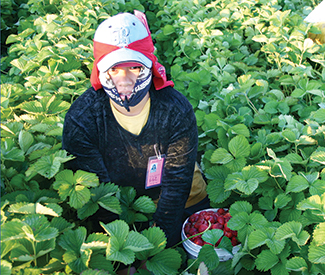
According to the US Public Health Service, there are, on average, an estimated 3.5 million migrant farmworkers in the United States, the majority of whom are undocumented immigrants. At harvest season, most of them perform the backbreaking work of picking our fruits and vegetables for an average $12,500 annually; at other times, they share slum-like apartments or live out of cars looking for odd jobs — 68 percent of them wondering if they should return home to Mexico and risk another border crossing to the US when picking time rolls around again. Only 5 percent of migrant workers have health insurance, and what happens to the rest if they get injured or fall ill doing the work the rest of us won’t is an eye-opening American tragedy.

To many Americans, this cheap, legally and socially vulnerable population is a faceless brown mass in the fields somewhere, maybe receiving a noble thought at Cesar Chavez Day or inducing the occasional twinge of guilt in the produce aisle, if thought of at all. But a provocative, important new book by UC Berkeley Assistant Professor of Public Health and Medical Anthropology Seth M. Holmes, Fresh Fruit, Broken Bodies: Migrant Farmworkers in the United States (University of California Press), which is picking up awards and has been featured on mainstream news outlets, is helping to re-personalize migrant farmworkers and move their health care situation into the media spotlight.

As the US finally addresses the facts that it spends the most money on health care for the worst outcomes, that a huge chunk of its population has no health care at all (and is severely underpaid for its work), and that we’re dependent on undocumented immigrants to harvest our produce and keep food costs down, we’re only just starting to realize the irony in giving the people who devastate their bodies to provide our healthiest foods perhaps the lousiest health care deal of all.


COMPLEX VOICES

Part heart-pounding adventure tale, part deep ethnograhic study, part urgent plea for reform, Fresh Fruit starts off with Holmes embedded in an ill-fated group of border-crossers from the mountains of Oaxaca: he gets arrested, they get deported after a harrowing stay in a detention center. Holmes then writes about his 18 months spent picking fruit alongside hundreds of others at a large family-owned farm in Skagit Valley, Wash., living in a closet with a dozen farmworkers in a rundown apartment while they look for work on the off-season, returning to Mexico to spend time with workers and their families, and shadowing the medical professionals in the publicly and privately funded clinics that serve migrant populations. Throughout, Holmes saw people “give premature birth, develop injured knees and backs, suffer from extreme stress, experience symptoms of pesticide poisoning, and even have farm trucks run over and crush their legs,” as he told Farmworker Justice magazine.

Holmes, a medical doctor as well as a doctor of anthropology — the book resulted from his thesis work — brings an enlightening complexity to the issue of migrant workers. (Including the label “migrant worker” itself, which, he notes piercingly at the end of the book, has been ossified with classist and racial overtones. If this group of people were flying over every summer from Europe or Hong Kong to secure investments on Wall Street, they would be called “international businesspeople.”)

He’s especially concerned not just with the grueling minutae of trying to receive treatment for the aches and pains that come with stooping to pick strawberries 12 hours a day, struggling to meet ambitious quotas in order to get paid very little, but also the larger, physically devastating effects of the structural violence visited upon a whole population by neoliberal economic policies that continue to widen the global income gap and entrench the wealthy in power. His “participant observation” method of studying migrant farmworkers means he writes about his own experiences in the field, and he brings his sophisticated anthropological knowledge to bear on the way contemporary society ensures that migrant farmworkers stay on the bottom rung of the economic ladder, building on the work of Pierre Bordieu, Philippe Bourgois, and others who’ve studied power relationships and structural violence in terms of workers’ health.

But, although there are scholarly footnotes and personal interjections, Holmes avoids an icky “anthropological tourism” vibe by providing the workers themselves with room to tell their histories, talk about their bodies, and react to the way they’re treated. People like Abelino, who falls victim to a series of misunderstandings over his severely injured knee, or Crescencio, who suffers acute headaches whenever he’s called racist names or ordered around degradingly, but is labeled a potential domestic abuser by one caregiver and resorts to drinking up to 24 beers per night to soothe his pain. We also hear from Marcelina, who talks to a Skagit Valley community gathering about low wages and high quotas.

And Holmes lets the owners and operators on all levels of Skagit’s Tanaka Brothers Farm — a pseudonym to protect his sources — speak as well, about the need for cheap labor in an increasingly competitive global agribusiness environment, among other concerns. (One especially interesting tidbit: organic distributors pressured Tanaka Brothers Farms to sign a machine-pick contract, which relegates farmworkers to the pesticide-ridden fields, despite the growing market for organic produce.) The Japanese-descended Tanaka family is deeply embedded in the Skagit Valley community, with roots stretching back before the Japanese internment period. The farm has seen different waves of migrant workers from poor white to Asian to Mexican. The Valley community itself has a fascinating relationship with the migrant community, emerging from it while reacting to it, developing its own social hierarchy as each generation “graduates” from farmworker to resident.


ANOTHER GENERATION

A lot has changed from Chavez’s day. For one thing, the previous generation of field workers, mostly from Guadalajara and northern Mexico or from Central America, has gained a toehold on American society — like the Asian workers that preceded them, many Hispanic workers’ children, placed in American schools, have grown up, providing their parents with a path to citizenship or work visas that allow them access to better jobs.

Today, a lot of workers are not mestizo Mexican, but of indigenous Mixtec descent, from increasingly violent mountain villages of Oaxaca in southern Mexico like San Miguel and San Pedro. Bloody land disputes, ethnic tension, the collapse of the local agriculture market that was exacerbated by the North American Free Trade Agreement in the 1990s and continued through the recent global recession, and the rowdy and malevolent presence of US-funded anti-drug military forces (strange since no major drug cartels operate there) have isolated this area, forcing its men, women, and children to look for work in America.

Triqui, not Spanish, is their native language — just one of the major hurdles when it comes to delivering healthcare to this population. Another hurdle comes with the specific cultural record of Triqui and general Mexican healthcare. Many Triqui workers rely on native healers, even in American farmworker camps, whose methods of consulting cards and drawing evil spirits from bodies using oils surely provide some psychosomatic respite. But reliance on native healers — out of a combination of tradition, availability, and fear of discovery or of health institutions in general — often prevents workers with deeper problems from receiving a wider range of appropriate treatments. Self-medication through alcohol is common (Holmes observed no drug use), and in one case a man named Bernardo took to the habit mashing his abdomen with soda bottles to ease a chronic stomache ache.

The migratory nature of these workers — and their shifting relationship to the law — all but insures disruptions in preventative and prescriptive care, lack of access to medications, frustratingly spotty medical records, and the inability to form a valuable personal bond with a trusted physician. But the major hurdle is that the system put in place by the government to serve migrant populations hasn’t been revisited since 1962, when a wave of media concern spotlighted the plight of migrant workers — most of whom, at that time, were white Oakies descended from the great Dustbowl diaspora of the ’30s and ’40s. The system has been only slightly adapted and enlarged since then, with dozens of clinics and organizations competing for limited grants, and nonprofits charging as little as they can (often still a steep fee on a farmworkers’ wage).

The picture Holmes paints of the clinics he visits and the doctors, nurses, and caseworkers he encounters is a mostly warm one — most health workers are hard-working and well-intentioned, stymied by cultural and linguistic differences, lack of funds and proper medical records, and racist attitudes from the surrounding communities. Some are prone to misinterpretation, and there are a couple outbursts of frustration that borders on stereotyping.

Still, most migrant worker health care providers are dedicated to their patients’ welfare. As one doctor, a mountaineer who serves the Tanaka Brothers Farm workers, put it: “It’s a very difficult problem. We have a bad situation where citizens cannot really afford health care. And the migrant workers, I truly believe they should have at least the same access as the others. I mean, this work that they are doing is something that nobody else is willing to do. That’s the truth. That’s probably the only reason why we are able to go to the supermarket and buy fruit for a fair price. So this is a group of people that really deserves our attention.”

That group will most likely be left out of the Affordable Care Act’s initial implementation, with possible implications for other, growing fields of migrant work, like software coding or childcare. Holmes’ book will hopefully inspire other investigations into this critical area of the nation’s health care gap — and concerted action to bridge it.

Tech leaders must engage their critics

33

EDITORIAL It’s time for San Franciscans to have a public conversation about who we are, what we value, and where we’re headed. In the increasingly charged and polarized political climate surrounding economic displacement, the rising populist furor needs to be honestly and seriously addressed by this city’s major stakeholders.

Whether or not the technology industry that is overheating the city’s economy is to blame for the current eviction crisis and hyper-gentrification, it’s undeniable that industry and it’s leaders need to help solve this problem. They are rolling in money in right now, including tens of millions of dollars in city tax breaks, and they need to offer more than token gestures to help offset their impacts.

As we were finalizing stories for this issue on Dec. 9, the Guardian newsroom was roiled by our rollercoaster coverage of a protest blockade against a Google bus, which has become a symbol for the insulated and out-of-touch nouveau-riche techies in the emerging narrative of two San Franciscos.

Our video of an apparent Google-buser shouting at protesters “if you can’t afford it, it’s time for you to leave” went viral and burned up the Internet (and our servers) even as we discovered and reported that he was actually a protester doing some impromptu street theater.

But there was a reason why his comments resonated, and it’s the same reason why The New York Times and other major media outlets have been doing a series of stories on San Francisco and the problems we’re having balancing economic development with economic security, diversity, infrastructure needs, and other urban imperatives.

Rents have increased more than 20 percent this year, the glut of new housing coming online now is mostly unaffordable to current residents, even that new construction has done little to slow real estate speculators from cannibalizing rent-controlled apartments, and the only end in sight to this trend is a bursting of the dot-com bubble, which would cause its own hardships.

We need this city’s political leaders to convene a summit meeting on this problem, and Mayor Ed Lee and his neoliberal allies need to bring tech leaders to the table and impress upon them that they must engage with their critics in a meaningful way and be prepared to share some of their wealth with San Franciscans. Not only is the future of the city at stake, so is its present, because the housing justice movement won’t be ignored any longer. The good news is that San Francisco has a golden opportunity to test whether democracy can help solve the worst aspects of modern capitalism, offering an example to others if we succeed. But if our political leaders don’t create good faith avenues for meaningful reforms, San Francisco may offer a far messier and more contentious lesson.

UPDATE: Union organizer shouts down protesters as they block private Google shuttle

228

Protesters blocked a private Google shuttle on Valencia street today, decrying private shuttle’s use of public bus stops without paying fees or fines.

The group of 20 or so neon-yellow vested protesters called themselves the “San Francisco Displacement and Neighborhood Impact Agency.” The company doesn’t pay San Francisco a dime to use the Muni stops — fines that private auto drivers pay regularly.

UPDATE 3:58pm: Just how does a story go from breaking, to verification, to “holy shit it’s all over the internet now?” Here’s our interview with Fake Google Employee Max Alper, and our recount of how it all went down: http://www.sfbg.com/politics/2013/12/09/whyd-you-do-it-we-ask-fake-google-employee-max-bell-alper

UPDATE 12:32pm: Various tips have streamed in that this shout-out was staged. Protest organizer Leslie Dreyer talked to us on the phone and verified that this person’s identity was Max Bell Alper, a union organizer from Oakland. This person was not a Google employee, and Dreyer was not able to verify if Alper was there in the morning with the group of 20-30 protesters. The Guardian is attempting to contact Alper for comment. Dreyer said she, as an organizer, was unaware that the “performance” had been planned. We are following this as it develops.

UPDATE 1:06pm: Within an hour of our original post, the Guardian learned that Max Bell Alper, a union organizer with Unite Here Local 2850 was the man shouting down Google bus protesters earlier this morning. We asked Alper what motivated him to impersonate a Google employee.

This is political theater to demonstrate what is happening to the city. It’s about more than just the bus. These are enormous corporations that are investing in this community. These companies, like Google, should be proud of where they’re from and invest in their communities,” he said.

When asked if he intentiionally intended to deceive media, he replied “People are talking all over the country about what’s happening in San Francisco (referring to evictions and displacement). That’s the debate we need to have here. The more we talk about it, the more we think about it, the more we’re going to see the tech companies need to contribute.”

 Alper said that he did not intend to engage in theater before going to the protest, but when there made the decision, “spontaneously,” to stage the argument. When he maintained his story that this was political theater, we again asked why he did not verify his name at the protest itself — and only after the story blew up in national and local media.

This was improv political theater,” he said.

Original post follows:

The SFMTA has a pilot plan in the works to regulate private use of public bus stops.

Though the private shuttles were the crux of the day’s protest, the heart of the fight is over gentrification. As the tech revolution in SF leads to rising rents and longtime San Franciscans are being displaced.

In the video, a union organizer who hopped off the bus shouts down Erin McElroy, staging an argument with a protester who also heads the eviction mapping project. “How long have you lived in this city?” McElroy asked him. He shouted back “Why don’t you go to a city that can afford it? This is a city for the right people who can afford it. You can’t afford it? You can leave. I’m sorry, get a better job.”

“What kind of fucking city is this?” he shouted, and then walked off. He mentioned repeatedly that he couldn’t get to work because the bus was blocked, and did exit the bus (indicated he was a Google employee), but the Guardian (nor a nearby Al Jazeera reporter) could not verify his job title or name. If anyone has any tips as to the identity of this man, please contact us at news@sfbg.com. 

(UPDATE 12:12 PM — The Guardian amended the headline to reflect our story more accurately, that though this man exited the bus and claimed he was late for work, we have not yet verified his employment at Google)

We’ll have more on this story later in the day, for now, check out footage from the protest.)

Oakland joins 100 cities in national fast food strike

28

It was a bad day for Big Macs, but a good day for workers. 

Joining a nationwide day of action, a wave of over a hundred protesters crowded into a Oakland McDonald’s, on Jackson street, demanding fast food workers to join in the strike.

Four employees joined in the strike, and others briefly joined the march outside.

100 cities across the country held similar strikes, with workers in Detroit, New York City and more demanding a livable wage of $15 an hour. 

The protest was nationally led by labor unions, including the SEIU, but locally it was led by men like Jose Martinez. Martinez led the strike at KFC some time back, and was one of the organizers at the forefront of today’s action at McDonald’s and other fast food outlets. 

“It’s a movement for all fast food workers to come together and fight for our rights,” he said.

Standing with Martinez in Oakland, rapper, performer and music producer Boots Riley said he was in support of the fast food workers’ movement.

“Fighting to raise wages of anyone helps everyone, a high tide raises all boats,” he told the Guardian. “You help make that profit, your labor is worth more than minimum wage.”

Inside, the fast food joint was bursting at the seams, the workers hungry for justice.

“Markeisha! Markeisha! Markeisha!” they screamed, bursting into cheers as the five-foot tall girl hobbled around the counter to join the strike. Markeisha, who did not want her last name used, said she tore her ACL a week ago tripping over one of her children’s toys. She can’t afford not to be at work though, and worked the register from a chair.

We asked if she was afraid to be on strike.

“Afraid? Kind of,” she said. If she lost her job, “I wouldn’t have a way to pay my bills and support her family.”

She has two children, a five year old and an 11 month old. But to her this is important, because she isn’t earning a living wage.

“I haven’t had a raise in three years,” she said. That’s the entire time she’s worked there. Only now that she’s training to be a shift manager is she going to make $8.50 an hour. That’s a raise of fifty cents.

“McDonald’s and our owner-operators are committed to providing our employees with opportunities to succeed,” McDonald’s stated on its website. “We offer employees advancement opportunities, competitive pay and benefits.”

One worker we talked to said they had to visit food banks to eat, even though they were fully employed. McDonalds also wanted to correct the media.

“To right-size the headlines, however, the events taking place are not strikes. Outside groups are traveling to McDonald’s and other outlets to stage rallies,” they wrote.

But contrary to their statements, eventually four workers did join the protesters in their strike, and together they poured out of the McDonalds into the adjoining parking lot. They danced and screamed, all advocating for their right to a livable wage.

Nationally the SEIU has taken the lead in organizing the workers, but locally the protest was organized as a coalition between a number of groups, including the ReFund & ReBuild Oakland Community-Labor Coalition, ACCE, EBASE, the East Bay Organizing Committee, UNITE-HERE Local 2850, OUR WALMART, SEIU 1021, and SEIU ULTCW. 

Rep Clock: December 4 – 10, 2013

0

Schedules are for Wed/4-Tue/10 except where noted. Director and year are given when available. Double and triple features marked with a •. All times pm unless otherwise specified.

ALBANY 1115 Solano, Albany; www.landmarktheatres.com. $7. “Family Series:” The Muppet Movie (Frawley, 1979), Sat-Sun, 10:30am.

“ANOTHER HOLE IN THE HEAD FILM FESTIVAL” Balboa Theater, 3630 Balboa, SF; New People Cinema, 1746 Post, SF; www.sfindie.com. $12. Now in its 10th year, the festival highlights indie horror, sci-fi, and fantasy films, through Dec 19.

ATA GALLERY 992 Valencia, SF; www.atasite.org. $4-10. “OpenScreening,” Thu, 8. For more info, contact programming@atasite.org. “Other Cinema,” animated works by Martha Coburn, Jeremy Rouke, Janie Geiser, and others, Sat, 8:30.

BALBOA THEATRE 3630 Balboa, SF; cinemasf.com/balboa. $10. Art Gods: An Oral History of the Tower Records Art Department (Taylor, 2013), Fri-Sat, 10. “Popcorn Palace:” The Polar Express (Zemeckis, 2005), Sat, 10am. Matinee for kids.

BERKELEY FELLOWSHIP OF UNITARIAN UNIVERSALISTS’ HALL 1924 Cedar, Berk; www.bfuu.org. $5-10. “Screening the Green:” The Story of Stuff (Fox, 2007), and The Story of Solutions (2013), Thu, 7.

BINDLESTIFF STUDIO 185 Sixth St, SF; www.facinesf.com. $10-20. “FACINE bente: Filipino American Cine Festival,” 33 feature length films and short works from the Philippines and the Filipino Diaspora, Dec 9-14. Proceeds benefit Typhoon Haiyan relief operations in the Philippines.

CASTRO 429 Castro, SF; (415) 621-6120, www.castrotheatre.com. $8.50-12. The Sound of Music (Wise, 1965), Wed-Thu and Sat-Sun, 7 (also Sat-Sun, 1pm). Presented sing-along style; tickets ($10-15) at www.ticketweb.com. “Good Vibrations Quickies: Erotic Short Film Competition,” Fri, 7 (pre-party); 8 (screening). These events, $10; visit www.brownpapertickets.com for advance tickets. I Am Divine (Schawarz, 2013), Mon, 7, 9. Gravity (Cuarón, 2013), Dec 10-11, 7, 9:15 (also Dec 11, 2:30, 4:45).

CHRISTOPHER B. SMITH RAFAEL FILM CENTER 1118 Fourth St, San Rafael; (415) 454-1222, www.cafilm.org. $6.50-$10.75. The Armstrong Lie (Gibney, 2013), call for dates and times. Blue is the Warmest Color (Kechiche, 2013), call for dates and times. The Great Beauty (Sorrentino, 2013), call for dates and times. Richard II, Royal Shakespeare Company production starring David Tennant, Thu, 7; Sun, 1. Walking the Camino: Six Ways to Santiago (Smith, 2013), Dec 6-12, call for times. Sweet Dreams (Fruchtman and Fruchtman, 2012), Sun, 7. Filmmakers Lisa and Rob Fruchtman in person; this event, $12.

CLAY 2261 Fillmore, SF; www.landmarktheatres.com. $10. “Midnight Movies:” Labyrinth (Henson, 1986), Fri-Sat, midnight.

DAVIES SYMPHONY HALL 201 Van Ness, SF; www.sfsymphony.org. $25-80. “A Symphonic Night at the Movies:” Singin’ in the Rain (Donen and Kelly, 1952), Fri-Sat, 7:30.

MECHANICS’ INSTITUTE 57 Post, SF; milibrary.org/events. $10. “CinemaLit Film Series: Dark Star: The Films of Barbara Stanwyck:” Remember the Night (Leisen, 1940), Fri, 6.

NEW PARKWAY 474 24th St, Oakl; www.thenewparkway.com. “Courtney Trouble’s Queer Porn Movie Party,” Thu, 7. This event, $10. “First Friday Shorts,” films by and about Bay Area Girls Rock Camp, Fri, 6. This event, free.

PACIFIC FILM ARCHIVE 2575 Bancroft, Berk; (510) 642-5249, bampfa.berkeley.edu. $5.50-9.50. “The Resolution Starts Now: 4K Restorations from Sony Pictures:” “Grover Crisp: The Resolution Starts Now,” followed by Bonjour Tristesse (Preminger, 1958), Thu, 7; Alamo Bay (Malle, 1985), Sat, 6:30; Taxi Driver (Scorsese, 1976), Sat, 9; The Arch (Tang, 1969), Sun, 3; Picnic (Logan, 1956), Sun, 5:15. “Love Is Colder Than Death: The Cinema of Rainer Werner Fassbinder:” Why Does Herr R. Run Amok? (Fengler and Fassbinder, 1969), Fri, 7; Despair (1977), Fri, 8:50.

ROXIE 3117 and 3125 16th St, SF; (415) 863-1087, www.roxie.com. $6.50-11. Is the Man Who Is Tall Happy? (Gondry, 2013), Wed, 7:15, 9:15; Thu, 9:15. A Journey to Planet Sanity (Freeman, 2012), Wed, 7. This event, $12. Muscle Shoals (Camalier, 2013), Wed-Thu, 9. “Frameline Encore:” Seventh-Gay Adventists (Akers and Eyer, 2012), Thu, 7. This event, free. •Amal’s Garden (Shihab, 2012), and My Father Looks Like Abdel Nasser (Kassem, 2012), Thu, 7. At Berkeley (Wiseman, 2013), Dec 6-12, 6:45 (also Sat-Sun, 2). The Punk Singer (Anderson, 2013), Dec 6-12, 7, 8:45.

SOCIAL STUDY 1795 Geary, SF; www.socialstudysf.com. Free. Impresa! (Woldu, 2013), Tue, 6:30.

TEMESCAL ART CENTER 511 48th St, Oakl; www.shapeshifterscinema.com. Free. Intertidal, performance-based work by media artist Alex MacKenzie, inspired by the tidal zones and marine life of Western Canada, Sun, 8.

YERBA BUENA CENTER FOR THE ARTS 701 Mission, SF; www.ybca.org. $8-10. “X: The History of a Film Rating:” Bad Timing: A Sensual Obsession (Roeg, 1980), Thu, 7:30. “Films by Fassbinder:” Querelle (1982), Sun, 2. *


Pros and cons(oles)

2

arts@sfbg.com

GAMER The next generation of game consoles is officially in stores and consumers demand to know — definitively — which is the superior console. Is it the PlayStation 4 or the Xbox One?

Unfortunately, the comparison isn’t that simple. Although both are sleek, state-of-the-art devices that play video games, we’re talking about two machines with different aims. Sony hopes the PS4 will lure back gamers that it disenfranchised with the expensive, non-intuitive and difficult-to-love PlayStation 3 by making things simple, fun, and focused on playing and sharing games. Microsoft is high on the success of the Xbox 360 and looking to dominate home media on all fronts, creating in the Xbox One an all-in-one device that allows you to control your TV, movies, and other digital downloads.

Strictly speaking, if you want to just play games and have an experience that is the same but prettier, Sony has your interests at heart. It’s the more powerful machine, current games look a bit better, and navigating the PS4 generally is an all-around smooth experience. Upon booting the system up, you’re greeted with soothing music and a fairly straightforward, simple interface. I was able to find all my games, apps, and settings within seconds, rather than minutes. The new DualShock 4 controller has a touch pad and a light bar for motion gaming (provided you have a PlayStation camera) and it performs these new functions with a minimum of hassle.

The most “next gen” aspect of the PS4 is the share button. A new button on the DualShock 4 is dedicated to sharing your experiences with friends, whether what’s being shared is video clips or actual streams of gameplay that can be viewed on another PlayStation, computer, or phone. Game streams and Let’s Plays have become their own genre on YouTube, and, by giving people that experience on day one (Xbox One’s streaming services are set to launch next year), Sony has a real upper hand on conquering the online gaming community that enjoys watching other people play games.

The PS4 is a machine that plays games, plain and simple, and right now the games it plays are only so-so. You’ve got a new Killzone, Shadow Fall; first-party beat ’em up Knack; and a few multi-platform — and cross-generationtitles that are likely to do well, but the must-have next-gen gaming experience just isn’t here yet.

The Xbox One is not nearly as intuitive as the PS4 and your first few hours with the machine will require patience and a bit of learning. Applications and settings are hidden in sub-menus and the revelatory Kinect voice commands are exhilarating when they work and aggravating when they inevitably do not. Growing pains were inevitable; Microsoft is attempting things that have never been done on a gaming machine before — like the ability to route your cable box into the Xbox One and change channels with your voice — and, if their history of iteration is to be trusted, it’s likely that the issues with organization and un-matched voice commands will melt away sooner rather than later.

Xbox’s launch games are favorable only in comparison with the PS4’s meager lineup. Forza Motorsport 5 is a wonderful showcase for what the Xbox One is capable of, and the best buy on either console so far, but the other exclusives are essentially limited to Dead Rising 3 and Ryse: Son of Rome, which are fun in spurts but offer nothing you haven’t hacked or slashed before.

Which leaves the question, what do you want from your “next-gen” console? If you’re in the market for a new device, you’re not wrong to expect improved graphics or increased resolution and frame rate. You want games to look better. And that’s at least partially there if you want it, but it doesn’t seem to be the current focus for either machine. Even on the PS4, the visual leap we’re seeing right now isn’t worth the $400 asking price, and the lower-spec’d Xbox One is tagged at a whopping $500 for a system bundled with Kinect.

In spite of all the internet furor spouted by gamers in the past few months about sub-standard resolution and graphics, perhaps Microsoft and Sony both realize the real coup is getting people who aren’t gamers to buy these consoles. In that area, Xbox One’s ambition to do more than play games is a risky pursuit, but one that could make all the difference for consumers who have only a passing interest in traditional gaming.

Time will tell which console resonates more with the public and some day financial reports aplenty will give us a definitive resolution on which console is more successful. But calling this a “console war” is more than a little sensational. Both the PlayStation 4 and the Xbox One currently offer incrementally better experiences than their previous-gen counterparts, and the world of popular consumer electronics has proven a little better is often just enough. *


Riot acts

0

arts@sfbg.com

FILM It was strange when Kathleen Hanna — riot grrrl activist, iconic Bikini Kill battle cry leader, electro-popping Le Tigre singer — went silent.

Though she was not entirely absent from the public eye, she did not make any new music or tour for nearly a decade. Beat down by a mysterious illness, she seemingly tumbled into hardcore self-preservation mode, contributing her personal files of zines, show flyers, and lyrics to the “Riot Grrrl Collection” at New York University’s Fales Library.

This archival material would prove key to Sini Anderson’s new documentary about Hanna, The Punk Singer. The film includes many lesser-seen clips from the early days of Bikini Kill, the band’s tours through Europe, and rare early moments with Hanna’s husband, Beastie Boy Adam Horovitz.

“There’s some unfortunate and there’s some fortunate in this,” says Anderson, speaking to me in a hotel in San Francisco ahead of the film’s Bay Area premiere at the Oakland Underground Film Festival in September. “The unfortunate is that Kathleen started getting incredibly sick, and she was getting worse and worse. [But then] she decided to pull all her materials together and start archiving them. So she had a few interns and for a couple of years they just pulled all this stuff from all over the place, so by the time we started the film project, a lot of this was in one place.”

Anderson is a Portland, Ore.-based feminist artist who co-founded Sister Spit while living in SF and has worked in film for a decade, though this is her first documentary. She suggested the idea to Hanna while Le Tigre was making 2011 doc Who Took The Bomp? Le Tigre on Tour. While Hanna became the reluctant face of the riot grrrl movement in the ’90s, she’d never granted the media access to her whole story, at least partially because she didn’t want to be misunderstood.

“She had been out of music for six years at that point, and in [the realms of feminism and politics], there just didn’t seem to be any kind of action going on. Things seemed complacent,” Anderson says. “I said, ‘Kathleen, people need to hear your story, and they need to hear it now.'”

Using archival footage and present-day interviews, the doc covers Hanna’s childhood, the beginning of the riot grrrl movement, Le Tigre, and the resurrection of her post-Bikini Kill solo project, the Julie Ruin. Anderson interviewed Hanna in a series of intimate, enlightening sit-downs at her lake house, which are delicately spliced throughout the film between older clips and interviews with Hanna’s contemporaries: Bikini Kill’s Tobi Vail, Billy Karren, and Kathi Wilcox (now of the Julie Ruin); Kim Gordon; Joan Jett; Carrie Brownstein and Corin Tucker; and teenage Rookie Magazine editor Tavi Gevinson, who wears the colorful “Feminist” sweater gifted to her by Hanna.

The main bulk of filming was done over the course of a year — and it was a momentous one. Countless doctors had misdiagnosed Hanna by the time Anderson began filming, without an end in sight. Halfway through filming, she finally had a name for her illness: late-stage neurological Lyme disease. When she began treatments, filmmaker and subject decided not to shy away from the vulnerability of moments like Hanna taking her meds and experiencing their uncomfortable after-effects.

“Once she started treatment, it was a roller coaster — she got worse, and then she got better, then she got worse. We had to plan the interviews around when she was up for it,” — explains Anderson, who, incredibly, was also diagnosed with Lyme disease during filming, from an unrelated incident. “I really believe there’s so much power and strength in that vulnerability. It really is important for other women to see that we can tell our truth, we can let people see what’s going on — that doesn’t make us weak, that makes us stronger.” Anderson is now working on another documentary specifically about Lyme disease.

During filming for The Punk Singer, Hanna decided to put together the Julie Ruin, her first new musical act since the end of Le Tigre. This year, the band released its full-length, Run Fast, on Dischord Records.

“She says it really eloquently in the film: when she realized that she may never again be able to do this thing she loves, she realized she wanted it more than ever,” Anderson says.

For the director, one of the biggest moments during filming came from this realization. Hanna sits by her fireplace, surprising herself as she talks about why she quit music — why it was easier to just say she’d already said everything she’d needed to sing. She didn’t want to admit to anyone, including herself, that she was quitting because she was sick. In the doc, Hanna seems taken aback and tears up a bit, but gives the go-ahead to keep filming.

The Punk Singer‘s other epiphany comes at the very end, on the last day of filming, in what became the last scene of the film. Hanna asks, “What is my story? I have no idea,” and begins mentioning moments from her life. “I thought, who is going to believe me? Other women will believe me.”

Says Anderson, “It was about being believed, and being heard, and having her truth be validated. That’s [her] story.” *


THE PUNK SINGER opens Fri/6 in San Francisco.

Suspending judgment

40

joe@sfbg.com

The Guardian is publishing only the first names of minors and their relatives named in this story, to protect their privacy.

In San Francisco public schools students can be sent home for talking back to a teacher, wearing a hat indoors, or sporting sagging pants. These infractions sound like the daily life of a kid, but the state calls them “willful defiance,” a category of suspensions that are nebulous to define at best.

Like the old saying about pornography, teachers say they know it when they see it, but students and parents alike are now calling foul on the practice.

The suspensions are so abundant in the San Francisco Unified School District that a movement has risen up against it. Sending kids home not only is an ineffective punishment, opponents say, it also can lead youth into the criminal justice system.

Now San Francisco Board of Education Commissioner Matt Haney is proposing a resolution that would ban willful defiance suspensions in San Francisco schools altogether.

“There will still be situations where we need to send a student home, but willful defiance will not be one of those reasons,” he told the Guardian. “Change is hard, complicated, and messy. But we can no longer deal with discipline or interactions with our students in that sort of way.”

He plans to introduce the resolution at the Dec. 10 Board of Education meeting, and if it passes, he said full implementation may take until the next school year.

There’s a fight to ban willful defiance suspensions statewide as well, but so far it’s been stymied. Just last month, Gov. Jerry Brown vetoed Assembly Bill 420, a bill mirroring aspects of Haney’s proposal. Those advocating for such a ban say it’s an issue of racial justice.

San Francisco’s African American and Latino students together suffer 80 percent of willful defiance suspensions, according to SFUSD data. The nonprofit student group Coleman Advocates for Children and Youth decried this statistic as an injustice, supporting the ban.

The San Francisco Board of Education took tentative steps to reduce suspensions as a whole in 2010, voting to introduce a new disciplinary system called Restorative Practices district wide. It’s complex, but basically asks students to talk things out in what are called “restorative circles” that include everyone involved in an incident, like a fight.

It’s also about changing the culture around discipline. It encourages teachers and students to establish a rapport, turning around the way some schools have practiced authority for decades.

At the time, there was hope. Fast forward three years, and that hope has dwindled.

Early evidence shows that Restorative Practices work better than suspensions, and prevent behavioral problems down the road, too. But out of SFUSD’s more than 100 schools, less than half of them started to implement the new reform.

Few schools have fully integrated the change, officials told us. Haney’s resolution addresses this with a mandate: SFUSD must implement Restorative Practices throughout the San Francisco school district.

The program is important, proponents say, because the majority of the 55,000 students a year moving through San Francisco schools still face school discipline that can set them way back in school and later may lead to incarceration. And suspensions can be levied for the smallest of infractions.

Cupcakes and justice

Xochitl is a 15-year-old SFUSD sophomore with long brown hair. She watches the TV show Supernatural (Dean is cuter than Sam) and yearns to one day live with her relatives in Nicaragua. Years ago on her middle school playground, she once faced a hungry child’s ultimate temptation: Free cupcakes.

The baked goods sat in a box on the cement by the playground, unattended. The frosting sat un-licked, the wrappers unwrapped.

She and her friend looked around, searching for a possible pastry owner nearby. Runners circled around the track in the distance, but no one else was around. The cupcakes met a satisfying fate inside Xochitl’s belly. The next morning went decidedly downhill.

As she walked into school, the counselor told her to go home: she was suspended.

“The cupcakes belonged to this girl because it was her birthday,” Xochitl said, something she found out only once she was being punished. “They went straight to suspension, they didn’t even let me speak.”

Restorative practices would have sat her with the birthday girl to explain her mistake and apologize. Maybe she would’ve bought the girl new cupcakes. That wasn’t what happened.

Suspended, Xochitl spent the day at her grandparents’ house. Not every suspended student has a safe place to go. Some turn to the streets.

stats

In October a group of mostly black young students marched to the Board of Education to protest willful defiance suspensions. The group, 100 Percent College Prep Institute, formed in the ashes of violence.

“I drive a school bus for a living, and I had a boy on my bus who was not bad, but not good,” said 100 Percent College Prep Institute co-founder Jackie Cohen, speaking with the Guardian as she marched with her students. “When we got back from Christmas break, he wasn’t back on the bus. Turns out he decided to ‘live that life.’ Three days later, I found he was shot and killed.”

In some communities the jaws of crime and drugs are forever nipping at their children’s heels. A child inside school is safe. Suspensions throw the most vulnerable students into the wild.

“Preventing crime in San Francisco begins with keeping children in the classroom,” SFPD Chief Greg Suhr wrote in a letter to the SF Examiner last year. “Proactive policies, such as the ‘restorative practices’ implemented by the SFUSD, emphasize the importance of building positive relationships while holding kids accountable for their actions.”

Black students make up about 10 percent of SFUSD’s population, but they represented 46 percent of SFUSD’s total suspensions in 2012, according to SFUSD data. Latino students represented about 30 percent of suspensions.

The racial disparity of suspensions mirror the disparity of incarceration. A study by nonprofit group The Advancement Project found that in 2002, African American youths made up 16 percent of the juvenile population but were 43 percent of juvenile arrests.

Xochitl sees that with her own eyes every day.

“Some kids turn to the streets, you know. I’ve seen people younger than me go to jail,” Xochitl said. “I was on Instagram and saw a friend locked up. I knew that girl, she’s in my PE class.”

It’s one of our country’s many shameful open secrets. Nearly half of all adult men in the United States serving life sentences are African Americans, and one in six is Latino, according to data from the nonprofit group the Sentencing Project.

Fathers and sons, mothers and daughters, all trapped in a cycle of poverty to prisons that for some starts at school.

“As a school district, when that’s staring us in the face, we can’t not do something about it,” Haney said.

Sometimes it begins when students are still learning their ABC’s.

Bruises inside and out

Restorative Practices are implemented from kindergarten to high school.

“If [students] don’t have a sense of belonging… that’s going to prevent schools from addressing behavior,” Kerry Berkowitz, the district’s program administrator of Restorative Practices, told us. The seeds of mistrust are planted when students are young.

Desamuel could not yet spell the world “police” when he first met them.

He was five years old, and as kindergartners sometimes do, he threw a temper tantrum. In the school’s desperation to contain him, officials called the SFPD.

“The police only came one time,” Desamuel, now seven, told the Guardian. Sitting in his San Francisco home with his uncle Lionel, Desamuel sounded ashamed. “But I didn’t go to jail because they only put kids in jail for being bad, like kids taking guns to school.”

The memory angers Desamuel’s uncle, who feels restorative practices would have prevented the misunderstanding. His home is a testament to bridge building.

Lionel, his brothers and mother all pitch in to take care of Desamuel while the boy’s father makes what he calls “a transition.” The home is large by San Francisco standards. Drawings of Spiderman and Batman line the wall, equal in number only to the portraits of their family, most of whom live in the city. There’s a lot of care in Desamuel’s life. That hasn’t stopped his tantrums, though.

The family tried to get him therapy, psychological analysis, anything to help. But as any parent can tell you, sometimes a child just needs love.

Lionel struggled with the school’s administration, and asked them to try less punitive ways of handling his nephew. “I told them to just hug the boy. Their response was ‘it’s hard to hug someone swinging at you.'”

The last time Desamuel fought a student he was tackled to the ground by a school security guard. The now-second grader came home with a bruise on his face.

“When I was bad I hurted the children. I wasn’t supposed to get up, and couldn’t get up off the ground. He took me by the arms and legs,” Desamuel said.

The problem with outsize use of suspensions and punitive action, Berkowitz said, is that it breeds a fear of school that shouldn’t exist. Desamuel is no different.

“I got sent to the office and I had to go to the principal’s office and they talked about me being bad,” Desamuel said. “I think because I make too much trouble I have a lot of problems and they don’t want me to be there.”

Cat Reyes is a history teacher who is now a Restorative Practices coach at Mission High School. She said transformation in behavior is the whole point.

She told the Guardian about a student recorded a fight on film. The two fighting teenagers tried to let the incident go, but with the video online for all to see their pride came between them. If the school suspended the girl who recorded the fight there may never have been resolution. The wounds would fester.

But now the girl will join a restorative circle and explain her actions to those involved in the fight, and their parents. That’s far more daunting to kids than simply going home for a day, Reyes said. It doesn’t just stop at the talk though. “On one end she has to say sorry,” Reyes said. “But now she may go to the media center and create a [movie] about it on our closed circuit TV. The consequence fits the crime.”

As students talk out their differences enemies can become friends, she said. After all, the goal is to correct bad behavior and break destructive cycles. Yet less than half of the schools in SFUSD are employing Restorative Practices.

Slowly but surely

One of the biggest critiques of Restorative Practices is that it removes consequences. That’s the wrong way to look at it, Berkowitz said: “When people say consequences, they mean punishment. We want to work with students to find root causes.”

The numbers back her up: 2,700 SFUSD staff members have trained in Restorative Practices, according to data provided by the district. This consequently led to a strong reduction in suspensions, the district says, from more than 3,000 in 2009 to about 1,800 last year.

SFUSD recognized a good thing when it saw it, growing the Restorative Practices budget from $650,000 in 2009 to $900,000 in 2013.

But only about 25 schools started measurable implementation, Berkowitz said. She put it plainly, saying the program is in its infancy. “Are they ‘there’ yet?” she said. “No.”

“Our team is pretty maxed out,” she said. “To really bring this to scale and implement Restorative Practices, there’d need to be a lot of discussions around that.”

Asked how much she’d need to fully fund the program across all schools, she was evasive. Haney was more direct. When asked if his resolution tied funding to the mandate of implementing Restorative Practices district-wide, he admitted that a funding source hadn’t yet been identified.

“Mostly we hear there needs to be more: more support, more social workers, more people in schools to make this functional,” he said. “It’s a longer term challenge.”

That solution may emerge as the resolution goes through the approval process, but the program faces other problems besides funding.

Teachers have depended on suspensions as a tool for years. Money is one thing, but changing educators’ minds about discipline is another.

The “R” word

Martin Luther King Jr. fought for the integration of schools, but in a speech about Vietnam he said something that could apply to the SFUSD today.

“Life and history give eloquent testimony to the fact that conflicts are never resolved without trustful give and take on both sides,” the southern preacher said in one of his last speeches before his death.

There is one issue simmering under this entire debate, festering, unspoken. Why are black and Latino students suspended more than other groups? Is this system inherently racist?

It’s a tough question. Teachers are notoriously underpaid, overworked, under supported, and asked to enforce the newest policies at the drop of a hat. The teachers the Guardian spoke to all described a packed year filled with new methods to learn, all with a common purpose — a love of their profession and a love of their students.

“There’s a hesitancy to talk about race with this,” said Kevin Boggess, civic engagement leader for Coleman Advocates, the group leading the charge for the willful defiance ban.

Nevertheless the question of racism permeates the discussion. Xochitl felt persecuted as one of the few Latinas in a mostly Asian middle school.

In the case of Desamuel, the young black child who had the police called on him at age five, his uncle stressed the need for culturally aware teaching. Lionel said Desamuel was well-behaved when he had an authoritative, elderly black female teacher, but acted up in the hands of substitutes who weren’t black and whom he characterized as “young and new” to teaching. Then again, the principal who called the police to handle Desamuel was herself black.

Norm “Math” Mattox is a former James Lick Middle School math and science teacher, and he said from his perspective as an African American he’s seen the issues Haney’s resolution addresses clear as day.

“My sense is that teachers might be blowing the alarm a little bit too soon as far as their brown and black students are concerned, especially the boys. They don’t know how to manage them,” he said. In his experience, misbehaving children are sent out of the room too soon.

In the short term, suspensions are an expedient tool, but punishment without communication does long lasting damage. “The dynamic between teacher and student did not get resolved inside of the class,” he said.

One SFUSD school tackled the specter of racism head on. Mission High School is at the vanguard of what its principal calls “anti-racist teaching.”

Mission High has a higher African American student college placement rate than many SFUSD schools, a group that struggles to perform elsewhere. And as a designated “newcomer pathway” for new immigrants, the school has 40 percent English language learners.

Mission High’s principal, Eric Guthertz, is energized by the challenge. He revamped the way the school teaches to address race and ethnicity directly.

The geometry teachers use Bayview district planning data to illustrate mathematical lessons, and teachers look at grades by ethnicity and address disparities directly.

Guthertz credited Restorative Practices with lowering the school’s suspensions. SFUSD data shows Mission High’s steady suspension decline, with a 14 percent suspension rate in 2009, before the program started, and down to a 0.4 percent suspension rate by 2012.

missionprincipal

Mission High School Principal Eric Guthertz. Guardian photo by Brittany M. Powell

“We’ve deeply embraced Restorative Practices,” he said.

Next week San Francisco will see if the Board of Education will take the same leap Gutherz did. As he is quick to point out, shifting the culture at Mission High School took years.

The Guardian contacted members of the school board, but did not hear back from them before press time to see how they may vote.

Either way, it’s time for SFUSD to change its ways, Haney said. But no matter what side of the matter you fall on, he said, it’s important to remember one thing.

“Everyone involved in this conversation wants to do better by these students,” he said.

The San Francisco Board of Education will vote on the ban of willful defiance suspensions and full implementation of Restorative Practices at their Dec. 10 meeting.

Alerts: November 27 – December 3, 2013

0

WEDNESDAY 27

Harvey Milk and George Moscone Memorial Harvey Milk Plaza, Castro and Market, SF. tinyurl.com/MilkMoscone. 7pm, free. A candlelight vigil and march will be held in remembrance of the 35th anniversary of the murders of San Francisco Supervisor Harvey Milk and Mayor George Moscone. The event is meant to honor their memories and bring people together. It is being co-sponsored by a broad coalition, including the Harvey Milk LGBT Democratic Club.


FRIDAY 29


Black Friday Roller Disco Party San Francisco Women’s Building, 3543 18th St, SF. (415) 820-3907. 8pm-12am, free. SF Indiefest and Black Rock Roller Disco present a Black Friday roller disco party inside the Women’s Building auditorium. Disco costumes encouraged! Skate rentals will be provided, or bring your own.


SATURDAY 30


Citizen Journalism Symposium East Bay Media Center, 1949 Addison, Berk. 3pm, free. Live streamers, bloggers and social media mavens will converge for a series of conversations on citizen journalism, featuring those who helped capture Occupy Wall Street protests and a discussion led by host Clark Sullivan on ethics in citizen journalism. Bring your smartphone, laptop, curiosity, and enthusiasm.


MONDAY 2

World AIDS Day forum San Francisco LGBT Community Center, 1800 Market, SF. 6:30-8:30pm, free. This year’s forum, titled “Getting to Zero in San Francisco: How Close Are We?” offers attendees the latest news on San Francisco’s progress in fighting HIV/AIDS from experts in the field. They will also be informed about programs that are helping the city get closer to its goal of zero new HIV infections. The interactive town hall forum structure of the event enables it to be as informative as possible, and ensures audience engagement with the topic. TUESDAY 3 #GivingTuesday: Project Homeless Connect 3200 California, SF. (415) 292-1286 or sstickel@jccsf.org. 10am-8pm, free. People ages 12 and up are asked to come help put together personal hygiene kits for homeless people in San Francisco. Participants may come anytime during either of two shifts, which run 10am-1pm and 3-4:30pm. Afterward, everyone is invited to a Hanukkah Candle Lighting, which will begin at 4:30pm. The kits will be distributed by volunteers the following week at Bill Graham Civic Center Auditorium. This event is part of #GivingTuesday, which is a national day dedicated to charitable activities.

Activists organize, and some journalists chronicle, a progressive resurgence in SF

131

While Mayor Ed Lee jets around the world, still too focused on fueling the economic fire that is gentrifying San Francisco and displacing its diverse population — and as the San Francisco Chronicle and other downtown boosters niggle on the margins of the city’s biggest issue — local activists and some media outlets are paying attention and pushing back.

The New York Times ran an excellent Sunday piece about the growing populist backlash here against Mayor Lee’s economic policies and his friends and benefactors in the tech industry, a story that the Santa Rosa Press Democrat also put on its front page, but which the Chronicle only briefly mentioned today on its business page in a short story wrapping all the high-end housing now coming online. Instead, on Sunday the Chron ran this pro-landlord garbage

Meanwhile, as we report in tomorrow’s edition of the Guardian, more than 20 local organizations have combined forces this year to organize and promote tomorrow’s (Wed/27) annual memorial march marking the 1978 assassinations of Mayor George Moscone and Sup. Harvey Milk in City Hall, which will this year focus on their legacy of advocating for renters and keeping this city affordable by and welcoming of the working class and outsiders of all types.

We’ve said it before and we’ll say it again: this is a struggle for the very soul of San Francisco, and it’s a struggle that we at the Guardian renew our commitment to with every issue we print. See you all on the streets tomorrow night starting at 7pm in Milk Plaza and Castro and Market.    

On the Cheap: November 20 – 26, 2013

0

Listings are compiled by Guardian staff. Submit items for the listings at listings@sfbg.com. For further information on how to submit items for the listings, see Selector.

WEDNESDAY 20

“The Diversity of Habitable Zones and Their Planets” Randall Museum, 199 Museum Wy, SF; www.randallmuseum.org. 7:30pm, free. San Francisco State astrophysicist Dr. Stephen R. Kane discusses, among other things, advancements in knowledge about “planets in highly eccentric orbits” and “super-Earths.” Geared for adults but all ages are welcome.

“Lyrics and Dirges” Pegasus Books Downtown, 2349 Shattuck, Berk; (510) 649-1320. 7:30pm, free. Reading with a mix of prominent, emerging, and beginning writers, including Charles Kruger, Monica Wesolowska, Airial Clark, and others.

Michael McClure City Lights, 261 Columbus, SF; www.citylights.com. 7pm, free. The legendary Beat author reads from his recently reissued Ghost Tantras.

THURSDAY 21

Bay Street Tree Lighting Bay Street Emeryville, 5616 Bay, Emeryville; www.baystreetemeryville.com. 6-8pm, free. The shopping center ushers in the winter-holiday season with the lighting of its 34-foot tree, plus a light and sound show, photos with Santa, hot chocolate, and more.

Holiday Craft Fair Simple Family Health, One Rio Vista, Oakl; www.simplefamilyhealth.com. 6-9pm, free. Nine different craft artists — fleece hats, cute polka-dot items, fascinators and headbands, and more! — share their wares.

Paul Koudounaris Bone Room Presents, 1573 Solano, Berk; www.boneroompresents.com. 7pm, free. The author discusses and signs copies of his macabre, beautifully-photographed books The Empire of Death and Heavenly Bodies: Cult Treasures and Spectacular Saints from the Catacombs.

Karen Luk Cartoon Art Museum, 655 Mission, SF; thirdthursdaysf.wordpress.com. 5-8pm, free. The author and illustrator discusses her new release, Steampunk ABCs, at an appropriately steampunk-y event (hint: costumes encouraged!)

“Survival Not Extinction: A Fundraiser for Tribal Rights” Dr. Teeth and the Electric Mayhem, 2323 Mission, SF; (415) 503-1254. 6pm, free. A gallery, short film, raffle, photo booth, and other activities highlight this happy-hour fundraiser for Survival International, an international rights organization working to assist the Awá tribe of Brazil. The bar will donate 10 percent of its proceeds from the evening, so show up thirsty.

FRIDAY 22

“Pancakes and Booze Art Show” Minna Gallery, 111 Minna, SF; www.pancakesandbooze.com. 8pm, $5. Through Sat/23. Over 75 underground and emerging artists display their works — plus a performance by Xpander Xperience, a photo booth, body painting, and an all-you-can-eat pancake bar.

“Rude, Glued, and Screwed” Red Door Studios, 50-A Bannam Place, SF; www.collagemuseumsf.com. 7-10pm, free. Opening exhibition celebrating the launch of the Collage Museum of San Francisco, curated by Winston Smith.

SATURDAY 23

“Art and Ideas Day Festival” Yerba Buena Center for the Arts, 701 Mission, SF; www.ybca.org. Noon-9pm, free. In conjunction with its current “Dissident Futures” exhibit, YBCA hosts a festival aiming to inspire explorations of “possible futures,” with workshops, lectures, performances, interactive media and more presented by robotic experts, food activist, designers, environmentalists, and other experts.

“Magic Makers: The Bay Area’s Queer Art and Craft Fair” Temescal Arts Center, 511 48th Ave, Oakl; themagicmakers.wordpress.com. 1-8pm, free. A marketplace and showplace for Bay Area queer artists. Hey, the gift-giving season is approaching — and what better presents than jewelry, prints, body-care products, candles, and other items created by local makers?

“Operation: Fork 4!” Stork Club, 2330 Telegraph, Oakl; (510) 444-6174. 6pm-midnight, five cans of food or $10. Cobra 1st Legion hosts this costume party-dance party-food drive (with help from the Bay Area Ghostbusters). The Alameda County Community Food Bank benefits from donations, and Disastroid, Victoria and the Vaudevillians, MHA, and Maritime Wilderness provide the tunes. Costumes are encouraged.

“Ukranian Holodomer: Genocidal Famine of 1932-33 (80th Anniversary)” Koret Auditorium, San Francisco Main Library, 100 Larkin, SF; (650) 281-6927. 2pm, free. Speakers, including survivors and witness accounts; music; and a documentary screening highlight this historical commemoration of the Ukraine’s tragic famine.

SUNDAY 24

“Patchwork Indie Art and Craft Festival” Jack London Market Building, 55 Harrison, Oakl; www.jacklondonsquare.com. 11am-5pm. Over 140 local artists gather to sell handmade goods, including art, housewares, paper crafts, and clothing. Plus: food trucks, free DIY craft stations, a DIY gift-wrap booth, and more.

“Thangs Taken: Rethinking Thanksgiving” La Peña Cultural Center, 3105 Shattuck, Berk; www.lapena.org. 7pm, $10-25 sliding scale. Artists and activists come together to explore Thanksgiving’s complex history through music, dance, spoken word, and other avenues. Produced by the Free Land Project and curated and hosted by Ariel Luckey. *


Richmond resident saved from deportation at the last moment

7

Felipe Valdes has lived and worked in the United States for 23 years. Two weeks ago, he received a letter ordering his deportation. Valdes reported to the Immigration and Customs Enforcement (ICE) office in downtown San Francisco yesterday (Mon/18) morning as he instructed and prepared to say his final goodbyes to his family before boarding one of ICE’s deportation buses at noon. Instead, he was released after five hours and allowed to return to his home in Richmond.

“It’s one in a million,” stated Marie Vincent, Valdes’ attorney. She had filed a stay of removal on her client’s behalf to delay his deportation, but such claims rarely get reviewed quickly. Vincent believes Valdes was awarded additional time in the US at the last moment because of media attention he received in recent weeks.

“His case was very compelling,” she explained. “He’s been here so long, and he has contributed greatly to the United States. He’s worked the whole time, he’s active at his church, his children are here. This is his country.”

While Valdes met with ICE officers inside, more than 50 local faith leaders, community members and reporters assembled on the street outside the office, with supporters there to protest the deportation. According to Vincent, this pressure was critical in influencing ICE’s decision to approve Valdes for a one-year work permit, temporarily halting his deportation.

That year may prove to be enough time for the currently pending residency visa application that Valdes recently submitted to be reviewed. His application is the latest in a long history of attempts to become a legal resident of the U.S. stretching back to 1997, seven years after he immigrated here from Mexico with his wife, their baby son, and their unborn daughter. Now, Vincent thinks he finally has a strong case that will earn him legal status in the US.

If Valdes is forced to return to Mexico, it could result in major consequences for his family. His wife, their three children, and their granddaughter all depend upon his wages as a plumber to survive.

“We would have really struggled just to buy food or make rent,” his daughter, Mayra Valdes, reflected after the family received the news that Valdes would not be deported that day.

Mayra’s younger brother suffers from severe scoliosis. The family does not have medical insurance and without Valdes’ earnings, they would be unable to afford the specialized chiropractic and medical care that he needs. With his father gone and no one to pay for his costly weekly treatments, there would be weeks when the boy would not even have been able to walk.

The family depends on Valdes for more than his income too.

“He really pushes me and my siblings to keep going to school,” says Mayra, a Contra Costa Community College student. Her older brother is at the University of California at Davis, and her younger brother is a senior at Richmond High School. With a four-year-old daughter and a second child on the way, Mayra relies on her father to babysit after he gets off work so that she can attend classes.

Valdes’ victory on Monday was a bright note in the sad story of deportation in this country. His single case may not mean much in the broader fight for immigration reform, but for his family, it has meant the world.

“I wanted today to disappear from the calendar,” Mayra recalls, “but now I feel like it was the happiest day of my life. My father was able to come home today—it’s the best present I’ve ever received.”

Theater Listings: November 13 – 19, 2013

0

Stage listings are compiled by Guardian staff. Performance times may change; call venues to confirm. Reviewers are Robert Avila, Rita Felciano, and Nicole Gluckstern. Submit items for the listings at listings@sfbg.com.

THEATER

OPENING

Amaluna Big Top at AT&T Park, Third Street at Terry A. Francois Blvd, SF; www.cirquedusoliel.com. $50-175. Opens Wed/13, 8pm. Check website for schedule, including special holiday showtimes. Through Jan 12. Cirque du Soliel returns with a show set on “a mysterious island governed by Goddesses and guided by the cycles of the moon.”

Arlington Magic Theatre, Fort Mason Center, 2 Marina, Bldg D, Third Flr, SF; www.magictheatre.org. $20-60. Previews Wed/13-Sat/16, 8pm; Sun/17, 2:30pm; Tue/19, 7pm. Opens Nov 20, 8pm. Runs Wed-Sat, 8pm (no show Nov 28; also Dec 4, 2:30pm); Sun and Tue, 7pm (also Sun, 2:30pm; no 7pm show Dec 8); Through Dec 8. Magic Theatre performs Victor Lodato and Polly Pen’s world-premiere musical.

Urge For Going Z Below, 470 Florida, SF; www.goldenthread.org. $10-45. Previews Thu/14-Fri/15, 8pm. Opens Sat/16, 8pm. Runs Thu-Sat, 8pm (no show Nov 28); Sun, 3pm. Through Dec 8. Golden Thread Productions presents Mona Mansour’s play about a Palestinian teen who hopes academics will be her ticket out of the Lebanese refugee camp she calls home.

BAY AREA

Harvey Barn Theatre, 30 Sir Francis Drake, Ross; www.rossvalleyplayers.com. $10-22. Previews Thu/14, 7:30pm. Opens Fri/15, 8pm. Runs Thu, 7:30pm; Fri-Sat, 8pm; Sun, 2pm (no show Sun/17). Through Dec 15. Ross Valley Players perform the Pulitzer-winning play by Mary Chase.

110 in the Shade Douglas Morrison Theatre, 22311 N. Third St, Hayward; www.dmtonline.org. $10-29. Previews Thu/14, 8pm. Runs Fri-Sat and Dec 5, 8pm (also Sat, 2pm); Sun, 2pm. Through Dec 8. Douglas Morrison Theatre performs N. Richard Nash’s romantic musical, adapted from his classic play The Rainmaker.

ONGOING

The Barbary Coast Revue Stud Bar, 399 Ninth St, SF; eventbrite.com/org/4730361353. $10-40. Wed, 9pm (no show Nov 27). Through Dec 18. Blake Wiers’ new “live history musical experience” features Mark Twain as a tour guide through San Francisco’s wild past.

Bengal Tiger at the Bagdad Zoo SF Playhouse, 450 Post, SF; www.sfplayhouse.org. $30-100. Wed/13-Thu/14, 7pm; Fri/15-Sat/16, 8pm (also Sat/16, 3pm). In Rajiv Joseph’s Pulitzer-nominated Bengal Tiger at the Bagdad Zoo, the dead quickly outnumber the living, and soon the stage is littered with monologist ghosts lost in transition. In Joseph’s world, at least, death is but another phase of consciousness, a plane of existence where a man-eating tiger might experience a crisis of conscience, and a brash young soldier with a learning disability might suddenly find himself contemplating algebraic equations and speaking Arabic — knowledge that had eluded his comprehension in life. Will Marchetti’s portrayal of the titular tiger is on the static side, though his wry intelligence and philosophical awakening comes as a welcome contrast to the willfully obtuse world view of the American soldiers (Gabriel Marin and Craig Marker) guarding him. But it’s Musa (Kuros Charney), a translator for the Americans and a former gardener and topiary “artist,” who eventually emerges as the play’s most fully realized character and also the most tragic, becoming that which he dreads the most, a beast in a lawless land, egged on by the ghost of his former employer, the notoriously sadistic Uday Hussein (Pomme Koch). At times, director Bill English’s staging feels too understated and contained for a play that’s so muscular and expansive (an understatement not carried over into Steven Klems’ appropriately jarring sound design) focused less on its metaphysical implications than on its mundane surface, but however imperfect the production and daunting the script, it remains a fascinating response to an unwinnable war — the war against our own animal natures. (Gluckstern)

BoomerAging: From LSD to OMG Marsh San Francisco, 1062 Valencia, SF; www.themarsh.org. $15-50. Tue, 8pm. Extended through Dec 17. Will Durst’s hit solo show looks at baby boomers grappling with life in the 21st century.

Driving Miss Daisy Buriel Clay Theater at the African American Art and Culture Complex, 762 Fulton, SF; www.african-americanshakes.org. $12.50-37.50. Fri/15-Sat/16, 8pm; Sun/17, 3pm. It’s 1948 in Atlanta, Ga., the same year that Martin Luther King Jr. joined the ministry at Ebenezer Baptist Church, and Daisy Werthan (Ann Kendrick) has just crashed her new Packard. Grudgingly forced into accepting a driver hired by her son Boolie (Timothy Beagley), she enters what will become a 25-year association with Hoke Coleburn (L. Peter Callender). Although she is a wealthy Jewish widow and he is a working-class African American man, they share a similar stubborn attitude, and although initially constrained by the manners of the time, the two gradually warm up to each other, their relationship evolving simultaneously with the mores of the South. In African-American Shakespeare Company’s production, Kendrick in the title role cuts a formidable figure yet ably reveals her character’s weaknesses and insecurities, while Callender as Hoke maintains an aura of quiet dignity and self-sufficiency; a hired man, but never a servant. Rounding out the excellent cast, Beagley as Boolie is the perfect foil for both his mother’s tendency towards imperiousness and her chauffeur’s sanguine sense of self. Charming, humorous, and subtly profound, Daisy ushers in the holiday season with a non-saccharine sweetness. (Gluckstern)

Emmett Till: A River NOH Space in Project Artaud, 2840 Mariposa, SF; www. theatreofyugen.org. $20-30. Thu/14-Sat/16, 8pm; Sun/17, 2pm. Taken from his bed in the dead of night and brutally killed for allegedly making a pass at a white woman, 14-year-old Emmett Till’s tragic demise helped to fuel the growing fires of the Civil Rights movement. But although his story has become deeply embedded within the fabric of American consciousness, it is usually recalled as a symbol for an oppressive system rather than representative of an actual human being. In an intriguing exploration of Till’s internal landscape, Kevin Simmonds and Judy Halebsky’s Emmett Till: A River at Theatre of Yugen takes Till’s story and fits it into a mugen (or phantasm) noh framework in which the restless spirit of Till encounters the woman in whose defense he was killed over 50 years earlier. As the performers remain seated, moving only to turn the pages of their score in unison, or to play their instruments, the experience is ritualistic in nature, a commingling of chant, poetry, and ghost story, expressed primarily via the sonorous vocals and heavy silences of Lluis Valls (as both Mamie and Emmett Till) and Sheila Berotti (as Carolyn Bryant). A gospel-style chorus of three African American voices (Derek Lassiter, Khalil Sullivan, and Dario Slavazza), the mournful flutes of Polly Moller, and the traditional percussion instruments and kakegoe vocals employed by David Crandall add tonal and atmospheric texture. (Gluckstern)

Foodies! The Musical Shelton Theater, 533 Sutter, SF; www.foodiesthemusical.com. $32-34. Fri-Sat, 8pm. Open-ended. AWAT Productions presents Morris Bobrow’s musical comedy revue all about food.

The Gershwins’ Porgy and Bess Golden Gate Theatre, One Taylor, SF; www.shnsf.com. $60-210. Tue-Sat, 8pm (no show Nov 28; check website for matinee schedule); Sun, 2pm. Through Dec 8. The Tony-winning Broadway revival launches its national tour in San Francisco.

Hedwig and the Angry Inch Boxcar Theatre, 505 Natoma, SF; www.boxcartheatre.org. $27-43. Thu-Sat, 8pm. Open-ended. John Cameron Mitchell’s cult musical comes to life with director Nick A. Olivero’s ever-rotating cast.

I Married an Angel Eureka Theatre, 215 Jackson, SF; www.42ndstmoon.org. $25-75. Wed/13-Thu/14, 7pm; Fri/15, 8pm; Sat/16, 6pm; Sun/17, 3pm. 42nd Street Moon performs the Rodgers and Hart classic.

The Jewelry Box: A Genuine Christmas Story The Marsh San Francisco, 1062 Valencia, SF; www.themarsh.org. $15-40. Fri, 8pm; Sat, 5pm. Through Dec 28. Brian Copeland performs the world premiere of his new, holiday-themed work, an Oakland-set autobiographical tale that’s a prequel to his popular Not a Genuine Black Man.

My Beautiful Launderette New Conservatory Theatre Center, 25 Van Ness, SF; www.nctcsf.org. $25-45. Wed-Sat, 8pm; Sun, 2pm. Through Dec 22. New Conservatory Theatre Center performs Andy Gram and Roger Parsley’s adaptation of Hanif Kureishi’s award-winning screenplay.

Peter and the Starcatcher Curran Theatre, 445 Geary, SF; www.shnsf.com. $40-160. Tue-Sat, 8pm (also Wed and Sat, 2pm; no show Nov 28); Sun, 2pm. Through Dec 1. Fanciful, Tony-winning prequel to Peter Pan.

The Rita Hayworth of This Generation Garage, 715 Bryant, SF; www.715bryant.org. $10-15. Wed-Thu, 8pm. Through Nov 21. Writer-performer Tina D’Elia’s 2010 solo comedy spins a queer and ethnically rich world that straddles the living and the dead in a Las Vegas that, let’s face it, lies somewhere between those two poles already. Drawing on her own professional obsession with Rita Hayworth (née Margarita Carmen Cansino), the ethnically neutered Hispanic star of 1940s Hollywood, D’Elia plays Carmelita, an ambitious Rita Hayworth impersonator who gets entangled with a Latino/a transgender blackjack champion with a drinking problem and too many deals with the devil — in the person of deceased Columbia Pictures mogul Harry Cohn’s daughter, a powerful Vegas TV host and Star-maker. Meanwhile, Carmelita’s smitten production manager Angel tries her best to look out for her, while would-be angel Rita Hayworth herself takes on the role of Carmelita’s consultant on all things Hayworth in a bid to earn her wings from a God moving in typically mysterious ways. While the piece requires patience with the usual formal pitfalls of the solo form (including some awkward back-and-forth between multiple characters) and the hefty plot could also use some editing, D’Elia (under director Mary Guzmán), in a production with few frills, proves a sharp and engaging performer, her characters tending to be both endearing and amusingly full-bodied. (Avila)

Scamoramaland Bindlestiff Studio, 185 Sixth St, SF; www.performersunderstress.com. $15-30. Thu/14-Sat/16, 8pm; Sun/17, 2pm. We’ve probably all received at least one “419” letter from a Nigerian prince-businessman-widow with a fortune abroad that must be reclaimed, for reasons not completely clear, by you and you alone. Eve Edelson’s play Scamoramaland (inspired loosely by her book of the same name) takes a closer look at these scams and attempts to flesh out what we never see online, namely, the faces behind the fraud. As such, however, it’s an incomplete look at best. We’re first introduced to Freddy (James Udom) a charming youth with a fast, flirty patter and a hunger for words, which has driven him to his strange profession, a writer of advance fee fraud scenarios for his boss or “oga” (Duane Lawrence), who holds his school fees hostage for more lucrative letters. As scam artists go, Udom’s Freddy is relatively likable, and it’s hard not to feel for him when a belligerent, wheelchair-bound “scambaiter” Tom (Scott Baker) begins to string him along. But as Freddy becomes more entangled in his unsavory trade, we never get a strong sense of what he is giving up by descending irrevocably deeper into the criminal underworld, his character remaining almost as two-dimensional as his loquacious online alter ego. As for the global socio-economic inequalities that drive such endeavors, they too are barely touched upon, and we’re left with a play that is more troubling than the comedy it’s billed as, but not unflinching enough to be truly transformative. (Gluckstern)

Shakespeare Night at the Blackfriars (London Idol 1610) Phoenix Arts Association Annex Theatre, 414 Mason, SF; www.subshakes.com. $20-25. Fri/15-Sat/16, 8pm; Sun/17, 7pm. Subterranean Shakespeare performs George Crowe’s comedy about a playwriting contest between Ben Jonson, Thomas Middleton, Francis Beaumont, and the ghost of Christopher Marlowe.

“Shocktoberfest 14: Jack the Ripper” Hypnodrome, 575 10th St, SF; www.thrillpeddlers.com. $25-35. Thu-Sat, 8pm. Through Nov 23. It’s lucky 14 for the Thrillpeddlers’ annual Halloween-tide Shocktoberfest, and while there are few surprises in this year’s lineup, there’s plenty of reliable material to chew on. Opening with A Visit to Mrs. Birch and the Young Ladies of the Academy, a ribald Victorian-era “spanking drama,” the fare soon turns towards darker appetites with a joint Andre De Lorde-Pierre Chaine work, Jack the Ripper. Works by De Lorde — sometimes referred to as the “Prince of Fear” — have graced the Hypnodrome stage over the years, and this tense Victorian drama, though penned in the 30s, is suitably atmospheric. Although it becomes pretty evident early on who dunnit, it’s the why that lies at the heart of this grim drama, and in the course of that discovery, the play’s beleaguered lawmen reveal themselves to be no less ruthless than the titular Ripper (John Flaw) in pursuit of their quarry. Norman Macleod as Inspector Smithson particularly embodies this unwholesome dichotomy, and Bruna Palmeiro excels as his spirited yet doomed bait. Inspired by Oscar Wilde’s Salome, the Thrillpeddlers’ piece by the same name is perhaps the weak link in the program, despite being penned by the ever-clever Scrumbly Koldewyn, and danced with wanton abandon by Noah Haydon. Longtime Thrillpeddlers’ collaborator Rob Keefe ties together the evening’s disparate threads under one sprawling big top media circus of murder, sex, ghosts, and sensationalism with his somewhat tongue-in-cheek, San Francisco-centric The Wrong Ripper. (Gluckstern)

Sidewinders Exit on Taylor, 277 Taylor, SF; www.cuttingball.com. $10-50. Thu/14, 7:30pm; Fri/15-Sat/16, 8pm (also Sat/16, 2pm); Sun/17, 5pm. Cutting Ball opens its 15th season with the world premiere of Basil Kreimendahl’s absurdist romp through gender queerness. In a cartoonish, desolate wasteland (designed by Michael Locher), Dakota (Sara Moore), a bleached-blonde gunslinger in buckskin fringes, and Bailey (DavEnd), a possibly AWOL soldier rocking high-heeled boots and a single drop earring, wrestle with the conundrum of what to call their respective genitals. And more to the point, what to do with them after they figure it out. Or as Bailey bluntly puts it, “Who am I supposed to fuck?” But there’s more to being stranded in the uncharted wilderness at stake than “organ confusion,” and soon they must channel their uncommon alliance into finding a way back out. What they find instead include a regal figure of indeterminate gender possessed of extra limbs (Donald Currie), a suicidal servant with surgical skills (Norman Muñoz), and a growing realization that wilderness, like identity, is relative. Moore and DavEnd make a good comedic team, their endless banter, circular logic and exaggerated facial gymnastics giving them the philosophical gravitas of a Looney Tunes episode, while Currie’s turn as mutated muse is unexpectedly moving. Recent winner of the prestigious Rella Lossy award, this intriguing world premiere marks playwright Basil Kreimendahl’s first professional production, though it seems safe to say that it won’t be the last. (Gluckstern)

Underneath the Lintel Geary Theater, 415 Geary, SF; www.act-sf.org. $20-150. Tue-Sat, 8pm (check website for matinees). Extended through Nov 23. A lone librarian (David Strathairn) takes the stage with a suitcase of “scraps” he will use to “prove one life and justify another.” To illustrate the first, he pulls a battered travel guide — 113 years overdue — from the case, and then, as the play continues, displays further “lovely evidence” to bolster his admittedly vague hypothesis. The life he is attempting to prove is that of the so-called “Wandering Jew,” but it’s the life he attempts to justify, namely his own, that becomes the more compelling, and his broadening horizons drive his narrative far more efficiently than his curious obsession with a man in a funny hat (who owes the library quite a fine for his century-delayed return of the guidebook). As a man who has rarely left the comfortable confines of his home town, Hoofddorp, traveling to London, China, New York City, and even Australia is nothing short of epic in the best sense of the word — a hero’s journey during which the benignly dotty librarian emerges transformed. Given the expanse of ACT’s Geary Theater mainstage, the production does suffer somewhat from a lack of intimacy, but moments of inventive staging take advantage of Nina Ball’s fantastically-cluttered set and the librarian’s innate sense of curiosity, as he unearths a wealth of evidence and fraught memories from the depths of the cavernous space. (Gluckstern)

BAY AREA

A Bright New Boise Aurora Theatre, 2081 Addison, Berk; www.auroratheatre.org. $32-50. Previews Wed/13, 8pm. Opens Thu/14, 8pm. Runs Tue, 7pm; Wed-Sat, 8pm; Sun, 2 and 7pm. Through Dec 8. Aurora Theatre presents Samuel D. Hunter’s tale of an ex-evangelical cult member attempting to bond with his estranged son before the end of the world.

Can You Dig It? Back Down East 14th — the 60s and Beyond Marsh Berkeley, 2120 Allston, Berk; www.themarsh.org. $15-50. Sat, 8:30pm; Sun, 7pm. Extended through Dec 15. Don Reed’s new show offers more stories from his colorful upbringing in East Oakland in the 1960s and ’70s. More hilarious and heartfelt depictions of his exceptional parents, independent siblings, and his mostly African American but ethnically mixed working-class community — punctuated with period pop, Motown, and funk classics, to which Reed shimmies and spins with effortless grace. And of course there’s more too of the expert physical comedy and charm that made long-running hits of Reed’s last two solo shows, East 14th and The Kipling Hotel (both launched, like this newest, at the Marsh). Can You Dig It? reaches, for the most part, into the “early” early years, Reed’s grammar-school days, before the events depicted in East 14th or Kipling Hotel came to pass. But in nearly two hours of material, not all of it of equal value or impact, there’s inevitably some overlap and indeed some recycling. Reed, who also directs the show, may start whittling it down as the run continues. But, as is, there are at least 20 unnecessary minutes diluting the overall impact of the piece, which is thin on plot already — much more a series of often very enjoyable vignettes and some painful but largely unexplored observations, wrapped up at the end in a sentimental moral that, while sincere, feels rushed and inadequate. (Avila)

Don’t Dress For Dinner Center REPertory Company, 1601 Civic, Walnut Creek; www.centerrep.org. $33-52. Wed, 7:30pm; Thu-Sat, 8pm (also Nov 23, 2:30pm); Sun, 2:30pm. Through Nov 23. Center REP performs Marc Camoletti’s sequel to his classic farce Boeing-Boeing.

A King’s Legacy Pear Avenue Theatre, 1220 Pear, Mtn View; www.thepear.org. $10-35. Thu-Sat, 8pm; Sun, 2pm. Through Nov 24. Pear Avenue Theatre performs Elyce Melmon’s world premiere, a drama about King James VI of Scotland.

A Little Princess Julia Morgan Theater, 2640 College, Berk; www.berkeleyplayhouse.org. $17-60. Thu-Fri, 7pm (Nov 28, shows at 1 and 6pm); Sat, 1 and 6pm; Sun, noon and 5pm (no 5pm show Dec 1). Through Dec 8. Berkeley Playhouse opens its sixth season with Brian Crawley and Andrew Lippa’s musical adaptation of the Frances Hodgson Burnett story.

Metamorphoses South Berkeley Community Church, 1802 Fairview, Berk; www.infernotheatre.org. $10-25. Thu and Sat-Sun, 8pm; Fri, 9pm. Through Nov 23. Inferno Theatre performs a multimedia, contemporary adaptation of Ovid’s classic.

The Pianist of Willesden Lane Berkeley Repertory Theatre, Thrust Theatre, 2015 Addison, Berk; www.berkeleyrep.org. $29-89. Tue and Thu-Sat, 8pm (also Dec 5 and Sat, 2pm; no show Nov 28); Wed and Sun, 7pm (also Sun, 2pm). Through Dec 8. Mona Golabek stars in this solo performance inspired by her mother, a Jewish pianist whose dreams and life were threatened by the Nazi regime.

Red Virgin, Louise Michel and the Paris Commune of 1871 Berkeley City Club, 2315 Durant, Berk; www.centralworks.org. $15-28. Thu-Sat, 8pm; Sun, 5pm. Through Nov 24. Central Works presents a new play (with live music) by Gary Graves about the Paris Commune uprising.

Social Security Muriel Watkin Gallery, 1050 Crespi Drive, Pacifica; (650) 359-8002. $10-25. Fri-Sat, 8pm; Sun, 2pm. Through Nov 24. Pacifica Spindrift Players performs Andrew Bergman’s classic comedy.

strangers, babies Ashby Stage, 1901 Ashby, Berk; www.shotgunplayers.org. $20-35. Wed/13-Thu/14, 7pm; Fri/15-Sat/16, 8pm; Sun/17, 5pm. Shotgun Players present Linda McLean’s drama about a woman confronting her past.

PERFORMANCE/DANCE

BATS Improv Bayfront Theater, B350 Fort Mason Center, SF; www.improv.org. $20. This week: “DuoProv Championship,” Fri, 8pm, through Nov 29; “Family Drama,” Sat, 8pm, through Nov 30.

“Be Bop Baby: A Musical Memoir: Z Space, 450 Florida, SF; www.zspace.org. Nov 19-21, 7pm; Nov 22-23, 8pm. $25-75. World premiere by Margo Hall and the Marcus Shelby Jazz Orchestra.

“Best of the 2013 San Francisco Fringe Festival” Exit Studio, 156 Eddy, SF; www.theexit.org. Fri/15-Sat/16, 8pm. $15-25. This week: Sarah Mackey’s Memphis On My Mind (“Best of” series continues through Nov. 23).

“Bitch and Tell: A Real Funny Variety Show” Garage, 715 Bryant, SF; www.ftloose.org. Fri/15-Sat/16, 8pm. $8-10. With Paco Romane, Rosemary Hannon, David Miller, Lindsay Wood, Bruce Yelaska, and others.

“Broadway Bingo” Feinstein’s at the Nikko, Hotel Nikko, 222 Mason, SF; www.feinsteinssf.com. Wed, 7-9pm. Ongoing. Free. Countess Katya Smirnoff-Skyy and Joe Wicht host this Broadway-flavored night of games and performance.

“The Buddy Club Children’s Shows” Randal Museum Theater, 199 Museum Wy, SF; www.thebuddyclub.com. Sun/17, 11am-noon. $8 (under 2, free). Dan Chan Magic Man performs dog tricks, illusions, and juggling.

“Con Nombre y Apellido” Fort Mason Center, Southside Theater, Marina at Laguna, SF; www.brownpapertickets.com. Thu/15-Sat/16, 8pm; Sun/17, 2pm. $35-40. Also Nov 23, 8pm, $45, Mtn View Center for the Performing Arts, 500 Castro, Mtn View. Theatre Flamenco of San Francisco presents renowned flamenco dancer Carola Zertuche.

CounterPULSE 1310 Mission, SF; www.counterpulse.org. This week: Year of the Snake with Jason Hoopes, Peiling Kao, and Karl Jensen, Fri/15-Sat/16, 8pm; Sun/17, 7pm, $10-15. “Beware the Band of Lions (They’re Dandy Lions),” with Bandelion, Sun/17, 3pm, free (reservations required as space is extremely limited; to request an invitation, email info@dandeliondancetheater.org).

“Fashioning Women” SOMArts Cultural Center, 934 Brannan, SF; www.brownpapertickets.com. Sat/16, 8pm. $25. Bay Area artist Kate Mitchell presents a dance/theater performance, book launch, and gallery show incorporating her faux costume designs.

Flyaway Productions Joe Goode Annex, 401 Alabama, SF; www.flyawayproductions.com. Wed/13-Sat/16, 7:30 and 9pm. $25. Director-choreographer Jo Kreiter and Flyaway Productions’ latest aerial composition banks off various aspects of female transcendence over the obstacles and confines of the modern world. That informs the deep structure of Give a Woman a Lift anyway — subtitled “a self-propelled, upward dash” — which is currently inhabiting the floor, walls, widows, and the very air within the high-ceilinged Joe Goode Annex. The piece has no narrative per se, but nevertheless evokes a sense of countless stories in both the sweeping grace and the spasmodic or reflexive contortions of its six performers (a lithe and forceful ensemble comprised of Christine Cali, Jennifer Chien, Becca Dean, Lisa Fagan, MaryStarr Hope, and Patricia Jiron). Further augmenting these proto-narrative tropes is an enveloping score by Jewlia Eisenberg and Laura Inserra, whose richly woven melodies are laced with images of women in flight and a repeated call to “rise up, fly girl.” Well-wrought and sympathetic as this fabric is, it can get in the way of some of the more immediately compelling parts of the dance, which makes fine use of the contact between the performers’ bodies and various (industrial) surfaces. These include discrete sections of rust-covered steel I-beams manipulated throughout as objects, supports, or as the central swinging platform suspended from the ceiling, which rises and falls throughout with dancers on and around it. There is something in that contact and negotiation which speaks to, but also reaches intriguingly beyond, the familiar tropes flagged by the “uplifting” aspects of the score and choreography. The latter is full of sweeping arcs and upended bodies, but also gestures that are unnecessarily histrionic. One ends up wondering what more silence and less affectation might have allowed to arise with this wonderfully kinetic and almost trans-human situation. (Avila)

“The Grawlix” Hemlock Tavern, 1131 Polk, SF; www.hemlocktavern.com. Fri/15, 9pm. $15. Club Chuckles hosts the Denver stand-up comedy troupe.

“Hysterical Historical San Francisco, Holiday Edition” Shelton Theater, 533 Sutter, SF; www.sheltontheater.org. Sun, 7pm. Through Dec 29. $30-40. Comic Kurt Weitzman performs.

“Mission Position Live” Cinecave, 1034 Valencia, SF; www.missionpositionlive.com. Thu, 8pm. Ongoing. $10. Stand-up comedy with rotating performers.

Megan Mullally and Stephanie Hunt Feinstein’s at the Nikko, Hotel Nikko, 222 Mason, SF; www.feinsteinssf.com. Thu/14-Fri/15, 8pm; Sat/16, 7pm. $45-65 ($20 food and beverage minimum). The performers present their band Nancy and Beth.

“Okeanos Intimate” Aquarium of the Bay, Pier 39, SF; www.capacitor.org. Sat, 4:30 and 7pm. $20-30 (free aquarium ticket with show ticket). Extended through Dec 28. Choreographer Jodi Lomask and her company, Capacitor, revive 2012’s Okeanos — a cirque-dance piece exploring the wonder and fragility of our innate connection to the world’s oceans — in a special “intimate” version designed for the mid-size theater at Pier 39’s Aquarium of the Bay. The show, developed in collaboration with scientists and engineers, comes preceded by a short talk by a guest expert — for a recent Saturday performance it was a down-to-earth and truly fascinating local ecological history lesson by the Bay Institute’s Marc Holmes. In addition to its Cirque du Soleil-like blend of quasi-representational modern dance and circus acrobatics — powered by a synth-heavy blend of atmospheric pop music — Okeanos makes use of some stunning underwater photography and an intermittent narrative that includes testimonials from the likes of marine biologist and filmmaker Dr. Tierney Thys. The performers, including contortionists, also interact with some original physical properties hanging from the flies — a swirling vortex and a spherical shell — as they wrap and warp their bodies in a kind of metamorphic homage to the capacity and resiliency of evolution, the varied ingenuity of all life forms. If the movement vocabulary can seem limited at times, and too derivative, the show also feels a little cramped on the Aquarium Theater stage, whose proscenium arrangement does the piece few favors aesthetically. Nevertheless, the family-oriented Okeanos Intimate spurs a conversation with the ocean that is nothing if not urgent. (Avila)

Point Break Live!” DNA Lounge, 373 11th St, SF; www.dnalounge.com. Dec 6 and Jan 3, 7:30 and 11pm. $25-50. Interactive interpretation of Kathryn Bigelow’s 1991 classic. (Some tickets include meatball sandwiches!)

San Francisco International Hip Hop DanceFest Palace of Fine Arts Theatre, 3301 Lyon, SF; www.sfhiphopdancefest.com. Fri/15-Sat/16, 8pm; Sun/17, 2 and 7pm. $39.99-$75. The fest celebrates its 15th anniversary with performances by 13 hip-hop dance companies.

“San Francisco Magic Parlor” Chancellor Hotel Union Square, 433 Powell, SF; www.sfmagicparlor.com. Thu-Sat, 8pm. Ongoing. $40. Magic vignettes with conjurer and storyteller Walt Anthony.

“Seijin no Hi/Coming of Age” Japanese Cultural and Community Center of Northern California, 1840 Sutter, SF; www.brownpapertickets.com. Sun/17, 1pm. $17-25. Taiko drumming and dance company GenRyu Arts performs its 18th anniversary concert.

BAY AREA

Adventures of a Black Girl: Traveling While Black EastSide Cultural Center, 2277 International, Oakl; www.brownpapertickets.com. Fri-Sat, 8pm. Through Nov 23. $5-15. Edris Cooper-Anifowoshe performs her solo show.

Diablo Ballet Lesher Center for the Arts, 1601 Civic, Walnut Creek; www.lesherartscenter.org. Fri/15-Sat/16, 8pm (also Sat/16, 2pm). $20-52. The company’s 20th season kicks off with Our Waltzes Trilogy and A Swingin’ Holiday.

“The Intergalactic Nemesis: Book One: Target Earth” Zellerbach Hall, UC Berkeley, Bancroft at Dana, Berk; www.calperformances.org. Thu/14, 8pm. $18-42. A “live-action graphic novel” for ages seven and up.

“Rednecks, God, and Angelenos: The Worst of Randy Newman” Subterranean Art House, 2179 Bancroft, Berk; www.shotgunplayers.org. Sun/17, 8pm. $10-15. First Person Singular performs.

Savage Jazz Dance Company Laney College Theater, 900 Fallon, Oakl; www.savagejazz.org. Thu/14-Sat/16, 8pm. $10-20. The company performs its 2013 fall season, with repertory classics set to Wynton Marsalis and Philip Glass, plus a world premiere.

Unión Tanguera Zellerbach Hall, UC Berkeley, Bancroft at Dana, Berk; www.calperformances.org. Sun/17, 7pm. $18-48. The contemporary tango ensemble performs Nuit Blanche (2010). *


Alerts: November 13 – 19, 2013

0

Thursday 14

Forum: Our children, our city Cesar Chavez Elementary School, 825 Shotwell, SF. ourchildren-ourcity.wikispaces.com. 6-9pm, free. Mayor Ed Lee and San Francisco Unified School District Superintendent Richard Carranza will join with other city leaders for this forum on public education in the city. The Children’s Fund and the Public Education Enrichment Fund, which together provide more than $100 million for young people in the public education system, will soon expire. Are there smarter and more effective ways for parents, educators and city officials to work together? Show up to share your opinions and ideas. Mayor Ed Lee, San Francisco Unified, and senior leaders from the City and SFUSD invite you to share your opinions and ideas.

Watch a film about climate change aboard a famous ship Pier 15, 698 Embarcadero, SF. tinyurl.com/PostcardsofClimateChange. 6-7:30pm or 8-9:30 p.m., free. RSVP required. Join Greenpeace on the deck of their intrepid environmental crusading vessel, the Rainbow Warrior, which is temporarily berthed in the San Francisco Bay. “Postcards from Climate Change,” was inspired by the unprecedented destruction wrought by Hurricane Sandy. Greenpeace began collating climate change stories from the affected region and expanded its reach to the rest of the country.

Friday 15

Social Impact Film Festival The New Parkway Theater, 474 24th St., Oakl. Events.compathos.com. 6-11pm Friday, 5pm-12am Sat/16. Sponsored by the Compathos Foundation, the Relevate! Social Impact Film Forum will bring together community leaders to deepen an understanding of issues relevant to the Bay Area. With the theme New Worlds are Possible, it will include screenings of award-winning documentaries and nonfictional shorts by filmmakers and young, Oakland-based media artists tackling issues such as human rights, immigration, crime and violence, environmental and related heath issues and social injustice. Tickets can be purchased online in advance. Ticket proceeds benefit Compathos’ Youth Media Travel Abroad Program, which facilitates youth media and social justice. Cosponsored by KPFA.

Tuesday 19

Forum on a new county jail First Unitarian Universalist Center, 1187 Franklin, SF. 1-3pm. A debate is underway about a proposal to build a long-term jail, to replace seismically unsound county jails at San Francisco’s Hall of Justice. The planned facility would be smaller than the current jail and incorporate more space for programming and family visitation. But some prison justice advocates question the idea of building a new jail at all. At this forum, representatives from the San Francisco Sheriff’s Department and Californians United for a Responsible Budget, which seeks to reverse mass incarceration, will debate the best way forward for prison and restorative justice.

Undocumented and unafraid

45

rebecca@sfbg.com

Business as usual means buses depart from the Immigration and Customs Enforcement building in downtown San Francisco every weekday, ferrying deportees from throughout the region to federal detention centers or the airport. Even in San Francisco, a Sanctuary City where local law enforcement agencies have limited cooperation with ICE authorities, life can be filled with uncertainty for those who lack legal citizenship status.

In recent years, many immigrant activists have taken the step of publicly revealing themselves to be “undocumented,” to sound a call for immigration reform and to push back against the fearful existence that the looming threat of deportation can create.

But the young people who are profiled here have taken things a step further, going so far as to risk arrest by protesting deportations and pushing for immigration reform, all while identifying themselves loud and clear as undocumented.

In the same vein as protesters who marched for civil rights, gay rights, free speech, or in anti-war movements before them, the undocumented youth are putting themselves on the line. Their mantra, chanted at top volume, is “undocumented and unafraid,” highlighting the ever-present possibility that they could face stiff penalties for their actions.

Nationwide, an estimated 11 million undocumented immigrants remain in limbo as a push for federal immigration reform, which would create a pathway to citizenship for people in the country illegally, remains stalled in Congress. While community-led campaigns have yielded legislation that creates safeguards against deportation for young people who arrived with their parents as children, bureaucratic nightmares and forced deportations continue unabated.

Nearly everyone we interviewed for this article mentioned their grandparents while sharing their personal stories with the Guardian. While the politics and policy surrounding immigration reform are tremendously complex, the impact the current system has on people’s lives often boils down to problems like not being able to take a flight to visit an ailing grandparent because it would be impossible to return.

“It’s intense,” says Nicole Salgado, an American citizen who lives with her foreign-born husband in Mexico. “Because you know, it’s essentially an issue of trespassing, and so it seems to me like it’s a really harsh penalty for a civil infraction. No harm was done to a person, and that’s the case for the vast majority of people who are in this situation.”

ALEX ALDANA

Alex Aldana is nervous.

He’s stopped making eye contact, which is strange, because Aldana doesn’t normally break eye contact, and isn’t the nervous type. Since 2012, he’s been arrested seven times.

All seven arrests stemmed from acts of civil disobedience, each carried out to protest the same issue: immigration laws that he views as unjust, because they lead to forced deportation.

Aldana, 26, is an undocumented immigrant. He entered the US legally from Guadalajara, Mexico, in February 2003 on a work visa, but when the time on his visa ran out, he was left undocumented. It coincided with the departure of his father, a man Aldanda says deceived his family.

Like many other undocumented immigrants, he has been trying to give a largely misunderstood population a face. Unlike many others, he’s doing so in a way that carries a great deal of risk.

He’s part of the growing contingent of undocumented immigrants who are, as they say, “undocumented and unafraid.” And when they say it, they shout it.

Aldana participated in a sit-in inside Gov. Jerry Brown’s office. He’s faced the Ku Klux Klan at pro-immigration reform rallies in San Bernardino. He’s been a key link in a human roadblock created to halt a deportation bus in San Francisco. He’s been detained by ICE and local police departments. He normally comes across as fearless, but not on this day.

“This is probably the last crazy thing I’ll do,” Aldana says. “I have thought about it, I have planned it.”

Sometime in late November, he and an intrepid band of humanitarian crusaders plan on taking their fight to the southern US border for the first action of its kind.

The details — which they’re keeping intentionally vague — involve a group of activists crossing the San Diego-Tijuana border legally (many are still Mexican citizens, after all), before ferrying previously deported people back over the border into the United States.

Their hope is to create a spectacle to raise awareness, and even mentioning the planned action makes Aldana squirm a bit. He’s hesitant to disclose specific information; the wrong statement could end his journey before it begins, he explains.

And the timing isn’t perfect for community support, he adds. The last act of civil disobedience he engaged in — a human blockade that halted an ICE bus (see “On the line,” Oct. 23) — didn’t garner universal backing within the immigrant activist community.

“[Some] people are really backlashing the immigrant youth movement right now,” says Aldana. “They consider us harmful.”

But on the flip side, Aldana considers that community’s apathy toward deportation harmful. He doesn’t think that any approved immigration reform should even include deportation as an option.

“In the immigrant community, if you mention ‘immigration reform’ — not ‘conscious,’ not ‘comprehensive,’ just ‘immigration reform’ — then you hear, ‘Yeah, I support it,'” he says. “But what kind of immigration reform are we supporting? Are we supporting militarization? Are we supporting massive deportation? Because word by word, that’s what it says right now.”

The immigration reform package now being pushed by President Obama includes beefed up border security, a crackdown on the hiring of undocumented immigrants, and streamlined deportation procedures, along with a path to citizenship.

Aldana’s confidence in his activism belies a background drenched in fear.

“I never learned how to drive because of that fear [of being deported]. I never traveled because of that fear,” he says. “One of the reasons I never went to college was because ICE was in every bus stop, at least where I come from. When you lose fear, you do incredible things. I’ve been to like 30 states now.”

He started on the activism trail when he was still in high school in Coachella, advocating for women’s rights after watching his mother suffer through domestic abuse, but he didn’t start advocating for immigration reform until years later.

“I was very open about my sexuality and my gender identity very early on,” says Aldana, who identifies as queer. Yet he felt more self-conscious about sharing his immigration status. “Ten years after that, even when I was working for a nonprofit [in Southern California], I was really afraid saying I was undocumented, because my family depended on that job.”

More recently, Aldana has struck a balance between activism and bread winning, a lifestyle that will be put to the test in the coming month. He says he isn’t planning on coming back to the US for a little while after the protest at the border, but not for legal reasons. He just wants to have peace of mind for a moment, to be treated like any other American.

“My grandmother is dying, and I’m not gonna wait for any policy to deny what I couldn’t do with my mom’s mom,” says Aldana. “I think that when what makes us human is that vulnerability, that we really need to have those rights.”

He adds, “I really dislike when people say, ‘I’m gonna visit so-and-so because they’re really sick and they’re on the other side of the world.’ To me it’s like, why can’t I do that?” (Reed Nelson)


MAY LIANG

May Liang, a 23-year-old campaign organizer who accompanied her parents to the United States from China as a child, remembers the moment she realized there were other undocumented Asian families in her midst.

She was at a conference on issues surrounding the Asian Pacific Islander community at the University of California Berkeley campus, where she was a student. “Outside of each workshop, there’s this poster. This one said ‘undocumented Asian students.'” It struck a chord as she realized she wasn’t the only one.

It was one of the first meetings of ASPIRE (Asian Students Promoting Immigrant Rights through Education), a small but growing organization where Liang is now the first paid staff member. Her first undertaking was to plan out last month’s ICE bus blockade.

Now, she’s in the middle of preparing for a Thanksgiving Day vigil to be staged with others outside the West County Detention Center in Richmond, where undocumented immigrants are held in federal custody. Many in her community won’t get the chance to enjoy Thanksgiving dinner with loved ones, she says, “because their families have been ripped apart by deportation.”

Liang wasn’t always an activist. She didn’t become aware of the barriers her immigration status presented until she became a teenager and started pursuing part-time jobs and a driver’s license, only to discover she lacked a Social Security number.

Not having an ID posed problems, but she’s quick to note that she had it easier than some of her fellow activists. “I walk around, and nobody suspects me because I’m Asian. In the media we see a lot of Latino people,” she explains. Nevertheless, “It was just like hiding a secret. I was trying to pass as something I knew that I wasn’t.”

One day, just as she was gearing up to go to college, her father called a family meeting. Their immigration status had been “pending” ever since they’d arrived on tourist visas and applied for green cards. But he’d just been notified that their applications had been denied.

“As soon as you get denied, you can’t be here,” Liang notes. “And so we were also ordered deported.”

They decided to fight it out in court, and the case dragged on until after she’d entered college.

“My family’s first court date was on the same day as a midterm,” she recalls. “It was really early in the morning, at the immigration court on Montgomery. I was in the waiting room, reading and studying. And then right afterward, I got on the BART and took my anatomy midterm. It felt really surreal.”

In the end, they were able to avert deportation, yet remained undocumented. As a full-time activist, Liang is thinking big. “For me, it’s like we need to change the system of immigration. One of the most important things we need is sort of a cultural shift as to how we treat people.”

Her first priority is to call for an end to deportations as long as federal immigration reform remains pending in Congress.

Liang is big on being inclusive. Laws such as the California DREAM Act, which aids undocumented students, and the federal Deferred Action for Childhood Arrivals can help youth like herself. Yet she doesn’t understand that piecemeal approach.

“Why is there a distinction being made, just because we’re younger?” she says. “These narratives were given to us. We did not create them. And it becomes divisive, because it really puts our parents under the bus.”

She’s also critical of the notion that immigration laws should treat people differently based on their nations of origin. “We like to say immigration is a Latino issue,” she says. “But it is also an Asian issue. It’s an American issue, because we are immigrants of America.”

Along those lines, Liang regards the work that she and other undocumented youth are engaged in as being a kind of patriotism, for a country that hasn’t yet accepted them as citizens.

“We actually love this country,” she says, “because it does have this sort of mentality of fighting for your rights, social justice, freedom of speech, and that stuff. In all that has happened in the history of this country, there are so many examples of things having been changed because of the people.” (Rebecca Bowe)


DAVID LEMUS

On July 21, 2008, David Lemus arrived in the United States at the age of 16.

He’d spent the previous two days marooned in the pick-your-poison expanse of desert spanning the southern border of the US.

All told, his El Salvador-to-California journey lasted a month, and he did the final two-day leg of the passage solo, carrying nothing more than a water bottle, tortillas, and beans.

He had no identification, he said, and no other personal items; nothing that could tie him to an existence he was supposed to be leaving behind. The goal was to be invisible, both to Border Patrol and any computers storing records.

He made the trip with his father and two younger brothers, but he’d last seen them in Mexico; the coyote guiding them across the border had informed Lemus and his family that they stood a better chance of making it if they split up. Lemus got in one car, next to a Honduran teenager who was roughly the same age, and his father and brothers got into another one.

He didn’t see his father and brothers again until October 2008. They were detained at the US-Mexico border and were deported back to El Salvador; their second trip took over four months, but they finally made it.

Lemus, his father, and his brothers were trying to reunite with his mother and sister, who had successfully completed the journey earlier that year. But as things went, Lemus was ferried across the border, let out in the desert, and traveled across a desert known for its potentially fatal landscape, all without his family.

It was a remarkable journey — hot, rugged, impossibly arid — made even more remarkable by the fact that Lemus, along with the rest of his family, is among the millions to complete it. Yes, millions.

But now, as a UC Berkeley student and member of the East Bay Immigrant Youth Coalition, Lemus is a key player in the “undocumented and unafraid” wave of activism that is under way in California, and he’s a long way from donning the invisible mask he felt he had to wear while crossing the desert.

“Undocumented and unafraid is probably the only thing owned by the undocumented community, where we can say, ‘This is our thing,'” Lemus said.

Lemus and his peers have been making waves in California since 2011, when an anti-ICE action in San Bernardino made national headlines. He was arrested alongside six other students in the demonstration, which he refers to as “coming out of the shadows.”

It was his first action of civil disobedience, and the rush of activism overwhelmed him. The second time he was arrested for civil disobedience was this past summer, while protesting President Obama and the slow pace of immigration reform.

“The first time was scary, because we didn’t know what was going to happen,” Lemus said. “But I also feel that that is the moment when you really wake up, because you see it for the first time.”

Lemus is a born agitator, someone who can’t sit idly by while an injustice is being committed. His face, almost eternally placid, contorts when he mentions things like the public perception of undocumented immigrants.

“People say that we are not only the shit stirrers, but that we created the shit,” said Lemus. “And that’s not fair. The way I see it is that most immigrants are here because of a lot of actions the US has taken in Latin America; military interventions in Nicaragua, Guatemala, El Salvador, Columbia, Venezuela. You know we don’t even have a currency in El Salvador anymore? We have dollars.”

Lemus doesn’t consider himself a DREAMer, a word used to describe students brought here as children who would receive protection from deportation under the federal DREAM Act, were it signed into law. He was born in El Salvador and remembers it well, in stark contrast to the DREAMers — and doesn’t know if he would even want to become a US citizen should the opportunity present itself, since he says he’s witnessed too much injustice at the institutional level.

What he won’t stop fighting for is what he calls, “not civil rights, but human rights. It would be unfair for us to want civil rights right now, because we need to get human rights first.”

For Lemus, that distinction is about valuing our basic humanity more than our citizenship.

“I don’t think a lot of people realize the amount of risk it takes to come here,” he said. “We leave everything behind in the process, and a lot of times we don’t get it back. We just want a better life.” (RN)


SITI “PUTRI” RAHMAPUTRI

Siti Rahmaputri, who goes by Putri, was 19 when she risked arrest by joining a handful of classmates in disrupting a meeting of the University of California Board of Regents.

A petite, soft-spoken UC Berkeley student, she hardly comes across as an agitator. Yet she joined the July protest to voice anger about the selection of Janet Napolitano, former secretary of the Department of Homeland Security, as head of the UC system. For undocumented students like Rahmaputri, Napolitano is synonymous with deportations due to her former post as head of the agency that oversees ICE.

When they got word of Napolitano’s appointment, Rahmaputri and fellow activist Ju Hong joined with some students from UC Irvine and UC San Diego to call attention to the secretary’s role in deportations.

“We started chanting, ‘undocumented unafraid,’ ‘education not deportation,’ ‘no to Napolitano.’ Unfortunately, two of my friends got hurt — they were tackled down by the UC police. And at the end, the four of us stood there and really linked arms. We were screaming and screaming,” she recalls. In a matter of minutes, “everyone left except for us, the media, and the UC police. The UC Regents were just outside the door.”

She was charged with two misdemeanors, placed in handcuffs for several hours, and then released. But the whole time, Rahmaputri said she felt encouraged by supporters from ASPIRE and others.

“I heard people chanting from the outside: Let them go. Let them go. I didn’t want to seem scared, I wanted to seem confident, like here I am, getting arrested, so what?” she says. “I’m just standing for the things that I feel is right.”

Originally from Indonesia, Rahmaputri attended middle school and high school in San Francisco after coming to the United States with her parents at age 11. Not long ago, she and her parents narrowly averted deportation.

“They never really told me exactly that I was undocumented, but they gave me hints,” she says of her upbringing.

A couple years ago, not long after she’d enrolled in Diablo Valley College, her parents were notified — six months late, due to an incorrect address — that their green card applications had been denied.

“I lost a lot of hope. I didn’t really know what to do,” she remembers. “I talked to my counselor and asked, ‘should I keep going in school or should I start working instead to save money to go back to Indonesia?'”

In the end, they were able to defer deportation through letters of support and legal assistance from the Asian Law Caucus, but their immigration status continues to hang in the balance, and the possibility of eventual deportation still looms.

In early October, Napolitano agreed to sit down with Rahmaputri and nine other UC students to discuss policies affecting undocumented university students. The activists urged her to shore up sanctuary protections, by providing campus resources and incorporating better sensitivity training for UC police.

But it was a little awkward, Rahmaputri thought, because Napolitano’s office had made it a lunch meeting.

“She was just there eating her lunch, listening to our stories and our struggles and why we think she should not be here. And here she is, enjoying her meal. It was a weird conversation. She said okay, ‘I will look at it thoroughly. Give me time to look at it.’ So, she’s basically not giving us any answers.”

She and others plan to keep the pressure on by staging rallies whenever Napolitano makes public appearances, and they were planning an action for the Nov. 8 inauguration of the new Berkeley chancellor, Nicholas Dirks.

When her family was fighting deportation, Rahmaputri caught a glimpse of detainees in the ICE facility in downtown San Francisco when she was there to be fingerprinted. She was impacted by the sight of them being led around in shackles.

“It was time for me to reflect, that I have this privilege to be free, to be out here where I can speak my mind, and I am able to go to school and get educated,” she says of that experience. “At the same time, I want to represent others who cannot.” (RB)


Agitating in exile

An American citizen who was born and raised in the United States, Nicole Salgado holds a master’s degree, is a published author, and previously held jobs in the Bay Area as a high school science teacher and urban gardener. While she might seem like an unlikely person to be directly impacted by immigration laws, she’s essentially been living in exile in Queretaro, Mexico, for the past seven years.

She’s there because Margo, Salgado’s husband and the father of their daughter, is prevented from returning to the US from Mexico due to immigration laws.

“It really boils down to some pretty strict technicalities,” Salgado explained in a Skype interview. “There’s really not any way around it. My husband has a permanent bar that lasts 10 years, and we’re in year seven of that. And if there was no reform in the next three years, we would not be able to apply — just apply — for his return until 2016.”

They met in 2001, when she was 23.

“I worked for the San Francisco League of Urban Gardeners. I was working on a project down the peninsula, in La Honda, and I met Margo through friends. We got really close really fast, and got engaged within a few months,” she said.

Salgado knew he was undocumented, “but I didn’t know what it entailed.” Simply getting married, it turned out, wasn’t going to put them in the clear.

As long as they remained in the US, Margo’s status was a source of anxiety. He didn’t have a driver’s license, but nevertheless had to drive in order to work.

“I was always really petrified when he would be working more than half an hour away from the house,” Salgado said. “Because I always knew that if there was just one little bit of racial profiling, or something wrong with the taillight or something, then he could get pulled over.”

They closely monitored the progress of proposed laws that could offer protection for undocumented immigrants, and went to immigration rallies. But in the end, they opted for joining his family in Mexico, because they did not want to live in fear.

Salgado co-authored a book with Nathaniel Hoffman, Amor and Exile: True Stories of Love Across America’s Borders, which explores the role that American citizens who are married to undocumented immigrants might play in the larger immigration reform efforts in Congress.

She’s also been organizing online. “We got together and we formed a sort of loosely organized forum of women, like myself who were in exile, or were separated from their spouses in the US,” she said. “We called ourselves Action for Family Unity.”

She acknowledges that adults who knowingly crossed the border illegally might have a harder time winning over the public at large than youth who were brought to the US as children. Yet she still believes the laws that have placed her in this situation are in need of reform.

“My basic premise is, you know, the US is a nation of immigrants, and we depend on immigrants every year as part of our economy and part of our society,” Salgado says. “And as an American citizen, I believe that it’s my right to be able to determine where I want to live, regardless of who my choice of spouse is.” (RB)