Labor

Last-minute gifts: Social Justice T-shirts from Liberation Ink

1

Looking for a gift for the revolutionary who has everything? Liberation Ink is a great place to go for consciousness-raising apparel…

LIBERATION INK: Do you have a friend who has been dying for a “Brown and Proud” T-shirt ($24)? Perhaps they’re jonesing for an organic tote with a picture of Assata Shakur ($16)? Liberation Ink, an all-volunteer, worker-owned apparel printing and design collective, believes in a sustainable movement for social justice that is funded from within.

It prints revolutionary faces and sayings on shirts made organically and/or without the use of sweatshop labor. All profits go directly to support grassroots social justice organizations like the May 1st Alliance for Land, Work and Power, and the Deporten a la Migra Coalition. The brand’s comfy, stylin’ T-shirts will have your lucky giftee looking fly and spreading the word of social equality in one fell swoop.

www.liberationink.org

For more last-minute gift ideas check out the Guardian’s Holiday Guide.


Dick Meister: Stamp out sexual harassment

1

By Dick Meister

Dick Meister, former labor editor of the SF Chronicle and KQED-TV Newsroom, has covered labor and politics for more than a half-century. Contact him through his website, www.dickmeister.com, which includes more than 350 of his columns.

Thanks to the recent widely publicized reports of alleged sexual harassment by some highly prominent men, the serious problem of sexual harassment on the job has drawn lots of attention from unions and other advocates of working women. And for good reason.

A recent Washington Post-ABC News poll indicated that nearly two-thirds of Americans now consider sexual harassment a problem. The poll also showed that about one-fourth of the country’s working women report having been sexually harassed on the job.

The increasing concern about harassment may very well explain the withdrawal of Republican Herman Cain from the presidential race amid allegations that he made unwanted sexual advances while heading the National Restaurant Association in the 1990s.

Cain, of course, denied the accusations. But the Post says that by a ratio of more than two to one, women who said they had been harassed at work had unfavorable views of Cain. By an even larger margin of nearly three to one, they said they were apt to believe Cain’s accusers.

Quite apart from the question of Cain’s guilt or innocence, 25 percent of the men polled said they worried that they might be unfairly accused of sexual harassment.

The Post reported that about 10 percent of the men said “they may at one time done something, even inadvertently, that a colleague may have considered an unwanted sexual advance.” But the percentage of men saying that is lower than it was in the past. Undoubtedly that percentage will rise, in part because of the heightened concern prompted by the charges against Cain and other prominent men.

Previously, the level of concern was even lower. A 1994 ABC News poll, for instance, showed that 32 percent of working women said they had been sexually harassed on the job. Reports of harassment have deceased steadily since then, with fewer women younger than 50 currently claiming to have been victims.

Overall, about one in six Americans now say they’ve been sexually harassed at work. That includes 24 percent of women workers, 9 percent of men. The 1994 survey showed that nearly one-third of women 18 to 49 said they had been sexually harassed, as compared with today’s lower figure of one-fourth of such women.

The percentage of workers who’ve reported to their employer that they’ve been harassed has meanwhile increased, although not nearly enough. Despite the generally heightened concern about harassment, about half of those charging harassment at work told pollsters they never reported it.

About one-third said they didn’t think it serious enough to report, and about one-fifth were worried about the possible consequences – or thought it wouldn’t do any good to report harassment.

Major steps have been taken to combat discrimination against workers because of their race, gender, age or other factors. Now it’s time to pay increased attention to combating sexual harassment, still one of the most serious forms of workplace discrimination.


Dick Meister, former labor editor of the SF Chronicle and KQED-TV Newsroom, has covered labor and politics for more than a half-century. Contact him through his website, www.dickmeister.com, which includes more than 350 of his columns.


Path: p » strong


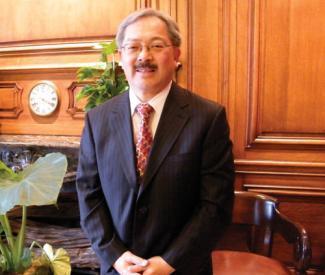
Ed Lee and “job killers”

15

Every time I hear the word “job killer” I think of the California Chamber of Commerce, which loves to affix the label to anything that might hurt corporate profits. Most environmental legislation, most pro-labor legislation, most financial regulations, anything that improves employer requriements for health insurance — the Chamber dubs it “job killers.”

And now Ed Lee is using that word to slow down progressive taxes, regulations or business mandates. He’s proposing a Charter Amendment to send any bills that might cause job losses to the Small Business Commission for a “jobs impact” public hearing.

That would give another weapon to downtown interests who want to kill, say, improvements to the Healthy San Francisco law, or any changes in the business tax.

Here’s what kills me: How many jobs were destroyed by the LACK of regulations over the U.S. financial industry? How many jobs were destroyed by a tax system that keeps most of the wealth concentrated in the top one percent? How many jobs were destroyed by cutbacks and layoffs in the public sector (which were a direct result of a failure to seek new revenues that business leaders would have called “job killers”?)

But we don’t have a special commission weighing in on tax cuts and tax breaks that cost the city money and kill city jobs.

Assemblymember Tom Ammiano, who has to deal with the California Chamber and its lackeys, told me that Lee “is talking like a Republican, or like the moderate Democrats in Sacramento.” That’s not where the mayor of San Francisco ought to be.


Plugging the flow

0

rebeccab@sfbg.com

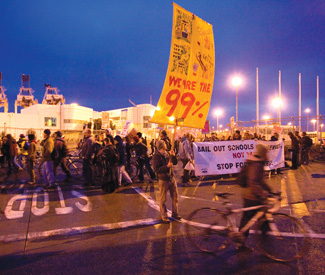
When significant events related to the Occupy movement occur in the pre-dawn hours, it usually means a protest encampment has been raided. But on Dec. 12, Occupy protesters were the ones carrying out a strategic plan before sun up.

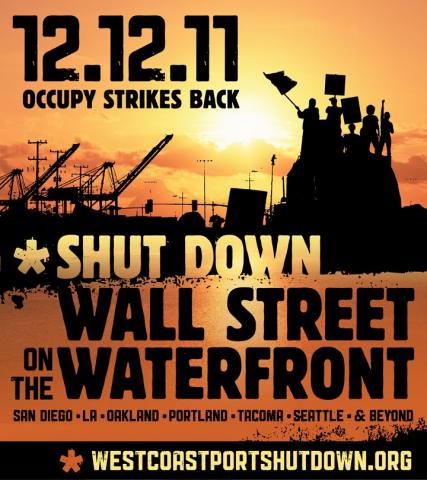
Activists organized by OccupyOakland effectively blocked cargo shipments from moving through several Port of Oakland terminals that day, as part of a coordinated West Coast Port Blockade that featured similar actions in other cities including San Diego, Portland, Seattle, and Longview, Washington.

About 150 longshore workers were sent home from their morning shifts at Oakland shipping terminals because protesters were marching in circular picket lines outside the gates.

The day began when more than 1,000 protesters met up at the West Oakland BART station at 5:30 a.m., sleepily raising signs and banners in the chilly morning air as they proceeded down 7th Street toward the port. Once they reached the sprawling shipping hub, they formed picket lines outside terminal entrances. Police were on the scene and clad in riot gear, but no clashes with protesters occurred early in the day.

Around 7 a.m., when the morning shift would have typically started, two International Longshore & Warehouse Union (ILWU) dockworkers — who declined to give their names — stood near the Hanjin Shipping gate at berths 55 and 56. Past the gate, a cargo vessel which had likely come from Japan was berthed and waiting to unload.

The men calmly surveyed the roughly 200 chanting Occupy activists as they marched around and around in a circular picket. “Ain’t nobody going to cross it,” one offered. The other gestured toward the protesters. “These are Americans wanting American jobs,” he said.

Around 10 a.m. outside the same terminal, protest organizer and Oakland hip-hop artist Boots Riley declared the first part of the port shutdown to be a victory. “Longshoremen are going home now,” he said. “Effectively, the Port of Oakland is shut down.” Later in the afternoon, protesters returned to prevent the start of an evening shift.

Until recently, the nationwide Occupy movement manifested as tent cities springing up everywhere in rebellion against the lopsided economic conditions. After a series of police raids cleared the tents away, however, organizers in the Bay Area and beyond took a different tack with the port blockade.

Working in tandem with allies from labor, occupiers from San Diego all the way up to Anchorage directed their gaze at international shipping hubs, critical infrastructure for multinational businesses importing and exporting goods between Asia and North America.

Cargo terminals make for heavyweight targets, as five of the nation’s 10 largest ports are located along the West Coast. The value of annually traded goods flowing in and out of Oakland alone is $34 billion, and authorities there estimate some $8 million could be lost if business were to be halted for a full day.


MAKING HISTORY

OccupyOakland unanimously approved the call for a coordinated West Coast port blockade at a Nov. 18 General Assembly.

“The ports play a pivotal role in the flow and growth of capital for the 1 percent in this country and internationally,” occupiers explained on a website announcing the port shutdown. “For that reason alone it is the ideal place to disrupt their profit machine.”

The ports weren’t selected as a target for that reason alone, but rather as an affront to specific corporations whose labor practices have sparked the ire of port workers. Export Grain Terminal (EGT) and its parent company, Bunge, Ltd., came into Occupy’s crosshairs because of their ongoing dispute with ILWU Local 21 in Longview, Wash., stemming from what longshoremen characterize as union-busting practices.

Port terminal operator Stevedoring Services of America (SSA Marine) and its parent company’s primary shareholder, Goldman Sachs, were also singled out in support of low-wage port truckers whose employment classification as independent contractors bars them from unionizing.

The third objective of the blockade, according to organizers, was to strike back against a series of police raids that dismantled Occupy encampments nationwide.

It wasn’t the first time cargo ships traversing the Pacific would be stalled by a politically motivated coast-wide port blockade. In 2008, ILWU members coordinated a West Coast port shutdown in dissent of the Iraq War.

In 1984, longshoremen and anti-apartheid activists blocked South African cargo to boycott the apartheid regime, noted ILWU member Stan Woods. Similar shutdowns, carried out in response to politically explosive issues going back to 1934, have been led by community activists forming picket lines at port entrances to prevent dockworkers from beginning their shifts.

Occupy’s call for a coordinated blockade brought an unprecedented twist to this historic trend, representing the first time a group unaffiliated with dockworkers had called for a shutdown spanning the entire West Coast. It left some seasoned organizers wondering anxiously how things would unfold, while others saw it as a gust of wind in the sails of the labor movement.

“One of the good things about the Occupy movement is that it’s challenging leaders of progressive institutions,” Woods said. “The old way … isn’t working. There’s been a one-sided class war, and there has to be a two-sided class war.”

Organizer Barucha Peller noted that the Occupy movement could be galvanizing for non-unionized workers, too. “Our movement is giving a framework for the 89 percent of workers who are not in unions,” she said.

For occupiers up and down the West Coast, the port shutdown also seemed to present a kind of test as to whether their young movement could successfully “exert its collective muscle,” as an OccupyOakland press statement put it, and effectuate a mass mobilization even after police raids flattened their encampments.


A ROUGH VOYAGE

In the weeks leading up to Dec. 12, even as Bay Area Occupy organizers plastered fliers about the blockade everywhere, met with union members, and organized outreach events to garner community support, they stumbled into challenges. Robert McEllrath, the president of the ILWU, publicly criticized the blockade plan, saying organizers had failed to reach out to union officials before unanimously approving the call to action.

“Any decisions made by groups outside of the union’s democratic process do not hold water, regardless of the intent,” McEllrath wrote. He seemed troubled that Occupy had attached itself to a union struggle without adequate communication, but an official endorsement of a third-party blockade by the ILWU would have landed the union in legal trouble.

“Whenever a group of people decide to march into a workplace in an effort to shut it without respecting the democratic decision-making process, it’s not an ideal situation,” ILWU spokesperson Craig Merrilees told the Guardian.

Some rank-and-file ILWU members saw things differently. “The rank and file do support the principles of the community, and Occupy,” said Anthony Lavierge, an ILWU steward. “Longshoremen had a good response to [the Nov. 2 port blockade]. It was empowering to a lot of people that so many came out.”

Another rank-and-file union member said, “the majority of ILWU workers are supportive of what’s going on, definitely.”

One rank-and-file ILWU member and self-described anarchist published a critique online raising concerns that OccupyOakland had failed to bring local union officials on board before approving the call to action.

In response, OccupyOakland organizer Mike King said, “We never brought it to them, because it’s not something they could endorse.” Yet he added that they had sought to include the rank-and-file from the start.

“We have done far more outreach for Dec. 12,” than in the days prior to the Nov. 2 port shutdown, which brought tens of thousands of activists to the street, King said. “Leading up to Nov. 2, we never expected half that many people would show up.”

Occupiers in San Diego, Los Angeles, Portland, Vancouver, Anchorage, and other cities all signed up to participate, and the idea drew support from activist groups as far away as Japan who vowed to perform solidarity actions in their own communities.

Nevertheless, the international union president’s statement prompted a flurry of mainstream news articles — along with some downright derisive columns — casting occupiers as out of sync with the very workers they claimed to stand with.

In Oakland, authorities of the targeted facility posed another obstacle. The Port of Oakland took out full-page ads in local daily newspapers and the New York Times urging the community to “Keep the Port Open.” The ads borrowed the language of the movement by proclaiming that the port “employs the 99 percent.” Port spokesperson Robert Bernardo emphasized this message in an interview with the Guardian. “When you shut down a port, you lose jobs,” he said. “Local jobs.”

Sue Piper, special assistant to Oakland Mayor Jean Quan, noted prior to Dec. 12 that the mayor was working with police and port officials to ensure that the port remained open for business. On the morning of the port blockade, however, police stood down and did not prevent protesters from circling up in front of terminal entrances.


BIG FISH TO FRY

Lost in much of the mainstream coverage of the port blockade were Occupy Oakland’s three main objectives. The protesters aimed to demonstrate solidarity with low-income port truckers laboring in service of the powerful SSA Marine; stand with ILWU Local 21 members in their face-off against EGT; and deliver a show of resistance against coordinated police raids of Occupy encampments nationwide.

In October, 26 Los Angeles truckers working for a port company called Toll Group were fired after wearing Teamsters truckers’ union jerseys to their shifts to demonstrate their wish to unionize. Because they’re classified as independent contractors instead of employees, it’s illegal for the truckers to join unions. They’re paid per shipment rather than per hour, which translates to hours of unpaid labor spent in the queue, and must cover their own job-related costs.

Occupy Los Angeles caught wind of the incident and began to talk about doing an action in solidarity with the truckers.

“The date of Dec. 12 was originally suggested by people in Los Angeles,” explained Dave Welsh, a delegate of the San Francisco Labor Council and secretary of the Committee to Defend the ILWU. “It’s also Our Lady of Guadalupe feast day, a Mexican holiday. Since many truckers of the Port of LA are Mexican, they picked that date. One focus [of the blockade] is support for truckers and their demand for better wages, working conditions, etc.”

On the day of the blockade, an open letter from port truckers was published on the website of the Coalition for Clean and Safe Ports, an advocacy group. “We are inspired that a non-violent democratic movement that insists on basic economic fairness is capturing the hearts and minds of so many working people,” the message read. “Thank you ’99 Percenters’ for hearing our call for justice. We are humbled and overwhelmed by recent attention. Normally we are invisible.”

The second major target of the blockade was EGT, which constructed a new grain terminal on Port of Longview property at the edge of the Columbia River in southern Washington, about an hour’s drive from Portland, Ore.

EGT’s parent company is Bunge, Ltd., a major agribusiness firm that has come under fire for everything from tax evasion, to rampant clearing of Amazon rainforest lands for soybean cultivation, to the use of slave labor in Brazil.

Although the terminal construction first brought hope to a small community inflicted with 15 percent unemployment , ILWU Local 21 President Dan Coffman says things soured when EGT brought in out-of-state laborers to build the facility, then refused to hire members of his union.

Coffman contends that EGT’s lease with the port means the company is required to hire Local 21 workers, but EGT disputes this, and has been locked in a federal court battle with the port. The dispute has prompted union members to stage port blockades of their own, resulting in some arrests.

Peller, the Occupy Oakland organizer, announced on a megaphone Dec. 12 that occupiers in southern Washington had shut down the Port of Longview, according to a text message from ILWU Local 21. Union members wanted to thank the movement for the show of support, she added.

“They thought they could just run over a small local,” Coffman told the Guardian, referencing EGT. “Well, David met Goliath. We’re going to fight them till the bitter end.”


Guardian editorial: And now we recommend a national Occupy Day

9

EDITORIAL In less than three months, the Occupy movement has changed the national political debate — and possibly the course of U.S. history. A small group of protesters, derided in the mainstream media, grew to a massive outpouring of anger at economic inequality. It’s no coincidence that politicans at all levels have begun to respond. At least five different measures aimed at raising taxes on the rich are in the works in California. In Kansas Dec. 6, President Obama made one of the most progressive speeches of his career, talking directly about the need for economic justice.

While even some supposed allies say the encampments weren’t effective, the truth is that the out-front, in-your-face tactic of holding nonstop protests in the financial heart of places like Manhattan and San Francisco got attention. The visibility of the Occupy camps forced everyone to pay attention. The U.S. economy is in a crisis; less disruptive tactics wouldn’t have worked. But now most of the emcampments are gone, broken up by police forces and scattered from the central areas of major cities. It’s crucial that this growing and powerful national movement not fall apart after the almost inevitable crackdown on one style of protest. Occupy needs to look forward and plan its next steps.

Some of that is already happening, with Occupy activists targeting home foreclosures and marching on West Coast ports. But it’s worth considering another tactic, too: Occupy ought to begin planning now for a massive spring mobilization in Washington and a series of nationwide actions that could bring millions more people into the movement.

Part of the strategy of the Occupy camps was to maintain a presence, day after day — and that made perfect sense when the movement was starting. But single-day events, if organized on a massive scale as part of a larger campaign, can have a profound and lasting impact.

The original Earth Day — April 22, 1970 — involved 20 million people across the United States. There were events in hundreds of cities and thousands of high school and college campuses. It brought together old-school, sometime stodgy conservation groups with radical young environmentalists, the United Auto Workers with people concerned about pollution from car exhaust. It was, by any reasonable account, the birth of the modern American environmental movement.

The other great thing about Earth Day — and the reason it makes a great model for the Occupy movement — is that it was largely a grassroots event. Although there was a national office, most of the work was done spontaneously, in local communities, with no top-down direction.

And everyone — from Washington D.C. to the state capitols and city halls — paid attention.

Mass marches and mobilizations helped end the Vietnam War, spark the Civil Rights Movement and fight the anti-labor politics of the Reagan Administration. None of those events took place in isolation, any more than a national Occupy Day would take place in isolation. The nation’s ready for major economic change — and organizing a national event alone could help make stronger connnections among the broad constituency that is the 99 percent.


For the kids?

2

caitlin@sfbg.com

HERBWISE Mission District dispensary Medithrive has started doing home deliveries. Since Nov. 22 its medical marijuana patients can have buds, tinctures, Auntie Dolores’ brownie bits, and more delivered straight to their apartment doors.

So why are Medithrive customers and staff members peeved? Because the new feature isn’t an expansion in services — it’s a forced shift in the co-op’s business structure. The dispensary was compelled to close its doors on 1933 Mission Street after a Sept. 28 letter from Department of Justice attorney Melinda Haag threatened its landlord with jail time if Medithrive didn’t cease operations in the space within 45 days. (Full disclosure: Medithrive is a Guardian advertiser)

The feds’ given reason was Medithrive’s proximity to Marshall Elementary School, located a 745-foot walk (according to Google Maps) from the dispensary door.

But Marshall’s principal Peter Avila wasn’t consulted on the matter. When called for comment by the Guardian, he said that he had bigger safety concerns.

“Right next door to Medithrive is a liquor store,” Avila said, adding that there is also a methadone clinic across the street from his school. “We have to deal with people passed out on the property, people smoking — those are more the issues than people buying medical marijuana.”

The principal says he patrols Marshall’s immediate neighborhood three to four times a day, dealing with drug addicts, people with mental problems, and the Mission’s homeless population. He called the dispensary “discreet” and never saw any cannabis usage by dispensary patients. Indeed: “They looked pretty much like the people who were coming out of the Walgreens [down the street].” In the past, Medithrive has offered to sponsor health education at Marshall.

Regardless, the dispensary’s Mission Streets doors are shuttered now. On many days, a staff member stands outside, handing out flyers announcing the delivery service to customers unaware that walk-up sales have ceased.

“We’re actually not in such a unique position,” said Medithrive community outreach liaison Hunter Holliman. The Tenderloin’s Divinity Tree and the Mission’s Mr. Nice Guy dispensaries also closed their doors this autumn in light of similar school zone notifications sent to their landlords. The landlord of Marin County marijuana activist Lynnette Shaw, founder of Marin Alliance for Medical Marijuana, was also hit. Shaw intends to fight to stay open.

Holliman says the shift to delivery services has been unexpectedly popular with Medithrive’s customers and allows the dispensary to service patients unable to physically access the storefront location — but it’s not without its challenges. Operations have been transient since the co-op is unable to even stage deliveries from the space on Mission Street. The day that the Guardian called, a voicemail informed patients that due to high call volume they’d have to leave a message so that dispensary staff could call them back. Once contacted by a helpful “budtender,” it took a little over an hour for the order to arrive.

Although Medithrive let go of many employees in its initial closure, it’s hired nearly all back in the transition to the labor-intensive delivery services. The dispensary is still hoping to secure another brick and mortar location, but permitting for new dispensaries has stalled at the city level.

Even if the dispensary’s been booted from its space, at least Medithrive patients still have access to medical cannabis — for now. Holliman is convinced that Bay Area dispensaries haven’t seen the end of legal challenges. “I’m sure there’s more to come,” he said grimly. “The feds are really serious about this.” 

Medithrive’s delivery-only menu is available at www.medithrive.com

Occupy’s next steps

6

EDITORIAL In less than three months, the Occupy movement has changed the national political debate — and possibly the course of U.S. history. A small group of protesters, derided in the mainstream media, grew to a massive outpouring of anger at economic inequality — and it’s no coincidence that politicians at all levels have begun to respond. At least five different measures aimed at raising taxes on the rich are in the works in California. In Kansas Dec. 6, President Obama made one of the most progressive speeches of his career, talking directly about the need for economic justice.

While even some supposed allies say the encampments weren’t effective, the truth is that the out-front, in-your-face tactic of holding nonstop protests in the financial heart of places like Manhattan and San Francisco got attention. The visibility of the Occupy camps forced everyone to pay attention. The U.S. economy is in a crisis; less disruptive tactics wouldn’t have worked. But now most of the encampments are gone, broken up by police forces and scattered from the central areas of major cities. It’s crucial that this growing and powerful national movement not fall apart after the almost inevitable crackdown on one style of protest. Occupy needs to look forward and plan its next steps.

Some of that is already happening, with Occupy activists targeting home foreclosures and marching on West Coast ports. But it’s worth considering another tactic, too: Occupy ought to begin planning now for a massive spring mobilization in Washington and a series of nationwide actions that could bring millions more people into the movement.

Part of the strategy of the Occupy camps was to maintain a presence, day after day — and that made perfect sense when the movement was starting. But single-day events, if organized on a massive scale as part of a larger campaign, can have a profound and lasting impact.

The original Earth Day — April 22, 1970 — involved 20 million people across the United States. There were events in hundreds of cities and thousands of high school and college campuses. It brought together old-school, sometime stodgy conservation groups with radical young environmentalists, the United Auto Workers with people concerned about pollution from car exhaust. It was, by any reasonable account, the birth of the modern American environmental movement.

The other great thing about Earth Day — and the reason it makes a great model for the Occupy movement — is that it was largely a grassroots event. Although there was a national office, most of the work was done spontaneously, in local communities, with no top-down direction.

And everyone — from Washington D.C. to the state capitols and city halls — paid attention.

Mass marches and mobilizations helped end the Vietnam War, spark the Civil Rights Movement and fight the anti-labor politics of the Reagan Administration. None of those events took place in isolation, any more than a national Occupy Day would take place in isolation. The nation’s ready for major economic change — and organizing a national event alone could help make stronger connections among the broad constituency that is the 99 percent.

Occupy shuts down morning shift at Port of Oakland

Usually, when significant events related to the Occupy movement occur in the pre-dawn hours, it means an encampment has been raided. But this morning, Occupy protesters were the ones carrying out a strategic plan before the sun came up.

A main objective of today’s Port of Oakland shutdown — the second in two months initiated by Occupy Oakland — was to strike back against the police raids that dismantled their camps.

Protesters led by Occupy Oakland effectively shut down the morning shift at the Port of Oakland today, Dec. 12, as part of a Coordinated West Coast Port Blockade that Occupy groups from San Diego to Anchorage have been planning since Nov. 18, when Occupy Oakland’s General Assembly unanimously approved the call to action.

Several hundred activists met up at the West Oakland BART station at 5:30 a.m. and proceeded to march down Seventh Street to the sprawling shipping hub, where they formed picket lines outside terminal entrances to prevent workers from entering the gates for the 7 a.m. shift. Shortly after they began picketing, truckers waiting to load or unload cargo began turning around to exit port property.

There were several busloads of protesters in addition to those who traveled to the port on foot, as well as a bicycle contingent. While most protesters filed through the streets in an uncharacteristically quiet march that seemed muted due to a lack of sleep, a few displayed gusto with a sound system, shiny homemade flags, and flashy outfits. Some showed up toting a life-sized cut-out of Lt. John Pike, the University of California Davis officer who became notorious for dispersing teargas into student protesters’ eyes, with the face cut out so people could pose for photos.

Police arrived on the scene clad in riot gear, but did not attempt to prevent protesters from circling up around the gate entrances and forming picket lines. They stood in formations in front of the gates weilding batons and teargas launchers, though protesters had no intention of entering the gates and only sought to block them. Alameda County Sheriff buses circled the area as well.

Around 7 a.m., when the morning shift would have typically started, two ILWU dockworkers (who declined to give their names) stood near the Hanjin Shipping gate at berths 55 and 56, surveying the picket line. Past the gate, a cargo vessel which had likely come from Japan was berthed and waiting to unload.

“Ain’t nobody going to cross it,” one of the men offered. The other gestured toward protesters and said, “These are Americans wanting American jobs.” Asked how he felt about the picket, he responded, “We don’t support it, because it’s not in our contract — but I do see some issues, like we’re hurting, too.” The ILWU members said longshoremen turned away because of the picket line wouldn’t be paid for the day, because they’re only registered as having reported to work if they’re physically on the terminal. They also noted that there was a relatively light workload at Oakland terminals on this particular day.

The official objectives of the port blockade, aside from showing resistance against crackdowns on Occupy encampments, were to demonstrate Occupy’s solidarity with longshore workers and port truckers. The International Longshore & Warehouse Union (ILWU) Local 21, based in Longview, Wash., has been locked in a legal dispute with Export Grain Terminal (EGT) stemming from what workers characterize as union-busting practices.

Port truckers, particularly in Los Angeles, have been unable to unionize due to their employment classification as independent contractors, and protesters sought to highlight their struggle as well. Picketers held signs declaring solidarity with the ILWU and truckers against the one percent — global shipping companies owned in part by agribusiness giant Bunge, Ltd. and Goldman Sachs, respectively, who profit from their labor.

Speaking into a megaphone, organizer Barucha Peller announced that occupiers in southern Washington had shut down the Port of Longview, according to a text message from ILWU Local 21. Union members wanted to thank the movement for the show of support.

By around 10 a.m., an independent arbitrator had ruled that the picket posed a health and safety risk to longshore workers, so the dockworkers were sent home, effectively halting port activity for the first part of the day. “I’m really impressed that so many people got up at five o’clock in the morning,” Anthony Lavierge, a steward with ILWU, said into the megaphone. “It’s officially shut down. The longhshore labor is officially going home.” However, protesters planned to return to the port later on to prevent the start of an evening shift.

Following the announcement that workers had gone home for the day, protesters marched back to West Oakland BART station. A second march to the port is planned for 4 p.m., leaving from 14th and Broadway streets in downtown Oakland following a 3 p.m. rally. A third march to the port is scheduled to leave the West Oakland BART station at 5 p.m.

Dick Meister: Unemployment is slamming public employees

18


By Dick Meister

Dick Meister, former labor editor of the SF Chronicle and KQED-TV Newsroom, has covered labor and politics for more than a half-century. Contact him through his website, www.dickmeister.com, which includes more than 350 of his columns.

The latest job reports show that public employees, those favorite targets of Republicans and other government budget slashers, are being hit particularly hard by the country’s severe unemployment problems.

As the New York Times reported, 20,000 government workers were laid off in November alone, most of them state, county and city employees.

The public workers’ unemployment numbers have been steadily increasing for the past several years, at the same time that the jobless figures for workers in private employment actually have been decreasing.

In fact, private employers have been adding jobs since the end of 2009, a year after the beginning of the Great Recession. More than a half-million government jobs have been lost since the recession began.

The Times noted that in most cases, the layoffs were made because of declining tax revenues, or reduced federal aid “because of Washington’s inexplicable decision to focus more on the deficit in the near term than on jobs.”

The layoffs mean “a lower quality of life . . . fewer teachers, pothole repair crews and nurses.” It’s been happening all over the country, of course. The Times cited as a typical example what’s been happening in the Indiana city of Marion, population 30,000.

Marion city officials recently announced what they called a “radical reorganization” of city services that will mean laying off 15 of the city’s 58 police officers and 12 of its 50 firefighters. Radical, indeed. That’s more than 25 percent of Marion’s police and firefighters.

As elsewhere, the layoffs of course reduce vital public services, but it’s important to note that they also of course have a serious impact on those who lose their jobs. The impact has been especially harsh on African- American workers.

The Times’ Timothy Williams reported that one-fifth of the nation’s millions of black workers “have entered the middle class through government employment” and tend to make 25 percent more than other African-American workers. But now tens of thousands are being forced to leave both their jobs and the middle class.

The Times cited as a prime example the city of Chicago, which is scheduled to lay off more than 200 employees in the next fiscal year, two-thirds of them African-Americans.

It shouldn’t be surprising, then, that the African-American jobless rate has risen to more than 15 percent nationwide, almost double the rate for other workers.

As the Times said, the effect has been severe – “destabilizing black neighborhoods and making it harder for young people to replicate their parents’ climb up the economic ladder.” Their rise was made largely by the government jobs that they’re now losing without much hope of finding other jobs, given the current tattered state of the economy and continued job discrimination against African-American workers generally.

It certainly would be hard to disagree with the Times’ conclusion that much of the public job losses and consequent cutbacks in public services stem from the fact that many Republicans “don’t regard government jobs as actual jobs, and are eager to see them disappear. Republican governors around the Midwest have aggressively tried to break the power of public unions while slashing their workforces, and Congressional Republicans have proposed paying for a payroll tax cut by reducing federal employment rolls by 10 percent through attrition.”

That 10 percent, the Times pointed out, is 200,000 jobs. And, surprise! Many of those jobs “would be filled by blacks and Hispanics and others who tend to vote Democratic.” So, said the Times, those workers “are considered politically superfluous” by the GOP.

But, the Times concluded, “every layoff, whether public or private, is a life, and a livelihood, and a family. And too many of them are getting battered by the economic storm.”

Dick Meister, former labor editor of the SF Chronicle and KQED-TV Newsroom, has covered labor and politics for more than a half-century. Contact him through his website, www.dickmeister.com, which includes more than 350 of his columns.


ILWU attitudes toward port blockade aren’t so simple

The Chronicle’s Andrew Ross describes Occupy organizers as “brilliant” in a sarcastic tone for vowing to move ahead with the Dec. 12 West Coast port blockade, despite public statements from the longshore union’s president criticizing the plan. But Ross’ article misses the mark, and seems to ignore alliances that have been forged between various sectors of labor and the Occupy movement in recent months.

“Trouble is, the folks they purport to be in solidarity with don’t seem hot on the idea to ‘effectively shutdown the hubs of commerce’ at all,” Ross writes. The Chronicle’s narrative is clear: Here you have some everyday working people trying to do their jobs, make ends meet, and put food on the table. They don’t want to see business as usual disrupted by a bunch of out-of-touch radicals who claim to speak for them.

But in reality, workers’ attitudes toward the port shutdown are far more nuanced. After all, longshore and warehouse workers are feeling the pinch as advances in technology reduce the number of jobs to be filled along waterfront shipping facilities, and many truck drivers who haul cargo to and from West Coast ports are barely able to make ends meet since they’re employed as independent contractors and paid low hourly wages without union representation.

The president of the International Longshore and Warehouse Union (ILWU), Robert McEllrath, issued a statement Dec. 6 in which he criticized the plan for a west coast port blockade, which occupiers in Oakland, Los Angeles, Seattle, Portland, Vancouver, and Anchorage have all vowed to participate in on Dec. 12.

The official aim of the Occupy port shutdown is to demonstrate solidarity with longshore workers engaged in a labor dispute against EGT in Longview, Wash., and to stand with port truckers in Los Angeles whose attempts to unionize have been thwarted. The action is also meant as payback for raids against Occupy encampments in Portland, Oakland, Los Angeles, and other major cities, which were carried out in the wake of coordinated teleconferences between metropolitan mayors and a powerful organization of former police chiefs engaged in shaping law enforcement practices.

“Support is one thing,” wrote McEllrath, the ILWU president. “Organization from outside groups attempting to co-opt our struggle in order to advance a broader agenda is quite another and one that is destructive to our democratic process and jeopardizes our over two year struggle in Longview.”

ILWU spokesperson Craig Merrilees echoed McEllrath’s statement, telling the Guardian, “The Occupy Oakland group failed to respect the ILWU’s democratic decision-making structure. It’s unfortunate — it could’ve been handled differently.”

Dan Coffman, president of ILWU Local 21 in Longview, Washington, had just gotten out of a court hearing with grain terminal operator EGT when the Guardian caught up with him by phone. His union has been locked in an ongoing struggle against EGT, stemming from the multinational corporation’s attempts hire non-union workers and erode standard worker benefits such as overtime pay at a new grain terminal built on Port of Longview property.

“The ILWU has no involvement in [the port blockade] whatsoever,” Coffman explained. “We are not organizing this, and we are not promoting it.”

Yet he emphasized that, speaking as individual, “I’m a 99 percenter. Things have got to change. We’ve got to get some sanity back in this country. It’s obscene what they’re doing to working people and poor people in this country.”

Some rank and file members of ILWU said they agreed with the principles of the Occupy movement.

“Longshoremen had a good response to the [Nov. 2 general strike and port blockade],” Anthony, a longshoreman who’s worked at the Port of Oakland for more than a decade, told the Guardian in a phone interview. “It was empowering to a lot of people that so many people came out.” He added, “The rank and file do support the principles of the community and Occupy.”

The Port of Oakland ran full-page ads in major newspapers last week condemning plans for a port blockade, yet incorporating a key phrase of the Occupy movement into its message. “Port of Oakland is where the 99% work,” the ad proclaimed. “Occupy groups have called for a ‘total west coast ports shutdown’ on December 12th. Port of Oakland maritime operations were partially shut down on November 2nd. What did that accomplish? Lost work hours, lost shifts, and lost wages for workers and their families.”

Asked about the ad, Anthony called it “a lot of propaganda.”

Tremaine Waters, another longshoreman at the Port of Oakland, told the Guardian, “The majority of ILWU workers are supportive of what’s going on. They understand the situation occurring in America right now.” He added that if community members organize a picket line on Dec. 12, “I would say, yes, the ILWU members will respect it.”

Clarence Thomas, a third generation Oakland longshoreman, discussed the planned port shutdown in an interview with Worker’s World. Thomas emphasized that ILWU traditions and practices dictate that union members do not cross community picket lines.

“A picket line is a public demonstration — whether called by organized labor or not,” Thomas said in the interview. “It is legitimate. There are established protocols in these situations. To suggest to longshoremen that they shouldn’t follow them demands clarification. It is one thing to state for the record that the union is not involved, but another thing to erase the historical memory of ILWU’s traditions and practices included in the Ten Guiding Principles of the ILWU adopted at the 1953 biennial convention in San Francisco,” Thomas said. He added, “Labor is now officially part of the Occupy movement. That has happened.”

Michael Goldstein, 1953-2011

7

news@sfbg.com

San Francisco lost a valued champion of progressive causes on Dec. 2 when Michael Goldstein lost his battle with stage 4 lymphoma after surviving nearly 20 years living with HIV, a disease that helped awaken his political activism.

Michael was born in 1953 in New Mexico, where he was raised. His grandparents had come to New Mexico after surviving the Holocaust, and Michael came to the San Francisco in the early 1980s. Like many gay men of his generation, Michael came here to find community, to create family, and to be welcomed when much of the country was still hostile to the LGBT community.

He worked at Neiman Marcus, dressing “the San Francisco A list,” as he used to say. He studied at City College towards a paralegal certificate and was heavily involved in student politics. He landed a job at AIDS Legal Research Panel, where he worked when he was diagnosed HIV-positive in the mid-’80s.

The news hit hard, and the treatment he began took its toll. The HIV drugs were harsh then and there were many horrible side-effects with these early drugs. At that time, there was very little information or education about HIV/AIDS and there was even less support, from families and from the public.

Our San Francisco political community became Michael’s family. He was also blessed with an amazing friend in Lorae Lauritch. They worked together at NM, became roommates, and lived together with some incredible cats that were dear to him, including Paloma, Huey, Cadeau, and Missy.

Michael was a proud feminist who valued the women in his life and community, leading him to endorse a pair of successive female candidates for the Castro’s District 8 seat on the Board of Supervisors: Eileen Hansen in 2002 and Alix Rosenthal in 2006.

Over the years, Michael served as an elected member of the Democratic County Central Committee (serving as vice president), served as President of the Harvey Milk LGBT Democratic Club, and was appointed to a San Francisco City College citizen oversight board, where his questioning helped bring attention to mishandling of funds at that institution.

Michael was determined, opinionated, persistent, intolerant of bullshit, prickly, always questioning. He challenged us all to move a common agenda, come together beyond our own personal ambitions, but to also never back down out of convenience or feigned civility. “Civility doesn’t make change,” he often said.

I came to know Michael as many came to know him. Michael always showed up in support of every one of our causes. He not only showed up, he advised, opined, debated, argued, protested, got arrested, drafted policy, and so much more. Campaign after campaign, issue after issue — our friendships grew around our passion for politics, our deep concerns about everything, and a strong and unwavering belief that anyone can help make change.

Michael believed that and Michael lived that.

In the past few years, many of us noticed that Michael wasn’t feeling well. We pushed him to go to the doctor. This is a man who spent hours fighting to push through HIV/AIDS policy and funding, healthcare reform, Healthy SF — and he did not have healthcare, had not seen a doctor in nearly 10 years, and was not treating his HIV.

As many know, Michael and I were like brother and sister…often bickering back and forth on whatever was going on. We “debated” like the dear friends we had become. His lack of healthcare was one of the more important issues I would bring up often. As a long term survivor of this condition, Michael knew the score.

As the symptoms of this disease ravaged his body, he retreated from us and attempted to make sense of the unimaginable alone.

Finally at the end of September, Michael was admitted to General Hospital. With the amazing care of Ward 5A, Diane Jones, and all the amazing General Hospital workers, as well as Laguna Honda Staff and at his final resting place UCSF — his care, though coming too late, was the best in the world and gave Michael a fighting chance. He was clearly comforted and supported by his community in his final days, support that mattered so much to him.

If you knew Michael, you know there is a “what comes out of this” part. We all got to really see the results of the hard work we all participated in to rebuild General Hospital, to rebuild Laguna Honda, and to provide healthcare access to everyone, even the poorest among us. Michael, personally, was able to experience the fruits of our collective labor over these years.

He also experienced some areas where there really is a need for some work. We need to remember that AIDS/HIV is still killing people every day. We must improve people’s access to healthcare. We need to protect patients’ access to medical cannabis, even in General Hospital. We need services and we need housing, particularly affordable housing for those who need it, people struggling through this bad economy.

These are our issues and this is our agenda on the left that we have been fighting for.

I will never forget Michael. One of the last real discussions we had about politics was around election time, with Michael remembering the 2010 elections. Michael was probably more upset about what has come out of that election — the beginning of a political shift to the right in San Francisco — than many.

He has been such an integral part of the work that brought our progressive community together and he was devastated by the events tearing it apart. More than anything, he wanted to bring us together, but he ran out of time.

Michael had an agenda. His agenda was to move forward our agenda. It is time to come together and do that.

Debra Walker is an artist, activist, DCCC member, and city commissioner who ran for the District 6 seat on the Board of Supervisors last year.

On the Cheap Listings

0

Submit items for the listings at listings@sfbg.com. For further information on how to submit items for the listings, see Picks.

THURSDAY 8

Drag Queens on Ice Union Square Ice Rink, 333 Post, SF. www.unionsquareicerink.com. 8-9:30 p.m., $10. Mutha Chucka, Anna Conda, Lil’ Hot Mess and other dazzlingly-named lovelies gleefully speed and twirl through the Union Square ice skater crowd.

Archie Green: the Making of a Working-Class Hero talk Green Arcade, 1680 Market, SF. 7 p.m., free. Historian Sean Burns captured foundational labor activist Archie Green’s story over years of interviews and conversations. Now he shares how Green became a tireless and radical advocate for the preservation of American folklore.


FRIDAY 9

Winter Wunderkammer holiday art sale The Lab, 2948 16th St., SF. www.thelab.org. 6-11 p.m. Also Sat/10, 11 a.m.-4 p.m., free. For the 15th year, the Lab hosts a jewel of a holiday sale where it’s possible to spend anything from one buckaroo to 50. Up for grabs: small-format work by local artists.

OCCUPY! screening Artists’ Television Access, 992 Valencia, SF. www.atasite.org. 6:30 p.m., donation requested. ATA hosts a multimedia collage of the Occupy movement. Poetry, videos, history, aerial maps, and performance art relating to the massive protest are on the docket; all donations directly benefit Occupy San Francisco.

Luke Warm Water and Jim Barnard poetry reading Nefeli Caffe, 1854 Euclid, Berk. (510) 841-6374. 7 p.m., free. Stirring poets Luke Warm Water (a virtuoso of spoken word hailing from Rapid City, South Dakota) and Jim Barnard (cofounder of Berkeley’s Poetry Express readings) join forces for a colorful finger-snapper.


SATURDAY 10

End of Semester show Mission Cultural Center for Latino Arts, 2868 Mission, SF. www.missionculturalcenter.org. 2-5 p.m., $5. Mission Cultural Center showcases the multitudinous and fine community talents it has worked to cultivate this semester, from Afro-Peruvian dancers to Samba Jam Brazilian percussion artists.

Writers with Drinks Make Out Room, 3225 22nd St., SF. www.makeoutroom.com. 7:30-9:30 p.m., $5-10 sliding scale. Gail Carriger, Sean Baby, Mike Jung, and Diana Salier have between them a prestigious prize for young adult lit, a balls-out comic strip, MTV appearances, and a new poetry chapbook on heartache and Wikipedia. The Center for Sex and Culture reaps the proceeds from this all-star reading.

Vagabond Indie Craft Fair Urban Bazaar, 1371 9th Ave., SF. www.vagabondsf.wordpress.com. 12:30-6 p.m., free. Independent artisans and the SF Etsy street team unite amongst Urban Bazaar’s backyard succulents for a small-scale, high-quality local craft fair.

1901 Maritime Christmas Hyde Street Pier, SF. www.nps.gov/safr. 6-9 p.m., free with reservation to (415) 447-5000. If the idea of riding the waves circa 1900 brings to mind scurvy and mishaps with icebergs, you’ve got it wrong. The National Park Service trots out costumed actors and historic ships for a warm, watery Christmas performance by lamplight.

East Bay Alternative Press Book Fair Berkeley City College, 2050 Center, Berk. www.berkeleycitycollege.edu. 10 a.m.-4 p.m., free. Local independent writers, publishers, zinesters and craftspeople flood downtown Berkeley to showcase boundlessly-inventive bookworks.


SUNDAY 11

Christine Schmidt book signing Museum Store, SFMOMA, 151 Third St., SF. www.sfmoma.org. 2 p.m., free. Christine Schmidt, the artist behind Yellow Owl Workshop and those ubiquitous, beautifully-printed California poppy postcard sets, demonstrates a project and signs her recent how-to printmaking book meant for, she says, those with “low budgets and high ambition.”


MONDAY 12

Occupy Phoenix Books readings Phoenix Books, 3957 24th St., SF. www.dogearedbooks.com. 6:30 p.m., free. Young ‘uns from 826 Valencia join Denise Sullivan, author of Keep on Pushing: Black Power Music from Blues to Hip Hop for a night of Occupy-oriented readings. Accompanying the shindig is local Americana act McCabe and Mrs. Miller.

The problem with the tax initiative

3

EDITORIAL The Occupy movement — despite police abuse, official hostility and dismissive media — is changing the mainstream of discussion in American politics. For the first time in years, it’s actually possible to talk about raising taxes on the very wealthy. All the polls show strong, and growing, public sentiment in favor of economic equality. It’s a great opportunity to reform California’s tax system — but Gov. Jerry Brown seems unwilling to take advantage of what could be the most important moment in his political career.

At least five groups are preparing tax-reform measures for the November, 2012 ballot. One of them — the so-called Think Long proposal supported by billionaire Nicolas Berggruen and Google executive Eric Schmidt — is largely regressive. Much of the $10 billion it would raise would come from sales taxes on services, which amounts to a whopping new tax on the middle class. Another, known as the Clean Energy Jobs Act (also backed by a billionaire, hedge fund manager Tom Steyer) would force corporations to pay taxes based on sales in the state, which in and of itself isn’t a terrible idea. But that’s the beginning and end of the measure, and half of the $1 billion it would raise would be earmarked for (private sector) clean energy projects.

Then there are the income tax proposals. One, sponsored by a Los Angeles attorney named Molly Munger (whose father happens to be a billionaire investor) would raise almost everyone’s income taxes, although the wealthy would pay more; every penny of the $10 billion in new revenue would be earmarked for education. The Courage Campaign and the California Federation of Teachers want to raise taxes on incomes of more than $1 million, with the money also dedicated to education.

Then there’s the governor’s plan. Brown’s offering a mix of a half-cent sales-tax hike and higher income taxes to raise about $7.5 billion. Some major labor groups are already on board — as are some business groups, which would rather see a tax on consumers than higher taxes on big corporations and the wealthy. His plan may seem pragmatic — but it’s hardly progressive and won’t solve the state’s $13 billion budget shortfall for this year, much less restore funding to the services that have been cut in past budget battles.

All of the plans have problems. While we’re much more aligned with the Courage Campaign’s goal of taxing the rich, and we agree that education is a critical need, there are other critical needs in the state, too (affordable housing, health and social services, for example) and we’re not sure the education earmark makes sense. And most of them don’t go beyond personal income taxes, when taxes on big businesses are often scandalously low.

Brown ought to be taking the best of the various proposals, adding other ideas that have been put forward by Democrats in the Legislature, and producing a final product that would shift the state’s tax burden onto those who can most afford it. That means scrapping the sales tax and replacing it with steeper income tax increases on the highest earners and an oil-severance tax (which could alone bring in as much as $8 billion a year). Higher taxes on financial institutions ought to be part of the deal, too.

With the presidential election driving a high turnout in California, and public anger at the greed of the top one percent defining the electoral debate, it’s foolish to put forward a half-assed measure that doesn’t amount to real reform. Brown and his team need to make some major changes before a tax measure heads to the Nov. 2012 ballot.

Editor’s notes

0

tredmond@sfbg.com

The private sector that Republicans see as our economic savior has been creating jobs. Not a lot, a few hundred thousand a month, but some. And yet the unemployment rate remains stubbornly high.

There’s a reason for that, one politicians from San Francisco to Washington D.C. don’t want to talk about. But the New York Times put it nicely in a Dec. 5 editorial:

“While the private sector has been adding jobs since the end of 2009, more than half a million government positions have been lost since the recession…”

“The cutbacks hurt more than just services. As Timothy Williams of the Times reported last week, they hit black workers particularly hard. Millions of African Americans — one in five who are employed — have entered the middle class through government employment, and they tend to make 25 percent more than other black workers. Now tens of thousands are leaving both their jobs and the middle class.”

Remember: Most of the biggest employers in this city are not corporations; they’re government agencies. The City and County of San Francisco, the University of California, the State of California, the United States Postal Service, City College and the San Francisco Unified School District drive the local economy more than any one private company. Between them, those public-sector operations employ more than 60,000 people. The largest single private employer, Wells Fargo, has fewer than one sixth of that number.

Most of the those public-sector jobs are unionized and offer decent benefits. They are such an important part of the city’s economic development future that it’s impossible to talk about jobs in San Francisco unless you start the conversation with the public sector.

Mayor Ed Lee is about to enter negotiations with unions representing 24,000 city employees. His office is already indicating that cost savings will be a big part of the discussion. I know there are cost savings out there — you can’t spend $2 billion on payroll and not have some waste somewhere in the package.

But if he’s serious about his campaign mantra — jobs, jobs, jobs — I hope he remembers what the Republicans don’t: Government jobs count, too.

Guardian editorial: The problem with the tax initiatives

1

 The Occupy movement — despite police abuse, official hostility and dismissive media — is changing the mainstream of discussion in American politics. For the first time in years, it’s actually possible to talk about raising taxes on the very wealthy. All the polls show strong, and growing, public sentiment in favor of economic equality. It’s a great opportunity to reform California’s tax system — but Gov. Jerry Brown seems unwilling to take advantage of what could be the most important moment in his political career.

At least five groups are preparing tax-reform measures for the November, 2012 ballot. One of them — the so-called Think Long proposal supported by billionaire Nicolas Berggruen and Google executive Eric Schmidt — is largely regressive. Much of the $10 billion it would raise would come from sales taxes on services, which amounts to a whopping new tax on the middle class. Another, known as the Clean Energy Jobs Act (also backed by a billionaire, hedge fund manager Tom Steyer) would force corporations to pay taxes based on sales in the state, which in and of itself isn’t a terrible idea. But that’s the beginning and end of the measure, and half of the $1 billion it would raise would be earmarked for (private sector) clean energy projects.

Then there are the income tax proposals. One, sponsored by a Los Angeles attorney named Molly Munger (whose father happens to be a billionaire investor) would raise almost everyone’s income taxes, although the wealthy would pay more; every penny of the $10 billion in new revenue would be earmarked for education. The Courage Campaign and the California Federation of Teachers want to raise taxes on incomes of more than $1 million, with the money also dedicated to education.

Then there’s the governor’s plan. Brown’s offering a mix of a half-cent sales-tax hike and higher income taxes to raise about $7.5 billion. Some major labor groups are already on board — as are some business groups, which would rather see a tax on consumers than higher taxes on big corporations and the wealthy. His plan may seem pragmatic — but it’s hardly progressive and won’t solve the state’s $13 billion budget shortfall for this year, much less restore funding to the services that have been cut in past budget battles.

All of the plans have problems. While we’re much more aligned with the Courage Campaign’s goal of taxing the rich, and we agree that education is a critical need, there are other critical needs in the state, too (affordable housing, health and social services, for example) and we’re not sure the education earmark makes sense. And most of them don’t go beyond personal income taxes, when taxes on big businesses are often scandalously low.

Brown ought to be taking the best of the various proposals, adding other ideas that have been put forward by Democrats in the Legislature, and producing a final product that would shift the state’s tax burden onto those who can most afford it. That means scrapping he sales tax and replacing it with steeper income tax increases on the highest earners and an oil-severance tax (which could alone bring in as much as $8 billion a year). Higher taxes on financial institutions ought to be part of the deal, too.

With the presidential election driving a high turnout in California, and public anger at the greed of the top one percent defining the electoral debate, it’s foolish to put forward a half-assed measure that doesn’t amount to real reform. Brown and his team need to make some major changes before a tax measure heads to the Nov. 2012 ballot.


Dick Meister: Six ways to heal the economy

8


By Dick Meister

 Dick Meister, former labor editor of the SF Chronicle and KQED-TV Newsroom, has covered labor and politics for more than a half-century. Contact him through his website, www.dickmeister.com, which includes more than 350 of his columns.

The AFL-CIO has come up with an ambitious six-point plan for healing our very sick economy – one of the best plans that have yet been suggested by anyone.

Point one calls for rebuilding the school, transportation and energy systems by spending at least $2.2 trillion to restore crumbling 20th century infrastructure. As the AFL-CIO says, it would be an investment that would put millions of people to work while laying the foundation for the nation’s long-term growth and competitiveness with other nations.

Point two is as direct: “Revive U.S. manufacturing and stop exporting good jobs overseas.”  That would involve, among many other steps, reforming and enforcing tax policies that are currently encouraging U.S. companies to have manufacturing done in other countries. And enhance Buy America standards, increase investment in job training and oppose free trade deals.

Point three: Provide federal help for hiring people to do at least part of the work that needs to be done nationwide. That could create millions of jobs in distressed communities, especially communities of color, where much of the work is badly needed. In doing so, pay competitive wages and do not replace existing jobs.

Point four: Help federal, state and local governments avoid more of the layoffs and cutbacks of public services that have been a major drag on the economy. Congress should make a commitment to not lay off any more federal employees. It should prevent more state and local layoffs by providing increased federal funding of Medicaid when unemployment is high and providing additional federal funds directly to communities “to save and create jobs and protect and restore public services.”

Point five: Extend unemployment benefits for at least a year to those whose benefit payout time has expired. “Our economy continues to suffer from a massive shortfall of consumer demand . . . the primary reason why businesses are not hiring.”

The AFL-CIO calls for combining the extension of benefits with providing relief to homeowners facing foreclosure. If banks lowered the principal balance on mortgages to current market value, the AFL-CIO calculates that “over $70 billion a year would be pumped back into the economy, millions of families would be able to stay in their homes and over one million jobs would be created.”

Point six: “Reform Wall Street so that it helps Main Street create jobs.” That would mean channeling capital into productive sectors of the economy – more lending to small businesses, for instance – and enacting a federal financial speculation tax to discourage harmful speculation and “make Wall Street pay to rebuild the economy it helped destroy.” The government should “enforce tough safeguards to stop the kind of cheating and massive fraud on Wall Street that precipitated the crisis of 2008.”

Many of those who did indeed cause the crisis are still in control, many still doing just what brought on the economic ailments that so deeply affect the country. It will take a lot to loosen their tight grip on the economy. But it can be done if we are wise enough to adopt reforms such as the AFL-CIO advocates.

Dick Meister, former labor editor of the SF Chronicle and KQED-TV Newsroom, has covered labor and politics for more than a half-century. Contact him through his website, www.dickmeister.com, which includes more than 350 of his columns.

How does it make you feel?

0

arts@sfbg.com

MUSIC Africa Hitech makes intoxicating music. Programmed polyrhythms snake over punchy bass lines. Synthetic chord progressions crescendo and fall, disrupted by surges of 808 kicks, constellations of snares, outbursts of electric energy.

All the while, an offbeat rhythm assaults the interweaving drum patterns, unsettling any steady flow that might have taken shape. This tension pulls the music forward, destining outwards, while the bass anchors the body, whether on the dance floor or just mesmerized inwardly, a head in the groove.

The sound builds in momentum, in suspense, but with subtle patience, producing a great gathering of intensity — which if you happen to hear on the right sound system — exceeds its limit, and disorients, overwhelms, destructs, rejuvenates. It’s the Dionysian rave rewired for our times.

“We grew up in that whole bass line culture in the UK with dub, reggae, soul, and everything that’s come about after it and around it,” says Steve Spacek, who together with Mark Pritchard makes the duo Africa Hitech. “We try to tap into that amazing feeling of the frequency in the club when everyone’s getting down together on one vibe, one of the best feelings imaginable.”

Seasoned producers-vocalists Spacek and Pritchard have pursued this utopian vision of sound in their latest project. In the past couple years, Africa Hitech has released three EPs, including this month’s Do U Really Wanna Fight on Warp, and dropped a brilliant record earlier this spring, 93 Million Miles. The songs navigate two topological poles: the cosmic and the streets. While “The Sound of Tomorrow” and “Light the Way” evoke otherworldliness, the ecstatic openness of galactic space channeled by the likes of George Clinton’s Mothership and Sun Ra’s Arkestra, “Blen” and “Gangslap” gurgle in the enclosed terrain of frenetic polypercussion and dread inducing low end. Their vocals wreak both havoc and bliss on language: soulful croons give away to disembodied vocoder chants; or, Spacek unleashes a growling patois, and sample cuts dissipate in mutilated mantras, reconfigured on a stuttering trigger pad: “Out/ Out/ Out/ Out in the streets/ Out in the streets/ They call it murrderrrrr.”

“We’re trying to preserve the Jamaican sound system in the music we make,” says Spacek. “There’s all these so-called different genres, but we just see them as all just one family. In the end they’re just different tempos and sensibilities of the same rhythm.”

That rhythm, the swing, carries traces of its past. Its body has been dispersed across the Atlantic: marked by violence, labor, hybridization, creative upheavals and reversals, restless paths of migration and commerce, moments of resistance and dreams of redemption. In these diasporic unfoldings, the swing has evolved, adapted, mutated. Those struck by the rhythm have both reinvented its prosthetic origins and conjured alternative prophecies, sometimes in folkloric traditions, sometimes in the margins, on the limits of popular music or in the neglected underbellies of familiar acoustic space. Recall the recent ancestry. Mystic purveyors of dub armed the bass line in a highly weaponized electronic form; techno rebels programmed the soul of the machine with analog drum machines, keyboards, and sequencers; hip-hop and jungle collagists digitized the beat through cut and paste sample techniques, effect, and manipulation. Today, footwork, dubstep, funky, and all their kin tap into the same alchemy, spread spontaneously through the planetary dissolution wrought by cyberspace. Africa Hitech picks up here.

For Spacek and Pritchard, sonic oscillations between the cosmic and street, inner and outer, traces of the past and hyper-tech future, collapse in the simple and pure feeling of the intoxicating bass line. “We’re not trying to make music that’s deep and meaningful. We’re trying to make music that feels good … the kind of feeling that you can’t escape, and you don’t want to, you get lost in it,” says Spacek, the words now rushing out. “The bass becomes so immense that it’s literally rattling your ribcage. Some call it spiritual. It resonates. It makes sense, intuitively. But there’s some kind of emotion in there that we don’t quite understand. To some degree, we don’t want to understand it, maybe we can’t. We just want to feel it.”

AFRICA HITECH

With Jonwayne, Kush Arora, DJ Dials

Thurs/1, 10 p.m.

Public Works

161 Erie, SF (415) 932-0955

www.publicsf.com

Dick Meister: Jobless in wonderland

0

By Dick Meister

Dick Meister, former labor editor of the SF Chronicle and KQED-TV Newsroom, has covered labor and politics for more than a half-century. Contact him through his website, www.dickmeister.com, which includes more than 350 of his columns.

Finding a job is hard enough for the many millions of unemployed American workers. But, believe it or not, the fact that they are jobless keeps many employers from hiring them.

That’s right, being jobless keeps many workers from being hired for many of the jobs that are available.

It’s crazy, I know. But once they’re unemployed, many workers are destined to remain unemployed. Many employers are saying, in effect, that workers who are laid off by other employers, or who can’t get other employers to hire them, must automatically be considered bad workers who they don’t want to hire either.

Up to now, that bizarre practice has generally affected only workers who have been jobless for more than six months, but recent studies show it will soon affect a majority of all the unemployed. That would be particularly rough on women and minorities, whose unemployment rates and length of unemployment are much greater than those of other workers.

So precisely why do employers do it? The National Employment Law Project, which has conducted a major survey of the practices, says “the precise rationale is unknown, but with so many applicants for every job opening, screening out the unemployed is a convenient device for reducing the workload associated with the hiring process.”

Or it may be that “employers presume that workers who are currently employed are more likely to be good performers and have a stronger work ethic than those who are unemployed.” That, of course, “completely ignores the realities of the current labor market, in which millions have become unemployed through no fault of their own.”

As reprehensible and outrageously illogical as the practice of denying available jobs to the unemployed is, some employers don’t bother to hide their part in it. They openly say in ads seeking workers that the long-term unemployed need not apply or that the employer will only consider applicants who are currently employed.

The federal Economic Employment Opportunity Commission (EEOC) is investigating whether to charge such employers with discrimination, which they so very obviously are practicing.

What’s more, President Obama’s American Jobs Act and two companion bills pending in Congress would make it illegal for companies with 15 or more employees to turn down or fail to seek jobless workers to fill vacancies solely because the workers are unemployed.

New Jersey has enacted a state law similar to the proposed federal law, and moves are underway to enact similar laws in at least three other states – New York, Michigan and Illinois.

The federal and state bills cover employment agencies as well as employers and prohibit want ads that disqualify applicants because they are jobless. But what if the agencies and employers had legitimate reasons to find out why applicants lost their previous jobs? Or if they want to otherwise examine their employment history?

That would be perfectly legal. It would not be legal, however, to reject job applicants simply because they lost their last jobs. The EEOC would protect workers who complain of such blatant discrimination from retaliation.

The commission also could order employers to pay workers damages covering the pay and other compensation they lost because of the employer’s violation of the law and at least part of fees workers might pay to attorneys arguing their case.

Although organized labor generally seems satisfied with Obama’s American Jobs Act and its goal of creating two million new jobs, many in labor and elsewhere on the political left consider it an inadequate response to the nation’s massive unemployment problem.

But this much is clear: The act would ban one of the most outrageous practices ever perpetrated on American workers. You need a job because you’re unemployed? Sorry, says the boss, no job for you because you’re unemployed.

Have we fallen into Alice’s Wonderland?

Dick Meister, former labor editor of the SF Chronicle and KQED-TV Newsroom, has covered labor and politics for more than a half-century. Contact him through his website, www.dickmeister.com, which includes more than 350 of his columns.

Protesters target UC to demand openness, accountability, and the restoration of cuts

2

UPDATED BELOW — Protesters with ReFund California and other groups are gathering today (Mon/28) at UCSF-Mission Bay and three other UC campuses to protest a teleconference of the UC Board of Regents, which will discuss state funding levels and tuition increases, as well as recent incidents of police violence against nonviolent student protesters.

ReFund California, a coalition of student and labor groups, is angry with the UC’s decision to abruptly cancel the Nov. 16-17 Regents meeting at UCSF, citing public safety concerns surrounding a meeting that the group had been planning a convergence on for months – as well as a hastily called meeting on the day after Thanksgiving.

The group has created a pledge that it wants the Regents to agree to, which includes calling for higher taxes on the rich, a restoration of cuts to the public university systems, removal of commercial land from Prop. 13 property tax caps, and a fee on Wall Street financial transactions.

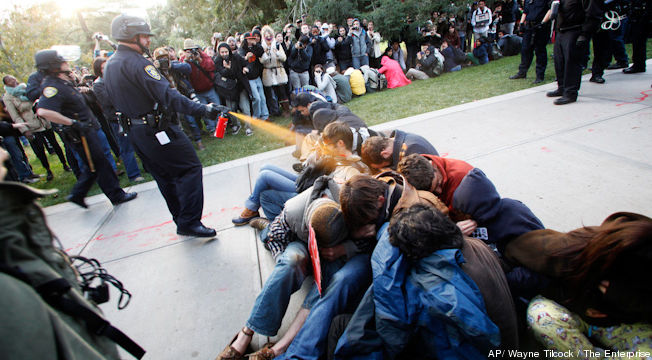
ReFund California is also dismissive of independent investigations the UC has initiated to look at aggressive police repression of students protests, including police at UC Berkeley using batons and mass arrests to dismantle an OccupyCal tent city and police at UC Davis dousing passive protesters with pepper spray. Video of both incidents went viral and have helped galvanize the overlapping Occupy and student movements.

“No amount of new ‘police protocols’ will prevent violence against students and workers, as long California’s corporate and financial elite along with their representatives among the Regents and administrators of the UC rely on police to address the concerns of students and workers,” the ReFund California Coalition wrote in the letter to the UC.

Today’s action at UCSF – centered around the meeting site at 1675 Owens Street, where a Guardian reporter is on the scene and will offer her report later today – joins similar protests at UC Davis, UCLA, and UC Merced, the four sites where the Regents will gather.

Meanwhile, ReFund and other groups are also angry that the CSU Board of Trustees went ahead with its Nov. 16 meeting behind closed doors, clearing out student protesters and the public before they approved a 9 percent tuition hike, an action that Lt. Gov. Gavin Newsom (a member of that body) denounced.

“While I understand the CSU leadership’s concerns regarding public safety, the spirit of open deliberations has been marred,” Newsom wrote in a Nov. 18 letter to Chancellor Charles Reed, calling for the matter to be re-voted at the Dec. 5 meeting to “allow the full board to hold an open debate, with full public comment and members of the media present.”

In related news, many students and faculty at UC Davis are on strike today to protest the pepper-spraying incident. And tomorrow (Tues/29) at noon, members of OccupyOakland say they plan to retake Frank Ogawa Plaza (which they renamed Oscar Grant Plaza) and set up another 24/7 encampment.

UPDATE NOON: Guardian reporter Christine Deakers says there is a heavy police presence at the UCSF meeting, where only 50 members of the public are allowed inside and most of those seats have been claimed by ReFund California members. When the Regents decided to limit the time for public testimony, the group held a General Assembly in the meeting, drowning out the Regents and causing the meeting to adjourn until 1:30 pm. You can follow her tweets here or here.

UPDATE 1:50 PM: The UC Board of Regents did not reconvene, instead cancelling the rest of the meeting without taking action. The San Francisco Chronicle quotes Newsom as saying he supports the demands of ReFund but that he’s not willing to sign its pledge.

Dick Meister: Newt’s wacko 18th century idea

0

Providing services is secondary to them, however needed the services might be. Saving money is their concern, whatever the consequences of the savings might be.

In case you haven’t heard the details of Rep Gingrich’s outrageous suggestion, let me recap what he’s said about it over the past week or so. Honest, this is exactly what he’s proposed.

You know those child labor laws that were first enacted in the 19th century to protect children from serious exploitation – laws that limit their working hours, give them time to get a decent education and protect them from workplace dangers that could very well lead to serious harm?

Those laws are still in effect, on the state and federal level. The federal law limits the working hours of children under 16 to no more than three hours a day or 18 hours a week when school is in session or 40 hours a week when school is not in session. Some states limit working hours even more.

Ah, but that’s too much for Newt Gingrich. He calls the child labor laws “truly stupid.” That’s right: “stupid.” That surely puts Gingrich right where he belongs, squarely in the 18th century.

Gingrich’s 18th century plan calls for schools to “get rid of unionized school janitors “and hire poor school kids to clean the schools in low-income neighborhoods.”. That’s what the man said. Just think of that. And he wants to be president!

But Gingrich is right on one thing. Yes, as he says, kid janitors “would be dramatically less expensive than unionized janitors.” But obviously the difference is well worth paying, although not to Rep. Gingrich.

But don’t be too hard on the man. He’s only talking about working the kids a mere 20 hours a week.  And this, said Gingrich, would empower them to succeed. He actually said that kids in the poorest neighborhoods are trapped by the child labor laws that prevent them from earning money. They also, of course, protect kids from serious exploitation, but that apparently doesn’t concern Gingrich.

So what should schools do to carry out Gingrich’s 18th century plan? “Get rid of their unionized janitors, have one master janitor and pay local students to take care of the school . . .the kids would actually do work.”

Why, that would give them “pride in the schools.” And the students “would begin the process of rising.

What next? Have classes in janitoring? Put teachers to work with brooms, too?

AFSCME is currently asking people to add their names to an on-line letter that says Gingrich’s idea “is outrageous, dangerous and downright hogwash.” You can add your name to the letter at www.reallynewt.com.

The letter notes that “doing janitorial work in a school entails sanitizing toilets, handling hazardous cleaning chemicals and scrubbing floors hunched over a mop for hours. It’s hard to imagine a nine-year-old doing any of those tasks. Come on.”

The union cites another important point that Gingrich ignores: A lot of those unionized janitors he’d replace with kids are parents. And their janitorial jobs “put a roof over kids’ heads, food on the table, and provide them with health care and the chance to get an education.

“That job is the only thing between a kid and poverty. Firing someone’s mom and hiring the kid for less money, isn’t exactly the ‘process of rising.'”

Could it possibly be that Newt Gingrich is willing to exploit children 18th century style in order to boost his campaign for president?  You make the call.

Dick Meister, former labor editor of the SF Chronicle and KQED-TV Newsroom, has covered labor and politics for more than a half-century. Contact him through his website, www.dickmeister.com, which includes more than 350 of his columns.

About that “acrimonious fall”

Catch this. Mayor Ed Lee’s mayoral victory had nothing to do with millions of dollars in campaign contributions from private interests, a sophisticated get-out-the vote effort targeting Lee supporters, the advantage of incumbency, some funny business, or a calculated campaign strategy concentrating efforts on absentee ballots.

Instead, the fact that Lee triumphed over voters’ second pick, the significantly less well-funded progressive candidate Sup. John Avalos, is proof that the left in San Francisco has plummeted into a dark abyss. In fact, the progressive movement has descended so far into disarray and become so irrelevant that its condition warrants front page news.

That’s essentially the narrative that Benjamin Wachs and Joe Eskenazi of the San Francisco Weekly offer in their cover article, “Progressively Worse: The Tumultuous Rise and Acrimonious Fall of the City’s Left,” in which they refer to the Guardian as “the movement’s cajoling ward boss, kingmaker, and sounding board.” Gosh, I feel so goddamn important right now.

Once the blood pressure returned to normal, my initial reaction to this piece was that Wachs and Eskenazi seem to misunderstand who and what progressives actually are. They portray the city’s left as a caricature, a brash bunch of power mongers now on the losing end that can be easily summed up with pithy video game references, Happy Meal toy bans, and bikes.

Witness the contrast between the Weekly’s portrayal of progressives (helped along by former Newsomite Eric Jaye), and the portrait of the left the Guardian offers this week with an Op-Ed written by NTanya Lee — an actual progressive who volunteered for the Avalos for Mayor campaign.

Here’s the Weekly on the left:

“This is an eclectic group, one often bound not by mutual interests as much as mutual enmity — toward Brown, his successors, and the corporate interests of ‘downtown.’ As a result, progressive principles are often wildly inconsistent. Progressives favor more government control over people’s lives for their own good, as when they effectively banned McDonald’s Happy Meals. But sometimes progressives say the government needs to let people make their own choices … Progressives believe government should subsidize homeless people who choose to drink themselves to death, while forbidding parents from buying McNuggets because fast food is bad for us. … Without consistent principles, it’s easy to associate progressives with the craziest ideas to come out of City Hall, and the movement’s bad ideas are memorable. … Daly’s pledge to say ‘Fuck’ at every public meeting makes a killer Internet meme. Hey, let’s legalize prostitution and outlaw plastic bags!”

Here’s Lee on the left:

“The Avalos coalition was largely community forces: SF Rising’s base in working class Black, Latino, Filipino and Chinese communities; the Bike Coalition’s growing base of mostly white bike riders; affinity groups like Filipinos, Queers, Latinos and Arabs for Avalos; progressive Democrats; social networks of creative, young progressive activists affiliated with the League of Young Voters; and loyal families and neighborhood leaders from John’s own District 11. The campaign prioritized communicating to voters in four languages, and according to the Chinese press, John Avalos was the only non-Chinese candidate with a significant Chinese outreach program. There were stalwarts from progressive labor unions (most notably SEIU 1021 and USWW) who threw down — but overall, labor played it safe and invested resources in other guys. And then, in the great surprise development of the race, supporters of the new national occupy movement came to be a strong part of the Team Avalos base because the campaign was so well positioned to resonate with the call to take on the one percent.”

When it comes to takeaways from the November election, the Weekly’s conclusion is essentially opposite that of progressives. While many on the left see themselves as regaining momentum and building the power to rise even in the face of defeat by the established powers-that-be, the Weekly casts San Francisco’s left as deflated and out-of-touch.

Speaking of out-of-touch, the SF Weekly refers to San Francisco’s “increasingly imaginary working class.”  But in reality, 61 percent of students attending public schools in S.F. Unified School District qualify for free or reduced lunch, and a majority of San Franciscans cannot afford market-rate housing.

However, the Weekly is correct in pointing out that shifting demographics have dealt a blow to the progressive base.

“Between 2000 and 2010, the city grew older (every age group over 50 increased), wealthier (there are now 58 percent more households earning $125,000 or more), and more heavily Asian (up from around 30 to nearly 35 percent of the city’s population): exactly the groups progressives don’t win with. These voters don’t respond well to campaigns against developments or for city services, because they’re often living in those developments and don’t need city services.”

I take issue with the Asian part of that statement as a sweeping generalization, however, having witnessed the solid organizing work of the Chinese Progressive Association, for example.

The Weekly also says progressives and the Guardian never called out former Mayor Gavin Newsom for ripping off their best ideas. Oh, they didn’t?  That’s news to me.

The Weekly article implies that progressives got trounced by moderates because jobs are priority No. 1 for voters, and the left has no feasible economic plan — but at the same time, the article completely dismisses ideas that the Guardian has put forth, like creating a municipal bank, implementing Avalos’ Local Hire legislation, or taxing the rich.

Taxing the rich is precisely the kind of economic solution the international Occupy movement is clamoring for, and the concept has even attracted a few unlikely supporters, like billionaires Warren Buffet and Sean Parker, who is not some conservative a*hole by the way.

“The Guardian … stays on the progressive agenda because they put it there, along with taxing the rich, tapping downtown to subsidize Muni, and other measures … Proposing the same old solutions to every new problem turns policies into punch lines.”

Speaking of predictable, no profile authored by the Weekly mentioning the Guardian would be complete without some dig about public power. “The Guardian has been flogging public power since Tesla invented the alternating-current generator,” the S.F. Weekly squawks. Those clever reporters, turning policies into punch lines.

But wait, I thought the problem was that progressives couldn’t get it together on the job creation thing. Consider the CleanPower SF program, which has been strongly advocated for by progressive Sup. and Sheriff-elect Ross Mirkarimi (who it turns out is “not toxic,” according to the Weekly, since he was elected citywide and all). According to an analysis by the Local Clean Energy Alliance, CleanPowerSF will create 983 jobs — 4,357 jobs when indirect job creation is factored in — over the course of three years, assuming the 51 percent renewable energy target is met. Presented with this kind of information, the Weekly will only yawn and say, “Are we on that again?”

That being said, our friends’ article might actually have a pearl of wisdom or two buried somewhere in that nauseating sea of sarcasm. Everyone needs to engage in self-reflection. So right after you’re done throwing up, think about how to take advantage of the opportunity this article presents for a citywide dialogue about progressivism in San Francisco.

Gifts with grace

1

culture@sfbg.com

HOLIDAY GUIDE 2011 It’s the gift-giving season, and each foil-wrapped bauble tells a tale. There’s the love-you-this-much of a parent’s infamous peach cobbler pie, the damn-I-just-took-your-breath-away of a winter getaway to the Bahamas. There is the who-are-you-again? of Aunt Shirley’s yearly package of black dress socks. But then there are the let’s-change-the-world gifts, the ones that are not just about the recipient but that nonetheless land in the giftee’s hands with a heft that speaks of their worth to the community. Toasty as a chestnut roasting on an open fire, no? Giving that warmth can be as simple as copping a T-shirt, book, or card from one of the do-gooder nonprofits and shops listed below. And remember, even if you’re not the thin sock-loafer type, you can always improve your own karma by snail-mailing a heartfelt thank you note to Shirley. 


NIROGA CENTER

Everyone seems to make the same tired New Year’s resolution: lose weight, live healthier, blah blah blah. At the Niroga Center, however, you can spring for a yoga package for that uncreative loved one that will not just help brighten their inner light, but will go to stoke the spark of others who are struggling to make ends meet. The center offers affordable, high-quality yoga instruction, and puts particular focus on at-risk and underserved individuals, teaching yoga to incarcerated youth, high school children, and cancer survivors. For the holidays, you can donate any amount of money to the center, which will fund their donation-based classes and classes that teach yoga to the underprivileged. You can also purchase yoga classes to start someone’s year anew for as low as $10.

1808 University, Berk. (510) 704-1330, www.nirogacenter.org


CASA BONAMPAK

With a salesfloor awash in papel picado and other crafts from Chiapas, Casa Bonampak believes in preserving Mexican traditions, and that reconnecting with culture can transform and heal. All in all, it’s a feel-good (and community-building) place to do your holiday shopping. The shop’s all-woman staff works directly with Mexican and Latin American artists to sell unique jewelry, luchador masks, and handmade cards, with most items ranging from $4 to $13. The store has also been dedicated to promoting local Latin artists in the Bay Area for 15 years. With so many gorgeous handicrafts crammed into the Valencia Street storefront, Casa Bonampark is a great place to support culture on either sides of the border.

1051 Valencia, SF. (415) 642-4079, www.casabonampak.com


GUARDSMEN CHRISTMAS TREE LOT

The Guardsmen, a group of Bay Area men who work together to help at-risk children and organize educational and outdoor activities for inner-city youth have organized this forest of fir every year since 1947. Now as way back then, the proceeds from the lot support the organization’s doing-good year-round. Post-Thanksgiving, a corner of Fort Mason is transformed into a winter wonderland with trees as tall as 15 feet decorated with ornaments and wreaths. The all-volunteer guardsmen staff can assist you in picking the perfect holiday tree with which to surprise your apartmentmates — you can even arrange to have one delivered to your home. Coupled with events like crab feeds, wine tastings, and opportunities to take photos with Santa, picking up some beautiful boughs for the family never felt so good.

Festival Pavilion, Fort Mason Center, 38 Fort Mason, SF. www.guardsmentreelot.com


LIBERATION INK

Do you have a friend who has been dying for a “Brown and Proud” T-shirt ($24)? Perhaps they’re jonesing for an organic tote with a picture of Assata Shakur ($16)? Liberation Ink, an all-volunteer, worker-owned apparel printing and design collective, believes in a sustainable movement for social justice that is funded from within. It prints revolutionary faces and sayings on shirts made organically and/or without the use of sweatshop labor. All profits go directly to support grassroots social justice organizations like the May 1st Alliance for Land, Work and Power, and the Deporten a la Migra Coalition. The brand’s comfy, stylin’ T-shirts will have your lucky giftee looking fly and spreading the word of social equality in one fell swoop.

www.liberationink.org


COMMUNITY THRIFT STORE

A nonprofit secondhand store, Community Thrift relies entirely upon donations of clothes, knick-knacks, kitchen supplies, and furniture to keep its doors open. And they stay open, too: the Mission District shop is open to browsing and donations from 10 a.m. to 5 p.m. daily. Shopping here — and if your boyfriend’s been searching for that perfect yet affordable leather bomber jacket or snazzy armchair, this should be your first stop — supports local non-profits like the San Francisco LGBT Center and the San Francisco Child Abuse Prevention Center, just two of almost 200 organizations that benefit from Community Thrift’s largess.

623 Valencia, SF. (415) 861-4910, www.communitythriftsf.org


SAN FRANCISCO ZOO

Has the kid you nanny been yapping about adopting a Magellanic penguin? Maybe your friend has always admired Chilean flamingos? You can sponsor their love of the wild by donating $50 in their name to the Adopt-an-Animal program at the San Francisco Zoo. The donation will help to provide veterinary care for the furred and feathered, not to mention support educational programs for tomorrow’s wildlife champions. Once you’ve dropped the dough your loved one will receive a certificate of adoption — very official! — as well as a fact sheet and photo of the critter they’re sponsoring. Feeling flush? Your other option is the zoo’s Guardian program, which for a minimum annual contribution of $1000 will help provide further support to the zoo. It supports high-quality animal care, and all kinds of incidentals that keep the family destination open to the public. Give the gift of Guardianship and your buddy will receive free admission, carousel rides, and free parking near their furry for an entire year.

San Francisco Zoo, 1 Zoo Road, SF. (415) 753-7080, www.sfzoo.org


THE BOOKMARK STORE

Sure, the money from your holiday purchase here will go to a good cause — but it’s also the perfect place to browse and spend your lunch hour while you shop down your holiday list. The Bookmark is a non-profit that’s run by the Friends of the Oakland Public Library. It houses everything from science fiction to cooking to non-fiction, an inexpensive place where you don’t have to scour shelves to find those hard-to-find, out-of-print books your favorite bibliophile will flip to receive. Plus, all proceeds from your sale will keep libraries in Oakland with their pages open to the public.

721 Washington, Oakl. (510) 444-0473, www.thebookmarkstore.org


Lessons of the Avalos campaign

157

By N’Tanya Lee

It’s the middle of the night. His two kids and wife are home in bed. Supervisor John Avalos, candidate for mayor, heads downtown in his beat-up family car. He parks and walks over to 101 Market Street, and casually starts talking to members of OccupySF. He’s a city official, but folks camped out are appreciative when they see he’s there to stand with them, to try to stop the cops from harassing them, even though its 1 a.m. and he should be in bed.

John Avalos was the first elected official to personally visit Occupy SF. It wasn’t a publicity stunt — his campaign staff didn’t even know he was going until it was over. He arrived and left without an entourage or TV cameras. This kind of moment — defined by John’s personal integrity and the strength of his personal convictions — was repeated week after week, and provides a much-needed model of progressive political leadership in the city.

John Avalos is more than “a progressive standard bearer,” as the Chronicle likes to call him. He’s also a Spanish-speaking progressive Latino, rooted in community and labor organizing, with a racial justice analysis and real relationships with hundreds of organizers and everyday people outside of City Hall. He’s demonstrated an authentic accountability to the disenfranchised of the city, to communities of color and working people, and he knows that ultimately the future of the city is in our hands.

Some accomplishments of John’s campaign for mayor are already clear: He consolidated the progressive-left with 19%, or nearly 40,000, first-place votes, despite the confusion of a crowded field; he came in a strong second to incumbent Ed Lee despite being considered a long shot even weeks before the election; after RCV tallies, he finished with an incredible 40% of the vote, demonstrating a much wider base of support across the city than he began with, and much broader than former frontrunners Leland Yee and David Chiu, who outspent him 3-1. He won the Castro, placed third in Chinatown (ahead of Yee), and actually won the election-day citywide vote. Not bad. In fact, remarkable, for a progressive Latino from a working class district in the southern part of town, running in his first citywide race.

I believe John Avalos demonstrated what can be accomplished with a new kind of progressive leadership — and suggests the elements of a new progressive coalition that can be created to win races in 2012, and again, in 2015.

It’s Monday afternoon, 1:35pm, time for our weekly Campaign Board meeting. John rushes in, after a dozen appointments already that day. The rest of us file into the ‘cave’ — the one private room in Campaign headquarters, with no windows, a makeshift wall and furniture that looks to be third-hand. The board makes the key strategy, message, and financial decisions. There are no high paid political consultants here. Most of us are, or have been, organizers. Today, we need to approve the campaign platform. Finally. We’ve decided to get people excited about our ideas, an agenda for change. We leave the meeting excited and nervous, wondering if anyone will get excited about the city creating its own Municipal Bank.

We were an unlikely crew to lead a candidate campaign — even a progressive one in San Francisco. We come from membership based community and labor organizations, and share a critique of white progressive political players and electeds who spend too few resources on building power through organizing and operate without accountability to any base. We are policy and politics nerds, but we hate traditional politics. Seventy percent of us are people of color — Black, Filipina, Latino, and Chinese. We are all women except John, the candidate, and nearly half of us are balancing politics with parenting.

The campaign board — including John himself—shared a vision for building progressive power. The campaign plan was explicit and specific about achieving outcomes that included winning room 200 but went beyond that central goal. We set out to strengthen progressive forces, to build towards the 2012 Supervisor races, and increase the capacity of the community-based progressive electoral infrastructure so we can keep building our collective power year-round, for the long-term.

We hope these victories will shape progressive strategy moving forward:

1. In just a few months, Team Avalos consolidated a new and unique progressive bloc. We brought together people and organizations who’d never worked together before — white bike riders and Latino anti-gentrification organizers, queer activists and African American advocates for Local Hire. The Avalos coalition was largely community forces: SF Rising’s base in working class Black, Latino, Filipino and Chinese communities; the Bike Coalition’s growing base of mostly white bike riders; affinity groups like Filipinos, Queers, Latinos and Arabs for Avalos; progressive Democrats; social networks of creative, young progressive activists affiliated with the League of Young Voters; and loyal families and neighborhood leaders from John’s own District 11. The campaign prioritized communicating to voters in four languages, and according to the Chinese press, John Avalos was the only non-Chinese candidate with a significant Chinese outreach program. There were stalwarts from progressive labor unions (most notably SEIU 1021 and USWW) who threw down — but overall, labor played it safe and invested resources in other guys. And then, in the great surprise development of the race, supporters of the new national occupy movement came to be a strong part of the Team Avalos base because the campaign was so well positioned to resonate with the call to take on the one percent.

2) Team Avalos built popular support for key progressive ideas. We used the campaign to build popular support for a citywide progressive agenda. Instead of leading with our candidate we led with bold, distinctive issues that provided a positive alternative vision to the economic crisis: Progressive taxation, municipal banking, and corporate accountability for living wage jobs instead of corporate tax breaks. By the end of the campaign, at least three other candidates came to support the creation of a city-owned bank, and the idea had enough traction that even the San Francisco Business Times was forced to take a position against it.

3) Team Avalos built the electoral capacity of grassroots organizations whose members have the most at stake if progressives gain or lose power in SF: poor and working-class communities of color. We developed the electoral organizing skills of a large new cohort of grassroots leaders and organizers of color with no previous leadership experience in a candidate campaign. They are ready for the next election.

For the last few months, I had the privilege of working with an unusual but extraordinary Avalos campaign team, who were exactly the right people for the right moment in history, to lead a long shot campaign to an unlikely, remarkable and inspiring outcome. Let’s build on these gains. In the coming weeks and months, we must be thorough in our analysis of this election, engage and expand the Avalos coalition base, and build unity around one or more collective demands of Mayor Lee from the left. And in time, we will have a progressive voting majority and a governing bloc in City Hall. We will win, with the mass base necessary to defend gains, hold our own electeds accountable, and truly take on the city’s one percent.

NTanya Lee was the Executive Director of Coleman Advocates for Children & Youth, and served as a volunteer chair of the Avalos for Mayor campaign board. You can find her now at USF or working on her new project about a long-term vision for left governance called Project 2040.


Hyatt in the hot seat

0

Two housekeepers at the Hyatt Regency Santa Clara filed charges with the Equal Employment Opportunity Commission (EEOC) Nov. 18, alleging they were fired in retaliation after removing “sexually suggestive images” of themselves posted in a hotel work area.
 
The charges come just weeks after the San Francisco Hyatt at Fisherman’s Wharf was issued serious citations by the California Division of Occupational Safety and Health (CalOSHA), coupled with proposed fines totaling more than $20,000, for health and safety violations.
 
Martha and Lorena Reyes, who are sisters, were fired from the Hyatt Regency Santa Clara on Oct. 14, two weeks after Martha removed the images from a display board that had similar images of all the housekeeping staff members. “When I saw the images, I was embarrassed, ashamed, and humiliated,” Lorena Reyes’ EEOC complaint states. “My sister tore down the photo of me. When an employee told my sister to return the photos to the bulletin board, she refused.”
 
The images showed photographs of the Latina sisters’ faces tacked onto cartoon-like drawings of white women wearing bikinis. Hyatt Regency Santa Clara spokesperson Peter Hillan told us they were put up as part of an industrywide annual event, National Housekeeping Week, to celebrate housekeepers. The hotel selected a beach scene, he said, because “The theme was ‘riding the waves to success.’”
 
“We take it seriously any time that our associates indicate that they’ve been offended,” Hillan said, but stressed that “this morning was the first time we were made aware that there was offense taken.” Hillan could not say when management first became aware that Martha Reyes had removed the images, nor was he able to identify who was responsible for displaying them.
 
When the Reyes sisters were fired, they were told it was because they took lunch breaks that were longer than the allotted 30 minutes, Lorena Reyes explained. Yet she countered this by saying it’s common practice for housekeepers to rest for an additional 10 minutes during lunch breaks on days when heavy workloads make it infeasible to take one of the two 10-minute breaks they’re entitled to under state law.
 
“We haven’t come across anyone else who’s been fired for it,” said Adam Zapala, an attorney with the firm Davis, Cowell, and Bowe, who is representing the sisters. “So it raises the suspicion in our mind.”
 
Hillan, the Hyatt spokesperson, described the sisters’ assertions that they had been fired in retaliation as false. “To us, this is part of a larger issue with UNITE HERE,” the hotel workers’ union, “that we’ve seen a fairly consistent approach by UNITE HERE leadership to take out of context and make disingenuous claims on behalf of associates,” he said.
 
On Nov. 18, UNITE HERE Local 2 helped organize a picket against Hyatt Regency Santa Clara. The union has sought to unionize workers at that location.
 
Zapala noted that the pair of EEOC complaints were filed Nov. 18 to compel Hyatt to re-hire the sisters. However, the official complaints are also a first step toward a lawsuit in state or federal court.
 
Meanwhile, in San Francisco, CalOSHA issued two serious citations against the Hyatt Fisherman’s Wharf along with proposed fines of more than $20,000, alleging violations against health and safety codes protecting workers against repetitive motion injuries.
 
Pamela Vossenas, health and safety director for UNITE HERE, described housekeepers’ work as “a nonstop assembly line of repetitive motion. These citations allege that Hyatt failed to follow certain parts of that standard.”
 
Hyatt Fisherman’s Wharf hotel workers formally complained about repetitive motion injuries in Nov. 2010, and the citations are a result of a long-term investigation.
 
Workplace injuries resulting from repetitive motion can include back strain, shoulder strain, and carpal tunnel syndrome. “There are many ways the tasks could be done safer, but they’re not given the time, and they’re not given the tools,” Vossenas said.

Dania Duke, general manager at Hyatt Fisherman’s Whart, dismissed those concerns. “We strongly disagree with CalOSHA’s investigative process, and the end result which was handed down to us before their ergonomic study was completed,” she said. “We’re going to use every legal avenue available to appeal, and we feel that they’re driven by political motives, not facts.” 

She added that Hyatt provides long-handled dusters, surface-cleaning tools, and wet and dry swiffers for cleaning walls and floors, noting that their use is not mandatory. “Our associates have the tools the resources and the training they need to do the job,” she said. “We constantly strive to promote safety.”
 
According to a study published in the American Journal of Industrial Medicine examining a total of 50 hotel properties from five different hotel companies, Hyatt housekeepers had an injury rate that was higher than that of other housekeepers when compared by company.

Across the industry, one solution would be to give workers long-handled tools – like mops – for cleaning, Vossenas said. “The majority of hotels don’t give them mops — they give them rags to use,” she explained. “It’s 2011, and women housekeepers are still supposed to be on their hands and knees scrubbing the floor. Male custodians, janitors – who would ever think of giving them a rag to scrub the floor?” Yet Duke told the Guardian that this is not the case at Hyatt Fisherman’s Wharf.
 
There are four major Hyatts in the Bay Area. The Grand Hyatt, located at San Francisco’s Union Square, and the Hyatt Regency Embarcadero are both union hotels. The Hyatt Fisherman’s Wharf does not have a union, nor does the Hyatt Regency Santa Clara. All four are under boycott; at the unionized properties because workers have not had a contract since August of 2009, and at the non-unionized properties because attempts to unionize have been stymied, according to UNITE HERE.