Labor

Dick Meister: The lessons of Ohio

0

By Dick Meister

Dick Meister, former labor editor of the SF Chronicle and KQED-TV Newsroom, has covered labor and politics for more than a half-century. Contact him through his website, www.dickmeister.com, which includes more than 350 of his columns.

AFL-CIO President Richard Trumka has drawn some important lessons from last week’s election in Ohio that repealed a state law severely limiting the collective bargaining rights of public employees. Worse, it threatened to inspire passage of similar anti-bargaining laws elsewhere.

Listen to Trumka, a man who obviously knows what he’s talking about. In an article he wrote for Reader Supported News, he cites post-election polls showing that more than half of Ohio’s voters correctly “perceived the law as a political maneuver by Gov. John Kasich and state Republicans to weaken labor unions, rather than a genuine effort to make state government more efficient.”

Another poll, done for the AFL-CIO, showed that more than half the voters also found that Kasich and his allies “are putting the interests of big corporations ahead of average working people.”<–break->

Voters everywhere in the mid-term elections clearly wanted change. But, as Trumpka says, they did not want “political maneuvers and overreach” like those of Kasich and Republican legislators. They want effective action to curb unemployment, create jobs and deal with the other severe economic problems facing the country.

As Trumka notes, public employees, union members, Democrats and liberals voted overwhelmingly to repeal the Ohio law, but so did a majority of voters “from households with no public employee, workers without union representation and independents – as well as 30 percent of Republicans and 36 percent of conservatives.”

One of the key lessons Trumka draws from Ohio’s election is that “the myth of the pampered public employee has been busted. Public employees didn’t cause the economic crisis and they’re not the enemy. Demonization of public employees is neither a strategy nor a solution and the heartland Americans who voted to restore rights for public employees understood that.”

The election also reinforced the continued need for working people, public and private employees alike, to join closely together. That’s what happened in Ohio. There, as Trumka notes, “firefighters, teachers and other public employees were joined by plumbers, pilots and all kinds of private sector employees to win. Worker to worker, neighbor to neighbor, the message spread, and what began as an attempt to divide workers flopped famously. In the end, working people’s solidarity was the message.”

Politicians could also learn important lessons – if they will. For the Ohio voters “showed that when fundamental rights and livelihoods are targeted, working people will not only defend themselves, but come back stronger.”

The outcome of the Ohio vote should show politicians seeking office that it would be wise for them to pay much more attention to the wishes of working and middle class voters than to those of the wealthy and privileged. Says Trumka:

“Cutting taxes for millionaires and billionaires, scapegoating working Americans and their unions and downsizing Social Security and Medicare may get you a standing ovation from the 1%, but the voters who decide elections will not be fooled – and you may just get more than you bargained for.”

Trumka’s correct. But despite the results in Ohio and the lessons they hold for the anti-labor political right, many undoubtedly will continue what the AFL-CIO sees as “part of Wall Street’s strategy to chip away at collective bargaining rights, piece by piece, law by law, until unions and collective bargaining rights are destroyed.”

Working people and their unions can be reasonably certain, at least, that they’ll have strong support in trying to withstand the attack – including support from the Occupy Wall Street movement, which Trumka credits with “redefining the political narrative.”

The next major test will come in the presidential and congressional elections in 2012. They’re especially looking for support from the swing voters who supported President Obama in the 2008 election and generally have the same political views as the majority of Ohio voters.

Trumka describes the swing voters as “working Americans with modest incomes, moderate views and little patience for polices that aren’t fair and don’t work.”

He says politicians seeking election or re-election next year must heed them and “support public policies for the 99 percent – policies that create jobs, invest in America’s future, safeguard Social Security, Medicare and Medicaid, and promote fiscal sanity by requiring millionaires and billionaires to pay their fair share.”

OK, that’s asking for much more than we’ve been getting. But the Ohio vote demonstrated that it is possible to garner the votes necessary to overcome the forces that would deny us vital economic and political rights.

Dick Meister, former labor editor of the SF Chronicle and KQED-TV Newsroom, has covered labor and politics for more than a half-century. Contact him through his website, www.dickmeister.com, which includes more than 350 of his columns.

Labor ready to fight Occupy eviction

5

Tim Paulson, director of the San Francisco Labor Council, just told me that he’s got as many as 500 union members on alert to stand with the OccupySF encampment if the city attempts to evict the protesters. The Labor Council has put together a communications system to let members who have volunteered to help know when a showdown with the police is coming, and the volunteers are ready to spend as much as 24 hours at Justin Herman Plaza, and if necessary, in jail.

“We mobilized for last night, but nothing happened,” he said. “We’re in a state of constant vigilance.”

Paulson noted that the San Francisco encampment “is the symbol of the Occupy Movement.”

The solidarity of San Francisco labor will make it considerably more difficult for Mayor Ed Lee to send in the police and break up the camp. The idea that he would be ordering the arrests not only of several hundred Occupy protesters but a large contingent of local labor leaders and union members has to be giving him second (and third, and fourth) thoughts.

And whatever the outcome, the connenctions between labor and Occupy are critical to building and sustaining a national movement to demand economic justice. It’s great to see the SF Labor Council in the heart of the fight.

OccupySF is worth the investment

30

Thirteen labor and community leaders wrote to Mayor Ed Lee Nov. 17 asking him not to evict the OccupySF protesters. The message of the hand-delivered letter: It’s worth the time and effort the city will have to make to allow the encampment to remain. It was signed by Conny Ford, OPEIU Local 3, Bob Offer-Westord, Coalition on Homelessness, Pilar Sciavo, California Nurses Association, Elizabeth Alexander, SEIU 1021, Rev. Carol Been, Clergy and Laity United for Economic Justice, Steve Williams, POWER, Gabriel Haaland, SEIU 1021, Tim Paulson, San Francisco Labor Council, Kate Huge, La Raza Centro Legal, Gordon Mar, Jobs with Justice, Forrest Schmidt, ANSWER, Shaw-San Liu, Chinese Progressive Association, and Mike Casey, UNITED-HERE Local 2.

Here’s the full letter:

Dear Mr. Mayor:

Occasionally a movement takes hold of the imagination of a people, resulting in major social and economic shifts in public policy. Thirty to forty years ago, such a movement driven by a coalition of the religious right and corporate America and spearheaded by the National Chamber of Commerce and the National Association of Manufacturers, changed the course of our nation for the worse.

With the election of Ronald Reagan and scores of corporate-backed politicians since then, our nation has seen a reversal of the progressive gains made in the decades immediately preceding 1980, from the New Deal to the War on Poverty.

In yesterday’s meeting, you and several city department heads questioned whether it is “worth the investment” to meet and work with the SF Occupy movement to address certain health and safety issues. We think it is.

The national Occupy Wall Street movement has brought dramatic focus to the disproportionate concentration of wealth and power held by the top 1% of America.  They have drawn broad attention to the devastation wrought by Wall Street upon communities throughout the country:  home foreclosures, record unemployment, attacks on immigrants, union busting, school closures, social service cutbacks, etc.

Over the years, in our own city, a number of legendary movements and causes have led to meaningful and lasting progressive change. The 1934 General Strike and the I-Hotel are but two examples. These and other struggles such as the Civil Rights movement are iconic not based on whether they resulted in victory or defeat, but because these struggles inspired and trained a new generation of organizers and activists committed to economic and social change.

Whether the Occupy movement is helping usher in yet another shift remains to be seen. But of this we are certain: the City of San Francisco working with Occupy SF to support their vision and work is “worth the investment.”

Provocative police actions in Oakland resulted in unnecessary injuries and threatened the very safety of the community they’ve sworn to protect.

We appeal that you not shut down the occupation of Justin Herman Plaza and continue to meet, daily if necessary, in order to work through the issues connected with Occupy SF.

The scene at Occupy Cal last night (VIDEO)

0

Students at the University of California at Berkeley voted overwhelmingly to reestablish an Occupy encampment at the university’s Sproul Plaza yesterday, Nov. 15, following a student strike and Day of Action packed with marches, rallies, and student protests called in response to a police crackdown on Occupy Cal’s first attempt to set up tents Nov. 9.

A general assembly drew thousands to Sproul Plaza, the historic site where Berkeley’s free speech movement began. The 15th annual ceremony honoring recipients of the Mario Savio Young Activist Award was held on the steps outside Sproul Hall following the general assembly, and Robert Reich, Chancellor’s Professor of Public Policy at the University of California at Berkeley and former secretary of labor under President Bill Clinton, delivered a speech on “Class Warfare in America.”

By 11:30 p.m., roughly 20 tents had been pitched, and more were cropping up. The atmosphere felt like a festival as hundreds of students assembled their mini tent city, threw a dance party on the steps, waved signs, and vowed to stay their ground. Police presence was minimal, with several officers surveying the scene from a balcony above the plaza and a handful of Alameda County Sheriff deputies in regular uniform clustered near Bancroft Street at the campus edge.

The Guardian will have a full report on the events of the day and night later on, but for now, here’s a video that captures the vote to re-occupy and the high-energy scene that followed.

Video by Shawn Gaynor and Rebecca Bowe

Bling and the kingdom

1

arts@sfbg.com

HAIRY EYEBALL “Why curate an exhibition focused on a single country in an age of disappearing boundaries?” is one of the questions posed by the curatorial text at the start of “The Matter Within: New Contemporary Art from India,” Yerba Buena Center for the Arts’ survey of recent photography, sculpture, and video from the subcontinent.

One obvious answer is, “Why not?” The recent historic record gives plenty of reason enough. Despite all those “disappearing boundaries” and the wider circulation of art and ideas and artists around the globe, there is the fact that, perhaps with the exception of Chinese art, comprehensive displays of contemporary art from non-Western countries are proportionally much rarer in major Western institutions, especially those in the US.

There is also the issue of timeliness. Although India’s transformation into a leading global economic player is not news, the impact that growth has had on the arts and the art market still is. An Artinfo.com headline asked only last week, “Is India Becoming the World’s Hub for Internet Art Commerce?” (with the related article on the blue chip, Internet-based art fair, India Art Collective, making a persuasive case for “yes”).

But the most compelling reasons for The Matter Within are offered by the art itself. Alternately playful and reflective, packing visual pop and demanding of deeper consideration, the exhibit’s pieces are as densely-packed with ideas, portraits, and questions about what and who comprises as complex an entity as “India,” and also what India’s future might look like when reflected in its past and present, as YBCA’s galleries are chock-a-block with things to look at.

This breadth is both “The Matter Within”‘s greatest curatorial strength and the source of some of its practical weak spots, particular in regards to how it is installed. There is simply more art here than YBCA can comfortably accommodate, as well as intriguing omissions (why no paintings?). Different series by the same artist are spread across the space’s two main galleries, something not explicitly stated in the wall didactics, which often address both bodies of work but are positioned alongside only one of them.

This is all the more frustrating since not everything in the show necessarily deserves inclusion. Sunil Gupta’s photo-story Sun City, which recasts the heterosexual relationship at the center of Chris Marker’s 1962 science fiction film La Jetee as a trans-national homosexual one played out against the backdrop of AIDS rather than nuclear annihilation, is a moving engagement with both the film it references and the shifting valences of minoritarian sexuality and desirability across borders.

His large-scale, multi-portrait narratives focusing on gender-ambiguous couples in the next room over, however, is less compelling and lacks the directness with which Tejal Shah documents the female masculinity of her transsexual and transgender subjects in the photo series and digital slide show, “I Am.” Shah’s portraits would’ve made for a smart counterpoint to Pushpamala N.’s “Native Types” series — in which the photographer appears as various Indian female archetypes culled from art history, pop culture, and religion— that instead are hung across from Nikhil Chopra’s equally costume and prop-heavy, yet less conceptually tight, photos and video in the show’s entry gallery.

Similarly, Rina Banerjee’s Frankensteinian sculptures of colonial-era antiquities and costly animal remnants, although rich with historical allusion, simply look busy compared to Siddartha Karawall’s giant send-up of a horse and rider statue Hangover Man, made from wax-covered T-shirts that had originally been donated to poor communities in India by an American charity but got re-routed to the open market. The rider in question is the former Maharaja after whom Karwall’s art school was named, who now appears as a Don Quixote-like wraith representative of the gulf between Western goodwill and the Indian “ground truth” of need and impoverishment it is supposedly addressing.

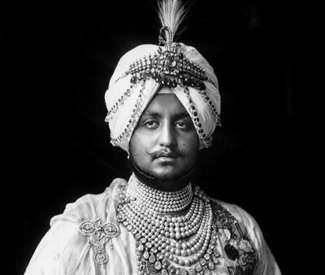
A different sort of disconnect haunts the Asian Art Museum’s “Maharaja: The Splendor of India’s Royal Courts,” the other major exhibit in town currently devoted to India. Maharaja means “great king” or “high king” in Sanskrit, a status expressed in the breathtaking level of sumptuousness and luxury of the material items through which Indian rulers displayed their power.

Light on historical context and heavy on the baubles, Maharaja offers up a seemingly endless parade of such items: extravagantly embroidered textiles, magnificent ceremonial accouterments, and enough serious bling to outshine the borrowed sparkles of any contemporary red carpet. The effect is strangely flattening. Monarchy is the golden goose that produces marvelous things rather than a larger institution, the spoils of which only tell one part of a more complex and usually bloody story.

Thus, what Maharaja leaves largely unaddressed are questions of power and history, as well as the politics of display. For example, what was the cost in human labor (and perhaps lives) to spin and weave the silk necessary to make the stunning 18th Century bridal gown in the second gallery? Or to mine the diamonds, rubies, and emeralds that emblazon so many of the items displayed?

The fact that the majority of the artifacts come from London’s Victoria and Albert Museum –an official co-presenter of the exhibit— speaks more to the legacy of British colonial rule than the brief gloss the Raj and its aftermath receive in the show’s third gallery, which crams in most of Maharaja’s history lessons. And judging from the case of various Cartier commissions from the 1920s and ’30s, and the gorgeous modern furniture commissioned by Yeshwant Rao Holkar II (a jazz age jetsetter and friend of Man Ray’s who is the exhibit’s breakout star), India’s deposed royals did pretty well for themselves, even as the times changed around them.

But then again, that the already powerful would continue being high rollers is not really news. As Mel Brooks pointed out long ago, it’s good to be the king.

THE MATTER WITHIN: NEW CONTEMPORARY OF INDIA

Through January 15

Yerba Buena Center for the Arts

701 Mission, SF.

(415) 978-2787

www.ybca.org

MAHARAJA: THE SPLENDOR OF INDIA’S ROYAL COURTS

Through April 8

Asian Art Museum

200 Larkin, SF.

(415) 581-3500

www.asianart.org


State of the occupations

0

rebeccab@sfbg.com

The police evictions of OccupyOakland and OccupyCal over the last week, and the looming threat of another attempt to evict OccupySF, presented challenges for the Bay Area protests just as similar police crackdowns targeted Occupy encampments in Portland, Denver, New York, and other cities nationwide.

These fast-moving developments also come at a time when university students from around California will be descending on San Francisco for a Nov. 16-17 University of California Board of Regents meeting that was canceled this week because of public safety concerns. All of this adds up to a big and unpredictable moment for the widening movement (see “The growing 99 percent,” 11/9).

So we’ve decided to start a regular feature to track the latest developments in an Occupy movement that seems adamant about standing its ground even as it’s forced to deal with threats from police, organizing challenges, and the coming of winter.


#OCCUPYCAL GROWS UP FAST

Students at the University of California at Berkeley burst onto the Occupy scene Nov. 9 with the launch of OccupyCal, a student-led protest that made waves nationally after university police advanced on around 500 students in Sproul Plaza, the historic epicenter of the Free Speech Movement, and struck them with batons after they tried to set up camp.

UCB police made 39 arrests in two separate actions against protesters, fueling student protesters’ resolve at a general assembly convened afterward that drew more than 1,000 people and lasted well into the night. At around 1:30 am, students voted to hold a student strike on Nov. 15 in solidarity with others throughout the UC system.

The harsh police response prompted condemnation from the Free Speech Movement Archives (FSM-A). “It appears that the campus police are in need of remedial education concerning fundamental protections offered by the US Constitution — including First Amendment rights to Free Speech and Free Assembly that were clearly recognized and enshrined on the UCB campus 47 years ago on these very steps,” the group noted in an open letter.

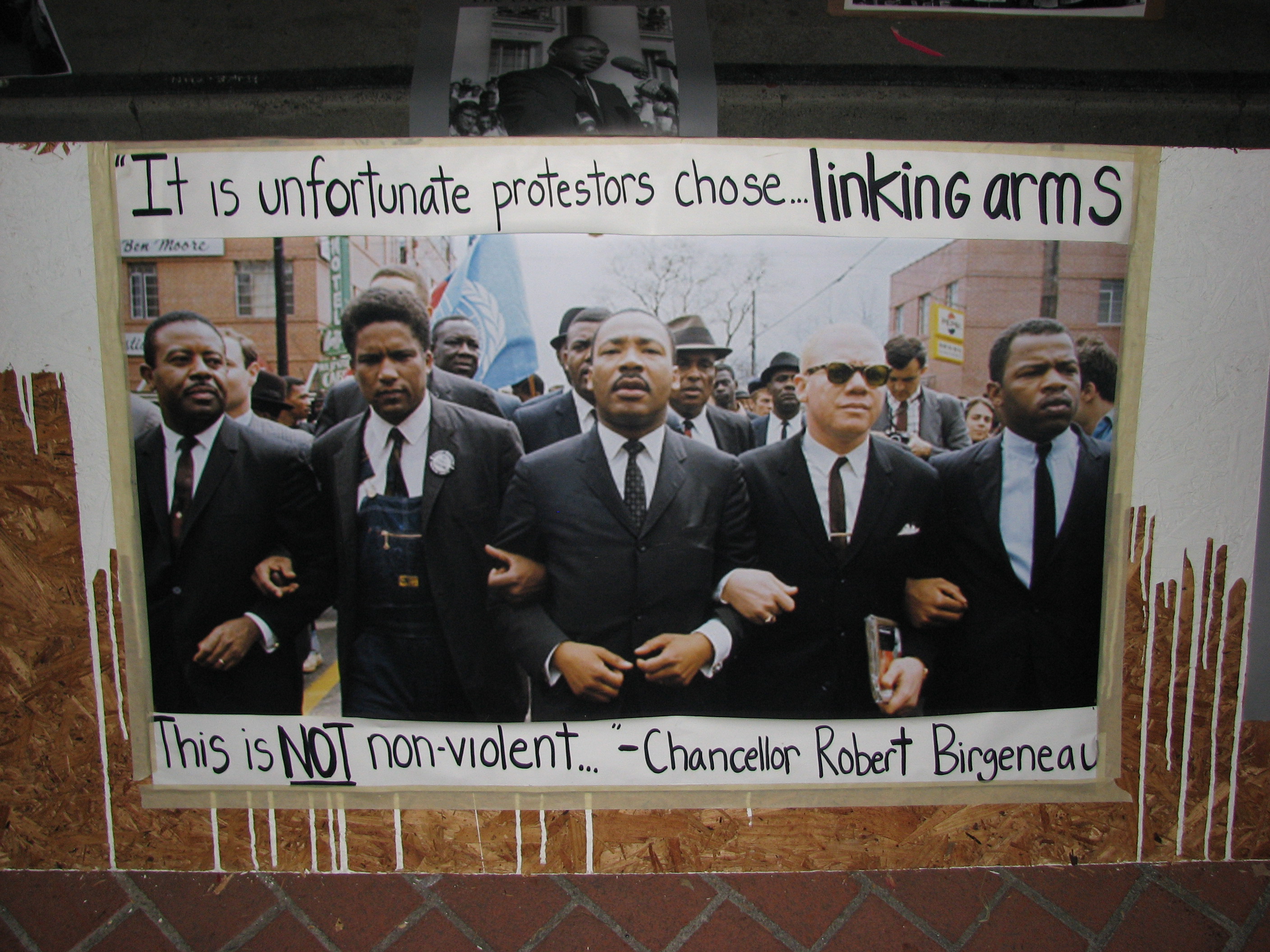
UC Berkeley Chancellor Robert J. Birgeneau, who was out of the country during the violent police crackdown, issued a statement on Nov. 14 ordering a third-party investigation of the clash and granting amnesty under the Student Code of Conduct to all students who were arrested for blocking police from removing the encampment.

“It was only yesterday that I was able to look at a number of the videos that were made of the protests on November 9. These videos are very disturbing. The events of last Wednesday are unworthy of us as a university community. Sadly, they point to the dilemma that we face in trying to prevent encampments and thereby mitigate long-term risks to the health and safety of our entire community,” he wrote. “Most certainly, we cannot condone any excessive use of force against any members of our community.”


#OCCUPYSF, THE NEXT BATTLEGROUND

At press time, student and labor groups that were planning to converge on the UC Regents meeting at UCSF Mission Bay on Nov. 16 by the thousands were deciding how to respond to the meeting cancellation, but protests are still planned for that day, with support from OccupySF.

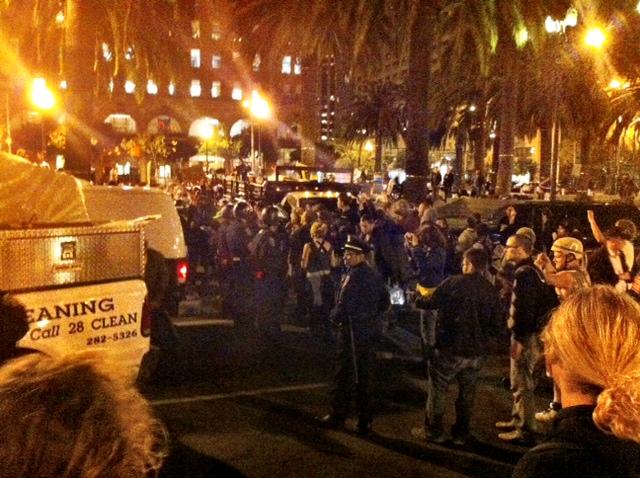
Meanwhile, Mayor Ed Lee continues to insist that OccupySF break camp, but instead it has only grown larger, with the tents spreading out from Justin Herman Plaza onto the nearby sidewalk along Market Street in front of the Federal Reserve. At press time, protesters feared what seemed an imminent police raid, particularly now that the election is over and busloads of student protesters were headed into town.


TRAGEDY STRIKES #OCCUPYOAKLAND

On Nov. 10, Kayode Ola Foster, 25, suffered a fatal gunshot wound to the head following an argument, just yards from the Occupy Oakland encampment in Frank Ogawa Plaza (Oscar Grant Plaza to the occupiers who’d camped there for a solid month).

A somber mood settled over the plaza in the hours following the shooting as the tent city dwellers absorbed the gravity of the situation, and occupy activists held a candlelight vigil. Although initial reports suggested Foster had no relationship to the camp, police later said they believed he and one of two shooting suspects had spent time there.


#OCCUPYOAKLAND GETS THE BOOT

Three days after the fatal shooting near the OccupyOakland encampment sparked a hard-line response from local government officials, the camp was dismantled in an early morning police raid Nov. 14, the second to befall the occupation since it began a month ago. That evening, thousands marched back to the plaza in response to the raid and held a general assembly.

On the night of the raid, it took several hours for police to arrive at 14th and Broadway streets, where protesters began congregating in the intersection around 2 a.m. in anticipation of the forced eviction from camp. Law enforcement came en masse, with mutual aid support from seven different regional law enforcement agencies.

While two lines of riot police formed an L-shaped formation blocking protesters’ access to the plaza and nearby streets, hundreds more poured into the plaza to dismantle tents, flatten structures, and make arrests. Police arrested 32, the majority of whom belonged to a group of clergy members from the occupation’s Interfaith Coalition tent who sat calmly together in the plaza and sang by candlelight as they waited for police. Occupiers who witnessed the dismantling of the camp from behind police barricades yelled out, “Shame! Shame! Shame!”

Steven T. Jones contributed to this report.
Fearing violence, UC cancels Regents meeting; Chancellor pardons arrested UC protesters

15

Citing public safety concerns, University of California has canceled a UC Board of Regents meeting set for Wednesday morning at UCSF Mission Bay, a meeting that has been the target of months worth of student organizing to protest tuition hikes and service cuts and which dovetailed with the roiling Occupy movements in the Bay Area.

After police crackdowns on Occupy encampments in Oakland and in UC Berkeley’s Sproul Plaza over the last week, the long-planned showdown with the UC Regents – whom protest groups such a ReFund California say are among the powerful 1 percent that Occupy has targeted and which they blame for deep cuts in California’s public university system – was highly anticipated.

OccupyCal protesters have called for a strike on that and other UC campuses tomorrow to protest the violent police expulsion of student protesters at UC Berkeley last week. At a General Assembly at 6 pm today (Mon/14) in UC Berkeley’s Sproul Plaza, attendees will decide how to respond to the cancellation of the meeting.

Other groups that include labor representatives, such as ReFund California, will also independently decide how to proceed. “We’re figuring out what to do,” said Jennifer Tucker with ReFund, noting that they will post that information on its website: www.makebankspaycalifornia.com.

A statement issued today by the UC President’s Office cited information gathered by UC Police: “From various sources they had received information indicating that rogue elements intent on violence and confrontation with UC public safety officers were planning to attach themselves to peaceful demonstrations expected to occur at the meeting.

“They believe that, as a result, there is a real danger of significant violence and vandalism. They have advised us further that this violence could place at risk members of the public, students lawfully gathered to voice concerns over tuition levels and any other issues, the UCSF community, including patients, and public safety officers, UC staff and neighbors of UCSF Mission Bay. They recommended to us, in the strongest of terms, that we cancel or postpone the meeting as scheduled.”

Tucker criticized the move: “We were floored this morning by the announcement that the Regents were canceling their meeting. There had been a statewide organizing campaign for months on this with thousands of students coming in on buses from throughout the state,” she said, adding that, “There will still be protests on Wednesday, but we’re not sure what form they will take.”

Meanwhile, UC Berkeley Chancellor Robert J. Birgeneau, who was out of the country during the violent police crackdown last week, today issued a statement ordering a third-party investigation of the clash and granting amnesty under the Student Code of Conduct to all students who were arrested for blocking police from removing the encampment.

“It was only yesterday that I was able to look at a number of the videos that were made of the protests on November 9.  These videos are very disturbing.  The events of last Wednesday are unworthy of us as a university community.  Sadly, they point to the dilemma that we face in trying to prevent encampments and thereby mitigate long-term risks to the health and safety of our entire community,” he wrote. “Most certainly, we cannot condone any excessive use of force against any members of our community.”

Lessons from 2011 for 2012

4

With the release of precinct results for the 2011 election, we are able to actually see, for the first time, what San Francisco voters did, as opposed to hearing what various nabobs said they did.  There are a couple of key conclusions about the vote that should guide any left-liberal thinking of the key 2012 Supervisor races.

The first thing San Francisco voters did- about 40,000 of them-  was stay home.  Turnout – about 40% – was the lowest for a mayor’s race in 40 years. Moreover, counter to several “expert” narratives, turnout in neighborhoods with large numbers of Chinese voters — Chinatown, the Richmond, the Sunset, and Vis Valley — was lower (average 33%) than in neighborhoods with few Chinese voters — Diamond Heights, Noe Valley, the Castro and West of Twin Peaks — where turnout averaged 40%.

There seems to be four reasons for this curious outcome. A couple of them have lessons for us for the 2012 election that we ignore at our peril.
First, in a City that is clearly center-left, voters were presented with nine center-right candidates, seven of whom were declared by the Chronicle at one time or another to be “serious.” Only John Avalos was a clear center-left choice. This was shown in the huge number undecideds that appeared in poll after poll. Undecided voters are often unhappy at the lack of choice being offered by the field and simply don’t vote.

Second, professional campaign management of the supposedly serious candidates was terrible and actually counter-productive to their candidates’ best interests. The pros actually seemed to have suppressed turnout in key neighborhoods. Ace Smith and Bill Barnes, working for for Ed Lee, spent most of their time trying to distance their candidate from his base and key supporters, made rookie fund-raising mistakes time and again and gave their counterparts in the Yee and Herrera campaigns ample ammunition for a  series of negative ads and mailers.  John Whitehurst and Mark Mosher, working for Herrera, and Jim Sterns, working for Yee, took the opportunity and went negative on the least threatening figure in San Francisco politics in recent memory. 

As we all know negative campaigns generally suppress turnout — and that seems to be the case in this election. Avalos, who after September had no professional management, stayed positive and gained votes by doing so.

Third, organized labor, for the first time in living memory, did not endorse the winning candidate for mayor. Indeed, its official candidate, Yee, came in FIFTH. It’s as if labor decided to concentrate only on its issue — pension reform — and devote no energy, people or money to the myors race. Without labor’ support,effective GOTV in left-liberal neighborhoods is all the more difficult and was clearly beyond the ability of the Avalos campaign to carry by itself.

Labor knew who it wanted to vote on pension reform and narrowly focused only on those voters. That it still has the ability to do electoral politics can be seen in the fact that more total votes were cast on  Proposition C (186,336) — labor’s pension- reform measure –than were cast for all candidates in the mayors race (179,888).

Finally, there were 160 fewer polling places this election than last year, and to make matters worse the Department of  Elections mailed 115,000 voter handbooks with the wrong polling place address causing them to send postcards with the corrections. While this in no way was responsible for the 40,000 fewer votes cast, it was probably worth several hundreds of missed votes.

The lessons for next year? We need good candidates who actually align with political sensibility of the voters. This will be especially true in District Five after Mayor Lee appoints some center-right clone in the most left-liberal district in the city, and equally true in District Three with David Chiu, who has certainly turned to the right since his election. 

Supervisor David Campos in District 9 will be fine in this regard as will Supervisor Eric Mar in District 1 — where he will face a real fight.
Avalos’ showing in the mayors race should do him well in District 11 and offers a real chance for him to be board president in 2013.
Community-based left-liberals and labor must come together closer than in this election and perhaps closer than at any time since the Great depression. Labor’s support for the Occupy movement is a good indication that fruitful common ground can be found. We need each other more than ever in 2012.

We need to work to get good lines for the new districts and have a grand meeting of the minds on how we address the absentee voter issue.  Both labor and the Mirkarimi campaign did absentees well enough to win.  We need to apply their lessons to the Supervisors races.

Dare to struggle, dare to win.

Calvin Welch is a housing activist who has been watching San Francisco elections for more than 40 years.


Dick Meister: Strange bedfellows: Labor’s Tim Paulson and the Chamber’s Steve Falk

5

By Dick Meister

Dick Meister, former labor editor of the SF Chronicle and KQED-TV Newsroom and a former city editor of the Oakland Tribune, has covered labor and politics for a half-century as a reporter, editor, author and commentator. Contact him through his website, dickmeister.com, which includes more than 300 of his columns.

It’s hard to imagine organized labor and the thoroughly anti-labor Chamber of Commerce on the same side, especially in a city like San Francisco with a major union presence.

It’s especially hard to imagine it at a time when unions everywhere are joining with Occupy Wall Streeters to demand justice from anti-labor business and corporate leaders like those who control the Chamber.

But consider what Tim Paulson, executive director of SF’s Labor Council, and President Steve Falk of the SF Chamber of Commerce had to say in a joint statement about the results of Tuesday’s election.

They were downright overjoyed about the passage of Proposition C, which will raise the amounts city employees must pay toward their less-than lucrative pensions and limit future cost-of-living raises. That’s a way to avoid raising business taxes to maintain city services in these recessionary times.

Perhaps most distressing, the passage of Prop C shifted control of the City Health Service System from the employees who are covered by the system to City Hall appointees who won’t have to demonstrate any particular experience in health care matters.

At least Paulson and Falk said they were pleased with the defeat of Public Defender Jeff Adachi’s outrageous Prop D – even though it would have changed the city pension system in almost exactly the same ways as Prop C.

In any case, the difference between C and D was not necessarily their content, but how they got on to the ballot.

Why, exclaimed Paulson in a separate, self-congratulatory statement, the results “sent new shock waves across San Francisco and America as workers demonstrated that collaborative democracy is the best way to set public policy.”

Collaborative democracy? By that I guess Tim was referring to the joining together of labor leaders and public employee unions and Chamber of Commerce members in a coalition with city officials, non-profit social agencies and community groups to put Prop C on the ballot.

The collaborators didn’t even include representatives of the retired employees whose health care would be seriously affected and who were quite active in helping elect labor-friendly candidates.

Paulson, a generally ineffective leader who always seems to be seeking approval of the City establishment, singled out billionaire Warren Hellman for being one of the principal collaborators.

Paulson boasted that every city employee union joined in what he actually described as “a real San Francisco way of doing things.” Hardly. If there really were such a thing, it would be a far cry from the “collaborative” approach that involved labor giving in to the wishes of its anti-labor corporate and business opponents.

Paulson and Falk claimed the approach will be “a model for the rest of the country.” Thankfully for the rest of the country, that seems highly unlikely given the widespread demands for actual reform triggered by the Occupy Wall Street protests.

Negotiations between labor and management eventually reach agreements that both can live with, albeit often uncomfortably. But no agreement can be reached, or should be reached, when one party – the Chamber of Commerce in this case – is not seeking real compromise with an enemy – namely unions – that it would like to put out of business, or at least seriously weaken. Unions, of course, have the same feelings about union foes like the Chamber.

Tim Paulson actually declared the election results “a great victory during difficult times.”

Dick Meister, former labor editor of the SF Chronicle and KQED-TV Newsroom and a former city editor of the Oakland Tribune, has covered labor and politics for a half-century as a reporter, editor, author and commentator. Contact him through his website, dickmeister.com, which includes more than 300 of his columns.


The next D5 supervisor

21

Now that it appears Sup. Ross Mirkarimi will be the next sheriff — and Ed Lee will be mayor for the next four years — the speculation is starting over who Lee will name to replace Mirkarimi as District Five supervisor. There are an abundance of qualified candidates, but my sources tell me the Mayor’s Office is looking right now primarily at two people — London Breed, director of the African American Art and Culture Complex and a former redevelopment commissioner, and Malcolm Yeung, an attorney who is president of the Asian American Bar Association and longtime policy person at the Chinatown Comminity Development Center.

Both, of course, were Lee supporters.They have a history of working on progressive causes (Yeung, at CCDC) and strong ties to the community (Breed at AAACC). Breed has spent more time as an activist in D5 (and was appointed to her job by former mayor Willie Brown), but Yeung is reportedly popular with Rose Pak, who clearly has the mayor’s ear.

I don’t know who Lee will be taking to about the appointment, but you can be sure both Brown and Pak will be giving their advice. And so far — although it’s still early — nobody has been talking to the current supervisor.

I called Mirkarimi and asked him who he would suggest, and he told me there were plenty of people — although neither Breed nor Yeung would be on his short list. He didn’t want to name names, but I can: queer/labor activist Gabriel Halland and Community College Board Member John Rizzo are both eminently qualified for the job, and Julian Davis would also be on a lot of short lists. So would Christina Olague, a planning commissioner (and Lee supporter) — but one City Hall insider told me that “Willie would never let that happen.”

Mirkarimi did suggest that he ought to be consulted. “I would think after all the work I’ve done in the district over seven years and two administration that  Mayor Lee would at least want my input,” he said. We’ll see.

San Francisco’s political spectrum: a primer

120

During yesterday’s post-election wrap-up at the San Francisco Planning and Urban Research Association, political consultant and analyst David Latterman cited the ideological breakdown of San Francisco voters: 19 percent are progressive, 36 percent are liberal, 39 percent are “moderate,” and 6 percent are conservative. I cited those figures in a post I wrote yesterday on the latest election results, and some people responded by asking me to explain those terms, so let me take a crack at that because I think it’s important to understanding the city’s political dynamics.

I even discussed the matter with Latterman – who self-identifies as moderate, whereas I and the Guardian have a progressive worldview. “That’s a fantastic question and I don’t think any of us can give suitable answers,” Latterman said. “These aren’t hard lines. It’s like: I don’t know how to define pornography, but I know it when I see it.” Nonetheless, we agreed on the basic outlines and borders between the labels, even though we might frame them and value them a little differently.

In San Francisco, there is general agreement on most social issues among the moderates, liberals, and progressives, although we may disagree on political tactics. We all basically support gay rights, reproductive freedom, the value of diversity, environmentalism, and freedom of expression. That’s why most people consider San Francisco to be a famously liberal city, because of our tolerance on social issues, which only that 6 percent who are conservatives don’t share.

Yet San Francisco is still a deeply divided city on economic issues, including land use and the role of government. This is where most of the political conflicts and divisions occur, and it is here where our political spectrum is as wide as anywhere – perhaps even wider given the extreme wealth and poverty here, as well as the long history of political activism and the setting of national political trends. And it is in this realm that our labels come from.

A “moderate” in San Francisco – which is a real misnomer despite its widespread usage – is a fiscal conservative: anti-tax, anti-regulation, an almost religious faith in the free market, and a resentment of the poor (particularly the homeless and the jobless) and those who advocate for them. They want bare minimal government and see the role of government as primarily to facilitate economic activity in the private sector and to provide the basic infrastructure that the private sector needs to operate efficiently. They even believe social services should be provided by the private sector, such as nonprofits, rather than by government. On economic issues, they’re almost indistinguishable from conservatives, with whom they disagree on social issues.

On the other end of the spectrum are the progressives, who don’t trust capitalists and large corporations and believe they need to be heavily regulated and taxed to provide for the common good. We believe in progressive taxation and a redistribution of wealth, particularly from the richest 1 percent, and that government has an important role to play in leveling the economic playing field and playing referee. Progressives generally believe this country has been drifting to the right for at least the last 31 years and that this is a dangerous trend that needs to be addressed with fundamental, systemic reforms. And at this point, we’re willing to adopt radical strategies for triggering that change, such as Occupy Wall Street or other forms of civil disobedience.

The liberals of San Francisco are somewhere in the middle. They’re Democrats (or DTS) who don’t believe in radical change or anything that might disrupt the existing order, preferring incremental reforms over long period of time. They accept the legitimacy of the two-party political system and an economic system governed by Wall Street and powerful corporations, and they believe we need to do what we can within that framework. They use neoliberal economic policies like business tax cuts and incentives to encourage private sector job creation and housing development, and they accept a shrinking public sector, which they expect to operate more like the private sector, and a waning labor movement.

The reactions to the OccupySF movement is an interesting illustration of the dividing lines. Moderates have voiced tepid support for the movement’s critique of the growing gap between rich and poor, but they’re appalled at the tactic of occupation, believing curfew and anti-camping laws are more important. Progressives have been the most enthusiastic supporters of a movement that echoes their core values and physically challenges the status quo. Liberals basically support the movement, but they’ve been very uneasy with the tactic of occupation and have been vacillating on how to deal with it.

Latterman and the moderates – as well as many liberals – see ideology as a dirty word, and he was happy that in this election “it was the least ideological race we’ve seen in a long time.” Mayor Ed Lee and Board President David Chiu – both of whom hover in the liberal to moderate range, depending on the issue – also treat the notion of ideology with disdain, claiming to support practical, pragmatic, or common sense solutions to problems.

But progressives see ideology as the essence of politics. They understand the world in terms of class struggle, and believe that the very rich have been aggressively exploiting the people and the planet for too long, and that the only real way to make progress is to fight them and win. They believe in the Occupy paradigm that the 1 percent – the greedy rich who have corrupted our political and economic systems – are actively hostile to the interests of the 99 percent. We know that’s an unsustainable system and we’re hopeful that this is the moment when progress – the core of our belief system, that it’s possible to devise better economic and political systems than the ones we’ve inherited – could finally be attainable if we continue to organize and challenge the system.

That’s my general analysis of San Francisco’s political dynamics. What’s yours?

Dick Meister: Labor and the occupiers: a natural fit

0

LABOR & THE OCCUPIERS: A NATURAL FIT

By Dick Meister

Dick Meister, former labor editor of the SF Chronicle and KQED-TV Newsroom and a former city editor of the Oakland Tribune, has covered labor and politics for a half-century as a reporter, editor, author and commentator. Contact him through his website, dickmeister.com, which includes more than 300 of his columns.

Think of what a combined effort by unions and the Occupy Wall Street movement could do to weaken the tight grip of corporate greed on the economy. Think of how it could greatly strengthen both the labor movement and the occupiers.

OWS and labor have worked together in some locations. But many occupiers consider labor a part of the economic and political establishment that they’re protesting, and fear that union leaders might try to take control of their movement, which, unlike unions, is based on direct rather than representative democracy.

And labor is not happy that OWS has no clearly identified leaders or formal demands, which of course is how unions operate.

Unions and the occupiers, however, have the same powerful enemies. They need each other if they are to overcome them. It seems to me that unions are in the best position to bring the two much closer together.

So, how to go about it? Unions need to make clear, in words and deeds, that they are indeed facing the same problems and opponents as the occupiers and that they need to join together so as to act as forcefully as possible to overcome their mutual enemies. They must make clear as well that union leaders do not want to take over their movement, but seek to strengthen it.

There’s an old, but still highly effective tactic that labor must stress to its potential OWS friends. It’s called solidarity.

Clearly identified unionists must march and otherwise demonstrate with occupiers, join them in their rallies and in their tent cities and elsewhere. They should provide them with food, blankets, medical care and other necessities. They should organize joint actions and show that labor leaders are doing important work in the occupiers’ behalf.

At the same time, unions should make clear that they do not support the destructive vandals who’ve tried to attach themselves to the OWS movement.

If necessary, labor should also take dramatic actions such as were taken November 2nd by Occupy Oakland protestors who had been camped in front of Oakland’s City Hall for close to a month. They led a rally and then a march of some 7,000 people through downtown Oakland to the city’s port, one of the most important on the West Coast.

Occupiers and their supporters forced the port to close by blocking delivery trucks from loading or unloading cargo on the docks. At any rate, many dock workers, union members all, didn’t show up for work.

The march and port closure were planned as part of a citywide general strike that, while drawing many words of support from Oaklanders and others, was not widely supported otherwise.

Most notable among those who showed their support physically as well as verbally were more than 300 teachers who did not report to school. Some other teachers used the day to explain the nature of such protests to their students.

Unions certainly have had a long experience in doing what needs to be done to build the strength for battling powerful economic and political enemies. During the Great Depression, for instance, unions waged massive organizing drives to recruit workers and give them the strength they needed to overcome the greedy oppressors of the 1930s. That led to the laws that guarantee workers the right to unionization and regulate their hours and other working conditions.

Like the union activists of the thirties, occupiers have helped focus widespread attention on the financial interests which are responsible for battering the economy and on what the financial interests must do to make it right.

That has helped OWS gain support from the AFL-CIO, and from more than two dozen national unions and many of their local affiliates. Some of the unions have made participation in the occupy movement a major activity.

Unions already have spent lots of money and put lots of members into the occupiers battles to win much better treatment for workers from the same forces that are denying decent treatment to unionists.

A partnership of labor and the Occupy Wall Street movement could very well lead to reforms as far-reaching and vital as those won by activists eight decades ago.

Dick Meister, former labor editor of the SF Chronicle and KQED-TV Newsroom and a former city editor of the Oakland Tribune, has covered labor and politics for a half-century as a reporter, editor, author and commentator. Contact him through his website, dickmeister.com, which includes more than 300 of his columns.

The growing 99 percent

0

steve@sfbg.com

In recent weeks, the Bay Area has been roiled by anger and frustration with how the rich have grown richer while the rest of us endure underemployment, foreclosures, and deep cuts to public education and services, peaking with the Nov. 2 Oakland General Strike that drew more than 10,000 people into the streets to demand economic justice.

The Occupy Wall Street movement — and its many local manifestations, including OccupySF and Occupy Oakland — has been the main vehicle for those populist passions for the last two months, with the support of the labor movement. But now, student and faculty groups from California’s three public university systems are about to get involved in the fight in a big way.

Student and labor groups allied with the ReFund California coalition are planning a week of action for Nov. 9-16, culminating that final day in demonstrations outside the California State University Board of Trustees meeting in Fullerton and University of California Board of Trustees meeting at the UCSF campus in San Francisco’s Mission Bay.

Those protests aim to connect the problem of deep cuts and tuition hikes in the public university systems with the larger issue of wealthy individuals and corporations that haven’t been paying their fair share. The coalition wants the boards to pledge support for a five-point action plan that includes taxes on the wealthy, removing commercial property from Prop. 13 caps on property taxes, restoration of cuts to higher education, a sales tax on Wall Street financial transactions, and pressuring banks to reduce mortgage debt on underwater homes.

Charlie Eaton, a ReFund California organizer from United Auto Workers Local 2865, which represents teaching assistants at UC, notes that many UC and CSU board members also sit on the boards of major banks and corporations that have contributed to the current financial crisis and which have been in the crosshairs of the Occupy Wall Street movement.

“It’s really a club of California’s corporate elites,” Eaton said. “It’s about saying to these folks: if you aren’t willing to actively support paying your fair share, or at least get out of the way, we can’t let it be business as usual at the Wall Street institutions that you help run.”


NO BUSINESS AS USUAL

He said there’s a direct connection between the actions of these corporate boards and lack of resources in California for public education and services, so it’s only right that these powerful board members — from Regent Richard Blum, the investment banker husband of Sen. Dianne Feinstein, to Trustee Bill Hauck, former head of the California Business Roundtable — support the needs of the 99 percent.

“We’ll be there to call on them to sign the pledge,” Eaton said of the Nov. 16 meetings. “And if they aren’t prepared to make that pledge, we’re headed to the Financial District to make sure there is no business as usual for these corporations.”

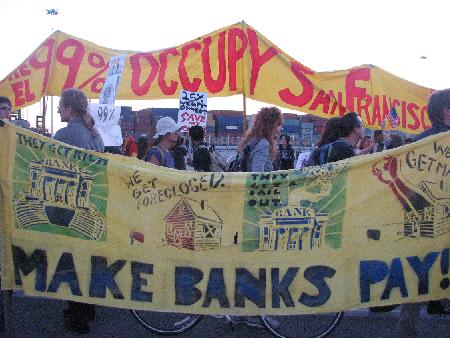
That day of action will echo the last ReFund California protest in San Francisco, the Sept. 29 “Make Banks Pay” march through the Financial District that was one of the first high-profile demonstrations involving OccupySF. The march was several hundred strong, targeting major financial institutions including a Chase Bank branch on Market Street that was occupied by protesters, resulting in six arrests.

When we asked Eaton whether the Occupy movement would lend its energy and numbers to these ReFund California protests, he said, “We’re embedded in the Occupy movement, so it’s not quite right to say it’s something the Occupy movement might help with…I think the Occupy Wall Street movement shows we can make them pay.”

Meanwhile, the next day (Nov. 17), Occupy Wall Street plans to march the 11-mile length of Manhattan in a day of action that will be supported by solidarity marches by Occupy encampments across the country. That is also the day that a two-campus strike is being threatened by the California Faculty Association.

“I think that day is going to be a busy day all around the nation,” Kim Geron, a political science professor at CSU East Bay and vice president of the CFA, told us.

On Nov. 7, the CFA Board of Directors authorized one-day strikes for Nov. 17 at the CSU East Bay and CSU Dominguez Hills campuses to protest CSU Chancellor Charles B. Reed’s decision to withhold negotiated faculty pay raises. It would be the first faculty strike in the system since 1983, although a strike was authorized in 2007 but called off after a negotiated settlement.

After the vote, according to a statement put out to members, CFA President Lillian Taiz told her board, “We hope this carefully targeted strike, which symbolizes both our anger and our commitment to fairness, will lead to changes in his priorities and his positions. If it does not, the CFA leadership—and the CSU faculty we represent—are prepared to escalate the fight.”


DUCKING THE TAX ISSUE

CSU spokesperson Mike Uhlenkamp said the campuses will remain open despite the strikes. “We expect it to be business as usual,” he said. As for the pledge that ReFund California is seeking, “We don’t get into advocating between taxing and not taxing,” he said, saying that’s a state decision and “we’re not going to push them to make that determination.”

Guardian calls to the UC President’s Office were not returned by press time. A spokesperson for Gov. Jerry Brown, who is the subject of a student letter-writing campaign urging him to tax the rich and stop cutting public services, continued to blame Republicans.

“We too are deeply concerned about cuts to the state’s universities and colleges, which is why the Governor pushed for a solution to our budget deficit that included extending revenues. Unfortunately, Republicans in the Legislature refused to even allow the people of California to vote on the measure, which could have helped prevent future cuts,” Brown spokesperson Evan Westrup responded via email.

When we asked whether Brown was simply giving up, how he planned to deal with the problem, and why Brown has not followed up his campaign pledge to tax the rich with any proposals to do so, he wrote simply, “There are a number of ways to pursue additional revenue moving forward and these options are being considered.”

Geron said there is a clear connection between problems in the CSU system and the hoarding of resources by the richest one percent of Americans, the main critique of Occupy Wall Street, a movement driven largely by current and recent college students.

“We are part of it. One of our slogans is we are the 99 percent and we teach the 99 percent,” Geron told us.

While the CFU is focused on decisions by the Chancellor’s Office — indeed, the strike is legally allowed only because the chancellor broke the contract by withholding negotiated pay increases — Geron said those decisions were made in a climate of deep funding cuts prompted by the state budget crisis.

“Obviously, the economic crisis is a lot of the reason why all this happened. It’s part of a larger crisis that is going on about how to fund the public good, including higher education,” Geron said. “Students are paying a lot more and getting a lot less. That’s the heart of what’s going on.”

The UC Student Association is taking part in the ReFund California week of action, but has not yet voted to participate in direct action against corporations on Nov. 16, Executive Director Matt Haney told us. But he said that many UC students will still take part in that action, just as they’ve been taking part in the Occupy movement.

“It’s the same frustrations. We have to get out there and start pushing this ourselves,” he told us. “We need to show the state that things can’t just keep moving along as they have. We have to put a stop to business as usual. The economic collapse is what destroyed the UC system.”

Haney sees the student, labor, and Occupy movements starting to come together in a very natural way. “It has really put the wind in the sails of student activists to see the energy of the Occupy movement,” Haney said. “There is a coming together of students and labor, and it’s overlapping with the Occupy movement in a powerful way.” *

Find details about the ReFund California Week of Action at www.makebankspaycalifornia.com.

Helping the 99 percent — with less

2

OPINION La Raza Centro Legal, an organization central to the empowerment of San Francisco’s low-wage immigrant workers, finds common cause with the Occupy movement during a time when our programs combining legal services and worker organizing are in jeopardy. Our hour of need falls within a window of tough times, but heightened political awareness, and we are calling out to the community to join us in solidarity as members of the 99 percent.

La Raza’s resonance with Occupy shows on a bilingual sign printed for the movement. Under a day laborer’s face, the sign reads, “We are the 99 percent. I’m blamed for the economic crisis, but what about the Wall Street banks?” Immigrants pay more in taxes than they use in government services, generate revenue exceeding the services they receive, subsidize the Social Security system, and provide labor that supports entire industries.

Contrary to the red herring propaganda generated by the 1 percent, the scapegoated low-wage immigrant worker is not the cause of the financial crisis in the United States. Occupy has resuscitated public discourse with the plain facts of shocking economic inequity and the corruption of our democracy. Immigration debate can now rise to the surface after nearly drowning in the lies that spawned the recent legal abominations in Arizona, Alabama, and Georgia.

In the current political and economic climate, immigrant rights organizations face an intractable three-pronged challenge: dangerous policies born of anti-immigrant zeal, a crushing economic crisis that disproportionately impacts low-income communities of color, and dwindling funds from the government and foundations that used to support our work. The Obama administration’s Orwellian-named “Secure Communities” deportation program creates an unprecedented stream of profits for privately contracted immigration detention facilities rife with human rights abuses. At the same time, employers take advantage of job scarcity to exploit low-wage immigrant workers. On the same days that our advocacy and services are needed more than ever, we’ve receive news that a grant that we depend on will not be renewed in the coming year.

Just like so many other members of the 99 percent, La Raza Centro Legal is in financial crisis. If the organization cannot find immediate support, some of La Raza’s programs that help so many people in the immigrant community could die. If La Raza is diminished, who will reunite a family unjustly torn apart, or take an employer to task for ripping off a day laborer so that the worker can feed his children? Who will organize the community so that, through La Raza’s Day Labor Program and Women’s Collective, low-wage immigrant workers can find their voice and build their own innate capacity for leadership in their community?

We aren’t giving up. Because the Occupy movement has pushed into public consciousness the well-established but long-ignored truth of how the status quo is hurting us all, it offers incredible hope. An October 20 community meeting kicked off a new fundraising drive for La Raza. San Franciscans and the city must join us in solidarity to help us find ways to support community nonprofits in declining economies and increasing civil rights abuses — which is when they are needed most.

Kate Hegé and Kate Deeny work in the Workers’ Rights Program at La Raza Centro Legal. For more information about how to help, contact Genevie Gallegos, Executive Director of La Raza Centro Legal at Genevie@lrcl.org.

Alerts

0

alert@sfbg.com

WEDNESDAY 9

Student Day of Action

ReFund California begins its Make Banks Pay week of action by organizing a protest to shut down a local branch of Wells Fargo, a contributor to the financial collapse of 2008 and the current foreclosure crisis. Students from City College and the San Francisco State University will join forces to call for banks to help restore the deep cuts to higher educations that they helped cause.

Noon, free

Gather at SFSU Quad to take the M bus to West Portal and march to the bank

www.makebankspaycalifornia.com


THURSDAY 10

Poor People’s Decolonization

Join Occupy Oakland, POOR Magazine, and other groups for a march on four government offices that promote the criminalization and deportation of poor people from around the world: the Oakland Police Department, Oakland Housing Authority, Alameda County Social Services, and U.S. Department Immigration and Customs Enforcement.

Noon, free

Gather at the OPD

455 Seventh, Oakl.

www.occupyoakland.org


Picket Hotel Frank

Wells Fargo and its Hotel Frank management company, Provenance, refused to recognize the Unite Here Local 2 contract, increased the workload for employees, and haven’t paid any medical or pension coverage. The National Labor Relations Board has found Hotel Frank guilty of violating federal labor laws, including firing and disciplining workers for engaging in union activities, but only this daily picket seems capable of making a difference.

3-5:30pm, free

Hotel Frank Geary and Mason, SF

www.hotelfranksf.info


FRIDAY 11

Bay Area Resilience

Help formulate regional plans by community groups, social movements, and public planners for a strong economy, climate adaptation, and emergency preparedness. Bay Localize, Communities for a Better Environment, Global Exchange, and other groups are coming together for this Bay Area Convening on Resilience and Equity. Come and join the movement.

9am-3pm, $7-10 (includes lunch)

California Endowment Conference Center 1111 Broadway, Oakl

leanne@baylocalize.org

colin@baylocalize.org


SATURDAY 12

OccupySF Teach-In

Learn about the OccupySF movement and what it’s all about by attending the General Assembly at noon followed by a march to downtown at 3pm. Meet at the “SF Free School” poster.

Noon- 4:30 p.m., free

Justin Herman Plaza

Embarcadero and Market, SF

www.occupysf.com


Mail items for Alerts to the Guardian Building, 135 Mississippi St., SF, CA 94107; fax to (415) 437-3658; or e-mail alert@sfbg.com. Please include a contact telephone number. Items must be received at least one week prior to the publication date.

Dick Meister: Searching for Joe

2


By Dick Meister

Dick Meister, former labor editor of the SF Chronicle and KQED-TV Newsroom, has covered labor and politics for more than a half-century. Contact him through his website, www.dickmeister,com, which includes more than 300 of his columns.

San Francisco’s unions have been looking for another Joe Alioto ever since he left the mayor’s office in 1976 after eight years of being one of the best political friends organized labor ever had – anywhere.

Unions certainly have no chance of finding such a staunch supporter among the candidates for mayor in Tuesday’s election – not even in former Supervisor Michela Alioto-Pier, Alioto’s granddaughter. She reflects the conservative views of her former supervisorial district, which encompasses the upscale Pacific Heights and Marina neighborhoods.

Some of the other candidates claim to be labor-friendly, and some actually are. But none have gained anything approaching the all-out, almost unprecedented support that unions gave Alioto. Not surprisingly, unions have in turn been promised only relatively little post-election support by Tuesday’s candidates.

Alioto’s rewards to labor were based in part on the fact that, as he declared, “the controlling and decisive factor in my election was the support of organized labor.”

His administrations, he said, were “first of all sympathetic to labor.”

Alioto appointed union representatives to all of the city’s boards and commissions, some of which previously had little or no union representation, and helped unions in major strikes against recalcitrant employers, often stepping in to convince the employers to settle.

Probably the greatest benefits to union members came from the downtown building boom that Alioto launched, creating thousands of construction jobs.

So, with no Alioto-like union supporter in this year’s mayoral race, who are unions supporting? And how is labor likely to influence the outcome as well as the votes for ballot propositions, particularly Props C and D that involve the pensions and health care of public employees that have come to preoccupy municipal and state governments everywhere?

It seems clear that labor’s influence on the election outcome will turn out to be relatively slight, certainly considerably less than in Alioto’s time – less, in fact than in just about any other city election since the 1930s, when San Francisco was celebrated as one of the country’s premier “union towns.”

But no more. It’s sometimes hard to believe that San Francisco was ever a union town in the same league as New York, Chicago and Detroit.

The general public hardly hears from the city’s once vibrant and highly influential Labor Council and its leaders these days. Individual unions such as the Service Employees, Longshore and Warehouse Union, Nurses Association and Unite-Here, the hotel workers union, still have considerable clout, as do a few others. But that’s about it.

It’s partly the fault of the news media, but their scant coverage of organized labor reflects the failure of unions to take the leading position in politics as in economics that they once had, and must have if they are to prosper.

Unions are staging something of a comeback with the growth of public employee unions, which now dominate organized labor in numbers and influence – though locally unions probably do not yet have enough influence to play the role that once put them in a position to help elect politicians who considered them indispensable.

Public Defender and mayoral candidate Jeff Adachi and his conservative backers are trying hard to seriously weaken the growing strength of San Francisco’s public employee unions and their members, mainly through Proposition D. The apparent frontrunner in the mayor’s race, acting Mayor Ed Lee, is no particular friend of labor, either. Neither was Lee’s predecessor, Gavin Newsom.

Labor wasn’t helped by last year’s elections that gave the Board of Supervisors a strong minority of members on the political right who are at best indifferent to unions. Only five of the 11 supervisors can be legitimately considered pro-labor progressives.

It would help labor greatly to have a strong pro-union mayor, but none of the major candidates would play that role. The Labor Council endorsed Dennis Herrera and Leland Yee. The Building and Construction Trades Council went with Alioto-Pier and Yee.

But what about me? Glad you asked. I say it should be Herrera, who’s an excellent city attorney, has a broad base of supporters and, as a Hispanic, would give that underrepresented minority an important voice in City Hall. All the major candidates for sheriff and district attorney have solid credentials, and I’m sure any of them would do a good job.

Can’t see any reason not to vote for Prop A, a much needed school bond measure, and Prop B that would authorize bonds to pay for needed road and street repair. A big no on the foolish Prop E that would allow the Board of Supervisors to undo measures previously approved by voters.

No on F, another foolish and unnecessary measure. But Prop. G’s a good one. It raises the sales tax by half a percent to finance public safety programs and services to children and seniors.

Prop H is bad news. It would take away parental choice of schools and force students to attend only their neighborhood schools. Since many neighborhoods are still segregated by race or along socio-economic lines, it also would re-segregate schools citywide.

The main event includes, of course, Props C and D, and we should reject both measures. Don’t be confused by those who say, “I can’t vote no on C, because if D gets more votes, Adachi will win.” That ain’t necessarily so, for if neither measure gets at least 50 percent+one of the votes, then both would be defeated.

Make no mistake: Both propositions would be extremely harmful, because both would needlessly increase the financial burden of city employees by limiting the pensions of many new employees, while at the same time requiring them to make higher contributions to city pension funds. Both measures would also require some current employees to contribute more, although Prop D’s rates are somewhat higher, especially for higher income employees. Both C and D would also limit cost-of-living raises for current retirees.

Ever since voters in 2004 approved a badly needed reform of the City Health Service System that oversees the health care of employees and retirees, their elected representatives have had a genuine voice, with four members on the service’s seven-member governing board. The other three have been City Hall appointees.

Prop C would reverse the numbers, substituting another City Hall appointee for one of the elected members and otherwise limiting the voice of the elected members. Sponsors of Prop C would have you believe that the proposition is a “consensus” measure agreed to by all parties. But don’t you believe it.

Retirees, who make up a large part of those in the Health Service System, were not allowed to be part of the consensus negotiations, presided over by acting Mayor Lee.

It’s certain Joe Alioto would never have allowed that to happen.

Dick Meister, former labor editor of the SF Chronicle and KQED-TV Newsroom, has covered labor and politics for more than a half-century. Contact him through his website, www.dickmeister,com, which includes more than 300 of his columns.

Powerful, mostly peaceful Oakland action ends badly

19

After a long day of mostly peaceful demonstrations by thousands of protesters who joined OccupyOakland’s General Strike and Day of Action yesterday, it’s still unclear why the Oakland Police – which had stood down the entire day, leaving the movement to self-police – massed in riot gear around midnight and used tear gas and other projectiles to clear the streets and make a reported 80 arrests.

Spokespersons for the Oakland Police Department and Mayor Jean Quan haven’t returned Guardian phone calls, and reports in the Oakland Tribune and other media outlets don’t indicate exactly what prompted police to change tactics and aggressively confront the demonstration. Protesters had taken over a vacant building and erected barricades in the streets shortly before riot police showed up, and it appears from a Tribune video that a dumpster was set on fire after the police showed up.

Before the standoff between city officials and demonstrators in Oakland again took a violent turn, the day was notable for its lack of police presence around the occupied Oscar Grant Plaza and nearby 14th and Broadway epicenter. And despite a small number of masked agitators who broke bank windows and sprayed graffiti – much to the chagrin of most protesters who actively opposed such tactics – the movement was remarkably nonviolent and self-policing, particularly given a crowd of what seemed to be around 10,000 people at its peak. Protesters even handled traffic control, using a megaphone to help motorists through intersections congested with passing demonstrators.

“This is an extraordinarily peaceful collection of diverse people,” Sen. Loni Hancock (D-Oakland) told the Guardian just after 5 pm as a massive march left the encampment to shut down the Port of Oakland. “I feel like they’re doing what no elected person can do: they’re putting economic equity issues in front of the American people.”

“This is beautiful and powerful. This I love,” agreed Oakland City Council member Libby Schaaf, beaming as the peaceful march took off, although she told us that she was disappointed to see Oakland businesses vandalized, including her beloved Noah’s Bagels. “Fight greed, not bagels.”

Most of the crowd condemned the violence, and many openly worried that it would undercut the positive demonstration of people power and the airing of frustration with economic injustices in the country. But even Hancock said a few bad apples shouldn’t spoil people’s understanding of what an important day it was.

“I’m very grateful to them for calling attention to economic inequality. It is in the interests of cities that this issue take center stage,” Hancock told us. “There are so many things that have been talked about that are now on the stage and it’s a very important conversation to have.”

But many in the movement were disappointed nonetheless, despite the myriad successes in shutting down business nonviolently. Around 3 pm, a crowd of thousands marched past a Chase Bank at 20th and Berkeley streets where the front window had been shattered, as was the case with at least six other businesses. Taped to the windows were signs reading “We are better than this” and “This is not the 99%. Sorry, the 99%”.

As the huge crowd repeatedly chanted “peaceful protest,” Ryan, a 31-year-old Oakland resident, expressed his frustration over vandalism he blamed on out-of-town instigators. “People from Oakland would not damage their city like that,” he told me. “Last week was beautiful, we were dancing and singing in the streets,” he said, referring to the largely nonviolent response to police violence, “but this is bullshit.”

Large protests almost always have members who want to escalate the conflict and who see breaking windows as a legitimate tactic, and yesterday there were sometimes tense conflicts between protesters who disagreed on the issue. Another complex issue is how to now view Oakland Mayor Jean Quan, whose support for last week’s violent police crackdown prompted calls for her recall or resignation, although her subsequent apology, the re-encampment of Frank Ogawa Plaza, and yesterday’s police stand down caused some to rethink whether to actively oppose her.

“My goal for today is to spur the international movement forward and to show what we’re capable of,” said 23-year-old Iris Brilliant, who got more actively involved in OccupyOakland after the crackdown and said she was happy to see the police kept at bay. “It’s important to push this forward.”

But Tania Kappner, a 41-year-old teacher from Oakland, still hadn’t forgiven Quan or the police for the violent excesses in last week’s raid. She was camped out in Oscar Grant Plaza in a tent with the sign “Mayor Quan Must Go!”

“It’s good she’s not sending them in on us today, but she never should have done it in the first place,” Kappner told us. “We’re calling for her to go and the police who did it to be jailed.”

With the decision to again unleash the riot police and tear gas and arrest big numbers of people – which was the very thing that prompted such huge numbers of people to turn out yesterday, giving OccupyOakland the numbers and power to easily shut down the port and dozens of businesses – Oakland and the larger Occupy movement might again find itself back at square one.

The National Lawyer’s Guild, which had observers on hand to witness the late-night police crackdown, issued a statement today condemning the city’s actions and saying they violate a crowd control police the NLG helped the city write to settle lawsuits stemming from the OPD’s use of rubber bullets to clear anti-war protesters from the Port of Oakland back in 2003.

“Like we saw last Tuesday, the OPD actions in the late night hours violated numerous provisions of the Crowd Control Policy and the Constitutional rights of activists,” explained NLG’s San Francisco Bay Area chapter president Michael Flynn. “Our legal observers did not disobey any police orders and neither did many of the other arrestees.”
“The Crowd Control Policy clearly prohibits shooting munitions into a crowd,” added NLG attorney Rachel Lederman. “While the police are allowed to use tear gas, they are supposed to use a minimum amount and only where other crowd control tactics have failed.  It is not at all clear that less violent and less provocative measures would not have sufficed to achieve any legitimate law enforcement objectives last night.”

Meanwhile, in San Francisco, Mayor Ed Lee has reportedly assured OccupySF that he won’t follow through on threats to raid the camp if tents aren’t removed, at least not anytime soon (many observers speculate that he’ll at least wait until after next week’s mayoral election). But Lee has been unwilling to make a clear public statement that raids are now off the table.

When we sought to clarify Lee’s position and get his reaction to a Board of Supervisors resolution calling for the city to allow a 24/7 encampment, his Press Secretary Christine Falvey wrote: “The mayor has not focused on the resolution, but has been focusing on meeting with clergy, labor, occupysf demonstrators and his department heads to make sure that the site is kept clean, safe and accessible for everyone. He remains concerned about overnight camping and the public health and safety issues that brings. That said, he has seen some good progress over the last few days because of his open communication with the group. DPW cleaned up the site over the weekend and the demonstrators helped facilitate the cleanup. Tents were moved off the Bocce Ball Court as well. The group is working with Fire and Public Health officials to make some improvements. The dialogue is ongoing.”

Photos by Steven T. Jones

Anyone but Lee

198

tredmond@sfbg.com

Two weeks ago, the race for mayor of San Francisco seemed in the bag. Mayor Ed Lee was so far ahead in most polls that everyone else looked like an also-ran. A Bay Citizen simulation of ranked-choice voting showed Lee getting enough seconds and thirds to emerge easily as the winner. His approval rating with voters was above 70 percent. The money was pouring in to his campaign and to the coffers of independent expenditure committees promoting him.

But that was before the voter-fraud scandals, OccupySF, Sup. John Avalos appearing on national TV, a controversial veto, Sup. David Chiu getting the endorsement of the San Francisco Chronicle, and an attack on City Attorney Dennis Herrera backfiring.

“It’s changing,” Corey Cook, a political scientist at the University of San Francisco, told us. “I don’t know whether it’s tightening up, but it’s certainly changing.”

One campaign consultant, who asked not to be named, was more blunt: “The Lee campaign is one bad news story away from free-fall.”

That’s not to say Lee is going to lose, or even that he’s anything but the clear front-runner. But over the past week, as Lee has taken a series of hits, supporters of the other candidates — particularly Herrera and Avalos — are starting to wonder: Could somebody else really win?

The answer, of course, is yes — anything can happen in the week before an election. But defeating Mayor Lee will take a confluence of events and strategies that starts with a big progressive turnout — and with voters who don’t like the idea of an incumbent with ties to a corrupt old political machine carefully allocating their three ranked choices.


NO SURPRISE

So far, there’s been no crushing “October surprise” — no single event or revelation that can change the course of the election. And the impact of anything that happens in the next few days will be blunted by the fact that 27,000 absentee ballots have already arrived at the Department of Elections.

By all accounts, Lee’s campaign and the somewhat sketchy independent expenditure groups that are working in parallel, if not in concert, have done an impressive job of identifying and turning out absentee voters. Local consultants from most of the campaigns agree that at least 20 percent of the final turnout will be Chinese voters — and Lee will get at least 75 and as much of 90 percent of that vote.

But as Cook notes, there are still “huge undecideds” for this late in a race. And while Lee was polling above 30 percent a few weeks ago, by most accounts his numbers have been dropping steadily. One recent poll shows him falling 10 points in the past two weeks, leaving him closer to 20 percent than 30 percent.

“If the election were held three weeks from now, he’d lose,” said one consultant who asked not to be identified by name.

What’s happened? A confluence of factors have put the incumbent in a bad light.

The voter-fraud allegations have made headlines and the district attorney is discussing a criminal investigation. Although Lee and his campaign weren’t directly involved — the possibly illegal efforts to steer voters to Lee were run by one of the IEs — the last thing a politician wants to see in the waning days before an election are the words “voter fraud” and “criminal investigation.”

And the allegation — that Lee supporters in Chinatown filled out ballots for absentee voters then collected them for later delivery — play right into Lee’s weakness. While voters generally have good impressions of his work at City Hall, the fact that he’s connected to sleazy operators and tied to the old discredited Brown machine continues to haunt him. And this sort of activity simply re-enforces that perception.

The Leland Yee campaign has taken direct advantage of that perception, releasing a parody of the hagiographic Lee biography written by political consultant Enrique Pearce. “The Real Ed Lee story,” which repeatedly talks of his connections to unethical power brokers, hit the streets this past weekend.

Lee also sided with the San Francisco Chamber of Commerce over a coalition of labor and consumer groups with his veto of legislation by Sup. David Campos that would have prevented employers from draining $50 million per year from health savings accounts set up to comply with city law. Many restaurants even tack a 3-5 percent surcharge onto customers’ bills, making it essentially consumer fraud.

“It’s important for us to take a stance on the issue and say that what the mayor did was wrong,” Campos told us. “It’s a defining issue for us in City Hall.”

Then there’s OccupySF. Nobody knows for sure, but it’s likely that a majority of San Franciscans are at least somewhat sympathetic to the group’s message. And Lee has so far avoided the public relations disaster of Oakland’s crackdown.

But the left is unhappy with Lee’s constant threats to clear out the encampment, and the right is unhappy that he hasn’t sent in the cops already — and even the San Francisco Chronicle has denounced his lack of decisiveness.

Lee put the police on high alert and had them moving around in buses, ready to move in — than at the last minute changed his mind. “What this shows,” said former Supervisor Aaron Peskin, “is that we don’t have a mayor with a firm hand on the tiller.”

Most observers expected that the Chronicle would join the San Francisco Examiner and endorse Lee. But the paper came down on the side of Supervisor David Chiu. Chiu is still running well behind in the polls, and not that many voters follow the Chron’s advice, but the endorsement was a huge boost to his campaign.

“Ed Lee’s had a bad couple of weeks, and some of the others have had a good couple of weeks,” Cooks said.


RANKED CHOICE

Ranked-choice voting puts an interesting twist into all of this. Several consultants and election experts I talked to this week said that Lee would be far more vulnerable in a traditional election. “He would lose a runoff against almost any of the top challengers,” one person said.

But every poll that’s tested the ranked-choice scenario — even recent polls that show Lee faltering — still put him on top after the votes are all tallied and allocated. That’s in part because supporters of candidates who are lower in the pack — Chiu, for example — tend to put Lee as a second or third choice. The Bay Citizen/USF poll showed that when Chiu was eliminated, most of his votes wound up going to Lee.

“Ranked-choice voting clearly favors incumbents,” Cook told me.

And, people walking precincts say, there are still some Herrera and even Avalos voters who put Lee second or third. And the only way Avalos — or anyone other than Lee — can win the election is if progressive and independent voters stick to a clear “anyone but Lee” voting strategy.

Avalos is doing well in recent polls; in fact, one shows him ahead of Herrera in first-place votes. Herrera does better when seconds and thirds are counted. Michela Alioto-Pier gets a fair number of first-place votes, which isn’t surprising since she’s one of only three women in the race, the only woman with citywide name recognition — and the only real credible conservative.

Yee and Chiu are both in the running, and Yee has come out strong attacking Lee and is running hard for progressive votes. He showed up at OccupySF the night a police raid was threatened and has been the leading critic of the alleged voter fraud.

Cook says a scenario where somebody beats Lee is still “an inside straight” — but it’s not at all impossible.

If Lee gets 30 percent of the first-place votes, most observers (including his opponents) agree that he’s going to cruise to victory. But if his first-place total is closer to 20 percent, and one or more of the other candidates are within five points, it’s going to be a lot closer.

Here’s the bottom line: If you don’t want to see a repeat of the late 1990s, when Willie Brown was mayor and City Hall was for sale to the highest bidder, vote for anyone but Lee — and use your three votes strategically. If you like John Avalos, put him first — but give your second-place vote to Herrera, who seems positioned right now to be the other strongest challenger. If you like Herrera, give your second to Avalos. If you like Leland Yee or David Chiu, make sure that Avalos and Herrera are also on your slate.

Fill out all three votes. And get your friends and family to the polls. Because turnout is projected to be low, which helps Lee — and the race may well be decided on the basis of who shows up November 8th.

Lee benefits from vetoing health care reform

25

Downtown groups that pressured Mayor Ed Lee to veto legislation that would have prevented businesses from raiding their employees’ health savings accounts have been funneling big bucks into independent expenditure campaigns formed to keep Lee in the Mayor’s Office.

Meanwhile, the Board of Supervisors today strengthened a weak alternative to the vetoed legislation by Board President David Chiu, which it then continued for two weeks. The amendments by Sup. Malia Cohen were unanimously approved by the board, but her five allies in supporting the vetoed legislation – David Campos, John Avalos, Ross Mirkarimi, Jane Kim, and Eric Mar – preferred that the measure be returned to committee for more analysis, losing on a 6-5 vote.

“We need more time to understand the implications of the amendments. We’re not sure if it actually closes the loophole,” Campos, the vetoed measure’s sponsor, said of provisions in the Health Care Security Ordinance – the city’s landmark measure that required employers to provide some health coverage to employees – that allowed businesses last year to pocket more than $50 million from health savings accounts they created for their employees.

One Cohen amendment specifically addressed one of the more egregious violations – restaurants that charge customers at 3-5 percent surcharge for employee health care and than pocket that money at the end of the year – which Chiu had addressed only by calling for more scrutiny of the tactic by the Office of Labor Standards. She also would require businesses to keep two years worth of contributions in the account, rather than the one year sought by Chiu to address the so-called “January problem” of businesses draining the account at the end of every year and leaving nothing for employees who get sick or injured at the start of the year.

It was perhaps a sign of the heat that Lee took from labor and consumer groups for his veto that he quickly issued a press release today praising the supervisors for addressing the issue. “I applaud President Chiu, Supervisor Cohen, organized labor, small business owners, and the Department of Public Health for finding the solutions to this important public policy that can strengthen our City’s landmark Health Care Security Ordinance. By closing the loophole through these proposed amendments, we can increase access to health care, protect jobs in our small businesses and protect consumers while growing our economy at the same time,” it read.

But Lee appears to have already benefited from heeding the demands of downtown – particularly the San Francisco Chamber of Commerce and Golden Gate Restaurant Association (GGRA) – who made defeating the Campos legislation a top priority, casting it as a new “fee” that would drain $50 million from the local economy.

The San Francisco Alliance for Jobs and Sustainable Growth PAC, created by notorious downtown bagman Jim Sutton, is the best-funded on the four independent expenditure groups that are supporting Lee, taking in $390,000 this fall, including $27,000 from the GGRA and $25,000 from the Chamber’s SF Forward group. Both groups also support the Committee on Jobs, which kicked in $110,000 to the Alliance campaign. GGRA also gave another $10,000 to the pension reform campaign that Lee is pushing, support the Chamber had threatened to withhold if the Campos measure was approved.

GGRA Executive Director Rob Black denied this was pay-to-play politics, noting that the Alliance is also supporting DA George Gascon, Sheriff candidate Chris Cunnie and two ballot measures. “But absolutely, the mayor’s name is on there and the organization voted to endorse him,” Black said.

GGRA voted in August to endorse Lee, Chiu, and Michela Alioto-Pier for mayor. Black said the organization is “generally supportive of Sup. Chiu’s approach to reforming the Health Care Security Ordinance,” and Black specifically said it supports improving requirements that businesses notify employees about the health savings accounts and how to use them.

The GGRA led the original fight against the HCSO in 2006, which was sponsored by then-Sup. Tom Ammiano, who lined up a veto-proof majority on the progressive-dominated board and eventually persuaded then-Mayor Gavin Newsom to support it. The measure created the Healthy San Francisco program and required employers to spend a minimum amount per employee on health care, although federal ERISA law bars cities from prescribing how that money is spent.

GGRA challenged the employer mandate all the way to the U.S. Supreme Court on the grounds that it violated ERISA, losing the case. Many of its members restaurants then opted to use health savings accounts rather than paying into Healthy San Francisco or private health insurance, even though health experts say such accounts are the worst option.

Campos and his allies have maintained that money in these health savings accounts belongs to employees and that businesses that use and raid them gain an unfair competitive advantage at the expense of their employees, customers, and city taxpayers, who are often forced to foot the bill for the uninsured.

Campos and the coalition that supports him has said they may take this issue to voters if the Chiu/Lee legislative fix doesn’t address their concerns.

Our Weekly Picks November 2-8

0

WEDNESDAY 2

“The Unstable Object”

The PFA hosts the West Coast premiere of The Unstable Object, a mysterious, precisely observed work by Daniel Eisenberg. Nearly wordless (but densely aural), the film surveys three work sites: a glassy Volkswagen plant in Germany which doubles as a tourist destination; a Chicago clock producer staffed by the blind; and the alchemical Zildjian Cymbal factory in Istanbul. Occasionally surreal and completely engrossing, the film poetically analyzes differing degrees of labor and manual reproduction. Tomorrow night Eisenberg visits Yerba Buena Center for the Arts to present his film Persistence (1997) and to continue a conversation with Jeffrey Skoller, a UC Berkeley scholar who has edited a new critical anthology on Eisenberg’s work. (Max Goldberg)

7:30 p.m., $11

Pacific Film Archive

2575 Bancroft, Berk.

(510) 642-1412

www.bampfa.berkeley.edu

www.sfcinematheque.org


THURSDAY 3

Fruit Bats

Starting out life as a lo-fi project of Eric D. Johnson (who has stints behind him as a member of the Shins, among other bands) in the mid 1990s, the Fruit Bats came together as an working live band around the turn of the millennium, and has had somewhat of an open/revolving door of a lineup since — but its releases continue to get better and better. The group’s music is full of joyously simple , yet infectiously catchy folk-esque tunes, mixed with a touch of country-fried Southern rock and brightly sung sweet melodies — Johnson keeps the successful formula going on the group’s most recent release, Tripper (Sub Pop), which dropped earlier this year. (Sean McCourt)

With Parson Red Heads

9 p.m., $15

Great American Music Hall

859 O’Farrell, SF

(415) 885-0750

www.gamh.com


Unknown Mortal Orchestra

Unknown Mortal Orchestra’s eponymous debut has to be one of my favorite albums of 2011. The brainchild of Portland, Ore., via New Zealand rocker Ruban Nielson, Unknown Mortal Orchestra is like listening to a crate of dusty, warped ’60s psych and Motown records after ingesting a couple mind-altering substances. It may have originated in Portland, but I can’t imagine a place more suited to this fuzzy drugged out basement-pop than San Francisco. Come get weird. (Frances Capell)

With Gauntlet Hair and Popscene DJs 9 p.m., $12–<\d>$14 Rickshaw Stop 155 Fell, SF (415) 861-2011 www.rickshawstop.com


Mastodon

Mastodon didn’t please everyone with Crack the Skye, its astral-projecting 2009 concept album, but the band isn’t really in the pleasing business. Ever since mid-aughts underground success propelled the Atlanta quartet into the major label limelight, Mastodon has stuck to its wildly inventive, idiosyncratic guns. Pivoting away from Crack‘s epic song structures and complicated arrangements, The Hunter, released this fall, is an infectious smorgasbord of taut, focused songwriting, heavy on vocal hooks provided by the band’s three singers (guitarist Brent Hinds, bassist Troy Sanders, and drummer Brann Dailor). Lyrical topics range from meth-addled lumberjacks to lonely octopi, but the star of the show is Mastodon’s boundless, yet disciplined creativity. No note, no matter how unexpected or bizarre, feels out of place. (Ben Richardson)

With the Dillinger Escape Plan and Red Fang

8 p.m., $30

Warfield

982 Market, SF

(415) 345-0900

www.thewarfieldtheatre.com


San Francisco Transgender Film Festival

One of the greatest things about San Francisco is that there’s a film festival for everyone: green activists, dog lovers, anti-corporate crusaders, horror fiends, outdoor enthusiasts, kung fu fans, and dozens more. Basically, if you can’t find a festival that excites you, you probably don’t actually like movies. This week alone there’s “Not Necessarily Noir” at the Roxie, the San Francisco Film Society’s “Cinema By the Bay,” the American Indian Film Festival (see Fri/4), and the San Francisco Transgender Film Festival. Step out tonight to check out a performance honoring the Transgender fest’s 10th anniversary, with artistic director Shawna Virago among those taking the stage. The films kick in this weekend, showcasing two shorts programs from across the globe; all have a transgender element in common, but topics range from boxing, boobs, and bunnies to the search for true love. (Cheryl Eddy)

Through Sat/5

8 p.m., $12–$15

CounterPulse

1310 Mission, SF

www.sftff.org


FRIDAY 4

American Indian Film Festival

Hollywood loves to depict indigenous people as creatures who exist only in the past, battling cowboys or stepping forth to offer solemn life lessons to the likes of Kevin Costner. The American Indian Film Festival, now in its 36th year, offers ample cinematic evidence to the contrary, with a jam-packed week of programming. Ok, there’s a Western — supernatural frontier tale Yellow Rock — but there are also documentaries (Wild Horses and Renegades, about the Bureau of Land Management’s controversial stance on wild horses), a thriller set in deepest Alaska (On the Ice, which won “Best Debut Film” at the Berlin International Film Festival), and opening night family drama Every Emotion Costs, a Canadian film making its US premiere. (Eddy)

Nov. 4-12, free–$20

Embarcadero Cinema

One Embarcadero Center, Promenade Level, SF

Palace of Fine Arts

3301 Lyon, SF

(415) 554-0525

www.americanindianfilminstitute.com


FRIDAY 4


“Cat Lady”

Performance artist, writer, and serious prankster Kristina Wong has a way with stereotypes (cf. her mail-order-bride site, bigbadchinesemama.com), but her work defies categories by virtue of the brilliant wit, creative reach, and restless iconoclasm informing such acclaimed pieces as Wong Flew Over the Cuckoo’s Nest (about the high incidence of suicide among Asian American women) and Going Green the Wong Way (which made its Bay Area debut in July). The SF-born, LA-based Wong normally flies solo, but in her anticipated return to San Francisco this weekend, she unveils her first full-length ensemble piece, a work bringing together “animal psychics, aggressive pick-up artists and musty cat ladies” in a hilarious and unsettling exploration of connection at the social and sexual margins. (Robert Avila)

Fri/4-Sat/5, 8 p.m., Sun/6, 7 p.m.; $17–$20

ODC Theater

3153 17th St., SF

(415) 863-9834

www.odctheater.org


Wild Flag

Wild Flag’s self-titled debut, released in September on Merge, is a breath of fresh air from the former members of Sleater-Kinney (Carrie Brownstein, Janet Weiss), Helium (Mary Timony), and the Minders (Rebecca Cole). As tested rockers from Portland, Ore. and Washington D.C. who’ve been playing in bands and listening to them for years (Brownstein also had a blog at NPR Music), Wild Flag’s tough pop rock feels decidedly different from other new bands out today — in other words, not esoteric indie rock awash in reverb. Wild Flag is vivacious, accessible, and catchy. It delivers a multifarious punch of classic hard rock, punk, and post-hardcore that’s downright fun to listen to. And if there’s ever been a great live band, it’s Wild Flag; these women grew up on stage.(James H. Miller)

With Drew Grow & the Pastors’ Wives

Through Sat/5

9 p.m., $19

Great American Music Hall

859 O’Farrell, SF

(415) 885-0750

www.gamh.com


Das Racist

Das Racist is a tough act to define. It’s weed rap; it’s social commentary. It’s catchy and fun; it’s edgy and subversive. Or, as Himanshu Suri (a.k.a. Heems) and Victor Vazquez (a.k.a. Kool AD) put it, they’re not joking — just joking — they are joking. Since the pair first broke into the hip-hop scene with silly cyber-hit “Combination Pizza Hut and Taco Bell,” Das Racist has released two hugely successful mixtapes and an album, Relax (Greedhead). Suri and Vazquez may be joking, but with remarkably astute lyrics and a crazy amount of talent, Das Racist is taking over the rap game in a very serious way. (Capell)

With Boots Riley (sitting in with Das Racist), Danny Brown, and Despot

8 p.m., $25

Ruby Skye

420 Mason, SF

(415) 693-0777

www.rubyskye.com


SATURDAY 5

SF Symphony Dia de los Muertos

There is musically much more to Day of the Dead than the ominous-humorous beating of drums, the rustle of voluminous skirts through ofrenda-dotted parks, and the clackity-clack of dancing skeletons bumping knees. There is singing at the symphony! Mexican tenor David Lomelí will join the players in a festive, family-oriented afternoon of favorites like “Besame Mucho,” “Granada,” and works by Mexican composers. Starting at 1 p.m., the colorful Ensambles Ballet Folklórico de San Francisco and musical group Vinikai will lead a procession into Davies Symphony Hall, where musically themed altars will be on display. Plus, complimentary pan de muerto from Bay Baking Co and Mexican hot chocolate will be served, eliciting a few shouts of “Yum!” (Marke B.)

1 p.m. procession, 2 p.m. performance, $15–$68

Davies Symphony Hall

201 Van Ness, SF.

(415) 552-8338

www.sfsymphony.org


DaM-Funk and Master Blazter

The last few times DaM-Funk was in town for shows — a DJ set at Som Bar; an incredible but barely remembered 45 party at Public Works to cap off Noise Pop — it wasn’t the full deal. Now the ambassador of boogie will cap off his fall tour with live accompaniment from Master Blazter, strapping on the shoulder synth to accomplish his main goal: throwing a party where everyone gets down. And there’s a good chance DaM-Funk has picked up some new old school tricks producing former Slave frontman Steve Arrington’s new album which comes out this month, Love, Peace, and Funky Beats. (Ryan Prendiville)

With Matthew David, Devon Who, and Sweater Funk DJs

9 p.m., $20

Mezzanine

444 Jessie, SF

(415) 625-8880

www.mezzaninesf.com


SUNDAY 6

“Beyond This Place” with live soundtrack

It makes sense that Sufjan Stevens would compose the soundtrack for Kaleo La Belle’s documentary Beyond This Place. The two have been friends since childhood and the documentary is personal. After 30 years of estrangement, La Belle and his stubborn hippie father, Cloud Rock, embark on a 500-mile bike excursion where La Belle hopes he’ll learn whether there’s an inextricable bond between himself and Cloud Rock — a man without guilt, regret, or compassion. At the Castro Theater, Beyond This Place screens with a live soundtrack performance by Sufjan Stevens and Castanets’ Ray Raposa; a Q&A with La Belle follows. (Miller)

7:30 p.m., $25

Castro Theater

429 Castro, SF

(415) 621-6120

www.castrotheater.com


TUESDAY 8

North Sky Cello Ensemble

When the Yeah Yeah Yeahs burst onto the indie rock scene in 2003, singer Karen O and guitarist Nick Zinner were so fashionable and seductive that I couldn’t quite relate to the coolness of it all. I preferred Brian Chase, who looked like a 1980s tech guy by comparison. Besides, the classically trained drummer played phenomenally. All three members have been working on projects outside the Yeah Yeah Yeahs lately. O wrote a “psycho opera,” Zinner has been doing photography, and Chase? He’s been pounding at the drums with the North Sky Cello Ensemble, a collection of classical musicians whose players have supported the likes of Beyonce and Elton John. How would, say, Debussy sound with a killer rhythm section? (Miller)

8 p.m., free

Brick and Mortar Music Hall

1710 Mission, SF

(415) 800-8782

www.brickandmortarmusic.com 


The Guardian listings deadline is two weeks prior to our Wednesday publication date. To submit an item for consideration, please include the title of the event, a brief description of the event, date and time, venue name, street address (listing cross streets only isn’t sufficient), city, telephone number readers can call for more information, telephone number for media, and admission costs. Send information to Listings, the Guardian Building, 135 Mississippi St., SF, CA 94107; fax to (415) 487-2506; or e-mail (paste press release into e-mail body — no text attachments, please) to listings@sfbg.com. Digital photos may be submitted in jpeg format; the image must be at least 240 dpi and four inches by six inches in size. We regret we cannot accept listings over the phone.

Superviors and labor leaders challenge Lee’s OccupySF stance

41

Mayor Ed Lee has put the city and its police force on a collision course with not only OccupySF, but also several members of the Board of Supervisors and top labor leaders who support the movement and want the city to allow its encampment to continue.

They spoke at a special hearing of the City Operations and Neighborhood Services Committee that was convened by Chair John Avalos this morning, supporting a resolution that Avalos created to allow OccupySF to have tents and other infrastructure that Lee opposes. The resolution – which is co-sponsored by Sups. Eric Mar, David Campos, and Jane Kim – was approved by the committee and is set to be considered by the full Board of Supervisors tomorrow (Tues/1).

“It is something I am wholeheartedly supporting because it is an expression of great frustration and concern about the economic system,” Avalos said. “We need to speak with a greater voice about changing our economic system so it works for the many and not just the few,” Avalos said, explaining why he is “wholeheartedly supporting” the OccupySF movement.

But Avalos said he’s been frustrated that Lee and the police have raided the camp twice and are threatening more, something that Avalos has been trying to mediate since the first raid on Oct. 5. He also said the city should learn from Oakland that using the police force to stop the movement only makes it stronger.

“If we were to try to stop it from happening, it would just encourage more people to take part in it,” he said, noting that more midnight raids are dangerous for both police and protesters. “We have to figure out as a city how we’re going to facilitate, encourage, and accommodate this movement.”

But instead, Avalos said Lee’s stand against allowing tents or an kind of encampment, while claiming to support the message OccupySF, has created a tense standoff. “I’ve seen very mixed messages come out of this administration,” Avalos said, adding that nobody believes police statements that the massing of SFPD cops in riot gear on Oct. 26 was only a training exercise.

Mar said OccupySF deserves tremendous credit for holding the space and being responsive to the health and safety concerns raised by city officials. “I’ve seen a transformation in the movement in the last three weeks that is truly impressive,” Mar said. “I’ve also seen, during the General Assemblies, an incredible exercise in democracy.”

He also disputed accusations that the camps are dirty and that the movement is unfocused. “Don’t believe the hype from the mainstream media but look at the messages coming out of this movement,” said Mar, who was wearing a “We are the 99 percent” sticker.

“We should allow OccupySF to do what they’re doing,” Campos said. “It’s good for San Francisco.”

Campos also called out Lee and Oakland Mayor Jean Quan for ordering violent raids on the peaceful encampment, disputing the idea that “somehow it’s okay for us to spend the limited resources we have on these kinds of police actions…I hope we don’t have Mayors Quan and Lee wasting resources that could be better spent elsewhere.”

During the public comment portion of the hearing, each of the more than two dozen speakers supported the resolution.

“What this resolution does is it calls on the other supervisors and the mayor to decide how they want to deal with OccupySF,” said Gus Feldman of SEIU Local 1021.

Representatives of several labor unions and the San Francisco Labor Council that have voted to endorse OccupySF spoke at the hearing, include Ken Tray with United Educators of San Francisco, who gave a rousing speech in support of the movement.

“The times have changed and the political landscape has shifted,” Tray said, ticking off a long list of reasons for supporting the movement, from San Francisco’s long tradition of advocating for progressive change to the fact that “the schoolchildren of San Francisco are being denied resources because the 1 percent refuse to pay their fair share.”

Frank Martin del Campo of the SF Labor Council displayed the bruises on his arm inflicted by police during the raid on the Occupy Oakland, saying “this was an attempt to criminalize dissent…It represents the politicization of the police.”

Labor Council Executive Director Tim Paulson said, “I just want to be clear that we are the 99 percent….We want Occupy San Francisco to be there 24/7.” He and others say the Occupy movement is highlighting deep economic inequities that the labor movement has long been raising as well. “OccupySF has called the question on really important issues we’ve been struggling with for years,” said Gabriel Haaland of SEIU Local 1021

“Here is a peaceful protest being answered with violence,” said Pilar Schiavo of California Nurses Association, which has been supporting the occupations. This is an important political struggle, she said, and “It’s time for the mayor to decide what side he’s on.”

Many speakers focused their criticism on Lee, such as Brad Newsham, who said, “Any official who would send in the riot police to deal with this camp does not deserve to be mayor of San Francisco.” He said the city should set an example for the country by formally allowing the encampment to continue, and he turned to the young protesters in the room and said, “Hold your ground and we’ll try to get your back.”

Sean Semans, an active member of OccupySF since the beginning, thanked Avalos and the other progressive supervisors for “saving us when nobody would,” and he expressed frustration with the Mayor’s Office.

“The mayor still doesn’t recognize us, he won’t come down and see the work we’re doing,” Semans said. “We can do all kinds of work when we’re not fighting to protect our First Amendment rights.”

He was part of an OccupySF delegation that met with Lee last week, and Semans said the mayor offered to help get the protesters rooms in SRO hotels or meals from local soup kitchens, showing that he has a fundamental misunderstanding about what this occupation is about.

As Semans said, “It shows what we’re dealing with here.”

Dick Meister: Respect for car wash workers

2

RESPECT FOR CAR WASH WORKERS – AT LAST

By Dick Meister

Dick Meister, former labor editor of the SF Chronicle and KQED-TV Newsroom, has covered labor and politics for more than a half-century. Contact him through his website, www.dickmeister.com, which includes more than 350 of his columns.

Few workers are more poorly treated and generally ignored than those swift moving and hard-working employees of the country’s many thousands of car washing facilities. But finally, there’s genuine hope that the carwash workers will win much better conditions.

Workers at a major Southern California carwash have won what could very well be just the first of many union contracts in California and elsewhere that will guarantee them decent treatment. The workers are significantly strengthened by their membership in a local of the powerful United Steelworkers union.

Their initial contract, with a major Southern California carwash, is what could be only the first of many union contracts in California and elsewhere that will promise carwash workers decent treatment.

As they had in winning the contract, it’s certain they’ll have strong backing from a coalition of the Steelworkers, AFL-CIO and hundreds of community and faith organizations that began a unionizing drive three years ago.

The contract terms are modest, but they’re an important, badly needed start toward correcting the carwash workers’ truly deplorable conditions. As one Steelworkers official said, they generally are treated “like workers in a third-world country.”

Most carwash workers are immigrants, many undocumented. A successful organizing drive among them undoubtedly would lead to stepped-up organizing drives among the nation’s millions of other immigrant workers, particularly janitors, nursing home aides and security guards.

The AFL-CIO noted that the car wash workers generally “are without the power to fight back against the horrible conditions in which they work.” The New York Times reported that “they are to scared to speak out or give their bosses any excuse to fire them.”

A veteran car washer, Oliverio Gomez, said bosses at the now unionized firm “didn’t treat us like people. What I hope is that future generations who come to work here aren’t treated as badly as we were – that they’re no longer humiliated, but respected.”

Car washers often work 10-hour days, six days a week, often for as little as less than half the legal minimum wage, often for as little as $30 to $40 a day. Some work before, after or even during their scheduled shifts strictly for tips. Many aren’t paid for the time they spend waiting for customers to drive in.

The work is dangerous. As the AFL-CIO reported, employers commonly violate health and safety laws, exposing workers to “a variety of toxic chemicals without adequate protective gear and frequently work for extended periods under the sun without rest or shade.”

An investigation by the Los Angeles Times estimated that two-thirds of the car washing facilities that have been investigated by California’s Labor Department over the past eight years were violating one or more laws. That included underpaying workers, hiring child labor, going without workers compensation insurance and denying workers meal breaks.

Meanwhile, the employers were doing well. Their profits in Los Angeles, for instance, were averaging $1 million a year.

The monetary terms of the car washers’ two-year union contract include a modest raise of only about 2 percent, and cover only 30 workers. But whatever the terms, they are an important foundation for better terms in later contracts covering far more workers at other car washing firms.

There are other terms in the contract, however, that are more important than pay raises. The contract guarantees badly needed health and safety protections, prohibits employers from disciplining or firing workers without just cause, including firing those who complain openly about unsafe conditions. And it sets up a formal procedure for settling grievances and a procedure to settle disputes by arbitration.

Although it shouldn’t be necessary, but certainly is, the contract requires employers to follow the labor laws that many have been openly violating. Among other things, that will require breaks for workers and paying them for time spent awaiting customers rather than just for their time working.

Above all, as car wash worker Olivereo Gomez declared, the union contract means “we finally get respect as workers.”

Dick Meister, former labor editor of the SF Chronicle and KQED-TV Newsroom, has covered labor and politics for more than a half-century. Contact him through his website, www.dickmeister.com, which includes more than 350 of his columns.