Labor

Progressive group stands out as the lone Lee endorser

86

Mayor Ed Lee’s support by the wealthy power brokers and his checkered history with the Willie Brown administration has caused most progressive groups to shun him in this election, with one notable exception. San Francisco Rising Action Fund, a grassroots organization for working class people of color, gave Lee its second place endorsement, right after progressive favorite John Avalos. It’s the only slate that the two political opposites appear on together.

The San Francisco Democratic Party, Sierra Club, San Francisco Labor Council, the Bay Guardian, and other progressive groups have all issued endorsement slates that generally include Avalos, Dennis Herrera, and sometimes Leland Yee. But Lee has been almost entirely shut out on the left – except for a third place endorsement by the San Francisco Bicycle Coalition, which is generally left but mostly single issue – making SFRAF the rare exception.

Alex Tom, one of the directors of SFRAF, clarified that its endorsement “ is not about Ed, but about the larger progressive movement.” Going against the endorsement grain, he said SFRAF consolidates the Asian, Latino, and Black communities— a strategy to compensate the divided nature in the political left.

“We need to step back in general and have a conversation with how people of color engage with politics and the progressive movement,” Tom told us.

Like many liberal groups, SFRAF is at the front lines of OccupySF and supports progressive bills like the Health Care Security Ordinance, which was the subject of Lee’s first veto this week, angering progressive groups who sought to close a loophole that lets businesses raid the health savings accounts of their employees.

But Tom points out that “there is an assumption in SF that to get progressive things passed you need to go to District 5, 6, and 9— you don’t go to the Southeast,” or other lower income neighborhoods. SFRAF is trying to reframe the broad spectrum of progressives, to “civically engage [voters of color and lower incomes] and [include them] in the electorate.”

Voters of color don’t engage in the same spaces that other progressive do. “We are not insiders, we are not even inside the progressive circle,” Tom says.

SFRAF’s Board of Directors includes Joel Aguilar, who recently left SF Day Labor Program; Chelsea Boilard with Coleman Advocates for Children and Youth; Antonio Diaz of People Organized to Demand Environmental and Economic Rights; Ariana Gil of Mujers Unidas y Activas; Adam Gold of Causa Justa: Alex Tom with the Chinese Progressive Association; and Steve Williams of People Organized to Win Employment Rights (POWER).

The Directors promote Ed Lee’s platforms on local hire, summer school, fight against wage-theft, and facilitating equitable budget process. Lee’s a viable candidate for a new type of progressive, says SFRAF, who doesn’t “agree with the insider game” in regards to Rose Pak and Willie Brown, Lee’s closest associates.

SFRAF doesn’t believe the company Lee keeps makes him untrustworthy. While many progressives see a politician’s connections as good indicators of their future actions and allegiances, SFRAF doesn’t seem to place much emphasis on this. Indeed, Lee seems to be an obstacle to much of the group’s agenda.

Take the SFRAF’s 10-point platform, which is diametrically opposed to many of Lee’s recent actions. In the matters of health care, SFRAF’s promotes, “policies that require employers to provide quality, affordable healthcare coverage to their employees and their families,” something that Lee’s recent veto seemed to weaken, letting businesses take about $50 million per year that city law required them to set aside for employee health care.

The next day, Lee faced the same groups he voted against— at a labor union rally— and explained his veto was an act of diligence to protect jobs. But the sponsor of the vetoed legislation, Sup. David Campos, said the veto was an setback for workers’ rights and consumer protection. “It’s a defining issue for us at City Hall,” Campos told us.

But Tom disagrees with progressive assessments that “pay to play” is a major force in City Hall politics, although to did say it is important to “acknowledge your power structure.” To SFRAF, the progressive sector cannot duplicate a city run by a few insiders— a fear SFBG expects to be a reality with Ed Lee as mayor. Instead, he says a progressive City Hall must bring a “multi-sectored” people into the decision-making process.

And he think Lee will be an ally in doing so.

Steven T. Jones contributed to this report.

Mayor Lee still moving toward showdown with OccupySF

22

Mayor Ed Lee continues to insist that OccupySF break down its encampment in Justin Herman Plaza and threaten to send in riot police if that doesn’t happen, even as this week’s violent police raid on Occupy Oakland has sparked international outrage, condemnation, and solidarity with other occupations.

Reporters packed into the Mayor’s Office for a photo op with a good samaritan who recently helped rescue an injured truck driver, clearly waiting for the chance to interview Lee and Police Chief Greg Suhr about last night’s aborted police raid on the OccupySF encampment, asking repeated questions seeking to clarify Lee’s confusing political doublespeak before his communication staff shuffled him out of he room after about 10 minutes.

“I, like all of you, were watching in somewhat of very big deep concern as I saw things unveiled in Oakland, certainly in constant communication with not only our chief of police, Chief Suhr, but also all of our departments to say that’s not what we want to happen in San Francisco,” Lee began. “We’re trying to enforce all the laws here, and of course it’s public health stuff that we’re emphasizing. We need to make sure our public spaces are clean and healthy, and to protect their First Amendment rights. But we didn’t want to get into a situation where we’re just busting heads because then it’s all lost.”

Yet neither Lee nor Suhr could articulate why they think Oakland’s raid turned so violent or how to guard against a similar fate here in San Francisco, particularly because they reiterated their position that the encampment must go and held open the possibility that another police raid – there have been two so far, the second more violent than the first, and the camp has only grown in size since then – could come at any moment.

They also offered shifting explanations for last night’s massing of SFPD troops in riot gear in buses on Treasure Island, which protesters believe was turned back only because of the huge presence in the camp, which included five members of the Board of Supervisors and various labor leaders, a group that Lee says he would be meeting with shortly after the event (“We’re seeing if they’d like to propose some additional solutions,” Lee said).

When asked about plans for yesterday’s raid, Suhr initially said it was simply a normal Wednesday evening training exercise. “There were that many police amassed last Wednesday, there will be that many police amassed next Wednesday. Wednesday is a standard training day for the Police Department,” Suhr said.

But when reporters expressed skepticism – many aware of the busloads of police in riot gear massing on Treasure Island, the last minute changes in police staffing schedules, and the notices of possible police activity sent to businesses around Justin Herman Plaza – Suhr said police were preparing to either assist in Oakland or deal with trouble from OccupySF.

“Out of deference for what was going on in Oakland, we felt that the more pressing need was whether we needed to assist Oakland and/or whether that situation was going to come to us,” Suhr said. “I didn’t say it was a training exercise, we took advantage of the presence on what was training day and to train to what we may have to do down the line.”

Lee also raised the concern that violent agitators might come to San Francisco: “They had to get ready for what they saw in downtown Oakland. They had to get ready for hundreds of people coming to San Francisco, either walking over the bridge or coming through the BART system. So they were trying to get ready for that particular activity because we didn’t know what was going to happen. We saw a lot of anger and a lot of frustration by people who wanted to come over to San Francisco and we didn’t know what their intention was.”

But reporters noted that Lee ordered OccupySF to take down its encampment two weeks ago, that he told reporters this week that they must do so “within days,” and that Suhr circulated a memo in the camp yesterday entitled “You are Subject to Arrest” if they didn’t heed city codes regarding overnight camping. Given all that, we again asked if there was any intention to go into the camp last night?

“That was not our intention, but I’ve always asked the chief to be ready. I’ve been insistent that we have to be ready to enforce our laws so he’s been under that instruction for quite some time. But the tactical decisions are the chief’s responsibilities,” Lee said.

Yet later in the press conference, after Lee had left the room, Suhr made it clear that the decision about if and when to stage another raid on OccupySF is the mayor’s. “Make no mistake about it, Mayor Lee is in charge of this situation,” Suhr said.

In fact, when we asked Suhr about this constant threat of a violent police raid in the middle of the night hanging over the protesters – which is a wearying distraction from the main economic justice purpose at best, and at worst what some protesters told us was akin to psychological warfare – Suhr said that even he didn’t know when a raid might come.

“There’s nobody more anxious that I am because I don’t know when the raid is coming either, so I can attest to the fact that it makes me anxious. We are working painstakingly and patiently to make sure that area is safe and sanitary,” Suhr said.

But while Lee insists that dialogue and compromise could still avert another crackdown, he refuses to accept that occupation is a tactic that protesters aren’t likely to abandon anytime soon. So Lee’s insistence that the camp be broken down seems to be putting the city and OccupySF on a collision course that most members of the Board of Supervisors – including those sponsoring resolution urging the city to allow overnight camping – fear could be a disastrous stain on the city.

“Our message to OccupySF is we’re still wanting you to comply,” Lee said. “That’s been the consistent message we’ve been sending clearly these last couple weeks…We’re trying to ensure that [the ban on] overnight camping is still enforced, but also respecting their rights to protest.”

I and other reporters tried to push Lee on the potentially harmful standoff he was creating, and he tried to make it sound as if the OccupySF movement could avoid another police crackdown, something he said depends on protesters submitting to his demands.

“It’s optimistic on our part that we would get some sensible minds who want to help us find a way to clean up the area, because that ultimately what we want to do,” he said.

But for all his statements of support for the Occupy Wall Street movement and stated desire to avoid the violent confrontation in Oakland, he refuses to allow tents on the site.

“There’s a fine line between occupying public space within your First Amendment rights and sleeping overnight and causing health conditions that we’ve been very concerned about. So we’re going to take it step by step,” Lee said. When asked about whether tents would still be allowed if the camp was clean and otherwise compliant, he said, “We’re still saying no tents.”

So then when and how will you be enforcing that, reporters kept asking.

“Let’s see what can voluntarily be done through the dialogue that trying to establish. We’ve given them a lot of notices. I want to be sure that if we have to do things to enforce our laws, that we’re quite justified and that everybody knows,” Lee said.

Yet that was the same stance that Oakland Mayor Jean Quan took, and it’s one that she is reportedly backtracking on in the wake of the violence and international condemnation. And Lee couldn’t explain how a crackdown might go differently in San Francisco, particularly none that OccupySF has grown larger and more empowered by defying Lee’s edict for so long.

“Everyone agrees that we don’t want to Oakland situation to happen here,” Lee said, at which point Press Secretary Christine Falvey said he would take only two more questions.

“We’re putting a responsible burden on the occupiers to work with us so we can avoid situations like Oakland,” Lee said. “They have to take responsibilities for what they’ve done.”

“Frankly, it sounds like you’ve said nothing, and I think some other reporters are feeling the same way,” KCBS reporter Barbara Taylor, the senior journalist stationed at City Hall, said with a tone of exasperation. “So can you just outline, when you say to do the right thing, what is the right thing? Do you expect them to voluntarily take down the tents, clean up the camp, only be there within certain hours?”

“Yes. The right thing for them to begin showing responsibility,” Lee responded.

“But what does that mean?” Taylor persisted.

Lee said they need to clean up the camp, saying that “cleanliness has been our number one concern….They have to show signs that they’re willing to work with us.” But the protesters have been diligent about regularly cleaning the camp, and they have complied with other city requests such as no open flames. And when the city refused to make porta-potties available at night, supporters of the camp rented four of their own after the city and its daily newspapers complained about public urination and defecation.

“I’ve said all along that public safety is our number one concern,” Lee said.

Fire Chief Joanne Hayes-White reinforced Lee’s point, complaining about open flames, car batteries, and generally “unhealthy and unsafe conditions.” When we noted that the protesters have already addressed and abated many of these issues in recent days, she admitted that she hasn’t been to the site recently, but said, “The tarps and the tents are not something we’re going to tolerate.”

Suhr made it clear that police action would be done in support of other city departments who ordered hazards to be abated. As for when and how officers would do so: “If we believe we could go into the camp safely, if we think we can go in and support the agencies that will be doing the cleanup, without having to go past a measured response, we would do that,” Suhr said. “That opportunity did not present itself last night.”

And so the standoff continues.

How OccupySF thwarted a police raid

9

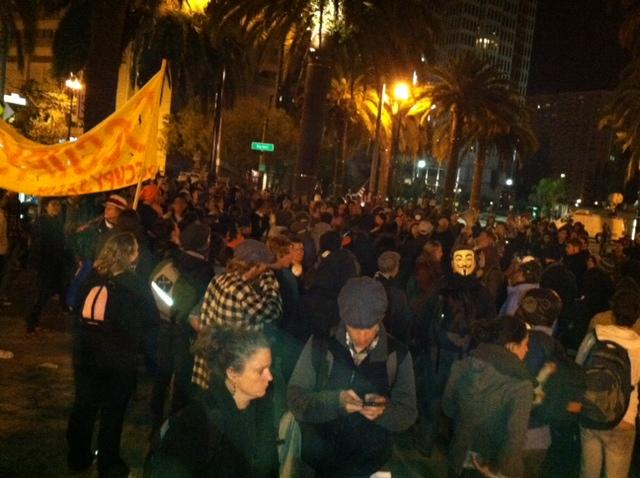
More than 1,000 people amassed at the OccupySF camp last night based on word that police would be raiding the camp. At 4:30 am, there were still 500 gathered in Justin Herman Plaza when OccupySF organizer Ryan Andreola finally announced: “We just got a report from an official police statement that the raid has been called off because there were not enough police for the number of people here,” as the crowd erupted in applause.

It was the end of what was for many protesters a long — and remarkably successful — day. Word began circulating of possible police altercation at 6 a.m. October 26, when police passed through the encampment handing out notices titled “You are subject to arrest,” which claimed that the protest was in violation of several city and state laws and had become a public health hazard.

On Oct 19, city officials had communicated to OccupySF that they would provide portable toilets, but a week later had not followed through; to deal immediately with public health concerns, protesters acquired them on their own.

Around 8:00, having received various tips and seen a document warning nearby businesses of police activity that night, OccupySF put out a call for supporters, saying police raid was confirmed. Justin Herman Plaza officially closes at 10 p.m., so protesters mobilized to be ready for an attack then.
At 9:00, hundreds of people were at the encampment and were meeting about tactics in case the raid occurred. For the next several hours, as hundreds more continued to pour into camp, supporters practiced formations to defend the camp and separate those who were willing to risk arrest from those who weren’t.

At 9:30, photos began circulating social media of scores of police in riot gear waiting with six muni buses near the police operations building in Potrero Hill. Many feared that they were gearing up to descend on Justin Herman Plaza.

Different groups, including a group of clergy, SF Labor Council representatives, a meditation circle and groups practicing blockade formations met throughout the camp. Drum circles continuously pounded, and the Brass Liberation Orchestra jammed throughout the night.

Nurses and medic volunteers distributed materials to protect from and relieve the effects of tear gas, and National Lawyers Guild volunteers scoured the camp making sure protesters had their legal hotline phone number. Talk of the violence and mass arrests at Occupy Oakland that had happened the past few days permeated the group.

The BART stations closest to the OccupySF and Oakland camps were closed last night due to “civil disturbance,” but many supporters still crossed the Bay to swell the OccupySF ranks.

At 10:00, between 500 and 600 people had gathered at the camp. Protesters danced to the constant music and chanted political cries to the beat: “This system has got to die, hella hella occupy!”

Others waited in defense formation around the camp. After spotting Supervisor John Avalos, many began imploring him to sit down in the ranks, which he did.

As the night went on, sightings of police with buses continued. Some protesters joked, “the police are on the way, but they’re taking Muni so it will be a few hours.”

At 12:40, though much of the camp’s kitchen supplies and food had been moved offsite, protesters continued to serve free food. A young man serving up salad and bread gestured to several cases of food, saying “this has all been donated within the last hour.”

At 1 a.m., the group had reached its peak numbers. All sides of Justin Herman Plaza were blocked by masses of people, who also spilled out into the street on Steuart and Market, attracting virtually all passers-by into the crowd. Organizers urged supporters to stay prepared, but as one woman emphasized on a bullhorn “Remember, 99 percent means we are all individuals. It’s your choice how you respond.”

At 1:30, an impromptu speak-out began as protesters, amplified by the Peoples Mic, explained who they were and why they were there that night. Ten minutes later the group decided to allow a makeshift press conference, giving a formal space for five city officials present to speak.

Supervisors John Avalos, Jane Kim, David Campos, David Chiu and Eric Mar, along with state Senator Leland Yee, professed their support for OccupySF and commitment to protecting it from raids. The group was met with mixed responses. Many cheered their support, and one woman said, “I’m from Oakland and I wish Oakland supervisors had done what San Francisco supervisors have done tonight.” Others were less receptive, crying “I don’t trust you!” and “remember, these are the same supervisors that helped pass sit-lie!”

After the politicians finished speaking at 2:00, many supporters left the camp. One man declared, “I’m glad they came, but they do not represent us.”
About 30 minutes later, new reports were coming in that police were massing at Treasure Island. Protesters surveyed their drastically reduced numbers, and voted on what new formations to practice. As the group discussed, drummers punctuated each point, keeping energy high.

Protesters organized new strategies, but by 3:38 there was still no sign of cops. Representatives of labor organizations began a spontaneous rally, speaking to why they supported OccupySF. Mentions of Occupy Oakland’s vote to call for a general strike on Wednesday November 2 circulated, and one labor rep recalled the 1934 general strike.

At 4 a.m., hundreds were still awake and prepared in the camp. Said protester Robert Duddy, “I’m tired. I stayed up last night until 5:30 after getting the notice that we might be evicted. I think they’re trying to wait us out and have our numbers dwindle.” Duddy added that he did not expect the police to show up that night.

Won-Yin Tang wasn’t convinced. “I won’t feel [that we’ve won] until 7 a.m. when they’re not waiting in riot gear anymore. We have to stay focused. When everyone leaves, that’s when they’ll come.”

At 4:30, the long-awaited announcement of victory came. The crowd cheered, and many headed to nearby Muni stations, now open for the morning. Said protester Sam Miller, waiting exhausted in Embarcadero Station, “Tonight was a great triumph of the human sprit. It was the middle class showing we can’t be beaten down anymore. We’re not the zombies that they think we are.”

Protester Sean Semans also celebrated. Said Semans, “We won tonight. Now we just have to sure, if we need to, we can do the same thing tomorrow.”
Staying up until 5 a.m. on weeknights is no easy call to action. But it seems thousands throughout the Bay Area are willing to step up to the plate.

Big victory for OccupySF, Occupy Oakland reconvenes after crackdown (VIDEO)

36

(UPDATED/CORRECTED AT 11:30 AM)The Occupy movements in San Francisco and Oakland reportedly scored big victories last night, with huge numbers of people overcoming police crackdowns and the shutdown of public transit stations, turning back city efforts to clear the OccupySF encampment and voting in the General Assembly in Oakland to call a general strike for Nov. 2.

We’ll have a full reports later today. Occupy Oakland protesters showed up outside a cordoned-off Frank Ogawa Plaza to figure out how to respond to the previous day’s aggressive police raid, which made national news and left Iraq War veteran Scott Olsen in the hospital with a fractured skull after apparently being hit by a tear gas canister or some other projectile fired by police.

In San Francisco, Mayor Ed Lee and the SFPD threatened to shut down the OccupySF encampment over alleged public health problems – which the movement tried to address by bringing in their own porta-potties because the city refused to provide them at night – but the camp swelled with supporters. Among them were mayoral candidates John Avalos, Leland Yee, Jeff Adachi, and David Chiu, as well as Sups. Jane Kim, Eric Mar, and David Campos.

Video by Rebecca Bowe

They spoke to the crowd around 2 a.m., expressing their support and saying that neither police nor Lee had responded to requests for information about the city’s intentions. Other notables on the scene included writer Rebecca Solnit, SF Democratic Party Chair Aaron Peskin, Shawn San Liu of the Chinese Progressive Association, and local labor leaders Tim Paulson, Gabriel Haaland, and Mike Casey. Spirits were high, and protesters were ready to link arms and form a human blockade in the event that police showed up.

SF police reportedly massed nearby in the early morning hours, preparing to clear Justin Herman Plaza, and there were rumors that hundreds more were on the way. BART stations in the area were shut down to prevent more arrivals, while police in Oakland also reportedly stopped protesters there who tried to cross the bay to support OccupySF. But the raid was then reportedly called off because police were outnumbered and possibly to avoid a repeat of the violence and mass arrests that have plagued Oakland since the decision to clear the encampment there, and protesters sent out jubilant messages of victory.

Check back later for video and eyewitness details of what went down, from the the Guardian’s Rebecca Bowe (who contributed to this report) and Yael Chanoff, as well as information on what comes next. Or follow the Oakland live stream here or San Francisco live stream here.

Live Shots: Gold Panda at the Independent

0

The endangered giant panda. The vulnerable red panda. But, the most rare variety of all, the elusive Gold Panda, emerged under the cover of a hooded sweatshirt (as is his nature) at the Independent Tuesday night, drawn out by the lure of a MPC, samples, and a sold out crowd.

Gold Panda’s music runs between melancholy and exuberance. Even when the BPM picks up on one level and the notes get more and more chopped up, the speedy, aggressive current that runs through so much electronic music never emerges. Maybe it’s the slow drone or the endless, never collapsing crashes that seem to be in the background of most of his songs, a building hypnotic tension behind his beats. (Hypnotic that is, until a quick little break comes around, smacks you in the ear, and leaves like nothing happened.)

As the UK/Germany based musician (“real” name Derwin Panda) played a fairly long set, covering most of the material off his LPs Lucky Shiner and Companion, the music seemed natural and organic, but also utterly inhuman. When voices appear, they’re abstracted, like the foreign ragas or the dissected “you.” (No setlist for this one; knowing the title of “I Suppose I Should Say ‘Thanks’ Or Some Shit”, contributes little to the appreciation, and is arguably distracting.) The stage setup was simple with some LED string lights and a paper lantern, but the live visuals by Ronni Shendar complemented the emotional mood of the songs perfectly, with found typographic examples, oceanic and urban triptychs, and some nature shots deserving of Attenborough.

Openers:
Blackout Make Out wins the best name award. A shaggy haired, jeans-clad, sunglassed, mustachioed, local singer songwriter sang ballads, sustaining notes on the electric guitar over synthetic beats. “Do you, you run away? Will you, will you stay?” At times a little ooh-ooh moan-y, but dude wasn’t afraid to let his guitar go to work over a building four-to-the-floor bass beat. Some cool moments sounded like he was having a conversation with his instrument, or more appropriately, arguing that no one is broken hearted like a man in denim.

At the conclusion of Jonti, a guy behind me said, “It was like a Rain Man set.” Burn, dude. That’s a little harsh, but I knew when Jonti, hailing from South Africa, took off his shoes right before starting, that it was going to be an idiosyncratic performance. Charmingly awkward, he lost a lot of momentum in his mic breaks, and was then be faced with the hard labor up building it back up. But there was a joy in watching Jonti get into his own distinctive beats enough to not just put words together but actually sing. Better than counting matchsticks.

Blowback

0

caitlin@sfbg.com

HERBWISE A throng of reporter types had gathered in the lobby of the State Building to listen to State Senator Mark Leno and State Assemblymember Tom Ammiano badmouth the feds.

“It is not the purview of the federal government to upset the will of the people,” said Ammiano, to the grunted affirmations of the patients, advocates, and cannabis business owners who had also assembled for the event.

Leno called the recent steps taken against the medicinal cannabis industry — which provides California each year with somewhere between $50 million and $100 million in taxes according to a 2010 estimate by the state’s Board of Equalization — “the exact wrong policy for a deep recession.” And then there’s the patients themselves. The two gay politicians commented that the issue of patient access is especially salient for the LGBT community, given that group’s increased incidence of HIV and AIDS.

Ammiano and Leno announced plans to push for federal regulatory guidelines that would clear up inconsistencies in the way medicinal cannabis works at the state level. As of press time for this article, Ammiano had scheduled another panel to discuss the matter on Tuesday, October 25 where he’ll be joined by marijuana advocates, labor leaders, Steve DeAngelo — founder of Harborside Health Center, which the IRS recently announced owes millions in back taxes because the business cannot legally write off standard expenses — and Matthew Cohen, who was handcuffed for hours along with his wife when the DEA raided his legal Mendocino County grow-op Northside Organics earlier this month. The event is being timed to coincide with President Obama’s visit to San Francisco this week.

When the politicos were done with their spiels, they trotted out Charlie Pappas, the owner of Divinity Tree Patients’ Wellness Cooperative. The landlord of Pappas’ 3,000-member dispensary was served with a cease and desist notice from the DEA that threatened property forfeiture and jail time if he continued to let Divinity Tree operate in his building.

Pappas approached the podium in a wheelchair, a patient himself. As he was introduced, it was noted that here we had one of the little guys, not a tycoon turning millions of dollars of profit as dispensary owners have been portrayed by unsympathetic media and government officials. It’s illegal to turn a profit off of medical marijuana — and who would want to get rich off of sick people anyway?

The controversy over the issue is understandable, but also mind-blowingly hypocritical. You know who turns a profit off of making and distributing medicine? The pharmaceutical industry, to the tune of billions of dollars, in fact. Makes the $1.7 billion national market that constitutes the medical marijuana industry look like shake.

The sound of money talking rendered unsurprising the words of a one Bruce Buckner, who has been a patient “since the laws passed” and who came down from his home in Sonoma County to attend Ammiano and Leno’s press conference. Buckner shared his suspicions about why the federal government turned its eyes to dispensary operations this autumn. Slightly grizzled and wearing a straw hat, Buckner had sat patiently though the event, hooked up to a respirator.

“It’s real obvious why Obama is doing it,” he said. “The pharmaceutical industry is afraid of how potent this medicine is.”

Our Weekly Picks: October 26-November 1

0

WEDNESDAY 26

Yngwie Malmsteem

Coming to prominence in the early 1980s, master guitarist Yngwie Malmsteen blew listeners away with classically-inspired shredding and a flashy style that displayed his incredible technical prowess on the instrument. The virtuoso has released a slew of metal and rock records that show off his scorching solos, but he has also put out albums featuring classical and orchestral compositions and collaborations with groups such as the Czech Philharmonic Orchestra. Malmsteen, whose latest effort Relentless (Universal) came out last year, continues to hone his fancy fretwork — don’t miss out on your chance to see him “unleash the fury!” (Sean McCourt)

8 p.m., $30

Fillmore

1805 Geary, SF

(415) 346-6000

www.thefillmore.com


“Desdemona”

Determining to write a response to Othello following Peter Sellars’ controversial staging in New York in 2009, world renowned author Toni Morrison teamed up with famed theater-opera director Sellars and acclaimed West African singer Rakia Traoré to craft this unique piece of music theater, making its US premiere in Berkeley. Taking her cue from a couple of brief but suggestive lines in Shakespeare’s text, Morrison imagines a reunion beyond the grave between Desdemona and the African woman who raised her, in a song cycle combining traditional West African compositions with original ones penned by Traoré and Morrison. From this encounter come hints of a new future based on a world that was always deeply interconnected.(Robert Avila)

Through Sat/29, 8 p.m., $100

Zellerbach Playhouse

101 Zellerbach Hall, Berk.

(510) 642-9988

www.calperformances.org


THURSDAY 27

“Lumière and After”

Although Louis Lumière famously described cinema as “an invention without a future” not long after having a major hand in inventing it, the beautifully composed single shot actualities he produced with his brother Auguste still have a strong hold on the motion picture imagination. An intriguing Cinematheque program lines up several shorts directly inspired by the Lumières along with a handful of the original articles. Expect work by avant-garde materialists like Ken Jacobs and Peter Tscherkassky along with Andrew Norman Wilson’s fascinating short Workers Leaving the Googleplex. The latter drills holes in the search engine’s labor practices by way of revisiting the Lumières’ first publicly screened film (Workers Leaving the Lumière Factory). The Cinematheque screening sets the stage for Bring on the Lumière!, an original choreographic work premiering at the ODC Theater in a couple of weeks. (Max Goldberg)

7:30 p.m., $10

Artists’ Television Access

992 Valencia, SF

(415) 824-3890

www.sfcinematheque.org


FRIDAY 28

“Kevin Smith’s Halloween Extravaganza”

Do you like your spooky mixed with side-splitting hilarity? Then celebrate All Hallows Eve the “View Askewniverse” way with “Kevin Smith’s Halloween Extravaganza!” Writer and director Smith, known for his movies such as Clerks, Dogma and Chasing Amy, and actor Jason Mewes bring their “Jay and Silent Bob Get Old” live podcast show to the city tonight for what promises to be wildly funny romp through all manner of subject and story. Afterward, stick around for a screening of the horror flick Red State, Smith’s latest work, for which he will also partake in an audience Q&A. (McCourt)

7 p.m., $55

Castro Theatre

429 Castro, SF

(415) 621-6120

www.castrotheatre.com


Get Dead

San Francisco troublemakers Get Dead were forged in the furnace of rad. The punk five-piece’s interests include drinking gin out of pineapples and getting banned for life from local venues. Get Dead’s shows are rough, rowdy, and downright unforgettable. Charismatic leader Sam King is temporarily relocating to Costa Rica, so this Halloween bash is also a going away party. King returns in February, when the band will release an acoustic album featuring a slew of California collaborators. Go buy him a shot and raise some hell. (Frances Capell)

Slick’s Helloween Bash With Code 4-15, Murderland, Lazerwolf, and AxeWound

10 p.m., free

Rockit Room

406 Clement, SF

(415) 387-6343

www.rock-it-room.com


SATURDAY 29

Journey to the End of the Night

A citywide game modeled after tag, Journey to the End of the Night has become one of the most popular street games in the world since its inception in 2006; now played everywhere from Chicago to Vienna, Mexico City to Berlin. In San Francisco last year, 1,300 participants flooded the streets in play. A brief rundown of the rules: there are six check points scattered throughout the city that you must try to get to, either on foot or by public transit, without being caught by “chasers,” those that do everything in their power to stop you. If caught by a chaser, you become a chaser. The first to the last checkpoint wins. Meet at Justin Herman Plaza and include friends, certainly, but the website recommends you bring “ones you can outrun.” Tag, you’re it (James H. Miller)

7 p.m., Free

Justin Herman Plaza

End of Market at Embarcadero, SF

www.totheendofthenight.com


“Diary of a Country Priest”

Diary of a Country Priest (1951), written and directed by Robert Bresson and adapted from the novel by Georges Bernanos, is a film that is so earnest and heartrending that it doesn’t feel entirely of this world. When a sickly priest (Claude Laydu, who lived in a monastery to prepare for the role) is assigned to his first parish in a small village devoid of faith or morals, he’s met with blatant hostility and outcast as a fool (the character recalls Myshkin from Dostoevsky’s The Idiot). Using dialogue pulled directly from the novel, Country Priest has scenes of such emotional intensity and suspense that it will make you ache in the gut, or,stir your very soul. If you feel nothing watching this film, you’re missing a heart. (Miller)

Sat/29, 7:30 p.m.; Sun/30, 2 p.m.; $8

Yerba Buena Center for the Arts

701 Mission, SF

(415) 978-2787

www.ybca.org


SUNDAY 30

“The Phantom of the Opera: Halloween Concert with Cameron Carpenter”

Juilliard-trained Cameron Carpenter been called “a talent of Mozartean proportions” and “the bad boy of the organ;” the bio on his slick website speaks breathlessly not only of his talents on the keys, but also his “Swarovski-encrusted performance wear and organ shoes.” He may be from Pennsylvania, but it sounds like he’ll fit in just fine in Halloween-crazed San Francisco — specifically at the SF Symphony’s annual silent-film screening. This year’s flick is the 1925 Phantom of the Opera, starring Lon Chaney; Carpenter performs a short recital and accompanies the film on Davies Symphony Hall’s insanely grand Ruffatti pipe organ. (Cheryl Eddy)

8 p.m., $20–$60

Davies Symphony Hall

201 Van Ness, SF

(415) 864-6000

www.sfsymphony.org


Anamanaguchi

Are you a bad enough dude? A chip-rock band hailing from New York, Anamanaguchi’s music comes as much from hacked Gameboys as it does electric guitars. Following its Dawn Metropolis LP in 2009 the band was tapped to create the epic soundtrack to the epic video game based on the epic indie comic Scott Pilgrim Vs. The World. Imagine Rivers Cuomo brawling through a side-scrolling beat ’em up of your youth and you’ll have some idea of what it sounds like. The live show is a frenetic, hyper affair. (Try to resist the familiar urge to pick up the person nearest to you and throw them into the crowd. They are not a crate.) (Ryan Prendiville)

With Starscream, Knife City, Crash Faster

8 p.m., $12-$14

Slim’s

333 11th St., SF

(415) 255-0333

www.slims-sf.com


MONDAY 31

“Shock It To Me Halloween Spookenany”

Calling all monster kids! Local promoter and writer August Ragone — who penned the behemoth biography Eiji Tsuburaya: Master of Monsters — has been working in his dungeon lab all year and has created a frightful fete so terrifyingly good it would make Uncle Forry and all his Famous Monsters proud! The “Shock-It-To-Me Halloween Spookenanny” will feature music from rockabilly rumbler Johnny Legend & His Naked Apes (with members of the Mummies and the Chuckleberries,) Beachkrieg, and the Undertaker & His Pals. Host Miss Misery and DJ Omar will lord over the ghoulish gathering, which will also include a “scary screaming contest” and “creepy costume contest” — hopefully security can keep the torch-wielding villagers at bay! (McCourt)

9 p.m., $13–$15

Café Du Nord

2170 Market, SF

(415) 861-5016

www.cafedunord.com


“Fog & Laser 3 — Halloween Spectacular”

In the beginning there was the void. It was really dark and God kept bumping into shit, so God said ‘Let there be lasers.” And there were. But then it was just way too bright and killed the mood, so God said, “Let there be a fog machine.” And that, children, is how the first party came to be. Today, the wise ones know that you don’t need more than that to have a great time. (Well, alcohol, some eclectic indie and electro dance music by DJs RamblinWorker & EmDee , maybe a photobooth — those things help) Oh, and costumes: Adam and Eve had the right idea with the fig leaves, but God thought the snake’s disco ball costume was fucking sweet. (Prendiville)

9 p.m., $7

Makeout Room

3225 22nd St., SF

(415) 647-2888

www.makeoutroom.com


TUESDAY 1

Shantala Shivalingappa

If you want to know why Pina Bausch was enchanted with Kuchipudi performer Shantala Shivalingappa, check out the Madras-born, Paris-raised dancer’s contemporary solo on YouTube. You can’t miss the exquisitely detailed arm and finger gestures that feel like the essence of Indian classicism. Bausch hired Shivalingappa for her “Bamboo Blues” — just about the only “authentic” Indian ingredient in that 2007 work. Last year, Shivalingappa made her San Francisco debut in what she does best, Kuchipudi — the fleet-footed, free-spirited yet ever so disciplined South Indian form. Fabulously musical — she has a first-rate live “band”— expressive and elegant, she made the Tarangam, a rhythmic bravura endeavor in which the dancer performs on the edges of a brass plate look as if she were riding the waves. (Rita Felciano)

8 p.m. $35-50

Herbst Theatre

401 Van Ness, SF

(415) 392-2545

www.sfperformances.org


Youth Lagoon

The recent release of Youth Lagoon’s debut LP The Year Of Hibernation (Fat Possum) has catapulted 22-year-old college student Trevor Powers out of the Boise, Idaho, bedroom where he recorded the album and into the hearts of countless indie kids. Powers began composing wistful, dreamy piano pop as a means of confronting his struggles with anxiety. Since posting his first track as Youth Lagoon in May, he’s emerged as one of the most buzzed about new acts of 2011. Powers is taking his tender, haunting body of work on the road for Youth Lagoon’s first national headlining tour. Don’t miss the kick-off show at Bottom of the Hill on Tuesday. (Capell)

With Young Magic and Parentz

9 p.m., $12

Bottom of the Hill

1233 17th St., SF

(415) 621-4455

www.bottomofthehill.com


The Guardian listings deadline is two weeks prior to our Wednesday publication date. To submit an item for consideration, please include the title of the event, a brief description of the event, date and time, venue name, street address (listing cross streets only isn’t sufficient), city, telephone number readers can call for more information, telephone number for media, and admission costs. Send information to Listings, the Guardian Building, 135 Mississippi St., SF, CA 94107; fax to (415) 487-2506; or e-mail (paste press release into e-mail body — no text attachments, please) to listings@sfbg.com. Digital photos may be submitted in jpeg format; the image must be at least 240 dpi and four inches by six inches in size. We regret we cannot accept listings over the phone.

Avalos offers resolution supporting OccupySF and its camp

57

In the wake of last night’s violent police raid on the Occupy Oakland encampment (a still-tense situation that we’re now on the scene covering) and two similar late-night police crackdowns on OccupySF in recent weeks, Sup. John Avalos and co-sponsors Eric Mar and David Campos are introducing a resolution at today’s San Francisco Board of Supervisors meeting that calls for the city to explicitly allow the OccupySF encampment and its related infrastructure to remain.

That resolution (the full text follows below), which Avalos legislative aide Raquel Redondiez says will be the subject of a special hearing on Monday before being considered by the full board on Tuesday, Nov. 1, grew out of testimony from OccupySF participants that Avalos solicited at last week’s board meeting following a late night police raid on Oct. 16 that resulted in five arrests and many injuries.

As we report in this week’s paper (see “Mixed messages,” to be posted this evening, Tues/25), at that Oct. 18 board meeting, Mayor Ed Lee took the position that no tents, kitchens, or other infrastructure would be permitted, a stance that Police Chief Greg Suhr seemed to soften slightly at a raucous Police Commission hearing the next day. In the face of those mixed messages, OccupySF grew into a full-blown tent city in Justin Herman Plaza and there have been no real conflicts with police since.

Both the San Francisco Police Department and the Mayor’s Office were slow to respond to messages we left all week seeking to clarify the city’s policy toward OccupySF, but both finally got back to us last night after the article had gone to press.

SFPD spokesperson Daryl Fong told us, “We’re still currently doing daily safety inspections at Justin Herman Plaza and continuing to provide leafletting…We’re educating the campers about violations and concerns for public safety,” such as unsanitary conditions or unsafe camping structures.

But he said OccupySF hasn’t been given any deadlines for removing structures and there are no current plans for another raid. “Our goal is to get compliance from the campers voluntarily,” he said. “This situation is being continually monitored as it progresses.”

When we asked the Mayor’s Office about the contradiction being Lee’s stance and the city’s reaction to the growing tent city, Press Secretary Christine Falvey wrote, “The mayor’s position on Occupy SF has not changed. He has directed his departments to facilitate peaceful protest, but not allow structures, tents, or a permanent campsite. He wants to ensure the area is safe for demonstrators and the general public. If you have been to the site, you may have seen the Fire and Public Health Departments conducting inspections for public health and safety concerns and you may have seen Recreation and Park and Police staff informing people of the parks and public safety codes that prohibit camping equipment. Individuals are being informed daily of this and the city’s Homeless Outreach Team is offering services to anyone in the area who may need it. The policy stands and departments are educating the group about what is and is not allowed and the mayor expects those who want to use the space to protest, to follow the rules.”

But OccupySF protesters say they have no intention of leaving the space, believing it’s their right to be there as part of a national movement spotlighting the greed and corruption of the wealthiest 1 percent of Americans. And when I told Falvey that the encampment seems to defy the mayor’s stated position, she wrote, “The mayor has asked several departments to enforce the existing codes, and I understand a number of informational contacts have gone out daily to educate those using the plaza about what is allowable in addition to Fire and Public Health inspections to make sure open flames or dangerous materials are not being used or stored at the site.”

I told her that didn’t address my question, and I asked for a reaction to the Avalos legislation that would explicitly allow “tents, tarps, First Aid supplies, environmentally clean and fire-safe energy sources, and the ability to store, prepare, and serve hot food,” which is the reality now on the ground. I’ll update this post when I get a response.

In the meantime, here’s the full text of the resolution:

[Expressing Support for Occupy Wall Street Protest Movement and the People’s Right to Peaceful Assembly in San Francisco]

Resolution Supporting the Occupy Wall Street Protest Movement and Urging Mayor Lee to Uphold People’s Right to Peaceful Assembly and Collaborate with Occupy SF to Ensure Safety of the Protestors, their Supporters, and the Greater Public.

WHEREAS, “Occupy Wall Street” was formed by a broad spectrum of people coming together to protest the corporate-serving economic and political system controlled by the 1 percent, profiting at the expense of 99 percent of the people; and

WHEREAS, Three years after the current financial crisis caused by Wall Street speculators and profiteers, the unemployment rate in the United States is still at the highest level since the Great Depression with the unemployment rate in San Francisco currently at 8.3 percent; and,

WHEREAS, The United States’ major banking institutions, which have been bailed-out by the government and United States taxpayers, have done little to prevent massive foreclosure of residential properties or support the revitalization of local economies by sustaining small businesses; and,

WHEREAS, Since 2008, there have been 1.2 million foreclosures in California, with 12,410 homes in San Francisco alone; and,

WHEREAS, The “Occupy Wall Street” protest movement has struck a chord with the people of the United States and around the world, inspiring over 900 similar protests and solidarity actions across the country, where tens of thousands of people have come out to express their deep indignation against Wall Street greed and systemic socio-economic injustices; and,

WHEREAS, The “Occupy” demonstrations are a rapidly growing movement of people from all walks of life with the goal of occupying public space in order to create a shared dialogue and assert demands for economic justice; and,

WHEREAS, The “Occupy” demonstrations have been supported by the California Nurses Association/ National Nurses Association, American Federation of Labor -Congress of Industrial Organizations, Change to Win, International Longshore and Warehouse Union-International, Teamsters Joint Council 7, Services Employees International Union, Laborers International Union of North America, and many others; and,

WHEREAS, The OccupySF demonstrations began in September with small gatherings of people and have since grown and gained supported from thousands of individuals, community and faith-based organizations, and unions; and,

WHEREAS, On October 12, a 500-person march and civil disobedience organized by local community groups received national media attention, exposing the struggles of San Francisco residents against foreclosure, corporate control, and spiraling unemployment; and,

WHEREAS, The October march and protest action culminated in civil disobedience and, despite the arrest of 11 people, lacked any antagonistic conflict between the police and protestors; and,

WHEREAS, Similar to demonstrations in hundreds of cities across the United States, OccupySF demonstrators are asserting their rights to free speech and peaceful assembly 24 hours a day, seven days a week, in order to create public dialogue around corporate control of the political process and public space; and,

WHEREAS, Numerous and various groups continue to join the protesters at OccupySF, including an interfaith clergy contingent and the California Nurses Association, which has set up a First Aid tent to support the protestors and help ensure public safety; and,

WHEREAS, The City of San Francisco has a right and duty to ensure the safety and security of the general public including the protestors and their supporters; and,

WHEREAS, Since the beginning of the protest, City actions have resulted in the confiscation of food, tents, sleeping bags, and other belongings from the OccupySF demonstrators as well as causing preventable injuries and arrests; and,

WHEREAS, The City has a lengthy and proud history of political protest and has upheld the rights of people to free speech, freedom of assembly, and peaceful protest; and,

WHEREAS, With clear leadership from the Mayor, City departments can set a tone of cooperation and collaboration with OccupySF protestors and supporters, help mitigate harm, and address any public safety, health and sanitation concerns, all while avoiding unnecessary conflict; now, therefore, be it

RESOLVED, That the Board of Supervisors supports the Occupy Wall Street protest movement and the rights of all who protest to assemble peacefully and enjoy free speech in the City and County of San Francisco; and, be it

FURTHER RESOLVED, That the Board of Supervisors recognizes that Free Speech and Freedom of Assembly should not be limited to daytime nor short-term activities and we deem the need of protesters to have tents, tarps, First Aid supplies, environmentally clean and fire-safe energy sources, and the ability to store, prepare, and serve hot food reasonable; and, be it

FURTHER RESOLVED, That the Board of Supervisors urges the Mayor, the Police Department, and other City agencies to uphold the rights of protestors to political speech and public assembly, and to recognize that the full exercise of such rights requires that participants are able to attend to the needs of everyday life, and have a space free from harassment; and, be it

FURTHER RESOLVED, That the Board of Supervisors urges Mayor Ed Lee to direct the Recreation and Park Department, the Department of Public Works, the Police Department, and other City agencies, as relevant, to be flexible and to collaborate with protestors for the safe sharing of public spaces, in which demonstrators can exercise their political rights and the City can address legitimate safety concerns while avoiding unnecessary antagonism; and, be it

FURTHER RESOLVED, That the Board of Supervisors urges Mayor Ed Lee, in order to prevent further harm and conflict to any members of the public, including protestors of OccupySF, to direct the Police Department to ensure that there will be no use of force to dislodge the OccupySF demonstrators and confiscate their belongings.

Dick Meister: Unions can help bridge the income gap

2

By Dick Meister

Dick Meister, former labor editor of the SF Chronicle and KQED-TV Newsroom, has covered labor and politics for more than a half-century. Contact him through his website, www.dickmeister.com, which includes more than 350 of his columns.

There’s obviously no easy way to bridge the income gap between the rich and the rest of us or to combat the other serious economic problems raised by the Occupy Wall Street movement. But keep in mind the crucial – if not decisive – role that labor unions can play in righting our economic wrongs.

Union members earn a lot more than non-union workers overall and within particular occupations, and in age, gender and racial groups, and so spend more. They have more and greater fringe benefits, a greater voice in community and political affairs and otherwise are in a good position to span the income gap as well as contribute to the growth of the economy that’s so badly needed.


Unionized workers are paid nearly 30 percent more than non-union workers generally, a median of about $900 a week to about $700 a week. That’s an advantage of $4.95 an hour, or more than $10,000 a year, that can be spent to help boost the sagging economy.

The unionized workers’ much greater access to employer-financed health care helps, too, as does their invariably longer paid vacations, their sick pay and, among other key benefits, the pensions that go to more than three-fourths of unionized workers but to only about 20 percent of other workers.

Unions clearly provide the purchasing power needed to drive the economy and narrow the income gap between hugely paid corporate executives and the people who do the actual work of the country. Unions could very well do that, in part by helping improve working conditions that would attract more workers to particular employers and help the employers retain workers and compensate them well.

Although unions have been declining in numbers to the point that only about 13 percent of today’s workers are in unions, indications are that their numbers will be growing, thanks in part as a reaction to the current economic troubles.

The past practices of unions, in any case, indicate they’ll undoubtedly provide lots of help to ease the current crisis. They played a major role, for instance, in passage of the laws that set a minimum wage and a standard workweek, regulate on-the-job safety and provide workers’ compensation for on-the-job injuries.

What’s more, union members usually have more training and thus greater productivity. Their unions commonly work on local economic development in partnership with employers, community groups and local governments and commonly invest union pension funds to help rebuild declining communities and, among other local projects, help finance moderate–income housing.

Don’t forget, either, that non-union employers sometimes offer pay and benefits equal to union pay and benefits in their areas, in hopes of avoiding unionization.

Unions, which had much to do with pulling the nation out of the Great Depression and helping establish a true middle class, are in position to provide help that’s as necessary in 2011 as it was in the 1930s.

Dick Meister, former labor editor of the SF Chronicle and KQED-TV Newsroom, has covered labor and politics for more than a half-century. Contact him through his website, www.dickmeister.com, which includes more than 350 of his columns.

The selling of Ed Lee

0

steve@sfbg.com

Ed Lee has gone through a remarkable makeover in the last year, transformed from the mild-mannered city bureaucrat who reluctantly became interim mayor to a political powerhouse backed by wealthy special interests waging one of the best-funded and least transparent mayoral campaigns in modern San Francisco history.

The affable anti-politician who opened Room 200 up to a variety of groups and individuals that his predecessor had shut out — a trait that won Lee some progressive accolades, particularly during the budget season — has become an elusive mayoral candidate who skipped most of the debates, ducked his Guardian endorsement interview, and speaks mostly through prepared public statements peppered with contradictions that he won’t address.

The old Ed Lee is still in there somewhere, with his folksy charm and unshakable belief that there’s compromise and consensus possible on even the most divisive issues. But the Ed Lee that is running for mayor is largely a creation of the political operatives who pushed him to break his word and run, from brazen power brokers Willie Brown and Rose Pak to political consultants David Ho and Enrique Pearce to the wealthy backers who seek to maintain their control over the city.

So we thought it might be educational to retrace the steps that brought us to this moment, as they were covered at the time by the Guardian and other local media outlets.

Caretaker mayor

The story begins quite suddenly on Jan. 4, when the Board of Supervisors convened to consider a replacement for Gavin Newsom, who had been elected lieutenant governor but delayed his swearing-in to prevent the board from choosing a progressive interim mayor who might then have an advantage in the fall elections. Newsom and other political centrists insisted on a “caretaker mayor” who pledged to vacate the office after serving the final year of the current term.

It was the final regular meeting of the old board, four days before the four newly elected supervisors would take office. What had been a bare majority of progressive supervisors openly talked about naming former mayor Art Agnos, or Sheriff Michael Hennessey, or maybe Democratic Party Chair Aaron Peskin as a caretaker mayor.

When then-Sup. Bevan Dufty said he would support Hennessey, someone Newsom had already said was acceptable, the progressive supervisors decided to coalesce around Hennessey. That was mostly because the moderates on the board had suddenly united behind a rival candidate who had consistently said didn’t want the job: City Administrator Ed Lee.

Board President David Chiu was the first in the progressive bloc to breaks ranks and back Lee, saying that had long been his first choice. Dufty became the swing vote, and he abstained from voting as the marathon meeting passed the 10 p.m. mark, at which point he asked for a recess and walked down to Room 200 to consult with Newsom.

At the time, Dufty said no deals had been cut and that he was just looking for assurances that Lee wouldn’t run for a full term (Dufty was already running for mayor) and that he would defend the sanctuary city law. But during his endorsement interview with the Guardian last month, he confessed to another reason: Newsom told him that Hennessey had pledged to get rid of Chief-of-Staff Steve Kawa, a pro-downtown political fixer from the Brown era who was despised by progressive groups but liked by Dufty.

Chiu and others stressed Lee’s roots as a progressive tenants rights attorney, the importance of having a non-political technocrat close the ideological gap at City Hall and get things done, particularly on the budget. So everyone just hoped for the best.

“Run, Ed, Run”

The drumbeat began within just a couple months, with downtown-oriented politicos and Lee supporters urging him to run for mayor in the wake of a successful if controversial legislative push by Lee, Chiu, and Sup. Jane Kim to give million of dollars in tax breaks to Twitter and other businesses in the mid-Market and Tenderloin areas.

In mid-May, Pak and her allies created Progress for All, registering it as a “general civic education and public affairs” committee even though its sole purpose was to use large donations from corporations with city contracts or who had worked with Pak before to fund a high-profile “Run, Ed, Run” campaign, which plastered the city with posters featuring a likeness of Lee.

Initially, that campaign and its promotional materials were created by Pak (who refuses to speak to the Guardian) and political consultant Enrique Pearce (who did not return calls for this article) of Left Coast Communications, which had just run Kim’s successful D6 victory over progressive opponent Debra Walker, along with Pak protégé David Ho.

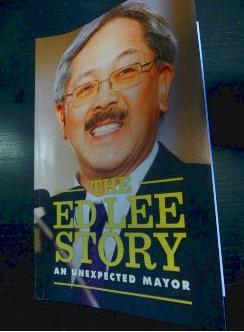
During that campaign, the Guardian and Bay Citizen discovered Pearce running an independent expenditure campaign called New Day for SF, funded mostly by Willie Brown, out of his office, despite bans of IEs coordinating with official campaigns. That tactic would repeat itself over the coming months, drawing criticism but never any sanctions from the toothless Ethics Commission. Pearce was hired by two more pro-Lee IEs: Committee for Effective City Management and SF Neighbor Alliance, for which he wrote the book The Ed Lee Story, a supposedly “unauthorized biography” filled with photos and personal details about Lee.

Publicly, the campaign was fronted by noted Brown allies such as his former planning commissioner Shelly Bradford-Bell, Pak allies including Chinatown Community Development Center director Gordon Chin, and a more surprising political figure, Christina Olague, a progressive board appointee to the Planning Commission. She had already surprised and disappointed some of her progressive allies on Feb. 28 when she endorsed Chiu for mayor during his campaign kickoff, and even more when she got behind Lee.

Olague recently told us the moves did indeed elicit scorn from some longtime allies, but she defends the latter decision as being based on Lee’s experience and willingness to dialogue with progressives who had been shut out by Newsom, noting that she had been asked to join the campaign by Chin. Olague also said the decision was partially strategic: “If we get progressives to support him early on, maybe we’ll have a seat at the table.”

Right up until the end, Lee told reporters that he planned to honor his word and not run. During a Guardian interview in July when we pressed him on the point, Lee said he would only run if every member of the Board of Supervisors asked him to, although about half the board publicly said that he shouldn’t, including Sup. Sean Elsbernd, who nominated him for interim mayor.

And then, just before the filing deadline in early August, Lee announced that he had changed his mind and was running for mayor, the powers of incumbency instant catapulting him into the frontrunner position where he remains today, according to the most recent poll by the Bay Citizen and University of San Francisco.

Lee the politician

With his late entry into the race and decision to forgo public financing and its attendant spending limits, one might think that Lee would have to campaign aggressively to keep his job. But most of the heavy lifting has so far been done by his taxpayer-financed Office of Communications (which issues press releases at least daily) and by corporate-funded surrogates in a series of coordinated “independent” groups (see Rebecca Bowe’s story, “The billionaires’ mayor”).

That has left Lee to simply act as mayor, where he’s made a series of decisions that favor the business community and complement the “jobs” mantra cited relentlessly by centrist politicians playing on people’s economic insecurities.

Yet Lee has been elusive on the campaign trail and to reporters who seek more detailed explanations about his stands on issue or contradictions in his positions, and his spokespersons sometimes offer only misleading doublespeak.

For example, Lee’s office announced plans to veto legislation by Sup. David Campos that would prevent businesses from meeting their city obligation to provide a minimum level of employee health benefits through health savings accounts that these businesses would then pocket at the end of the year, taking $50 million last year even though some of that money had been put in by restaurant customer’s paying 5 percent surcharges on their bills.

Although Campos, the five other supervisors who voted for the measure, four other mayoral candidates, and its many supporters in the labor and consumer rights movements maintained the money belonged to workers who desperately needed it to afford expensive health care, the San Francisco Chamber of Commerce said it was about “jobs” that would be protected only if businesses could keep that money.

Lee parroted the position but tried to push the political damage until after the election, issuing a statement entitled “Mayor Lee Convenes Group to Improve Health Care Access & Protect Jobs,” saying that he would seek to “develop a consensus strategy” on the divisive issue — one in which Campos said “we have a fundamental disagreement” — that would take weeks to play out.

After a frustrating back-and-forth with Lee Press Secretary Christine Falvey by email, it’s still unclear how to resolve the contradiction between whether businesses could seize these funds or whether they belonged to employees, with her latest statement being, “The Mayor absolutely wants these funds spent on providing access to quality primary and preventative health care because this is the business’s obligation under HCSO. Making sure that these funds go to pay for health care is the most important objective.”

Similarly, when police raided the OccupySF encampment on Oct. 5, Lee’s office issued a statement that was a classic case of politicians trying to have it both ways, expressing support for the movement and its goal to “occupy” public space, but also supporting the need to police to clear the encampment of those same occupiers.

But now, in the wake of a repeat raid on Oct. 16 that has inflamed passions on the issue, the question is whether Lee can run out the clock and retain the office he gained on the promise of being someone more than a typical politician.

The case against C and D

68

By Brenda Barros, Riva Enteen, Joe Jacskon, Renee Saucedo, Dave Welsh, David H. Williams and Claire Zvanski

OPINION The Guardian started out right on Proposition C and D:

“Our initial instinct was to oppose both of these measures… There’s a basic unfairness about all of this that bothers us … city workers are being asked to give up part of their pay — but the wealthiest individuals and big corporations in San Francisco are giving up nothing. It’s part of the national trend — the poor and middle class are shouldering the entire burden of the economic crisis, and the rich aren’t suffering a bit.”

It’s too bad that the Guardian editors didn’t stick to their guns.

We all know why decent pensions and health care cost so much: corporate greed. And the identity of the corporate criminals who are driving the economy into the ground is no secret. It’s the Wall Street banks and financial speculators. It’s Bank of America and Wells Fargo. It’s the corporate CEOs. It’s the insurance companies.

All workers, whether they work for the city or not, have a right to affordable medical care and a decent retirement.

Take Ethel, who retired 10 years ago after working for the city for more than 20 years and collects a pension of only $17,000 a year. Both Prop C and Prop D would take money out of her check. Some city workers qualify for section 8 housing — Prop C and D would take money out of their paychecks too.

None of this is rocket science. But the corporate media pounds away daily at public employees and ignores the shenanigans of their buddies in the corporate boardrooms. And far too many fall for this bait and switch, or are just too confused to stand up and fight back.

Now, with Propositions C and D, the downtown bigwigs and their lapdog politicians are taking advantage of this confusion to sock it to the victims, and make workers pay for the party the rich have been having at our expense.

Unfortunately, there are those among us who think we should concede many of our hard-fought rights in order to appear reasonable and fend off future attacks.

Making these kinds of concessions is like putting a little blood in the water, and hoping that the corporate sharks will be satisfied. But the reality is that when sharks taste blood, they just get hungry for more.

The editors of the San Francisco Chronicle, the mouthpiece for Wall Street and its minions, said pretty much the same thing in a recent editorial:

“San Franciscans should have no illusions,” wrote the Chronicle editors. “Props C and D offer only modest down payments on the reforms [sic] that must be pursued… The very fact that business and labor leaders are supporting Prop C… sets the stage for… further reforms [sic] that will almost certainly be needed…”

Of course the “reforms” that the Chronicle is demanding are just more attacks on workers’ rights. That’s why many political leaders, including former Supervisor Chris Daly and Ted Gullicksen of the Tenants Union — opposed both Propositions C and D.

Enough is enough. Let’s take heart from the Occupy Wall Street movement. After decades of Reaganomics, Bushonomics, and Democratonomics, it is high time to draw the line, stand up to Wall Street, and fight back.

Join former Supervisor Chris Daly and Tenant’s Union leader Ted Gullicksen, and: Vote NO on C! Vote NO on D! Tax the Rich! 

Brenda Barros is vice-chair, Social Economic Committee, SEIU 1021. Riva Enteen is a member of SEIU 1021. Joe Jackson is co-chair of the S.F. African American Employee Association. Renee Saucedo is a member of SEIU 1021. Dave Welsh is a delegate to the S.F. Labor Council. David H. Williams and Claire Zvanski are retiree members of SEIU 1021.

Period Piece: A Carnegie library reopens in the Marina

0

Period Piece is Lucy Schiller’s recurring feature on the hidden histories of San Francisco. Give her a shout at culture@sfbg.com if you know of some hot dirt on olden times in the city

About a hundred years ago, Andrew Carnegie was giving away most of the money he had amassed from a gargantuan steel empire. Eight libraries in San Francisco directly resulted from Carnegie’s efforts, including the Marina’s Golden Gate Valley branch – the recipient of a much needed facelift that concluded last week.

The library was the eighth branch to open in San Francisco. It was born in 1918 to a city less than thrilled about accepting money from a man with a terrible labor rights record. Various arguments at City Hall had already played out over whether to accept the dirty money or refuse it, dedicate most of the funds to a main library or allocate more to several branches, elect trustees or keep the wealthy, elite ones around. 

After years of stalling, it was decided. Half of Carnegie’s grant went to the Main Library, the other half to seven branches. Last week, the Golden Gate Valley branch reopened after an extensive renovation thanks to B.L.I.P. (the inauspicious acronym for the Branch Library Improvement Project).

You can sense the money that went into this place’s initial construction. Shaped like a big wedge of cake, the Golden Gate Valley branch nestles into the corner of Octavia and Green and is decked out with stately columns, heavy copper doors, and high ceilings. 

Libraries have come a long way from their original intended purpose of providing literature to the masses. There are books here, of course — lots and lots of them. But the Golden Gate Valley branch also holds features for kids who can’t even read yet, digital signage in the teens’ area, a program room for community events, and of course, rows of computers for what is perhaps the library’s most salient role in today’s society: free Internet access. 

“Part of the mission of the library is to be a family destination,” says Mindy Linetzky, bond program administrator for BLIP. “We really want teens to come, for example.” With the library’s plans to hold occasional Wii gaming days, you can be sure they will, in droves.

B.L.I.P. has seen marked increase in community engagement since the start of the renovations. According to Michelle Jeffers, public relations officer at SFPL, the Visitation Valley branch’s recent renovation was met with a 406 percent increase in library card registration. 

BLIP’s job is almost done now with twenty-two refurbished libraries under its belt and only two more on the docket. Safer (with seismic bracing), greener (with solar panels), and more accessible (with elevators), our new libraries hold a lot of their former glory but also some fancy new swag.

Golden Gate Valley Public Library
 1801 Green, SF
(415) 355-5666


Get on the bus: St. James Infirmary’s new sex worker PSAs are

3

St. James Infirmary has been providing free, non-judgmental medical and social services for sex workers since 1999. This week, it’ll take the next step. The clinic is putting ads up in Muni buses throughout the city this month meant to educate and inspire Muni riders throughout the city.  

But the campaign, entitled “Someone you know is a sex worker,” won’t be seen on a billboard near you. The ads, which feature actual sex workers, were rejected outright by both Clear Channel and CBS Outdoor before transit ad company Titan 360 agreed to the bus campaign.

You can preview the controversial images — as well as mingle with fabulous people who work for the health and safety of Bay Area sex workers every day — at an exhibit and launch party on Sun/16.

Artist Rachel Schreiber — who created the campaign with photographer Barbara DeGenevieve, and whom the Guardian reached by phone yesterday — thinks advertisers may be hesitant to seem aligned with sex workers rights.

“The anti-trafficking community has such a monopoly on the voice of the issue that I think people are afraid to speak out in another way. People are afraid of being perceived as not supporting that position. Anti-trafficking campaigns are really well funded, often overstated and under researched. Of course we are anti-trafficking and one of our big goals is to fight violence against sex workers”

“There are a lot of people who work in the industry by choice,” she continues. “And everyone deserves access to labor rights and health care and shouldn’t be stigmatized.”

The 27 individuals — sex workers as well as friends and family members of sex workers — who agreed to have their portraits and quotes displayed are taking a risk. It can be dangerous for sex workers to let their identities be known to the public. But Schreiber praised the participants for taking that risk for the good of the sex workers rights movement.

“There are a lot of activists in the community who are willing to go out on a limb…one impressive feature of this community is their support for one another, their willingness to go public to make the topic less secretive and stigmatized,” she says. 

Campaign slogans include “sex work is real work” and “sex workers rights are human rights.” Those are central tenets of the sex worker rights movement, which strives to gain respect and rights for everyone from legal workers like adult film performers and dancers to people who work illegally, including those who exchange sex for survival or sustenance. 

Most sex workers go to great lengths to separate their sex work from the rest of their lives. Schreiber notes a case where a high school teacher in Berkeley was outed, and lost her teaching job as a result. 

“We have a really intense social and cultural taboo against the notion that people trade sex for any kind of money,” says Schreiber. “It’s really deeply ingrained.” She says other, legal occupations, present similar challenges. 

“Agricultural workers, they’re using their bodies and their bodies are in harm’s way. Same with construction workers,” she goes on to say. “Sex work, yes it’s a form of labor that uses the body, but just because it involves sexuality its taboo is blown out of proportion.”


“Someone you know is a sex worker” campaign launch

Sun/16 5-8 p.m., $10 suggested donation

 Intersection for the Arts

925 Mission, SF

www.stjamesinfirmary.org


OccupySF protesters shut down Wells Fargo HQ

30

At 7 a.m. this morning (Wed/12), protesters against corporate greed were poised for one of the most impactful actions since OccupySF began.

About 50 people associated with the Foreclose Wall Street coalition were seated in front of all the entrances to the Wells Fargo corporate headquarters on California and Montgomery streets. Back at the site of the OccupySF camp in front of the Federal Reserve Bank on Market Street, protesters gathered. They held a rally there that included a speech from Sup. John Avalos, the only mayoral candidate to actively support the movement.

When the march started off to join those blockading Wells Fargo, there were about 1,000 protesters present, according to estimates of those present. They stopped off at the Hyatt across the street from the Fed to support Unite Here Local 2 hotel workers who are involved in a boycott against the Hyatt before continuing in the march. Protesters chanted, “make banks pay” and “we are the 99 percent.”

The march reached the Wells Fargo building and began rallying there. The sit-ins in front of entrances were still going strong. There, activist and author Naomi Klein addressed the crowd.

When Wells Fargo employees began to arrive at work. According to Max Bell Alper, one of those involved in the blockade, “a number of bankers were trying to get in and yelling at us.” Then they called the police.

When the police arrived, Alper says, “at first, the people from the march were physically blocking them from arresting us.”

Around 8:30 a.m., 11 were arrested. They were brought to the North Beach/Chinatown police station, were they were cited for trespassing, held for about an hour and then released. When I spoke to Alper, he was back from the police station, chanting and marching with the crowd.

He told me that when his parents’ home was foreclosed this year, they moved in with his uncle, whose home was then foreclosed. Currently his grandmother is facing foreclosure. He listed Chase, Wells Fargo, and Bank of America as the banks involved in his family members’ foreclosures.

“Enough is enough. Banks need to recognize that they need to pay,” said Alper.

Protesters continued to block every entrance besides the employee entrance on Leidesdorff Street with sit-ins, as well as march in picket lines, chant “banks got bailed out, we got sold out”, and cheer as organizers spoke. The bank was unable to open until they chose to leave around noon.

SFPD Lt. Troy Dangerfield said that no more arrests were made because Wells Fargo did not request them- apparently, they preferred to wait it out. Said Dangerfield, “It would make it worse if they had to remove them. It doesn’t look good.”

Dangerfield insisted that he “had no stake whatsoever” in what will result from the Occupy movement throughout the country. He has noticed, “it seems like it’s growing nationwide.”

Activist Lucia Kimble sat helping to block the bank’s California entrance from 7:15 to noon. She says protesters voluntarily left at noon because, “We’ve been out here five hours. We successfully shut down the bank. I think our message has been heard.”

Kimble, 27, is a Bay Area resident and housing counselor with Causa Justa :: Just Cause, a group that works to advocate for housing and tenants rights for low income and African American and Latino communities in San Francisco and Oakland. Kimble said that her group was part of the coalition that put on this event “to give a voice to those most affected by our economic crisis.”

Kimble listed the Foreclose Wall Street West coalition’s demands with this action: an immediate moratorium on foreclosures, fixed annual interest rates, an end to Wells Fargo’s financing of high-interest Pay Day Loans, and that they “pay their fair share – pay taxes and give them to the community.”

Shaw San Liu of the Chinese Progressive Association – which just voted to endorse OccupySF and today joined the movement – was an energetic and inspiring speaker throughout the event. Said Liu: “A lot of folks have been saying there’s no diversity in the Occupy movement…In San Francisco it’s becoming clear the diversity of groups that support this movement. Youth, community groups, anti-war, we’re all coming together”

Liu maintained that the problems she was fighting did not start with the financial collapse in 2008. “In my work in Chinese immigrant communities, I know that even before the recession, we were already suffering from unemployment, low wages, and poor housing. I’m excited to see how the country is waking up to oppose a system that allows 1 percent of the people to control 42 percent of the wealth.”

The California Nurses Association, one of the many labor organizations that have showed support for OccupySF, was present at the protest. Said Pilar Schiavo, 36, a CNA organizer from Oakland, “I’m fed up with social inequity. I’m tired of corporate America buying politicians and passing laws to benefit the rich.”

“Patients are foregoing treatment and losing their healthcare. The nurses are here fighting for everyone,” she said.

Schiavo’s father, Bill, drove from Sonora to be at the protest today. A 65-year-old retired electrician, he says that the medical benefits he felt fortunate to have after retiring from a secure job have become unaffordable. “My medical benefits went up $300 a month this year. Who can afford that? Does anyone get a $300 raise? But Wall Street has benefits galore.”

Schiavo made his opinion clear about the Wall Street crisis and bailouts: “It was unbridled theft. We’re angry.”


On Guard!

1

news@sfbg.com

ORACLE’S DIRTY SECRET

If wealth trickled down from Oracle’s OpenWorld conference in San Francisco last week, very little of it reached a small group of low-wage laborers hired from out of state to set up for a concert hosted as an event highlight on Treasure Island.

Oracle is a prominent Bay Area tech company helmed by Larry Ellison, the billionaire CEO who worked closely with top city officials to bring the America’s Cup sailing regatta to San Francisco.

The Oct. 5 Oracle OpenWorld concert on Treasure Island featured Sting and Tom Petty as headliners. Registration packages for the weeklong tech conference, which drew some 45,000 attendees to San Francisco, ranged from $1,395 to $2,595.

A member of the carpenters union contacted the San Francisco Office of Labor Standards & Enforcement (OLSE) Sept. 16 to formally complain that a construction crew assembling a large seating structure for the event was being paid less than the city-mandated minimum wage of $9.92 per hour, city documents show.

Josh Pastreich, an OLSE official, went to the worksite to interview crew members. Their names were redacted from public records, but Pastreich described them as monolingual Spanish speakers who travel from city to city building seating arrangements for major events.

“Everyone is being paid $8 an hour (except for the supervisors),” he reported in a city document. “Workers generally started at 6:30 am but there was a little confusion about quitting times.” At least one work day lasted 11 and a half hours, according to a timesheet. The workers were hired by subcontractors brought in by Hartmann Studios, an events management outfit working directly for Oracle.

“We made a phone call, and sent them some emails,” OLSE director Donna Levitt explained. “Nobody said, ‘we intended to pay them the [legal] rate,'” but the subcontractors increased workers’ hourly wages to comply with San Francisco minimum wage ordinance requirements, Levitt said. Since the company adjusted the rate immediately, no fines were issued. There were fewer than 20 workers on the project.

OLSE did not correspond with Oracle directly, but spoke to the subcontractors. One was T & B Equipment, a Virginia-based company. “We were not aware of the minimum wage there, but we fixed it before the payroll was done,” a T & B representative identified only as Mr. Waller told the Guardian. Lewmar, a Florida-based subcontractor, assisted with staffing for the job. Oracle, Hartmann Studios, and Lewmar did not respond to Guardian requests for comment.

Since the enforcement agency intervened, the laborers earned $9.92 per hour instead of $8 — still well below the average Bay Area payscale for similar work. Building bleachers is comparable to raising scaffolding for major construction projects, and the prevailing wage for unionized scaffolding erectors in California is $37.65 per hour, or $62.63 when benefits are factored in.

None of the workers were from San Francisco, which likely spurred the carpenters union complaint — Carpenters Local 22 has faced significant losses in membership since the economic downturn due to high levels of unemployment disproportionately impacting the construction sector. Represenatives from Local 22 did not return calls seeking comment.

Boosters of the America’s Cup have hailed the upcoming sailing event as an engine for local job creation, but Oracle’s use of low-wage, out-of-state laborers at its pricey, high-profile OpenWorld event raises questions. While the tech company is a separate outfit from the America’s Cup organizing team, Ellison holds leadership positions at both.

Ellison was named the world’s sixth wealthiest individual in a Forbes profile in 2010, with a net worth of $28 billion. His total compensation last year was listed as $70,143,075. That’s 3,399 times the amount a person earning $9.92 an hour would make in a year working 40 hours every week — before taxes, of course. (Rebecca Bowe)


LEE’S TELLING VETO

The Board of Supervisors approved legislation to close a gaping loophole in the city’s landmark Health Security Ordinance on Oct. 4, in the process forcing Mayor Ed Lee to promise his first veto and reveal his allegiance to business interests over labor and consumer groups.

Sup. David Campos sponsored legislation that would prevent SF businesses from pocketing money they are required to set aside for employee health care, seizures that totaled about $50 million last year. These health savings accounts are often used by restaurants who charge their customers a 3-5 percent surcharge, ostensibly for employee health care, instead simply keeping most of the money.

Despite aggressive lobbying against the measure by the San Francisco Chamber of Commerce — which went so far as to threaten to withdraw support for Prop. C, the pension reform measure it helped craft with Lee and labor unions — the Board of Supervisors approved the measure on a 6-5 vote on first reading (final approval was expected Oct. 11 after press time).

But then Lee announced that he would veto the measure, claiming it was about “protecting jobs,” a stand that was criticized in an Oct. 5 rally on the steps of City Hall featuring labor unions, consumer advocates, and mayoral candidates John Avalos, Leland Yee, Dennis Herrera, and Phil Ting.

Lee and Board President David Chiu — who voted against the Campos legislation, along with Sups. Sean Elsbernd, Mark Farrell, Carmen Chu, and Scott Wiener — have each offered alternative legislation that lets businesses keep the money but make some minor reforms, such as requiring businesses to notify employees that these funds exist.

Both Lee and Chiu talk about seeking “compromise” and “consensus” on the issue, but Campos and his allies say it’s simply wrong for businesses to take money that belongs to the employees, to gain a competitive advantage over rivals who actually offer health insurance or pay into the city’s Healthy San Francisco program, and to essentially commit fraud against restaurant customers.

“This money belongs to the workers and it’s something that consumers are paying for,” Campos said. “We have a fundamental disagreement.” (Steven T. Jones)


ET TU, DAVID CHIU?

In a press release on Oct. 6, mayoral candidate David Chiu stated his concerns over Mayor Ed Lee’s potentially illegal campaign contributions from employees of the GO Lorrie airport shuttle service. That company benefited from a decision by airport officials in September and then offered to reimburse employees for making $500 contributions to Lee, according to a Bay Citizen report.

“These revelations raise deeply troubling questions that merit a full investigation by state authorities. City Hall cannot be for sale. Pay-to-play politics has no place in San Francisco, and will have no place in a Chiu administration — you can count on that,” he said in the release.

But has Chiu — one of the top fundraisers in the mayoral field — been engaging in a little pay-to-play of his own? That was the question we had after we saw that he had received lots of donations from restaurant owners, whose side he took last week in opposing Sup. David Campos’ legislation to keep them from raiding their employee health care funds.

The Golden Gate Restaurant Association (GGRA) waged unsuccessful legal battles against the Health Care Security Ordinance and lobbied against Campos’ recent reforms of its loophole. And in the latest donation cycle, the GGRA donated the maximum $500 to the Chiu campaign. Other Bay Area food services contributed up to $5,950.

So the question remains, despite Chiu’s posturing against “pay-to play politics”— are these food service companies contributing to Chiu’s campaign because he’s doing their bidding in opposing the Campos measure and sponsoring an alternative that lets them keep most of the money?

When Liane Quan, co-owner of SF’s Lee’s Deli, was asked if the health care legislation was a reason she donated, she said, “Yes, that’s one reason.” She then hesitated to elaborate why. Members of the Quan family associated with Lee’s Deli contributed a total of $1,000 to the campaign.

Maurizio Florese, an Italian-speaking co-owner of Mona Lisa’s Restaurant who contributed $100, didn’t want to talk about his contribution or employee health care. Neither did his wife and co-owner, Filomena Florese, who is also President of Mona Lisa Inc., which manufactures chocolate and pastry products.

In fact, despite leaving messages at seven local restaurants who donated to Chiu, none wanted to talk. But we did finally get ahold of Chiu campaign manager Nicole Derse, who said Chiu has a broad array of supporters and his donations from restaurants had nothing to do with his stance on the Campos legislation.

“There definitely is no correlation at all,” she told us. “Any suggestion to the contrary is ludicrous.” (Christine Deakers)

Chronicle taps Chiu, opening up the mayoral field

112

David Chiu has snagged the mayoral endorsement of the San Francisco Chronicle, beefing up his fairly paltry list of endorsers and giving his campaign something to trumpet with its hefty cash reserves in the final weeks. Most importantly, the endorsement opens up the race and probably hurts perceived frontrunner Ed Lee.

After the Examiner endorsed Lee as its top pick, it would have solidified the appointed incumbent mayor’s standing as the consensus pick of pro-business centrists – who always have a strong influence in the mayor’s race – if the Chron had also gone that way. But now, both that vote and the Chinese-American vote will be divided, with some of the latter also picked up by Leland Yee, who got the top endorsements of the Labor Council, Sierra Club, and other influential groups.

The Chronicle endorsement probably gives the biggest advantage to Dennis Herrera, who has placed second in most public opinion polls as well as many endorsements, including getting the second place nod in the Guardian, Examiner, Labor Council, Milk Club, San Francisco Democratic Party, and others – an impressive array that covers the full spectrum of San Francisco politics.

Lee, Herrera, and Jeff Adachi also got praised by the Chronicle in a companion editorial entitled “Three other candidates to consider,” and that will also help Adachi with his left-right punch and outsider appeal, making him another candidate who can’t be counted out just yet.

By opening up the mayor’s race and creating a more complicated calculus in the city’s ranked choice voting system, the varied list of endorsements and the dethroning of Lee as a done-deal could also be a boon to John Avalos, the consensus pick of the city’s left who has a long list of first place endorsements (including those of the Guardian, Milk Club, SF Democratic Party, and many others). Avalos could capitalize on the rising frustration with corporate America that is embodied to the Occupy movement, which he has been nearly alone among the mayoral field in actively supporting.

(You can read an Excel file of the endorsements of various San Francisco organizations, which we’ll periodically update, here.)

While the Lee campaign and the many independent expenditure groups that back him are expected to vastly outspend the rest of the field, obscene displays of corporate cash could end up backfiring this year, particularly against the backdrop of OccupySF and the business community’s raid on employee health care funds and deceptive surcharges on restaurant bills, which Chiu and Lee have been supporting.

Bottom line: with four weeks left until Election Day, the mayor’s race is still up for grabs.

The Occupy Wall Street platform

6

EDITORIAL In New York City, the protesters who started the Occupy Wall Street movement remain camped out in Zuccotti Park. In Washington, DC, President Obama said at an Oct. 6 press conference that he understands the sentiment driving the activists. Yet in San Francisco, Mayor Ed Lee has approved a police crackdown and the confiscation of camping supplies in an effort to debilitate the occupation in front of the Federal Reserve Bank.

The move comes at a time when Lee is doing nothing to crack down on foreclosures that cost the city money, nothing to force the big banks that have the city’s deposits to lend more in the community, and nothing to promote local taxes on the wealthy.

While Lee says he supports the First Amendment rights of the protesters, he sent the cops in at 10:30 at night to confiscate their belongings — using, in part, the sit-lie law (which is only in effect until 11 p.m.)

His approach is just wrong. This city ought to be embracing and supporting the demonstrations. San Francisco makes room for all kinds of public events; this one should be no different. The people at City Hall should be working with the people in the streets to make San Francisco a central part of this growing national movement.

Make no mistake about it: What started as a small-scale, leaderless, somewhat ragtag group in lower Manhattan now has the potential to become a potent political force in this country. Occupy Wall Street has tapped into a deep feeling of frustration that’s shared by people in blue states and red states, in cities and towns and rural communities. The feeble economy impacts almost everyone — and this movement has managed to point the finger at the people who caused the problem, who are preventing solutions and who are making big money off the suffering of others.

We realize that at this point, there’s no specific focus for Occupy Wall Street. The civil rights movement and the anti-war movements of the 1960s and the antinuclear movement of the 1970s, the demonstrations against free trade agreements in the 1990s and the marches against the Iraq War in the past decade included people with hundreds of ideological agendas, but they had a pretty clear message — and, generally speaking, specific actions that government officials could take to address the issues.

Occupy Wall Street hasn’t called for any bills, regulations or policies. It’s still a group that is simply calling attention to a basic truth — the very wealthy in general, and the financial sector in particular, are enjoying economic gains at the expense of the rest of us. But that alone is a profound and potent message — if the demonstrators don’t have all the solutions, at least they’ve identified the problem. And that’s more than Obama, Congress, or the mainstream news media have done.

There’s been plenty of talk of a formal platform — one Occupy Wall Street activist posted a proposed list of 13 demands on the group’s website. It’s not a bad list (a guaranteed living wage, single-payer health care, free college education, debt forgiveness, a racial and gender equal rights amendment) with a few somewhat random elements (outlaw all credit agencies). Fox News has picked up the list, although the organization, such as it is, has made it clear that there is no consensus on any platform and agenda. And the labor unions that are joining the protests — with the proper respect for the folks who started things — have legislation in mind (a financial transaction tax, for example).

There’s a danger that the message becomes so diffuse, and imbued with every possible issue that anyone on the left cares about, that it loses the potential to have an impact on the 2012 elections. Occupy Wall Street could go a long way to providing a populist progressive message to counter the Tea Party (which is funded by and largely organized by billionaires but tries to claim grassroots legitimacy).

And there’s no need for a laundry list of agenda items. The focus is right where it ought to be: The richest Americans — and the big financial institutions — have been sucking all the money and energy out of the economy. The remaining 99 percent are suffering. Tax the top 1 percent and create a robust jobs program to put the rest of the country back to work; that’s a winning platform for 2012

Editorial: The Occupy Wall Street platform

6

In New York City, the protesters who started the Occupy Wall Street movement remain camped out in Zuccotti Park. In Washington, DC, President Obama said at an Oct. 6 press conference that he understands the sentiment driving the activists. Yet in San Francisco, Mayor Ed Lee has approved a police crackdown and the confiscation of camping supplies in an effort to debilitate the occupation in front of the Federal Reserve Bank.

The move comes at a time when Lee is doing nothing to crack down on foreclosures that cost the city money, nothing to force the big banks that have the city’s deposits to lend more in the community, and nothing to promote local taxes on the wealthy.

While Lee says he supports the First Amendment rights of the protesters, he sent the cops in at 10:30 at night to confiscate their belongings — using, in part, the sit-lie law (which is only in effect until 11 p.m.)

His approach is just wrong. This city ought to be embracing and supporting the demonstrations. San Francisco makes room for all kinds of public events; this one should be no different. The people at City Hall should be working with the people in the streets to make San Francisco a central part of this growing national movement.

Make no mistake about it: What started as a small-scale, leaderless, somewhat ragtag group in lower Manhattan now has the potential to become a potent political force in this country. Occupy Wall Street has tapped into a deep feeling of frustration that’s shared by people in blue states and red states, in cities and towns and rural communities. The feeble economy impacts almost everyone — and this movement has managed to point the finger at the people who caused the problem, who are preventing solutions and who are making big money off the suffering of others.

We realize that at this point, there’s no specific focus for Occupy Wall Street. The civil rights movement and the anti-war movements of the 1960s and the antinuclear movement of the 1970s, the demonstrations against free trade agreements in the 1990s and the marches against the Iraq War in the past decade included people with hundreds of ideological agendas, but they had a pretty clear message — and, generally speaking, specific actions that government officials could take to address the issues.

Occupy Wall Street hasn’t called for any bills, regulations or policies. It’s still a group that is simply calling attention to a basic truth — the very wealthy in general, and the financial sector in particular, are enjoying economic gains at the expense of the rest of us. But that alone is a profound and potent message — if the demonstrators don’t have all the solutions, at least they’ve identified the problem. And that’s more than Obama, Congress, or the mainstream news media have done.

There’s been plenty of talk of a formal platform — one Occupy Wall Street activist posted a proposed list of 13 demands on the group’s website. It’s not a bad list (a guaranteed living wage, single-payer health care, free college education, debt forgiveness, a racial and gender equal rights amendment) with a few somewhat random elements (outlaw all credit agencies). Fox news has picked up the list, although the organization, such as it is, has made it clear that there is no consensus on any platform and agenda. And the labor unions that are joining the protests — with the proper respect for the folks who started things — have legislation in mind (a financial transaction tax, for example).

There’s a danger that the message becomes so diffuse, and imbued with every possible issue that anyone on the left cares about, that it loses the potential to have an impact on the 2012 elections. Occupy Wall Street could go a long way to providing a populist progressive message to counter the Tea Party (which is funded by and largely organized by billionaires but tries to claim grassroots legitimacy).

And there’s no need for a laundry list of agenda items. The focus is right where it ought to be: The richest Americans — and the big financial institutions — have been sucking all the money and energy out of the economy. The remaining 99 percent are suffering. Tax the top 1 percent and create a robust jobs program to put the rest of the country back to work; that’s a winning platform for 2012.

The Performant: They Might be Giants

0

Stagewerx and SF Olympians Festival go big

It’s been a turbulent year for independent theatre and its venues. In truth, every year is. But there have been some notable successes too. Boxcar Theatre’s addition of a new studio space on Hyde Street. Bindlestiff Theatre’s move into a new permanent space. Pianofight’s acquisition of the old Original Joe’s in order to create a hybrid performance space-kitchen-bar right on the cutting edge of the downtown theatre district. 

And just in case you’d missed it, this is the month that Stagewerx, which has been occupying the literal theatrical underground in the basement of 533 Sutter since 2007, has opened the doors of its community-supported digs at 446 Valencia — the old Intersection for the Arts space. 

Following a big-ticket Kickstarter campaign* and months of hard labor, rebuilding one venue from scratch while running another, the Stagewerx crew’s labor of love has finally put down its expansive roots in the Mission District.

It was a low-key but convivial christening, a bevy of Stagewerx supporters and performers (and supporter-performers) poking around the nooks and crannies of the strangely familiar, yet revitalized space. The evening’s emcee, Mikl-em, presided over a variety show of musicians and comedians (and musician-comedians), including a special guest appearance from Carol Channing, as well as one by Sean Owens, who mysteriously often appears on the same bill as Channing. (It’s rumored they share a booking agent.) 

Other acts included Circus Finelli, Tom Sway from Undergroud Sound, Joe Klocek from Previously Secret Information, Tom Jonesing, Don Seaver, and Gerri Lawlor. No sooner was the party over, Stagewerx hit the ground running with a Monday performance of the Picklewater Clown Cabaret and a four-weekend whirlwind of sketch comedy dubbed PanderFest 2011, co-starring Pianofight’s Mission CTRL and Crisis Hopkins. 

Meanwhile downtown, another theatre festival of quietly epic proportions. The SF Olympians Festival, opened with staged readings of new full-length plays by Thunderbird Theatre Company and Megan Cohen and a veritable constellation of shorts, kicking off a four-weekend run of its own on the EXIT Theatre mainstage. 

In its second year, the SF Olympians Festival uniquely fuses ancient Greek mythology with modern-day theatre-making, with each play featuring a different mythological figure—from Andromeda to Zephyrus—and a different local playwright (there are 29 represented in this festival of 32 plays). 

On Friday, a three-play bill of two shorts and one full-length work debuted, thematically clustered around Orion, one of the most recognizable of all constellations. Claire Rice’s very short, “Dog Day”, starred Benji Cooper as Canis, who morphed into the narrator of stage directions for Megan Cohen’s full-length “Hunter and Hunted,” which turned the Orion myth into an updated crime noir. 

Starring Matt Gunnison as the beleaguered “Joe Ryan,” an old-school detective on the trail of the Scorpio gang, Cohen’s often humorous play turned the otherwise familiar streets of San Francisco, from North Beach to the Panhandle, into a giant playground for the infamous Scorpio gang. 

Rounding out the evening with a case of constellation envy was “Scorpio,” a short penned by Seanan Palermo, starring an exasperated John Lennon Harrison as the titular character, fruitlessly pursuing Orion across the deserts of Arizona. There’re still three weekends left of the festival, each night more ambitious than the last, and at just ten bucks a pop, repeat visits are not only possible, but recommended.   

*Full disclosure, the author of this piece made a kickstarter donation to the Stagewerx campaign.


PanderFest 2011

Through Oct. 29

Various times, $20

Stagewerx

446 Valencia, SF

www.stagewerx.org/446.html

www.panderexpress.com


SF Olympians Festival

Through Oct. 29

 Various times, $10

Exit Theatre

156 Eddy, SF

www.sffringe.org

www.sfolympians.com


The goals of Occupy Wall Street

74

Occupy Wall Street is an easy target — a group of protesters taking on one of the most powerful institutions in the country, with loose spinoffs in cities all over, and no clear leadership or (many would say) agenda. The Atlantic’s business writer, Danile Indiviglio, weighed in Oct 5 with an essay he called “Five Reasons Occupy Wall Street Won’t Work.” Some of it’s your typical musings from a guy in a suit who doesn’t understand direct action (“But the Occupy Wall Street movement’s anger is directed at bankers. Here’s the problem: they really don’t care.”)

But his main pitch is one that I’m sympathetic to, and so are a lot of other supporters of the growing movement. He says the protesters don’t know what they want:

Any protest that hopes to accomplish some goal needs, well, a goal. If a demonstration like this lacks concrete objectives, then its purpose will be limited at best and nonexistent at worst. At this time, all the protest really appears to stand for is a general dislike of Wall Street. But what does that mean?

And that’s where I think he’s wrong. The occupiers may have started off with only vague objectives, but some tangible, progressive goals are starting to emerge — and they don’t in any way require the bankers to care.

The Wall Street protests are growing — and some of the people getting involved have a very clear agenda. The most dramatic evidence is the growing role of organized labor in the actions. The nurses marched Oct. 5 — and they have a very specific platform, well thought-out, that calls for a financial transactions tax. AFSCMA, CWA and the city’s transit workers joined the march, too. And the head of the AFL-CIO, Richard Trumka, is now on board. And while Trumka made it clear that labor isn’t going to try to dominate the spontaneous protests,

The labor leader was specific as he summarized his demands: make Wall Street invest in creating jobs for Americans, stop foreclosures and write down problem mortgages. Paying for government programs would come from a “very tiny” tax on speculation, he said.

I’m not seeing any kind of political turf war here — the original Occupy Wall Street folks seem happy to have labor on the team. And once you get tens of thousands of labor activists in the streets — and using the media and the growing groundswell of support for the protests to push a Congressional agenda — then something potentially powerful is happening.


Lee seeks to lessen political damage from his promised veto

3

Mayor Ed Lee says he will veto legislation that the Board of Supervisors approved yesterday that would have banned San Francisco businesses from keeping money they’re required to set aside for employee health care costs. But he seems to be worried about how that move will be seen by voters, touting his support for a “consensus strategy” that doesn’t yet exist and might not be possible given the fundamentally different way both sides see the issue.

The legislation by Sup. David Campos addresses the $50 million per year that businesses have been taking from their employees’ health savings accounts, which they set up to comply with city law requiring them to cover employee health care costs and which many restaurants subsidize by placing a 3-5 percent surcharge on their customers’ bills.

The San Francisco Chamber of Commerce and opponents of the Campos legislation defend the practice and cast efforts to reserve that money for employee health care as a job-killing loss to the business community, although some have finally come around to calling the practice a “loophole” that should be addressed with minor reforms. Yet labor groups and consumer advocates say businesses have no valid claim to that money, making it difficult to see where this elusive common ground might lie.

Supporters of the legislation – including mayoral candidates Leland Yee, Dennis Herrera, John Avalos, and Phil Ting, as well as Assemblymember Tom Ammiano, who authored the Health Care Security Ordinance as a supervisor – rallied on the steps of the City Hall today, calling for Lee to sign the legislation.

Shortly thereafter, the Mayor’s Office issued a press release with the headline “Mayor Lee Convenes Group to Improve Health Care Access & Protect Job,” announcing a “consensus building effort” that includes business groups and Campos and other supporters of the measure. Campos tells the Guardian that he did get a call from the Mayor’s Office today and he agreed to take part in the effort – just as he did in fruitless negotiations with Chamber officials – but he still has a fundamental disagreement with Lee and other Chamber allies over the issue.

“I talked to the Mayor’s Office about their proposal and I have indicated my concerns,” Campos said. He noted that both Lee’s proposal and another alternative by Board President David Chiu – who was quoted in Lee’s press release saying “I am committed to continuing the collaborative effort to ensure health care access to workers while protecting jobs.” – let businesses profit from money that’s supposed to be dedicated to employee health care

“So far, none of the proposals except for mine ensure that whatever consumers pay goes to health care,” Campos said, expressing confidence that public opinion is on his side. “It’s one of those issues that the more everyday San Franciscans hear what’s happening, the more outraged they are.”

But while Lee and Chiu each use the language of seeking compromise and trying to “close the loophole,” both rely on the basic Chamber paradigm that this money belongs to the businesses and setting it aside for employee health care as city law calls for would hurt “jobs.”

When Lee was asked about the issue by a group of reporters today, he said: “Next week, we’re forging a labor and management entities’ meeting with the Mayor’s Office and supervisors to try to forge changes to the Campos legislation. I cannot sign it the way it is now, because of two reasons. One, it does not focus on the healthcare needs of the employees; and two, it will force the employers to just keep millions of dollars lying around without any use and that will decrease the efforts to create more jobs. So both objectives have to be reflected in the ordinance, and I want to make the changes appropriate for that.”

The first reason seems to ignore the fact that the city is barred by federal ERISA law from telling businesses how to provide health coverage, which is why so many of them opted to create these health savings accounts – which are almost useless for people facing serious medical costs – rather than providing health insurance or paying into the city’s Healthy San Francisco program. And supporters of the legislation simply reject the validity of Lee’s second reason.

“That position is based on a false premise. This money belongs to the workers and it’s something that consumers are paying for,” Campos said. “We have a fundamental disagreement.”

Jerry Brown has lost his mind

8

He’s all for “realignment” — giving counties more responsibility for public services. He’s all for environmental initiatives that decrease the state’s reliance on fossil fuels. But when a measure comes along that does both — at no harm to anyone in Sacramento, and has the support of just about everyone in San Francisco from the Chamber of Commerce to the Labor Council — he vetoes it.

Brown just announced that he won’t sign Sen. Mark Leno’s SB 223, which would have allowed San Francisco to bring in as much as $75 million a year in new revenue by raising license fees on cars.

Let’s look at this for a moment. New revenue to handle increased state mandates — without Brown having to raise anyone’s taxes. Local control (San Franciscans would have to vote to tax themselves on car use.) A rejection of his Republican predecessor’s unliateral decimation of the state budget. And someting that discourages car use in the process.

A winner on every account. A perfect piece of Jerry Brown legislation that fits in precisely with everything he’s been talking about as governor.

And yet, he vetoes the bil, issuing a ridculous statement calling Leno’s bill “piecemeal” and asking for “a broader revenue solution to the state’s fiscal crisis” — something he knows the Republicans won’t allow and thus will not happen any time soon.

I dunno. Looks to me like Jerry’s gone off the deep end.