Labor

Some wins, some losses in Sacto

9

The state Assembly and Senate passed the usual flurry of bills on May 31, the last day for initial-house approval, with some unusual drama that temporarily sidelined a medical-marijuana bill by Assemblymember Tom Ammiano.

By the time it was all over, several other Ammiano bills passed, a measure by Assemblymember Phil Ting to ease the way for a Warriors arena on the waterfront won approval, and state Sen. Mark Leno got most of his major legislation through.

The pot bill, AB 473, would have established a state regulatory framework for medical cannabis, something that most advocates and providers support. Still, because the subject is marijuana, it was no easy sell and at first, a lot of members, both Republicans and Democrats, expressed concern that the measure might restrict the ability of local government to ban or limit dispensaries.

Ammiano, in presenting the bill, made it clear that it had no impact on local control, and that was enough to get 38 votes. Typically, when a bill is that close to passage, the chair asks the sponsor if he or she wants to “hold the call” that is, freeze the vote for a few minutes so supporters can make sure all of their allies are actually on the floor and voting and to try, if necessary, to round up a couple of wobblers.

In this case, though, Speaker Pro Tem Nora Campos, of San Jose, simply gaveled the vote to a close while Ammiano was scrambling to get her to hold it. “That’s very unusual, not good behavior,” one Sacramento insider told me.

Ammiano was more respectful toward Campos, simply calling it a “procedural mistake.” He told us he would be looking for other ways to move the bill. “The door is never fully closed up here,” he said.

However that turns out, the veteran Assemblymember, now in his final term, won a resounding victory with the passage of his Domestic Workers Bill of Rights, AB 241. The bill would give domestic workers some of the same labor rights as other employees, including the right to overtime pay and breaks. “These workers, who are mostly women, keep our households running smoothly, care for our children, and enable people with disabilities to live at home and remain engaged in our communities,” Ammiano said. “Why shouldn’t they have overtime protections like the average barista or gas station attendant?”

An Ammiano bill restricting the ability of prosecutors to use condom possession as evidence in prostitution cases also cleared, as did a bill tightening safety rules on firearms.

Ting’s bill, AB 1273, would allow the state Legislature, not the Bay Conservation and Development Commission, to make a key finding on whether the new area is appropriate for the shoreline. Mayor Ed Lee and the Warriors strongly backed the measure, clearly believing it would make the path to development easier. Ammiano voted against it showing that the San Francisco delegation is by no means unanimous on this issue.

Leno had a string of significant victories. A bill called the Disclose Act, which would mandate that all campaign ads reveal, in large, readable type, who is actually paying for them, cleared with the precise two-thirds majority needed and it was a straight party-line vote. Every single Republican was in opposition. “They know that if their ads say “paid for by Chevron and PG&E, the won’t work as well,” Leno told us.

He also won approval for a bill that would ease the way for people wrongfully imprisoned for crimes they didn’t commit to receive the modest $100 a day payment the state theoretically owes them. There are 132 people cleared of crimes and released from prison, but the process of applying for the payment is currently so onerous that only 11 have actually gotten a penny. “We victimized these people, and we shouldn’t make them prove their innocence twice,” Leno said.

Bills to better monitor price manipulation by oil companies and to expand the trauma recovery program pioneered by San Francisco General Hospital also cleared the Senate floor.

But Leno had a disappointing loss, too: A bill that would have helped tenants collect on security deposits that landlords wrongfully withheld died with only 12 vote a sign of how powerful the real-estate industry remains in Sacramento.


Keep the focus on real estate

70

OPINION Let’s stop blaming the hipsters. The Google bus, that annoying icon of yuppie invasion and transit privatization, is not the lead driver of gentrification’s reckless stampede reshaping our city (though it does play a role). The upscale restaurants dominating commercial strips may be economically and aesthetically offensive to many, but they are the natural byproducts of gentrification’s much-ignored elephant in the room: the real estate industry.

While headlines, comment threads, and café chatter fixate on the tech industry and yuppies with fistfuls of dollars, it’s the profit-gobbling real estate companies and speculators who are jacking up rents and evicting so many small businesses and renters—and they are surely happy to stay out of the spotlight.

Gentrification is a many-layered beast nurtured by cultural and economic trends, regional and local labor and housing factors, and public policies (or lack thereof). Beneath the surface-level aesthetics, it is about displacement of people who don’t fit the dominant economic growth plan—radical market-driven upheavals of communities often abetted by government policies and inaction.

The stats are familiar but bear repeating as they are so destructive: average apartment rentals exceeding $2,700 a month, requiring someone making $70,000 a year to pay half of his or her salary in rent. Literally thousands of no-fault evictions in the past decade, according to the Rent Board.

Despite rampant displacement of thousands of San Franciscans, there has been little response from City Hall: no hearings, no proactive legislation, not even bully-pulpit style leadership. We must demand more.

Where is the leadership demanding the city do everything in its albeit limited power to halt further displacement of residents and small businesses? The toxic combo of tenant evictions and home foreclosures by the thousands — driven principally by major banks and real estate companies — is destroying lives and communities.

Some of this is beyond City Hall’s jurisdiction: state laws like the Ellis Act and Costa-Hawkins enable no-fault evictions and prevent vitally needed commercial rent control. Still, beyond their valiant opposition to the Wiener-Farrell condo conversion threat, city leaders have been largely silent about this latest wave of gentrification that’s eviscerating communities, driving out small businesses, and squeezing renters to the bone.

What can we do? We won’t defeat gentrification with city hearings or loud protests or online screeds and petitions — but we need all those things, along with serious public education, to shine a bright hot spotlight on the companies and individuals defining who lives and votes here.

We need a new era of citywide awareness, unity, and action to literally save San Francisco — a bold unapologetic vision that puts affordability and diversity at the forefront of what our city is about. We can’t have diversity without affordability; it’s that simple.

Renters are gearing up to fight back. An ‘Eviction Free Summer’ is being planned — an innovative campaign to counter the rash of evictions that are generating both displacement and skyrocketing rent prices. The idea of ‘Eviction Free Summer’ is to put evictions and evictors in the spotlight, to put would-be evictors on notice and capture the attention of city officials who have so far done little to stem their tide.

We must demand accountability and action by City Hall and state legislators to rein in the real estate industry and put the brakes on evictions and other displacement. People’s lives, neighborhoods and communities, and the very fabric and identity of our city are at stake.

To those who cheer “change” as if its victims were not real, or who wearily concede the fight, we must ask: are we really going to allow the profit-hungry market and wealth-seeking executives and speculators decide who lives and votes here? Are we going to let the market destroy what’s left of our city’s economic, cultural, racial and ethnic diversity — the very things that make San Francisco what it is?

Christopher D. Cook is an award-winning journalist and author, and former Bay Guardian city editor. Contact him at www.christopherdcook.com

Planning for displacement

70

tredmond@sfbg.com

The intersection of Cesar Chavez and Evans Avenue is a good enough place to start. Face south.

Behind you is Potrero Hill, once a working-class neighborhood (and still home to a public housing project) where homes now sell for way more than a million dollars and rents are out of control. In front, down the hill, is one of the last remaining industrial areas in San Francisco.

Go straight along Evans and you find printing plants, an auto-wrecking yard, and light manufacturing, including a shop that makes flagpoles. Take a right instead on Toland, past the Bonanza restaurant, and you wander through auto-glass repair, lumber yards, plumbing suppliers, warehouses, the city’s produce market — places that the city Planning Department refers to at Production, Distribution, and Repair facilities. Places that still offer blue-collar employment. There aren’t many left anywhere in San Francisco, and it’s amazing that this district has survived.

Cruise around for a while and you’ll see a neighborhood with high home-ownership rates — and high levels of foreclosures. Bayview Hunters Point is home to much of the city’s dwindling African American population, a growing number of Asians, and much higher unemployment rates than the rest of the city.

Now pull up the website of the Association of Bay Area Governments, a well-funded regional planning agency that is working on a state-mandated blueprint for future growth. There’s a map on the site that identifies “priority development area” — in planning lingo, PDAs — places that ABAG, and many believers in so-called smart growth, see as the center of a much-more dense San Francisco, filled with nearly 100,000 more homes and 190,000 new jobs.

Guess what? You’re right in the middle of it.

The southeastern part of the city — along with many of the eastern neighborhoods — is ground zero for massive, radical changes. And it’s not just Bayview Hunters Point; in fact, there’s a great swath of the city, from Chinatown/North Beach to Candlestick Park, where regional planners say there’s space for new apartments and condos, new offices, new communities.

It’s a bold vision, laid out in an airy document called the Plan Bay Area — and it’s about to clash with the facts on the ground. Namely, that there are already people living and working in the path of the new development.

And there’s a high risk that many of them will be displaced; collateral damage in the latest transformation of San Francisco.

CLIMATE CHANGE AND “SMART GROWTH”

The threat of global climate change hasn’t convinced the governor or the state Legislature to raise gas taxes, impose an oil-severance tax, or redirect money from highways to transit. But it’s driven Sacramento to mandate that regional planners find ways to reduce greenhouse gas emissions in California cities.

The bill that lays this out, SB375, mandates that ABAG, and its equivalents in the Los Angeles Basin, the Central Coast, the Central Valley and other areas, set up “Sustainable Communities Strategies” — land-use plans for now through 2040 intended to reduce greenhouse gas emissions by 15 percent.

The main path to that goal: Make sure that most of the 1.1 million people projected to live in the Bay Area by 2040 be housed in already developed areas, near transit and jobs, to avoid the suburban sprawl that leads to long commutes and vast amounts of car exhaust.

The notion of smart growth — also referred to as urban infill — has been around for years, embraced by a certain type of environmentalist, particularly those concerned with protecting open space. But now, it has the force of law.

And while ABAG is not a secret government with black helicopters that can force cities to do its will — land-use planning is still under local jurisdiction in this state — the agency is partnering with the Metropolitan Transportation Commission, which controls hundreds of millions of dollars in state and federal transportation money. And together, they can offer strong incentives for cities to get in line.

Over in Contra Costa and Marin counties, at hearings on the plan, Tea Party types (yes, they appear to exist in Marin) railed against the notion of elite bureaucrats forcing the wealthy enclaves of single-family homes to accept more density (and, gasp, possibly some affordable housing). In San Francisco, it’s the progressives, the transit activists, and the affordable housing people who are starting to get worried. Because there’s been almost zero media attention to the plan, and what it prescribes for San Francisco is alarming — and strangely nonsensical.

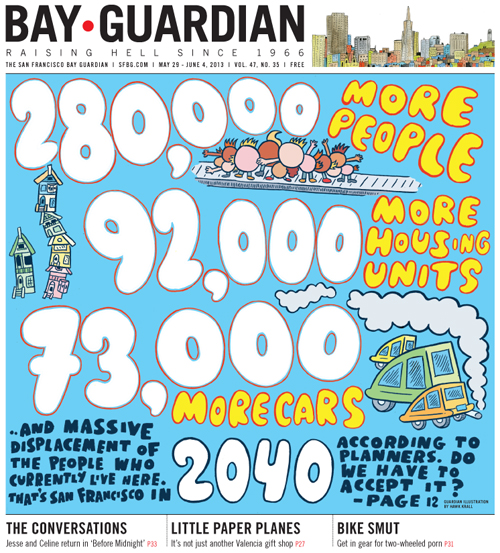
Under the ABAG plan, San Francisco would approve 92,400 more housing units for 280,000 more people. The city would host 190,000 more jobs, many of them in what’s called the “knowledge economy,” which mostly means high tech. Second and third on the list: Health and education, and tourism.

The city currently allows around eight cars for every 10 housing units; as few as five in a few neighborhoods, at least 10 in many others. And there’s nothing in any city or regional plan right now that seeks to change that level of car dependency. In fact, the regional planners think that single-occupancy car travel will be the mode of choice for 48 percent of all trips by 2040 — almost the same as it is today.

And since most of the new housing will be aimed at wealthier people, who are more likely to own cars and avoid catching buses, San Francisco could be looking for ways to fit 73,000 more cars onto streets that are already, in many cases, maxed out. There will be, quite literally, no place to park. And congestion in the region, the planners agree, will get a whole lot worse.

That seems to undermine the main intent of the plan: Transit-oriented development only works if you discourage cars. In a sense, the car-use projections are an admission of failure, undermining the intent of the entire project.

The vast majority of the housing that will be built will be too expensive for much of the existing (and even future) workforce and will do little to relieve the pressure on lower income people. But there is nothing whatsoever in the plan to ensure that there’s money available to build housing that meets the needs of most San Franciscans.

Instead, the planners acknowledge that 36 percent of existing low-income people will be at risk for displacement. That would be a profound change in the demographics of San Francisco.

Of course, adding all those people and jobs will put immense pressure on city services, from Muni to police, fire, and schools — not to mention the sewer system, which already floods and dumps untreated waste into the Bay when there’s heavy rain. Everyone involved acknowledged those costs, which could run into the billions of dollars. There is nothing anywhere in any of the planning documents addressing the question of who will pay for it.

THE NUMBERS GAME

Projecting the future of a region isn’t easy. Job and population growth isn’t a straight line, at best — and when you’re looking at a 25-year window in a boom-and-bust area with everything from earthquakes to sea-level rise factoring in, it’s easy to say that anyone who claims to know what’s going to happen in 2040 is guessing.

But as economist Stephen Levy, who did the regional projections for ABAG, pointed out to us, “You have to be able to plan.” And you can’t plan if you don’t at least think about what you’re planning for.

Levy runs the Center for the Continuing Study of the California Economy, and he’s been watching trends in this state for years. He agrees that some of his science is, by nature, dismal: “Nobody projects deep recessions,” much less natural disasters. But overall, he told me, it’s possible to get a grip on what planners need to prepare for as they write the next chapter of the Bay Area’s future.

And what they have to plan for is a lot more people.

Levy said he started with the federal government’s projections for population growth in the United States, which include births and deaths, immigration, and out-migration, using historic trends to allocate some of that growth to the Bay Area. There’s what appears at first to be circular logic involved: The feds (and most economists) project that job growth nationally will be driven by population — that is, the more people live in the US, the more jobs there will be.

Population growth in a specific region, on the other hand, is driven by jobs — that is, the more jobs you have in the Bay Area, the more people will move here.

“Jobs in the US depend on how many people are in the labor force,” he said. “Jobs in the Bay Area depend on our share of US jobs and population depends on relative job growth.”

Make sense? No matter — over the years it’s generally worked. And once you project the number of people and jobs expected in the Bay Area, you can start looking at how much housing it’s going to take to keep them all under a roof.

Levy projects that the Bay Area’s share of jobs will be higher than most of the rest of the country. “This is the home of the knowledge industry,” he told me. So he’s concluded that population in the Bay Area will grow from 7.1 million to 9.2 million — an additional 2.14 million people. They’ll be chasing some 1.1 million new jobs, and will need 660,000 new housing units.

Levy stopped there, and left it to the planners at ABAG to allocate that growth to individual cities — and that’s where smart growth comes in.

For decades in the Bay Area, particularly in San Francisco, activists have waged wars against developers, trying to slow down the growth of office buildings, and later, luxury housing units. At the same time, environmentalists argued that spreading the growth around creates serious problems, including sprawl and the destruction of farmland and open space.

Smart growth is supposed to be an alternative: the idea is to direct new growth to already-established urban areas, not by bulldozing over communities (as redevelopment agencies once did) but by the use of “infill” — directing development to areas where there’s usable space, or by building up and not out.

ABAG “focused housing and jobs growth around transit areas, particularly within locally identified Priority Development Areas,” the draft environmental impact report on the plan notes.

The draft EIR is more than 1,300 pages long, and it looks at the ABAG plan and several alternatives. One alternative, proposed by business groups, would lead to more development and higher population gains. Another, proposed by community activist groups including Public Advocates, Urban Habitat, and TransForm, is aimed at reducing displacement and creating affordable housing; that one, it turns out, is the “environmentally preferred alternative.” (See sidebar).

But no matter which alternative you look at, two things leap out: There is nothing effective that ABAG has put forward to prevent large-scale displacement of vulnerable communities. And despite directing growth to transit corridors, the DEIR still envisions a disaster of traffic congestion, parking problems, and car-driven environmental wreckage.

THE DISPLACEMENT PROBLEM

ABAG has gone to some lengths to identify what it calls “communities of concern.” Those are areas, like Bayview Hunters Point, Chinatown, and the Mission, where existing low-income residents and small businesses face potential displacement. In San Francisco, those communities are, to a great extent, the same geographic areas that have been identified as PDAs.

And, the DEIR, notes, some degree of displacement is a significant impact that cannot be mitigated. In other words, the gentrification of San Francisco is just part of the plan.

In fact, the study notes, 36 percent of the communities of concern in high-growth areas will face displacement pressure because of the cost of housing. And that’s region wide; the number in San Francisco will almost certainly be much, much higher.

Miriam Chion, ABAG’s planning and research director, told me that displacement “is the core issue in this whole process.” The agency, she said, is working with other stakeholders to try to address the concern that new development will drive out longtime residents. But she also agreed that there are limited tools available to local government.

The DEIR notes that ABAG and the MTC will seek to “bolster the plan’s investment in the Transit Oriented Affordable Housing Fund and will seek to do a study of displacement. It also states: “In addition, this displacement risk could be mitigated in cities such as San Francisco with rent control and other tenant protections in place.”

There isn’t a tenant activist in this town who can read that sentence with a straight face.

The problem, as affordable housing advocate Peter Cohen puts it, is that “the state has mandated all this growth, but has taken away the tools we could use to mitigate it.”

That’s exactly what’s happened in the past few decades. The state Legislature has outlawed the only effective anti-displacement laws local governments can enact — rent controls on vacant apartments, commercial rent control, and eviction protections that prevent landlords from taking rental units off the market to sell as condos. Oh, and the governor has also shut down redevelopment agencies, which were the only reliable source of affordable housing money in many cities.

Chion told me that the ABAG planners were discussing a list of anti-displacement options, and that changes in state legislation could be on that list. Given the power of the real-estate lobby in the state Capitol, ABAG will have to do more than suggest; there’s no way this plan can work without changing state law.

Otherwise, eastern San Francisco is going to be devastated — particularly since the vast majority of all housing that gets built in the city, and that’s likely to get built in the city, is too expensive for almost anyone in the communities of concern.

“This plan doesn’t require affordable housing,” Cindy Wu, vice-chair of the San Francisco Planning Commission, told me. “It’s left to the private market, which doesn’t build affordable housing or middle-class housing.”

In fact, while there’s plenty of discussion in the plan about where money can come from for transit projects, there’s virtually no discussion of the billions and billions that will be needed to produce the level of affordable housing that everyone agrees will be needed.

Does anyone seriously think that developers can cram 90,000 new units — at least 85 percent of them, under current rules, high-cost apartments and condos that are well beyond the range of most current San Franciscans — into eastern neighborhoods without a real-estate boom that will displace thousands of existing residents?

Let’s remember: Building more housing, even a lot more housing, won’t necessarily bring down prices. The report makes clear that the job growth, and population boom that accompanies it, will fuel plenty of demand for all those new units.

Steve Woo, senior planner with the Chinatown Community Development Center, sees the problem. In a letter to ABAG, he notes: “Plan Bay Area and its DEIR has analyzed the displacement of low-income people and explicitly acknowledges that it will occur. This is unacceptable for San Francisco and for Chinatown, where the pressures of displacement have been a constant over the past 20 years.”

Adds the Council of Community Housing Organizations: “It would be irresponsible for the regional agencies to advance a plan that purports to ‘improve’ the region’s communities as population grows while the plan simultaneously presents great risk and uncertainty for many vulnerable communities.”

Jobs are at stake, too — not tech jobs or office jobs, which ABAG projects will expand, but the kind of industrial jobs that currently exist in the priority development areas.

Calvin Welch, who has been watching urban planning and displacement issues in San Francisco for more than 40 years, puts it bluntly: “It is axiomatic that market-rate housing drives out blue-collar jobs,” he said.

Of course, there’s another potential problem: Nobody really knows where jobs will come from in the next 25 years, whether tech will continue to be the driver or whether the city’s headed for a second dot-com bust. San Francisco doesn’t have a good record of building for projected jobs: In the mid-1980s, for example, the entire South of Market area (then home to printing, light manufacturing, and other blue-collar jobs) was rezoned for open-floor office space because city officials projected a huge need for “back-office” functions like customer service.

“Where are all those jobs today?” Welch asked. “They’re in India.”

TOO MANY CARS

For a plan that’s designed to reduce greenhouse gas emissions by moving residential development closer to work areas, Plan Bay Area is awfully pessimistic about transportation.

According to the projections, there will be more cars on the roads in 2040, with more — and much worse — traffic. The DEIR predicts that a full 48 percent of all trips in 2040 will be made by single-occupant vehicles — just slightly down from current rates. The percentage of trips on transit will only be a little bit higher — and there’s no significant increase in projected bicycle trips.

That alone is pretty crazy, since the number of people commuting to work by bike in San Francisco has risen dramatically in the past 10 years, and the city’s official goal is that 20 percent of all vehicle trips will be by bike in the next decade.

Part of the problem is structural. Not everyone in San Francisco 2040 is going to be a high-paid tech worker. In fact, the most stable areas of employment are health services and government — and hospital workers and Muni drivers can’t possibly afford the housing that’s being built. So those people will — the DEIR acknowledges — be displaced from San Francisco and forced to live elsewhere in the region (if that’s even possible). Which means, of course, they’ll be commuting further to work. Meanwhile, if current trends continue, many of the people moving into the city will work in Silicon Valley.

Chion and Levy both told me that the transit mode projections were based on historical trends for car use, and that it’s really hard to get people to give up their cars. Even higher gas prices and abominable traffic delays won’t drive people off the roads, they said.

If that’s the case — if auto culture, which is a top source of global climate change, doesn’t shift at all — it would seem that all this planning is pointless: the seas will rise dramatically, and San Franciscans ought to be buying boats.

“The projections don’t take into account social change,” Jason Henderson, a geography professor at San Francisco State University and a local transportation expert, told me. “And social change does happen.”

Brad Paul, a longtime housing activist who now works for ABAG, said these projections are just a start, and that the plan will be updated every four years. “I think we’re finding that the number of people who want to drive cars will go down,” he said.

Henderson argues that the land-use policy is flawed. He suggests that it would make more sense to increase density in the Bay Area suburbs along the BART lines. “Elegant development in those areas would work better,” he said. You don’t need expensive high-rises: “Four and five stories is the sweet spot,” he explained.

Most of the transportation projects in the plan are already in the pipeline; there’s no suggestion of any major new public transit programs. There is, however, a suggestion that San Francisco adopt a congestion management fee for downtown driving — something that city officials say is the only way to avoid utter gridlock in the future.

SIDELINING CEQA

ABAG and the MTC have a fair amount of leverage to implement their plans. MTC controls hundreds of millions of dollars in transit money; ABAG will be handing out millions in grants to communities that adopt its plan. And under state law, cities that allow development in PDAs near transit corridors can gain an exemption from the California Environmental Quality Act.

CEQA is a powerful tool to slow or halt development, and developers (and some public officials) drool at the prospect of getting a fast-track pass to avoid some of the more cumbersome parts of the environmental review process.

Under SB 375 and Plan Bay Area, CEQA exemptions are available to projects that meet the Sustainable Community Strategy standards and are close to transit corridors. And when you look at the map of those areas, it’s pretty striking: All of San Francisco, pretty much every square inch, qualifies.

That means that almost any project almost anywhere in town can make a case that it doesn’t need to accept full CEQA review.

The most profound missing element in this entire discussion is the cost of all this growth.

You can’t cram 210,000 more residents into San Francisco without new schools, parks, and child-care centers. You can’t protect those residents without more police officers and firefighters. You can’t take care of their water and sewer needs without substantial infrastructure upgrades. And even if there’s state and federal money available for new buses and trains, you can’t operate those systems without paying drivers, mechanics, and support workers.

There’s no question that the new development will bring in more tax money. But the type of infrastructure improvements that will be needed to add 25 percent more residents to the city are really expensive — and every study that’s ever been done in San Francisco shows that the tax benefits of new development don’t cover the costs of public services it requires.

When World War II and the post-war boom in the Bay Area brought huge growth to the region, property taxes and federal and state money were adequate to build things like BART, the freeways, and hundreds of new schools, and to staff the public services that the emerging communities needed. But that all changed in 1978, with the passage of Prop. 13, and two years later, with the election of Ronald Reagan as president.

Now, federal money for cities is down to a trickle. Local government has an almost impossible time raising taxes. And instead of hiking fees for new residential and commercial projects, many communities (including San Francisco) are offering tax breaks to encourage job growth.

Put all that in the mix and you have a recipe for overcrowded buses, inadequate schools, overstressed open space (imagine 10,000 new Mission residents heading for Dolores Park on a nice day), and a very unattractive urban experience.

That flies directly in the face of what Plan Bay Area is supposed to be about. If the goal is to cut down on commutes by bringing new residents into developed urban areas, those cities have to be decent places to live. What would it cost to accommodate this level of new development? Five billion dollars? Ten billion? Nobody knows — because nobody has run those numbers. But they’re going to be big.

Because just as tax dollars have been vanishing, the costs of infrastructure keep going up. It costs a billion dollars a mile to build BART track. It’s costing more than a billion to build a short subway to Chinatown. Just upgrading the sewer system to handle current demands is a $4 billion project.

And if the developers and property owners who stand to make vast sums of money off all of this growth aren’t going to pay, who’s left?

The ABAG planners point out, correctly, that there’s a price for doing nothing. If there’s no regional plan, no proposal for smart growth, the population will still increase, and displacement will still happen — but the greenhouse gas emissions will be even worse, the development more haphazard.

But if the region is going to spend all this money and all this time on a plan to make the Bay Area more sustainable, more livable, and more affordable in 25 years, we might as well push all the limits and get it right.

Instead of looking at displacement as inevitable, and traffic as a price of growth, the planners could tell the state Legislature and the governor that it’s not possible to comply with SB375 — not until somebody identifies the big sums of money, multiples of billions of dollars, needed to build affordable housing; not until there are transit options, taxes, and restrictions on driving.

Because continued car use and massive displacement — the package that’s now facing us — just isn’t an acceptable option.


Very Strange Bedfellows

6

If you stop and think about it for a moment, Memorial Day Weekend and Gay Pride weekends have a lot in common.

Both came about to commemorate serious and life-changing events for millions of people.

Now, not really about either. Memorial Day, except to veterans and families of the deceased, is the “beginning of summer”. Boat on lake and barbeques. Politicians may pay homage to fallen soldiers but it’s really Labor Day’s bookend to most. Gay Pride is now a city to city franchise of a sort, kind of a traveling mega party. Which make sense in both cases–as conscription ended in the 1970’s, the professional military represents a smaller and smaller segment of the American public (so much for shared sacrifice). And even though Stonewall was less than 45 years ago, a gay or lesbian kid now–even in the heart of the Bible Belt–could never imagine how secretive people had to be, even in the “enlightened 60’s”. 

It isn’t a bad thing. It’s human nature. Just strange how two supposedly disparate events are so similar. 


Solomon: Obama in Plunderland: Down the corporate rabbit hole

0


By Norman Solomon

Norman Solomon is co-founder of RootsAction.org and founding director of the Institute for Public Accuracy. His books include “War Made Easy: How Presidents and Pundits Keep Spinning Us to Death.” He writes the Political Culture 2013 column.

The president’s new choices for Commerce secretary and FCC chair underscore how far down the rabbit hole his populist conceits have tumbled. Yet the Obama rhetoric about standing up for working people against “special interests” is as profuse as ever. Would you care for a spot of Kool-Aid at the Mad Hatter’s tea party?

Of course the Republican economic program is worse, and President Romney’s policies would have been even more corporate-driven. That doesn’t in the slightest make acceptable what Obama is doing. His latest high-level appointments — boosting corporate power and shafting the public — are despicable.

To nominate Penny Pritzker for secretary of Commerce is to throw in the towel for any pretense of integrity that could pass a laugh test. Pritzker is “a longtime political supporter and heavyweight fundraiser,” the Chicago Tribune reported with notable understatement last week, adding: “She is on the board of Hyatt Hotels Corp., which was founded by her family and has had rocky relations with labor unions, and she could face questions about the failure of a bank partly owned by her family. With a personal fortune estimated at $1.85 billion, Pritzker is listed by Forbes magazine among the 300 wealthiest Americans.”

A more blunt assessment came from journalist Dennis Bernstein: “Her pioneering sub-prime operations, out of Superior Bank in Chicago, specifically targeted poor and working class people of color across the country. She ended up crashing Superior for a billion-dollar cost to taxpayers, and creating a personal tragedy for the 1,400 people who lost their savings when the bank failed.” Pritzker, whose family controls Hyatt Regency Hotels, has a vile anti-union record.

Commerce Secretary Penny Pritzker? What’s next? Labor Secretary Donald Trump? SEC Chairman Bernie Madoff?

The choice of Penny Pritzker to run the Commerce Department is a matched set with the simultaneous pick of Tom Wheeler — another mega-fundraiser for candidate Obama — to chair the Federal Communications Commission.

With crucial decisions on the near horizon at the FCC, the president’s nomination of Wheeler has dire implications for the future of the Internet, digital communications and democracy. For analysis, my colleagues at the Institute for Public Accuracy turned to the progressive former FCC commissioner Nicholas Johnson, who called the choice “bizarre.”

“There is no single independent regulatory commission that comes close to the impact of the FCC on every American’s life,” Johnson said. “That’s why Congress, in creating it, characterized its mission as serving ‘the public interest’ — an expression used throughout the Act.

But with countless billions of dollars at stake, the corporate fix was in. As Johnson pointed out, “Wheeler’s background is as a trade association representative for companies appearing before the Commission, a lobbyist in Congress for other FCC customers, and a venture capitalist investing in and profiting from others whose requests he’ll have to pass on. He has no record, of which I am aware, of challenging corporate abuse of power on behalf of consumers and the poor.”

But wait. There’s more. “Nor does Wheeler’s membership on the president’s Intelligence Advisory Board bode well for those who believe Americans’ Fourth Amendment privacy rights should be getting at least as much attention as the government’s perceived need to engage in even more secret snooping.”

To urge senators to reject the nominations of Pritzker and Wheeler, click here.

Meanwhile, at the Securities and Exchange Commission, Obama’s recent appointment of Wall Street insider Mary Jo White as SEC chair is playing out in predictable fashion. Days ago, in an editorial, the New York Times faulted her role in an SEC decision on regulating the huge derivatives market: “Last week, in her first commission vote, Ms. White led the commissioners in approving a proposal that, if finalized, could leave investors and taxpayers exposed to the ravages of reckless bank trading.”

We need to ask ourselves how the forces of corporate capitalism have gained so much power over government, to the extreme detriment of people who aren’t rich. Humpty Dumpty’s brief dialectical exchange with Alice is on point

“When I use a word,” Humpty Dumpty said, “it means just what I choose it to mean — neither more nor less.”

“The question is,” Alice replied, “whether you can make words mean so many different things.””The question is,” Humpty Dumpty responded, “which is to be master — that’s all.

Denunciations and protests against the dominant power structure are essential. And insufficient. For the body politic and the potential of democracy, accommodating to the Democratic Party leadership is a deathly prescription. So is failure to fight for electoral power by challenging that leadership, fielding genuinely progressive candidates and organizing to win.

Norman Solomon is co-founder of RootsAction.org and founding director of the Institute for Public Accuracy. His books include “War Made Easy: How Presidents and Pundits Keep Spinning Us to Death.” He writes the Political Culture 2013 column.

(The Bruce Blog is written and edited by Bruce B. Brugmann, editor at large of the San Francisco Bay Guardian, and co-founder and editor and co-publisher with his wife Jean of the Bay Guardian, 1966-2012, now retired.)

Young, creative people who work hard

173

I almost don’t know what to say, except: Finally, someone admits it.

Rebecca Pederson, writing in The Bold Italic, explains why she actually likes the idea that San Francisco is becoming so expensive that thousands of longtime residents are being forced out; see, if it’s more expensive to live here, then young, creative people will work harder:

People who want to make a living here from their creative work should have to hustle; it makes the successes much more meaningful.

Ah, yes. “Hustle.” So all the older people who are, say, not trained in the tech field, or might be disabled and unable to “hustle,” or the single parents who “hustle” all the goddam day just to keep the family together, or all the “creative” people who work for nonprofits or (gasp) are artists — and trust me, they “hustle” as much as any tech worker … they don’t get to live here any more. Because

We can’t afford to walk barefoot around Golden Gate Park and write half-sonnets about trees. This city’s too expensive now.

I don’t know anyone who thinks we still live in the Beat era. I don’t know anyone who has ever written a half-sonnet about trees, and nobody with any sense of public health walks barefoot in Golden Gate Park. Get a clue.

But I do know a whole lot of people, including some who work for websites, who are seeing their lives and their community destroyed by rising prices — which are due primarily to greed in the real-estate industry.

I don’t think all tech workers are anywhere near as dumb as Rebecca Pederson, but I do see a lot of her attitude around: We are young and have money, and you are old and in the way. That’s capitalism.

The “older people are losers” attitude was the worst part of the Sixties ethos (although disdain for labor — often reciprocated by conservative unions — was pretty bad, too.) This is a big city, with a diverse population. Not everyone is healthy and able to “hustle.” Not everyone is young and carefree. Please, my friends: Have respect for the community you recently dropped into.

Yes, I was a San Francisco immigrant, too, in a different era, and I know things will always change, but I don’t remember my young friends believing that they were by nature better and smarter than the people who already lived here. It’s called respect.


UCSF medical centers prepare for strike

On Tuesday morning at 4 a.m., a 48-hour strike will begin at University of California medical centers across the state.

The strike was called by the American Federation of State, County, and Municipal Employees (AFSCME) Local 3299, a union representing more than 13,000 UC patient care technical workers.

AFSCME has been at an impasse on contract negotiations with UC for months. Administrators have pointed to proposed pension reform measures as the central issue, while the union has highlighted rising executive salaries and bonuses that they deem unfair at a time when frontline staff positions have been cut. AFSCME also recently called for new caps on UC executives’ pensions.

Speaking on a conference call earlier today, Jack Stobo, senior vice president for health sciences and services at the UC system, told reporters that the upcoming strike would affect patient care. He said 150 surgeries had to be rescheduled, and estimated that some 100 patient transfers would be delayed. “We have canceled a number of chemotherapy sessions and approximately half of radiation sessions with patients who are about to start radiation therapy,” he added. 

UC administrators pegged the total cost of the two-day strike at about $20 million for the entire system, mostly associated with hiring temporary staffers. They did not provide the number of temporary staffers that would be brought on. Stobo said the strike “will impact our ability to provide the quality services that we’re committed to provide to a large number of patients.”

AFSCME, on the other hand, says it has been working for months to craft a patient protection plan. “We have a patient protection task force in place in the event of a medical emergency,” such as an event that would cause a major influx of patients, AFSCME 3299 spokesperson Todd Stenhouse told the Bay Guardian. “Our workers are the ones … who understand the stakes. That’s why they’ve taken pains to make sure patients are protected.”

Union representatives say they are striking in part due to concern about the long-term erosion of patient care, stemming from cuts to frontline staff positions earlier this year.

“This strike is not just about the next two days – it’s about the fact that UC is endangering its patients every day with chronic understaffing and reckless cost cutting,” said AFSCME 3299 President Kathryn Lybarger. “If we don’t stand up to it now, we are inviting disaster when thousands of new patients begin flooding UC hospitals with the onset of the Affordable Care Act in the coming year.”

Earlier today, a California Superior Court decision enjoined certain respiratory therapists and other critical classifications from striking, but the ruling does not prevent the strike from going forward. The decision stemmed from an effort by UC to halt the strike by petitioning for injunctive relief with the Public Employees Relations Board (PERB). The labor board upheld the union’s right to strike and only sought a temporary injunction in court.

Meanwhile, AFSCME-represented UC service workers will also hold a “sympathy strike” in support of patient care employees, and the University Professional and Technical Employees (UPTE), a union which represents pharmacists, clinical lab scientists, social workers and other health care professionals, is also planning a daylong sympathy strike on May 21. 

Jelger Kalmijn, systemwide president of UPTE, told the Bay Guardian that his union membership had voted to strike because “we support our sisters and brothers who work at UCSF.” He added that UPTE is also in contract negotiations with UC, and noted that pension reform is a key issue. “People stay here because of the benefits and the pension,” Kalmijn said. “It’s a serious concern. When [UC] makes half a billion in profit, why should employees have to give up their right to retire with dignity?”

Housing for the rootless superrich

61

When San Francisco looks at building ultra-luxury housing — places like 8 Washington — and some city officials and “experts” say it’s going to help meet the housing needs of the city, we ought to look at what’s happening in Manhattan. There, high-end housing is being flooded with people who don’t live in Manhattan, won’t live in Manhattan, and will at best hang out there a few weeks a year.

Only 10 floors have been completed in what is intended to be the tallest residential building in the Western Hemisphere — a slender, 84-story tower on Park Avenue at 56th Street in Manhattan. But the top penthouse is already under contract for $95 million. Other buyers have snapped up apartments on lower floors for prices that are almost as breathtaking. While their identities are not known, it is likely that many are the rootless superrich: Russian metals barons, Latin American tycoons, Arab sheiks and Asian billionaires.

Why does that matter? Other than the fact that, according to developers, “Only about a quarter of the units will be occupied at any one time,” which doesn’t make for street life, community or even much in the way of economic benefits? Here’s the problem:

The growth in high-end projects in Manhattan comes as housing for the working and middle class is in increasingly short supply in the city. These buildings are proving so profitable that they are warping the local real-estate market, making it more difficult to put up more-affordable housing.

Developers have long complained that the prices of land, construction materials and labor are high in New York, even if they are somewhat less expensive than in London or Hong Kong.

But builders of ultraluxury apartments have much more latitude on costs because they are securing spectacular prices for their projects.

As a result, the luxury building trend is driving up the overall cost of land in the city. Several developers maintained that they could build moderately priced housing only if they could get significant tax breaks.

Sound familiar? There is, one New York architects say, “only two markets, ultraluxury and subsidized housing.” San Francisco is also an international city, and prices here are even better than New York. So don’t be surprised if, in a city that doesn’t seem a bit concerned about how much new housing costs or who the buildings are designed for, we reach Manhattan-like levels of insanity.


Do falling jobless numbers mean we’re smart and focused, or rich and exclusive?

73

The unemployment rate continues to drop in San Francisco and all over California, according to new numbers released today by the California Employment Development Department, which were trumpeted by Mayor Ed Lee as vindication for his economic development policies.

“San Francisco’s steady economic recovery is the result of our continued focus on job creation, education and training residents for the demands of the 21st century workforce. San Franciscans are getting back to work across the spectrum of job sectors – from hospitality to construction to technology to service industry jobs and we will continue to help these sectors grow in our City,” Lee said in a press release.

But are Lee’s neoliberal policies of promoting technology and other corporations with tax breaks and city-subsidized training programs and financing mechanisms really creating the rosy economic picture he’s painting? And even if it is helping to promote boom times, at what point have we essentially reached full employment, the point at which we should maybe turn our focus and resources to addressing the rising cost of living here?

After all, San Francisco’s unemployment rate of 5.4 percent is third only to Marin County (4.6 percent) and San Mateo County (5.1 percent). Those three counties also just happen to be the three counties with the highest per capita incomes in the state, a fact that explains our jobless rate more than the mid-Market payroll tax exemption and other taxpayer giveaways.

“Unemployment rates tend to be lowest in areas with high education attainment,” Ruth Kavanagh, EDD’s labor market consultant for this area, told us when we called to discuss the disparties among counties.

What about the rising cost of living in San Francisco? Clearly, this is becoming a much more difficult city for the unemployed and marginally employed to remain living in. How much are gentrification, evictions, and the exodus to the East Bay (Alameda County’s rate is 7 percent, still better than the statewide rate of 8.5 percent) and other locales a factor in our low jobless rate?

Kavanagh said the EDD doesn’t directly track that and so she couldn’t address the question. But she did say that the Bay Area was indeed experiencing the fastest job growth in the state, driven largely by the tech industry. In the last year, this three-county area has added 9,600 jobs in Professional Business Services (which includes tech) and 4,600 each in Leisure & Hospitality and Construction.

Indeed, in his State of the City speech in January, Lee touted the 23 construction cranes on the city skyline as the best gauge of the state of the city. And if counting jobs is one’s only measure of success, San Francisco is doing as well as can be expected. Kavanagh said most economists consider “full employment” within the capitalist system to be somewhere between 4-5 percent.     

Yet Lee says he’s not backing off from his full-throttle focus on economic development. “San Francisco’s unemployment rate today stands at a five-year low and I will continue to pursue policies that get people back to work, support San Francisco families and invest in our City’s future,” he said. “This Summer through San Francisco Summer Jobs +, we are setting an aggressive goal of putting 6,000 youth to work in paid jobs and internships, and I will continue working hard to make sure all San Franciscans have access to good paying jobs.”

Now if only we all had access to reasonably priced housing, health care, food, entertainment, and a transportation system built to handle a growing population.

-sigh-

Now get back to work!

The Ro Khanna party

17

When Ro Khanna, a young, energetic intellectual property lawyer, ran for Congress against Tom Lantos, he was the candidate of the progressives. I liked Khanna, and appreciated his willingness to take on the almost unheard-of task of challenging a longtime incumbent in a Democratic primary. At that point, in 2004, the big issues were the war and the PATRIOT Act, and Khanna was against both. Lantos, who was always hawkish on defense issues (and a die-hard supporter of Israel, no matter what the Israeli government was doing), was clearly out of touch with his district. But Khanna never got much traction, and he lost pretty badly.

Now he’s back, in a new era of top-two primaries (which has its own problems), and in a different district. He’s taking on Mike Honda, who, like Lantos, has been around a while, and hasn’t faced serious opposition in years.

And this time around, it’s not Matt Gonzalez and the left supporting Khanna — it’s Lite Guv Gavin Newsom, who beat Gonzalez for mayor of SF, along with Ron Conway and the tech industry. And  instead of talking about failed US military policies, he’s talking about bringing the interests of Silicon Valley to Washington:

“The premise of this campaign is quite simple,” Khanna told the crowd. “We’ve had quite brilliant people…use technology to change the world. And it’s time that we actually change politics, that Silicon Valley has the potential to do this.” “It’s not just about having a tech agenda. This is about something much deeper — our values, and our ability to use those values to change Washington and the world,” he told them.

Now: It’s not as if Mike Honda has been horrible to Silicon Valley. He’s been involved in all sorts of tech-related issues. But he’s of a different generation, and however stereotypical it may be to say it, there’s a certain level of ageism in the tech world right now. Honda is old; the wealth in the tech world is overwhelmingly young. Politico notes:

Khanna’s decision to take on Honda also reflects a long-standing frustration among many young California pols who have been patiently waiting for older members to exit the state’s congressional delegation. Last year’s induction of an independent redistricting committee and a jungle primary system in which the top two finishers in an open primary advance to the runoff regardless of party affiliation, helped push many senior members into retirement.

Oh, and Honda is very much a pro-labor guy. And tech firms are almost never unionized, and their owners and workers don’t tend to have the same sympathies for labor unions as young activists did 20 years ago.

Politico doesn’t give Khanna much of a shot; it’s going to be a tough battle. Honda’s been around the district forever, and has no apparent scandals or gaffes (and unlike poor Pete Stark, he doesn’t seem to be losing his marbles).

But money talks, and Khanna’s got a lot of it — and in some ways, this will be a new-money-v.-old-Democratic Party, tech v. labor kind of battle that will say a lot about where Bay Area politics are going as the region’s population, and wealth, are dramatically and rapidly changing.

The “Do Nothing” Solution to “Illegal Immigration”

114

Both sides of the political aisle have made a major issue out of the problem of the 11 million people inside the US illegally or presently undocumented. The president has said this is a priority and Florida senator Marco Rubio has agreed. They are theoretically opposed to each other, yet Rubio’s proposals entailed in the Border Security, Economic Opportunity, and Immigration Modernization Act of 2013 don’t differ a great deal from Obama’s. In a nutshell, Rubio has suggested that the wholesale eviction of 11 million people is impossible and that the bill offers them an opportunity for legalization and permanent residence and citizenship. Naturally, the “jump through hoops” process begins here: Fines and background checks and no federal bennies.

Sounds completely reasonable, but you’d think Rubio had suggested that the government was handing out lollipops and bon-bons, making Spanish the new “official language” and changing the “Star Spangled Banner” to “Guantanmera” by the reaction of his “conservative” peers. A cursory Google reveals an enraged base represented by such intellectual heavweights as Townhall.com and Ann “To Hell With Palin, I Was Here First” Coulter. Any concessions to the teeming masses of south of the border is treasonous amnesty and in their hardly humble opinions, this will lead to “de-Europeanization” (ie less white).

As far as what the generally pitiful Democrats are offering, it is only marginally different than Rubio’s idea. Which is also reasonable, but overlooks the crux of the issue, because no one anywhere has to unmitigated gall (until now) to say it: “Illegal Immigration reform” is a solution in search of a problem, because in reality, it isn’t a problem at all!

The way I see it, a problem means an aggrieved party and in this instance, there isn’t one. People want to hire help for whatever the task is, other people agree to do it for a price, end of story. The idea that “illegal immigrants are stealing American workers jobs” sounds fairly solid on its face unless you happen to live in the American Southwest and notice that wherever day laborers congregate, there aren’t a whole hell of a lot of white folks. As far as “taking away jobs that union carpenters/plumbers/electricians do”, isn’t it the union’s job to protect their own for one and for two, a skyscraper isn’t built and wired with dudes from the Lowe’s parking lot. It is not worth a major contractor’s license to screw with E-Verify (I passed an E-Verify check myself a few months ago for my radio show!).

Assuming you “legalized” every man, woman in child in the US tomorrow, what happens? The working person’s price rises. Which means that they will be replaced by new people from Central America or Asia that will remain invisible. See, we are a free country with open borders–people can come and go as they please, this isn’t a gulag (yet) (The irony of the most virulent anti-USSR voices being the loudest for a border fence is astounding). Not only is there no way to stop it, there isn’t even a real reason to stop it–as China and Japan might tell you, an aging and shrinking worker base is starting to hurt them and hard.

Fact is, both major political parties support and oppose it for a pair of reasons of their own. Democrats love this, as it accelerates the “Bluing” of the Southwest with millions of new voters beholding and grateful to them, making a Republican national electoral victory mathematically impossible. The other reason they love it is because it replenishes their most loyal and organized base, labor. Republicans hate it for two reasons as well–newly legal workers will have more rights, bargaining power and higher pay, which means that a new cheap labor era is gonna take a while. The other reason is the one they vehemently deny but is as obvious as the honkers on their maps–their base’s great unifier isn’t economics or even social issues, but race. That the Dixiecrats of the last century are now almost entirely Republican. The glue that holds them intact, whether they’d care to admit it or not, is white supremacy. And a sea of legal Americans that are a deeper shade of soul galls them to the cores of their rancid selves. Were they serious about “sending all of these people back to where they came from”, they’d boycott every and any business that employs them, which means they’d pretty much have to stop eating. I’ve seen what the average reactionary looks like--that ain’t happening.

In fact, when the “illegals” are white, they say nothing.

Obama and Rubio both cry out that the system is “broken” but it isn’t. Undocumenteds pour billions into the coffers of state and federal and don’t get it back and whatever their costs are to health or schools, they’re balanced off by what the public saves in lower food and service costs. They’re a wash. Which means that any changes to the laissez-faire system only make everyone’s life harder and more complex. If there is a solution, the easiest one would be a “seven year rule”–you prove you’ve actually been here 7 years, no criminal record, you take a citizenship test, that’s it. 

We have undocumented people in this very neighborhood. They want the same things we do. That’s good enough for me.


JAW


Is Larkin Street Youth Services using public funds to fight a union organizing drive?

57

Larkin Street Youth Services does great and important social work with homeless youth in San Francisco, for which it receives generous support from city taxpayers, as well as federal grants. That’s why its employees and some prominent local officials are questioning the organization’s aggressive, deceptive, and anti-union resistance to the request by a majority of its 88 employees to be represented by Service Employees International Union Local 1021.

A majority of employees submitted an organizing petition on April 8, asking LSYS Executive Director Sherilyn Adams to honor the request and recognize card check neutrality, as other local city-supported nonprofits have done, such as Tenderloin Housing Clinic. But SEIU organizer Peter Masiak said Adams refused to even discuss it, leading the National Labor Relations Board to set a mail-in ballot election that begins May 21.

“That was two months she was able to buy by forcing this election,” he told us.

Adams and LSYS management have used that time to try to undermine the organizing effort with staff meetings and mailers that criticize SEIU in particular and the labor movement in general, using misleading scare tactics about the costs of organizing.  

“In my view, if employees become represented by a union, our organization will be significantly impacted, and not for the better,” Adams wrote in an April 23 email to staff announcing the NLRB election. LSYS management has also posted flyers with inaccurate information on the costs of joining the union and dated information about a contentious contract impasse between Local 1021 and its workers that has [since been settled. CORRECTION: Local 1021 workers rejected that settlement, with negotiations scheduled to restart May 21].

“They have been engaged in an anti-union campaign and hired outside counsel to fight this,” Masiak told us, noting how inappropriate such actions are for an organization that gets the vast majority of its funding from government grants. “I think it’s a misuse of these funds.”

Some public officials agree, including Assembly member Tom Ammiano and Sup. John Avalos, who have written letters to LSYS criticizing the tactics and urging Adams to recognize the union.

“Their desire to have a voice on the job and develop professionally in a supportive environment should be celebrated by LSYS management,” Ammiano wrote to Adams on April 30, noting his long history of advocating for increased city funding of the organization. “Unions are an important voice for employees regarding salary, benefits, working conditions, and many other issues. I strongly encourage you to accept card check recognition, to remain neautral during your employees’ organizing efforts, and not to use public funds on anti-union attorneys or consultants, so that your employees may make their own decision on whether or not to form a union.”

Eva Kersey, who works in LSYS HIV-prevention programs and helped organize the union drive, said it was driven by concerns about low wages, poor benefits, and the belief that “we don’t have a meaningful voice in how our programs are run,” she told us.

Kersey said she was disappointed at how management has reacted to the organizing drive. “What was most surprising is the general lack of respect we’ve gotten as workers and an organizing committee,” Kersey said, citing belittling management statements about how employees were being manipulated by the desperate union. “We’ve put a lot of work into this and put ourselves out there in a lot of ways.”

But Kersey believes support for the union has only grown and that LSYS employees — who are used to cutting through the bullshit they hear from troubled teens — haven’t been swayed by the speeches, flyers, and emails from management.

“I don’t think they’re very effective. They’re pretty one-sided,” Kersey said.  

Adams did not return our calls for comment, but had LSYS spokesperson Nicole Garroutte respond by asking for questions in writing, and we provided a list raising the issues and concerns expressed in this article. She didn’t answer the questions directly but offered this prepared statement: “Thank you for your interest in Larkin Street and, in particular, the election process that is currently underway. Out of respect for all of our employees and to help ensure a fair and independent process, we will confine our response to reaffirming the high degree to which we value our staff and the faith that we have in their ability to make informed individual decisions regarding the election. We recognize that there are expected differences of opinions regarding the preferred labor-management model, but we are confident that we all share a mutual passion for our mission and, most importantly, for assisting to our fullest potential the vulnerable clients we serve. We would be happy to talk further after the election process is concluded.” 

Masiak said the ballots will be mailed out May 21, they must be returned by June 5, and they will counted June 6.

The bagpipe squawks for thee: first thoughts on ‘Black Watch’

0

If you thought the theatricalized story of a jaunty and imperiled Scottish regiment in Iraq in 2004 would come off as a sort of “Trainspotting meets Black Hawk Down,” you wouldn’t be too far off the mark — in a very positive way. I’ll leave the nuts and bolts reviewing of full-force National Theatre of Scotland via American Conservatory Theater’s spectacular “Black Watch,” (through June 16) presented at the huge Mission Armory, to my colleague Robert Avila in next Wednesday’s Guardian. But my first thoughts upon emerging from Sunday night’s opening performance, after I cleaned the constant stream of expletives from my ears (and a bit of something from my eye) is that yae fookin’ coonts moost sae this pish, i.e. the production and performances are well worth the gasp-inducing $100 ticket price.

As is, I guess, a reminder of the — hey, ongoing! — sorry state of our “misadventures” in that part of the world. Ten years later, we have to drop a Benjamin for a complex, moving, and engrossing take on what just happened, or any take whatsoever, pretty much. That it also includes a lot of nifty multimedia effects (a surprisingly malleable pool table basically co-stars), affecting and thrillingly performed choreography, a bit of fascinating history, and some old Scottish ballads — oh yes, there will be bagpipes — is icing on the erroneous Occupation. 

Less plot-driven than situation-oriented (within the framing device of a “researcher” interviewing former squadron-mates at a pub, the story of the 300-year-old Black Watch Scottish fighting force’s dissolution in Iraq is told through clever reenactments), Gregory Burke’s play, first performed in 2007, keeps its ideological cards tucked slightly up its sleeve. But it pulls no punches when it comes to the hella screwy “facts” on the ground. It also toys with the Mametian trope that language is a real sharp double-edged sword, especially the language of power in crisis, when all the misogyny, homophobia, sexphobia, and racism comes howling through the seams of ballsy mens’ speech. One wondered how the more delicate members of A.C.T.’s regular subscription audience was taking all the “fucks,” “cunts,” and every other realistically used expletive, all fenced in by a true yet penetrable thicket of brogue.

One also wondered how many of them knew they were sitting in a giant BDSM porn studio — a famous fact left out of the program’s introduction to the “Armory Community Center,” a.k.a. Kink.com HQ, the timeline of which conveniently ends in the late 1970s, and has the gall to state that “plans to convert the building into a full-time film studio did not come to fruition.” Ahem. Aaanyways. For those of us in the know, it made the porn jokes a lot more funny.

The location also resonates with military history, of course. It was built in the early 1900s to help quell any union strikes or labor demonstrations downtown  … with hundreds of troops armed to the teeth. The wee irony of a play about an occupation staged here isn’t lost. But the genius of the location comes through in other ways. On first hearing ACT was hosting the play here, I immediately thought it would involve dozens of extras and a full orchestra. The play, however takes place in a modest (if very large compared to other locations) draped off part of the armory, and the often-eerie backing music is recorded. It is up to the cast, numbering a mere 10, to bring a full war and its aftershocks to a life big enough to fill the physical and mental space, which they do with aplomb.

They’re aided by a panoply of well-executed mulitmedia efects, culminating in a series of tragic explosions that ripple outward into the Armory’s enormous space. Those explosions can’t help but remind of the recent Boston marathon explosions, permanently televised into our senses. So much blood, so many severed limbs, the media and government weren’t afraid to show us in that bombing earlier this year. And yet 10 years ago, I remember seeing hardly any blood at all, let alone any troops’ bodies, in the long, long, then too-short coverage of the “Iraq War.” How far we’ve come, and haven’t come at all since then, “Black Watch” reminds us.      

Hey, you! “Tech people” are not the douchebags you think we are

I hear a lot of talk, especially from my own queer community, about how “tech people” are ruining San Francisco. From skyrocketing rent prices and disappearing diversity to economic and cultural ruination, the tech community has become the scapegoat for a lot of the problems we are facing in the city as a whole. As a tech worker, I’m writing this to say: wake up and direct your anger at the real sources of these problems.

First of all, let’s get one thing straight. The vast majority of “tech people” in San Francisco don’t make nearly as much money as you think they do. We are not making six-figure salaries, we are not personally driving up rent costs, and we are not killing the cultural community here. Simply put, we are trying to further our careers and make the city we call home a nicer place to live. 

From day one of living in San Francisco, I’ve put blood sweat and tears into building the cultural community in SF (music, mostly), and I’ll never stop doing that. I first moved here with my husband in 2006 from Indiana. We fell deeply in love with the city while visiting several times early on in our relationship, and knew this was where we wanted to call home. Of course queer acceptance came into play, but I loved the fact that the city had a life of its own, an entity with which I felt a kinship. I immediately immersed myself in the music scene here, forming a touring band and quickly becoming a booker and promoter for live shows. It wasn’t until several years into my time here that I snuck my way into the tech industry. Thankfully all those hours spent in my parent’s basement as a child on the computer helped! Here I am, five years into my tenure at Bay Area music tech startup Thrillcall, hustling every day to help build music communities not only in SF, but across the country.

I bust my ass doing this for modest pay just to get ahead and know I’m working in a field (music) that I love. I know many others like myself who have day jobs in the tech community that do the same.

However, accusations that I’ve been hearing lately would have you believe otherwise. Claims that “people like us” are ruining San Francisco by gentrifying everything and pushing out what San Francisco truly is. Protip: the Bay Area has, for quite some time now, been a hub for technology. This is not a new thing. Stop acting like it is. Directing anger towards us for what you consider woes to the community at large here is way off base. Bubbles have happened constantly since the early 1990s (or hey, 1840s), and anyone who has lived here for long can tell you this is true. 

The tipping point for me, to be honest, was the nonsense of people beating up a “Google Bus” piñata in the Mission, shouting epithets about how they’re the bane of San Francisco. The people that ride those buses are not to blame. They are not heading up that company, they don’t make millions of dollars, and they certainly don’t deserve the hatred being directed at them by many people here in San Francisco.

They’re utilizing a method of mass transportation (cutting down on carbon footprint) provided by their employer. If you want to be angry about something, be angry at the company, not the people who work for it. If you want to actually do something about it (beating a piñata in a public place solves nothing), then take your grievances to the heads of the companies you think are responsible for the predicament that San Francisco currently finds herself in.

You know what is ruining San Francisco? Complacency. Apathy. Misguided hate. Inaction. Put some energy into making change, not senseless whining.

If you’re upset about rising rent costs, be angry at the money-hungry landlords that do absolutely nothing to put money back into the city or help build culture. Want SF prices to stop skyrocketing? Let’s organize and drive proposals with our city government. Upset about the recent sanitization of many of the lovely traditions and values of San Francisco? Get mad at a-holes like Scott Weiner, who is actually supported by a lot of longtime, non-tech residents. Want more culture, arts, music? Maybe try reaching out to people that can help in the tech world instead of complaining about everything going downhill. 

A vast majority of the tech workers here in SF are upwardly mobile, culturally involved people. We are not ruining this city. We live here for much more than just the jobs we have. We love it, and it’s where we call home. We have as much control over the cost of living here as everybody else. And we are not the companies we work for, however large or small. Corporations, for the most part, suck. We all know that. Demonizing the people that work for them (while contributing to this wonderful city) is baseless, classless, and makes you look like a total dick.

We’re not the douchebags you think we are. Let’s put our energy toward doing good, instead of just pointing fingers. A great deal can be accomplished if people took an active role toward coexisting, rather than shouting “ENEMY!” to anyone who will listen. 


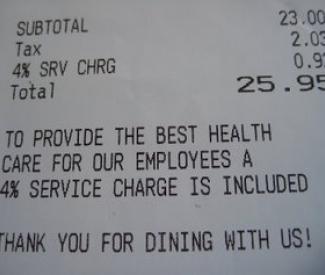
More SF restaurants settle with the city over fraudulent employee health surcharges

12

City Attorney Dennis Herrera today announced another batch of settlements with restaurants that have been fraudulently using surcharges on customers’ bills to cover their city-required employee health coverage and using some of that money to simply pad their profits.

Seventeen San Francisco restaurants that took advantage of Herrera’s partial amnesty offer — settlements are half of what the violators should owe, based on voluntarily submitting records by last month’s deadline — will be paying tens of thousands of dollars each to the employees’ they ostensibly collected the money for, joining two other restaurants that had settled with the city earlier this year.

Among this latest batch of restaurants is Burgermeister, whose $134,088 settlement is the largest of this group; and Burma Superstar, whose $10,045 is the smallest. Other restaurants paying up as part of the settlement are 5A5 Steak Lounge, Amber India, B Star, Bix, Cafe Bellini, Calibri Mexican Bistro, Citizen’s Band, Cafe Flore, Fresca, MarketBar, Nob Hill Café, Press Club, Skool, Tony’s Pizza Napoletana, and Venticello Ristorante.

In total, Herrera’s office has recovered about $844,000 that will be split among about 1,500 employees.

Another dozen restaurants suspected of misusing the surcharges were given a clean bill of health: Bluestem Brasserie, Cafe Claude, Cupola Pizzeria, Firefly Restaurant, Gitane Restaurant and Bar, Lark Creek Management LLC, Lark Creek Steak, NOPA, One Market Restaurant, Plant Cafe, Ristobar, and Twenty Five Lusk.

There are still more than 30 restaurants that responded to the amnesty offer that remain in negotiates with Deputy City Attorney Sara Eisenberg, with more settlements expected in the coming weeks and the possibility of lawsuits being filed against restaurants that won’t settle.  

The full press release follows:


Restaurant workers net $844K restitution in 19 surcharge enforcement settlements so far

Herrera praises good faith efforts by restaurants ‘to do right by their employees’; announces ‘clean bills of health’ for 12 other establishments targeted in investigation

SAN FRANCISCO (May 8, 2014) — City Attorney Dennis Herrera today announced settlement agreements with 18 local restaurant businesses that voluntarily took part in his office’s surcharge enforcement and amnesty program, which seeks to remedy shortfalls between amounts collected from customers to cover the cost of complying with San Francisco’s universal healthcare law, and funds actually expended to provide health care benefits to employees.  Together with an earlier settlement announced in January, Herrera’s restaurant surcharge enforcement effort has now netted a total $844,644 to be distributed among approximately 1,500 eligible employees by 19 different companies.

The program announced in January included a one-time 50 percent amnesty offer for establishments with significant shortfalls — provided they fully cooperate with city investigators; agree to good faith compliance with the employer spending requirement of San Francisco’s Health Care Security Ordinance moving forward; and directly compensate their current and former employees who were the intended beneficiaries of the surcharges paid by customers.  All agreements announced today resolve potential disputes with the City over collected surcharges without admissions of liability.  

“I commend these businesses for working cooperatively with us so early in the process, and for understanding our duty to enforce the law even-handedly,” said Herrera.  “Today’s settlements reflect good faith efforts by restaurant owners and managers to do right by their employees, and to honor the intent of fees charged to their customers.  I recognize that complying with groundbreaking programs like Healthy San Francisco can sometimes present new and unique challenges.  So, I’m grateful to these businesses for their cooperation in reaching settlement agreements with us.  I’m glad to continue patronizing these establishments, and I hope other San Franciscans and visitors will join me in doing so, too.”

Some of the 19 establishments that reached settlements under the program include: 5A5 Steak Lounge, Amber India, B Star, Bix, Bugermeister, Burma Superstar, Cafe Bellini, Cafe Flore, MarketBar, Mina Group, Nob Hill Cafe, Patxi’s Chicago Pizza (announced in January), Press Club, Skool, and Tony’s Pizza Napoletana.

Twelve establishments receive ‘Clean Bills of Health’ following investigation
Herrera also announced that 12 businesses targeted for investigation on the basis of the health care expenditure shortfalls they reported to San Francisco’s Office of Labor Standards Enforcement had received “clean bills of health.”  Recipients of such letters were informed by Herrera’s office that after extensive review of additional evidence provided in the course of the City Attorney’s investigation, surcharge-related consumer fraud did not appear to have been committed during the relevant time periods.  In most instances, shortfalls reported to OLSE by businesses that received “clean bills of health” were attributable to their inadvertent reporting or accounting errors.

Establishments so far issued “clean bills of health” are: Bluestem Brasserie, Cafe Claude, Cupola Pizzeria, Firefly Restaurant, Gitane Restaurant and Bar, Lark Creek Management LLC, Lark Creek Steak, NOPA, One Market Restaurant, Plant Cafe, Ristobar, and Twenty Five Lusk.

Surcharge Fraud Enforcement Program background
Herrera announced the program at a City Hall news conference on Jan. 25 with Assemblymember Tom Ammiano, Supervisors David Campos and David Chiu, and representatives from San Francisco restaurants and the Office of Labor Standards Enforcement.  Ammiano first authored legislation in 2005 as a member of the Board of Supervisors that would ultimately lead to the City’s Health Care Security Ordinance, or HCSO, which passed in 2007 with policy input from then-Mayor Gavin Newsom.  Board President Chiu and Supervisor Campos have both been active in subsequent proposed amendments to strengthen and improve the law.  In launching the enforcement and amnesty program, Herrera lauded the Golden Gate Restaurant Association for working productively to share its helpful input, even after years of legal disputes over the law that ultimately ended in the U.S. Supreme Court.  

Status of enforcement efforts and investigation
In addition to the establishments involved with today’s announcement, more than 30 other businesses applied for Herrera’s amnesty program before the April 10, 2013 deadline.  The City Attorney’s Office expects a significant number of additional settlement agreements in the coming weeks, pending further analysis of surcharge funds that establishments collected and expended over the relevant time period.    

Herrera’s one-time offer of 50 percent amnesty has now expired, and the favorable settlement terms are no longer guaranteed to non-participating establishments with significant shortfalls between health care-related collections and expenditures.  Announcing his enforcement and amnesty program in January, Herrera said that restaurants and other businesses found to have committed HCSO-related surcharge fraud during the years 2009 to 2011 that failed to come forward before the deadline voluntarily would risk being sued for full restitution of the amount of surcharges collected during that period, together with potentially substantial penalties, costs and attorneys’ fees.  A small number of defiant, non-participating businesses remain under consideration by the City Attorney for further enforcement action or litigation.

“For restaurants that haven’t yet come forward, it’s still very much in their interest to do so voluntarily,” Herrera said.  “I can’t guarantee the same favorable terms reflected in today’s settlements, but cooperative engagement is better and more cost-effective than lawsuits.”  

Hospital union targets UC executive pensions [VIDEO]

An update to this story has been posted below.

An ongoing labor rift is intensifying between frontline University of California hospital employees and the UC medical center system. UC administrators have minimized employees’ stated concerns about eroding patient care due to staffing rollbacks, saying the real issue at the heart of the dispute is AFSCME’s “refusal to agree to UC’s pension reforms.”

But now the union is striking a different note on pension reform, most recently taking aim at UC executive pensions – or what AFSCME 3299 spokesperson Todd Stenhouse glibly refers to as the “golden handshake protection program.”

AFSCME 3299 represents 13,000 UC patient care and technical workers. The union is expected to announce the outcome of a strike authorization vote, stemming from a contract negotiation that has been at an impasse for months, any day now.

Meanwhile, the hospital workers’ union issued a statement on May 3 pointing out that top-ranking UC executives, particularly longtime administrators whose robust retirement benefits were grandfathered in from a more bountiful era, stand to receive pension payouts that dramatically exceed the reduced retirement benefits most public employees can now expect.

“Our point is simply this,” Stenhouse explains. “How can you even pretend to have pension reform when you’re not capping executives’?”

UC spokesperson Steve Montiel noted that UC restructured its pension program several years ago. He justified the higher payouts, saying, “That’s something we see as being necessary to attract the best people at all levels, and to compete with others for the very best people.”

This past January, sweeping pension reform legislation took effect after winning bipartisan support in Sacramento. The new limits cap pensionable salary levels at $110,000 for public employees who earn Social Security, and $130,000 for those who don’t.

Yet the leaner retirement regime does not apply to employees in the UC system, which operates under a separate pension structure. Under the UC framework, pensionable salary levels are capped at $250,000, or $375,000 for employees hired prior to 1994.

“The cap on compensation for the governor of California is $110,000,” Stenhouse points out. “They say they want pension reform. Well, we want real pension reform.”

AFSCME is targeting Mark Laret, CEO of UCSF Medical Center, in particular. Since he was hired early enough to benefit from the higher pensionable salary cap, the hospital director, whose total annual compensation exceeds $1 million, is expected to earn more than $309,000 per year in retirement benefits.

In 2010, Laret joined 35 other UC executives in threatening to sue the Board of Regents if pension caps, mandated by the Internal Revenue Service, were not lifted. The IRS had offered to grant an exemption to the UC system but Regents ultimately determined that the caps should remain in place, despite executives’ objections.

In this clip, AFSCME 3299 President Kathryn Lybarger and Pathology/Lab Technician Margaret Mann confront Laret during his onstage address at the UC Health Center for Health Quality and Innovation’s Spring Colloquium, held at Oakland Marriott City Center on May 3. Video courtesy AFSCME.

Had they succeeded in lifting the caps, Laret could have received more than twice as much in annual retirement benefits, according to AFSCME estimates. (The medical center CEO recently co-authored an Op Ed in the San Francisco Examiner admonishing AFSCME for resisting “modest reforms” on pension contributions proposed by hospital management.)

Montiel emphasized to the Bay Guardian that contract bargaining negotiations are the central issue, noting that executive pensions haven’t figured into that discussion. “They haven’t raised this at the bargaining table,” he said. “If they wanted to propose caps on pensions for their units, we would look at that, but what they’re talking about is beyond what’s being bargained right now.” A key issue, he added, is a proposal for employees to contribute 6.5 percent toward retirement savings, up from 5 percent.

AFSCME has estimated that the UC system could save $35 million annually if executives were held to the $110,000 pensionable salary cap now in effect for a majority of state, county and municipal employees.

“I haven’t looked at the math on that,” Montiel said when asked about this potential source of savings. “The medical centers are supported by medical center revenue, so there’s really no state funding that is going into salaries there. … There are lots of savings that could be made. These are all things that have been taken into consideration for years as compensation levels have been set and so forth, but this is not part of the negotiations with AFSCME.”

Sen. Leland Yee has introduced legislation, SB 8, to prohibit pay increases for top UC administrators within two years of a tuition hike or when budget allocations are not increased. According to a fact sheet prepared by Yee’s office, the bill is meant to address a trend where “the UC and the CSU systems have historically hiked executives’ pay while raising student fees and have given new administrators more than double digit pay hikes.” The legislation is working its way through the approval process, currently in committee.

On this latest debate, Yee sided with the union. “I don’t see why, when state workers are in a pinch and tuitions are at record highs, UC executives should be pulling down $300,000 a year on their pensions,” he said. “This shows yet again the profoundly backwards priorities in the UC system.”

UPDATE: We just got word that AFSCME 3299 members voted to authorize a strike with 97 percent support. The union can lawfully call a strike any day now, but dates and duration of a strike have not been finalized.

Another attack on public-employee unions

43

Big-business and conservative interests have been trying to years to find a way to undermine the political clout of organized labor, particularly unions like the teachers and nurses, who have played a huge role in progressive campaigns. And now there’s a new tactic.

The anti-union folks have gone to court to try to do what they haven’t been able to do in the legislative arena: take away the ability of public-employee unions to use membership dues for political campaigns:

In a scarcely-noticed lawsuit filed Monday in federal district court in Los Angeles, a conservative nonprofit, the Center for Individual Rights, claims that California’s system for collecting union dues from government employees abridges free speech safeguards by compelling employees to subsidize union political advocacy and activities with which they disagree.

Peter Scheer, who runs the California First Amendment Coalition, notes that current law is on the side of the unions — but five Supreme Court justices have been critical of the prevailing case law.

And if they prevail? Public employee unions, not just in California but across the country, would lose the bulk of their dues funding-and with it, the ability to wield decisive political influence in state and local governments everywhere. That is a big deal.

Yep. It’s a big deal. It could do what corporate America has been trying to do for years — eliminate the one remaining power base with the money to challenge right-wing efforts. If this gets all the way to the Supremes, it will be a few years away, but we need to keep an eye on it.

Scenes from the struggle for economic justice

9

Hacking Oakland’s budget

Sporting trucker hats, nose rings, and in activist Shawn McDougal’s case, a white tee with “Revolutionary” printed across the front in simple black lettering, the young, energetic activists assembled at Sudo Room, an Oakland hacker space, come across as unlikely ballot-initiative proponents. Nevertheless, in a few short weeks, the all-volunteer Community Democracy Project crew intends to hit the pavement and begin collecting signatures for a measure to introduce “participatory budgeting” to Oakland city government.

Their objective is to set up a kind of direct democracy system for hashing out the city’s discretionary spending. The proposal would create a charter amendment and a new Oakland city department to reconfigure the politically contentious budget allocation process, by “shifting accountability in a way that more people are able to engage,” says organizer Sonya Rifkin.

The proposal envisions convening democratic “neighborhood assemblies,” each of which would represent roughly 4,000 Oaklanders. Any resident age 16 or older would be free to attend meetings and vote on NA proposals. The NA proposals would then be forwarded onto citywide committees and synthesized as proposals for the ballot, whereupon the electorate would have the final say.

For the Community Democracy Project organizers, who mostly became acquainted through Occupy Oakland, the radical concept is just as much about achieving equitable budget allocation as it is about stoking the embers of community building. To place it on Oakland’s city ballot, the ambitious campaigners hope to collect 40,000 signatures in the next six months.

It’s a tall order, yet the activists appear undaunted. It’s a movement, McDougal says, comprised of “regular people, realizing that they don’t have to be spectators. They can be participants.” (Rebecca Bowe)

Solidarity with Bangladeshi sweatshop workers

News of a Bangladesh factory collapse last week that killed hundreds of low-wage workers reached San Francisco just as labor organizers were preparing to rally for stronger safety measures in overseas sweatshops.

Last November, a fire broke out in the Tarzeen Fashions factory in Bangladesh, killing 112 employees who produced garments for Walmart and other retailers. Sumi Abedin, a 24-year-old garment worker who earned about $62 a month working 11-hour days, six days a week, survived the blaze.

Through a translator, Abedin told reporters, “We were trying to exit through the staircase, and then we saw a lot of burned bodies, injured bodies. And I jumped through a third floor window because I thought, instead of being burned alive, even if I die, my mother will get my body.”

Abedin was standing outside San Francisco’s Gap headquarters, flanked by Bay Area activists from Jobs with Justice, Unite HERE, Our Walmart, and others. They were there to call on the popular retailer to sign a fire-safety agreement to implement renovations, at an estimated cost of about 10 cents per garment. In a statement, Gap noted that it had implemented its own four-point plan “to improve fire safety at the selected factories that produce our products.”

Gap had no direct connection with the Tarzeen Fashions blaze that Abedin narrowly escaped. Yet Bangladesh Center for Worker Solidarity organizer Kalpona Akter explained that the campaign was targeting Gap because “they’re saying they have corporate social responsibility,” yet have refused to sign onto the worker-sanctioned, legally binding fire safety agreement endorsed by BCWS, which brands such as Tommy Hilfiger and German retailer Tchibo have committed to. “This is one appropriate thing Gap can do in this moment,” Akter said, “if they really wanted to prevent this death toll in other parts of the world.” (Bowe)

Making job-training programs actually work

The phrase “welfare” may conjure up the image of a couch potato catching up on daytime soaps while the checks roll in, but Karl Kramer of the San Francisco Living Wage Coalition says it’s simply not the case — some people are not only working to earn those meager checks, they’re faced with few options once their participation in such programs comes to an end.

In San Francisco, many recipients of public assistance are part of the local Community Jobs Program, designed to provide unemployed people with on-the-job experience to help them land on their feet after six months. In practice, however, “it’s not happening,” Kramer says. “They’re dead-end programs. People aren’t moving onto jobs, and at the end of the Community Jobs program, they’re cut off completely.”

Part of the problem is that few pathways exist to connect the workers with actual paid gigs once they’ve finished. So the Living Wage Coalition is pushing for legislation that would improve and expand upon the Community Jobs Program, by raising the wage rate from $11.03 to $12.43 per hour, giving participants the option of working 40 hours a week, extending the program from six months to one year to square with eligibility requirements for many job listings, and creating an advisory committee to facilitate entry-level job creation in city departments.

“There has not been political will to really make these programs successful,” Kramer notes. And in the meantime, “people don’t connect it with why there’s such a growth of homeless families” in San Francisco. (Bowe)

Basic rights for domestic workers

The California Domestic Workers Bill of Rights would apply basic federal labor protections (such as a minimum wage, the right to breaks, and basic workplace safety standards) to domestic workers. If it becomes law, credit will go in part to its author, Assemblymember Tom Ammiano, but also to the California Domestic Workers Coalition, which has been pushing the issue for years.

Supporters of the bill say it’s unconscionable that domestic workers — the people who care for our children and grandparents and tend our homes — are one of just two occupations exempt from the Fair Labor Standards Act of 1938, the other being farm workers (another profession with a well-documented history of labor abuses, and also one comprised largely of unpaid immigrants). “We need to have protections for the people who do really important work,” Katie Joaquin, campaign coordinator for the coalition, told the Guardian.

As we reported recently (“Do We Care?,” 3/26/13), Gov. Jerry Brown vetoed the measure last year after it was overwhelmingly approved by the Legislature, expressing the paternalistic concern that it may reduce wages or hours of domestic workers. But its supporters have come back stronger than ever this year. Now know as Assembly Bill 241, the measure cleared the Assembly Labor Committee on a 5-2 vote on April 24 and it now awaits action by the Assembly Appropriations Committee. They say this bill, which New York approved in 2010, is a key step toward valuing caregiving and other undervalued work traditionally performed by women. (Steven T. Jones)

Michael Mina reaches settlement after overcharging customers at his SF restaurants

27

Celebrity Chef Michael Mina and his four San Francisco restaurants – Michael Mina, RN74, Bourbon Steak, and Clock Bar – have agreed to pay $83,617 to their employees to settle charges of overbilling their customers a 4 percent meal surcharge ostensibly intended to cover the company’s employee health care obligations.

As I reported last week, City Attorney Dennis Herrera is investigating fraudulent use of surcharges by restaurants, and its settlement with Mina Group LLC was the first of what could be dozens with local restaurants to come clean under Herrera’s partial amnesty offer. The company was the city’s worst violator, according to filings last year with the city’s Office of Labor Standards Enforcement, which showed the company collected $539,806 in surcharges and spent just $211,809 on employee health care.

A spokesperson for Mina Group had told the Guardian that a settlement was in the offing and that the company would forward it to us as soon as it was available. Instead, the company leaked the settlement to SFgate.com’s Inside Scoop restaurant column, which posted a story about it on Friday evening, the dead spot in the weekly news cycle.

Mina told Inside Scoop that all the surcharges it collected are being held in a fund for employee health care and the company has lowered its surcharges from 4 to 3 percent to correct the overcharging. San Francisco’s restaurant industry – which waged an aggressive legal battle against the employer health care mandate – is the only industry to use explicit customer surcharges to cover its obligations under city law.

The full joint statement by the City Attorney’s Office and Mina Group follows:

“The City Attorney’s Office and Mina Group announce a settlement regarding surcharges imposed in response to San Francisco’s Health Care Security Ordinance. The settlement terms have been guided in part by findings in which the City Attorney’s Office acknowledges that Mina Group’s employee health care program reflects some best practices in administration of health care surcharge funds.

“Mina Group and its affiliates collected surcharges during 2009 – 2011, as previously reported to the Office of Labor Standards Enforcement (OLSE). The City recognizes that 100 percent of the surcharges collected will continue to be used exclusively for employee healthcare and that the majority has already been used. Under the settlement agreement, Mina Group will contribute $83,617.50 of remaining surcharges to eligible persons who were employees during that period.

“The City Attorney’s Office reaches no conclusions on liability in successfully concluding its enforcement action with Mina Group and its affiliates. Mina Group will continue to fully support the San Francisco Health Care Security Ordinance.”

Care clash

13

The first week in April was a rough time for Connie Salguero. The Filipina nursing assistant, who says she would’ve been eligible to retire in two years, reported to her shift at the University of California San Francisco medical center at Mt. Zion on April 1 — and was told she was laid off. Two days after that, she was forced out of her home through an eviction, but fortuitously met an elderly Filipina woman who said Salguero could stay with her until she gets back on her feet.

“This manager said to me, Connie, come here, let’s talk,” and delivered the bad news, Salgeuro recounted, getting a little misty-eyed. Two other Filipina hospital assistants in her unit met with the same fate that day, she said.

“I’m trying to find a job,” Salguero said. “It’s very hard. But I will survive.” She projected a sense of resolve despite the whirlwind of sudden stress, which seemed fitting for someone whose job entailed feeding, bathing, and assisting up to ten bedridden patients at a time, many of them suffering from cancer.

Salguero said management told her the layoffs were necessary because of the most recent wave of federal budget cuts. But Cristal Java, lead organizer for UC patient care technical workers’ union, AFSCME 3299, interjected during an interview with the Bay Guardian to refute that explanation, calling it “total crap. They don’t want to tell workers the truth,” Java said, “which is that the hospitals are extremely profitable.”

UCSF ELIMINATES 300 POSITIONS

Salguero is one of about 25 UCSF certified nursing assistants whose recent layoffs prompted AFSCME to register a formal complaint with the Public Employee Relations Board, an agency that mediates labor disputes. The CNA layoffs hit in March and early April as part of a raft of cutbacks that eliminated a total of 300 full-time equivalent positions. Some of those positions were unfilled while other staffers were reassigned elsewhere or had their hours cut; a total of 75 individuals were laid off.

The cuts prompted union representatives to organize a protest at UCSF’s Parnassus Campus April 4, with San Francisco Sup. John Avalos and California Sen. Leland Yee turning out in support of the workers. Salguero was there too, waving a sign, and she wound up telling her story for an international broadcast by a Filipino news station. Things took a dramatic turn when police arrived on the scene, and Union President Kathryn Lybarger and some others were escorted off the premises in handcuffs.

Asked to explain the rationale behind the layoffs, UCSF spokesperson Karin Rush-Monroe responded, “We evaluated the impact of the Affordable Care Act, expected reductions in Medicare, MediCal and private insurance reimbursements,” as well as employee benefits and rising costs in drugs and medical supplies, and ultimately decided on a 4 percent labor budget cut. “We must make a ‘course correction’ if we are to maintain our resources to care for our patients,” Rush-Monroe said.

But the staffing cuts hit just weeks after AFSCME published a blistering report, titled “A Question of Priorities,” charging that UC has prioritized profit margins at its medical centers since 2009 while needlessly eliminating frontline staff positions, all to the detriment of patient care.

“It feels very much like they’re chasing down the Wall Street model of business,” Randall Johnson, an MRI technologist at UCSF Parnassus Campus who is active with Local 3299, told the Guardian. “We’re pressed to move faster and faster and faster. It’s more about profit than it is about patient care.”

Steve Montiel, spokesperson for UC Office of the President, told us that UCSF is “consistently ranked as one of the top hospitals in the country by U.S. News and World Report,” and pointed out that the AFSCME report coincided with an ongoing contract dispute concerning patient care technical workers, which may lead to a strike authorization in the next few weeks.

DANGEROUSLY LOW STAFFING LEVELS?

Billed as a “whistleblower report,” AFSCME’s 40-page publication portrays an internal environment throughout UC medical centers in which staffers — particularly frontline workers — are exhausted, overburdened, and dangerously likely to make mistakes.

Peppered with anecdotal horror stories describing things like dried blood observed on operating room tables at facilities where custodial staffing was cut to a bare minimum, or an incident in which a mentally altered patient was found on a window sill at a medical facility where harrowed nursing assistants’ attention was divided too many ways, the report portrays an unsafe environment that seems out of sync with the system’s reportedly healthy earnings derived from patient care.

“Bring it up at bargaining, and you get told to kick rocks,” said union spokesperson Todd Stenhouse. AFSCME has called upon state agencies and lawmakers to investigate UC policies on “cutting costs, reducing staff, and maximizing revenue.”

“We’ve been getting lots of reports about short staffing, and no coverage for breaks,” said Tim Thrush, a diagnostic sonographer who works with patients experiencing complications in pregnancy, and has worked at UCSF for years. “If you get a break or a lunch, it seems to be rare — even though it’s state law.” Thrush added. “It looks to us … that UC’s response to us raising concerns … is to say, OK well then let’s make it worse. Let’s lay off a whole bunch of people.

“It’s been very disappointing,” he said, “and it’s getting to be kind of scary.”

The report emphasizes California Department of Public Health findings of violations relating to bedsores from 2008 to 2012. The sores can occur if a patient stays in one position for too long, causing reduced blood flow and damage to skin tissue, and have been linked to infection.

Among those affected by the layoffs were “lift and turn team” members, including care workers tasked with turning immobilized patients to prevent bedsores.

Ironically, Rush-Monroe, the UCSF spokesperson, noted in response to a Guardian query that a $300,000 “incentive pay” bonus CEO Mark Laret received in 2011 was based on multiple “clinical improvement goals” that had to be satisfied in order to qualify for the 2011 compensation increase. One of these targets was a reduction in the number of hospital-acquired bedsores.

While the union report points to rising instances of bedsores, and the UCSF administration claims they were reduced to the extent that the CEO was monetarily rewarded for the accomplishment, a quick look at scores on hospital ranking website California Hospital Compare showed that pressure sore rankings at UCSF are almost exactly even with the statewide average.

Meanwhile, hospital rankings of patient safety indicators on Health Grades, an online consumer ranking website, didn’t reflect any dramatic differences between patient safety scores at UCSF, CPMC or Kaiser Permanente.

QUESTIONS RAISED

In the midst of these staffing cuts, AFSCME charges, the $6.9 billion system has enjoyed robust finances, with UCSF earning $100 million in net revenue last year. Between 2009 to 2012, management positions increased by 38 percent system-wide, while payroll costs for managers grew by 50 percent, with an additional $100 million a year allocated to administrative staffing.

According to a 2013-14 budgetary report prepared at the UC level, the system’s network of public universities have suffered deep financial cuts while its five medical centers “have continued to flourish and grow,” and “enjoy robust earnings.”

A revenue breakdown in the UC budget report shows that 62 percent of medical center earnings system-wide were derived from private health care plan reimbursements, while about a third came from Medicare and MediCal, funded by the federal and state government.

Meanwhile, ASCFME’s report has raised eyebrows in the California Senate. Sen. Ed Hernandez, who represents part of Los Angeles County and chairs the Senate Health Committee, “has expressed an interest in looking at it further,” according to committee consultant Vincent Marchand. “We may decide to call a hearing” sometime in May to see if further action is warranted, he added.

Sen. Yee lambasted the UC system for what he called “blatant disregard for the working staff.” Yee said the layoffs raised concerns about the quality of patient care, saying, “How do you lay off 300 individuals and think that it’s not going to compromise patient care?”

Yee added that he thought the UC budget ought to be scrutinized when it goes before the Senate. “Although the Constitution gives the UCs of California tremendous autonomy via the Board of Regents, ultimately we in the Legislature still allocate dollars … so there is a legislative and moral responsibility that we need to exercise,” he said. “Are the dollars within UC being used appropriately to take care of patients and in ensuring their safety?”

CONSTRUCTION, COMPENSATION AND VIPS

In early 2015, UCSF will open its new Mission Bay complex, a 289-bed facility featuring a children’s hospital with an urgent/emergency care unit and an adult care unit for cancer patients. The estimated price tag for the project is about $1.5 billion, and construction costs associated the project were referenced in an Oct. 12 letter Laret, UCSF’s CEO, issued to hospital staff announcing the pending staffing cuts.

Thrush questions decisions made at the highest administrative levels. Laret is “eliminating 300 jobs, and we’re opening a new facility, and he’s getting a $300,000 bonus,” he said, referring to a “retention bonus” expected to be awarded this year, which could be followed by a $400,000 bonus in 2014. “Why is he getting a huge bonus if we’re having to lay off so much staff?”

With a total compensation of around $1.2 million in 2011, Laret’s salary seems excessive in comparison with that of frontline workers — and it is. At the same time, it seems to be within the realm of a CEO of a major medical facility, a quick Internet search reveals.

ACSFME’s report targets Laret specifically, saying he repeatedly emphasized to hospital staff, “When you see patients, you should see dollar signs.” Johnson, the MRI technician, told the Guardian he heard Laret make this statement years ago, when he first came on as CEO. “I know that some physicians were outraged by it,” he said. “I heard that the physicians told him to stop, and he stopped saying it.” UCSF did not respond to Guardian requests for a comment on this allegation.

The report also focuses on a practice of so-called “VIPs” — patients connected with the UC Regents or other influential persons — receiving preferential care. “I got called in on a Sunday to take care of a celebrity, because they had a headache,” said Johnson. “I’ve seen patients have to be on hold so we can scan the [VIPs]. They definitely get preference. I’ve been told, if one of those VIPs comes in, we have to get them on the scanner.” UCSF didn’t respond to Guardian questions concerning VIP patient treatment, either.

LABOR DISPUTE

Montiel, the media relations director for the UC system, responded to a Guardian query with a wholesale rejection of the detailed 40-page report, without directly addressing any of the allegations. Instead, he said the whole controversy arose from a labor rift over pension reform.

“These claims by AFSCME coincide with a bargaining impasse, and the scheduling of a strike vote by its patient care technical workers,” Montiel wrote in an email. “Quality of care is not the issue. The real issue is pension reform. AFSCME has resisted pension reforms that eight unions representing 14 other UC bargaining units have agreed to. The reforms also apply to UC faculty and staff not in unions.”

AFSCME recently announced that its membership would begin voting on April 30 over whether to authorize a strike, following months of stalled negotiations over a contract that expired last September. Stenhouse, the union spokesperson, called it “the impasse of impasses” yet suggested to the Guardian that the strike authorization vote was a side issue from the concerns raised in the whistleblower report. The workers are there to “provide patient care,” he told the Guardian. “They’re not making Buicks.”

“This report is about something much bigger than our members’ livelihoods,” Lybarger stated when the report was released. “It’s about whether the UC is prioritizing quality care for the millions of Californians who put their lives in our hands.”