Kids

Film Listings: January 15 – 21, 2014

0

Film listings are edited by Cheryl Eddy. Reviewers are Kimberly Chun, Dennis Harvey, Lynn Rapoport, Sam Stander, and Sara Maria Vizcarrondo. For rep house showtimes, see Rep Clock.

OPENING

Devil’s Due A newlywed couple find themselves dealing with a sudden, probably Satanic pregnancy in this found-footage flick from horror filmmaking collective Radio Silence (who directed the final segment — the Halloween party gone demonically awry — in 2012’s V/H/S). (1:29)

The Girls in the Band Judy Chaikin’s upbeat documentary is in step with the recent, not-unwelcome trend of bringing overlooked musicians into the spotlight (think last year’s Twenty Feet from Stardom and A Band Called Death). The Girls in the Band takes a chronological look at women in the big-band and jazz scenes, taking the 1958’s “A Great Day in Harlem” as a visual jumping-off point, sharing the stories of two (out of just three) women who posed amid that sea of male musicians. One is British pianist Marian McPartland, who’s extensively featured in interviews shot before her death last year; the other is gifted composer and arranger Mary Lou Williams, who died in 1981 but left behind a rich legacy that still inspires. Others featured in this doc (which culminates in a re-creation of that famous Harlem photo shoot — with all-female subjects this time) include saxophone- and trumpet-playing members of the multi-racial, all-female International Sweethearts of Rhythm, which toured the segregated south at great peril during the 1930s and was a favorite among African American servicemen during World War II. No matter her race, nearly every woman interviewed cites the raging sexism inherent in the music biz — but the film’s final third, which focuses on contemporary successes like Esperanza Spalding, suggests that stubborn roadblock is finally being chipped away. (1:26) Opera Plaza, Smith Rafael. (Eddy)

Jack Ryan: Shadow Recruit Kenneth Branagh directs Chris “Captain Kirk” Pine in this latest film focused on Tom Clancy’s iconic spy character. (1:45) Marina.

The Nut Job Animated comedy about squirrels starring the voices of Will Arnett, Liam Neeson, and Maya Rudolph. (1:26)

Ride Along Tim Story (2012’s Think Like a Man) directs Ice Cube and Kevin Hart in this buddy comedy about a cop who’s forced to team up with his future brother-in-law. (1:40)

The Square Like the single lit candle at the very start of The Square — a flicker of hope amid the darkness of Mubarak’s 30-year dictatorship — the initial street scenes of the leader’s Feb. 11, 2011, announcement that he was stepping down launch Jehane Noujaim’s documentary on a euphoric note. It’s a lot to take in: the evocative shots of Tahrir Square, the graffiti on the streets, the movement’s troubadours, and the faces of the activists she follows — the youthful Ahmed Hassan, British-reared Kite Runner (2007) actor-turned-citizen journalist Khalid Abdalla, and Muslim Brotherhood acolyte Magdy Ashour, among them. Yet that first glimmer of joy and unity among the diverse individuals who toppled a dictatorship was only the very beginning of a journey — which the Egyptian American Noujaim does a remarkable job documenting, in all its twists, turns, multiple protests, and voices. Unflinching albeit even-handed footage of the turnabouts, hypocrisies, and injustices committed by the Brotherhood, powers-that-be, the army, and the police during the many actions occurring between 2011 and the 2013 removal of Mohammed Morsi will stay with you, including the sight of a tank plowing down protestors with murderous force and soldiers firing live rounds at activists armed only with stones. “We found ourselves loving each other without realizing it,” says Hassan of those heady first days, and Noujaim brings you right there and to their aftermath, beautifully capturing ordinary people coming together, eating, joking, arguing, feeling empowered and discouraged, forming unlikely friendships, setting up makeshift hospitals on the street, and risking everything, in this powerful document of an unfolding real-life epic. (1:44) Roxie. (Chun)

ONGOING

American Hustle David O. Russell’s American Hustle is like a lot of things you’ve seen before — put in a blender, so the results are too smooth to feel blatantly derivative, though here and there you taste a little Boogie Nights (1997), Goodfellas (1990), or whatever. Loosely based on the Abscam FBI sting-scandal of the late 1970s and early ’80s (an opening title snarks “Some of this actually happened”), Hustle is a screwball crime caper almost entirely populated by petty schemers with big ideas almost certain to blow up in their faces. It’s love, or something, at first sight for Irving Rosenfeld (Christian Bale) and Sydney Prosser (Amy Adams), who meet at a Long Island party circa 1977 and instantly fall for each other — or rather for the idealized selves they’ve both strained to concoct. He’s a none-too-classy but savvy operator who’s built up a mini-empire of variably legal businesses; she’s a nobody from nowhere who crawled upward and gave herself a bombshell makeover. The hiccup in this slightly tacky yet perfect match is Irving’s neglected, crazy wife Rosalyn (Jennifer Lawrence), who’s not about to let him go. She’s their main problem until they meet Richie DiMaso (Bradley Cooper), an ambitious FBI agent who entraps the two while posing as a client. Their only way out of a long prison haul, he says, is to cooperate in an elaborate Atlantic City redevelopment scheme he’s concocted to bring down a slew of mafioso and presumably corrupt politicians, hustling a beloved Jersey mayor (Jeremy Renner) in the process. Russell’s filmmaking is at a peak of populist confidence it would have been hard to imagine before 2010’s The Fighter, and the casting here is perfect down to the smallest roles. But beyond all clever plotting, amusing period trappings, and general high energy, the film’s ace is its four leads, who ingeniously juggle the caricatured surfaces and pathetic depths of self-identified “winners” primarily driven by profound insecurity. (2:17) Four Star, Metreon, 1000 Van Ness, Presidio, Shattuck, Sundance Kabuki. (Harvey)

Anchorman 2: The Legend Continues Look, I fully understand that Anchorman 2: The Legend Continues — which follows the awkward lumberings of oafish anchor Ron Burgundy (Will Ferrell) and his equally uncouth team (Paul Rudd, Steve Carell, David Koechner) as they ditch San Diego in favor of New York’s first 24-hour news channel, circa 1980 — is not aimed at film critics. It’s silly, it’s tasteless, and it’s been crafted purely for Ferrell fans, a lowbrow army primed to gobble up this tale of Burgundy’s national TV rise and fall (and inevitable redemption), with a meandering storyline that includes chicken-fried bat, a pet shark, an ice-skating sequence, a musical number, epic amounts of polyester, lines (“by the bedpan of Gene Rayburn!”) that will become quoteable after multiple viewings, and the birth of infotainment as we know it. But what if a film critic happened to be a Ferrell fan, too? What if, days later, that film critic had a flashback to Anchorman 2‘s amplified news-crew gang war (no spoilers), and guffawed at the memory? I am fully aware that this ain’t a masterpiece. But I still laughed. A lot. (1:59) Metreon, 1000 Van Ness. (Eddy)

August: Osage County Considering the relative infrequency of theater-to-film translations today, it’s a bit of a surprise that Tracy Letts had two movies made from his plays before he even got to Broadway. Bug and Killer Joe proved a snug fit for director William Friedkin (in 2006 and 2011, respectively), but both plays were too outré for the kind of mainstream success accorded 2007’s August: Osage County, which won the Pulitzer, ran 18 months on Broadway, and toured the nation. As a result, August was destined — perhaps doomed — to be a big movie, the kind that shoehorns a distracting array of stars into an ensemble piece, playing jes’ plain folk. But what seemed bracingly rude as well as somewhat traditional under the proscenium lights just looks like a lot of reheated Country Gothic hash, and the possibility of profundity you might’ve been willing to consider before is now completely off the menu. If you haven’t seen August before (or even if you have), there may be sufficient fun watching stellar actors chew the scenery with varying degrees of panache — Meryl Streep (who else) as gorgon matriarch Violet Weston; Sam Shepard as her long-suffering spouse; Julia Roberts as pissed-off prodigal daughter Barbara (Julia Roberts), etc. You know the beats: Late-night confessions, drunken hijinks, disastrous dinners, secrets (infidelity, etc.) spilling out everywhere like loose change from moth-eaten trousers. The film’s success story, I suppose, is Roberts: She seems very comfortable with her character’s bitter anger, and the four-letter words tumble past those jumbo lips like familiar friends. On the downside, there’s Streep, who’s a wizard and a wonder as usual yet also in that mode supporting the naysayers’ view that such conspicuous technique prevents our getting lost in her characters. If Streep can do anything, then logic decrees that includes being miscast. (2:10) Albany, Balboa, Metreon, 1000 Van Ness, Presidio, Sundance Kabuki. (Harvey)

Blue is the Warmest Color The stars (Adèle Exarchopoulos and Léa Seydoux) say the director was brutal. The director says he wishes the film had never been released (but he might make a sequel). The graphic novelist is uncomfortable with the explicit 10-minute sex scene. And most of the state of Idaho will have to wait to see the film on Netflix. The noise of recrimination, the lesser murmur of backpedaling, and a difficult-to-argue NC-17 rating could make it harder, as French director Abdellatif Kechiche has predicted, to find a calm, neutral zone in which to watch Blue is the Warmest Color, his Palme d’Or–winning adaptation (with co-writer Ghalya Lacroix) of Julie Maroh’s 2010 graphic novel Le Blue Est une Couleur Chaude. But once you’ve committed to the three-hour runtime, it’s not too difficult to tune out all the extra noise and focus on a film that trains its mesmerized gaze on a young woman’s transforming experience of first love. (2:59) Opera Plaza. (Rapoport)

Blue Jasmine The good news about Blue Jasmine isn’t that it’s set in San Francisco, but that it’s Woody Allen’s best movie in years. Although some familiar characteristics are duly present, it’s not quite like anything he’s done before, and carries its essentially dramatic weight more effectively than he’s managed in at least a couple decades. Not long ago Jasmine (a fearless Cate Blanchett) was the quintessential Manhattan hostess, but that glittering bubble has burst — exactly how revealed in flashbacks that spring surprises up to the script’s end. She crawls to the West Coast to “start over” in the sole place available where she won’t be mortified by the pity of erstwhile society friends. That would be the SF apartment of Ginger (Sally Hawkins), a fellow adoptive sister who was always looked down on by comparison to pretty, clever Jasmine. Theirs is an uneasy alliance — but Ginger’s too big-hearted to say no. It’s somewhat disappointing that Blue Jasmine doesn’t really do much with San Francisco. Really, the film could take place anywhere — although setting it in a non-picture-postcard SF does bolster the film’s unsettled, unpredictable air. Without being an outright villain, Jasmine is one of the least likable characters to carry a major US film since Noah Baumbach’s underrated Margot at the Wedding (2007); the general plot shell, moreover, is strongly redolent of A Streetcar Named Desire. But whatever inspiration Allen took from prior works, Blue Jasmine is still distinctively his own invention. It’s frequently funny in throwaway performance bits, yet disturbing, even devastating in cumulative impact. (1:38) Opera Plaza. (Harvey)

Dallas Buyers Club Dallas Buyers Club is the first all-US feature from Jean-Marc Vallée. He first made a splash in 2005 with C.R.A.Z.Y., which seemed an archetype of the flashy, coming-of-age themed debut feature. Vallée has evolved beyond flashiness, or maybe since C.R.A.Z.Y. he just hasn’t had a subject that seemed to call for it. Which is not to say Dallas is entirely sober — its characters partake from the gamut of altering substances, over-the-counter and otherwise. But this is a movie about AIDS, so the purely recreational good times must eventually crash to an end. Which they do pretty quickly. We first meet Ron Woodroof (Matthew McConaughey) in 1986, a Texas good ol’ boy endlessly chasing skirts and partying nonstop. Not feeling quite right, he visits a doctor, who informs him that he is HIV-positive. His response is “I ain’t no faggot, motherfucker” — and increased partying that he barely survives. Afterward, he pulls himself together enough to research his options, and bribes a hospital attendant into raiding its trial supply of AZT for him. But Ron also discovers the hard way what many first-generation AIDS patients did — that AZT is itself toxic. He ends up in a Mexican clinic run by a disgraced American physician (Griffin Dunne) who recommends a regime consisting mostly of vitamins and herbal treatments. Ron realizes a commercial opportunity, and finds a business partner in willowy cross-dresser Rayon (Jared Leto). When the authorities keep cracking down on their trade, savvy Ron takes a cue from gay activists in Manhattan and creates a law evading “buyers club” in which members pay monthly dues rather than paying directly for pharmaceutical goods. It’s a tale that the scenarists (Craig Borten and Melisa Wallack) and director steep in deep Texan atmospherics, and while it takes itself seriously when and where it ought, Dallas Buyers Club is a movie whose frequent, entertaining jauntiness is based in that most American value: get-rich-quick entrepreneurship. (1:58) Embarcadero, Piedmont, Shattuck. (Harvey)

47 Ronin (2:00) Metreon, 1000 Van Ness.

Frozen (1:48) Metreon, 1000 Van Ness, Shattuck.

Gravity “Life in space is impossible,” begins Gravity, the latest from Alfonso Cuarón (2006’s Children of Men). Egghead Dr. Ryan Stone (Sandra Bullock) is well aware of her precarious situation after a mangled satellite slams into her ship, then proceeds to demolition-derby everything (including the International Space Station) in its path. It’s not long before she’s utterly, terrifyingly alone, and forced to unearth near-superhuman reserves of physical and mental strength to survive. Bullock’s performance would be enough to recommend Gravity, but there’s more to praise, like the film’s tense pacing, spare-yet-layered script (Cuarón co-wrote with his son, Jonás), and spectacular 3D photography — not to mention George Clooney’s warm supporting turn as a career astronaut who loves country music almost as much as he loves telling stories about his misadventures. (1:31) Metreon. (Eddy)

The Great Beauty The latest from Paolo Sorrentino (2008’s Il Divo) arrives as a high-profile contender for the Best Foreign Language Film Oscar, already annointed a masterpiece in some quarters, and duly announcing itself as such in nearly every grandiose, aesthetically engorged moment. Yes, it seems to say, you are in the presence of this auteur’s masterpiece. But it’s somebody else’s, too. The problem isn’t just that Fellini got there first, but that there’s room for doubt whether Sorrentino’s homage actually builds on or simply imitates its model. La Dolce Vita (1960) and 8 1/2 (1963) are themselves swaying, jerry-built monuments, exhileratingly messy and debatably profound. But nothing quite like them had been seen before, and they did define a time of cultural upheaval — when traditional ways of life were being plowed under by a loud, moneyed, heedless modernity that for a while chose Rome as its global capital. Sorrentino announces his intention to out-Fellini Fellini in an opening sequence so strenuously flamboyant it’s like a never-ending pirouette performed by a prima dancer with a hernia. There’s statuary, a women’s choral ensemble, an on-screen audience applauding the director’s baffled muse Toni Servillo, standing in for Marcello Mastroianni — all this and more in manic tracking shots and frantic intercutting, as if sheer speed alone could supply contemporary relevancy. Eventually The Great Beauty calms down a bit, but still its reason for being remains vague behind the heavy curtain of “style.” (2:22) Opera Plaza, Shattuck. (Harvey)

Her Morose and lonely after a failed marriage, Theodore (Joaquin Phoenix) drifts through an appealingly futuristic Los Angeles (more skyscrapers, less smog) to his job at a place so hipster-twee it probably will exist someday: beautifulhandwrittenletters.com, where he dictates flowery missives to a computer program that scrawls them onto paper for paying customers. Theodore’s scripting of dialogue between happy couples, as most of his clients seem to be, only enhances his sadness, though he’s got friends who care about him (in particular, Amy Adams as Amy, a frumpy college chum) and he appears to have zero money woes, since his letter-writing gig funds a fancy apartment equipped with a sweet video-game system. Anyway, women are what gives Theodore trouble — and maybe by extension, writer-director Spike Jonze? — so he seeks out the ultimate gal pal: Samantha, an operating system voiced by Scarlett Johansson in the year’s best disembodied performance. Thus begins a most unusual relationship, but not so unusual; Theodore’s friends don’t take any issue with the fact that his new love is a machine. Hey, in Her‘s world, everyone’s deeply involved with their chatty, helpful, caring, always-available OS — why wouldn’t Theo take it to the next level? Inevitably, of course, complications arise. If Her‘s romantic arc feels rather predictable, the film acquits itself in other ways, including boundlessly clever production-design touches that imagine a world with technology that’s (mostly) believably evolved from what exists today. Also, the pants they wear in the future? Must be seen to be believed. (2:00) 1000 Van Ness, Piedmont, Presidio, SF Center, Shattuck, Sundance Kabuki. (Eddy)

The Hobbit: The Desolation of Smaug Just when you’d managed to wipe 2012’s unwieldy The Hobbit: An Unexpected Journey from your mind, here comes its sequel — and it’s actually good! Yes, it’s too long (Peter Jackson wouldn’t have it any other way); arachnophobes (and maybe small children) will have trouble with the creepy, giant-spider battle; and Orlando Bloom, reprising his Lord of the Rings role as Legolas the elf, has been CG’d to the point of looking like he’s carved out of plastic. But there’s much more to enjoy this time around, with a quicker pace (no long, drawn-out dinner parties); winning performances by Martin Freeman (Bilbo), Ian McKellan (Gandalf); and Benedict Cumberbatch (as the petulent voice of Smaug the dragon); and more shape to the quest, as the crew of dwarves seeks to reclaim their homeland, and Gandalf pokes into a deeper evil that’s starting to overtake Middle-earth. (We all know how that ends.) In addition to Cumberbatch, the cast now includes Lost‘s Evangeline Lilly as elf Tauriel, who doesn’t appear in J.R.R. Tolkien’s original story, but whose lady-warrior presence is a welcome one; and Luke Evans as Bard, a human poised to play a key role in defeating Smaug in next year’s trilogy-ender, There and Back Again. (2:36) Metreon, 1000 Van Ness, Sundance Kabuki. (Eddy)

The Hunger Games: Catching Fire Before succumbing to the hot and heavy action inside the arena (intensely directed by Francis Lawrence) The Hunger Games: Catching Fire force-feeds you a world of heinous concept fashions that’d make Lady Gaga laugh. But that’s ok, because the second film about one girl’s epic struggle to change the world of Panem may be even more exciting than the first. Suzanne Collins’ YA novel The Hunger Games was an over-literal metaphor for junior high social survival and the glory of Catching Fire is that it depicts what comes after you reach the cool kids’ table. Katniss (Jennifer Lawrence) inspired so much hope among the 12 districts she now faces pressures from President Snow (a portentous Donald Sutherland) and the fanatical press of Capital City (Stanley Tucci with big teeth and Toby Jones with big hair). After she’s forced to fake a romance with Peeta (Josh Hutcherson), the two watch with horror as they’re faced with a new Hunger Game: for returning victors, many of whom are too old to run. Amanda Plummer and Jeffrey Wright are fun as brainy wackjobs and Jena Malone is hilariously Amazonian as a serial axe grinder still screaming like an eighth grader. Inside the arena, alliances and rivalries shift but the winner’s circle could survive to see another revolution; to save this city, they may have to burn it down. (2:26) Metreon, 1000 Van Ness, Shattuck, Sundance Kabuki. (Vizcarrondo)

I Am Divine Bringing joy to a lot of people during his too-brief life was Glenn Milstead, the subject of Jeffrey Schwarz’s I Am Divine. A picked-on sissy fat kid, he blossomed upon discovering Baltimore’s gay underground — and starring in neighbor John Waters’ underground movies, made by and for the local “freak” scene they hung out in. Yet even their early efforts found a following; when “Divine” appeared in SF to perform at one of the Cockettes’ midnight movie/theater happenings, he was greeted as a star. This was before his greatest roles for Waters, as the fearsome anti-heroines of Pink Flamingos (1972) and Female Trouble (1974), then the beleaguered hausfraus of Polyester (1981) and Hairspray (1988). Despite spending nearly his entire career in drag, he wanted to be thought of as a character actor, not a “transvestite” novelty. Sadly, he seemed on the verge of achieving that — having been signed to play an ongoing male role on Married … with Children — when he died of respiratory failure in 1988, at age 42. (1:25) Roxie. (Harvey)

Inside Llewyn Davis In the Coen Brothers’ latest, Oscar Isaac as the titular character is well on his way to becoming persona non grata in 1961 NYC — particularly in the Greenwich Village folk music scene he’s an ornery part of. He’s broke, running out of couches to crash on, has recorded a couple records that have gone nowhere, and now finds out he’s impregnated the wife (Carey Mulligan) and musical partner of one among the few friends (Justin Timberlake) he has left. She’s furious with herself over this predicament, but even more furious at him. This ambling, anecdotal tale finds Llewyn running into one exasperating hurdle after another as he burns his last remaining bridges, not just in Manhattan but on a road trip to Chicago undertaken with an overbearing jazz musician (John Goodman) and his enigmatic driver (Garrett Hedlund) to see a club impresario (F. Murray Abraham). This small, muted, droll Coens exercise is perfectly handled in terms of performance and atmosphere, with pleasures aplenty in its small plot surprises, myriad humorous idiosyncrasies, and T. Bone Burnett’s sweetened folk arrangements. But whether it actually has anything to say about its milieu (a hugely important Petri dish for later ’60s political and musical developments), or adds up to anything more profound than an beautifully executed shaggy-dog story, will be a matter of personal taste — or perhaps of multiple viewings. (1:45) Balboa, California, Embarcadero, 1000 Van Ness, Piedmont, Sundance Kabuki. (Harvey)

The Invisible Woman Charles Dickens was a regular scold of the British class system and its repercussions, particularly the gentry’s general acceptance that poverty was something the bottom rung of society was suited for, perhaps even deserved. Given how many in positions of power would have preferred such issues go ignored, it was all the more important their highest-profile advocate be of unimpeachable “moral character” — which in the Victorian era meant a very high standard of conduct indeed. So it remains remarkable that in long married middle-age he heedlessly risked scandal and possible career-ruin by taking on a much younger mistress. Both she and he eventually burned all their mutual correspondence, so Claire Tomalin’s biography The Invisible Woman is partly a speculative work. But it and now Ralph Fiennes’ film of the same name are fascinating glimpses into the clash between public life and private passion in that most judgmentally prudish of epochs. Framed by scenes of its still-secretive heroine several years after the central events, the movie introduces us to a Dickens (Fiennes) who at mid-career is already the most famous man in the UK. In his lesser-remembered capacity as a playwright and director, at age 45 (in 1857) he hired 18-year-old actress Nelly Ternan (Felicity Jones) for an ingénue role. He was instantly smitten; she was, at the least, awed by this great man’s attention. Their professional association permitted some further contact without generating much gossip. But eventually Dickens chafed at the restraints necessary to avoid scandal — no matter the consequences to himself, let alone his wife, his 10 (!) children, or Ternan herself. Fiennes, by all accounts an exceptional Shakespearean actor on stage, made a strong directorial debut in 2011 with that guy’s war play, Coriolanus — a movie that, like this one, wasn’t enough of a conventional prestige film or crowd-pleaser to surf the awards-season waves very long. But they’re both films of straightforward confidence, great intelligence, and unshowy good taste that extends to avoiding any vanity project whiff. (1:51) Embarcadero, Shattuck. (Harvey)

The Legend of Hercules What better reason to wield the blunt force of 3D than to highlight the muscle-bound glory of a legendary hero — and, of course, foreground his impressive six-pack abs and impudently jutting nipples. Lead Kellan Lutz nails the eye candy aspect in this sword ‘n’ sandals effort by Renny Harlin (aka the man who capsized Geena Davis’s career), though it’s hard to take him seriously when he looks less like the hirsute, leonine hero depicted in ancient artwork than an archetypal, thick-necked, clean-shaven, all-American handsome-jock star (Lutz’s resemblance to Tom Brady is uncanny). Still, glistening beefcake is a fact of life at toga parties, and it’s clearly a large part of the appeal in this corny popcorner about Greek mythology’s proto-superhero. The Legend of Hercules is kitted out to conquer teen date nights around the world, with a lot of bloodless PG-13 violence for the boys and flower-petal-filled nuzzle-fests between Herc and Hebe (Gaia Weiss) for the girls, along with the added twist that Hercules’s peace-loving mother Alcmene conceived him with Zeus — with Hera’s permission — in order to halt her power-mad brute of a spouse King Amphitryon (Scott Adkins). In any case Harlin and company can’t leave well enough alone and piledrive each action scene with way too much super-slo-mo, as if mainlining the Matrix films in the editing booth to guarantee the attention of critical overseas markets and future installments. And the cheesy badness of certain scenes, like Hercules twirling the broken stone walls he destroys like a pair of giant fuzzy dice, can’t be denied. We all know how rich and riveting Greek mythology is, and by Hera, if the original, complicated Heracles is ever truly encapsulated on film, I hope it’s by Lars von Trier or another moviemaker capable of adequately harnessing a bisexual demi-god of enormous appetites and heroism. (1:38) 1000 Van Ness, SF Center, Shattuck. (Chun)

Lone Survivor Peter Berg (2012’s Battleship, 2007’s The Kingdom) may officially be structuring his directing career around muscular tails of bad-assery. This true story follows a team of Navy SEALs on a mission to find a Taliban group leader in an Afghani mountain village. Before we meet the actors playing our real-life action heroes we see training footage of actual SEALs being put through their paces; it’s physical hardship structured to separate the tourists from the lifers. The only proven action star in the group is Mark Wahlberg — as Marcus Luttrell, who wrote the film’s source-material book. His funky bunch is made of heartthrobs and sensitive types: Taylor Kitsch (TV’s Friday Night Lights); Ben Foster, who last portrayed William S. Burroughs in 2013’s Kill Your Darlings but made his name as an officer breaking bad news gently to war widows in 2009’s The Messenger; and Emile Hirsch, who wandered into the wilderness in 2007’s Into the Wild. We know from the outset who the lone survivors won’t be, but the film still manages to convey tension and suspense, and its relentlessness is stunning. Foster throws himself off a cliff, bounces off rocks, and gets caught in a tree — then runs to his also-bloody brothers to report, “That sucked.” (Yesterday I got a paper cut and tweeted about it.) But the takeaway from this brutal battle between the Taliban and America’s Real Heroes is that the man who lived to tell the tale also offers an olive branch to the other side — this survivor had help from the non-Taliban locals, a last-act detail that makes Lone Survivor this Oscar season’s nugget of political kumbaya. (2:01) Metreon, 1000 Van Ness, Sundance Kabuki. (Vizcarrondo)

Nebraska Alexander Payne may be unique at this point in that he’s in a position of being able to make nothing but small, human, and humorous films with major-studio money on his own terms. It’s hazardous to make too much of a movie like Nebraska, because it is small — despite the wide Great Plains landscapes shot in a wide screen format — and shouldn’t be entered into with overinflated or otherwise wrong-headed expectations. Still, a certain gratitude is called for. Nebraska marks the first time Payne and his writing partner Jim Taylor weren’t involved in the script, and the first one since their 1996 Citizen Ruth that isn’t based on someone else’s novel. (Hitherto little-known Bob Nelson’s original screenplay apparently first came to Payne’s notice a decade ago, but getting put off in favor of other projects.) It could easily have been a novel, though, as the things it does very well (internal thought, sense of place, character nuance) and the things it doesn’t much bother with (plot, action, dialogue) are more in line with literary fiction than commercial cinema. Elderly Woody T. Grant (Bruce Dern) keeps being found grimly trudging through snow and whatnot on the outskirts of Billings, Mont., bound for Lincoln, Neb. Brain fuzzed by age and booze, he’s convinced he’s won a million dollars and needs to collect it him there, though eventually it’s clear that something bigger than reality — or senility, even — is compelling him to make this trek. Long-suffering younger son David (Will Forte) agrees to drive him in order to simply put the matter to rest. This fool’s mission acquires a whole extended family-full of other fools when father and son detour to the former’s podunk farming hometown. Nebraska has no moments so funny or dramatic they’d look outstanding in excerpt; low-key as they were, 2009’s Sideways and 2011’s The Descendants had bigger set pieces and narrative stakes. But like those movies, this one just ambles along until you realize you’re completely hooked, all positive emotional responses on full alert. (1:55) California, Embarcadero, Piedmont. (Harvey)

Paranormal Activity: The Marked Ones (1:24) Metreon, 1000 Van Ness.

The Past Splits in country, culture, and a harder-to-pinpoint sense of morality mark The Past, the latest film by Asghar Farhadi, the first Iranian moviemaker to win an Oscar (for 2011’s A Separation.) At the center of The Past‘s onion layers is a seemingly simple divorce of a binational couple, but that act becomes more complicated — and startlingly compelling — in Farhadi’s capable, caring hands. Ahmad (Ali Mosaffa) has returned to Paris from Tehran, where he’s been living for the past four years, at the request of French wife Marie (Bérénice Bejo of 2011’s The Artist). She wants to legalize their estrangement so she can marry her current boyfriend, Samir (Tahar Rahim of 2009’s A Prophet), whose wife is in a coma. But she isn’t beyond giving out mixed messages by urging Ahmad to stay with her, and her daughters by various fathers, rather than at a hotel — and begging him to talk to teen Lucie (Pauline Burlet), who seems to despise Samir. The warm, nurturing Ahmad falls into his old routine in Marie’s far-from-picturesque neighborhood, visiting a café owned by fellow Iranian immigrants and easily taking over childcare duties for the overwhelmed Marie, as he tries to find out what’s happening with Lucie, who’s holding onto a secret that could threaten Marie’s efforts to move on. The players here are all wonderful, in particular the sad-faced, humane Mosaffa. We never really find out what severed his relationship with Marie, but in the end, it doesn’t really matter. We care about, and end up fearing for, all of Farhadi’s everyday characters, who are observed with a tender and unsentimental understanding that US filmmakers could learn from. The effect, when he finally racks focus on the forgotten member of this triangle (or quadrilateral?), is heartbreaking. (2:10) Albany, Clay. (Chun)

Philomena Judi Dench gives this twist on a real-life scandal heart, soul, and a nuanced, everyday heft. Her ideal, ironic foil is Steve Coogan, playing an upper-crusty irreverent snob of an investigative journalist. Judging by her tidy exterior, Dench’s title character is a perfectly ordinary Irish working-class senior, but she’s haunted by the past, which comes tumbling out one day to her daughter: As an unwed teenager, she gave birth to a son at a convent. She was forced to work there, unpaid; as supposed penance, the baby was essentially sold to a rich American couple against her consent. Her yarn reaches disgraced reporter Martin Sixsmith (Coogan), who initially turns his nose up at the tale’s piddling “human interest” angle, but slowly gets drawn in by the unexpected twists and turns of the story — and likely the possibility of taking down some evil nuns — as well as seemingly naive Philomena herself, with her delight in trash culture, frank talk about sex, and simple desire to see her son and know that he thought, once in a while, of her. It turns out Philomena’s own sad narrative has as many improbable turnarounds as one of the cheesy romance novels she favors, and though this unexpected twosome’s quest for the truth is strenuously reworked to conform to the contours of buddy movie-road trip arc that we’re all too familiar with, director Stephen Frears’ warm, light-handed take on the gentle class struggles going on between the writer and his subject about who’s in control of the story makes up for Philomena‘s determined quest for mass appeal. (1:35) Embarcadero, Marina, Shattuck. (Chun)

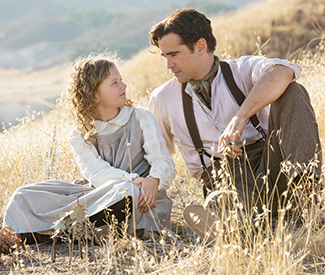
Saving Mr. Banks Having promised his daughters that he would make a movie of their beloved Mary Poppins books, Walt Disney (Tom Hanks) has laid polite siege to author P.L. Travers (Emma Thompson) for over 20 years. Now, in the early 1960s, she has finally consented to discuss the matter in Los Angeles — albeit with great reluctance, and only because royalty payments have dried up to the point where she might have to sell her London home. Bristling at being called “Pam” and everything else in this sunny SoCal and relentlessly cheery Mouse House environ, the acidic English spinster regards her creation as sacred. The least proposed changes earn her horrified dismissal, and the very notion of having Mary and company “prancing and chirping” out songs amid cartoon elements is taken as blasphemy. This clash of titans could have made for a barbed comedy with satirical elements, but god forbid this actual Disney production should get so cheeky. Instead, we get the formulaically dramatized tale of a shrew duly tamed by all-American enterprise, with flashbacks to the inevitable past traumas (involving Colin Farrell as a beloved but alcoholic ne’er-do-well father) that require healing of Travers’ wounded inner child by the magic of the Magic Kingdom. If you thought 2004’s Finding Neverland was contrived feel-good stuff, you’ll really choke on the spoons full of sugar force-fed here. (2:06) 1000 Van Ness, Presidio, SF Center, Shattuck. (Harvey)

The Secret Life of Walter Mitty Walter Mitty (Ben Stiller) works at the Life magazine archives, where the world’s greatest photojournalists send him images of their extraordinary adventures. Walter lives vicariously. When he imagines his office crush (Kristen Wiig) trapped in a burning building, his inner superhero arrests his faculties and sends him flying through windows, racing up stairs to liberate children from their flaming homes. It’s all a fantasy, of course: the man works in a basement with pictures and George Bailey-styled dreams of travel, what does he have but his imagination to keep him warm? Turns out his workplace is planning to kill off its print edition and become LifeOnline — so facing the end of Life, and imminent quiet desperation, this office-mouse is tasked with delivering the last cover the magazine will ever have. But frame 25 on the contact sheet — the one the magazine’s star photog (Sean Penn) calls “The Quintessence of Life” — is blank. Instead of crying defeat, Walter goes on a hunt for the photographer, his avatar of rugged outdoorsmanship, and the realization of his dreams of adventure. It’s liberating to watch him take risks — Stiller says years of watching Danny Kaye movies (Kaye starred in the 1947 adaptation of James Thurber’s short story) inspired the awkwardly balletic gestures of roving, frightened, ultimately exuberant Walter. The film, which Stiller also directed, is ultimately a dreamy parable about getting caught up in imagination — or just confusing images for real life — both of which feel timely in a world where libraries are cyberplaces and you can play “tennis” in front of your couch. The kind of guy who thought the biggest threat was making the first move, Walter learns differently when he takes actual risks: there is magic in this. (2:05) 1000 Van Ness, SF Center. (Vizcarrondo)

A Touch of Sin This bleak, gritty latest from Jia Zhangke (2004’s The World) is said to be based on actual incidents of violence in China. The writer-director also drew inspiration — as the title suggests — from King Hu’s martial arts epic A Touch of Zen (1971). And despite some scattered Buddhist references, sin — delivered in heavy doses, hardly just “a touch” — reigns over zen in the film’s four barely connected stories. Before the credits finish rolling, we’ve witnessed a stone-faced man in a Chicago Bulls beanie (Wang Baoqiang) respond to a trio of roadside muggers with a hail of bullets. Is he a vigilante, or did the robbers just mess with the wrong motorcyclist? Next, we visit “Black Gold Mountain,” site of a coal mine whose profits have been funneled into the pockets of its obscenely rich owner and the corrupt local village chief, who’s prone to put-downs like “You’ll be a loser all your life.” On the receiving end of that insult is worker Dahai (the magnetic Wu Jiang), a human pressure cooker of rage and resentment. Later, we pick up the thread of the man in the Bulls hat. He’s a migrant worker, traveling home to a mother who ignores him and a wife who insists “I don’t want your money.” Another fractured family appears in the film’s next chapter, as a woman (Zhao Tao, Jia’s wife and muse) gives her married boyfriend an ultimatum. As the man’s train rumbles away (A Touch of Sin’s characters are constantly in motion: trains, buses, motorcycles, riding in the backs of trucks, etc.), she travels to her job, working the front desk at “Nightcomer Sauna,” as unglamorous a joint as the name suggests. When a pair of wealthy customers decide she’s on the menu (“I’ll smother you with money, bitch!”), she’s forced to defend herself, with blood-drenched consequences. In the film’s final segment, we follow a young man drifting between jobs, finally settling into soul-stifling tech-gadget factory work. That his company housing is dubbed the “Oasis of Prosperity” would be funny, if it wasn’t so depressing. In A Touch of Sin‘s final scene, the film’s one potentially salvageable character passes by an opera being performed in the street. “Do you understand your sin?” the singer warbles. The character pauses, remembering what happened — and why it had to happen. So do we. And yes, we understand. (2:13) Roxie, Smith Rafael. (Eddy)

12 Years a Slave Pop culture’s engagement with slavery has always been uneasy. Landmark 1977 miniseries Roots set ratings records, but the prestigious production capped off a decade that had seen some more questionable endeavors, including 1975 exploitation flick Mandingo — often cited by Quentin Tarantino as one of his favorite films; it was a clear influence on his 2012 revenge fantasy Django Unchained, which approached its subject matter in a manner that paid homage to the Westerns it riffed on: with guns blazing. By contrast, Steve McQueen’s 12 Years a Slave is nuanced and steeped in realism. Though it does contain scenes of violence (deliberately captured in long takes by regular McQueen collaborator Sean Bobbitt, whose cinematography is one of the film’s many stylistic achievements), the film emphasizes the horrors of “the peculiar institution” by repeatedly showing how accepted and ingrained it was. Slave is based on the true story of Solomon Northup, an African American man who was sold into slavery in 1841 and survived to pen a wrenching account of his experiences. He’s portrayed here by the powerful Chiwetel Ejiofor. Other standout performances come courtesy of McQueen favorite Michael Fassbender (as Epps, a plantation owner who exacerbates what’s clearly an unwell mind with copious amounts of booze) and newcomer Lupita Nyong’o, as a slave who attracts Epps’ cruel attentions. (2:14) Embarcadero, Shattuck. (Eddy)

Walking With Dinosaurs Like hungry, fast-moving Chirostenotes, movieland has a habit of poaching from all comers, be it a toy, video game, or here, a hugely successful 1999 BBC documentary miniseries of the same name. This 3D hamburger version of the award-winning six-parter plays to dinos’ most avid audience, traditionally — kids — by anthropomorphizing runt Pachyrhinosaurus, otherwise known as Patchi (voiced by Justin Long), as the scrappy young hero of this adventure and dramatizing life-and-death migrations his herd undertakes each year as rites of passage. Framing the adventure is a present-day dig with archaeologist Zack (Karl Urban), his skeptical nephew (Charlie Rowe), and gung-ho niece (Angourie Rice). With a broken 70 million-year-old tooth in hand — and with help from prehistoric Alexomis bird Alex (John Leguizamo, who provides most of the levity), we learn about Patchi, his brother Scowler (Skyler Stone), and their herd of horned, thick-noised lizards as they make their way south for winter and back, encountering multiple dangers and predators, as well as let’s-make-a-family delights in the form of young female Juniper (Tiya Sircar) along with way. Count on the CGI to be seamless, the 3D to come in handy when it comes to incoming Quetzalcoatlus, and the choice of not having the lizards’ lips move as they speak to seem tasteful and wise — especially when it comes dubbing for a global audience. (1:27) Metreon. (Chun)

The Wolf of Wall Street Three hours long and breathless from start to finish, Martin Scorsese’s tale of greed, stock-market fraud, and epic drug consumption has a lot going on — and the whole thing hinges on a bravado, breakneck performance by latter-day Scorsese muse Leonardo DiCaprio. As real-life sleaze Jordan Belfort (upon whose memoir the film is based), he distills all of his golden DiCaprio-ness into a loathsome yet maddeningly likable character who figures out early in his career that being rich is way better than being poor, and that being fucked-up is, likewise, much preferable to being sober. The film also boasts keen supporting turns from Jonah Hill (as Belfort’s crass, corrupt second-in-command), Matthew McConaughey (who has what amounts to a cameo — albeit a supremely memorable one — as Belfort’s coke-worshiping mentor), Jean Dujardin (as a slick Swiss banker), and newcomer Margot Robbie (as Belfort’s cunning trophy wife). But this is primarily the Leo and Marty Show, and is easily their most entertaining episode to date. Still, don’t look for an Oscar sweep: Scorsese just hauled huge for 2011’s Hugo, and DiCaprio’s flashy turn will likely be passed over by voters more keen on honoring subtler work in a shorter film. (2:59) California, Marina, 1000 Van Ness, SF Center, Sundance Kabuki, Vogue. (Eddy) *

 

Film Listings: January 15 – 21, 2014

0

Film listings are edited by Cheryl Eddy. Reviewers are Kimberly Chun, Dennis Harvey, Lynn Rapoport, Sam Stander, and Sara Maria Vizcarrondo. For rep house showtimes, see Rep Clock.

OPENING

Devil’s Due A newlywed couple find themselves dealing with a sudden, probably Satanic pregnancy in this found-footage flick from horror filmmaking collective Radio Silence (who directed the final segment — the Halloween party gone demonically awry — in 2012’s V/H/S). (1:29)

The Girls in the Band Judy Chaikin’s upbeat documentary is in step with the recent, not-unwelcome trend of bringing overlooked musicians into the spotlight (think last year’s Twenty Feet from Stardom and A Band Called Death). The Girls in the Band takes a chronological look at women in the big-band and jazz scenes, taking the 1958’s “A Great Day in Harlem” as a visual jumping-off point, sharing the stories of two (out of just three) women who posed amid that sea of male musicians. One is British pianist Marian McPartland, who’s extensively featured in interviews shot before her death last year; the other is gifted composer and arranger Mary Lou Williams, who died in 1981 but left behind a rich legacy that still inspires. Others featured in this doc (which culminates in a re-creation of that famous Harlem photo shoot — with all-female subjects this time) include saxophone- and trumpet-playing members of the multi-racial, all-female International Sweethearts of Rhythm, which toured the segregated south at great peril during the 1930s and was a favorite among African American servicemen during World War II. No matter her race, nearly every woman interviewed cites the raging sexism inherent in the music biz — but the film’s final third, which focuses on contemporary successes like Esperanza Spalding, suggests that stubborn roadblock is finally being chipped away. (1:26) Opera Plaza, Smith Rafael. (Eddy)

Jack Ryan: Shadow Recruit Kenneth Branagh directs Chris “Captain Kirk” Pine in this latest film focused on Tom Clancy’s iconic spy character. (1:45) Marina.

The Nut Job Animated comedy about squirrels starring the voices of Will Arnett, Liam Neeson, and Maya Rudolph. (1:26)

Ride Along Tim Story (2012’s Think Like a Man) directs Ice Cube and Kevin Hart in this buddy comedy about a cop who’s forced to team up with his future brother-in-law. (1:40)

The Square Like the single lit candle at the very start of The Square — a flicker of hope amid the darkness of Mubarak’s 30-year dictatorship — the initial street scenes of the leader’s Feb. 11, 2011, announcement that he was stepping down launch Jehane Noujaim’s documentary on a euphoric note. It’s a lot to take in: the evocative shots of Tahrir Square, the graffiti on the streets, the movement’s troubadours, and the faces of the activists she follows — the youthful Ahmed Hassan, British-reared Kite Runner (2007) actor-turned-citizen journalist Khalid Abdalla, and Muslim Brotherhood acolyte Magdy Ashour, among them. Yet that first glimmer of joy and unity among the diverse individuals who toppled a dictatorship was only the very beginning of a journey — which the Egyptian American Noujaim does a remarkable job documenting, in all its twists, turns, multiple protests, and voices. Unflinching albeit even-handed footage of the turnabouts, hypocrisies, and injustices committed by the Brotherhood, powers-that-be, the army, and the police during the many actions occurring between 2011 and the 2013 removal of Mohammed Morsi will stay with you, including the sight of a tank plowing down protestors with murderous force and soldiers firing live rounds at activists armed only with stones. “We found ourselves loving each other without realizing it,” says Hassan of those heady first days, and Noujaim brings you right there and to their aftermath, beautifully capturing ordinary people coming together, eating, joking, arguing, feeling empowered and discouraged, forming unlikely friendships, setting up makeshift hospitals on the street, and risking everything, in this powerful document of an unfolding real-life epic. (1:44) Roxie. (Chun)

ONGOING

American Hustle David O. Russell’s American Hustle is like a lot of things you’ve seen before — put in a blender, so the results are too smooth to feel blatantly derivative, though here and there you taste a little Boogie Nights (1997), Goodfellas (1990), or whatever. Loosely based on the Abscam FBI sting-scandal of the late 1970s and early ’80s (an opening title snarks “Some of this actually happened”), Hustle is a screwball crime caper almost entirely populated by petty schemers with big ideas almost certain to blow up in their faces. It’s love, or something, at first sight for Irving Rosenfeld (Christian Bale) and Sydney Prosser (Amy Adams), who meet at a Long Island party circa 1977 and instantly fall for each other — or rather for the idealized selves they’ve both strained to concoct. He’s a none-too-classy but savvy operator who’s built up a mini-empire of variably legal businesses; she’s a nobody from nowhere who crawled upward and gave herself a bombshell makeover. The hiccup in this slightly tacky yet perfect match is Irving’s neglected, crazy wife Rosalyn (Jennifer Lawrence), who’s not about to let him go. She’s their main problem until they meet Richie DiMaso (Bradley Cooper), an ambitious FBI agent who entraps the two while posing as a client. Their only way out of a long prison haul, he says, is to cooperate in an elaborate Atlantic City redevelopment scheme he’s concocted to bring down a slew of mafioso and presumably corrupt politicians, hustling a beloved Jersey mayor (Jeremy Renner) in the process. Russell’s filmmaking is at a peak of populist confidence it would have been hard to imagine before 2010’s The Fighter, and the casting here is perfect down to the smallest roles. But beyond all clever plotting, amusing period trappings, and general high energy, the film’s ace is its four leads, who ingeniously juggle the caricatured surfaces and pathetic depths of self-identified “winners” primarily driven by profound insecurity. (2:17) Four Star, Metreon, 1000 Van Ness, Presidio, Shattuck, Sundance Kabuki. (Harvey)

Anchorman 2: The Legend Continues Look, I fully understand that Anchorman 2: The Legend Continues — which follows the awkward lumberings of oafish anchor Ron Burgundy (Will Ferrell) and his equally uncouth team (Paul Rudd, Steve Carell, David Koechner) as they ditch San Diego in favor of New York’s first 24-hour news channel, circa 1980 — is not aimed at film critics. It’s silly, it’s tasteless, and it’s been crafted purely for Ferrell fans, a lowbrow army primed to gobble up this tale of Burgundy’s national TV rise and fall (and inevitable redemption), with a meandering storyline that includes chicken-fried bat, a pet shark, an ice-skating sequence, a musical number, epic amounts of polyester, lines (“by the bedpan of Gene Rayburn!”) that will become quoteable after multiple viewings, and the birth of infotainment as we know it. But what if a film critic happened to be a Ferrell fan, too? What if, days later, that film critic had a flashback to Anchorman 2‘s amplified news-crew gang war (no spoilers), and guffawed at the memory? I am fully aware that this ain’t a masterpiece. But I still laughed. A lot. (1:59) Metreon, 1000 Van Ness. (Eddy)

August: Osage County Considering the relative infrequency of theater-to-film translations today, it’s a bit of a surprise that Tracy Letts had two movies made from his plays before he even got to Broadway. Bug and Killer Joe proved a snug fit for director William Friedkin (in 2006 and 2011, respectively), but both plays were too outré for the kind of mainstream success accorded 2007’s August: Osage County, which won the Pulitzer, ran 18 months on Broadway, and toured the nation. As a result, August was destined — perhaps doomed — to be a big movie, the kind that shoehorns a distracting array of stars into an ensemble piece, playing jes’ plain folk. But what seemed bracingly rude as well as somewhat traditional under the proscenium lights just looks like a lot of reheated Country Gothic hash, and the possibility of profundity you might’ve been willing to consider before is now completely off the menu. If you haven’t seen August before (or even if you have), there may be sufficient fun watching stellar actors chew the scenery with varying degrees of panache — Meryl Streep (who else) as gorgon matriarch Violet Weston; Sam Shepard as her long-suffering spouse; Julia Roberts as pissed-off prodigal daughter Barbara (Julia Roberts), etc. You know the beats: Late-night confessions, drunken hijinks, disastrous dinners, secrets (infidelity, etc.) spilling out everywhere like loose change from moth-eaten trousers. The film’s success story, I suppose, is Roberts: She seems very comfortable with her character’s bitter anger, and the four-letter words tumble past those jumbo lips like familiar friends. On the downside, there’s Streep, who’s a wizard and a wonder as usual yet also in that mode supporting the naysayers’ view that such conspicuous technique prevents our getting lost in her characters. If Streep can do anything, then logic decrees that includes being miscast. (2:10) Albany, Balboa, Metreon, 1000 Van Ness, Presidio, Sundance Kabuki. (Harvey)

Blue is the Warmest Color The stars (Adèle Exarchopoulos and Léa Seydoux) say the director was brutal. The director says he wishes the film had never been released (but he might make a sequel). The graphic novelist is uncomfortable with the explicit 10-minute sex scene. And most of the state of Idaho will have to wait to see the film on Netflix. The noise of recrimination, the lesser murmur of backpedaling, and a difficult-to-argue NC-17 rating could make it harder, as French director Abdellatif Kechiche has predicted, to find a calm, neutral zone in which to watch Blue is the Warmest Color, his Palme d’Or–winning adaptation (with co-writer Ghalya Lacroix) of Julie Maroh’s 2010 graphic novel Le Blue Est une Couleur Chaude. But once you’ve committed to the three-hour runtime, it’s not too difficult to tune out all the extra noise and focus on a film that trains its mesmerized gaze on a young woman’s transforming experience of first love. (2:59) Opera Plaza. (Rapoport)

Blue Jasmine The good news about Blue Jasmine isn’t that it’s set in San Francisco, but that it’s Woody Allen’s best movie in years. Although some familiar characteristics are duly present, it’s not quite like anything he’s done before, and carries its essentially dramatic weight more effectively than he’s managed in at least a couple decades. Not long ago Jasmine (a fearless Cate Blanchett) was the quintessential Manhattan hostess, but that glittering bubble has burst — exactly how revealed in flashbacks that spring surprises up to the script’s end. She crawls to the West Coast to “start over” in the sole place available where she won’t be mortified by the pity of erstwhile society friends. That would be the SF apartment of Ginger (Sally Hawkins), a fellow adoptive sister who was always looked down on by comparison to pretty, clever Jasmine. Theirs is an uneasy alliance — but Ginger’s too big-hearted to say no. It’s somewhat disappointing that Blue Jasmine doesn’t really do much with San Francisco. Really, the film could take place anywhere — although setting it in a non-picture-postcard SF does bolster the film’s unsettled, unpredictable air. Without being an outright villain, Jasmine is one of the least likable characters to carry a major US film since Noah Baumbach’s underrated Margot at the Wedding (2007); the general plot shell, moreover, is strongly redolent of A Streetcar Named Desire. But whatever inspiration Allen took from prior works, Blue Jasmine is still distinctively his own invention. It’s frequently funny in throwaway performance bits, yet disturbing, even devastating in cumulative impact. (1:38) Opera Plaza. (Harvey)

Dallas Buyers Club Dallas Buyers Club is the first all-US feature from Jean-Marc Vallée. He first made a splash in 2005 with C.R.A.Z.Y., which seemed an archetype of the flashy, coming-of-age themed debut feature. Vallée has evolved beyond flashiness, or maybe since C.R.A.Z.Y. he just hasn’t had a subject that seemed to call for it. Which is not to say Dallas is entirely sober — its characters partake from the gamut of altering substances, over-the-counter and otherwise. But this is a movie about AIDS, so the purely recreational good times must eventually crash to an end. Which they do pretty quickly. We first meet Ron Woodroof (Matthew McConaughey) in 1986, a Texas good ol’ boy endlessly chasing skirts and partying nonstop. Not feeling quite right, he visits a doctor, who informs him that he is HIV-positive. His response is “I ain’t no faggot, motherfucker” — and increased partying that he barely survives. Afterward, he pulls himself together enough to research his options, and bribes a hospital attendant into raiding its trial supply of AZT for him. But Ron also discovers the hard way what many first-generation AIDS patients did — that AZT is itself toxic. He ends up in a Mexican clinic run by a disgraced American physician (Griffin Dunne) who recommends a regime consisting mostly of vitamins and herbal treatments. Ron realizes a commercial opportunity, and finds a business partner in willowy cross-dresser Rayon (Jared Leto). When the authorities keep cracking down on their trade, savvy Ron takes a cue from gay activists in Manhattan and creates a law evading “buyers club” in which members pay monthly dues rather than paying directly for pharmaceutical goods. It’s a tale that the scenarists (Craig Borten and Melisa Wallack) and director steep in deep Texan atmospherics, and while it takes itself seriously when and where it ought, Dallas Buyers Club is a movie whose frequent, entertaining jauntiness is based in that most American value: get-rich-quick entrepreneurship. (1:58) Embarcadero, Piedmont, Shattuck. (Harvey)

47 Ronin (2:00) Metreon, 1000 Van Ness.

Frozen (1:48) Metreon, 1000 Van Ness, Shattuck.

Gravity “Life in space is impossible,” begins Gravity, the latest from Alfonso Cuarón (2006’s Children of Men). Egghead Dr. Ryan Stone (Sandra Bullock) is well aware of her precarious situation after a mangled satellite slams into her ship, then proceeds to demolition-derby everything (including the International Space Station) in its path. It’s not long before she’s utterly, terrifyingly alone, and forced to unearth near-superhuman reserves of physical and mental strength to survive. Bullock’s performance would be enough to recommend Gravity, but there’s more to praise, like the film’s tense pacing, spare-yet-layered script (Cuarón co-wrote with his son, Jonás), and spectacular 3D photography — not to mention George Clooney’s warm supporting turn as a career astronaut who loves country music almost as much as he loves telling stories about his misadventures. (1:31) Metreon. (Eddy)

The Great Beauty The latest from Paolo Sorrentino (2008’s Il Divo) arrives as a high-profile contender for the Best Foreign Language Film Oscar, already annointed a masterpiece in some quarters, and duly announcing itself as such in nearly every grandiose, aesthetically engorged moment. Yes, it seems to say, you are in the presence of this auteur’s masterpiece. But it’s somebody else’s, too. The problem isn’t just that Fellini got there first, but that there’s room for doubt whether Sorrentino’s homage actually builds on or simply imitates its model. La Dolce Vita (1960) and 8 1/2 (1963) are themselves swaying, jerry-built monuments, exhileratingly messy and debatably profound. But nothing quite like them had been seen before, and they did define a time of cultural upheaval — when traditional ways of life were being plowed under by a loud, moneyed, heedless modernity that for a while chose Rome as its global capital. Sorrentino announces his intention to out-Fellini Fellini in an opening sequence so strenuously flamboyant it’s like a never-ending pirouette performed by a prima dancer with a hernia. There’s statuary, a women’s choral ensemble, an on-screen audience applauding the director’s baffled muse Toni Servillo, standing in for Marcello Mastroianni — all this and more in manic tracking shots and frantic intercutting, as if sheer speed alone could supply contemporary relevancy. Eventually The Great Beauty calms down a bit, but still its reason for being remains vague behind the heavy curtain of “style.” (2:22) Opera Plaza, Shattuck. (Harvey)

Her Morose and lonely after a failed marriage, Theodore (Joaquin Phoenix) drifts through an appealingly futuristic Los Angeles (more skyscrapers, less smog) to his job at a place so hipster-twee it probably will exist someday: beautifulhandwrittenletters.com, where he dictates flowery missives to a computer program that scrawls them onto paper for paying customers. Theodore’s scripting of dialogue between happy couples, as most of his clients seem to be, only enhances his sadness, though he’s got friends who care about him (in particular, Amy Adams as Amy, a frumpy college chum) and he appears to have zero money woes, since his letter-writing gig funds a fancy apartment equipped with a sweet video-game system. Anyway, women are what gives Theodore trouble — and maybe by extension, writer-director Spike Jonze? — so he seeks out the ultimate gal pal: Samantha, an operating system voiced by Scarlett Johansson in the year’s best disembodied performance. Thus begins a most unusual relationship, but not so unusual; Theodore’s friends don’t take any issue with the fact that his new love is a machine. Hey, in Her‘s world, everyone’s deeply involved with their chatty, helpful, caring, always-available OS — why wouldn’t Theo take it to the next level? Inevitably, of course, complications arise. If Her‘s romantic arc feels rather predictable, the film acquits itself in other ways, including boundlessly clever production-design touches that imagine a world with technology that’s (mostly) believably evolved from what exists today. Also, the pants they wear in the future? Must be seen to be believed. (2:00) 1000 Van Ness, Piedmont, Presidio, SF Center, Shattuck, Sundance Kabuki. (Eddy)

The Hobbit: The Desolation of Smaug Just when you’d managed to wipe 2012’s unwieldy The Hobbit: An Unexpected Journey from your mind, here comes its sequel — and it’s actually good! Yes, it’s too long (Peter Jackson wouldn’t have it any other way); arachnophobes (and maybe small children) will have trouble with the creepy, giant-spider battle; and Orlando Bloom, reprising his Lord of the Rings role as Legolas the elf, has been CG’d to the point of looking like he’s carved out of plastic. But there’s much more to enjoy this time around, with a quicker pace (no long, drawn-out dinner parties); winning performances by Martin Freeman (Bilbo), Ian McKellan (Gandalf); and Benedict Cumberbatch (as the petulent voice of Smaug the dragon); and more shape to the quest, as the crew of dwarves seeks to reclaim their homeland, and Gandalf pokes into a deeper evil that’s starting to overtake Middle-earth. (We all know how that ends.) In addition to Cumberbatch, the cast now includes Lost‘s Evangeline Lilly as elf Tauriel, who doesn’t appear in J.R.R. Tolkien’s original story, but whose lady-warrior presence is a welcome one; and Luke Evans as Bard, a human poised to play a key role in defeating Smaug in next year’s trilogy-ender, There and Back Again. (2:36) Metreon, 1000 Van Ness, Sundance Kabuki. (Eddy)

The Hunger Games: Catching Fire Before succumbing to the hot and heavy action inside the arena (intensely directed by Francis Lawrence) The Hunger Games: Catching Fire force-feeds you a world of heinous concept fashions that’d make Lady Gaga laugh. But that’s ok, because the second film about one girl’s epic struggle to change the world of Panem may be even more exciting than the first. Suzanne Collins’ YA novel The Hunger Games was an over-literal metaphor for junior high social survival and the glory of Catching Fire is that it depicts what comes after you reach the cool kids’ table. Katniss (Jennifer Lawrence) inspired so much hope among the 12 districts she now faces pressures from President Snow (a portentous Donald Sutherland) and the fanatical press of Capital City (Stanley Tucci with big teeth and Toby Jones with big hair). After she’s forced to fake a romance with Peeta (Josh Hutcherson), the two watch with horror as they’re faced with a new Hunger Game: for returning victors, many of whom are too old to run. Amanda Plummer and Jeffrey Wright are fun as brainy wackjobs and Jena Malone is hilariously Amazonian as a serial axe grinder still screaming like an eighth grader. Inside the arena, alliances and rivalries shift but the winner’s circle could survive to see another revolution; to save this city, they may have to burn it down. (2:26) Metreon, 1000 Van Ness, Shattuck, Sundance Kabuki. (Vizcarrondo)

I Am Divine Bringing joy to a lot of people during his too-brief life was Glenn Milstead, the subject of Jeffrey Schwarz’s I Am Divine. A picked-on sissy fat kid, he blossomed upon discovering Baltimore’s gay underground — and starring in neighbor John Waters’ underground movies, made by and for the local “freak” scene they hung out in. Yet even their early efforts found a following; when “Divine” appeared in SF to perform at one of the Cockettes’ midnight movie/theater happenings, he was greeted as a star. This was before his greatest roles for Waters, as the fearsome anti-heroines of Pink Flamingos (1972) and Female Trouble (1974), then the beleaguered hausfraus of Polyester (1981) and Hairspray (1988). Despite spending nearly his entire career in drag, he wanted to be thought of as a character actor, not a “transvestite” novelty. Sadly, he seemed on the verge of achieving that — having been signed to play an ongoing male role on Married … with Children — when he died of respiratory failure in 1988, at age 42. (1:25) Roxie. (Harvey)

Inside Llewyn Davis In the Coen Brothers’ latest, Oscar Isaac as the titular character is well on his way to becoming persona non grata in 1961 NYC — particularly in the Greenwich Village folk music scene he’s an ornery part of. He’s broke, running out of couches to crash on, has recorded a couple records that have gone nowhere, and now finds out he’s impregnated the wife (Carey Mulligan) and musical partner of one among the few friends (Justin Timberlake) he has left. She’s furious with herself over this predicament, but even more furious at him. This ambling, anecdotal tale finds Llewyn running into one exasperating hurdle after another as he burns his last remaining bridges, not just in Manhattan but on a road trip to Chicago undertaken with an overbearing jazz musician (John Goodman) and his enigmatic driver (Garrett Hedlund) to see a club impresario (F. Murray Abraham). This small, muted, droll Coens exercise is perfectly handled in terms of performance and atmosphere, with pleasures aplenty in its small plot surprises, myriad humorous idiosyncrasies, and T. Bone Burnett’s sweetened folk arrangements. But whether it actually has anything to say about its milieu (a hugely important Petri dish for later ’60s political and musical developments), or adds up to anything more profound than an beautifully executed shaggy-dog story, will be a matter of personal taste — or perhaps of multiple viewings. (1:45) Balboa, California, Embarcadero, 1000 Van Ness, Piedmont, Sundance Kabuki. (Harvey)

The Invisible Woman Charles Dickens was a regular scold of the British class system and its repercussions, particularly the gentry’s general acceptance that poverty was something the bottom rung of society was suited for, perhaps even deserved. Given how many in positions of power would have preferred such issues go ignored, it was all the more important their highest-profile advocate be of unimpeachable “moral character” — which in the Victorian era meant a very high standard of conduct indeed. So it remains remarkable that in long married middle-age he heedlessly risked scandal and possible career-ruin by taking on a much younger mistress. Both she and he eventually burned all their mutual correspondence, so Claire Tomalin’s biography The Invisible Woman is partly a speculative work. But it and now Ralph Fiennes’ film of the same name are fascinating glimpses into the clash between public life and private passion in that most judgmentally prudish of epochs. Framed by scenes of its still-secretive heroine several years after the central events, the movie introduces us to a Dickens (Fiennes) who at mid-career is already the most famous man in the UK. In his lesser-remembered capacity as a playwright and director, at age 45 (in 1857) he hired 18-year-old actress Nelly Ternan (Felicity Jones) for an ingénue role. He was instantly smitten; she was, at the least, awed by this great man’s attention. Their professional association permitted some further contact without generating much gossip. But eventually Dickens chafed at the restraints necessary to avoid scandal — no matter the consequences to himself, let alone his wife, his 10 (!) children, or Ternan herself. Fiennes, by all accounts an exceptional Shakespearean actor on stage, made a strong directorial debut in 2011 with that guy’s war play, Coriolanus — a movie that, like this one, wasn’t enough of a conventional prestige film or crowd-pleaser to surf the awards-season waves very long. But they’re both films of straightforward confidence, great intelligence, and unshowy good taste that extends to avoiding any vanity project whiff. (1:51) Embarcadero, Shattuck. (Harvey)

The Legend of Hercules What better reason to wield the blunt force of 3D than to highlight the muscle-bound glory of a legendary hero — and, of course, foreground his impressive six-pack abs and impudently jutting nipples. Lead Kellan Lutz nails the eye candy aspect in this sword ‘n’ sandals effort by Renny Harlin (aka the man who capsized Geena Davis’s career), though it’s hard to take him seriously when he looks less like the hirsute, leonine hero depicted in ancient artwork than an archetypal, thick-necked, clean-shaven, all-American handsome-jock star (Lutz’s resemblance to Tom Brady is uncanny). Still, glistening beefcake is a fact of life at toga parties, and it’s clearly a large part of the appeal in this corny popcorner about Greek mythology’s proto-superhero. The Legend of Hercules is kitted out to conquer teen date nights around the world, with a lot of bloodless PG-13 violence for the boys and flower-petal-filled nuzzle-fests between Herc and Hebe (Gaia Weiss) for the girls, along with the added twist that Hercules’s peace-loving mother Alcmene conceived him with Zeus — with Hera’s permission — in order to halt her power-mad brute of a spouse King Amphitryon (Scott Adkins). In any case Harlin and company can’t leave well enough alone and piledrive each action scene with way too much super-slo-mo, as if mainlining the Matrix films in the editing booth to guarantee the attention of critical overseas markets and future installments. And the cheesy badness of certain scenes, like Hercules twirling the broken stone walls he destroys like a pair of giant fuzzy dice, can’t be denied. We all know how rich and riveting Greek mythology is, and by Hera, if the original, complicated Heracles is ever truly encapsulated on film, I hope it’s by Lars von Trier or another moviemaker capable of adequately harnessing a bisexual demi-god of enormous appetites and heroism. (1:38) 1000 Van Ness, SF Center, Shattuck. (Chun)

Lone Survivor Peter Berg (2012’s Battleship, 2007’s The Kingdom) may officially be structuring his directing career around muscular tails of bad-assery. This true story follows a team of Navy SEALs on a mission to find a Taliban group leader in an Afghani mountain village. Before we meet the actors playing our real-life action heroes we see training footage of actual SEALs being put through their paces; it’s physical hardship structured to separate the tourists from the lifers. The only proven action star in the group is Mark Wahlberg — as Marcus Luttrell, who wrote the film’s source-material book. His funky bunch is made of heartthrobs and sensitive types: Taylor Kitsch (TV’s Friday Night Lights); Ben Foster, who last portrayed William S. Burroughs in 2013’s Kill Your Darlings but made his name as an officer breaking bad news gently to war widows in 2009’s The Messenger; and Emile Hirsch, who wandered into the wilderness in 2007’s Into the Wild. We know from the outset who the lone survivors won’t be, but the film still manages to convey tension and suspense, and its relentlessness is stunning. Foster throws himself off a cliff, bounces off rocks, and gets caught in a tree — then runs to his also-bloody brothers to report, “That sucked.” (Yesterday I got a paper cut and tweeted about it.) But the takeaway from this brutal battle between the Taliban and America’s Real Heroes is that the man who lived to tell the tale also offers an olive branch to the other side — this survivor had help from the non-Taliban locals, a last-act detail that makes Lone Survivor this Oscar season’s nugget of political kumbaya. (2:01) Metreon, 1000 Van Ness, Sundance Kabuki. (Vizcarrondo)

Nebraska Alexander Payne may be unique at this point in that he’s in a position of being able to make nothing but small, human, and humorous films with major-studio money on his own terms. It’s hazardous to make too much of a movie like Nebraska, because it is small — despite the wide Great Plains landscapes shot in a wide screen format — and shouldn’t be entered into with overinflated or otherwise wrong-headed expectations. Still, a certain gratitude is called for. Nebraska marks the first time Payne and his writing partner Jim Taylor weren’t involved in the script, and the first one since their 1996 Citizen Ruth that isn’t based on someone else’s novel. (Hitherto little-known Bob Nelson’s original screenplay apparently first came to Payne’s notice a decade ago, but getting put off in favor of other projects.) It could easily have been a novel, though, as the things it does very well (internal thought, sense of place, character nuance) and the things it doesn’t much bother with (plot, action, dialogue) are more in line with literary fiction than commercial cinema. Elderly Woody T. Grant (Bruce Dern) keeps being found grimly trudging through snow and whatnot on the outskirts of Billings, Mont., bound for Lincoln, Neb. Brain fuzzed by age and booze, he’s convinced he’s won a million dollars and needs to collect it him there, though eventually it’s clear that something bigger than reality — or senility, even — is compelling him to make this trek. Long-suffering younger son David (Will Forte) agrees to drive him in order to simply put the matter to rest. This fool’s mission acquires a whole extended family-full of other fools when father and son detour to the former’s podunk farming hometown. Nebraska has no moments so funny or dramatic they’d look outstanding in excerpt; low-key as they were, 2009’s Sideways and 2011’s The Descendants had bigger set pieces and narrative stakes. But like those movies, this one just ambles along until you realize you’re completely hooked, all positive emotional responses on full alert. (1:55) California, Embarcadero, Piedmont. (Harvey)

Paranormal Activity: The Marked Ones (1:24) Metreon, 1000 Van Ness.

The Past Splits in country, culture, and a harder-to-pinpoint sense of morality mark The Past, the latest film by Asghar Farhadi, the first Iranian moviemaker to win an Oscar (for 2011’s A Separation.) At the center of The Past‘s onion layers is a seemingly simple divorce of a binational couple, but that act becomes more complicated — and startlingly compelling — in Farhadi’s capable, caring hands. Ahmad (Ali Mosaffa) has returned to Paris from Tehran, where he’s been living for the past four years, at the request of French wife Marie (Bérénice Bejo of 2011’s The Artist). She wants to legalize their estrangement so she can marry her current boyfriend, Samir (Tahar Rahim of 2009’s A Prophet), whose wife is in a coma. But she isn’t beyond giving out mixed messages by urging Ahmad to stay with her, and her daughters by various fathers, rather than at a hotel — and begging him to talk to teen Lucie (Pauline Burlet), who seems to despise Samir. The warm, nurturing Ahmad falls into his old routine in Marie’s far-from-picturesque neighborhood, visiting a café owned by fellow Iranian immigrants and easily taking over childcare duties for the overwhelmed Marie, as he tries to find out what’s happening with Lucie, who’s holding onto a secret that could threaten Marie’s efforts to move on. The players here are all wonderful, in particular the sad-faced, humane Mosaffa. We never really find out what severed his relationship with Marie, but in the end, it doesn’t really matter. We care about, and end up fearing for, all of Farhadi’s everyday characters, who are observed with a tender and unsentimental understanding that US filmmakers could learn from. The effect, when he finally racks focus on the forgotten member of this triangle (or quadrilateral?), is heartbreaking. (2:10) Albany, Clay. (Chun)

Philomena Judi Dench gives this twist on a real-life scandal heart, soul, and a nuanced, everyday heft. Her ideal, ironic foil is Steve Coogan, playing an upper-crusty irreverent snob of an investigative journalist. Judging by her tidy exterior, Dench’s title character is a perfectly ordinary Irish working-class senior, but she’s haunted by the past, which comes tumbling out one day to her daughter: As an unwed teenager, she gave birth to a son at a convent. She was forced to work there, unpaid; as supposed penance, the baby was essentially sold to a rich American couple against her consent. Her yarn reaches disgraced reporter Martin Sixsmith (Coogan), who initially turns his nose up at the tale’s piddling “human interest” angle, but slowly gets drawn in by the unexpected twists and turns of the story — and likely the possibility of taking down some evil nuns — as well as seemingly naive Philomena herself, with her delight in trash culture, frank talk about sex, and simple desire to see her son and know that he thought, once in a while, of her. It turns out Philomena’s own sad narrative has as many improbable turnarounds as one of the cheesy romance novels she favors, and though this unexpected twosome’s quest for the truth is strenuously reworked to conform to the contours of buddy movie-road trip arc that we’re all too familiar with, director Stephen Frears’ warm, light-handed take on the gentle class struggles going on between the writer and his subject about who’s in control of the story makes up for Philomena‘s determined quest for mass appeal. (1:35) Embarcadero, Marina, Shattuck. (Chun)

Saving Mr. Banks Having promised his daughters that he would make a movie of their beloved Mary Poppins books, Walt Disney (Tom Hanks) has laid polite siege to author P.L. Travers (Emma Thompson) for over 20 years. Now, in the early 1960s, she has finally consented to discuss the matter in Los Angeles — albeit with great reluctance, and only because royalty payments have dried up to the point where she might have to sell her London home. Bristling at being called “Pam” and everything else in this sunny SoCal and relentlessly cheery Mouse House environ, the acidic English spinster regards her creation as sacred. The least proposed changes earn her horrified dismissal, and the very notion of having Mary and company “prancing and chirping” out songs amid cartoon elements is taken as blasphemy. This clash of titans could have made for a barbed comedy with satirical elements, but god forbid this actual Disney production should get so cheeky. Instead, we get the formulaically dramatized tale of a shrew duly tamed by all-American enterprise, with flashbacks to the inevitable past traumas (involving Colin Farrell as a beloved but alcoholic ne’er-do-well father) that require healing of Travers’ wounded inner child by the magic of the Magic Kingdom. If you thought 2004’s Finding Neverland was contrived feel-good stuff, you’ll really choke on the spoons full of sugar force-fed here. (2:06) 1000 Van Ness, Presidio, SF Center, Shattuck. (Harvey)

The Secret Life of Walter Mitty Walter Mitty (Ben Stiller) works at the Life magazine archives, where the world’s greatest photojournalists send him images of their extraordinary adventures. Walter lives vicariously. When he imagines his office crush (Kristen Wiig) trapped in a burning building, his inner superhero arrests his faculties and sends him flying through windows, racing up stairs to liberate children from their flaming homes. It’s all a fantasy, of course: the man works in a basement with pictures and George Bailey-styled dreams of travel, what does he have but his imagination to keep him warm? Turns out his workplace is planning to kill off its print edition and become LifeOnline — so facing the end of Life, and imminent quiet desperation, this office-mouse is tasked with delivering the last cover the magazine will ever have. But frame 25 on the contact sheet — the one the magazine’s star photog (Sean Penn) calls “The Quintessence of Life” — is blank. Instead of crying defeat, Walter goes on a hunt for the photographer, his avatar of rugged outdoorsmanship, and the realization of his dreams of adventure. It’s liberating to watch him take risks — Stiller says years of watching Danny Kaye movies (Kaye starred in the 1947 adaptation of James Thurber’s short story) inspired the awkwardly balletic gestures of roving, frightened, ultimately exuberant Walter. The film, which Stiller also directed, is ultimately a dreamy parable about getting caught up in imagination — or just confusing images for real life — both of which feel timely in a world where libraries are cyberplaces and you can play “tennis” in front of your couch. The kind of guy who thought the biggest threat was making the first move, Walter learns differently when he takes actual risks: there is magic in this. (2:05) 1000 Van Ness, SF Center. (Vizcarrondo)

A Touch of Sin This bleak, gritty latest from Jia Zhangke (2004’s The World) is said to be based on actual incidents of violence in China. The writer-director also drew inspiration — as the title suggests — from King Hu’s martial arts epic A Touch of Zen (1971). And despite some scattered Buddhist references, sin — delivered in heavy doses, hardly just “a touch” — reigns over zen in the film’s four barely connected stories. Before the credits finish rolling, we’ve witnessed a stone-faced man in a Chicago Bulls beanie (Wang Baoqiang) respond to a trio of roadside muggers with a hail of bullets. Is he a vigilante, or did the robbers just mess with the wrong motorcyclist? Next, we visit “Black Gold Mountain,” site of a coal mine whose profits have been funneled into the pockets of its obscenely rich owner and the corrupt local village chief, who’s prone to put-downs like “You’ll be a loser all your life.” On the receiving end of that insult is worker Dahai (the magnetic Wu Jiang), a human pressure cooker of rage and resentment. Later, we pick up the thread of the man in the Bulls hat. He’s a migrant worker, traveling home to a mother who ignores him and a wife who insists “I don’t want your money.” Another fractured family appears in the film’s next chapter, as a woman (Zhao Tao, Jia’s wife and muse) gives her married boyfriend an ultimatum. As the man’s train rumbles away (A Touch of Sin’s characters are constantly in motion: trains, buses, motorcycles, riding in the backs of trucks, etc.), she travels to her job, working the front desk at “Nightcomer Sauna,” as unglamorous a joint as the name suggests. When a pair of wealthy customers decide she’s on the menu (“I’ll smother you with money, bitch!”), she’s forced to defend herself, with blood-drenched consequences. In the film’s final segment, we follow a young man drifting between jobs, finally settling into soul-stifling tech-gadget factory work. That his company housing is dubbed the “Oasis of Prosperity” would be funny, if it wasn’t so depressing. In A Touch of Sin‘s final scene, the film’s one potentially salvageable character passes by an opera being performed in the street. “Do you understand your sin?” the singer warbles. The character pauses, remembering what happened — and why it had to happen. So do we. And yes, we understand. (2:13) Roxie, Smith Rafael. (Eddy)

12 Years a Slave Pop culture’s engagement with slavery has always been uneasy. Landmark 1977 miniseries Roots set ratings records, but the prestigious production capped off a decade that had seen some more questionable endeavors, including 1975 exploitation flick Mandingo — often cited by Quentin Tarantino as one of his favorite films; it was a clear influence on his 2012 revenge fantasy Django Unchained, which approached its subject matter in a manner that paid homage to the Westerns it riffed on: with guns blazing. By contrast, Steve McQueen’s 12 Years a Slave is nuanced and steeped in realism. Though it does contain scenes of violence (deliberately captured in long takes by regular McQueen collaborator Sean Bobbitt, whose cinematography is one of the film’s many stylistic achievements), the film emphasizes the horrors of “the peculiar institution” by repeatedly showing how accepted and ingrained it was. Slave is based on the true story of Solomon Northup, an African American man who was sold into slavery in 1841 and survived to pen a wrenching account of his experiences. He’s portrayed here by the powerful Chiwetel Ejiofor. Other standout performances come courtesy of McQueen favorite Michael Fassbender (as Epps, a plantation owner who exacerbates what’s clearly an unwell mind with copious amounts of booze) and newcomer Lupita Nyong’o, as a slave who attracts Epps’ cruel attentions. (2:14) Embarcadero, Shattuck. (Eddy)

Walking With Dinosaurs Like hungry, fast-moving Chirostenotes, movieland has a habit of poaching from all comers, be it a toy, video game, or here, a hugely successful 1999 BBC documentary miniseries of the same name. This 3D hamburger version of the award-winning six-parter plays to dinos’ most avid audience, traditionally — kids — by anthropomorphizing runt Pachyrhinosaurus, otherwise known as Patchi (voiced by Justin Long), as the scrappy young hero of this adventure and dramatizing life-and-death migrations his herd undertakes each year as rites of passage. Framing the adventure is a present-day dig with archaeologist Zack (Karl Urban), his skeptical nephew (Charlie Rowe), and gung-ho niece (Angourie Rice). With a broken 70 million-year-old tooth in hand — and with help from prehistoric Alexomis bird Alex (John Leguizamo, who provides most of the levity), we learn about Patchi, his brother Scowler (Skyler Stone), and their herd of horned, thick-noised lizards as they make their way south for winter and back, encountering multiple dangers and predators, as well as let’s-make-a-family delights in the form of young female Juniper (Tiya Sircar) along with way. Count on the CGI to be seamless, the 3D to come in handy when it comes to incoming Quetzalcoatlus, and the choice of not having the lizards’ lips move as they speak to seem tasteful and wise — especially when it comes dubbing for a global audience. (1:27) Metreon. (Chun)

The Wolf of Wall Street Three hours long and breathless from start to finish, Martin Scorsese’s tale of greed, stock-market fraud, and epic drug consumption has a lot going on — and the whole thing hinges on a bravado, breakneck performance by latter-day Scorsese muse Leonardo DiCaprio. As real-life sleaze Jordan Belfort (upon whose memoir the film is based), he distills all of his golden DiCaprio-ness into a loathsome yet maddeningly likable character who figures out early in his career that being rich is way better than being poor, and that being fucked-up is, likewise, much preferable to being sober. The film also boasts keen supporting turns from Jonah Hill (as Belfort’s crass, corrupt second-in-command), Matthew McConaughey (who has what amounts to a cameo — albeit a supremely memorable one — as Belfort’s coke-worshiping mentor), Jean Dujardin (as a slick Swiss banker), and newcomer Margot Robbie (as Belfort’s cunning trophy wife). But this is primarily the Leo and Marty Show, and is easily their most entertaining episode to date. Still, don’t look for an Oscar sweep: Scorsese just hauled huge for 2011’s Hugo, and DiCaprio’s flashy turn will likely be passed over by voters more keen on honoring subtler work in a shorter film. (2:59) California, Marina, 1000 Van Ness, SF Center, Sundance Kabuki, Vogue. (Eddy) *

 

SFUSD students may get new police protections

0

Students who run afoul of the police may gain new protections under an agreement between the San Francisco Police Department and San Francisco Unified School District up for vote at tomorrow’s Board of Education meeting

The new agreement explicitly calls for parents to be notified when their children are taken into the custody of police, or are questioned as a victim or a witness. The agreement also introduces graduated steps that increase the burden on school administrators and the police to exhaust all other options before arresting a student.

“What we’re outlining in this policy is that the school system has the first responsibility to ensure discipline and safety, but we don’t want to overreact or push students toward the criminal justice system unless it’s absolutely necessary,” Board of Education Commissioner Matt Haney told the Guardian.

Under the current rules, police officers have been known to discipline kindergartners in San Francisco public schools at the behest of school administrators.

The Guardian touched on this issue briefly in our coverage of suspension reform (“Suspending Judgement,” Vol. 48, Issue 10, Dec. 4): 

He was five years old, and as kindergartners sometimes do, he threw a temper tantrum. In the school’s desperation to contain him, officials called the SFPD.

‘The police only came one time,’ Desamuel, now seven, told the Guardian. Sitting in his San Francisco home with his uncle Lionel, Desamuel sounded ashamed. ‘But I didn’t go to jail because they only put kids in jail for being bad, like kids taking guns to school.’

(Desamuel’s uncle and guardian) Lionel struggled with the school’s administration, and asked them to try less punitive ways of handling his nephew. ‘I told them to just hug the boy. Their response was ‘it’s hard to hug someone swinging at you.’

But it wasn’t just that the police were called in to handle his five year old nephew that set off Desamuel’s uncle and guardian, Lionel Hill. It was that they were brought in without his knowledge. 

If the new agreement passes a vote by the board, parents and guardians will be in the disciplinary process with police from the beginning. The disciplinary process itself may change too.

Before the police can bring students into the juvenile justice system, the new rules would allow them a series of graduated offenses. A first offense would bring an official warning notice, a second offense allows the officer to recommend the student into a diversion program, and only on the third offense can an officer bring that student to juvenile probation. 

Since 2009, over 50 students aged 12 or younger have been arrested at school, according to SFPD data compiled by Huckleberry Youth Services. 

United Educators of San Francisco President Dennis Kelley praised the potential for better communication among all involved. “You don’t want things going on with kids that are isolated from the parents,” he told us. “I think having coordination between the board, parents, and police is a positive step.” 

Coleman Advocates, an education and social justice group in San Francisco, was a driving force behind the new changes. 

“We’re putting the responsibility for student behavior back where it belongs, with educators, students, and parents, not with police,” said Karn Saetang, director of Student Organizing at Coleman Advocates. “When police get involved in school discipline, it sends all the wrong messages to students and makes it more likely they will fall behind, fail to graduate, or get involved in the juvenile justice system.” 

These changes come on the heels of new disciplinary reforms tasking the SFUSD with implementing new “restorative practice” interventions in lieu of suspensions, ending zero tolerance discipline that is falling out of favor nationally, according to a recent editorial by the New York Times

It looks like better days are ahead for students in the SFUSD. 

Gimme 5: Must-see shows this week

1

Happy Monday, kids! If you’re feeling the comedown from a solid week of shows celebrating the Rickshaw Stop’s 10th anniversary (read our feature on it here), quit yer whining. Here are a handful of rad upcoming shows to get you out of the house. It’s winter, you’re pale, you need to. 

Tues/14
Black Cobra Vipers

Black Cobra Vipers are an SF-based art-rock trio in which two of three members were jazz majors (bassist Julian Borrego and drummer Rob Mills), a fact which announces itself both through the band’s technical abilities, and through its (mostly) controlled chaos. There are slowed-down funk numbers here; there are nods to ’70s psyche masters; there’s hard-driving, danceable rock and roll, with singer/guitarist Gregory DeMartino’s howls at the helm. Weird enough to keep you guessing, but just poppy enough to get their riffs stuck in  your head, the guys are a quarter of the way through a monthlong residency at the Chapel, so you have three more chances to become a fan.
With French Cassettes, The Netherfriends
The Chapel
777 Valencia, SF
www.thechapelsf.com

http://www.youtube.com/watch?v=3ZTGhgtaW2U

Wed/15

Connan Mockasin
Listening to Connan Mockasin’s “Forever Dolphin Love” (in particular the post-climax/comedown attuned “Rework” by Erol Alkan) for the first time gave me a strange sense of primed nostalgia: it wasn’t that I’d heard the song a hundred times in the past, but the instant recognition that I would be listening to it for the inevitable future. A couple of years later I certainly have, along with the album it came off of and Mockasin’s latest platter of psych pop, Caramel, a Moebius strip of a concept album (based around the concept of what an album entitled “Caramel” would sound like.) But the New Zealand weirdo musician/Ariel Pink doppelganger is only now popping up on a US tour, seemingly having been on an extended European engagement supporting Charlotte Gainsbourg following his underrated guitar work on her Stage Whisper album.   (Ryan Prendiville)
With Disappearing People, Faux Canada
9pm, $10-12
Bottom of the Hill
1233 17th St, SF
www.bottomofthehill.com

Thurs/16

Parquet Courts
Though the band may reside in NYC, the lyric “there’s billionaire buses on my unlit street” should hit close enough to home (if not right on the nose) to remind that Brooklyn isn’t that far away. Full of riffs both frenetically punk and spaciously melodic, Parquet Courts’s Light Up Gold is one of last year’s best. A deceptively effortless mix of slacked out rock songs, it’s a witty blend, with thankfully enough cleverness to know when to be dumb (while doing the inevitable references to Messrs. Reed, Richman, and Malkmus justice.) “Stoned and Starving” has got all the necessary hooks to deliver on a subject that needs no further explanation, but it’s “N. Dakota,” a probably unnecessary but totally enjoyable state-wide diss (with lines like “in Manitoba they call it boring / at night we hum to Canada snoring”) that’s still on replay. (Ryan Prendiville)
With White Fence (co-headliner), CCR Headcleaner
8pm, $16
Great American Music Hall
859 O’Farrell, SF
www.slimspresents.com

http://www.youtube.com/watch?v=iWAdh4YIpd8

Fri/17
Bad News
Replicant Presents’ electronic and experimental noise reaches into Oakland again with a dose of “weird core,” industrial and straight-up sounds out of a horror-film soundtrack. BR-OOKS will have the home-court advantage and push the boundaries of any genre, then the more palpable Names will bring a dancier, more rhythmic approach, while maintaining roots in the realm of noise. But the true industrial strength will be heard when Bad News takes over. This commanding SF/LA guitar and synth duo, comprised of Sarah Bernat and Alex Lukas, should whip you into shape with sounds of precision and perfection. But before they totally slay you, you’ll reflect on any angst past or present and why it feels so right. Look for their new material in 2014! (Andre Torrez)
With Names and BR-OOKS
9pm, $7
The Night Light
311 Broadway, Oakland
www.thenightlightoakland.com
Sun/19
Queer/Trans* Night
Celebrate being queer in the New Year with Gilman’s first Queer/Trans* Night of 2014, when MC Per Sia hosts a night of hard-hitting punk from some of the coolest queers in Bay Area music. The show features masked trio Moira Scar, San Cha, DADDIE$ PLA$TIC, Oakland punks Didisdead, post-punk duo Bestfriend Grrlfriend, and Alice Cunt all the way from LA. Show goers can also look forward to DJ Johnny Rose and a video booth by Lovewarz. This is a safe and sober show, so leave the booze and drugs at home, as well as any racism, misogyny, transphobia, or homophobia. (Kirstie Haruta)
5pm, $5 + $2 membership
924 Gilman St.
924 Gilman, Berkeley
www.924gilman.org


Music Listings: January 8-15, 2014

0

WEDNESDAY 8
ROCK
Bottom of the Hill: 1233 17th St., San Francisco. A Lot Like Birds, Sianvar, Stolas, The Venetia Fair, 8:30 p.m., $12.
El Rio: 3158 Mission, San Francisco. Apogee Sound Club, Grandma’s Boyfriend, UFOFBI, 8 p.m., $1.
Hemlock Tavern: 1131 Polk, San Francisco. Augurs, North, Bloodmoon, 8:30 p.m., $7.
Milk Bar: 1840 Haight, San Francisco. Bonnie & The Bang Bang, Strange Vine, Down & Outlaws, Wag, 8:30 p.m., $5.
Rickshaw Stop: 155 Fell, San Francisco. Rickshaw Stop 10th Anniversary: Mikal Cronin, Cool Ghouls, Cocktails, 8 p.m., $15.
Yoshi’s San Francisco: 1330 Fillmore, San Francisco. The Young Dubliners, 8 p.m., $19-$23.
DANCE
111 Minna Gallery: 111 Minna St., San Francisco. “Qoöl,” w/ D.F. Tram, Marshall Watson, Dulce, Will Spencer, Dan Sherman, Spesh, 5-10 p.m., free.
Beaux: 2344 Market, San Francisco. “BroMance: A Night Out for the Fellas,” 9 p.m., free.
The Cafe: 2369 Market, San Francisco. “Sticky Wednesdays,” w/ DJ Mark Andrus, 8 p.m., free.
Cat Club: 1190 Folsom, San Francisco. “Bondage A Go Go,” w/ DJs Damon, Tomas Diablo, & guests, 9:30 p.m., $5-$10.
Club X: 715 Harrison, San Francisco. “Electro Pop Rocks,” 18+ dance night with Tittsworth, Jays One, DJ Dials, Cocaine at the Disco (SwitchBlade & Mr. Brandon), Jazz-E, Shane Fontane, Dmitri Reign, Cosmo Koyote, 9 p.m., $15-$20.
Edinburgh Castle: 950 Geary, San Francisco. “1964,” w/ DJ Matt B & guests, Second and Fourth Wednesday of every month, 10 p.m., $2.
Elbo Room: 647 Valencia, San Francisco. “Commune,” w/ Pixel Memory, Niteppl, Alien Angel Brigade, Popgang DJs, 9 p.m., free.
The EndUp: 401 Sixth St., San Francisco. “Tainted Techno Trance,” 10 p.m.
F8: 1192 Folsom St., San Francisco. “Housepitality,” 9 p.m., $5-$10.
Infusion Lounge: 124 Ellis, San Francisco. “Indulgence,” 10 p.m.
The Knockout: 3223 Mission, San Francisco. “Disorder,” w/ The Victoriana, PSSNGRS, DJ Nickie, 10 p.m.
Lookout: 3600 16th St., San Francisco. “What?,” w/ resident DJ Tisdale and guests, 7 p.m., free.
Madrone Art Bar: 500 Divisadero, San Francisco. “Rock the Spot,” 9 p.m., free.
MatrixFillmore: 3138 Fillmore, San Francisco. “Reload,” w/ DJ Big Bad Bruce, 10 p.m., free.
Q Bar: 456 Castro, San Francisco. “Booty Call,” w/ Juanita More, Joshua J, guests, 9 p.m., $3.
HIP-HOP
Skylark Bar: 3089 16th St., San Francisco. “Mixtape Wednesday,” w/ resident DJs Strategy, Junot, Herb Digs, & guests, 9 p.m., $5.
Slate Bar: 2925 16th St., San Francisco. “Special Blend,” w/ resident DJs LazyBoy & Mr. Murdock, 9 p.m., free.
ACOUSTIC
Cafe Divine: 1600 Stockton, San Francisco. Craig Ventresco & Meredith Axelrod, 7 p.m., free.
Club Deluxe: 1511 Haight, San Francisco. Happy Hour Bluegrass, 6:30 p.m., free.
Hotel Utah: 500 Fourth St., San Francisco. The Verms, Sister Exister, Octomutt, 8 p.m., $7.
JAZZ
Amnesia: 853 Valencia, San Francisco. Gaucho, Eric Garland’s Jazz Session, The Amnesiacs, 7 p.m., free.
Burritt Room: 417 Stockton St., San Francisco. Terry Disley’s Rocking Jazz Trio, 6 p.m., free.
Jazz Bistro at Les Joulins: 44 Ellis, San Francisco. Charles Unger Experience, 7:30 p.m., free.
Le Colonial: 20 Cosmo, San Francisco. The Cosmo Alleycats featuring Ms. Emily Wade Adams, 7 p.m., free.
Savanna Jazz Club: 2937 Mission, San Francisco. “Cat’s Corner,” 9 p.m., $10.
SFJAZZ Center: 205 Franklin St., San Francisco. John Santos Listening Party, 7:30 p.m., $5-$10.
Top of the Mark: One Nob Hill, 999 California, San Francisco. Ricardo Scales, Wednesdays, 6:30-11:30 p.m., $5.
Zingari: 501 Post, San Francisco. Sherri Roberts, 7:30 p.m., free.
INTERNATIONAL
Bissap Baobab: 3372 19th St., San Francisco. Timba Dance Party, w/ DJ WaltDigz, 10 p.m., $5.
Cafe Cocomo: 650 Indiana, San Francisco. “Bachatalicious,” w/ DJs Good Sho & Rodney, 7 p.m., $5-$10.
Pachamama Restaurant: 1630 Powell, San Francisco. Cafe Latino Americano, 8 p.m., $12.
EXPERIMENTAL
Meridian Gallery: 535 Powell, San Francisco. Composers in Performance: Todd Lerew, 7:30 p.m., $8-$10.
FUNK
Vertigo: 1160 Polk, San Francisco. “Full Tilt Boogie,” w/ KUSF-in-Exile DJs, Second Wednesday of every month, 8 p.m.-1:30 a.m., free.

THURSDAY 9
ROCK
Boom Boom Room: 1601 Fillmore, San Francisco. Koobi Fora, Jay Trainer Band, 9:30 p.m., $5-$8.
Bottom of the Hill: 1233 17th St., San Francisco. Maus Haus, Tiaras, Memory Motel, 9 p.m., $10.
The Chapel: 777 Valencia St., San Francisco. Pickwick, Elliott Brood, Fine Points, 9 p.m., $15-$17.
Hemlock Tavern: 1131 Polk, San Francisco. Brookhaven, Commissure, The Silhouette Era, 8:30 p.m., $5.
Make-Out Room: 3225 22nd St., San Francisco. Chain & The Gang, The Shivas, Skate Laws, 7 p.m., $8.
Milk Bar: 1840 Haight, San Francisco. Turn Me On Dead, Cash for Gold, The Gold Medalists, The Sweet Bones, 8 p.m., $8.
Monarch: 101 6th St., San Francisco. Dangermaker, Odd Owl, Margaret the King, 9 p.m., $5-$10.
Rickshaw Stop: 155 Fell, San Francisco. Rickshaw Stop 10th Anniversary: Geographer, Trails & Ways, DJ Aaron Axelsen, 8 p.m., sold out.
S.F. Eagle: 398 12th St., San Francisco. La Plebe, The Meat Sluts, The Bloody Hells, 9 p.m., $10.
Tupelo: 1337 Green St., San Francisco. Hot Einstein, 9 p.m.
DANCE
1015 Folsom: 1015 Folsom St., San Francisco. “Gem & Jam: A Light in the Attic S.F. Preparty,” w/ Govinda, Love & Light, Nico Luminous, Insightful, The Flying Skulls, Matt Haze, 10 p.m., $10 advance.
Abbey Tavern: 4100 Geary, San Francisco. DJ Schrobi-Girl, 10 p.m., free.
Aunt Charlie’s Lounge: 133 Turk, San Francisco. “Tubesteak Connection,” w/ DJ Bus Station John, 9 p.m., $5-$7.
The Cafe: 2369 Market, San Francisco. “¡Pan Dulce!,” 9 p.m., $5.
Cat Club: 1190 Folsom, San Francisco. “Throwback Thursdays,” ‘80s night with DJs Damon, Steve Washington, Dangerous Dan, and guests, 9 p.m., $6 (free before 9:30 p.m.).
The Cellar: 685 Sutter, San Francisco. “XO,” w/ DJs Astro & Rose, 10 p.m., $5.
Club X: 715 Harrison, San Francisco. “The Crib,” 9:30 p.m., $10, 18+.
Danzhaus: 1275 Connecticut, San Francisco. “Alt.Dance,” Second Thursday of every month, 7 p.m., $7, 18+.
Elbo Room: 647 Valencia, San Francisco. “Afrolicious,” w/ DJs Pleasuremaker, Señor Oz, and live guests, 9:30 p.m., $5-$8.
Infusion Lounge: 124 Ellis, San Francisco. “I Love Thursdays,” 10 p.m., $10.
Madrone Art Bar: 500 Divisadero, San Francisco. “Night Fever,” 9 p.m., $5 after 10 p.m.
Q Bar: 456 Castro, San Francisco. “Throwback Thursday,” w/ DJ Jay-R, 9 p.m., free.
Raven: 1151 Folsom St., San Francisco. “1999,” w/ VJ Mark Andrus, 8 p.m., free.
The Tunnel Top: 601 Bush, San Francisco. “Tunneltop,” DJs Avalon and Derek ease you into the weekend with a cool and relaxed selection of tunes spun on vinyl, 10 p.m., free.
Underground SF: 424 Haight, San Francisco. “Bubble,” 10 p.m., free.
Vessel: 85 Campton, San Francisco. “Base,” w/ Lisa Rose, Jaime James, OneMoHit, Monchis the DJ, 10 p.m., free.
HIP-HOP
Eastside West: 3154 Fillmore, San Francisco. “Throwback Thursdays,” w/ DJ Madison, 9 p.m., free.
John Colins: 138 Minna, San Francisco. “Party with Friends,” w/ resident DJs IllEfect, GeektotheBeat, Merrick, and Delrokz, Second Thursday of every month, 9 p.m., free.
Skylark Bar: 3089 16th St., San Francisco. “Peaches,” w/ lady DJs DeeAndroid, Lady Fingaz, That Girl, Umami, Inkfat, and Andre, 10 p.m., free.
ACOUSTIC
Amnesia: 853 Valencia, San Francisco. The Dull Richards, Dinner with the Kids, Demimonde, Old Belle, 9 p.m., $7-$10.
Atlas Cafe: 3049 20th St., San Francisco. Mountain Dojo, 8 p.m., free.
Bazaar Cafe: 5927 California, San Francisco. Acoustic Open Mic, 7 p.m.
Hotel Utah: 500 Fourth St., San Francisco. Minor Birds, Robert Deeble, Caitlin Eadie, 9 p.m., $8-$10.
The Lost Church: 65 Capp St., San Francisco. Andrew St. James & Scott Mickelson, 8 p.m., $10.
Plough & Stars: 116 Clement, San Francisco. John Caulfield & Friends, 9 p.m.
Yoshi’s San Francisco: 1330 Fillmore, San Francisco. Andy McKee, Janet Noguera, 8 p.m., $31.
JAZZ
Blush! Wine Bar: 476 Castro, San Francisco. Doug Martin’s Avatar Ensemble, 7:30 p.m., free.
Jazz Bistro at Les Joulins: 44 Ellis, San Francisco. Clifford Lamb, Mel Butts, and Friends, Second Thursday of every month, 7:30 p.m., free.
Le Colonial: 20 Cosmo, San Francisco. Steve Lucky & The Rhumba Bums, 7:30 p.m.
Savanna Jazz Club: 2937 Mission, San Francisco. Savanna Jazz Jam with Eddy Ramirez, 7:30 p.m., $5.
SFJAZZ Center: 205 Franklin St., San Francisco. “Hotplate,” w/ Le Jazz Hot (playing Django Reinhardt), 8 & 9:30 p.m., $15-$20.
Top of the Mark: One Nob Hill, 999 California, San Francisco. Stompy Jones, 7:30 p.m., $10.
Zingari: 501 Post, San Francisco. Barbara Ochoa, 7:30 p.m., free.
INTERNATIONAL
Bissap Baobab: 3372 19th St., San Francisco. “Pa’Lante!,” w/ Juan G, El Kool Kyle, Mr. Lucky, 10 p.m., $5.
Pachamama Restaurant: 1630 Powell, San Francisco. “Jueves Flamencos,” 8 p.m., free.
Sheba Piano Lounge: 1419 Fillmore, San Francisco. Gary Flores & Descarga Caliente, 8 p.m.
Verdi Club: 2424 Mariposa, San Francisco. The Verdi Club Milonga, w/ Christy Coté, DJ Emilio Flores, guests, 9 p.m., $10-$15.
REGGAE
Make-Out Room: 3225 22nd St., San Francisco. “Festival ‘68,” w/ Revival Sound System, Second Thursday of every month, 10 p.m., free.
Pissed Off Pete’s: 4528 Mission St., San Francisco. Reggae Thursdays, w/ resident DJ Jah Yzer, 9 p.m., free.
BLUES
50 Mason Social House: 50 Mason, San Francisco. Bill Phillippe, 5:30 p.m., free.
Biscuits and Blues: 401 Mason, San Francisco. Toronzo Cannon, 7:30 & 9:30 p.m., $20.
COUNTRY
The Parlor: 2801 Leavenworth, San Francisco. “Twang Honky Tonk & Country Jamboree,” w/ DJ Little Red Rodeo, 7 p.m., free.
EXPERIMENTAL
The Luggage Store: 1007 Market, San Francisco. “Trance Mutations,” w/ I.C.P.C.P., Demon Sleeper, Loachfillet, 8 p.m., $6-$10.
SOUL
Cigar Bar & Grill: 850 Montgomery, San Francisco. Big Blu Soul Revue, Second Thursday of every month, 7:30 p.m., free.
Lookout: 3600 16th St., San Francisco. Queen B, Beyoncé tribute night with the Rice Rockettes and DJ Brenda Dong., 9 p.m., $5.

FRIDAY 10
ROCK
Bottom of the Hill: 1233 17th St., San Francisco. Tennis, Kyle M. Terrizzi, 9:30 p.m., sold out.
Brick & Mortar Music Hall: 1710 Mission, San Francisco. Death Valley High, Flexx Bronco, Happy Fangs, 9 p.m., $5-$8.
DNA Lounge: 375 11th St., San Francisco. Girls Rock!, Fundraiser for victims of drunk drivers with music by Punk Funk Mob, MoonFox, Victoria & The Vaudevillains, and Coffee Shop Dropout., 9 p.m., $10-$12.
Hemlock Tavern: 1131 Polk, San Francisco. Eyes on the Shore, Spidermeow, The Midnight Snackers, 9:30 p.m., $6.
Hotel Utah: 500 Fourth St., San Francisco. Panic Is Perfect, My Stupid Brother, Salty De Vito, 9 p.m., $10.
Make-Out Room: 3225 22nd St., San Francisco. The Minks, Matthew Edwards & The Unfortunates, 7:30 p.m., $8.
Milk Bar: 1840 Haight, San Francisco. Fritz Montana, The Meat Packers, Peachelope, 9 p.m., $7-$10.
Rickshaw Stop: 155 Fell, San Francisco. Rickshaw Stop 10th Anniversary: YACHT, Shock, plus Three Kinds of Stupid DJs Brother Grimm, Chris Baty, and BAS, 9 p.m., $20.
Slim’s: 333 11th St., San Francisco. Battlehooch, Sun Hop Fat, Hungry Skinny, The Rotten Kids, Jazzy Fox, 8 p.m., $15.
DANCE
1015 Folsom: 1015 Folsom St., San Francisco. “Trap City,” w/ Ookay, Caked Up, Sasha Go Hard, UltraViolet, VNDMG, Napsty, Jocelyn, 10 p.m., $15 advance.
Amnesia: 853 Valencia, San Francisco. “Indie Slash,” w/ resident DJs Danny White, Rance, and Sweethearts, Second Friday of every month, 10 p.m., $5.
Audio Discotech: 316 11th St., San Francisco. Hot Since 82, Pheeko Dubfunk, 9:30 p.m., $15 advance.
BeatBox: 314 11th St., San Francisco. “Bears in the Dark,” w/ DJ Del Stamp, 10 p.m., $5-$10.
Cafe Flore: 2298 Market, San Francisco. “Kinky Beats,” w/ DJ Sergio, 10 p.m., free.
The Cafe: 2369 Market, San Francisco. “Boy Bar,” w/ DJ Matt Consola, 9 p.m., $5.
Cat Club: 1190 Folsom, San Francisco. “Dark Shadows,” w/ DJs Daniel Skellington, Joe Radio, Melting Girl, and Mz. Samantha, 9:30 p.m., $7 ($3 before 10 p.m.).
The Cellar: 685 Sutter, San Francisco. “F.T.S.: For the Story,” 10 p.m.
The EndUp: 401 Sixth St., San Francisco. “Fever,” 10 p.m., free before midnight.
The Grand Nightclub: 520 4th St., San Francisco. “We Rock Fridays,” 9:30 p.m.
Harlot: 46 Minna, San Francisco. “The Animal Party: Snowy Playground,” w/ Traviswild & Wallace, 9 p.m., $10-$20 advance.
Infusion Lounge: 124 Ellis, San Francisco. “Escape Fridays,” 10 p.m., $20.
Lone Star Saloon: 1354 Harrison, San Francisco. “Cubcake,” w/ DJ Medic, Second Friday of every month, 9 p.m.
Lookout: 3600 16th St., San Francisco. “HYSL,” 9 p.m., $3.
Manor West: 750 Harrison, San Francisco. “Fortune Fridays,” 10 p.m., free before 11 p.m. with RSVP.
MatrixFillmore: 3138 Fillmore, San Francisco. “F-Style Fridays,” w/ DJ Jared-F, 9 p.m.
Monarch: 101 6th St., San Francisco. “Direct to Earth,” w/ Ambivalent, Mossmoss, Brian Knarfield, Bob Five, Dao & Pwny, 9 p.m., $15 advance.
OMG: 43 6th St., San Francisco. “Release,” 9 p.m., free before 11 p.m.
Public Works: 161 Erie, San Francisco. “The Music of Radiohead vs. The Music of Daft Punk,” w/ DJs Motion Potion & Matt Haze (in the OddJob Loft), 9 p.m., $5-$10; Wait What, in the main room, 9 p.m., $8-$10.
Q Bar: 456 Castro, San Francisco. “Pump: Worq It Out Fridays,” w/ resident DJ Christopher B, 9 p.m., $3.
Ruby Skye: 420 Mason, San Francisco. BT, 9 p.m., $25.
S.F. Eagle: 398 12th St., San Francisco. “Cub Trap,” 8 p.m.
Showdown: 10 Sixth St., San Francisco. “Electric WKND,” w/ The Certain People Crew, Second Friday of every month, 10 p.m., free.
Slide: 430 Mason, San Francisco. “E2F,” Second Friday of every month, 9 p.m.
Temple: 540 Howard, San Francisco. DJ Enfo, E-20, Reflecta, Mikey Tan, Ayla Simone, DJ Midnight, 10 p.m., $15.
Underground SF: 424 Haight, San Francisco. “Bionic,” 10 p.m., $5.
Vessel: 85 Campton, San Francisco. “Sound Addiction,” w/ Konman, Adam Cova, Halloran, DJ Nile, 10 p.m., $10-$30.
Wish: 1539 Folsom, San Francisco. “Bridge the Gap,” w/ resident DJ Don Kainoa, Fridays, 6-10 p.m., free.
Women’s Building: 3543 18th St., San Francisco. Prom Night: Redux, SF IndieFest launch party and benefit dance with DJs Shindog and Junkyard., 8 p.m., $5-$10.
HIP-HOP
EZ5: 682 Commercial, San Francisco. “Decompression,” Fridays, 5-9 p.m.
John Colins: 138 Minna, San Francisco. “Heartbeat,” w/ resident DJ Strategy, Second Friday of every month, 9 p.m., $5 (free before 11 p.m).
Mighty: 119 Utah, San Francisco. DJ Jazzy Jeff, DJ Shortkut, DJ Proof, 9 p.m., $15-$25 advance.
Slate Bar: 2925 16th St., San Francisco. “The Hustle,” w/ DJs Sake One & Sean G, Second Friday of every month, 9 p.m.
ACOUSTIC
Bazaar Cafe: 5927 California, San Francisco. Acoustic Guitar Showcase, hosted by Teja Gerken, 7 p.m.
The Chapel: 777 Valencia St., San Francisco. Lia Rose, Misisipi Mike Wolf, 9 p.m., $12-$15.
Dolores Park Cafe: 501 Dolores, San Francisco. Jeff Desira, 7:30 p.m.
The Independent: 628 Divisadero, San Francisco. Dead Winter Carpenters, American Nomad, Sleeping Giants, 9 p.m., $15.
The Lost Church: 65 Capp St., San Francisco. “Brian Belknap’s Front Porch Friday Night,” w/ The Parmesans & Field Medic, 8 p.m., $10.
Plough & Stars: 116 Clement, San Francisco. Anju’s Pale Blue Eyes, Hardly Strictly Trad., 9 p.m.
The Sports Basement: 610 Old Mason, San Francisco. “Breakfast with Enzo,” w/ Enzo Garcia, 10 a.m., $5.
JAZZ
Atlas Cafe: 3049 20th St., San Francisco. Jazz at the Atlas, 7:30 p.m., free.
Beach Chalet Brewery & Restaurant: 1000 Great Highway, San Francisco. Johnny Smith, 8 p.m., free.
Bird & Beckett: 653 Chenery, San Francisco. Jimmy Ryan Quintet, Second Friday of every month, 5:30 p.m., free.
Boom Boom Room: 1601 Fillmore, San Francisco. Grant Green Jr. with Bernard Purdie, Eamonn Flynn, and Daniel Casares, 9 p.m., $15 advance.
The Emerald Tablet: 80 Fresno St., San Francisco. Vince Lateano Quartet, 8 p.m., $15 suggested donation.
Jazz Bistro at Les Joulins: 44 Ellis, San Francisco. Charles Unger Experience, 7:30 p.m., free.
The Palace Hotel: 2 New Montgomery, San Francisco. The Klipptones, 8 p.m., free.
Pier 23 Cafe: Pier 23, San Francisco. 29th Street Swingtet, 8 p.m., free.
Red Poppy Art House: 2698 Folsom, San Francisco. Beth Custer Ensemble, 7:30 p.m., $15-$20.
Savanna Jazz Club: 2937 Mission, San Francisco. Savanna Jazz Trio, 7 p.m., $8.
Top of the Mark: One Nob Hill, 999 California, San Francisco. Black Market Jazz Orchestra, 9 p.m., $10.
Zingari: 501 Post, San Francisco. Joyce Grant, 8 p.m., free.
INTERNATIONAL
Bissap Baobab: 3372 19th St., San Francisco. “Paris-Dakar African Mix Coupe Decale,” 10 p.m., $5.
Cafe Cocomo: 650 Indiana, San Francisco. Taste Fridays, featuring local cuisine tastings, salsa bands, dance lessons, and more, 7:30 p.m., $15 (free entry to patio).
Cliff House: 1090 Point Lobos, San Francisco. Orquesta Conquistador Quartet, 7 p.m.
Pachamama Restaurant: 1630 Powell, San Francisco. Cuban Night with Fito Reinoso, 7:30 & 9:15 p.m., $15-$18.
REGGAE
Gestalt Haus: 3159 16th St., San Francisco. “Music Like Dirt,” 7:30 p.m., free.
BLUES
Biscuits and Blues: 401 Mason, San Francisco. Toronzo Cannon, 7:30 & 10 p.m., $22.
Lou’s Fish Shack: 300 Jefferson St., San Francisco. Eldon Brown, 6 p.m.
The Saloon: 1232 Grant, San Francisco. Jinx Jones & The KingTones, Second Friday of every month, 4 p.m.
Tupelo: 1337 Green St., San Francisco. Marshall Law Band, 9 p.m.
FUNK
Make-Out Room: 3225 22nd St., San Francisco. “Loose Joints,” w/ DJs Centipede, Damon Bell, and Tom Thump, 10 p.m., $5-$10.
ROCKABILLY
Elbo Room: 647 Valencia, San Francisco. The Chop Tops, Hayride to Hell, Hard Fall Hearts, Blacktop Tragedy, 9 p.m., $12.
SOUL
Edinburgh Castle: 950 Geary, San Francisco. “Soul Crush,” w/ DJ Serious Leisure, 10 p.m., free.
The Knockout: 3223 Mission, San Francisco. “Nightbeat,” w/ DJs Primo, Lucky, and Dr. Scott, Second Friday of every month, 10 p.m., $4.
Madrone Art Bar: 500 Divisadero, San Francisco. “Yo Momma: M.O.M. Weekend Edition,” w/ DJ Gordo Cabeza, Second Friday of every month, 9 p.m., $5 (free before 10 p.m.).
Yoshi’s San Francisco: 1330 Fillmore, San Francisco. Amel Larrieux, 8 & 10 p.m., $30-$40.

SATURDAY 11
ROCK
Bender’s: 806 S. Van Ness, San Francisco. Alabaster & The Original Bastards, Colonel Jimmy & The Blackfish, 10 p.m., $5.
Bottom of the Hill: 1233 17th St., San Francisco. I the Mighty, Fighting the Villain, Rin Tin Tiger, Mr. Kind, 8:30 p.m., $10.
Hemlock Tavern: 1131 Polk, San Francisco. Odawas, Jon Bernson, Paint the Trees White, 9:30 p.m., $7.
Neck of the Woods: 406 Clement St., San Francisco. The Shape, Style Like Revelators, The Saint Ides, on the downstairs stage, 9 p.m., $6-$8.
The Riptide: 3639 Taraval, San Francisco. The Copper Tones, 9:30 p.m., free.
Slim’s: 333 11th St., San Francisco. Astronauts, etc.; Waterstrider; There’s Talk, show moved from Cafe Du Nord, 9 p.m., $7-$10.
Thee Parkside: 1600 17th St., San Francisco. StaG, Tidelands, Dinners, 9 p.m., $8.
Tupelo: 1337 Green St., San Francisco. The Bonedrivers, 9:30 p.m.
DANCE
Amnesia: 853 Valencia, San Francisco. “2 Men Will Move You,” w/ DJs Primo & Jordan, Second Saturday of every month, 9 p.m.
Audio Discotech: 316 11th St., San Francisco. Adrenalin Room Label Showcase, w/ SNR, Jacob Henry, David Gropper, Zulu Company, 9 p.m., $10 advance.
Cafe Flore: 2298 Market, San Francisco. “Bistrotheque,” w/ DJ Ken Vulsion, 8 p.m., free.
Cat Club: 1190 Folsom, San Francisco. “Club Gossip,” w/ DJ Damon & guests, Second Saturday of every month, 9 p.m., $5-$8 (free before 9:30 p.m.).
DNA Lounge: 375 11th St., San Francisco. “Bootie S.F.,” w/ Earworm, Smash-Up Derby, A+D, DJ Dada, DJ Dcnstrct, Meikee Magnetic, Mixtress Shizaam, more, 9 p.m., $10-$15.
Edinburgh Castle: 950 Geary, San Francisco. Bowie & Elvis Birthday Bash, w/ DJs Shindog, Cammy, Moonshine, and Andy T, 9 p.m., $5.
Elbo Room: 647 Valencia, San Francisco. “Tormenta Tropical,” w/ Poirier, Oro11, Deejay Theory, 10 p.m., $5-$10.
The EndUp: 401 Sixth St., San Francisco. “Eclectricity,” Second Saturday of every month, 10 p.m.
The Hot Spot: 1414 Market, San Francisco. “Love Will Fix It,” w/ DJ Bus Station John, Second Saturday of every month, 10 p.m., $5.
Infusion Lounge: 124 Ellis, San Francisco. “One Way Ticket Saturdays,” w/ Eric D-Lux, Second Saturday of every month, 10 p.m., $20.
The Knockout: 3223 Mission, San Francisco. “Galaxy Radio,” w/ resident DJs Smac, Emils, Holly B, and guests, Second Saturday of every month, 9 p.m., free.
Lookout: 3600 16th St., San Francisco. “Bounce!,” 9 p.m., $3.
Madrone Art Bar: 500 Divisadero, San Francisco. “Music Video Night,” w/ DJs Satva & 4AM, Second Saturday of every month, 10 p.m., $5.
Mezzanine: 444 Jessie, San Francisco. Benga, Twrk, RyuRy, Tchphnx, 9 p.m., $17-$20.
Mighty: 119 Utah, San Francisco. “Salted,” w/ Miguel Migs, Julius Papp, guests, Second Saturday of every month, 10 p.m., $10 before 11 p.m.
Milk Bar: 1840 Haight, San Francisco. “Week-End: Saturday Edition,” w/ DJ Madison, 9 p.m., free.
Monarch: 101 6th St., San Francisco. “The Super Silly Circus Birthday Bash,” w/ Detroit Swindle, Bells & Whistles, Bo Bo the Clown, B the Bohemian, Machete Master Mitsu, Jonny the Pocket Juggler, 10 p.m., $5-$15.
OMG: 43 6th St., San Francisco. “Fixup,” Second Saturday of every month, 10 p.m., $5 (free before 11 p.m).
Public Works: 161 Erie, San Francisco. “Isis,” w/ Kim Ann Foxman, Avalon Emerson, Mountaincount (in the OddJob Loft), 9:30 p.m., $10-$15.
Q Bar: 456 Castro, San Francisco. “Shoop!,” w/ DJs Tommy T & Bryan B, Second Saturday of every month, 9 p.m.
Rickshaw Stop: 155 Fell, San Francisco. Rickshaw Stop 10th Anniversary: Cockblock, w/ DJs China G & Kidd Sysko, 10 p.m., $10.
Ruby Skye: 420 Mason, San Francisco. Robbie Rivera, 9 p.m., $20.
The Stud: 399 Ninth St., San Francisco. “Frolic,” w/ Cosmo Coyote, Neshamah, Orion Barkley, NeonBunny, 8 p.m., $8 ($4 in costume).
Temple: 540 Howard, San Francisco. AndDrop!, Drezo, Brotherboard, Lukas Felt, Sean B, Roger Moorehouse, Rich Era, 10 p.m., $20.
Vessel: 85 Campton, San Francisco. Scooter & Lavelle, 10 p.m., $10-$30.
Wish: 1539 Folsom, San Francisco. “All Styles & Smiles,” w/ DJ Tom Thump, Second Saturday of every month, 10 p.m., free.
HIP-HOP
111 Minna Gallery: 111 Minna St., San Francisco. “Back to the ‘90s,” Second Saturday of every month, 9:30 p.m., $10.
50 Mason Social House: 50 Mason, San Francisco. Maya Castleman, Mantis One, Yarrow Slaps, DJ Dalej, 7 p.m., free.
Double Dutch: 3192 16th St., San Francisco. “Cash IV Gold,” w/ DJs Kool Karlo, Roost Uno, and Sean G, Second Saturday of every month, 10 p.m., free.
John Colins: 138 Minna, San Francisco. “Second Saturdays,” w/ resident DJ Matt Cali, Second Saturday of every month, 10 p.m., free.
Showdown: 10 Sixth St., San Francisco. “The Shit Show,” w/ resident DJ Taurus Scott, Second Saturday of every month, 10 p.m., two for $5.
ACOUSTIC
Amnesia: 853 Valencia, San Francisco. The Highway Poets, 7 p.m., $5-$7.
Atlas Cafe: 3049 20th St., San Francisco. Craig Ventresco and/or Meredith Axelrod, Saturdays, 4-6 p.m., free.
Bazaar Cafe: 5927 California, San Francisco. David Whitaker with Gary Adler, Sugar Ponies, Dane Ohri, Mario DiSandro, and David Colón, 7 p.m.
Great American Music Hall: 859 O’Farrell, San Francisco. The Good Luck Thrift Store Outfit, w/ The Human Condition, Three Times Bad, 9 p.m., $13.
Hotel Utah: 500 Fourth St., San Francisco. Andrew Duhon, Don DiLego, Jeff Conley, Keyan Keihani, 9 p.m., $10.
The Independent: 628 Divisadero, San Francisco. Diego’s Umbrella, Con Brio, 9 p.m., $20-$25.
The Lost Church: 65 Capp St., San Francisco. Dara Ackerman, MacClain & Cole, 8 p.m., $10.
JAZZ
Boom Boom Room: 1601 Fillmore, San Francisco. Wil Blades, Skerik, Jeff Parker, and Simon Lott, 9:30 p.m., $15 advance.
The Emerald Tablet: 80 Fresno St., San Francisco. Rebecca Kleinmann, 8 p.m.
Hotel Rex: 562 Sutter, San Francisco. Pamela Joy’s “Strange Bedfellows: The Music and Unlikely Partnership of Cole Porter and Irving Berlin,” 8 p.m., $20.
Jazz Bistro at Les Joulins: 44 Ellis, San Francisco. Bill “Doc” Webster & Jazz Nostalgia, 7:30 p.m., free.
Savanna Jazz Club: 2937 Mission, San Francisco. Savanna Jazz Trio, 7 p.m., $8.
Sheba Piano Lounge: 1419 Fillmore, San Francisco. The Robert Stewart Experience, 9 p.m.
Zingari: 501 Post, San Francisco. Barbara Ochoa, 8 p.m.
INTERNATIONAL
1015 Folsom: 1015 Folsom St., San Francisco. “Pura,” 9 p.m., $20.
Bissap Baobab: 3372 19th St., San Francisco. Misión Flamenca, Monthly live music and dance performances., Second Saturday of every month, 7:30 p.m. “Paris-Dakar African Mix Coupe Decale,” 10 p.m., $5.
Brick & Mortar Music Hall: 1710 Mission, San Francisco. Bang Data, El Conjunto Nueva Ola, Deejay Julicio, 9 p.m., $10-$13.
Make-Out Room: 3225 22nd St., San Francisco. “El SuperRitmo,” w/ DJs Roger Mas & El Kool Kyle, 10 p.m., $5 before 11 p.m.
Pachamama Restaurant: 1630 Powell, San Francisco. Eddy Navia & Pachamama Band, 8 p.m., free.
Public Works: 161 Erie, San Francisco. “Non Stop Bhangra,” w/ DJ Jimmy Love, DJ Sep, DJ Nix, Dholrhythms dance troupe, more (in the main room), 9 p.m., $10-$15.
Red Poppy Art House: 2698 Folsom, San Francisco. Guatam Tejas Ganashan, 7:30 p.m., $12-$20.
Space 550: 550 Barneveld, San Francisco. “Club Fuego,” 9:30 p.m.
BLUES
Biscuits and Blues: 401 Mason, San Francisco. Andy T & Nick Nixon Band with Janiva Magness, 7:30 & 10 p.m., $22.
Lou’s Fish Shack: 300 Jefferson St., San Francisco. Willie G, 6 p.m.
The Saloon: 1232 Grant, San Francisco. Dave Workman, Second Saturday of every month, 4 p.m.

SUNDAY 12
ROCK
Brick & Mortar Music Hall: 1710 Mission, San Francisco. Amoebapalooza S.F., 9 p.m., $5.
Hemlock Tavern: 1131 Polk, San Francisco. Ownership, The Rabbles, Reverse Headache, 8:30 p.m., $5.
The Knockout: 3223 Mission, San Francisco. Buffalo Tooth, Harsh Toke, Artifact, 3 p.m.
Make-Out Room: 3225 22nd St., San Francisco. Enorchestra, 3 Leafs, Henry Plotnick, 7:30 p.m., $8.
Rickshaw Stop: 155 Fell, San Francisco. Rickshaw Stop 10th Anniversary: Leslie & The LY’s, Double Duchess, DJ Kidd Sysko, 8 p.m., $16.
DANCE
BeatBox: 314 11th St., San Francisco. “Tea-Rex,” w/ DJ Corey Craig, 4-8 p.m., $10.
Beaux: 2344 Market, San Francisco. “Full of Grace: A Weekly House Music Playground,” 9 p.m., free.
The Cellar: 685 Sutter, San Francisco. “Replay Sundays,” 9 p.m., free.
The Edge: 4149 18th St., San Francisco. “’80s at 8,” w/ DJ MC2, 8 p.m.
Elbo Room: 647 Valencia, San Francisco. “Dub Mission,” w/ DJ Sep, J-Boogie, Matt Haze, 9 p.m., $6 (free before 9:30 p.m.).
The EndUp: 401 Sixth St., San Francisco. “T.Dance,” 6 a.m.-6 p.m.; “The Rhythm Room,” Second Sunday of every month, 8 p.m.; “Sunday Sessions,” 8 p.m.
F8: 1192 Folsom St., San Francisco. “Stamina,” w/ DJs Lukeino, Jamal, and guests, 10 p.m., free.
The Knockout: 3223 Mission, San Francisco. “Sweater Funk,” 10 p.m., free.
Lookout: 3600 16th St., San Francisco. “Jock,” Sundays, 3-8 p.m., $2.
MatrixFillmore: 3138 Fillmore, San Francisco. “Bounce,” w/ DJ Just, 10 p.m.
Otis: 25 Maiden, San Francisco. “What’s the Werd?,” w/ resident DJs Nick Williams, Kevin Knapp, Maxwell Dub, and guests, 9 p.m., $5 (free before 11 p.m.).
The Parlor: 2801 Leavenworth, San Francisco. DJ Marc deVasconcelos, 10 p.m., free.
Q Bar: 456 Castro, San Francisco. “Gigante,” 8 p.m., free.
Slate Bar: 2925 16th St., San Francisco. “Vibes,” w/ Druid Cloak, Benito, Josh Mace, more, 10 p.m., free.
Temple: 540 Howard, San Francisco. “Sunset Arcade,” 18+ dance party & game night, 9 p.m., $10.
HIP-HOP
Boom Boom Room: 1601 Fillmore, San Francisco. “Return of the Cypher,” 9:30 p.m., free.
ACOUSTIC
Amnesia: 853 Valencia, San Francisco. The Dustbowl Revival, 9 p.m., $7-$10.
Bazaar Cafe: 5927 California, San Francisco. “Ukuladies & Gentleman,” w/ Allison Craig, Robin Galante, more, 6 p.m.
The Lucky Horseshoe: 453 Cortland, San Francisco. Bernal Mountain Bluegrass Jam, 4 p.m., free.
Madrone Art Bar: 500 Divisadero, San Francisco. “Spike’s Mic Night,” Sundays, 4-8 p.m., free.
Plough & Stars: 116 Clement, San Francisco. Seisiún with Marla Fibish, Erin Shrader, and Richard Mandel, 9 p.m.
St. Luke’s Episcopal Church: 1755 Clay, San Francisco. “Sunday Night Mic,” w/ Roem Baur, 5 p.m., free.
JAZZ
Chez Hanny: 1300 Silver, San Francisco. Matt Renzi Cello Quartet, 4 p.m., $20 suggested donation.
Jazz Bistro at Les Joulins: 44 Ellis, San Francisco. Bill “Doc” Webster & Jazz Nostalgia, 7:30 p.m., free.
Madrone Art Bar: 500 Divisadero, San Francisco. “Sunday Sessions,” 10 p.m., free.
Martuni’s: 4 Valencia, San Francisco. Madame Jo Trio, second Sunday of every month, 4-6 p.m., free.
Revolution Cafe: 3248 22nd St., San Francisco. Jazz Revolution, 4 p.m., free/donation.
The Royal Cuckoo: 3202 Mission, San Francisco. Lavay Smith & Chris Siebert, 7:30 p.m., free.
Zingari: 501 Post, San Francisco. Amanda King, 7:30 p.m., free.
INTERNATIONAL
Atmosphere: 447 Broadway, San Francisco. “Hot Bachata Nights,” w/ DJ El Guapo, 5:30 p.m., $10 ($18-$25 with dance lessons).
Bissap Baobab: 3372 19th St., San Francisco. “Brazil & Beyond,” 6:30 p.m., free.
El Rio: 3158 Mission, San Francisco. “Salsa Sundays,” Second and Fourth Sunday of every month, 3 p.m., $8-$10.
Thirsty Bear Brewing Company: 661 Howard, San Francisco. “The Flamenco Room,” 7:30 & 8:30 p.m.
BLUES
Lou’s Fish Shack: 300 Jefferson St., San Francisco. Little Wolf & The HellCats, 4 p.m.
The Saloon: 1232 Grant, San Francisco. Blues Power, 4 p.m.
Sheba Piano Lounge: 1419 Fillmore, San Francisco. Bohemian Knuckleboogie, 8 p.m., free.
Swig: 571 Geary, San Francisco. Sunday Blues Jam with Ed Ivey, 9 p.m.
COUNTRY
The Riptide: 3639 Taraval, San Francisco. Joe Goldmark & The Seducers, Second Sunday of every month, 7:30 p.m., free.
EXPERIMENTAL
Musicians Union Local 6: 116 Ninth St., San Francisco. Confluence: Adventurous Music for Building Brain Cells, w/ Thollem McDonas, 7:30 p.m., $8-$10.
SOUL
Delirium Cocktails: 3139 16th St., San Francisco. “Heart & Soul,” w/ DJ Lovely Lesage, 10 p.m., free.
Yoshi’s San Francisco: 1330 Fillmore, San Francisco. Amel Larrieux, 7 & 9 p.m., $30-$40.

MONDAY 13
ROCK
Elbo Room: 647 Valencia, San Francisco. “Americalia,” w/ Mark Matos & guests, 9 p.m. continues through Jan. 27, $7.
DANCE
DNA Lounge: 375 11th St., San Francisco. “Death Guild,” 18+ dance party with DJs Decay, Joe Radio, Melting Girl, & guests, 9:30 p.m., $3-$5.
Q Bar: 456 Castro, San Francisco. “Wanted,” w/ DJs Key&Kite and Richie Panic, 9 p.m., free.
Underground SF: 424 Haight, San Francisco. “Vienetta Discotheque,” w/ DJs Stanley Frank and Robert Jeffrey, 10 p.m., free.
ACOUSTIC
Amnesia: 853 Valencia, San Francisco. The Pick Bluegrass Jam, Second Monday of every month, 6 p.m., free; Toshio Hirano, Second Monday of every month, 9 p.m., free.
The Chieftain: 198 Fifth St., San Francisco. The Wrenboys, 7 p.m., free.
Fiddler’s Green: 1333 Columbus, San Francisco. Terry Savastano, 9:30 p.m., free/donation.
Hotel Utah: 500 Fourth St., San Francisco. Open Mic with Brendan Getzell, 8 p.m., free.
Osteria: 3277 Sacramento, San Francisco. “Acoustic Bistro,” 7 p.m., free.
The Saloon: 1232 Grant, San Francisco. Peter Lindman, 4 p.m.
JAZZ
Jazz Bistro at Les Joulins: 44 Ellis, San Francisco. Eugene Pliner Quartet with Tod Dickow, 7:30 p.m., free.
Le Colonial: 20 Cosmo, San Francisco. Le Jazz Hot, 7 p.m., free.
Sheba Piano Lounge: 1419 Fillmore, San Francisco. City Jazz Instrumental Jam Session, 8 p.m.
The Union Room at Biscuits and Blues: 401 Mason, San Francisco. The Session: A Monday Night Jazz Series, pro jazz jam with Mike Olmos, 7:30 p.m., $12.
REGGAE
Skylark Bar: 3089 16th St., San Francisco. “Skylarking,” w/ I&I Vibration, 10 p.m., free.
BLUES
The Saloon: 1232 Grant, San Francisco. The Bachelors, 9:30 p.m.
SOUL
Madrone Art Bar: 500 Divisadero, San Francisco. “M.O.M. (Motown on Mondays),” w/ DJ Gordo Cabeza & Timoteo Gigante, 8 p.m., free.

TUESDAY 14
ROCK
Bottom of the Hill: 1233 17th St., San Francisco. PSSNGRS, Face Tat, Casey Chisholm, Kid in the Attic, 9 p.m., $8.
The Chapel: 777 Valencia St., San Francisco. Black Cobra Vipers, 8 p.m., $12.
The Knockout: 3223 Mission, San Francisco. The Custom Kicks, Pogo Ono, Adderall Lavigne, DJ Lightnin’ Jeff G, 9:30 p.m.
Rickshaw Stop: 155 Fell, San Francisco. Maria Taylor, PJ Bond, The Ian Fays, 8 p.m., $12-$14.
DANCE
Aunt Charlie’s Lounge: 133 Turk, San Francisco. “High Fantasy,” w/ DJ Viv, Myles Cooper, & guests, 10 p.m., $2.
Harlot: 46 Minna, San Francisco. “Tutu Tuesday,” w/ resident DJ Atish, Second Tuesday of every month, 9 p.m., $7 ($2 in a tutu before 11 p.m.).
Monarch: 101 6th St., San Francisco. “Soundpieces,” 10 p.m., free-$10.
Q Bar: 456 Castro, San Francisco. “Switch,” w/ DJs Jenna Riot & Andre, 9 p.m., $3.
Underground SF: 424 Haight, San Francisco. “Shelter,” 10 p.m., free.
Wish: 1539 Folsom, San Francisco. “Tight,” w/ resident DJs Michael May & Lito, 8 p.m., free.
HIP-HOP
Double Dutch: 3192 16th St., San Francisco. “Takin’ It Back Tuesdays,” w/ DJs Mr. Murdock & Roman Nunez, Second Tuesday of every month, 10 p.m., free.
ACOUSTIC
Amnesia: 853 Valencia, San Francisco. Farallons, Indianna Hale, Jeffrey Manson, 9:15 p.m., $7.
Bazaar Cafe: 5927 California, San Francisco. Songwriter in Residence: Tom Rhodes, 7 p.m. continues through Jan. 28.
Plough & Stars: 116 Clement, San Francisco. Seisiún with Vinnie Cronin, 9 p.m.
Yoshi’s San Francisco: 1330 Fillmore, San Francisco. Shawn Colvin, Jan. 14-16, 8 p.m., $45.
JAZZ
Beach Chalet Brewery & Restaurant: 1000 Great Highway, San Francisco. Gerry Grosz Jazz Jam, 7 p.m.
Blush! Wine Bar: 476 Castro, San Francisco. Kally Price & Rob Reich, 7 p.m., free.
Burritt Room: 417 Stockton St., San Francisco. Terry Disley’s Rocking Jazz Trio, 6 p.m., free.
Cafe Divine: 1600 Stockton, San Francisco. Chris Amberger, 7 p.m.
Jazz Bistro at Les Joulins: 44 Ellis, San Francisco. Clifford Lamb, Mel Butts, and Friends, 7:30 p.m., free.
Le Colonial: 20 Cosmo, San Francisco. Lavay Smith & Her Red Hot Skillet Lickers, 7 p.m.
Revolution Cafe: 3248 22nd St., San Francisco. West Side Jazz Club, 5 p.m., free.
Tupelo: 1337 Green St., San Francisco. Mal Sharpe’s Big Money in Jazz Band, 6 p.m.
Verdi Club: 2424 Mariposa, San Francisco. “Tuesday Night Jump,” w/ Stompy Jones, 9 p.m., $10-$12.
INTERNATIONAL
Cafe Cocomo: 650 Indiana, San Francisco. “Descarga S.F.,” w/ DJs Hong & Good Sho, 8 p.m., $12.
The Cosmo Bar & Lounge: 440 Broadway, San Francisco. “Conga Tuesdays,” 8 p.m., $7-$10.
F8: 1192 Folsom St., San Francisco. “Underground Nomads,” w/ rotating resident DJs Amar, Sep, and Dulce Vita, plus guests, 9 p.m., $5 (free before 9:30 p.m.).
REGGAE
Milk Bar: 1840 Haight, San Francisco. “Bless Up,” w/ Jah Warrior Shelter Hi-Fi, 10 p.m.
BLUES
Biscuits and Blues: 401 Mason, San Francisco. Fat Tuesday Band, 7:30 & 9:30 p.m., $15.
FUNK
Madrone Art Bar: 500 Divisadero, San Francisco. “Boogaloo Tuesday,” w/ Oscar Myers & Steppin’, 9:30 p.m., free.
SOUL
Make-Out Room: 3225 22nd St., San Francisco. “Lost & Found,” w/ DJs Primo, Lucky, and guests, 9:30 p.m., free. 2

Film Listings: January 8 – 14, 2014

0

Film listings are edited by Cheryl Eddy. Reviewers are Kimberly Chun, Dennis Harvey, Lynn Rapoport, Sam Stander, and Sara Maria Vizcarrondo. For rep house showtimes, see Rep Clock.

OPENING

August: Osage County Considering the relative infrequency of theater-to-film translations today, it’s a bit of a surprise that Tracy Letts had two movies made from his plays before he even got to Broadway. Bug and Killer Joe proved a snug fit for director William Friedkin (in 2006 and 2011, respectively), but both plays were too outré for the kind of mainstream success accorded 2007’s August: Osage County, which won the Pulitzer, ran 18 months on Broadway, and toured the nation. As a result, August was destined — perhaps doomed — to be a big movie, the kind that shoehorns a distracting array of stars into an ensemble piece, playing jes’ plain folk. But what seemed bracingly rude as well as somewhat traditional under the proscenium lights just looks like a lot of reheated Country Gothic hash, and the possibility of profundity you might’ve been willing to consider before is now completely off the menu. If you haven’t seen August before (or even if you have), there may be sufficient fun watching stellar actors chew the scenery with varying degrees of panache — Meryl Streep (who else) as gorgon matriarch Violet Weston; Sam Shepard as her long-suffering spouse; Julia Roberts as pissed-off prodigal daughter Barbara (Julia Roberts), etc. You know the beats: Late-night confessions, drunken hijinks, disastrous dinners, secrets (infidelity, etc.) spilling out everywhere like loose change from moth-eaten trousers. The film’s success story, I suppose, is Roberts: She seems very comfortable with her character’s bitter anger, and the four-letter words tumble past those jumbo lips like familiar friends. On the downside, there’s Streep, who’s a wizard and a wonder as usual yet also in that mode supporting the naysayers’ view that such conspicuous technique prevents our getting lost in her characters. If Streep can do anything, then logic decrees that includes being miscast. (2:10) Presidio. (Harvey)

The Invisible Woman See “A Tale of Two.” (1:51) Embarcadero.

The Legend of Hercules Renny Harlin rises from the dead to direct Twilight series hunk Kellan Lutz in this 3D, CG-laden retelling of you know which myth. (1:38)

Lone Survivor Peter Berg (2012’s Battleship, 2007’s The Kingdom) may officially be structuring his directing career around muscular tails of bad-assery. This true story follows a team of Navy SEALs on a mission to find a Taliban group leader in an Afghani mountain village. Before we meet the actors playing our real-life action heroes we see training footage of actual SEALs being put through their paces; it’s physical hardship structured to separate the tourists from the lifers. The only proven action star in the group is Mark Wahlberg — as Marcus Luttrell, who wrote the film’s source-material book. His funky bunch is made of heartthrobs and sensitive types: Taylor Kitsch (TV’s Friday Night Lights); Ben Foster, who last portrayed William S. Burroughs in 2013’s Kill Your Darlings but made his name as an officer breaking bad news gently to war widows in 2009’s The Messenger; and Emile Hirsch, who wandered into the wilderness in 2007’s Into the Wild. We know from the outset who the lone survivors won’t be, but the film still manages to convey tension and suspense, and its relentlessness is stunning. Foster throws himself off a cliff, bounces off rocks, and gets caught in a tree — then runs to his also-bloody brothers to report, “That sucked.” (Yesterday I got a paper cut and tweeted about it.) But the takeaway from this brutal battle between the Taliban and America’s Real Heroes is that the man who lived to tell the tale also offers an olive branch to the other side — this survivor had help from the non-Taliban locals, a last-act detail that makes Lone Survivor this Oscar season’s nugget of political kumbaya. (2:01) (Vizcarrondo)

Liv and Ingmar You wouldn’t expect anything less than soul-scorching intimacy from a documentary on the relationship of acting icon Liv Ullmann and moviemaking maestro Ingmar Bergman. And Dheeraj Akolkar satisfies with the help of plentiful clips from Bergman’s filmography, disarmingly frank interviews with Ullmann, behind-the-scenes footage, and grainy images of and excerpts from letters and memoirs by Bergman. Ullmann was the unforgettable face and inspiration for Persona (1966) and other Bergman classics; he was her director, mentor, and teacher; and they were brought together by film and remained drawn to each other despite the scandal of their respective spouses. Their at-first-happy then increasingly jealously-filled and isolated life is translated into intensely personal, searing visions like Shame (1968), which sparks at least one close-to-the-bone anecdote from Ullmann. She shows Akolkar photos of a bundled-up Bergman in a boat beside a vessel carrying an underdressed, freezing Ullmann and Max Von Sydow. “He was really angry that day,” she recounts. “You ask if he was ever cruel to me. This time, he was really cruel. I hated him so much and I was planning to leave him.” Some might criticize Akolkar for his loose hand with the couple’s story and his heavy reliance on invaluable Bergman works like 1973’s Scenes From a Marriage — no dates or clues to the films or productions used are given until the credits roll — but more irksome are the sentimental montages, “reenactments,” and score: one can picture Bergman convulsed in the beyond during the most saccharine moments. Liv and Ingmar‘s strength is the woman at its center. Revealing mementos from her “dearest Pingmar,” as well as unguarded glimpses into her heart, the almost achingly sincere Ullmann gets the last word here, as befits a survivor and an actress who never hesitated to let the camera see every emotion flitting across her lush features — making this doc less about Ingmar and the specifics of his career, and more about Liv and her still living, breathing emotional life. (1:23) Opera Plaza. (Chun)

ONGOING

American Hustle David O. Russell’s American Hustle is like a lot of things you’ve seen before — put in a blender, so the results are too smooth to feel blatantly derivative, though here and there you taste a little Boogie Nights (1997), Goodfellas (1990), or whatever. Loosely based on the Abscam FBI sting-scandal of the late 1970s and early ’80s (an opening title snarks “Some of this actually happened”), Hustle is a screwball crime caper almost entirely populated by petty schemers with big ideas almost certain to blow up in their faces. It’s love, or something, at first sight for Irving Rosenfeld (Christian Bale) and Sydney Prosser (Amy Adams), who meet at a Long Island party circa 1977 and instantly fall for each other — or rather for the idealized selves they’ve both strained to concoct. He’s a none-too-classy but savvy operator who’s built up a mini-empire of variably legal businesses; she’s a nobody from nowhere who crawled upward and gave herself a bombshell makeover. The hiccup in this slightly tacky yet perfect match is Irving’s neglected, crazy wife Rosalyn (Jennifer Lawrence), who’s not about to let him go. She’s their main problem until they meet Richie DiMaso (Bradley Cooper), an ambitious FBI agent who entraps the two while posing as a client. Their only way out of a long prison haul, he says, is to cooperate in an elaborate Atlantic City redevelopment scheme he’s concocted to bring down a slew of mafioso and presumably corrupt politicians, hustling a beloved Jersey mayor (Jeremy Renner) in the process. Russell’s filmmaking is at a peak of populist confidence it would have been hard to imagine before 2010’s The Fighter, and the casting here is perfect down to the smallest roles. But beyond all clever plotting, amusing period trappings, and general high energy, the film’s ace is its four leads, who ingeniously juggle the caricatured surfaces and pathetic depths of self-identified “winners” primarily driven by profound insecurity. (2:17) Four Star, Marina, Metreon, 1000 Van Ness, Presidio, Sundance Kabuki. (Harvey)

Anchorman 2: The Legend Continues Look, I fully understand that Anchorman 2: The Legend Continues — which follows the awkward lumberings of oafish anchor Ron Burgundy (Will Ferrell) and his equally uncouth team (Paul Rudd, Steve Carell, David Koechner) as they ditch San Diego in favor of New York’s first 24-hour news channel, circa 1980 — is not aimed at film critics. It’s silly, it’s tasteless, and it’s been crafted purely for Ferrell fans, a lowbrow army primed to gobble up this tale of Burgundy’s national TV rise and fall (and inevitable redemption), with a meandering storyline that includes chicken-fried bat, a pet shark, an ice-skating sequence, a musical number, epic amounts of polyester, lines (“by the bedpan of Gene Rayburn!”) that will become quoteable after multiple viewings, and the birth of infotainment as we know it. But what if a film critic happened to be a Ferrell fan, too? What if, days later, that film critic had a flashback to Anchorman 2‘s amplified news-crew gang war (no spoilers), and guffawed at the memory? I am fully aware that this ain’t a masterpiece. But I still laughed. A lot. (1:59) Four Star, Marina, Metreon, 1000 Van Ness. (Eddy)

Blue is the Warmest Color The stars (Adèle Exarchopoulos and Léa Seydoux) say the director was brutal. The director says he wishes the film had never been released (but he might make a sequel). The graphic novelist is uncomfortable with the explicit 10-minute sex scene. And most of the state of Idaho will have to wait to see the film on Netflix. The noise of recrimination, the lesser murmur of backpedaling, and a difficult-to-argue NC-17 rating could make it harder, as French director Abdellatif Kechiche has predicted, to find a calm, neutral zone in which to watch Blue is the Warmest Color, his Palme d’Or–winning adaptation (with co-writer Ghalya Lacroix) of Julie Maroh’s 2010 graphic novel Le Blue Est une Couleur Chaude. But once you’ve committed to the three-hour runtime, it’s not too difficult to tune out all the extra noise and focus on a film that trains its mesmerized gaze on a young woman’s transforming experience of first love. (2:59) Opera Plaza. (Rapoport)

Blue Jasmine The good news about Blue Jasmine isn’t that it’s set in San Francisco, but that it’s Woody Allen’s best movie in years. Although some familiar characteristics are duly present, it’s not quite like anything he’s done before, and carries its essentially dramatic weight more effectively than he’s managed in at least a couple decades. Not long ago Jasmine (a fearless Cate Blanchett) was the quintessential Manhattan hostess, but that glittering bubble has burst — exactly how revealed in flashbacks that spring surprises up to the script’s end. She crawls to the West Coast to “start over” in the sole place available where she won’t be mortified by the pity of erstwhile society friends. That would be the SF apartment of Ginger (Sally Hawkins), a fellow adoptive sister who was always looked down on by comparison to pretty, clever Jasmine. Theirs is an uneasy alliance — but Ginger’s too big-hearted to say no. It’s somewhat disappointing that Blue Jasmine doesn’t really do much with San Francisco. Really, the film could take place anywhere — although setting it in a non-picture-postcard SF does bolster the film’s unsettled, unpredictable air. Without being an outright villain, Jasmine is one of the least likable characters to carry a major US film since Noah Baumbach’s underrated Margot at the Wedding (2007); the general plot shell, moreover, is strongly redolent of A Streetcar Named Desire. But whatever inspiration Allen took from prior works, Blue Jasmine is still distinctively his own invention. It’s frequently funny in throwaway performance bits, yet disturbing, even devastating in cumulative impact. (1:38) Opera Plaza. (Harvey)

Dallas Buyers Club Dallas Buyers Club is the first all-US feature from Jean-Marc Vallée. He first made a splash in 2005 with C.R.A.Z.Y., which seemed an archetype of the flashy, coming-of-age themed debut feature. Vallée has evolved beyond flashiness, or maybe since C.R.A.Z.Y. he just hasn’t had a subject that seemed to call for it. Which is not to say Dallas is entirely sober — its characters partake from the gamut of altering substances, over-the-counter and otherwise. But this is a movie about AIDS, so the purely recreational good times must eventually crash to an end. Which they do pretty quickly. We first meet Ron Woodroof (Matthew McConaughey) in 1986, a Texas good ol’ boy endlessly chasing skirts and partying nonstop. Not feeling quite right, he visits a doctor, who informs him that he is HIV-positive. His response is “I ain’t no faggot, motherfucker” — and increased partying that he barely survives. Afterward, he pulls himself together enough to research his options, and bribes a hospital attendant into raiding its trial supply of AZT for him. But Ron also discovers the hard way what many first-generation AIDS patients did — that AZT is itself toxic. He ends up in a Mexican clinic run by a disgraced American physician (Griffin Dunne) who recommends a regime consisting mostly of vitamins and herbal treatments. Ron realizes a commercial opportunity, and finds a business partner in willowy cross-dresser Rayon (Jared Leto). When the authorities keep cracking down on their trade, savvy Ron takes a cue from gay activists in Manhattan and creates a law evading “buyers club” in which members pay monthly dues rather than paying directly for pharmaceutical goods. It’s a tale that the scenarists (Craig Borten and Melisa Wallack) and director steep in deep Texan atmospherics, and while it takes itself seriously when and where it ought, Dallas Buyers Club is a movie whose frequent, entertaining jauntiness is based in that most American value: get-rich-quick entrepreneurship. (1:58) Sundance Kabuki. (Harvey)

47 Ronin (2:00) Metreon, 1000 Van Ness.

Frozen (1:48) Metreon, 1000 Van Ness.

Gravity “Life in space is impossible,” begins Gravity, the latest from Alfonso Cuarón (2006’s Children of Men). Egghead Dr. Ryan Stone (Sandra Bullock) is well aware of her precarious situation after a mangled satellite slams into her ship, then proceeds to demolition-derby everything (including the International Space Station) in its path. It’s not long before she’s utterly, terrifyingly alone, and forced to unearth near-superhuman reserves of physical and mental strength to survive. Bullock’s performance would be enough to recommend Gravity, but there’s more to praise, like the film’s tense pacing, spare-yet-layered script (Cuarón co-wrote with his son, Jonás), and spectacular 3D photography — not to mention George Clooney’s warm supporting turn as a career astronaut who loves country music almost as much as he loves telling stories about his misadventures. (1:31) Metreon. (Eddy)

The Great Beauty The latest from Paolo Sorrentino (2008’s Il Divo) arrives as a high-profile contender for the Best Foreign Language Film Oscar, already annointed a masterpiece in some quarters, and duly announcing itself as such in nearly every grandiose, aesthetically engorged moment. Yes, it seems to say, you are in the presence of this auteur’s masterpiece. But it’s somebody else’s, too. The problem isn’t just that Fellini got there first, but that there’s room for doubt whether Sorrentino’s homage actually builds on or simply imitates its model. La Dolce Vita (1960) and 8 1/2 (1963) are themselves swaying, jerry-built monuments, exhileratingly messy and debatably profound. But nothing quite like them had been seen before, and they did define a time of cultural upheaval — when traditional ways of life were being plowed under by a loud, moneyed, heedless modernity that for a while chose Rome as its global capital. Sorrentino announces his intention to out-Fellini Fellini in an opening sequence so strenuously flamboyant it’s like a never-ending pirouette performed by a prima dancer with a hernia. There’s statuary, a women’s choral ensemble, an on-screen audience applauding the director’s baffled muse Toni Servillo, standing in for Marcello Mastroianni — all this and more in manic tracking shots and frantic intercutting, as if sheer speed alone could supply contemporary relevancy. Eventually The Great Beauty calms down a bit, but still its reason for being remains vague behind the heavy curtain of “style.” (2:22) Opera Plaza. (Harvey)

Grudge Match If the prospect of watching Rocky go glove-to-glove with Jake LaMotta sounds either tired or exploitive, Grudge Match wants to change your mind. A comedy that delivers a decent bout inside the ring and a worthwhile message about fulfilling your potential at every age, Grudge Match is 100 percent feel-good movie, 100 percent of the time. Yes, the publicity campaign contrived by Kevin Hart’s promoter character is embarrassing. Yes, Alan Arkin plays yet another foul-mouthed curmudgeon. And yes, the boxers have a torn family this match could heal (though fighting threatens to kill them both). But the takeaway is an all-ages lesson our elders are most qualified to teach: having guts is pretty glorious. And at 68 and 70, Sylvester Stallone and Robert De Niro seem delighted to lampoon past greatness. “Kid” (DeNiro) does a puppet show that’s less pathos-filled than the poetry he spouted in 1980’s Raging Bull; the training montages “Razor” (Stallone) slogs through naturally recall 1976’s Rocky. But Grudge Match is about today — not yesterday. Alongside Gravity and The Wolf of Wall Street, Grudge Match is yet another populist lovefest throwaway, but who cares? Few have cornered the market on audience affection like Stallone, and he’s helped De Niro find that love too. (1:53) Metreon. (Vizcarrondo)

Her Morose and lonely after a failed marriage, Theodore (Joaquin Phoenix) drifts through an appealingly futuristic Los Angeles (more skyscrapers, less smog) to his job at a place so hipster-twee it probably will exist someday: beautifulhandwrittenletters.com, where he dictates flowery missives to a computer program that scrawls them onto paper for paying customers. Theodore’s scripting of dialogue between happy couples, as most of his clients seem to be, only enhances his sadness, though he’s got friends who care about him (in particular, Amy Adams as Amy, a frumpy college chum) and he appears to have zero money woes, since his letter-writing gig funds a fancy apartment equipped with a sweet video-game system. Anyway, women are what gives Theodore trouble — and maybe by extension, writer-director Spike Jonze? — so he seeks out the ultimate gal pal: Samantha, an operating system voiced by Scarlett Johansson in the year’s best disembodied performance. Thus begins a most unusual relationship, but not so unusual; Theodore’s friends don’t take any issue with the fact that his new love is a machine. Hey, in Her‘s world, everyone’s deeply involved with their chatty, helpful, caring, always-available OS — why wouldn’t Theo take it to the next level? Inevitably, of course, complications arise. If Her‘s romantic arc feels rather predictable, the film acquits itself in other ways, including boundlessly clever production-design touches that imagine a world with technology that’s (mostly) believably evolved from what exists today. Also, the pants they wear in the future? Must be seen to be believed. (2:00) Presidio, SF Center. (Eddy)

The Hobbit: The Desolation of Smaug Just when you’d managed to wipe 2012’s unwieldy The Hobbit: An Unexpected Journey from your mind, here comes its sequel — and it’s actually good! Yes, it’s too long (Peter Jackson wouldn’t have it any other way); arachnophobes (and maybe small children) will have trouble with the creepy, giant-spider battle; and Orlando Bloom, reprising his Lord of the Rings role as Legolas the elf, has been CG’d to the point of looking like he’s carved out of plastic. But there’s much more to enjoy this time around, with a quicker pace (no long, drawn-out dinner parties); winning performances by Martin Freeman (Bilbo), Ian McKellan (Gandalf); and Benedict Cumberbatch (as the petulent voice of Smaug the dragon); and more shape to the quest, as the crew of dwarves seeks to reclaim their homeland, and Gandalf pokes into a deeper evil that’s starting to overtake Middle-earth. (We all know how that ends.) In addition to Cumberbatch, the cast now includes Lost‘s Evangeline Lilly as elf Tauriel, who doesn’t appear in J.R.R. Tolkien’s original story, but whose lady-warrior presence is a welcome one; and Luke Evans as Bard, a human poised to play a key role in defeating Smaug in next year’s trilogy-ender, There and Back Again. (2:36) Balboa, Metreon, 1000 Van Ness, Sundance Kabuki. (Eddy)

The Hunger Games: Catching Fire Before succumbing to the hot and heavy action inside the arena (intensely directed by Francis Lawrence) The Hunger Games: Catching Fire force-feeds you a world of heinous concept fashions that’d make Lady Gaga laugh. But that’s ok, because the second film about one girl’s epic struggle to change the world of Panem may be even more exciting than the first. Suzanne Collins’ YA novel The Hunger Games was an over-literal metaphor for junior high social survival and the glory of Catching Fire is that it depicts what comes after you reach the cool kids’ table. Katniss (Jennifer Lawrence) inspired so much hope among the 12 districts she now faces pressures from President Snow (a portentous Donald Sutherland) and the fanatical press of Capital City (Stanley Tucci with big teeth and Toby Jones with big hair). After she’s forced to fake a romance with Peeta (Josh Hutcherson), the two watch with horror as they’re faced with a new Hunger Game: for returning victors, many of whom are too old to run. Amanda Plummer and Jeffrey Wright are fun as brainy wackjobs and Jena Malone is hilariously Amazonian as a serial axe grinder still screaming like an eighth grader. Inside the arena, alliances and rivalries shift but the winner’s circle could survive to see another revolution; to save this city, they may have to burn it down. (2:26) Metreon, 1000 Van Ness, Sundance Kabuki. (Vizcarrondo)

I Am Divine Bringing joy to a lot of people during his too-brief life was Glenn Milstead, the subject of Jeffrey Schwarz’s I Am Divine. A picked-on sissy fat kid, he blossomed upon discovering Baltimore’s gay underground — and starring in neighbor John Waters’ underground movies, made by and for the local “freak” scene they hung out in. Yet even their early efforts found a following; when “Divine” appeared in SF to perform at one of the Cockettes’ midnight movie/theater happenings, he was greeted as a star. This was before his greatest roles for Waters, as the fearsome anti-heroines of Pink Flamingos (1972) and Female Trouble (1974), then the beleaguered hausfraus of Polyester (1981) and Hairspray (1988). Despite spending nearly his entire career in drag, he wanted to be thought of as a character actor, not a “transvestite” novelty. Sadly, he seemed on the verge of achieving that — having been signed to play an ongoing male role on Married … with Children — when he died of respiratory failure in 1988, at age 42. (1:25) Roxie. (Harvey)

Inside Llewyn Davis In the Coen Brothers’ latest, Oscar Isaac as the titular character is well on his way to becoming persona non grata in 1961 NYC — particularly in the Greenwich Village folk music scene he’s an ornery part of. He’s broke, running out of couches to crash on, has recorded a couple records that have gone nowhere, and now finds out he’s impregnated the wife (Carey Mulligan) and musical partner of one among the few friends (Justin Timberlake) he has left. She’s furious with herself over this predicament, but even more furious at him. This ambling, anecdotal tale finds Llewyn running into one exasperating hurdle after another as he burns his last remaining bridges, not just in Manhattan but on a road trip to Chicago undertaken with an overbearing jazz musician (John Goodman) and his enigmatic driver (Garrett Hedlund) to see a club impresario (F. Murray Abraham). This small, muted, droll Coens exercise is perfectly handled in terms of performance and atmosphere, with pleasures aplenty in its small plot surprises, myriad humorous idiosyncrasies, and T. Bone Burnett’s sweetened folk arrangements. But whether it actually has anything to say about its milieu (a hugely important Petri dish for later ’60s political and musical developments), or adds up to anything more profound than an beautifully executed shaggy-dog story, will be a matter of personal taste — or perhaps of multiple viewings. (1:45) Embarcadero, Sundance Kabuki. (Harvey)

Mandela: Long Walk to Freedom As tough as it is to separate the man from the monument, Idris Elba, Naomie Harris, director Justin Chadwick manage it in this cinematic rendering of Nelson Mandela’s autobiography — perfectly if unintentionally timed, all us cynics recognize, to coincide with the sad passing of the father of the modern South Africa. Chadwick starts slow, and somewhat chaotically, by quickly sketching out Mandela’s relatively wild youth, with plenty of women and clubbing and few specifics on particulars like, say, the fact that he established the first black law firm in South Africa. So when Mandela finally joins forces with the ANC, you wonder at his sudden radicalization — the context is taken for granted. Not so when Mandela is sentenced to life in prison and he turns into an international symbol of anti-apartheid injustice, and the white authorities turn desperately to him for ways to quell a country erupting in violence. Meanwhile wife Winnie (a surprisingly fiery Harris) gets her just share of screen time as Chadwick concentrates on the couple’s romance and marriage. She’s also offered ample reason for her promotion of violence in the struggle when she’s harassed by the police and put in solitary confinement for more than a year, for no cause. Here the Mandelas come to conveniently embody polar opposite approaches in the movement, and it works, as Chadwick attempts to show how political the personal became. When Mandela’s amazing story takes over, it blows away reservations and inconvenient codas, and remembers the leader at his most triumphant. As the film’s iconic lead character, Elba at first seems physically miscast, but nevertheless effortlessly projects Mandela’s authority, gravitas, and charisma. (2:26) 1000 Van Ness, SF Center. (Chun)

Nebraska Alexander Payne may be unique at this point in that he’s in a position of being able to make nothing but small, human, and humorous films with major-studio money on his own terms. It’s hazardous to make too much of a movie like Nebraska, because it is small — despite the wide Great Plains landscapes shot in a wide screen format — and shouldn’t be entered into with overinflated or otherwise wrong-headed expectations. Still, a certain gratitude is called for. Nebraska marks the first time Payne and his writing partner Jim Taylor weren’t involved in the script, and the first one since their 1996 Citizen Ruth that isn’t based on someone else’s novel. (Hitherto little-known Bob Nelson’s original screenplay apparently first came to Payne’s notice a decade ago, but getting put off in favor of other projects.) It could easily have been a novel, though, as the things it does very well (internal thought, sense of place, character nuance) and the things it doesn’t much bother with (plot, action, dialogue) are more in line with literary fiction than commercial cinema. Elderly Woody T. Grant (Bruce Dern) keeps being found grimly trudging through snow and whatnot on the outskirts of Billings, Mont., bound for Lincoln, Neb. Brain fuzzed by age and booze, he’s convinced he’s won a million dollars and needs to collect it him there, though eventually it’s clear that something bigger than reality — or senility, even — is compelling him to make this trek. Long-suffering younger son David (Will Forte) agrees to drive him in order to simply put the matter to rest. This fool’s mission acquires a whole extended family-full of other fools when father and son detour to the former’s podunk farming hometown. Nebraska has no moments so funny or dramatic they’d look outstanding in excerpt; low-key as they were, 2009’s Sideways and 2011’s The Descendants had bigger set pieces and narrative stakes. But like those movies, this one just ambles along until you realize you’re completely hooked, all positive emotional responses on full alert. (1:55) Embarcadero. (Harvey)

Paranormal Activity: The Marked Ones (1:24) Metreon, 1000 Van Ness.

The Past Splits in country, culture, and a harder-to-pinpoint sense of morality mark The Past, the latest film by Asghar Farhadi, the first Iranian moviemaker to win an Oscar (for 2011’s A Separation.) At the center of The Past‘s onion layers is a seemingly simple divorce of a binational couple, but that act becomes more complicated — and startlingly compelling — in Farhadi’s capable, caring hands. Ahmad (Ali Mosaffa) has returned to Paris from Tehran, where he’s been living for the past four years, at the request of French wife Marie (Bérénice Bejo of 2011’s The Artist). She wants to legalize their estrangement so she can marry her current boyfriend, Samir (Tahar Rahim of 2009’s A Prophet), whose wife is in a coma. But she isn’t beyond giving out mixed messages by urging Ahmad to stay with her, and her daughters by various fathers, rather than at a hotel — and begging him to talk to teen Lucie (Pauline Burlet), who seems to despise Samir. The warm, nurturing Ahmad falls into his old routine in Marie’s far-from-picturesque neighborhood, visiting a café owned by fellow Iranian immigrants and easily taking over childcare duties for the overwhelmed Marie, as he tries to find out what’s happening with Lucie, who’s holding onto a secret that could threaten Marie’s efforts to move on. The players here are all wonderful, in particular the sad-faced, humane Mosaffa. We never really find out what severed his relationship with Marie, but in the end, it doesn’t really matter. We care about, and end up fearing for, all of Farhadi’s everyday characters, who are observed with a tender and unsentimental understanding that US filmmakers could learn from. The effect, when he finally racks focus on the forgotten member of this triangle (or quadrilateral?), is heartbreaking. (2:10) Clay, Smith Rafael. (Chun)

Philomena Judi Dench gives this twist on a real-life scandal heart, soul, and a nuanced, everyday heft. Her ideal, ironic foil is Steve Coogan, playing an upper-crusty irreverent snob of an investigative journalist. Judging by her tidy exterior, Dench’s title character is a perfectly ordinary Irish working-class senior, but she’s haunted by the past, which comes tumbling out one day to her daughter: As an unwed teenager, she gave birth to a son at a convent. She was forced to work there, unpaid; as supposed penance, the baby was essentially sold to a rich American couple against her consent. Her yarn reaches disgraced reporter Martin Sixsmith (Coogan), who initially turns his nose up at the tale’s piddling “human interest” angle, but slowly gets drawn in by the unexpected twists and turns of the story — and likely the possibility of taking down some evil nuns — as well as seemingly naive Philomena herself, with her delight in trash culture, frank talk about sex, and simple desire to see her son and know that he thought, once in a while, of her. It turns out Philomena’s own sad narrative has as many improbable turnarounds as one of the cheesy romance novels she favors, and though this unexpected twosome’s quest for the truth is strenuously reworked to conform to the contours of buddy movie-road trip arc that we’re all too familiar with, director Stephen Frears’ warm, light-handed take on the gentle class struggles going on between the writer and his subject about who’s in control of the story makes up for Philomena‘s determined quest for mass appeal. (1:35) Embarcadero, Sundance Kabuki. (Chun)

Saving Mr. Banks Having promised his daughters that he would make a movie of their beloved Mary Poppins books, Walt Disney (Tom Hanks) has laid polite siege to author P.L. Travers (Emma Thompson) for over 20 years. Now, in the early 1960s, she has finally consented to discuss the matter in Los Angeles — albeit with great reluctance, and only because royalty payments have dried up to the point where she might have to sell her London home. Bristling at being called “Pam” and everything else in this sunny SoCal and relentlessly cheery Mouse House environ, the acidic English spinster regards her creation as sacred. The least proposed changes earn her horrified dismissal, and the very notion of having Mary and company “prancing and chirping” out songs amid cartoon elements is taken as blasphemy. This clash of titans could have made for a barbed comedy with satirical elements, but god forbid this actual Disney production should get so cheeky. Instead, we get the formulaically dramatized tale of a shrew duly tamed by all-American enterprise, with flashbacks to the inevitable past traumas (involving Colin Farrell as a beloved but alcoholic ne’er-do-well father) that require healing of Travers’ wounded inner child by the magic of the Magic Kingdom. If you thought 2004’s Finding Neverland was contrived feel-good stuff, you’ll really choke on the spoons full of sugar force-fed here. (2:06) Balboa, 1000 Van Ness, Presidio, SF Center. (Harvey)

The Secret Life of Walter Mitty Walter Mitty (Ben Stiller) works at the Life magazine archives, where the world’s greatest photojournalists send him images of their extraordinary adventures. Walter lives vicariously. When he imagines his office crush (Kristen Wiig) trapped in a burning building, his inner superhero arrests his faculties and sends him flying through windows, racing up stairs to liberate children from their flaming homes. It’s all a fantasy, of course: the man works in a basement with pictures and George Bailey-styled dreams of travel, what does he have but his imagination to keep him warm? Turns out his workplace is planning to kill off its print edition and become LifeOnline — so facing the end of Life, and imminent quiet desperation, this office-mouse is tasked with delivering the last cover the magazine will ever have. But frame 25 on the contact sheet — the one the magazine’s star photog (Sean Penn) calls “The Quintessence of Life” — is blank. Instead of crying defeat, Walter goes on a hunt for the photographer, his avatar of rugged outdoorsmanship, and the realization of his dreams of adventure. It’s liberating to watch him take risks — Stiller says years of watching Danny Kaye movies (Kaye starred in the 1947 adaptation of James Thurber’s short story) inspired the awkwardly balletic gestures of roving, frightened, ultimately exuberant Walter. The film, which Stiller also directed, is ultimately a dreamy parable about getting caught up in imagination — or just confusing images for real life — both of which feel timely in a world where libraries are cyberplaces and you can play “tennis” in front of your couch. The kind of guy who thought the biggest threat was making the first move, Walter learns differently when he takes actual risks: there is magic in this. (2:05) 1000 Van Ness, SF Center, Sundance Kabuki. (Vizcarrondo)

A Touch of Sin This bleak, gritty latest from Jia Zhangke (2004’s The World) is said to be based on actual incidents of violence in China. The writer-director also drew inspiration — as the title suggests — from King Hu’s martial arts epic A Touch of Zen (1971). And despite some scattered Buddhist references, sin — delivered in heavy doses, hardly just “a touch” — reigns over zen in the film’s four barely connected stories. Before the credits finish rolling, we’ve witnessed a stone-faced man in a Chicago Bulls beanie (Wang Baoqiang) respond to a trio of roadside muggers with a hail of bullets. Is he a vigilante, or did the robbers just mess with the wrong motorcyclist? Next, we visit “Black Gold Mountain,” site of a coal mine whose profits have been funneled into the pockets of its obscenely rich owner and the corrupt local village chief, who’s prone to put-downs like “You’ll be a loser all your life.” On the receiving end of that insult is worker Dahai (the magnetic Wu Jiang), a human pressure cooker of rage and resentment. Later, we pick up the thread of the man in the Bulls hat. He’s a migrant worker, traveling home to a mother who ignores him and a wife who insists “I don’t want your money.” Another fractured family appears in the film’s next chapter, as a woman (Zhao Tao, Jia’s wife and muse) gives her married boyfriend an ultimatum. As the man’s train rumbles away (A Touch of Sin’s characters are constantly in motion: trains, buses, motorcycles, riding in the backs of trucks, etc.), she travels to her job, working the front desk at “Nightcomer Sauna,” as unglamorous a joint as the name suggests. When a pair of wealthy customers decide she’s on the menu (“I’ll smother you with money, bitch!”), she’s forced to defend herself, with blood-drenched consequences. In the film’s final segment, we follow a young man drifting between jobs, finally settling into soul-stifling tech-gadget factory work. That his company housing is dubbed the “Oasis of Prosperity” would be funny, if it wasn’t so depressing. In A Touch of Sin‘s final scene, the film’s one potentially salvageable character passes by an opera being performed in the street. “Do you understand your sin?” the singer warbles. The character pauses, remembering what happened — and why it had to happen. So do we. And yes, we understand. (2:13) Roxie, Smith Rafael. (Eddy)

12 Years a Slave Pop culture’s engagement with slavery has always been uneasy. Landmark 1977 miniseries Roots set ratings records, but the prestigious production capped off a decade that had seen some more questionable endeavors, including 1975 exploitation flick Mandingo — often cited by Quentin Tarantino as one of his favorite films; it was a clear influence on his 2012 revenge fantasy Django Unchained, which approached its subject matter in a manner that paid homage to the Westerns it riffed on: with guns blazing. By contrast, Steve McQueen’s 12 Years a Slave is nuanced and steeped in realism. Though it does contain scenes of violence (deliberately captured in long takes by regular McQueen collaborator Sean Bobbitt, whose cinematography is one of the film’s many stylistic achievements), the film emphasizes the horrors of “the peculiar institution” by repeatedly showing how accepted and ingrained it was. Slave is based on the true story of Solomon Northup, an African American man who was sold into slavery in 1841 and survived to pen a wrenching account of his experiences. He’s portrayed here by the powerful Chiwetel Ejiofor. Other standout performances come courtesy of McQueen favorite Michael Fassbender (as Epps, a plantation owner who exacerbates what’s clearly an unwell mind with copious amounts of booze) and newcomer Lupita Nyong’o, as a slave who attracts Epps’ cruel attentions. (2:14) Embarcadero. (Eddy)

Walking With Dinosaurs Like hungry, fast-moving Chirostenotes, movieland has a habit of poaching from all comers, be it a toy, video game, or here, a hugely successful 1999 BBC documentary miniseries of the same name. This 3D hamburger version of the award-winning six-parter plays to dinos’ most avid audience, traditionally — kids — by anthropomorphizing runt Pachyrhinosaurus, otherwise known as Patchi (voiced by Justin Long), as the scrappy young hero of this adventure and dramatizing life-and-death migrations his herd undertakes each year as rites of passage. Framing the adventure is a present-day dig with archaeologist Zack (Karl Urban), his skeptical nephew (Charlie Rowe), and gung-ho niece (Angourie Rice). With a broken 70 million-year-old tooth in hand — and with help from prehistoric Alexomis bird Alex (John Leguizamo, who provides most of the levity), we learn about Patchi, his brother Scowler (Skyler Stone), and their herd of horned, thick-noised lizards as they make their way south for winter and back, encountering multiple dangers and predators, as well as let’s-make-a-family delights in the form of young female Juniper (Tiya Sircar) along with way. Count on the CGI to be seamless, the 3D to come in handy when it comes to incoming Quetzalcoatlus, and the choice of not having the lizards’ lips move as they speak to seem tasteful and wise — especially when it comes dubbing for a global audience. (1:27) Metreon. (Chun)

The Wolf of Wall Street Three hours long and breathless from start to finish, Martin Scorsese’s tale of greed, stock-market fraud, and epic drug consumption has a lot going on — and the whole thing hinges on a bravado, breakneck performance by latter-day Scorsese muse Leonardo DiCaprio. As real-life sleaze Jordan Belfort (upon whose memoir the film is based), he distills all of his golden DiCaprio-ness into a loathsome yet maddeningly likable character who figures out early in his career that being rich is way better than being poor, and that being fucked-up is, likewise, much preferable to being sober. The film also boasts keen supporting turns from Jonah Hill (as Belfort’s crass, corrupt second-in-command), Matthew McConaughey (who has what amounts to a cameo — albeit a supremely memorable one — as Belfort’s coke-worshiping mentor), Jean Dujardin (as a slick Swiss banker), and newcomer Margot Robbie (as Belfort’s cunning trophy wife). But this is primarily the Leo and Marty Show, and is easily their most entertaining episode to date. Still, don’t look for an Oscar sweep: Scorsese just hauled huge for 2011’s Hugo, and DiCaprio’s flashy turn will likely be passed over by voters more keen on honoring subtler work in a shorter film. (2:59) 1000 Van Ness, SF Center, Sundance Kabuki, Vogue. (Eddy) *

 

Beathoven

0

marke@sfbg.com

SUPER EGO A couple of years ago, Muni put out a public safety campaign that showed this gorgeous woman in giant silver headphones texting ferociously right before she stepped into the path of an oncoming train. Tagline: “Do you want Beethoven to be the last thing you hear?

Which was a bit unintentionally hilarious because, yes, I do want Beethoven to be the last thing I hear, specifically the insanely great, otherworldly “late string quartets,” which would be a fine soundtrack with which to finally divest myself from this gorgeous, all-natural, all-me, not-silicone-at-all, nope-definitely-not, personal body.

But I’ll take any Beethoven at all, really — and local contemporary “laptop classical” composer Mason Bates is teaming up with the SF Symphony for a special treat: two nights of great Beethoven works paired with Bates’ electronica-obsessed orchestral pieces (Symphony No. 7 and The B-Sides Jan. 8-11, and Mass in C Major and Liquid Interface Jan. 15-18, www.sfsymphony.org).

If you’re unfamiliar with Bates, he uses digital and electronic instruments to bring lush, eerie dancefloor atmospherics and a leftfield backbeat to a full symphony and chorus setting. Adding Beethoven’s existential and ecstatic works to the mix might start some kind of weird fire.


AMBIVALENT

The Berlin-via-NYC favorite, a.k.a. Kevin McHugh, takes a heady, design-oriented approach to techno, reaching back into minimal to tease skeins of pulsing sonic ideas into a more visceral present. And you can dance to it. With Mossmoss, Brian Knarfield, Bob Five, and more.

Fri/10, 9pm-4am, $15. Monarch, 101 Sixth St., SF. www.monarchsf.com


HOT SINCE ’82

And he is hot! Out of the current crop of tech house pretty boys, Daley Padley of Leeds is also one of the sharpest, with a thoughtful sound that isn’t afraid to recall your champagne hangovers and long-lost puppy love dreams.

Fri/10, 9:30pm, $15-20. Audio Discotech, 316 11th St., SF. www.audiosf.com


MR. TIES

Have you heard this Berlin bearded queer techno wonder’s killer, slow-burn three-hour Boiler Room DJ set? Kind of all you need to hear. He’s coming in from his beloved Homopatik club to play Honey Soundsystem’s “Midi Slave” party, and it will get steamy.

Fri/10, 9pm-4am, $10–$15. F8, 1192 Folsom, SF. mrtieshoneysoundsystem.eventbrite.com


CIRCUIT SLAVE

Experimental psychedelic electronic music brings all the kids to the yard for a mini-festival of sorts. Headliners Circuit Slave slice punk angst through the wiring; duo Cry gets emotive with some 4AD-influenced eeriness, Bezier’s loops and arpeggios drive us back to analog days. With Redredred, PSSNGRS, and PowWow.

Sat/11, 9pm, $5, The Holdout, 2313 San Pablo Ave., Oakl. www.tinyurl.com/circuitslaveOAK


DJ DEEON

“Let me bang!” The legend of booty bass comes to the jackin’ Two Men Will Move You party for a night of low-low-low.

https://www.youtube.com/watch?v=hMtBpGqA1mU

Sat/11, 9pm, $8. Amnesia, 853 Valencia, SF.


KIM ANN FOXMAN

The NYC superfox of house grooves somes to the monthly Isis party, bringing with her a dose of classics with a devilishly danceable helping of transcendent 1980s and early ’90s sound-a-likes. Nice and funky, with a slow-motion vogue-ready twist. With Avalon Emerson, Hi Today, and Brittany B.

Sat/11, 9:30pm-3:30am, $10 advance. Public Works, 161 Erie, SF. www.publicsf.com


LESLIE AND THE LYS

Rickshaw Stop celebrates 10 years of rolling us out — wow, remember the insanely fun hipster-glitzy hardcore electro scene there? — with this appearance by the Iowan queen of hyper-ironic dance rap (she made it into art). Grab your gem sweater and let’s reach for the gold!

Sun/12, 8pm, $16, all ages. Rickshaw Stop, 155 Fell, SF. www.rickshawstop.com


Build a bot

0

culture@sfbg.com

CAREERS AND ED For most of the working world, cardboard represents little more than a recyclable material, something to hold your pizza. But to Jutiki Gunter, cardboard is a construction material with near-limitless potential.

Gunter, founder of Robotics for Fun (www.roboticsforfun.com), an Oakland-based robotics retailer and workshop, can seemingly build anything out of it. He can then take that anything and program it to move on its own. After that, in an exhibition of what is arguably his most impressive talent, he can teach you to do the same.

All it requires is some digestible training, an easy-to-assemble kit, and a bit of imagination. And while Robotics for Fun offers popular adult workshops, it’s the youth program that stands out. “My goal has always been to teach kids what I learned at a professional level,” said Gunter, who holds degrees from Cornell and Harvard in architecture. “If we can introduce them to those concepts early, they’ll be able to move things much further along.”

Dominating the entryway inside Robotics for Fun are dozens of colorful home-cut creations hanging on the walls. A scorpion is proudly displayed next to a penguin perched near an owl. An alligator sits beside a pterodactyl, flanked by a frog, shark, and rhino. The taxidermy-like display might seem morbid if these animal-like cardboard creations didn’t also come to life robotically. But nearly all of them do — and their little Dr. Frankensteins are usually fresh out of kindergarten.

“We’ve found that the kids can understand it conceptually as young as six, but they can’t really retain the information younger than that,” said Gunter. “By six, seven, eight, they can do the projects.”

Those projects start off simple: Most of the beginning classes center on preconstructed “kits” that are made in-house, composed of either Lego pieces or cardboard. The students conceptualize the project, construct the model, then do the requisite programming and circuitry to mobilize their robot, if the model they’re working on is capable of handling motorization.

But in the advanced classes, things get more intricate. And far more creative. “We used to work with Legos, but once the kids started wanting to make their own designs, we started showing them how to make robots out of cardboard, so they could learn to prototype and create any piece that they want.”

Results: awesome. Students have built climbing “rescue robots,” artificially intelligent vacuum cleaners, rovers that run on auto-pilot, even a car-like vehicle that can travel within a 30 mile radius at 15 miles an hour.

Gunter manufactures the parts onsite. His supply room is one part artist’s studio, one part Silicon Valley. Prototype robots lie about half-realized; sketchbooks lie open atop a workbench revealing dreams in the process of actualization, computer code sharing the same page as hastily drawn lines.

Behind the workbench is his most important piece of equipment: an Epilog Legend EXT laser system. The laser-etcher is necessary to create parts with the precision robotics require, and the process itself looks like a microscopic manifestation of the laser-obsessed Archimedes.

The fewer limitations Gunter has when it comes to what he can do, the fewer limitations the kids have when it comes to creation. And for Gunter, fewer limitations is what this is all about. “We’re teaching kids skills here that they’re not even learning in first year college, and why not? They love it, they have the ability to do it, they have the capacity to understand it. Of course, we want to give kids a fun experience. But my real, ideal goal is to give them advanced skills at a young age and see what they can do with it.””


Film Listings: Jan. 1-6, 2014

0

Film listings are edited by Cheryl Eddy. Reviewers are Kimberly Chun, Dennis Harvey, Lynn Rapoport, Sam Stander, and Sara Maria Vizcarrondo. For rep house showtimes, see Rep Clock. Due to holiday deadlines, theater information was incomplete at presstime.

OPENING

August: Osage County See “Bad Company.” (2:10)

Caught in the Web See “Breaking Points.” (2:01)

Paranormal Activity: The Marked Ones For those keeping score at home, this is the 756th Paranormal Activity movie. (1:24)

A Touch of Sin See “Breaking Points.” (2:13) Roxie, Smith Rafael.

ONGOING

American Hustle David O. Russell’s American Hustle is like a lot of things you’ve seen before — put in a blender, so the results are too smooth to feel blatantly derivative, though here and there you taste a little Boogie Nights (1997), Goodfellas (1990), or whatever. Loosely based on the Abscam FBI sting-scandal of the late 1970s and early ’80s (an opening title snarks “Some of this actually happened”), Hustle is a screwball crime caper almost entirely populated by petty schemers with big ideas almost certain to blow up in their faces. It’s love, or something, at first sight for Irving Rosenfeld (Christian Bale) and Sydney Prosser (Amy Adams), who meet at a Long Island party circa 1977 and instantly fall for each other — or rather for the idealized selves they’ve both strained to concoct. He’s a none-too-classy but savvy operator who’s built up a mini-empire of variably legal businesses; she’s a nobody from nowhere who crawled upward and gave herself a bombshell makeover. The hiccup in this slightly tacky yet perfect match is Irving’s neglected, crazy wife Rosalyn (Jennifer Lawrence), who’s not about to let him go. She’s their main problem until they meet Richie DiMaso (Bradley Cooper), an ambitious FBI agent who entraps the two while posing as a client. Their only way out of a long prison haul, he says, is to cooperate in an elaborate Atlantic City redevelopment scheme he’s concocted to bring down a slew of mafioso and presumably corrupt politicians, hustling a beloved Jersey mayor (Jeremy Renner) in the process. Russell’s filmmaking is at a peak of populist confidence it would have been hard to imagine before 2010’s The Fighter, and the casting here is perfect down to the smallest roles. But beyond all clever plotting, amusing period trappings, and general high energy, the film’s ace is its four leads, who ingeniously juggle the caricatured surfaces and pathetic depths of self-identified “winners” primarily driven by profound insecurity. (2:17) (Harvey)

Anchorman 2: The Legend Continues Look, I fully understand that Anchorman 2: The Legend Continues — which follows the awkward lumberings of oafish anchor Ron Burgundy (Will Ferrell) and his equally uncouth team (Paul Rudd, Steve Carell, David Koechner) as they ditch San Diego in favor of New York’s first 24-hour news channel, circa 1980 — is not aimed at film critics. It’s silly, it’s tasteless, and it’s been crafted purely for Ferrell fans, a lowbrow army primed to gobble up this tale of Burgundy’s national TV rise and fall (and inevitable redemption), with a meandering storyline that includes chicken-fried bat, a pet shark, an ice-skating sequence, a musical number, epic amounts of polyester, lines (“by the bedpan of Gene Rayburn!”) that will become quoteable after multiple viewings, and the birth of infotainment as we know it. But what if a film critic happened to be a Ferrell fan, too? What if, days later, that film critic had a flashback to Anchorman 2‘s amplified news-crew gang war (no spoilers), and guffawed at the memory? I am fully aware that this ain’t a masterpiece. But I still laughed. A lot. (1:59) (Eddy)

Blue is the Warmest Color The stars (Adèle Exarchopoulos and Léa Seydoux) say the director was brutal. The director says he wishes the film had never been released (but he might make a sequel). The graphic novelist is uncomfortable with the explicit 10-minute sex scene. And most of the state of Idaho will have to wait to see the film on Netflix. The noise of recrimination, the lesser murmur of backpedaling, and a difficult-to-argue NC-17 rating could make it harder, as French director Abdellatif Kechiche has predicted, to find a calm, neutral zone in which to watch Blue is the Warmest Color, his Palme d’Or–winning adaptation (with co-writer Ghalya Lacroix) of Julie Maroh’s 2010 graphic novel Le Blue Est une Couleur Chaude. But once you’ve committed to the three-hour runtime, it’s not too difficult to tune out all the extra noise and focus on a film that trains its mesmerized gaze on a young woman’s transforming experience of first love. (2:59) (Rapoport)

Blue Jasmine The good news about Blue Jasmine isn’t that it’s set in San Francisco, but that it’s Woody Allen’s best movie in years. Although some familiar characteristics are duly present, it’s not quite like anything he’s done before, and carries its essentially dramatic weight more effectively than he’s managed in at least a couple decades. Not long ago Jasmine (a fearless Cate Blanchett) was the quintessential Manhattan hostess, but that glittering bubble has burst — exactly how revealed in flashbacks that spring surprises up to the script’s end. She crawls to the West Coast to “start over” in the sole place available where she won’t be mortified by the pity of erstwhile society friends. That would be the SF apartment of Ginger (Sally Hawkins), a fellow adoptive sister who was always looked down on by comparison to pretty, clever Jasmine. Theirs is an uneasy alliance — but Ginger’s too big-hearted to say no. It’s somewhat disappointing that Blue Jasmine doesn’t really do much with San Francisco. Really, the film could take place anywhere — although setting it in a non-picture-postcard SF does bolster the film’s unsettled, unpredictable air. Without being an outright villain, Jasmine is one of the least likable characters to carry a major US film since Noah Baumbach’s underrated Margot at the Wedding (2007); the general plot shell, moreover, is strongly redolent of A Streetcar Named Desire. But whatever inspiration Allen took from prior works, Blue Jasmine is still distinctively his own invention. It’s frequently funny in throwaway performance bits, yet disturbing, even devastating in cumulative impact. (1:38) (Harvey)

Dallas Buyers Club Dallas Buyers Club is the first all-US feature from Jean-Marc Vallée. He first made a splash in 2005 with C.R.A.Z.Y., which seemed an archetype of the flashy, coming-of-age themed debut feature. Vallée has evolved beyond flashiness, or maybe since C.R.A.Z.Y. he just hasn’t had a subject that seemed to call for it. Which is not to say Dallas is entirely sober — its characters partake from the gamut of altering substances, over-the-counter and otherwise. But this is a movie about AIDS, so the purely recreational good times must eventually crash to an end. Which they do pretty quickly. We first meet Ron Woodroof (Matthew McConaughey) in 1986, a Texas good ol’ boy endlessly chasing skirts and partying nonstop. Not feeling quite right, he visits a doctor, who informs him that he is HIV-positive. His response is “I ain’t no faggot, motherfucker” — and increased partying that he barely survives. Afterward, he pulls himself together enough to research his options, and bribes a hospital attendant into raiding its trial supply of AZT for him. But Ron also discovers the hard way what many first-generation AIDS patients did — that AZT is itself toxic. He ends up in a Mexican clinic run by a disgraced American physician (Griffin Dunne) who recommends a regime consisting mostly of vitamins and herbal treatments. Ron realizes a commercial opportunity, and finds a business partner in willowy cross-dresser Rayon (Jared Leto). When the authorities keep cracking down on their trade, savvy Ron takes a cue from gay activists in Manhattan and creates a law evading “buyers club” in which members pay monthly dues rather than paying directly for pharmaceutical goods. It’s a tale that the scenarists (Craig Borten and Melisa Wallack) and director steep in deep Texan atmospherics, and while it takes itself seriously when and where it ought, Dallas Buyers Club is a movie whose frequent, entertaining jauntiness is based in that most American value: get-rich-quick entrepreneurship. (1:58) (Harvey)

47 Ronin (2:00)

Frozen (1:48)

Gravity “Life in space is impossible,” begins Gravity, the latest from Alfonso Cuarón (2006’s Children of Men). Egghead Dr. Ryan Stone (Sandra Bullock) is well aware of her precarious situation after a mangled satellite slams into her ship, then proceeds to demolition-derby everything (including the International Space Station) in its path. It’s not long before she’s utterly, terrifyingly alone, and forced to unearth near-superhuman reserves of physical and mental strength to survive. Bullock’s performance would be enough to recommend Gravity, but there’s more to praise, like the film’s tense pacing, spare-yet-layered script (Cuarón co-wrote with his son, Jonás), and spectacular 3D photography — not to mention George Clooney’s warm supporting turn as a career astronaut who loves country music almost as much as he loves telling stories about his misadventures. (1:31) (Eddy)

The Great Beauty The latest from Paolo Sorrentino (2008’s Il Divo) arrives as a high-profile contender for the Best Foreign Language Film Oscar, already annointed a masterpiece in some quarters, and duly announcing itself as such in nearly every grandiose, aesthetically engorged moment. Yes, it seems to say, you are in the presence of this auteur’s masterpiece. But it’s somebody else’s, too. The problem isn’t just that Fellini got there first, but that there’s room for doubt whether Sorrentino’s homage actually builds on or simply imitates its model. La Dolce Vita (1960) and 8 1/2 (1963) are themselves swaying, jerry-built monuments, exhileratingly messy and debatably profound. But nothing quite like them had been seen before, and they did define a time of cultural upheaval — when traditional ways of life were being plowed under by a loud, moneyed, heedless modernity that for a while chose Rome as its global capital. Sorrentino announces his intention to out-Fellini Fellini in an opening sequence so strenuously flamboyant it’s like a never-ending pirouette performed by a prima dancer with a hernia. There’s statuary, a women’s choral ensemble, an on-screen audience applauding the director’s baffled muse Toni Servillo, standing in for Marcello Mastroianni — all this and more in manic tracking shots and frantic intercutting, as if sheer speed alone could supply contemporary relevancy. Eventually The Great Beauty calms down a bit, but still its reason for being remains vague behind the heavy curtain of “style.” (2:22) (Harvey)

Grudge Match If the prospect of watching Rocky go glove-to-glove with Jake LaMotta sounds either tired or exploitive, Grudge Match wants to change your mind. A comedy that delivers a decent bout inside the ring and a worthwhile message about fulfilling your potential at every age, Grudge Match is 100 percent feel-good movie, 100 percent of the time. Yes, the publicity campaign contrived by Kevin Hart’s promoter character is embarrassing. Yes, Alan Arkin plays yet another foul-mouthed curmudgeon. And yes, the boxers have a torn family this match could heal (though fighting threatens to kill them both). But the takeaway is an all-ages lesson our elders are most qualified to teach: having guts is pretty glorious. And at 68 and 70, Sylvester Stallone and Robert De Niro seem delighted to lampoon past greatness. “Kid” (DeNiro) does a puppet show that’s less pathos-filled than the poetry he spouted in 1980’s Raging Bull; the training montages “Razor” (Stallone) slogs through naturally recall 1976’s Rocky. But Grudge Match is about today — not yesterday. Alongside Gravity and The Wolf of Wall Street, Grudge Match is yet another populist lovefest throwaway, but who cares? Few have cornered the market on audience affection like Stallone, and he’s helped De Niro find that love too. (1:53) (Vizcarrondo)

Her Morose and lonely after a failed marriage, Theodore (Joaquin Phoenix) drifts through an appealingly futuristic Los Angeles (more skyscrapers, less smog) to his job at a place so hipster-twee it probably will exist someday: beautifulhandwrittenletters.com, where he dictates flowery missives to a computer program that scrawls them onto paper for paying customers. Theodore’s scripting of dialogue between happy couples, as most of his clients seem to be, only enhances his sadness, though he’s got friends who care about him (in particular, Amy Adams as Amy, a frumpy college chum) and he appears to have zero money woes, since his letter-writing gig funds a fancy apartment equipped with a sweet video-game system. Anyway, women are what gives Theodore trouble — and maybe by extension, writer-director Spike Jonze? — so he seeks out the ultimate gal pal: Samantha, an operating system voiced by Scarlett Johansson in the year’s best disembodied performance. Thus begins a most unusual relationship, but not so unusual; Theodore’s friends don’t take any issue with the fact that his new love is a machine. Hey, in Her‘s world, everyone’s deeply involved with their chatty, helpful, caring, always-available OS — why wouldn’t Theo take it to the next level? Inevitably, of course, complications arise. If Her‘s romantic arc feels rather predictable, the film acquits itself in other ways, including boundlessly clever production-design touches that imagine a world with technology that’s (mostly) believably evolved from what exists today. Also, the pants they wear in the future? Must be seen to be believed. (2:00) (Eddy)

The Hobbit: The Desolation of Smaug Just when you’d managed to wipe 2012’s unwieldy The Hobbit: An Unexpected Journey from your mind, here comes its sequel — and it’s actually good! Yes, it’s too long (Peter Jackson wouldn’t have it any other way); arachnophobes (and maybe small children) will have trouble with the creepy, giant-spider battle; and Orlando Bloom, reprising his Lord of the Rings role as Legolas the elf, has been CG’d to the point of looking like he’s carved out of plastic. But there’s much more to enjoy this time around, with a quicker pace (no long, drawn-out dinner parties); winning performances by Martin Freeman (Bilbo), Ian McKellan (Gandalf); and Benedict Cumberbatch (as the petulent voice of Smaug the dragon); and more shape to the quest, as the crew of dwarves seeks to reclaim their homeland, and Gandalf pokes into a deeper evil that’s starting to overtake Middle-earth. (We all know how that ends.) In addition to Cumberbatch, the cast now includes Lost‘s Evangeline Lilly as elf Tauriel, who doesn’t appear in J.R.R. Tolkien’s original story, but whose lady-warrior presence is a welcome one; and Luke Evans as Bard, a human poised to play a key role in defeating Smaug in next year’s trilogy-ender, There and Back Again. (2:36) (Eddy)

The Hunger Games: Catching Fire Before succumbing to the hot and heavy action inside the arena (intensely directed by Francis Lawrence) The Hunger Games: Catching Fire force-feeds you a world of heinous concept fashions that’d make Lady Gaga laugh. But that’s ok, because the second film about one girl’s epic struggle to change the world of Panem may be even more exciting than the first. Suzanne Collins’ YA novel The Hunger Games was an over-literal metaphor for junior high social survival and the glory of Catching Fire is that it depicts what comes after you reach the cool kids’ table. Katniss (Jennifer Lawrence) inspired so much hope among the 12 districts she now faces pressures from President Snow (a portentous Donald Sutherland) and the fanatical press of Capital City (Stanley Tucci with big teeth and Toby Jones with big hair). After she’s forced to fake a romance with Peeta (Josh Hutcherson), the two watch with horror as they’re faced with a new Hunger Game: for returning victors, many of whom are too old to run. Amanda Plummer and Jeffrey Wright are fun as brainy wackjobs and Jena Malone is hilariously Amazonian as a serial axe grinder still screaming like an eighth grader. Inside the arena, alliances and rivalries shift but the winner’s circle could survive to see another revolution; to save this city, they may have to burn it down. (2:26) (Vizcarrondo)

I Am Divine Bringing joy to a lot of people during his too-brief life was Glenn Milstead, the subject of Jeffrey Schwarz’s I Am Divine. A picked-on sissy fat kid, he blossomed upon discovering Baltimore’s gay underground — and starring in neighbor John Waters’ underground movies, made by and for the local “freak” scene they hung out in. Yet even their early efforts found a following; when “Divine” appeared in SF to perform at one of the Cockettes’ midnight movie/theater happenings, he was greeted as a star. This was before his greatest roles for Waters, as the fearsome anti-heroines of Pink Flamingos (1972) and Female Trouble (1974), then the beleaguered hausfraus of Polyester (1981) and Hairspray (1988). Despite spending nearly his entire career in drag, he wanted to be thought of as a character actor, not a “transvestite” novelty. Sadly, he seemed on the verge of achieving that — having been signed to play an ongoing male role on Married … with Children — when he died of respiratory failure in 1988, at age 42. (1:25) Roxie. (Harvey)

Inside Llewyn Davis In the Coen Brothers’ latest, Oscar Isaac as the titular character is well on his way to becoming persona non grata in 1961 NYC — particularly in the Greenwich Village folk music scene he’s an ornery part of. He’s broke, running out of couches to crash on, has recorded a couple records that have gone nowhere, and now finds out he’s impregnated the wife (Carey Mulligan) and musical partner of one among the few friends (Justin Timberlake) he has left. She’s furious with herself over this predicament, but even more furious at him. This ambling, anecdotal tale finds Llewyn running into one exasperating hurdle after another as he burns his last remaining bridges, not just in Manhattan but on a road trip to Chicago undertaken with an overbearing jazz musician (John Goodman) and his enigmatic driver (Garrett Hedlund) to see a club impresario (F. Murray Abraham). This small, muted, droll Coens exercise is perfectly handled in terms of performance and atmosphere, with pleasures aplenty in its small plot surprises, myriad humorous idiosyncrasies, and T. Bone Burnett’s sweetened folk arrangements. But whether it actually has anything to say about its milieu (a hugely important Petri dish for later ’60s political and musical developments), or adds up to anything more profound than an beautifully executed shaggy-dog story, will be a matter of personal taste — or perhaps of multiple viewings. (1:45) (Harvey)

Mandela: Long Walk to Freedom As tough as it is to separate the man from the monument, Idris Elba, Naomie Harris, director Justin Chadwick manage it in this cinematic rendering of Nelson Mandela’s autobiography — perfectly if unintentionally timed, all us cynics recognize, to coincide with the sad passing of the father of the modern South Africa. Chadwick starts slow, and somewhat chaotically, by quickly sketching out Mandela’s relatively wild youth, with plenty of women and clubbing and few specifics on particulars like, say, the fact that he established the first black law firm in South Africa. So when Mandela finally joins forces with the ANC, you wonder at his sudden radicalization — the context is taken for granted. Not so when Mandela is sentenced to life in prison and he turns into an international symbol of anti-apartheid injustice, and the white authorities turn desperately to him for ways to quell a country erupting in violence. Meanwhile wife Winnie (a surprisingly fiery Harris) gets her just share of screen time as Chadwick concentrates on the couple’s romance and marriage. She’s also offered ample reason for her promotion of violence in the struggle when she’s harassed by the police and put in solitary confinement for more than a year, for no cause. Here the Mandelas come to conveniently embody polar opposite approaches in the movement, and it works, as Chadwick attempts to show how political the personal became. When Mandela’s amazing story takes over, it blows away reservations and inconvenient codas, and remembers the leader at his most triumphant. As the film’s iconic lead character, Elba at first seems physically miscast, but nevertheless effortlessly projects Mandela’s authority, gravitas, and charisma. (2:26) (Chun)

Nebraska Alexander Payne may be unique at this point in that he’s in a position of being able to make nothing but small, human, and humorous films with major-studio money on his own terms. It’s hazardous to make too much of a movie like Nebraska, because it is small — despite the wide Great Plains landscapes shot in a wide screen format — and shouldn’t be entered into with overinflated or otherwise wrong-headed expectations. Still, a certain gratitude is called for. Nebraska marks the first time Payne and his writing partner Jim Taylor weren’t involved in the script, and the first one since their 1996 Citizen Ruth that isn’t based on someone else’s novel. (Hitherto little-known Bob Nelson’s original screenplay apparently first came to Payne’s notice a decade ago, but getting put off in favor of other projects.) It could easily have been a novel, though, as the things it does very well (internal thought, sense of place, character nuance) and the things it doesn’t much bother with (plot, action, dialogue) are more in line with literary fiction than commercial cinema. Elderly Woody T. Grant (Bruce Dern) keeps being found grimly trudging through snow and whatnot on the outskirts of Billings, Mont., bound for Lincoln, Neb. Brain fuzzed by age and booze, he’s convinced he’s won a million dollars and needs to collect it him there, though eventually it’s clear that something bigger than reality — or senility, even — is compelling him to make this trek. Long-suffering younger son David (Will Forte) agrees to drive him in order to simply put the matter to rest. This fool’s mission acquires a whole extended family-full of other fools when father and son detour to the former’s podunk farming hometown. Nebraska has no moments so funny or dramatic they’d look outstanding in excerpt; low-key as they were, 2009’s Sideways and 2011’s The Descendants had bigger set pieces and narrative stakes. But like those movies, this one just ambles along until you realize you’re completely hooked, all positive emotional responses on full alert. (1:55) (Harvey)

Out of the Furnace Scott Cooper is best-known for directing Jeff Bridges to a long-overdue Oscar in 2009 country-music yarn Crazy Heart. Perhaps that’s why his follow-up contains so many stars: Christian Bale, Casey Affleck, Forest Whitaker, Willem Dafoe, Sam Shepard, Zoe Saldana, and Woody Harrelson. That cast is the main draw for Out of the Furnace, a glum fable of dying American dreams co-written by Cooper and Brad Inglesby. Furnace retains Crazy Heart‘s melodramatic tendencies and good ol’ boy milieu, though this time we’re deep in Pennsylvania’s Rust Belt, which manages to be even more depressing than Crazy Horse‘s honky-tonks. Cue gray skies, repeated shots of train tracks and smoke stacks, an emo banjo score, and dialogue that casually mentions that “the mill,” the only source of income for miles around, is about to close. Probably the nicest guy in town is Bale’s character, arrested early on for causing a fatal car accident thanks to his inability to turn down a drink offered by the town heavy (Dafoe). Post-prison, he discovers that his girlfriend (Saldana) has taken up with another man, and that his money-troubled Iraq-vet brother (Affleck) has been entering high-stakes pit fights. Really, this can’t end well for anyone. Adding to Out of the Furnace‘s bleak take on modern masculinity is Harrelson, stealing all his scenes with ease as a psychotically violent redneck. Mickey Knox lives! (1:56) (Eddy)

The Past Splits in country, culture, and a harder-to-pinpoint sense of morality mark The Past, the latest film by Asghar Farhadi, the first Iranian moviemaker to win an Oscar (for 2011’s A Separation.) At the center of The Past‘s onion layers is a seemingly simple divorce of a binational couple, but that act becomes more complicated — and startlingly compelling — in Farhadi’s capable, caring hands. Ahmad (Ali Mosaffa) has returned to Paris from Tehran, where he’s been living for the past four years, at the request of French wife Marie (Bérénice Bejo of 2011’s The Artist). She wants to legalize their estrangement so she can marry her current boyfriend, Samir (Tahar Rahim of 2009’s A Prophet), whose wife is in a coma. But she isn’t beyond giving out mixed messages by urging Ahmad to stay with her, and her daughters by various fathers, rather than at a hotel — and begging him to talk to teen Lucie (Pauline Burlet), who seems to despise Samir. The warm, nurturing Ahmad falls into his old routine in Marie’s far-from-picturesque neighborhood, visiting a café owned by fellow Iranian immigrants and easily taking over childcare duties for the overwhelmed Marie, as he tries to find out what’s happening with Lucie, who’s holding onto a secret that could threaten Marie’s efforts to move on. The players here are all wonderful, in particular the sad-faced, humane Mosaffa. We never really find out what severed his relationship with Marie, but in the end, it doesn’t really matter. We care about, and end up fearing for, all of Farhadi’s everyday characters, who are observed with a tender and unsentimental understanding that US filmmakers could learn from. The effect, when he finally racks focus on the forgotten member of this triangle (or quadrilateral?), is heartbreaking. (2:10) (Chun)

Philomena Judi Dench gives this twist on a real-life scandal heart, soul, and a nuanced, everyday heft. Her ideal, ironic foil is Steve Coogan, playing an upper-crusty irreverent snob of an investigative journalist. Judging by her tidy exterior, Dench’s title character is a perfectly ordinary Irish working-class senior, but she’s haunted by the past, which comes tumbling out one day to her daughter: As an unwed teenager, she gave birth to a son at a convent. She was forced to work there, unpaid; as supposed penance, the baby was essentially sold to a rich American couple against her consent. Her yarn reaches disgraced reporter Martin Sixsmith (Coogan), who initially turns his nose up at the tale’s piddling “human interest” angle, but slowly gets drawn in by the unexpected twists and turns of the story — and likely the possibility of taking down some evil nuns — as well as seemingly naive Philomena herself, with her delight in trash culture, frank talk about sex, and simple desire to see her son and know that he thought, once in a while, of her. It turns out Philomena’s own sad narrative has as many improbable turnarounds as one of the cheesy romance novels she favors, and though this unexpected twosome’s quest for the truth is strenuously reworked to conform to the contours of buddy movie-road trip arc that we’re all too familiar with, director Stephen Frears’ warm, light-handed take on the gentle class struggles going on between the writer and his subject about who’s in control of the story makes up for Philomena‘s determined quest for mass appeal. (1:35) (Chun)

Reaching for the Moon Brazilian director Bruno Barreto (1997’s Four Days in September) offers a moving account of the romantic relationship between the American poet Elizabeth Bishop (Miranda Otto) and the Brazilian architect Lota de Macedo Soares (Glória Pires), which spanned the 1950s and the better part of the ’60s. The pair meet under inauspicious circumstances: traveling to Brazil, Elizabeth visits her old Vassar friend Mary (Tracy Middendorf) at the gorgeous rural estate where she lives with Lota, a wealthy woman from one of Brazil’s prominent political families. Unfortunately for Mary, Lota’s regard for the timid, restrained Elizabeth moves along a precipitous arc from irritation to infatuation, her subsequent impetuous pursuit of her lover’s friend revealing a heartless egoism — as well as an attitude toward householding that blends a poly sensibility with a ruling-class sense of entitlement. The film tracks Elizabeth and Lota’s enduring affair during a period marked by professional triumphs, personal lows, and political turmoil, all of which take their toll on the relationship. (1:56) (Rapoport)

Saving Mr. Banks Having promised his daughters that he would make a movie of their beloved Mary Poppins books, Walt Disney (Tom Hanks) has laid polite siege to author P.L. Travers (Emma Thompson) for over 20 years. Now, in the early 1960s, she has finally consented to discuss the matter in Los Angeles — albeit with great reluctance, and only because royalty payments have dried up to the point where she might have to sell her London home. Bristling at being called “Pam” and everything else in this sunny SoCal and relentlessly cheery Mouse House environ, the acidic English spinster regards her creation as sacred. The least proposed changes earn her horrified dismissal, and the very notion of having Mary and company “prancing and chirping” out songs amid cartoon elements is taken as blasphemy. This clash of titans could have made for a barbed comedy with satirical elements, but god forbid this actual Disney production should get so cheeky. Instead, we get the formulaically dramatized tale of a shrew duly tamed by all-American enterprise, with flashbacks to the inevitable past traumas (involving Colin Farrell as a beloved but alcoholic ne’er-do-well father) that require healing of Travers’ wounded inner child by the magic of the Magic Kingdom. If you thought 2004’s Finding Neverland was contrived feel-good stuff, you’ll really choke on the spoons full of sugar force-fed here. (2:06) (Harvey)

The Secret Life of Walter Mitty Walter Mitty (Ben Stiller) works at the Life magazine archives, where the world’s greatest photojournalists send him images of their extraordinary adventures. Walter lives vicariously. When he imagines his office crush (Kristen Wiig) trapped in a burning building, his inner superhero arrests his faculties and sends him flying through windows, racing up stairs to liberate children from their flaming homes. It’s all a fantasy, of course: the man works in a basement with pictures and George Bailey-styled dreams of travel, what does he have but his imagination to keep him warm? Turns out his workplace is planning to kill off its print edition and become LifeOnline — so facing the end of Life, and imminent quiet desperation, this office-mouse is tasked with delivering the last cover the magazine will ever have. But frame 25 on the contact sheet — the one the magazine’s star photog (Sean Penn) calls “The Quintessence of Life” — is blank. Instead of crying defeat, Walter goes on a hunt for the photographer, his avatar of rugged outdoorsmanship, and the realization of his dreams of adventure. It’s liberating to watch him take risks — Stiller says years of watching Danny Kaye movies (Kaye starred in the 1947 adaptation of James Thurber’s short story) inspired the awkwardly balletic gestures of roving, frightened, ultimately exuberant Walter. The film, which Stiller also directed, is ultimately a dreamy parable about getting caught up in imagination — or just confusing images for real life — both of which feel timely in a world where libraries are cyberplaces and you can play “tennis” in front of your couch. The kind of guy who thought the biggest threat was making the first move, Walter learns differently when he takes actual risks: there is magic in this. (2:05) (Vizcarrondo)

12 Years a Slave Pop culture’s engagement with slavery has always been uneasy. Landmark 1977 miniseries Roots set ratings records, but the prestigious production capped off a decade that had seen some more questionable endeavors, including 1975 exploitation flick Mandingo — often cited by Quentin Tarantino as one of his favorite films; it was a clear influence on his 2012 revenge fantasy Django Unchained, which approached its subject matter in a manner that paid homage to the Westerns it riffed on: with guns blazing. By contrast, Steve McQueen’s 12 Years a Slave is nuanced and steeped in realism. Though it does contain scenes of violence (deliberately captured in long takes by regular McQueen collaborator Sean Bobbitt, whose cinematography is one of the film’s many stylistic achievements), the film emphasizes the horrors of “the peculiar institution” by repeatedly showing how accepted and ingrained it was. Slave is based on the true story of Solomon Northup, an African American man who was sold into slavery in 1841 and survived to pen a wrenching account of his experiences. He’s portrayed here by the powerful Chiwetel Ejiofor. Other standout performances come courtesy of McQueen favorite Michael Fassbender (as Epps, a plantation owner who exacerbates what’s clearly an unwell mind with copious amounts of booze) and newcomer Lupita Nyong’o, as a slave who attracts Epps’ cruel attentions. (2:14) (Eddy)

Tyler Perry’s A Madea Christmas (1:45)

Walking With Dinosaurs Like hungry, fast-moving Chirostenotes, movieland has a habit of poaching from all comers, be it a toy, video game, or here, a hugely successful 1999 BBC documentary miniseries of the same name. This 3D hamburger version of the award-winning six-parter plays to dinos’ most avid audience, traditionally — kids — by anthropomorphizing runt Pachyrhinosaurus, otherwise known as Patchi (voiced by Justin Long), as the scrappy young hero of this adventure and dramatizing life-and-death migrations his herd undertakes each year as rites of passage. Framing the adventure is a present-day dig with archaeologist Zack (Karl Urban), his skeptical nephew (Charlie Rowe), and gung-ho niece (Angourie Rice). With a broken 70 million-year-old tooth in hand — and with help from prehistoric Alexomis bird Alex (John Leguizamo, who provides most of the levity), we learn about Patchi, his brother Scowler (Skyler Stone), and their herd of horned, thick-noised lizards as they make their way south for winter and back, encountering multiple dangers and predators, as well as let’s-make-a-family delights in the form of young female Juniper (Tiya Sircar) along with way. Count on the CGI to be seamless, the 3D to come in handy when it comes to incoming Quetzalcoatlus, and the choice of not having the lizards’ lips move as they speak to seem tasteful and wise — especially when it comes dubbing for a global audience. (1:27) (Chun)

The Wolf of Wall Street Three hours long and breathless from start to finish, Martin Scorsese’s tale of greed, stock-market fraud, and epic drug consumption has a lot going on — and the whole thing hinges on a bravado, breakneck performance by latter-day Scorsese muse Leonardo DiCaprio. As real-life sleaze Jordan Belfort (upon whose memoir the film is based), he distills all of his golden DiCaprio-ness into a loathsome yet maddeningly likable character who figures out early in his career that being rich is way better than being poor, and that being fucked-up is, likewise, much preferable to being sober. The film also boasts keen supporting turns from Jonah Hill (as Belfort’s crass, corrupt second-in-command), Matthew McConaughey (who has what amounts to a cameo — albeit a supremely memorable one — as Belfort’s coke-worshiping mentor), Jean Dujardin (as a slick Swiss banker), and newcomer Margot Robbie (as Belfort’s cunning trophy wife). But this is primarily the Leo and Marty Show, and is easily their most entertaining episode to date. Still, don’t look for an Oscar sweep: Scorsese just hauled huge for 2011’s Hugo, and DiCaprio’s flashy turn will likely be passed over by voters more keen on honoring subtler work in a shorter film. (2:59) (Eddy) *


Music Listings Jan 1-6, 2014

0

WEDNESDAY 1
DANCE
1015 Folsom: 1015 Folsom St., San Francisco. “First Light,” w/ Odesza, Rising Appalachia, Russ Liquid, The Human Experience, jPod, Balance, more, 10 p.m., $15-$20.
BeatBox: 314 11th St., San Francisco. “Morning Glory,” w/ Steve Fabus, Sergio Fedasz, Taco Tuesday, Doc Sleep, Trevor Sigler, Robert Jeffrey, Robin Simmons, M*J*R (starts 4 a.m. Wednesday morning).
Cafe Cocomo: 650 Indiana, San Francisco. “Stompy + Sunset: New Year’s Day 2014,” w/ Solar, J-Bird, Galen, Deron, Tasho, Sweet P, more, 2 p.m., $10-$20.
Cat Club: 1190 Folsom, San Francisco. “Bondage A Go Go,” w/ DJs Damon, Tomas Diablo, & guests, 9:30 p.m., $5-$10.
F8: 1192 Folsom St., San Francisco. “Housepitality: New Year’s Day,” w/ Doc Martin, Heartthrob, Nikita, Atish, Brian Bejarano, Mossmoss, Benjamin Vallery, Ivan Ruiz, Dao & Pwny, Tyrel Williams, Sharon Buck, Fil Latorre, more, 6 a.m., $10-$25.
Mighty: 119 Utah, San Francisco. “Breakfast of Champions 2014,” New Year’s Day block party with Space Cowboys and guests, 6 a.m.-6 p.m., $25-$30.
Monarch: 101 6th St., San Francisco. “Honey Soundsystem + No Way Back New Year’s Day Disco,” w/ Hunee, Josh Cheon, Conor, P-Play, Robot Hustle, Solar, Jason Kendig, more, 6 a.m., $10-$20 advance.
Public Works: 161 Erie, San Francisco. “S.O.S.: Brass Tax Supper of Survivors V,” w/ JoeJoe, Ding Dong, Mace, Ernie Trevino, Haute Mess, Ethan Miller, Dao & Pwny, Dr. Whiskers, Marky Ray, 3 p.m., $5-$20.
Ruby Skye: 420 Mason, San Francisco. “Day 1,” w/ Carnage, Trevor Simpson, 9 p.m., $35-$40 advance.
Supperclub San Francisco: 657 Harrison, San Francisco. “Breakfast in Bed,” w/ DJs Dutch, Rooz, Didje Kelli, Alain Octavo, P-Dub, Cosmic Selector, UltraViolet, Jocelyn, WolfBitch, and Napsty (starts 4 a.m. Wednesday morning), $15 advance.
ACOUSTIC
Fiddler’s Green: 1333 Columbus, San Francisco. Terry Savastano, Every other Wednesday, 9:30 p.m., free/donation.
Plough & Stars: 116 Clement, San Francisco. Jeanie & Chuck’s Bluegrass Country Jam, First Wednesday of every month, 9 p.m., free.
JAZZ
Amnesia: 853 Valencia, San Francisco. Gaucho, Eric Garland’s Jazz Session, The Amnesiacs, 7 p.m., free.
Chez Hanny: 1300 Silver, San Francisco. Dan Pratt Quartet, 4 p.m., $20 suggested donation.
Jazz Bistro at Les Joulins: 44 Ellis, San Francisco. Charles Unger Experience, 7:30 p.m., free.
Red Poppy Art House: 2698 Folsom, San Francisco. Adam Shulman Quintet, 7:30 p.m., $10-$15.
Revolution Cafe: 3248 22nd St., San Francisco. Michael Parsons Trio, Every other Wednesday, 8:30 p.m., free/donation.
Zingari: 501 Post, San Francisco. Anne O’Brien, First Wednesday of every month, 7:30 p.m., free.
BLUES
Biscuits and Blues: 401 Mason, San Francisco. Alvon Johnson, 7:30 & 9:30 p.m., $15.
FUNK
Tupelo: 1337 Green St., San Francisco. The Love Gangsters, 9 p.m.
SOUL
Boom Boom Room: 1601 Fillmore, San Francisco. Down North, 9:30 p.m., free.

THURSDAY 2
ROCK
Bottom of the Hill: 1233 17th St., San Francisco. Brother Grand, Pizza Friday, Avery Burke, 9 p.m., $10.
The Knockout: 3223 Mission, San Francisco. Terry Malts, Audacity, White Night, 10 p.m., $8.
Milk Bar: 1840 Haight, San Francisco. OnOff, Till I Fall, The Subtle Tease, Vvomen, 8:30 p.m., $6.
DANCE
Abbey Tavern: 4100 Geary, San Francisco. DJ Schrobi-Girl, 10 p.m., free.
Aunt Charlie’s Lounge: 133 Turk, San Francisco. “Tubesteak Connection,” w/ DJ Bus Station John, 9 p.m., $5-$7.
The Cafe: 2369 Market, San Francisco. “¡Pan Dulce!,” 9 p.m., $5.
Cat Club: 1190 Folsom, San Francisco. “Throwback Thursdays,” ‘80s night with DJs Damon, Steve Washington, Dangerous Dan, and guests, 9 p.m., $6 (free before 9:30 p.m.).
The Cellar: 685 Sutter, San Francisco. “XO,” w/ DJs Astro & Rose, 10 p.m., $5.
Club X: 715 Harrison, San Francisco. “The Crib,” 9:30 p.m., $10, 18+.
Elbo Room: 647 Valencia, San Francisco. “Afrolicious,” w/ DJs Pleasuremaker, Señor Oz, and live guests, 9:30 p.m., $5-$8.
F8: 1192 Folsom St., San Francisco. “Beat Church,” w/ Son of Kick, Djunya, Bogl, Octopod, Indaskyes, Diamond Crates, 10 p.m., $10.
Infusion Lounge: 124 Ellis, San Francisco. “I Love Thursdays,” 10 p.m., $10.
Lookout: 3600 16th St., San Francisco. “Fluff: A Queer Night of House,” w/ DJs Sissyslap & Dr. Sleep, First Thursday of every month, 9 p.m., $3.
Madrone Art Bar: 500 Divisadero, San Francisco. “Night Fever,” 9 p.m., $5 after 10 p.m.
Q Bar: 456 Castro, San Francisco. “Throwback Thursday,” w/ DJ Jay-R, 9 p.m., free.
Raven: 1151 Folsom St., San Francisco. “1999,” w/ VJ Mark Andrus, 8 p.m., free.
The Tunnel Top: 601 Bush, San Francisco. “Tunneltop,” DJs Avalon and Derek ease you into the weekend with a cool and relaxed selection of tunes spun on vinyl, 10 p.m., free.
Underground SF: 424 Haight, San Francisco. “Bubble,” 10 p.m., free.
HIP-HOP
Boom Boom Room: 1601 Fillmore, San Francisco. “Vibes,” w/ DJ Kevvy Kev, 9 p.m., $5.
Brick & Mortar Music Hall: 1710 Mission, San Francisco. Young Remedy, City P, hosted by Roach Gigz, 9 p.m., $10-$15.
Eastside West: 3154 Fillmore, San Francisco. “Throwback Thursdays,” w/ DJ Madison, 9 p.m., free.
John Colins: 138 Minna, San Francisco. “The Premiere,” video hip-hop party with VDJ T.D. Camp, First Thursday of every month, 9 p.m., $5.
Skylark Bar: 3089 16th St., San Francisco. “Peaches,” w/ lady DJs DeeAndroid, Lady Fingaz, That Girl, Umami, Inkfat, and Andre, 10 p.m., free.
ACOUSTIC
Amnesia: 853 Valencia, San Francisco. Misisipi Mike & The Midnight Gamblers, First Thursday of every month, 9 p.m.
Bazaar Cafe: 5927 California, San Francisco. Acoustic Open Mic, 7 p.m.
Musicians Union Local 6: 116 Ninth St., San Francisco. San Francisco Singer-Songwriters’ Workshop, hosted by Robin Yukiko, First Thursday of every month, 6:30 p.m., $25 (free for AFM members).
Plough & Stars: 116 Clement, San Francisco. The Shannon Céilí Band, First Thursday of every month, 9 p.m., free.
JAZZ
Blush! Wine Bar: 476 Castro, San Francisco. Doug Martin’s Avatar Ensemble, 7:30 p.m., free.
Bottle Cap: 1707 Powell, San Francisco. The North Beach Sound with Ned Boynton, Jordan Samuels, and Tom Vickers, 7 p.m., free.
Cigar Bar & Grill: 850 Montgomery, San Francisco. Jimmy Grant Quartet, First Thursday of every month, 8 p.m., free.
Jazz Bistro at Les Joulins: 44 Ellis, San Francisco. Eugene Pliner Quartet with Tod Dickow, First and Third Thursday of every month, 7:30 p.m., free.
Le Colonial: 20 Cosmo, San Francisco. Steve Lucky & The Rhumba Bums, 7:30 p.m.
Savanna Jazz Club: 2937 Mission, San Francisco. Savanna Jazz Jam with Eddy Ramirez, 7:30 p.m., $5.
Top of the Mark: One Nob Hill, 999 California, San Francisco. Stompy Jones, 7:30 p.m., $10.
INTERNATIONAL
Bissap Baobab: 3372 19th St., San Francisco. “Pa’Lante!,” w/ Juan G, El Kool Kyle, Mr. Lucky, 10 p.m., $5.
Pachamama Restaurant: 1630 Powell, San Francisco. “Jueves Flamencos,” 8 p.m., free.
Sheba Piano Lounge: 1419 Fillmore, San Francisco. Gary Flores & Descarga Caliente, 8 p.m.
Verdi Club: 2424 Mariposa, San Francisco. The Verdi Club Milonga, w/ Christy Coté, DJ Emilio Flores, guests, 9 p.m., $10-$15.
REGGAE
Pissed Off Pete’s: 4528 Mission St., San Francisco. Reggae Thursdays, w/ resident DJ Jah Yzer, 9 p.m., free.
BLUES
50 Mason Social House: 50 Mason, San Francisco. Bill Phillippe, 5:30 p.m., free.
Biscuits and Blues: 401 Mason, San Francisco. Lance Canales & The Flood, 7:30 & 9:30 p.m., $15.
The Saloon: 1232 Grant, San Francisco. Chris Ford, First Thursday of every month, 4 p.m.
COUNTRY
Atlas Cafe: 3049 20th St., San Francisco. The Country Casanovas, 8 p.m., free.
The Parlor: 2801 Leavenworth, San Francisco. “Twang Honky Tonk & Country Jamboree,” w/ DJ Little Red Rodeo, 7 p.m., free.
EXPERIMENTAL
The Luggage Store: 1007 Market, San Francisco. The Ruminations, Matt Davignon & Dave Douglas Duo, 8 p.m., $6-$10.
SOUL
Yoshi’s San Francisco: 1330 Fillmore, San Francisco. Brian McKnight, 8 & 10 p.m., $50-$55.

FRIDAY 3
ROCK
50 Mason Social House: 50 Mason, San Francisco. Death Cheetah, 3 Leafs, Crash & Burn, Fever Witch, 8 p.m., $8.
Boom Boom Room: 1601 Fillmore, San Francisco. Naive Melodies, 9:30 p.m., $10-$15.
Bottom of the Hill: 1233 17th St., San Francisco. Sunrunners, The Bye Bye Blackbirds, The Real Numbers, 9:30 p.m., $10.
Hemlock Tavern: 1131 Polk, San Francisco. Beast Fiend, Sorrow Church, Neurotrash, 9 p.m., $6.
Neck of the Woods: 406 Clement St., San Francisco. Wes Fox & The Loons, Karl?, 1989, The Mighty Russian Winter, 8 p.m., $5-$8.
Rickshaw Stop: 155 Fell, San Francisco. Felsen, Brad Brooks, We Became Owls, 8 p.m., $10.
Slim’s: 333 11th St., San Francisco. Dedvolt, Secrets of the Sky, G2K, Almost Dead, 9 p.m., $14.
DANCE
1015 Folsom: 1015 Folsom St., San Francisco. Cut Chemist, Them Jeans, Birdee, DJ Alarm, DJ Platurn, Motion Potion, Matt Haze, DJ Dials, King Most, 9 p.m., free with RSVP.
Amnesia: 853 Valencia, San Francisco. “Brass Tax,” w/ resident DJs JoeJoe, Ding Dong, Ernie Trevino, Mace, First Friday of every month, 10 p.m., $5.
Cafe Flore: 2298 Market, San Francisco. “Kinky Beats,” w/ DJ Sergio, 10 p.m., free.
The Cafe: 2369 Market, San Francisco. “Boy Bar,” w/ DJ Matt Consola, 9 p.m., $5.
Cat Club: 1190 Folsom, San Francisco. “Strangelove: Vampire Ball,” w/ DJs Tomas Diablo, Melting Girl, Sage, and Fact.50, 9:30 p.m., $7 ($3 before 10 p.m.).
The Cellar: 685 Sutter, San Francisco. “F.T.S.: For the Story,” 10 p.m.
Elbo Room: 647 Valencia, San Francisco. “Last Nite: A 2000s Indie Dance Party,” w/ DJs EmDee & Jamie Jams, 10 p.m., $5-$10.
The EndUp: 401 Sixth St., San Francisco. “Fever,” 10 p.m., free before midnight.
The Grand Nightclub: 520 4th St., San Francisco. “We Rock Fridays,” 9:30 p.m.
Infusion Lounge: 124 Ellis, San Francisco. “Escape Fridays,” 10 p.m., $20.
Lookout: 3600 16th St., San Francisco. “HYSL,” 9 p.m., $3.
Madrone Art Bar: 500 Divisadero, San Francisco. “Dirty Rotten Dance Party,” w/ Kap10 Harris, Shane King, guests, First Friday of every month, 9 p.m., $5.
Manor West: 750 Harrison, San Francisco. “Fortune Fridays,” 10 p.m., free before 11 p.m. with RSVP.
MatrixFillmore: 3138 Fillmore, San Francisco. “F-Style Fridays,” w/ DJ Jared-F, 9 p.m.
Mezzanine: 444 Jessie, San Francisco. “Future Fridays: 2014 Kickoff,” w/ Alex Sibley, Manics, Eelrack, MPHD, 9 p.m., $15.
Mighty: 119 Utah, San Francisco. Steve Lawler, Ben Seagren, Dean Samaras, 10 p.m., $10-$15.
OMG: 43 6th St., San Francisco. “Release,” 9 p.m., free before 11 p.m.
Powerhouse: 1347 Folsom, San Francisco. “Nasty,” First Friday of every month, 10 p.m., $5.
Q Bar: 456 Castro, San Francisco. “Pump: Worq It Out Fridays,” w/ resident DJ Christopher B, 9 p.m., $3.
Ruby Skye: 420 Mason, San Francisco. Ben Gold, 9 p.m., $20 advance.
Slate Bar: 2925 16th St., San Francisco. “Haçeteria,” w/ resident DJs Jason P, Smac, Tristes Tropiques, and Nihar, First Friday of every month, 10 p.m., $5.
Underground SF: 424 Haight, San Francisco. “Bionic,” 10 p.m., $5.
Vessel: 85 Campton, San Francisco. Wild Boyz, David Paul, 10 p.m., $10-$30.
Wish: 1539 Folsom, San Francisco. “Bridge the Gap,” w/ resident DJ Don Kainoa, Fridays, 6-10 p.m., free; “Depth,” w/ resident DJs Sharon Buck & Greg Yuen, First Friday of every month, 10 p.m., free.
HIP-HOP
Brick & Mortar Music Hall: 1710 Mission, San Francisco. “The 45 Sessions,” w/ DJs Platurn, Enki, Delgado, and Mr. E, 10 p.m., free.
EZ5: 682 Commercial, San Francisco. “Decompression,” Fridays, 5-9 p.m.
Nickies: 466 Haight, San Francisco. “First Fridays,” w/ The Whooligan & Dion Decibels, First Friday of every month, 11 p.m., free.
ACOUSTIC
Cafe Du Nord: 2170 Market, San Francisco. Goh Nakamura, Sea of Bees, Trevor Garrod, 9:30 p.m., $10.
Hotel Utah: 500 Fourth St., San Francisco. Delta City Ramblers, The Golden Cadillacs, Royal Jelly, 9 p.m., $8.
Plough & Stars: 116 Clement, San Francisco. Benjamin Brown, 9 p.m.
The Sports Basement: 610 Old Mason, San Francisco. “Breakfast with Enzo,” w/ Enzo Garcia, 10 a.m., $5.
St. Cyprian’s Episcopal Church: 2097 Turk, San Francisco. First Fridays Song Circle, First Friday of every month, 7 p.m., $5-$10.
JAZZ
Atlas Cafe: 3049 20th St., San Francisco. Jazz at the Atlas, 7:30 p.m., free.
Beach Chalet Brewery & Restaurant: 1000 Great Highway, San Francisco. Johnny Smith, 8 p.m., free.
Bird & Beckett: 653 Chenery, San Francisco. Don Prell’s SeaBop Ensemble, First Friday of every month, 5:30 p.m., free.
Jazz Bistro at Les Joulins: 44 Ellis, San Francisco. Charles Unger Experience, 7:30 p.m., free.
The Palace Hotel: 2 New Montgomery, San Francisco. The Klipptones, 8 p.m., free.
Savanna Jazz Club: 2937 Mission, San Francisco. Savanna Jazz Trio, 7 p.m., $8.
Top of the Mark: One Nob Hill, 999 California, San Francisco. Black Market Jazz Orchestra, 9 p.m., $10.
Zingari: 501 Post, San Francisco. Joyce Grant, 8 p.m., free.
INTERNATIONAL
Bissap Baobab: 3372 19th St., San Francisco. “Paris-Dakar African Mix Coupe Decale,” 10 p.m., $5.
Cafe Cocomo: 650 Indiana, San Francisco. Taste Fridays, featuring local cuisine tastings, salsa bands, dance lessons, and more, 7:30 p.m., $15 (free entry to patio).
Pachamama Restaurant: 1630 Powell, San Francisco. Cuban Night with Fito Reinoso, 7:30 & 9:15 p.m., $15-$18.
Red Poppy Art House: 2698 Folsom, San Francisco. Avotcja & Modúpue, 7:30 p.m., $10-$15.
REGGAE
Gestalt Haus: 3159 16th St., San Francisco. “Music Like Dirt,” 7:30 p.m., free.
The Independent: 628 Divisadero, San Francisco. Anthony B, Rian Basillio & The Roosters, DJ Stepwise, 9 p.m., $25.
Showdown: 10 Sixth St., San Francisco. “How the West Was Won,” w/ Nowtime Sound, First Friday of every month, 10 p.m., free.
BLUES
Biscuits and Blues: 401 Mason, San Francisco. Chris Cain, 7:30 & 10 p.m., $20.
Tupelo: 1337 Green St., San Francisco. Jinx Jones & The KingTones, First Friday of every month, 9 p.m.
EXPERIMENTAL
Z Below: 470 Florida St., San Francisco. San Francisco Tape Music Festival 2014, featuring works by Alexander Graham Bell, Steve Reich, Willem de Ridder and the Hafler Trio, the Voyager Golden Record, and more, 8 p.m., $8-$15 (or $35 for a festival pass).
FUNK
Amnesia: 853 Valencia, San Francisco. Swoop Unit, First Friday of every month, 6 p.m., $3-$5.
Make-Out Room: 3225 22nd St., San Francisco. “Loose Joints,” w/ DJs Centipede, Damon Bell, and Tom Thump, 10 p.m., $5-$10.
SOUL
Edinburgh Castle: 950 Geary, San Francisco. “Soul Crush,” w/ DJ Serious Leisure, 10 p.m., free.
The Knockout: 3223 Mission, San Francisco. “Oldies Night,” w/ DJs Primo, Daniel, Lost Cat, friends, First Friday of every month, 10 p.m., $5.
Yoshi’s San Francisco: 1330 Fillmore, San Francisco. Brian McKnight, 8 & 10 p.m., $60-$65.

SATURDAY 4
ROCK
Bottom of the Hill: 1233 17th St., San Francisco. Benefit for Alan Forbes with Black Cobra, Lecherous Gaze, Pins of Light, Kicker, 9 p.m., $12+.
El Rio: 3158 Mission, San Francisco. OnOff, Cables & Arms, Till I Fall, 9 p.m., $8.
Hemlock Tavern: 1131 Polk, San Francisco. Fronds, Dim Peaks, Vestals, 9:30 p.m., $6.
The Lost Church: 65 Capp St., San Francisco. Be Brave Bold Robot, Pomegranate, 8 p.m., $10.
Neck of the Woods: 406 Clement St., San Francisco. Dogpatch, 1955, The Bat Rays, 8 p.m., $5-$8.
Rickshaw Stop: 155 Fell, San Francisco. The Yellow Dress, Quite Polite, Basement, Watercolor Paintings, 8 p.m., $10.
Slim’s: 333 11th St., San Francisco. This Charming Band, Zoo Station, Killer Queens, 9 p.m., $15-$20.
Sub-Mission Art Space (Balazo 18 Gallery): 2183 Mission, San Francisco. The Guverment, Another Tangent, The Shams Eire, The Butlers, 9 p.m., $10.
Thee Parkside: 1600 17th St., San Francisco. Great Apes, Void Boys, Travesura, Five Eyes, 9 p.m., $8.
DANCE
Audio Discotech: 316 11th St., San Francisco. Doorly, 9:30 p.m., $10 advance.
Cafe Flore: 2298 Market, San Francisco. “Bistrotheque,” w/ DJ Ken Vulsion, 8 p.m., free.
Cat Club: 1190 Folsom, San Francisco. “Leisure,” w/ DJs Aaron, Omar, & Jetset James, First Saturday of every month, 10 p.m., $7.
DNA Lounge: 375 11th St., San Francisco. “Bootie S.F.,” w/ DJs Tripp, Entyme, Fox, Kool Karlo, Medic, Tannhäuser Gate, Starr, and more, 9 p.m., $10-$15.
The EndUp: 401 Sixth St., San Francisco. “Play: The Locals Edition,” w/ Bai-ee, Craig Kuna, Dan Sherman, Jackie House, Jason Kendig, Mossmoss, Mozaic, Nikita, Tyrel Williams, more, 10 p.m., $15-$20 (free before 11 p.m.).
The Independent: 628 Divisadero, San Francisco. NVO, Materialized, Zebuel, 9 p.m., $10.
Infusion Lounge: 124 Ellis, San Francisco. “Volume,” First Saturday of every month, 10 p.m., $10-$20.
The Knockout: 3223 Mission, San Francisco. “Debaser,” w/ resident DJs EmDee, Jamie Jams, and Stab Master Arson, First Saturday of every month, 10 p.m., $5 (free before 11 p.m. if wearing flannel).
Lookout: 3600 16th St., San Francisco. “Bounce!,” 9 p.m., $3.
Madrone Art Bar: 500 Divisadero, San Francisco. “The Prince & Michael Experience,” w/ DJs Dave Paul & Jeff Harris, First Saturday of every month, 9 p.m., $5.
Mighty: 119 Utah, San Francisco. “Deep Blue: 12th Annual Capricorn Party,” w/ Mark Farina, David Harness, DJ Rooz, Dax Lee, Buckner, Ken Minn, Josh Vincent, 9 p.m., $12-$15 advance.
Monarch: 101 6th St., San Francisco. “Lights Down Low,” w/ Brenmar, 10 p.m., $10-$15.
Public Works: 161 Erie, San Francisco. “Odyssey,” w/ DJ Severino, Robert Jeffrey, Robin Simmons (in the OddJob loft), 9:30 p.m., $10.
The Stud: 399 Ninth St., San Francisco. “Go Bang!,” w/ DJs Michael Serafini, Jeremy Rosebrook, Steve Fabus, and Sergio Fedasz, 9 p.m., $7 (free before 10 p.m.).
Vessel: 85 Campton, San Francisco. “Swank,” w/ Pheeko Dubfunk, Nile, Reggie Soares, Lorentzo, 10 p.m., $10-$30.
HIP-HOP
Brick & Mortar Music Hall: 1710 Mission, San Francisco. SolGanix, Aisha Fukushima & Raptivism, Power Struggle, DJ Gordo Cabeza, 9 p.m., $7-$10.
Hotel Utah: 500 Fourth St., San Francisco. Telli Prego, Peter Feliciano, Onewerd, BP & Praduh, Sean Dick, 9 p.m., $8.
John Colins: 138 Minna, San Francisco. “N.E.W.: Never Ending Weekend,” w/ DJ Jerry Ross, First Saturday of every month, 9 p.m., free before 11 p.m.
Milk Bar: 1840 Haight, San Francisco. No Bird Sing, Eliquate, Louder Space, Rebel Allianz, 9 p.m., $10.
Slate Bar: 2925 16th St., San Francisco. “Touchy Feely,” w/ The Wild N Krazy Kids, First Saturday of every month, 10 p.m., $5 (free before 11 p.m.).
ACOUSTIC
Amnesia: 853 Valencia, San Francisco. The Gilded Rooks, Pony Hunt, Sam Doores, 9 p.m., $7-$10.
Atlas Cafe: 3049 20th St., San Francisco. Craig Ventresco and/or Meredith Axelrod, Saturdays, 4-6 p.m., free.
Bazaar Cafe: 5927 California, San Francisco. Mark Comstock, Wesley Woo, Chinese Melodrama, 7 p.m.
Cafe Du Nord: 2170 Market, San Francisco. Fleeting Trance, Erin Brazill & The Brazillionaires, Miss Erma, 9:30 p.m., $8.
The Chapel: 777 Valencia St., San Francisco. Vaud & The Villains, 9 p.m., $20-$22.
Revolution Cafe: 3248 22nd St., San Francisco. Seth Augustus, First Saturday of every month, 9 p.m., free/donation.
St. Cyprian’s Episcopal Church: 2097 Turk, San Francisco. Ramblin’ Jack Elliott, Vikki Lee, 8 p.m., $22-$25.
Tupelo: 1337 Green St., San Francisco. Shantytown, 9:30 p.m.
JAZZ
Jazz Bistro at Les Joulins: 44 Ellis, San Francisco. Bill “Doc” Webster & Jazz Nostalgia, 7:30 p.m., free.
Savanna Jazz Club: 2937 Mission, San Francisco. Savanna Jazz Trio, 7 p.m., $8.
Sheba Piano Lounge: 1419 Fillmore, San Francisco. The Robert Stewart Experience, 9 p.m.
INTERNATIONAL
1015 Folsom: 1015 Folsom St., San Francisco. “Pura,” 9 p.m., $20.
Bissap Baobab: 3372 19th St., San Francisco. “Paris-Dakar African Mix Coupe Decale,” 10 p.m., $5.
Make-Out Room: 3225 22nd St., San Francisco. “El SuperRitmo,” w/ DJs Roger Mas & El Kool Kyle, 10 p.m., $5 before 11 p.m.
Pachamama Restaurant: 1630 Powell, San Francisco. Eddy Navia & Pachamama Band, 8 p.m., free.
Space 550: 550 Barneveld, San Francisco. “Club Fuego,” 9:30 p.m.
BLUES
Biscuits and Blues: 401 Mason, San Francisco. Paula Harris, 7:30 & 10 p.m., $20.
The Riptide: 3639 Taraval, San Francisco. Face the Giant, 9:30 p.m., free.
The Saloon: 1232 Grant, San Francisco. Daniel Castro, First Saturday of every month, 9:30 p.m.
AMERICANA
Plough & Stars: 116 Clement, San Francisco. “Americana Jukebox,” First Saturday of every month, 9 p.m., $6-$10.
EXPERIMENTAL
Center for New Music: 55 Taylor St., San Francisco. duo B, 7:30 p.m., $8-$10.
Z Below: 470 Florida St., San Francisco. San Francisco Tape Music Festival 2014, featuring works by Thomas Edison, Iannis Xenakis, Kotoka Suzuki, Peter Batchelor, Matt Ingalls, Jacob Felix Heule, and more, 7 & 9:30 p.m., $8-$15 (or $35 for a festival pass).
FUNK
Boom Boom Room: 1601 Fillmore, San Francisco. Kuckaw!, Cliff Hines & G. Maxwell Zemanovic Duo, DJ K-Os, 9:30 p.m., $10 advance.
SOUL
El Rio: 3158 Mission, San Francisco. “Hard French,” w/ DJs Carnita & Brown Amy, First Saturday of every month, 2 p.m., $7.
Elbo Room: 647 Valencia, San Francisco. “Saturday Night Soul Party,” w/ DJs Lucky, Phengren Oswald, & Paul Paul, First Saturday of every month, 10 p.m., $10 ($5 in formal attire).
Yoshi’s San Francisco: 1330 Fillmore, San Francisco. Brian McKnight, 8 & 10 p.m., $60-$65.

SUNDAY 5
ROCK
Hotel Utah: 500 Fourth St., San Francisco. OnOff, The Subtle Tease, Build the Empire, 8 p.m., $7.
DANCE
Beaux: 2344 Market, San Francisco. “Full of Grace: A Weekly House Music Playground,” 9 p.m., free.
The Cellar: 685 Sutter, San Francisco. “Replay Sundays,” 9 p.m., free.
The Edge: 4149 18th St., San Francisco. “’80s at 8,” w/ DJ MC2, 8 p.m.
Elbo Room: 647 Valencia, San Francisco. “Dub Mission,” w/ Jah Yzer, DJ Sep, Maneesh the Twister, 9 p.m., $6 (free before 9:30 p.m.).
The EndUp: 401 Sixth St., San Francisco. “T.Dance,” 6 a.m.-6 p.m.; “Sunday Sessions,” 8 p.m.; “BoomBox,” First Sunday of every month, 8 p.m.
F8: 1192 Folsom St., San Francisco. “Stamina,” w/ DJs Lukeino, Jamal, and guests, 10 p.m., free.
The Knockout: 3223 Mission, San Francisco. “Sweater Funk,” 10 p.m., free.
Lookout: 3600 16th St., San Francisco. “Jock,” Sundays, 3-8 p.m., $2.
MatrixFillmore: 3138 Fillmore, San Francisco. “Bounce,” w/ DJ Just, 10 p.m.
Otis: 25 Maiden, San Francisco. “What’s the Werd?,” w/ resident DJs Nick Williams, Kevin Knapp, Maxwell Dub, and guests, 9 p.m., $5 (free before 11 p.m.).
The Parlor: 2801 Leavenworth, San Francisco. DJ Marc deVasconcelos, 10 p.m., free.
Q Bar: 456 Castro, San Francisco. “Gigante,” 8 p.m., free.
HIP-HOP
Boom Boom Room: 1601 Fillmore, San Francisco. “Return of the Cypher,” 9:30 p.m., free.
Brick & Mortar Music Hall: 1710 Mission, San Francisco. NhT Boyz, C-Plus, Street Knowledge, ST Spittin, Nick Jame$, F.L.I.P, City Shawn, Spittin Image, DJ Cos the Kid, 9 p.m., $7-$10.
El Rio: 3158 Mission, San Francisco. “Swagger Like Us,” First Sunday of every month, 3 p.m.
Skylark Bar: 3089 16th St., San Francisco. “Shooz,” w/ DJ Raymundo & guests, First Sunday of every month, 10 p.m., free.
ACOUSTIC
The Lost Church: 65 Capp St., San Francisco. Peter Chung, Adventure Book, 8 p.m., $10.
The Lucky Horseshoe: 453 Cortland, San Francisco. Bernal Mountain Bluegrass Jam, 4 p.m., free.
Madrone Art Bar: 500 Divisadero, San Francisco. “Spike’s Mic Night,” Sundays, 4-8 p.m., free.
Plough & Stars: 116 Clement, San Francisco. Seisiún with Ciersdan Marsden, 9 p.m.
St. Luke’s Episcopal Church: 1755 Clay, San Francisco. “Sunday Night Mic,” w/ Roem Baur, 5 p.m., free.
JAZZ
Amnesia: 853 Valencia, San Francisco. Kally Price Old Blues & Jazz Band, First Sunday of every month, 9 p.m., $7-$10.
Jazz Bistro at Les Joulins: 44 Ellis, San Francisco. Bill “Doc” Webster & Jazz Nostalgia, 7:30 p.m., free.
Madrone Art Bar: 500 Divisadero, San Francisco. “Sunday Sessions,” 10 p.m., free.
Revolution Cafe: 3248 22nd St., San Francisco. Jazz Revolution, 4 p.m., free/donation.
The Royal Cuckoo: 3202 Mission, San Francisco. Lavay Smith & Chris Siebert, 7:30 p.m., free.
Tupelo: 1337 Green St., San Francisco. The Joe Cohen Show, 9 p.m.
INTERNATIONAL
Atmosphere: 447 Broadway, San Francisco. “Hot Bachata Nights,” w/ DJ El Guapo, 5:30 p.m., $10 ($18-$25 with dance lessons).
Balancoire: 2565 Mission St., San Francisco. “Tardeadas Tropicales,” 3 p.m.
Bissap Baobab: 3372 19th St., San Francisco. “Brazil & Beyond,” 6:30 p.m., free.
Thirsty Bear Brewing Company: 661 Howard, San Francisco. “The Flamenco Room,” 7:30 & 8:30 p.m.
BLUES
The Saloon: 1232 Grant, San Francisco. Blues Power, 4 p.m.
Sheba Piano Lounge: 1419 Fillmore, San Francisco. Bohemian Knuckleboogie, 8 p.m., free.
Swig: 571 Geary, San Francisco. Sunday Blues Jam with Ed Ivey, 9 p.m.
COUNTRY
The Riptide: 3639 Taraval, San Francisco. “The Hootenanny West Side Revue,” First Sunday of every month, 7:30 p.m., free.
EXPERIMENTAL
Z Below: 470 Florida St., San Francisco. San Francisco Tape Music Festival 2014, featuring works by Alexander Graham Bell, François Bayle, Jonty Harrison, Elanie Lillios, Stijn Govaere, and more, 7 p.m., $8-$15 (or $35 for a festival pass).
SOUL
Delirium Cocktails: 3139 16th St., San Francisco. “Heart & Soul,” w/ DJ Lovely Lesage, 10 p.m., free.
Yoshi’s San Francisco: 1330 Fillmore, San Francisco. Brian McKnight, 7 & 9 p.m., $50-$55.

MONDAY 6
ROCK
Elbo Room: 647 Valencia, San Francisco. “Americalia,” w/ Mark Matos & guests, 9 p.m. Starts . continues through Jan. 27, $7.
DANCE
DNA Lounge: 375 11th St., San Francisco. “Death Guild,” 18+ dance party with DJs Decay, Joe Radio, Melting Girl, & guests, 9:30 p.m., $3-$5.
Q Bar: 456 Castro, San Francisco. “Wanted,” w/ DJs Key&Kite and Richie Panic, 9 p.m., free.
Underground SF: 424 Haight, San Francisco. “Vienetta Discotheque,” w/ DJs Stanley Frank and Robert Jeffrey, 10 p.m., free.
ACOUSTIC
Amnesia: 853 Valencia, San Francisco. Front Country, First Monday of every month, 9 p.m., free.
The Chieftain: 198 Fifth St., San Francisco. The Wrenboys, 7 p.m., free.
Fiddler’s Green: 1333 Columbus, San Francisco. Terry Savastano, 9:30 p.m., free/donation.
Hotel Utah: 500 Fourth St., San Francisco. Open Mic with Brendan Getzell, 8 p.m., free.
Osteria: 3277 Sacramento, San Francisco. “Acoustic Bistro,” 7 p.m., free.
The Saloon: 1232 Grant, San Francisco. Peter Lindman, 4 p.m.
JAZZ
Cafe Divine: 1600 Stockton, San Francisco. Rob Reich, First and Third Monday of every month, 7 p.m.
Jazz Bistro at Les Joulins: 44 Ellis, San Francisco. Eugene Pliner Quartet with Tod Dickow, 7:30 p.m., free.
Le Colonial: 20 Cosmo, San Francisco. Le Jazz Hot, 7 p.m., free.
Sheba Piano Lounge: 1419 Fillmore, San Francisco. City Jazz Instrumental Jam Session, 8 p.m.
The Union Room at Biscuits and Blues: 401 Mason, San Francisco. The Session: A Monday Night Jazz Series, pro jazz jam with Mike Olmos, 7:30 p.m., $12.
REGGAE
Skylark Bar: 3089 16th St., San Francisco. “Skylarking,” w/ I&I Vibration, 10 p.m., free.
BLUES
The Saloon: 1232 Grant, San Francisco. The Bachelors, 9:30 p.m.
EXPERIMENTAL
Make-Out Room: 3225 22nd St., San Francisco. “The Monday Makeout,” w/ Denny Denny Breakfast, duo B vs. Noah Phillips, Eric Glick Rieman, 8 p.m., free.
SOUL
Madrone Art Bar: 500 Divisadero, San Francisco. “M.O.M. (Motown on Mondays),” w/ DJ Gordo Cabeza & Timoteo Gigante, 8 p.m., free.

TUESDAY 7
ROCK
Bottom of the Hill: 1233 17th St., San Francisco. Wander, Balms, Airs, 9 p.m., $8.
The Chapel: 777 Valencia St., San Francisco. Califone, The Luyas, 8 p.m., $16.
Hemlock Tavern: 1131 Polk, San Francisco. Scraper, Mane, Warm White, Tears Club, 8:30 p.m., $6.
Hotel Utah: 500 Fourth St., San Francisco. Steff & The Articles, Linus of Hollywood, Kelly Jones, 8 p.m., $10.
The Knockout: 3223 Mission, San Francisco. Mad Mama & The Bona Fide Few, Swamp Angel, Lester T. Raww’s Graveside Quartet, DJ Ryan Smith, 9:30 p.m., $7.
Rickshaw Stop: 155 Fell, San Francisco. Rickshaw Stop 10th Anniversary: The Spits, Violent Change, Crez DeeDee, 8 p.m., $15.
DANCE
Aunt Charlie’s Lounge: 133 Turk, San Francisco. “High Fantasy,” w/ DJ Viv, Myles Cooper, & guests, 10 p.m., $2.
Laszlo: 2532 Mission, San Francisco. “Beards of a Feather,” Enjoy classy house records, obscuro disco, and laid-back late-’80s jams with DJ Ash Williams and guests, First Tuesday of every month, 9 p.m., free.
Monarch: 101 6th St., San Francisco. “Soundpieces,” 10 p.m., free-$10.
Q Bar: 456 Castro, San Francisco. “Switch,” w/ DJs Jenna Riot & Andre, 9 p.m., $3.
Underground SF: 424 Haight, San Francisco. “Shelter,” 10 p.m., free.
Wish: 1539 Folsom, San Francisco. “Tight,” w/ resident DJs Michael May & Lito, 8 p.m., free.
ACOUSTIC
Amnesia: 853 Valencia, San Francisco. Farallons, Mariee Sioux, Soft Shells, 9:15 p.m., $7.
Bazaar Cafe: 5927 California, San Francisco. Songwriter in Residence: Tom Rhodes, 7 p.m. Starts . continues through Jan. 28.
Plough & Stars: 116 Clement, San Francisco. Seisiún with Suzanne Cronin, 9 p.m.
JAZZ
Beach Chalet Brewery & Restaurant: 1000 Great Highway, San Francisco. Gerry Grosz Jazz Jam, 7 p.m.
Blush! Wine Bar: 476 Castro, San Francisco. Kally Price & Rob Reich, 7 p.m., free.
Burritt Room: 417 Stockton St., San Francisco. Terry Disley’s Rocking Jazz Trio, 6 p.m., free.
Cafe Divine: 1600 Stockton, San Francisco. Chris Amberger, 7 p.m.
Jazz Bistro at Les Joulins: 44 Ellis, San Francisco. Clifford Lamb, Mel Butts, and Friends, 7:30 p.m., free.
Le Colonial: 20 Cosmo, San Francisco. Lavay Smith & Her Red Hot Skillet Lickers, 7 p.m.
Revolution Cafe: 3248 22nd St., San Francisco. West Side Jazz Club, 5 p.m., free; Conscious Contact, First Tuesday of every month, 8 p.m., free.
Tupelo: 1337 Green St., San Francisco. Mal Sharpe’s Big Money in Jazz Band, 6 p.m.
Verdi Club: 2424 Mariposa, San Francisco. “Tuesday Night Jump,” w/ Stompy Jones, 9 p.m., $10-$12.
Yoshi’s San Francisco: 1330 Fillmore, San Francisco. Tommy Igoe Big Band, 8 p.m., $22.
INTERNATIONAL
Cafe Cocomo: 650 Indiana, San Francisco. “Descarga S.F.,” w/ DJs Hong & Good Sho, 8 p.m., $12.
The Cosmo Bar & Lounge: 440 Broadway, San Francisco. “Conga Tuesdays,” 8 p.m., $7-$10.
F8: 1192 Folsom St., San Francisco. “Underground Nomads,” w/ rotating resident DJs Amar, Sep, and Dulce Vita, plus guests, 9 p.m., $5 (free before 9:30 p.m.).
REGGAE
Milk Bar: 1840 Haight, San Francisco. “Bless Up,” w/ Jah Warrior Shelter Hi-Fi, 10 p.m.
BLUES
Biscuits and Blues: 401 Mason, San Francisco. Ron Thompson & The Resistors, 7:30 & 9:30 p.m., $15.
The Saloon: 1232 Grant, San Francisco. Lisa Kindred, First Tuesday of every month, 9:30 p.m., free.
EXPERIMENTAL
Center for New Music: 55 Taylor St., San Francisco. sfSoundSalonSeries, w/ Chris Newman, 7:49 p.m., $7-$10.
FUNK
Madrone Art Bar: 500 Divisadero, San Francisco. “Boogaloo Tuesday,” w/ Oscar Myers & Steppin’, 9:30 p.m., free.
SOUL
Boom Boom Room: 1601 Fillmore, San Francisco. Soul Mechanix, 9:30 p.m., free.
Make-Out Room: 3225 22nd St., San Francisco. “Lost & Found,” w/ DJs Primo, Lucky, and guests, 9:30 p.m., free.

Film Listings: December 25 – 31, 2013

0

Film listings are edited by Cheryl Eddy. Reviewers are Kimberly Chun, Dennis Harvey, Lynn Rapoport, Sam Stander, and Sara Maria Vizcarrondo. For rep house showtimes, see Rep Clock.

OPENING

47 Ronin Keanu Reeves, Tadanobu Asano, Rinko Kikuchi, and Cary-Hiroyuki Tagawa star in this action film about a posse of vengeful 18th-century Japanese samurai. (2:00) Shattuck.

Grudge Match If the prospect of watching Rocky go glove-to-glove with Jake LaMotta sounds either tired or exploitive, Grudge Match wants to change your mind. A comedy that delivers a decent bout inside the ring and a worthwhile message about fulfilling your potential at every age, Grudge Match is 100 percent feel-good movie, 100 percent of the time. Yes, the publicity campaign contrived by Kevin Hart’s promoter character is embarrassing. Yes, Alan Arkin plays yet another foul-mouthed curmudgeon. And yes, the boxers have a torn family this match could heal (though fighting threatens to kill them both). But the takeaway is an all-ages lesson our elders are most qualified to teach: having guts is pretty glorious. And at 68 and 70, Sylvester Stallone and Robert De Niro seem delighted to lampoon past greatness. “Kid” (DeNiro) does a puppet show that’s less pathos-filled than the poetry he spouted in 1980’s Raging Bull; the training montages “Razor” (Stallone) slogs through naturally recall 1976’s Rocky. But Grudge Match is about today — not yesterday. Alongside Gravity and The Wolf of Wall Street, Grudge Match is yet another populist lovefest throwaway, but who cares? Few have cornered the market on audience affection like Stallone, and he’s helped De Niro find that love too. (1:53) (Vizcarrondo)

Her Morose and lonely after a failed marriage, Theodore (Joaquin Phoenix) drifts through an appealingly futuristic Los Angeles (more skyscrapers, less smog) to his job at a place so hipster-twee it probably will exist someday: beautifulhandwrittenletters.com, where he dictates flowery missives to a computer program that scrawls them onto paper for paying customers. Theodore’s scripting of dialogue between happy couples, as most of his clients seem to be, only enhances his sadness, though he’s got friends who care about him (in particular, Amy Adams as Amy, a frumpy college chum) and he appears to have zero money woes, since his letter-writing gig funds a fancy apartment equipped with a sweet video-game system. Anyway, women are what gives Theodore trouble — and maybe by extension, writer-director Spike Jonze? — so he seeks out the ultimate gal pal: Samantha, an operating system voiced by Scarlett Johansson in the year’s best disembodied performance. Thus begins a most unusual relationship, but not so unusual; Theodore’s friends don’t take any issue with the fact that his new love is a machine. Hey, in Her’s world, everyone’s deeply involved with their chatty, helpful, caring, always-available OS — why wouldn’t Theo take it to the next level? Inevitably, of course, complications arise. If Her’s romantic arc feels rather predictable, the film acquits itself in other ways, including boundlessly clever production-design touches that imagine a world with technology that’s (mostly) believably evolved from what exists today. Also, the pants they wear in the future? Must be seen to be believed. (2:00) Shattuck. (Eddy)

I Am Divine Bringing joy to a lot of people during his too-brief life was Glenn Milstead, the subject of Jeffrey Schwarz’s I Am Divine. A picked-on sissy fat kid, he blossomed upon discovering Baltimore’s gay underground — and starring in neighbor John Waters’ underground movies, made by and for the local “freak” scene they hung out in. Yet even their early efforts found a following; when “Divine” appeared in SF to perform at one of the Cockettes’ midnight movie/theater happenings, he was greeted as a star. This was before his greatest roles for Waters, as the fearsome anti-heroines of Pink Flamingos (1972) and Female Trouble (1974), then the beleaguered hausfraus of Polyester (1981) and Hairspray (1988). Despite spending nearly his entire career in drag, he wanted to be thought of as a character actor, not a “transvestite” novelty. Sadly, he seemed on the verge of achieving that — having been signed to play an ongoing male role on Married … with Children — when he died of respiratory failure in 1988, at age 42. (1:25) Roxie. (Harvey)

Mandela: Long Walk to Freedom As tough as it is to separate the man from the monument, Idris Elba, Naomie Harris, director Justin Chadwick manage it in this cinematic rendering of Nelson Mandela’s autobiography — perfectly if unintentionally timed, all us cynics recognize, to coincide with the sad passing of the father of the modern South Africa. Chadwick starts slow, and somewhat chaotically, by quickly sketching out Mandela’s relatively wild youth, with plenty of women and clubbing and few specifics on particulars like, say, the fact that he established the first black law firm in South Africa. So when Mandela finally joins forces with the ANC, you wonder at his sudden radicalization — the context is taken for granted. Not so when Mandela is sentenced to life in prison and he turns into an international symbol of anti-apartheid injustice, and the white authorities turn desperately to him for ways to quell a country erupting in violence. Meanwhile wife Winnie (a surprisingly fiery Harris) gets her just share of screen time as Chadwick concentrates on the couple’s romance and marriage. She’s also offered ample reason for her promotion of violence in the struggle when she’s harassed by the police and put in solitary confinement for more than a year, for no cause. Here the Mandelas come to conveniently embody polar opposite approaches in the movement, and it works, as Chadwick attempts to show how political the personal became. When Mandela’s amazing story takes over, it blows away reservations and inconvenient codas, and remembers the leader at his most triumphant. As the film’s iconic lead character, Elba at first seems physically miscast, but nevertheless effortlessly projects Mandela’s authority, gravitas, and charisma. (2:26) Piedmont. (Chun)

The Past Splits in country, culture, and a harder-to-pinpoint sense of morality mark The Past, the latest film by Asghar Farhadi, the first Iranian moviemaker to win an Oscar (for 2011’s A Separation.) At the center of The Past’s onion layers is a seemingly simple divorce of a binational couple, but that act becomes more complicated — and startlingly compelling — in Farhadi’s capable, caring hands. Ahmad (Ali Mosaffa) has returned to Paris from Tehran, where he’s been living for the past four years, at the request of French wife Marie (Bérénice Bejo of 2011’s The Artist). She wants to legalize their estrangement so she can marry her current boyfriend, Samir (Tahar Rahim of 2009’s A Prophet), whose wife is in a coma. But she isn’t beyond giving out mixed messages by urging Ahmad to stay with her, and her daughters by various fathers, rather than at a hotel — and begging him to talk to teen Lucie (Pauline Burlet), who seems to despise Samir. The warm, nurturing Ahmad falls into his old routine in Marie’s far-from-picturesque neighborhood, visiting a café owned by fellow Iranian immigrants and easily taking over childcare duties for the overwhelmed Marie, as he tries to find out what’s happening with Lucie, who’s holding onto a secret that could threaten Marie’s efforts to move on. The players here are all wonderful, in particular the sad-faced, humane Mosaffa. We never really find out what severed his relationship with Marie, but in the end, it doesn’t really matter. We care about, and end up fearing for, all of Farhadi’s everyday characters, who are observed with a tender and unsentimental understanding that US filmmakers could learn from. The effect, when he finally racks focus on the forgotten member of this triangle (or quadrilateral?), is heartbreaking. (2:10) Clay. (Chun)

Reaching for the Moon Brazilian director Bruno Barreto (1997’s Four Days in September) offers a moving account of the romantic relationship between the American poet Elizabeth Bishop (Miranda Otto) and the Brazilian architect Lota de Macedo Soares (Glória Pires), which spanned the 1950s and the better part of the ’60s. The pair meet under inauspicious circumstances: traveling to Brazil, Elizabeth visits her old Vassar friend Mary (Tracy Middendorf) at the gorgeous rural estate where she lives with Lota, a wealthy woman from one of Brazil’s prominent political families. Unfortunately for Mary, Lota’s regard for the timid, restrained Elizabeth moves along a precipitous arc from irritation to infatuation, her subsequent impetuous pursuit of her lover’s friend revealing a heartless egoism — as well as an attitude toward householding that blends a poly sensibility with a ruling-class sense of entitlement. The film tracks Elizabeth and Lota’s enduring affair during a period marked by professional triumphs, personal lows, and political turmoil, all of which take their toll on the relationship. (1:56) Opera Plaza. (Rapoport)

The Secret Life of Walter Mitty Walter Mitty (Ben Stiller) works at the Life magazine archives, where the world’s greatest photojournalists send him images of their extraordinary adventures. Walter lives vicariously. When he imagines his office crush (Kristen Wiig) trapped in a burning building, his inner superhero arrests his faculties and sends him flying through windows, racing up stairs to liberate children from their flaming homes. It’s all a fantasy, of course: the man works in a basement with pictures and George Bailey-styled dreams of travel, what does he have but his imagination to keep him warm? Turns out his workplace is planning to kill off its print edition and become LifeOnline — so facing the end of Life, and imminent quiet desperation, this office-mouse is tasked with delivering the last cover the magazine will ever have. But frame 25 on the contact sheet — the one the magazine’s star photog (Sean Penn) calls “The Quintessence of Life” — is blank. Instead of crying defeat, Walter goes on a hunt for the photographer, his avatar of rugged outdoorsmanship, and the realization of his dreams of adventure. It’s liberating to watch him take risks — Stiller says years of watching Danny Kaye movies (Kaye starred in the 1947 adaptation of James Thurber’s short story) inspired the awkwardly balletic gestures of roving, frightened, ultimately exuberant Walter. The film, which Stiller also directed, is ultimately a dreamy parable about getting caught up in imagination — or just confusing images for real life — both of which feel timely in a world where libraries are cyberplaces and you can play “tennis” in front of your couch. The kind of guy who thought the biggest threat was making the first move, Walter learns differently when he takes actual risks: there is magic in this. (2:05) (Vizcarrondo)

The Wolf of Wall Street Three hours long and breathless from start to finish, Martin Scorsese’s tale of greed, stock-market fraud, and epic drug consumption has a lot going on — and the whole thing hinges on a bravado, breakneck performance by latter-day Scorsese muse Leonardo DiCaprio. As real-life sleaze Jordan Belfort (upon whose memoir the film is based), he distills all of his golden DiCaprio-ness into a loathsome yet maddeningly likable character who figures out early in his career that being rich is way better than being poor, and that being fucked-up is, likewise, much preferable to being sober. The film also boasts keen supporting turns from Jonah Hill (as Belfort’s crass, corrupt second-in-command), Matthew McConaughey (who has what amounts to a cameo — albeit a supremely memorable one — as Belfort’s coke-worshiping mentor), Jean Dujardin (as a slick Swiss banker), and newcomer Margot Robbie (as Belfort’s cunning trophy wife). But this is primarily the Leo and Marty Show, and is easily their most entertaining episode to date. Still, don’t look for an Oscar sweep: Scorsese just hauled huge for 2011’s Hugo, and DiCaprio’s flashy turn will likely be passed over by voters more keen on honoring subtler work in a shorter film. (2:59) California, Vogue. (Eddy)


ONGOING

About Time Richard Curtis, the man behind 2003’s Love Actually, must be enjoying his days in England, rolling in large piles of money. Coinciding with the 10-year anniversary of that twee cinematic love fest comes Curtis’ latest ode to joy, About Time. The film begins in Cornwall at an idyllic stone beach house, as Tim (Domhnall Gleeson) describes his family members (Bill Nighy is dad; Richard Cordery is the crazy uncle) and their pleasures (tea on the beach, ping pong). Despite beachside bliss, Tim is lovelorn and ready to begin a career as a barrister (which feels as out of the blue as the coming first act break). Oh! And as it happens, the men in Tim’s family can travel back in time. There are no clear rules, though births and deaths are like no-trespass signs on the imaginary timeline. When he meets Mary (Rachel McAdams), he falls in love, but if he paves over his own evening by bouncing back and spending that night elsewhere, he loses the path he’s worn into the map and has to fix it. Again and again. Despite potential repetition, About Time moves smoothly, sweetly, slowly along, giving its audience time enough to feel for the characters, and then feel for the characters again, and then keep crying just because the ball’s already in motion. It’s the most nest-like catharsis any British film ever built. (2:03) SF Center. (Vizcarrondo)

American Hustle David O. Russell’s American Hustle is like a lot of things you’ve seen before — put in a blender, so the results are too smooth to feel blatantly derivative, though here and there you taste a little Boogie Nights (1997), Goodfellas (1990), or whatever. Loosely based on the Abscam FBI sting-scandal of the late 1970s and early ’80s (an opening title snarks “Some of this actually happened”), Hustle is a screwball crime caper almost entirely populated by petty schemers with big ideas almost certain to blow up in their faces. It’s love, or something, at first sight for Irving Rosenfeld (Christian Bale) and Sydney Prosser (Amy Adams), who meet at a Long Island party circa 1977 and instantly fall for each other — or rather for the idealized selves they’ve both strained to concoct. He’s a none-too-classy but savvy operator who’s built up a mini-empire of variably legal businesses; she’s a nobody from nowhere who crawled upward and gave herself a bombshell makeover. The hiccup in this slightly tacky yet perfect match is Irving’s neglected, crazy wife Rosalyn (Jennifer Lawrence), who’s not about to let him go. She’s their main problem until they meet Richie DiMaso (Bradley Cooper), an ambitious FBI agent who entraps the two while posing as a client. Their only way out of a long prison haul, he says, is to cooperate in an elaborate Atlantic City redevelopment scheme he’s concocted to bring down a slew of mafioso and presumably corrupt politicians, hustling a beloved Jersey mayor (Jeremy Renner) in the process. Russell’s filmmaking is at a peak of populist confidence it would have been hard to imagine before 2010’s The Fighter, and the casting here is perfect down to the smallest roles. But beyond all clever plotting, amusing period trappings, and general high energy, the film’s ace is its four leads, who ingeniously juggle the caricatured surfaces and pathetic depths of self-identified “winners” primarily driven by profound insecurity. (2:17) Four Star, Metreon, 1000 Van Ness, Sundance Kabuki. (Harvey)

Anchorman 2: The Legend Continues Look, I fully understand that Anchorman 2: The Legend Continues — which follows the awkward lumberings of oafish anchor Ron Burgundy (Will Ferrell) and his equally uncouth team (Paul Rudd, Steve Carell, David Koechner) as they ditch San Diego in favor of New York’s first 24-hour news channel, circa 1980 — is not aimed at film critics. It’s silly, it’s tasteless, and it’s been crafted purely for Ferrell fans, a lowbrow army primed to gobble up this tale of Burgundy’s national TV rise and fall (and inevitable redemption), with a meandering storyline that includes chicken-fried bat, a pet shark, an ice-skating sequence, a musical number, epic amounts of polyester, lines (“by the bedpan of Gene Rayburn!”) that will become quoteable after multiple viewings, and the birth of infotainment as we know it. But what if a film critic happened to be a Ferrell fan, too? What if, days later, that film critic had a flashback to Anchorman 2’s amplified news-crew gang war (no spoilers), and guffawed at the memory? I am fully aware that this ain’t a masterpiece. But I still laughed. A lot. (1:59) Four Star, Marina, Metreon, 1000 Van Ness. (Eddy)

The Armstrong Lie “This is a story about power, not doping,” a talking head points out in Alex Gibney’s latest doc, The Armstrong Lie. Gibney, an Oscar winner for 2007’s Taxi to the Dark Side, set out to make something more along the lines of The Armstrong Return, shadowing Lance Armstrong as he prepped for his 2009 Tour de France comeback. He envisioned crafting a “feel-good movie,” especially when Armstrong notched an impressive third-place finish — a feat intended to silence those performance-enhancing drug rumors once and for all. In the end, it only amplified the skepticism that loomed over his accomplishments. And as the evidence against Armstrong mounted, Gibney scrapped his original concept and went in a decidedly darker direction. Armstrong’s critics, interviewed for Lie, admit they spotted the acclaimed documentarian among Armstrong’s Tour de France entourage and feared he was “buying into the bullshit.” Among these voices are Armstrong’s former US Postal Service teammate, Frankie Andreu, and his wife, Betsy, who’d been excoriated by their former good friend and his supporters for speaking out against him. A feel-good movie, this is not. And ultimately, Gibney’s film probes deeper than Armstrong’s flaws; it’s careful to point out that drug use is widespread among professional cyclists, who are surrounded by an insular, high-stakes culture that encourages it. The sports world lives and dies by the next world record or superhuman achievement. Is it any wonder that elite athletes seek out that extra competitive edge? And that Armstrong, in fully-inflated ego mode, would believe he had the power to rearrange reality to keep his victories intact? (2:03) Smith Rafael. (Eddy)

Bettie Page Reveals All Mark Mori’s affectionate Bettie Page Reveals All is narrated in the form of a rambling, chuckle-punctuated interview with the late pin-up icon herself. (We never actually see her except in archival film and images.) Even die-hards who already know the story behind the legend — a rough childhood, several unsuccessful marriages, mental-health issues — will likely learn some new tidbits. (A friend recalls watching 2005’s unauthorized biopic The Notorious Bettie Page with its subject, who hollered her opinion — “Lies! Lies!” — throughout.) Associates like Hugh Hefner and Dita Von Teese drop by to praise Page’s talents and legacy, but there’s no greater proof of lasting glamour than Page’s famous photographs, which she clearly loved posing for, and never regretted, even after embracing Christianity later in life. (1:41) Smith Rafael. (Eddy)

The Book Thief One of those novels that seems to have been categorized as “young adult” more for reasons of marketing than anything else, Markus Zusak’s international best seller gets an effective screen adaptation from director Brian Percival and scenarist Michael Petroni. Liesl (Sophie Nelisse) is an illiterate orphan — for all practical purposes, that is, given the likely fate of her left-leaning parents in a just-pre-World War II Nazi Germany — deposited by authorities on the doorstep of the middle-aged, childless Hubermanns in 1938. Rosa (Emily Watson) is a ceaseless nag and worrywart, even if her bark is worse than her bite; kindly housepainter Hans (Geoffrey Rush), who’s lost work by refusing to join “the Party,” makes a game of teacher Liesl how to read. Her subsequent fascination with books attracts the notice of the local Burgermeister’s wife (Barbara Auer), who under the nose of her stern husband lets the girl peruse tomes from her manse’s extensive library. But that secret is trivial compared to the Hubermanns’ hiding of Max Vandenburg (Ben Schnetzer), son of Jewish comrade who’d saved Hans’ life in the prior world war. When war breaks out anew, this harboring of a fugitive becomes even more dangerous, something Liesl can’t share even with her best friend Rudy (Nico Liersch). While some of the book’s subplots and secondary characters are sacrificed for the sake of expediency, the filmmakers have crafted a potent, intelligent drama whose judicious understatement extends to the subtlest (and first non-Spielberg) score John Williams has written in years. Rush, Watson, and newcomer Schnetzer are particularly good in the well-chosen cast. (2:11) SF Center. (Harvey)

Blue is the Warmest Color The stars (Adèle Exarchopoulos and Léa Seydoux) say the director was brutal. The director says he wishes the film had never been released (but he might make a sequel). The graphic novelist is uncomfortable with the explicit 10-minute sex scene. And most of the state of Idaho will have to wait to see the film on Netflix. The noise of recrimination, the lesser murmur of backpedaling, and a difficult-to-argue NC-17 rating could make it harder, as French director Abdellatif Kechiche has predicted, to find a calm, neutral zone in which to watch Blue is the Warmest Color, his Palme d’Or–winning adaptation (with co-writer Ghalya Lacroix) of Julie Maroh’s 2010 graphic novel Le Blue Est une Couleur Chaude. But once you’ve committed to the three-hour runtime, it’s not too difficult to tune out all the extra noise and focus on a film that trains its mesmerized gaze on a young woman’s transforming experience of first love. (2:59) Smith Rafael. (Rapoport)

Blue Jasmine The good news about Blue Jasmine isn’t that it’s set in San Francisco, but that it’s Woody Allen’s best movie in years. Although some familiar characteristics are duly present, it’s not quite like anything he’s done before, and carries its essentially dramatic weight more effectively than he’s managed in at least a couple decades. Not long ago Jasmine (a fearless Cate Blanchett) was the quintessential Manhattan hostess, but that glittering bubble has burst — exactly how revealed in flashbacks that spring surprises up to the script’s end. She crawls to the West Coast to “start over” in the sole place available where she won’t be mortified by the pity of erstwhile society friends. That would be the SF apartment of Ginger (Sally Hawkins), a fellow adoptive sister who was always looked down on by comparison to pretty, clever Jasmine. Theirs is an uneasy alliance — but Ginger’s too big-hearted to say no. It’s somewhat disappointing that Blue Jasmine doesn’t really do much with San Francisco. Really, the film could take place anywhere — although setting it in a non-picture-postcard SF does bolster the film’s unsettled, unpredictable air. Without being an outright villain, Jasmine is one of the least likable characters to carry a major US film since Noah Baumbach’s underrated Margot at the Wedding (2007); the general plot shell, moreover, is strongly redolent of A Streetcar Named Desire. But whatever inspiration Allen took from prior works, Blue Jasmine is still distinctively his own invention. It’s frequently funny in throwaway performance bits, yet disturbing, even devastating in cumulative impact. (1:38) Opera Plaza. (Harvey)

Dallas Buyers Club Dallas Buyers Club is the first all-US feature from Jean-Marc Vallée. He first made a splash in 2005 with C.R.A.Z.Y., which seemed an archetype of the flashy, coming-of-age themed debut feature. Vallée has evolved beyond flashiness, or maybe since C.R.A.Z.Y. he just hasn’t had a subject that seemed to call for it. Which is not to say Dallas is entirely sober — its characters partake from the gamut of altering substances, over-the-counter and otherwise. But this is a movie about AIDS, so the purely recreational good times must eventually crash to an end. Which they do pretty quickly. We first meet Ron Woodroof (Matthew McConaughey) in 1986, a Texas good ol’ boy endlessly chasing skirts and partying nonstop. Not feeling quite right, he visits a doctor, who informs him that he is HIV-positive. His response is “I ain’t no faggot, motherfucker” — and increased partying that he barely survives. Afterward, he pulls himself together enough to research his options, and bribes a hospital attendant into raiding its trial supply of AZT for him. But Ron also discovers the hard way what many first-generation AIDS patients did — that AZT is itself toxic. He ends up in a Mexican clinic run by a disgraced American physician (Griffin Dunne) who recommends a regime consisting mostly of vitamins and herbal treatments. Ron realizes a commercial opportunity, and finds a business partner in willowy cross-dresser Rayon (Jared Leto). When the authorities keep cracking down on their trade, savvy Ron takes a cue from gay activists in Manhattan and creates a law evading “buyers club” in which members pay monthly dues rather than paying directly for pharmaceutical goods. It’s a tale that the scenarists (Craig Borten and Melisa Wallack) and director steep in deep Texan atmospherics, and while it takes itself seriously when and where it ought, Dallas Buyers Club is a movie whose frequent, entertaining jauntiness is based in that most American value: get-rich-quick entrepreneurship. (1:58) Embarcadero, 1000 Van Ness, Sundance Kabuki. (Harvey)

Ender’s Game Those entering Ender’s Game in search of homophobic threads or politically unsavory themes will likely be frustrated. After all, Orson Scott Card — once a board member of the National Organization for Marriage, and here serving as a producer intent on preserving the 1985 novel that netted him acclaim — has revisited what was initially a short story multiple times over the years, tweaking it to reflect a new political climate, to ready it for new expedient uses. Who knows — the times are a-changin’ fast enough, with the outcry of LGBT activists and the growing acceptance of gay military members, to hope that a gay character might enter the mix someday. Of course, sexuality of all sorts is kept firmly in check in the Ender’s world. Earth has been invaded by an insect-like species called the Formics, and the planet unifies to serve up its best and brightest (and, it’s implied, most ruthless) young minds, sharpened on first-person-shooters and tactical games, to the cause of defeating the alien “other.” Andrew “Ender” Wiggin (Asa Butterfield) is the knowing hybrid of his sociopath brother Peter (Jimmy Pinchak) and compassionate sister Valentine (Abigail Breslin) — of the trinity, he’s “the One,” as Han Solo, I mean, Harrison Ford, cadet talent-spotter and trainer Colonel Graff, puts it. Ender impresses the leather off the hardened old war horse, though the Colonel’s psychologically more equipped cohort Major Anderson (Viola Davis) suspects there’s more going on within their chosen leader. Director-screenwriter Gavin Hood demonstrates his allegiance to Card’s vision, valorizing the discipline and teamwork instilled by military school with the grim purpose and dead serious pleasure one might take in studying a well-oiled machine, while Ender is sharpened and employed as a stunningly effective tool in a war he never truly conceived of. This game has a bit more in common with the recent Wii-meets-Rock ‘Em Sock ‘Em Godzillas of Pacific Rim than the winking, acidic satire of Starship Troopers (1997), echoing a drone-driven War on Terror that has a way of detaching even the most evolved fighter from the consequences of his or her actions. The question is how to undo, or rewrite, the damage done. (1:54) SF Center. (Chun)

Frozen (1:48) Metreon, 1000 Van Ness, Vogue.

Go For Sisters “Looks like trouble,” grumbles disgraced former LAPD detective Freddy Suárez when he spots Bernice (Lisa Gay Hamilton) and Fontayne (Yolonda Ross) on his front lawn. The women — childhood friends, recently reunited by the awkward circumstance of parole officer Bernice being assigned to recovering drug addict Fontayne’s case — are looking for Bernice’s estranged son, missing and probably in grave danger due to his entanglements with gangsters in Mexico. Suárez, nicknamed “the Terminator” despite his grizzled exterior, agrees to help (for a price), and the unlikely threesome travel to Tijuana on Rodney’s trail. Border tales are the specialty of writer-director John Sayles (1996’s Lone Star), and as usual, “border” doesn’t only refer to a line on a map. Go For Sisters‘ characters are mostly living between worlds, with morals that shift according to the situation. (The constant is the rekindled friendship between Bernice and Fontayne, once so close they could pass for sisters, or “go for sisters,” per the title.) If the resulting film is a little more rambling than Sayles’ best work, it still offers an experience that feels lived-in and authentic. (2:02) Opera Plaza. (Eddy)

Gravity “Life in space is impossible,” begins Gravity, the latest from Alfonso Cuarón (2006’s Children of Men). Egghead Dr. Ryan Stone (Sandra Bullock) is well aware of her precarious situation after a mangled satellite slams into her ship, then proceeds to demolition-derby everything (including the International Space Station) in its path. It’s not long before she’s utterly, terrifyingly alone, and forced to unearth near-superhuman reserves of physical and mental strength to survive. Bullock’s performance would be enough to recommend Gravity, but there’s more to praise, like the film’s tense pacing, spare-yet-layered script (Cuarón co-wrote with his son, Jonás), and spectacular 3D photography — not to mention George Clooney’s warm supporting turn as a career astronaut who loves country music almost as much as he loves telling stories about his misadventures. (1:31) Castro, Metreon, 1000 Van Ness. (Eddy)

The Great Beauty The latest from Paolo Sorrentino (2008’s Il Divo) arrives as a high-profile contender for the Best Foreign Language Film Oscar, already annointed a masterpiece in some quarters, and duly announcing itself as such in nearly every grandiose, aesthetically engorged moment. Yes, it seems to say, you are in the presence of this auteur’s masterpiece. But it’s somebody else’s, too. The problem isn’t just that Fellini got there first, but that there’s room for doubt whether Sorrentino’s homage actually builds on or simply imitates its model. La Dolce Vita (1960) and 8 1/2 (1963) are themselves swaying, jerry-built monuments, exhileratingly messy and debatably profound. But nothing quite like them had been seen before, and they did define a time of cultural upheaval — when traditional ways of life were being plowed under by a loud, moneyed, heedless modernity that for a while chose Rome as its global capital. Sorrentino announces his intention to out-Fellini Fellini in an opening sequence so strenuously flamboyant it’s like a never-ending pirouette performed by a prima dancer with a hernia. There’s statuary, a women’s choral ensemble, an on-screen audience applauding the director’s baffled muse Toni Servillo, standing in for Marcello Mastroianni — all this and more in manic tracking shots and frantic intercutting, as if sheer speed alone could supply contemporary relevancy. Eventually The Great Beauty calms down a bit, but still its reason for being remains vague behind the heavy curtain of “style.” (2:22) Opera Plaza, Smith Rafael. (Harvey)

The Hobbit: The Desolation of Smaug Just when you’d managed to wipe 2012’s unwieldy The Hobbit: An Unexpected Journey from your mind, here comes its sequel — and it’s actually good! Yes, it’s too long (Peter Jackson wouldn’t have it any other way); arachnophobes (and maybe small children) will have trouble with the creepy, giant-spider battle; and Orlando Bloom, reprising his Lord of the Rings role as Legolas the elf, has been CG’d to the point of looking like he’s carved out of plastic. But there’s much more to enjoy this time around, with a quicker pace (no long, drawn-out dinner parties); winning performances by Martin Freeman (Bilbo), Ian McKellan (Gandalf); and Benedict Cumberbatch (as the petulent voice of Smaug the dragon); and more shape to the quest, as the crew of dwarves seeks to reclaim their homeland, and Gandalf pokes into a deeper evil that’s starting to overtake Middle-earth. (We all know how that ends.) In addition to Cumberbatch, the cast now includes Lost‘s Evangeline Lilly as elf Tauriel, who doesn’t appear in J.R.R. Tolkien’s original story, but whose lady-warrior presence is a welcome one; and Luke Evans as Bard, a human poised to play a key role in defeating Smaug in next year’s trilogy-ender, There and Back Again. (2:36) Balboa, Cerrito, Metreon, 1000 Van Ness, Sundance Kabuki. (Eddy)

The Hunger Games: Catching Fire Before succumbing to the hot and heavy action inside the arena (intensely directed by Francis Lawrence) The Hunger Games: Catching Fire force-feeds you a world of heinous concept fashions that’d make Lady Gaga laugh. But that’s ok, because the second film about one girl’s epic struggle to change the world of Panem may be even more exciting than the first. Suzanne Collins’ YA novel The Hunger Games was an over-literal metaphor for junior high social survival and the glory of Catching Fire is that it depicts what comes after you reach the cool kids’ table. Katniss (Jennifer Lawrence) inspired so much hope among the 12 districts she now faces pressures from President Snow (a portentous Donald Sutherland) and the fanatical press of Capital City (Stanley Tucci with big teeth and Toby Jones with big hair). After she’s forced to fake a romance with Peeta (Josh Hutcherson), the two watch with horror as they’re faced with a new Hunger Game: for returning victors, many of whom are too old to run. Amanda Plummer and Jeffrey Wright are fun as brainy wackjobs and Jena Malone is hilariously Amazonian as a serial axe grinder still screaming like an eighth grader. Inside the arena, alliances and rivalries shift but the winner’s circle could survive to see another revolution; to save this city, they may have to burn it down. (2:26) Metreon, 1000 Van Ness, Sundance Kabuki. (Vizcarrondo)

Inside Llewyn Davis In the Coen Brothers’ latest, Oscar Isaac as the titular character is well on his way to becoming persona non grata in 1961 NYC — particularly in the Greenwich Village folk music scene he’s an ornery part of. He’s broke, running out of couches to crash on, has recorded a couple records that have gone nowhere, and now finds out he’s impregnated the wife (Carey Mulligan) and musical partner of one among the few friends (Justin Timberlake) he has left. She’s furious with herself over this predicament, but even more furious at him. This ambling, anecdotal tale finds Llewyn running into one exasperating hurdle after another as he burns his last remaining bridges, not just in Manhattan but on a road trip to Chicago undertaken with an overbearing jazz musician (John Goodman) and his enigmatic driver (Garrett Hedlund) to see a club impresario (F. Murray Abraham). This small, muted, droll Coens exercise is perfectly handled in terms of performance and atmosphere, with pleasures aplenty in its small plot surprises, myriad humorous idiosyncrasies, and T. Bone Burnett’s sweetened folk arrangements. But whether it actually has anything to say about its milieu (a hugely important Petri dish for later ’60s political and musical developments), or adds up to anything more profound than an beautifully executed shaggy-dog story, will be a matter of personal taste — or perhaps of multiple viewings. (1:45) Embarcadero, Sundance Kabuki. (Harvey)

Lenny Cooke In 2001, Brooklyn-raised Lenny Cooke was the number one high school basketball player in America — rated higher than future NBA megastars like Carmelo Anthony and LeBron James. This doc from brothers Joshua and Benny Safdie is largely a cautionary tale, starting with Cooke’s decision to forego college and enter the NBA draft after a much-hyped but unstable high school career. Footage shot by producer Adam Shopkorn — who followed Cooke during his late teenage years, hoping to track a star being born — captures Cooke excitedly watching the 2001 draft, when multiple “prep-to-pro” players were selected in the first round. It also shows him engaged in a fierce basketball camp match-up with the slightly younger James, who gets the better of him. An unlikely voice of reason comes early, when Kobe Bryant advises Cooke and other young players “Don’t rely on basketball for your happiness, because it’s not gonna happen.” Indeed, the 19-year-old Cooke goes undrafted in 2002, instead playing in various lesser leagues (including a stint in Quezon City, Philippines) before drifting away from his dreams. Inevitably, Lenny Cooke catches up with its subject in more recent years: nearing 30, noticeably overweight, and by turns reflective, regretful, angry, and humbled, cooking for his family as a New York Times sports reporter takes notes on what “not making it” looks like. (1:30) Roxie. (Eddy)

Nebraska Alexander Payne may be unique at this point in that he’s in a position of being able to make nothing but small, human, and humorous films with major-studio money on his own terms. It’s hazardous to make too much of a movie like Nebraska, because it is small — despite the wide Great Plains landscapes shot in a wide screen format — and shouldn’t be entered into with overinflated or otherwise wrong-headed expectations. Still, a certain gratitude is called for. Nebraska marks the first time Payne and his writing partner Jim Taylor weren’t involved in the script, and the first one since their 1996 Citizen Ruth that isn’t based on someone else’s novel. (Hitherto little-known Bob Nelson’s original screenplay apparently first came to Payne’s notice a decade ago, but getting put off in favor of other projects.) It could easily have been a novel, though, as the things it does very well (internal thought, sense of place, character nuance) and the things it doesn’t much bother with (plot, action, dialogue) are more in line with literary fiction than commercial cinema. Elderly Woody T. Grant (Bruce Dern) keeps being found grimly trudging through snow and whatnot on the outskirts of Billings, Mont., bound for Lincoln, Neb. Brain fuzzed by age and booze, he’s convinced he’s won a million dollars and needs to collect it him there, though eventually it’s clear that something bigger than reality — or senility, even — is compelling him to make this trek. Long-suffering younger son David (Will Forte) agrees to drive him in order to simply put the matter to rest. This fool’s mission acquires a whole extended family-full of other fools when father and son detour to the former’s podunk farming hometown. Nebraska has no moments so funny or dramatic they’d look outstanding in excerpt; low-key as they were, 2009’s Sideways and 2011’s The Descendants had bigger set pieces and narrative stakes. But like those movies, this one just ambles along until you realize you’re completely hooked, all positive emotional responses on full alert. (1:55) Embarcadero. (Harvey)

Out of the Furnace Scott Cooper is best-known for directing Jeff Bridges to a long-overdue Oscar in 2009 country-music yarn Crazy Heart. Perhaps that’s why his follow-up contains so many stars: Christian Bale, Casey Affleck, Forest Whitaker, Willem Dafoe, Sam Shepard, Zoe Saldana, and Woody Harrelson. That cast is the main draw for Out of the Furnace, a glum fable of dying American dreams co-written by Cooper and Brad Inglesby. Furnace retains Crazy Heart‘s melodramatic tendencies and good ol’ boy milieu, though this time we’re deep in Pennsylvania’s Rust Belt, which manages to be even more depressing than Crazy Horse‘s honky-tonks. Cue gray skies, repeated shots of train tracks and smoke stacks, an emo banjo score, and dialogue that casually mentions that “the mill,” the only source of income for miles around, is about to close. Probably the nicest guy in town is Bale’s character, arrested early on for causing a fatal car accident thanks to his inability to turn down a drink offered by the town heavy (Dafoe). Post-prison, he discovers that his girlfriend (Saldana) has taken up with another man, and that his money-troubled Iraq-vet brother (Affleck) has been entering high-stakes pit fights. Really, this can’t end well for anyone. Adding to Out of the Furnace‘s bleak take on modern masculinity is Harrelson, stealing all his scenes with ease as a psychotically violent redneck. Mickey Knox lives! (1:56) SF Center. (Eddy)

Philomena Judi Dench gives this twist on a real-life scandal heart, soul, and a nuanced, everyday heft. Her ideal, ironic foil is Steve Coogan, playing an upper-crusty irreverent snob of an investigative journalist. Judging by her tidy exterior, Dench’s title character is a perfectly ordinary Irish working-class senior, but she’s haunted by the past, which comes tumbling out one day to her daughter: As an unwed teenager, she gave birth to a son at a convent. She was forced to work there, unpaid; as supposed penance, the baby was essentially sold to a rich American couple against her consent. Her yarn reaches disgraced reporter Martin Sixsmith (Coogan), who initially turns his nose up at the tale’s piddling “human interest” angle, but slowly gets drawn in by the unexpected twists and turns of the story — and likely the possibility of taking down some evil nuns — as well as seemingly naive Philomena herself, with her delight in trash culture, frank talk about sex, and simple desire to see her son and know that he thought, once in a while, of her. It turns out Philomena’s own sad narrative has as many improbable turnarounds as one of the cheesy romance novels she favors, and though this unexpected twosome’s quest for the truth is strenuously reworked to conform to the contours of buddy movie-road trip arc that we’re all too familiar with, director Stephen Frears’ warm, light-handed take on the gentle class struggles going on between the writer and his subject about who’s in control of the story makes up for Philomena’s determined quest for mass appeal. (1:35) Embarcadero, Marina, Sundance Kabuki. (Chun)

The Punk Singer It was strange when Kathleen Hanna — riot grrrl activist, iconic Bikini Kill battle cry leader, electro-popping Le Tigre singer — went silent. Beat down by a mysterious illness, she seemingly tumbled into hardcore self-preservation mode, contributing her personal files of zines, show flyers, and lyrics to the “Riot Grrrl Collection” at New York University’s Fales Library. This archival material would prove key to Sini Anderson’s new documentary about Hanna, The Punk Singer. The film includes many lesser-seen clips from the early days of Bikini Kill, the band’s tours through Europe, and early moments with Hanna’s husband, Beastie Boy Adam Horovitz, and it uses archival footage and present-day interviews to color in Hanna’s childhood, the beginning of the riot grrrl movement, Le Tigre, and her post-Bikini Kill solo project, the Julie Ruin. The bulk of filming was done over the course of a year — and it was a momentous one: Halfway through, Hanna was diagnosed with late-stage neurological Lyme disease. The revelation spurred Anderson (who also has Lyme disease) to focus on the strength in Hanna’s vulnerability, and to depict how her subject chose to view her illness as motivation to return to music. Anderson’s interviews with Hanna are intimate and enlightening; the film also features commentary from Bikini Kill’s Tobi Vail, Billy Karren, and Kathi Wilcox (now of the Julie Ruin); Kim Gordon; Joan Jett; Carrie Brownstein and Corin Tucker; and teenage Rookie Magazine editor Tavi Gevinson. (1:56) Roxie. (Emily Savage)

Saving Mr. Banks Having promised his daughters that he would make a movie of their beloved Mary Poppins books, Walt Disney (Tom Hanks) has laid polite siege to author P.L. Travers (Emma Thompson) for over 20 years. Now, in the early 1960s, she has finally consented to discuss the matter in Los Angeles — albeit with great reluctance, and only because royalty payments have dried up to the point where she might have to sell her London home. Bristling at being called “Pam” and everything else in this sunny SoCal and relentlessly cheery Mouse House environ, the acidic English spinster regards her creation as sacred. The least proposed changes earn her horrified dismissal, and the very notion of having Mary and company “prancing and chirping” out songs amid cartoon elements is taken as blasphemy. This clash of titans could have made for a barbed comedy with satirical elements, but god forbid this actual Disney production should get so cheeky. Instead, we get the formulaically dramatized tale of a shrew duly tamed by all-American enterprise, with flashbacks to the inevitable past traumas (involving Colin Farrell as a beloved but alcoholic ne’er-do-well father) that require healing of Travers’ wounded inner child by the magic of the Magic Kingdom. If you thought 2004’s Finding Neverland was contrived feel-good stuff, you’ll really choke on the spoons full of sugar force-fed here. (2:06) Balboa, Cerrito, 1000 Van Ness, SF Center. (Harvey)

12 Years a Slave Pop culture’s engagement with slavery has always been uneasy. Landmark 1977 miniseries Roots set ratings records, but the prestigious production capped off a decade that had seen some more questionable endeavors, including 1975 exploitation flick Mandingo — often cited by Quentin Tarantino as one of his favorite films; it was a clear influence on his 2012 revenge fantasy Django Unchained, which approached its subject matter in a manner that paid homage to the Westerns it riffed on: with guns blazing. By contrast, Steve McQueen’s 12 Years a Slave is nuanced and steeped in realism. Though it does contain scenes of violence (deliberately captured in long takes by regular McQueen collaborator Sean Bobbitt, whose cinematography is one of the film’s many stylistic achievements), the film emphasizes the horrors of “the peculiar institution” by repeatedly showing how accepted and ingrained it was. Slave is based on the true story of Solomon Northup, an African American man who was sold into slavery in 1841 and survived to pen a wrenching account of his experiences. He’s portrayed here by the powerful Chiwetel Ejiofor. Other standout performances come courtesy of McQueen favorite Michael Fassbender (as Epps, a plantation owner who exacerbates what’s clearly an unwell mind with copious amounts of booze) and newcomer Lupita Nyong’o, as a slave who attracts Epps’ cruel attentions. (2:14) Embarcadero, 1000 Van Ness, Sundance Kabuki. (Eddy)

Tyler Perry’s A Madea Christmas (1:45) Metreon, 1000 Van Ness.

Walking With Dinosaurs Like hungry, fast-moving Chirostenotes, movieland has a habit of poaching from all comers, be it a toy, video game, or here, a hugely successful 1999 BBC documentary miniseries of the same name. This 3D hamburger version of the award-winning six-parter plays to dinos’ most avid audience, traditionally — kids — by anthropomorphizing runt Pachyrhinosaurus, otherwise known as Patchi (voiced by Justin Long), as the scrappy young hero of this adventure and dramatizing life-and-death migrations his herd undertakes each year as rites of passage. Framing the adventure is a present-day dig with archaeologist Zack (Karl Urban), his skeptical nephew (Charlie Rowe), and gung-ho niece (Angourie Rice). With a broken 70 million-year-old tooth in hand — and with help from prehistoric Alexomis bird Alex (John Leguizamo, who provides most of the levity), we learn about Patchi, his brother Scowler (Skyler Stone), and their herd of horned, thick-noised lizards as they make their way south for winter and back, encountering multiple dangers and predators, as well as let’s-make-a-family delights in the form of young female Juniper (Tiya Sircar) along with way. Count on the CGI to be seamless, the 3D to come in handy when it comes to incoming Quetzalcoatlus, and the choice of not having the lizards’ lips move as they speak to seem tasteful and wise — especially when it comes dubbing for a global audience. (1:27) Metreon, 1000 Van Ness. (Chun)

White Reindeer Washington, DC area realtor Suzanne (Anna Margaret Hollyman) is in full Yuletide spirit well before Jesus’ actual b-day, looking forward to moving in the new year to Hawaii with her TV weatherman husband. But holiday cheer goes down the toilet when she comes home one day to find he’s been shot to death during an attempted break-in. While attempting to be supportive, her parents offer further trauma by announcing that they’re about to break up after probably 40 years or so of marriage. And a mourner at the wake unnecessarily unburdens himself of a secret he might well have kept: Suzanne’s late husband was pretty heavily involved with a local stripper, Autumn, a.k.a. Fantasia (Laura Lemar-Goldsborough). Suzanne seeks her out, first to get some closure, then to “hang out” — part of a pretty crazed grieving process that eventually involves much clubbing, drinking, snorting, and some swinging (new neighbors who bought their home through her turn out to be sexually … adventurous). Zach Clark’s bittersweet semi-black comedy set during a very white Christmas delivers outré content in a low-key, attuned to the emotional realities of characters whose actions make a certain internal sense even when they make absolutely none externally. It’s a holiday movie about depression that is not, ultimately, depressing in itself. (1:22) Roxie. (Harvey) *

Pop psychology

0

By Sara Maria Vizcarrondo

arts@sfbg.com

YEAR IN FILM When Labor Day‘s sexpot convict Josh Brolin holds Kate Winslet and her son hostage in their home, you know he’s dangerous even though he’s not exactly threatening. He starts cooking and fixing stuff around the house, and quickly slips into the role of surrogate father-husband. He’s not just doing it because Winslet’s hot divorcee could use company or her son could use a manly example, he’s filling a void left by an inferior dad whose apology for leaving began, “If I were a better man…” (Labor Day opens in SF next month.)

From fallen fathers to dishonest daddies, 2013’s movies featured a lot of bad providers. Some were crooks, others were benign fuckups, and their stories didn’t necessarily end with redemption or comeuppance. What’s more, most of the men stumbled into fatherhood — and none more clumsily than Delivery Man‘s David, played with surprising pathos by Vince Vaughn.

David’s just gotten excited about his girlfriend’s pregnancy when he learns that his years-ago decision to bank enough sperm to finance a European vacation has resulted in 533 “surprises.” (Director Ken Scott helmed both Delivery Man and its Canadian inspiration, Starbuck.) Oh, and a group of his offspring have filed a class-action lawsuit, intent on discovering who their father is. Granted, it seems unfair to judge him as a parent. He’s blindsided by the existence of his adult kids — and his reaction is to do the embarrassing, heartwarming shit dads do to get to know their teenagers. He may be dumb enough to pile up mob debt, but he’s sticking his neck out as far as it’ll go for relative strangers. (Now that’s the kind of setup — speaking of Brolin flicks — that could almost make Oldboy plausible.)

And then there’s Irving Rosenfeld, Christian Bale’s upwardly mobile con artist in American Hustle. Irv cheats on his wife, but he’s loyal as hell to his stepson, and he stays on the take to provide for the little guy. The Wolf of Wall Street‘s manic maniac Jordan Belfort (Leonardo DiCaprio) swindles the one percent purely to satisfy his own ego. The obscenely rich Quaalude addict could easily buy an island for the world’s orphans. He hires hookers instead.

Wolf is full of drug-fueled sequences that are played for laughs, until the ugliest, most over-the-top scene, which transpires in front of Jordan’s toddler daughter. Finally, the line is crossed. Long having left that line in the dust, along with his dignity, is Kyle Chandler’s weary dad in The Spectacular Now — an alcoholic whose wasted life serves as a warning to his teenage son, whose own boozy habits suggest history is about to repeat itself.

If all you had to go on was 2013’s movies, you could believe someone had to grift, jerk off, and/or do time to be a man. Even foreign releases featured patriarchs with bad judgment. Asghar Farhadi’s The Past begins as Iranian Ahmad (Ali Mossafa) travels to France to finalize his divorce to anxious Marie (Bérénice Bejo); before long, he’s playing traffic cop and detective in a morass that involves Marie’s new boyfriend (Tahar Rahim) and an array of children (none of whom are Ahmad’s). What some people call help, others call “codependence.”

At least Ahmad’s no Charles Dickens. Betcha didn’t know the man behind Tiny Tim talked a lady into making her daughter his concubine, as depicted in The Invisible Woman (also out next month). Worse, Mom (Kristin Scott Thomas) approves because she knows the pretty lass (Felicity Jones) will never receive a better offer. Ralph Fiennes, who also directs, plays Dickens like a daddy with deep pockets and deeper emotional issues. We know he can always pay the girl’s expenses and return to his baby-wrecked wife — but by all means, let’s celebrate the great writer! While I’m on the tangent of fleeing fathers: someone needs to tell Inside Llewyn Davis‘ title character about condoms. (Preferably not Anchorman 2‘s Brian Fantana, however.)

But the honorary Oscar for Best Portrayal of a Wayward Provider goes to Colin Farrell. It’s mesmerizing how the man can be so lovable and yet so simultaneously disappointing. In Saving Mr. Banks, he’s Travers Goff, a banker who nips bourbon in the office and tells the most drunk-mazing stories. The world he gives his children, including Mary Poppins author P.L. Travers, is filled with wonders; the one he forces his wife to occupy is oppressive and darkly real. When he develops consumption (less insulting than the clap but still bad), an imposing agony aunt (Rachel Griffiths) comes to rescue the family, and a legend is born.

When she’s wooed by Walt Disney (Tom Hanks), who’s intent on bringing the Banks family to the big screen, prim Mrs. Travers (Emma Thompson) resists. She’s protective of Mr. Banks, the father in Mary Poppins — a character she created as an act of catharsis. Meanwhile, Disney assumes the role of patriarch to America’s children for his own bleak-childhood reasons. Banks may be one of the few films about daddy issues that doesn’t look like Girls Gone Wild.

Making a living can be hard and taking care of loved ones can be messy. Enter Spike Jonze’s Her, a movie about the ultimate no-fuss girlfriend: a witty, adoring computer operating system blessed with the voice of Scarlett Johansson. Her is the biggest campaign against childbearing since 1997’s Gattaca. We all have issues with our parents — but between 533 happy endings and the positioning of an escaped convict as the ideal man, we should caution against looking for answers in the movies. If you get confused, ask your father. *

Joy to the stage: Smuin Ballet’s ‘The Christmas Ballet’ is a tradition worth keeping

0

Smuin Ballet’s The Christmas Ballet, which the late choreographer Michael Smuin premiered in 1995, has earned its spot among the myriad of Bay Area holiday entertainments. This year’s opening night at San Francisco’s Yerba Buena Center for the Arts — performances run through Dec. 28 — was packed with a casually dressed yet festive crowd of all ages, including grandparents with their elementary school age charges. (Gratefully absent were the toddlers that flood ballet performances). It was probably the most diverse and receptive audience an evening of ballet can muster these days.

And why not. The late choreographer knew how to entertain a crowd. With this take on the holidays he created a flexible show that changes a little bit every year as new material gets added and some of it is shelved for the time being. Christmas shows Smuin at his best — a broad-based love for music, an excellent sense of how to communicate through dance, and at his not so good —an unwillingness or inability to dig below the surface. Here he offered a mostly well-grown evergreen of what the holidays represent: kitsch and grandeur, sentimentality and sentiment, conviviality and loneliness, all wrapped up in tinsel-covered package.

The ballet is divided into two parts, “Classical Christmas,” with a frontispiece of Renaissance angel musicians blowing away their heavenly songs; the after-intermission introduces “Cool Christmas” with Louis Armstrong’s inimitable reciting of ‘Twas the Night before Christmas, which runs over grade school kids’ illustrations of the poem, including one which disputes the fact that “not even a mouse” was stirring.

The first part’s highlights from great and classical music works remain problematic. These are the sections in which the music has to carry the communicative weight because the choreography too often slithers over the top of the scores. Still, to see Smuin’s men soar in flying jetés and the women kick their legs to the beginning of Bach’s Magnificat suggested what could have been.

When he let himself be guided by simplicity Smuin’s choreography often beguiles. The calm walking patterns for Veni, Veni Emmanuel that evolved into a garland dance grew out of the music’s longing. New company member Eduardo Permuy did his best to convey La Virgen Lava Panãles‘ lilting poignancy, in which nature jubilates while the virgin washes diapers. Another newish dancer, Nicole Haskins, who stood out every time she was on stage, phrased the Zither Carol every so musically.

Also lovely to watch was the gently celebratory Gloucester Wassail, which echoed folk dance traditions. Robert Dekkers’ The Bells, an intricately structured and high-spirited sextet, became a welcome addition this year.

For “Cool Christmas,” the pointe shoes came off, and everybody went to town. The post-intermission segment is filled with popular music: Willie Nelson, Irving Berlin, the Chieftains, Eartha Kitt, and Elvis Presley — where Smuin was most comfortably at home. He also had a special touch with ballads. Blue Christmas, with a pelvis-rolling and grinning Jonathan Dummar plus a bevy of teeny boppers, was on the dot. So were, on a much softer note, Erin Yarbrough and Ben Needham Wood, who turned a ribbon into a cat’s cradle as they wooed each other in Pretty Paper. Twirling his drumsticks ever more expertly, Wood built Drummer Boy into something more expressive than sheer technical expertise.

Popular music has also inspired some non-Smuin additions from previous years. Robert Sund’s jazz-based trio Winter Wonderland (Erica Chipp, Haskin and Yarbrough) still looks fresh. Val Caniparoli’s Jingle Bells Mambo was performed lustily by Aidan DeYoung, Weston Krukow, and Jonathan Powell. And Amy Seiwert’s new, full-company I’ve Got My Love to Keep Me Warm — a romp involving headgear (among other things) — is sure to join the list of perennial favorites.

Still, there are super favorites. Santa Baby, with its oversized boa, was back, but unless the company finds another dancer of Celia Fushille’s sophistication and wit — not to speak of her legs — it might have to be shelved. Shannon Hurlburt, Dummar, and Powell tap-danced through the sad-sack Droopy Little Christmas Tree, which finally hit the dust. Hurlburt also returned in his tap shoes for Bells of Dublin, which he premiered brilliantly quite a few years ago.

Some other numbers work because of how well these dancers realize slapstick. To watch Krukow wobble on that surfboard like a country hick on a Hawaiian vacation in Christmas Island is enough to make you fall in love with every failed body builder. But perhaps the most heartwarming solo in “Cool Christmas” — because you both laugh at and want to embrace her — is Terez Dean in Seiwert’s furiously stomping, yet ever so lonely, Please Come Home for Christmas. Even if you don’t like the holidays, “The Christmas Ballet” is worth seeing. And it just might change your anti-Yule attitude to boot.

XXmas: The Christmas Ballet, 2013 Edition
Tonight and Sat/21, 8pm (also Sat/21, 2pm); Sun/22, 2 and 7pm; Tue/24, 2pm; Dec 26-28, 8pm (also Dec 26, 2pm), $24-64
Yerba Buena Center for the Arts
Lam Research Theater
700 Howard, SF
www.smuinballet.org

Rep Clock: December 18 – 24, 2013

0

The Yerba Buena Center for the Arts’ “X: The History of a Film Rating” wraps up with Henry and June (1990).

PHOTO COURTESY OF UNIVERSAL

Schedules are for Wed/18-Tue/24 except where noted. Director and year are given when available. Double and triple features marked with a •. All times pm unless otherwise specified.

“ANOTHER HOLE IN THE HEAD FILM FESTIVAL” Balboa Theater, 3630 Balboa, SF; New People Cinema, 1746 Post, SF; www.sfindie.com. $12. Now in its 10th year, the festival highlights indie horror, sci-fi, and fantasy films, Wed-Thu.

ATA GALLERY 992 Valencia, SF; www.atasite.org. Free-$7. “Periwinkle Cinema: Voyeurs and Exhibitionists,” Wed, 8. “Shorts from the SF State Cinema Department (Fall 2013),” Thu, 7. “City College of SF Motion Picture Directing: Student Film Showcase,” Fri, 8. “Other Cinema:” “New Experimental Works,” Sat, 8:30.

BALBOA THEATRE 3630 Balboa, SF; cinemasf.com/balboa. $10. “Popcorn Palace:” It’s a Wonderful Life (Capra, 1946), Sat, 10am. Matinee for kids.

BERKELEY FELLOWSHIP OF UNITARIAN UNIVERSALISTS 1924 Cedar, Berk; www.bfuu.org. $5-10 donation. The World According to Monsanto (Robin, 2008), Thu, 7.

CASTRO 429 Castro, SF; (415) 621-6120, www.castrotheatre.com. $8.50-12. “Noir City Xmas 2013:” •Blast of Silence (Baron, 1961), and Christmas Eve (Marin, 1947), Wed, 7. With Blast of Silence director and star Allen Baron in person with his new book, Blast of Silence: A Memoir. •Gremlins (Danter, 1984), Thu, 7, and Lethal Weapon (Donner, 1987), Thu, 9. “Midnites for Maniacs: Horrific Holidays:” •Home for the Holidays (Foster, 1995), Fri, 7:15, and Love Actually (Curtis, 2003), Fri, 9:15. •Bullitt (Yates, 1968), Sat, 2:35, 7, and The Thomas Crown Affair (Jewison, 1968), Sat, 4:50, 9:15. It’s a Wonderful Life (Capra, 1946), Sun, 2, 5, 8. “San Francisco Gay Men’s Chorus: Shine,” with guest artists Matt Alber and Marina Harris, Tue, 5, 7, 9. Advance tickets ($25-35) at www.sfgmc.org.

CHRISTOPHER B. SMITH RAFAEL FILM CENTER 1118 Fourth St, San Rafael; (415) 454-1222, www.cafilm.org. $6.50-$10.75. The Armstrong Lie (Gibney, 2013), call for dates and times. Bettie Page Reveals All (Mori, 2012), call for dates and times. Blue is the Warmest Color (Kechiche, 2013), call for dates and times. The Great Beauty (Sorrentino, 2013), call for dates and times.

CLAY 2261 Fillmore, SF; www.landmarktheatres.com. $10. “Midnight Movies:” Die Hard (McTiernan, 1988), Fri-Sat, midnight.

PACIFIC FILM ARCHIVE 2575 Bancroft, Berk; (510) 642-5249, bampfa.berkeley.edu. $5.50-9.50. PFA closed until Jan 16.

RANDALL MUSEUM 155 Museum Way, SF; elephants.brownpapertickets.com. $10-20. “An Evening with Elephants:” Sri Lanka: Elephant Island (Colbeck, 2013), Sat, 6. Followed by a slideshow and lecture about Asian elephants. Proceeds benefit elephant research and conservation efforts by Trunks & Leaves Inc.

ROXIE 3117 and 3125 16th St, SF; (415) 863-1087, www.roxie.com. $6.50-11. Is the Man Who is Tall Happy? (Gondry, 2013), Wed, 7, 9. The Punk Singer (Anderson, 2013), Wed-Thu, 7:15, 9. “Piaf: Her Story, Her Songs,” with Raquel Bitton, Thu, 8:15. This event, $25-40. Lenny Cooke (Safdie and Safdie, 2013), Dec 20-26, call for times. White Reindeer (Clark, 2013), Dec 20-26, 9:15 (also Sat-Sun, 2:45).

TANNERY 708 Gilman, Berk; berkeleyundergroundfilms.blogspot.com. Donations accepted. “Berkeley Underground Film Society:” March of the Wooden Soldiers (Meins and Rogers, 1934), Sun, 7:30.

YERBA BUENA CENTER FOR THE ARTS 701 Mission, SF; www.ybca.org. $8-10. “X: The History of a Film Rating:” Henry and June (Kaufman, 1990), Thu, 7:30. “Films by Fassbinder:” In a Year with 13 Moons (1978), Sat, 7:30. *


Film Listings: December 18 – 24, 2013

0

Film listings are edited by Cheryl Eddy. Reviewers are Kimberly Chun, Dennis Harvey, Lynn Rapoport, Sam Stander, and Sara Maria Vizcarrondo. For rep house showtimes, see Rep Clock. For complete film listings, see www.sfbg.com.

OPENING

American Hustle See “All That Glitters.” (2:17)

Anchorman 2: The Legend Continues See “Back in Burgundy.” (1:59) Metreon.

Go For Sisters “Looks like trouble,” grumbles disgraced former LAPD detective Freddy Suárez when he spots Bernice (Lisa Gay Hamilton) and Fontayne (Yolonda Ross) on his front lawn. The women — childhood friends, recently reunited by the awkward circumstance of parole officer Bernice being assigned to recovering drug addict Fontayne’s case — are looking for Bernice’s estranged son, missing and probably in grave danger due to his entanglements with gangsters in Mexico. Suárez, nicknamed “the Terminator” despite his grizzled exterior, agrees to help (for a price), and the unlikely threesome travel to Tijuana on Rodney’s trail. Border tales are the specialty of writer-director John Sayles (1996’s Lone Star), and as usual, “border” doesn’t only refer to a line on a map. Go For Sisters‘ characters are mostly living between worlds, with morals that shift according to the situation. (The constant is the rekindled friendship between Bernice and Fontayne, once so close they could pass for sisters, or “go for sisters,” per the title.) If the resulting film is a little more rambling than Sayles’ best work, it still offers an experience that feels lived-in and authentic. (2:02) Opera Plaza. (Eddy)

Inside Llewyn Davis In the Coen Brothers’ latest, Oscar Isaac as the titular character is well on his way to becoming persona non grata in 1961 NYC — particularly in the Greenwich Village folk music scene he’s an ornery part of. He’s broke, running out of couches to crash on, has recorded a couple records that have gone nowhere, and now finds out he’s impregnated the wife (Carey Mulligan) and musical partner of one among the few friends (Justin Timberlake) he has left. She’s furious with herself over this predicament, but even more furious at him. This ambling, anecdotal tale finds Llewyn running into one exasperating hurdle after another as he burns his last remaining bridges, not just in Manhattan but on a road trip to Chicago undertaken with an overbearing jazz musician (John Goodman) and his enigmatic driver (Garrett Hedlund) to see a club impresario (F. Murray Abraham). This small, muted, droll Coens exercise is perfectly handled in terms of performance and atmosphere, with pleasures aplenty in its small plot surprises, myriad humorous idiosyncrasies, and T. Bone Burnett’s sweetened folk arrangements. But whether it actually has anything to say about its milieu (a hugely important Petri dish for later ’60s political and musical developments), or adds up to anything more profound than an beautifully executed shaggy-dog story, will be a matter of personal taste — or perhaps of multiple viewings. (1:45) Embarcadero. (Harvey)

Lenny Cooke In 2001, Brooklyn-raised Lenny Cooke was the number one high school basketball player in America — rated higher than future NBA megastars like Carmelo Anthony and LeBron James. This doc from brothers Joshua and Benny Safdie is largely a cautionary tale, starting with Cooke’s decision to forego college and enter the NBA draft after a much-hyped but unstable high school career. Footage shot by producer Adam Shopkorn — who followed Cooke during his late teenage years, hoping to track a star being born — captures Cooke excitedly watching the 2001 draft, when multiple “prep-to-pro” players were selected in the first round. It also shows him engaged in a fierce basketball camp match-up with the slightly younger James, who gets the better of him. An unlikely voice of reason comes early, when Kobe Bryant advises Cooke and other young players “Don’t rely on basketball for your happiness, because it’s not gonna happen.” Indeed, the 19-year-old Cooke goes undrafted in 2002, instead playing in various lesser leagues (including a stint in Quezon City, Philippines) before drifting away from his dreams. Inevitably, Lenny Cooke catches up with its subject in more recent years: nearing 30, noticeably overweight, and by turns reflective, regretful, angry, and humbled, cooking for his family as a New York Times sports reporter takes notes on what “not making it” looks like. (1:30) Roxie. (Eddy)

Walking With Dinosaurs Like hungry, fast-moving Chirostenotes, movieland has a habit of poaching from all comers, be it a toy, video game, or here, a hugely successful 1999 BBC documentary miniseries of the same name. This 3D hamburger version of the award-winning six-parter plays to dinos’ most avid audience, traditionally — kids — by anthropomorphizing runt Pachyrhinosaurus, otherwise known as Patchi (voiced by Justin Long), as the scrappy young hero of this adventure and dramatizing life-and-death migrations his herd undertakes each year as rites of passage. Framing the adventure is a present-day dig with archaeologist Zack (Karl Urban), his skeptical nephew (Charlie Rowe), and gung-ho niece (Angourie Rice). With a broken 70 million-year-old tooth in hand — and with help from prehistoric Alexomis bird Alex (John Leguizamo, who provides most of the levity), we learn about Patchi, his brother Scowler (Skyler Stone), and their herd of horned, thick-noised lizards as they make their way south for winter and back, encountering multiple dangers and predators, as well as let’s-make-a-family delights in the form of young female Juniper (Tiya Sircar) along with way. Count on the CGI to be seamless, the 3D to come in handy when it comes to incoming Quetzalcoatlus, and the choice of not having the lizards’ lips move as they speak to seem tasteful and wise — especially when it comes dubbing for a global audience. (1:27) Elmwood. (Chun)

White Reindeer Washington, DC area realtor Suzanne (Anna Margaret Hollyman) is in full Yuletide spirit well before Jesus’ actual b-day, looking forward to moving in the new year to Hawaii with her TV weatherman husband. But holiday cheer goes down the toilet when she comes home one day to find he’s been shot to death during an attempted break-in. While attempting to be supportive, her parents offer further trauma by announcing that they’re about to break up after probably 40 years or so of marriage. And a mourner at the wake unnecessarily unburdens himself of a secret he might well have kept: Suzanne’s late husband was pretty heavily involved with a local stripper, Autumn, a.k.a. Fantasia (Laura Lemar-Goldsborough). Suzanne seeks her out, first to get some closure, then to “hang out” — part of a pretty crazed grieving process that eventually involves much clubbing, drinking, snorting, and some swinging (new neighbors who bought their home through her turn out to be sexually … adventurous). Zach Clark’s bittersweet semi-black comedy set during a very white Christmas delivers outré content in a low-key, attuned to the emotional realities of characters whose actions make a certain internal sense even when they make absolutely none externally. It’s a holiday movie about depression that is not, ultimately, depressing in itself. (1:22) Roxie. (Harvey)

ONGOING

About Time Richard Curtis, the man behind 2003’s Love Actually, must be enjoying his days in England, rolling in large piles of money. Coinciding with the 10-year anniversary of that twee cinematic love fest comes Curtis’ latest ode to joy, About Time. The film begins in Cornwall at an idyllic stone beach house, as Tim (Domhnall Gleeson) describes his family members (Bill Nighy is dad; Richard Cordery is the crazy uncle) and their pleasures (tea on the beach, ping pong). Despite beachside bliss, Tim is lovelorn and ready to begin a career as a barrister (which feels as out of the blue as the coming first act break). Oh! And as it happens, the men in Tim’s family can travel back in time. There are no clear rules, though births and deaths are like no-trespass signs on the imaginary timeline. When he meets Mary (Rachel McAdams), he falls in love, but if he paves over his own evening by bouncing back and spending that night elsewhere, he loses the path he’s worn into the map and has to fix it. Again and again. Despite potential repetition, About Time moves smoothly, sweetly, slowly along, giving its audience time enough to feel for the characters, and then feel for the characters again, and then keep crying just because the ball’s already in motion. It’s the most nest-like catharsis any British film ever built. (2:03) SF Center. (Vizcarrondo)

All Is Lost As other reviewers have pointed out, All Is Lost‘s nearly dialogue-free script (OK, there is one really, really well-placed “Fuuuuuck!”) is about as far from J.C. Chandor’s Oscar-nominated script for 2011’s Margin Call as possible. Props to the filmmaker, then, for crafting as much pulse-pounding magic out of austerity as he did with that multi-character gabfest. Here, Robert Redford plays “Our Man,” a solo sailor whose race to survive begins along with the film, as his boat collides with a hunk of Indian Ocean detritus. Before long, he’s completely adrift, yet determined to outwit the forces of nature that seem intent on bringing him down. The 77-year-old Redford turns in a surprisingly physical performance that’s sure to be remembered as a late-career highlight. (1:46) Elmwood, SF Center, Sundance Kabuki. (Eddy)

The Armstrong Lie “This is a story about power, not doping,” a talking head points out in Alex Gibney’s latest doc, The Armstrong Lie. Gibney, an Oscar winner for 2007’s Taxi to the Dark Side, set out to make something more along the lines of The Armstrong Return, shadowing Lance Armstrong as he prepped for his 2009 Tour de France comeback. He envisioned crafting a “feel-good movie,” especially when Armstrong notched an impressive third-place finish — a feat intended to silence those performance-enhancing drug rumors once and for all. In the end, it only amplified the skepticism that loomed over his accomplishments. And as the evidence against Armstrong mounted, Gibney scrapped his original concept and went in a decidedly darker direction. Armstrong’s critics, interviewed for Lie, admit they spotted the acclaimed documentarian among Armstrong’s Tour de France entourage and feared he was “buying into the bullshit.” Among these voices are Armstrong’s former US Postal Service teammate, Frankie Andreu, and his wife, Betsy, who’d been excoriated by their former good friend and his supporters for speaking out against him. A feel-good movie, this is not. And ultimately, Gibney’s film probes deeper than Armstrong’s flaws; it’s careful to point out that drug use is widespread among professional cyclists, who are surrounded by an insular, high-stakes culture that encourages it. The sports world lives and dies by the next world record or superhuman achievement. Is it any wonder that elite athletes seek out that extra competitive edge? And that Armstrong, in fully-inflated ego mode, would believe he had the power to rearrange reality to keep his victories intact? (2:03) Smith Rafael. (Eddy)

Bettie Page Reveals All Mark Mori’s affectionate Bettie Page Reveals All is narrated in the form of a rambling, chuckle-punctuated interview with the late pin-up icon herself. (We never actually see her except in archival film and images.) Even die-hards who already know the story behind the legend — a rough childhood, several unsuccessful marriages, mental-health issues — will likely learn some new tidbits. (A friend recalls watching 2005’s unauthorized biopic The Notorious Bettie Page with its subject, who hollered her opinion — “Lies! Lies!” — throughout.) Associates like Hugh Hefner and Dita Von Teese drop by to praise Page’s talents and legacy, but there’s no greater proof of lasting glamour than Page’s famous photographs, which she clearly loved posing for, and never regretted, even after embracing Christianity later in life. (1:41) Smith Rafael. (Eddy)

The Book Thief One of those novels that seems to have been categorized as “young adult” more for reasons of marketing than anything else, Markus Zusak’s international best seller gets an effective screen adaptation from director Brian Percival and scenarist Michael Petroni. Liesl (Sophie Nelisse) is an illiterate orphan — for all practical purposes, that is, given the likely fate of her left-leaning parents in a just-pre-World War II Nazi Germany — deposited by authorities on the doorstep of the middle-aged, childless Hubermanns in 1938. Rosa (Emily Watson) is a ceaseless nag and worrywart, even if her bark is worse than her bite; kindly housepainter Hans (Geoffrey Rush), who’s lost work by refusing to join “the Party,” makes a game of teacher Liesl how to read. Her subsequent fascination with books attracts the notice of the local Burgermeister’s wife (Barbara Auer), who under the nose of her stern husband lets the girl peruse tomes from her manse’s extensive library. But that secret is trivial compared to the Hubermanns’ hiding of Max Vandenburg (Ben Schnetzer), son of Jewish comrade who’d saved Hans’ life in the prior world war. When war breaks out anew, this harboring of a fugitive becomes even more dangerous, something Liesl can’t share even with her best friend Rudy (Nico Liersch). While some of the book’s subplots and secondary characters are sacrificed for the sake of expediency, the filmmakers have crafted a potent, intelligent drama whose judicious understatement extends to the subtlest (and first non-Spielberg) score John Williams has written in years. Rush, Watson, and newcomer Schnetzer are particularly good in the well-chosen cast. (2:11) Metreon. (Harvey)

Blue is the Warmest Color The stars (Adèle Exarchopoulos and Léa Seydoux) say the director was brutal. The director says he wishes the film had never been released (but he might make a sequel). The graphic novelist is uncomfortable with the explicit 10-minute sex scene. And most of the state of Idaho will have to wait to see the film on Netflix. The noise of recrimination, the lesser murmur of backpedaling, and a difficult-to-argue NC-17 rating could make it harder, as French director Abdellatif Kechiche has predicted, to find a calm, neutral zone in which to watch Blue is the Warmest Color, his Palme d’Or–winning adaptation (with co-writer Ghalya Lacroix) of Julie Maroh’s 2010 graphic novel Le Blue Est une Couleur Chaude. But once you’ve committed to the three-hour runtime, it’s not too difficult to tune out all the extra noise and focus on a film that trains its mesmerized gaze on a young woman’s transforming experience of first love. (2:59) Clay, Smith Rafael. (Rapoport)

Blue Jasmine The good news about Blue Jasmine isn’t that it’s set in San Francisco, but that it’s Woody Allen’s best movie in years. Although some familiar characteristics are duly present, it’s not quite like anything he’s done before, and carries its essentially dramatic weight more effectively than he’s managed in at least a couple decades. Not long ago Jasmine (a fearless Cate Blanchett) was the quintessential Manhattan hostess, but that glittering bubble has burst — exactly how revealed in flashbacks that spring surprises up to the script’s end. She crawls to the West Coast to “start over” in the sole place available where she won’t be mortified by the pity of erstwhile society friends. That would be the SF apartment of Ginger (Sally Hawkins), a fellow adoptive sister who was always looked down on by comparison to pretty, clever Jasmine. Theirs is an uneasy alliance — but Ginger’s too big-hearted to say no. It’s somewhat disappointing that Blue Jasmine doesn’t really do much with San Francisco. Really, the film could take place anywhere — although setting it in a non-picture-postcard SF does bolster the film’s unsettled, unpredictable air. Without being an outright villain, Jasmine is one of the least likable characters to carry a major US film since Noah Baumbach’s underrated Margot at the Wedding (2007); the general plot shell, moreover, is strongly redolent of A Streetcar Named Desire. But whatever inspiration Allen took from prior works, Blue Jasmine is still distinctively his own invention. It’s frequently funny in throwaway performance bits, yet disturbing, even devastating in cumulative impact. (1:38) Elmwood, Opera Plaza. (Harvey)

Captain Phillips In 2009, Captain Richard Phillips was taken hostage by Somali pirates who’d hijacked the Kenya-bound Maersk Alabama. His subsequent rescue by Navy SEALs came after a standoff that ended in the death of three pirates; a fourth, Abduwali Abdukhadir Muse, surrendered and is serving a hefty term in federal prison. A year later, Phillips penned a book about his ordeal, and Hollywood pounced. Tom Hanks is perfectly cast as Phillips, an everyman who runs a tight ship but displays an admirable ability to improvise under pressure — and, once rescued, finally allows that pressure to diffuse in a scene of memorably raw catharsis. Newcomer Barkhad Abdi, cast from an open call among Minneapolis’ large Somali community, plays Muse; his character development goes deep enough to emphasize that piracy is one of few grim career options for Somali youths. But the real star here is probably director Paul Greengrass, who adds this suspenseful high-seas tale to his slate of intelligent, doc-inspired thrillers (2006’s United 93, 2007’s The Bourne Ultimatum). Suffice to say fans of the reigning king of fast-paced, handheld-camera action will not be disappointed. (2:14) Elmwood, SF Center, Sundance Kabuki. (Eddy)

Dallas Buyers Club Dallas Buyers Club is the first all-US feature from Jean-Marc Vallée. He first made a splash in 2005 with C.R.A.Z.Y., which seemed an archetype of the flashy, coming-of-age themed debut feature. Vallée has evolved beyond flashiness, or maybe since C.R.A.Z.Y. he just hasn’t had a subject that seemed to call for it. Which is not to say Dallas is entirely sober — its characters partake from the gamut of altering substances, over-the-counter and otherwise. But this is a movie about AIDS, so the purely recreational good times must eventually crash to an end. Which they do pretty quickly. We first meet Ron Woodroof (Matthew McConaughey) in 1986, a Texas good ol’ boy endlessly chasing skirts and partying nonstop. Not feeling quite right, he visits a doctor, who informs him that he is HIV-positive. His response is “I ain’t no faggot, motherfucker” — and increased partying that he barely survives. Afterward, he pulls himself together enough to research his options, and bribes a hospital attendant into raiding its trial supply of AZT for him. But Ron also discovers the hard way what many first-generation AIDS patients did — that AZT is itself toxic. He ends up in a Mexican clinic run by a disgraced American physician (Griffin Dunne) who recommends a regime consisting mostly of vitamins and herbal treatments. Ron realizes a commercial opportunity, and finds a business partner in willowy cross-dresser Rayon (Jared Leto). When the authorities keep cracking down on their trade, savvy Ron takes a cue from gay activists in Manhattan and creates a law evading “buyers club” in which members pay monthly dues rather than paying directly for pharmaceutical goods. It’s a tale that the scenarists (Craig Borten and Melisa Wallack) and director steep in deep Texan atmospherics, and while it takes itself seriously when and where it ought, Dallas Buyers Club is a movie whose frequent, entertaining jauntiness is based in that most American value: get-rich-quick entrepreneurship. (1:58) Embarcadero, 1000 Van Ness, Sundance Kabuki. (Harvey)

Delivery Man Twenty years ago David Wozniak (Vince Vaughn) “put love in a cup” 600-plus times to finance a family trip to Italy. His mother was sick, his father couldn’t afford it, and with time running out, David embarked on a harebrained scheme to make (a lot of) “it” happen. The sperm bank that paid him $23K for his “seed” overused it, and 18 years later he has 533 kids, 143 of which are on a hunt to find their biological father, “Starbuck.” (This also the name of the 2011 Canadian comedy on which Delivery Man is based.) With a premise this quirky you’ll have a hard time finding something to hate, even if this is technically a film about runaway jizz. This heartwarming Thanksgiving release isn’t really appropriate for youngsters (unless you’re been trying to find a entrée to explain sperm banks) but the way Delivery Man deals with the seemingly limitless generosity contained in each of us is both touching and inspiring. Maybe David’s contribution to “Starbuck’s Kids” doesn’t obligate him to reveal his identity, but he’s desperately attached, and goes embarrassingly far outside his comfort zone to interact. The kids’ emotional stake in this is murky, but the way their search for identity finds a voice in tune with the current tech-confident yet socially-confused younger generation could make Delivery Man relevant to more generations than X or Y. (1:45) SF Center. (Vizcarrondo)

Ender’s Game Those entering Ender’s Game in search of homophobic threads or politically unsavory themes will likely be frustrated. After all, Orson Scott Card — once a board member of the National Organization for Marriage, and here serving as a producer intent on preserving the 1985 novel that netted him acclaim — has revisited what was initially a short story multiple times over the years, tweaking it to reflect a new political climate, to ready it for new expedient uses. Who knows — the times are a-changin’ fast enough, with the outcry of LGBT activists and the growing acceptance of gay military members, to hope that a gay character might enter the mix someday. Of course, sexuality of all sorts is kept firmly in check in the Ender‘s world. Earth has been invaded by an insect-like species called the Formics, and the planet unifies to serve up its best and brightest (and, it’s implied, most ruthless) young minds, sharpened on first-person-shooters and tactical games, to the cause of defeating the alien “other.” Andrew “Ender” Wiggin (Asa Butterfield) is the knowing hybrid of his sociopath brother Peter (Jimmy Pinchak) and compassionate sister Valentine (Abigail Breslin) — of the trinity, he’s “the One,” as Han Solo, I mean, Harrison Ford, cadet talent-spotter and trainer Colonel Graff, puts it. Ender impresses the leather off the hardened old war horse, though the Colonel’s psychologically more equipped cohort Major Anderson (Viola Davis) suspects there’s more going on within their chosen leader. Director-screenwriter Gavin Hood demonstrates his allegiance to Card’s vision, valorizing the discipline and teamwork instilled by military school with the grim purpose and dead serious pleasure one might take in studying a well-oiled machine, while Ender is sharpened and employed as a stunningly effective tool in a war he never truly conceived of. This game has a bit more in common with the recent Wii-meets-Rock ‘Em Sock ‘Em Godzillas of Pacific Rim than the winking, acidic satire of Starship Troopers (1997), echoing a drone-driven War on Terror that has a way of detaching even the most evolved fighter from the consequences of his or her actions. The question is how to undo, or rewrite, the damage done. (1:54) SF Center. (Chun)

Frozen (1:48) Metreon, 1000 Van Ness, Vogue.

Gravity “Life in space is impossible,” begins Gravity, the latest from Alfonso Cuarón (2006’s Children of Men). Egghead Dr. Ryan Stone (Sandra Bullock) is well aware of her precarious situation after a mangled satellite slams into her ship, then proceeds to demolition-derby everything (including the International Space Station) in its path. It’s not long before she’s utterly, terrifyingly alone, and forced to unearth near-superhuman reserves of physical and mental strength to survive. Bullock’s performance would be enough to recommend Gravity, but there’s more to praise, like the film’s tense pacing, spare-yet-layered script (Cuarón co-wrote with his son, Jonás), and spectacular 3D photography — not to mention George Clooney’s warm supporting turn as a career astronaut who loves country music almost as much as he loves telling stories about his misadventures. (1:31) Castro, Metreon, 1000 Van Ness. (Eddy)

The Great Beauty The latest from Paolo Sorrentino (2008’s Il Divo) arrives as a high-profile contender for the Best Foreign Language Film Oscar, already annointed a masterpiece in some quarters, and duly announcing itself as such in nearly every grandiose, aesthetically engorged moment. Yes, it seems to say, you are in the presence of this auteur’s masterpiece. But it’s somebody else’s, too. The problem isn’t just that Fellini got there first, but that there’s room for doubt whether Sorrentino’s homage actually builds on or simply imitates its model. La Dolce Vita (1960) and 8 1/2 (1963) are themselves swaying, jerry-built monuments, exhileratingly messy and debatably profound. But nothing quite like them had been seen before, and they did define a time of cultural upheaval — when traditional ways of life were being plowed under by a loud, moneyed, heedless modernity that for a while chose Rome as its global capital. Sorrentino announces his intention to out-Fellini Fellini in an opening sequence so strenuously flamboyant it’s like a never-ending pirouette performed by a prima dancer with a hernia. There’s statuary, a women’s choral ensemble, an on-screen audience applauding the director’s baffled muse Toni Servillo, standing in for Marcello Mastroianni — all this and more in manic tracking shots and frantic intercutting, as if sheer speed alone could supply contemporary relevancy. Eventually The Great Beauty calms down a bit, but still its reason for being remains vague behind the heavy curtain of “style.” (2:22) Opera Plaza, Smith Rafael. (Harvey)

The Hobbit: The Desolation of Smaug Just when you’d managed to wipe 2012’s unwieldy The Hobbit: An Unexpected Journey from your mind, here comes its sequel — and it’s actually good! Yes, it’s too long (Peter Jackson wouldn’t have it any other way); arachnophobes (and maybe small children) will have trouble with the creepy, giant-spider battle; and Orlando Bloom, reprising his Lord of the Rings role as Legolas the elf, has been CG’d to the point of looking like he’s carved out of plastic. But there’s much more to enjoy this time around, with a quicker pace (no long, drawn-out dinner parties); winning performances by Martin Freeman (Bilbo), Ian McKellan (Gandalf); and Benedict Cumberbatch (as the petulent voice of Smaug the dragon); and more shape to the quest, as the crew of dwarves seeks to reclaim their homeland, and Gandalf pokes into a deeper evil that’s starting to overtake Middle-earth. (We all know how that ends.) In addition to Cumberbatch, the cast now includes Lost‘s Evangeline Lilly as elf Tauriel, who doesn’t appear in J.R.R. Tolkien’s original story, but whose lady-warrior presence is a welcome one; and Luke Evans as Bard, a human poised to play a key role in defeating Smaug in next year’s trilogy-ender, There and Back Again. (2:36) Balboa, Cerrito, Metreon, 1000 Van Ness, Sundance Kabuki. (Eddy)

Homefront It’s not clear if Jason Statham’s undercover DEA agent is retired, but after a major meth bust he loses his scraggly mop of hair and put-on accent to enter seclusion in a town “not far from Appalachia.” He’s taught his daughter well, but when she defends herself against a school bully, the family incurs the wrath of the local tweaker-tiger mom (Kate Bosworth). Tiger Mom’s brother is the local meth lord, Gator (James Franco). He’s in cahoots with the Sheriff (Clancy Brown) and aspires to the heights of the biker badass Agent Statham put away, so he causes trouble for Statham’s family. Winona Ryder, looking more like Cher’s kid than she did in 1990’s Mermaids, is the “meth-whore” who starts a bustling lab with her business-savvy BF, and while she’s hardly out-performing any of the cast, she’s definitely the film’s best character. This mess of wonky editing and absurd send-ups totally delivers on gags and explosions, and when Franco sees his future he looks at it like a CEO applying at Starbucks. His face says “What the hell happened?” but his mouth yells, regrettably, “Are you retarded?” (1:40) SF Center. (Vizcarrondo)

The Hunger Games: Catching Fire Before succumbing to the hot and heavy action inside the arena (intensely directed by Francis Lawrence) The Hunger Games: Catching Fire force-feeds you a world of heinous concept fashions that’d make Lady Gaga laugh. But that’s ok, because the second film about one girl’s epic struggle to change the world of Panem may be even more exciting than the first. Suzanne Collins’ YA novel The Hunger Games was an over-literal metaphor for junior high social survival and the glory of Catching Fire is that it depicts what comes after you reach the cool kids’ table. Katniss (Jennifer Lawrence) inspired so much hope among the 12 districts she now faces pressures from President Snow (a portentous Donald Sutherland) and the fanatical press of Capital City (Stanley Tucci with big teeth and Toby Jones with big hair). After she’s forced to fake a romance with Peeta (Josh Hutcherson), the two watch with horror as they’re faced with a new Hunger Game: for returning victors, many of whom are too old to run. Amanda Plummer and Jeffrey Wright are fun as brainy wackjobs and Jena Malone is hilariously Amazonian as a serial axe grinder still screaming like an eighth grader. Inside the arena, alliances and rivalries shift but the winner’s circle could survive to see another revolution; to save this city, they may have to burn it down. (2:26) Balboa, Metreon, 1000 Van Ness, Sundance Kabuki. (Vizcarrondo)

Nebraska Alexander Payne may be unique at this point in that he’s in a position of being able to make nothing but small, human, and humorous films with major-studio money on his own terms. It’s hazardous to make too much of a movie like Nebraska, because it is small — despite the wide Great Plains landscapes shot in a wide screen format — and shouldn’t be entered into with overinflated or otherwise wrong-headed expectations. Still, a certain gratitude is called for. Nebraska marks the first time Payne and his writing partner Jim Taylor weren’t involved in the script, and the first one since their 1996 Citizen Ruth that isn’t based on someone else’s novel. (Hitherto little-known Bob Nelson’s original screenplay apparently first came to Payne’s notice a decade ago, but getting put off in favor of other projects.) It could easily have been a novel, though, as the things it does very well (internal thought, sense of place, character nuance) and the things it doesn’t much bother with (plot, action, dialogue) are more in line with literary fiction than commercial cinema. Elderly Woody T. Grant (Bruce Dern) keeps being found grimly trudging through snow and whatnot on the outskirts of Billings, Mont., bound for Lincoln, Neb. Brain fuzzed by age and booze, he’s convinced he’s won a million dollars and needs to collect it him there, though eventually it’s clear that something bigger than reality — or senility, even — is compelling him to make this trek. Long-suffering younger son David (Will Forte) agrees to drive him in order to simply put the matter to rest. This fool’s mission acquires a whole extended family-full of other fools when father and son detour to the former’s podunk farming hometown. Nebraska has no moments so funny or dramatic they’d look outstanding in excerpt; low-key as they were, 2009’s Sideways and 2011’s The Descendants had bigger set pieces and narrative stakes. But like those movies, this one just ambles along until you realize you’re completely hooked, all positive emotional responses on full alert. (1:55) Embarcadero. (Harvey)

Out of the Furnace Scott Cooper is best-known for directing Jeff Bridges to a long-overdue Oscar in 2009 country-music yarn Crazy Heart. Perhaps that’s why his follow-up contains so many stars: Christian Bale, Casey Affleck, Forest Whitaker, Willem Dafoe, Sam Shepard, Zoe Saldana, and Woody Harrelson. That cast is the main draw for Out of the Furnace, a glum fable of dying American dreams co-written by Cooper and Brad Inglesby. Furnace retains Crazy Heart‘s melodramatic tendencies and good ol’ boy milieu, though this time we’re deep in Pennsylvania’s Rust Belt, which manages to be even more depressing than Crazy Horse‘s honky-tonks. Cue gray skies, repeated shots of train tracks and smoke stacks, an emo banjo score, and dialogue that casually mentions that “the mill,” the only source of income for miles around, is about to close. Probably the nicest guy in town is Bale’s character, arrested early on for causing a fatal car accident thanks to his inability to turn down a drink offered by the town heavy (Dafoe). Post-prison, he discovers that his girlfriend (Saldana) has taken up with another man, and that his money-troubled Iraq-vet brother (Affleck) has been entering high-stakes pit fights. Really, this can’t end well for anyone. Adding to Out of the Furnace‘s bleak take on modern masculinity is Harrelson, stealing all his scenes with ease as a psychotically violent redneck. Mickey Knox lives! (1:56) 1000 Van Ness, SF Center, Sundance Kabuki. (Eddy)

Philomena Judi Dench gives this twist on a real-life scandal heart, soul, and a nuanced, everyday heft. Her ideal, ironic foil is Steve Coogan, playing an upper-crusty irreverent snob of an investigative journalist. Judging by her tidy exterior, Dench’s title character is a perfectly ordinary Irish working-class senior, but she’s haunted by the past, which comes tumbling out one day to her daughter: As an unwed teenager, she gave birth to a son at a convent. She was forced to work there, unpaid; as supposed penance, the baby was essentially sold to a rich American couple against her consent. Her yarn reaches disgraced reporter Martin Sixsmith (Coogan), who initially turns his nose up at the tale’s piddling “human interest” angle, but slowly gets drawn in by the unexpected twists and turns of the story — and likely the possibility of taking down some evil nuns — as well as seemingly naive Philomena herself, with her delight in trash culture, frank talk about sex, and simple desire to see her son and know that he thought, once in a while, of her. It turns out Philomena’s own sad narrative has as many improbable turnarounds as one of the cheesy romance novels she favors, and though this unexpected twosome’s quest for the truth is strenuously reworked to conform to the contours of buddy movie-road trip arc that we’re all too familiar with, director Stephen Frears’ warm, light-handed take on the gentle class struggles going on between the writer and his subject about who’s in control of the story makes up for Philomena‘s determined quest for mass appeal. (1:35) Embarcadero, 1000 Van Ness, Sundance Kabuki. (Chun)

The Punk Singer It was strange when Kathleen Hanna — riot grrrl activist, iconic Bikini Kill battle cry leader, electro-popping Le Tigre singer — went silent. Beat down by a mysterious illness, she seemingly tumbled into hardcore self-preservation mode, contributing her personal files of zines, show flyers, and lyrics to the “Riot Grrrl Collection” at New York University’s Fales Library. This archival material would prove key to Sini Anderson’s new documentary about Hanna, The Punk Singer. The film includes many lesser-seen clips from the early days of Bikini Kill, the band’s tours through Europe, and early moments with Hanna’s husband, Beastie Boy Adam Horovitz, and it uses archival footage and present-day interviews to color in Hanna’s childhood, the beginning of the riot grrrl movement, Le Tigre, and her post-Bikini Kill solo project, the Julie Ruin. The bulk of filming was done over the course of a year — and it was a momentous one: Halfway through, Hanna was diagnosed with late-stage neurological Lyme disease. The revelation spurred Anderson (who also has Lyme disease) to focus on the strength in Hanna’s vulnerability, and to depict how her subject chose to view her illness as motivation to return to music. Anderson’s interviews with Hanna are intimate and enlightening; the film also features commentary from Bikini Kill’s Tobi Vail, Billy Karren, and Kathi Wilcox (now of the Julie Ruin); Kim Gordon; Joan Jett; Carrie Brownstein and Corin Tucker; and teenage Rookie Magazine editor Tavi Gevinson. (1:56) Roxie. (Emily Savage)

Saving Mr. Banks Having promised his daughters that he would make a movie of their beloved Mary Poppins books, Walt Disney (Tom Hanks) has laid polite siege to author P.L. Travers (Emma Thompson) for over 20 years. Now, in the early 1960s, she has finally consented to discuss the matter in Los Angeles — albeit with great reluctance, and only because royalty payments have dried up to the point where she might have to sell her London home. Bristling at being called “Pam” and everything else in this sunny SoCal and relentlessly cheery Mouse House environ, the acidic English spinster regards her creation as sacred. The least proposed changes earn her horrified dismissal, and the very notion of having Mary and company “prancing and chirping” out songs amid cartoon elements is taken as blasphemy. This clash of titans could have made for a barbed comedy with satirical elements, but god forbid this actual Disney production should get so cheeky. Instead, we get the formulaically dramatized tale of a shrew duly tamed by all-American enterprise, with flashbacks to the inevitable past traumas (involving Colin Farrell as a beloved but alcoholic ne’er-do-well father) that require healing of Travers’ wounded inner child by the magic of the Magic Kingdom. If you thought 2004’s Finding Neverland was contrived feel-good stuff, you’ll really choke on the spoons full of sugar force-fed here. (2:06) Cerrito, SF Center. (Harvey)

Thor: The Dark World Since any tentacle of Marvel’s Avengers universe now comes equipped with its own money-printing factory, it’s likely we’ll keep seeing sequels and spin-offs for approximately the next 100 years. With its by-the-numbers plot and “Yeah, seen that before” 3D effects, Thor: The Dark World is forced to rely heavily on the charisma of its leads — Chris Hemsworth as the titular hammer-swinger; Tom Hiddleston as his brooding brother Loki — to hold audience interest. Fortunately, these two (along with Anthony Hopkins, Natalie Portman, Idris Elba, and the rest of the supporting cast, most of whom return from the first film) appear to be having a blast under the direction of Alan Taylor, a TV veteran whose credits include multiple Game of Thrones eps. Not that any Avengers flick carries much heft, but especially here, jokey asides far outweigh any moments of actual drama (the plot, about an alien race led by Christopher Eccleston in “dark elf” drag intent on capturing an ancient weapon with the power to destroy all the realms, etc. etc., matters very little). Fanboys and -girls, this one’s for you … and only you. (2:00) Metreon, 1000 Van Ness. (Eddy)

12 Years a Slave Pop culture’s engagement with slavery has always been uneasy. Landmark 1977 miniseries Roots set ratings records, but the prestigious production capped off a decade that had seen some more questionable endeavors, including 1975 exploitation flick Mandingo — often cited by Quentin Tarantino as one of his favorite films; it was a clear influence on his 2012 revenge fantasy Django Unchained, which approached its subject matter in a manner that paid homage to the Westerns it riffed on: with guns blazing. By contrast, Steve McQueen’s 12 Years a Slave is nuanced and steeped in realism. Though it does contain scenes of violence (deliberately captured in long takes by regular McQueen collaborator Sean Bobbitt, whose cinematography is one of the film’s many stylistic achievements), the film emphasizes the horrors of “the peculiar institution” by repeatedly showing how accepted and ingrained it was. Slave is based on the true story of Solomon Northup, an African American man who was sold into slavery in 1841 and survived to pen a wrenching account of his experiences. He’s portrayed here by the powerful Chiwetel Ejiofor. Other standout performances come courtesy of McQueen favorite Michael Fassbender (as Epps, a plantation owner who exacerbates what’s clearly an unwell mind with copious amounts of booze) and newcomer Lupita Nyong’o, as a slave who attracts Epps’ cruel attentions. (2:14) Embarcadero, 1000 Van Ness, Sundance Kabuki. (Eddy)

20 Feet From Stardom Singing the praises of those otherwise neglected backup vocalists who put the soul into that Wall of Sound, brought heft to “Young Americans,” and lent real fury to “Gimme Shelter,” 20 Feet From Stardom is doing the rock ‘n’ roll true believer’s good work. Director Morgan Neville follows a handful of mainly female, mostly African American backing vocal legends, charts their skewed career trajectories as they rake in major credits and keep working long after one-hit wonders are forgotten (the Waters family) but fail to make their name known to the public (Merry Clayton), grasp Grammy approval yet somehow fail to follow through (Lisa Fischer), and keep narrowly missing the prize (Judith Hill) as label recording budgets shrivel and the tastes, technology, and the industry shift. Neville gives these industry pros and soulful survivors in a rocked-out, sample-heavy, DIY world their due on many levels, covering the low-coverage minis, Concert for Bangladesh high points, gossipy rumors, and sheer love for the blend that those intertwined voices achieve. One wishes the director had done more than simply touch in the backup successes out there, like Luther Vandross, and dug deeper to break down the reasons Fischer succumbed to the sophomore slump. But one can’t deny the passion in the voices he’s chosen to follow — and the righteous belief the Neville clearly has in his subjects, especially when, like Hill, they are ready to pick themselves up and carry on after being told they’re not “the Voice.” (1:30) Metreon. (Chun)

Tyler Perry’s A Madea Christmas (1:45) Metreon, 1000 Van Ness. *


Teen dream machine

0

arts@sfbg.com

YEAR IN TOFU AND WHISKEY Call it the Rookie Magazine trickle-down effect: Teen girl rockers ruled the world in 2013. Granted, some 20-somethings were in there too. But still, these young and fierce ladies — celebrated on either Rookie’s more polished site or eye-popping Tumblrs of a similar demographic — were the artists to take notice of this year.

The young majors of 2013 were 17-year-old New Zealander Lorde and Los Angeles sister trio Haim, all in their early 20s. There were also female rappers and soul singers, like Cameroon-raised Lorine Chia (20), and Brooklyn-based Angel Haze (22). Locally, there was teen surf pop quartet the She’s. On a smaller scale, there are emerging acts like Sacramento’s sister duo Dog Party, which, at ages 14 and 17, released its biggest record to date on Asian Man Records this August.

Rookie is the web magazine for young girls that looks more to the Sassy archetype than Seventeen, but so far beyond those bounds that it’s almost ludicrous to compare the two. Started in 2011 by now-iconic mini fashion blogger Tavi Gevinson, the website blends style, feminism, and culture into a Nylon-esque vision of rude glamour. More so, it’s become a casual, glittery hit-maker, simply by nature of showcasing exciting new talent early in the game, often before it’s been hungrily shredded by the widespread blogger industrial complex.

Musicians are featured in gushy profiles, or longer Q&As, often with more personalized questions than are found on standard music blogs. An early Rookie writeup on Lorde reviewed her full-length record Pure Heroine (Universal Music Group) in a typically conversational tone: “I first heard Lorde, when I was in the parking lot of a Target one night. It was 10:50pm and I was in the car by myself, listening to the radio; I had just been going through a breakup and was in an awful state of mind. Suddenly this song came on with a simple beat and this AMAZING voice that made me sit up straight and turn on Shazam, which told me it was Lorde’s song ‘Royals.'”

Can’t you too remember such a time? An moment in a youthful life, alone in your car or next to the stereo in your room, the disappointments of a confusing day rushing through your mind, and then the moment a song transformed that hurt into pure joy? It might not have been a pop song, but it certainly could have been.

Thanks to the thrill of that paradoxically anti-consumerist pop song “Royals,” Lorde (née Ella Yelich-O’Connor) was undoubtedly the biggest of the aforementioned bunch of teen girls who made it big in 2013. She became a bona fide pop star in black lipstick and a poof of untamed, grungy curls. And while her look and style are certainly endlessly dissected, she came to the pop charts when there was a specific need for her new breed of mainstream-yet-still-underground-enough-to-be-weirdish sound.

In her recent essay on Lorde and others of her ilk, NPR writer Ann Powers poetically described Lorde’s step away from pop stars of the tongue-out, twerked-out Miley variety we also suffered through in 2013: “Lorde is a phenomenon because of perfect timing. She came along just when listeners were craving what ‘Royals’ famously advocates: a different kind of buzz. After a few months as the new find of early musical adopters, this droll chanteuse became notorious for suggesting that some kids might prefer to stand apart from pop’s endless party.”

Angel Haze was another standout — a stunning, pansexual, artistically rare rapper who took Macklemore’s “Same Love,” and gave it meaning, singing of her own (real) struggles with sexuality. The young artist’s debut full-length, Dirty Gold, doesn’t even see release until January 2014, but her covers (she also took on Eminem’s “Cleanin’ Out My Closet”) made her a name to know in 2013.

Haze was featured on Rookie, as was soul singer Lorine Chia. A performer with a silky voice and tropical beats, Chia released an EP, Naked Truths (Make Millions Music), in October and frequently Tumbls her fascinating life and favorite musical finds. Like other young females who made their mark this year, she seems worlds apart from the sleek pop stars of yore, still enthralling but somehow approachable.

And then there was Haim, the crunchy, LA-based sister trio that hit it big with September-released Days Are Gone (Polydor Records, Columbia Records). The album went silver, selling nearly 90,000 copies stateside, which is big news in these unwieldy music industry days.

But apart from the pop and hip-hop charts, teen girls were also making waves in smaller local scenes. Case in point: The She’s. The talented, breezy-surf pop quartet started off the year playing Noise Pop and were on the cover of the Guardian, posed as a group to watch in 2013.

A few months later, there they were: life-sized on bus-stop posters plastered around downtown as part of that big Converse campaign that overran the city’s music scene this summer (not that we had anything to do with the leap). The She’s recorded a track for Converse’s Rubber Tracks popup station at Different Fur Studios, and also played a ton of shows throughout the year. Oh, and the SF natives all just graduated from high school.

As for Sacramento’s burgeoning Dog Party, the sister duo is still navigating those studious halls of yore. Singer-guitarist Gwendolyn Giles is a senior in high school, and drummer Lucy Giles is a 14-year-old sophomore. They started playing together at ages 9 and 6.

“Before [guitar] I played the flute, but that wasn’t for very long because I like guitar,” Gwendolyn tells me from their Sacramento home. “The flute made me dizzy. Also when I was in fourth grade, American Idiot came out and I was obsessed with Green Day.”

Lucy pipes up with her earliest inclination that she wanted to play rock’n’roll: “I was really into the White Stripes when I was in third grade. I like Meg White and so I just kind of decided I wanted to play the drums.”

Her dad picked up a drum set at a garage sale, and the girls soon began lessons, and then started writing songs — with angsty lyrics about worrisome BFFs and the like, and stories that were mostly autobiographical. In 2013, the Giles sisters released their third full-length, bratty pop-punk record Lost Control, on Mike Park’s legendary Asian Man Records. It stands with the Donnas, the Bangs, and a mix of other fun party punk acts before them.

Ty Segall tops their mutual list of favorite new (or new-to-them) acts of 2013, followed by the Descendents, the Babies, fellow SacTown locals Pets, and most of the Burger Records roster.

“My sister and I really love Ty Segall,” Gwendolyn gushes of the prolific rocker. “He’s amazing … my favorite artist of all time.”

Dog Party went on a full US tour with Kepi Ghoulie (of ’80s band Groovie Ghoulies) and just last week played with the Aquabats at Slim’s. Next up, they’ll play the Gilman Fri/20.

As with other female artists this year (and for the past decade), Dog Party has had to deal with web trolls intent on breaking them down.

“Now that we’ve gained a little bit of popularity, there have been some nasty things written about us on the Internet,” Lucy says. “But that doesn’t really affect us. We don’t like to listen to what they say because we don’t really care.”

While the Giles sisters hadn’t known about Rookie before they were featured on the site, they’ve heard a lot of feedback since the post, which urged readers to “stream the new album by our (and probably your) new favorite band.”

“We got a lot of attention from Rookie,” Gwendolyn says. “People have come up to us and been like ‘Hey, I heard about you from Rookie!’ It’s pretty cool.”

“Our social media sites had a pretty big boost off that article,” adds Lucy. 


Tofu and Whiskey’s top records (and sandwiches) of 2013

1. Weird Sister, Joanna Gruesome

2. In Dark Denim, Antwon

3. It’s Alive, La Luz

4. Run Fast, The Julie Ruin

5. Ionika, Metal Mother

6. Ride Your Heart, Bleached

7. Self-titled, Golden Grrrls

8. Mama’s Hummus sandwich, Bi-Rite

9. Tofu Banh Mi, Hella Vegan Eats

10. Vegan Reuben, Ike’s

Candy crush

0

marke@sfbg.com

YEAR IN NIGHTLIFE The drink of the year was the Chinese Mai Tai at Lipo Lounge. It’s $9, but it’s huge and you only need one. Or maybe a half, if you want to remember your pants. Oh, just drink the whole thing.

It was another supersweet, neon-bright yet sonically sophisticated year of clubbing and dance music, full of ups, downs, and twirl-arounds. Celebrated rave cave 222 Hyde and Hayes Valley drag outpost Marlena’s closed (boooo). But Mighty and 1015 got mindblowing new sound systems, Monarch and DNA Lounge expanded, Project One inherited 222’s speakers, Public Works and F8 doubled-down on adventurous bookings, and ambitious venues Audio Discotech and Beaux opened (and are still finding their footing). And we got a new dance music record store, RS94109, and rising dark techno star, Vereker.

As far as music goes: we’ve managed to fend off the worst of pop-EDM, while welcoming the drum ‘n bass and big-room ’90s sound comeback with open underground arms. (Also, there is an actual underground!) San Francisco’s still a major destination for techno up-and-comers — and even though you may stumble across some clueless tech-bros sporting 2k7-wear or novelty rasta wigs on our finer dance floors, give them a hug and hope they improve! It’s all good.

>>Read Emily Savage’s take on the YEAR IN MUSIC 2013 

Before I get into some of my favorite 2013 things, let’s tip a hat to two legends we lost this year: Scott Hardkiss and Cheb i Sabbah. Between them, they brought a whole world’s worth of music to our dance floors and spanned generations. Dancing forever in their honor.

HIP-HOP, Q’ED UP

Hip-hop got so good in 2013, the Year that Twerking Ate the Internet. Trap sounds and molly pops seemed to invigorate the East Bay scene: E-40 dropped a zillion slaps, while Iamsu! and Sage the Gemini (who can totally get it, hellieu) swerved onto the national scene. Buffed-up SF legends Latyrx dropped a nifty disc after two decades. In the bigtime, Kanye bought up every edgy electronic producer he could to impress Pitchfork, while Danny Brown and Kendrick Lamar recontextualized essential ’90s rap tropes — gangsta and concept albums, respectively, but in a party way.

Unfortunately, another ’90s rap trope, tired homophobia, was also revived, with Eminem and Tyler, the Creator fumbling bigtime. This time, however, there was such a huge and thriving queer hip-hop party scene that we could look right past all that lazy ish. Queer rap broke big in 2012 when eye-catching artists blended witch-dark sounds, quantum vogue moves, and afro-surreal poetry with R&B licks, broken bass boost, and neon-bright performance art.

That scene deepened and brightened this year — here, at super parties like Swagger Like Us, 120 Minutes, Fix Yr Hair, and House of Babes and unstoppable homegrown talent like Micahtron, Double Duchess, and even cameo appearances by classic homohop babes Deep Dickollective — proving that spitting flames can still burn down the disco. And queer-rap resistance even grabbed the national spotlight when Daddie$ Pla$tic‘s electro-anarchic “Google Google Apps Apps” went viral.


SWEET AND LOW

The Honey Soundsystem crew ended its Sunday night parties at the top of its game with a huge blowout — surprise marriage proposal, performance by fabled ’80s singer Jorge Socarras, and slew of unannounced guest DJs included. Honey was an ostensibly gay club, but that might have just been a feint to pack the floor with hairdressers. While it never ceased brazenly shoving its raw homosexuality in the oft-frigid techno scene’s face, its influence went way beyond the queer sphere. For five years, it was our best weekly in terms of musical guests (Wednesdays’ fantastic Housepitality almost ties it on that score), bringing in a mind-blowing roster of international underground players.

But Honey Sundays were more. Will there ever be a party ballsy enough to take as a month-long theme the skyrocketing real estate market, condo-mapping its venue and printing “luxury house” brochures? Or base the décor of one of its biggest parties around a collection of putrid haters’ comments? What promoters, nowadays, even bother to actually design and print challenging works of art as posters and flyers, or truly transform their venues? (DJ Bus Station John, still our gold standard, is the only one I can think of.)

Fortunately, Honey parties will continue, just not weekly. But SF is full of such amazingly talented crews, both well-established (As You Like It, No Way Back, Sunset, Lights Down Low, Icee Hot, Opel, Pink Mammoth) and burgeoning (Isis, Face, Modular, Mighty Real, Trap City, Odyssey). My wish for 2014 is that many of these really invest themselves in building a whole vibe for their parties, top to bottom, instead of just relying on groovy headliners, online promotions, and audience goodwill. As the changing city chases out its artists and loses its edge, we need entire worlds of freakiness to escape into and call our own.


TOP SOUNDS OF 2013

>> Nebakaneza, “Expansion Project, Vols. 1-11

What does our most forward-thinking dubstep DJ do when dubstep’s no longer an option? He deepens his crates, cycling through 12 months-worth of excellent mixes, themed by genres like yacht rock and classic soul, to rediscover his bass roots while transforming his sound into something even more thrilling.

>> Swedish House Mafia, Bill Graham Center, Feb. 16

I finally get it! All you need is a $1 million light rig, 40,000 glowsticks, an indoor fireworks show, and an arena full of half-naked teens. This EDM stuff is actually kind of fun.

>> The Disclosure Effect

Disclosure’s Grammy-nominated debut Settle (Cherrytree) will nest atop most critic’s dance picks this year, and rightly so: the young Lawrence Brothers brought lovely, 2-step-fueled house back into headphones and charts worldwide. But if it also brings more attention to breezy sonic relatives like Bondax, AlunaGeorge, Joe Hertz, the Majestic Casual roster, and the hundreds of bedroom producers who suddenly switched from making EDM and dubstep to deeper house sounds, then so much the better.

>> Deafheaven, Sunbather (Deathwish, Inc.)

Shoegaze plus death metal equals an arctic beauty and burning mystery that transcends even My Bloody Valentine’s wonderful, self-released mbv and, when listened to alongside this year’s icy electronic-ish masterworks like Tim Hecker’s Virgins (Paper Bag Records) and the Haxan Cloak’s Excavations (Tri Angle) — or more emotive ones like Chance of Rain (Hyperdub) by Laurel Halo, Psychic (Matador) by Darkside, or Engravings (Tri Angle) by Forest Swords — makes strange sense of a near future.

Steve Reich, “Music for 18 Musicians,” SF Contemporary Music Players, Jan. 28

The fact that there was a near-riot to get into a performance this hypnotic, hyper-complex 50-minute 1974 piece by minimalist icon Reich attests to SF’s ravenous appetite for “contemporary classical.” That the audience sat in stunned silence a full two minutes after the piece concluded before exploding with applause attests to the excellence of our local players. (And while we’re on “classical,” kudos, too, to the SF Opera’s summer production of Mozart’s “Cosi fan tutte” — three fantastic hours of the most ravishing singing I’ve ever heard.

>> Patrick Cowley, School Daze 2 x LP (Dark Entries)

The instant Internet popularity of Montag’s trippy “Porn Archives Lo-Fi Mix” earlier this year should have tipped off the coming re-evaluation of porn soundtracks as electronic artworks. But when members of Honey Soundsystem released this two-disc compilation of fascinating, atmospheric early tracks by local electronic wizard Patrick Cowley (1950-1982) used in ’80s gay porn flicks, it became a critical sensation.

>> Regis, As You Like It and Public Works, July 26

Here’s a question: Do you need to actually be at a party to enjoy it? I was out of town when this joint went down. But after witnessing my feeds blow up and listening obsessively to the Soundcloud set, later posted to Youtube, it feels like I was there when the young Brit freaked everyone out with a hard, deep techno set. No FOMO, baby.

>> Throwback monthly, Mighty

I may be fascinatingly elderly, but all the young kids flocked to the ’90s big-room house sound revival this year. This party, a SF reunion brimming with new faces, classic tracks, and legends at the decks, is like Universe plus cool straight people, or maybe the End Up in the East Bay.

>> Jay Tripwire

I fell deep(er) in love with so many DJs this year: Guy Gerber, Kyle Hall, Osunlade, J.Phlip, Greg Wilson, Catz ‘n Dogz, South London Ordnance, Finnebassen, 0Phase, MK, Vakula, Robert Hood, Huerco S., Kastle, Psychemagik, Jeff Mills, Keep Schtum, Stretford Dogs Club — but this revered Canadian DJ’s DJ always sets my (vinyl!) standard, especially with this year’s banging techno DJ Mag and expansive Electronic Groove (best deep house buildup of the year on that one, imho) mixes.

>> Divoli S’vere, Ckuntinomksz Vols. 1-3

Vogue beats continued to come into, er, vogue harder than ever this year, their flashy attitude and underground authenticity influencing musicmakers, like our own up-and-coming Soo Wavey label. Young NYCer Divoli, however, gives you real quantum fishiness to gag on all day — and goes waaay above your wig, hunty. These three volumes of lightning-made bedroom beats might be overload, but take us into some incredible sonic landscapes, beyond the balls.

>> Mexico

Forget Miami, Playa del Carmen is the new Ibiza of North America — with all the tech house festivals, bare white flesh, and urbanizing displacement (and opportunity) that entails. And Mexico’s tech scene, like its economy recently, is coming on strong with players like Rebolledo and White Visitation. But the best nightlife sound in the world still comes from Plaza Garibaldi at 3am in Mexico City, when dozens of spangled mariachi bands play all at once for your attention. Pure musical bliss.


Homework troubles

28

joe@sfbg.com

The San Francisco Board of Education approved a land swap with city government on Dec. 10, gifting San Francisco an empty lot that it will use to build new affordable housing. That’s 115 units of living space for low-income San Francisco renters, wrapped in a bow for the holidays.

The proposal was the brainchild of board members Hydra Mendoza-McDonnell and Sandra Lee Fewer, who worked on the measure with the Mayor’s Office of Housing for over two years. The district will trade a lot on 1950 Mission street and another on Connecticut Street in exchange for a property it currently rents from the city of San Francisco. The city will also pay SFUSD $4.5 million, according to district data.

The deal was the culmination of that work, which Fewer said was the right thing to do.

“Could we get more money from [selling] this property with a private developer? I’m sure. But would we get the value? No,” Fewer said at the meeting.

The original intent of the land swap was to provide affordable housing for the school district’s employees. Project proponents say school district workers are being priced out of San Francisco in droves. But the affordable housing project will be general use, with no specific provisions for teachers or other SFUSD workers.

teachersinSF Though the teachers’ union supports the land swap, United Educators of San Francisco President Dennis Kelly warned that teachers are in dire need.

“It’s more than an oversight, it’s an insult, felt very deeply, and very bitterly,” Kelly said at the podium. “Affordable housing will not house a single teacher, not a single one, because of where the dollar breaks are.”

The board has made various promises over the past decade to aid with teacher housing, all empty words, Kelly told the Guardian. There’s yet to be a solution from the school district or the board on finding sustainable housing for teachers.

The problem is a microcosm of one of San Francisco’s toughest challenges during this tech-fueled affordable housing crisis. Affordable housing helps the poor, and the rich certainly don’t need help staying in the city, but help for middle-income earners is hard to come by.


NEW RECRUIT

Research from education nonprofit ASCD shows most first-year teachers face three challenges: difficulty learning to manage classroom behavior, an overload of curriculum creation, and lack of school support. San Francisco’s new teachers face a fourth: finding a place to sleep at night.

Second-year SFUSD science teacher Kate Magary, 29, knows this all too well. Her first year on the job went from challenging to hellish as she looked for an affordable place to live.

Despite having a modestly salaried full-time job, she couldn’t afford a studio on her own. She eventually found a room for rent on Craigslist, but her noisy roommates made grading papers and writing curriculum a constant challenge. She started a new apartment hunt, but even that was like a full-time job.

“As a first-year teacher, it was awful,” Magary said. “I tried not to let it affect me too much at school, but the stress from home eventually made it with me to the classroom.”

She over-disciplined some kids, she said, and her patience was at the breaking point for most of the year. When teachers suffer, students suffer.

Magary is a science teacher at the Academy of Arts and Sciences, which is on the Ruth Asawa School of the Arts campus at Twin Peaks. Three-story homes and apartment buildings dot the hills along the road from Market Street on her drive to school, but Magary can’t afford them.

Instead, she eventually found a place on Treasure Island. A sixth-generation San Franciscan, Magary is happy to stay in what is still technically part of the city. But her lease is tenuous, and she anticipates having to move within the next few years. She’s not alone.

Out of SFUSD’s 3,284 teachers, 927 live outside of San Francisco, according to data from their union. That’s 28 percent of teachers living outside of the city, 3 percent higher than just last year. That number masks the depth of the problem.

New teachers who aren’t established in San Francisco bear the brunt of displacement. Half of all new teachers leave SFUSD in their first five years, according to data from the district. And 35 percent of teachers hired since July 1 live outside the city.

“A teacher might start in the district, live in the city, and move out,” said UESF spokesperson Matt Hardy. “The turnover is very high, particularly in newer schools.”

Teachers we talked to said there are problems for those who manage to stay in San Francisco as well. They sometimes sleep in unstable or unsafe housing, couchsurf, or sleep in their cars. In the morning they teach the city’s children.

It’s bad for teachers, but worse still, it’s bad for students. Recognizing this, federal, state and city government have all pitched in to try and find housing solutions for teachers.

Unfortunately for them, and for us, they’ve mostly failed.


OWNERSHIP FOR NONE

Art Agnos is most well known for being San Francisco’s former mayor. But after stepping down in the ’90s, he served in the Clinton Administration as the Department of Housing and Urban Development regional director throughout California, Arizona, Nevada, and Hawaii.

He was in charge of finding folks places to live.

The crisis for teacher housing was stark. At the time, Agnos was in charge of implementing Clinton’s housing program for teachers in San Francisco. The experiment? Build affordable housing units at Dianne Feinstein Elementary School on 25th Avenue exclusively for teachers.

The idea died in a sea of NIMBYism.

“The resistance came from the neighborhood who thought affordable housing for the teachers would diminish the value for their property and make traffic issues,” Agnos told the Guardian. “The Board of Education yielded to that NIMBYism and refused to pursue the deal, which was on the table.”

The federal push for teacher housing died, having created a home for just one teacher in San Francisco by the year 2000, and only 100 in California, according to news reports at the time.

California would follow suit with a less ambitious teacher housing program. The Teacher Next Door program offers assistance for teachers buying homes in San Francisco through the Mayor’s Office of Housing. We called the office to get statistics on its use, but as of press time it had not called back.

Among teachers, the program is mostly a joke.

“That’s the case with most teachers,” science teacher Tom Dallman of Ruth Asawa School of the Arts told the Guardian. “They roll their eyes when it comes to talk about buying a place in San Francisco.”

Median home prices in San Francisco skyrocketed past $1 million in June, a signal that for many teachers, homeownership in the city is a near impossibility.

Subsidized Below Market Rate housing is out of their reach too. San Francisco teachers make anywhere between $40,000 and $80,000 a year, placing them just above the salary as a single person to qualify for affordable housing.

“The struggle is about middle income people who do not qualify for mortgages or newly develop projects, because the market is astronomically high,” Agnos said. And that’s leading to a teacher migration, numbers from the UESF show.

“If they have to live in Oakland, they’ll work in Oakland,” Agnos said. “Their talent will follow them.”

The dream of homeownership for San Francisco’s education workforce is a thing of the past, Susan Solomon, vice president of the UESF told us.

“Maybe long, long ago this was a possibility,” she said, “way back when.”


FEW SOLUTIONS

Fewer was ecstatic to see the land swap deal go through, and excited to see affordable housing for San Francisco families.

But when asked what she’ll do to tackle the struggle to find affordable housing for teachers, she said that the upcoming contract negotiations may be the time to revisit a new plan.

“We’ve asked the unions to give us a poll for a long time,” she said. She wants to know what the teachers want. Do they want to live in housing together? Have rental subsidies? Housing assistance? What are their needs?

Sup. Jane Kim, a former school board member, said there’s a split of preference in the union. Should affordable housing solutions be given to teachers in their first five years in SFUSD, to encourage them to stay in San Francisco, or to veteran teachers?

“There’s a limited amount of funding,” Kim told us. And when the district lucks itself into extra funding, it’s hard not to spend it in the classroom. “How do you invest the limited dollars that you have?” she asked.

Santa Clara’s school district built its own affordable housing, and spent $6 million in 2005 to construct 40 units for its workforce. Three years later, they built 30 more units. Teachers there initially paid $1,075 a month in rent for a two-bedroom apartment, according to The New York Times.

“You cannot be an education advocate without being a housing advocate,” Fewer said. But housing help has been largely elusive for SFUSD employees.

“Stubbornness is keeping me in the city,” Magary said. But without some help, that may not be enough.

Rep Clock: December 11 – 17, 2013

0

Schedules are for Wed/11-Tue/17 except where noted. Director and year are given when available. Double and triple features marked with a •. All times pm unless otherwise specified.

“ANOTHER HOLE IN THE HEAD FILM FESTIVAL” Balboa Theater, 3630 Balboa, SF; New People Cinema, 1746 Post, SF; www.sfindie.com. $12. Now in its 10th year, the festival highlights indie horror, sci-fi, and fantasy films, through Dec 19.

ATA GALLERY 992 Valencia, SF; www.atasite.org. $6-10. The Book of Jane (Alli, 2013), Thu, 8. “Open States,” sound and music performances by Evan Caminiti, Danny Paul Grody, and Trevor Montgomery, plus films by Paul Clipson, Fri, 8. “Other Cinema:” Children of the Stars (Perrine, 2012), Sat, 8:30. “Small Press Traffic: Amanda Davidson and Jaime Cortez,” reading, Sun, 5.

BALBOA THEATRE 3630 Balboa, SF; cinemasf.com/balboa. $10. Silent Night, Deadly Night (Sellier, 1984), Sat, 10. “Popcorn Palace:” Elf (Favreau, 2003), Sat, 10am. Matinee for kids.

BINDLESTIFF STUDIO 185 Sixth St, SF; www.facinesf.com. $10-20. “FACINE bente: Filipino American Cine Festival,” 33 feature length films and short works from the Philippines and the Filipino Diaspora, Wed-Sat. Proceeds benefit Typhoon Haiyan relief operations in the Philippines.

CASTRO 429 Castro, SF; (415) 621-6120, www.castrotheatre.com. $8.50-12. Gravity (Cuarón, 2013), Wed, 2:30, 4:45, 7, 9:15. Mystical Traveler: The Life and Times of Dr. John-Roger (John-Roger and Garcia), Thu, 7:30. Free screening; visit website for related events. •Killer of Sheep (Burnett, 1977), Fri, 7:15, and Eraserhead (Lynch, 1976), Fri, 9. Mariinsky Theater’s The Nutcracker in 3D (2013), Sat, 1:30, 4. Children of Paradise (Carné, 1945), Sat, 7. •To Catch a Thief (Hitchcock, 1955), Sun, 2:25, 7, and Dial M for Murder (Hitchcock, 1954), Sun, 4:55, 9. “A Holiday Wurlitzer Extravaganza,” holiday organ concert to save and enhance the Castro’s Wurlitzer, Mon, 7:30. This event, $20.

CHRISTOPHER B. SMITH RAFAEL FILM CENTER 1118 Fourth St, San Rafael; (415) 454-1222, www.cafilm.org. $6.50-$10.75. The Armstrong Lie (Gibney, 2013), call for dates and times. Blue is the Warmest Color (Kechiche, 2013), call for dates and times. The Great Beauty (Sorrentino, 2013), call for dates and times. Walking the Camino: Six Ways to Santiago (Smith, 2013), call for dates and times. “Hollywood Home Movies,” Wed, 7. This event, $12. “A Century Ago: The Films of 1913,” Thu, 7. This event, $12. Bettie Page Reveals All (Mori, 2012), Dec 13-19, call for times. Mariinsky Theater’s The Nutcracker in 3D (2013), Sun, 1:30 and Dec 19, 7.

CLAY 2261 Fillmore, SF; www.landmarktheatres.com. $10. “Midnight Movies:” The Room (Wiseau, 2003), Sat, midnight.

EXPLORATORIUM 600 the Embarcadero, SF; www.sfcinematheque.org. $5-10. San Francisco Cinematheque presents: “Teeming and Tenuous/Fleeting and Alive: Film Performances by Alex MacKenzie,” Wed, 7.

PACIFIC FILM ARCHIVE 2575 Bancroft, Berk; (510) 642-5249, bampfa.berkeley.edu. $5.50-9.50. “The Resolution Starts Now: 4K Restorations from Sony Pictures:” Experiment in Terror (Edwards, 1962), Wed, 7; Obsession (De Palma, 1976), Fri, 7; Dr. Strangelove or: How I Learned to Stop Worrying and Love the Bomb (Kubrick, 1964), Fri, 9; On the Waterfront (Kazan, 1954), Sun, 3. “Love Is Colder Than Death: The Cinema of Rainer Werner Fassbinder:” Martha (1973), Thu, 7; Querelle (1982), Sat, 8:40; In a Year of 13 Moons (1978), Sun, 5:15. “Fassbinder’s Favorites:” Johnny Guitar (Ray, 1954), Sat, 6:30.

ROXIE 3117 and 3125 16th St, SF; (415) 863-1087, www.roxie.com. $6.50-11. At Berkeley (Wiseman, 2013), Wed-Thu, 6:45. The Punk Singer (Anderson, 2013), Wed-Thu, 7, 8:45. Ms. 45 (Ferrara, 1981), Fri-Sat, 11; Sun, 2; Mon, TBA.

YERBA BUENA CENTER FOR THE ARTS 701 Mission, SF; www.ybca.org. $8-10. “X: The History of a Film Rating:” Midnight Cowboy (Schlesinger, 1969), Thu, 7:30; Pink Flamingos (Waters, 1972), Sat, 7:30. *