Kids

Watch: Lia Rose’s “Trainwreck Tuesday”

2

“You ever been in that place where you really want to be in love, deep down you know you deserve love, but some part of you manages to mess every good thing up?” That’s what SF indie-folk songstress Lia Rose says when asked what inspired the song “Trainwreck Tuesday.” (Answer: Duh.) “So, that’s where I was at when I wrote that song.”

Rose is one of those rare, lucky songwriters who can sing about dark places in a jaunty way without it seeming forced, thanks in no small part to the singularly sweet, lilting clarity of her voice — she always sounds like she’s been there, and she can report that it’s all going to be OK. Her live shows don’t disappoint, but you also kind of just wish she were your summer camp counselor that year you got poison oak.

In honor of Tuesday, which has been scientifically proven to be most miserable day of the week, check out her new video for the track, which was shot in her hometown of Long Beach, featuring Mike Wolf on the guitar and Kyle Caprista (the Joel Streeter Band, Megan Slankard, others) on the drums.

If you want to catch Rose’s next show, it’s a super-intimate March 6 living room gig that will be streamed online. Happy Tuesday, kids. 

Board of Education president calls out thousands of “invisible suspensions”

39

K-12 student advocates have suspensions in their crosshairs.

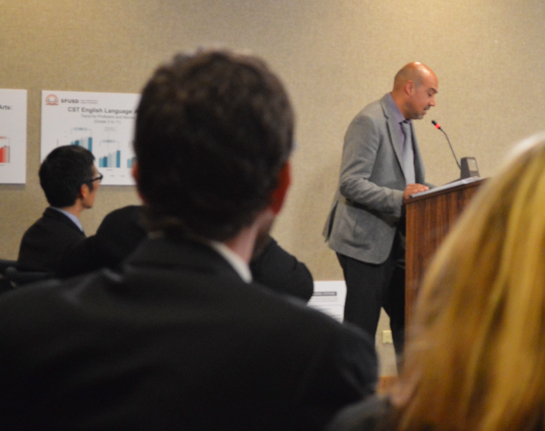
At last night’s (Tue/4) Board of Education meeting, young students rallied against suspensions they see as unfair. Advocates negotiated rule changes. San Francisco Unified School District Board of Education commissioners shook their fists at injustice. 

“Willful defiance” suspensions are cited nationwide as a problematic category of suspension because of their subjective nature. Wearing a backwards cap, having a bad day, talking back, all of those fall under the umbrella of willful defiance.

The suspension ban is monumental, SFUSD Superintendent Richard Carranza told the board.

“We’re talking about culture change. A culture where it’s not okay for an adult to say ‘get out,’” Carranza said.

The point of the Board of Ed’s meeting last night was to discuss banning suspensions for willfully defiant behavior, and to refocus SFUSD resources on improving student-teacher relationships instead. 

But new data shows that a different form of punishment, which was previously unrecorded, may cause almost as much harm as suspensions. 

Ever been sent to the principal’s office? That’s a form of referral, and in California it’s enshrined in state education code. Students can be sent to a counselor, principal, or even another classroom. But President Sandra Lee Fewer said the numbers of referrals are getting out of hand, and must be addressed. 

Fewer made an amendment to the controversial resolution to ban suspensions at last night’s meeting, calling for it to also require a reduction of in-school referrals.

The punishment, she said, deprives students of needed classroom time — and is ineffective.

“We can’t pass a resolution like this without including referrals,” Fewer said. “These are in the thousands. Some schools have three times the amount of black children with referrals.”

She called them “invisible suspensions,” because this school year is the first time they’ve been thoroughly tracked, thanks to a new system called the Counselor Online Referral Form. 

The new data shows thousands of middle school students (high school data is still being collected), mostly black and Latino, were sent out of the classroom for “non-compliance” referrals since the last school semester alone. “Non-compliance” referrals are nebulous, advocates allege, a subjective catch-all category for bad behavior. 

referraldata

SFUSD referral data. This is incomplete data collected from the first semester and portion of the second semester of all SFUSD middle schools, but only a few high schools. Completed multi-year data of SFUSD high school suspensions show similar disparities in enforcement of punishments, however.

The board will vote on the proposed amendment and willful defiance resolution at their Feb. 25 meeting.

Fewer’s amendment would not go so far as to eliminate referrals entirely. That would be legally problematic, United Educators of San Francisco President Dennis Kelly said. 

“The teachers have a right under law to send a child to the office if there is a disruption in the classroom,” he said in a phone interview.

“There is a concern that an awful lot is being dumped on teachers and counselors,” Kelly added. “More and more people are having very good ideas and saying ‘you do it now.’” 

Reforms need to be backed by resources that help a teacher enact needed changes, he said. “Without those supplements, this is only so much talk.”

But in the meantime, students are suffering. Many students took to the podium at last night’s meeting, decrying policies they said were detrimental to their education.

Alexandria Berliner, now 22, said suspensions and referrals as a high schooler derailed her education. “I’ve been suspended so many times, I ended up dropping out of high school.”

Laura Faer is an attorney and director of the statewide education rights at the nonprofit Public Counsel. Faer told the Bay Guardian that though referrals could be problematic, it was less clear cut of an issue than suspensions.

“The question is: what is happening to the child who is referred?” she said. “If a referral goes to counseling and it’s productive, that could be a good thing.”

But the non-compliance category of referrals was a red flag for Faer. 

“Noncompliance is not specific, and I would say that’s a huge problem” she said. “It’s entirely subjective, from what we’re looking at right now. It could lead to a child losing instructional time.”

That was commissioner Fewer’s concern as well. At the meeting, she said she’s talked to kids as young as third-grade level who felt school administrators and teachers did not want them there in the schools. She blames policies that send kids out of the classroom. 

“We have a school-to-prison pipeline here, (while) we pat ourselves for our good work,” she said at the end of the meeting. 

“The impact these suspensions have is social isolation. We break spirit, and we are very good at breaking spirit.” 

This Week’s Picks: February 5 – 11, 2014

0


WEDNESDAY/5

Action Bronson

Action Bronson lives life large. Imposing both physically and lyrically, the Queens native and former gourmet chef draws upon his joys in life — food, drugs, and women — to construct poetically intricate and technically impressive rhymes. His mix tapes are full of love songs, both highly eloquent and frequently offensive, written about the grit of urban life and the beauty of a great meal. Lines about “pissing through your fishnets” are sprinkled among odes to “bone marrow roasted/spread it on the rosemary bread/lightly toasted,” all delivered with Bronson’s sure, sharp-tongued talent. At his live shows, Bronson is extremely interactive with his (extremely devoted) fans, passing back and forth joints, liquor, and jokes from the stage to the audience. With the brand-new addition of Odd Future thrash punks Trash Talk to the lineup, this show is sure to be insane. (Haley Zaremba)

With Trash Talk

9pm, $25

Slim’s

333 11th Ave, SF

(415) 255-0333

www.slimspresents.com


Alejandro Murguia

In a city overflowing with Google bussers and tech transplants, San Francisco’s newest poet laureate, Alejandro Murguía, seeks to revive a marginalized community through the written word. He’ll be honored at City Lights Bookstore with a reading from his new book, Stray Poems. The bilingual poet is the first Latino laureate, paving the way for the city’s poesía en español revival — not only through his poems but also through his activism. Marguía is the voice of the city’s forgotten residents, the voice of “the waitresses the norteños trios the flowers sellers / the blind guitarist wailing boleros at a purple sky / the shirtless vagrant vagabond ranting at a parking meter / the spray paint visionary setting fire to the word” (from the laureate’s poem “16th and Valencia”). (Laura B. Childs)

7pm, free

City Lights Bookstore

261 Columbus, SF

www.citylights.com


SF Bicycle Coalition’s Dating Game: Love On Wheels

This year’s Love on Wheels fundraiser is back with a ’90s twist. In a modern-day version of MTV’s dating show, Singled Out, bike-lovers looking for a mate will get paired up and sent off to a first date in time for the big V-day. Be sure to look the part — ’90s attire is encouraged. Find love in fellow midriff-bearing, flannel-sporting cyclists, or show off your best Tootsee Roll on the dance floor. Proceeds benefit the SF Bicycle Coalition’s work to make the city more bicycle-friendly. (Childs)

6:30pm, $10

DNA Lounge

375 11th St., SF

www.dnalounge.com


THURSDAY/6

Academy of Sciences Lunar New Year Celebration

Saddle up and celebrate the Year of the Horse at the California Academy of Sciences Lunar New Year Nightlife. The contemporary museum will be decked out with traditional occidental activities and performances. Let your inner wildcat out on the dance floor or watch an authentic lion dance routine. For a little wisdom, participate in a traditional Chinese tea ceremony and if you believe in making your own luck, check out the customized fortune cookie booth. Workshops will teach the lion dance or martial arts moves, but leave most of it to the pros. Throughout the night, live shows will feature authentic lion dance, a martial art demonstration and an ancient Chinese mask performance. (Childs)

6pm, $12

Academy of Sciences

55 Music Concourse

www.calacademy.org


Throwing Shade Live

Throwing Shade is a weekly podcast by LA comedians Bryan Safi and Erin Gibson in which the pair address queer and feminist issues in the news. Though the topics are often heavy, Gibson and Safi’s goofy back-and-forths, impressions, and gimmicks strike the perfect balance. Both hilarious and extremely insightful, Throwing Shade is the ideal way to hear about important and often under-reported topics without getting too blue — although your sides may ache by the end of the segment. Putting their show on the road for SF Sketchfest, the duo will be recording the show at the Punchline for the podcast. Endorsed by both Maximum Fun and Funny or Die, Throwing Shade is a serious laughing matter. Don’t miss this rare live appearance. (Zaremba)

8pm, $20

Punch Line

444 Battery, SF

(415) 397-7573

punchlinecomedyclub.com


Oneohtrix Point Never

Picking up on the ’90s era abstract, contemplative side of Warp Records, recent signee Oneohtrix Point Never’s R Plus Seven is thoroughly brain busting. The elements are disparate: vocals that begin without reference and depart without finishing, gamelan reminiscent rhythms seemingly performed on the Cosmic Key, and an ever-present effect best described as the stuttering sound of audio on an overburdened CPU. Partly playful, with New Age and stereotypically “world” music samples ripped off of Pirate Bay (where, to be fair, R Plus Seven gets the “plunderphonics” genre tag), the album still manages to sound wholly reverent. To what? Let me get back to you on that. (Ryan Prendiville)

With Holly Herndon (Live A/V), Marco de la Vega, DJ Will, Chad Salty

10pm-3am, $17.50-20

1015 Folsom

1015 Folsom St., SF

www.1015.com


FRIDAY/7


ASKEW

Performance art, visual art, and experimental film collide with boundary-pushing results at ASKEW, a Festival of Film and Performance Art, presented by the similarly edgy, female-focused Femina Potens Art Gallery. Three nights of themed events spotlight a variety of unique, fearlessly curious talents; tonight’s “We All Live Here: Primal Expressionism” includes SF Fringe Festival hit Fish Girl, by Siouxsie Q with Sean Andries. Tomorrow, it’s “Breaking Stones: Defining New Roles of Masculinity,” with a performance and screening by fest curator Madison Young, among others. Saturday’s “The Sacred and the Profane” features an appearance by sex-positive icon Annie Sprinkle, plus I Am Lady Samar, a work that mixes dance with “flesh hooks” — an act not for the faint-hearted, or close-minded. (Cheryl Eddy)

Through Sat/8, 7pm, $8-$10

Yerba Buena Center for the Arts

701 Mission, SF

www.ybca.org


Liquid Hymn

Feast your eyes! First Amendment Gallery presents the opening of Liquid Hymn, a solo exhibition of kaleidoscopic multimedia ink paintings by Oakland-based artist J.S. Weis. With wild animals pouring out of splashes of color, Weis’ projects seem like a 1970s acid trip — see: purple elephant, two-headed tiger, and a sea of crab legs; the artist uses ink, pencil, and intricately stacked paper to create a detailed 3D effect on his multimedia creations. Multicolored plants and ethereal animals roam through the psychedelic ink paintings, creating a fantastical symphony where nature and art become one. (Childs)

6:30pm, free

1AM SF

1000 Howard, SF

www.1amsf.com


SATURDAY/8

Top Secret

Continuing in the same zany and hilarious vein of comedy as seen in their earlier films Kentucky Fried Movie and Airplane!, writers and directors Jim Abrahams, Jerry Zucker, and David Zucker decided to spoof both 1960s cold war/spy movies as well as rock n’ roll musicals with 1984’s Top Secret! Featuring Val Kilmer (in one of his very first starring roles) as fictional American rocker Nick Rivers battling the evil empire of East Germany, the flick parodies a host of genre clichés and plays on pun after side-splitting pun. Join Abrahams and the Zucker brothers for what promises to be an unpredictable 30th anniversary screening, audience discussion and Q&A. (Sean McCourt)

1pm, $20

Castro Theatre

429 Castro, SF

www.sfsketchfest.com


Aszure Barton

When Mikhail Baryshnikov’s Hells Kitchen Dance troupe performed at the Zellerbach Play House in 2006, he looked fabulous — at 58, a self-effacing, masterful dancer. He also brought works by two barely known choreographers. Benjamin Millepied, at the time a dancer with New York City Ballet, now runs the Paris Opera Ballet; the Canadian Aszure Barton’s two pieces immediately marked her as someone with chops to burn and a fascinating individual voice. She hasn’t stopped working — all over the world. Now SF Performances is bringing her back with Awáa, a piece inspired by an underwater dream, in which Barton, apparently, explores the masculine and feminine traits we all have. I’ll take her word for it — anytime. (Rita Felciano)

Feb. 7/8. 7:30pm. $35-50

Aszure Barton + Artists

Lam Research Center, YBCA

700 Howard St. SF

415-978-2787

www.sfperformances.org

Thu/6-Sat/8


SUNDAY/9


Shakes The Clown Live

Although it was critically panned and considered a financial flop when it was first released, the 1991 movie Shakes The Clown has gone on to achieve a loyal cult following over the years. Comedian Bobcat Goldthwait wrote, directed, and starred in the dark comedy that follows the life of an alcoholic and depressed clown that shows up for kids’ parties drunk, sees his career going down the toilet, and even eventually gets framed for murder. Join Goldthwait, along with original film cast members Julie Brown, Tom Kenny, and Florence Henderson as they bring the under-appreciated story back to life in all its debaucherous glory, live on stage! (Sean McCourt)

4pm, $25

Cobb’s Comedy Club

915 Columbus, SF

(415) 928-4320

www.cobbscomedyclub.com

www.sfsketchfest.com


TUESDAY/11

Kid Congo

Helping form the influential roots-rock/punk band The Gun Club when he was still a teenager, Kid Congo Powers was quickly persuaded by the Cramps to join as their second guitar player in 1980 before he eventually went on to play with Nick Cave and the Bad Seeds for a time. Continuing to harness the power of American roots music and twist it into a warped web of perverse sounds over the ensuing years with his latest band, The Pink Monkey Birds, Kid Congo ventures further down the deliciously demented path on his latest record, Haunted Head (In The Red).

With Wax Idols, Dancer. (Sean McCourt)

8pm, $15

Slim’s

333 11th St., SF

(415) 255-0333

www.slimspresents.com


Hospitality

This trio’s debut S/T album was essentially a collection of undeniable indie-pop hooks matched by songwriting that combined Belle and Sebastian’s wittiness with the urban social unease of a Shirley Jackson story. Still it didn’t quite capture the appeal as a live band, where I found them to be most endearing. On its freshly minted second album, Trouble, Hospitality has set out to prove their mettle as simply a rock (drop the indie, drop the twee) group as well. While Amber Papini’s voice is still endlessly charming — listen to the way her double esses fill in some hissing hi-hat on The Who-styled percussion on “I Miss Your Bones” — but the band seems in less of a hurry, giving the guitar and bass its due. (Ryan Prendiville)

With Air Waves, Matt Kivel

8pm, $10-12

Rickshaw Stop

155 Fell, SF

(415) 861-2011

 www.rickshawstop.com


The Guardian listings deadline is two weeks prior to our Wednesday publication date. To submit an item for consideration, please include the title of the event, a brief description of the event, date and time, venue name, street address (listing cross streets only isn’t sufficient), city, telephone number readers can call for more information, telephone number for media, and admission costs. Send information to Listings, the Guardian, 225 Bush, 17th Flr., SF, CA 94105; or email (paste press releasea into email body — no attachments, please) to listings@sfbg.com. Digital photos may be submitted in jpeg format; the image must be at least 240 dpi and four inches by six inches in size. We regret w cannot accept listings over the phone.

Rep Clock: February 5 -11, 2014

0

Schedules are for Wed/5-Tue/11 except where noted. Director and year are given when available. Double and triple features marked with a •. All times pm unless otherwise specified.

ARTISTS’ TELEVISION ACCESS 992 Valencia, SF; www.atasite.org. $5-7. “OpenScreening,” Thu, 8. For participation info, contact programming@atasite.org. Boom: The Sound of Eviction (2001), Fri, 7:30.

BALBOA THEATRE 3630 Balboa, SF; cinemasf.com/balboa. $7.50-10. “Popcorn Palace:” The Seventh Voyage of Sinbad (Juran, 1958), Sat, 10am. Matinee for kids. Barbie: The Pearl Princess (2014), Sun, 10am.

BERKELEY FELLOWSHIP OF UNITARIAN UNIVERSALISTS 1924 Cedar, Berk; www.bfuu.org. $5-10. In Transition 2.0, Thu, 6:30. More info at www.transitionberkeley.com.

CASTRO 429 Castro, SF; (415) 621-6120, www.castrotheatre.com. $8.50-11. “SF Sketchfest:” “NPR’s Ask Me Another,” Wed, 8 (this event, $25-35); “Tribute to Alan Arkin:” The In-Laws (Hiller, 1979), Thu, 7 ($25); Cabin Boy (Resnick, 1994), Fri, 7:30 (20th anniversary screening, hosted by Peaches Christ with Chris Elliot in person, $20); Top Secret! (Abrahams, Zucker, and Zucker, 1984), Sat, 1 (30th anniversary screener with writers-directors in person, $20); “The Benson Movie Interruption:” The Twilight Saga: New Moon (Weitz, 2009), Sat, 4:20 ($20); Revenge of the Nerds (Kanew, 1984), Sat, 8:30 (30th anniversary screening with cast in person, $30). Visit www.sfsketchfest.com for tickets and more info on SF Sketchfest events. •The Lady From Shanghai (Welles, 1947), Sun, 3, 7, and Gilda (Vidor, 1946), Sun, 4:45, 8:45. •I Am Divine (Schwarz, 2013), Mon, 7:30, and Bettie Page Reveals All (Mori, 2012), Mon, 9:10. “Veteran Documentary Corps,” short documentaries, Tue, 7. Special event; purchase tickets ($10-50) at www.veterandocs.org.

CHRISTOPHER B. SMITH RAFAEL FILM CENTER 1118 Fourth St, San Rafael; (415) 454-1222, www.cafilm.org. $6.50-$10.75. The Girls in the Band (Chaikin, 2011), call for dates and times. “Oscar Nominated Short Films 2014,” call for dates and times. The Past (Farhadi, 2013), call for dates and times. Gloria (Lelio, 2013), Feb 7-13, call for times. Breathing Earth (2012), Sun, 7.

CLAY 2261 Fillmore, SF; www.landmarktheatres.com. $10. “Midnight Movies:” The Room (Wiseau, 2003), Sat, midnight.

CRANEWAY PAVILION 1414 Harbour Way South, Richmond; www.craneway.com. $20-30. “Lunafest Film Festival,” short films by, for, and about women, Fri, 6:30.

EXPLORATORIUM Pier 15, SF; www.exploratorium.edu. Free with museum admission ($19-25). “Saturday Cinema:” “Teachers Institute Film Festival,” Sat, 11am-2pm.

MECHANICS’ INSTITUTE 57 Post, SF; milibrary.org/events. $10. “CinemaLit Film Series: Villains We Love:” Caged (Cromwell, 1950), Fri, 6.

NEW PARKWAY 474 24th St, Oakl; www.thenewparkway.com. Free. “First Friday Shorts,” films from Creative Growth Video Production Workshop, Fri, 6.

OAKLAND PUBLIC LIBRARY Rockridge Branch, 5366 College, Oakl; www.oaklandlibrary.org. Free. “90-Second Newbery Film Festival,” Sat, noon.

OSHER MARIN JCC 200 N. San Pedro, San Rafael; www.marinjcc.org. $10-20. “Best of the San Francisco Jewish Film Festival:” Arab Labor, Tue, 7. Three episodes from season four of the Israeli TV show.

PACIFIC FILM ARCHIVE 2575 Bancroft, Berk; (510) 642-5249, bampfa.berkeley.edu. $5.50-9.50. “Film 50: History of Cinema:” M (Lang, 1931), with lecture by Emily Carpenter, Wed, 3:10. “African Film Festival 2014:” Tey (Gomis, 2012), Wed, 7. “Funny Ha-Ha: The Genius of American Comedy, 1930-1959:” Will Success Spoil Rock Hunter? (Tashlin, 1957), Thu, 7. “Against the Law: The Crime Films of Anthony Mann:” Strange Impersonation (1946), Fri, 7; Desperate (1947), Fri, 8:30. “Screenagers: 16th Annual Bay Area High School Film and Video Festival,” Sat, 3. “Jean-Luc Godard: Expect Everything from Cinema:” Vivre sa vie (1962), Sat, 6:30; Les carabiniers (1963), Sat, 8:15. “The Brilliance of Satyajit Ray:” Three Daughters (1961), Sun, 3. “Documentary Voices:” The Specialist (Sivian, 1999), Tue, 7.

ROXIE 3117 and 3125 16th St, SF; (415) 863-1087, www.roxie.com. $6.50-11. SF IndieFest, Feb 6-20. For program info, visit www.sfindie.com.

TANNERY 708 Gilman, Berk; berkeleyundergroundfilms.blogspot.com. Donations accepted. “Berkeley Underground Film Society:” “LOOP Presents:” What’s Up, Tiger Lily? (Allen, 1966), Sat, 7:30; Duck Soup (McCarey, 1933), Sun, 7:30.

TEMESCAL ART CENTER 511 48th St, Oakl; www.shapeshifterscinema.com. Free. “Shapeshifters Cinema: Lori Varga,” old and new analog film work, Sun, 8.

YERBA BUENA CENTER FOR THE ARTS 701 Mission, SF; www.ybca.org. $8-10. “Femina Potens’ ASKEW Film and Performance Festival,” screenings and performances, Thu-Sat. *


Film Listings: February 5 – 11, 2014

0

Film listings are edited by Cheryl Eddy. Reviewers are Kimberly Chun, Dennis Harvey, Lynn Rapoport, Sam Stander, and Sara Maria Vizcarrondo. For rep house showtimes, see Rep Clock.

OPENING

Gloria The titular figure in Sebastian Lelio’s film is a Santiago divorcee and white collar worker (Paulina Garcia) pushing 60, living alone in a condo apartment — well, almost alone, since like Inside Llewyn Davis, this movie involves the frequent, unwanted company of somebody else’s cat. (That somebody is an upstairs neighbor whose solo wailings against cruel fate disturb her sleep.) Her two children are grown up and preoccupied with their adult lives. Not quite ready for the glue factory yet, Gloria often goes to a disco for the “older crowd,” dancing by herself if she has to, but still hoping for some romantic prospects. She gets them in the form of Rodolfo (Sergio Hernandez), who’s more recently divorced but gratifyingly infatuated with her. Unfortunately, he’s also let his daughters and ex-wife remain ominously dependent on him, not just financially but in every emotional crisis that affects their apparently crisis-filled lives. The extent to which Gloria lets him into her life is not reciprocated, and she becomes increasingly aware how distant her second-place priority status is whenever Rodolfo’s other loved ones snap their fingers. There’s not a lot of plot but plenty of incident and insight to this character study, a portrait of a “spinster” that neither slathers on the sentimental uplift or piles on melodramatic victimizations. Instead, Gloria is memorably, satisfyingly just right. (1:50) Embarcadero, Smith Rafael, Sundance Kabuki. (Harvey)

The Lego Movie The toy becomes a movie. Fun fact: Nick Offerman gives voice to a character named “Metalbeard,” a revenge-seeking pirate. So it’s got that going for it, which is nice. (1:41) Balboa, Presidio.

Monuments Men George Clooney directs this World War II-set film about an unlikely platoon sent into Germany to rescue artworks being plundered by Nazi thieves. With Matt Damon, Cate Blanchett, Bill Murray, and John Goodman. (1:58) Balboa, Marina.

“Oscar Nominated Short Films 2014: Documentary” This year, the Oscar-nominated docs are presented in two separate feature-length programs. Program A contains The Lady in Number 6: Music Saved My Life, about a Holocaust survivor; Karama Has No Walls, about protestors in Yemen during the Arab Spring; and Facing Fear, about a gay man who encounters the neo-Nazi who terrorized him 25 years prior. Program B contains Cavedigger, about environmental sculptor Ra Paulette; and Prison Terminal: The Last Days of Private Jack Hall, about a dying prisoner being cared for by other prisoners. Opera Plaza.

Stranger by the Lake Franck (Pierre Deladonchamps) is an attractive young French guy spending his summer days hanging at the local gay beach, where he strikes up a platonic friendship with chunky older loner Henri (Patrick d’Assumcao). Still, the latter is obviously hurt when Franck practically gets whiplash neck swiveling at the sight of Michel (Christophe Paou), an old-school gay fantasy figure — think Sam Elliott in 1976’s Lifeguard, complete with Marlboro Man ‘stache and twinkling baby blues. No one else seems to be paying attention when Franck sees his lust object frolicking in the surf with an apparent boyfriend, one that doesn’t surface again after some playful “dunking” gets rather less playful. Eventually the police come around in the form of Inspector Damroder (Jerome Chappatte), but Franck stays mum — he isn’t sure what exactly he saw. Or maybe it’s that he’s quite sure he’s happy how things turned out, now that sex-on-wheels Michel is his sorta kinda boyfriend. You have to suspend considerable disbelief to accept that our protagonist would risk potentially serious danger for what seems pretty much a glorified fuck-buddy situation. But Alain Guiraudie’s meticulously schematic thriller- which limits all action to the terrain between parking lot and shore, keeping us almost wholly ignorant of the characters’ regular lives — repays that leap with an absorbing, ingenious structural rigor. Stranger is Hitchcockian, all right, even if the “Master of Suspense” might applaud its technique while blushing at its blunt homoeroticism. (1:37) Clay, Shattuck. (Harvey)

Top Secret! After the sleeper smash of 1980’s Airplane! (and the TV failure of 1982’s Police Squad! series, which nonetheless led directly to the later, successful Naked Gun movies), the Madison, Wisc.-spawned comedy trio of David Zucker, Jim Abrahams, and Jerry Zucker had one more exclamation point up their collective sleeves. That resulted in this hit 1984 parody of Cold War spy movies (and Elvis Presley musicals) starring Val Kilmer (in his perpetually open-mouthed film debut) as hip-swiveling American rock star Nick Rivers, who is dispatched to East Germany on a diplomatic entertainment mission. Instead, he gets yanked into major intrigue that includes kidnapped scientists, Omar Sharif, an elaborate Blue Lagoon (1980) spoof, and of course extremely realistic cow disguises. It also features this immortal exchange between Nazi-Commies, as they’re torturing captured Nick: “Do you vant me to bring out ze LeRoy Neiman paintings?” “No — ve cannot risk violating ze Geneva Convention!” Herrs Zucker, Abrahams, and Zucker will reunite on the Castro stage to screen and discuss their incisive political classic as it enters its fourth decade of cultdom. The 30th anniversary afternoon program is co-presented by SF Sketchfest (www.sfsketchfest.com), Midnites for Maniacs, Noise Pop, and the Jewish Film Festival. Castro. (Harvey)

Vampire Academy Bloodsuckers go to high school in this adaptation of the YA series directed by Mark Waters (2004’s Mean Girls). (1:45)

ONGOING

American Hustle David O. Russell’s American Hustle is like a lot of things you’ve seen before — put in a blender, so the results are too smooth to feel blatantly derivative, though here and there you taste a little Boogie Nights (1997), Goodfellas (1990), or whatever. Loosely based on the Abscam FBI sting-scandal of the late 1970s and early ’80s (an opening title snarks “Some of this actually happened”), Hustle is a screwball crime caper almost entirely populated by petty schemers with big ideas almost certain to blow up in their faces. It’s love, or something, at first sight for Irving Rosenfeld (Christian Bale) and Sydney Prosser (Amy Adams), who meet at a Long Island party circa 1977 and instantly fall for each other — or rather for the idealized selves they’ve both strained to concoct. He’s a none-too-classy but savvy operator who’s built up a mini-empire of variably legal businesses; she’s a nobody from nowhere who crawled upward and gave herself a bombshell makeover. The hiccup in this slightly tacky yet perfect match is Irving’s neglected, crazy wife Rosalyn (Jennifer Lawrence), who’s not about to let him go. She’s their main problem until they meet Richie DiMaso (Bradley Cooper), an ambitious FBI agent who entraps the two while posing as a client. Their only way out of a long prison haul, he says, is to cooperate in an elaborate Atlantic City redevelopment scheme he’s concocted to bring down a slew of Mafioso and presumably corrupt politicians, hustling a beloved Jersey mayor (Jeremy Renner) in the process. Russell’s filmmaking is at a peak of populist confidence it would have been hard to imagine before 2010’s The Fighter, and the casting here is perfect down to the smallest roles. But beyond all clever plotting, amusing period trappings, and general high energy, the film’s ace is its four leads, who ingeniously juggle the caricatured surfaces and pathetic depths of self-identified “winners” primarily driven by profound insecurity. (2:17) Four Star, Metreon, 1000 Van Ness, Presidio, Sundance Kabuki. (Harvey)

August: Osage County Considering the relative infrequency of theater-to-film translations today, it’s a bit of a surprise that Tracy Letts had two movies made from his plays before he even got to Broadway. Bug and Killer Joe proved a snug fit for director William Friedkin (in 2006 and 2011, respectively), but both plays were too outré for the kind of mainstream success accorded 2007’s August: Osage County, which won the Pulitzer, ran 18 months on Broadway, and toured the nation. As a result, August was destined — perhaps doomed — to be a big movie, the kind that shoehorns a distracting array of stars into an ensemble piece, playing jes’ plain folk. But what seemed bracingly rude as well as somewhat traditional under the proscenium lights just looks like a lot of reheated Country Gothic hash, and the possibility of profundity you might’ve been willing to consider before is now completely off the menu. If you haven’t seen August before (or even if you have), there may be sufficient fun watching stellar actors chew the scenery with varying degrees of panache — Meryl Streep (who else) as gorgon matriarch Violet Weston; Sam Shepard as her long-suffering spouse; Julia Roberts as pissed-off prodigal daughter Barbara (Julia Roberts), etc. You know the beats: Late-night confessions, drunken hijinks, disastrous dinners, secrets (infidelity, etc.) spilling out everywhere like loose change from moth-eaten trousers. The film’s success story, I suppose, is Roberts: She seems very comfortable with her character’s bitter anger, and the four-letter words tumble past those jumbo lips like familiar friends. On the downside, there’s Streep, who’s a wizard and a wonder as usual yet also in that mode supporting the naysayers’ view that such conspicuous technique prevents our getting lost in her characters. If Streep can do anything, then logic decrees that includes being miscast. (2:10) Metreon, Sundance Kabuki. (Harvey)

Dallas Buyers Club Dallas Buyers Club is the first all-US feature from Jean-Marc Vallée. He first made a splash in 2005 with C.R.A.Z.Y., which seemed an archetype of the flashy, coming-of-age themed debut feature. Vallée has evolved beyond flashiness, or maybe since C.R.A.Z.Y. he just hasn’t had a subject that seemed to call for it. Which is not to say Dallas is entirely sober — its characters partake from the gamut of altering substances, over-the-counter and otherwise. But this is a movie about AIDS, so the purely recreational good times must eventually crash to an end. Which they do pretty quickly. We first meet Ron Woodroof (Matthew McConaughey) in 1986, a Texas good ol’ boy endlessly chasing skirts and partying nonstop. Not feeling quite right, he visits a doctor, who informs him that he is HIV-positive. His response is “I ain’t no faggot, motherfucker” — and increased partying that he barely survives. Afterward, he pulls himself together enough to research his options, and bribes a hospital attendant into raiding its trial supply of AZT for him. But Ron also discovers the hard way what many first-generation AIDS patients did — that AZT is itself toxic. He ends up in a Mexican clinic run by a disgraced American physician (Griffin Dunne) who recommends a regime consisting mostly of vitamins and herbal treatments. Ron realizes a commercial opportunity, and finds a business partner in willowy cross-dresser Rayon (Jared Leto). When the authorities keep cracking down on their trade, savvy Ron takes a cue from gay activists in Manhattan and creates a law evading “buyers club” in which members pay monthly dues rather than paying directly for pharmaceutical goods. It’s a tale that the scenarists (Craig Borten and Melisa Wallack) and director steep in deep Texan atmospherics, and while it takes itself seriously when and where it ought, Dallas Buyers Club is a movie whose frequent, entertaining jauntiness is based in that most American value: get-rich-quick entrepreneurship. (1:58) Embarcadero, 1000 Van Ness, Presidio. (Harvey)

Devil’s Due (1:29) Metreon.

Frozen (1:48) Metreon, 1000 Van Ness.

Gimme Shelter Pope Francis has been making up for lost time, but nevertheless, it’s tough to get a good dose of up-with-Catholicism promotional material these days. Like Francis, Gimme Shelter aims to highlight the church’s tangible and spiritual support to those in need — and here, in this movie based on a real story, would-be teen moms uninterested or unwilling to abort. Oh yes, and it’s down to shelter those battered by bad press about pedophile priests and provide a role with some meat to an ingenue itching to grow. Vanessa Hudgens is that actress, who seems to be making the right career moves following last year’s Spring Breakers by playing crust-punk teen runaway Apple. The girl is trying to break away from her abusive, cracked-out mom (Rosario Dawson) and is forced to reconnect with her privileged stranger of a dad (Brendan Fraser). The cherry — or lack thereof — on top of her troubles is the fact that she’s preggers, which inspires her father’s pinched spouse (Stephanie Szostak) to march her straight to the clinic to terminate. With the help of a hospital priest Frank (James Earl Jones), she finds, yes, shelter in a home for teen moms in need, though we never quite understand why Apple is so determined to have the child —especially when her own mother, brought scarily to life by an intense, unrecognizable Dawson, is such a monster. Still, it’s a measure of how believable Hudgens is, working with what little she has in the way of verbiage, that a viewer is touched by her trajectory. Meanwhile the avid film fan can’t help but wonder how this well-meaning movie — which incidentally has absolutely nothing to do with the Stones and doesn’t quite deserve this way-too-literal title — would have unfolded in the hands of a Lee Daniels or even a Olivier Assayas. (1:40) SF Center. (Chun)

The Girls in the Band Judy Chaikin’s upbeat documentary is in step with the recent, not-unwelcome trend of bringing overlooked musicians into the spotlight (think last year’s Twenty Feet from Stardom and A Band Called Death). The Girls in the Band takes a chronological look at women in the big-band and jazz scenes, taking the 1958’s “A Great Day in Harlem” as a visual jumping-off point, sharing the stories of two (out of just three) women who posed amid that sea of male musicians. One is British pianist Marian McPartland, who’s extensively featured in interviews shot before her death last year; the other is gifted composer and arranger Mary Lou Williams, who died in 1981 but left behind a rich legacy that still inspires. Others featured in this doc (which culminates in a re-creation of that famous Harlem photo shoot — with all-female subjects this time) include saxophone- and trumpet-playing members of the multi-racial, all-female International Sweethearts of Rhythm, which toured the segregated south at great peril during the 1930s and was a favorite among African American servicemen during World War II. No matter her race, nearly every woman interviewed cites the raging sexism inherent in the music biz — but the film’s final third, which focuses on contemporary successes like Esperanza Spalding, suggests that stubborn roadblock is finally being chipped away. (1:26) Smith Rafael. (Eddy)

Gravity “Life in space is impossible,” begins Gravity, the latest from Alfonso Cuarón (2006’s Children of Men). Egghead Dr. Ryan Stone (Sandra Bullock) is well aware of her precarious situation after a mangled satellite slams into her ship, then proceeds to demolition-derby everything (including the International Space Station) in its path. It’s not long before she’s utterly, terrifyingly alone, and forced to unearth near-superhuman reserves of physical and mental strength to survive. Bullock’s performance would be enough to recommend Gravity, but there’s more to praise, like the film’s tense pacing, spare-yet-layered script (Cuarón co-wrote with his son, Jonás), and spectacular 3D photography — not to mention George Clooney’s warm supporting turn as a career astronaut who loves country music almost as much as he loves telling stories about his misadventures. (1:31) Metreon, 1000 Van Ness. (Eddy)

The Great Beauty The latest from Paolo Sorrentino (2008’s Il Divo) arrives as a high-profile contender for the Best Foreign Language Film Oscar, already annointed a masterpiece in some quarters, and duly announcing itself as such in nearly every grandiose, aesthetically engorged moment. Yes, it seems to say, you are in the presence of this auteur’s masterpiece. But it’s somebody else’s, too. The problem isn’t just that Fellini got there first, but that there’s room for doubt whether Sorrentino’s homage actually builds on or simply imitates its model. La Dolce Vita (1960) and 8 1/2 (1963) are themselves swaying, jerry-built monuments, exhileratingly messy and debatably profound. But nothing quite like them had been seen before, and they did define a time of cultural upheaval — when traditional ways of life were being plowed under by a loud, moneyed, heedless modernity that for a while chose Rome as its global capital. Sorrentino announces his intention to out-Fellini Fellini in an opening sequence so strenuously flamboyant it’s like a never-ending pirouette performed by a prima dancer with a hernia. There’s statuary, a women’s choral ensemble, an on-screen audience applauding the director’s baffled muse Toni Servillo, standing in for Marcello Mastroianni — all this and more in manic tracking shots and frantic intercutting, as if sheer speed alone could supply contemporary relevancy. Eventually The Great Beauty calms down a bit, but still its reason for being remains vague behind the heavy curtain of “style.” (2:22) Opera Plaza. (Harvey)

Her Morose and lonely after a failed marriage, Theodore (Joaquin Phoenix) drifts through an appealingly futuristic Los Angeles (more skyscrapers, less smog) to his job at a place so hipster-twee it probably will exist someday: beautifulhandwrittenletters.com, where he dictates flowery missives to a computer program that scrawls them onto paper for paying customers. Theodore’s scripting of dialogue between happy couples, as most of his clients seem to be, only enhances his sadness, though he’s got friends who care about him (in particular, Amy Adams as Amy, a frumpy college chum) and he appears to have zero money woes, since his letter-writing gig funds a fancy apartment equipped with a sweet video-game system. Anyway, women are what gives Theodore trouble — and maybe by extension, writer-director Spike Jonze? — so he seeks out the ultimate gal pal: Samantha, an operating system voiced by Scarlett Johansson in the year’s best disembodied performance. Thus begins a most unusual relationship, but not so unusual; Theodore’s friends don’t take any issue with the fact that his new love is a machine. Hey, in Her‘s world, everyone’s deeply involved with their chatty, helpful, caring, always-available OS — why wouldn’t Theo take it to the next level? Inevitably, of course, complications arise. If Her‘s romantic arc feels rather predictable, the film acquits itself in other ways, including boundlessly clever production-design touches that imagine a world with technology that’s (mostly) believably evolved from what exists today. Also, the pants they wear in the future? Must be seen to be believed. (2:00) Four Star, 1000 Van Ness, Presidio, SF Center, Sundance Kabuki. (Eddy)

The Hobbit: The Desolation of Smaug Just when you’d managed to wipe 2012’s unwieldy The Hobbit: An Unexpected Journey from your mind, here comes its sequel — and it’s actually good! Yes, it’s too long (Peter Jackson wouldn’t have it any other way); arachnophobes (and maybe small children) will have trouble with the creepy, giant-spider battle; and Orlando Bloom, reprising his Lord of the Rings role as Legolas the elf, has been CG’d to the point of looking like he’s carved out of plastic. But there’s much more to enjoy this time around, with a quicker pace (no long, drawn-out dinner parties); winning performances by Martin Freeman (Bilbo), Ian McKellan (Gandalf); and Benedict Cumberbatch (as the petulent voice of Smaug the dragon); and more shape to the quest, as the crew of dwarves seeks to reclaim their homeland, and Gandalf pokes into a deeper evil that’s starting to overtake Middle-earth. (We all know how that ends.) In addition to Cumberbatch, the cast now includes Lost‘s Evangeline Lilly as elf Tauriel, who doesn’t appear in J.R.R. Tolkien’s original story, but whose lady-warrior presence is a welcome one; and Luke Evans as Bard, a human poised to play a key role in defeating Smaug in next year’s trilogy-ender, There and Back Again. (2:36) 1000 Van Ness. (Eddy)

The Hunger Games: Catching Fire Before succumbing to the hot and heavy action inside the arena (intensely directed by Francis Lawrence) The Hunger Games: Catching Fire force-feeds you a world of heinous concept fashions that’d make Lady Gaga laugh. But that’s ok, because the second film about one girl’s epic struggle to change the world of Panem may be even more exciting than the first. Suzanne Collins’ YA novel The Hunger Games was an over-literal metaphor for junior high social survival and the glory of Catching Fire is that it depicts what comes after you reach the cool kids’ table. Katniss (Jennifer Lawrence) inspired so much hope among the 12 districts she now faces pressures from President Snow (a portentous Donald Sutherland) and the fanatical press of Capital City (Stanley Tucci with big teeth and Toby Jones with big hair). After she’s forced to fake a romance with Peeta (Josh Hutcherson), the two watch with horror as they’re faced with a new Hunger Game: for returning victors, many of whom are too old to run. Amanda Plummer and Jeffrey Wright are fun as brainy wackjobs and Jena Malone is hilariously Amazonian as a serial axe grinder still screaming like an eighth grader. Inside the arena, alliances and rivalries shift but the winner’s circle could survive to see another revolution; to save this city, they may have to burn it down. (2:26) Metreon. (Vizcarrondo)

I, Frankenstein (1:33) Metreon, 1000 Van Ness.

Inside Llewyn Davis In the Coen Brothers’ latest, Oscar Isaac as the titular character is well on his way to becoming persona non grata in 1961 NYC — particularly in the Greenwich Village folk music scene he’s an ornery part of. He’s broke, running out of couches to crash on, has recorded a couple records that have gone nowhere, and now finds out he’s impregnated the wife (Carey Mulligan) and musical partner of one among the few friends (Justin Timberlake) he has left. She’s furious with herself over this predicament, but even more furious at him. This ambling, anecdotal tale finds Llewyn running into one exasperating hurdle after another as he burns his last remaining bridges, not just in Manhattan but on a road trip to Chicago undertaken with an overbearing jazz musician (John Goodman) and his enigmatic driver (Garrett Hedlund) to see a club impresario (F. Murray Abraham). This small, muted, droll Coens exercise is perfectly handled in terms of performance and atmosphere, with pleasures aplenty in its small plot surprises, myriad humorous idiosyncrasies, and T. Bone Burnett’s sweetened folk arrangements. But whether it actually has anything to say about its milieu (a hugely important Petri dish for later ’60s political and musical developments), or adds up to anything more profound than an beautifully executed shaggy-dog story, will be a matter of personal taste — or perhaps of multiple viewings. (1:45) Sundance Kabuki. (Harvey)

The Invisible Woman Charles Dickens was a regular scold of the British class system and its repercussions, particularly the gentry’s general acceptance that poverty was something the bottom rung of society was suited for, perhaps even deserved. Given how many in positions of power would have preferred such issues go ignored, it was all the more important their highest-profile advocate be of unimpeachable “moral character” — which in the Victorian era meant a very high standard of conduct indeed. So it remains remarkable that in long married middle-age he heedlessly risked scandal and possible career-ruin by taking on a much younger mistress. Both she and he eventually burned all their mutual correspondence, so Claire Tomalin’s biography The Invisible Woman is partly a speculative work. But it and now Ralph Fiennes’ film of the same name are fascinating glimpses into the clash between public life and private passion in that most judgmentally prudish of epochs. Framed by scenes of its still-secretive heroine several years after the central events, the movie introduces us to a Dickens (Fiennes) who at mid-career is already the most famous man in the UK. In his lesser-remembered capacity as a playwright and director, at age 45 (in 1857) he hired 18-year-old actress Nelly Ternan (Felicity Jones) for an ingénue role. He was instantly smitten; she was, at the least, awed by this great man’s attention. Their professional association permitted some further contact without generating much gossip. But eventually Dickens chafed at the restraints necessary to avoid scandal — no matter the consequences to himself, let alone his wife, his 10 (!) children, or Ternan herself. Fiennes, by all accounts an exceptional Shakespearean actor on stage, made a strong directorial debut in 2011 with that guy’s war play, Coriolanus — a movie that, like this one, wasn’t enough of a conventional prestige film or crowd-pleaser to surf the awards-season waves very long. But they’re both films of straightforward confidence, great intelligence, and unshowy good taste that extends to avoiding any vanity project whiff. (1:51) Opera Plaza. (Harvey)

Jack Ryan: Shadow Recruit Throwback Terror Thursday, anyone? If the early Bourne entries leapt ahead of then-current surveillance technology in their paranoia-inducing ability to Find-Replace-Eliminate international villains wherever they were in the world, then Jack Ryan: Shadow Recruit flails in the opposite direction — toward a nonsensical, flag-waving mixture of Cold War and War on Terror phobias. So when covert mucky-muck Thomas Harper (Kevin Costner) solemnly warns that if mild-mannered former Marine and secret CIA analyst Jack Ryan stumbles, the US is in danger of … another Great Depression, you just have to blink, Malcolm Gladwell-style. Um, didn’t we just do that? And is this movie that out of touch? It doesn’t help that director Kenneth Branagh casts himself as the sleek, camp, and illin’ Russian baddie Viktor Cherevin, who’s styled like a ’90s club tsar in formfitting black clothing with a sheen that screams “Can this dance-floor sadist buy you another cosmo?” He’s intended to pass for something resembling sex — and soul — in Shadow Recruit‘s odd, determinedly clueless universe. That leaves a colorless, blank Chris Pine with the thankless task of rescuing whiney physician love Cathy (Keira Knightley) from baddie clutches. Pine’s no Alec Baldwin, lacking the latter’s wit and anger management issues, or even Ben Affleck, who has also succumbed to blank, beefcake posturing on occasion. Let’s return this franchise to its box, firmly relegated to the shadows. (1:45) Metreon, 1000 Van Ness. (Chun)

Labor Day Sweet little home repairs, quickie car tune-ups, sensual pie-making, and sexed-up chili cookery — Labor Day seems to be taking its chick-flick cues from Porn For Women, Cambridge Women’s Pornography Cooperative’s puckish gift-booklet that strives to capture women’s real desires: namely, for vacuuming, folded laundry, and patient listening from their chosen hunks of beefcake. Let’s call it domestic close encounters of the most pragmatic, and maybe most realistic, kind. But that seems to sail over the heads of all concerned with Labor Day. Working with Joyce Maynard’s novel, director-screenwriter Jason Reitman largely dispenses with the wit that washes through Juno (2007) and Up in the Air (2009) and instead chooses to peer at his actors through the seriously overheated, poetically impressionistic prism of Terrence Malick … if Malick were tricked into making a Nicholas Sparks movie. Single mom Adele (Kate Winslet) is down in the dumps over multiple miscarriages and her husband’s (Clark Gregg) departure. Son Henry (Gattlin Griffith) becomes her caretaker of sorts — thus, when escaped convict Frank (Josh Brolin) forces the mother-and-son team to give him a ride and a hideout, it’s both a blessing and a curse, especially because the hardened tough guy turns out to be a compulsively domestic, hardworking ubermensch of a Marlboro Man, able to bake up a peach pie and teach Henry to throw a baseball, all within the course of a long Labor Day weekend. Hapless Adele is helpless to resist him, particularly after some light bondage and plenty of manly nurturing. Ultimately this masochistic fantasy about the ultimate, if forbidden, family man — and the delights of the Stockholm Syndrome — is much harder to swallow than a spoonful of homemade chili, despite its strong cast. (1:51) Metreon, 1000 Van Ness, Sundance Kabuki. (Chun)

The Legend of Hercules What better reason to wield the blunt force of 3D than to highlight the muscle-bound glory of a legendary hero — and, of course, foreground his impressive six-pack abs and impudently jutting nipples. Lead Kellan Lutz nails the eye candy aspect in this sword ‘n’ sandals effort by Renny Harlin (aka the man who capsized Geena Davis’s career), though it’s hard to take him seriously when he looks less like the hirsute, leonine hero depicted in ancient artwork than an archetypal, thick-necked, clean-shaven, all-American handsome-jock star (Lutz’s resemblance to Tom Brady is uncanny). Still, glistening beefcake is a fact of life at toga parties, and it’s clearly a large part of the appeal in this corny popcorner about Greek mythology’s proto-superhero. The Legend of Hercules is kitted out to conquer teen date nights around the world, with a lot of bloodless PG-13 violence for the boys and flower-petal-filled nuzzle-fests between Herc and Hebe (Gaia Weiss) for the girls, along with the added twist that Hercules’s peace-loving mother Alcmene conceived him with Zeus — with Hera’s permission — in order to halt her power-mad brute of a spouse King Amphitryon (Scott Adkins). In any case Harlin and company can’t leave well enough alone and piledrive each action scene with way too much super-slo-mo, as if mainlining the Matrix films in the editing booth to guarantee the attention of critical overseas markets and future installments. And the cheesy badness of certain scenes, like Hercules twirling the broken stone walls he destroys like a pair of giant fuzzy dice, can’t be denied. We all know how rich and riveting Greek mythology is, and by Hera, if the original, complicated Heracles is ever truly encapsulated on film, I hope it’s by Lars von Trier or another moviemaker capable of adequately harnessing a bisexual demi-god of enormous appetites and heroism. (1:38) SF Center. (Chun)

Lone Survivor Peter Berg (2012’s Battleship, 2007’s The Kingdom) may officially be structuring his directing career around muscular tails of bad-assery. This true story follows a team of Navy SEALs on a mission to find a Taliban group leader in an Afghani mountain village. Before we meet the actors playing our real-life action heroes we see training footage of actual SEALs being put through their paces; it’s physical hardship structured to separate the tourists from the lifers. The only proven action star in the group is Mark Wahlberg — as Marcus Luttrell, who wrote the film’s source-material book. His funky bunch is made of heartthrobs and sensitive types: Taylor Kitsch (TV’s Friday Night Lights); Ben Foster, who last portrayed William S. Burroughs in 2013’s Kill Your Darlings but made his name as an officer breaking bad news gently to war widows in 2009’s The Messenger; and Emile Hirsch, who wandered into the wilderness in 2007’s Into the Wild. We know from the outset who the lone survivors won’t be, but the film still manages to convey tension and suspense, and its relentlessness is stunning. Foster throws himself off a cliff, bounces off rocks, and gets caught in a tree — then runs to his also-bloody brothers to report, “That sucked.” (Yesterday I got a paper cut and tweeted about it.) But the takeaway from this brutal battle between the Taliban and America’s Real Heroes is that the man who lived to tell the tale also offers an olive branch to the other side — this survivor had help from the non-Taliban locals, a last-act detail that makes Lone Survivor this Oscar season’s nugget of political kumbaya. (2:01) Metreon, 1000 Van Ness, Sundance Kabuki. (Vizcarrondo)

Nebraska Alexander Payne may be unique at this point in that he’s in a position of being able to make nothing but small, human, and humorous films with major-studio money on his own terms. It’s hazardous to make too much of a movie like Nebraska, because it is small — despite the wide Great Plains landscapes shot in a wide screen format — and shouldn’t be entered into with overinflated or otherwise wrong-headed expectations. Still, a certain gratitude is called for. Nebraska marks the first time Payne and his writing partner Jim Taylor weren’t involved in the script, and the first one since their 1996 Citizen Ruth that isn’t based on someone else’s novel. (Hitherto little-known Bob Nelson’s original screenplay apparently first came to Payne’s notice a decade ago, but getting put off in favor of other projects.) It could easily have been a novel, though, as the things it does very well (internal thought, sense of place, character nuance) and the things it doesn’t much bother with (plot, action, dialogue) are more in line with literary fiction than commercial cinema. Elderly Woody T. Grant (Bruce Dern) keeps being found grimly trudging through snow and whatnot on the outskirts of Billings, Mont., bound for Lincoln, Neb. Brain fuzzed by age and booze, he’s convinced he’s won a million dollars and needs to collect it him there, though eventually it’s clear that something bigger than reality — or senility, even — is compelling him to make this trek. Long-suffering younger son David (Will Forte) agrees to drive him in order to simply put the matter to rest. This fool’s mission acquires a whole extended family-full of other fools when father and son detour to the former’s podunk farming hometown. Nebraska has no moments so funny or dramatic they’d look outstanding in excerpt; low-key as they were, 2009’s Sideways and 2011’s The Descendants had bigger set pieces and narrative stakes. But like those movies, this one just ambles along until you realize you’re completely hooked, all positive emotional responses on full alert. (1:55) Embarcadero, 1000 Van Ness. (Harvey)

The Nut Job (1:26) Metreon.

“Oscar Nominated Short Films 2014: Animated” Five nominees — plus a trio of “highly commended” additional selections — fill this program. If you saw Frozen in the theater, you’ve seen Get a Horse!, starring old-timey Mickey Mouse and some very modern moviemaking techniques. There’s also Room on the Broom, based on a children’s book about a kindly witch who’s a little too generous when it comes to befriending outcast animals (much to the annoyance of her original companion, a persnickety cat). Simon Pegg narrates, and Gillian Anderson voices the red-headed witch; listen also for Mike Leigh regulars Sally Hawkins and Timothy Spall. Japanese Possessions is based on even older source material: a spooky legend that discarded household objects can gain the power to cause mischief. A good-natured fix-it man ducks into an abandoned house during a rainstorm, only to be confronted with playful parasols, cackling kimono fabric, and a dragon constructed out of kitchen junk. The most artistically striking nominee is Feral, a dialogue-free, impressionistic tale of a foundling who resists attempts to civilize him. But my top pick is another dialogue-free entry: Mr. Hublot, the steampunky tale of an inventor whose regimented life is thrown into disarray when he adopts a stray robot dog, which soon grows into a comically enormous companion. It’s cute without being cloying, and the universe it creates around its characters is cleverly detailed, right down to the pictures on Hublot’s walls. Embarcadero. (Eddy)

“Oscar Nominated Short Films 2014: Live Action” With the exception of one entry — wryly comedic The Voorman Problem, starring Sherlock‘s Martin Freeman as a prison doctor who has a most unsettling encounter with an inmate who believes he’s a god — children are a unifying theme among this year’s live-action nominees. Finnish Do I Have to Take Care of Everything?, the shortest in the bunch, follows a cheerfully sloppy family’s frantic morning as they scramble to get themselves to a wedding. Danish Helium skews a little sentimental in its tale of a hospital janitor who makes up stories about a fanciful afterlife (way more fun than heaven) for the benefit of a sickly young patient. Spanish That Wasn’t Me focuses on a different kind of youth entirely: a child soldier in an unnamed African nation, whose brutal encounter with a pair of European doctors leads him down an unexpected path. Though it feels more like a sequence lifted from a longer film rather than a self-contained short, French Just Before Losing Everything is the probably the strongest contender here. The tale of a woman (Léa Drucker) who decides to take her two children and leave her dangerously abusive husband, it unfolds with real-time suspense as she visits her supermarket job one last time to deal with mundane stuff (collecting her last paycheck, turning in her uniform) before the trio can flee to safety. If they gave out Oscars for short-film acting, Drucker would be tough to beat; her performance balances steely determination and extreme fear in equally hefty doses. Embarcadero. (Eddy)

The Past Splits in country, culture, and a harder-to-pinpoint sense of morality mark The Past, the latest film by Asghar Farhadi, the first Iranian moviemaker to win an Oscar (for 2011’s A Separation.) At the center of The Past‘s onion layers is a seemingly simple divorce of a binational couple, but that act becomes more complicated — and startlingly compelling — in Farhadi’s capable, caring hands. Ahmad (Ali Mosaffa) has returned to Paris from Tehran, where he’s been living for the past four years, at the request of French wife Marie (Bérénice Bejo of 2011’s The Artist). She wants to legalize their estrangement so she can marry her current boyfriend, Samir (Tahar Rahim of 2009’s A Prophet), whose wife is in a coma. But she isn’t beyond giving out mixed messages by urging Ahmad to stay with her, and her daughters by various fathers, rather than at a hotel — and begging him to talk to teen Lucie (Pauline Burlet), who seems to despise Samir. The warm, nurturing Ahmad falls into his old routine in Marie’s far-from-picturesque neighborhood, visiting a café owned by fellow Iranian immigrants and easily taking over childcare duties for the overwhelmed Marie, as he tries to find out what’s happening with Lucie, who’s holding onto a secret that could threaten Marie’s efforts to move on. The players here are all wonderful, in particular the sad-faced, humane Mosaffa. We never really find out what severed his relationship with Marie, but in the end, it doesn’t really matter. We care about, and end up fearing for, all of Farhadi’s everyday characters, who are observed with a tender and unsentimental understanding that US filmmakers could learn from. The effect, when he finally racks focus on the forgotten member of this triangle (or quadrilateral?), is heartbreaking. (2:10) Opera Plaza, Smith Rafael. (Chun)

Philomena Judi Dench gives this twist on a real-life scandal heart, soul, and a nuanced, everyday heft. Her ideal, ironic foil is Steve Coogan, playing an upper-crusty irreverent snob of an investigative journalist. Judging by her tidy exterior, Dench’s title character is a perfectly ordinary Irish working-class senior, but she’s haunted by the past, which comes tumbling out one day to her daughter: As an unwed teenager, she gave birth to a son at a convent. She was forced to work there, unpaid; as supposed penance, the baby was essentially sold to a rich American couple against her consent. Her yarn reaches disgraced reporter Martin Sixsmith (Coogan), who initially turns his nose up at the tale’s piddling “human interest” angle, but slowly gets drawn in by the unexpected twists and turns of the story — and likely the possibility of taking down some evil nuns — as well as seemingly naive Philomena herself, with her delight in trash culture, frank talk about sex, and simple desire to see her son and know that he thought, once in a while, of her. It turns out Philomena’s own sad narrative has as many improbable turnarounds as one of the cheesy romance novels she favors, and though this unexpected twosome’s quest for the truth is strenuously reworked to conform to the contours of buddy movie-road trip arc that we’re all too familiar with, director Stephen Frears’ warm, light-handed take on the gentle class struggles going on between the writer and his subject about who’s in control of the story makes up for Philomena‘s determined quest for mass appeal. (1:35) Embarcadero, Four Star, Sundance Kabuki. (Chun)

Ride Along By sheer dint of his ability to push his verbosity and non-threatening physicality into that nerd zone between smart and clueless, intelligent and irritating, Kevin Hart may be poised to become Hollywood’s new comedy MVP. In the case of Ride Along, it helps that Ice Cube has comic talents, too — proven in the Friday movies as well as in 2012’s 21 Jump Street — as the straight man who can actually scowl and smile at the same time. Together, in Ride Along, they bring the featherweight pleasures of Rush Hour-style odd-couple chortles. Hart is Ben, a gamer geek and school security guard shooting to become the most wrinkly student at the police academy. He looks up to hardened, street-smart cop James (Cube), brother of his new fiancée, Angela (Tika Sumpter). Naturally, instead of simply blessing the nuptials, the tough guy decides to haze the shut-in, disabusing him of any illusions he might have of being his equal. More-than-equal talents like Laurence Fishburne and John Leguizamo are pretty much wasted here — apart from Fishburne’s ultra lite impression of Matrix man Morpheus — but if you don’t expect much more than the chuckles eked out of Ride Along‘s commercials, you won’t be too disappointed by this nontaxing journey. (1:40) Metreon, 1000 Van Ness. (Chun)

Saving Mr. Banks Having promised his daughters that he would make a movie of their beloved Mary Poppins books, Walt Disney (Tom Hanks) has laid polite siege to author P.L. Travers (Emma Thompson) for over 20 years. Now, in the early 1960s, she has finally consented to discuss the matter in Los Angeles — albeit with great reluctance, and only because royalty payments have dried up to the point where she might have to sell her London home. Bristling at being called “Pam” and everything else in this sunny SoCal and relentlessly cheery Mouse House environ, the acidic English spinster regards her creation as sacred. The least proposed changes earn her horrified dismissal, and the very notion of having Mary and company “prancing and chirping” out songs amid cartoon elements is taken as blasphemy. This clash of titans could have made for a barbed comedy with satirical elements, but god forbid this actual Disney production should get so cheeky. Instead, we get the formulaically dramatized tale of a shrew duly tamed by all-American enterprise, with flashbacks to the inevitable past traumas (involving Colin Farrell as a beloved but alcoholic ne’er-do-well father) that require healing of Travers’ wounded inner child by the magic of the Magic Kingdom. If you thought 2004’s Finding Neverland was contrived feel-good stuff, you’ll really choke on the spoons full of sugar force-fed here. (2:06) SF Center. (Harvey)

That Awkward Moment When these bro-mancers call each other “idiots,” which they do repeatedly, it’s awkward all right, because that descriptor hits all too close to home. Jason (Zac Efron) and Daniel (Miles Teller) are douchey book-marketing boy geniuses, with all the ego and fratty attitude needed to dispense bad advice and push doctor friend Mikey (Michael B. Jordan), whose wife recently broke it off after an affair with her lawyer, into an agreement to play the field — no serious dating allowed. The pretext: Anything to avoid, yup, that awkward moment when the lady has the temerity to ask, “So — where is this going?” How fortuitous that Jason should run into the smartest, cutest author in NYC (Imogen Poots), all sharp-tongued charisma and sparkling Emma Stone-y cat eyes; that Daniel would get embroiled with his Charlotte Rampling-like wing woman (Mackenzie Davis); and Mikey would edge back into bed with his ex. That’s the worst — or best — these tepid lotharios can muster. The education of these numbskulls when it comes to love and lust aspires to the much-edgier self-criticism of Girls — but despite the presence of Fruitvale Station (2013) breakout Jordan and the likable Poots, first-time director Tom Gormican’s screenplay lets them down. (1:34) Metreon, 1000 Van Ness. (Chun)

12 Years a Slave Pop culture’s engagement with slavery has always been uneasy. Landmark 1977 miniseries Roots set ratings records, but the prestigious production capped off a decade that had seen some more questionable endeavors, including 1975 exploitation flick Mandingo — often cited by Quentin Tarantino as one of his favorite films; it was a clear influence on his 2012 revenge fantasy Django Unchained, which approached its subject matter in a manner that paid homage to the Westerns it riffed on: with guns blazing. By contrast, Steve McQueen’s 12 Years a Slave is nuanced and steeped in realism. Though it does contain scenes of violence (deliberately captured in long takes by regular McQueen collaborator Sean Bobbitt, whose cinematography is one of the film’s many stylistic achievements), the film emphasizes the horrors of “the peculiar institution” by repeatedly showing how accepted and ingrained it was. Slave is based on the true story of Solomon Northup, an African American man who was sold into slavery in 1841 and survived to pen a wrenching account of his experiences. He’s portrayed here by the powerful Chiwetel Ejiofor. Other standout performances come courtesy of McQueen favorite Michael Fassbender (as Epps, a plantation owner who exacerbates what’s clearly an unwell mind with copious amounts of booze) and newcomer Lupita Nyong’o, as a slave who attracts Epps’ cruel attentions. (2:14) Embarcadero. (Eddy)

The Wolf of Wall Street Three hours long and breathless from start to finish, Martin Scorsese’s tale of greed, stock-market fraud, and epic drug consumption has a lot going on — and the whole thing hinges on a bravado, breakneck performance by latter-day Scorsese muse Leonardo DiCaprio. As real-life sleaze Jordan Belfort (upon whose memoir the film is based), he distills all of his golden DiCaprio-ness into a loathsome yet maddeningly likable character who figures out early in his career that being rich is way better than being poor, and that being fucked-up is, likewise, much preferable to being sober. The film also boasts keen supporting turns from Jonah Hill (as Belfort’s crass, corrupt second-in-command), Matthew McConaughey (who has what amounts to a cameo — albeit a supremely memorable one — as Belfort’s coke-worshiping mentor), Jean Dujardin (as a slick Swiss banker), and newcomer Margot Robbie (as Belfort’s cunning trophy wife). But this is primarily the Leo and Marty Show, and is easily their most entertaining episode to date. Still, don’t look for an Oscar sweep: Scorsese just hauled huge for 2011’s Hugo, and DiCaprio’s flashy turn will likely be passed over by voters more keen on honoring subtler work in a shorter film. (2:59) Marina, 1000 Van Ness, SF Center, Sundance Kabuki, Vogue. (Eddy) *


Q up

10

MUSIC “I always wanted to know how music sounded in outer space. And with certain types of crystals you can supposedly tune into different frequencies, receive other transmissions. Often I meditate with crystals, go to sleep, and dream about music from outer space. Then I wake up, make stuff like that on the turntables, and take it from there.”

That’s a lot of there to take it from, but DJ Qbert is no stranger to mixing the cosmic with the underground. A legendary emissary of scratch who became the international representative of turntable culture in the 1990s along with his “band” Invisibl Skratch Piklz, Q has always mixed a heavy dose of Bay Area flavor into his masterly sets — which aren’t typical DJ sets by any means, but untethered, jazz-like flights during which a set of turntables and a crossfader, manipulated lightning-fast, become their own kind of spaceship. His polyrhythmic scratch concertos summon white noise, radio interference, oceanic undertow, Looney Tunes quick cuts, vintage advertising jingles, embryonic hip-hop, Big Brother menace, and fiendish, childlike glee. Great beauty, too, especially when you think of them as pure sonic expression, floating free of time and space. Not that you can’t dance your ass off to most of it, mind you.

We were talking about his new album Extraterrestria, dropping in March on the Thud Rumble label and backed by a huge Kickstarter campaign that aims not just to fund the disc, a marketing campaign and a tour, but also typical Qbert innovations like amazing touch-sensitive digital album packaging that simulates DJ controller equipment. (More details at www.djqbert.com)

“The album is actually two albums in one, two different discs,” Qbert, looking tight in a buttondown shirt and track pants, told me. “Extraterrestria is music from another galaxy, hip-hop beats from other planets, collected by the Galactic Scratch Federation. It’s as bizarre and unique as I could make it, a collection of weird noises and different time signatures with as much scratching as possible. The second disc is called Galaxxxian, which is hip-hop from earth beamed into space: raw, primitive. It features a bunch of MCs — Kool Keith, Del Tha Funky Homosapien, Mr. Lif, Soul Khan, Bambu — doing their thing, which a lot of time, you know, means going for the sex, drugs, and hip-hop and roll. We’re not quite on the extraterrestrial level, yet.”

Other biggies like Dan the Automator, Chad Hugo of the Neptunes, cellist-trombonist Dana Leong, and rapper El-P (here a producer) also contributed. “What with the recession and everything, a lot of us have been trading with each other, so we can continue collaborating. Like I’ll do a beat for your album if you do a verse on mine. Something where the money’s phased out, a barter thing. It’s put us back in touch with what’s real,” Qbert said.


TWIST THE FORCE

As we talked on the second floor of the California Academy of Sciences, the first floor was rapidly filling up for the Academy’s weekly Nightlife party, this week a launch celebration and fundraiser for Extraterrestria — and a reunion of sorts for turntablism heads, albeit one bursting with fresh young faces. As b-boys and fly girls made their way through exotic landscapes, whale skeletons, stuffed giraffes, a butterfly-flooded rainforest dome, and aquarium displays including live stingrays, giant octopi, frisky penguins, Claude the albino alligator, and phosphorescent jellyfish, I couldn’t help but be reminded of the deliciously loopy, phantasmagorical animated movie version of Qbert’s era-defining previous album Wave Twisters, released 16 years ago.

That’s a long time between official releases, but it wasn’t like Qbert had been kidnapped by aliens. Although his live performance schedule was less-than-usual bonkers, he still made regular appearances, by himself or as part of his extended Bay Area scratch crew family. He popularized turntable techniques in a series of instructional videos and launched online educational community Qbert Skratch University, in 2009. He also went all in on the equipment tip, putting out his own brand of turntable cartridges and needles, an Invisibl Skratch Piklz-branded mixer, “and of course our own vinyl to scratch with — which is really vinyl on one side and a digital interface on the other, for use with DJ software like Traktor.”

Fifteen years has also seen the rise of social media and a more user-friendly Internet. Has that changed the way he produces beats or performs at all? “Of course it’s been great for finding new sounds to use,” Qbert said. “If I want to hear, say, a tarantula farting, I can look it up instantly and hear that. On the other hand, most of my old sets are up there now, with all their mistakes, and a lot of times I’m cringing and say in a small voice, ‘Please, please let them delete that.’ It keeps me on my toes now, knowing everything can be recorded in all its glory. But because I’ve actually been working on this album for seven years, all that’s been incorporated — it’s not like a shock. I use what I can use.

“But I try not to be trapped in the present. I often think back to the past, to cats like Sun Ra, Miles Davis, Louis Armstrong. That timeless, improvisational jazz feeling where you practice and practice, but when the time comes you’re just an instrument connecting with the god-force, channeling the sound through you, swinging through that ocean of feeling. When you’re in that zone, that’s the most wonderful thing. It’s a meditation, a spiritual thing. We’re all spirits, so we have to connect to other spirits and the most high, whatever you want to call it — God, Allah — connect to that creator source and use it because it’s yours to use. Like how some writers just flow and do that automatic writing, they’re just instruments. We’re just instruments you know, it all flows through us.”


SKRATCHING ROOTS

When Qbert, raised in SF’s Excelsior neighborhood, astonished the DJ world by winning its spun-out version of the Olympics, the DMC World Championships, not once (solo, 1991) but three more times in a row after that (as part of Rocksteady DJs with Mixmaster Mike and Apollo) it was an unparalleled triumph not just for local scratch and hip-hop community, but for Bay Area Filipino American culture as well.

http://www.youtube.com/watch?v=u2ZFsQjaOTI

As music critic and Guardian contributor Oliver Wang details meticulously in his forthcoming book Legions of Boom: Mobility, Identity and Filipino American Disc Jockeys in the San Francisco Bay Area (Duke University Press), a vibrant scene of Filipino mobile DJ crews — independent groups of teenage sound and lighting specialists hired to provide entertainment for weddings, graduations, and parties — thrived here since the 1970s. When hip-hop eclipsed disco on the request lists in the 1980s, the mobile crews defined streetwise Bay Area Filipino youth culture and provided a fertile training ground (and sometimes needed cash) for young DJ up-and-comers.

Qbert’s domination of the DJ world could be read as the apex of that scene, which faded in the 1990s with the rise of digital technology. And of course Qbert went on to create his own crew of fellow Filipino DJs: The Invisibl Skratch Piklz, with Shortkut, Apollo, Mix Master Mike, and several others. The Piklz went on to become insanely popular, establishing scratching and other turntable manipulations as a form of art and a highly marketable genre — turntablism — that changed the sound of hip-hop and dance music. Mix Master Mike went on to become, in essence, the fourth Beastie Boy; one early ISP member was A-Trak, current turntable-wielding heartthrob of the superstar EDM crowd.

In fact, the current popularity of turntable-rooted DJs like A-Trak and the burgeoning trip-hop and late ’90s revival makes the timing of Qbert’s return auspicious. “A-Trak runs a dance music scene and I think it’s great that he brings the scratching into it, he’s really unique in that field — so more power to him for turning on a different crowd to the sound. But for me it’s never really gone away, pure scratching. There’s a zillion underground cats who are genius at what they do — Quest, Deeandroid and Ceslkii, Disk, tons more. And maybe the widespread recognition isn’t there, maybe it isn’t in your face like it once was, but they’re all around. It’s like the guys who still do yo-yo tricks. They don’t know things have moved on. They keep practicing and practicing and doing incredible things, regardless of how many people are following. They’re always battling, always progressing. Never put down your yo-yo, man,” he laughs.

As for connecting to a new generation, working with (gasp!) turntables and (double gasp!) vinyl at this stage of DJ history is a deliberate artistic choice. Even with a resurgence of interest in analog techniques — a specific reaction to digital overload — does Qbert fear that scratching will be seen as merely a retro novelty?

“I think no one can deny that, whether you’re old or young, using a turntable to make a scratch sound — well, you can’t deny that it sounds really bugged out. How else are you going to make that sound unless you’re actually moving the sound with your own hand? Just to hold the sound and grab it, move it back and forth — that’s unique and fascinating to people. It’s like a sci-fi movie in real life, a sound that people have heard since maybe they were little kids, but one that also points to a future where man meets machine. It’s a real manipulation, a sound design in itself. What other instrument can do that?”


The return of Pyno Man

1

LEFT OF THE DIAL As legend has it, there was a time when you couldn’t walk the streets of Berkeley without running into him. He accosted you from posters adorning bar bathroom doors; he lurked around corners, plastered to telephone poles. He was mischievous, sometimes foul-mouthed, usually up to no good, but he always meant well. He wanted you to rock out. He was Pyno Man, and he was everywhere.

“Pyno Man was basically just the dream anybody has of being great, but instead of working a regular job and having fantasies about doing crazy rockstar things, he’s actually trying it all the time and failing. So he’s out there on the street acting like a rockstar, but everyone just thinks he’s crazy,” explains John Seabury, artist, creator of Pyno Man, and bass player for the relatively short-lived but locally legendary East Bay garage-punk outfit Psycotic Pineapple, for which the wild-eyed, mohawked, anthropomorphized pineapple served as mascot. “To me, that was logical.”

A staple of the East Bay punk club scene of the late ’70s, Psycotic Pineapple held court at the Keystone in Berkeley, sometimes playing SF’s fabled Mabuhay Gardens with friend bands, like the (underrated) power-pop maestros the Rubinoos. PP songs were about youth and drugs and sex, and you could count on them for an insane live show. But something in the band’s demeanor set them apart from the prevailing punk attitudes of the time: There wasn’t much they took seriously — least of all themselves.

“We didn’t really call them punks at that time, because that just wasn’t what we would call people who played music like them. They were just outlaws in a way, because they brought this sort of pop aesthetic to punk music. They were thumbing their nose at it and wrapping their arms around it at the same time,” says John Cuniberti, a producer, mastering engineer, and longtime friend of the band who helped the guys finally re-issue Psycotic Pineapple’s sole album, Where’s the Party?, on CD in 2012 — something that led to the band playing its first live show in more than two decades, which inspired Cuniberti to make a documentary about the band in the process.

There was something determinedly fun about Psycotic Pineapple, says Cuniberti. “I was working with the Dead Kennedys at the same time [’70s], and it was political, straight-up social commentary, songs about death and war and all these things. These guys played pop songs about relationships — really well-written pop songs, the songwriting was always very compelling to me — but they were rowdy, and they did it with an ‘I don’t care if you like us or not’ kind of attitude. There was an outrageousness to it.”

The band put out its lone record 1980, packed with 11 gleefully irreverent tracks that ran just over 25 minutes altogether. In 1981, something happened that no one could have predicted: Guitar player Henricus Holtman suffered a brain aneurysm, hindering his dexterity on his right side. The band stopped playing live. While most members remained involved in the local music scene — Seabury’s art adorns posters and t-shirts for a ton of other bands — Psycotic Pineapple mostly became the stuff of Bay Area folklore. But the fans were still out there. More than 30 years after PP disbanded, about a year after the band’s official reunion show at Bottom of the Hill, the music somehow doesn’t sound dated at all. They’ll headline the Gilman this week for the first time, with Pinole’s own Bobby Joe Ebola and the Children MacNuggits (whom could be said to follow in PP’s footsteps in terms of ethos, if not sound) opening.

“I don’t think the music feels old, but I’ve always thought that,” says Seabury, whose art fills a booklet that accompanies the re-issue CD. “By the time we broke up a lot of bands were starting to imitate that kind of attitude — Camper Van Beethoven, some others. I think we would have fit right into the alternative rock scene. We were kind of like these New Wave clowns making fun of punkers&ldots;which, as far as bands we gigged with go, their fans didn’t really like it. I remember opening for 999 and the Dickies, and both of their fans just hated us. They were booing us already, so we decided to close the set with ‘We’re an American Band,’ and that’s when the bottles started flying.”

They haven’t gotten to play together too often since the official reunion — for one, keyboard player Alexi Karlinski lives in Eastern Europe for most of the year. But while he’s back in the Bay for this stint, the guys plan to record a few new songs.

Maybe don’t call it a comeback just yet, says Cuniberti. But “I think they’re worth listening to, and there’s a lot of music being made that I can’t say that about. The songwriting is so good, and it’s timely, it still sounds fresh. You can hear in this record that they really love what they’re doing.”

While we’re immersed in the warm glow of East Bay punk history: 1-2-3-4 Go! Records, the independent record store, label, and all-ages venue housed in a deceptively small couple of rooms on 40th Street in Oakland, is expanding into the recently vacated space next door. From their crowdfunding campaign:

“A few weeks ago we were told our next door neighbors would be leaving and we could take a section of their space for an expansion. The catch is that we need to take the space by February 1st or it would go to someone else. As a small business with employees to take care of and regular bills to pay we don’t tend to have a lot of extra expansion capital on hand, especially on short notice. So we come to you, the good people who have supported us all these years and ask for you to join us in bringing the store to this next level and to continue to offer the great music and art we have been in our venue space.

In order to complete this expansion we need to do the following;

Knock out the adjoining wall.

Paint the interior and exterior to match our existing space

All new lighting that will stretch the length of both spaces.

Build additional custom fixtures; record bins, shelving etc.

Purchase new product; Records, books, supplies, turntables etc.

Purchase new Mic’s, Cords and Stands for the venue.

Close the store for 7 to 14 days (oof!)

Our plan is to have our Grand Re-Opening on March 15th to coincide with our 6th anniversary. We will have a sale during the day and a private event from 7pm to 10pm with food, drinks and music for supporters who come in at the $50 and above level who RSVP.”

As of this writing they have just under a week to go and still need to raise about $7,000. Want your as-of-yet unborn kids to know what actual record stores are? You know what to do: 1234gorecords.com.

Back here on this side of the Bay, A Million Billion Dying Suns — the psych-rock project of busy guitar virtuoso Nate Mercereau, who tours with Sheila E., among others (last week he was backing Dave Chappelle at the SFJazz Center) — have embarked on a mini-residency of sorts at the Knockout, starting with a Feb. 11 show. They recently had a song featured in a GoPro commercial, accompanying Shaun White as he blasts through snow-covered hills, but the band’s had my attention for about a year now, especially since the arrival last November’s Strawberry EP, with its slow-building, expertly crafted wall of spaced-out guitar fuzz, particularly on “Strawberry Letter 23,” a cover/homage to Shuggie Otis.

“I record a lot of stuff by myself, and Shuggie Otis has been a huge inspiration in that respect,” says Mercereau, who recently moved to LA, though he finds himself back in SF “every two weeks or so” — the band’s studio is still here. “Though it was also for our friend [manager and friend to many an SF musician] Steve Brodsky, who passed away last year. He really loved that song, and it felt like a way to do something for him.”

The Knockout feels a little small for the seriously powerful five-piece, Mercereau will acknowledge, but he wanted a residency at “a place our friends can walk to, a down-home punk rock spot that’s in the neighborhood.” If all goes well, he says, AMBDS will have another few shows here shortly, regardless of his new home base. “It’s easier than you might think,” he says. “We just live on Highway 5.”

PSYCOTIC PINEAPPLE
With Rock N’ Roll Adventure Kids, Bobby Joe Ebola and the Children MacNuggits, and the Gregors
Friday, Feb. 7, 7:30pm, $10
924 Gilman Street
924 Gilman, Berkeley
www.924gilman.org

A MILLION BILLION DYING SUNS
With What Fun Life Was and Lemme Adams
Tuesday, Feb. 11, 8:30pm, $6
Knockout
3223 Mission, SF
www.theknockout.com

Tee time: a peek inside Urban Putt, the Mission’s indoor mini-golf course

2

On the back wall of the main room of the old Victorian building at 1096 S. Van Ness is a sculpture of two creepy angels. One holds the other in its arms, their wings keeping them up. These angels are part of the original construction of the building, back when it functioned as a mortuary. Perhaps due to the haunting angels, perhaps due to the thought of a dead body storage center, the building has sat empty on the corner of South Van Ness and 22nd Streets for 15 years.

Today, the angels are still there and the building’s new owner has no intention of taking them down. “We will preserve as much as we can from this old look,” says Steve Fox, the man behind San Francisco’s first indoor mini-golf course, Urban Putt, set to open in April. The “high-concept” course will feature a restaurant with “eclectic California comfort cuisine” upstairs and two bars with a “creative bar program,” according to Urban Putt’s most recent press release. 

Urban Putt is not your traditional mini-golf course. The fantastical, technologically advanced, steampunk-y 14-hole course (four short of the customary 18 due to space constraints) will be composed of high-tech gadgets, countless buttons and nobs, and a few obligatory tongue-in-cheek twists (see: the “TransAmerica Windmill”) contained within its homages to San Francisco landmarks. 

A replica of the Painted Ladies shakes in a simulated earthquake at the first hole. At the “Musical” hole, the golf ball is catapulted toward the ceiling before bouncing delicately on drums and a cymbal. A two-hole underwater area pays homage to Jules Verne: an intricate submarine embellished with control panels and levers — although the 150 motion-sensor LED floorboards (imitating the lights of phytoplankton) are exceptionally post-Verne. Next to those wistful angels, the “Day of the Dead” hole honors the building’s previous tenants.

With a name like Urban Putt and its kitschy concept, it’s tempting to call out the spot as yet another example of gentrification in the Mission. Can’t you just see the hordes of trendy techies lining up to play putt-putt before hitting up the Make-Out Room on a Saturday night? (Because you know they will…)

Fox, a longtime mini-golf fanatic, was prepared for the criticism. “The very first note we got was like ‘the nerve of these people.’ It was written up on the Chron that we were doing this,” he says about the initial backlash. “We had signed the lease two days before.”

So Fox put up his phone number outside the building to encourage any and all complaints about Urban Putt. He also set out to connect with the neighborhood, reaching out to the community when he started hiring. “I think they realized that I had every intention of not being some sort of carpet bagger,” says Fox.

For Fox, Urban Putt is a longtime dream. A lousy golf player himself, the former editorial director of PCWorld and editor in chief of InfoWorld is an avid putt putt player. Since the 1990’s Fox and his wife have been hosting mini golf parties at their house. So what happens when you grow old and have a lot of money? Make your dream come true.

“My theory in all of this, having spent years and years running organizations — albeit editorial organizations, not mini golf — is if you don’t have expertise, go out and find the best people you can and have them do it,” says Fox. 

With experience that spans Burning Man, Maker Faire, the Exploratorium, and even MythBusters, the members of the design and construction team have an expansive background in creativity and innovation. “We have a group of people with real expertise in these areas. You can get that in San Francisco. There’s a lot of places you couldn’t find that. There’s that kind of wonderful talent base,” says Fox. At their disposal: the $17,000 3D printing ShopBot. Claiming it as one of their competitive advantages, Fox explains that the in-house printer will help his team can easily innovate, make changes, and repair the course over time.

Despite UrbanPutt’s extravagance, Fox maintains that the wonderland will be accessible to both children and adults, as well as both techy transplants and long-established local residents. His mission to keep games affordable ($8 for kids, $12 for adults) and to retain the vibrant local culture demonstrates his dedication to the city. Much of the building’s original construction will remain the same: the historical exterior, the metal front gate, the Victorian sconces, and the two angels at the back wall.

“People get that I am really of this neighborhood,” says Fox. “I think they’re responding well to that.”

‘The Bachelor’ (episode 4, what better time to start?) recap: APOLOGY PLZ

1

Forgive the late (mid-season) arrival, some copy got lost in translation. And if you buy that, Juan Pablo’s public image has a shot.

So last week, amid all the real news (Chris Christie things, GOP things, Obama-NSA things, Sochi things) and amid all the Bieber news (eggs, DUI’s, Jeremy Bieber’s existence, shiny shorts, smiling mugshots) there was a bad piece of Bachelor news. 

Juan Pablo, the current Bachelor, decided to share his feelings on a matter he was totally unqualified to address, he did so in a socially tone-deaf manner and is now dealing with that fallout. 

But because The Bachelor was filmed awhile ago, we got to travel back to the vacuum that was Episode 4, and Episode 4 was filmed before this question undoubtedly (and justly) ruined Juan Pablo in front of cameras for forever. If you’re still reading, you know the deets, but before we go for some fish pedicures, let’s dive into the events in a totally chronological fashion:

It opens with Juan Pablo wishing his daughter goodbye, which a week ago would’ve been super-sweet or whatever. Not this week, JP! Meanwhile, Chris Harrison shows up to the girls’ house and lets the girls know that they’re going to South Korea. 

Clare, who’s a hairstylist from Sacramento, cries because no one else is crying. She then let’s the viewers know that she’s never been anywhere before. Anywhere. It turns out that Clare doesn’t count Sacramento as a place. Shots fired, Clare, shots fired.

Juan Pablo starts the South Korean expedition with a group date. The date’s clue: Pop! Onomatopoetic, JP, onomatopoetic. Also, very vague. But details emerge. Those details? Again, murky. 

The girls ride to the date in a van. They talk about how awesome South Korea is. Chelsie, the Science Educator, displays a poor knowledge of how to wear seat belts by wearing it below her chest, and no one else seems to make this mistake. The girls meet Juan Pablo outside a giant building, which, he so kindly informs us, is a K-Pop recording studio. Juan Pablo tells the girls that, “All the K-Pop is made here.” Hear that girls? ALL OF IT.

The girls go inside to meet… 2NE1! 

2NE1? 

2NE1!

2NE1, we are told, is the biggest K-Pop group in all of South Korea. They’re like the “Spice Girls of South Korea,” Juan Pablo says. Maybe Juan Pablo, but the Spice Girls without Scary, Baby, Ginger, or Posh, soooo…

The girls get their date task from what appears to be the front woman of the uber-famous band, 2NE1. How do we know that she is the front woman? We don’t, but she certainly is assertive. The task she assigns them is dancing. 

Nikki, the pediatric nurse from Missouri, hates dancing. But Kat, the medical sales rep from Scottsdale, loves it. Kat loves everything, it would seem, but she especially loves dancing. And she is incredible at it, she doesn’t mind telling us. “I was made for this,” she says. 

(For whatever reason, Cassandra, the NBA Dancer, is neither offended by this comment nor is she interviewed. She is either the most boring person ever or the producers are as confused about the girls’ identities as Juan Pablo is.)

Back to the dancing. Nikki is really bad. Kat announces once again that she’s really good. Because this is a newspaper blog, that claim was investigated. The findings? Inconclusive. When the camera shows Kat dancing, only Kat is shown dancing. So, in regards to its validity, the statement is difficult to assess.

2NE1, a group that, in case you forgot, is really famous in South Korea, teaches them dance steps, then leaves the room. The girls learn these dance steps. 2NE1, a really famous K-Pop group (they really drove this point home, so I feel I should too), comes back into the dance studio with big news: The girls will be backup dancers at their show that may or may not take place in a few hours. 

Nikki is pissed. She hates dancing, after all. Kat, on the other hand, besides possessing a generally unpleasant demeanor, is thrilled. 

Kat decides that the crowd is here to see her. Again, no mention of Cassandra’s profession. 

*Pause.* BACKUP DANCING IS HER PROFESSION, ABC, HER PROFESSION. IT WOULD BE LIKE JUAN PABLO GOING TO A SOCCER FIELD ON THE BACHELORETTE (WHICH HE DID) AND FAILING TO MENTION THAT HE USED TO DO THAT FOR MONEY (WHICH THEY DIDN’T. PS: SORRY FOR THE DOUBLE NEGATIVES AND FOR THE CAPSLOCK). *Play.*

Back to the show. The girls perform inside a mall, which means only one thing: South Korea has very few limitations when it comes to choosing concert venues. 

After the date, the girls do the awkward group dinner date thing, and Nikki ends up with a rose, much to the chagrin of the rest of the girls. They think she’s a downer — which she totally is — and they don’t understand why she got the rose. This, for those wondering, is standard practice on The Bachelor.

Meanwhile, at Bachelor Mansion: South Korea, Sharleen gets the one-on-one date card, and proceeds to look unenthused. The date is thankfully not one that involves a private concert featuring a marginally known country-pop star singing to an audience of two. Those are the worst.

Instead, JP asks Sharleen to sing on their date. Sharleen does not, however, ask JP to perform his profession afterwards, which is a good thing. We know plenty about Juan Pablo, but we have no idea what he does to make money in real life. He is listed as a “Sports Consultant” on the Bachelor website, which is only slightly more specific than the title of “Government Person.” 

Anyways, back to the date. JP and Sharleen kiss. It’s way less awkward than their Episode 3 kiss and far more private. They stop kissing and start talking, which means an awkward transition from one of Juan Pablo’s strengths to one of his weaknesses. He wants kids, she doesn’t. Doesn’t seem to faze either one. Cross that bridge when we get there, I suppose.

A bridge Sharleen doesn’t need to worry about crossing? The Rose Ceremony Bridge, which doesn’t really exist, but whatever. Why? She got a rose, because she always gets a rose. Juan Pablo thinks she has “mundo,” like Atlas, or something. 

Moving on. The rest of the girls get the clue for their group date. They are going to be eating street-food and exploring Seoul, Seoul style. On their date, we learn that Clare is petrified of eating octopus. Andi, the lawyer, reminds us that octopus is widely available outside South Korea, and its presence shouldn’t alarm anyone. Kelly, the Dog Lover from Atlanta (real title), makes a fellatio joke, which is funny, but in a you-had-to-be-there kind of way. And, to be clear, it was a you-had-to-be-there-while-we-were-filming-in-South-Korea kind of way. 

After the tasting fiasco, the group goes to an establishment offering fish pedicures. For the uninitiated out there, a fish pedicure is when you stick your feet in a plastic tub filled with fish that snack on your dead foot-flesh. It looked about as comfortable as it sounds. Post-fish feeding, JP takes the girls to sing karaoke, because all Juan Pablo likes to do is sing and dance, we’re learning.

After the Octopus-Fishicure-Karaoke date, the girls get their alone time with Juan Pablo. 

But there’s a M. Night twist coming at the girls: Juan Pablo won’t kiss any of them on this Seoul-ful evening. His reasoning? He has a daughter, who he doesn’t want to set a bad example for. At this time, it’s important to note that this fact has neither stopped him from making out with “six” other girls since this thing has started, nor does it explain his motives for coming onto the show in the first place. 

(And after host Chris Harrison‘s “27 Girls” shenanigans and JP’s secret pact with himself, the only fitting ending to this season of The Bachelor would be an “After the Rose” revelation that Harrison has, in fact, been dead this whole time and we, America, are now all blessed with the gift/curse of Young (aka Best) Haley Joel Osment. I can see no other alternative, regardless of what Reality Steve says.)

But I digress… Andi gets time with Juan Pablo. She wants a kiss, but JP’s made that personal pact. Impasse, folks, impasse. What does Andi do? Busts ol’ JP’s balls for being both a bad dancer and a dude who is more clearly a dancer than he is a professional. In any field. That second part was made up, but she was thinking it. She was totally thinking it. JP likes the ball-busting, though, and seems smitten. Still no kiss for Andi, though. 

Then Lauren, the accomplished pianist, gets her one-on-one time, and she is worried about the connection between her and the Venezuelan dancing machine. Juan Pablo reassures her that everything is fine, but he refuses to kiss her when she directly propositions him for such, because of his whole sabbatical from kissing thing. Weird rationale, Juan Pablo, weird rationale. 

Anyway, she’s visibly crushed, and he then goes on to explain to the poor girl that even sans kiss he is still super into her and that he really wants to get to know her more, which is sort of like the Bachelor equivalent of George telling Lenny how awesome their farm is going to be. Message to Lauren: You’re an accomplished pianist, you’ll be fine. You don’t want to live in Miami. You’re not named Pitbull. Back to the action! 

After the JP-Lauren awk-fest, Clare, the hairstylist from Sacramento who has already cried this episode, gets more screen time, which we can file in the Non-Octopus Related folder. Clare is a piece of work, behavior-wise, but Juan Pablo is absolutely unabashed about how “hot” he thinks she is. Juan Pablo calls himself helpless. They kiss. Juan Pablo apparently forgets he has a daughter whom he may or may not be disappointing. 

After the kiss, he awards Andi with the date rose. Yes, Andi. To recap (within the recap): He’s admittedly helpless around Clare, won’t kiss Andi, Lauren or anyone else on the second group date, but he then awarded the date rose to someone other than Clare. Makes total sense.

Following a necessary commercial break, the Episode 4 Rose Ceremony gets underway. The three girls who already got roses — Sharleen, Nikki and Andi — agree to let the other girls have the precious one-on-one time with JP, because they already got their roses. Who says the Bachelor is all about girl-on-girl crime? 

Whoever it was is totally right. Nikki, who is potentially the human manifestation of a rain cloud, decided that she didn’t agree to this rule and that she wanted her one-on-one time with JP regardless of rose acquiescence. She interrupts Clare, who was in the process of talking smack on Nikki. (The timing on this show makes NASA look like amateurs, BTW.) Nikki, oblivious to the smack talk, asks for time. Clare is displeased. Juan Pablo asks Nikki awkward questions about her relationship with the rest of the girls in the house. Nikki throws Clare under the bus. It all happens very fast.

After Girl, Interrupted: Bachelor concludes, Nikki seeks out Kelly for moral support-venting camaraderie. Some righteous talk is dropped regarding Clare, neither of them like her attitude, but… But!!! BUTTTT… Clare emerges from around a corner and walks up to the clandestine-ish meeting. Kelly changes the subject remarkably well. She should consider changing her profession from Dog Lover to Subject Switcher. 

BUT! Kelly can’t handle the awkwardness and spills the beans that she and Nikki were talking about Clare. Sort of. Again, this season is vague. Clare and Nikki talk about barely anything, and then the Rose Ceremony begins (Note: The events might not have proceeded that quickly, but this is a two-hour show, folks. Latitude is requested.)

The roses, in order, go to Renee, Chelsie, Kelly, Danielle, Cassandra, Alli, Clare and Kat, the Dancing Queen. Lauren was predictably sent packing, and so was Elise, a girl whose existance I was unaware of until she didn’t get a rose. It’s down to 11. Here’s to hoping Juan Pablo gets interviewed some more this week. 

Episode Grade: B.* 

*Justification for Episode Grade: None. But, to be more specific, only an episode featuring either, a) real violence, b) real, deserved tears, c) an ambulance or d) a hot tub/paddle boat combo can earn an A from this particular grader.

This Week’s Picks: January 29 – February 4, 2014

0

WEDNESDAY 29

Yuck

The year 2013 was a tumultuous one for this London indie outfit. It recorded and released its sophomore album within a matter of months, simultaneously announcing the record and frontman Daniel Blumberg’s departure from the band. This was a surprising turn of events for a band that should have been basking in the afterglow of the critical success of its 2011 debut, not to mention universal adoration by both music journalists and the blogosphere. Instead of disbanding or recruiting a new vocalist, guitarist Max Bloom has stepped up to the mic and taken a turn from its shoegaze-tinged debut to embrace other forms of alternative rock, but don’t worry — it still sounds like it emerged from a time capsule buried in 1997. (Haley Zaremba)

With GRMLN, The She’s

8pm, $15

The Independent

628 Divisadero, SF

(415) 771-1421

www.theindependentsf.com


THURSDAY 30

Performance Research Experiment #2

It sounds deceptively dry, but “Performance Research Experiment #2” is a fairly accurate description of what Jess Curtis and his partners will show this weekend: It’s simultaneously a show and a scientific inquiry of what a performance does to a viewer — like it or not. Some of it will be sheer fun, some of it puzzling, and some of it difficult to watch. Curtis admits that the experience can be “intense.” The work — about a dozen two-minute episodes performed by Curtis and his partner on stage Joerg Mueller with media artist Yoann Trellu — raises fascinating questions about our bodies’ involuntary responses to what comes at them. This performance shows that science and art, contrary to common assumptions, can in fact inhabit the same universe. (Rita Felciano)

Jan. 30-Feb.1, 8pm, $15-20

Joe Goode Annex

499, Alabamba St. SF

http://www.brownpapertickets.com/event/537659


“Melt: The Art of Macaroni and Cheese”

Oakland food writer and chef Stephanie Stiavetti has gone and done something we were all waiting for: made our near-constant urge to eat only macaroni and cheese for dinner seem like a reasonable, adult thing to do. Her new cookbook marries the sophistication of handcrafted artisan cheeses from around the world with the simple joy produced only by the smell of perfectly browned, parmesan-covered pasta filling your kitchen. There are classic recipes, to be sure; there’s also an entire roasted pumpkin stuffed with Italian sausage, pasta and Fontina. She’ll talk all things mac-and-cheesy at this reading, and of course — don’t forget your Lactaid — she’ll be bringing samples. (Emma Silvers)

6:30pm, free

Omnivore Books on Food

3885a Cezar Chavez, SF

(415) 282-4712

www.omnivorebooksonfood.com


FRIDAY 31

Jean-Luc Godard: Expect Everything from Cinema

We know him best for his 1959 black-and-white debut Breathless, a genre-changing film that came to epitomize the French New Wave with its philosophical angst, tender tragedies, and haphazard American-Western heroism — all set in Paris of the ’60s, with recklessness, heavy eyeliner, and a rejection of the traditional love story. Yet Jean-Luc Godard produced a number of works, and when viewed together they form an inventive collection, to say the least. Beginning Jan. 31, BAM/PFA will screen Godard’s shorts and features in the film series “Expect Everything From Cinema,” allowing Godard die-hards and New Wave newbies the chance to see his films on the big screen, and begin to recognize characteristics of his work on a continuum, from subversive political messages to his ambiguous-realism style. (Kaylen Baker)

Times vary per week, visit BAMPFA website for details, $9.50

Pacific Film Archive Theater

2575 Bancroft Way, Berkeley

(510) 642-1124

bampfa.berkeley.edu


Dirty Harry

Of all of Clint Eastwood’s many iconic film roles, that of rogue San Francisco Police Detective Harry Callahan in 1971’s Dirty Harry is perhaps the most indelible. Shot on location throughout the city and Marin County, the film mixed the traditional cop drama with a harsh and gritty approach, incorporating then-recent events such as the Zodiac into the script about a serial killer terrorizing the populace. Here’s your chance to cheer on one of the most famous — but misquoted — lines in film history: “You’ve got to ask yourself one question: ‘Do I feel lucky?’ Well, do ya, punk?!” Feature preceded by cartoons, newsreels, games, and more. (Sean McCourt)

8pm, $5

Paramount Theatre

2025 Broadway, Oakland

(510) 465-6400

www.paramounttheatre.com


SATURDAY 1

Reggie and the Full Effect

For a guy who played with classic emo outfits like the Get Up Kids and My Chemical Romance, Kansas City’s James Dewees sure seems like a happy guy. His solo act, Reggie and the Full Effect, is the polar opposite of Dewees’ other musical endeavors. This bizarre and completely hilarious side project bounces back and forth between genres as varied as hardcore, emo pop, and bluegrass, sporting song titles like “Happy Chickens” and “Revenge is a Dish Best Served at Park Chan-Wook’s.” Though Dewees hit the road for a farewell tour in 2008, he’s back this year with a new album (thanks, Kickstarter) and his first solo tour in half a decade. The only thing to expect from this show is the unexpected. And trust us, the unexpected is very, very entertaining. (Zaremba)

With Dads, Pentimento

8:30pm, $16

Bottom of the Hill

1233 17th St, SF

(415) 626-4455

www.bottomofthehill.com


Millennium Film Journal: 35th Anniversary Celebration

Sprung from the still-vital Millennium Film Workshop, which had its edgy beginnings in New York City’s fertile 1960s Lower East Side scene, the bi-annual Millennium Film Journal has been studying and celebrating avant-garde film since 1978 (and has since expanded to include video and works in other mediums, too). This San Francisco Cinematheque presentation welcomes current editor Grahame Weinbren to celebrate the publication’s 58th issue with a program of film and video by Stella Brennan, Catherine Elwes, and others, as well as a slideshow that looks back through its long and varied history on the printed page. (Cheryl Eddy)

7:30pm, $6-$10

Yerba Buena Center for the Arts

701 Mission, SF

www.sfcinematheque.org


SUNDAY 2

The Fourth Annual Super Bowl: Men In Tights

If you’d rather do your taxes than watch three hours of football this weekend, join SF Indiefest at the Roxie for the Fourth Annual Super Bowl: Men in Tights comedy show — “Come for the comedy, stay for the commercials.” Indiefest’s SportsSweater comedians will provide hysterical (and most likely incorrect) play-by-play commentary, raunchy sketches, and general debauchery while the game plays on Roxie’s big screen. Ad junkies rejoice, as the only untouched part of the Superbowl comes every 15 minutes. Watch America’s top-notch commercials uninterrupted by the horde of jokesters. And what Sunday football viewing is complete without beer, wine, bloodies, and snacks? Tickets benefit the Roxie Theater and IndieFest. (Laura Childs)

3pm, $10

The Roxie

3117 16th, SF

www.roxie.com


The Toasters

Everything has changed since 1981. The Soviet Union has fallen, the Internet has taken over the world, smartphones have taken over our brains, and no one listens to Kim Carnes. One thing, however, has stayed completely, unflaggingly consistent: New York’s checker-caped crusaders of third-wave ska. Thirty-three years, nine albums, and 40 lineup changes later, the Toasters are still skanking. Though they haven’t released a new record since 2007, these ska kings have been touring nearly constantly for three decades. If you’re looking for up-and-coming, hip, or new and different, this is not the show for you. But if you’re looking for an absolute blast with some well-practiced dudes who know how to put on a show better than just about anyone, you definitely want to be at the Gilman tonight. (Haley Zaremba)

With Monkey, Jokes for Feelings, The Skunkadelics, Skank Bank

5pm, $10

924 Gilman, Berkeley

(510) 524-8180

www.924gilman.org


Groundhog Day

If you’re among the grouchy, local Niners fans looking for something else to do this Sunday, why not enjoy the uniquely brilliant 1993 comedy Groundhog Day screening on the holiday itself? The cult classic stars Bill Murray as a cantankerous TV reporter who is grudgingly sent to cover the annual proceedings in Punxsutawney, Pa., only to be trapped in a mysterious time loop where he is forced to repeat the same day, over and over again. Following his journey, going from annoyed and suicidal to finally embracing life and love, this funny and touching film was added to the National Film Registry in 2006. (Sean McCourt)

2pm, $8-$8.50

CineArts @ Empire Theater

85 West Portal, SF

(415) 661-2539

www.cinemark.com


MONDAY 3

Burroughs at 100: The Films of William S. Burroughs

William S. Burroughs is best known for his powers with the written word. Specifically, his tendency to do terrible, wonderful, innovative, influential, shocking and heroin-laced things with it over the course of 18 novels, six collections of short stories, and four collections of essays. His work in films, however — the result of collaboration with artist Brion Gysin and filmmaker Anthony Balch at the Beat Hotel in Paris — showcases an entirely new side to the writer, who was interested in the ways visual art could adapt his “cut-up” method and other themes in his writing. Part of City Lights’ celebration of Burrough’s 100th birthday, the films Towers Open Fire, The Cut-Ups, and Bill and Tony will be screened with commentary by Burrough’s friend, filmmaker, and film historian Mindaugis Bagdon. (Emma Silvers)

8pm, free

City Lights Bookstore

261 Columbus, SF

www.citylights.com


TUESDAY 4

From Russia Without Love: The 2014 Winter Olympics and Human Rights in Russia

Two good things, at least, that have come from the worldwide outrage at the horrifying persecution of homosexuals going on right now in Russia: a wake-up call that, despite many encouraging gains, us LGBTs are far from out of the woods yet. (The other good thing? Tons of hilarious memes of Putin in drag. Oh, and also we discovered which vodkas were actually Russian, so we could boycott them.) This discussion with educators and advocates will discuss the treatment of Russian homosexuals and queer athletes and spectators in the shadow of the upcoming Winter Olympic Games in Sochi. The panel includes Dr. Krista Hanson, SFSU professor of Russian culture, and Helen Carroll, sports project director at the National Center for Lesbian Rights. (Marke B.)

5:30pm, $8-$20

Commonwealth Club

595 Market, SF

www.commonwealthclub.org

Rep Clock: January 29 – February 4, 2014

0

Schedules are for Wed/29-Tue/4 except where noted. Director and year are given when available. Double and triple features marked with a •. All times pm unless otherwise specified.

ANSWER COALITION 2969 Mission, SF; www.answersf.org. $5-10 donation (no one turned away for lack of funds). We Are the Palestinian People (1973), Wed, 7.

BALBOA THEATRE 3630 Balboa, SF; cinemasf.com/balboa. $7.50-10. “Popcorn Palace:” Jason and the Argonauts (Chaffey, 1963), Sat, 10am. Matinee for kids. Barbie: The Pearl Princess (2014), Sun/2 and Feb 9, 10am.

BAY MODEL 2100 Bridgeway, Sausalito; www.tiburonfilmfestival.com. Free. Heaven’s Mirror: A Portuguese Voyage (Mellars, 2011), Tue, 6.

CASTRO 429 Castro, SF; (415) 621-6120, www.castrotheatre.com. $8.50-12. Check website for shows and times.

CHRISTOPHER B. SMITH RAFAEL FILM CENTER 1118 Fourth St, San Rafael; (415) 454-1222, www.cafilm.org. $6.50-$10.75. The Girls in the Band (Chaikin, 2011), call for dates and times. The Past (Farhadi, 2013), call for dates and times. The Act of Killing (Anonymous, Cynn, and Oppenheimer, 2013), Wed, 6:30. With filmmaker Joshua Oppenheimer in person. “Oscar Nominated Short Films 2014,” Jan 31-Feb 6, call for times.

CLAY 2261 Fillmore, SF; www.landmarktheatres.com. $10. “Midnight Movies:” Teenage Mutant Ninja Turtles (Barron, 1990), Fri-Sat, midnight.

ELLEN DRISCOLL PLAYHOUSE 325 Highland, Piedmont; www.diversityfilmseries.org. Free. “Diversity Film Series:” The Waiting Room (Nicks, 2012), Wed, 7. With filmmaker Peter Nicks in person. Film also screens Sat, 3pm, New Parkway, 474 24th St, Oakl.

EXPLORATORIUM Pier 15, SF; www.exploratorium.edu. Free with museum admission ($19-25). “Saturday Cinema:” Gyre: Creating Art from a Plastic Ocean, Sat, 1. Followed by a talk with photographer Kip Evans, plus a hands-on workshop with artist Claudio Garzón on crafting art from marine debris (2-4:30pm).

MIGHTY 119 Utah, SF; richwho.eventbrite.com. $15-20. “The Future of Soul,” with projections by filmmaker Terence Nance and music spun by King Britt, Rich Medina, and J Boogie, Fri, 9.

PACIFIC FILM ARCHIVE 2575 Bancroft, Berk; (510) 642-5249, bampfa.berkeley.edu. $5.50-9.50. “Film 50: History of Cinema:” The Lodger: A Story of the London Fog (Hitchcock, 1926), with lecture by Emily Carpenter, Wed, 3:10. “Funny Ha-Ha: The Genius of American Comedy, 1930-1959:” The Palm Beach Story (Sturges, 1942), Wed, 7; Adam’s Rib (Cukor, 1949), Sat, 8:15. “Jean-Luc Godard: Expect Everything from Cinema:” Breathless (1965), Fri, 7; Le petit soldat (1960), Fri, 8:50; A Woman Is a Woman (1961), Sat, 6:30. “African Film Festival 2014:” Burn It Up Djassa (Solo, 2012), Thu, 7; Zarafa (Bezançon and Lie, 2012), Sun, 3; Fidaï (Ounouri, 2012), Tue, 7. “The Brilliance of Satyajit Ray:” Davi (1960), Sun, 4:45.

PARAMOUNT THEATRE 2025 Broadway, Oakl; www.ticketmaster.com. $5. Dirty Harry (Siegel, 1971), Fri, 8.

ROXIE 3117 and 3125 16th St, SF; (415) 863-1087, www.roxie.com. $6.50-11. 12 O’ Clock Boys (Nathan, 2013), Jan 31- Feb 6, 6:30, 8:15 (also Sat-Sun, 4:30). 24 Exposures (Swanberg, 2013), Fri-Mon, 10:15 (also Sat-Sun, 2). “Super Bowl XLVII: Men in Tights,” large-screen showing of the big game with running comedy commentary, Sun, 2. Jobriath AD (Turner, 2012), Tue, 7 and 9:15.

YERBA BUENA CENTER FOR THE ARTS 701 Mission, SF; www.ybca.org. $8-10. “Ravishing, Radical, and Restored: The Films of Jack Smith:” Normal Love (1963-65), Thu, 7:30. SF Cinematheque presents: “Millennium Film Journal: 35th Anniversary Celebration,” Sat, 7:30. *


Film Listings: January 29 – February 4, 2014

0

Film listings are edited by Cheryl Eddy. Reviewers are Kimberly Chun, Dennis Harvey, Lynn Rapoport, Sam Stander, and Sara Maria Vizcarrondo. For rep house showtimes, see Rep Clock.

OPENING

At Middleton Andy Garcia and Vera Farmiga play strangers paying introductory visits to the titular (fictive) college with offspring on the brink of leaving home and starting independent adult lives. Everyone is temperamentally ill-matched — jokester mom with humorless daughter, persnickety dad with laid-back son — but during the course of the day strolling around campus, frissons of romance and new self knowledge occur on both sides of the generation gap. Adam Rodgers’ feature is pleasant but a little too pat, relying overmuch on the appeal of lead actors who’ve been better served elsewhere. (1:39) (Harvey)

Labor Day Pie-baking escaped con (Josh Brolin) meets lonely single mom (Kate Winslet) in Jason Reitman’s adaptation of Joyce Maynard’s novel. (1:51) Presidio.

“Oscar Nominated Short Films 2014: Animated” Five nominees — plus a trio of “highly commended” additional selections — fill this program. If you saw Frozen in the theater, you’ve seen Get a Horse!, starring old-timey Mickey Mouse and some very modern moviemaking techniques. There’s also Room on the Broom, based on a children’s book about a kindly witch who’s a little too generous when it comes to befriending outcast animals (much to the annoyance of her original companion, a persnickety cat). Simon Pegg narrates, and Gillian Anderson voices the red-headed witch; listen also for Mike Leigh regulars Sally Hawkins and Timothy Spall. Japanese Possessions is based on even older source material: a spooky legend that discarded household objects can gain the power to cause mischief. A good-natured fix-it man ducks into an abandoned house during a rainstorm, only to be confronted with playful parasols, cackling kimono fabric, and a dragon constructed out of kitchen junk. The most artistically striking nominee is Feral, a dialogue-free, impressionistic tale of a foundling who resists attempts to civilize him. But my top pick is another dialogue-free entry: Mr. Hublot, the steampunky tale of an inventor whose regimented life is thrown into disarray when he adopts a stray robot dog, which soon grows into a comically enormous companion. It’s cute without being cloying, and the universe it creates around its characters is cleverly detailed, right down to the pictures on Hublot’s walls. Embarcadero, Shattuck. (Eddy)

“Oscar Nominated Short Films 2014: Live Action” With the exception of one entry — wryly comedic The Voorman Problem, starring Sherlock‘s Martin Freeman as a prison doctor who has a most unsettling encounter with an inmate who believes he’s a god — children are a unifying theme among this year’s live-action nominees. Finnish Do I Have to Take Care of Everything?, the shortest in the bunch, follows a cheerfully sloppy family’s frantic morning as they scramble to get themselves to a wedding. Danish Helium skews a little sentimental in its tale of a hospital janitor who makes up stories about a fanciful afterlife (way more fun than heaven) for the benefit of a sickly young patient. Spanish That Wasn’t Me focuses on a different kind of youth entirely: a child soldier in an unnamed African nation, whose brutal encounter with a pair of European doctors leads him down an unexpected path. Though it feels more like a sequence lifted from a longer film rather than a self-contained short, French Just Before Losing Everything is the probably the strongest contender here. The tale of a woman (Léa Drucker) who decides to take her two children and leave her dangerously abusive husband, it unfolds with real-time suspense as she visits her supermarket job one last time to deal with mundane stuff (collecting her last paycheck, turning in her uniform) before the trio can flee to safety. If they gave out Oscars for short-film acting, Drucker would be tough to beat; her performance balances steely determination and extreme fear in equally hefty doses. Embarcadero, Shattuck. (Eddy)

That Awkward Moment Zac Efron, Michael B. Jordan, and Miles Teller star in this tale of three best buds struggling with the messy business of growing up and falling in love. (1:34)

12 O’Clock Boys Lotfy Nathan’s documentary starts with a talk radio guy dismissing as “little scumbags” the urban dirt bikers of Baltimore, saying their menace to public safety is tolerated because they’re African American. Boldly leaping past that dread specter of political correctitude, he opines “”I don’t care if they get hurt. I don’t care if one of them dies,” so long as the problem is dealt with. We then meet the problem in the person of Pug, a 12-year-old observed for three years as he grows older if not bigger (he’s got a Napoleon complex), forever trying to get into the titular fabled pack of “renegade riders” who exasperate the city’s police. An ex-member, who no longer rides but provides mobile “support” to the 12 O’Clockers (so named for their near-vertical wheelies) from his van, says, “You will learn the right way to do all the wrong things in Baltimore.” Dirt biking, he offers, is one of very few “positives” available to those growing up in a community beset by joblessness, crime, and poverty. It’s certainly an outlet for Pug, though whether it’s keeping him out of or getting him into more trouble is an open question. It stays open here, as we see him increasingly exasperating former exotic dancer mom Coco and school officials alike. He’s turning into a bit of an asshole, but will he become a major one? Will he even make it to 18? This vérité slice is itself frustrating as well as compelling — but you’ll hope Nathan makes a sequel so we can see what fate has in store for Pug. (1:15) Roxie. (Harvey)

24 Exposures See “Mumble, Mumble, Murder.” (1:20) Roxie.

ONGOING

American Hustle David O. Russell’s American Hustle is like a lot of things you’ve seen before — put in a blender, so the results are too smooth to feel blatantly derivative, though here and there you taste a little Boogie Nights (1997), Goodfellas (1990), or whatever. Loosely based on the Abscam FBI sting-scandal of the late 1970s and early ’80s (an opening title snarks “Some of this actually happened”), Hustle is a screwball crime caper almost entirely populated by petty schemers with big ideas almost certain to blow up in their faces. It’s love, or something, at first sight for Irving Rosenfeld (Christian Bale) and Sydney Prosser (Amy Adams), who meet at a Long Island party circa 1977 and instantly fall for each other — or rather for the idealized selves they’ve both strained to concoct. He’s a none-too-classy but savvy operator who’s built up a mini-empire of variably legal businesses; she’s a nobody from nowhere who crawled upward and gave herself a bombshell makeover. The hiccup in this slightly tacky yet perfect match is Irving’s neglected, crazy wife Rosalyn (Jennifer Lawrence), who’s not about to let him go. She’s their main problem until they meet Richie DiMaso (Bradley Cooper), an ambitious FBI agent who entraps the two while posing as a client. Their only way out of a long prison haul, he says, is to cooperate in an elaborate Atlantic City redevelopment scheme he’s concocted to bring down a slew of Mafioso and presumably corrupt politicians, hustling a beloved Jersey mayor (Jeremy Renner) in the process. Russell’s filmmaking is at a peak of populist confidence it would have been hard to imagine before 2010’s The Fighter, and the casting here is perfect down to the smallest roles. But beyond all clever plotting, amusing period trappings, and general high energy, the film’s ace is its four leads, who ingeniously juggle the caricatured surfaces and pathetic depths of self-identified “winners” primarily driven by profound insecurity. (2:17) Four Star, Metreon, 1000 Van Ness, Presidio, Shattuck, Sundance Kabuki. (Harvey)

Anchorman 2: The Legend Continues Look, I fully understand that Anchorman 2: The Legend Continues — which follows the awkward lumberings of oafish anchor Ron Burgundy (Will Ferrell) and his equally uncouth team (Paul Rudd, Steve Carell, David Koechner) as they ditch San Diego in favor of New York’s first 24-hour news channel, circa 1980 — is not aimed at film critics. It’s silly, it’s tasteless, and it’s been crafted purely for Ferrell fans, a lowbrow army primed to gobble up this tale of Burgundy’s national TV rise and fall (and inevitable redemption), with a meandering storyline that includes chicken-fried bat, a pet shark, an ice-skating sequence, a musical number, epic amounts of polyester, lines (“by the bedpan of Gene Rayburn!”) that will become quoteable after multiple viewings, and the birth of infotainment as we know it. But what if a film critic happened to be a Ferrell fan, too? What if, days later, that film critic had a flashback to Anchorman 2‘s amplified news-crew gang war (no spoilers), and guffawed at the memory? I am fully aware that this ain’t a masterpiece. But I still laughed. A lot. (1:59) Metreon. (Eddy)

August: Osage County Considering the relative infrequency of theater-to-film translations today, it’s a bit of a surprise that Tracy Letts had two movies made from his plays before he even got to Broadway. Bug and Killer Joe proved a snug fit for director William Friedkin (in 2006 and 2011, respectively), but both plays were too outré for the kind of mainstream success accorded 2007’s August: Osage County, which won the Pulitzer, ran 18 months on Broadway, and toured the nation. As a result, August was destined — perhaps doomed — to be a big movie, the kind that shoehorns a distracting array of stars into an ensemble piece, playing jes’ plain folk. But what seemed bracingly rude as well as somewhat traditional under the proscenium lights just looks like a lot of reheated Country Gothic hash, and the possibility of profundity you might’ve been willing to consider before is now completely off the menu. If you haven’t seen August before (or even if you have), there may be sufficient fun watching stellar actors chew the scenery with varying degrees of panache — Meryl Streep (who else) as gorgon matriarch Violet Weston; Sam Shepard as her long-suffering spouse; Julia Roberts as pissed-off prodigal daughter Barbara (Julia Roberts), etc. You know the beats: Late-night confessions, drunken hijinks, disastrous dinners, secrets (infidelity, etc.) spilling out everywhere like loose change from moth-eaten trousers. The film’s success story, I suppose, is Roberts: She seems very comfortable with her character’s bitter anger, and the four-letter words tumble past those jumbo lips like familiar friends. On the downside, there’s Streep, who’s a wizard and a wonder as usual yet also in that mode supporting the naysayers’ view that such conspicuous technique prevents our getting lost in her characters. If Streep can do anything, then logic decrees that includes being miscast. (2:10) Albany, Balboa, Metreon, 1000 Van Ness, Sundance Kabuki. (Harvey)

Blue Jasmine The good news about Blue Jasmine isn’t that it’s set in San Francisco, but that it’s Woody Allen’s best movie in years. Although some familiar characteristics are duly present, it’s not quite like anything he’s done before, and carries its essentially dramatic weight more effectively than he’s managed in at least a couple decades. Not long ago Jasmine (a fearless Cate Blanchett) was the quintessential Manhattan hostess, but that glittering bubble has burst — exactly how revealed in flashbacks that spring surprises up to the script’s end. She crawls to the West Coast to “start over” in the sole place available where she won’t be mortified by the pity of erstwhile society friends. That would be the SF apartment of Ginger (Sally Hawkins), a fellow adoptive sister who was always looked down on by comparison to pretty, clever Jasmine. Theirs is an uneasy alliance — but Ginger’s too big-hearted to say no. It’s somewhat disappointing that Blue Jasmine doesn’t really do much with San Francisco. Really, the film could take place anywhere — although setting it in a non-picture-postcard SF does bolster the film’s unsettled, unpredictable air. Without being an outright villain, Jasmine is one of the least likable characters to carry a major US film since Noah Baumbach’s underrated Margot at the Wedding (2007); the general plot shell, moreover, is strongly redolent of A Streetcar Named Desire. But whatever inspiration Allen took from prior works, Blue Jasmine is still distinctively his own invention. It’s frequently funny in throwaway performance bits, yet disturbing, even devastating in cumulative impact. (1:38) Opera Plaza. (Harvey)

Dallas Buyers Club Dallas Buyers Club is the first all-US feature from Jean-Marc Vallée. He first made a splash in 2005 with C.R.A.Z.Y., which seemed an archetype of the flashy, coming-of-age themed debut feature. Vallée has evolved beyond flashiness, or maybe since C.R.A.Z.Y. he just hasn’t had a subject that seemed to call for it. Which is not to say Dallas is entirely sober — its characters partake from the gamut of altering substances, over-the-counter and otherwise. But this is a movie about AIDS, so the purely recreational good times must eventually crash to an end. Which they do pretty quickly. We first meet Ron Woodroof (Matthew McConaughey) in 1986, a Texas good ol’ boy endlessly chasing skirts and partying nonstop. Not feeling quite right, he visits a doctor, who informs him that he is HIV-positive. His response is “I ain’t no faggot, motherfucker” — and increased partying that he barely survives. Afterward, he pulls himself together enough to research his options, and bribes a hospital attendant into raiding its trial supply of AZT for him. But Ron also discovers the hard way what many first-generation AIDS patients did — that AZT is itself toxic. He ends up in a Mexican clinic run by a disgraced American physician (Griffin Dunne) who recommends a regime consisting mostly of vitamins and herbal treatments. Ron realizes a commercial opportunity, and finds a business partner in willowy cross-dresser Rayon (Jared Leto). When the authorities keep cracking down on their trade, savvy Ron takes a cue from gay activists in Manhattan and creates a law evading “buyers club” in which members pay monthly dues rather than paying directly for pharmaceutical goods. It’s a tale that the scenarists (Craig Borten and Melisa Wallack) and director steep in deep Texan atmospherics, and while it takes itself seriously when and where it ought, Dallas Buyers Club is a movie whose frequent, entertaining jauntiness is based in that most American value: get-rich-quick entrepreneurship. (1:58) Balboa, Embarcadero, 1000 Van Ness, Piedmont, Presidio, Shattuck, Sundance Kabuki. (Harvey)

Devil’s Due (1:29) Metreon, 1000 Van Ness.

Frozen (1:48) Metreon, 1000 Van Ness, Shattuck.

G.B.F. High schooler Brent (Paul Iacono) decides his path to social success will be established once he comes out. I mean, duh — he’ll become the pet pick of the would-be prom queens: the girl-with-the-best-hair Fawcett (Sasha Pieterse), drama mama Caprice (Xosha Roquemore), and Mormon good girl ‘Shley (Andrea Bowen), and mad popularity will ensue. Alas, wholly unprepared comic-book fan Tanner (Michel J. Willet) gets outed first — and the battle for the O.G. G.B.F. (or “gay best friend”) is on. Working with a fast, sassy, and slangy script — and teen comedy vets Natasha Lyonne, Rebecca Gayheart, and Jonathan Silverman — director Darren Stein (1999’s Jawbreaker) has already traversed some of this uber-camp territory; yes, there’s a multiplayer saunter down a high school hall and a major makeover montage. But the snappy, laugh-out-loud dialogue by first-time screenwriter George Northy (fresh from the Outfest Screenwriting Lab), along with some high-speed improvising by the cast, makes for an effortlessly enjoyable viewing experience. (1:38) Metreon. (Chun)

Gimme Shelter Pope Francis has been making up for lost time, but nevertheless, it’s tough to get a good dose of up-with-Catholicism promotional material these days. Like Francis, Gimme Shelter aims to highlight the church’s tangible and spiritual support to those in need — and here, in this movie based on a real story, would-be teen moms uninterested or unwilling to abort. Oh yes, and it’s down to shelter those battered by bad press about pedophile priests and provide a role with some meat to an ingenue itching to grow. Vanessa Hudgens is that actress, who seems to be making the right career moves following last year’s Spring Breakers by playing crust-punk teen runaway Apple. The girl is trying to break away from her abusive, cracked-out mom (Rosario Dawson) and is forced to reconnect with her privileged stranger of a dad (Brendan Fraser). The cherry — or lack thereof — on top of her troubles is the fact that she’s preggers, which inspires her father’s pinched spouse (Stephanie Szostak) to march her straight to the clinic to terminate. With the help of a hospital priest Frank (James Earl Jones), she finds, yes, shelter in a home for teen moms in need, though we never quite understand why Apple is so determined to have the child —especially when her own mother, brought scarily to life by an intense, unrecognizable Dawson, is such a monster. Still, it’s a measure of how believable Hudgens is, working with what little she has in the way of verbiage, that a viewer is touched by her trajectory. Meanwhile the avid film fan can’t help but wonder how this well-meaning movie — which incidentally has absolutely nothing to do with the Stones and doesn’t quite deserve this way-too-literal title — would have unfolded in the hands of a Lee Daniels or even a Olivier Assayas. (1:40) SF Center, Shattuck. (Chun)

The Girls in the Band Judy Chaikin’s upbeat documentary is in step with the recent, not-unwelcome trend of bringing overlooked musicians into the spotlight (think last year’s Twenty Feet from Stardom and A Band Called Death). The Girls in the Band takes a chronological look at women in the big-band and jazz scenes, taking the 1958’s “A Great Day in Harlem” as a visual jumping-off point, sharing the stories of two (out of just three) women who posed amid that sea of male musicians. One is British pianist Marian McPartland, who’s extensively featured in interviews shot before her death last year; the other is gifted composer and arranger Mary Lou Williams, who died in 1981 but left behind a rich legacy that still inspires. Others featured in this doc (which culminates in a re-creation of that famous Harlem photo shoot — with all-female subjects this time) include saxophone- and trumpet-playing members of the multi-racial, all-female International Sweethearts of Rhythm, which toured the segregated south at great peril during the 1930s and was a favorite among African American servicemen during World War II. No matter her race, nearly every woman interviewed cites the raging sexism inherent in the music biz — but the film’s final third, which focuses on contemporary successes like Esperanza Spalding, suggests that stubborn roadblock is finally being chipped away. (1:26) Smith Rafael. (Eddy)

Gravity “Life in space is impossible,” begins Gravity, the latest from Alfonso Cuarón (2006’s Children of Men). Egghead Dr. Ryan Stone (Sandra Bullock) is well aware of her precarious situation after a mangled satellite slams into her ship, then proceeds to demolition-derby everything (including the International Space Station) in its path. It’s not long before she’s utterly, terrifyingly alone, and forced to unearth near-superhuman reserves of physical and mental strength to survive. Bullock’s performance would be enough to recommend Gravity, but there’s more to praise, like the film’s tense pacing, spare-yet-layered script (Cuarón co-wrote with his son, Jonás), and spectacular 3D photography — not to mention George Clooney’s warm supporting turn as a career astronaut who loves country music almost as much as he loves telling stories about his misadventures. (1:31) Metreon. (Eddy)

The Great Beauty The latest from Paolo Sorrentino (2008’s Il Divo) arrives as a high-profile contender for the Best Foreign Language Film Oscar, already annointed a masterpiece in some quarters, and duly announcing itself as such in nearly every grandiose, aesthetically engorged moment. Yes, it seems to say, you are in the presence of this auteur’s masterpiece. But it’s somebody else’s, too. The problem isn’t just that Fellini got there first, but that there’s room for doubt whether Sorrentino’s homage actually builds on or simply imitates its model. La Dolce Vita (1960) and 8 1/2 (1963) are themselves swaying, jerry-built monuments, exhileratingly messy and debatably profound. But nothing quite like them had been seen before, and they did define a time of cultural upheaval — when traditional ways of life were being plowed under by a loud, moneyed, heedless modernity that for a while chose Rome as its global capital. Sorrentino announces his intention to out-Fellini Fellini in an opening sequence so strenuously flamboyant it’s like a never-ending pirouette performed by a prima dancer with a hernia. There’s statuary, a women’s choral ensemble, an on-screen audience applauding the director’s baffled muse Toni Servillo, standing in for Marcello Mastroianni — all this and more in manic tracking shots and frantic intercutting, as if sheer speed alone could supply contemporary relevancy. Eventually The Great Beauty calms down a bit, but still its reason for being remains vague behind the heavy curtain of “style.” (2:22) Metreon, Opera Plaza, Shattuck. (Harvey)

Her Morose and lonely after a failed marriage, Theodore (Joaquin Phoenix) drifts through an appealingly futuristic Los Angeles (more skyscrapers, less smog) to his job at a place so hipster-twee it probably will exist someday: beautifulhandwrittenletters.com, where he dictates flowery missives to a computer program that scrawls them onto paper for paying customers. Theodore’s scripting of dialogue between happy couples, as most of his clients seem to be, only enhances his sadness, though he’s got friends who care about him (in particular, Amy Adams as Amy, a frumpy college chum) and he appears to have zero money woes, since his letter-writing gig funds a fancy apartment equipped with a sweet video-game system. Anyway, women are what gives Theodore trouble — and maybe by extension, writer-director Spike Jonze? — so he seeks out the ultimate gal pal: Samantha, an operating system voiced by Scarlett Johansson in the year’s best disembodied performance. Thus begins a most unusual relationship, but not so unusual; Theodore’s friends don’t take any issue with the fact that his new love is a machine. Hey, in Her‘s world, everyone’s deeply involved with their chatty, helpful, caring, always-available OS — why wouldn’t Theo take it to the next level? Inevitably, of course, complications arise. If Her‘s romantic arc feels rather predictable, the film acquits itself in other ways, including boundlessly clever production-design touches that imagine a world with technology that’s (mostly) believably evolved from what exists today. Also, the pants they wear in the future? Must be seen to be believed. (2:00) Four Star, 1000 Van Ness, Piedmont, Presidio, SF Center, Shattuck, Sundance Kabuki. (Eddy)

The Hobbit: The Desolation of Smaug Just when you’d managed to wipe 2012’s unwieldy The Hobbit: An Unexpected Journey from your mind, here comes its sequel — and it’s actually good! Yes, it’s too long (Peter Jackson wouldn’t have it any other way); arachnophobes (and maybe small children) will have trouble with the creepy, giant-spider battle; and Orlando Bloom, reprising his Lord of the Rings role as Legolas the elf, has been CG’d to the point of looking like he’s carved out of plastic. But there’s much more to enjoy this time around, with a quicker pace (no long, drawn-out dinner parties); winning performances by Martin Freeman (Bilbo), Ian McKellan (Gandalf); and Benedict Cumberbatch (as the petulent voice of Smaug the dragon); and more shape to the quest, as the crew of dwarves seeks to reclaim their homeland, and Gandalf pokes into a deeper evil that’s starting to overtake Middle-earth. (We all know how that ends.) In addition to Cumberbatch, the cast now includes Lost‘s Evangeline Lilly as elf Tauriel, who doesn’t appear in J.R.R. Tolkien’s original story, but whose lady-warrior presence is a welcome one; and Luke Evans as Bard, a human poised to play a key role in defeating Smaug in next year’s trilogy-ender, There and Back Again. (2:36) Metreon, 1000 Van Ness. (Eddy)

The Hunger Games: Catching Fire Before succumbing to the hot and heavy action inside the arena (intensely directed by Francis Lawrence) The Hunger Games: Catching Fire force-feeds you a world of heinous concept fashions that’d make Lady Gaga laugh. But that’s ok, because the second film about one girl’s epic struggle to change the world of Panem may be even more exciting than the first. Suzanne Collins’ YA novel The Hunger Games was an over-literal metaphor for junior high social survival and the glory of Catching Fire is that it depicts what comes after you reach the cool kids’ table. Katniss (Jennifer Lawrence) inspired so much hope among the 12 districts she now faces pressures from President Snow (a portentous Donald Sutherland) and the fanatical press of Capital City (Stanley Tucci with big teeth and Toby Jones with big hair). After she’s forced to fake a romance with Peeta (Josh Hutcherson), the two watch with horror as they’re faced with a new Hunger Game: for returning victors, many of whom are too old to run. Amanda Plummer and Jeffrey Wright are fun as brainy wackjobs and Jena Malone is hilariously Amazonian as a serial axe grinder still screaming like an eighth grader. Inside the arena, alliances and rivalries shift but the winner’s circle could survive to see another revolution; to save this city, they may have to burn it down. (2:26) Metreon, Shattuck. (Vizcarrondo)

I, Frankenstein (1:33) Metreon, 1000 Van Ness.

Inside Llewyn Davis In the Coen Brothers’ latest, Oscar Isaac as the titular character is well on his way to becoming persona non grata in 1961 NYC — particularly in the Greenwich Village folk music scene he’s an ornery part of. He’s broke, running out of couches to crash on, has recorded a couple records that have gone nowhere, and now finds out he’s impregnated the wife (Carey Mulligan) and musical partner of one among the few friends (Justin Timberlake) he has left. She’s furious with herself over this predicament, but even more furious at him. This ambling, anecdotal tale finds Llewyn running into one exasperating hurdle after another as he burns his last remaining bridges, not just in Manhattan but on a road trip to Chicago undertaken with an overbearing jazz musician (John Goodman) and his enigmatic driver (Garrett Hedlund) to see a club impresario (F. Murray Abraham). This small, muted, droll Coens exercise is perfectly handled in terms of performance and atmosphere, with pleasures aplenty in its small plot surprises, myriad humorous idiosyncrasies, and T. Bone Burnett’s sweetened folk arrangements. But whether it actually has anything to say about its milieu (a hugely important Petri dish for later ’60s political and musical developments), or adds up to anything more profound than an beautifully executed shaggy-dog story, will be a matter of personal taste — or perhaps of multiple viewings. (1:45) California, Embarcadero, Piedmont, Sundance Kabuki. (Harvey)

The Invisible Woman Charles Dickens was a regular scold of the British class system and its repercussions, particularly the gentry’s general acceptance that poverty was something the bottom rung of society was suited for, perhaps even deserved. Given how many in positions of power would have preferred such issues go ignored, it was all the more important their highest-profile advocate be of unimpeachable “moral character” — which in the Victorian era meant a very high standard of conduct indeed. So it remains remarkable that in long married middle-age he heedlessly risked scandal and possible career-ruin by taking on a much younger mistress. Both she and he eventually burned all their mutual correspondence, so Claire Tomalin’s biography The Invisible Woman is partly a speculative work. But it and now Ralph Fiennes’ film of the same name are fascinating glimpses into the clash between public life and private passion in that most judgmentally prudish of epochs. Framed by scenes of its still-secretive heroine several years after the central events, the movie introduces us to a Dickens (Fiennes) who at mid-career is already the most famous man in the UK. In his lesser-remembered capacity as a playwright and director, at age 45 (in 1857) he hired 18-year-old actress Nelly Ternan (Felicity Jones) for an ingénue role. He was instantly smitten; she was, at the least, awed by this great man’s attention. Their professional association permitted some further contact without generating much gossip. But eventually Dickens chafed at the restraints necessary to avoid scandal — no matter the consequences to himself, let alone his wife, his 10 (!) children, or Ternan herself. Fiennes, by all accounts an exceptional Shakespearean actor on stage, made a strong directorial debut in 2011 with that guy’s war play, Coriolanus — a movie that, like this one, wasn’t enough of a conventional prestige film or crowd-pleaser to surf the awards-season waves very long. But they’re both films of straightforward confidence, great intelligence, and unshowy good taste that extends to avoiding any vanity project whiff. (1:51) Opera Plaza, Shattuck. (Harvey)

Jack Ryan: Shadow Recruit Throwback Terror Thursday, anyone? If the early Bourne entries leapt ahead of then-current surveillance technology in their paranoia-inducing ability to Find-Replace-Eliminate international villains wherever they were in the world, then Jack Ryan: Shadow Recruit flails in the opposite direction — toward a nonsensical, flag-waving mixture of Cold War and War on Terror phobias. So when covert mucky-muck Thomas Harper (Kevin Costner) solemnly warns that if mild-mannered former Marine and secret CIA analyst Jack Ryan stumbles, the US is in danger of … another Great Depression, you just have to blink, Malcolm Gladwell-style. Um, didn’t we just do that? And is this movie that out of touch? It doesn’t help that director Kenneth Branagh casts himself as the sleek, camp, and illin’ Russian baddie Viktor Cherevin, who’s styled like a ’90s club tsar in formfitting black clothing with a sheen that screams “Can this dance-floor sadist buy you another cosmo?” He’s intended to pass for something resembling sex — and soul — in Shadow Recruit‘s odd, determinedly clueless universe. That leaves a colorless, blank Chris Pine with the thankless task of rescuing whiney physician love Cathy (Keira Knightley) from baddie clutches. Pine’s no Alec Baldwin, lacking the latter’s wit and anger management issues, or even Ben Affleck, who has also succumbed to blank, beefcake posturing on occasion. Let’s return this franchise to its box, firmly relegated to the shadows. (1:45) Marina, Metreon, 1000 Van Ness. (Chun)

The Last Match Yosvani (Milton García) and Reinier (Reinier Díaz) are barely adult, unemployed Havana residents on the margins, each living under a girlfriend or wife’s roof, but more properly living under the thumb of that partner’s parent. While Yosvani has it somewhat easy in the household of black marketeer Silvano (Luis Alberto García), Reinier has to peddle his body to tourists — for a while snagging a good one in visiting Spaniard Juan (Toni Cantó) — to get by. There’s a simmering attraction between the two ostensibly heterosexual best friends that won’t make life any easier — and even when talented player Rey gets scouted by soccer pros, his potential good fortune could be undone by a debt owed to Silvano, who is not to be fooled with. This leisurely but compelling drama, a Spanish-Cuban co-production by director-cowriter Antonio Hens (2007’s Clandestinos) mixes a restrained love story (there’s some nudity but not much hot-guys-making-out titillation here) with observation of Cuban social norms re: macho vs. “down low” life, money (or the lack of it), and so forth. It’s not wildly original in content or style, but there’s an air of unassuming truth that makes the eventual turn toward tragedy feel more resonant than formulaic. (1:34) Opera Plaza. (Harvey)

The Legend of Hercules What better reason to wield the blunt force of 3D than to highlight the muscle-bound glory of a legendary hero — and, of course, foreground his impressive six-pack abs and impudently jutting nipples. Lead Kellan Lutz nails the eye candy aspect in this sword ‘n’ sandals effort by Renny Harlin (aka the man who capsized Geena Davis’s career), though it’s hard to take him seriously when he looks less like the hirsute, leonine hero depicted in ancient artwork than an archetypal, thick-necked, clean-shaven, all-American handsome-jock star (Lutz’s resemblance to Tom Brady is uncanny). Still, glistening beefcake is a fact of life at toga parties, and it’s clearly a large part of the appeal in this corny popcorner about Greek mythology’s proto-superhero. The Legend of Hercules is kitted out to conquer teen date nights around the world, with a lot of bloodless PG-13 violence for the boys and flower-petal-filled nuzzle-fests between Herc and Hebe (Gaia Weiss) for the girls, along with the added twist that Hercules’s peace-loving mother Alcmene conceived him with Zeus — with Hera’s permission — in order to halt her power-mad brute of a spouse King Amphitryon (Scott Adkins). In any case Harlin and company can’t leave well enough alone and piledrive each action scene with way too much super-slo-mo, as if mainlining the Matrix films in the editing booth to guarantee the attention of critical overseas markets and future installments. And the cheesy badness of certain scenes, like Hercules twirling the broken stone walls he destroys like a pair of giant fuzzy dice, can’t be denied. We all know how rich and riveting Greek mythology is, and by Hera, if the original, complicated Heracles is ever truly encapsulated on film, I hope it’s by Lars von Trier or another moviemaker capable of adequately harnessing a bisexual demi-god of enormous appetites and heroism. (1:38) SF Center. (Chun)

Lone Survivor Peter Berg (2012’s Battleship, 2007’s The Kingdom) may officially be structuring his directing career around muscular tails of bad-assery. This true story follows a team of Navy SEALs on a mission to find a Taliban group leader in an Afghani mountain village. Before we meet the actors playing our real-life action heroes we see training footage of actual SEALs being put through their paces; it’s physical hardship structured to separate the tourists from the lifers. The only proven action star in the group is Mark Wahlberg — as Marcus Luttrell, who wrote the film’s source-material book. His funky bunch is made of heartthrobs and sensitive types: Taylor Kitsch (TV’s Friday Night Lights); Ben Foster, who last portrayed William S. Burroughs in 2013’s Kill Your Darlings but made his name as an officer breaking bad news gently to war widows in 2009’s The Messenger; and Emile Hirsch, who wandered into the wilderness in 2007’s Into the Wild. We know from the outset who the lone survivors won’t be, but the film still manages to convey tension and suspense, and its relentlessness is stunning. Foster throws himself off a cliff, bounces off rocks, and gets caught in a tree — then runs to his also-bloody brothers to report, “That sucked.” (Yesterday I got a paper cut and tweeted about it.) But the takeaway from this brutal battle between the Taliban and America’s Real Heroes is that the man who lived to tell the tale also offers an olive branch to the other side — this survivor had help from the non-Taliban locals, a last-act detail that makes Lone Survivor this Oscar season’s nugget of political kumbaya. (2:01) Metreon, 1000 Van Ness, Sundance Kabuki. (Vizcarrondo)

Nebraska Alexander Payne may be unique at this point in that he’s in a position of being able to make nothing but small, human, and humorous films with major-studio money on his own terms. It’s hazardous to make too much of a movie like Nebraska, because it is small — despite the wide Great Plains landscapes shot in a wide screen format — and shouldn’t be entered into with overinflated or otherwise wrong-headed expectations. Still, a certain gratitude is called for. Nebraska marks the first time Payne and his writing partner Jim Taylor weren’t involved in the script, and the first one since their 1996 Citizen Ruth that isn’t based on someone else’s novel. (Hitherto little-known Bob Nelson’s original screenplay apparently first came to Payne’s notice a decade ago, but getting put off in favor of other projects.) It could easily have been a novel, though, as the things it does very well (internal thought, sense of place, character nuance) and the things it doesn’t much bother with (plot, action, dialogue) are more in line with literary fiction than commercial cinema. Elderly Woody T. Grant (Bruce Dern) keeps being found grimly trudging through snow and whatnot on the outskirts of Billings, Mont., bound for Lincoln, Neb. Brain fuzzed by age and booze, he’s convinced he’s won a million dollars and needs to collect it him there, though eventually it’s clear that something bigger than reality — or senility, even — is compelling him to make this trek. Long-suffering younger son David (Will Forte) agrees to drive him in order to simply put the matter to rest. This fool’s mission acquires a whole extended family-full of other fools when father and son detour to the former’s podunk farming hometown. Nebraska has no moments so funny or dramatic they’d look outstanding in excerpt; low-key as they were, 2009’s Sideways and 2011’s The Descendants had bigger set pieces and narrative stakes. But like those movies, this one just ambles along until you realize you’re completely hooked, all positive emotional responses on full alert. (1:55) Balboa, California, Embarcadero, 1000 Van Ness, Piedmont. (Harvey)

The Nut Job (1:26) Metreon.

The Past Splits in country, culture, and a harder-to-pinpoint sense of morality mark The Past, the latest film by Asghar Farhadi, the first Iranian moviemaker to win an Oscar (for 2011’s A Separation.) At the center of The Past‘s onion layers is a seemingly simple divorce of a binational couple, but that act becomes more complicated — and startlingly compelling — in Farhadi’s capable, caring hands. Ahmad (Ali Mosaffa) has returned to Paris from Tehran, where he’s been living for the past four years, at the request of French wife Marie (Bérénice Bejo of 2011’s The Artist). She wants to legalize their estrangement so she can marry her current boyfriend, Samir (Tahar Rahim of 2009’s A Prophet), whose wife is in a coma. But she isn’t beyond giving out mixed messages by urging Ahmad to stay with her, and her daughters by various fathers, rather than at a hotel — and begging him to talk to teen Lucie (Pauline Burlet), who seems to despise Samir. The warm, nurturing Ahmad falls into his old routine in Marie’s far-from-picturesque neighborhood, visiting a café owned by fellow Iranian immigrants and easily taking over childcare duties for the overwhelmed Marie, as he tries to find out what’s happening with Lucie, who’s holding onto a secret that could threaten Marie’s efforts to move on. The players here are all wonderful, in particular the sad-faced, humane Mosaffa. We never really find out what severed his relationship with Marie, but in the end, it doesn’t really matter. We care about, and end up fearing for, all of Farhadi’s everyday characters, who are observed with a tender and unsentimental understanding that US filmmakers could learn from. The effect, when he finally racks focus on the forgotten member of this triangle (or quadrilateral?), is heartbreaking. (2:10) Albany, Clay, Smith Rafael. (Chun)

Philomena Judi Dench gives this twist on a real-life scandal heart, soul, and a nuanced, everyday heft. Her ideal, ironic foil is Steve Coogan, playing an upper-crusty irreverent snob of an investigative journalist. Judging by her tidy exterior, Dench’s title character is a perfectly ordinary Irish working-class senior, but she’s haunted by the past, which comes tumbling out one day to her daughter: As an unwed teenager, she gave birth to a son at a convent. She was forced to work there, unpaid; as supposed penance, the baby was essentially sold to a rich American couple against her consent. Her yarn reaches disgraced reporter Martin Sixsmith (Coogan), who initially turns his nose up at the tale’s piddling “human interest” angle, but slowly gets drawn in by the unexpected twists and turns of the story — and likely the possibility of taking down some evil nuns — as well as seemingly naive Philomena herself, with her delight in trash culture, frank talk about sex, and simple desire to see her son and know that he thought, once in a while, of her. It turns out Philomena’s own sad narrative has as many improbable turnarounds as one of the cheesy romance novels she favors, and though this unexpected twosome’s quest for the truth is strenuously reworked to conform to the contours of buddy movie-road trip arc that we’re all too familiar with, director Stephen Frears’ warm, light-handed take on the gentle class struggles going on between the writer and his subject about who’s in control of the story makes up for Philomena‘s determined quest for mass appeal. (1:35) Embarcadero, Four Star, Shattuck, Sundance Kabuki. (Chun)

Ride Along By sheer dint of his ability to push his verbosity and non-threatening physicality into that nerd zone between smart and clueless, intelligent and irritating, Kevin Hart may be poised to become Hollywood’s new comedy MVP. In the case of Ride Along, it helps that Ice Cube has comic talents, too — proven in the Friday movies as well as in 2012’s 21 Jump Street — as the straight man who can actually scowl and smile at the same time. Together, in Ride Along, they bring the featherweight pleasures of Rush Hour-style odd-couple chortles. Hart is Ben, a gamer geek and school security guard shooting to become the most wrinkly student at the police academy. He looks up to hardened, street-smart cop James (Cube), brother of his new fiancée, Angela (Tika Sumpter). Naturally, instead of simply blessing the nuptials, the tough guy decides to haze the shut-in, disabusing him of any illusions he might have of being his equal. More-than-equal talents like Laurence Fishburne and John Leguizamo are pretty much wasted here — apart from Fishburne’s ultra lite impression of Matrix man Morpheus — but if you don’t expect much more than the chuckles eked out of Ride Along‘s commercials, you won’t be too disappointed by this nontaxing journey. (1:40) Metreon, 1000 Van Ness. (Chun)

Saving Mr. Banks Having promised his daughters that he would make a movie of their beloved Mary Poppins books, Walt Disney (Tom Hanks) has laid polite siege to author P.L. Travers (Emma Thompson) for over 20 years. Now, in the early 1960s, she has finally consented to discuss the matter in Los Angeles — albeit with great reluctance, and only because royalty payments have dried up to the point where she might have to sell her London home. Bristling at being called “Pam” and everything else in this sunny SoCal and relentlessly cheery Mouse House environ, the acidic English spinster regards her creation as sacred. The least proposed changes earn her horrified dismissal, and the very notion of having Mary and company “prancing and chirping” out songs amid cartoon elements is taken as blasphemy. This clash of titans could have made for a barbed comedy with satirical elements, but god forbid this actual Disney production should get so cheeky. Instead, we get the formulaically dramatized tale of a shrew duly tamed by all-American enterprise, with flashbacks to the inevitable past traumas (involving Colin Farrell as a beloved but alcoholic ne’er-do-well father) that require healing of Travers’ wounded inner child by the magic of the Magic Kingdom. If you thought 2004’s Finding Neverland was contrived feel-good stuff, you’ll really choke on the spoons full of sugar force-fed here. (2:06) SF Center, Shattuck. (Harvey)

The Secret Life of Walter Mitty Walter Mitty (Ben Stiller) works at the Life magazine archives, where the world’s greatest photojournalists send him images of their extraordinary adventures. Walter lives vicariously. When he imagines his office crush (Kristen Wiig) trapped in a burning building, his inner superhero arrests his faculties and sends him flying through windows, racing up stairs to liberate children from their flaming homes. It’s all a fantasy, of course: the man works in a basement with pictures and George Bailey-styled dreams of travel, what does he have but his imagination to keep him warm? Turns out his workplace is planning to kill off its print edition and become LifeOnline — so facing the end of Life, and imminent quiet desperation, this office-mouse is tasked with delivering the last cover the magazine will ever have. But frame 25 on the contact sheet — the one the magazine’s star photog (Sean Penn) calls “The Quintessence of Life” — is blank. Instead of crying defeat, Walter goes on a hunt for the photographer, his avatar of rugged outdoorsmanship, and the realization of his dreams of adventure. It’s liberating to watch him take risks — Stiller says years of watching Danny Kaye movies (Kaye starred in the 1947 adaptation of James Thurber’s short story) inspired the awkwardly balletic gestures of roving, frightened, ultimately exuberant Walter. The film, which Stiller also directed, is ultimately a dreamy parable about getting caught up in imagination — or just confusing images for real life — both of which feel timely in a world where libraries are cyberplaces and you can play “tennis” in front of your couch. The kind of guy who thought the biggest threat was making the first move, Walter learns differently when he takes actual risks: there is magic in this. (2:05) SF Center. (Vizcarrondo)

12 Years a Slave Pop culture’s engagement with slavery has always been uneasy. Landmark 1977 miniseries Roots set ratings records, but the prestigious production capped off a decade that had seen some more questionable endeavors, including 1975 exploitation flick Mandingo — often cited by Quentin Tarantino as one of his favorite films; it was a clear influence on his 2012 revenge fantasy Django Unchained, which approached its subject matter in a manner that paid homage to the Westerns it riffed on: with guns blazing. By contrast, Steve McQueen’s 12 Years a Slave is nuanced and steeped in realism. Though it does contain scenes of violence (deliberately captured in long takes by regular McQueen collaborator Sean Bobbitt, whose cinematography is one of the film’s many stylistic achievements), the film emphasizes the horrors of “the peculiar institution” by repeatedly showing how accepted and ingrained it was. Slave is based on the true story of Solomon Northup, an African American man who was sold into slavery in 1841 and survived to pen a wrenching account of his experiences. He’s portrayed here by the powerful Chiwetel Ejiofor. Other standout performances come courtesy of McQueen favorite Michael Fassbender (as Epps, a plantation owner who exacerbates what’s clearly an unwell mind with copious amounts of booze) and newcomer Lupita Nyong’o, as a slave who attracts Epps’ cruel attentions. (2:14) Embarcadero, 1000 Van Ness, Shattuck, Sundance Kabuki. (Eddy)

The Wolf of Wall Street Three hours long and breathless from start to finish, Martin Scorsese’s tale of greed, stock-market fraud, and epic drug consumption has a lot going on — and the whole thing hinges on a bravado, breakneck performance by latter-day Scorsese muse Leonardo DiCaprio. As real-life sleaze Jordan Belfort (upon whose memoir the film is based), he distills all of his golden DiCaprio-ness into a loathsome yet maddeningly likable character who figures out early in his career that being rich is way better than being poor, and that being fucked-up is, likewise, much preferable to being sober. The film also boasts keen supporting turns from Jonah Hill (as Belfort’s crass, corrupt second-in-command), Matthew McConaughey (who has what amounts to a cameo — albeit a supremely memorable one — as Belfort’s coke-worshiping mentor), Jean Dujardin (as a slick Swiss banker), and newcomer Margot Robbie (as Belfort’s cunning trophy wife). But this is primarily the Leo and Marty Show, and is easily their most entertaining episode to date. Still, don’t look for an Oscar sweep: Scorsese just hauled huge for 2011’s Hugo, and DiCaprio’s flashy turn will likely be passed over by voters more keen on honoring subtler work in a shorter film. (2:59) California, Marina, 1000 Van Ness, SF Center, Sundance Kabuki, Vogue. (Eddy) *


Young at heart

0

LEFT OF THE DIAL “Why are some songs so perfect in a way that never happens again in our lives? What is it about music and being older than 12 but younger than 20?”

Those are the lines of narration capping the final panel of one of my favorite Lynda Barry comic strips, an autobiographical story in her collection One Hundred Demons. In it, our teenage protagonist is lying in bed, staring at the ceiling, listening to the radio in a manner immediately recognizable to anyone who has ever been a teenager. The mood is: I am surely feeling feelings and thinking thoughts no one ever has before. As I recall, this is what being a teenager is. Every emotion, positive or negative, however fleeting, is all-consuming, and often you have no choice but to lie in your room, crushed by the weight of it, headphones drowning out the world. The idea that “this too shall pass” is impossible to understand, because you can’t even see past the econ test you’re surely going to flunk tomorrow, or that guy in biology who barely knows your name. This is why teenagers always seem so sluggish: That shit’s exhausting.

Ask any teenager what helps them get through it — and here I realize I’m starting to sound like adolescence is an inevitable six-year-long disease of sorts, or perhaps a heroin detox you just have to sweat through, but whatever, it kind of is — and near the top of the list, I bet you’ll find music.

“I would have ended up as a drug dealer, no question,” says John Vanderslice, the musician-producer-owner of SF’s storied Tiny Telephone studios, of what he might have become without music as a young person. “I would currently be residing in prison.”

Lucky for him, “My mother forced me by gunpoint to take piano lessons,” he says. “And this was the dirty South. I was in public schools, where the arts meant, you know, coloring. But I got really interested in music, and that became a huge open door for me. I think it would have been a lot tougher to do what I do now if I hadn’t had that music theory kind of shoved in to my brain when I was seven, eight, nine years old, even if I didn’t know it was happening at the time.”

Vanderslice is just one in a who’s who of Bay Area artists who were invited to think about what music meant to them when they were young — how and when and which music shaped their formative years — in preparation for a Friday, Jan. 31 show celebrating the 5th anniversary of the Magik*Magik Orchestra at the Fox Theater in Oakland. The orchestra, a group of more than 50 musicians who have provided “made-to-order” support on records and tours with Death Cab for Cutie, Zola Jesus, How to Dress Well, and Nick Cave, to name a few, is raising money for Magik For Kids, their nonprofit arm that throws hands-on music education events for school-aged kids in the Bay Area.

“When We Were Young,” presented by Noise Pop, will showcase bands — Nicki Bluhm and the Gramblers, the Dodos, Geographer, and a dozen others — collaborating with a 30-piece orchestra and the 30-piece Pacific Boychoir on songs that the artists themselves selected. The prompt: Pick a tune from your childhood that’s close to your heart.

“It was really interesting to see what people chose — I was expecting more ’80s given the age range, but you realize you’re not always listening to what’s new when you’re little,” says arranger, conductor and Magik*Magik founder Minna Choi, a Berkeley-born, classically trained 32-year-old colleagues refer to as a dynamo. (Vanderslice — who will be performing a Simon and Garfunkel song — agreed to Magik*Magik becoming the house band at Tiny Telephone after Choi cold-emailed him five years ago: “Minna’s the kind of person who can and will do absolutely anything she wants to do.”) Choi will conduct most of the show, with Michael Morgan, conductor of the Oakland East Bay Symphony, appearing on a couple pieces.

In designing music programming for children, says Choi, “We’re trying to create ways to expose younger kids not only to music, but to a music career and what that looks like.” The orchestra has organized instrument “petting zoos,” taught kids to build their own string instruments, and run a summer camp where children learn to conduct.

Many players in the orchestra also teach private music lessons, and some had to cancel a few lessons in order to rehearse for the show. “But the point of this show is music education,” says Choi. “So we came up with a kind of ‘Bring your student to Magik work’ day and had them reach back out to parents saying ‘I can’t do a traditional violin lesson Tuesday, but you’re welcome to bring your son or daughter to the studio, we’ll have it set up for them’…there’s so much to learn there, whether it’s rehearsal technique, or just how to communicate when you’re working with 40 other people.”

Diana Gameros, a staple of the Mission’s indie-folk scene — she’s been called “the Latin Feist” — chose an original song from her most recent album, a song she wrote for her hometown of Juárez, Mexico.

“I grew up listening to very traditional Mexican songs, because my grandparents lived on a little farm and that was what there was,” she recalls. “And I didn’t like it when I was young. I wanted to be hip, I wanted to be cool. I liked really poppy songs, which you could hear on the radio because we were so close to the border. What was that band that sang ‘I Saw the Sign’? That’s what I wanted.”

She moved to the States as a teenager, and began writing songs as a young adult. And that’s when she realized that the traditional Mexican music she’d disliked as a child “was embedded in me…it’s in my blood.” She chose “En Juárez” for this show in part because it’s written from a mother’s perspective: “If I had children, this is a song for them — explaining the realities of Juárez, the violence, but also talking to them about what’s possible, about dreams and the hope we should have regardless of problems,” she says.

“I was just honored to be asked to be part of this show, honestly. It’s going to be a magical night.”

A handful of scattered thoughts, while we’re on the topic of music that helped when you needed to lie on your bed blasting music through a Walkman:

  • Green Day’s Dookie was released Feb. 1, 1994 — 20 years ago this Saturday.
  • I’ve listened to that album from start to finish more recently and more frequently as an adult than I should probably admit. If “When I Come Around” starts on the radio when I’m driving, I will turn it all the way up.
  • Miley Cyrus. Skrillex.
  • My grandfather, in the last stages of Alzheimer’s at age 95 and unable to keep family members’ names straight, would sing along if you brought him tapes of Big Band songs from the 1930s.
  • Sherman Alexie: “Your generation’s music isn’t better than any others. It’s just inextricably linked to your youth.”


When We Were Young
With Nicki Bluhm and The Gramblers, The Dodos, Diana Gameros, Geographer, How To Dress Well, Zoe Keating, The Lonely Forest, Maestro Michael Morgan, The Pacific Boychoir, Rogue Wave, Two Gallants, and John Vanderslice

Fri/31, 8pm, $29.50 – $45
The Fox Theater
1807 Telegraph, Oakland
www.thefoxoakland.com


Events: January 29 – February 4, 2014

0

Listings are compiled by Guardian staff. Submit items for the listings at listings@sfbg.com. For further information on how to submit items for the listings, see Selector.

WEDNESDAY 29

Sean Strub Books Inc., 2275 Market, SF; www.booksinc.net. 7:30pm, free. The author discusses Body Counts: A Memoir of Politics, Sex, AIDS, and Survival.

THURSDAY 30

“Playland After Dark” Playland-Not-at-the-Beach, 10979 San Pablo, El Cerrito; www.playland-not-at-the-beach.org. 6-10pm, $10. Adults (18 and up) get full run of Playland’s pinball and carnival games, plus board games galore and unique exhibits.

SATURDAY 1

Lunar Chinese New Year Festival on Fourth Street Near 1780 Fourth St, Berk; www.teance.com, www.fourthstreet.com. Noon-4pm, free. Welcome the Year of the Horse with Chinese Opera vignettes by Kei Lun Martial Arts, traditional lion dancing, drummers, and more.

“Sam & Max: A Look Back with Steve Purcell” Cartoon Art Museum, 655 Mission, SF; www.cartoonart.org. 4-5pm, free (reception, 7-9pm, $5). Booksigning celebrating The Collected Sam & Max: Surfin’ the Highway. The later reception also includes Purcell in person and a chance to check out the Cartoon Art Museum’s Sam & Max exhibit, as well as the concurrent exhibits “Grains of Sand: 25 Years of the Sandman” and “Searle in America.”

“Peralta Hacienda Saturday Kids Club” Peralta Hacienda Historical Park, 2465 34th Ave, Oakl; www.peraltahacienda.org. 2:30-5pm, free. Ongoing through May 31. Outdoorsy games, sports, and team-building fun for kids, who can learn about Ohlone Native American life, make crafts using dyes drawn from local plants, and go birdwatching, to name just a few of the offered activities.

Art Peterson Emerald Tablet, 80 Fresno, SF; www.emtab.org. 2-5pm, free. The author reads from Why Is That Bridge Orange? San Francisco for the Curious.

“Sick Plant Clinic” UC Botanical Garden, 200 Centennial, Berk; events.berkeley.edu. 9am-noon, free. Feeling like a green-thumb failure? Bring your ailing plants (covered or in a container) for diagnosis by volunteer plant pathologists and entomologists at this long-standing monthly event.

Gene Luen Yang SF Public Library, Latino/Hispanic Community Meeting Room, 100 Larkin, SF; www.sfpl.org. 2-3:30pm, free. The two-time National Book Award finalist discusses and signs his latest work, graphic novel Boxers & Saints: A Historical Duology of the Boxer Rebellion.

SUNDAY 2

Exploratorium free day Exploratorium, Pier 15, SF; www.exploratorium.edu. 10am-5pm, free. Regular adult admission is $25, so here’s your chance to check out (for free!) the science museum’s six exhibit galleries, including a Bay Observatory, and other attractions.

“Poetry Unbound #9” Art House Gallery, 2905 Shattuck, Berk; berkeleyarthouse.wordpress.com. 5:15pm, $5 donation (no one turned away for lack of funds). With Paradise, Jan Steckel, and Martin Heimstra, followed by a brief open mic. Hosts are Clive Matson and Richard Loranger.

MONDAY 3

Colin Meloy and Carson Ellis Booksmith, 1644 Haight, SF; www.booksmith.com. 7pm, $5 (advance tickets at www.brownpapertickets.com). Portland, Ore.-based author Meloy (also known at the lead singer and songwriter of the Decemberists) and illustrator Ellis — real-life partners and parents to two sons — share their latest literary collaboration, fantasy epic Wildwood Imperium: The Wildwood Chronicles, Part III. *


SFMTA approves tech shuttle plan

8

The San Francisco Municipal Transportation Agency Board of Directors approved a pilot program Jan. 21 that allows operators of private commuter shuttles to use public bus stops, something they’ve been doing illegally for years on a very predictable basis.

The program will establish an “approved network” of 200 designated San Francisco stops where private shuttles may pick up and drop off passengers. It will issue permits and identifying placards to the private buses and require them to adhere to certain set of rules, like yielding to Muni buses if they approach the stop at the same time. (There’s already a Curb Priority Law stating that any vehicles not operated by Muni will be fined $271 for blocking a bus zone. But the city has chosen to ignore that law when it comes to private commuter shuttles.)

Finally, the program will charge shuttle operators $1 per stop per day, which seeks to cover the costs of the program implementation and no more. The meeting drew a very high turnout that included the protesters who have been blockading the buses, Google employees, private commuter shuttle drivers, and residents of various San Francisco neighborhoods.

Sup. Scott Wiener said at the meeting he was fully supportive of the pilot program, which was developed over the course of many months in collaboration with tech companies who operate the shuttles.

“These shuttles are providing a valuable service,” Wiener said. He said he was sensitive to widespread “frustration and anxiety” around the high cost of housing and rising evictions, but thought it was unfair to blame tech workers: “We need to stop demonizing these shuttles and these tech workers.”

Then Sup. David Campos addressed the board. “I think it’s really important for us to have a dialogue to find common ground,” Campos said, adding that pushing shuttle riders into private automobiles was not a good outcome. But he also urged the SFMTA board to send the proposal back to the drawing board: “It’s a proposal that simply does not go far enough.”

Campos was also critical of the SFMTA’s process of studying the growing private shuttle problem for years and drafting a proposal in collaboration with members of the tech community, with Campos pointing out, “Public input is being sought after the fact.”

Bus plan ignores real cost

Many community members have criticized the new $1 per stop tech shuttle fee as being too low, but city officials say their hands are tied by a state law prohibiting them from charging any more than that.

Yet under Proposition 218 — the state law that limits local governments’ ability to impose new fees — the city has more discretion about how to calculate “cost recovery” than officials have let on.

“Prop. 218 is part of a legal scheme that doesn’t so much limit how we calculate cost recovery,” San Francisco City Attorney’s Office spokesperson Gabriel Zitrin told us, “but limits the city to cost recovery.”

At the Jan. 21 SFMTA meeting, Project Manager Carli Paine explained how her team had arrived at the $1 per stop, per day fee amount.

“We identified everything it would take to implement this program,” Paine said. After identifying all the program components, the agency “took the number of stop events and came up with a ‘per stop event’ cost…The kinds of costs we included are upfront costs, ongoing program costs.”

Under Prop. 218, however, the SFMTA could determine whether there are other costs associated with allowing private commuter shuttles to use public transportation infrastructure, beyond just the cost of issuing and enforcing permits and placards.

Zitrin said the city can identify any costs not already being recovered elsewhere. If shuttles’ use of public bus stops cause transit delays, for instance, what are the costs associated with those delays? More overtime pay for bus drivers?

Low-income kids getting to school late and missing breakfast? What’s the cost of that?

If rents rise in neighborhoods located along the shuttle routes (and studies show they do), what are the associated costs of that phenomenon? What’s the cost of displacement resulting from those higher rents?

The SFMTA could legally charge commuter shuttles a higher fee

Under a newly approved pilot program that sanctions private commuter shuttles’ use of San Francisco public bus stops, shuttle operators will be made to pay a fee of $1 per stop, per day.

Many community members have criticized this fee as being too low. In response, city officials have indicated that their hands are tied due to a state law prohibiting them from charging any more than that.

But we’ve just learned that under Proposition 218 – the state law that limits local governments’ ability to impose new fees – the city has more discretion about how to calculate “cost recovery” than officials have let on.

“Prop. 218 is part of a legal scheme that doesn’t so much limit how we calculate cost recovery,” said spokesperson Gabriel Zitrin, of the San Francisco City Attorney’s office, “but limits the city to cost recovery.”

At the San Francisco Municipal Transportation Agency Board meeting yesterday afternoon (Tue/21), Project Manager Carli Paine explained very clearly how her team had arrived at the $1 per stop, per day fee amount.

“We identified everything it would take to implement this program,” Paine said. After identifying all the program components, the agency “took the number of stop events and came up with a ‘per stop event’ cost.” Further clarifying, Paine said, “The kinds of costs we included are upfront costs, ongoing program costs.”

Even while remaining within the limitations of Prop. 218, however, the SFMTA could determine whether there are other costs associated with allowing private commuter shuttles to use public transportation infrastructure, beyond just the cost of issuing permits and placards.

It would be well within the legal rights of the city to recover identified costs, as long as they were not already being recovered elsewhere, according to Zitrin’s explanation.

If shuttles’ use of public bus stops cause transit delays, for instance, what are the costs associated with those delays? More overtime pay for bus drivers?

Low-income kids getting to school late and missing breakfast? What’s the cost of that?

If rents rise in neighborhoods located along the shuttle routes (studies show they do), what are the associated costs of that phenomenon? What’s the cost of displacement resulting from those higher rents, which can create a new class of commuters originating from the East Bay?

There are no simple answers, of course. But thanks to data and technology (two things Google seems to know an awful lot about) many costs associated with the private use of public infrastructure can likely be identified.

Zitrin said it was tough to say more without having the details. 

“As far as our office is concerned,” he said, “we would need full detail on what costs are being recovered.”

A comedian cursed

0

For those of us who’ve been following Michael Showalter since he was but a flop-haired 20-something on MTV’s The State — where he gave us, among other absurdist treasures, Doug, a rebellious teenager whose cool dad gave him frustratingly little to rebel against — there is no Showalter project too silly, too cranky, too obscure to love. Whether it was Stella, Michael and Michael Have Issues, or, say, the training montage from Wet Hot American Summer that burrowed its way weirdly into your heart, there’s something about the comedian that’s eminently, endearingly watchable.

Ahead of his appearances Jan. 31 and Feb. 1 at SF Sketchfest, we caught up with Showalter as he took a break in the writers’ room of the Rebel Wilson TV show Super Fun Night (he’s a producer) to talk cats, comedy, and what makes him feel like a loser.

San Francisco Bay Guardian: You have several projects going on right now, but the first thing I need to ask about is a male-centric cat ownership guidebook you published last October: Guys Can Be Cat Ladies Too. How many cats do you have?

Michael Showalter: Right now I’m living in LA, and we have four indoor cats here. And then at our place in Brooklyn, there’s a small posse of cats that live in my backyard, that are now being taken care of by the people subletting our place. At any given moment there are between three and six cats back there…so using the law of averages, I’ll say I have seven.

SFBG: Why did the world need a book about how to be a male cat lady?

MS: Basically, I really took to heart the saying “Write what you know.” I looked around me and said “What do you know?” As I was saying that I probably had two cats on my lap. My next book is going to be about drinking coffee.

SFBG: Since it’s premiering at Sundance this week, what can you tell us about They Came Together (in theaters Jan. 24) , the Paul Rudd-Amy Poehler rom-com you made with your usual partner-in-crime David Wain? Do you think it will appease the hordes of Wet Hot American Summer fans who are hungry for a sequel — or prequel, as has been discussed?

MS: I’d say it’s a parody/homage to the romantic comedies of the ’80s and ’90s that myself and David Wain sort of grew up on and loved. It’s a combination send-up/love letter, based in New York. Obviously it’s got a great cast…and yeah, it’s very similar in a lot of ways [to Wet Hot]. It has a lot of the same sensibility to it, the reference points, the sense of humor.

SFBG: Because I have to ask anyway: Is there still a Wet Hot prequel in the works?

MS: Yeah. We’re figuring it out. But I’ve been instructed by David Wain not to talk about it, because we want it to be shrouded in mystery. Like the new Star Wars movie.

SFBG: Fair. Shall we talk about your podcast with Michael Ian Black? How is that kind of writing different from screenwriting or, say, cat books?

MS: Topics! Topics is actually all improvised. Basically the two of us are in character as two guys who take themselves very seriously and think very highly of their own opinions. The main thing with Topics is we try not to tell jokes — we’re just being these characters who are really, really serious about what they’re talking about, but they don’t actually know anything. We just start out with a topic and we improvise for half an hour. [Ed. note — December brought us such topics as “Regret,” “The Middle East,” and “Paranormal Activity.” It’s excellent.]

SFBG: There are some of us for whom The State is still the gold standard in sketch comedy. Do you think it would work on TV right now? There hasn’t really been anything like it since.

MS: You know, I think we were very much a product of our generation. It was Kids in the Hall and The State and the Upright Citizens Brigade…and I think at that time, sketch comedy was still a kind of theatrical thing; it hadn’t yet become so video-based. I don’t know if sketch in that traditional sense is still as viable. But I’m sure another great sketch show will come along, figure out the next thing.

SFBG: As for Sketchfest — of the events you’re scheduled to perform in, I’m most excited about the Uptown Showdown debate on breakfast vs. dinner. Can you say what side you’re on?

MS: (Sighs deeply.) OK, which do you think will win, should win?  

SFBG: I would say breakfast, hands down.  

MS: Yeah. So I am on dinner. I did not choose to be on dinner; dinner was given to me. Here’s the thing: This will be my fourth time competing in Uptown Showdown. The first time was cats vs. dogs. I was on cats, and we lost to dogs. The second time was Christmas vs. Hanukkah. I was on Christmas, and we lost to Hanukkah. The third time, last year, we did the ’80s vs. the ’90s, and I was on the ’80s, and we lost to the ’90s. So this year — dinner vs. breakfast — I already know I’m going to lose, and I’m livid about it. I’m not even joking. I could read you my emails back and forth with [the organizers] where they’re asking me to do this and I’m saying I don’t like it — here, I’ll pull it up. I wrote, “I’m sick and tired of losing at this.” I’m not being facetious. It’s making me feel bad about myself. Like a loser. It really pisses me off.

SFBG: How did this happen, exactly? Who gets to choose? 

MS: Here, let me find this email: “David Wain prefers that his team defend breakfast as the superior meal.” Sure. What’s the point? I know we’ll lose. I have the Uptown Showdown curse.  

SFBG: You sound pretty defeatist about this. Are you even going to prepare?  

MS: Oh, yeah. I mean, don’t get me wrong. When it’s game time, I’ll come to do battle.  

Uptown Showdown: Breakfast vs. Dinner  
Sat/1, 10pm, $30
Marines Memorial Theatre  
609 Sutter, SF
www.sfsketchfest.com


Rep Clock: January 22 – 28, 2014

0

Schedules are for Wed/22-Tue/28 except where noted. Director and year are given when available. Double and triple features marked with a •. All times pm unless otherwise specified.

ARTISTS’ TELEVISION ACCESS 992 Valencia, SF; www.atasite.org. $7-10. Screaming Queens: The Riot at Compton’s Cafeteria (Stryker and Silverman, 2005), Sat, 8. With filmmaker Susan Stryker in person.

BALBOA THEATRE 3630 Balboa, SF; cinemasf.com/balboa. $10. “Popcorn Palace:” Kung Fu Panda (Osborne and Stevenson, 2008), Sat, 10am. Matinee for kids.

CASTRO 429 Castro, SF; (415) 621-6120, www.castrotheatre.com. $8.50-12. •Chinatown (Polanski, 1974), Wed, 7, and The Fortune (Nichols, 1975), Wed, 5:10, 9:25. SF Sketchfest: Napoleon Dynamite (Hess, 2004), 10-year anniversary celebration with Jon Heder and other stars in person, Thu, 7; “Tribute to Tenacious D: An Evening of Conversation, Clips, and Songs with Jack Black and Kyle Gass,” Thu, 9:30. Tickets ($25) and more program details at www.sfsketchfest.com. “Noir City:” •Journey Into Fear (Foster and Welles, 1943), Fri, 7:30, and The Third Man (Reed, 1949), Fri, 9; •Border Incident (Mann, 1949) Sat, noon, In the Palm of Your Hand (Gavaldón, 1951), Sat, 2, and Victims of Sin (Fernandez, 1951), Sat, 4; •Too Late for Tears (Haskin, 1949), Sat, 7:30, and The Hitch-Hiker (Lupino, 1953), Sat, 9:30; •Drunken Angel (Kurosawa, 1948), Sun, 1:15, 6, and Stray Dog (Kurosawa, 1949), Sun, 3:30, 8:15; •The Murderers Are Among Us (Staudte, 1946), Mon, 7:15, and Berlin Express (Tourneur, 1948), Mon, 9; •Death of a Cyclist (Bardem, 1955), Tue, 7:15, and Death is a Caress (Carlmar, 1949), Tue, 9. Advance tickets ($10) and more program details at www.noircity.com.

CHRISTOPHER B. SMITH RAFAEL FILM CENTER 1118 Fourth St, San Rafael; (415) 454-1222, www.cafilm.org. $6.50-$10.75. The Girls in the Band (Chaikin, 2011), call for dates and times. The Past (Farhadi, 2013), call for dates and times. A Touch of Sin (Jia, 2013), call for dates and times.

CLAY 2261 Fillmore, SF; www.landmarktheatres.com. $10. “Midnight Movies:” The Rocky Horror Picture Show (Sharman, 1975), Sat, midnight. With the Bawdy Caste performing live.

COBB’S COMEDY CLUB 915 Columbus, SF; www.sfsketchfest.com. $15. “Say Hello To My Little Funny: A Night of Short Films Made By Stand-Up Comedians,” Tue, 8. Part of SF Sketchfest.

EXPLORATORIUM Pier 15, SF; www.exploratorium.edu. Free with museum admission ($19-25). “Saturday Cinema: Experimental Films for Kids,” Sat, 1, 2, and 3.

KAISER CENTER 300 Lakeside #206, Oakl; documented.eventbrite.com. $15-20. Documented (Vargas, 2013), with filmmaker and Pulitzer-winner journalist Jose Antonio Vargas in person, Tue, 7:30.

KANBAR HALL JCCSF, 3200 California, SF; www.jccsf.org. $25. “Mark Cantor’s Giants of Jazz: Treasures from the Archives,” Sat, 8.

MECHANICS’ INSTITUTE 57 Post, SF; milibrary.org/events. $10. “CinemaLit Film Series: Over the Top: Precode Hollywood:” Skyscraper Souls (Selwyn, 1932), Fri, 6.

PACIFIC FILM ARCHIVE 2575 Bancroft, Berk; (510) 642-5249, bampfa.berkeley.edu. $5.50-9.50. “Film 50: History of Cinema:” “Introduction to Film Language plus Avant-Garde Shorts,” Wed, 3:10. “Funny Ha-Ha: The Genius of American Comedy, 1930-1959:” It Happened One Night (Capra, 1934), Wed, 7; The Bank Dick (Cline, 1940), Fri, 7; His Girl Friday (Hawks, 1940), Fri, 8:40. “The Brilliance of Satyajit Ray:” The Bicycle Thief (De Sica, 1948), Thu, 7; The Music Room (Ray, 1958), Sat, 6:30; Ray: Life and Work of Satyajit (Ghose, 1999), Sun, 3; The River (Renoir, 1950), Sun, 5:10. “African Film Festival 2014:” Mother of George (Dosunmu, 2012), Sat, 8:30; Le Président (Bekolo, 2013), Tue, 7.

ROXIE 3117 and 3125 16th St, SF; (415) 863-1087, www.roxie.com. $6.50-11. The Square (Noujaim, 2013), Wed-Thu, 6:45, 8:45. “Sundance Short Films,” Wed, 7. A Touch of Sin (Jia, 2013), Wed, 9. “Ruth’s Table Benefit:” Ruth Asawa, Roots of an Artist (Toy), with “Hearing Voices: The Ruth’s Table Story” (Butnaru), Thu, 7. This event, $30. “Roxie’s Future Filmmakers Program: SFFS Youth Filmmaker Showcase,” Sat, noon. SF Sketchfest film screenings with artists in person, Sat-Sun and Feb 1. Visit www.sfsketchfest.com for program details. “SFMOMA on the Go: An Evening with Mike Mills,” Sun, 7.

TANNERY 708 Gilman, Berk; berkeleyundergroundfilms.blogspot.com. Donations accepted. “Berkeley Underground Film Society:” “LOOP Presents: Cartoon Carnival #3,” short films, Sat, 7:30; Breathless (Godard, 1960), Sun, 7:30.

YERBA BUENA CENTER FOR THE ARTS 701 Mission, SF; www.ybca.org. $8-10. “Ravishing, Radical, and Restored: The Films of Jack Smith:” No President (1967-70) with “I Was a Male Yvonne DeCarlo” (1967-70), Thu, 7:30; •Ray Cohn/Jack Smith (Godmilow, 1995), Sun, 2, and “Shorts and Ephemera,” Sun, 3:45. *


Film Listings: January 22 – 28, 2014

0

Film listings are edited by Cheryl Eddy. Reviewers are Kimberly Chun, Dennis Harvey, Lynn Rapoport, Sam Stander, and Sara Maria Vizcarrondo. For rep house showtimes, see Rep Clock.

OPENING

G.B.F. High schooler Brent (Paul Iacono) decides his path to social success will be established once he comes out. I mean, duh — he’ll become the pet pick of the would-be prom queens: the girl-with-the-best-hair Fawcett (Sasha Pieterse), drama mama Caprice (Xosha Roquemore), and Mormon good girl ‘Shley (Andrea Bowen), and mad popularity will ensue. Alas, wholly unprepared comic-book fan Tanner (Michel J. Willet) gets outed first — and the battle for the O.G. G.B.F. (or “gay best friend”) is on. Working with a fast, sassy, and slangy script — and teen comedy vets Natasha Lyonne, Rebecca Gayheart, and Jonathan Silverman — director Darren Stein (1999’s Jawbreaker) has already traversed some of this uber-camp territory; yes, there’s a multiplayer saunter down a high school hall and a major makeover montage. But the snappy, laugh-out-loud dialogue by first-time screenwriter George Northy (fresh from the Outfest Screenwriting Lab), along with some high-speed improvising by the cast, makes for an effortlessly enjoyable viewing experience. (1:38) Metreon. (Chun)

Gimme Shelter Vanessa Hudgens plays a pregnant, homeless 16-year-old in this based-on-true events tale. (1:40) SF Center, Shattuck.

I, Frankenstein Cobbled-together superhuman Adam Frankenstein (Aaron Eckhart) enters the fray when a war between gargoyles and demons breaks out. Needless to say this is based on a graphic novel (by screenwriter and actor Kevin Grevioux of the Underworld series). (1:33)

The Last Match Yosvani (Milton García) and Reinier (Reinier Díaz) are barely adult, unemployed Havana residents on the margins, each living under a girlfriend or wife’s roof, but more properly living under the thumb of that partner’s parent. While Yosvani has it somewhat easy in the household of black marketeer Silvano (Luis Alberto García), Reinier has to peddle his body to tourists — for a while snagging a good one in visiting Spaniard Juan (Toni Cantó) — to get by. There’s a simmering attraction between the two ostensibly heterosexual best friends that won’t make life any easier — and even when talented player Rey gets scouted by soccer pros, his potential good fortune could be undone by a debt owed to Silvano, who is not to be fooled with. This leisurely but compelling drama, a Spanish-Cuban co-production by director-cowriter Antonio Hens (2007’s Clandestinos) mixes a restrained love story (there’s some nudity but not much hot-guys-making-out titillation here) with observation of Cuban social norms re: macho vs. “down low” life, money (or the lack of it), and so forth. It’s not wildly original in content or style, but there’s an air of unassuming truth that makes the eventual turn toward tragedy feel more resonant than formulaic. (1:34) Opera Plaza. (Harvey)

ONGOING

American Hustle David O. Russell’s American Hustle is like a lot of things you’ve seen before — put in a blender, so the results are too smooth to feel blatantly derivative, though here and there you taste a little Boogie Nights (1997), Goodfellas (1990), or whatever. Loosely based on the Abscam FBI sting-scandal of the late 1970s and early ’80s (an opening title snarks “Some of this actually happened”), Hustle is a screwball crime caper almost entirely populated by petty schemers with big ideas almost certain to blow up in their faces. It’s love, or something, at first sight for Irving Rosenfeld (Christian Bale) and Sydney Prosser (Amy Adams), who meet at a Long Island party circa 1977 and instantly fall for each other — or rather for the idealized selves they’ve both strained to concoct. He’s a none-too-classy but savvy operator who’s built up a mini-empire of variably legal businesses; she’s a nobody from nowhere who crawled upward and gave herself a bombshell makeover. The hiccup in this slightly tacky yet perfect match is Irving’s neglected, crazy wife Rosalyn (Jennifer Lawrence), who’s not about to let him go. She’s their main problem until they meet Richie DiMaso (Bradley Cooper), an ambitious FBI agent who entraps the two while posing as a client. Their only way out of a long prison haul, he says, is to cooperate in an elaborate Atlantic City redevelopment scheme he’s concocted to bring down a slew of Mafioso and presumably corrupt politicians, hustling a beloved Jersey mayor (Jeremy Renner) in the process. Russell’s filmmaking is at a peak of populist confidence it would have been hard to imagine before 2010’s The Fighter, and the casting here is perfect down to the smallest roles. But beyond all clever plotting, amusing period trappings, and general high energy, the film’s ace is its four leads, who ingeniously juggle the caricatured surfaces and pathetic depths of self-identified “winners” primarily driven by profound insecurity. (2:17) Four Star, Metreon, 1000 Van Ness, Presidio, Shattuck, Sundance Kabuki. (Harvey)

Anchorman 2: The Legend Continues Look, I fully understand that Anchorman 2: The Legend Continues — which follows the awkward lumberings of oafish anchor Ron Burgundy (Will Ferrell) and his equally uncouth team (Paul Rudd, Steve Carell, David Koechner) as they ditch San Diego in favor of New York’s first 24-hour news channel, circa 1980 — is not aimed at film critics. It’s silly, it’s tasteless, and it’s been crafted purely for Ferrell fans, a lowbrow army primed to gobble up this tale of Burgundy’s national TV rise and fall (and inevitable redemption), with a meandering storyline that includes chicken-fried bat, a pet shark, an ice-skating sequence, a musical number, epic amounts of polyester, lines (“by the bedpan of Gene Rayburn!”) that will become quoteable after multiple viewings, and the birth of infotainment as we know it. But what if a film critic happened to be a Ferrell fan, too? What if, days later, that film critic had a flashback to Anchorman 2‘s amplified news-crew gang war (no spoilers), and guffawed at the memory? I am fully aware that this ain’t a masterpiece. But I still laughed. A lot. (1:59) Metreon, 1000 Van Ness. (Eddy)

August: Osage County Considering the relative infrequency of theater-to-film translations today, it’s a bit of a surprise that Tracy Letts had two movies made from his plays before he even got to Broadway. Bug and Killer Joe proved a snug fit for director William Friedkin (in 2006 and 2011, respectively), but both plays were too outré for the kind of mainstream success accorded 2007’s August: Osage County, which won the Pulitzer, ran 18 months on Broadway, and toured the nation. As a result, August was destined — perhaps doomed — to be a big movie, the kind that shoehorns a distracting array of stars into an ensemble piece, playing jes’ plain folk. But what seemed bracingly rude as well as somewhat traditional under the proscenium lights just looks like a lot of reheated Country Gothic hash, and the possibility of profundity you might’ve been willing to consider before is now completely off the menu. If you haven’t seen August before (or even if you have), there may be sufficient fun watching stellar actors chew the scenery with varying degrees of panache — Meryl Streep (who else) as gorgon matriarch Violet Weston; Sam Shepard as her long-suffering spouse; Julia Roberts as pissed-off prodigal daughter Barbara (Julia Roberts), etc. You know the beats: Late-night confessions, drunken hijinks, disastrous dinners, secrets (infidelity, etc.) spilling out everywhere like loose change from moth-eaten trousers. The film’s success story, I suppose, is Roberts: She seems very comfortable with her character’s bitter anger, and the four-letter words tumble past those jumbo lips like familiar friends. On the downside, there’s Streep, who’s a wizard and a wonder as usual yet also in that mode supporting the naysayers’ view that such conspicuous technique prevents our getting lost in her characters. If Streep can do anything, then logic decrees that includes being miscast. (2:10) Albany, Balboa, Metreon, 1000 Van Ness, Presidio, Sundance Kabuki. (Harvey)

Blue is the Warmest Color The stars (Adèle Exarchopoulos and Léa Seydoux) say the director was brutal. The director says he wishes the film had never been released (but he might make a sequel). The graphic novelist is uncomfortable with the explicit 10-minute sex scene. And most of the state of Idaho will have to wait to see the film on Netflix. The noise of recrimination, the lesser murmur of backpedaling, and a difficult-to-argue NC-17 rating could make it harder, as French director Abdellatif Kechiche has predicted, to find a calm, neutral zone in which to watch Blue is the Warmest Color, his Palme d’Or–winning adaptation (with co-writer Ghalya Lacroix) of Julie Maroh’s 2010 graphic novel Le Blue Est une Couleur Chaude. But once you’ve committed to the three-hour runtime, it’s not too difficult to tune out all the extra noise and focus on a film that trains its mesmerized gaze on a young woman’s transforming experience of first love. (2:59) Opera Plaza. (Rapoport)

Blue Jasmine The good news about Blue Jasmine isn’t that it’s set in San Francisco, but that it’s Woody Allen’s best movie in years. Although some familiar characteristics are duly present, it’s not quite like anything he’s done before, and carries its essentially dramatic weight more effectively than he’s managed in at least a couple decades. Not long ago Jasmine (a fearless Cate Blanchett) was the quintessential Manhattan hostess, but that glittering bubble has burst — exactly how revealed in flashbacks that spring surprises up to the script’s end. She crawls to the West Coast to “start over” in the sole place available where she won’t be mortified by the pity of erstwhile society friends. That would be the SF apartment of Ginger (Sally Hawkins), a fellow adoptive sister who was always looked down on by comparison to pretty, clever Jasmine. Theirs is an uneasy alliance — but Ginger’s too big-hearted to say no. It’s somewhat disappointing that Blue Jasmine doesn’t really do much with San Francisco. Really, the film could take place anywhere — although setting it in a non-picture-postcard SF does bolster the film’s unsettled, unpredictable air. Without being an outright villain, Jasmine is one of the least likable characters to carry a major US film since Noah Baumbach’s underrated Margot at the Wedding (2007); the general plot shell, moreover, is strongly redolent of A Streetcar Named Desire. But whatever inspiration Allen took from prior works, Blue Jasmine is still distinctively his own invention. It’s frequently funny in throwaway performance bits, yet disturbing, even devastating in cumulative impact. (1:38) Opera Plaza. (Harvey)

Captain Phillips In 2009, Captain Richard Phillips was taken hostage by Somali pirates who’d hijacked the Kenya-bound Maersk Alabama. His subsequent rescue by Navy SEALs came after a standoff that ended in the death of three pirates; a fourth, Abduwali Abdukhadir Muse, surrendered and is serving a hefty term in federal prison. A year later, Phillips penned a book about his ordeal, and Hollywood pounced. Tom Hanks is perfectly cast as Phillips, an everyman who runs a tight ship but displays an admirable ability to improvise under pressure — and, once rescued, finally allows that pressure to diffuse in a scene of memorably raw catharsis. Newcomer Barkhad Abdi, cast from an open call among Minneapolis’ large Somali community, plays Muse; his character development goes deep enough to emphasize that piracy is one of few grim career options for Somali youths. But the real star here is probably director Paul Greengrass, who adds this suspenseful high-seas tale to his slate of intelligent, doc-inspired thrillers (2006’s United 93, 2007’s The Bourne Ultimatum). Suffice to say fans of the reigning king of fast-paced, handheld-camera action will not be disappointed. (2:14) SF Center. (Eddy)

Dallas Buyers Club Dallas Buyers Club is the first all-US feature from Jean-Marc Vallée. He first made a splash in 2005 with C.R.A.Z.Y., which seemed an archetype of the flashy, coming-of-age themed debut feature. Vallée has evolved beyond flashiness, or maybe since C.R.A.Z.Y. he just hasn’t had a subject that seemed to call for it. Which is not to say Dallas is entirely sober — its characters partake from the gamut of altering substances, over-the-counter and otherwise. But this is a movie about AIDS, so the purely recreational good times must eventually crash to an end. Which they do pretty quickly. We first meet Ron Woodroof (Matthew McConaughey) in 1986, a Texas good ol’ boy endlessly chasing skirts and partying nonstop. Not feeling quite right, he visits a doctor, who informs him that he is HIV-positive. His response is “I ain’t no faggot, motherfucker” — and increased partying that he barely survives. Afterward, he pulls himself together enough to research his options, and bribes a hospital attendant into raiding its trial supply of AZT for him. But Ron also discovers the hard way what many first-generation AIDS patients did — that AZT is itself toxic. He ends up in a Mexican clinic run by a disgraced American physician (Griffin Dunne) who recommends a regime consisting mostly of vitamins and herbal treatments. Ron realizes a commercial opportunity, and finds a business partner in willowy cross-dresser Rayon (Jared Leto). When the authorities keep cracking down on their trade, savvy Ron takes a cue from gay activists in Manhattan and creates a law evading “buyers club” in which members pay monthly dues rather than paying directly for pharmaceutical goods. It’s a tale that the scenarists (Craig Borten and Melisa Wallack) and director steep in deep Texan atmospherics, and while it takes itself seriously when and where it ought, Dallas Buyers Club is a movie whose frequent, entertaining jauntiness is based in that most American value: get-rich-quick entrepreneurship. (1:58) Balboa, Embarcadero, Piedmont, Presidio, Shattuck, Sundance Kabuki. (Harvey)

Devil’s Due (1:29) Metreon, 1000 Van Ness.

47 Ronin (2:00) Metreon.

Frozen (1:48) Metreon, 1000 Van Ness, Shattuck.

The Girls in the Band Judy Chaikin’s upbeat documentary is in step with the recent, not-unwelcome trend of bringing overlooked musicians into the spotlight (think last year’s Twenty Feet from Stardom and A Band Called Death). The Girls in the Band takes a chronological look at women in the big-band and jazz scenes, taking the 1958’s “A Great Day in Harlem” as a visual jumping-off point, sharing the stories of two (out of just three) women who posed amid that sea of male musicians. One is British pianist Marian McPartland, who’s extensively featured in interviews shot before her death last year; the other is gifted composer and arranger Mary Lou Williams, who died in 1981 but left behind a rich legacy that still inspires. Others featured in this doc (which culminates in a re-creation of that famous Harlem photo shoot — with all-female subjects this time) include saxophone- and trumpet-playing members of the multi-racial, all-female International Sweethearts of Rhythm, which toured the segregated south at great peril during the 1930s and was a favorite among African American servicemen during World War II. No matter her race, nearly every woman interviewed cites the raging sexism inherent in the music biz — but the film’s final third, which focuses on contemporary successes like Esperanza Spalding, suggests that stubborn roadblock is finally being chipped away. (1:26) Opera Plaza, Smith Rafael. (Eddy)

Gravity “Life in space is impossible,” begins Gravity, the latest from Alfonso Cuarón (2006’s Children of Men). Egghead Dr. Ryan Stone (Sandra Bullock) is well aware of her precarious situation after a mangled satellite slams into her ship, then proceeds to demolition-derby everything (including the International Space Station) in its path. It’s not long before she’s utterly, terrifyingly alone, and forced to unearth near-superhuman reserves of physical and mental strength to survive. Bullock’s performance would be enough to recommend Gravity, but there’s more to praise, like the film’s tense pacing, spare-yet-layered script (Cuarón co-wrote with his son, Jonás), and spectacular 3D photography — not to mention George Clooney’s warm supporting turn as a career astronaut who loves country music almost as much as he loves telling stories about his misadventures. (1:31) Metreon. (Eddy)

The Great Beauty The latest from Paolo Sorrentino (2008’s Il Divo) arrives as a high-profile contender for the Best Foreign Language Film Oscar, already annointed a masterpiece in some quarters, and duly announcing itself as such in nearly every grandiose, aesthetically engorged moment. Yes, it seems to say, you are in the presence of this auteur’s masterpiece. But it’s somebody else’s, too. The problem isn’t just that Fellini got there first, but that there’s room for doubt whether Sorrentino’s homage actually builds on or simply imitates its model. La Dolce Vita (1960) and 8 1/2 (1963) are themselves swaying, jerry-built monuments, exhileratingly messy and debatably profound. But nothing quite like them had been seen before, and they did define a time of cultural upheaval — when traditional ways of life were being plowed under by a loud, moneyed, heedless modernity that for a while chose Rome as its global capital. Sorrentino announces his intention to out-Fellini Fellini in an opening sequence so strenuously flamboyant it’s like a never-ending pirouette performed by a prima dancer with a hernia. There’s statuary, a women’s choral ensemble, an on-screen audience applauding the director’s baffled muse Toni Servillo, standing in for Marcello Mastroianni — all this and more in manic tracking shots and frantic intercutting, as if sheer speed alone could supply contemporary relevancy. Eventually The Great Beauty calms down a bit, but still its reason for being remains vague behind the heavy curtain of “style.” (2:22) Opera Plaza, Shattuck. (Harvey)

Her Morose and lonely after a failed marriage, Theodore (Joaquin Phoenix) drifts through an appealingly futuristic Los Angeles (more skyscrapers, less smog) to his job at a place so hipster-twee it probably will exist someday: beautifulhandwrittenletters.com, where he dictates flowery missives to a computer program that scrawls them onto paper for paying customers. Theodore’s scripting of dialogue between happy couples, as most of his clients seem to be, only enhances his sadness, though he’s got friends who care about him (in particular, Amy Adams as Amy, a frumpy college chum) and he appears to have zero money woes, since his letter-writing gig funds a fancy apartment equipped with a sweet video-game system. Anyway, women are what gives Theodore trouble — and maybe by extension, writer-director Spike Jonze? — so he seeks out the ultimate gal pal: Samantha, an operating system voiced by Scarlett Johansson in the year’s best disembodied performance. Thus begins a most unusual relationship, but not so unusual; Theodore’s friends don’t take any issue with the fact that his new love is a machine. Hey, in Her‘s world, everyone’s deeply involved with their chatty, helpful, caring, always-available OS — why wouldn’t Theo take it to the next level? Inevitably, of course, complications arise. If Her‘s romantic arc feels rather predictable, the film acquits itself in other ways, including boundlessly clever production-design touches that imagine a world with technology that’s (mostly) believably evolved from what exists today. Also, the pants they wear in the future? Must be seen to be believed. (2:00) 1000 Van Ness, Piedmont, Presidio, SF Center, Shattuck, Sundance Kabuki. (Eddy)

The Hobbit: The Desolation of Smaug Just when you’d managed to wipe 2012’s unwieldy The Hobbit: An Unexpected Journey from your mind, here comes its sequel — and it’s actually good! Yes, it’s too long (Peter Jackson wouldn’t have it any other way); arachnophobes (and maybe small children) will have trouble with the creepy, giant-spider battle; and Orlando Bloom, reprising his Lord of the Rings role as Legolas the elf, has been CG’d to the point of looking like he’s carved out of plastic. But there’s much more to enjoy this time around, with a quicker pace (no long, drawn-out dinner parties); winning performances by Martin Freeman (Bilbo), Ian McKellan (Gandalf); and Benedict Cumberbatch (as the petulent voice of Smaug the dragon); and more shape to the quest, as the crew of dwarves seeks to reclaim their homeland, and Gandalf pokes into a deeper evil that’s starting to overtake Middle-earth. (We all know how that ends.) In addition to Cumberbatch, the cast now includes Lost‘s Evangeline Lilly as elf Tauriel, who doesn’t appear in J.R.R. Tolkien’s original story, but whose lady-warrior presence is a welcome one; and Luke Evans as Bard, a human poised to play a key role in defeating Smaug in next year’s trilogy-ender, There and Back Again. (2:36) Metreon, 1000 Van Ness, Sundance Kabuki. (Eddy)

The Hunger Games: Catching Fire Before succumbing to the hot and heavy action inside the arena (intensely directed by Francis Lawrence) The Hunger Games: Catching Fire force-feeds you a world of heinous concept fashions that’d make Lady Gaga laugh. But that’s ok, because the second film about one girl’s epic struggle to change the world of Panem may be even more exciting than the first. Suzanne Collins’ YA novel The Hunger Games was an over-literal metaphor for junior high social survival and the glory of Catching Fire is that it depicts what comes after you reach the cool kids’ table. Katniss (Jennifer Lawrence) inspired so much hope among the 12 districts she now faces pressures from President Snow (a portentous Donald Sutherland) and the fanatical press of Capital City (Stanley Tucci with big teeth and Toby Jones with big hair). After she’s forced to fake a romance with Peeta (Josh Hutcherson), the two watch with horror as they’re faced with a new Hunger Game: for returning victors, many of whom are too old to run. Amanda Plummer and Jeffrey Wright are fun as brainy wackjobs and Jena Malone is hilariously Amazonian as a serial axe grinder still screaming like an eighth grader. Inside the arena, alliances and rivalries shift but the winner’s circle could survive to see another revolution; to save this city, they may have to burn it down. (2:26) Metreon, Shattuck, Sundance Kabuki. (Vizcarrondo)

Inside Llewyn Davis In the Coen Brothers’ latest, Oscar Isaac as the titular character is well on his way to becoming persona non grata in 1961 NYC — particularly in the Greenwich Village folk music scene he’s an ornery part of. He’s broke, running out of couches to crash on, has recorded a couple records that have gone nowhere, and now finds out he’s impregnated the wife (Carey Mulligan) and musical partner of one among the few friends (Justin Timberlake) he has left. She’s furious with herself over this predicament, but even more furious at him. This ambling, anecdotal tale finds Llewyn running into one exasperating hurdle after another as he burns his last remaining bridges, not just in Manhattan but on a road trip to Chicago undertaken with an overbearing jazz musician (John Goodman) and his enigmatic driver (Garrett Hedlund) to see a club impresario (F. Murray Abraham). This small, muted, droll Coens exercise is perfectly handled in terms of performance and atmosphere, with pleasures aplenty in its small plot surprises, myriad humorous idiosyncrasies, and T. Bone Burnett’s sweetened folk arrangements. But whether it actually has anything to say about its milieu (a hugely important Petri dish for later ’60s political and musical developments), or adds up to anything more profound than an beautifully executed shaggy-dog story, will be a matter of personal taste — or perhaps of multiple viewings. (1:45) California, Embarcadero, 1000 Van Ness, Piedmont, Sundance Kabuki. (Harvey)

The Invisible Woman Charles Dickens was a regular scold of the British class system and its repercussions, particularly the gentry’s general acceptance that poverty was something the bottom rung of society was suited for, perhaps even deserved. Given how many in positions of power would have preferred such issues go ignored, it was all the more important their highest-profile advocate be of unimpeachable “moral character” — which in the Victorian era meant a very high standard of conduct indeed. So it remains remarkable that in long married middle-age he heedlessly risked scandal and possible career-ruin by taking on a much younger mistress. Both she and he eventually burned all their mutual correspondence, so Claire Tomalin’s biography The Invisible Woman is partly a speculative work. But it and now Ralph Fiennes’ film of the same name are fascinating glimpses into the clash between public life and private passion in that most judgmentally prudish of epochs. Framed by scenes of its still-secretive heroine several years after the central events, the movie introduces us to a Dickens (Fiennes) who at mid-career is already the most famous man in the UK. In his lesser-remembered capacity as a playwright and director, at age 45 (in 1857) he hired 18-year-old actress Nelly Ternan (Felicity Jones) for an ingénue role. He was instantly smitten; she was, at the least, awed by this great man’s attention. Their professional association permitted some further contact without generating much gossip. But eventually Dickens chafed at the restraints necessary to avoid scandal — no matter the consequences to himself, let alone his wife, his 10 (!) children, or Ternan herself. Fiennes, by all accounts an exceptional Shakespearean actor on stage, made a strong directorial debut in 2011 with that guy’s war play, Coriolanus — a movie that, like this one, wasn’t enough of a conventional prestige film or crowd-pleaser to surf the awards-season waves very long. But they’re both films of straightforward confidence, great intelligence, and unshowy good taste that extends to avoiding any vanity project whiff. (1:51) Embarcadero, Shattuck. (Harvey)

Jack Ryan: Shadow Recruit Throwback Terror Thursday, anyone? If the early Bourne entries leapt ahead of then-current surveillance technology in their paranoia-inducing ability to Find-Replace-Eliminate international villains wherever they were in the world, then Jack Ryan: Shadow Recruit flails in the opposite direction — toward a nonsensical, flag-waving mixture of Cold War and War on Terror phobias. So when covert mucky-muck Thomas Harper (Kevin Costner) solemnly warns that if mild-mannered former Marine and secret CIA analyst Jack Ryan stumbles, the US is in danger of … another Great Depression, you just have to blink, Malcolm Gladwell-style. Um, didn’t we just do that? And is this movie that out of touch? It doesn’t help that director Kenneth Branagh casts himself as the sleek, camp, and illin’ Russian baddie Viktor Cherevin, who’s styled like a ’90s club tsar in formfitting black clothing with a sheen that screams “Can this dance-floor sadist buy you another cosmo?” He’s intended to pass for something resembling sex — and soul — in Shadow Recruit‘s odd, determinedly clueless universe. That leaves a colorless, blank Chris Pine with the thankless task of rescuing whiney physician love Cathy (Keira Knightley) from baddie clutches. Pine’s no Alec Baldwin, lacking the latter’s wit and anger management issues, or even Ben Affleck, who has also succumbed to blank, beefcake posturing on occasion. Let’s return this franchise to its box, firmly relegated to the shadows. (1:45) Marina, Metreon, 1000 Van Ness. (Chun)

The Legend of Hercules What better reason to wield the blunt force of 3D than to highlight the muscle-bound glory of a legendary hero — and, of course, foreground his impressive six-pack abs and impudently jutting nipples. Lead Kellan Lutz nails the eye candy aspect in this sword ‘n’ sandals effort by Renny Harlin (aka the man who capsized Geena Davis’s career), though it’s hard to take him seriously when he looks less like the hirsute, leonine hero depicted in ancient artwork than an archetypal, thick-necked, clean-shaven, all-American handsome-jock star (Lutz’s resemblance to Tom Brady is uncanny). Still, glistening beefcake is a fact of life at toga parties, and it’s clearly a large part of the appeal in this corny popcorner about Greek mythology’s proto-superhero. The Legend of Hercules is kitted out to conquer teen date nights around the world, with a lot of bloodless PG-13 violence for the boys and flower-petal-filled nuzzle-fests between Herc and Hebe (Gaia Weiss) for the girls, along with the added twist that Hercules’s peace-loving mother Alcmene conceived him with Zeus — with Hera’s permission — in order to halt her power-mad brute of a spouse King Amphitryon (Scott Adkins). In any case Harlin and company can’t leave well enough alone and piledrive each action scene with way too much super-slo-mo, as if mainlining the Matrix films in the editing booth to guarantee the attention of critical overseas markets and future installments. And the cheesy badness of certain scenes, like Hercules twirling the broken stone walls he destroys like a pair of giant fuzzy dice, can’t be denied. We all know how rich and riveting Greek mythology is, and by Hera, if the original, complicated Heracles is ever truly encapsulated on film, I hope it’s by Lars von Trier or another moviemaker capable of adequately harnessing a bisexual demi-god of enormous appetites and heroism. (1:38) 1000 Van Ness, SF Center, Shattuck. (Chun)

Lone Survivor Peter Berg (2012’s Battleship, 2007’s The Kingdom) may officially be structuring his directing career around muscular tails of bad-assery. This true story follows a team of Navy SEALs on a mission to find a Taliban group leader in an Afghani mountain village. Before we meet the actors playing our real-life action heroes we see training footage of actual SEALs being put through their paces; it’s physical hardship structured to separate the tourists from the lifers. The only proven action star in the group is Mark Wahlberg — as Marcus Luttrell, who wrote the film’s source-material book. His funky bunch is made of heartthrobs and sensitive types: Taylor Kitsch (TV’s Friday Night Lights); Ben Foster, who last portrayed William S. Burroughs in 2013’s Kill Your Darlings but made his name as an officer breaking bad news gently to war widows in 2009’s The Messenger; and Emile Hirsch, who wandered into the wilderness in 2007’s Into the Wild. We know from the outset who the lone survivors won’t be, but the film still manages to convey tension and suspense, and its relentlessness is stunning. Foster throws himself off a cliff, bounces off rocks, and gets caught in a tree — then runs to his also-bloody brothers to report, “That sucked.” (Yesterday I got a paper cut and tweeted about it.) But the takeaway from this brutal battle between the Taliban and America’s Real Heroes is that the man who lived to tell the tale also offers an olive branch to the other side — this survivor had help from the non-Taliban locals, a last-act detail that makes Lone Survivor this Oscar season’s nugget of political kumbaya. (2:01) Metreon, 1000 Van Ness, Sundance Kabuki. (Vizcarrondo)

Nebraska Alexander Payne may be unique at this point in that he’s in a position of being able to make nothing but small, human, and humorous films with major-studio money on his own terms. It’s hazardous to make too much of a movie like Nebraska, because it is small — despite the wide Great Plains landscapes shot in a wide screen format — and shouldn’t be entered into with overinflated or otherwise wrong-headed expectations. Still, a certain gratitude is called for. Nebraska marks the first time Payne and his writing partner Jim Taylor weren’t involved in the script, and the first one since their 1996 Citizen Ruth that isn’t based on someone else’s novel. (Hitherto little-known Bob Nelson’s original screenplay apparently first came to Payne’s notice a decade ago, but getting put off in favor of other projects.) It could easily have been a novel, though, as the things it does very well (internal thought, sense of place, character nuance) and the things it doesn’t much bother with (plot, action, dialogue) are more in line with literary fiction than commercial cinema. Elderly Woody T. Grant (Bruce Dern) keeps being found grimly trudging through snow and whatnot on the outskirts of Billings, Mont., bound for Lincoln, Neb. Brain fuzzed by age and booze, he’s convinced he’s won a million dollars and needs to collect it him there, though eventually it’s clear that something bigger than reality — or senility, even — is compelling him to make this trek. Long-suffering younger son David (Will Forte) agrees to drive him in order to simply put the matter to rest. This fool’s mission acquires a whole extended family-full of other fools when father and son detour to the former’s podunk farming hometown. Nebraska has no moments so funny or dramatic they’d look outstanding in excerpt; low-key as they were, 2009’s Sideways and 2011’s The Descendants had bigger set pieces and narrative stakes. But like those movies, this one just ambles along until you realize you’re completely hooked, all positive emotional responses on full alert. (1:55) California, Embarcadero, Piedmont. (Harvey)

The Nut Job (1:26) Metreon.

Paranormal Activity: The Marked Ones (1:24) Metreon.

The Past Splits in country, culture, and a harder-to-pinpoint sense of morality mark The Past, the latest film by Asghar Farhadi, the first Iranian moviemaker to win an Oscar (for 2011’s A Separation.) At the center of The Past‘s onion layers is a seemingly simple divorce of a binational couple, but that act becomes more complicated — and startlingly compelling — in Farhadi’s capable, caring hands. Ahmad (Ali Mosaffa) has returned to Paris from Tehran, where he’s been living for the past four years, at the request of French wife Marie (Bérénice Bejo of 2011’s The Artist). She wants to legalize their estrangement so she can marry her current boyfriend, Samir (Tahar Rahim of 2009’s A Prophet), whose wife is in a coma. But she isn’t beyond giving out mixed messages by urging Ahmad to stay with her, and her daughters by various fathers, rather than at a hotel — and begging him to talk to teen Lucie (Pauline Burlet), who seems to despise Samir. The warm, nurturing Ahmad falls into his old routine in Marie’s far-from-picturesque neighborhood, visiting a café owned by fellow Iranian immigrants and easily taking over childcare duties for the overwhelmed Marie, as he tries to find out what’s happening with Lucie, who’s holding onto a secret that could threaten Marie’s efforts to move on. The players here are all wonderful, in particular the sad-faced, humane Mosaffa. We never really find out what severed his relationship with Marie, but in the end, it doesn’t really matter. We care about, and end up fearing for, all of Farhadi’s everyday characters, who are observed with a tender and unsentimental understanding that US filmmakers could learn from. The effect, when he finally racks focus on the forgotten member of this triangle (or quadrilateral?), is heartbreaking. (2:10) Albany, Clay, Smith Rafael. (Chun)

Philomena Judi Dench gives this twist on a real-life scandal heart, soul, and a nuanced, everyday heft. Her ideal, ironic foil is Steve Coogan, playing an upper-crusty irreverent snob of an investigative journalist. Judging by her tidy exterior, Dench’s title character is a perfectly ordinary Irish working-class senior, but she’s haunted by the past, which comes tumbling out one day to her daughter: As an unwed teenager, she gave birth to a son at a convent. She was forced to work there, unpaid; as supposed penance, the baby was essentially sold to a rich American couple against her consent. Her yarn reaches disgraced reporter Martin Sixsmith (Coogan), who initially turns his nose up at the tale’s piddling “human interest” angle, but slowly gets drawn in by the unexpected twists and turns of the story — and likely the possibility of taking down some evil nuns — as well as seemingly naive Philomena herself, with her delight in trash culture, frank talk about sex, and simple desire to see her son and know that he thought, once in a while, of her. It turns out Philomena’s own sad narrative has as many improbable turnarounds as one of the cheesy romance novels she favors, and though this unexpected twosome’s quest for the truth is strenuously reworked to conform to the contours of buddy movie-road trip arc that we’re all too familiar with, director Stephen Frears’ warm, light-handed take on the gentle class struggles going on between the writer and his subject about who’s in control of the story makes up for Philomena‘s determined quest for mass appeal. (1:35) Embarcadero, Four Star, Shattuck. (Chun)

Ride Along By sheer dint of his ability to push his verbosity and non-threatening physicality into that nerd zone between smart and clueless, intelligent and irritating, Kevin Hart may be poised to become Hollywood’s new comedy MVP. In the case of Ride Along, it helps that Ice Cube has comic talents, too — proven in the Friday movies as well as in 2012’s 21 Jump Street — as the straight man who can actually scowl and smile at the same time. Together, in Ride Along, they bring the featherweight pleasures of Rush Hour-style odd-couple chortles. Hart is Ben, a gamer geek and school security guard shooting to become the most wrinkly student at the police academy. He looks up to hardened, street-smart cop James (Cube), brother of his new fiancée, Angela (Tika Sumpter). Naturally, instead of simply blessing the nuptials, the tough guy decides to haze the shut-in, disabusing him of any illusions he might have of being his equal. More-than-equal talents like Laurence Fishburne and John Leguizamo are pretty much wasted here — apart from Fishburne’s ultra lite impression of Matrix man Morpheus — but if you don’t expect much more than the chuckles eked out of Ride Along‘s commercials, you won’t be too disappointed by this nontaxing journey. (1:40) Metreon, 1000 Van Ness. (Chun)

Saving Mr. Banks Having promised his daughters that he would make a movie of their beloved Mary Poppins books, Walt Disney (Tom Hanks) has laid polite siege to author P.L. Travers (Emma Thompson) for over 20 years. Now, in the early 1960s, she has finally consented to discuss the matter in Los Angeles — albeit with great reluctance, and only because royalty payments have dried up to the point where she might have to sell her London home. Bristling at being called “Pam” and everything else in this sunny SoCal and relentlessly cheery Mouse House environ, the acidic English spinster regards her creation as sacred. The least proposed changes earn her horrified dismissal, and the very notion of having Mary and company “prancing and chirping” out songs amid cartoon elements is taken as blasphemy. This clash of titans could have made for a barbed comedy with satirical elements, but god forbid this actual Disney production should get so cheeky. Instead, we get the formulaically dramatized tale of a shrew duly tamed by all-American enterprise, with flashbacks to the inevitable past traumas (involving Colin Farrell as a beloved but alcoholic ne’er-do-well father) that require healing of Travers’ wounded inner child by the magic of the Magic Kingdom. If you thought 2004’s Finding Neverland was contrived feel-good stuff, you’ll really choke on the spoons full of sugar force-fed here. (2:06) 1000 Van Ness, SF Center, Shattuck. (Harvey)

The Secret Life of Walter Mitty Walter Mitty (Ben Stiller) works at the Life magazine archives, where the world’s greatest photojournalists send him images of their extraordinary adventures. Walter lives vicariously. When he imagines his office crush (Kristen Wiig) trapped in a burning building, his inner superhero arrests his faculties and sends him flying through windows, racing up stairs to liberate children from their flaming homes. It’s all a fantasy, of course: the man works in a basement with pictures and George Bailey-styled dreams of travel, what does he have but his imagination to keep him warm? Turns out his workplace is planning to kill off its print edition and become LifeOnline — so facing the end of Life, and imminent quiet desperation, this office-mouse is tasked with delivering the last cover the magazine will ever have. But frame 25 on the contact sheet — the one the magazine’s star photog (Sean Penn) calls “The Quintessence of Life” — is blank. Instead of crying defeat, Walter goes on a hunt for the photographer, his avatar of rugged outdoorsmanship, and the realization of his dreams of adventure. It’s liberating to watch him take risks — Stiller says years of watching Danny Kaye movies (Kaye starred in the 1947 adaptation of James Thurber’s short story) inspired the awkwardly balletic gestures of roving, frightened, ultimately exuberant Walter. The film, which Stiller also directed, is ultimately a dreamy parable about getting caught up in imagination — or just confusing images for real life — both of which feel timely in a world where libraries are cyberplaces and you can play “tennis” in front of your couch. The kind of guy who thought the biggest threat was making the first move, Walter learns differently when he takes actual risks: there is magic in this. (2:05) 1000 Van Ness, SF Center. (Vizcarrondo)

The Square Like the single lit candle at the very start of The Square — a flicker of hope amid the darkness of Mubarak’s 30-year dictatorship — the initial street scenes of the leader’s Feb. 11, 2011, announcement that he was stepping down launch Jehane Noujaim’s documentary on a euphoric note. It’s a lot to take in: the evocative shots of Tahrir Square, the graffiti on the streets, the movement’s troubadours, and the faces of the activists she follows — the youthful Ahmed Hassan, British-reared Kite Runner (2007) actor-turned-citizen journalist Khalid Abdalla, and Muslim Brotherhood acolyte Magdy Ashour, among them. Yet that first glimmer of joy and unity among the diverse individuals who toppled a dictatorship was only the very beginning of a journey — which the Egyptian American Noujaim does a remarkable job documenting, in all its twists, turns, multiple protests, and voices. Unflinching albeit even-handed footage of the turnabouts, hypocrisies, and injustices committed by the Brotherhood, powers-that-be, the army, and the police during the many actions occurring between 2011 and the 2013 removal of Mohammed Morsi will stay with you, including the sight of a tank plowing down protestors with murderous force and soldiers firing live rounds at activists armed only with stones. “We found ourselves loving each other without realizing it,” says Hassan of those heady first days, and Noujaim brings you right there and to their aftermath, beautifully capturing ordinary people coming together, eating, joking, arguing, feeling empowered and discouraged, forming unlikely friendships, setting up makeshift hospitals on the street, and risking everything, in this powerful document of an unfolding real-life epic. (1:44) Roxie. (Chun)

A Touch of Sin This bleak, gritty latest from Jia Zhangke (2004’s The World) is said to be based on actual incidents of violence in China. The writer-director also drew inspiration — as the title suggests — from King Hu’s martial arts epic A Touch of Zen (1971). And despite some scattered Buddhist references, sin — delivered in heavy doses, hardly just “a touch” — reigns over zen in the film’s four barely connected stories. Before the credits finish rolling, we’ve witnessed a stone-faced man in a Chicago Bulls beanie (Wang Baoqiang) respond to a trio of roadside muggers with a hail of bullets. Is he a vigilante, or did the robbers just mess with the wrong motorcyclist? Next, we visit “Black Gold Mountain,” site of a coal mine whose profits have been funneled into the pockets of its obscenely rich owner and the corrupt local village chief, who’s prone to put-downs like “You’ll be a loser all your life.” On the receiving end of that insult is worker Dahai (the magnetic Wu Jiang), a human pressure cooker of rage and resentment. Later, we pick up the thread of the man in the Bulls hat. He’s a migrant worker, traveling home to a mother who ignores him and a wife who insists “I don’t want your money.” Another fractured family appears in the film’s next chapter, as a woman (Zhao Tao, Jia’s wife and muse) gives her married boyfriend an ultimatum. As the man’s train rumbles away (A Touch of Sin’s characters are constantly in motion: trains, buses, motorcycles, riding in the backs of trucks, etc.), she travels to her job, working the front desk at “Nightcomer Sauna,” as unglamorous a joint as the name suggests. When a pair of wealthy customers decide she’s on the menu (“I’ll smother you with money, bitch!”), she’s forced to defend herself, with blood-drenched consequences. In the film’s final segment, we follow a young man drifting between jobs, finally settling into soul-stifling tech-gadget factory work. That his company housing is dubbed the “Oasis of Prosperity” would be funny, if it wasn’t so depressing. In A Touch of Sin‘s final scene, the film’s one potentially salvageable character passes by an opera being performed in the street. “Do you understand your sin?” the singer warbles. The character pauses, remembering what happened — and why it had to happen. So do we. And yes, we understand. (2:13) Roxie, Smith Rafael. (Eddy)

12 Years a Slave Pop culture’s engagement with slavery has always been uneasy. Landmark 1977 miniseries Roots set ratings records, but the prestigious production capped off a decade that had seen some more questionable endeavors, including 1975 exploitation flick Mandingo — often cited by Quentin Tarantino as one of his favorite films; it was a clear influence on his 2012 revenge fantasy Django Unchained, which approached its subject matter in a manner that paid homage to the Westerns it riffed on: with guns blazing. By contrast, Steve McQueen’s 12 Years a Slave is nuanced and steeped in realism. Though it does contain scenes of violence (deliberately captured in long takes by regular McQueen collaborator Sean Bobbitt, whose cinematography is one of the film’s many stylistic achievements), the film emphasizes the horrors of “the peculiar institution” by repeatedly showing how accepted and ingrained it was. Slave is based on the true story of Solomon Northup, an African American man who was sold into slavery in 1841 and survived to pen a wrenching account of his experiences. He’s portrayed here by the powerful Chiwetel Ejiofor. Other standout performances come courtesy of McQueen favorite Michael Fassbender (as Epps, a plantation owner who exacerbates what’s clearly an unwell mind with copious amounts of booze) and newcomer Lupita Nyong’o, as a slave who attracts Epps’ cruel attentions. (2:14) Embarcadero, Shattuck, Sundance Kabuki. (Eddy)

The Wolf of Wall Street Three hours long and breathless from start to finish, Martin Scorsese’s tale of greed, stock-market fraud, and epic drug consumption has a lot going on — and the whole thing hinges on a bravado, breakneck performance by latter-day Scorsese muse Leonardo DiCaprio. As real-life sleaze Jordan Belfort (upon whose memoir the film is based), he distills all of his golden DiCaprio-ness into a loathsome yet maddeningly likable character who figures out early in his career that being rich is way better than being poor, and that being fucked-up is, likewise, much preferable to being sober. The film also boasts keen supporting turns from Jonah Hill (as Belfort’s crass, corrupt second-in-command), Matthew McConaughey (who has what amounts to a cameo — albeit a supremely memorable one — as Belfort’s coke-worshiping mentor), Jean Dujardin (as a slick Swiss banker), and newcomer Margot Robbie (as Belfort’s cunning trophy wife). But this is primarily the Leo and Marty Show, and is easily their most entertaining episode to date. Still, don’t look for an Oscar sweep: Scorsese just hauled huge for 2011’s Hugo, and DiCaprio’s flashy turn will likely be passed over by voters more keen on honoring subtler work in a shorter film. (2:59) California, Marina, SF Center, Sundance Kabuki, Vogue. (Eddy) *


 

Events: January 22 – 28, 2014

0

Listings are compiled by Guardian staff. Submit items for the listings at listings@sfbg.com. For further information on how to submit items for the listings, see Selector.

WEDNESDAY 22

“Black Widow Stars: Vengeful Star Corpses” Smithwick Theater, Foothill College, 12345 El Monte, Los Altos Hills; foothill.edu/ast. 7pm, free (parking, $3). Stanford’s Dr. Roger Romani delivers an illustrated, non-technical talk on the intriguingly violent “black widow” star corpses discovered by NASA’s Fermi Gamma-ray Space Telescope.

Kirsten Chen Booksmith, 1644 Haight, SF; www.booksmith.com. 7:30pm, free. Chen discusses her “foodie love story” Soy Sauce for Beginners with fellow author Aimee Phan.

FRIDAY 24

Gem Faire Marin Center Exhibit Hall, 10 Avenue of the Flags, San Rafael; www.gemfaire.com. Noon-6pm, free. Also Sat/25, 10am-6pm; Sun/26, 10am-5pm. Over 70 importers, exporters, and wholesalers gather to showcase fine jewelry, costume jewelry, precious and semi-precious gemstones, crystals, minerals, jewelry-making tools, and more. Jewelry repair, cleaning, and ring-sizing services will also be available.

SATURDAY 25

Golden Gate Kennel Club Dog Show Cow Palace, 2600 Geneva, Daly City; www.goldengatekennelclub.com. 8:30am-5pm, $7-12 ($30 for both days for a family of four). Also Sun/26. Nearly 1,500 dogs representing over 135 breeds vie for the coveted “Best in Show” title at this long-running competition. The event also features a “dog rally” grading dog-handler partnerships as well as a dog fashion show and “dog dancing.”

Chris Johanson Adobe Books and Arts Cooperative, 3130 24th St, SF; www.adobebooks.com. 6-10pm, free. As part of indie stalwart Adobe Books’ 25th anniversary, the Mission School artist signs copies of his new book on Phaidon Press. With live music by Ovarian Trolley.

“Knitting Hour” Berkeley Public Library, 2090 Kittredge, Berk; www.berkeleylibraryfriends.org. Sat/25, 3:15-4:45pm. Free. Learn how to knit at this intergenerational knitting group, aimed at all ages 8 and above and all skill levels.

“MakeArt: Aluminum Foil Sculpture” Museum of Craft and Design, 2569 Third St, SF; ww.sfmcd.org. 1:30-3:30pm, $10. No tin-foil hat jokes here — this workshop (aimed at kids ages 8-12, or kids 6-7 with parent participation) guides kids in creative fun inspired by “A Sense of Balance: The Sculpture of Stoney Lamar.”

San Francisco Fine Print Fair Golden Gate Club, Presidio Trust, 135 Fisher Loop, SF; www.sanfrancisco-fineprintfair.com. 10am-6pm, free. Also Sun/26, 11am-5pm. The International Fine Print Dealers Association presents this annual survey of printmaking by renowned artists, with a full gamut of goods: traditional Japanese woodcuts, 19th century etchings, contemporary works, and more.

“Vascularium: Closing Show for Freya Prowe” Accident & Artifact, 381 Valencia, SF; (415) 437-9700. 7pm, free. A closing reception for artist Freya Prowe’s “Vascularium,” an exhibit filled with inky, visceral works inspired by arteries, roots, and tentacles.

TUESDAY 28

Jessica Alexander Booksmith, 1644 Haight, SF; www.booksmith.com. 7:30pm, free. The author discusses her memoir, Chasing Chaos: My Decade in and Out of Humanitarian Aid.

Melinda Chateauvert Books Inc., 2275 Market, SF; www.booksinc.net. 7:30pm, free. The author discusses Sex Workers Unite: A History of the Movement from Stonewall to Slutwalk. Visit sexworkersunite.brownpapertickets.com for info on Chateauvert’s participation in a fundraiser for the Litigate to Emancipate Fund this week.

“Dennis McKenna: The Brotherhood of the Screaming Abyss” Emerald Tablet, 80 Fresno, SF; www.emtab.org. 7-8:30pm, free. The younger brother of late philosopher, writer, and counterculture icon Terence McKenna discusses their relationship at this event co-hosted by City Lights.

“The Shape of Sound” Saylor’s Restaurant, 2009 Bridgeway, Sausalito; www.acs-sfbay.org. 7-9pm, $5 suggested donation. The San Francisco Bay Area American Cetacean Society presents this talk by Mark Fischer on his work creating images from the sounds of birds, whales, and dolphins using the Aguasonic process.

“Sutro’s Glass Palace: The Rise and Fall of Sutro Baths” St. Philip’s Catholic Church, 725 Diamond, SF; www.sanfranciscohistory.org. 7:30pm, $5. Ever wondered about those ruins out by the Cliff House? Get the full story on the Sutro Baths at this San Francisco History Association-hosted talk by fourth-generation San Franciscan and professional researcher John Martini. *


Tenant battle brewing

44

rebecca@sfbg.com

Benito Santiago, 63, was born and raised in San Francisco. But now that he’s received an eviction notice from the apartment he’s lived in since 1977, he isn’t sure what the future holds.

“This is roots for me,” Santiago told us. “I have more affinity for San Francisco than the Philippines,” his family’s place of origin.

He works part-time with disabled youth enrolled in San Francisco public schools. “The idea that I built a rapport with these students here … to be put in a position where I wouldn’t be able to work with them, I’m a little saddened and depressed by it,” he said. “If I’m homeless, I can’t be taking care of these kids. I mean — it’s a worst-case scenario.”

He’s been exploring alternative housing options, and trying to stay positive. He says he’s even trying to “change the rate of vibration” of the real estate speculators seeking to oust him as part of his pre-dawn meditation and ritualistic movement practice, a routine he developed to mitigate the chronic pain he dealt with after being hit by an automobile when he was crossing the street in 1980.

“Hopefully, they can have some compassion,” he said.

Santiago is hoping to get a temporary extension to stave off his eviction, and he’s been looking into publicly subsidized below-market rate apartments. But rent for even the most affordable of those places would eat up 75 percent of his monthly income, he said. Unless he can find an affordable arrangement somewhere, he might end up having to leave the city.


GROWING MOVEMENT

Santiago has been a part of a growing movement underway in San Francisco to reform the Ellis Act and introduce meaningful legislation at the local level to protect the city’s renters.

In recent weeks, the San Francisco Anti Displacement Coalition, made up of a wide range of organizations including the San Francisco Tenants Union, has hosted a series of neighborhood tenant conventions to solicit ideas that will be boiled down at a citywide tenants’ gathering scheduled for Feb. 8. At that meeting, organizers plan to hash out a strategy and possibly solicit ideas for a ballot initiative.

The tenant conventions are happening on a parallel track with efforts to reform the Ellis Act, which allows landlords to remove apartments from the rental market and evict tenants.

“Our goal is to ban the use of the Ellis Act in certain circumstances,” explained Dean Preston of Tenants Together, a nonprofit focused on strengthening the rights of renters.

“More than half of Ellis Acts are performed by people who bought the properties within the past six months,” he told us. “Their whole purpose is to buy it and kick everyone out. It was supposed to be for long-term landlords to get out of the business” of being landlords, he added. Instead, “it’s being completely abused.”

Sen. Mark Leno is working with Mayor Ed Lee on a response that would seek to lessen the impact the Ellis Act has had in San Francisco. Meanwhile, Assemblymember Tom Ammiano is spearheading a separate effort.

“At this time, he’s not really ready to say which avenue he’s taking” in terms of a legislative strategy, said Carlos Alcalá, Ammiano’s communications director. “Because that can rule out that avenue.”

Preston said he’s been through waves of evictions before, but the organizing now taking place has been especially effective at drawing attention to the issue. Oftentimes, “the speculators are not from within the city or even within the state,” he pointed out. “That has fueled a lot of activism and courage.”

For Santiago, the organizing has given him heart during a difficult time. “I’m hearing a lot of sad stories,” he said, “and I am not alone.”

SFUSD backs supervisors’ sugary beverage tax, with concerns

8

A San Francisco ballot initiative to levy a tax on sugary beverages got a boost last night as the San Francisco Unified School District Board of Education voted 5-2 to endorse it.

“The school district has done amazing work around nutrition for kids,” said Supervisor Scott Wiener, one of the initiative’s authors, shortly after the meeting. “This is a big win.” 

The initiative is proposed by Supervisors Mar, Wiener, Cohen and Avalos, and is estimated to generate up to $31 million annually, according to data from the supervisors, but its main aim is to curb the consumption of beverages they believe contributes to obesity in San Franciscans. The supervisors will be introducing a final, unified measure at the Board of Supervisors in the coming weeks, they said. 

Advocates at the meeting said sugary drinks contribute to a crisis in children’s health. “Our community suffers some of the highest rates of diabetes and hospitalizations from diabetes,” said Roberto Vargas, a Bayview resident and Mission high graduate of 1989. “I ask you to support these policies for San Francisco’s children, and San Francisco’s families.”

The resolution to support the tax initiative passed, but not easily. The ensuing argument may even have given a peek inside the mayor’s insecurities around the upcoming November ballot.

Commissioner Hydra Mendoza McDonald, who works in the Mayor’s Office as his education advisor, thought backing the “soda tax” could put a ballot initiative regarding SFUSD funding in jeopardy. 

“I don’t have a political or personal agenda, but I think we’d be remiss if we didn’t think this would be a political fight,” Mendoza McDonald said. “I have a tremendous amount of respect for Supervisor Wiener… but I have to say my priority right now is the public education enrichment fund, and that’s it.”

She’s referring to the city’s supplemental funding to the school district, PEEF, which the SFUSD depends on to pay for over 50 librarians, 200 PE coaches and more. That fund is about to sunset in 2015 — meaning no more money for the SFUSD from the city. In the 2013-2014 fiscal year, the city is set to provide the SFUSD over $50 million.

A ballot initiative is slated for November that would renew the PEEF funding agreement. That’s a lot of money at stake. 

Mendoza McDonald expressed fear that support of the soda tax would put the SFUSD in the crosshairs of Wiener and Mar’s deep-pocketed opponents, the beverage industry. 

“It makes me nervous,” she said. “It’s in everyone’s mind a slam dunk to pass the (PEEF funding initiative)…People have voted time and time again for children’s issues. But in every single measure, we’ve cleared the field and made sure we haven’t had any opposition, and that’s what makes us successful. I’m worried if the people who have historically supported us would do so again knowing there’s a bigger pot of money going against us.”

This 13 minute audio recording features some of the main arguments made against backing the sugary beverages tax initative. 

The board then asked Wiener to respond.

“If I could be blunt, the arguments that I’m hearing from people not comfortable supporting this are going to be the same in June as they are today,” Wiener said. “The idea that this would generate a campaign against the Children’s Fund and PEEF, has no basis, with respect. This is about the sugary beverage industry.”

“In San Francisco we don’t shy away from big business trying to threaten us,” he added.

Ultimately the board voted to back the sugary beverage tax initiative. Its reasons were many. Some commissioners described the early onset of puberty children are facing due to the effects of sugary drinks, others brought up the growing rates of obesity in children. 

They all echoed the sentiment that the benefits of supporting the resolution outweighed the risks. Commissioner Rachel Norton probably echoed their myriad positions most succinctly. 

“I have no idea whether this legislation will ultimately pass at the ballot box, but I think what’s important is that we support this resolution,” she said. “This is the right thing to do, and be fearless about.”

Rep Clock: January 15 – 21, 2014

0

Frederick Wiseman’s four-hour 2013 doc At Berkeley returns by popular demand to UC Berkeley’s Pacific Film Archive.

Schedules are for Wed/15-Tue/21 except where noted. Director and year are given when available. Double and triple features marked with a •. All times pm unless otherwise specified.

BALBOA THEATRE 3630 Balboa, SF; cinemasf.com/balboa. $10. “Popcorn Palace:” The Princess Bride (Reiner, 1987), Sat, 10am. Matinee for kids.

BERKELEY FELLOWSHIP OF UNITARIAN UNIVERSALISTS 1924 Cedar, Berk; www.bfuu.org. $5-10. Memory of Forgotten War (Liem and Liem, 2012), Thu, 7.

CASTRO 429 Castro, SF; (415) 621-6120, www.castrotheatre.com. $8.50-12. “Berlin and Beyond Film Festival,” new cinema from Germany, Austria, and Switzerland, Wed-Sun. Complete schedule and ticket info at www.berlinbeyond.com. •Wattstax (Stuart, 1973), Mon, 7, and Richard Pryor Live on the Sunset Strip (Layton, 1982), Mon, 5:15, 8:55. •Captain Phillips (Greengrass, 2013), Tue, 2:30, 7, and Dirty Wars (Rowley, 2013), Tue, 5:05, 9:30.

CHRISTOPHER B. SMITH RAFAEL FILM CENTER 1118 Fourth St, San Rafael; (415) 454-1222, www.cafilm.org. $6.50-$10.75. The Past (Farhadi, 2013), call for dates and times. A Touch of Sin (Jia, 2013), call for dates and times. “For Your Consideration: A Selection of Oscar Submissions from Around the World,” Wed-Thu. The Girls in the Band (Chaikin, 2011), Jan 17-23, call for times.

CLAY 2261 Fillmore, SF; www.landmarktheatres.com. $10. “Midnight Movies:” Big Trouble in Little China (Carpenter, 1986), Fri-Sun, midnight.

EXPLORATORIUM Pier 15, SF; www.exploratorium.edu. Free with museum admission ($19-25). “Off the Screen: Chip Lord City Films,” Thu, 7. With Chip Lord in person. “Saturday Cinema: Space,” short films, Sat, 1, 2, and 3pm.

MECHANICS’ INSTITUTE 57 Post, SF; milibrary.org/events. $10. “CinemaLit Film Series: Over the Top: Precode Hollywood:” Female (Curtiz, 1933), Fri, 6.

NEW PARKWAY 474 24th St, Oakl; www.thenewparkway.com. $8. “Thrillville Theater:” Rainbow Black: Poet Sarah Webster Fabio, Sun, 12:30.

PACIFIC FILM ARCHIVE 2575 Bancroft, Berk; (510) 642-5249, bampfa.berkeley.edu. $5.50-9.50. “Funny Ha-Ha: The Genius of American Comedy, 1930-1959:” My Man Godfrey (La Cava, 1936), Thu, 7; Duck Soup (McCarey, 1933), Sun, 3. “The Brilliance of Satyajit Ray:” Pather Panchali (1955), Fri, 7:30; Aparajito (1956), Sat, 7:30; The World of Apu (1958), Sun, 4:45. At Berkeley (Wiseman, 2013), Sat, 3.

PARAMOUNT THEATRE 2025 Broadway, Oakl; www.ticketmaster.com. $5. To Catch a Thief (Hitchcock, 1955), Fri, 8.

RED POPPY ART HOUSE 2698 Folsom, SF; www.redpoppyarthouse.org. $10-15. Blood Brother (Hoover, 2013), Thu, 7:30. With an installation of “Florecer, Blossoming and Living With HIV: Overcoming Stigma Through Art.”

ROXIE 3117 and 3125 16th St, SF; (415) 863-1087, www.roxie.com. $6.50-11. It’s Not You, It’s Me (2013), Wed, 7. The Punk Singer (Anderson, 2013), Wed, 9. A Touch of Sin (Jia, 2013), Wed, 6:45, 9:30; Thu, 9:15. Cupid’s Conundrum (Adams, 2014), Thu, 7. I Am Divine (Schwarz, 2013), Thu, 9:30. “On the Other Side of You: New Korean Films,” short films, Thu, 7. The Square (Noujaim, 2013), Jan 17-23, 6:45, 8:45 (also Sat-Sun, 2, 4).

TANNERY 708 Gilman, Berk; berkeleyundergroundfilms.blogspot.com. Donations accepted. “Berkeley Underground Film Society:” “LOOP Presents: Old School, New Light,” short films, Sat, 7:30; Monsieur Verdoux (Chaplin, 1947), Sun, 7:30.

UNITARIAN UNIVERSALISTS OF SAN MATEO 300 E. Santa Inez, San Mateo; www.uusanmateo.org. Free. Dirty Wars (Rowley, 2013), Sun, 7.

YERBA BUENA CENTER FOR THE ARTS 701 Mission, SF; www.ybca.org. $8-10. “Ravishing, Radical, and Restored: The Films of Jack Smith:” Flaming Creatures (1962-63) with “Yellow Submarine” (1963-65), Thu, 7:30; Jack Smith and the Destruction of Atlantis (Jordan, 2006), Sun, 2, free with RSVP. *