John Avalos

8 Washington isn’t getting much better

30

When the Board of Supervisors approved the environmental impact report for the most expensive condos in San Francisco history, several members of the board said they weren’t entirely happy with the project. Supervisors Christina Olague and Eric Mar both complained about the height and bulk and Olague said she wanted a parking fee.

So now the project is back, and just won approval at the Budget and Finance Commitee — with only a few minor changes. There’s no adjustment to the height and bulk, although the parking has been cut from 255 spaces to 200 and a 50-cent parking surcharge has been added. Sup. Jane Kim wants to be sure that the pool built in the new facility will be open to low-income youth.

But the city’s not getting a dime more than the $11 million in affordable housing money that developer Simon Snellgrove has already offered — despite the fact that the available financial evidence suggests Snellgrove and his partners will make more than $250 million on the deal. Sup John Avalos made clear that the city’s not getting enough out of this project.

So now it goes to the full board June 12 — and if things go according to the normal San Francisco pattern, the developer will get what he wants and the city will get screwed.

See, when you give developers the opening, they take advantage of it. When you let them over the first hurdle with and 8-3 vote, they get pretty confident that they’re going to win. So why would they compromise on more than few details? Why cut the height and bulk when you know you have the votes?

I respect what Eric Mar, Jane Kim and Christina Olague said about their votes on the EIR — but imagine if it had been a 6-5 vote? Snellgrove might have gotten the message that this wouldn’t be easy. He might be calling Olague and Mar and saying: How much less height? How much less bulk? How much more affordable housing? We might have wound up with a much better deal.

Every time — every single time — a developer presents what is supposed to be the last, best deal it’s a scam. Every time the city has said No, the developer has come back and sweetened the pot. That would have happened here, too.

But no. I predict no height and bulk adjustments, no additional affordable housing money — nothing more than what Budget and Finance already got. Which isn’t enough.

Oh, and by the way: Everyone here already knows that I oppose this project because it’s too much housing for rich people, which we don’t need in this city, and puts the city’s housing balance further out of whack. But if we’re going to sell off the waterfront for all the wrong reasons, we should at least get the best deal we can.

Supervisors dominate DCCC race, but key newbies join them

5

“I just stopped by on my way to finish campaigning,” Sup. David  Campos told me at the Bike Coalition’s 20th Annual Golden Wheel Awards (more on that tomorrow), the first in more than a majority of the Board of Supervisors at the event.

Campos was campaigning for reelection to the Democratic Party County Central Committee (DCCC) and the polls were still going to be open for almost two more hours. Perhaps he could still reach the one in four registered SF voters who bothered to weigh in on this lackluster election.

“There was nothing really on the ballot that excited voters,” Campos said. “Hopefully November will be different.”

Tonight’s returns — for leadership of a local Democratic Party that hopes for more  voter engagement in the fall races — showed that Campos and fellow supervisors David Chiu, John Avalos, and Scott Wiener expectedly topped the pack, with Bevan Dufty, who moved from the board to the Mayor’s Office this year, in fifth place. And longtime former legislator Carole Migden’s sixth place fininish in the 14-seat eastside DCCC race helped show that it was mostly about name recognition.

But there were a couple of first-time candidates in the winning field: Matt Dorsey and Zoe Dunning, who finished 8th and 12th respectively. Both played key roles in recent LGBT politics: Dorsey as the City Attorney’s Office spokesperson during the same-sex marriage saga of the last eight years, Dunning as a poster lesbian in ending the US military’s “don’t ask, don’t tell” policy.

“I think Zoe and Matt are the ones to watch,” DCCC member Alix Rosenthal told me at the Buck Tavern as she celebrated her reelection, after campaigning hard for both the progressive and women’s slates.     

Unprompted, Dorsey returned the recognition when I stopped by his party down the street at Churchill. “Alix and Rafael [Mandelman, who organized the progressive slate and finished 10th, right after Sup. Malia Cohen] ran other things, so it’s apples and oranges,” Dorsey humbly said of the two former Dist. 8 supervisorial candidates he bested, when I asked about his strong finish.

Dorsey ran an aggressive campaign, targeting high-turnout precincts and working hard to get the full spectrum of political endorsements (and posting all his answers to each group online), what he called “Moneyball politics.” And it translated into an impressive finish for a freshman candidate but longtime politico.  

“Right now, I’m looking to get back to the gym after a year and a half of campaigning,” said Dorsey, the spokesperson for the mayoral campaign of City Attorney Dennis Herrera, who was at the party, along with District Attorney George Gascon. 

Dorsey and his fellow Guardian/progressive slate members did better in Eastside Dist. 17 than Westside Dist. 19, taking 10 of 14 seats compared to four of 10, leaving a near-equal balance with the moderate Democrats once the seats of elected officials are factored in.

But if the spirits count for anything, Dorsey told me he ran especially hard to earn the seat that outgoing DCCC Chair Aaron Peskin appointed him to when long progressive activist Michael Goldstein died last year.

“Knowing that it was his seat,” Dorsey said, “motivated me to work harder.”

Reading Ed Lee’s mind

15

Political reporters love to believe we can read politician’s minds; it makes us feel important. (And Lord knows, these days we need something to make us feel important.) So let me go way out on a limb here and tell you what Mayor Lee is thinking right now:

1. Gotta minimize Prop. B. It was an aberration, a bunch of rich Nimbys from Telegraph Hill, nothing more to see here. Certainly not a public referendum on my Rec-Park director, Phil Ginsburg, and his efforts to make money by renting out city parks for private events. No no no, just ignore it and maybe it will go away.

2. We won back the Democratic Party. Good move to take a page from Aaron Peskin’s book and run a bunch of elected officials and former elected officials with high name recognition in a low-turnout election. Bevan Dufty, who happens to work for me, would make an excellent chair; should be easy to make that happen.

3. What if we look at the DCCC race in the 17th District as a first-pass primary for the 2014 Assembly seat when Tom Ammiano — who’s just way too independent and won’t get with my program — is termed out? Hmmm … David Chiu, who I can mostly deal with, is in first place — but John Avalos and David Campos are more popular than my pal Scott Wiener. And if the progressives get behind Campos, he’ll be tough to beat. Hmmm….

4. That oddball Michael Breyer ran for Assembly pretending he was me. He even put out a mailer with my mustache on the front suggesting that he’ll be just like I am (except that he’s white and has no experience and no credible program and isn’t going to win). But he got a lot of votes with the Ed Lee card and I could totally control him. Can’t support him over Phil Ting, of course, but maybe I can get him some help behind the scenes.

5. This was an unusual election with radically low turnout. I know I can’t read too much into it. If the DCCC were on the ballot in November, or if there were a real presidential primary to bring people out to vote, the results would be very different. But still: All that new housing for rich people that my mentor Willie Brown and my friend Gavin Newsom got started seems to be having an impact. The city’s getting more conservative. Let’s just keep that one going and I’m home free.

6. What’s up with Lincecum? Damn those Padres.

Nah — the mayor’s too nice a guy to be thinking like that. Right?


Early SF results: No on A, Yes on B

5

The first results just got posted, and it’s a fairly large number of votes. More than 60,000 people voted by mail, and there’s enough to draw a few conclusions.

Prop. A, the measure that would have required competitive bidding for the city’s garbage contracts, is dead, losing in the early absentees 77-23. No surprise that it’s losing; getting 23 percent of the vote with no campaign to speak of up against the full might of Recology’s money and political connections is actually pretty impressive.

Prop. B, the Coit Tower measure, is winning, 55-45, which is a good place to be at this stage. I’d say it’s time for the Yes on B camp to start celebrating.

The DCCC early returns show a lot of what we expected — the elected officials and incumbents are doing well. David Chiu is in first, beating Scott Wiener, who is beating John Avalos. For what it’s worth.

After that, it’s Bevan Dufty, David Campos, former Sup. Leslie Katz and former state Sen. Carole Migden.

Interestingly, Matt Dorsey, an appointed incumbent facing the electorate for the first time, is ahead of Sup Malia Cohen. Rafael Mandleman, Zoe Dunning, Alix Rosenthal, Petra DeJesus, and Justin Morgan finish out the top 14 on the East Side.

Those are the early absentees, and the difference between Morgan and incumbent Gabriel Haaland, now in 18th place, is just 800 votes. So it will change.

Right now, the progressives have 9 of the 14 seats on the East Side, but only 4 of the 10 on the West Side, which won’t be enough to elect a progressive chair and ensure good endorsements in the fall. But the margins are so thin and it’s so early we can’t call it yet.

On the West Side of town, Assessor Phil Ting is comfortably in the lead for the 19th Assembly District, but newcomer Michael Breyer, a conservative Democrat who spent a ton of money, is edging Republican Matthew Del Carlo by two points, setting up the possibility that Ting will have to raise money and face off against Breyer in November.

SEIU deal could undermine progressive coalition

1

I stumbled on the oddest deal on a union-gossip website, but I’ve checked it out and it’s really happening — and it could be a total trainwreck for progressive politics in San Francisco.

The deal, still in draft form, is an “agreement on political unity” between SEIU Local 1021, one of the most progressive unions in the state and part of the voice of the left in San Francisco, and SEIU-UHW, a much more moderate union that has been taken over by the international. (One example of the tension between the two: Local 1021 has been and remains a strong supporter of Sup. John Avalos, and UHW leader Leon Chow is challenging him in District 11, something that even Randy Shaw, who increasingly disagrees with my politics, finds distasteful.) UHW has attacked the hotel workers union and split with most of the rest of labor around CPMC.

The way the deal would work is this: Both unions would choose a candidate. If they disagreed, the head of the international, Mary Kay Henry, would appoint a mediator to essentially break the tie. That person could unilaterally “direct the joint endorsment of one candidate.”

It would be a radical change — for the first time, the members of Local 1021 would cede final control of their endorsements to the international.

Ed Kinchley, a co-chair of Local 1021’s political action commitee, told me he finds the proposal troubling. “I’m not at all interested in having the international have a say in who we endorse,” he said. “Decisions about endorsements should be in the hands of our members.”

He said he’s all in favor of trying to find areas of agreement between the two SEIU locals — “but do I want to have something enforced on us if we can’t agree? No.”

The agreement specificially exempts the Avalos-Chow race and it calls for UHW to endorse Eric Mar and David Campos. Campos is basically unbeatable, so that doesn’t matter. The nod from UHW to Mar will be helpful to him.

But overall, this could dilute the progressive force of one of the most important voices in local politics. Local 1021 is more than just a city employee union; it’s a part of the progressive coalition, part of the left in this town. Forcing a joint endorsement with a union that is distinctly not part of the progressive coalition can only undermine Local 1021’s historical role.

And it’s odd; as the Stern Burger with Fries blog puts it:

If you’re Local 1021, why would you sign this deal? Local 1021 is a big political player in San Francisco with lots of members, money and foot soldiers. [UHW leader Dave] Regan has shown again and again that he’s hostile to the priorities of Local 1021’s members. Basically, he’s bedded down with the business community. So, if you’re [Local 1021’s Roxanne] Sanchez, why would you agree to this so-called “unity” deal? It hands over control of Local 1021’s political destiny to Regan and some SEIU bureaucrat in DC. Plus, when push comes to shove, everyone knows that [International head] Mary Kay Henry is going to back Regan over Sanchez. If Local 1021 accepts this deal, they’re basically declaring unilateral disarmament as far as their political future.

I couldn’t reach Sanchez and her phone isn’t taking messages. But I spoke with Chris Daly, the former supervisor and now Local 1021 political director, who told me he wasn’t there when the deal was negotiated. But he said “we’ve had many internal discussions on this” and that “the policy of speaking with one voice makes sense.”

When I told him I thought this was a progressive fumble, he said: “I disagree with your analysis.”

The proposal is scheduled to come before the SEIU 1021 COPE June 7.

Bikes and business, a new and evolving union in SF

3

Building Owners and Managers Association of San Francisco (BOMA) is being honored by the San Francisco Bicycle Coalition at next week’s annual Golden Wheel Awards, recognizing BOMA’s help earlier this year in passing a city law requiring commercial landlords to let workers bring their bikes indoors or another secure bike parking area.

It is a strange and noteworthy honor for BOMA, a downtown force that is usually at odds with SFBC and progressive political entities, including opposing an effort to pass similar bikes-in-buildings legislation a decade ago. But this time, BOMA was an early partner on legislation sponsored by progressive Sup. John Avalos, an indicator of just how much the politics surrounding urban cycling have changed in recent years, particularly in San Francisco.

In the city where Critical Mass was born 20 years ago this fall – since then exported to dozens of cities around the world, globalizing urban cyclists’ demand for the equal right to use roadways often built mainly for automobiles – the bicycle has moved from the preferred mode of rebels, children, and the poor into a mainstream transportation option recognized even by the suits in the corner offices.

“They’re responding to a market demand. They see lots of employees looking for bike access in their buildings,” San Francisco Bicycle Coalition Executive Director Lean Shahum said BOMA.

It was a point echoed by John Bozeman, BOMA’s government and public affairs manager and a regular cyclist. “Ten years ago, our members didn’t see it as something their tenants were asking of them,” Bozeman told us. “With the rise of young workers coming into our buildings, there was a greater demand for better bike access.”

But there are different ways of looking at this switch, which could undermine the progressive movement in San Francisco as SFBC increasingly adopts a more neoliberal approach of reliance on corporate support, rather than relying primarily on the political strength of their 12,000-plus members. For example, the Sunday Streets road closures that SFBC helped initiate are sponsored by a long list of corporations looking to improve their public image, including Bank of America (whose representative recently joined SFBC and city officials at a press conference announcing an expansion of the program), California Pacific Media Center, and Clear Channel, and in the past PG&E and Lennar.

“It reflects that bicycling sells real estate, and that’s a recent trend in hip, tech-focused cities,” says Jason Henderson, a San Francisco State University geography professor now finishing up a book on the politics of transportation, which explores these shifting dynamics.

The relationship with and dependence upon the business community could diminish SFBC’s willingness to champion bold reforms to our transportation system, such as congestion pricing charges for cars entering the city core during peak hours or demanding public transit mitigation fees of downtown corporations.

“On the other hand, it’s helping legitimize the bike as a legitimate form of transportation when the power elite accept it,” Henderson said.

Whatever the case, SFBC decision to honor BOMA with an award – which will be presented on the evening of June 5 during an event at the swank War Memorial Building – represents a new and evolving political dynamic for San Francisco.

“San Francisco has become a very different place in terms of embracing bicycling,” Shahum said. “There is a strong understanding that biking is good for the economy.”

Sunshine eclipsed

1

As an advocate for the passage of the San Francisco Sunshine Ordinance in the early 1990s, I felt obligated to take my first and only City Hall position and serve as a founding member of the Sunshine Ordinance Task Force. I served for l0 years and helped with many other good members to build the task force into a strong and respected agency for helping citizens get access to records and meetings and hold city officials accountable for suppressing access and information.

The task force is the first and best local sunshine task force of its kind in the country, if not the world. It is the only place where citizens can file an access complaint without an attorney or a fee and force a city official, including the mayor, to come before the task force for questioning and a ruling on whether they had violated sunshine laws. The task force lacked enforcement powers, but it still annoyed city officials, including Mayor Willie Brown.

In fact, Brown spent a good deal of time trying to kick me off the task force. He used one jolly maneuver after another, even getting an agent to make a phony complaint against me for violating the ordinance with an email (The complaint went nowhere). I refused to budge and decided to stay on until Brown left office—on the principle that neither the mayor nor anybody else from City Hall could arbitrarily kick members off the task force.

That principle held until about 3pm last Thursday (May 17) at the meeting of the Board of Supervisors Rules Committee to appoint candidates to the task force. At that meeting, without proper notice, advance warning, explanation, apology, or even a nice word or two, the supervisors suddenly turned a normal drowsy committee meeting into an unprecedented bloodbath for the task force and its independence. Sup. Mark Farrell played the heavy, Jane Kim was the facilitating chair, and David Campos was the reluctant third party, working together to bring Willie Brownism back at the task force with a vengeance.

The committee rejected four qualified candidates from three organizations who are mandated by the Sunshine Ordinance to choose representatives for the task force because of the organizations’ special open government credentials. (Doug Comstock, editor of the West of Twin Peaks Observer; Attorney Ben Rosenfeld from the Northern California chapter of Society of Professional Journalists, sponsor of the ordinance; Allyson Washburn from the League of Women Voters and Suzanne Manneh from America New Media.)

The committee without blushing asked the organizations to come up with a “list of names,” a whiff of grapeshot aimed at members and organizations who had served the public well for years. Who wants to go before the supervisors on a list of names for a bout of public character assassination? Meanwhile, while knocking off the qualified, knowledgeable candidates, the committee approved four neophytes without experience and then unanimously appointed David Pilpel, a former task force member known for delaying meetings with bursts of nitpicking. He almost always comes down on the side of City Hall and against citizens with their complaints.

Farrell also tried to bounce Bruce Wolfe, an excellent member, but Kim and Campos supported him and his name was sent on to the full board for approval.

Then, when Wolfe’s name got to the board on May 22, it was a repeat of Willie Brownism and this time to the max. Sup. Scott Wiener moved to amend the motion and substituted Todd David. Farrell seconded. The vote was 6-5, meaning that Willie Brownism wiped the sunshine slate clean of anybody who would raise a pesky question of city officials and the City Attorney’s Office.

The infamous votes against Wolfe: Wiener (ah, yes, the heir of the Harvey Milk and Harry Britt seat in the Castro), Farrell (where is Janet Reilly when we need her?), Malia Cohen (who comes from the Potrero Hill/Bay View/Hunters Point district that needs all the sunshine it can get in facing an Oklahoma-style land rush of development), David Chiu (who was reportedly angry over the unanimous task force opinion finding he violated the Sunshine Ordinance with late submission of documents before the controversial vote to redevelop Parkmerced), Carmen Chu and Sean Elsbernd (neighborhood supes way out in West Portal and the Sunset who almost always vote the downtown line at City Hall). The good votes for Wolfe: John Avalos, Eric Mar, Cristina Olague, Jane Kim, and David Campos.

Campos told me that the organization candidates were “eminently qualified,” that they should have been appointed, and that he would fight for them. He advised the organizations to “stand by their candidates.” He is urging that the issue of organization candidates come back to the next Rules Committee.

Rick Knee, SPJ’s mandated journalist on the task force surveying the carnage, said the supervisors’ actions stem “partly from a desire by some supervisors to sabotage the task force and ordinance itself, and partly from a vendetta by certain supervisors after the task force found several months ago that the board violated local and state open meeting laws when it railroaded some last minute changes to a contract on the Parkmerced development project without allowing sufficient time for public review and comment.”

Knee is right, and it isn’t just Parkmerced, but all the high-stakes development deals flowing through City Hall these days, with their advocates preferring to cut backroom deals rather than being subjected to the full scrutiny of the public and the task force.

James Chaffee, a former chair of the task force, watched the board proceedings with outrage and fired off a letter to all supervisors later that day. He charged that the board in sacking Wolfe violated the Sunshine Ordinance on several counts. Among them: the board changed the committee recommendation on Wolfe without allowing public comment and it passed over Wolfe even though the ordinance requires at least one member of the task force to be “physically handicapped.” That was Wolfe.

Thus, Chaffee wrote, the orchestrated coup was “the perfect example of a failure to follow the sunshine ordinance that led to the sort of problem that it was intended to forestall, namely the supervisors taking an action without being informed of what they are doing.  If Scott Weiner and David Chiu and the rest of the crew did not consider the citizens the enemy and exercize judgment about whether they were complying with the spirit of open government rather than just shaving off the letter of the law as closely as possible, this could have been avoided.”

Chaffee said he couldn’t tell if David was physically handicapped but he said nothing in his application for the task force nor was any disability apparent from the video of the rules committee meeting.

Chaffee said David’s  application showed he  was “self-employed as an investor, obtained a BA from Stanford in 1993, has never attended a task force meeting, and left the statement of his qualifications blank.”

Chaffee said, “It’s easy to see why Scott Wiener likes him. He said it would be a long road before he would go against the city attorney’s office and when it came to constitutional law, he would place the city attorney’s opinion above his own because the city attorney is an ‘expert.'”

I sent Chaffee’s letter and my Bruce Blog post ( “The return of Willie Brown to the Sunshine Task Force,” 5/21) to City Attorney Dennis Herrera for comment: How can his office sit by while the letter and spirit of the sunshine laws are being violated in the move to sabotage the sunshine ordinance and task force? I also sent Chaffee’s letter, with the Bruce blog, to the supervisors with similar questions: Why  are you violating the sunshine laws to kick out the best candidates? For their answers (coming)  and the latest on this evolving controversy, follow along at  www.sfbg.com/bruce.

There you have it:  the state of sunshine and open government in city hall in San Francisco in May of 2012. Todd David over Bruce Wolfe. David  Pilpel uber alles.  Five inexperienced candidates over five experienced candidates. David Pilpel uber alles. A city attorney who rolls over and over and over again. And a whiff of grapeshot for the three organizations mandated by the charter to have represenatives on the task force  because of their open government and public access credentials (the Northern California chapter of the Society of Professional Journalists, the League of Women Voters, and America New Media.)  On guard,  b3


Julian Davis announces for supervisor in the key battleground district for progressives (5)

29

Julian Davis, a widely known progressive activist and organizer in San Francisco since 2002, declared Tuesday  his intention to run for supervisor in District 5, the city’s most liberal district and a battleground district for progressives seeking to regain control of the Board of Supervisors.

He joins eight other challengers to Sup. Christina Olague, appointed by Mayor Ed Lee to replace former Sup. Ross Mirkarimi. He was considered by many to be  the board’s most reliable progressive. He succeeded Matt Gonzales, a strong progressive.  The battle will center on which candidate will be the most reliable progressive vote–Olague,  whose votes are being carefully watched by progressives, or by one of her challengers.

Davis, a Bay Area native,  is a graduate of Brown University and UC Hastings College of the Law, where he graduated magna cum laude. He has worked in government and non-profit and legal sectors on community development, civil rights, social justice, public power, and environmental causes. He has worked on several candidate and ballot measure campaigns including John Avalos for mayor (20ll), Jane Kim for supervisor (2010), Prop H (2008), Clean Energy Act.) He also led a succeesful campaign in 2007 to free journalist Josh Wolf from federal prison for refusing to reveal sources in a demonstration he was covering.

“I was drawn to San Francisco by the creative energy and culture of the city–by what makes this place so special,” Davis said. “Over the past l0 years, I’ve devoted myself to developing healthy communities. I’m running for supervisor to keep the city a vibrant home for the every day people that make San Francisco real.”  b3


The battle of 8 Washington

tredmond@sfbg.com

More than 100 people showed up May 15 to testify on a condominium development that involves only 134 units, but has become a symbol of the failure of San Francisco’s housing policy.

I didn’t count every single speaker, but it’s fair to say sentiment was about 2-1 against the 8 Washington project. Seniors, tenant advocates, and neighbors spoke of the excessive size and bulk of the complex, the precedent of upzoning the waterfront for the first time in half a century, the loss of the Golden Gateway Swim and Tennis Club — and, more important, the principle of using public land to build the most expensive condos in San Francisco history.

Ted Gullicksen, director of the San Francisco Tenants Union, calls it housing for the 1 percent, but it’s worse than that — it’s actually housing for the top half of the top half of the 1 percent, for the ultra-rich.

It is, even supervisors who voted in favor agreed, housing the city doesn’t need, catering to a population that doesn’t lack housing opportunities — and a project that puts the city even further out of compliance with its own affordable-housing goals.

And in the end, after more than seven hours of testimony, the board voted 8-3 in favor of the developer.

It was a defeat for progressive housing advocates and for Board President David Chiu — and it showed a schism on the board’s left flank that would have been unthinkable a few years ago. And it could also have significant implications for the fall supervisorial elections.

Sup. Jane Kim, usually an ally of Chiu, voted in favor of the project. Sup. Eric Mar, who almost always votes with the board’s left flank, supported it, too, as did Sup. Christina Olague, who is running for re-election in one of the city’s most progressive districts.

At the end of the night, only Sups. David Campos and John Avalos joined Chiu in attempting to derail 8 Washington.

The battle of 8 Washington isn’t over — the vote last week was to approve the environmental impact report and the conditional use permit, but the actual development agreement and rezoning of the site still requires board approval next month.

Both Mar and Olague said they were going to work with the developer to try to get the height and bulk of the 134-unit building reduced.

But a vote against the EIR or the CU would have killed the project, and the thumbs-up is a signal that opponents will have an upward struggle to change the minds of Olague, Kim, and Mar.


DEFINING VOTES

The 8 Washington project is one of a handful of defining votes that will happen over the next few months. The mayor’s proposal for a business tax reform that raises no new revenue, the budget, and the massive California Pacific Medical Center hospital project will force board members to take sides on controversial issues with heavy lobbying on both sides.

In fact, by some accounts, 8 Washington was a beneficiary of the much larger, more complicated — and frankly, more significant — CPMC development.

The building trades unions pushed furiously for 8 Washington, which isn’t surprising — the building trades tend to support almost anything that means jobs for their members and have often been in conflict with progressives over development. But the Hotel and Restaurant Employees Union joined the building trades and lined up the San Francisco Labor Council behind the deal.

And for progressive supervisors who are up for re-election and need union support — Olague and Mar, for example — defying the Labor Council on this one was tough. “Labor came out strong for this, and I respect that,” Olague told me. “That was a huge factor for me.”

She also said she’s not thrilled with the deal — “nobody’s jumping up and down. This was a hard one” — but she thinks she can get the developer to pay more fees, particularly for parking.

Kim isn’t facing re-election for another two years, and she told me her vote was all about the $11 million in affordable housing money that the developer will provide to the city. “I looked at the alternatives and I didn’t see anything that would provide any housing money at all,” she said. The money is enough to build perhaps 25 units of low- and moderate-income housing, and that’s a larger percentage than any other developer has offered, she said.

Which is true — although the available figures suggest that Simon Snellgrove, the lead project sponsor, could pay a lot more and still make a whopping profit. And the Council of Community Housing Organizations, which represents the city’s nonprofit affordable housing developers, didn’t support the deal and expressed serious reservations about it.

Several sources close to the lobbying effort told me that the message for the swing-vote supervisors was that labor wanted them to approve at least one of the two construction-job-creating developments. Opposing both CPMC and 8 Washington would have infuriated the unions, but by signing off on this one, the vulnerable supervisors might get a pass on turning down CMPC.

That’s an odd deal for labor, since CPMC is 10 times the size of 8 Washington and will involve far more jobs. But the nurses and operating engineers have been fighting with the health-care giant and there’s little chance that labor will close ranks behind the current hospital deal.

Labor excepted, the hearing was a classic of grassroots against astroturf. Some of the people who showed up and sat in the front row with pro-8 Washington stickers on later told us they had been paid $100 each to attend. Members of the San Francisco Planning and Urban Research Association, to which Snellgrove has donated substantial amounts of money in the past, showed up to promote the project.


BEHIND THE SCENES

But the real action was behind the scenes.

Among those pushing hard for the project were Chinese Chamber of Commerce consultant Rose Pak and community organizer David Ho.

Pak’s support comes after Snellgrove spent years courting the increasingly powerful Chinatown activist, who played a leading role in the effort that got Ed Lee into the Mayor’s Office. Snellgrove has traveled to China with her — and will no doubt be coughing up some money for Pak’s efforts to rebuild Chinese Hospital.

Ho was all over City Hall and was taking the point on the lobbying efforts. Right around midnight, when the final vote was approaching, he entered the board chamber and followed one of Kim’s aides, Matthias Mormino, to the rail where Mormino delivered some documents to the supervisor. Several people who observed the incident told us Ho appeared to be talking Kim in an animated fashion.

Kim told me she didn’t actually speak to Ho at that point, although she’d talked to him at other times about the project, and that “nothing he could have said would have changed anything I did at that point anyway.” Matier and Ross in the San Francisco Chronicle reported that Ho was heard outside afterward saying “don’t worry, she’s fine.”

Matier and Ross have twice mentioned that the project will benefit “Chinatown nonprofits,” but there’s nothing in any public development document to support that assertion.

Chiu told me that no Chinese community leaders called him to urge support for 8 Washington. The money that goes into the affordable housing fund could go to the Chinatown Community Development Corp., where Ho works, but it’s hardly automatic — that money will go into a city fund and can’t be earmarked for any neighborhood or organization.

CCDC director Norman Fong confirmed to me that CCDC wasn’t supporting the project. In fact, Cindy Wu, a CCDC staffer who serves on the city Planning Commission, voted against 8 Washington.

I couldn’t reach Ho to ask why he was working so hard on this deal. But one longtime political insider had a suggestion: “Sometimes it’s not about money, it’s about power. And if you want to have power, you need to win and prove you can win.”

Snellgrove will be sitting pretty if 8 Washington breaks ground. Since it’s a private deal (albeit in part on Port of San Francisco land) there’s no public record of how much money the developer stands to make. But Chiu pointed out during the meeting, and confirmed to me later by phone, that “there are only two data points we know.” One is that Snellgrow informed the Port that he expects to gross $470 million in revenue from selling the condos. The other is that construction costs are expected to come in at about $177 million. Even assuming $25 million in legal and other soft costs, that’s a huge profit margin.

And it suggests the he can well afford either to lower the heights — or, more important, to give the city a much sweeter benefits package. The affordable housing component could be tripled or quadrupled and Snellgrove’s development group would still realize far more return that even the most aggressive lenders demand.

Chiu said he’s disappointed but will continue working to improve the project. “While I was disappointed in the votes,” he said, “many of my colleagues expressed concerns about height, parking, and affordable housing fees that they can address in the upcoming project approvals.”

So what does this mean for the fall elections? It may not be a huge deal — the symbolism of 8 Washington is powerful, but if it’s built, it won’t, by itself, directly change the lives of people in Olague’s District 5 or Mar’s District 1. Certainly the vote on CPMC will have a larger, more lasting impact on the city. Labor’s support for Mar could be a huge factor, and his willingness to break with other progressives to give the building trades a favor could help him with money and organizing efforts. On the other hand, some of Olague’s opponents will use this to differentiate themselves from the incumbent. John Rizzo, who has been running in D5 for almost a year now, told me he strongly opposed 8 Washington. “It’s a clear-cut issue for me, the wrong project and a bad deal for the city.” London Breed, a challenger who is more conservative, told us: “I would not have supported this project,” she said, arguing that the zoning changes set a bad precedent for the waterfront. “There are so many reasons why it shouldn’t have happened,” she said. And while Mar is in a more centrist district, support from the left was critical in his last grassroots campaign. This won’t cost him votes against a more conservative opponent — but if it costs him enthusiasm, that could be just as bad.

Housing for the super rich approved, 8-3

111

The progressive movement and the battle for housing balance and economic justice in San Francisco got walloped May 15 when eight supervisors sided with a developer who wants to build condos for the massively rich on the waterfront.

I watched it all, minus a few minutes while I was putting the kids to bed, all seven and a half hours of testimony and discussion, winding up with a series of pro-developer voters a little after midnight. It was stunning: Opponents of the project came out in droves, many of them seniors, others tenant activists and neighbors. Former City Attorney Louise Renne, who is by no means an anti-development type or any sort of economic radical, led off the arguments in favor of scrapping the environmental impact report and denying the conditional use permit that are needed for 8 Washington to move forward. They brought up so many points that by the end there was nothing more to say: This meets no housing need in San Francisco, further screws up the city’s own mandates for a mix of affordable and market-rate housing, caters to the top half of the top half of the 1 percent, is too tall and bulky for the site, offers the city too little in community benefits and is one of the great development scams of our time.

Then the other side spoke — the city planners who defended the EIR and, briefly, developer Simon Snellgrove. His supporters lined up — and almost all of them talked about the same thing: Construction jobs. I get it, we need construction jobs — but is that a justification for such a bad project? As Sup. David Chiu pointed out, “apartment construction is booming.  There are 22,000 units under construction and 50,000 more in the pipeline.”

Both sides were organized, but only one paid people to show up: At least five people seated in the front row, wearing pro-8 Washington stickers, confirmed that they’d been paid $100 each — in cash — to show up. They didn’t even speak, leaving once they realized that they were misled about the project. One source heard a construction worker say he knew nothing about the project and had been bused in from Sacramento.

And after hearing all of that, the supervisors did what they clearly had decided to do long before a word of testimony was uttered.

The vote to overturn the EIR went like this: favoring the developer were Supervisors Mark Farrell, Jane Kim, Eric Mar, Christina Olague, Malia Cohen, Carmen Chu, Sean Elsbernd and Scott Wiener. Opposing the project were Chiu, John Avalos and David Campos.

Approving the conditional use went along the same voting lines. Chiu couldn’t even get a continuance after arguing that there was no report from the budget analyst and no financial information about whether this is a good deal for the city.

That’s the lineup: Eight votes for the 1 percent. Three votes for the rest of us. I haven’t seen anything this bad in years.

Some fascinating information came out of the discussion. Chiu made clear that the developer doesn’t need the height-limit increase to make a profit off the deal. He estimated that the total sales revenue from the project would be around $470 million and construction costs about $177 million. That’s a huge profit margin, even if you add in another $25 million for upfront soft costs.

Snellgrove’s lawyer, Mary Murphy, tried to duck the financial issues, talking around in circles. Evenutally Chiu got Snellgrove to respond, and he said the costs would be higher and his profit would only be about $80 million. “The capital markets require a high return on these projects,” he said.
Still: $80 million is a lot of money. And while Snellgrove and his allies love to talk about the $11 million in affordable housing money for the city, that’s about 2.3 percent of his total revenue. Which doesn’t sound quite as juicy.

Chiu raised another good question: “Should a condo that sells for $5 million pay the same affordable housing fees as one that sells for $500,000?”
Mar, who is usually a strong progressive, was the big surprise of the night, not only voting the wrong way but teeing up softball questions for the city planners to make the project sound better. It was as if he was reading from the developer’s talking points.

In the end, he said he saw “a lot of benefits from this project,” but promised to work with the developer to advocate for “less bulk and less height.” Olague said the same thing.

But even if it’s a little smaller, this will still be a completely misalignment of housing priorities, a project entirely for the very rich. That’s not going to change.

If anything, they should push for more affordable housing money — a whole lot more. Because what we’re getting is enough for maybe 25 or 30 units, which means 80 percent of the new housing related to this project will be for multimillionaires and 20 percent for everyone else. Keep that pattern going — and there are few signs that it’s about to change — and imagine what this city will be like in 20 years.

It’s not over, not yet: The actual development agreement and the height-limit changes still have to come to the board early in June. And if the mayor signs off on it, opponents are talking serious about a ballot referendum that would be before the voters in November — just when Olague, Mar, Avalos, Campos, and Chiu will be up for re-election.

Tax equity

3

steve@sfbg.com, yael@sfbg.com

A broad consensus in San Francisco supports reforming the city’s business-tax structure by replacing the payroll tax with a gross receipts tax through a November ballot measure. But the devil is in the details of how individual tax bills are affected, which has divided the business community and given a coalition of labor and progressives the opportunity to overcome the insistence by Mayor Ed Lee and other pro-business moderates that any change be revenue-neutral.

Service Employees International Union Local 1021, San Francisco’s biggest city employee union, last month launched a campaign demanding that the measure increase city revenue, setting a goal of at least $50 million, which represents the amount the city has lost annually since 2001 when 52 large downtown corporations sued to overturn the last gross receipts tax. The union is threatening to place a rival measure on the fall ballot.

“This call for it to be revenue-neutral didn’t make a lot of sense given all the reductions in city services in recent years,” said Chris Daly, the union’s interim political director. “It’s fair to at least get the money back that we lost in 2001.”

The union and the city recently agreed on a new contract that avoids more of the salary cuts that SEIU members have taken in recent years, but workers could still face layoffs under a new city budget that Lee is scheduled to introduce June 1. Lee, Board of Supervisors President David Chiu, and business leaders working on the tax-reform proposal have until June 12 to introduce their ballot measure.

But they don’t yet have an agreement on what the measure should look like — largely because the technology sector (led by billionaire venture capitalist Ron Conway, the biggest fundraiser for Lee’s mayoral campaign last year), the traditional businesses represented by the San Francisco Chamber of Commerce, and the small business community are pushing different interests and priorities.

“The technology industry has to realize they have a tax obligation like any member of the business community does,” Jim Lazarus, the Chamber’s vice president for public policy, told us.

Conway is reportedly using his influence on Lee to push for a model that keeps taxes low for tech companies — even if that comes at the expense of other economic sectors, such as commercial real estate and big construction firms, which will likely see their tax obligations increase. Yet some Chamber counter-proposals could end up costing small businesses more money, creating a puzzle that has yet to be worked out.

But one thing is clear: The business leaders don’t want to see overall city revenue increase. “If there’s anything that is unifying in the business community is that it’s revenue neutral,” small business advocate Scott Hauge told us. “We’re not going to increase revenues, that’s just a given, so if we have to do battle then so be it.”

SEIU and other members of progressive revenue coalition that has been strategizing in recent weeks are hoping to exploit the divisions in the business community and arrive at a compromise that increases revenue, and if not then they say they’re willing to go to the ballot with a rival measure.

“We’re working on trying to recover what we lost in the 2001 settlement and then some,” Sup. John Avalos, who has been working with the progressive coalition, told us. “We have to have something going to the ballot that is revenue generating.”


LABOR’S CAMPAIGN

For labor and progressives, this is an equity issue. Workers have been asked to give back money, year after year, despite the fact that big corporations have been doing well in recent years but haven’t contributed any of that wealth to the cash-strapped city. Labor leaders say that after they supported last year’s pension-reform measure, it’s time for the business community to support city services.

“When we talked about Prop C, we said if our members are doing this with our pensions now, we’ll see next year what businesses do with business tax,” said Larry Bradshaw, vice president of SEIU Local 1021. “Then we read about secret meetings where the labor movement was excluded from those talks.”

Anger over the “secret meetings” of business leaders that Lee assembled to craft the tax reform measure — meetings at which no labor leaders were included — helped inspire the fierce protest campaign that defined the SEIU’s recent contract negotiations.

In the first weeks of negotiations, workers were already up in arms. Protest marches at SF General Hospital and Laguna Honda Hospital brought hundreds of hospital workers to the streets. These hospitals serve some of the city’s poorest populations: Laguna Honda patients are mostly seniors on Medi-Cal and General is the main public hospital serving the city’s poor.

On April 5, city workers got creative with a street theater protest that involved six-story projections on the iconic Hobart Building. Protesters dressed as rich CEOs and handed out thank-you cards to commuters at the Montgomery transit station. SEIU’s “The City We Need, Not Downtown Greed” campaign included a website (www.neednotgreed.org), slick video, and direct mailers portraying CEOs as panhandlers on the street asking city residents, “Can you spare a tax break?”

The most dramatic civil disobedience came on April 18, when more than 1,000 workers rallied outside City Hall — along with several progressive supervisors — and then marched to Van Ness and Market. Protesters blocked the street, resulting in 23 arrests. At that point, increases in health care cuts and pay cuts to city workers were still on the table.

That was followed the next week by hundreds of workers staging noisy demonstrations in City Hall, and then again on May Day when SEIU workers were well represented in actions that took over parts of the Financial District.

In the end, the demands of union representatives were met in the contract agreement. Health care cost increases and pay cuts were eliminated, and a 3 percent pay raise will kick in during the two-year contract’s second year, a deal overwhelmingly approved by union members. Labor leaders hope to use that momentum to force a deal with the Mayor’s Office on the tax reform measure — which some sources say is possible. Otherwise, they say the campaign will continue.

“We may end up on the streets gathering signatures soon,” Daly said. “We need to figure it out in the next few weeks.”


THOSE DEVILISH DETAILS

The Controller’s Office released a report on May 10 that made the case for switching to a gross receipts tax and summed up the business community’s meetings, and the report was the subject of a joint statement put out by Lee and Chiu. “After months of thorough analysis, economic modeling and inclusive outreach to our City’s diverse business community, the City Controller and City Economist have produced a report that evaluates a gross receipts tax, a promising alternative to our current payroll tax, which punishes companies for growing and creating new jobs in our City'” the statement said. “Unlike our current payroll tax, a gross receipts tax would deliver stable and growing revenue to fund vital city services, while promoting job growth and continued economic recovery for San Francisco.”

Daly and Avalos say progressives agree that a gross receipts tax would probably be better than the payroll tax, and they say the controller’s report lays out a good analysis and framework for the discussions to come. But despite its detailed look at who the winners and losers in the tax reform might be, Daly said, “We haven’t seen an actual proposal yet.”

Lazarus made a similar statement: “Nobody likes the payroll tax, but the devil is in the details.”

But it’s clear some businesses those with high gross receipts but low payrolls — would pay more taxes. For example, the finance, insurance, and real estate sector now pays about 16 percent of the $410 million the city collects in payroll taxes. That would go up to about 21 percent under a gross receipts tax.

“Several industries that could face higher taxes under the proposal, such as commercial real estate, large retailers, and large construction firms, felt the increase was too sharp,” the report said under the heading of “Policy Issues Arising From Meetings with Businesses.”

The report highlighted how the change would broaden the tax base. Only about 7,500 businesses now pay the payroll tax (others are either too small or are exempt from local taxation, such as banks), whereas 33,500 companies would pay the gross receipts tax, which the report identified as another issue to be resolved.

“While some businesses appreciated the base-broadening aspect of the gross receipts proposal, others felt that too many small businesses were being brought into the Gross Receipts tax,” the report said. Hauge also told us that he fears a tax increase on commercial real estate firms could be passed on to small businesses in the form of higher rents. “I don’t want to see the business community split,” Hauge said, although it’s beginning to look like that might be unavoidable. The big question now is whether progressives and labor can find any allies in this messy situation, and whether they’ll be able to agree on a compromise measure that all sides say is preferable to competing measures.

What the preservation vote says about the 2012 supervisors

64

UPDATE: Important update at the end of this story

What does it mean that a historic preservation law favored by developers and promoted by Sup. Scott Wiener passed the Board of Supervisors 8-3? Maybe nothing. Historic preservation is a strange poliltical issue, favored by some of the wealthy white homeowner types who love pretty buildings (and aren’t so good on other issues), and this thing was sold as a way to help low-income people and affordable housing. But the reality is that the Wiener measure will make it harder to declare historic districts, and thus will take away a tool that the left can use to stop uncontrolled commercial development. And remember: The affordable housing community wasn’t pushing this bill, and, for the most part, hasn’t had problems with historic preservation. The most progressive political club in the city, the Harvey Milk LGBT Democratic Club, came out strongly against the measure and urged Sup. Christina Olague, a co-sponsor, to oppose it:

We are extremely troubled that you appear to be buying into the flawed, bogus and self-serving arguments by SPUR and other supporters of this legislation that historic preservation is classist and leads to gentrification, interferes with the production of affordable housing and is a tool of San Francisco’s elite.  Nothing could be further from the truth.

There was a way to address the issues of low-income people in historic districts without making it harder to block inappropropriate development, but Wiener’s bill went much further. And while I respect Scott Wiener and find him accessible and straightforward, and I agree with him on some issues, he isn’t someone whose basic agenda promotes the interests of tenants or low-income people. His supporters are much more among the landlord class and the downtown folks. The San Francisco Chronicle, which is a conservative paper on economic and development issues, loved the legislation.

So what happened when this got to the Board? Only three people — the ones the Chron calls “the stalwart left flank of the Board” — voted no.

John Avalos, David Campos and Eric Mar. They are now the solid left flank, the ones who can be counted on to do the right thing on almost every issue. Once upon a time, there were six solid left votes. Now there are three.

What does this mean for the other key issues coming up, including CPMC, 8 Washington, and the city budget? Maybe nothing. As I say, this issue is complicated. Olague told me, for example, that she’s really worried about working-class people who can’t afford to comply with the increased regulations that come with historic districts. Her vote doesn’t mean she’s dropped out of the progressive camp, or that she (or Sups. Jane Kim and David Chiu) can’t be counted on in the future. I really want to believe that this was just an aberration, a vote where I’ll look back in the fall and say: Okay, we disagreed on that one, but nobody’s perfect

Still, it’s kind of depressing: The dependable progressive vote is down to three.

UPDATE/CORRECTION: I didn’t know when I posted this that Olague had spoken to the Milk Club leadership after the club’s statement went out and the club has since issued a correction:

Due to a misunderstanding, Supervisor Christine Olague’s position on the Historic Preservation Commission’s critical role in the life of San Franicsco was misrepresented in our weekly newsletter. Supervisor Olague is looking into ways to help continue Historic District status for the Queer community, the Filipino community in the South of Market area, and the Japantown area. She is specifically looking for wording that would help these plans remain viable and welcomes any questions on her position and on her plan. Our apologies to the Supervisor for this unfortunate mistake.

Progressives party — together

6

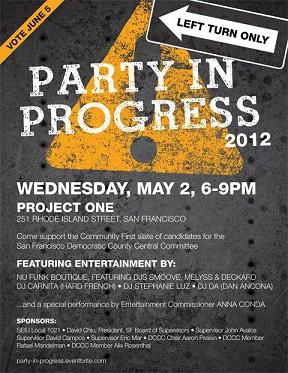
There are plenty of political fundraisers during campaign seasons, but this one will be especially interesting: The progressive slate for the Democratic County Central Committee is coming together for an event May 2 at 6 pm at Project One. The host committee includes outgoing chair Aaron Peskin and Sup. David Chiu, who have not always been on the best of terms — and Committee incumbent Alix Rosenthal, the main organizer of the event, who is also the organizer of what some see as a competing slate.

And that slate is having its own problems — involving clashes between some of the progressive women (Hene Kelley, who will no doubt be at the May 2 event) and some of the more moderate women (Hydra Mendoza, who won’t be there.) The party invite has a street sign saying “left turn only” — which is not at all what some of the people on Rosenthal’s other slate are thinking.

Rosenthal told us: “I personally think it’s remarkable that Aaron, Rafi [Mandelman], David Chiu, David Campos, Eric Mar, John Avalos and I are all on the host committee, given the rifts in the progressive movement of late.”

Yep. Everyone’s getting along. For one night, anyway.

The two defining votes of 2012

38

The Board of Supervisors will be facing two votes in the next couple of months that will define this board, establish the extent of the mayor’s political clout — and potentially play a decisive role in the political futures of several board members.

Oh: They’ll also have a lasting impact on the future of this city.

I’m talking about 8 Washington and CPMC — one of them the most important vote on housing policy to come along in years, the other a profound decision that will change the face of the city and alter the health-care infrastructure for decades to come.

Both projects have cleared the Planning Commission, as expected. Neither can go forward without approval from a majority of the supervisors. And there will be intense downtown lobbying on both of them.

The 8 Washington project would create what developer Simon Snellgrove calls the most expensive condos ever built in San Francisco. A piece of waterfront property would become a gated community for the very, very rich, many of whom won’t even live here most of the time. If it’s approved, the economy won’t collapse, neighborhoods won’t be destroyed — but it will make a powerful statement about the city’s housing policy. The message: We build housing for the 1 percent. We are a city that caters only to one very tiny group of people. We are willing to let the needs of the few drive our policy over the needs of the many.

Face it: There is no shortage of housing for the people who will buy Snellgrove’s condos. There’s a severe shortage of housing for most of the people who actually work in San Francisco. And the city’s housing policy is so scewed up that it’s making things worse. That’s the message of 8 Washington.

Then there’s CPMC. California Pacific Medical Center wants to put a snazzy state-of-the art new medical center on Van Ness, which is all well and good. But the giant nonprofit Sutter Health, which operates CPMC, has been openly hostile to some of the city’s demands (for housing, transit and other environmental mitigiation) and the proposal that Mayor Ed Lee has signed off on is way out of balance. There’s not anything even close to a reasonable link between jobs and housing — which will impact the entire city. You bring in a lot of new workers and don’t help build enough housing for them and everyone’s rent goes up.

CPMC also wants to radically downsize St. Luke’s Hospital, the only full-service facility on the south side of town except for the overcrowded and overloaded SF General. Health care for a sizable part of the city will suffer.

This is a very big deal, and the Chamber of Commerce is pushing hard for the supes to approve it. A lot of labor and the entire affordable housing community is against it.

So put those two votes in front of a board where the progressive majority has been very shaky of late — and where Lee will be working hard to line up six votes — and you’ve got potential political dynamite. Supervisor John Avalos told me he has serious concerns about both projects. Sup. David Campos told me he feels the same way. Sup Eric Mar is unlikely to vote for 8 Washington and unlikely to oppose the health-care workers and the progressive leaders who want to block the CPMC deal and make Sutter come back with a better offer, but some elements of labor are pushing hard for 8 Washington and Mar is up for re-election in one of the city’s swing districts.

Sup. David Chiu is against 8 Washington. I’ve called Sups. Jane Kim and Christina Olague (who was not a fan of the project when she was on the Planning Commission) but they haven’t gotten back to me. Olague is running for re-election this fall in the city’s most progressive district, one that’s right on the edge of the CPMC project site; Kim’s district is on the other edge.

You can’t really count to six on either of these projects without getting Chiu and/or Kim and/or Olague. Chiu has no progressive opposition, but if he supports the CPMC deal, someone may decide to challenge him. If Olague supports either project, it will give her opponents plenty of fodder for the fall campaign (John Rizzo, who is running against her, told me he opposes both). If Olague opposes the two projects, it’s going to be much harder for anyone to run against her from the left since she will have demonstrated that she can stand up the mayor on tough issues.

I’ll let you know if I hear more.


Pushing back

0

Dexter Cato has no right to be here.

He’s standing on the corner outside the house he bought in 1990. His four kids, still teenagers, grew up here. He was living here when his wife, Christina, passed away following a car accident in 2009. Next door is the house he grew up in, having spent all his life on Quesada Avenue, in the wide streets and residential friendliness of the Bayview.

Still, the bank says Cato doesn’t belong here anymore, evicting him when his home went into foreclosure in August 2010. Yet Cato and his community not only fought back and reoccupied the home last month, they have turned it into a community center and base of operations from which to fight other foreclosures in the area.

The house, at the corner of Quesada and Jenning, is draped with banners, such as “Banks: no foreclosures!” and “keep families in our homes!” In the rain on March 16, when they were unfurled on the property that has remained vacant for nearly two years, surrounded by neighbors and friends, Cato moved back in. It was a gamble and an act of civil disobedience. Now they feel festive; it’s been a month, and no one has shown up to tell Cato he has to leave.

It has become a home base for a who’s who list of “foreclosure fighters,” the name taken on by Cato and others who have, in recent months, gone to extreme means to prevent banks from foreclosing on their homes. There’s Vivian Richardson, who got her foreclosure rescinded after 1,400 emails to her loan servicer. There’s Alberto Del Rio, who was ignored and told that his paperwork was lost during a Kafka-esque two-year loan modification attempt, only to win a meeting with top Wells Fargo executives last month after Occupy Bernal got behind his cause. There’s Carolyn Gage, who took a cue from protesters downtown and occupied her Bayview home in November.

Those taking on the foreclosure crisis certainly have a big task ahead of them. Since the market collapsed in 2008, there have been 12,410 foreclosures in San Francisco, according to data from RealtyTrac as compiled by the Alliance of Californians for Community Empowerment (ACCE). The neighborhoods with the most foreclosures are Ingleside-Excelsior/Crocker Amazon, Visitacion Valley/Sunnydale, and Bayview-Hunters Point, with more than 1,000 in each neighborhood. But the number of home foreclosures are in the hundreds in every neighborhood in San Francisco.

Despite the pandemic, many San Francisco residents say they felt distinctly alone in the events surrounding receiving notice of default.

“I’ve lived in Noe Valley since 1972,” said Kathy Galvess, an activist we spoke to Cato’s basement. “I didn’t know anybody who had been foreclosed on.”

When she got her eviction notice and, hooking up with ACCE and Occupy Bernal, faced her situation and the extent of the crisis, she wondered if her neighbors knew something she didn’t.

“I asked around the neighborhood, no one had any idea,” she said. “That’s how the banks get away with it. We suffer in silence.”

Carolyn Gage echoed that sentiment. “A while ago, foreclosure was shameful. But now it shouldn’t be. It’s happening in a systemic way, so people are getting over that shame,” she told me and several neighbors March 24 during a barbecue at Cato’s house.

This shame came in part from the illusion that the onslaught of seemingly affordable home loans from the housing bubble’s height were, in fact, affordable.

“The easy money fueled the ability for people to refinance every one or two years. A lot of people did that and just lived on it. Certain people used it, some abused it, others got caught up in it,” said CJ Holmes, a real estate broker in Santa Rosa who became interested in understanding the meanings of the crisis when the value of property she owned plummeted in 2008.

While President Bush signed on to Troubled Asset Relief Program (TARP) in 2008, and bailouts to Fannie Mae and Freddie Mac continued to roll out well into the Obama presidency, foreclosures were steadily clearing San Francisco of longtime residents, not to mention property tax and home values on foreclosure-stricken blocks.

There were advocates working on the behalf of those getting evicted. The Alliance of Californians for Community Empowerment looked into cases and worked to discern the complex chain of entitlement, talk to the right people, and try to get loans modified. HUD-certified organizations like the Mission Economic Development Agency (MEDA) and the San Francisco Housing Development Corporation (SFHDC) counseled homeowners and waded through paperwork.

“The modification process takes an average of 12 months to complete,” said Jose Luis Rodriguez, a foreclosure counselor with MEDA, in an email. The loan modification process can make or break a homeowners chances of keeping their home, leaving them in what he called “purgatory.”

Assessor-Recorder Phil Ting later concluded that in 84 percent of foreclosure cases, there was some kind of faulty paperwork.

“We’d fax documents to banks and they would habitually lose documents. We’d have to fax them sometimes up to 10 times,” said Jonathan Segarra, director of communications for MEDA.

Alberto Del Rio had the same issue. During his loan modification struggle, “we kept having to sign up for a new case,” Del Rio told me. “About every three months. Generally because they lost paperwork, or paperwork wasn’t properly transmitted.”

“There was no callback on their part,” he said. “We would have to call to get updates and they would say: oh, it’s closed, you have to start over with the paperwork now.”

But this lost paperwork epidemic, an emblem of the carelessness that ran rampant through the mad expansion of the subprime mortgage industry, has more than one face. It is likely due to lost paperwork, for example, that Cato has been living in the home that is, technically, no longer his.

No one seems to have the title.

At the time of sale, it was owned by Wells Fargo. According to transaction records, the foreclosure is being serviced by American Home Mortgage Servicers; they get a portion of the money, but do not own it. According to Wells Fargo representatives, that bank is now the trustee of the mortgage, also known as the beneficiary.

ACCE has claimed that Wells Fargo “sold the house back to itself,” and that American Home Mortgage Services, the company currently servicing the loan, is a subsidiary of Wells Fargo. Ruben Pulido, a Wells Fargo spokesperson, denies this.

“That’s incorrect. American Home mortgage services is completely different and separate from Wells Fargo,” Pulido told us.

But Martinez believes that “they’re different entities in that they work separately, but they’re the main servicer for Wells Fargo, they only service for Wells Fargo.”

Calls and emails to American Home Mortgage Services went unanswered.

Last fall, as an angry mass suddenly emerged from the American public, cries of “banks got bailed out, we got sold out” rang through the streets. Occupy Bernal and ACCE have had success in the city government, gaining support from Sups David Campos and John Avalos, who represent some of the hardest hit districts, helping facilitate meetings between Wells Fargo representatives and homeowners with foreclosure horror stories, with some success.

Activists also went for more civil disobedience-style tactics. These were on display Feb. 22, when dozens of supporters showed up at Monica Kenney’s Excelsior home. Kenney was in the midst of dealing with a foreclosure that didn’t seem right. She had received a forbearance agreement and made the first payment on it June 27, then was surprised to learn that, June 28, her house had been sold at auction.

“At this point I wrote Wells Fargo and I said, I have this paperwork, and I want you to honor it and rescind the foreclosure,” Kenney explained when she came to speak with us at the Guardian offices. She gave us copies of the forbearance agreement.

“Their response was, we did nothing wrong and the foreclosure will stand,” she said. “So at that point I decided I would fight to retain my home.”

After dishing out most of her savings in a lawsuit and eviction stays, the fight looked grim, and her house was slated for eviction. The plan — the last line of defense — was to simply bring as many people as possible to Kenney’s home and hope they could fend off eviction. Kenney remembers her nerves, huddled up that cold morning with veteran foreclosure fighter Vivian Richardson, worried that no one would show up.

“Then, at six in the morning, I had foreclosure fighters, neighbors, friends, Occupy Bernal, Occupy folks period, they just started showing up at the house, and just sat down, hunkered down with me and said, we’ll do whatever we can to at least dissuade the sheriff,” she recalls

It worked. And it hasn’t stopped working. Many people who have joined with Occupy Bernal and ACCE are still in their homes thanks to everything from lobbying politicians to civil disobedience. Some were evicted despite the protest movement’s best efforts but, thanks to newfound community, they avoided homelessness.

Kathy Galvess wasn’t able to keep her home, but her experience was made much more pleasant by Occupy Bernal. “Stardust got the moving truck and helped me move, out of the goodness of his heart,” she told me. “And if it wasn’t for Vivian, me and my sister would be wandering the streets in these storms we’ve been having.”

It’s that community, it’s that tireless work, it’s that victory in the midst of a sea of ongoing challenges that was celebrated at the barbecue at Cato’s house. It’s hard to know the future of the occupied home. The goal of the coalition supporting it was to keep it until April 24, the day of a Wells Fargo shareholders meeting that a large coalition of advocates are determined to shut down.

But for now, the place has become a community center and a symbol of hope and defiance. Politicians have certainly taken note. The Board of Supervisors passed a resolution last week urging banks to suspend foreclosures in San Francisco.

“It’s great,” Cato said. “That’s what the house is useful for right now. Everyone’s coming in and asking, how can we be a part of this, how can we help.”


Sorting through scandal

22

news@sfbg.com

>>Read the Guardian Op-Ed by Eliana Lopez’s friend Myrna Melgar here.

On March 20, Mayor Ed Lee announced his decision to suspend and seek the removal of Sheriff Ross Mirkarimi, taking the city into complex and uncharted legal and political territory. He did so with little explanation in a statement lasting two minutes. Then he went and hid.

Over the past week, the mayor has refused to expound on the reasoning behind his decision, won’t answer questions from reporters, and has held no public events where he might face the news media.

But he’s set off the political equivalent of a nuclear bomb, forcing the supervisors to take on a no-win situation in an election year and leaving the City Attorney’s Office, the Ethics Commission, and Mirkarimi’s lawyers scrambling to figure out how this will all play out.

At issue is whether Mirkarimi’s guilty plea to a misdemeanor false imprisonment charge — and his actions since the New Year’s Eve conflict with his wife, Eliana Lopez, that led to the three domestic violence charges that he originally faced — warrant his immediate removal from office without pay pending hearings that could take months. Mirkarimi, the mayor alleges, violated official misconduct standards written into the City Charter with little discussion in 1995, broad language that has yet to be interpreted by a court.

Mirkarimi and his new attorney, David Waggoner, responded March 27 by filing a court petition challenging that language — “conduct that falls below the standard of decency, good faith and right action impliedly required of all public officers” — as unconstitutionally vague and arguing Lee abused his mayoral discretion in suspending Mirkarimi and violated his due process rights by taking away his livelihood without a hearing. They are asking the court to order Mirkarimi’s reinstatement, or at least the restoration of his salary, until the long city process determines his fate.

“It makes it more difficult for the sheriff to fight these charges when he’s suspended without pay,” Waggoner told us.

To those who have been calling for Mirkarimi’s removal for the last few months, the case seems simple: Mirkarimi grabbed Lopez’s arm with enough force to leave a bruise, police and prosecutors got a video the neighbor made of the wife tearfully telling the story, and Mirkarimi tried to quell the controversy by calling it a “private matter” — infuriating anti-domestic-violence advocates who have spent decades trying to explain that DV is a crime, not a family issue. The sheriff ended up pleading guilty to a related charge.

That, many say, is plenty of reason to remove him from office: How can a top law-enforcement official do his job when he’s been convicted of a crime for which advocates say there should be zero tolerance? How can a man who runs the jails have any credibility when he’s pled guilty to false imprisonment?

“He has chosen not to resign and now I must act,” Lee said at a press conference he held shortly after the 24-hour deadline he gave Mirkarimi to resign or be removed.

But like everything in this politically fractured and passionate city, it’s a lot more complicated.

WHAT REALLY HAPPENED

Lopez and her attorneys have consistently maintained that Mirkarimi was not abusive, that the video was created solely in case their deteriorating marriage devolved into a child custody battle, and that it was not an accurate description of what happened that day, suggesting the former Venezuelan soap opera star was telling a particular kind of story.

The Guardian and the San Francisco Chronicle (“Mirkarimi’s argument with wife detailed,” March 25) have pieced together some of what happened. Sources say the couple argued in the car on the way to lunch at Delfina Pizzeria about whether Lopez would take their nearly three-year-old son, who was sitting in the backseat, with her to Venezuela.

The couple had been having marital problems and Mirkarimi, worried that she might not return or that their son could be kidnapped for ransom, got angry. As the argument escalated, Mirkarimi decided to take the family home. On the way, Mirkarimi told her that he had spoken to a lawyer and learned that she needed written permission from him to take their son out of the country and that he wouldn’t do so.

That made Lopez angry and she got out of the car and tried to unfasten their son to leave when Mirkarimi grabbed her right arm, leaving a bruise that was clear in the videotape but which wasn’t visible a week later when she wore a sleeveless dress to Mirkarimi’s swearing in ceremony for sheriff.

That’s the couple’s version of events, anyway. There are no witnesses who can verify or dispute it.

Lee never called Lopez or her attorney to hear this story before deciding to remove him from office. But in the official charges he filed against Mirkarimi, Lee alleges “acts of verbal and physical abuse against his wife” and that he “restrained Ms. Lopez and violated her personal liberty,” plus unproven allegations that he was never charged with, including encouraging neighbors to destroy evidence, and of hurting morale in the Sheriff’s Department (based on a newspaper quote from a political opponent).

You don’t have to defend Mirkarimi’s conduct or belittle the serious crime of domestic violence — in fact, you don’t have to believe anything the sheriff or his wife have said — to ask a few basic questions. Is this extraordinary executive power warranted in this case? What harm would come from waiting for a recall election, the usual method of removing elected officials after a scandal? Why did Lee give Mirkarimi 24 hours to resign and did he offer anything as incentive (sources tell us he offered another city job)? Will he release the City Attorney’s Office advice memo, and if not, why?

The Guardian submitted those and many other questions to Mayoral Press Secretary Christine Falvey, who said she would answer them by March 23, but then sent us this message at the end of that day before going on vacation: “After looking at your questions, it seems Mayor Lee addressed much of this in his comments on Tuesday. After Sheriff Mirkarimi pleaded guilty to a crime of false imprisonment, Mayor Lee made a thorough review of the facts, reviewed his duties under the Charter and gave the Sheriff an opportunity to resign. When that did not happen, he moved to suspend the Sheriff.”

Very few progressives have stood up publicly and taken Mirkarimi’s side. One of them is Debra Walker, a longtime activist and city commissioner.

“This is about McCarthyism at this point, and not domestic violence,” Walker told us. “Instead of helping [Lopez], they have succeeded in breaking this family apart. It’s just bullying. It was always aimed at Ross stepping down and removing him as sheriff.”

THE LEGAL MESS

So what happens next? It is, to say the least, unclear.

The last time a public official was charged with misconduct was in the 1970s, when Joe Mazzola, an official with the Plumbers Union, was removed from the Airport Commission because he refused to order striking plumbers back to work. The state Court of Appeal later overturned that decision, ruling that “official misconduct” had to be narrowly construed to be conduct directly related to the performance of official duties (a case Waggoner relies on in his petition).

But the City Charter has changed since then, and now allows removal for the vague charge of “conduct that falls below the standard of decency and good faith and right action impliedly required by all public officers.” That phrase gives extraordinary power to the mayor — and, given some of the conduct we’ve seen at City Hall over the years, could have been used to remove a long list of city officials.

The Charter states that Mirkarimi, as the accused, will get a hearing before the Ethics Commission, and that he can be represented by counsel. It’s silent on the question of what form that hearing will take, what the rules of evidence will be, what witnesses will be allowed, and what rights the defendant will have.

Four of the five Ethics Commission members are practicing attorneys, and before they can call a hearing, they’ll have to hold a meeting to discuss the rules.

In the case of former Sup. Ed Jew, who was accused of falsifying his address, Ethics was prepared to take only written testimony (Jew resigned before any hearing, partially to deal with more serious federal charges of shaking down constituents for bribes). But that’s not a hard and fast rule — this time, the panel could decide to allow both sides to present witnesses.

If the commission decides to allow evidence, someone will have to rule on what evidence can be presented and what can’t. Will that be the commission chair, Benjamin Hur, or the commission as a whole?

The answer is: Nobody knows for sure. Hur told us he couldn’t comment on anything related to the case; the City Attorney’s Office won’t comment, either, since the office is representing both the mayor (on the prosecution side) and the supervisors and the Ethics Commission, and the board and the commission haven’t made any decisions on rules yet.

Then it gets even trickier. The Board of Supervisors has to vote on whether to remove the sheriff, and it takes nine votes to do that. So if three supervisors vote no, Mirkarimi is automatically back in office.

There are no rules in the Charter for how the board will proceed; in theory, the supervisors could simply accept the recommendation of the Ethics Commission and vote without any further hearings. They could rely on the record of the Ethics proceedings — or they could hold the equivalent of a second trial, with their own witnesses and procedures.

To add another layer of confusion, Mirkarimi, as sheriff, is classified under state law as a peace officer — and the Peace Officers’ Bill of Rights sets entirely different standards for administrative and disciplinary hearings. Among other things, Mirkarimi could assert the right to have the Ethics Commission hearing closed to the public and the records sealed.

State law also mandates that a peace officer facing suspension without pay has the right to a hearing and adjudication within 90 days. That’s not in the City Charter; under the Charter, the city can wait as long as it wants to decide the issue.

Nobody knows for sure whether the Peace Officers Bill of Rights trumps the City Charter.

It’s clear that Mirkarimi, like anyone accused of a crime or facing an administrative hearing, has the right to due process — but not necessarily the same rights as he would have in a court proceeding. It’s also clear that the supervisors will be sitting in a quasi-judicial role — and thus can’t take into account anything that isn’t part of the official record of the case.

They probably can’t, for example, hold a public hearing on the issue — and judges in a case are theoretically supposed to ignore the hundreds of calls and emails that are now flooding in to the board offices on all sides.

The political implications are equally complex. Lee would have been in a dangerous situation if he declined to file charges — if Mirkarimi ever did anything else this disturbing, some would say it was Lee’s fault for leaving him in office.

It’s a safe bet that none of the supervisors are happy about having to vote on Mirkarimi’s job, but it’s particularly tough for the progressives. Anyone on the left who votes against removal will be subject to a barrage of attack ads — and since the balance of power on the board will be decided in November, when David Chiu, John Avalos, Eric Mar, David Campos, and Christina Olague, all more or less part of the progressive bloc, will all be up for re-election, the pressure on them will be immense.

That, in and of itself, ought to be reason for the sheriff to step down, some progressives say: Is preserving Mirkarimi in the Sheriff’s Office worth potentially destroying the progressive majority on the board? It’s a good question — and one that Lee’s advisors were well aware of, too.

Supervisors hope to halt foreclosures with new resolution

70

John Avalos introduced a resolution today urging support for homeowners facing foreclosure in San Francisco. The resolution calls for several actions, including suspending all foreclosures until state and federal measures to protect homeowners are in place.

Sponsors of the resolution Avalos, David Chiu, Jane Kim, Eric Mar, and Christina Olague joined a coalition of community organizations to explain the resolution at a press conference.

The resolution would call for support of a statewide Homeowners Bill of Rights, a series of bills that would address predatory loans and robosigning, as well as California Attorney General Kamala Harris’s campaign for a statewide suspension on foreclosures in properties controled by Fannie Mae and Freddie Mac. It also “urges all city and county officials and departments to work proactively to ensure that San Francisco residents do not fall victim to unlawful foreclosure practices,” as Avalos explained.

Supervisors cited a report released in February by Assessor Phil Ting as one of the reasons for the resolution. The report found “irregularities” in 99 percent of foreclosure documents in San Francisco between 2009 and 2011, and “what appear to be one or more clear violations of the law” in 84 percent of cases. 

The resolution’s language also names “predatory banking practices that disproportionately targeted racial and ethnic minority communities, especially working class African Americans and Latinos” as an impetus for the resolution, noting that “from 2007 to 2008, Wells Fargo, and mortgage lenders it has since acquired, was 188 percent more likely to put African American borrowers and 117 percent more likely to put Latino borrowers into higher-cost, subprime loans.”

“What we see around foreclosures is that we have a systemic problem,” said Campos. Over 1,000 homes in San Francisco are currently in the process of foreclosure, 

Supervisor Kim connected the issue to another systemic problem affecting San Francisco, that has been a recent topic of discussion at City Hall: family flight. 

“We do have many low-income families that are actually homeowners in the city, primarily in the southeast sector. But how they afford to buy homes is by squeezing often two to three families in these homes in the southeast. So we’re talking about not just one household when we foreclose on a home, we’re often talking about two, three families with multiple youth and seniors,” said Kim.

“This is something that has been an important issue for many of our supervisors across the political spectrum, is how to retain families in San Francisco. Stopping foreclosure has to be a key part of that.” 

A few supervisors congratulated community organizers for focusing on the foreclosure crisis.

“I want to thank Occupy Bernal for not only shedding light on what’s happening in Bernal Heights, but realizing that the foreclosure crisis that we’re facing is something that involves all of us. Every single neighborhood,” said Campos.

The resolution was introduced to the Board of Supervisors March 20. It will be discussed further at the Land Use and Economic Development committee meeting April 2. 

If it eventually passes the Board of Supervisors, the resolution will be non-binding; a citywide foreclosure moratorium is likely not imminent. Yet many supporters expressed urgency and commitment for city action to address foreclosures. 

“When speaking with the sheriff about how we can stop evictions, what struck me most was he said that sometimes when we walk into these homes, we’ve found that people have committed suicide before the sheriffs even come in,” said Supervisor Kim. “This is a life and death issue for many of our residents.”


Sisters unite: Hyatt workers picket on International Women’s Day

5

About 80 protesters from a coalition of women workers yesterday staged a peaceful protest demanding that Hyatt reinstate two workers, Martha and Lorena Reyes, who were fired in October. 

The Reyes sisters claim they were fired after Martha tore down photoshopped images of the sisters’ heads tacked onto the cartoon images of women’s bodies in bikinis. These images were displayed in their workplace, the Hyatt Santa Clara, along with similar images of 70 fellow housekeepers. Hyatt has denied that tearing down the picture was the cause for the Reyes’ sisters’ termination. 

The protest, planned for International Women’s Day, was also meant to draw attention to what the demonstrators see as widespread disregard for the health and safety of women workers at Hyatt, as well as an ongoing contract dispute between UNITE HERE and Hyatt hotels.

“Underpaid, Underrated”

Demonstrators formed a picket line outside the Grand Hyatt Hotel at Union Square, chanting “women united will never be defeated.” The protest was accompanied by a creative project; a “clothesline” displaying more than 50 garments on which workers and allies had painted solidarity slogans. 

Women: 51 percent of world’s population, 70 percent of world’s poor, 66 percent of world’s workers, produce 50 percent of food, earn 10 percent of the income. Underpaid, underrated” read one puff-painted t-shirt.

“We are taking out the dirty laundry and talking about the injustices that Hyatt has done,” Martha Reyes told the Guardian.

Groups such as Mujeres Unidas y Activas, the Day Labor Program, the Chinese Progressive Association, and Gabriela USA (an coalition advocating for the rights of Filipino women workers), and the Progressive Jewish Alliance represented at the rally. 

Sup. John Avalos also marched in the picket line supporting the workers.

“I’m here to support the workers on International Women’s Day,” said Avalos. He decried the bikini pictures, which he said “create a hostile work environment,” and remarked that hostile work environments for women are all too common.

Inspired by the large turn-out, which Labor Council representative Conny Ford called “a multi-generational, multi-ethnic group of community and labor,” UNITE HERE Local 2 decided to enter the Grand Hyatt in an attempt to meet with General Manager David Nadelman. He conceded, and spoke with a delegation of about 30 women.

In a polite and non-confrontational meeting, Nadelman listened as each woman in the delegation took a minute to tell her story. 

Nadelman, who has managed 16 different Hyatt locations, gave a supportive response. 

“I appreciate and respect each and every one of you, and I want you to know your words will not go unheard. I will share the message, because that’s the least I can do,” Nadelman told the group.

Ford, who helped facilitate the meeting, responded that “the proof will be in the pudding.”

In a debrief about the meeting that closed the rally, the group expressed uncertainty that Nadelman’s promise to help would be fruitful. Some suggested ramping up tactics in the future, and potentially demanding that Nadelman call the Hyatt Santa Clara and ask them to reinstate the Reyes’s. 

The rally closed with chants of “we’ll be back.”

When asked to clarify his positions, Nadelman reiterated to the Guardian that “the message will be brought back to the folks I report to and beyond.”

He also expressed frustration with UNITE HERE Local 2, who was been locked in a contract battle with several Bay Area Hyatt locations since 2009.

Conflicted history

In an ongoing contract negotiation, the Hyatt wants to remove a part of the hotel workers’ contract that allows workers to vote on whether or not new hotels built in San Francisco or San Mateo will be unionized, on their terms. 

“Workers did 53-day lockout to win that language in 2005,” said Wong. “They’re not going to give it up.”

UNITE HERE is requesting a “solidarity clause,” which would allow workers to protest if they feel any Hyatt in the US or Canada is mistreating its workers. Currently, the contract contains a clause prohibiting workers from striking, boycotting or picketing while the contract is in place. 

Neither party seems likely to give up their demand. Since 2009, UNITE HERE and other supporters have spread a boycott of Hyatt hotels throughout the country, which they claim has cost Hyatt $25 million worth of business. 

Hyatt has made strides to counter UNITE HERE in their contract campaign as well as claims that Hyatt mistreats workers. They created a website, devoted largely to countering claims made by UNITE HERE. 

Hyatt representatives have also issues statement alleging that a 2010 peer-reviewed, UNITE HERE-funded study entitled Occupational Injury Disparities in the US Hotel Industry  “distorted data to achieve a result that was negative to the hotel industry.”

The report compared injuries of workers at 50 hotel properties owned by five companies, and found that Hyatt housekeepers had the highest rate of injury.

Workers report being injured while lifting heavy mattresses that often exceed 100 pounds in order to change the sheets and cleaning slippery bathrooms. According to Wong, these issues could be addressed in part if housekeepers were given proper tools. Fitted sheets, for example, would halve the work involved in bed-making, but housekeepers are provided only with flat sheets, according to Wong.

“When the Hyatt bought their location in Santa Clara, they took away the long-handled mops and replaced them with kneepads,” she says. 

The Hyatt Santa Clara has since provided long-handled mops to its housekeepers.

But Nenita Ibe, 70, is still angry that she was made to clean the bathroom on her hands and knees.

“I would always bump my head on the sink,” Ibe told the Guardian. “It’s completely wrong.”

Ibe has also lost full use of her left arm due to the repetitive motion involved in making beds.

A similar protest at the Hyatt Santa Clara the morning of March 8 brought more than 150 supporters. A delegation also successfully met with that location’s general manager, Dania Duke. 

After meeting with the delegation, Nadelman expressed frustration to the Guardian.

“It would make a lot of sense for both Hyatt and Local 2 to sit down at the table and negotiate a new, fair contract,” he said.

“We keep asking them for dates to do this, and have yet to be given one.”

But according to Wong, UNITE HERE is willing to negotiate, but not to concede some aspects of the agreement.

“As far as this contract, they know what we are demanding and they know how to get in touch with us. We’re just going to keep fighting until that happens,” said Wong.

Sisters in struggle

UNITE HERE’s campaign against the Hyatt covers working conditions and contracts all over the country. Now, they’re also hoping to get Martha and Lorena Reyes they’re jobs back, and the campaign has galvanized support. 

The sisters filed complaints with the Equal Employment Opportunities Commission in November. 

Jan. 7, they met Gloria Steinem at a conference at Stanford on the future of feminism and told her their story; she signed on to the nationwide Hyatt boycott. 

The women, who worked in the hotel for decades, say they will continue to fight until they are rehired.

“We want to have respect at work and to be treated fairly and equally. WE want to also put pressure on Hyatt for us to be able to return to work.  And we want to be able to make sure that Hyatt respects women and gives them safe working conditions and job protection, not get fired like we were,” said Martha Reyes.

SF allows bikes indoors, but its cycling goal is elusive

63

When the Board of Supervisors this week voted 9-2 to require commercial building owners to allow employees to bring their bicycles indoors while they work, ordinance sponsor Sup. John Avalos hailed the legislation as an important step toward meeting the city goal of having 20 percent of all vehicle trips in the city be by bike by the year 2020.

“We are removing a barrier to people getting around the city by bicycle,” Avalos said at the March 6 hearing, noting that the measure addresses cyclists’ concern about bike theft and helps keep sidewalks uncluttered and racks and poles free for other cyclists to use.

While it’s true this may help make cycling a bit more attractive, San Francisco would have to take far bolder actions to get anywhere near meeting its 20 percent by 2020 goal, a target it set in 2010 with legislation sponsored by Board President David Chiu and one regularly touted in speeches by Mayor Ed Lee.

Just last month, the San Francisco Municipal Transportation Agency released its latest bike count survey, which showed that about 3.5 percent of vehicle trips in the city are taken by bike, a 71 percent increase in the last five years, gains the San Francisco Bicycle Coalition lauded as “impressive.” Yet to reach the city’s goal would require a 571 percent increase in the next seven years – one that would seem unattainable at this pace.

“It’s a very ambitious but realistic goal,” SFBC director Leah Shahum told us, although she acknowledged it would require a drastic change in the city’s approach. “I’ve been impressed by how much Mayor Lee has touted the 20 percent by 2020 goal, but our city agencies need to step up their sense of urgency and commitment to meet that goal.”

The SFMTA is now finalizing a report on how to hit that 2020 target, which is scheduled for release next month. But agency spokesperson Paul Rose acknowledged the difficulty in meeting that goal: “It would take funding resources which at this point we don’t have.” He can’t yet say would it would take to meet the goal, which the report will outline, but he said, “We’re exploring what can be achieved with our available funding.”

Shahum said all studies by SFBC and other groups show concerns about safety is the biggest barrier to substantially increasing cycling in the city, and that most people need bike lanes – particularly paths physically separated from cars, known as cycle tracks – to feel safe. She praised the SFMTA for installing 20 miles of new bike lanes in the last two years, its fastest pace ever, “but that pace needs to double or triple to meet that goal.”

Instead, Mayor Lee has backed off a pledge he made last year to fast-track a short segment of bike lanes on dangerous sections of Oak and Fell streets that would connect two popular east-west bikeways: the Panhandle and the Wiggle. That project was delayed by a year for more meetings and work after motorists objected to the loss of street parking spots.

“We’re talking about three blocks. It’s relatively small in scope but huge in impacts,” Shahum said of the project. “If the pace of change on these three blocks is replicated through the city, it’ll take hundreds of years to meet the goal.”

In his run for mayor last year, Chiu regularly touted the 20 percent goal he set in 2010 after returning from a fact-finding trip to the Netherlands – where about 38 percent of vehicle trips are by bike – that he took with SFMTA Director Ed Reiskin, SFBC members, and officials from other cities. Chiu says that San Francisco might be further along than the SFMTA figures show, citing an SFBC poll showing that 5 percent of San Franciscans say they ride a bike daily and another 12 percent ride more than once a week.

“Whatever the current percentage is, we have a long way to go. We have to be bolder about specific projects and strategies,” Chiu told us. He said there is a growing recognition that promoting cycling is an important way to address traffic congestion and greenhouse gas reduction and that “segregated bikes lanes are the most efficient way to move the most people through areas of urban density.”

Chiu also said that San Francisco could be poised for rapid progress on the creation of new bikes lanes, citing early opposition to replacing parking spaces with parklets and the car-free Sunday Streets (which kicks off its new season this Sunday along the Embarcadero) events, with the business community and many neighborhood groups fearing that restrictions on motorists would hurt businesses.

“The experience has turned out to be exactly the opposite,” Chiu said, noting the explosion in demand for parklets and new Sunday Streets events in the last couple years, saying that a widening embrace of more cycle tracks and other biking infrastructure could be next.

Mayoral Press Secretary Christine Falvey told us, “The mayor is very much committed to the aggressive goals set to get to 20 percent by 2020 and the city is moving in the right direction. He has also always supported the Oak Fell project and we’re seeing progress. It will be complete in 2013 and he has been talking to the SFMTA about the project to keep up to date. San Francisco is on its way to becoming the most bicycle friendly city in the U.S. and in this era of limited public funding, the mayor is working with the SFMTA to explore what ways we can increase trips taken by bicycle with available funding and increased public awareness.”

She cited the Avalos legislation and the current installation of cycle tracks on JFK Drive in Golden Gate Park as examples of the city’s commitment to “move us toward the goal of 20 percent,” but many in the cycling community consider these efforts to be low-hanging fruit – easy, cheap, and non-controversial improvements – that won’t get the city anywhere near its stated goal.

Bike activist Marc Salomon is critical of the incremental approaches taken by SFBC and the city, saying that to make significant progress the city needs to address enforcement and the culture on the roadways, protecting cyclists from aggressive or impatient motorists and recognizing that many traffic laws don’t make sense for cyclists.

“We need to change the culture of the cops to make sure every street is a safe street,” he said. Shahum said that’s an issue SFBC is trying to address: “We are talking to them about how police could better enforce dangerous behaviors.”

Yet any efforts to promote cycling will likely be met with a backlash by motorists who resent losing space to cyclists and the fact that many cyclists routinely run stop signs and lights. Sups. Sean Elsbernd and Carmen Chu voted against the Avalos legislation, with Chu objecting to city staff evaluating businesses that seek waivers based on limited space or other factors, calling it a waste of precious resources.

But Avalos noted that his ordinance – which will be up for final approval on its second reading this Tuesday – has no enforcement mechanisms and “overall, this is a cost effective way to promote bicycling in the city. The costs are minimal.”

He also thanked the conservative Building Owners and Managers Association for supporting the legislation. Shahum said BOMA strongly opposed similar legislation almost 10 years ago and its embrace of it now shows how attitudes toward cyclists have changed. “There are so many more people biking now and the business community recognizes the benefits of having more of their employees biking,” she said.

Even politically moderate supervisors have been supportive of promoting cycling, with Sup. Scott Wiener saying at this week’s hearing, “It’s very important to make it as easy as possible to bike, and bike theft is a big issue in this city as well.”

The failure of Lee’s business tax plan

16

The Mayor’s Office and city finance officials are circulating drafts of a new business tax plan that would largely abolish the payroll tax and replace it with a levy on gross receipts.

Ben Rosenfield, the city controller, and Ted Egan, the chief economist, have been meeting with business groups and presenting what’s described in the documents they’re circulating as “one possible idea.” And there’s some very positive news about the proposal: It would greatly broaden the tax base (only about 10 percent of the city’s businesses are hit by the payroll tax) and it’s designed to be somewhat progressive: Businesses with higher gross receipts would pay a higher percentage tax.

The plan is complicated — since some types of industries (retailers, for example) have high gross receipts compared to payroll, and some (financial services) have high payrolls compared to gross receipts, the levies are broken down into four schedules. At the lowest end, companies with comparatively large gross reciepts would pay between 0.05 percent and 0.125 percent. At the highest end, the tax would go from 0.220 to 0.535.
But there’s one central — and simple — element of the proposal: At this point, it’s entirely revenue neutral. In fact, finance officials say, over time the total tax burden paid by local businesses would go down, since payroll tends to rise slightly faster than gross receipts.

That, sources say, is something the mayor has made clear he doesn’t want to budge on. He’s not willing to accept a plan that raises the total amount of money the city gets from business taxes.

Which puts him in synch with what some business groups want: “The business community thinks this should be revenue-neutral,” Scott Hauge, who runs Small Business California, told me.

But in a city that faces a large structural budget deficit, some supervisors have other ideas. “I want to look at new revenue possibilities,” Sup. John Avalos said.

And even the current proposals would let banks, which are exempt from local business taxes, escape without paying anything.
In reality, the proposals are less then revenue-neutral. Rosenfield and Egan project that the new tax system would lead to the creation of 2,500 jobs a year — mostly because businesses over time would be paying lower taxes.

Hague told me that he’s not sure exactly how business leaders feel about this. “We don’t know yet how it will affect people,” he noted. But some political leaders have been clamoring for years for the elimination of the payroll tax, which, by taxing employment, appears to be a damper on job growth.

That’s actually a myth. The payroll tax is so minor that it can’t possibly influence any individual hiring decision. It’s true that if city business taxes in general are reduced, companies will have more money — and some might spend that on new hiring. But San Francisco, like most major cities, has to have some kind of business tax — and I can already hear some downtown types complaining that a gross receipts tax “punishes growth and success.”

This proposal is a long way from what Sup. David Chiu suggested a year ago. His plan would have included a commercial rent tax — ensuring that financial institutions that get away with paying nothing would have to contribute like other businesses. Like most local taxes, it wasn’t perfect — state law bars cities from imposing corporate income taxes and limits what else municipalities can do — but together with a reworked gross receipts tax, it was projected to bring $28 million more dollars into the city treasury — without any job loss.

But the Chamber of Commerce and crew fought bitterly against that idea, and Chiu withdrew it.

At this point, Chiu said, he’s working with the mayor and trying to get the business community to accept the idea of a change in the tax structure. But this is a rare opportunity to do two things — to make the local tax system more fair, and to raise taxes on the biggest companies to bring additional revenue into the city.

The plan will probably have to go to the ballot anyway, so why not do it right?

What’s wrong with the America’s Cup deal? A lot

21

Let’s start out with a premise that even Larry Ellison’s minions have come to accept: The race is happening here. Too late now to move it to another city. Worst-case scenario, according to Stephen Barclay, the point person for the world’s sixth-richest man: “If we don’t meet those dates, the teams will be forced to relocate to other places around the bay.”

That’s right — the teams will relocate to other places around the bay. The host city will still, for all practical purposes, be San Francisco; the races will happen off SF’s waterfront (where the Coast Guard is willing to allow them and the conditions are right) and the rich tourists will stay here, not in Burlingame or Fremont.

If Ellison decides the city’s not giving him enough, he won’t put up $55 million to fix up some of the waterfront piers. The city may decide that a development deal of some sort with him makes economic sense. But it’s a real-estate deal at this point, not a deal for the race. At least, that’s what the Ellison team seems to be confirming.

And I fear that the real-estate deal that the Board of Supervisors Finance Committee sent forward yesterday, 2-1, is a bad deal for the city.

The terms are really complicated, and it makes my head hurt just trying to figure it all out — and still, the supes are expected to vote on the 120-plus-page document Feb. 28. Here’s what we do know, though:

The supervisors originally came to a deal with the America’s Cup Event Authority back in December. The concept was — and is — pretty straightforward, the same sort of deal the city has done (or, certainly, the Redevelopment Agency has done) many times in the past. In exchange for putting cash into renovating several piers, Ellison’s group would get long-term leases and development rights on the property. The idea: The city can’t afford to fix the piers. Ellison’s organization can. And once the property is renovated, the developer can make back that initial investment, and a profit, by building commercial space, condos and whatever else the Port decides to allow.

In a perfect world, San Francisco (and the state and the feds) would tax the hell out of people like Ellison, and there’d be public money to rebuild the waterfront as public open space, recreational facilities and the like. And wouldn’t that be utterly cool? Wouldn’t this city have the most awesome waterfront in the world?

But no: The only way the piers are going to anything but a place to park cars until they fall into the bay is if some private developer gets the rights to build something that I won’t like.

Supervisors Jane Kim and Mark Farrell, who don’t agree on a lot of things, both agreed with my basic analysis of the politics here: We shouldn’t let the excitement over the prospect of a boat race get in the way of analyzing this for what it is: A financing tool for the Port to get its infrastructure fixed up. Without a private investor, “they just don’t have the capacity to do that,” Kim told me.

So let’s just stipulate for a moment that this is the best, maybe the only way the city can restore the Port. Then it comes down to the real issue: Has the Mayor’s Office negotiated a good enough deal? Is San Francisco getting enough out of this? Or is everyone so hyper-buzzed about fancy carbon-fiber boats in the water (and I admit, they’re pretty cool) and free-spending tourists in the hotels and restaurants that we’re letting Mr. Ellison — who didn’t get so stinky rich by being a weak negotiator — walk away with most of the cookies?

Remember: Ellison’s not doing the city any favors. He’s only fixing up the piers that he will effectively own (as least for most of the rest of this century).

Back in December, the rough outlines looked like this: A corporation set up by Oracle, called the America’s Cup Event Authority, would put $55 million into repairing and renovating piers, then would get  66-year leases and development rights on piers 30-32, 26 and 28, as well as seawall lot 330, across the Embarcadero, which Ellison’s team wants to turn into more condos for rich people. If that’s not enough to pay for Ellison’s investment, Ellison’s heirs or successors get half the rent for the piers for another 15 years. That’s 81 years.

The original deal mandated that the city would collect a 1 percent fee on the re-sale of the new condos. It also had a requirement that Ellison share with the city any profits he made by flipping the long-term leases.

That’s a big deal, because almost nobody in the city actually holds onto development entitlements anymore. A developer wins the right to build an office building — and next week, he or she sells that right to somebody else. It’s almost certain that at some point, Ellison — whose sole goal here is going to be making a profit off city land — will decide that the best way to make money is to cash out. He’ll keep his 66-year leases for a few years, maybe lobby his way to approvals for office, condos, time-shares (gasp! yeah, they’ll do that if it’s legal) restaurants or whatever — then sell the remaining time on the leases, plus the development rights, to somebody else. And because he’s Larry Ellison, he’ll wind up making a nice tidy profit.

That used to be what happened with Port property (see: Pier 39) but lately, the Port’s gotten a bit wiser and has, in some cases, insisted that part of the profit from flipping a lease goes back to the city. In the original discussions, Ellison was going to have to pay the Port 15 percent of any net gains he made from the almost inevitable sale of the valuable leases.

But that’s gone now. After the board approved Newsom’s deal, the former mayor — who was always terrible at negotiation with the rich and powerful and always gave away the store — went back and monkeyed around with it. He and Sup. David Chiu insisted that the changes were just technical, not substantive enough to require a new board vote — but the current deal has no 15 percent cut for the Port, and the 1 percent levy on condo sales only applies after the second owner sells — which will be years down the road.

Then there’s the part where the city has to reimburse Ellison if the cost of renovating the piers exceeds what’s expected (oh, and we have to pay him 11 percent interest, which is about ten times what I get on my bank account; how about you?) There’s no cap on what the city might have to pay. And Ellison gets to develop a new marina.

And while Pier 29 is no longer a part of the deal, the city has to give Ellison $12 million — or rights to a pier to be named later. (Maybe Ellison figures that in a few years the people who opposed Pier 29 development will be out of office and he can convince the new mayor and supervisors to give Pier 29 back. It’s not legally excluded.)

Kim told me she’s going to insist that the final deal include a local-hire provision, which the rest of the board would be crazy not to support (and which Ellison, despite his company’s problems with local labor laws in the past, would be crazy not to accept).

But overall, Kim — who with Sup. Carmen Chu was part of the 2-1 majority sending the package to the full board — told me she thought the city got a good deal. “It took me a while,” she said. “But [Port Director] Monique Moyer convinced me that this was good for them.”

Sup. John Avalos, the dissenting vote on the Finance Committee, isn’t convinced. He’s got a long list of concerns, starting with the fact that he thinks the projected attendance and economic benefits are a bit delusional. “The figures seem farfetched,” he told me. “I’m seeing a lot of pumped up numbers. And those numbers drive whether this is a good deal for the city or not.”

He’d like to see the 1 percent rule apply to the second condo sale, not the third. He’d like to see the Port get 15 percent of the profits from any sale. And he’d like a cap on the reimbursements the city has to give to Ellison.

But here’s the problem: When the development agreement comes before the board, sitting as a Committee of the Whole Feb. 28, it will be hard to put any of that back in the agreement. This is a contract, and while the board can pass a resolution asking for more, in the end, it’s a matter of voting it up or down.

Vote yes and it’s done — more or less as is — although Kim says there will be another chance to make changes down the road, since the board and the Planning Commission will have to sign off on whatever type of development Ellison wants to do. The problem with that scenario? Ellison’s lawyers will wave this development agreement around like a Giants victory towel and proclaim that it binds the city and limits any ability to demand any more changes later. That’s how these people operate.)

Vote no and the ball goes back to Larry’s Court: His group can sit down with the Mayor’s Office and make some changes, or they can walk away (and build their boat sheds in …. where? Oakland? Foster City? Who’s got waterfront that can handle this?)

When the Finance Committee send the package to the full board, Avalos said, “we pretty much lost our ability to influence the agreement. Now we have to decide if we want to call [Ellison’s] bluff.”

PS: One of the lingering issues is whether the America’s Cup Organizing Committee can raise the $30 million-odd that is needed to make the numbers pencil out. If I were a rich person and Mark Buell, the ACOC point person, called me for money, here’s what I’d say:

How much is Larry Ellison contributing?

See, Ellison’s improvements on the waterfront aren’t charity. He’s looking to make a buck off everything he does. In past eras, the great robber baron capitalists would donate civic monuments — libraries and museums and stuff — and by any traditional standard of great wealth, Ellison ought to be writing a personal check for that $30 million. Or at least for some of it.

But so far, he hasn’t given a penny. The sixth richest man in the world isn’t actually donating anything to San Francisco. Yeah, he’s gracing us with his lordly presence, but cash? Nada.

Good luck with that one, Mark.

PPS: This whole concept that the city needs to fix the “crumbling” piers ought to be examined. First of all, nobody’s ever said that Pier 29 was in anything but fine shape. But beyond that, the Bay Conservation and Development Commission considers piers to be bay fill, and in the long term, wants San Francisco to get rid of some of them. “Maybe it’s a good thing if some of the piers fall into the bay,” former Sup. Aaron Peskin told me. “Then we’ll have more leeway with BCDC when we want to fix up some of the others.”

Research assistance by Royce Kurmelovs

Campaign cash roundup and questions about our sleeping watchdog

3

Oliver Luby – the last true public-spirited employee at the Ethics Commission (a campaign lapdog when it should be a watchdog) before being forced out in 2010 – has written an insightful and comprehensive analysis of spending by candidates and outside groups during last year’s election. It’s published by CitiReport.

Among his findings are that the largely unregulated spending by supposedly independent third-party groups totaled $3.6 million, with $1.4 million of that going to support Mayor Ed Lee, and much of it coming so late in the race that voters weren’t able to factor its sources into their decisions.

Those outside groups spent almost as much to elect Lee as the campaign itself raised, which was almost $1.6 million. When those two figures are combined, and one subtracts the $419,891 in independent expenditure (IE) spending in opposition to Lee, the appointed mayor and his supporters spent $33.87 for each first place vote he received, or about 2.5-times that of second-place finisher John Avalos, whose $757,327 in “supportive financing” works out to $13.25 per vote.

Luby has long called for Ethics to get tougher on violators of campaign finance law, playing whistleblower at several key points in his career, starting in 2004 when he and then-staffer Kevin DeLiban exposed notorious campaign attorney Jim Sutton’s alleged scheme to illegally launder unregulated funds being collected for then-Mayor Gavin Newsom’s inauguration into paying off some of his $550,000 campaign debt.

In his latest piece, Luby again calls out his old bosses at Ethics for ignoring local laws against maxing out donations to many candidates in order to buy influence at City Hall. Donors are limited to an “overall contribution limit” that equals the maximum individual donation of $500 times the number of offices open, which was three in this election. It allows the city recoup from the campaigns money collected in excess of that, which Luby said totals $29,111 in this election.

“The SF Ethics Commission does not enforce this law. Supervisor Scott Wiener wants to help them get rid of it,” Luby wrote. Ethics Commission Executive Director John St. Croix was out of the office and hasn’t returned a Guardian call for comment.

Among those whose excessive contributions would be diverted to city coffers are Planning Commissioner Michael Antonini (perhaps the city’s most powerful Republican), PR powerhouse Sam Singer, medical marijuana activist Kevin Reed, political fundraiser Wade Randlett, city staffer-turned-developer Michael Cohen, moderate Democrat Mary Jung, and Coalition for Responsible Growth (a pro-development group) President Rodrigo Santo. Not surprisingly, they all contributed to Lee, whose campaign would be on the hook for the most in givebacks, $7,725, followed by David Chiu’s mayoral campaign at $4,700.

Finally, for all their talk about fiscal responsibility, Lee and his supporters couldn’t seem to live within their means in this election. Lee’s campaign finished about $275,000 in debt, while two of the pro-Lee IEs also finished in the red: SF Neighbor Alliance ($11,338) and Progress for All ($35,890), the ethically challenged creators of the “Run Ed Run” campaign that purported to talk Lee out of his pledge not to run for a full term in the office he’d been appointed to.

These are just some of the findings in Luby’s voluminous reporting, so check it.

Valentine’s Day dump the banks rally: If only all break-ups involved this much singing (VIDEO)

7

Protesters across the country participated in “break up with your bank” day on Feb. 14. Several protesters happened throughout the Bay Area, including a demonstration organized by Causa Justa :: Just Cause, Occupy Bernal, Occupy SF Housing, and the San Francisco Tenants Union.

In past months those organizations have variously stopped evictions and foreclosures, prevented homes from being auctioned off, and organized mass protests. They’ve created trouble shutting down bank branches, sometimes for hours, on dozens of occasions.

For Valentine’s Day, protesters decided to have a little fun.

“Our intention is not to shut down the banks,” insisted Causa Justa organizer Maria Zamudio. “Just to break up with them.”

About 60 marched through the financial district Feb. 14, presenting large red broken hearts and “dump the banks” banners decorated with pink balloons.

http://www.youtube.com/watch?v=6-f6pHXQkbs

Security guards at the banks that the group approached locked their doors. Protesters, amused, began chanting “the banks shut themselves down.”

Bank of America building locked their doors when they saw the protest approaching. At the Wells Fargo west coast headquarters around the corner, a representative who identified himself as David accepted the card.

Afterwards, a dozen members of the group headed to City Hall for a Board of Supervisors meeting in support of a resolution brought by Supervisor John Avalos and co-sponsored by Supervisor Eric Mar. The resolution supports the city treasurer’s office in its recent efforts to include social responsibility and community reinvestment in its evaluation criteria as it searches for new banks in which to invest San Francisco’s money. The resolution passed.

“It’s not a victory, but a great step in the right direction,” said Zamudio. She hopes that the social responsibility assessment will look at a bank’s history with predatory loans, investment in small businesses, and refinancing mortgages.