John Avalos

Meet the new supervisor

10

Christina Olague, the newest member of the Board of Supervisors, faces a difficult balancing act. She was appointed by Mayor Ed Lee, whom she supported as co-chair of the controversial “Run Ed Run” campaign, to fill the vacancy in District 5, an ultra-progressive district whose voters rejected Lee in favor of John Avalos by a 2-1 margin.

So now Olague faces the challenge of keeping her district happy while staying on good terms with the Mayor’s Office, all while running in her first campaign for elected office against what could be a large field of challengers scrutinizing her every vote and statement.

Olague has strong progressive activist credentials, from working with the Mission Anti-Displacement Coalition to protect low-income renters during the last dot-com boom to her more recent community organizing for the Senior Action Network. She co-chaired the 2003 campaign that established the city’s minimum wage and has been actively involved in such progressive organizations as the Milk Club, Transit Riders Union, and the short-lived San Francisco People’s Organization.

“One of the reasons many of us are so supportive of Christina is she is grounded in the issues of low-income San Franciscans,” said Gabriel Haaland, who works with SEIU Local 1021 and accompanied Olague to a recent interview at the Guardian office.

She also served two terms on the Planning Commission — appointed by Board of Supervisors then-President Matt Gonzalez in 2004 and reappointed by then-President Aaron Peskin in 2008 — where she was known for doing her homework on complicated land use issues and usually landing on the progressive side of divided votes.

“Coming from the Planning Commission, she can do a lot of good,” said Tom Radulovich, executive director of Livable City and a supporter who has worked with Olague for 15 years. “We lost a lot of collective memory on land use issues,” he said, citing the expertise of Chris Daly and Aaron Peskin. “We do need that on the board. There is so much at stake in land use.”

Olague disappointed many progressives by co-chairing Progress for All, which was created by Chinatown power broker Rose Pak to push the deceptive “Run Ed Run” campaign that was widely criticized for its secrecy and other ethical violations. At the time, Olague told us she appreciated how Lee was willing to consider community input and she thought it was important for progressives to support him to maintain that open door policy.

In announcing his appointment of Olague, Lee said, “This is not about counting votes, it’s about what’s best for San Francisco and her district.” Olague also sounded that post-partisan theme, telling the crowd at her swearing-in, “I think this is an incredible time for our city and a time when we are coming together and moving past old political pigeonholes.”

With some big projects coming to the board and the working class being rapidly driven out of the city, progressives are hoping Olague will be a committed ally. There’s some concern, though, about her connections to Progress For All campaign’s secretive political consultant, Enrique Pearce.

Pearce has become a bit of a pariah in progressive circles for his shady campaign tactics on behalf of powerful players. In 2010, his Left Coast Communications got caught running an independent expenditure campaign partly funded by Willie Brown out of Pearce’s office, even though Sup. Jane Kim was both its beneficiary and his client — and that level of coordination is illegal. Last year, Pearce was hired by Pak to create the “Run Ed Run” campaign and write the hagiographic book, The Ed Lee Story, which also seemed to have some connections with Lee’s campaign. The Ethics Commission hasn’t fined Pearce for either incident, and he didn’t return a Guardian call for comment.

Olague told us not to worry. “He’s a friend…and I think it’s an exaggerated concern,” she said, confirming but minimizing his role so far. Yet she hired one of Pearce’s former employees, Jen Low, as one of her board aide. Olague’s other aides are Chris Durazo from South of Market Community Action Network (SOMCAN) and Dominica Henderson, formerly of the SF Housing Authority.

Debra Walker, a progressive activist who served on the Building Inspection Commission and has worked with Olague for decades, said she’s a reliable ally: “She’s from the progressive community and I have no equivocation about that.”

Olague makes no apologies for her alliances, saying that she is both independent and progressive and that she should be judged by her actions as a supervisor. “People will have to decide who I am based on how I vote,” she said, later adding, “I support the mayor and I’m not going to apologize for that.”


OLAGUE’S PRIORITIES

Olague was born in Merced in 1961 to a Mexican immigrant father who fixed farming equipment and a stay-at-home mother. She went to high school in Fresno and moved to the Bay Area in 1982. She attended San Francisco State University but had to drop out to help support her family, working at various stock brokerage firms in the Financial District. She later got a degree in liberal studies from California Institute of Integral Studies.

In 1992, Olague’s mother was in serious car accident that left her a quadriplegic, so Olague spent the next seven years caring for her. After her mother died, Olague left the financial services industry and became a community organizer for the Mission Anti-Displacement Coalition, battling the forces of gentrification and then-Mayor Brown and becoming an active player in the ascendant progressive movement.

But Olague never abided progressive orthodoxy. She backed Mark Leno over the more progressive Harry Britt in their 2002 Assembly race and backed Leno again in 2007 when he ran for state Senate against Carole Migden. She also voted for the Home Depot project on Bayshore Boulevard despite a progressive campaign against the project.

Olague worked with then-Sup. Chris Daly to win more community benefits and other concessions from developers of the Trinity Plaza and Rincon Tower projects, but now she is critical of Daly’s confrontational tactics. “Daly’s style isn’t what I agree with anymore,” Olague said, criticizing the deals that were cut on those projects to approve them with larger than required community benefits packages. “I think we romanticized what we got.”

So how does Olague plan to approach big development proposals, and is she willing to practice the brinksmanship that many progressives believe is necessary to win concessions? While she says her approach will be more conciliatory than Daly’s, she says the answer is still yes. “You push back, you make demands, and if you don’t think it’s going to benefit the city holistically, you just fucking say no,” Olague said.

Walker said Olague has proven she can stand up to pressure. “I think she’ll do as well as she did on the Planning Commission. She served as president and there is an enormous amount of pressure that is applied behind the scenes,” Walker said. “She’s already stood up to mayoral pressure on some issues.”

Yet even some of Olague’s strongest supporters say her dual — and perhaps dueling — loyalties to the Mayor’s Office and her progressive district are likely to be tested this year.

“It’ll be challenging for her to navigate,” Radulovich said. “The Mayor’s Office is going to say I want you to do X and Y, and it won’t always be progressive stuff, so it’ll be interesting to see how that plays out.”

But he said Olague’s land use expertise and progressive background will likely count for more than any bitter pills that she’s asked to swallow. “Sometimes, as a policy maker, you have to push the envelope and say we can get more,” he said. “It helps if you’re willing to say no to things and set boundaries.”

When we asked Olague to lay out her philosophy on dealing with land-use issues, she said that her approach will vary: “I have a very gray approach, project by project and neighborhood by neighborhood.”

Only a couple weeks into her new role, Olague said that she’s still getting a lay of the land: “I’m in information gathering mode, meeting with neighborhood groups to try to figure out what their issues are.”

But Olague said she understands that part of her job is making decisions that will disappoint some groups. For example, after Mayor Lee pledged to install bike lanes on Fell and Oak streets to connect the Panhandle to The Wiggle and lessen the danger to bicyclists, he recently stalled the project after motorists opposed the idea.

“I’m a transit-first person, for sure. I don’t even drive,” Olague said of her approach to that issue, which she has now begun to work on. “We’ll try to craft a solution, but then at some point you have to fall on one side or the other.”


THE “JOBS” FOCUS

One issue on which Olague’s core loyalities are likely to be tested is on the so-called “jobs” issue, which both Lee and Olague call their top priority. “Jobs and economic revitalization are very important,” she told us.

Progressives have begun to push back on Lee for valuing private sector job creation over all other priorities, such as workers’ rights, environmental safeguards, and public services. That came to a head on Jan. 26 at the Rules Committee hearing on Lee’s proposed charter amendment to delay legislation that might cost private sector jobs and require extra hearings before the Small Business Commission. Progressives and labor leaders slammed the proposal as unfair, divisive, unnecessary, and reminiscent of right-wing political tactics.

But when we interviewed Olague the next day, she was reluctant to criticize the measure on the record, even though it seemed so dead-on-arrival at the Board of Supervisors that Mayor Lee voluntarily withdrew it the next week.

Olague told us job creation is important, but she said it can’t squeeze out other priorities, such as protecting affordable rental housing.

“We always have to look at how the community will benefit from things. So if we want to incentivize for businesses, how do we also make it work for neighborhoods and for people so that we don’t end up with where we were in the Mission District in the ’90s?” she said.

Olague also said that she didn’t share Lee’s focus on jobs in the technology sector. “There’s a lot of talk of technology, and that’s fine and I’m not against that, and we can see how it works in the city. But at the same time, I’m concerned about folks who aren’t interested necessarily in working in technology. We need other types of jobs, so I think we shouldn’t let go of the small scale manufacturing idea.”

Local control of cops

1

news@sfbg.com

Sup. Jane Kim has introduced legislation to the Board of Supervisors calling for a re-examination of the San Francisco Police Department’s participation in some aspects of the Joint Terrorism Task Force, which was created by the Federal Bureau of Investigations to do domestic surveillance.

The proposed ordinance would prohibit the SFPD from working with the JTTF to collect intelligence on individuals in the absence of criminal wrongdoing, which has been a concern of civil libertarians since last year when a secret memo revealed that local officers were under FBI command and not bound by local and state restrictions on such surveillance (see “Spies in blue,” 4/26/11).

Kim said the ordinance was necessary to ensure the “requirement of reasonable suspicion before we do any type of investigation of criminal activity. And we don’t base it on ethnic identification or religious practice as some of the members of the community have been experiencing the last couple of years.

“Our office is sponsoring this because many members of the Arab, Asian and the Muslim community worship in the district and own many small businesses,” she said.

Critics of the relationship between local and federal law enforcement agencies, facilitated through participation in the JTTF, have long raised concerns about racial profiling and unnecessary spying ordered at the federal level, and carried out by SFPD inspectors assigned full time to the task force.

Federal regulations governing FBI intelligence gathering are weaker than standards set by San Francisco and California’s Constitution. In 1990, the San Francisco Police Commission established rules requiring that intelligence-gathering involving any First Amendment activity be based on reasonable suspicion of significant criminal activity. Those rules reflect the California Constitutional requirement of an “articulable criminal predicate” before law enforcement agencies engage in intelligence-gathering activity.

However, because the SFPD inspectors assigned to the JTTF work under the direction of the FBI, the local regulation and control of law enforcement is effectively limited in JTTF investigations.

“It’s important that a clear prohibition against policing based on race, ethnicity, national origin, or religion applies to all of our officers, all of the time,” said John Crew, police practices expert for the Northern California chapter of the American Civil Liberties Union. The ACLU is one of more than 30 civil rights and community organizations participating in the Coalition for Safe SF, which helped develop the proposed ordinance.

According to the coalition, current rules prevent the SFPD from barring its inspectors assigned to the JTTF from joining FBI agents in collecting intelligence on San Franciscans without any “particular factual predication.”

“The purpose of this legislation is to restore local control, civilian oversight, and transparency over the SFPD’s participation in FBI intelligence-gathering,” stated attorney Nasrina Bargzie of the Asian Law Caucus, which is part of the coalition.

The coalition was a major participant in the San Francisco Human Rights Commission hearing in 2010 on the issue of baseless spying and racial profiling in JTTF investigations. The result was a comprehensive report, endorsed by the Board of Supervisors last spring.

But in 2011, the ACLU and Asian Law Caucus learned that key protections for civil liberties — including civilian oversight of intelligence activity and safeguards to limit intrusive tactics — were thrown out the window and replaced by a secret Memorandum of Understanding with federal law enforcement in 2007.

Under the MOU, SFPD paid officers work out of the local FBI office. The secure nature of their work means they must seek federal permission to even talk to their superiors in the SFPD about their work, effectively removing them from the local chain of command. Despite mandated requirements on local law enforcement, the MOU does not allow for any civilian oversight of the work of officers assigned to the JTTF.

San Francisco Chief of Police Greg Suhr said he believes that the concerns have already been addressed. In his first days in office, Chief Suhr issued a binding Bureau Order #2011-07 setting forth the requirement that officers comply with local standards.

An excerpt of the order reads, “SFPD officers shall work with the JTTF only on investigations of suspected terrorism that have a criminal nexus. In situations where the statutory law of California is more restrictive of law enforcement than comparable federal law, the investigative methods employed by SFPD officers working on JTTF investigations shall conform to the requirements of such California statutes.”

“With this Bureau Order, the language of the 2007 Memorandum of Understanding no longer applies and SFPD personnel are bound by the provisions of the 2011 Order,” SFPD Public Information Officer Albie Esparza told the Guardian.

But Crew said that as long as the MOU between the SFPD and federal law enforcement remains in place, Suhr’s order at best creates contradictory policy. “The Memorandum of Understanding is a binding legal contact with the federal government. Which do you think will take legal precedence when it comes up against a local police chief’s departmental order?” said Crew, who urged the department to clarify the matter by withdrawing from the MOU, a step the SFPD has thus far been unwilling to take.

A letter from Sept. 28 of last year to Coalition for Safe SF from FBI Special Agent Stephanie Douglas regarding the contradiction clarifies the matter. “I do retain the right to assign FBI JTTF cases,” states Douglas, who goes on to assert it is she who makes the confidential judgment of which cases fall afoul of the state and city rules and which do not.

After years of intelligence-gathering authorized under a secret memorandum, public mistrust in the SFPD’s relationship to federal law enforcement persists. Kim says she believes the proposed ordinance will still help make San Francisco safer. “It increases the trust of the community members that are working with public safety in reporting, and in cooperating around many of the actual criminal activities that might be going on in the city,” she said.

The proposed legislative approach of regulating the scope of local participation in federal JTTF work is not unprecedented. The city has the option of terminating the MOU with 30 days notice, a step that the city of Portland, Oregon has taken to prevent its police force from spying on citizens in violation of local and state law.

In December, the city of Berkeley suspended its agreement with the Northern California Regional Intelligence Center (an arm of the Joint Terrorism Task Force) as part of a broad review of that city’s relationship to other local and federal law enforcement agencies (see “Policing the police,” 12/13/11).

“What this is about is maintaining local control of law enforcement and ensuring the civil liberties of the people of San Francisco,” Crew said. “Don’t San Franciscans deserve the same protection of their civil liberties as the people of Portland?”

Kim was joined by Sups. David Compos and John Avalos in sponsoring the ordinance. Supervisors are expected to vote on the whether to adopt the ordinance this spring after the measure is heard by the city’s Public Safety Committee following the normal 30-day hold. The measure seems to have the support it needs to pass the Board of Supervisors, but it remains unclear whether Mayor Ed Lee, who did not answer our inquiries, will sign it.

America’s Cup moves forward, but economic concerns remain

5

In past weeks, several environmental and community organizations filed two appeals of the Environmental Impact Report (EIR) prepared for the America’s Cup yacht race in 2013.

Jan. 24, the Board of Supervisors rejected the appeal, allowing for construction on the several major projects contained in the America’s Cup proposal to move forward.

But some supervisors say that the many groups with environmental concerns about the America’s Cup brought up important issues, including economic issues that will still need to be addressed.

Organizations involved in the appeals include San Francisco Tomorrow, Telegraph Hill Dwellers, and the Golden Gate Audubon Society.

The biggest concession regards the jumbotron, a giant TV screen that was planned to project the race’s events. The America’s Cup event authority planned to float the jumbotron’s 44-foot wide screen on a 140-foot barge, and anchor it with large concrete blocks, dropped in Aquatic Park. Opponents said that the blocks would stir up potentially toxic sediments and that the whole plan put Aquatic Park, a preferred beach of bay swimmers, at risk of a diesel spill that would have long-term implications for the safety of its swimmers.

After a heated back-and-forth, attorney for the The America’s Cup event authority Mary G. Murphy stated that the Authority would ditch plans for the water-born jumbotron and look into landside options.

President of the Dolphin Club Reuben Hechanova said that the decision on the jumbotron was a clear victory. The club, whose members have been swimming in the cold waters of Aquatic Park since 1877, was vocal in its opposition for plans for the floating TV. Members of the Dolphin Club and their allies had been meeting with city officials for over a year, campaigning against the jumbotron.

Hechanova denied that Dolphin Club members had planned to disrupt the America’s Cup in a swim-in called “Occupy the Bay” if plans for the floating jumbotron proceeded.

“We were always going to continue to work with the governing agencies…we were not going to occupy the bay. The only official spokespersons of the club are the board members,” Hechanova told the Guardian.

Appellants were also concerned about effects on air quality from cruise ship emissions.

The EIR claimed that these air quality issues would be mitigated with a shore-side power source on Pier 70, but appellants questioned the feasibility of these mitigating measures. Michael Martin of the Mayor’s Office on Economic and Workforce Development commented on the issue, stating that since issuing the report the port, along with its shipyard partner, BAE San Francisco Ship Repair, had in fact secured the 5.7 million necessary for the shore-side power project.

Still, several supervisors remained skeptical about the feasibility of paying for all of the mitigating measures crucial to the adequacy and accuracy of the EIR. Supervisors will vote on these and other financial matters associated with the Cup at a Feb. 14 hearing.

“I have questions remaining about finances, about union jobs that will be created for San Franciscans in this project…as well as assuring that there would be no hit to the general fund,” said Supervisor John Avalos at the meeting’s end.

Other environmental concerns, such as impact on sea and shore birds and on neighborhoods adjacent the America’s Cup area, went largely unresolved.

However, in an amendment proposed by Supervisor David Chiu, the Board made clear that they would require additional environmental reviews, including, potentially, more EIRs, for subsequent projects.

Aaron Peskin, former President of the Board of Supervisors and longtime water rights advocate, has been a vocal opponent of many aspects of the America’s Cup. He said these agreements are a step in the right direction.

“I wouldn’t call it a victory, I’d call it a step. It’s a good step,” said Peskin.

After the appeals had been rejected, Campos thanks all parties involved, including the appellants.

“I do believe that the two appeals that have been filed have clearly made this project better, and not only on the environmental piece. I think the appeals have also raised some very important issues about financial terms of this deal,” said Campos.

How should San Franciscans vote?

36

The Board of Supervisors Rules Committee will consider competing proposals for changing how elections are conducted in San Francisco tomorrow (Thu/26) at 2 p.m., taking public testimony and voting on which ideas should go before voters in June.

Sups. Sean Elsbernd and Mark Farrell propose to end the ranked-choice voting (RCV) system and go back to runoff elections, while Sups. David Campos and John Avalos propose modifying RCV to allow more than three candidates to be ranked and changing the public campaign financing system to make qualifying more difficult and thus thin the electoral herd a bit. They would also consolidate odd-year elections for citywide offices into a single year, a proposal that Sup. Scott Wiener is also offering as a stand-alone measure.

“We believe our current election system fundamentally works. However, we heard concerns from voters during our last election that it was difficult to discern the different ideas and ideologies of the numerous candidates in the race. We are introducing an ordinance today that is designed to address this concern,” Avalos said in a public statement on Jan. 10 when their measure was introduced.

That package came in reaction to the proposal to repeal the RCV system that voters approved in 2002, a campaign that has been strongly promoted for years by political moderates, downtown groups such as the San Francisco Chamber of Commerce, and the San Francisco Chronicle and other mainstream media outlets.

During a forum at the San Francisco Planning and Urban Research Association last week, Elsbernd debated Steven Hill – the author and activist who created the city’s RCV system – on the issue. Much of it came down to differences over how to gauge the will of voters and allow them to make good decisions.

Hill’s argues that runoff elections – which have traditionally been held in December, although the current proposal could create either June/November or September/November elections – tend to have very low turnout of voters (who tend to be more white, rich, and conservative than in general elections). And they are usually dominated by nasty, corporate-funded independent expenditures campaigns designed to sully the more progressive candidate.

“Let’s face it, December was just a terrible time of year for an election,” Hill said, adding that September would be just as bad, June is too early, and both options would also likely have low turnouts.

Hill said that while RCV may have flaws, so does every electoral system, but that RCV is an accurate gauge of voter preference. He displayed charts and statistics showed that the winning candidate in every election since RCV started has won a majority of the continuing ballots, which are those that remain after a voter’s first three choices have been eliminated.

But Elsbernd seized on that idea to say, “Continuing ballots, that’s what this issue is all about.” He made the distinction between continuing ballots and total ballots cast, saying the latter is what’s important and that few winners under RCV receive a majority of total ballots cast.

“Our elected officials should be elected by a majority of the votes cast,” Elsbernd said.

He said that runoff elections offer voters a clear distinction between different candidates and their ideologies, and he even dangled a proposition that might have appealed to progressives in the last mayor’s race: “Wouldn’t we have loved our month of Ed Lee debating John Avalos about the future of San Francisco?”

Elsbernd cited crowded field free-for-all races like the District 10 race of 2010, in which Malia Cohen came from behind to win using RCV, saying they muddy up the contests. “The benefit of the runoff is you get that true one on one,” Elsbernd said, calling for “real discussion, real debates, about what San Franciscans want.”

Yet Hill said the crowded fields of candidates in some recent races wasn’t caused by RCV, a system that promotes real democracy by giving voters more than one choice of candidates rather than being stuck with the lesser of two evils. And rather than showing the problems with RCV, Hill said Cohen’s election (an African-American woman elected to serve a largely African-American district) and that of Mayor Jean Quan in Oakland (who came from behind to beat Don Perata, who many perceived as a corrupt party boss) show how RCV can help elevate minority and outsider candidates.

All those arguments – and many, many more – will likely be made during what’s expected to be a long afternoon of public testimony.

Supervisors make the Chamber of Commerce happy

7

You want a sense of what’s happened to politics at City Hall? Here you go: the San Francisco Chamber of Commerce is thrilled.


The Chamber just released its 2011 voting scorecard on the Board of Supervisors (which it calls the “Paychecks and Pink Slips Scorecard,” as if most of the stuff the Chamber supports had anything to do with actual job creation), and guess what? The board is more pro-downtown than it has been in a while:


The 2011 year-end scorecard reveals marked improvement in city’s efforts to create jobs and grow the economy. Overall, the Board of Supervisors received a score of 82 percent (equivalent to a B – grade), up from 60 percent (or a D – grade) in 2010. Individual rankings also improved, with five supervisors increasing their scores by at least 15 percent since last year. In 2011, a solid majority of supervisors voted in favor of jobs, the economy and government efficiency more than 75 percent of the time.


The top performer: Sup. Scott Wiener, who voted with the Chamber 88 percent of the time. Second best: Supervisor David Chiu (82%). The worst (or best, depending how you see downtown’s agenda of low taxes, reduced public services and minimual regulations) was Sup. John Avalos, who scored 56%.


The reality is that some of the Chamber’s key votes were relatively noncontroversial things that everone on the board supported — for example, a law sponsored by Sups. Ross Mirkarimi, Eric Mar, David Campos and Wiener making it easier for small cafes and restaurants to host live music and a measure restricting restaurant waste, both of which passed unanimously. There were some votes where nearly everyone opposed the Chamber — the cell phone disclosure requirements and the ban on yellow pages. And on a couple of them, even Chamber darlings Sean Elsbernd and Mark Farrell were on the wrong side — they voted against a tax exclusion for stock options because they wanted even greater tax reductions.


But on the key votes, you can see where the majority of the board lies: Six, sometimes seven votes with downtown, five, sometimes four with the rest of us. Not exactly a progressive majority. 

The new board committes: Not great news

49

Board President David Chiu has released the new committee assignments for 2012, and they aren’t a whole lot different from last year’s — except in a few areas. And they aren’t exactly an indication of progressive power.

The three most conservative supervisors — Mark Farrell, Sean Elsbernd and Carmen Chu — all were named to chair committees. Supervisors Eric Mar and John Avalos also are committee chairs, although David Campos was relegated to the joint City and School District Select Commitee, which is important but takes no votes and has no role in the legislative process.

Word is, however, that Campos may wind up chairing the Transportation Authority.

The Budget and Finance Committee is run by Chu, but Avalos and Jane Kim are also members, giving a majority to the progressives. But during the budget season, that panel expands to five members — and the additional two, Scott Wiener and Malia Cohen, are both decidedly on the moderate side. That means progressives will not have a majority on the panel that plays the central role in setting the city’s budget.

The Rules Committee is improved from last year — Kim is the chair, joined by Campos and Farrell. But Land Use and Economic Development — possibly the second most important committee after Budget and Finance — is dominated by moderates; Mar is the chair but Cohen and Wiener will have a 2-1 majority.

State Assemblymember Tom Ammiano told me he’s concerned that the two openly gay members of the board, Campos and Wiener, aren’t in more prominent roles. “It seems like there are two very hardworking people who were slighted here,” he said.

But Chiu disagrees, saying that the assignments “reflect the diversity of the board and the city.” He added: “Last year (when conservatives were given key posts) everyone thought the sky would fall, and it didn’t.”

The sky falling is pretty dramatic; I suspect it won’t. But there’s a difference between the sky falling and the progressive agenda moving forward.


Should city commissioners live in San Francisco?

14

Overriding the Rules Committee recommendation and dissing Sup. Scott Wiener – who has taken a lead role on protecting nightlife from critical cops and NIMBY neighbors – the Board of Supervisors yesterday voted to appoint Glas Kat Supper Club owner Steven Lee to the Entertainment Commission, even though he doesn’t live in the city and needed a special residency waiver. UPDATE (1/12, 3 PM): Sup. Sean Elsbernd informs us that the City Attorney’s Office has ruled residency waivers can’t be used with Charter Commissions such as Entertainment, thus invalidating this appointment. 

Why would supervisors do so when Castro club owner Tim Eicher, Wiener’s pick and the Rules Committee’s choice, was well-qualified, anxious to serve, and actually lives in the city? Maybe it has something to do with the fact that sources say Chinatown political fixer Rose Pak and Pak protege David Ho are close to Lee and have been lobbying on his behalf. Or that Wiener said Lee supporters have been making the argument that there are already too many gay men on the commission.

“Nightlife issues are important tot he LGBT community,” Wiener said, noting that he was disappointed that Lee supporters have made that argument, particularly because he noted the LGBT people are underrepresented on many city commissions, particularly the powerful Planning and Airport commissions, where there are none.

Whatever the case, it made for a tense discussion at the board yesterday, followed by a vote that didn’t break along normal ideological lines. The motion by Sup. Eric Mar to substitute Lee for Eicher was approved on a 6-5 vote, with Sups. David Campos, Carmen Chu, Sean Elsbernd, Mark Farrell, and Wiener opposed.

Lee supporters noted that he has lived and worked in San Francisco for decades even though he has recently moved down the peninsula to help care for an aging father and disabled brother. For three generations, Lee’s family has been opening and operating businesses in San Francisco, including nightclubs.

“I felt his experience was somewhat superior,” Sup. John Avalos said of his reason for backing Lee.

But those who voted against Lee said it’s a troubling precedent to choose an out-of-towner over a city resident. “To grant a residency waiver for someone when we have a qualified San Francisco candidate is something we just don’t do,” Farrell said.

Sup. Jane Kim cited examples of other appointees that had such waivers, but Elsbernd angrily retorted that those were for seats that no city residents had applied for. And if Sup. Malia Cohen gets her way, there will be even more non-residents being appointed to city commissions. She said that she intends to recommend African Americans who have left the city to serve on various commissions, and she told her colleagues that she expects their future support for that effort.

After the hearing, both Lee and Ho downplayed Pak’s role in the move, telling the Guardian that Lee had key supporters in many of the supervisorial districts. “I’ve been doing this on my own,” Lee said. “I never asked Rose to help me.”

As for his priorities on the Entertainment Commission, Lee said, “Obviously, our main goal is public safety, but also working with the neighbors.”

Redrawing the map

43

tredmond@sfbg.com, steve@sfbg.com

The most important political change of 2012 may not be the appointment of a new District 5 supervisor or the inauguration of a new mayor and sheriff. A process moving slowly through a little-known city task force could wind up profoundly shifting the makeup, and balance of power, on the Board of Supervisors — and hardly anyone is paying attention, yet.

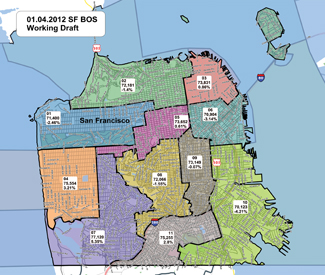
The Redistricting Task Force is in the process of drawing new lines for the supervisorial districts, as mandated every 10 years when new census data is available. The nine-member body is made up of three appointees each by the board, the mayor and the Elections Commission. While mandated to draw equal-sized districts that maintain “communities of interest,” the board has almost unchecked authority to decide which voters are in which districts.

While it’s difficult to draw 11 bad districts in San Francisco, it’s entirely possible to shift the lines to make it more difficult to elect progressives — something many groups out there are anxious to do.

VIEW THE CURRENT WORKING DRAFT MAP HERE


CONSOLIDATING THE LEFT

Downtown and pro-landlord groups are circulating their own draft maps, attempting to influence the outcome. Their goal is hardly a secret: If progressive voters can be concentrated in a small number of districts — say, districts 5, 6, and 9 — it’s more likely that a majority of the board will be moderates and conservatives.

The task force has looked at 10 “visualizations” prepared by a consultant, and each of them had some alarming aspects. For example, the visualizations mostly pushed such conservative areas as Seacliff and Presidio Heights into District 1, which is represented by progressive Sup. Eric Mar.

On Jan. 4, those drafts were replaced by a single working draft map, which is now on the task force’s hard-to-find website (www.sfgov2.org/index.aspx?page=2622) — and it’s not as bad as the earlier versions. The working draft keeps Seacliff and Presidio Terrace in District 2 — which share similar demographics.

“The working families in the Richmond don’t belong in the same community of interest as the millionaires with homes overlooking the ocean,” Mar told us.

But there are other changes that some may find alarming. The more conservative Portola neighborhood, which is now in District 9, would be included in District 11, while D9 would pick up the more liberal north Mission. That would make D9 an even safer progressive district — but make D11 harder for a progressive like the incumbent, John Avalos, to win.

The task force has been holding hearings on each of the districts — but there’s been little discussion about how the new lines will affect the makeup of the board, and the politics and policy of the city, as a whole.


POPULATION CHANGES

The driving force behind the changes in the districts is the rather dramatic population shift on the east side of the city. Most of the districts, census data show, have been relatively stable. But since 2000, 24,591 more people have moved into D6 — a nearly 30 percent increase — while 5,465 have moved into D10 (a 7.5 percent increase) and 5,414 into D11 (8.7 percent). D9 saw the biggest population decrease, losing 7,530 voters or 10.3 percent.

The huge growth in D6 has been the result of a boom in new high-end condos in the Rincon Hill and SoMa neighborhoods, and it’s changed the demographics of that district and forced the city to rethink how all of the surrounding districts are drawn.

No matter what scenario you look at, D6 has to become geographically smaller. Most of the maps circulating around suggest that the north Mission be shifted into D9 and parts of the Tenderloin move into districts 3 and 5. But those moves will make D6 less progressive, and create a challenge: The residents of the Tenderloin don’t have a lot in common with the millionaires in their high-rise condos.

As progressive political consultant David Looman noted, “The question is, how do you accommodate both the interests and concerns of San Francisco’s oldest and poorest population and San Francisco’s youngest, hippest, and very prosperous population?”

The working map is far from final. By law, the population of every district has to be within 1 percent of the median district population, or up to 5 percent if needed to prevent dividing or diluting the voting power of minority groups and/or keeping established neighborhoods together.

Under the current draft, eight of the 11 districts are out of compliance with the 1 percent standard, and District 7 has 5.35 percent more residents than the mean, so it will need to change. But task force Chair Eric McDonnell told the Guardian that he expects the current map to be adopted with only slight modifications following a series of public meetings over the next couple months.

“The tweaks will be about how we satisfy the population equalization, while trying to satisfy communities of interest,” McDonnell said, noting that this balancing act won’t be easy. “I anticipate everyone will be disappointed at some level.”


OUTSIDE INFLUENCES?

Some progressives have been concerned that downtown groups have been trying to influence the final map, noting that the San Francisco Board of Realtors, downtown-oriented political consultants David Latterman and Chris Bowman, and others have all created and submitted their own maps to the task force.

McDonnell said the task force considered solutions proposed by the various maps, but he said, “We won’t adopt wholesale anyone’s maps, but we think about what problem they were trying to solve.”

For example, some progressive analysts told us that many of the proposals from downtown make D9 more progressive, even though it is already a solidly progressive seat, while making D8 more conservative, whereas now it is still a contestable district even though moderates have held it for the last decade.

“It would be nice to see the Mission in one district, but it makes D8 considerably more conservative, so it’s a balancing act,” said Tom Radulovich, a progressive activist who ran for D8 supervisor in 2002.

Latterman told us he has a hard time believing the final map will be substantially similar to the current draft. “Once that gets circulated to the neighborhoods, I find that hard to believe it won’t change,” he said. “A lot of the deviations are big and they will have to change.”

He said that he approached the process of making a map as a statistician trying to solve a puzzle, and that begins with figuring out what to do with D6. “I fall back on my technician skills more than the political,” Latterman, who teaches political science at the University of San Francisco, said. “It’s a big puzzle.”

Latterman also disputed concerns that he or others have tried to diminish progressive voting power, saying that’s difficult to do without a drastic remaking of the map, something that few people are advocating.

“It’s hard to make major political changes with the other constraints we have to meet,” he said. “Unless you’re willing to scrap everything we have, it’ll be hard to make major political changes.”

Once the task force approves a final map in April, there’s little that can be done to change it. The map will go to both the Elections Commission and the Board of Supervisors, but neither can alter the boundaries.

“We are the final say,” McDonnell said. That is, unless it is challenged with a lawsuit, which is entirely possible given the stakes.

Guardian editorial: Mixed report on Mayor Lee

21

EDITORIAL Mayor Ed Lee’s first big decision — the appointment of a District 5 supervisor — demonstrated something very positive:

The mayor knows that he can’t do what his predecessor did and ignore and dismiss the progressive community.

His inauguration speech demonstrated something else: That he has no intention of being a mayor who takes on and defies the interests of downtown.

Part of the reason Gavin Newsom was a failure as mayor is that he was constantly at war with the left. He ran the city as if his was the only way, as if there were no good ideas coming out of anywhere except his office — and as if anyone who disgreed with or voted against him was his enemy.

That didn’t work, and it doesn’t seem to be Lee’s style. He was under pressure to appoint a supervisor who would go along with him on key votes, but he also knew that a moderate or a lackey would deeply offend the voters in D5, who supported John Avalos for mayor and remain among the most progressive voters in the city. The choice of Christina Olague shows a willingless to accept that progressives play a significant role in San Francisco politics. (It also shows that he is better than any mayor in recent memory at keeping a secret — nobody outside of his inner circle had any idea who his choice was until he announced it Jan 9.)

Olague was, overall, an excellent planning commissioner, and has the potential to be an excellent supervisor. But she will need to make clear from the start that she is representing the district, not the person who gave her the job. Because on some of the key issues that will come before the board this spring, her constituents are well to the left of the mayor. If she can’t vote against his wishes, she’ll have trouble in November.

Olague also needs to be sure that some of the issues her predecessor, Sheriff Ross Mirkarimi, championed (public power and community policing, for example) don’t fall by the wayside. Her expertise in land use issues should be helpful as the board wrangles with waterfront development, affordable housing and the giant California Pacific Medical Center hospital project.

Lee’s inaugural speech was mostly a typical political speech for a new mayor, but it contained a nugget that’s worthy of note. He proclaimed that San Francisco should be a “city of the 100 percent,” a takeoff on the Occupy movement’s 99 percent slogan. And while that’s mostly rhetoric, it’s also a sign that the former housing activist is not going to be a mayor who wants to make a legacy of challenging the economic and political powers of San Francisco.

Working together is fine — but there are a small number of very wealthy and powerful people who have interests that are utterly opposed to the interests of the rest of us. Economic injustice is every bit as real in this city as it is elsewhere in the country — and that’s something the mayor didn’t even mention or acknowledge. Pacific Gas and Electric Co., the big real-estate developers, the landlords out at ParkMerced, the Chamber of Commerce,  and the Board of Realtors … they don’t want to work together. They want their way.

So it’s a mixed report for Mayor Lee — and over the next few months, he’s going to have to realize that everyone in the city can’t and shouldn’t work together, that there are battles where politicians have to take sides, and that all of us will be watching very closely to see where he draws the line.

Mirkarimi takes the oath

181

The room was packed for the inauguration of Sheriff Ross Mirkarimi, and for the most part, the crowd wasn’t talking about what Mirkarimi referred to as the “cloud” hanging over the event. He mentioned the investigation into possible domestic violence only that once, then joked that he’d managed to get a lot of press to his event.


There was music, dancing, former Mayor Art Agnos administering the oath of office, a long, long Mirkarimi speech on criminal justice policy (please, Ross, 15 minutes would have been plenty). Most of Mirkarimi’s progressive colleagues (including supervisors John Avalos, David Campos, Jane Kim, and Eric Mar, state Sen. Mark Leno and Assemblymember Tom Ammiano) were on hand. And the press conference afterward was surprisingly mild.


Mirkarimi was asked what happened the night in question, and he declined to talk about it, saying the criminal justice system would work its way through the process. Then his wife, Eliana Lopez, interrupted, took the mike, and announced that this was a “family matter” and she would have no more to say – except that she has no complaints about her husband.


That was it. No shouted questions as the sheriff walked away, no 1000-watt camera flashes in his eyes, nothing to indicate that this is the gigantic scandal that it’s become in the daily papers.


But Mirkarimi did make one statement that’s worth mentioning: He said that there were forces in the department (I think he meant the Police Department) that didn’t want to see him as sheriff. That’s absolutely true.


Let me make a few points here.


First, for the record: There’s no excuse for assaulting anyone, and there’s less excuse for assaulting your wife. Domestic violence is a serious, under-reported problem, something all too often dismissed by the authorities – with catastrophic results. Women die because batterers are not held to account. I have close friends who have been in abusive relationships, and it’s not pretty and it’s not a joke and it’s not something to take lightly.


That said: I don’t know what happened that night at Mirkarimi’s house. But I do know that the minute the cops were brought in, it became political.


See, the cops, for the most part, are not Mirkarimi fans. He beat their guy, former Police Officers Association president Chris Cunnie, in the race for sheriff. He’s demanded changes in the department (including foot patrols, which a lot of old-timers don’t like). He also beat a sheriff’s captain. He’s a civilian who is going to run a law-enforcement agency as a civilian, which means he’s not part of the Fraternity.


The news reports about the incident were clearly leaked by the SFPD. So, I’m sure, was the search warrant (that’s a public document, but I honestly don’t think the Examiner tracked it down, I think it was delivered to the paper by a source in the department). Nothing wrong with that – cops (and politicians) tip reporters to stories all the time. I’m not blaming the Chron or the Ex for doing the story – it’s news, you have to report it.


And, of course, if the cops had ignored the case or downplayed it, they would have been criticized for covering up an incident involving the new sheriff.


Again: I’m not excusing Mirkarimi’s behavior (alleged behavior — we don’t know what actually happened). But the way the story and the details were leaked reflects the political reality that the cops don’t love the new sheriff, and a lot of them would be thrilled to take him down. That’s just political reality.


Which means Mirkarimi needs to be very, very careful – there are people watching every single move he makes, every day. And they’re not interested in policy debates.


PS: The D.A. and the cops managed to finish this particular investigation in record time. I wonder what’s happened to the investigation into possible vote fraud in the Ed Lee campaign. Months have passed. Nobody is facing any charges. There are no police leaks about anyone involved. Funny, that.

Daly is back in a progressive leadership role

45

Chris Daly, a pivotal organizer of progressive politics during his decade on the San Francisco Board of Supervisors, has returned to a high-profile role in the movement. Last month, he went to work for Service Employees International Union Local 1021, the city’s largest public employee year. And today, he was named its interim political director.

“I’m excited and I think everyone here is excited to have Chris’s talent and experience and energy on this team,” local President Roxanne Sanchez, who was elected as part of a progressive reform slate in 2010, told the Guardian. “Part of the vision of the executive board, and the mandate that we were elected on, is to build a long-lasting sense of power at the rank-and-file level.”

Even before lending support to the Occupy movement and its challenge to the power of the richest 1 percent of society, Local 1021 was targeting banks and other downtown financial institutions with its Fight for a Fair Economy campaign. Now Daly can continue pushing that agenda and connecting the dots between the consolidation of wealth and the hardships faced by workers and local government.

“The spark has been the Occupy movement, but it’s been 1021 that has been helping to instigate some of these possible next steps…It has an opportunity to be successful if there’s some institutional support for it,” Daly said of San Francisco’s progressive movement, which suffered a setback when he and other board progressives were termed out, and a bit of a revival in the fall with the emergence of OccupySF.

“Occupy is going to need some foundation to continue its work,” Daly said. “Without organizational or structural support, that could have been a one-time thing.”

But now, during an important election year when the union’s contracts with the city expire, Daly sees an opportunity to forward the interests of both union members and the broader progressive movement. Both Daly and Sanchez say educating their members and the general public about the importance of progressive issues is essential to advocating for their members, who are among the city’s lowest paid workers and those who have suffered the most layoffs in recent years.

“If there’s not a notion of the distribution of wealth and the 99 percent, we won’t be successful,” Daly said. “Downtown is powerful, and labor needs to be here to offset the power of downtown. Without that, we’re stuck.”

Sanchez said the reorganization now underway in her union, of which hiring Daly is a key component, is about turning the clock back on the labor movement and returning to an agenda of broadly building working class power, as unions did in the ’30s and ’40s before becoming more bureaucratic institutions in the ’50s.

“Chris, and his perspective of building community strength, is our focus,” Sanchez said. “This is the time when unions have to help move a working family agenda and to push back on the opportunistic wealthy interests in this society.”

In the year since he left the board, Daly has been running the bar he purchased, The Buck (formerly Buck Tavern) – which became like a progressive clubhouse and gathering spot – as well as helping John Avalos’s mayoral run and other campaigns. Daly says he wants to maintain that role by continuing to tend bar on Friday nights, but he plans to pour most of his energies into a new role that is really a continuation of his old role.

“For me, it was never about being on the Board of Supervisors. It was about trying to make the progressive movement strong and more effective…In some ways, I was one of the unofficial political directors of progressive San Francisco,” Daly told us. “I have a strong motivation to build a progressive political program, and now I have the opportunity to do that.”

An open letter to Ed Lee

76

OPINION Dear Mr. Mayor,

During the next week you will be appointing the a supervisor for District 5, an area of the city that has been historically considered the most progressive part of one of the most progressive cities in the country. It will be a signature decision for you in the next year, and will reveal the tone of your administration. Will you be a consensus mayor — or will you carry on your predecessor’s fight with progressives?

You have many qualified choices, but there is probably only one on your list that a majority of progressives would consider a clear progressive choice: Christina Olague, president of the Planning Commission. There are some who have hesitations about her, but ironically those hesitations are based on her relationship to you and her support for your candidacy for mayor. I have to admit, as a supporter of progressive Supervisor John Avalos for mayor, I shared some disappointment that she didn’t support John.

I’m sure there’s intense pressure on you to choose a more moderate choice, and I’m sure there are from your perspective some valid points to that argument. That said, District 5 deserves progressive representation.

I am a Haight resident, and I ran for Supervisor in District 5 in 2004. Supervisor Ross Mirkarimi came in first, I came in second, and Lisa Feldstein came in third. Both Lisa and I have spoken repeatedly about whether we would run next year, and we have even discussed running as a slate. Most political analysts think one of us would have a decent shot at winning — but I think both of us would support Christina, assuming that her votes continue to reflect her commitment to the progressive values of the district.

Christina not only supported you, she also supported Mirkarimi in 2004, and Matt Gonzalez when he ran for supervisor in 2000. She was appointed to the Planning Commission by Gonzalez and has been reappointed repeatedly by progressive supervisors to that commission. While her votes have not been perfect, by and large, her record is excellent; she has never succumbed to pressure, has listened well to all sides, and has ultimately done what she thought was right.

For example, she stood up for tenants’ rights when the landlord from Park Merced came to the Planning Commission to ask that 1,500 apartments be demolished, all of which were subject to the city’s rent control ordinance. She recognized the flaws in the landlord’s argument that a side agreement (negotiated without the local tenant groups involved) would prevent rent hikes and evictions. Olague was on the right side of history on the Park Merced deal, and has a long record of building tenant and senior tenant power. That’s the kind of leadership we need for District 5, an area comprised of primarily renters. I believe Olague will be a supervisor tenants can trust.

I can’t guarantee that all progressives will stand down if Olague gets the seat. The ego game is what it is. You have learned that from politics, I’m sure. But I think most progressive institutions and progressive activists will see her appointment as a victory and will support her candidacy for Supervisor next fall, as they should if she shows that her votes reflect the trends and values of District 5.

With Christina Olague, you have a win-win. You appoint a supervisor who reflects the progressive values of the district and who is also electable in November. 

Gabriel Haaland is an elected member of the San Francisco Democratic County Central Committee and an LGBT labor and tenant activist.

Mayor Lee, Sharp Park, and Gavin Newsom

43

So Ed Lee’s going to veto the Board of Supervisors resolution on Sharp Park. Of course he is. And there’s more than snakes and frogs at issue here.

The veto, I think, sets the tone for what we’re going to see over the next four years, which is: Gavin Newsom.

For four years, the progressive bloc on the board — that is, the shaky sometimes-majority that can pull together six votes on an issue — is going to run slam into a mayoral veto a good deal of the time.

In this case, John Avalos, David Campos, David Chiu, Jane Kim, Eric Mar and Ross Mirkarimi — that’s the list of the six — all supported a plan to negotiate with the National Park Service to take over the property, which would probably mean the end of the golf course. It’s an environmental issue, mostly, and also a public-resource issue — but the main thing is that it’s an issue that split the board along the left-center/right lines that we’ll see again and again over Lee’s term. And Lee is siding with the right.

That’s what we came to expect from Newsom — every progressive initiative was a struggle; often, bill sponsors had to line up eight votes, not six, because there was always the threat that Newsom would shoot it down. And I’m getting the feeling that we’ll be facing the same thing with Mayor Lee.


A step forward and step back for SF’s homeless families

26

As San Francisco grapples with a record-high number of homeless families seeking shelter space during the holiday season, a pair of homeless policy discussions at yesterday’s Board of Supervisors meeting highlighted shortcomings and missed opportunities in the city’s approach to the issue.

Mayor Ed Lee announced that he is opening up more shelter space and public housing units for homeless families, finally relenting to weeks of pressure to address the pressing problem. Yet the board also narrowly approved turning surplus city property over to neighborhood residents rather than using proceeds from selling it to benefit homeless families, as city policies call for.

The property in question, 341 Corbett Avenue, is a vegetated hillside near Upper Market that the city declared a surplus property in 2004, transferring it to the Mayor’s Office of Housing to either develop as housing for poor families or to put the proceeds from its sale toward that purpose. Providing housing for the homeless is what city policy calls for surplus property to be used for, according to 2002’s Surplus City Property Ordinance. The property was assessed at $2.2 million, but it wasn’t developed because of costs associated with the steep hillside, nor was it listed for sale.

Neighbors of the property have sought to use the property for open space and a community garden, so the district’s Sup. Scott Wiener authored legislation to facilitate a community garden by transferring it to the Department of Public Works. The transfer would involve no money, leaving homeless advocates concerned about depriving homeless families of any revenues from the property.

“There are a lot of public assets we could sell if we wanted to fund this need or that,” Wiener told his colleagues, noting that neighbors would rather see a community garden on the site and that Upper Market lacks adequate open space.

But Sups. Jane Kim and Eric Mar led the opposition to the move, saying they didn’t object to that kind of community use of this property, but that city policies need to be followed, particularly considering the dire need for more resources to address the needs of homeless families. “I do have concerns about the precedent we set and also being consistent,” she said, arguing for a delay in the action until city officials find a way to compensate MOH for at least some of the property’s value.

“Overriding the surplus property ordinance is not something I want to do right now,” Sup. John Avalos said.

But the board voted 6-5 to approve the transfer, with progressive Sups. Kim, Avalos, Mar, David Campos, and Ross Mirkarimi in dissent. Housing advocates upset by the action directly their ire at the swing vote, one-time progressive Sup. David Chiu, with activist Tommi Avicolli Mecca sending out an e-mail blast saying, “david chiu betrayed us again — he wouldn’t support continuing the 341 Corbett item so that affordable housing advocates could try and work out a better deal with the Mayor’s Office on Housing and others.”

Meanwhile, the skyrocketing number of homeless families has become a big issue in town since the Guardian broke the story on Oct. 13, with repeated stories in the Chronicle, Examiner, and other media outlets, and homeless advocates staging rallies outside City Hall and unsuccessfully pushing for a meeting with Mayor Lee on the issue.

During yesterday’s monthly mayoral question time, Kim asked Lee what he was doing to address the “alarming rate” of homeless families in the city – with 267 families now on a wait list for emergency shelter space, a 356 percent increase since 2007 – specifically challenging him to expand the city’s Rental Subsidy Program by 50 families and open new emergency winter shelters. She also noted three recent suicides in the city by individuals facing homelessness.

“I share your concern about family homelessness in San Francisco. My staff has been hard at work for a long time now trying to proactively respond to this very serious challenge and I’m proud to offer some very constructive, tangible solutions,” Lee said. He announced that his administration had just this week starting expediting the placement of homeless families into vacant public housing units, with 18 families now being processed and a goal of placing about 30 of the 79 families now in shelters into public housing units.

Lee also said that SalesForce.com CEO Marc Benioff is donating $1.5 million to the Home for the Holidays program the city is creating to provide rent subsidies and case management to 160 families, a donation that the city will match. “Their generosity is inspiring,” Lee said.

He also pledged to open up an unspecified number of new family shelter spots and, somewhat bizarrely, tried to wrap this issue into his relentless focus on promoting private sector job creation, mostly through tax breaks that actually cut into the city’s ability to provide direct assistance to homeless families. As Lee said, “The long-term goal is to increase these families’ incomes and to place them into permanent unsubsidized housing.”

Progressives split on bag ban, ex-cons

12

A couple of interesting votes at the Board of Supes Dec. 6. Sup. Ross Mirkarimi lost two pieces of legislation — a mandate that stores charge for bags at checkout counters and a tax credit for companies that hire ex-offenders.

The bag ban went down 7-4. Well, actually, it was continued to February, by which time Mirkarimi will be gone. Sup. Jane Kim said she wanted to see more outreach to minority businesses, and was quoted in the press saying she would support it at a future date, but I suspect the delay marks the end of the bill. Without Mirkarimi around to push it, the measure will probably just die. It’s odd because San Francisco used to be on the cutting edge of environmental issues; the bag ban is getting picked up by other cities and will probably be law all over the country in a decade.

Voting for the continuation were three supes who said they supported the “concept” — Scott Wiener, David Chiu and Kim.

The ex-offender tax credit went down 6-5 — and on this one, Sup. Malia Cohen, who is not always with the progressives but whose district has the largest number of parolees in the city, supported Mirkarimi. So did Kim, Eric Mar, and David Campos. The swing vote: Sup. John Avalos, the progressive leader in the mayor’s race and one of the most solid left votes on the board.

Avalos told me that he doesn’t support tax breaks; he’s been consistent on that, and I understand. I don’t support tax breaks, either. I don’t think they’re very effective and they cost the city money. But there are two elements that make this unusual — for one, if anyone actually used the tax credit and hired an ex-offender, the money the city would likely save by keeping that person from going back to jail would greatly exceed the amount of the tax reduction.

Besides, I was waiting to see Lee come up with an excuse to veto the bill — particularly at a time when more and more ex-offenders are going to be released in San Francisco. I know this is just petty politics and all that, but this was a tough decision involving a very unpopular group (nobody wants to be nice to former criminals) — and Lee got off easy.

Stop downtown’s attack on RCV

52

OPINION The long-time foes of political reform at the Chamber of Commerce and San Francisco Chronicle have launched an effort to repeal ranked choice voting (RCV) and public financing of campaigns. Supervisors Sean Elsbernd and Mark Farrell have introduced a June 2012 charter amendment to repeal RCV, with public financing also in their crosshairs.

Many of us fought hard to pass these reforms, and I am reminded of when the downtown corporate interests repealed district elections in 1980. They blamed the assassinations of Harvey Milk and George Moscone on district elections and the election of Supervisor Dan White. San Francisco has a history of the anti-reformers waiting for their moment of opportunity. Now these same corporate interests think that moment has arrived again.

The Bay Guardian first reported about an anti-RCV campaign in 2009, when a meeting of downtown business leaders was hosted by Steve Falk, Chamber of Commerce CEO (and past publisher of the Chronicle) to discuss repealing RCV.

As part of that effort, polling also was done to see if they could repeal district elections and public financing. They also filed a bogus anti-RCV lawsuit which was unanimously rejected by two courts. Elsbernd’s repeal legislation is the culmination of their calculated efforts.

It’s clear what these special interests want: a return to the days when local races were decided in low-turnout December elections, and those who had the most money pounded their opponents into submission. An Ethics Commission report in 2003 found that independent expenditures increased by a factor of four during December runoffs, while another study found that voter turnout dropped by more than a third in 10 of the 14 December runoff races held from 2000-2003. Turnout in one city attorney runoff dropped to 16 percent.

Just as importantly, the December electorate did not represent the diversity of San Francisco’s population. Voters in the runoffs were overwhelmingly whiter, older and more conservative than the city as a whole, as voter turnout plummeted in December among racial minorities, the poor and young people. Simply put, a return to December runoffs will allow groups like the Chamber and its allies to dump huge amounts of money into negative campaigns aimed at the more conservative December electorate when most San Franciscans don’t vote.

In the era of unlimited independent expenditures by corporations (thanks the Supreme Court decision in Citizens United), political reforms like RCV are crucial for protecting our democracy. Both RCV and public financing have greatly improved local elections — since their inception San Francisco has doubled the number of racial minorities elected to the Board of Supervisors. Elections are now decided in higher turnout November contests, allowing more people to have a voice in choosing their local representatives. Winning candidates in RCV contests have won with an average of 30 percent more votes than winners in the old December runoffs.

San Francisco has saved $10 million in taxes by not holding second elections, money used for other public needs. Candidates also haven’t needed to raise money for a second election, which helps level the playing field. Progressive candidates have never done well in citywide elections, but this year in RCV contests Ross Mirkarimi was elected sheriff and John Avalos mobilized and finished a strong second. That bodes well for progressives’ future.

It’s no coincidence that Supervisor Elsbernd is trying to get his charter amendment on a low-turnout June ballot, when the electorate is more conservative. The downtown corporate interests are clear on what they must repeal in order to elect the candidates they want — RCV, public financing, and ultimately district elections. Progressives need to be just as clear on what reforms we must defend.

Assemblymember Tom Ammiano represents the 13th District.

About that “acrimonious fall”

Catch this. Mayor Ed Lee’s mayoral victory had nothing to do with millions of dollars in campaign contributions from private interests, a sophisticated get-out-the vote effort targeting Lee supporters, the advantage of incumbency, some funny business, or a calculated campaign strategy concentrating efforts on absentee ballots.

Instead, the fact that Lee triumphed over voters’ second pick, the significantly less well-funded progressive candidate Sup. John Avalos, is proof that the left in San Francisco has plummeted into a dark abyss. In fact, the progressive movement has descended so far into disarray and become so irrelevant that its condition warrants front page news.

That’s essentially the narrative that Benjamin Wachs and Joe Eskenazi of the San Francisco Weekly offer in their cover article, “Progressively Worse: The Tumultuous Rise and Acrimonious Fall of the City’s Left,” in which they refer to the Guardian as “the movement’s cajoling ward boss, kingmaker, and sounding board.” Gosh, I feel so goddamn important right now.

Once the blood pressure returned to normal, my initial reaction to this piece was that Wachs and Eskenazi seem to misunderstand who and what progressives actually are. They portray the city’s left as a caricature, a brash bunch of power mongers now on the losing end that can be easily summed up with pithy video game references, Happy Meal toy bans, and bikes.

Witness the contrast between the Weekly’s portrayal of progressives (helped along by former Newsomite Eric Jaye), and the portrait of the left the Guardian offers this week with an Op-Ed written by NTanya Lee — an actual progressive who volunteered for the Avalos for Mayor campaign.

Here’s the Weekly on the left:

“This is an eclectic group, one often bound not by mutual interests as much as mutual enmity — toward Brown, his successors, and the corporate interests of ‘downtown.’ As a result, progressive principles are often wildly inconsistent. Progressives favor more government control over people’s lives for their own good, as when they effectively banned McDonald’s Happy Meals. But sometimes progressives say the government needs to let people make their own choices … Progressives believe government should subsidize homeless people who choose to drink themselves to death, while forbidding parents from buying McNuggets because fast food is bad for us. … Without consistent principles, it’s easy to associate progressives with the craziest ideas to come out of City Hall, and the movement’s bad ideas are memorable. … Daly’s pledge to say ‘Fuck’ at every public meeting makes a killer Internet meme. Hey, let’s legalize prostitution and outlaw plastic bags!”

Here’s Lee on the left:

“The Avalos coalition was largely community forces: SF Rising’s base in working class Black, Latino, Filipino and Chinese communities; the Bike Coalition’s growing base of mostly white bike riders; affinity groups like Filipinos, Queers, Latinos and Arabs for Avalos; progressive Democrats; social networks of creative, young progressive activists affiliated with the League of Young Voters; and loyal families and neighborhood leaders from John’s own District 11. The campaign prioritized communicating to voters in four languages, and according to the Chinese press, John Avalos was the only non-Chinese candidate with a significant Chinese outreach program. There were stalwarts from progressive labor unions (most notably SEIU 1021 and USWW) who threw down — but overall, labor played it safe and invested resources in other guys. And then, in the great surprise development of the race, supporters of the new national occupy movement came to be a strong part of the Team Avalos base because the campaign was so well positioned to resonate with the call to take on the one percent.”

When it comes to takeaways from the November election, the Weekly’s conclusion is essentially opposite that of progressives. While many on the left see themselves as regaining momentum and building the power to rise even in the face of defeat by the established powers-that-be, the Weekly casts San Francisco’s left as deflated and out-of-touch.

Speaking of out-of-touch, the SF Weekly refers to San Francisco’s “increasingly imaginary working class.”  But in reality, 61 percent of students attending public schools in S.F. Unified School District qualify for free or reduced lunch, and a majority of San Franciscans cannot afford market-rate housing.

However, the Weekly is correct in pointing out that shifting demographics have dealt a blow to the progressive base.

“Between 2000 and 2010, the city grew older (every age group over 50 increased), wealthier (there are now 58 percent more households earning $125,000 or more), and more heavily Asian (up from around 30 to nearly 35 percent of the city’s population): exactly the groups progressives don’t win with. These voters don’t respond well to campaigns against developments or for city services, because they’re often living in those developments and don’t need city services.”

I take issue with the Asian part of that statement as a sweeping generalization, however, having witnessed the solid organizing work of the Chinese Progressive Association, for example.

The Weekly also says progressives and the Guardian never called out former Mayor Gavin Newsom for ripping off their best ideas. Oh, they didn’t?  That’s news to me.

The Weekly article implies that progressives got trounced by moderates because jobs are priority No. 1 for voters, and the left has no feasible economic plan — but at the same time, the article completely dismisses ideas that the Guardian has put forth, like creating a municipal bank, implementing Avalos’ Local Hire legislation, or taxing the rich.

Taxing the rich is precisely the kind of economic solution the international Occupy movement is clamoring for, and the concept has even attracted a few unlikely supporters, like billionaires Warren Buffet and Sean Parker, who is not some conservative a*hole by the way.

“The Guardian … stays on the progressive agenda because they put it there, along with taxing the rich, tapping downtown to subsidize Muni, and other measures … Proposing the same old solutions to every new problem turns policies into punch lines.”

Speaking of predictable, no profile authored by the Weekly mentioning the Guardian would be complete without some dig about public power. “The Guardian has been flogging public power since Tesla invented the alternating-current generator,” the S.F. Weekly squawks. Those clever reporters, turning policies into punch lines.

But wait, I thought the problem was that progressives couldn’t get it together on the job creation thing. Consider the CleanPower SF program, which has been strongly advocated for by progressive Sup. and Sheriff-elect Ross Mirkarimi (who it turns out is “not toxic,” according to the Weekly, since he was elected citywide and all). According to an analysis by the Local Clean Energy Alliance, CleanPowerSF will create 983 jobs — 4,357 jobs when indirect job creation is factored in — over the course of three years, assuming the 51 percent renewable energy target is met. Presented with this kind of information, the Weekly will only yawn and say, “Are we on that again?”

That being said, our friends’ article might actually have a pearl of wisdom or two buried somewhere in that nauseating sea of sarcasm. Everyone needs to engage in self-reflection. So right after you’re done throwing up, think about how to take advantage of the opportunity this article presents for a citywide dialogue about progressivism in San Francisco.

Lessons of the Avalos campaign

157

By N’Tanya Lee

It’s the middle of the night. His two kids and wife are home in bed. Supervisor John Avalos, candidate for mayor, heads downtown in his beat-up family car. He parks and walks over to 101 Market Street, and casually starts talking to members of OccupySF. He’s a city official, but folks camped out are appreciative when they see he’s there to stand with them, to try to stop the cops from harassing them, even though its 1 a.m. and he should be in bed.

John Avalos was the first elected official to personally visit Occupy SF. It wasn’t a publicity stunt — his campaign staff didn’t even know he was going until it was over. He arrived and left without an entourage or TV cameras. This kind of moment — defined by John’s personal integrity and the strength of his personal convictions — was repeated week after week, and provides a much-needed model of progressive political leadership in the city.

John Avalos is more than “a progressive standard bearer,” as the Chronicle likes to call him. He’s also a Spanish-speaking progressive Latino, rooted in community and labor organizing, with a racial justice analysis and real relationships with hundreds of organizers and everyday people outside of City Hall. He’s demonstrated an authentic accountability to the disenfranchised of the city, to communities of color and working people, and he knows that ultimately the future of the city is in our hands.

Some accomplishments of John’s campaign for mayor are already clear: He consolidated the progressive-left with 19%, or nearly 40,000, first-place votes, despite the confusion of a crowded field; he came in a strong second to incumbent Ed Lee despite being considered a long shot even weeks before the election; after RCV tallies, he finished with an incredible 40% of the vote, demonstrating a much wider base of support across the city than he began with, and much broader than former frontrunners Leland Yee and David Chiu, who outspent him 3-1. He won the Castro, placed third in Chinatown (ahead of Yee), and actually won the election-day citywide vote. Not bad. In fact, remarkable, for a progressive Latino from a working class district in the southern part of town, running in his first citywide race.

I believe John Avalos demonstrated what can be accomplished with a new kind of progressive leadership — and suggests the elements of a new progressive coalition that can be created to win races in 2012, and again, in 2015.

It’s Monday afternoon, 1:35pm, time for our weekly Campaign Board meeting. John rushes in, after a dozen appointments already that day. The rest of us file into the ‘cave’ — the one private room in Campaign headquarters, with no windows, a makeshift wall and furniture that looks to be third-hand. The board makes the key strategy, message, and financial decisions. There are no high paid political consultants here. Most of us are, or have been, organizers. Today, we need to approve the campaign platform. Finally. We’ve decided to get people excited about our ideas, an agenda for change. We leave the meeting excited and nervous, wondering if anyone will get excited about the city creating its own Municipal Bank.

We were an unlikely crew to lead a candidate campaign — even a progressive one in San Francisco. We come from membership based community and labor organizations, and share a critique of white progressive political players and electeds who spend too few resources on building power through organizing and operate without accountability to any base. We are policy and politics nerds, but we hate traditional politics. Seventy percent of us are people of color — Black, Filipina, Latino, and Chinese. We are all women except John, the candidate, and nearly half of us are balancing politics with parenting.

The campaign board — including John himself—shared a vision for building progressive power. The campaign plan was explicit and specific about achieving outcomes that included winning room 200 but went beyond that central goal. We set out to strengthen progressive forces, to build towards the 2012 Supervisor races, and increase the capacity of the community-based progressive electoral infrastructure so we can keep building our collective power year-round, for the long-term.

We hope these victories will shape progressive strategy moving forward:

1. In just a few months, Team Avalos consolidated a new and unique progressive bloc. We brought together people and organizations who’d never worked together before — white bike riders and Latino anti-gentrification organizers, queer activists and African American advocates for Local Hire. The Avalos coalition was largely community forces: SF Rising’s base in working class Black, Latino, Filipino and Chinese communities; the Bike Coalition’s growing base of mostly white bike riders; affinity groups like Filipinos, Queers, Latinos and Arabs for Avalos; progressive Democrats; social networks of creative, young progressive activists affiliated with the League of Young Voters; and loyal families and neighborhood leaders from John’s own District 11. The campaign prioritized communicating to voters in four languages, and according to the Chinese press, John Avalos was the only non-Chinese candidate with a significant Chinese outreach program. There were stalwarts from progressive labor unions (most notably SEIU 1021 and USWW) who threw down — but overall, labor played it safe and invested resources in other guys. And then, in the great surprise development of the race, supporters of the new national occupy movement came to be a strong part of the Team Avalos base because the campaign was so well positioned to resonate with the call to take on the one percent.

2) Team Avalos built popular support for key progressive ideas. We used the campaign to build popular support for a citywide progressive agenda. Instead of leading with our candidate we led with bold, distinctive issues that provided a positive alternative vision to the economic crisis: Progressive taxation, municipal banking, and corporate accountability for living wage jobs instead of corporate tax breaks. By the end of the campaign, at least three other candidates came to support the creation of a city-owned bank, and the idea had enough traction that even the San Francisco Business Times was forced to take a position against it.

3) Team Avalos built the electoral capacity of grassroots organizations whose members have the most at stake if progressives gain or lose power in SF: poor and working-class communities of color. We developed the electoral organizing skills of a large new cohort of grassroots leaders and organizers of color with no previous leadership experience in a candidate campaign. They are ready for the next election.

For the last few months, I had the privilege of working with an unusual but extraordinary Avalos campaign team, who were exactly the right people for the right moment in history, to lead a long shot campaign to an unlikely, remarkable and inspiring outcome. Let’s build on these gains. In the coming weeks and months, we must be thorough in our analysis of this election, engage and expand the Avalos coalition base, and build unity around one or more collective demands of Mayor Lee from the left. And in time, we will have a progressive voting majority and a governing bloc in City Hall. We will win, with the mass base necessary to defend gains, hold our own electeds accountable, and truly take on the city’s one percent.

NTanya Lee was the Executive Director of Coleman Advocates for Children & Youth, and served as a volunteer chair of the Avalos for Mayor campaign board. You can find her now at USF or working on her new project about a long-term vision for left governance called Project 2040.


Rank complaints

27

steve@sfbg.com

Even before all the votes had been cast on election day, the two most conservative members of the San Francisco Board of Supervisors proposed a ballot measure to repeal the city’s ranked-choice voting (RCV) system, prompting all the usual critics of this voter-approved electoral reform to denounce it as confusing and undemocratic.

Those same two supervisors, Sups. Sean Elsbernd and Mark Farrell, were also the ones who unsuccessfully pushed for a weakening of the public financing system last month, changes that will likely be wrapped into discussions in the coming weeks over how elections are conducted in the city. And progressive supporters of both systems warn that district supervisorial elections will probably be the next target of this concerted push to roll the clock back on electoral reforms in the city.

"The [San Francisco] Chronicle and the [San Francisco] Chamber [of Commerce] have been at it from day one," Steven Hill, who helped crafted both the RCV and public financing systems, told us. "They’re really clear about what they want to eliminate, so we should be clear about what we need to defend and we can’t get confused by this."

Indeed, the Chronicle ran an editorial Nov. 14 advocating the repeal of ranked-choice, calling it "a fundamentally flawed system that is fraught with unintended consequences." The paper, as well as its allies at the Chamber and other downtown institutions, has been equally vociferous in criticizing public financing and district elections.

Hill said that’s because moneyed interests prefer systems that they can manipulate using the millions of dollars in unregulated independent expenditures they can summon — an ability they demonstrated again in his election on behalf of Mayor Ed Lee — such as low-turnout runoff elections, citywide supervisorial races, and elections without the countervailing force of public financing. "They’ve been doing this steadily and looking for ways to chip away at it," Hill said.

But conservatives aren’t the only ones raising questions about RCV; some progressives say the system needs adjustment, too.

Although Farrell opposes all three of those electoral reforms, he insists that his concerns about RCV are about voter confusion and the perception that winners don’t have majority support and could be viewed as illegitimate. "There is just so much voter confusion out there," Farrell said, citing comments from voters who don’t understand how their votes are tabulated to produce a winner.

Hill counters that voters do have a clear understanding of how to rank their choices, downplaying the importance of whether they understand all the details of what happens next. But Farrell said that and the majority rule issue have undermined people’s faith in the elections.

"People get very upset when they realize someone didn’t get a majority of the vote," he told us, referring to how the majority threshold drops as voters’ top three candidates are eliminated. "To me, it’s just simpler to go back to the runoff system."

Many moderate politicians agree. "I don’t like ranked choice voting and I never have," City Attorney Dennis Herrera, who finished third in the mayor’s race, told us on election night. "I defended it all the way to the 9th Circuit [Court of Appeals in his role at City Attorney], but I think it’s bad policy."

Sup. Scott Wiener, a Herrera supporter we spoke to at the same election night party, also wants to see a change. "I supported ranked-choice voting and until recently I continued to support it, but this race changed by mind," Wiener said, attributing the large mayoral candidate field and free-for-all debates to RCV. "There is no way most voters will be able to distinguish among the candidates."

But Hill says it’s a mistake to attribute the large field to RCV, or even to the public financing system that some are also trying to blame, a problem he said can be addressed in other ways, such as changing when and how candidates qualify for public matching funds.

Wiener said he hasn’t made up his mind about repealing RCV, and he said that he absolutely opposes a return to the December runoff election. One alternative he suggested was a system like that in place in New York City, with the initial election in September and the runoff during the general election in November. But he does think some change is needed, and he’s glad Elsbernd and Farrell proposed an RCV repeal.

"They’re starting a conversation with the repeal, but that’s not where it’s going to end," Wiener said.

Indeed, the system still has the support of most progressives, even Sup. John Avalos, who finished second in the mayor’s race and would now be headed into a runoff election against Ed Lee under the old system. "I continue to support ranked choice voting," Avalos told us. It takes six supervisors to play the charter amendment repealing RCV on the ballot.

Sup. Ross Mirkarimi, who was narrowly elected sheriff in the ranked-choice runoff despite a 10-point lead in first place votes, said of the Farrell and Elsbernd proposal, "I do want to hear their criticisms."

"I understand the larger discussion, which was a bit of a misguided approach that some of our colleagues used to go after ranked choice voting on election day," Mirkarimi said. "But they are good politicians and they seized an opportunity."

Mirkarimi did say he was open to "maybe some tweaks. I do think ranked choice works better when you have many choices." Others, such as former Sup. Matt Gonzalez, have also recently advocated a ranked-choice system that allows more choices, which would address the majority-vote criticism because fewer ballots would be exhausted.

Hill said the legislation that voters approved back in 2002 already calls for more choices, but the technology used in the city’s current system only allows three choices. Yet he said the city’s vendor, Dominion Voting Systems, has developed a system allowing up to 11 choices, for which it is currently seeking federal certification.

Although he said various tweaks are possible, "I think the system worked well in this election," Hill said, noting that few San Franciscans would have wanted to drag this long campaign out by another month or to pay for another election.

Lessons from 2011 for 2012

4

With the release of precinct results for the 2011 election, we are able to actually see, for the first time, what San Francisco voters did, as opposed to hearing what various nabobs said they did.  There are a couple of key conclusions about the vote that should guide any left-liberal thinking of the key 2012 Supervisor races.

The first thing San Francisco voters did- about 40,000 of them-  was stay home.  Turnout – about 40% – was the lowest for a mayor’s race in 40 years. Moreover, counter to several “expert” narratives, turnout in neighborhoods with large numbers of Chinese voters — Chinatown, the Richmond, the Sunset, and Vis Valley — was lower (average 33%) than in neighborhoods with few Chinese voters — Diamond Heights, Noe Valley, the Castro and West of Twin Peaks — where turnout averaged 40%.

There seems to be four reasons for this curious outcome. A couple of them have lessons for us for the 2012 election that we ignore at our peril.
First, in a City that is clearly center-left, voters were presented with nine center-right candidates, seven of whom were declared by the Chronicle at one time or another to be “serious.” Only John Avalos was a clear center-left choice. This was shown in the huge number undecideds that appeared in poll after poll. Undecided voters are often unhappy at the lack of choice being offered by the field and simply don’t vote.

Second, professional campaign management of the supposedly serious candidates was terrible and actually counter-productive to their candidates’ best interests. The pros actually seemed to have suppressed turnout in key neighborhoods. Ace Smith and Bill Barnes, working for for Ed Lee, spent most of their time trying to distance their candidate from his base and key supporters, made rookie fund-raising mistakes time and again and gave their counterparts in the Yee and Herrera campaigns ample ammunition for a  series of negative ads and mailers.  John Whitehurst and Mark Mosher, working for Herrera, and Jim Sterns, working for Yee, took the opportunity and went negative on the least threatening figure in San Francisco politics in recent memory. 

As we all know negative campaigns generally suppress turnout — and that seems to be the case in this election. Avalos, who after September had no professional management, stayed positive and gained votes by doing so.

Third, organized labor, for the first time in living memory, did not endorse the winning candidate for mayor. Indeed, its official candidate, Yee, came in FIFTH. It’s as if labor decided to concentrate only on its issue — pension reform — and devote no energy, people or money to the myors race. Without labor’ support,effective GOTV in left-liberal neighborhoods is all the more difficult and was clearly beyond the ability of the Avalos campaign to carry by itself.

Labor knew who it wanted to vote on pension reform and narrowly focused only on those voters. That it still has the ability to do electoral politics can be seen in the fact that more total votes were cast on  Proposition C (186,336) — labor’s pension- reform measure –than were cast for all candidates in the mayors race (179,888).

Finally, there were 160 fewer polling places this election than last year, and to make matters worse the Department of  Elections mailed 115,000 voter handbooks with the wrong polling place address causing them to send postcards with the corrections. While this in no way was responsible for the 40,000 fewer votes cast, it was probably worth several hundreds of missed votes.

The lessons for next year? We need good candidates who actually align with political sensibility of the voters. This will be especially true in District Five after Mayor Lee appoints some center-right clone in the most left-liberal district in the city, and equally true in District Three with David Chiu, who has certainly turned to the right since his election. 

Supervisor David Campos in District 9 will be fine in this regard as will Supervisor Eric Mar in District 1 — where he will face a real fight.
Avalos’ showing in the mayors race should do him well in District 11 and offers a real chance for him to be board president in 2013.
Community-based left-liberals and labor must come together closer than in this election and perhaps closer than at any time since the Great depression. Labor’s support for the Occupy movement is a good indication that fruitful common ground can be found. We need each other more than ever in 2012.

We need to work to get good lines for the new districts and have a grand meeting of the minds on how we address the absentee voter issue.  Both labor and the Mirkarimi campaign did absentees well enough to win.  We need to apply their lessons to the Supervisors races.

Dare to struggle, dare to win.

Calvin Welch is a housing activist who has been watching San Francisco elections for more than 40 years.


Mirkarimi victory seems assured

49

The San Francisco Elections Department counted more than 25,000 ballots today and just posted new ranked choice voting tallies that continue to indicate Ross Mirkarimi has been elected sheriff, widening his margin of victory from yesterday’s count. Mayor Ed Lee and District Attorney George Gascon saw their margins shrink slightly, but they are also the clear winners.

With only about 7,000 provisional ballots still be counted, it’s unlikely that these results will change. Lee’s share of first place votes dipped by about a half percentage point to 31 percent, while second place John Avalos, third Dennis Herrera, fourth David Chiu, and fifth place Leland Yee each gained a bit of ground.

It took 12 rounds of reallocating votes, one more than yesterday’s tally, but the latest count shows Lee winning with 60 percent of the vote to Avalos’s 40 percent.

In the sheriff’s race, the only variable after yesterday’s count was whether Paul Miyamota might be eliminated before Chris Cunnie – raising the question of whether Mirkarimi would get a big enough chunk of Miyamoto’s votes to put him over to top. But with Mirkarimi gaining ground in first place votes to 38 percent, and with 1,117 votes separating Cunnie and Miyamoto in the second round, it would be almost impossible for the winner to change.

In the DA’s race, Gascon dropped and David Onek rose by about a half percentage point, but with more of Sharmin Bock’s votes going to Gascon, he wins in the third round with 63 percent of the vote.

The low-turnout election

25

A factor that hasn’t been discussed much in the analysis of the election results is the very low turnout for a contested mayor’s race. The turnout without the provisionals and final absentees was about 30 percent; by my figures, when the 35,000 remaining ballots are counted, it will total about 37 percent.

That’s about the same level as the 2007 race, when Gavin Newsom had no serious opposition and the races for sheriff and district attorney were essentially uncontested.

The past two contested mayoral races had much higher turnout. In 1999, when Tom Ammiano ran against Willie Brown, 45 percent of the voters turned out; same for the 2003 race pitting Matt Gonzalez against Gavin Newsom.

It’s odd — the weather was good, there were three contested races, all of the candidates had and spent money … and even in traditionally high-turnout areas, not that many voters went to the polls.

In the Mission, where John Avalos won overwhelmingly, turnout was only 30 percent.

Clearly, one of the reasons that Ed Lee won is that he got his voters to the polls. Would higher turnout on election day have made a difference? Maybe. Lee had support all over the city, and he was going to be tough to beat. He also got most of the second-place votes from candidates like David Chiu and even Leland Yee, who had spent much of the fall attacking him. And although Avalos won on election day, Lee was so far ahead from the absentees that catching him would have been difficult.

Still: The race certainly would have been closer. And the low turnout is curious. Did people just assume Lee was going to win? It’s hard to imagine that voters had no appealing candidates — there were so many choices. And there was so much election hype — I got about 30 mail pieces in the last week.

By the way: Randy Shaw did his list of winner and losers, and he left out Avalos entirely. Avalos didn’t win the election, but his suprisingly strong finish established him as a progressive leader for the future and helped keep the left organized and in the game. He also left out Ross Mirkarimi, who is the first solid progressive to win a citywide office in quite a while — and he did it running for sheriff against two law-enforcement types. Mirkarimi has now established himself as someone who can win in all parts of town and has made crime and law-enforcement a progressive issue.

Then there’s OccupySF — and while a lot of the people there probably didn’t vote, the fact that that Avalos stood with the occupiers and contrasted himself to Ed Lee (who came very close to using the cops to evict the protesters) helped his campaign immensely.

Lee, Mirkarimi, and Gascon win first ranked choice tally

67

San Francisco’s first run of ranked choice voting tallies for yesterday’s election shows Ed Lee winning the mayor’s race (with progressive favorite John Avalos in second), George Gascon remaining district attorney, and Ross Mirkarimi becoming the new sheriff in town.
“Progressive victory, citywide, that’s huge,” Sup. David Campos told Mirkarimi this afternoon outside the Elections Department, where a scrum of journalists and politicos gathered to get the results. It would indeed be a rare citywide victory for progressives, which analyst David Latterman says constitute about 19 percent of the electorate, compared to 39 percent who identify as moderate and 36 percent who call themselves liberals.   
About 7,500 provisional and 24,000-25,000 absentee ballots remain to be counted over the next few days, said Elections Chief John Arntz, telling reporters, “I’m not saying these are the final results by any stretch.” But there is good reason to believe these winners will stick.
In the sheriff’s race, where Mirkarimi faced off against three candidates with long law enforcement backgrounds, David Wong was the first to be eliminated, and the lion’s share of his 9,487 votes went to fellow Sheriff’s Deputy Paul Miyamoto rather than Chris Cunnie, the former head of the San Francisco Police Officers Association, knocking Cunnie out of the race.
Of Wong’ votes, 3,828 went to Miyamoto, 2,637 were exhausted (meaning Wong voters had no second choice), 1,682 went to Mirkarimi, and just 1,325 went to Cunnie, who had been in second place. That gave Mirkarimi almost 40 percent of the vote, compared with 30.7 percent for Miyamoto and 29.8 percent for Cunnie.
On the next round, Cunnie’s 42,877 votes were redistributed as follows: 16,820 to Miyamoto, 14,675 exhausted, and 11,322 to Mirkarimi, giving him 53 percent of the vote. “I’m optimistic, but I’m not declaring victory,” Mirkarimi told reporters. He said that he hopeful that he’ll get the chance to continue the 30-year progressive legacy of retiring Sheriff Michael Hennessey, who endorsed Mirkarimi.
The only real variable in the sheriff’s race is how Cunnie’s second place votes break in the event that incoming ballots change who gets eliminated after Wong, but Mirkarimi said he was happy with how well progressive campaigns did in this election.  
“I want to say how proud I am of the Avalos campaign. It did a good job at getting people out who have felt disenfranchised,” Mirkarimi added.
Indeed, Avalos surprised much of the political establishment by finishing strongly in second place with 18.3 percent of the vote compared to Lee’s 31.5 percent and Dennis Herrera’s 11.3 percent. In the first ranked choice run, it took 11 rounds of eliminations for Lee to break the 50 percent threshold of victory. And when he did, he jumped all the way to 61 percent, mostly because voters who chose Herrera as their third choice exhausted their ballots.
When Herrera was eliminated in Round 10, 18,276 of his 29,717 votes were exhausted, and of the balance, 6,683 went to Avalos and 4,705 went to Lee, where they had been at 28 percent and 49 percent respectively. Avalos then finished second with 39 percent of the vote.
Other notable rounds in the mayoral runoff were when fourth place finisher David Chiu was eliminated and his nearly 20,000 votes broke most heavily in favor of Ed Lee and being exhausted, reinforcing the idea that he draws his support mostly from moderates and is no longer part of the progressive movement that helped elect him to the Board of Supervisors.
Avalos got just 2,376 of Chiu’s second place votes, compared to 5,894 for Lee and 3,832 for Herrera. By contrast, when Leland Yee was eliminated a round earlier, his votes were redistributed fairly evenly among Lee, Chiu, Herrera, and Avalos. Part of the reason that Avalos never gained ground on Lee was that the mayor got more second place votes than his progressive challenger on every elimination between Round 3 and the final round.
In the DA’s race, Gascon’s 42 percent total of first place votes is an insurmountable lead, particularly given that he also did well on the second place votes, showing that attacks on his secrecy and police connections didn’t do much to hurt him. When third place finisher Sharmin Bock was eliminated in the third round, Gascon got 13,301 of her votes, compared with 10,430 for David Onek, and 11,840 exhausted.
The Elections Department will run new totals every day at 4 pm