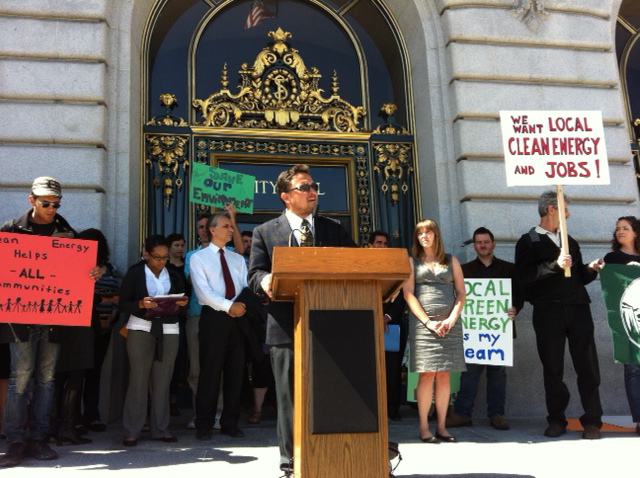
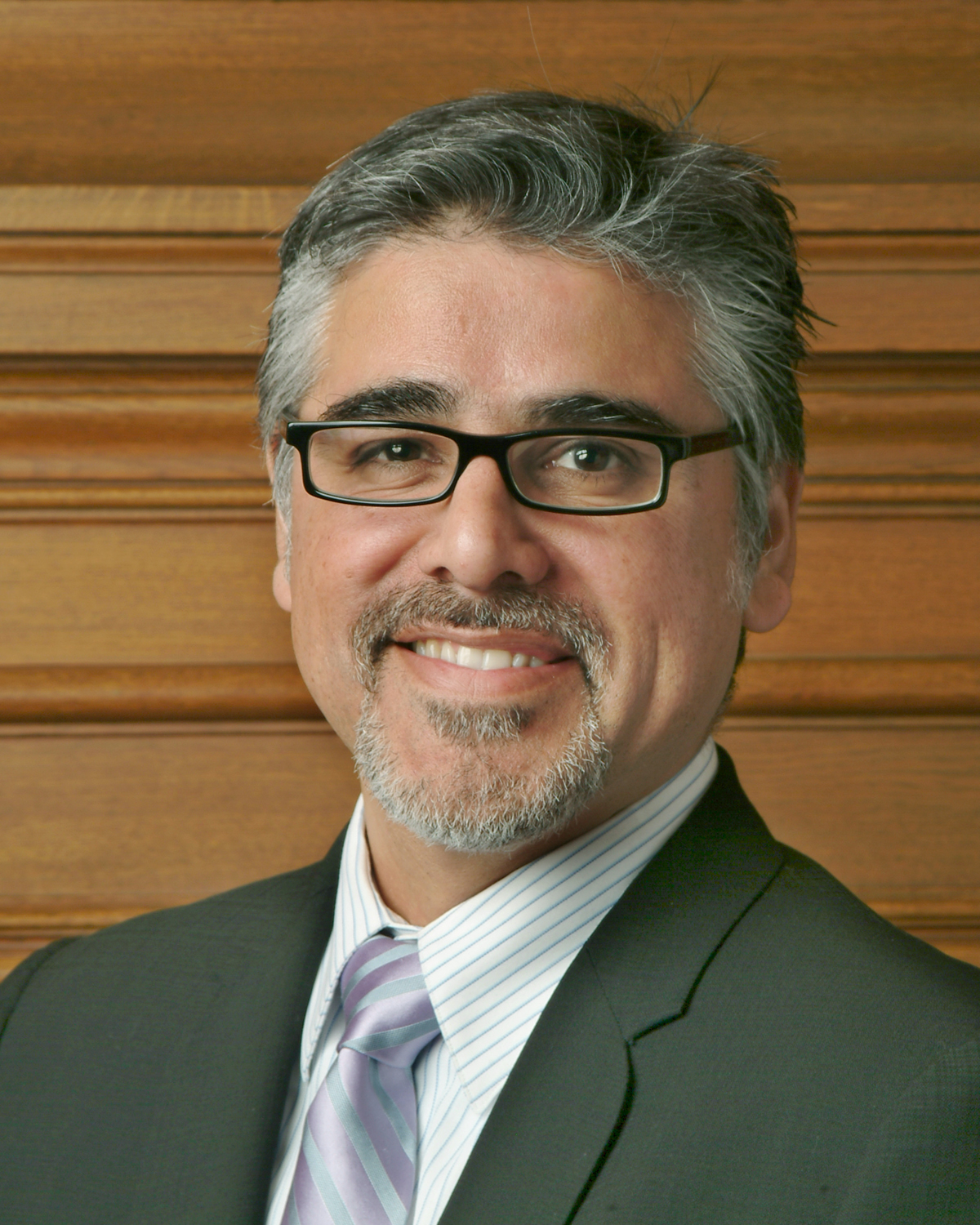
John Avalos

Supervisors advised against Mirkarimi recusals, essentially removing their gags

76

It’s looking increasingly unlikely that any members of the Board of Supervisors will be recused from next week’s big vote on whether to sustain the official misconduct charges against suspended Sheriff Ross Mirkarimi, particularly given an advice letter written today by attorney Scott Emblidge, who is advising the board.

Mirkarimi and his attorneys were hoping some supervisors would admit discussing the case with Mayor Ed Lee or others – particularly Sup. Christina Olague, who is at the center of the controversy about whether Lee committed perjury when he denied, while testifying under oath, ever consulting with any supervisors about the case – and they were disappointed with Emblidge’s advice.

“Scott Emblidge parrots the language of the City Attorney in his recommendation against recusal,” Mirkarimi attorney David Waggoner told us, taking issue with the relationship Emblidge and his firm have with the city and the fact that he also served as legal counsel to the Ethics Commission, some of whose members were unaware of that dual role and expressed concern. “The board must appoint independent counsel.”

In his advice letter, Emblidge did take a similar position to that urged by the City Attorney’s Office, which argued that supervisors are assumed to be politicians who have some relationship with the person that they’re being asked to judge and that analogizing it to a jury in a criminal case isn’t accurate.

“That analogy is misguided. The Charter does not provide for resolution of official misconduct charges by a body unfamiliar with the parties or the facts of the dispute. Rather, it specifically entrusts that decision to the Board of Supervisors, a body composed of individuals who almost certainly would have had dealings with anyone charged with official misconduct,” Emblidge wrote in a letter requested by Board President David Chiu. “Rather than a jury trial, this proceeding is more like an administrative hearing involving employee discipline or other important rights.”

Emblidge said the legal standards indicate that a supervisor must have a financial interest in the decision or be so “personally embroiled” in the case that he/she would have already demonstrated a strong bias or animus against Mirkarimi. And even then, it would be up to a majority vote by the board to excuse a supervisor from the vote.

Such recusal votes are usually mere formalities once a supervisor claims a conflict-of-interest, as then-Sup. Gavin Newsom sometimes did on votes involving landlord-tenant relations. But given that it takes nine of the 11 votes to remove Mirkarimi – with each recusal effectively being a vote in his favor – claims of a conflict will be carefully scrutinized, which Emblidge thinks is appropriate.

“The bar should be high for recusal because of the three-fourths requirement,” Emblidge told the Guardian, making clear that was his personal rather than legal opinion.

The City Attorney’s Office strongly advised the supervisors earlier this year not to discuss the Mirkarimi case with anyone, and they have all heeded that advice and refused to discuss the case with reporters, adding to the drama surrounding a high-profile decision with huge potential long-term ramifications.

Unlike other big decisions, in which supervisors will publicly stake out positions before the vote, often making clear the political dynamics and swing votes, nobody really knows where any of the supervisors stand right now. It’s widely believed that progressive Sups. John Avalos and David Campos – both of whom have unexpectedly easy paths to reelection in November – are the most likely votes for Mirkarimi, with just one more vote needed to reinstate him.

Olague will be in a tough spot politically, torn between supporting the mayor who appointed her and a district that Mirkarimi once represented, where opposition to his removal seems strongest. Ditto with Sup. Jane Kim, a fellow former Green long allied with Mirkarimi, but also someone who backed Lee last year and has ambitions to be the next board president.

This is also a board filled with Ivy League lawyers, and it’s hard to say what aspect of this complex case will draw their focus. Will they side with those who say the decision is simply about showing zero tolerance for domestic violence, or will they share the concerns of Ethics Chair Benedict Hur, who calls this a potentially dangerous precedent that gives too much power to the mayor.

It’s even possible that someone from the board’s conservative bloc of Sups. Sean Elsbernd, Mark Farrell, and Carmen Chu might object to this costly and distracting move by government to go after one individual, making this more about limited government and deferring to voters rather than the fate of an individual for whom they have no particular fondness.

Until now, it’s been difficult to read these tea leaves, but that might be about to change. Emblidge argues that the grounds for recusal are so narrow and restrictive that even if supervisors make public statements about their thoughts on the case, that wouldn’t present a conflict-of-interest that would prevent them from voting on it, particularly now that they’re actively reviewing the record.

So, are we about to start getting some hints from under the dome about how this is going to play out? We’re listening and we’ll let you know.

The gloves are coming off in competitive D5

52

Candidates in the District 5 supervisorial race – where one recent poll showed almost half of voters undecided about a field of imperfect candidates seeking to represent the city’s most progressive district – have been sharpening their attacks on one another, learning lessons about hardball politics, and fighting over key endorsements.

Christina Olague, the incumbent appointed by Mayor Ed Lee earlier this year, has been taking flak in recent debates from competitors who are highlighting the schism between her progressive history and her more conservative recent votes and alliances. That gulf was what caused Matt Gonzalez to pull his endorsement of Olague this summer and give it to Julian Davis.

London Breed has now suffered a similar setback when US Sen. Dianne Feinstein revoked her endorsement following colorful comments Breed made to the Fog City Journal, which were repeated in the San Francisco Chronicle, blasting her one-time political patron Willie Brown. Breed, whose politics have been to the right of the district, seemed to be trying to assert her independence and win over progressive voters who have different worldviews than her more conservative endorsers.

But she may have gone a bit too far when she told Fog City Journal’s Luke Thomas: “You think I give a fuck about a Willie Brown at the end of the day when it comes to my community and the shit that people like Rose Pak and Willie Brown continue to do and try to control things. They don’t fucking control me – you go ask them why wouldn’t you support London because she don’t do what the hell I tell her to do. I don’t do what no motherfucking body tells me to do.”

Shortly thereafter, Breed said she got a call from Feinstein’s people withdrawing the endorsement. “There were just some concerns about the kind of language I used in the article,” Breed told us.

Sources say Brown has been in payback mode ever since, urging Feinstein and others to stop supporting Breed and switch to Olague. Neither Brown nor Feinstein returned our calls. On the record, Breed was contrite when we spoke with her and reluctant to say anything bad about Brown or Feinstein, except to offer us the vague, “There are a lot of people who respect and like me, and they don’t like what they see happening.”

Breed went after Olague hard during a Sept. 18 debate sponsored by the Haight-Ashbury Neighborhood Council and other groups, blasting Olague for her ties to Brown, Lee, and Chinatown power broker Rose Pak, claiming Olague is too beholden to that crew and D5 needs a more independent supervisor.

Asked to respond to the attack during the debate, Olague said, “I won’t dignify that with a response.” But it seems clear to anyone watching the race that Olague has been getting lots of support from Lee, Pak, and Brown and the political consultants who do their bidding, David Ho and Enrique Pearce, which is one reason many progressives have been withholding their support.

The Breed campaign this week trumpeted its endorsement by three prominent progressive activists: Debra Walker, Roma Guy, and Alix Rosenthal. But it has been Davis that has captured the endorsements of the most progressive individuals and organizations, including a big one this week: the Harvey Milk LGBT Democratic Club, which gave Davis is sole endorsement even though he’s straight and Olague is from the LGBT community.

Davis also snagged the number one endorsement of the San Francisco Tenants Union, a big one for D5, as well as the sole endorsements of Gonzalez, former Democratic Party Chair Aaron Peskin, and Sup. John Avalos. Assembly member Tom Ammiano also endorsed the Davis campaign, adding that to Ammiano’s earlier endorsement of John Rizzo, the other solid progressive in the race. Rizzo also got the Sierra Club and the number one ranking by San Francisco Tomorrow.

But Olague is enjoying quite a bit of union support, including snagging the sole endorsement of the San Francisco Labor Council, whose members in the trades like her controversial vote on the 8 Washington project more than progressives or her competitors, who all opposed the deal. Olague was also endorsed by the United Educators of San Francisco and California Nurses Association.

The biggest union of city workers, SEIU Local 1021, gave its unranked endorsements to Davis, Olague, and Rizzo, as did Sup. David Campos. Sup. Jane Kim – who has also occasionally parted ways with progressives after Ho and Pearce ran her campaign against Walker – gave Olague an early endorsement, but late this week also extended an endorsement to Davis.

“As someone who has championed rank-choice voting, it is important for me that progressives are thoughtful about how we strategize for victory.  I have known Julian Davis a long time, and I believe that he would be a strong leader that fights for progressive values that District 5 cares about, including sustainable streets and livable neighborhoods,” Kim said in a statement given to the Davis campaign.

Another important endorsement in D5 is that of the San Francisco Bicycle Coalition, which carried a faint whiff of controversy this year. The group gave Olague its number one endorsement and Davis its number two, but some SFBC members have secretly complained to us that the fix was in and that Davis actually got more votes from SFBC members, which most people thought was how its endorsements are decided.

SFBC Executive Director Leah Shahum told us she wouldn’t reveal who got the most member votes, but she did say that the SFBC Board of Directors actually decides the endorsements based on several factors. “The member vote is one of the factors the board took into consideration,” she said, listing a candidate’s record, relationship with SFBC, personal history, and other factors. “Nothing special was done in that vote, by any means.”

SFBC has been playing nice with Mayor Lee in the last couple years, despite his broken promise of getting the critical yet controversial Fell/Oak separated bike lanes approved by the SFMTA, which he first said would be done by the end of 2011, then by the end of 2012, but which lately seemed to be dragging into 2013.

At SFBC’s urging, Olague recently wrote a pair of letters to the SFMTA urging quicker action on the project, and it seems to have worked: Shahum said a vote on that project has now been scheduled for Oct. 16, and she’s hopeful that it might now be underway by the end of the year after all. As she said, “We’re thrilled.”

BTW, in case you’re curious, the Guardian’s endorsements come out on Oct. 3.

Stop the presses: CleanPowerSF 8, PG&E 3

19

Sometimes, the good guys (and gals) win.

And so, after the Guardian started the public power movement in 1969  with the pioneering Joe Neilands expose of the PG&E/Raker Act scandal, after three  initiative campaigns to kick PG&E put of City Hall and enforce the public power mandates of the federal Raker Act and bring our own Hetch Hetchy public power to our own people, after hundreds of people worked for years inside and outside City Hall for public power and clean energy,  the San Francisco Board of Supervisors voted 8-3 Tuesday  to formally launch a CleanPowerSF project that would for the first time challenge the decades-old power monopoly of the Pacific Gas & Electric Company.

It was a historic moment. And it was a historic veto proof vote that Ed Lee, the PG&E- friendly mayor, and his ally and mentor, former mayor Willie Brown, the unregistered $200,000 a year PG&E lobbyist, will have difficulty snuffing out this time around.

The CleanPowerSF 8 were Sups. David Campos, who sponsored the legislation, Scott Weiner, who cast the deciding swing vote, David Chiu, Eric Mar, Christina Olague, Jane Kim, Malia Cohen, and John Avalos, all of whom made helpful remarks during the debate. They also voted down an attempt by the PG&E bloc to continue the vote for a week and voted against crippling amendments.

The PG&E 3 were Sups.Mark Farrell and Carmen Chiu, who tried to dilute the legislation with the crippling amendments, and Sean Elsbernd, who was strangely silent during the debate. 

I use the phrase CleanPowerSF  8 and PG&E 3 to dramatize the crucial political point and toss in a bit of Guardian history on the story.  For years, as clean energy/public power proposals were routinely voted down as a result of PG&E political muscle and power lobbying, the Guardian would use variations of the phrase. PG&E l0, San Francisco l or whatever was the PG&E margin of victory. The phrase was accurate, pin-pointed the good and bad guys and gals, lifted our spirits, and sent the message that the battle was far from over.

The hero of the afternoon was Ed Harrington, the general manager of the San Francisco Public Utilities Commission who delayed his retirement to complete the project. He got a standing ovation after his testimony backing up his legislation and deft handling of  all questions.  As Campos said, Harrington’s legislation  was as “good as you are going to get.”  No one seriously questioned his plan, figures,  marketing strategy, or key argument that his plan was fiscally and environmentally sound.

PG&E was never mentioned during the discussion and it was difficult to determine its lobbying strategy. After the vote, I asked Eric Brooks, the crafty clean power leader at the meeting,  what happened to PG&E and  its strategy. He said that PG&E, after the San Bruno disaster and other notable mishaps, was not the monopoly power it once was and that perhaps the company had decided it would rather face the slower pace of  CleanPowerSF rather than another clean energy initiative it would have a good chance of losing 

Thanks and congratulations to the CleanPowerSF 8, David Campos, Scott Weiner, John Avalos, David Chiu, Eric Mar, Chritina Olague, Jane Kim, and Malia Cohen, who voted themselves into San Francisco history.  Five of them will face the electorate and PG&E in the November election (Campos, Avalos,  Chiu, Mar, and Olague.) and they acted and spoke as if voting for CleanPowerSF would be a significant advantage to their campaigns in their districts. And thanks and congratulatons to former Sup. Ross Mirkarimi, who carried the public power flag as the unpaid campaign manager during the first two unsuccessful public power campaigns and then carried the CCA plan inside City Hall during his seven years as supervisor.  When he was voted in as sheriff last November, he handed the CCA baton to Campos who pushed the proposal through with style and solid argument that the issue was choice and providing necessary competition to PG&E’s monopoly.

The vote to start public power in San Francisco comes none too soon. The tear-down-tne-Hetch Hetchy dam forces have put the nice-sounding Proposition F to study draining the Hetch Hetch reservoir.on the fall ballot. This is the first step toward tearing down the dam.  The problem for the city is that it could ultimately lose the dam, if it isn’t moving to public power, because the Raker Act mandates that San Francisco have a municipal  system to distribute public power to its residents and businesses because the act allowed San Francisco to dam Hetch Hetchy Valley in Yosemite National Park. The Guardian’s position is that the dam is in place and  should only be torn down after the city has real public power and is able to find and afford an adequate new source for the city’s water and power supply. And that, let me emphasize,  will be a massive undertaking involving billions of dollars and incredible political challenges.   .

Much more to come in this saga that never ends,  b3

Here is Guardian City Editor  Steve Jones’ account of the vote: : http://www.sfbg.com/politics/2012/09/18/historic-veto-proof-vote-launches-cleanpowersf

And some Guardian background on the PG&E/Raker Act Scandal in my advance story: http://www.sfbg.com/bruce/2012/09/17/historic-pgeclean-energy-vote-today

Historic, veto-proof vote launches CleanPowerSF

24

The San Francisco Board of Supervisors today cast an historic vote that was more than a decade in the making, approving the CleanPowerSF program – which challenges PG&E’s monopoly by offering 100 percent renewable energy directly to city residents – on an 8-3 vote that would be enough to override an implied veto threat by Mayor Ed Lee.

The outcome was far from certain throughout the two-hour hearing as conservative Sups. Mark Farrell and Carmen Chu led efforts to undermine the program, which was the final work product of retiring San Francisco Public Utilities Commission Executive Director Ed Harrington, who previously served as the city’s controller for 17 years.

The pair of supervisors offered a series of amendments challenging the state requirement that city residents must proactively opt-out of such community choice aggregation (CCA) programs if they want to remain with PG&E, offering convoluted language that would have required people to opt-in to the program before its launch, and requiring that the $13 million in reserve funds from the SFPUC be covered entirely by CleanPowerSF customers, which could increase its rates.

“It looks like the amendments would be harmful to the success of the program,” Sup. Eric Mar observed, prompting Farrell and Chu to flash broad conspiratorial smiles at one another.

Sup. Scott Wiener, who was undecided and considered a key swing vote in reaching a veto-proof majority, said he also had concerns about the opt-out requirement and wanted to better understand how the amendments would work and whether they were legal. “For me, I’m not interested in putting any poison pills in here,” he said.

Wiener posed questions about the amendments to Farrell and to Harrington, who said it was possible for the SFPUC to have CleanPowerSF customers repay the initial allocation of reserve funds over time but that he wasn’t sure how the opt-in change would work without sabotaging the program.

“It harms the ability to have an intelligent conversation with people,” Harrington said, noting that rates are based on the number of customers in the program, so it would be nearly impossible to survey everyone’s potential interest without being able to tell them how their bills would be affected.

As it is, the SFPUC has already done extensive surveys of which neighborhoods and demographics are likely to be interested in taking part in CleanPowerSF, initially paying about $10 more per month for 100 percent renewable energy (PG&E’s portfolio includes less than 30 percent renewable). “We’ve done extensive surveys already,” Harrington said. Based on that research, the city is initially rolling out the program to less than a third of city residents, who will be repeatedly notified about how to opt-out, anticipating about 90,000 customers remain in the initial program. 

The program has been repeatedly tweaked over the last eight years that it’s been in development, during which time Marin County launched a successful version of the CCA concept that was developed in San Francisco by legislators Tom Ammiano, Carole Migden, and Mark Leno.

“I feel pretty comfortable trusting Ed Harrington on whether the numbers add up,” said the measure’s chief sponsor, Sup. David Campos, arguing against the Farrell/Chu amendments, later adding, “With Ed Harrington leading this charge, this is as good as it gets. If you don’t like CCA under Ed Harrington, you’re not going to like CCA.”

Farrell claimed to support CCA in concept, but he strenuously objected to the opt-out requirements that Migden included in the enabling state legislation, which she had argued was the only way to make CCAs viable against PG&E’s proven willingness to spend tens of millions of dollars to sabotage would-be competitors.

“It’s the wrong way to legislate, the opt-out. It smells of coercion,” Farrell said. Campos countered that, “The best thing we can give the consumers in San Francisco is a choice, a meaningful choice.”

Wiener ultimately made a motion to delay the item by a week, something Mayor Lee yesterday told the Chronicle he wanted, in order to further study the opt-out issue, telling Farrell that his amendment “feels a little seat of the pants to me.”

Campos and other progressive supervisors who were supporting CleanPowerSF argued against the continuance, noting that it has been years in development and sitting in board committees since January, while the Farrell/Chu amendments weren’t offered until this meeting had already begun.    

“This is not going to change because we wait a week to make a decision,” Campos said. “The terms of this deal are not going to change.”

The motion for a continuance failed on a 4-7 vote, with Wiener joined by Farrell, Chu, and Sup. Sean Elsbernd (who offered no comments throughout the hearing).

Then, as the vote on the Farrell/Chu opt-in amendment came up for vote, Wiener said, “I don’t feel comfortable voting for amendments that I don’t know what they’ll do,” and it failed on a 3-8 vote.

Sup. Malia Cohen had earlier indicated a willingness to support the other Farrell/Chu amendment: saddling CleanPowerSF customers with paying the SFPUC back for reserve fund costs – which Harrington indicated could be dragged out over many years to minimize the impact on rates, and which might not be necessary at all if the initial program exceeds expectations.

That amendment was then approved on an 8-3 vote, with Sups. Jane Kim, Christina Olague, and John Avalos opposed. Another set of amendments that would keep low-income city residents out of the initial rollout and take other steps to reduce their rates if they opted in – which was developed by Kim, Cohen, and Sup. Eric Mar – was unanimously approved by the board.

Then it was time for the big vote on creating the CleanPowerSF program, approving the contract with Shell Energy Northern California to administer it, and authorizing the initial $19.5 million expenditure. Would there be eight votes to override a veto by Mayor Lee, who has been under pressure by PG&E and their downtown allies to kill the program?

“To be perfectly candid, I struggled mightily with this contract,” Wiener said, reiterating his concern about its opt-in requirement, noting that the measure wasn’t perfect, even though it was significantly improved from earlier versions. It sounded as if he were about to vote against it.

“What we have the opportunity to do is move forward with clean power,” Wiener said, noting that even Marin County supervisors who initially opposed its CCA have come around to supporting it. “This is something I believe we should try.”

And with that, the board voted 8-3 to launch the program in mid-2013, with Chu, Farrell, and Elsbernd opposed.

Campos said he was “pleasantly surprised” by the vote, while key supporters say they are cautiously hopeful it will stand up during next week’s final supervisorial approval on second reading and in a veto override vote, if that becomes necessary. Campos said he was thankful for the work of Harrington, who got a standing ovation after the vote as the board recognized him for his long service to the city.

Earlier in the meeting, Harrington told supervisors that while the program isn’t perfect, and it contains some risks that he considers reasonable, there is no other way the city has identified to meet ambitious greenhouse gas reduction goals it has set for itself over the last decade. It is city policy to reduce emissions by 25 percent below 1990 levels by 2017 and 80 percent below those levels by 2050.

“This program before you has the only chance of reaching those goals. There’s nothing else,” Harrington said. He also said “it’s an incredibly efficient way to spend money,” noting that the city has spent $90 million on solar and other renewable energy projects that power fewer than 7,000 homes, whereas this $19.5 million will power 90,000 households, possibly without ever tapping into that $13 million reserve fund set aside to cover any losses by Shell, which will buy renewable energy, a role the city hopes to eliminate as it develops its own projects.

Harrington said the ultimate goal of CleanPowerSF is to develop a large enough customer base that the city could use revenue bonds to finance a wide variety of renewable energy projects – many using solar arrays along city-owned property connected to its water system stretching all the way to Hetch Hetchy Valley – that would pay for themselves.

“The real issue is can you build a facility that will have this rate structure support it?” Harrington said.

That’s the real power and potential of CleanPowerSF – finally taking action to address global warming, which will have a huge impact on San Francisco and future generations – as supporters noted in a rally outside City Hall before the meeting. Sen. Mark Leno said that he doesn’t usually weigh in on proposals before the board, but that, “This is an exceptional time and this is an exceptional vote. This is the time that we need to address our inconvenient truth.”

Committee approves CleanPowerSF over downtown opposition

51

The question of whether San Francisco creates a renewable energy program that offers an alternative to Pacific Gas & Electric got its first major hearing at City Hall today, with the business community claiming it’s too expensive and supporters arguing that the time has come for the city to address climate change and the long-term energy needs of city residents and businesses.

The Board of Supervisors Budget & Finance Committee voted 2-1 in favor creating CleanPowerSF, entering into a contract with Shell Energy Northern California to administer the program, and devoting $19.5 million from the San Francisco Public Utility Commission’s water fund to help launch it and buy clean power for city residents.

Sups. John Avalos and Jane Kim supported the project, while Sup. Carmen Chu was opposed. It now goes to the full Board of Supervisors next week, where it is expected to have progressive support and be opposed by the fiscal conservatives.

“I do think we will have the necessary majority to get this through,” the measure’s sponsor, Sup. David Campos, told us. But one open question is whether Mayor Ed Lee will veto a measure that his SFPUC appointees developed but his downtown allies are trying to kill, and if so, whether there are eight supervisors willing to override a veto.

But Campos noted that SFPUC officials testified today that CleanPowerSF is the only way they’ve identified to meet the city’s ambitious official goals for reducing greenhouse gas emissions, which call for a reduction of 20 percent below 1990 levels by the end of this year and an 80 percent reduction by 2050.

Supporters who testified today included environmentalists, progressive groups, and young people who cast addressing climate change as the defining struggle of their generation. “This, not to go overboard, is the most important vote you’ll ever do,” said the Sierra Club’s Arthur Feinstein.

Those who spoke against the program included the usual array of downtown groups that have traditionally defended PG&E’s interests – including the Committee on Jobs, Golden Gate Restaurant Association, and Plan C – and they were joined by an unusually large number of elderly Asian individuals wearing stickers opposing the project.

“It’s a bad program that doesn’t meet even the basic elements of its original promise,” said Chris Wright, executive director of the Committee on Jobs, which PG&E has helped fund since its inception. Like most CleanPowerSF opponents, they have long opposed even the concept of community choice aggregation (CCA), the state law that allowed the city to create CleanPowerSF.

PG&E’s longtime support by local politicians has eroded in recent years because of its overkill campaigns against public power initiatives and supporters and its negligence in the deadly San Bruno pipeline explosion.

Even GGRA Executive Director Rob Black told the committee, “PG&E, a local company, candidly has its problems.” But he and other project opponents – and even a few supporters of the project – centered much of their opposition on the involvement of Shell, which has a bad reputation and environmental record, like almost every other multinational energy company.

“I have the same qualms about Shell that everyone else does,” said Katherine Roberts, who said that she nonetheless supports the project, calling it the only way for most San Franciscans to directly support the development of renewable energy sources. Shell was the sole bidder on a project that requires enormous financial wherewithal.

Campos calls the focus on Shell a diversionary tactic: “PG&E already buys energy from Shell. To the extent people don’t want Shell in the picture, Shell is already in the picture.”

Both the supervisors and the mayor will be under intense pressure to derail CleanPowerSF, with that campaign led by downtown groups and IBEW Local 1245, the union that represents PG&E workers. Sup. Scott Wiener, who says he’s still undecided, told us that his office was flooded with phone calls today, mostly in opposition to the project.

Why Question Time is boring

9

So Sup. Jane Kim isn’t sure Question Time is useful. And the press and some other board members think that, to quote Sup. John Avalos, it’s “deadening.”

Well, there’s a reason for that — the mayor doesn’t like the idea of appearing in an unscripted forum with board members, where he could face tough questions he doesn’t expect and engage in some real debate. And led by Board President David Chiu, the supervisors intentionally created a system that guarantees nothing valuable will happen.

The board sets the rules for Question Time. It’s in the law. And the mayor has to follow those rules.

The whole idea, when Sup. Chris Daly first brought this up, was to mandate that the chief executive interact with the board — and to provide an opportunity for the supervisors to engage in public discussion and debate with the occupant of an office that under Mayors Willie Brown and Gavin Newsom had become increasinly imperious.

Lee’s nowhere near as bad — but still, what Daly envisioned, and what the voters approved, was an open forum. Instead, we got a farce, a pre-scripted scene where the supervisors submit questions in advance, the mayor reads from a prepared answer, and there’s no follow-up or back-and-forth.

Yeah, it’s boring. No, it’s not useless. It’s just broken, because the supervisors didn’t have the guts to put into practice what the voters wanted. It’s simple: Change the rules. Get rid of the requirement that questions be sumitted in advance. Let the supervisors ask, challenge, debate, follow up. That would be a public service.

And the idea that the mayor can’t handle a few unscripted questions is insulting. Lee handles press conferences just fine. And I suspect the supes would be no worse than those wild, unpredictable hordes in the City Hall press corps.

Yes on Prop. A rally urges support for City College parcel tax measure

18

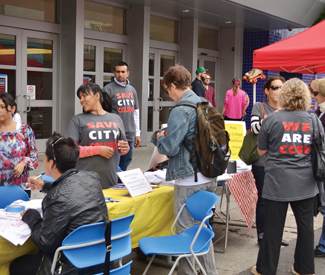
Those who work at, attend and support City College of San Francisco have a lot of work ahead of them. The school’s budget has been regularly slashed, losing $20 million last year alone. The school cut 700 classes this semester. After receiving notice that they faced losing accreditation, students, faculty, staff and administrators have been working tirelessly to save the school.

A rally yesterday highlighted one issue of importance to City College: Proposition A.

Prop. A would create a parcel tax of $79 per year for eight years for San Francisco tax payers. The revenue, estimated at $15 million per year, would go to City College.

Prop. A will be one of three ballot measures that increase taxes in November, including Prop 30 and Prop 38. The second two are statewide measures that also raise taxes to fund schools. 

If both Prop. A and Prop. 30 pass it would restore much of the funds cut from City College. If either measure doesn’t pass, the college would face a large deficit.

Several members of the board of supervisors, the school board, and candidates for those seats spoke in support of City College. 

As Community College Board President John Rizzo mentioned at the rally, the school has cut 700 classes this semester alone. For many of those classes, the school still offers the subject but in far fewer class sections, lengthening wait lists and making it more difficult for students to get into the classes they need to graduate.

“This does not restore all the funding, but it goes a good way forward,” said Norman Yee, president of the board of education. Yee attended City College before going on to UC Berkeley, and taught ESL classes at City College for 10 years.

“If it wasn’t for City College I would have gone down a different path,” said Yee.

Alex Tom, Executive Director of the Chinese Progressive Association, emphasized that support for Prop A should be a citywide issue. He also pointed out that supporting City College “Is a big issue for Asian Americans.”

“Most people don’t know that half of the population of City College is Asian students,” said Tom.

Students, labor, and Democratic Party members also lended their voices to support Prop A. “It’s so important and critical for students to have this resource,” said Shanell Williams, president of the Associated Students organization at City College. 

Sup. John Avalos told Guardsman reporter Joe Fitzgerald that the accreditation process is related but separate from the need to pass Prop A. 

“We need to actually fund it, and make sure it’s around,” said Avalos. “If the parcel tax fails, we’ll see a real diminishment of the effectiveness of City College, and that’s something that I think would further deteriorate its ability to get accredited.”

Video by Joe Fitzgerald

Lee appoints Santos, a staunch development advocate, to CCSF board

22

Rodrigo Santos, a structural engineer who heads the pro-development advocacy group San Francisco Coalition for Responsible Growth, had already raised an unheard of amount of money in his race for the City College of San Francisco Board of Trustees, $113,153 in just six months, mostly from real estate and development interests.

Today, he got another big boost when Mayor Ed Lee appointed Santos to fill the vacancy on that board created by the recent death of Milton Marks, giving the ambitious Santos a big advantage in the fall contest and perhaps signaling Lee’s support for making deep program cuts to satisfy the accrediting commission’s demand that CCSF cut expenditures and beef up its reserves.

“Tough decisions and reform are what City College needs at this time,” Lee said at a press conference this afternoon, calling Santos “someone who shares my vision of reform and will support the tough decisions ahead.”

Although Lee said Santos “is committed and passionate about education,” Santos hasn’t been active on education issues before running for this office. His passions seem to lie mostly with advocating for developers and opposing government regulations in front of the Planning Commission and other bodies, where he regularly testifies, and in helping fellow conservatives gain power on city boards and commissions.

The appointment continues Lee’s pattern of appointing and relying on controversial conservatives in key areas, from his chief fundraiser and economic adviser, venture capitalist Ron Conway, to his recent reappointment to the Planning Commission of Republican Michael Antonini, who gave Santos the maximum $500 contribution in his CCSF race.

“I join an institution that must be saved. I am absolutely committed to that goal,” Santos told a press conference in the Mayor’s Office. He said that he will work to “achieve consensus” around solutions to the troubled institution’s problems, while also declaring, “We must support the interim chancellor, Pamila Fisher.”

But rather than someone who seeks political compromise, Santos’ reputation is as more of polarizing and ideologically conservative firebrand who regularly criticizes government and progressives as part of the downtown alliance that includes Plan C, Committee on Jobs, Building Owners and Managers Association, the SF Chamber of Commerce, and the Board of Realtors PAC

“I actually find him to be pretty divisive in trying to work on issues at [the Department of Building Inspection],” Debra Walker, who served with Santos on the Building Inspection Commission. “He always seems to come into a situation attacking and I hope he doesn’t bring that to this board.”

Walker, a longtime progressive activist and former supervisorial candidate, said that she and her political allies have long endured nasty attacks from Santos and his CRG bretheren.

“They spend all of their time attacking progressives and he gets pretty intense about attacking rather than working with people,” she said. “CRG is about getting people elected who are conservative, that’s their whole reason for existence, perpetuating the real estate industry’s impact of city policies, which has had a negative impact on the middle class.”

Asked about that reputation by the Guardian, both Lee and Santos denied it and refused to answer follow-up questions. Santos said CRG has a “diverse membership” and told us, “I don’t know why you would cast that as polarizing.”

Yet its board is made up almost exclusively of real estate and development interests who have shown themselves to be politically ambitious, winning key mayoral appointments to the Building Inspection and Small Business commissions and working with mayoral staffers to hold onto key leadership positions, edging out supervisorial appointees in the process.

Sup. John Avalos, who was targeted by a CRG independent expenditure campaign in 2008, said that he researched Santos’ background on education issues and was a little surprised not to find anything. “More than anything, the appointment says more about Lee’s pro business leanings,” Avalos told us.

It was also telling that Lee included two of the most conservative CCSF trustees in his press conference, Natalie Berg and Anita Grier, but that more liberal trustees Chris Jackson and John Rizzo were neither consulted nor notified directly about the appointment. “I’m sorry the mayor didn’t involve us more or let us know,” Rizzo told us.

While Rizzo didn’t endorse Santos – instead backing Jackson, Steve Ngo, and Rafael Mandelman (who Rizzo said “really does have the best interests of the district at heart”) – he didn’t want to offer an opinion on Santos, saying that he wants to work constructively with him to solve the district’s problems: “I welcome him to the board and hope he will welcome the work we’ve been doing.”

Santos told reporters that he starts every work day with an “open house” at his office from 5:20-8am, discussing various issues with anyone who wants to stop by, before getting into his engineering and administrative work for his firm, Santos & Urrutia. “I will bring that same commitment to City College,” he pledged.

Guess who’s unopposed for supervisor?

34

Here’s an interesting fact to think about: There are exactly two people running unopposed for the SF Board of Supervisors, two people whose constituents support them strongly enough that nobody thinks a challenge would be effective (or necessary). And those are two supes who have consistently stuck to the progressive agenda and uncompromising progressive politics. They’ve done exactly what they promised to do four years ago; they haven’t moved to the center, haven’t tried to redefine their politics … they are who they are. And that works.

Just worth noting.

Davis snags a trio of top progressive endorsements

36

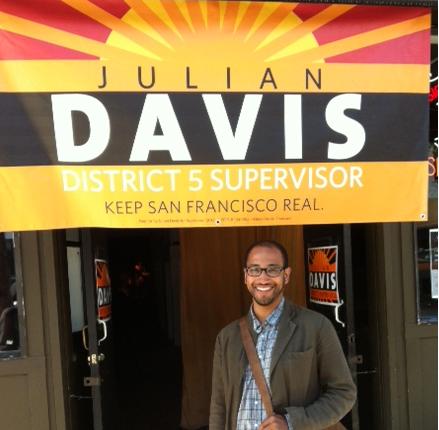
District 5 supervisorial candidate Julian Davis is emerging as the progressive standard-bearer in that competitive race after today receiving the endorsements of a trio of top progressive politicians: Sups. John Avalos and David Campos and attorney Matt Gonzalez, the former board president, mayoral candidate, and D5 supervisor.

Gonzalez had endorsed appointed incumbent Sup. Christina Olague – who he appointed to the Planning Commission in 2004 – but he withdrew that endorsement last month after being frustrated by a series of actions in which she sided with Mayor Ed Lee, moderates, and developers over her longtime progressive colleagues and constituents.

Avalos and Gonzalez are endorsing just Davis, at least for now, while Campos added to his early endorsement of Olague by today endorsing Davis and John Rizzo, who had earlier snagged the other prized progressive endorsement by winning the support of Assembly member Tom Ammiano.

Davis, who was already endorsed by former supervisor and local Democratic Party chair Aaron Peskin, said he’s thrilled with today’s triple endorsement. While some have questioned his anemic fundraising so far, raising less than $10,000 as of June 30, Davis notes that he had been in the race for less than a month before that deadline and that he expects to have more than $150,000 to get his message out.

“What these endorsements signal is a confidence from San Francisco’s progressive leaders, not only in the vision of this campaign, but in our capacity to win,” Davis told us.

Avalos said that he has confidence in Davis’ values, experience, and his ability to run a strong race that will help to reinvigorate the progressive movement.

“Julian is a solid candidate who has been around for years on a number of progressive causes. Running for mayor, I was impressed with his connection to neighborhood issues ranging from small business development to urban cycling and youth and worker rights. His campaign has a good buzz about it, one that I expect will resonate with District 5 residents,” Avalos told us.

Saving City College

43

news@sfbg.com

CAREERS AND ED City College of San Francisco (CCSF) is fighting for its life, and that struggle has turned old enemies into new allies. Suddenly, past differences seem less important than the need to work together, bringing a new sense of unity and purpose to the troubled community college.

In June the school was sanctioned and ordered to “show cause” from the Accrediting Commission of Community and Junior Colleges, putting it on the brink of losing its accreditation — certification necessary for the college’s degrees to be worth anything and for the school to secure federal aid (see “City College fights back,” July 17).

Twelve workgroups comprised of faculty, staff, administrators, students, and college board members are working feverishly to prove by October that the school is making major progress. Otherwise, it could face dire consequences.

While few people with any education or political background believe the school will actually close, there are serious consequences if its accreditation is revoked. A special trustee assigned by the state chancellor’s office could assume the powers of the college’s board or the school could be merged with another community college district.

The only college in California to ever suffer both of those fates was Compton Community College in 2006. Though the two colleges serve wildly different communities, many speak of their fates in the same breath. Its shadow hangs over City College like a ghost of what is to come.

WORKING TOGETHER

The newfound sense of common purpose was displayed on Aug. 1 in CCSF conference rooms, where once-battling special interest groups and employees gathered to tackle problems that have plagued the school for years.

The feuds aren’t just of interest to political geeks and college insiders. Infighting and a dysfunctional governance structure had stalled the school from tackling urgent issues, according to the accrediting commission.

“During interviews, criticism regarding the efficiency of the institutional governance process was revealed. The criticism centered on the length of time to reach a recommendation. It was also noted that there may be misunderstanding regarding the role of a recommending body versus a decision-making body,” according to the commission’s report.

That snippet of the 66-page critical report represents years of strife at the school, not only among the school’s elected trustees but also between the board and other college groups on issues ranging from placement testing to school site closures.

The 12 newly formed workgroups — constituted by the Chancellor’s Office and comprised mostly of faculty, administrators, and trustees — met to discuss issues and make recommendations to the system’s decision-making authorities: the Chancellor’s Office and Board of Trustees. One of the workgroups is in charge of evaluating that very decision-making system, with 14 people from different college constituencies hashing out a new style of democracy for the school.

At their first meeting, the members brought in stacks of papers to hand out — research on best practices and policies in college governments around the state and the nation. This particular workgroup discussed how an ideal student government should run, and how to enact those changes at City College.

The workgroups are brainstorming sessions, and each one has a different task ahead of it, including how to measure student learning, leveraging technology to streamline the school, facilities planning, and fiscal planning. Each workgroup acts independently, although some themes and members overlap.

The Board of Trustees is scheduled to meet and report on the progress of the workgroups on August 14 — the day before fall semester classes begin.

A final, preliminary report based on the findings of the dozen workgroups is expected to be completed before the accrediting commission’s October 15 deadline. With everything on the table, from staff layoffs to campus closures, CCSF is an anxious institution facing an uncertain future.

THE GHOST OF COMPTON’S PAST

In Compton, faculty and staff lived in constant fear of losing their jobs between 2002 and 2006, while the school was at risk of losing accreditation. Its path offers some lessons for CCSF.

“From three or four years prior to the accreditation being revoked, every March everybody got a pink slip and then you found out, you know, whether or not you actually had a job to come back to the next year,” Ann Garten, the community relations director of El Camino Community College District, told the Guardian in a phone interview.

El Camino swooped in to save Compton from total closure when its accreditation was revoked in 2006. The fate of employees at City College is a mystery for now, but based on Compton’s experience, part-time faculty are most at risk.

During spring semester, City College had nearly 1,700 instructors, approximately half of which were part-timers, according to college payroll documents. The school’s faculty are represented by the American Federation of Teachers Local 2121.

Classified workers — those who perform services such as administrative support, technology services, and grounds maintenance — could also be at risk. Their numbers exceeded 800 during the last fiscal year, according to the school’s assistant director of research, Steve Spurling.

They are represented by the Service Employees International Union Local 1021, a large and active union that also represents most city workers. In recent years, both unions have already taken pay cuts and freezes on raises and accepted furlough days to help plug the college’s fiscal holes.

If a special trustee were to take over, these workers would become even more vulnerable. But even without a special trustee, will there be layoffs?

Though there is no definitive answer yet, “everything needs to be on the table,” Trustee Steve Ngo told us. Yet most indications are that part-timers are at the most risk.

“I’m not convinced [full time faculty] pay cuts are what is called for. Our part time is the highest paid in the country,” CCSF Chancellor Pamila Fisher told the Associated Student Presidents, made up of elected leaders from CCSF’s eight main campuses. “We pay them health care. That’s unheard of” and could be re-evaluated, she said.

Yet it’s also possible that more creative and aggressive fundraising could save the part-timers and other college functions. Alisa Messer, president of AFT local 2121, said statewide categorical funds exist expressly to help fund part time faculty health care costs, she said, although not all colleges follow through.

“AFT 2121 has been a leader in this state, and in fact in the nation, on increasing parity for part-time/contingent faculty,” Messer said. “We will not allow this crisis to be an excuse to roll back significant progress that has been made on the rights of our most vulnerable faculty.”

The commission’s June report dinged the school for spending higher than average levels on salaries and benefits, 92 percent of their funds to be exact, while other community colleges in the Bay Area have figures in the low to mid 80s.

Yet many of CCSF’s defenders say that comparison isn’t fair or accurate, noting San Francisco’s higher cost of living and the fact that the district provides health coverage to part-time faculty, which most other community colleges in the state do not provide.

SERVING STUDENTS

As the college unites, many conflicts that remain boil down to the question of open access. CCSF currently operates with what it sees as a true community college ethos, where the varied needs of a diverse student population are balanced.

Recent high school graduates preparing for transfer mingle with adult students continuing their education, while English as Second Language (ESL) learners work towards proficiency and others seek new technical skills or transition to a new career.

Many students also take so-called “personal enrichment” courses — one time classes in the arts or languages, for example — that state government has de-prioritized as the budget hole has gotten deeper.

“I think we have to spend money better,” Ngo said, concerning “non-credit” courses, which are primarily classes for adult learners. He pointed to the fact that ESL classes are a full semester long, despite a unique “hop in, hop out” structure to the lessons, which gives students flexibility in their attendance over the course of the semester.

Reducing the number of weeks in a semester that those classes meet could be one possible strategy for saving money, he said. He emphasized that the college needs to work with hard data, and that calculations from what could be saved by such moves aren’t finished.

The number of campuses within the district is also being re-evaluated. “Yes, one of things we’re looking at is whether we should have nine sites. Centers may be combined. We don’t know if that will pay out yet,” Chancellor Fisher told the student presidents, referring to complex funding formulas that could actually prevent CCSF from saving money by closing campuses.

Fisher said officials are researching the possibility of combining campuses in close proximity, which drew a mixed reaction from the presidents. Bouchra Simmons, the Downtown Campus student president, said that combining the Civic Center and Downtown campuses would be disastrous.

“[Downtown Campus] is already pushed to capacity in terms of class size,” Simmons said. And the reverse, moving Downtown Campus students into Civic Center, would make it difficult for her to drop her daughter off at child care and still be able to make it to school on time.

Emanuel Andreas, Southeast Campus president, disagreed when it came to his constituents. “We understand what is happening, and everything needs to be on the table,” he said.

The threat of campus closures and a reduction in non-credit classes are all part of the attack on open access, as some students have said. To combat that, they’ve formed a new student group aimed at educating the city about what they stand to lose.

Project Unity is comprised of Occupy CCSF students, former student trustee Jeffrey Fang, student body President Shanell Williams, and other students, led by the newly elected student Trustee William Walker. They’ve rallied for their school at City Hall, where Supervisors Eric Mar and John Avalos have sponsored a resolution to support City College.

Project Unity met at the Mission Campus shortly after supporting the resolution, and started to plan a grassroots campaign to educate the city and its residents about open access.

Bob Gorringe, a member of Occupy San Francisco, was on hand to help the fledgling group strategize. “[Trustee] Anita Grier came out to the Occupy action council, and she was very open,” Gorringe told the group on July 31, referring to the longtime board member who is not exactly known for her radical tendencies.

Students taking such a vested interest in their college should come as no surprise, considering what happened to Compton before it folded into El Camino.

Although Compton never actually closed, it hemorrhaged students as public fears of the college closing grew larger, and the student body dropped to around 2,000 when El Camino took over, Garten told the Guardian.

Some students went elsewhere, but many appear to have just abandoned the education system.

“We looked at two or three colleges around Compton and none of us had a significant increase in students from the Compton district” enrolling, Garten said.

In other words, it looked like many disillusioned students had simply dropped out, something that nobody wants to see in San Francisco.

MOVING FORWARD

Just over two months remain for CCSF and its supporters to hash out a preliminary plan. Aiding them is a team of experts that will create a detailed report on everything related to the college’s financial woes — possibly the most critical problem area.

The Fiscal Crisis and Management Assistance Team, or FCMAT, explained their process to the college on August 3.

Without revealing any specific details, Michelle Plumbtree, the chief management analyst of FCMAT, warned an audience of a couple dozen interested people that its report would seem negative, but only because that’s exactly what the report is supposed to be: a critical review of problem areas.

“You guys are doing incredible things…But that’s not what we talk about [in our reports],” Plumbtree said.

Mike Hill, another FCMAT team member, succinctly layed out the biggest obstacles to City College’s fiscal future. “This is not a one year problem…We’re looking at three years. What makes that complicated is the governor’s tax, and the parcel tax,” Hill said, referring to Prop. 30 and the San Francisco ballot measure City College sponsored. “There are four scenarios… It’s not predictable.” Prop. 30, the tax measure placed on the ballot by Governor Jerry Brown, wouldn’t raise new revenue for community colleges. If it passes, they simply break even, staving off more drastic cuts. But the parcel tax offers more hope for CCSF, if city voters approve it. It would free up $14 million in revenue for this fiscal year, restoring some of what was lost and prevent the deep cuts and scaled back mission that the school’s support most fear.

Antonini, quarterback for development interests, wins the game

20

If there was any doubt about the loyalty to developers of Planning Commissioner Michael Antonini, he put them to rest yesterday shortly after finally winning reappointment to a fourth, four-year on a 6-5 vote by the Board of Supervisors. Afterward, in comments to Examiner reporter Joshua Sabatini, Antonini likened his role on the commission to that of a successful football team’s quarterback.

“You want to knock out the quarterback for the other team,” Antonini said. “It’s a tribute in a way – backhanded.”

The five supervisors who opposed Antonini – Sups. David Chiu, John Avalos, David Campos, Eric Mar, and Jane Kim, the board’s most progressive members – seemed to understand that Antonini saw himself playing for the developers and big corporations that see San Francisco mostly as a place to make money, even at the expense of eastern neighborhoods and the city’s long-term interests.

The voting record of this Republican dentist – an elected member of the San Francisco Republican County Central Committee who advocates for right-wing causes (such as crackdowns on the homeless) and candidates – makes clear which team Antonini plays for, and it isn’t the same team as the vast majority of people in San Francisco, where Republicans constitute less than 10 percent of the electorate.

It says a great deal about the corporatist politics of Mayor Ed Lee for re-appointing him, as well as the politics and integrity of the swing votes, Sups. Malia Cohen and Christina Olague, the Lee appointee now running for election in District 5, one of the city’s most progressive districts.

Both supervisors mouthed meaningless platitudes and justifications for their votes, but in reinstating the developers’ quarterback just as the progressives were about to remove him from the game, one wonders what team they’re playing for – or whether they even understand the dimensions of the game they have unexpectedly found themselves playing.

But Antonini clearly understands. And despite the ridiculous statements that Cohen and Olague made about holding him “accountable,” Antonini now has four more years to continue leading a team that is rapidly gentrifying San Francisco, making it more inviting to the Google-busers and Twitterati and their landlords, but less so for the average teacher, clerk, and social worker.

Compromise measures

3

news@sfbg.com

San Franciscans are poised to vote this November on two important, complicated, and interdependent ballot measures — one a sweeping overhaul of the city’s business tax, the other creating an Affordable Housing Trust Fund that relies on the first measure’s steep increase in business license fees — that were the products of intense backroom negotiations over the last six months.

Mayor Ed Lee and his business community allies sought a revenue-neutral business tax reform measure that might have had to compete against an alternative proposal developed by Sup. John Avalos and his labor and progressive allies, who sought around $40 million in new revenue, although both sides wanted to avoid that fight and find a compromise measure.

Meanwhile, Mayor Lee was having trouble securing business community support for the housing trust fund that he pledged to create during his inaugural address in City Hall in January. So he modified his business tax proposal to bring in $13 million that would be dedicated to the Affordable Housing Trust Fund, but that didn’t satisfy the Avalos camp, who insisted the city needed more general revenue to offset cuts to city services and help with the city’s structural budget deficit.

Less than a day before the competing business reform measures came before the Board of Supervisors on July 24, a compromise was finally struck that would bring $28.5 million a year, with $13 million of that set aside for the affordable housing fund, tying the fate of the two measures together and creating a kumbaya moment at City Hall that was reminiscent of last year’s successful pension reform deal between labor and the business community.

But there was one voice raised at that July 24 meeting, that of Sup. David Campos, who asked questions and expressed concerns over whether this deal will adequately address the “crisis” faced by the working class in a city that will continue to gentrify even if both of these measures pass. Affordable housing construction still won’t meet the long-term needs outlined in the city’s Housing Element that indicates 60 percent of housing construction would need public subsidies to be affordable to current city residents.

It’s also worth asking why a business tax reform measure that doubles the tax base — just 8.4 percent of businesses in San Francisco now pay the payroll tax, whereas 16.4 percent would pay the gross receipts tax that replaces it — doesn’t increase its current funding level of $410 million (the $28.5 million comes from increased business license fees). Some industries — most notably the technology and restaurant industries that have strongly supported Mayor Lee’s political ambitions — could receive substantial tax cuts.

Politics is about compromise, and Avalos tells us that in the current political climate, these measures are the best that we can hope for and worthy of progressive support. And that may be true, but it also indicates that San Francisco will continue to be more welcoming to businesses than the working class residents struggling to remain here.


SOARING HOUSING COSTS

As Mayor Lee acknowledged during his inaugural speech, the boom times in the technology industry has also been driving up commercial and residential rents, he sought to create “housing for the 100 percent.”

The median rent in San Francisco has been steadily rising, jumping again in June an astounding 12.9 percent over June of last year, according to real estate monitor RealFacts, leaving renters shelling out on average an extra $350 a month to landlords.

Driven by a booming tech industry and a lag in new housing, the average San Francisco apartment now rents for $2,734. That’s an annual increase of $4,000 per unit over last year, in a city that saw the highest jumps in rent nationally in the first quarter of 2012. Even prices for the average studio apartment have edged up to $1,800 a month.

The affordability gap between housing and wages in the city is stark. Somebody spending a quarter of their income on rent would need to be making $85,000 a year just to keep up with the average studio. With a mean wage of $64,820 in the San Francisco metro area, even middle class San Franciscans have a difficult time affording a modest apartment. For the city’s lowest paid workers, even earning the country’s highest minimum wage of $10.25 an hour, even devoting every earned dollar to rent still wouldn’t pay for the average small studio apartment.

For those looking to buy a home in the city, it can be a huge hurdle to put aside a down payment while keeping up with the city’s high rents. Almost 90 percent of San Franciscans cannot afford a market rate home in the city. The average San Francisco home price was up 1.9 percent in June over May, climbing to $713,500, or a leap of $50,000 per unit over last year’s prices.

In the 2010 census, before the recent boom in the local real estate market, San Francisco already ranked third in the nation for worst ratio between income and home ownership prices, behind Honolulu and Santa Cruz.

But as the city leadership grapples to mitigate the tech boom’s effects, the lingering recession and conservative opposition to new taxes have gutted state and federal funds for affordable housing. Capped off last December by the California Legislature’s decision to dissolve the State Redevelopment Agency, a major source of money for creating affordable housing, San Francisco has seen a drop of $56 million in annual affordable housing funds since 2007.

Trying to address dwindling funding for affordable housing, the Board of Supervisors voted 8-2 on July 24 to place the Affordable Housing Trust Fund measure on the fall ballot. Only the most conservative supervisors, Sups. Sean Elsbernd and Carmen Chu, opposed the proposal. Sup. Mark Farrell, who has signaled his support for the measure, was absent.

“Creating a permanent source of revenue to fund the production of housing in San Francisco will ensure that San Francisco is a viable place to live and work for everyone, at every level of the economic spectrum. I applaud the Board of Supervisors,” Mayor Lee said in response.

At the heart of the program, the city hopes to create 9,000 new units of affordable housing over 30 years. The measure would set aside money to help stabilize the ongoing foreclosure crisis and replenish the funds of a down payment assistance program for those earning 80 to 120 percent of the median income.

To do so, the city anticipates spending $1.2 billion over the 30-year lifespan of the program, with a $20 million annual contribution the first year increasing $2.5 million annually in subsequent years. It would fold some existing funding in with new revenue sources, including $13 million yearly from the business tax reform measure. Language in the housing fund measure would allow Mayor Lee to veto it is the business tax reform measure fails.

The board was forced to delay consideration of the business tax measure until July 31 because of changes in the freshly merged measures. That meeting was after Guardian press time, although with nine co-sponsors on the board, its passage seemed assured even before the Budget and Legislative Analysts Office had not yet assessed its impacts, as Campos requested on July 24.

“I do believe that we have to ask certain questions when a proposal of this magnitude comes forward,” Campos said at the hearing, later adding, “When you have a proposal of this magnitude, you’re not going to be able to adjust it for some time, so you want it to be right.”

The report that Campos requested, which came out in the late afternoon before the next day’s hearing, agreed that it would stabilize business tax revenue, but it raised concerns that some small businesses exempt from the payroll tax would pay more under the proposal and that it would create big winners and losers compared to the current system.

For example, it calculated that between the gross receipts tax and business license fee, a sample full service restaurant would pay 69 percent less taxes and a supermarket 33 percent less taxes, while a commercial real estate leasing firm would pay 46.7 percent more tax and a large engineering firm would see its business tax bills more than double.

Board President David Chiu, who has co-sponsored the business tax reform measure with Mayor Lee since its inception, agreed that it is a “once in a decade reform,” calling it a “compromise that reflects the best sense of that word.” And that view, that this is the best compromise city residents can expect, seems to be shared by leaders of various stripes.


BACKING THE COMPROMISE

The business community and fiscally conservative politicians have long called for the replacement of the city payroll tax — which they deride as a “job killer” because it uses labor costs to gauge the size of company’s size and ability to pay taxes — with a gross receipts tax that uses a different gauge. But the devil has been in the details.

Chiu praised the “dozens and dozens and dozens of companies that have worked with us to fine-tune this measure,” and press reports indicate that representatives of major corporations and economic sectors have all spent hours in the closed door meetings shaping the complicated formulas for how they will be taxed, which vary by industry.

When the Guardian made a Sunshine Ordinance request to the Mayor’s Office for a list of all the business representatives that have been involved in the meetings, its spokespersons said no such list exists. They have also asked for a time extension in our request to review all documents associated with the deliberations, delaying the review until next week at the earliest, after the board approves the measure.

But the business community seems to be on board, even though some economic sectors — including real estate firms and big construction companies — are expected to face tax hikes.

“The general reaction has been neutral to favorable, and I expect we’ll be supportive,” Jim Lazarus, the vice president of public policy for the San Francisco Chamber of Commerce, who participated in crafting the proposal but who said the Chamber won’t have an official position until it votes later this week.

Lazarus noted the precipitous rise in annual business license fees — the top rate for the largest companies would go from just $500 now to $35,000 under the proposal, going up even more in the future as the Consumer Price Index rises — “but some of it will be offset by a drop in the payroll tax,” Lazarus said.

He also admitted that the new tax system will be “hugely complicated” compared to the payroll tax, with complex formulas that differ by sector and where economic transactions take place. But he said the Chamber has long supported the switch and he was happy to see a compromise.

“I’m assuming it will pass. I don’t believe there will be any major organized opposition to the measure,” Lazarus said.

Labor and progressive leaders also say the measure — which exempts small businesses with less than $1 million in revenue and has a steeply progressive business license fee scale — is a good proposal worth supporting, even if they didn’t get everything they wanted.

“We fared pretty well, the royal ‘we,’ with the mayor starting off from the position that he wanted a revenue-neutral proposition,” Chris Daly, who unsuccessfully championed affordable housing ballot measures as a supervisor before leaving office and becoming the political director for SEIU Local 1021, the largest union of city employees.

Both sides say they gave considerable ground to reach the compromise.

“Did we envision $28.5 million in new revenue? No,” said Lazarus, who had insisted from the beginning that the tax measure be revenue-neutral. “But we also didn’t envision the Affordable Housing Trust Fund.”

Daly and Avalos also said the measures need to be considered in the context of current political and economic realities.

“We were never going to be able to pass — or even to craft — a measure to meet all of the unmet needs in San Francisco,” Daly said. “Given the current political climate, we did very well.”

“If we had a different mayor who was more interested in serving directly the working class of the city, rather than supporting a business class that he hopes will serve all the people, the result might have been different,” Avalos said. “But what’s significant is we have a tax measure that really is progressive.”

Given that “we have an economic system that is based on profits and not human needs,” Avalos said, “This is a good step, better that we’ve had in decades.”


THE HOUSING CRISIS

The tax and housing measures certainly do address progressive priorities — bringing in more revenue and helping create affordable housing — even if some progressives express concerns that conditions in San Francisco could get worse for their vulnerable, working class constituents.

“I don’t know if the proposal before us is aggressive enough in terms of dealing with a crisis,” Campos told his colleagues on July 24 as they discussed the housing measure, later adding, “As good as this is, we are truly facing a crisis and a crisis requires a level of response that I unfortunately don’t think we are providing at this point.”

Not wanting to let “the perfect be the enemy of the good,” Campos said he still wanted to be able to support both measures, urging the board to have a more detailed discussion of their impacts.

“I wish this went further and created even more funding for critically needed affordable housing,” Sup. Eric Mar said before joining Campos in voting for the proposal anyway. “I think they need to build 60 percent of those units as below market rate otherwise we face more working families leaving the city, and the city becoming less diverse.”

Yet affordable housing advocates are desperate for something to replace the $56 million annual loss in affordable housing the city has faced in recent years, creating an immediate need for action and potentially allowing Lee to drive a wedge between the affordable housing advocates and labor if the latter held out for a better deal.

Many have heralded the mayor’s process in bringing together developers, housing advocates, and civic leaders to build a broad political consensus for the measure, particularly given the three affordable housing measures crafted by progressives over the last 10 years were all defeated by voters.

“One of the goals of any measure like this is for it to gain broad enough support to actually pass,” Sup. Scott Wiener said at a Rules Committee hearing on the measure.

In the measure’s grand bargain, developers receive a reduction in the percentage of on-site affordable housing units they are required to build, from 15 percent of units to 12 percent. The city will also buy some new housing units in large projects, paying market rate and then holding them as affordable housing — the buying power of which could be a boon to developers while creating affordable housing units.

At its root, the measure shifts some of the burden of funding affordable housing from developers to a broader tax base and locks in that agreement for 30 years, which could also spur market rate housing development in the process.

A late addition to the proposal by Farrell would create funding to help emergency workers with household earnings up to 150 percent of average median income buy homes in the city, citing a need to have these workers close at hand in the event of an earthquake or other emergency.

While some progressives have grumbled about the givebacks to developers and the high percentage of money going to homebuyer assistance in a city where almost two-thirds of residents rent, affordable housing advocates are pleased with the proposal.

“Did we gain out of this local package? Yes, we got 30 years of local funding. We came out net ahead in an environment where cities are crashing. We essentially caught ourselves way early from the end of redevelopment funds,” said Peter Cohen, executive director of the San Francisco Council of Community Housing Organizations.

Without it, Cohen says many affordable housing projects in the existing pipeline would be lost. “This last year was a bumpy year, and we will not be back to the same operation level for a number of years,” Cohen said. “There was a dip and we are coming out of that dip. It will take us a while to get back up to speed.”

The progressive side was also able to eliminate some of the more controversial items in the original proposal, including provisions that would expand the number of annual condo conversions allowed by the city and encourage rental properties to be converted into tenancies-in-common.

With ballot measures notoriously hard to amend, the Affordable Housing Trust Fund measure is a broad outline with many of the details of how the fund would be administered yet to be filled in. If passed, it will be up to Olson Lee, head of the Mayors Office on Housing and former local head of the demised redevelopment agency, to fill in the details, folding what was essential two partnered affordable housing agencies into a single local unit.

But even the most progressive members of the affordable housing community said there was no other alternative to addressing affordable housing in the wings — which is indeed a crisis now that redevelopment funds are gone — making this measure essential.

As Sara Shortt of the Housing Rights Committee of San Francisco told the Rules Committee, “We lost a very important funding mechanism. We have to replace it. We have no choice.”


Chow withdraws from D11 race after residency questioned

15

Sup. John Avalos appears to be cruising to an uncontested reelection now that Leon Chow, an organizer and executive with SEIU-UHW, has been chased out of the District 11 supervisorial race by journalist Chris Roberts, the SF Appeal, and their reporting on what appears to be Chow’s false claims that he lived in the district.

Chow had been banking on support from his union and the district’s substantial Chinese immigrant population, which he had been helping rally against new medical cannabis dispensaries that the city had approved for the Outer Mission/Excelsior area, presenting Avalos with a challenge that needed to be taken seriously.

But Roberts dropped a journalistic bomb on Chow’s ambitions a couple weeks ago when he unearthed documents indicating that Chow actually lived in Walnut Creek and that he was registered to vote at Chinatown business address – both in violation of election law – doing the solid reporting that journalists failed to do when Ed Jew was elected to the District 4 seat without living there. It wasn’t until Jew was caught in an FBI bribery sting that journalists dug into the background of a politician who had flown into office largely under the press’s radar.

As the Appeal reported this afternoon, Chow sent this email to the Elections Department: “Since I have not filed for Candidacy, I am notifying your department simply with this email, please let me know if there is any other process I will need to do. Please kindly remove my names [sic] from the Potential Local Candidate List in the department web site.”

Although it made no mention of Roberts’ story – which hadn’t gotten much journalistic traction yet, although that was bound to happen as the campaign wore on – the connection seems obvious. So, congratulations to Roberts … and to Avalos.

Best of the Bay 2012 Readers Poll: City Living

2

BEST OF THE BAY 2012: READERS POLL

City Living


BEST STREET FAIR

Folsom Street Fair

www.folsomstreetfair.com


BEST HOTEL

Phoenix Hotel

601 Eddy, SF. (415) 776-1380, www.jdvhotels.com/phoenix


BEST TOURIST ATTRACTION

Golden Gate Bridge


BEST TOUR

Discovery Street Tours

www.discoverystreettours.com


BEST EVENT OR VENUE FOR KIDS

Exploratorium

3601 Lyon, SF.  (415) 397-5673, www.exploratorium.edu


BEST STARTUP COMPANY

BeatsMe

www.beatsme.fm


BEST OVERALL WEBSITE

FunCheap SF

www.funcheapsf.com


BEST NEWS WEBSITE

SF Gate

www.sfgate.com


BEST STYLE WEBSITE

Refinery 29

www.refinery29.com


BEST SEX WEBSITE

Kink.com

www.kink.com


BEST POLITICIAN

John Avalos


BEST POLITICIAN YOU LOVE TO HATE

Willie Brown


BEST NONPROFIT ORGANIZATION

Rocket Dog Rescue

www.rocketdogrescue.org


BEST ADULT EDUCATION

The Writing Salon

Various locations, www.writingsalons.com


BEST TV NEWSCASTER

Dana King of CBS


BEST LOCALLY PRODUCED TV SHOW

Check Please! Bay Area

www.blogs.kqed.org/checkplease


BEST RADIO STATION

KQED 

www.kqed.org


BEST RADIO DJ OR SHOW

Sarah and Vinnie of 97.3 Alice

www.radioalice.cbslocal.com/show/sarah-and-vinnie


BEST TATTOO PARLOR

Black and Blue Tattoo

381 Guerrero, SF. (415) 626-0770, www.blackandbluetattoo.com


BEST TATTOO ARTIST

Phillip Milic

(510) 834-2769, www.oldcrowtattoo.com


BEST LOCAL ANIMAL RESCUE

SF SPCA

www.sfspca.org


BEST DOG-WALKING SERVICE

Dog Tales Walking & Sitting Service

(415) 948-3840, www.dogtalesunleashed.com


BEST PET GROOMER

Bow Wow Meow

2150 Polk Street, SF. (415) 440-2845, www.bowwowmeow.net


BEST VETERINARIAN

Mission Pet Hospital

720 Valencia, SF. (415) 552-1969, www.missionpet.com


BEST DENTIST

Jennifer Creelman of Creelman Famer DDS

2191 Market, SF. (415) 255-0400, www.cfdds.com


BEST DOCTOR

Carl Bricca of Mercy Doctors Medical Group

1 Shrader, No. 640, SF. (415) 752-0100, www.mercydoctorsmedicalgroup.com


BEST PLUMBER

Ace Plumbing and Rooter

945 Taraval, No. 201, SF. (415) 824-6333, www.aceplumbingandrooter.com


BEST ELECTRICIAN

Ike’s Electric

3546 19th St., SF. (415) 861-6417, www.ikeselectric.com


BEST MOVING SERVICE

Delancey Street Moving and Trucking

600 Embarcadero, SF. (415) 512-5110, www.delanceystreetfoundation.org


BEST CLEANING SERVICE

Dirty Donnie’s Green Cleaning Services

(415) 505-7261, www.dirtydonniesgreenclean.com


BEST ALTERNATIVE HEALING

Jaden Rose Holistic Bodywork

(415) 939-7795, www.jadenroseholisticbodywork.com


BEST THERAPIST (TIE)

Nicolle Zapien

870 Market, SF. (415) 835-2195, www.nicollegottfriedzapien.com


Cameron Yarbrough of Couples Counseling San Francisco

383 Rhode Island, No. 201, SF. (415) 935-4249, www.cameronyarbrough.org


BEST CAR MECHANICS

Pat’s Garage

1090 26th St., SF. (415) 647-4500, www.patsgarage.com


BEST MOTORCYCLE REPAIR

Scuderia West

69 Duboce, SF. (415) 621-7223, www.scuderiawest.com


BEST BICYCLE REPAIR

Valencia Cyclery

1077 Valencia, SF. (415) 550-6601, www.valenciacyclery.com


BEST SHOE REPAIR (TIE)

Frank’s Shoe Repair

1619 Polk, SF. (415) 775-1694


Anthony’s Shoe Repair

340 Kearny, SF. (415) 781-1338


BEST TAILOR

Al’s Attire

1314 Grant, SF. (415) 693-9900, www.alsattire.com


BEST LAUNDROMAT

BrainWash

1122 Folsom, SF. (415) 431-9274, www.brainwash.com


BEST SALON

Carmichael Salon and Color Bar

166 Geary, SF. (415) 409-2353, www.carmichaelsalon.com


BEST HAIRSTYLIST

Rebekah Nummer of Carmichael Salon and Color Bar

166 Geary, SF. (415) 409-2353, www.rebekahnummer.com


BEST MASSAGE

Project Zen

325 Bay, SF. (415) 500-4777, www.projectzenmassage.com


BEST DAY SPA

Kabuki Springs and Spa

1750 Geary, SF. (415) 922-6000, www.kabukisprings.com


BEST GYM

Club One Fitness Centers

Various Bay Area locations, www.clubone.com


BEST PERSONAL TRAINER

Ace Morgan Fitness

(510) 459-8202, www.acemorganfitness.com


BEST YOGA STUDIO

Monkey Yoga Shala

3215 Lakeshore, Oakl. (510) 595-1330, www.monkeyyoga.com


BEST YOGA INSTRUCTOR

Tim Thompson of Monkey Yoga Shala

3215 Lakeshore, Oakl. (510) 595-1330, www.monkeyyoga.com


BEST AMATEUR SPORTS TEAM

Bay Area Derby Girls

www.bayareaderbygirls.com


BEST PUBLIC SPORTS FACILITY

AT&T Park

24 Willie Mays Plaza, SF. (415) 972-1800


BEST BEACH

Baker Beach


BEST PUBLIC PARK

Golden Gate Park

www.sfrecpark.org


BEST NATURE SPOT FOR PEOPLE WITH DISABILITIES

Golden Gate Park

www.sfrecpark.org


BEST CAMPGROUND

Angel Island

(415) 435-5390, www.angelisland.org


BEST CAMP FOR KIDS

Steve and Kate’s Camp

28 Liberty Ship, Sausalito. (415) 887-957, www.steveandkatescamp.com


BEST PARK FOR DOGS

Fort Funston


BEST SKATE SPOT

Golden Gate Park


BEST SURF SPOT

Ocean Beach


BEST PLACE TO WATCH THE SUNSET

Ocean Beach

Guest opinion: RCV is good for progressives

52

Since San Francisco began using ranked choice voting in 2004 and public financing of campaigns in 2002, the city has been a leader in the types of political reform badly needed at state and national levels. People of color today have an unprecedented degree of representation and progressives are a dominant presence in city government. Elections are being decided in November, when turnout usually is highest, and the combination of public financing and deciding races in one election minimizes the impact of independent expenditures and Super PACs .

Yet progressive stalwart Calvin Welch, whose work we have long admired, recently authored a Bay Guardian oped against RCV. His charges against RCV are as wrong today as they were when he first made them 10 years ago when he opposed RCV on the ballot. And given the horrible Supreme Court ruling known as Citizens United, which has opened the floodgates on corporate campaign spending and did not exist when San Francisco last used separate runoff elections, returning to two elections is a direct threat to the future of San Francisco progressivism. 

The most serious of his claims is that RCV favors “moderate to conservative candidates” because “left-liberals do very well in run-off elections” since “in low-turnout elections, left-liberals vote more heavily than do conservatives.” He cites the 2000 supervisorial races and 2001 city attorney race, in which “the more liberal candidate for City Attorney, Dennis Herrera” bested “Chamber of Commerce functionary Jim Lazarus.” He asserts “that’s a verifiable San Francisco political fact.”

But San Francisco State University professor Richard DeLeon, author of the acclaimed book of Left Coast City about San Francisco politics, debunked that claim with real election data in his 2002 paper, “Do December runoffs help or hurt progressives?”

He found that in the November 2001 city attorney election, for every 100 voters who turned out in progressive precincts, 107 turned out in conservative precincts. But in the December 2001 runoff, for every 100 voters who turned out in the progressive precincts, 126 turned out in the conservative precincts, an 18 percent increase. Wrote DeLeon, “This dramatic increase in the ratio of conservative to progressive voters occurred despite (or perhaps because of) the 44 percent drop in voter turnout citywide between November and December.”

He continued: “If San Francisco had used [ranked choice voting] in November, Herrera most likely would have won by an even greater margin. In November, the liberal/progressive candidates for city attorney won a combined 60 percent of the vote…In the December runoff, however, Herrera won with only 52 percent of the vote. Thus, due to the proportionally greater decline in progressive voter turnout, Herrera probably lost approximately 8 percent of his potential vote, making the election close.”

DeLeon also rebutted Welch’s citation of the supervisorial races in 2000 as ones that demonstrated a progressive advantage in low-turnout runoffs, writing:

 “Progressive success that year was NOT due solely to a one-time surge in turnout among progressive voters…Many powerful forces converged in that election, not least the anti-Willie Brown backlash, the cresting of the dot-com invasion, and the return to district elections, which forced despised incumbents to stand trial before angry neighborhood electorates.”

DeLeon concluded:  “Based on the evidence presented, I conclude that December runoffs have hurt progressive voters, candidates and causes in the past and (absent same-day runoffs) will continue to do so in the future, even under district elections.”The Bay Guardian cited Professor DeLeon’s study in March 2002 (see  and scroll down to “A is OK”), and Mr. Welch is ignoring these results today just as he did then.

Certainly progressives haven’t won 100% of RCV elections — should any political perspective? — but they have done well nonetheless, electing  Bay Guardian-endorsed candidates like John Avalos, David Campos, Eric Mar, David Chiu and Ross Mirkarimi, despite those candidates not being incumbents. Other progressive incumbents first elected before RCV elections, like Aaron Peskin, Chris Daly, and others, were re-elected under RCV. And Mirkarimi was elected citywide in the sheriff’s race. On  the flip side, progressive Eileen Hansen most certainly would have beaten moderate Bevan Dufty in a November RCV contest for D8 supervisor; instead she lost in December after finishing first in November.

What’s actually at stake here is how we define progressivism. Since we began using RCV in 2004, 8 of the eleven members of the Board of Supervisors come from communities of color, a DOUBLING from pre-RCV days. At the citywide level, all seven officials elected by RCV come from communities of color. So out of the 18 elected officials in San Francisco, a whopping 15 out of 18 come from communities of color, the highest percentage for a major city in the United States.

The proposed repeal amendment would launch low-turnout September elections in San Francisco. In fact, the December 2001 city attorney race in which Welch cites as exemplary had a turnout of 15 percent of registered voters, the lowest in San Francisco’s history. New York City’s last September mayoral primary had a turnout of 11.4 percent. In Charlotte NC (population 750,000, similar to San Francisco) its last mayoral primary had a turnout of only 4.3 percent. Cincinnati had a September turnout of 15 percent, and Boston and Baltimore had September mayoral primaries with turnout in the low 20s. Many cities in Minnesota have September primaries with extremely low turnout; the two largest cities, Minneapolis and St. Paul, have switched to RCV largely to eliminate September primaries.

Research has demonstrated that voters in low turnout elections are disproportionately more conservative, whiter, older, and more affluent; those who don’t participate are people of color, young people, poor people — and progressives. So having a mayoral race in a low turnout September election has real consequences not only on voter turnout but on the demographics of the electorate.

While we share the priorities of Welch’s progressive economics, we believe progressivism must be more inclusive, especially if it wants to enjoy the support of these burgeoning demographics. While disappointed by the lack of progressive achievements of President Barack Obama, we still view the election of the first African American as president as a major progressive achievement.

Finally, we would assert that the ranked ballots used in RCV have been important for San Francisco democracy. Just look at the recent “top two” primary on June 5, and you can see the defects of the methods proposed to replace RCV. In many races across the state – including in the Marin County congressional race where progressive Democrat Norman Solomon lost by 0.2 percent — too many spoiler candidates split the field and candidates got into the top two with extremely low vote percentages, some as low as 15 percent of the vote. In one race where there was a Latino majority and a solid Democratic district, the Democrats ran so many candidates that the Democratic vote split and two white Republicans made the runoff with low vote percentages.

San Francisco risks such elections if we get rid of RCV. Think of the last mayoral election, and the choice for Asian voters if we used single-shot plurality voting instead of RCV. Which Asian candidate would they vote for with their single-shot vote — Lee, Chiu, Yee, Ting, Adachi? What kind of vote split might have occurred? And to avoid that, what kind of backroom dealing would have occurred BEFORE the election to keep that many candidates out of the race to prevent that vote-splitting?  We saw such vote splitting in the 2003 mayoral election as well, with various progressive candidates running and splitting the progressive vote. Going back to plurality elections would be damaging for constituencies that often run multiple candidates, such as the Asian and progressive communities.

RCV has been good for San Francisco, and we should keep it. For those who would like to see a runoff in mayoral races, Board president David Chiu has proposed a compromise that, while increasing the costs of running for mayor, is far better than the repeal measure for September elections. Chiu’s proposal would keep RCV to elect the mayor, but with a December runoff if no mayoral candidate won a majority of first rankings in November. The 2011 mayoral election would have gone to a runoff, with John Avalos as Ed Lee’s opponent.

San Francisco progressives should embrace a view of progressivism that is inclusive, promotes higher turnout and is based on a politics that is looking forward instead of backward to some golden age that never existed. Ranked choice voting and public financing are two parts of the puzzle for ensuring a vibrant progressivism.

Steven Hill led the campaign for ranked choice voting in San Francisco, and Matt Gonzalez was President of the Board of Supervisors and legislative author of the RCV charter amendment. See www.SFBetterElections.org for more information


Hearing could work out flaws in Lee’s housing trust fund proposal

2

Mayor Ed Lee’s proposed Housing Trust Fund charter amendment — which he proposed during his inaugural address in January — will be up for review before the Board of Supervisors Rules Committee tomorrow (Wed/11) in the hopes of making its way onto the November ballot. The meeting is at 1:30pm in City Hall Room 263.

The measure, which would guarantee money for affordable housing for the next 30 years, was drafted primarily by the Council of Community Housing Organization (CCHO) and the Mayor’s Office, but included input from housing developers, the San Francisco Planning and Urban Research Association (SPUR), and some supervisors.

Supporters intend the housing trust fund to provide a consistent stream of funding that guarantees $1.2 billion over a 30-year period for affordable housing. Each year the fund would take in between $20 million and $50 million. In addition to building new housing, it would create a $15 million homebuyers assistance program, doubling the current funds, and a $15 million home stabilization fund to help homeowners facing foreclosure. But Lee hasn’t convinced his business community allies to adequately fund the measure and there are doubts about its revenue projections.

Sup. John Avalos is cosponsoring the measure and helped draft some content, but he isn’t ready to vote for it yet. He is concerned with some of the big concessions the measure grants to market-rate developers, which could end up actually hurting existing affordable housing programs.

“I am watching closely,” Avalos said, “to make sure we don’t give too much away.”

Here are the three concessions: 1) High-rise residential developers would be allowed to pay inclusionary housing fees for affordable housing after construction instead up upfront. 2) Low to mid-rise developers would have the percentage of onsite affordable housing unit requirements lowered from 15 percent to 12 percent. 3) Developers of small five-to-nine-unit buildings would no longer have the inclusionary housing fee or the onsite affordable housing requirement.

The housing trust gets its funding by trying recapture the disbanded Redevelopment Agency’s bond repayments and hotel tax funds, but Fernando Marti of CCHO doesn’t believe that would capture nearly as much as Lee hopes. Marti estimates that the money would eventually lead to $13 million a year, which is a far cry from the previous $50 million needed.

Marti said the rest of the funding he hopes will come from the two competing business tax reform measures developed by Lee and Avalos, although Avalos has make clear that the $40 million his measure would raise is intended for the General Fund to maintain city services that have been cut in recent years. Lee’s measure would generate $13 million that he would earmark for the housing trust fund.

Marti said if the housing trust is approved by voters but the business tax reform fails, Lee has inserted language into the measure that would allow him to unilaterally abolish the housing trust fund. Marti said the CCHO doesn’t want the money for the housing trust to come out of the cash-strapped general fund.

Avalos is skeptical of Lee’s approach, telling us, “That doesn’t sound like anything I’d vote for.”

Davis launches D5 campaign with fortuitous timing

14

When progressive activist Julian Davis formally launched his District 5 supervisorial campaign late last week with a well-attended kickoff party at the Peacock Lounge in Lower Haight, timing and circumstances seemed to be on his side.

Days earlier, Quintin Mecke – a rival for the progressive vote in this staunchly leftist district – announced to supporters that he needed to care for his ailing mother and wouldn’t be running after all. At the same time, appointed incumbent Christina Olague seemed to be rapidly falling from favor with many progressives.

First came the viral video of Olague gushing over all the support she’s received from Chinatown power broker Rose Pak during a fundraiser where she raised nearly $50,000, then her squirrely role in helping the moderates repeal ranked-choice voting, and finally the bizarre episode of clashing with a close progressive ally and friend to defend Mayor Ed Lee from perjury allegations.

Davis has sought to capitalize on the rapidly unfolding developments, today sending out a press release blasting Olague for having “joined the conservatives on the Board of Supervisors to repeal ranked choice voting for mayoral elections,” and telling the Guardian that Mecke’s exit will help clarify the choice D5 voters face.

“The fact that he’s out allows us to consolidate the progressive base,” Davis said, not mentioning that candidates John Rizzo and Thea Shelby will also be vying for the progressive vote.

At his kickoff party, Davis also demonstrated that he has substantial support from another significant D5 voting block – African Americans – for which he’ll be competing with political moderate London Breed, director of the African American Arts & Cultural Complex.

Davis said that with Olague’s support by Mayor Ed Lee and the city’s economic and political establishment, he’ll need to run a strong grassroots campaign based on “people power and shoe leather,” an approach that he’s also displaying with regular street corner campaigning.

“We’re at an economic, social, and political crossroads in San Francisco,” he said at his launch party. “Rogue developers are corrupting City Hall with a vision of luxury condos, corporate tax breaks, chain stores, and parking garages. It’s a vision of San Francisco that doesn’t include us. Everyday, progressive reforms are being dismantled and progressive values are being abandoned.”

Davis is hoping that Olague’s ties to Lee will drag her down in a district that voted almost 2-1 in favor of progressive John Avalos (whose campaign Davis actively worked on) over Lee in last year’s mayor’s race.

“Look what’s happening on the waterfront where Olague voted to approve the 8 Washington development. These are condos for the Kardashians, vacation homes for the ultra rich and the 1 percent. That’s not keeping it real for San Francisco,” he said at the kickoff. “So we’ve got to ask ourselves: how do they get away with it? The only way they can. By choosing your leaders for you. Over the past two years in San Francisco, we’ve had an appointed mayor, an appointed district attorney, an appointed sheriff, and an appointed District 5 supervisor. Does that sound like participatory democracy to you? Does that sound like your vote counts?”

And as Avalos also tried to do in his mayoral campaign, Davis says he wants to use his campaign to help restart the city’s progressive movement, which has been in tatters since being divided and nearly conquered by the politicians and political operatives who helped elevate Lee into Room 200 18 months ago.

As he told supporters, “We can re-launch the progressive movement in San Francisco from this district. We can take back City Hall. We will win this election with people power, street by street, block by block, neighbor to neighbor, shop by shop.”

Avalos emerges as the board’s main progressive champion

23

Sup. John Avalos seems to be the only consistent champion of progressive values at the Board of Supervisors these days, as he demonstrated once again yesterday as he tried to present some alternatives to the neoliberal corporatism that has seized City Hall over the last couple years.

Last week, Avalos was the only vote against a pandering proposal by Sup. Mark Farrell to exempt more small businesses from the city’s payroll tax, which is projected to cost the city $1.5 million next fiscal year and $2.5 million the following one, blowing a $4 million hole in the two-year budget that supervisors are now finalizing for approval in two weeks.

Yesterday, as the measure was about to receive final approval on its second reading, Avalos made a motion to delay it until after the fall election when voters may consider a pair of measures to transition from a payroll to gross receipts tax as the means of assessing local businesses. Mayor Ed Lee and Board President David Chiu introduced one measure that is revenue neutral, while an alternative by Avalos would bring in about $40 million per year.

Avalos didn’t have the votes for the long delay, so he got behind a compromise motion by Sup. Jane Kim to delay the measure until July 10 so the Budget Committee can at least factor it into its deliberations. Farrell opposed the move, insisting that “this is about creating jobs now,” despite the fact that businesses couldn’t apply for the exemption until next February.

A spirited debate followed, in which Avalos criticized City Hall’s current penchant for business tax cuts and questioned whether it really creates the jobs its boosters claim. He also noted that it is the multitude fee increases that local politicians have approved in recent years to balance the budget without raising taxes that have become most onerous for small businesses.

“When we were raising fees over the last five years, we were raising taxes on small businesses,” Avalos said, suggesting that rolling back those fees and taxing larger corporations that can afford it is a better strategy for helping small businesses and encouraging them to create jobs.

Eventually, Avalos won the short delay on a 7-4 vote, with Sups. Farrell, Carmen Chu, Sean Elsbernd, and Scott Wiener opposed.

Meanwhile, Avalos managed to place on the fall ballot an increase in the real estate transfer taxes paid on properties worth $2.5 million or more, convincing Sups. Kim, David Campos, and Eric Mar to support the proposal as the 5 pm deadline for at least four supervisors to place measures on the ballot neared. It would raise $16 million and compete with a similar measure by Lee that would raise $13 million through a smaller increase on properties worth more than $1 million.

Avalos also joined Campos and Chiu in opposing final approval for the 8 Washington housing project for the uber-wealthy. On the same 8-3 vote, the board also rejected Chiu’s efforts to allow opponents of the project to circulate referendum petitions without having to lug around a thick stack of all the studies referenced in the project approval.

Chiu appealed to his colleagues to support “citizens of San Francisco exercising the constitutional right to referendum,” but he won few sympathies on a board that these days seems most concerned with the interests of this city’s wealthiest individuals and corporations.

The 8 Washington embarrassment

16

I wasn’t shocked by the vote on 8 Washington. I knew it was happening; I knew we’d lost when the EIR went through. I knew we couldn’t count on a solid progressive bloc any more. I knew that the lobbying was intense.

But I have to say, at the end of the day I was embarrassed. Because the supervisors sold the city cheap.

In the earlier board discussions, Sup. Christina Olague and Sup. Eric Mar mentioned their concerns about the heigh and bulk of the project and said they would work with the developer, Simon Snellgrove, on changes. But the final project was exactly the same size.

Olague and Sup. Jane Kim were concerned about the amount of parking; the developer agreed to cut 50 spaces. But the actual size of the garage won’t be reduced at all; the only promise: There won’t be valet parking, so maybe not so many cars will fit.

Yes, Snellgrove agreed to set aside some scholarships for low-income kids to swim in the pool, which is a great thing and I fully support it. For a project that, according to available figures, will net the developer $200 million in profit — according to Sup. David Chiu’s analysis, a 72 percent rate of return — the scholarship money is peanuts.

There’s an additional 50 cent parking levy to pay for surface improvements in the area.

But as Chiu asked at the June 12 meeting, “Is the city getting an appropriate level of benefits based on Snellgrove’s profits?” Project foe Brad Paul — a veteran of more than 30 years of the city’s development wars — doesn’t think so. “They got nothing,” he told me.

Here’s how it went down:

Chiu started off by introducing the board’s budget analyis, Harvey Rose. Rose said he’d reviewed the finances of the project, and concluded that the city would get $50 million less out of the project than the developer or the Port of San Francisco, which owns some of the land and is a primary proponent, had originally claimed. Chiu also noted that not all the documents were in the file, but nobody else seemed to care.

In fact, through most of the discussion — limited discussion — and final votes, it was pretty clear that nobody was swayed by any of the facts that Chiu put forward. This deal was done long before the board members took their seats.

Chiu offered a series of amendments, none of them terribly radical. He pointed out that the deal requires the city to pay the developer $5 million for open-space improvements. “That’s an anomaly,” Chiu said, and moved that it be removed.

Kim, who throughout the meeting was the strongest supporter of the project, argued that the city often reimburses developers for open space. More, she said, compared to what the city has asked other major residential developers to give, this project is just dandy. “I would not say this is not a fair deal for the city,” she told her colleagues.

The vote on the $5 million giveaway? Developer 6, SF 5. Siding with Snellgrove: Christina Olague, Scott Wiener, Carmen Chu, Sean Elsbernd, Mark Farrell, and Jane Kim. Siding with Chiu and project opponents: John Avalos, David Campos, Malia Cohen, and Eric Mar. It’s an odd lineup — Cohen doesn’t always vote with the progressives, and I have to say it’s strange to see Kim and Olague siding with the four most conservative supervisors.

Chius’s second proposal: Since the city’s benefits were $50 million less than advertised, why not add $14 million to the affordable housing fee?
Developer: 7. Affordable housing: 4. Voting for the developer: Olague, Wiener, Chu, Elsbernd, Farrell, Kim and Mar.

Okay, one last try. Chiu suggested maybe just $2 million more for affordable housing. Wiener, as is he way, went off on his usual complaint that too much of the affordable housing money is for poor people and not enough for the middle class. The final vote:

Developer: 6. Affordable housing: 5. Voting for the developer: Olague, Wiener, Chu, Elsbernd, Farrell, Kim.

Kim, again, took the lead in promoting the deal on the final vote, saying that a parking lot and a private club were not a good use for the space and that “we are achieving here is a higher and better use for the land.” That’s what every developer talks about, by the way — higher and better use.

She also talked about One Rincon, that hideous tower next to the Bay Bridge that was approved after then-Sup. Chris Daly cut a deal with the developer that the San Francisco Chronicle denounced as a “shakedown.

Kim said that, considering the much-smaller size of the Snellgrove project, the benefits were richer than the Rincon deal.

I never liked the Rincon deal — that tower’s a disaster, an ugly scar on the skyline, and there was nowhere near enough affordable housing money. That’s because I think that the city should be building six affordable units for every four market-rate units, that there’s no need for more housing for the very rich and that our current housing policy is a disaster. (The Guardian wrote an editorial at the time that said it was good that Daly had gotten that much money, but was dubious about the whole project. In retrospect, we were too kind.)

I think all my readers at this point know that. So does Daly.

But I asked the former supervisor anyway to comment on the difference between 8 Washington and One Rincon. His thoughts:

1. The Rincon Hill agreement was negotiated by the district Supervisor working together with the communities most impacted by the development. 8 Washington was opposed by the district Supervisor and many nearby residents.
2. Most people in the South of Market were not diametrically opposed to highrise development in that location. The Planning Department had been working on a Rincon Hill neighborhood plan and was recommending upzoning for the area.
3. Rincon Hill had no waterfront trust issues.
4. The Rincon HIll development impact fee was $25 per square foot (over and above the required inclusionary affordable housing fee even though the Mayor’s Office contended that over $20 per square foot would kill the deal.) According to Kim’s release, her 8 Washington deal netted an additional $2 million for affordable housing and a $.50 parking surcharge. This even though development in Rincon Hill is not as valuable as the northern waterfront.

Folks: I think the city got taken to the cleaners here. I’ll stipulate that I’m against this project for much broader reasons. And maybe I’m just an old commie who thinks that the richer you are, the more you should give back, that the affordable housing fees on the most expensive condos in San Francisco should be higher than normal, that if Snellgrove nets $200 million, then the city by definition left too much on the table.

But I don’t think I’m alone in believing that if you’re going to approve something that will make a developer this rich, and let him use public land to do it, on the waterfront, you ought to get your fair share. And that didn’t happen.

Embarrassing.

No deal yet on business tax reform as competing measure are introduced

21

Mayor Ed Lee and his business community allies failed to reach an agreement with labor and progressives by today’s deadline for submitting fall ballot measures to the Board of Supervisors, leading progressive Sup. John Avalos to introduce a business tax reform measure that would compete with Lee’s proposal.

The Avalos measure would raise $40 million in new General Fund revenue to restore recent cuts to city services while Lee’s would essentially be revenue-neutral, although Lee did tweak the formulas to raise about $13 million in new revenue that would be dedicated to a new Affordable Housing Trust Fund, which would be created by another ballot measure that Lee was having a hard time funding in the face of business community opposition.

“I don’t believe trickle down economics works, except for the 1 percent,” Avalos told the Guardian, arguing the importance of recovering revenue that the city lost when the biggest downtown corporations sued the city in 2001 to invalidate a gross receipts tax. Both the Lee and Avalos measures would gradually convert the current payroll tax into a new version of the gross receipts tax, which is preferred by most of the business community.

So, will voters in the fall be faced with competing ballot measures? Probably not, according to the same sources from the business and progressive sides of the negotiations who told us last week that it appeared a deal was in the offing, something they still believe.

“This is the beginning of the negotiations,” said the business community source, noting that both measures won’t be approved until next month, with discussions about merging them ongoing. “I’m sure this is part of the process and they will agree on a number.”

Our labor source agreed, predicting the two sides will come to an agreement because neither side wants competing ballot measure, but noting that Lee appears to be trying to create divisions between the progressive revenue coalition and the affordable housing advocates. “That’s just positioning on their part, but it doesn’t feel like good faith bargaining,” the source said.

Mayoral Press Secretary Christine Falvey seemed to leave the door open for compromise, telling the Guardian, “The Mayor believes that to be successful, we should continue building consensus around business tax reform and that it’s important that the business community continue to be key partners in that effort.”

Lee is trying to placate an emboldened business community, which has taken a hard line position on opposing new taxes even while seeking ever more tax breaks and public subsidies. In fact, Sup. Mark Farrell had another business tax cut on today’s board agenda, cutting the payroll tax for small businesses at a cost of more than $2 million to city finances.

“I believe we need to do all we can to incentivize job growth in our small business community,” Farrell said.

Avalos said he agrees with helping small businesses – which is why both his and Lee’s business tax reform measure shifts more of the tax burden to the large corporations that have been so profitable in recent years – but that “we should not be putting a hole in the city’s budget to do so.”

In a sign of just how strong the business community has become at City Hall compared to the progressive movement that had a board majority just two years ago, the tax cuts were approved on a 10-1 vote, with only Avalos opposed.