Green

Workin’ at the car wash

Worker advocates with La Raza Centro Legal and the San Francisco Day Labor Program are partnering with city officials for a creative approach to addressing the pervasive issue of wage theft: A worker-owned car wash.

On Aug. 17, attorneys from La Raza joined with City Attorney Dennis Herrera to announce that a lawsuit had been filed against the owners of Tower Car Wash for longstanding labor law violations that resulted in workers earning less than minimum wage. The complaint, filed jointly with the city and La Raza, seeks to recover up to $3 million in compensation, penalties, and interest for the cheated workers.

The Tower Car Wash lawsuit, along with other high-profile complaints alleging wage theft that the city has filed against the owners of Dick Lee Pastry and Danny Ho, who allegedly cheated day laborers out of the money they were owed, would never have come to fruition if low-wage workers hadn’t come forward. Individuals like Tower Car Wash employee Rosa Ochoa, who’s involved with La Raza’s Colectiva de Mujeres, have publicly challenged their employers for labor violations, a tough stand in a state with exceptionally high unemployment in the midst of a recession.

“What we feel like is really important about this lawsuit is that for us, it’s about worker empowerment,” says Workers’ Rights Coordinating Attorney Kate Hegé of La Raza. “It wouldn’t be possible without these workers being able to come forward.”

The idea for a worker-owned car wash emerged out of a desire to advance the goal of worker empowerment, Hegé notes. With help from Sup. David Campos, interim Mayor Ed Lee, and pro bono assistance from the law firm Orrick, Herrington & Sutcliffe, La Raza and the San Francisco Day Labor Program hope to establish a regular car wash on weekdays in the city-owned lot on Bayshore and Alemany boulevards, the location of the Alemany Farmer’s Market and the Alemany Flea Market on Saturdays and Sundays.

“We’ve been working with the city for the past several months to start a green, worker-owned car wash cooperative where workers of the San Francisco Day Labor Program would not only administer it, but work and gain benefits,” Renee Saucedo, Community Empowerment Coordinator at La Raza, told the Guardian. “The main thing about this day labor car wash is that it’s going to be run by the workers themselves.”

The project comes on the heels of a broader local effort to improve protections for low-wage workers. Earlier this month, the Board of Supervisors approved the Wage Theft Prevention Ordinance, crafted in partnership with the Progressive Workers Alliance to strengthen the the city’s Office of Labor Standards & Enforcement.

UPDATED: Is time travel possible? A Potrero Hill sign warns of the possibility.

10

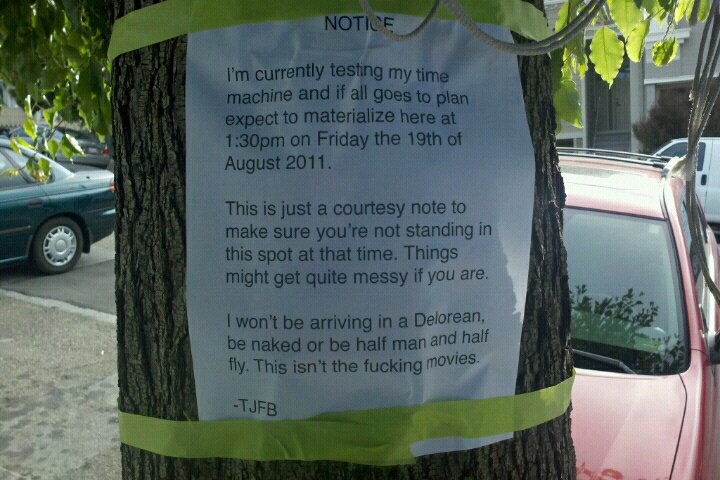
Something strange popped up on an unassuming tree near the Guardian offices in Poterero Hill earlier this week. Walk up Mississippi Street, in between Mariposa and 18th Streets, and you will find a white sheet of paper taped to a trunk with neon green electrical tape. The sign warns bystanders of an attempt at time travel.

The picture is pasted here. I’ve also taken the liberty of typing it out for you.

“NOTICE

I’m currently testing my time machine and if all goes according to plan expect to materialize
here at 1:30pm on Friday the 19th of August 2011.

This is just a courtesy note to make sure you’re not standing in this spot at that time. Things might get messy if you are.

I won’t be arrive in a Delorean, or be naked or be half man and half fly. This isn’t the fucking movies.

TJFB”

So what does this all mean? Is there a nut planning to do something freaky near us? It is an actual scientific endeavor? It is a marketing ploy (I’m usually quick to assume such things)? We’ll find out at 1:30 p.m. today and update this post. A crack team of Guardian editors will be on hand to find out the truth. It’s out there.

Update 1: Something does indeed look fishy, as suspected. Check out this conversation on Reddit. However, as dedicated time travel enthusiasts, we still plan to stake it out.

Update 2: HOLY CRAP, IT WAS AMAZING! There was a huge puff of smoke, and lasers, and unicorns, and roller skates, and books containing sports scores from the year 2012 … just kidding. What do you think happened? Until the next alien landing or chupacabra sighting ’round these parts, the Guardian’s X-files division will be returning to our regularly scheduled duties.

Swear ta god, there was like 12 witnesses assembled for the event.

Update 3: See you next week! Looks like our time traveler had some family law issues to tend to. 

Once upon a time in the Bronx

0

arts@sfbg.com

FILM Though the visibility of gays and lesbians in cinema remains (largely) confined to independent film, Rashaad Ernesto Green, in his debut feature Gun Hill Road, uses the creative freedom afforded by that closeting to explore issues of race and confused sexuality amid the Latino population of the Bronx.

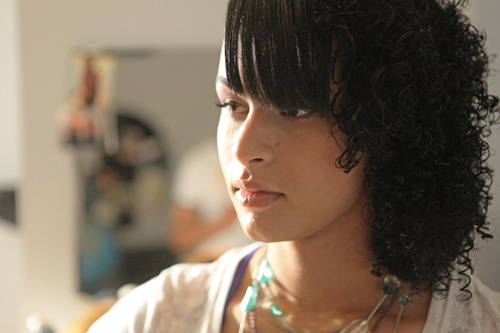
Esai Morales is Enrique, a former drug dealer returning from prison to his wife Angela (Judy Reyes) and teenage son Michael (Harmony Santana). But everyone seems to have moved on with their lives. Angela is having an affair, and Michael has created a new persona, Vanessa. Green’s film focuses on the relationship between the damaged Enrique and Michael, whose cross-dressing and budding transsexuality puts the family members at odds.

Nominated for the Grand Jury Prize at Sundance and an entry in this year’s Frameline Film Festival, Gun Hill Road is one in a recent spate of films that deals with coming out in an urban setting. Like Green’s film, Peter Bratt’s La Mission (2009) offered a picture of homophobia in the Latino community. But Gun Hill Road, despite its bulging dramatic heft, shirks the after-school-special formula of La Mission by imagining complex characters rather than hewing them from instantly recognizable, sympathetic archetypes.

Yet Gun Hill Road takes many a detour into hokum-town. There’s a lot of yelling and screaming in that tiny Bronx apartment, which makes the proceedings occasionally claustrophobic and tiresome. The film has the subtlety of a slam poetry reading: it has emotional punch, but that punch often feels like its swinging in the dark. Yet the whole thing is handled with such chutzpah and bravery that you have to admire it.

The young Santana is fearless, portraying Michael-Vanessa with a naked-to-the-world earnestness that makes him the emotional center of the film. Enrique’s fist-wielding masculinity makes him a difficult character to like, but the film is well-cast and the performances are on-point. Though the script is flawed, it’s the execution that succeeds.

With a handheld camera in the tradition of gritty social realism, Green sheaths the Bronx cityscape in a muted lacquer of beige and blue, affording visual pleasures while treating Michael’s disoriented sexuality with sensitivity rather than camp. But the film probably could have used a sense of humor. Perhaps it’s because Michael isn’t yet comfortable in his own skin. In the end, Green gives us reason to believe that he’ll get there. 


GUN HILL ROAD opens Fri/19 at the Sundance Kabuki.

Familiar but strange

0

arts@sfbg.com

THEATER In 1934, Broadway hosted its longest-running opera to that time, the serenely unconventional Four Saints in Three Acts. The brainchild of writer Gertrude Stein and composer Virgil Thomson, the production famously featured an all–African American cast (for the first time in roles not geared to depicting African American life), a scenic design covered in cellophane, music that mingled hints of Parisian modernism with a boisterous collage of vernacular American forms, and a libretto of unfathomable if evocative wordplay that merrily eschewed narrative — or even consistency with the title (acts were actually five, saints were many). It was weird. And people liked it.

In deciding upon a topic for the opera, Stein had taken on the lives of saints (especially Theresa and Ignatius, who figure prominently) as representative of the lives of artists. It was a secular work, and apotheosis, that ultimately concerned both her and Thomson, neither of them otherwise religious. As it turned out, the opera not only hailed the arrival of avant-garde ideas into the mainstream, but catapulted Stein into the stratosphere of celebrity.

“In Stein’s personal story the opera was a very large chapter,” explains Frank Smigiel, associate curator of public programs at the San Francisco Museum of Modern Art, currently presenting The Steins Collect: Matisse, Picasso, and the Parisian Avant-Garde. “In addition to The Autobiography of Alice B. Toklas, [Four Saints] radically transformed Stein from an experimental writer known for collecting other artists into a popular artist in her own right.”

One good apotheosis deserves another. This weekend SFMOMA, in association with Yerba Buena Center for the Arts, presents Four Saints in Three Acts: An Opera Installation, as part of The Steins Collect. While the exhibition already includes footage and ephemera from Stein and Thomson’s landmark opera (with even more footage on view in the concurrent Gertrude Stein exhibition at nearby Contemporary Jewish Museum), audiences will now have the chance to see a full staging of the work. Meanwhile, the production’s team of collaborators promises as much a re-envisioning as a revival.

This is as it should be, suggests Smigiel, who spearheaded the idea for the revival about a year ago as he and his colleagues were asking themselves how they might expand on the exhibition.

“If you look at all the other artists in the Steins Collect exhibition, they’re all working not just on canvases,” he says, speaking by phone from his office at SFMOMA. “It was a creative community that was crossing disciplines in ways people might not always know about. One of our aims was to rev up the avant-garde energy of the exhibition. There’s a way, when you go to a show with Matisse and Picasso, they can just look canonical now to us. One of the hopes is that there’s still something about Stein’s language and the opera that’s going to have a bit of shake-up to it. It won’t just appear as a rolling out of a canonical piece, and people wondering, ‘What was this again?'”

To that end, Smigiel approached local company Ensemble Parallèle, acclaimed specialists in contemporary chamber opera, having been impressed by their recent production of Alban Berg’s Wozzeck, including its shrewd use of visual media. He also sought out Italian-born, San Francisco–based composer, performer, and musicologist Luciano Chessa, an expert in the period whom he had worked with before. Equally inspired was Smigiel’s call to Kalup Linzy, whose video-performance practice mixes soap opera genre with drag, original songs, lip-sync, and themes of family, community, sexuality, and otherness through the prism of his African American Southern upbringing and later Brooklyn milieu.

After a process of deciding how they might re-approach the work, Chessa landed on the idea of resetting the text that Thomson had excised in his own 1950s version of the opera. The result is its own piece, entitled A Heavenly Act, which will immediately precede Four Saints without an intermission (the entire program will run a fleet 90 minutes). Linzy developed video projections as the predominant visual element in the production.

Chessa and Linzy offered further insight into the collaboration, and their respective processes, during a break from a rehearsal last week. Although neither knew the opera very well before embarking on the revival, each found points of contact and familiarity with their own work.

“I knew it mostly because of [Canadian filmmaker] John Greyson’s [2009 operatic documentary] Fig Trees,” explains Chessa. In conceiving A Heavenly Act, Chessa says he wanted to account for both Thomson’s own musical influences as well as the legacy he has left in the work of later composers.

“I couldn’t be approaching the text naively as if I was discovering it for the first time,” he says. “There is a history of setting Stein in the 20th century, which I ended up discovering by analyzing the work and also the development of Thomson’s fortunes in the 20th century. Because Stein’s text is very wordy, Thomson used the technique of having it chanted. So my idea was to bring this element of chant, but do it in a different way, using different lines of text moving at different speeds, creating clusters of textures.”

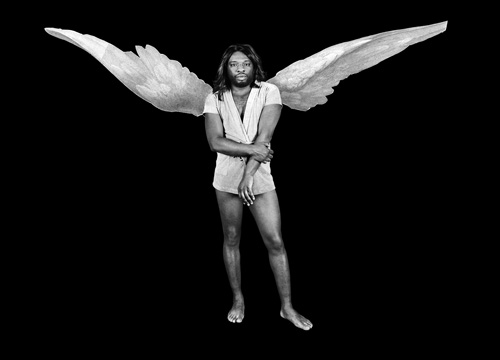
Adds Linzy, “We kept things very loose and abstract, kind of organic. It didn’t have to be so strict.” Linzy — who in the production also performs a song Chessa wrote for him set to Stein’s words — shot a cast of friends as angels against a green screen, usually with movement informed by music tracks Chessa had forwarded. But in at least one case, Linzy didn’t receive the track for a corresponding scene.

“There’s a dance scene [in A Heavenly Act] where [Chessa] did a waltz, but we danced to Donna Summer’s ‘Bad Girls,'” explains Linzy. “But seeing it against the waltz, really slowed down, it’s almost like the angels got high off LSD and just went too far. But we were moving to Donna Summer, we were discoing. That’s what I like. He had sent the tracks but somehow I didn’t get that particular one. So I was like, ‘Oh, we’ll just disco it out.’ And so that’s what we did, and it’s the most amazing thing.”

FOUR SAINTS IN THREE ACTS: AN OPERA INSTALLATION

Thurs/18, 7:30 p.m. (preview); Fri/19-Sat/20, 8 p.m.; Sun/21, 2 p.m., $10-85.

Novellus Theater

700 Howard, SF

(415) 978-2787

www.ybca.org


Green buds

56

steve@sfbg.com

CANNABIS Most marijuana sold in Bay Area dispensaries is grown indoors, where the ability to precisely control conditions creates the kind of buds — strong, dense, crystal-covered, fragrant, beautiful — that consumers have come to expect. But that perfection comes at a high price, both financially and environmentally.

So some local leaders in the medical marijuana movement have begun to nudge the industry to return to its roots, to the days before prohibition and the helicopter raids of the Campaign Against Marijuana Planting chased the pot growers indoors. They say it’s time for California to start growing more of its cannabis outdoors again, in the soil and sunlight, just like the rest of the state’s crops.

Growers have long known how inefficient it is to grow indoors. All they need to do is look at their huge monthly energy bills. Between the powerful grow lights, constantly running air conditioners, elaborate ventilation systems, pumps and water purifiers, and heaters used for drying and curing, this is an energy-intensive endeavor.

But a widely circulated study released in April — “Energy Up in Smoke: The Carbon Footprint of Indoor Cannabis Production” by Evan Mills, a researcher with Lawrence Berkeley National Laboratory — revealed just what a huge cumulative toll the practice was taking on California and the planet.

It found that indoor pot production accounts for about 8 percent of California household energy use, costing about $3 billion annually and producing about 4 millions tons of greenhouse gases each year, the equivalent of 1 million automobiles. Producing one joint was the equivalent of driving 15 miles in a 44 mpg car.

“The emergent industry of indoor Cannabis production results in prodigious energy use, costs, and greenhouse-gas pollution. Large-scale industrialized and highly energy-intensive indoor cultivation of cannabis is driven by criminalization, pursuit of security, and the desire for greater process control and yields,” Mills wrote in the report’s summary.

Yet while opponents of marijuana seized on the report to condemn the industry, proponents say there’s a very simple solution to the problem: grow it outdoors. And with the artisanship and quality in the fields and greenhouses now rivaling that of indoor buds, the biggest barriers to moving most marijuana production outdoors are federal laws and the biases of pot consumers.

“There’s a misconception out there that indoor is better marijuana than outdoor, but we don’t think that’s true,” Erich Pearson, who runs the San Francisco Patient and Resource Center (SPARC) dispensary and sits on the city’s Medical Cannabis Task Force. “Marijuana is a plant that came from the earth and that’s where we should grow it, just like our food.”


INDOOR VS. OUTDOOR

There are definitely some benefits to growing indoors, beyond just the ability to hide it from the prying eyes of law enforcement. The grow cycles are shorter, allowing for multiple harvests around the year. The generally small operations and precise control over growing conditions also tend to produce the best-looking buds, which command the highest prices and win the top prizes in competitions.

Kevin Reed, who runs Green Cross — a venerable medical marijuana delivery service that works closely with an established group of growers — told us there are several reasons why indoor buds have dominated the marketplace.

“The most important factor is local laws and regulations and the enforcement of those various laws. A second factor is space and climate — obviously outdoor cultivation will flourish is some places better than other. And, a final factor is sustainability of the market; indoor cultivators can produce crops on a year-round basis, providing some stability in the market over the long-term, especially in the event of crop failure or other unforeseen and unexpected disasters,” Reed told us.

Yet he also said, “If cultivated correctly and with care, there should be no difference between the same strain grown in- or outdoors.” And he said that from an environmental standpoint, outdoor is clearly superior: “So far as environmental factors are concerned, there is little doubt in my mind that outdoor cultivation is kinder to Mother Earth.”

Wilson Linker, with Steep Hill Laboratories, Northern California’s largest tester of medical marijuana, said that outdoor plants generally have more vegetative growth because of the longer light cycles, meaning that “indoor tests generally higher in cannabanoids, with THC [marijuana’s main psychoactive compound] in particular.”

But he and other marijuana experts also say that the quality of the buds ultimately depends on a wide variety of factors, from the strain used to the expertise of the cultivators to the time and care taken by the trimmers.

“I’ve seen outdoor that can compete with the best indoor strains,” said David Goldman, who runs San Francisco’s Americans for Safe Access (ASA) chapter, sits on the city’s Medical Marijuana Task Force, and is active in rating the various dispensaries and pot strains in terms of quality, using magnifying glasses to investigate the trichomes and other characteristics. “I would match the best outdoor I know up with anybody’s indoor, any day.”

Even when indoor buds look better, Pearson said, that doesn’t means they are better. Looks can be deceiving, he said, noting how local consumers now accept that those perfect-looking, genetically modified apples and tomatoes in the store aren’t as tasty or good for you as their ugly, organic counterparts.

“It’s not all about appearance,” he said, noting that marijuana grown in the sunshine is more robust and complex than its indoor cousins.

“We’re starting to find [outdoor] strains that were scoring just as high as indoor,” says Rick Pfrommer, the purchasing manager for Oakland’s Harborside Health Center.

And that’s especially true when the cannabis is grown in greenhouses, where it gets natural sunlight but growing conditions can be controlled better than in the fields.

“Greenhouses can attain a level of cosmetic attractiveness that is right up there with indoor,” Pfrommer said.

“There are a lot of products coming out of greenhouses that even trained eyes can’t tell the difference with [compared to indoors],” Linker said. “Greenhouses are the future.”

Or at least they might be the future if there is a change in the federal laws, which still view any marijuana cultivation as a crime — which is why indoor grows flourished in the first place.


LINGERING PROHIBITION

Rising demand for medical marijuana has created some regulatory pushback, even in pot-friendly San Francisco, where the Department of Public Health announced earlier this year that it wanted to create a registry of growers that work with the dispensaries in order to weed out the illegal growing operations.

“In the last few years, there’s been a proliferation of both illegal and legal cultivators,” Dr. Rajiv Bhatia, San Francisco’s environmental health director, told us earlier this summer. “We’re asking for this information to try to steer them back toward legal cultivation.”

Reed, Goldman, and other industry representatives strongly condemned the move, mostly on the grounds that creating lists of growers could subject them to federal prosecution, so the idea was shelved for now. But Bhatia said the problem remains, and in San Francisco, it’s a problem created largely by the demand for cannabis grown indoors.

But allowing for a more widespread conversion to sustainably grown marijuana will require a relaxation of the federal enforcement to allow for more land cultivation and the development of high-tech greenhouses.

“A lot of that rests in the hands of law enforcement,” Pearson said.

But it isn’t just the cops. Consumers are also supporting indoor grows.


SUPPLY AND DEMAND

Pfrommer said there are many factors that influence whether customers choose indoor or outdoor, or what he calls the “bag appeal” that causes customers to zero in on one strain among the 40 or so that can be offered at one time.

Generally, indoor grows are smaller operations, allowing greater care in the tending and processing of the buds, whereas outdoor grows usually produce large crops harvested all at once, “so frequently people won’t manicure it as well,” Pfrommer said.

Smell is another big factor, Pfrommer said, and that’s one area where he thinks outdoor actually has an advantage. “Outdoor generally has a more pungent smell,” he said. “Cannabis is very sensitive to the environment, so it can pick up elements from the soil, the wind, and the surroundings. It picks up different qualities.”

For that reason, he also said, “I personally find outdoor to taste better when it’s grown well,” comparing it to the subtle qualities that various appellations can give to fine wines.

The final factor is price, and that’s one area where outdoor has a distinct advantage. SPARC is currently selling quarter-ounces of greenhouse-grown Big Buddha Cheese with a THC content of more than 17 percent for just $70. And when the buds from open outdoor fields arrive this fall, they’ll be as low as $50.

“This,” Pearson said, holding up a beautiful bud of greenhouse-grown Green Dragon, “was grown at a fraction of the cost of indoor and it’s outstanding.”

“That’s why indoor sells for so much more,” Goldman said, ” because it costs so much more to grow.”

So if outdoor cannabis is cheaper, better for the environment, less risky for the industry, and just as good, why are the indoor stains still so much more popular?

“You’re looking a 20-plus years of indoor being the standard,” Pfrommer said, noting that the hardest part of creating a more substantial changeover in people’s buying habits is their expectations.

He said Harborside started offering more outdoor strains three years ago, “but the market wasn’t responding as strongly.” In other words, people still preferred indoor.

Yet things are changing, prompted partly by the Mills study. “That was what kicked off this latest round,” Pfrommer said. “There is a small but growing awareness among the regular marijuana consumers about the costs of growing indoors…The consciousness is starting to shift, but it’ll be slow, probably over the next two seasons.”

Harvests usually take place during the full moons in September and October, after which they are cured and processed for about four weeks, finally coming to market around Thanksgiving.

“It’s mostly an education process,” Pfrommer said. “We’re going to have a vigorous push around harvest time this year.”

“We’re trying to transition completely to outdoor because the environmental toll is less, the cost is less, the yield is higher, and our testing is showing that the quality is just as good,” said Nick Smilgys, who has done both marketing and purchasing at SPARC. “It just makes more sense to grow it outdoors.”

Munchies

0

HERBWISE There will be things at this weekend’s Street Food Festival that you will want to eat. Oh yes, very much so. And damn if there won’t be things that you will want to look at — and then eat.

One of these things will be Rosa Rodriguez’ Sweets Collection gelatin desserts: small, sweet cups in which three dimensional flowers bloom, taunting you to stick a spoon in them. I will take them over designer cupcakes any day.

Rodriguez, who now lives in the Mission with her two daughters, is from the Mexican state of Durango. There, large gelatin molds traditionally bloom at birthdays, baby showers, and wedding parties; red roses and yellow zinnias made of condensed milk curling prettily around the faces of happy couples and beaming little girls. When I asked her via email about her San Francisco customers’ most common reaction to her wares, she said it is uncertainty. “They ask if they can eat the flower, or if it’s plastic.”

A La Cocina street food incubator program graduate, Rodriguez will be in the heart of the Mission this Saturday, along with the rest of the sweet and savory offerings of the Street Food Festival’s 60-some vendors. She’ll be selling “fanciful jellos shots” at the festival’s bars on 23rd and Folsom streets, and her more family-friendly concoctions at a stand of her own on the same intersection.

Saturday will entail a lot of eating, and a lot of gawking at fanciful jello shots, and for these reasons alone the day will go very well if you are really, really stoned.

But ingesting marijuana before the Street Food Festival is a delicate matter. After all, the third year of the event will be the biggest yet, its girth spanning eight blocks of Folsom Street, plus parts of 23rd, 25th, the Cesar Chavez Elementary School parking lot, and the Parque de los Niños Unidos.

In past years, massive crowds have marred the day for many an avid snacker — the lines, my friend, the lines. This year La Cocina is hopeful that the vast expansion of the event will stem the tide — but nonetheless it would not do to have agoraphobia derail you just as you are reaching the front of the line at the Kasa booth.

Luckily, there are plenty of San Francisco souls that geek out tailor-making THC regimens for situations like these. I placed a call to one such place humans like this congregate: the San Francisco Patient and Resource Center, winningly acronym-ed SPARC. It just received our Best of the Bay reader’s poll award for Best Cannabis Club and it’s well known for having an extensive selection of in-house strains. It seemed like a fine place to start out.

Nick Smilgys, who has served as the club’s marketing director for over a year now, had two words for me: blackberry kush. Then he had some more. The kush — which he says is traditionally cultivated in Pakistan and India, but happens to be one of SPARC’s signature strains — is a deep-green indica that’ll make you hungry as hell, ready to take on all those Indian burritos and handmade huaraches.

Smilgys says the blackberry buds create “good well being” in their ingester, and result in a nice body high. Of course, he cautions, medicines will have differing effects on different patients.

But if you’re not careful with the blackberry, it could keep you from your improbably edible jello flowers. (Smilgys employed the term “couch lock” to describe a potential blackberry kush effect.) If you’re prone to getting paranoid, he counsels medical marijuana patients to look for a sativa-indica hybrid that tilts to the indica side of things for a more tranquil, crowd-ready high.

Be brave friends, eat the flower. *

STREET FOOD FESTIVAL

Sat/20 11 a.m.-7 p.m., free

Folsom between 22nd and 26th sts. and surrounding area, SF

www.sfstreetfoodfest.com


Film Listings

0

OPENING

Amigo John Sayles’ career is a fascinating one too varied to fully examine here; suffice it to say, the man’s first big gig was writing 1978’s Piranha before he became the indie auteur behind such notables as 1984’s The Brother from Another Planet, 1987’s Matewan, 1988’s Eight Men Out, and 1996’s Lone Star. He favors large ensemble casts, socially-conscious themes, and an unhurried pace that allows the exploration of various plot threads. Amigo is possibly most similar to 1997’s Men With Guns, in that it’s largely subtitled, is set in a foreign country (here, the Philippines), and plays out against a backdrop of political and military unrest. The film takes place during the Philippine-American War, circa 1900, as U.S. troops (led by Sayles favorite Chris Cooper) roam the just-freed-from-Spain jungles searching for rebels who threaten America’s claim to the land. Also in the mix are town leader Rafael (Filipino superstar Joel Torre), his guerilla brother (Ronnie Lazaro), and a crooked priest (Yul Vázquez) fond of incorrectly translating between sides. Amigo‘s an important film simply because it educates about a little-known conflict — frankly, America’s conduct as occupiers is so cruel that it’s no surprise the history books gloss over it — but it’s slow-moving and heavy-handed, with a tone that pitches uneasily between humor and tragedy. (2:08) Stonestown. (Eddy)

*The Arbor An audaciously conceived and genuinely haunting chronicle of a family, The Arbor reinvents two of the most debased forms of nonfiction film: the venerating portrait of an artist who died young and the voyeuristic confession of abuse. The locus here is the short, bottle-strewn life of Andrea Dunbar, a brilliant playwright whose work distilled the manners and speech of the West Yorkshire housing projects. The Arbor effectively stages some of this work in a park near the same apartments, but the project’s focus is Dunbar’s shambling private life and its devastating effect on friends, lovers, and daughters. Our emotions are strained by their collective fury and grief, but never cheated. Curiously, Clio Barnard accomplishes this by being up front in her manipulations. After collecting interviews with the key players, she cast actors to lip sync the answers — that is, the voices are documentary while the images are staged, an uncanny effect that becomes even more so when Barnard stitches together responses to narrate a single event. The technique is eerie and literally disembodying. In the same way that one affected by trauma may experience a separation from his or her self, so the image of the actor speaking comes unglued from the “real” voice — and so too is there a crucial hesitation in our assigning authenticity to a single, undivided subject. There are shades of Greek tragedy in The Arbor‘s patient, distanced unfolding of its characters’ fates. The speakers are imagined as a chorus, and though the drama is offscreen, long since buried, the pain still lives. (1:34) Roxie. (Goldberg)

*Bellflower Picture Two Lane Blacktop (1971) drifters armed with “dude”-centric vocabulary and an obsession with The Road Warrior (1981) and its apocalypse-wow survivalist chic. There are so many pleasures in this janky, so-very-DIY, heavy-on-the-sunblasted-atmosphere indie that you’re almost willing to overlook the clichés, the dead zones, and the annoying characters. Seeming every-dudes Woodrow (director-writer-producer Evan Glodell) and Aiden (Tyler Dawson) are far too obsessed with tricking out their cars and building a flamethrower for their own good — the misfits must force themselves out of the metal shop of the mind to meet women. So when Woodrow goes up against Milly (Jessie Wiseman) in a cricket-eating contest at a bar, it’s love at first bite. Their meet-gross morphs into a road trip and eventually a relationship, while the flamethrower nags, unexplained, in the background, like an unfired gun — or an unconsummated, not-funny bromance. These manifestations of male fantasy — muscle cars, weapons, and tough chicks — are cast in a dreamy, saturated, and burnt-at-the-edges light, as Glodell and company weave together barely articulated reveries and bad-new-west imagery with a kind of fuck-all intelligence, culminating in a finale that will either haunt you with its scattershot machismo-romanticism or leave you scratching your noggin wondering what just happened. (1:46) (Chun)

Conan the Barbarian Jason Momoa (Game of Thrones), Rose McGowan, and Ron Perlman star (in 3D) in this latest take on the Robert E. Howard hero. (1:42)

*The Future See “Fear and Longing.” (1:31)

Fright Night Don’t let the spooky trailer fool you: the Fright Night remake is almost as silly as the original. In fact, it follows the 1985 film closely, as young Charley Brewster (Anton Yelchin) comes to realize that his neighbor Jerry (Colin Farrell) is a vampire. The biggest change is a smart one — this Fright Night transforms late-night TV host Peter Vincent into Criss Angel-type illusionist Peter Vincent (David Tennant). The casting is spot on all-around, and frankly, Farrell is a lot more believable than Chris Sarandon as the seductive bad boy. The only real problem with the new Fright Night — other than the unnecessary 3D — is that it never fully commits to camp the way the original did. There’s a bit too much back-and-forth between serious scares and goofy blood splatters. Luckily, it’s still an entertaining remake that doesn’t crap all over a classic. It’s also a great reminder that vampires don’t have to be moody — remember, they used to be fun. (2:00) (Peitzman)

Griff the Invisible See “Fortress of Meh.” (1:33) Shattuck.

Gun Hill Road See “Once Upon a Time in the Bronx.” (1:28) Sundance Kabuki.

*One Day See “Deep in the Heart.” (1:48) Balboa.

*Senna When Ayrton Senna died in 1994 at the age of 34, he had already secured his legacy as one of the greatest and most beloved Formula One racers of all time. The three-time world champion was a hero in his native Brazil and a respected and feared opponent on the track. This eponymous documentary by director Asif Kapadia is nearly as dynamic as the man himself, with more than enough revving engines and last minute passes to satisfy your lust for speed and a decent helping Ayrton’s famous personality as well. Senna was a champion, driven to win even as the sometimes-backhanded politics of the racing world stood in his way. A tragic figure, maybe, but a legend nonetheless. You don’t have to be an F1 fan to appreciate this film, but you may wind up one by the time the credits roll. (1:44) Embarcadero, Smith Rafael. (Cooper Berkmoyer)

Sholem Aleichem: Laughing in the Darkness This documentary cuts to the chase right at the beginning: yeah, Sholem Aleichem was the guy who wrote the Tevye stories that inspired Fiddler on the Roof. But filmmaker Joseph Dorman isn’t trying to make Fiddler: Behind the Musical. Instead, he takes an in-depth look at the life, writing career, and cultural significance of “one of the great modern Jewish writers — and our greatest Yiddish writer,” per the film’s press notes. Fans of Jewish lit will be particularly engaged by Sholem Aleichem’s tale; raised in a shtetl in what’s now the Ukraine, he moved around Europe and to the United States pursuing various careers, but always writing the popular stories that addressed not just Jewish life, but broader issues facing turn-of-the-last-century Jews, including the cross-generational conflicts that make up much of Fiddler‘s plot and humor. That said, this film does rely an awful lot on PBS-style slow pans over black-and-white photos and intellectual talking heads; one suspects the subject himself (so devoted was he to entertaining the regular folk who gobbled up his tales) would’ve preferred his life story to unfold in a livelier fashion. (1:33) Opera Plaza. (Eddy)

Spy Kids: All the Time in the World Robert Rodriguez just can’t stop making these. (1:29)

ONGOING

Another Earth After serving a prison sentence for a youthful drunk-driving incident that killed two passengers in another car, Rhoda (Brit Marling) emerges no longer a blithe party girl but a haunted loner who prefers working as a high school janitor. Obsessed by her crime, she starts spying on the man it had left widowed and childless, a onetime composer (William Mapother) who like her has retreated into a solitary shell of depression. She finds a way to integrate herself (without revealing her identity) into his threadbare current existence, the two of them bonding over fascination with a newly discovered planet that appears the exact duplicate of Earth — complete with the possibility of our doubles living a parallel existence there. You can take Mike Cahill’s modestly scaled U.S. indie feature (cowritten with actor Marling) as a familiar drama about grief and repentance with a novel gloss of sci-fi, or as a sci-fi story with unusual attention to character emotions and almost no need of fantasy FX. Either way, it’s earnest, well-acted and interesting if not quite memorable; as has been noted elsewhere, the material could have fit just as effectively into a half-hour Twilight Zone episode. (1:32) Opera Plaza, Shattuck. (Harvey)

*Attack the Block The Goonies go to a South London projects, with more gore, guts, and gumption? With good reason, writer, director, and Edgar Wright/Simon Pegg cohort Joe Cornish’s own project, Attack the Block, has been getting raves at fests for its effortless, energetic originality, discernible through its thick, glottal stop-chomping, Jafaican-draped local brogue. The question posed, ever so entertainingly: what happens when you pit the toughest kids on the block against a ferocious pack of outer-space critters — not quite out to serve man but rather sever him limb from limb? We start out seeing this gang of at-risk, risk-taking youth through the peepers of a vulnerable female mugging victim and neighbor, Sam (Jodie Whittaker) — they seem as scary as any alien invader and she wants to bring down the full force of the law on them. But the pack, led by Moses (John Boyega, who charismatically scowls like a young 50 Cent), has more pressing matters at hand: a mysterious creature has come crashing down from out of the sky, and naturally, being nasty terrors, they kill it, bringing down a intergalactic shit storm of trouble. Their favorite refuge: the top-floor weed room overseen by Ron (Pegg sidekick Nick Frost), where they attempt to suss out why they’ve become the prime prey for wolfish aliens out for blood. Throw in chills, bike chases, a resourceful use of elevators and dumpsters, and an epic, eerie dubstep theme by Basement Jaxx, and you have a very fun horror-thriller that declines to preach but manages to bring home a message reminiscent of Night of the Living Dead (1968). Consider this a whole-hearted, double-fisted antidote to the fearful vigilantism of films like 2009’s Harry Brown. (1:28) Metreon. (Chun)

Beats, Rhymes & Life Actor Michael Rapaport probably didn’t set out to make a hip-hop Metallica: Some Kind of Monster (2004), but that’s pretty much where his portrait of A Tribe Called Quest ends up. The first half of Beats, Rhymes & Life: The Travels of A Tribe Called Quest is predictably worshipful, slathering on low angles and slow motion to cover mediocre live shows. More effectively, Rapaport traces the Queens group’s brief incubation period and subsequent breakthroughs in what would later be called alternative or, more obnoxiously, conscious hip-hop. A slew of notable followers and contemporaries toast Tribe’s first three albums, but by the time Rapaport catches up to the group’s 2008 reunion even their longtime friends De La Soul are wishing they’d call the whole thing off. The documentary slides into the Monster zone of hurt feelings and passive aggressive behavior in accounting for the group’s split after their inappropriately named 1998 album, The Love Movement. Phife Dawg and Q-Tip are the warring egos, though perennially slighted Phife is really no match for the imperially cool Tip. DJ Ali Shaheed Muhammad is the Kirk Hammett of the outfit, looking on helplessly as the two bigger personalities make a mess of things. There’s still novelty in a story about aging in hip-hop, but Rapaport’s portrait is utterly conventional. He also doesn’t pursue more interesting questions of race and politics that naturally follow the band’s crossover appeal. (1:38) Shattuck. (Goldberg)

*Beginners There is nothing conventional about Beginners, a film that starts off with the funeral arrangements for one of its central characters. That man is Hal (Christopher Plummer), who came out to his son Oliver (Ewan McGregor) at the ripe age of 75. Through flashbacks, we see the relationship play out — Oliver’s inability to commit tempered by his father’s tremendous late-stage passion for life. Hal himself is a rare character: an elderly gay man, secure in his sexuality and, by his own admission, horny. He even has a much younger boyfriend, played by the handsome Goran Visnjic. While the father-son bond is the heart of Beginners, we also see the charming development of a relationship between Oliver and French actor Anna (Mélanie Laurent). It all comes together beautifully in a film that is bittersweet but ultimately satisfying. Beginners deserves praise not only for telling a story too often left untold, but for doing so with grace and a refreshing sense of whimsy. (1:44) Lumiere. (Peitzman)

Bride Flight Who doesn’t love a sweeping Dutch period piece? Ben Sombogaart’s Bride Flight is pure melodrama soup, enough to give even the most devout arthouse-goer the bloats. Emigrating from post-World War II Holland to New Zealand with two gal pals, the sweetly staid Ada (Karina Smulders) falls for smarm-ball Frank (Waldemar Torenstra, the Dutchman’s James Franco) and kind of joins the mile high club to the behest of her conscience. The women arrive with emotional baggage and carry-ons of the uterine kind. As the harem adjusts to the country mores of the Highlands, Frank tries a poke at all of them in a series of sex scenes more moldy than smoldery. This Flight, set to a plodding score and stuffy mise-en-scene, never quite leaves the runway. Not to mention the whole picture, pale as a corpse, resembles one of those old-timey photographs of your great grandma’s wedding. These kinds of pastoral romances ought to be put out to, well, pasture. (2:10) Opera Plaza. (Ryan Lattanzio)

*Bridesmaids For anyone burned out on bad romantic comedies, Bridesmaids can teach you how to love again. This film is an answer to those who have lamented the lack of strong female roles in comedy, of good vehicles for Saturday Night Live cast members, of an appropriate showcase for Melissa McCarthy. The hilarious but grounded Kristen Wiig stars as Annie, whose best friend Lillian (Maya Rudolph) is getting hitched. Financially and romantically unstable, Annie tries to throw herself into her maid of honor duties — all while competing with the far more refined Helen (Rose Byrne). Bridesmaids is one of the best comedies in recent memory, treating its relatable female characters with sympathy. It’s also damn funny from start to finish, which is more than can be said for most of the comedies Hollywood continues to churn out. Here’s your choice: let Bridesmaids work its charm on you, or never allow yourself to complain about an Adam Sandler flick again. (2:04) Shattuck. (Peitzman)

Buck This documentary paints a portrait of horse trainer Buck Brannaman as a sort of modern-day sage, a sentimental cowboy who helps “horses with people problems.” Brannaman has transcended a background of hardship and abuse to become a happy family man who makes a difference for horses and their owners all over the country with his unconventional, humane colt-starting clinics. Though he doesn’t actually whisper to horses, he served as an advisor and inspiration for Robert Redford’s The Horse Whisperer (1998). Director Cindy Meehl focuses generously on her saintly subject’s bits of wisdom in and out of a horse-training setting — e.g. “Everything you do with a horse is a dance” — as well as heartfelt commentary from friends and colleagues. In the harrowing final act of the film, Brannaman deals with a particularly unruly horse and his troubled owner, highlighting the dire and disturbing consequences of improper horse rearing. (1:28) Opera Plaza, Shattuck. (Sam Stander)

Captain America: The First Avenger OK, Marvel. I could get behind 2008’s Iron Man (last year’s Iron Man 2, not so much), but after Thor and now Captain America, I’m starting to get cynical about this multi-year build-up to the full-on Avengers movie, due in May 2012. Can even a superhero-stuffed movie directed by Joss Whedon live up to all this hype? There’s plenty of time to ponder, and maybe worry a little, with Captain America’s backstory-explaining picture now in theaters. Chris Evans stars as the 90-pound weakling who morphs into a supersoldier, thanks to the World War II-era tinkerings of a scientist (Stanley Tucci) and an inventor (Dominic Cooper as Howard Stark, a.k.a. Iron Man’s dad). The original plan for the musclebound shield-bearer (fighting Nazis, natch) gets waylaid a bit when the newly famous Captain America becomes a PR prop for the U.S. government; it’s abandoned entirely when a worse-than-Hitler foe, in the guise of power-obsessed Red Skull (Hugo Weaving), threatens the world. Directed by Spielberg cohort Joe Johnston, Captain America is gee-whiz enjoyable enough, but it’s very nearly the same movie as Thor, which no amount of Tommy Lee Jones (as a sarcastic army colonel) wisecracks can conceal. And here’s an anti-spoiler: there’s no post-credits surprise in this one, so you can bolt as soon as they start to roll. (2:09) SF Center, Shattuck, Sundance Kabuki. (Eddy)

The Change-Up This brom-com just might go down as the one where Ryan Reynolds proves his acting chops by playing a creepy Peter Pan and an upstanding family man with Jason Bateman’s physical tics. And it’s almost good enough to wipe out those terrible memories of Reynolds’ dances with CGI in Green Lantern. Yet 2011 summer movies’ MVP Bateman still manages to steal all the best scenes as both the straight man and the kidult-in-a-grown-up’s-body: namely those R-pushing moments he’s changing diapers and taking a face full of baby poo, coming on like a pink-Polo’d jackass at a big-money meeting, and watching the woman of his dreams saunter into the can to cope with backfiring Thai grub. It’s the stuff of fantasy — as well as some clever writing and considerable buddy-buddy chemistry — when career-climbing, do-right lawyer Dave (Bateman) and perpetual playa Mitch (Reynolds) voice envy for each other’s lives while pissing into a magical fountain. The old switcheroo inexplicably occurs the next morning when each chum find himself in the other’s body. Fortunately the Freaky Friday (1976) kookiness that ensues rises a bit above the safe norm by plunging headlong into all the cringey discomfort that comes with watching babies toy with cleavers and electrical outlets. The Change-Up is completely ludicrous, fo’ sho’, and never really strays from the reassuring confines of its story arc, but the laughs accompanying its morning-afters will satisfy more than any new Hangover. (1:52) Four Star, Marina, 1000 Van Ness, Shattuck. (Chun)

Cowboys and Aliens Here ’tis in a nutshell: the movie’s called Cowboys and Aliens — and that’s exactly, entirely what you’ll get. Director Jon Favreau may never best 2008’s Iron Man (actor Jon Favreau will prob never top 1996’s Swingers, but that’s a debate for another time), but that doesn’t mean he won’t have a good time trying. Cowboys is a genre mash-up in the most literal sense; as the title suggests, it pits Wild West gunslingers (Harrison Ford as a crabby cattleman, Daniel Craig as an amnesiac outlaw) against gold-seeking space invaders who also delight in kidnapping and torturing humans. As stupidly entertaining as it is, this is a textbook example of a pretty OK movie that could have been so much better … if only. If only the alien characters had a little bit more District 9-style personality. If only the story had a shred of suspense — look ye not here for “spooky” and “mysterious;” this shit is 100 percent full-on explosions. If only Craig’s comically fine-tooled physique didn’t outshine his wooden acting. And so forth. (1:58) 1000 Van Ness, Presidio, SF Center. (Eddy)

Crazy, Stupid, Love Keep the poster’s allusion to 1967’s The Graduate to one side: there aren’t many revelations about midlife crises in this cleverly penned yet strangely flat ensemble rom-com, awkwardly pitched at almost every demographic at the cineplex. There’s the middle-aged romance that’s withered at the vine: nice but boring family man Cal (Steve Carell) finds himself at a hopeless loss when wife and onetime teenage sweetheart Emily (Julianne Moore) tells him she wants a divorce and she’s slept with a coworker (Kevin Bacon). He ends up waxing pathetic at a slick nightclub where he catches the eye of the well-dressed, spray-tanned smoothie Jacob (Ryan Gosling), who appears to have taken his ladies man stance from the Clooney playbook. It’s manly makeover time: GQ meets Pretty Woman (1990)! Cut to Cal and Emily’s babysitter Jessica (Analeigh Tipton), who is crushing out on Cal, while the separated couple’s tween Robbie (Jonah Bobo) hankers for Jessica. Somehow Josh Groban worms his way into the mix as the dullard suitor of Hannah (Emma Stone) in a hanging chad of a storyline that must somehow be resolved in this mad, mad, mad, mad — actually, the problem with Crazy, Stupid, Love is that it isn’t really that crazy. It tries far too hard to please everybody in the theater to its detriment, reminding the viewer of a tidy, episodic TV series (albeit a quality effort) like Modern Family more than an actual film. Likewise I yearned for a way to fast-forward through the too-cute Jessica-Robbie scenes in order to get back to the sleazy-smart, punchy complexity of Gosling, playing adeptly off both Carrell and Stone. (1:58) Marina, 1000 Van Ness, SF Center, Shattuck, Sundance Kabuki. (Chun)

*Crime After Crime In 1983, Deborah Peagler was sentenced to 25 years to life for first-degree murder in the death of her former boyfriend Oliver Wilson, whom two local L.A. gang members had strangled — supposedly at her behest. Encouraged to plead guilty to avoid the death penalty, Peagler had a juryless trial and was quickly shunted off to prison. There she was repeatedly turned down for parole despite spending the years of her incarceration as a church leader, mentor, and tutor to other inmates; a highly skilled electronics-assembly supervisor; earning two degrees; and sustaining good long-distance relationships with her two daughters. Even most of the victim’s surviving relatives had come to believe she should have been released years earlier. For her part, Peagler always claimed she intended Wilson to be beaten, but had not asked for or condoned his murder. What was missing (or suppressed) from the original trial were the myriad reasons she’d wanted to frighten him away from herself and her family, including the fact that he’d frequently beaten her. Walnut Creek attorneys Nadia Costa and Joshua Safran agreed to take on Peagler’s case pro bono, and they launched what turned into years of effort during which her cause becomes a public cause célèbre, and indications emerge of some very ugly misconduct by the District Attorney’s office. This battle is chronicled in Bay Area filmmaker Yoav Potash’s documentary Crime After Crime. It’s a story with plenty of lurid and tragic revelations, ranging from child sexual abuse to terminal illness to hidden evidence of perjury. The film won’t exactly stoke your faith in the justice system, but this thoroughly engrossing document does affirm that there is hope good people can and will fight the system. (1:33) Smith Rafael. (Harvey)

The Devil’s Double Say hello to my little friend, again— and rest assured, it’s not a dream and you’re seeing double. New Zealand filmmaker Lee Tamahori gets back to his potboiler roots with this campy, claustrophobic look back at the House of Saddam Hussein, based on a true story and designed to win over fans of Scarface (1983) with its portrait of mad excess and deca-dancey ’80s-ish soundtrack. The craziest poseur of all is Hussein’s son Uday (Dominic Cooper), a petty dictator-in-the-making — and, according to this film, a full-fledged murderous pedophile — who chomps cigars and wraps his jaws around schoolgirls while Cooper happily chews scenery. Uday needs a double to sidestep all those troublesome assassination attempts, so he enlists look-alike childhood friend Latif (also Cooper) to get the surgery, pop in the overbite, bray like a madman, make appearances in his stead, and function as a kind of pet human. Never mind Ludivine Sagnier, glassy-eyed and absurd in the role of Uday’s favorite sex kitten Sarrab — Double is completely Cooper’s, who seizes the moment, investing the morally upstanding Latif with a serious sincerity with just his eyes and body language and infusing evil odd job Uday with a dangerous, comic-book unpredictability. To his credit, Cooper imbues such cult-ready, blow-the-doors-off lines as “I love cunt! I love cunt more than god!” with, erm, believability, even as the denouement rings somewhat false. (1:48) California, SF Center, Sundance Kabuki. (Chun)

*Final Destination 5 The thing about my undying love for the Final Destination series is that it’s completely legitimate and 100 percent sincere. You know exactly what you’re getting with each new movie, and these films never try to tell you otherwise. Yes, everyone will die. Yes, the deaths will be creative and disgusting. Yes, the quality of acting will be sacrificed for some of the more expensive splatter effects. For those of us who understand what the series is all about, Final Destination 5 is a triumph. It’s gory, wickedly funny, and a notable improvement on previous sequels. Not to mention the fact that Tony “Candyman” Todd gets a beefed-up role. For once, the 3D is actually a big help, with some of the best in-your-face effects I’ve seen. As for non-fans, I can’t say Final Destination 5 has much to offer. You have to embrace the absurdity and the mission statement before you can fully appreciate death by laser eye surgery. (1:32) 1000 Van Ness. (Peitzman)

*Friends With Benefits If you see only one romantic comedy this summer about a sex-sans-pair-bonding pact between a girl and a guy saddled with intimacy issues — well, chances are, if you tend to see movies with premises like this, you probably already saw No Strings Attached. In which case, poor unlucky Friends with Benefits may be filed away in your brain as that other movie about fuckbuddies, the one in which Ashton Kutcher is played by Justin Timberlake and Natalie Portman (in a slightly eerie cosmic echo of last year’s Black Swan) is played by Mila Kunis. But if you see two such movies this summer, and admit it, you probably might, you’ll likely agree that FWB kicks NSA‘s booty call, particularly in the areas of scriptwriting ingenuity, pacing, and the casting subcategory of basic chemistry between romantic leads, with points possibly taken off for shark-jumping use of flash mobs and the fact that the maddeningly sticky song “Closing Time” will now be with you from closing credits ’til doomsday. This is not a searing, psychologically nuanced portrayal of two young people’s struggles to grapple with modern-day sexual mores and their own crippling pathologies — rather, the pair’s emotional baggage mostly seems to be stuffed with packing peanuts, and scenes in which they catalog their sexual proclivities in a humorously businesslike, gently raunchy fashion reveal them to be hearteningly adept at the art of communication. But such moments keep us entertained as the film, salted with light jabs at the genre’s worn-down touchstones yet utterly complicit, depicts the inevitable stages of a non-relationship relationship. (1:44) Sundance Kabuki. (Rapoport)

*The Future Dreams and drawings, cats and fantasies, ambition and aimlessness, and the mild-mannered yet mortifying games people play, all wind their way into Miranda July’s The Future. The future’s a scary place, as many of us fully realize, even if you hide from it well into your 30s, losing yourself in the everyday. But you can’t duck July’s collection of moments, objects, and small gestures transformed into something strangely slanted and enchanted, both weird and terrifying, when viewed through July’s looking glass. Care and commitment — to oneself and others — are two vivid threads running through The Future. Cute couple Sophie (July) and Jason (Hamish Linklater) — unsettling look-alikes with their curly crops — appear at first to be sailing contently, aimlessly toward an undemanding unknown: Jason works from home as a customer-service operator, and Sophie attempts to herd kiddies as a children’s dance instructor. But enormous, frightening demands beckon — namely the oncoming adoption of a special-needs feline named Paw-Paw (voiced by July as if it’s a traumatized, innocent child). Lickety-splitsville, they must be all they can be before Paw-Paw’s arrival. The weirdness of the familiar, and the kindness of strangers, become ways into fantasy and escape when the couple bumps up against the limits of their imagination. This ultra-low-key horror movie of the banal is obviously remote territory for July (2005’s Me and You and Everyone We Know). The Future is her best film to date and finds her tumbling into a kind of magical realism or plastic fantastic, embodied by a talking cat that becomes the conscience of the movie. (1:31) Shattuck. (Chun)

Glee: The 3D Concert Movie (1:30) 1000 Van Ness.

The Guard Irish police sergeant Gerry Boyle (Brendan Gleeson) is used to running his small town on his own terms — not in a completely Bad Lieutenant (1992) kind of way, though he’s not afraid to sample drugs and hang with hookers. More like, he’s been running the show for years, and would prefer that big-city cops stay the hell out of his village. Alas, a gang of drug smugglers is doing business in the area, so an officious group of investigators from Dublin (horrors!) and America (in the form of an FBI agent played by Don Cheadle) soon descend. His mother’s dying, his brand-new partner’s missing, and between all the interlopers on both sides of the law, Boyle’s having a hard time having a pint in peace. Good thing he’s not as simple-minded as all who surround him think he is. Writer-director John Michael McDonagh (brother of playwright Martin, who directed 2008’s In Bruges — also starring Gleeson) puts an affable Irish spin on what’s essentially a pretty typical indie comedy, with some pretty typical crime-drama elements layered atop. Boyle’s character is memorably clever, but the film that contains him never quite elevates to his level. (1:36) Embarcadero, Shattuck, Sundance Kabuki. (Eddy)

*Harry Potter and the Deathly Hallows Part 2 Chances are you aren’t going to jump into the Harry Potter series with Harry Potter and the Deathly Hallows Part 2. So while the movie is probably the best Harry Potter film yet, it’s more a fitting conclusion than a standalone film. For fans of the books, there are no real surprises — this is a close adaptation. And for those Harry Potter movie fans who haven’t read the books, shame on you, and kudos if you managed to not get spoiled. It’s hard for me to offer a serious critical analysis of Part 2, because it represents the end of a long and very emotional journey. (Everyone in that audience was crying. Everyone.) I will say that, as was the case in the book, there are a few overdone, schmaltzy moments that aren’t really necessary. But in the context of the series, they’re forgivable — this may not be the great cinematic event of our generation, but Harry Potter as a whole is sure to be one of our most enduring cultural icons. (2:10) Empire, 1000 Van Ness, Sundance Kabuki. (Peitzman)

The Help It’s tough to stitch ‘n’ bitch ‘n’ moan in the face of such heart-felt female bonding, even after you brush away the tears away and wonder why the so-called help’s stories needed to be cobbled with those of the creamy-skinned daughters of privilege that employed them. The Help purports to be the tale of the 1960s African American maids hired by a bourgie segment of Southern womanhood — resourceful hard-workers like Aibileen (Viola Davis) and Minny (Octavia Spencer) raise their employers’ daughters, filling them with pride and strength if they do their job well, while missing out on their own kids’ childhood. Then those daughters turn around and hurt their caretakers, often treating them little better than the slaves their families once owned. Hinging on a self-hatred that devalues the nurturing, housekeeping skills that were considered women’s birthright, this unending ugly, heartbreaking story of the everyday injustices spells separate-and-unequal bathrooms for the family and their help when it comes to certain sniping queen bees like Hilly (Bryce Dallas Howard). But the times they are a-changing, and the help get an assist from ugly duckling of a writer Skeeter (Emma Stone, playing against type, sort of, with fizzy hair), who risks social ostracism to get the housekeepers’ experiences down on paper, amid the Junior League gossip girls and the seismic shifts coming in the civil rights-era South. Based on the best-seller by Kathryn Stockett, The Help hitches the fortunes of two forces together — the African American women who are trying to survive and find respect, and the white women who have to define themselves as more than dependent breeders — under the banner of a feel-good weepie, though not without its guilty shadings, from the way the pale-faced ladies already have a jump, in so many ways, on their African American sisters to the Keane-eyed meekness of Davis’ Aibileen to The Help‘s most memorable performances, which are also tellingly throwback (Howard’s stinging hornet of a Southern belle and Jessica Chastain’s white-trash bimbo-with-a-heart of-gold). (2:17) Balboa, California, Empire, 1000 Van Ness, Presidio, SF Center, Sundance Kabuki. (Chun)

Horrible Bosses Lead by a clearly talented ensemble of comic actors, Horrible Bosses is yet another example of a big-budget summer comedy with a promising conceit (see Bad Teacher) that fails to deliver anything but crude alms to the lowest common denominator. Seth Gordon directs Jason Bateman, Jason Sudeikis, and Charlie Day as three pals fed up with their evil employers (Kevin Spacey, Colin Farrell and Jennifer Aniston, respectively) so they hatch a plan to have them killed. Because the answer to their problem obviously lies in a dive bar in the “bad part of town,” Jamie Foxx plays Motherfucker Jones, their murder consultant and the film’s most likable character-stereotype. In the tradition of The Hangover (2009) and its ilk of beer-guzzling, frat-boy cousins, Horrible Bosses is a disastrous pile-up of idiocy that’s more vapid than vulgar despite a few amusing performances. See it for no other reason than Michael Bluth and Charlie Kelly on coke. (1:33) 1000 Van Ness. (Lattanzio)

*Magic Trip How to bottle the lysergic thrills and chills of a monumental road trip that marked the close of the Beat Generation era and the dawn of the hippie years? Remarkably, Ken Kesey and his Merry Pranksters did just that — and with the help of directors-writers Alison Ellwood and Alex Gibney, their efforts have been retrieved from the swamps of yesterday. You don’t have to be a Summer of Love easy rider, Kesey reader, Deadhead, or acid gobbler to appreciate the freewheeling energy and epoch-making antics of Magic Trip, which arrives well-outfitted in much invaluable, real-deal-y footage and audio of Kesey, driver Neal Cassady, and the proto-Merry Pranksters, shot during their 1964 trip from La Honda to the World’s Fair in NYC, off, on, and hovering 10 miles above the paint-strewn school bus named Further. Already viewed through the lens of Tom Wolfe’s The Electric Kool-Aid Acid Test, the trip unfolds in all its truly weird, silly, LSD-laden, improvised, awkward, flailing, freeing glory, as the filmmakers gracefully sidestep the audio sync problems that drove Kesey to give up on assembling the film himself. Instead Ellwood and Gibney contextualize the hijinks with voice-over interviews from Pranksters prepped to look back on the journey’s consciousness-expanding trips, both good and bad, and imaginatively animate memorable asides, including a tape recording of Kesey’s first LSD experiments as a Stanford student. “What long, strange trip,” indeed — and this affectionate document viscerally, wonderfully conveys why it changed lives as well. (1:47) Lumiere. (Chun)

Midnight in Paris Owen Wilson plays Gil, a self-confessed “Hollywood hack” visiting the City of Light with his conservative future in-laws and crassly materialistic fiancée Inez (Rachel McAdams). A romantic obviously at odds with their selfish pragmatism (somehow he hasn’t realized that yet), he’s in love with Paris and particularly its fabled artistic past. Walking back to his hotel alone one night, he’s beckoned into an antique vehicle and finds himself transported to the 1920s, at every turn meeting the Fitzgeralds, Gertrude Stein (Kathy Bates), Dali (Adrien Brody), etc. He also meets Adriana (Marion Cotillard), a woman alluring enough to be fought over by Hemingway (Corey Stoll) and Picasso (Marcial di Fonzo Bo) — though she fancies aspiring literary novelist Gil. Woody Allen’s latest is a pleasant trifle, no more, no less. Its toying with a form of magical escapism from the dreary present recalls The Purple Rose of Cairo (1985), albeit without that film’s greater structural ingeniousness and considerable heart. None of the actors are at their best, though Cotillard is indeed beguiling and Wilson dithers charmingly as usual. Still — it’s pleasant. (1:34) Albany, Embarcadero, 1000 Van Ness, Piedmont, Sundance Kabuki. (Harvey)

*My Perestroika Robin Hessman’s very engaging documentary takes one very relatable look at how changes since glasnost have affected some average Russians. The subjects here are five thirtysomethings who, growing up in Moscow in the 70s and 80s, were the last generation to experience full-on Communist Party indoctrination. But just as they reached adulthood, the whole system dissolved, confusing long-held beliefs and variably impacting their futures. Andrei has ridden the capitalist choo-choo to considerable enrichment as the proprietor of luxury Western menswear shops. But single mother Olga, unlucky in love, just scrapes by, while married schoolteachers Lyuba and Boris are lucky to have inherited an apartment (cramped as it is) they could otherwise ill afford. Meanwhile Ruslan, once member of a famous punk band (which he abandoned on principal because it was getting “too commercial”), both disdains and resents the new order just as he did the old one. Home movies and old footage of pageantry celebrating Soviet socialist glory make a whole ‘nother era come to life in this intimate, unexpectedly charming portrait of its long-term aftermath. (1:27) Balboa. (Harvey)

*The Names of Love Arthur (Jacques Gamblin) is a 40-ish scientist being interviewed about the threat of a bird flu epidemic when his radio broadcast is interrupted by 20-something Baya (Sara Forestier), who denounces him on-air as a “fascist” for frightening the public. But then, Baya tends to use that label rather indiscriminately, applying it to anyone who might conceivably have views to the right of the dial — and Arthur is in fact a solid liberal, which means she can bed him for love. As opposed to the many, many other men she beds as a self-described “political whore,” seeking out conservative types in order to seduce them and hopefully induce an idealogical shift by whispering sweet nothings (“Not all Arabs are thieves,” etc.) as they orgasm. Raised by parents whose emotions are so tightly wound his mother won’t acknowledge her parents were Jews killed at Auschwitz, Arthur has a hard time adjusting to a relationship with a lover who is faithful emotionally but sees promiscuity as her propagandic gift to the world. Meanwhile Baya’s largely Algerian family treats garrulous political argument as the very air they breathe. This odd-couple story written by Baya Kasmi and director Michel Leclerc deals with serious issues in both humorous and respectful fashion, making for one of the more novel, delightful and depthed French romantic comedies in a long time. Added plus: lots of antic gratuitous nudity. (1:42) Clay, Piedmont, Shattuck, Smith Rafael. (Harvey)

*Point Blank Not for nothing did Hollywood remake French filmmaker Fred Cavaye’s last film, Anything for Her (2008) as The Next Three Days (2010) — Cavaye’s latest, tauter-than-taut thriller almost screams out for a similar rework, with its Bourne-like handheld camera work, high-impact immediacy, and noirish narrative economy. Point Blank — not to be confused with the 1967 Lee Marvin vehicle —kicks off with a literal slam: a mystery man (Roschdy Zem) crashing into a metal barrier, on the run from two menacing figures until he is cornered and then taken out of the action by fate. His mind mainly on the welfare of his very pregnant wife Nadia (Elena Anaya), nursing assistant Samuel (Gilles Lellouche) has the bad luck to stumble on a faux doctor attempting to make sure that the injured man never rises from his hospital bed. As police wrangle over whose case this exactly is — the murder of an industrialist seems to have expanded the powers of the stony-faced, monolithic Commandant Werner (Gerard Lanvin) — Samuel gets sucked into the mystery man’s lot, a conspiracy that allows them to trust no one, and seemingly impossibly odds against getting out of the mess alive. Cavaye never quite stops applying the pressure in this clever, unrelenting cat-and-mouse and mouse-and-his-spouse game, topping it with a nerve-jangling search through a messily chaotic police station. (1:24) Embarcadero. (Chun)

*Rise of the Planet of the Apes “You gotta love a movie where the animals beat up on the humans,” declared my Rise of the Planet of the Apes companion. Indeed, ape must not kill ape, and this Planet of the Apes prequel-cum-remake of Conquest of the Planet of the Apes (1972) takes the long view, back to the days when ape-human relations were still high-minded enough to forbid smart apes from killing those well-armed, not-so-bright humanoids. I was a fan of the original series, but honestly, I approached Rise with trepidation: I dreaded the inevitable scenes of human cruelty meted out to exploited primates — the current wave of chimp-driven films seems focused on holding a scary, shaming mirror up to the two-legged mammalian violence toward their closest living genetic relatives. It’s a contrast to the original series, which provided prisms with which to peer at race relations and generational conflict. But I needn’t have feared this PG-13 “reboot.” There’s little CGI-driven gore, apart from the visceral opening and the showdown, though the heartbreak remains. Scientist Will (James Franco, brow perpetually furrowed with worry) is working to find a medicine designed to supercharge the brain in the wake of Alzheimer’s — a disease that has struck down his father (John Lithgow). When the experimental chimp that responds to his serum becomes violently aggressive, the project is shut down, although the primate leaves behind a surprise: a baby chimp that Will and his father name Caesar and raise like a beloved child in their idyllic Bay Area Victorian. Growing in intelligence as he matures, Caesar finds himself torn by an existential dilemma: is he a pet or a mammal with rights that must be respected? Rise becomes Caesar’s story, rendered in heart-wrenching, exhilarating ways — to director Rupert Wyatt and his team’s credit you don’t miss the performance finesse of Roddy McDowell and Kim Hunter in groundbreaking prosthetic ape face in the original movies — while resolving at least one question about why humans gave up the globe to the primates. One can only imagine the next edition will take care of the lingering question about how even the cleverest of apes will feed themselves in Muir Woods. (1:50) Empire, 1000 Van Ness, Presidio, SF Center, Sundance Kabuki. (Chun)

*Salvation Boulevard The ridiculous and ill-reputed worlds of ex-Deadheads and evangelical mega-churches collide in director George Ratliff’s Salvation Boulevard, based on Larry Beinhart’s novel of the same name. When proselytizing pastor Dan Day (Pierce Brosnan) accidentally murders an atheist professor (Ed Harris), churchgoer Carl (Greg Kinnear) tries to forget what he saw. He soon finds himself embroiled in plots involving a kidnapping in Mexico and the fundamentalist takeover of his town. Carl’s god-fearin’, brainwashed wife (Jennifer Connelly) isn’t the least bit understanding, and instead takes to painting demons to exorcise her grief. Though the film often struggles to find a consistent tone, its lampoon of spiritual hogwash (i.e. purity balls) and the sheer inanity of the situational comedy makes for pleasantly amusing satire. The real saint of the film — and no surprise here — is Marisa Tomei as a pothead security guard named Honey. (1:35) Opera Plaza, Shattuck. (Lattanzio)

Sarah’s Key (1:42) Albany, Embarcadero, Piedmont.

Sex and Zen: Extreme Ecstasy (2:09) Four Star.

30 Minutes or Less In some ways, 30 Minutes or Less is reminiscent of 2008’s Pineapple Express: both are stoner action comedies about normal people shoved into high-stakes criminal activity. But while Pineapple Express was an exciting addition to the genre, 30 Minutes or Less is a flimsy 80-minute diversion that still feels like a waste of time. Jesse Eisenberg plays Nick, a pizza delivery boy who is forced to rob a bank after two would-be criminals strap a bomb to his chest. Strangely, Eisenberg was more charming as Mark Zuckerberg in The Social Network (2010) — and his buddy Chet (Aziz Ansari) doesn’t exactly up the likability factor. There’s actually the potential for an interesting story here: something darker seems appropriate, given that 30 Minutes or Less was inspired by a true story with a very unhappy ending. But the film completely fumbles, delivering an action comedy that’s neither tense nor funny. That means the pizza’s free, right? (1:29) 1000 Van Ness, Presidio, SF Center, Shattuck. (Peitzman)

The Tree of Life Mainstream American films are so rarely adventuresome that overreactive gratitude frequently greets those rare, self-conscious, usually Oscar-baiting stabs at profundity. Terrence Malick has made those gestures so sparingly over four decades that his scarcity is widely taken for genius. Now there’s The Tree of Life, at once astonishingly ambitious — insofar as general addressing the origin/meaning of life goes — and a small domestic narrative artificially inflated to a maximally pretentious pressure-point. The thesis here is a conflict between “nature” (the way of striving, dissatisfied, angry humanity) and “grace” (the way of love, femininity, and God). After a while Tree settles into a fairly conventional narrative groove, dissecting — albeit in meandering fashion — the travails of a middle-class Texas household whose patriarch (a solid Brad Pitt) is sternly demanding of his three young sons. As a modern-day survivor of that household, Malick’s career-reviving ally Sean Penn has little to do but look angst-ridden while wandering about various alien landscapes. Set in Waco but also shot in Rome, at Versailles, and in Saturn’s orbit (trust me), The Tree of Life is so astonishingly self-important while so undernourished on some basic levels that it would be easy to dismiss as lofty bullshit. Its Cannes premiere audience booed and cheered — both factions right, to an extent. (2:18) California, Lumiere. (Harvey)

*The Trip Eclectic British director Michael Winterbottom rebounds from sexually humiliating Jessica Alba in last year’s flop The Killer Inside Me to humiliating Steve Coogan in all number of ways (this time to positive effect) in this largely improvised comic romp through England’s Lake District. Well, romp might be the wrong descriptive — dubbed a “foodie Sideways” but more plaintive and less formulaic than that sun-dappled California affair, this TV-to-film adaptation displays a characteristic English glumness to surprisingly keen emotional effect. Playing himself, Coogan displays all the carefree joie de vivre of a colonoscopy patient with hemorrhoids as he sloshes through the gray northern landscape trying to get cell reception when not dining on haute cuisine or being wracked with self-doubt over his stalled movie career and love life. Throw in a happily married, happy-go-lucky frenemy (comic actor Rob Brydon) and Coogan (TV’s I’m Alan Partridge), can’t help but seem like a pathetic middle-aged prick in a puffy coat. Somehow, though, his confused narcissism is a perverse panacea. Come for the dueling Michael Caine impressions and snot martinis, stay for the scallops and Brydon’s “small man in a box” routine. (1:52) Bridge, Shattuck. (Devereaux)

*Vigilante Vigilante Eschewing any pretense of objectivity and adopting a civic-journalism approach, Bay Area director Max Good and producer Nathan Wollman exhaustively explore the issues at stake in the current graffiti and street art scene by focusing on some unexpected, once-hidden antagonists: the so-called buffers, graffiti abatement advocates, and self-styled vigilantes who obsessively paint over graffiti in cities like Los Angeles (Joe Connolly) and New Orleans (Fred Radtke). Good wraps his interviews with well-known street artists like Shepard Fairey, cultural critics such as Stefano Bloch, and graf advocates a la SF author Steve Rotman around his central pursuit: he’s trying to uncover the identity of the Silver Buff, the mysterious figure who has splashed silver over artwork and tags in Berkeley for more than a decade. After capturing the Buff on camera in the wee hours of the morn, the documentarian get his story — it’s Jim Sharp, a stubborn preservationist intent on “beautifying” the blight, tearing down street posters, picking up trash, and covering over what he sees as vandalism, even if he has to damage the property he claims to be cleaning up. In a witty twist on if-you-can’t-beat-’em-join-’em, Good and Wollman ratchet their tale up a notch when they follow Sharp with colorful paint of their own, brilliantly driving home an appeal for freedom of expression and a reclamation of public space. (1:26) Roxie. (Chun)

The Whistleblower (1:58) Embarcadero, Shattuck, Smith Rafael.


Film listings are edited by Cheryl Eddy. Reviewers are Kimberly Chun, Michelle Devereaux, Max Goldberg, Dennis Harvey, Louis Peitzman, Lynn Rapoport, Ben Richardson, and Matt Sussman. For rep house showtimes, see Rep Clock.

Appetite: A mouthwatering preview of the SF Street Food Festival

0

La Cocina‘s SF Street Food Festival keeps getting bigger each year. Gearing up for this Saturday’s (8/20) third annual street food extravaganza, prepare for a takeover of numerous Mission blocks (free admission, with food for purchase under $8). This year there was an early sneak peek for media and select guests. There will be much to love at this year’s festival. Many food truck and street food favorites return, plus Ferry Plaza stars like Namu. Just a few stand-outs the new-to-this-year front:

Wax moth larvae tacos from Don Bugito – These pretty, little tacos are laden with crispy larvae, garlic, pasilla chiles, and pickled onions. Some popped them in their mouths without realizing what they were, others turned away once they heard… but to taste them is to be converted. No need to fear bugs in the hands of owner, Monica Martinez. Plus, it’s a great conversation starter.

15 Romolo’s jambalini – I’ve been touting 15 Romolo since day one. One of our city’s best bars is also home to some of the best bar food (just try their Challah at ‘Cha Boy, Nutella lathered on challah bread with fried bananas, bacon, and pickles!) The jambalini (jambalaya croquettes) are fried balls in the style of Italian arancini, with a Creole aioli for dipping. This has been a top bite at the bar for years. Thankfully, it’s also at this year’s Street Food Fest.

Rye on the Road’s Lawrenceburg swizzle & spicy paloma – You’d want Rye on the Road at any party. The experts behind beloved bars 15 Romolo and Rye are handling the bars at Street Food Fest. Watch for the snow cone-like fun of a lawrenceburg swizzle: Wild Turkey 101, maple syrup, lemon, Creole bitters, garnished with mint. Or go for a little heat with a spicy paloma: tequila, grapefruit juice, jalapeno syrup, salt.

Azalina’s Malaysian bites
Azalina‘s fills the far too vacant Malaysian food gap with a few Malaysian items, including a creamy, savory coconut chicken curry on green onion buns, perked up with spice, cut with blueberry cucumber pickles.

For the first time, there will also be six mobile vendors from across the country: The Peached Tortilla (Austin), The Arepa Lady (New York), Big-Ass Sandwiches (Portland), Skillet Street Food (Seattle), La Cocina grads Global Soul (Los Angeles), Ingrid’s Lunch Box (Madison).

Passports ($50-$250) offer discounts on food and eliminate cash purchases or you can just stop by for a couple individual bites.

— Subscribe to Virgina’s twice monthly newsletter, The Perfect Spot

Environmentalists: America’s Cup not green enough

A preliminary planning document for the America’s Cup doesn’t go far enough to protect San Francisco’s natural environment, a coalition of environmental organizations has said.

The Environmental Council — made up of a group of nonprofits including the Sierra Club, San Francisco Baykeeper, Turtle Island Restoration Network, the Dolphin Swimming and Boating Club, and others closely tracking planning for the America’s Cup — were gearing up to offer feedback to the San Francisco Planning Commission Aug. 11 on a hefty draft environmental impact review (DEIR) of the prestigious yachting event’s impacts on marine life, air quality, and parklands.

The draft EIR “does not go far enough to protect San Francisco’s air, water, and marine life,” said Teri Shore of the Turtle Island Restoration Network. She advocated for requiring vessels to use the cleanest possible fuels and to travel at slow speeds so as not to collide with dolphins, porpoises, seals, sea lions, or whales once outside the Golden Gate.

Ken Coren, Vice President of the Dolphin and Swimming Club, voiced concerns about the effects the race would have on swimming and recreational boating. “The bay would be sealed off — it would only be spectator viewing,” he said. Activities like swimming around Aquatic Park or entering the bay on rowboats “would be prevented if you were going to take the EIR as it stands today at its word.”

Jon Golinger, president of the Telegraph Hill Dwellers, said the report “dramatically underestimates the impact” to individual San Francisco neighborhoods.

http://www.youtube.com/watch?v=BngNbTCUcM8
Jon Golinger speaks at a press conference on the steps of City Hall. Video by Rebecca Bowe

Jennifer Clary, of San Francisco Tomorrow, said the groups’ concerns centered on three key areas: Impacts to the water, such as the potential for oil spills or degraded water quality; impacts that huge crowds would have on surrounding lands, especially in protected areas such as the Presidio; and neighborhood impacts. “You have already busy locations, and they’re going to packing more people in,” she said.

While they raised concerns, the nonprofit representatives also made it clear that they were not opposed to the America’s Cup, and only wanted to see the city strengthen environmental protections during the event. David Anderson, Conservation Committee Chair with the Golden Gate Audubon Society, noted that the world-famous regatta would result in a major economic boon. “Certainly the city can afford some mitigation to make it right,” he said.

Film Listings

0

OPENING

Final Destination 5 Because Death never dies, or stops making sequels. (1:32)

Glee: The 3D Concert Movie The TV show goes cinematically 3D. (1:30)

The Help Three women (played by Emma Stone, Viola Davis, and Octavia Spencer) form an unlikely alliance in 1960s Mississippi. (2:17) Balboa, California, Presidio.

*Point Blank Not for nothing did Hollywood remake French filmmaker Fred Cavaye’s last film, Anything for Her (2008) as The Next Three Days (2010) — Cavaye’s latest, tauter-than-taut thriller almost screams out for a similar rework, with its Bourne-like handheld camera work, high-impact immediacy, and noirish narrative economy. Point Blank — not to be confused with the 1967 Lee Marvin vehicle —kicks off with a literal slam: a mystery man (Roschdy Zem) crashing into a metal barrier, on the run from two menacing figures until he is cornered and then taken out of the action by fate. His mind mainly on the welfare of his very pregnant wife Nadia (Elena Anaya), nursing assistant Samuel (Gilles Lellouche) has the bad luck to stumble on a faux doctor attempting to make sure that the injured man never rises from his hospital bed. As police wrangle over whose case this exactly is — the murder of an industrialist seems to have expanded the powers of the stony-faced, monolithic Commandant Werner (Gerard Lanvin) — Samuel gets sucked into the mystery man’s lot, a conspiracy that allows them to trust no one, and seemingly impossibly odds against getting out of the mess alive. Cavaye never quite stops applying the pressure in this clever, unrelenting cat-and-mouse and mouse-and-his-spouse game, topping it with a nerve-jangling search through a messily chaotic police station. (1:24) Embarcadero. (Chun)

*Salvation Boulevard The ridiculous and ill-reputed worlds of ex-Deadheads and evangelical mega-churches collide in director George Ratliff’s Salvation Boulevard, based on Larry Beinhart’s novel of the same name. When proselytizing pastor Dan Day (Pierce Brosnan) accidentally murders an atheist professor (Ed Harris), churchgoer Carl (Greg Kinnear) tries to forget what he saw. He soon finds himself embroiled in plots involving a kidnapping in Mexico and the fundamentalist takeover of his town. Carl’s god-fearin’, brainwashed wife (Jennifer Connelly) isn’t the least bit understanding, and instead takes to painting demons to exorcise her grief. Though the film often struggles to find a consistent tone, its lampoon of spiritual hogwash (i.e. purity balls) and the sheer inanity of the situational comedy makes for pleasantly amusing satire. The real saint of the film — and no surprise here — is Marisa Tomei as a pothead security guard named Honey. (1:35) )Opera Plaza, Shattuck. (Ryan Lattanzio)

Sex and Zen: Extreme Ecstasy Ming Dynasty-set porn on the big screen. (2:09) Four Star.

30 Minutes or Less Jesse Eisenberg and Danny McBride star in this comedy caper about a pizza delivery guy forced to rob a bank. (1:29) Presidio, Shattuck.

*Vigilante Vigilante Eschewing any pretense of objectivity and adopting a civic-journalism approach, Bay Area director Max Good and producer Nathan Wollman exhaustively explore the issues at stake in the current graffiti and street art scene by focusing on some unexpected, once-hidden antagonists: the so-called buffers, graffiti abatement advocates, and self-styled vigilantes who obsessively paint over graffiti in cities like Los Angeles (Joe Connolly) and New Orleans (Fred Radtke). Good wraps his interviews with well-known street artists like Shepard Fairey, cultural critics such as Stefano Bloch, and graf advocates a la SF author Steve Rotman around his central pursuit: he’s trying to uncover the identity of the Silver Buff, the mysterious figure who has splashed silver over artwork and tags in Berkeley for more than a decade. After capturing the Buff on camera in the wee hours of the morn, the documentarian get his story — it’s Jim Sharp, a stubborn preservationist intent on “beautifying” the blight, tearing down street posters, picking up trash, and covering over what he sees as vandalism, even if he has to damage the property he claims to be cleaning up. In a witty twist on if-you-can’t-beat-’em-join-’em, Good and Wollman ratchet their tale up a notch when they follow Sharp with colorful paint of their own, brilliantly driving home an appeal for freedom of expression and a reclamation of public space. (1:26) Roxie. (Chun)

The Whistleblower Rachel Weisz stars as a scandal-unearthing American working on a U.N. peacekeeping mission in post-war Bosnia. (1:58) Embarcadero.

ONGOING

Another Earth After serving a prison sentence for a youthful drunk-driving incident that killed two passengers in another car, Rhoda (Brit Marling) emerges no longer a blithe party girl but a haunted loner who prefers working as a high school janitor. Obsessed by her crime, she starts spying on the man it had left widowed and childless, a onetime composer (William Mapother) who like her has retreated into a solitary shell of depression. She finds a way to integrate herself (without revealing her identity) into his threadbare current existence, the two of them bonding over fascination with a newly discovered planet that appears the exact duplicate of Earth — complete with the possibility of our doubles living a parallel existence there. You can take Mike Cahill’s modestly scaled U.S. indie feature (cowritten with actor Marling) as a familiar drama about grief and repentance with a novel gloss of sci-fi, or as a sci-fi story with unusual attention to character emotions and almost no need of fantasy FX. Either way, it’s earnest, well-acted and interesting if not quite memorable; as has been noted elsewhere, the material could have fit just as effectively into a half-hour Twilight Zone episode. (1:32) Opera Plaza, Shattuck. (Harvey)

*Attack the Block The Goonies go to a South London projects, with more gore, guts, and gumption? With good reason, writer, director, and Edgar Wright/Simon Pegg cohort Joe Cornish’s own project, Attack the Block, has been getting raves at fests for its effortless, energetic originality, discernible through its thick, glottal stop-chomping, Jafaican-draped local brogue. The question posed, ever so entertainingly: what happens when you pit the toughest kids on the block against a ferocious pack of outer-space critters — not quite out to serve man but rather sever him limb from limb? We start out seeing this gang of at-risk, risk-taking youth through the peepers of a vulnerable female mugging victim and neighbor, Sam (Jodie Whittaker) — they seem as scary as any alien invader and she wants to bring down the full force of the law on them. But the pack, led by Moses (John Boyega, who charismatically scowls like a young 50 Cent), has more pressing matters at hand: a mysterious creature has come crashing down from out of the sky, and naturally, being nasty terrors, they kill it, bringing down a intergalactic shit storm of trouble. Their favorite refuge: the top-floor weed room overseen by Ron (Pegg sidekick Nick Frost), where they attempt to suss out why they’ve become the prime prey for wolfish aliens out for blood. Throw in chills, bike chases, a resourceful use of elevators and dumpsters, and an epic, eerie dubstep theme by Basement Jaxx, and you have a very fun horror-thriller that declines to preach but manages to bring home a message reminiscent of Night of the Living Dead (1968). Consider this a whole-hearted, double-fisted antidote to the fearful vigilantism of films like 2009’s Harry Brown. (1:28) Metreon. (Chun)

Beats, Rhymes & Life Actor Michael Rapaport probably didn’t set out to make a hip-hop Metallica: Some Kind of Monster (2004), but that’s pretty much where his portrait of A Tribe Called Quest ends up. The first half of Beats, Rhymes & Life: The Travels of A Tribe Called Quest is predictably worshipful, slathering on low angles and slow motion to cover mediocre live shows. More effectively, Rapaport traces the Queens group’s brief incubation period and subsequent breakthroughs in what would later be called alternative or, more obnoxiously, conscious hip-hop. A slew of notable followers and contemporaries toast Tribe’s first three albums, but by the time Rapaport catches up to the group’s 2008 reunion even their longtime friends De La Soul are wishing they’d call the whole thing off. The documentary slides into the Monster zone of hurt feelings and passive aggressive behavior in accounting for the group’s split after their inappropriately named 1998 album, The Love Movement. Phife Dawg and Q-Tip are the warring egos, though perennially slighted Phife is really no match for the imperially cool Tip. DJ Ali Shaheed Muhammad is the Kirk Hammett of the outfit, looking on helplessly as the two bigger personalities make a mess of things. There’s still novelty in a story about aging in hip-hop, but Rapaport’s portrait is utterly conventional. He also doesn’t pursue more interesting questions of race and politics that naturally follow the band’s crossover appeal. (1:38) Shattuck. (Goldberg)

*Beginners There is nothing conventional about Beginners, a film that starts off with the funeral arrangements for one of its central characters. That man is Hal (Christopher Plummer), who came out to his son Oliver (Ewan McGregor) at the ripe age of 75. Through flashbacks, we see the relationship play out — Oliver’s inability to commit tempered by his father’s tremendous late-stage passion for life. Hal himself is a rare character: an elderly gay man, secure in his sexuality and, by his own admission, horny. He even has a much younger boyfriend, played by the handsome Goran Visnjic. While the father-son bond is the heart of Beginners, we also see the charming development of a relationship between Oliver and French actor Anna (Mélanie Laurent). It all comes together beautifully in a film that is bittersweet but ultimately satisfying. Beginners deserves praise not only for telling a story too often left untold, but for doing so with grace and a refreshing sense of whimsy. (1:44) Lumiere. (Peitzman)

*Between Two Worlds In 1981 Deborah Kaufman founded the nation’s first Jewish Film Festival in San Francisco. Thirteen years later, with similar festivals burgeoning in the wake of SFJFF’s success — there are now over a hundred around the globe — she left the festival to make documentaries of her own with life partner and veteran local TV producer Alan Snitow. Their latest, Between Two Worlds, could hardly be a more personal project for the duo. Both longtime activists in various Jewish, political, and media spheres, Snitow and Kaufman were struck — as were plenty of others — by the rancor that erupted over the SFJFF’s 2009 screening of Simone Bitton’s Rachel. That doc was about Rachel Corrie, a young American International Solidarity Movement member killed in 2003 by an Israeli Defense Forces bulldozer while standing between it and a Palestinian home on the Gaza Strip. As different sides argued whether Corrie’s death was accidental or deliberate, she became a lightning rod for ever-escalating tensions between positions within and without the U.S. Jewish populace on Israeli policy, settlements, Palestinian rights, and more. Seeing the festival being used by extremists on both sides became a natural starting point for Between Two Worlds, which takes a many-sided, questioning, sometimes humorous look at culture wars in today’s American Jewish population. The fundamental question here, as Kaufman puts it, is “Who is entitled to speak for the tribe?” For the first time, the filmmakers have made themselves part of the subject matter, exploring their own very different personal and familial experiences to illustrate the diversity of the U.S. Jewish experience. (1:10) Roxie. (Harvey)

Bride Flight Who doesn’t love a sweeping Dutch period piece? Ben Sombogaart’s Bride Flight is pure melodrama soup, enough to give even the most devout arthouse-goer the bloats. Emigrating from post-World War II Holland to New Zealand with two gal pals, the sweetly staid Ada (Karina Smulders) falls for smarm-ball Frank (Waldemar Torenstra, the Dutchman’s James Franco) and kind of joins the mile high club to the behest of her conscience. The women arrive with emotional baggage and carry-ons of the uterine kind. As the harem adjusts to the country mores of the Highlands, Frank tries a poke at all of them in a series of sex scenes more moldy than smoldery. This Flight, set to a plodding score and stuffy mise-en-scene, never quite leaves the runway. Not to mention the whole picture, pale as a corpse, resembles one of those old-timey photographs of your great grandma’s wedding. These kinds of pastoral romances ought to be put out to, well, pasture. (2:10) Opera Plaza. (Lattanzio)

*Bridesmaids For anyone burned out on bad romantic comedies, Bridesmaids can teach you how to love again. This film is an answer to those who have lamented the lack of strong female roles in comedy, of good vehicles for Saturday Night Live cast members, of an appropriate showcase for Melissa McCarthy. The hilarious but grounded Kristen Wiig stars as Annie, whose best friend Lillian (Maya Rudolph) is getting hitched. Financially and romantically unstable, Annie tries to throw herself into her maid of honor duties — all while competing with the far more refined Helen (Rose Byrne). Bridesmaids is one of the best comedies in recent memory, treating its relatable female characters with sympathy. It’s also damn funny from start to finish, which is more than can be said for most of the comedies Hollywood continues to churn out. Here’s your choice: let Bridesmaids work its charm on you, or never allow yourself to complain about an Adam Sandler flick again. (2:04) Shattuck. (Peitzman)

Buck This documentary paints a portrait of horse trainer Buck Brannaman as a sort of modern-day sage, a sentimental cowboy who helps “horses with people problems.” Brannaman has transcended a background of hardship and abuse to become a happy family man who makes a difference for horses and their owners all over the country with his unconventional, humane colt-starting clinics. Though he doesn’t actually whisper to horses, he served as an advisor and inspiration for Robert Redford’s The Horse Whisperer (1998). Director Cindy Meehl focuses generously on her saintly subject’s bits of wisdom in and out of a horse-training setting — e.g. “Everything you do with a horse is a dance” — as well as heartfelt commentary from friends and colleagues. In the harrowing final act of the film, Brannaman deals with a particularly unruly horse and his troubled owner, highlighting the dire and disturbing consequences of improper horse rearing. (1:28) Opera Plaza, Shattuck. (Sam Stander)

Captain America: The First Avenger OK, Marvel. I could get behind 2008’s Iron Man (last year’s Iron Man 2, not so much), but after Thor and now Captain America, I’m starting to get cynical about this multi-year build-up to the full-on Avengers movie, due in May 2012. Can even a superhero-stuffed movie directed by Joss Whedon live up to all this hype? There’s plenty of time to ponder, and maybe worry a little, with Captain America’s backstory-explaining picture now in theaters. Chris Evans stars as the 90-pound weakling who morphs into a supersoldier, thanks to the World War II-era tinkerings of a scientist (Stanley Tucci) and an inventor (Dominic Cooper as Howard Stark, a.k.a. Iron Man’s dad). The original plan for the musclebound shield-bearer (fighting Nazis, natch) gets waylaid a bit when the newly famous Captain America becomes a PR prop for the U.S. government; it’s abandoned entirely when a worse-than-Hitler foe, in the guise of power-obsessed Red Skull (Hugo Weaving), threatens the world. Directed by Spielberg cohort Joe Johnston, Captain America is gee-whiz enjoyable enough, but it’s very nearly the same movie as Thor, which no amount of Tommy Lee Jones (as a sarcastic army colonel) wisecracks can conceal. And here’s an anti-spoiler: there’s no post-credits surprise in this one, so you can bolt as soon as they start to roll. (2:09) Empire, 1000 Van Ness, SF Center, Shattuck, Sundance Kabuki. (Eddy)

The Change-Up This brom-com just might go down as the one where Ryan Reynolds proves his acting chops by playing a creepy Peter Pan and an upstanding family man with Jason Bateman’s physical tics. And it’s almost good enough to wipe out those terrible memories of Reynolds’ dances with CGI in Green Lantern. Yet 2011 summer movies’ MVP Bateman still manages to steal all the best scenes as both the straight man and the kidult-in-a-grown-up’s-body: namely those R-pushing moments he’s changing diapers and taking a face full of baby poo, coming on like a pink-Polo’d jackass at a big-money meeting, and watching the woman of his dreams saunter into the can to cope with backfiring Thai grub. It’s the stuff of fantasy — as well as some clever writing and considerable buddy-buddy chemistry — when career-climbing, do-right lawyer Dave (Bateman) and perpetual playa Mitch (Reynolds) voice envy for each other’s lives while pissing into a magical fountain. The old switcheroo inexplicably occurs the next morning when each chum find himself in the other’s body. Fortunately the Freaky Friday (1976) kookiness that ensues rises a bit above the safe norm by plunging headlong into all the cringey discomfort that comes with watching babies toy with cleavers and electrical outlets. The Change-Up is completely ludicrous, fo’ sho’, and never really strays from the reassuring confines of its story arc, but the laughs accompanying its morning-afters will satisfy more than any new Hangover. (1:52) Four Star, Marina, 1000 Van Ness, Shattuck. (Chun)

Cowboys and Aliens Here ’tis in a nutshell: the movie’s called Cowboys and Aliens — and that’s exactly, entirely what you’ll get. Director Jon Favreau may never best 2008’s Iron Man (actor Jon Favreau will prob never top 1996’s Swingers, but that’s a debate for another time), but that doesn’t mean he won’t have a good time trying. Cowboys is a genre mash-up in the most literal sense; as the title suggests, it pits Wild West gunslingers (Harrison Ford as a crabby cattleman, Daniel Craig as an amnesiac outlaw) against gold-seeking space invaders who also delight in kidnapping and torturing humans. As stupidly entertaining as it is, this is a textbook example of a pretty OK movie that could have been so much better … if only. If only the alien characters had a little bit more District 9-style personality. If only the story had a shred of suspense — look ye not here for “spooky” and “mysterious;” this shit is 100 percent full-on explosions. If only Craig’s comically fine-tooled physique didn’t outshine his wooden acting. And so forth. (1:58) Balboa, 1000 Van Ness, Presidio, SF Center. (Eddy)

Crazy, Stupid, Love Keep the poster’s allusion to 1967’s The Graduate to one side: there aren’t many revelations about midlife crises in this cleverly penned yet strangely flat ensemble rom-com, awkwardly pitched at almost every demographic at the cineplex. There’s the middle-aged romance that’s withered at the vine: nice but boring family man Cal (Steve Carell) finds himself at a hopeless loss when wife and onetime teenage sweetheart Emily (Julianne Moore) tells him she wants a divorce and she’s slept with a coworker (Kevin Bacon). He ends up waxing pathetic at a slick nightclub where he catches the eye of the well-dressed, spray-tanned smoothie Jacob (Ryan Gosling), who appears to have taken his ladies man stance from the Clooney playbook. It’s manly makeover time: GQ meets Pretty Woman (1990)! Cut to Cal and Emily’s babysitter Jessica (Analeigh Tipton), who is crushing out on Cal, while the separated couple’s tween Robbie (Jonah Bobo) hankers for Jessica. Somehow Josh Groban worms his way into the mix as the dullard suitor of Hannah (Emma Stone) in a hanging chad of a storyline that must somehow be resolved in this mad, mad, mad, mad — actually, the problem with Crazy, Stupid, Love is that it isn’t really that crazy. It tries far too hard to please everybody in the theater to its detriment, reminding the viewer of a tidy, episodic TV series (albeit a quality effort) like Modern Family more than an actual film. Likewise I yearned for a way to fast-forward through the too-cute Jessica-Robbie scenes in order to get back to the sleazy-smart, punchy complexity of Gosling, playing adeptly off both Carrell and Stone. (1:58) Marina, 1000 Van Ness, SF Center, Shattuck, Sundance Kabuki. (Chun)

*Crime After Crime In 1983, Deborah Peagler was sentenced to 25 years to life for first-degree murder in the death of her former boyfriend Oliver Wilson, whom two local L.A. gang members had strangled — supposedly at her behest. Encouraged to plead guilty to avoid the death penalty, Peagler had a juryless trial and was quickly shunted off to prison. There she was repeatedly turned down for parole despite spending the years of her incarceration as a church leader, mentor, and tutor to other inmates; a highly skilled electronics-assembly supervisor; earning two degrees; and sustaining good long-distance relationships with her two daughters. Even most of the victim’s surviving relatives had come to believe she should have been released years earlier. For her part, Peagler always claimed she intended Wilson to be beaten, but had not asked for or condoned his murder. What was missing (or suppressed) from the original trial were the myriad reasons she’d wanted to frighten him away from herself and her family, including the fact that he’d frequently beaten her. Walnut Creek attorneys Nadia Costa and Joshua Safran agreed to take on Peagler’s case pro bono, and they launched what turned into years of effort during which her cause becomes a public cause célèbre, and indications emerge of some very ugly misconduct by the District Attorney’s office. This battle is chronicled in Bay Area filmmaker Yoav Potash’s documentary Crime After Crime. It’s a story with plenty of lurid and tragic revelations, ranging from child sexual abuse to terminal illness to hidden evidence of perjury. The film won’t exactly stoke your faith in the justice system, but this thoroughly engrossing document does affirm that there is hope good people can and will fight the system. (1:33) Roxie, Smith Rafael. (Harvey)

The Devil’s Double Say hello to my little friend, again— and rest assured, it’s not a dream and you’re seeing double. New Zealand filmmaker Lee Tamahori gets back to his potboiler roots with this campy, claustrophobic look back at the House of Saddam Hussein, based on a true story and designed to win over fans of Scarface (1983) with its portrait of mad excess and deca-dancey ’80s-ish soundtrack. The craziest poseur of all is Hussein’s son Uday (Dominic Cooper), a petty dictator-in-the-making — and, according to this film, a full-fledged murderous pedophile — who chomps cigars and wraps his jaws around schoolgirls while Cooper happily chews scenery. Uday needs a double to sidestep all those troublesome assassination attempts, so he enlists look-alike childhood friend Latif (also Cooper) to get the surgery, pop in the overbite, bray like a madman, make appearances in his stead, and function as a kind of pet human. Never mind Ludivine Sagnier, glassy-eyed and absurd in the role of Uday’s favorite sex kitten Sarrab — Double is completely Cooper’s, who seizes the moment, investing the morally upstanding Latif with a serious sincerity with just his eyes and body language and infusing evil odd job Uday with a dangerous, comic-book unpredictability. To his credit, Cooper imbues such cult-ready, blow-the-doors-off lines as “I love cunt! I love cunt more than god!” with, erm, believability, even as the denouement rings somewhat false. (1:48) California, SF Center, Sundance Kabuki. (Chun)

*Friends With Benefits If you see only one romantic comedy this summer about a sex-sans-pair-bonding pact between a girl and a guy saddled with intimacy issues — well, chances are, if you tend to see movies with premises like this, you probably already saw No Strings Attached. In which case, poor unlucky Friends with Benefits may be filed away in your brain as that other movie about fuckbuddies, the one in which Ashton Kutcher is played by Justin Timberlake and Natalie Portman (in a slightly eerie cosmic echo of last year’s Black Swan) is played by Mila Kunis. But if you see two such movies this summer, and admit it, you probably might, you’ll likely agree that FWB kicks NSA‘s booty call, particularly in the areas of scriptwriting ingenuity, pacing, and the casting subcategory of basic chemistry between romantic leads, with points possibly taken off for shark-jumping use of flash mobs and the fact that the maddeningly sticky song “Closing Time” will now be with you from closing credits ’til doomsday. This is not a searing, psychologically nuanced portrayal of two young people’s struggles to grapple with modern-day sexual mores and their own crippling pathologies — rather, the pair’s emotional baggage mostly seems to be stuffed with packing peanuts, and scenes in which they catalog their sexual proclivities in a humorously businesslike, gently raunchy fashion reveal them to be hearteningly adept at the art of communication. But such moments keep us entertained as the film, salted with light jabs at the genre’s worn-down touchstones yet utterly complicit, depicts the inevitable stages of a non-relationship relationship. (1:44) 1000 Van Ness, Sundance Kabuki. (Rapoport)

The Guard Irish police sergeant Gerry Boyle (Brendan Gleeson) is used to running his small town on his own terms — not in a completely Bad Lieutenant (1992) kind of way, though he’s not afraid to sample drugs and hang with hookers. More like, he’s been running the show for years, and would prefer that big-city cops stay the hell out of his village. Alas, a gang of drug smugglers is doing business in the area, so an officious group of investigators from Dublin (horrors!) and America (in the form of an FBI agent played by Don Cheadle) soon descend. His mother’s dying, his brand-new partner’s missing, and between all the interlopers on both sides of the law, Boyle’s having a hard time having a pint in peace. Good thing he’s not as simple-minded as all who surround him think he is. Writer-director John Michael McDonagh (brother of playwright Martin, who directed 2008’s In Bruges — also starring Gleeson) puts an affable Irish spin on what’s essentially a pretty typical indie comedy, with some pretty typical crime-drama elements layered atop. Boyle’s character is memorably clever, but the film that contains him never quite elevates to his level. (1:36) Embarcadero, Shattuck, Sundance Kabuki. (Eddy)

*Harry Potter and the Deathly Hallows Part 2 Chances are you aren’t going to jump into the Harry Potter series with Harry Potter and the Deathly Hallows Part 2. So while the movie is probably the best Harry Potter film yet, it’s more a fitting conclusion than a standalone film. For fans of the books, there are no real surprises — this is a close adaptation. And for those Harry Potter movie fans who haven’t read the books, shame on you, and kudos if you managed to not get spoiled. It’s hard for me to offer a serious critical analysis of Part 2, because it represents the end of a long and very emotional journey. (Everyone in that audience was crying. Everyone.) I will say that, as was the case in the book, there are a few overdone, schmaltzy moments that aren’t really necessary. But in the context of the series, they’re forgivable — this may not be the great cinematic event of our generation, but Harry Potter as a whole is sure to be one of our most enduring cultural icons. (2:10) Empire, Sundance Kabuki. (Peitzman)

Horrible Bosses Lead by a clearly talented ensemble of comic actors, Horrible Bosses is yet another example of a big-budget summer comedy with a promising conceit (see Bad Teacher) that fails to deliver anything but crude alms to the lowest common denominator. Seth Gordon directs Jason Bateman, Jason Sudeikis, and Charlie Day as three pals fed up with their evil employers (Kevin Spacey, Colin Farrell and Jennifer Aniston, respectively) so they hatch a plan to have them killed. Because the answer to their problem obviously lies in a dive bar in the “bad part of town,” Jamie Foxx plays Motherfucker Jones, their murder consultant and the film’s most likable character-stereotype. In the tradition of The Hangover (2009) and its ilk of beer-guzzling, frat-boy cousins, Horrible Bosses is a disastrous pile-up of idiocy that’s more vapid than vulgar despite a few amusing performances. See it for no other reason than Michael Bluth and Charlie Kelly on coke. (1:33) 1000 Van Ness. (Lattanzio)

Life in a Day (1:30) Balboa.

*Magic Trip How to bottle the lysergic thrills and chills of a monumental road trip that marked the close of the Beat Generation era and the dawn of the hippie years? Remarkably, Ken Kesey and his Merry Pranksters did just that — and with the help of directors-writers Alison Ellwood and Alex Gibney, their efforts have been retrieved from the swamps of yesterday. You don’t have to be a Summer of Love easy rider, Kesey reader, Deadhead, or acid gobbler to appreciate the freewheeling energy and epoch-making antics of Magic Trip, which arrives well-outfitted in much invaluable, real-deal-y footage and audio of Kesey, driver Neal Cassady, and the proto-Merry Pranksters, shot during their 1964 trip from La Honda to the World’s Fair in NYC, off, on, and hovering 10 miles above the paint-strewn school bus named Further. Already viewed through the lens of Tom Wolfe’s The Electric Kool-Aid Acid Test, the trip unfolds in all its truly weird, silly, LSD-laden, improvised, awkward, flailing, freeing glory, as the filmmakers gracefully sidestep the audio sync problems that drove Kesey to give up on assembling the film himself. Instead Ellwood and Gibney contextualize the hijinks with voice-over interviews from Pranksters prepped to look back on the journey’s consciousness-expanding trips, both good and bad, and imaginatively animate memorable asides, including a tape recording of Kesey’s first LSD experiments as a Stanford student. “What long, strange trip,” indeed — and this affectionate document viscerally, wonderfully conveys why it changed lives as well. (1:47) Lumiere. (Chun)

Midnight in Paris Owen Wilson plays Gil, a self-confessed “Hollywood hack” visiting the City of Light with his conservative future in-laws and crassly materialistic fiancée Inez (Rachel McAdams). A romantic obviously at odds with their selfish pragmatism (somehow he hasn’t realized that yet), he’s in love with Paris and particularly its fabled artistic past. Walking back to his hotel alone one night, he’s beckoned into an antique vehicle and finds himself transported to the 1920s, at every turn meeting the Fitzgeralds, Gertrude Stein (Kathy Bates), Dali (Adrien Brody), etc. He also meets Adriana (Marion Cotillard), a woman alluring enough to be fought over by Hemingway (Corey Stoll) and Picasso (Marcial di Fonzo Bo) — though she fancies aspiring literary novelist Gil. Woody Allen’s latest is a pleasant trifle, no more, no less. Its toying with a form of magical escapism from the dreary present recalls The Purple Rose of Cairo (1985), albeit without that film’s greater structural ingeniousness and considerable heart. None of the actors are at their best, though Cotillard is indeed beguiling and Wilson dithers charmingly as usual. Still — it’s pleasant. (1:34) Albany, Embarcadero, 1000 Van Ness, Piedmont, Sundance Kabuki. (Harvey)

*My Perestroika Robin Hessman’s very engaging documentary takes one very relatable look at how changes since glasnost have affected some average Russians. The subjects here are five thirtysomethings who, growing up in Moscow in the 70s and 80s, were the last generation to experience full-on Communist Party indoctrination. But just as they reached adulthood, the whole system dissolved, confusing long-held beliefs and variably impacting their futures. Andrei has ridden the capitalist choo-choo to considerable enrichment as the proprietor of luxury Western menswear shops. But single mother Olga, unlucky in love, just scrapes by, while married schoolteachers Lyuba and Boris are lucky to have inherited an apartment (cramped as it is) they could otherwise ill afford. Meanwhile Ruslan, once member of a famous punk band (which he abandoned on principal because it was getting “too commercial”), both disdains and resents the new order just as he did the old one. Home movies and old footage of pageantry celebrating Soviet socialist glory make a whole ‘nother era come to life in this intimate, unexpectedly charming portrait of its long-term aftermath. (1:27) Balboa. (Harvey)

*The Names of Love Arthur (Jacques Gamblin) is a 40-ish scientist being interviewed about the threat of a bird flu epidemic when his radio broadcast is interrupted by 20-something Baya (Sara Forestier), who denounces him on-air as a “fascist” for frightening the public. But then, Baya tends to use that label rather indiscriminately, applying it to anyone who might conceivably have views to the right of the dial — and Arthur is in fact a solid liberal, which means she can bed him for love. As opposed to the many, many other men she beds as a self-described “political whore,” seeking out conservative types in order to seduce them and hopefully induce an idealogical shift by whispering sweet nothings (“Not all Arabs are thieves,” etc.) as they orgasm. Raised by parents whose emotions are so tightly wound his mother won’t acknowledge her parents were Jews killed at Auschwitz, Arthur has a hard time adjusting to a relationship with a lover who is faithful emotionally but sees promiscuity as her propagandic gift to the world. Meanwhile Baya’s largely Algerian family treats garrulous political argument as the very air they breathe. This odd-couple story written by Baya Kasmi and director Michel Leclerc deals with serious issues in both humorous and respectful fashion, making for one of the more novel, delightful and depthed French romantic comedies in a long time. Added plus: lots of antic gratuitous nudity. (1:42) Clay, Piedmont, Shattuck, Smith Rafael. (Harvey)

*Rise of the Planet of the Apes “You gotta love a movie where the animals beat up on the humans,” declared my Rise of the Planet of the Apes companion. Indeed, ape must not kill ape, and this Planet of the Apes prequel-cum-remake of Conquest of the Planet of the Apes (1972) takes the long view, back to the days when ape-human relations were still high-minded enough to forbid smart apes from killing those well-armed, not-so-bright humanoids. I was a fan of the original series, but honestly, I approached Rise with trepidation: I dreaded the inevitable scenes of human cruelty meted out to exploited primates — the current wave of chimp-driven films seems focused on holding a scary, shaming mirror up to the two-legged mammalian violence toward their closest living genetic relatives. It’s a contrast to the original series, which provided prisms with which to peer at race relations and generational conflict. But I needn’t have feared this PG-13 “reboot.” There’s little CGI-driven gore, apart from the visceral opening and the showdown, though the heartbreak remains. Scientist Will (James Franco, brow perpetually furrowed with worry) is working to find a medicine designed to supercharge the brain in the wake of Alzheimer’s — a disease that has struck down his father (John Lithgow). When the experimental chimp that responds to his serum becomes violently aggressive, the project is shut down, although the primate leaves behind a surprise: a baby chimp that Will and his father name Caesar and raise like a beloved child in their idyllic Bay Area Victorian. Growing in intelligence as he matures, Caesar finds himself torn by an existential dilemma: is he a pet or a mammal with rights that must be respected? Rise becomes Caesar’s story, rendered in heart-wrenching, exhilarating ways — to director Rupert Wyatt and his team’s credit you don’t miss the performance finesse of Roddy McDowell and Kim Hunter in groundbreaking prosthetic ape face in the original movies — while resolving at least one question about why humans gave up the globe to the primates. One can only imagine the next edition will take care of the lingering question about how even the cleverest of apes will feed themselves in Muir Woods. (1:50) Empire, 1000 Van Ness, Presidio, SF Center, Sundance Kabuki. (Chun)

Sarah’s Key (1:42) Albany, Embarcadero, Piedmont.

The Smurfs in 3D (1:43) 1000 Van Ness.

The Tree of Life Mainstream American films are so rarely adventuresome that overreactive gratitude frequently greets those rare, self-conscious, usually Oscar-baiting stabs at profundity. Terrence Malick has made those gestures so sparingly over four decades that his scarcity is widely taken for genius. Now there’s The Tree of Life, at once astonishingly ambitious — insofar as general addressing the origin/meaning of life goes — and a small domestic narrative artificially inflated to a maximally pretentious pressure-point. The thesis here is a conflict between “nature” (the way of striving, dissatisfied, angry humanity) and “grace” (the way of love, femininity, and God). After a while Tree settles into a fairly conventional narrative groove, dissecting — albeit in meandering fashion — the travails of a middle-class Texas household whose patriarch (a solid Brad Pitt) is sternly demanding of his three young sons. As a modern-day survivor of that household, Malick’s career-reviving ally Sean Penn has little to do but look angst-ridden while wandering about various alien landscapes. Set in Waco but also shot in Rome, at Versailles, and in Saturn’s orbit (trust me), The Tree of Life is so astonishingly self-important while so undernourished on some basic levels that it would be easy to dismiss as lofty bullshit. Its Cannes premiere audience booed and cheered — both factions right, to an extent. (2:18) California, Lumiere. (Harvey)

*The Trip Eclectic British director Michael Winterbottom rebounds from sexually humiliating Jessica Alba in last year’s flop The Killer Inside Me to humiliating Steve Coogan in all number of ways (this time to positive effect) in this largely improvised comic romp through England’s Lake District. Well, romp might be the wrong descriptive — dubbed a “foodie Sideways” but more plaintive and less formulaic than that sun-dappled California affair, this TV-to-film adaptation displays a characteristic English glumness to surprisingly keen emotional effect. Playing himself, Coogan displays all the carefree joie de vivre of a colonoscopy patient with hemorrhoids as he sloshes through the gray northern landscape trying to get cell reception when not dining on haute cuisine or being wracked with self-doubt over his stalled movie career and love life. Throw in a happily married, happy-go-lucky frenemy (comic actor Rob Brydon) and Coogan (TV’s I’m Alan Partridge), can’t help but seem like a pathetic middle-aged prick in a puffy coat. Somehow, though, his confused narcissism is a perverse panacea. Come for the dueling Michael Caine impressions and snot martinis, stay for the scallops and Brydon’s “small man in a box” routine. (1:52) Bridge, Shattuck. (Devereaux)


Film listings are edited by Cheryl Eddy. Reviewers are Kimberly Chun, Michelle Devereaux, Max Goldberg, Dennis Harvey, Louis Peitzman, Lynn Rapoport, Ben Richardson, and Matt Sussman. For rep house showtimes, see Rep Clock.

UPDATED: Hardly Strictly lineup slowly revealed

1

Hardly Strictly Bluegrass, the free festival held annually in Golden Gate Park, began trickling out its 2011 lineup early this week. To give eager fans a (small) thrill, instead of simply announcing the bands, the festival’s site is hosting a series of song medleys through Soundcloud. Listen to the songs, and you will discover the artists (or you can just look at the scrolling box at the top of the page). While more acts will be announced in the coming days as the festival nears – the dates are Sept. 30, Oct. 1 and 2 – the first batch of bands is already looking pretty great.

Silver-tressed country rocker Emmylou Harris returns again as do Punch Brothers, and of course, The Wronglers – the band includes Warren Hellman, the philanthropist who foots the festival bill. Other acts listed so far include Gillian Welch, Bob Mould (of Hüsker Dü), Elbow, Robert Plant & the Band of Joy, Cass McCombs, and Those Darlins.

Those Darlins, by the way, is a band to check out if you haven’t yet. It’s stripped-down, guitar-friendly pop. The song “Be Your Bro” is good for a late afternoon pick-me-up. Hint

So far, the only real head-scratcher on the list, at least in my mind, is Buckethead. I know he’s a virtuoso guitarist and this is “hardly strictly” bluegrass, but I just can’t picture him out there in the picturesque, dew-tipped green fields of Golden Gate alongside all that crunchy folk togetherness, wearing a big, white bucket on his head. Call me crazy.

Keep checking the Hardly Strictly site for new medleys. At this point, we can only guess as to who might be added to the bill based on previous years. MC Hammer? Elvis Costello? Bonnie “Prince” Billy? It’s all just wild speculation.

UPDATE: 10:28 a.m. It seems that the Hardly Strictly organizers were ready to divulge the rest of the lineup by early Tuesday evening. The medleys were no longer on the front page, instead replaced by a dizzying list of truly awesome acts. New revelations include: Kris Kristofferson and Merle Haggard, Broken Social Scene,  Kurt Vile and the Violators, M. Ward, Thurston Moore, Bright Eyes, and the always-entertaining a cappella Leonard Cohen cover group, Conspiracy of Beards. And yes, to those wondering, MC Hammer is back.

Return of the rock

0

emilysavage@sfbg.com

MUSIC Outside Lands has stepped up its game in its fourth year. The mix of bands this time around is truly inspired — if a bit pilfered from old lineups at other fests like Treasure Island. No matter, it’s riding high in 2011.

This was not always the case. Last year, the Golden Gate Park festival seemed lackluster in the music department; the lineup wasn’t as solid as it had been previously, and it lacked that one giant-but-dependably-awesome act like Radiohead (or this year’s Arcade Fire). In the process, it may have lost a festival-goer or two.

It also went down to just two days in 2010 (it was three in 2008 and 2009), which Another Planet Entertainment vice president Allen Scott says was originally the plan. He later added, “[Last] year there weren’t a lot of touring headliners because of the recession. A lot of bands and artists decided to take last year off.”

This year, however, it’s back to long-weekend status. Saturday is already sold out, unless you want to do it up big and invest in a three-day pass or VIP tickets. That leaves, as of press time, the option of going either Friday or Sunday.

The highlights below are meant to help you more easily maneuver your way through the thick bustle of crowds and trees when you get out to those green fields. For the most part, I steered clear of headliners, since those are the artists who likely inspired your decision to attend in the first place. Here’s how to get the most (audio) bang for your buck.


FRIDAY

Do not miss:

Big Boi: Despite Big Boi’s arrest for drug possession last weekend, Scott says, “We are expecting Big Boi to be performing at Outside Lands this Friday.” Chances are, you were not one of the lucky few who jumped on tickets to see Big Boi at the Independent earlier this year — a venue far smaller than his usual digs. Needless to say, that show was way, way sold out. While the Outside Lands stage is far larger, his presence with silky-smooth vocals and casual flowing skills are big enough to dominate.

Joy Formidable: The acclaimed Welsh trio has been lauded for ushering a return to ’90s-era pop and shoegaze. With driving guitar riffs and strong female vocals, there’s a definite glint of Breeders in there. Dave Grohl, a man well familiar with the grunge decade, chose the band to open for Foo Fighters later this year.

Toro Y Moi: South Carolina native Chaz Bundick, known as Toro Y Moi on stage, is one of those talented genre smashers. His sophomore album Underneath the Pine, which came out earlier this year, has elements of dance, funk, and dream pop; Bundick is said to be influenced by French house, ’80s R&B, and Stones Throw hip-hop. And you can throw a little Off the Wall-era Michael Jackson in there as well.

Worth checking out:

Kelley Stoltz: He’s got connections with Sonny Smith (of Sonny and the Sunsets) — he appeared on the Sunsets’ album Tomorrow is Alright — but Kelley Stoltz is a talented musician to watch in his own right. The singer-songwriter-guitarist is at the heart of San Francisco’s garage scene, has been compared to Brian Wilson (Beach Boy, not Giant), and will likely perform tracks off his excellent 2010 Sub Pop release To Dreamers.


SATURDAY

Do not miss:

Black Keys: With just two members, the Black Keys has a notoriously big sound. This will travel well, even if you’re stuck towards the back of the crowd, and that deep soul will likely cause some uncontrollable shoulder shaking.

Old 97s: One of the early pioneers of alt-country, Old 97s was at the forefront of a new classification of music in the early ’90s. Since then, singer Rhett Miller has struck out on his own with well-received solo albums, but catching his sound where it all started is a rarer treat.

Worth checking out:

STRFKR: Portland, Ore.-based dance pop quartet STRFKR (pronounced “Starfucker”) injects emotion into live electronic dance music. Call it that now-retro genre electro pop, call it the LCD Soundsystem effect, call it whatever you wish: just dance.


SUNDAY

Do not miss:

Beirut: Beirut doesn’t play very often — the last time it stopped in San Francisco was at the Treasure Island Festival in 2008 — but when it does, it’s imperative that you watch. The result is an inspired jumble of brass horns and ukulele, Balkan folk, and Eastern European-influenced torch songs. Band leader Zachary Condon’s vocals soar live and he emotes convincingly at each stop.

Deadmau5: The tripped-out lights, lasers, and holograms of the show are worth sticking around for regardless of sound. But Deadmau5, nestled in a lit-up diamond cube and wearing an oversize foam mouse head, does bring music as well; it’s haunting yet danceable electronica with moving beats and breakdowns.

tUne-YarDs: Colorful, paint-streaked Merrill Garbus (a.k.a. tUne-YarDs) could likely be dubbed acid queen of 2011 — minus any actual drugs. Her looping drums, ukulele, and bass compositions are a dizzying work of art. And if you’ve seen her weirdo video for “Bizness,” you know she’s got a few unique ideas floating around. All that brain power manifests itself into a superior live show. Plus, she brought “two free-jazzing saxophonists” to the Pitchfork Music Festival, so here’s hoping she’ll do the same in her adopted Bay Area home.

Worth checking out:

Fresh & Onlys: The band may on the verge of outgrowing this place, but for now, Fresh & Onlys can be described as very San Francisco. As in, its music is one of a few local favorites to be included in the Hemlock Tavern’s meticulously selective jukebox. The garage rockers play moody, ’80s-tinged rock ‘n’ roll — soundtrack music for backseat teenage make-out sessions.

Major Lazer: You know Diplo, that guy who made M.I.A. good? He is also a member of Major Lazer, along with another producer you may know through M.I.A., Switch. Diplo has described Major Lazer’s sound as “digital reggae and dancehall from Mars in the future,” which: yeah. The show includes eye-popping costumes, hype men, and a refreshing bent towards live audio.


OUTSIDE LANDS MUSIC AND ARTS FESTIVAL Fri/12-Sun/14, noon, $85 Golden Gate Park, SF www.sfoutsidelands.com

Straw

2

paulr@sfbg.com

We don’t typically use the expression “start-up” when talking about restaurants — the phrase belongs to Techtopia and implies, at least to me, oceans of venture capital and huge salaries for people who run companies that don’t make money. But if we did, Straw would be an ideal one. It’s the sort of place one saw quite a few of in the early to mid 1990s, in that interval between the disasters of stock-market-crash-earthquake-war-fire and the start of the first tech boom. In that moment, people seemed to feel a renewed sense of optimism but didn’t have pots of money. The result was a sequence of new restaurants offering superior food, high value, and modest (sometimes DIY) décor. If you couldn’t afford to have Cass Calder Smith design your dining room, you could still somehow let it be known, through the medium of unprepossessingness, that you were reserving your best efforts for the food and service.

Straw, in this important sense, feels like a throwback from 1995. The restaurant (which opened in January) is small and slightly scruffy and is in an old building — a small oddity along Octavia Boulevard, which is newness itself and has been the occasion for all sorts of fresh construction in the past few years. The white walls, slightly scuffed, are hung with carnival posters, and some of the window seating seems to have been salvaged from a ride at a state fair somewhere. We haven’t had a place like this in more than a decade, I don’t think, not since the days when 3 Ring tried to make its circus theme fly in the old Val 21 space (now Dosa) on Valencia.

What kind of food would you expect to find at a carnival? Straw does provide some witty answers to this question, but the menu ranges gracefully beyond the obvious, which is to say the fried. Still, the fried stuff is good — a basket of little corn dogs ($7.75) made of Niman Ranch beef and looking like batter-fried musket balls. These were wonderfully crisp and juicy, and the trio of dipping sauces — nacho cheese, spicy ketchup, and ranch dressing — each had a strong enough personality to make them distinct, one from the others. The prawn ceviche ($7.75), boldly seasoned with habanero, lime, cilantro, and red pepper was presented in a fried tortilla cup, the kind tortilla salads come in, along with some tortilla chips on the side. These turned out to be good for dispensing with the last of the corndog sauces.

But not everything is fried, and the kitchen helps itself to a wide variety of influences. Grilled cobs of corn ($4) sprinkled with feta cheese, cayenne, and chili powder and presented with fresh lime and what the menu calls, with charming redundancy, “garlic aioli,” seemed to have Mexican roots, while the mac ‘n’ cheese ($5), fortified with bacon and slices of apple (an excellent idea) was a nice little crock of Americana.

The menu is also vegetarian-friendly — and not just in the small dishes, though quite a few of those are meatless, among them the tomato soup, pretzel bites, and several of the salads. An entrée called samba on subuco ($12), festively joined chunks of butternut squash and eggplant in a slightly sweet (but not cloying) coconut-milk curry broth reminiscent of many a hormak talay in Thai restaurants. This dish succeeded for me, despite the eggplant, which managed to be both rubbery and mushy.

Places are found for flesh too, often cleverly. We were particularly impressed by the satchemo ($15), a bed of creamy white grits carefully inlaid with sautéed prawns, leaves of linguiça, and green filet beans. Apart from being flavorful and well-balanced, the dish was beautiful to look at: like a tile taken from the palace of an Ottoman pasha.

I was a little less impressed with the picadilly ($14.75), if only because I wonder if a fish as marvelous as ahi tuna needs to be turned into fish sticks. Ahi, like beef, can stand on its own and is generally best when standing on its own. It doesn’t take all that kindly to elaborate treatments and back-room, hardball techniques like breading and frying. Doing that to a nice piece of ahi is a little like getting out your best lead crystal to serve some Diet Coke. The accompanying mayonnaise was astounding, however.

No carnival would be complete without a root beer float, and Straw offers a nice one ($5.50), made with root beer gelato and served with a straw (!)— not exactly radical ideas but sound ones. The more radical idea was laying little sticks of candied bacon atop an almost impossibly creamy peanut butter pie ($6) in a chocolate crust. Peanut butter and chocolate are one of sweetdom’s divine combinations (also totally New World), and I’d never heard the pair were looking for a third, certainly not pork. The truth is that the pie would have been fine without it. But the meat brought a bit of salty-sweet chewiness for contrast, and the result was better than fair.

STRAW

Dinner: Mon.-Sat., 5-10 p.m.; Sun., 5-9 p.m.

Brunch: Sat.-Sun., 10 a.m.-3 p.m.

203 Octavia, SF

(415) 431-3663

www.strawsf.com

Full bar

MC/V

Noisy

Wheelchair accessible


Tasty tunes

0

virginia@sfbg.com

FESTIVAL Outside Lands has been descending on lush Golden Gate Park for three years now. As the music lineup continues to feature some of the biggest acts on the summer tour circuit, the festival’s local food and drink offerings have been steadily increasing their profile. A Taste of the Bay Area, OL’s edible arena, hosts 54 food vendors, and 30 wineries and winemakers pour 100 different wines amid whimsical barrel seating under the big tent of Wine Lands. As if our dancecards weren’t already full of all the music we want to see!

To maximize your opportunities to stuff yourself, we’ve compiled an eating-drinking guide for the weekend that pairs just a few of each day’s musicians with harmonious eats. Also included: suggestions for your inter-set hydration intervals. (Read: the best booze and caffeine on offer.)


FRIDAY

New Orleans Klezmer Allstars, noon, Land’s End Stage Take traditional Jewish klezmer, amplify to the power of New Orleans, and suddenly you have New Orleans Klezmer Allstars on your hands. As you’re gyrating wildly to the sounds of the group’s clarinet and accordion, snack on some fried kosher dill pickles. Those Fabulous Frickle Brothers will be serving deep fried “frickle” chips and fried green tomatoes perfect for dipping in the booth’s cukaracha Sriracha, or perhaps its tasty curry mustard.

Drink interlude Avail yourself to a range of Kermit Lynch’s imported wines — the Berkeley local (a musician himself) was a key player in the introduction of French wines to the United States.

Phish, 6:30 p.m., Land’s End Stage Call us hippies, but what could go better with the ultimate jam band high than sweet summer produce? Full Belly Farms will be offering plump melons, peaches, tomatoes, corn, green beans, and bell peppers. Another farm-fresh pick: cucumber-melon spritzers from Flour + Water’s soon-to-open Salumeria. Pick up a porchetta sandwiches there to counteract all that good health.

Big Audio Dynamite, 7 p.m., Twin Peak Stage Don’t call it a comeback. With the return of Big Audio Dynamite (BAD), playful good times are sure to ensue — a perfect pair for Hayes Valley restaurant Straw’s Outside Lands carnival game, (also called Playful), which will be taking place in the Corral area of the festival. Don’t worry if you don’t win any prizes — Straw’s sweet potato tots and its falafel and schawarma snow cones will be reward enough.

Erykah Badu, 7:50 p.m., Sutro Stage Maybe you won’t be at your sexiest while slurping Split Pea Seduction’s soups, but sounds from the sultry Ms. Badu make a creation like sweet corn and smoked trout chowder oh-so-alluring — not to mention the stand’s spit-roasted lamb and Puerto Rican pork pernil sandwiches.


SATURDAY

Nicki Bluhm & The Gramblers, 12:05 p.m., Sutro Stage Nicki Bluhm’s lazy sunny day tunes will make it feel like summer, even if (when) the fog rolls into Golden Gate Park. Fresh seafood can also bring out that summer shine, particularly Woodhouse Fish Co.’s BBQ or fresh oysters. Even better for when that condensation does convene is its excellent clam chowder.

Drink interlude Elegant Rhône varietals and Chardonnay from the central coast’s Qupé winery have made many a fan forget the next set they wanted to see.

The Black Keys, 6:15 p.m., Land’s End Stage The guttural blues rock of Ohio natives Dan Auerbach and Patrick Carney is sure to be one of this year’s highlights. The group is the first ever act to play multiple years at Outside Lands, so you’ll want real crowd pleasing snacks at its show. Nombe’s ever-satisfying Japanese izakaya eats should fit the bill — its popular chicken wings, honey-sweetened, lime-and-fish-sauce perky, rarely leave their audience underplussed. Nombe will also be serving up odango (fried rice balls) and fried tofu for vegetarian music lovers.

The Roots, 6:50 p.m., Twin Peaks Stage The Roots have been interjecting ensemble musicianship into the hip-hop scene since 1987. You know what else is keeping it real? American Grilled Cheese Kitchen. We look forward to seeing what multi-voiced sandwiches it will be grilling up — will the Jalapeno Popper with chèvre, jack, applewood-smoked bacon, and apricot-jalapeño relish make an appearance? What about the Mousetrap, with its sharp cheddar, havarti, and jack?

Drink interlude Wind Gap’s grapes are grown from the Sonoma Coast down to Paso Robles, resulting in earnest, heartfelt wines that express a sampling of California’s terroir. Known for its syrahs, the winery also produces Chardonnay, grenache, and pinot gris.

Muse, 8:10 p.m., Land’s End Stage All of Muse’s dramatic intensity and rock opera influences mean you’ll need to lube up your vocal chords if you want to hit those soaring vocals alongside frontman Matthew Bellamy. Down a cup of Juice To You’s energizing green juice, watermelon juice, or Thai young coconut water before you belt it out.


SUNDAY

Drink interlude Hedge your energy for the last day of festivities with Ritual Coffee Roaster’s iced joe or a strong coffee brew from Philz.

Mavis Staples, 1:45 p.m., Land’s End Stage From her days with the Staples Singers to her latest Grammy-winning, Jeff Tweedy-produced album You Are Not Alone, this woman bleeds heart and soul. You’ll taste both in 4505 Meats’ raved-about chicharrones and hot dogs, Namu’s Korean tacos, or Rosamunde’s beer, chicken-cherry, and apple-sage sausages.

Drink interlude Manhattan restaurateur and sommelier Paul Grieco of Hearth and Terroir Wine Bar will be at the festival on his Summer of Riesling tour, touting — you guessed it — refreshing, crisp rieslings.

Julieta Venegas, 3:50 p.m., Sutro Stage Tijuana native Julieta Venegas has earned fans globally with her Spanish language rock. Augment her Latina vibes with El Huarache Loco’s huaraches or Little Chihuahua’s dreamy fried plantain-black bean burritos. For dessert skip to the Southern Hemisphere for mouth-watering Argentinean treats: Sabores del Sur’s dreamy alfajores, powdered sugar-dusted butter cookies sandwiched around creamy dulce de leche.

John Fogerty, 4:45 p.m., Land’s End Stage Creedence Clearwater Revival’s frontman is a living legend. No one epitomizes roots rock like Fogerty — who, despite CCR’s famous Southern sound, is a Berkeley native. His one-of-a-kind local vocals make a happy pair with Little Skillet’s fried chicken, Maverick’s pulled pork sandwiches, or Criolla Kitchen’s shrimp po’ boys.

www.sfoutsidelands.com/taste


Ecological rewind

25

rebeccab@sfbg.com

Follow the trail from Yosemite National Park’s Rancheria Falls up along dusty switchbacks and down through a canopy of pines and madrones for roughly three miles, and you will reach Tiltill Valley.

Accessible only to hikers and horseback riders, the backwoods meadow hums with the chatter of birds, bees, and the distant rush of water spilling over rocks. Butterflies dart among wild orchids, lilies, yarrow, and other kinds of flowering plants that thrive there, and a lone sequoia stands along the perimeter. The valley floor is lush and boggy, with the forested hills of the High Sierra as its backdrop.

Tiltill Valley is a real-life example of what Yosemite’s Hetch Hetchy Valley might look like if the reservoir that holds San Francisco’s water supply were drained and the terrain allowed to return to its natural state, according to Mike Marshall, executive director of Restore Hetch Hetchy.

His nonprofit group has a singular mission, as the title suggests. The upbeat, 50-year-old former political consultant wants to place a charter amendment on the November 2012 ballot to ask San Francisco voters if Hetch Hetchy Reservoir should be drained so that the valley, which has been underwater since 1923, can be ecologically restored and turned into an attraction for park visitors.

Yet that simply stated goal belies an extraordinarily difficult and expensive task, one that would fundamentally alter San Francisco’s water delivery system and diminish a city-owned source of inexpensive, green energy.

“The destruction of Hetch Hetchy Valley in the 1920s was the worst environmental disaster to ever besiege the national park system,” Marshall says. “And today, it is completely out of whack with the values of the vast majority of people who live here.”

But most city officials think this idea is just plain crazy. Whether or not it was a good idea to build the dam originally, they say it’s unwise and unrealistic to spend scarce resources to destroy one of city’s most valuable assets.

“While it is an interesting idea, I don’t think that there is yet a credible plan to move forward and actually restore Hetch Hetchy that will ensure that within our budget, we’ll be able to get the water that 2.5 million Bay Area customers need, as well as do everything else that the current Hetch Hetchy system does,” Board President David Chiu told the Guardian.

Based in San Francisco, Restore Hetch Hetchy worked in tandem with the Environmental Defense Fund and a consulting firm to craft a technical analysis describing how the city could continue receiving reliable freshwater deliveries without the reservoir, although it would require filtration because of its lower quality and be less abundant in drought years.

While restoring the valley would be an ecological win in a perfect world, cost estimates range in the billions of dollars at a time when budgets are shrinking and economic turbulence rocks the public and private sectors.

Draining Hetch Hetchy Reservoir and replacing it with other water and power projects would punch holes in an already cash-strapped city budget, first with the high capital costs and then with higher long-term annual costs. The hydro-electric system provides carbon-free electricity to city agencies at basement rates and helps fund local renewable-energy projects, so relinquishing some of that generation capacity would be a step backward when it comes to addressing climate change.

“The loss of Hetch Hetchy Reservoir would fly in the face of every effort San Francisco has made to replace fossil-fuel power generation with renewable energy sources,” City Attorney Dennis Herrera wrote in a 2004 editorial in the Guardian. Losing hydropower from the dam, he wrote, “would force greater dependence on fossil-fuel electricity and impair low-cost hydropower with higher-cost renewables, making San Francisco’s efforts to create a sustainable energy future virtually impractical. And it would devastate our efforts to enact a public power system in San Francisco. Hetch Hetchy was built by people who envisioned a public power system to serve all of San Francisco. We should finish that system before we start tearing it down.”

But when a round of invitations went out to Bay Area journalists to join a three-day backpacking trip in Yosemite and learn about Restore Hetch Hetchy’s vision, I signed up to attend. After all, here was a chance to go backpacking in beautiful terrain and assess one of the most controversial and impactful proposals facing San Francisco.


WATER

Our first stop within park boundaries was a chocolate-colored chalet with a spacious deck overlooking the waterfront. Owned by the San Francisco Public Utilities Commission (SFPUC), it’s notorious in San Francisco politics as a weekend getaway for local elected officials, city commissioners, and favored staffers. Stories of the chalet abound, as it’s rumored to have been the site of private soirees for powerful players and a rendezvous for lovers in extramarital affairs.

The eight-mile long, 300-foot deep Hetch Hetchy Reservoir holds 360,000 acre-feet of water, and the dam itself is an impressive structure, although Marshall scoffs at the popular wisdom casting it as “a marvel of engineering,” and dryly quips, “so was the Titanic.”

Native American remains were buried underwater when it was built, Marshall told us as we peered out over the towering dam wall, and 67 lives were lost during construction. As we rounded the perimeter of the man-made water body, sweating in the summer heat and saddled with gear, he asked us to imagine peering down into a dramatic sloping valley instead of what it looks like in its current state, which is a lake.

“Don’t call it a lake,” he insisted. Restore Hetch Hetchy regards the reservoir as an unnatural blemish that should never have been imposed upon a scenic and biodiverse environment in a national park. According to Mark Cedorborg, an ecological restoration expert with Hanford ARC and a Restore Hetch Hetchy board member who joined the trip, it wouldn’t take long for the natural ecosystem to bounce back if the water were removed, recreating a rare wildlife habitat that would mirror Yosemite Valley.

Sierra Club founding president John Muir would have sided with them, of course. The famous ecologist wrote passionately about the valley and vehemently fought the effort to submerge it. At the time, a chorus of opposition arose against flooding Hetch Hetchy — and that was before modern science documenting the impacts dams have wrought on the environment.

A black-and-white image of Michael O’Shaughnessy, the civil engineer behind the project, is posted on an info kiosk beside the dam, his eyebrows arched in a wizard-like, calculating gaze as he uses a pointer to mark the spot on a map of San Francisco’s watershed.

As things stand today, Hetch Hetchy Reservoir is a crucial storage facility for drinking water. Freshwater flowing from the Tuolumne River through the glacial formation accounts for 85 percent of SFPUC deliveries to about 2.5 million customers in the city and on the peninsula.

Hetch Hetchy is unique in that it’s just one of a handful of water systems nationwide that uses chemical treatment and ultraviolet disinfection, but no filtration, to purify fresh water that is transported along a gravity-fed system down to the city.

SFPUC spokesperson Tyrone Jue said Hetch Hetchy water does not require filtration “because basically, it’s a giant granite basin there in the reservoir, so there’s no sedimentation.” He added that the water quality is exceptionally high. “It’s high up in the watershed. The higher up in the watershed, the better it is.”

Restore Hetch Hetchy has submitted a number of proposals to ensure that San Francisco could still receive adequate supplies without the reservoir, including constructing a new intertie at Don Pedro Reservoir, which lies downstream from Hetch Hetchy, to get drinking water supplies from there instead.

Under this scenario, the SFPUC would continue to get its water from the Tuolumne River — but it would have to build a new filtration system to treat it because the water quality would be worse and the city would lose its federal waiver.

That’s an expensive consideration, particularly at a time when city coffers are depleted, critical services for vulnerable populations have been gutted, and taxpayers are wary of authorizing costly new endeavors.

Marshall defends the cost by asserting that the current system is flawed; the lack of filtration makes San Francisco’s water more susceptible to contamination from nasty microorganisms like cryptosporidium and giardia, he says.

“San Francisco has a unique health demographic in that over 5 percent of the people that live in the city have compromised immune systems, if you just look at people who are HIV positive,” he said. “Ultimately, San Francisco is going to be forced to filter its water, so why are we kicking this can down the road?”

But filtering water at the residential level would be far cheaper than tearing down the dam. Jue pegs the cost of a new filtration system at somewhere between $3 billion and $10 billion, but Marshall rejects that estimate as “just crazy.”

So we called Xavier Irias, director of engineering at the East Bay Municipal Utility District. “Ten looks a little high, but the three sounds very credible,” Irias said, acknowledging that there were many complicating factors that could affect cost. Ultimately, he said, the cost range could be anywhere from half a billion to the single-digit billions of dollars.

“With the filtration costs, not only are you talking about building a facility to filter the water, you’re now talking about increased power consumption to basically power those filtration plants,” Jue noted. “You’d have to start pumping water, which would require additional energy. And then on top of that, there’s the long-term operation.”

What’s more is that the quantity of water that San Francisco now depends on wouldn’t be guaranteed every year. According to an analysis done in partnership with the Environmental Defense Fund, reconfiguring the system to tap Don Pedro would result in 19 percent less water delivered from the Tuolumne in critically dry years, and similar losses would result from alternative proposals like tapping Cherry Reservoir, another storage facility in the SFPUC system.

Restore Hetch Hetchy has suggested that the shortfall could be made up in part with new water-conservation measures, something that cities arguably ought to be practicing anyhow since climate change threatens to bring about drier conditions in California’s watershed. It could also place the city in the position of having to go to the open market to purchase water for customers — just as dwindling water supplies raise the temperature between cities and counties scrambling to secure reliable deliveries.

“The Hetch Hetchy water system is a fully owned public asset,” Jue notes. “At a time when state and federal governments are struggling with even being able to close our budget deficits, to even look at dismantling an environmentally sound, cost-efficient water system that delivers water to 2.5 million people is sort of outrageous.”


POWER

In addition to capturing the flow of pristine Tuolumne River water that eventually makes its way into the city’s plumbing network, O’Shaughnessy Dam is a key component of the SFPUC-owned hydro-electric system, which produced 1.7 billion kilowatt hours of power last year with no greenhouse gas emissions.

If efforts to advance the cause of a public power system resurfaced in San Francisco, having the full capacity of the Hetch Hetchy hydro-electric generation in place would be vital. Juice for city streetlights, Muni’s light rail cars, the chandeliers adorning the Board Chambers in City Hall, and countless other municipal uses are derived from this gravity-fed system, which provides roughly one-fifth of San Francisco’s overall energy needs.

City departments pay three or four cents per kilowatt-hour, less than what it costs to generate the power. If all the hydro-electric power were eliminated and substituted with PG&E power, the city would get pinned with $32 million in additional costs annually, and its carbon footprint would expand by more than 900 million pounds of greenhouse-gas emissions, according to the SFPUC. However, a technical report produced by the Environmental Defense Fund suggests the city would only suffer a 20 percent decline in the hydro-electric output, since operations at other SFPUC reservoirs would continue.

The hydro-electric system also generates revenue through the sale of excess power to Turlock and Modesto irrigation districts, but that would come to an end if the generation capacity fell by 20 percent. Restore Hetch Hetchy estimates this loss to be around $10 million annually.

“Whenever we sell the power to Modesto and Turlock, that revenue then goes to fund programs like GoSolarSF, and all of our energy-efficiency retrofits of municipal facilities,” Jue explains. If the city lost its ability to sell off this excess supply, “We would no longer be getting power revenue at all, which we’re using to help fund community choice aggregation.”

Fraught with problems as it is, the city’s effort to launch a community choice aggregation program offering residential customers an alternative to PG&E nevertheless holds promise as a powerful green shift for a major metropolitan hub. For all the ecological benefits to Yosemite, restoring Hetch Hetchy could wind up undercutting the fledgling green power initiative, and the upshot would be a boon for PG&E. Coupled with the fact that ceding control of the valley back to the National Park Service could strip the city of its mandate for public power, the utility giant would benefit tremendously from this plan.

All of this makes it somewhat surprising that District 5 Sup. Ross Mirkarimi, a longtime champion of the cause of public power, appointed Marshall to serve on the SFPUC Citizens Advisory Committee, a move that rankled SFPUC staff.

“I’ve known Mike many years and have found him to be whip smart when it comes to complicated policy issues,” Mirkarimi told the Guardian when asked about this. “He knows that I am an unwavering supporter for public power and that I’d hope his advocacy on the SFPUC continues to advance and innovate our locally-driven clean energy objectives.”


POLITICS

The concept of bringing back Hetch Hetchy Valley originated with the Sierra Club in 1999, and several mainstream environmental organizations have lent support for the cause although few have made it a high priority. Nevertheless, there’s plenty of financial backing and support from key political players to keep the vision alive.

Democratic County Central Committee Chair Aaron Peskin, a member of Restore Hetch Hetchy’s national advisory board, told me he’s been active with the group for at least a decade, making him a rare exception among the city’s political leaders.

“San Francisco is a remarkably sophisticated town that is technologically advanced and environmentally advanced, and this is an opportunity to right one of the most destructive environmental wrongs,” he said. “It’s time to start a local and national conversation.”

He acknowledged that there were a lot of technical issues to contend with, saying, “It should only be done in a way that makes sure San Francisco and communities that rely on the system are taken care of.”

Major funders backing Restore Hetch Hetchy include retired businesspeople from the financial sector, Patagonia founder Yvon Chouinard, council members of the Yosemite Conservancy, and Lance Olson, a Restore Hetch Hetchy board member and partner in Olson Hagel & Fishburn, LLP, a prominent Sacramento legal firm that represents the California Democratic Party and elected officials.

Other influential and politically connected individuals have joined the effort as well. Marshall assured me that “no one from PG&E has given us a dime.” Yet the project still faces some powerful opponents. “I have opposed removing the O’Shaughnessy Dam in Hetch Hetchy Valley for decades and I remain opposed,” U.S. Sen. Dianne Feinstein told the Guardian. “Draining the reservoir would endanger San Francisco’s water supply, further jeopardize California’s water infrastructure and impose a huge financial burden on the state.”

Music Listings

0

WEDNESDAY 10

ROCK/BLUES/HIP-HOP

Blah Boutique, Love Axe, Genius and the Thieves Rickshaw Stop. 8pm, $10.

Grady Champion Biscuits and Blues. 8 and 10pm, $18.

Clap Your Hands Say Yeah Independent. 9pm, $20.

Outside Lands Night Show. Mad Noise Yoshi’s San Francisco. 8pm, $5.

Outdoorsmen, Mordecai, SF Water Cooler Hemlock Tavern. 9pm, $6.

Personal and the Pizzas, X-Mas Island Knockout. 9pm, $6.

Return to Earth, Suggies, Symbolick Jews, Guitar Wizards of the Future Elbo Room. 9pm, $6.

Roundups 50 Mason Social House, 50 Mason, SF; www.50masonsocialhouse.com. 9pm, free.

Steinway Junkies, Shake Me!, Mick Leonardi, Prose In Rosette Bottom of the Hill. 8:30pm, $8.

JAZZ/NEW MUSIC

Dink Dink Dink, Gaucho with Tamar Korn, Michael Abraham Amnesia. 7pm, free.

Jazz organ party with Graham Connah Royal Cuckoo, 3202 Mission, SF; www.royalcuckoo.com. 7:30pm, free.

Ben Marcato and the Mondo Combo Top of the Mark. 7:30pm, $10.

FOLK/WORLD/COUNTRY

Steve Taylor-Ramirez Plough and Stars. 9pm.

DANCE CLUBS

Booty Call Q-Bar, 456 Castro, SF; www.bootycallwednesdays.com. 9pm. Juanita Moore hosts this dance party, featuring DJ Robot Hustle.

Buena Onda Little Baobab, 3388 19th St, SF; (415) 643-3558. 10pm, free. Funk, swing, rare grooves, and more with Dr. Musco and guests.

Death or Glory Milk. 9pm, free. Punk rock dance party with Handsome Hawk Valentine and DJs Bazooka Jules and Queen-e.

English Pound Radio Otis Lounge, 25 Maiden Lane, SF; www.otissf.com. 9pm, $5. Reggae.

Mary Go Round Lookout, 3600 16th St, SF; www.lookoutsf.com. 10pm, $5. Drag with Suppositori Spelling, Mercedez Munro, and Ginger Snap.

Megatallica Fiddler’s Green, 1333 Columbus, SF; www.megatallica.com. 7pm, free. Heavy metal.

No Room For Squares Som., 2925 16th St, SF; (415) 558-8521. 6-10pm, free. DJ Afrodite Shake spins jazz for happy hour.

THURSDAY 11

ROCK/BLUES/HIP-HOP

Best Coast, Eskmo California Academy of Sciences, 55 Music Concourse Dr, SF; www.calacademy.org/nightlife. 6pm, $12.

Outside Lands Night Show. Eels, Submarines Great American Music Hall. 9pm, $28.

Equipto Amoeba, 1855 Haight, SF; www.amoeba.com. 6pm, free. Evaline, Lite Brite, Fake Your Own Death Botttom of the Hill. 9pm, $10.

Alan Iglesias Biscuits and Blues. 8 and 10pm, $16. Stevie Ray Vaughan tribute.

Jésus and the Rabbis Blackthorn Tavern, 834 Irving, SF; www.blackthornsf.com. 10pm, free.

Memorials, Secret Secretaries, NIAYH Café Du Nord. 9pm, $12.

Pins of Light, Young Lions, Hornss Knockout. 9:30pm, $7.

White Pee, Birch Cooper and Polly Darton Hemlock Tavern. 9pm, $6.

Zoot Woman Rickshaw Stop. 10pm, $12. With Popscene DJs.

JAZZ/NEW MUSIC

SF Jazz Hotplate Series Amnesia. 9pm.

Soul jazz party with Chris Siebert Royal Cuckoo, 3202 Mission, SF; www.royalcuckoo.com. 7:30pm, free.

Stompy Jones Top of the Mark. 7:30pm, $10.

FOLK/WORLD/COUNTRY

Shareef Ali and the Radical Folksonomy Revolution Café, 3248 22nd St, SF; (415) 642-0474. 8:30pm, free.

Kentucky Twisters Atlas Café. 8-10pm, free. Maxi Priest Yoshi’s San Francisco. 8 and 10pm, $24-32.

Bradley Reeves 50 Mason Social House, 50 Mason, SF; www.50masonsocialhouse.com. 9pm, free.

Shannon Céili Band Plough and Stars. 9pm.

DANCE CLUBS 

Afrolicious Elbo Room. 9:30pm, $5. Afrobeat, Tropicália, electro, samba, and funk with DJs Pleasuremaker and Señor Oz, plus guest Ursula 1000.

Guilty Pleasures Gestalt, 3159 16th St, SF; (415) 560-0137. 9:30pm, free. DJ TophZilla, Rob Metal, DJ Stef, and Disco-D spin punk, metal, electro-funk, and 80s.

1984 Mighty. 9pm, $2. The long-running New Wave and 80s party features video DJs Mark Andrus, Don Lynch, and celebrity guests.

Thursday Special Tralala Revolution Café, 3248 22nd St, SF; (415) 642-0474. 5pm, free. Downtempo, hip-hop, and freestyle beats by Dr. Musco and Unbroken Circle MCs.

Thursdays at the Cat Club Cat Club. 9pm, $6 (free before 9:30pm). Two dance floors bumpin’ with the best of 80s mainstream and underground with Dangerous Dan, Skip, Low Life, and guests.

Tropicana Madrone Art Bar. 9pm, free. Salsa, cumbia, reggaeton, and more with DJs Don Bustamante, Apocolypto, Sr. Saen, Santero, and Mr. E.


FRIDAY 12

ROCK/BLUES/HIP-HOP

Alma Desnuda, Dogman Joe Slim’s. 9pm, $17.

Califone, Yesway, Sands Bottom of the Hill. 9:30pm, $12.

Damned Things, Maylene and the Sons of Disaster, Fair to Midland, Hourcast, I Am Empire Fillmore. 8pm, $20.

Dex Romweber Duo, Ferocious Few, Touch-Me-Nots Thee Parkside. 9pm, $10. Moon Rockers, Lumps, Joy Hemlock Tavern. 9pm, $6.

“Outside Lands Music and Arts Festival” Golden Gate Park, SF; www.SFOutsideLands.com. Noon, $85. With Phish, Shins, MGMT, Original Meters, and more.

Sadies, Jesse Sykes and the Sweet Hereafter Great American Music Hall. 9pm, $17.

Soft Bombs, Aerosols, These Hills of Gold, Skystone Knockout. 9pm, $7.

Vetiver, Extra Classic Rickshaw Stop. 10pm, $15.

Outside Lands Night Show. We The Kings, Summer Set, Downtown Fiction, Hot Chelle Rae, Action Item Regency Ballroom. 6:30pm, $18.

JAZZ/NEW MUSIC

Black Market Jazz Orchestra Top of the Mark. 9pm, $10.

Gaucho with Tamar Korn Caffe Pascucci, 170 King, SF; www.caffe-pascucci.com. 8pm, $10.

Jazz Organ Party with Graham Connah Royal Cuckoo, 3202 Mission, SF; www.royalcuckoo.com. 7:30pm, free.

Lavay Smith and Her Red Hot Skillet Lickers Biscuits and Blues. 8 and 10pm, $20.

Paula West with the George Mesterhazy Trio Yoshi’s San Francisco. 8 and 10pm, $25-35.

FOLK/WORLD/COUNTRY

Kitchen Fire Plough and Stars. 9pm.

Song Preservation Society 50 Mason Social House, 50 Mason, SF; www.50masonsocialhouse.com. 9pm, free.

Torreblanca, Bang Data, Andrea Balency, DJ El Kool Kyle Elbo Room. 10pm, $10.

DANCE CLUBS

Afro Bao Little Baobab, 3388 19th St, SF; (415) 643-3558. 10pm, $5.Afro and world music with rotating DJs including Stepwise, Steve, Claude, Santero, and Elembe.

Blow Up vs. Popscene 8 DNA Lounge. 10pm, $20. With DJs Jeffrey Paradise, Fred Falke, Omar, and more.

Breakiosaurus: Elephant Bird Camp Fundraiser and Outside Lands After Party Blue Macaw, 2565 Mission, SF; www.thefunkyones.com/breakiosaurus. 10pm, $5-10. Hip-hop.

No Way Back Public Works. 10pm, $15. With Theo Parrish, Conor, and Solar. Re:Creation Temple SF, 540 Howard, SF; www.templesf.com. 10pm, $20. With Polish Ambassador, Quitter, Dnae Beats, Samples, and more.

Vintage Orson 508 Fourth St, SF; (415) 777-1508. 5:30-11pm, free. DJ TophOne and guest spin jazzy beats for cocktalians.


SATURDAY 13

ROCK/BLUES/HIP-HOP

Matt Berkeley Blackthorn Tavern, 834 Irving, SF; www.blackthornsf.com. 9:30pm, free.

Big Sandy and His Fly-Rite Boys, Eilen Jewell, Zoe Muth and the Lost High Rollers Slim’s. 9pm, $16.

Matthew Edwards and the Unfortunates, Sean Smith Make-Out Room. 7:30pm, $8.

“Elv-O-Rama King Size Variety Show” Knockout. 9:30pm, $10. With Elvis Herselvis, Quarter Mile Combo, Naked and Shameless, and more.

Forgotten Passage 50 Mason Social House, 50 Mason, SF; www.50masonsocialhouse.com. 9pm, free. 

Heartsounds, Story So Far, This Time Next Year, Shotdown Thee Parkside. 9pm, $8.

Hooks, Eastern Span, InterChords, Clash City Sirens Bottom of the Hill. 9:30pm, $10.

“Jimmy McCracklin’s 90th Birthday Bash” Biscuits and Blues. 8 and 10pm, $20. With Ben Petry, BigCat, Bobby Cochran, and more.

Sid Luscious and the Pants, CH-3, Doormats Thee Parkside. 3pm, free.

“Outside Lands Music and Arts Festival” Golden Gate Park, SF; www.SFOutsideLands.com. Noon, $85. With Muse, Black Keys, Girl Talk, Roots, and more.

“Rotfest III” Hemlock Tavern. 5pm, $10. With 3 Stoned Men, Natural Fonzie, Wiki Wiki Uke Band, and more.

“Swing Goth Presents: Bowie Ball 2: 2 Times the Bowie” Café Du Nord. 9:30pm, $20. With Scission and Tiger Club.

JAZZ/NEW MUSIC

Carlitos Club Deluxe, 1511 Haight, SF; (415) 552-6949. 9pm.

Soul Jazz Party with Jules Broussard and Chris Siebert Royal Cuckoo, 3202 Mission, SF; www.royalcuckoo.com. 7:30pm, free.

Paula West with the George Mesterhazy Trio Yoshi’s San Francisco. 8 and 10pm, $25-35.

FOLK/WORLD/COUNTRY

DaMaDa Westside Art House, 540 Balboa, SF; www.westsidearthouse.com. 8:30pm, $5.

Mutineers, Misisipi Mike Wolf, Big Jugs Plough and Stars. 9pm. Sweet Chariot Riptide Tavern. 10 and 11:15pm, free.

Craig Ventresco and Meredith Axelrod Atlas Café. 4-6pm, free.

DANCE CLUBS

Afro Bao Little Baobab, 3388 19th St, SF; (415) 643-3558. 10pm, $5. Afro and world music with rotating DJs including Stepwise, Steve, Claude, Santero, and Elembe.

Bootie SF: Eight Year Anniversary Show DNA Lounge. 9pm, $10-15. With DJs Adrian and Mysterious D, Trixxie Carr, and more.

Cockblock Rickshaw Stop. 10pm, $8-10. With Natalie Nuxx. DJ Questlove, DJ Mark DiVita Public Works. 9pm, $15.

Tormenta Tropical Elbo Room. 10pm, $5-10. Electro-cumbia with DJs Shawn Reynaldo and Oro 11.


SUNDAY 14

ROCK/BLUES/HIP-HOP

Bare Wires, Liquor Store, Natural Child Hemlock Tavern. 9pm, $8.

Ronnie Baker Brooks Biscuits and Blues. 8 and 10pm, $22.

Buck 65 Slim’s. 8pm, $16.

Cosa Brava, Grex, Jack O’ the Clock Great American Music Hall. 8pm, $20.

“Outside Lands Music and Arts Festival” Golden Gate Park, SF; www.SFOutsideLands.com. Noon, $85. With Arcade Fire, Deadmau5, Decemberists, John Fogerty, and more.

Solo and the Skyrider Band, Dosh Bottom of the Hill. 9pm, $12.

Underground Railroad to Candyland, Arrivals Knockout. 9pm, $6.

Warren Haynes Band, Stone Foxes Independent. 10pm, $30.

Young Offenders, Airfix Kits, Only the Messengers Hemlock Tavern. 3pm, $5.

JAZZ/NEW MUSIC

Creative Voices Musicians’ Union Hall, 116 Ninth St, SF; www.noertker.com. 7:30pm, $10.

Jazz organ party with Lavay Smith and Chris Siebert Royal Cuckoo, 3202 Mission, SF; www.royalcuckoo.com. 7:30pm, free. Mezghoon Ensemble Yoshi’s San Francisco. 7pm, $35.

Sunday Jazz Jam 50 Mason Social House, 50 Mason, SF; www.50masonsocialhouse.com. 9pm, free.

FOLK/WORLD/COUNTRY

Maria Fibush and friends Plough and Stars. 9pm. Javier Limón featuring Buika, La Shica, Sandra Carrasco, and Luisa Maita Sigmund Stern Grove, 19th Ave at Sloat, SF; www.sterngrove.org. 2pm, free.

Zach Lupetin and the Dustbowl Revival Amnesia. 8pm, $7.

Saddle Tramps Thee Parkside. 4pm, free. Secret Sisters Café Du Nord. 8pm, $17.

DANCE CLUBS

Batcave Cat Club. 10pm, $5. Death rock, goth, and post-punk with Steeplerot Necromos and c_death.

Dub Mission Elbo Room. 9pm, $6. Dub, roots, and classic dancehall with DJ Sep, Ludichris, and guest Roger Mas.

Jock Lookout, 3600 16th St, SF; www.lookoutsf.com. 3pm, $2. Raise money for LGBT sports teams while enjoying DJs and drink specials.

La Pachanga Blue Macaw, 2565 Mission, SF; www.thebluemacawsf.com. 6pm, $10. Salsa dance party with live Afro-Cuban salsa bands.


MONDAY 15

ROCK/BLUES/HIP-HOP

Bomb the Music Industry, Sidekicks, Blanks, Caps Bottom of the Hill. 9pm, $10.

Kirby Sewell Band featuring John Nemeth Biscuits and Blues. 8 and 10pm, $15.

Ovens, Culture Kids, Sourpatch, DJs Harkin and Chominski Knockout. 9pm, $5.

Winter, Noothgrush, Trap Them, Black Breath, All Pigs Must Die, Acephalix Elbo Room. 7pm, $25.

DANCE CLUBS

Death Guild DNA Lounge. 9:30pm, $3-5. Gothic, industrial, and synthpop with Joe Radio, Decay, and Melting Girl.

DJ Brian Turner Hemlock Tavern. 6pm, free.

M.O.M. Madrone Art Bar. 6pm, free. DJs Timoteo Gigante, Gordo Cabeza, and Chris Phlek playing all Motown every Monday.

Sausage Party Rosamunde Sausage Grill, 2832 Mission, SF; (415) 970-9015. 6:30-9:30pm, free. DJ Dandy Dixon spins vintage rock, R&B, global beats, funk, and disco at this happy hour sausage-shack gig.


TUESDAY 16

ROCK/BLUES/HIP-HOP

Bipolaroid, Nectarine Pie, Shrougs, DJ Tina Boom Boom Knockout. 9:30pm, $7.

Go Go’s, Girl In A Coma Fillmore. 8pm, $39.50. Heavy Hawaii, Bleached, Plateaus Hemlock Tavern. 9pm, $7.

Milk Carton Kids, Andrew Belle Café Du Nord. 9pm, $12.

Pentagram, Pelican, Alpinist, Masakari, Early Graves, Baptists Mezzanine. 6:30pm, $25.

Holcombe Waller, Mia Doi Todd, Garrett Pierce Bottom of the Hill. 9pm, $12.


Since club life is unpredictable, it’s a good idea to call ahead or check the venue’s website to confirm bookings and hours. Prices are listed when provided to us. Submit items for the listings at listings@sfbg.com. For further information on how to submit items for the listings, see Picks. 

Appetite: A pilgrimage to the Plymouth Gin distillery

0

A decade ago I explored the central and northern parts of England, feeling strangely at home among its countryside and moors. This summer I took a three-and-a-half hour train ride through those rolling green English hills (yes, dotted with sheep and cows), that was as idyllic as my memories. The journey brought me to the southwestern coast of England and the town of Plymouth

Famed for being the port from which the Mayflower and its pilgrims set sail for America and as home to the British Royal Navy, Plymouth is also known for Plymouth Gin, distilled here since 1793 in the Black Friars Distillery. It is the most atmospheric distillery I’ve ever visited, oozing history from every wall. Stone, wood, and signature navy blue colors (a homage to the seaside location and the town’s navy ties) define its look. Its gorgeous in-house bar evokes both farmhouse and chapel with a wood ceiling and warm, red walls.

Master distiller Sean Harrison was genuinely gracious and hospitable, an engaging conversationalist on numerous subjects. He took us out for haddock and chips, toured us through the distillery, taught us how to make our own basic gin, and treated us to a surprise English tea alongside a river in the woods.

Here is a photo journey commemorating an unforgettable trip as a guest of Plymouth, truly an institution in the spirits world. You can read more about my English adventures here and here

— Subscribe to Virgina’s twice-monthly newsletter, The Perfect Spot 


Replacing the Concourse

4

news@sfbg.com

In one of the few remaining San Francisco neighborhoods untouched by gentrification, there is a proposal to demolish the Concourse Exhibition Center and replace the quintessential Showplace Square building with a market-rate residential project, which the developer says will be rental apartments.

This is the first major project in the new Eastern Neighborhoods Plan that will change the light industrial neighborhood where brick and mortar meet interior design, raising questions about whether the development would be sustainable, transit-oriented, and family-friendly.

Home to annual events like the Green Festival and the KPFA Craft Fair, the Concourse is where mom and pop vendors share their wares in an affordable venue — one of the few remaining in the city.

“Since ’96,” recounted Alan Van De Kamp, director of sales for the Green Festival, “they’ve been trying to sell it, to tear it down. You never know from year to year … You imagine at some point, somebody’s gonna say it’s time.”

Though nothing has been approved, the current proposal by developer and Concourse owner Bay West Development, first introduced in 2000, has come the farthest yet. The project will be considered for approval by the Planning Commission once the environmental review process is complete, which could take up to six months. Public comments on the project will be accepted until August 8.

The proposed project contains two sites, one at 801 Brannan Street and one at 1 Henry Adams Street, which would result in a total development of up to 674 residential units, 43,037 square feet of retail space, and 673 parking spaces. Under the city’s inclusionary housing laws, 221 of those units would be affordable (71 to be built on site and 150 dedicated to the city for development). Of the total parking spaces, 166 spaces would replace existing parking spots at the site.

Bay West, developer of the San Francisco Design Center, has owned the Concourse building for 30 years and wants to demolish and rebuild as part of the Eastern Neighborhoods Rezoning and Area Plans, the blueprint for development in a part of the city dominated by working class residents.

That controversial plan was in development for years, during which there was a moratorium on approval of large projects, and it was finally adopted in 2008. It was created to redevelop The Mission, Showplace Square/Potrero Hill, East SoMa, and the Central Waterfront — 7 percent of the city’s 47 square miles — over 20 years.

“It’s our feeling that the building itself is beyond its use as an exhibit hall and we’re replacing it with housing units,” said Sean Murphy, a partner at Bay West.

The Planning Commission heard the draft Environmental Impact Report for the proposal on July 28. At the hearing, the commissioners expressed interest in seeing the progression of the development, but not all were convinced.

“There is a certain amount of vagueness,” said Commissioner Kathrin Moore. “This EIR is ultimately tempered by the strong policy issues that underlie building in the Eastern Neighborhoods and at this moment I don’t quite see that.”

The proposal has left some questions unanswered, such as, where will the small vendors go to sell their wares? Bay West has suggested exhibition halls like the Cow Palace or Moscone Center, but Green Festival organizers say that isn’t realistic for everyone. “We would lose some of our vendors if we went to Moscone,” said Van De Kamp. “There’s some people that can’t come. A lot of the green economy is about mom and pops. They can’t afford it.”

Sue Hestor, a land-use attorney who opposes the development, asked vendors who use the Concourse how important leaving the center would be. “For a lot of people,” she said, “it meant the difference for them being viable or not.”

It would be a major challenge to move, said Robbie Kowal, the co-director of Sea of Dreams, a huge party and concert that will hold its seventh annual celebration this New Years Eve at the Concourse. “There’s the Cow Palace, and the Design Center, but it’s not that big, not a place where you can put a proper concert on one side and a multitude of different kinds of spaces [on the other]. The Sea of Dreams’ success is attributable to the proper use of the Concourse.”

With 125,000 square feet of space that can be split into its west and east halls and a mezzanine, the Concourse building has catered to annual festivals and events for more than 20 years, holding as many as 6,800 people at once.

“There’s room for so many different communities in there. We love our home,” said Kowal. “It’s a really unique and wonderful space.”

The redwood frame of the Concourse, accented by glass fronts that allow for natural lighting, used to be a furniture mart and then a fashion and jewelry mart before it was an event center. The project proposal’s architect, David Baker and Partners, has already designed many of the new buildings in Showplace Square.

Bay West isn’t worried about where the Concourse shows will go. “Most of our shows use less than 20,000 square feet,” said Murphy. “The larger shows would go to the 100,000 square foot San Mateo County Event Center.”

Tony Kelly of the Potrero Boosters Neighborhood Association says the intention of the plan is to reduce the light industrial area by zoning more of it for residential uses, protecting only about half of it and converting the remainder.

“This is an area where we don’t have enough parks, or transit. The project would double the population, and we don’t have enough new infrastructure to handle it,” he said. “It’s essentially a ticking time bomb that the city’s going to have to get a handle on at some point, or these residents are going to be miserable.”

Though the project would create at least an acre of publicly accessible open space, some residents wonder if it’s enough, and the concern about insufficient transit remains.

“It seems to me that once again there is too much parking near a freeway entrance, inadequate transit that is not likely to improve significantly once the Transit Effectiveness Project [a city plan for improving Muni service] is implemented,” said activist Sue Vaughan, who rides her bike at least part way during her commute from the Richmond District to REI at 840 Brannan Street for work.

“This is exactly the kind of place that attracts (commuters),” said Hestor. “There’s too much parking. There’s crappy transit. It totally undermines any idea of sustainable development.”

But at the commission hearing, Commissioner Hisashi Sugaya didn’t think Hestor’s argument had merit. “Parking is not an environmental impact as far as the city is concerned,” he said.

Vaughan says that Muni managers have been absent from several development meetings in the Eastern Neighborhoods area. “No one from Muni was represented on this panel discussion about the Sustainable Communities Strategy,” she said, referring to a July 6 meeting convened by the Planning Department to discuss the importance of building housing next to accessible transit.

The Concourse is scarcely accessible by bus lines 10 and 19, but with a growing population in Showplace Square, it wouldn’t be enough, says Vaughan. “We’re moving forward with all these projects with lots of parking near freeway entrances, which makes it seems like SF is becoming a bedroom community for Silicon Valley. You have an impact on Muni when that happens. With more cars, there’s more congestion for buses.”

Bay West argues that the apartments it plans to build at the Concourse site would be “workforce housing” with less than 1:1 parking (actual parking would work out to .79:1 at the 801 Brannan site and .64:1 at the One Henry Adams site). More than 40 percent of the units would be larger two-bedroom units intended for families.

Yet Kelly says that that by offering the apartments at market rates, none are appropriate for new families. “For all the talk about keeping families here, then how come we’re not building family housing?”

It’s a max-out project, says San Francisco architect Dick Millet, of the Potrero Boosters Neighborhood Association. “In the end, under their breath, they’re all going to say, I wouldn’t live there myself.”

Step up and save CCA

6

EDITORIAL Two things became abundantly clear at the San Francisco Public Utilities Commission meeting July 26th: The Community Choice Aggregation program is off track — and General Manager Ed Harrington has no interest in making it work. The supervisors need to move aggressively to save CCA.

Since 2007, when a draft implementation plan was released, the goals of the program — which is supposed to offer a cleaner alternative to Pacific Gas & Electric Co. — have shifted fairly dramatically. No longer does the plan seek to meet PG&E’s rates. It won’t be aimed at the entire city to start. And the PUC is putting most of its effort into a short-term contract to buy green power from Shell Energy North America — and all-but ignoring the more important moves to build a publicly owned energy-generation infrastructure.

CCA, which allows cities to buy power in bulk and resell it to customers, is a step in the right direction. The program now before the PUC would put San Francisco in the public power business — to a degree. But as the financial projections for the program demonstrate, the real savings and the real revenue won’t come until San Francisco replaces PG&E as the owner and operator of the local grid. A full-scale public power system would allow the city to both increase renewable power and cut rates — and would bring hundreds of millions into the treasury in the process (see “Mud Money,” 6/26/08).

Still, CCA offers many benefits — including the chance for the city to build local renewable energy facilities. And that’s where the PUC’s efforts ought to be focused.

During discussion of the proposed contract July 26th, Harrington was largely negative and talked repeatedly as if he didn’t think the original program could work. He kept saying that renewable power was more costly (true, today — but not after the city starts building its own facilities). He said that the goals the “advocates” (who include a majority of the Board of Supervisors) have demanded were unrealistic. And most of the commissioners seemed clueless.

That’s a terrible way to launch one of the most important environmental and financial initiatives in modern San Francisco history. Marin County is already well on the way to creating a working CCA system. Other counties are moving forward. And San Francisco, the only city in the nation with a federal mandate for public power, can’t get its civic act together.

The supervisors need to get involved, quickly. The Local Agency Formation Commission, which is overseeing this project, should haul Harrington in for a hearing as soon as possible. Among other things, the LAFCO members should ask why Harrington is so determined that the project won’t work; why his proposal is geared to a small number of residents and businesses who would face higher rates for power; and what his plans are to create a local energy generation infrastructure that over the long run would be dramatically cheaper and greener than anything PG&E (which has been in the background here trying to undermine CCA) will be able to offer.

The problems with CCA reflect the immense challenges of putting this program in the hands of a commission a majority of whose members were appointed by a mayor who opposed public power, managed by someone who has never supported municipalization efforts. Harrington and the SFPUC appear to be setting CCA up to fail. The supervisors need to step in before that happens — and every candidate for mayor needs to be pushed to publicly support CCA and make this an important campaign issue. And they need to promise that they’ll appoint people with real public power credentials who will replace Harrington and shake up the next PUC.

Perbacco

1

paulr@sfbg.com

DINE In the little gathering of restaurants on the 200 block of California Street deep in the Financial District, Perbacco is one of the middle children, at least physically. Mid-block positions can be awkward for restaurants, since your would-be customers are likely to have to do a bit of searching for you instead of finding you in mighty command of some conspicuous corner. On the other hand, if your nearest neighbors are Michael Mina (née Aqua) and Tadich Grill, the foot-traffic factor could tilt in your favor.

Perbacco, which turns five later this year, is relatively narrow and deep, which is not atypical of mid-block spaces. Within those friendly confines it does offer a few points of topographical interest, including a mezzanine and, at the very rear, an open kitchen that redefines “open kitchen”: a kitchen so open that it has no physical barrier or marker to separate it from the rest of the restaurant. It reminded me in an odd way of those federal prisons without fences — the so-called Club Feds — where Michael Millken and the other high-finance hucksters of the 1980s did their time. It was odd to glance back there and see young chefs just milling around. Even in a star-struck culture like ours, there can be such a thing as overexposure.

It would also be fair to say that the design scheme emphasizes earth tones.

“It’s brown in here” was a pithy observation that reached me from the pithy observer across the table. Some cream tones too, yes, but still. One imagines that the grand men’s clubs of old London, White’s, and the Atheneum, among others, must look something like this inside, not that I’ve ever managed a peek.

If you’ve been to Italy, particularly in the north, you’ll probably agree that Italians eat more meat than is generally supposed, and in this sense, chef-owner Staffan Terje’s menu does reflect a profound Italian aesthetic. (Its principal influences are from the northern regions of Piemonte and Liguria.) The kitchen turns out its own salumi, and an $18 plate of it (the small version) is most impressive in range, flavor, and sheer heft. If you open with this, you should plan accordingly for what you want to follow, because you don’t just get a couple of crostini smeared with paté and some cornichons. You get, instead, a sizable plate dizzyingly arrayed with such treats as testa in cassetta di Gavi, pancetta, several types each of lardo and salame, and — for a bit of crunchy acid — a bouquet of pickled cauliflower florets.

The passion for meat, in particular for cured meat, even insinuated itself into the salads, where we found a witty reimagining of the classic cantaloupe with prosciutto in the form of ripe peach slices ($12) set amid baby lettuces with flaps of smoked goose breast that could easily have passed for speck or pancetta affogata except for their color, which was more of a telltale red. The salad was dressed with a stone-fruit vinaigrette, but this salad was that rare thing, a salad that, laden with juicy ripe fruit and pungent flesh, would have been fine with no dressing at all.

Yet more meat turned up in the pasta courses (many interesting and unusual shapes here), in the form of short-rib ragu ladled over pappardelle ($17), the wide ribbons that look like fledgling lasagne. The ragu was intensely earthy, and horseradish shavings brought some bite, but I did question the addition of a roasted cipolline confit, whose almost jelly-like texture and sweetness seemed to me to disrupt the harmony of the dish. So much of the brilliance of Italian cooking has to do with simplicity — i.e., resisting the temptation to add ingredients and omitting them instead — and this dish would have been better with no onion confit.

Actual short ribs ($24) were also available, cooked long and slow (stracotto is the Italian word), given a bone-marrow crust (rich!), and plated with pea tendrils, chanterelle mushrooms, and more cipolline onions, which for some reason did not wreak the havoc here they did with the pasta and actually might have helped balance the richness of the bone marrow.

The dessert menu, like its savory counterpart, reflects a surprisingly friendly pricing scheme. Everything is $8, except for the sorbetti ($7) and the panforte ($3). And the preparations are complex enough so that you feel you’re actually getting more than one thing. For example, a strawberry semifreddo (a flat pink disk with the consistency of sherbet kept in a too-cold freezer) was festooned with crumbles of pistachio cake and tumbles of zabaglione, the marvelous — and marvelously simple — concoction of egg yolks whipped in a bain marie with sugar and some kind of sweet wine, usually marsala, but flat champagne works well, too. The zabaglione had a faint green sheen; had it been doctored with pistachios, like the cake? Pink plus green beats brown every time.

PERBACCO

Dinner: Mon.-Sat., 5:30-10 p.m.

Lunch: Mon.-Fri., 11:30 a.m.-2:30 p.m.

230 California, SF

(415) 955-0663

www.perbaccosf.com

Full bar

AE/MC/V

Noisy

Wheelchair accessible

Film Listings

0

Film listings are edited by Cheryl Eddy. Reviewers are Kimberly Chun, Michelle Devereaux, Max Goldberg, Dennis Harvey, Louis Peitzman, Lynn Rapoport, Ben Richardson, and Matt Sussman. For rep house showtimes, see Rep Clock.

SAN FRANCISCO JEWISH FILM FESTIVAL

The 31st San Francisco Jewish Film Festival runs through August 8 at the Christopher B. Smith Rafael Film Center, 1119 Fourth St., San Rafael; Oshman Jewish Community Center, 3921 Fabian Way, Palo Alto; and Roda Theatre at Berkeley Rep, 2025 Addison, Berk. For tickets (most shows $12) and a full schedule, visit www.sfjff.org.

OPENING

*Between Two Worlds See “Whose Voice?” (1:10) Roxie.

The Change-Up This brom-com just might go down as the one where Ryan Reynolds proves his acting chops by playing a creepy Peter Pan and an upstanding family man with Jason Bateman’s physical tics. And it’s almost good enough to wipe out those terrible memories of Reynolds’ dances with CGI in Green Lantern. Yet 2011 summer movies’ MVP Bateman still manages to steal all the best scenes as both the straight man and the kidult-in-a-grown-up’s-body: namely those R-pushing moments he’s changing diapers and taking a face full of baby poo, coming on like a pink-Polo’d jackass at a big-money meeting, and watching the woman of his dreams saunter into the can to cope with backfiring Thai grub. It’s the stuff of fantasy — as well as some clever writing and considerable buddy-buddy chemistry — when career-climbing, do-right lawyer Dave (Bateman) and perpetual playa Mitch (Reynolds) voice envy for each other’s lives while pissing into a magical fountain. The old switcheroo inexplicably occurs the next morning when each chum find himself in the other’s body. Fortunately the Freaky Friday (1976) kookiness that ensues rises a bit above the safe norm by plunging headlong into all the cringey discomfort that comes with watching babies toy with cleavers and electrical outlets. The Change-Up is completely ludicrous, fo’ sho’, and never really strays from the reassuring confines of its story arc, but the laughs accompanying its morning-afters will satisfy more than any new Hangover. (1:52) (Chun)

*Crime After Crime See “Time Served.” (1:33) Elmwood, Roxie, Smith Rafael.

The Devil’s Double Lee Tamahori directs Dominic Cooper in this 80s-set drama about Saddam Hussein’s sinister son Uday and his reluctant body double. (1:48)

The Guard Irish police sergeant Gerry Boyle (Brendan Gleeson) is used to running his small town on his own terms — not in a completely Bad Lieutenant (1992) kind of way, though he’s not afraid to sample drugs and hang with hookers. More like, he’s been running the show for years, and would prefer that big-city cops stay the hell out of his village. Alas, a gang of drug smugglers is doing business in the area, so an officious group of investigators from Dublin (horrors!) and America (in the form of an FBI agent played by Don Cheadle) soon descend. His mother’s dying, his brand-new partner’s missing, and between all the interlopers on both sides of the law, Boyle’s having a hard time having a pint in peace. Good thing he’s not as simple-minded as all who surround him think he is. Writer-director John Michael McDonagh (brother of playwright Martin, who directed 2008’s In Bruges — also starring Gleeson) puts an affable Irish spin on what’s essentially a pretty typical indie comedy, with some pretty typical crime-drama elements layered atop. Boyle’s character is memorably clever, but the film that contains him never quite elevates to his level. (1:36) Embarcadero. (Eddy)

*Magic Trip How to bottle the lysergic thrills and chills of a monumental road trip that marked the close of the Beat Generation era and the dawn of the hippie years? Remarkably, Ken Kesey and his Merry Pranksters did just that — and with the help of directors-writers Alison Ellwood and Alex Gibney, their efforts have been retrieved from the swamps of yesterday. You don’t have to be a Summer of Love easy rider, Kesey reader, Deadhead, or acid gobbler to appreciate the freewheeling energy and epoch-making antics of Magic Trip, which arrives well-outfitted in much invaluable, real-deal-y footage and audio of Kesey, driver Neal Cassady, and the proto-Merry Pranksters, shot during their 1964 trip from La Honda to the World’s Fair in NYC, off, on, and hovering 10 miles above the paint-strewn school bus named Further. Already viewed through the lens of Tom Wolfe’s The Electric Kool-Aid Acid Test, the trip unfolds in all its truly weird, silly, LSD-laden, improvised, awkward, flailing, freeing glory, as the filmmakers gracefully sidestep the audio sync problems that drove Kesey to give up on assembling the film himself. Instead Ellwood and Gibney contextualize the hijinks with voice-over interviews from Pranksters prepped to look back on the journey’s consciousness-expanding trips, both good and bad, and imaginatively animate memorable asides, including a tape recording of Kesey’s first LSD experiments as a Stanford student. “What long, strange trip,” indeed — and this affectionate document viscerally, wonderfully conveys why it changed lives as well. (1:47) Embarcadero. (Chun)

*Pianomania You think your job is detail-oriented, your bosses fussy? Walk a mile in the shoes of Stefan Knupfer, a Steinway technician — i.e. “piano tuner” — who must attend every minute aspect of each instrument’s inner workings, surrounding physical spaces, and their temperature fluctuations, idiosyncratically demanding players, etc. when preparing for either a live performance or studio session. “When I see the kind of life pianists have, I am very happy I can get off the stage when the public comes,” Knupfer explains. Nonetheless, he’s so dedicated to his job he has regular nightmares about strings breaking. His good-humored expertise and ingenuity make for engaging company on a multi-city itinerary, during which we meet a roll call of world-class virtuosi. Following this affable, unflappable protagonist over a year’s course, with an important Bach recording project at its end, this beautifully assembled documentary (a rare one these days shot on 35mm) by Lilian Franck and Robert Cibis should fascinate even those not especially attuned to classical music. (1:33) Opera Plaza. (Harvey)

Rise of the Planet of the Apes Fun fact: according to this origin story starring James Franco, the first supersmart apes were bred right here in San Francisco. (1:50)

Sarah’s Key Kristen Scott Thomas stars as a journalist in France who becomes deeply involved in a story she’s researching about the Jewish family forced by Nazis to vacate the home she now lives in. (1:42) Embarcadero.

ONGOING

Another Earth After serving a prison sentence for a youthful drunk-driving incident that killed two passengers in another car, Rhoda (Brit Marling) emerges no longer a blithe party girl but a haunted loner who prefers working as a high school janitor. Obsessed by her crime, she starts spying on the man it had left widowed and childless, a onetime composer (William Mapother) who like her has retreated into a solitary shell of depression. She finds a way to integrate herself (without revealing her identity) into his threadbare current existence, the two of them bonding over fascination with a newly discovered planet that appears the exact duplicate of Earth — complete with the possibility of our doubles living a parallel existence there. You can take Mike Cahill’s modestly scaled U.S. indie feature (cowritten with actor Marling) as a familiar drama about grief and repentance with a novel gloss of sci-fi, or as a sci-fi story with unusual attention to character emotions and almost no need of fantasy FX. Either way, it’s earnest, well-acted and interesting if not quite memorable; as has been noted elsewhere, the material could have fit just as effectively into a half-hour Twilight Zone episode. (1:32) Embarcadero, Sundance Kabuki. (Harvey)

*Attack the Block The Goonies go to a South London projects, with more gore, guts, and gumption? With good reason, writer, director, and Edgar Wright/Simon Pegg cohort Joe Cornish’s own project, Attack the Block, has been getting raves at fests for its effortless, energetic originality, discernible through its thick, glottal stop-chomping, Jafaican-draped local brogue. The question posed, ever so entertainingly: what happens when you pit the toughest kids on the block against a ferocious pack of outer-space critters — not quite out to serve man but rather sever him limb from limb? We start out seeing this gang of at-risk, risk-taking youth through the peepers of a vulnerable female mugging victim and neighbor, Sam (Jodie Whittaker)—they seem as scary as any alien invader and she wants to bring down the full force of the law on them. But the pack, led by Moses (John Boyega, who charismatically scowls like a young 50 Cent), has more pressing matters at hand: a mysterious creature has come crashing down from out of the sky, and naturally, being nasty terrors, they kill it, bringing down a intergalactic shit storm of trouble. Their favorite refuge: the top-floor weed room overseen by Ron (Pegg sidekick Nick Frost), where they attempt to suss out why they’ve become the prime prey for wolfish aliens out for blood. Throw in chills, bike chases, a resourceful use of elevators and dumpsters, and an epic, eerie dubstep theme by Basement Jaxx, and you have a very fun horror-thriller that declines to preach but manages to bring home a message reminiscent of Night of the Living Dead (1968). Consider this a whole-hearted, double-fisted antidote to the fearful vigilantism of films like 2009’s Harry Brown. (1:28) Metreon. (Chun)

*Beginners There is nothing conventional about Beginners, a film that starts off with the funeral arrangements for one of its central characters. That man is Hal (Christopher Plummer), who came out to his son Oliver (Ewan McGregor) at the ripe age of 75. Through flashbacks, we see the relationship play out — Oliver’s inability to commit tempered by his father’s tremendous late-stage passion for life. Hal himself is a rare character: an elderly gay man, secure in his sexuality and, by his own admission, horny. He even has a much younger boyfriend, played by the handsome Goran Visnjic. While the father-son bond is the heart of Beginners, we also see the charming development of a relationship between Oliver and French actor Anna (Mélanie Laurent). It all comes together beautifully in a film that is bittersweet but ultimately satisfying. Beginners deserves praise not only for telling a story too often left untold, but for doing so with grace and a refreshing sense of whimsy. (1:44) Elmwood, Lumiere. (Peitzman)

Bride Flight Who doesn’t love a sweeping Dutch period piece? Ben Sombogaart’s Bride Flight is pure melodrama soup, enough to give even the most devout arthouse-goer the bloats. Emigrating from post-World War II Holland to New Zealand with two gal pals, the sweetly staid Ada (Karina Smulders) falls for smarm-ball Frank (Waldemar Torenstra, the Dutchman’s James Franco) and kind of joins the mile high club to the behest of her conscience. The women arrive with emotional baggage and carry-ons of the uterine kind. As the harem adjusts to the country mores of the Highlands, Frank tries a poke at all of them in a series of sex scenes more moldy than smoldery. This Flight, set to a plodding score and stuffy mise-en-scene, never quite leaves the runway. Not to mention the whole picture, pale as a corpse, resembles one of those old-timey photographs of your great grandma’s wedding. These kinds of pastoral romances ought to be put out to, well, pasture. (2:10) Opera Plaza. (Ryan Lattanzio)

Buck This documentary paints a portrait of horse trainer Buck Brannaman as a sort of modern-day sage, a sentimental cowboy who helps “horses with people problems.” Brannaman has transcended a background of hardship and abuse to become a happy family man who makes a difference for horses and their owners all over the country with his unconventional, humane colt-starting clinics. Though he doesn’t actually whisper to horses, he served as an advisor and inspiration for Robert Redford’s The Horse Whisperer (1998). Director Cindy Meehl focuses generously on her saintly subject’s bits of wisdom in and out of a horse-training setting — e.g. “Everything you do with a horse is a dance” — as well as heartfelt commentary from friends and colleagues. In the harrowing final act of the film, Brannaman deals with a particularly unruly horse and his troubled owner, highlighting the dire and disturbing consequences of improper horse rearing. (1:28) Opera Plaza. (Sam Stander)

*Cameraman: The Life and Work of Jack Cardiff Cameraman: The Life and Work of Jack Cardiff is to a large extent exactly what is sounds like: a well-made documentary on one of cinema’s most prolific and well-regarded cinematographers. Featuring interviews with the elderly Cardiff himself as well as with Martin Scorsese, Kirk Douglas, Lauren Bacall, and others, Cameraman examines Cardiff’s career, from his beginnings in 1918 as a child actor through his early innovations with color film, his mastery of lighting, and his brief transition into directing. As much as this is a film about Cardiff, though, it’s also about the collaborative process of filmmaking and the artistry of cinematography. With big-name directors and actors soaking up the headlines, it’s easy to forget the talent behind the camerawork. Cardiff, who passed away in 2009 at the age of 94, was a true artist, as at ease with a lens as with a paintbrush. (1:30) Balboa, Smith Rafael. (Cooper Berkmoyer)

Captain America: The First Avenger OK, Marvel. I could get behind 2008’s Iron Man (last year’s Iron Man 2, not so much), but after Thor and now Captain America, I’m starting to get cynical about this multi-year build-up to the full-on Avengers movie, due in May 2012. Can even a superhero-stuffed movie directed by Joss Whedon live up to all this hype? There’s plenty of time to ponder, and maybe worry a little, with Captain America’s backstory-explaining picture now in theaters. Chris Evans stars as the 90-pound weakling who morphs into a supersoldier, thanks to the World War II-era tinkerings of a scientist (Stanley Tucci) and an inventor (Dominic Cooper as Howard Stark, a.k.a. Iron Man’s dad). The original plan for the musclebound shield-bearer (fighting Nazis, natch) gets waylaid a bit when the newly famous Captain America becomes a PR prop for the U.S. government; it’s abandoned entirely when a worse-than-Hitler foe, in the guise of power-obsessed Red Skull (Hugo Weaving), threatens the world. Directed by Spielberg cohort Joe Johnston, Captain America is gee-whiz enjoyable enough, but it’s very nearly the same movie as Thor, which no amount of Tommy Lee Jones (as a sarcastic army colonel) wisecracks can conceal. And here’s an anti-spoiler: there’s no post-credits surprise in this one, so you can bolt as soon as they start to roll. (2:09) Cerrito, Empire, 1000 Van Ness, SF Center, Sundance Kabuki. (Eddy)

Cars 2 You pretty much can’t say a bad thing about a Pixar film. Cars 2 is by no means Ratatouille (2007) or Wall-E (2008), but the sequel to the 2006 hit Cars offers plenty of sleek visuals and one-note gags under its hollow hood. If nothing else, Pixar seems to have overcome the dingy, dark glaze that plagues 3-D films. Directors John Lasseter and Joe Ranft return to beloved autos Lightning McQueen (Owen Wilson) and the “extremely American” Mater (Larry the Cable Guy). This time around, secret agents Finn McMissile (Michael Caine) and Holley Shiftwell (Emily Mortimer) come along for the ride while working to expose sabotage in the alternative fuel industry. Compelling chase sequences, explosions and more than a few jabs at cultural stereotypes follow suit. This is the lightest, silliest Pixar film to date, but you probably don’t have any business seeing it unless you’ve got a kid in tow. (1:52) SF Center. (Lattanzio)

Cowboys and Aliens Here ’tis in a nutshell: the movie’s called Cowboys and Aliens — and that’s exactly, entirely what you’ll get. Director Jon Favreau may never best 2008’s Iron Man (actor Jon Favreau will prob never top 1996’s Swingers, but that’s a debate for another time), but that doesn’t mean he won’t have a good time trying. Cowboys is a genre mash-up in the most literal sense; as the title suggests, it pits Wild West gunslingers (Harrison Ford as a crabby cattleman, Daniel Craig as an amnesiac outlaw) against gold-seeking space invaders who also delight in kidnapping and torturing humans. As stupidly entertaining as it is, this is a textbook example of a pretty OK movie that could have been so much better … if only. If only the alien characters had a little bit more District 9-style personality. If only the story had a shred of suspense — look ye not here for “spooky” and “mysterious;” this shit is 100 percent full-on explosions. If only Craig’s comically fine-tooled physique didn’t outshine his wooden acting. And so forth. (1:58) Balboa, 1000 Van Ness, SF Center. (Eddy)

Crazy, Stupid, Love Keep the poster’s allusion to 1967’s The Graduate to one side: there aren’t many revelations about midlife crises in this cleverly penned yet strangely flat ensemble rom-com, awkwardly pitched at almost every demographic at the cineplex. There’s the middle-aged romance that’s withered at the vine: nice but boring family man Cal (Steve Carell) finds himself at a hopeless loss when wife and onetime teenage sweetheart Emily (Julianne Moore) tells him she wants a divorce and she’s slept with a coworker (Kevin Bacon). He ends up waxing pathetic at a slick nightclub where he catches the eye of the well-dressed, spray-tanned smoothie Jacob (Ryan Gosling), who appears to have taken his ladies man stance from the Clooney playbook. It’s manly makeover time: GQ meets Pretty Woman (1990)! Cut to Cal and Emily’s babysitter Jessica (Analeigh Tipton), who is crushing out on Cal, while the separated couple’s tween Robbie (Jonah Bobo) hankers for Jessica. Somehow Josh Groban worms his way into the mix as the dullard suitor of Hannah (Emma Stone) in a hanging chad of a storyline that must somehow be resolved in this mad, mad, mad, mad — actually, the problem with Crazy, Stupid, Love is that it isn’t really that mad or crazy. It tries far too hard to please everybody in the theater to its detriment, reminding the viewer of a tidy, episodic TV series (albeit a quality effort) like Modern Family more than an actual film. Likewise I yearned for a way to fast-forward through the too-cute Jessica-Robbie scenes in order to get back to the sleazy-smart, punchy complexity of Gosling, playing adeptly off both Carrell and Stone. (1:58) 1000 Van Ness, SF Center, Sundance Kabuki. (Chun)

*Friends With Benefits If you see only one romantic comedy this summer about a sex-sans-pair-bonding pact between a girl and a guy saddled with intimacy issues — well, chances are, if you tend to see movies with premises like this, you probably already saw No Strings Attached. In which case, poor unlucky Friends with Benefits may be filed away in your brain as that other movie about fuckbuddies, the one in which Ashton Kutcher is played by Justin Timberlake and Natalie Portman (in a slightly eerie cosmic echo of last year’s Black Swan) is played by Mila Kunis. But if you see two such movies this summer, and admit it, you probably might, you’ll likely agree that FWB kicks NSA‘s booty call, particularly in the areas of scriptwriting ingenuity, pacing, and the casting subcategory of basic chemistry between romantic leads, with points possibly taken off for shark-jumping use of flash mobs and the fact that the maddeningly sticky song “Closing Time” will now be with you from closing credits ’til doomsday. This is not a searing, psychologically nuanced portrayal of two young people’s struggles to grapple with modern-day sexual mores and their own crippling pathologies — rather, the pair’s emotional baggage mostly seems to be stuffed with packing peanuts, and scenes in which they catalog their sexual proclivities in a humorously businesslike, gently raunchy fashion reveal them to be hearteningly adept at the art of communication. But such moments keep us entertained as the film, salted with light jabs at the genre’s worn-down touchstones yet utterly complicit, depicts the inevitable stages of a non-relationship relationship. (1:44) 1000 Van Ness, Sundance Kabuki. (Rapoport)

*Harry Potter and the Deathly Hallows Part 2 Chances are you aren’t going to jump into the Harry Potter series with Harry Potter and the Deathly Hallows Part 2. So while the movie is probably the best Harry Potter film yet, it’s more a fitting conclusion than a standalone film. For fans of the books, there are no real surprises — this is a close adaptation. And for those Harry Potter movie fans who haven’t read the books, shame on you, and kudos if you managed to not get spoiled. It’s hard for me to offer a serious critical analysis of Part 2, because it represents the end of a long and very emotional journey. (Everyone in that audience was crying. Everyone.) I will say that, as was the case in the book, there are a few overdone, schmaltzy moments that aren’t really necessary. But in the context of the series, they’re forgivable — this may not be the great cinematic event of our generation, but Harry Potter as a whole is sure to be one of our most enduring cultural icons. (2:10) Cerrito, Empire, 1000 Van Ness, Sundance Kabuki. (Peitzman)

Horrible Bosses Lead by a clearly talented ensemble of comic actors, Horrible Bosses is yet another example of a big-budget summer comedy with a promising conceit (see: Bad Teacher) that fails to deliver anything but crude alms to the lowest common denominator. Seth Gordon directs Jason Bateman, Jason Sudeikis, and Charlie Day as three pals fed up with their evil employers (Kevin Spacey, Colin Farrell and Jennifer Aniston, respectively) so they hatch a plan to have them killed. Because the answer to their problem obviously lies in a dive bar in the “bad part of town,” Jamie Foxx plays Motherfucker Jones, their murder consultant and the film’s most likable character-stereotype. In the tradition of The Hangover (2009) and its ilk of beer-guzzling, frat-boy cousins, Horrible Bosses is a disastrous pile-up of idiocy that’s more vapid than vulgar despite a few amusing performances. See it for no other reason than Michael Bluth and Charlie Kelly on coke. (1:33) Elmwood, 1000 Van Ness, Sundance Kabuki. (Lattanzio)

Life, Above All It’s tough enough to simply grow up, let alone care for a parent with AIDS and deal with the suspicions and fears of the no-nothing adults all around you. Rising above easy preaching and hand-wringing didacticism, Life, Above All takes as its blueprint the 2004 best-seller by Allan Stratton, Chandra’s Secrets, and makes compelling work of the story of 12-year-old Chandra (Khomotso Manyaka) and her unfortunate family, unable to get effective help amid the thicket of ignorance regarding AIDS in Africa. After her newborn sister dies, Chandra finds her loyalty torn between her bright-eyed best friend Esther (Keaobaka Makanyane), who’s rumored to hooking among the truck drivers in their dusty, sun-scorched rural South African hometown, and her mother (Lerato Mvelase), who listens far too closely to her bourgie friend Mrs. Tafa (an OTT Harriet Manamela), for her own good. Cape Town native director Oliver Schmitz sticks close to the action playing across his actors’ faces, and he’s rewarded, particularly by the graceful Manyaka, in this life-affirmer about little girls forced to shoulder heart-breaking responsibility far too soon. (1:46) Sundance Kabuki. (Chun)

Life in a Day (1:30) Balboa.

Midnight in Paris Owen Wilson plays Gil, a self-confessed “Hollywood hack” visiting the City of Light with his conservative future in-laws and crassly materialistic fiancée Inez (Rachel McAdams). A romantic obviously at odds with their selfish pragmatism (somehow he hasn’t realized that yet), he’s in love with Paris and particularly its fabled artistic past. Walking back to his hotel alone one night, he’s beckoned into an antique vehicle and finds himself transported to the 1920s, at every turn meeting the Fitzgeralds, Gertrude Stein (Kathy Bates), Dali (Adrien Brody), etc. He also meets Adriana (Marion Cotillard), a woman alluring enough to be fought over by Hemingway (Corey Stoll) and Picasso (Marcial di Fonzo Bo) — though she fancies aspiring literary novelist Gil. Woody Allen’s latest is a pleasant trifle, no more, no less. Its toying with a form of magical escapism from the dreary present recalls The Purple Rose of Cairo (1985), albeit without that film’s greater structural ingeniousness and considerable heart. None of the actors are at their best, though Cotillard is indeed beguiling and Wilson dithers charmingly as usual. Still — it’s pleasant. (1:34) Embarcadero, 1000 Van Ness, Sundance Kabuki. (Harvey)

*The Names of Love Arthur (Jacques Gamblin) is a 40-ish scientist being interviewed about the threat of a bird flu epidemic when his radio broadcast is interrupted by 20-something Baya (Sara Forestier), who denounces him on-air as a “fascist” for frightening the public. But then, Baya tends to use that label rather indiscriminately, applying it to anyone who might conceivably have views to the right of the dial — and Arthur is in fact a solid liberal, which means she can bed him for love. As opposed to the many, many other men she beds as a self-described “political whore,” seeking out conservative types in order to seduce them and hopefully induce an idealogical shift by whispering sweet nothings (“Not all Arabs are thieves,” etc.) as they orgasm. Raised by parents whose emotions are so tightly wound his mother won’t acknowledge her parents were Jews killed at Auschwitz, Arthur has a hard time adjusting to a relationship with a lover who is faithful emotionally but sees promiscuity as her propagandic gift to the world. Meanwhile Baya’s largely Algerian family treats garrulous political argument as the very air they breathe. This odd-couple story written by Baya Kasmi and director Michel Leclerc deals with serious issues in both humorous and respectful fashion, making for one of the more novel, delightful and depthed French romantic comedies in a long time. Added plus: lots of antic gratuitous nudity. (1:42) Clay, Smith Rafael. (Harvey)

*NEDs There is bleak, and there is Scottish bleak. Weighed down by class and roundly ignored by apathetic institutions, the non-educated delinquent is the star of writer-director Peter Mullan’s wrenching but delightful NEDS (2010), a dark and curiously fanciful tale of youth in the housing estates of 1970s Glasgow. John McGill (Conor McCarron) is a bright and talented student with high hopes for a future at university until abuse by peers and teachers alike leads him down the well worn path of drinking, fighting, and gang life with the Young Car-Ds, his older brother Benny’s (Joe Szula) crew. The quiet John can’t escape the tide of history that society has set him upon and soon he’s joined the fray, abandoning his academic promise for a life of Doc Martens and concealed blades. As J. McGill so eloquently explains: “Youse want a NED? I’ll gie youse a fucking NED!” (2:03) Balboa. (Berkmoyer)

*Page One: Inside the New York Times When Andrew Rossi’s documentary premiered at Sundance this January, word of mouth on it was respectable but qualified, with nearly everyone opining that it was good … just not what they’d been led to expect. What they expected was (in line with the original subtitle A Year Inside the New York Times) a top-to-bottom overview of how the nation’s most respected — and in some circles resented — arbiter of news, “style,” and culture is created on a day-to-day as well as longer term basis. That’s something that would doubtless fascinate anyone still interested in print media, or even that realm of web media not catering to the ADD nation. But that big picture and the wealth of minute cogs within isn’t Page One‘s subject. Instead, Rossi focuses on the Gray Lady’s wrestling with admittedly fast-changing times in which newspapers and any other information source on paper seem to constitute an endangered species. This particular Times, however, is such a special case that that crisis might better have been explored by training a camera on a less fabled publication, perhaps one of the many that have succumbed to a once unthinkable, market-shrunk mortality in recent years. The film finds its colorful protagonist in David Carr, an ex-crack addict turned media columnist who retains his cranky, nonconformist edge even as he defends the Times itself from the same out-with-the-old cheerleaders who 15 years ago were inflating the dot-com boom till it burst. Facing one particularly smug champion of the blogosphere at a forum, Carr notes that without a few remaining outlets — like the Times — doing the hard work of serious research and reportage, the web would have nothing to purloin or offer but its own unending trivia and gossip. Page One does what it does entertainingly well, but if you’re looking for insight toward this not-dead-yet U.S. institution as a whole, you’d be better off simply picking up this week’s Sunday edition and reading every last word. (1:28) Opera Plaza. (Harvey)

The Smurfs in 3D (1:43) 1000 Van Ness.

*Tabloid Taking a break from loftier subjects, Errol Morris’ latest documentary simply finds a whopper of a story and lets the principal participant tell her side of it — one we gradually realize may be very far from the real truth. In 1978 former Miss Wyoming Joyce McKinney flew to England, where the Mormon boy she’d grown infatuated with had been posted for missionary work by his church. What ensued became a U.K. tabloid sensation, as the glamorous, not at all publicity-shy Yankee attracted accusations of kidnapping, imprisonment, attempted rape and more. Her victim of love, one Kirk Anderson, is not heard from here — presumably he’s been trying to live down an embarrassing life chapter ever since. But we do hear from others who shed considerable light on the now middle-aged McKinney’s continued protestations that it was all just one big misunderstanding. Most importantly, we hear from the lady herself — and she is colorful, unflappable, unapologetic, and quite possibly stone-cold nuts. (1:28) Lumiere. (Harvey)

Transformers: Dark of the Moon I’ll never understand the wisdom behind epic-length children’s movies. What child — or adult, for that matter — wants to sit through 154 minutes of assaultive popcorn entertainment? It’s an especially confounding decision for this third installment in the Transformers franchise because there’s a fantastic 90-minute movie in there, undone at every turn by some of the worst jokes, most pointless characters, and most hateful cultural politics you’re likely to see this summer. But when I say a fantastic movie, I mean a fantastic movie. It took two very expensive earlier attempts before director Michael Bay figured out that big things require a big canvas. Every shot of Dark of the Moon‘s predecessors seemed designed to hide their effects by crowding the screen. Finally we get the full view — the scale is now rightly calibrated to operatic and ridiculous. The marquee set pieces are inspired and terrifying, eliciting a sense of vertigo that’s earned for once, not imposed by the editing. The human hijinks are less consistent but ingratiatingly batshit, and without resorting to preening self-awareness and elaborately contrived mea culpas. But unfortunately Bay is too unapologetic even to walk back the ethnic buffoonery that not only upsets hippies like me but also seems defiantly disharmonious with the movie he’s trying to make. Bay is like that guy at the party who thinks amping up the racism will prove he’s not a racist. It’s that kind of garbage (plus, I guess, some universal primal hatred of Shia LaBeouf that I don’t really get) that makes people dismiss these movies wholesale. This time it’s just not deserved. I wouldn’t want to meet the asshole who made this thing, but credit where credit is due. It’s a visual marvel with perfectly integrated, utterly tactile, brilliantly choreographed CG robotics — a point that’ll no doubt be conceded in passing as if it’s not the very reason the movie exists. As if it’s not a feat of mastery to make a megaton changeling truck look graceful. (2:34) 1000 Van Ness. (Jason Shamai)

The Tree of Life Mainstream American films are so rarely adventuresome that overreactive gratitude frequently greets those rare, self-conscious, usually Oscar-baiting stabs at profundity. Terrence Malick has made those gestures so sparingly over four decades that his scarcity is widely taken for genius. Now there’s The Tree of Life, at once astonishingly ambitious — insofar as general addressing the origin/meaning of life goes — and a small domestic narrative artificially inflated to a maximally pretentious pressure-point. The thesis here is a conflict between “nature” (the way of striving, dissatisfied, angry humanity) and “grace” (the way of love, femininity, and God). After a while Tree settles into a fairly conventional narrative groove, dissecting — albeit in meandering fashion — the travails of a middle-class Texas household whose patriarch (a solid Brad Pitt) is sternly demanding of his three young sons. As a modern-day survivor of that household, Malick’s career-reviving ally Sean Penn has little to do but look angst-ridden while wandering about various alien landscapes. Set in Waco but also shot in Rome, at Versailles, and in Saturn’s orbit (trust me), The Tree of Life is so astonishingly self-important while so undernourished on some basic levels that it would be easy to dismiss as lofty bullshit. Its Cannes premiere audience booed and cheered — both factions right, to an extent. (2:18) Empire, Lumiere. (Harvey)

*The Trip Eclectic British director Michael Winterbottom rebounds from sexually humiliating Jessica Alba in last year’s flop The Killer Inside Me to humiliating Steve Coogan in all number of ways (this time to positive effect) in this largely improvised comic romp through England’s Lake District. Well, romp might be the wrong descriptive — dubbed a “foodie Sideways” but more plaintive and less formulaic than that sun-dappled California affair, this TV-to-film adaptation displays a characteristic English glumness to surprisingly keen emotional effect. Playing himself, Coogan displays all the carefree joie de vivre of a colonoscopy patient with hemorrhoids as he sloshes through the gray northern landscape trying to get cell reception when not dining on haute cuisine or being wracked with self-doubt over his stalled movie career and love life. Throw in a happily married, happy-go-lucky frenemy (comic actor Rob Brydon) and Coogan (TV’s I’m Alan Partridge), can’t help but seem like a pathetic middle-aged prick in a puffy coat. Somehow, though, his confused narcissism is a perverse panacea. Come for the dueling Michael Caine impressions and snot martinis, stay for the scallops and Brydon’s “small man in a box” routine. (1:52) Bridge. (Devereaux)

Winnie the Pooh (1:09) Elmwood, 1000 Van Ness.

*World on a Wire The words “Rainer Werner Fasbinder” and “science fiction film” are enough to get certain film buffs salivating, but the Euro-trashy interior décor is almost reason enough to see this restored print of the New German Cinema master’s cyber thriller. Originally a two-part TV miniseries, World on a Wire is set in an alternate present (then 1973) in which everything seems to be made of concrete, mirror, Lucite, or orange plastic. When the inventor of a supercomputer responsible for generating an artificial world mysteriously disappears, his handsome predecessor must fight against his corporate bosses to find out what really happened, and in the process, stumbles upon a far more shattering secret about the nature of reality itself. Riffing off the understated cool of Godard’s Alphaville (1965) while beating 1999’s The Matrix to the punch by some 25 years, World on a Wire is a stylistically singular entry in Fassbinder’s prolific filmography. (3:32) Roxie. (Sussman)


Mayor’s race a tight pack, but Gascón lags in DA’s contest

25

Despite the hype and spin from various mayoral campaigns and newspapers, the big story in yesterday’s release of semi-annual campaign finance reports is that there isn’t much of a story: It’s pretty much what everyone has been expecting, a tight field of qualified mayoral candidates with comparable financial resources.

It was also no surprise that Progress for All, the deceptive committee behind the effort to draft Mayor Ed Lee into breaking his word and running to keep his job, was funded mostly by a narrow group of business interests connected to longtime power brokers Rose Pak and Willie Brown, mostly with $5,000 contributions, or 10 times the contribution limit for legitimate mayoral campaigns.

The real story in yesterday’s numbers was in the district attorney’s race where the conventional wisdom that incumbent George Gascón is the clear frontrunner (“wisdom” that we’ve always questioned given his lack of local roots) was cast into doubt by his lackluster fundraising, big spending for small results, and the fact that each of his two major challengers have twice as much money in the bank.

Alameda County prosecutor Sharmin Bock led the fundraising race this year with $240,337, about $6,000 more than Gascón. And after spending $156,916 in just six months, Gascón has just $77,570 in the bank. David Onek, who has been getting progressive support and retail campaigning up a storm, raised $126,386 this year, but his early start and frugal spending leaves him with $153,474 in the bank.

In the mayor’s race, while both the Chronicle and Examiner led with David Chiu’s impressive fundraising this year, leading the pack with almost $400,000, all that really did was put him into financial contention with the top-tier candidates who have been raising money since last year: Leland Yee, Dennis Herrera, Bevan Dufty, Joanna Rees, and Michela Alioto-Pier.

As of last month, their campaigns’ cash-on-hand was Herrera at $586,294, Dufty at $493,372, Yee at $444,820, Ress at $441,168, Alioto-Pier at $406,574, and Chiu at $396,754. On the next tier down, Phil Ting appears dead in the water, raising just $67,526 and having more debt than money in the bank, although his campaign consultant Eric Jaye said public funds are just starting to come in and the campaign is on track to meet its $300,000 fundraising goal.

Two other major candidates were also well behind the pack, but both are running with an outsiders’ appeal that should keep them in the running throughout the race. Tony Hall, a conservative with a strong independent appeal, raised $102,612, has $173,368, and will likely continue nipping at the heels of the mainstream pack.

And then there’s progressive favorite John Avalos, who has been running a visible, enthusiastic campaign with lots of volunteer support, although he raised just $86,882 this period and has about $100,000 in the bank (contrary the erroneous report in today’s Chronicle that he only had $500, apparently because the reporter looked at his supervisorial campaign report instead of his mayoral – whoops).

But Avalos supporter Chris Daly said the campaign has recently raised another $32,000 and is due to soon receive about $120,000 in matching funds, bringing them up to around $250,000. “That’s what [then-mayoral candidate Tom] Ammiano had in his entirety in ’99,” Daly said, noting that progressive mayoral favorites always get outspent and usually by margins greater than what Avalos now faces. “Our people don’t have as much money or city contracts.”

By contrast, Chiu has been raking in the dough this year, with lots of $500 contributions mostly from lawyers, bankers, developers, people with Chinese surnames, and employees of Google and other tech firms, with almost half of the contributions from out of town.

“We raised almost a hundred grand more than the closest competitor,” said Chiu campaign manager Nicole Derse. “We’re in a super strong position.”

In addition to the big money sources that usually gravitate to strong moderate candidates, Chiu also had some notable financial support from some progressive constituencies, including bicyclist activists (such as Gary Fisher, Dan Nguyen-Tan, Jason Henderson, architect David Baker, and MTA member Cheryl Brinkman), progressive activists Susan King and Amy Laitenen (Matt Gonzalez’s former board aide), and medical marijuana advocate Kevin Reed from Green Cross.

Jim Stearns, who is running the Yee and Bock campaigns, said the funding picture is about what he and others predicted would be the case given public financing (and its $1.475 million spending cap) and the large field of qualified candidates. “That’s the interesting thing about this race, it’s like the World Series of Poker with everyone getting the same stake,” he said. “This is unlike every other mayor’s race where there have been huge disparities in funding.”

Many political analysts privately fear that this dynamic, with nobody really pulling away from the pack of candidates, could encourage Lee to get into the race. But Stearns notes that Lee, despite the power of incumbency, will have a hard time catching up in fundraising and a huge target on his back because of breaking his word, the sleazy “Run Ed Run” campaign tactics, and just the fact that he would become the instant frontrunner.

“In the ranked choice voting scenario, if there’s someone who looks like he’s going to come in first, you don’t lose anything by attacking him because his second place votes aren’t going anywhere,” said Stearns, who said the current mayor’s race appears to be a game of inches. “It’s an infantry game rather than an air game, where the gains are slow and people are proceeding carefully.”