Golden Gate Park

Mrs. Wilsey’s fine art

66

rebecca@sfbg.com

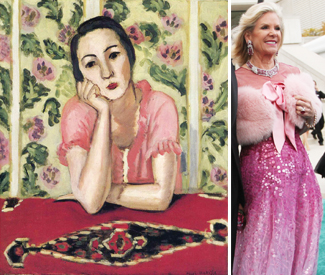
A little more than a year ago, Therese Chen, director of registration at San Francisco’s de Young Museum in Golden Gate Park, sent an email to another staffer concerning “Mrs. Wilsey’s new Matisse.”

That would be Diane “Dede” Wilsey, the wealthy art collector who is also president of the Board of Trustees of the Fine Arts Museums of San Francisco.

Chen asked Steve Brindmore, then a museum staff member who also runs a personal art crating business, whether he had a crate for the oil painting, which is titled “The Pink Blouse.” According to records from Sotheby’s New York auction house, the estimated value of this painting is between $3 and $4 million.

“The painting is on an A-frame in the Examination Room,” Chen wrote. “I’m taking the painting over to Dede on Wednesday … for [an event], and then it will come back here to the de Young to be crated for Portland around the week of Jan. 23.”

The exchange suggests that public museum facilities were being used to store and crate a piece of art from Wilsey’s personal collection.

Timestamps show that the exchange happened around 1:30 on a Monday, during museum hours. The correspondence was sent using museum staff email. It’s unclear what, if anything, this task had to do with the operations of a public museum. But FAMSF clearly handled a painting from the growing private art collection maintained by Wilsey, a major donor and key FAMSF fundraiser who loves Impressionist paintings and seems to gravitate toward works incorporating the color pink.

Beth Heinrich, a spokesperson for the Portland Art Museum, confirmed to the Guardian that a Matisse titled “The Pink Blouse” was indeed loaned to the museum from a private collection, and placed on display in its Impressionist galleries in February of 2012.

The email exchange between Chen and Brindmore is just one thread in a trove of correspondence, invoices, and other documentation anonymously submitted to the Guardian. Put together, the information shows museum staff being asked, during normal business hours, to handle, photograph, crate or arrange shipments for more than a dozen different pieces from Wilsey’s personal art collection in just the past two years. The documentation also shows several examples in which museum employees were directed by Chen to digitally reproduce works from Wilsey’s private collection.

It’s not uncommon for art collectors to put private pieces in the collection of a museum, nor it is unusual for collectors to lend out art to other museums. And if the de Young received some benefit from its association with Wilsey’s art, it wouldn’t be surprising (or inappropriate) for the museum to help reproduce or ship it.

On the other hand, if Wilsey is loaning out the pieces on her own, from her private collection, and using museum resources, it could raise conflicts of interest.

The de Young, for example, wasn’t cosponsoring the Portland exhibit where the Matisse was shown. Since Wilsey just bought the Matisse, it couldn’t have been part of the de Young’s collection.

There’s no indication that it was anything but her personal loan of a valuable painting — facilitated by the staff of a nonprofit that runs a city museum.

Invoices show that some staff members were paid separately for assisting with Wilsey’s art collection, in some cases through independent businesses.

WHO’S IN CHARGE?

The Fine Arts Museums include the de Young and the Legion of Honor. Included as charitable trust departments under the City Charter, they are governed by a 43-member Board of Trustees, which is responsible for appointing a director. Wilsey has presided over the body as board president since the 1990s. The bylaws of the board were changed to eliminate term limits for the president, meaning she could stay in the post for as long as her board colleagues want.

The FAMSF has been leaderless since director John Buchanan died in December, 2011.

Though the museums are public institutions, their governance structure is similar to that of a public-private partnership, since a private nonprofit organization called the Corporation of Fine Arts Museums of San Francisco handles museum administration and employs a number of museum staff, including curators and other professionals.

The city contributes some public funding to FAMSF, but the majority of revenue is derived from private sources. Wilsey, a multi-millionaire, contributed $10 million to the de Young, and spearheaded a 10-year fundraising campaign that culminated in 2005 with more than $180 million raised to rebuild the museum.

The socially connected philanthropist, known for throwing Christmastime bashes that attract a roster of powerful luminaries from government and big business to her Pacific Heights mansion, is often the subject of press reports or gossip surrounding San Francisco high society. Her stepson, Sean Wilsey, famously characterized Wilsey as his “evil stepmother” in his memoir, “Oh, the Glory of It All,” which includes an unflattering scene in which she is said to have pinned $200,000 brooches onto her bathrobe one Christmas morning.

She owns a fair amount of art — and apparently moves it around. In August of 2011, for instance, email threads show that Chen, using her FAMSF email address, contacted Jamil Abou-Samra of Masterpiece International, the shipping company, regarding “Mrs. Wilsey’s Degas.” Chen wrote: “I brought the Degas to the de Young last week for glazing. It should be ready for Steve to measure for crating any days [sic] now. Are we still looking at August 30, Tuesday, for pick up?” The thread indicates that the painting was destined for the Royal Academy of Arts, in London.

An Internet search shows that the Royal Academy indeed hosted an exhibit titled “Degas and the Ballet,” which opened in September of 2011. Press reports highlighting the artwork on display include an image of a Degas credited to “Collection of Diane B. Wilsey.”

There is no mention of the de Young or the Fine Arts Museums of San Francisco anywhere in the web or press materials discussing the exhibition. Numerous other cooperating museums are identified by name.

When the Guardian reached Abou-Samra by phone, she indicated that she was not at liberty to discuss any of Masterpiece International’s handling of art shipments.

OFF TO PARIS

In February of 2011, email records show, Chen contacted Brindmore on his FAMSF email regarding a crate for a painting by Jean-Louis Forain that was bound for an exhibition at the Petit Palais, in Paris. The Parisian exhibit was launched in partnership with a Forain exhibit at Dixon Gallery and Gardens in Memphis.

“Dede has a Forain painting that needs to be packed and crated … The painting is currently in our storage and [FAMSF staff member Steven Correll] knows the exact location,” Chen wrote to Brindmore. A few weeks later, Chen provided some special handling instructions for the Forain in an email to Samra, of Masterpiece International, just before it was transported to the airport.

There are established professional standards governing the operations of art museums, and the Guardian phoned several experts to determine whether it’s common practice for a member of the Board of Trustees to call upon museum staff members to handle their personal artwork. In response, communications director Dewey Blanton of the American Alliance of Museums highlighted an ethical standard stating, “No individual can use his or her position with the museum for personal gain.”

The code of ethics at the Boston Science Museum put it quite clearly: “When Museum of Science Trustees seek staff assistance for personal needs they should not expect that such help will be rendered to an extent greater than that available to a member of the general public in similar circumstances or with similar needs.”

It’s unlikely that a member of the general public who wanted to ship artworks would have the staff of the de Young at his or her disposal.

The Guardian telephoned a number believed to be Wilsey’s seeking comment, and was greeted with a receptionist who answered with the bright greeting, “Wilsey residence!” After being informed that Wilsey was traveling, we requested comment from her via email, explaining that documentation appeared to show use of museum time to manage her personal art collection. She had not responded by press time.

Ken Garcia, press spokesman for the Museums, told us “there are situations in which the museum facilitates loans to the Corporation of the Fine Arts Museums (COFAM), loans to other museums, and in other ways assists with the care and handling of artworks for private collectors, including trustees when there is significant value to our museum.” He added: “The reasons for museum staff to have handled the board president’s private art collection reflect standard practice for exhibitions and loans.”

He noted: “Reproductions of artworks (2D) are routinely requested by collectors when the loan of a picture conflicts with the lenders need for privacy, represents a potential security issue, or interrupts the continuity of the enjoyment of a collection. FAMSF provides for the photographic reproduction of artworks as an appreciative acknowledgment of the negotiated loan. Mrs. Wilsey has on occasion requested a reproduction be made of a loaned picture but on each occasion has generously assumed responsibility for the associated costs.”

Maybe it’s all perfectly fine and normal, “standard practice.” But there’s a lot of it going on, and some is at the very least curious.

Out of place

414

news@sfbg.com 

In his State of the City address last week, Mayor Ed Lee cheerfully characterized San Francisco as “the new gravitational center of Silicon Valley.” He touted tech-sector job creation. “We have truly become the innovation capital of the world,” Lee said, “home to 1,800 tech companies with more than 42,000 employees — and growing every day.”

From a purely economic standpoint, San Francisco is on a steady climb. But not all residents share the mayor’s rosy outlook. Shortly after Lee’s speech, renowned local author Rebecca Solnit published her own view of San Francisco’s condition in the London Review of Books. Zeroing in on the Google Bus as a symbol of the city’s housing affordability crisis, she linked the influx of high-salaried tech workers to soaring housing costs. With rents trending skyward, she pointed out, the dearth of affordable housing is escalating a shift in the city’s cultural fabric.

“All this is changing the character of what was once a great city of refuge for dissidents, queers, pacifists and experimentalists,” Solnit wrote. “It has become increasingly unaffordable over the past quarter-century, but still has a host of writers, artists, activists, environmentalists, eccentrics and others who don’t work sixty-hour weeks for corporations — though we may be a relic population.”

LIMITED OPTIONS

The issue of housing in San Francisco is highly emotional, and there is perhaps no greater flashpoint in the charged debate than Ellis Act evictions.

When the housing market bounces upward, Ellis Act evictions tend to hit long-term tenants whose monthly payments, protected by rent control, are a comparative bargain. Even if they’ve submitted every payment on time and upheld every lease obligation for 20 years, these renters can find themselves in the bind of being forced out.

And they don’t just lose their homes; often they lose their community. San Francisco has become so expensive that many Ellis Act victims are tossed out of this city for good.

Enacted in 1986, the state law allows a landlord to stop renting units, evict all tenants, and sell the building for another purpose. Originally construed as a way for landlords to “go out of business” and move into their properties, the Ellis Act instead gained notoriety as a driving force behind a wave of evictions that slammed San Francisco during the tech boom of the late 90s. Between 1986 and 1995, just 29 Ellis evictions were filed with the San Francisco Rent Board; in the 1999-2000 fiscal year alone, that number ballooned to a staggering 440.

Under the current tech heyday, there are indications that Ellis Act evictions are gaining fresh momentum. The San Francisco Rent Board recorded 81 this past fiscal year, more than double that of the previous year, and there appears to be an upward trend.

TIC CONTROVERSY

Buildings cleared via the Ellis Act are typically repackaged as tenancies-in-common (TIC), where several buyers jointly purchase a multi-unit residence and each occupy one unit. Realtors often market TICs as a path to homeownership for moderate-income individuals, creating an incentive for buyers to enter into risky, high-interest shared mortgages in hopes of later converting to condos with more attractive financing.

The divide between TIC owners and renters came into sharp focus at a contentious Jan. 28 hearing, when a Board of Supervisors committee met to consider legislation that would allow some 2,000 TIC units to immediately convert to condos without having to wait their turn in a requisite lottery system.

One TIC owner said he was financially burdened, but had only entered into the arrangement because “I wanted to stay here and raise my family, but we couldn’t afford a single family home.” Yet tenants brought their own set of concerns to the table, saying the temptation to create TICs was putting a major dent in the city’s finite stock of rent-controlled units — the single greatest source of affordable housing in San Francisco.

“My feeling is, let’s stop doing TICs,” Tommi Avicolli Mecca, a tenants right activist with the Housing Rights Committee, told the Guardian following the hearing. “The city has to just start making sure that the condos that are built are the kind of thing [TIC buyers] can afford. Instead, we cannibalize our rental stock? That’s a reasonable way? You evict one group of people to house another: How does that make sense?”

The grueling five-hour hearing illustrated the sad fact that San Franciscans in a slightly better economic position were being pitted against economically disadvantaged renters. The two groups were bitterly divided, and all seemed weary, furious, and frustrated by their housing situations.

The condo-conversion legislation, co-sponsored by Sups. Scott Wiener and Mark Farrell, did not move forward that day. Instead, Board President David Chiu made a motion to table the discussion until Feb. 25, to provide time for “an intensive negotiation process.” Chiu, who rents his home, added: “While I myself would like to become a homeowner someday … I do not support the legislation in its current form.”

Sup. Jane Kim sought to appeal to the tenants as well as the TIC owners. “It’s very tragic that we have set up a situation where [TICs and renters] are pitted against one another,” she said. She hinted at what a possible alternative to might look like. “We should be looking at a ban of scale,” she said. “If we allow 1,800 potential units to go thru this year, are we willing to do a freeze for the next 8 to 10 years?”

It’s unclear what will happen in the next few weeks, but if this legislation makes it back to the full board in some form, the swing votes are expected to be Sups. London Breed, Malia Cohen and Norman Yee.

CASH OR EVICTION?

New protections were enacted following the late-90s frenzy to discourage real-estate speculators from using the Ellis Act to turn a profit on the backs of vulnerable seniors or disabled tenants. Yet a new wave of investors has discovered they can persuade tenants to leave voluntarily, simply by offering buyouts while simultaneously wielding the threat of an Ellis Act eviction. “The process got more sophisticated,” explains San Francisco Rent Board Deputy Director Robert Collins.

Once a tenant has accepted a check in lieu of eviction, rent-controlled units can be converted to market rate, or refurbished and sold as pricey condos, without the legal hindrances of an eviction blemish. Buyouts aren’t recorded with the Rent Board, and the agency has no real guidance for residents faced with this particular dilemma. “We don’t have the true number on buyouts,” says Mecca. “We don’t know how many people have left due to intimidation.”

Identity-wise, renters impacted by the Ellis Act defy categorization. A contingent of monolingual Chinese residents rallied outside City Hall recently to oppose legislation they believed would give rise to evictions; in the Mission, many targeted tenants are Latinos who primarily speak Spanish. From working immigrants, to aging queer activists, to disabled seniors, to idealists banding together in collective houses, the affected tenants do have one thing in common. When landlords or real-estate speculators perceive that their homes are more valuable unoccupied, their lives are susceptible to being upended by forces beyond their control.

The upshot of San Francisco’s affordability crisis is a cultural blow for a city traditionally regarded as tolerant, forward thinking, and progressive. In the words of Rose Eger, a musician who faces an Ellis Act eviction from her apartment of 19 years, “it changes the face of who San Francisco is.

Out of the Castro

By Tim Redmond

You can’t get much more Castro than Jeremy Mykaels. The 62-year old moved to the neighborhood in the early 1970s, fleeing raids at gay bars in Denver. He played in a rock band, worked at the old Jaguar Books, watched the rise of Harvey Milk, saw the neighborhood transform and made it his home.

He’s lived in a modest apartment on Noe Street for 17 years, and for the past 11 has been living with AIDS. Rent control has made it possible for Mykaels, who survives on disability payments, to remain in this city, in his community, close to the doctors at Davis Hospital who, he believes, have saved his life.

And now he’s going to have to leave.

In the spring of 2011, his longtime landlords sold the building to a real-estate investment group based in Union City — and the new owners immediately sought to get rid of all the tenants. Two renters fled, knowing what was coming; Mykaels stuck around. In September of 2012, he was served with an eviction notice, filed under the state’s Ellis Act.

He’s a senior, he’s disabled, his friends are mostly dead and his life is in his community — but none of that matters. The Ellis Act has no exceptions.

Mykaels spent a fair amount of his life savings fixing up his place. The walls are beige, decorated with nice art. Dickens the cat, who is chocolate brown but looks black, wanders in and out of the small bedroom. Mykaels has been happy there and never wanted to leave; “this,” he told me, “is where I thought I would live the rest of my life.”

There’s no place in the Castro, or even the rest of the city, where he can afford to move. Small studios start at $2,500 a month, which would eat up all of his income. There is, quite literally, nowhere left for him to go.

“A lot of my friends have died, or moved to Palm Springs,” he said. “But this is where my doctors are and where I’m comfortable. I’m not going to find a support system like this anywhere else in the world.”

Mykaels is the face of San Francisco, 2013, a resident who is not part of the mayor’s grand vision for bringing development and high-paying jobs into the city. As far as City Hall is concerned, he’s collateral damage, someone whose life will have to be upended in the name of progress.

But Mykaels isn’t going easily. The former web designer has created a site — ellishurtsseniors.org — that lists not only his address (460 Noe) and the names of the new owners (Cuong Mai, William H. Young and John H. Du) but the addresses of dozens of other properties that are facing Ellis Act evictions. His message to potential buyers: Boycott.

“Do not buy properties where seniors or the disabled have been evicted for profit by real estate speculators using the Ellis Act,” the website states.

Mykaels is a demon researcher — his site is a guide to 31 properties with 94 units where seniors or disabled people are being evicted under the Ellis Act. In some cases, individuals or couples are filing the eviction papers, but at least 14 properties are owned by corporations or trusts.

Mai told me that he knew a disabled senior was living in the building when he and his two partners bought it, but he said his plan all along was to evict all the tenants and turn the three-unit place into a single-family house. He said he hasn’t decided yet whether to sell building; “I might decide to live there myself.” (Of course, if he wanted to live there himself, he wouldn’t need the Ellis Act.)

Mai said he “felt bad about the whole situation,” and he had offered to buy Mykaels out. The offer, however, wouldn’t have covered more than a few months of market rent anyplace else in the Castro.

By law, Mykaels can stay in his apartment until September. If he can’t stave off the eviction by then, San Francisco will lose another longtime member of the city community.


Dark days in the Inner Sunset

By Rebecca Bowe

The living room in Rose and Willie Eger’s Inner Sunset apartment is where Rose composes her songs and Willie unwinds after playing baseball in Golden Gate Park. Faded Beatles memorabilia and 45 records adorn the walls, and a prominently displayed poster of Jimi Hendrix looms above a row of guitar cases and an expansive record collection.

It’s a little worn and drafty, but the couple has called this 10th Ave. apartment home for 19 years. Now their lives are about to change. On Jan. 5, all the tenants in their eight-unit building received notice that an Ellis Act eviction proceeding had been filed against them.

“The music that I do is about social and political things,” explains Rose, dressed from head-to-toe in hot pink with a gray braid swinging down her back. Determined to derive inspiration from this whole eviction nightmare, she’s composing a song that plays with the phrase “tenants-in-common.”

Cindy Huff, the Egers’ upstairs neighbor, says she began worrying about the prospect of eviction when the property changed hands last summer. Realtor Elba Borgen, described as a “serial evictor” in online news stories because she’s used the Ellis Act to clear several other properties, purchased the apartment building last August, through a limited liability corporation. The notice of eviction landed in the mailbox less than six months later. (Borgen did not return Guardian calls seeking comment.)

“With the [average] rent being three times what most of us pay, there’s no way we can stay in the city,” Huff says. “The only option we would have is to move out of San Francisco.” She retired last year following a 33-year stint with UCSF’s human resources department. Now, facing the prospect of moving when she and her partner are on fixed incomes, she’s scouring job listings for part-time work.

The initial notice stated that every tenant had to vacate within 120 days, but several residents are working with advocates from the Housing Rights Committee in hopes of qualifying for extensions. Huff and the Egers are all in their fifties, but some tenants are seniors—including a 90-year-old Cuban woman who lives with her daughter, and has Alzheimer’s disease.

Willie works two days a week, and Rose is doing her best to get by with earnings from musical gigs. Both originally from New York City, they’ve lived in the city 35 years. When they first moved to the Sunset, it resembled something more like a working-class neighborhood, where families could raise kids. The recent tech boom has ushered in a transformation, one that Rose believes “changes the face of who San Francisco is.” Willie doesn’t mince words about the mess this eviction has landed them in. “I call it ‘Scam-Francisco,'” he says.

The trio recently joined tenant advocates in visiting Sup. Norman Yee, their district supervisor, to tell their stories. Yee, who is expected to be one of the swing votes on an upcoming debate about condo-conversion legislation vehemently opposed by tenant activists, reportedly listened politely but didn’t say much.

As for what the next few months have in store for the Egers? “I can’t really visualize the outcome,” Rose says. “I can only visualize the day-to-day fight. And that’s scary.”


Fighting for a home in the Mission

By Tim Redmond

Eleven years ago, Olga Pizarro fell in love with Ocean Beach. A native of Peru who was living in Canada, she visited the Bay Area, saw the water and decided she would never leave.

Fast forward to today and she’s built a home in the Mission, renting a small room in a basement flat on Folsom Street. The 55-year-old has lived in the building for eight years; polio has left her wearing a leg brace and she can’t climb stairs very well, but she still rides her bike to work at the Golden Gate Regional Center. She’s a sociologist by training; the walls in her room are lined with bookshelves, with hundreds of books in Spanish and English.

The place isn’t fancy, and it needs work, but it’s hard to find a ground-floor apartment in the Mission that’s affordable on a nonprofit worker’s salary. Since 2011, when she moved in, she and her three housemates have been protected by rent control. And Pizarro’s been happy; “I love the neighborhood,” she told me.

The letter warning of a pending eviction arrived Jan. 16. A new owner of the building wants to turn the place into tenancies in common and is prepared to throw everyone out under the Ellis Act. There’s no place else in town for Pizarro to go.

“I’ve looked and looked,” she said. “The cheapest places are $2,500 a month or more. Maybe I’ll have to move out of the city.”

Pizarro’s building is owned by Wai Ahead, LLC, a San Francisco partnership registered to Carol Wai and Sean Lundy. I couldn’t reach Wai or Lundy, but their attorney, Robert Sheppard, had plenty to say. “San Francisco is going the way of New York,” he told me. “Manhattan is full of co-ops that used to be rentals, and lower-income people are moving to Brooklyn and Queens. That’s happening here with Oakland and further out.” He argued that TICs, like co-ops, provide home-ownership opportunities for former renters.

Sheppard, who for years represented tenants in eviction cases, said the Ellis Act is law, and America is a capitalist country, and “as long as there is a private housing market, there will be shifts of people as the housing market shifts.” He agreed that it’s not good for lower-income people to lose their homes, but “the poor will always be hurt by a changing economy. It’s called evolution.”

Pizarro told me she’s shocked at how expensive housing has become in the Mission. “It’s gotten so gentrified,” she said. “People show up in their BMWs. It’s starting to feel very isolated.”

She’s fighting the eviction. “I didn’t intend it to be this way,” she explained. “I just want to live here.” Lacking any family in the area, the Mission has become her community — “and I’m frustrated by the violence of how expensive it is.”


Affordability goes out of style

By Rebecca Bowe

Hester Michael is a fashion designer, and her home doubles as a project space for creating patterns, sewing custom clothing, weaving cloth, and painting. She’s lived in her Outer Sunset two-bedroom unit for almost two decades, but now she faces an Ellis Act eviction. Michael says she initially received notice last June. The timing was awful -– that same month, her husband passed away after a long battle with terminal illness.

“I’ve been here 25 years. My friends are here, and my business. I don’t know where else to go, or what else to do,” she says. “I just couldn’t picture myself anywhere else.”

Michael rents the upstairs unit of a split single-family home, a kind of residence that normally isn’t protected by rent control. Yet she leased the property in 1994, getting in under the wire before that exemption took effect. Since she pays below-market-rate rent in a home that could be sold vacant for top dollar, a target was essentially inscribed on her back when the property changed hands in 2004. That’s about when her long battle with the landlords began, she says.

From the get-go, her landlords indicated that she should look for a new place, Michael says, yet she chose to remain. The years that followed brought things falling into disrepair, she says, and a string of events that caused her feel intimidated and to fear eviction. Finally, she consulted with tenant advocates and hired an attorney. A complaint filed in superior court alleges that the property owners “harassed and retaliated [Michael] when she complained about the defective and dangerous conditions …telling [her] to move out of the property if she did not like the dangerous conditions thereat … repeatedly making improper entries into [the] property, and wrongfully accusing [her] of causing problems.”

Records show that Angela Ng serves as attorney in fact for the property owner, Ringo Chung Wai Lee. Steven Adair MacDonald, an attorney who represents both landlords and tenants in San Francisco housing disputes, represents the owners. “An owner of a single family home where the rent is controlled and a fraction of market has virtually no other choice but to terminate the tenancy,” MacDonald said when the Guardian reached him by phone. “They’ve got to empty it, and the only way to empty it is the Ellis Act.”

While Michael received an extension that allows her to remain until June 5, she fears her custom sewing business, Hester’s Designs, will suffer if she has to move. There’s the issue of space. “I have so much stuff in this house,” she says. And most of her clients are currently located close by, so she doesn’t know where her business would come from if she had to relocate. “A lot of my clients don’t have cars,” she says, “so if I live in some suburb in the East Bay, forget it. I’ll lose my business.”

The prospect of eviction has created a major dilemma for Michael, who first moved to San Francisco in 1987. While moving to the East Bay seems untenable, she says renting in San Francisco feels out of reach. “People are renting out small, tiny bedrooms for the same price as I pay here,” she says. With a wry laugh, she adds: “I don’t think there’s any vacant apartments in San Francisco -– unless you’re a tech dude and make seven grand a month.”

Bloombastic: It’s magnolia season at the SF Botanical Garden

0

As we speak there are budding booms in Golden Gate Park that will have even the greenest of thumbs tickled pink. Yes, it is magnolia season, and the San Francisco Botanical Garden is a fantastic place to check out the flowers’ arrival — the Garden is home to nearly 100 rare and historic magnolias, all erupting in aromatic array. In fact, the collection is the most comprehensive and long-standing one of its kind outside of China. We’re talking 51 species and 33 cultivars, all assembled by the Garden in the name of varietal preservation.

The star of the year’s show is undoubtedly the cup and saucer magnolia, or the Magnolia campbellii. Nicknamed for its distinctive shape, it first bloomed in the United States in 1940, born from a transplanted cutting from a tree in the Lloyd Botanic Garden of Darjeeling, India. The cup and saucer is considered the flagship flower in the SF Botanical Garden due to its size, shape, and vivid coloration.

“Magnolias have long been the signature flower of San Francisco Botanical Garden,” says Don Mahoney, the garden’s curator. “Everyone loves them. They are an unforgettable sight of great beauty, and it turns out that the mild and foggy climate in San Francisco is the perfect environment for Asian magnolias, so we’ve been extremely successful cultivating them here.” His Garden’s collection was born in 1939, when director Eric Walther planted the first bloom.

To commemorate this signature flower’s peak season, the Botanical Garden is assembling a full bouquet of special programs dedicated to the occasion. There will be moonlit docent-led tours highlighting the evening beauty of the flowers, bloom-inspired drawing classes, . The magnolias will also star in the Garden’s celebration of the Lunar New Year — tai chi and lion dance performances will twirl through the weekend of Feb. 16-17 at the Garden, and you’ll be able to make a plant lantern from the petals of the fair blooms.

And like any decent event series, there’s a mixology course scheduled: on January 31 you can join Elixir owner H. Joseph Ehrmann for a hands-on craft cocktail class inspired by the Garden’s magnolias. You’ll be using herbs and spices picked from the Garden itself to make drinks, an intoxicating lead-in to spring. 

Magnolias by Moonlight tour

Fri/25, 6pm, $15

Magnolia Mixology

Thu/31, 5pm, $125

Family Lunar New Year celebration

Feb. 16, 11am-3pm; Feb. 17, 9:30-11am, free

San Francisco Botanical Gardens

1199 Ninth Ave., SF

(415) 661-1316

www.sfbotanicalgarden.org

Girl with a Pearl Earring: Dutch Paintings from the Mauritshuis

0

Experience a once-in-a-lifetime opportunity when Vermeer’s mysterious Girl with a Pearl Earring travels from Holland to the de Young Museum in San Francisco. See this masterpiece and more than 30 others by artists of the Dutch Golden Age— including Rembrandt, Hals, and Steen—from the collection of the Royal Picture Gallery Mauritshuis. Included is a bonus companion exhibition, Rembrandt’s Century, featuring more than 200 rarely seen prints and drawings by Rembrandt and his predecessors and contemporaries. Get more details here.

Saturday, January 26 thru Sunday, June 2 @ de Young Museum, Golden Gate Park, SF

More recycling fallout

84

The unintended consequences of closing the Haight Ashbury’s only recycling center are about to ripple through small businesses in the neighborhood. As the recycling center’s final days loom, merchants are gearing up to face new fees — as much as $100 a day.

But they may get a reprieve sooner than they think.

State law requires stores that sell beverages in cans and bottles to take them back for recycling — unless there’s a functioning recycling center within a half-mile radius.

With the Haight-Ashbury Neighborhood Council recycling center gone, Whole Foods supermarket, the largest purveyor of beverages on Haight Street, will be faced with a decision — provide bottle and can buy-back services, or pay a $100 a day fee instead. If Whole Foods decides to pay the fee and not provide recycling in the area, small businesses in the Haight will be forced to make the same choice — only they won’t be able to afford the $36,500 a year fee.

San Francisco’s Department of the Environment doesn’t enforce those fees, but does provide oversight on recycling in San Francisco. Guillermo Rodriguez, spokesperson for the department, said that his office is in the planning stages of creating a mobile recycling center, which could roll out in early 2013.

“Certainly it’s not in our interest to have those businesses pack up and move out,” Rodriguez said. The mobile recycling center gives the neighborhood a new option.

If a recycling center serves the Haight neighborhood, the small businesses in the area could avoid paying the steep fees, and from having to go through the trouble of seeking exemption.

“Its similar to food trucks,” Rodriguez said. “After they finish for the day, they leave. But they’d set up at a usual time in a usual spot.”

San Francisco Supervisor Christina Olague, whose district includes the Haight Ashbury, said she was working on a way for HANC to turn into a mobile recycling center. Though she said that those talks had since stalled, Rodriguez said that if HANC wanted to be a partner in the new mobile center, the Department of the Environment would be open to it.

Why does the state of California expect small businesses to provide a can and bottle buy-back program on site, or face fees in the first place?

Rodriguez explained that the laws weren’t necessarily made with San Francisco in mind.

“When the rules were drafted, San Francisco was the exception, as we are for a lot of things,” Rodriguez told us. “The law was written for the suburbs, where small businesses generally have parking lots where recycling can easily be handled.”

The San Francisco Recreation and Parks department has long pushed for the Haight recycling center’s ouster. Sarah Ballard, spokesperson for the department, said the recycling fees and regulations that will hit local businesses aren’t Rec-Park’s problem.

“HANC has been on a month to month lease for over a decade,” she said. “The Parks Department have never sought to stop them from seeking non-park property to continue to run their business.”

Basically, HANC can operate wherever it wants to — just not in Golden Gate Park. And there aren’t a whole lot of other low-cost open spaces where the center can set up shop.

Small businesses we’ve talked to say they don’t have the space, staff, or ability to handle buying back recyclables. Fred Kazzouh, owner of “Fred’s New Lite Supermarket” on Haight and Masonic streets, doubted he’d get a reprieve from the fee.

“I mean if we all apply for an exemption, there’ll be half a mile radius without a recycling center,” Kazzouh said. “I saw recycling centers on Safeway on Webster (street) and I don’t see why Whole Foods can’t do it.”

Kazzouh’s store has been in the Haight neighborhood since 1995. The Haight has long been known as a place that draws alternative people, he said. And that’s the way he likes it.

“I don’t like to be in the clean neighborhood with the white picket fence and suits and ties,” Kazzouh said. “That’s not a real life. Its a very fake life.”

Even some of the ritzier stores along Haight St. aren’t bothered by the homeless population there. Firras Zawaideh, owner of Liquid Experience on Haight, sells high end (expensive) alcohol that few homeless people can afford.

He said he thinks only the transplants and new folks to San Francisco are bothered by them.

“I’m a native San Franciscan, from the Sunset [district],” Zawaideh said. “We’re the ones who don’t hate the homeless. Its all the transplants from New York and the midwest who complain about it.”

Zawaideh already handles bottle and can buy-back through his store, though he said that no one has ever taken advantage of it. But with HANC closing, he dreads the idea of people bringing cans and bottles en masse to his store.

“Say on a busy Friday night someone comes in with a cart full of recyclables,” he said. “Then what? I have to help them out too?”

The mobile recycling center would exempt Zawaideh of that responsibility. But if neighbors of HANC complained about the homeless population, would the same customers cause a problem for the mobile center as well?

Rodriguez said he wouldn’t speculate on if the homeless population that now uses the Haight recycling center would follow the food trucks around as well.

“I think we’ll have to take it as it comes,” Rodriguez said. Though he wanted this to be clear: “Not everyone that participates, frankly, is a homeless person.”

Fred Kazzouh was dubious that the homeless population would go away with HANC’s closure. “If HANC goes away, the homeless won’t go with them,” Kazzouh said. “The homeless will just have less people fighting for them.”

Discovery channels

0

arts@sfbg.com

YEAR IN DANCE Looking back on 2012’s over 500 performances — as calculated by Dancers’ Group — the game of “best” and “worst” makes less sense than ever. What makes the Bay Area a place worth living in is the vitality of its arts, and dance in particular. We only have one superstar company, San Francisco Ballet, but we’ve got a number of excellent mid-size ensembles and just enough of a competitive environment to discourage rank amateurism.

Whether for financial reasons or a desire to forego the demands of conventional stage presentations, dancers have continued their exodus to galleries and museums, like the San Francisco Museum of Modern Art, the Asian Art Museum, the California Academy of Sciences, and the de Young Museum. But they have also presented work in public spaces: City Hall, Market Street, Union Square, and Golden Gate Park. These performances necessitate the rethinking of formal parameters, but also reach out to new audiences.

Here are ten companies and artists who challenged expectations or unveiled surprises (at least to me) in 2012. Surprises from young artists are the norm, but experienced choreographers have a far more difficult task when it comes to catching viewers off-guard.

In the middle of March (and after 40 years of rethinking time, space, and motion), Eiko and Koma presented their most radical performance yet. With the breathtaking Fragile, a four-hour meditation in which they moved perhaps two feet, they stretched every conceivable theatrical concept beyond where it could reasonably be expected to go. It was mesmerizing, though I kept wondering where Fragile would be without the wondrous collage of music that David Harrington had assembled for his Kronos Quartet.

Keith Hennessy’s Turbulence (a dance about the economy), a many-tentacled creature that sprawled and oozed its way through Yerba Buena Center for the Arts, was one of the year’s most controversial premieres. No easy viewing, it showed that, for all his passion to redesign the social order, Hennessy is still working on creating new vehicles into which to pour his content. Gratifyingly, Hennessy just received a USA Fellows Award, one of only five Bay Area choreographers to have been so honored.

Monique Jenkinson’s splendid solo Instrument just finished its run at CounterPULSE. It needs to come back. She’s known as Fauxnique in her drag alter ego, but there is nothing faux about this dancer-performance artist. In Instrument, perhaps Jenkinson’s finest work yet, she asks questions about the body as a tool and the nature of being on stage. The figure of Rudolf Nureyev gave her the entrance into a witty but also heartbreaking portrayal of what it means to be a performer.

Even if you watch dance a lot, once in a while it happens that somebody pops up that you have never seen — and yet what they show is already excellent. Such was the case with Nicole Klaymoon’s Embodiment and her joyously rocking House Matter. Working with very good modern and hip-hop dancers, plus jazz singer Valerie Troutt and her vocal ensemble, the women created an evening-long piece about how a house can become a home.

Jenny McAllister’s two-year old 13th Floor Dance Theater is the newest incarnation of McAllister’s dance making endeavors. She has been choreographing genuinely funny dance, often sending up popular culture, for a long time. Bloomsbury/It’s Not Real was her first evening-length work. Using reality TV as a format, she came up with a lovingly loony but smart portrait of the lives and loves of that motley crew known as the Bloomsbury Group.

At the end of September, Birju Maharaj, the 74-year-old Kathak virtuoso, packed the Palace of Fine Arts with a primarily Indian audience who sat through a four-plus hour performance of superb dance. Maharaj performs here every couple of years, often with a similar repertoire. And still you sit there and can’t believe your eyes and ear at this gentle, witty, and generous artist playing “games” with someone like Zakir Hussein.

During its 41st home season, ODC/Dance premiered KT Nelson’s Transit. Taking one look at Max Chen’s whimsical bike concoctions, I just knew that they would steal the show — but they didn’t. Nelson used these metamorphosing velocipedes to call to the stage an image of urban life as fast-paced, fluid, and unstable. Yet for all its fractured continuity, Nelson and ODC’s superb dancers seemed to say, it’s a wonderful life.

San Francisco Ballet’s Beau raised more eyebrows than any of its other commissions, as far as I can remember. Longtime guest artist Mark Morris has built up expectations, so people were furious, feeling let down by what they considered thin, slipshod, easy-way-out choreography. My opinion was in the minority — so I’m looking forward to the piece’s return to find out whether what I thought was there, really is.

In the fall, my first encounter with Einstein at the Beach opened my ears and eyes to what I had known as “an opera” by Robert Wilson and Philip Glass. Surprising to see was how its exquisite details and extraordinary stylization owed more to kabuki than opera, and how Lucinda Childs’ choreography fit into it like a jewel set into a frame. For once the hype surrounding a piece did not even approach the reality of the experience.

Dancers around the world know the Venezuelan-born David Zambrano as a superb, idiosyncratic teacher. So his Soul Project, set to a rich selection of blues and soul music, raised questions about his approach to choreography. Using the YBCA’s Forum as a unified space for dancers and audience, Soul’s meandering trajectory — you never knew who would perform what where — made this one of the year’s most intimate experiences. To be a couple of inches away from such different, yet such superb performers doing what they do best was a treat.


Balkan brass blowup

0

emilysavage@sfbg.com

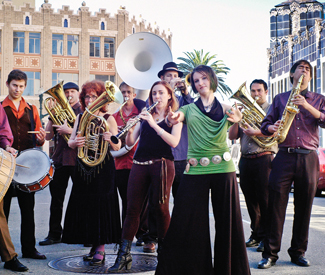
Tofu and Whiskey If you’re going to book a Balkan-influenced band, don’t expect the crowd to stay put. The Bay Area’s Inspector Gadje, an offshoot of the Brass Liberation Orchestra, usually packs in around 15 players, including 12 on horns and three percussionists. When the raucous group came marching through the wilderness (read: Golden Gate Park) during Outside Lands, it filled in crevices between trees, and created an instant party atmosphere between the main stages. Those fast-walking through the thoroughfare of Choco Lands stopped in their tracks, surrounded the group, and started dancing, against everyone’s better judgment. It all happened in the blink of a dirt-lodged eye.

“A lot of Balkan music has a great ‘party’ feel to it…even when the music includes moments or textures that might have a darker feel, the music is played with an undeniable exuberance,” says Oakland’s David Murray. “The rhythms of the Balkans; Greece, Macedonia, Serbia, Bulgaria, etc., include many unusual time signatures that are compelling and especially attractive to musicians.”

Murray, a graphic designer by trade, is one of those musicians — he’s been playing bouzouki in Greek Rebetika band Disciples of Markos since 2004, and also plays fiddle in the Squirrelly Stringband, which is the house band for the North Oakland square dance (a “monthly underground hillbilly dance party,” as he describes it). As a combination of his art and music backgrounds, he also produces and designs albums for the Dust-to-Digital record label, which specializes in reissuing obscure folk and world music.

His newest project, however, is all about the music of the Balkans. He began the Berkeley Balkan Bacchanal (berkeleybalkanbacchanal.com) music series at Berkeley’s Starry Plough in October 2011. He got the idea after meeting like-minded acts in the Bay Area, with affinities for Southeastern European styles of music. In the past year or so, the monthly Balkan showcase has seen performances by Murray’s band, along with Inspector Gadje, Zoyres, Veretski Pass, Janam, Gadjitos, and a dozen or so more.

The last Berkeley Balkan Bacchanal of 2012 takes place this week, with Fanfare Zambaleta, “Middle Eastern marching band” MWE, and Helm, a group that specializes in Turkish classical and pop music (Thu/20, 8pm. Starry Plough, 3101 Shattuck, Berk. www.starryploughpub.com). Murray says MWE, which includes three or four horns and the wailing Turkish reed (zurna), is known to play in the middle of the dancefloor with the crowd dancing around them. See? Instant party music.

I asked Murray if it’s been challenging to track down acts for this series, as it has such specific influences but he shut that down quick: “No, it hasn’t been difficult at all. There are a lot of great bands around here that fit into the theme of our series. At one point there were no less than three Balkan brass bands in town…And because we don’t mind pushing the boundaries of the Balkans to include neighboring influences, we’ve been able to feature bands that play Algerian music, Persian, and more.”

He added in some historical links, for good measure: “The Bay Area has a very vibrant Balkan music scene, which has some interesting origins in the 1960s, with bands like Kaleidoscope. The early California Renaissance Fairs provided an early outlet for many Balkan musicians, and music camps, such as Lark Camp in Mendocino, have been inspiring and teaching musicians for generations.”

As a novice listener, I’ve (admittedly) grown interested in Balkan sounds via more mainstream bands that have remote influences from the regions, acts like Balkan Beat Box and early Beirut, which typically blend sounds and instruments from a variety of places with pop and folk influences; but also thanks to Gogol Bordello and, more recently, Inspector Gadje, which is more purely influenced by the Balkan style.

“I tend to avoid bands that are actively ‘fusion,’ it doesn’t interest me much, especially bands that combine many styles,” Murray says. “It seems, to me, to usually dilute the very thing that makes the music interesting to begin with. But I’m sure there’s a wide range of opinions on this subject among the various bands and audience members.”

He says he’s more interested in bands that dig deep into the music they play, understanding the history and playing it in an authentic style. He brings up local bands such as Veretski Pass, which plays klezmer with accordion, fiddle, and bass, but also has studied the Jewish music of the Carpathian mountains, noting that the band will be back to the Starry Plough Jan. 17 for an all-klezmer night with the Gonifs.

But Murray points out that this doesn’t mean the acts of the Berkeley Balkan Bacchanal are rigid. “…that’s not to say that these bands are stuffy academics or that they don’t play with styles to some degree. On the contrary, most of the players are young and bring the music to life in a vibrant way that gets heads bobbing and feet dancing.”

“A great example is the Mano Cherga band, which played in September, and sounds like a Serbian party band you’d hear at a drunken wedding bash.”

Bring on the brass and vodka.


A VERY CASTLE FACE CHRISTMAS

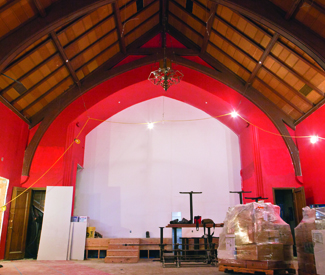
There are a number of reasons why A Very Castle Face Christmas is an obvious choice. There’s performances by Thee Oh Sees, Blasted Canyons, Warm Soda, and recent GOLDIES winner the Mallard. Plus, it’s a benefit for the Coalition on Homelessness in SF, a very worthy cause. There’s also the added bonus of the venue itself. I just this week finally made it to a show at newish Mission venue the Chapel, and it was, frankly, charming — from the dark-wood high beam arched ceiling, to the multiple bars (three), to the band-watching angles (you can see from the main room, the balcony, and the soon-to-be-restaurant, plus there are flatscreens linked to cameras fixed on the stage). Win-win-win. Thu/20, 8:30pm, $15. Chapel, 777 Valencia, SF; www.thechapelsf.com.


HIGH ON FIRE

Following front person Matt Pike’s treatment for alcohol addiction, Oakland’s beloved stoner metal act High on Fire is back. Well, technically, the band has been back for about a month, touring the country on most recent release De Vermis Mysteriis. But this will be it’s first big show back in the Bay, where it belongs. With Goatwhore, Lo-Pan. Sat/22, 9pm, $21. Slim’s, 333 11th St., SF. www.slimspresents.com.

CHURCHES

Remember this summer, when distortion-loving East Bay act CHURCHES was Kickstarting a record written for the pro-marriage equality cause? The band — led by Caleb Nichols of Port O’Brien and Grand Lake, Pat Spurgeon of Rogue Wave, and Dominic East — exceeded its goal, and that seven-inch (LOVELIFE) will see release at Bottom of the Hill this week. The trio also released a music video in conjunction with the record: interspersed with the band playing is a classic family portrait set-up with scenes of smiling families, and CHURCHES with their friends and loved ones, including Nichol’s fiance, Grand Lake drummer John Pomeroy. With Tijuana Panthers, Toshio Hirano. Sat/22, 9pm, $12. Bottom of the Hill, 1233 17th St., SF; www.bottomofthehill.com

Golden Gate Park magic mushroom finally classified, just in time for high season

40

Hurray for science! Thanks to it and people who believe in it, a small tan spore that has been sprouting happily for Bay Area trippers for decades has a name: Psilocybe allenii. Our friends at the Psychedelic Society of San Francisco tipped us off to the fact that PSSF lecturer and mycologist Alan Rockefeller had helped pen a definitional paper that introduced the little guys. Rockefeller will be leading a Society mushroom hunt — open to all comers — in Golden Gate Park on Thu/20. He told us hippies have been hunting Psilocybe allenii in the park for ages, previously using its informal name Psilocybe cyanofriscosa, which sounds suspiciously close to “San Francisco” to us. 

We got in touch with Rockefeller and his cohort Peter Werner by email to hear about our new fungal friend. They only used a few words that we didn’t understand, but we’re willing to put up with it because they are very smart people.

PLEASE NOTE: Do not eat wild mushrooms without someone who knows what they’re doing. Really. 

San Francisco Bay Guardian: How was Psilocybe allenii discovered?

Alan Rockefeller: [John W. Allen] found it in wood chip landscaping [where it grows] October through January. It grows in cities, in areas where lots of people go. John is not the first person to find the mushroom, it has been well known for a long time. It was named after him because he picked it and mailed it to [Czech mycologist] Jan Borovicka. The earliest collection that I know of is a photo by Paul Stamets, taken in Golden Gate Park in 1976, and published in Mushrooms Demystified by David Arora. In that photo, there are three Psilocybe cyanescens and three Psilocybe allenii, all labeled Psilocybe cyanescens.

It’s been an open secret for many years that there is a new psilocybin mushroom that needs to be described. Literally hundreds of people have found it. People have been calling it “Psilocybe cyanofriscosa” since 2006, but that name is not proper Latin and was never validly published. New species of mushrooms must be named using proper Latin, and need to be described in a peer reviewed scientific journal. 

http://www.youtube.com/watch?v=69VhBQVLjVU&feature=plcp

SFBG: How was it determined to be psychedelic?

AR: All mushrooms which stain blue where damaged and have either a dark purple brown or black spore print are psychedelic.   

This species has been eaten by many psilocybin mushroom enthusiasts and they say it’s one of the strongest mushrooms known. The only mushroom which may be stronger is the closely-related Psilocybe azurescens. That species is very similar but has a cap that is umbonate, and there is a two base pair difference in the ITS gene. Psilocybe allenii occurs from BC, Canada to Los Angeles, and is common in San Francisco.  Psilocybe azurescens only occurs within 20 miles of the Oregon/Washington border, in coastal dune grasses in the mouth of the Columbia river. (Correction: John W. Allen wrote to us to assure us that Psilocybe azurescens grow quite prolifically in the Seattle Puget Sound area)

Psilocybe cyanescens is also very common in San Francisco. It is almost as potent. If you go to Golden Gate Park in December you will see hundreds of hippies looking at the wood chip landscaping for Psilocybe cyanescens and Psilocybe allenii.

SFBG: How common is it to find new psychedelic/otherwise mushroom strains?

Peter Werner: Mushrooms in general? Finding new species is quite common, because fungi are not nearly as well investigated as plants, in spite of being a kingdom that, if anything, contains more species. (Albeit, mushroom-forming fungi are a small subset.) I couldn’t give you exact numbers, but there are probably a number of new species described in California each year. In really mycologically-underexplored areas, say Belize or Guyana, a mycologist may make a large collection in an hour, over half of which will be species that have never been scientifically described. Dennis Desjardin, the eminent mycologist at SFSU, once said that if he never went out in the field again, he could spend the rest of his life naming undescribed species deposited in the SFSU herbarium.

>>MORE SHOTS OF THE ‘SHROOM AVAILABLE HERE

In terms of Psilocybe in this part of the world, people find new species less often, because most of the West Coast species were described during a great wave of interest in the 1960s and ’70s. Still, there are several papers each year describing new Psilocybe species from various parts of the world, including from North America.

SFBG: How many species of mushrooms are there?

PW: [First you have to not just] define “species.” but define “mushroom”! The terms “mushroom” and “truffle” describe pretty much any macroscopically visible fungus with a distinct fruiting body, that are above-ground or underground, respectively. But definitions vary — the terms are not scientific ones. To take a stab at the number, I’d say the majority of mushroom and truffle species fall into the basidiomycete subdivision Agaricomycotina, and the Tree of Life web pages (which are a good general source for such things) estimates some 20,000 named species. (Named being the keyword here, undescribed species making up a possibly much greater number worldwide.) There are another about 1700 named species in the order Pezizales, which include the majority of fleshy ascomycetes (morels, cup fungi, true truffles, etc.)

In terms of fungi in general, that runs into the many millions, most of which are unnamed. Estimates range from over 600 thousand to over 5 million. A good article on estimating the earth’s biodiversity, including estimates of fungi, was run in the New York Times science pages last year.

SFBG: Are there any events coming up that laypeople might be interested in/invited to? Do you have to be a mushroom expert to be a part of the Society?

AR: I am leading a mushroom hunt in Golden Gate Park on Dec. 20 at noon, it is open to the public. You don’t need to be a mushroom expert to attend.  I think that I am the only mushroom hunter that attends these events.  Information on where exactly to meet will be posted on the SF Psychedelics Society website

Fresh ranch

1

le.chicken.farmer@gmail.com


CHEAP EATS CHEAP SPORTS

by Hedgehog

Greetings from Portland! Oregon! Chicken Farmer would be writing this, but we have a show tonight and she needs to rest her voice.

I, on the other hand, can talk to youse now because I’m not the greatest singer in the world. There: I admit it. Also, I’m not on strike. But anyway, singing: When you get me in my car with the iPod set to my “singalong” folder and no witnesses, I can “shred,” as the kids say. But if a song is shredded when there’s no one there to hear, does it really shred? No. Clearly not. Because in front of people, it’s a different story.

I had just about got where I could play an instrument, sing on key, and occasionally glance up and show my face to the audience without making the whole house of cards come tumbling down.

Then we got in the car and went on tour. And on I-5 North Chicken Farmer says to me one word: harmony.

Harm what now? No, see, I sing along with the radio. I’m not a barbershop quartetist. But Chicken Farmer (a.k.a. The Experienced Musician) says it will sound awesome. It will, in fact, shred, if I can harmonize with her.

And so it has been for the last few hundred miles now, in the car, singing the same chorus over and over and over again with my right index finger in my right ear, so as to hear myself over Chicken Farmer. It’s hard. Life on the road is hard.

I have a newfound respect for Justin Bieber. Ha. No I don’t.

Anyhow, we drove up here from pretty near where you are right now and our first stop foodwise was La Plazita Taqueria in Madison. That was a cool place. What’s-Her-Face had a carnitas burrito and I had a chicken taco and a beef taco. They have foosball. Nice folks . . .

After that, we drove to Ashland, Oregon, where we played at a piercing studio and ate at Taroko. It’s an Asian Fusion place. A little pricey, but the food was good and the portions of pho were HUGE. What was odd was I ordered eel maki and got salmon skin instead.

You know how when you take a big gulp of water thinking it’s vodka and the shock makes you choke and sputter? Yeah, that. But the highlight so far has been Laundromat Thai, just around the corner from Johnny “Jack” Poetry’s Portland pad. It’s actually got a name, but gets called Laundromat because it shares a building with one and hipsters are too cool to just call things what they are. Tasty red curry, robust massuman, zesty shrimp salad and a friendly drunken noodle. But speaking of Johnny “Jack” . . .


CHEAP LIT

“Potato Salad”

by Johnny “Jack” Poetry

The sky, too, needs to be white, not exactly an oboe awash in Debussy but maybe a clarinet basking in a Hoagy Carmichael chromatic progression & lolling about in mid-register where the clouds are practically smoky curtains—

& a tenor ukulele strummed in a green canoe in a pond where those clouds are floating topsy-turvy amidst the patches of duckweed—

cilantro, chopped fine, is crucial—the odor of leafing thru sheet music in a used bookstore San Francisco late 90s & the musty pages & the breezes off the Pacific slightly green with kelp—

some brand of delicatessen mustard—poignant with horseradish—neglected words on any lemonade June day when it seems there are light years at least to say them while a guitar transmits watermelons bicycles Dorothy Sayers’ mysteries beyond the bluish & optimistic horizon—

which is also white though with a yellow patina—the potatoes are Yukon Golds & some say chop them larger & some say smaller—when we were young we were so extraordinarily young like the strings on a baritone uke strumming Blue Moon like a Ferris wheel & the picnic table beside the lake stands empty as the long twilight starts to edge down—

tho really only fresh Ranch dressing will do—the buttermilk warmth— & plenty of ground black pepper—& the sky, too, needs to be blue as worn denim or blue as a Crayola sky blue crayon melting for hours & hours over Golden Gate Park—

& not thinking too much how it all slowly goes into indigo as the clarinet sighs down to low G & below & deeper blue as is most everything else—


Sorry, Chuck — HANC eviction hasn’t happened

14

The eviction of the Haight Asbury Neighborhood Council’s recycling center, which critics of the center said was scheduled to take place Dec. 5, hasn’t happened – and it’s entirely possible that the center could keep operating for several more weeks.

At the end of the day Wednesday, the doors were open, the center was continuing business as usual – and the office of Sheriff Ross Mirkarimi, who is charged with carrying out the eviction, was telling reporters that Dec. 5 was never a firm deadline.

Kathy Gorwood, Mirkarimi’s chief of staff, told us that the law gives tenants five days from the service of an eviction notice before any law-enforcement action can take place. “But that’s not a legal mandate that we evict on the sixth day,” she said.

The notice was served Nov. 30.

Gorwood said all evictions are planned with officer safety, tenant hardships and staff scheduling in mind – and on Dec. 5, the sheriff wasn’t ready to move.

“We surveyed the property, the sheriff personally surveyed the property,” she said. “We can’t say, and we don’t say, when an eviction will take place.”

Gorwood said Mirkarimi wasn’t defying the law or refusing to carry out the eviction. But since there are likely to be protests, possibly civil disobedience, the deputies need to be prepared and the schedule set carefully.

Mirkarimi has a history of supporting HANC. As a former supervisor of District 5, which includes the Haight, he voted to urge SF Rec and Park to and find a solution to keep the center in Golden Gate Park. The vote was nonbinding. He clearly wants to avoid a nasty confrontation, and if he can find a way to work out a voluntary move-out, it’s likely he’ll take the time to negotiate it.

For the past ten years, The Department of Recreation and Parks has aggressively sought to oust HANC.  Finally, this fall, Rec-Park filed an eviction through the City Attorney’s Office
Interestingly, the “Notice to Vacate” served on the center was signed off by the City Attorney’s Office on September 14, 2012. However, the actual eviction date that SF Rec and Park requested was December 5, 2012.

Why wait three months to evict a center that Rec-Park has been trying to get rid of for a decade?

Jack Fong, a spokesperson for the City Attorney’s office, declined to say if there were any procedural or administrative reasons that an eviction notice given to the sheriff in September would take three months to go through.

We called Phil Ginsburg, director of Rec and Parks, and Sarah Ballard, its spokesperson, to ask about the time disparity. We did not hear back from them before press time.

But you don’t need to be a genius to figure it out — just look at what was happening in November. Ginsburg was pushing Proposition B, which secured $195 million in bonds to shore up neglected playgrounds and open spaces in San Francisco’s parks. The measure needed a two-thirds vote – and Rec-Park was nervous about any bad publicity.

The measure passed by a landslide. Butousting HANC, eliminating a revenue stream for the poor, the homeless, and working class people, would have been bad publicity leading up the November election.

The Small Business Commission is scrambling to notify businesses in the area of their possible new role without the recycling center — they could all either become mini-recycling centers, or
face a $100 a day charge from the state of California
.

Exactly how and when the commission will reach out to those affected will be discussed at the Small Business Commission’s December 10 meeting.

Regina Dick-Endrizzi, the executive director of the Small Business Commission, told us that one business in the SOMA, which she declined to name, faced three months worth of the $100-a-
day charge for not buying back recyclables from the state while trying to navigate applying for an exemption. Even after being granted the exemption, that’s a $9,000 charge, which for a small
liquor store or grocer is not chump change.

There’s a precedent for a San Francisco sheriff refusing to carry out an eviction notice. Sheriff Richard Hongisto, who later served on the board of supervisors for three terms, famously
refused to evict the Filipino and Chinese elderly tenants of the International Hotel in 1976. The scandal was even the subject of a documentary, “The Fall of the I-Hotel.

The International Hotel was sold to developers who were going to cast the elderly tenants out onto the street. News outlets as far flung as the New York and LA times wrote about the
mass eviction, and many consider it a black eye on San Francisco to this day.

In January 1977, Hongisto was jailed for five days for his refusal to evict the tenants. Eventually, he relented, leading a team of SWAT and other officers to clear the hotel of
protesters, and even swung an ax himself to bust open the hotel.

But this is a different situation: Mirkarimi hasn’t refused to follow the law, and in fact, Gorwood said that he has every intention of carrying out the eviction. The law, Mark Nicco, assistant counsel to the sheriff, told us, only says that an eviction has to happen in a timely manner – and there’s no definition of what that might be.

So if Ginsburg or the mayor think Mirkarimi is dragging his feet, the only recourse would be for Rec-Park to go to court and seek a judge’s order compelling the sheriff to evict the center in a stated period of time. All of which could take weeks.

So for the moment, HANC is still in business, Mirkarimi is avoiding an ugly eviction scene – and there’s still a chance for Rec-Park to come to its senses. But we’re not taking bets.

Additional reporting by Tim Redmond

Canned!

6

news@sfbg.com

So much for the holiday spirit.

In a win for the NIMBY neighbors of the Haight neighborhood, the Haight Ashbury Recycling Center was gifted with its final eviction notice, ordering it out on the street by the day this story goes to print, Dec. 5.

But those who hoped this eviction would rid the neighborhood of poor people recycling bottles and cans may be disappointed — and so might local small businesses that could face some unintended consequences of the move.

The site, run by the Haight Ashbury Neighborhood Council (HANC), houses a community garden, native plant nursery, and recycling center. HANC battled eviction for nearly a decade as newer neighborhood associations complained to the city, saying the center was too noisy and attracted too many homeless people.

The recycling center is located at the edge of Golden Gate Park behind Kezar stadium, and has been crushing cans and busting bottles since 1974.

The San Francisco Recreation and Park Department issued several eviction notices to HANC over the years, and the process seemed to drag on, but the eviction notice from the Sheriff’s Department on Nov. 28 is likely the last nail in the coffin.

“We’ve exhausted our legal options,” Ed Dunn, HANC’s director, told us.

Even Sup. Christina Olague, who has championed HANC as one of their few supporters on the current Board of Supervisors, said that the recycling center was done, although representatives from Sup. Eric Mar’s office told us they were still hopeful the eviction could be delayed long enough to relocate HANC somewhere else.

Olague told us that she’d talked to Mayor Ed Lee about the issue many times, and they discussed many options. But with the finality of the eviction notice, she said, “I just don’t know what we can do.”


COAL FOR CHRISTMAS

The recycling center’s employees will lose their jobs just at the start of the winter holiday season. “The notion that they’d put people out of work before Christmas was horrendous,” Dunn said.

What will happen to HANC’s 10 employees is up in the air. “I have no idea what I’ll do,” HANC employee Brian McMahon told us, lowering his orange protective headphones to talk. He’s worked there since 1989, and his last job was at a Goodwill store. “The quote under my high school yearbook picture says ‘take it as it comes,’ and that’s what I’m going to do.”

Susan Fahey, the sheriff’s media relations officer, declined to discuss the details of how the officers would handle the eviction, saying only that “we plan accordingly.”

A staff report prepared for the Recreation and Park Commission’s Nov. 20 meeting estimated that just 0.1 percent of San Francisco’s recycling tonnage is processed at HANC, according to a report by citizen journalist Adrian Rodriguez. The agenda also said that the Department of Environment was confident that recyclers would use other nearby sites instead.

But the customers at HANC that we talked to didn’t agree.

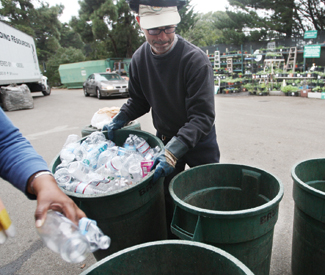
“I think it’s necessary they have the [recycling center] here,” HANC customer Eugene Wong told us. Wong lives in the Haight, and hauls in his recyclables every six months or so for some extra pocket money. As Wong and his friend Bob Boston spoke, one of their Haight Ashbury neighbors, Rory O’Connor, surprised them as he walked up.

“Just droppin’ off my beer cans, man,” O’Connor said. Asked if he would make his way out to the Bayview recycling center when HANC closed, he said, “You’ll spend more on gas than you would even get back.”

There were quite a few neighborhood locals there that day, and more people drove into the recycling center than there were people pushing shopping carts. But it’s the folks with the shopping carts that had HANC’s opponents up in arms.

And though some — like Chronicle columnist C.W. Nevius, a regular critic of HANC — are celebrating HANC’s demise, the unintended consequences should have all small businesses in the Haight Ashbury worried.


CLASS WARFARE BACKFIRES

State law requires that Californians have easy access to a “convenience zone,” basically somewhere nearby that they can collect the five-cent deposit all consumers pay for cans and bottles. HANC served that purpose for a half mile radius around its location on Frederick, near Stanyan.

“Whole Foods and Andronico’s were serviced by HANC’s existence,” Regina Dick-Endrizzi, the director of San Francisco’s Office of Small Business, told us. With HANC gone, “They will be required to buy back [bottles and cans] from local stores.”

San Francisco’s Department of Environment oversees recycling policy in the city, but did not respond to calls or emails.

The reason that HANC was being pushed out was due to a vocal few, like the Haight Ashbury Improvement Association, complaining that HANC was a magnet to the homeless population looking to sell bottles and cans collected in shopping carts. That group didn’t respond by press time. Now those same poor folks may take their business from Golden Gate Park to the Haight neighborhood itself by recycling at the local Whole Foods, the new legal alternative to HANC.

Sometimes local grocery stores defy the state mandate, and instead choose to pay a state-mandated fee, Dick-Endrizzi said. If Whole Foods chooses not buy back recyclables, small businesses all over the Haight will be required by state law to do it themselves.

Suhail Sabba has owned Parkview Liquors on Stanyan Street, just two blocks from HANC, for nine years. He said that he doesn’t have the employees, storage, or scale “to handle even a portion of HANC’s customers.”

He may not have much of a choice. If small businesses don’t buy back the recyclables, they would face charges of $100 a day under California state law. A year gone without complying would lead to charges up to $36,000, an amount that large-scale businesses often factor into their budgets, but which could bankrupt a small store.

When contacted, Whole Foods representative Adam Smith said that the company was aware of the issue and was still deciding on a course of action.

The company has a 60-day grace period to make a decision that, for good or ill, would ripple through the Haight neighborhood. “I might go out of business,” Sabba said.

Store owners can apply for an exemption, but the process can be as lengthy as a few months and fines could still accrue, Dick-Endrizzi said. The Office of Small Business will soon reach out to the affected store owners, but she encourages them to contact her office directly at 415-554-6134.


GARDEN FOR A GARDEN

The HANC site houses more than the recycling center. It also encompasses a native plant nursery, run for the past decade by caretaker Greg Gaar, who we’ve profiled before (“Reduce, reuse, replace,” 5/30/12). Gaar raises Dune Tansy, Beach Sagewort, Coast Buckwheat and Bush Monkey — all native plants bred from the dunes of old San Francisco, which Golden Gate Park used to be.

Adjacent to the nursery is a community garden with 50 plots serving just more than 100 neighbors. But the odd part is, when the city is done tearing down the recycling center and gardens, it plans to put in, well, another community garden, at taxpayer expense.

The new plan does offer a few tweaks. There will be a small stone Greek-style amphitheater, and removing the recycling center will leave more green space for the site. The new community garden will feature 10 fewer plots. As of now, there is no formal plan to transfer the 100 gardeners from HANC’s community gardens to the new plots once they’ve been built.

Some of HANC’s current gardeners count among the local homeless population, said Soumyaa Behrens, HANC’s social media coordinator. Those few homeless use their plots to grow food.

“You meet people you wouldn’t meet anywhere else,” said Miriam Pinchuck, a writer who will soon lose her and her husband’s garden plot at HANC. “It’s very shortsighted, and it’d deprive us of a chance to meet our neighbors.”

Though Dunn and Gaar are in negotiations with city officials on their gardners’ behalf, at this point it looks like the current gardeners will need to sign up for the new plots, just like everybody else.

Gaar looks like he may be the only employee to work at the new garden site once it replaces the recycling center. He’d have to volunteer, but he said that doesn’t necessarily bother him.

“For me, gardening is a joy,” Gaar said, although he did voice one concern: “I just want the nursery to survive.” With HANC’s eviction, it seems like everyone has something to worry about.

HANC evicted, but the poor recyclers could remain in the Haight

36

In a win for the gentrifiers of the Haight Ashbury, the Haight Ashbury Neighborhood Council’s (HANC) Recycling Center has been issued an official eviction notice, posted by the Sheriff’s Department, and is slated to be out on the street by this Wednesday, Dec. 5. But those who hoped this would rid the neighborhood of poor people recycling bottles and cans may be disappointed.

The HANC site in Golden Gate Park — which houses a community garden, native plant nursery, and recycling center — has been battling eviction pushed by the Mayor’s Office and mayoral appointees for nearly a decade. Previously, the city Recreation and Park Department pushed for HANC to leave, a stand reinforced by court rulings, but the eviction notice looks like the last nail in the coffin. The recycling center’s employees will lose their jobs just as the winter holiday season begins.

“The notion that they’d put people out of work before Christmas was horrendous,” said Ed Dunn, HANC’s director. The eviction caught him totally flat footed, as he had just last week given a tour to San Francisco officials interested in mediating the dispute.

“It seemed like there was growing awareness that we’re a public good,” Dunn said. “I guess that went nowhere.”

Deputies posted the eviction notice at HANC’s doors on Wednesday, Nov. 28. Susan Fahey, the Sheriff’s Department media relations officer, declined to discuss the details on how the department would handle the eviction, saying only that “we plan accordingly.”

And though some, like Chronicle columnist C.W. Nevius, are celebrating HANC’s demise, the unintended consequences should have all small businesses in the Haight Ashbury worried.

 State law requires that Californians have easy access to a “convenience zone,” basically somewhere nearby that they can sell the cans and bottles and get back the “redemption” fee charge to consumers. HANC served that purpose for a half mile radius around its location on Frederick, near Stanyan.

“My position is we have to understand the full potential of the decision we’re making,” Regina Dick-Endrizzi, director of San Francisco’s Office of Small Business, told us. Namely, that without HANC, two local grocers will have to pick up the slack and buy back the bottles and cans they sell.

“Whole Foods and Andronicos were serviced by HANC’s existence,” Dick-Endrizzi said. With HANC gone, “they will be required to buy back [bottles and cans] from local stores.”

The whole reason that HANC was being pushed out in the first place was due to a vocal few, like the Haight Ashbury Improvement Association, saying that HANC was a magnet to the homeless population and their shopping carts filled with bottles and cans. Now those same poor folks may take their business from Golden Gate Park to the Haight neighborhood itself, frequenting the local Whole Foods, defeating the whole purpose behind the opposition’s scorn for HANC.

But sometimes local grocery stores defy the state mandate, and instead choose to pay state fines, Dick-Endrizzi said. If they choose not to take recyclables, small businesses all over the Haight would be required to individually pay customers for their used recyclables.

If they don’t, small businesses could be fined as $100 a day under state law. A year gone without dealing with the issue could cripple a business, with fines up to $36,000.

When contacted, Whole Foods representative Adam Smith said that the company was aware of the issue and was still deciding on a course of action for the neighborhood.

Under $10 gift guide: Neighborly love

0

Our Holiday Guide “neighborhood” is Cookie Dough, who plays Sofia Petrillo in the now-classic annual drag queen production of The Golden Girls: The Christmas Episodes. The show runs Dec. 6-30, get your tickets at goldengirlssf.eventbrite.com

>>CHECK OUT THE REST OF OUR HOLIDAY GUIDE FOR MORE CHEAP GIFTS, THINGS TO DO, ALTERNATIVE CHEER

SAN FRANCISCO MAPKINS, $5.50

Presents for acquaintances should draw on the things you have in common — like a love of your shared territory.

Lola, 1415 Grant, SF. www.lolaofnorthbeach.com

HAND-WOVEN RAAHUNA COLECTIVO CHANGE PURSE, $10

Oaxaca, Mexico’s women-run Raahuna artisan collective makes this beautiful, fair trade purse. It’d make a socially-conscious (and hip) token of your esteem.

Artillery Gallery, 2751 Mission, SF. www.artillery-ag.com

STICKY NOTES BY JUNZO TERADA, $9.95

If your neighbor’s going to be leaving you passive-aggressive memos about placement of recycling bins, they may as well be on these friendly animal and guitar-shaped sticky notes.

Kinokuniya Bookstore, 1581 Webster, SF

NEIGHBORHOOD SOAPS, $10

Associate yourself in their minds with good, clean living with these soaps from San Franpsycho’s Divisadero store. Choose from Golden Gate Park, Mission, Hayes Valley, Potrero Hill, Pacific Heights, SoMa, Nopa, Ocean Beach, and more.

San Franpsycho, 505 Divisadero, SF. www.sanfranpsycho.com

WEE BOWL, $8

In addition to poetry-engraved ceramic necklaces and porcelain buttons, San Franciscan Lynae Zebest sells these sweet little bowls on her Etsy site.

Zebest Pottery, www.etsy.com/shop/zebestpottery

FARMER’S MARKET FLOWER BOUQUET, $3-10

Every Tuesday and Saturday from 9am-1pm Santa Rosa Flowers sells bright bundles of blooms perfecting for brightening your giftee’s foyer, or even cubicle

Alameda Farmers Market, Webster and Haight, Alameda

Run over by a reindeer

0

culture@sfbg.com

EVENTS

Union Square ice-skating rink Union Square, SF. www.unionsquareicerink.com. Through Jan. 16, 10 a.m.-11:30 p.m. except for when closed for private parties, $10 for 90-minute session. Sweetheart, the rink is open, grab my hand and try not to twist an ankle as we glide in circles around downtown’s living room.

Westin St. Francis sugar castle Westin St. Francis, Landmark Lobby, 335 Powell, SF. www.westinstfrancis.com. Through Jan. 24, on view 24 hours/day. Don’t lick it. For although this ever-growing sweet behemoth which each holiday season occupies the lobby of downtown’s classic luxury digs with its 1,300 pounds, 20 towers, 30 rooms, and sugar replicas of 2012’s movers and shakers has a hold on our heart, its original dimensions were sugar-spun back in 2005. Incredibly made, undeniably festive, but altogether inappropriate for dietary purposes.

Jack London Square holiday tree lighting Jack London Square, Oakl. www.jacklondonsquare.com. Nov. 30, 4:30-7pm, free. Performances by Disney-approved pop stars! Reindeer petting zoo! Miss California 2012 and a kids dress-up station with costumes from the Oakland Ballet! You’ll be hard-pressed not to find some holiday cheer at this annual lighting of Jack London’s fir tree for the masses.

Oakland-Alameda Estuary Lighted Yacht Parade Visible from Jack London Square, Oakl. www.lightedyachtparade.com. Dec. 1, 5:30pm, free. Let those cheeks get rosy, it’s boat-watching time. This yearly tradition sees the yacht owners of the East Bay putting their aquatic rides on display, stringing bulbs galore across decks and sails.

Festival of lights Union between Van Ness and Steiner, Fillmore between Union and Lombard, SF. www.sresproductions.com. Dec. 1, 3-7pm, free. Wiggle your nose at Santa at this explosion of twinkly tinsel and Cow Hollow reindeer — today Union Street puts on the holiday glitz and lays out the welcome mat. Cudworth Mansion (2040 Union) will be hosting a cupcake-decorating session from 3:30-5:30pm, at which Old St. Nick himself will make an appearance out front.

Golden Gate Park holiday tree lighting McLaren Lodge, 501 Stanyan, SF. www.sfrecpark.org. Dec. 6, 5pm, free. A tradition started by Golden Gate Park grandfather and San Francisco’s first park superintendent John McLaren in 1929, the lighting of the tree returns to Fell Street for the 83rd year in a row. Accompanying fanfare includes live performances, carnival rides, and a visit from Saint Nick.

Great Dickens Christmas Fair Cow Palace, 2600 Geneva, SF. www.dickensfair.com. Fri/23 and Sat.-Sun. Sat/24-Dec. 23, 10am-7pm, $21-25. For an ace weekend drunk this holiday season, toodle over to the Cow Palace. Once ensconced in the warm period embrace of the Dickens Fair, you will have the run of five bars (absinthe!), a multitude of meat pie shoppes, hilarious accents, near-constant stage shows, and the company of “famous Victorians,” including Charles Dickens and Her Majesty, the queen herself.

Family holiday crafts day Randall Museum, 199 Museum Way, SF. (415) 554-9600, www.randallmuseum.org. Dec. 1, 10am-3pm, free admission, activities fees vary. Bring the kiddos to the always-free-admission Randall Museum so they can spend the morning making holiday decorations and gifts. Cap off the morning with a performance by Asian American performance troupe Eth-Noh-Tec and its fusion of ancient and contemporary movement.

Community Hanukkah candle lighting Jewish Community Center, 3200 California, SF. (415) 292-1200, www.jccsf.org. Dec. 8-14, 4:30pm, free. Join up with your neighbors for the Jewish Community Center’s daily lighting of the menorah in the building’s atrium. Attend the Shabbat celebration on Dec. 14 for a family storytelling session, grape juice, hallah, and Hanukkah gelt.

Bill Graham Menorah Day Union Square, SF. www.chabadsf.org. Dec. 9, festivities start at 3pm, menorah lighting at 5pm, free. Each day from December 8-15, a candle will be ceremoniously lit on the Bill Graham mahogany menorah, a gift from the famous San Francisco promoter to his city. But on the 9th, Bill Graham Menorah Day festivities will occupy Union Square, a beautiful beginning to the Festival of Lights in the city.

Public library winter celebration Bernal Heights Library, 500 Cortland, SF. www.sfpl.org. Dec. 12, 6:30-8:30pm, free. The library’s got all kinds of free holiday programming this year, from cupcake-decorating and card-making to a magic show with a winter wonderland theme. Today’s no exception: join the Bernal Heights community for a kid-friendly celebration featuring the Bernal Jazz Quintet, refreshments, and children’s movies.

Frosting the Conservatory Conservatory of Flowers, 100 John F. Kennedy, SF. (415) 831-2090, www.conservatoryofflowers.org. Dec. 15, 11am-3pm, $10. Make your own ginger-greenhouse at this event amid the hothouse blooms of the Conservatory of Flowers. This events gets our thumbs-up for guaranteed toastiness, because being warm and cozy is a pre-req for Christmas cheer.

Jewish Christmas with Broke Ass Stuart The Make-Out Room, 3225 22nd St., SF. www.makeoutroom.com. Dec. 25, 5-11pm, $10. Strip dreidel set to the tune of streaming Woody Allen, Larry David, and Sascha Baron Cohen footage sounds like our kind of Christmas. Such was the vision of DJ Matt Haze and host Broke Ass Stuart, who designed this kitschy extravaganza for all of you (Chosen and Left Behind alike) who can’t stomach staying in on a perfectly good day off. Did we mention there will be a Chinese food buffet?

Kwanzaa celebration Bay Area Discovery Museum, 557 McReynolds, Sausalito. www.baykidsmuseum.org. Dec. 26, 9am-5pm, free. A traditional Kwanzaa altar will greet you upon arriving at the kids museum’s celebration of African-American culture, featuring two performance (at 11am and 1pm) by African Roots of Jazz.

PERFORMANCE

The Christmas Ballet Various times and Bay Area locations. www.smuinballet.org. Nov. 23 — Dec. 23, $25-65. Back by popular demand, the Smuin Ballet Company returns with this annual production, split this year into two acts: “Classical Christmas” and “Cool Christmas.” Both promise eye-opening, energetic entertainment set to eclectic tunes from Elvis to klezmer.

A Christmas Carol American Conservatory Theatre, 415 Geary, SF. (415) 749-2228, www.act-sf.org. Nov. 30-Dec. 24, various times, $20–$160. Stressful election year and rumors of apocalypse tightened those purse strings? Exorcise your inner Scrooge at this classic stage production of Charles Dickens’ terrifying ode to generosity and kindness towards diminutive children.

The Golden Girls: The Christmas Episodes Victoria Theatre, 2961 16th St., SF. www.victoriatheatre.org. Dec. 6-30, Thu.-Sat. 8pm, Sun. 7pm, $30. Our cover girl Cookie Dough co-stars as Sophia Petrillo in this now-traditional SF holiday stage production of the classic sitcom that employs more shoulder pads, even, than the original TV show. You’ll never know a catty elderly network television star until you’ve seen her re-enacted by a drag queen. Buy tickets pronto, the shows usually sell out.

California Revels Oakland Scottish Rite Center, 1547 Lakeside, Oakl. (510) 452-8800, www.californiarevels.org. Dec. 7-9, 13-15. Fridays 8pm, Saturdays and Sundays 1 and 5pm, $20-55. Feast and family are cornerstones of this annual interactive period piece performance celebrating the winter solstice. Hoist your mead and turkey leg and sway to the music, friends, good times will be upon ye here.

The Nutcracker Palace of Fine Arts, 3301 Lyon, SF. www.cityballetschool.org. Dec. 8, 2pm & 7pm; Dec. 9, 2pm, $20. Yes, everyone does The Nutcracker. At this point, it’s like the Rocky Horror Picture Show of ballet. (Would that ballet patrons donned Rat King costumes to attend!) Embrace the tradition, and check out the City Ballet School’s production of a classic.

Charles Phoenix Retro Holiday Show Empress of China Ballroom, 838 Grant, SF. www.charlesphoenix.com. Dec. 12, 8pm, $25. The creator of the Cherpumple, a pie-stuffed cake concoction that rises to the dizzying heights of kitsch, humorist Charles Phoenix celebrates the retro in every occasion. Tonight, he regales the crowd with tales of his favorite SF landmarks, road trips, and yes, feats of food fantasy.

Holiday youth mariachi concert Mission Cultural Center for Latino Arts, 2868 Mission, SF. www.missionculturalcenter.org. Dec. 14, 7:30-9pm, $15. Three mariachi troupes made of young people join forces for this exciting holiday program. The hat-dropping, guitar plucking action will be highlighted by Zenon Barron’s Mexican youth folk dance class.

The Snowman Davies Symphony Hall, 201 Van Ness, SF. (415) 864-6000, www.sfsymphony.org. Dec. 22, 11am, $13.50-57. Even the smallest budding season ticket holder will find this film-symphony presentation of Joe Nesbø’s classic children’s book a welcome boost to their holiday cheer. The animated version of this story of a youg’n’ whose bud is a Frosty-like chap will soar when paired with the world-class musicians of the SF Symphony.

Kung Pao Kosher Comedy New Asia Restaurant, 772 Pacific, SF. www.koshercomedy.com. Dec. 22-25, various times, $44-64. There’s nothing like having dinner on Christmas to up your alterna (or simply, not pan-Christian) cred. Add stand up comedy and you have a winning formula, which is obvious from the longevity of Lisa Gedulig’s annual show. This year features yucks from Judy Gold, Mike Capozzola, and Adrianne Tolsch.

Clairdee’s Christmas Yoshi’s San Francisco, 1330 Fillmore, SF. (415) 655-5600, www.yoshis.com. Dec. 24, 8pm, $20. Everything could use a little soul in lives and the holidays are no exception. Come hear the sounds of soul-jazz vocalist Clairdee, and soak in her ensemble’s rhythmic takes on Christmas standards.

“Holiday Memories” double feature A rare 16mm showing of Dylan Thomas’ A Child’s Christmas in Wales will be accompanied by a screening of The Sweater, a tale of a young hockey player’s passion for the sport, and the dangers that come of wearing the wrong jumper. Dec. 22, 2pm, Exploratorium, 3601 Lyon, SF. (415) 563-7337, www.exploratorium.edu

PEACE ON EARTH

Darkness and Light: A Hanukkah Meditation Retreat Jewish Community Center, 3200 California, SF. (415) 292-1200, www.jccsf.org. Dec. 9, 10am-5pm, $50-60. No prior experience is needed for this day-long workshop on finding the light within during the Hanukkah season. Sitting and walking meditation will be covered — the perfect primer for a month that can try the patience of even the most festive reveler.

Winter solstice ceremony San Francisco Zen Center, 300 Page, SF. (415) 863-3136, www.sfzc.org. Dec. 21, 6:15pm, free. Recharge on the longest night of the year in the peaceful confines of the SF Zen Center. The crowd here promises to be made of meditation newbies, Zen Center students, and all those in-between. It will also be your best bet to avoid jingles and tinsel, if that’s what your body is craving at this point.

Reclaiming’s Sing Up The Sun ritual Inspiration Point parking lot, Tilden Park, Berk. www.reclaiming.org. Dec. 21, 6:30am, free. Wake up before the sun does to greet it on this, the day of the year when it spends the least time out of its bed. A pagan celebration, you’re welcome to bring musical instruments and a warm Thermos of liquid to the community gathering.

GIFTS

Celebration of Craftswomen Herbst Pavilion, Fort Mason Center, SF. (650) 615-6838, www.celebrationofcraftswomen.org. Nov. 24-25, Dec. 1-2, 10am-5pm, $9 or $12 two-day pass. The first edition of this alternative holiday fair took place 34 years ago at the now-defunct Old Wives’ Tales Bookstore on Valencia Street with 22 female makers-of-things. Today, the event fills the Herbst Pavilion, features 150 juried artists and a mini-film festival. It’s still the best place for feminist shopping, some things don’t change.

Holiday Design Bazaar Intersection for the Arts, 925 Mission, No. 109, SF. www.artsedmatters.org. Nov. 30, 5-8pm; Dec. 1, noon-6pm, free. An arts fair with 25 local creators, plus live music and refreshments that may well make a difference in our kids’ art education. The event is a benefit for Arts Ed Matters, a group that is looking to build community support for art in schools.

Creativity Explored holiday art sale Creativity Explored, 3245 16th St., SF. www.creativityexplored.org. Dec. 1-2, noon-5pm, free. Shop at this studio for developmentally-disabled artists and half of your bill will go straight into their pocket — standard practice for Creativity Explored, which has been the real-deal spot for outsider art in San Francisco since 1983.

Paxton Gate holiday party Dec. 1, 3-6pm at Paxton Gate’s Curiosities for Kids, 766 Valencia; 8-10pm at Paxton Gate, 824 Valencia, SF. (415) 824-1872, www.paxtongate.com. One of the city’s most beloved families of taxidermy/kid’s toys/nursery shops, Paxton Gate is turning two decades of age this weekend. What better time to shop there? And what better to get your face painted “Victorian-style” (?!), check out stilt walkers and an accordionist-ballerina duo, and eat snacks during the day at its kids location — then walk two doors down later that night for more circus freakery, door prizes and a Hendrick’s gin open bar at 826 Valencia’s pirate shop?

Palestinian Craft Fair Middle East Children’s Alliance office, 1101 Eighth St., Berk. www.mecaforpeace.org. Dec. 1-2, 10am-5pm, free. Sip Arabic coffee while you paw through painted ceramics from Gaza, children’s book, scarves, West Bank olive oil, and more at this chance to support a nonprofit benefiting craftspeople living in Palestine — a particularly salient cause in this year of war and turmoil.

Bazaar Bizarre Concourse Exhibition Center, East Hall, 620 Seventh St., SF. www.bazaarbizarre.org. Dec. 1-2, 11am-6pm, free. This traveling indie craft fair stocks all the twee and yippee you need to get your gift recipients in your pocket. New in 2012: a mini-version of Forage SF’s Underground market, for all your small biz-sourced holiday edible needs.

Muir Beach Quilters Holiday Arts Fair Muir Beach Community Center, 19 Seascape, Muir Beach. www.muirbeach.com/quiltersfair. Dec. 1, 10am-5pm, Dec. 2 10am-4pm, free. Make a blustery beach journey that has time to spare for handicraft browsing. This annual gift fair stocks locally-made knickknacks by local groups (Muir Beach Garden Club included), and has more than retail opportunities. Hands-on crafts bars will stoke the creative fire of kids and big person shoppers alike.

La Cocina Gift Bazaar Crocker Galleria, 50 Post, SF. www.giftbazaarsf.com. Dec. 7, 1-7pm, free. You’re not going to have problems finding foodie-friendly presents at this fair — but getting them safely to their intended destination sans bite marks might be a problem. La Cocina business incubator program graduates Clairesquares, Onigilly, Love & Hummus Co., Chiefo’s Kitchen, and more will all have their wares for sale.

East Bay Alternative Book and Zine Fest Berkeley City College, 2050 Center, Berk. Dec. 8, 10am-5pm, donations suggested. www.eastbayalternativebookandzinefest.com. For the indie comic nerds on your list, you’ll want to check out this expo of all things zine. Talks by New Yorker illustrator Erik Drooker and Go the Fuck to Sleep author Adam Mansbach spice up the fair’s schedule and there’s rumor of a dance party to take place at day’s end.

KPFA Crafts Fair Concourse Exhibition Center, 635 Eighth St., SF. www.kpfa.org/craftsfair. Dec. 8-9, 10am-6pm, $10. Our public radio station hosts 220 artists and their wares for this no-brainer shopping weekend. Pick up unique wrapables from leather fashion to gourmet snacks to lotions and creams to pamper your loved ones.

Mercado de Cambio/The Po’ Sto’ market and knowledge exchange 2940 16th St., SF. www.poormagazine.org. Dec. 15, 3-7pm, donations suggested. We can pretty much guarantee you that there is no other gift fair that will have better hip-hop music. The Mercado de Cambio organized by POOR Magazine aims to counterbalance the corporatization of our holiday season. Go here for aforementioned live beats, indigenous crafts, Occupy gear, and POOR-published literature.

Renegade Craft Fair holiday market Concourse Exhibition Center, 635 Eighth St., SF. www.renegadecraft.com. Dec. 15-16, 11am-6pm, free. A DIY gift wrap station is one of the attractions at this one stop for cute gift shopping, which makes one of its two yearly appearances in the Bay Area for the holiday season. The Oakland Museum of California will truck out its mobile “we/customize” exhibit, and of course, there will be crafters: over 250 will have booths hawking clothes, accessories, home stuff, kid stuff — most handmade, and most awesome.


On the Cheap Listings

0

Submit items for the listings at listings@sfbg.com. For further information on how to submit items for the listings, see Picks.

WEDNESDAY 31

Hacienda Halloween Peralta House Museum of History and Community, 2465 34th Ave., Oakl. (510) 532-9142, www.peraltahacienda.org. 5:30-7:30pm, free. Halloween events can be educational too! The Peralta House Museum would like to invite you to come brush up on your California history and learn how the early settlers of the Golden State celebrated Halloween. There will be snacks (from the on-site garden, no less!)

THURSDAY 1

“When We Were Young and Dumb” Make-Out Room, 3225 22nd St., SF. (415) 863-8688, www.booksmith.com. 6-9pm, free. Watch writers from the Believer and Seattle’s alt-weekly The Stranger get embroiled in a no-holds-barred reading ranging from religion to LSD to virginity. Buy Bethany Jean Clement, Christopher Frizzelle, and Lindy West’s latest book How to be a Person, and you’ll get a free drink. 

“Conversations With Artists” Contemporary Jewish Museum, 736 Mission, SF. (415) 655-7800, www.thecjm.org. 6:30-8:30pm, free–$5. The quest for social justice via documentation of the marginalized are at the heart of artist Rachel Schreiber’s and UCSC professor Martin Berger’s work. Both will be on hand to discuss their progressive-themed photo exhibits that document the crossroads of people and place in the Bay Area.

“Fluorescent Virgins: Contemporary Alters and Offerings for the Dead” The Art Gallery at the Cesar Chavez Student Center, SFSU, 1650 Holloway, SF. (415) 338-2580, www.sfsustudentcenter.com/artgallery. Through Nov/8. Reception: 5-8pm, free. Witness the rich cultural tradition steeped in Latino folklore that is this exhibit, which shows a broad display of vibrant and artful altars associated with Dia de los Muertos.

FRIDAY 2

“Entrippy” D-Structure, 520 Haight, SF. (718) 938-0678, www.drewmorrison.com. Through Dec/5. Opening reception: 6-10pm, free. Brooklyn artist Drew Morrison wants you to come get all metaphysical with him at his first West Coast exhibit. The paintings in this new exhibit delve in the perceptions of mass and tangible matter and shifting identity of elemental beings

Hendrix on Hendrix Diesel, A Bookstore, 5433 College, Oakl. (510) 653-9965, www.dieselbookstore.com. 7pm, free. If you fancy yourself a Jimi Hendrix enthusiast, then you should cancel whatever you have going on this Friday night and rush over to Diesel, A Bookstore where local author and all-around Hendrix maven Steven Roby will be promoting his new book Hendrix on Hendrix: Interviews and Encounters with Jimi Hendrix. Falling on what would have been Hendrix’s 70th birthday, at this event Roby will playing clips from interviews with the guitar great. Some are calling his book the closest thing we’ll get to a Hendrix autobiography, come see why.

Dia de los Muertos North Berkeley procession and altars Shattuck and Rose, Berk. Community altars: 5-7:30pm; candle-lit procession 7:45-9pm, free. Bay Area Day of the Dead: not just for the Mission anymore. This year, you can play La Catrina in the burgeoning restaurant district of North Berkeley — or, if you’re not just looking for an excuse to wear facepaint, view altars and mourn those who have recently passed with a candle and your community in the somber night-time processional.

SATURDAY 3

Potrero Hill History Night International Studies Academy, 655 De Haro, SF. (415) 863-0784. 5:30pm, free. A can’t-miss for a proud Potrero Hill dweller, or anyone who enjoys a good barbecue and live music. The Potrero Hill Archives project is producing this 13th installment of its annual Potrero Hill History night. In addition to eats and beats, take in stories from readers like Chronicle columnist Carl Nolte about growing up in this neighborhood.

“Birding for Everyone” Meet at SF Botanical Garden bookstore, Golden Gate Park, SF. (415) 387-9160, www.sfnature.org. 10am-noon, free–$10. In the mood for some flights of fancy? Join naturalists Nancy DeStefanis and Bill Milestone as they take you on a hike through the SF botanical garden, while educating you on the richly-colored avian flocks present in the garden.

“Slow it! Spread it! Sink it!” SFPUC Headquarters, 525 Golden Gate, SF. (415) 554-3289, www.sfwater.org. 1-4pm, free with RSVP to jwalsh@sfwater.org. For dwellers in a city that stays dry most of the year, it might come as a shock to hear that SF’s annual rainfall equals 9.5 billion gallons. For more interesting facts about the city’s infrastructure, join the San Francisco Public Utilities Commission for a tour of the city’s latest green infrastructure installations.

SUNDAY 4

Winter Art Festival San Francisco Art Institute, 800 Chestnut, SF. (415) 749-4508, www.sfai.edu/SFAIwinterartfest. 11am-4pm, free. A month and a half before the actual start of winter, the SFAI will preview the season with an exhibit and art sale of pieces from over 200 alumni and students. Rounding out this extravagant affair will be live music, interactive installations, and the omnipresent food trucks — this time, you’ll dine on Happa Ramen and Le Truc.

Profiling those who rely on HANC, which the city is evicting (VIDEO)

6

The Haight Ashbury Neighborhood Council’s (HANC) Recycling Center has fought for the past decade to stay in its tiny corner of Golden Gate Park, behind Kezar stadium, and it may be days from closing. It’s been served with eviction notices from the city and weathered political tirades from politicians on pulpits, and most recently, saw its eviction appeal denied by California’s Supreme Court.

The recycling center, which has been in operation since 1974, wouldn’t be the only loss to the Haight either. Both a community garden and San Francisco native plant nursery are on the site, under the umbrella name of Kezar Gardens. After an eviction for the recycling center, all three would go.

So in what may be their last days, the Guardian decided to take a look at  who is a part of the recycling center’s community. What keeps them coming back – even in the face of eviction? While the final eviction date is nebulous, the reasons for it are not: as the Haight gentrified, more and more neighbors complained about the site’s surrounding homeless population, the noise the recycling center makes, and every other NIMBY complaint in the book.

Contrary to the usual complaints of the recycling center and gardens attracting numerous homeless people, the people detailed in the stories below reflect a diverse community. And there were far more stories that we didn’t include: the busy head of a nonprofit who gardens to keep his sanity, or the two brothers who bring in their recyclables every week as a way for their parents to teach them responsibility. And they’re not the only people who depend on the recycling center and gardens.

“One of the problems [with evicting HANC] is that the small businesses in the area depend on the service of the center,” Sup. Christina Olague, who representing the area, told us. “We don’t want to see it relocated out of the area.”

Olague said that although ideas for a mobile recycling center or a relocation have been batted around, nothing is concrete yet. The Mayor’s Office, the Recreations and Parks Department, and HANC were all going to have more meetings and try to come to a solution that would benefit all sides, she said.

The recycling center and gardens aren’t going down without their supporters making a clamor. They developed a feature documentary about their struggles, titled 780 Frederick. Directed by Soumyaa Kapil Behrens, the film will play at the San Francisco International Film Festivals “Doc Fest” on Nov. 11.

Until then, here’s a glimpse at some of the people who make up the community at the HANC Recycling Center and Kezar Gardens.


Greg Gaar, Native Plant Nursery Caretaker

Longtime groundskeeper and recycling guru Greg Gaar will soon be out of a job, only a year after single-handedly starting a native plant nursery in the Haight Ashbury that serves more than 100 people.

Gaar is the caretaker of the Kezar Garden nursery. He raises Dune Tansy, Beach Sagewort, Coast Buckwheat and Bush Monkey –  all plants originally born and bred from the dunes of old San Francisco.

“I do it because I worship nature, to me that’s god,” Gaar said. He spoke of the plants reverently.

The native plants aren’t as bombastically colorful as the rest of Golden Gate Park, he said, which Gaar calls “European pleasure gardens,” but they’re hearty and durable, like Gaar himself.

Gaar has a weathered face from years of working in the open air, and he grinned large as he talked about his plants. His grey beard comes down a few inches, giving him the look of a spry Santa Claus. Gaar has a history of embracing the counterculture, much like the Haight itself. In 1977, he made his first foray into activism.

At the time, wealthy developers in the city wanted to develop buildings and houses on Tank Hill, one of the few remaining lands of San Francisco with native growth. “Two percent of the city right now has native plants,” he said. It’s a travesty to him, but he did his part to prevent it.

Gaar led the charge against the redevelopers by putting up posters and flyers, and fighting them tooth and nail for the land through old fashioned San Francisco rallying.

In the end, the counterculture activists won, and the city of San Francisco bought the land back from the developers, keeping it for the public trust. The long-ago battle over Tank Hill was a victory, but the fight for the Haight Ashbury Recycling Center may already be lost.

Gaar has deep ties to the recycling center. Among his friends are two ravens, Bobbie and Regina, who recognize Gaar since the first time he fed them 16 years ago. Occasionally, he says, they’ll accompany him on his rounds around the park. The ravens aren’t the only friends he’s made through the recycling center.

They have many patrons looking to make a few bucks off of cans and bottles, many of which are poverty-struck or homeless. Gaar darkened as he spoke of them, because over the years he has lost many friends he’s made through work. The recycling center is a community, and those that are lost are often memorialized in the garden that Gaar grew with his own hands.

In the San Francisco Chronicle, columnist C. W. Nevius frequently calls out the nursery as a “last ditch effort” on the part of the recycling center to stave off closure and legitimize its own existence. In reality, the nursery was brainstormed years before the controversy through Gaar’s inspiration.

Though Nevius may not agree with the ethos Gaar has brought to the recycling center, the city of San Francisco must trust him. The Recreation and Parks Department has offered him a job planting native plants around Golden Gate Park, which is Gaar is welcome to after the recycling center closes. But taking care of native plants is more than a job to Gaar, it’s a calling.

“Isn’t it amazing that we exist on one of the sole planets we know of that supports life?” Gaar said with wide eyes. He sees his job as preserving the natural order, working to keep alive the plants that were part of the city before the first arrival of the spaniards.

Gaar, much like his plants, is part of a shrinking population of the city: the San Francisco native. When the recycling center closes, he’ll be able to spread native plants across Golden Gate Park, another rebel cause in a life of green activism.


Kristy  Zeng, loyal daughter

Kristy Zeng, 30,  talked about everything she does for her family in a matter of fact tone, as if none of it took effort, patience or loyalty.

As she talked, Zeng unloaded over six trash cans worth of recyclables into colored bins. At home, she has two young girls waiting for her, ages three and one, she said. The money she gets from the recyclables is small, but necessary – not for herself, but for her mother.

“My mom’s primary job is this one,” she said. Zeng’s mother is 62 and speaks no English. In the eight years she’s been in San Francisco since immigrating from China, she hasn’t been able to find a job.

“People look at her and say she’s too old,” Zeng said. “She’s too near retirement age.”

So Zeng’s mother hauls cans in her shopping cart every day to earn her keep. She’s one of the folks you can spot around town foraging in bins outside people’s homes, collecting recyclables from picnic-goers in parks, and asking for empties from local bars. The money she earns is just enough to pay for her food.

Even between her husband’s two jobs, Zeng said her family doesn’t have quite enough to fully support her mother. The recyclable collecting is vital income, Zeng said. She and her extended family all live in the Sunset and Outer Richmond, though she wishes they could find a place big enough to live together.

The Haight Ashbury Recycling Center is just close enough to make the chore worth the trip. Zeng was surprised to hear that the center was near closure.

“I would have to find a job,” she said. She usually watches her infant and toddler while her husband is at work. “Mom can’t babysit them, her back isn’t so good. It’s too hard.”

It’s not so bad though, she said, because at 30 years old, Zeng is still young and can handle the extra work. But if the recycling center closed, Zeng and her mom would both have to find a new way to make ends meet.


Steven and Brian Guan learn responsibility

At about five feet tall, wearing an oversized ball-cap and dwarfed by the man-sized jacket he wore, Brian Guan, 12,  definitely stood out at the Haight Ashbury Recycling Center. All around him, grisly old men hauled bins full of cans and bottles – but he didn’t pay them any mind.

Brian had his older brother Steven Guan, 14, to look out for him. Together they hauled in four bags worth of recyclables in plastic bags, walking straight to the empty bins as if it were a routine they’d done a dozen times before.

Which, of course, they had.

“I’ve been doing this for at least a year,” Steven said. Though he looks totally comfortable, the chore definitely introduced him to a different crowd than he’s used to.

The recycling center’s clientele of homeless folks, and people generally older than 14, don’t really bother him, he said. “It’s kinda weird, but it’s no big deal.” Besides, he said, he’s happy to help out his family, who spend a lot of time working.

“My mom works in a hotel, and she collects the cans and stuff there.” His dad does the same.

Their mom is a maid, and dad is a bellhop, working in separate hotels downtown. Steven didn’t know if the money they collect each week was vital for his family’s income, but he does know that the haul isn’t very much.

“It’s usually only like $10,” he said.

So was it even worth the trip? Steven said that if he wasn’t helping out his parents by bringing in recyclables, he’d probably be “at home doing nothing.” A Washington High School student, he doesn’t play on any sports teams and isn’t in any clubs. He spends the majority of his time helping out his family.

The way he figures it, he said, the chore is meant to teach him responsibility.

It looks like it worked.


Dennis Horsluy, a principled man

A lot of the patrons haul cans and bottles to the Haight Ashbury Recycling Center out of need: to feed themselves, clothe themselves, and live. Dennis Horsluy, 44, does not count himself as one of those people.

“It’s pocket change,” Horsluy said. But despite the cost, he’s going to get every red penny back from the government that he’s owed through the California Redemption Value charges on cans and bottles. “It’s just the right thing to do.”

Horsluy said that Sunset Scavenger, now known as Recology, has a stranglehold on San Francisco’s recycling and trash.

“If you leave your recyclables on the curb, it’s like taxation without representation,” he said. You pay for it whether you want to or not. In his own version of “sticking it to the man,” Horsluy makes sure his recycling dollars get back into his hands.

Horsluy is a displaced auto-worker who has only just recently found work again. “I made plenty, and now I make nothing,” he said.

A family man, he has a daughter at Lowell High School, and a son at Stuart Hall High School. He thinks San Francisco has problems much weightier than closing the recycling center, such as the school lottery system that almost had him sending his kids far across town for school.

Horsluy wasn’t surprised that some of the Haight locals had managed to finally oust the recycling center, considering they’ve been complaining for years about how it attracts many of the local homeless population to the area. “I’m sure it’s a problem for the neighbors with their million-dollar homes,” he said.

But the homeless were a problem long before the Haight Ashbury Recycling Center, Horsluy said. San Francisco has a history of generosity, and so it draws more of the needy. Horsluy will be fine without the recycling center, he said, but the more poverty stricken patrons of the center may not be.

“They’re just trying to survive.”


Chris Dye, gardening his troubles away

Some people drink to forget. Chris Dye, 44,  does something similar — he gardens to forget.

While watering the plot of greens he calls his own, Dye spun a yarn that sounded like a San Francisco version of a country song. His ex-wife bleeds his paychecks dry, and he had to leave his dream job at the National Parks Service to make ends meet in Information Technology, a job he pictures as the last place he’d like to be.

He regained a bit of peace in his ordeals through a hardcore passion for San Francisco native plants. “I found a rare kind of phacelia clinging to life in the cement at City College,” Dye said. “You know, down by the art building? When I saw it, I sketched it.”

A day later though it was gone, he said. He fell silent in what was almost a reverent moment for the rare native plant he spotted. Dye is on a personal mission to revive native San Franciscan plants.

The Kezar Gardens give Dye a chance to grow for himself all the interesting native plants he’s interested in. Inspired by the native plant nursery’s caretaker, Greg Gaar, he rattles off all the near-extinct species he’s been able to see and raise. “For me, it’s a personal experiment to figure all this out.”

It’s not all about leafy activism though. Sometimes, it’s just about a good meal. Dye snapped off a leaf and crushed it with his fingers. “This is Hummingbird Sage,” he said, holding it up to his nose for a sniff. “Mix this into a little olive oil, and rub it all over your pot roast, or whatever. It’s fucking amazing.”


Lael and Genevieve Dasgupta

Four-year-old Genevieve marched around the table by the garden, watching as a woman carves a pumpkin for Halloween.

Genevieve and her mother, Lael Dasgupta, recycle there in the Haight once a week, as part of Dasgupta’s hope to get her to learn at a young age about eco-responsibility. They don’t use one of the garden plots in the community garden, because they have a communal backyard at home. They do use some of Greg Gaar’s native plants in their garden, for decoration.

Dasgupta has mostly practical reasons for recycling. “It brings us about $40 to $50 a week… That’s a lot of money,” Dasgupta said.

But despite the location of several other recycling centers in the city, why does Dasgupta bring Genevieve here?

“Dirt, dirt dirt,” she said. “Its just good for her to play in the dirt, and build a healthy immune system. The other recycling centers aren’t as charming.”

Dasgupta said that if Kezar Gardens and the Haight Ashbury Recycling Center were to close, she wouldn’t relish taking her daughter out to the Bayview recycling center. She’s been there, and didn’t enjoy the experience. It’s easy to see that the two are comfortable at Kezar Gardens. Folks around the gardens all seem to know Genevieve, who marches around the place without fear.

The woman who was carving the pumpkins handed one to Genevieve for her to play with. The young girl promptly set to the pumpkin with a marker, making what could be either a set of incomprehensible squiggly lines, or the Milky Way galaxy, depending on your perspective.


SF Stories: Annalee Newitz

0

46TH ANNIVERSARY SPECIAL Right now, at UC Berkeley, somebody is inventing a new organism. Across the Bay, at the San Francisco hacker space Noisebridge, somebody is programming a giant array of LEDs they bought from a cheerfully piratical Chinese website that sells the lights on long ribbons rolled tightly into bundles. On Mount Tam, long after the park closes on Saturday night, a group of amateur astronomers has set up telescopes and is surveying Messier objects. In Golden Gate Park, historians are leading walking tours; in the Presidio, the Park Service has just painstakingly recreated a dune ecosystem that had been destroyed by development decades ago. And over at Tech Shop, in SoMa, somebody is inventing a high-tech prosthetic that will turn disabilities into superpowers.

The San Francisco Bay Area is globally famous for its subversive subcultures, from the hippies and punks to the hipsters and steampunks. But what we usually forget is that scientists and engineers are part of the city’s phylogeny of subversives too. The Bay Area was home to the nation’s first conservationist movement in the early twentieth century, as well as the first urban “sidewalk astronomy” club in the 1960s. The Homebrew Computer Club, whose members included a bunch of weirdos who invented the first home PCs, started in Silicon Valley in the 1970s. The people who participated in these groups, like John Muir and Steve Wozniak, were activists. Their goal was to teach everyone about science, so that we could use science to transform our cities and the world.

We did it, too. In the 1960s, conservationists prevented developers from choking the Bay with landfill so they could build more condos. In the 1980s, computer scientists at Stanford and Berkeley organized to educate the public about the incredible dangers of Reagan’s “Star Wars” project, a computerized missile defense system. And today, Bay Area scientists are still trying to save the world. Earthquake engineers at an enormous lab in Richmond are figuring out ways to construct buildings that won’t collapse when the Big One hits. Biologists at Walnut Creek’s Joint Genome Institute are using a fleet of genome sequencers save the environment by figuring out which plants make the best biofuels — and which microorganisms are the best carbon sinks.

It’s no accident that San Francisco is home to two of the country’s most radical experiments in politicized science: the Electronic Frontier Foundation (EFF), which fights legal battles to protect people’s privacy and free speech in the realms of technology; and the Public Library of Science (PLoS), which makes scientific journal articles freely available online under open copyright licenses. Both organizations challenge the conventional wisdom that technology and science should be controlled by an elite few.

Here in the Bay Area, we use education to disturb the peace. We do science in the streets. When it comes to rational inquiry, we do not fuck around. And that is why San Francisco will always be a city with one glowing tentacle wrapped tightly around the future. Of course, our version of tomorrow isn’t ruled by brain-eating zombie authoritarians and mind-controlled mutants. Instead, it’s full of green energy, freely-shared information, robotic exoskeletons for people who are paralyzed, carefully maintained ecosystems, and Utopian experiments with Internet democracy. I know you’ve seen that future, too. It lurks in labs and libraries. Of course there are always reasons to be pessimistic. But sometimes, when you climb a hill and look out at the open Bay, you cannot suppress the feeling that we are inventing a better tomorrow.

Annalee Newitz is a surly media nerd who is editor and time distortion field operator for i09.com.


SF Stories: Tiny

3

46TH ANNIVERSARY SPECIAL I have a Vision..(Too!)

of poor people-led revolutions and clan mothers wit solutions including the many colored, many spirited, humble people who still remain in San Francisco even though we are systematically incarcerated, profiled, shot or just hated Used by akkkademic institutions, Nonprofiteering, complex over-funded government collusions — From gang ijunctions to sit-lie laws —

Arresting poor folks of color for no just cause

From Ambassador security guards to Stop ‘ n’ Frisk-

using code words like”cleaning up streets”

so frisko is only for the white ‘ n’ Rich The Afrikan population Out-migration caused by Negro Removal, Redlining, Re-Devil-opment and Lennar displacement La Raza en la mission replaced, displaced by condominiums and Eastern Neighborhood Plans, making room for wheatgrass juice and gourmet coffe stands-

And then let’s go back to the Original removal — !st Peoples of the Ohlone Nation — rarely remembered, considered, spoken about or even named..

Caring for Pachamama, mother Earth in a good way, by the teachings of our ancestors every day

So where does this leave us folx who refuse to be cleaned out, incarcerated, profiled or Wheat-grasserated…

We still here, aqui estamos y no nos vamos —

You can’t Frisk, me, Injunct me or incarcerate me cuz let me be clear.

I am staying in my hood, on my corner

and gonna stay seated in my newly gentrifuked park

.. and to Google buses, condominium, devil-opers and un-conscous new-comers,

we will be a thorn in your side for life and up-end your corporate, money-driven hustle

with our feet, our love, our actions …and our ancestors at our side…

“Where we supposed to go, us po’ folks born here, raised here?” said Vietnam vet, disabled, poverty skola and panhandler reporter at POOR magazine, Papa Bear, arrested three times in one day under Sit-lie. “Going to Hell,” thats my vision (of the city) — when they killed the black community — the soul of this city was gone,” said Tony Robles, PNN co-editor, poet, author and organizer and revolutionary son of San Francisco natives of Manilatown. “I don’t care if I’m the last Mexican in the Mission,” said Sandra Sez, indigenous warrior mama and organizer born and raised in the Mission District.

I was born in the back seat of a car, dealt with houselessness and criminalization since I was 11. Ended up in the Bay Area when I was 14. Can’t say San Francisco is my town. But I have had the blessing of meeting and being in family with some of the most powerful revolutionaries from both sides of this beautiful bay. From the I-Hotel resistance to Mission Anti-displacement Coalition to HOMIES to PODER, from The Bay View Newspaper, Idriss Stelley Foundation to the Coalition on Homelessness. Me and my houseless mama along with other landless revolutionaries launched revolutionary projects, POOR Magazine/Prensa POBRE, PeopleSkool, the Po Poets/Poetas POBRE’s , the welfareQUEENs and Theatre of the POOR, to name a few.

I have also been houseless, incarcerated, evicted, profiled, poverty-pimped, gentriFUKed and welfare deformed in the Bay. I have seen beauty and felt resistance in this place in ways I don’t believe would have been possible anywhere else. And yet now it seems like the struggle is just to remain.

Should one fight to stay in a party that no longer includes most of your friends? Neighborhoods filled with people you don’t know and don’t want to know. Schools stripped of their color and cultures. Corporate streets filled with shiney white buses for people who can’t put their deliecate feet on a public bus. Bike lanes filled with $3,000 bicycles and coffee shops that only sell $4 cups of coffee and $3 vegan donuts.

My humble vision for SF includes reparations for black peoples in the Bay View, giving back stolen vacant land to Original Peoples, makng the more than 30,000 empty units in San Francisco available for poor, houseless, and foreclosed on peoples to live in. For landlords to rent at least one apartment per building to families in poverty at reduced or no rent, for doctors and dentists to see at least three patients per practice for a sliding scale starting at $0 — and for people to not question “where their money is going” when they give 50 cents to a panhandler/street newspaper vendor while never questioning where their tax dollars go to politricksters and CEOs of corporations. For the SFPD to arrest, profile, and harass drunken white people who spill out of Bay to Breakers and Golden Gate Park concerts with the same voracity that they do poor youth of color — cause then maybe it would actually have to stop.

And finally for all racist, classist laws that target us poor folks, like sit-lie, gang injunctions and stop and frisk be repealed for their flagrant and disgusting unconstitutionality so that public space will remain truly public and people might truly be free.

Tiny, aka Lisa Gray-Garcia, is a founder of POOR Magazine.

Shake, rattle, and read

1

LIT What do you get when you bring together a horde of ravenous bibliophiles in a city that’s known for the possibility of a future catastrophic event? No, not the zombie-nerd apocalypse: Litquake, the largest annual independent literary festival on the West Coast. This year’s nine-day festival runs from Fri/5 through Sat/13, ending with Lit Crawl, the infamous booklovers pub-crawl that words up the Mission. The festival’s venues are as diverse as its writers, ranging from theaters, coffee houses, bars to a barbershop, a bee-keeping supply store, even a parklet. The jam-packed program is expected to bring even more attendees than last year (a whopping 16,581), and features 850 authors in 163 events including hundreds of readings and a multitudinous array of panels and cross-media events.

Originally dubbed Litstock, the festival was conjured up by Jane Ganahl and Jack Boulware at the Edinburgh Castle pub in San Francisco, a watering hole where local authors had been doing readings of their work. Ganahl and Boulware’s idea was simple: get a bunch of writers together to read their work in Golden Gate Park, and see what happens. With the help of Phil Bronstein, then editor of the San Francisco Examiner, they got $300 for a sound system, and on July 16, 1999, Litstock was born. Twenty-five writers read from their work, and to the surprise of Ganahl and Boulware, 300 people came to hear them. In 2002, the festival acquired its new, quintessentially San Francisco moniker, Litquake, and has been growing exponentially — more than 3,650 authors have presented to more than 83,500 people.

(About this year’s installment, Boulware tells the Guardian, “”This year, the festival feels like the programming has more depth than in previous years. We’re including more events at museums, more events outside the city, in particular the Berkeley Ramble, more tributes to noteworthy authors — Lenore Kandel, Woody Guthrie, and Juan Rulfo — and much more diversity in our expanded Lit Crawl schedule. We’re overjoyed to help cement the Bay Area’s rightful place on the national and international literary map.”)

As the story goes, the renaming of the festival in 2002 was partly inspired by an article in USA Today reporting that San Franciscans spend more money on books and alcohol than the residents of any other major city in the nation, according to the Bureau of Labor Statistics. Added to the festival in 2004, Lit Crawl has becoming the living, breathing embodiment of San Francisco’s happy marriage of books and booze — more than 6000 scribes and fans take part in venues in the Mission. San Francisco’s Lit Crawl (this year on Sat/13) has been so successful that there are now Lit Crawls in New York, Austin, Brooklyn and, soon, Seattle.

As neighborhoods go, the Mission is the perfect setting for the event, given its noteworthy independent bookstores and Dave Eggers’s brainchild, 826 Valencia. Like North Beach and the Haight, the city’s former literary hotspots, the Mission has an inherited bohemian spirit (some would call it Beat) that gives life to the idea of literary community.

This year’s Liquake roster of readers is a hefty one, spanning various genres and including such notable participants as Christopher Coake and Daniel Alarcón, both among Granta’s Best of Young American Novelists, along with local legends like US Poet Laureate Robert Hass and poet D.A. Powell. A bound-to-be-popular panel featuring cartoonist Daniel Clowes and Eggers himself will surely to draw a crowd, as the two discuss everything from the creative process to their favorite comics, books, and movies.

And for history buffs, there will be panels on little-known and formerly censored poetry of Beat poet Kandel and a tribute to Jane Austen featuring Karen Joy Fowler, author of bestseller book The Jane Austen Book Club.

It’s a fitting testament to San Francisco’s rich intellectual heritage that, in a city known for its ballooning tech industry (the oft-feared culprit behind literature’s “imminent demise”), San Franciscans’ literary love affair shows no signs of waning. Our lust for books still causes the city to tremble.

LITQUAKE

Fri/5-Sat/13

Various times, venues, and prices, SF.

www.litquake.org


Reborn on the Bayou

0

Tofu and whiskey is music editor Emily Savage’s new weekly music column.

emilysavage@sfbg.com

Tofu and Whiskey There are loud grinding noises and those cinematic electric sparks shooting from a machine below a church pew-like balcony. It’s musky and filled with dark bordello wood. The arched main room, the one you see when you walk in the front door of 777 Valencia Street and turn a quick corner, is outlined in bright, bloody red, and there’s a stage.

Despite this transitional state a few weeks back, this stage at brand new Mission venue, Preservation Hall West at the Chapel — named after the jazzy New Orleans venue that inspired it — will hold star-powered spillover from Hardly Strictly Bluegrass (www.hardlystrictlybluegrass.com) this week, beginning Thu/4; the fest itself is Fri/5 through Sun/7. The Preservation Hall Jazz Band of New Orleans will perform each night of the long weekend with double-dipping special guests including Elvis Costello, Robert Earl Keen, Justin Townes Earl, and Steve Earle. Maybe this means we’ll see a bespectacled Costello riding a bicycle from Golden Gate Park to the Mission, with a guitar slung on his back? One can dream.

Back to reality: “There’s no shame in construction,” said Tracey Buck of Slim’s, who, along with Britt Govea of (((folkYEAH!))) and certainly others in the future, will be doing consulting and programming at the new all-ages venue. The building, now owned by Jack Knowles, was built in 1914, formerly housed the New College, and before that was a mortuary — which gives it a sort of macabre back story. The idea for the Chapel came from Knowles’ friend Ben Jaffe, creative director for the beloved New Orleans venue, Preservation Hall, and leader of the Preservation Hall Jazz Band.

In early 2013, the West Coast sister venue will have a full restaurant attached serving fare with elements of New Orleans cuisine. But for now, there will just be concerts, including the aforementioned HSB-linked shows and upcoming visits from the likes of Woods, White Fence, and Here We Go Magic — but not to worry, the Chapel does have its liquor license now, and the bar should be ready to serve.

I pushed for fears about the venuenot being ready in time for its rapidly approaching opening date, anxiety about the relatively short distance between that morning two weeks back and the first show this week, but got back little more than nervous laughter. “It’s crunch time, but everyone knows what needs to be done,” said Buck, diplomatically.

It’s no surprise. First of all, if you live in the neighborhood, or have been near it recently, you’ve undoubtedly poked your head in and have seen what I saw — constant work. Secondly, as rabid HGTVers know, programs like Love It Or List It and their ilk show designers and construction workers whipping out brand new pads in a matter of weeks. Buck even referenced the show Restaurant: Impossible, where they quickly turn around a doomed eatery. So, it can be done.

There was also some less literal rebuilding at the actual Hardly Strictly Bluegrass festival in 2012. After the death late last year of the fest’s founder, head cheerleader, and billionaire backer, Warren Hellman, the crew had some personal reconstruction to work on.

Buck has been working the festival since it began 12 years back, and felt the loss personally. “It’s been tough, and I realize it more and more every day. But his spirit is there.”

Sheri Sternberg, technical director for the Hardly Strictly Bluegrass festival, also ruminated on Hellman’s passing, “There was something really great about having our first meeting with Warren each year…how excited he got about all the bands. If it was up to him, we would keep adding stages and days.”

The lineup this year is interesting, it’s a bit smaller — no more Thursday shows — but heavy on seriously disparate musicians such as Dwight Yoakam and Jenny Lewis and actor-bluegrass enthusiast John Reilly, and Cowboy Junkies, along with Giant Giant Sand (Howe Gelb’s hour-long opera) and a handful of younger acts such as Beachwood Sparks, the Civil Wars, and the Head and the Heart, along with the fest pillars like Emmylou Harris, Guy Clark, and Steve Earle. Sternberg says Gary West is gathering a “greatest hits” of the festival to pay tribute to Hellman, Earl Scruggs, and Doc Watson, all of whom died last year, in a set called “The Founding Fathers.” It’s kind of the theme of this year as well. That tribute will likely be kicked off with the Preservation Hall Jazz Band doing a second line.

I asked Buck if it was hard to nab artists from Hardly Strictly to play an unknown, nearly unfinished venue like the Chapel and she claims it was the opposite: “They were really eager. I think it’s just exciting to finally have a venue opening — rather than closing.”


LAURA MARLING

While bone-rattling noise has its very important place in my heart, there’s something to be said for warm cooing and surreal lyrics. For that, you can crawl up the grand staircase of the Swedish American and opera clap for English folk plucker Laura Marling. Her honest lilt and fluttering riffs have gained her comparisons to Joni Mitchell, but she has a distinctly British affect to these American ears. She played Grace Cathedral earlier this year and returns this week on her “Working Holiday Tour” to play from her most recent album A Creature I Don’t Know (Ribbon Music, 2011) at this far more intimate venue.

Wed/3, 8pm, $25. Swedish American Hall, 2174 Market, SF; www.cafedunord.com.


NOM DE GUERRE

Best band name of the week goes to members of San Francisco’s Butt Problems: Fuck You Cop, You Fucking Cop opens for Street Justice at the Knockout.

Thu/4, 10pm, $7. 3223 Mission, SF. www.theknockoutsf.com.


TOYS THAT KILL

Here’s to Recess Records — the independent punk label formed in 1989 and thriving in the current web-and-micro record shop musical landscape — and its friendly kingpin, Todd Congelliere. The snot-nosed singer-guitarist-label owner, who also fronted F.Y.P. and Underground Railroad to Candyland, returned this year to his early Aughts punk outfit, Toys That Kill. Todd and the Toys That Kill gang released its first new album in six years — the energetic and well-received Fambly 42 (Recess Records, 2012) — earlier this summer and have sparingly journeyed up the coast from their mythic Sunken City homebase of San Pedro, Calif. to play it live. Fambly 42 might have taken so long to get here because Todd (jokingly?) told me that good bands only put out three albums then quit to form new ones. With Pins of Light, Elephant Rifle.

Fri/5, 9:30pm, $10. Hemlock Tavern, 1131 Polk, SF; www.hemlocktavern.com.