food

Bluestem Brasserie

0

› paulr@sfbg.com

DINE In Bizarro world, dinner would begin with dessert — I know someone who truly hopes this particular sun will indeed rise in the west one day. And if your pastry chef happened to be James Ormsby, you not only would probably not get around to your savory courses, you might very well not be able to get up from the table. Ormsby, interestingly, is the pastry chef at the newly opened Bluestem, and he does not disappoint, though his confections are right where convention says they should be, at the end of the meal.

Bluestem occupies a spot at the Market Street head of the block-long Yerba Buena pedestrian mall, which has become a mini-restaurant row, with Amber and Tropisueño just steps away. But the new place does bring a distinctive identity, as a kind of New American brasserie, with steakhouse-y overtones, to the ménage. Also, the floor is striking: a mosaic of wood tiles cut from a single tropical tree. Each looks like a giant version of a cell being examined on a slide under a microscope.

Ormsby, who ran the kitchens at PlumpJack Cafe and Jack Falstaff, is probably better-known than the man in charge of Bluestem’s savory operation. That would be Sean Canavan, whose pedigree is not unimpressive; he’s cooked at La Folie and Jeanty at Jack’s, among other places. His Gallic background is perhaps most apparent in the restaurant’s charcuterie service, which has a build-your-own angle. The base price ($8.75) brings you sweet mustard pickles, several spears of grilled bread, smears of fruit chutney and stone-ground mustard, and a choice of meat — from rustic country paté with pistachios to duck rillettes and pig’s head terrine — and you can add others for $2.50 each. Although refrigeration is a basic aspect of food safety in our time, it turns out that charcuterie, like wine, can be served overchilled, and if it is served that way, a certain creaminess is lost. If you’re going to eat all that fat, you should at least have the sinful sensation of it on your tongue.

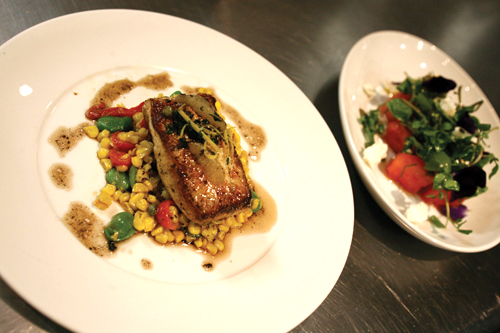
In the more temperate latitudes we turned up a corn and fava-bean succotash ($5), a marvelous, deeply American dish deeply influenced here, in color and flavor, by strips of roasted red pepper. At first I wondered why the menu made no mention of the dominant ingredient, but I came to suppose that corn and beans mean succotash, while red pepper doesn’t — plus, fava beans are rather glamorous, if any bean can be said to be glamorous. Still, red-pepper succotash would have given a clearer sense of this elegantly composed dish.

A great virtue of brasserie-style cooking is that it isn’t overwrought, and Canavan’s main dishes are exercises in well-controlled forcefulness. He allows ingredients to speak in their own way. This can be a tricky path when dealing with seafood, which so often needs a deft touch or two. Halibut is one of the rare fish (tuna is another) that can largely stand on its own, like beef, and Bluestem’s version ($24) consisted of a brick-like filet, topped with brown butter and set on a broad, flat pediment of cheddar grits (substituted for the succotash). The fish was firm, moist, and flaky — perfect — and the accompanying elements boosted it rather than trying to compete.

Calf’s liver ($21) I just don’t like and never will, but there are those who take to it almost as if it were a dessert. Here the flaps of sautéed meat were embedded in mashed potatoes, topped with ribbons of caramelized onion, and — nice touch — given a bit of smoky-sweet harmony by grilled-peach quarters.

A few housekeeping odds and ends: You get bread only if you ask for it. There is much to recommend this policy as a matter of reducing waste and the eating of needless starch calories, but it does seem stingy. Your server will also set one more bottles (still or fizzy or both) of complimentary water on your table; but then, annoyingly, some member of the staff will pop by every few minutes to see if you’ve had a sip, whereupon your glass will be topped up. I found this attention to be slightly maniacal — a restaurant version of hovering helicopter parents.

Ormsby’s desserts: well, they’re worth the wait and all the water refills. A Bing cherry sundae ($8), served in a parfait glass, could have sprung from 1950s soda fountains. It consisted of cherry gelée, fresh cherries, cherry sorbet, vanilla ice cream, and a couple of chocolate-chip cookes. There also seemed to be something crumbly inside. My only criticism would be that because Bings are sweet and mild, their delicate flavor suffered in the cold. A shot of Kirsch might have bucked them up a bit.

The Honolulu hangover ($8) had the layered, slightly boozy look of tiramisù but carried the flavors of chocolate and coconut: a chocolate-coconut layer cake amended with puffs of marshmallow cream dotted with bits of toasted coconut. It seemed to combine, somehow, a tropical flair and the memory of many backyard cookouts on the Fourth of July, with something shamelessly creamy for dessert. The end.

BLUESTEM BRASSERIE

Daily, 11 a.m.-11 p.m.

One Yerba Buena Lane, SF

(415) 547-1111

www.bluestembrasserie.com

Full bar

AE/MC/V

Moderate noise

Wheelchair accessible

Parking on the park

13

news@sfbg.com

In a steering committee meeting for the Dolores Park Rehabilitation Project on August 4, San Francisco Recreation and Park Department (RPD) officials stunned the committee with a proposal to bring in more food trucks. The move came just two days after a ballot measure that would have banned more such leases in city parks was removed from the fall ballot.

The proposal included putting in a “cement pad,” with electrical and water hookups, where food trucks would park and sell their fare. It was just the latest in a series of controversial attempts to monetize park resources to raise funds for RPD (see “Parks Inc.,” July 12). But the steering committee reeled at the idea, worried it would permanently harm the image of Dolores Park.

“It was a surprise. It really hadn’t come up before,” said Rachel Herbert of Dolores Park Café, a steering committee member. Many of the neighbors don’t like the idea of commercializing the park because there’s no infrastructure to support it, she said.

“It personally made me question if the steering committee meetings are really just a way for Rec & Park to say, ‘We reached out to the community,'” said Herbert. The rehabilitation project is in its early stages of design and development, with a predicted completion date of April 2014.

There’s already one semi-permanent food truck in the park — the La Cocina-incubated, generator-powered Chaac-Mool truck — which is parked in the main park entrance. “We felt it would be irresponsible to ignore discussing a place for more food trucks in the new design,” said Jake Gilchrist, the park rehabilitation project manager.

“There were a lot of members in the room that didn’t want this to happen,” said steering committee member Robert Brust of the nonprofit Dolores Park Works. Brust said the argument over the proposal lasted all of five minutes before landscape architect Steve Cancian, employed by RPD to facilitate the meetings, “took it off the table.”

But it doesn’t look like they’re willing to give it up, said Brust. “The fight over the ‘commercialization’ of the park is at a stalemate right now,” he said. “Rec & Park has always sold stuff—they’re just trying to capitalize on it a little more now.”

Despite the steering committee’s obvious and immediate discontent with the idea to create a cemented, permanent space for food trucks, RPD officials say they are continuing to include the idea in community discussions. But they say they are open to suggestions.

“At the end of the day, it’s the community’s park,” RPD spokesperson Connie Chan told us. “We understand that whatever vision that we have, it needs to be with the community.”

The meeting came just two days after members of the Board of Supervisors killed a previously approved ballot measure that had been written by the group Take Back Our Parks, which had been severely criticized by RPD, Mayor Ed Lee, and supporters of the department’s privatization efforts. John Rizzo, a member of that group, expects RPD to move ahead with the proposal for Dolores Park.

“They never change something because of public opposition,” Rizzo said. “It’s the same stamp they use all over the city. They come up with these plans to make money and then they unveil the plans to the public.”

Rizzo suggested that the public contact San Francisco supervisors and the mayor to be heard regarding the privatization of parks, because “the [Recreation and Park] Commission is deaf ears.” Either way, Herbert said, significant changes are in store for Dolores Park, including the possibility of putting in a 14-foot paved road for vehicles. “I just really was kind of sad when I left that meeting. I don’t know if anyone’s really going to be able to make a difference. It seems like we’re in danger of it being built,” she said. “It’s not gonna be our sweet little Dolores Park anymore.”

Maximum Consumption: Singing and slinging with One Ring Zero

1

This is the first installment of our new series, Maximum Consumption, an unseasoned look at the increasingly overlapping fields of music and culinary arts. So if you’re in a band and looking to talk chop, or a chef that moonlights as an acoustic guitar-playing busker, we’d like to talk to you.

An enticing little book landed on my desk last week. It’s part cookbook, part music journalism, part rock opus, and hell, part coffee table book. The Recipe Project (subhead “A Delectable Extravaganza of Food and Music) is a concept spearheaded by New York-based gypsy-klezmer act One Ring Zero. The band’s co-founders, Michael Hearst and Joshua Camp, created songs using the recipes of well-known chefs (Mario Batali, Isa Chandra Moskowitz, Chris Cosentino) as the word-for-word lyrics. The meals themselves served as musical influence; each recipe inspired a different sound.

While the songs are not likely ones you’d listen to say, on a long lonesome drive, they do have a certain childlike glint of glee. It’s conceptual. The true genius of this project is its overall cohesiveness. It’s an all-in-one package. Follow the recipe, listen to the song, get some interesting background factoids. There’s also the starpower — and that goes for both rockers and chefs.

Celebrated vegan author Isa Chandra Moskowitz, a.k.a one-half of Post Punk Kitchen, offers her recipe for peanut butter brunettes, and to match it One Ring Zero brought in singer Tanya Donelly (of Belly, the Breeders, and Throwing Muses) to add dreamy pop vocals. Donelly also makes another appearance later in the book as the author of a recipe called the ugly muffin.

San Francisco’s Cosentino, of Incanto, includes a recipe for brains and eggs and One Ring Zero matched it with a hyper Beastie Boys-esque rap song, as Cosentino suggested. In the preface, the reader learns that Cosentino’s brains and eggs recipe was the original impetus for the project, given its lyrical instructions. I, however, am particularly fond of the song matching Mark Kurlansky’s recipe for a raw peach. With the whisk-whisk-whisk of an old record scratch kicking off the song, it naturally leads to a sweet vintage Parisian-style ditty, you might as well be wandering the Champs-Élysées munching some ripe fruit.

But it’s not all just matchy-match recipes with songs, The Recipe Project also includes full recipe playlists, articles rock journalists, and some pretty interesting interviews with chefs, along with “A Wine Lover’s Guide to Mexican Music.” Those in-between articles start off with headlines such as “Raspberries, Moussaka, and Metallica” in which we learn that chef Michael Symon is “America’s MVP of pork” — and that Stevie Ray Vaughan is the musical equivalent.

It’s a cookbook that’s worth a spin. The Recipe Project is out Oct. 15, 2011 on Black Balloon Publishing.

Holy manta rays! (A journey to Treasure Island with Tiny Town Productions)

0

I’m coming to pick you up right now, we’re going to Treasure Island, and we’re gonna see manta rays. Jeff Waldman and Andrew Hartley shot this footage of the scrap of land (recently labeled a “food desert” for its low income residents by the Department of Agriculture) to practice their videography skills for the upcoming Bolivian leg of their “multi-country experiment in random acts of kindness.” What’d they find?

Definitely not grocery stores, but public housing, art collectives, condemned military structures, wineries, and a family of manta ray-anglers. “It’s a crazy weird place that’s largely abandoned but also partially inhabited by an eclectic mix of bizarre personalities. You get the sense that you can do anything there, without consequence or attention, despite being a stone’s throw from the most densely populated metropolitan area on the West Coast,” says Waldman. 

Food cart captures: Snaps from the Street Food Festival

1

We still had five blocks to walk, but we could already smell the medley of exotic flavors wafting up the street. Sam Love and I were headed to the third annual SF Street Food Festival, which took over blocks and blocks of Folsom Street this past Saturday, bringing together street food vendors from La Cocina, San Francisco, and even a few from across the country to share edible wares with local foodies.

Signs lined the street, warning us to “pace yourself.” This was no joke. It was hard to decide where to start, but we chose to stick with the stars of the event: the entrepreneurial women of La Cocina. When we finally picked a vendor line to wait in, some of were snaking half way down the block.

We started with some tamales from Alicia’s Tamales Los Mayas. They were creamy and delicate, and as Alicia put it with a huge smile on her face, “stuffed with love.” We could have eaten a whole suitcase full of those babies. Yum!

Then we moved on to a more tactile eating experience, stopping at Eji’s Ethiopian Gourmet for some spongy injera topped with lentils and cabbage. Using the bread as utensil, we scooped the perfectly spiced veggies up, letting them drip satisfyingly down our chins.

After a pit stop for some agua fresca, we made one more beeline to Los Cilantos, to grab an elote (how had I never had one of these before!), which is roasted corn on the cob, smothered in mayo and parmesan cheese. So good. So good!

I have no idea how many zillions of people showed up for the festival on Saturday, but I do know that everyone at the stands was working their butts off to make sure no one went home hungry.


Inside the V.I.P. cocktail party with Willie Brown

The Alliance for Jobs and Sustainable Growth hosted a V.I.P. reception just before a mayoral candidate forum held at UCSF Aug. 16, and former Mayor Willie Brown appeared to be the guest of honor. Although the theme of the event was technically “honoring San Francisco’s mayors” — former Mayor Frank Jordan was there, someone indicated that former Mayor Art Agnos was in the room, former Mayor Gavin Newsom was invited but didn’t show, and Mayor Ed Lee was of course in attendence — Brown seemed to be given more prominent recognition than any of the others.

The moment he strolled in, Sup. Mark Farrell, who was doing introductions for the the affair, scrambled onstage to announce Brown’s presence and deliver a warm welcome, and everyone applauded. Within minutes, the former mayor was seen chatting with a crowd that included Mayor Lee and several others. Soon after, Brown and former Mayor Frank Jordan were summoned to the stage to say a few words.

Once in the limelight, Brown cracked a few jokes. He said he felt for the 36 mayoral candidates, who are forced to campaign in an era when the Internet threatens to reveal videos and photos of them at any time to thousands of online viewers. “I’m glad they didn’t have that kind of communication system when I was running,” he said. “I can’t imagine the photographs you’d have of me floating around doing things I shouldn’t have been doing.”

As for his own time in Room 200, “I enjoyed every single solitary minute of it, and if I really thought I had great skills, I would be number 37,” he said, drawing more applause.

Then again, common wisdom says it isn’t necessary for Brown to bother campaigning in order to gain access to Room 200 these days. Later that same evening, during his own turn in the spotlight at the mayoral debate, Mayor Lee came under fire from Board President David Chiu, who revealed that Lee had privately confided to him about a week before he announced his candidacy that he was having a difficult time saying no to Brown and influential Chinatown business consultant Rose Pak when it came to launching a campaign for a full term.

Chiu’s pointed question for the mayor was what had changed in his mind since that conversation, but Lee referenced neither Brown nor Pak in his answer. Instead, he said he’d changed his mind after witnessing his success in changing the tone of government and getting things done in City Hall.

Back at the V.I.P. reception, Brown and Jordan were invited onstage again, this time to receive awards presented by the Alliance for Jobs and Sustainable Growth. But first Steve Falk, president and CEO of the San Francisco Chamber of Commerce, reminded the crowd that there was still time to buy a drink before the debate got underway. He said, “Debates are much more interesting after three drinks.”

Before Falk presented Brown with a commemorative plaque, he said, “It’s tough to put in a few sentences the life and times of Willie Brown,” and proceeded to note that, with his term in the California Assembly and time serving as mayor of San Francisco behind him, Brown “has now followed his friend Herb Caen into an honest line of work as a columnist for the San Francisco Chronicle.”

Being a newspaper columnist doesn’t mean Brown is always kind to members of the local media. While mixing through the crowd minutes after receiving his award, he fired some harsh words at a well-known City Hall reporter who had recently published some unflattering articles about the “Run, Ed, Run” effort to encourage Lee to seek a full term.

In recent months, Brown’s columns have provided the public at large with a rare glimpse into Mayor Lee’s dining experiences in San Francisco. In February, Brown wrote in one of his columns that he went out to North Beach Restaurant at sat at the window table with Lee, Brown’s “friend” Sonya Molodetskaya, and Jack Baylis, who serves as the US Group Executive of Strategic Development for AECOM, one of the city’s largest contractors and a sponsor of the Alliance for Jobs and Sustainable Growth Event. (Baylis was on the invite list for the V.I.P reception, too.)

Apparently, AECOM had something to celebrate that same day — according to an Aug. 16 press release, an AECOM joint venture was just awarded a $150 million contract for program management services for the San Francisco Public Utilities Commission’s wastewater improvement program.

The V.I.P. reception had representation from many key players in the downtown business community, with sponsorship from AT&T, AECOM, Pacific Gas & Electric Co., Wells Fargo, Motorola, California Pacific Medical Center, the San Francsico Chamber of Commerce, the Building Owners and Managers Association, the San Francisco Police Officer’s Association, Shorenstein Properties, and others. Several labor unions, including the United Association of Plumbers & Pipefitters Union Local 38, United Brotherhood of Carpenters and Joiners of America Local Union No. 22, and United Food and Commercial Workers Union Local 5 were also listed as sponsors. Guests included district supervisors, developers, lobbyists, business owners, mayoral candidates, media spokespeople, executives from the health care industry, and other political insiders.

Clearly, there were many people in the room who wanted to get on Brown’s good side.

Sweet streets: Gelatin dessert art at this weekend’s Street Food Festival

0

As the foodie masses descend on the Mission for Sat/20’s Street Food Festival, they’ll be met with a diverse representation of what San Francisco eats. In this corner, fancy brick and mortar spots: Slanted Door, 15 Romolo, and Rye are but a few representatives of the eateries that are taking grills and spatulas into the fresh air this weekend. But for sheer culinary comeliness, the big guys have a serious contender when it comes to Sweets Collection arty gelatin creations. 

Graduates of the La Cocina street food incubator program will total a solid 50 percent of the 60 vendors in attendance at the festival. The varying styles of food preparation are meant to express the breadth of eats in San Francisco, but also to reinforce the fact that the huarache you buy at your local farmer’s market has the culinary chops to stand up against many places that take Visa.

According to the website, in a perfect world the festival would “get rid of all the white tents, and just do it block party style, but that’s not so cool with the Health Department, so you will have to imagine it with us.”

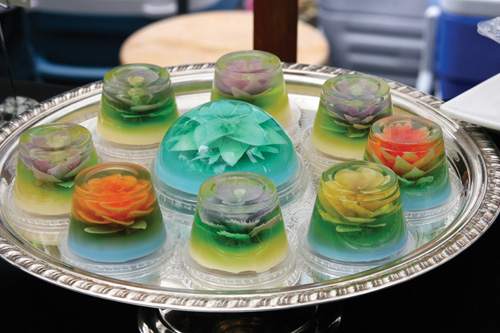
Rosa Rodriguez would surely be invited if the fest turned into a block party. She lives in the Mission, and has been creating her Sweets Collection intricate gelatin creations, in which graceful flowers bloom in edible gel, for a year now. We mentioned certain circumstances under which her treats might prove particularly awesome in the paper today, and here’s more on Rodriguez from an email interview we conducted with her last week. (You can also check out food writer Virginia Miller’s adventuresome picks for the fest here.) 

Sweets Collection got its name when Rodriguez realized her treats wouldn’t look amiss in an art gallery

SFBG: Tell us a little about yourself. How did you start Sweets Collection?

RR: My name is Rosa Rodriguez, I have two children, one is 15 years old and named Dayra, and Hasam is eight years old, we are from Durango, Mexico. I’m a single mother. When we are not doing artistic desserts, my children go to school and I take English classes and work on my business. I became unemployed in 2009, and in 2010 I had the idea of starting my own business to cover household expenses and share the art of my greatest passions.


SFBG: Can you tell us a little about gelatin art?

RR: Arte floral en gelatina has become a centerpiece of Mexican culture. Evening parties in Cancun often have intricate gelatin dessert flowers served in glass, personalized gelatin desserts are in demand at corporate events in Mexico, and no birthday is complete without fun gelatin designs on the cake.  


SFBG: Most of your work I’ve seen is of flowers. Do you do any other kinds of designs?

RR: I am fascinated by flowers, but do figures, characters or any design. You can get your favorite hobby, movie, or fantasy adventure in a gelatin dessert.


SFBG: What are you bringing to the Street Food Festival this weekend?

RR: Sweets Collection will participate by offering fanciful jello shots at two bars that will be located on Folsom and 23rd streets. But we also have a booth on that intersection, selling designs that the entire family can enjoy. Last year was my first year, like me, many people were impressed by the art to gelatin and I hope that this year more people came by our Booth , to know and taste the art you can eat.


SFBG: What does it taste like?

RR: This artistic dessert is made with passion. They’re handcrafted and they taste how they look… delicious.


San Francisco Street Food Festival

Sat/20 11 a.m.- 7 p.m., free

Folsom between 22nd and 26th sts. and surrounding area, SF

www.sfstreetfoodfest.com

Fairer trade?

6

news@sfbg.com

Many people will pay more for a cup of coffee if a significant amount of that money goes to the people who grew its beans, helping improve their lives and communities. That’s the idea behind Fair Trade Certified coffee.

But Fair Trade may not be as lucrative for coffee farmers as people are led to believe, and uncertified San Francisco roasters such as Four Barrel, Ritual Roasters, and Blue Bottle appear to be making more significant impacts on the growers they buy from.

Fair Trade was once just a name for ethical commerce and an idea to fairly pay the farmers growing our food, but Fair Trade Certified* is now a trademarked term owned by Fair Trade USA*, based here in the Bay Area. To label their coffee with the Fair Trade certification, coffee farmers must buy into the system and abide by strict standards set by the cooperatives that oversee their production.

Although Fair Trade Certified coffee sells at significantly higher prices than generic coffee, the coffee producers often don’t see the majority of the increased profits. That’s because all the parties involved in the system take shares of that increased price.

“The buyer buys the coffee at a hiked price, assuming the price is trickled down to the farmer, but it isn’t,” says Masumi Patzel, a political scientist who made a recent research trip to the coffee farms of Guatemala. “The people who are benefiting from Fair Trade are the exporters.”

The coffee producers only receive a fraction of the final cost of the coffee, says Patzel, and her research has shown it hasn’t done much to improve conditions in coffee-growing communities.

“What are these farmers going do? How are they going to feed their families?” she asks.

Patzel says that in Guatemala, a country of mostly farmers and peasants, more than half of all personal income is spent on food (compared to about 20 percent in the U.S.), food prices have risen 80 percent in the last 10 years, and nearly half the population suffers from malnourishment.

Buying into the Fair Trade system and switching to the monitored system of growing coffee can be costly for the Guatemalan farmers who are struggling to get by. “They are just not making the cut,” she says, noting that on the farms she visited, farmers only drank instant coffee because they couldn’t afford the coffee they grew.

Yet Fair Trade USA spokesperson Stacy Geagan Wagner says Fair Trade has helped farmers. “Fair Trade is essentially an agreement between producers, industry and consumers,” she says. “Fair Trade agrees to pay a fair price for the products.”

At Fair Trade USA, which oversees the label, that “fair price” comes to at least $1.40 per pound of coffee beans, with an added 20-cent community development premium given to the farmers and a possible 30-cent organic incentive.

“Essentially the farmers always get higher then market price,” Wagner says, “because they get the premium, the organic incentive and the minimum price.”

However, the International Coffee Organization’s most recent composite had the average worldwide coffee price at $2.15 per pound, higher than the Fair Trade price. To work with the ever fluctuating coffee market, Fair Trade Certified coffee farmers are either paid the minimum of $1.40, or the current market price, whichever is higher.

“The Fair Trade minimum covers the cost of sustainable production,” says Wagner, “so they don’t starve to death when the market crashes.”

Some of San Francisco’s most popular coffee roasters have chosen to buy their coffee directly from the farms that grow it, bypassing the Fair Trade system and paying the farmers significantly more while forming a strong relationship between producer and roaster. Without the middlemen, there is suddenly a smaller separation between the farmer growing the coffee and the consumer purchasing it.

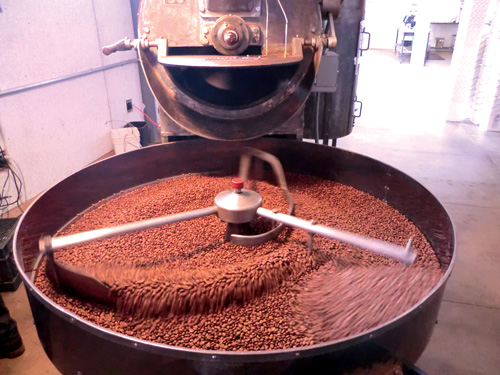
I saw that illustrated on my recent visit to the Ritual Roasters facility where roasters convert raw beans procured worldwide into aromatic coffee. As I was drinking a cup of very fresh coffee, owner Eileen Hassi showed me pictures of the exact farm where my coffee had been grown.

She had made a recent trip to this Costa Rican coffee farm, and taken pictures of the farm, the processing facilities, and the owners. It is this visible connection, as well as high quality coffee, that contribute to the growing popularity of some San Francisco independent roasters.

Local roasters Ritual, Four Barrel and Blue Bottle Coffee Co. follow this model of buying coffee directly from the producers and forming beneficial relationships. Some roasters call this direct trade.

“For me, it’s the only way to get the best quality coffee and the only way that you can continue to get the best coffee is to pay good money for it,” says Four Barrel owner Jeremy Tooker. “If you pay your pickers better then they pick better coffee.”

Hassi believes that the cost of coffee will continue to increase because of a volatile, heavily fluctuating market, increased consumption, and global warming causing some places to lose their capability of producing coffee.

“If all of us in the developed world want to keep drinking coffee,” she says, “we need to get used to paying a lot more for it.”

James Freeman, owner of Blue Bottle Coffee Co., says he believes there’s a place for Fair Trade. “It’s a certification and, like all certifications, there’s the pluses and the minuses,” he says. Yet his coffee is uncertified and purchased directly from producers and organic cooperatives. “The cheapest we buy coffee for is probably two, two-and-a-half times the fair trade minimum,” he says. “In a way it’s better for fewer farmers, but at least it’s better.”

Wagner disputes several San Francisco roasters’ claims that the $3–<\d>$4 minimum price they pay is double Fair Trade’s. “The market has been over $3 on many occasions in the past year,” she says, reiterating FairTrade’s policy to pay producers either the Fair Trade minimum or the market price. “So to say you’re paying double the fair trade minimum without knowing what is going on that is actually you distorting the information…We love people’s efforts to trade more directly with farmers, but we do not appreciate spreading misinformation about Fair Trade. That doesn’t help anyone.”

Fair Trade’s popularity stems from its altruistic image, and to lose this image through “misinformation” might do damage to its popularity. But challenging people’s assumptions about Fair Trade could help raise its standards, which Patzel says need to be “upgraded and improved”.

“It is my belief,” she says, “that the FTA [Fair Trade Association] and other certifying entities may want to consider how to improve the Fair Trade calculator, ensuring that it is not the exporters that are making the majority of the income and instead, increase the wealth distribution starting at the very base and bottom of the pyramid, not in the middle.”

Even Wagner concedes, “We’ve made significant impact but we can do more.”

Patzel says Fair Trade farmers may not even be treated better than convention coffee farmers. “Just because a farmer is producing Fair Trade coffee does not mean — not at all — that they are being treated better than farmers who are not. It depends on what kind of relationship they have with the producer,” she says. “It really is a case by case basis.”

Gilbert Ramirez has been working to run a cooperative in Costa Rica for 25 years that is 70 percent Fair Trade. For him, the monetary increase between Fair Trade and conventional coffee is 15-20 percent.

“But if we’re taking into account the added value, I’d say that we get 50 percent more in added value when we work through Fair Trade,” says Ramirez. “There’s a long list of things we consider added value, and the largest added value Fair Trade allows us is knowledge.”

Ramirez says he believes that Fair Trade has significantly helped his community. “Farmers are happy in Fair Trade because it’s a model that respects them. And it’s a model that gives farmers a guide on how to develop themselves better.”

In 2010 his cooperative received $8 million in premiums to invest in the community. And yet he says, “The situation is a bit difficult because the cost of living has gone up a lot. In Costa Rica, there’s a higher cost of living than in other countries. We have a really high tax environment in Costa Rica, and also really low production so it doesn’t allow the country to have a lot of economic development.” In the end, consumers can choose to buy a pound of Peet’s Fair Trade Coffee for $15.95, or a pound of Ritual’s Los Crestones coffee for $22.50 and know that it was produced in Costa Rica by Grace Calderón Jiménez before I probably watched it being roasted here in San Francisco.

* This article was changed to correct the name of the organization and its trademark.

Cluck and shuck

0

le.chicken.farmer@gmail.com

CHEAP EATS Beignets have cheese in them. Boudin does not have rice. Andouille is made of tripe. It’s not the least bit spicy. I’m learning a lot in France, and one of the things I’m learning is I can’t wait to be back in New Orleans.

In Rochefort they are building a ship, a more-or-less exact replica of the Hermione, which carried LaFayette from Rochefort to Boston in 1780 with news that yo, the French had our back. According to some Frenchies who I ate with, the new Hermione upon completion will also sail from Rochefort to Boston! You know, for old time’s sake.

I’ve tried more than once to get into the little shipyard there and have a peek at it. I want to know approximately how much time I have to get back home and start a revolution. But alas, I haven’t got a clue.

Yesterday I cooked up one of Farmer Fabienne’s chickens for dinner and we ate it again for lunch today, and I still can’t believe how goddamn awful good it tasted. And juicy! Even the breast. Even warmed over. I’m accustomed to true free-range chickens being a tad too easily overcooked. In fact, until we sunk our teeth into it, I was sure I had overcooked this one and had already started my suicide note while I was waiting for Fabienne and Fred to come in for dinner from the fields.

“You raise you a fine, fine chicken, farmer,” I said to Fabienne.

“And you cooked it perfectly, farmer,” she said to me.

We call each other farmer. Fred, technically, is a carpenter.

The secret from her end, Fabienne said, was in the corn, which (allegedly) “builds lipids.” So her feed, which she grows herself organically, is more corn than wheat or sunflower seeds. And the chickens of course also have access to grass and bugs and sunshine.

Hedgehog is in New York now, working on a movie. When I sent her a picture of our dinner and explained about the lipid-ish juicy excellence of it all, she of course wanted to know if the corn was sweet corn or “ratty yellow stuff.”

“Hold on a second,” I said (but in an email). And I went out into yon cornfield to check.

Yellow. I didn’t see any rats and or rattiness, but I’m guessing it ain’t exactly sweet corn by Hedgehog’s standards. I’m not saying she’s a sweet corn snob, but she is. And she has every right to be, like I’m a snob about butter. And together we shall make the best popcorn in the history of the world, if not cinema.

So, yeah, she’s working on a movie and I’m working on a book. And I send her pictures of the food I’m feeding the French and she sends me baseball reports from the States.

As if I cared. Which I do. Again. Thanks to both her and Baseball Mary. Baseball Mary, you will recall, presides at the Clement Street Bar and Grill, my new favorite bar. And grill, come to think of it.

Hedgehog and I had the honor of house and garden-sitting for my pals Papa and Papi, thanks to which you will be reading about much more avenue-y than usual restaurants over the next few weeks.

The Clement Street Bar and Grill was where we watched our baseball, except for one evening we also ate there, along with the Choo-Choo Train, Ding-a-Ling-a-Ling, Earl Butter, and a couple of visiting beloveds from Ohio.

Me, I got osso buco with garlic mashed potatoes. Hedgehog had the duck breast special. Earl Butter had a steak, and I forget what all else was flying around the table. But for sure, a lot of happy faces and good times, not to mention full bellies.

This is a real gem of an unpretentiously old-school filler-upper, whether you’re eating or drinking.

We bellied up to the bar afterwards to watch the end of the Giants game, and Baseball Mary joined us for a little while, but then the game went into extra innings and we all had to leave.

CLEMENT STREET BAR AND GRILL

Tue.-Thu. 4:30 — 9:30 p.m.; Fri.-Sat. 4:30-10 p.m.; Sun. 10 a.m.-3 p.m. & 4:30 — 9 p.m.

708 Clement, SF

(415) 386-2200

Full bar

AE/D/MC/V


Una Pizza Napoletana

0

paulr@sfbg.com

DINE If food is art (probably not, by the way), then Una Pizza Napoletana is probably the closest thing we have to a food-art installation.

This phrase, “art installation,” isn’t exactly euphonious. You install mufflers and software, and (if you’re the new head coach of the 49ers) the West Coast offense. You install a new dishwasher. Art, whatever it may or may not be, deserves a more supple verb.

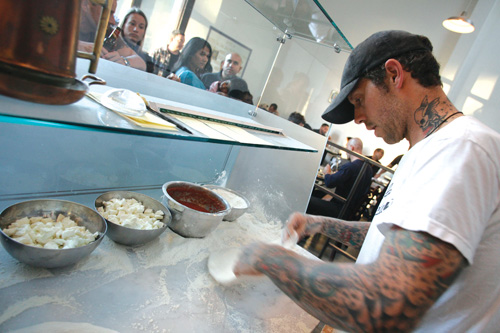
Picture a white cube with high walls, mostly bare except for white tile wainscoting (rather restroom-y, I thought, but most likely practical). At the center behind the glass podium, a pizza oven of turquoise tiles like a huge Navajo artifact recovered from an archaeological dig. The space, on a nondescript SoMa corner, looks like one of the art galleries you might find in the western reaches of Chelsea, in the part of New York City where the avenues are a little wider, the buildings less tall, and the city feels not quite so breathlessly compacted.

Una Pizza Napoletana’s crowd fits the space: it’s youthful and knowing, ritualistically peering into smart phones, willing to wait for a table at a place that is so plainly and peculiarly happening. Young people don’t want to miss out, it’s their greatest fear.

What they will find missing here is anything other than pizza. That is the menu: pizza in five versions, no substitutions, no polluting table-side condiments like oregano or chili flakes (but salt and pepper, in demure shakers). That is all. No side dishes, soups or salads, no fritti misti, no pastas or roasts. The pizza isn’t sliced for you either; it’s uncut, we might say. Seinfeld had the Soup Nazi (not to mention that lunatic mohel), and we have this.

The maestro of this remarkable production, Antonio Mangieri, can be observed behind the podium manning the oven, wielding his long-handled peel like a medieval knight with a lance. He could be a mime, a figure of soundless kinesis: he stretches, he thrusts, in goes a pie, out comes another, on goes a drizzle of olive oil from his copper urn and a handful of fresh arugula.

It’s hard not to watch his act, because he’s at the very center of things. Also, you’re likely to be quite hungry and wondering if the pizza he’s lifting from the oven might be headed for your table. If it is, you’ll be happy, because the pies, despite their stark lack of trappings are worth waiting for and even suffering (a little) for.

The heart of any pizza is the crust, and UPN’s crusts deserve the ultimate compliment: they could stand on their own, without any toppings at all. They have a slight thickness and focaccia-like sponginess that cuts against current cracker-crust vogue, and they taste quite distinctly of sourdough. It is rare in my experience that pizza crust, even in good pizzerias contributes flavor. Mostly one is attentive to, and grateful for, texture (chewy? crispy?) and the structural question of whether or not the points droop. UPN’s did droop for us a little, but that was probably because we were hacking our way through them haphazardly, so the pieces weren’t symmetric.

Another factor in the droopiness would likely be that the pies are generously laden with toppings. You don’t get a dusting of this and a few gratings of that. These pizzas are loaded. The bianca ($20) for instance, was fitted out with extra-virgin olive oil, garlic, sea salt, at least a dozen thumbs of buffalo mozzarella, and plenty of basil leaves which interestingly accompanied the rest of the pie into the oven rather than being put on after the pie had baked — and were accordingly blistered. Basil’s flavor can withstand rougher handling than that of most other herbs (you can keep pesto made from your summer surplus frozen for months without having it go flat), but I did think that in this case the high heat had diminished the leaves’ fragrant, peppery bite.

The Ilaria pie ($22) by contrast was strewn with fresh arugula leaves, but these were aftermarket add-ons and had not been asked to face a 900-degree Fahrenheit oven. As a result they retained their fresh, nutty flavor, but they also were not well-integrated with the rest of the toppings. Instead they amounted to a mat laid over their accompaniments — a kind of roof to the crust’s floor. Those other toppings included extra-virgin olive oil, sea salt, cherry tomatoes, and smoked mozzarella. I thought the last would be the dominant flavor — smoked anything often asserts itself over other ingredients in the vicinity — but it was mild and muted here.

Service is excellent, and a brief wine list offers several unusual, pizza-friendly Italian bottlings in both red and white by the glass. But I noticed quite a few bottles of Moretti beer on nearby tables, too. If beer matches up with almost any food, then pizza — more than almost any other food — matches up with practically any drink euphoric in nature.

UNA PIZZA NAPOLETANA

Dinner: Wed.-Sat., from 5 p.m.

210 11th St., SF

(415) 861-3444

www.unapizza.com

Beer and wine

MC/V

Noisy

Wheelchair accessible

Green buds

56

steve@sfbg.com

CANNABIS Most marijuana sold in Bay Area dispensaries is grown indoors, where the ability to precisely control conditions creates the kind of buds — strong, dense, crystal-covered, fragrant, beautiful — that consumers have come to expect. But that perfection comes at a high price, both financially and environmentally.

So some local leaders in the medical marijuana movement have begun to nudge the industry to return to its roots, to the days before prohibition and the helicopter raids of the Campaign Against Marijuana Planting chased the pot growers indoors. They say it’s time for California to start growing more of its cannabis outdoors again, in the soil and sunlight, just like the rest of the state’s crops.

Growers have long known how inefficient it is to grow indoors. All they need to do is look at their huge monthly energy bills. Between the powerful grow lights, constantly running air conditioners, elaborate ventilation systems, pumps and water purifiers, and heaters used for drying and curing, this is an energy-intensive endeavor.

But a widely circulated study released in April — “Energy Up in Smoke: The Carbon Footprint of Indoor Cannabis Production” by Evan Mills, a researcher with Lawrence Berkeley National Laboratory — revealed just what a huge cumulative toll the practice was taking on California and the planet.

It found that indoor pot production accounts for about 8 percent of California household energy use, costing about $3 billion annually and producing about 4 millions tons of greenhouse gases each year, the equivalent of 1 million automobiles. Producing one joint was the equivalent of driving 15 miles in a 44 mpg car.

“The emergent industry of indoor Cannabis production results in prodigious energy use, costs, and greenhouse-gas pollution. Large-scale industrialized and highly energy-intensive indoor cultivation of cannabis is driven by criminalization, pursuit of security, and the desire for greater process control and yields,” Mills wrote in the report’s summary.

Yet while opponents of marijuana seized on the report to condemn the industry, proponents say there’s a very simple solution to the problem: grow it outdoors. And with the artisanship and quality in the fields and greenhouses now rivaling that of indoor buds, the biggest barriers to moving most marijuana production outdoors are federal laws and the biases of pot consumers.

“There’s a misconception out there that indoor is better marijuana than outdoor, but we don’t think that’s true,” Erich Pearson, who runs the San Francisco Patient and Resource Center (SPARC) dispensary and sits on the city’s Medical Cannabis Task Force. “Marijuana is a plant that came from the earth and that’s where we should grow it, just like our food.”


INDOOR VS. OUTDOOR

There are definitely some benefits to growing indoors, beyond just the ability to hide it from the prying eyes of law enforcement. The grow cycles are shorter, allowing for multiple harvests around the year. The generally small operations and precise control over growing conditions also tend to produce the best-looking buds, which command the highest prices and win the top prizes in competitions.

Kevin Reed, who runs Green Cross — a venerable medical marijuana delivery service that works closely with an established group of growers — told us there are several reasons why indoor buds have dominated the marketplace.

“The most important factor is local laws and regulations and the enforcement of those various laws. A second factor is space and climate — obviously outdoor cultivation will flourish is some places better than other. And, a final factor is sustainability of the market; indoor cultivators can produce crops on a year-round basis, providing some stability in the market over the long-term, especially in the event of crop failure or other unforeseen and unexpected disasters,” Reed told us.

Yet he also said, “If cultivated correctly and with care, there should be no difference between the same strain grown in- or outdoors.” And he said that from an environmental standpoint, outdoor is clearly superior: “So far as environmental factors are concerned, there is little doubt in my mind that outdoor cultivation is kinder to Mother Earth.”

Wilson Linker, with Steep Hill Laboratories, Northern California’s largest tester of medical marijuana, said that outdoor plants generally have more vegetative growth because of the longer light cycles, meaning that “indoor tests generally higher in cannabanoids, with THC [marijuana’s main psychoactive compound] in particular.”

But he and other marijuana experts also say that the quality of the buds ultimately depends on a wide variety of factors, from the strain used to the expertise of the cultivators to the time and care taken by the trimmers.

“I’ve seen outdoor that can compete with the best indoor strains,” said David Goldman, who runs San Francisco’s Americans for Safe Access (ASA) chapter, sits on the city’s Medical Marijuana Task Force, and is active in rating the various dispensaries and pot strains in terms of quality, using magnifying glasses to investigate the trichomes and other characteristics. “I would match the best outdoor I know up with anybody’s indoor, any day.”

Even when indoor buds look better, Pearson said, that doesn’t means they are better. Looks can be deceiving, he said, noting how local consumers now accept that those perfect-looking, genetically modified apples and tomatoes in the store aren’t as tasty or good for you as their ugly, organic counterparts.

“It’s not all about appearance,” he said, noting that marijuana grown in the sunshine is more robust and complex than its indoor cousins.

“We’re starting to find [outdoor] strains that were scoring just as high as indoor,” says Rick Pfrommer, the purchasing manager for Oakland’s Harborside Health Center.

And that’s especially true when the cannabis is grown in greenhouses, where it gets natural sunlight but growing conditions can be controlled better than in the fields.

“Greenhouses can attain a level of cosmetic attractiveness that is right up there with indoor,” Pfrommer said.

“There are a lot of products coming out of greenhouses that even trained eyes can’t tell the difference with [compared to indoors],” Linker said. “Greenhouses are the future.”

Or at least they might be the future if there is a change in the federal laws, which still view any marijuana cultivation as a crime — which is why indoor grows flourished in the first place.


LINGERING PROHIBITION

Rising demand for medical marijuana has created some regulatory pushback, even in pot-friendly San Francisco, where the Department of Public Health announced earlier this year that it wanted to create a registry of growers that work with the dispensaries in order to weed out the illegal growing operations.

“In the last few years, there’s been a proliferation of both illegal and legal cultivators,” Dr. Rajiv Bhatia, San Francisco’s environmental health director, told us earlier this summer. “We’re asking for this information to try to steer them back toward legal cultivation.”

Reed, Goldman, and other industry representatives strongly condemned the move, mostly on the grounds that creating lists of growers could subject them to federal prosecution, so the idea was shelved for now. But Bhatia said the problem remains, and in San Francisco, it’s a problem created largely by the demand for cannabis grown indoors.

But allowing for a more widespread conversion to sustainably grown marijuana will require a relaxation of the federal enforcement to allow for more land cultivation and the development of high-tech greenhouses.

“A lot of that rests in the hands of law enforcement,” Pearson said.

But it isn’t just the cops. Consumers are also supporting indoor grows.


SUPPLY AND DEMAND

Pfrommer said there are many factors that influence whether customers choose indoor or outdoor, or what he calls the “bag appeal” that causes customers to zero in on one strain among the 40 or so that can be offered at one time.

Generally, indoor grows are smaller operations, allowing greater care in the tending and processing of the buds, whereas outdoor grows usually produce large crops harvested all at once, “so frequently people won’t manicure it as well,” Pfrommer said.

Smell is another big factor, Pfrommer said, and that’s one area where he thinks outdoor actually has an advantage. “Outdoor generally has a more pungent smell,” he said. “Cannabis is very sensitive to the environment, so it can pick up elements from the soil, the wind, and the surroundings. It picks up different qualities.”

For that reason, he also said, “I personally find outdoor to taste better when it’s grown well,” comparing it to the subtle qualities that various appellations can give to fine wines.

The final factor is price, and that’s one area where outdoor has a distinct advantage. SPARC is currently selling quarter-ounces of greenhouse-grown Big Buddha Cheese with a THC content of more than 17 percent for just $70. And when the buds from open outdoor fields arrive this fall, they’ll be as low as $50.

“This,” Pearson said, holding up a beautiful bud of greenhouse-grown Green Dragon, “was grown at a fraction of the cost of indoor and it’s outstanding.”

“That’s why indoor sells for so much more,” Goldman said, ” because it costs so much more to grow.”

So if outdoor cannabis is cheaper, better for the environment, less risky for the industry, and just as good, why are the indoor stains still so much more popular?

“You’re looking a 20-plus years of indoor being the standard,” Pfrommer said, noting that the hardest part of creating a more substantial changeover in people’s buying habits is their expectations.

He said Harborside started offering more outdoor strains three years ago, “but the market wasn’t responding as strongly.” In other words, people still preferred indoor.

Yet things are changing, prompted partly by the Mills study. “That was what kicked off this latest round,” Pfrommer said. “There is a small but growing awareness among the regular marijuana consumers about the costs of growing indoors…The consciousness is starting to shift, but it’ll be slow, probably over the next two seasons.”

Harvests usually take place during the full moons in September and October, after which they are cured and processed for about four weeks, finally coming to market around Thanksgiving.

“It’s mostly an education process,” Pfrommer said. “We’re going to have a vigorous push around harvest time this year.”

“We’re trying to transition completely to outdoor because the environmental toll is less, the cost is less, the yield is higher, and our testing is showing that the quality is just as good,” said Nick Smilgys, who has done both marketing and purchasing at SPARC. “It just makes more sense to grow it outdoors.”

Munchies

0

HERBWISE There will be things at this weekend’s Street Food Festival that you will want to eat. Oh yes, very much so. And damn if there won’t be things that you will want to look at — and then eat.

One of these things will be Rosa Rodriguez’ Sweets Collection gelatin desserts: small, sweet cups in which three dimensional flowers bloom, taunting you to stick a spoon in them. I will take them over designer cupcakes any day.

Rodriguez, who now lives in the Mission with her two daughters, is from the Mexican state of Durango. There, large gelatin molds traditionally bloom at birthdays, baby showers, and wedding parties; red roses and yellow zinnias made of condensed milk curling prettily around the faces of happy couples and beaming little girls. When I asked her via email about her San Francisco customers’ most common reaction to her wares, she said it is uncertainty. “They ask if they can eat the flower, or if it’s plastic.”

A La Cocina street food incubator program graduate, Rodriguez will be in the heart of the Mission this Saturday, along with the rest of the sweet and savory offerings of the Street Food Festival’s 60-some vendors. She’ll be selling “fanciful jellos shots” at the festival’s bars on 23rd and Folsom streets, and her more family-friendly concoctions at a stand of her own on the same intersection.

Saturday will entail a lot of eating, and a lot of gawking at fanciful jello shots, and for these reasons alone the day will go very well if you are really, really stoned.

But ingesting marijuana before the Street Food Festival is a delicate matter. After all, the third year of the event will be the biggest yet, its girth spanning eight blocks of Folsom Street, plus parts of 23rd, 25th, the Cesar Chavez Elementary School parking lot, and the Parque de los Niños Unidos.

In past years, massive crowds have marred the day for many an avid snacker — the lines, my friend, the lines. This year La Cocina is hopeful that the vast expansion of the event will stem the tide — but nonetheless it would not do to have agoraphobia derail you just as you are reaching the front of the line at the Kasa booth.

Luckily, there are plenty of San Francisco souls that geek out tailor-making THC regimens for situations like these. I placed a call to one such place humans like this congregate: the San Francisco Patient and Resource Center, winningly acronym-ed SPARC. It just received our Best of the Bay reader’s poll award for Best Cannabis Club and it’s well known for having an extensive selection of in-house strains. It seemed like a fine place to start out.

Nick Smilgys, who has served as the club’s marketing director for over a year now, had two words for me: blackberry kush. Then he had some more. The kush — which he says is traditionally cultivated in Pakistan and India, but happens to be one of SPARC’s signature strains — is a deep-green indica that’ll make you hungry as hell, ready to take on all those Indian burritos and handmade huaraches.

Smilgys says the blackberry buds create “good well being” in their ingester, and result in a nice body high. Of course, he cautions, medicines will have differing effects on different patients.

But if you’re not careful with the blackberry, it could keep you from your improbably edible jello flowers. (Smilgys employed the term “couch lock” to describe a potential blackberry kush effect.) If you’re prone to getting paranoid, he counsels medical marijuana patients to look for a sativa-indica hybrid that tilts to the indica side of things for a more tranquil, crowd-ready high.

Be brave friends, eat the flower. *

STREET FOOD FESTIVAL

Sat/20 11 a.m.-7 p.m., free

Folsom between 22nd and 26th sts. and surrounding area, SF

www.sfstreetfoodfest.com


Big Boi, big deal: Outside Lands 2011 pics

2

All photos by Erik Anderson Imagery and Caitlin Donohue

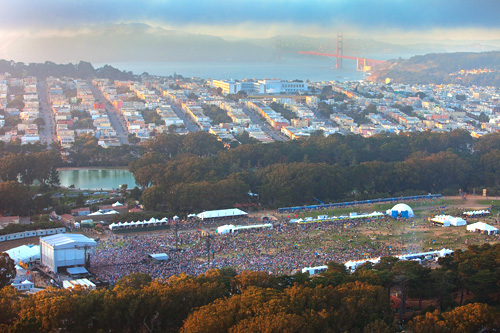
I’m just going to go ahead and say it because I’ve had a few days to think about it: that was the best year of Outside Lands yet. Not just because of the weather — even though my singed epidermis is ample proof that the sun was out and about in Speedway Meadows this weekend — but because after four years of hype, the sold-out festival is finally justified in its claim that it’s among the top five biggest and best in the country.

So who cares if Big Boi didn’t show up (at least we got beach ball humor from Dave Chappelle, who seems to be showing his face more around these parts lately) — a bonus appearance from M.I.A. during Deadmau5 evens it all out in the cosmic sense of things. And who could be mad at Sir Lucious when Bay hip-hop repped as hard as it did with K. Flay and Latryx featuring Jazz Mafia? Not to mention local turns by show-stoppers tUnE-yArDs, who are not rappers but proved on Sunday afternoon that the group might have enough swagger to qualify. Oh — and yeah, the headliners. Arcade Fire, you really did deserve all the buzz. 

Like I’ve said in the past, some of the best parts of this festival took place off of any stage (and I’m not talking about the Loyd Family Players’ impromptu shows in the transition areas of the fest). The half-moon of Eco Lands stalls gave the three-day affair a little purpose beyond entertainment — everyone from Wavy Gravy’s Seva Foundation to the Wigg Party was there, the latter doling out chalkboard necklaces so that fest attendees could have a forum to share their thoughts with the guy standing behind them at Beirut. (“Free hugs” was a common refrain.)

The trippy little path from the main entrance out to the Twin Peaks Stage provided a welcome respite from the crowds, a nice improvement on the at-times-gridlocked inter-set migrations of past years. Plus, festival organizers stuffed it with sideshows — a dessert food court, a lackluster Mexican food court regrettably dubbed “the Mission,” and a phenomenal art installation by Monica Canilao and other local creatives: a fabric-parachute hinterland that fluttered soothingly in the breezes that whipped in from park’s edge Ocean Beach (bummer that a lot of it got ripped down by last-day rowdies). Coupled with a windchime swing and a wacky, remant-built castle, the OL consciousness-expanders finally had a place to breathe deep and reflect. 

Anyway, good job everyone on staying hydrated. See ya next year.

See also Emily Savage’s take on day three of the fest

Appetite: A mouthwatering preview of the SF Street Food Festival

0

La Cocina‘s SF Street Food Festival keeps getting bigger each year. Gearing up for this Saturday’s (8/20) third annual street food extravaganza, prepare for a takeover of numerous Mission blocks (free admission, with food for purchase under $8). This year there was an early sneak peek for media and select guests. There will be much to love at this year’s festival. Many food truck and street food favorites return, plus Ferry Plaza stars like Namu. Just a few stand-outs the new-to-this-year front:

Wax moth larvae tacos from Don Bugito – These pretty, little tacos are laden with crispy larvae, garlic, pasilla chiles, and pickled onions. Some popped them in their mouths without realizing what they were, others turned away once they heard… but to taste them is to be converted. No need to fear bugs in the hands of owner, Monica Martinez. Plus, it’s a great conversation starter.

15 Romolo’s jambalini – I’ve been touting 15 Romolo since day one. One of our city’s best bars is also home to some of the best bar food (just try their Challah at ‘Cha Boy, Nutella lathered on challah bread with fried bananas, bacon, and pickles!) The jambalini (jambalaya croquettes) are fried balls in the style of Italian arancini, with a Creole aioli for dipping. This has been a top bite at the bar for years. Thankfully, it’s also at this year’s Street Food Fest.

Rye on the Road’s Lawrenceburg swizzle & spicy paloma – You’d want Rye on the Road at any party. The experts behind beloved bars 15 Romolo and Rye are handling the bars at Street Food Fest. Watch for the snow cone-like fun of a lawrenceburg swizzle: Wild Turkey 101, maple syrup, lemon, Creole bitters, garnished with mint. Or go for a little heat with a spicy paloma: tequila, grapefruit juice, jalapeno syrup, salt.

Azalina’s Malaysian bites
Azalina‘s fills the far too vacant Malaysian food gap with a few Malaysian items, including a creamy, savory coconut chicken curry on green onion buns, perked up with spice, cut with blueberry cucumber pickles.

For the first time, there will also be six mobile vendors from across the country: The Peached Tortilla (Austin), The Arepa Lady (New York), Big-Ass Sandwiches (Portland), Skillet Street Food (Seattle), La Cocina grads Global Soul (Los Angeles), Ingrid’s Lunch Box (Madison).

Passports ($50-$250) offer discounts on food and eliminate cash purchases or you can just stop by for a couple individual bites.

— Subscribe to Virgina’s twice monthly newsletter, The Perfect Spot

Straw

2

paulr@sfbg.com

We don’t typically use the expression “start-up” when talking about restaurants — the phrase belongs to Techtopia and implies, at least to me, oceans of venture capital and huge salaries for people who run companies that don’t make money. But if we did, Straw would be an ideal one. It’s the sort of place one saw quite a few of in the early to mid 1990s, in that interval between the disasters of stock-market-crash-earthquake-war-fire and the start of the first tech boom. In that moment, people seemed to feel a renewed sense of optimism but didn’t have pots of money. The result was a sequence of new restaurants offering superior food, high value, and modest (sometimes DIY) décor. If you couldn’t afford to have Cass Calder Smith design your dining room, you could still somehow let it be known, through the medium of unprepossessingness, that you were reserving your best efforts for the food and service.

Straw, in this important sense, feels like a throwback from 1995. The restaurant (which opened in January) is small and slightly scruffy and is in an old building — a small oddity along Octavia Boulevard, which is newness itself and has been the occasion for all sorts of fresh construction in the past few years. The white walls, slightly scuffed, are hung with carnival posters, and some of the window seating seems to have been salvaged from a ride at a state fair somewhere. We haven’t had a place like this in more than a decade, I don’t think, not since the days when 3 Ring tried to make its circus theme fly in the old Val 21 space (now Dosa) on Valencia.

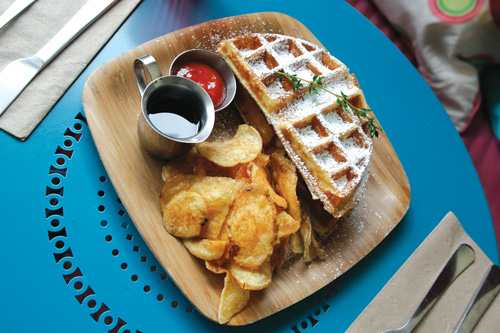
What kind of food would you expect to find at a carnival? Straw does provide some witty answers to this question, but the menu ranges gracefully beyond the obvious, which is to say the fried. Still, the fried stuff is good — a basket of little corn dogs ($7.75) made of Niman Ranch beef and looking like batter-fried musket balls. These were wonderfully crisp and juicy, and the trio of dipping sauces — nacho cheese, spicy ketchup, and ranch dressing — each had a strong enough personality to make them distinct, one from the others. The prawn ceviche ($7.75), boldly seasoned with habanero, lime, cilantro, and red pepper was presented in a fried tortilla cup, the kind tortilla salads come in, along with some tortilla chips on the side. These turned out to be good for dispensing with the last of the corndog sauces.

But not everything is fried, and the kitchen helps itself to a wide variety of influences. Grilled cobs of corn ($4) sprinkled with feta cheese, cayenne, and chili powder and presented with fresh lime and what the menu calls, with charming redundancy, “garlic aioli,” seemed to have Mexican roots, while the mac ‘n’ cheese ($5), fortified with bacon and slices of apple (an excellent idea) was a nice little crock of Americana.

The menu is also vegetarian-friendly — and not just in the small dishes, though quite a few of those are meatless, among them the tomato soup, pretzel bites, and several of the salads. An entrée called samba on subuco ($12), festively joined chunks of butternut squash and eggplant in a slightly sweet (but not cloying) coconut-milk curry broth reminiscent of many a hormak talay in Thai restaurants. This dish succeeded for me, despite the eggplant, which managed to be both rubbery and mushy.

Places are found for flesh too, often cleverly. We were particularly impressed by the satchemo ($15), a bed of creamy white grits carefully inlaid with sautéed prawns, leaves of linguiça, and green filet beans. Apart from being flavorful and well-balanced, the dish was beautiful to look at: like a tile taken from the palace of an Ottoman pasha.

I was a little less impressed with the picadilly ($14.75), if only because I wonder if a fish as marvelous as ahi tuna needs to be turned into fish sticks. Ahi, like beef, can stand on its own and is generally best when standing on its own. It doesn’t take all that kindly to elaborate treatments and back-room, hardball techniques like breading and frying. Doing that to a nice piece of ahi is a little like getting out your best lead crystal to serve some Diet Coke. The accompanying mayonnaise was astounding, however.

No carnival would be complete without a root beer float, and Straw offers a nice one ($5.50), made with root beer gelato and served with a straw (!)— not exactly radical ideas but sound ones. The more radical idea was laying little sticks of candied bacon atop an almost impossibly creamy peanut butter pie ($6) in a chocolate crust. Peanut butter and chocolate are one of sweetdom’s divine combinations (also totally New World), and I’d never heard the pair were looking for a third, certainly not pork. The truth is that the pie would have been fine without it. But the meat brought a bit of salty-sweet chewiness for contrast, and the result was better than fair.

STRAW

Dinner: Mon.-Sat., 5-10 p.m.; Sun., 5-9 p.m.

Brunch: Sat.-Sun., 10 a.m.-3 p.m.

203 Octavia, SF

(415) 431-3663

www.strawsf.com

Full bar

MC/V

Noisy

Wheelchair accessible


Tasty tunes

0

virginia@sfbg.com

FESTIVAL Outside Lands has been descending on lush Golden Gate Park for three years now. As the music lineup continues to feature some of the biggest acts on the summer tour circuit, the festival’s local food and drink offerings have been steadily increasing their profile. A Taste of the Bay Area, OL’s edible arena, hosts 54 food vendors, and 30 wineries and winemakers pour 100 different wines amid whimsical barrel seating under the big tent of Wine Lands. As if our dancecards weren’t already full of all the music we want to see!

To maximize your opportunities to stuff yourself, we’ve compiled an eating-drinking guide for the weekend that pairs just a few of each day’s musicians with harmonious eats. Also included: suggestions for your inter-set hydration intervals. (Read: the best booze and caffeine on offer.)


FRIDAY

New Orleans Klezmer Allstars, noon, Land’s End Stage Take traditional Jewish klezmer, amplify to the power of New Orleans, and suddenly you have New Orleans Klezmer Allstars on your hands. As you’re gyrating wildly to the sounds of the group’s clarinet and accordion, snack on some fried kosher dill pickles. Those Fabulous Frickle Brothers will be serving deep fried “frickle” chips and fried green tomatoes perfect for dipping in the booth’s cukaracha Sriracha, or perhaps its tasty curry mustard.

Drink interlude Avail yourself to a range of Kermit Lynch’s imported wines — the Berkeley local (a musician himself) was a key player in the introduction of French wines to the United States.

Phish, 6:30 p.m., Land’s End Stage Call us hippies, but what could go better with the ultimate jam band high than sweet summer produce? Full Belly Farms will be offering plump melons, peaches, tomatoes, corn, green beans, and bell peppers. Another farm-fresh pick: cucumber-melon spritzers from Flour + Water’s soon-to-open Salumeria. Pick up a porchetta sandwiches there to counteract all that good health.

Big Audio Dynamite, 7 p.m., Twin Peak Stage Don’t call it a comeback. With the return of Big Audio Dynamite (BAD), playful good times are sure to ensue — a perfect pair for Hayes Valley restaurant Straw’s Outside Lands carnival game, (also called Playful), which will be taking place in the Corral area of the festival. Don’t worry if you don’t win any prizes — Straw’s sweet potato tots and its falafel and schawarma snow cones will be reward enough.

Erykah Badu, 7:50 p.m., Sutro Stage Maybe you won’t be at your sexiest while slurping Split Pea Seduction’s soups, but sounds from the sultry Ms. Badu make a creation like sweet corn and smoked trout chowder oh-so-alluring — not to mention the stand’s spit-roasted lamb and Puerto Rican pork pernil sandwiches.


SATURDAY

Nicki Bluhm & The Gramblers, 12:05 p.m., Sutro Stage Nicki Bluhm’s lazy sunny day tunes will make it feel like summer, even if (when) the fog rolls into Golden Gate Park. Fresh seafood can also bring out that summer shine, particularly Woodhouse Fish Co.’s BBQ or fresh oysters. Even better for when that condensation does convene is its excellent clam chowder.

Drink interlude Elegant Rhône varietals and Chardonnay from the central coast’s Qupé winery have made many a fan forget the next set they wanted to see.

The Black Keys, 6:15 p.m., Land’s End Stage The guttural blues rock of Ohio natives Dan Auerbach and Patrick Carney is sure to be one of this year’s highlights. The group is the first ever act to play multiple years at Outside Lands, so you’ll want real crowd pleasing snacks at its show. Nombe’s ever-satisfying Japanese izakaya eats should fit the bill — its popular chicken wings, honey-sweetened, lime-and-fish-sauce perky, rarely leave their audience underplussed. Nombe will also be serving up odango (fried rice balls) and fried tofu for vegetarian music lovers.

The Roots, 6:50 p.m., Twin Peaks Stage The Roots have been interjecting ensemble musicianship into the hip-hop scene since 1987. You know what else is keeping it real? American Grilled Cheese Kitchen. We look forward to seeing what multi-voiced sandwiches it will be grilling up — will the Jalapeno Popper with chèvre, jack, applewood-smoked bacon, and apricot-jalapeño relish make an appearance? What about the Mousetrap, with its sharp cheddar, havarti, and jack?

Drink interlude Wind Gap’s grapes are grown from the Sonoma Coast down to Paso Robles, resulting in earnest, heartfelt wines that express a sampling of California’s terroir. Known for its syrahs, the winery also produces Chardonnay, grenache, and pinot gris.

Muse, 8:10 p.m., Land’s End Stage All of Muse’s dramatic intensity and rock opera influences mean you’ll need to lube up your vocal chords if you want to hit those soaring vocals alongside frontman Matthew Bellamy. Down a cup of Juice To You’s energizing green juice, watermelon juice, or Thai young coconut water before you belt it out.


SUNDAY

Drink interlude Hedge your energy for the last day of festivities with Ritual Coffee Roaster’s iced joe or a strong coffee brew from Philz.

Mavis Staples, 1:45 p.m., Land’s End Stage From her days with the Staples Singers to her latest Grammy-winning, Jeff Tweedy-produced album You Are Not Alone, this woman bleeds heart and soul. You’ll taste both in 4505 Meats’ raved-about chicharrones and hot dogs, Namu’s Korean tacos, or Rosamunde’s beer, chicken-cherry, and apple-sage sausages.

Drink interlude Manhattan restaurateur and sommelier Paul Grieco of Hearth and Terroir Wine Bar will be at the festival on his Summer of Riesling tour, touting — you guessed it — refreshing, crisp rieslings.

Julieta Venegas, 3:50 p.m., Sutro Stage Tijuana native Julieta Venegas has earned fans globally with her Spanish language rock. Augment her Latina vibes with El Huarache Loco’s huaraches or Little Chihuahua’s dreamy fried plantain-black bean burritos. For dessert skip to the Southern Hemisphere for mouth-watering Argentinean treats: Sabores del Sur’s dreamy alfajores, powdered sugar-dusted butter cookies sandwiched around creamy dulce de leche.

John Fogerty, 4:45 p.m., Land’s End Stage Creedence Clearwater Revival’s frontman is a living legend. No one epitomizes roots rock like Fogerty — who, despite CCR’s famous Southern sound, is a Berkeley native. His one-of-a-kind local vocals make a happy pair with Little Skillet’s fried chicken, Maverick’s pulled pork sandwiches, or Criolla Kitchen’s shrimp po’ boys.

www.sfoutsidelands.com/taste


Ear plugs

0

caitlin@sfbg.com

FESTIVAL I’m that person at the concert who is facing 90 degrees in the wrong direction when the DJ just busted everyone’s ankles or the guitarist is smashing an axe on the drummer’s head. I’m like: when did this festival relocate the bathrooms to the left of the Sunset Harmony Stage? The things we get excited over. Anyways, Outside Land producer Allen Scott of Another Planet Entertainment gave me (and now you!) some gems to hunt for and meditate on when the attention deficit takes over mid-John Fogerty.

McLaren Pass: You know that elevated pine glade up the hill from the horse corrals? During Hardly Strictly Bluegrass its luxuriously empty shade it is the perfect anti-crowd. In previous years of Outside Lands it’s been purposed as a VIP section — but this year, says Scott “it’ll be a surreal little experience.” The once-mellow path that runs along the ridge will open onto “Food Truck Forest,” a Mexican beer-and-burrito area dubbed “The Mission,” and perhaps most excitingly, “Chocolands,” where licorice lamp posts and gummi bear lanterns designed by a guy who does work for Family Guy and Tim Burton’s films will hang over stands staffed by local chocolatiers.

Some numbers: Outside Lands gives $3 million to the Recreation and Parks Department in exchange for using Speedway Meadows. The festival employs 2,500 people during the course of the weekend, including 500 security guards — some of them mounted on horses for added scariness for all those people who for sure are not sneaking into the festival. 97 percent of the festie workers are local hires.

Tighten it up: I was a serious pain in the ass about asking how people sneak into the festival (er, completely in the spirit of learning about the festival’s infrastructure — obviously I advocate paying lots of money to Outside Lands). Scott, the intelligent festival spokesperson that he is, wouldn’t give me anything juicy except that “we’re beefing up one area of the park that has been an Achilles heel.” And that he thinks that with measures like double fence layers around the festival very few people make it in without paying, so there.

Brush off: Perhaps you’ll notice a distinct lack of underbrush along the north end of the park area between the Twin Peaks and Panhandle stages. This isn’t a festival-driven pruning, Scott tells me — rather, Golden Gate Park arborists are attempting to return Speedway Meadows to its original design, which apparently involved a less bushy look.

Kitty city: I asked Scott what the biggest risk is that Outside Lands poses to Golden Gate Park’s ecosystem. He may or may not have understood what I was asking because he answered: “feral cats.” Apparently the fest has a responsibility to feed the furry devils and mitigate disturbance to their habitat. New area suggestion for next year: Tunalands.

Major lasers: Is the Polo Field feeling particularly level this year? According to Scott, the sense of equilibrium flooding your innermost soul during Phish’s mega-set on Friday will be due in part to Rec and Parks having laser-graded the grassy expanse where the main stage resides.

OUTSIDE LANDS Fri/12-Sun/14, $85-450. Speedway Meadows, Golden Gate Park. www.sfoutsidelands.com


So classy

0

caitlin@sfbg.com

Reward the long-term relationships in your life by taking your game up a notch. Brain fitness? Bar-stocking skills? Bicyclist rights? It’ll all make for more scintillating dinner conversations, so take the pupil plunge. Most of the following classes will charge for your mental charge, but always remember that the Free University of San Francisco (www.freeuniversitysf.org) and the East Bay Free Skool (eastbayfreeskool.wikia.com) have incredible learning opportunities available gratis.

URBAN BICYCLING WORKSHOP

The streets can be a scary place for poor little meat puppets, particularly when one doesn’t know the rules of the road. Lucky for us, the SF Bike Coalition hosts regular crash courses on how not to crash on course. Its biking workshops cover everything from choosing the right bicycle for you, to traffic safety on two wheels, to getting your bike on BART, to your rights as a bicyclist. Did we mention it’s free? More power to the pedal.

Aug. 20, 10 a.m.-2 p.m., free. St. Anne’s Church, 1320 14th Ave., SF. www.sfbike.org


DIY LIQUEURS AND INFUSIONS

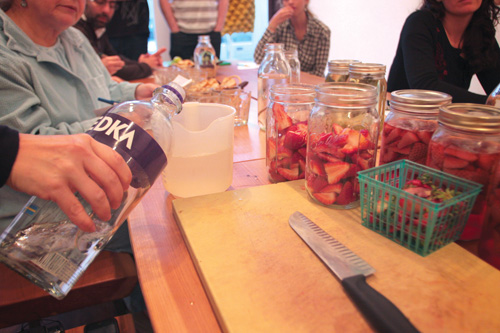
With one four-to-eight-ounce jar (err on the larger size, trust) you can take your party game up a notch. That’s because Sean Timberlake of Punk Domestics — a local site promoting fermentation and other home cooking processes — will be guiding you through the steps of creating a fantastically flavored liquor at community-food space 18 Reasons. Pluots? Cucumbers? Bananas and brandy? The world is alive and flavorful!

Aug. 23, 7-9 p.m., $40-50. 18 Reasons, 593 Guerrero, SF. www.18reasons.org


RIGID HEDDLE WEAVING

It’s not going to be summer forever, Gidget. Time to jump on a rigid heddle loom, which in addition to being a beach party of a phrase to say out loud is one of the easiest ways to learn how to weave a top-notch scarf for a cold season cover-up. This class requires you to bring some supplies with you, so make sure you check the website (and yarn store A Verb For Keeping Warm’s selection of chill-chasing threads) before heading over.

First class: Aug. 27, 2:30-5:30 p.m. Second class: Sept. 3, 3:30-4:30 p.m., $54-64. A Verb For Keeping Warm, 6328 San Pablo, Oakl. (510) 595-8372, www.averbforkeepingwarm.com


IAPP DESIGN

Those that control the iPhone applications, control the world. Seriously, we don’t care what market you’re in, your boss probably wants you to design an app for your company. On second thought, this class will definitely not improve your dinnertime banter, but if you can make your way through the course (and it does require a wee bit of prior computer knowledge), at least your talent will be popular!

Oct. 8, 10 a.m.-5 p.m., $155. San Francisco State Downtown Campus, 835 Market, SF. www.cel.sfsu.edu


MIND-BODY HEALTH

Okay this one for sure your friends will love. T’ai chi sessions included, this class will bestow upon you methodologies for getting physically healthier by getting mentally healthier. Clean out those mental cobwebs and untoward cognitive ruts, why don’tcha. The class is available in multiple locations — at the Mission branch of City College as well as a senior citizen home near Fort Mason.

Various City College of San Francisco class times and locations. www.ccsf.edu


SKILLSHARE

Once upon a time, a nationwide website took it upon itself to teach local communities how to teach themselves things. Recently, the site opened its e-doors to San Francisco, kind of. Classes haven’t started yet, but many potential listings are already up and you can sign up to be a “watcher” — someone who is interested in one of the course descriptions. Many of the courses are under $20, and will be taught by people who’ve got local cred in the topics at hand — which so far include fantasy football strategies, underground dinners, social media skills, and whiskey 101.

www.skillshare.com

Shelter from the storm

0

rebeccab@sfbg.com

Ms. Li has a petite build, but she’s physically strong. Hauling around dish bins and boxes of produce weighing 50 pounds was part of her daily routine when she worked shifts lasting 12 hours a day, six days a week, at a San Francisco Chinatown eatery that later made headlines for its poor labor standards.

Li, who did not share her full name for fear of retaliation, says things have improved slightly since the days she worked at King Tin Restaurant, which closed its doors abruptly in 2004 after workers who hadn’t seen paychecks in months filed an onslaught of complaints. At the time, her husband was unemployed and she was struggling to support her two teenagers on a single paycheck totaling $950 a month.

It took about five years before the San Francisco Office of Labor Standards Enforcement (OLSE), the City Attorney’s Office, and grassroots advocates with the Chinese Progressive Association (CPA) finally succeeded in forcing the restaurant’s previous owner to grant Li and other workers the back wages they were owed.

Now, she’s working 12 hour shifts, five days a week at a different restaurant, but says she still isn’t receiving minimum wage or overtime pay. Li aided in the efforts of the Progressive Workers Alliance (PWA) to urge members of the Board of Supervisors to pass the Wage Theft Prevention Ordinance, which aims to strengthen enforcement of local labor standards by empowering OLSE to take a more proactive role against employers who don’t pay workers what they’re owed.

As a kitchen worker at a high-end restaurant in downtown San Francisco, Li receives a monthly paycheck totaling a little more than $1,400 before taxes. Take-home pay is less, because the employer deducts for meals, a requirement that cannot be dodged even if employees bring their own food.

Li told the Guardian her coworkers are angry about the working conditions, but fear of job loss keeps them silent. “Some of my coworkers work so hard that they cry,” she said, speaking through a translator. “One worker was burned badly in the kitchen, and didn’t receive worker’s compensation or paid sick leave.” That person uses their own ointment to treat the burns, she added.

As she described her predicament at the CPA office in Chinatown, student volunteers were creating a banner to be displayed during a press event at City Hall. They arranged folded red and yellow petitions signed by workers in similar situations to spell out PWA, for Progressive Worker’s Alliance, to urge city officials to crack down on employers who violate local labor laws.

PWA has been meeting regularly since last year, but the organizations that are part of the advocacy group have been engaged in organizing low-wage workers for much longer. Over the course of more than three years, CPA interviewed hundreds of restaurant workers in Chinatown, and their surveys revealed that about half were not receiving San Francisco’s minimum wage, while about 75 percent weren’t being paid overtime when they worked more than 40 hours a week. Yet the problem of wage theft in San Francisco extends well beyond Chinatown.

PWA includes representatives from CPA, the Filipino Community Center, Young Workers United, People Organized to Win Employment Rights (POWER), the San Francisco Day Labor Program, and Pride at Work, among others. On August 2, workers and organizers with PWA burst into thunderous applause after the Board of Supervisors voted unanimously to pass the Wage Theft Prevention Ordinance on first reading. This represented a major victory.

“With the economic crisis, and the backlash against workers, we felt that as a small grassroots organization, we needed to have a more powerful voice and a specific space for worker issues to be brought to light,” CPA lead organizer Shaw San Liu said of the impetus behind PWA.

“You’re talking about workers who are pretty vulnerable — not knowing the laws, not speaking the language. People who need a job and cannot afford to lose it are vulnerable to exploitation,” Liu said.

While labor laws in San Francisco are uniquely strong, with mandatory paid sick leave and local minimum wage established at $9.92 per hour, “When it comes to implementation and enforcement, there’s still a lot left to be desired,” Liu said. As things stand, investigation of employer violations are predicated on worker complaints, and it can take years for a worker to get a hearing if they’re owed back wages.

The Wage Theft Prevention Ordinance doubles the fines for employers who retaliate against workers who file complaints. It allows OLSE investigators to issue immediate citations if they detect a problem in a workplace. When an employer comes under investigation, it requires them to post a notice informing workers that they have a right to cooperate with investigators — and imposes a fine for failing to post the notice. It also establishes a one-year timeline in which cases brought to OSLE’s attention must be resolved.

Under the new law, employers would also be required to provide contact information to their workers, an important change for day laborers who are sometimes taken to job sites where they perform manual labor, only to be dropped off later without payment and no way to get in touch with their temporary bosses.

“You have raised awareness about the crisis of wage theft,” OLSE director Donna Levitt told workers at an Aug. 2 rally outside City Hall. “And we have made it clear that wage theft will not be tolerated in our city.”

The ordinance was spearheaded by Sups. David Campos and Eric Mar, with Sups. Jane Kim, John Avalos, Ross Mirkarimi, and Board President David Chiu signing on as co-sponsors. Members of PWA met with supervisors to win their support, and even succeeded in bringing on board the influential Golden Gate Restaurant Association.

“The fact is that even though we have minimum wage laws in place, those laws are still being violated not only throughout the country, but here in San Francisco,” Campos told the Guardian. “Wage theft is a crime, and we need to make sure that there is adequate enforcement — and that requires a change in the law so that we provide [OLSE] more tools and more power to make sure that the rights of workers are protected.”

Victoria Aquino, 66, spent several years working 16-hour hours without minimum wage or overtime pay as the sole live-in caregiver for six disabled patients at a San Francisco care center. Her duties included feeding patients, bathing them, changing diapers, and cleaning.

“The patients would knock to wake me up and ask me for cigarettes or food in the middle of the night,” she recounted, “and I wasn’t paid for that.” She first complained to OLSE after one of the patients physically attacked her, leaving her black and blue with a permanently injured finger, and later sought the help of the Filipino Community Center to file a claim demanding back wages. It took months, but her employer eventually settled, agreeing to pay $60,000 in back wages and reduce her shifts to eight hours a day.

Aquino said she became involved with the Filipino Community Center because “there are a lot of caregivers still suffering, and more than I suffered — especially those who don’t know the laws. I sympathize for them. It hurts me when I hear some caregivers who are no longer supposed to work. They’re past their 70s, and they’re still working.”

A new kind of biker bar

0

Rapha Cycle Club is altering my mental image of what a biker bar is. For one thing, the walls are all really white. For others, I can shop, I can order a cup of Four Barrel and a Telltale Preserve croissant, I can watch the Tour de France – but I can’t have a beer. 

That’s because it’s a clothing shop, mainly. But as manager Emily Haddad (who Rapha imported to SF from her gig at an Austin bike shop specifically to work at the new space) tells me, it’s so much more. 

“It’s a bar, but one where everyone’s drinking coffee.”

It’s also a bar where everyone’s drinking coffee that opens at six a.m. on some days – those being when the Tour de France is on TV, or Italy’s equivalent the Giro D’Italia. On those days Haddad says there can be twenty bikers in the sleek Marina storefront, sitting and standing around the long, low table in the middle of the room that’s speckled with vintage biking photos and ephemera, watching the race and chatting amongst themselves. 

Rapha is a British cycling clothes brand that debuted in 2004 with a multimedia exhibition called “Kings of Pain.” It now has an office in Portland, Ore., has opened a similar “social shop” in Tokyo, and a mobile club — a van with similar intent that is cruising Europe this summer, stopping in places like Alpe D’Huez, France. The dominant colors of the line are grey and, complexly, pink – a homage to the Maglia Rosa, the pink jersey that is wore by the standings leader in the Giro D’Italia. 

Here is a Graeme Fife – the playwright and cycling journalist – quote the company feels illustrates its ethos. It is, in fact, written on the shop’s wall:

The greatest battle is not physical but psychological. The demons telling us to give up when we push ourselves to the limit can never be silenced for good. They must always be answered by the quiet the steady dignity that simply refuses to give in. Courage. We all suffer. Keep going.

Rapha Cycle Club San Francisco is the first yearround cafe the label has opened – a four seasons timetable that was decided, one assumes, when Haddad and Rapha brass realized that SF’s “summer” is not really the height of cycling season. 

Tucked into my favorite Marina intersection (its neighbors are John Campbell’s Irish Bakery and Real Food Co. grocery store), the shop-cafe is mere blocks from the hill that separates the neighborhood from the rest of San Francisco to the south. 

One end of the long table meant for coffee-drinking and the cheering-on of jerseys holds a glass curio case dedicated to Eddy Merckx, the dashing Belgian who many consider the most accomplished cyclist of all time (five Tour de France victories, three world championships, breaker of the world hour record). The case houses two commemorative plates, and amazing retro keychains that proclaim Merckx a world record holder. There is also a small photo gallery in a loft space upstairs, with rotating exhibitions that currently feature black and white images of men grimacing in pain.

One imagines road bike ironpeople inspired by Merckx or the steady dignity on the shop’s flatscreens purchasing a pink jersey and turning bike wheels resolutely to the mountain rising up from Rapha’s front door. Even if this is not quite the case, the shop is the ideal jump-off for friends meeting up to bike to the Marin Headlands, joining the phalanxes of sharply-Lycra’d bicyclists on those hills. 

With its sleek, get-er-done ethos Rapha Cycle Club would be a really good stop for all those businesspeoples that complain about not being able to ride their workclothes on their bikes. The shop sells a very expensive (but maybe worth it? I find men’s dress clothes hard to judge) blazer made by British bespoke tailor Timothy Everest that buttons up, and together, has a sharp little pocket on its back, and is made of fabric that gives enough to encourage light physical exertion.

It also sells similarly functional gingham dress shirts. One guy was trying on a pink, short-sleeved number when I was in the shop, wondering out loud if he could pull it off. Everyone in the store encouraged him to try. Or rather: Keep going. 


Rapha Cycle Club 

Mon.-Fri., 7 a.m.-7 p.m.; Sat.-Sun. 7 a.m.-6 p.m.

2198 Filbert, SF

(415) 896-4671

www.rapha.cc/san-francisco

Behind the yuba: A trip to Hodo Soy Beanery’s factory floor

0

When I was fourteen, Snorkel Mom and I went to Japan to visit my Japanese “grandma” Kiyo. She lived in Tokyo and I remember one morning walking with her to a tiny, closet-sized building that had housed the neighborhood tofu shop in the very same spot for several hundred years. We took home a block of the freshest, most exquisite tofu I had ever eaten — nothing like the hard blocks of flavorless tofu found at most stores here in the States. So when I heard that there was a small company making fresh, traditional tofu in Oakland, I knew it would be worth hopping over the Bay to see what they had to offer.

On the first Wednesday of every month, Hodo Soy Beanery offers a tour to the public, giving folks a chance to sample the wide variety of soy products it creates and see first hand how it gets made. Hodo’s long list of organic, GMO-free soy delights includes fresh, creamy soymilk (nothing like that crap you can get in a box!), super-flavorful tofu in a wide range of textures, and ready-to-eat yummies like tofu salads, curry nuggets, and bricks of braised tofu with dense, potent flavors, perfect for adding to a sandwich in place of meat.

But probably the most exciting item at the beanery is its yuba. Hodo is the only place in the country making fresh yuba, a paper-thin tofu skin that comes together on the surface of heated soymilk. It’s carefully lifted off, drip-dried, and tenderly folded into small delicate rectangles. The texture is incredible and I can see this super-high protein soy food becoming a staple in home cooking on account of its versatility and delicacy.

And apart from being tasty, a visit to Hodo is fun. The staff was working hard and there’s big machines (eyes forward, people!), but there was a very human pace about the place. I got to chat with a few of the workers and they seemed to be enjoying their day.

That’s a beautiful thing, when companies are able to create an environment where their employees are having a good time and simultaneously making a product that is pure, simple, and scrumptious. There’s no longer the need to travel back to Japan to find that perfect piece of tofu, made in a centuries-old shop. Hodo’s right here.

Kind of makes me want to sing… 

Scribe’s Guide to Playa Prep

32

steve@sfbg.com

PLAYA PREP This is a crazy time of year for burners, when they begin to realize just how overly ambitious their art projects actually are, when the August calendar seems to shrink as to-do lists grow, and when procrastination morphs into panic — all of it laced with a giddy, distracting excitement about the dusty adventures to come.

Don’t worry, fellow burners, Scribe is here to help. I’m way too busy right now to actually come help weld your art car or hot glue your costume (unless you’ve got stuff or skills that I may need, in which case we can maybe work something out) but after years of deep immersion in this culture, I do have a few tips and resources for you.


ATTITUDE

The most important thing to bring to the playa with you is the right attitude. It’s right up there with your ticket at the very top of the list. As I worked on this guide, I posed the question “What’s the most important thing you bring to the playa?” to online burner hives, and most of the answers I got back had something to do with attitude.

Whether you’re a nervous newbie or salty veteran, it’s important to leave your expectations at home and just be open to whatever experiences await you. Intention is everything out there, and if you try to always maintain an open mind, a loving heart, and a sense of humor, everything you need will just flow your way.

It isn’t always easy. When your project breaks, or the dust won’t stop blowing, or your lover squashes your heart, or some yahoo behaves in a way that strikes you as somehow un-Burning Man, it’s natural to let your anxieties creep up. But you’ve got to let it go, because it’s all going to be OK, it really is. When all else fails, just breathe.

It is the breaking through those difficult moments and coming out the other side — enduring through things that feel like they may break you — that makes Burning Man feel so transformative. It is a cauldron, and you may not come out in the same form you went it, but that’s part of why you go.


GETTING AROUND

You’ll need a motorized vehicle to get to Burning Man — and art cars can be a fun way to get around when you’re there, a sort of surreal public transit system — but if you don’t have a good bicycle then you’re at a decided disadvantage in fully experiencing Black Rock City, the most bike-friendly city on the planet while it exists. And that’s never been more true than this year, when early reports indicate that the wet winter has left the playa packed solid and perfect for pedaling.

Form and function are equally important when it comes to your bike. It needs to be in good mechanical condition (and with enough tools and patch kits to keep it that way) and correctly sized to your body, ideally with a comfortable, upright position and basket for your stuff. And you also need to decorate it and make it unique, both because making art is the essence of Burning Man and so you can easily find it amid a sea of bikes. Form and function, they’re like two wheels rolling together.

Although the Borg, a.k.a. Black Rock City LLC, recommends that you bring a bike lock, I’ve personally never used one and never had a problem. Sure, bike thefts happen, but I believe they’re almost always crimes of opportunity or drunken mistakes involving nondescript bikes, not unique rides like mine that I could spot 100 yards away.

I’m convinced that half the people who think their bikes got stolen actually just lost them. The playa can be a very disorienting place, with art cars and other visible markers moving around — and even one’s own brain conspiring against locating one’s bike. So illuminate your bike well, ideally with something that sticks up high the air, and leave your lights on as you explore on foot.

Speaking of which: wear good, comfy shoes. Most costumes should stop at the ankle at Burning Man, particularly if you’re prowling the playa


SNEAKING IN

In honor of the mad scramble for tickets after Burning Man sold out more than a month before the event for the first time in its 25-year history, I’m offering some thoughts on sneaking into the event. Given how many people could find themselves stuck with counterfeit tickets or otherwise unable to get in this year, it seems like something that any thorough guide should cover.

Now, before everyone jumps all over me, telling me that I’m endangering lives and undermining the spirit and the stability of the event, let me make clear the spirit in which I’m offering this advice. Just think of it like a hacker publicizing the security vulnerabilities of a beloved institution — hopefully the Borg will read this too and do what it can to either plug the holes or somehow take pity on the desperate souls stuck outside the city’s gates.

First of all, you gotta know what you’re getting yourself into. Gate crew takes this shit very seriously, thoroughly searching every car and trailer, and looking into hiding spots that you probably haven’t even thought of. Many of them take real pride in this, some thoroughly stomping on rolls of carpet that might contain a stowaway, potentially adding injury to your insult.

Here’s the worst part: It is official Burning Man policy that when stowaways are found, everyone in that vehicle gets his or her tickets torn up. And burner brass says it will beef up security this year, including more people at the gate and more people scanning the open playa with night-vision goggles and fast interceptor cars.

Every year, they catch about 30 people trying to sneak it. “We’re very confident that we catch all the stowaways,” Borg member Marian Goodell tells us. But we all know that can’t possibly be true, right? There are playa legends of a contortionist who puts herself in a packing bin and gets in every year, and I’ve met people who claim to have snuck in both at the gate and over the open playa.

So, if you gotta do it, my best advice is to find a confederate on the inside, such as someone on Gate crew who owes you or will take pity on you or a bribe from you. That’s how many coyotes do it at the US-Mexico border, and it could work here too. There aren’t any wristbands at Burning Man, so once you can weasel your way in amid the confusion at the gate, you’re in.

Skydivers also have a pretty good shot at getting in, even though they’re likely to be greeted on the ground by someone asking for their tickets. But, it’s a big city, and if you’ve got some skydiving expertise and you’re able to rapidly change directions during the final phase of your descent, you might just make it.

There are also ways to take advantage of human oversights, particularly during the early arrival period before the event begins. There are often openings in the gate briefly left unguarded in the early days, as we discovered last year after a trip to the reservoir. Or sometimes, after thoroughly searching the car, the person at the gate will forget to tear your ticket. And believe it or not, sometimes people on the inside end up with spare tickets for friends who couldn’t make it. Any untorn tickets can be spirited out by people making runs into nearby Gerlach for supplies.

But in closing, let me just reiterate that buying a ticket is part of the “radical self-reliance” principle that is central to the burner ethos, so do yourself and your community a favor and find a ticket, or accept that you may just have to sit this year out. Don’t worry, we’ll make more.


FOOD AND SHELTER

In preparing for Burning Man, it’s always helpful to remember Maslow’s Hierarchy of Needs, which instructs us that we need to see to our basic needs at the bottom of the pyramid before we can even think about approaching the enlightenment at its pinnacle. And that begins with food and shelter.

Contrary to common misconceptions, you don’t need an RV or trailer on the playa — and it’s too late to get one at this point anyway. Frankly, you’ll be fine in a cheap pup tent as long as you place it under a sturdy shade structure, such as the 10-by-20-foot steel carports that are ubiquitous on the playa, or a cheaper shade structure with poles reinforced by PVC or something to help it from being flattened.

You may need to make adjustments during the course of the week, but jerry-rigging your shit is just part of the fun. Or if that’s not your cup of tea, more and more burners in recent years have been building their own yurts or turning to custom-made designs like the Playa Dome Shelters from Shelter Systems (www.shelter-systems.com/playadomes.html).

For food, just try to keep it simple, nutritious, and free of unnecessary waste. That means lots of simple snacks and easy meals, such as those you make ahead of time and reheat. There are also some good entrepreneurs out there that have perfected this approach, such as Gastronaut SF (www.gastronautsf.com/playa-provisions), which makes meals that you boil in the bag, which even allows you to reuse that water.

And don’t forget to take your vitamins because playa life can really take it out of you. Dr. Cory’s Playa Packs (www.drcory.com) are one of many good companies that understand what nutrients you’ll need and try to provide them.


SHOPPING

Let’s face it, for all the talk about decommodification and intentional communities and all that hippie crap, you’re going to need stuff at Burning Man. Lots and lots of stuff. Luckily, San Francisco is a great place to get it, and here are some of my personal favorite spots to shop for my playa gear.

Mendels This art supply store has everything you need for your costumes and other Burning Man projects, and many things you didn’t know you needed. For example, when I was looking for a cool covering for my bike years ago, I found tubes of thick acrylic paint that dries hard (now known as 3-D Paint), which has lasted for years and drawn compliments the whole time.

1556 Haight, SF. (415) 621-1287, www.mendels.com

Fabric Outlet Fake fun fur has become a staple item for Burning Man costumes and art projects, particularly as the styles and varieties of it have gotten better. And this place has the coolest fake furs in town, as well as a huge selection of other fabrics, patterns, and sewing kits.

2109 Mission, SF. (415) 552-4525, www.fabricoutletsf.com

Multikulti This is the best place in town to find a great selection of groovy sunglasses for just $6 each — and you’ll want a good selection of shades out there to go with your costumes — as well as a variety of other accessories and costumey geegaws to accent your Burning Man ensemble.

539 Valencia, SF. (415) 437-1718

Five and Diamond If there is a store that grew directly out of the feather-and-leather fashion aesthetic that has come to take center stage on the playa, this is it. From groovy utility belts (important when your costumes lack pockets) to elaborate leather outer wear to some of the coolest custom goggles that I’ve found (mine has a built-in light and both clear and shaded lenses), this place has great — if slightly pricey — stuff.

510 Valencia, SF. (415) 255-9747, www.fiveanddiamond.com

Held Over My favorite second-hand clothing store creates special racks of Burning Man clothes this time of year, but I always prefer to assemble my own outfits from their great selection of unique vintage and specialty clothes, including an entire room of tuxedos and other retro formal wear.

1543 Haight, SF. (415) 864-0818

Distractions The oldest walk-up Burning Man ticket outlet, Distractions knows just what burners need, offering a wide variety of playa-oriented clothing and accessories that you’ll need, from goggles to EL wire strips to pipes and other smoking paraphernalia.

1552 Haight, SF. (415) 252-8751

Cool Neon This Oakland-based company specializes in electro luminescent wire, the staple item for illumination on the playa (and whether you’re walking or on a bike, you will need to be lit-up out there). Cool Neon makes the rounds at many of the fairs and trunk shows, but you can also place orders for shipment or arrange pickups at its office at 1433 Mandela Parkway in Oakland.

www.coolneon.com

Discount Builders Supply Rather than spending your hard-earned money at Home Depot or some other chain store in the burbs, this locally owned business has everything you need to construct and decorate your project, or see to your sundry personal needs. They’re also used to burners with strange requests, so they give good advice.

1695 Mission, SF. (415) 621-8511, www.discoutbuilderssupplysf.com


WORKSPACES

The project. It is the essence of Burning Man, whether it’s the fun fur and EL wire you’re putting on your bike, the bar or showers your camp is building, or some ridiculously ambitious artwork that you’re creating with a crew of hundreds. Black Rock City is a series of thousands of these individual projects, all of which are coming together right now. And if you’re looking for some help finishing (or starting) yours, here are some resources you can tap.

The Crucible The Crucible is a venerable nonprofit institution that offers a wide variety of arts and crafts classes and resources in a state-of-the-art facility in West Oakland, with many burners among its staff and clients. As the longtime host of the Fire Arts Festival, this place knows its stuff.

1270 17th St., Oakl. www.thecrucible.org

CELLspace The Flaming Lotus Girls and many other key burner art collectives were born here, and his facility continues to provide the expertise and tools to bring Burning Man to life, year after year.

2050 Bryant, SF. www.cellspace.org

Techshop The new kid on the block, but one of the most technologically advanced, Techshop is a DIY workshop with amazing tools and experts on staff. Join its Aug. 15 EL wire workshop or other upcoming classes catering to burners.

926 Howard, SF. www.techshop.ws

American Steel Also known as Big Art Studios, this massive warehouse houses many of these biggest projects now bound for Burning Man. It may not have the structural support of places like the Crucible, but if you’re looking for knowledgeable burners to work through some problem, American Steel is brimming over with them.

1960 Mandela Parkway, Oakl. www.americansteelstudios.com

Burning Man costume creations If it’s sewing or other costuming help that you need, there are lots of local designers who might lend a hand (see “What not to M.O.O.P.” in this guide). Or you can stop by these Aug. 11 or Aug. 25 sewing circle meetups listed at www.meetup.com/Burning-Man-Costume-Creations


ART

Here are a few of the major installation artworks with Bay Area connections that I’m excited to see on the playa this year:

Charon by Peter Hudson Peter Hudson and his large volunteer crews have created some of the most dynamic art pieces in Burning Man history, zoetropes that use motion and strobe lights to animate the characters they create: the swimmers of Sisyphish, the divers of Deeper, the snake and monkeys of Homouroboros, and the man reaching for the golden apple of Tantalus. This year, Charon the boatman crosses the river Styx into Hades and, well, you just really gotta see what could be his best piece yet. As the artist says, “Charon asks them to reflect on their own mortality and ponder how to give and get the most from their brief time here on earth.”

Tympani Lambada by the Flaming Lotus Girls Combining fire, steel, light, and sound on the massive scale that we’ve come to expect from the Flaming Lotus Girls, Tympani Lambada simulates the structure of our inner ears, which control not just hearing but balance and perception. As always with this crew, this project promises to be space as occupy and interact with (usually with an unbelievable sense of awe) rather just a structure to see. And as they’ve been doing for many years (see “Angels of the Apocalypse,” 8/20/05), the dynamic crew built this creation right out at the Box Shop on Hunters Point (with an assist for American Steel, where some of its longest sections are being built).

Truth and Beauty by Marco Cochrane Following up last year’s amazing Blissdance, which is now on display on Treasure Island, this crew hoped to make an even larger female nude sculpture of the same model (55 feet this time), but their fundraising fell a little short so they couldn’t complete it. But even in the abbreviated form they’re bringing to the playa this year — just the torso from knee to shoulder, but well-anchored that it’s climbable — it should still be something to see.

Temple of Transition, by International Art Megacrew The Temple is always a special place at Burning Man (see “Burners in flux,” 8/31/10), and this year promises to be as spectacular as it is spiritual. The project is headed by a pair of builders known by their nationalities, Kiwi and Irish, and built mostly in Reno by a crew of committed volunteers from more than 20 countries. It’s centerpiece tower, Gratitude, is a towering 120-feet tall, surrounded by and connected to five smaller towers: Birth, Growth, Union, Death, and Decay.

Otic Oasis Lightning (Burning Man’s attorney) and friends (including named artists Gregg Fleishman and Melissa Barron) wanted the quietest spot on the playa for this 35-foot wooden pyramid of comfy lounging compartments, a remote spot where even the music from art cars couldn’t reach. Their answer: at the very back of the walk-in camping area, a spot only reachable on foot by people intending to go there. Finally, a quiet spot to chill out.


PLAYA EVENTS

OK, I know that many of these events are music-related, and there are an untold number of quirky, weird things to do on the playa besides just rocking out to a DJ. But exploring what the hundreds of theme camps offer each year is part of the fun, and it’s too Herculean a task to sort through the voluminous information and offer you sound predictions.

But every year the music lovers among us compile their recommendations of the stops to hit that will be going off and filled with dancing fools, so I know those lists are valuable. And mine does include some other stuff as well, so just deal with it.

The future of Burning Man The 17 board members of The Burning Man Project, the new nonprofit entity being created to take over operations of Burning Man in coming years (see “State of the burn” in this guide), will be available to discuss the future of this culture. This is your chance to weigh in on what’s important to you and how the event should be governed into the future.

Everyday, 1 p.m.-2:30 p.m. at Everywhere Lane (near Center Camp)

Lee Coombs This British-born DJ has long been a great supporter of Burning Man art projects — and he always plays fun sets — so come check him as the playa’s best daytime dance party camp starts to work it out.

Tuesday, 5 p.m.-6 p.m., Distrikt (9&F)

Unicorn Stampede

The perverts from Kinky Salon love getting horny on the playa, and this time they’re getting literal as they dress as unicorns and stampede across the playa, spreading their joy and juices onto unsuspecting burners and ending up at the Walkout Woods art piece. What does all that mean? Bring a horn, leave your inhibitions, and come find out.

Wednesday, 7-9:30 p.m., gather at The Man

Shpongle OT’s regular Wednesday night White Party — which has included many epic performances over the years, and this year include big draws EOTO, Infected Mushroom (both doing live sets on two stages OT is setting up for live music this year) and Christopher Lawrence, at midnight, 1:30 am and 3 am respectively — welcomes the dawn with pysbient music innovators Shpongle, which is already generating lots of excitement.

Thursday, 5:45 am (sunrise set), Opulent Temple (10&B)

Deep End reunion It’s like family day at Distrikt as the core San Francisco-based DJs that helped launch the original Deep End day parties play successive one-hour sets, with Syd Gris followed by Tamo, Kramer, and then Clarkie. Buckle up, everyone, because this could get ugly.

Thursday, 2-6 p.m., Distrikt (9&F)

Cuddle Ocean Upping the ante on the stereotype of ravers heaped into cuddle puddles at Burning Man, some instigators from last year’s Temple of Flux crew are seeking to create a Cuddle Ocean of thousands of burners heaped all over each other in the deep playa. Come feel the love.

Thursday, 6-8 p.m., between the Man and the Temple

Bootie BRC Adrian, Mysterious D, and the rest of the popular Bootie SF music mashup crew will be throwing a dance party specially mixed for your on-playa pleasure — with actual words!

Thusday, 8 pm-???, Fandango (Esplanade&4)

Circle of Regional Effigies burn Regional events have become an important part of the Burning Man culture, and this year 23 of them will build wooden effigies in circle around The Man. And then, as tends to happen to our effigies, they will all burn — simultaneously!

Thursday, 9 p.m., around The Man

Critical Tits This women-only topless bike ride has been a playa tradition for many years, so cruise by to cheer them on and offer your encouragement for what is a very freeing experience for many of the participants. Besides, who doesn’t like tits?

Friday, 4-5 p.m., The Man

Space Cowboys Hoedown Legendary SF-based sound collective the Space Cowboys has a tradition of driving its mobile music vehicle the Unimog out to the “biggest, baddest art piece” on the playa for a big dance party every year, which art cars with speakers and radio receivers can also relay, create a fun circle of sound. And this year, the winner is…The Flaming Lotus Girls’ Tympani Lambada.

Friday night at Tympani Lambada

Distrikt Come ride the daytime dance party train to the end of the line with DJ Kramer spinning until someone drags him off the stage to get ready for the burn.

Saturday, 4-??? at Distrikt Camp (9&F)

Scumfrog Dutch-born DJ Scumfrog has been rocking the playa every year since he first camped with us at Opulent Temple in 2004, and as readers of my book know, he’s a Burning Man true believer who just loves this culture, so he always brings his A-game. This is the place to be as the sun rises on final full day of Black Rock City.

Sunday, 4 am-sunrise, Disorient (2&Esplanade)

Tribes of Burning Man signing Yours truly, Scribe, will be on stage leading a discussion of issues raised in my book, The Tribes of Burning Man: How an Experimental City in the Desert is Shaping the New American Counterculture. Study up by ordering a signed copy now from www.steventjones.com and join in the debate, or just come heckle me for this shameless plug.

Sunday 4 p.m., Center Camp Stage

Steven T. Jones, a.k.a. Scribe, is the Guardian’s city editor and the author of The Tribes of Burning Man: How an Experimental City in the Desert is Shaping the New American Counterculture, which grew out of a series of stories in the Guardian that ran from 2004 through 2010.




The foodie crackdown

3

news@sfbg.com

Yet another blow was dealt to the San Francisco’s free-thinking food scene on June 11 when the final Underground Market was staged by ForageSF, at least for the time being. The market was shut down by the San Francisco Department of Public Health (SFDPH) in a clash between small-time food businesses and city officials over permitting and regulatory issues.

“I was ready for this for a while,” ForageSF founder Iso Rabins told us. “I thought someone would show up eventually to say something about this, and now they have.”

Rabins began the Underground Market in 2009 as a monthly venue for food entrepreneurs to share their goods without financial and bureaucratic red tape. It’s basically a farmers market without the permits, fees, and commercial kitchen requirements that add thousands of dollars to the cost of staging an event. Throw in live music, drinks, a little subversive thrill, and you’ve got a gathering that has proven enormously popular.

Until now, the market has operated as a private event. It is held in a private space and attendees are required to sign a membership form and pay a $5 entrance fee. It’s become a huge draw for foodies, with 1,500 to 3,200 patrons per event, according to Rabins, so the state government got wind of its largely unregulated operations.

Alicia Saam, the temporary events coordinator with SFDPH, says her department was asked by state officials to observe the market. It’s now too big to be considered private, she says, so it must adhere to health code and public safety regulations just like any other public event.

“One of the things that differentiate private versus public events is how much advertisement goes out there,” Saam said. “Something that is advertised and has grown big enough to have a following, that becomes a concern for us as a public event.”

Without official oversight, rules are bound to be broken. As with any novice venture, mistakes are made. When officials came to the Underground Market, they saw some vendors acting more like friends at a house party than professional food vendors, which is the complicated line that the market tries to toe.

“We observed operators and vendors eating and then handling the food, and that’s a huge contamination hazard for us,” Saam said. “They weren’t washing their hands before continuing food service, nor did they have a hand-washing set-up right there at their booth. There looked to be temperature issues as far as some of the food that was being stored, such as protein foods, sausages, and dairy. Some foods were not protected but were displayed on the table uncovered. People come up and they’re excited and curious, there’s a lot of creativity there, so they’re hovering over the food and possibly contaminating it with all sorts of things. The source of food, such as the kitchen where the food is coming from, needs to be an approved space where there are no animals, or cats like in some homes. It needs to be a commercial space that is properly cleaned and sanitized.”

According to the U.S. Center for Disease Control, one in six Americans get sick each year from eating contaminated food. Salmonella infection is of particular concern because food can be contaminated anywhere from the fields to kitchen surfaces.

The SFDPH has already allowed the Underground Market to operate unregulated for more than a year without any reported food illnesses, but Rabins is quick to agree that these health concerns are real.

“I do believe that these issues of health are important, and although I feel that all the vendors at the market are very careful about what they make, we do want to institute some Serve-Safe classes, basic food safety,” Rabins says.

He says that on the whole, people cooking small batches pay much more attention to their ingredients and processes than industrial food companies do. Rabin said that while the country’s food safety system works pretty well, it doesn’t allow for much locally based innovation in new models for making and sharing food.

“The Health Department’s position makes sense because this is the system that has existed, this is the system that they know and that their jobs support, and it’s a system that works in a lot of ways. But it’s also a system that was really created for industrial processes,” Rabins says. “Unfortunately the way regulations work, top-down is one-size-fits-all, but that’s just not the way it is.”

That gets to the meat of the issue: whether and how much the city should get involved in people’s food habits. Where is the line between public restaurants and private homes — and are there ways of creating hybrids of the two? It’s an ongoing battle in San Francisco between regulating restaurants (and netting taxes) while still promoting an innovative food industry that attracts locals and tourists alike.

In the past few years, the mobile food truck craze has hit San Francisco with little bits of foodie culture from all over the world. Entrepreneurs say it’s too difficult and expensive to start a successful restaurant in SF, so they’re trying small-time pop-ups instead.

At first they went unregulated, but now laws define what they can sell, the permits they need, and limit their mobility. Permits are expensive too, starting at $1660 for initial basic coverage, which is why Rabins says the Underground Market provides an additional support for motivated locals. As city officials have closed big budget deficits year after year without any substantial increases in general tax revenue, fees and permit costs have risen substantially in recent years.

According to Rabins, getting the Underground Market up to code means, “getting all the vendors commercial kitchen space, making them get catering licenses, which is around $600, making them pay for vendor event permits, which is $140 per event, and then I would have to buy a sponsor permit which is another $1200 per event plus event insurance plus, plus, plus all these things that would essentially destroy the spirit of the event. It would make the bar way too high.”

Tightening the membership rules is another option, such as making people sign up weeks in advance or requiring member cards. Richard Lee, the director of environmental health regulatory programs at SFPHD, says that regardless of the vendor’s complaints, the regulations must be met.

“We think that these are reasonable options,” Lee said. “Anyone who is going to sell to the public needs to meet certain requirements, and unfortunately some of those requirements are going to be costly. They have to pay for permits and whatever those permits cost they’re going to have to pay.”

Until some agreement can be reached, the Underground Market won’t be operating, and San Franciscans will have to find their fix at the numerous above ground markets and restaurants. Lee says that he hopes that the market meets city demands, and soon, as this kind of entrepreneurial innovation is essential to a thriving food economy.

“We do encourage the micro-enterprises, and there are possible ways to have that started in San Francisco,” Lee said. “It is possible that there may be legislation in the future that might be supported by the Board [of Supervisors] to make it easier for them to get permitted, so there are things that can be done. For us, though, it is food safety and public health that are the most important things.”

But Rabins is already looking far beyond just the small market model.

“They just want to make it another farmers market,” Rabins said. “I’m not interested in running another farmers market. There are plenty of farmers markets around and people who have been doing them for years and know how to do them.”

He also isn’t interested in conforming to the pre-set expectations and sees the motivation behind the market taking it to new heights. In addition to reopening, he says that ForageSF has secured a kitchen space for helping entrepreneurs launch their small businesses and host public classes.

“We are going to hopefully have a rooftop garden with a movie screen, a retail space in front that sells products being made in the kitchen by vendors, and possibly a small-scale brewery in back,” Rabins said.

He is also reaching out to other similar market organizers, such as some in Los Angeles, to brainstorm ways to make this business model more acceptable across the country. He says they are in the initial phases of creating a model that is reproducible for others who want to start their own markets.

Once again, in the place where the organic food movement first bloomed, people are coming together to create new interactions between producers, consumers, and their food.