food

Rogue pairings

1

culture@sfbg.com

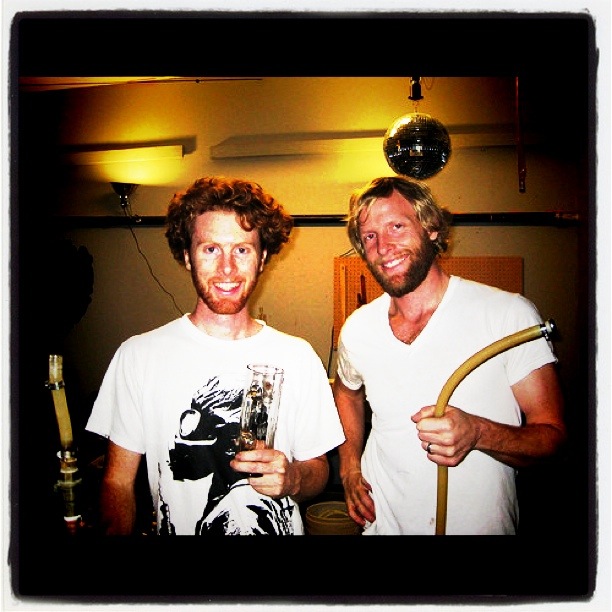
BEER AND WINE The other week, I hit up one of the free, bi-weekly Thursday night tasting parties put on by San Francisco nanobrewery Pacific Brewing Laboratories, located in a small garage on a side street deep in SoMa—and was completely smitten. The adventurous atmosphere and swell-looking crowd were part of that, of course. But the small-batch beers on offer (I quickly downed a gorgeously smooth black IPA), the rogue food vendors (I then dove into a box of Nosh This Bacon Crack chocolate), and the almost-steampunk assemblage of tangled brewing equipment, scuffed kegs, and illustrative blackboards really sealed the deal.

Since they seemed exquisitely attuned to the underground brew-plus-food equation, I asked the guys behind Pac Brew Labs, Patrick M. Horn and Bryan Hermannsson, to tell us a bit about themselves and give us a wee menu of street pairings. Here’s what Patrick came up with for us. (Marke B.)

“Pacific Brewing Laboratory started in a garage as a place for us to experiment with new beer flavors, styles, and brewing techniques. What started out as a place to share new creations with friends grew into a twice-monthly, totally free event with hundreds of our “new” friends and great local street food vendors.

“We brew small, 10-gallon batches which allows for constant beer experimentation. Some of our more exotic beer styles include Hibiscus Saison, Squid Ink Black IPA, Chamomile Ale, Lemongrass IPA, Szechwan Peppercorn Red ale, and wine-soaked oak-aged Brown Ale. We’re always on the lookout for new ingredients and inspirations that will lead us to palate-pleasing creations. For our tastings, we often invite a local food cart to attend, in order to pair our beers against some of the amazing varieties of flavors produced by DIY local food vendors. Below are a few of our favorites, which include beers we enjoy from other local breweries.”

Read about Pac Brew Lab’s upcoming free Thursday Night Beer Nights at www.pacbrewlab.com.


WISE SONS DELI PASTRAMI + PACIFIC BREWING LABORATORIES SQUID INK BLACK IPA

“Leo Beckerman and Evan Bloom of pop-up Wise Sons Deli (Saturdays, 9 a.m.-2 p.m. at Beast and Hare, 1001 Guerrero, SF. www.wisesonsdeli.com) are on a mission from God to bring to us mere mortals the best in Jewish deli. They’ve been serving up their in-house pickles, matzo ball soup, pastries and — most importantly — their weeklong-brined, spice-rubbed, hickory smoked pastrami with home made rye bread to San Francisco and at many of our beer socials since the year 5771. Our Squid Ink is made with darker grains than traditional IPAs and uses West Coast hops to give it a traditional West Coast IPA hop aroma and bitterness. The richness and spices of the pastrami pair perfectly with the citrus-y, hoppy and roasted flavors of the Black IPA. Finish with a house fermented pickle for the perfect sandwich-beer-pickle experience.”


MISSION CHINESE FOOD + TRUMER PILSNER

“Anthony Myint and Danny Bowien have created one of the most creative and community minded pop-up restaurant in the nation with Mission Chinese Food (Thu-Tue, 11:30 a.m.-3 p.m. and 5 p.m.-10:30 p.m., at Lung Shan, 2234 Mission, SF. (415) 863-2800, www.missionchinesefood.com). Their delicious twists on traditional Chinese and Asian cooking include kung pao pastrami, thrice-cooked bacon, tingling lamb noodle soup, salt cod fried rice and cold-poached chicken with chicken hearts. Mission Chinese Food also contributes $0.75 from each entrée to the San Francisco Food Bank. The Trumer (www.trumer-international.com) from Berkeley, with its high carbonation, crisp malt backbone and good hop bitterness, offers a good counterpoint to the exotic flavors and spices of Danny’s cuisine. As the heat and tingling build from chilies and Szechwan peppercorns, a pilsner can really satisfy. (And if you need to douse a flaming palate, the low alcohol content allows for a few brews with minor effect.)”


NOSH THIS CHOCOLATE + 21ST AMENDMENTS MONK’S BLOOD

Beer and chocolate go together like Bert and Ernie or peanut butter, bananas, and Elvis. Kai Kronfield of Nosh This (noshthis.com) makes some of the most creative chocolates in San Francisco. Butter toffee Bacon Crack, salted caramels made with balsamic vinegar, Meyer lemon, or salt & pepper… not to mention the Bacon Bourbon Rocky Road. These chocolates are the perfect balance of sweet, salty, and chocolate-y and pair well with darker, maltier beers. 21st Amendments Monk’s Blood (www.21st-ammendment.com), a dark Belgian ale, fits this bill well. Made with the traditional hops and barley, it also contains figs, vanilla, and cinnamon. It’s a complex beer, in a can, that complements the richness and intricate flavors of Kai’s creations. This combo is a perfect end to an evening, a mid-day snack, or breakfast — whatever, nobody’s judging.


PIZZA HACKER + MOONLIGHT DEATH AND TAXES

“Pizza and beer is typically a no-brainer pairing, but often most choose an IPA, pale ale, or lager to go with their cheesy slice. Moonlight’s Mooonlight’s Death and Taxes (www.moonlightbrewing.com) is a dark lager — but its roasty, crisp and malty flavors lends itself perfectly to the olive oil and salt-covered crust and smoky essence of the Pizza Hacker’s (www.thepizzahacker.com) pies. Jeff, the nominal Pizza Hacker and self-described “occasional Pazi (Pizza nazi)”, has built a custom-made portable wood fired brick oven called the FrankenWeber. He wheels it up outside bar or brewery, assembles, and bakes fresh pizzas on the sidewalk. His sauce is from organic heirloom tomatoes and he uses a method pioneered by Tartine for kneading the dough. Best tasted with a full bodied, flavorful pint of brew!


MAGIC CURRY KART + ALMANAC SUMMER 2010

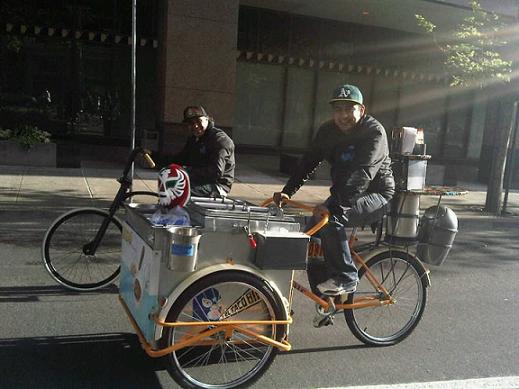
Almanac’s Summer 2010 Belgian golden (www.almanacbeer.com) is made with blackberries and aged in red wine oak barrels for 11 months. Brian Kimball of Magic Curry Kart (www.magiccurrykart.com) wheels around two burners and two rice cookers on his bike, and whips up the most incredibly Thai-influenced curries in front of you with amazing precision. The ingredients are fresh and the spices are delicious. Almanac’s golden ale will add a nice fruity finish to the spicy and flavorful red or green curry. With an eight percent alcohol count and naturally carbonated in the bottle, Summer 2010 will refresh your palette after every sip without overpowering it, enabling new tastes in every luscious bite of curry. Cheers!

Generation cork

0

virginia@sfbg.com

BEER AND WINE It’s a unique time in Bay Area winemaking. We see more California winemakers finding harmony between New and Old World-style production, laying off heavier-handed extremes of overly-oaked or high alcohol wines, honing in on our region’s true terroir. While global love for big, bold California wines isn’t going anywhere, it’s ever more apparent that our range is far beyond what might be assumed.

Small, family-run wineries have long undergirded our region’s greatness, and today there are many new wines, from Sonoma to Napa, adding nuance to the landscape. As is the case historically, many wineries are a family affair where parents and children share in the work, from production to business operations. Here are a few we felt you should know about; you can order most of their wines through their websites.


SUTTON CELLARS, SAN FRANCISCO

San Francisco holds a treasure in the person of Carl Sutton of Sutton Cellars. He walks the fine line of approachability and Old World-influenced production style. At 22nd Street and Illinois sits a funky warehouse winery where he throws Jug Sundays, tapping barrels and selling jugs or liters of wine (email directly through its website — www.suttoncellars.com — to be added to the event email list). Carl corrals Dogpatch neighbors to supply grub, like Olivier’s Butchery or the TomKat Asian street food truck. His wife Sharon often pours and works with him, both of them wine aficionados and passionate global travelers.

His grapes grow mostly in Sonoma County (with a little Mendocino in the mix), and are often single vineyard wines. At a time when many claim personal care, Sutton’s brown label wines are actually filled and corked by hand. Often this kind of care implies high costs, but Sutton stays amazingly affordable at $14–<\d>$21 a bottle.

Sutton is heavily influenced by France and Spain. He offers a full-bodied Rattlesnake Rosé ($15), but also the stunning Fizé, a 2010 rosé of organic Carignane grapes. It unfolds with each sip: tart cranberry and pomegranate notes, and a crisp effervescence. With no yeast or sulfites added, fermentation actually happens in the bottle. It possess a bready nose, with a profile far beyond typical rosés on either end of the sweet/dry spectrum (find this beauty at the winery, Bi-Rite, Rainbow Grocery, D&M). As of last week, he has keg preview of the 2010 Rattlesnake Rosé on tap at Magnolia Pub and Brewery.

His 2007 Carignane is an acidic, balanced, food-friendly red (barrel fermented in neutral oak). The aged La Solera is an elegant after-dinner imbibement and one of Sutton’s best creations. A blend of syrah, zin, and carignane wines from 1999-2006, it at turns evokes Madeira, Banyuls, sherry, even whiskey, with whispers of burnt orange, and a golden richness from its time resting in the sun, a classic method he picked up in Spain. La Solera is at the top of his price range at a mere $30, a steal for such a complex wine.

Sutton’s Brown Label Vermouth (unaged brandy-fortified neutral white wine, infused with 17 botanicals, bottled fresh weekly) is a winner. The Alembic was the first place to serve this refreshing aperitif on tap, enjoyed on the rocks, Italian-style. Sutton bubbles over with visions for a wide range of wines and liqueurs, including at least one new aperitif/digestif wine due before year’s end.


KELLY FLEMING WINES, CALISTOGA

Head off Silverado Trail, past vines and olive trees, onto a dirt road that leads to a gate. Beyond a sea of cabernet vines, lies Kelly Fleming’s stone winery (www.kellyflemingwines.com), evoking an Italian villa, similar to many I explored in Tuscany. The winery’s stone walls and wood shutters imbue the space with a rustic character far beyond its years.

In an open-air dining room, I sat under stone arches at a handmade wood table crafted from one tree off the 300-acre property. Kelly and her daughter Colleen, who also works for the company, served a Mediterranean-style spread for lunch, using ingredients from their garden (like a silky jam from their fig trees).

We sipped Fleming’s 2009 Sauvignon Blanc (50 percent French oak, 50percent stainless steel), representative of the Oakville soil from which these grapes grow. It’s a balanced white with a floral and fruity (pear, pineapple) profile, rounded out by a hint of vanilla. 2007 Cabernet is 100 percent estate and CCOF organically grown, rested in 85 percent new French oak. Though fruit plays prominently (warm, dusty raspberries), hints of wood, nuts and spice give it contrast.

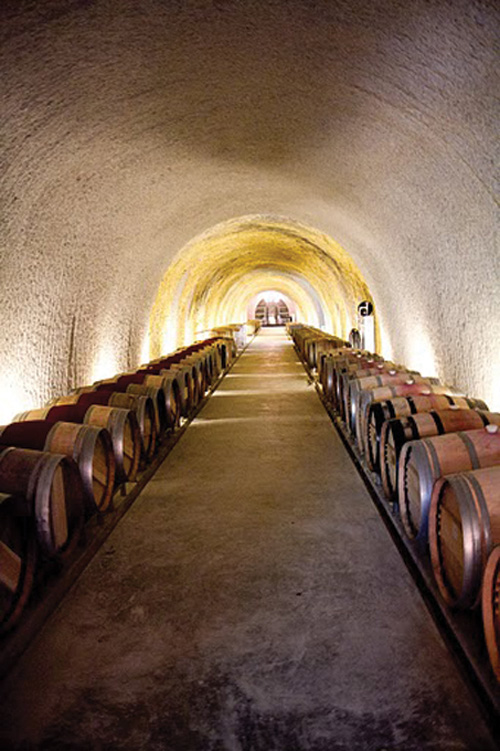
Winemaker Celia Welch works with the region’s terroir (this is cabernet country, after all), from vines planted in 1999. The wild beauty of the property’s forests and creeks is kept intact with only 12 of the 300 acres planted with vines. Inside limestone caves, the air is naturally cool, storing barrels and bottles of past vintages (unreleased but which they’ve been perfecting for nearly a decade). At a mere 850 cabernet and 675 sauvignon blanc cases a year, these are truly small production wines.

Kelly is hands-on in so many aspects from harvesting to forklift operation. She and Colleen both were recently certified in forklift driving, highlighting the involved, familial nature of the winery. They are gracious hosts, welcoming guests by appointment.


SWANSON VINEYARDS, RUTHERFORD

Think Parisian carnival, classic French estate, Napa’s rich nature, New Orleans’ roots, and you’ll begin to get an idea of the influences on Swanson Vineyards (www.swansonvineyards.com). The winemaker is Chris Phelps — Clarke Swanson founded the winery back in 1985, planting his first merlot grapes. His daughter, Alexis, works as the winery’s creative director. Wife Elizabeth buzzed about as we sipped wine in their enchanting garden, greeting each guest.

The first sign Swanson is different comes when you enter the Sip Shoppe, with red-and-white striped tented walls, Old World French artwork, and Billie Holiday playing soothingly in the background. Elizabeth and Alexis designed the shop themselves, imparting a playful Parisian spirit to what could just be another tasting room. One wants to linger for flights like “Some Like it Red,” paired with the likes of warm pistachios, Alexis bonbons (made by Vosges with curry and Swanson’s Alexis Cabernet), or a potato chip topped with creme fraiche and Hackleback sturgeon caviar (lovely with their Chardonnay).

The 2010 Chardonnay was my favorite, and a complete surprise as a mineral, French-inspired chardonnay, reminiscent of Chablis. Neutral oak allows crisp, green apple notes to shine, while honey adds a tinge of cream to the finish. At a pricey $45, this one is only available at the winery or to wine club members.

Of the reds, Swanson’s signature 2007 Merlot offers the best price-to-taste ratio at $38 per bottle. It’s unexpectedly balanced with tart tannins, hints of black cherry, currant and mocha. On the pricier end, the 2007 Alexis Cabernet ($75) is bold and layered, while a 2006 Petite Syrah ($70) goes the earthier, spice and gentle black pepper route.

Make an appointment to visit the winery for a Salon tasting ($65) or Sip Shoppe flight (around $25), then finish by lingering in the garden. You can taste at dozens of wineries but the Swanson’s chic shoppe and salon deliver a fun, Parisian spirit to the Napa countryside. *

Virginia Miller writes about the latest food and drink news at The Perfect Spot, www.theperfectspotsf.com

Alerts

0

alert@sfbg.com

FRIDAY 16

Justice begins with seeds

The California Biosafety Alliance hosts a two-day conference bringing together farmers, activists, and experts to discuss the threats of genetically modified foods. Speakers will discuss the corporate food model, how it impacts our lives and environment, and what people can do to change it. Dr. Vandana Shiva, activist and environmental justice leader, will be the keynote speaker.

Friday 9 a.m. to Saturday 6 p.m., $50–$200 sliding scale

The Women’s Building

3543 18th St. # 8

www.biosafetyalliance.org


SATURDAY 17

Stop corporate kleptocracy

Occupy Wall Street is a campaign started by Adbusters to sound the call of “Democracy NOT Corporatocracy” aimed at national policy makers. Organizers say 20,000-plus people will swarm Wall Street with peaceful barricades to set up tents and remain there until demands are met. To show West Coast solidarity, Occupy Financial District SF will host its own stay-in at the former Bank of America Building, which now houses Bank of America and Goldman Sachs offices.

2 p.m., free

555 California, SF

occupyfinancialdistrictsf@gmail.com

or Brian Cerney at bcerney@mail.csuchico.edu


Colossal coastal cleanup

Join 80,000 people to keep our waterways pristine as part of the annual California Coastal Cleanup Day. Environmental organizations are hosting cleanups throughout the Bay Area, so find a group cleaning a place near and dear to you at www.parksconservancy.org/volunteer. Bring a bucket, sunscreen, and a can-do attitude to show your appreciation for our beautiful outdoors.

9 a.m.-noon, free

Throughout Bay Area

www.coastal.ca.gov/publiced/ccd/ccd2.html


SUNDAY 18

Protest BART violence

Come to protest the recent violence propagated by BART police and discuss how to use other forms of public transportation as part of a BART boycott. Artists, poets, musicians, bicyclists, skateboarders, roller skaters and all are invited to come with their creativity flowing to this “celebration of life free of oppression.”

2-4:30 p.m., free

Ferry Building

Market and Embarcadero, SF

Jeremy Miller, 415-595-2894, djasik87.9@gmail.com

Mesha Monge Irizarry, 415-595-8251, mamalamesha@gmail.com


WEDNESDAY 21

Experiment with direct democracy

Hear a panel of experts speak to California’s direct democracy (or lack of) and join the discussion about how to return the political process to the people. Panelists include Kim Alexander of the California Voter Foundation; Bruno Kaufmann, Swiss-Swedish journalist and president of Initiative & Referendum Institute Europe; Paul Jacob, president of the Citizens in Charge Foundation; and James H. Fowler, medical geneticist and political scientist at UC San Diego.

7 p.m., free

Golden Gate Room, Building A Fort Mason Center

Marina and Buchanan, SF

www.zocalopublicsquare.org


Mail items for Alerts to the Guardian Building, 135 Mississippi St., SF, CA 94107; fax to (415) 437-3658; or e-mail alert@sfbg.com. Please include a contact telephone number. Items must be received at least one week prior to the publication date.

A new progressive agenda

56

Over the past three months, the Guardian has been hosting a series of forums on progressive issues for the mayor’s race. We’ve brought together a broad base of people from different communities and issue-based organizations all over town in an effort to draft a platform that would include a comprehensive progressive agenda for the next mayor. All told, more than 100 people participated.

It was, as far as we know, the first time anyone tried to do this — to come up with a mayoral platform not with a few people in a room but with a series of open forums designed for community participation.

The platform we’ve drafted isn’t perfect, and there are no doubt things that are left out. But our goal was to create a document that the voters could use to determine which candidates really deserve the progressive vote.

That’s a critical question, since nearly all of the top contenders are using the word “progressive” on a regular basis. They’re fighting for votes from the neighborhoods, the activists, the independent-minded people who share a vision for San Francisco that isn’t driven by big-business interests.

But those of us on what is broadly defined as the city’s left are looking for more than lip service and catchy phrases. We want to hear specifics; we want to know that the next mayor is serious about changing the direction of city policy.

The groups who endorsed this effort and helped plan the forums that led to this platform were the Harvey Milk LGBT Club, SEIU Local 1021, the San Francisco Tenants Union, the Human Services Network, the Community Congress 2010, the Council of Community Housing Organizations, San Francisco Rising, Jobs with Justice, and the Center for Political Education.

The panelists who led the discussions were: Shaw-san Liu, Calvin Welch, Fernando Marti, Gabriel Haaland, Brenda Barros, Debbi Lerman, Jenny Friedenbach, Sarah Shortt, Ted Gullicksen, Nick Pagoulatos, Sue Hestor, Sherilyn Adams, Angela Chan, David Campos, Mario Yedidia, Pecolio Mangio, Antonio Diaz, Alicia Garza, Aaron Peskin, Saul Bloom, and Tim Redmond.

We held five events looking at five broad policy areas — economy and jobs; land use, housing and tenants; budget and social services; immigration, education and youth; and environment, energy and climate change. Panelists and audience participants offered great ideas and the debates were lively.

The results are below — an outline of what the progressives in San Francisco want to see from their next mayor.


ECONOMY AND JOBS

Background: In the first decade of this century, San Francisco lost some 51,000 jobs, overwhelmingly in the private sector. When Gavin Newsom was sworn in as mayor in January 2004, unemployment was at 6.4 percent; when he left, in January 2011, it was at 9.5 percent — a 63 percent increase.

Clearly, part of the problem was the collapse of the national economy. But the failed Newsom Model only made things worse. His approach was based on the mistaken notion that if the city provided direct subsidies to private developers, new workers would flock to San Francisco. In fact, the fastest-growing sector of the local economy is the public sector, especially education and health care. Five of the 10 largest employers in San Francisco are public agencies.

Local economic development policy, which has been characterized by the destruction of the blue-collar sector in light industry and maritime uses (ironically, overwhelmingly privately owned) to free up land for new industries in business services and high tech sectors that have never actually appeared — or have been devastated by quickly repeating boom and bust cycle.

Instead of concentrating on our existing workforce and its incredible human capital, recent San Francisco mayors have sought to attract a new workforce.

The Mayor’s Office has, as a matter of policy, been destroying blue-collar jobs to promote residential development for people who work outside of the city.

There’s a huge disconnect between what many people earn and what they need. The minimum wage in San Francisco is $9.92, when the actual cost of living is closer to $20. Wage theft is far too common.

There is a lack of leadership, oversight and accountability in a number of city departments. For example, there is no officiating body or commission overseeing the work of the Office of Economic and Workforce Development. Similarly the Arts Commission, the chartered entity for overseeing cultural affairs, is responsible for less than 25 percent of the budget reserved for this purpose

There’s no accountability in the city to protect the most vulnerable people.

The city’s main business tax is highly regressive — it’s a flat tax on payroll but has so many exceptions and loopholes that only 8,500 businesses actually pay it, and many of the largest and richest outfits pay no city tax at all.


Agenda items:

1. Reform the Mayor’s Office of Economic and Workforce Development to create a department with workforce development as a primary objective. Work with the San Francisco Unified School District, City College and San Francisco State to create sustainable paths to training and employment.

2. Create a municipal bank that offers credit for locally developed small businesses instead of relying on tax breaks. As a first step, mandate that all city short-term funds and payroll accounts go only to banks or credit unions that will agree to devote a reasonable percentage of their local loan portfolios for small business loans.

3. Reform procurement to prioritize local ownership.

4. Link economic development of healthcare facilities to the economic development of surrounding communities.

5. Link overall approval of projects to a larger economic development policy that takes as its centerpiece the employment of current San Francisco residents.

6. Enforce city labor laws and fund the agency that enforces the laws.

7. Establish the Board of Supervisors as the policy board of a re-organized Redevelopment Agency and create community-based project area oversight committees.

8. Dramatically expand Muni in the southeast portion of the city and reconfigure routes to link neighborhoods without having to go through downtown. Put special emphasis on direct Muni routes to City College and San Francisco State.

9. Reform the payroll tax so all businesses share the burden and the largest pay their fair share.

10. Consolidate the city’s various arts entities into a single Department of Arts & Culture that includes as part of its mandate a clear directive to achieve maximum economic development through leveraging the city’s existing cultural assets and creative strengths and re-imagining San Francisco’s competitive position as a regional, national and international hub of creative thinking. Sponsor and promote signature arts programs and opportunities to attract and retain visitors who will generate maximum economic activity in the local economy; restore San Francisco’s community-based cultural economy by re-enacting the successful Neighborhood Arts Program; and leverage the current 1-2 percent for art fees on various on-site building projects to be directed towards non-construction-site arts activity.


LAND USE, HOUSING AND TENANTS

Background: Since the office market tanked, the big land-use issue has become market-rate housing. San Francisco is building housing for people who don’t live here — in significant part, for either very wealthy people who want a short-term pied a terre in the city or for commuters who work in Silicon Valley. The city’s own General Plan calls for 60 percent of all new housing to be below-market-rate — but the vast majority of the new housing that’s been constructed or is in the planning pipeline is high-end condos.

There’s no connection between the housing needs of city residents and the local workforce and the type of housing that’s being constructed. Family housing is in short supply and rental housing is being destroyed faster than it’s being built — a total of 21,000 rental units have been lost to condos and tenancies in common.

Public housing is getting demolished and rebuilt with 2500 fewer units. “Hotelization” is growing as housing units become transitory housing.

Planning has become an appendage of the Mayor’s Office of Economic Development, which has no commission, no public hearings and no community oversight.

Projects are getting approved with no connection to schools, transit or affordable housing.

There’s no monitoring of Ellis Act evictions.

Transit-oriented development is a big scam that doesn’t include equity or the needs of people who live in the areas slated for more development. Cities have incentives to create dense housing with no affordability. Communities of concern are right in the path of this “smart growth” — and there are no protections for the people who live there now.

Agenda items:

1. Re emphasize that the Planning Department is the lead land-use approval agency and that the Mayor’s Office of Economic and Workforce Development should not be used to short-circuit public participation in the process.

2. Enact a freeze on condo conversions and a freeze on the demolition of existing affordable rental housing.

3. Ban evictions if the use or occupation of the property will be for less than 30 days.

4. Index market-rate to affordable housing; slow down one when the other is too far ahead.

5. Disclose what level of permanent affordability is offered at each project.

6. Stabilize existing communities with community benefits agreements before new development is approved.


BUDGET AND SOCIAL SERVICES

Background: There have been profound cuts in the social safety net in San Francisco over the past decade. One third of the city’s shelter beds have been lost; six homeless centers have closed. Homeless mental health and substance abuse services have lost $32 million, and the health system has lost $33 million.

None of the budget proposals coming from the Mayor’s Office have even begun to address restoring the past cuts.

There’s not enough access to primary care for people in Healthy San Francisco.

Nonprofit contracts with the city are flat-funded, so there’s no room for increases in the cost of doing business.

The mayor has all the staff and the supervisors don’t have enough. The supervisors have the ability to add back budget items — but the mayor can then make unilateral cuts.

The wealthy in San Francisco have done very well under the Bush tax cuts and more than 14 billionaires live in this city. The gap between the rich and the poor, which is destroying the national economy, exists in San Francisco, too. But while city officials are taking a national lead on issues like the environment and civil rights, there is virtually no discussion at the policy level of using city policy to bring in revenue from those who can afford it and to equalize the wealth disparities right here in town.

Agenda items:

1. Establish as policy that San Francisco will step in where the state and federal government have left people behind — and that local taxation policy should reflect progressive values.

2. Make budget set-asides a budget floor rather than a percentage of the budget.

3. Examine what top city executives are paid.

4. Promote public power, public broadband and public cable as a way to bring the city millions of dollars.

5. Support progressive taxes that will bring in at least $250 million a year in permanent new revenue.

6. Change the City Charter to eliminate unilateral mid-year cuts by the mayor.

8. Pass a Charter amendment that: (a) Requires the development of a comprehensive long-term plan that sets the policies and strategies to guide the implementation of health and human services for San Francisco’s vulnerable residents over the next 10 years, and (b) creates a planning body with the responsibility and authority to develop the plan, monitor and evaluate its implementation, coordinate between policy makers and departments, and ensure that annual budgets are consistent with the plan.

9. Collect existing money better.

10. Enact a foreclosure transfer tax.


YOUTH, IMMIGRATION, AND EDUCATION

Background: In the past 10 years, San Francisco has lost 24,000 people ages 12-24. Among current youth, 5,800 live in poverty; 6,000 have no high school degree; 7,000 are not working or attending school; 1,200 are on adult probation.

A full 50 percent of public school students are not qualified for college studies. Too often, the outcome is dictated by race; school-to-prison is far too common.

Trust between immigrants and the police is a low point, particularly since former Mayor Gavin Newsom gutted the sanctuary ordinance in 2008 after anti-immigrant stories in the San Francisco Chronicle.

Some 70 percent of students depend on Muni, but the price of a youth pass just went from $10 to $21.

Agenda items:

1. Recognize that there’s a separate role for probation and immigration, and keep local law enforcement from joining or working with immigration enforcement.

2. Improve public transportation for education and prioritize free Muni for youth.

3. Create family-friendly affordable housing.

4. Restore the recreation direction for the Recreation and Parks Department.

5. Implement police training to treat youth with respect.

6. Don’t cut off benefits for youth who commit crimes.

7. Shift state re-alignment money from jails to education.


ENERGY, ENVIRONMENT AND CLIMATE CHANGE

Background: When it comes to land use, the laws on the books are pretty good. The General Plan is a good document. But those laws aren’t enforced. Big projects get changed by the project sponsor after they’re approved.

Land use is really about who will live here and who will vote. But on a policy level, it’s clear that the city doesn’t value the people who currently live here.

Climate change is going to affect San Francisco — people who live near toxic materials are at risk in floods and earthquakes.

San Francisco has a separate but unequal transportation system. Muni is designed to get people downtown, not around town — despite the fact that job growth isn’t happening downtown.

San Francisco has a deepwater port and could be the Silicon Valley of green shipping.

San Francisco has a remarkable opportunity to promote renewable energy, but that will never happen unless the city owns the distribution system.


Agenda items:

1. Promote the rebirth of heavy industry by turning the port into a center for green-shipping retrofits.

2. Public land should be for public benefit, and agencies that own or control that land should work with community-based planning efforts.

3. Planning should be for the community, not developers.

4. Energy efficiency programs should be targeted to disadvantaged communities.

5. Pay attention to the urban food revolution, encourage resident owned farmers markets. Use unused public land for local food and community gardens.

6. Provide complete information on what parts of the city are fill, and stop allowing development in areas that are going to be inundated with sea level rise.

7. Prioritize local distributed generation of electricity and public ownership of the power grid.

8. Change Clean Energy San Francisco from a purchasing pool system to a generating system.

YBCA PRESENTS BIG ART GROUP

0

On Sept. 16 and 17, YBCA and Z Space present New York experimental ensemble Big Art Group, transforming Florida Street into a film set of sorts for The People: San Francisco. The site-specific performance combines live theater with large-scale, real-time video projections on Z Space’s exterior. Juxtaposing live reenactments with clips of taped conversations, The People: San Francisco brings the concept of reality TV to a new level. The People, which first premiered in Italy in 2007, is part of a larger cross-cultural work that will eventually combine dialogues from all its global exhibitions. Starting at 6:30pm, prior to each evening’s performance, the block will be closed off for food and drink vendors, including something called “The Taco Throwdown.” Performances start at 8; $10 in advance at ybca.org or cash only at the door. More info here.
September 16-17 at 8PM @ Outside Z Space, 450 Florida St, San Francisco

Suds on sea legs: A photo journey through Brews on the Bay

0

All photos by Allen David

“Fuck the wine industry! I mean, I drink wine like everybody else.” Brenden Dobel, brewmaster at Thirsty Bear Brewing Company may be tipsy — but then again, we are on a boat.

A bigass boat in fact — the S.S. Jeremiah O’Brien, one of the mere two Liberty ships still afloat from the batch of 2,710 that were constructed during WWII. But we were pretty far from Normandy on Saturday; the O’Brien was hosting Brews on the Bay, a celebration of San Francisco’s alcoholic beverage of choice.

At least, that’s how Dobel would have it. “Our entire civilization is based on beer — and I’ll stand by that statement,” said the brewer from behind his aviator glasses and cigarette, hanging out by the cask ale at his brewery’s tasting table, perched on a platform atop the 441-foot boat. 

But for too long California wine producers have been outhustling brewers in terms of public relations, even in the food pairing arena (“wine cannot handle heavy cheeses, spicy food — beer has much more dimensions,” he says). Dobel and other SF brewers’ answer to the problem was to form the SF Brewer’s Guild in 2003. The associationa has been holding Brews on the Bay for eight years to celebrate San Francisco beer — suds from “the birthplace of the American craft brewery revolution,” as Dobel puts it. 

This weekend, 50 beers from eight breweries were on offer to the exuberant crowd of mostly-young people swilling on the O’Brien’s deck. Thirsty Bear’s brewmaster was excited about the possibilities of adding more guild members in the years to come, possibly from the ranks of the nanobreweries that have begun to make their mark on the San Francisco scene. 

“By 2013, we should have 11 breweries here,” he shares — although from the look of the crowd swerving down the gangplank at the end of the day (your author definitely included), Brews of the Bay’s beer selection left nothing to be desired. 

Boxing Room

1

paulr@sfbg.com

DINE It does make a difference, I must say, when you step into a restaurant and find the people at the host’s station smiling and nodding at you, riffling their stack of menus before showing you to your table — instead of not. The last time I made an attempt on Citizen Cake, a few years ago, at lunchtime, I found myself confronted by a rather steely-eyed maitre d’ who advised me, in a spirit of what I took to be barely suppressed glee, that there was no possibility of seating my party of two even though the restaurant was all but empty. I left and did not look back.

If only for a marked change in tone, the Boxing Room, which opened recently in Citizen Cake’s old haunt at the corner of Gough and Grove, is a welcome turning of the page. Just as welcome is the remodel of what was once a shirt factory into a wonder of woodiness, from the ceiling of exposed joists to the impressive swaths of sauna-like blond paneling along the rear wall. Best of all is the long, sinuous bar in place of Citizen Cake’s boxy, glass-and-steel dessert cases; the bar’s reassuring jiggle, like a well-banked S-curve on a freeway, softens the hard, high angles of the space. And while the floor (of poured concrete) is of a cold hardness that usually means reverberant noise, that isn’t the case here. Even when the restaurant is nearly full, it’s possible to have a pleasant conversation without having to raise your voice.

Are there bitter cold nights in New Orleans? The Boxing Room is one of the latest entrants in what seems to be spate of bayou-themed spots in our chilly city. As at Roy’s, I felt a slight dissonance in eating the food of some faraway warm place while awaiting the little tongues of clamminess that would slither into the dining room every time somebody came in the front door. (The front door is gorgeous, incidentally, a masterwork of glass and iron, but very heavy and unwieldy.) The restaurant belongs to the Absinthe group, and the chef is Justin Simoneaux, whose name speaks for itself, at least if you speak French.

The obvious question is how Boxing Room’s food stacks up against that of Criolla Kitchen, the new, Louisiana-accented successor to Baghdad Cafe in the Castro. As we might expect, there is considerable overlap, including red beans, handlings of mirliton (the cucumber relative), various versions of the po’boy, and fried chicken. The cooking of the Mississippi Delta is well-defined and has, for North America, deep historical roots. If there’s a meaningful difference between the two menus, it’s probably Boxing Room’s upmarketiness; a couple of the main dishes pop the $20 boundary.

But most of them don’t, and the tapas-like nibbles called lagniappe are just $5 each. (This might be a small joke, since the word supposedly means, more or less, “gift.” Maybe the modest charge is the equivalent of shipping and handling.) Of these, the one that particularly caught our eye was the small cast-iron pot of Cajun boiled peanuts. We were expecting something flamingly spicy — Cajun is one of those words — and were surprised to find the legumes mildly seasoned and rather soggy, like the bits of wood that splinter from old decks in rainy weather. At first this was disappointing, but in true bar-food fashion, the peanuts built up a subtle momentum and, by the end, were nearly addictive.

You may have had grilled Monterey Bay squid ($9) before, but you probably haven’t had it like this — with tasso (a form of spicy cured pork), fried okra, and aioli made with roasted garlic, all of it brought together into a voluptuous faux-stew. Just as good, if more conventional, was a little cast-iron pot of red beans and sausage ($6) — all the cast-iron pots, incidentally, amount to a small detail that makes a big impression — while a green-tomato ratatouille ($5) seemed underpowered, though beautifully diced.

Apart from the occasional small smear of foie gras, I don’t think I’ve ever eaten a savory item as rich as the fried-oyster po’boy ($18). The quite-large oysters had been battered with corn meal and slathered with mayonnaise before being snuggled between slices of fabulously fresh baguette — a kingly sandwich. The throw weight was increased slightly by a small litter of hushpuppies on the side.

“Gumbo” is derived from the West African word for “okra,” and there was okra aplenty in the gumbo ($9), along with andouille coins and shreds of chicken in a thick, smoky broth. Okra is like cilantro: You either love or hate its unmistakable flavor. As I happen to love it, I loved this gumbo. But it isn’t for doubters.

The dessert menu includes beignets ($7), and they’re fine — shaped like hamantaschen here. A livelier choice would be the pralines and cream ($7), a sundae of vanilla ice cream embellished with chunks of praline, candied almonds, and little squares of blondie bar — a ghost of pastries past? 

BOXING ROOM

Continuous service: Mon.-Wed., 11:30 a.m.-midnight; Thurs.-Fri., 11:30-1 a.m.; Sat., 5 p.m.-1 a.m.; Sun., 5 p.m.-midnight

399 Grove, SF

(415) 430-6590

www.boxingroomsf.com

Beer and wine

AE/DC/DS/MC/V

Noisy

Wheelchair accessible


Ativanitude

0

le.chicken.farmer@gmail.com

CHEAP EATS Some people wanted closure, so we went around the circle and each said what we got out of our 10 days of writerly camaraderie, intense productivity, and snorkeling. OK, chicken farmer, here’s where you thank the people who brought you here and lick the asses of all the new, important writerly friends you’ve made, I thought. Which should have been easy, because I did love my new friends and got a shitload of good work done in Mexico; but exhaustion and head problems got the better of me, and by the time my turn came the circle was already aslosh with gratitude, spinning its wheels in good vibes and wonderfulness. I was suffocating. I was drowning. I was dizzy. And it was my turn to say what I got out of it.

“An ear infection!” I said.

If I’d have stopped there it would have been funny, but I’d been out of my stomach for four days and couldn’t stop bitching and whining: My head felt like it was going to explode every time I nodded, the smell of toast made me want to puke, and if I bent down to scratch a mosquito bite I would pass out, I was so dizzy. How the hell was I supposed to get in the van that was taking us all to the airport next morning, let alone fly in an airplane at 39,000 feet with entirely clogged ears? Did anyone have any decongestants?

Heads shook in sympathy. People promised to check their pill collections before going to bed.

“The food was really really good,” I added.

Then it wasn’t my turn to speak anymore, and the circle continued to gush toward closure. Hard to say how many enemies I’d made, but — since everything else in the world is hard to say too –hey, who’s counting?

At the airport, I wasn’t the only one having a nervous breakdown. Irene was scheduled to land in New York at the same time some of us were. The East Coast was closed. Flights to other places were full.

And, worse, the Starbucks where we awaited our fates was playing squirrely jazz.
I set up a little Ativan dispensary at our table. See, here’s where being a complete spaz comes in handy: I’d been tracking the hurricane for half a week, and had already changed my return trip from JFK to Pittsburgh. So alls I had to worry about was my head exploding before reaching cruising altitude.

It didn’t!

Hedgehog was waiting for me at the bottom of the escalator by baggage claim, big smile. She’d left her
stupid movie one day early, drove to Pittsburgh, and got us a nice hotel room near the airport and even nearer to one of the satellite Primanti Bros. To which she immediately whisked me for a pastrami and French fry sandwich and a romaine salad, also with French fries. As if I weren’t loopy enough already.

“Not as good as Giordano’s,” I declared, “but better than the original Primanti.”

The fizzy water did not have French fries in it.

Hedgehog set a half-full bottle of West Indies Creole habanero sauce on the table between us. “I didn’t know what you’re supposed to take with you in an evacuation,” she said, “but I grabbed this.”

“I like your style,” I said, putting it mildly while pouring my favorite hot sauce all over everything.

“You did the right thing.”

She liked my ativanitude, she said.

And we went to our hotel room, made category 4 love,
and in the morning drove back to New York where we had dinner plans and US Open tickets. After this we head back west, finally, stopping only for nephewish weddings, state fairs and I guess gas and shit.

We might go to a Steelers game.

Meanwhile, in time for football season, Giordano’s has opened a restaurant in the Mission, without me.

It’s where Ti Couz used to be, on 16th Street at Valencia, and rumor has it they have pieroghis.

So my question to you, Mr. Earl Butter, is why the hell are you still eating at Valencia Pizza & Pasta?

Fresh and Easy displacement

20

OPINION You could cut the hate with a knife. All eyes were on my fumbling fingers, unable to sign my WIC coupons fast enough with one hand while holding my 13-month-old son with the other. “Somebody’s using welfare checks to pay for their food,” A 20 something man in a polo shirt shouted into his phone next to me.

I spend so many days like this while trying to shop as a poor mama, its hard to even think about them. The life of a poor parent in the U.S. is always a scarcity model rollercoaster ride of hate, system abuse, subsistence crumbs and criminalization, best exemplified in the supermarket experience where the so-called paying customers suffer through the bother of waiting for poor parents to pay with our WIC coupons, working poor mamas to pay with payroll checks or indigenous elders to count out their multiple coupons.

I began to reflect on this when I heard about the new fresh and Easy Markets opening in the Bayview-Hunters Point, the Mission and the Portola district. It’s a new supermarket chain from England that by policy doesn’t accept WIC coupons.

WIC — the federal Women, Infants and Children’s program, is not welfare, but rather a supplemental program that allows low-income parents to get milk, grains, cereal and other basic foodstuffs. It’s a program used by many working poor as well as mamas on government crumbs so we can feed our children a balanced diet.

The Bayview, Mission, and Portola neighborhoods are peopled with a lot of multi-generational, multi-lingual mamas, and families in poverty like mine, who need access to affordable fruits and vegetables and non-hormone-filled meat like Fresh and Easy has, but are these stores really being built for us?

Like so much of San Francisco and the whole Bay Area, these communities are under attack from redevelopment and gentrification efforts. Removal and evictions of poor families and elders happen everyday in the city to make way for the corporate veneer of Lennar and John Stewart properties, condominiums, lofts and the rich young people who they are built for.

So who is Fresh and Easy for? They don’t take coupons, personal checks or WIC — and like their Whole Paycheck counterparts, they don’t hire union employees, or ultimately many employees at all, as they have the new self-pay check-out stands.

Fresh and Easy claims it doesn’t except the manufacturers’ coupons for the same reasons it doesn’t accept paper personal checks, W.I.C. vouchers, or cash payroll checks: That elimination of manual paper processing, combined with its self-service checkout system, saves money.

Pressured by community members who protested outside the Bayview store on its opening day, Fresh and Easy CEO Tim Mason now claims that Fresh and Easy in the Bayview will eventually begin taking WIC.

As this poor mama tries to move out from under the lie of criminalized government crumbs and the non-existent, bootstraps centered, corporate underwritten American dream, I have come to realize our collective, self-determined liberation begins with growing our own food in our poor neighborhoods with people-led community gardens, taking back stolen indigenous land and resources with organized poor people led/indigenous people-led efforts and whenever we have the energy, after all the other things we have to do to survive in this capitalist society fighting the exclusion and removal efforts of us by the smooth talking corporations who don’t see us as part of their grand profit-making plans.

Tiny aka Lisa Gray-Garcia, daughter of Dee and mama of Tiburcio is the co-founder of POOR Magazine/PoorNewsNetwork and author of Criminal of Poverty: Growing up Homeless in America

On the Cheap Listings

0

WEDNESDAY 7

Grant application seminar Independent Film Center, 145 Ninth St., SF. (415) 402-2794, www.creativeworkfund.org. 6-7:30pm, free. The Creative Work Fund is giving out up to $810,000 to local artists — and it’s hosting a series of workshops that will guide potential applicants through the process of submitting their proposal. The program is focusing on media (computer, audio, digital, and film) and performing artists this time around — if you fit the bill, you might want to look at letting this organization fit out your bills.

THURSDAY 8

Captive Genders: Trans Embodiment and the Prison Industrial Complex reading Modern Times Bookstore, 2919 24th St., SF. 7-9pm, free. A ground-breaking new book examines the relationship of queer, trans, and gender non-conforming people and the prison industrial complex. Contributors to the book — a group that includes past and present prisoners, academics, and activists — will speak at this reading. The event could be a call to action on an under-reported conflict.

Back to school dog and kid party Wag Hotel, 25 14th St., SF. (415) 876-0700, www.waghotels.com. 5-7pm, $5 suggested donation. The SF SPCA is bringing adoptable woofs to this meet-and-greet (don’t bring Junior if you’re not trying to walk away with a new best friend?). Kids will also be able to participate in the shelter’s Puppy Dog Tales Reading Room program.

FRIDAY 9

Rally in the Alley 100-199 Ames, SF. www.alleyproject.ning.com. 5:30-8pm, free. Ames Alley (between 22nd and 23rd streets and Dolores and Guerrero) has recently been renovated — the new alleyway features solar lighting, vertical gardens… whoa, water-permeable pavement!? This calls for a celebration, and a celebration is what you’ve got coming to you. Today, join food vendors, an art exhibit, live music, and more to welcome the newly spruced-up walkway to the neighborhood.

SATURDAY 10

Babylon Salon Cantina, 580 Sutter, SF. www.babylonsalon.com. 7pm, free. ZYZZYVA’s longtime editor Howard Junker is a free agent now, so he’s got the time to focus on his own projects — share in their glory at this event, where Junker will be reading from his “proto-memoir-ish blog novel of ideas” tentatively titled An Old Junker. Other readers for the night include authors Nick Krieger, Laura Goode, and magician Robert Strong.

Haight Street Hop Milk, 1840 Haight, SF. www.milksf.com. 9pm, $5 before 10pm, $10 afterwards. Bingo, boobies, DJs, dancing: such is the multi-faceted entertainment that awaits you at this something-for-everyone ho-down. Burlesque bingo? Free hairdos from professional stylists? What is going on here really, this is just getting too crazy.

Ghirardelli Square Chocolate Festival Ghirardelli Square, SF. www.ghirardellisq.com. Noon-5pm, free. Sure, you’ve got shell out some dough to sample the goods at this fest in the heart of tourist town, but monkeys come free! Paul Frank — the company of that iconic Julian monkey face, and all your adolescent nieces favorite cartoon-cute T-shirts — is coming to town. Representatives from the brand will be holding a contest for “king and queen of puppy prom,” and while we hesitate to qualify what the hell that means, it seems safe to say you should bring your dog.

SUNDAY 11

Drum for Peace gathering Numi Tea Garden, 2230 Livingston, Oakl. (877) 686-4832, www.numiteagarden.com. 3-6pm, free. A fundraiser for Altitudinal Healing Connection’s ArtEsteem youth arts education program, this gathering is sure to be very “Kumbaya” — which given this day’s recent history, probably isn’t the worst thing ever. Love your neighbor and all that, people. 


Submit items for the listings at listings@sfbg.com. For further information on how to submit items for the listings, see Picks.

Appetite: Refreshing the Starlight

0

Sampling the new, revamped Harry Denton’s Starlight Room cocktails. All photos by Virginia Miller

Tonight, September 6th, Harry Denton’s legendary Starlight Room will reopen, revamped, with brand new menus and look. Though the space wasn’t quite ready for a sneak peek, I was able sample a few of the cocktails that will be on offer from bar manager Joel Teitelbaum’s winning menu.

Grouped together by time periods, the menu starts with the 1600s and punch, ending with Starlight Room classics from great bartenders who have launched from here over the years (like Tony Abou-Ganim, Marco Dionysos, Jacques Bezuidenhout). Other sections include The Jerry Thomas Years (1860’s), The Dry Years – Prohibition (1920-1933), and Dark Times (1980’s – this one with updated versions of ’80’s hits like the Fuzzy Navel).


Peppered with colorful quotes from W.C. Fields to Homer Simpson, the cocktail and bar food menus are playful and wide-ranging. They walk the fine, thin line of pleasing a steady stream of out-of-towners (due to the bar’s legendary status, location in the Sir Francis Drake hotel http://www.sirfrancisdrake.com/ and on Union Square), but also giving locals and drink geeks strong reasons to stop in.

I sampled five drinks utilizing everything from pisco to calvados. Each was elegant and interesting, yet gentle and subtle enough to introduce (and hook?) the uninitiated on the likes of Scotch, mezcal, genever.

In my photo captions, I describe the cocktails sampled. I encourage you to head out to celebrate the re-opening of a legendary spot I suspect will not only be better than ever, but will finally offer what shouldn’t be a rarity in our fair city: well-crafted, artisanal drink and bites… with a stunning view.

— Subscribe to Virgina’s twice monthly newsletter, The Perfect Spot

Dick Meister: VIVA EL BOICOTTEO!

2

By Dick Meister

(Third part of a five part daily series)

Although the United Farm Workers initially relied solely on strikes in its drive to win union contracts for California’s farm workers, it soon switched to the much more effective weapon of the boycott.

Growers could easily replace strikers, and often did. But they couldn’t do much about customers – individuals and institutions – who heeded the UFW’s call to not buy any grapes, lettuce or wine from growers who continued to rebuff the UFW demands for union recognition.

The boycotts helped forge a potent coalition of clergymen, industrial unionists, young activists and civil rights advocates, liberal Democratic politicians, socially conscious shoppers and others. They also waved crimson banners, sang the farm workers’ songs, chanted their slogans and espoused non-violence, on city streets, outside supermarkets, in meeting halls, wherever they could. There were an estimated 17 million of them worldwide between 1968 and 1975, including 10 to 12 percent of all U.S. adults. Later boycotts drew less support but were nevertheless effective in winning new contracts.

John Giumarra Jr., a young lawyer who spoke for the grape growers who signed the first UFW contracts, declared that boycott pressures had been threatening to “destroy a number of farmers.” Lionel Steinberg, a major Coachella Valley grape grower who was the first to agree to a UFW contract, urged others to quickly reach an agreement, lest they continue losing millions of dollars in sales.

Steinberg told his fellow growers, “It is costing us more to produce and sell our grapes than we are getting paid for them. We are losing maybe 20 percent of our market. The boycott is illegal and immoral, but it also is a fact.”

The signing of the union contracts with grape growers in Delano signaled the inevitable. California’s farm workers were going to be organized, and the next target would be those in the nearby Salinas and Santa Maria valleys, which produced 70 percent of the nation’s iceberg lettuce and much of its other vegetables. It was called “America’s Salad Bowl,” a flat, fertile place where morning fog hung heavy over land carpeted green for miles.

Men and women hovered over the land, gripping hoes so short their handles scarcely protruded above their fast-moving hands as they stooped and cut, stooped and cut. Most worked under the supervision of men with the broad accents of Texas, Oklahoma and Arkansas who had wielded hoes for small independent growers before giant corporations bought up the land and hired them to manage their new holdings. These men were among the Dust Bowl Refugees of the 1930s who had made their own violently opposed demands for better working lives during the Great Depression.

Many of the former Dust Bowl Refugees were lured into urban employment when the depression ended, but those who remained as managers joined the farm corporations to oppose the demands of the Chicano and Filipino American farm workers who replaced the at the bottom of the economic totem pole.

The demands were for union recognition elections in which the UFW seemed a certain winner. But if they didn’t agree to elections, the growers faced the certain prospect of a boycott like that which had been so costly to grape growers.

There was, however, an alternative that the growers had overlooked until the inevitability of unionization arrived with the UFW demands. They might arrange to bypass elections and sign with another union that would demand less than the aggressive, unorthodox UFW and at the same time ease the sting of a boycott by enabling by enabling growers to point out that their workers were unionized.

The growers found their alternative in the Teamsters Union, which feared that UFW strikes and boycotts would endanger the flow of produce handled by truck drivers, cannery workers and other Teamster members. What’s more, Teamster officials were eager for representation rights that would allow them to control the field workers. The potential was immense: more than 30,000 farm workers in the two valleys alone. That would bring a lot of new money into the dues and pension funds used by leaders of the corruption-ridden Teamsters to gain power, influence and fat salaries for themselves.

Virtually all the 170 growers in the two valleys soon announced they had signed Teamster contracts, even though the Teamsters had no farm worker members. The growers and Teamsters hadn’t even agreed on specific contract terms. They were in so great a rush to head off the UFW, they merely signed agreements that the terms would be filled in later. The terms, however, would not be decided in consultation with the workers or their union. Terms were left solely to grower and Teamster representatives.

The workers were not even allowed to ratify the contracts, although they would be required to join the Teamsters and have union dues deducted from their paychecks. If they didn’t join the Teamsters, they’d be fired. Most workers got basic pay raises of 10 to 50 cents an hour in return for forced membership in the Teamsters and some minimal health and welfare benefits – but that was all.

Teamster recognition was a very small price for growers to pay in exchange for maintaining their ability to make decisions on pay and working conditions in isolation from the direct collective demands of their employees. Since the Teamsters’ main interest lay elsewhere, in transportation and food processing, growers also could expect that even the minimal terms of the contracts would not be fully enforced and that strikes and boycotts were hardly a possibility. But on the slim chance that the growers might still feel insecure, the contracts were written to stand for five years.

Chavez was outraged at the Teamsters’ “act of treason against the legitimate aspirations of farm workers.” He declared “all-out war against the Teamsters and the bosses ” and marched into Salinas with several hundred farm workers and an AFL-CIO contingent headed by Organizing Director Bill Kircher. Pickets went immediately to a farm where 250 workers had been fired for not joining the Teamsters. Hundreds of workers struck at other farms and the UFW began preparing for legal action and a nationwide lettuce boycott.

Growers got a court order against what was ruled an illegal jurisdictional dispute, but the pickets and boycotters kept marching nevertheless and Chavez began “a penitential fast against injustice.”

In less than two weeks, the Teamsters were asking for a treaty with the UFW. It was quickly reached. The Teamsters agreed to reallocate jurisdiction over field workers to the UFW and agreed that growers who had signed with the Teamsters could switch to the UFW without penalty.

But there was a catch. Growers who had signed Teamster contracts would not give them up. Finally, UFW members voted to strike. It was, at the start, the largest and most effective farm strike since the mid-1930s. More than 5000 workers left their jobs at nearly 150 farms, and produce shipments were cut from 200 carloads a day to 75 or less. Growers were losing an average of $500,000 a day.

Unlike the vineyard strike, this dispute was violent, with beatings suffered by UFW and Teamster partisans alike. Some of the turmoil was caused by officials of a Teamster cannery workers local who were charged with using $25,000 in union funds to hire some of the local’s burly members to “guard” fields from UFW organizers.

A judge ruled there could only be one informational picket at 22 of the Salinas Valley farms that made up the strikers’ main targets, none at the eight others. Nor would the UFW be allowed to call a boycott against any of the 170 growers who held Teamster contracts. The union nevertheless called a boycott. Officially, the strike continued, but the major effort was at food markets in 64 cities across the country, where UFW members and supporters urged shoppers to bypass lettuce from the struck growers.

A judge ordered Chavez arrested. He went to jail accompanied by more than 2000 UFW members and supporters, including Coretta King and Ethel Kennedy. They cheered Chavez’ parting advice to “boycott the hell out of them!” and then began a series of prayer vigils and other highly publicized demonstrations. After three weeks, Chavez was released, pending the outcome of a UFW appeal.

The boycott continued at an intensified pace throughout the early months of 1971 until a committee of Catholic bishops mediated a settlement between national Teamster and AFL-CIO leaders. But growers still refused to give up their Teamster contracts. They held them for a half-dozen years more, until the Teamsters, beaten badly in a series of union representation elections under California’s new farm worker bargaining law, finally abandoned as futile the fierce fight they had waged against the UFW for more than a decade.

Meanwhile, the boycott continued, as the UFW expanded its organizing efforts to Florida and Arizona. The UFW’s victory in California was truly spectacular. Imagine, one of the youngest and smallest unions in the country, representing the most oppressed of American workers, decisively beating the country’s largest and most powerful union.

It was the UFW’s incredible use of the boycott that did it,  the major non-violent weapon available to all who would seek justice from an oppressor.

Dick Meister, former labor editor of the SF Chronicle and KQED-TV Newsroom, has covered labor and politics for more than a half-century. Contact him through his website, www.dickmeister.com, which includes more than 350 of his columns.


Desolation angels

0

arts@sfbg.com

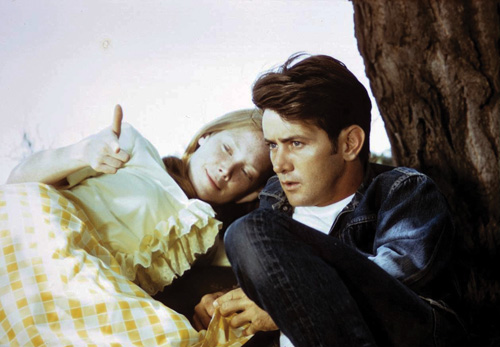
FILM Wanda (1970) takes a long time to settle into anything resembling a plot, but the wayward scenes at the start of the film have a remarkable exactness to them. In one, the title character (played by director Barbara Loden) walks into a dingy bar looking to end the day early. She’s fresh from divorce court, where she lost her kids, merely acceding to the judgments of her ex-husband and the court. As the bartender puts a bottle of beer and glass on her table, a greasy lump at the bar says he’ll take care of the drink. The unsolicited offer clouds Wanda’s face; she sips her drink resigned to what it means. A rude cut takes us to a spent motel room where Wanda sleeps naked alone in pale afternoon light. The guy from the bar tiptoes around the room to leave, but he makes a noise setting Wanda to hurriedly dress herself, pointlessly calling after him to wait. The plainness of the scene’s despair tells us it’s nothing new for her.

Characterization emerges in the fluidity of situation and behavior, melancholy in an unanchored camera and stark ellipses. Once its protagonist takes up with an amateur thief who radiates nervous energy, Wanda unspools as an inverted Gun Crazy (1950), its unsentimental portrait of a female drifter looking ahead to films like Jeanne Dielman (1975), Vagabond (1985), Safe (1995), and Kelly Reichardt’s River of Grass (1994) and Wendy and Lucy (2008). Wanda screens in a restoration print as part of a bountiful overview at the Pacific Film Archive called “The Outsiders: New Hollywood in the Seventies.”

Drawing inspiration from The Last Great American Picture Show, an excellent anthology edited by Alexander Horwath to accompany an earlier retrospective at the Austrian Film Museum, the PFA series shifts the historical narrative of New Hollywood from movie brats to unnamed margins. Celebrity-driven surveys of the same period (like Peter Biskind’s Easy Riders, Raging Bulls) miss the congruence of by-the-teeth filmmaking and borderline characters that helps to define the PFA series. Ample room is made for those filmmakers whose careers couldn’t hold a straight line (Loden’s career as a director began and ended with Wanda), and familiar landmarks like Mean Streets and Badlands (both 1973) are considered alongside lesser known but no less groundbreaking character studies like Dusty and Sweets McGee (1971), Ice (1970) and The Heartbreak Kid (1972).

The swift scene of Wanda getting picked up at the bar establishes a few leitmotifs for “The Outsiders.” You notice right away that the crummy motel rooms and bars are the real thing, and that an actor’s vanity is never spared a frank look at a character’s worn down body and face. The incidental nature of the camera placement, long duration of scenes, and dispersive spread of sound deepen the melancholy reality of these appearances. A verité-style handheld camera takes single measure of the scene, registering the immediacy of behavior but stopping short of slicing up the conflict into easy points of identification (Wanda cinematographer Nicholas T. Proferes cut his teeth with Robert Drew’s pioneering documentary crew in the early 1960s). Also borrowed from observational documentary is an interest in private, semi-coherent forms of speech; the stories are as much told through gesture and movement. You constantly feel on the precipice of emotions, watching as they form and stagnate in a languid real time that makes a character’s exhaustion palpable in the theater.

Most of these movies are indeed populated by outsiders, though the meaning of the word shifts from film to film. There are plenty of figures of hedonism (memorably, Rip Torn’s hard-driving country western singer in 1972’s Payday), but so too are there close portraits of the lived differences of gender, race, class and age — Wanda, but also Killer of Sheep (1977), Bush Mama (1975), and Over the Edge (1979). Unlike Easy Rider (1969), the film typically cited as launching a hundred New Hollywood productions, these movies don’t valorize the outsider towards an obvious political morality. A film like Killer of Sheep is delicate because it recognizes the social constraints of the central character’s life while at the same time respecting the fullness of his winnowed existence. The same long-take camera style which expresses pessimism is also left open to moments of ragged beauty that escape political allegory.

The exciting vision of radical heroism offered by Sweet Sweetback’s Baadasssss Song (1971) is the exception that makes it easier to imagine how Wanda‘s brittle poetry of despair might have disappointed feminists at the time. Wanda is left alone again at the end of the film, seemingly unable to live with or without a man. There’s a glimmer of hope when another woman invites her inside a raucous roadhouse where mixed company drink and smoke and laugh as a string duo stomp out a joyful sound. But through it all Wanda remains withdrawn, eating and drinking as if someone might at any moment snatch the food out of her hands. The film ends with a freeze frame of her blank face as the music slowly drains away on the soundtrack. The shot holds a mirror up to our desire for her story to mean something, our wish for the succor of tragedy or redemption. Loden’s film instead narrows in on the insoluble nature of the character’s existence, holding the wreckage of her life in view with both pitiless reserve and tender regard.

THE OUTSIDERS: NEW HOLLYWOOD CINEMA IN THE SEVENTIES

Sept. 2-Oct.27, $5.50–<\d>$9.50

Pacific Film Archive

2575 Bancroft, Berk.

(510) 642-5249

bampfa.berkeley.edu

Txoko

0

› paulr@sfbg.com

DINE Among the reasons to regret the passing of Enrico’s and its replacement by Txoko is that “Enrico’s” was pretty straightforward to pronounce, whereas the new endeavor, with its impossible juxtaposition of t and x — the spelling equivalent of dividing by zero — does not seem to be. Txoko, despite its modest five letters, has the look of what Sam (having heard Dwarvish spoken for the first time) called “a fair jaw-cracker” in The Lord of the Rings. The good news is that “tx” is pronounced “ch,” so the restaurant’s name is “choke-o,” which sounds like the stage name of a particularly menacing rapper.

As a cultural signifier, “tx” tells us that we’re in or near the Basque country, and I know this mainly because I love the wonderful white wines produced in Spain’s Basque provinces from the Txakoli grape. (The same grape is now grown in Chile and spelled, mercifully, chacoli. ) The wine — Txoko offers a lovely example from Uriondo for $9 a glass — is sharp, bright, minerally, and sour, about as close as a white wine could be to lemon juice passed through a gravel filter. This could be an acquired taste, and if so, I’ve acquired it. The Basques, incidentally, are a singular people; their language is not known to be related to any other in the world, and their Iberian origins are believed to run back 40,000 years or more, to a time when early homo sapiens sapiens and the people we know as Neanderthal might have coexisted and perhaps, as judge advocate general types like to put it, fraternized.

Enrico’s always had a slightly fraternal air for me, and the new regime doesn’t seem to have changed much about the space’s appearance. It’s still a dark, stage-like vault, with a concave face of window glass that looks south, soaking up all the available sunlight like a snowbird in Florida on a weeklong January holiday. All the daylight streaming in makes the interior seem that much darker and lounge-like; it’s as though you’re looking right at a flashbulb as it goes off.

Chef Ian Begg’s menu deals mainly in small plates, among them pintxos, the Basque edition of tapas. There’s only one main dish offered: a $65 ribeye steak for two, which might be a sort of oblique answer to Zuni Cafe’s roast chicken for two. A giant steak sounds pretty all-American, and indeed the tone of much of the rest of the food is mainly Cal-Med: grilled Delta asparagus ($9), for instance, topped with a fried egg and a marvelously cheesy green garlic hollandaise sauce. There are various ways of dealing with asparagus’s grassiness if, like me, you’re not wild about it; Begg’s pincer movement — grilling plus a heavy wash of fat — was most effective.

A wild mushroom empanada ($5), rather pastry-ish, did have an Iberian flair, along with intense fungal flavor. Equally fungal was the wild mushroom arroz ($10), similar to a risotto but with a powerfully concentrated reduction (from chanterelles, baby shiitake, and hen-of-the-wood) that hinted at soup. A batter-fried squash blossom ($3) seemed rather Italian; this version was stuffed with herbed ricotta and presented on a toasted levain spear, with a smear of goat cheese nearby.

One of the more striking items turned out by the kitchen wasn’t even a headliner on the menu card. It was the summer squash and tomato tartlet that accompanied a tiny fist of grilled lamb loin chop ($11). The lamb itself was flavorful and juicy, though slightly complex to eat, despite its size, because a bit of bone that had to be carved around. But the tartlet was a small masterpiece, a kind of ratatouille napoleon reminiscent of the pièce de resistance in the Pixar movie Ratatouille. It looked like a tomato-slathered disk, but under the tomato cap was the summer squash, thin coins carefully arranged into coiling strands, like DNA. The bean salad accompanying a small filet of butter-braised halibut ($12), by contrast, was much more free-form, in fact totally free-form, though several of the players were notable, among them fava beans, fresh chickpeas, and sea beans, an unusual edible that could pass as a cross between kelp and asparagus.

In keeping with a strong recent trend, desserts are excellent. We warmed to a date bread pudding ($8), which had the velvet-sponge consistency of angelfood cake and was finished with a pair of mock-savory witticisms: a sail (stuck into the top) of latticed chorizo crisped like a tuile, and a smear of black-olive caramel sauce, a clever recasting of that current vogue item, sea-salt caramel. The gâteau Basque ($8) also made imaginative use of an herb, thyme, we usually associate with the savory; here it was combined with peaches into what amounted to a fabulously moist clafoutis, capped with crottin of Straus frozen yogurt. Easy on the jaws.

TXOKO

Dinner: Tues.-Sat. from 5 p.m.

504 Broadway, SF

(415) 500-2744

www.txokosf.com

Full bar

MC/V

Noisy

Wheelchair accessible

The real Leland Yee

53

tredmond@sfbg.com

It’s early January 2011, and the Four Seas restaurant at Grant and Clay is packed. Everyone who is anyone in Chinatown is there — and for good reason. In a few days, the Board of Supervisors is expected to appoint the city’s first Asian mayor.

The rally is billed as a statement of support for Ed Lee, the mild-mannered bureaucrat and reluctant mayoral hopeful. But that’s not the entire — or even, perhaps, the central — agenda.

Rose Pak, who describes herself as a consultant to the Chinese Chamber of Commerce but who is more widely known as a Chinatown powerbroker, is the host of the event. She stands in front of the room, takes the microphone, and, in Cantonese, delivers a remarkable political speech.

According to people in the audience, she says, in essence, that the community has come out to celebrate and support Ed Lee — but that’s just the start. She also urges them not just to promote their candidate — but to do everything possible to prevent Leland Yee from becoming mayor.

She continues on for several minutes, lambasting Yee, the state Senator who lived in Chinatown as a child, accusing him of about every possible political sin — and turning the Lee rally into an anti-Yee crusade. And nobody in the crowd seems terribly surprised.

Across Chinatown, from the liberal nonprofits to the conservative Chamber of Commerce, there’s a palpable fear and distrust of the man who for years has been among San Francisco’s most prominent Asian politicians — and who, had Lee not changed his mind and decided to run for a full term this fall, was the odds-on favorite to become the city’s first elected Chinese mayor.

The reasons for that fear are complex and say a lot about the changing politics of Asian San Francisco, the power structure of a city where an old political machine is making a bold bid to recover its lucrative clout — and about the career of Yee himself.

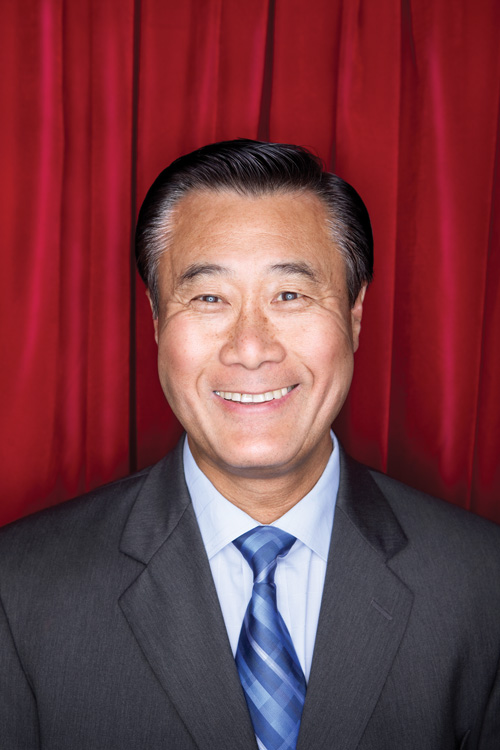
Senator Leland Yee is a political puzzle. He’s a Chinese immigrant who has built a political base almost entirely outside of the traditional Chinatown community. He’s a politician who once represented a deeply conservative district, opposed tenant protections, voted against transgender health benefits and sided with Pacific Gas and Electric Co. on key environmental issues — and now has the support of some of the most progressive organizations in the city. He’s taken large sums of campaign money from some of the worst polluters in California, but gets high marks from the Sierra Club.

His roots are as a fiscal conservative — yet he’s been the only Democrat in Sacramento to reject budget compromises on the grounds that they required too many spending cuts.

He’s grown, changed, and developed his positions over time. Or he’s become an expert at political pandering, telling every group exactly what it wants to hear. He’s the best chance progressives have of keeping the corrupt old political machine out of City Hall — or he’s a chameleon who will be a nightmare for progressive San Francisco.

Or maybe he’s a little bit of all of that.


Leland Yin Yee was born in Taishan, a city in China’s Guangdong province on the South China Sea. The year was 1948; Mao Zedong’s Communist Party of China had taken control of much of the countryside and was moving rapidly to take the major cities. The nationalist army of General Chiang Kai-Shek was falling apart, and Yee’s father, who owned a store, decided it was time for the family to leave.

The Yees made it to Hong Kong, and since Mee G. Yee had previously lived in the United States and served in the U.S. Army during World War II, he was ultimately able to move the family to San Francisco. In 1951, the three-year-old Leland Yee arrived in Chinatown.

For four years, Yee lived with his sister and mother in a one-room apartment with a shared bathroom while his father worked as a sailor in the merchant marine. It was, Yee recalled in a recent interview, a tight, closed, and largely self-sufficient community.

“The movie theater, the shoe store, the barber shop, food — everything you needed you could get in Chinatown,” Yee said. “You never had to leave.”

Of course, after a while, Yee and his mom started to venture out, down Stockton Street to Market, where they’d shop at the Emporium, the venerable department store. “It was like walking into a different country,” he said. “If you didn’t know English, they didn’t have time for you.”

Yee, like a lot of young Chinese immigrants of his era, put much of his time into his studies — in the San Francisco public schools and in a local Chinese school. “My mom spoke a village dialect, and we had to learn Cantonese,” he said. “Every little kid had to go to Chinese school. We hated it.”

When Yee was eight, his parents managed to buy a four-unit building on Dolores Street, and the family moved to the Mission, where he would spend not only the rest of his childhood but much of his early adult life. He graduated from Mission High School, enrolled in City College, studied psychology and after two years won admission to UC Berkeley.

Berkeley in 1968 was a very different world from Chinatown and even the relatively controlled environment he’d experienced at home in the Mission. “You didn’t protest in school. You’d have been sent home, and your mother would kill you,” he said.

At Berekely, all hell was breaking loose, with the antiwar protests, the People’s Park demonstrations, the campaign to create a Third World College (which led to the first Ethnic Studies Department), and a general attitude of mistrust for authority. “I developed a sense of activism,” Yee said. “I realized I could speak out.”

That spirit quickly vanished when Yee lost faith in some of his fellow activists. “People would work with us, then get into positions of power and use that against you,” he recalled. “A lot of my friends said ‘forget it.’ I left the scene.”

Yee once again devoted his energy to school, earning a masters at San Francisco State University and a Ph.D in child psychology from the University of Hawaii. Along the way, he met his wife, Maxine.

With his new degree, the Yees moved back to San Francisco — and back in with his parents at the Dolores property, where he, Maxine and a family that would grow to four kids would live for more than a decade.


Yee worked as a child psychologist for the San Francisco Department of Public Health, starting the city’s first high school mental-health clinic. He went on to become a child psychologist at the Oakland Unified School District, then joined a nonprofit mental health program in San Jose.

In 1986, Yee decided to get active in politics for the first time since college, and ran for the San Francisco School Board. He lost — and that would be the only election he would ever lose. In 1988, he won a seat, and established himself as an advocate for students of color, fighting school closures in minority neighborhoods. He also tried to get the district to modify its harsh disciplinary rules, arguing against mandatory expulsions.

On fiscal issues, though, Yee was a conservative. For his first term, despite the brutal cutbacks of the recession of the late 1980s and early 1990s, he insisted that the district make do with the money it had. His solution to the red ink: Cut waste. Only in 1992, when he was up for re-election, did he acknowledge that the district needed more cash; at that point, he supported a statewide initiative to tax the rich to bring money to the schools.

The sense of fiscal conservatism — of holding the line on taxes, but mandating open and fair contracting procedures and tight financial controls — was a hallmark of much of his political career. When the Guardian endorsed him for re-election to the board in 1992, we wrote that “there’s real value in his continuing vigilance against administrative fat and favoritism in contracts.”

Over the next four years, Yee worked with then-Superintendent Waldemar “Bill” Rojas, a deeply polarizing figure who pushed his own personal theory of “reconstitution” — firing all the staff at low-performing schools — and later was enmeshed in a scandal that led to prison time for a contractor he’d hired. Yee told me he was the only board member to vote against hiring Rojas, but people who were watching the board closely back then say he didn’t always stand up to the superintendent.

He also became what some say was a bit too close with Tim Tronson, a consultant hired by the district as a $1,000-a-day facilities consultant. Tronson wound up getting indicted on 22 counts of grand theft, embezzlement, and conspiracy in a scheme to steal $850,000 from the schools, and was sentenced to four years in state prison.

In 1998, when some school board members wanted to build housing for teachers on property that the district owned in the Sunset, Yee led the opposition — with Tronson’s help. At one meeting at Sunset Elementary School, Yee went so far as to say, according to people present, that “Tim Tronson is my man, and I rely on him for advice.”

Yee acknowledged that he worked closely with Tronson to defeat that housing project. “He was the facilities manager,” Yee explained, “and I said that I trusted his judgment.”


Yee has either a great sense of political timing or exceptional luck. He ran for the Board of Supervisors in 1996, facing one of the weakest fields in modern San Francisco history. He was the only Chinese candidate and one of just two Asians (the other, appointed incumbent Michael Yaki, barely squeaked to re-election). In an at at-large election with the top five winning seats, Yee came in third, with 103,000 votes.

He was never a progressive supervisor. In 2000, the Guardian ranked the good votes of what we referred to as Willie Brown’s Board, and Yee scored only 43 percent. He was against campaign finance reform. He supported the brutal gentrification and community displacement represented by the Bryant Square development. He voted to kill a public-power feasibility study and opposed the Municipal Utility District initiative. He opposed a moratorium on uncontrolled live-work development.

In 2002, Yee was one of only three supervisors to oppose Proposition D, a crucial public-power measure that would have broken up PG&E’s monopoly in the city. He stood with PG&E (and then-Sups. Tony Hall and Gavin Newsom) in opposition to the measure, then signed a pro-PG&E ballot argument packed with PG&E lies.

When I asked him about that stand, Yee at first didn’t recall opposing Prop. D, but then said he “stood with labor” on the issue. In fact, the progressive unions didn’t oppose Prop. D at all; the opposition was led by PG&E’s house union, IBEW Local 1245.

Yee was particularly bad on tenant issues. He not only voted to deny city funding for the Eviction Defense Collaborative, which helped low-income tenants fight evictions; he actually tried to get the city to put up money for a free legal fund to help landlords evict their tenants. He opposed a ballot measure limiting condo conversions. He opposed a measure to limit the ability of landlords to pass improvement costs on to their tenants.

In 2001, Yee voted to uphold a Willie Brown veto of legislation to limit tenancies in common, a backdoor way to get around the city’s condo conversion ordinance. Only Hall and Newsom, then the most conservative supervisors on the board, joined Yee. At one point, he started asking whether the city should consider repealing rent control.

He opposed an affordable housing bond in 2002, joining the big landlord groups in arguing that it would raise property taxes. Every tenant group in town supported the measure, Proposition B; every landlord group opposed it.

I asked Yee about his tenant record, and he told me that he now supports rent control. But he said that he was always on the side of homeowners and small landlords, and that property ownership was central to Chinese culture. “I was responding to the Chinese community and the West Side,” he said.

He wasn’t much of an environmentalist, either — at least not in today’s terms. He was one of the only city officials to support a “Critical Car” rally in 1999, aimed at promoting the rights of vehicle drivers (and by implication, criticizing Critical Mass and the bicycle movement).

His record on LGBT issues was mixed. While he supported a counseling program for queer youth when he was on the school board, he also supported JROTC, angering queer leaders who didn’t want a program in the public schools run by, and used as a recruiting tool for, the military, which at that point open discriminated against gay and lesbian people.


Yee was also one of only two supervisors who voted in 2001 against extending city health benefits to transgender employees.

That was a dramatic moment in local politics. Nine votes were needed to pass the measure, and while eight of the supervisors were in favor, Yee and Hall balked. At one point, Board President Tom Ammiano had to direct the Sheriff’s Office to go roust Sup. Gerardo Sandoval, who was ducking the issue in his office, to provide the crucial ninth vote.

Yee didn’t just vote against the bill. According to one reliable source who was there at the time, Yee spoke to a community meeting out on Ulloa Street in the Sunset and berated his colleagues, quipping that the city should have better things to do than “spend taxpayer money on sex-change operations.”

It was a bit shocking to trans people — Yee had, over the years, befriended some of the most marginalized members of what was already a marginalized community. “There was one person at the rail crying, saying ‘Leland, how could you do this to us,'” Ammiano recalled.

The LGBT community was furious with Yee. “I didn’t speak to him for at least a year,” Gabriel Haaland, one of the city’s most prominent transgender activists, told me.

Yee now says the vote was a mistake — but at the time, he told me, he was under immense pressure. When he voted for the queer youth program, he said, “the elders of the Chinese community ripped me apart. They called my mother’s friends back in the village [where he was born] and said her son was embarrassing the Chinese community.”

That must have been difficult — and he said that “if I had known the pain I had caused, I wouldn’t have voted that way.” But it was hard to miss that pain his vote caused.

On the other hand, people learn from their experiences, attitudes evolve, we all grow up and get smarter, and the way Yee describes it, that’s what happened to him.

In 2006, when he was running for state Senate, Yee met with a group of trans leaders and formally — many now say sincerely — apologized. It was an important gesture that made a lot of his critics feel better about him.

“He didn’t have to do that,” Haaland said. “People change, and he paid for his crime, and that’s genuine enough for me.”

As a former school board member, Yee kept an interest in the schools — but not always a healthy one. At one point, he actually proposed splitting SFUSD into two districts, one on the (poorer) east side of town and one on the (richer) west. “We strongly opposed that,” recalled Margaret Brodkin, who at the time ran Coleman Advocates for Children and Youth. “Eventually he dropped the idea.”

For all the problems, in his time on the Board of Supervisors, Yee developed a reputation for independence from the Brown Machine, which utterly dominated much of city politics in the late 1990s. His weak 43 percent rating on the Guardian scorecard was actually third-best among the supervisors, after Ammiano and the late Sue Bierman.

In 1998, he was one of the leaders in a battle to prevent the owners of Sutro Tower from defying the city’s zoning administrator and placing hundreds of new antennas on Sutro Tower. He, Bierman, and Ammiano were the only supervisors opposing Brown’s crackdown on homeless people in Union Square.

When he ran in the first district elections, in 2000, against two opponents who had Brown’s support and big downtown money, the Guardian endorsed him, noting that while he “can’t be counted on to support worthy legislation … He’s one of only two board members who regularly buck the mayor on the big issues.”

(He never liked district elections, and used to take any opportunity to denounce the system, at times forcing Ammiano to use his position as president to tell Yee to quit dissing the electoral process and get to the point of his speech.)


In 2002, the westside state Assembly district seat opened up, and both Yee and his former school board colleague Dan Kelly ran in the Democratic primary. Yee won, and went on to win the general election with only token opposition.

His legislative record in the Assembly wasn’t terribly distinguished. Yee never chaired a policy committee — although he did win a leadership post as speaker pro tem. And he cast some surprisingly bad votes.

In 2003, for example, then-Assemblymember Mark Leno introduced a bill that would have exempted single-room occupancy hotels from the Ellis Act, which allows landlords to evict tenants for no reason. Yee refused to vote for the bill. Leno was furious — he was one vote short of a majority and Yee’s position would have doomed the bill. At the last minute, a conservative Republican who had grown up in an SRO hotel voted in favor.

When he ran for re-election in 2004, we noted: “What’s Leland Yee doing up in Sacramento? We can’t figure it out — and neither, as far as we can tell, can his colleagues or constituents. He’s introduced almost no significant bills — compared, for example, to Assemblymember Mark Leno’s record, Yee’s is an embarrassment. The only high-profile thing he’s done in the past several years is introduce a bill to urge state and local governments to allow feng shui principles in building codes.”

In 2006, Yee decided to move up to the state Senate, and he won handily, beating a weak opponent (San Mateo County Supervisor and former San Francisco cop Mike Nevin) by almost 2-1. His productivity increased significantly in the upper chamber — and in some ways, he moved to the left. He’s begun to support taxes — particularly, an oil severance tax — and when I’ve questioned him, he somewhat grudgingly admits that Prop. 13 deserves review.

He’s done some awful stuff, like trying to sell off the Cow Palace land to private developers. But he has consistently been one of the best voices in the Legislature on open government, and that’s brought him some national attention.

Yee has been a harsh critic of spending practices and secrecy at the University of California, and when UC Stanislaus refused in 2010 to release the documents that would show how much the school was paying Sarah Palin to speak at a fundraiser, Leland flew into action. He not only blasted the university and introduced legislation to force university foundations to abide by sunshine laws; he worked with two Stanislaus students who had found the contract in a dumpster and made headlines all over the country.

He’s fought for student free speech rights and this year pushed a bill mandating that corporations that get tax breaks for job creation prove that they’ve actually created jobs — or pay the tax money back. He’s also won immense plaudits from youth advocates and criminal justice reformers for his bill that would end life-without-parole sentences for offenders under 18.

Along the way, he compiled a 100 percent voting record from the major labor unions, including the California Nurses Association and SEIU, and with the Sierra Club. All three organizations have endorsed him for mayor.

Yee told me that he thinks he’s become more progressive over the years. “My philosophy has shifted,” he said.

Yet when you talk to his colleagues in Sacramento, including Democrats, they aren’t always happy with him. Yee has a tendency to be a bit of a loner — he’s never chaired a policy committee and in some of the most bitter budget fights, he’s refused to go along with the Democratic majority. Yee insists that he’s taken principled stands, declining to vote for budget bills that include deep service cuts. But the reality in Sacramento is that budget bills have until this year required a two-thirds vote, meaning two or three Republicans have had to accept the deal — and losing a Democratic vote has its cost.

“You have to give up all sorts of things, make terrible compromises, to get even two Republicans,” one legislative insider told me. “When a Democrat goes south, you have to find another Republican, and give up even more.”

In other words: It’s easy to take a principled stand, and make a lot of liberal constituencies happy, when you aren’t really trying to make the state budget work.


I met Rose Pak on a July afternoon at the Chinatown Hilton. She brought along her own loose tea, in a paper package; the waitress, who clearly knew the drill, took it back to the kitchen to brew. Pak and I have not been on the greatest of terms; she’s called the Guardian all kinds of names, and I’ve had my share of critical things to say about her. But on this day, she was polite and even at times charming.

After we got the niceties out of the way (she told me I was unfair to her, and I told her I didn’t like the way she and Willie Brown played politics), we started talking about Yee. And Pak (unlike some people I interviewed for this story) was happy to speak on the record.

She told me Yee had “no moral character.” She told me she couldn’t trust him. She told me a lot of stories and made a lot of allegations that we both knew neither she nor I could ever prove.

Then we got to talking about the politics of Chinatown and Asians in San Francisco, and a lot of the animosity toward Yee became more clear.

For decades, Chinatown and the institutions and people who live and work there have been the political center of the Chinese community. Nonprofits like the Chinatown Community Development Center have trained several generations of community organizers and leaders. The Chinese Chamber of Commerce, the Six Companies, and other business groups have represented the interests of Chinese merchants. And while the various players don’t always get along, there’s a sense of shared political culture.

“In Chinatown,” Gordon Chin, CCDC’s director, likes to say, “it’s all about personal connections.”

There’s a lively infrastructure of community-service programs, some of which get city money. There’s also a sense that any mayor or supervisor who wants to work with the Chinese community needs to at least touch base with the Chinatown establishment.

Yee doesn’t do that. “He doesn’t give a shit about them,” David Looman, a political consultant who has worked with many Chinese candidates over the years, told me.

Yee’s Asian political base is outside of Chinatown; he told me he sees himself representing more of the Chinese population of the Sunset and Richmond and the growing Asian community in Visitacion Valley and Bayview.

Pak is connected closely to Brown, who Yee often clashed with. For Pak, Brown, and their allies, strong connections to City Hall mean lucrative lobbying deals and public attention to the needs of Chinatown businesses. Then there’s the nonprofit sector.

CCDC and other nonprofits do important, sometimes crucial work, building and maintaining affordable housing, taking care of seniors, fighting for workers rights, and protecting the community safety net. Yee, Pak said, “has never shown any interest in our local nonprofits. We all work together here, and he doesn’t seem to care what we do.” Yee told me he has no desire to see funding cut for any critical social services in any part of town. But he has also made no secret of the fact that he questions the current model of delivering city services through a large network of nonprofits, some of which get millions of taxpayer dollars. And the way Pak sees it, all of that — the nonprofits, the business benefits, the contracts — are all at risk. “If Leland Yee is elected mayor,” she told me, “we are all dead.”

I ran into an old San Francisco political figure the other day, a man who has been around since the 1970s, inside and outside of City Hall, who remains an astute observer of the players and the power relationships in the local scene. At the time we talked, he wasn’t supporting any of the mayoral candidates, but he had a thought for me. “This town,” he said, “is being taken over by a syndicate. Willie Brown is the CEO, and Rose Pak is the COO, and it’s all about money and influence.”

That’s not a pleasant thought — I’ve lived through the era of political machine dominance in this town, and it was awful. In the days when Brown ran San Francisco, politics was a tightly controlled operation; only a small number of people managed to get elected to office without the support of the machine. Developers made land-use policy; gentrification and displacement were rampant; corruption at City Hall turned a lot of San Franciscans off, not only to the political process but to the whole notion that government could be a positive force in society.

A few years ago, I thought those days were over — and to a certain extent, district elections will always make machine politics more difficult. But when I see signs of the syndicate popping up — and I see a candidate like Ed Lee, who’s close friends with Brown, leading the Mayor’s Race — it makes me nervous. And for all his obvious flaws, at least Leland Yee isn’t part of that particular operation. If there’s a better reason to vote for him, I don’t know what it is.

YEE HOME PURCHASE RAISES SUSPICIONS

Rose Pak has a question about Leland Yee. “How,” she asked me, “did the guy manage to buy a million-dollar house on a $30,000 City Hall salary?”

Pak isn’t the only one asking — numerous media reports over the years have examined how Yee raised a family of four and bought a house in the Sunset on very little visible income. And while I’m not usually that interested in the personal finances of political candidates, I decided that it was worth a look.

Here’s what I found: Public records show that in July 1999, Yee and his wife, Maxine, purchased a house on 24th Avenue for $875,000 (it’s now assessed at slightly more than $1 million). At the time, Yee was a San Francisco supervisor, earning a little more than $30,000 a year. (The salary of the supervisors was raised dramatically shortly after Yee left the board and went to the state Assembly.) His wife wasn’t working. And his economic interest statements for that period show no other outside earnings. So the disposable, after-tax income of the entire Yee family couldn’t have been much more than $25,000.

That, by any normal standard, shouldn’t have been enough to float a mortgage that, records show, totaled $516,000. In fact, the interest payments alone on that mortgage alone would total $3,600 a month — more than Yee’s gross income.

Documents in the Assessor’s Office show another paper trail, too. In 1989, Jung H. Lee, Yee’s mother, transferred the deed on a four-unit Dolores St. building where the family had been living to Maxine and Leland Yee — for no money. And a few months before the Yees bought the Sunset house, they took out a $320,000 home-equity loan on that property. That was the down payment on the Sunset property.

Still: At that point, the Yees would have been paying off two mortgages, with a total nut of about $5,000 a month — and supporting four kids, in San Francisco. In 2002, Yee’s economic interest statement’s show some modest income from teaching at Lincoln University — but nowhere near enough to pay that level of expenses.

What happened? Yee explains it this way: “For more than 10 years, we were living rent-free in my parents’ property,” he told me I an interview. “We were a close Chinese family, and my parents provided the food and helped pay for the children’s clothing. So we had almost no expenses and we lived very frugally.”

During that period, Yee was working for the San Francisco Department of Public Health, the Oakland Unified School District, and a San Jose nonprofit, earning, he said, between $50,000 and $90,000 a year. If he saved almost all of that money, he would have had more than a half-million dollars in the bank when he bought the Sunset house.

There’s nothing on any of his economic disclosure forms showing any ownership of stocks or other reportable financial interests during that period, so he wasn’t investing the money. In fact, he says, it was, and is, all in simple savings accounts. A bit unusual for that large a sum of money.

How did he get a mortgage? “Back then,” he said, “banks were willing to lend a lot more freely than they do today.”

Starting in 2003, Yee was in the state Assembly, making a higher salary — but still not much in excess of $100,000 a year. After taxes, he was probably taking home about $75,000 — and $60,000 was going to the two mortgages.

How did he do it? “We have been supplementing our income with our savings,” he said. “We don’t take vacations, we are very careful with our money.” And they clearly aren’t desperate for cash — Yee’s daughter occupies two of the four units in the Dolores St. building they own, but the other two units are vacant.

It’s possible. It’s plausible. But I don’t blame people for wondering how he managed to pull it off. (Tim Redmond, with research assistance by Oona Robertson) 


BIG CORPORATIONS HAVE BACKED YEE

Yee became a prodigious fundraiser in Sacramento — and a lot of the money came from big corporations that had business in the Legislature. And while he has perfect scores from the Sierra Club and the big labor unions, he’s taken tens of thousands of dollars from some of the biggest corporations, agribusiness interests, and polluters in the state. And at times, he’s voted their way.

Since 1993, for example, campaign finance records show Yee has taken more than $20,000 from Chevron, ExxonMobil, Valero, Conoco Phillips, and BP. He’s received another $22,450 from the chemical industry (and industry employees). Most of it came from Clorox, Dow Chemical, and Dupont.

And while the Sierra Club may not have considered it a priority, Sen. Mark Leno has worked hard to pass a bill limiting chemical fire retardants in furniture. In 2008, Yee voted against Leno’s AB 706.

That year he also refused to support a bill that would prohibit the use of the chemical diacetyl in workplaces. The industries that opposed AB 514 (including Bayer, Abbott Laboratories, Pfizer, and Johnson & Johnson) have given Yee a total of more than $60,000.

In 2003, Yee voted against a crucial tenant bill, one that would have prevented the owners of single room occupancy hotels from using the Ellis Act to evict tenants. He received a campaign check for $2,500 from the San Francisco Apartment Association the next day. Landlords in general have given Yee close to $40,000.

Then there’s agribusiness. Yee gets a lot of money from the farming industry, despite the fact that there obviously aren’t many farms in his district. Why, for example, would the California Poultry Association, the California Cattlemen’s Association, and the California Farm Bureau give him money? The Poultry Association’s Bill Mattos told us that Yee “has taken a keen interest in California’s poultry industry.”

Yee also took immense flak from the San Francisco Chronicle and other papers over a 2003 vote against a bill to limit emissions from farm vehicles. In an editorial, the paper wrote that he was “doing dirty work for the lobbyists.” In the end, under immense public pressure, he switched positions and voted for the bill. I asked Yee about all that money from all those bad operators, and he told me — as most politicians will — that campaign cash has never influenced any of his votes.

So why do all these groups give him money? “It’s about whether you will sit down and listen,” Yee said. “I will talk to all sides and at least consider the arguments as a thoughtful human being. Then I vote my conscience.” (Tim Redmond, with research by Oona Robertson) 

5 Things: August 26, 2011

0

>>WATER WORKS Everyone’s abuzz about Ali Farzat, the Syrian cartoonist whose hands were broken after creating wildly popular illustrated works critiquing the government. The assault on Farzat is a reminder that art has the power to change minds and lives — an idea that US artists with Estria Miyashiro’s Water Writes mural series were fully with when they teamed up with young people to create eight environmental justice-themed murals at water purification sites in eight days in Gaza. The beleaguered city was the project’s fifth stop — including already-completed Phillipines and Hawaii walls, the Water Writes project will go to 10 worldwide cities in total.

>>BABY BANKROLL Back in June, Tim Redmond looked at the reasons for why families stay in San Francisco. His isn’t the only clan that is sticking in the city: Broke Ass Stuart just launched a new column called Mommy No Bucks that’ll be looking at how all us broke asses (with children!!) make it work in the concrete jungle. 

Not til you’re 21, honey. 

>>CHEESE IT! With all the experimental mixologists in San Francisco and our very own grilled cheese food truck, Toasty Melts, you’d think we’d be the first to come up with this: the grilled cheese martini. The Internet has been aglow in gooey praise/disgust the past few days over this concoction, which can be ordered at Bennett’s Pure Food Bistro in Seattle and the Cellar at Beecher’s in New York – both owned by Kurt Beecher Dammeier. It consists of grilled cheese sandwich-infused vodka (“six piping hot sandwiches in 10 gallons of vodka”), fresh tomatoes, basil, and tomato juice. Sounds like vomit central.

>>WINING DOWN We went to check out the public premiere of Wine From Here, a documentary on California’s nascent natural wine culture. Natural wine, we say? Yeah, the definition’s under a fair amount of debate — never more evident than at the filmmaker Q&A after last night’s screening at the Victoria Theatre. The crowd quibbled over things like the use of oak barrels (shouldn’t the fragrant wood be considered an additive since it alters vino’s flavor profile?), labeling moratoriums, and relative price points of wine grown with and without the addition of foreign yeasts, dyes, and government-approved chemicals. Hopefully the differences of opinion were smoothed over at the screening’s after-party at natural wine-friendly Heart, where the profiled vignerons’ bottles were on the menu, including pours from Coturri Winery and Berkeley’s Edmund St. John.

>>BLAST-OFF TO THE WEEKEND When the aliens come for us, we hope they have noodle faces like the claymates in the new Hopie Spitshard and Del the Funky Homosapien video for Hopie’s single “Space Case,” shot outside Beauty Bar and around the Yay. And we hope they transmorgrify our faces with the same fly colorblock eyeshadow as Bay Area MC Hopie’s. And we hope that the ray of light doesn’t come for us today — we wanna catch Spitshard’s show at 111 Minna tonight, part of a fundraiser for Alameda’s Bohol Circle Filipino community center. 


Kreayshawn gets some lady love at Slim’s

5

It was just fine, really. Oakland-bred rapper Kreayshawn’s big, sold-out show at Slim’s last night was amusing, mildly enjoyable, and packed with good people watching. Rapping over prerecorded beats, elfin Kreayshawn and her Chipmunks White Girl Mob (V-Nasty and Lil Debbie) ran through what I suspect is the gamut of their songs in a brief, hyper set.

This likely ages me, but if I’m being honest, I don’t totally get the appeal after seeing it live. Sure, “Gucci Gucci” and “Rich Whores” are fun romps through anti-consumerist hipsterdom, and, perhaps conversely, the rapper clearly has a unique aesthetic, but other than that, it felt almost false, even silly — and unsustainable.

For the first few tracks last night, Kreayshawn and Lil Debbie monster-walked back and forth across the stage in non-choreographed unison, casually shouting duel lyrics and yet somehow still revving up the crowd of mostly young women. This is another aspect about Kreayshawn that’s at least interesting – her followers. They dress like her in a pop culture mishmash of ’80s ripped punk, horn-rimmed glasses, and door-knocker earrings. Maybe I’m just seeing the ripped up shirts/shorts as reverential to punk because Kreayshawn’s mom was there last night – the very awesome Elka Zolot of the Trashwomen.

After a prerecorded “V-Nasty!” screamed through the speakers,  Kreayshawn was all, “what’s that? A special guest?” and V-Nasty, who has been at the center of her own controversies, bounded out and rapped with the others. And then there were three; similarly paced, mousy high-pitched voices stalking across stage. It must have been an intense night, she earlier tweeted “Doing home shows are hella stressful.”

However I might feel about the quality of music, as mentioned above, it is pretty cool to see teen girls and 20-somethings adopting this attitude of “fuck you” and aping Kreayshawn’s style of dress. They clearly adore her and were screaming along with every song. One climbed up on someone’s shoulders and whipped her shirt over her head. At least they’re not being submissive; I was jostled hard by a number of excited young people in light-up glasses throughout the night.

Who knows if Kreayshawn will stand the test of time. A nominee for “best new artist,” it was announced yesterday that she’ll be hosting the 2011 VMA Red Carpet Report for MTV.com, so that’s something. In some ways, I can see the early Madonna factor – sidenote: both have now rocked fishnets half-shirts –  if only based on the fans’ obvious obsession with this peculiar new pop culture figure. She could also go the way of so much niche hip-hop before her and disappear after the Next Big Thing. No more swag.

She’s definitely inspired an onslaught of parody videos, including these food-themed takes on “Gucci Gucci”:

Pizza Pizza:

http://www.youtube.com/watch?v=yi9Gfy52J7s

Fishy Fishy:


Appetite: Oompah and bratwurst in Larkspur

0

Think towering redwoods, smoky aromas of sausages, onions and peppers wafting from a grill, German beers on tap from a cooler, and a darling oompah band of elderly gentleman playing with spunk and skill. Enter the just-launched-this-week Biergarten at the Tavern at Lark Creek. For a short jaunt from the city to Larkspur, it feels worlds away.


I arrived the inaugural Sunday, 8/21, to sunny, fresh air and the knowing shade of those gorgeous redwoods that flank the Tavern (more a classic yellow and white house than tavern). The Biergarten will run every Sunday through October 30 (2pm–5:30pm) outside the restaurant. It evokes Munich beer garden days but with a decidedly California spirit from towering redwoods and elevated beerhaus food.

Chef Aaron Wright grills up smoked beer or chicken apple sausages and garlic bratwurst, juicy and savory, accompanied with grilled onions, peppers and two types of mustard. House-made pretzels come generously dusted with sea salt, or German potato salad helps in soaking up pints of Spaten’s Pilsner and Dark Optimator. Food operates with a ticket system (1-2 tickets, at $5 each, per dish or beer).

When the oompah band raised their steins with rowdy joy, I raised mine, feeling time stop if for a moment, aware of the simple joys of taste, smell, music, camaraderie and nature on a Sunday afternoon.

— Subscribe to Virgina’s twice monthly newsletter, The Perfect Spot

5 Things: August 25, 2011

0

>>COMIC ZEN We just want to breathe deeply and slow our caffiene mainline (ironically) when we read Paul Madonna’s All Over Coffee comic strip (is it a strip when it’s a single panel? More research is needed here). Shit is peaceful. Perhaps that’s why the Zen Center is tapping Madonna for this talk on creative theory, highlighted by a slideshow of his luminous scenes from our city’s vertiginous hills and boring flat parts.

>>PINTXO US, WE’RE DREAMING Next week, our restaurant reviewer Paul Reidinger writes about Txoco, a newish Basque restaurant in North Beach (RIP the similar Iluna Basque, whose Top Chef contestant chef, Mattin Noblia, now helms Rendezvous Tapas Lounge. We’ll leave the overall verdict to Paul, but we simply adore the pintxos — basically an hors-d’oeuvre-sized version of tapas. We had some stellar pintxos in Basque country earlier this year, and these little bites (technically each individual pintxo should last exactly two bites) whisked us back. Do not miss the boquerones (anchovies in olive oil, this version served with quail egg, manchego cheese, thyme, avocado, and aioli). Three dollars for two bites might cause some to balk, but each of those bites is a meal unto itself.  Basque in the glory!     

Vegan Filipino snaxx going mobile. Photo via No Worries

>>SOME WORRIES Before we even had a chance to visit, Oakland’s vegan Filipino restaurant No Worries is transitioning from a brick-and-mortar space to a food truck. “We’re minimizing our waste and we’re using less resources. We’re also more accessible to the community,” says owner Jay Ar-Pugao in this very positive video. September 1 No Worries goes mobile — which will, come to think about it, probably up our chances of every actually eating its food. [via Vegansaurus]

>>NUT YOUR AVERAGE DIVIS DIVE In an attempt to fashion itself into a one-stop shop, tiny KK Cafe on Divisadero began quietly began serving huge burritos last month. The cafe, owned by neighborhood legends Jack and Margaret Chang, already serves a fairly baffling mix of burgers (huge, juicy, and cheap), Chinese hot plate meals, and croissantwiches. But its most well-known product is the peanut milk, a concoction said to have healing powers. The Changs added beef and chicken burritos to their menu at the request of the rabid customers who stop off daily for another jug of Signs and Wonders peanut milk.

>>NO FUNCTION JUNCTION Oh dear, L.A. friends and fans, it looks like this year’s huge annual outdoor Sunset Junction festival in Silver Lake — featuring bands as varied as Butthole Surfers, Hanson(!), and Ozomatli — has been cancelled. War on Fun alert down south! (Well, it would be one, except corporate giant Live Nation was basically bankrolling the thing, until it wasn’t.) Luckily, some lovely DIY souls are trying to save the day with a guerrilla No Function Junction spur-of-the-moment festival of their own in multiple venues near the same spot. If you’d planned to head to head to Silver Lake this weekend, there’s still plenty to go for. Nothing, however, will be able to equal the drama of this absolutely amazing moment with Deneice Williams at Sunset Junction 2007  — she fell right off the stage, but before the ambulances came, she sang her heart out. Now THAT’s rock ‘n roll.


Buche on a bike? Dreams come true, courtesy of El Taco Bike

0

Why does Alfonso Dominguez, owner of Oakland’s Tamarindo, La Calle, and partial owner of Era Art Bar and Lounge, spend his free time hawking tacos from a bike? An avid cyclist and owner of six different bikes himself, we got the idea talking to him last week that Dominguez built El Taco Bike to prove it was possible in the first place.

We’re in full support. Too few snack foods come off the back of bicycles these days.

In fact, Dominguez’ brainchild is the first licensed hot food bike in the Bay Area — maybe even in the state, as far as he knows. That meant he basically had to write the book on how to make the thing pass health code. 

“They didn’t know how to process it,” he says.

Luckily, he’s trained in design. “If I could design a building, I figured I could make a bicycle.” It took eight months of back-and-forth, but finally the city felt he had a solid operation. The bike features compartments to keep his tacos warm, hot and cold sinks, a trash bin, a table to eat on — even a napkin dispenser. 

Also this: “I wanted to keep it traditional, real.” Dominguez has recreated a system that operates in virtually every developing country, street cooks who serve up snack on the back of bicycles. “There’s no food trucks in Mexico,” he continued. “But food bikes are everywhere.”

Accordingly, his tacos are authentically Mexican. Dominguez hawks steamed tacos de canasta, which translates to “basket tacos” — snacks that are kept in a warm basket and steam throughout the day to a soft, melt-in-your-mouth texture. Dominguez’ treats are filled with papas, carnitas, and buche (pork stomach). 

Better than an ice cream truck

El Taco Bike has been rolling the downtown Oakland streets and out to private events (the bulk of business at this point) since the beginning of July. All the world loves a bicycle these days, so El Taco Bike seems like a pretty strong business plan. Dominguez has plans to attend the next East Bay Bike Party with his culinary contraption — and doesn’t expect to still be the only one in the bike food game come summer 2012.

“I’ve only opened the gates. Trust me, everyone’s been looking at that bike. Next summer it’s going to be crazy.” What’s next, bike samosas? We can only dream. 

Check in with El Taco Bike here to get in with Dominguez’ tacos de canasta

Maximum Consumption: il gato eats SF

1

When I sat down with il gato for this week’s cover story, I also grilled the band about their favorite local eateries. And they had some pretty serious opinions on the matter. Below is a transcript of our food-loving conversation:

San Francisco Bay Guardian: So where do you like to eat in San Francisco?

Johnny Major: Little Chihuahua, have you ever been there? I’m an absolute addict. It’s the perfect food. Garlic shrimp burritos! And they have amazing carnitas burritos. I go there all the time. And Lower Haight has got some great spots like Memphis Minnies. It’s great Southern barbecue. Where do you go and get some real Southern barbecue here? Those are my two favorite restaurants.
Daimian Holiday Scott: I was raised vegetarian so initially coming out here and, which I’m still super into, I’ve never had the experience of eating lots of different types of meat, so getting like, veggie chili cheese fries or there’s [Golden Era] that has fake fried chicken sticks that have a bamboo dowel.

SFBG: Are you still vegetarian?
DHS: Still vegetarian. Yeah.
JM: From birth! Never had a piece of meat.
DHS: [Laughs] That’s John’s favorite line! It’s not true.
JM: I mean a real piece of meat. You ever had a steak?
DHS: No, I don’t know if I have really.
JM: There you go.

DHS: I lived in Berkeley a couple of years, and Berkeley is still one of the top food spots. And I love Little Star and that rosemary cornmeal crust. I [also] like pickled things so I pickle a lot – cured olives and sauerkraut.

Andrew Thomas: I grew up in Texas, so I’ve had plenty of steak [laughs]. I’ve dabbled in all types. I’ve been a pescetarian, I’ve been a vegan, I’ve tried it all and I’m pretty much back to eating meat. I live in Oakland so I’ve got lots of favorites in Oakland. But I lived in San Francisco for a year and one of my favorites is House on Nanking in Chinatown. And in general, moving up here –  and my girlfriend is part of it too, she’s a big cook and into farmers’ markets – I’ve learned infinitely more about cooking and vegetables in general. And I have to say, my token place was Kennedy’s [Irish Pub and Curry House]. It’s pretty much an Irish bar meets and Indian place.

DHS: Indian pizza is one of my favorite things about living in San Francisco. Zantes is better but there used to be Raja in Lower Haight. I actually went to a [different] place that said they had Indian pizza – [it was] a cheese slice with garlic, spinach, and then some like, jarred Indian sauce on it. I was like, “what are you doing? How dare you?!” [laughs].

I walked home last night after Johnny’s [solo] show, and I got homemade apple pie with fresh whipped cream off a vender on Valencia. That’s tied into the city being one of the top two or three food cities in the world, which is so true and we’re so spoiled.

Bestivals

0

caitlin@sfbg.com

FALL ARTS Now that even the quaintest neighborhood block parties publish music lineups in advance and big beat fests give as much shine to snack vendors as secondary stages, it’s becoming clear that the events on our fall fair and festival listings are all just part of one big movement. Leading to what, you might ask? Leading to you having a celebrate-good-times kind of autumn in the Bay Area. Seize the day, pack your sunscreen, bring cash: from film to activism to chocolate, here comes the sun.


NOW-SEPT. 25

Shakespeare in the Park Presidio’s Main Post Parade Ground Lawn, between Graham and Keyes, SF. (415) 558-0888, www.sfshakes.org. Times vary, free. Whilst thou be satisfied with the Bard’s hits in the open air, free for you and the clan? The line-up, from Cymbeline to Macbeth, suggests that it won’t be so hard.


AUG. 27

J Pop Summit Japantown Peace Plaza, SF. www.newpeopleworld.com. 11 a.m.-6 p.m., free. Enter the kaleidoscope of anime, manga, Lolita, androgynously cute boys in tuxedo jackets, keyboard theatrics, and Vocaloid (a computer program that creates complete songs, vocals and all) contests at this unique festival marathon of Japanese pop culture.

Rock The Bells Shoreline Amphitheatre, Mountain View. www.rockthebells.net. 10:55 a.m.-10:25 p.m., $55.50-281.00. Lauryn Hill, Nas, GZA, Common, Black Star — the country’s biggest hip-hop festival hits the Bay, bigger than ever.


SEPT. 3

International Cannabis and Hemp Expo Telegraph from 16th to 20th sts. and Frank Ogawa Plaza, Oakl. intche.eventbrite.com. Noon-8 p.m., $18-300. 120 different strains of Mary Jane should be enough to get you through eight hours of festival — if not, there will be three stages of music and educational speakers for pot pals to trip on.


SEPT. 3-4

Zine Fest SF County Fair Building, 1199 Ninth Ave., SF. www.sfzinefest.org. 11 a.m.- 6 p.m., free. If arbiter of Bay indie comic cute Lark Pien’s original kitty cat Zine Fest 2011 poster doesn’t hook you (how?), you’re sure to find something that tickles your cut-and-paste among the aisles at this assemblage of DIY publishers and comic heads.

Millbrae Art and Wine Festival Broadway between Victoria and Meadow Glen, Millbrae. (650) 697-7324, www.miramarevents.com. 10 a.m.- 5 p.m., free. Celebrate Labor Day at this multi-faceted celebration of artisan comestibles, classic cars, live tunes, and hundreds of crafters — it even has a kids talent show.


SEPT. 4

EcoFair Marin Marin County Fairgrounds, San Rafael. www.ecofairmarin.org. 10 a.m.-7 p.m., $5. The keynote speaker at this expo of all things green and cutting-edge is Temple Grandin, Ph.D., one of the world’s leading autism advocates.


SEPT. 7-18

Fringe Festival Various locations, times, prices. www.sffringe.org. This festival’s egalitarian method of stage assignments mean that there’s no better time of year in the city to check out first-time playwrights and original (yes, sometimes wonky) scripts.


SEPT. 8-11

Electronic Music Festival Brava Theater Center, 2789 24th St., SF. www.sfemf.org. The Bay’s new music artists pop off together for this long weekend of exploration of the sonic spectrum.


SEPT. 10

Brews on the Bay Pier 45, SF. www.sfbrewersguild.org. Noon-5 p.m., $45. The city’s biggest brewers: Magnolia, Beach Chalet, Anchor, and Speakeasy among others, pour out endless tastes at this Bay-side swigfest


SEPT.10-11

Ghirardelli Square Chocolate Festival Ghriradelli Square, North Point and Larkin sts., SF. (415) 775-5500, www.ghirardellisq.com. Noon-5 p.m., $20 for 15 samples. A benefit for chronically ill and housebound elderly folks, chocolatier demonstrations and ice cream sandwich-eating contests sprinkle over this day of chocolate tasting par excellence.


SEPT. 14-18

Berkeley Old Time Music Convention Times, locations, and prices vary. www.berkeleyoldtimemusic.org. Loosen up them joints — it’s time to get goofy and gangly to some banjos and flat-footin’ at this multi-day Americana celebration of film screenings, concerts, open jams, and more.

Power and Sailboat Expo Jack London Square, Broadway and First St., Oakl. (510) 536-6000, www.ncma.com. Wed.-Fri., noon — 6 p.m.; Sat.-Sun., 10 a.m.-6 p.m., $10. In the market for a rubber inflatable raft? Wanna scope haute yachts? Sail away to this family-friendly event on the Bay.


SEPT. 15 — DEC. 18

SF Jazz Fest Times, locations, and prices vary. (866) 920-5299, www.sfjazz.org. Esperanza Spalding, Booker T., Aaron Neville, and performances by SF’s most talented high school jazz players mark this season of innovative concerts and jazz appreciation events.


SEPT. 23-25

Eat Real Jack London Square, Broadway and First St., Oakl. (510) 250-7811, www.eatrealfest.com. Fri, 1-8 p.m.; Sat, 11 a.m.-8 p.m.; Sun, 11 a.m.-7 p.m., free. A celebration of all foods local and sustainable, you can enter your prize pickles in a contest at this burgeoning fest, learn how to be a backyard farmer, and of course, eat good food til you burst.


SEPT. 23 — OCT. 16

24 Days of Central Market Arts www.centralmarketarts.org. Most events are free. The heart of the city organizes this smorgasboard of art events — from world class dance to circus to quirky theater pieces. Take your brown bag (lunch? something else?) down to Civic Center for one of the free performances.


SEPT. 24

Lovevolution Oakland Coliseum, 7000 Coliseum Way, Oakl. www.sflovevolution.org. Noon- 8 p.m., $25. The days of prancing neon-ly down Market Street are over but hey, Oakland’s got better weather! This year’s massive outdoor rave stages its traditional parade around the circumference of the coliseum’s parking lot.


SEPT. 25

Folsom Street Fair Folsom between Seventh and 12th sts., SF. www.folsomstreetfair.org. 11 a.m.- 6 p.m., $10 suggested donation. Sure, it’s touristy, but this kink community mega-event has its heart in the right place (between its legs). The premier place to get whipped in public, hands down.


SEPT. 30 — OCT. 2

Hardly Strictly Bluegrass Speedway Meadows, Golden Gate Park, SF. www.strictlybluegrass.com. Sure this homegrown free twangfest gets more crowded by the year — but attendance numbers are directly tied to the ever-more-badass lineup of multi-genre legends. This year: Emmylou Harris, Bright Eyes, Broken Social Scene, Robert Plant — and yes, MC Hammer.

Oktoberfest By the Bay Pier 48, SF. 1-888-746-7522, www.oktoberfestbythebay.com. Fri, 5 p.m.-midnight; Sat, 11 a.m.-5 p.m. and 6 p.m.-midnight; Sun, 11 a.m.-6 p.m., $25-65. Oompah, it’s time for some bratwurst! Raise your stein to this boozy celebration of German culture.


OCT. 1

Wildlife Conservation Expo Mission Bay Conference Center, 1675 Owens, SF. www.wildnet.org. 10 a.m.- 6 p.m., $30-60. Save the Botswanan cheetahs and okapis! Learn from leading conservationists about innovative environmental projects around the world.


OCT. 1-2

World Vegetarian Day County Fair Building, 9th Ave. and Lincoln, SF. (415) 273-5481, www.worldvegfestival.com. 10 a.m.-6 p.m., $10 suggested donation, free before 10:30 a.m. The 40-year old SF Vegetarian Society sponsors this expo of veggie livin’ — expert speakers talk science and advocacy, and there’ll even be a round of vegan speed dating for those hoping to share their quinoa with a like-minded meatless mama.

Alternative Press Expo (APE) Concourse Exhibition Center, 635 Eighth St., SF. (619) 491-1029, www.comic-con.org/ape. Check website for times and prices. The indie version of Comic-Con offers a weekend designed to give budding comics a leg up: workshops, keynote talks by slammin’ scribblers, issue-based panel discussions, and tons of comics for sale.


OCT. 2

Castro Street Fair Castro and Market, SF. (415) 841-1824, www.castrostreetfair.org. 11 a.m.- 6 p.m., free. This is no standard block party — big name acts take the stage at our historic homo ‘hood’s neighborhood get down, and along the curbs, crafters and chefs park alike.


OCT. 7-15

Litquake Times, locations, and prices vary. www.litquake.org. Our very own literary festival has grown a lot — the Valencia Street LitCrawl tradition has even spread to Austin and New York — check out its schedule for a chance to see one of your favorite scribes live and reading.


OCT. 9

Italian Heritage Day Parade Begins at Jefferson and Stockton sts., SF. (415) 703-9888, www.sfcolumbusday.org. 12:30 p.m., free. Peroni floats and courts of teenaged “Isabellas” reign supreme at this long-running North Beach cultural day.

Decompression Indiana outside Cafe Cocomo, SF. www.burningman.com. Check website for times prices. The Burning Man after-after-after party will be slammin’ this year, what with all the playa peeps that couldn’t score a ticket in the sell-out.


OCT. 15

Potrero Hill Festival 20th St. between Missouri and Arkansas, SF. potrerohillfestival.eventbrite.com. 9 a.m.- 4:30 p.m., free. $12 for brunch. A New Orleans-style mimosa brunch with live music kicks off this neighborhood gathering, also featuring a petting zoo and traditional Chinese dancers.

Noe Valley Harvest Festival 24th St. between Sanchez and Castro, SF. www.noevalleyharvestfestival.com. 10 a.m.- 5 p.m., free. Your little pumpkins can get their faces painted at this neighborhood fest, while you cruise the farmer’s market and meet the neighbors.


OCT. 15-16

Treasure Island Music Festival Treasure Island, SF. www.treasureislandfestival.com. $69.50-219.50. Indie fever takes a hold of the island this weekend, with a varied lineup this year featuring Aloe Blacc, Death Cab for Cutie, Empire of the Sun, and Dizzee Rascal.


OCT. 22

CUESA Harvest Festival In front of the Ferry Building, Embarcadero and Market, SF. www.cuesa.org. 10 a.m.-1 p.m., free. Butter churning, cider pressing, weaving demonstrations, and a chance to pick the mind of Bi-Rite Market founder Sam Morgannam.


NOV. 12-13

Green Festival SF Concourse Exhibition Center, 635 Eighth St., SF. www.greenfestivals.org. Sat, 10 a.m.- 7 p.m.; Sun, 11 a.m.- 6 p.m. Check website for prices. What would the sustainability movement be without endless halls of hemp backpacks and urban farming lectures? Keep up with the (Van) Joneses at this marquee environmental event.