food

Mission sandwiched

0

virginia@sfbg.com

APPETITE Two unusual, new Mission sandwich options: one of the city’s best restaurants launches lunch with Scandinavian influence (part of the Nordic culinary wave finally reaching the West Coast that includes new restaurant Pläj) , and a low-key panini shop opens, refreshingly real with Middle Eastern touches.

SMØRREBRØD AND LANGOS AT BAR TARTINE

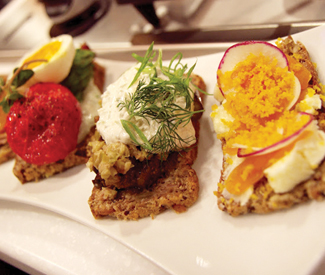
Nick Balla’s forward-thinking, Eastern European menu at Bar Tartine offers some of the most exciting food in the city right now, so new daytime hours (Wed-Sun, 10:30am-2:30pm) are a gain. Smørrebrød is Danish for “bread and butter”: these open-faced sandwiches (one for $6; three for $15) lead the way on the new menu, though heartier sandwiches are on offer, too, such as beef tongue ($12) generously laden with sauerkraut, onion, and that Hungarian staple, paprika. Or on the vegetarian side, slab bread filled with lentil croquettes, yogurt, cucumber, padron peppers.

On rustic rye bread, smørrebrød toppings evolve. I find two enough, three for those with a bigger appetite. My favorite is bacon, egg, avocado, dill and roasted tomato in a blue cheese sauce blessedly garlic-heavy. Creamy chicken liver pate is a gourmand’s option, although such a generous scoop of pate overwhelms accompanying apricot jam. Another toast is topped with smoked eggplant, white beans, olive, roasted tomato, while a sweeter side is expressed in hazelnut butter and rhubarb compote.

They’re calling it a sandwich counter and you can certainly take out, but Bar Tartine’s rustic tables and expanded space welcome: they’re ideal for lingering with Four Barrel coffee and that divine Hungarian fried bread, langos ($9), you’ve heard me talk about often — it’s on the lunch menu. Now it’s amped up with toppings like lamb, horseradish cream, summer squash, and tomato, or blackberries, peaches, and cream. Langos with fried egg, hollandaise and bacon is a breakfast dish of my dreams.

In the spirit of meggyleves, Balla’s Hungarian sour cherry soup that wowed me last summer, there’s chilled apricot soup ($9) — not as sweet as suspected — smoked almonds, and sour cream adding texture to the savory-fruity broth. Jars of pickled treats line the walls, available in the menu’s snacks section (pickled curried green beans!), refreshing contrasted with a kefir-ginger-strawberry shake ($5).

561 Valencia, SF. 415-487-1600, www.bartartine.com

ZA-ATAR AND HALLOUMI AT HOT PRESS

With a friendly Middle Eastern welcome, the guys at the new Hot Press welcome customers into their humble Mission shop for panini, Caffe Trieste coffee, and Three Twins ice cream by the scoop, waffle cone, or sundae. While American sandwiches like pastrami-loaded Staten Island ($7.75) with Emmentaler cheese, house Dijonaise, cabbage slaw, and sliced pickles are delicious, the Lebanese touches and vegetarian offerings that skew unusual. Dream Cream ($6.50) is soft-yet-crusty ciabatta bread slathered in light cream cheese, sauteed peppers, caramelized walnuts, and cucumbers, za’atar spices perking up the mild, comforting panini. On a French baguette, another vegetarian sandwich with Middle Eastern leanings is Ayia Napa ($6.99), likewise comforting with melted halloumi (a traditional Cypriot cheese from the island of Cyprus), mint leaves, tomatoes and a douse of olive oil. Pollo de la Mission ($7.75) is a neighborhood tribute of free range chicken on ciabatta in creamy chipotle sauce, pressed with peppers, grilled onions, Colby Jack cheese, and corn.

Sides ($2.25 half pint; $4.25 pint) range from coleslaw to a salad of spinach leaves, goat cheese and strawberries, while three bean salad — cannellini, kidney and garbanzo beans tossed with onion, parsley, lemon, olive oil — comes in mini-tasting cups with each sandwich. Local ingredients go beyond ice cream and coffee to sandwich bread from Bordenave’s in San Rafael, with neighborhood goodwill in the form of a kids menu and dessert sandwiches like Peanut Butter & Better ($4.99): creamy or crunchy PB, sliced bananas, lavender honey, or grape jelly.

The space is nondescript in a refreshing way, with sidewalk seating and Middle Eastern music videos playing on a flat screen. Thankfully, not every new opening in the Mission is a hipster, trendy affair.

2966 Mission, SF. (415) 814-3814, www.hotpresssf.com

Subscribe to Virgina’s twice-monthly newsletter, The Perfect Spot, www.theperfectspotsf.com


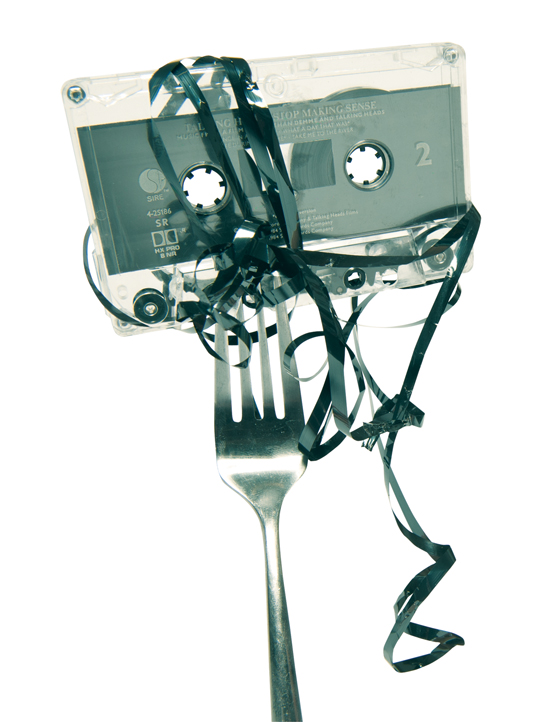
The Turntable Kitchen remixes dinnertime

0

emilysavage@sfbg.com

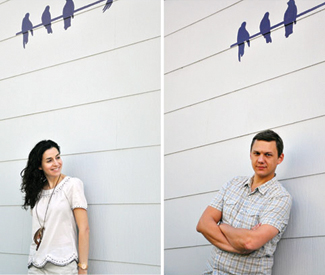
EAT BEAT I’d venture a guess that no one in this town knows the frosting tipped appeal of hand-mixing music and food more than the couple behind Turntable Kitchen. What started a year and a half ago as a simple (yet highly aesthetically pleasing) website mashing up recipes and records, has grown into a multi-headed creative output machine, with food and music news, giveaways, and physical pairings boxes — on top of the drool-inducing posts.

I caught up with the duo last winter and again this month to find out, among other queries, what ingredient you simply must always have on hand, and the records every collection should include:

San Francisco Bay Guardian For people who have never heard of Turntable Kitchen, can you give a brief rundown on how the concept came together?

Matthew Hickey Turntable Kitchen is a website combining food and music. We do that by pairing recipes Kasey creates in the kitchen with some of my favorite albums. I try to find albums that share the same characteristics as her recipes, pairing them together the way a sommelier would pair wine with food. The idea to start the site was Kasey’s, but we were pairing food and music in our own foggy Inner Sunset apartment long before we launched the site. I’ve always been obsessive about music and Kasey loves to cook. Part of our evening ritual involved her explaining the recipe we were going to make and me then hitting my record collection to find an album to compliment our meal.

SFBG How did you come up with the Pairings Box idea?

MH We liked the idea of sending goodies to our readers in the mail, but we weren’t sure what form that would take. Whatever we did, we wanted it to stay true to the theme of our site. Speaking to the music specific elements: they just made sense for me. I love vinyl records and have an ever-growing record collection. With the ease of digital distribution, though, some of my favorite new music isn’t yet available on vinyl. So the singles we release feature music that I wanted for my collection, but which didn’t already exist on vinyl. I’ve been making mixtapes for my friends for as long as I can remember, so the digital mixtape we include gives me yet another opportunity to share music I love with our supporters.

Kasey Fleisher I have always thought that a big barrier to cooking for many people is having a pantry. A lot of times, a recipe calls for a lot of expensive and/or hard to find ingredients and when you don’t cook often, it’s hard to think, “why not give this a try?” The concept of giving people three recipes and one to two premium dried ingredients gives them that nudge to experiment.

SFBG On the site, what have been the most popular pairing(s) so far?

MH Some of our most popular pairings have been our Pop Overs with Jam paired with Frank Ocean’s channel ORANGE, and Quinoa Sushi paired with Peaking Lights’ new album.

SFBG What’s the most important ingredient to keep in your cupboard?

KF That is a tough question! But I’d probably have to say salt.

SFBG What’s the most important album to keep in your record collection?

MH That is a tough one. If you are going to listen to it by yourself then you’d want your favorite album — whatever that may be. If you want versatile music that sounds great and can be played on any occasion, I highly recommend owning a few Motown records. I don’t think I’ve ever met anyone — young or old — who hates the Four Tops, the Jackson 5, The Supremes, Al Green.

Rich appetites

2

emilysavage@sfbg.com

CHEAPER EATS “By the way, I have the best peanut sauce recipe ever. I would say it’s one of the top three things about me, my peanut sauce recipe.” Author-blogger-chef Gabi Moskowitz mentions over brunch at the Dolores Park Cafe in her Mission neighborhood.

“I develop crushes on peanut sauces and tinker until I get them just right. And — sidebar — peanut sauce, if you make a batch of it and keep it in your fridge, you’re like, 50 percent on your way to dinner.”

Moskowitz is full of helpful asides like this. She initially was discussing her Vietnamese spring rolls recipe, a popular dish she wrote about on her blog — BrokeAss Gourmet — and subsequently included in her first cookbook, The BrokeAss Gourmet Cookbook (Egg & Dart, 224pp, $16.95), released this spring. The book’s subtitle? “Recipes To Keep Your Taste Buds Happy and Your Wallet Thick.”

But the peanut sauce digression is probably the best representation of Moskowitz’s personality. The former kindergarten teacher is friendly and funny, obsessed with good food, and the consummate teacher, always looking for a way to make things better and cheaper. She just wants you to love her peanut sauce and much as she does.

And that’s why the formula for BrokeAss Gourmet dot com, and The Brokeass Gourmet Cookbook, works so well. It’s simple but creative dishes, made with inexpensive components (each ingredient is listed with a price), and explained in a relatable way. Moskowitz always dishes on how she came to these recipes, be it after a rude ex-boyfriend criticized another meal, or a when a close friend fell ill and needed something warm and appetizing in her belly.

The book includes pantry staples and recipes for meals such as lamb-feta burgers, sundried tomato ricotta gnocchi, and garlic-lemon-rosemary chicken (“Third Date Chicken”), which she deems the sluttier version of the legendary “Engagement Chicken.”

The blog, which began in 2009, saw near-instant success, after MSN Money covered it just two weeks after the launch. The morning of the article, Moskowitz says she awoke to see 30,000 hits over 24 hours. Just before the launch, she became aware of the other brokeass, Broke-Ass Stuart — who wrote a popular lifestyle book and runs his own site — and contacted him to let him know. He was fine with the name, as he didn’t plan to cook or include recipes on his own site, and Moskowitz says it was the start of a great friendship. The two support each other on their respective sites.

On the BrokeAss Gourmet site, the chedder-thyme knishes and brown butter pumpkin mac and cheese are the long-running top posts. When Moskowitz was featured in an iPad food app called Appetites, the New York Times wrote it up and included a mention of that creamy fall mac and cheese recipe.

When it came to choosing which posts to include in the cookbook, Moskowitz said she wanted it to be a “really excellent first cookbook for someone” and to show that it’s possible to eat well on a budget.

“I grew up in Sonoma County; I live in the Mission in San Francisco, where food is king. It’s not enough for me to just eat, I think it’s really important to eat well, and to eat fresh food. Even when I was making no money at all, I wasn’t willing to compromise my lifestyle in that way, I wanted to make it work.”

Now that the initial buzz of the cookbook has slowed down a bit, Moskowitz is still wildly busy, keeping up with the blog posts, working on some top-secret TV projects, and finishing the manuscript for her second book: The Brokeass Gourmet Pizza Dough Cookbook. That one is about the different meals you can make with pizza dough, besides the obvious (naan, cinnamon rolls, calzones, donuts, Italian stromboli appetizers).

As with much of her food writing, the concept came from a personal experience. She was invited to a potluck dinner party a few years back and the host asked her to bring a main course. “I had this huge batch of pizza dough and 15 minutes before I was supposed to leave, the host called to say the party was canceled. I was like, ‘ah man, I have all this stuff!’ and I’d basically spent my grocery budget on it, but I found that I could do a million and a half things with pizza dough.”

While she did make a great many dishes with that leftover dough, her weekly go-to meal staple is a bit different. She has a $15.94 Duc Loi Supermarket trip nailed (of course, did a post about it). And her personal comfort dish is built with it: soba or rice noodles with that crush-worthy peanut sauce, shredded vegetables, and shallow-fried cube sprouted tofu. Sometimes garnished with crushed peanuts or sprouts and chili paste.

“I’ll make a big batch of it and seal it in the fridge if I’m having a busy week, and then that’s just what I’ll eat at the end of the day.” Even as the conversation comes to an end, and the Dolores Park Cafe dishes are pushed aside, Moskowitz is still giving tips on low-cost eats.

The agri-chem industry’s secrets

3

OPINION This November, California voters will decide on a question that affects us all: Do we have the right to know what’s in the food we’re eating and feeding our families?

This high-stakes food fight has become the most expensive issue of the upcoming election. Pesticide and junk-food corporations have already poured $25 million into an effort to defeat Proposition 37, a simple labeling measure that would inform California consumers about whether our food has been genetically engineered.

What is it that these corporations don’t want us to know?

Right now, many foods on supermarket shelves, from baby formula to corn chips, contain genetically engineered ingredients that are hidden from consumers. Also called GMOs, these are crops that have been artificially altered in a lab with the DNA of other species in ways that cannot occur in nature.

Numerous studies link genetically engineered foods to allergies and other adverse health effects. But the U.S. government requires no safety studies of GMOs, no long-term health studies have been conducted, and no labeling is required to notify consumers so we can make our own choices about whether we want to eat these foods.

Genetically engineered foods are also linked to serious environmental concerns, including an overall increase in pesticide use, a rise in super weeds that are threatening farm land, and the unintentional contamination of organic crops.

These concerns have led 50 other countries to require GMO labeling. But here in the U.S., the agri-chemical companies have deployed their massive lobby power to stop the federal government and at least 19 U.S. states from passing simple labeling bills.

Now it’s up to the voters of California — and the heavy-artillery corporate lobbying campaign is heading our way.

The Yes on 37 Campaign is currently tracking far ahead in the polls. But the voters have not yet been subjected to the wave of deceptive television ads designed to convince us that GMO labeling is too scary or too expensive.

When you see these ads, consider the source. The largest funders of No on 37 are Monsanto and DuPont, two corporations that hardly have a track record of integrity when it comes to truth in advertising. These are the same companies that told us DDT and Agent Orange were safe.

Major funders of the No campaign also include junk-food companies that have a long history of opposing common-sense labels to give consumers information about their food. Look for these companies to spend tens of millions trying to convince voters that adding a few words to food labels will force them to raise the cost of groceries “hundreds of dollars a year.”

Over on the Yes on 37 side is a true people’s movement made up of millions of moms, dads, and consumers in California, and the many farmers and California businesses that are part of the state’s thriving natural and sustainable food industry.

Now is the time and this is our chance to make sure we have the right to know what’s in our food. Visit Yes on 37 at Carighttoknow.org to volunteer, donate and stay up to date with the latest news about this historic campaign.

Stacy Malkan is the media director for Yes on 37, the California Right to Know campaign to label genetically engineered foods.

Feeding a movement

0

yael@sfbg.com

Keith McHenry was in Tampa, feeding fed-up (and hungry) Republican National Convention protesters, when we spoke by phone. Next he’ll head to Charlotte to do the same for those protesting the Democrats, and then to New York for Occupy Wall Street’s anniversary on Sept. 17.

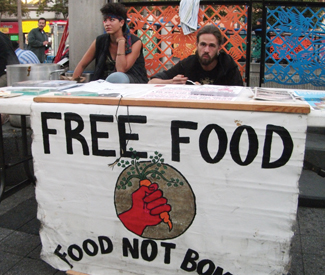
Everywhere he goes, he’ll feed the masses home-cooked vegetarian meals. But unlike the other protesters, McHenry helped invent the system that gets them fed. He helped to found Food Not Bombs, the organization that salvages food that would otherwise be thrown out, cooks it up, and serves free, tasty meals in public squares throughout the world.

McHenry served the first meal in Boston Common in 1980, then moved to San Francisco a few years later, bringing the movement with him. Now, there are 500 chapters in the United States and hundreds more throughout the world.

“We provided food for 100 days at the Orange Revolution in the Ukraine,” McHenry recalls. “We fed a two-year occupation in Sarajevo. We provided food at Camp Casey,” Cindy Sheehan’s anti-war stakeout at then-President George W. Bush’s ranch.

The FNB approach to hunger is pretty simple: There’s enough food to go around, it’s just not distributed right. So activists find ways to distribute food that would otherwise be thrown out. San Francisco FNB gets donations of extra, unsold food from places like Rainbow Grocery and Other Avenues food co-op.

It was started by anti-nuclear activists, thus the “Not Bombs” part. But there’s more to their analysis than a cry for peace. As the group states, “For over 30 years the movement has worked to end hunger and has supported actions to stop the globalization of the economy, restrictions to the movements of people, end exploitation and the destruction of the earth and its beings.”

A typical Food Not Bombs operation features a table with a vegetarian or vegan meal, maybe some produce, and anti-war and other leftist literature and banners. In 1988, this is what was on the table when the San Francisco Police Department cracked down on Food Not Bombs, arresting dozens for serving food at the entrance to Golden Gate Park at Haight and Stanyan.

“We had our sign such that when you walked in at the corner of Haight you would see the words Food Not Bombs for a block and a half,” McHenry recalls. “What was good about that was you had tourists, and local business people, and local workers, and you had the people in the Golden Gate Park, all coming together to eat at that place. It was really perfect.”

FNB still serves there on Saturdays, but that perfection was disrupted by a high profile series of arrests in 1988, then again a few weeks ago, when Parkwide, the Recreation and Parks Department’s new bike rental program, set up in their old spot.

Food Not Bombs still runs into conflicts with police and courts. Last year, McHenry was one of 24 arrested in Orlando, Florida, spending 19 days in jail after protesting an ordinance making it a crime to feed the homeless in the city’s downtown.

Last week, FNB held its world gathering at Occupy Tampa’s tent city, serving daily breakfast and dinner while planning the future of the movement. Occupy Tampa has only grown in recent weeks as it hosts people in town to protest the RNC. Sharing food and shelter, making art, and protesting politicians doing the bidding of greedy corporations is McHenry’s vision made reality — and one he got to see bloom last fall with the birth of Occupy.

As McHenry tells it, he and others from Food Not Bombs have been part of a decade-long buildup to the “occupy” tactics that erupted into the world in 2011. “I was promoting the idea of occupation ever since a meeting that was held in 2003 after Cancun,” he said. Protests at the World Trade Organization meeting in Cancun were part of a growing trend of disrupting international conventions in which political and business leaders make agreements that further exploitation and neo-liberalism. But McHenry says that more was needed.

“There was a group of us that got together and said these one-off events, like summits, were just becoming more disempowering rather than successful,” he said.

After years of calling for occupations, the notion clicked last fall. “We had seen the Arab Spring, so that made it that much easier to imagine the occupation concept. And the Spanish occupations were just then happening.”

“That’s a common thing,” McHenry said. “People try all these different ways of organizing and then all at the same time, the same thing will start to click. And there’s no real way to say, ‘oh, it started here, it started there, this person started it.'”

When Occupy encampments sprang up, Food Not Bombs was behind many of the kitchens and food sharing efforts — it even had a guide to building a tent city kitchen at foodnotbombs.net/occupy_supplies.

“In the beginning of some of the first occupations like Chicago, DC, Wall Street, we made peanut butter and jelly sandwiches, because we didn’t know if we would get busted,” McHenry said. “We ended up behind the scenes helping provide free meals to the occupations.”

McHenry said he hopes the spirit of occupying grows again. “It’s so important,” he said. “It would be great if we could regroup and retake public space.”


Portable pollution

11

news@sfbg.com

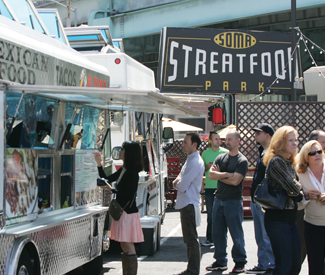
With its decidedly hip aesthetic and clientele, San Francisco’s food truck trend may be naturally assumed to be environmentally sound and health conscious. But the rapidly expanding craze may actually be creating air pollution and endangering the health of their employees in ways that aren’t yet being regulated.

Although the mobile eateries are held to a few of the same standards as their brick and mortar counterparts, such as food hygiene and sanitation, the gas-powered portable generators that provide needed energy to the trucks are a tricky beast to tame. The exhaust-heavy portable generators do not fall under the San Francisco Department of Public Health’s radar of regulation, according to its Food Safety Program Director Richard Lee.

“There are combustion products from the generators being generated while the truck is parked and operating,” he told the Guardian. “The generators are needed to power lights, fans, refrigerators, etcetera. SFDPH does not monitor or regulate the generators.”

The lack of monitoring on the generators may not be due to a lack of need for regulation, but rather the difficulty in doing so. Given that most of the generators are used to power relatively small vehicles, their small size inhibits them from meriting the attention of the California Air Resources Board (CARB) after their initial manufacture.

A CARB-compliant generator has met with the organization’s restrictions on various organic gases, nitrogen oxides, sulfuric oxides, carbon monoxide, carbon dioxide, and particulate matter. However, the generators are only monitored at the point of manufacture, with their in-use emissions going unregulated.

Furthermore, Bay Area Air Quality Management District spokesperson Aaron Richardson tells us that despite the BAAQMD’s 28 air monitor stations, the localization of the fad and the trucks themselves would make it difficult to see the effects of the generators as a regional issue.

“The concern would be they may not all operate in the same ways,” he said. “I think that if the trucks…are running back up generators, it’s going to emit some pollution. It’s something I think we will be doing more research on, but at this point it’s not looking like it’s a dramatic impact on air quality. CARB regulates all mobile sources, and lot of these trucks use individual generators. At this point, we only regulate back up diesel generators…of 50 horse power or above.”

So BAAQMD doesn’t regulate the generators because they’re gas-powered, and they don’t trigger CARB’s post-production attention, despite that agency’s current efforts to reduce the state’s carbon footprint.

CARB spokesperson John Swanton explained that given the small size and localization of the generators, it’s up to the individual communities to decide how to approach the situation.

“It’s up to the community to decide if they can bear the expense of a highly regulated community. In the terms of restaurants — which is what food trucks are — what are the community’s standards and regulations?” he said. “When we sell, say, a Honda generator, we have ideas of how that’s going to be used…We try to make it as clean as practically possible, but the idea is that it’s not gonna run 24/7 at the same location. If it’s going into a food truck and the food truck is going into a particular district, then it becomes the decision of the city and the air quality management [district].”

It seems, then, that no one is really regulating the exhaust emissions coming from the hordes of trucks that travel up Haight, down Market, into Fort Mason, and sit in clusters downtown, in SoMa, around City Hall, and other spots around town.

But at least they aren’t dirty diesel fuel, right? Perhaps the BAAQMD and the city of San Francisco have no need to regulate the teensy-eensy bit of gasoline generator exhaust.

Yet according to SFDPH spokesperson Imelda Rayes, there are now approximately 300 (registered) mobile food facilities in San Francisco. That means the number has nearly tripled since the mere 120 registered MFFs that were scouring the streets in 2009. What they lack in horse power, the generators may make up for in sheer multitude.

“In a period of three years, the number has increased almost 250 percent and [we’re] still getting more applications,” she said.

In addition to cumulative impacts, there are also questions about the health impacts on food truck employees.

Studies like such as the 2009 “Modeling the Effects of Outdoor Gasoline Powered Generator Use on Indoor Carbon Monoxide Exposures” by academics Liangzhu Wang and Steven Emmerich brings up a different concern: gasoline generators create emissions of poisonous carbon monoxide.

“The generators are always positioned outside of the vehicle. The workers are inside,” Lee said. “We would not expect that there is significant employee exposure to the generator exhaust to the employees.”

Yet the U.S. Centers for Disease Control and Prevention (CDC) reported that half of non-fatal carbon monoxide poisoning incidents in the 2004 and 2005 hurricane seasons were due to the gas-powered generators used to heat homes, even when placed outside the homes themselves.

Food truck generators, given their smaller size, are often placed much closer to the trucks and their workers than in the case of houses and their inhabitants. Furthermore, the trucks often idle for long periods to keep the food warm and utilities working.

“At this point, it’s enough of a new thing…We’re interested in finding out more about them, but at this point we are not receiving many complaints,” Richardson said. “A lot of variables are involved. It’s something I think we will be doing more research on.”

After the game of verbal hot potato that was research for this article — it seems every agency deferred to another in terms of exactly who is monitoring these things — Swanton assured us that the danger doesn’t seem imminent.

“In general, small engines [portable generators] are dirtier than an engine providing motor power to a vehicle,” he said. “But the sheer number of these cleaner engines dwarfs everything.”

True, but the food trucks that run for more than a few hours at one location are increasing in numbers at a rapid pace. With the high number of mobile food trucks in operation, most of which utilize some form of generator or another, it may be time to nail down those pesky variables involved and draw some conclusive evidence on the potential environmental and health effects of our city’s seemingly innocent snack time.

Jesus-free food

0

“For I was hungry and you gave me food, I was thirsty and you gave me drink, I was a stranger and you welcomed me,” Jesus supposedly said way back when. In San Francisco, there are a multitude of churches that offer free food to the hungry (find a handy list at www.freeprintshop.org).

But what follows is a list of secular organizations that share food — for the planet, for self-determination and providing for community outside of the system, for healthy food untainted by hormones, pesticides and GMOs, for food not grown by exploited workers, and for many other reasons, these groups bring food straight to the people.

FREE FARM STAND

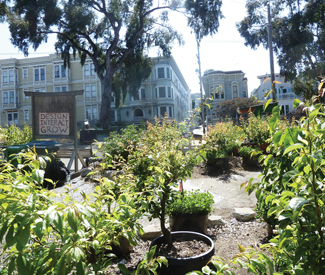
Where: Parque Niños Unidos, 23rd St. and Treat. When: Sundays, 1-3pm. Numbers given out at around noon. The Free Farm Stand gives out food and flowers grown at the Free Farm on Eddy and Gough, where local volunteers grow and harvest produce. They also share local organic surplus produce left over from several farmer’s markets and produce brought in from neighbors and from locally gleaned fruit trees.

The philosophy of the Free Farm is food sovereignty. Why should anyone go hungry, or go broke, feeding themselves and their kids? Instead, they figure, they should get for free what the earth gives. They facilitate this by offering the farm’s harvest — as well free sprouts and plants, that people can use to grow food themselves.

“The solution to the problem of hunger is to share the abundance that’s out there and to encourage people to grow food and share some with those in need.” said a Free Farm Stand organizer. “We can set up neighborhood networks of people growing food and sharing their surplus.” The Free Farm Stand is a step towards that vision.

BETTER DAYS TO COME

Where: Tuesday, 16th and Mission, Thursday, Turk and Taylor. When: 6pm. Some of the folks at Better Days to Come have God in mind, but the organization’s founder, Leonard Fulgham, came from not the churches but the prisons. As its mission statement says, “Mr. Fulgham began mentoring many of the younger inmates, while having the unique opportunity to hear their stories. Many of their stories outlined how they landed in the prison community and why they continued to return. Being homeless upon release back into society is a commonly known contributing factor to these ex-offenders being hungry while being starved by the lack of job training and vocational skills.” Fulgham passed away March 24, 2012, and in his memory, the organization began serving two hot meals a week.

CURRY WITHOUT WORRY

Where: Civic Center Plaza at Hyde and Market. When: Tuesdays 5:45-7pm. Curry Without Worry serves vegetarian food, mostly Nepali and mostly with five courses, in San Francisco every week. It does the same at its other branch in Kathmandu. Shrawan Nepali once owned a restaurant, Taste of the Himalayas, but used the proceeds to start Curry Without Worry and eventually sold it when “I realized I was not a businessmen.” Instead, he’s a man who feeds people a vegan five-course meal, which includes a sauce made from timur, herbs that grow in his Himalayan hometown but are rare in the US. “Our mantra is healthy food for hungry souls,” says Nepali.

FOOD NOT BOMBS

Where and when: Monday, UN Plaza at 6:30pm and 16th and Mission at 7pm. Wednesday, UN Plaza at 6pm. Thursday: 16th and Mission at 7pm. Saturday: Haight and Stanyan at 5pm. After 30 years, Food Not Bombs still serves almost daily in San Francisco at a few locations throughout the city. Volunteers cook meals then bring them out to the people, bringing home the message that there’s enough to go around and you shouldn’t need money to feed yourself. The Saturday team still shares food at Haight and Stanyan, where Food Not Bombs first parked three decades ago.

FOOD BANK OF AMERICA

Where: In front of the Bank of America at 2701 Mission. When: Thursday, 5pm until food runs out. Occupy-related people, carrying on from the giant Food Bank of America action on Jan. 20, when the Bank of America at the Embarcadero locked its doors after activists set up a food table and hung two interactive banners where passers-by could write what fit under the category “person” and what fit under the category “corporation.” They hung a third banner saying Food Bank of America, hundreds ate a hot meal, and the concept caught on. Now, people who have been gathering food donations for Occupy and otherwise give away fresh produce and hand out information about credit unions weekly in front of the bank.

COMMUNITY FEED

Where: Mendell Plaza, at Third and Oakdale. When: Every third Sunday, 10-2. A few organizations, including the Black Star Riders Coalition and the Kenneth Harding Jr. Foundation, work together to put on this food giveaway every other week. It takes place in Mendell Plaza, the square that some have renamed Kenny’s Plaza after Harding, who was killed in the plaza at 19 years old after a dispute with SFPD officers over bus fare. “First, we definitely want to honor Kenny, that’s why we got there,” said Tracey Bell-Borden, one of the organizers of the Community Feed. “But there’s been a lot of activity in that area for a long time. So it’s really about healing the community,” she said. “We have to take care of our community.”

Alerts

0


Wednesday 29

Bernal Heights outdoor cinema Roccapulco Supper Club, 3140 Mission, SF; www.bhoutdoorcine.org. 7pm, $10 suggested donation. The first of five nights of film screenings in Bernal Heights. At this kickoff party, enjoy drinks, food and music from the Bernal Jazz Quintet before a lineup of short films celebrating community and organizing in the Bay Area. Films include Berkeley High School students on heritage and identity, “Occupy the Auctions Dance Party!” in which Occupy Bernal and ACCE stop evictions on the steps of City Hall, and a tour of Alemany Farm (also the beneficiary of the event’s ticket price), among others. The event also includes the announcement of winners of the Best of Bernal and Spirit of Bernal Awards and the first-year recipients of the Mauricio Vela Youth Film Scholarship.

Occupy, the state of the movement Mediterranean Café, 2475 Telegraph, Berk; www.occupyoakland.org. 7-10pm, free. Einar Stensson, a sociologist at Stockholm University and activist at Occupy Stockholm during the fall of 2011, studied Occupy Oakland for two months. Why did the movement start and spread so quickly around the globe? How is Occupy organized? Who matters in the movement and why? What is the future of Occupy? Come hear his perspectives on where Occupy is, locally and internationally.

Friday 31

Occupy the Bay The 25th Street Collective, 477 25th St., Oakl; www.occupyoakland.org. 6pm, $25. “This week in Oakland, California will go down as a watershed moment. People across America were disgusted by what they saw here. Average Americans trying to stand up and peacefully assemble, to be brutally savaged and attacked by the police department that they pay for.” So said Michael Moore to a fired up crowd in the wake of the Oct. 26 Occupy Oakland eviction that rained tear gas and rubber bullets on demonstrators. This is just one of the many historic events caught on tape by filmmakers Jonathan Riley and Kevin Pina, whose documentary Occupy the Bay is screening around the Bay Area before it starts showing in film festivals. On Friday, stick around for special musical performances from Jabari Shaw, Shareef Ali and Super Natural.

Enemies of the state: In their own words Station 40, 3030B 16th St., SF; station40events.wordpress.com. 7pm, free. After a year of Occupy and years more of struggle by people who are not down with the state, there are a lot of people in jail and prison. At this event, organizers will read writing from those locked up. Poems and statements from Truth and Kali of Occupy Oakland and a statement from Jesse Nesbitt, the May Day brick-thrower we profiled (“Who is the Brick Thrower?” 5/8/12). As the event description says, “Any effort at anti-repression in the face of lengthy prison terms must be aimed at bringing down separation at all costs.” Come fight the separation and connect.

Original Plumbing birthday celebration Elbo Room, 647 Valencia, SF; www.originalplumbing.com. 10pm, $3-6. Original Plumbing, the trans male quarterly magazine, is throwing a party celebrating its third year on this planet. It now lives in the Brooklyn part of the planet, but it all started in San Francisco, and they’re coming back here to party. “We feel that there is no single way to sum up what it means to be a trans man because we each have different beliefs, life experiences, and relationships to our own bodies,” say the organizers, and they started the magazine to document this diversity of experiences. Celebrate with the editors Amos Mac and Rocco Katastrophe, and performances by Rocco Katastrophe with special guests Billie Elizabeth, Nicky Click & Jenna Riot. Birthday cupcakes available!

Tuesday 4

Rally to save City College City Hall steps, 1 Polk, SF; ProtectOurCityCollege@gmail.com. 12pm, free. A rally in support of Prop A, the local ballot measure that would create a parcel tax for revenue to City College of San Francisco. “If City College is to survive and maintain accessibility, educational quality and the mission of serving low-income and underrepresented students with the best educators and staff, we must pass Prop A,” say organizers of the rally, which include students, teachers, staff and supporters.

Eat to the beat

0

emilysavage@sfbg.com

EAT BEAT Good food was never the part of the concert plan. In high school, the punks and shredders ate giant Pixy Stix, filled to the plastic brim with unnaturally purple sugar dust — purchased from the all-ages venue snack counter — followed by late night Del Taco red burritos slathered in Del Scorcho and stuffed with crinkle fries. Flash forward a decade or so, and the vegan Malaysian nachos with spicy peanut sauce and pickled veggies from Azalina’s were all I could talk about after Outside Lands, save for the requisite “oh my god” Metallica utterance.

I wasn’t the only one. From every corner of that packed festival, people — and of course, bloggers — were raving about The Whole Beast (featuring pop-ups from the Michael Mina Group) tucked away by Choco Lands, Andalu’s fried mac and cheese, and Del Popolo’s massive, industrial-looking rustic pizza truck.

While the higher-end meal options have now been going strong at Outside Lands for a few years — and, granted, food has long been a part of the festival equation — the gourmet pop-up thing, and locally-sourced, quality food offerings are on the menu more and more in brick-and-mortar music venues in San Francisco. Last week, the Great American Music Hall hosted an event dubbed the Great American Pop-Up. Seems it’s more open to experimentation in the slower summer months.

The one-off (for now) event was a family affair for the Great American Music Hall. There were six pop-up food vendors set up in between the grand bronze pillars of the Tenderloin venue, chosen by security guard Drake Wertenberger, who stepped forward at a managers meeting to coordinate. Jessica DaSilva, who works in the box office at both GAMH and sister-venue Slim’s, was there selling imaginative sweet treats for Milk Money/Dora’s Donuts Shut Yer Hole Truck, including a strawberry cheesecake push-pop, and the chewy chocolate raspberry cookie I devoured. There was also local, sustainable sushi by Ricecrackersushi, some colorful Asian fusion dishes via Harro-Arigato & Ronin, and a whole lot of sausages sliced by the Butcher’s Daughter.

It felt nearly illicit to be in the venue without the anticipation of a live set, like we were sneaking in. And the warmer lighting opened up the intricacies of the architectural design. But this event was focused squarely on the food, with the tables pushed out onto the floor, and a flannel-clad DJ spinning inoffensive hip-hop while munching on something from a paper plate.

Last year, Slim’s created something similar, but broke it down to one chef at a time hosting rotating gourmet pop-ups once a week for the month of August. Those too were more about the unique food offerings, less about music. There were dinners served in the venue by Jetset Chef Alex Marsh and Cathead’s BBQ (which now occupies its own legitimate space down the street from the venue).

GAMH and Slim’s both already serve dinner nightly at live shows, but publicist Leah Matanky tells me there were no hard feelings from the in-house restaurant staff.

On regular show nights even, Matanky says she’s seen an increase of interest in gourmet food at the venues. “We have seen our kitchen sales numbers increase noticeably over the last couple of years. We’ve started running nightly food and drink specials that include things we don’t normally offer and people have really responded to that. We still offer the full array of bar food…but you can also get gourmet specialties like the baked polenta pizza with smoked mozzarella or the grilled tri-tip steak with garlic-herb potatoes.”

Mountain View’s infinitely larger Shoreline Amphitheater also recently got an in-house food upgrade. So the story goes, when the GM of Shoreline dined at Calafia in Palo Alto, Chef Charlie Ayers pointed out the stadium’s lackluster food, and was then summoned to create a tastier menu. Ayers now has a “Snack Shack” at Shoreline that generates $8,000 per show, selling vegan lentil bowls, pork bowls, and salad wraps with Dino kale and feta cheese.

At the bars-with-bands level, El Rio seems to also be upping its epicurean pop-ups. Along with the now-frequent Rocky’s Fry Bread (side note: Rocky is also in the band Sweat Lodge, which often plays El Rio) stand, there’s Piadina homemade Italian flat bread, and the occasional Mugsy pop-up wine bar, which offers bubbly and red wine varieties.

There was an entirely separate event that took place Aug. 4 in San Francisco, which combined all of this: the high-end food, the live music, the ubiquitous pop-ups. It was a food and music festival (Noisette) at a brick-and-mortar venue (Public Works, where it moved after switching venues from Speakeasy Brewery).

The event was put on by Noise Pop Industries. The production company, which does Noise Pop and the Treasure Island Festival, began dipping into independent food culture a few years back with the Covers dinners, pairing well-known chefs with corresponding cover songs for a relatively small group. Noise Pop’s Stacey Horne came up with the Noisette concept after talking with DJs Darren and Greg Bresnitz of New York promotion company Finger on the Pulse, who do an event out there called Backyard Barbecue, which also pairs live music and gourmet food.

From the beginning, the Dodos were the first choice of headliners at Noisette. Merrick Long is a “professed foodie,” has worked in the restaurant business, and was on a panel at SXSW talking about food and music. Horne says they chose chefs that do things a little differently, and are more attuned to the pop-up mentality.

“Something that struck me at Noisette that I loved was that we were eating such good food and then were able to wander over and hear amazing music. It wasn’t one or the other. It was nice to have that as an option,” Horne says. “The chefs we’re focusing on are kind of the indie version of that world, and that’s what Noise Pop has always been interested in, independent music, independent film and art. It just seems like a logical extension.”

Noise Pop is also again looking to do a variation on the Covers dinners with the upcoming Treasure Island Festival. Sound Bites is more of a passed appetizer event with little bites inspired by the bands playing at the festival.

So what does it all mean? Are we, as the generalized concert-going public, getting soft, both physically from all those readily available treats, and mentally because we’ve expanded beyond a minimalist punk rock lifestyle? Should we all go back to Pixy Stix and Del Scorcho hangovers?

“Look, the reality is that most nights that you go to hear a band in a club, there’s no food or if there is food, it’s not going to be anything great. So you can still have your punk rock experience, but something like Noisette and other events like ours that are popping up around the country are just offering another type of event, and people are interested in it, as we’re seeing,” Horne says.

I guess, if you want to see your life as a black and white cookie, you’ll see this change as against type. Or maybe if you’re in the teenage angst subset, you’re just getting in to the greasy post-concert routine. But perhaps this mashup is just another trend — participate if you will. It goes far beyond the music scene, to the way Americans eat now, looking for quality, locally sourced food, seeking creative options.

“Speaking for myself personally, I still love going to see shows,” Horne says, “but if I can have both things in one place, it’s win-win.”

www.slimspresents.com

www.noisepop.com

www.elrio.com

shoreline.amphitheatermtnview.com

A vision in Vocaloid: Fashion shots from J-Pop Summit Festival 2012

0

Black lace, kimonos, and colorful wigs ruled the day this weekend in Japantown at the J-Pop Summit Festival Aug. 25-26. Also popular this year, for those of you trend-spotting, were sweetly wobbling attenae, which announced the presence of the head attached as they weaved through the booths, stopping here and there to check out the Vocaloid dance contest, an Evangelion fan’s robotic get-up, or the Sunday performance by 18-year singer Kylee. Although there was music, food, and things to buy, it was really all about the clothes. Whether they were dressing up to be a favorite anime character or simply sporting super-sweet tights or an awesome leather jacket, those on the street were working it in some pretty amazing threads.

Appetite: Outside Lands, as seen by a food writer

0

This year’s Outside Lands, the three-day extravaganza of some of the top musical acts in the world and quality food and drink (this is SF, after all) in the beauty of Golden Gate Park, felt more packed than ever. But despite throngs descending on SF from all over the country that turning Golden Gate Park into a sea of trash — thanks clean-up crews! — Outside Lands magic happened each day.

For example on Sunday, when performer Jack White popped up for an impromptu set, surprising fans who happened to be traversing the eucalyptus groves near Choco Lands. It was magic eating local foods in a festival setting, like dreamy Italian Del Popolo (although hour-plus lines and daily sell-outs were a drag) or everything from Ryan Farr’s two 4505 Meats stands sustaining us on those long walks between stages with the perfect “damn good cheeseburger” and “yum yum” fried chicken sandwich. You could feel the magic in the new-this-year Beer Lands, where one could sip craft beers while taking in the Foo Fighters, Regina Spektor, or Beck (Although the training given to those pouring beers was far from magic. One pourer for The Bruery on Saturday told me confidently that this incredible brewery from the O.C. was from San Diego.)

Magic occurred when Metallica, flames, lasers, and all, delivered the tightest, hardest-rocking set of the weekend. Not long after the noon hour, fun. swept up the entire Polo Field in their rousing anthems. Magic reigned at Stevie Wonder’s set on Sunday night. His voice sounded as tight and beautiful as ever, even at age 62. His joy and wisdom radiated from the moment he took the stage, streaming out to a field full of thousands basking in waves of pink, blue, and green lights, foggy Pacific Ocean air, and the voice of a legend.

Full captions: 

1.  Ryan Farr’s ridiculously good Chicken “yum yum” sandwich was one of the festival’s best eats. Watch for it at Ferry Plaza Farmers Market

2. 4505 Meats’ chicharrones bars were like rice krispie treats made with Ryan Farr’s unparalleled chicharrones, puffed rice, marshmallow, and Apple Jacks or Cocoa Puffs

3. Misty, dreamy lighting changes colors, illuminating Golden Gate Park trees at night

4. The hilarious, improvisational Reggie Watts rocked comedy and music Friday afternoon (and here, in the media tent following his set)

5. The Wine Lands tent impressed once again with 49 wineries. 2012 highlights included Villa Creek, Robert Sinskey, Qupe, Kermit Lynch, Palmina, The Scholium Project, and Wind Gap 

6. Beck keeps the crowd happy at the Land’s End stage on Friday

7. The new-this-year Beer Lands hosted 16 California breweries selected by brewmaster Dave McLean of Magnolia Pub. Highlights included the Bruery’s brilliantly bitter Humulus APA and Sierra Nevada’s Outside Lands saison 

8. Under faux Victorian facades, chef John Fink of The Whole Beast grilled eight to 10 whole lambs per day at Lamb Lands, an excellent 2012 addition to Outside Land’s food selection

9. Michael Mina’s RN74 and Bourbon Steak served whole roasted lamb gyros, lamb poutine, sweet corn in lamb sausage crumbs at Lamb Lands

10. Thousands swarm the Polo Fields

11. Saturday in the media tent, Magnolia and Alembic brewer Dave McLean (center) talks Beer Lands and The Whole Beast’s John Fink dishes on lamb

12. Choco Lands was an enchanted, Tim Burton-esque fantasy in the eucalyptus groves, with Day of the Dead accents and an array of chocolate carts and treats

13. Outside Lands ends with best set of all: Stevie Wonder exudes joy and life to thousands in the Polo Field, his voice in top form

Subscribe to Virgina’s twice-monthly newsletter, The Perfect Spot


Diamond Dave’s report from Romneyville

27

Activists from San Francisco and around the country are descending on Tampa this week to protest the Republican National Convention. I got a call this morning from Diamond Dave Whitaker, the poet who hung with the beats and the hippies in his 75 years, CCSF student senator and San Francisco legend. He’s has been serving food to protesters at election-season conventions for almost three decades. His first was 1984, the Democratic Convention here in San Francisco before he got hooked and headed to Dallas to protest the Republicans. Along with a few hundred others, Diamond Dave braved the rain, but missed the full effects of Hurricane Isaac on the tent city last night. The RNC starts officially starts today (though many of the day’s events have been called off due tot the hurricane warning.)

“I’m talking in the midst of Romneyville,” he said. “Folks came from far and wide to camp out together, cause a ruckus and be here.”

What’s Romneyville? “It’s a homeless camp, a poor peoples camp,” said Dave. He’s been there a week setting up the Food Not Bombs kitchen, and Romneyville grew up around him. It now has few hundred tents, he said. But most people arrived today, so as the convention gets started, it will probably grow. “Two buses from Zuccotti Square came today,” he said.

Romneyville is put together in part by the Poor Peoples Economic Human Rights Campaign. Dave said Green Party vice presidential nominee Cheri Honkala, a formerly homeless mother herself who works with the Poor Peoples campaign, is a fixture around the camp.

“Our demands are housing for all, food for all, healthcare for all, and living wages for all. We call for an end to foreclosures and homelessness, an end to the war on the poor, both here and abroad. An end to criminalization of poverty. Money for jobs and housing, not for war!” says a statement from the group.

More protesters are staying over at the Occupy Tampa encampment.

A permitted march left this morning, and Diamond Dave says there’s another, unpermitted, planned for 3pm est. Many citizen journalists and livestreamers are documenting the events, one can be found at mobilebroadcastnews.com.

But so far, his work has been handing out free meals with Food Not Bombs.

“We fed the masses this morning for sure,” he said.

Are free Golden Gate Park events fading away?

25

San Francisco’s countercultural community was built at least partly through free concerts and gatherings in Golden Gate Park, including the legendary Human Be-In and Grateful Dead and Jefferson Airplane concerts in the late-’60s. But these days, as corporations starve local government but seize public spaces, grassroots groups and populist performances are being forced out of the park.

Events without expensive tickets and corporate sponsorships (such as this month’s Outside Lands) or endowments from dead billionaires (Hardly Strictly Bluegrass Festival, coming up in early October) just can’t afford the rising fees charged by the Recreation and Parks Department, a reality that is quietly ending an important San Francisco tradition and legacy.

A few weeks ago, organizers of the Power to the Peaceful Festival – a free concert featuring Michael Franti and Spearhead and other big acts, which drew tens of thousands of people to the meadow formerly known as Speedway annually for more than a decade – announced that it was canceling next month’s event because of onerous fees.

“The only way to have produced the festival this year would have been to turn it into a ticketed event,” organizers wrote in their July 31 announcement. RPD officials were going to charge the event $77,000 in permit fees this year, dealing it a death blow after also forcing the cancellation of last year’s event by instituting a strict 40,000 attendee cap, which was nearly impossible to enforce for a free event.

If we accept the neoliberal perspective that has taken hold of San Francisco – which sees government’s role as facilitating whatever corporations want to do and hoping they share some of their profits, or at least create some good jobs – it makes sense. After all, the cash-strapped RPD made $1.7 million in profit-sharing off Outside Lands this year, up from $1.4 million last year.

The same logic has caused RPD, under the mercenary leadership of Director Phil Ginsburg, to rent out its recreation centers to the highest bidders and fire the recreation directors that used to treat them as public resources, and to let the private City Fields Foundation cover many parks in artificial turf. Again, through a strictly economic lens, it makes a certain amount of sense.

“As the steward of our parks, the Department works with event organizers to host diverse events in our parks, it is our shared responsibility to make sure the City and the event organizers have plans and resources in place to care for our park land and ensure public safety. The Department is always ready to work with all event organizers to modify their event planning for safe and successful events,” RPD spokesperson Connie Chan told us.

Power to the Peaceful – ironically, an event celebrating the plight of ordinary people against powerful political and economic interests around the world – just didn’t have the resources to meet the standard, so out they go. Same thing with the venerable Anarchist Book Faire, which was also forced from the park by rising fees this year after 17 years in the park’s County Fair Building.

Again, there’s a note of irony to this exodus, with city officials suddenly deciding the anarchists could no longer police themselves and needed to pay for four Park Police officers to watch over a festival that has been without violent incident throughout its history, unless you count a speaker getting pied last year (which the self-sufficient anarchists easily dealt with on their own).

“We had put this thing on for 17 years and there were no problems until this new guy came,” Joey Cain of Bound Together Bookstore, which puts on a free event whose fees have steadily risen to almost $14,000. “We’ve had to increase our rates every year, and we were starting to lose some vendors.”

On top of that, city officials had also cracked down on free offerings that surrounded the free event, banning Food Not Bombs from serving free meals to visitors and people from setting up information tables outside the main event.

So now the event, coming up in March, will be held at the Armory. Cain admitted that rent on the building they used in Golden Gate Park was still fairly cheap compared to similar sized venues around town, “as it should be, being owned by the city.”

But when city departments like RPD become dependent on corporate contributions, public spaces become commodified, and we begin to lose access to the last places in town where our creator endowed us with the right to assemble freely and pursue our happiness: our public parks.

The Performant: Let ‘em eat cake

2

While the Performant is off hugging trees in Oregon, please enjoy this series of interviews with the curators of three innovative performance spaces

There’s nothing about the Good Shepherd Episcopal Church in North Berkeley that particularly speaks of abstract performance, but that element of the unexpected is possibly what makes it the perfect venue for Karen Penley’s fledgling performance series, Retard. Inhabited by out-of-the-box, outré performers such as Dan Carbone, Edna Barron, Herb Heinz, and Catherine Debon, Retard is a low-key, all-inclusive, no-judgment sort of event where the weird get a chance to shine, and everybody gets to eat cake. After an evening spent nibbling clafoutis and ducking clowns, I caught up with Karen via the magic of the Interwebs to pick her brain about her brave new experimental showcase.

SFBG: What was the original impetus for this showcase? What sets it apart?

Karen Penley: I have an interest in brave unconventional work and I wanted to be able to have room to let that happen instead of having to fit into the structure of poetry and music open mics…. I think the thing that sets Retard apart is a feeling of support for adventurous, innocent work.  I really love raw art, as well as the feeling of people being so immersed in…their artistic work and caring about it so much. It’s this feeling of creating different worlds as well. You can do anything, theater, movement, improvisation, music, or some hybrid of such. Also, it’s kind of homey, easy, non pretentious. I really wanted that. There are special Retards, the evenings called “Crack,” where I curate more carefully and then the other retards are more a jambalaya and are open to people I don’t know their work as well so they can just come and perform and I can get a sense of them.

SFBG:  What is your ultimate vision for these evenings?

KP: Well, ultimately, I would love to have them be ‘Crack’ every Friday, with lots of people coming, and I’d love to rent the church another day a week and have it be ‘Pretard’ which I tried to do for five months, but there wasn’t enough participation and I couldn’t afford it. ‘Pretard’ was a place to work on and develop material just for a warm audience, not a workshop, just a place to try out stuff, and then I wanted to take that work and curate it into cool evenings. But I’d love to connect with people that I admire, all different kinds of performers, and curate great evenings so that it really is a network of daring work.

SFBG: Do you bake your own cake? What do the cake and tea signify for you?

KP: I love cake and I can’t eat a whole one so this gives me an opportunity to bake all those great cakes on the internet that I couldn’t bake just for myself. I always like food to be involved in performing and watching performance. It feels more cozy and fun and more warm-y to have cake and tea for people. 

SFBG: “Retard” sounds intentionally provocative, though you do offer a rather nonconfrontational definition for it on the webpage. What prompted you to use that name, and has anyone had an uncomfortable reaction to it?

KP: I HAVE had some uncomfortable reactions to the name. One girl was labeled in her high school and I really liked her and wanted her to perform, but we had a long email back and forth about it and she just couldn’t condone the use of the word.  My feeling is that using it for my show changes the derogatory feeling associated with that word. I feel like a retard myself, always have. I want to be more retarded; i.e. slow down. In my mind, to be retarded is a good thing. Plus it’s just funny (the name).

Retard

Fridays 7-9pm, $10 sliding scale

1823 Ninth Ave., Berk. (side building next to The Good Shepherd Church)

theretardshow.wordpress.com


Election 2012: Here’s the beef

0

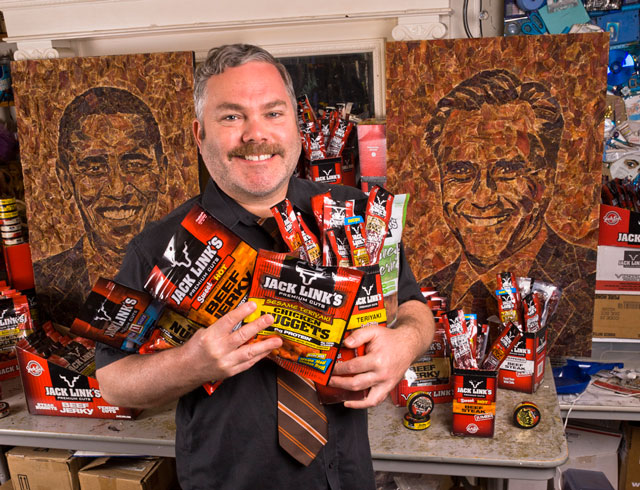
Fabulous food-and-junk-drawer-oriented collage artist (and legendary SF club denizen) Jason Mecier is back in our virtual orbit lately. His meme explosion beef jerky portraits of Obama and Romney seem to be everywhere. And his wonderful makeup-y likeness of Phyllis Diller, RIP, is giving us sad LOLs. But wait, the “meatraits” of Obameat and Meat Romney are sponsored! And there’s a video! Let’s go to the jerky tape:

Film Listings

0

Film listings are edited by Cheryl Eddy. Reviewers are Kimberly Chun, Max Goldberg, Dennis Harvey, and Lynn Rapoport. For rep house showtimes, see Rep Clock.

OPENING

Alps Yorgos Lanthimos is well on his way to a reputation for sick yet oddly charming high-concept spectacles. Here, a group calling themselves Alps offers substitution services for the recently bereaved — that’s right, they’ll play your dead loved one to fill that hole in your life. Pitch-black comic moments abound, and the sensibility that made 2009’s Dogtooth so thrilling is distinctly present here, if not quite as fresh. Beyond the absurd logline, the plot is rather more conventional: things get out of hand when Alps member Anna (Aggeliki Papoulia, the eldest daughter from Dogtooth) gets too invested in one of her assignments, and the power structure of Alps turns on her. If Alps is not exactly a revelation, it’s still a promising entry in a quickly blossoming auteur’s body of work. (1:33) Roxie. (Sam Stander)

The Apparition A couple with a ghost problem (Ashley Greene and Sebastian Stan) hire Slytherin’s own Tom Felton to help clean house. (1:22)

Compliance No film at this year’s Sundance Film Festival encountered as much controversy as Craig Zobel’s Compliance. At the first public screening, an all-out shouting match erupted, with an audience member yelling "Sundance can do better!" You can’t buy that kind of publicity. Every screening (public and press) that followed was jam-packed with people hoping to experience the most shocking film at Sundance, and the film does not disappoint. (Beware: every review I have happened upon has unnecessarily spoiled major plots in the film, which is based on true events.) What is so impressive about Zobel’s film is how it builds up a sense of ever-impending terror. In fact, I would go as far as to say that the film steps into Psycho (1960) terrain, specifically in the final act of the film. Compliance aims to confront a society filled with people who are trained to follow rules without questioning them. Magnolia Pictures, which previously collaborated with Zobel on his debut film Great World of Sound (which premiered at Sundance in 2007), picked up the film for theatrical release; if you dare to check it out, prepare to be traumatized. You’ll be screaming about one of the most audacious movies of 2012 — and that’s exactly why the film is so brilliant. For an interview with Zobel, visit www.sfbg.com/pixel_vision. (1:30) Bridge, Shattuck. (Jesse Hawthorne Ficks)

Cosmopolis David Cronenberg directs Robert Pattinson in this Don DeLillo adaptation. (1:49) Embarcadero, Shattuck.

"Global Threats Film Series" The San Francisco Film Society’s "Global Threats" series continues with a double dose of stuff that’ll kill ya. Though separated by six decades, both features are remarkably similar for their matter-of-fact, location-shot, non-pulp treatment of a prime (if infrequently used) thriller topic: the desperate attempts by health officials to contain a deadly virus before it spreads to the whole population. While in some quarters it was criticized for being too docu-drama-esque and not "thriller" enough, Steven Soderbergh’s Contagion last year was admirably cool-headed in its depiction of various global, national, and local authorities (played by an all-star cast) frantically coping with an outbreak of something that yuppie slut Gwyneth Paltrow brought home from a business trip. A year before A Streetcar Named Desire (which was, contrastingly, almost entirely shot on studio soundstages), Elia Kazan ventured to the real New Orleans for Panic in the Streets (1950), in which another traveler imports an actual plague to the Big Easy. US Public Health Service physician Richard Widmark is tasked with tracking down the rapidly growing number of the infected, which is complicated by the fact that several of them (including Jack Palance and Zero Mostel) are criminal-underground types naturally averse to cooperating with the cops or any other governmental representative. If Contagion irked some for being a little too nuts-and-bolts procedural, the brilliantly black-and-white-shot Panic excited audiences and critics at the time for its unusual realism. That extends to the warmly credible marital relationship between workaholic Widmark (very appealing in one of his few nice-guy leads) and neglected but understanding spouse Barbara Bel Geddes. SF Film Society Cinema. (Harvey)
Hermano As a child, Julio (Eliu Armas) discovered foundling Daniel (Fernando Moreno) abandoned in a dumpster; taken in by the former’s mom (Marcela Giron), the two boys are raised as brothers. They’re close as can be, even if Julio is physically slight, shy, and straight-arrow, while strapping Daniel is a born leader and survivor quite willing to cross the legal line when it serves his purposes. One area in which they’re of the same mind is the soccer field, where both (especially Daniel) are talented players with hopes of going pro. But that seems a remote dream in their violence-ridden slum. Marcel Rasquin’s Venezuelan sports-crime drama is built on some hoary clichés — the "good" brother/"bad" brother dynamic, the tragedy that sparks revenge that sparks more tragedy, etc. — but is so unpretentious, energetic, sincere. and well-cast that skeptical resistance is futile. It’s a modest movie, but a true, satisfying pleasure. (1:37) Metreon. (Harvey)

Hit and Run Annie (Kristen Bell) has a Stanford doctorate but is treading in the academic backwaters until the prospect is raised of an ideal department-heading position at UCLA. She’s thrilled, but also conflicted, because live-in beau Charlie (Dax Shepard) is in the Federal Witness Protection program, and can’t leave the nowhere burg he lives in incognito — particularly for Los Angeles — without risking serious personal harm. However, for love he decides he’ll risk everything so she can take the job. Unfortunately, this fast attracts the attention of various people very much interested in halting this exodus, for various reasons: notably Charlie’s inept U.S. Marshall "protector" (Tom Arnold), Annie’s psycho ex (Smallville’s Michael Rosenbaum), and a guy with an even more serious grudge against Charlie (Bradley Cooper in a dreadlock wig). A whole lot of wacky chases and stunt driving ensues. The second feature Shepard’s co-directed (with David Palmer) and written, this aims for a cross between 1970s drive-in demolition derbies (1977’s Smokey and the Bandit, 1974’s Dirty Mary, Crazy Larry, etc.) and envelope-pushing comedy thrillers like 1993’s True Romance. There’s a lot of comic talent here, including some notable cameos, yet Hit and Run is one of those cases where the material is almost there, but not quite. It moves breezily enough but some of the characters are more annoying than funny; the dialogue is an awkward mix of bad taste and PC debates about bad taste; and some ideas that aim to be hilarious and subversive (naked old people, a long discussion about jailhouse rape) just sit there, painfully. Which makes this only the second-best Dax Shepard movie with incarceration rape jokes, after 2006’s Let’s Go to Prison. (1:38) (Harvey)

Premium Rush Joseph Gordon-Levitt stars as a New York City bike messenger who accidently runs (cycles?) afoul of some dirty cops. (1:31)

Robot and Frank Imagine the all-too-placid deadpan of Hal from 2001: A Space Odyssey (1968) coming out of a home-healthcare worker, and you get just part of the appeal of this very likable comedy debut with a nonrobotic pulse directed by Jake Schreier. Sometime in the indeterminate near future, former jewel thief and second-story man Frank (Frank Langella) can be found quietly deteriorating in his isolated home, increasingly forgettable and unable to care for himself and assemble a decent bowl of Cap’n Crunch (though he can still steal fancy soaps from the village boutique). In an effort to cover his own busy rear, Frank’s distracted son (James Marsden) buys him a highly efficient robotic stand-in (voiced by Peter Sarsgaard), much to his father’s grim resistance ("That thing is going to murder me in my sleep") and the dismay of crunchy sibling Madison (Liv Tyler). The robot, however, is smarter than it looks, as it bargains with Frank to eat better, get healthier, and generally reanimate: it’s willing to learn to pick locks, participate in a robbery, and even plan a jewel heist, provided, say, Frank agrees to a low-sodium diet. Frank flourishes, like the garden the robot nurtures in a vain attempt to interest his human charge, and even goes on a date with his librarian crush (Susan Sarandon), though can the self-indulgent idyll last forever? A tale about aging as much as it is about rediscovery, Robot tells an old story, but one that’s wise beyond its years and willing to dress itself up in some of the smooth, sleek surfaces of an iGeneration. (1:30) Albany, Embarcadero, Piedmont. (Chun)

Sinister A true-crime writer (Ethan Hawke) encounters a demon who looks an awful lot like a refugee from Norway’s 1990 black metal scene. (1:50)

$upercapitalist Greed is good … fodder for cinematic drama these days as all assembled struggle to get out from under the Great Recession and look to immerse themselves in the boardroom battlefields of films like 2011’s Margin Call. Spinning off his time working for CNN in Hong Kong in the halcyon mid-’00s, lead actor, writer, and producer Derek Ting stars as a bright, eager-to-please hedge fund trader from New York, transplanted in the wild, wild East, and forced to learn a lesson about unchecked, profit-driven gamesmanship. In Hong Kong, Conner (Ting) only looks as Chinese as the rest — otherwise he’s American through and through. Unlike, say, the old-fashioned family-run corporation he’s assigned to take down, Conner is estranged from his family and has few loyalties, apart from Quentin (Darren E. Scott), the fellow trader who shows him the ropes and gets him hooked on hand-tailored suits, flash cars, and attractive arm candy, and Natalie (Kathy Uyen), a publicist who’s as brainy as she is beautiful. Unfortunately the game Conner’s playing has real costs for the people around him — and he finds himself questioning his loyalties. Ting and director Simon Yin have the makings of a compelling thriller — nothing is more tempting than a peep behind the curtain of a closed world like Chinese big business — and though the overall narrative pulls you in, they get tripped up on the details, namely easy clichés like $upercapitalist‘s pampered, playboy son of a business dynasty, or the rote devices like the middle-class family rigged to reveal that Conner does indeed have a soul. Much like their hero, Ting and company take a bit for granted, from the viewer’s patience with tired Hollywood conventions to the very system — capitalist, supercapitalist, or socialist market economy — that supports them. (1:36) Opera Plaza. (Chun)

ONGOING

Ai Weiwei: Never Sorry Unstoppable force meets immovable object — and indeed gets stopped — in Alison Klayman’s documentary about China’s most famous contemporary artist. A larger than life figure, Ai Weiwei’s bohemian rebel persona was honed during a long (1981-93) stint in the U.S., where he fit right into Manhattan’s avant-garde and gallery scenes. Returning to China when his father’s health went south, he continued to push the envelope with projects in various media, including architecture — he’s best known today for the 2008 Beijing Olympics’ "Bird’s Nest" stadium design. But despite the official approval implicit in such high-profile gigs, his incessant, obdurate criticism of China’s political repressive politics and censorship — a massive installation exposing the government-suppressed names of children killed by collapsing, poorly-built schools during the 2008 Sichuan earthquake being one prominent example — has tread dangerous ground. This scattershot but nonetheless absorbing portrait stretches its view to encompass the point at which the subject’s luck ran out: when the film was already in post-production, he was arrested, then held for two months without official charge before he was accused of alleged tax evasion. (He is now free, albeit barred from leaving China, and "suspected" of additional crimes including pornography and bigamy.) (1:31) Shattuck, Smith Rafael. (Harvey)

The Amazing Spider-Man A mere five years after Sam Raimi and Tobey Maguire’s Spider-Man 3 — forgettable on its own, sure, but 2002’s Spider-Man and especially 2004’s Spider-Man 2 still hold up — Marvel’s angsty web-slinger returns to the big screen, hoping to make its box-office mark before The Dark Knight Rises opens in a few weeks. Director Marc Webb (2009’s 500 Days of Summer) and likable stars Andrew Garfield (as the skateboard-toting hero) and Emma Stone (as his high-school squeeze) offer a competent reboot, but there’s no shaking the feeling that we’ve seen this movie before, with its familiar origin story and with-great-power themes. A little creativity, and I don’t mean in the special effects department, might’ve gone a long way to make moviegoers forget this Spidey do-over is, essentially, little more than a soulless cash grab. Not helping matters: the villain (Rhys Ifans as the Lizard) is a snooze. (2:18) Metreon. (Eddy)

The Awakening In 1921 England Florence Cathcart (Rebecca Hall) is a best-selling author who specializes in exposing the legions of phony spiritualists exploiting a nation still grieving for its World War I dead. She’s rather rudely summoned to a country boys’ boarding school by gruff instructor Robert (Dominic West), who would be delighted if she could disprove the presence of a ghost there — preferably before it frightens more of his young charges to death. Borrowing tropes from the playbooks of recent Spanish and Japanese horror flicks, Nick Murphy’s period thriller is handsome and atmospheric, but disappointing in a familiar way — the buildup is effective enough, but it all unravels in pat logic and rote "Boo!" scares when the anticlimactic payoff finally arrives. The one interesting fillip is Florence’s elaborate, antiquated, meticulously detailed arsenal of equipment and ruses designed to measure (or debunk) possibly supernatural phenomena. (1:47) Sundance Kabuki. (Harvey)

Beasts of the Southern Wild Six months after winning the Grand Jury Prize at Sundance (and a Cannes Camera d’Or), Beasts of the Southern Wild proves capable of enduring a second or third viewing with its originality and strangeness fully intact. Magical realism is a primarily literary device that isn’t attempted very often in U.S. cinema, and succeeds very rarely. But this intersection between Faulkner and fairy tale, a fable about — improbably — Hurricane Katrina, is mysterious and unruly and enchanting. Benh Zeitlin’s film is wildly cinematic from the outset, as voiceover narration from six-year-old Hushpuppy (Quvenzhané Wallis) offers simple commentary on her rather fantastical life. She abides in the Bathtub, an imaginary chunk of bayou country south of New Orleans whose residents live closer to nature, amid the detritus of civilization. Seemingly everything is some alchemical combination of scrap heap, flesh, and soil. But not all is well: when "the storm" floods the land, the holdouts are forced at federal gunpoint to evacuate. With its elements of magic, mythological exodus, and evolutionary biology, Beasts goes way out on a conceptual limb; you could argue it achieves many (if not more) of the same goals Terrence Malick’s 2011 The Tree of Life did at a fraction of that film’s cost and length. (1:31) California, Embarcadero, Smith Rafael. (Harvey)

Beloved There is a touch of Busby Berkeley to the first five or so minutes of Christophe Honoré’s Beloved — a fetishy, mid-’60s-set montage in which a series of enviably dressed Parisian women stride purposefully in and out of a shoe shop, trying on an endless array of covetable pumps. As for the rest, it’s a less delightful tale of two women, a mother and a daughter, and the unfathomable yet oft-repeated choices they make in their affairs of the heart. It helps very little that the mother is played by Ludivine Sagnier and then Catherine Deneuve — whose handsome Czech lover (Rasha Bukvic) is somewhat unkindly but perhaps deservedly transformed by the years into Milos Forman — or that the daughter, as an adult, is played by Deneuve’s real-life daughter, Chiara Mastroianni. And it helps even less that the film is a musical, wherein one character or another occasionally takes the opportunity, during a moment of inexplicable emotional duress, to burst into song and let poorly written pop lyrics muddy the waters even further. The men are sexist cads, or children, or both, and if they’re none of those, they’re gay. The women find these attributes to be charming and irresistible. None of it feels like a romance for the ages, but nonetheless the movie arcs through four interminable decades. When tragedy strikes, it’s almost a relief, until we realize that life goes on and so will the film. (2:15) Opera Plaza. (Rapoport)

Bernie Jack Black plays the titular new assistant funeral director liked by everybody in small-town Carthage, Tex. He works especially hard to ingratiate himself with shrewish local widow Marjorie (Shirley MacLaine), but there are benefits — estranged from her own family, she not only accepts him as a friend (then companion, then servant, then as virtual "property"), but makes him her sole heir. Richard Linklater’s latest is based on a true-crime story, although in execution it’s as much a cheerful social satire as I Love You Philip Morris and The Informant! (both 2009), two other recent fact-based movies about likable felons. Black gets to sing (his character being a musical theater queen, among other things), while Linklater gets to affectionately mock a very different stratum of Lone Star State culture from the one he started out with in 1991’s Slacker. There’s a rich gallery of supporting characters, most played by little-known local actors or actual townspeople, with Matthew McConaughey’s vainglorious county prosecutor one delectable exception. Bernie is its director’s best in some time, not to mention a whole lot of fun. (1:39) Smith Rafael. (Harvey)

The Bourne Legacy Settle down, Matt Damon fans — the original Bourne appears in The Bourne Legacy only in dialogue ("Jason Bourne is in New York!") and photograph form. Stepping in as lead badass is Jeremy Renner, whose twin powers of strength and intelligence come courtesy of an experimental-drug program overseen by sinister government types (including Edward Norton in an utterly generic role) and administered by lab workers doing it "for the science!," according to Dr. Rachel Weisz. Legacy‘s timeline roughly matches up with the last Damon film, The Bourne Ultimatum, which came out five years ago and is referenced here like we’re supposed to be on a first-name basis with its long-forgotten plot twists. Anyway, thanks to ol’ Jason and a few other factors involving Albert Finney and YouTube, the drug program is shut down, and all guinea-pig agents and high-security-clearance doctors are offed. Except guess which two, who manage to flee across the globe to get more WMDs for Renner’s DNA. Essentially one long chase scene, The Bourne Legacy spends way too much of its time either in Norton’s "crisis suite," watching characters bark orders and stare at computer screens, or trying to explain the genetic tinkering that’s made Renner a super-duper-superspy. Remember when Damon killed that guy with a rolled-up magazine in 2004’s The Bourne Supremacy? Absolutely nothing so rad in this imagination-free enterprise. (2:15) Balboa, 1000 Van Ness, Presidio, SF Center, Sundance Kabuki. (Eddy)

Brave Pixar’s latest is a surprisingly familiar fairy tale. Scottish princess Merida (voiced by Kelly Macdonald) would rather ride her horse and shoot arrows than become engaged, but it’s Aladdin-style law that she must marry the eldest son of one of three local clans. (Each boy is so exaggeratedly unappealing that her reluctance seems less tomboy rebellion than common sense.) Her mother (Emma Thompson) is displeased; when they quarrel, Merida decides to change her fate (Little Mermaid-style) by visiting the local spell-caster (a gentle, absent-minded soul that Ursula the Sea Witch would eat for brunch). Naturally, the spell goes awry, but only the youngest of movie viewers will fear that Merida and her mother won’t be able to make things right by the end. Girl power is great, but so are suspense and originality. How, exactly, is Brave different than a zillion other Disney movies about spunky princesses? Well, Merida’s fiery explosion of red curls, so detailed it must have had its own full-time team of animators working on it, is pretty fantastic. (1:33) 1000 Van Ness, Shattuck. (Eddy)

The Campaign (1:25) California, 1000 Van Ness, Presidio, SF Center, Vogue.

Celeste and Jesse Forever Married your best friend, realized you love but can’t be in love with each other, and don’t want to let all those great in-jokes wither away? Such is the premise of Celeste and Jesse Forever, the latest in what a recent wave of meaty, girl-centric comedies penned by actresses — here Rashida Jones working with real-life ex Will McCormack; there, Zoe Kazan (Ruby Sparks), Zoe Lister Jones (Lola Versus), and Lena Dunham (Girls) — who have gone the DIY route and whipped up their own juicy roles. There’s no mistaking theirs for your average big-screen rom-com: they dare to wallow harder, skew smarter, and in the case of Celeste, tackle the thorny, tough-to-resolve relationship dilemma that stubbornly refuses to conform to your copy-and-paste story arc. Nor do their female protagonists come off as uniformly likable: in this case, Celeste (Jones) is a bit of an aspiring LA powerbitch. Her Achilles heel is artist Jesse (Andy Samberg), the slacker high school sweetheart she wed and separated from because he doesn’t share her goals (e.g., he doesn’t have a car or a job). Yet the two continue to spend all their waking hours together and share an undeniable rapport, extending from Jesse’s encampment in her backyard apartment to their jokey simulated coitus featuring phallic-shaped lip balm. Throwing a wrench in the works: the fact that they’re still kind of in love with each other, which all their pals, like Jesse’s pot-dealer bud Skillz (McCormack), can clearly see. It’s an shaggy, everyday breakup yarn, writ glamorous by its appealing leads, that we too rarely witness, and barring the at-times nausea-inducing shaky-cam under the direction of Lee Toland Krieger, it’s rendered compelling and at times very funny — there’s no neat and tidy way to say good-bye, and Jones and McCormack do their best to capture but not encapsulate the severance and inevitable healing process. It also helps that the chemistry practically vibrates between the boyish if somewhat one-note Samberg and the soulful Jones, who fully, intelligently rises to the occasion, bringing on the heartbreak. (1:31) Metreon, Shattuck, Sundance Kabuki. (Chun)

The Dark Knight Rises Early reviews that called out The Dark Knight Rises‘ flaws were greeted with the kind of vicious rage that only anonymous internet commentators can dish out. And maybe this is yet another critic-proof movie, albeit not one based on a best-selling YA book series. Of course, it is based on a comic book, though Christopher Nolan’s sophisticated filmmaking and Christian Bale’s tortured lead performance tend to make that easy to forget. In this third and "final" installment in Nolan’s trilogy, Bruce Wayne has gone into seclusion, skulking around his mansion and bemoaning his broken body and shattered reputation. He’s lured back into the Batcave after a series of unfortunate events, during which The Dark Knight Rises takes some jabs at contemporary class warfare (with problematic mixed results), introduces a villain with pecs of steel and an at-times distractingly muffled voice (Tom Hardy), and unveils a potentially dangerous device that produces sustainable energy (paging Tony Stark). Make no mistake: this is an exciting, appropriately moody conclusion to a superior superhero series, with some nice turns by supporting players Gary Oldman and Joseph Gordon-Levitt. But in trying to cram in so many characters and plot threads and themes (so many prisons in this thing, literal and figural), The Dark Knight Rises is ultimately done in by its sprawl. Without a focal point — like Heath Ledger’s menacing, iconic Joker in 2008’s The Dark Knight — the stakes aren’t as high, and the end result feels more like a superior summer blockbuster than one for the ages. (2:44) Metreon, 1000 Van Ness, Sundance Kabuki. (Eddy)

Diary of a Wimpy Kid: Dog Days (1:34) Metreon.

The Expendables 2 (1:43) Metreon, 1000 Van Ness.

Farewell, My Queen (Benoît Jacquot, France, 2012) Opening early on the morning of July 14, 1789, Farewell, My Queen depicts four days at the Palace of Versailles on the eve of the French Revolution, as witnessed by a young woman named Sidonie Laborde (Léa Seydoux) who serves as reader to Marie Antoinette (Diane Kruger). Sidonie displays a singular and romantic devotion to the queen, while the latter’s loyalties are split between a heedless amour propre and her grand passion for the Duchess de Polignac (Virginie Ledoyen). These domestic matters and other regal whims loom large in the tiny galaxy of the queen’s retinue, so that while elsewhere in the palace, in shadowy, candle-lit corridors, courtiers and their servants mingle to exchange news, rumor, panicky theories, and evacuation plans, in the queen’s quarters the task of embroidering a dahlia for a projected gown at times overshadows the storming of the Bastille and the much larger catastrophe on the horizon. (1:39) Albany, Opera Plaza. (Rapoport)

Hope Springs Heading into her 32nd year of matrimony with aggressively oblivious Arnold (Tommy Lee Jones), desperate housewife Kay (Meryl Streep) sets aside her entrenched passivity in a last-ditch effort to put flesh back on the skeleton of a marriage. Stumbling upon the guidance of one Dr. Bernard Feld (Steve Carell) in the self-help section of a bookstore, Kay (barely) convinces Arnold to accompany her to a weeklong session at Feld’s Center for Intensive Couples Counseling, in Hope Springs, Maine. The scenes from a marriage leading up to their departure, as well as the incremental advances and crippling setbacks of their therapeutic sojourn, are poignant and distressing and possibly familiar. Some slow drift, long ago set in motion, though we don’t know by what, has settled them in concrete in their separate routines — and bedrooms. It’s the kind of thing that, if it were happening in real life — say, to you — might make you weep. But somehow, through the magic of cinema and the uncomfortable power of witnessing frankly depicted failures of intimacy, we laugh. This is by no means a wackiness-ensues sort of sexual comedy, though. Director David Frankel (2006’s The Devil Wears Prada and, unfortunately, 2008’s Marley & Me) and Jones and Streep, through the finely detailed particularities of their performances, won’t let it be, while Carell resists playing the therapeutic scenes for more than the gentlest pulses of humor. More often, his empathetic silences and carefully timed queries provide a place for these two unhappy, inarticulate, isolated people to fall and fumble and eventually make contact. (1:40) Four Star, Marina, 1000 Van Ness, Piedmont, SF Center, Shattuck, Sundance Kabuki. (Rapoport)

Ice Age: Continental Drift (1:27) Metreon.

The Imposter A family tragedy, an international thriller, a Southern-fried mystery, and a true story: The Imposter is all of these things. This unique documentary reveals the tale of Frédéric Bourdin, dubbed "the Chameleon" for his epic false-identity habit. His ballsiest accomplishment was also his most heinous con: in 1997, he claimed to be Nicholas Barclay, a San Antonio teen missing since 1994. Amazingly, the impersonation worked for a time, though Bourdin (early 20s, brown-eyed, speaks English with a French accent) hardly resembled Nicholas (who would have been 16, and had blue eyes). Using interviews — with Nicholas’ shell-shocked family, government types who unwittingly aided the charade, and Bourdin himself — and ingenious re-enactments that borrow more from crime dramas than America’s Most Wanted, director Bart Layton weaves a multi-layered chronicle of one man’s unbelievable deception. (1:39) Lumiere, Shattuck. (Eddy)

The Intouchables Cries of "racism" seem a bit out of hand when it comes to this likable albeit far-from-challenging French comedy loosely based on a real-life relationship between a wealthy white quadriplegic and his caretaker of color. The term "cliché" is more accurate. And where were these critics when 1989’s Driving Miss Daisy and 2011’s The Help — movies that seem designed to make nostalgic honkies feel good about those fraught relationships skewed to their advantage—were coming down the pike? (It also might be more interesting to look at how these films about race always hinge on economies in which whites must pay blacks to interact with/educate/enlighten them.) In any case, Omar Sy, portraying Senegalese immigrant Driss, threatens to upset all those pundits’ apple carts with his sheer life force, even when he’s shaking solo on the dance floor to sounds as effortlessly unprovocative, and old-school, as Earth, Wind, and Fire. In fact, everything about The Intouchables is as old school as 1982’s 48 Hrs., spinning off the still laugh-grabbing humor that comes with juxtaposing a hipper, more streetwise black guy with a hapless, moneyed chalky. The wheelchair-bound Philippe (Francois Cluzet) is more vulnerable than most, and he has a hard time getting along with any of his nurses, until he meets Driss, who only wants his signature for his social services papers. It’s not long before the cultured, classical music-loving Philippe’s defenses are broken down by Driss’ flip, somewhat honest take on the follies and pretensions of high culture — a bigger deal in France than in the new world, no doubt. Director-writer Olivier Nakache and Eric Toledano aren’t trying to innovate —they seem more set on crafting an effervescent blockbuster that out-blockbusters Hollywood — and the biggest compliment might be that the stateside remake is already rumored to be in the works. (1:52) Clay. (Chun)

Jiro Dreams of Sushi Celebrity-chef culture has surely reached some kind of zeitgeist, what with the omnipresence of Top Chef and other cooking-themed shows, and the headlines-making power of people like Paula Deen (diabetes) and Mario Batali (sued for ripping off his wait staff). Unconcerned with the trappings of fame — you’ll never see him driving a Guy Fieri-style garish sports car — is Jiro Ono, 85-year-old proprietor of Sukiyabashi Jiro, a tiny, world-renowned sushi restaurant tucked into Tokyo’s Ginza station. Jiro, a highly-disciplined perfectionist who believes in simple, yet flavorful food, has devoted his entire life to the pursuit of "deliciousness" — to the point of sushi invading his dreams, as the title of David Gelb’s reverential documentary suggests. But Jiro Dreams of Sushi goes deeper than food-prep porn (though, indeed, there’s plenty of that); it also examines the existential conflicts faced by Jiro’s two middle-aged sons. Both were strongly encouraged to enter the family business — and in the intervening years, have had to accept the soul-crushing fact that no matter how good their sushi is, it’ll never be seen as exceeding the creations of their legendary father. (1:21) Four Star. (Eddy)

Killer Joe William Friedkin made two enormously popular movies that have defined his career (1971’s The French Connection and 1973’s The Exorcist), but his resumé also contains an array of lesser films that are both hit-and-miss in critical and popular appeal. Most have their defenders. After a couple biggish action movies, it seemed a step down for him to be doing Bug in 2006; though it had its limits as a psychological quasi-horror, you could feel the cracking recognition of like minds between cast, director, and playwright Tracy Letts. Letts and Friedkin are back in Killer Joe, which was a significant off-Broadway success in 1998. In the short, violent, and bracing film version, Friedkin gets the ghoulish jet-black-comedic tone just right, and his actors let themselves get pushed way out on a limb to their great benefit — including Matthew McConaughey, playing the title character, who’s hired by the Smith clan of Texas to bump off a troublesome family member. Needless to say, almost nothing goes as planned, escalating mayhem to new heights of trailer-trash Grand Guignol. Things get fugly to the point where Killer Joe becomes one of those movies whose various abuses are shocking enough to court charges of gratuitous violence and misogyny; unlike the 2010 Killer Inside Me, for instance, it can’t really be justified as a commentary upon those very entertainment staples. (Letts is highly skilled, but those looking for a message here will have to think one up for themselves.) Still, Friedkin and his cast do such good work that Killer Joe‘s grimly humorous satisfaction in its worst possible scenarios seems quite enough. (1:43) Lumiere, Shattuck, Sundance Kabuki. (Harvey)

Love in the City By 1953 Italian cinema had begun to export bombshells (Silvana Mangano from 1949’s Bitter Rice, then Sophia Loren and Gina Lollobrigida); soon would come the sword and sandal epics and international coproductions that would make Rome a crazy hive of commercial filmmaking. Neorealism was on its way out, but as a brand it still had familiarity and a certain market appeal. Ergo a "second generation" of directors were introduced via Love in the City (1953), a recently restored six-part omnibus feature opening for a week at the San Francisco Film Society Cinema. It isn’t a great film so much as a great curio, and a crystal ball forecasting where the local industry would be head for the next 20 years or more. Little of that was immediately apparent, but just months later Federico Fellini (the sole director here who’d already made several well-received features) would cause a sensation with La Strada (1954). The others, including Michelangelo Antonioni, would eventually follow with breakthroughs of their own. The two surviving today are still active — in fact Francesco Maselli and Carlo Lizzani just contriburted to a new omnibus feature last year. (1:45) SF Film Society Cinema. (Harvey)

Moonrise Kingdom Does Wes Anderson’s new film mark a live-action return to form after 2007’s disappointingly wan Darjeeling Limited? More or less. Does it tick all the Andersonian style and content boxes? Indubitably. In the most obvious deviation Anderson has taken with Moonrise, he gives us his first period piece, a romance set in 1965 on a fictional island off the New England coast. After a chance encounter at a church play, pre-teen Khaki Scout Sam (newcomer Jared Gilman) instantly falls for the raven-suited, sable-haired Suzy Bishop (Kara Hayward, ditto). The two become pen pals, and quickly bond over the shared misery of being misunderstood by both authority figures and fellow kids. The bespectacled Sam is an orphan, ostracized by his foster parents and scout troop (much to the dismay of its straight-arrow leader Edward Norton). Suzy despises her clueless attorney parents, played with gusto by Bill Murray and Frances McDormand in some of the film’s funniest and best scenes. When the two kids run off together, the whole thing begins to resemble a kind of tween version of Godard’s 1965 lovers-on the-lam fantasia Pierrot le Fou. But like most of Anderson’s stuff, it has a gauzy sentimentality more akin to Truffaut than Godard. Imagine if the sequence in 2001’s The Royal Tenenbaums where Margot and Richie run away to the Museum of Natural History had been given the feature treatment: it’s a simple yet inspired idea, and it becomes a charming little tale of the perils of growing up and selling out the fantasy. But it doesn’t feel remotely risky. It’s simply too damn tame. (1:37) Four Star, Metreon, 1000 Van Ness, Piedmont, Shattuck, Sundance Kabuki. (Michelle Devereaux)

The Odd Life of Timothy Green (2:05) 1000 Van Ness, Presidio, SF Center.

Painted Skin: The Resurrection A sort-of sequel to 2008’s Painted Skin (which one need not have seen to enjoy Resurrection), this lavish fantasy stars two of China’s most glamorous leading ladies and follows the adventures of fox demon Xiaowei (Xun Zhou), who can become human only if someone voluntarily offers up his or her heart (as in, the actual blood-pumping muscle). Though she’s been rampaging cross-country trying to find a suitable man-donor, she spots a likelier candidate in Princess Jing (Vicki Zhao), who wears a delicate gold mask to conceal her scarred face. Jing has fled her royal duties to confront her true love, General Huo (Chen Kun), who is a generally nice guy and most excellent archer, but not a huge fan of the messed-up face. But wait! Supernaturally pretty Xiaowei has just the solution, and it definitely involves swapping bodies (and all-important internal organs). But Huo is secondary here. Less a love story than the tale of a toxic friendship, Resurrection adds levity with a subplot about a demon hunter (William Feng) who falls for Xiaowei’s bird-demon sidekick (Mini Yang), and has plenty of over-the-top flair, with abundantly obvious CG and Kris Phillips’ campy performance as an evil wizard. It was a huge hit in China but will probably only reach a small audience here, so don’t miss your chance. (2:11) Metreon. (Eddy)

ParaNorman (1:32) Balboa, Metreon, 1000 Van Ness, Presidio.

The Queen of Versailles Lauren Greenfield’s obscenely entertaining The Queen of Versailles takes a long, turbulent look at the lifestyles lived by David and Jackie Siegel. He is the 70-something undisputed king of timeshares; she is his 40-something (third) wife, a former beauty queen with the requisite blonde locks and major rack, both probably not entirely Mother Nature-made. He’s so compulsive that he’s never saved, instead plowing every buck back into the business. When the recession hits, that means this billionaire is — in ready-cash as opposed to paper terms — suddenly sorta kinda broke, just as an enormous Las Vegas project is opening and the family’s stupefyingly large new "home" (yep, modeled after Versailles) is mid-construction. Plugs must be pulled, corners cut. Never having had to, the Siegels discover (once most of the servants have been let go) they have no idea how to run a household. Worse, they discover that in adversity they have a very hard time pulling together — in particular, David is revealed as a remote, cold, obsessively all-business person who has no use for getting or giving "emotional support;" not even for being a husband or father, much. What ultimately makes Queen poignantly more than a reality-TV style peek at the garishly wealthy is that Jackie, despite her incredibly vulgar veneer (she’s like a Jennifer Coolidge character, forever squeezed into loud animal prints), is at heart just a nice girl from hicksville who really, really wants to make this family work. (1:40) Lumiere, Smith Rafael. (Harvey)

Ruby Sparks Meta has rarely skewed as appealingly as with this indie rom-com spinning off a writerly version of the Pygmalion and Galatea tale, as penned by the object-of-desire herself: Zoe Kazan. Little Miss Sunshine (2006) directors Jonathan Dayton and Valerie Faris helm this heady fantasy about a crumpled, geeky novelist, Calvin (Paul Dano), who’s suffering from the sophomore slump — he can’t seem to break his rock-solid writers block and pen a follow-up to his hit debut. He’s a victim of his own success, especially when he finally begins to write, about a dream girl, a fun-loving, redheaded artist named Ruby (scriptwriter Kazan), who one day actually materializes. When he types that she speaks nothing but French, out comes a stream of the so-called language of diplomacy. Calvin soon discovers the limits and dangers of creation — say, the hazards of tweaking a manifestation when she doesn’t do what you desire, and the question of what to do when one’s baby Frankenstein grows bored and restless in the narrow circle of her creator’s imagination. Kazan — and Dayton and Faris — go to the absurd, even frightening, limits of the age-old Pygmalion conceit, giving it a feminist charge, while helped along by a cornucopia of colorful cameos by actors like Annette Bening and Antonio Banderas as Calvin’s boho mom and her furniture-building boyfriend. Dano is as adorably befuddled as ever and adds the crucial texture of every-guy reality, though ultimately this is Kazan’s show, whether she’s testing the boundaries of a genuinely codependent relationship or tugging at the puppeteer’s strings. (1:44) California, Four Star, Piedmont. (Chun)

Searching for Sugar Man The tale of the lost, and increasingly found, artist known as Rodriguez seems to have it all: the mystery and drama of myth, beginning with the singer-songwriter’s stunning 1970 debut, Cold Fact, a neglected folk rock-psychedelic masterwork. (The record never sold in the states, but somehow became a beloved, canonical LP in South Africa.) The story goes on to parse the cold, hard facts of vanished hopes and unpaid royalties, all too familiar in pop tragedies. In Searching for Sugar Man, Swedish documentarian Malik Bendjelloul lays out the ballad of Rodriguez as a rock’n’roll detective story, with two South African music lovers in hot pursuit of the elusive musician — long-rumored to have died onstage by either self-immolation or gunshot, and whose music spoke to a generation of white activists struggling to overturn apartheid. By the time Rodriguez himself enters the narrative, the film has taken on a fairy-tale trajectory; the end result speaks volumes about the power and longevity of great songwriting. (1:25) Embarcadero. (Chun)

Sparkle What started as a vehicle for American Idol‘s Jordin Sparks will now forever be known as Whitney Houston’s Last Movie, with the fallen superstar playing a mother of three embittered by her experiences in the music biz. Her voice is hoarse, her face is puffy, and her big singing moment ("His Eye Is on the Sparrow" in a church scene) is poorly lip-synced — but dammit, she’s Whitney Houston, and she has more soul than everything else in Sparkle combined and squared. The tale of an aspiring girl group in late-60s Detroit, Sparkle‘s other notable points include flawless period outfits, hair, and make-up (especially the eyeliner), but the rest of the film is a pretty blah mix of melodrama and clichés: the sexpot older sister (Carmen Ejogo) marries the abusive guy and immediately starts snorting coke; the squeaky-clean youngest (Sparks, sweet but boring) is one of those only-in-the-movie songwriters who crafts intricate pop masterpieces from her diary scribblings. As far as Idol success stories go, Dreamgirls (2006) this ain’t; Houston fans would do better to revisit The Bodyguard (1992) and remember the diva in her prime. (1:56) Marina, Metreon, 1000 Van Ness. (Eddy)

Ted Ah, boys and their toys — and the imaginary friends that mirror back a forever-after land of perpetual Peter Pans. That’s the crux of the surprisingly smart, hilarious Ted, aimed at an audience comprising a wide range of classes, races, and cultures with its mix of South Park go-there yuks and rom-commie coming-of-age sentiment. Look at Ted as a pop-culture-obsessed nerd tweak on dream critter-spirit animal buddy efforts from Harvey (1950) to Donnie Darko (2001) to TV’s Wilfred. Of course, we all know that the really untamable creature here wobbles around on two legs, laden with big-time baggage about growing up and moving on from childhood loves. Young John doesn’t have many friends but he is fortunate enough to have his Christmas wish come true: his beloved new teddy bear, Ted (voice by director-writer Seth MacFarlane), begins to talk back and comes to life. With that miracle, too, comes Ted’s marginal existence as a D-list celebrity curiosity — still, he’s the loyal "Thunder Buddy" that’s always there for the now-grown John (Mark Wahlberg), ready with a bong and a broheim-y breed of empathy that involves too much TV, an obsession with bad B-movies, and mock fisticuffs, just the thing when storms move in and mundane reality rolls through. With his tendency to spew whatever profanity-laced thought comes into his head and his talents are a ladies’ bear, Ted is the id of a best friend that enables all of John’s most memorable, un-PC, Hangover-style shenanigans. Alas, John’s cool girlfriend Lori (Mila Kunis) threatens that tidy fantasy setup with her perfectly reasonable relationship demands. Juggling scary emotions and material that seems so specific that it can’t help but charm — you’ve got to love a shot-by-shot re-creation of a key Flash Gordon scene — MacFarlane sails over any resistance you, Lori, or your superego might harbor about this scenario with the ease of a man fully in touch with his inner Ted. (1:46) Metreon. (Chun)

To Rome with Love Woody Allen’s film legacy is not like anybody else’s. At present, however, he suffers from a sense that he’s been too prolific for too long. It’s been nearly two decades since a new Woody Allen was any kind of "event," and the 19 features since Bullets Over Broadway (1994) have been hit and-miss. Still, there’s the hope that Allen is still capable of really surprising us — or that his audience might, as they did by somewhat inexplicably going nuts for 2011’s Midnight in Paris. It was Allen’s most popular film in eons, if not ever, probably helped by the fact that he wasn’t in it. Unfortunately, he’s up there again in the new To Rome With Love, familiar mannerisms not hiding the fact that Woody Allen the Nebbish has become just another Grumpy Old Man. There’s a doddering quality that isn’t intended, and is no longer within his control. But then To Rome With Love is a doddering picture — a postcard-pretty set of pictures with little more than "Have a nice day" scribbled on the back in script terms. Viewers expecting more of the travelogue pleasantness of Midnight in Paris may be forgiving, especially since it looks like a vacation, with Darius Khondji’s photography laying on the golden Italian light and making all the other colors confectionary as well. But if Paris at least had the kernel of a good idea, Rome has only several inexplicably bad ones; it’s a quartet of interwoven stories that have no substance, point, credibility, or even endearing wackiness. The shiny package can only distract so much from the fact that there’s absolutely nothing inside. (1:52) Opera Plaza, Shattuck, Sundance Kabuki. (Harvey)

Total Recall Already the source material for Paul Verhoeven’s campy, quotable 1990 film (starring the campy, quotable Arnold Schwarzenegger), Philip K. Dick’s short story gets a Hollywood do-over, with meh results. The story, anyway, is a fine nugget of sci-fi paranoia: to escape his unsatisfying life, Quaid (Colin Farrell) visits a company capable of implanting exciting memories into his brain. When he chooses the "secret agent" option, it’s soon revealed he actually does have secret agent-type memories, suppressed via brain-fuckery by sinister government forces (led by Bryan Cranston) keeping him in the dark about his true identity. Shit immediately gets crazy, with high-flying chases and secret codes and fight scenes all over the place. The woman Quaid thinks is his wife (Kate Beckinsale) is actually a slithery killer; the woman he’s been seeing in his dreams (Jessica Biel) turns out to be his comrade in a secret rebel movement. Len Wiseman (writer and sometimes director of the Underworld films) lenses futuristic urban grime with a certain sleek panache, and Farrell is appealing enough to make highly generic hero Quaid someone worth rooting for — until the movie ends, and the entire enterprise (save perhaps the tri-boobed hooker, a holdover from the original) becomes instantly forgettable, no amnesia trickery required. (1:58) California, Metreon, 1000 Van Ness. (Eddy)

2 Days in New York Messy, attention-hungry, random, sweet, pathetic, and even adorable — such is the latest dispatch from Julie Delpy, here with her follow-up to 2007’s 2 Days in Paris. It’s also further proof that the rom-com as a genre can yet be saved by women who start with the autobiographical and spin off from there. Now separated from 2 Days in Paris‘s Jake and raising their son, artist Marion is happily cohabiting with boyfriend Mingus (Chris Rock), a radio host and sometime colleague at the Village Voice, and his daughter, while juggling her big, bouncing bundle of neuroses. Exacerbating her issues: a visit by her father Jeannot (Delpy’s real father Albert Delpy), who eschews baths and tries to smuggle an unseemly selection of sausages and cheeses into the country; her provocative sister Rose (Alexia Landeau), who’s given to nipple slips in yoga class and Marion and Mingus’ apartment; and Rose’s boyfriend Manu (Alexandre Nahon), who’s trouble all around. The gang’s in NYC for Marion’s one-woman show, in which she hopes to auction off her soul to the highest, and hopefully most benevolent, bidder. Rock, of course, brings the wisecracks to this charming, shambolic urban chamber comedy, as well as, surprisingly, a dose of gravitas, as Marion’s aggrieved squeeze — he’s uncertain whether these home invaders are intentionally racist, cultural clueless, or simply bonkers but he’s far too polite to blurt out those familiar Rock truths. The key, however, is Delpy — part Woody Allen, if the Woodman were a maturing, ever-metamorphosing French beauty — and part unique creature of her own making, given to questioning her identity, ideas of life and death, and the existence of the soul. 2 Days in New York is just a sliver of life, but buoyed by Delpy’s thoughtful, lightly madcap spirit. You’re drawn in, wanting to see what happens next after the days are done. (1:31) Embarcadero, Shattuck, Smith Rafael. (Chun)


Farmville, for real

11

yael@sfbg.com

In the next few months, San Francisco will lose some of its most beloved urban farms.

The City Hall victory garden is now reduced to dirt. The grants that kept afloat Quesada Gardens Initiative, which creates community gardens in Bayview, were temporary and are now drying up. Kezar Gardens, funded by the Haight Asbury Neighborhood Council recycling center, is facing eviction by the city.

Time is up for Hayes Valley Farm, on the old freeway ramp, where developers are now ready to build condos.

St. Paulus Lutheran Church has also announced that it wants to sell the land that the Free Farm uses at Eddy and Gough.

“There’s the old joke about developers,” said Antonio Roman-Alcalá, co-founder of Alemany Farm and the San Francisco Urban Agriculture Alliance. “God must be a developer, because they always seem to get their way.”

At the same time, new urban agriculture projects have sprung up across San Francisco. Legislation authored by Sup. David Chiu will create a city Urban Agriculture Program, with the goal of coordinating efforts throughout the city.

So is the movement to grow food in the city progressing? It’s a tricky question that gets down to one of the oldest conflicts in San Francisco: The best use of scarce, expensive land.

THE VALUE OF FARMING

The San Francisco Planning and Urban Research Association lauds the value of community gardens. An April 2012 SPUR report notes that urban agriculture connects people “to the broader food system, offers open space and recreation, provides hands-on education, presents new and untested business opportunities, and builds community.”

According to the report, the city had “nearly 100 gardens and farms on both public and private land (not including school gardens),” two dozen of which started in the past four years.

But that’s nowhere near enough for the demand. “The last time waiting lists were surveyed, there were over 550 people waiting,” Eli Zigas, Food Systems and Urban Agriculture Program Manager at SPUR, told us. “That likely underrepresents demand because some people who are interested haven’t put their name down.”

Changes in zoning last year, and the recent ordinance to create the Urban Agriculture Program, show a measure of city support for urban farming and gardening.

“We have one of the most permissive zoning codes for urban agriculture that I know of in the country,” said Zigas.

One zoning change from 2011 makes it explicit that community gardens and farms less than one acre in size are welcome anywhere in the city, and that projects on larger plots of land are allowed in certain non-residential districts.

More recent legislation is meant to streamline the process of starting to grow food in the city. Applying to use empty public land for a garden can be an arduous process, and every public agency has a different approach. The hoops to jump through for land owned by the Police Department, for example, are entirely different than what the Public Utilities Commission requires. A new Urban Agriculture Program would coordinate efforts.

“The idea is to create a new program that will serve as the main point of entry. Whether it will be managed by existing agency or nonprofit is to be determined,” said Zigas.

If the timeline laid out in the ordinance is followed, the plan will be implemented by Jan.1, 2014.

By then, if all goes according to plan, no San Franciscan looking to garden will wait more than a year for access to a community garden plot.

NO NEW LAND

Roman-Alcalá said that efforts to clear the way for urban agriculture are much less controversial than for affordable housing and other tenets of anti-gentrification. But for all the good the latest legislation does, it doesn’t secure a single square foot of land for urban agriculture.

“If you look at the language, there’s nowhere in it that mandates or prioritizes urban agriculture on any site,” said Roman-Alcalá. “The closest thing is a call for an audit of city owned rooftops. That’s the closest it comes to changing land use.”

And it won’t be easy. “No matter how much support there is for urban agriculture, in the end, developers and their ability to make money is going to be prioritized,'” he said. “The only way to really challenge that right now is cultural. Social change is not an event but a process.”

Janelle Fitzpatrick, a member of the Hayes Valley Farm Resource Council and a neighborhood resident who has been volunteering at the farm since it started, is committed to that process.

“Hayes Valley Farm proves that when the city, developers, and communities come together, urban agriculture projects can be successful,” Fitzpatrick said. She and dozens of other volunteers created the farm, which is now lush with food crops, flowers, and trees. The farm has a bee colony, a seed library, and a green house. It offers yoga and urban permaculture classes.

Hayes Valley Farm started on land that used to be ramps to the Central Freeway before that section was damaged in the Loma Prieta earthquake. The land under the freeway was toxic, but volunteers spent six months layering mulch and cardboard and planting fava beans to create soil. It took less than a year to create a productive farm on a lot that had been vacant and overgrown for nearly two decades.

“We’re producing food, we’re producing community, we’re producing education,” said Zoey Kroll, another volunteer and resource council member.

When they vacate their land in the winter, many Hayes Valley Farm team members will already be knee deep in new urban agriculture projects. These include Bloom Justice, a flower farm in the Lower Haight that Kroll says will teach job skills like forestry and landscaping. The farm has also built a relationship with Hunters Point Family, working together to offer organic gardening and produce at Double Rock Community Garden at the Alice Griffith Housing Development and Adam Rogers Community Garden.

As for the loss of the current site, Kroll says, “It’s an exercise in detachment.” Change in landscapes and ownership is part of urban life, she said — “We’re a city of renters.”

We’re also a city of very limited land. “Securing permanent public land for urban agriculture would be challenging,” said Kevin Bayuk, an instructor at the Urban Permaculture Institute. “And securing long-term tenure on anything significant, an acre or more of land in San Francisco, if it were on private land, would be cost prohibitive.”

Of the city’s three largest farms, only Alemany Farm seems secure in its future. The farm is on Recreation and Parks Department land, and has been working with the department since 2005 to create a somewhat autonomous governance structure.

Community gardens on Rec-Park land are subject to a 60-page rulebook, and according to Roman-Alcalá, Alemany Farm’s operations were restricted by the rules.

Last week, the group’s plan to be reclassified as a farm instead of a garden was approved, eliminating some of the rules and creating an advisory council of community stakeholders that will exert decision making power over the farm, although Rec-Park still has ultimate authority.

“Now it’s more secure,” said Roman-Alcalá. “We’ve finally reached this point where the city acknowledges it as a food production site.”

“I think the urban agriculture movement is still growing and burgeoning in the grassroots sense,” said Bayuk. “And I think some of the grassroots growth is reflected in the policy and code changes. “I’m optimistic for the idea of people putting land into productive use to meet human needs and be a benefit of all life.”

This article has been corrected to reflect information about the location and ownership of the Free Farm.

Alerts

0

WEDNESDAY 22

Lockout ruling victory march Castlewood Country Club, 707 Country Club Circle, Pleasanton; www.endthelockout.org. 5-6pm, free. Castlewood Country Club workers have been out of work and replaced by low-paid, non-union workers for two years. They haven’t stopped fighting to get their jobs back, and on Aug. 17, the National Labor Relations Board ruled that the lockout is illegal and Castlewood Country Club must reinstate their jobs. Come march for victory for the workers. Also, come march for support on the road ahead, as the country club will likely appeal or delay the process.

FRIDAY 24

Heal the Streets graduation celebration Nile Hall, Preservation Park, 668 13th St., Oakl; www.ellabakercenter.org. 5-7pm, free. "If we truly want to address violence, we must engage youth impacted by it so they can heal, have positive alternatives, and take action." That’s the philosophy of the Ella Baker Center’s Heal the Streets program, where young people spend 10 months in theater workshops and conversation, coming up with practical and creative ideas. Friday, they will be graduating from the program, presenting their theater piece and their findings. Come celebrate with them.

SATURDAY 25

American Indian market and pow wow 56 Julian, SF; www.friendshiphousesf.org. 10am-6pm, free. This eighth annual street festival features a pow wow, dance, hand drum contest and dance contests (both with cash prizes), and vendor booths with arts and crafts and food. In 1953, Congress passed a resolution to seize more than a million acres of American Indian land. This resulted in massive displacement and movement of Native Americans to major cities, including the Bay Area. To provide support and a community center, Friendship House was founded in San Francisco. Now, it still provides several programs, including this annual street festival.

SUNDAY 26

National day of action for women’s rights 24th and Mission, SF; www.defendwomensright.org. 12pm, free. On this day in 1920, the 19th Amendment passed, finally giving women the right to vote. This year, attacks on women spread throughout the country. The day before the Republican and Democratic national conventions, protests will be held in several cities nationwide to show that the people will not tolerate attacks on reproductive rights. Women Organized to Resist and Defend asked dozens of women why they will be marching, and the answers, shown in photos on their website, range from "to shut down sexual assault" to "women’s health is not secondary" to "ICE and homeland security perpetuate violence against women." Will you march?

Shifts in feminism in Japan’s anti-nuke movement Omiiroo Gallery, 400 Franklin, Oakl; nonukesaction.wordpress.com. 6pm, free. After the Fukushima nuclear disaster last year, a movement of Japanese parents who no longer trusted the government’s word that the nuclear industry was safe took root. Parents formed study groups on radiation and used their own Geiger counters at home and at their children’s schools. Mari Matsumoto, a Tokyo writer who was in the middle of it, focuses on feminism and reproductive labor in the context of nuclear radiation. She will be speaking at this event, along with a screening of the film "How nukes got to Japan." The event is a potluck, and seating is available, but organizers recommend you bring a pillow to sit on the floor in case it runs out.

MONDAY 27

Eyewitness from Tahrir Square Audre Lorde Room, The Women’s Building, 3543 18th St., SF; www.occupyforumsf.org. 6pm, free. Gihan Abou Zeid had years of experience working to end violence against women and coordinating with various UN efforts before she became involved in the Egyptian Revolution. She has since helped to found Mayadin Al-Tahrir (Liberation Places), an effort to bring the liberation that was found in Tahrir Square to new places all over Egypt. After the successful ousting of Hosni Mubarak, many women have continued to protest sexual assaults and other violence. Zeid will speak on women’s experiences in the revolution and the ongoing fight for gender justice.

Country Country Club workers plan picket after step towards victory

0

Workers at Castlewood Country Club in Pleasanton, represented by UNITE HERE Local 2850, received a favorable decision from Administrative Law Judge Clifford Anderson of the National Labor Relations Board on Monday. He found that the club owes all 61 union workers two years of back pay– and their jobs back.

“For the workers it feels like a relief to be believed in some way,” said Local 2850 organizer Sarah Norr. “The workers have been saying for two years that Castlewood was not really trying to reach a compromise.”

The food service workers and janitors of Local 2850 at Castlewood haven’t worked in two years. Instead, they picket the club and march. But they’re not on strike– they would love to go back to work. They’re on lockout.

In Feb. 2010, the club tried to hike up their health care costs, significantly increase the hours per week that would be considered full-time, and cut pay. After heated negotiations, the club refused to allow workers to return to their jobs and hired non-union replacements.

Negotiations have continued since, but according to Norr, they haven’t been productive. In Aug. 2010 the management presented a new set of proposals, which Norr called worst than the first. It would have allowed for the club to keep on the temporary workers that had replaced the union workers during the lockout and do away with seniority in scheduling and layoffs, as well as allowed for increased subcontracting. That was when the union filed a complaint with the NLRB.

In Aug. 2011, the General Counsel of the NLRB issued a decision that there was sufficient evidence to prosecute Castlewood for violating federal labor law. After hearing nine days of testimony for various stakeholders on both sides, Judge Anderson ruled that the alleged violations had occured.

He found that the lockout was illegal, and recommended that the NLRB order Castlewood to reinstate the locked-out workers and pay them two years of back wages and benefits.

Jerry Olson, Castlewood Country Club’s general manager, told us that the club hasn’t decided yet if they will be complying with the judge’s order.

“We just received the ruling today in the mail, and we’re considering all our options,” Olson said Aug. 21. “We certainly respect the administrative law judge.”

“We were surprised,” said Olson. “We expected to win the case.”

“It’s important for folks to understand that this doesn’t guarantee that its all over,” Norr said. “Castlewood does have the option of asking for a review of the case from the NLRB in Washington, DC.” Such a review could take years, prolonging the lockout but also increasing the amount of back pay the club would need to pay if they lose.

Workers plan to picket the club Aug. 22 at 5pm, celebrating their victory and demanding that the club comply.

“We’re thrilled about the decision, but we know we could still have a long fight in front of us,” said Castlewood janitor Francisca Carranza in a press release. “We’ll be here for as long as it takes to get our jobs back and win a fair contract with health care for our kids. We know people in the community will stand behind us, just like they always have over the past two years.”

Appetite: Highlights and bites from SF Chefs

0

Here are a few highlights in photos of another SF Chefs, San Francisco’s food, wine, spirits “classic” (aka week-long festival in tented Union Square), a whirlwind of excellent bites, drinks, wine, demos, and parties.

There are high points every year, but no party has yet been as memorable as this year’s Late Night Cocktail Adventure/Campari after party on Saturday, August 4. The Redwood Room at the Clift Hotel was as magical as it was meant to be outfitted for the South Seas by way of Milan with Afrolicious providing the addictive, live reggae-funk soundtrack of the evening we couldn’t stop dancing to. Drinks were high-caliber, including a brilliant rum and passion fruit punch by Steven Liles (Smuggler’s Cove), and rum, coconut milk, and kaffir lime beauty by Brooke Arthur (formerly of Wo Hing, now House Spirits’ Director of On Premise Outreach and Education).

All photos by Virginia Miller. Subscribe to her newsletter at www.theperfectspotsf.com.

Good evening, good eating: Shots from the Street Food Festival Night Market

0

Photos by Bowerbird Photography

It wasn’t too long ago that shopping locally meant hitting up your neighborhood Safeway. But seemingly overnight (in retrospect), farmers markets sprung up like healthy tomato plants. A weekend doesn’t go by during which I don’t see someone toting their re-usable canvas bag down the street to fill up with fresh produce from local growers.

This is just one sign of a big revolution that is happening in the food world. Having visited night markets across the globe, from Taiwan to Morocco, I’ve always wondered when the States would figure out their own version of these late-night-snack shindigs. Lo and behold, this weekend night markets hit our soil. The Street Food Festival hosted its first night market to eager eaters on Friday the 17th at the Alemany Farmers’ Market. The happily matched location housed live music, dancers, hot toddies (a useful weapon for battling the chilly evening fog) and of course, delicious street food. Night markets often highlight grilled meats and one-bite-wonders for foodies who want a little taste of it all. This night was no different, with a food-filled dream of delicious dumplings, tiny tacos, and pork sandwiches sprinkled with chicharones. The greasier, the better, thank you very much!


Appetite: Delicious new cuisine and cocktail reads

0

Fermentation and distillation, hot plats and sugar cones, sweet creams and brokeasses … These eight books were released this spring, and are among the best of what has landed on my desk this year:

TRADITIONAL DISTILLATION: ART AND PASSION
by Huber Germain-Robin

Anyone who knows US craft distilling knows Hubert Germain-Robin, one of the pioneers in the American craft distilling movement. He was making world class, French-style brandies (he is French, after all) since the early ’80s right here in Northern California at Germain-Robin, which he co-founded, an example to generations after him of what true, elegant brandies should be. As he states in the introduction, “When I came to California in 1981, I realized the unbelievable potential of the New World, with such diversity in grape varietals, microclimates, and less demanding restrictions than there are in France.”

He just released his first book, Traditional Distillation, and, as the inside cover states, it’s an ode to the “passion, art and poetry” behind distillation. I’ve seen a few (there’s really not many) technical distillation books that get into still types or cutting the “heads and tails” of a distillation batch. Germain-Robin’s book (the first in a series of books on brandy production) is a thoughtful essay, covering the technical but doing so in an artistic, poetic way. The book boasts an Old World, classic look, delving into the philosophy behind distillation as much as process. A romantic sensibility pervades this book and passion speaks from the pages – there is even poetry and classic art included, doing justice to the reason people like myself (one who rarely had a drink in younger years), fell in love with the artisan craft and history behind distillation. It’s a short, succinct book, but a unique one. Hubert captures the beauty of the craft, giving concrete advice for would-be distillers everywhere, ensuring that his incredible knowledge and legacy is shared with many more.

THE ART OF FERMENTATION by Sandor Ellix Katz

Just released June 12, The Art of Fermentation (with forward by none other than Michael Pollan) is sure to be the gold standard on fermentation. Katz published Wild Fermentation in 2003, at the time dubbed the “fermenting bible” by Newsweek. As the press release states for his new, elegantly understated book, he now has an additional decade of experimentation behind this one. The first book of its kind, it contains recipes, yes, but ultimately is a 400+ page textbook on all things fermentation, its history and processes, and DIY steps in a range of categories from meads, wines and ciders to meat, fish and eggs. There’s plenty of study material for food and drink folk alike, whether an extensive section on sour tonic beverages (from kombucha to kvass) or details on fermenting beans, seeds and nuts. Katz’ book makes me want to start fermenting my own potato beer immediately.

TAKE AWAY by Jean-Francois Mallet

Take Away is a lovely photo book. Released in the US in April (first released in France in 2009), this beauty of a book is a virtual escape around the world, immersing the reader in street foodscapes and dishes from Shanghai to the Ukraine. Be warned: perusing this book is difficult on an empty stomach. And for those of us who thrive on travel and exploring every nook and cranny of a city or region, Mallet’s approachable, street savvy photography also induces travel lust.

CINDY’S SUPPER CLUB: Meals from Around the World to Share with Family and Friends by Cindy Pawlcyn

Cindy Pawlcyn is one of California’s trailblazing chefs, aiding Napa in becoming a dining destination when opening Mustard’s Grill nearly 30 years ago along with subsequent restaurants, like Cindy’s Backstreet Kitchen. She’s written a few cookbooks, but I particularly enjoy her newest, out this May: Cindy’s Supper Club. A book based on favorite international recipes prepared in her supper clubs with friends, the recipes span the globe from Russia and Hungary to Lebanon, Peru, Korea. Cindy’s intros to each selected country and recipe feel comfortable, like a chef chatting about their travels and technique as you sit with them in their kitchen. Though recipes tend toward the heartwarming, soulful kind, many list more than ten ingredients and aren’t exactly simple. But for cooks ready to try something new yet not fussy, adventure lies within these pages, whether Flemish meatloaf in spicy tomato gravy or white gazpacho (made of white bread, milk, almonds, garlic, olive oil, sherry vinegar) with peeled white grapes.

PLATS DU JOUR: the girl and the fig’s Journey Through the Seasons in Wine Country by Sondra Bernstein

Just see if you don’t long to move to Sonoma after spending time with Plats du Jour, a large, photographic book capturing Sonoma’s vibrancy. With a range of recipes from Sondra Bernstein’s beloved girl and the fig duo and Italian restaurant, Estate, the book journeys well beyond recipes. Sectioned by seasons, there’s highlights on wine, cheese, and produce, pairing possibilities, origins of foods, cocktail hour menus, and seasonal menus to recreate at home. Interspersed throughout are drink recipes, such as the perennially popular lavender mojito from girl and the fig http://www.platsdujour.net/#!home/mainPage. Photos and stories of trailblazing Sonoma farmers keep the reader rooted to a sense of place. Though the variety of info might initially seem disparate, it weaves into an inspiring whole urging one to seek out ingredients from their own farmers markets and entertain or cook inspired by the invigorating spirit behind Bernstein’s book and the artisans of Sonoma.

SWEET CREAM AND SUGAR CONES
by Kris Hoogerhyde, Anne Walker, and Dabney Gough

Bi-Rite’s ice cream essentially needs no introduction. For those in San Francisco, it’s already an institution. For foodies nationally, the beloved market’s ice cream has been written up in most national food magazines, among the best ice creameries in the country. Thankfully this spring, founders Anne Walker and Kris Hoogerhyde, along with writer Dabney Gough, have released a book, Sweet Cream and Sugar Cones, sharing many of Bi-Rite’s lauded recipes (yes, their legendary salted caramel ice cream, which spawned dozens of imitations around the nation, is included), and many more besides, including sweets far beyond ice cream, from cookies to pie. The book is grouped in ingredient-themed sections like chocolate, coffee, vanilla, citrus or nuts. I take to the herbs and spices section with recipes like basil or peach leaf ice cream, picante galia melon pops, and my favorite Bi-Rite flavor of recent years, Ricanelas (cinnamon and Snickerdoodles). Having already tried a couple of the recipes, they are easy to follow, and, of course, delicious.

SUNSET EDIBLE GARDEN COOKBOOK

Sunset has cornered DIY gardening and cooking for decades in their magazine and cookbooks, with recipes and step-by-step gardening instructions. Their latest book, Edible Garden Cookbook, just out this spring, is another winner with accessible recipes, growing-harvesting-storage-cooking tips and varietal lists on a wealth of vegetables (from peas to cucumbers), herbs (mint to thyme), and fruits (melons to stone fruit). Creative recipe twists enliven everyday dishes like an icebox salad layered in a casserole dish or kabocha squash filled with Arabic lamb stew.

THE BROKEASS GOURMET COOKBOOK by Gabi Moskowitz
(Review by Andi Berlin)

Chasing the elusive paycheck is a tiresome routine, but at least it’ll taste good with the new BrokeAss Gourmet cookbook from San Franciscan Gabi Moskowitz (not to be confused with Broke-Ass Stuart.) The former kindergarten teacher-turned-caterer-turned-Internet-celebrity founded the website BrokeAss Gourmet after seeing friends laid off from tech jobs and eating junk. Taking a conversational, gal-pal tone, Gabi guides us through the essentials of running an eclectic kitchen – from stocking a full pantry to boosting cheap proteins with flavorful sauces. Recipes like vegetable lasagna with wonton wrappers demonstrate her craftiness. The book is high on kitsch: rather than photographs, illustrations of animals stand beside cheeky anecdotes (“Because bacon really does make everything better.”) Moskowitz paints a vivid Bay Area landscape, adapting several recipes from ethnic joints and buzzy spots like Bakesale Betty. And if she relies too heavily on sriracha sauce, forgive her. When you’ve got to shove off to work early morning after morning, it’s often the call of the rooster that gets you going.

Subscribe to Virgina’s twice-monthly newsletter, The Perfect Spot, www.theperfectspotsf.com