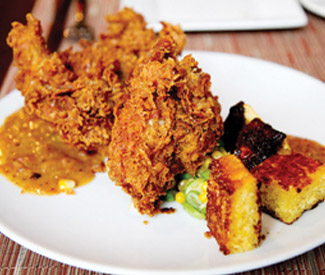
food

Is it Saturday yet? 5 (vegetarian-abled) Street Food Festival snacks we can’t wait for

0

The Bay’s press has been salivating ever since July 26, when La Cocina‘s Street Food Festival hosted a passel of media types at Fort Mason Center with tables upon tables of the snacks that we’ll all get to freak out over at the festival on Sat/18. Read on for some of our favorite snacks that we’re having a hard time holding off on until Saturday.

Bonus! If mornings aren’t your deal, you’ve got options this year. On Fri/17, you can jet down to the Alemany Farmer’s Market for the fest’s Night Market. 25 vendors will be selling sub-$10 treats, including American Masala Farm’s Suvir Saran serving up Indian food, Ryar Farr from 4505 Meats, and Tijuana’s Javier Plasencia of Mision 19. Plus, craft beer and cocktails.

>>CLICK HERE FOR THE COMPLETE STREET FOOD FESTIVAL MAP

Go early on Saturday. Lines for vendors, which range from La Cocina participants who have hardly sold commercially before to some of SF’s hautest eateries, tend to be pretty long by lunch time, and this is one fest that does not award the fashionably late. You’ll also be able to pick up a paper copy in the Guardian on newsstands today. Here’s some treats you’ll wanna queue up for as soon as you fall out of bed, veggie-friendly all. We dare you to do all five — tweet their photos to @sfbg if you do and we’ll figure out some kind of reward for gluttonous you. 

1. El Buen Comer esquites

Something about corn, cheese, and mayo soup sounds vaguely unsettling, but take it from an avowed mayonaise h8r, these are cups of pleasure and you want at least one. La Cocina graduate Isabel Caudillo makes them, bringing this Mexico City recipe straight to SF bellies. Perfect if Saturday gets chilly (please no.)

2. Chiefo’s Kitchen moi-moi

Chiefo Chukwudebe makes these West African firm cakes made of pureed black eyed peas, topped with tomatoes, onions, peppers, and carmelized onions. The deliciously chewy version that was being sampled at Fort Mason was topped with flakes of corned beef, but vegetarian versions were available. 

3. Hella Vegan Eats pad thai egg rolls

The plucky Tiffany and Sylvee Esquivel of this rad catering outfit didn’t give their Street Food Fest offering quite as catchy a moniker as some of their repetoire (“vegans are better lovers” lasagna comes to mind), but no matter — this Asian-inspired nuggets are the kind of stoner snack you normally only dream of. Noodles inside egg rolls? *Eyes roll back into head, Homer Simpson-scruff sprouts instantly* Much props to these ladies for the hundreds of free vegan cookies they baked for the Dyke March this year, by the way. 

4. Clairesquares‘ deep-fried caramel pop

One quibble about these devilish, gooey, troublesome-in-a-good-way dessert snacks — is that spear in the center really necessary? After all, the first time you crunch into one the thing is going to require two hands so that it doesn’t fall off the wooden skewer onto the — NOOOOOOOOO! — ground. That’s not what you want, so this is your official reminder to pay attention to sugar bomb of satiation. Clairesquares is the brainchild of Ireland’s Claire Keene, who re-interprets traditional recipes into decadent desserts that have popped up all over town in the last few years. 

5. Sweets Collection artisan Jello shots

I went on the record last year over how much I love these things. Nothing combines a love of pastels and a love of getting drunk more than Rosa Rodriguez’s mouthfuls of booze and condensed milk flower. They are magic, and you can find them at the Street Food Festival bars, waiting for you cheefully when you’re done eating the fest’s more nutritious options. 


Street Food Festival Night Market

Fri/17 6-9pm, $25 entry

Alemany Farmer’s Market (free shuttle leaves from 25th St. and Mission, SF)

100 Alemany, SF


Street Food Festival

Sat/18 11am-7pm, free entry

Mission District (Folsom from 20th to 26th St., 21st and 25th Sts. from Treat to Shotwell, Cesar Chavez Elementary School parking lot, Parque de los Ninos Unidos and Jose Coronada Playgrounds), SF

www.sfstreetfoodfest.com

Film Listings

0

Film listings are edited by Cheryl Eddy. Reviewers are Kimberly Chun, Max Goldberg, Dennis Harvey, and Lynn Rapoport. For rep house showtimes, see Rep Clock.

OPENING

The Awakening In 1921 England Florence Cathcart (Rebecca Hall) is a best-selling author who specializes in exposing the legions of phony spiritualists exploiting a nation still grieving for its World War I dead. She’s rather rudely summoned to a country boys’ boarding school by gruff instructor Robert (Dominic West), who would be delighted if she could disprove the presence of a ghost there — preferably before it frightens more of his young charges to death. Borrowing tropes from the playbooks of recent Spanish and Japanese horror flicks, Nick Murphy’s period thriller is handsome and atmospheric, but disappointing in a familiar way — the buildup is effective enough, but it all unravels in pat logic and rote "Boo!" scares when the anticlimactic payoff finally arrives. The one interesting fillip is Florence’s elaborate, antiquated, meticulously detailed arsenal of equipment and ruses designed to measure (or debunk) possibly supernatural phenomena. (1:47) Embarcadero, Shattuck. (Harvey)

Beloved There is a touch of Busby Berkeley to the first five or so minutes of Christophe Honoré’s Beloved — a fetishy, mid-’60s-set montage in which a series of enviably dressed Parisian women stride purposefully in and out of a shoe shop, trying on an endless array of covetable pumps. As for the rest, it’s a less delightful tale of two women, a mother and a daughter, and the unfathomable yet oft-repeated choices they make in their affairs of the heart. It helps very little that the mother is played by Ludivine Sagnier and then Catherine Deneuve — whose handsome Czech lover (Rasha Bukvic) is somewhat unkindly but perhaps deservedly transformed by the years into Milos Forman — or that the daughter, as an adult, is played by Deneuve’s real-life daughter, Chiara Mastroianni. And it helps even less that the film is a musical, wherein one character or another occasionally takes the opportunity, during a moment of inexplicable emotional duress, to burst into song and let poorly written pop lyrics muddy the waters even further. The men are sexist cads, or children, or both, and if they’re none of those, they’re gay. The women find these attributes to be charming and irresistible. None of it feels like a romance for the ages, but nonetheless the movie arcs through four interminable decades. When tragedy strikes, it’s almost a relief, until we realize that life goes on and so will the film. (2:15) Lumiere, Shattuck. (Rapoport)

The Expendables 2 Pretty much every aging action hero in the universe (except Steven Seagal) appears in this plot-lite but explosion-heavy sequel. (1:43)

Hara-Kiri: Death of a Samurai See "The Trouble with Demons." (2:08) Four Star.

Love in the City See "Mid-Century Modern." (1:45) SF Film Society Cinema.

The Odd Life of Timothy Green A childless couple (Jennifer Garner, Joel Edgerton) adopt a boy after he mysteriously appears in their garden. (2:05) Presidio.

Painted Skin: The Resurrection See "The Trouble with Demons." (2:11) Metreon.

ParaNorman A boy who can speak to the dead saves his small town from a ghoul invasion in this spooky, 3D stop-motion animated film. (1:32) Balboa, Presidio.

Sparkle A 1960s Motown girl group faces the perils of stardom in this musical drama, featuring Whitney Houston in her last screen appearance. (1:56) Marina.

2 Days in New York Messy, attention-hungry, random, sweet, pathetic, and even adorable — such is the latest dispatch from Julie Delpy, here with her follow-up to 2007’s 2 Days in Paris. It’s also further proof that the rom-com as a genre can yet be saved by women who start with the autobiographical and spin off from there. Now separated from 2 Days in Paris‘s Jake and raising their son, artist Marion is happily cohabiting with boyfriend Mingus (Chris Rock), a radio host and sometime colleague at the Village Voice, and his daughter, while juggling her big, bouncing bundle of neuroses. Exacerbating her issues: a visit by her father Jeannot (Delpy’s real father Albert Delpy), who eschews baths and tries to smuggle an unseemly selection of sausages and cheeses into the country; her provocative sister Rose (Alexia Landeau), who’s given to nipple slips in yoga class and Marion and Mingus’ apartment; and Rose’s boyfriend Manu (Alexandre Nahon), who’s trouble all around. The gang’s in NYC for Marion’s one-woman show, in which she hopes to auction off her soul to the highest, and hopefully most benevolent, bidder. Rock, of course, brings the wisecracks to this charming, shambolic urban chamber comedy, as well as, surprisingly, a dose of gravitas, as Marion’s aggrieved squeeze — he’s uncertain whether these home invaders are intentionally racist, cultural clueless, or simply bonkers but he’s far too polite to blurt out those familiar Rock truths. The key, however, is Delpy — part Woody Allen, if the Woodman were a maturing, ever-metamorphosing French beauty — and part unique creature of her own making, given to questioning her identity, ideas of life and death, and the existence of the soul. 2 Days in New York is just a sliver of life, but buoyed by Delpy’s thoughtful, lightly madcap spirit. You’re drawn in, wanting to see what happens next after the days are done. (1:31) Embarcadero, Shattuck, Smith Rafael. (Chun)

ONGOING

Ai Weiwei: Never Sorry Unstoppable force meets immovable object — and indeed gets stopped — in Alison Klayman’s documentary about China’s most famous contemporary artist. A larger than life figure, Ai Weiwei’s bohemian rebel persona was honed during a long (1981-93) stint in the U.S., where he fit right into Manhattan’s avant-garde and gallery scenes. Returning to China when his father’s health went south, he continued to push the envelope with projects in various media, including architecture — he’s best known today for the 2008 Beijing Olympics’ "Bird’s Nest" stadium design. But despite the official approval implicit in such high-profile gigs, his incessant, obdurate criticism of China’s political repressive politics and censorship — a massive installation exposing the government-suppressed names of children killed by collapsing, poorly-built schools during the 2008 Sichuan earthquake being one prominent example — has tread dangerous ground. This scattershot but nonetheless absorbing portrait stretches its view to encompass the point at which the subject’s luck ran out: when the film was already in post-production, he was arrested, then held for two months without official charge before he was accused of alleged tax evasion. (He is now free, albeit barred from leaving China, and "suspected" of additional crimes including pornography and bigamy.) (1:31) Shattuck, Smith Rafael. (Harvey)

The Amazing Spider-Man A mere five years after Sam Raimi and Tobey Maguire’s Spider-Man 3 — forgettable on its own, sure, but 2002’s Spider-Man and especially 2004’s Spider-Man 2 still hold up — Marvel’s angsty web-slinger returns to the big screen, hoping to make its box-office mark before The Dark Knight Rises opens in a few weeks. Director Marc Webb (2009’s 500 Days of Summer) and likable stars Andrew Garfield (as the skateboard-toting hero) and Emma Stone (as his high-school squeeze) offer a competent reboot, but there’s no shaking the feeling that we’ve seen this movie before, with its familiar origin story and with-great-power themes. A little creativity, and I don’t mean in the special effects department, might’ve gone a long way to make moviegoers forget this Spidey do-over is, essentially, little more than a soulless cash grab. Not helping matters: the villain (Rhys Ifans as the Lizard) is a snooze. (2:18) Metreon, 1000 Van Ness. (Eddy)

Beasts of the Southern Wild Six months after winning the Grand Jury Prize at Sundance (and a Cannes Camera d’Or), Beasts of the Southern Wild proves capable of enduring a second or third viewing with its originality and strangeness fully intact. Magical realism is a primarily literary device that isn’t attempted very often in U.S. cinema, and succeeds very rarely. But this intersection between Faulkner and fairy tale, a fable about — improbably — Hurricane Katrina, is mysterious and unruly and enchanting. Benh Zeitlin’s film is wildly cinematic from the outset, as voiceover narration from six-year-old Hushpuppy (Quvenzhané Wallis) offers simple commentary on her rather fantastical life. She abides in the Bathtub, an imaginary chunk of bayou country south of New Orleans whose residents live closer to nature, amid the detritus of civilization. Seemingly everything is some alchemical combination of scrap heap, flesh, and soil. But not all is well: when "the storm" floods the land, the holdouts are forced at federal gunpoint to evacuate. With its elements of magic, mythological exodus, and evolutionary biology, Beasts goes way out on a conceptual limb; you could argue it achieves many (if not more) of the same goals Terrence Malick’s 2011 The Tree of Life did at a fraction of that film’s cost and length. (1:31) Bridge, California, Embarcadero, Smith Rafael. (Harvey)

Bernie Jack Black plays the titular new assistant funeral director liked by everybody in small-town Carthage, Tex. He works especially hard to ingratiate himself with shrewish local widow Marjorie (Shirley MacLaine), but there are benefits — estranged from her own family, she not only accepts him as a friend (then companion, then servant, then as virtual "property"), but makes him her sole heir. Richard Linklater’s latest is based on a true-crime story, although in execution it’s as much a cheerful social satire as I Love You Philip Morris and The Informant! (both 2009), two other recent fact-based movies about likable felons. Black gets to sing (his character being a musical theater queen, among other things), while Linklater gets to affectionately mock a very different stratum of Lone Star State culture from the one he started out with in 1991’s Slacker. There’s a rich gallery of supporting characters, most played by little-known local actors or actual townspeople, with Matthew McConaughey’s vainglorious county prosecutor one delectable exception. Bernie is its director’s best in some time, not to mention a whole lot of fun. (1:39) Opera Plaza, Smith Rafael. (Harvey)

Bill W. Even longtime AA members are unlikely to know half the organizational history revealed in this straightforward, chronological, fast-moving portrait of its late founder. Bill Wilson was a bright, personable aspiring businessman whose career was nonetheless perpetually upset by addiction to the alcohol that eased his social awkwardness but brought its own worse troubles. During one mid-1930s sanitarium visit, attempting to dry out, he experienced a spiritual awakening. From that moment slowly grew the idea of Alcoholics Anonymous, which he shaped with the help of several other recovering drunks, and saw become a national movement after a 1941 Saturday Evening Post article introduced it to the general public. Wilson had always hoped the "leaderless" organization would soon find its own feet and leave him to build a separate, sober new career. But gaining that distance was difficult; attempts to find other "cures" for his recurrent depression (including LSD therapy) laid him open to internal AA criticism; and he was never comfortable on the pedestal that grateful members insisted he stay on as the organization’s founder. Admittedly, he appointed himself its primary public spokesman, which rendered his own hopes for privacy somewhat self-canceling — though fortunately it also provides this documentary with plenty of extant lecture and interview material. He was a complicated man whose complicated life often butted against the role of savior, despite his endless dedication and generosity toward others in need. That thread of conflict makes for a movie that’s compelling beyond the light it sheds on an institution as impactful on individual lives and society as any other to emerge from 20th-century America. (1:43) Roxie. (Harvey)

The Bourne Legacy Settle down, Matt Damon fans — the original Bourne appears in The Bourne Legacy only in dialogue ("Jason Bourne is in New York!") and photograph form. Stepping in as lead badass is Jeremy Renner, whose twin powers of strength and intelligence come courtesy of an experimental-drug program overseen by sinister government types (including Edward Norton in an utterly generic role) and administered by lab workers doing it "for the science!," according to Dr. Rachel Weisz. Legacy‘s timeline roughly matches up with the last Damon film, The Bourne Ultimatum, which came out five years ago and is referenced here like we’re supposed to be on a first-name basis with its long-forgotten plot twists. Anyway, thanks to ol’ Jason and a few other factors involving Albert Finney and YouTube, the drug program is shut down, and all guinea-pig agents and high-security-clearance doctors are offed. Except guess which two, who manage to flee across the globe to get more WMDs for Renner’s DNA. Essentially one long chase scene, The Bourne Legacy spends way too much of its time either in Norton’s "crisis suite," watching characters bark orders and stare at computer screens, or trying to explain the genetic tinkering that’s made Renner a super-duper-superspy. Remember when Damon killed that guy with a rolled-up magazine in 2004’s The Bourne Supremacy? Absolutely nothing so rad in this imagination-free enterprise. (2:15) Balboa, 1000 Van Ness, Presidio, SF Center, Sundance Kabuki. (Eddy)

Brave Pixar’s latest is a surprisingly familiar fairy tale. Scottish princess Merida (voiced by Kelly Macdonald) would rather ride her horse and shoot arrows than become engaged, but it’s Aladdin-style law that she must marry the eldest son of one of three local clans. (Each boy is so exaggeratedly unappealing that her reluctance seems less tomboy rebellion than common sense.) Her mother (Emma Thompson) is displeased; when they quarrel, Merida decides to change her fate (Little Mermaid-style) by visiting the local spell-caster (a gentle, absent-minded soul that Ursula the Sea Witch would eat for brunch). Naturally, the spell goes awry, but only the youngest of movie viewers will fear that Merida and her mother won’t be able to make things right by the end. Girl power is great, but so are suspense and originality. How, exactly, is Brave different than a zillion other Disney movies about spunky princesses? Well, Merida’s fiery explosion of red curls, so detailed it must have had its own full-time team of animators working on it, is pretty fantastic. (1:33) 1000 Van Ness, SF Center, Shattuck. (Eddy)

The Campaign (1:25) California, 1000 Van Ness, Presidio, SF Center, Vogue.

Celeste and Jesse Forever Married your best friend, realized you love but can’t be in love with each other, and don’t want to let all those great in-jokes wither away? Such is the premise of Celeste and Jesse Forever, the latest in what a recent wave of meaty, girl-centric comedies penned by actresses — here Rashida Jones working with real-life ex Will McCormack; there, Zoe Kazan (Ruby Sparks), Zoe Lister Jones (Lola Versus), and Lena Dunham (Girls) — who have gone the DIY route and whipped up their own juicy roles. There’s no mistaking theirs for your average big-screen rom-com: they dare to wallow harder, skew smarter, and in the case of Celeste, tackle the thorny, tough-to-resolve relationship dilemma that stubbornly refuses to conform to your copy-and-paste story arc. Nor do their female protagonists come off as uniformly likable: in this case, Celeste (Jones) is a bit of an aspiring LA powerbitch. Her Achilles heel is artist Jesse (Andy Samberg), the slacker high school sweetheart she wed and separated from because he doesn’t share her goals (e.g., he doesn’t have a car or a job). Yet the two continue to spend all their waking hours together and share an undeniable rapport, extending from Jesse’s encampment in her backyard apartment to their jokey simulated coitus featuring phallic-shaped lip balm. Throwing a wrench in the works: the fact that they’re still kind of in love with each other, which all their pals, like Jesse’s pot-dealer bud Skillz (McCormack), can clearly see. It’s an shaggy, everyday breakup yarn, writ glamorous by its appealing leads, that we too rarely witness, and barring the at-times nausea-inducing shaky-cam under the direction of Lee Toland Krieger, it’s rendered compelling and at times very funny — there’s no neat and tidy way to say good-bye, and Jones and McCormack do their best to capture but not encapsulate the severance and inevitable healing process. It also helps that the chemistry practically vibrates between the boyish if somewhat one-note Samberg and the soulful Jones, who fully, intelligently rises to the occasion, bringing on the heartbreak. (1:31) Metreon, Shattuck, Sundance Kabuki. (Chun)

Dark Horse You can look at filmmaker Todd Solondz’s work and find it brilliant, savage, and challenging; or show-offy, contrived, and fraudulent. The circles of interpersonal (especially familial) hell he describes are simultaneously brutal, banal, and baroque. But what probably distresses people most is that they’re also funny — raising the issue of whether he trivializes trauma for the sake of cheap shock-value yuks, or if black comedy is just another valid way of facing the unbearable. Dark Horse is disturbing because it’s such a slight, inconsequential, even soft movie by his standards; this time, the sharp edges seem glibly cynical, and the sum ordinary enough to no longer seem unmistakably his. Abe (Jordan Gelber) is an obnoxious jerk of about 35 who still lives with his parents (Mia Farrow, Christopher Walken) and works at dad’s office, likely because no one else would employ him. But Abe doesn’t exactly see himself as a loser. He resents and blames others for being winners, which is different — he sees the inequality as their fault. Dark Horse is less of an ensemble piece than most of Solondz’s films, and in hinging on Abe, it diminishes his usual ambivalence toward flawed humanity. Abe has no redemptive qualities — he’s just an annoyance, one whose mental health issues aren’t clarified enough to induce sympathy. (1:25) Smith Rafael. (Harvey)

The Dark Knight Rises Early reviews that called out The Dark Knight Rises‘ flaws were greeted with the kind of vicious rage that only anonymous internet commentators can dish out. And maybe this is yet another critic-proof movie, albeit not one based on a best-selling YA book series. Of course, it is based on a comic book, though Christopher Nolan’s sophisticated filmmaking and Christian Bale’s tortured lead performance tend to make that easy to forget. In this third and "final" installment in Nolan’s trilogy, Bruce Wayne has gone into seclusion, skulking around his mansion and bemoaning his broken body and shattered reputation. He’s lured back into the Batcave after a series of unfortunate events, during which The Dark Knight Rises takes some jabs at contemporary class warfare (with problematic mixed results), introduces a villain with pecs of steel and an at-times distractingly muffled voice (Tom Hardy), and unveils a potentially dangerous device that produces sustainable energy (paging Tony Stark). Make no mistake: this is an exciting, appropriately moody conclusion to a superior superhero series, with some nice turns by supporting players Gary Oldman and Joseph Gordon-Levitt. But in trying to cram in so many characters and plot threads and themes (so many prisons in this thing, literal and figural), The Dark Knight Rises is ultimately done in by its sprawl. Without a focal point — like Heath Ledger’s menacing, iconic Joker in 2008’s The Dark Knight — the stakes aren’t as high, and the end result feels more like a superior summer blockbuster than one for the ages. (2:44) Metreon, 1000 Van Ness, Sundance Kabuki. (Eddy)

Diary of a Wimpy Kid: Dog Days (1:34) Metreon, 1000 Van Ness.

Easy Money A title like that is bound to disprove itself, and it doesn’t take long to figure out that the only payday the lead characters are going to get in this hit 2010 Swedish thriller (from Jens Lapidus’ novel) is the kind measured in bloody catastrophe. Chilean Jorge (Matias Padin Varela), just escaped from prison, returns to Stockholm seeking one last big drug deal before he splits for good; JW (Joel Kinnaman from AMC series The Killing) is a economics student-slash-cabbie desperate for the serious cash needed to support his double life as a pseudo-swell running with the city’s rich young turks. At first reluctantly thrown together, they become friends working for JW’s taxi boss — or to be more specific, for that boss’ cocaine smuggling side business. Their competitors are a Serbian gang whose veteran enforcer Mrado (Dragomir Mrsic) is put in the awkward position of caring for his eight-year-old daughter (by a drug addicted ex-wife) just as "war" heats up between the two factions. But then everyone here has loved ones they want to protect from an escalating cycle of attacks and reprisals from which none are immune. Duly presented here by Martin Scorsese, Daniel Espinosa’s film has the hurtling pace, engrossing characters and complicated (sometimes confusing) plot mechanics of some good movies by that guy, like Casino (1995) or The Departed (2006). Wildly original it’s not, but this crackling good genre entertainment that make you cautiously look forward to its sequel — which is just about to open in Sweden. (1:59) Opera Plaza. (Harvey)

Farewell, My Queen (Benoît Jacquot, France, 2012) Opening early on the morning of July 14, 1789, Farewell, My Queen depicts four days at the Palace of Versailles on the eve of the French Revolution, as witnessed by a young woman named Sidonie Laborde (Léa Seydoux) who serves as reader to Marie Antoinette (Diane Kruger). Sidonie displays a singular and romantic devotion to the queen, while the latter’s loyalties are split between a heedless amour propre and her grand passion for the Duchess de Polignac (Virginie Ledoyen). These domestic matters and other regal whims loom large in the tiny galaxy of the queen’s retinue, so that while elsewhere in the palace, in shadowy, candle-lit corridors, courtiers and their servants mingle to exchange news, rumor, panicky theories, and evacuation plans, in the queen’s quarters the task of embroidering a dahlia for a projected gown at times overshadows the storming of the Bastille and the much larger catastrophe on the horizon. (1:39) Albany, Opera Plaza. (Rapoport)

Girlfriend Boyfriend The onscreen title of this Taiwanese import is Gf*Bf, but don’t let the text-speak fool you: the bulk of the film is set in the 1980s and 90s, long before smart phones were around to complicate relationships. And the trio at the heart of Girlfriend Boyfriend is complicated enough as it is: sassy Mabel (Gwei Lun-Mei) openly pines for brooding Liam (Joseph Chang), who secretly pines for rebellious Aaron (Rhydian Vaughan), who chases Mabel until she gives in; as things often go in stories like this, nobody gets the happy ending they desire. Set against the backdrop of Taiwan’s student movement, this vibrant drama believably tracks its leads as they mature from impulsive youths to bitter adults who never let go of their deep bond — despite all the misery it causes, and a last-act turn into melodrama that’s hinted at by the film’s frame story featuring an older Liam and a pair of, um, sassy and rebellious twin girls he’s been raising as his own. (1:45) Metreon. (Eddy)

Hope Springs Heading into her 32nd year of matrimony with aggressively oblivious Arnold (Tommy Lee Jones), desperate housewife Kay (Meryl Streep) sets aside her entrenched passivity in a last-ditch effort to put flesh back on the skeleton of a marriage. Stumbling upon the guidance of one Dr. Bernard Feld (Steve Carell) in the self-help section of a bookstore, Kay (barely) convinces Arnold to accompany her to a weeklong session at Feld’s Center for Intensive Couples Counseling, in Hope Springs, Maine. The scenes from a marriage leading up to their departure, as well as the incremental advances and crippling setbacks of their therapeutic sojourn, are poignant and distressing and possibly familiar. Some slow drift, long ago set in motion, though we don’t know by what, has settled them in concrete in their separate routines — and bedrooms. It’s the kind of thing that, if it were happening in real life — say, to you — might make you weep. But somehow, through the magic of cinema and the uncomfortable power of witnessing frankly depicted failures of intimacy, we laugh. This is by no means a wackiness-ensues sort of sexual comedy, though. Director David Frankel (2006’s The Devil Wears Prada and, unfortunately, 2008’s Marley & Me) and Jones and Streep, through the finely detailed particularities of their performances, won’t let it be, while Carell resists playing the therapeutic scenes for more than the gentlest pulses of humor. More often, his empathetic silences and carefully timed queries provide a place for these two unhappy, inarticulate, isolated people to fall and fumble and eventually make contact. (1:40) Four Star, Marina, 1000 Van Ness, Piedmont, SF Center, Shattuck, Sundance Kabuki. (Rapoport)

Ice Age: Continental Drift (1:27) Metreon.

The Imposter A family tragedy, an international thriller, a Southern-fried mystery, and a true story: The Imposter is all of these things. This unique documentary reveals the tale of Frédéric Bourdin, dubbed "the Chameleon" for his epic false-identity habit. His ballsiest accomplishment was also his most heinous con: in 1997, he claimed to be Nicholas Barclay, a San Antonio teen missing since 1994. Amazingly, the impersonation worked for a time, though Bourdin (early 20s, brown-eyed, speaks English with a French accent) hardly resembled Nicholas (who would have been 16, and had blue eyes). Using interviews — with Nicholas’ shell-shocked family, government types who unwittingly aided the charade, and Bourdin himself — and ingenious re-enactments that borrow more from crime dramas than America’s Most Wanted, director Bart Layton weaves a multi-layered chronicle of one man’s unbelievable deception. (1:39) Lumiere, Shattuck. (Eddy)

The Intouchables Cries of "racism" seem a bit out of hand when it comes to this likable albeit far-from-challenging French comedy loosely based on a real-life relationship between a wealthy white quadriplegic and his caretaker of color. The term "cliché" is more accurate. And where were these critics when 1989’s Driving Miss Daisy and 2011’s The Help — movies that seem designed to make nostalgic honkies feel good about those fraught relationships skewed to their advantage—were coming down the pike? (It also might be more interesting to look at how these films about race always hinge on economies in which whites must pay blacks to interact with/educate/enlighten them.) In any case, Omar Sy, portraying Senegalese immigrant Driss, threatens to upset all those pundits’ apple carts with his sheer life force, even when he’s shaking solo on the dance floor to sounds as effortlessly unprovocative, and old-school, as Earth, Wind, and Fire. In fact, everything about The Intouchables is as old school as 1982’s 48 Hrs., spinning off the still laugh-grabbing humor that comes with juxtaposing a hipper, more streetwise black guy with a hapless, moneyed chalky. The wheelchair-bound Philippe (Francois Cluzet) is more vulnerable than most, and he has a hard time getting along with any of his nurses, until he meets Driss, who only wants his signature for his social services papers. It’s not long before the cultured, classical music-loving Philippe’s defenses are broken down by Driss’ flip, somewhat honest take on the follies and pretensions of high culture — a bigger deal in France than in the new world, no doubt. Director-writer Olivier Nakache and Eric Toledano aren’t trying to innovate —they seem more set on crafting an effervescent blockbuster that out-blockbusters Hollywood — and the biggest compliment might be that the stateside remake is already rumored to be in the works. (1:52) Clay. (Chun)

Jiro Dreams of Sushi Celebrity-chef culture has surely reached some kind of zeitgeist, what with the omnipresence of Top Chef and other cooking-themed shows, and the headlines-making power of people like Paula Deen (diabetes) and Mario Batali (sued for ripping off his wait staff). Unconcerned with the trappings of fame — you’ll never see him driving a Guy Fieri-style garish sports car — is Jiro Ono, 85-year-old proprietor of Sukiyabashi Jiro, a tiny, world-renowned sushi restaurant tucked into Tokyo’s Ginza station. Jiro, a highly-disciplined perfectionist who believes in simple, yet flavorful food, has devoted his entire life to the pursuit of "deliciousness" — to the point of sushi invading his dreams, as the title of David Gelb’s reverential documentary suggests. But Jiro Dreams of Sushi goes deeper than food-prep porn (though, indeed, there’s plenty of that); it also examines the existential conflicts faced by Jiro’s two middle-aged sons. Both were strongly encouraged to enter the family business — and in the intervening years, have had to accept the soul-crushing fact that no matter how good their sushi is, it’ll never be seen as exceeding the creations of their legendary father. (1:21) Four Star. (Eddy)

Killer Joe William Friedkin made two enormously popular movies that have defined his career (1971’s The French Connection and 1973’s The Exorcist), but his resumé also contains an array of lesser films that are both hit-and-miss in critical and popular appeal. Most have their defenders. After a couple biggish action movies, it seemed a step down for him to be doing Bug in 2006; though it had its limits as a psychological quasi-horror, you could feel the cracking recognition of like minds between cast, director, and playwright Tracy Letts. Letts and Friedkin are back in Killer Joe, which was a significant off-Broadway success in 1998. In the short, violent, and bracing film version, Friedkin gets the ghoulish jet-black-comedic tone just right, and his actors let themselves get pushed way out on a limb to their great benefit — including Matthew McConaughey, playing the title character, who’s hired by the Smith clan of Texas to bump off a troublesome family member. Needless to say, almost nothing goes as planned, escalating mayhem to new heights of trailer-trash Grand Guignol. Things get fugly to the point where Killer Joe becomes one of those movies whose various abuses are shocking enough to court charges of gratuitous violence and misogyny; unlike the 2010 Killer Inside Me, for instance, it can’t really be justified as a commentary upon those very entertainment staples. (Letts is highly skilled, but those looking for a message here will have to think one up for themselves.) Still, Friedkin and his cast do such good work that Killer Joe‘s grimly humorous satisfaction in its worst possible scenarios seems quite enough. (1:43) Embarcadero, Shattuck. (Harvey)

Klown A spinoff from a long-running Danish TV show, with the same director (Mikkel Nørgaard) and co-writer/stars, this bad-taste comedy might duly prove hard to beat as "the funniest movie of the year" (a claim its advertising already boasts). Socially hapless Frank (Frank Hvam) discovers his live-in girlfriend Mia (Mia Lyhne) is pregnant, but she quite reasonably worries "you don’t have enough potential as a father." To prove otherwise, he basically kidnaps 12-year-old nephew Bo (Marcuz Jess Petersen) and drags him along on a canoe trip with best friend Casper (Casper Christensen). Trouble is, Casper has already proclaimed this trip will be a "Tour de Pussy," in which they — or at least he — will seize any and every opportunity to cheat on their unknowing spouses. Ergo, there’s an almost immediate clash between awkward attempts at quasi-parental bonding and activities most unsuited for juvenile eyes. Accusations of rape and pedophilia, some bad advice involving "pearl necklaces," an upscale one-night-only bordello, reckless child endangerment, encouragement of teenage drinking, the consequences of tactical "man flirting," and much more ensue. Make no mistake, Klown one-ups the Judd Apatow school of raunch (at least for the moment), but it’s good-natured enough to avoid any aura of crass Adam Sandler-type bottom-feeding. It’s also frequently, blissfully, very, very funny. (1:28) Roxie. (Harvey)

Magic Mike Director Steven Soderbergh pays homage to the 1970s with the opening shot of his male stripper opus: the boxy old Warner Bros. logo, which evokes the gritty, sexualized days of Burt Reynolds and Joe Namath posing in pantyhose. Was that really the last time women, en masse, were welcome to ogle to their heart’s content? That might be the case considering the outburst of applause when a nude Channing Tatum rises after a hard night in a threesome in Magic Mike‘s first five minutes. Ever the savvy film historian, Soderbergh toys with the conventions of the era, from the grimy quasi-redneck realism of vintage Reynolds movies to the hidebound framework of the period’s gay porn, almost for his own amusement, though the viewer might be initially confused about exactly what year they’re in. Veteran star stripper Mike (Tatum) is working construction, stripping to the approval of many raucous ladies and their stuffable dollar bills. He decides to take college-dropout blank-slate hottie Adam (Alex Pettyfer) under his wing and ropes him into the strip club, owned by Dallas (Matthew McConaughey, whose formidable abs look waxily preserved) and show him the ropes of stripping and having a good time, much to the disapproval of Adam’s more straight-laced sister Brooke (Cody Horn). Really, though, all Mike wants to do is become a furniture designer. Boasting Foreigner’s "Feels like the First Time" as its theme of sorts and spot-on, hot choreography by Alison Faulk (who’s worked with Madonna and Britney Spears), Magic Mike takes off and can’t help but please the crowd when it turns to the stage. Unfortunately the chemistry-free budding romance between Mike and Brooke sucks the air out of the proceedings every time it comes into view, which is way too often. (1:50) Metreon. (Chun)

Moonrise Kingdom Does Wes Anderson’s new film mark a live-action return to form after 2007’s disappointingly wan Darjeeling Limited? More or less. Does it tick all the Andersonian style and content boxes? Indubitably. In the most obvious deviation Anderson has taken with Moonrise, he gives us his first period piece, a romance set in 1965 on a fictional island off the New England coast. After a chance encounter at a church play, pre-teen Khaki Scout Sam (newcomer Jared Gilman) instantly falls for the raven-suited, sable-haired Suzy Bishop (Kara Hayward, ditto). The two become pen pals, and quickly bond over the shared misery of being misunderstood by both authority figures and fellow kids. The bespectacled Sam is an orphan, ostracized by his foster parents and scout troop (much to the dismay of its straight-arrow leader Edward Norton). Suzy despises her clueless attorney parents, played with gusto by Bill Murray and Frances McDormand in some of the film’s funniest and best scenes. When the two kids run off together, the whole thing begins to resemble a kind of tween version of Godard’s 1965 lovers-on the-lam fantasia Pierrot le Fou. But like most of Anderson’s stuff, it has a gauzy sentimentality more akin to Truffaut than Godard. Imagine if the sequence in 2001’s The Royal Tenenbaums where Margot and Richie run away to the Museum of Natural History had been given the feature treatment: it’s a simple yet inspired idea, and it becomes a charming little tale of the perils of growing up and selling out the fantasy. But it doesn’t feel remotely risky. It’s simply too damn tame. (1:37) Four Star, Metreon, 1000 Van Ness, Piedmont, Shattuck, Sundance Kabuki. (Michelle Devereaux)

Moth Diaries The Moth Diaries, Rachel Klein’s 2002 novel turned into Mary Harron’s film, is the director’s most mainstream-friendly effort, being less edgy and grown-up than American Psycho (2000), I Shot Andy Warhol (1996), or even The Notorious Bettie Page (2005). It’s the start of a new academic year at an upscale girls’ boarding school. Becca (Sarah Bolger from The Tudors) is particularly happy to be reunited with best friend Lucie (Sarah Gadon), as the former is still psychologically fragile in the wake of her well-known poet father’s suicide. But a wedge is driven between them by the arrival of Ernessa (Lily Cole), a tall, English-accented student with a face like a creepy porcelain doll. She "colonizes" Lucie, who at first guiltily hides her infatuation from Becca, then (along with everyone else) accuses her of simple jealousy. But Becca notices things others don’t, or dismiss: how Ernessa never seems to eat, how she can’t abide water, the sickly sweet smell emanating from her room and her odd disappearances into the luxury-hotel-turned-school’s off limits basement. Klein’s book, which had our heroine looking back on this episode from middle age, insisted on ambiguity: we’re never sure whether Ernessa really is a supernatural predator, or if all this is just a hysterical fantasy. Adapted by Harron as scenarist, the movie eliminates that frame and leaves little room for doubt that there be vampires here. The film’s weakness is that it still tries to play it both ways, as troubled coming-of-age portrait and Gothic horror, with the result that the two elements end up seeming equally half-realized. (1:22) SF Film Society Cinema. (Harvey)

Nitro Circus the Movie 3D (1:28) Metreon.

The Queen of Versailles Lauren Greenfield’s obscenely entertaining The Queen of Versailles takes a long, turbulent look at the lifestyles lived by David and Jackie Siegel. He is the 70-something undisputed king of timeshares; she is his 40-something (third) wife, a former beauty queen with the requisite blonde locks and major rack, both probably not entirely Mother Nature-made. He’s so compulsive that he’s never saved, instead plowing every buck back into the business. When the recession hits, that means this billionaire is — in ready-cash as opposed to paper terms — suddenly sorta kinda broke, just as an enormous Las Vegas project is opening and the family’s stupefyingly large new "home" (yep, modeled after Versailles) is mid-construction. Plugs must be pulled, corners cut. Never having had to, the Siegels discover (once most of the servants have been let go) they have no idea how to run a household. Worse, they discover that in adversity they have a very hard time pulling together — in particular, David is revealed as a remote, cold, obsessively all-business person who has no use for getting or giving "emotional support;" not even for being a husband or father, much. What ultimately makes Queen poignantly more than a reality-TV style peek at the garishly wealthy is that Jackie, despite her incredibly vulgar veneer (she’s like a Jennifer Coolidge character, forever squeezed into loud animal prints), is at heart just a nice girl from hicksville who really, really wants to make this family work. (1:40) Lumiere, Smith Rafael. (Harvey)

Ruby Sparks Meta has rarely skewed as appealingly as with this indie rom-com spinning off a writerly version of the Pygmalion and Galatea tale, as penned by the object-of-desire herself: Zoe Kazan. Little Miss Sunshine (2006) directors Jonathan Dayton and Valerie Faris helm this heady fantasy about a crumpled, geeky novelist, Calvin (Paul Dano), who’s suffering from the sophomore slump — he can’t seem to break his rock-solid writers block and pen a follow-up to his hit debut. He’s a victim of his own success, especially when he finally begins to write, about a dream girl, a fun-loving, redheaded artist named Ruby (scriptwriter Kazan), who one day actually materializes. When he types that she speaks nothing but French, out comes a stream of the so-called language of diplomacy. Calvin soon discovers the limits and dangers of creation — say, the hazards of tweaking a manifestation when she doesn’t do what you desire, and the question of what to do when one’s baby Frankenstein grows bored and restless in the narrow circle of her creator’s imagination. Kazan — and Dayton and Faris — go to the absurd, even frightening, limits of the age-old Pygmalion conceit, giving it a feminist charge, while helped along by a cornucopia of colorful cameos by actors like Annette Bening and Antonio Banderas as Calvin’s boho mom and her furniture-building boyfriend. Dano is as adorably befuddled as ever and adds the crucial texture of every-guy reality, though ultimately this is Kazan’s show, whether she’s testing the boundaries of a genuinely codependent relationship or tugging at the puppeteer’s strings. (1:44) Metreon, Piedmont, Shattuck, Sundance Kabuki. (Chun)

Searching for Sugar Man The tale of the lost, and increasingly found, artist known as Rodriguez seems to have it all: the mystery and drama of myth, beginning with the singer-songwriter’s stunning 1970 debut, Cold Fact, a neglected folk rock-psychedelic masterwork. (The record never sold in the states, but somehow became a beloved, canonical LP in South Africa.) The story goes on to parse the cold, hard facts of vanished hopes and unpaid royalties, all too familiar in pop tragedies. In Searching for Sugar Man, Swedish documentarian Malik Bendjelloul lays out the ballad of Rodriguez as a rock’n’roll detective story, with two South African music lovers in hot pursuit of the elusive musician — long-rumored to have died onstage by either self-immolation or gunshot, and whose music spoke to a generation of white activists struggling to overturn apartheid. By the time Rodriguez himself enters the narrative, the film has taken on a fairy-tale trajectory; the end result speaks volumes about the power and longevity of great songwriting. (1:25) Embarcadero. (Chun)

Step Up Revolution The Step Up franchise makes a play for the Occupy brand, setting up its fourth installment’s Miami street crew, the Mob, as the warrior dance champions of the 99 percent — here represented by a vibrant lower-income neighborhood slated for redevelopment. Embodying the one percent is a hotel-chain mogul named Bill Anderson (Peter Gallagher), armed with a wrecking ball and sowing the seeds of a soulless luxury monoculture. Our hero, Mob leader Sean (Ryan Guzman), and heroine, Anderson progeny and aspiring professional dancer Emily (Kathryn McCormick), meet beachside; engage in a sandy, awkward interlude of grinding possibly meant to showcase their dance skills; and proceed to spark a romance and a revolution that feel equally fake (brace yourself for the climactic corporate tie-in). The Mob’s periodic choreographed invasions of the city’s public and private spaces are the movie’s sole source of oxygen. The dialogue, variously mumbled and slurred and possibly read off cue cards, drifts aimlessly from tepid to trite as the protagonists attempt to demonstrate sexual chemistry by breathily trading off phrases like "What we do is dangerous!" and "Enough with performance art — it’s time to make protest art!" Occasionally you may remember that you have 3D glasses on your face and wonder why, but the larger philosophical question (if one may speak of philosophy in relation to the dance-movie genre) concerns the Step Up films’ embrace of postproduction sleights of hand that distance viewers from whatever astonishing feats of physicality are actually being achieved in front of the camera. (1:20) SF Center. (Rapoport)

Ted Ah, boys and their toys — and the imaginary friends that mirror back a forever-after land of perpetual Peter Pans. That’s the crux of the surprisingly smart, hilarious Ted, aimed at an audience comprising a wide range of classes, races, and cultures with its mix of South Park go-there yuks and rom-commie coming-of-age sentiment. Look at Ted as a pop-culture-obsessed nerd tweak on dream critter-spirit animal buddy efforts from Harvey (1950) to Donnie Darko (2001) to TV’s Wilfred. Of course, we all know that the really untamable creature here wobbles around on two legs, laden with big-time baggage about growing up and moving on from childhood loves. Young John doesn’t have many friends but he is fortunate enough to have his Christmas wish come true: his beloved new teddy bear, Ted (voice by director-writer Seth MacFarlane), begins to talk back and comes to life. With that miracle, too, comes Ted’s marginal existence as a D-list celebrity curiosity — still, he’s the loyal "Thunder Buddy" that’s always there for the now-grown John (Mark Wahlberg), ready with a bong and a broheim-y breed of empathy that involves too much TV, an obsession with bad B-movies, and mock fisticuffs, just the thing when storms move in and mundane reality rolls through. With his tendency to spew whatever profanity-laced thought comes into his head and his talents are a ladies’ bear, Ted is the id of a best friend that enables all of John’s most memorable, un-PC, Hangover-style shenanigans. Alas, John’s cool girlfriend Lori (Mila Kunis) threatens that tidy fantasy setup with her perfectly reasonable relationship demands. Juggling scary emotions and material that seems so specific that it can’t help but charm — you’ve got to love a shot-by-shot re-creation of a key Flash Gordon scene — MacFarlane sails over any resistance you, Lori, or your superego might harbor about this scenario with the ease of a man fully in touch with his inner Ted. (1:46) Metreon, 1000 Van Ness. (Chun)

To Rome with Love Woody Allen’s film legacy is not like anybody else’s. At present, however, he suffers from a sense that he’s been too prolific for too long. It’s been nearly two decades since a new Woody Allen was any kind of "event," and the 19 features since Bullets Over Broadway (1994) have been hit and-miss. Still, there’s the hope that Allen is still capable of really surprising us — or that his audience might, as they did by somewhat inexplicably going nuts for 2011’s Midnight in Paris. It was Allen’s most popular film in eons, if not ever, probably helped by the fact that he wasn’t in it. Unfortunately, he’s up there again in the new To Rome With Love, familiar mannerisms not hiding the fact that Woody Allen the Nebbish has become just another Grumpy Old Man. There’s a doddering quality that isn’t intended, and is no longer within his control. But then To Rome With Love is a doddering picture — a postcard-pretty set of pictures with little more than "Have a nice day" scribbled on the back in script terms. Viewers expecting more of the travelogue pleasantness of Midnight in Paris may be forgiving, especially since it looks like a vacation, with Darius Khondji’s photography laying on the golden Italian light and making all the other colors confectionary as well. But if Paris at least had the kernel of a good idea, Rome has only several inexplicably bad ones; it’s a quartet of interwoven stories that have no substance, point, credibility, or even endearing wackiness. The shiny package can only distract so much from the fact that there’s absolutely nothing inside. (1:52) Albany, Opera Plaza, Sundance Kabuki. (Harvey)

Total Recall Already the source material for Paul Verhoeven’s campy, quotable 1990 film (starring the campy, quotable Arnold Schwarzenegger), Philip K. Dick’s short story gets a Hollywood do-over, with meh results. The story, anyway, is a fine nugget of sci-fi paranoia: to escape his unsatisfying life, Quaid (Colin Farrell) visits a company capable of implanting exciting memories into his brain. When he chooses the "secret agent" option, it’s soon revealed he actually does have secret agent-type memories, suppressed via brain-fuckery by sinister government forces (led by Bryan Cranston) keeping him in the dark about his true identity. Shit immediately gets crazy, with high-flying chases and secret codes and fight scenes all over the place. The woman Quaid thinks is his wife (Kate Beckinsale) is actually a slithery killer; the woman he’s been seeing in his dreams (Jessica Biel) turns out to be his comrade in a secret rebel movement. Len Wiseman (writer and sometimes director of the Underworld films) lenses futuristic urban grime with a certain sleek panache, and Farrell is appealing enough to make highly generic hero Quaid someone worth rooting for — until the movie ends, and the entire enterprise (save perhaps the tri-boobed hooker, a holdover from the original) becomes instantly forgettable, no amnesia trickery required. (1:58) California, Metreon, 1000 Van Ness. (Eddy)

Unforgiveable The distinguishing characteristic of André Téchiné’s movies is the speed and force with which life changes people and their relationships with one another, even as the director’s presentation is so matter-of-fact that no single moment betrays the enormity of changes endured. Unforgiveable‘s Francis (the estimable André Dussollier) is the French author of best-selling crime novels who’s decided to recharge his batteries by living in Venice for a year. He’s struck by the brisk attractiveness of Judith (Carole Bouquet), the estate agent he consults to find a rental; 18 months later they’re contentedly married, and hosting two daughters of his by a prior marriage. When the eldest (Mélanie Thierry) disappears, Francis hires a private detective (Adriana Asti), who was once ex-model Judith’s paramour and, like Francis, has a problem child in the recently prison-sprung Jérémie (Mauro Conte). The paternal quest that’s become an obsession oddly fosters a bond between Francis and this mercurial delinquent, even as it erodes the happiness he’s won in autumnal life with Judith. Unforgivable is based on a novel by Philippe Djian, but feels very much of a piece with films whose stories Téchiné originated with or without collaborators. It hurtles forward with a casual intensity that’s uniquely his own, sometimes surprising or even shocking us, but never inflating incidents to the point of melodrama. It isn’t among the director’s most memorable creations, but it’s satisfying to spend two hours with someone who thinks like an adult, and treats the audience as one. (1:52) Opera Plaza. (Harvey)

The Watch Directed by Lonely Island member Akiva Schaffer (famed for Saturday Night Live‘s popular digital shorts, including "Dick in a Box"), The Watch is, appropriately enough, probably the most dick-focused alien-invasion movie of all time. When a security guard is mangled to death at Costco, store manager and uber-suburbanite Evan (Ben Stiller, doing a damn good Steve Carell impersonation) organizes a posse to keep an eye on the neighborhood — despite the fact that the other members (Vince Vaughn as the overprotective dad with the bitchin’ man cave; Jonah Hill as the creepy wannabe cop; and British comedian Richard Ayoade as the sweet pervert) would much rather drink beers and bro down. Much bumbling ensues, along with a thrown-together plot about unfriendly E.T.s. The Watch offers some laughs (yes, dick jokes are occasionally funny) but overall feels like a pretty minor effort considering its big-name cast. (1:38) 1000 Van Ness, SF Center. (Eddy) *


On the Cheap Listings

0

Listings compiled by Caitlin Donohue. Submit items for the listings at listings@sfbg.com. For further information on how to submit items for the listings, see Picks.

WEDNESDAY 15

Smack Dab open mic Magnet, 4122 18th St., SF. www.magnetsf.org. 8pm, open mic sign-up starts at 7:30pm, free. Magnet, the Castro’s neighborhood health clinic hosts this open mic for all ages and genders. Lewis DeSimone, author of Chemistry and The Heart’s History, will be the night’s featured reader but everyone is welcome to bring in up to five minutes of shareable words.

Competitive Erotic Fan Fiction Hemlock Tavern, 1131 Polk, SF. www.hemlocktavern.com. 6-8pm, $10. The San Francisco debut of LA’s sexy comic showdown, this installation of CEFF brings 10 comics to the stage to share their fan fic-themed smut. Some even take audience suggestions in their creative process, so bring your dirty minds.

THURSDAY 16

Ruben Martinez The Booksmith, 1644 Haight, SF. (415) 863-8688, www.booksmith.com. 7:30pm, free. The Western plains of the United States that once were home to Native American tribes and later, roaming cowboys, are now the scene of an entirely different wild frontier. Post-colonial author Martinez reads from his time spent researching Marfa, Texas; the banks of the Rio Grande; and the Tohono O’odham reservation in his research for Desert America: Boom and Bust in the New “New West.”

“Discover the Birds of Honduras” Northbrae Community Church, 941 The Alameda, Berk. (510) 843-2222, www.northbrae.org. 7-9pm, free. The Golden Gate Audubon Society sponsors this talk by Robert Gallardo, who has opened butterfly farms and spent 12 years as a bird guide. Today, Gallardo presents some of the 750 bird species of Honduras, home to nearly 10 percent of the planet’s winged species.

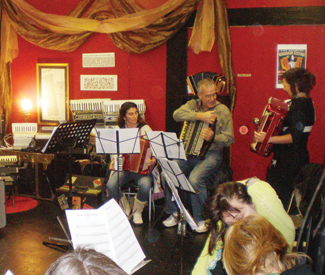
Squeeze This! A Cultural History of the Accordion in America Accordion Apocalypse, 255 10th St., SF. www.accordionapocalypse.com. 7pm, free. Author Marion Jackson penned this look at our country’s relationship with the squeezebox. Should you be inspired to tickle the ivories yourself, you can buy an accordion of your own from the lecture’s gracious hosts.

San Jorocho Festival Brava Theater, 2781 24th St., SF. (415) 641-7657, www.brava.org. 8pm, $6-$35. Brava’s celebration of the Veracruz region of Mexico kicks off tonight with filmmaker Marcos Villalobos presenting his documentary on three Son Jorocho musicians. Son Siglos looks at the cross-border translation of culture – particularly pertinent to this Northern Cali look at Mexican tradition.

SATURDAY18

Street Food Festival Folsom between 20th and 26th Sts. and some other streets, SF. www.sfstreetfoodfest.com. 11am-7pm, free. Some of SF’s hautest eateries and best food entrepreneurs take to the Mission streets for this foodie heaven: hundreds of dishes for $8 and under from across the world, not to mention bars selling artisan cocktails and more.

Balboa Park grand re-opening San Jose and Sgt. Young Drive, SF. www.tpl.org. 11am-2pm, free. The Balboa Park playground has a fresh new look, and the whole neighborhood’s invited to come out and give it a swing. The Trust for Public Land and SF Rec and Parks will be hosting and providing snacks, music, and activities.

Haute Pool Show Chambers at Hotel Phoenix, 601 Eddy, SF. www.hautepoolshow.eventbrite.com. 1-8pm, $5-$15. Shop local fashion by the pool at the city’s rock ‘n’ roll pool while DJs like Omar from Popscene and Brandon Arnovick from Rondo Brothers spin. 30 independent clothesmakers will be participating – the perfect stop-off if you’re looking for weekend threads.

Tell Your Tattoo Story video shoot Mission Cultural Center for Latino Arts, 2868 Mission, SF. (415) 671-0507, www.sfiaf.org. 6:30pm, free. RSVP necessary. The new play Placas (part of the SF International Arts Festival this fall) centers around street gangs and the implications of tattoo removal – but that doesn’t mean that those involved in the production are anti-ink. Sign up to show off your tats and explain their provenance. Footage will be shown as a companion piece when the play debuts.

Alamo Square Flea Market South side of Alamo Square Park, SF. www.alamosquare.org. 9am-3pm, free. Sidestep the Full House-house-seeking tour buses and search for your own vision of superlative San Francisco – the 29th year of this neighborhood-sponsored flea market will feature clothes, housewares, dogs for adoption from Rocket Dog Rescue, and much more.

Pedalfest Jack London Square, Broadway and 1st St., Oakl. www.pedalfestjacklondon.com. 11am-8pm, free. Bikes for days! Art bikes, acrobatic bikes, stunt bikes, foldable bikes, kids bikes, food for bikes – okay, maybe just food for riders, who will also enjoy live music and cavorting with their two-wheeled community. The East Bay Bike Coalition also sponsored last year’s Pedalfest, which attracted over 18,000 attendees.

SUNDAY 19

SF Mime Troupe Yerba Buena Gardens, Mission and Fourth St., SF. www.sfmt.org. 2pm, free. Check out the Bay’s historic radical theater troupe in the rolling hills of downtown’s greenest field. This year’s production is called The Last Election. Shall we reflect on a world without political monkeying about? At least electoral shenanigans birthed a spectacular community theater troupe.

Indie Mart Wisconsin between 16th and 17th Sts., SF. www.indie-mart.com. Noon-7pm, free. Because you know somebody that deserves an August handmade gifty, this regularly-occurring craft fair is coming to Potrero Hill with 100 of the city’s finest makers. Thee Parkside is included in the festivities, so grab some tots and a Bloody before you shop – pricetags will go down way easier.


Healthy transitions

1

yael@sfbg.com

When the Human Rights Campaign, the national LGBT rights group, released its latest scorecard, rating companies by their support for LGBT issues, the healthcare giant Kaiser scored 100 percent. In June, the company’s float in the San Francisco Pride Parade was packed with happy employees.

But as the float passed through the streets, it was met by a group of protesters. Pride at Work complained, loudly, that Kaiser — for all its efforts to work with the community — excludes transgender care from its standard policies.

“We said, let’s push Kaiser,” said Sasha Wright, an organizer with Pride at Work. “They say they’re good for the community. Let’s show them that the queer community demands this.”

It was a perfect sign of the city’s struggle with trans health care. In many ways, San Francisco is exemplary — this is a long ways from Chattanooga, Texas, where state legislator Richard Floyd tried to pass a law instituting steep fines for people who can’t prove their genders match the designated genders of public bathrooms.

And with Healthy San Francisco officials’ recent decision to cover transgender and care, it’s likely this city is leading the nation in trans health.

But that’s a limited distinction — because trans people everywhere, even here, still face sometimes daunting obstacles in getting access even to basic care. And the struggle to change that is becoming a high-profile (and increasingly successful) political fight.

TRANSITIONS AND COSMETIC SURGERY

Kaiser’s insurance plans are typical of the industry. In its 2012-2013 “Traditional Plan,” Kaiser lists “transgender surgeries” among the services excluded from coverage, along with massage therapy and cosmetic surgery.

And Kaiser’s not alone.

Medicare, the federal health plan for low-income people, specifically excludes transgender health care. MediCal, the state version, is required to cover trans care — but will often deny individual applications. And many of the doctors and surgeons who accept MediCal (and many don’t) are unfamiliar with transition-related care.

Then there’s plain old discrimination. A troubling number of people report being denied healthcare — not just healthcare related to their gender identity — because the doctor they saw didn’t want to treat a transgender person.

The State of Transgender California, a 2008 survey by the Transgender Law Center, found that 30 percent of transgender people in California reported that they have “postponed care for illness or preventative care due to disrespect and discrimination from doctors or other healthcare providers. Over 40 percent did so because of economic barriers.”

The study also found that 35 percent of respondents “recount having to teach their doctor or care provider about transgender people in order to get appropriate care.”

To make things worse, American health insurance is overwhelmingly employer-based — and unemployment among trans people is epidemic. A 2011 study from the National Center for Transgender Equality found that trans unemployment was double the national rate and that 47 percent of trans people surveyed had been fired or overlooked for a job.

The World Professional Association for Transgender Health (WPATH) sets the international standard for transgender health care. WPATH states that, for many transgender people, “sex reassignment surgery is effective and medically necessary.” Hormone therapy, voice and communication therapy, as well as non-discriminatory primary and preventative care are also necessary.

But with high rates of poverty and discrimination among transgender people, affording these medically necessary procedures can be nearly impossible. Even in San Francisco, where some politicians and powerful organizations advocate tirelessly for transgender rights, many people are forced to go outside the system altogether to take care of themselves.

“We see transgender folks either not being able to make a transition, or having to spend a lot of money,” said Wright. “I don’t know if you’ve ever been to a top surgery party, but they’re common in San Francisco.”

Mia Tu Mutch, a member of San Francisco’s Youth City Services Committee who advocates for LGBTQ rights inside and outside City Hall, recently started a group that supports and raises funds for people who are transitioning.

“Me and my partner have been shocked at trans incompetency in San Francisco,” said Tu Mutch. “We’ve had several really bad instances of doctors refusing to treat us when they found out that we were trans. There’s still education needed.”

Tu Mutch said that, even though she is covered by a high-quality, trans-inclusive insurance plan, she has spent at least $10,000 out of pocket on transition related expenses.

“People are usually told, ‘get a good job, save all your money,'” she said. “But I’ve been spending 80 percent of my money on transgender related care for the past couple of years. I don’t think the whole ‘pull yourself up by your bootstraps’ thing works.”

HOPE ON THE HORIZON

But the situation is starting to change. In fact, trans organizers say that the medical, insurance and political establishments — particularly in California — are beginning to realize how backward the system is and are open to dramatic changes.

“It is an exciting time,” said Dr. Dawn Harbatkin, executive director or San Francisco’s Lyon Martin Health Center, which offers free and low-cost service to trans people “I didn’t think I would see this during my career.”

Nikki “Tita Aida” Calma, program supervisor at Trans: Thrive, echoed that sentiment. Said Calma, “I’m glad to see this in my lifetime.”

Thanks to groups like Pride at Work and the Transgender Law Center (TLC), city workers in San Francisco and Berkeley are now covered by the trans-inclusive version of Kaiser’s plan. The TLC, along with Lyon Martin and Equality California, came together to form Project Health in 2010, which convinced Healthy San Francisco to drop its transgender exclusions.

Tu Mutch has also worked this year to start FEATHER, or Fundraising Everywhere for All Transitions: a Health Empowerment Revolution.

Meanwhile, lawmakers in Sacramento, and even nationally, are also chipping away at the transgender discrimination that plagues the healthcare system.

Harbatkin told us that there isn’t a specific set of services that make up transgender health care.

“Really good transgender medicine means that you are providing good primary care, that you’re treating a patient as a whole person and taking care of all of their health care needs,” she said.

Lyon Martin provides preventative care like pap smears, breast exams, and prostate exams, treatment for chronic issues like hypertension and diabetes, as well as transition-related care—services that assist transgender people in transitioning to a body that reflects their gender identity.

“The bigger part of providing good medicine is about being culturally competent, culturally sensitive,” Harbatkin said. “Knowing how to address people respectfully and with their appropriate name and pronoun. Knowing about their legal name versus preferred name, or gender markers in terms of billing issues.”

One obstacle transgender patients face is doctors who are unfamiliar with transition-related healthcare, such as hormone therapy and surgeries. But often, trans people are denied care that doctors know well and would perform on cisgender patients, simply because of their gender identity.

Then there’s the challenge low-income people face in finding doctors who accept MediCal.

Harbatkin cited the example of an orchiectomy — surgical removal of the testicles, a procedure done by urologists. Finding a urologist who takes MediCal is fairly routine.

“But finding a surgeon who would do a vaginoplasty who accepts MediCal, that is more challenging,” she said.

And some urologists might perform an orchiectomy for someone with testicular cancer — but refuse to do so for someone who is transitioning from male to female.

That type of discrimination has caught the attention of Assemblymember Tom Ammiano, and his office has been working for several years to change it.

Ammiano aide Wendy Hill has been focusing on eliminating transgender health barriers in California for years. Thanks in part to her efforts, the California Department of Insurance now interprets existing gender equity legislation to include transgender people.

“They’ve clarified a set of recommendations and essentially code sections that spell out that for the purpose of transgender, this law requires gender equity,” Hill said. “If you cover pap smears, you have to cover them for everybody. If you cover breast reconstruction or hysterectomy, you have to cover it for everybody, regardless of gender.”

Now Ammiano’s office is taking on the Department of Managed Health Care and has been documenting cases of discrimination.

“When a citizen calls the Department of Managed Health Care, their helpline, they tag the call so that they know what’s going on,” Hill explains.

“They just tagged the calls based on discrimination. But we got them to tag the calls based on gender discrimination, and then even more specifically, discrimination against transgender people.”

The sort of problem she sees: “A person goes in to be treated for what could potentially be pneumonia, but the physician is having trouble seeing this person because their papers say they’re male but they are trying to see a gynecologist.”

Hill said some of her most interesting moments have been outreach meetings with community members and local businesses.

“I’ve gone in to talk with folks and said, how many of you know someone who’s transgender?” Hill recalls. “And in Sacramento, not that many people raise their hands. And then I say, how many of you identity as transgender? And the transgender people raise their hands. A lot of people don’t know that they already knew transgender people.”

Ammiano, who created Healthy San Francisco, said he was thrilled about the program dropping its transgender exclusions. “This has been in the works for a while,” he said. “We always fully intended to make sure that everyone who needed it was covered.”

Nationally, he said, “I think it’s an uphill battle around eradicating the transphobia and getting services provided without any hassle, but there’s light at the end of the tunnel.”

SUPPORTIVE NETWORK

San Francisco offers plenty of support. Lyon Martin is part of a network of organizations providing health-related services to transgender people.

Trans: Thrive, a project of API, serves as a drop-in center for transgender people, including many who show up there as one of their first stops after coming to San Francisco to escape discrimination and danger in their hometowns. Trans: Thrive provides counseling, computer labs, food, activities, and an all-important clothing closet to cut the extensive costs of a whole new wardrobe that better reflects a person’s gender identity.

Lyon Martin is “a federally qualified health center, so we take MediCal, MediCare, and many commercial insurances and Healthy San Francisco,” said Harbatkin. “And for patients who are uninsured, they are put on a sliding scale based on income and family size. And we continue to see people whether they can afford it or not.”

That means even people with little or no income can access transition-related surgery at Lyon Martin. This can be essential for people who otherwise would rely on MediCal.

The situation will actually be improved with the changes to Healthy San Francisco, as people who access healthcare through the program will have more options for surgeons and specialists.

In the 2008 State of Transgender California report, the TLC made a series of recommendations — and to the surprise of even the TLC staff, many have been adopted.

For example, the Affordable Care Act bars discrimination against people with pre-existing conditions — a term used to deny coverage to trans people. Most medical schools still don’t teach transgender healthcare, but on a local scale, Lyon Martin is working to train healthcare professionals and students to provide quality, culturally appropriate care to transgender patients with a residency program.

But one of the key recommendations — “Enact federal and state legislation prohibiting transgender- and gender-specific exclusions that limit access to comprehensive, quality care in public and private insurance plans” — is still a ways off.

As far as state legislation goes, said Hill, “Assemblymember Ammiano is definitely there. But the Legislature is not there yet. We don’t have enough support for that, to get a bill down to the governor.”

Kristina Wertz, director of Policy and Programs at the TLC, says that significant progress has been made on the recommendations that the 2008 report included.

“We’re really getting there,” said Wertz. “Things have changed. The world of transgender healthcare is very different than it was five. years ago.

“Right now there’s a lot of advocacy to build on the good laws that we already have and make sure they’re effectively implemented.”

Off the walls

3

arts@sfbg.com

VISUAL ART As the Cindy Sherman retrospective draws huge crowds to the San Francisco Museum of Modern Art’s fourth floor, visitors will find it the gateway drug par excellence for a neighboring show just a few steps away. Taking in Sherman’s frozen drag — in which visual art harnesses performance as both subject and tactic — is already to broach the invigorating dialogue underway in “Stage Presence: Theatricality in Art and Media.”

>>Drag artists re-enact Cindy Sherman portraits: view our “Tastes of Cindy” photo essay

The eclectic group show, curated by SFMOMA’s Rudolf Frieling, gathers choice pieces from the museum’s collection, plus some vital loans, to consider the increasing role of theatricality as theme and strategy in contemporary art since the 1980s.

It further includes a “live art” component courtesy of the museum’s curator of public programs, Frank Smigiel — a weekly performance series that continues through Labor Day weekend in a commissioned space adjacent to the gallery, a lush little jewel box of a theater-cinema designed by Bay Area artist Tucker Nichols. This week’s performance piece is a highly anticipated appearance by Los Angeles-based troupe My Barbarian: Broke People’s Baroque Peoples’ Theater, a raucous, multi-layered work that figures the American financial system as a garishly absurd spectacle of waste. (In addition to this site-specific series, a performance finale takes place October 4 in the museum’s atrium: Rashaad Newsome’s Shade Compositions, a choreographed choral work for 20 women of color.)

Whether live or otherwise, the bridging of the visual and performing arts in “Stage Presence” encompasses a truly wide range of work. Highlights include some fascinating projected pieces on view in one or another of the floor’s darkened recesses — each one furnished with a glass window allowing visual access from the gallery proper, whether or not one wants to venture into the screening room.

One of these is Charles Atlas’s Hail the New Puritan (1986), which collapses the visual and performing arts by way of a made-for-BBC faux-documentary portrait of Scottish dancer-choreographer Michael Clark, supposedly captured over the course of one monumental but half-desultory day as he and his company rehearse his New Puritan (1984). With endless interruptions and segues — and a soundtrack sharpened by ample doses of post punk’s jolly downers, the Fall (whose Mark E. Smith and Brix Smith even appear in a staged TV “interview” with Clark) — Hail the New Puritan remains a gorgeous work whose ’80s-era aesthetic (a little like Godard meets Culture Club) retains a questioning and mocking insouciance.

http://www.youtube.com/watch?v=PLm0tgyH4cc

It’s such jubilant indifference, including toward previous standards of seriousness or taste, that has contributed to a significant turn in much new work in the 1980s. Frieling, in an email correspondence from Europe, describes it as “a moment where the historic era of performance art and conceptualism had been challenged by a more exuberant, playful, and hybrid way of working — Charles Atlas, Peter Fischli and David Weiss, or Robert Wilson [all represented in the show] being three examples from that time despite their huge differences.”

Other salient themes running through the show explore the conceptual and practical possibilities in rehearsal, reenactment, and the speech act. To this end, the installation Today Is Not a Dress Rehearsal — which repurposes video of a Judith Butler lecture and other materials from an eponymous three-day collaborative performance by Mika Tajima (with her group New Humans) and Charles Atlas in the museum’s atrium in 2009 — offers subtle food for thought amid a visual and aural repositioning of a privileged form of address.

Also intriguing along similar lines is Sharon Hayes’s restrained yet progressively enthralling four channel video work, Symbionese Liberation Army (SLA) Screeds #13, 16, 20, & 29 (2003). In each of four television screens fixed with audio headphones, viewers see and hear the artist reciting from memory each of Patty Hearst’s four video messages to her parents while a hostage of the SLA in 1974, with prompting from an unseen audience each time she veers even slightly from the script. It becomes, especially in the era of Occupy, a resonant occasion for a collective act of remembering as well as re-presenting, re-creating, resituating, and reformulating an iconic but elusive link to a radical past.

“Rethinking formats of presentation is a key to many of the works and the whole show,” says Frieling. “We were ultimately interested in art works that stress this open process while reflecting about the conscious act of staging.” *

“STAGE PRESENCE: THEATRICALITY IN ART AND MEDIA”

Through Oct. 8, $11-$18

San Francisco Museum of Modern Art

151 Third St., SF

www.sfmoma.org


Pläj

0

virginia@sfbg.com

APPETITE The world has become hooked on New Nordic cuisine in recent years, thanks to Copenhagen’s Noma, often referred to as the world’s best restaurant for three years straight, sparking a global interest in all things Scandinavian and a new generation of chefs.

Before this renaissance I dined at New York City’s Aquavit, back in the days when Marcus Samuelsson was still its chef. I reveled in Samuelsson’s clean dishes and shots of the restaurant’s eponymous liquor infused with horseradish or dill. As a fan of pickled herring, cured fish, and the like, I’ve long been drawn to Germanic and Eastern European cuisines. Perhaps my love for Scandinavian food was a forgone conclusion. I dream of taking a trip to the region to eat lutefisk (air-dried whitefish), and breathe in crisp air during long hours of summer daylight.

But then Pläj (pronounced “play”) opened in SF in June, tucked behind the Inn at the Opera and within sight of City Hall. I dined there during its opening week, and have returned multiple times since. Granted, what you’re about to read is an early take. The newborn restaurant needs time to come into its own.

Yes, Pläj is a hotel dining room, and off-putting smooth jazz and clubby Euro tunes often intrude, altering the mood of a meal. But bright orange accents and fireside seating warm up the blessedly peaceful space, and service is warmly welcoming, staff attentive and gracious.

Pläj isn’t so much New Nordic or Scandinavian-style minimalist. It’s more reminiscent of Aquavit: traditional dishes interpreted with a fresh regional spin, Scandinavia by way of Northern California. Chef-owner Roberth Sundell hails from Stockholm but has been in the Bay Area long enough to be well-acquainted with local ingredients, putting them to good use in Nordic-influenced dishes.

Working my way through every dish on the initial menu, I was happiest in the Fjord-seafood section that highlighted the best parts of Scandinavian cooking. A creative “taste of herring” trio ($12) brought fish served à la ginger-smoked soy, saffron tomato, and with coriander, chile, and lime on rye crackers. Rustic bread arrived at the table, artfully served in a paper bag.

Krondill (crown dill) poached lobster is the seafood of choice for Sundell’s skagen, which is typically toast topped with a mixture that often includes poached shrimp, mayo, caviar. Beautifully reinterpreted here, lobster swam in a foam akin to bisque that was also made of lobster, with horseradish, avocado, and a hint of chili, all of it accented by white fish caviar.

Norwegian salmon belly gravlax ($9) proved to be buttery, thin slices of cured salmon over lemon crème fraîche, spicy grain mustard, and dill purée. Only the Alaskan halibut ($21) felt closer to typical: the fish came seared in herbs and partnered with shaved asparagus in a chanterelle emulsion. In a similar, though more traditional vein of meat and veg entree was the tender, porter-braised ox cheek ($22) topped with a mountain of fried onions. Other than the vibrant red, whipped beetroot the ox rested atop, the dish was well-executed, if not particularly memorable. Next time I’d go for traditional, comforting Swedish meatballs ($15), which were juicy in their pan gravy and bed of mashed potatoes, served with lingonberries and pickled cucumber that added a much-desired contrast of sweet and vinegar.

On the Hagen (“pasture”) or vegetarian section of the menu, burrata ($12) was pleasant, but its presentation was similar to countless burrata plates everywhere — heirloom tomato and greens. At least it wasn’t beets, which are obvious, overdone burrata companions. Barely-there aquavit in the vinaigrette could have set it apart if it was kicked up a few intensity levels. I found a subtle smearing of beetroot under a salad ($14) piled with Jerusalem artichoke, watercress, hazelnuts, and thinly-shaved layers of Västerbotten cheese and black summer truffles more interesting. Equally intriguing were the potato dumpling kumla ($12), dense and doughy dumplings in brown butter sauce that were savory with onion ragout and, once again, lingonberries.

Desserts ($8) are certainly pleasing — particularly the rhubarb crumble pie — but none left a major impression. Cocktails ($11) thankfully utilize Scandinavian spirits like vodka and genever (Dutch gin, often aged in wood so as akin to whiskey as gin.) Spirit-cocktail aficionados may crave more depth in a menu that leans toward sweet, subtle, and light cocktails. The Midsommar is promising: Pernod absinthe that delivers herbaceous notes to a Flor de Cana light rum, lime, and dill simple syrup. It was garden-fresh, a fine companion to seafood.

An all-Scandinavian beer list is spot-on, with pours like HaandBryggeriet Norwegian harvest ale ($14) or cheaper, refreshing Einstock Icelandic white and pale ales ($6 each.)

Pläj is a welcome newcomer to the SF dining scene — one I hope thrives as it dares to bring what we lack. What a delight it would be to form a “best of” list of Scandinavian eateries here, as we can with so many cuisines.

PLÄJ

333 Fulton, SF

(415) 294-8925

Subscribe to Virgina’s twice-monthly newsletter, The Perfect Spot, www.theperfectspotsf.com


Creating activist scholars: extended interview with Andrej Grubacic

16

For this week’s paper, we talked with with Andrej Grubacic, the new head of the anthropology department at the California Institute for Integral Studies. Here’s the extended interview with Grubacic, where he talks more about the new Anthropology and Social Change program, as well as the history of anarchist schools, how his grandmother influenced his politics growing up in Yugoslavia, and the state of the occupy movement.

San Francisco Bay Guardian: What’s the structure of the new program going to look like?

Andrej Grubacic: It’s going to be called Anthropology and Social Change, and we have two levels. One is MA, the other is PhD. Philosophically speaking and politically speaking, in the age of occupy and all of these movements, the great question for me was how to organize a department that’s actually going to be useful for all of these social struggles and that activism that’s happening outside of education. I’ve been in academia as a scholar-activist for a long time. And what I’ve discovered is the most painful thing in my experience is the separation. The fact of actual separation between the grassroots knowledges, produced outside of the academia, and academic knowledge produced within the universities. So the best things, the way that I was thinking about this was that what we should do on both levels, MA and PhD, is to construct a space of translation of different knowledge. So to put these two knowledges, one produced outside of academia and the other produced in the university, in dialogue.

So we have Boots Riley for example, he’s going to be teaching community organizing, or organizing for social justice. Then we’re going to have Sasha Lilley teaching an eminently practical course on how to create and produce radical radio. So you’re going to get activist media skills. Then we’re going to have a few other people teaching also different skills, and knowledge that’s inspired by art, bringing artists in, and knowledge that’s inspired by people who are thinking about social theory and social emancipation. We’re going to create something really exciting. 

SFBG: Do you think the students who attend are going to be the same kind of mix of academics, artists, activists, and people who want to organize within their own communities here in San Francisco?

AG: I think so. That’s the idea. The idea is to make this department work for the students, but also for the people in San Francisco Bay Area. And we can do that by bringing students who are interested in local work, and I think that’s going to be a pretty amazing. If we are of course able to do things right, but I think that we will be. So Chris Carlsson for example, he’s going to be teaching labor and ecological history of San Francisco, so a very local topic. We’re going to be teaching courses on activist ethnography, and activist ethnography is the center for the whole program, which is how can we relate to community– and this is where we’re also using the term integral– in an integral way? Meaning how do we integrate community into every step of the research process? And the traditional anthropology, as you probably know, is all about participant observation. We would like to have instead observant participants. People who are involved with the communities. People who are trying to dissolve the distinction between the researcher, between who’s on the outside, and who’s on the inside. And they’re creating something together. 

SFBG: I saw when you spoke at the University of the Commons launch. You were talking about how there’s a wave of radical activity going on at schools throughout the world.

AG: Oh yeah.

SFBG: This is obviously very different, because this is an institution putting out something radical, but do you think it fits into that trend right now?

AG: I think it does. Because if you know my biography, I’ve been travelling through all of these experiences in schools for many many years now. I had to leave Yugoslavia where I’m from because of my oppositional political activity and, you know, I finally arrived here to work at New College of California which was also a private institution, and I was very inspired by the department of Activism and Social Change, and I completely fell in love with the history of radical schools in San Francisco. Now I don’t know how much you know about them, but they’re, like, great stuff. There was a liberation school, there were Black Panther schools, of course. There is a great history of alternative schools and experiments. So New College was a private institution, but still, many of my activist friends, who became friends later, have actually been through New College and they got their MA s in activism and social change or media studies. So CIIS actually took many of these people, many of the professors from these programs, and invited them here. So in a certain sense, I think what was done in terms of Activism and Social Change, and orientation to social justice and emancipation, was that at New College we are still keeping that spirit alive. But, in communication- and I think this is the crucial thing for our department- we are doing this in communication with radical educational experiments, movement-based experiments from all over the world. Manolo Callahan, who is going to be teaching here next semester, he is one of the people involved in University of the Earth- Universidad de la Tierra in Oaxaca and in Chiapas, so we are creating relationships with them. Which you know are completely radical experiences outside of institutions, they call themselves deprofessionalized intellectuals. We have already relationships with the Activism and Social Change department in Leeds, in England, they have a great school there. With people in Brazil, the landless workers movements. We’re in touch with people from Ecuador and people form Bolivia. So it’s a whole network of educational, tendency of educational experiences that this department is now creating.

SFBG: Do you have economics courses here?

AG: Yeah.

SFBG: So are there classes that are non-capitalist economics?

AG: Yes, it’s called radical political economy. We are trying to understand political economy from a feminist perspective, from an anarchist perspective, from a post-colonialist- so in that sense we are engaging multiple emancipatory frameworks of understanding social reality. So I myself, I come from the anarchist experience in social science, in politics. We have people who are feminists- Roxanne Dunbar-Ortiz for example. She’s sort of a legend in San Francisco Bay Area and she’s teaching three courses. Roxane Dunbar-Ortiz is going to be teaching about Native American struggles. As it pains me to say, that kind of a focus is mostly missing not only in private but also in public universities now. 

SFBG: So could you tell me a little more about the anarchist background you come from?

AG: I became an anarchist fairly early on, I was 13 or something. Because I was living in Yugoslavia. At that time, Yugoslavia was a socialist state. And because it was a socialist state for me it was a very interesting place to grow up, because you see socialism, real existing socialism, and you see many things that are beautiful about socialism. But you also see many things that are not so beautiful. And I was thinking about the alternatives to it. And for me it was really, sounds cheesy, but a conversation with my grandmother that decided it. She was a communist; she was a Yugoslav revolutionary communist. And Yugoslavia was falling apart, Yugoslavia was in a series of really brutal ethnic wars back in the 90s, and my grandmother, this lifelong communist, told me– my question was, are you still a communist? Do you still believe in communism in the context of this country falling apart? And she said yes, I do, I think that we have chosen a path to communism that was wrong. But I think the responsibility of your generation is to find a different path. The ideal is OK, the ideal is good. It’s a different path that you’re generation needs to find, and you have a great responsibility to do so. And the alternative that I discovered that seemed to me, back when I was 13 years old, and it still does, rational– as an alternative to the Marxist-Leninst way of getting from here to there, right– is anarchism. So for me anarchism, or libertarian socialism is another name that people are using, is a way of organizing for social justice and creating an egalitarian system that takes democracy very seriously. It’s like democracy without a state. 

SFBG: What happened that made you leave Yugoslavia?

AG: I was raised a Yugoslav. So I was raised to be a citizen of a country that doesn’t exist anymore. And on one hand, you had people who were Serbian nationalists, and I couldn’t really get along with those. On the other hand you had people who were neoliberal capitalists, who thought that everything coming from Europe and the United States was great and I couldn’t really agree with those either. And being a young academic, I was a historian at the time and working within the university, there was a great deal of pressure to get me out of the university. So it became very unpleasant. So I already had a relationship with Noam Chomsky, and Chomsky was following everything that was happening to me in Yugoslavia. And he told me at some point OK, it’s time for you to go. So he got me out of Yugoslavia, moved me to the United States or helped me move to the United States, introduced me to a man whose name is Immanuel Wallerstein, a great, amazing sociologist, who helped me get to his program at the Center for the Study of Economics, Historical Systems, and Civilization at SUNY-Binghamton to finish my graduate studies. So that was a– it was a long journey. 

Let’s just say that it was an active disagreement with the political class active at that time in Yugoslav-Serbia. It was actually funnily enough still called Yugoslavia. We only had two countries of the former Yugoslavia, Serbia and Montenegro. But the political cultures and political groups in power were either Serbian nationalists or these hyper-capitalists, right. And going after them, because I was publishing and I was doing a lot of things, was– let’s say, not smart career choice. But it made it possible for me to meet people like Chomsky and some other people. And they liked what I was doing and they were concerned that, for health reasons, United States might be a better environment.

SFBG: Even within these more welcoming academic environments, do you feel your activism or anarchism is stifled in some way?

AG: I had a bad experience here at one university, a local university here in San Francisco, and it wasn’t a good experience. That felt unpleasant and it felt very stifling. CIIS is very different. Actually this is the first place where I think that I was hired because I was an anarchist, or I am an anarchist. It’s kind of funny. But in other places, in Yugoslavia and there was another institution here, I had problems because of my politics. Here, that was exactly the reason I was hired. So it gives you an idea that the school is very different than most other universities. 

SFBG: Could there be such a thing as an anarchist school?

AG: I hope University of the Commons can become something like an anarchist school. Anarchist schools actually used to exist. And they still exist. But the really big one was Francisco Ferrer in Spain. It was called Modern School. It was created in 1904. It became so huge– especially after Francisco Ferrer was killed by the Spanish state in 1909- that there were 60 schools only in Spain and there were I don’t know how many schools in the United States but the last one closed only in 1958 in New Jersey. Modern Schools were amazing places. One could also argue that Yasnaya Polyana of Leo Tolstoy was also an anarchist school. It was in many ways. 

But anarchist schools were schools where you had a few elements. Integral education was number one. Education of the whole person. You don’t only educate somebody as an intellectual but you aim at education of the whole person. The other thing was something that anarchists called reality of the encounter. Which means that all the questions in pedagogical practice needs to come from real questions posed by life itself. So you need to do something that’s practical. Another thing was the complementary role of the teacher, which means the teacher needs to be a facilitator who listens and who offers something in return. But the first thing, the first kind of show of interest, comes from the student. So the role of the teacher is complementary. Another huge thing was something Proudhon called démoédie, or self-government of the school. So school becomes a place where you teach students arts of self-government and self-management. Schools are organized in the spirit of direct democracy. Another thing which was Paul Goodman, famous anarchist educator, his idea was to organize decentralized “teeny schools,” as he called them. So to have a small teaching environment. To have students go to the bank to be taught about mathematics, to go to a museum and then to teach them about geography, to do these things. And then the most important thing for anarchist schools on all levels is the idea of natural motivation and natural learning which was first formulated by Tolstoy. The idea is the students have this natural motivation to learn. And what you do is basically you create an environment where that kind of learning becomes possible. And another thing for anarchist schools was the idea of spontaneous order. So there is no imposed order by the teacher, but there is a spontaneous order that the students themselves discover. In other words, discipline is– I think this is Tolstoy’s, the word that he used– discipline is being discovered, not imposed. What would that mean for a university is a different question. I think the one obvious thing would be that everybody, students and professors, there needs to be a horizontal relationship between them. There needs to be an atmosphere of collective production of knowledge in the classroom. There cannot be a curriculum that’s linear. It needs to be dialogical, it needs to be participatory, you need to talk about this and co-create a syllabus. You need to be as horizontal and participatory as possible. You need to be as imaginative as possible in diminishing your own role as a teacher, which is a very tricky thing, without becoming a populist in the classroom, you know. Empowering students, and finding appropriate structure together with students. Again we are coming back to the idea of listening. We need to listen to the students and together with them, create an atmosphere in the classroom that’s going to be genuinely transformative. 

SFBG: I’d love to ask you more about how this will relate to anarchism and occupy.

AG: In terms of anarchism, we are gonna have- this is going to be one of the few places where anarchism is going to be studied. So anarchist social theory, anarchist education, anarchist ideas in general. We are going to study them, seriously, because they need to be recognized seriously. They’re part of- it’s a beautiful history, it’s a beautiful tradition. How important it is, I think, is revealed, by the recent rediscovery or reinvention of anarchism at occupy. So I think that it’s more relevant than ever to create a space where anarchism will be studied. 

In terms of occupy, occupy is going through the process of fragmentation right now, and they are looking for a new political space of conversation I think. So the way that we can relate to occupy, I think, is to have our students participate in whatever different movements occupy helped. Because you know that occupy now how occupy patriarchy, there is decolonize, there are many different groups. So I expect our students to be involved in occupy, and I expect us to be able to offer a space where many of the debates related to occupy can happen. So, and you know there is an actual affinity. When Silvio Federici comes, or John Holloway, or Michael Hardt, or any of these people, these are the people that occupy people read, and these are some of the bibles of the occupy movement. So what are we going to do is, we are going to make them available and accessible to these people who come here, and we are going to bring here,  and we are going to take them to the occupy movements and we are going to invite people from the occupy movements to come here. But we are also going to do more I think. What we can do, and this is now only a plan an idea, is to invite the movement itself, not only occupy but different movements, and say, OK, please come here and tell us what would you like us to do. And one person from our department had this idea and I think it is brilliant. So to have the movement, different movements– is it food, is it the environment, is it one of the occupy-related movements- come here. We provide the space. And they tell us- social theorist, social scientists, people in the academia, they tell us what do they need us to do. It comes back to this idea of listening. So give a movement or movements a real possibility and opportunity to speak. Because usually academics, we are people who speak. Well we would like to see academics become people who actually listen. 

SFBG: I agree that occupy is basically an anarchist movement and a lot of the tenants of anarchism are being used in it. And I think this is a time when, in the mainstream, people are talking about anarchism more. But for a lot of people it has the image of people who wear black and smash stuff. So I’m curious, how does black bloc, or property damage, relate to the anarchism that’s going to be studied in the department?

AG: It doesn’t relate at all. The anarchism that we are going to study is– in Katrina, the Common Ground collective. That for me is a great example. Common Ground collective is a relief group of activists who went there from all over the place, they went to New Orleans, they were all anarchists and they said OK, we don’t believe in charity, we believe in solidarity. And they built a common ground center and they did relief work with the community for a couple of years. And there is a new book about it by a person who actually came here and spoke, one of the New Orleans activists, Scott Crow. And this is the kind of anarchism I am myself inspired by, the constructive side, not the destructive side. So how to build alternatives in the present for people, what sometimes referred to as prefigurative politics. How to think about positive stuff, constructive stuff. Building alternatives that are going to be persuasive enough– not about breaking windows. I don’t see any particular point in breaking windows. And I think it’s an unfortunate thing that people would reduce anarchism to that. If you think about it, the most important public intellectuals in the United States, one of them recently died, Howard Zinn, and Noam Chomsky thankfully is still alive, they’re both anarchists. So this is the kind of anarchism that I subscribe to, and both of them were my mentors. And I studied with Howard. I studied with Noam, he was the chair of my PhD committee. So these are the people whose anarchism I take very seriously, and this is the kind of anarchism that I like. 

SFBG: But it’s hard to ignore organizing tactics.

AG: But even orgnanizing tactics– black bloc as a tactic comes from the autonomen movement in Germany, which was not an anarchist movement. It comes from the 80s. People dressed in black in Germany, you know, doing property destruction thinking that property destruction is going to contribute to the tactical efficiency of a particular action. Then it went through the environmental movement in particular places, in the environmental movement here in the United States. And it’s being used not only by anarchists, it’s being used by people who would call themselves communists, left, anti-state communists, by different varieties, autonomous Marxists. So it’s not only a tactic that anarchists use. And, you know, it’s a tactic. Anarchism is far broader. 

SFBG: Than just tactics.

AG: Yes. If you would ask me what is the most distinguishing, for me, character of anarchism I would say prefigurative politics– creating the new within the shell of the old—the idea of direct democracy, and the idea of direct action. Direct action being producing alternatives within the present, and direct democracy, behaving in the way that general assemblies are being set up. So that is I think the greatest lesson that anarchism can teach, direct democracy and direct action. 

SFBG: Occupy Oakland, they only had their camp for less than two months, but so much happned.

AG: They did great things. I really feel bad when I read mainstream media completely dismissing that experience. I was there, and the amount of work that went into keeping the medical facilities there, to helping homeless, feeding homeless, helping people with medicine, with immediate healthcare, taking care of children, creating children-friendly spaces, I mean it was amazing. Sure there were problems, of course there are going to be problems. But the stuff that people did there was just incredible. And the general strike, and shutting the port, and all of that, these were great things.

SFBG: And part of the reason the city started cracking down on it was when police tried to enter the space, people wouldn’t let them in.

AG: And they shouldn’t let them in, because the way police behave in Oakland was just outrageous.

This interview has been edited for length.

Non-Stop Bhangra

0

Have you ever wanted to crash an Indian wedding reception, where you walk into a room filled with beautiful outfits, arms in the air, and the swirling of colors? Well, here’s your opportunity to become part of that exuberant celebration without the stress of last minute gifts and the long speeches.
 
This month’s theme for Non Stop Bhangra is “Crash an Indian Wedding Reception”, without the guilt of not being invited. Join the NSB crew as they take you on a colorful journey to experience an Indian wedding reception with colorful decor, beautifully dressed people, sweets, henna, food, and endless dancing and music. Put on your favorite outfit and dancing shoes and show off  the moves you will learn during the dance lesson or the ones you’ve been secretly practicing for the perfect occasion. Get tickets here.
 
Saturday, August 11 at 9pm @ Public Works, 161 Erie, SF |  $10

In Richmond, is it safe to eat your garden fruits and veggies?

12

Questions remain about the safety of eating homegrown fruits and vegetables from gardens in Richmond and other areas affected by a fire at the Chevron refinery August 6.

The official line from Contra Costa County–where residents were told to shelter-in-place during Monday evening’s fire–is to wash the produce in your gardens extra well.

“It’s safe to eat your fruit and vegetables,” said Randy Sawyer, the county’s chief environmenta and hazardous materials officer. “We do recommend that you wash them in a weak soap solution like a dish soap.” If there was harmful residue on the plants, it would be visible, he said. “It wouldn’t be a dust product, it would be sooty.”

But local gardeners and environmentalists beg to differ, and many are anxious about the fire’s potential long-term effect on the area’s urban agriculture. At a tense community meeting on Tuesday night, gardeners from Urban Tilth rolled in wheelbarrows of wilted produce they said was destroyed by the refinery fire, which was contained after a few hours but burned into the night. 

“We have extreme concerns,” Urban Tilth executive director Doria Robinson told the Guardian. “We’re trying to work with soil and air quality scientists to figure out what we need to test and how we can test it to determine what is safe. In the meantime, we can’t stand by the food we have.”

Until we know what chemicals were burning in the fire and what remains in the air, it’s dangerous to assume our garden products are not contamminated, said Robinson, a Richmond resident herself. “If it’s particulate matter or dust, in theory you can wash it off. At the same time, you’re not exactly sure how certain chemicals react. More importantly, if you can wash the plant, what happens to the soil? Heavy metals like mercury are used in some processing. If that stuff was in the plume and it deposited in the soil” there could be lasting detrimental effects on our gardens, she said. 

When a Richmond resident at Tuesday’s community meeting asked what chemicals might be in the air, and Jeff McKay, Deputy Air Pollution Control Officer at Bay Area Air Quality Management District (BAAQMD), listed hydrogen sulfide, benzene, sulfur dioxide, and styrene. All four compounds are either considered poisonous, or suspected to be carcinogens. 

The BAAQMD’ lab analysis report tested for 23 compounds, including Benzene, but not the other three chemicals. Most of the chemicals “have been identified by the state of California as Toxic Air Contaminants,” according to the BAAQMD. And although the same report insists that the air pollution levels were “significantly below federal health standards,” the San Francisco Chronicle reported that 1,700 people ended up in the emergency room with respitory problems during or after the fire. 

Robinson said it is extremely difficult to trace health problems to individual pollutants. 

“The way that companies like Chevron have been able to pollute the air without liability is it’s extremely hard to trace back, and they can point to things like the highways,” she said. “This particular instance was so extreme that if we get a list of what was burning, we might be able to trace it back for the first time.”

Robinson and her team hope to have a plan to test Urban Filth’s produce by Monday, though she said financial barriers will make a comprehensive analysis difficult or impossible. Until the products are deemed safe, the organization is planning on suspending its school programs and refraining from eating from its 11 Richmond gardens, and Robinson urged residents to do the same with their personal plants.

“Before we take someone else’s word for it, we owe it to ourselves and our community” to ensure our food is clean, she said.

Outer limits

0

arts@sfbg.com

MUSIC Last year, we thought it couldn’t get better, and then it upped the ante. Outside Lands 2012 takes place this weekend, and the lineup is packed with legendary performers, reunited favorites, and flashy newcomers, pieced together (some overlapping) in a masterful Golden Gate frame, outlined by all that glorious flora and fog.

There’s little to debate; our inboxes have been unequivocally flooded with requests to cover the event from the moment the full list roared onto the web. Who’s to say what sparked the revved up offerings and subsequent queries?

The facts: 72 bands on stage, 15 DJs in the Dome, 25 comedy-variety acts in the Barbary, plus 10 night shows featuring 20 performers. Expected attendance is more than 65,000 people per day, according to the organizers.

It’s a lot to take in, even for the seasoned San Francisco festival-goer (keep hydrated, wear layers, duh). So we’ve whittled down the schedule to the must-sees — those with a certain unscientific combination of vitality and vigor, of historical significance and a very-modern presence.

Of course, if you’ve got a one or three-day pass, you’re likely planning on packing in as many acts as possible, with perfectly timed bathroom, wine, and gourmet food stand breaks. But if you’re of the looser sort, one to wander with feckless abandon among those throngs, keep the below in mind.

Here are your must-see Outside Lands performances:

THE BIG ONES

Headliners and icons

Watching an old friend dance with his bride to iconic folk ballad “Harvest Moon,” it dawned on us: despite his gruff persona, broadly influential singer-songwriter Neil Young & Crazy Horse (8:10-9:55pm Friday, Lands End) is for lovers. And his words — and strumming — are deeply personal for a handful of generations. They’ve left a yearning imprint on our collective pleasure center.

This is a grand return for ’90s indie rockers, Grandaddy (5:10-6:10pm Saturday, Sutro). The Modesto five-piece split in 2006, after a respected career that included touring with Elliott Smith (RIP) and a song, “AM 180,” used in a memorable zombie-less supermarket sweep scene in 28 Days Later.

Kill ‘Em AllAnd Justice For All…okay, and we guess St. Anger. The heavy metal — and then some other stuff — back catalogue of Metallica (7:55-9:55pm Saturday, Lands End) is forever drilled into our brains. In a press call leading up to the fest, drummer Lars Ulrich said, “we’re very proud of our…relation and our history with San Francisco,” (does that mean the band will do us a solid and play early tracks?), later adding, “it’s an amazing thing, 31 years into a career to be able to be as busy as we are and to [see] people give a shit and to be able to still tour.” We give a shit, Lars.

As one fan noted, Mr. Superstition, Steve Wonder (7:20-9:30pm Sunday, Lands End), is likely the most creative choice of a headliner in 2012. And it makes the night-map easy for some of us; in the scheduling contest between dub-monster Skrillex and Motown icon Stevie Wonder, there is no contest.

LOCALS ONLY

Best of the Bay represented

It’s been five years since Two Gallants (1:50-2:40pm Friday, Lands End) released an album, and this fest (along with the OL night show) are the first local shows for the folk-punk duo touring on the new record, The Bloom and the Blight. Seems they’ll have a lot of stowed away energy to release in the park.

Perhaps never has man and computer so beautifully collided than with San Francisco digi-rock act Geographer (2:10-2:55pm Saturday, Twin Peaks). Swelling vocal melodies blend so evenly with darting beeps and blurps and laser synths, sometimes deepened by floating violin. It’s hard-rocking orchestral pop, operatic robot love, and world travel in a machine. The band paid its dues playing Rock Make, Treasure Island, Live 105’s BFD, and now, Outside Lands.

These San Francisco pysch-surf-punks are notorious for their headspinningly prolific songwriting, unpredictable live shows, and spastic energy. Regardless of what happens during Thee Oh Sees (6:05-6:45pm Saturday, Panhandle) set, it’ll be an act people are talking about.

THE ANDY WARHOL FACTOR

Who everyone will be Tweeting about

Having just premiered barely pronounceable single “XP€N$IV $H1T” (“I rub my dick on XP€N$IV $H1T” being actual lyrics) it’s safe to assume that Southern African freak-rap trio Die Antwoord (5:25-6:15pm Friday, Twin Peaks) is going to continue down a path of what-the-fuck-did-I-just-witness trashy splendor. There will be rave wear and Ninja’s inexplicable junk-thrusting dance moves, DJ Hi-Tek records spinning, and Yo-Landi’s hyper-high chirp.

When Father John Misty (2:55-3:35pm Saturday, Panhandle), a.k.a. J. Tillman of Fleet Foxes, stopped by Bottom of the Hill earlier this year, folks didn’t know what hit them. FJM was a wild force on stage, engaging in an ongoing and increasingly odd conversation with the audience, with quips and asides a-plenty in between a hectic set of woozy pop and crunchy-hippie psychedelic jams.

Perhaps not since Janis Joplin, have we heard a lady blues vocalist with pipes this powerful. That wail is a show-stopper. And, four-piece Alabama Shakes (3:50-4:40pm Saturday, Sutro), led by Brittany Howard (she of the powerful pipes), is actually born and raised Alabama, as the band name would imply, meaning its a more authentic experience, it would seem.

After a prolonged break, Santigold (5:10-6pm Sunday, Twin Peaks) dropped long-awaited Master Of My Make-Believe this year, with reggae-flecked party jam single “Disparate Youth,” cut through with a machine-gun guitar riff. Clearly, Santigold is no less bold in her return. Both the sound and her avant-pop style will surely absorb those expansive outdoor stages.

WORLD TRAVEL

Globally relevant bands from far and wide

Sigur Ros is not the only Icelandic band at Outside Lands 2012. If ambient soundscapes aren’t your thing, check out the lesser-known folk sextet Of Monsters and Men (5:25-6:25pm Friday, Sutro), which balances catchy melodies with beautifully harmonized vocals. Amadou & Mariam (3:35-4:25pm Sunday, Twin Peaks) met at Mali’s Institute for the Young Blind. What the African duo lacks in 20/20 vision they make up for in mesmerizing sound — irresistible hip-hop-and blues-inspired world music. We dare you not to dance. Globally recognized Columbian culture-masher band Bomba Estéreo (6-6:40pm Sunday, Panhandle) mixes in the sounds of Latin America, the Caribbean, reggae, dub, and beyond, with bouncy hip-hop beats. Live, lead vocalist Li Saumet (who this year also released a side-project in which she imagines killing her boyfriend) pumps up the energy tenfold.

SONIC BREAK

Explore beyond the music

Imbibe in yeasty concoctions at this year’s first ever Beer Lands (oui, Wine Lands will be there too). And the beer lineup is made up of local craft breweries: 21st Amendment, Anchor Brewing, Magnolia, Pac Brewing Labs, Speakeasy (all San Francisco); Bear Republic (Russian River area), Drakes, (San Leandro) and Linden Street (West Oakland). Oh, and Sierra Nevada is debuting the Outside Lands Saison at the fest, said to be inspired by OL itself. Reggie Watts, Neil Patrick Harris, David Cross, Kristen Schaal, Nerdist Chris Hardwick, the list goes on for The Barbary. The comedy and variety tent keeps getting bigger, and weirder. There are the big names of course (see above) but also some awesome homegrown talent — Jesse Elias, for one. We caught him in the Cinecave last month, and were blown away by his timing. Our cheeks ached from laughing. And he never once looked up at the audience, only moving to push his glasses back up his nose.

OUTSIDE LANDS MUSIC AND ARTS FESTIVAL

Fri/10-Sun/12, noon, $95

Golden Gate Park, SF

www.sfoutsidelands.com

Appetite: Under the stars in Guerneville

0

Amid towering redwoods, summer heat, and parties along the Russian River is the small town of Guerneville, one of Sonoma’s most unique towns, with its vibrant gay community, laid back river culture, and haunting redwood state park. On a recent idyllic summer weekend, barbecues and live, twanging bands added color to the bustling main street.

Foodies have a destination cafe-restaurant in Guerneville’s Big Bottom Market, which was opened last summer by co-owners Michael Volpatt and Crista Luedtke (the latter owns neighboring boon hotel + spa and boon eat + drink restaurant). Big Bottom draws crowds for breakfasts, lunch, and for anytime cups of my favorite Sonoma County coffee, Flying Goat‘s special blend for the cafe. The cafe’s breakfast biscuits ($3-9) are stuffed with a changing array of goodies like bananas, peanut butter, strawberries and white chocolate, or ham, Swiss, and dill pickle (loved the mustard in the latter but lamentably had to hunt for the ham.) Offerings change daily, but the day’s special is easily ascertained — each biscuit is adorned with a bit of its filling.

Big Bottom Cafe’s superlatively-stuffed biscuits. Guardian photo by Virginia Miller

My recent weekend in Guerneville coincided with the launch of Big Bottom’s dinner service (Thursdays-Saturdays only, 5-9pm). Executive chef Tricia Brown cooked at one of my all-time favorite restaurants, Gramercy Tavern in NYC, moving from Brooklyn to Sonoma for a lifestyle change. With that pedigree, it’s no surprise that she’s cooking an elevated style of cafe food. In the rustic, touch-of-farmhouse shop lined with wood floors and wine and gourmet food items for purchase, dinner means comfort food, like a Moroccan chicken tagine ($18), or apricot-studded couscous laden with Castelvetrano olives and toasted almonds, or green-chile-cheddar turkey meatloaf ($17) over chipotle mashed sweet potatoes.

Unexpectedly, sandwiches ruled: pinot pulled pork covered in spicy BBQ sauce ($16) and garlic aioli smeared on a toasted brioche, both with sides of bourbon-bacon baked beans and cilantro-lime coleslaw ($4 individually or 3 for $11.) There was also a sandwich special of wild salmon that was softly pink, almost medium-rare, topped with slaw on buttery brioche. Both were made with care, blessedly robust in flavors and texture. Chilled cucumber soup spiked with mint and yogurt ($6) was a refreshing summer starter. Only a large pile of dry crostini felt out of place on a mezze platter ($9) of roasted red pepper hummus, lentil walnut pate, cucumber red onion yogurt salad, and olives.

Small, local winemakers are featured on the wine menu, including a few of my go-tos like Thomas George Estates and Unti. It also features different winemakers like Sonoma’s Paul Mathew Vineyards, whose vintages are made by winemaker Mat Gustafson. I sampled all three of Gustafon’s featured wines, like a mineral 2010 Weeks Vineyard Chardonnay that held slight citrus notes from its stainless steel aging, rounded out by a hint of oak. I found the 2011 Knight’s Valley Valdigue most interesting (and the most affordable at $7 glass/$33 bottle.) It’s a chilled wine more akin to a Lambrusco or other chilled red with dry, strawberry notes, earthy yet bright.

Certainly when in Guerneville, one can enjoy the retreat-like (though dated) Applewood Inn, but Big Bottom Market hits at a lower price point, though its obviously more casual. For a sleepy small town in the redwoods, nestled between vineyards and ocean, the Market’s casual-gourmet approach feels appropriate.

End the night at Rio Nido Roadhouse dancing under the stars out back to live music (blues, classic rock, etc.) Were it not for the redwoods and that clean, crisp Sonoma air, the crusty older cowboys, families, and dive bar setting would be enough to convince you you’re in a small Texas town, embracing the warm summer night.

Big Bottom Market

16228 Main St., Guerneville

(707) 604-7295

Subscribe to Virgina’s twice-monthly newsletter, The Perfect Spot, www.theperfectspotsf.com


Korean commotion

0

virginia@sfbg.com

APPETITE The nation’s on a kimchi kick. Truth be told, California has long been home to some of the country’s densest Asian populations, so here in the Bay Korean cuisine is at a crossroads — is it a staple? Exotic novelty? With the help of a few new openings, the answer may be shifting. Despite a smattering of Korean BBQ joints in SF and a concentrated Korean population in Oakland, it hasn’t been until the last few years that I’ve witnessed local Korean eateries offering much beyond barbecue.

But now, thanks to the forward-thinking fusion of Namu Gaji and home-cooked joys of To Hyang, Nan, Manna, and Aato, the Bay is getting a crack at more diverse Korean offerings. In Oakland, good times can be had at the “porno bar,” a.k.a. Dan Sung Sa (2775 Telegraph, Oakl. (510) 663-5927), so-called due to the Korean film posters lining its walls, though there’s actually nothing explicit to be seen. Its fried chicken, Korean beers, and comfortably dive-y atmosphere evoke an under-the-radar speakeasy vibe, reminiscent of long-timer Toyose (3814 Noriega, SF. (415) 731-0232), tucked away in a similarly relaxed spot in an Outer Sunset garage.

Here’s two stand-outs in a wave of openings that exemplify the gourmet fun of casual Korean snacking, both an ideal locales for cheap beers with good friends.

ARIA KOREAN AMERICAN SNACK BAR

The Kim family has taken over what was once the Old Chelsea Fish and Chips space in the Tenderloin. Aria Korean American Snack Bar is a closet-sized eatery — still appropriately dingy for its bustling block, but the Kims have infused it with fresh life, greeting visitors with a smile and a record player stocked with Tom Jones and Sinatra LPs. Mom and Pop Kim run the place, though their son and his girlfriend have come up from LA to help them get going.

The family has a hit on its hands with the Korean fried chicken (nine pieces for $6.99-7.99, 16 pieces for $12.99-13.99). It feels like everyone is doing KFC these days, but these boneless, overgrown nuggets are special: crispy-tender and fried in cottonseed oil, with zero trans fat. Dip them into earthy-sweet spicy sauce and an addiction will be born. Mama’s acidic sweet-and-sour radishes are just the right accompaniment to clean the palate and perk up the taste buds.

There’s also an array of fried snacks from mixed veggies (carrots, sweet potato, zucchini, onion) to seaweed rolls packed with potato and glass noodles (eight pieces for $5.99). Hot and spicy rice cakes ($5.99) are another of mom’s recipes. They arrive blessedly chewy, sitting in — what else? — a spicy red sauce. The Kim family good cheer and authentic fried bites make this the kind of snack bar every neighborhood should be so lucky to have.

932 Larkin, SF. (415) 292-6914

FUSEBOX

Tucked away in a sunny courtyard off desolate West Oakland streets sits FuseBOX, a truly exciting haven for Asian fusion. Those looking to categorize its food could satisfy themselves by calling it Korean food served Japanese izakaya style, but the FuseBOX mashup goes above and beyond this simplification.

In the three months it’s been open, this cash-only respite created by Sunhui and Ellen Sebastian Chang offers daily robata specials ($1–$3). Granted, these are merely bites, but there’s real joy in sampling this range of grilled vegetables and meat.

From the spare, industrial interior sparsely dotted with tables to rice purified with binchotan, or Japanese white charcoal ($2), it’s clear this no typical Asian eatery. There is — of course! — KFC ($5), although here it is lightly fried, yielding spicy chicken more akin to buffalo wings than the aforementioned boneless chicken at Aria. Bento box-like “BAP sets” ($6-10) offer meat or veggies alongside rice and banchan or panchan (mini-dishes that often accompany Korean meals that could account for the name of these plates on the menu), which rotate daily. Spinach roots and French breakfast radish crowns are brined in mustard and nori, and sesame leaves are pickled in soy, white zucchini or green mango in vinegar. Kimchi comes in multiple forms, including versions made with bok choy and kale.

Robata specials are grilled on wood skewers. There’s okra and snap peas and tender chicken “oyster” cuts. The best bite of all? Bacon mochi ($2.50). The mochi is sticky, subtly savory, and gummy, satisfying on its own merit — until you reach the bacon and accompanying mustard seeds. I’d eat this fantastic bite for breakfast, dessert — basically any way at all. For bigger appetites, there’s sandwiches ($8) like a Tokyo po’ boy laden with fried chicken, red cabbage slaw, house mayo, and pickles.

To drink there’s a bracing, cool roasted corn tea ($1), chilled and nearly creamy with fresh corn flavor. Other drink options include Tang (yes, Tang!), house barrel-aged soju, and glasses from the neighbors, like Alameda’s Rock Wall Wines and beer on tap from Oakland’s Linden Street Brewery. FuseBOX is only open Wednesday through Friday, 11:30am—2:30pm, but promises that its dinner menu will soon be operational. As its hours expand, I’ve no doubt it will become even more crowded than its three-day-a-week lunches already are. There’s no place like it.

2311A Magnolia, Oakl. (510) 444-3100, www.fuseboxoakland.com

Subscribe to Virgina’s twice-monthly newsletter, The Perfect Spot, www.theperfectspotsf.com


Liver or leave ‘er

0

le.chicken.farmer@gmail.com

CHEAP EATS Kayday came back down to town and for letting her stay in our bottom apartment, she treated Hedgehog and me to Chinese food, and just me to Japanese. The Japanese was at Izakaya Yuzuki, which I can see out my window right now cause it’s just across the street, kitty-corner-wise.

Small plates. Big bucks. Not the kind of place I would ever dare to go to if there weren’t at least a 67 percent chance of someone else picking up the check. In this case there was a 100 percent chance.

I’m not saying that this is a review of Izakaya Yuzuki, but this one dish . . . I never got its name, but it was squid marinated in its own liver and something really very salty.

I love liver, and that includes every kind of liver I have ever had, including squid liver, but the really remarkable thing about this dish was that the squid didn’t go away when you chewed it. It didn’t grind, crush, tear, or otherwise respond to mastication in any of the usual ways. You couldn’t even call it chewy. It just kind of immediately . . . shrunk. It retreated into itself and became a small, condensed blip in my mouth.

My first thought was, it’s alive.

But it wasn’t, of course.

This is a review of Salumeria, where once I shared a prosciutto-on-pretzel sandwich with Stringbean the Person, my beloved quarterback, because really if there’s one person in life a wide receiver needs to eat with, it’s her quarterback. Nothing says “throw me the ball” more than sharing a sandwich and pickle board at an outside table on a sunny Mission day.

She insisted on paying for her sandwich though, dadburn it.

“Throw me the ball,” I said, thrusting her wadded up ten back at her. She wouldn’t take it — maybe because of some quarterbacky code I don’t know about.

But, anyway … yeah: pickles. As in pickled things — maybe some of the same ones that were conspicuously missing from my beans a couple weeks ago in this column. Salumeria delivers. Salumeria comes through, on the pickle front. Okra. Green tomatoes. Beets …. Pickles!

And the sandwich came through too. It was prosciutto on pretzel, and it was dee-fucking-both-licious-and-lightful. I’d never had pretzel bread before. And I’m not sure I ever had that much prosciutto, either, on a sandwich. Fantastic!

The Person had to go to Rainbow Grocery after lunch, she said, to return things. “What are you returning?” I said. She told me she’d accidentally bought an overpriced foodie magazine for $11, and something else overpriced for $11 — I think she said vitamins. “I’m going to return them,” she said, “and buy $22 worth of sausage.”

Seldom in my life have I heard such sound economic theory laid out before me, like pickles on a board. I was touched.

I was moved.

I loved my quarterback right then, and felt proud to be one of only a handful of people in life who gets to catch her balls. I mean, 11 + 11 = 22, forever and always, but when you express this mathematical truth in terms of sausage attainment, it kind of sizzles and pops. Like poetry.

And when I first met Stringbean, bear in mind, she was a skinny vegetarian! Speaking of which, I did feel a little badly for my many skinny vegetarian friends down at Rainbow, because of course they don’t sell sausages. Which gave me an idea.

“Bean, wait right here,” I said, and I ran back into Salumeria to buy her a homemade salami. For (what? whoa!) 10 bucks. Ack! I couldn’t pull the trigger, even though I had a 10-dollar bill I didn’t really want. Which gave me an even better idea.

I ran back outside and handed the 10 to Stringbean. “I bought an overpriced salami for you,” I explained. “But then I returned it for cash to add to your sausage fund. Here.”

She looked at me like I was crazy and would not take the ten.

“Throw me the ball,” I said.

SALUMERIA

Daily 9am-7pm

3000 20th St., SF

(415) 471-2998

AE, D, MC, V

Beer and wine

www.salumeriasf.com


Let it learn

1

culture@sfbg.com

CAREERS AND ED Be not dazzled by the big show across the pond into forgetting your studies! Regardless of how assured and gosh-darn perfect the Olympians may seem, few of us will ever find our dream job by cutting another tenth of a second off our 100-meter dash, or adding another five pounds onto our barbell (egads! Didn’t you people check that Korean weightlifter’s horrific elbow dislocation last week? Low weight, high reps out there, please.) But there are ample ways to improve your lot in life, by attending a class or two or enrolling at one of our fine educational institutions. We’ve compiled some amazing options within your grasp here. Grasp… poor, poor Sa Jae-hyouk.

EXTRACURRICULARS

INTRODUCTION TO ACCORDION

Saturdays at the Accordion Apocalypse repair shop offer a shot in SoMa at learning to tickle the ivories on sweet, sweet squeezebox. For only $20, staff teach accordion-playing hopefuls about the inner workings of the instrument. It’s said you’ll even emerge from your day of instruction knowing how to wheeze an entire song. Lessons happen once a week and hey, how convenient! If you really take to the accordion, fine specimens are available for purchase mere feet from your classroom.

Saturdays, 4pm. $20. Accordion Apocalypse, 255 10th St, SF. www.accordianapocalypse.com

CAMP WAKEUPOBAMA

You don’t have to be a stoner to be upset about the way the federal government has been shutting down our cannabis dispensaries and raiding marijuana trade schools here in the Bay Area. And you don’t have to be a stoner to not know, like, what the hell to do about it. Enter patient advocacy group Americans For Safe Access, who is teaching you how to stand up for medical marijuana with its free Camp WakeUpObama program. Earn online merit badges for calling your elected officials, making protest art projects — even coordinating pot-themed street theater with the help of ASA’s exhaustive website’s educational resources.

www.americansforsafeaccess.org/campwakeupobama

STUDIO SCULPTURE

Maybe you don’t want to go back to college, but you are down to take a college class. It happens, and San Francisco State’s extended learning department gets it. Register for an Open University course for this kind of real class, real life confluence. For example, its Studio Sculpture course. It’s a rare opportunity to get a in-depth studio sculpting experience without all the boring prerequisites. That doesn’t mean you won’t get ample lessons in theoretical background. You didn’t think your trip back to college will be all clay and play, did you?

Tuesdays and Thursdays Aug. 27-Dec. 17, 9:10-11:55am. $960. SFSU Fine Arts Building, 1600 Holloway, SF. www.sfsu.edu

WE BE SUSHI WORKSHOP

Sharpen your hamachi-making skills at this City College of San Francisco two-session course on the best in raw fish prep. We Be Sushi owner Andy Tonozuka opened his first sushi shop in 1987, so he should be able to impart all you need to know, from rolls to sashimi. Best of all: the lessons take place in Tonozuka’s classic Mission District eatery. You can’t get more San Francisco sushi-authentic than that — and we’ll bet you your class fee covers at least a free sample or two.

Sundays, Sept. 26-Oct. 6, 10am-1pm. $65-80. We Be Sushi, 538 Valencia, SF. www.ccsf.edu

SURVIVAL TOOL MAKING

From camp-happy urbanites to professional explorers, Bay Area citizens can take their wilderness savvy to the next level with Adventure Out, one of NorCal’s ultimate resources on all things wild. With the organization’s flintknapping and stone tools course, students will be introduced and trained in stone technology, which sound like an oxymoron, but actually entails exacting processes like spalling, percussion, and pressure flaking. Apocalypse now!

Sep. 29-30, 10am, $250. Adventure Out, Santa Cruz. www.adventureout.com

DEGREE PROGRAMS

DRAMA THERAPY

A concentration within the school’s counseling psychology degree, this is one of the nation’s only master’s in drama therapy. The program is intended for those who’d like to make their living implementing Erik Erikson’s psychological prescription to “play it out.” Courses focus on broadening self-understanding and activating dormant aspects of the human psyche.

California Institute of Integral Studies, 1453 Mission, SF. (415) 575-1600, www.ciis.edu

BROADCAST JOURNALISM

If you can’t beat ’em, join ’em. After all, if our media sources aren’t covering the news to your liking, it may be high time you became a newscaster. This program teaches students the appropriate research, writing, and reporting skills for careers in media forms including radio, television, cable, syndicated, Internet, and satellite news organizations.

Community College of San Francisco, 50 Phelan, SF. (415) 239-3285, www.ccsf.edu

PRODUCT DESIGN AND DEVELOPMENT

For every consumer consuming, there must be an industry creating. San Francisco State keeps this basic fact of capitalism on the books by offering a degree that is as much kooky inventor as it is savvy economist. Process, people, and product provide the basis for this bachelor’s degree in industrial design with a concentration in product design and development. Students will learn product design through researching technology, material, aesthetics, and the nuances of that ever-present invisible hand.

San Francisco State University, 1600 Holloway, SF. (415) 338-1111, www.sfsu.edu

DIETETICS

Body-conscious, food-obsessed Californians can thank their stars that some of the state’s brightest students are equally as nutrition-oriented, and driven to make moves in the world of healthy eating. UC Berkeley’s College of Natural Resource undergraduate degree in dietetics focuses on disease prevention through understanding metabolic regulation, genetics, and the biological and chemical sciences of nutritional studies. Graduates from the program are generally expected to gun for a future in food production, clinical settings, or community and governmental leadership.

UC Berkeley, 318 Sproul Hall No. 5900, Berk. (510) 642-7405, www.berkeley.edu

Film Listings

0

Film listings are edited by Cheryl Eddy. Reviewers are Kimberly Chun, Max Goldberg, Dennis Harvey, and Lynn Rapoport. For rep house showtimes, see Rep Clock.

OPENING

The Bourne Legacy Jeremy Renner steps into Matt Damon’s super-spy shoes to play a Jason Bourne-esque international man of ass-kicking mystery. (2:15) Balboa. Presidio.

The Campaign A smug incumbent (Will Ferrell) and a naïve newcomer (Zach Galifianakis) battle over a North Carolina congressional seat. (1:25) Presidio, California, Vogue.

Celeste and Jesse Forever Indie dramedy about a couple (Andy Samberg and co-writer Rashida Jones) who try to stay friends despite their impending divorce. (1:31) Metreon, Sundance Kabuki.

Easy Money A title like that is bound to disprove itself, and it doesn’t take long to figure out that the only payday the lead characters are going to get in this hit 2010 Swedish thriller (from Jens Lapidus’ novel) is the kind measured in bloody catastrophe. Chilean Jorge (Matias Padin Varela), just escaped from prison, returns to Stockholm seeking one last big drug deal before he splits for good; JW (Joel Kinnaman from AMC series The Killing) is a economics student-slash-cabbie desperate for the serious cash needed to support his double life as a pseudo-swell running with the city’s rich young turks. At first reluctantly thrown together, they become friends working for JW’s taxi boss — or to be more specific, for that boss’ cocaine smuggling side business. Their competitors are a Serbian gang whose veteran enforcer Mrado (Dragomir Mrsic) is put in the awkward position of caring for his eight-year-old daughter (by a drug addicted ex-wife) just as “war” heats up between the two factions. But then everyone here has loved ones they want to protect from an escalating cycle of attacks and reprisals from which none are immune. Duly presented here by Martin Scorsese, Daniel Espinosa’s film has the hurtling pace, engrossing characters and complicated (sometimes confusing) plot mechanics of some good movies by that guy, like Casino (1995) or The Departed (2006). Wildly original it’s not, but this crackling good genre entertainment that make you cautiously look forward to its sequel — which is just about to open in Sweden. (1:59) Lumiere, Shattuck. (Harvey)

Hope Springs A married couple (Meryl Streep, Tommy Lee Jones) turn to a counselor (Steve Carell) to help salvage their relationship. (1:40) Four Star, Marina, Piedmont, Shattuck.

Moth Diaries See “Fangs, But No Fangs.” (1:22) SF Film Society Cinema.

Nitro Circus the Movie 3D The daredevil “action sports collective” hits the big screen with ridiculous stunts aimed at delighting Jackass and X Games fans. (1:28)

Nuit #1 Montreal director-writer Anne Émond bares more than her actor’s beautiful bodies: she’s eager to uncover their tenderized souls: hurt, unsavory, vulnerable, terrified, nihilistic, compulsive, and desperate. Nikolai (Dimitri Stroroge) and Clara (Catherine de Lean) are just two kids on the crowded dance floor, jumping up and down in slow motion to the tune of a torch song; before long, they’re in Nikolai’s shabby apartment, tearing off their clothes and making love as if their lives depended on it. But when Nikolai, laid out on his mattress on the floor like a grunge Jesus with a bad haircut, catches Clara sneaking out without saying good-bye, he sits her down for an earful of his reality. She returns the favor, revealing an unexpected double life, and the two embark on a psycho-tango that takes all night. It can seem like a long one to those impatient with the young, beautiful, and possibly damned’s doubts and self-flagellation, though Émond’s artful, coolly empathetic eye takes the proceedings to a higher level. She’s attempting to craft a simultaneously romantic and raw-boned song of self for a generation. (1:31) Elmwood, Lumiere. (Chun)

360 A massive ensemble sprinkled with big-name stars, a sprawling yet interconnected story, and locations as far-flung as Phoenix and Bratislava: 360 is not achieving anything new with its structure (see also: 2011’s Contagion, 2006’s Babel, and so on). And some pieces of its sectioned-off narrative are less successful than others, as with the exploits of a posh, unfaithful duo played by Rachel Weisz (re-teaming with her Constant Gardener director Fernando Meirelles) and Jude Law. Fortunately, screenwriter Peter Morgan (2006’s The Queen) finds some drama (and a lot of melancholy) in less-familiar relationship scenarios. An airport interlude that interweaves a grieving father (Anthony Hopkins), a newly single Brazilian (Maria Flor), and a maybe-rehabilitated sex offender (Ben Foster) is riveting, as are the unexpectedly sweet and sour endpoints of tales spiraling off a Russian couple (Dinara Drukarova, Vladimir Vdovichenkov) who’ve drifted apart. (1:51) Opera Plaza, Shattuck. (Eddy)

Unforgiveable See “When in Venice.” (1:52) Opera Plaza, Shattuck.

ONGOING

Ai Weiwei: Never Sorry Unstoppable force meets immovable object — and indeed gets stopped — in Alison Klayman’s documentary about China’s most famous contemporary artist. A larger than life figure, Ai Weiwei’s bohemian rebel persona was honed during a long (1981-93) stint in the U.S., where he fit right into Manhattan’s avant-garde and gallery scenes. Returning to China when his father’s health went south, he continued to push the envelope with projects in various media, including architecture — he’s best known today for the 2008 Beijing Olympics’ “Bird’s Nest” stadium design. But despite the official approval implicit in such high-profile gigs, his incessant, obdurate criticism of China’s political repressive politics and censorship — a massive installation exposing the government-suppressed names of children killed by collapsing, poorly-built schools during the 2008 Sichuan earthquake being one prominent example — has tread dangerous ground. This scattershot but nonetheless absorbing portrait stretches its view to encompass the point at which the subject’s luck ran out: when the film was already in post-production, he was arrested, then held for two months without official charge before he was accused of alleged tax evasion. (He is now free, albeit barred from leaving China, and “suspected” of additional crimes including pornography and bigamy.) (1:31) Lumiere, Shattuck, Smith Rafael, Sundance Kabuki. (Harvey)

The Amazing Spider-Man A mere five years after Sam Raimi and Tobey Maguire’s Spider-Man 3 — forgettable on its own, sure, but 2002’s Spider-Man and especially 2004’s Spider-Man 2 still hold up — Marvel’s angsty web-slinger returns to the big screen, hoping to make its box-office mark before The Dark Knight Rises opens in a few weeks. Director Marc Webb (2009’s 500 Days of Summer) and likable stars Andrew Garfield (as the skateboard-toting hero) and Emma Stone (as his high-school squeeze) offer a competent reboot, but there’s no shaking the feeling that we’ve seen this movie before, with its familiar origin story and with-great-power themes. A little creativity, and I don’t mean in the special effects department, might’ve gone a long way to make moviegoers forget this Spidey do-over is, essentially, little more than a soulless cash grab. Not helping matters: the villain (Rhys Ifans as the Lizard) is a snooze. (2:18) Metreon, 1000 Van Ness. (Eddy)

Beasts of the Southern Wild Six months after winning the Grand Jury Prize at Sundance (and a Cannes Camera d’Or), Beasts of the Southern Wild proves capable of enduring a second or third viewing with its originality and strangeness fully intact. Magical realism is a primarily literary device that isn’t attempted very often in U.S. cinema, and succeeds very rarely. But this intersection between Faulkner and fairy tale, a fable about — improbably — Hurricane Katrina, is mysterious and unruly and enchanting. Benh Zeitlin’s film is wildly cinematic from the outset, as voiceover narration from six-year-old Hushpuppy (Quvenzhané Wallis) offers simple commentary on her rather fantastical life. She abides in the Bathtub, an imaginary chunk of bayou country south of New Orleans whose residents live closer to nature, amid the detritus of civilization. Seemingly everything is some alchemical combination of scrap heap, flesh, and soil. But not all is well: when “the storm” floods the land, the holdouts are forced at federal gunpoint to evacuate. With its elements of magic, mythological exodus, and evolutionary biology, Beasts goes way out on a conceptual limb; you could argue it achieves many (if not more) of the same goals Terrence Malick’s 2011 The Tree of Life did at a fraction of that film’s cost and length. (1:31) Bridge, California, Embarcadero, Smith Rafael. (Harvey)

Bernie Jack Black plays the titular new assistant funeral director liked by everybody in small-town Carthage, Tex. He works especially hard to ingratiate himself with shrewish local widow Marjorie (Shirley MacLaine), but there are benefits — estranged from her own family, she not only accepts him as a friend (then companion, then servant, then as virtual “property”), but makes him her sole heir. Richard Linklater’s latest is based on a true-crime story, although in execution it’s as much a cheerful social satire as I Love You Philip Morris and The Informant! (both 2009), two other recent fact-based movies about likable felons. Black gets to sing (his character being a musical theater queen, among other things), while Linklater gets to affectionately mock a very different stratum of Lone Star State culture from the one he started out with in 1991’s Slacker. There’s a rich gallery of supporting characters, most played by little-known local actors or actual townspeople, with Matthew McConaughey’s vainglorious county prosecutor one delectable exception. Bernie is its director’s best in some time, not to mention a whole lot of fun. (1:39) Opera Plaza, Smith Rafael. (Harvey)

Bill W. Even longtime AA members are unlikely to know half the organizational history revealed in this straightforward, chronological, fast-moving portrait of its late founder. Bill Wilson was a bright, personable aspiring businessman whose career was nonetheless perpetually upset by addiction to the alcohol that eased his social awkwardness but brought its own worse troubles. During one mid-1930s sanitarium visit, attempting to dry out, he experienced a spiritual awakening. From that moment slowly grew the idea of Alcoholics Anonymous, which he shaped with the help of several other recovering drunks, and saw become a national movement after a 1941 Saturday Evening Post article introduced it to the general public. Wilson had always hoped the “leaderless” organization would soon find its own feet and leave him to build a separate, sober new career. But gaining that distance was difficult; attempts to find other “cures” for his recurrent depression (including LSD therapy) laid him open to internal AA criticism; and he was never comfortable on the pedestal that grateful members insisted he stay on as the organization’s founder. Admittedly, he appointed himself its primary public spokesman, which rendered his own hopes for privacy somewhat self-canceling — though fortunately it also provides this documentary with plenty of extant lecture and interview material. He was a complicated man whose complicated life often butted against the role of savior, despite his endless dedication and generosity toward others in need. That thread of conflict makes for a movie that’s compelling beyond the light it sheds on an institution as impactful on individual lives and society as any other to emerge from 20th-century America. (1:43) Roxie. (Harvey)

Brave Pixar’s latest is a surprisingly familiar fairy tale. Scottish princess Merida (voiced by Kelly Macdonald) would rather ride her horse and shoot arrows than become engaged, but it’s Aladdin-style law that she must marry the eldest son of one of three local clans. (Each boy is so exaggeratedly unappealing that her reluctance seems less tomboy rebellion than common sense.) Her mother (Emma Thompson) is displeased; when they quarrel, Merida decides to change her fate (Little Mermaid-style) by visiting the local spell-caster (a gentle, absent-minded soul that Ursula the Sea Witch would eat for brunch). Naturally, the spell goes awry, but only the youngest of movie viewers will fear that Merida and her mother won’t be able to make things right by the end. Girl power is great, but so are suspense and originality. How, exactly, is Brave different than a zillion other Disney movies about spunky princesses? Well, Merida’s fiery explosion of red curls, so detailed it must have had its own full-time team of animators working on it, is pretty fantastic. (1:33) 1000 Van Ness, SF Center, Shattuck. (Eddy)

Dark Horse You can look at filmmaker Todd Solondz’s work and find it brilliant, savage, and challenging; or show-offy, contrived, and fraudulent. The circles of interpersonal (especially familial) hell he describes are simultaneously brutal, banal, and baroque. But what probably distresses people most is that they’re also funny — raising the issue of whether he trivializes trauma for the sake of cheap shock-value yuks, or if black comedy is just another valid way of facing the unbearable. Dark Horse is disturbing because it’s such a slight, inconsequential, even soft movie by his standards; this time, the sharp edges seem glibly cynical, and the sum ordinary enough to no longer seem unmistakably his. Abe (Jordan Gelber) is an obnoxious jerk of about 35 who still lives with his parents (Mia Farrow, Christopher Walken) and works at dad’s office, likely because no one else would employ him. But Abe doesn’t exactly see himself as a loser. He resents and blames others for being winners, which is different — he sees the inequality as their fault. Dark Horse is less of an ensemble piece than most of Solondz’s films, and in hinging on Abe, it diminishes his usual ambivalence toward flawed humanity. Abe has no redemptive qualities — he’s just an annoyance, one whose mental health issues aren’t clarified enough to induce sympathy. (1:25) Smith Rafael. (Harvey)

The Dark Knight Rises Early reviews that called out The Dark Knight Rises‘ flaws were greeted with the kind of vicious rage that only anonymous internet commentators can dish out. And maybe this is yet another critic-proof movie, albeit not one based on a best-selling YA book series. Of course, it is based on a comic book, though Christopher Nolan’s sophisticated filmmaking and Christian Bale’s tortured lead performance tend to make that easy to forget. In this third and “final” installment in Nolan’s trilogy, Bruce Wayne has gone into seclusion, skulking around his mansion and bemoaning his broken body and shattered reputation. He’s lured back into the Batcave after a series of unfortunate events, during which The Dark Knight Rises takes some jabs at contemporary class warfare (with problematic mixed results), introduces a villain with pecs of steel and an at-times distractingly muffled voice (Tom Hardy), and unveils a potentially dangerous device that produces sustainable energy (paging Tony Stark). Make no mistake: this is an exciting, appropriately moody conclusion to a superior superhero series, with some nice turns by supporting players Gary Oldman and Joseph Gordon-Levitt. But in trying to cram in so many characters and plot threads and themes (so many prisons in this thing, literal and figural), The Dark Knight Rises is ultimately done in by its sprawl. Without a focal point — like Heath Ledger’s menacing, iconic Joker in 2008’s The Dark Knight — the stakes aren’t as high, and the end result feels more like a superior summer blockbuster than one for the ages. (2:44) Balboa, Marina, Metreon, 1000 Van Ness, Sundance Kabuki. (Eddy)

The Devil, Probably This seldom-revived 1977 feature from late French master Robert Bresson was his penultimate as well as most explicitly political work. Newspaper clips at the start betray where these 95 minutes will be heading: they introduce Parisian Charles (Antoine Monnier) as a casualty, a suicide at age 20. The reasons for that act are probed in the succeeding flashback, as we observe his last days drifting between friends and lovers, quitting student activist groups, and generally expressing his disillusionment with everything from politics to religion to human interaction. Then 70, Bresson expresses his own disenchantment in solidarity with the youthful characters by including documentary shots of pollution, clubbed baby seals, A-bomb explosions, and other dire signs of “an Earth that is ever more populated and ever less habitable.” That essential message makes The Devil, Probably more relevant than ever, but unfortunately it’s also one of the filmmaker’s driest, most didactic exercises. There are a few odd, almost farcical moments (as when the constant pondering of man’s fate extends to a spontaneous philosophical debate between passengers on a public bus), but the characters are too obviously mouthpieces with no inner lives of their own. In particular, Charles remains an unengaging blank in Monnier’s performance, which is all too faithful to the director’s usual call for “automatic,” uninflected line readings from his nonprofessional cast. Nothing Bresson did is without interest, but here his detached technique drains nearly all emotional impact from a film ostensibly about profound despair. (1:35) SF Film Society Cinema. (Harvey)

Diary of a Wimpy Kid: Dog Days (1:34) Metreon, 1000 Van Ness, Presidio.

Farewell, My Queen (Benoît Jacquot, France, 2012) Opening early on the morning of July 14, 1789, Farewell, My Queen depicts four days at the Palace of Versailles on the eve of the French Revolution, as witnessed by a young woman named Sidonie Laborde (Léa Seydoux) who serves as reader to Marie Antoinette (Diane Kruger). Sidonie displays a singular and romantic devotion to the queen, while the latter’s loyalties are split between a heedless amour propre and her grand passion for the Duchess de Polignac (Virginie Ledoyen). These domestic matters and other regal whims loom large in the tiny galaxy of the queen’s retinue, so that while elsewhere in the palace, in shadowy, candle-lit corridors, courtiers and their servants mingle to exchange news, rumor, panicky theories, and evacuation plans, in the queen’s quarters the task of embroidering a dahlia for a projected gown at times overshadows the storming of the Bastille and the much larger catastrophe on the horizon. (1:39) Albany, Embarcadero, Piedmont. (Rapoport)

Girlfriend Boyfriend The onscreen title of this Taiwanese import is Gf*Bf, but don’t let the text-speak fool you: the bulk of the film is set in the 1980s and 90s, long before smart phones were around to complicate relationships. And the trio at the heart of Girlfriend Boyfriend is complicated enough as it is: sassy Mabel (Gwei Lun-Mei) openly pines for brooding Liam (Joseph Chang), who secretly pines for rebellious Aaron (Rhydian Vaughan), who chases Mabel until she gives in; as things often go in stories like this, nobody gets the happy ending they desire. Set against the backdrop of Taiwan’s student movement, this vibrant drama believably tracks its leads as they mature from impulsive youths to bitter adults who never let go of their deep bond — despite all the misery it causes, and a last-act turn into melodrama that’s hinted at by the film’s frame story featuring an older Liam and a pair of, um, sassy and rebellious twin girls he’s been raising as his own. (1:45) Metreon. (Eddy)

Ice Age: Continental Drift (1:27) Metreon, 1000 Van Ness.

The Imposter A family tragedy, an international thriller, a Southern-fried mystery, and a true story: The Imposter is all of these things. This unique documentary reveals the tale of Frédéric Bourdin, dubbed “the Chameleon” for his epic false-identity habit. His ballsiest accomplishment was also his most heinous con: in 1997, he claimed to be Nicholas Barclay, a San Antonio teen missing since 1994. Amazingly, the impersonation worked for a time, though Bourdin (early 20s, brown-eyed, speaks English with a French accent) hardly resembled Nicholas (who would have been 16, and had blue eyes). Using interviews — with Nicholas’ shell-shocked family, government types who unwittingly aided the charade, and Bourdin himself — and ingenious re-enactments that borrow more from crime dramas than America’s Most Wanted, director Bart Layton weaves a multi-layered chronicle of one man’s unbelievable deception. (1:39) Lumiere, Shattuck. (Eddy)

The Intouchables Cries of “racism” seem a bit out of hand when it comes to this likable albeit far-from-challenging French comedy loosely based on a real-life relationship between a wealthy white quadriplegic and his caretaker of color. The term “cliché” is more accurate. And where were these critics when 1989’s Driving Miss Daisy and 2011’s The Help — movies that seem designed to make nostalgic honkies feel good about those fraught relationships skewed to their advantage—were coming down the pike? (It also might be more interesting to look at how these films about race always hinge on economies in which whites must pay blacks to interact with/educate/enlighten them.) In any case, Omar Sy, portraying Senegalese immigrant Driss, threatens to upset all those pundits’ apple carts with his sheer life force, even when he’s shaking solo on the dance floor to sounds as effortlessly unprovocative, and old-school, as Earth, Wind, and Fire. In fact, everything about The Intouchables is as old school as 1982’s 48 Hrs., spinning off the still laugh-grabbing humor that comes with juxtaposing a hipper, more streetwise black guy with a hapless, moneyed chalky. The wheelchair-bound Philippe (Francois Cluzet) is more vulnerable than most, and he has a hard time getting along with any of his nurses, until he meets Driss, who only wants his signature for his social services papers. It’s not long before the cultured, classical music-loving Philippe’s defenses are broken down by Driss’ flip, somewhat honest take on the follies and pretensions of high culture — a bigger deal in France than in the new world, no doubt. Director-writer Olivier Nakache and Eric Toledano aren’t trying to innovate —they seem more set on crafting an effervescent blockbuster that out-blockbusters Hollywood — and the biggest compliment might be that the stateside remake is already rumored to be in the works. (1:52) Clay. (Chun)

Jiro Dreams of Sushi Celebrity-chef culture has surely reached some kind of zeitgeist, what with the omnipresence of Top Chef and other cooking-themed shows, and the headlines-making power of people like Paula Deen (diabetes) and Mario Batali (sued for ripping off his wait staff). Unconcerned with the trappings of fame — you’ll never see him driving a Guy Fieri-style garish sports car — is Jiro Ono, 85-year-old proprietor of Sukiyabashi Jiro, a tiny, world-renowned sushi restaurant tucked into Tokyo’s Ginza station. Jiro, a highly-disciplined perfectionist who believes in simple, yet flavorful food, has devoted his entire life to the pursuit of “deliciousness” — to the point of sushi invading his dreams, as the title of David Gelb’s reverential documentary suggests. But Jiro Dreams of Sushi goes deeper than food-prep porn (though, indeed, there’s plenty of that); it also examines the existential conflicts faced by Jiro’s two middle-aged sons. Both were strongly encouraged to enter the family business — and in the intervening years, have had to accept the soul-crushing fact that no matter how good their sushi is, it’ll never be seen as exceeding the creations of their legendary father. (1:21) Four Star. (Eddy)

Killer Joe William Friedkin made two enormously popular movies that have defined his career (1971’s The French Connection and 1973’s The Exorcist), but his resumé also contains an array of lesser films that are both hit-and-miss in critical and popular appeal. Most have their defenders. After a couple biggish action movies, it seemed a step down for him to be doing Bug in 2006; though it had its limits as a psychological quasi-horror, you could feel the cracking recognition of like minds between cast, director, and playwright Tracy Letts. Letts and Friedkin are back in Killer Joe, which was a significant off-Broadway success in 1998. In the short, violent, and bracing film version, Friedkin gets the ghoulish jet-black-comedic tone just right, and his actors let themselves get pushed way out on a limb to their great benefit — including Matthew McConaughey, playing the title character, who’s hired by the Smith clan of Texas to bump off a troublesome family member. Needless to say, almost nothing goes as planned, escalating mayhem to new heights of trailer-trash Grand Guignol. Things get fugly to the point where Killer Joe becomes one of those movies whose various abuses are shocking enough to court charges of gratuitous violence and misogyny; unlike the 2010 Killer Inside Me, for instance, it can’t really be justified as a commentary upon those very entertainment staples. (Letts is highly skilled, but those looking for a message here will have to think one up for themselves.) Still, Friedkin and his cast do such good work that Killer Joe‘s grimly humorous satisfaction in its worst possible scenarios seems quite enough. (1:43) Embarcadero. (Harvey)

Klown A spinoff from a long-running Danish TV show, with the same director (Mikkel Nørgaard) and co-writer/stars, this bad-taste comedy might duly prove hard to beat as “the funniest movie of the year” (a claim its advertising already boasts). Socially hapless Frank (Frank Hvam) discovers his live-in girlfriend Mia (Mia Lyhne) is pregnant, but she quite reasonably worries “you don’t have enough potential as a father.” To prove otherwise, he basically kidnaps 12-year-old nephew Bo (Marcuz Jess Petersen) and drags him along on a canoe trip with best friend Casper (Casper Christensen). Trouble is, Casper has already proclaimed this trip will be a “Tour de Pussy,” in which they — or at least he — will seize any and every opportunity to cheat on their unknowing spouses. Ergo, there’s an almost immediate clash between awkward attempts at quasi-parental bonding and activities most unsuited for juvenile eyes. Accusations of rape and pedophilia, some bad advice involving “pearl necklaces,” an upscale one-night-only bordello, reckless child endangerment, encouragement of teenage drinking, the consequences of tactical “man flirting,” and much more ensue. Make no mistake, Klown one-ups the Judd Apatow school of raunch (at least for the moment), but it’s good-natured enough to avoid any aura of crass Adam Sandler-type bottom-feeding. It’s also frequently, blissfully, very, very funny. (1:28) Roxie. (Harvey)

Magic Mike Director Steven Soderbergh pays homage to the 1970s with the opening shot of his male stripper opus: the boxy old Warner Bros. logo, which evokes the gritty, sexualized days of Burt Reynolds and Joe Namath posing in pantyhose. Was that really the last time women, en masse, were welcome to ogle to their heart’s content? That might be the case considering the outburst of applause when a nude Channing Tatum rises after a hard night in a threesome in Magic Mike‘s first five minutes. Ever the savvy film historian, Soderbergh toys with the conventions of the era, from the grimy quasi-redneck realism of vintage Reynolds movies to the hidebound framework of the period’s gay porn, almost for his own amusement, though the viewer might be initially confused about exactly what year they’re in. Veteran star stripper Mike (Tatum) is working construction, stripping to the approval of many raucous ladies and their stuffable dollar bills. He decides to take college-dropout blank-slate hottie Adam (Alex Pettyfer) under his wing and ropes him into the strip club, owned by Dallas (Matthew McConaughey, whose formidable abs look waxily preserved) and show him the ropes of stripping and having a good time, much to the disapproval of Adam’s more straight-laced sister Brooke (Cody Horn). Really, though, all Mike wants to do is become a furniture designer. Boasting Foreigner’s “Feels like the First Time” as its theme of sorts and spot-on, hot choreography by Alison Faulk (who’s worked with Madonna and Britney Spears), Magic Mike takes off and can’t help but please the crowd when it turns to the stage. Unfortunately the chemistry-free budding romance between Mike and Brooke sucks the air out of the proceedings every time it comes into view, which is way too often. (1:50) SF Center, Sundance Kabuki. (Chun)

Moonrise Kingdom Does Wes Anderson’s new film mark a live-action return to form after 2007’s disappointingly wan Darjeeling Limited? More or less. Does it tick all the Andersonian style and content boxes? Indubitably. In the most obvious deviation Anderson has taken with Moonrise, he gives us his first period piece, a romance set in 1965 on a fictional island off the New England coast. After a chance encounter at a church play, pre-teen Khaki Scout Sam (newcomer Jared Gilman) instantly falls for the raven-suited, sable-haired Suzy Bishop (Kara Hayward, ditto). The two become pen pals, and quickly bond over the shared misery of being misunderstood by both authority figures and fellow kids. The bespectacled Sam is an orphan, ostracized by his foster parents and scout troop (much to the dismay of its straight-arrow leader Edward Norton). Suzy despises her clueless attorney parents, played with gusto by Bill Murray and Frances McDormand in some of the film’s funniest and best scenes. When the two kids run off together, the whole thing begins to resemble a kind of tween version of Godard’s 1965 lovers-on the-lam fantasia Pierrot le Fou. But like most of Anderson’s stuff, it has a gauzy sentimentality more akin to Truffaut than Godard. Imagine if the sequence in 2001’s The Royal Tenenbaums where Margot and Richie run away to the Museum of Natural History had been given the feature treatment: it’s a simple yet inspired idea, and it becomes a charming little tale of the perils of growing up and selling out the fantasy. But it doesn’t feel remotely risky. It’s simply too damn tame. (1:37) California, Four Star, Metreon, 1000 Van Ness, Piedmont, Shattuck, Sundance Kabuki. (Michelle Devereaux)

Prometheus Ridley Scott’s return to outer space — after an extended stay in Russell Crowe-landia — is most welcome. Some may complain Prometheus too closely resembles Scott’s Alien (1979), for which it serves as a prequel of sorts. Prometheus also resembles, among others, The Thing (1982), 2001: A Space Odyssey (1968), and Event Horizon (1997). But I love those movies (yes, even Event Horizon), and I am totally fine with the guy who made Alien borrowing from all of them and making the classiest, most gorgeous sci-fi B-movie in years. Sure, some of the science is wonky, and the themes of faith and creation can get a bit woo-woo, but Prometheus is deep-space discombobulation at its finest, with only a miscast Logan Marshall-Green (apparently, cocky dude-bros are still in effect at the turn of the next millennium) marring an otherwise killer cast: Noomi Rapace as a dreamy (yet awesomely tough) scientist; Idris Elba as Prometheus‘ wisecracking captain; Charlize Theron as the Weyland Corportation’s icy overseer; and Michael Fassbender, giving his finest performance to date as the ship’s Lawrence of Arabia-obsessed android. (2:03) Metreon. (Eddy)

The Queen of Versailles Lauren Greenfield’s obscenely entertaining The Queen of Versailles takes a long, turbulent look at the lifestyles lived by David and Jackie Siegel. He is the 70-something undisputed king of timeshares; she is his 40-something (third) wife, a former beauty queen with the requisite blonde locks and major rack, both probably not entirely Mother Nature-made. He’s so compulsive that he’s never saved, instead plowing every buck back into the business. When the recession hits, that means this billionaire is — in ready-cash as opposed to paper terms — suddenly sorta kinda broke, just as an enormous Las Vegas project is opening and the family’s stupefyingly large new “home” (yep, modeled after Versailles) is mid-construction. Plugs must be pulled, corners cut. Never having had to, the Siegels discover (once most of the servants have been let go) they have no idea how to run a household. Worse, they discover that in adversity they have a very hard time pulling together — in particular, David is revealed as a remote, cold, obsessively all-business person who has no use for getting or giving “emotional support;” not even for being a husband or father, much. What ultimately makes Queen poignantly more than a reality-TV style peek at the garishly wealthy is that Jackie, despite her incredibly vulgar veneer (she’s like a Jennifer Coolidge character, forever squeezed into loud animal prints), is at heart just a nice girl from hicksville who really, really wants to make this family work. (1:40) Embarcadero, Shattuck, Smith Rafael. (Harvey)

Red Lights Skeptics and budding myth busters, get ready. Maybe. Director-writer Rodrigo Cortés blends the stuff of thrillers and horror in this slippery take on psychics and their debunkers. Psychologist Margaret Matheson (Sigourney Weaver) and her weirdly loyal assistant Tom (Cillian Murphy) investigate paranormal phenomena — faith healers, trance mediums, ghost hunters, and psychics — in order to peer behind the curtain and expose all Ozs great and small. Spoon-bending blind ESP master Simon Silver (Robert De Niro) is their biggest prize: he’s come out of retirement after the death of his most dogged critic. Has Silver learned to kill with his mind? And can we expect a brain-blowing finale on the same level as The Fury (1978)? Despite all the high-powered acting talent in the room, Red Lights never quite convinces us of the urgency of its mission — it’s hard to swallow that the debunking of paranormal phenomenon rates as international news in an online-driven 24/7 multiniched news cycle — and feels like a curious ’70s throwback with its Three Days of the Condor-style investigative nail-biter arc, while supplying little of the visceral, camp showman panache of a De Palma. (1:53) (1:53) Metreon. (Chun)

Ruby Sparks Meta has rarely skewed as appealingly as with this indie rom-com spinning off a writerly version of the Pygmalion and Galatea tale, as penned by the object-of-desire herself: Zoe Kazan. Little Miss Sunshine (2006) directors Jonathan Dayton and Valerie Faris helm this heady fantasy about a crumpled, geeky novelist, Calvin (Paul Dano), who’s suffering from the sophomore slump — he can’t seem to break his rock-solid writers block and pen a follow-up to his hit debut. He’s a victim of his own success, especially when he finally begins to write, about a dream girl, a fun-loving, redheaded artist named Ruby (scriptwriter Kazan), who one day actually materializes. When he types that she speaks nothing but French, out comes a stream of the so-called language of diplomacy. Calvin soon discovers the limits and dangers of creation — say, the hazards of tweaking a manifestation when she doesn’t do what you desire, and the question of what to do when one’s baby Frankenstein grows bored and restless in the narrow circle of her creator’s imagination. Kazan — and Dayton and Faris — go to the absurd, even frightening, limits of the age-old Pygmalion conceit, giving it a feminist charge, while helped along by a cornucopia of colorful cameos by actors like Annette Bening and Antonio Banderas as Calvin’s boho mom and her furniture-building boyfriend. Dano is as adorably befuddled as ever and adds the crucial texture of every-guy reality, though ultimately this is Kazan’s show, whether she’s testing the boundaries of a genuinely codependent relationship or tugging at the puppeteer’s strings. (1:44) Metreon, Piedmont, Shattuck, Sundance Kabuki. (Chun)

Safety Not Guaranteed San Francisco-born director Colin Trevorrow’s narrative debut feature Safety Not Guaranteed, written by Derek Connolly, has an improbable setup: not that rural loner Kenneth (Mark Duplass) would place a personal ad for a time travel partner (“Must bring own weapons”), but that a Seattle alt-weekly magazine would pay expenses for a vainglorious staff reporter (Jake Johnson, hilarious) and two interns (Aubrey Plaza, Karan Soni) to stalk him for a fluff feature over the course of several days. The publishing budget allowing that today is true science-fiction. But never mind. Inserting herself “undercover” when a direct approach fails, Plaza’s slightly goth college grad finds she actually likes obsessive, paranoid weirdo Kenneth, and is intrigued by his seemingly insane but dead serious mission. For most of its length Safety falls safely into the category of off-center indie comedics, delivering various loopy and crass behavior with a practiced deadpan, providing just enough character depth to achieve eventual poignancy. Then it takes a major leap — one it would be criminal to spoil, but which turns an admirable little movie into something conceptually surprising, reckless, and rather exhilarating. (1:34) SF Center. (Harvey)

Savages If it’s true, as some say, that Oliver Stone had lost his way after 9/11 — when seemingly many of his worst fears (and conspiracy theories) came to pass — then perhaps this toothy noir marks his return: it definitely reads as his most emotionally present exercise in years. Not quite as nihilistic as 1994’s Natural Born Killers, yet much juicier than 2010’s Wall Street: Money Never Sleeps, this pulpy effort turns on a cultural clash between pleasure-seeking, honky Cali hedonists, who appear to believe in whatever feels good, and double-dealing Mexican mafia muscle, whose apparently ironclad moral code is also shifting like drifting SoCal sands. All are draped in the Stone’s favored vernacular of manly war games with a light veneer of Buddhistic higher-mindedness and, natch, at least one notable wig. Happy pot-growing nouveau-hippies Ben (Aaron Johnson), Chon (Taylor Kitsch), and O (Blake Lively) are living the good life beachside, cultivating plants coaxed from seeds hand-imported by seething Afghanistan war vet Chon and refined by botanist and business major Ben. Pretty, privileged sex toy O sleeps with both — she’s the key prize targeted by Baja drug mogul Elena (Salma Hayek) and her minions, the scary Lado (Benicio Del Toro) and the more well-heeled Alex (Demian Bichir), who want to get a piece of Ben and Chon’s high-THC product. The twists and turnarounds obviously tickle Stone, though don’t look much deeper than Savages‘ saturated, sun-swathed façade — the script based on Don Winslow’s novel shares the take-no-prisoners hardboiled bent of Jim Thompson while sidestepping the brainy, postmodernish light-hearted detachment of Quentin Tarantino’s “extreme” ’90s shenanigans. (1:57) SF Center. (Chun)

Searching for Sugar Man The tale of the lost, and increasingly found, artist known as Rodriguez seems to have it all: the mystery and drama of myth, beginning with the singer-songwriter’s stunning 1970 debut, Cold Fact, a neglected folk rock-psychedelic masterwork. (The record never sold in the states, but somehow became a beloved, canonical LP in South Africa.) The story goes on to parse the cold, hard facts of vanished hopes and unpaid royalties, all too familiar in pop tragedies. In Searching for Sugar Man, Swedish documentarian Malik Bendjelloul lays out the ballad of Rodriguez as a rock’n’roll detective story, with two South African music lovers in hot pursuit of the elusive musician — long-rumored to have died onstage by either self-immolation or gunshot, and whose music spoke to a generation of white activists struggling to overturn apartheid. By the time Rodriguez himself enters the narrative, the film has taken on a fairy-tale trajectory; the end result speaks volumes about the power and longevity of great songwriting. (1:25) Embarcadero. (Chun)

Step Up Revolution The Step Up franchise makes a play for the Occupy brand, setting up its fourth installment’s Miami street crew, the Mob, as the warrior dance champions of the 99 percent — here represented by a vibrant lower-income neighborhood slated for redevelopment. Embodying the one percent is a hotel-chain mogul named Bill Anderson (Peter Gallagher), armed with a wrecking ball and sowing the seeds of a soulless luxury monoculture. Our hero, Mob leader Sean (Ryan Guzman), and heroine, Anderson progeny and aspiring professional dancer Emily (Kathryn McCormick), meet beachside; engage in a sandy, awkward interlude of grinding possibly meant to showcase their dance skills; and proceed to spark a romance and a revolution that feel equally fake (brace yourself for the climactic corporate tie-in). The Mob’s periodic choreographed invasions of the city’s public and private spaces are the movie’s sole source of oxygen. The dialogue, variously mumbled and slurred and possibly read off cue cards, drifts aimlessly from tepid to trite as the protagonists attempt to demonstrate sexual chemistry by breathily trading off phrases like “What we do is dangerous!” and “Enough with performance art — it’s time to make protest art!” Occasionally you may remember that you have 3D glasses on your face and wonder why, but the larger philosophical question (if one may speak of philosophy in relation to the dance-movie genre) concerns the Step Up films’ embrace of postproduction sleights of hand that distance viewers from whatever astonishing feats of physicality are actually being achieved in front of the camera. (1:20) 1000 Van Ness, SF Center. (Rapoport)

Ted Ah, boys and their toys — and the imaginary friends that mirror back a forever-after land of perpetual Peter Pans. That’s the crux of the surprisingly smart, hilarious Ted, aimed at an audience comprising a wide range of classes, races, and cultures with its mix of South Park go-there yuks and rom-commie coming-of-age sentiment. Look at Ted as a pop-culture-obsessed nerd tweak on dream critter-spirit animal buddy efforts from Harvey (1950) to Donnie Darko (2001) to TV’s Wilfred. Of course, we all know that the really untamable creature here wobbles around on two legs, laden with big-time baggage about growing up and moving on from childhood loves. Young John doesn’t have many friends but he is fortunate enough to have his Christmas wish come true: his beloved new teddy bear, Ted (voice by director-writer Seth MacFarlane), begins to talk back and comes to life. With that miracle, too, comes Ted’s marginal existence as a D-list celebrity curiosity — still, he’s the loyal “Thunder Buddy” that’s always there for the now-grown John (Mark Wahlberg), ready with a bong and a broheim-y breed of empathy that involves too much TV, an obsession with bad B-movies, and mock fisticuffs, just the thing when storms move in and mundane reality rolls through. With his tendency to spew whatever profanity-laced thought comes into his head and his talents are a ladies’ bear, Ted is the id of a best friend that enables all of John’s most memorable, un-PC, Hangover-style shenanigans. Alas, John’s cool girlfriend Lori (Mila Kunis) threatens that tidy fantasy setup with her perfectly reasonable relationship demands. Juggling scary emotions and material that seems so specific that it can’t help but charm — you’ve got to love a shot-by-shot re-creation of a key Flash Gordon scene — MacFarlane sails over any resistance you, Lori, or your superego might harbor about this scenario with the ease of a man fully in touch with his inner Ted. (1:46) Metreon, 1000 Van Ness, Sundance Kabuki. (Chun)

To Rome with Love Woody Allen’s film legacy is not like anybody else’s. At present, however, he suffers from a sense that he’s been too prolific for too long. It’s been nearly two decades since a new Woody Allen was any kind of “event,” and the 19 features since Bullets Over Broadway (1994) have been hit and-miss. Still, there’s the hope that Allen is still capable of really surprising us — or that his audience might, as they did by somewhat inexplicably going nuts for 2011’s Midnight in Paris. It was Allen’s most popular film in eons, if not ever, probably helped by the fact that he wasn’t in it. Unfortunately, he’s up there again in the new To Rome With Love, familiar mannerisms not hiding the fact that Woody Allen the Nebbish has become just another Grumpy Old Man. There’s a doddering quality that isn’t intended, and is no longer within his control. But then To Rome With Love is a doddering picture — a postcard-pretty set of pictures with little more than “Have a nice day” scribbled on the back in script terms. Viewers expecting more of the travelogue pleasantness of Midnight in Paris may be forgiving, especially since it looks like a vacation, with Darius Khondji’s photography laying on the golden Italian light and making all the other colors confectionary as well. But if Paris at least had the kernel of a good idea, Rome has only several inexplicably bad ones; it’s a quartet of interwoven stories that have no substance, point, credibility, or even endearing wackiness. The shiny package can only distract so much from the fact that there’s absolutely nothing inside. (1:52) Albany, Opera Plaza, Sundance Kabuki. (Harvey)

Total Recall Already the source material for Paul Verhoeven’s campy, quotable 1990 film (starring the campy, quotable Arnold Schwarzenegger), Philip K. Dick’s short story gets a Hollywood do-over, with meh results. The story, anyway, is a fine nugget of sci-fi paranoia: to escape his unsatisfying life, Quaid (Colin Farrell) visits a company capable of implanting exciting memories into his brain. When he chooses the “secret agent” option, it’s soon revealed he actually does have secret agent-type memories, suppressed via brain-fuckery by sinister government forces (led by Bryan Cranston) keeping him in the dark about his true identity. Shit immediately gets crazy, with high-flying chases and secret codes and fight scenes all over the place. The woman Quaid thinks is his wife (Kate Beckinsale) is actually a slithery killer; the woman he’s been seeing in his dreams (Jessica Biel) turns out to be his comrade in a secret rebel movement. Len Wiseman (writer and sometimes director of the Underworld films) lenses futuristic urban grime with a certain sleek panache, and Farrell is appealing enough to make highly generic hero Quaid someone worth rooting for — until the movie ends, and the entire enterprise (save perhaps the tri-boobed hooker, a holdover from the original) becomes instantly forgettable, no amnesia trickery required. (1:58) California, Metreon, 1000 Van Ness, Presidio. (Eddy)

The Watch Directed by Lonely Island member Akiva Schaffer (famed for Saturday Night Live‘s popular digital shorts, including “Dick in a Box”), The Watch is, appropriately enough, probably the most dick-focused alien-invasion movie of all time. When a security guard is mangled to death at Costco, store manager and uber-suburbanite Evan (Ben Stiller, doing a damn good Steve Carell impersonation) organizes a posse to keep an eye on the neighborhood — despite the fact that the other members (Vince Vaughn as the overprotective dad with the bitchin’ man cave; Jonah Hill as the creepy wannabe cop; and British comedian Richard Ayoade as the sweet pervert) would much rather drink beers and bro down. Much bumbling ensues, along with a thrown-together plot about unfriendly E.T.s. The Watch offers some laughs (yes, dick jokes are occasionally funny) but overall feels like a pretty minor effort considering its big-name cast. (1:38) 1000 Van Ness, SF Center. (Eddy)

The Well-Diggers Daughter Daniel Auteuil owes a debt of gratitude to Marcel Pagnol, courtesy of his breakthrough roles in the 1980s remakes of the writer and filmmaker’s Jean de Florette and Manon of the Spring. He returns the favor with his debut directorial work, reworking the 1940s film and crafting a loving, old-school tribute to Pagnol. The world is poised on the edge of World War I; Auteuil plays salt-of-the-earth Pascal Amoretti. The poor widower does the town’s dirty work (oh, the dangerous symbolism of hole-digging) and cares for his six daughters — his favorite, the eldest and the most beautiful, Patricia (Astrid Berges-Frisbey), has caught the eye of his assistant, Felipe (Kad Merad). The happy home — and tidy arrangement — is shattered, however, when Patricia meets an inconveniently dashing pilot Jacques Mazel (Nicolas Duvauchelle), who sweeps her away, in the worst way possible for a girl of her day. “You’ve sinned, and I thought you were an angel,” says the stunned father when he hears his beloved offspring is pregnant. “Angels don’t live on earth,” she responds. “I’m like any other girl.” Faced with the inevitable, Auteuil and company shine a sweet but, importantly, not saccharine light — one that’s as golden warm as the celebrated sunshine of rural Provence — on the proceedings. And equipped with Pagnol’s eloquent prose, as channeled through his love of the working folk, he restores this tale’s gently throwback emotional power, making it moving once more for an audience worlds away. (1:45) Opera Plaza, Shattuck. (Chun)


Alerts

0

WEDNESDAY 8

Speak up: stop and frisk Southeast Community Complex, 1800 Oakdale, SF; Stop and frisk — the controversial, pretty much definitely Fourth Amendment-violating policy that police in New York cling to despite protest and that Mayor Ed Lee recently proposed implementing in San Francisco — just won’t go away, despite opposition from pretty much everyone. This panel discussion and opportunity to debate issues relating to the proposed stop and frisk policy. The event is presented by the Osiris Coalition and filmmaker Kevin Epps.

First District 5 debate of the season Park Branch Library, 1833 Page, SF; District 5 is in the center of San Francisco, and much of the excitement of November’s city elections will center on its race for supervisor. A wide range of candidates will vie for the coveted spot that Ross Mirkarimi left to become sheriff. All of the candidates have promised to show up to this first debate in the hotly contested race. The debate is presented by District 5 Democratic Club, the District 5 Neighborhood Action Committee, and the Wigg Party.

THURSDAY 9

Occupy the Bay Berkeley Fellowship of Unitarian Universalists’ Hall, 1924 Cedar, Berk; www.bfuu.org. 7pm, $5-10 suggested donation. Filmmakers Name Name and Namey Namey have been documenting Occupy in the Bay Area since the fall. Come reminisce, learn, and be inspired by their film at its premier. You made this history happen, celebrate it, baby!

SATURDAY 11

Black Riders Liberation Party La Peña Cultural Center, 10pm, $5-10. The Black Riders Liberation Party considers itself the new generation of the Black Panther Party, organizing similar programs to stop police violence and gang violence and feed communities. This Saturday, the Party parties. Come celebrate the Black Riders and meet organizers, bring a canned food donation for a discount.

Pistahan Yerba Buena Gardens, Mission and Third St., SF; www.pistahan.net. 11am, free. This giant annual Filipino celebration goes all weekend. Start off the weekend with a parade from Beale and Market streets to Yerba Buena Gardens, where the festival of music, food, performance and education begins.

Foreclosure victory block party 376 Bradford, SF; www.occupybernal.org. 10am, free. Shortly after we named Ross Rhodes a Local Hero (Best of the Bay 2012) for his work protecting his home and those of his Bernal Heights neighbors from unjust foreclosure, he received a loan modification agreement. Come celebrate with Ross and others from Occupy Bernal with a block party at his house. There will be educational presentations about banks’ predatory role in the foreclosure crisis and efforts to fight back in the morning, followed by general partying.

SUNDAY 12

Lessons from Vermont Eric Quezada Center, 518 Valenica, SF; www.collectiveliberation.org. 3-5pm, free. Yes, we have the Affordable Care Act, but it leaves much to be desired, unless you’re in Vermont. There, Governor Peter Shumlin signed universal healthcare into law in May 2011. But of course, Shumlin didn’t do this alone. Come hear a presentation from some of the organizers who won this victory, all the way from the Vermont Workers’ Center.

MONDAY 13

Undocumented and unafraid Asian Law Caucus, 55 Columbus, SF; www.asianlawcaucus.org. 12-1:30pm, free. The Asian Pacific Islander undocumented student group ASPIRE will lead this talk on the immigration rights struggle. The last talk in the Asian Law Caucus-led summer brown bag series is especially timely as undocumented youth work on figuring out if and how they might benefit from President Obama’s policy directive giving limited amnesty to undocumented college students, and what it means for family and friends, especially those already in ICE custody. This talk on the issues youth without legal status face and how to keep building towards the DREAM Act, which would offer broader protections that Obama’s policy.

TUESDAY 14

Milk Club District 5 debate Eric Quezada Center, 518 Valencia, SF; www.milkclub.org. 7-8:30 p.m., free. A District 5 supervisors race debate hosted by the Harvey Milk Democratic Club. Milk Club President Glendon Hyde, aka Anna Conda, says candidates will cover drug policy, public space, sex worker rights, the housing crisis, queer seniors’ issues, and much more. As an extra special bonus, the debate will be hosted by transgender performer Ben McCoy and the Guardian Managing Editor Marke Bieschke.

Survivor recounts life of rape and abuse by Your Black Muslim Bakery leader

8

Editor’s Note: This story is part of the Chauncey Bailey Project, a collaboration of Bay Area media outlets (including the Guardian) to investigate Bailey’s murder by members of Your Black Muslim Bakery.

By Louise Rafkin, Center for Investigative Reporting

 In 2002, five years before journalist Chauncey Bailey was murdered by members of Your Black Muslim Bakery, a woman identified only as Jane Doe 1 stepped forward to report decades of sexual abuse, welfare fraud and violence by the bakery’s leader, Yusuf Bey Sr.

She was prepared to hand over to Oakland police DNA from three of her children evidence that Bey had impregnated her, the first time when she was 12 years old.

Given the history of violence by members of Your Black Muslim Bakery, this was a risky move. But the woman was fueled by a mother’s anger. Her daughter, then 18, alerted her that Bey was trying to abuse her – his own daughter.

Now a devout Christian, Jane Doe 1 has decided she no longer wants to be the nameless whistle-blower. Her name is Kowana Banks and, in her first public interview, she said she made the decision to come forward to help other children trapped in similar situations. She hopes to publish a book about her experiences.

“Abused people go one of two ways: Either they are going to self-destruct or they’re going to make a difference,” said Banks, 44. “I’m going to make a difference.”

The violent saga of Your Black Muslim Bakery is fading into Oakland history, but wounds remain among Bey’s victims and family members today marks the fifth anniversary of the murder of Bailey, the Oakland Post editor who had been investigating the bakery’s finances.

The facts behind Banks’ story have been outlined in court proceedings and depositions, but her decision to come forward allows her to detail her unique insider’s perspective as a victim and survivor.

Today, Banks is an optimistic, composed woman who has moved on as best she can. One of her three children by Bey, Yusuf V, 25, is in San Quentin State Prison for his part in the 2007 kidnapping of two Oakland women, one who was tortured, a crime related to the bakery’s demise. The other two are doing well.

Banks considers the three to be the “blessing out of what happened to me.”

Married for 18 years to a man she met after leaving the bakery, Banks says the bitterness and anger that grew from her childhood abuse dissolved when she fell in love. The couple have two children together.

“But it’s difficult to look back and know I was just a child then and that no one cared,” she said.

Throughout her childhood at the bakery, Banks said she felt abandoned by the social welfare system, invisible even to those at local hospitals where she – and many other underage girls at the bakery compound – gave birth to multiple children while still children themselves.

She delivered the first of three children by Bey at Alta Bates Hospital in Berkeley at 13. A social worker questioned Banks about the paternity of her son, she said, but under the watchful eye of one of Bey’s “wives,” Banks kept silent. Later, she said she told a child protection worker that she was working long hours and not going to school.

“She told me she would check into it, and I never saw her again,” Banks said.

Bey, a self-appointed minister who gave himself the title of “Dr.,” was formerly a hairdresser. He opened Your Black Muslim Bakery in the late 1970s, espousing black self-reliance and his own interpretation of Islam, which included racist attacks on whites. Nevertheless, in his more than 30 years in North Oakland, Bey gained the support of local business leaders, clergy and politicians eager to align with the underclass.

In 2003, Bey died before facing trial, setting off the struggle for power and control that escalated into mayhem and multiple murders. Banks said she saw the violence coming.

“You cut off the head,” Banks said, “and the body will go crazy.”

Molestations began at age 8

Banks, who was born in the East Bay, said her father was a drug addict who met Bey’s followers while doing jail time for drug-related crimes. Banks can’t remember her mother, who she said abandoned her as a toddler, along with a younger brother and older sister.

In 1976, Banks’ father brought the children to live at the bakery compound, where he’d gotten a job. A hive of single-family homes, retail storefronts and apartments clustered on the corner of San Pablo Avenue and 59th Street in North Oakland, the compound housed bakery workers and Bey’s sprawling family of children and women he called his wives.

One Sunday night in 1976, Bey invited Banks to spend the night in his apartment, telling her she could play with his baby daughter. Banks was nervous and thought it strange to spend time with Bey, then 41. But her older sister had spent the night there and returned toting candy and new clothes. She said that night marked the first time Bey molested her. She was 8.

Bey told her to tell no one, she said. If she did, she would be killed.

“But he didn’t stop with me,” she said. “He told me he’d murder my whole family, everyone.”

Banks believes her father did not know about the incident, but the family moved away soon after that first molestation. They lived in Hayward for a while, and later, Banks’ father left her and her siblings with a grandmother near Monterey.

In 1978, after another arrest, her father brought them back to the bakery and left them with Bey.

Not long after, Banks said, Bey came into her bedroom above the bakery while she was sleeping, and raped her. She was 10 and remembers wearing one-piece pink zip-up pajamas. After the assault, she sought help from Nora Bey, then 23, one of the minister’s many “wives.” Banks’ father had surrendered his paternal rights so Yusuf Bey could receive welfare for their care; the court appointed Nora Bey, later known as Esperanza Johnson, as their legal guardian.

“ ‘I need you to help me because he’s trying to do things to me,’ ” Banks recalls telling Nora Bey. “And her comment was, ‘Oh, girl, he’s not going to do anything to you that he hasn’t done to anyone else.’ ”

Living in various bakery-owned homes, Banks was kept out of public school. She was smart, though, and soon became an integral part of the bakery, which sold pies and sandwiches from its San Pablo Avenue storefront. She learned bookkeeping and taught basic math and reading at the bakery’s school. Her life was regimented; she baked from 4 to 8 a.m., taught in the bakery’s combined school and day care until 6 p.m., and then wrapped bakery products until 10 p.m.

It was not until several years later that Banks even received a wage, just $25 per week.

At the time, Banks remembers not understanding why those living in the compound all were so isolated from outsiders, why they were punished for sneaking out once to see a movie, “The Wiz.”

“But as an adult, I understand now,” she said, “because he had secrets, and he didn’t want those secrets to get out.”

Learning Bey’s doctrine

In the bakery’s school, Yusuf Bey’s doctrine was drilled into the children. Girls were taught to cover their heads; everyone was addressed as “brother” or “sister.” Bey preached the superiority of men over women and of blacks over whites. Whites, he said, were “the devil” and responsible for all the world’s problems.

“The men were the ceiling, and women were the floor,” Banks said, quoting Bey.

She, however, was hardly subservient, growing into a feisty and hardheaded young woman, often chastised for speaking out against unfair treatment.

“I was known for saying whatever was on my brain,” Banks said.

Once when Banks complained about the long hours of work, she said she was forced to get up even earlier. When one of the other women found Bey with Banks in his bedroom late at night, the woman’s questions were silenced with a beating. Banks was then given a beating herself.

Banks said Bey tried to turn others against her and, because her mother was white, called her “nobody but the devil.”

But he continued to rape her repeatedly. At 13, she gave birth to the first of the three children she would have with Bey.

All the while, Banks said, Bey received – and kept for himself – welfare payments and food stamps intended for Banks, her siblings, others and eventually the children born as a result of the rapes. Bey was said to have more than 40 children and called up to 100 women his wives.

The atmosphere of fear was total, Banks said. In 1986, a young man, Peter Kaufman, who’d spoken out about having seen Bey rape a boy in the bakery’s bathroom, turned up dead on a nearby side street, shot in the head. Beatings – for both women and men in the bakery community – were commonplace.

Bey, Banks said, was a persuasive man who used intimidation, violence and a flashy lifestyle to control his mostly down-and-out followers, many of whom were parolees. There were cameras in the bakery and microphones in every room to monitor conversations. Among the women, the abuse was ubiquitous and unspoken. It was some time before Banks realized that Bey was molesting her sister, too.

Banks said she was instructed by Nora Bey not to identify him as the father of her children on their birth certificates. And Banks wasn’t allowed to choose names for her kids. Particularly painful to Banks was that her second son was named Yusuf by Nora Bey.

Banks said she had nowhere to turn. She blames racism, fear and a hands-off attitude for the lack of oversight by welfare officials and police.

“They were fed Brother Bey’s line that he was doing a lot for the black community,” she said. “No one wanted to intervene.”

Escape from bakery life

For years, Banks dreamed of leaving. But under the constant threat of violence, she waited. She planned to leave at 18, but was again pregnant. In 1988, then 20, she became romantically interested in a man her own age she met at the bakery. Bey caught wind of this and held a meeting at which he directed his other women to teach Banks a lesson by beating her.

Warned of her impending punishment, Banks made her escape that night, Aug. 28, 1988. A cousin on her father’s side agreed to pick her up. As she was collecting her children, Bey confronted her and threw her belongings at her.

“I picked up as much as I could that he threw at me and packed it into the car,” said Banks, laughing at the memory. “I don’t think he realized he was helping me.”

At first, she “felt so free” in a world outside the bakery, but soon she began to live in fear that Bey would send someone to harm her.

“My fear was a stranger that I didn’t even know would walk up to me and do something, because of course they had pictures of me,” she said.

Moving forward with her life was difficult, and keeping hold of the children she had with Bey ultimately proved too much of a challenge. Banks found work at restaurants as a server, but money was always tight. Bey wouldn’t pay child support, and the welfare she received never seemed to be enough.

“I was just a child when my kids were born,” she said. “It would be different if today I was having children, or even 20 years ago.”

Soon, Bey, exerting his power, sent for the kids, and they returned to the bakery. The boys spent most of their childhood there. Banks said her daughter, despite spending some time at the bakery and with foster families, mainly grew up with her.

At the bakery, Bey tried to turn her kids against her, Banks said, telling them she wanted them only for their welfare checks. While still a child, her oldest asked why she didn’t live with them at the bakery, like the parents of the other kids. Banks explained to him that “it wasn’t a good place” for her.

“I felt it was a better environment for men than it was for women,” she said, noting that at the time, she assumed Bey would not molest his own children.

In 1989, she met her husband through an acquaintance. The couple had their two children in the ’90s.

More than a decade passed. Banks took community college classes, found work in restaurants, earned her GED diploma and occasionally visited her boys at the bakery. There was constant intimidation; she feared retribution for leaving and was always looking over her shoulder.

Concern for daughter prompts action

Banks never told her kids about her abuse. It was hard to watch her boys be lured in by Bey’s flashy lifestyle – a Mercedes or Cadillac was always parked curbside – but Banks held out hope that she had been right, that it really was a better place for boys than it was for girls.

In June 2002, her 18-year-old daughter, who was working at the bakery but living elsewhere, told Banks a story that suggested Bey had tried to molest her. Banks was devastated, unable to even ask her daughter for details.

“I prayed, asking God who was going to stop him,” said Banks, then 34. “And then, suddenly, I knew it was me.”

With DNA testing available, she could prove Bey’s paternity. It offered the proof she had always hoped to find. In an angry phone conversation with Bey, she told him her plan.

“You, sir, are a rapist and a child molester, and let me tell you what I’m going to do to you,” she recalls saying. “First, I’m going to go to the police, and I’m going to press charges against you, and then, when I’m done, I’m going to sue you and I’m going to take all your money. And then I won’t have to ask you to help your children, my children, with anything else, because I’m going to have all your money.”

Bey, she said, told her she’d soon be “floating in a river.”

To show Bey her determination, she called him again from a phone at the Oakland Police Department. “He knew from that day forth that it was over for him,” she said.

Three months later, Bey was taken into police custody. With DNA test results in hand, Banks pressed felony criminal charges of rape and assault. Bey posted bail, but died in the hospital a year later before facing the criminal trial.

Banks was disappointed that Bey never faced a trial but took pleasure in knowing that he had at least faced the charges.

“He lived a long life of getting away with it,” she said. “By the grace of Jesus, I know he’s boiling in hell.”

Another Jane Doe revealed

Along with two other women, Banks also filed a civil suit, alleging that Alameda County did nothing to protect them. The county eventually settled with Banks and the two other Jane Does, admitting no liability.

Another of the Jane Does in the suits, a former foster child who worked at the bakery between 1994 and 1996 and was raped by Bey, also has decided to publicly identify herself for the first time.

Malikha Hardy said she reported her abuse on three occasions to a county social worker, to a guidance counselor at juvenile hall and, in 1996, to the Oakland police. No one followed up until seven years later, she said, when an Oakland detective working on Banks’ case turned up at her door.

“The people feared Bey,” Hardy, now 32, said in a recent phone interview. “He had people who would do anything for him.”

To protect the two women, California Watch is not providing information about their current whereabouts or employment. During multiple interviews for this story, a family therapist was present to provide support.

Having wrestled with low self-worth, nightmares, and other aftereffects of childhood trauma, Banks is writing a book about her life with the therapist’s help. She credits her conversion to Christianity with making it possible for her to smile again.

“I’m resilient, and I’m positive,” Banks said. “I say, ‘If people are preying on you, God has chosen you.’ ”

Banks remains in contact with her son Yusuf V, who is imprisoned at San Quentin and serving a 10-year sentence as part of a plea agreement in the kidnapping incident.

“I’m trying to reform my son’s way of thinking,” Banks said. “Him sitting in one spot is the best time for me to do it, because his mind is open.”

During a recent visit to the former bakery compound, Banks said she thinks the reign of terror is now over. Many of the buildings have been sold or renovated; little is left to indicate what went on, outside or inside. The old bakery is a beauty supply store. The former school is a martial arts studio.

As Banks walked through memorable rooms and haunted hallways, she recounted stories both benign and horrific.

“I’ve seen stuff here,” she said, “that will scare me for the rest of my life.

This story was edited by Robert Salladay and Amy Pyle and copy edited by Nikki Frick and Christine Lee.


This story was produced by the independent, nonprofit Center for Investigative Reporting in collaboration with the Chauncey Bailey Project. For more, visit www.cironline.org and www.chaunceybaileyproject.org. Rafkin can be contacted at Louise.Rafkin@gmail.com.


Live Shots: SF Street Food Festival 2012 preview

0

The SF Street Food Festival has become such a delight in the summertime. (This year’s takes place on Saturday, August 18.) A chance to sample wonderful treats from the around the world (many developed in the test kitchens of entrepeneurial incubator La Cocina), transporting your taste buds to the far reaches of yumminess. The festival can get crazy crowded, so to help you out, here’s a list of some fave vendors to make a beeline for:


Alicia’s Tamales Los Mayas
– It’s partially that you’ll fall in love with Alicia, who will call you “mi cariño,” but it’s also that her delectable homemade tamales are out of this world, stuffed with pork, chicken or cheese and slathered in fresh salsa verde. You can’t go wrong with this corny bundles of love.

Minnie Bells’ Soul Movement – Think fried chicken and mac and cheese. Really good soul food, simple and delicious. Never tasted such flavorful gumbo!

Chiefo’s Kitchen – Chiefo cooks wonderful West African cuisine, that’s spicy and filled with exotic flavors. Try her mini moi-moi, a savory cake made with blended black eyed peas and topped with a crispy piece of meat.

Global Soul – Here’s the deal. I was handed a piece of meat on a toothpick, dripping in fat and it was the best thing ever. You know you want that too.

Azalina’s – “I love deep frying things!” declared Azalina. And she’s not joking! But what I love about her snacks is that yes, they are perfectly fried and golden, but then layered with roasted meats, fresh veggies and topped with a hot pink raspberry. So unique and beautiful!

Neo Cocoa – Save room for dessert! Christine from Neo Cocoa will be serving up chocolate truffle brownies, layered with such decadent fillings as almond butter.

Localized Appreesh: Seatraffic

0

Localized Appreesh is our weekly thank-you column to the musicians that make the Bay. To be considered, contact emilysavage@sfbg.com.

On the new seven-inch, Crimes, the persistent flow of Seatraffic feels like it’s washing over you like warm bath water. The San Francisco electronic pop duo takes a page out of the 1980s synth playbook, and executes it with a shiny modern gleam, incorporating dreamy reverb, and heavy, shoe-gazing beats.

If you climb over some sandy rocks at Corona Del Mar State Beach down in Southern California, you can jet down to Little Corona, a more secluded plot of warm sand and water with craggy little caves surrounding it. And if you should ever visit, I suggest playing Seatraffic’s Crimes on your portable record player, and bringing along edibles.

This is because vocalist Mark Zannad and drummer Brandon Harrison created cavernous atmospheres pressed on small white vinyl, just the right speed for a languid dip. It’s Seatraffic’s first physical release, and limited to 300 copies.

The band will perform live from the new release at a DJ-studded Project One gathering this week.

http://www.youtube.com/watch?v=SPOMr-u15q0

Year and location of origin: We formed in summer of 2010, in San Francisco. It was more or less an agreement that one day we’d start making music, we actually didn’t get serious until about six months later.  I (Mark) had been working out a few songs and when Brandon heard them he thought it would be really unique to bring live drums into synthy music.  We gave it a shot and the first time we made music together it just felt right.  Despite having very different musical backgrounds we meshed really well and most of the songs came a long with little stress.

Band name origin:
The word Seatraffic, is suppose to be like Air Traffic, but we like boats better than planes. We had hundreds of names written down, most of them very bad. Seatraffic just sounded right to us, later our writer friend suggested we make it into one word.

Band motto: Never really thought of having a band motto, but if we had one it would be “Stay different, know your Identity”

Description of sound in 10 words or less:
Dreamy blend of whirling synthesizers, organs, bass, and heavy drums.

Instrumentation: Mark Zannad: Vocals, Organs, Synthesizers; Brandon Harrison: Drums, Percussion

Most recent release: Crimes 7-inch (2012).

Best part about life as a Bay Area band: The best part of being a band in the Bay Area is how open minded and diverse music enthusiasts are here.

Worst part about life as a Bay Area band: The worst thing about being a band in the Bay Area is that it is a very saturated place for music, it can be difficult to be heard locally.

First album ever purchased:  Mark: Lion King soundtrack on Cassette; Brandon: Astro Lounge by Smashmouth

Most recent album purchased/downloaded:  Mark: Ariel Pink’s Mature Themes; Brandon: Ty Segall Band’s Slaughterhouse.

Favorite local eatery and dish: This may be the most difficult question we have ever been asked because the food in SF is just so good. Mark: a mini-burger (don’t let the name deceive you) from Super Duper Burger; Brandon: Carne Asada Burrito from Farolito.

Seatraffic
With DJs Boyfren, YR Skull, Shaky Premise, and Epicsauce DJs
Thu/2, 9pm, $3 (free beer before 11pm)
Project One
251 Rhode Island, SF
(415) 938-7173
p1sf.com

Appetite: Southern taste adventures in Louisville, KY

0

Kentucky: land of bourbon, the Derby and Mint Juleps. I’m ever delighted to return to the South, although I’m connected to some areas more than others (ah, New Orleans, my love). I recently spent a week in Louisville, on the judging panel for ADI’s (American Distilling Institute) annual awards. It was an honor to judge with key spirits and cocktail industry folk, spending days tasting (blind, of course) through the latest in a broad range of small US craft spirits – winners here.

In my off time, I roamed Louisville, from downtown to Bardstown Road. Louisville is a small city, not exactly visually beautiful or dense like other US cities, but its distinctly Kentuckian treasures do unfold. The historic Brown Hotel was my home base, its player piano welcoming me with strains of Gershwin and old world elegance in the beautiful lobby.

I’m an American whiskey girl at heart (although I love all spirits), being in bourbon and rye’s epicenter is invigorating, even if I can find the region’s most rare, small batch spirits in my own city. A unique preview came in an early peek at Distilled Spirits Epicenter, shortly before it opened, essentially a distillery “for rent,” where would-be distillers have their visions crafted, try out test batches, or take classes to learn more about distilling. It was founded by David Defoe of Flavorman, a scientific flavor lab that creates sodas, juices and beverage products for numerous companies. My favorite feature is the upstairs apartment which they offer to guests using their facilities as they create a product: it’s an open, brick-walled apartment upstairs in the Flavorman building.

Here are highlights from my travels in food, cocktails, whiskey and unexpectedly the most incredible beer collection I’ve ever seen.

SERGIO’s WORLD OF BEERS
If you can find Sergio’s World of Beers (no, it’s not the dive bar next door), you will walk into an unmarked space and could wait 10 minutes for someone to even come out. I was immediately impressed by the selection of beers lining the dingy front room packed with boxes and glasses. Beer aficionados will freak out over the options available on tap. Numerous rotating beers range from Italian sours to a bourbon barrel rarity made by a guy down the street.

Sergio Ribenboim himself is an avid beer collector (read Imbibe magazine’s article about him last year). With one of the most exhaustive collections in the world, he leads tours of breweries around the globe. After the joys of the front room are uncovered, one realizes they haven’t seen anything. Stocking the halls and back rooms (not to mention Sergio’s home) are over 1000 beers for purchase from every region of the globe, including first editions of cult favorites and rarities, such as a Belgian beer, Smisje Calva Reserva, aged in Calvados barrels.

The humble shop is a beer lovers paradise, every unassuming foot of it. The Renaissance Man – the avid beer fan in my home – and I planned to stop in for 30 minutes but ended up staying over 3 hours. We chatted with Sergio and obsessed beer lovers who dropped in from all over the country, those who, like us, will make Sergio’s a must-stop whenever we’re in Kentucky.

HARVEST
To date, Harvest is my favorite Louisville restaurant. It’s the usual farm-to-table concept, long the standard where I live and more common in recent years around the country. The walls are covered with large black and white photos of Kentucky farmers who supply Harvest’s ingredients.

Here the concept invigorates local classics like the Hot Brown (see Brown Hotel’s English Grill below) in a Hot Brown pizza ($14), a brilliant twist on a local classic. Or burgoo ($16), a Southern stew laden with rabbit, pork and chicken, fresh with snow pea sprouts. Its one flaw was being far too salty so that the heartwarming bowl started to feel “one note” after a few bites.

After a starter of a pretzel bun dipped in addictive amber ale beer cheese sauce ($7) and solid cocktails utilizing house bitters, syrups and tinctures, not to mention engaging service and a manager walking the floor ensuring all of us were satisfied, I found Harvest a “whole package” kind of dining destination. No wonder they were nominated for a James Beard award this year for Best New Restaurant.

BROWN HOTEL’S ENGLISH GRILL
The Hot Brown ($22) is one of Kentucky’s signature dishes, created in 1926 at the Brown Hotel’s English Grill by chef Fred Schmidt. When bored with traditional ham and eggs, he opted for roasted turkey breast over toast points topped with bacon and tomatoes, then slathered it all in Mornay sauce (butter, milk, Parmesan, egg, cream). If that weren’t enough, it’s baked golden brown in Parmesan cheese. Brilliant. Eaten in its home base, the old world elegance of the English Grill, it’s every bit as decadent, gooey, rich, meaty and fabulous as it sounds.

MEAT
Hands-down, the best bar of my visit to Louisville was Meat – and Jared was the best bartender. We lingered for hours, till 3am, watching thunderstorms pass, filling paper bags with their revolving turntable of free snacks, a genius addition of unending servings, including Trader Joe’s favorites from mustard pretzels to peanut butter stuffed pretzels.

Jared joked and flirted with customers from the oval bar at the center of a brick-walled space tucked away upstairs in the back of a building that once housed a butchery in the trendy Butchertown neighborhood. Butcher tools and meats hang in the entrance, while the dim, glowing room is a romantic space filled with couches and comfy nooks.

The menu states, “We love the Prohibition-era cocktail movement. We love Louisville.” Instead of exactly copying big city bars, their mission is to “serve authentic and inventive beverages with a distinctly Louisvillian sense of place.” They list recipes from favorite bartenders around the world alongside house creations (all $10), while Jared whips up some off-menu beauties, including an effervescent mix of Del Maguey mezcal with Moet Imperial champagne.

One of the most delightfully unique menu offerings is a Viking 75. The Nordic twist on a French 75 uses Taffel aquavit, Cynar, house sour mix, demarara syrup and lingonberry jam with Bott Geyl Cremant d’Alsace. Upscale tacky plays well in The Queen’s Tea: Pimm’s, Hendrick’s gin, Campari, Dewar’s Scotch, Chartreuse, lemon, and, yes, 7-Up.

Puerto Rican Wingman was another favorite: Ron Zacapa Solera and Bacardi rums blend with orange curacao and lime into a bright whole where house falernum adds nutty texture, coffee bitters an earthy kick, Abita root beer a punchy finish. Another winner? Hit the smoky side with The Smoke Monster: Ardbeg 10yr Scotch, Vya sweet vermouth, Grand Marnier, orange juice, grenadine, celery seed bitters.

Whatever you order, don’t miss Meat.

HILLBILLY TEA
Hillbilly Tea is a funky, hipster version of Appalachia circa turn-of-the-century. In a gorgeous restored building, two levels of brick walls, rustic wood floors, ’70s rocking chairs, 1800s sewing machines, picnic tables and quilts set a comfortable tone for rounds of tea served on slices of a tree trunk. We sipped aromatic, herbal, mint-inflected Snap green tea ($3.75) and Sweet Smokey Mountain chai boiled with milk and sugar ($4.75) – a little sweet for me (we’re in the South, after all, where “sweet tea” means sweet). I found Twig ($3.75) most soothing: a nutty, toasted green tea.

Brunch is a fun affair, whether a skillet pancake ($8) lathered in Smokey Mountain chai butter and sorghum syrup, or white bean and sage fritters ($5). I particularly enjoyed pork and pone ($8), a mound of BBQ pulled pork on corn pone with garlic mayo, red cabbage chow chow, and choice of side – I opted for healthy braised greens. They serve a tasty biscuit ($3), even better with local honey and a dreamy house-cured bacon ($5). In the locally sourced foods vein with young, hip servers, Hillbilly Tea delivers substance alongside style.

DOC CROW’S

Spacious, extensive Doc Crow’s is a historic, 1880′s downtown Louisville space, particularly charming in the cozy, middle booth section or open back room with wood floors and fireplaces. The menu is a fun range of some of my Southern favorites, heavy on BBQ and oysters, also offering Po Boys, fried green tomatoes, mac n’ cheese, fried catfish and gumbo. Not all of it is the best version possible, but cornmeal fried catfish with hush puppies ($9), for example is generously portioned and satisfying, as are slow-smoked, baby back ribs ($12 1/2 rib, $22 full rib).

Key Lime Pie ($6) is not as tart as my favorite renditions (still remembering Uncle Bubba’s outside Charleston), while seasoned pork rinds ($4) taste great with a boozy lemonade but aren’t comparable to SF’s own cult classic – the best chicharrones I’ve ever had from the South to Mexico – 4505 Meats‘ chicharrones. Overall, Doc Crow’s is a fine downtown choice for value, with large portions, heartwarming food, and a welcoming, all-day space.

GARAGE ON MARKET
The building alone draws one into Garage on Market: a restored gas station with two cars melded together on the front drive, and a picnic table area with astro turf-covered seating under strung white lights. Serving brick oven-cooked pizzas, like the Monte Cristo ($14 – smoked chicken, gouda, egg, sorghum, preserves) or on the sweet side, Nutella Pie ($12 – nutella, banana, cinnamon sugar, butter, syrup), the Garage offers a playful, casual menu and regional country hams.

Brunch is the likes of beignets, poached eggs and ham, with drinks like a Red Hot Bitter ($7): local Red Hot Roasters espresso, chocolate milk, Kahlua, Bailey’s, and chocolate bitters. The cocktail menu in general appeals to cocktail fans while keeping that same approachable, unfussy tone.

PROOF ON MAIN

When it comes to Louisville, the restaurant and bar that almost always comes up is Proof on Main. Inside the 21c Hotel one is immediately impressed by its modern art museum. The dining room makes a statement with dramatic artwork and upholstered seats. But despite how long I’ve heard raves, disappointment set in immediately at the bar with a diffident, seemingly bored bartender who stood off to the side of the bar mixing drinks, only talking to servers vs. interacting with customers – and this was at the mellow hour of 5:30pm with a half empty bar.

The bartender acted as if he was doing us a favor serving an ok round of cocktails from a menu that in the end felt typical. For those of us who travel the world in search of the best food and drink, cocktails should stand on their own, yes, but service sets apart a menu that reads well from a destination-worthy bar. Ordering whiskey pours was the best way to go (we opted for Woodford Reserve’s rye duo), but in terms of the hundreds of top notch bars I’ve visited around the world, I wouldn’t return to Proof.

Once we moved to the dining room, service was friendly and gratifying, redeeming the experience. The food menu is a stimulating mix of modern creativity with Southern ingredients, but at high prices (starters are $8-21, entrees $18-34) I was disappointed in more than one dish, starting with a dry charred octopus ($15) with bagna cauda and lime.

Striped mullet ($27) sounded like a fishy/meaty melange of mussels, fennel, country ham, rutabaga, almonds, and smoked grapefruit but ultimately felt disjointed. The beloved Proof bison burger ($17), which more than half the restaurant seemed to order, piled high with Tillamook cheddar, smoked bacon, Jezebel sauce (a wonderful Southern mix of pineapple preserves, apple jelly, horseradish, mustard, black pepper), was cooked more medium than my medium rare request. I couldn’t help but recall the countless delectable gourmet burgers (whether bison or beef) I’ve had for under $15.

A standout dish was Bison marrow bones ($12), fatty and delectable, smartly paired with apple butter and frisee on toast. For cost to value/taste ratio, I’d recommend visiting the hotel’s museum, then heading on to Harvest or another locale for dinner and drinks.

CELLAR DOOR CHOCOLATES

A local chocolatier, Cellar Door Chocolates, produces crave-worthy sea salt peanut butter dark chocolate cups available at shops like The Wine Market http://www.thewinemarket.net/ on Bardstown Road. Buying a four-pack to sample, I promptly finished each one.

RYE BAR

Rye had just opened in February when I was in Louisville on a hip stretch of Market Street. Young bartenders in a sleek space were looking up recipes in Jim Meehan’s PDT Cocktail Book, slowly crafting drinks requested by guests or on menu. At the time, they seemed not quote yet ready for “prime time”, but served decent standards like a Mezcal Mule or Dark & Stormy (with Ron Zacapa 23 rum), or tongue-in-cheek drinks like The Shit ($9): Plymouth gin, chile-lime syrup, Prosecco.

One of my drinking companions, a well-known distiller, requested a Whiskey Sour with egg white and Whistlepig 10 year Rye (which they pour at $19 a glass) – it was easily the best drink I had here, bright and refreshing. Just mentioned in Food & Wine, this bar should get progressively better as the staff gain a more seamless knowledge of the menu and what they want to offer to customers.

SEELBACH BAR
The Seelbach is a piece of Louisville history dating back nearly 100 years. A dated respite of a bar inside a hotel, it offers an impressive range of bourbons and ryes, including a couple you won’t find outside of Kentucky, like a special Seelbach bottling from 1983 of Rathskeller Rye: a true treat, vibrant and boozy at cask strength. 

JOCKEY SILKS
With over 120 whiskies, Jockey Silks is a hotel bar offering a quiet, dated bar (think lots of wood and red, circa 1970’s) in which to sip a range of bourbons, from “deluxe” pours at $10, premium at $9, or most glasses at $8. It’s affordable and relaxing, a classic Louisville bourbon respite.

THE WINE MARKET OF LOUISVILLE AND OLD TOWN WINE AND SPIRITS
The Wine Market is a small but well-curated selection of wines from Alsace to Bordeaux with friendly staff in a funky, cool building with appealing wording (“weird, independent, proud”) covering the exterior wall. It seems to be Bardstown Road’s finest wine shop. Stronger on the spirits and beer front with a badass drive-through window is Old Town Wine and Spirits – they offer an affordable, wide-ranging selection.

QUILLS COFFEE
I felt right back at home with third wave coffee, excellently roasted beans and proper foam on my cappuccino at Quills Coffee (with two Louisville locations), which appears to be Louisville’s best artisan coffee.

As has long been commonplace on the West Coast and only gained traction in recent years in NY and places East, this hipster coffee haven is full of artists and students on laptops, with chemex and locally roasted beans hailing from Africa to South America.

Subscribe to Virgina’s twice-monthly newsletter, The Perfect Spot, www.theperfectspotsf.com

Maverick

6

virginia@sfbg.com

APPETITE Opened on July 13 way back in 2005, Maverick is a longtimer by modern day restaurant standards. I’d posit that it’s better than ever with new executive chef Emmanual Eng, brought on last year by owners Scott Youkilis and Michael Pierce (who is also the general manager and wine director). In contrast to its more casual, younger sister Hog and Rocks, Maverick’s food has grown more sophisticated and focused over the years.

The menu delights and has evolved slightly at each visit, with whispers of Southern influence (and beyond) married to forward-thinking culinary vision. Traditional Southern ingredients and dishes are a springboard for cutting-edge “New Southern” cuisine, the likes of which I’ve seen in cities such as Charleston and Atlanta in recent years or at San Francisco newcomers like Dixie and St. Vincent.

Maverick hasn’t slowed down with age and, especially with talented young Chef Eng on board, to continue challenging itself. An artist and Portland native, Eng boldly walked into SF’s Indigo in 2000, offering to work for free to learn the ropes. He eventually became line cook at Aqua, Quince, and Foreign Cinema, then sous chef at Boulevard and Sons and Daughters. His experience at some of our top restaurants shows in his bold-yet-refined cooking.

Let’s get the obvious out of the way: the signature fried chicken ($24) is as fantastic as ever. Juicy inside, crispy outside, and not at all greasy, the batter is touched with cinnamon, cayenne, and white pepper. It was recently served with blackened patty-pan squash, succotash, pickled watermelon rind, and cornbread croutons — with ham hock and mustard gravy tying it all together, eliciting sighs of delight. It’s hard not to want to return to this one over and over again — and many diners do.

But you’d be remiss not to branch out. There’s nothing Southern about a squash blossom stuffed with brandade ($10), rosso bruno tomatoes, Calabrian chilis, and basil, but it’s delicious. Italian spirit is also present in burrata cheese, made nearby on 16th Street ($12), but rather than being leaving it as another burrata starter, Eng layers flavors with ashed rind from corn husks, baby leeks, arugula pisto, pickled fiddlehead ferns and zucchini. Just before the foie gras ban — which I am not happy about — a duck butcher plate ($16) impressed with foie, tasso-cured duck breast (there’s your Southern touch: fantastic tasso ham), strawberry mostarda, white peach, lime, and duck rillette croquette. Summery as it was rich, it’s the mostarda I craved more of.

Another inspired Southern reinterpretation is porcini mushroom and Anson Mills grits ($12.50). It’s not remotely a traditional grits dish, in fact, there’s only a smattering of creamy grits amid tender porcinis, pearl onion, snap peas and a smoked soft-poached egg running over ingredients when punctured. For a vegetarian dish, it’s almost meaty and soulful. Massachusetts Dayboat sea scallops ($13) are seared just right, but accents of compressed watermelon, pineapple mint, Padron peppers, dotted with lipstick pimento sauce and ancho chile-pumpkin seed pesto making it memorable. Lobster bread pudding draped in smoked cod ($26) is a brilliant twist on traditional New Brunswick stew — in this case, a creamy mussel chowder touched with jerky-like strips of linguica, clams, corn, and sea beans (seaweed). Dessert is no afterthought. In fact, a chocolate Samoa truffle ($9) feels like vacation, a chocolate mound spiked with chocolate bark in a pool of caramelized coconut accented by crumbled shortbread.

Pierce’s wine pairings and frank, engaging welcome are another key part of what makes Maverick special. (We share a New Jersey past, and you can still sense some of that state about him.) His love of wine has grown since his days at Sociale. The thoughful wine list is inclusive of some of California’s more interesting small labels like Wind Gap and Le P’Tit Paysan. A 2009 Cru Pinot from Monterey is perfection with the grits. The anise hyssop dotting tasso-cured duck “prosciutto” pops when paired with a floral, crisp 2011 Domaine de la Fouquette Grenache-Cinsault-Syrah-Rolle rose from Provence. Ask Pierce about his Junk Food Wine Pairing series — he’ll pair wines with the likes of Slim Jims and Doritos.

I appreciate that even sans hard liquor license, Maverick attempts creative cocktails ($9) using vermouth and sake in low alcohol aperitifs. Some work better than others, but the attentive use of local products like Sutton Cellars vermouth is something I wish more wine and beer only restaurants would do. The most consistent drink is a ginger lemon fizz, utilizing Sutton’s dry vermouth, bright with ginger, Meyer lemon, and dreamy honey foam.

At Maverick, attentive staff, intimate dining room, and unique explorations of a well-known regional cuisine exhibit what makes Southern cooking so beloved in the first place: heart.

MAVERICK

3316 17th St., SF

415-863-3061

www.sfmaverick.com

Subscribe to Virgina’s twice-monthly newsletter, The Perfect Spot, www.theperfectspotsf.com

Cheaplicious

1

CHEAP EATS I can’t tell you how beside myself I am to be back in San Francisco. I can tell you, but it will sound like it’s coming from over there. It’s not! I’m right here where I belong, typing at you from the warmth of my very own(ish) clawfoot tub in the bowels of my old dungeon-y hovel at 18th and Guerrero.

Upstairs, in the relative sunshine of our other, airier studio apartment, Hedgehog is pacing back and forth and saying to herself: We live in San Francisco. We live in San Francisco. Until finally she can’t take it anymore and shaves off her eyebrows.

You too, dear reader, must be pretty somewhat goddamn happy to hear this. It means instead of me writing about restaurants in Oakland and Berkeley all the time, not to mention points even farther east, I will likely go right back to hardly ever leaving the Mission.

Just last night for example, because neither of our two refrigerators had any food in it yet, we were stuck in one of those where-to-eat thingies, wherein I kept saying: Sichuan Home! And I kept saying: Halu! No, Sichuan Home. No, Halu. And Hedgehog kept sitting on our pretty red couch, looking daggers at me and altogether having eyebrows.

Then she said, “Let’s just go outside and walk around the neighborhood and find something. You haven’t lived here in almost a year. There will be new things.”

“Yeah sure,” I said.

We grabbed our jackets and stepped out into the hallway of our apartment building just as Scotty the House was walking by with a bass. “What?” we all said.

“We’re back!” I said.

He was going upstairs to get Earl Butter to practice for their cute little bandy. But first he wanted to tell us about where he’d just had dinner, and how awesome it was. New place. Small plates. Outside tables. Tacolicious.

Can there be a dumber name for a restaurant?

Please don’t be in the Mission. Please don’t be in the Mission, I repeated to myself.

Scotty the House is a vegetarian.

“Where is it?” Hedgehog asked.

Scotty the House lives in Oakland. “In the Mission!” he said.

It was just around the corner, on Valencia, he said, between 18th and 19th. So OK so that was where we eventually walked to.

We were not the discoverers of Tacolicious. In fact, there was only one table left, and it was outside.

“The heaters are on,” our hostessperson assured us, and we were sold so she led the way.

Outside is a nice little alleyway between buildings, with a big black-and-white mural of the city along one wall. There are words on the mural, too. And the heat was on and the chips were fresh-made and immediate, the salsa spicy and delicious.

Uh-oh. If I’m not careful, I’m going to like this restaurant, I thought.

I wasn’t careful. At $3.95 a pop, 4 for $13, we ordered one of everything, tacowise, give or take the vegetarian one. Give, to be precise. But to make up for it, we tacked on a taco of the week, which was achiote chicken, and a side of drunken beans that promised us both bacon and “pickled things.” Their words, not mine.

Problem being, we couldn’t find anything at all pickled in those beans. It was either an oversight, or a very subtle drunk.

Neverminding that, though, the tacos were, generally speaking, pretty great. Except I don’t much like mole so I let Hedgehog have almost all of that one. And the shot-and-a-beer braised chicken and chorizo-and-potato ones were also not my favorites.

I loved the carnitas, the cochinita pibil and the braised beef short rib tacos. The fried rock cod one was also especially wonderful: one nice-size lump of white fish delicately breaded and bursting with juiciness. Honestly, at first bite I wondered if they had injected the fish with melted butter or something. It was heavenly.

Oh yeah: bistec adobado, with big chunks of actually rare steak and pickled onions. You have to add a buck, it’s so good. Not cheap. But close enough.

Tacolicious

Daily: 11:30 a.m.-midnight
741 Valencia St., S.F.
(415) 626-1344
AE,D,MC,V
Full bar