David Chiu

Sutter’s CPMC deal isn’t healthy

28

At 10am on Friday, June 15, at the main chambers of the Board of Supervisors, the first of a series of public hearings will be held on specific aspects of the  development agreement governing the $1.9 billion Sutter Health/California Pacific Medical Center proposal to expand and centralize the giant health-care outfit’s health center by building a new 555 bed hospital at Geary and Van Ness. The deal involves demolishing the existing 220-bed hospital at St. Luke’s at Mission and Cesar Chavez and rebuilding a new 80-bed facility, expanding the Ralph K. Davies hospital at Duboce and Noe and closing down the old Children’s Hospital in Laurel Heights.

The hearing will be the first before the Board of Supervisors. Thus far, the project has been before only the executive branch: the Planning Commission and the mayor. After a brief introduction on the overall project the hearing will focus on the issue of jobs.

This is the largest project to be negotiated by the Lee administration — and although the mayor introduced it to the board in May, not one supervisor has yet joined him to sponsor the legislation. That’s an an odd situation given the importance of the project – and the fact that Mayor Lee can usually count on an automatic four votes from the conservative faction of the board. But not this time.

The hearing was requested by a coalition of more than 60 community, neighborhood, labor, and environmental organizations — San Franciscans for Healthcare, Housing, Jobs and Justice (SFHHJJ) — which has been closely following the project for the last two years.  Members of the coalition have already appealed the project’s environmental impact report, passed last month by the Planning Commission, and SFHHJJ has developed a series of amendments to the agreement that it has been pressing on the Board of Supervisors.  Board President David Chiu agreed to set a series of hearings on the project before it voted on, along with the determination of the appeal of the EIR, in  late July.  SGHHJJ hopes to use the hearings to get across the serious shortcoming of the agreement.  In addition, depending upon the appeal of the EIR,  a law suit may well be filed by some members of the Coalition.

In short, what starts next Friday is a big deal.

Not only is it a big deal in the development war that is at the heart of San Francisco politics, but it also is a big deal given what may well be done by the Supreme Court in deciding the constitutionality of all or part of the Affordable Health Care Act. If Obama’s health reform is struck down by the court, in all or in part, which seems almost certain, Sutter/CPMC’s plan will most definitely take on even more importance for the future of health care and its costs in San Francisco.

Sutter currently controls about a third of the market for health care in San Francisco.  With the construction of this project, it will control about 40 percent — a portion most knowledgable observers feel will give it market dominance  and an ability to actually set health care costs in San Francisco. Sutter’s business model — as shown in Berkeley when it took over Alta Bates and elsewhere in the state – demonstrates that  with a dominate market position, it jacks up prices.

As the San Francisco Chronicle noted in 2010: “…Sutter Health Co. has market power that commands prices 40 to 70 percent higher than its rivals per typical procedure — and pacts with insurers that keep those prices secret”.

A US Supreme Court that weakens or strikes down health care reform will simply re-establish the status-quo ante, a situation in which Sutter will thrive.

And that’s why the board’s conservative members are not supporting Mayor Lee’s deal: it simply does not protect the city — itself a major health care consumer for both its workforce and Healthy San Francisco — from Sutter’s history of turning market power into high health care charges.

SFHHJJ want the development agreement amended to place a cap on the costs charged to the city, allowing Sutter no more than 115 percent of the average charged  by  San Francisco’s other private, nonprofit hospitals.  It also wants Sutter/CPMC low charity care payments pegged at an average of what other nonprofit hospitals contribute, and it is calling for rebuilding St. Luke’s in San Francisco medically underserved south east to 180 beds, not the sure-to-fail size of 80 beds.

But there’s even more to deplore about the proposed deal.

In housing, although the EIR showed that a demand would be created for some 1,500 new two-bedroom homes, Sutter/CPMC agreed to only provide funds to build about 90 such homes. Such a massive shortfall will boost housing prices all other San Franciscans will pay.

The project’s impact on public transit at the Geary / Van Ness intersection will be large and ongoing. More than 20,000 new car trips will be generated at that intersection by the new hospital. Plans for a Bus Rapid Transit raised roadway for the 38 Geary — the most used bus line in the city — will have to be altered at an unknown price since the project calls for all auto traffic to enter the site on the Geary Avenue side.

Again, San Francisco taxpayers will be on the hook to pay for these new costs.

But it is the jobs aspect of the deal that is the most distressing. Sutter/CPMC has a long history of labor disputes with its workforce. Last year it replaced nurses who took a day off to protest their working conditions, and a replacement nurse hired by Sutter accidentally killed a patient. Sutter/CPMC refuses to agree to hire all of its 6,000 current employees for the new facilities. It’s requiring them all to apply as new workers, losing all of their seniority, with a real prospect that many currently employed San Francisco residents will lose their jobs once the new facility opens. All that Sutter/CPMC has agreed to do is hire 50 residents a year for four years – 200 new local jobs, total.

The  June 15 hearing will focus on the jobs issue and public comment is sure to be hot on this laughable “commitment” agreed to by the “jobs” administration.

Calvin Welch is a longtime community organizer living in San Francisco. He currently teachs a course in the development history of San Francisco at San Francisco State University and the University of San Francisco.

Supervisors dominate DCCC race, but key newbies join them

5

“I just stopped by on my way to finish campaigning,” Sup. David  Campos told me at the Bike Coalition’s 20th Annual Golden Wheel Awards (more on that tomorrow), the first in more than a majority of the Board of Supervisors at the event.

Campos was campaigning for reelection to the Democratic Party County Central Committee (DCCC) and the polls were still going to be open for almost two more hours. Perhaps he could still reach the one in four registered SF voters who bothered to weigh in on this lackluster election.

“There was nothing really on the ballot that excited voters,” Campos said. “Hopefully November will be different.”

Tonight’s returns — for leadership of a local Democratic Party that hopes for more  voter engagement in the fall races — showed that Campos and fellow supervisors David Chiu, John Avalos, and Scott Wiener expectedly topped the pack, with Bevan Dufty, who moved from the board to the Mayor’s Office this year, in fifth place. And longtime former legislator Carole Migden’s sixth place fininish in the 14-seat eastside DCCC race helped show that it was mostly about name recognition.

But there were a couple of first-time candidates in the winning field: Matt Dorsey and Zoe Dunning, who finished 8th and 12th respectively. Both played key roles in recent LGBT politics: Dorsey as the City Attorney’s Office spokesperson during the same-sex marriage saga of the last eight years, Dunning as a poster lesbian in ending the US military’s “don’t ask, don’t tell” policy.

“I think Zoe and Matt are the ones to watch,” DCCC member Alix Rosenthal told me at the Buck Tavern as she celebrated her reelection, after campaigning hard for both the progressive and women’s slates.     

Unprompted, Dorsey returned the recognition when I stopped by his party down the street at Churchill. “Alix and Rafael [Mandelman, who organized the progressive slate and finished 10th, right after Sup. Malia Cohen] ran other things, so it’s apples and oranges,” Dorsey humbly said of the two former Dist. 8 supervisorial candidates he bested, when I asked about his strong finish.

Dorsey ran an aggressive campaign, targeting high-turnout precincts and working hard to get the full spectrum of political endorsements (and posting all his answers to each group online), what he called “Moneyball politics.” And it translated into an impressive finish for a freshman candidate but longtime politico.  

“Right now, I’m looking to get back to the gym after a year and a half of campaigning,” said Dorsey, the spokesperson for the mayoral campaign of City Attorney Dennis Herrera, who was at the party, along with District Attorney George Gascon. 

Dorsey and his fellow Guardian/progressive slate members did better in Eastside Dist. 17 than Westside Dist. 19, taking 10 of 14 seats compared to four of 10, leaving a near-equal balance with the moderate Democrats once the seats of elected officials are factored in.

But if the spirits count for anything, Dorsey told me he ran especially hard to earn the seat that outgoing DCCC Chair Aaron Peskin appointed him to when long progressive activist Michael Goldstein died last year.

“Knowing that it was his seat,” Dorsey said, “motivated me to work harder.”

Reading Ed Lee’s mind

15

Political reporters love to believe we can read politician’s minds; it makes us feel important. (And Lord knows, these days we need something to make us feel important.) So let me go way out on a limb here and tell you what Mayor Lee is thinking right now:

1. Gotta minimize Prop. B. It was an aberration, a bunch of rich Nimbys from Telegraph Hill, nothing more to see here. Certainly not a public referendum on my Rec-Park director, Phil Ginsburg, and his efforts to make money by renting out city parks for private events. No no no, just ignore it and maybe it will go away.

2. We won back the Democratic Party. Good move to take a page from Aaron Peskin’s book and run a bunch of elected officials and former elected officials with high name recognition in a low-turnout election. Bevan Dufty, who happens to work for me, would make an excellent chair; should be easy to make that happen.

3. What if we look at the DCCC race in the 17th District as a first-pass primary for the 2014 Assembly seat when Tom Ammiano — who’s just way too independent and won’t get with my program — is termed out? Hmmm … David Chiu, who I can mostly deal with, is in first place — but John Avalos and David Campos are more popular than my pal Scott Wiener. And if the progressives get behind Campos, he’ll be tough to beat. Hmmm….

4. That oddball Michael Breyer ran for Assembly pretending he was me. He even put out a mailer with my mustache on the front suggesting that he’ll be just like I am (except that he’s white and has no experience and no credible program and isn’t going to win). But he got a lot of votes with the Ed Lee card and I could totally control him. Can’t support him over Phil Ting, of course, but maybe I can get him some help behind the scenes.

5. This was an unusual election with radically low turnout. I know I can’t read too much into it. If the DCCC were on the ballot in November, or if there were a real presidential primary to bring people out to vote, the results would be very different. But still: All that new housing for rich people that my mentor Willie Brown and my friend Gavin Newsom got started seems to be having an impact. The city’s getting more conservative. Let’s just keep that one going and I’m home free.

6. What’s up with Lincecum? Damn those Padres.

Nah — the mayor’s too nice a guy to be thinking like that. Right?


Early SF results: No on A, Yes on B

5

The first results just got posted, and it’s a fairly large number of votes. More than 60,000 people voted by mail, and there’s enough to draw a few conclusions.

Prop. A, the measure that would have required competitive bidding for the city’s garbage contracts, is dead, losing in the early absentees 77-23. No surprise that it’s losing; getting 23 percent of the vote with no campaign to speak of up against the full might of Recology’s money and political connections is actually pretty impressive.

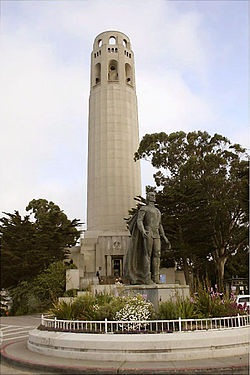
Prop. B, the Coit Tower measure, is winning, 55-45, which is a good place to be at this stage. I’d say it’s time for the Yes on B camp to start celebrating.

The DCCC early returns show a lot of what we expected — the elected officials and incumbents are doing well. David Chiu is in first, beating Scott Wiener, who is beating John Avalos. For what it’s worth.

After that, it’s Bevan Dufty, David Campos, former Sup. Leslie Katz and former state Sen. Carole Migden.

Interestingly, Matt Dorsey, an appointed incumbent facing the electorate for the first time, is ahead of Sup Malia Cohen. Rafael Mandleman, Zoe Dunning, Alix Rosenthal, Petra DeJesus, and Justin Morgan finish out the top 14 on the East Side.

Those are the early absentees, and the difference between Morgan and incumbent Gabriel Haaland, now in 18th place, is just 800 votes. So it will change.

Right now, the progressives have 9 of the 14 seats on the East Side, but only 4 of the 10 on the West Side, which won’t be enough to elect a progressive chair and ensure good endorsements in the fall. But the margins are so thin and it’s so early we can’t call it yet.

On the West Side of town, Assessor Phil Ting is comfortably in the lead for the 19th Assembly District, but newcomer Michael Breyer, a conservative Democrat who spent a ton of money, is edging Republican Matthew Del Carlo by two points, setting up the possibility that Ting will have to raise money and face off against Breyer in November.

The funny money against Prop. B

19

Credit where it’s due: My competitor and sometimes journalistic adversary Joe Eskenazi has a nice little piece on the weird money behind the campaign against Prop. B, a policy statement about the privatization of Coit Tower. He points out that such varied groups as the California Dental Association and the San Manuel Band of Mission Indians have coughed up money to protect the right of San Francisco officials to close Coit Tower to the public and rent it out for fancy corporate parties.

And how exactly did that happen?

Well, Eskenazi manages to tie Willie Brown into it. (He also calls this “Nimby against the Swells,” which isn’t quite fair — I don’t think the supporters of Prop. B are trying to keep anything out of their back yards. If anything, they want more noisy tourists and fewer quiet, subdued rich-people events. And I don’t think the “swells” are against it as much as the mayor, his Rec-Park director and big businesses that generally back the privatization of public resources.)

But there’s another interesting twist: I’m not sure the folks who gave to the Golden State Leadership Fund Political Action Committee, which is running a No on B independent expenditure, had any clue where their money was going.

Sure, the Chamber of Commerce and BOMA know what’s up, and it’s pretty clear why they like the idea of raising money for the parks by holding exclusive private events instead of by raising taxes. But the Indians? And the dentists? By what possible stretch do they care about a San Francisco ballot measure that has nothing to do with Native American rights or oral health?

Eskenazi may be right — maybe Brown called the Indians and asked, and they threw the money his way to help his buddy the mayor (while keeping the mayor’s fingers out of this particular political pie). But the Golden State Leadership PAC, through which all this money flowed, has been around for years and gives money to candidates all over the state. (It’s definately something of a slush fund for local races — files in the Secretary of State’s office show that in 2008, money from Pacific Gas and Electric Co. flowed in and out of the PAC as it ran a campaign against the San Francisco public-power measure, Prop. H. PAC money went to David Chiu, Phil Ting and Ed Lee for mayor.) It’s based in West Hollywood and the treasurer is a guy named William Molina.

I called the San Manuel Band of Mission Indians and the California Dental Association and asked them why there were helping fund a campaign against Prop. B in San Francisco. The press person at the dental group apparently had no idea what I was talking about and asked for more details about the contribution. I gave her the date and the PAC and I haven’t heard back.

The Indians didn’t seem to clear on Prop. B, either. Kenneth Shoji, a spokesperson for the group, told me by email:

The San Manuel Band of Mission Indians made a contribution of $25,000 to the Golden State Leadership Fund PAC with the expectation of helping to support candidate(s) for public office in the 2012 elections.  We do not control where or how the PAC might extend its support beyond that.

In other words: This Coit tower thing is news to us.

UPDATE: I got essentially the same message from the dentists. Alicia Malaby at the CDA writes:

 When an organization such as CalDPAC contributes to an independent expenditure committee, that committee may spend money on races and issues that CalDPAC supports, but may also spend money on other campaigns. CalDPAC does not control how those committees spend money, and in this case, CalDPAC has no interest in and no position on Proposition B.

UPDATE TWO: Ron Cottingham at PORAC just called me and said his group has no position on or interest in Prop. B. The money that went to the PAC was earmarked to support Rob Bonta for Assembly in the East Bay. Presumably the PAC folks keep track of such things.

Maybe not. Maybe Willie or someone else made a call. It happens all the time.  I mean, somebody clearly was raising money for this PAC, which right now isn’t doing a hell of a lot besides No on B in San Francisco. (Oh, I called Brown, too. He hasn’t called back. He never does. I still always try.)

Either way, it’s a classic San Francisco political story — and it reflects how muddy and corrupt local politics can still be, even in an era of electronic disclosure and ethics laws. Why, if the dentists and Indians don’t like Prop. B, didn’t they (or any of the others in the PAC) create a No on B committee, disclose who was behind it and let the voters know a little more about the real money trail? Why funnel all this cash through a little-known Southern California PAC?

And for that matter, why is there a sudden influx of late money in this race? Has the mayor and the Chamber types suddenly discovered that Prop. B might pass — and might set a precedent against future privatization efforts?

June 5 is Election Day. Vote early and often.


Sup. Cohen answers some Impertinent Questions on sunshine

1

b3 Note:  I sent some Impertinent Questions to the supervisors who voted against Bruce Wolfe, an excellent task force member,  and for Todd David (See other sunshine blogs.) To their credit, Sups.Elsbernd and Malia Cohen responded, Sup. David Chiu said he could not make the deadline but would reply with a new deadline.  Sups.Wiener and Farrell and Carmen Chiu have not responded.

Dear Bruce –
It was nice to see you the other night at the Potrero Hill Boosters dinner. I believe very strongly in the Sunshine Ordinance, transparency and efficiency in government. I also believe that the Sunshine Ordinance Task Force is an essential component of ensuring that our City departments are open with members of the public. As I mentioned in my comments on Tuesday, I have significant concerns with opinions of some of the Task Force’s members that the City Charter does not apply to them in the same manner as it applies to all other elected and appointed bodies in the City. I also have concerns about the inefficiency of Task Force meetings and the process by which complaints are adjudicated. I was encouraged by the qualifications of a number of new applicants that applied to serve on the Task Force. In particular I believe that the newly appointed members bring a diverse skill set in consumer advocacy, media relations and community involvement in governmental issues. It has also been one of my commitments as a member of the Board of Supervisors to increase the diversity of the membership of our City’s appointed bodies, whether that be on the Small Business Commission, Entertainment Commission or the Sunshine Ordinance Task Force, and I believe that the new appointees bring a much needed level of diversity to this body. I also want to stress that we still have a number of seats that the Rules Committee has not yet recommended appointments to. I know that it is my intention and I would also bet that it is the intention of my colleagues to ensure that these remaining vacant seats meet the requirement to have a physically handicapped individual on the Task Force, as well as individuals who bring expertise and experience in the above mentioned areas.

Always at your service,
Supervisor Malia Cohen

B 3 comment: Your “strong” belief in the sunshine ordinance and task force is admirable but would be more so if you didn’t reject knowledgeable representatives from the organizations with open government and public access credentials and experience.  And if you weren’t voting for the big development projects that want as little sunshine as possible on their contracts and operations and lobbying. 

Sunshine eclipsed

1

As an advocate for the passage of the San Francisco Sunshine Ordinance in the early 1990s, I felt obligated to take my first and only City Hall position and serve as a founding member of the Sunshine Ordinance Task Force. I served for l0 years and helped with many other good members to build the task force into a strong and respected agency for helping citizens get access to records and meetings and hold city officials accountable for suppressing access and information.

The task force is the first and best local sunshine task force of its kind in the country, if not the world. It is the only place where citizens can file an access complaint without an attorney or a fee and force a city official, including the mayor, to come before the task force for questioning and a ruling on whether they had violated sunshine laws. The task force lacked enforcement powers, but it still annoyed city officials, including Mayor Willie Brown.

In fact, Brown spent a good deal of time trying to kick me off the task force. He used one jolly maneuver after another, even getting an agent to make a phony complaint against me for violating the ordinance with an email (The complaint went nowhere). I refused to budge and decided to stay on until Brown left office—on the principle that neither the mayor nor anybody else from City Hall could arbitrarily kick members off the task force.

That principle held until about 3pm last Thursday (May 17) at the meeting of the Board of Supervisors Rules Committee to appoint candidates to the task force. At that meeting, without proper notice, advance warning, explanation, apology, or even a nice word or two, the supervisors suddenly turned a normal drowsy committee meeting into an unprecedented bloodbath for the task force and its independence. Sup. Mark Farrell played the heavy, Jane Kim was the facilitating chair, and David Campos was the reluctant third party, working together to bring Willie Brownism back at the task force with a vengeance.

The committee rejected four qualified candidates from three organizations who are mandated by the Sunshine Ordinance to choose representatives for the task force because of the organizations’ special open government credentials. (Doug Comstock, editor of the West of Twin Peaks Observer; Attorney Ben Rosenfeld from the Northern California chapter of Society of Professional Journalists, sponsor of the ordinance; Allyson Washburn from the League of Women Voters and Suzanne Manneh from America New Media.)

The committee without blushing asked the organizations to come up with a “list of names,” a whiff of grapeshot aimed at members and organizations who had served the public well for years. Who wants to go before the supervisors on a list of names for a bout of public character assassination? Meanwhile, while knocking off the qualified, knowledgeable candidates, the committee approved four neophytes without experience and then unanimously appointed David Pilpel, a former task force member known for delaying meetings with bursts of nitpicking. He almost always comes down on the side of City Hall and against citizens with their complaints.

Farrell also tried to bounce Bruce Wolfe, an excellent member, but Kim and Campos supported him and his name was sent on to the full board for approval.

Then, when Wolfe’s name got to the board on May 22, it was a repeat of Willie Brownism and this time to the max. Sup. Scott Wiener moved to amend the motion and substituted Todd David. Farrell seconded. The vote was 6-5, meaning that Willie Brownism wiped the sunshine slate clean of anybody who would raise a pesky question of city officials and the City Attorney’s Office.

The infamous votes against Wolfe: Wiener (ah, yes, the heir of the Harvey Milk and Harry Britt seat in the Castro), Farrell (where is Janet Reilly when we need her?), Malia Cohen (who comes from the Potrero Hill/Bay View/Hunters Point district that needs all the sunshine it can get in facing an Oklahoma-style land rush of development), David Chiu (who was reportedly angry over the unanimous task force opinion finding he violated the Sunshine Ordinance with late submission of documents before the controversial vote to redevelop Parkmerced), Carmen Chu and Sean Elsbernd (neighborhood supes way out in West Portal and the Sunset who almost always vote the downtown line at City Hall). The good votes for Wolfe: John Avalos, Eric Mar, Cristina Olague, Jane Kim, and David Campos.

Campos told me that the organization candidates were “eminently qualified,” that they should have been appointed, and that he would fight for them. He advised the organizations to “stand by their candidates.” He is urging that the issue of organization candidates come back to the next Rules Committee.

Rick Knee, SPJ’s mandated journalist on the task force surveying the carnage, said the supervisors’ actions stem “partly from a desire by some supervisors to sabotage the task force and ordinance itself, and partly from a vendetta by certain supervisors after the task force found several months ago that the board violated local and state open meeting laws when it railroaded some last minute changes to a contract on the Parkmerced development project without allowing sufficient time for public review and comment.”

Knee is right, and it isn’t just Parkmerced, but all the high-stakes development deals flowing through City Hall these days, with their advocates preferring to cut backroom deals rather than being subjected to the full scrutiny of the public and the task force.

James Chaffee, a former chair of the task force, watched the board proceedings with outrage and fired off a letter to all supervisors later that day. He charged that the board in sacking Wolfe violated the Sunshine Ordinance on several counts. Among them: the board changed the committee recommendation on Wolfe without allowing public comment and it passed over Wolfe even though the ordinance requires at least one member of the task force to be “physically handicapped.” That was Wolfe.

Thus, Chaffee wrote, the orchestrated coup was “the perfect example of a failure to follow the sunshine ordinance that led to the sort of problem that it was intended to forestall, namely the supervisors taking an action without being informed of what they are doing.  If Scott Weiner and David Chiu and the rest of the crew did not consider the citizens the enemy and exercize judgment about whether they were complying with the spirit of open government rather than just shaving off the letter of the law as closely as possible, this could have been avoided.”

Chaffee said he couldn’t tell if David was physically handicapped but he said nothing in his application for the task force nor was any disability apparent from the video of the rules committee meeting.

Chaffee said David’s  application showed he  was “self-employed as an investor, obtained a BA from Stanford in 1993, has never attended a task force meeting, and left the statement of his qualifications blank.”

Chaffee said, “It’s easy to see why Scott Wiener likes him. He said it would be a long road before he would go against the city attorney’s office and when it came to constitutional law, he would place the city attorney’s opinion above his own because the city attorney is an ‘expert.'”

I sent Chaffee’s letter and my Bruce Blog post ( “The return of Willie Brown to the Sunshine Task Force,” 5/21) to City Attorney Dennis Herrera for comment: How can his office sit by while the letter and spirit of the sunshine laws are being violated in the move to sabotage the sunshine ordinance and task force? I also sent Chaffee’s letter, with the Bruce blog, to the supervisors with similar questions: Why  are you violating the sunshine laws to kick out the best candidates? For their answers (coming)  and the latest on this evolving controversy, follow along at  www.sfbg.com/bruce.

There you have it:  the state of sunshine and open government in city hall in San Francisco in May of 2012. Todd David over Bruce Wolfe. David  Pilpel uber alles.  Five inexperienced candidates over five experienced candidates. David Pilpel uber alles. A city attorney who rolls over and over and over again. And a whiff of grapeshot for the three organizations mandated by the charter to have represenatives on the task force  because of their open government and public access credentials (the Northern California chapter of the Society of Professional Journalists, the League of Women Voters, and America New Media.)  On guard,  b3


The battle of 8 Washington

tredmond@sfbg.com

More than 100 people showed up May 15 to testify on a condominium development that involves only 134 units, but has become a symbol of the failure of San Francisco’s housing policy.

I didn’t count every single speaker, but it’s fair to say sentiment was about 2-1 against the 8 Washington project. Seniors, tenant advocates, and neighbors spoke of the excessive size and bulk of the complex, the precedent of upzoning the waterfront for the first time in half a century, the loss of the Golden Gateway Swim and Tennis Club — and, more important, the principle of using public land to build the most expensive condos in San Francisco history.

Ted Gullicksen, director of the San Francisco Tenants Union, calls it housing for the 1 percent, but it’s worse than that — it’s actually housing for the top half of the top half of the 1 percent, for the ultra-rich.

It is, even supervisors who voted in favor agreed, housing the city doesn’t need, catering to a population that doesn’t lack housing opportunities — and a project that puts the city even further out of compliance with its own affordable-housing goals.

And in the end, after more than seven hours of testimony, the board voted 8-3 in favor of the developer.

It was a defeat for progressive housing advocates and for Board President David Chiu — and it showed a schism on the board’s left flank that would have been unthinkable a few years ago. And it could also have significant implications for the fall supervisorial elections.

Sup. Jane Kim, usually an ally of Chiu, voted in favor of the project. Sup. Eric Mar, who almost always votes with the board’s left flank, supported it, too, as did Sup. Christina Olague, who is running for re-election in one of the city’s most progressive districts.

At the end of the night, only Sups. David Campos and John Avalos joined Chiu in attempting to derail 8 Washington.

The battle of 8 Washington isn’t over — the vote last week was to approve the environmental impact report and the conditional use permit, but the actual development agreement and rezoning of the site still requires board approval next month.

Both Mar and Olague said they were going to work with the developer to try to get the height and bulk of the 134-unit building reduced.

But a vote against the EIR or the CU would have killed the project, and the thumbs-up is a signal that opponents will have an upward struggle to change the minds of Olague, Kim, and Mar.


DEFINING VOTES

The 8 Washington project is one of a handful of defining votes that will happen over the next few months. The mayor’s proposal for a business tax reform that raises no new revenue, the budget, and the massive California Pacific Medical Center hospital project will force board members to take sides on controversial issues with heavy lobbying on both sides.

In fact, by some accounts, 8 Washington was a beneficiary of the much larger, more complicated — and frankly, more significant — CPMC development.

The building trades unions pushed furiously for 8 Washington, which isn’t surprising — the building trades tend to support almost anything that means jobs for their members and have often been in conflict with progressives over development. But the Hotel and Restaurant Employees Union joined the building trades and lined up the San Francisco Labor Council behind the deal.

And for progressive supervisors who are up for re-election and need union support — Olague and Mar, for example — defying the Labor Council on this one was tough. “Labor came out strong for this, and I respect that,” Olague told me. “That was a huge factor for me.”

She also said she’s not thrilled with the deal — “nobody’s jumping up and down. This was a hard one” — but she thinks she can get the developer to pay more fees, particularly for parking.

Kim isn’t facing re-election for another two years, and she told me her vote was all about the $11 million in affordable housing money that the developer will provide to the city. “I looked at the alternatives and I didn’t see anything that would provide any housing money at all,” she said. The money is enough to build perhaps 25 units of low- and moderate-income housing, and that’s a larger percentage than any other developer has offered, she said.

Which is true — although the available figures suggest that Simon Snellgrove, the lead project sponsor, could pay a lot more and still make a whopping profit. And the Council of Community Housing Organizations, which represents the city’s nonprofit affordable housing developers, didn’t support the deal and expressed serious reservations about it.

Several sources close to the lobbying effort told me that the message for the swing-vote supervisors was that labor wanted them to approve at least one of the two construction-job-creating developments. Opposing both CPMC and 8 Washington would have infuriated the unions, but by signing off on this one, the vulnerable supervisors might get a pass on turning down CMPC.

That’s an odd deal for labor, since CPMC is 10 times the size of 8 Washington and will involve far more jobs. But the nurses and operating engineers have been fighting with the health-care giant and there’s little chance that labor will close ranks behind the current hospital deal.

Labor excepted, the hearing was a classic of grassroots against astroturf. Some of the people who showed up and sat in the front row with pro-8 Washington stickers on later told us they had been paid $100 each to attend. Members of the San Francisco Planning and Urban Research Association, to which Snellgrove has donated substantial amounts of money in the past, showed up to promote the project.


BEHIND THE SCENES

But the real action was behind the scenes.

Among those pushing hard for the project were Chinese Chamber of Commerce consultant Rose Pak and community organizer David Ho.

Pak’s support comes after Snellgrove spent years courting the increasingly powerful Chinatown activist, who played a leading role in the effort that got Ed Lee into the Mayor’s Office. Snellgrove has traveled to China with her — and will no doubt be coughing up some money for Pak’s efforts to rebuild Chinese Hospital.

Ho was all over City Hall and was taking the point on the lobbying efforts. Right around midnight, when the final vote was approaching, he entered the board chamber and followed one of Kim’s aides, Matthias Mormino, to the rail where Mormino delivered some documents to the supervisor. Several people who observed the incident told us Ho appeared to be talking Kim in an animated fashion.

Kim told me she didn’t actually speak to Ho at that point, although she’d talked to him at other times about the project, and that “nothing he could have said would have changed anything I did at that point anyway.” Matier and Ross in the San Francisco Chronicle reported that Ho was heard outside afterward saying “don’t worry, she’s fine.”

Matier and Ross have twice mentioned that the project will benefit “Chinatown nonprofits,” but there’s nothing in any public development document to support that assertion.

Chiu told me that no Chinese community leaders called him to urge support for 8 Washington. The money that goes into the affordable housing fund could go to the Chinatown Community Development Corp., where Ho works, but it’s hardly automatic — that money will go into a city fund and can’t be earmarked for any neighborhood or organization.

CCDC director Norman Fong confirmed to me that CCDC wasn’t supporting the project. In fact, Cindy Wu, a CCDC staffer who serves on the city Planning Commission, voted against 8 Washington.

I couldn’t reach Ho to ask why he was working so hard on this deal. But one longtime political insider had a suggestion: “Sometimes it’s not about money, it’s about power. And if you want to have power, you need to win and prove you can win.”

Snellgrove will be sitting pretty if 8 Washington breaks ground. Since it’s a private deal (albeit in part on Port of San Francisco land) there’s no public record of how much money the developer stands to make. But Chiu pointed out during the meeting, and confirmed to me later by phone, that “there are only two data points we know.” One is that Snellgrow informed the Port that he expects to gross $470 million in revenue from selling the condos. The other is that construction costs are expected to come in at about $177 million. Even assuming $25 million in legal and other soft costs, that’s a huge profit margin.

And it suggests the he can well afford either to lower the heights — or, more important, to give the city a much sweeter benefits package. The affordable housing component could be tripled or quadrupled and Snellgrove’s development group would still realize far more return that even the most aggressive lenders demand.

Chiu said he’s disappointed but will continue working to improve the project. “While I was disappointed in the votes,” he said, “many of my colleagues expressed concerns about height, parking, and affordable housing fees that they can address in the upcoming project approvals.”

So what does this mean for the fall elections? It may not be a huge deal — the symbolism of 8 Washington is powerful, but if it’s built, it won’t, by itself, directly change the lives of people in Olague’s District 5 or Mar’s District 1. Certainly the vote on CPMC will have a larger, more lasting impact on the city. Labor’s support for Mar could be a huge factor, and his willingness to break with other progressives to give the building trades a favor could help him with money and organizing efforts. On the other hand, some of Olague’s opponents will use this to differentiate themselves from the incumbent. John Rizzo, who has been running in D5 for almost a year now, told me he strongly opposed 8 Washington. “It’s a clear-cut issue for me, the wrong project and a bad deal for the city.” London Breed, a challenger who is more conservative, told us: “I would not have supported this project,” she said, arguing that the zoning changes set a bad precedent for the waterfront. “There are so many reasons why it shouldn’t have happened,” she said. And while Mar is in a more centrist district, support from the left was critical in his last grassroots campaign. This won’t cost him votes against a more conservative opponent — but if it costs him enthusiasm, that could be just as bad.

The return of Willie Brownism to the sunshine task force

35

As an advocate for the passage of the  San Francisco sunshine ordinance and task force in the early 1990s, I felt obligated to take my first and only City Hall position and serve as a founding member of the task force. I served for l0 years and helped with many other good members to build the task force into a strong and respected agency  for helping citizens get access to records and meetings and hold city officials accountable for suppressing access.

The task force is the only place where citizens can file an access complaint without an attorney or a fee and force a city official, including the mayor, to come before the task force for questioning and a ruling on whether they had violated  sunshine laws, The task force lacked enforcement power, but it still annoyed of city officials, including Mayor Willie Brown.

In fact, Willie spent a good deal of time trying to kick me off the task force. He used one jolly  maneuver after another, even getting an agent to make a phony complaint against me for violating the ordinance with an email. (The complaint went nowhere.) I refused to budge and decided to stay on the task force until Willie left office—on the principle that that neither the mayor nor anybody else from City Hall could arbitrarily kick members off the task force. When Willie left office after two terms, I resigned with the hope that the Willie principle had been established.

The principle held, until last Thursday (May 17) when the board’s rules committee (Sup. Mark Farrell, Chair Jane Kim, and Sup. David Campos) brought Willie Brownism back to the task force with a vengeance. The committee moved to sabotage the task force by sacking or refusing to appoint four qualified candidates from three organizations who are mandated by the ordinance to choose representatives for the task force because of the organizations’ special open government  credentials. Their representatives served as experienced, knowledgeable members who were independent counters to nominees of supervisors who were often  promoting an anti-sunshine agenda. The committee asked the organizations to come up with more names. There was no explanation nor apology to the candidates nor to their organizations. It was a nasty slap at members and organizations that have served the task force well for years. And this arbitrary demand  will make  it virtually impossible for these organizations to come up with a “list of candidates” to run the supervisorial gauntlet.  Who wants to go before the supervisors on a list for a bout of public character assassination?

 Specifically, the committee:

+unanimously moved to sack the two incumbents (Allyson Washburn from the League of Women Voters) and Suzanne Manneh (California New Media.)  The League was mandated to name a representative because of its tradition and experience with good government and public access issues.  California New Media was mandated to name a member to insure there would always be a journalist of color on the task force.

+unanimously refused to seat two representatives from the Northern
California chapter of the Society of Professional Journalists, the sponsor of the ordinance with a long tradition in open government and First Amendment issues.  One SPJ  mandated  representative was for a journalist (Doug Comstock, editor of the West of Twin Peaks Observer, one of the best neighborhood papers in town and a former chair of the task force.) The second mandated seat was for an attorney (Ben Rosenfeld.)

+tried to knock out incumbent Bruce Wolfe on motion of Farrell, but Wolfe survived on a 2-l vote.   

+voted unanimously to approve David Pilpel, a former task force member who is known by observers for delaying meetings with is  bursts of lengthy nitpicking on almost every item.   He then usually votes against citizen complaints and for protecting  city officials on the basis of spotting   “onerous” burdens caused by the complaint

+voted unanimously for four new persons to the task force while sacking  and refusing to appoint able members with experience and expertise without a word of thanks. The four new members are “a “a bunch of neophytes,” according Rick Knee, outgoing SPJ member for 10 years.

Knee, a former task force chair surveying the carnage,  said that the committee’s actions stemmed “partly from a desire  by some supervisors to sabotage the task force and the ordinance itself, and partly from a vendetta by certain supervisors after the task force found several months ago that the board violated local and state open meeting laws when it railroaded some last minute changes to a contract on the Park Merced development project without allowing sufficient time for public service review and comment.” He noted that the developer “had slipped in a 14-page package of amendments at the llth hour”  to get board approval.

Knee said  that the rules committee is recommending sacking two incumbents and apparently hopes to sack two more. Farrell wanted to push out a fifth but was outvoted by Kim and Campos.  All five candidates, he said,  “have done excellent work, each brought a unique perspective and, while we had our share of disagreements among ourselves, all shared a passion for open government and for making sure that everyone who came before us got a fair hearing.”

Hanley Chan, an outgoing task force member,  backed up Knee’s point in an email. He  wrote that “I spoke with Sup. David Chiu and he told me that the rest of the supervisors will not appoint any incumbent, because we defied the city attorney’s opinion (the Park Merced  case). “”You should have made a right decision. I was told by the city attorney that it was legal, my aides explained it to the task force and you should have made a better judgment.'”  Chan said that the rules committee ouster move  was “retribution on how we voted that day.”  Chan said that “Bruce Wolfe and all the task force members made a wonderful argument and stuck to their guns.” The task force vote was a  unanimous 8-0 vote.The point: defy the supervisors and city attorney and the boys and girls in the back room and  get blasted off   the task force, bang, bang, bang, bang. 

The committee choreographed the move smoothly.  Farrell as the heavy  would make the move. Kim would agree and facilitate as chair. Campos would go along reluctantly. The deputy city attorney would be supine through the process  even though the supervisors were breaking precedent and misinterpreting the ordinance.  Sunshine candidates and advocates in the audience were furious and emails have been crackling back and forth ever since.

Campos later told me that he went along because he could see he didn’t have the votes. He said the organization’s candidates “were eminently qualified,” that they should have been appointed, and that he would fight for them. He said he would ask Kim’s office to set the issue for hearing at the next rules meeting or call for a special meeting. Kim did not return calls for comment.

I asked Campos what the organizations should do. “They should stand by their candidates,” he said.

I concur. The Society of Professional Journalists,  the League of Women Voters, and California New Media and their open government allies should stand by their candidates, lobby for them with the rules committee and the full board, and get out the word about this attempted coup in the most important court of all, the court of public opinion. Make this an election issue with all incumbents and candidates.  Let public officials know there are serious consequences to supporting Willie Brownism on the sunshine task force, the first and best local task force of its kind in the country if not the world.

The good news is that the rules committee has demonstrated, with its sneak attack,  the value of the task force for citizens and open government and why it is a San Francisco institution that needs to be saved and strengthened.  All of this  illustrates once again my  favorite axiom of mine. In San Francisco, the public is generally safe, except when the mayor is in his office and the supervisors are in session. b3


Housing for the super rich approved, 8-3

111

The progressive movement and the battle for housing balance and economic justice in San Francisco got walloped May 15 when eight supervisors sided with a developer who wants to build condos for the massively rich on the waterfront.

I watched it all, minus a few minutes while I was putting the kids to bed, all seven and a half hours of testimony and discussion, winding up with a series of pro-developer voters a little after midnight. It was stunning: Opponents of the project came out in droves, many of them seniors, others tenant activists and neighbors. Former City Attorney Louise Renne, who is by no means an anti-development type or any sort of economic radical, led off the arguments in favor of scrapping the environmental impact report and denying the conditional use permit that are needed for 8 Washington to move forward. They brought up so many points that by the end there was nothing more to say: This meets no housing need in San Francisco, further screws up the city’s own mandates for a mix of affordable and market-rate housing, caters to the top half of the top half of the 1 percent, is too tall and bulky for the site, offers the city too little in community benefits and is one of the great development scams of our time.

Then the other side spoke — the city planners who defended the EIR and, briefly, developer Simon Snellgrove. His supporters lined up — and almost all of them talked about the same thing: Construction jobs. I get it, we need construction jobs — but is that a justification for such a bad project? As Sup. David Chiu pointed out, “apartment construction is booming.  There are 22,000 units under construction and 50,000 more in the pipeline.”

Both sides were organized, but only one paid people to show up: At least five people seated in the front row, wearing pro-8 Washington stickers, confirmed that they’d been paid $100 each — in cash — to show up. They didn’t even speak, leaving once they realized that they were misled about the project. One source heard a construction worker say he knew nothing about the project and had been bused in from Sacramento.

And after hearing all of that, the supervisors did what they clearly had decided to do long before a word of testimony was uttered.

The vote to overturn the EIR went like this: favoring the developer were Supervisors Mark Farrell, Jane Kim, Eric Mar, Christina Olague, Malia Cohen, Carmen Chu, Sean Elsbernd and Scott Wiener. Opposing the project were Chiu, John Avalos and David Campos.

Approving the conditional use went along the same voting lines. Chiu couldn’t even get a continuance after arguing that there was no report from the budget analyst and no financial information about whether this is a good deal for the city.

That’s the lineup: Eight votes for the 1 percent. Three votes for the rest of us. I haven’t seen anything this bad in years.

Some fascinating information came out of the discussion. Chiu made clear that the developer doesn’t need the height-limit increase to make a profit off the deal. He estimated that the total sales revenue from the project would be around $470 million and construction costs about $177 million. That’s a huge profit margin, even if you add in another $25 million for upfront soft costs.

Snellgrove’s lawyer, Mary Murphy, tried to duck the financial issues, talking around in circles. Evenutally Chiu got Snellgrove to respond, and he said the costs would be higher and his profit would only be about $80 million. “The capital markets require a high return on these projects,” he said.
Still: $80 million is a lot of money. And while Snellgrove and his allies love to talk about the $11 million in affordable housing money for the city, that’s about 2.3 percent of his total revenue. Which doesn’t sound quite as juicy.

Chiu raised another good question: “Should a condo that sells for $5 million pay the same affordable housing fees as one that sells for $500,000?”
Mar, who is usually a strong progressive, was the big surprise of the night, not only voting the wrong way but teeing up softball questions for the city planners to make the project sound better. It was as if he was reading from the developer’s talking points.

In the end, he said he saw “a lot of benefits from this project,” but promised to work with the developer to advocate for “less bulk and less height.” Olague said the same thing.

But even if it’s a little smaller, this will still be a completely misalignment of housing priorities, a project entirely for the very rich. That’s not going to change.

If anything, they should push for more affordable housing money — a whole lot more. Because what we’re getting is enough for maybe 25 or 30 units, which means 80 percent of the new housing related to this project will be for multimillionaires and 20 percent for everyone else. Keep that pattern going — and there are few signs that it’s about to change — and imagine what this city will be like in 20 years.

It’s not over, not yet: The actual development agreement and the height-limit changes still have to come to the board early in June. And if the mayor signs off on it, opponents are talking serious about a ballot referendum that would be before the voters in November — just when Olague, Mar, Avalos, Campos, and Chiu will be up for re-election.

Tax equity

3

steve@sfbg.com, yael@sfbg.com

A broad consensus in San Francisco supports reforming the city’s business-tax structure by replacing the payroll tax with a gross receipts tax through a November ballot measure. But the devil is in the details of how individual tax bills are affected, which has divided the business community and given a coalition of labor and progressives the opportunity to overcome the insistence by Mayor Ed Lee and other pro-business moderates that any change be revenue-neutral.

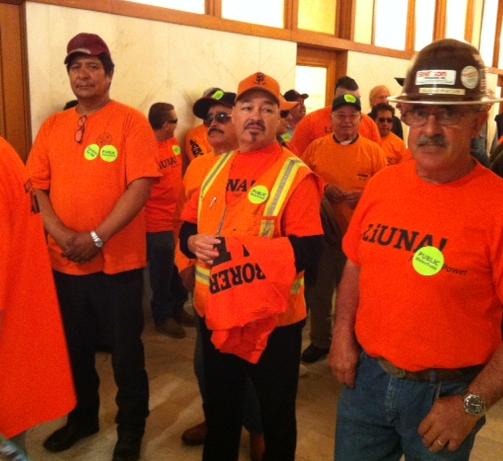
Service Employees International Union Local 1021, San Francisco’s biggest city employee union, last month launched a campaign demanding that the measure increase city revenue, setting a goal of at least $50 million, which represents the amount the city has lost annually since 2001 when 52 large downtown corporations sued to overturn the last gross receipts tax. The union is threatening to place a rival measure on the fall ballot.

“This call for it to be revenue-neutral didn’t make a lot of sense given all the reductions in city services in recent years,” said Chris Daly, the union’s interim political director. “It’s fair to at least get the money back that we lost in 2001.”

The union and the city recently agreed on a new contract that avoids more of the salary cuts that SEIU members have taken in recent years, but workers could still face layoffs under a new city budget that Lee is scheduled to introduce June 1. Lee, Board of Supervisors President David Chiu, and business leaders working on the tax-reform proposal have until June 12 to introduce their ballot measure.

But they don’t yet have an agreement on what the measure should look like — largely because the technology sector (led by billionaire venture capitalist Ron Conway, the biggest fundraiser for Lee’s mayoral campaign last year), the traditional businesses represented by the San Francisco Chamber of Commerce, and the small business community are pushing different interests and priorities.

“The technology industry has to realize they have a tax obligation like any member of the business community does,” Jim Lazarus, the Chamber’s vice president for public policy, told us.

Conway is reportedly using his influence on Lee to push for a model that keeps taxes low for tech companies — even if that comes at the expense of other economic sectors, such as commercial real estate and big construction firms, which will likely see their tax obligations increase. Yet some Chamber counter-proposals could end up costing small businesses more money, creating a puzzle that has yet to be worked out.

But one thing is clear: The business leaders don’t want to see overall city revenue increase. “If there’s anything that is unifying in the business community is that it’s revenue neutral,” small business advocate Scott Hauge told us. “We’re not going to increase revenues, that’s just a given, so if we have to do battle then so be it.”

SEIU and other members of progressive revenue coalition that has been strategizing in recent weeks are hoping to exploit the divisions in the business community and arrive at a compromise that increases revenue, and if not then they say they’re willing to go to the ballot with a rival measure.

“We’re working on trying to recover what we lost in the 2001 settlement and then some,” Sup. John Avalos, who has been working with the progressive coalition, told us. “We have to have something going to the ballot that is revenue generating.”


LABOR’S CAMPAIGN

For labor and progressives, this is an equity issue. Workers have been asked to give back money, year after year, despite the fact that big corporations have been doing well in recent years but haven’t contributed any of that wealth to the cash-strapped city. Labor leaders say that after they supported last year’s pension-reform measure, it’s time for the business community to support city services.

“When we talked about Prop C, we said if our members are doing this with our pensions now, we’ll see next year what businesses do with business tax,” said Larry Bradshaw, vice president of SEIU Local 1021. “Then we read about secret meetings where the labor movement was excluded from those talks.”

Anger over the “secret meetings” of business leaders that Lee assembled to craft the tax reform measure — meetings at which no labor leaders were included — helped inspire the fierce protest campaign that defined the SEIU’s recent contract negotiations.

In the first weeks of negotiations, workers were already up in arms. Protest marches at SF General Hospital and Laguna Honda Hospital brought hundreds of hospital workers to the streets. These hospitals serve some of the city’s poorest populations: Laguna Honda patients are mostly seniors on Medi-Cal and General is the main public hospital serving the city’s poor.

On April 5, city workers got creative with a street theater protest that involved six-story projections on the iconic Hobart Building. Protesters dressed as rich CEOs and handed out thank-you cards to commuters at the Montgomery transit station. SEIU’s “The City We Need, Not Downtown Greed” campaign included a website (www.neednotgreed.org), slick video, and direct mailers portraying CEOs as panhandlers on the street asking city residents, “Can you spare a tax break?”

The most dramatic civil disobedience came on April 18, when more than 1,000 workers rallied outside City Hall — along with several progressive supervisors — and then marched to Van Ness and Market. Protesters blocked the street, resulting in 23 arrests. At that point, increases in health care cuts and pay cuts to city workers were still on the table.

That was followed the next week by hundreds of workers staging noisy demonstrations in City Hall, and then again on May Day when SEIU workers were well represented in actions that took over parts of the Financial District.

In the end, the demands of union representatives were met in the contract agreement. Health care cost increases and pay cuts were eliminated, and a 3 percent pay raise will kick in during the two-year contract’s second year, a deal overwhelmingly approved by union members. Labor leaders hope to use that momentum to force a deal with the Mayor’s Office on the tax reform measure — which some sources say is possible. Otherwise, they say the campaign will continue.

“We may end up on the streets gathering signatures soon,” Daly said. “We need to figure it out in the next few weeks.”


THOSE DEVILISH DETAILS

The Controller’s Office released a report on May 10 that made the case for switching to a gross receipts tax and summed up the business community’s meetings, and the report was the subject of a joint statement put out by Lee and Chiu. “After months of thorough analysis, economic modeling and inclusive outreach to our City’s diverse business community, the City Controller and City Economist have produced a report that evaluates a gross receipts tax, a promising alternative to our current payroll tax, which punishes companies for growing and creating new jobs in our City'” the statement said. “Unlike our current payroll tax, a gross receipts tax would deliver stable and growing revenue to fund vital city services, while promoting job growth and continued economic recovery for San Francisco.”

Daly and Avalos say progressives agree that a gross receipts tax would probably be better than the payroll tax, and they say the controller’s report lays out a good analysis and framework for the discussions to come. But despite its detailed look at who the winners and losers in the tax reform might be, Daly said, “We haven’t seen an actual proposal yet.”

Lazarus made a similar statement: “Nobody likes the payroll tax, but the devil is in the details.”

But it’s clear some businesses those with high gross receipts but low payrolls — would pay more taxes. For example, the finance, insurance, and real estate sector now pays about 16 percent of the $410 million the city collects in payroll taxes. That would go up to about 21 percent under a gross receipts tax.

“Several industries that could face higher taxes under the proposal, such as commercial real estate, large retailers, and large construction firms, felt the increase was too sharp,” the report said under the heading of “Policy Issues Arising From Meetings with Businesses.”

The report highlighted how the change would broaden the tax base. Only about 7,500 businesses now pay the payroll tax (others are either too small or are exempt from local taxation, such as banks), whereas 33,500 companies would pay the gross receipts tax, which the report identified as another issue to be resolved.

“While some businesses appreciated the base-broadening aspect of the gross receipts proposal, others felt that too many small businesses were being brought into the Gross Receipts tax,” the report said. Hauge also told us that he fears a tax increase on commercial real estate firms could be passed on to small businesses in the form of higher rents. “I don’t want to see the business community split,” Hauge said, although it’s beginning to look like that might be unavoidable. The big question now is whether progressives and labor can find any allies in this messy situation, and whether they’ll be able to agree on a compromise measure that all sides say is preferable to competing measures.

What the preservation vote says about the 2012 supervisors

64

UPDATE: Important update at the end of this story

What does it mean that a historic preservation law favored by developers and promoted by Sup. Scott Wiener passed the Board of Supervisors 8-3? Maybe nothing. Historic preservation is a strange poliltical issue, favored by some of the wealthy white homeowner types who love pretty buildings (and aren’t so good on other issues), and this thing was sold as a way to help low-income people and affordable housing. But the reality is that the Wiener measure will make it harder to declare historic districts, and thus will take away a tool that the left can use to stop uncontrolled commercial development. And remember: The affordable housing community wasn’t pushing this bill, and, for the most part, hasn’t had problems with historic preservation. The most progressive political club in the city, the Harvey Milk LGBT Democratic Club, came out strongly against the measure and urged Sup. Christina Olague, a co-sponsor, to oppose it:

We are extremely troubled that you appear to be buying into the flawed, bogus and self-serving arguments by SPUR and other supporters of this legislation that historic preservation is classist and leads to gentrification, interferes with the production of affordable housing and is a tool of San Francisco’s elite.  Nothing could be further from the truth.

There was a way to address the issues of low-income people in historic districts without making it harder to block inappropropriate development, but Wiener’s bill went much further. And while I respect Scott Wiener and find him accessible and straightforward, and I agree with him on some issues, he isn’t someone whose basic agenda promotes the interests of tenants or low-income people. His supporters are much more among the landlord class and the downtown folks. The San Francisco Chronicle, which is a conservative paper on economic and development issues, loved the legislation.

So what happened when this got to the Board? Only three people — the ones the Chron calls “the stalwart left flank of the Board” — voted no.

John Avalos, David Campos and Eric Mar. They are now the solid left flank, the ones who can be counted on to do the right thing on almost every issue. Once upon a time, there were six solid left votes. Now there are three.

What does this mean for the other key issues coming up, including CPMC, 8 Washington, and the city budget? Maybe nothing. As I say, this issue is complicated. Olague told me, for example, that she’s really worried about working-class people who can’t afford to comply with the increased regulations that come with historic districts. Her vote doesn’t mean she’s dropped out of the progressive camp, or that she (or Sups. Jane Kim and David Chiu) can’t be counted on in the future. I really want to believe that this was just an aberration, a vote where I’ll look back in the fall and say: Okay, we disagreed on that one, but nobody’s perfect

Still, it’s kind of depressing: The dependable progressive vote is down to three.

UPDATE/CORRECTION: I didn’t know when I posted this that Olague had spoken to the Milk Club leadership after the club’s statement went out and the club has since issued a correction:

Due to a misunderstanding, Supervisor Christine Olague’s position on the Historic Preservation Commission’s critical role in the life of San Franicsco was misrepresented in our weekly newsletter. Supervisor Olague is looking into ways to help continue Historic District status for the Queer community, the Filipino community in the South of Market area, and the Japantown area. She is specifically looking for wording that would help these plans remain viable and welcomes any questions on her position and on her plan. Our apologies to the Supervisor for this unfortunate mistake.

20 percent by 2020

52

steve@sfbg.com

There’s no doubt that San Francisco is one of the best cities in the United States for bicyclists, a place where near universal support in City Hall has translated into regular cycling infrastructure improvements and pro-cyclist legislation, as a slew of activists and politicians will attest to on May 10 after dismounting from their Bike to Work Day morning rides.

But even the most bike-friendly U.S. cities — including Portland, Ore., Davis, Chicago, and New York City — are still on training wheels compared to our European counterparts, such as Amsterdam and Copenhagen, where around 30 percent of all vehicle trips are by bike. By comparison, even the best U.S. cities are still in the low single digits. [Correction: Davis, which stands alone among U.S. cities, is actually at about 15 percent bike mode share]

Board President David Chiu and other city officials proposed to aggressively address that gap two years ago after returning from a fact-finding trip to Europe that also included Ed Reiskin, executive director of the San Francisco Municipal Transportation Agency (SFMTA), the agency charged with implementing city policies that favor transit riders, cyclists, and pedestrians over motorists.

Chiu sponsored legislation setting the goal of having 20 percent of all vehicle trips in San Francisco be by bike by the year 2020 and calling for the SFMTA to do a study on how to meet that goal. It was overwhelmingly approved by the Board of Supervisors and signed by Mayor Ed Lee, who has regularly cited it and proclaimed his support for what it now official city policy.

But the city will fail to meet that goal, probably by a significant amount, unless there is a radical change on our roadways.

The latest SFMTA traffic survey, released in February, showed that bikes represent about 3.5 percent of vehicle trips, a 71 percent increase in five years. While the San Francisco Bicycle Coalition (SFBC) lauded that gain as “impressive,” it would mean a 571 percent increase in the next seven years to meet the 2020 goal.

The SFMTA study on how to meet the goal is long overdue, with sources telling us its potentially controversial conclusions have it mired by internal concerns and divisions. SFMTA spokesperson Paul Rose told us in March that it was coming out in April, and now he won’t say when to expect it and he won’t even make its authors available to answer our questions.

“We want to make sure everything is addressed before the plan is finalized,” he told us, acknowledging that it’s been a difficult process. “The challenge of reaching the goal is ambitious.”

Chiu acknowledges that the goal he set probably won’t be met and expressed frustration with the SFMTA. “I’m disappointed that two years after we set that goal, there is still no plan,” he told us, adding that to make major gains “will take leadership at the top” and a greater funding commitment to this cost-effective transportation option: “We’re spending budget dust on something that we say is a priority for the city.”

Reiskin also seemed to acknowledge the difficulty in meeting the goal when we asked him about it and he told us, “To get to 20 percent would be a quantum leap, no question, but the good news is there’s strong momentum in the right direction.”

Yet on Bike to Work Day, it’s worth exploring why we’re failing to meet our goal and how we might achieve it. What would have to happen, and what would it look like, to have 20 percent of traffic be people on bikes?


CLOSING THE GAP

SFBC Executive Director Leah Shahum said that all the group’s studies show safety concerns are by far the biggest barrier to getting more people on bikes. Most people are simply scared to share space with automobiles, so SFBC’s top priority has been creating more bikes lanes, particularly lanes that are physically separated from traffic, known as cycletracks, like those on a portion of Market Street.

“We’ve seen it time and again, when you build, they will come,” Shahum said. “People want to feel safe. They want dedicated space on the roadways.”

SFBC’s Connecting the City proposal calls for the creation of four crosstown colored cycletracks totaling 100 miles. Other bike activists emphasize the importance of projects that close key gaps in the current bike network, such as the dangerous section along Oak and Fell streets that separates the Panhandle from the Wiggle, scary spots that deter people from cycling.

That safety concern — and the possibilities for making cycling a more attractive option to more people — extends to neighborhood streets that don’t have bike lanes, where Shahum said measures to slow down automobile traffic and increase motorist awareness of cyclists would help. “What we’re talking about is a calmer, safer, greener, neighborhood-focused street,” she said.

Bike advocates say the goal is to make cycling a safe and attractive option for those 8 to 80 years old, a goal that will require extensive new bike infrastructure — not just new bike lanes, but also more dedicated bike parking — as well as education programs for all road users.

“What I hope is on the drawing board is infrastructure that will make more people feel safe riding, particularly women,” SFMTA board member Cheryl Brinkman, a regular cyclist, told us.

Shahum also praised the Bay Area Rapid Transit District’s new Bike Plan, which seeks to double the percentage of passengers who bike to stations (from 4 percent now up to 8 percent in 10 years), saying Muni should also take steps to better accommodate cyclists. And she praised the city’s bike-sharing program that will debut in August, making 1,000 bikes available to visitors.

But to realize the really big gains San Francisco would need to hit 20 percent by 2020 would take more than just steadily increasing the mileage of bike lanes, says Jason Henderson, a San Francisco State University geography professor who is writing a book on transportation politics. It would take a systemic, fundamental shift, one either deliberately chosen or forced on the city by dire circumstances.

“If gasoline goes to $10 per gallon, sure, we’ll get to 20 percent just because of austerity,” Henderson said. But unless energy prices experience that kind of sudden shock, which would idle cars and overwhelm public transit, thus forcing people onto bikes, getting to 20 percent would take smart planning and political will. In fact, it will require the city to stop catering to drivers and accommodating cars.

Henderson noted that bicycle mode share is as high as 10 percent in some eastern neighborhoods, such as the Mission District, Lower Haight, and in some neighborhoods near Civic Center. “In this part of the city, Muni is crowded and young people get tired of Muni being such a slow option,” Henderson said. “If you live within a certain radius of downtown, it’s easier to bike.”

To build on that, he said the city needs to limit the number of parking spaces built in residential projects in the city core even more than it does now, as well as adding substantially more affordable units. “The most bikeable parts of the city have massive rent increases,” he said. “We have to make sure affordable housing is wrapped around downtown.”

Henderson said city leaders need to show more courage in converting car lanes and street parking spaces into bike lanes, creating bike corridors that parallel those focused on cars or transit, and exempting most bike projects from the detailed environment review that slow their implementation. At the same time, he said the city needs to drastically expand Muni’s capacity to give people more options and compensate for bike improvements that may make driving slower.

“If you want 20 percent bike mode share, you need 30 percent on transit,” he said, noting that public transit ridership in San Francisco is now about 17 percent, far less than in the great bike cities of Amsterdam and Copenhagen, which made a commitment to reducing reliance on the automobile starting in the 1970s. “It’s like a puzzle.”


BARRIERS AND BACKLASH

The kind of active urban planning that Henderson advocates would be anathema to many San Franciscans, particularly people like Rob Anderson, the blogger and activist who sued San Francisco over the lack of studies supporting its Bike Plan and created a four-year court injunction against bike projects that just ended two years ago.

“The only way you could get to 20 percent is creating gridlock in San Francisco. I don’t think it’s going to happen. City Hall is adopting a slogan as transportation policy,” he told us. “It’s a statement of pro-bike, anti-car principle, but it’s not a realistic transportation policy.”

Anderson considers bicycles to be dangerous toys that will never be used by more than a small minority of city residents, believing the majority will always rely on automobiles and there will be a huge political backlash if the city continues to take space from cars for bikes or open space.

Many city officials and cycling advocates say making big gains means convincing people like Anderson that bicycles are not just a viable transportation option, but an important one to facilitate given global warming, oil wars, public health issues, and traffic congestion that will only worsen as the population increases.

“We need to help all San Franciscans see cycling as a legitimate transportation option,” Chiu said. Or as Shahum put it, “It’s prioritizing space for biking, walking, and transit over driving.”

Shahum said the city’s political leaders seem to get it, but she doesn’t feel the same sense of urgency from the city’s planners.

“I feel like the bureaucracy needs to get on board. We have strong political support and the public support is growing,” Shahum said. “We’ve set ambitious, worthwhile, and I think achievable goals, yet nobody is holding the city accountable….It can’t just be a political platitude, it needs to be an actual plan with measureables and people held accountable.”

She cited studies showing that the most bike-friendly cities in the U.S. are spending between $8 million and $40 million a year on bike infrastructure and education programs, “but San Francisco is spending more like $2-3 million, which is peanuts…San Francisco has got to start putting its money where its mouth is to improve biking numbers.”

It’s cheap and easy to stripe new bike lanes. “It’s one of the best investments we can make in terms of mode share,” Reiskin said. That makes cycling advocates question the city’s true commitment to goals like the 2020 policy. “We will need more investment,” Chiu said, “but compared to other modes of transportation, it is far cheaper per mile.”


POLITICAL WILL

So why then has San Francisco slipped back into a slow pace for doing bike projects following a year of rapid improvements after the bike injunction was lifted? And why does the city set arbitrary goals that it doesn’t know how to meet? The answer seems to lie at the intersection of the political and the practical.

“We need a more detailed and comprehensive strategy that says this is where we need to be in five years and this is how we get there,” Sup. David Campos, who chairs the San Francisco Transportation Authority, told us. “I feel like the commitment is there, but it’s a question of what resources you have to devote to that goal.”

But it’s also a question of how those resources are being used, and whether political leaders are grabbing at low-hanging fruit rather than making the tough choices to complete the city’s bike network and weather criticisms like those offered by Anderson.

It often seems as if SFMTA is still prioritizing political projects or experimenting in ways that waste time and money. For example, the most visible improvement to the bike network in the last year, and the one most often cited by Mayor Lee, is the new cycletracks on JFK Drive in Golden Gate Park. But they do little to make cycling more attractive and they may even exacerbate tensions between cyclists and drivers.

It was one of two major bike projects that Mayor Lee announced on Bike to Work Day last year, and it seemed to have more to do with politicians announcing more bike lane mileage that with actually improving the bike network.

The other project Lee announced, just a few blocks of bike lanes on Fell and Oak streets, really was a significant bike safety advance that SFBC has been seeking for several years. But Lee failed to live up to his pledge to install them by the end of 2011 after neighbors complained about the lost parking spots, and the project was pushed back to next year at the earliest.

“We’re talking about three blocks. It’s relatively small in scope but huge in impacts,” Shahum said of the project. “If the pace of change on these three blocks is replicated through the city, it’ll take hundreds of years to meet the [20 percent] goal.” But Lee Press Secretary Christine Falvey said: “The mayor is very much committed to the aggressive goals set to get to 20 percent by 2020 and the city is moving in the right direction. He has also always supported the Oak Fell project and we’re seeing progress.” Yes, but not the kind of progress the city would need to make to meet its own goal. “Chicago is really the leader right now,” Shahum said, noting Chicago Mayor Rahm Emanuel’s commitment to building 25 miles a year of new cycletracks and the city’s advocacy for getting more federal transportation money devoted to urban cycling improvements. “Where does San Francisco fit in this? Do we want to be at that level or not?”


Progressives party — together

6

There are plenty of political fundraisers during campaign seasons, but this one will be especially interesting: The progressive slate for the Democratic County Central Committee is coming together for an event May 2 at 6 pm at Project One. The host committee includes outgoing chair Aaron Peskin and Sup. David Chiu, who have not always been on the best of terms — and Committee incumbent Alix Rosenthal, the main organizer of the event, who is also the organizer of what some see as a competing slate.

And that slate is having its own problems — involving clashes between some of the progressive women (Hene Kelley, who will no doubt be at the May 2 event) and some of the more moderate women (Hydra Mendoza, who won’t be there.) The party invite has a street sign saying “left turn only” — which is not at all what some of the people on Rosenthal’s other slate are thinking.

Rosenthal told us: “I personally think it’s remarkable that Aaron, Rafi [Mandelman], David Chiu, David Campos, Eric Mar, John Avalos and I are all on the host committee, given the rifts in the progressive movement of late.”

Yep. Everyone’s getting along. For one night, anyway.

The two defining votes of 2012

38

The Board of Supervisors will be facing two votes in the next couple of months that will define this board, establish the extent of the mayor’s political clout — and potentially play a decisive role in the political futures of several board members.

Oh: They’ll also have a lasting impact on the future of this city.

I’m talking about 8 Washington and CPMC — one of them the most important vote on housing policy to come along in years, the other a profound decision that will change the face of the city and alter the health-care infrastructure for decades to come.

Both projects have cleared the Planning Commission, as expected. Neither can go forward without approval from a majority of the supervisors. And there will be intense downtown lobbying on both of them.

The 8 Washington project would create what developer Simon Snellgrove calls the most expensive condos ever built in San Francisco. A piece of waterfront property would become a gated community for the very, very rich, many of whom won’t even live here most of the time. If it’s approved, the economy won’t collapse, neighborhoods won’t be destroyed — but it will make a powerful statement about the city’s housing policy. The message: We build housing for the 1 percent. We are a city that caters only to one very tiny group of people. We are willing to let the needs of the few drive our policy over the needs of the many.

Face it: There is no shortage of housing for the people who will buy Snellgrove’s condos. There’s a severe shortage of housing for most of the people who actually work in San Francisco. And the city’s housing policy is so scewed up that it’s making things worse. That’s the message of 8 Washington.

Then there’s CPMC. California Pacific Medical Center wants to put a snazzy state-of-the art new medical center on Van Ness, which is all well and good. But the giant nonprofit Sutter Health, which operates CPMC, has been openly hostile to some of the city’s demands (for housing, transit and other environmental mitigiation) and the proposal that Mayor Ed Lee has signed off on is way out of balance. There’s not anything even close to a reasonable link between jobs and housing — which will impact the entire city. You bring in a lot of new workers and don’t help build enough housing for them and everyone’s rent goes up.

CPMC also wants to radically downsize St. Luke’s Hospital, the only full-service facility on the south side of town except for the overcrowded and overloaded SF General. Health care for a sizable part of the city will suffer.

This is a very big deal, and the Chamber of Commerce is pushing hard for the supes to approve it. A lot of labor and the entire affordable housing community is against it.

So put those two votes in front of a board where the progressive majority has been very shaky of late — and where Lee will be working hard to line up six votes — and you’ve got potential political dynamite. Supervisor John Avalos told me he has serious concerns about both projects. Sup. David Campos told me he feels the same way. Sup Eric Mar is unlikely to vote for 8 Washington and unlikely to oppose the health-care workers and the progressive leaders who want to block the CPMC deal and make Sutter come back with a better offer, but some elements of labor are pushing hard for 8 Washington and Mar is up for re-election in one of the city’s swing districts.

Sup. David Chiu is against 8 Washington. I’ve called Sups. Jane Kim and Christina Olague (who was not a fan of the project when she was on the Planning Commission) but they haven’t gotten back to me. Olague is running for re-election this fall in the city’s most progressive district, one that’s right on the edge of the CPMC project site; Kim’s district is on the other edge.

You can’t really count to six on either of these projects without getting Chiu and/or Kim and/or Olague. Chiu has no progressive opposition, but if he supports the CPMC deal, someone may decide to challenge him. If Olague supports either project, it will give her opponents plenty of fodder for the fall campaign (John Rizzo, who is running against her, told me he opposes both). If Olague opposes the two projects, it’s going to be much harder for anyone to run against her from the left since she will have demonstrated that she can stand up the mayor on tough issues.

I’ll let you know if I hear more.


In city workers’ shoes

6

We both work under City Hall’s iconic dome as civil servants. While I often work late into the evening hours as a supervisor, Robert’s back-breaking work as a janitor is often done past the midnight hour, five nights a week.

I had the opportunity to meet Robert last week, as part of the “Walk A Day In Our Shoes” program of Service Employees International Union, Local 1021.

Robert is 52 years old. He’s worked for the city since 1999. Before that, he worked for San Francisco Unified School District. He sweeps and mops the floors and stairs of the famous rotunda and cleans 150 cubicles.

Last week, Robert had me take off my jacket and tie, roll up my sleeves and do his job for a while. I swept the marble floors, which are truly unending. I mopped the grand marble staircase behind happy couples exchanging wedding vows. He let me attempt to push a gigantic whirring machine that felt more like a Zamboni than a vacuum.

When I was younger, I had a summer job as a janitor at a public high school, so I know how truly strenuous Robert’s job is.

Robert injured his spine as a result of pushing that heavy vacuum for years. When he was in the hospital treating his spinal injury, the doctors discovered cancer. While in chemotherapy, he didn’t miss a day of work. He lives cancer-free today.

Robert is also a green pioneer at City Hall — he started a recycling program here before it was popular to do so. After that, the rest of the city caught on. He has photos of himself and the past four mayors in his home. He offers directions to visitors. He has a son, and they both live in his sister’s home. He speaks lovingly of his wife, who he lost to diabetes several years ago.

As our economy evolves, we can’t leave people like Robert — those who support our world-class city —behind. While we court businesses who create new jobs in our city, we also need to reinvest in the people who do the important work that often goes unnoticed.

Hospital workers are up at 4am, preparing meals for patients. Library technicians provide bilingual translation for our children. Others, like Robert, are up until 1am, making sure we have a clean and safe environment to work every day.

After years of concessions to balance deep budget deficits, city workers experienced ongoing cuts to their wages and benefits. In current contract negotiations, they are being asked to give hundreds more each month in healthcare costs to insure their children.

We appreciate all they have done to help our city in times of need. As our city recovers economically, it’s time to thank them, to ask others to help shoulder the costs for affordable housing, parks and recreation facilities and schools, and to reform our local business tax — which is paid by only 10% of our city’s companies.

Last week, I got to know a fellow civil servant whose work we need to remember to value. Which is why I will stand alongside Robert, labor unions, nonprofits, community members and neighbors on Wednesday, April 18, in front of City Hall from 4pm to 7pm. Please join us in supporting the workforce that supports us all, 24 hours a day. 

David Chiu is president of the Board of Supervisors.Thousands of community allies, elected officials, and SEIU 1021 members will rally on Wednesday, April 18 to close tax loopholes on mega banks and corporations from 4pm to 7pm at City Hall.

San Francisco’s loss

116

news@sfbg.com

San Francisco is increasingly losing its working and creative classes to the East Bay and other jurisdictions — and with them, much of the city’s diversity — largely because of policy decisions that favor expensive, market-rate housing over the city’s own affordable housing goals.

“It’s definitely changing the character of the city,” said James Tracy, an activist with Community Housing Partnership. “It drains a big part of the creative energy of the city, which is why folks came here in the first place.”

>>Is Oakland cooler than San Francisco? Oaklanders respond.

Now, as San Francisco officials consider creating an affordable housing trust fund and other legislative changes, it’s fair to ask: Does City Hall have the political will to reverse the trend?

Census data tells a big part of the story. In 2000, the median owner-occupied home in San Francisco cost $369,400, and by 2010 it had more than doubled to $785,200. Census figures also show median rents have gone from $928 in 2000 up to $1,385 in 2010 — and even a cursory glance at apartment listings show that rents have been steadily rising since then.

Tracy and other affordable housing activists testified at an April 9 hearing before the Board of Supervisors Land Use and Economic Development Committee on a new study by the Budget and Legislative Analyst, commissioned last July by Sup. David Campos, entitled “Performance Audit of San Francisco’s Affordable Housing Policies and Programs.”

“There’s a hearing right now at City Hall about our housing stock and how it’s been skewing upward toward those with higher incomes,” Board President David Chiu told us, noting that it is sounding an alarm that, “Creative individuals that make this place so special are being driven out of the city.”

Oakland City Council member Rebecca Kaplan said that San Francisco’s loss has been a gain for Oakland and other East Bay cities, which are enjoying a new cultural vibrancy that has so far been largely free of the gentrifying impacts that can hurt a city’s diversity.

“You can add more people without getting rid of anybody if you do it right. Most of development is looking at places that are now completely empty like the Lake Merritt BART station parking lot, empty land around the Coliseum, and the West Oakland BART station,” Kaplan told us. “We have to commit to revitalization without displacement.”

Yet the fear among some San Franciscans is that we’ll have just the opposite: displacement that actually hinders the city’s attempts at economic revitalization. “What’s at stake is the economic recovery of the city,” Tracy said. “You can’t have such a large portion of the workforce commuting into the city.”

TOO MANY CONDOS

A big part of the problem is that San Francisco is building plenty of market-rate (read: really expensive) housing, but not nearly enough affordable housing. The report Campos commissioned looked at how well the city did at meeting various housing construction goals it set for itself from 1999 to 2006 in its state-mandated Housing Element, which requires cities to plan for the housing needs of its population and absorb a fair share of the state’s affordable housing needs.

The plan called for 7,363 market-rate units, or 36 percent of the total housing construction, with the balance being housing for those with moderate, low, or very low incomes. Developers built 11,293 market rate units during that time, 154 percent of what was needed and 65 percent of the total housing construction. There were only 725 units built for those with moderate incomes (just 13 percent the goal) and just over half the number of low-income units needed and 83 percent of the very low-income goal met.

“We have to do a better job of monitoring and evaluating each project,” Chiu said. “Every incremental decision we make determines whether this will be a city for just the wealthy.”

The situation for renters is even worse. From 2001-2011, the report showed there were only 1,351 rental units built for people in the low to moderate income range, people who make 50-120 percent of the area median income, which includes a sizable chunk of the working class living in a city where about two-thirds of residents rent.

“The Planning Commission does not receive a sufficiently comprehensive evaluation of the City’s achievement of its housing goals,” the report concluded, calling for the planners and policymakers to evaluate new housing proposals by the benchmark of what kind of housing the city actually needs. Likewise, it concluded that the Board of Supervisors isn’t being regularly given information it needs to correct the imbalance or meet affordable housing needs.

Policy changes made under former Mayor Gavin Newsom also made this bad situation even worse. Developers used to build affordable housing required by the city’s inclusionary housing law rather than pay in-lieu fees to the city by a 3-1 ratio, but since the formulas in that law changed in 2010, 55 percent of developers have opted to pay the fee rather than building housing.

Also in 2010, Newsom instituted a policy that allowed developers to defer payment of about 85 percent of their affordable housing fees, resulting in an additional year-long delay in building affordable housing, from 48 months after the market rate project got permitted to 60 months now.

Tracy and the affordable housing activists say the city needs to reverse these trends if it is to remain diverse. “It’s not even debatable that the majority housing built in the city needs to be affordable,” Tracy said.

Mayor Ed Lee has called for an affordable housing trust fund, the details of which are still being worked out as he prepares to submit it for the November ballot. Chiu said that would help: “I will require a lot of different public policies, but a lot of it will be an affordable housing trust fund.”

GROWTH AND DIVERSITY

San Francisco’s problems have been a boon for Oakland.

“With much love and affection to my dear SF friends, I must say that Oakland is more fun,” Kaplan told us. “Also I think a lot of people are choosing to live in Oakland now for a variety of reasons that aren’t just about price. We have a huge resurgent art scene, an interconnected food, restaurant, and club scene, a place where multicultural community of grassroots artists is thriving, best known from Art Murmur.”

There is fear that Oakland could devolve into the same situation plaguing San Francisco, with rising housing prices that displace its diverse current population, but so far that isn’t happening much. Oakland remains much more racially and economically diverse than San Francisco, particularly as it attracts San Francisco’s ethnically diverse residents.

“We’re not looking at a situation where the people moving into town are necessarily predominantly white,” Kaplan said. “We’re having large growth in quite a range of communities, including growing Ethiopian and Eritrean and Vietnamese populations…If you don’t want to live in a multicultural community, maybe Oakland’s not your cup of tea.”

According to the 2010 census, a language other than English is spoken at home in 40.2 percent of Oakland households, compared to 25.4 percent in San Francisco. “Almost every language in the world spoken in Oakland,” Kaplan said.

African Americans make up 28 percent of Oakland’s population, compared to only 6.1 percent in San Francisco, and 6.2 percent of the population of California. In San Francisco, the number of black-owned businesses is dismal at 2.7 percent, compared to 4 percent statewide and 13.7 percent in Oakland. The census also finds that 25.4 percent Oaklanders are people of Latino origin, compared to San Francisco at 15.1 percent and 37.6 percent statewide. San Francisco is 33.3 percent Asian, compared to Oakland at 16.8 percent and all of California at 13 percent.

Both cities are less white than California as a whole; the state’s white population is 57.6 percent, compared to 34 percent in Oakland and 48.5 percent in San Francisco.

Gentrification shows its face differently depending on the neighborhood. Some say Rockridge, a trendy Oakland neighborhood where prices have recently increased, has gone too far down the path.

“Rockridge has been ‘in’ for a long time, but the prices are staggering and it isn’t as interesting any more,” Barbara Hendrickson, an East Bay real estate agent, told us.

The nationwide foreclosure crisis didn’t spare Oakland and may have sped up its gentrification process. “The neighborhoods are being gentrified by people who buy foreclosures and turn them into sweet remolded homes,” observed Hendrickson.

Yet Kaplan said many of these houses simply remain vacant, driving down values for surrounding properties and destabilizing the community. “I think we need a policy where the county doesn’t process a foreclosure until the bank has proven that they own the note,” said Kaplan, who mentioned that the city has had some success using blight ordinances to hold banks accountable for the empty buildings.

And as if San Francisco didn’t have enough challenges, Kaplan also noted another undeniable advantage: the weather. “The weather is really quite something,” she said. “I have days with a meeting in San Francisco and I always have to remember to bring completely different clothing. Part of why I wanted to live in California was to be able to spend more time outdoors, be healthy, bicycle, things like that. So that’s pretty easy to do over here in Oakland.”

End the health-care scam

15

OPINION Last year, after receiving data from San Francisco, the Wall Street Journal reported on an investigation into the use of health reimbursement accounts by several local restaurants. It showed a group of employers evading the city’s health care law while charging their customers a “Healthy San Francisco” surcharge that is never actually spent on employees’ health care.

Rather than providing health coverage to their workers, as customers are led to believe, the restaurants are allocating funds for HRAs — and taking back the funds before they can be used.

The numbers speak for themselves: Of the $62 million that was set aside for health care accounts in 2010, more than $50 million was kept by employers.

>>WHO’S GAMING THE SYSTEM? CLICK HERE FOR OUR COMPLETE GUIDE TO RESTAURANTS WITH SURCHARGES — AND WHERE THE MONEY GOES

Workers spoke about never being notified about the accounts; being forced to jump through numerous, often onerous hoops to receive reimbursements or never receiving reimbursements; facing severe restrictions on use of the funds; and fearing retaliation for seeking to access the funds. It was clear that as long as employers can take back unspent funds they have a large incentive to restrict workers’ access.

In response, Supervisor Campos drafted an amendment to the Health Care Security Ordinance (known as Healthy San Francisco) that would have closed this loophole, which was being exploited by a small number of employers. The Chamber of Commerce, accompanied by the San Francisco Chronicle, made hysterical claims about impending job loss and business closures, and after the Board of Supervisors approved the legislation on a 6-5 vote, Mayor Ed Lee vetoed it.

Supervisors Malia Cohen and David Chiu then authored “compromise” legislation that actually didn’t address the problem. Their version merely allowed employers to take back workers’ health care dollars after two years instead of one. This cosmetic change did, however, provide enough window dressing to please the Chamber, so the supervisors approved it and Mayor Lee signed it into law.

Now, just a few months later, an article in the Public Press showed exactly why we opposed the Cohen/Chiu amendment in the first place: It doesn’t really close the loophole. Employers can still take money back from the HRAs. This creates a clear incentive to choose HRAs over insurance — the worst option for workers. Furthermore, the loophole leaves responsible businesses that provide health coverage to employees through insurance or HSF competing against employers that exploit it by paying less into HRAs.

We find it unconscionable that there are businesses charging customers a health-care surcharge and then keeping the money for profit. What is more unconscionable is that City Hall passed an amendment that continues to let it happen.

The Department of Labor Standards Enforcement compliance data for 2011 will be available next month — and if that continues to show abuse of the HRA provision, then it’s time for the Board of Supervisors to end the charade and truly close the loophole once and for all. Healthy San Francisco is about providing health care for workers — not creating additional profit for businesses.

Assemblymember Tom Ammiano represents the 13th District. Supervisor David Campos represents District 9.

End the healthcare scam

7

OPINION Last year, after receiving data from San Francisco, the Wall Street Journal reported on an investigation into the use of health reimbursement accounts by several local restaurants. It showed a group of employers evading the city’s health care law while charging their customers a “Healthy San Francisco” surcharge that is never actually spent on employees’ health care.

Rather than providing health coverage to their workers, as customers are led to believe, the restaurants are allocating funds for HRAs — and taking back the funds before they can be used.

The numbers speak for themselves: Of the $62 million that was set aside for health care accounts in 2010, more than $50 million was kept by employers.

Workers spoke about never being notified about the accounts; being forced to jump through numerous, often onerous hoops to receive reimbursements or never receiving reimbursements; facing severe restrictions on use of the funds; and fearing retaliation for seeking to access the funds. It was clear that as long as employers can take back unspent funds they have a large incentive to restrict workers’ access.

In response, Supervisor Campos drafted an amendment to the Health Care Security Ordinance (known as Healthy San Francisco) that would have closed this loophole, which was being exploited by a small number of employers. The Chamber of Commerce, accompanied by the San Francisco Chronicle, made hysterical claims about impending job loss and business closures, and after the Board of Supervisors approved the legislation on a 6-5 vote, Mayor Ed Lee vetoed it.

Supervisors Malia Cohen and David Chiu then authored “compromise” legislation that actually didn’t address the problem. Their version merely allowed employers to take back workers’ health care dollars after two years instead of one. This cosmetic change did, however, provide enough window dressing to please the Chamber, so the supervisors approved it and Mayor Lee signed it into law.

Now, just a few months later, an article in the Public Press showed exactly why we opposed the Cohen/Chiu amendment in the first place: It doesn’t really close the loophole. Employers can still take money back from the HRAs. This creates a clear incentive to choose HRAs over insurance — the worst option for workers. Furthermore, the loophole leaves responsible businesses that provide health coverage to employees through insurance or HSF competing against employers that exploit it by paying less into HRAs.

When the landmark Healthy San Francisco legislation passed five years ago, it never occurred to us that some businesses would be so obvious in their attempts to game the system. We find it unconscionable that there are businesses charging customers a healthcare surcharge and then keeping the money for profit. What is more unconscionable is that City Hall passed an amendment that continues to let it happen.

The Department of Labor Standards Enforcement compliance data for 2011 will be available next month — and if that continues to show abuse of the HRA provision, then it’s time for the Board of Supervisors to end the charade and truly close the loophole once and for all. Healthy San Francisco is about providing healthcare for workers — not creating additional profit for businesses.

Assemblymember Tom Ammiano represents the 13th District. Supervisor David Campos represents District 9.

Sorting through scandal

22

news@sfbg.com

>>Read the Guardian Op-Ed by Eliana Lopez’s friend Myrna Melgar here.

On March 20, Mayor Ed Lee announced his decision to suspend and seek the removal of Sheriff Ross Mirkarimi, taking the city into complex and uncharted legal and political territory. He did so with little explanation in a statement lasting two minutes. Then he went and hid.

Over the past week, the mayor has refused to expound on the reasoning behind his decision, won’t answer questions from reporters, and has held no public events where he might face the news media.

But he’s set off the political equivalent of a nuclear bomb, forcing the supervisors to take on a no-win situation in an election year and leaving the City Attorney’s Office, the Ethics Commission, and Mirkarimi’s lawyers scrambling to figure out how this will all play out.

At issue is whether Mirkarimi’s guilty plea to a misdemeanor false imprisonment charge — and his actions since the New Year’s Eve conflict with his wife, Eliana Lopez, that led to the three domestic violence charges that he originally faced — warrant his immediate removal from office without pay pending hearings that could take months. Mirkarimi, the mayor alleges, violated official misconduct standards written into the City Charter with little discussion in 1995, broad language that has yet to be interpreted by a court.

Mirkarimi and his new attorney, David Waggoner, responded March 27 by filing a court petition challenging that language — “conduct that falls below the standard of decency, good faith and right action impliedly required of all public officers” — as unconstitutionally vague and arguing Lee abused his mayoral discretion in suspending Mirkarimi and violated his due process rights by taking away his livelihood without a hearing. They are asking the court to order Mirkarimi’s reinstatement, or at least the restoration of his salary, until the long city process determines his fate.

“It makes it more difficult for the sheriff to fight these charges when he’s suspended without pay,” Waggoner told us.

To those who have been calling for Mirkarimi’s removal for the last few months, the case seems simple: Mirkarimi grabbed Lopez’s arm with enough force to leave a bruise, police and prosecutors got a video the neighbor made of the wife tearfully telling the story, and Mirkarimi tried to quell the controversy by calling it a “private matter” — infuriating anti-domestic-violence advocates who have spent decades trying to explain that DV is a crime, not a family issue. The sheriff ended up pleading guilty to a related charge.

That, many say, is plenty of reason to remove him from office: How can a top law-enforcement official do his job when he’s been convicted of a crime for which advocates say there should be zero tolerance? How can a man who runs the jails have any credibility when he’s pled guilty to false imprisonment?

“He has chosen not to resign and now I must act,” Lee said at a press conference he held shortly after the 24-hour deadline he gave Mirkarimi to resign or be removed.

But like everything in this politically fractured and passionate city, it’s a lot more complicated.

WHAT REALLY HAPPENED

Lopez and her attorneys have consistently maintained that Mirkarimi was not abusive, that the video was created solely in case their deteriorating marriage devolved into a child custody battle, and that it was not an accurate description of what happened that day, suggesting the former Venezuelan soap opera star was telling a particular kind of story.

The Guardian and the San Francisco Chronicle (“Mirkarimi’s argument with wife detailed,” March 25) have pieced together some of what happened. Sources say the couple argued in the car on the way to lunch at Delfina Pizzeria about whether Lopez would take their nearly three-year-old son, who was sitting in the backseat, with her to Venezuela.

The couple had been having marital problems and Mirkarimi, worried that she might not return or that their son could be kidnapped for ransom, got angry. As the argument escalated, Mirkarimi decided to take the family home. On the way, Mirkarimi told her that he had spoken to a lawyer and learned that she needed written permission from him to take their son out of the country and that he wouldn’t do so.

That made Lopez angry and she got out of the car and tried to unfasten their son to leave when Mirkarimi grabbed her right arm, leaving a bruise that was clear in the videotape but which wasn’t visible a week later when she wore a sleeveless dress to Mirkarimi’s swearing in ceremony for sheriff.

That’s the couple’s version of events, anyway. There are no witnesses who can verify or dispute it.

Lee never called Lopez or her attorney to hear this story before deciding to remove him from office. But in the official charges he filed against Mirkarimi, Lee alleges “acts of verbal and physical abuse against his wife” and that he “restrained Ms. Lopez and violated her personal liberty,” plus unproven allegations that he was never charged with, including encouraging neighbors to destroy evidence, and of hurting morale in the Sheriff’s Department (based on a newspaper quote from a political opponent).

You don’t have to defend Mirkarimi’s conduct or belittle the serious crime of domestic violence — in fact, you don’t have to believe anything the sheriff or his wife have said — to ask a few basic questions. Is this extraordinary executive power warranted in this case? What harm would come from waiting for a recall election, the usual method of removing elected officials after a scandal? Why did Lee give Mirkarimi 24 hours to resign and did he offer anything as incentive (sources tell us he offered another city job)? Will he release the City Attorney’s Office advice memo, and if not, why?

The Guardian submitted those and many other questions to Mayoral Press Secretary Christine Falvey, who said she would answer them by March 23, but then sent us this message at the end of that day before going on vacation: “After looking at your questions, it seems Mayor Lee addressed much of this in his comments on Tuesday. After Sheriff Mirkarimi pleaded guilty to a crime of false imprisonment, Mayor Lee made a thorough review of the facts, reviewed his duties under the Charter and gave the Sheriff an opportunity to resign. When that did not happen, he moved to suspend the Sheriff.”

Very few progressives have stood up publicly and taken Mirkarimi’s side. One of them is Debra Walker, a longtime activist and city commissioner.

“This is about McCarthyism at this point, and not domestic violence,” Walker told us. “Instead of helping [Lopez], they have succeeded in breaking this family apart. It’s just bullying. It was always aimed at Ross stepping down and removing him as sheriff.”

THE LEGAL MESS

So what happens next? It is, to say the least, unclear.

The last time a public official was charged with misconduct was in the 1970s, when Joe Mazzola, an official with the Plumbers Union, was removed from the Airport Commission because he refused to order striking plumbers back to work. The state Court of Appeal later overturned that decision, ruling that “official misconduct” had to be narrowly construed to be conduct directly related to the performance of official duties (a case Waggoner relies on in his petition).

But the City Charter has changed since then, and now allows removal for the vague charge of “conduct that falls below the standard of decency and good faith and right action impliedly required by all public officers.” That phrase gives extraordinary power to the mayor — and, given some of the conduct we’ve seen at City Hall over the years, could have been used to remove a long list of city officials.

The Charter states that Mirkarimi, as the accused, will get a hearing before the Ethics Commission, and that he can be represented by counsel. It’s silent on the question of what form that hearing will take, what the rules of evidence will be, what witnesses will be allowed, and what rights the defendant will have.

Four of the five Ethics Commission members are practicing attorneys, and before they can call a hearing, they’ll have to hold a meeting to discuss the rules.

In the case of former Sup. Ed Jew, who was accused of falsifying his address, Ethics was prepared to take only written testimony (Jew resigned before any hearing, partially to deal with more serious federal charges of shaking down constituents for bribes). But that’s not a hard and fast rule — this time, the panel could decide to allow both sides to present witnesses.

If the commission decides to allow evidence, someone will have to rule on what evidence can be presented and what can’t. Will that be the commission chair, Benjamin Hur, or the commission as a whole?

The answer is: Nobody knows for sure. Hur told us he couldn’t comment on anything related to the case; the City Attorney’s Office won’t comment, either, since the office is representing both the mayor (on the prosecution side) and the supervisors and the Ethics Commission, and the board and the commission haven’t made any decisions on rules yet.

Then it gets even trickier. The Board of Supervisors has to vote on whether to remove the sheriff, and it takes nine votes to do that. So if three supervisors vote no, Mirkarimi is automatically back in office.

There are no rules in the Charter for how the board will proceed; in theory, the supervisors could simply accept the recommendation of the Ethics Commission and vote without any further hearings. They could rely on the record of the Ethics proceedings — or they could hold the equivalent of a second trial, with their own witnesses and procedures.

To add another layer of confusion, Mirkarimi, as sheriff, is classified under state law as a peace officer — and the Peace Officers’ Bill of Rights sets entirely different standards for administrative and disciplinary hearings. Among other things, Mirkarimi could assert the right to have the Ethics Commission hearing closed to the public and the records sealed.

State law also mandates that a peace officer facing suspension without pay has the right to a hearing and adjudication within 90 days. That’s not in the City Charter; under the Charter, the city can wait as long as it wants to decide the issue.

Nobody knows for sure whether the Peace Officers Bill of Rights trumps the City Charter.

It’s clear that Mirkarimi, like anyone accused of a crime or facing an administrative hearing, has the right to due process — but not necessarily the same rights as he would have in a court proceeding. It’s also clear that the supervisors will be sitting in a quasi-judicial role — and thus can’t take into account anything that isn’t part of the official record of the case.

They probably can’t, for example, hold a public hearing on the issue — and judges in a case are theoretically supposed to ignore the hundreds of calls and emails that are now flooding in to the board offices on all sides.

The political implications are equally complex. Lee would have been in a dangerous situation if he declined to file charges — if Mirkarimi ever did anything else this disturbing, some would say it was Lee’s fault for leaving him in office.

It’s a safe bet that none of the supervisors are happy about having to vote on Mirkarimi’s job, but it’s particularly tough for the progressives. Anyone on the left who votes against removal will be subject to a barrage of attack ads — and since the balance of power on the board will be decided in November, when David Chiu, John Avalos, Eric Mar, David Campos, and Christina Olague, all more or less part of the progressive bloc, will all be up for re-election, the pressure on them will be immense.

That, in and of itself, ought to be reason for the sheriff to step down, some progressives say: Is preserving Mirkarimi in the Sheriff’s Office worth potentially destroying the progressive majority on the board? It’s a good question — and one that Lee’s advisors were well aware of, too.