Corporations

Nathaniel Blumberg: Open to change

0

By Wilbur Wood

 (Wilbur Wood was a student of Nathaniel Blumberg in the early 1960s at the University of Montana in Missoula. And he was the leader  of a contingent of Blumberg students that turned up in San Francisco, many dispatched by the  Dean to work on the Guardian during the highly active and newsworthy 1960s.   Wilbur was a poet and a reporter,  with a master’s degree in creative wiriting at San Francisco State, so he fit in well at the Guardian. He had edited his campus paper,  so I made him city editor. He covered the 1967 mayor’s race and operated as if he were directed by Blumberg himself.  Wilbur followed Joe Alioto around, from place to place, and found that Alioto was changing his story depending on the audience.  Wilbur, as a Blumberg mentee, was not shocked. He nailed Alioto and  wrote one of the most amusing and  illuminating stories of the campaign. but it did not deter Alioto from becoming mayor. Wilbur ‘s big triumph as city editor was his work in positioning and editing an investigative story exposing how the members of the  local  San Francisco draft boards were anonymous, establishment types who worked in secrecy at secret meetings to draft a disproportionate number of minorities.  The expose  appeared in Deccember, 1967, in  the red hot middle of the Vietnam War. It was a bombshell, the first such story ever done in the nation, and led to extensive litigation on behalf of draftees in federal court, pioneering reforms in the draft, and inspired a national New York Times investigation.  It was written by Eugene Hunn, the husband of Nancy Engelbach Hunn from Kalispell, Montana, and a classmate of Wilbur’s and a student of Blumberg at the Montana School of Journalism.

(Alas, Wilbur  went back to Montana, as all Montana people seemed to do, and is now a poet, reporter, and philosopher living in his hometown of Roundup, Montana with his wife Elizabeth. She worked as an ad representative at the Guardian. Elizabeth and Wilbur run a a writing, editing, and consulting business called Stone House Productions. The stonehouse was built by Wilbur’s grandfather and is where the two live, work, and play.   Others in this Guardian era also went back to Montana:  Printer Bowler, Troy Holter, Larry Cripe, Nancy Engelbach Hunn, Karen King, Bruce DeRosier, Doug Giebel et al, a talented group of journalists, writers, and political activists bristling with Montana populism. The Blumberg/Montana contributions were enormously valuable in our early days when we had lots of ideas and ambitions but slender resources.   Why they left San Francisco to go back to Montana is still a mystery to me.)

I’m late for class, jogging, short-cutting across a mowed lawn in front of the School of Journalism. A window squeaks open and the unmistakable voice of the Dean, Nathan Blumberg, roars out a second story window: “BARBARIAN!”

Astonished, I plop down on the ground, speechless, chagrined, then leap up and disappear into class. It is the early 1960s. The Dean is, at that time, a man who believes that people should walk on the sidewalks, not upon the carefully tended lawns, at the University of Montana. He sees a reason for rules, even as he openly questions many of them

A scant six or seven years later, this same man is gliding over those same lawns, sailing Frisbees into the sky, chasing the return throws from students, the occasional faculty colleague, and former students back for a visit.

“When did Nathan start calling himself Nathaniel?” asks Bruce Brugmann, editor and publisher of the San Francisco Bay Guardian. We’re talking on the phone on the day of Nathaniel Blumberg’s death, February 14, 2012. Valentine’s Day. It is fifty-four days before his 90th birthday, on April 8. (April 8, Blumberg was delighted to learn, is Buddha’s birthday.)

“The name change happened in the 1970s or early ‘80s,” I tell Brugmann. Bruce, back in 1953, at the University of Nebraska, was a student of Nathan Blumberg. “We called him by his last name,” Brugmann said, “outside class. We never used his first name.”

Nor did we in the early ‘60s, I reply. He was The Dean, Dean Blumberg — until Printer Bowler (one of his students) began calling him “Coach.” Things were starting to loosen up by then.

“Blumberg is who inspired me,” Brugmann says. “He was highly critical of the mainstream press–and this was back in the ‘50s. He pointed out their faults in class. He advised me to go someplace – he mentioned San Francisco — and start an independent weekly newspaper. When I could do that, I did.”

But why change his name from Nathan? Both Brugmann and I know people who, through the years, met Blumberg and later named their sons Nathan. “It’s about affirming his full identity,” I say to Bruce. “He decided to accept his name as it appears on his birth certificate: Nathaniel Bernard Blumberg.”

NBB arrives at middle age in the 1960s — a man of high principles, acute intelligence, possessing an inquiring mind along with great reservoirs and pride and stubbornness, his career a success. He arrives at middle age but does not come to a stop. He opens up. Opens his heart to an expanding circle of friends. His property on Flathead Lake becomes a destination. Music, talk, good food and drink flow in the clearing under the tall trees.

Not long ago Nathaniel brought up an argument he and I engaged in, more than 40 years ago, driving up the Big Sur Coast on our way back to San Francisco. We’d made a day trip to San Simeon, and toured the hilltop castle of the newspaper magnate William Randolph Hearst. Our argument was about Vietnam and the Civil Rights Movement. Blumberg thought the two issues were different, and that linking one with the other would damage the prospects for each cause, anti-war and anti-segregation. “You said the two were connected,” Blumberg reminded me, adding that about a year later, Martin Luther King, Jr., made that connection in public, in a speech at the Riverside Church in New York City. Nathaniel wanted to tell me that I had been right.

A veteran of World War II, NBB wrote the story of his weaponry unit going up against highly trained Nazi soldiers in the Battle of the Bulge. He honored that moment in history, but he approved of the next generation’s aversion and resistance to the war it had been handed: Vietnam. Although he was part of what Tom Brokaw called “the greatest generation,” Nathaniel rejected that label. He preferred the Sixties Generation, he told me, more than once, because “you did not accept the word of the government as truth.” Nor did we accept, he said, the word of the big corporations.

Nathaniel supported anyone trying to create a world based on love.

Les Gapay, a forrmer Blumberg student, writes a Blumberg remembrance and Blumberg writes his own obituary.

http://www.sfbg.com/bruce/2012/02/28/nathaniel-blumberg-everyone-needs-mentor


Journalists express doubts about nonprofit media merger

2

Will the Bay Area’s two biggest nonprofit newsrooms — Bay Citizen and the Center for Investigative Reportingmerge and what would that mean for local journalism? While we await votes as soon as next week on the first part of that question, I explored the second part in last week’s Guardian. But for the old-fashioned reason of limited space in the paper, I couldn’t use another set of interviews that I’d gathered for the story at the recent launch party for San Francisco Public Press’ sixth print edition.

In many ways, the Bay Citizen and Public Press are mirror images of one another. Both pursued the nonprofit, noncommercial, reader-supported model for doing local journalism with an emphasis of media partnerships. But while the Bay Citizen tapped wealthy benefactors to fund well-paid leadership and full-time reporters, the Public Press has been a labor of love put out on a shoestring budget largely with volunteer labor, although its journalists are now getting small stipends.

I played a role in the launch of both newsrooms. In 2008, I was one of the founding board members of the Public Press, working with director Michael Stoll (the Examiner’s former city editor and a current journalism professor) to help launch the project and hire its first paid editor, consulting with them periodically thereafter. I had also developed a good working relationship with billionaire financier Warren Hellman and helped spark his interest in reversing the decline in local journalism, which led to Hellman’s founding the Bay Citizen with $5 million in seed money in 2009. Before that, I helped set up a mutually beneficial meeting between Hellman and Stoll (Hellman got some good advice for his project while the Public Press soon secured its first $35,000 grant from San Francisco Foundation, run by Hellman’s family).

Yes, the journalism community in the Bay Area seems just that small at times and – despite our fiercely competitive impulses at times – we all have an interest in promoting good reporting on local institutions. It’s just something we believe in, and something that we don’t like entrusting to the big, out-of-town corporations that own the San Francisco Chronicle and Examiner.

So, as Stoll and his Public Press colleagues celebrated their latest print edition – a solid effort featuring investigations of human trafficking that go beyond the hype of activists and pandering politicians, as well as follow-ups on their last issue’s coverage of Healthy San Francisco – at Booksmith on Haight Street, I asked what they thought of the proposed merger.

“Hopefully the marriage of the two will be better than either of them are independently,” Stoll said.

He praises the statewide work CIR has done under director Robert Rosenthal, a respected journalist, but it hasn’t helped fill the gaping hole in Bay Area journalism created by years of media mergers and layoffs. And while Stoll thinks Bay Citizen has done some good work, it hasn’t had the local impact one might expect with a $17 million budget over the last three years.

“If I had the millions of dollars they had, I would have done some things differently,” he said.

Praveen Madan, who owns Booksmith and has worked as an editor for Public Press, is even more critical of Bay Citizen, calling it a “misguided philanthropic activity” that lacks the independence journalistic outlets need to be credible and effective.

“It’s about public education,” Madan said, calling the proposed CIR-Bay Citizen merger “a terrible idea.” Madan has been in the business world for 20 years and has consulted on mergers and acquisitions, and he said that 60 percent of mergers fail, usually because of differences in the culture and values of the entities. And he said media mergers are an especially bad idea.

“Independent media means you need lots of independent organizations reporting on the community,” Madan said.

He also criticized the proposal that the merged newsrooms would be led by Phil Bronstein, who ran the Examiner before taking over as editor of the Chronicle when Hearst Corp. bought it. “He is the person who presided over the failure of the Examiner,” Madan said.

Stoll agrees that Bronstein could be problematic as a leader, if for no other reason than the symbolism: “He has had such an influence on the quality of journalism in San Francisco that it’s tough to distinguish between him and the problems we’re trying to address.”

Public Press Publisher Lila LaHood also expressed reservations about Bronstein and the merger: “One runs the risk of having one voice homogenizing both the corporate and nonprofit journalism in San Francisco.”

When I asked Bronstein about that issue for my last article, he said, “I don’t know that I’m the best person to take it over. That’s something other people should determine, not me.”

But Stoll thinks the merger itself might help each entity make up for the others’ shortcomings. “If CIR can provide the leadership that the Bay Citizen has been lacking, and if Bay Citizen can provide some of the magic and capital that the Bay Citizen had, it may work,” Stoll said.

“They’re going through a lot of changes and permutations, and who knows what their future is,” Stoll said of the Bay Citizen.

Its funding model has been working well, but it doesn’t seem to have a guiding vision of the role that it wants to play in San Francisco or the kind of journalism that the city needs. And for Stoll’s crew, the problem is how to find the resources to fund the community-based journalism they believe in.

“We had a vision and we still have that vision, but the goal is not as close at hand as it seemed four years ago when we started this,” Stoll said. “If it’s not sustainable, it’s not going to help anyone.”

But, like Bronstein and Rosenthal both told me, Stoll said it’s important that these conversations and efforts are taking place because of the important role journalism plays in this country and in the Bay Area: “We’re all trying to do something to keep journalism alive and keep public service journalism alive.”

Cole Hardware pleads guilty in SFPUC scam

1

We at the Guardian have long celebrated small businesses as more beneficial to San Francisco than large corporations, which often extract wealth from the community and use it for competitive advantage or political corruption. But a recent criminal case shows that even a beloved local business – in this case, Cole Hardware – can get caught up in shady dealings.

The District Attorney’s Office yesterday announced the settlement of a procurement scam case involving the San Francisco Public Utilities Commission (SFPUC) and employees of Cole Hardware. The company pled guilty to felony charges and has agreed to pay $51,545 in restitution to the SFPUC and $650 in court fines and fees.

“Our city will not tolerate city vendors who steal taxpayers’ money. We are pleased Cole Hardware has accepted responsibility for their role in this multi-level scheme to defraud the SFPUC,” District Attorney George Gascón said in a public statement.

Court records detail a scam that ran from April 2003 to October 2007 in which Cole Hardware and another city vendor worked with former SFPUC manager Donnie Alan Thomas – who pled guilty to his role in the scheme last year – to submit false invoices to the SFPUC for personal purchases.

Cole Hardware has issued a public statement explaining its role in the case and reasons for accepting the guilty plea: “For more than 50 years, Cole Hardware has stood for integrity, excellence and good citizenship in San Francisco. Unfortunately, a few years ago two trusted 20+ year employees submitted misleading invoices to the City, thereby facilitating a fraud by some of the City’s P.U.C. workers. At the time, Cole Hardware’s ownership was not aware of this misconduct. When we learned the details we terminated both employees, fully cooperated with the District Attorney’s investigation, adopted new internal policies to prevent future misconduct and offered to reimburse the City for any losses attributable to our employees. Sadly, after more than two years of huge expenses fighting the charges in court, Cole Hardware has reluctantly accepted a plea bargain. This is purely an economic decision. Cole remains committed to our mission of serving those living and working in San Francisco.”

SFPUC General Manager Ed Harrington noted in his public statement how important it is to take a hard line against this kind of fraud: “Today we have sent a strong message that the City will not tolerate public servants or vendors who attempt to fleece our hardworking taxpayers.”

There are six other co-defendants who have already pled guilty in this case: Donnie Thomas, Jean Quiroz, Centennial Distributors, Inc., John Rauch, Robert Mazariegos, and Vincent Padilla. There are three other co-defendants who have not yet pled guilty and who await their preliminary hearing: Miles Bonner, Tri-Delta Electric, and Elizabeth Bradford.

Justin Vivian Bond talks Occupy Wall Street, the power of language, and the politics behind the music

1

When Justin Vivian Bond was a little kid, v (more about that unique pronoun below) confidently wore Iced Watermelon lipstick to school and, inspired by feminist movements of the time, brandished a sign reading “Kids Lib!” Adults told the young Mx. Bond that these things were wrong, but v knew how right they felt, and represents for queer pride and radical poltics to this day. The writer, singer and activist is best known for v’s role as Kiki DuRane in Kiki and Herb, a drag cabaret show with partner Kenny Mellman. The show started in San Francisco and made it to Broadway, and was nominated for a 2007 Tony award. V’s memoir Tango: My Childhood, Backwards and in High Heels was released this year (wherein Bond tells the lipstick story and a lot more about growing up gender-free). Bond is still touring and will be back in San Francisco Feb. 23, performing from v’s new album, Dendrophile. I talked with v about the upcoming concert, v’s recent performance at Occupy Wall Street, and how music can bring people together.

SFBG What can people expect at your upcoming concert?

JVB I’m going to be performing songs from Dendrophile. I did my release concert when I was in the Bay Area in the spring. So some songs from that, some others songs, and some monologues about contemporary political observations. Also– 20 years ago I married a local performer by the name of Leigh Crow, aka Elvis Herselvis, and she and her band the Whoa Nellies are going to be opening. So it’s going to be an anniversary celebration.

SFBG You performed at Occupy Wall Street. What was that like?

JVB It was really awesome. I performed for the Trans-form the Occupation rally Nov. 13. It was a lot of trans activists talking about trans issues and establishing a presence of trans people within the revolution. It was so inspiring, empowering and exciting for me to perform my song on the Peoples’ Mic. The song, New Economy, is about the current obsession with whether people have enough and who has it. It was such a great experience.

Of course, the next day the police came in and closed Zuccoti park down. In my show I joked that once the queers and the trans people started making their presence known the police they realized they’d better shut it down. They were probably having flash backs to the ACT UP and Queer Nation days!

SFBG Do you think there has been a good presence of queer and trans issues in the Occupy movement?

JVB There certainly was that day. We didn’t get to see how that manifested within the community at the park. But I do feel that there are a lot of queer and trans people involved in raising awareness about social and economic disparities within our culture, so I think that its an inevitability that the subjects are going to be part of the Occupy conversation. Because trans people are constantly being oppressed and harassed.

SFBG How do you think music can help bring that kind of political awareness?

JVB I think that music is a way of bringing people together, especially people that may not realize how much they have in common, or may not have an excuse to be in the same space. If there’s an artist who starts voicing thoughts, ideas, and political sentiments, that’s one person making a statement, and people all of a sudden find themselves in a room with like-minded people. Community is formed. That community can become a larger voice, and that’s a powerful way of affecting the culture. Historically, music and artists have been a rallying potent for great and powerful change.

SFBG What’s your most powerful political song?

JVB Probably New Economy, this song that I did at occupy Wall Street . There’s also my cover of 22nd Century, which was written by Exuma, whose a Bahamian voodoo priest and spiritual revolutionary writer. That one really seems to get people going.


SFBG What inspired New Economy?

JVB I wrote it when the stock market was collapsing and everybody was freaking out. People were losing their 401k plans or health insurance. As an artist, I’ve never had those things. So seeing people freaking about something I’m so used to dealing with was kind of comforting. It was like, we are all going to be on a similar level for a while and try to figure out how to solve peoples problems. The song is about our commonality. The final line is “take what you need and give a little back,” because I believe there is enough out there for everybody.

SFBG
You’ve been involved with Radical Faeries, a group that celebrates queer sexuality, connection with the earth, and community. Have you been involved recently, and what does it mean to you?
 

JVB I haven’t been to a Faerie Gathering since the fall, but yes, I’m still involved. Its about community, and its about finding alternative economies, and ways of sharing and supporting each other on a very human, person-to-person level. That’s as opposed to having your reality dictated by the mass media and corporations.

SFBG Last year, you announced your official pronoun: V. You also use the honorific Mx. The move raised awareness for genderqueer and non-gender-conforming people, and also created backlash. It’s been a year now—how are you feeling about your pronoun decision?

JVB It’s been really great for me. Of course there’s frustration with people who somehow feel like they know me or my trip better than I do. But in general its been really liberating. And on a social level, I’ve met a lot of wonderful people who are going through similar experiences, that are not interested in being part of a fundamentalist or gender-fascist paradigm. So it’s nice to meet other people who feel this same way, and amazing to find out how many of those people there are out there.

SFBG
I know some writers don’t like using gender-neutral pronouns (some commonly-used pronouns that don’t signify a particular gender include ze and they.) But as a writer who has used the incorrect pronoun for somebody in the past, then edited the piece, I feel– it’s not that hard to respect how people identify!

JVB
I’ve been shocked to find out how heavily invested some writers are are in what they’re used to. For people that make their living using words, I’m almost shocked at how inflexible they can be. As for me, I love language and the power of it. The conversation that the pronoun provokes has been a great conversation to have with so many people. There have been times when people have done that same thing with me, then they fix it online and apologize, so that’s a nice thing.

SFBG Well thank you, and we’re excited for your concert.

JVB It’s going to be really fine show. It’s going to be a celebration, and I’m looking forward to it.

Before Burning Man’s big announcement, some final bits and bytes…

27

[UPDATE: Goodell posted details on the new system, which distributes remaining tickets through theme camps. We’ll have interviews and analysis tomorrow.]  Burning Man participants are anxiously awaiting tomorrow’s (Wed/15, release expected at 6:30 pm) announcement by Black Rock City LLC about how it will solve this year’s ticket fiasco that left most veteran burners – those who work through theme camps and art collectives to create the event’s infrastructure, entertainment, and artistic offerings – without tickets.

As I reported last week, sources say all or most of the remaining 10,000 tickets will likely be distributed through these theme camps and collectives, and representatives from many of the major ones have been invited to a meeting at Burning Man’s mid-Market headquarters tomorrow to discuss the new system.

Sources say the LLC is also trying to implement a system of having those who were awarded tickets on Feb. 1 register those tickets to specific individuals before they are mailed out in June and to create a regulated aftermarket ticket exchange in order to prevent scalpers from charging more than face value. The LLC has resisted creating such a system, which many burners have suggested since the event sold out for the first time last year and scalpers gouged buyers.

LLC board member Marian Goodell still has not returned my repeated calls for comment, so we can’t say exactly what the new system will look like, or how the LLC will decide which of the hundreds of theme camps that have registered over the years get tickets. Or how the registration system will work, or to sort out many of the other tricky details associated with this mess.

Hopefully, much of that will become clear tomorrow, and I’m sure there will still be many issues to explore then. But for now, I’d like to do a bit of a notebook dump to air a few of the interesting bits from the voluminous input that has been coming my way since I started writing (and being interviewed by the Sacramento Bee and New York Times) about the snafu a few weeks ago:


CHICKEN THE SCALPER

The LLC has been urging burners to freeze out ticket scalpers and refuse to pay more than face value for a ticket, urging the community to stick together. “You’re really hurting your community if you’re treating this like a commodity,” Goodell told me in late January, a message that I helped to convey.

As hundreds of burners commented on my stories and others, I was a bit surprised by the silence of longtime burner Chicken John Rinaldi, who has been a regular vocal critic of the LLC’s leadership since I first started reporting on Burning Man for the Guardian in late 2004 and who then became a major character in my book.

Chicken had predicted the new ticket lottery system would fail and be gamed by scalpers, so when I finally talked to him late last week, I asked about his relative recent silence. “I really don’t think I belong in this conversation because I’m the scalper,” he told me. “I got dozens of tickets and I’m planning to make tens of thousands of dollars.”

Chicken said he used confederates and multiple credit cards to game the system, just like the scalpers. And to justify his mercenary approach, he cited last year’s announcement by event founder Larry Harvey that he and the other five LLC board members are in the process of cashing out their ownership interest over the trademarks and logos for significant sums of money before turning control of the event over to a new nonprofit.

“They want capitalism. Larry wants to make millions of dollars off of this, so I’m going to make some money, too,” Chicken said. “I deserve that money.”

Now, I don’t know whether Chicken is telling the truth or just making a provocative point, but he does say that he’s only taking this tack because the LLC has commodified Burning Man and failed to heed community input and guard against scalpers. “If I ran Burning Man, I wouldn’t let people make tens of thousands of dollars off my members,” he said. “Our community needs some leadership.”


SERVING THE DISABLED

Many theme camp members have publicly said that their camps won’t be able to attend this year because so few of their campmates got tickets, making it impossible to pull off large scale projects, thus diminishing Black Rock City. But there was one story I found particularly poignant, and one that the LLC might be forced to help.

For the last six years, the Black Rock Department of Mobility (formerly known as Hotwheelz) has been providing shuttle services and electric wheelchairs to those with disabilities, helping them to get around a city where private cars aren’t allowed to drive during the week and where dusty, uneven terrain can to be problematic for the disabled.

But this year, camp founder Wayne Merchant told me, the Southern California-based camp scored just three tickets for its 27 active members. Already, he said they lined up almost 10 golf carts to do shuttles, nine electric wheelchairs for people to use, a few art cars with lifts, and at least 10 clients with disabilities have signed up for their services.

“I have the best core team that we’ve ever had on this camp,” he said, “but this is totally putting us out of business.”

He also raised the specter that without the voluntary services that this camp provides, the event itself might be out-of-compliance with the Americans with Disabilities Act (ADA), possibly exposing the LLC to legal liability: “It will basically dump all the ADA compliance on Burning Man.”

“Depending on what happens tomorrow,” said Merchant, who plans to the attend the meeting at BM HQ, “I could be totally be done with Burning Man.”


WAITING ON THE FEDS

Many burners have suggested the LLC deal with this year’s ticket demand issues by simply increasing the city’s population, but organizers have said that’s not really within their power. Not only are there transportation and other logistical constraints, but determining the population cap is at the sole discretion of the Bureau of Land Management, which manages the Black Rock Desert.

More precisely, it is at the sole discretion of Rolando Mendez, the BLM field manager for the region, who I interviewed last week, along with assistant field manager Cory Roegner. And one of the things I learned that I found most interesting is that the population cap won’t even be set until this June, after all the tickets have been distributed.

“Black Rock City LLC is free to sell as many tickets as they’re inclined to,” Mendez said. “That’s a calculated business decision on their part, but I would expect Black Rock City LLC to live by the population cap that I set.”

Right now, both the LLC and BLM are awaiting completion of an Environmental Assessment (EA) report on the LLC’s request for a five-year permit that seeks a population cap that would gradually increase from 58,000 to 70,000. A draft report is expected next month, after which there will be a public comment period, with the final report expected in June.

“I have not determined how to allocate that population cap over time,” Mendez said, expressing concerns over limited highway access to the site and other factors. “Too sudden of a change at too great a level could overwhelm the system.”

Both Mendez and Goodell say the two entities have a good working relationship. “We work together at problem solving and brainstorming,” Mendez said. “But right now, I’m depending on the EA.”

While he did indicate that Burning Man will probably be allowed to maintain at least its current size, as the LLC is relying on, even that isn’t guaranteed. It all depends on what the report says. So what happens if the LLC sells too many tickets now? Mendez said that’s not his call: “I don’t know the business strategy Black Rock City LLC is using or what their contingency plans are.”


CHANGING NUMBERS

When Goodell and Harvey called me on Jan. 27 to let me know that requests for tickets had far exceeded supply and to enlist my help in spreading the word that people should remain calm, rely on those in the community who had most of the extra tickets, and avoid buying from scalpers, I asked how many ticket requests there were.

They refused to tell me. I’ve been a journalist for 20 years, so I’m used to corporations denying me financial information that I’ve sought. And it wasn’t even a surprise from this LLC, which claims financial transparency but which has refused to disclose lots of information that I’ve sought over the years.

But as it became clear that their initial beliefs about how many tickets would be available within the community proved overly optimistic, and as pressure grew from both the Burning Man community and other journalism organizations, the LLC went into damage control mode and started to be a little more forthcoming.

So, how many ticket requests did they actually have? Well, it depends on who you believe. Goodell told the New York Times and other outlets that it was about 80,000 requests. But longtime event spokesperson Andie Grace – in a post that was widely lauded for a frankness and contrition that had been lacking in earlier communications from the LLC – wrote “we had nearly three times the number of tickets requested than we had available tickets.”

So, was 80,000 or 120,000? That’s a pretty big difference, particularly given that all the official posts so far have claimed that scalpers gaming the new system wasn’t as big a factor as is widely believed, although few have offered convincing evidence for that self-serving belief (after all, if it was scalpers gaming the system, than its creators made a mistake).

Personally, I’ve long believed that the LLC should be more transparent. As I discuss in my book, the LLC reveals general expenditure data (sometimes belatedly), but no information on revenues or current balances. The most recent report, for 2010, shows total expenses of $17.5 million, which includes a payroll of $7.3 million and fees to BLM and other agencies of more than $1.5 million.

Harvey has said that everything will be opened up once control is turned over to the nonprofit Burning Man Project in two to five years, but Chicken and others have complained that the board members will already have made off their their payouts by then and that those have contributed their sweat equity for decades have a right to know how much that is.

Maybe a bit more consistency in numbers and transparency now would help quell some of this restive community’s concerns, but clearly we’re not the ones making those kinds of decisions.

Campaign to regulate health insurance premiums launched in SF

68

Representatives from Consumer Watchdog and other groups today launched a ballot measure campaign to regulate health insurance rates in California with an event outside the San Francisco headquarters of Blue Shield of California, which is in the process of substantially increasing health premiums for a second consecutive year despite sitting on billions of dollars in cash reserves.

Consumer Watchdog President Jamie Court told us the measure and the campaign to gather the 505,000 valid signatures needed to qualify it for the November ballot would be similar to the group’s landmark 1988 campaign to pass Prop. 103, which regulated car insurance rates. That will include an extensive effort to mail petitions directly to voters and seek donations for the efforts, supplemented this time by an e-mail campaign.

“On 103, they got all but 100,000 signatures that way,” Court said, adding, “This is Prop. 103 for health insurance.”

The 800-word measure would require health insurance companies to publicly justify their rate increase requests, make the company CEOs affirm that financial data under penalty of perjury, and make the rate increases subject to approval by California’s Insurance Commissioner.

Significantly, the first person to sign the petition was U.S. Sen. Dianne Feinstein, who Court told us is co-chairing the campaign. “She has a real passion for the issue,” he said, describing how she was so outraged by a Blue Shield executive’s testimony to Congress over its double-digit proposed rate hike last year that she sponsored legislation to regulate health insurance premiums, which was defeated.

Blue Shield is officially a nonprofit company, and Court said its public filings show it has $3.4 billion in reserves, with is about 1400 percent more than the state requires. He also said many Blue Shield customers will be hit with a 15 percent rate hike on March 1, and he cited California Healthcare Foundation figures showing health insurance premiums have increased 153 percent in the last decade, while inflation increased by just 29 percent.

Calls to Blue Shield’s press office have not been returned, but I’ll update this post if/when they call.

After the tear gas clears

3

yael@sfbg.com

After a chaotic day of marches and confrontations between police and protesters Jan 28, I was arrested along with about 400 others who were trapped by police in front of the downtown Oakland YMCA. Seven of us were journalists.

The goal of the march was to take over an abandoned building — an the vacant Kaiser Convention Center, a city-owned building that’s been closed since 2005, was a prime target.

I have not yet been able to retrieve my property, including my recorder and notebook, which is being held by the Oakland Police Department. What follows is a pieced-together account and a perspective on what the events of Jan. 28.

I spend 20 hours behind bars, and missed the later parts of the action. But I was able to observe what happened in jail and make some sense of what happened.

Occupy people are constantly debating tactics and goals, and for many, the idea of occupying a vacant building made sense. When Occupy Oakland had a camp in Frank Ogawa Plaza, also known as Oscar Grant Plaza, and commonly shortened to OGP, it created a strong community. That community bridged divides between the homeless and the housed, between students and labor organizers, and between Oakland residents of different races, genders and levels of ability in an unprecedented fashion.

The camp had a kitchen that fed hundreds of people everyday and a network of shared tents and blankets which welcomed in hundreds who otherwise would have slept on the streets, often feeling isolated from other residents of their city and made to feel inferior.

The camp was repeatedly raided, Occupiers were tear gassed and shot with rubber bullets, and when OGP was cleared out, the community no longer had a home. And the police started that violence.

That was the practical reason for wanting to occupy a vacant building: to have a social center for Occupy Oakland.

Of course, there are other reasons. There’s the question that many squatters and homeless advocacy groups have been making for decades: why let buildings lie vacant while people freeze on the street?

Remember: The building that Occupy wanted to occupy is public property, and right now nobody is using if for anything.

In one exchange in jail, a guard asked a protester why the activists thought they had the right to take over a vacant building. “I mean, it’s not yours,” he insisted. The protester replied that many vacant buildings are government-owned and therefore public.

“So it’s the government’s,” the cop said.

“But I pay taxes,” the protester responded.

“Me too!” replied the cop. “It’s mine!”

“It’s both of ours,” smiled the protester. “It’s all of ours.”

That’s what made the convention center action such a clear and easy political decision.

A lot of people in Occupy would go further, saying that at a time of a severe housing crisis, it’s perfectly legitimate to take over privately owned buildings that are sitting there vacant. It’s part of the central argument of Occupy — that corporations and the rich unfairly own and continue to acquire much more wealth than the majority of people. For many people, owning a vacant building and doing nothing with it, while hundreds freeze on the streets, is a crime itself.


UP AGAINST THE COPS

Then there’s the question of the police — and violence.

The word “nonviolent” has a specific meaning in the history of political movements. Martin Luther King Jr. defined it in his essay “The Meaning of Non-Violence”: “If you are hit you must not hit back; you must rise to the heights of being able to accept blows without retaliating … But it also means that you are constantly moving to the point where you refuse to hate your enemy. You are constantly moving to the point where you love your enemy.”

It’s a philosophy but also, in political terms, a tactic.

Many of the people who make up Occupy Oakland get their start as activists organizing against police brutality in a city that has longstanding problems with violent and undisciplined officers.

Police Chief Howard Jordan said in a press release that “It became clear that the objective of this crowd was not to peacefully assemble and march, but to seek opportunity to further criminal acts, confront police, and repeatedly attempt to illegally occupy buildings.”

It was certainly clear that the intent of the crowd was to illegally occupy a building. And any honest assessment of Occupy Oakland would have to acknowledge that some members are not wedded to King-style nonviolent civil disobedience. (Neither, by the way, were a lot of the protest movements of the 1960s.) Many protesters wore masks and bandanas to disguise their identities and protect them from tear gas and pepper spray, and the march was led by protesters with makeshift shields, which suggests that they expected to be attacked. You could certainly argue that what those people were doing wasn’t confrontation; it was self-defense.

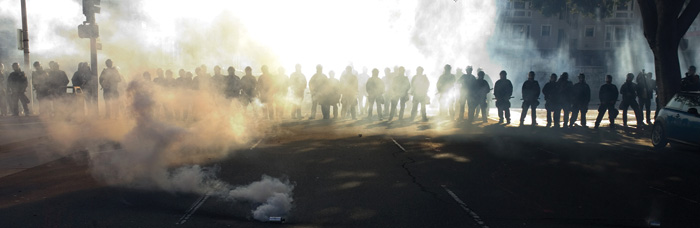
Frankly, it made sense to be prepared: In other Occupy Oakland actions, police have attacked with batons, tear gas, pepper spray, flash-bang grenades, and smoke bombs. And for quite a few Oakland residents, the police have always been seen as an outside force that can’t be trusted.

In fact, violence did break out. Many, including myself, have eyes still stinging from tear gas. I saw several wounds caused by rubber bullets shot at protesters. I spoke individually to at least a dozen people — one of them a pregnant woman — who were struck with police batons.

And protesters did not remain peaceful while this violence was being used against them.

Some picked up tear gas canisters and threw them back towards police; that much I saw. I also saw protesters throw empty plastic bottles at police.

According to the police, they also threw metal pipes, rocks and bricks. According to the protesters, they threw mainly empty plastic bottles and fruit at police. But as protesters often say of the police, “They’re the ones who showed up with the guns.” If the cops didn’t want violence, why unleash such an arsenal of weapons?

People got hurt, protesters and police alike. Several bystanders who had nothing to do with the situation were swept up in the mass arrest.

The city of Oakland, already in dire financial straits, likely spent hundreds of thousands of dollars reacting to the protests. Police claim that they were unable to sufficiently respond to violent crimes over the weekend, including five murders, because they were overwhelmed with Occupy troublemakers.

Of course, city officials were the ones who decided to arrest 400 people — with all the expense that involves.

There are, at this point, no reports of serious injuries to any police officers. However, at least a dozen protesters had welts on their faces or bodies from being beaten by clubs or shot with rubber bullets. One woman was shot in both arms with rubber bullet; one man was shot in the face with rubber bullets while holding a video camera to document the events. Several protesters were shoved to the ground and received wounds on their faces while being arrested. Police raised their rubber-bullet rifles to the faces of protesters throughout the day, threatening attacks. A rubber bullet to the face can cause brain damage and blindness.


DID IT HAVE TO HAPPEN?

How could this have been prevented?

Police say that “while peaceful forms of expression and free speech rights will be facilitated, acts of violence, trespassing, property destruction and overnight lodging will not be tolerated.” But 40 people were arrested during an ongoing Occupy Oakland vigil in the first weeks of January for having “illegal property” at OGP in what many saw as clearly a peaceful expression of First Amendment rights.

On KGO radio Jan. 29, Chief Jordan said that he has allowed Occupy Oakland to protest without a permit and would continue to do so, but those early January raids were ostensibly due to permit violations — violations of the terms of a permit that Occupy Oakland did in fact have.

There’s no question: The police response to Occupy Oakland over the past few months has caused some people in the movement to get more radical.

Many Occupy Oakland-affiliated medics condemned those who threw objects at police, saying that they provoked a backlash that caused more injuries. Many Oakland residents who might be in line with the socio-economic critique presented by the Occupy movement feel endangered and confused by marches that result in the massive use of police weapons in broad daylight. A lot of people would rather protest in a lot of ways that less resemble urban warfare.

On the other hand, there are also ways that Oakland officials could have prevented the consequences of weapons deployed and 400 arrested Jan. 28. They could, for example, have allowed protesters to occupy the vacant building.

When protesters seized a building Jan. 20 in San Francisco, police first attempted to prevent them. They lined up in front of the targeted building. They deployed pepper spray and struck several protesters with batons. When they were unsuccessful, and protesters entered the building from the back, they opted to block the surrounding streets and wait until the time seemed right to enter the situation and make arrests. Police spokesperson Carlos Manfredi told me that the cops were not going to rush into the situation and were trying to prevent injury and violence.

The Kaiser Convention Center has been vacant for years. The city of Oakland recently made plans to sell it to its Redevelopment Agency, but that plan fell into legal limbo when Gov. Jerry Brown signed AB26, a bill that dissolved all California redevelopment agencies.

At this point, nobody at Oakland City Hall has any plans whatsoever for the big, empty structure.

Why not allow Occupy to use the convention center? It’s not downtown, where Mayor Quan says businesses have been adversely affected by Occupy Oakland’s presence. It would give the movement a chance to stop focusing on trying to occupy spaces and start focusing on benefiting the community with food, shelter, and community programs that they provided when they had a camp. It would give the building tenants who could be held responsible for maintaining it. It might even help get Occupy Oakland and the Oakland Police Department out of the cycle of violence that they have been spiraling into for months.

Each time arrests occur, each time violence occurs, both sides blame the other. Both sides are correct that they were provoked. Both sides are correct that something that they think is worth defending was violated — for the cops, it’s the law. For the protesters, it’s the right of the people to assemble.

In fact, many Oakland residents have experienced violence at the hands of the Oakland Police Department for years before Occupy began. There was already a mass movement formed around the murder of Oscar Grant, and thousands of people fed up with police murders of unarmed, often black, suspects.

In recent decades, other radical groups, notably the Black Panthers, insisted that their community lacked basic needs because the city of Oakland refused to prioritize them. The Black Panther free breakfast program served food in a strikingly similar way to Occupy Oakland. Black Panthers were also notorious for carrying guns to defend themselves against police violence.

Occupy Oakland protesters (unlike Tea Party members) certainly don’t carry guns. But, more and more, they cry “fuck the pigs” as much as any Panther.

For much of the Occupy movement’s 99 percent, unjust actions by banks, corporations, and the government officials that they have often bought and paid for are the worst problems facing the United States today. For others, particularly the poor and people of color, these problems are magnified and exacerbated by the fact that they feel the threat of police harassment every day. For years, they’ve understood that police disproportionately do not investigate or solve crimes that happen to them and their families.


THE RADICALS AND THE BROADER MOVEMENT

The Oakland General Assembly Jan. 29 was the biggest it’s been in weeks. While there were still over 300 people in jail, 300 more came out to get involved with the meeting. That happened at the same time that many who felt that inexcusable violence and property destruction occurred Jan. 28 and concluded they could no longer have anything to do with Occupy Oakland.

It’s a challenge for the movement nationally, too: How do you accept and encourage the people whose legitimate anger at economic injustice and police abuse turns them toward more radical responses — and at the same time make room for a people who want nothing to do with the black bloc Fs, vandalism, and confrontation with the police?

There are tactical issues with the way the building occupation was planned. Many who were completely in line with the concept felt unsafe and uncomfortable with the secretive nature of the organizers who planned it. The location of the building targeted for occupation was kept secret for practical reasons; police could easily prevent a successful takeover. Supporters must often be led to the locations of planned takeovers without knowing where the action is and how they’ll get there. But how do you reconcile this with the transparency required when organizers are leading more than 1,000 people who want to use tactics they feel comfortable with and make their own choices?

Occupy Oakland is asking the people to imagine a world where property rights wouldn’t prevent them from doing all the good that they could do with a building like the Kaiser Convention Center. They must also ask themselves to imagine a world in which goals like a building occupation can be achieved in a way that everyone involved is able to consent to their involvement.

These debates continue to occur at Occupy Oakland. Some will leave the movement, some will join. Some will take the ideas and try to manifest them in new and different ways. Participants in Occupy Oakland desperately want basic needs of food and shelter met for their community members, and for the system that governs the city to do so in a way that allows people to thrive when it comes to health, education, and opportunities for creativity and growth. They think that they have the beginnings of a community and a process that can achieve those visions, better than the city government ever has, and they care more about achieving it than respecting the property rights of the owners of abandoned buildings.

What are people?

4

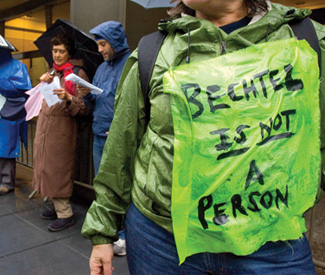
Protesters from the Occupy movement and beyond gathered in front of the Ninth Circuit Court of Appeals in San Francisco on Jan. 20, calling for the adoption of a 28th amendment to the U.S. Constitution aimed at refuting the idea that corporations should have the same rights as people, a legal doctrine know as corporate personhood.

The event was part of a day of action at courthouses around the country, seeking to raise public awareness about the unfettered influence of corporate money in U.S. elections and draw attention to the second anniversary of the landmark corporate personhood decision by U.S. Supreme Court, Citizens United vs the Federal Elections Commission.

“We are here not to protest, not to petition, and not to plead, but to proclaim a truth that should be self evident, even to the Supreme Court: Corporations are not people; money is not speech,” said Abraham Entin, of North Bay Move To Amend, addressing a crowd gathered at the courthouse. “Corporations work very hard to convince us that we cannot do without them and the products they produce. They tell us they are too big to fail, and that our survival is dependent on their survival … Occupy has changed all that.”

In a contentious 5-4 ruling handed down on Jan. 21, 2010, the Citizens United case solidified the legal framework that bequeaths corporations the same rights under the Constitution as real, living, breathing, U.S. citizens, and by merit of their First Amendment rights as citizens bars any restrictions placed on a corporation’s ability to spend money to influence elections.

When Republican presidential candidate Mitt Romney famously said on the campaign trail that “corporations are people, my friend, because corporations have people inside them,” he is reflecting the logic of the majority opinion in the Citizens United case. The court’s majority asserted that corporations are essentially an association of people and thus enjoy the same rights as individuals.

The court also claimed that it is impossible to distinguish between the corporate media outlets and other corporate speech, so all corporations should enjoy the free speech rights saved for the press. Furthermore, because journalists often have to spend money to achieve speech, money spent on messaging by all corporations represents protected speech.

Corporations, a relatively modern invention, aren’t actually discussed in the Constitution. But the notion of corporation personhood began around 1886 in the case of Santa Clara County v. Southern Pacific Railroad. What Citizens United did was equate corporate money spent to influence elections with protected political speech, upending attempts at election reforms and gutting the McCain-Feingold Act of 2002 that regulated federal election campaigns.

That corporations act to corrupt our democratic systems for their own profit is not conspiracy, it’s simply a byproduct of what they are. Corporations are legally obligated to act to maximize their profits for the benefit of their shareholders, otherwise their board and corporate officers are considered negligent of their obligations to their shareholders’ financial interests. Unlike journalists, whose professional credo calls for fairness and acting in the public interest, corporations are designed to act in their own interests.

As Justice John Paul Stevens wrote for the dissenting judges in Citizens United, “Corporations have no consciences, no beliefs, no feelings, no thoughts, no desires. Corporations help structure and facilitate the activities of human beings, to be sure, and their ‘personhood’ often serves as a useful legal fiction. But they are not themselves members of ‘We the People’ by whom and for whom our Constitution was established.”

The resulting flood of corporate money into election campaigns since the court’s ruling is delivered through an aqueduct known as the Super PAC (political action committee). In the wake of Citizens United, election spending by Super PACs in the 2010 midterm elections exceeded $300 million dollars, more spending than the overall spending in the previous five midterm elections combined.

Unlike donations to campaigns, which so far remain regulated, Super PAC money is spent directly by the Super PAC, and can be spent attacking as well as supporting candidates, leading to fears that corporations can exert influence on incumbents before a re-election campaigns by threatening to spend money attacking them in the upcoming election cycle.

“Corporations are human creations, state creations, legal entities … There is no reason we cannot limit their spending,” said Carlos Villarreal, executive director of the National Lawyers Guild’s Bay Area chapter. “Nonprofit organizations are limited in their political spending. Churches and charitable organizations are also limited in their spending. So why not for-profit corporations?”

Perhaps no group knows more about government limits to free speech than participants of the Occupy movement. Elastic restrictions on individual free speech and freedom of association rights spelled out in the First Amendment, resting on alleged risks to health and public safety, have led to Occupy encampments across the nation being restricted and evicted, at times enforced by brutal police crackdowns.

The right of the government to restrict individual and group speech that officials believe represents a clear and present danger was established by the Supreme Court in the 1919 Schenck v United States case — the famous “don’t yell fire in a crowded theater” case. What is not widely known is that this case was a re-examination of the famous 1917 Espionage Act. The “crowded theater” was our nation’s entry into World War I, and those being jailed for “yelling fire” were labor organizers and pacifists expressing their opposition to our entry into the war.

Relying on Schenck, courts have consistently defended restrictions on individual free speech when there is a compelling interest to public safety, the so-called “clear and present danger” standard. Villarreal and the crowd gathered before the Ninth Circuit asserted that corporate influence in our democratic processes represents a clear and present danger to society. “There is no more compelling interest than protecting democracy,” said Villarreal.

Despite the apparent double standard, legal experts say the courts action in the Citizens United case leaves a constitutional amendment as the only avenue left for regulating corporate money in elections and ending corporate personhood, but the movement to take on that Herculean task has already begun.

U.S. Sen. Bernie Sanders (I-VT) and Rep. Ted Deutch (D-FL) have introduced legislation proposing a 28th Amendment to the Constitution. While the language differs from another amendment presented by the group Move to Amend, it also takes aim at ending corporate personhood.

“Two years ago, the United States Supreme Court betrayed our Constitution and those who fought to ensure that its protections are enjoyed equally by all persons regardless of religion, race or gender, by engaging in an unabashed power-grab on behalf of corporate America,” Sanders wrote in a Jan. 20 Guardian(UK) column.

In Sanders’ home state of Vermont, the state Senate is also considering a resolution calling for a constitutional amendment against corporate personhood. A similar resolution, authored by Alix Rosenthal, was adopted by the San Francisco Democratic County Central Committee during a special meeting on Jan. 21. There was just one dissenting vote, and DCCC members say they plan to push for the state party organization to also adopt the stance.

The hurdles set forth to amend the U.S. Constitution, outlined in Article V, are substantial. In order for an amendment to even be considered, a super majority of both houses of Congress must initiate the process, or two-thirds of states must call for the amendment. Proposed amendments passing this threshold are then adopted only after three-quarters of state legislatures ratify the proposed amendment. But that difficult road is one the protesters said they are ready to travel. “We are here on a rainy day with warm hearts and wet feet. We are the 100 percent, the humans. No corporation has every experienced the thrill of wet feet,” said Gangs of America author Ted Nace. “We are the fools who go out on a wet day to fix a broken world. Eighty percent of the public want to fix this. That means we are halfway to our goal. What remains is organization, mobilization.”

Occupy is back — with horns and glitter

8

yael@sfbg.com

On Jan. 20, hundreds of activists converged on the Financial District in a day that showed a reinvigorated and energized Occupy movement.

The day of action was deemed “Occupy Wall Street West.” Despite pouring rain, the numbers swelled to 1,200 by early evening.

Critics have said that the Occupy movement is disorganized and lacks a clear message. Some have decried its supposed lack of unity. Others have even declared it dead.

But the broad coalition of community organizations that came together to send a message focused on the abuses of housing rights by corporations and the 1 percent sent a clear message:

The movement is very much alive.


A FULL SCHEDULE

Protesters packed the day with an impressive line-up of marches, pickets, flash mobs, blockades, and everything in between.

The action began at 6:30 a.m., when dozens chained and locked themselves together, blocking every entrance to Wells Fargo’s West Coast headquarters at 420 Montgomery Street. The bank didn’t open for business that morning.

Another group of protesters did the same thing at the Bank of America Building around the corner. A dozen blockaded one of the bank’s entrances from 8:30 a.m. to 6 p.m., preventing its opening. A group organized by Act Now to Stop War and End Racism (ANSWER) closed down the Bank of America branch at Powell and Market for several hours.

The Bank of America branch at Market and Main was also closed when activists turned it into “the Food Bank of America.” Several chained themselves for the door, while others set up a table serving donated food to hundreds of people.

Meanwhile, activists with the SF Housing Rights Coalition and Tenants Union occupied the offices of Fortress Investments, a hedge fund that has overseen the destruction of thousands of rent controlled apartments at Parkmerced. Direct actions also took place at the offices of Bechtel, Goldman Sachs, and Citicorp.

Hundreds picketed the Grand Hyatt at Union Square in solidarity with UNITE HERE Local 2 hotel workers.

A group of about 600 left from Justin Herman Plaza at noon and marched to offices of Fannie Mae, Wells Fargo, and the Immigration and Customs Enforcement Agency (ICE) in a protest meant to draw attention to housing and immigrant-rights issues.

“It’s not just a corporate problem. The government has been complicit in these abuses as well,” said Diana Masaca, one of the protest’s organizers.

More than 100 activists from People Organized to Win Employment Rights (POWER) and the Progressive Workers Alliance “occupied Muni,” riding Muni buses on Market Street with signs and chants demanding free transit for youth in San Francisco.

Another 200 participated in an “Occupy the Courts” action at the Ninth Circuit Court of Appeals, in protest of the Citizens United Supreme Court decision and corporate personhood.


GLITTER AND BRASS

Exhausted, soaked protesters managed to keep a festive spirit throughout the day, with colorful costumes, loud music, and glitter — lots of glitter.

The Horizontal Alliance of Very Organized Queers (HAVOQ) and Pride at Work brought the sparkly stuff, along with streamers and brightly colored umbrellas, to several different actions. Many painted protest slogans onto their umbrellas, proclaiming such sentiments as “I’ll show you trickle down” and “Not gay as in happy, queer as in fuck capitalism.”

According to protester Beja Alisheva, “HAVOQ is about bringing fabulosity to the movement with glitter, queerness, and pride. All day we’ve been showing solidarity between a lot of different types of oppression.”

There was also the Occupy Oakland party bus — a decked-out former AC transit bus — and carnival, a roving party that shut down intersections and bank entrances in its path while providing passengers a temporary respite from rain.

The Brass Liberation Orchestra, a radical marching band that has been energizing Bay Area protests for a decade, showed up in full force with trumpets, drums, trombones, and a weathered sousaphone.

The Interfaith Allies of Occupy also used horns to declare their message. About 30 participated in a mobile service, sounding traditional rams’ horns and declaring the need to “lift up human need and bring down corporate greed.”

Said Rabbi David J. Cooper of Kehela Community Synagogue in Oakland: “Leviticus 19 says, do not stand idly by in the face of your neighbor’s suffering. Well, we’re all neighbors here. Ninety-nine percent of us are suffering in some way, economically or spiritually. And maybe that number is 100 percent.”


FOCUS ON HOUSING

A coalition called Occupy SF Housing called for and organized the day of action, but the messages ranged from environmental to anti-war to immigrant rights.

Many groups did focus in on housing-related issues — and a takeover of a vacant hotel building stressed the urgency and need to house homeless San Francisco residents.

Housing protests included an anti wage-theft occupation led by the Filipino Community Center and the National Alliance for Filipino Concerns at the offices of CitiApartments, an action at the offices of Fortress Investments to demand a halt to predatory equity, and an “Occupy the Auction” demonstration in which protesters with Occupy Bernal stopped the day’s housing auction (at which foreclosed homes are sold) at City Hall.

“A lot of the displacement in this city is happening because of banks and because of things that are out of peoples’ control,” said Amitai Heller, a counselor with the San Francisco Tenants Union. “People will live in a rent controlled apartment for 20 years thinking that they have their retirement planned. A lot of the critiques of the movement are, if you couldn’t afford it you should move. But these people moved here knowing they could afford it because of our rent controls.”


LIBERATE THE COMMONS

Most of the early protests drew a few hundred people. But when the 5 p.m. convergence time rolled around, many people got off work and joined the march. A rally at Justin Herman Plaza brought about 600; by the time the march joined up with others at Bank of America on Montgomery and California, the numbers had doubled.

The evening’s demonstration, deemed “liberate the commons,” was also more radical than other tactics throughout the day; organizers hoped to break into and hold a vacant building, the 600-unit former Cathedral Hill Hotel at 1101 Van Ness.

When protesters arrived at the site, police were waiting for them. Wearing riot gear and reinforced by barricades, the cops successfully blocked the Geary entrance to the former hotel.

The darkness, rain, and uncertainty created a chaotic environment as protesters decided how to proceed. Some attempted to remove barricades; others chanted anti-police slogans.

Soon, cries of “Medic! We need a medic!” pierced the air. A dozen or so protesters had been pepper sprayed.

Police Information Officer Carlos Manfredi later claimed that the pepper spray was in response to “rocks, bottles and bricks” thrown by protesters. He also claimed that one officer was struck in the chest by a brick, and another “may have broken his hand.”

But I witnessed the entire incident, and I can say that no rocks, bottles or bricks were thrown at police.

When protesters opted to march down Van Ness, apparently towards City hall, several broke windows at a Bentley dealership at 999 Van Ness.

The march then turned around and headed back up Franklin, ending at the former hotel’s back entrance. There, it became clear that some protesters had successfully entered the building; they unfurled a banner from the roof reading “liberate the commons.”

Soon, many other protesters streamed into the building. They held it, with no police interference, for several hours.

Around 9:30, police entered the building and arrested three protesters for trespassing. About 15 others remained in the building, but left voluntarily by midnight.

This building has been a target of protest campaigns in San Francisco since it was purchased by California Pacific Medical Center, which closed the hotel in 2009. There are plans underway for a hospital to open at the site in 2015.

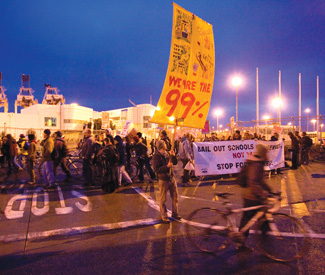
The project has been met with opposition from unions such as SEIU United Healthcare Workers West and UNITE HERE Local 2. The California Nurses Association (CNA) has also come out against the hospital proposal. In fact, it was the target of a CNA protest earlier in the day Jan. 20, when protesters created a “human billboard” reading “CPMC for the 1 percent.”

At a Jan.18 press conference, CNA member Pilar Schiavo said that at the former Cathedral Hill Hotel site, “A huge hospital is being planned with is being likened by Sutter to a five-star hotel. At the same time, Sutter is gutting St. Lukes Hospital, which is essential to providing healthcare for residents in the Mission, the Excelsior and Bayview- Hunter’s Point.”

Homes Not Jails, a group that finds housing for the homeless, often without regard to property rights, was crucial to planning the “Liberate the Commons’ protest. The group insists that the 30,000 vacant housing units in San Francisco should be used to shelter the city’s homeless, which they estimate at 10,000.


RAINY REBIRTH

Wet and cold conditions were not what Occupy SF Housing Coalition organizers had in mind they spent weeks planning Occupy Wall Street West, which was billed as the reemergence of the Occupy Movement in San Francisco for 2012.

Yet for many, the day was still a success.

“The rain’s a downer. But I think it speaks to the power of the movement, the fact that all these people are still out getting soaked,” said Heller on Jan. 20.

Perhaps hundreds of “fair-whether activists” did forgo the day’s events to stay out of the cold. If that’s the case, then occupy protesters with big plans for the spring should be pleased.

At this rate, it seems that Occupy will survive the winter- and emerge with renewed energy in 2012.


This article has been to corrected. We originally reported that a demonstration at the offices of Citi Apartments was led by the Chinese Progressive Association (CPA). In fact, it was led by the Filipino Community Center and the National Alliance for Filipino Concerns, and supported by a number of organizations including the Progressive Workers Alliance, of which CPA is a member organization. We regret the error.

“Occupy Wall Street West” hopes to see massive protest

14

A coalition from across San Francisco is hoping to make tomorrow – Friday, Jan. 20 – a monumental day in the history of Bay Area activism, the Occupy movement, and the fight against home foreclosures and other manifestations of corporate greed.Organizers call the day of protests, marches, street theater, pickets, and more “Occupy Wall Street West.”

Those that urged Occupy protesters to focus in on a list of demands should be pleased, as the day includes a list of demands on banks, including a moratorium on foreclosures and an end to predatory and speculative loans.


Organizers note that Occupy SF Housing, the coalition that planned the day, is separate from OccupySF. In fact, a subset of the group known best for its months-long tent city at Justin Herman Plaza was only one part of a substantial coalition that planned this day of action. Among others, the coalition includes the SF Housing Rights Committee, Homes Not Jails, Alliance of Californians for Community Empowerment (ACCE), and Occupy Bernal, a neighborhood-focused Occupy group specifically aimed at preventing evictions and foreclosures.

Justin Herman Plaza – or Bradley Manning Plaza, as many in OccupySF like to refer to the park just across from the Ferry Building – will be a crucial meeting point. A press spokesperson said that “down at Bradley Manning Plaza at 6 a.m.,12 p.m., and 5 p.m., we’re going to be launching various segments of the protests, and there will be information desks and education all for those who are interested.”

Organizers hope to culminate the day with a mass march at 5 p.m. A map of the planned actions can also be found here.

Many of the groups in the coalition have focused on specific cases of homeowners and tenants facing eviction and foreclosure; tomorrow, they bring their power to the Financial District.

Vivian Richardson, a member of the coalition who has also worked with ACCE and the newer Foreclosure Fighters group in Bayview, says that she remains in her home after being threatened with foreclosure due to community support.

“On my own, I tried everything to get out of this bad loan… I fought for two years on my own, only to have my home foreclosed on and taken away,” Richardson said at a press conference held yesterday.

“With the help of my community, unions, and ACCE members throughout the state, we generated over 1,400 emails and a few hundred calls to the CEO of [lender] Aurora Bank, and within one hour they called me to reopen my case,” she said. “As of today, the bank has voided the sale of my home and rescinded the foreclosure.”

Groups hoping to prevent foreclosures have had many success stories like Richardson’s. But tomorrow, they will put pressure on large corporate banks.

As SF Housing Rights Committee Executive Director Sarah Shortt said at the rally, “What we’re trying to do here is draw connections between some of those issues and the banking industry… I think that’s one of the most important pieces of the Occupy movement: starting to educate ourselves and each other about how ubiquitous the toll that’s been taken on cities, neighborhoods, communities by banking industry and the one percent.”

The focus is on housing, but in typical Occupy fashion, protesters will draw connections between all kinds of concerns that they see as abuses by banks and corporations.

According to OccupySF member Lisa Guide, the day is about “war profiteering, unjust foreclosures and evictions for profits by the big banks, exploitation of labor and union workers, and liberation of the commons for public good, among many other [issues].”

Guide also mentioned that Jan. 20 is “the eve of the Citizens United Supreme Court case, the court case that gave corporations the power to buy our government.” Simultaneous actions are planned to protest Citizens United, including an Occupy the Courts action at the Ninth District Court of Appeals at noon, to coincide with a national call to “Occupy the Courts

More than 55 organizations are involved in the day of action, and their focuses go beyond housing rights. These include students from Occupy SF State, Occupy Modesto Junior College, and other campus Occupy groups; anti-war organizations such as Iraq Veterans Against the War; environmental organizations such as the Rainforest Action Network; several unions, including UNITE HERE Local 2 and the California Nurses Association; the Chinese Progressive Alliance; and the Interfaith Allies of Occupy, which will be hosting an all-day “respite area” at Saint Patrick’s Roman Catholic Church at 756 Mission.

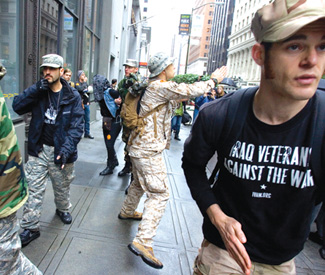
The array of events planned for Friday is overwhelming. There are demonstrations, pickets, and occupations planned at dozens of banks and corporations throughout the Financial District. Street theater is planned in several places, including an adaptation of A Christmas Carol by the San Francisco Mime Troupe at Justin Herman Plaza at noon and a show from Iraq Veterans Against the War that, according to IVAW member Jason Matherne, a Navy veteran who served in Qatar, “is called Operation First Casualty, because the first casualty of war is the truth.”

Matherne said, “corporations are profiting off the war at the expense of the 99 percent. Specifically, the Bechtel Corporation is using–misusing–billions of dollars to rebuild the infrastructure in Iraq.”

Tomorrow should be big. In a press release, organizers claim that “this is predicted to be the largest street protest of the Financial District since anti-war protests in 2003.”

Whatever the turnout, the Saint Patrick’s “respite” should be a boon, as weather reports indicate rain for tomorrow. Luckily, as Vicki Gray, a Deacon in the Episcopal Diocese of California, Occupy supporter and Interfaith Organizer, said of the sanctuary: “All are welcome. It will be warm, it will be quiet, and you will be loved.”

Louis Dunn comments on Mitt Romney statement that “corporations are people”

1

“Corporations are people, my friend,” says Mitt Romney on the campaign trail.

Hear him emphasize and embellish the point: 

www.youtube.com/watch?v=E2h8ujX6T0A

Guardian graphic by Louis Dunn

Alerts

0

yael@sfbg.com


FRIDAY, JAN 20

Occupy Wall Street West

OccupySF revs back up for a day of nonviolent mass action to connect their protest against Wall Street banks and corporations to foreclosures, evictions, and homelessness here in San Francisco. The day will include teach-ins, marches, rallies, and “many ways to participate without risking arrest!”

Mobilizations at 6 a.m., noon, and 5 p.m., free

101 Market, SF

www.occupywallstwest.org/wordpress


SATURDAY 21

Chalk screening

A screening of the landmark Bay Area grassroots/indie film Chalk, which tells the story of competition, family, justice, and a game of pool. The film is a product of the Tenderloin Action Group, which creates “responsive cinema, generated out of the streets from pain and sacrifice, made from sweat, tears, and anguish.” Join producers Ethan Sing and Rand Crook for this screening.

2 p.m., free

Koret Auditorium, San Francisco Public Library main branch

100 Larkin, SF

www.sfpl.org

ggood@sfpl.org


Rally for Reproductive Justice

This annual rally for a woman’s right to choose started to counter-protest the pro-life Walk for Life march. This year, a rally will be held with speakers Sen. Mark Leno, Sup. David Chiu, and representatives from Slutwalk, Radical Women, and CA NOW. Also featuring a DIY art/activist tent and balloon artists and face paint for kids. Organized by Bay Area Coalition for our Reproductive Rights (BACORR.)

11 a.m., free

Justin Herman Plaza

Embarcadero and Market, SF

www.bacorr.org


SUNDAY 22

Remember Harding

The Kenneth Harding Jr. Foundation, in commemoration of the 19-year-old who was killed by San Francisco Police officers on July 16, calls for a protest to demand justice. Harding was unarmed when he exited the T train and was asked by police to show his transfer.

Instead, he ran away and police shot and killed him. Organizers plan to surround Candlestick Park during the NFC championship game to “raise awareness that police in the Bay View/Hunters Point community are killing our kids, violating our rights, and trying to silence us.”

Noon, free

Candlestick Park

602 Jamestown Ave, SF

www.poormagazine.org/node/4238 

Occupy Nation

15

news@sfbg.com

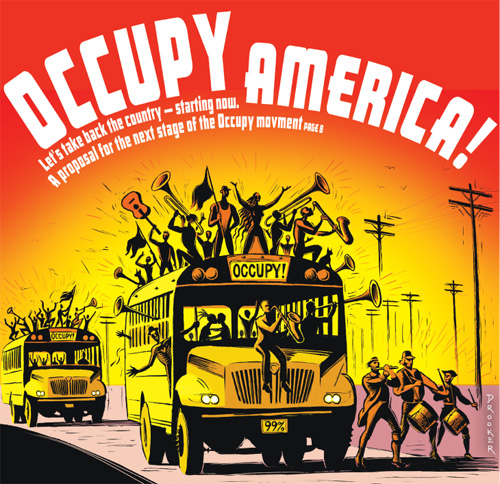
The Occupy movement that spread across the country last fall has already changed the national discussion: It’s brought attention to the serious, systemic problem of gross inequities of wealth and power and the mass hardships that have resulted from that imbalance.

Occupy put a new paradigm in the political debate — the 1 percent is exploiting the 99 percent — and it’s tapping the energy and imagination of a new generation of activists.

When Adbusters magazine first proposed the idea of occupying Wall Street last summer, kicking off on Sept. 17, it called for a focus on how money was corrupting the political system. “Democracy not Corporatocracy,” the magazine declared — but that focus quickly broadened to encompass related issues ranging from foreclosures and the housing crisis to self-dealing financiers and industrialists who take ever more profits but provide fewer jobs to the ways that poor and disenfranchised people suffer disproportionately in this economic system.

It was a primal scream, sounded most strongly by young people who decided it was time to fight for their future. The participants have used the prompt to create a movement that drew from all walks of life: recent college graduates and the homeless, labor leaders and anarchists, communities of colors and old hippies, returning soldiers and business people. They’re voicing a wide variety of concerns and issues, but they share a common interest in empowering the average person, challenging the status quo, and demanding economic justice.

We chronicled and actively supported the Occupy movement from its early days through its repeated expulsions from public plazas by police, particularly in San Francisco, Oakland, and Berkeley. We supported the right of the protesters to remain — even as we understood they couldn’t and shouldn’t simply stay forever. Occupy needed to evolve if it was to hold the public’s interest. The movement would ultimately morph into something else.

That time has come. This spring, Occupy is poised to return as a mass movement — and there’s no shortage of energy or ideas about what comes next. Countless activists have proposed occupying foreclosed homes, shutting down ports and blocking business in bank lobbies. Those all have merit. But if the movement is going to challenge the hegemony of the 1 percent, it will involve moving onto a larger stage and coming together around bold ideas — like a national convention in Washington, D.C. to write new rules for the nation’s political and economic systems.

Imagine thousands of Occupy activists spending the spring drafting Constitutional amendments — for example, to end corporate personhood and repeal the Citizens United decision that gave corporations unlimited ability to influence elections — and a broader platform for deep and lasting change in the United States.

Imagine a broad-based discussion — in meetings and on the web — to develop a platform for economic justice, a set of ideas that could range from self-sustaining community economics to profound changes in the way America is governed.

Imagine thousands of activists crossing the country in caravans, occupying public space in cities along the way, and winding up with a convention in Washington, D.C.

Imagine organizing a week of activities — not just political meetings but parties and cultural events — to make Occupy the center of the nation’s attention and an inspiring example for an international audience.

Imagine ending with a massive mobilization that brings hundreds of thousands of people to the nation’s capitol — and into the movement.

Occupy activists are already having discussions about some of these concepts (see sidebar). Thousands of activists are already converging on D.C. right now for the Occupy Congress, one of many projects that the movement can build on.


DEFINING MOMENTS

Mass social movements of the 20th Century often had defining moments — the S.F. General Strike of 1934; the Bonus Army’s occupation of Washington D.C.; the Freedom Rides, bus boycotts and Rev. Martin Luther King Jr.’s March on Washington; Earth Day 1970; the Vietnam War teach-ins and moratoriums. None of those movements were politically monolithic; all of them had internal conflicts over tactics and strategies.

But they came together in ways that made a political statement, created long-term organizing efforts, and led to significant reforms. Occupy can do the same — and more. At a time of historic inequities in wealth and power, when the rich and the right wing are stealing the future of generations of Americans, the potential for real change is enormous.

If something’s going to happen this spring and summer, the planning should get under way now.

A convention could begin in late June, in Washington D.C. — with the goal of ratifying on the Fourth of July a platform document that presents the movement’s positions, principles, and demands. Occupy groups from around the country would endorse the idea in their General Assemblies, according to procedures that they have already established and refined through the fall, and make it their own.

This winter and spring, activists would develop and hone the various proposals that would be considered at the convention and the procedures for adopting them. They could develop regional working groups or use online tools to broadly crowd-source solutions, like the people of Iceland did last year when they wrote a new constitution for that country. They would build support for ideas to meet the convention’s high-bar for its platform, probably the 90 percent threshold that many Occupy groups have adopted for taking action.

Whatever form that document takes, the exercise would unite the movement around a specific, achievable goal and give it something that it has lacked so far: an agenda and set of demands on the existing system — and a set of alternative approaches to politics.

While it might contain a multitude of issues and solutions to the complicated problems we face, it would represent the simple premise our nation was founded on: the people’s right to create a government of their choosing.

There’s already an Occupy group planning a convention in Philadelphia that weekend, and there’s a lot of symbolic value to the day. After all, on another July 4th long ago, a group of people met in Philly to draft a document called the Declaration of Independence that said, among other things, that “governments … deriv[e] their just powers from the consent of the governed … [and] whenever any Form of Government becomes destructive of these ends, it is the Right of the People to alter or to abolish it, and to institute new Government, laying its foundation on such principles and organizing its powers in such form, as to them shall seem most likely to effect their Safety and Happiness.”


ON THE ROAD

If the date is right and the organizing effort is effective, there’s no reason that Occupy couldn’t get close to a million people into the nation’s capital for an economic justice march and rally.

That, combined with teach-ins, events and days of action across the country, could kick off a new stage of a movement that has the greatest potential in a generation or more to change the direction of American politics.

Creating a platform for constitutional and political reform is perhaps even more important than the final product. In other words, the journey is even more important than the destination — and when we say journey, we mean that literally.

Occupy groups from around the country could travel together in zig-zagging paths to the Capitol, stopping and rallying in — indeed, Occupying! — every major city in the country along the way.

It could begin a week or more before the conference, along the coasts and the northern and southern borders: San Francisco and Savannah, Los Angeles and New York City, Seattle and Miami, Chicago and El Paso, Billings and New Orleans — Portland, Oregon and Portland, Maine.

At each stop, participants would gather in that city’s central plaza or another significant area with their tents and supplies, stage a rally and general assembly, and peacefully occupy for a night. Then they would break camp in the morning, travel to the next city, and do it all over again.

Along the way, the movement would attract international media attention and new participants. The caravans could also begin the work of writing the convention platform, dividing the many tasks up into regional working groups that could work on solutions and new structures in the encampments or on the road.

At each stop, the caravan would assert the right to assemble for the night at the place of its choosing, without seeking permits or submitting to any higher authorities. And at the end of that journey, the various caravans could converge on the National Mall in Washington D.C., set up a massive tent city with infrastructure needed to maintain it for a week or so, and assert the right to stay there until the job was done.

The final document would probably need to be hammered out in a convention hall with delegates from each of the participating cities, and those delegates could confer with their constituencies according to whatever procedures they prescribe. This and many of the details — from how to respond to police crackdowns to consulting of experts to the specific scope and procedures of this democratic exercise — would need to be developed over the spring.

But the Occupy movement has already started this conversation and developed the mechanisms for self-governance. It may be messy and contentious and probably even seem doomed at times, but that’s always the case with grassroots organizations that lack top-down structures.

Proposals will range from the eminently reasonable (asking Congress to end corporate personhood) to the seemingly crazy (rewriting the entire U.S. Constitution). But an Occupy platform will have value no matter what it says. We’re not fond of quoting Milton Friedman, the late right-wing economist, but he had a remarkable statement about the value of bold ideas:

“It is worth discussing radical changes, not in the expectation that they will be adopted promptly, but for two other reasons. One is to construct an ideal goal, so that incremental changes can be judged by whether they move the institutional structure toward or away from that ideal. The other reason is very different. It is so that if a crisis requiring or facilitating radical change does arrive, alternatives will be available that have been carefully developed and fully explored.”

After the delegates in the convention hall have approved the document, they could present it to the larger encampment — and use it as the basis for a massive rally on the final day. Then the occupiers can go back home — where the real work will begin.

Because Occupy will wind up spawning dozens, hundreds of local and national organizations — small and large, working on urban issues and state issues and national and international issues.


WASHINGTON’S BEEN OCCUPIED BEFORE

The history of social movements in this country offers some important lessons for Occupy.

The notion of direct action — of in-your-face demonstrations designed to force injustice onto the national stage, sometimes involving occupying public space — has long been a part of protest politics in this country. In fact, in the depth of the Great Depression, more than 40,000 former soldiers occupied a marsh on the edge of Washington D.C., created a self-sustaining campground, and demanded that bonus money promised at the end of World War I be paid out immediately.

The so-called Bonus Army attracted tremendous national attention before General Douglas Macarthur, assisted by Major George Patton and Major Dwight Eisenhower, used active-duty troops to roust the occupiers.

The Freedom Rides of the early 1960s showed the spirit of independence and democratic direct action. Raymond Arsenault, a professor at the University of South Florida, brilliantly outlines the story of the early civil rights actions in a 2007 Oxford University Press book (Freedom Rides: 1961 and the Struggle for Racial Justice) that became a national phenomenon when Oprah Winfrey devoted a show and a substantial online exhibition to it.

Arsenault notes that the rides were not popular with what was then the mainstream of the civil rights movement — no less a leader than Thurgood Marshall thought the idea of a mixed group of black and white people riding buses together through the deep south was dangerous and could lead to a political backlash. The riders were denounced as “agitators” and initially were isolated.

The first freedom ride, in May, 1961, left Washington D.C. but never reached its destination of New Orleans; the bus was surrounded by angry mobs in Birmingham, Alabama, and the drivers refused to continue.

But soon other rides rose up spontaneously, and in the end there were more than 60, with 430 riders. Writes Arsenault:

“Deliberately provoking a crisis of authority, the Riders challenged Federal officials to enforce the law and uphold the constitutional right to travel without being subjected to degrading and humiliating racial restrictions … None of the obstacles placed in their path—not widespread censure, not political and financial pressure, not arrest and imprisonment, not even the threat of death—seemed to weaken their commitment to nonviolent struggle. On the contrary, the hardships and suffering imposed upon them appeared to stiffen their resolve.”

The Occupy movement has already shown similar resolve — and the police batons, tear gas, pepper spray, and rubber bullets have only given the movement more energy and determination.

David S. Meyer, a professor at U.C. Irvine and an expert on the history of political movements, notes that the civil rights movement went in different directions after the freedom rides and the March on Washington. Some wanted to continue direct action; some wanted to continue the fight in the court system and push Congress to adopt civil rights laws; some thought the best tactic was to work to elect African Americans to local, state and federal office.

Actually, all of those things were necessary — and Occupy will need to work on a multitude of levels, too, and with a diversity of tactics.

Single-day events have had an impact, too. Earth Day, 1970, was probably the largest single demonstration of the era — in part because it was so decentralized. A national organization designed events in some cities — but hundreds of other environmentalists took the opportunity to do their own actions, some involving disrupting the operations of polluters. The outcome wasn’t a national platform but the birth of dozens of new organizations, some of which are still around today.

There’s an unavoidable dilemma here for this wonderfully anarchic movement: The larger it gets, the more it develops the ability to demand and win reforms, the more it will need structure and organization. And the more that happens, the further Occupy will move from its original leaderless experiment in true grassroots democracy.

But these are the problems a movement wants to have — dealing with growth and expanding influence is a lot more pleasant than realizing (as a lot of traditional progressive political groups have) that you aren’t getting anywhere.

All of the discussions around the next step for Occupy are taking place in the context of a presidential election that will also likely change the makeup of Congress. That’s an opportunity — and a challenge. As Meyer notes, “social movements often dissipate in election years, when money and energy goes into electoral campaigns.” At the same time, Occupy has already influenced the national debate — and that can continue through the election season, even if (as is likely) neither of the major party candidates is talking seriously about economic justice.

That’s why a formal platform could be so useful — candidates from President Obama to members or Congress can be presented with the proposals, and judged on their response.

Some of the Occupy groups are talking about creating a third political party — a daunting task, but certainly worth discussion.

But the important thing is to let this genie out of the bottle, to move Occupy into the next level of politics, to use a convention, rally, and national event to reassert the power of the people to control our political and economic institutions — and to change or abolish them as we see fit.

OCCUPY AMERICA IS ALREADY UNDERWAY

All across the country, Occupy organizers are developing and implementing creative ways to connect and come together, many of which we drew from for our proposal. We hope all of these people will build on each other’s ideas, work together, and harness their power.

From invading the halls of Congress to “occutripping” road trips to ballot initiatives, here is a list of groups already working on ways to Occupy America:


OCCUPY CONGRESS

Occupy Congress is an effort to bring people from around the country — and, in many cases, from around the world — to Washington DC on Jan. 17. The idea is to “bring the message of Occupy to the doorstep of the capital.” The day’s planned events include a “multi-occupation general assembly,” as well as teach-ins, idea sharing, open mics, and a protest in front of the Capitol building.

A huge network of transportation sharing was formed around Occupy Congress, with a busy Ridebuzz ridesharing online bulletin board, and several Occupy camps organizing buses all around the country, as well as in Montreal and Quebec.

There are still two Occupy tent cities in DC, the Occupy DC encampment at McPherson Square and an occupation called Freedom Plaza, just blocks from the White House. Both will be accepting hundreds of new occupiers for the event, although a poster on the Occupy Congress website warns that “the McPherson Square Park Service will be enforcing a 500 person limit.”

www.occupyyourcongress.info


OCCUPY BUS

The Occupy Bus service was set up for Occupy Congress, but organizers say if the idea works out, it can grow and repeat for other national Occupy calls to action. They have set up buses leaving from 60 cities in 28 U.S. states as well as Canada’s Quebec province. The buses are free to those who can’t afford to pay, and for those who pay, all profits will be donated to Occupy DC camps.

If all goes to plan, buses will be packed with passengers, their gear, and bigger donations for the event, as the “undercarriages of a bus are voluminous.” What gear do they expect each occupier to bring? “One large bag, one small bag, and a tent.”

congress.occupybus.com


DENVER OCCUTRIP

Many occupations have put together car and busloads of people to road trip to other occupations, hoping to learn, teach, network, and connect the movement across geographic barriers. One example is the Denver Occutrip, in which a handful of protesters toured West Coast occupations. The tenacious Occupy Denver recently made headlines when, rather than allow police to easily dismantle their encampment, a couple of occupiers set the camp on fire. It sent delegates to Occupations in Las Vegas, Los Angeles, Long Beach, Oakland, San Francisco, Berkeley, and Sacramento.

Sean Valdez, one of the participants, said the trip was important to “get the full story. What I’d been told by the media was that Occupy Oakland was pretty much dead, but we got there and saw there are still tons of dedicated, organized people working on it. It was important to see it with our own eyes, and gave a lot of hope for Occupy.”

Like lots of road-tripping Occupiers, they made it to Oakland for the Dec. 12 West Coast Port Shutdown action there. In fact, “occutrippers” from all around the country have flocked to Bay Area occupations in general, and especially the uniquely radical Occupy Oakland.

www.occupydenver.org/denver-occutrip-road-trip/


OCCUPY THE CONSTITUTION

An Occupy Wall Street offshoot — Constitution Working Group, Occupy the Constitution — argues that many of the Occupy movements concerns stem from violations of the constitution. They hope to address this with several petitions on issues such as corporate bailouts, war powers, public education, and the Federal Reserve bank. The group hopes to get signatures from 3-5 percent of the United States population before the list of petitions is “formally served to the appropriate elected officials.”

www.givemeliberty.org/occupy


THE 99% DECLARATION

This is a super-patriotic take on the Occupy movement, described on its website as an “effort run solely by the energy of volunteers who care about our great country and want to bring it back to its GLORY.” The group’s detailed plan includes holding nationwide elections on the weekend of March 30 to choose two delegates from “each of the 435 congressional districts plus Washington, D.C. and the U.S. Territories.”

These delegates would write up lists of grievances with the help of their Occupy constituents, then convene on July 4, 2012 in Philadelphia for a National General Assembly. They plan to present a unified list of grievances to Congress, the President, and the Supreme Court. If the grievances are not addressed, they would “reconvene to organize a new grassroots campaign for political candidates who publicly pledge to redress the grievances. These candidates will seek election for all open Congressional seats in the mid-term election of 2014 and in the elections of 2016 and 2018.”

www.the-99-declaration.org/


MOVE TO AMEND/OCCUPY THE COURTS

Move to Amend is a coalition focusing on one of the Occupy movement’s main concerns: corporate personhood. The group hopes to overturn the Citizens United vs. Federal Elections Commission ruling and “amend our Constitution to firmly establish that money is not speech, and that human beings, not corporations, are persons entitled to constitutional rights.”

The group has drafted a petition, signed so far by more than 150,000 people, and established chapters across the country. Its next big step is a national day of action called Occupy the Courts on Jan. 20. On the anniversary of the Citizens United ruling, the group plans to “Occupy the US Supreme Court” and hold solidarity occupations in federal courts around the country.

www.movetoamend.org/


THE OCCUPY CARAVAN

The Occupy Caravan idea originated at Occupy Wall Street, but the group has been coordinating with occupations across the country. If all goes according to plan, a caravan of RVs, cars, and buses will leave Los Angeles in April and take a trip through the South to 16 different Occupations before ending up in Washington DC.

Buddy, one of the organizers, tells us that the group already has “a commitment right now of 10 to 11 RVs, scores of vehicles, and a bio-diesel green machine bus. This caravan will visit cities, encircle city halls, and visit the local Occupy groups to assert their presence, and move on to the next, not stopping for long in each destination.”

This caravan is all about the journey, calling itself a “civil rights vacation with friends and family” and planning to gather “more RVs, more cars, more supporters…and more LOVE” along the way.

occupycaravan.webs.com

OCCUPY WALL STREET WEST

The Occupy movement in San Francisco has been relatively quiet for the past few weeks, but it’s planning to reemerge with a bang on Jan. 20, with an all-day, multi-event rally and march that aims to shut down the Financial District.

The protest is an effort to bring attention to banks’ complicity in the housing crisis plaguing the United States, and how that process manifests itself here in San Francisco.

At least 20 events are planned, centered in the Financial District. The plans range from teach-ins at banks to “occupy the Civic Center playground” for kids to a planned building takeover where hundreds are expected to risk arrest. A list of planned events can be found at www.occupywallstwest.org/wordpress/?page_id=74.

The day is presented by the Occupy SF Housing Coalition, which includes 10 housing rights and homeless advocacy groups. Dozens of other organizations will be involved in demonstrations throughout the day. “We’re asking the banks to start doing the right thing,” said Gene Doherty, a media spokesperson for the Occupy SF Housing Coalition. “No more foreclosures and evictions for profits. On the 20th, we will bring this message to the headquarters of those banks.”


States push back on Citizens United ruling

44

With the upcoming anniversary of the Citizens United decision, the U.S. Supreme Court ruling that allowed corporations to make unlimited campaign contributions, California Assembly member Julia Brownley (D-Santa Monica) is pushing a bill to ensure that corporate entities making political donations are required to at least disclose those contributions.

The California Disclose Act, AB 1148, specifically addresses accountability in election campaign ads, forcing corporate sponsors to step out from behind cryptic political action committee (PAC) names when they fund political advertisements.

“Currently the top two donors must be disclosed on political ads, usually behind meaningless campaign committee ads,” said Michelle Romero, manager of the Our Democracy program at the Greenlining Institute, which is supporting the legislation. “We hope to really pierce through the committee names to the top three donors behind ballot measure expenditure campaigns.”

Romero’s ideal realization of this bill would be to require political ads to list donors by the name of the corporation, rather than just its made-up PAC name. “Instead of saying, ‘This ad was paid for by the Committee for Responsible California,’ the ad would list the logos and names of top donors,” said Romero. “For example: the donors are Chevron, Comcast, etc.”

Yet other states have taken even bolder steps to counteract the Citizens United decision. The Montana Supreme Court recently affirmed a ban on unlimited corporate spending on political campaigns, seemingly defying the U.S. Supreme Court. But the Montana judges said that due to the rural state’s low-budget elections and the ability of a few large corporations (particularly mining interests) to drown out everyone else, the Citizens United case did not apply to Montana’s Corrupt Practices Law, which bars corporations from using company resources to make political contributions.

“The government is supposed to represent the people,” Romero said, “not corporate interests.” said Romero.

Editor’s notes

0

tredmond@sfbg.com

It’s hard for California cities to raise taxes. Almost anything that amounts to a tax hike has to go before the voters, and most of the time, it requires a two-thirds vote.

But in a year when the local legislators are also up for election — and six of the supervisorial districts are up this fall — the voters can pass taxes with a simple majority.

That’s one reason that 2012 is a perfect year for tax reform in San Francisco. The other is the spirit of Occupy.

The tent-city protests changed the political dynamics all over the country, putting the message of economic injustice on the agenda and on the front pages. That’s even more true in this city, which was one of the epicenters of the national movement.

Mayor Ed Lee announced in his inauguration speech that he’s going to be the mayor “of the 100 percent,” an effort to preach the message that we’re all good pals and we all love each other here in this great city of ours, but the truth is we aren’t, and we don’t. The very rich in San Francisco not only have little in common with the rest of us; for the most part, they like it that way. The biggest corporations and wealthiest individuals have an interest in preserving economic injustice, and they’ve shown repeatedly that they will go to great lengths to prevent progressive change.

San Francisco needs to change the way it raises revenue, and one of the key elements of that is the local business tax. Right now it’s a flat tax on payroll, and a lot of people (including me) don’t like it. So there’s movement for a new type of tax, maybe on gross receipts.

That’s fine — but it has to be more than a shift in how taxes are determined. San Francisco desperately needs more money — probably at least $250 million a year — to balance the budget without further cuts and to make up for what the state and federal government have taken away. And a new business tax needs to be progressive — to hit the biggest and the richest harder than the small and struggling.

I fear the mayor is not going to be pushing that kind of agenda, so someone on the board has to do it. This is the year that a “tax the one percent” measure can win. But we need to get started now.

Ed Lee’s 100 percent

26

I expected a lot of talk about togetherness at the mayor’s inauguration, but Ed Lee went a step further: He acually announced that he wants to be the mayor “for the 100 percent.” That’s a remarkable statement when you think about it, and it indicates to me that Lee doesn’t want to be, and isn’t going to be, and activist leader.

It’s nice to talk at political events about how we’re all in this together, how everyone in San Francisco is part of the same nice big city family, how we all really love each other and can hold hands and build a better city and all that happy horsehit. But the truth is, we aren’t, and we can’t.

San Francisco is a divided city, increasingly split between the rich and the poor, the powerful and the powerless. The politics are bitterly divided — and not because the progressives fought with former mayor Gavin Newsom. No: There are people who are used to getting their way in this town, and they have been for years, and they make up an oligarchy that stands with big landlords, and big developers, and big corporations, often using terms like “job creation”  to disguise an agenda of tax breaks, minimal regulation and a disdain for social justice.

That’s not conspiracy theory; it’s fact, and anyone who has been a part of this city for a long as me knows it.

It’s about political power. An activist, progressive mayor would acknowlege that fact — and the fact that power is never surrendered voluntarily. Sorry to spoil your spirit of togetherness, Ed, but Willie Brown and his clients, including Pacific Gas and Electric Company, have very little in common with me; I want to kick PG&E out of San Francisco and replace it with a publicly-owned utility. There is no compromise here, no middle ground — PG&E has to lose for us to win.

Not every issue in San Francisco is like that — some of the 1 percenters are all in favor of bicycle lanes and same-sex marriage and a lot of other wonderful things. There are plenty of areas where everyone in San Francisco can work together for the glory of our collective greatness.

But there are also issues that involve, yes, class warfare. Ed Lee must know that; he’s been around long enough, fought enough bad guys, stood up for the poor people. But he also apparently thinks he can be mayor and be pals with Brown and the billionaires — and still be on the side of the 99 percent. And it doesn’t work that way. Not if you want to make economic justice a part of the local agenda.

I think Lee’s going to be a lot better than Gavin Newsom, who was intractable and a jerk. But this notion that you never have to pick sides, that there is no 99 percent on one side up against a 1 percent on the other, is either cluelessness or bullshit. And I don’t think Lee is clueless.

Plugging the flow

0

rebeccab@sfbg.com

When significant events related to the Occupy movement occur in the pre-dawn hours, it usually means a protest encampment has been raided. But on Dec. 12, Occupy protesters were the ones carrying out a strategic plan before sun up.

Activists organized by OccupyOakland effectively blocked cargo shipments from moving through several Port of Oakland terminals that day, as part of a coordinated West Coast Port Blockade that featured similar actions in other cities including San Diego, Portland, Seattle, and Longview, Washington.

About 150 longshore workers were sent home from their morning shifts at Oakland shipping terminals because protesters were marching in circular picket lines outside the gates.

The day began when more than 1,000 protesters met up at the West Oakland BART station at 5:30 a.m., sleepily raising signs and banners in the chilly morning air as they proceeded down 7th Street toward the port. Once they reached the sprawling shipping hub, they formed picket lines outside terminal entrances. Police were on the scene and clad in riot gear, but no clashes with protesters occurred early in the day.

Around 7 a.m., when the morning shift would have typically started, two International Longshore & Warehouse Union (ILWU) dockworkers — who declined to give their names — stood near the Hanjin Shipping gate at berths 55 and 56. Past the gate, a cargo vessel which had likely come from Japan was berthed and waiting to unload.

The men calmly surveyed the roughly 200 chanting Occupy activists as they marched around and around in a circular picket. “Ain’t nobody going to cross it,” one offered. The other gestured toward the protesters. “These are Americans wanting American jobs,” he said.

Around 10 a.m. outside the same terminal, protest organizer and Oakland hip-hop artist Boots Riley declared the first part of the port shutdown to be a victory. “Longshoremen are going home now,” he said. “Effectively, the Port of Oakland is shut down.” Later in the afternoon, protesters returned to prevent the start of an evening shift.

Until recently, the nationwide Occupy movement manifested as tent cities springing up everywhere in rebellion against the lopsided economic conditions. After a series of police raids cleared the tents away, however, organizers in the Bay Area and beyond took a different tack with the port blockade.

Working in tandem with allies from labor, occupiers from San Diego all the way up to Anchorage directed their gaze at international shipping hubs, critical infrastructure for multinational businesses importing and exporting goods between Asia and North America.

Cargo terminals make for heavyweight targets, as five of the nation’s 10 largest ports are located along the West Coast. The value of annually traded goods flowing in and out of Oakland alone is $34 billion, and authorities there estimate some $8 million could be lost if business were to be halted for a full day.


MAKING HISTORY

OccupyOakland unanimously approved the call for a coordinated West Coast port blockade at a Nov. 18 General Assembly.

“The ports play a pivotal role in the flow and growth of capital for the 1 percent in this country and internationally,” occupiers explained on a website announcing the port shutdown. “For that reason alone it is the ideal place to disrupt their profit machine.”

The ports weren’t selected as a target for that reason alone, but rather as an affront to specific corporations whose labor practices have sparked the ire of port workers. Export Grain Terminal (EGT) and its parent company, Bunge, Ltd., came into Occupy’s crosshairs because of their ongoing dispute with ILWU Local 21 in Longview, Wash., stemming from what longshoremen characterize as union-busting practices.

Port terminal operator Stevedoring Services of America (SSA Marine) and its parent company’s primary shareholder, Goldman Sachs, were also singled out in support of low-wage port truckers whose employment classification as independent contractors bars them from unionizing.

The third objective of the blockade, according to organizers, was to strike back against a series of police raids that dismantled Occupy encampments nationwide.

It wasn’t the first time cargo ships traversing the Pacific would be stalled by a politically motivated coast-wide port blockade. In 2008, ILWU members coordinated a West Coast port shutdown in dissent of the Iraq War.

In 1984, longshoremen and anti-apartheid activists blocked South African cargo to boycott the apartheid regime, noted ILWU member Stan Woods. Similar shutdowns, carried out in response to politically explosive issues going back to 1934, have been led by community activists forming picket lines at port entrances to prevent dockworkers from beginning their shifts.

Occupy’s call for a coordinated blockade brought an unprecedented twist to this historic trend, representing the first time a group unaffiliated with dockworkers had called for a shutdown spanning the entire West Coast. It left some seasoned organizers wondering anxiously how things would unfold, while others saw it as a gust of wind in the sails of the labor movement.

“One of the good things about the Occupy movement is that it’s challenging leaders of progressive institutions,” Woods said. “The old way … isn’t working. There’s been a one-sided class war, and there has to be a two-sided class war.”

Organizer Barucha Peller noted that the Occupy movement could be galvanizing for non-unionized workers, too. “Our movement is giving a framework for the 89 percent of workers who are not in unions,” she said.

For occupiers up and down the West Coast, the port shutdown also seemed to present a kind of test as to whether their young movement could successfully “exert its collective muscle,” as an OccupyOakland press statement put it, and effectuate a mass mobilization even after police raids flattened their encampments.


A ROUGH VOYAGE

In the weeks leading up to Dec. 12, even as Bay Area Occupy organizers plastered fliers about the blockade everywhere, met with union members, and organized outreach events to garner community support, they stumbled into challenges. Robert McEllrath, the president of the ILWU, publicly criticized the blockade plan, saying organizers had failed to reach out to union officials before unanimously approving the call to action.

“Any decisions made by groups outside of the union’s democratic process do not hold water, regardless of the intent,” McEllrath wrote. He seemed troubled that Occupy had attached itself to a union struggle without adequate communication, but an official endorsement of a third-party blockade by the ILWU would have landed the union in legal trouble.

“Whenever a group of people decide to march into a workplace in an effort to shut it without respecting the democratic decision-making process, it’s not an ideal situation,” ILWU spokesperson Craig Merrilees told the Guardian.

Some rank-and-file ILWU members saw things differently. “The rank and file do support the principles of the community, and Occupy,” said Anthony Lavierge, an ILWU steward. “Longshoremen had a good response to [the Nov. 2 port blockade]. It was empowering to a lot of people that so many came out.”

Another rank-and-file union member said, “the majority of ILWU workers are supportive of what’s going on, definitely.”

One rank-and-file ILWU member and self-described anarchist published a critique online raising concerns that OccupyOakland had failed to bring local union officials on board before approving the call to action.

In response, OccupyOakland organizer Mike King said, “We never brought it to them, because it’s not something they could endorse.” Yet he added that they had sought to include the rank-and-file from the start.

“We have done far more outreach for Dec. 12,” than in the days prior to the Nov. 2 port shutdown, which brought tens of thousands of activists to the street, King said. “Leading up to Nov. 2, we never expected half that many people would show up.”

Occupiers in San Diego, Los Angeles, Portland, Vancouver, Anchorage, and other cities all signed up to participate, and the idea drew support from activist groups as far away as Japan who vowed to perform solidarity actions in their own communities.

Nevertheless, the international union president’s statement prompted a flurry of mainstream news articles — along with some downright derisive columns — casting occupiers as out of sync with the very workers they claimed to stand with.

In Oakland, authorities of the targeted facility posed another obstacle. The Port of Oakland took out full-page ads in local daily newspapers and the New York Times urging the community to “Keep the Port Open.” The ads borrowed the language of the movement by proclaiming that the port “employs the 99 percent.” Port spokesperson Robert Bernardo emphasized this message in an interview with the Guardian. “When you shut down a port, you lose jobs,” he said. “Local jobs.”

Sue Piper, special assistant to Oakland Mayor Jean Quan, noted prior to Dec. 12 that the mayor was working with police and port officials to ensure that the port remained open for business. On the morning of the port blockade, however, police stood down and did not prevent protesters from circling up in front of terminal entrances.


BIG FISH TO FRY

Lost in much of the mainstream coverage of the port blockade were Occupy Oakland’s three main objectives. The protesters aimed to demonstrate solidarity with low-income port truckers laboring in service of the powerful SSA Marine; stand with ILWU Local 21 members in their face-off against EGT; and deliver a show of resistance against coordinated police raids of Occupy encampments nationwide.

In October, 26 Los Angeles truckers working for a port company called Toll Group were fired after wearing Teamsters truckers’ union jerseys to their shifts to demonstrate their wish to unionize. Because they’re classified as independent contractors instead of employees, it’s illegal for the truckers to join unions. They’re paid per shipment rather than per hour, which translates to hours of unpaid labor spent in the queue, and must cover their own job-related costs.

Occupy Los Angeles caught wind of the incident and began to talk about doing an action in solidarity with the truckers.

“The date of Dec. 12 was originally suggested by people in Los Angeles,” explained Dave Welsh, a delegate of the San Francisco Labor Council and secretary of the Committee to Defend the ILWU. “It’s also Our Lady of Guadalupe feast day, a Mexican holiday. Since many truckers of the Port of LA are Mexican, they picked that date. One focus [of the blockade] is support for truckers and their demand for better wages, working conditions, etc.”

On the day of the blockade, an open letter from port truckers was published on the website of the Coalition for Clean and Safe Ports, an advocacy group. “We are inspired that a non-violent democratic movement that insists on basic economic fairness is capturing the hearts and minds of so many working people,” the message read. “Thank you ’99 Percenters’ for hearing our call for justice. We are humbled and overwhelmed by recent attention. Normally we are invisible.”

The second major target of the blockade was EGT, which constructed a new grain terminal on Port of Longview property at the edge of the Columbia River in southern Washington, about an hour’s drive from Portland, Ore.

EGT’s parent company is Bunge, Ltd., a major agribusiness firm that has come under fire for everything from tax evasion, to rampant clearing of Amazon rainforest lands for soybean cultivation, to the use of slave labor in Brazil.

Although the terminal construction first brought hope to a small community inflicted with 15 percent unemployment , ILWU Local 21 President Dan Coffman says things soured when EGT brought in out-of-state laborers to build the facility, then refused to hire members of his union.

Coffman contends that EGT’s lease with the port means the company is required to hire Local 21 workers, but EGT disputes this, and has been locked in a federal court battle with the port. The dispute has prompted union members to stage port blockades of their own, resulting in some arrests.

Peller, the Occupy Oakland organizer, announced on a megaphone Dec. 12 that occupiers in southern Washington had shut down the Port of Longview, according to a text message from ILWU Local 21. Union members wanted to thank the movement for the show of support, she added.

“They thought they could just run over a small local,” Coffman told the Guardian, referencing EGT. “Well, David met Goliath. We’re going to fight them till the bitter end.”

Film Listings

0

Film listings are edited by Cheryl Eddy. Reviewers are Kimberly Chun, Max Goldberg, Dennis Harvey, Lynn Rapoport, and Matt Sussman. For rep house showtimes, see Rep Clock.

OPENING

Alvin and the Chipmunks: Chip-wrecked Yep, another one. (1:27)

Being Elmo: A Puppeteer’s Journey Documentary about puppeteer Kevin Clash, currently living his lifelong dream as the man behind one of the most popular Sesame Street characters. (1:25) Opera Plaza, Shattuck.

A Dangerous Method Cool and chatty (unsurprisingly, given its subject matter and the fact that it’s based on a play and a novel), David Cronenberg’s latest begins in 1904 Zurich as a shrieking patient (Keira Knightley) is escorted into the care of psychiatrist Carl Jung (Michael Fassbender). Dr. Jung, an admirer of Sigmund Freud, tests the “talking cure” on the woman, who turns out to be the fiercely intelligent and conveniently beautiful Sabina Spielrein. An attraction, both intellectual and sexual, soon develops, no matter that Jung is Sabina’s doctor, or that he happens to be married to a prim wife whose family wealth keeps him in boats and lake houses. Meanwhile, Jung and Freud (an excellent Viggo Mortensen) begin corresponding, eventually meeting and forming a friendship that’s tested first when Sabina comes between them, and later when Jung expresses a growing interest in fringe pursuits like parapsychology. The scenes between Freud and Jung are A Dangerous Method‘s most intriguing — save those brief few involving Vincent Cassel as a doctor-turned-patient who advises Jung to “never repress anything” — but the film is mostly concerned with Jung’s various Sabina-related dramas. Pity that this is a tightly-wound Fassbender’s least dynamic performance of the year, and that Knightley, way over the top in Sabina’s hysterical scenes, telegraphs “casting mistake” from the get-go. (1:39) Embarcadero. (Eddy)

Footprints The title of this low-budget show biz fable refers to the imprints (aren’t they mostly hand prints, though?) left in front of Grauman’s Chinese Theatre by stars past, present, and sometimes forgotten. Daisy (Sybil Temtchine) wakes up on Doris Day’s piece of sidewalk, unsure of who she is or how she got there. A cast of Hollywood Boulevard denizens, all of whom are suspiciously friendly and non-creepy, pitch in to help the plaintive gal remember her identity: the chick who plays Catwoman for photo-snapping tourists, the Scientology recruiter (really!), the kindly old gentleman who directs her to a memorabilia shop (where yet another nice guy works), a pair of wisecracking tour guides, the helpful real-estate broker, the sweet former B-movie goddess. The only sinister presence is a stern-looking guy who appears at random to, uh, look stern; his role in this Twilight Zone-lite tale, as well as Daisy’s purpose, is cleared up by the end of the film’s slender 80 minutes. Distinguished by the attention it pays to old Hollywood landmarks that still lurk beneath the Boulevard’s newly shiny exterior — and a WTF scene where Daisy is mistaken for Mira Sorvino — Footprints is otherwise forgettable. Mulholland Drive (2001) this is not. (1:20) Roxie. (Eddy)

Paul McCartney: The Love We Make It’s easy to dismiss this fairly mundane Albert Maysles documentary following Paul McCartney as he organizes his all-star post-9/11 benefit, the Concert for New York City, in October 2001 — on one level, it comes off as a cheesy glad-hander aspiring to a kind of historic, old-school razzle-dazzle. Just how many celebs and famous faces can pass through the scene, grip and grin, then tug their forelocks in the direction of the king of all rock stars? You might want to make a drinking game of it. But if you stave off the eyeball-glazing boredom that sets in watching McCartney make the rounds at Howard Stern, 60 Minutes, etc., you might find the telling little character nuances that come out in Maysles’ edit intriguing and appreciate the weird balancing act McCartney undertakes — as both the “nice Beatle” and a musician trying put across his music — even as he’s besieged by teary-eyed aging Beatlemaniacs and crazed street folk alike. There’s an edge, a been-there, seen-it-all flicker in those wide, sloping eyes, much as there is in our own peepers, as McCartney makes baseball small talk with his driver, waits on a tardy Dan Rather, and even must listen to Bill Clinton deliver the same self-servicing wisecrack twice, in this mildly interesting glimpse into the continuing, blandly surreal journey of a rock ‘n’ roll survivor. (1:34) Roxie. (Chun)

Sherlock Holmes: A Game of Shadows The game is afoot (again) when Holmes (Robert Downey Jr.) and Watson (Jude Law) face arch nemesis Professor Moriarty (Jared Harris). (2:09) Four Star, Marina.

*Tinker Tailor Soldier Spy Tomas Alfredson (2008’s Let the Right One In) directs from Bridget O’Connor and Peter Straughan’s sterling adaptation of John le Carré’s classic spy vs. spy tale, with Gary Oldman making the role of George Smiley (famously embodied by Alec Guinness in the 1979 miniseries) completely his own. Your complete attention is demanded, and deserved, by this tale of a Cold War-era, recently retired MI6 agent (Oldman) pressed back into service at “the Circus” to ferret out a Soviet mole. Building off Oldman’s masterful, understated performance, Alfredson layers intrigue and an attention to weird details (a fly buzzing around a car, the sound of toast being scraped with butter) that heighten the film’s deceptively beige 1970s palette. With espionage-movie trappings galore (safe houses, code machines), a returned-to flashback to a surreal office Christmas party, and bang-on supporting performances by John Hurt, Mark Strong, Colin Firth, Toby Jones, and the suddenly ubiquitous Benedict Cumberbatch, Tinker Tailor epitomizes rule one of filmmaking: show me, don’t tell me. A movie that assumes its audience isn’t completely brain-dead is cause for celebration and multiple viewings — not to mention a place among the year’s best. (2:07) (Eddy)

ONGOING

Arthur Christmas (1:37) 1000 Van Ness.

*The Artist With the charisma-oozing agility of Douglas Fairbanks swashbuckling his way past opponents and the supreme confidence of Rudolph Valentino leaning, mid-swoon, into a maiden, French director-writer Michel Hazanavicius hits a sweet spot, or beauty mark of sorts, with his radiant new film The Artist. In a feat worthy of Fairbanks or Errol Flynn, Hazanavicius juggles a marvelously layered love story between a man and a woman, tensions between the silents and the talkies, and a movie buff’s appreciation of the power of film — embodied in particular by early Hollywood’s union of European artistry and American commerce. Dashing silent film star George Valentin (Jean Dujardin, who channels Fairbanks, Flynn, and William Powell — and won this year’s Cannes best actor prize) is at the height of his career, adorable Jack Russell by his side, until the talkies threaten to relegate him to yesterday’s news. The talent nurtured in the thick of the studio system yearns for real power, telling the newspapers, “I’m not a puppet anymore — I’m an artist,” and finances and directs his own melodrama, while his youthful protégé Peppy Miller (Bérénice Béjo) becomes a yakky flapper age’s new It Girl. Both a crowd-pleasing entertainment and a loving précis on early film history, The Artist never checks its brains at the door, remaining self-aware of its own conceit and its forebears, yet unashamed to touch the audience, without an ounce of cynicism. (1:40) Embarcadero, Smith Rafael. (Chun)

*The Descendants Like all of Alexander Payne’s films save 1996 debut Citizen Ruth, The Descendants is an adaptation, this time from Kaui Hart Hemmings’ excellent 2007 novel. Matt King (George Clooney) is a Honolulu lawyer burdened by various things, mostly a) being a haole (i.e. white) person nonetheless descended from Hawaiian royalty, rich in real estate most natives figure his kind stole from them; and b) being father to two children by a wife who’s been in a coma since a boating accident three weeks ago. Already having a hard time transitioning from workaholic to hands-on dad, Matt soon finds out this new role is permanent, like it or not — spouse Elizabeth (Patricia Hastie, just briefly seen animate) will not wake up. The Descendants covers the few days in which Matt has to share this news with Elizabeth’s loved ones, mostly notably Shailene Woodley and Amara Miller as disparately rebellious teen and 10-year-old daughters. Plus there’s the unpleasant discovery that the glam, sporty, demanding wife he’d increasingly seemed “not enough” for had indeed been looking elsewhere. When has George Clooney suggested insecurity enough to play a man afraid he’s too small in character for a larger-than-life spouse? But dressed here in oversized shorts and Hawaiian shirts, the usually suave performer looks shrunken and paunchy; his hooded eyes convey the stung joke’s-on-me viewpoint of someone who figures acknowledging depression would be an undeserved indulgence. Payne’s film can’t translate all the book’s rueful hilarity, fit in much marital backstory, or quite get across the evolving weirdness of Miller’s Scottie — though the young actors are all fine — but the film’s reined-in observations of odd yet relatable adult and family lives are all the more satisfying for lack of grandiose ambition. (1:55) California, Marina, 1000 Van Ness, Piedmont, SF Center, Sundance Kabuki. (Harvey)

*Drive Such a lovely way to Drive, drunk on the sensual depths of a lush, saturated jewel tone palette and a dreamlike, almost luxurious pacing that gives off the steamy hothouse pop romanticism of ’80s-era Michael Mann and David Lynch — with the bracing, impactful flecks of threat and ultraviolence that might accompany a car chase, a moody noir, or both, as filtered through a first-wave music video. Drive comes dressed in the klassic komforts — from the Steve McQueen-esque stances and perfectly cut jackets of Ryan Gosling as the Driver Who Shall Remain Nameless to the foreboding lingering in the shadows and the wittily static, statuesque strippers that decorate the background. Gosling’s Driver is in line with Mann’s other upstanding working men who hew to an old-school moral code and are excellent at what they do, regardless of what side of the law they’re working: he likes to keep it clear and simple — his services as a wheelman boil down to five minutes, in and out — but matters get messy when he falls for sweet-faced neighbor Irene (Carey Mulligan), who lives down the hall with her small son, and her ex-con husband (Oscar Isaac) is dragged back into the game. Populated by pungent side players like Albert Brooks, Bryan Cranston, Ron Perlman, and Christina Hendricks, and scattered with readily embeddable moments like a life-changing elevator kiss that goes bloodily wrong-right, Drive turns into a real coming-out affair for both Danish director Nicolas Winding Refn (2008’s Bronson), who rises above any crisis of influence or confluence of genre to pick up the po-mo baton that Lynch left behind, and 2011’s MVP Ryan Gosling, who gets to flex his leading-man muscles in a truly cinematic role, an anti-hero and under-the-hood psychopath looking for the real hero within. (1:40) Lumiere. (Chun)

*Eames: The Architect and the Painter Mad Men would boast considerably fewer sublime lines without the design impact of postwar masters Charles and Ray Eames. Touching on only the edges of the wide net cast by the couple and the talented designers at their Venice, Calif., studio, Eames attempts to sum up the genius behind the mid-century modern objets that brought a sophisticated new breed of beauty and glamour to an American middle class. Narrated by James Franco and chock-full of interviews with everyone from grandson Eames Demetrios to director Paul Schrader, this debut feature documentary by Jason Cohn opens on the then-married would-be architect Charles and sidetracked painter Ray meeting and swooning at the Cranbook Academy of Art in Michigan, all while working with Eero Saarinen on a prize-winning molded-wood chair for a MOMA competition. Their personal and design lives would remain intertwined forever more — through their landmark furniture designs (who doesn’t drool for that iconic Eames lounge and ottoman, one of many pieces still in production today); their whimsical, curious, and at-times-brilliant films; their exuberant propaganda for the US government and assorted corporations; and even those Mad Men-like indiscretions by the handsome Charles (Cohn drops one bombshell of an interview with a girlfriend). Throughout, in a way that faintly reflects the industrial design work at Apple today, the Eameses made selling out look good — even fun. One only wishes Cohn, who seems to get lost in the output, delved further into the specific furniture designs and films themselves (only 1968’s Powers of Ten is given adequate play), but perhaps that’s all fated to be sketched out for a sequel on the powers of two. (1:24) Balboa. (Chun)

Golf in the Kingdom Golfers, apparently, worship Michael Murphy’s 1971 best-seller Golf in the Kingdom for its explorations of the sport’s more mystical qualities (for context, Murphy also co-founded Big Sur’s Esalen Institute). It’s unlikely there’ll be any new converts via director Susan Streitfeld’s low-budget attempt to translate the cult novel to the big screen — supply your own “sand trap” joke here, but this movie is a mess: murky night scenes, strange editing choices, and pretentious new age dialogue (“Keep asking questions. The best ones don’t have answers!”) that might’ve felt deep on the page, but is hilariously woo woo when spoken aloud. In fact, if you pretend Golf in the Kingdom — the tale of a young American golfer who encounters a meditating, is-it-wisdom-or-is-it-bullshit-spouting teacher during a stopover in Scotland — is a comedy, you’ll be better off. Not as well off as if you just watched Caddyshack (1980) instead, though. (1:26) Roxie, Smith Rafael. (Eddy)

Le Havre Aki Kaurismäki’s second French-language film (following 1992’s La Vie de Boheme) offers commentary on modern immigration issues wrapped in the gauze of a feel good fairy tale and cozy French provincialism a la Marcel Pagnol. Worried about the health of his hospitalized wife (Kaurismäki regular Kati Outinen), veteran layabout and sometime shoe shiner Marcel (Andre Wilms) gets some welcome distraction in coming to the aid of Idrissa (Blondin Miguel), a young African illegally trying to make way to his mother in London while eluding the gendarmes. Marcel’s whole neighborhood of port-town busybodies and industrious émigrés eventually join in the cause, turning Le Havre into a sort of old-folks caper comedy with an incongruously sunny take on a rising European multiculturalism in which there are no real racist xenophobes, just grumps deserving comeuppance. Incongruous because Kaurismäki is, of course, the king of sardonically funny Finnish miserabilism — and while it’s charmed many on the festival circuit, this combination of his usual poker-faced style and feel-good storytelling formula may strike others as an oil-and-water mismatch. (1:43) Opera Plaza. (Harvey)

Hugo Hugo turns on an obviously genius conceit: Martin Scorsese, working with 3D, CGI, and a host of other gimmicky effects, creates a children’s fable that ultimately concerns one of early film’s pioneering special-effects fantasists. That enthusiasm for moviemaking magic, transferred across more than a century of film history, was catching, judging from Scorsese’s fizzy, exhilarating, almost-nauseating vault through an oh-so-faux Parisian train station and his carefully layered vortex of picture planes as Hugo Cabret (Asa Butterfield), an intrepid engineering genius of an urchin, scrambles across catwalk above a buzzing station and a hotheaded station inspector (Sacha Baron Cohen). Despite the special effects fireworks going off all around him, Hugo has it rough: after the passing of his beloved father (Jude Law), he has been stuck with an nasty drunk of a caretaker uncle (Ray Winstone), who leaves his duties of clock upkeep at a Paris train station to his charge. Hugo must steal croissants to survive and mechanical toy parts to work on the elaborate, enigmatic automaton he was repairing with his father, until he’s caught by the fierce toy seller (Ben Kingsley) with a mysterious lousy mood and a cute, bright ward, Isabelle (Chloe Grace Moretz). Although the surprisingly dark-ish Hugo gives Scorsese a chance to dabble a new technological toolbox — and the chance to wax pedantically, if passionately, about the importance of film archival studies — the effort never quite despite transcends its self-conscious dazzle, lagging pacing, diffuse narrative, and simplistic screenplay by John Logan, based on Brian Selznick’s book. Even the actorly heavy lifting provided by assets like Kingsley and Moretz and the backloaded love for the fantastic proponents at the dawn of filmmaking fail to help matters. Scorsese attempts to steal a little of the latters’ zeal, but one can only imagine what those wizards would do with motion-capture animation or a blockbuster-sized server farm. (2:07) 1000 Van Ness, Presidio, Shattuck, Sundance Kabuki. (Chun)

The Ides of March Battling it out in the Ohio primaries are two leading Democratic presidential candidates. Filling the role of idealistic upstart new to the national stage — even his poster looks like you-know-who’s Hope one — is Governor Mike Morris (George Clooney), who’s running neck-and-neck in the polls with his rival thanks to veteran campaign manager (Philip Seymour Hoffman) and ambitious young press secretary Steven (Ryan Gosling). The latter is so tipped for success that he’s wooed to switch teams by a rival politico’s campaign chief (Paul Giamatti). While he declines, even meeting with a representative from the opposing camp is a dangerous move for Steven, who’s already juggling complex loyalties to various folk including New York Times reporter Ida (Marisa Tomei) and campaign intern Molly (Evan Rachel Wood), who happens to be the daughter of the Democratic National Party chairman. Adapted from Beau Willimon’s acclaimed play Farragut North, Clooney’s fourth directorial feature is assured, expertly played, and full of sharp insider dialogue. (Willimon worked on Howard Dean’s 2004 run for the White House.) It’s all thoroughly engaging — yet what evolves into a thriller of sorts involving blackmail and revenge ultimately seems rather beside the point, as it turns upon an old-school personal morals quandary rather than diving seriously into the corporate, religious, and other special interests that really determine (or at least spin) the issues in today’s political landscape. Though stuffed with up-to-the-moment references, Ides already feels curiously dated. (1:51) SF Center. (Harvey)

Immortals Arrow time (comin’ at ya, in 3D), blood lust, fascinating fascinators, and endless seemingly-CGI-chiseled chests mark this rework of the Theseus myth. Tarsem Singh flattens out the original tale of crazy-busy hero who founded Athens yet seems determined to outdo the Lord of the Rings series with his striking art direction (so chic that at times you feel like you’re in a perfume ad rather than King Hyperion’s torture chamber). As you might expect from the man who made the dreamy, horse-slicing Cell (2000), Immortals is all sensation rather than sense. The proto-superhero here is a peasant (Henry Cavill), trained in secret by Zeus (John Hurt and Luke Evans) and toting a titanic chip on his shoulder when he runs into the power-mad Cretan King Hyperion (Mickey Rourke, struggling to gnash the sleek scenery beneath fleshy bulk and Red Lobster headgear). Hyperion aims to obtain the Epirus Bow — a bit like a magical, preindustrial rocket launcher — to free the Titans, set off a war between the gods, and destroy humanity (contrary to mythology, Hyperion is not a Titan — just another heavyweight grudge holder). To capture the bow, he must find the virgin oracle Phaedra (Freida Pinto), massacring his way through Theseus’ village and setting his worst weapon, the Beast, a.k.a. the Minotaur, on the hero. Saving graces amid the gory bluster, which still pays clear tribute to 1963’s Jason and the Argonauts, is the vein-bulging passion that Singh invests in the ordinarily perfunctory kill scenes, the avant-garde headdresses and costumes by Eiko Ishioka, and the occasional edits that turn on visual rhymes, such as the moment when the intricate mask of a felled minion melts into a seagoing vessel, which are liable to make the audience gasp, or laugh, out loud. (1:50) 1000 Van Ness. (Chun)

In Time Justin Timberlake moves from romantic comedy to social commentary to play Will Salas, a young man from the ghetto living one day at a time. Many 12-steppers may make this claim, but Salas literally is, because in his world, time actually is money and people pay, say, four minutes for a cup of coffee, a couple hours for a bus ride home from work, and years to travel into a time zone where people don’t run from place to place to stay ahead of death. In writer-director Andrew Niccol’s latest piece of speculative cinema, humans are born with a digitized timepiece installed in their forearm and a default sell-by date of 25 years, with one to grow on — though most end up selling theirs off fairly quickly while struggling to pay rent and put food on the table. Time zones have replaced area codes in defining social stature and signaling material wealth, alongside those pesky devices that give the phrase “internal clock” an ominous literality. Niccol also wrote and directed Gattaca (1997) and wrote The Truman Show (1998), two other films in which technological advances have facilitated a merciless, menacing brand of social engineering. In all three, what is most alarming is the through line between a dystopian society and our own, and what is most hopeful is the embattled protagonist’s promises that we don’t have to go down that road. Amanda Seyfried proves convincible as a bored heiress to eons, her father (Vincent Kartheiser) less amenable to Robin Hood-style time banditry. (1:55) Four Star. (Rapoport)

*Into the Abyss: A Tale of Death, a Tale of Life How remarkable is it that, some 50-plus features along, filmmaker Werner Herzog would become the closest thing to a cinema’s conscience? This time the abyss is much closer to home than the Amazon rainforest or the Kuwaiti oil fields — it lies in the heart of Rick Perry country. What begins as an examination of capital punishment, introduced with an interview with Reverend Richard Lopez, who has accompanied Texas death row inmates to their end, becomes a seeming labyrinth of human tragedy. Coming into focus is the execution of Michael Perry, convicted as a teenager of the murder of a Conroe, Tex., woman, her son, and his friend — all for sake of a red Camaro. Herzog obtains an insightful interview with the inmate, just days before his execution, as well as his cohort Jason Burkett, police, an executioner, and the victims’ family members, in this haunting examination of crime, punishment, and a small town in Texas where so many appear to have gone wrong. So wrong that one might see Into the Abyss as more related to 1977’s Stroszek and its critical albeit compassionate take on American life, than Herzog’s last tone poem about the mysterious artists of 2010’s Cave of Forgotten Dreams (and it’s also obviously directly connected to next year’s TV documentary, Death Row). The layered tragedies and the strata of destroyed lives stays with you, as do the documentary’s difficult questions, Herzog’s gentle humanity as an interviewer, and the fascinating characters that don’t quite fit into a more traditional narrative — the Conroe bystander once stabbed with a screwdriver who learned to read in prison, and the dreamy woman impregnated by a killer whose entire doomed family appears to be incarcerated. (1:46) Opera Plaza. (Chun)

J. Edgar The usual polished, sober understatement of Clint Eastwood’s directing style and the highlights-compiling CliffsNotes nature of Dustin Lance Black’s screenplay turn out to be interestingly wrong choices for this biopic about one of the last American century’s most divisive figures. Interesting in that they’re perhaps among the very few who would now dare viewing the late, longtime FBI chief with so much admiration tempered by awareness of his faults — rather than the other way around. After all, Hoover (played by Leonardo DiCaprio) strengthened his bureau in ways that, yes, often protected citizens and state, but at what cost? The D.C. native eventually took to frequently “bending” the law, witch-hunting dubious national enemies (he thought the Civil Rights movement our worst threat since the bomb-planting Bolshevik anarchists of half a century earlier), blackmailing personal ones, weakening individual rights against surveillance, hoarding power (he resented the White House’s superior authority), lying publicly, and doing just about anything to heighten his own fame. A movie that internalized and communicated his rising paranoid megalomania (ironically Hoover died during the presidency of Nixon, his equal in that regard) might have stood some chance of making us understand this contradiction-riddled cipher. But J. Edgar is doggedly neutral, almost colorless (literally so, in near-monochrome visual presentation), its weird appreciation of the subject’s perfectionism and stick-to-it-iveness shutting out almost any penetrating insight. (Plus there’s Eastwood’s own by-now-de rigueur soundtrack of quasi-jazz noodling to make what is vivid here seem more dull and polite.) The love that dare not speak its name — or, evidently, risk more than a rare peck on the cheek — between Hoover and right-hand-man/life companion Clyde Tolson (Armie Hammer, very good if poorly served by his old-age makeup) becomes both the most compelling and borderline-silly thing here, fueled by a nervous discretion that seems equal parts Black’s interest and Eastwood’s discomfort. While you might think the directors polar opposites in many ways, the movie J. Edgar ultimately recalls most is Oliver Stone’s 1995 Nixon: both ambitiously, rather sympathetically grapple with still-warm dead gorgons and lose, filmmaker and lead performance alike laboring admirably to intelligent yet curiously stilted effect. (2:17) 1000 Van Ness, SF Center, Sundance Kabuki. (Harvey)

*Like Crazy Jacob (Anton Yelchin) and Anna (Felicity Jones) meet near the end of college; after a magical date, they’re ferociously hooked on each other. Trouble is, she’s in Los Angeles on a soon-to-expire student visa — and when she impulsively overstays, then jets home to London for a visit months later, her re-entry to America is stopped cold at LAX. (True love’s no match for homeland security.) An on-and-off long-distance romance ensues, and becomes increasingly strained, even as their respective careers (he makes furniture, she’s a magazine staffer) flourish. Director and co-writer Drake Doremus (2010’s Douchebag) achieves a rare midpoint between gritty mumblecore and shiny Hollywood romance; the characters feel very real and the script ably captures the frustration that settles in when idealized fantasies give way to the messy workings of everyday life. There are some contrivances here — Anna’s love-token gift from Jacob, a bracelet engraved “Patience,” breaks when she’s with another guy — but for the most part, Like Crazy offers an honest portrait of heartbreak. (1:29) Piedmont, SF Center, Shattuck, Sundance Kabuki. (Eddy)

*Love Crime Early this year came the announcement that Brian De Palma was hot to do an English remake of Alain Corneau’s Love Crime. The results, should they come to fruition, may well prove a landmark in the annals of lurid guilty-pleasure trash. But with the original Love Crime finally making it to local theaters, it’s an opportune moment to be appalled in advance about what sleazy things could potentially be done to this neat, dry, fully clothed model of a modern Hitchcockian thriller. No doubt in France Love Crime looks pretty mainstream. But here its soon-to be-despoiled virtues of narrative intricacy and restraint are upscale pleasures. Ludivine Sagnier plays assistant to high-powered corporate executive Christine (Kristin Scott Thomas). The boss enjoys molding protégée Isabelle to her own image, making them a double team of carefully planned guile unafraid to use sex appeal as a business strategy. But Isabelle is expected to know her place — even when that place robs her of credit for her own ideas — and when she stages a small rebellion, Christine’s revenge is cruelly out of scale, a high-heeled boot brought down to squash an ant. Halfway through an act of vengeance occurs that is shocking and satisfying, even if it leaves the remainder of Corneau and Nathalie Carter’s clever screenplay deprived of the very thing that had made it such a sardonic delight so far. Though it’s no masterpiece, Love Crime closes the book on his Corneau’s career Corneau (he died at age 67 last August) not with a bang but with a crisp, satisfying snap. (1:46) Four Star. (Harvey)

*Margin Call Think of Margin Call as a Mamet-like, fictitious insider jab at the financial crisis, a novelistic rejoinder to Oscar-winning doc Inside Job (2010). First-time feature director and writer J.C. Chandor shows a deft hand with complex, writerly material, creating a darting dance of smart dialogue and well-etched characters as he sidesteps the hazards of overtheatricality, a.k.a. the crushing, overbearing proscenium. The film opens on a familiar Great Recession scene: lay-off day at an investment bank, marked by HR functionaries calling workers one by one into fishbowl conference rooms. The first victim is the most critical — Eric Dale (Stanley Tucci), a risk-management staffer who has stumbled on an investment miscalculation that could potentially trigger a Wall Street collapse. On his way out, he passes a drive with his findings to one of his young protégés, Peter (Zachary Quinto), setting off a flash storm over the next 24 hours that will entangle his boss Sam (Kevin Spacey), who’s agonizing over his dying dog while putting up a go-big-or-go-home front; cynical trading manager Will (Paul Bettany); and the firm’s intimidating head (Jeremy Irons), who gets to utter the lines, “Explain to me as you would to a child. Or a Golden Retriever.” Such top-notch players get to really flex their skills here, equipped with Chandor’s spot-on script, which manages to convey the big issues, infuse the numbers with drama and the money managers with humanity, and never talk down to the audience. (1:45) Four Star, Presidio. (Chun)

*Melancholia Lars von Trier is a filmmaker so fond of courting controversy it’s like he does it in spite of himself — his rambling comments about Hitler (“I’m a Nazi”) were enough to get him banned from the Cannes Film Festival earlier this year, where Melancholia had its debut (and star Kirsten Dunst won Best Actress). Oops. Maybe after the (here’s that word again) controversy that accompanied 2009’s Antichrist, von Trier felt like he needed a shocking context for his more mellow latest. Pity that, for Melancholia is one of his strongest, most thoughtful works to date. Split into two parts, the film follows first the opulent, disastrous, never-ending wedding reception of Justine (Dunst) and Michael (Alexander Skarsgard), held at a lavish estate owned by John (Kiefer Sutherland), the tweedy husband of Justine’s sister, Claire (Charlotte Gainsbourg). Amid the turmoil of arguments (John Hurt and Charlotte Rampling as Justine and Claire’s divorced parents), pushy guests (Stellan Skarsgard as Justine’s boss), livid wedding planner (Udo Kier, amazing), and hurt feelings (Michael is the least-wanted groom since Kris Humphries), it’s clear that something is wrong with Justine beyond just marital jitters. The film’s second half begins an unspecified amount of time later, as Claire talks her severely depressed, near-catatonic sister into moving into John’s mansion. As Justine mopes, it’s revealed that a small planet, Melancholia — glimpsed in Melancholia‘s Wagner-scored opening overture — is set to pass perilously close to Earth. John, an amateur astronomer, is thrilled; Claire, fearful for her young son’s future and goaded into high anxiety by internet doomsayers, is convinced the planets will collide, no matter what John says. Since Justine (apparently von Trier’s stand-in for himself) is convinced that the world’s an irredeemably evil place, she takes the news with a shrug. Von Trier’s vision of the apocalypse is somber and surprisingly poetic; Dunst and Gainsbourg do outstanding work as polar-opposite sisters whose very different reactions to impending disaster are equally extreme. (2:15) Albany, Bridge. (Eddy)

Midnight in Paris Owen Wilson plays Gil, a self-confessed “Hollywood hack” visiting the City of Light with his conservative future in-laws and crassly materialistic fiancée Inez (Rachel McAdams). A romantic obviously at odds with their selfish pragmatism (somehow he hasn’t realized that yet), he’s in love with Paris and particularly its fabled artistic past. Walking back to his hotel alone one night, he’s beckoned into an antique vehicle and finds himself transported to the 1920s, at every turn meeting the Fitzgeralds, Gertrude Stein (Kathy Bates), Dali (Adrien Brody), etc. He also meets Adriana (Marion Cotillard), a woman alluring enough to be fought over by Hemingway (Corey Stoll) and Picasso (Marcial di Fonzo Bo) — though she fancies aspiring literary novelist Gil. Woody Allen’s latest is a pleasant trifle, no more, no less. Its toying with a form of magical escapism from the dreary present recalls The Purple Rose of Cairo (1985), albeit without that film’s greater structural ingeniousness and considerable heart. None of the actors are at their best, though Cotillard is indeed beguiling and Wilson dithers charmingly as usual. Still — it’s pleasant. (1:34) Opera Plaza, SF Center, Shattuck. (Harvey)

Moneyball As fun as it is to watch Brad Pitt listen to the radio, work out, hang out with his cute kid, and drive down I-80 over and over again, it doesn’t quite translate into compelling cinema for the casual baseball fan. A wholesale buy-in to the cult of personality — be it A’s manager Billy Beane or the actor who plays him — is at the center of Moneyball‘s issues. Beane (Pitt) is facing the sad, inevitable fate of having to replace his star players, Jason Giambi and Johnny Damon, once they command the cash from the more-moneyed teams. He’s gotta think outside of the corporate box, and he finds a few key answers in Peter Brand (a.k.a. Paul DePodesta, played by Jonah Hill), who’s working with the sabermetric ideas of Bill James: scout the undervalued players that get on base to work against better-funded big-hitters. Similarly, against popular thought, Moneyball works best when director Bennett Miller (2005’s Capote) strays from the slightly flattening sunniness of its lead actor and plunges into the number crunching — attempting to visualize the abstract and tapping into the David Fincher network, as it were (in a related note, Aaron Sorkin co-wrote Moneyball‘s screenplay) — though the funny anti-chemistry between Pitt and Hill is at times capable of pulling Moneyball out of its slump. (2:13) SF Center. (Chun)

The Muppets Of course The Muppets is a movie appropriate for small fry, with a furry cast (supplemented by human co-stars Jason Segel and Amy Adams) cracking wise and conveying broad themes about the importance of friendship, self-confidence, and keeping dreams alive despite sabotage attempts by sleazy oil tycoons (Chris Cooper, comically evil in the grand Muppet-villain tradition). But the true target seems to be adults who grew up watching The Muppet Show and the earliest Muppet movies (1999’s Muppets from Space doesn’t count); the “getting the gang back together” sequence takes up much of the film’s first half, followed by a familiar rendition of “let’s put on a show” in the second. Interwoven are constant reminders of how the Muppets’ brand of humor — including Fozzie Bear’s corny stand-up bits — is a comforting throwback to simpler times, even with a barrage of celeb cameos and contemporary gags (chickens clucking a Cee-Lo Green tune — I think you can guess which one). Co-writer Segal pays appropriate homage to the late Jim Henson’s merry creations, but it remains to be seen if The Muppets will usher in a new generation of fans, or simply serve as nostalgia fodder for grown-ups like, uh, me, who may or may not totally still own a copy of Miss Piggy’s Guide to Life. (1:38) Balboa, 1000 Van Ness, Presidio. (Eddy)

My Week With Marilyn Statuette-clutching odds are high for Michelle Williams, as her impersonation of a famous dead celebrity is “well-rounded” in the sense that we get to see her drunk, disorderly, depressed, and so forth. Her Marilyn Monroe is a conscientious performance. But when the movie isn’t rolling in the expected pathos, it’s having other characters point out how instinctive and “magical” Monroe is onscreen — and Williams doesn’t have that in her. Who could? Williams is remarkable playing figures so ordinary you might look right through them on the street, in Wendy and Lucy (2008), Blue Valentine (2010), etc. But as Monroe, all she can do is play the little-lost girl behind the sizzle. Without the sizzle. Which is, admittedly, exactly what My Week — based on a dubious true story — asks of her. It is true that in 1956 the Hollywood icon traveled to England to co-star with director Sir Laurence Olivier (Kenneth Branagh) in a fluff romance, The Prince and the Showgirl; and that she drove him crazy with her tardiness, mood swings, and crises. It’s debatable whether she really got so chummy with young production gofer Colin Clark, our wistful guide down memory lane. He’s played with simpering wide-eyed adoration by Eddie Redmayne, and his suitably same-aged secondary romantic interest (Emma Watson) is even duller. This conceit could have made for a sly semi-factual comedy of egos, neurosis, and miscommunication. But in a rare big-screen foray, U.K. TV staples director Simon Curtis and scenarist Adrian Hodges play it all with formulaic earnestness — Marilyn is the wounded angel who turns a starstruck boy into a brokenhearted but wiser man as the inevitable atrocious score orders our eyes to mist over. (1:36) Albany, Clay, 1000 Van Ness, Piedmont. (Harvey)

New Year’s Eve (1:58) 1000 Van Ness, Presidio, Sundance Kabuki.

*Outrage The title definitely works: not only is this the most violent Takeshi Kitano film in a stretch, but the shameless, strangely off-key caricatures, especially that of a corrupt African diplomat, veer into offensiveness. Then again, what isn’t offensive, broadly sketched-out, and nasty about this yakuza crime drama-cum-jet-black comedy concerning a particularly code-less, amoral band of modern-day ronin? Chaos reigns, sucking even the beautiful and the charismatic into its quicksand. Kitano here is stony-faced Otomo, the chief bully for boss Kato (Miura Tomokazu) and underboss Ikemoto (Kunimura Jun). Kato is being screwed with by his own godfather, and must distance himself from ex-con brethren, or “brother,” Murase (Renji Ishibashi), then offend him, and finally do much worse. Otomo and his own crew of tough guys, headed up by the wickedly handsome Mizuno (Kippei Shiina) are charged with enacting the twisted plan, which is nihilistically comical in its Byzantine politics and back-stabbing switchbacks — the U.S. Congress will see much that’s familiar in Outrage‘s gaming of an already-decaying system. The shameless caricature of the mob’s African gambling cohort, which succeeds in making him the only vaguely sympathetic character of the lot, only demonstrates how irredeemable and decadent the so-called system — one filled with criminals obsessed with hierarchy and equally preoccupied with wrecking disorder within a very rotten order — has become, especially in the context of the interracial crime-brethren bonding of Kitano’s Brother (2000), the director’s last yakuza flick. Using Japan’s mafia as a cruel funhouse mirror through which to peer at his culture, Kitano finds much wanting with this, his 15th film, and much like Takashi Miike and his recent 13 Assassins, the filmmaker questions the core Japanese notions of duty, conformity, and loyalty and finds that, much like trickle-down economics, power corrupts from the top down. (1:49) Lumiere, Shattuck. (Chun)

Puss in Boots (1:45) 1000 Van Ness.

*Shame It’s been a big 2011 for Michael Fassbender, with Jane Eyre, X-Men: First Class, Shame, and A Dangerous Method raising his profile from art-house standout to legit movie star (of the “movie stars who can also act” variety). Shame may only reach one-zillionth of X-Men‘s audience due to its NC-17 rating, but this re-teaming with Hunger (2008) director Steve McQueen is Fassbender’s highest achievement to date. He plays Brandon, a New Yorker whose life is tightly calibrated to enable a raging sex addiction within an otherwise sterile existence, including an undefined corporate job and a spartan (yet expensive-looking) apartment. When brash, needy, messy younger sister Cissy (Carey Mulligan, speaking of actors having banner years) shows up, yakking her life all over his, chaos results. Shame is a movie that unfolds in subtle details and oversized actions, with artful direction despite its oft-salacious content. If scattered moments seem forced (loopy Cissy’s sudden transformation, for one scene, into a classy jazz singer), the emotions — particularly the titular one — never feel less than real and raw. (1:39) Embarcadero, Shattuck, Sundance Kabuki. (Eddy)

The Sitter Which lovable schlub do you identify with more — Zach Galifianakis or Jonah Hill? Galiafiankias was already a full-blown standup-of-sorts talent before he broke into the cineplexes, but Hill — son of Richard Feldstein, account to rockers such as Metallica — seems like a natural talent of the kind that wasn’t buffed and bruised onstage, but embodies a kind of Apatow-like organic funniness untied to one-liners and conventional shtick. In a way that musicians like his father’s clients might appreciate, he riffs well, and that talent serves him pretty well in The Sitter, which the actor has described as a mash-up of Adventures in Babysitting (1987) and After Hours (1985), only more punk rock. It’s actually more hip-hop pop, as filtered through a hapless but smartypants college drop-out and pitched to his 20-something peer group rather than the rug rats, but who’s sweatin’? As our tale opens, Noah (Hill) is not-so-busy failing to launch, living with his lovelorn mom, when he gets roped into sitting her pal’s kids as a good deed. The little monsters (Max Records, Landry Bender, and Kevin Hernandez) need a dose of harsh reality, and surprise, Noah is prepared to give it to them, when he goes on a drug run for his bad girlfriend (Ari Graynor). Hill does well with what he’s got to work with, as do such sketched-out figures like Sam Rockwell’s oddball gay dealer, who seems clearly derived from Alfred Molina’s character in Boogie Nights (1997), and though this effort never quite transcends its obvious sound-bite inspirations (and makes sure everyone feels far too good at the end), it delivers some cute-crass pleasure for just a brief sitting. (1:21) 1000 Van Ness, Shattuck. (Chun)

The Skin I Live In I’d like to think that Pedro Almodóvar is too far along in his frequently-celebrated career to be having a midlife crisis, but all the classic signs are on display in his flashy, disjointed new thriller. Still mourning the death of his burn victim wife and removed from his psychologically disturbed daughter, brilliant-but-ethically compromised plastic surgeon Robert (played with smoldering creepiness by former Almodóvar heartthrob Antonio Banderas) throws himself into developing a new injury-resistant form of prosthetic skin, testing it on his mysterious live-in guinea pig, Vera (the gorgeous Elena Anaya, whose every curve is on view thanks to an après-ski-ready body suit). Eventually, all hell breaks loose, as does Vera, whose back story, as we find out, owes equally to 1960’s Eyes Without a Face and perhaps one of the Saw films. And that’s not even the half of it — to fully recount every sharp turn, digression and MacGuffin thrown at us would take the entirety of this review. That’s not news for Almodóvar, though. Much like Rainer Werner Fassbinder before him, Almodóvar’s métier is melodrama, as refracted through a gay cinephile’s recuperative affections. His strength as a filmmaker is to keep us emotionally tethered to the story he’s telling, amidst all the allusions, sex changes and plot twists torn straight from a telenovela. The real shame of The Skin I Live In is that so much happens that you don’t actually have time to care much about any of it. Although its many surfaces are beautiful to behold (thanks largely to cinematographer José Luis Alcaine), The Skin I Live In ultimately lacks a key muscle: a heart. (1:57) Lumiere, Shattuck. (Sussman)

*Sutro’s: The Palace at Land’s End Filmmaker Tom Wyrsch (2008’s Watch Horror Films, Keep America Strong and 2009’s Remembering Playland) explores the unique and fascinating history behind San Francisco’s Sutro Baths in his latest project, an enjoyable documentary that covers the stories behind Adolph Sutro, the construction of his swimming pools, and the amazingly diverse, and somewhat strange collection of other attractions that entertained generations of locals that came to Land’s End for amusement. Told through interviews with local historians and residents, the narrative is illustrated with a host of rarely-seen historic photographs, archival film footage, contemporary video, and images of old documents, advertisements and newspapers. The film should appeal not only to older viewers who fondly remember going to Sutro’s as children, and sadly recall it burning down in 1966, but also younger audiences who have wandered through the ruins below the Cliff House and wondered what once stood there. (1:24) Balboa. (Sean McCourt)

*Tomboy In her second feature, French filmmaker Céline Sciamma (2007’s Water Lilies) depicts the brave and possibly perilous gender experimentations of a 10-year-old girl. Laure (Zoé Héran) moves with her family to a new town, falls in with the neighborhood gang during the summer vacation, and takes the stranger-comes-to-town opportunity to adopt a new, male persona, Mikael, a leap of faith we see her consider for a moment before jumping, eyes open. Watching Mikael quietly observe and then pick up the rough mannerisms and posturing of his new peers, while negotiating a shy romance with Lisa (Jeanne Disson), the sole female member of the gang, is to shift from amazement to amusement to anxiety and back again. As the children play games in the woods and roughhouse on a raft in the water and use a round of Truth or Dare to inspect their relationships to one another, all far from the eyes of the adults on the film’s periphery, Mikael takes greater and greater risks to inhabit an identity that he is constructing as he goes, and that is doomed to be demolished sooner, via accidental discovery, or later, when fall comes and the children march off to school together. All of this is superbly handled by Sciamma, who gently guides her largely nonprofessional young cast through the material without forcing them into a single precocious situation or speech. The result is a sweet, delicate story with a steady undercurrent of dread, as we wait for summer’s end and hope for the best and imagine the worst. (1:22) Opera Plaza, Shattuck. (Rapoport)

Tower Heist The mildest of mysteries drift around the edges of Tower Heist — like, how plausible is Ben Stiller as the blue-collar manager of a tony uptown NYC residence? How is that Eddie Murphy’s face has grown smoother and more seamless with age? And how much heavy lifting goes into an audience member’s suspension of disbelief concerning a certain key theft, dangling umpteen floors above Thanksgiving parade, in the finale? Yet those questions might not to deter those eager to escape into this determinedly undemanding, faintly entertaining Robin Hood-style comedy-thriller. Josh Kovacs (Stiller) is the wildly competent manager of an upscale residence — toadying smoothly and making life run perfectly for his entitled employers — till Bernie Madoff-like penthouse dweller Arthur Shaw (Alan Alda) is arrested for big-time financial fraud, catching the pension fund of Josh’s staffers in his vortex. After a showy standoff gets the upstanding Josh fired, he assembles a crew of ex-employees Enrique (Michael Peña) and Charlie (Casey Affleck), maid Odessa (Gabourey Sidibe), and foreclosed former resident Mr. Fitzhugh (Matthew Broderick), as well as childhood friend, neighbor, and thief Slide (Murphy). Murphy gets to slink effortlessly through supposed comeback role — is he vital here? Not really. Nevertheless, a few twists and a good-hearted feel for the working-class 99 percent who got screwed by the financial sector make this likely the most likable movie Brett Ratner has made since 2006’s X-Men: The Last Stand — provided you can get over those dangles over the yawning gaps in logic. (1:45) 1000 Van Ness. (Chun)

The Tree of Life Mainstream American films are so rarely adventuresome that overreactive gratitude frequently greets those rare, self-conscious, usually Oscar-baiting stabs at profundity. Terrence Malick has made those gestures so sparingly over four decades that his scarcity is widely taken for genius. Now there’s The Tree of Life, at once astonishingly ambitious — insofar as general addressing the origin/meaning of life goes — and a small domestic narrative artificially inflated to a maximally pretentious pressure-point. The thesis here is a conflict between “nature” (the way of striving, dissatisfied, angry humanity) and “grace” (the way of love, femininity, and God). After a while Tree settles into a fairly conventional narrative groove, dissecting — albeit in meandering fashion — the travails of a middle-class Texas household whose patriarch (a solid Brad Pitt) is sternly demanding of his three young sons. As a modern-day survivor of that household, Malick’s career-reviving ally Sean Penn has little to do but look angst-ridden while wandering about various alien landscapes. Set in Waco but also shot in Rome, at Versailles, and in Saturn’s orbit (trust me), The Tree of Life is so astonishingly self-important while so undernourished on some basic levels that it would be easy to dismiss as lofty bullshit. Its Cannes premiere audience booed and cheered — both factions right, to an extent. (2:18) Balboa. (Harvey)

Twilight Saga: Breaking Dawn — Part One Some may have found Robert Pattinson’s stalker-suitor Edward Cullen sufficiently creepy (fits of overprotective rage, flirtatious comments about his new girlfriend’s lip-smackingly narcotic blood) in 2008’s first installment of the Twilight franchise. And nothing much in 2009’s New Moon (suicide attempt) or 2010’s Eclipse (jealous fits, poor communication) strongly suggested he was LTR material, to say nothing of marriage for all eternity. But Twilight 3.5 is where things in the land of near-constant cloud cover and perpetually shirtless adolescent werewolves go seriously off the rails — starting with the post-graduation teen nuptials of bloodsucker Edward and his tasty-smelling human bride, Bella Swan (Kristen Stewart), and ramping up considerably when it turns out that Edward’s undead sperm are, inexplicably, still viable for baby-making. One of the film’s only sensible lines is uttered at the wedding by high school frenemy Jessica (Anna Kendrick), who snidely wonders whether Bella is starting to show. Of course not, in this Mormon-made tale, directed by Bill Condon (1998’s Gods and Monsters, 2004’s Kinsey). And while Bella’s dad, Charlie (Billy Burke), seems slightly more disgruntled than usual, no one other than lovesick werewolf Jacob Black (Taylor Lautner) seems to question the wisdom of this shotgun-free leap from high school to honeymoon. The latter, however, after a few awkward allusions to rough sex, is soon over, and Bella does indeed start showing. Suffice it to say, it’s not one of those pregnancies that make your skin glow and your hair more lustrous. What follows is like a PSA warning against vampire-bleeder cohabitation, and one wonders if even the staunchest members of Team Edward will flinch, or adjust their stance of dewy-eyed appreciation. (1:57) 1000 Van Ness, SF Center, Sundance Kabuki. (Rapoport)

*Young Adult We first meet Mavis Gary (Charlize Theron) passed out next to last night’s bar pickup, whose name she won’t remember upon waking. You get the feeling this scenario happens a lot to Mavis — she’s the aging Manhattan model who seems like a trophy until the guy realizes she’s an even bigger asshole than he is. Plus, she’s in Minneapolis, on a house-grade scotch budget, where the denizens of the Midwestern home town she’s long abandoned assume she’s living a relatively glittering existence as swinging single and published author (albeit ghost author, of a petering-out tween fiction franchise). But no, her life is empty. Save your sympathy, however — Mavis might feel she’s missing something, but her consumerist values and incredible selfishness aren’t going to be sacrificed in finding it. After getting a courtesy baby announcement from old boyfriend Buddy (Patrick Wilson), she makes a determination as arbitrary as it is adamant: they were always meant to be together, and she needs to reclaim him so they can re-live their glory as King Jock and Queen Bitch of high school. Never mind that Buddy is quite happy where he is — let alone that new baby, and a wife (Elizabeth Reaser) less glam but cooler than Mavis will ever be. Acting as her confidant on this kamikaze mission is ex-classmate Matt (Patton Oswalt), who wants to reverse time about two decades for very different reasons. This reunion for the Juno (2007) duo of director Jason Reitman and writer Diablo Cody puts the latter’s facile wit to more complex, mature, organic use — though this ruthless yet quiet black character comedy is no uptempo crowd-pleaser. Rather, it’s an insidious, incisive commentary on such entertainments, as well as on juvie fiction like Sweet Valley High, whose adaptation is what Cody was developing before this tangent trumped it. It’s a surprisingly nervy movie, more like a 20-years-later sequel to Heathers (1988) than to Juno. (1:34) California, Metreon. (Harvey)


 

OccupyOakland extends Port blockade into second day

0

Early this morning, the protesters carrying out Oakland’s part in yesterday’s national “West Coast Port Shutdown” declared victory after 24 hours of demonstrations. After picketing during both the 8am and 6pm shifts at the Port of Oakland yesterday, protesters decided to extend the day of action to the 3 am shift today (Tues/13). 

Occupy Oakland’s General Assembly had voted to extend the shut-down if there was police violence against Occupy protesters in other participating cities; Occupy groups from Anchorage to San Diego participated, and protesters were tear-gassed in Houston and Seattle.

After a successful morning action, thousands of protesters arriving on a march to picket the 6pm shift were surprised to find that it had already been canceled. In an emergency General Assembly, protesters exchanged information about solidarity actions across the country and chose to continue the shutdown.

Protesters marched to Gate 60, where they commenced what one long-time OccupySF protester called a “festival in the streets.” Sound trucks with live music and DJs entertained the crowd while others played live music; a handful of tents were pitched.
At 1:20 am, the picket began again. Demonstrators circled in front of the gate entrance, chanting “Oakand is a union town!” and slogans against Export Grain Terminal (EGT), a grain elevator operator with which the ILWU has been in dispute since 2009.

Port workers began to arrive around 1:30 am, and many were surprised to see that the picket had been extended. One man, one of the earliest to arrive, seemed exasperated, saying “This is still going on? I didn’t show up yesterday, but I drove here from Fairview today.”
Others reacted differently. When a protester greeted one man and explained the reason for the continued protest, he responded, “Listen, I’m from (ILWU) Local 10. We’re a militant union. I’m used to this kind of thing.”

Clarence Thomas, past secretary-treasurer of ILWU Local 10 and third generation Oakland longshoreman, expressed a similar sentiment of solidarity in a recent interview with Workers World, saying, “If ILWU members don’t honor the community picket lines, it will cause an irreparable breach with the community. If the ILWU can’t support the community, why should the community support the ILWU in 2014 contract negotiations or when the new grain agreement is up next year?”

At 1:45 am, dozens of Occupy supporters, many of whom had left the “port shutdown” action to get some rest with plans to return in the early hours of the morning, began marching to the port from 7th and Adeline streets to join the picket lines.

By 2:30 am, protesters were marching in community picket lines at gates 60, 63, 67 and 68, with over 100 at the first three locations and about 20 in an all-bike picket line at the fourth. A handful of workers crossed the picket line and went to work. The majority who arrived for work – a light turnout, as news of the picket traveled quickly – did not cross the picket line. Many did stay, however, and engage in political conversations with Occupy protesters.

By 3:15 am, the shift had been officially canceled. A general assembly of Occupy protesters and representatives from the ILWU met to discuss next steps.  ILWU steward Anthony Lavierge addressed the group, saying, “This was called in solidarity with the Longshoremen, and in my opinion another day would harm that relationship. However, this is a community picket, and in the end it’s up to you what you decide to do.

Though some protesters wanted to continue to extent the blockade, they were overwhelmingly voted down by those who felt the time was right to declare victory. Samantha Levins, an Alameda/Oakland ferry worker and organizer with the Inland Boatmans Union/ILWU, stayed until the protest dispersed at 3:45am. She told the Guardian, “Today was great. It was extremely well organized and everybody was really respectful.”

Levins saw the day of action as a step forward for Occupy in the direction of working more closely with unions. She said, “It really opens up possibilities (for Occupy) to work more with unions. They’ve proven they can do it in a respectful way. ”

CPMC provides little charity care despite huge profits

30

A new study has found that the California Pacific Medical Center (CPMC), an affiliate of nonprofit Sutter Health, provides far less charity care per paying patient than other hospitals in San Francisco even as it makes by far the most in profits, highlighting an issue that many city officials have raised as CPMC seeks permission to build a high-end new hospital on Cathedral Hill.

The study by UC Hastings College of Law is called “Profits & Patients: the Financial Strength and Charitable Contributions of San Francisco Hospitals,” and the Guardian reviewed an advance copy before its official release this Thursday. It compares CPMC’s hospitals with St. Francis Memorial Hospital, St. Mary’s Medical Center (both are Catholic Healthcare West facilities), and Chinese Hospital.

“Mainly due to Sutter Health’s plan to alter its current hospital structure within San Francisco, the provision of community health benefits by San Francisco hospitals is now a major issue before the Planning Commission and Board of Supervisors,” the report reads.

Even before that project, CPMC/Sutter is the dominant health provider in town, and by far the most profitable. Between 2006-2010, the report says the company made $743.9 million in profits from its San Francisco operations, compared to St. Mary’s $22.6 million in profits and the $14.8 million loss by St. Francis.

CPMC runs four of the largest hospitals in the city – St. Luke’s Hospital and CPMC’s Davies, California, and Pacific campuses – behind only San Francisco General Hospital, the city-run facility that does by far the most charity care. But while the other hospitals in the study are smaller, with much less staffed bed counts, they still manage to see the same or more charity care patients than CPMC.

For example, from the report, Saint Francis has 150 staffed beds and sees approximately 31 charity care patients per bed per year. CPMC has 514 staffed beds and sees only 14 patients per bed per year. “In 2010, CPMC’s three oldest campuses (Davies, California, and Pacific campuses) saw charity care patients at a patients per bed rate less than half that of Saint Francis, despite being more than 3 times the size of Saint Francis and having significantly greater financial stability,” read the report.

St. Mary’s and Chinese Hospital also see approximately 13 charity care patients per year per staffed bed, and their staffed beds are 160 for St. Mary’s and 31 for Chinese Hospital. If CPMC has so many more staffed beds, why aren’t their charity counts any higher than a hospital with only 31 beds to their 514 beds?

Hastings Professor Mark Aaronson, who put together the study, said that charity care is supposed to be at least 3 percent, the minimum expectation for the San Francisco Board of Supervisors. CPMC’s is closer to 1 percent.

Why is it so low? If you ask CPMC, it’s not. “It depends on how you calculate it,” said CPMC spokesperson Kevin McCormack. “As a dollar amount, we give more in charity care than any other hospital expect for General Hospital.”

Well, obviously. CPMC is a massive conglomerate that has four campuses to maintain and put money into to have the beds and staff available. Having so much more space than any other hospital, they would have to put in more as a dollar amount just to sustain those campuses.

Given that CPMC is a non-profit organization, where does that extra few tens of millions of dollars go? Well, some of it goes to hire the huge team of consultants and lobbyists who are now trying to win approval for the Cathedral Hill project. But McCormack said it also gets absorbed into CPMC operations.

“It goes back into the system itself,” said McCormack. “It goes back into the hospital, into salaries, building new facilities, repairing old ones.”

Even so, the report shows CPMC to be in a different category than other hospitals when it comes to supporting San Francisco’s full population. It also found that the profits extracted from San Francisco’s hospital subsidize the whole chain, a situation that will only become more pronounced as it builds a hospital at Cathedral Hill that seeks to draw patients from around the country.

“CPMC-St. Luke’s is not only the most profitable hospital in San Francisco, but it is also the most profitable hospital in the Sutter Health statewide network. Out of twenty-one hospital groups within the Sutter Health network, CPMC/St.Luke’s brought in nearly one quarter of Sutter Health’s average net income over the last five years,” the report reads.

The report was prepared for the Good Neighbor Coalition, Coalition for Health Planning — San Francisco, and Jobs with Justice. The official public release of “Profits & Patients” will be at 11 am on Thursday, Dec. 8, at the UC Hastings College of the Law, 100 McAllister St., Room 300, San Francisco.

Steven T. Jones contributed to this report.

Stop downtown’s attack on RCV

52

OPINION The long-time foes of political reform at the Chamber of Commerce and San Francisco Chronicle have launched an effort to repeal ranked choice voting (RCV) and public financing of campaigns. Supervisors Sean Elsbernd and Mark Farrell have introduced a June 2012 charter amendment to repeal RCV, with public financing also in their crosshairs.

Many of us fought hard to pass these reforms, and I am reminded of when the downtown corporate interests repealed district elections in 1980. They blamed the assassinations of Harvey Milk and George Moscone on district elections and the election of Supervisor Dan White. San Francisco has a history of the anti-reformers waiting for their moment of opportunity. Now these same corporate interests think that moment has arrived again.

The Bay Guardian first reported about an anti-RCV campaign in 2009, when a meeting of downtown business leaders was hosted by Steve Falk, Chamber of Commerce CEO (and past publisher of the Chronicle) to discuss repealing RCV.

As part of that effort, polling also was done to see if they could repeal district elections and public financing. They also filed a bogus anti-RCV lawsuit which was unanimously rejected by two courts. Elsbernd’s repeal legislation is the culmination of their calculated efforts.

It’s clear what these special interests want: a return to the days when local races were decided in low-turnout December elections, and those who had the most money pounded their opponents into submission. An Ethics Commission report in 2003 found that independent expenditures increased by a factor of four during December runoffs, while another study found that voter turnout dropped by more than a third in 10 of the 14 December runoff races held from 2000-2003. Turnout in one city attorney runoff dropped to 16 percent.

Just as importantly, the December electorate did not represent the diversity of San Francisco’s population. Voters in the runoffs were overwhelmingly whiter, older and more conservative than the city as a whole, as voter turnout plummeted in December among racial minorities, the poor and young people. Simply put, a return to December runoffs will allow groups like the Chamber and its allies to dump huge amounts of money into negative campaigns aimed at the more conservative December electorate when most San Franciscans don’t vote.

In the era of unlimited independent expenditures by corporations (thanks the Supreme Court decision in Citizens United), political reforms like RCV are crucial for protecting our democracy. Both RCV and public financing have greatly improved local elections — since their inception San Francisco has doubled the number of racial minorities elected to the Board of Supervisors. Elections are now decided in higher turnout November contests, allowing more people to have a voice in choosing their local representatives. Winning candidates in RCV contests have won with an average of 30 percent more votes than winners in the old December runoffs.

San Francisco has saved $10 million in taxes by not holding second elections, money used for other public needs. Candidates also haven’t needed to raise money for a second election, which helps level the playing field. Progressive candidates have never done well in citywide elections, but this year in RCV contests Ross Mirkarimi was elected sheriff and John Avalos mobilized and finished a strong second. That bodes well for progressives’ future.

It’s no coincidence that Supervisor Elsbernd is trying to get his charter amendment on a low-turnout June ballot, when the electorate is more conservative. The downtown corporate interests are clear on what they must repeal in order to elect the candidates they want — RCV, public financing, and ultimately district elections. Progressives need to be just as clear on what reforms we must defend.

Assemblymember Tom Ammiano represents the 13th District.