Corporations

Tax equity

3

steve@sfbg.com, yael@sfbg.com

A broad consensus in San Francisco supports reforming the city’s business-tax structure by replacing the payroll tax with a gross receipts tax through a November ballot measure. But the devil is in the details of how individual tax bills are affected, which has divided the business community and given a coalition of labor and progressives the opportunity to overcome the insistence by Mayor Ed Lee and other pro-business moderates that any change be revenue-neutral.

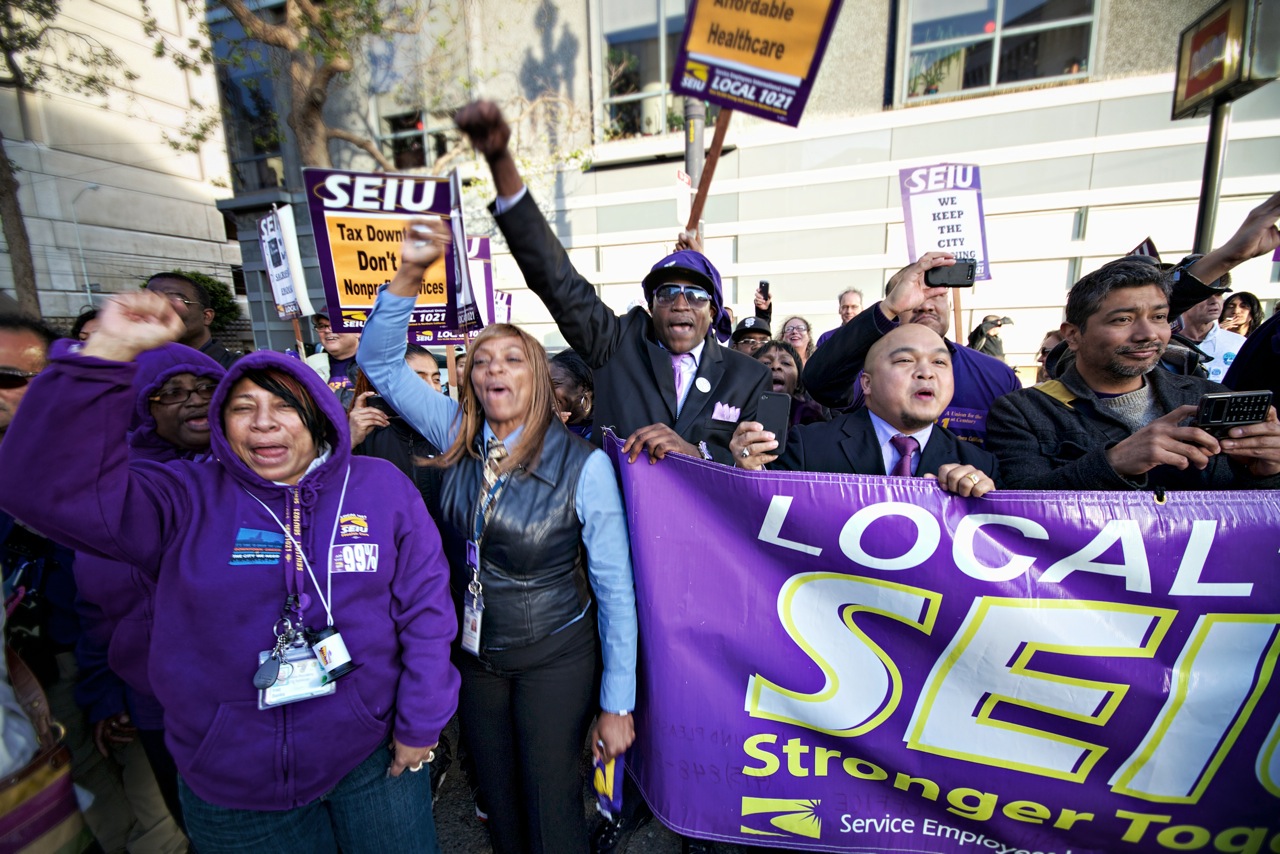
Service Employees International Union Local 1021, San Francisco’s biggest city employee union, last month launched a campaign demanding that the measure increase city revenue, setting a goal of at least $50 million, which represents the amount the city has lost annually since 2001 when 52 large downtown corporations sued to overturn the last gross receipts tax. The union is threatening to place a rival measure on the fall ballot.

“This call for it to be revenue-neutral didn’t make a lot of sense given all the reductions in city services in recent years,” said Chris Daly, the union’s interim political director. “It’s fair to at least get the money back that we lost in 2001.”

The union and the city recently agreed on a new contract that avoids more of the salary cuts that SEIU members have taken in recent years, but workers could still face layoffs under a new city budget that Lee is scheduled to introduce June 1. Lee, Board of Supervisors President David Chiu, and business leaders working on the tax-reform proposal have until June 12 to introduce their ballot measure.

But they don’t yet have an agreement on what the measure should look like — largely because the technology sector (led by billionaire venture capitalist Ron Conway, the biggest fundraiser for Lee’s mayoral campaign last year), the traditional businesses represented by the San Francisco Chamber of Commerce, and the small business community are pushing different interests and priorities.

“The technology industry has to realize they have a tax obligation like any member of the business community does,” Jim Lazarus, the Chamber’s vice president for public policy, told us.

Conway is reportedly using his influence on Lee to push for a model that keeps taxes low for tech companies — even if that comes at the expense of other economic sectors, such as commercial real estate and big construction firms, which will likely see their tax obligations increase. Yet some Chamber counter-proposals could end up costing small businesses more money, creating a puzzle that has yet to be worked out.

But one thing is clear: The business leaders don’t want to see overall city revenue increase. “If there’s anything that is unifying in the business community is that it’s revenue neutral,” small business advocate Scott Hauge told us. “We’re not going to increase revenues, that’s just a given, so if we have to do battle then so be it.”

SEIU and other members of progressive revenue coalition that has been strategizing in recent weeks are hoping to exploit the divisions in the business community and arrive at a compromise that increases revenue, and if not then they say they’re willing to go to the ballot with a rival measure.

“We’re working on trying to recover what we lost in the 2001 settlement and then some,” Sup. John Avalos, who has been working with the progressive coalition, told us. “We have to have something going to the ballot that is revenue generating.”


LABOR’S CAMPAIGN

For labor and progressives, this is an equity issue. Workers have been asked to give back money, year after year, despite the fact that big corporations have been doing well in recent years but haven’t contributed any of that wealth to the cash-strapped city. Labor leaders say that after they supported last year’s pension-reform measure, it’s time for the business community to support city services.

“When we talked about Prop C, we said if our members are doing this with our pensions now, we’ll see next year what businesses do with business tax,” said Larry Bradshaw, vice president of SEIU Local 1021. “Then we read about secret meetings where the labor movement was excluded from those talks.”

Anger over the “secret meetings” of business leaders that Lee assembled to craft the tax reform measure — meetings at which no labor leaders were included — helped inspire the fierce protest campaign that defined the SEIU’s recent contract negotiations.

In the first weeks of negotiations, workers were already up in arms. Protest marches at SF General Hospital and Laguna Honda Hospital brought hundreds of hospital workers to the streets. These hospitals serve some of the city’s poorest populations: Laguna Honda patients are mostly seniors on Medi-Cal and General is the main public hospital serving the city’s poor.

On April 5, city workers got creative with a street theater protest that involved six-story projections on the iconic Hobart Building. Protesters dressed as rich CEOs and handed out thank-you cards to commuters at the Montgomery transit station. SEIU’s “The City We Need, Not Downtown Greed” campaign included a website (www.neednotgreed.org), slick video, and direct mailers portraying CEOs as panhandlers on the street asking city residents, “Can you spare a tax break?”

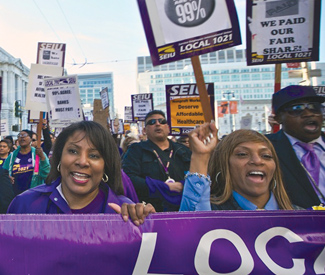
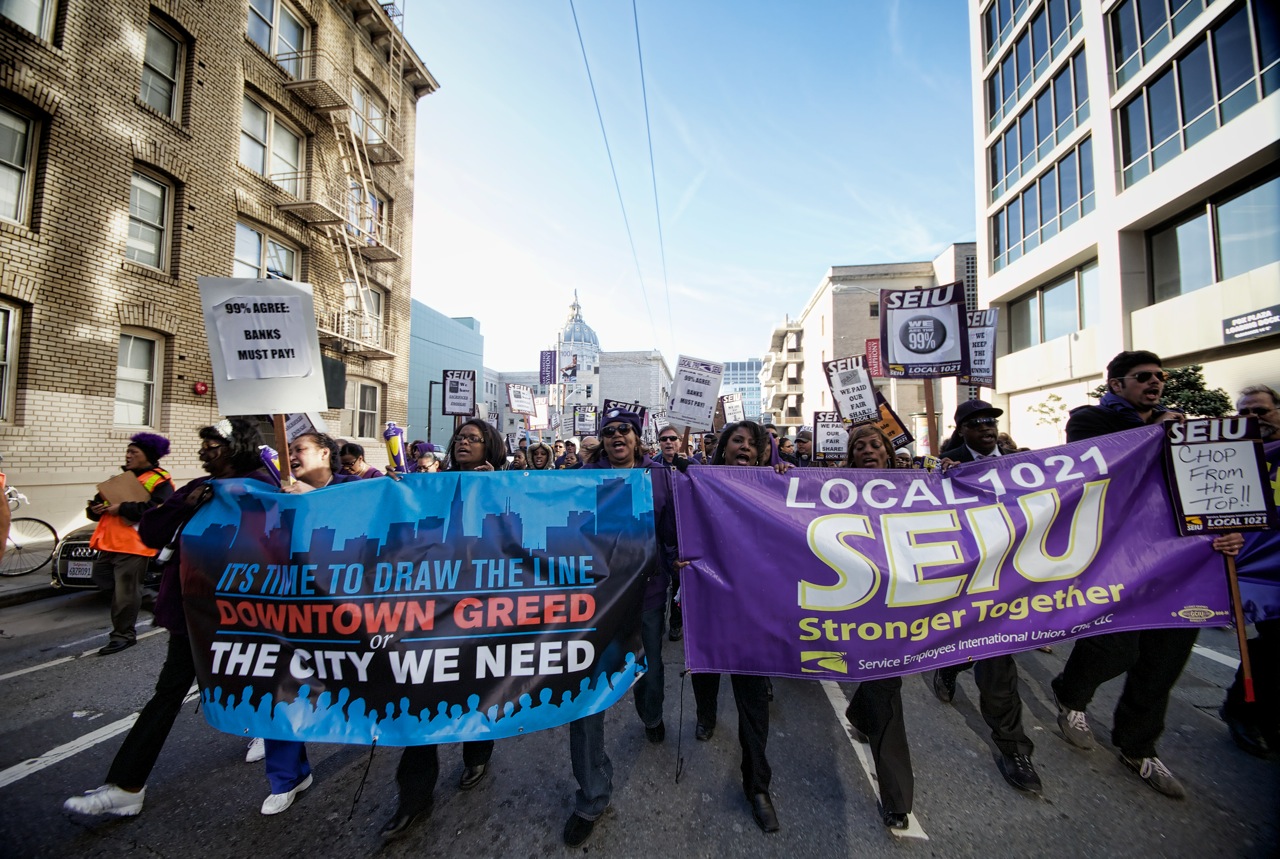
The most dramatic civil disobedience came on April 18, when more than 1,000 workers rallied outside City Hall — along with several progressive supervisors — and then marched to Van Ness and Market. Protesters blocked the street, resulting in 23 arrests. At that point, increases in health care cuts and pay cuts to city workers were still on the table.

That was followed the next week by hundreds of workers staging noisy demonstrations in City Hall, and then again on May Day when SEIU workers were well represented in actions that took over parts of the Financial District.

In the end, the demands of union representatives were met in the contract agreement. Health care cost increases and pay cuts were eliminated, and a 3 percent pay raise will kick in during the two-year contract’s second year, a deal overwhelmingly approved by union members. Labor leaders hope to use that momentum to force a deal with the Mayor’s Office on the tax reform measure — which some sources say is possible. Otherwise, they say the campaign will continue.

“We may end up on the streets gathering signatures soon,” Daly said. “We need to figure it out in the next few weeks.”


THOSE DEVILISH DETAILS

The Controller’s Office released a report on May 10 that made the case for switching to a gross receipts tax and summed up the business community’s meetings, and the report was the subject of a joint statement put out by Lee and Chiu. “After months of thorough analysis, economic modeling and inclusive outreach to our City’s diverse business community, the City Controller and City Economist have produced a report that evaluates a gross receipts tax, a promising alternative to our current payroll tax, which punishes companies for growing and creating new jobs in our City'” the statement said. “Unlike our current payroll tax, a gross receipts tax would deliver stable and growing revenue to fund vital city services, while promoting job growth and continued economic recovery for San Francisco.”

Daly and Avalos say progressives agree that a gross receipts tax would probably be better than the payroll tax, and they say the controller’s report lays out a good analysis and framework for the discussions to come. But despite its detailed look at who the winners and losers in the tax reform might be, Daly said, “We haven’t seen an actual proposal yet.”

Lazarus made a similar statement: “Nobody likes the payroll tax, but the devil is in the details.”

But it’s clear some businesses those with high gross receipts but low payrolls — would pay more taxes. For example, the finance, insurance, and real estate sector now pays about 16 percent of the $410 million the city collects in payroll taxes. That would go up to about 21 percent under a gross receipts tax.

“Several industries that could face higher taxes under the proposal, such as commercial real estate, large retailers, and large construction firms, felt the increase was too sharp,” the report said under the heading of “Policy Issues Arising From Meetings with Businesses.”

The report highlighted how the change would broaden the tax base. Only about 7,500 businesses now pay the payroll tax (others are either too small or are exempt from local taxation, such as banks), whereas 33,500 companies would pay the gross receipts tax, which the report identified as another issue to be resolved.

“While some businesses appreciated the base-broadening aspect of the gross receipts proposal, others felt that too many small businesses were being brought into the Gross Receipts tax,” the report said. Hauge also told us that he fears a tax increase on commercial real estate firms could be passed on to small businesses in the form of higher rents. “I don’t want to see the business community split,” Hauge said, although it’s beginning to look like that might be unavoidable. The big question now is whether progressives and labor can find any allies in this messy situation, and whether they’ll be able to agree on a compromise measure that all sides say is preferable to competing measures.

SEIU reps pleased with tentative contract

46

After heated negotiations, the city has come to a tentative two-year contract agreement with SEIU Local 1021. 

The union, which represents 12,000 city workers, has staged large protests in recent weeks while negotiators worked on the contract. The union was opposed to pay cuts and increases in health care costs that the city originally proposed.

With the new agreement, city workers will get a three percent pay increase, to kick in next year.

The arbitrator of the negotiations also ruled in favor of the union on the issue of temporary workers, who mostly don’t currently enjoy benefits or job security. Now, temporary city workers who have worked 1500 hours over the past three years will be prioritized for permanent jobs.

The SEIU did compromise on some parts of the deal. The new contract won’t include travel pay previously provided to people who commute outside the city for work. There will also be new restrictions placed on union organizing, as union stewards will need to be “escorted” into what the city deems “confidential areas,” restricting union access to work environments.

Larry Bradshaw, 1021 Vice President, has been at the table since negotiations began in February. “I’m very happy with the results,” said Bradshaw. “Its the first agreement since 2009 where the city is not going to balance the budget on the back of working families.”

In the years since 2009, city workers have had deferred pay wages, wage concessions, and increased health care costs. Bradshaw says the new contract will put base wages back at 2009 levels.

“I think in the first years of the recession our members were willing to sacrifice,” said Bradshaw. “But then year after year, they don’t want to keep doing that when the city is not going after corporations. They’re just sitting on wealth and the city is not taxing that wealth.”

http://vimeo.com/39869973

That sentiment has led to the SEIU’s call for increased taxes on some corporations in the city. That’s the issue they address in the above video, which may become a TV commercial for what may become a ballot measure in November that would restructure the business tax code.

SEIU Local 1021 members are currently in the process of voting to ratify the contract. The vote will be done by Monday evening, just in time for the Board of Supervisors to ratify the agreement at their May 15 meeting.

Bank’s offer to fund vandalism repairs draws activist backlash

55

After young anarchists vandalized cars and businesses during a brief but destructive rampage through the Mission District last week, Wells Fargo was quick to offer $25,000 in grants to repair the damage, which the bank publicized in a press release as “building upon its history of supporting local communities.”

Yet this is the same Wells Fargo that has been targeted by housing rights, labor, and other progressive activists in recent months for its aggressive foreclosure tactics and investments in mountaintop removal coal mining and other heinous activities, culminating in a major standoff between protesters and the company during its annual shareholders meeting in San Francisco on April 24.

The grant money was supposed to be administered mostly by the Valencia Corridor Merchants Association, but the group got an earful from activists during its meeting on Monday night and now its leaders are figuring out how they can extricate themselves from this thorny situation. Among those putting pressure on the group is Sara Shortt, executive director of the Housing Rights Committee of San Francisco, who says the bank is trying to buy allies that it desperately needs right now.

“Wells is trying to divide a wedge between activists who have been working to highlight their irresponsible practices in the community and the businesses we shop at,” Shortt told us. “As a Valencia Street resident, I resent that they are hoping to use my community merchants as a tool for them to gain positive PR, by taking advantage of their desperation after the attacks.”

Bank spokesperson Holly Rockwood emphasized Wells Fargo’s “long history of corporate philanthropy” when I asked her about the donation, and she denied that the corporation was trying to burnish its tarnished image less than week after thousands of activists disrupted the bank’s annual meeting, resulting in 20 arrests. “The timing was simply in response to the wave of vandalism,” Rockwood said.

Nonetheless, merchants association President Deena Davenport said the group is now “backing away from this” to avoid getting in the middle of this fight. “The people with the Housing Rights Committee gave us a lot of good reasons why shouldn’t accept this money,” she said, adding that the association will make a final decision at its meeting this Monday.

While she said that she appreciates the bank’s offer and doesn’t begrudge anyone who wants to accept the money, “we are looking at ways to raise the money ourselves,” including reaching out to local credit unions to see if they would match the Wells Fargo offer, making the same money available but without the heavy political baggage.

Low taxes are bad for business

29

The teachers at San Francisco’s public schools are talking about going on strike. The contracts talks with the district are at an impasse. Things look bleak.

Well, they don’t look as bleak as things in Philadelphia, but that’s not really much in the way of good news.

Part of the issue: The district wants the teachers to accept up to nine furlough days next year. Even if the governor’s tax measure passes, four furlough days are still on the schedule.

The teachers are complaining — with good reason — that the forced days off and other concessions cost them money, as much as $5,000 a year. But there’s another issue here: Furlough days are horrible for working parents — and for the businesses that employ them.

Ron Leuty has a nice column on this in the San Francisco Business Times, which doesn’t let you read all the stories unless you subscribe, but here’s the gist:

For parents, SFUSD parents who already have barely managed through four furlough days each of the past two school years, nine each year becomes intolerable. That totals up to nearly two school weeks for which we must find some sort of childcare or one-day mini-camps — and it’s cash out of our pocket. Or it means time off. For businesses, that means lost productivity, down work time and employees who are paying more for — and worrying more about — childcare.

For low-income parents who have to miss a day’s work and a day’s pay every time the kids are out of school, it’s a serious economic issue. And the local businesses, particularly small businesses which aren’t equipped to deal with excess employee absenteeism, it’s a nightmare.

Leuty doesn’t place any blame or explain how we got to this situation, so I will: Prop. 13 (and later, Prop. 218) made it really hard to raise local taxes, and a handful of Republicans are making it hard to raise state taxes, so there’s not enough money for the schools. Americans today, particularly wealthy Americans and corporations, are taxed far less than they were for most of the century, certainly the post-War era.

Local business leaders love to talk about the value of public schools. I don’t think many serious people who have looked at the finances believe that the SFUSD is fat, bloated, or wasting a lot of money; these days, even the anti-government folks have to admit it’s a pretty lean operation.

So why won’t those business folks (and, for the matter, the Business Times) start campaigning for changes in Prop. 13 to allow communities to fund the schools and avoid these debilitating furlough days? What, is this problem supposed to get fixed by magic?


A seat in Congress for the 99 percent

0

For the first time in two decades, voters north of the Golden Gate will choose a new member of Congress. Given the overwhelming party registration, a Democrat will fill the open seat. But what kind of Democrat?

We need a truly independent, progressive Democrat — determined to support the party leadership when it upholds our principles, and just as willing to challenge when it doesn’t.

We can’t defeat a heartless Republican agenda by being spineless. Rather than letting the reactionary GOP define “national security” or “fiscal responsibility,” we’ve got to stand tall for our core beliefs.

That’s why I’m running for Congress.

The retirement of Lynn Woolsey, a stalwart champion for peace and social justice, means that an open seat is up for grabs — and corporate interests are eager to grab it.

I’m convinced that the only way to beat corporate AstroTurf is genuine grassroots. And that’s the ongoing commitment of the Solomon for Congress campaign in this new North Coast district, which stretches from Marin County to the Oregon border.

Our campaign has become the grassroots leader in the race. While refusing to accept a penny from corporate PACs or lobbyists, we’ve relied on thousands of individuals to build our campaign from the ground up.

That’s why more than 1,000 volunteers are engaged in our campaign, why more than 5,100 individuals have contributed — and why the latest poll shows me on track to advance to the general election under California’s new top-two primary system.

This is a deep-blue, very progressive district. We can — and must — do much better than just sending a check-the-box Democrat to Washington.

Like so many in our district, I’m outraged at perpetual war and misplaced federal priorities that bail out Wall Street banks while pushing millions of homeowners into foreclosure.

I insist that we must fully uphold habeas corpus and other precious civil liberties, not throw them under the bus.

Nuclear power plants, including Diablo Canyon and San Onofre, must be closed. We can’t afford a wait-and-see approach. Nuclear energy isn’t safe or green; it’s not sustainable, and its radioactive waste is not an acceptable legacy for future generations.

We need a serious commitment to conservation and renewable energy sources like wind and solar.

And we must reject the austerity program that has wrecked budgets and ripped vast holes in safety nets from Sacramento to Washington.

We need a Green New Deal that combines job-creating public investment with a deep commitment to sustainability — while defending the ecosystem instead of big corporations.

North of San Francisco, with an open congressional seat at stake, wealthy interests have put big money on my main opponents.

While I’m outpolling her, multimillionaire Stacey Lawson is dumping huge quantities of money into TV and radio commercials touting her “middle class” values — while declining to mention her enormous wealth, much less the fact that she couldn’t be bothered to vote in two-thirds of a dozen elections.

The elections when Lawson failed to vote included the historic November 2008 contest that decided on the presidency and the anti-gay-marriage Prop 8 as well as a state measure seeking to undermine young women’s right to choose — requiring parental consent, waiting periods and penalties for doctors.

Genuine social change requires fighting for our ideals. Please help me occupy a seat in Congress for the 99 percent. Let’s work together to make it happen. *


Norman Solomon is a candidate for Congress in the new North Coast district that stretches from the Golden Gate Bridge to the Oregon border. A longtime activist, educator and policy advocate, he’s the author of a dozen books including “War Made Easy: How Presidents and Pundits Keep Spinning Us to Death.” For more information: www.SolomonForCongress.com.

Dick Meister: Only we can save the children

1

By Dick Meister

Dick Meister, former labor editor of the SF Chronicle and KQED-Newsroom, has covered labor and politics for more than a half-century. Contact him through his website, www.dickmeister.com, which includes more than 350 of his columns.

I remember checking into a small hotel in Coimbra, Portugal, with my wife Gerry in 1962, three very heavy suitcases in tow. Rushing out at the urgent clang of the desk clerk’s bell came a uniformed bellhop. A midget, I supposed. But, no, it was a child, nine, maybe ten years old.

He smiled shyly and tugged at the suitcases, eager to lug them up the long, narrow staircases that led to our room. I wouldn’t let go, but the clerk insisted. “It’s his job,” senhor.”

It was indeed his job, one that paid poorly and kept him from school – but a job necessary for his family’s survival.

There were millions of others like him, aged 5 to 15, throughout southern Europe, and Asia and Africa and Latin America, making up as much as one-third of the workforces in some countries. And there still are – 50 years later.

Although most countries have laws against child labor, and it is banned by United Nations’ conventions, there are at least 200 million children now at work in 71 countries.

Many work in slave-like conditions for up to 18 hours a day, seven days a week, on farms, in mines, in factories and elsewhere, to produce goods for sale in this country – food and metal products, jewelry and clothing, toys, carpets, furniture, electronic components, shoes, fireworks, matches, rugs, soccer balls, leather goods, paper cups and much more. Some, like the bellhop we encountered, work in hard, poor paying menial service jobs.

Most must work, whatever the conditions, if their families are to survive. Among them are children sold into bondage by starving parents or put to work to pay off loans made to their parents. Their wages are never enough to erase the debts and are further eroded by exorbitant charges for living accommodations and tools, and fines for “unsatisfactory work.”

Many are forced to live in cramped, dirty housing compounds near their workplaces, some as virtual prisoners forbidden to leave without passes from their overseers

Many of the workplaces are owned, at least in part, by U.S.-based corporations or by local employers under contract to such corporations.

The youngsters’ childhood is denied them. They have little time for play and none for schooling. Like their parents, they are doomed to a life of hard work under abysmal and often dangerous conditions, a life of poverty, ignorance and exploitation.

It could be better for them if the United States would use its great economic strength to challenge the growth of child labor in negotiating trade agreements with nations that allow or encourage the practice. The United States could at least refuse to trade with nations where child labor is common, making U.S. agreement to trade pacts contingent on its trading partners cracking down on child labor.

Given the corporate-oriented stance of Democratic and Republican leaders alike, the prospects for U.S. action are slight. And without U.S. support nothing meaningful can be done to stem the steady growth of child labor.

The nations in which the abuses occur won’t act for fear that would increase labor costs and thus put them at a disadvantage in the highly competitive world market. The United States and other major economic powers won’t act for fear of reducing corporate profits.

That leaves consumers, people like you and me who buy the goods made by children for the great profit of their employers. It’s up to us to find out just what those goods are and refuse to buy them, and to let President Obama, Congress and those who sell the goods know why we are refusing to buy them, and will continue to do so as long as children are used to produce them.

You can be sure that if we don’t act, no one else will. Only we can save the children.

Dick Meister, former labor editor of the SF Chronicle and KQED-Newsroom, has covered labor and politics for more than a half-century. Contact him through his website, www.dickmeister.com, which includes more than 350 of his columns.

Dufty fights Mayor Lee’s dehumanization of homeless people

65

I’ve had some pretty sharp disagreements with Bevan Dufty, but in this case, he’s on the right track: Mayor Lee’s idea of launching an ad campaign to discourage contributions to panhandlanders is ugly, dehumanizing, and a civic disgrace.

Homeless people are people. They’re not animals at Yosemite (“please don’t feed the bears.”) They’re not some sort of public-relations problem for downtown hotels. They’re San Franciscans who for one reason or another have lost the ability to pay rent. That’s not a crime and it shouldn’t be the end of their humanity.

You want to stop agressive panhandling? It’s relatively easy. Increase general assistance grants and make sure that everyone in the city has enough money to eat and get a place to sleep. Oh, but that involves raising taxes — and it also requires a dramatic change in attitude at City Hall. A guaranteed minimum income wasn’t always considered a crazy radical idea; 40 years ago, it was part of the mainstream of American political thought. Now, anybody who isn’t working — for whatever reason — is considered drunk, lazy, a freeloader, a drag on all of the rest of us. Except that a lot of the rest of us are one paycheck away from the same fate.

I always give to panhandlers. I know some of them take the money and buy booze or drugs; I spend part of my money on such things, too, and I don’t even live on the street. If I did, I suspect the beer-and-bourbon portion of my net spending would increase significantly. I know some have substance-abuse problems; I suspect that the buck or two I hand over isn’t going to make that any better or worse, but it might very well keep someone in need of a drink or a fix decide it’s not necessary to rob a passer-by or break a car window to get the money.

Even the “agressive” panhandlers I encounter tend to calm down if you treat them politely. If I have no cash, I look them in the eye, say I’m sorry and would love to help but I can’t do it right now. In more than 30 years walking the streets of San Francisco, treating panhandlers like the human beings they are, I’ve never once had a problem. And I don’t expect to.

Let’s do an ad campaign to discouarge residents and tourists from continuing to allow their tax money to go for loopholes and benefits for large corporations. Don’t feed the rich; they’re already too fat. How about it, Ed?


Dick Meister: Fair Trade: Not With Columbia

1

By Dick Meister

Dick Meister, former labor editor of the SF Chronicle and KQED-TV Newsroom, has covered labor and politics for more than a half century. Contact him through his website, www.dickmeister.net, which includes more than 350 of his columns.

By all accounts, Colombia is one of the world’s worst abusers of workers and their unions. Yet President Obama has just signed a Free Trade Agreement with Columbian President Juan Manuel Santos.

The agreement, set to go into effect May 15, will align the United States with a nation in which working people have very few of the basic labor rights long granted U.S. workers.

In fact, trying to exercise those rights in Colombia can be fatal. Two-dozen Colombian labor leaders and organizers were killed during the past year.

The U.S.-Colombia trade agreement was supposed to implement an “Action Plan on Labor Rights” that the two nations agreed to in 2011. The plan was designed to “protect internationally recognized labor rights, prevent violence against labor leaders, and prosecute the perpetrators of such violence” in Colombia.

Violence continues, however, as does the anti-union actions of the Colombian government and Colombian employers. Colombian union leaders noted in a joint statement that though the action plan calls for some badly needed reforms, it does not address many others also needed. That includes combating the serious violations of labor and human rights that continue to plague Colombia.

Many workers, for example, are prevented from exercising the two most important of all labor rights – the right to collective bargaining and to free association. The labor leaders said the government has done very little to prosecute the employers who deny those rights and other fundamental rights of workers.

“Labor activists and other human rights defenders remain subject to threats and violence, including murder, when they stand up to fight for their rights,” the leaders concluded.

As now written, the leaders said, the Colombia Free Trade Agreement “perpetuates a destructive economic model that expands the rights and privileges of big business and multinational corporations at the expense of workers, consumers and the environment.”

Other trade agreements that have followed that basic model have “historically benefitted a small minority of business interests, while leaving workers, families and communities behind.”

Key U.S. labor leaders also have denounced the U.S.-Colombia trade agreement, even though it was championed by President Obama, who generally gets high marks from labor’s establishment, as he should.

AFL-CIO President Richard Trumka saw Obama’s signing of the agreement as “deeply disappointing and troubling. We regret that the administration has placed commercial interests above the interests of workers and their trade unions.”

That is, the administration thinks the returns U.S. businesses and the economy generally gain from trading with Colombia are more important than protecting Colombian workers from exploitation by rejecting deals with businesses that violate the workers’ rights.

Trumka and the Colombian union leaders want a new trade agreement with lofty but reachable goals of creating jobs on a widespread scale, boosting economic development and raising the standard of living in both the United States and Colombia.

Workers would be guaranteed stronger protections. But more than that, Trumka and the Colombian leaders would add provisions “to ensure a healthy environment, safe food and production, and the ability to regulate financial and other markets to avoid crises like that of 2008.”

That would be fair trade as well as free trade – a vital, necessary fair and free trade agreement that would benefit millions of people on both sides of the agreement.

Dick Meister, former labor editor of the SF Chronicle and KQED-TV Newsroom, has covered labor and politics for more than a half century. Contact him through his website, www.dickmeister.net, which includes more than 350 of his columns.


SEIU rally draws 1,000 to city hall

26

More than 1,000 city employees gathered at City Hall April 18 for a protest that ended in 23 arrests.

The protest comes as the SEIU Local 1021 contract negotiations with the city’s employee relations division are underway. According to Larry Bradshaw, Local 1021 vice president, the city’s proposal may result in pay cuts and health care cost increases for city workers.

“Here’s your negotiations update. The city and county wants you to take another 2 ½ percent pay cut this year and next year. The courts want their court-workers to take a five percent pay cut indefinitely,” Bradshaw, who works as a paramedic, told the crowd.

He also claimed that: “If you have Kaiser, under the city’s proposal you’re going to pay six times more than you’re paying currently. If you have Blue Shield, you’re going to pay twice as much. If you’re on the city plan—I’m not making this up—you’re going to pay one hundred times more than what you’re paying right now.”

Workers at the rally ranged from hall janitors to General Hospital nurses to Department of Emergency Management dispatchers donning shirts reading, “we run 911!”

Workers from the International Federation of Professional and Technical Engineers Local 21 also attended to show solidarity.

Sups Avalos, Mar, Kim, Chiu, Campos and Olague offered their support at the rally.

Around 6:30, the group left city hall and marched down Polk St. City workers then stretched caution tape across Market at Van Ness, in front of a Bank of America branch, and 23 sat down on the street. After a police warning, they were arrested for obstructing the sidewalk.

“We’re sitting to protest the greed of the city. The man is getting raises. The district attorney and the city attorney are getting raises. And they want us to take more pay cuts and furloughs,” said Arlette Smith, a protective services social worker, ten minutes before she was arrested.

The union wants to take these pay cuts off the table.

SEIU Local 1021 spokesperson Carlos Rivera also noted, “we’re sitting by Bank of America because banks and corporations don’t pay their fair share.”

The union is calling into question a tax settlement from 2001, in which a court ruled in favor of several corporations that sued the city over a hybrid payroll and gross receipts tax structure. The union characterizes the resulting loss of about $25 million per year in tax revenue as a loophole.

“The payroll tax is only paid by ten percent of San Francisco businesses, yet they’re asking city workers and non profit workers to continue to shoulder these massive budget deficits year after year,” said SEIU spokesperson Anna Bakalis.

Bakalis said that the SEIU is focusing on reinstating a gross receipts tax after researching alternative solutions for the city budget, if the pay cut and health care increases do not go though.

“We want to be able offer some solutions,” she told the Guardian. “We want to help them fix the budget.”

The union plans to return to city hall for further demonstration April 30 “if they have not taken those pay cuts and health care cuts off the table,” according to Bradshaw.

In city workers’ shoes

6

We both work under City Hall’s iconic dome as civil servants. While I often work late into the evening hours as a supervisor, Robert’s back-breaking work as a janitor is often done past the midnight hour, five nights a week.

I had the opportunity to meet Robert last week, as part of the “Walk A Day In Our Shoes” program of Service Employees International Union, Local 1021.

Robert is 52 years old. He’s worked for the city since 1999. Before that, he worked for San Francisco Unified School District. He sweeps and mops the floors and stairs of the famous rotunda and cleans 150 cubicles.

Last week, Robert had me take off my jacket and tie, roll up my sleeves and do his job for a while. I swept the marble floors, which are truly unending. I mopped the grand marble staircase behind happy couples exchanging wedding vows. He let me attempt to push a gigantic whirring machine that felt more like a Zamboni than a vacuum.

When I was younger, I had a summer job as a janitor at a public high school, so I know how truly strenuous Robert’s job is.

Robert injured his spine as a result of pushing that heavy vacuum for years. When he was in the hospital treating his spinal injury, the doctors discovered cancer. While in chemotherapy, he didn’t miss a day of work. He lives cancer-free today.

Robert is also a green pioneer at City Hall — he started a recycling program here before it was popular to do so. After that, the rest of the city caught on. He has photos of himself and the past four mayors in his home. He offers directions to visitors. He has a son, and they both live in his sister’s home. He speaks lovingly of his wife, who he lost to diabetes several years ago.

As our economy evolves, we can’t leave people like Robert — those who support our world-class city —behind. While we court businesses who create new jobs in our city, we also need to reinvest in the people who do the important work that often goes unnoticed.

Hospital workers are up at 4am, preparing meals for patients. Library technicians provide bilingual translation for our children. Others, like Robert, are up until 1am, making sure we have a clean and safe environment to work every day.

After years of concessions to balance deep budget deficits, city workers experienced ongoing cuts to their wages and benefits. In current contract negotiations, they are being asked to give hundreds more each month in healthcare costs to insure their children.

We appreciate all they have done to help our city in times of need. As our city recovers economically, it’s time to thank them, to ask others to help shoulder the costs for affordable housing, parks and recreation facilities and schools, and to reform our local business tax — which is paid by only 10% of our city’s companies.

Last week, I got to know a fellow civil servant whose work we need to remember to value. Which is why I will stand alongside Robert, labor unions, nonprofits, community members and neighbors on Wednesday, April 18, in front of City Hall from 4pm to 7pm. Please join us in supporting the workforce that supports us all, 24 hours a day. 

David Chiu is president of the Board of Supervisors.Thousands of community allies, elected officials, and SEIU 1021 members will rally on Wednesday, April 18 to close tax loopholes on mega banks and corporations from 4pm to 7pm at City Hall.

Happy Tax Day, suckers

18

It’s Tax Day, the deadline for filing income tax returns, which seems like an appropriate time for Senate Republicans to kill President Barack Obama’s proposed Buffett Rule, which would have required the richest Americans to pay at least a 30 percent tax rate rather than using various tax dodges to pay a lower tax rate than most of us.

Honestly, it’s hard to even summon the outrage or indignation anymore over the latest example of life under plutocracy. Most Americans seem resigned to accept being ruled by the rich in crass, obvious, and incredibly short-sighted ways – even on Tax Day, when our class resentments should be finely tuned.

Sure, California voters will probably get a chance to increase taxes on millionaires this November – a proposal that consistently polls well – but even that has now been tied to a sales tax increase. Whatever happened to good ole economic populism? Why has the Occupy Wall Street movement’s brilliant “We are the 99 percent” paradigm faded so quickly from the national stage?

Despite mountains of evidence that the richest individuals and corporations have written tax codes to their benefit, and that the tax code is fundamentally unfair to most Americans and damaging to this country’s long-term economic prospects, Americans seem to accept their lowly fate and role serving the greedy rich.

The latest examples of solid reporting on our corrupt and inequitable tax system come from the New York Times’ David Kocieniewski, whose year-long series “But Nobody Pays That” just won the Pulitzer Prize for explanatory reporting, with the committee calling it a “lucid series that penetrated a legal thicket to explain how the nation’s wealthiest citizens and corporations often exploited loopholes and avoided taxes.”

And yet today, Tax Day, the greedy rich still paid lower tax rates than most of us, and then used their Republican Party enablers to prevent that situation from changing anytime soon. But rather than heeding that simple fact or clicking on my links that explain the problem in more detail, the blog commenters will probably say I’m just jealous. Ugh, I think it’s my nap time.

Different galaxies of hip-hop at Paid Dues

0

Under the sweltering San Bernardino sun this past Saturday, more than 40 artists came together to pay homage to hip-hop at the Paid Dues Festival.

Odd Future grilled raw meat on stage, intermittently lighting the bloody slab with a cucumber–sized blunt. Tyler the Creator sputtered out dribbles of water in between his lines — casually yet methodically, right as the camera appeared — making one wonder if there really is a synchronized reasoning behind the madness. Moments later, he leaped off the stage and sailed deep in to the moshing crowd, which accepted the Goblin with elation.  


On the other side of the festival — which felt like a completely different galaxy — Brother Ali captured the roots of spoken word hip-hop, performing a refreshingly simple set on an empty stage with just his DJ spinning behind him. Contrasting this profoundly tranquil execution was the whirlwind energy of Three 6 Mafia, which jumped from one side of the stage to the other, arms swaggering, voice booming, and collars popping.

Hip-hop has gone through many cycles since its origins as a social and political outlet for underrepresented minorities, and the sheer diversity of the performers at Paid Dues Festival showed just how broad the genre has become.

During a Guardian interview, Los Rakas member Raka Dun explained that he views the creation of subgenres within hip-hop as a “progressive evolution,” comparing Drake’s “R&B hip-hop” to Odd Future’s “punk rap” as merely a stylistic difference. Raka Rich, the second member of the Panamanian duo, added “that hip-hop has always been about expressing yourself, so you can’t tell someone that their music is or isn’t hip-hop.” 

DJ Paul of Three 6 Mafia agreed that the growth of hip-hop is a positive development, yet admitted that the genre has lost some of its vigor. He holds politics responsible, stating that “hip-hop used to be harder back in the day, but the government wanted the world to be in peace, so they made the music be more in peace.”

Thes One of People Under the Stairs says corporations are at fault for taking critical substance out of mainstream hip-hop, as “music is a lot more marketable when you don’t have to cosign a message.” Double K (also of People Under the Stairs) feels that young people do not have the same insightful experience listening to music anymore. “In school, we were taught the same lesson on Martin Luther King Jr. year after year, but it was from hip-hop that we learned about people like Marcus Garvey and H. Rap Brown,” he added.

The role of women — specifically the rise of female MCs — is significantly influential in how the current road of hip-hop is being paved. Nicki Minaj, although nowhere in the Nos Event Center’s vicinity, was a looming presence throughout the night. The general consensus over the self-proclaimed Black Barbie was that she has undeniable talent, but there were contrasting opinions on how extensively her sex appeal influenced her success.

The members of Hieroglyphics said they feel the issue of sex in music should not be marginalized to a gender issue, as “the industry as a whole is exploiting sex to promote music.” The crew contemplated over whether you have to be as visually appealing as Minaj for people to appreciate your talents — finding it ironic that a lot of artists are actually unwilling to give her credit for her lyricism because of her overt sexuality.

There was a collective nostalgia over non-pink-wigged women rappers the artists grew up listening to — such as Queen Latifah and Ice Cream Tee — who rapped wearing just a hoodie and baggy jeans.  As essential as it is to have prominent women that the female audience can identify with, artists questioned if current women MCs were truly communicating a positive message to young girls.

Luckyiam of Living Legends gave a final word of advice for all burgeoning artists bedroom producers, regardless of gender:

“When I lived in East Oakland, I thought there was a glass ceiling there. Now, with the Web, there’s no reason you can’t get your content out there. But don’t just be Tumblr famous. Go out to the streets or in the clubs, and pay your dues. And stop rapping over your vocals and wear some looser fitting jeans.”

Heading East: The flight from San Francisco

13

EDITORIAL There is no simple free-market solution to gentrification and displacement. There’s no way a crowded city like San Francisco can simply rely on the forces of supply and demand to protect vulnerable populations. And there’s no way the city’s flawed housing policy can prevent the loss of thousands of San Franciscans — particularly young, creative people who help keep a city lively — from fleeing to a town where they can actually afford the rent.

Richard Florida, the famous social and economic theorist who coined the term “creative class” argues that artists and writers and geeks and musicians are the forces that drive modern economies. His pioneering 2002 essay in the Washington Monthly was titled “Why cities without gays and rock bands are losing the economic development race.”

Florida’s something of an elitist and he ignores the contributions that tens of thousands of others (including retired people, union members and nonprofit workers) make a community. He idolizes tech culture and often ignores issues like class and race.

But he’s got a point: Nobody who’s doing anything cool wants to live in a city where everyone is rich and everything is clean and boring. And that’s the danger San Francisco faces.

Just go over to Oakland for a few days and talk to all the people who were once part of this city’s cultural scene. They’ll tell you what anyone with any sense knows: You don’t attract creative people to a city by giving out tax breaks for corporations and building fancy office space. The rock bands that Florida talks about aren’t going to stay in a city because it has high-end jobs for people with advanced degrees. Artists need a place where they can afford the rent.

San Francisco is still a great urban center, by any possible standard, and has all the qualities of diversity, openness, energy, politics and fun that have made generations of immigrants from all over the world want to make it their home. But at a certain point, housing becomes more important than all of the other development issues that local government can address.

Take Andy Duvall, a musician we interviewed who was part of San Francisco for 15 years before he was literally priced out of town. For half of what he was paying in the Mission, Duvall has more than twice the space in Oakland — and the situation is just getting worse. While most of the country is still mired in a deep housing slump (and parts of San Francisco are facing a foreclosure crisis), rents in this town are soaring, beyond the affordability of almost anyone who currently lives here. According to the city’s own statistics, only about 10 percent of San Franciscans can afford the rent on a median market-rate apartment. That means if they’re evicted or lose their homes, they have to leave town.

The supervisors held a hearing April 9 on affordable housing, and the message was profound: “Affordable housing preserves the neighborhood in more ways than one; residents are the foundation on which the economy is built. From any angle, if we can’t afford to live here, there is no city,” observed Val Sinckler, a Western Addition resident.

But while the mayor is working to attract companies that will pay high-end salaries to people who can afford to pay far more rent than the average San Franciscan, he’s a long way from coming up with the money to even begin to mitigate the problem.

An effective policy to preserve San Francisco requires strict regulation (to prevent evictions and displacement), a mandate that commercial developers build housing for their workforce and that residential developers meet the needs of low- and moderate-income residents — and a large investment of public money in affordable housing. If Lee isn’t willing to talk serious about those three crucial elements, then he’s presiding over the decline of one of the world’s coolest cities.

Editorial: The flight from San Francisco

23

EDITORIAL There is no simple free-market solution to gentrification and displacement. There’s no way a crowded city like San Francisco can simply rely on the forces of supply and demand to protect vulnerable populations. And there’s no way the city’s flawed housing policy can prevent the loss of thousands of San Franciscans — particularly young, creative people who help keep a city lively — from fleeing to a town where they can actually afford the rent.

Richard Florida, the famous social and economic theorist who coined the term “creative class” argues that artists and writers and geeks and musicians are the forces that drive modern economies. His pioneering 2002 essay in the Washington Monthly was titled “Why cities without gays and rock bands are losing the economic development race.”

Florida’s something of an elitist and he ignores the contributions that tens of thousands of others (including retired people, union members and nonprofit workers) make a community. He idolizes tech culture and often ignores issues like class and race.

But he’s got a point: Nobody who’s doing anything cool wants to live in a city where everyone is rich and everything is clean and boring. And that’s the danger San Francisco faces.

Just go over to Oakland for a few days and talk to all the people who were once part of this city’s cultural scene. They’ll tell you what anyone with any sense knows: You don’t attract creative people to a city by giving out tax breaks for corporations and building fancy office space. The rock bands that Florida talks about aren’t going to stay in a city because it has high-end jobs for people with advanced degrees. Artists need a place where they can afford the rent.

San Francisco is still a great urban center, by any possible standard, and has all the qualities of diversity, openness, energy, politics and fun that have made generations of immigrants from all over the world want to make it their home. But at a certain point, housing becomes more important than all of the other development issues that local government can address.

Take Andy Duvall, a musician we interviewed who was part of San Francisco for 15 years before he was literally priced out of town. For half of what he was paying in the Mission, Duvall has more than twice the space in Oakland — and the situation is just getting worse. While most of the country is still mired in a deep housing slump (and parts of San Francisco are facing a foreclosure crisis), rents in this town are soaring, beyond the affordability of almost anyone who currently lives here. According to the city’s own statistics, only about 10 percent of San Franciscans can afford the rent on a median market-rate apartment. That means if they’re evicted or lose their homes, they have to leave town.

The supervisors held a hearing April 9 on affordable housing, and the message was profound: “Affordable housing preserves the neighborhood in more ways than one; residents are the foundation on which the economy is built. From any angle, if we can’t afford to live here, there is no city,” observed Val Sinckler, a Western Addition resident.

But while the mayor is working to attract companies that will pay high-end salaries to people who can afford to pay far more rent than the average San Franciscan, he’s a long way from coming up with the money to even begin to mitigate the problem.

An effective policy to preserve San Francisco requires strict regulation (to prevent evictions and displacement), a mandate that commercial developers build housing for their workforce and that residential developers meet the needs of low- and moderate-income residents — and a large investment of public money in affordable housing. If Lee isn’t willing to talk serious about those three crucial elements, then he’s presiding over the decline of one of the world’s coolest cities.


Mayor McLaughlin on synthetic biology issue

1

For my story about synthetic biology in this week’s Guardian, I tried to reach Mayor Gayle McLaughlin of Richmond, where Lawrence Berkeley National Laboratory is building its second campus. The group Synbiowatch is questioning the safety and environmental responsibility of these new technologies. McLaughlin was traveling and just got back to us, so we thought we’d share the perspective of a Green Party mayor of the city where this work will take place.

SFBG: Do you have any concerns about safety at the lab or with the regulation of the synthetic biology field?

GM: I understand that this issue is extremely important. I was at the symposium “Unmasking the Synthetic Biology Lab” held in Berkeley last week and have been learning about the risks and concerns related to this field.

SFBG: Are you worried that we’re entering another “economic bubble,” this time with so-called “green jobs,” and that it could pop like previous bubbles and end up hurting Richmond?

GM: I think that green and sustainable job development will continue, as there is an absolute necessity for our human survival that we create a sustainable planet on which to live and thrive as well as pass along to future generations.

SFBG: The activists say the Precautionary Principle should dictate a slower and more careful and regulated approach to developing newly engineered microorganisms, do you share that view?

GM: I absolutely agree. There needs to a slow and deliberate process that fully researches and regulates this new engineering. I believe that science has a responsibility to examine step by step what is in the interest of us all as human beings – what truly advances us and what may cause us more problems.

SFBG: While the lab diversifies Richmond’s economy, much this research is funded by and could ultimately by developed by Chevron and other big energy companies. Is that appropriate for research into new energy forms that is sponsored with public money?

GM: I agree that the lab diversifies Richmond’s economy and I support opportunities it offers our community that come from positive, safe and healthy scientific exploration, education, and job opportunities. 

The fact that big energy corporations are funding much of the research definitely brings up concerns for me. We need to make sure that science is not conducted with an eye toward profit-making, but rather for the advancement of humanity. We know that our society currently is corporate-run, so we need to continuously raise the issue that true science has an obligation not to the corporations but to the people. This issue is something that should be raised everywhere.

Alerts

0

yael@sfbg.com


WEDNESDAY 4

Occupy the Dream

The SF Interfaith Allies of Occupy call for a rally to end racism, stop foreclosures, protect jobs, and hold corporations and financial institutions accountable. “At a time when Jews and Christians celebrate the ancient stories of liberation let us name the Caesars and Pharaohs of today,” say organizers of this latest event as part of Occupy the Dream. The event also commemorates the assassination of Martin Luther King, Jr on April 4, 1968.

11:30am, free

City Hall

1 Dr. Carlton B. Goodlett Place, SF


SATURDAY 7

Bill McKibben speaks

Bill McKibben is a leading figure in the fight against global warming. He started in 1989 with his book The End of Nature and went on to found 350.org, which has coordinated 15,000 rallies against climate change since 2009. He will speak about where to go next in the climate change crisis as well as discussing the current struggle against the Keystone XL pipeline.

10am, $15 in advance and $18 at the door

First Unitarian Universalist Church

1187 Franklin, SF

www.postcarbon.org/event/776185-progressive-perspectives-presents-bill-mckibben-in


SUNDAY 8

Birding by bike

The SF Bike Coalition hosts this tour of the birds of Lake Merced and Golden Gate Park. San Francisco could always have more bike routes, but the ones it does have provide an excellent pathway for this birding trip, in which participants don’t need to leave the city to observe both resident and migrating species. David and Annie Armstrong host birding by bike; David is an amateur ornithologist who has been birding and leading bike trips in San Francisco for 12 years. Bring your bike and binoculars.

8:45am, free

Vélo Rouge Café

798 Arguello, SF

www.sfbike.org/?chain#4876


TUESDAY 10

Remembering Bataan

On April 9, 1942, Filipino and American soldiers surrendered to Japanese forces after more than four months of holding their ground in the forest of Bataan, a large Philippine province; 15,000 then died en route to prisoner of war camps in what became known as the Bataan Death March. Students and faculty at Cal State University-East Bay will commemorate its 70th anniversary with a night of voices and perspectives from the battle. The event will feature a screening of the documentary Forgotten Soldiers, as well as speakers from the Philippine Scouts Heritage Society, Battling Bastards of Bataan, Bay Area Civilian Ex-Prisoners of War and the U.S. Armed Forces of the Far East, the the Philipine-American Student Alliance, who will present research on American film depictions of Filipino soldiers at the time and the stories of Bataan Death March survivors.

4pm, free

Cal State University- East Bay Theater

25800 Carlos Bee Blvd, Hayward

(510) 885-3000


“Your Money, and How Wells Fargo Gets Away With It”

To prepare for the April 24 Wells Fargo shareholders’ meeting in San Francisco, the International Forum on Globalization’s plutonomy program is sponsoring this teach-in and training. David Solnit from the Occupy SF direct action work group will be leading a workshop on nonviolent action, and people from across the social spectrum will be speaking on how irresponsible corporate banking has adversely affected their lives — from janitors to students, families to immigrant rights advocates. 

6pm-9pm, free

San Francisco State University

Humanities Building, Room 587

1600 Holloway, SF

www.moveon.org

Playing God?

6

steve@sfbg.com

THE GREEN ISSUE When Richmond was selected as the site for Lawrence Berkeley National Laboratory’s huge second campus in January, city officials and community leaders celebrated the “green” jobs it would create, hundreds of them, diversifying an economy dependent on Chevron and its massive oil refinery. But a new coalition called Synbiowatch (www.synbiowatch.org) is questioning how green those jobs really are and raising fears about the new scientific realm on which they rely.

It’s called synthetic biology, which combines engineering and computer science with the biological sciences to design new microbes that don’t exist in nature — living, self-replicating organisms — taking the field of genetic engineering to another level by allowing scientists to actually write new DNA codes and incubate new life forms.

Proponents tout myriad potential benefits from the approach, from medical treatments (such as developing new anti-malarial drugs or creating new viruses that would attack cancer cells in humans) to the creation of renewable energy sources that might eventually replace fossil fuels, a major focus of the new lab and its main partner, the U.S. Department of Energy’s Joint BioEnergy Institute (JBEI).

“JBEI researchers are engineering new types of microbes using the latest tools in biotechnology,” notes a cartoonish video on its website (www.jbei.org) explaining how these engineered organisms will turn grasses and other abundant biomass matter into powerful fuels — a task that is not yet possible — which can run cleaner burning internal combustion engines.

But the environmentalists, labor organizers, scientists, and community activists who make up Synbiowatch say this technology not only doesn’t live up to its speculative hype, but that it is being developed too rapidly and without adequate oversight given its potential to alter natural ecosystems in unpredictable ways.

“We need a precautionary approach to health and safety,” Jim Thomas — program manager for ETC Group (which stands for Erosion, Technology, and Concentration) and lead author of the 2007 report “Extreme Genetic Engineering: An Introduction to Synthetic Biology” — told journalists during a March 28 briefing at Center for Genetics and Society in Berkeley.

He was joined by UC Berkeley microbial ecologist Ignacio Chapela, a researcher who has publicized environmental impacts of the biotechnology industry; Nnimmo Bassey, executive director of Environmental Rights Action in Nigeria and chair of Friends of the Earth International; molecular biologist Becky McClain, who won a $1.4 million civil lawsuit against her old employer, Pfizer, after blowing the whistle on safety violations in its biotech research; Henry Clark of the West County Toxics Coalition; and Richmond activist Gopal Dayaneni of Movement Generation Justice and Ecology Project. All took part in a conference the next day entitled “Unmasking the Bay Area Bio Lab and Synthetic Biology: Health, Justice, and Communities at Risk.”

Thomas said this coalition formed in recent years to counter the rapid development of what he says is now a $1.6 billion industry that has successfully resisted meaningful government regulation and oversight, despite the fact that the microbes it produces “have no analog in nature, and they will grow and reproduce.”

With no natural predators, the new microbes could reproduce unchecked. “We cannot allow these corporations to play God. They are not God,” said Bassey, who has spent a career combating the false claims and environmental degradation of some of the same big energy corporations (such as Chevron, Shell, and BP) sponsoring this new research. “It’s reckless, it’s out of control, it’s all about money.”

The biggest target of these activists’ ire is Jay Keasling, who directs the JBEI program, helped found the Richmond lab, and has pioneered synthetic biology research for LBNL and UC Berkeley, in addition to starting several companies to take advantage of that research. His latest is Lygos, which he formed in February to develop commercial applications for JBEI’s work on developing new fuels.

Keasling tells us that his critics are wrong and that these new microbes are basically just modifications of substances that scientists have worked with for decades and know how to safely handle. “What we’re trying to do is make the engineering of biology more reliable, so it’s safer and more predictable,” Keasling told us.

He dismissed the idea that these new microbes could threaten ecosystems if they escape from the lab, noting that microbes whose genetic sequencing has been altered in experiments over the last 40 years haven’t proven to be resilient in nature. “When they’re exposed to the environment, they generally don’t survive,” he said. “They get eaten by the other microbes completely.”

But the fear raised by Synbiowatch is that these rapid technological advances could produce a more durable new microbe, and that these scientists are essentially playing God with the basic building blocks of life before they really understand the implications of what they’re creating. Does Keasling think it’s possible that one of his new microbes might be more of a survivor than its predecessors?

“There’s always a possibility, but in 40 years of doing research in this area, that has not been found,” Keasling told us.

That’s not good enough for Synbiowatch and other critics, who say that it’s important to practice the Precautionary Principle — which places the burden of proof on innovators to prove that new technologies won’t be harmful to the environment or human health — before this new lab ramps up its research and development.

The new facility is expected to produce more than 800 jobs. Dayaneni said it’s understandable that Richmond officials embraced the new lab and the prospect of green jobs, but he called the promises of synthetic biology “a wolf in sheep’s clothing, or a wolf genetically engineered to look like a sheep.” He called the new lab “a shell institution for a host of corporate interests” seeking to “synthesize fuel in a petri dish” as much to create an economic bubble as a long-term energy solution.

But he and Bassey said the nascent industry isn’t focused on the many potential downsides of its pursuit, including the degradation of vast tracts of land and consumption of natural resources in order to acquire the sugars needed to fuel the process. “They will need a massive amount of land,” Bassey said. “This is what the progenitors of synthetic biology have failed to acknowledge.”

Keasling does acknowledge that to develop large-scale energy production of the new technology — something he said is still decades away from being viable — will indeed require vast tracts of land growing crops such as jatropha that have been developed for their fuel production potential, something Bassey said will displace poor people around the world.

“Farmers are being tricked to grow crops that are only for industrial uses,” he said. “Farmers that would normally grow crops for food will now be growing it for machines.”

Bassey ridiculed claims that such crops would only utilized marginal lands, but Keasling said the idea is to make use of currently nonproductive vegetation such as switchgrass, using the new microbes to extract sugars from their cellulose. “My hope is the plants will be grown on marginal land and the people who own it will make money from growing it,” Keasling said. “In some ways, it’s giving something back to the farmers.”

Dayaneni compared the new facility and industry to the short-sighted hubris of the nuclear industry before Japan’s Fukushima disaster: “You don’t build a nuclear power plant on the edge of the ring of fire and you don’t build a synthetic biology laboratory on the edge of the ring of fire either.”

Yet Keasling said he and his colleagues are far more aware of these issues and the need for safety and security than activists are giving them credit for. “The synthetic biology community is made up of people who are really concerned about the environment,” Keasling told us.

But McClain said her case shows corporations will often disregard worker safety and environmental consequences in pursuit of profits, often with the complicity of scientists enamored by new discoveries. “There is a lack of integrity and leadership in our scientific leadership,” she said, later adding, “The bottom line is we’re giving the scientific community the right to self-regulate, but that comes with responsibility.”

Keasling said he thinks there is a middle ground possible because “we’re not against regulation, we believe in regulation, it’s important, but it has to be sensible.” He also defended the role that large energy and biotechnology corporations have played in funding this research and licensing the patented new technologies it produces.

“We live in a capitalist system, somebody has to fund this research and science,” Keasling said. “The government doesn’t have the money.”

Lee and the foreclosure crisis

1

EDITORIAL More than 1000 homes in San Francisco are either in foreclosure or at the start of the process. Some 16,000 homeowners are underwater, and as many as 12,000 may face foreclosure in the next 12 months. A report by the Alliance of Californians for Community Empowerment shows that the city could lose $115 million from the reduced property taxes and the costs of carrying out evictions.

That’s a crisis — and while the mayor has no direct control over home foreclosures, he ought to be speaking out and joining the protesters who are fighting this cascade of often-fraudulent bank actions.

The problems are legion: An audit released in February by Assessor Phil Ting shows that more than 80 percent of the foreclosure notices filed in San Francisco contain at least one legal irregularity, and many contain multiple. Banks back-date documents, use faulty information, and in some cases clearly and directly break the law when they move to seize property — often because of bad-faith loans that were more the fault of the banks than the homeowners.

A group from Occupy Bernal, the well-organized, sophisticated operation that’s been intervening in foreclosures and evictions in the Southeast neighborhoods, visited us recently, and the stories we heard were alarming. Some told of bankers who promised to make loan modifications — then went ahead with foreclosure anyway. Some people spend weeks just trying to figure out who actually owns the mortgage — and while the financial institutions are ducking calls and hiding from responsibility, they’re moving forward to toss people out of their homes.

ACCE and Occupy Bernal have had some successes — they slowed down foreclosure actions, forced banks to come to the table and in some cases saved homes. But the activists are up against big corporations and big numbers — too many homes on the block, too many financial institutions, and not enough people and money.

The Ting report showed enough violations of law that we’ve already urged the city attorney and the district attorney to start taking action.

But we’ve heard little beyond silence from the office of Mayor Ed Lee.

Lee’s the city’s chief executive, the person who has to handle the financial fallout of the foreclosure crisis as well as the human impacts — families evicted from their homes have a high chance of winding up on the streets, putting additional pressure on already-stressed social services.

Besides, this is a tragedy — and a lot of the problem is simply unaccountable, unreachable financial institutions. If Occupy Bernal and ACCE, through volunteer organizing and community pressure, can prevent a fair number of evictions, thing what the mayor of San Francisco could do — just by speaking out.

Lee ought to show up at some of the Occupy Bernal actions, but that may be too much to ask. But it’s not too much to suggest that he publicly support the foreclosure fighters and call on the banks to work with local homeowners.

The city keeps its multibillion-dollar short-term cash accounts in institutions like Bank of America, which is responsible for more than 10 percent of all foreclosures in the city. Wells Fargo, with its headquarters right here in town, is responsible for 22 percent of the local foreclosures. Lee ought to let the banks know the city won’t keep doing business with bad actors.

With a little visibility, the mayor could help save hundreds, maybe thousands of families from facing homelessness. This crisis calls for leadership; where’s the mayor?

Editorial: Mayor Lee: Ease off Mirkarimi and help stop the foreclosure crisis

16

And so the downtown gang (Willie Brown/Rose Pak, PG&E, the Chamber, the big developers et al) used Ed Lee to outmaneuver the progressives and roll Lee into the job of “interim mayor” on condition Lee not run for mayor.  Then Lee kept lying for months about his intentions and saying over and over that he would not run for mayor–until the downtown gang convinced him to run as a way to further damage the progressives. And now, according to news reports, Mayor Lee is poised to file misconduct charges against Mirkarimi for his gulty plea of false imprisonment in the Mirkarimi domestic violence case.

This could lead to an explosive and polarizing scenario where the Board of Supervvisors, in an election year, would be asked to remove Mirkarimi, a former fellow supervisor and political ally, as sheriff or side with him on what has turned out to become a toxic political issue. This would affect at minimum Mar, Avalos, Campos, and Olague in the supervisors’ races and Mar, Avalos, and Campos in the upcoming Democratic County Central Committee race. It would also affect any candidate in any race that said a nice word about Mirkarimi.  If anybody thinks the mayor and the downtown gang would be unhappy with this prospect, think again. I recommend that Lee hold off on Mirkarimi, and work to uphold his position as a “unifier,” and not become a polarizer and promoter of media and City Hall circuses. Instead of taking on Mirkarimi and the progressives, he should concentrate on such important and timely issues as helping stop the foreclosure process on the thousands of homes facing foreclosure in San Francisco. More: he should go after the big foreclosure banks, starting with the Bank of America and its multi-million dollar short term cash account with the city, and  Wells Fargo, with its national headquarters here in town.b3

More than 1,000 homes in San Francisco are either in foreclosure or at the start of the process. Some 16,000 homeowners are underwater, and as many as 12,000 may face foreclosure in the next 12 months. A report by the Alliance of Californians for Community Empowerment shows that the city could lose $115 million from the reduced property taxes and the costs of carrying out evictions.

That’s a crisis — and while the mayor has no direct control over home foreclosures, he ought to be speaking out and joining the protesters who are fighting this cascade of often-fraudulent bank actions.

The problems are legion: An audit released in February by Assessor Phil Ting shows that more than 80 percent of the foreclosure notices filed in San Francisco contain at least one legal irregularity, and many contain multiple. Banks back-date documents, use faulty information, and in some cases clearly and directly break the law when they move to seize property — often because of bad-faith loans that were more the fault of the banks than the homeowners.

A group from Occupy Bernal, the well-organized, sophisticated operation that’s been intervening in foreclosures and evictions in the Southeast neighborhoods, visited us recently, and the stories we heard were alarming. Some told of bankers who promised to make loan modifications — then went ahead with foreclosure anyway. Some people spend weeks just trying to figure out who actually owns the mortgage — and while the financial institutions are ducking calls and hiding from responsibility, they’re moving forward to toss people out of their homes.

ACCE and Occupy Bernal have had some successes — they slowed down foreclosure actions, forced banks to come to the table and in some cases saved homes. But the activists are up against big corporations and big numbers — too many homes on the block, too many financial institutions, and not enough people and money.

The Ting report showed enough violations of law that we’ve already urged the city attorney and the district attorney to start taking action.

But we’ve heard little beyond silence from the office of Mayor Ed Lee.

Lee’s the city’s chief executive, the person who has to handle the financial fallout of the foreclosure crisis as well as the human impacts — families evicted from their homes have a high chance of winding up on the streets, putting additional pressure on already-stressed social services.

Besides, this is a tragedy — and a lot of the problem is simply unaccountable, unreachable financial institutions. If Occupy Bernal and ACCE, through volunteer organizing and community pressure, can prevent a fair number of evictions, think of what the mayor of San Francisco could do — just by speaking out.

Lee ought to show up at some of the Occupy Bernal actions, but that may be too much to ask. But it’s not too much to suggest that he publicly support the foreclosure fighters and call on the banks to work with local homeowners.

The city keeps its multibillion-dollar short-term cash accounts in institutions like Bank of America, which is responsible for more than 10 percent of all foreclosures in the city. Wells Fargo, with its headquarters right here in town, is responsible for 22 percent of the local foreclosures. Lee ought to let the banks know the city won’t keep doing business with bad actors.

With a little visibility, the mayor could help save hundreds, maybe thousands of families from facing homelessness. This crisis calls for leadership; where’s the mayor?

Dick Meister: Apple’s unethical innovation

2

By Dick Meister

Dick Meister, former labor editor of the SF Chronicle and KQED-TV Newsroom, has covered labor and politics for more than a half-century. Contact him through his website, www.dickmeister.com, which includes more than 300 of his columns.

Apple’s position as a worldwide leader in technological innovation has brought huge rewards to those who run the company or own stock in it, and has raised co-founder Steve Jobs to demigod status. But the men and women who manufacture Apple’s highly profitable products are not doing well – and the AFL-CIO wants very much for that to change.

“When it comes to technology,” notes AFL-CIO President Richard Trumka, ” Apple has revolutionized its industry and set a standard other companies aspire to meet . It is now the biggest publicly traded company in the world, worth a whopping $465 billion.”

But, adds Trumka, “Apple’s record-breaking success comes at a back-breaking price.”

He cites news reports that workers who assemble iPhones, iPads and iPods at Foxconn, Apple’s major supplier in China, “have needlessly suffered lifelong injuries, and even died from avoidable tragedies, including suicides, explosions and exhaustion from 30- to 60- hour shifts.” There also have been reports of some workers suffering repetitive motion injuries that caused them to permanently lose use of their hands. Others have suffered from exposure to chemical toxins.

The manufacturing plants run by Foxconn clearly are sweatshops of the worst sort, relying heavily on child labor and rampant violation of basic labor rights. The working conditions are truly horrendous and brutal.

So what to do? For starters, the AFL-CIO is joining a global movement aimed at presenting hundreds of thousands of petitions from activists worldwide to Apple CEO Tim Cook. The petitions tell Cook to make sure that the workers who manufacture Apple’s products are treated fairly and ethically. Their work, after all, is essential to Apple’s success and its development of products happily bought and used by millions of people.

Trumka himself is one of those satisfied Apple customers. He uses an Apple iPhone, which he describes as “intuitive and powerful – an incredible piece of machinery.”

But the AFL-CIO insists that Apple “transform its industry by being ethical and innovative . . . to ensure the quality of its working conditions matches the quality of its products.”

The AFL-CIO wants Apple “to immediately allow genuine unions, with truly independent factory inspections and worker trainings” in its plants in China and elsewhere.

Apple obviously could afford the reforms demanded – and then some. Manufacturing costs, as the AFL-CIO’s Trumka notes, “are only a very small portion of Apple’s expenses. Chinese workers are paid just $8 to manufacture a $499 iPad, for example, while Apple pockets $150 of the retail price. And the company is sitting on nearly $100 billion in cash.”

Apple also could tell suppliers to improve their working conditions or lose Apple’s business. As one anonymous Apple executive told the New York Times recently, “suppliers would change everything tomorrow if Apple told them they didn’t have another choice.”

The Times cited another revealing quote from another anonymous Apple executive, which contradicts the AFL-CIO contention that Apple could be both innovative and ethical. The executive claimed there’s a trade-off between working conditions and innovation: “You can either manufacture in comfortable, worker-friendly factories,” or you can “make it better and faster and cheaper, which requires factories that seem harsh by American standards.”

Apple’s choice, of course, has been to move its manufacturing to overseas facilities where it can indeed get work done “faster and cheaper” by highly exploited and easily manipulated workers under conditions that would not be tolerated in the United States.

Apple has been trying to fend off complaints by joining an employer group, the Fair Labor Association (FLA) to arrange for inspection of Apple suppliers’ factories. That’s unlikely to change anything, however, since the FLA is funded and controlled by the multinational corporations that it’s charged with investigating.

As Richard Trumka points out, “What leaders do matters. And Apple is now the leader in its industry. That’s why the AFL-CIO will be watching Apple closely to make sure the company does right by the workers who make its products – no matter where they live.”

Dick Meister, former labor editor of the SF Chronicle and KQED-TV Newsroom, has covered labor and politics for more than a half-century. Contact him through his website, www.dickmeister.com, which includes more than 300 of his columns.