City Hall

Angered by senior evictions, Filipino American activists decline award

The board members of a local Filipino heritage organization, with ties to a high-profile eviction defense battle at San Francisco’s International Hotel in the late 1970s, have declined to an accept an award that San Francisco Mayor Ed Lee had planned to extend to them as part of a Filipino American History celebration because they are angry about a growing trend of senior evictions.

In a written statement sent to media by board member Tony Robles, the Manilatown Heritage Foundation explained that it couldn’t accept the award as long as “elders are being preyed upon, evicted and given a de facto death sentence thereof.”

The Manilatown Heritage Foundation board members were informed by Board of Supervisors President David Chiu that Lee had planned to recognize the I-Hotel as part of an annual cultural history celebration at City Hall, the statement noted. “Part of the occasion was to honor the I-Hotel and its many tenants and activists for its contribution to Filipino American history,” board members explained.

In 1976, the I-Hotel was targeted for demolition, prompting an historic eviction defense battle led by housing activists who rallied to the defense of the impacted tenants. A significant fixture in what was once a predominantly Filipino neighborhood known as Manilatown, the I-Hotel housed 196 tenants, predominantly low-income Filipino immigrants. 

“The I-Hotel fight was for dignity and it lived by the premise that housing is a human right,” Manilatown Heritage Foundation members explained in the written statement. “The fight for the I-Hotel galvanized the community around the fight for affordable housing, particularly for seniors—who sacrificed much and on whose shoulders we stand. The fight included tenants, elders, activists, artists and students who recognized that the real estate developers and financial interests were out of control—power unchecked.” 

The fight dragged on, at one point more than two thousand people surrounded the building to blockade the doors in an effort to prevent an eviction from going forward. The battle over the I-Hotel also brought on a famous San Francisco episode in which then-Sheriff Richard Hongisto served five days in his own jail for refusing to carry out the eviction order. In the end, the tenants were finally ousted. But the epic battle ultimately helped to produce a different outcome, many years later: The property became the site of low-cost senior housing, complete with a commemorative display in the interior documenting the dramatic I-Hotel fight.

As a young attorney who worked with the Asian Law Caucus, San Francisco Mayor Ed Lee was involved in that fight – as an activist defending tenants’ rights to stay. He frequently referred to this chapter of his personal history while running for mayor in 2011, to demonstrate his sensitivity to concerns about affordable housing.

But now that Lee is well into his mayoral term, a surge of evictions of low-income seniors is worsening on his watch. Tenant defense organizations such as Eviction Free San Francisco are showing up outside landlords’ homes and offices to protest eviction notices that threaten to push low-income seniors with few options out of the city. Some evictions have caught the attention of mainstream media, such as the ouster of elderly Chinatown couple Gum Gee Lee and Poor Heung Lee and their disabled daughter, Shiuman Lee.

Some advocates have proposed legislative solutions; meanwhile, the situation has evidently become so criticial that even city’s Human Services Agency is seeking outside assistance to provide eviction prevention services for elderly and disabled tenants facing Ellis Act evictions.

And today, the board of the Manilatown Heritage Foundation drew a line in the sand to send Lee a clear message by refusing to accept the honor of recognition in the current housing climate. So far, mayoral spokesperson Christine Falvey has not responded to the Bay Guardian’s request for comment in response to the Manilatown Heritage Foundation’s statement.

“Given the current state of San Francisco housing by forces out to make a killing by killing our communities, we as the torch bearers of the I-Hotel struggle and in the memory of its displaced elders and advocates Al Robles, Bill Sorro, Felix Ayson, Wahat Tampao and others, cannot, in good consciousness, accept any honor or award while elders are being preyed upon, evicted and given a de facto death sentence thereof. And it doesn’t matter if the honor is bestowed by Mayor Lee, President Obama or the pope. We have to say no.”

Here’s the full statement from the Manilatown Heritage Foundation. Here’s an historical essay about the I-Hotel from Shaping San Francisco’s digital archive at FoundSF.org.

Zombies to attack City Hall! UPDATED

50

We in the Bay Guardian newsroom have just received word of an impending zombie attack on City Hall. I repeat: Zombies are planning to attack City Hall this afternoon! [Updated coverage from the scene below]

Oh, wait, it looks like it’s actually going to be City College of San Francisco students and supporters — dressed as zombies and other Halloween creatures — that will be descending on City Hall around 4pm today (Thurs/31). Okay, maybe this isn’t as big a deal as an actual zombie attack, but it’s still newsworthy.

The faux-zombies came to see Mayor Ed Lee to demand that he stop supporting the state takeover of CCSF and that he stand up for local control over this important, low-cost educational institution. The San Francisco-elected college’s board of trustees’ powers were given to Special Trustee Bob Agrella, who was in turn appointed by the California Community College Chancellor Brice Harris.

At the rally Alisa Messer, CCSF’s local faculty union president, called for Lee to push for the board’s reinstatement.

“We’re calling on Mayor Lee to ask the state chancellor to restore democracy at City College,” Messer said, “We want our board restored next year. Not two years from now, not three years from now, next year!” 

She also called on the mayor to demand that Accrediting Commission for Community and Junior Colleges restore CCSF’s accreditation immediately.

Christine Falvey, the mayor’s spokesperson, wrote in an email to the Guardian that the mayor supports efforts to save CCSF — but only the ones he thinks will work.

“The mayor has said these are difficult times for the college, but that this is the time to commit to true reforms,” she wrote. “The mayor wants to focus his efforts on activities that will ultimately help the college stay open.” 

When asked if the mayor supported City Attorney Dennis Herrera’s lawsuit against the ACCJC meant to stop the closure of CCSF, she responded that the lawsuit may “go up and beyond” critical deadlines to save the college. The mayor has so far shown no support for any of the efforts to combat the ACCJC, despite multiple lawsuits against the accreditors as well as condemnation from the U.S. Department of Education of their practices.

The zombie march will began at 3:30pm, at the CCSF Downtown Campus, 750 Eddy Street, and hundreds of protesters arrived at City Hall around 4pm — to see if there’s anyone in City Hall with any brains.


Shit happened (Oct. 23-29)

6

Tenant proposals and Guardian forum address eviction crisis

Tenant advocates have proposed a sweeping set of legislative proposals to address what they’re calling the “eviction epidemic” that has hit San Francisco, seeking to slow the rapid displacement of tenants by real estate speculators with changes to land use, building, rent control, and other city codes.

“In essence, it’s a comprehensive agenda to restrict the speculation on rental units,” Chinatown Community Development Center Policy Director Gen Fujioka told the Guardian. “We can’t directly regulate the Ellis Act [the state law allowing property owners to evict tenants and take their apartments off the rental market], but we’re asking the city to do everything but that.”

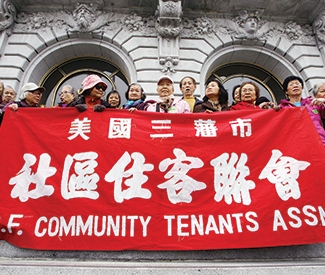
The package was announced Oct. 24 on the steps of City Hall by representatives of CCDC, San Francisco Tenants Union, Housing Rights Committee of SF, Causa Justa-Just Cause, Tenderloin Housing Clinic, UNITE HERE Local 2, Community Tenants Association, and Asian Americans Advancing Justice.

“San Francisco is falling into one of the deepest and most severe eviction crises in 40 years,” SFTU Director Ted Gullicksen said. “It is bad now and is going to get worse unless the city acts.”

The announcement came a day after the Lee family — an elderly couple on Social Security who care for their disabled daughter — was finally Ellis Act evicted from its longtime Chinatown home after headline-grabbing activism by CCDC and other groups had twice turned away deputies and persuaded the Mayor’s Office to intervene with the landlord.

But Mayor Ed Lee has been mum — his office ignored our repeated requests for comment — on the worsening eviction crisis, the tenant groups’ proposals, and the still-unresolved fate of the Lees, who are temporarily holed up in a hotel and still hoping to find permanent housing they can afford.

The package proposed by tenant advocates includes: require those converting rental units into tenancies-in-common to get a conditional use permit and bring the building into compliance with current codes (to discourage speculation and flipping buildings); regulate TIC agreements to discourage Ellis Act abuse; increase required payments to evicted tenants and improve city assistance to those displaced by eviction; require more reporting on the status of units cleared with the Ellis Act by their owners; investigate and prosecute Ellis Act fraud (units are often secretly re-rented at market rates after supposedly being removed from the market); increase inspections of construction on buildings with tenants (to prevent landlords from pressuring them to move); prohibit the demolition, mergers, or conversions of rental units that have been cleared of tenants using no-fault evictions in the last 10 years (Sup. John Avalos has already introduced this legislation).

“The evidence is clear. We are facing not only an eviction crisis but also a crisis associated with the loss of affordable rental housing across the city. Speculative investments in housing has resulted in the loss of thousands affordable apartments through conversions and demolitions. And the trend points to the situation becoming much worse,” the coalition wrote in a public statement proposing the reforms.

Evictions have reached their highest level since the height of the last dot-com boom in 1999-2000, with 1,934 evictions filed in San Francisco in fiscal year 2012-13, and the rate has picked up since then. The Sheriff’s Department sometimes does three evictions per day, last year carrying out 998 court-ordered evictions, Sheriff Ross Mirkarimi told us, arguing for an expansion of city services to the displaced.

At “Housing for Whom?” a community forum the Guardian hosted Oct. 23 in the LGBT Center, panelists and audience members talked about the urgent need to protect and expand affordable housing in the city. They say the current eviction epidemic is being compounded by buyouts, demolitions, and the failure of developers to build below-market-rate units.

“We’re bleeding affordable housing units now,” Fred Sherburn-Zimmer of Housing Right Committee said last night, noting the steadily declining percentage of housing in the city that is affordable to current city residents since rent control was approved by voters in 1979. “We took out more housing than we’ve built since then.”

Peter Cohen of the Council of Community Housing Organizations actually quantified the problem, citing studies showing that only 15 percent of San Franciscans can afford the rents and home prices of new housing units coming online. He said the housing isn’t being built for current city residents: “It’s a demand derived from a market calculation.”

Cohen said the city’s inclusionary housing laws that he helped write more than a decade ago were intended to encourage developers to actually build below-market-rate units in their projects, but almost all of them choose to pay the in-lieu fee instead, letting the city find ways to build the affordable housing and thereby delaying construction by years.

“It was not about writing checks,” Cohen said. “It was about building affordable units.”

Discussion at the forum began with a debate about the waterfront luxury condo project proposed for 8 Washington St., which either Props. B or C would allow the developer to build. Project opponent Jon Golinger squared off against proponent Tim Colen, who argued that the $11 million that the developer is contributing to the city’s affordable housing fund is an acceptable tradeoff.

But Sherburn-Zimmer said the developer should be held to a far higher standard given the obscene profits that he’ll be making from waterfront property that includes a city-owned seawall lot. “Public land needs to be used for the public good.”

Longtime progressive activist Ernestine Weiss sat in the front row during the forum, blasting Colen and his Prop. B as a deceptive land grab and arguing that San Francisco’s much ballyhooed rent control law was a loophole-ridden compromise that should be strengthened to prevent rents from jumping to market rate when a master tenant moves out, and to limit rent increases that exceed wage increases (rent can now rise 1.9 percent annually on rent controlled apartment).

“That’s baloney that it’s rent control!” she told the crowd. (Steven T. Jones)

Students fight suspensions targeting young people of color

Sagging pants, hats worn indoors, or having a really bad day — the list of infractions that can get a student suspended from a San Francisco Unified School District school sounds like the daily life of a teenager. The technical term for it is “willful defiance,” and there are so many suspensions made in its name that a student movement has risen up against it.

The punishment is the first step to derailing a child’s education, opponents said.

Student activists recognize the familiar path from suspensions to the streets to prisons, and they took to the streets Oct. 22 to push the SFUSD to change its ways. Around 20 or so students and their mentors marched up to City Hall and into the Board of Education to demand a stop of suspensions over willful defiance.

A quarter of all suspensions in SFUSD for the 2011-12 school year were made for “disruption or defiance,” according to the California Department of Education. Half of all suspensions in the state were for defiance.

When a student is willfully defiant and suspended, it’s seen as a downward spiral as students are pushed out of school and onto the streets, edging that much closer to a life of crime.

“What do we want? COLLEGE! What are we gonna do? WORK HARD!” the students shouted as they marched to the Board of Education’s meeting room, on Franklin Street.

They were dressed in graduation gowns of many colors, signs raised high. They smiled and danced and the mood was infectious. One driver drove by, honked and said “Yes, alright!” Assorted passersby of all ethnicities cheered on the group. The students were from 100% College Prep Institute, a Bayview tutoring and mentoring group founded in 1999 aiming to educate students of color in San Francisco. Their battle is a tough one. Though African American students make up only 10 percent of SFUSD students, they accounted for 46 percent of suspensions in 2012, according to SFUSD data. Latinos made up the next largest group, at 30 percent. (Joe Fitzgerald Rodriguez)

Techies to NSA: Stop spying on us!

Thousands of privacy and civil liberties activists, including many from the Bay Area, headed to Washington DC for an Oct. 26 rally calling for surveillance legislation reform, in response to National Security Agency spying programs. It was organized by more than 100 groups that have joined together as part of the Stop Watching Us coalition. The group has launched an online petition opposing NSA spying, and planned to deliver about 500,000 signatures to Congress. Many of the key drivers behind Stop Watching Us, from the Electronic Frontier Foundation to Mozilla, are based in San Francisco. (Rebecca Bowe)

Tenant groups propose sweeping package to ease the “eviction epidemic”

317

Tenant advocates today proposed a sweeping set of legislative proposals to address what they’re calling the “eviction epidemic” that has hit San Francisco, seeking to slow the rapid displacement of tenants by real estate speculators with changes to land use, building, rent control, and other city codes.

“In essence, it’s a comprehensive agenda to restrict the speculation on rental units,” Chinatown Community Development Center Policy Director Gen Fujioka told the Guardian. “We can’t directly regulate the Ellis Act [the state law allowing property owners to evict tenants and take their apartments off the rental market], but we’re asking the city to do everything but that.”

The package was announced this morning on the steps of City Hall by representatives of CCDC, San Francisco Tenants Union, Housing Rights Committee of SF, Causa Justa-Just Cause, Tenderloin Housing Clinic, UNITE HERE Local 2, Community Tenants Association, and Asian Americans Advancing Justice.

“San Francisco is falling into one of the deepest and most severe eviction crises in 40 years,” SFTU Director Ted Gullicksen said. “It is bad now and is going to get worse unless the city acts.”

The package includes: require those converting rental units into tenancies-in-common to get a conditional use permit and bring the building into compliance with current codes (to discourage speculation and flipping buildings); regulate TIC agreements to discourage Ellis Act abuse; increase required payments to evicted tenants and improve city assistance to those displaced by eviction; require more reporting on the status of units cleared with the Ellis Act by their owners; investigate and prosecute Ellis Act fraud (units are often secretly re-rented at market rates after supposedly being removed from the market); increase inspections of construction on buildings with tenants (to prevent landlords from pressuring them to move); prohibit the demolition, mergers, or conversions of rental units that have been cleared of tenants using no-fault evictions in the last 10 years (Sup. John Avalos has already introduced this legislation).

“The evidence is clear. We are facing not only an eviction crisis but also a crisis associated with the loss of affordable rental housing across the city. Speculative investments in housing has resulted in the loss of thousands affordable apartments through conversions and demolitions. And the trend points to the situation becoming much worse,” the coalition wrote in a public statement proposing the reforms.

Evictions have reached their high level since the height of the last dot-com boom in 1999-2000, with 1,934 evictions filed in San Francisco in fiscal year 2012-13, and the rate has picked up since then. The Sheriff’s Department sometimes does three evictions per day, last year carrying out 998 court-ordered evictions, Sheriff Ross Mirkarimi told us, arguing for an expansion of city services to the displaced.

At “Housing for Whom?” a community forum the Guardian hosted last night in the LGBT Center, panelists and audience member talked about the urgent need to protect and expand affordable housing in the city. They say the current eviction epidemic is being compounded by buyouts, demolitions, and the failure of developers to build below-market-rate units.  

“We’re bleeding affordable housing units now,” Fred Sherburn-Zimmer of Housing Right Committee said last night, noting the steadily declining percentage of housing in the city that is affordable to current city residents since rent control was approved by voters in 1979. “We took out more housing than we’ve built since then.”

Peter Cohen of the Council of Community Housing Organizations actually quantified the problem, citing studies showing that only 15 percent of San Franciscans can afford the rents and home prices of new housing units coming online. He said the housing isn’t being built for current city residents: “It’s a demand derived from a market calculation.”

Cohen said the city’s inclusionary housing laws that he helped write more than a decade ago were intended to encourage developers to actually build below-market-rate units in their projects, but almost all of them choose to pay the in-lieu fee instead, letting the city find ways to build the housing and thereby delaying construction by years.

“It was not about writing checks,” Cohen said. “It was about building affordable units.”

Last night’s discussion began with a debate about the waterfront luxury condo project proposed for 8 Washington Street, which either Props. B or C would allow the developer to build. Project opponent Jon Golinger squared off against proponent Tim Colen, who argued that the $11 million that the developer is contributing to the city’s afforable housing fund is an acceptable tradeoff.

But Sherburn-Zimmer said the developer should be held to a far higher standard given the obscence profits that he’ll be making from waterfront property that includes a city-owned seawall lot. “Public land needs to be used for the public good.”

Longtime progressive activist Ernestine Weiss sat in the front row during the forum, blasting Colen and his Prop. B as a deceptive land grab and arguing that San Francisco’s much ballyhooed rent control law was a loophole-ridden compromise that should be strengthened to prevent rents from jumping to market rate when a master tenant moves out, and to limit rent increases that exceed wage increases (rent can now rise 1.9 percent annually on rent controlled apartment.

“That’s baloney that it’s rent control!” she told the crowd.


Supes approve funding request for jail construction

“A Costco warehouse with metal bunk beds” is how Matt Freeman of the San Francisco Sheriff’s Department described one of the county’s outmoded jail facilities, speaking at a meeting in City Hall today (Tue/22). At its meeting, San Francisco Board of Supervisors cleared the way for the Sheriff and the Department of Public Works to request $80 million in state funding to be put toward the construction of a modernized jail.

The new facility would replace seismically vulnerable 1950s era jails that are slated for demolition as part of a larger Hall of Justice overhaul. However, some supervisors voiced reservations about the plan.

As the Guardian recently reported, plans for the $290 million jail rebuild have drawn criticism from community advocates who question the use of resources that could be spent on programs to help people stay out of the criminal justice system.

Sup. Eric Mar, who refused to endorse the grant application at a recent Budget & Finance Committee meeting, piped up at the beginning of this meeting to say he’d had a change of heart. Evidently, Sheriff Ross Mirkarimi and some others from the Sheriff’s Department took him on a tour of the San Bruno jail, the county’s most modern facility, to show him the difference between an outmoded jail and one designed with rehabilitative programming in mind.

“I see now that the need is really critical, for safety for inmates but also … a seismically safe and modern jail,” Mar said. “I’m convinced now that it’s really about … supporting anti-recidivism and rehabilitation programs. I really appreciate the sheriff and his staff for opening my eyes.”

But Sup. David Campos was not yet entirely sold on the need for a new jail. “I am not in a position to say that I support the building of this facility,” he said, but said he could be open the possibility after studying the details. “I do acknowledge that I have a bias – I would rather spend less money building a jail than building other things that I think are better investments for our city. That’s not to say I don’t want the jail population to be taken care of. I clearly do.” His office has requested a hearing on this topic, which will be held in early December.

Sup. John Avalos said he too had found it “difficult to support a jail altogether,” but noted that a debate on that decision would come at a later time. “This is just making sure that we have an opportunity to receive state funding if we decide to rebuild,” he said.

In the end, the request to submit an $80 million grant application for state funding was approved without opposition. But the preliminary discussion suggests that a broader debate over San Francisco’s jail rebuild is on the horizon, and it’s an issue where typical political allies won’t necessarily see eye-to-eye. At the same time, it’s a big financial commitment. According to City Controller Ben Rosenfield, the total cost could be in excess of $500 million after financing is factored in.

BEST OF THE BAY 2013: LOCAL HEROES

0

Bruce Brugmann, Jean Dibble, and Tim Redmond

The San Francisco Bay Guardian — which has had a significant impact on the Bay Area’s cultural and political dynamics and dialogue over the last 47 years — was largely the creation of three people with complementary skills and perspectives, an amalgam that gave the Guardian its voice and longevity.

Although they are no longer involved with running the paper, we’re honoring their contribution and legacy with a form of recognition they created: a Local Hero Award in our Best of the Bay issue, an annual edition that has been adopted by almost every alt-weekly in the country.

Bruce Brugmann and Jean Dibble launched the Guardian in October 1966 after years of planning by the married couple, and they ran it as co-publishers until the paper’s sale to the San Francisco Newspaper Co. last year, with Dibble running the business side and Brugmann in charge of editorial and serving as its most public face.

“We were one of the few husband and wife newspaper teams, a real mom and pop operation,” Brugmann told us. “We couldn’t have done it without the two of us, we needed both of our skill sets.”

They met in 1956 at the University of Nebraska, where Brugmann studied journalism and served as editor of the Daily Nebraskan, starting his long career as journalistic rabble-rouser. Dibble studied business, which she would continue in graduate school at Harvard University’s Radcliffe College while Brugmann got a master’s in journalism at Columbia University.

As graduation neared, they started talking about forming a newspaper together, an idea that percolated while Brugmann served in the US Army, where he wrote for Stars and Stripes, and Dibble moved to San Francisco with their two kids to work in personnel and administrative positions.

After the Army, they settled in Wisconsin, where Brugmann worked as a reporter for the Milwaukee Journal before moving to the Bay Area to work on launching the Guardian while Brugmann supported the family working for the Redwood City Tribune.

“We came out here with the idea of doing it and we immediately started planning. Jean did the prospectus, a damn good prospectus,” Brugmann said.

The Guardian published sporadically in the beginning, but it tapped into a vibrant counterculture that was clashing with the establishment and began publishing important articles highlighting inequities in the Vietnam War draft and exposing local political scandals, including how Pacific Gas & Electric illegally acquired its energy monopoly.

“A lot of it was just keep your head down and keep going,” Dibble said. “We never talked about alternatives, it was just what we were going to do.” The Guardian covered the successful revolts against new freeways in the city and plans to build Manhattan-style skyscrapers, publishing the book The Ultimate Highrise in 1971. In the mid-’70s, the Guardian won a successful unfair competition lawsuit against the Chronicle and the Examiner over their joint operating agreement, allowing the paper to become a free newsweekly. “Eventually, things got better, and we got some large advertisers in the ’80s and they really helped kick us off,” Dibble said. That was also when Tim Redmond, a journalist and activist steeped in radical politics, started writing for the Guardian, going on to serve as the paper’s executive editor and guiding voice for more than 30 years. “Tim was always more radical than I was,” Brugmann said, giving Redmond credit for the Guardian’s groundbreaking coverage of tenant, environmental, and economic justice issues. “Every publisher needs an editor who was more radical than they are to push them.” The two journalists had a prolific partnership, mentoring a string of journalists who would go on to national acclaim, turning the Guardian into a model for alt-weeklies across the country, exposing myriad scandals and emerging arts and cultural trends, and helping to write and pass the nation’s strongest local Sunshine Ordinance. “We always wanted to make things better,” Brugmann said of what drove the Guardian. “Even the battles that we lost, we got major concessions. Yerba Buena is much better because of the stories we did at the time, same thing with Mission Bay…San Francisco is much better that we were here. And we’re really proud and we appreciate the work of the current Guardian staff in keeping the Guardian flame alive.”


LOCAL HEROES: Kate Kendell

The night Proposition 8 passed was one of the hardest of Kate Kendell’s life. She remembers it with startling detail — and she should, because she was one of the most prominent opponents of the measure to overturn marriage equality in California.

“I was hopeful right up until the end that Prop. 8 would be defeated,” she said, speaking slowly as she pulled her thoughts from what sounded like a dark place. “Our initial polling numbers said we’d probably lose, but I really hoped in the deepest heart of my heart that when people got in there that they’d punch their vote in favor of the person they knew.”

But as the voters of California showed in that 2008 election, sometimes the good guys lose.

Kendell, executive director of the National Center for Lesbian Rights, fought the good fight since she started there in 1994. The NCLR litigates, creates policy, and performs outreach for LGBT civil rights on a national level, with headquarters in San Francisco. After years of anticipation, she poured herself into the campaign against the proposition that would make her marriage illegal, and then the measure passed.

That night she hung her head in disbelief. She felt physically ill, and her mind roiled in grief equaled only by the death of one of her parents. “It felt like that,” she said.

Kendell and her wife, Sandy, went home without speaking a word, and when she got in the door she tried to pull it together. Steeling herself to face her family, Kendell walked out of the bathroom and burst into tears. Her son said simply “this just means we have to fight more.”

So she did, and we all won.

That led to the moment for which Kendell may be remembered for a long time to come. When Prop. 8 was overturned by the US Supreme Court this year, a flock of San Francisco politicians descended the steps inside the rotunda at City Hall. Kendell took to the podium and spoke to the nation.

“My name is Kate Kendell with the National Center for Lesbian Rights,” she said, “and fuck you, Prop. 8!” The crowd erupted into cheers.

She regrets saying it now, but history will likely forgive her for being human. For someone whose own marriage’s validity was threatened and who spent two decades fighting for equality, she earned a moment of embarrassing honesty.

Kendell’s infamous declaration may be how she’s known, but one of her key decisions behind the scenes shaped the LGBT equality movement as well. When then-Mayor Gavin Newsom’s administration wanted a couple to be the first in his round of renegade gay marriages in 2004, it was Kendell who suggested Del Martin and Phyllis Lyon.

The two were in a relationship since 1953, pioneers of LGBT activism in San Francisco. Kendell said it was only right that they were first to read their vows in the city they helped shape. “Were it not for their contributions, visibility, and courage in the ’50s and ’60s, we wouldn’t be in that room with Newsom contemplating marriage licenses,” she said. “I’m just happy they said yes. It was absolutely appropriate.” And it’s with that sense of history that she herself pioneers forward, pushing in states across the US what Harvey Milk fought for in California — workplace protections for the LGBT community. “In 38 states, you can be fired from your job or being lesbian, gay, bisexual, or transgender. That has to change,” she said. “When the next chapter of history is written, it will be about a nation that treats the LGBT community as equals.”


Theo Ellington

Last year, when San Francisco Mayor Ed Lee floated the idea of implementing stop-and-frisk, a practice that many civil rights advocates say amounts to racial profiling, Theo Ellington stepped up to create a Change.org petition to oppose the idea — and won.

The policy would have given San Francisco police officers the authority to stop and search any individual who “looks suspicious,” in an effort to get guns off the streets.

“I found it was basically a predatory policing practice that didn’t belong in a city like San Francisco,” Ellington told us. His petition garnered a little more than 2,300 signatures, “enough to show policymakers we were paying attention,” he guesses. Faced with mounting pressure and a community outcry, Lee ultimately abandoned the idea.

“That was a win, I think, for everyone fighting for what’s really a civil right,” the 25-year-old, native San Franciscan told us in a recent phone interview. “It’s not a black issue or a white issue,” but it did strike a nerve and provide Ellington with some momentum for coalition building.

Ellington was born and raised in San Francisco’s Bayview Hunters Point neighborhood, home to a significant portion of the city’s dwindling black population. The campaign against stop-and-frisk helped catalyze his still-evolving political organization, the Black Young Democrats of San Francisco, of which he is president.

Go to BYDSF’s website and you’re confronted with some startling statistics about the experience of black San Franciscans: In the last 20 years, the African American community has dwindled to only 6 percent of the city’s population; meanwhile, the high school dropout rate stands at 38 percent, the unemployment rate is 18 percent, and the level of poverty stands at a disheartening 20 percent.

To tackle these looming challenges, BYDSF now faces the hurdle of getting local elected officials to care. “Since then, we have been trying to build our membership and figure out where we fit in the political climate of SF,” Ellington says.

His group’s chief concerns include closing the achievement gap in San Francisco public schools, doing something about the escalating cost of housing, and finding better solutions for public transit. “There’s the housing need, obviously. It’s a need that working class folks in general are facing,” he said.

He’s pursing a master’s degree in urban affairs at the University of San Francisco, and says he’s taken it upon himself to learn everything he can about how cities operate. To that end, he often ponders vexing questions: “How do you figure out a way to give those same opportunities to everyone? How do you provide opportunities for all income levels?”

His successful opposition campaign to stop-and-frisk didn’t stop Mayor Lee from appointing him to the Commission on Community Investment and Infrastructure, which oversees the successor to the San Francisco Redevelopment Agency. A major project under that body’s purview is the Hunters Point Shipyard development, a massive undertaking led by construction firm Lennar Urban, practically in Ellington’s backyard. Having grown up in the neighborhood, he sees himself as being in a unique position to ensure that the developers are providing jobs for local residents as required under the agreement. “It allows me to speak to both sides — on the community level, and in City Hall,” he said. “There are certain social dynamics you won’t understand unless you have lived in the community.” Ultimately, Ellington says, his goal is to push local politicians to find ways of making San Francisco a place where people of all income levels can find their way. “There’s a lot more work to do,” he said. “I think San Francisco is at a real pivotal point, where we can choose to go in the right direction … or we can choose the opposite.”


LOCAL HEROES: Shanell Williams

Shanell Williams is a chameleon activist, spearheading the effort to save City College of San Francisco from many fronts.

When City College fought off a statewide initiative to save money by stigmatizing struggling students, she defended the school as an Occupy activist. With a banner raised high, she faced down the California Community College Board of Governors, shouting their wrongs aloud at a meeting attended by hundreds. The board was stunned but her fellow activists were not, because that’s who Williams is: an uncompromising defender of San Francisco.

Now, as City College faces a fight for its existence, Williams is defending it again, this time as a duly elected CCSF student trustee.

Williams is at the forefront of Save CCSF, an Occupy-inspired group publicly protesting the Accrediting Commission of Community and Junior Colleges, the body trying to shut down City College. San Francisco is holding its breath until next July to hear if the accrediting commission will close the city’s only community college — and Williams was one of the key organizers helping students’ voices rise up to decry the decision to close the school.

She has reason to fight hard, growing up watching her community ravaged by those in power who purported to do good. She is a black woman and San Francisco native raised in the Fillmore and the long history of redevelopment and its role in the flight of The City’s African American population shaped her ethos. To Williams, there are forces that care about money at the expense of communities and those forces need to be fought.

“How are we supporting people to have a decent quality of life?” she said, and that’s the way she’s approached saving her community since a young age.

In 2003, while in high school, Williams got a taste of politicking as a member of San Francisco’s Youth Commission, appointed by then-Mayor Willie Brown. “I think he’s a very interesting character with a lot of influence over the city,” she said, with just an edge of steel to her voice.

As a teenaged politician, she discovered the work of the Human Rights Commission and was inspired. While a student of Washington High School and then Wallenberg High, she had a tough home life and entered the foster care system, getting a firsthand look at how the state takes care of its youth.

It galvanized her, honed her, and made her yearn for change. “I just innately had a sense of wanting to see justice and fairness,” she said.

Energized, she joined the Center for Young Women’s Development, the Youth Treatment Education Court, Urban Services YMCA, the Youth Leadership Institute, and more. She joined so many organizations and taught so many youth and government officials that even she can’t remember all of them off the top of her head.

At one point, she even taught judges across the country about cultural competency. “We had this whole spoken word performance thing we did,” she said, laughing.

In 2010, as Williams took classes at City College, she waved the banner defending San Francisco’s community college students. She pushed for city-level minimum wage requirements for City College workers, who earned dollars less. She also pushed back against state requirements to cut off priority registrations to those who took too long in the community college system — because she’s been there herself.

“They need a few chances to get it right and become a good student,” she said. When the struggle to save City College is done, win or lose, Williams sees herself remaining an advocate for students for years to come. At 29 years old, she’s still a student herself, and she eagerly awaits the day she’ll transfer to Cal or Stanford as an Urban Studies major. It all comes back to defending her city. “We have to broaden the movement,” she said. “The enemy is not about color, it’s about wealth inequality. It’s not just about City College either. It’s about the austerity regime that doesn’t care about working class people and poor folks.”


San Franciscans for Healthcare, Jobs, and Justice

When the San Francisco Mayor’s Office cut a deal with Sutter Health and its California Pacific Medical Center affiliate for an ambitious rebuild of hospital facilities — which would shape healthcare services in San Francisco for years to come — community activists began to find serious flaws in the proposal.

So they organized and banded together into a coalition to challenge the powerful players pushing the plan, eventually helping to hash out a better agreement that would benefit all San Franciscans. Representing an alliance between labor and community advocates, the coalition was called San Franciscans for Healthcare, Jobs, and Justice.

When the whole affair began, it seemed as if the CPMC rebuild would incorporate a host of community benefits — but those promises evaporated after the healthcare provider walked away from the negotiating table, unhappy with the terms.

Then a second agreement, with much weaker public benefits, came out of a second round of talks between CPMC and the Mayor’s Office. But by then, so much had been given up that “we were stunned,” said Calvin Welch, who joined the coalition on behalf of the Council of Community Housing Organizations. “We met with [Mayor Ed Lee] and told him, this is absolutely unacceptable.”

But the mayor wasn’t willing to address their concerns at that time. When the deal failed to win approval after a series of hearings at the Board of Supervisors, however, “the unacceptable deal that the mayor created melted in the sun of full disclosure,” Welch said.

That plan would have allowed St. Luke’s Hospital, a critically important facility for low-income patients, to shrink to just 80 beds with no guarantee that it would stay open in the long run. CPMC’s commitment to providing charitable care to the uninsured was disappointingly low. And while the project was expected to create 1,500 permanent jobs in San Francisco, the deal only guaranteed that 5 percent of those positions would go to existing San Francisco residents.

Enter the movers and shakers with San Franciscans for Healthcare, Housing, Jobs, and Justice. The coalition took its place at the negotiating table, along with CPMC, a mediator, and an unlikely trio of supervisors that included Board President David Chiu and Sups. David Campos and Mark Farrell. Over several months, the coalition put in some serious time and energy to push for a more equitable outcome.

“We pushed so hard for a smaller Cathedral Hill [Hospital] and a larger St. Luke’s,” Welch said, describing their strategy to safeguard against the closure of St. Luke’s. They also pushed for CPMC to make a better funding contribution toward affordable housing, a stronger guarantee for hiring San Franciscans at the new medical center, and improvements to transit and pedestrian safety measures as conditions of the deal.

Under the terms that were ultimately approved, St. Luke’s will remain a full-service hospital, and CPMC will commit to providing services to 30,000 “charity care” patients and 5,400 Medi-Cal patients per year.

CPMC also agreed to contribute $36.5 million to the city’s affordable housing fund, and promised to pay $4.1 million to replace homes it displaces on Cathedral Hill. Under the revised deal, 30 percent of construction jobs and 40 percent of permanent entry-level positions in the new facilities would be promised to San Francisco residents.

One of the greatest victories of all, Welch said, was how well coalition members worked together. “This was the most straight-up equal collaboration with labor and community people, equally supporting one another, that I’ve ever been involved with,” Welch said. Even though they were motivated to participate by different sets of concerns, the two sides remained mutually supportive, Welch said. During the long, grueling hearings, “The nurses never left,” he noted in amazement. “The nurses stuck around for all the community stuff.”


Photos by Evan Ducharme

Parking and the gentrification of food

74

STREET FIGHT Professor Don Shoup, an icon in San Francisco planning circles, is famous for illuminating that there is no such thing as free parking. In his voluminous book The High Cost of Free Parking, Shoup breaks-down the costs of building parking spaces and the land underneath.

Beyond that there’s lighting, insurance, security, maintenance, ventilation, financing, contracting, and surveying costs. There’s also the additional property tax on the parking, and piling onto that, the vast external costs to society with congestion and pollution from car trips generated by parking.

While all of this might seem obvious, the virtue in Shoup’s work was to show how the costs of parking are regressive and passed onto communities, especially low income households and non-drivers. For example, a grocery store bundles parking into the price of food and this is disproportionately borne by non-drivers.

In a sense, free parking causes the gentrification of food.

In San Francisco, underground parking costs anywhere from $80,000 to $100,000 per space to construct. In the proposed supermarket at 555 Fulton Street, the 77 spaces proposed underneath the store will cost anywhere from $6.1 million to $7.7 million to build.

That’s millions that will be passed on to a grocery store tenant and ultimately to shoppers. And that’s just to build, not operate, the parking. This adds more burden to the already tight pocketbooks in a gentrifying city like San Francisco.

Parking also complicates the issue of grocery stores and formula retail, making developers prefer a chain store because it can access the financing to build parking. So parking literally “drives-up” the rents for tenants seeking to lease the space. This makes it more difficult to find an affordable, local, non-chain grocer while also translating into higher food prices, since grocers transfer the cost of parking onto all shoppers regardless of how they got there and regardless of the shoppers’ income.

All of this came to a head last week at the San Francisco Planning Commission hearing on 555 Fulton, a proposed mixed use development that might include a grocery store. The Commission voted 4-2 to lift a formula retail ban on this site, concluding that only a chain store is “economically viable.” (Disclosure: I publicly advocated against that exemption as a member of the Hayes Valley Neighborhood Association).

This was not just a blow to the city’s unique character in terms of guarding against chain stores. It undercuts sustainable and affordable urbanism and will lead to gentrified food. Here’s a brief summary of what happened:

In the early 2000s, the old Christopher Dairy at 555 Fulton, between Laguna and Octavia, was identified as a good location for a supermarket as part of a larger mixed-use development. The site was folded into the Hayes Valley formula retail ban to encourage an independent, community-based supermarket with fresh produce, high quality food affordable to nearby residents, and jobs for locals.

In 2010, the Planning Commission approved the first iteration of this project, with 136 housing units above a non-chain grocery store. Neighbors were very excited to have a local supermarket to serve the whole community and the developer did not try to circumvent the chain store ban. The community and Planning Department were working together.

In late 2012, the site and its entitlements were sold to a new developer, Fulton Street Ventures. It immediately informed the community that it would seek to lift the ban. HVNA unanimously opposed lifting the ban and Planning Department staff supported HVNA’s position. At that point, it seemed that the planners had read and understood Shoup.

For its part, HVNA compiled a list of potential non-chain store candidates and proposed creative ways to make the site work for a locally owned business, with perhaps some space allotted to a hardware store or other neighborhood-serving shops. HVNA also proposed reducing the parking at the site in order to make the store affordable.

The Market and Octavia Plan, which includes 555 Fulton, allows a grocery store to have less parking than the 77 the developer wants, and even zero parking. The developer could eliminate some or all of the parking, reduce construction costs, and reduce the asking price for a lease. This area is flat, incredibly walkable and proximate to thousands of existing residents, with thousands more on the way.

A car-free or car-lite grocery store can deploy innovative ways of delivering groceries, such as a jitney service or delivery vans, for those who need such service, and to limit the amount of store parking to a small number of car share and disabled parking stalls. This kind of grocery store would be at the cutting edge of truly sustainable urbanism, while also providing more affordability to all residents of the community.

Yet another Shoup axiom is “Planning for parking is more a political than a professional activity.” Instead of being creative, Fulton Ventures balked at the parking ideas and employed divisive race-baiting to push its profit-driven agenda. It financed a quiet campaign to accuse anyone supporting the formula retail ban and reducing parking as racist and elitist. It leaned heavily on City Hall and somehow got the Planning Department to suddenly retract its support for upholding the chain store ban. Sup. London Breed, who remained publicly detached, insisted that all she cared about was an affordable supermarket, but she offered no path to achieve it.

In a confusing Oct. 3 hearing, supporters of Fulton Ventures LLC made below-the-belt public comments that seemed to come straight out of a Tea Party playbook. It was tough to watch. Their position was that a chain store with excessive underground parking was the only way to an affordable grocer — anything short of that was racist. The commission voted 4-2 to lift the ban.

By lifting the formula retail ban, the city lost leverage for making the store affordable while also providing fresh food for thousands of people within walking distance. And the many car-free households of the Western Addition and Hayes Valley will get to breathe the car fumes from upscale shoppers. The commission gentrified food.

All is not lost though. The damage done by the Planning Commission can be overturned or fixed at the Board of Supervisors. Breed states she cares about affordability, local small business, and the city’s transit-first policies. She can put conditions on this project that reduces the parking, or decouples the parking from the lease for the commercial floor space, thus making the project economically viable for an affordable grocer. She can demand other creative and sustainable solutions which planners so far have not considered. She doesn’t have to give it away to a chain store. And if you care for affordable groceries with less driving, and want to stop the gentrification of food, write her and let her know.

BART negotiations continue as unions withhold strike threat UPDATED

105

With the 60-day cooling off period ordered by Gov. Jerry Brown coming to an end on Thursday, raising the specter of another Bay Area Rapid Transit shutdown, BART’s two main unions announced yesterday that they were holding off on calling a strike for now. [UPDATE 10/11: BART unions today issued a 72-hour strike notice, meaning they could strike on Monday].

“We’ve listened to the public and we share their concern about a disruption in service at the end of the cooling-off period.  We do not want to strike. That is why we’re not giving a 72-hour notice at this time, because we want to leave every opportunity open to try to get this deal done. Of course we are keeping all options on the table,” Service Employee International Union Local 1021 and Amalgamated Transit Union Local 1555 said in a joint statement.

Some media reports indicate that there has finally been some progress in the long-stalled negotiations, with a framework on pensions being agreed to, although the two sides still seem far apart on wages, benefits, and the length of the contract.

The unions cast it this way: “To this point of doing everything possible to avoid a strike: over the past 10 days, the unions have moved publicly three times, to BART’s zero times. If this were a score in the baseball playoffs – we, the Oakland A’s would be three and they, the Detroit Tigers would be zero. 

“At this point, if there is a disruption in service at the end of the cooling-off period, it will be for one reason and for one reason alone: our elected BART leadership has not shown leadership.”

BART Board President Tom Radulovich disputed that the concessions have been one-sided, but he said that, “They continue to want to negotiate in the media and we’re not really down with that.”

Asked to characterized where things stand and the prospects for resolving the impasse without another strike, Radulovich said, “We’re still cranking away and trying to get it done…It’s really not up to us whether there’s a strike or not. We just have to get this done.”

Meanwhile, while conservatives clamor to use the situation to get the Democrat-controlled Legislature to ban unions from striking (good luck with that one), Sup. John Avalos held a hearing yesterday at City Hall to examine some of the larger issues at play in the impasse, such as retirement security, that the Guardian covered in our July 9 issue.

Asked how the hearing went, Avalos told the Guardian, “We talked a lot about how BART has been villifying workers in the court of public opinion in an effort to weaken workers’ bargaining power.”


Friends in the shadows

36

rebecca@sfbg.com, joe@sfbg.com

It’s a simple fact of life: Money buys influence. But in San Francisco, despite strict sunshine laws to illuminate donations to city agencies and gifts to the regulators from the regulated, money still circulates in the shadows when it flows through the coffers of “Friends” in high places.

Major real estate developers, city contractors, and large corporations often lend financial support to San Francisco city departments, to the tune of millions of dollars every year. But the money doesn’t just flow directly to city agencies, where it’s easily tracked by disclosure laws. Instead, it goes through private nonprofits that sometimes label themselves as “Friends Of…” these departments.

They include Friends of City Planning, Friends of the Library, a foundation formerly known as Friends of the San Francisco Department of Public Health, Friends of SF Environment, and Friends of San Francisco Animal Care and Control.

The Friends pay for programs the departments supposedly cannot cover on their own. Bond money can build a skyscraper, but sometimes not fill it with furniture. Agencies are barred by law from funding an employee mixer or a conference trip, so departments turn to their Friends to fill in the gaps. Adding bells and whistles to city websites, holding lunchtime lectures, hiring a grant writer — or, in the case of the Department of Public Health, bolstering health services for vulnerable populations — these are all examples of what gets funded.

The extra help can clearly be a good thing, but the lack of transparency around who’s giving money raises questions — especially if it’s a business gunning for a major contract or a permit to build a high-rise.

City agencies receive outside funding from a wide variety of sources. Sometimes grants are made by the federal government, or a well-established philanthropic foundation — and according to city law, gifts of $10,000 or higher must be approved by the Board of Supervisors. But in the case of organizations like Friends, which are created specifically to assist city government agencies, the original funders aren’t always identifiable. And the collaboration is frequently much closer, with city staff members serving on Friends boards in a few cases.

the circle of donations to "friends of" foundations

Friends board members told the Guardian that their partnership with government helps bolster city agencies in a time of increasing austerity, in service of the public good. But do the special relationships these influential insiders hold with high-ranking city officials come into play when awarding a contract, issuing a permit, making a hiring decision, or determining whether a developer’s request for a rule exemption should be honored? Without more transparency, it’s tough to tell.

City disclosure rules state that any gift to a department must be prominently displayed on that department’s website, along with any financial interest the donor has involving the city. But Friends and other outside funders are under no obligation to share their supporters’ names, much less financial ties, when they distribute grants. Meanwhile, the disclosure rules that are on the books seem to be frequently ignored, misunderstood, or unenforced, our investigation discovered.

How are donors repaid for their support? Consider the controversy earlier this year around Pet Food Express, which won approval in June for another store in the Marina District despite opposition from four locally owned pet stores in the area that fear competing with a large national chain. Pet Food Express won the unlikely support of the city’s Small Business Commissioners, some of whom reversed their 2009 positions opposing the chain’s previous application.

SF Animal Care and Control Director Rebecca Katz personally lobbied the commission to support Pet Food Express, at least partially because the company has donated pet supplies valued at $50,000 to $70,000 per year to the department. That’s a lot of money for a cash-strapped city department, but a pittance compared to the profits of an expanding national chain.

It’s moments of clarity like those, when the public can easily trace the line from donations to political influence, that show why disclosure is so crucial. But those moments are few and far between when trying to trace the funders of private foundations and Friends organizations, where deals often happen in the dark.


WHEN DEVELOPERS ARE FRIENDS

At the Merchant Exchange Building in May, a crowd of high-profile real-estate developers mixed and mingled with city planners, commissioners, and even Mayor Ed Lee, wine glasses in hand. Sources told the Guardian that most of the planning staff was present, and not all were happy about having ribbons and name tags affixed to their shirts, as if they were being auctioned off.

With around 500 in attendance, the event was an annual fundraiser hosted by the Friends of San Francisco City Planning, a nonprofit organization that accepts contributions of up to $2,500 per individual to lend a helping hand to the Planning Department. This year’s event was titled “Incubator Startups, New Jobs for the Future,” hinting that the development community shares the mayor’s affinity for new tech startups and the droves of high-salaried IT professionals they’ve attracted to the city.

Some Friends of City Planning board members are major real-estate developers who routinely seek approval for major construction projects. Others are former planning commissioners, or have a background in community advocacy.

Amid widespread concern about displacement, gentrification, and the overall character of San Francisco’s built environment, no city department has greater influence than Planning. An individual’s interpretation of the Planning Code can carry tremendous weight; it’s a series of small decisions that shape a project’s profits and the look and feel of San Francisco’s future. And with cranes dotting the city’s skyline and market-rate construction catering to the wealthy while middle income residents get priced out, the amount of capital flowing through the development sector these days is astonishing.

In this dizzy climate, there might seem to be something askew about affluent developers and land-use attorneys rubbing elbows with city regulators, all eager to pass the hat for the Planning Department. Whiff of impropriety or no, the fundraiser appears to be totally legal.

“We aren’t violating the law — that I know,” Friends of City Planning Chair Dennis Antenore told the Guardian. “We’ve had legal advice on that for years.”

There is close collaboration between Friends of San Francisco City Planning and the Planning Department — a partnership so entrenched that it’s almost as if the nonprofit is an unofficial, private-sector branch of the agency.

“We are certainly thankful and appreciative,” Planning spokesperson Joanna Linsangan told the Guardian. “They’ve helped us for many, many years.” The additional funding is needed, she said, because “there isn’t a lot of wiggle room” in the departmental budget.

Each year, Planning Director John Rahaim submits a wish list to the Friends, outlining projects he wants funding for. This year, he requested $122,000 for a variety of initiatives, including training support to help planners assess proposals for formula retail (read: chain stores). That’s a hot-button issue lately, and one that shows how seemingly small decisions by planners can have big impacts.

When the department’s zoning administrator ruled that Jack Spade, a high-end clothing chain that opened up in the old Adobe Books location on 16th Street, wasn’t considered formula retail and therefore didn’t need a conditional use permit, neither widespread community outrage nor a majority vote by the Board of Appeals could reverse that flawed decision. It was a similar story with the Planning Commission’s Oct. 3 approval of the 555 Fulton mixed use project, where Planning Department support for exempting the grocery store for the area’s formula retail ban made it happen, to the delight of that developer.

Even though the planning director makes specific funding requests each year to the Friends and pitches the projects in person at their meetings — and the Friends publishes a list of the grants it awards to the department online — the Planning Department is not reporting those gifts to the Board of Supervisors.

“I confirm that the Planning Department did not receive any gifts,” Finance and IT Manager Keith DeMartini wrote in official gift reports submitted to the Board of Supervisors for the years 2011-12 and 2012-13. Those reports were sent to the board on Oct. 7 and Oct. 4, respectively, well after the July filing deadline and after the Guardian requested the missing reports.

The Friends typically funds two-thirds of the requests, said board member Alec Bash, totaling around $80,000 a year. In 2012, the Friends awarded a $25,000 grant to make the department’s new online permit-tracking system more user-friendly, making life a lot easier for developers.

When asked what safeguards are in place to prevent undue influence when the director is soliciting funding from a nonprofit partially controlled by developers, Linsangan responded, “those are two very separate things. One does not influence the other.”

She stated repeatedly that planners are not privy to information about individual contributors — but the fundraisers are organized by a board that includes identifiable developers, and anyone who attends can plainly see the donors in attendance. Nevertheless, Linsangan insisted that planners would not be swayed by this special relationship, saying, “That’s simply not the way we do things around here. We do things according to the Planning Code.”

But as the ruling on Jack Spade shows, as well as countless rulings by planners on whether a project is categorically exempt from the California Environmental Quality Act, interpreting the codes can involve considerable discretion.

The public can’t review a list of who wrote checks to the Friends of San Francisco City Planning for the May fundraiser. Since the organization waits a year between collecting the money and disbursing grants, donors stay shielded from required annual disclosures in tax filings.

But Antenore says the system was established with the public interest in mind. “We don’t reveal the contributors, because we don’t want anybody to have increased influence by a donation,” he insisted. Bash echoed this idea, saying the delay was to “allow for some breathing room.”

Unlike some of his fellow board members from the high-end development sector, Antenore has a history of being aligned with neighborhood interests on planning issues, helping author a 1986 ballot measure limiting downtown high-rise development. He emphasized that the developers on the Friends board are balanced out by more civic-minded individuals.

Still, developers who regularly submit permit applications for major construction projects sit on the Friends board. Among them are Larry Nibbi, a partial owner of Nibbi Bros.; Clark Manus, CEO of Heller Manus Architects; and Oz Erikson, CEO of the Emerald Fund development firm.

“We’re not making use of [the funding] in a way that benefits these people,” Antenore said. “I wouldn’t do this if I thought otherwise. I have been careful to maintain the integrity of this organization.” The money is meant to facilitate better planning, he added. “I don’t think there’s any conspiracy,” he said. “We’re not financing anything evil.”

Both the Planning Department and its Friends dismissed the idea that the donations could open the door to favoritism or undue influence. So why isn’t the department reporting gifts it receives from the Friends to the Board of Supervisors, or disclosing them on its website, as required by city law?

According to a 2008 City Attorney memo on reporting gifts to city departments, when an agency receives a gift of $100 or more, it “must report the gift in a public record and on the department’s website. The public disclosure must include the name of the donor(s) and the amount of the gift [and] a statement as to any financial interest the contributor has involving the city.”

John St. Croix, director of the San Francisco Ethics Commission, confirmed that’s the current standard, telling us, “The actual disclosure should be on the website of the department that received the gift.”

Linsangan said records of the gifts are indeed available — listed as “grants” in the department’s Annual Report. But while the 2011-12 report lists grants from sources such as the Metropolitan Transportation Commission and the Environmental Protection Agency, there was no mention of Friends of City Planning.

The memo also says any gift of $10,000 and above must first be approved by a resolution of the Board of Supervisors. But last year, when the Friends provided $25,000 to upgrade the permit-tracking system, it wasn’t sanctioned by a board resolution. Asked why, Linsangan made it clear that she was not aware of any such requirement.

As is common, when it comes to adhering to disclosure laws, confusion abounds. And sometimes, only sometimes, politicos get caught.


READING UP ON DISCLOSURE LAWS

When the head of a city agency fails to report gifts totaling $130,000, how much do you think he is fined?

City Librarian Luis Herrera failed to report receiving that amount in gifts and he was fined exactly $600 by the California Fair Political Practices Commission on Sept. 19. Specifically, Herrera had to file a form 700 with the FPPC to state the gifts he received. From 2008-2010, the forms he turned in had the “no reportable interests” box checked.

The money was used in what he calls the City Librarian’s Fund, which is the money he keeps on hand to pay for office parties and giving honorariums to poets and speakers who perform at the library’s branches, money that wasn’t disclosed on the very forms designed for reporting it.

There are two stories of how the fine came about. Longtime library advocate James Chaffee said that it was the result of a complaint he filed with the FPPC in April, and indeed, he sought and obtained many public documents revealing the money trail. San Francisco Public Library spokesperson Michelle Jeffers disagreed, saying that the fine was the result of an ongoing conversation with the FPPC to figure how exactly to file the gifts appropriately.

“The law wasn’t clear around these forms and it wasn’t clear if he had to report them,” she told the Guardian. “For amending the reports you have to pay a $200 fine for every year it was proposed. We keep scrupulous records on every pizza party we have.”

When government officials receive “gift of cash or goods,” they must report them annually in statements of economic interest, known as a Form 700, to the city Controller’s Office. The form is kind of a running tally of who is receiving gifts from whom, a way for the public to track money’s influence in government.

The gifts came from the Friends of the San Francisco Public Library, another nonprofit that bolsters city agency funding. Now Herrera has to list the $130,000 gifts from fiscal years 2008-09 and 2009-10 on his website.

What exactly does that accomplish? As it turns out, not a whole lot.

City Administrative Code 67.29-6 defines the reporting of gifts to city departments, and one of those requirements is to make a statement of “any financial interest the contributor has involving the city.” Now that Herrera lists the Friends of the San Francisco Public Library as donors on the department website, the statement of financial interest by the friends group is this: “none.”

There are myriad donors to the Friends of the SFPL, and the group doesn’t have to state the economic interests of its donors, or even mention who its donors are. The code requires gifts be reported to the controller, and the deputy city controller told us this doesn’t apply to the “friends of” organizations, or any nonprofit foundation arms of city departments.

“If gifts are made to a department, yes, they have to disclose, so people don’t get preferential interest in getting city contracts,” Deputy Controller Monique Zmuda told us. “I know it’s a fine line. The foundations don’t provide us with anything.”

Friends of the SFPL doesn’t provide money just for pizza parties. A breakdown of a funding request from the library to its Friends shows requests up to $750,000 to advertise the library on Muni and in newspapers, funding for permanent exhibits, and the City Librarian’s personal fund. That’s just the money it gives to the library. Other monies are spent directly on activities supporting the library.

As Jeffers pointed out to the Guardian, the money isn’t spent on “trips to Tahiti.” Friends of the SPL do good city works, from a neighborhood photo project in the Bayview branch library to providing books for children. But the question is: Who’s buying that goodwill and why?

The millions of dollars in donations made to the Friends of the SFPL don’t need to be approved by the Board of Supervisors, like gifts to departments do. They’re not checked for conflicts of interest or financial interest by any governmental body. Donors give and the Friends of SFPL spend freely, financial interest or not.

When our research for this story began, no financial statements were available of the Friends of the SFPL website. After a few days of inquiries, the most recent year’s financial statements from 2011-12 were posted to the website.

Ultimately, the San Francisco Public Library is one of the smaller city departments, with an annual budget that hovers around $86 million. The Department of Public Health is a much bigger beast, with a 2011-12 budget of around $1.5 billion.

One of its main foundations, the San Francisco General Hospital Foundation, is also one of the largest nonprofits that supplements city spending. In many ways, it could be described as the model of disclosure for city foundations, although its disclosures are not by law, but by choice.


FOUNDATION OF FRIENDS

The Department of Public Health relies on a few entities that fundraise on its behalf: the San Francisco Public Health Foundation, the Friends of Laguna Honda Hospital, and the San Francisco General Hospital Foundation.

“They’re private nonprofit entities that are separate from the department,” CFO Greg Wagner told us. “But their roles are to support the department in its efforts.” He cited examples such as sending its staff to conferences or hosting meetings, “things that we don’t have the budget for or don’t have the staff or resources.”

The lion’s share of the DPH’s gifts are funneled through the SFGHF. Unlike many of the assorted Friends groups or foundations that support city services, the SFGHF extensively reports the sources of its $5 million in donations. The donors include a veritable who’s who of San Francisco: the Giants, Sutter Health, Xerox, Pacific Union, and Kohl’s all donated between $1,000 and $10,000 in the past two years.

But the largest gifts to the SFGHF came from Kaiser Permanente, and its financial interests in the city run deep. Kaiser came into the city’s crosshairs in July, when the Board of Supervisors passed a resolution calling on Kaiser to disclose its pricing model after a sudden, unexplained increase in health care costs for city employees. Kaiser holds a $323 million city contract to provide health coverage, and supervisors took the healthcare giant to task for failing to produce data to back up its rate hikes.

In the meantime, Kaiser has also been a generous donor. It contributed $364,950 toward SFGHF and another $25,000 to SFPHF in fiscal year 2011-12.

The funding from Kaiser and a host of other contributors — which include Chevron, Intel, Genentech, Macy’s, Wells Fargo (another city contractor), and a pharmaceutical company called Vertex — does support needed programs. They include research into the health of marginalized communities, services through Project Homeless Connect, screening for HIV, and immunization shots for travelers.

But because DPH doesn’t count much of this support as “gifts” formally received by the city, it isn’t subject to prior approval by the Board of Supervisors, or posted on the department’s website along with the contributors’ financial interests. Major contributions are disclosed in a report to the Health Commission, something Wagner described as a voluntary gesture in response to commissioners’ requests.

“Most gifts to foundations are donations to a nonprofit and do not come through the city or DPH at all,” he noted.

This distance is maintained on paper despite close collaboration with the department. In the case of Project Homeless Connect, a program that holds a bimonthly event to aid the homeless, it supports programs headquartered in city facilities. Penny Eardley, executive director of SFPHF— which used to be called Friends of San Francisco Public Health — noted that her organization occasionally makes grants or seeks funding in response to department requests. And Deputy Director of Health Colleen Chawla is a foundation board member. It’s almost like these foundations are extensions of the department, except they’re not.

SFPHF also earns revenue as a city contractor. When DPH received a grant from the Centers for Disease Control, it contracted with SFPHF to manage subcontracts with about a dozen community-based organizations.

The web gets even more tangled. The president of SFPHF is Randy Wittorp — who’s also Director of Public Affairs for Kaiser Permanente’s San Francisco Service Area. It’s a similar story with SFGHF, whose board includes several General Hospital administrators, including CEO Susan Currin.

Former Health Commissioner James Illig said people shouldn’t worry, that hospital the staff would never direct foundation funds to pet projects or mishandle funds. They maintain a separation and a firewall,” he said, for example noting, “Sue Currin is not directing funds to her own hospital.”

But he did admit that since SFGHF’s minutes are not public documents, that “raises a few concerns,” arguing the public should be able to inspect financial documents to decide if the foundations are directing funds lawfully to city departments.

Even when the public by law has a right to access financial records of a city department, rooting out corruption can be like pushing a boulder up a San Francisco hill.


FROM PATIENTS TO PARTIES

In 2010 and 2011, Laguna Honda Hospital administrators and staff used money from the hospital’s patient gift fund to throw a party. And then they spent it on airfare. And then they gave laser-engraved pedometers to the staff. All told, they spent nearly $350,000 meant for the dying and the infirm, nearly half of the total funds.

The incident was big, messy, and out in the public eye. It was an all-too-rare glimpse into the shady use of public funds by public officials. But when hospital staff members Dr. Derek Kerr and Dr. Maria Rivero blew the whistle on Laguna Honda’s misuse of patient funds in 2010, they were drummed out of their jobs.

Eventually litigation on behalf of the whistleblowers and their complaints of corruption were found to have merit.

Kerr’s vindication came at a meeting of the Health Commission in April 2013. In the packed City Hall meeting room, the public watched as Laguna Honda Executive Director Mivic Hirose read her apology to Kerr and Rivero aloud, even announcing a plaque in Kerr’s honor.

“The hospital will install the plaque in the South 3 Hospice,” she read, stiltedly, from a written statement, surrounded by microphones at the podium. “The plaque will say: In recognition of Derek Kerr MD of his contributions to the Laguna Honda’s hospice and palliative care program 1989-2010.”

Kerr received a settlement of $750,000 and something more important: His good name cleared.

But that conflict of interest was rooted out only after years of litigation that revealed the financial abuse through legal discovery of the department’s documents — documents that should’ve been public in the first place. ABC 7’s I-Team broke the story and did much of the reporting at the time, otherwise the entire affair may have been swept under the rug.

The misuse of funds was only brought to light with the revelation of public documents — revelations not possible with most Friends groups. The Laguna Honda Hospital Foundation has also had financial dealings with potential conflicts and a lack of transparency.

The now-defunct LHHF’s board chair, former City Attorney Louise Renne, made an interesting choice for her vice chair after she formed the nonprofit in 2003. Derek Parker was vice chair of the LHHF while simultaneously heading architecture firm Anshen-Allen, with a $585 million city contract to rebuild the hospital.

So he was not only rebuilding Laguna Honda under city contract, but soliciting and spending donations meant to supplement his project. Renne wrote to the Health Commission in December 2011 that LHHF’s purpose was to manage over $15 million in donations meant to furnish the hospital with beds, chairs, and other necessities. Eventually, then-Mayor Willie Brown found funding for the hospital, reducing the foundation’s role.

In a phone interview with the Guardian, Renne said the goals of the LHHF were only ever to furnish the newly christened hospital. “Our purpose was to fill the void, if you will, for what the city and its services could not do,” she said.

But in her letter, Renne advocated for LHHF to take an active role in fundraising for the hospital for years to come. “Today, the members of the Board of Directors of the Foundation continue to assist the hospital in various phases of its new projects and operations with projects approved by the City and/or the hospital administration,” she wrote to the Health Commission.

And Parker would have potentially managed millions of dollars flowing through donations for countless other hospital projects, while heading an architectural firm with contracts to build in San Francisco. We were unable to reach Parker for comment.

“I never saw Derek use his position as an architect or position for any political gain, I never saw it,” Renne told us. But no one else would see it either, because organizations like the now closed Laguna Honda Hospital Foundation operate without public oversight.

The Health Commission itself even noted this in its March 2012 meeting, the minutes describing then-commissioner James Illig as critiquing the foundation for not being open about its source of funding.

“Commissioner Illig thanks Ms. Renne and Mr. Parker for coming to the Commission,” the minutes read. “Because (LHHF) is a project of Community Initiatives, a fiscal sponsor for nonprofits, it is not possible to find basic financial information about the Foundation or its activities.”

Divided interests on hospital board

Due to a quirk of her foundation being under the “umbrella” of a separate entity, Community Initiatives, Illig was never able to even get the LHHF’s IRS forms, he told us. “We tried to get information and reports, and the Community Initiatives [Form] 990 was giant,” Illig said. “It didn’t separate anything out.”

Illig told us that it made sense to have Parker on the board because he is monied and well connected, making it easier to solicit donations. But insiders close to the board told us that Parker’s position may have made it easier to swing getting other contracts for his firm.

Parker got another city contract building the UCSF Benioff Children’s Hospital at Mission Bay, slated to open in 2015. No doubt his firm got the job partly due to his reputation as pioneering architecture that leads to healthy patient outcomes — but then again, the board he served on also approved donations to research at UCSF.

Laguna Honda Hospital Foundation may now be defunct, but it serves to illustrate the lack of controls and oversight of the foundations beyond even gift disclosure.


OFF THE BOOKS

It might be characterized as a web of influence, cronyism, or just the way business is done. But is there something improper about all of this?

Private funding often represents a needed boost that allows for important work to take place beyond what could happen under ordinary budgeting. At the same time, it smacks of privatization. While departments and funders point to lean times in the public sector to justify the need for this help, the funding continues to flow whether it’s a good year or a bad year for city government. And at the end of the day, the most glaring issue of all seems to be the lack of transparency.

Are city departments ever tempted to bend the rules to lend a little help to their Friends? As long as the funding is in the dark, the public has no way of knowing.

Ethics chief St. Croix told us his office lacks the resources to visit every city website and check up on whether departments are following the disclosure rules. “If someone brought it to my attention that a department received a gift and didn’t post it [on the website],” he said, “we would look into it.”

But if the watchdogs need watchdogs, citizens who can’t even review documents that should be publicly available, then these quasi-governmental functions and the people who fund them will remain in the shadows.  

Danielle Parenteau contributed to this report.  

ADDENDUM  

When city funders operate in the dark, one of the best ways to learn about corrupt influence, misuse of funds, and other transgressions is from whistleblowers. If you have a tip for us, send us snail mail at SAN FRANCISCO BAY GUARDIAN, 225 Bush, 17th Floor, San Francisco, CA 94104. Or email us at news@sfbg.com. Just make sure not to use an email address provided by your workplace, which is less secure.


Chain store ban and affordable groceries at issue in 555 Fulton debate UPDATED

77

UPDATED San Francisco’s resistance to formula retail stores will be put to the test tomorrow (Thu/3), when the San Francisco Planning Commission will vote on the 555 Fulton St. project.

The project — a five-story, 136-unit residential building with a ground-floor supermarket, complete with up to 275 total parking spaces— has been bobbing in purgatory since 2010, when developers were stalled by the withering economy.

But dried-up finances aren’t what’s now holding up the development of this project in an area governed by the Market and Octavia Better Neighborhood Plan and the Formula Retail Use Ordinance, both of which discourage national chains in favor of locally owned businesses.

Debate is centering on the question of whether the formula retail ban prevents an affordable grocery store from going in at the site, as the developer contends. The politics surrounding the project have gotten heated, with Hayes Valley Neighborhood Association supporting the ban on chain stores; the Mayor’s Office, Chinatown power broker Rose Pak, and Planning Director John Rahaim supporting the developer and project contractor Walter Wong; and Dist. 5 Sup. London Breed caught in the middle.

Last week, her legislative aide Vallie Brown told HVNA that Breed would support their request for a continuance at tomorrow’s meeting while they explore ways to attract an affordable local grocer, but Breed seems torn between what she told the New Yorker recently were desires to make affordable groceries available and prevent the boutiqueing of Hayes Valley, and her support for the formula retail ban.

“Breed said that despite the ban, she’s willing to allow a chain grocery store into the area to make it more affordable for residents,” reporter Lauren Smiley wrote in the article. The Guardian has been unable to reach Breed or Brown this week.

[UPDATE: Breed told the Guardian that her biggest concern is that the grocery store is affordable to the three low-income housing projects located right across the street, and she has yet to be convinced that can happen without breaking the formula retail ban at the site, despite working on the issue with both activists and the developer.

“It’s a challenge, I get that,” Breed told us. “I want the developer to operate with me in good faith and make a serious long-term commitment to me that this will be an affordable grocery store.”

But she doesn’t yet have that full commitment, and she says that she’s planning to honor her commitment to activists and ask that the formula retail waiver be delayed today even if the rest of the project goes through. “Ultimately, I asked them to be a good community partner,” she told us.]

For Hayes Valley, this has been a near decade-long process. In 2004, the Board of Supervisors first outlawed these generic retailers from opening up shop within the Hayes-Gough Neighborhood Commercial Transit (NCT) District when it passed Ordinance No. 62-04, classifying “formula retailers” and limiting their impact within unique neighborhoods. The ordinance keeps local businesses viable, keeping deep-pocketed corporations out.

The 555 Fulton project falls somewhere between the Hayes-Gough NCT and the Residential Transit Oriented District (RTO), and currently, a two-story, 19,620-square-foot office and industrial building with about 70 surface parking spots inhabits the address.

Both the neighborhood residents and the developers have historically felt that the property would make for an excellent grocery store. “What” has never been an issue with the property. “Who” on the other hand, has been the biggest issue.

In order for 555 Fulton to be developed by a “formula retail” outlet — which have been the only types of occupants the current developers believe to be able to pay the exorbitant established rent costs  — the property technically located in the Hayes-Gough NTC needs to be designated as a “Special Use District” (SUD).

An SUD adjusts the land use controls and height restrictions for a specific piece of property, in this case allowing for a “grocery store larger than 15,000 square feet of gross occupied floor area, as well as residential uses meeting a minimum density of one dwelling unit per 600 feet of lot area.” And up until April, the property was an SUD.

Back in 2008, 555 Fulton was granted its SUD by Section 249.35A of the Planning Code Section, which established the “Fulton Street Grocery Store Special Use District.” In 2010, the Planning Commission approved both a Conditional Use Authorization and a Planned Unit Development, allowing the developer of the subject property to build their mixed-use grocery store-residential building. Neither of these exceptions allowed for a “formula retail” outlet at the time, but interest still seemed solid.

Then everything stalled. And stalled. And stalled some more. Things have remained idle for so long that the five-year window given to the Fulton Street Grocery Store SUD expired this past April. Now, the developers are asking for five more years on the same Fulton Street Grocery Store SUD that was allowed to a different development group in 2008.

But it isn’t exactly the same request this time: Now the developers are trying to get an SUD without a provision on “formula retail” outlets, and both sides are expected to turn out big numbers on each side of the question at tomorrow’s hearing, which starts at noon in City Hall Room 400.

Theater Listings: October 2 – 8, 2013

0

Stage listings are compiled by Guardian staff. Performance times may change; call venues to confirm. Reviewers are Robert Avila, Rita Felciano, and Nicole Gluckstern. Submit items for the listings at listings@sfbg.com.

THEATER

OPENING

Carrie: The Musical Victoria Theatre, 2961 16th St, SF; www.rayoflighttheatre.com. $25-36. Opens Fri/4, 8pm. Runs Wed-Sat, 8pm (also Oct 26, 11:30pm; Nov 2, 2pm). Through Nov 2. Just in time to complement the Carrie film remake, Ray of Light Theatre performs the musical adaptation (initially a Broadway flop, then a re-tooled off-Broadway hit) of the Stephen King horror novel.

The Disappearance of Mary Rosemary Phoenix Theatre, 414 Mason, SF; secondwind.8m.com. $15-25. Opens Fri/4, 8pm. Runs Thu-Sat, 8pm; Sun, 2pm. Through Oct 26. Writer-director Ian Walker’s ghost story is adapted from J.M. Barrie’s Mary Rose.

Forbidden Fruit Garage, 715 Bryant, SF; www.brownpapertickets.com. $25. Previews Thu/3, 8pm. Opens Fri/4, 8pm. Runs Fri-Sat and Mon, 8pm. Through Oct 28. Back Alley Theater and Footloose present the West Coast premiere of Jeff Bedillion’s stylized love story that takes on social and religious conformity.

An Indian Summer Exit Theatre, 156 Eddy, SF; www.wehavemet.org. $20-40. Opens Fri/4, 8pm. Runs Thu-Sat, 8pm. Through Oct 19. Multi Ethnic Theater performs Charles Johnson’s drama set in the 1980s Deep South.

It’s a Bird … It’s a Plane … It’s Superman Eureka Theatre, 215 Jackson, SF; www.42ndstmoon.org. $25-75. Previews Wed/2-Thu/3, 7pm; Fri/4, 8pm. Opens Sat/5, 8pm. Runs Wed-Thu, 7pm; Fri, 8pm; Sat, 6pm (also Oct 12, 1pm); Sun, 3pm. Through Oct 20. 42nd Street Moon kicks off its 21st season with this 1966 musical homage to the Man of Steel.

The Scion Marsh San Francisco, 1062 Valencia, SF; www.themarsh.org. $15-100. Opens Fri/4, 8pm. Runs Fri, 8pm; Sat, 8:30pm. Through Oct 26. Popular solo performer Brian Copeland (Not a Genuine Black Man, The Waiting Period) performs a workshop production of his latest, “a tale of privilege, murder, and sausage.” The show has its official world premiere Jan. 9, 2014.

The Taming Thick House, 1695 18th St, SF; www.crowdedfire.org. $10-35. Previews Thu/3-Sat/5, 8pm. Opens Mon/7, 8pm. Runs Wed-Sat, 8pm (no show Oct 9). Through Oct 26. Crowded Fire Theater presents the world premiere of Lauren Gunderson’s modern farce.

The Voice: One Man’s Journey into Sex Addiction and Recovery EXIT Theatre, 156 Eddy, SF; www.theexit.org. $15-25. Opens Fri/4, 8pm. Runs Fri-Sat, 8pm. Through Oct 26. David Kleinberg performs his autobiographical solo show.

ONGOING

Acid Test: The Many Incarnations of Ram Dass Marsh San Francisco, 1062 Valencia, SF; www.themarsh.org. $15-50. Fri, 8pm; Sat, 8:30pm. Through Oct 12. Playwright Lynne Kaufman invites you to take a trip with Richard Alpert, aka Ram Dass (Warren David Keith) — one of the bigwigs of the psychedelic revolution and (with his classic book, Be Here Now) contemporary Eastern-looking spirituality — as he recounts times high and low in this thoughtful, funny, and sometimes unexpected biographical rumination on the quest for truth and meaning in a seemingly random life. Directed by Joel Mullennix, the narrative begins with Ram Dass today, in his Hawaiian home and partly paralyzed from a stroke, but Keith (one of the Bay Area’s best stage actors, who is predictably sure and engagingly multilayered in the role) soon shakes off the stiff arm and strained speech and springs to his feet to continue the narrative as the ideal self perhaps only transcendental consciousness and theater allow. Nevertheless, Kaufman’s fun-loving and extroverted Alpert is no saint and no model of perfection, which is the refreshing truth explored in the play. He’s a seeker still, ever imperfect and trying for perfection, or at least the wisdom of acceptance. As the privileged queer child of a wealthy Jewish lawyer and industrialist, Alpert was both insider and outsider from the get-go, and that tension and ambiguity make for an interesting angle on his life, including the complexities of his relationships with a homophobic Leary, for instance, and his conservative but ultimately loving father. Perfection aside, the beauty in the subject and the play is the subtle, shrewd cherishing of what remains unfinished. Note: review from an earlier run of this show. (Avila)

Beautiful: The Carole King Musical Curran Theatre, 445 Geary, SF; www.shnsf.com. $55-210. Tue-Sat, 8pm (also Sat and Oct 9 and 16, 2pm); Sun, 2 and 7:30pm (no evening show Oct 13 or 20). Through Oct 20. Pre-Broadway premiere of the musical about the legendary songwriter.

Band Fags! New Conservatory Theatre Center, 25 Van Ness, SF; www.nctcsf.org. $25-45. Wed-Sat, 8pm; Sun, 2pm. Through Oct 13. New Conservatory Theatre Center performs the West Coast premiere of Frank Anthony Polito’s coming-of-age tale, set in 1980s Detroit.

“Bay One Acts Festival” Tides Theatre, 533 Sutter, SF; www.bayoneacts.org. $20-40. Programs One and Two run in repertory Wed/2-Sat/5, 8pm. The 2013 BOA fest presents the world premieres of 13 short plays in partnership with 13 Bay Area theater companies.

BoomerAging: From LSD to OMG Marsh San Francisco, 1062 Valencia, SF; www.themarsh.org. $15-50. Tue, 8pm. Extended through Oct 29. Will Durst’s hit solo show looks at baby boomers grappling with life in the 21st century.

Buried Child Magic Theatre, Fort Mason Center, Bldg D, Third Flr, SF; www.magictheatre.org. $20-60. Tue, 7pm; Wed-Sat, 8pm (also Wed/2, 2:30pm); Sun, 2:30. Extended through Oct 13. A rural family in slow free-fall finally sees the ground rushing up to meet it in Sam Shepard’s raucous, solemn, and spooky American gothic. The 1978 Pulitzer Prize-winner not only secured a place for Shepard in the upper echelons of American playwrights but helped remake the theatrical landscape when it first premiered, 35 years ago, at the Magic Theatre. The Magic’s current revival tends to show the ways in which the play has aged, however, rather than the ways in which it endures. Loretta Greco’s perfunctory direction inadvertently underscores what has since become formula in the resolutely surreal undercurrent beneath its surface naturalism. Meanwhile her cast —though it includes some normally dependable actors like Patrick Alparone, Rod Gnapp and James Wagner — never comes together as a cohesive ensemble, further distancing us from the still vital dynamism in the text (more of that was captured last year in Boxcar Theatre’s admittedly rocky but overall more persuasive production). Alparone (as long-lost son Vince) and Patrick Kelly Jones (as his belligerent one-legged brother Bradley) manage to infuse some momentary energy, but from the opening lines, delivered offstage by chattering matriarch Halie (Denise Balthrop Cassidy), the tension remains mostly slack, the acting haphazard, and the themes muted. (Avila)

Foodies! The Musical Shelton Theater, 533 Sutter, SF; www.foodiesthemusical.com. $32-34. Fri-Sat, 8pm. Open-ended. AWAT Productions presents Morris Bobrow’s musical comedy revue all about food.

Geezer Marsh San Francisco, 1062 Valencia, SF; www.themarsh.org. $25-50. Wed-Thu, 8pm; Sat, 5pm. Through Oct 26. Geoff Hoyle’s hit solo show, a comedic meditation on aging, returns to the Marsh.

Hedwig and the Angry Inch Boxcar Theatre, 505 Natoma, SF; www.boxcartheatre.org. $27-43. Thu-Sat, 8pm. Open-ended. John Cameron Mitchell’s cult musical comes to life with director Nick A. Olivero’s ever-rotating cast.

Macbeth Fort Point, end of Marine Dr, Presidio of San Francisco, SF; www.weplayers.org. $30-60. Thu/3-Sun/6, 6pm. We Players perform the Shakespeare classic amid Fort Point’s Civil War-era fortress.

1776 ACT’s Geary Theater, 415 Geary, SF; www.act-sf.org. $20-160. Wed/2-Sat/5, 8pm (also Wed/2 and Sat/5, 2pm); Sun/6, 2pm. American Conservatory Theater performs the West Coast premiere of Frank Galati’s new staging of the patriotic musical.

Sex and the City: LIVE! Rebel, 1760 Market, SF; trannyshack.com/sexandthecity. $25. Wed, 7 and 9pm. Open-ended. It seems a no-brainer. Not just the HBO series itself — that’s definitely missing some gray matter — but putting it onstage as a drag show. Mais naturellement! Why was Sex and the City not conceived of as a drag show in the first place? Making the sordid not exactly palatable but somehow, I don’t know, friendlier (and the canned a little cannier), Velvet Rage Productions mounts two verbatim episodes from the widely adored cable show, with Trannyshack’s Heklina in a smashing portrayal of SJP’s Carrie; D’Arcy Drollinger stealing much of the show as ever-randy Samantha (already more or less a gay man trapped in a woman’s body); Lady Bear as an endearingly out-to-lunch Miranda; and ever assured, quick-witted Trixxie Carr as pent-up Charlotte. There’s also a solid and enjoyable supporting cast courtesy of Cookie Dough, Jordan Wheeler, and Leigh Crow (as Mr. Big). That’s some heavyweight talent trodding the straining boards of bar Rebel’s tiny stage. The show’s still two-dimensional, even in 3D, but noticeably bigger than your 50″ plasma flat panel. (Avila)

“Shocktoberfest 14: Jack the Ripper” Hypnodrome, 575 10th St, SF; www.thrillpeddlers.com. $25-35. Opens Thu/3, 8pm. Runs Thu-Sat and Oct 29-30, 8pm. Through Nov 23. Thrillpeddlers presents their 14th annual Grand Guignol show, “a evening of horror, madness, spanking, and song.”

To Sleep and Dream Z Below, 470 Florida, SF; www.therhino.org. $15-30. Wed/2-Sat/5, 8pm; Sun/6, 3pm. Theatre Rhinoceros performs writer-director John Fisher’s North Bay-set drama about the challenges of love.

The World’s Funniest Bubble Show Marsh San Francisco, 1062 Valencia, SF; www.themarsh.org. $8-11. Sun, 11am. Through Oct 27. Soapy, kid-friendly antics with Louis Pearl, aka “The Amazing Bubble Man.”

BAY AREA

After the Revolution Aurora Theatre, 2081 Addison, Berk; www.auroratheatre.org. $32-60. Wed/2-Sat/5, 8pm; Sun/6, 2 and 7pm. Emma (Jessica Bates) is a left-wing lawyer from a lefty Jewish family of Communist Party members and fellow travelers who heads an important defense fund for incarcerated Black Panther Mumia Abu-Jamal. When Emma learns that a book is coming out that pins her revered late grandfather (a CP martyr to McCarthyism for whom the fund is named) as a spy for Stalin, she collapses into an incapacitating personal crisis exacerbated by the revelation that her adored father (an expansive Rolf Saxon) already knew and kept the secret from her. The crisis leads to Emma’s severing ties with her father and, eventually, alienating her boyfriend (Adrian Anchondo) as the rest of the family do their best to negotiate the new dynamic, including her uncle Leo (Victor Talmadge), her rehab habitué of a sister (Sarah Mitchell), and her mother (Pamela Gaye Walker). Meanwhile, Emma faces the fraught temptation of a large donation to the fund by a wealthy old lefty (a fine Peter Kybart). Almost above the fray, by virtue of her unwavering devotion to the political legacy she shared with her husband, is Emma’s unreconstructed Stalinist of a grandmother, Vera (a jarringly affected Ellen Ratner in fakey-fakey old-lady makeup). Aurora Theater’s production of Amy Herzog’s After the Revolution offers another look at the celebrated American playwright whose Obie Award-winning 4000 Miles recently premiered at ACT. But just as the ACT production left one wondering what all the fuss was about, After the Revolution disappoints in its promise of exploring political commitment through the complexities of modern history and familial bonds. Instead, director Joy Carlin marshals a mostly strong cast to little effect against an unconvincing and strained dramatic narrative that seems oddly out of touch with today’s political currents. (Avila)

Can You Dig It? Back Down East 14th — the 60s and Beyond Marsh Berkeley, 2120 Allston, Berk; www.themarsh.org. $15-50. Sat, 8:30pm; Sun, 7pm. Through Oct 27. Don Reed’s new show offers more stories from his colorful upbringing in East Oakland in the 1960s and ’70s. More hilarious and heartfelt depictions of his exceptional parents, independent siblings, and his mostly African American but ethnically mixed working-class community — punctuated with period pop, Motown, and funk classics, to which Reed shimmies and spins with effortless grace. And of course there’s more too of the expert physical comedy and charm that made long-running hits of Reed’s last two solo shows, East 14th and The Kipling Hotel (both launched, like this newest, at the Marsh). Can You Dig It? reaches, for the most part, into the “early” early years, Reed’s grammar-school days, before the events depicted in East 14th or Kipling Hotel came to pass. But in nearly two hours of material, not all of it of equal value or impact, there’s inevitably some overlap and indeed some recycling. Reed, who also directs the show, may start whittling it down as the run continues. But, as is, there are at least 20 unnecessary minutes diluting the overall impact of the piece, which is thin on plot already — much more a series of often very enjoyable vignettes and some painful but largely unexplored observations, wrapped up at the end in a sentimental moral that, while sincere, feels rushed and inadequate. (Avila)

Ella, the Musical Center REPertory Company, 1601 Civic, Walnut Creek; (925) 943-SHOW. $37-64. Wed, 7:30pm; Thu-Sat, 8pm (also Oct 12, 2:30pm); Sun, 2:30pm. Through Oct 12. Yvette Cason portrays the legendary Ella Fitzgerald in this Center REP presentation.

The Tempest Pear Avenue Theatre, 1220 Pear, Mtn View; www.thepear.org. $10-35. Thu/3-Sat/5, 8pm; Sun/6, 2pm. Pear Avenue Theatre performs Shakespeare’s play in a new staging by director Jeanie K. Smith.

A Winter’s Tale Bruns Amphitheater, 100 California Shakespeare Theater Way, Orinda; www.calshakes.org. $35-72. Tue-Thu, 7:30pm; Fri-Sat, 8pm (also Oct 19, 2pm); Sun, 4pm. Through Oct 20. Cal Shakes concludes its 2013 season with the Bard’s fairy tale, directed and choreographed by sister team Patricia and Paloma McGregor.

PERFORMANCE/DANCE

“Bay Area Flamenco Festival” Brava Theater, 2781 24th St, SF; www.bayareaflamencofestival.com. Fri/4, 8pm. $25-65. Also Sat/5, 8pm, $30-75, Thrust Stage, Berkeley Repertory Theatre, 2025 Addison, Berk. Spain’s Gema Moneo performs gypsy flamenco dance.

Bill T. Jones/Arnie Zane Dance Company CounterPULSE, 1310 Mission, SF; www.ybca.org. Oct 8-9, 8pm. $50. The company performs the world premiere of /Time: Study I.

“Broadway Bingo” Feinstein’s at the Nikko, Hotel Nikko, 222 Mason, SF; www.feinsteinssf.com. Wed, 7-9pm. Ongoing. Free. Countess Katya Smirnoff-Skyy and Joe Wicht host this Broadway-flavored night of games and performance.

“Brutal Sound Effects Festival #76” Lab, 2948 16th St, SF; www.thelab.org. Fri/4, 7:30-10pm. $7-40. Performances by Blue Sabbath, Black Cheer, Magnetic Stripper, Dental Work, and more.

Caroline Lugo and Carolé Acuña’s Ballet Flamenco Peña Pachamama, 1630 Powell, SF; www.carolinalugo.com. Sun/6, Oct 12, 20, and 26, 6:15pm. $15-19. Flamenco performance by the mother-daughter dance company, featuring live musicians.

Dimensions Dance Theater Yerba Buena Center for the Arts, 701 Mission, SF; www.ybca.org. Sat/5, 8pm. $25-30. The company celebrates its 40th anniversary with highlights from past years, as well as the world premiere of Rhythms of Life: Down the Congo Line.

“First Annual @endHIV SF Drag Ball” BeatBox SF, 314 11th St, SF; www.endhiv.com. Sat/5, 7-10pm. $50. Drag competitions (including an “animal fashion” category, in keeping with the event theme: “The Animal Inside”) to raise money for testing a new AIDS vaccine.

“HeART of Market: Dance, Create, Connect” Mint Plaza, 2 Mint Plaza, SF; www.mintplazasf.org. Sat/5, noon-3pm. Free. Alonzo King LINES Dance Center presents a free, participatory, family-friendly performance.

“The Kepler Story” Morrison Planetarium, California Academy of Sciences, 55 Music Concourse Dr, SF; www.calacademy.org. Sun, 6:30pm. Through Oct 27. $15. Cal Academy and Motion Institute team up to produce this “immersive performance work” about astronomer Johannes Kepler.

“The King of Hearts is Off Again” Joe Goode Performance Annex, 401 Alabama, SF; www.sfiaf.org. Wed/2-Fri/4, 8pm. $18-25. Also Sat/5, 8pm, $18-25, University Theatre, CSU East Bay, 25800 Carlos Bee, Hayward. Poland’s Studium Teatralne performs the stage adaptation of Hannah Krall’s novel Chasing the King of Hearts, set in the Warsaw ghetto during World War II.

“Mission Position Live” Cinecave, 1034 Valencia, SF; www.missionpositionlive.com. Thu, 8pm. Ongoing. $10. Stand-up comedy with rotating performers.

“Rotunda Dance Series: Ballet Folklórico Costa de Oro” San Francisco City Hall, 1 Dr Carlton B Goodlett Pl, SF; www.dancersgroup.org. Fri/4, noon. Free. Traditional Mexican dances.

“San Francisco Magic Parlor” Chancellor Hotel Union Square, 433 Powell, SF; www.sfmagicparlor.com. Thu-Sat, 8pm. Ongoing. $40. Magic vignettes with conjurer and storyteller Walt Anthony.

Smuin Ballet Palace of Fine Arts Theatre, 3301 Lyon, SF; www.smuinballet.org. Fri/4-Sat/5 (also Sat/5, 2pm); Sun/6, 2pm; Oct 10-12, 8pm. $25-72. Smuin Ballet kicks off its 20th anniversary season with its “Xxtremes” fall program, including Jiri Kylian’s Return to a Strange Land and Amy Seiwert’s Dear Miss Cline.

“Union Square Live” Union Square, between Post, Geary, Powell, and Stockton, SF; www.unionsquarelive.org. Through Oct 9. Free. Music, dance, circus arts, film, and more; dates and times vary, so check website for the latest.

BAY AREA

“Angel Heart” Hertz Hall, UC Berkeley, Berk; calperfs.berkeley.edu. Sun/6, 5pm. $36. This family-friendly Cal Performances “musical storybook” is written by best-selling children’s author Cornelia Funke, with a score by Luna Pearl Woolf and narration by Malcolm McDowell.

Paufve Dance Hillside Swedenborgian Community Church, 1422 Navallier, El Cerrito; www.brownpapertickets.com. Fri-Sat and Oct 6, 6pm. Through Oct 12. $15-20. Randee Paufve and company present Soil, a quintet of new and revised solo works. *


Endorsements 2013

125

We’re heading into a lackluster election on Nov. 5. The four incumbents on the ballot have no serious challengers and voter turnout could hit an all-time low. That’s all the more reason to read up on the issues, show up at the polls, and exert an outsized influence on important questions concerning development standards and the fate of the city’s waterfront, the cost of prescription drugs, and the long-term fiscal health of the city.


PROP. A — RETIREE HEALTH CARE TRUST FUND

YES

Note: This article has been corrected from an earlier version, which incorrectly stated that Prop A increases employee contributions to health benefits.

Throughout the United States, the long-term employee pension and health care obligations of government agencies have been used as wedge issues for anti-government activists to attack public employee unions, even in San Francisco. The fiscal concerns are real, but they’re often exaggerated or manipulated for political reasons.

That’s one reason why the consensus-based approach to the issue that San Francisco has undertaken in recent years has been so important, and why we endorse Prop. A, which safeguards the city’s Retiree Health Care Trust Fund and helps solve this vexing problem.

Following up on the consensus pension reform measure Prop. B, which increased how much new city employees paid for lifetime health benefits, this year’s Prop. A puts the fund into a lock-box to ensure it is there to fund the city’s long-term retiree health care obligations, which are projected at $4.4 billion over the next 30 years.

“The core of it says you can’t touch the assets until it’s fully funded,” Sup. Mark Farrell, who has taken a lead role on addressing the issue, told us. “The notion of playing political football with employee health care will be gone.”

The measure has the support of the entire Board of Supervisors and the San Francisco Labor Council. Progressive Sup. David Campos strongly supports the measure and he told us, “I think it makes sense and is something that goes beyond political divides.”

There are provisions that would allow the city to tap the fund in emergencies, but only after it is fully funded or if the mayor, controller, the Trust Board, and two-thirds of the Board of Supervisors signs off, a very high bar. So vote yes and let’s put this distracting issue behind us.


PROP. B — 8 WASHINGTON SPECIAL USE DISTRICT

NO, NO, NO!

Well-meaning people can arrive at different conclusions on the 8 Washington project, the waterfront luxury condo development that was approved by the Board of Supervisors last year and challenged with a referendum that became Prop. C. But Prop. B is simply the developer writing his own rules and exempting them from normal city review.

We oppose the 8 Washington project, as we explain in our next endorsement, but we can understand how even some progressive-minded people might think the developers’ $11 million affordable housing and $4.8 million transit impact payments to the city are worth letting this project slide through.

But Prop. B is a different story, and it’s something that those who believe in honesty, accountability, and good planning should oppose on principle, even if they support the underlying project. Contrary to the well-funded deceptions its backers are circulating, claiming this measure is about parks, Prop. B is nothing more than a developer and his attorneys preventing meaningful review and enforcement by the city of their vague and deceptive promises.

It’s hard to know where to begin to refute the wall of mendacity its backers have erected to fool voters into supporting this measure, but we can start with their claim that it will “open the way for new public parks, increased access to the Embarcadero Waterfront, hundreds of construction jobs, new sustainable residential housing and funding for new affordable housing.”

There’s nothing the public will get from Prop. B that it won’t get from Prop. C or the already approved 8 Washington project. Nothing. Same parks, same jobs, same housing, same funding formulas. But the developer would get an unprecedented free pass, with the measure barring discretionary review by the Planning Department — which involves planners using their professional judgment to decide if the developer is really delivering what he’s promising — forcing them to rubber-stamp the myriad details still being developed rather than acting as advocates for the general public.

“This measure would also create a new ‘administrative clearance’ process that would limit the Planning Director’s time and discretion to review a proposed plan for the Site,” is how the official ballot summary describes that provision to voters.

Proponents of the measure also claim “it empowers voters with the decision on how to best utilize our waterfront,” which is another deception. Will you be able to tweak details of the project to make it better, as the Board of Supervisors was able to do, making a long list of changes to the deal’s terms? No. You’re simply being given the opportunity to approve a 34-page initiative, written by crafty attorneys for a developer who stands to make millions of dollars in profits, the fine details of which most people will never read nor fully understand.

Ballot box budgeting is bad, but ballot box regulation of complex development deals is even worse. And if it works here, we can all expect to see more ballot measures by developers who want to write their own “special use district” rules to tie the hands of planning professionals.

When we ask proponents of this measure why they needed Prop. B, they claimed that Prop. C limited them to just talking about the project’s building height increases, a ridiculous claim for a well-funded campaign now filling mailers and broadcast ads with all kinds of misleading propaganda.

With more than $1 million and counting being funneled into this measure by the developer and his allies, this measure amounts to an outrageous, shameless lie being told to voters, which Mayors Ed Lee and Gavin Newsom have shamefully chosen to align themselves with over the city they were elected to serve.

As we said, people can differ on how they see certain development deals. But we should all agree that it’s recipe for disaster when developers can write every last detail of their own deals and limit the ability of professional planners to act in the public interest. Don’t just vote no, vote hell no, or NO, No, no!


PROPOSITION C — 8 WASHINGTON REFERENDUM

NO

San Francisco’s northeastern waterfront is a special place, particularly since the old Embarcadero Freeway was removed, opening up views and public access to the Ferry Building and other recently renovated buildings, piers, and walkways along the Embarcadero.

The postcard-perfect stretch is a major draw for visiting tourists, and the waterfront is protected by state law as a public trust and overseen by multiple government agencies, all of whom have prevented development of residential or hotel high-rises along the Embarcadero.

Then along came developer Simon Snellgrove, who took advantage of the Port of San Francisco’s desperate financial situation, offered to buy its Seawall Lot 351 and adjacent property from the Bay Club at 8 Washington St., and won approval to build 134 luxury condos up to 12 stories high, exceeding the city’s height limit at the site by 62 percent.

So opponents challenged the project with a referendum, a rarely used but important tool for standing up to deep-pocketed developers who can exert an outsized influence on politicians. San Franciscans now have the chance to demand a project more in scale with its surroundings.

The waterfront is supposed to be for everyone, not just those who can afford the most expensive condominiums in the city, costing an average of $5 million each. The high-end project also violates city standards by creating a parking space for every unit and an additional 200 spots for the Port, on a property with the best public transit access and options in the city.

This would set a terrible precedent, encouraging other developers of properties on or near the waterfront to also seek taller high-rises and parking for more cars, changes that defy decades of good planning work done for the sensitive, high-stakes waterfront.

The developers would have you believe this is a battle between rival groups of rich people (noting that many opponents come from the million-dollar condos adjacent to the site), or that it’s a choice between parks and the surface parking lot and ugly green fence that now surrounds the Bay Club (the owner of which, who will profit from this project, has resisted petitions to open up the site).

But there’s a reason why the 8 Washington project has stirred more emotion and widespread opposition that any development project in recent years, which former City Attorney Louise Renne summed up when she told us, “I personally feel rich people shouldn’t monopolize the waterfront.”

A poll commissioned by project opponents recently found that 63 percent of respondents think the city is building too much luxury housing, which it certainly is. But it’s even more outrageous when that luxury housing uses valuable public land along our precious waterfront, and it can’t even play by the rules in doing so.

Vote no and send the 8 Washington project back to the drawing board.


PROP. D — PRESCRIPTION DRUG PURCHASING

YES

San Francisco is looking to rectify a problem consumers face every day in their local pharmacy: How can we save money on our prescription drugs?

Prop. D doesn’t solve that problem outright, but it mandates our politicians start the conversation on reducing the $23 million a year the city spends on pharmaceuticals, and to urge state and federal governments to negotiate for better drug prices as well.

San Francisco spends $3.5 million annually on HIV treatment alone, so it makes sense that the AIDS Healthcare Foundation is the main proponent of Prop. D, and funder of the Committee on Fair Drug Pricing. Being diagnosed as HIV positive can be life changing, not only for the health effects, but for the $2,000-5,000 monthly drug cost.

Drug prices have gotten so out-of-control that many consumers take the less than legal route of buying their drugs from Canada, because our neighbors up north put limits on what pharmaceutical companies can charge, resulting in prices at least half those of the United States.

The high price of pharmaceuticals affects our most vulnerable, the elderly and the infirm. Proponents of Prop. D are hopeful that a push from San Francisco could be the beginning of a social justice movement in cities to hold pharmaceutical companies to task, a place where the federal government has abundantly failed.

Even though Obamacare would aid some consumers, notably paying 100 percent of prescription drug purchases for some Medicare patients, the cost to government is still astronomically high. Turning that around could start here in San Francisco. Vote yes on D.


ASSESSOR-RECORDER

CARMEN CHU

With residential and commercial property in San Francisco assessed at around $177 billion, property taxes bring in enough revenue to make up roughly 40 percent of the city’s General Fund. That money can be allocated for anything from after-school programs and homeless services to maintaining vital civic infrastructure.

Former District 4 Sup. Carmen Chu was appointed by Mayor Ed Lee to serve as Assessor-Recorder when her predecessor, Phil Ting, was elected to the California Assembly. Six months later, she’s running an office responsible for property valuation and the recording of official documents like property deeds and marriage licenses (about 55 percent of marriage licenses since the Supreme Court decision on Prop. 8 have been issued to same-sex couples).

San Francisco property values rose nearly 5 percent in the past year, reflecting a $7.8 billion increase. Meanwhile, appeals have tripled from taxpayers disputing their assessments, challenging Chu’s staff and her resolve. As a district supervisor, Chu was a staunch fiscal conservative whose votes aligned with downtown and the mayor, so our endorsement isn’t without some serious reservations.

That said, she struck a few notes that resonated with the Guardian during our endorsement interview. She wants to create a system to automatically notify homeowners when banks begin the foreclosure process, to warn them and connect them with helpful resources before it’s too late. Why hasn’t this happened before?

She’s also interested in improving system to capture lost revenue in cases where property transfers are never officially recorded, continuing work that Ting began. We support the idea of giving this office the tools it needs to go out there and haul in the millions of potentially lost revenue that property owners may owe the city, and Chu has our support for that effort.


CITY ATTORNEY

DENNIS HERRERA

Dennis Herrera doesn’t claim to be a progressive, describing himself as a good liberal Democrat, but he’s been doing some of the most progressive deeds in City Hall these days: Challenging landlords, bad employers, rogue restaurants, PG&E, the healthcare industry, opponents of City College of San Francisco, and those who fought to keep same-sex marriage illegal.

The legal realm can be more decisive than the political, and it’s especially effective when they work together. Herrera has recently used his office to compel restaurants to meet their health care obligations to employees, enforcing an earlier legislative gain. And his long court battle to defend marriage equality in California validated an act by the executive branch.

But Herrera has also shown a willingness and skill to blaze new ground and carry on important regulation of corporate players that the political world seemed powerless to touch, from his near-constant legal battles with PG&E over various issues to defending tenants from illegal harassment and evictions to his recent lawsuit challenging the Accreditation Commission of Community and Junior Colleges over its threats to CCSF.

We have issues with some of the tactics his office used in its aggressive and unsuccessful effort to remove Sheriff Ross Mirkarimi from office. But we understand that is was his obligation to act on behalf of Mayor Ed Lee, and we admire Herrera’s professionalism, which he also exhibited by opposing the Central Subway as a mayoral candidate yet defending it as city attorney.

“How do you use the power of the law to make a difference in people’s lives every single day?” was the question that Herrera posed to us during his endorsement interview, one that he says is always on his mind.

We at the Guardian have been happy to watch how he’s answered that question for nearly 11 years, and we offer him our strong endorsement.


TREASURER/TAX COLLECTOR

JOSE CISNEROS

It’s hard not to like Treasurer/Tax Collector Jose Cisneros. He’s charming, smart, compassionate, and has run this important office well for nine years, just the person that we need there to implement the complicated, voter-approved transition to a new form of business tax, a truly gargantuan undertaking.

Even our recent conflicts with Cisneros — stemming from frustrations that he won’t assure the public that he’s doing something about hotel tax scofflaw Airbnb (see “Into thin air,” Aug. 6) — are dwarfed by our understanding of taxpayer privacy laws and admiration that Cisneros ruled against Airbnb and its ilk in the first place, defying political pressure to drop the rare tax interpretation.

So Cisneros has the Guardian’s enthusiastic endorsement. He also has our sympathies for having to create a new system for taxing local businesses based on their gross receipts rather than their payroll costs, more than doubling the number of affected businesses, placing them into one of eight different categories, and applying complex formulas assessing how much of their revenues comes from in the city.

“This is going to be the biggest change to taxes in a generation,” Cisneros told us of the system that he will start to implement next year, calling the new regime “a million times more complicated than the payroll tax.”

Yet Cisneros has still found time to delve into the controversial realm of short-term apartment sublets. Although he’s barred from saying precisely what he’s doing to make Airbnb pay the $1.8 million in Transient Occupancy Taxes that we have shown the company is dodging, he told us, “We are here to enforce the law and collect the taxes.”

And Cisneros has continued to expand his department’s financial empowerment programs such as Bank on San Francisco, which help low-income city residents establish bank accounts and avoid being gouged by the high interest rates of check cashing outlets. That and similar programs are now spreading to other cities, and we’re encouraged to see Cisneros enthusiastically exporting San Francisco values, which will be helped by his recent election as president of the League of California Cities.


SUPERVISOR, DIST. 4

KATY TANG

With just six months on the job after being appointed by Mayor Ed Lee, Sup. Katy Tang faces only token opposition in this race. She’s got a single opponent, accountant Ivan Seredni, who’s lived in San Francisco for three years and decided to run for office because his wife told him to “stop complaining and do something,” according to his ballot statement.

Tang worked in City Hall as a legislative aide to her predecessor, Carmen Chu, for six years. She told us she works well with Sups. Mark Farrell and Scott Wiener, who help make up the board’s conservative flank. In a predominantly Chinese district, where voters tend to be more conservative, Tang is a consistently moderate vote who grew up in the district and speaks Mandarin.

Representing the Sunset District, Tang, who is not yet 30 years old, faces some new challenges. Illegal “in-law” units are sprouting up in basements and backyards throughout the area. This presents the thorny dilemma of whether to crack down on unpermitted construction — thus hindering a source of housing stock that is at least within reach for lower-income residents — look the other way, or “legalize” the units in an effort to mitigate potential fire hazards or health risks. Tang told us one of the greatest concerns named by Sunset residents is the increasing cost of living in San Francisco; she’s even open to accepting a little more housing density in her district to deal with the issue.

Needless to say, the Guardian hasn’t exactly seen eye-to-eye with the board’s fiscally conservative supervisors, including Tang and her predecessor, Chu. We’re granting Tang an endorsement nevertheless, because she strikes us as dedicated to serving the Sunset over the long haul, and in touch with the concerns of young people who are finding it increasingly difficult to gain a foothold in San Francisco.

Mayor Lee responds to political furor with more funding to fight evictions

136

We’re not sure whether it was the high-profile recent protests against the eviction of the Lee family, our well-read “City Hall must address rising rents” editorial or eviction and gentrification coverage last week, our earlier focus on record eviction rates, or just the growing view that City Hall is too friendly to landlords and neglectful of tenants, but the Mayor’s Office has finally awoken to the biggest issue facing this city.

With skyrocketing rents — and with increasingly common efforts by the landlords of rent-controlled apartments to take advantage of that market by forcing out their tenants — Mayor Lee this afternoon announced that he’s tripling funding to fight illegal Ellis Act evictions, making populist statements along the way.

Now, spending an additional $700,000 to fight greedy, deep-pocketed landlords is not exactly going to change the playing field, but it’s a nice gesture and an indicator that Mayor Lee is starting to notice the problem. Hopefully, with pressure by progressive politicians and activists, this will be just the first of many such actions.

His press releases follows in it entirety:

*** PRESS RELEASE ***

MAYOR LEE ANNOUNCES ADDITIONAL RESOURCES FOR EVICTION PREVENTION IN SAN FRANCISCO

San Francisco to increase resources to support residents and families affected by illegal Ellis Act evictions and releases Eviction Prevention Funding from Housing Trust Fund

San Francisco, CA—Mayor Edwin M. Lee announced San Francisco will triple the amount of funding to prevent illegal Ellis Act evictions and that the City will release $700,000 in funding for other eviction prevention services from the Housing Trust Fund.

“San Francisco must remain a viable place to live and work for people at all levels of the economic spectrum,” said Mayor Lee. “That’s why I am providing additional resources to stop unlawful evictions and provide tenant counseling for our residents, so that San Francisco remains a City for the 100 percent.”

The Human Services Agency (HSA) currently provides nearly $8 million in homeless prevention and eviction defense services, an increase of $1.3 million from last year’s budget. In this year’s budget, the City was providing nearly $125,000 to fund free legal advice and represent 55 San Francisco families who have been affected by illegal Ellis Act eviction threats. Today, Mayor Lee tripled the amount of funding with an additional $250,000, which will immediately be available to eligible organizations that provide Ellis Act prevention legal work and will help more families and people at all levels of the economic spectrum remain in San Francisco.

“Providing resources to stop unlawful evictions has proven to be one of the most effective strategies to prevent displacement and homelessness in our City,” said Trent Rhorer, Director of the San Francisco Human Services Agency. “This additional $250,000 will help keep San Francisco families in their homes.”

The Mayor’s Office of Housing will also provide $700,000, from the Affordable Housing Trust Fund, to fund tenant counseling services. This is a 63 percent increase in funding and brings the total amount to more than $2.3 million in eviction prevention services from the Mayor’s Office of Housing. These additional resources will be distributed to community based organizations specifically expanding legal representation for individuals facing eviction; rental assistance to individuals and families who are currently homeless or are struggling to keep their current rental housing; and to provide outreach to San Franciscans to better inform them about their legal rights.

The Mayor’s Office of Housing has prioritized eviction prevention services and funds activities including legal services, tenant counseling, rental assistance, move-in assistance, know your rights trainings, and other types of tenant support.  Services are offered through a diverse group of community based organizations that reach San Francisco’s many communities including seniors, people with disabilities, immigrants, the homeless and families.

The HSA will issue an ‘Invitation to Bid’ this week so eligible organizations can apply and use the HSA funding to expand their legal services in order for them to be available to vulnerable tenants within 30 days. It is anticipated that the additional HSA funds will help at least 150 households receive legal advice and representation.


Brown signs bike buffer law as SF wrestles with cyclist-motorist relations

18

It took three tries, but cycling advocates and California legislators were finally able to get Gov. Jerry Brown’s signature yesterday on a new law requiring motorists to give at least three feet of clearance when passing bicyclists.

We criticized Brown for vetoing a similar bill in 2011 when he raised concerns about slowing automobile traffic, and then he frustrated supporters of the bill last year when his veto-prompting issue was how the new bill encouraged motorists to cross a double-yellow line to pass cyclists when it was safe to do so.

This time, the compromise that won Brown over was a requirement that drivers slow down to a “reasonable and prudent” speed if they aren’t able to given cyclists a full three feet because of road conditions. That’s not ideal, but at least it’s finally becoming illegal for cars to zip closely past cyclists, a dangerous, unnerving, and unfortunately too common practice.

San Francisco has become an intriguing testing ground for cyclist-motorist relations as the number of people choosing to pedal to work, play, or on errands has exploded, based on both official stats and by simply observing Market Street at commute time, which is like a mini Critical Mass everyday, or the overflowing bike parking areas in downtown buildings.

The city is also now wrestling with anti-cyclists biases in law enforcement and among some political figures, which will be the subject of City Hall hearings next month. Certainly, there is bad behavior on the roads by both cyclists and motorists, and often times poor understanding by both about the rules of the road, particularly on those dangerous “right hook” turns when motorists cross a bike lane (motorists should signal, then pull all the way to the right when it’s their turn, and cyclists should pass on their left, taking the lane if necessary), which have resulted in at least two cyclist fatalities in SF this year.

This new law provides some much needed clarity and public awareness to an important public safety issue — and it should be just the beginning of creating new laws and public education campaigns to help promote safe cycling and raise driver awareness of the need to slow down, pay attention, and share the roads. 

UPDATE: Dave Snyder, executive director of the California Bicycle Coalition, which worked on the new law, told us he expects more benefit from publicizing the new law than from police enforcing it.

“The main benefit is educational, just getting people who drive to give people on bikes plenty of space. I don’t expect much enforcement,” he told us. “There’s a heckuva lot more that we need to do to make California bicyclists safer.”

The main need he cited is more money for bike lanes, particularly those separated from automobile traffic: We ned funding to build bike networks so we dno’t need to worry about being passed at high speed.”

Evictions and gentrification fuel widespread concern in the Mission

202

A mix of neighborhood merchants, community activists and a couple City Hall staffers met for a community forum Sept. 23 on Mission gentrification, voicing anger and frustration about rising displacement in the face of soaring rents.

Arranged by organizer Andy Blue, the forum was hosted by Rose Aguilar of Your Call Radio and held at the Eric Quezada Center for Culture and Politics on Valencia Street.

The recent controversy stemming from a bid by high-end retailer Jack Spade to move into a 16th Street storefront catalyzed the discussion, but many addressed the overarching transformation of a neighborhood that has been flooded with high-salaried residents who can afford to pay top dollar.

Gabriel Medina, policy manager of the Mission Economic Development Agency, said he’s troubled by the displacement of Latino-owned businesses. About 80 percent of Latino-owned businesses are passed onto proprietors’ children, he said, representing critical assets in a pricey city like San Francisco. “It’s getting cheaper to be able to start a business than to buy a house,” he pointed out.

Erick Arguello of Calle 24 (formerly the Lower 24th Street Merchants and Neighbors Association) said he’d seen a similar trend along his strip of the Mission, where some Latino-owned businesses have managed to hold strong since they bought their properties years ago.

Nevertheless, Arguello said, the pressure is on. “There’s been an onslaught of realtors and prospectors on 24th Street,” he said. “They ask about the neighbor next door: Do you know when their lease goes to?”

Nor are businesses the only ones impacted. “We’re seeing a lot of evictions of residents along the corridor,” he noted. “The majority of them are Latino families.”

Laura Guzman, executive director of the Mission Neighborhood Resource Center, decried a lack of funding for affordable housing and dedicated units for the homeless and impoverished.

She said many individuals living on the streets in the Mission lack options, leading them to pass the time in the BART plaza. “Support the people in the plaza. They’re human beings,” Guzman said.

Nick Pagoulatos, a legislative aid to Sup. Eric Mar who was previously involved with mid-90s anti-gentrification campaigns in the Mission, said he himself wasn’t sure if he would be able to remain in the city.

“I’m a partner to a woman who was born in the Mission,” he said, acknowledging the deep ties her family has to the neighborhood. “We know that when we lose our housing” – it is likely a question of when, not if, Pagoulatos said – “we’re not going to be able to stay in the Mission. And we’re probably not going to be able to stay in San Francisco.”

Some activist efforts have emerged. A direct action group called Eviction Free San Francisco has staged protests outside the doors of real-estate speculators. At the upcoming Dia de los Muertos 2013 celebration, curator Martina Ayala said at the meeting, “We are building altars to remember the life that we once enjoyed.” La Llorona, a Dia de los Muertos exhibit that will be held at the Mission Cultural Center for Latino Arts, is subtitled “weeping for the life and death of the Mission District.”

A similar transformation happened 10 years ago when the first dot-com boom flooded the Mission with deep-pocketed residents, Pagoulatos noted. Back then, “there was an organized reaction,” he said. “To be honest with you, we fought the good fight, we were at it for a long time and we didn’t win.”

This time around, “Our level of disgust for what’s been going on has been numbed,” he said. But he called for reaching out to engage unlikely allies, and for tapping into collective anger about displacement to bring about change.

“Get pissed, folks,” Pagoulatos said. “Anger is a good thing, especially in the face of injustice.”

Fight to save City College grows teeth and bites back

99

Saving City College of San Francisco became a bigger battle yesterday when the California Federation of Teachers announced a lawsuit in San Francisco Superior Court to keep CCSF open.

The suit is directed against the Accrediting Commission for Community and Junior Colleges, which pronounced the college’s death sentence July 3 by promising to revoke its accreditation in a year, without which a school cannot receive state funding and its students cannot get federal loans. 

Now, the ACCJC finds itself the institution under investigation by the feds and even City Attorney Dennis Herrera, and the CFT lawsuit is the latest legal challenge to the accreditors. 

The CFT charged the accrediting commission with using unfair and illegal business practices in its efforts to abolish City College. When asked for a statement about the impending lawsuit, ACCJC representative Tom Lane declined to comment.

“The ACCJC must be held accountable for their reckless, irresponsible and illegal actions,” CFT President Joshua Pechtalt explained at the Sept. 23 press conference held on the steps of City Hall, where the suit was announced. More importantly, Pechtalt said, winning this lawsuit could potentially stop the closure of CCSF.

A group of students, faculty, and elected officials stood with Pechtalt on the stone steps. One by one, they enumerated the improper activities that will be the basis of their lawsuit against the ACCJC: failing to adhere to its own policies and bylaws, violations of state and federal laws, and sanctioning CCSF without just cause.

Assemblymember Tom Ammiano said that the illegal behavior must stop here and now.

“The blatant lack of transparency, the loose interpretation of the rules, all seen through a lens of hubris and elitism, cannot continue,” he said. “San Francisco is our backyard and the college is our treasure.”

While Ammiano admitted that CCSF is not without its flaws and areas in need of improvement, he was quick to assert that closing the college was not the solution. “Stay out of our backyard unless you have something constructive to say,” he declared.

CCSF Student Trustee Shanell Williams assured the crowd that the lawsuit would be won. “The diverse population of the San Francisco Bay Area, including working families, single parents, new immigrants and others, depends greatly on this college being here,” she said. “If we lose City, we are going to be on our way to being an indentured, working class state.”

If the ACCJC succeeds in San Francisco, it will pave the way for identical treatment of other schools across the state, Williams said. Likewise, CCSF triumphing over the commission would be a victory for every community college in California.

Sup. David Campos also recognized the vital importance of CCSF’s continued existence. “We cannot have the American dream alive in San Francisco if City College closes,” he said. “This fight is about the soul of our city. ”

The US Department of Education has cited the ACCJC for failing to follow its own rules and procedures. A month ago, the Joint Legislative Audit Committee began investigating the commission. The following day, Herrera filed a lawsuit against the ACCJC, claiming it had illegally allowed its advocacy and political bias to prejudice its evaluation of college accreditation standards.

A new report released by the city’s Budget and Legislative Analyst on Sept. 16 detailed the economic impact to San Francisco if City College were to close. The report was requested by Supervisor Eric Mar. We’ve detailed some of the report’s findings in the infographic below. 

ccsf closure infographic 


Due Process For All must wait another week

54

Sup. John Avalos’ Due Process for All ordinance, legislation barring San Francisco law enforcement agencies from honoring detainer requests issued by U.S. Immigrations and Customs Enforcement (ICE) under the federal Secure Communities (S-Comm) program, faced obstacles at the Sept. 17 Board of Supervisors meeting and was ultimately continued to the following week.

The legislation initially had enough support for a veto-proof supermajority, but opposition has surfaced to prevent the legislation from winning approval as written.

In a recent editorial, Police Chief Greg Suhr called for it to be scaled back. Meanwhile, the San Francisco Deputy Sheriffs’ Association came out against it and Mayor Ed Lee threatened to veto the legislation in its current form.

At issue was whether to amend the legislation by including “carve-outs” — exceptions requiring law enforcement to honor ICE requests in cases where offenders are suspected of serious violent crimes, child molestation or human trafficking.

District 6 Sup. Jane Kim, an initial supporter of Avalos’ Due Process for All Ordinance, proposed an amendment that would grant the Sheriff discretion to honor ICE detainer requests in cases where the offender had been convicted of one of the aforementioned crimes in the past seven years.

Kim characterized her amendment as “thoughtful and limited,” but the proposal met with resistance from Avalos and Sup. David Campos. “I am afraid that in the process of trying to do the right thing, we’re going to end up with unintended consequences,” Campos said.

Board President David Chiu indicated that he agreed with including carve-outs in narrow circumstances.

Under S-Comm, if an arrestee shows up in a shared database as an undocumented immigrant, ICE can ask the arresting local law enforcement agency to detain the person in question, even after they would be otherwise eligible for release. Detainer requests, which police have no legal obligation to comply with, are routinely issued without warrants or a requirement to show probable cause.

Avalos’ legislation seeks to extend due process to all San Franciscans by making it illegal for local law enforcement to comply with such requests. In San Francisco, ICE detainer requests issued under S-Comm have resulted in at least 784 deportations since 2010.

The Board Chamber at City Hall was filled to capacity with supporters of Avalos’ legislation before the hearing even began. The line to get into the main chamber stretched all the way down the hallway to the first overflow room, which had standing room only just five minutes after the meeting began. When Avalos initially stood to speak, the chamber resonated with chants of “Si se puede! Si se puede!”


Cinthya Muñoz, Immigrant Rights Organizer with Causa Justa, remained hopeful despite the setbacks. “We’re excited that we were able to push back on the amendments being proposed because of how they would impact the vast majority of our communities,” she said. “And we’re still hopeful that we’ll be able to get our Due Process for All policy passed next week.”

Up until recently, Lee lacked veto power due to the ordinance’s supermajority approval. But when Avalos lost his supermajority support due to what he called “political pressure,” Lee regained that power. “Whether it’s relationships directly with the police chief, the mayor, the Police Officers Association,” Avalos told the Guardian, “[the pressure] kind of withered eight sponsor support for not having carve-outs.”

Not to be deterred, however, are those groups and individuals fighting for Due Process for All. Following the continuation announcement, the throngs of supporters filed out of the main chamber and down into the lobby of City Hall, where they gathered and prepared for another hearing, same time, same place.

“It’s actually really great because I think it gives us a bigger chance for the supervisors to hear from community members,” Muñoz said. “That what community wants is Due Process for All, everybody to be treated equally and to not make a differentiation between who’s worth it in our communities.”

Waiting for BRT

18

By Joe Fitzgerald Rodriguez

joe@sfbg.com

You’re on Muni’s underground line, the train stalled just shy of your stop, just stuck there, the light at the end of the tunnel right in front of you. It’s a frustrating feeling, right?

With more than six years worth of delays in three major transit overhauls — the Van Ness, Geary and Geneva Bus Rapid Transit Projects — it’s beginning to feel just like that.

The projects are designed to speed up the most trafficked transit routes in the city by making the buses run like trains. For the Van Ness Bus Rapid Transit, the 47 and 49 would drive in dedicated bus-only lanes shuttling riders north and south, reducing travel time by a third, according to project estimates.

Van Ness BRT was initially announced in 2004 with a planned unveiling of 2012. Eight years later, the new debut is set for 2018. The Geary Project is even worse, with a completion date slated for 2020.

The Van Ness BRT is finally getting its wheels turning this month, with the Environmental Impact Report set to be approved by a number of governmental bodies: the Van Ness BRT Citizen’s Advisory Committee, the Transit Authority board, and the San Francisco Municipal Transportation Authority.

Why the hell has this bus project taken nearly a decade to start its engine? As is customary in politics, fingers are pointed at all sides.

At a citizen’s meeting for the Van Ness BRT on Sept. 4, two angry factions gathered in the Old First Church Fellowship Hall on Van Ness. The SFMTA’s spokesperson for the project, Lulu Feliciano, wrapped up her presentation to the crowd of about 100, and that’s when they pounced.

“Van Ness’ three lanes will be limited to two, but it’s a highway, isn’t it?” asked Carole Holt, owner of Russian Hill Upholstery. “Why do cars have no consideration?” She told the Guardian she worried her customers from Marin would have trouble getting to her store.

Another Polk Street activist, Kelly Gerber, walked right up to Feliciano’s face and gestured with his hand like an angry schoolteacher. “Why has no one ever heard of this?” he bellowed, telling us he opposes the loss of parking spaces.

Ironically, transit planners say car traffic would move faster, partially because of the elimination of all left turns along Van Ness except Broadway.

“They’re just angry and zooming in on every little detail,” Mario Tanez, spokesperson for the SF Transit Riders Union, said of BRT’s opponents.

The mostly younger crowd of transit activists showed up in equal force to counter the Polk Street merchants, hoping to stem the tide of NIMBYism.

“We’re the generation that will actually see these improvements,” Teo Wickland told us. He’s an urban planning student who hopes to see Muni running on time.

Feliciano said the project was complicated by having to coordinate multiple city agencies, all with their own goals.

Instead of digging up the same stretch of concrete a dozen times in a decade, San Francisco tries to include as many agencies as possible when cement is broken in any part of the city, she said. Since the Van Ness project is a two-mile stretch between Lombard and Mission streets, many are involved.

infographic showing different city agencies involved in the reconstruction of Van Ness

Graphic by Brooke Robertson

Peter Gabancho, the project manager for Van Ness BRT, said that the San Francisco Public Utilities Commission will put in new water lines, institute a rainwater catch system, and do sewer work. The Department of Public Works plans to repave, and the SFMTA will replace overhead bus lines and light poles.

When asked how much the city would save by combining work, he couldn’t give an exact dollar amount but said it was in the tens of millions, at least.

He also said that the process requires community meetings at many steps in the process. City officials visited Mexico City to see how they planned and built its BRT in just three years, and Gabancho said it’s because that city didn’t really consult the community.

“We can’t do business like that in San Francisco and I don’t think we want to do that in San Francisco,” he said.

All of that governmental insanity had a member of the Geary BRT’s Citizen Advisory Council calling it quits in a fury — he even wrote about it in his blog.

“What I’ve seen in the past six years has been a severe disappointment during which I have lost trust in America’s regulatory framework to enact effective transit improvements,” Kieran Farr, the CEO and co-founder of VidCaster, wrote. He described the process as fraught with starts and restarts, slips and delays, mostly due to a lack of leadership. And that’s the rub: There is no point person on this project with strong political will, according the SFTRU. “The mayor is not saying this is high priority,” Tanez told us. “He’s at all the Central Subway events, but getting political clout behind this by writing to our supervisors is the only way to do this.” The Van Ness project runs through the districts of Sups. Mark Farrell and David Chiu, who were both unavailable at press time. The SFMTA is slated to approve the Van Ness BRT EIR on Tue/17 at 1pm in City Hall, Room 400.

Campos urges SF to explore using Richmond’s eminent domain plan

170

Sup. David Campos is urging the board of supervisors to explore using eminent domain to save San Francisco resident’s underwater mortgages, a plan pioneered by the city of Richmond and its mayor Gayle McLaughlin.

The plan uses the power of eminent domain to seize underwater mortgage loans from banks and investors, saving homeowners from being booted out onto the street when they’re behind on their ballooning payments. The plan is controversial and under attack by Wells Fargo and other Wall Street interests, which we explored in last week’s cover story, “Not For Sale.” They say that the plan puts money into the pockets of Richmond and Mortgage Resolution Partners, the group that engineered the plan. 

Campos plans to introduce his resolution at tomorrow’s board meeting, but importantly it only asks The City to explore whether or not the plan could work in San Francisco. The resolution would not enact a plan at this point in time.

At a press conference this morning, housing activists and Campos trumpeted the plan as a way to save the homes of San Franciscans. Often those targeted with predatory loans have been people of color, they noted. 

“Our strategies have been, lets be honest, ‘Let’s see what the federal government or the banking industry will do to help these folks,’” Campos said at the steps of City Hall. “We’ve waited long enough.”

Campos rattled off surprising numbers, saying 58 homeowners in his district alone had underwater mortgages at risk of foreclosure, and that 16 percent of homeowners in neighborhoods like Visitacion Valley were underwater. 

Bernal Heights homeowner and activist Ross Rhodes was there supporting the action.

“Dave (Campos) helped me save my home when I was getting nowhere with the banks but frustration,” Rhodes said. 

He was making his payments which were up to $3,500 a month, but while on disability and going through a divorce, it was tough. Campos got Rep. Nancy Pelosi’s office involved, and they talked to the banks on his behalf. In the end, he finally got a principal reduction and what he calls a “real good” modification. “I’m not asking for a handout, I’m asking for help,” he said. 

Now his payments are $1,600 a month. “It just shows the banks can do what they want to do, they control it all, they can work with if you if they want to.”

Campos’ resolution also proclaims San Francisco’s support for Richmond’s eminent domain effort.

The bank asked him why he went to Pelosi and Campos for help, instead of going through them. He was incredulous, as he’d been fighting for a principal reduction on his own for two years. “I’ve been trying to work with you for months,” he told them. “It took that political muscle to get you to move. I went through five different loan agents.” 

The victory made him a convert, going to rallies and speaking to help others suffering with their loans. 

The hounds are coming for Richmond though, and the political muscle needed to enact the controversial plan is at risk. 

Wells Fargo already filed suit against Richmond over its use of eminent domain, saying the plan puts money in the pockets of the city and would put a chill on investments. A Richmond bond with an A- rating was already rejected by Wall Street, finding no financiers, putting Richmond in a possible bind when it comes to public works projects. 

In response, Richmond councilmember Nathaniel Bates has a resolution for tomorrow’s Richmond city council meeting to stall the plan. If it’s voted in, Richmond will withdraw all the offers to buy underwater loans and withdraw the plan to use eminent domain to seize them. 

If Bates’ resolution is approved, the whole plan would tank. 

A petition from the Home Defenders League to sand with Richmond’s eminent domain effort has over 7,000 signatures. 

To contact Wells Fargo’s CEO yourself, follow the link here.

The Guardian wrote to the Mayor Ed Lee’s office to see if he is in support of Campos’ plan, but didn’t hear back before press time, which was admittedly quick. 

Update 2:20 pm: We asked supervisor Campos’ aide Hilary Ronen if San Francisco would be at risk for a lawsuit from Wells Fargo, similar to Richmond, if the city enacted an eminent domain plan. In response, she said “All that we’re doing is asking the city attorney’s office as well as the budget and legislative analyst, ‘if we did something similar, what does it look like? What are the financial risks for the city?’ This way we can make an educated assessment. After having that information he’ll have to balance what the risks are. We’re not there yet.”

Where the art is

4

arts@sfbg.com

FALL ARTS If advance schedules and press releases are any indication, this fall we’ll see a resurgence of nuanced, informed abstract painting in galleries around the Bay Area. Thoughtful formalist and abstract painting is always percolating somewhere beneath the flashier strata of the art world, and I’m heartened to see the number of galleries prepping shows that allow it some spotlight.

Another welcome development is the migration of four solid programs from downtown locations to within a block of each other in Potrero. Epicenter shift? Maybe not. But the Brian Gross, Catharine Clark, Jack Fischer, and George Lawson galleries — along with Hosfelt gallery — definitely give you a reason to add Potrero to your gallery route.


Christopher Burch, Aggregate Space

Christopher Burch offers darkly skewed takes on Song of the South allegories. His installation puts familiar and invented characters into terse psychological situations, recasting and heightening blues music lyrics in ways familiar to fans of Kara Walker. Through Sept. 21. 801 West Grand, Oakl; www.aggregatespace.com.


Alice Cattaneo, Romer Young

The Milanese sculptor starts with fairly modest materials — cardboard, felt, wire — to make precise, fragile assemblages in precise, contradictory ways that recall both Richard Tuttle and Fred Sandback. She’ll be in residency at Romer Young during September creating site-specific work for the Potrero space. Sept. 5—30, 1240 22nd St, SF; www.romeryounggallery.com.


Sandy Kim, Ever Gold

Sandy Kim’s hot, post-Vice photographs mine the now-familiar tropes of confessional, in-your-face documentary much better than most. Her flashy work communicates an immediacy and offhand confidence along with great attention to color and texture. Sept. 5—Oct. 5, 441 O’Farrell, SF; www.evergoldgallery.com.


Linda Geary, Steven Wolf Fine Arts

Linda Geary’s intuitive formalist paintings strike an assured balance of rigor and looseness, clarity and experimentation. Accompanying her paintings will be the group show “Hotbox Forever,” which she curated to include abstract painters Wendy White, Lecia Del-Rios, Jeffrey Gibson, and Maria Weatherford. Sept. 7—Oct. 19, 2747 19th St, Ste A, SF; www.stevenwolffinearts.com.


Erin Lawlor, George Lawson (Potrero gallery)

Parisian Erin Lawlor’s lush, nuanced abstract oil paintings evoke both Baroque dynamism and a cool, contemporary repose, all within a focused manner of execution and fairly subdued color palette. This show inaugurates George Lawson’s expansion into a second SF gallery in Potrero, a very welcome development for fans of abstract painting, as Lawson has a honed eye and a pretty deep stable. Sept. 7—Oct. 5, 315 Potrero, SF; www.georgelawsongallery.com.


Ward Schumaker, Jack Fischer

Ward Schumaker makes loose, gestural, mixed-media paintings, sculpture, and collage that tend to mix formal and narrative concerns by way of text, brushwork, and color field painting. His moody, ruminative compositions display a sure hand and questioning but unfussy approach. Sept. 7—Oct. 12, 311 Potrero, SF; www.jackfischergallery.com.


2012 SECA Art Award: Zarouhie Abdalian, Josh Faught, Jonn Herschend, David Wilson

With its building under construction, the San Francisco Museum of Modern Art is setting up four different site-specific projects to highlight its 2012 SECA Art Award winners, bestowed biennially on the Bay Area’s breakout artists. Zarouhie Abdalian will install programmed bells to ring in front of City Hall in Oakland; Josh Faught will create new woven sculptures for the Neptune Society Columbarium; David Wilson will create multidimensional experiences along walking routes at six outdoor locations; and Jonn Herschend will premiere a short film on the museum’s rooftop taking the building’s closure as a point of departure. Sept. 14—Nov. 17, various locations; www.sfmoma.org.  

Edward Burtynsky, Rena Bransten

Burtynsky is famous for his arresting landscape photography which, like Richard Misrach, interrogates the way humans have irrevocably interrupted natural processes. His Rena Bransten show will feature aerials and large format shots related to water consumption and control in nine countries. Oct. 24—Dec. 14, 77 Geary, SF; www.renabranstengallery.com.  

“David Hockney: A Bigger Exhibition,” de Young Museum

Hockney is one of those artists that on paper ought to be talked about more: prolific, likable, a pioneer in his day, author of a mildly controversial art history book, and all that. His large-scale landscapes from the last decade get the retrospective treatment here, hopefully reminding us why at one point he was one of the world’s most famous living artists. Oct. 26—Jan. 20, 50 Hagiwara Tea Garden Dr., SF; deyoung.famsf.org.  

Chris Fraser, Highlight

Chris Fraser uses splintered and filtered beams of light in installations that recast space in terms of mathematical rigor, reworked scale, and pregnant narrative. Nov. 28—Jan. 18, 17 Kearny, SF; www.highlightgallery.com.

Essential grace

3

arts@sfbg.com

FALL ARTS Fall may no long bring with it the nervous anticipation of entering a new classroom, clutching a shiny lunch box to your chest. But for those of us hooked on live performance, September brings its own thrills, as theaters, studios, and lofts reopen their doors. If dance happens to be your particular bag, you can’t do much better than the here and now. Few other places in the country can beat the Bay Area for the sheer variety with which nude, slippered, and high-heeled feet take the stage.


SAN FRANCISCO SPECIAL: DANCE THEATER

EmSpace Dance‘s Erin Mei-Ling Stuart ranges far and wide for her new Monkey Gone to Heaven, exploring the role of prayer, meditation, and belief systems in primates of both the higher and the lower order. Sept. 12-15 and 19-22, CounterPULSE, SF; www.counterpulse.org.

For their new, multi-disciplinary MU — based on a Japanese legend about a young man who meets a mermaid and visits a lost continent at the bottom of the sea — First Voice art and life partners Brenda Wong Aoki and Mark Izu team up with ODC choreographer Kimi Okada. Young Kai Kane Aoki Izu portrays the traveler. Sept. 27-29, Jewish Community Center of San Francisco, SF; www.jccsf.org.

13th Floor Dance Theater‘s Jenny McAllister must have a thing for writers. She follows last year’s witty take on the Bloomsbury crowd with Being Raymond Chandler, in which she channels the quintessential mystery icon as he’s haunted by his fictional characters. Oct. 26-27 and Nov. 1-2, ODC Theater, SF; www.13thfloordance.org.


GREAT EXPECTATIONS

In the Netherlands the baton has been passed. It remains to be seen whether the long-time choreographic team — a rarity in itself — of Sol León and Paul Lightfoot can keep up the standards of the always superb Nederlands Dans Theater. Oct. 23-24, Zellerbach Hall, Berk; www.calperfs.berkeley.edu.

Good news: the West Wave Dance Festival is stayin’ alive. Its new artistic director, Joe Landini, commissioned choreographers Anne-René Patraca, Anandha Ray, Holly Shawn, and Casey Lee Thorne for one program. He turned over the other three evenings to guest curators Dance Mission Theater, Jesse Hewit, and Amy Seiwert, who imprint their own view on the fest. Sept. 16-Oct 28, various venues, SF; www.westwavedancefestival.org.

Joe Goode is poet, a soothsayer, and a clown who addresses a loneliness that goes to the core of who we are. His particular perspective comes from being a gay man, but his reach is broad and generous. Perhaps most important is his ability to continue finding intriguing new frameworks for his musings. The new Hush is based on six real-life stories. Sept. 26-Oct. 5, Z Space, SF; www.joegoode.org.

A rarity in contemporary dance, Los Angeles’ BodyTraffic is not a single-choreographer company, but focuses its efforts on creating a rep from the most exciting new voices it can find. For SF it will be Kyle Abraham, Barak Marshall, and Richard Siegal — hip-hop, dance theater, and jazz. Sept. 26-29, ODC Theater, SF; odcdance.org/bodytraffic.


ANNIVERSARIES

At 20, Smuin Ballet has begun to make major inroads into drawing audiences with a repertoire that pushes the boundaries of ballet without disowning late founder Michael Smuin’s heritage. Czech choreographer Jirí Kylián’s Return to a Strange Land is a case in point. Oct. 4-12, Palace of Fine Arts, SF; www.smuinballet.org.

To honor Bill T. Jones/Arnie Zane Dance Company‘s three decades of rethinking dance, Yerba Buena Center for the Arts has scheduled exhibits, conversations, master classes, video screenings, a site-specific piece at CounterPULSE (Oct. 10), and a rethinking of a classic. In A Rite Jones works with theater pioneer Anne Bogart for a fresh take on Stravinsky’s masterwork The Rite of Spring. Oct. 7-13, YBCA and CounterPULSE, SF; www.ybca.org.

For its 40th anniversary, Oakland-based Dimensions Dance Theater makes a rare appearance in SF. At this year’s SF Ethnic Dance Festival, the company just about tore the roof off YBCA with its explosively joyous take on a New Orleans funeral. The anniversary program offers glimpses into past — going back to 1973 — and the world premiere of Rhythms of Life Down the Congo Line. Oct. 5, YBCA, SF; www.dimensionsdance.org.


FREEBIES

Flamenco’s La Tania and ODC/Dance (with Waving Not Drowning: A Guide to Elegance, featuring paper dresses) are among the participants in Cal Performances’ annual hit show, Fall Free for All, an all-day open house of live performances on the UC Berkeley campus. Sept. 29, UC Berkeley, Berk; calperfs.berkeley.edu.

Janice Garrett and Charles Moulton of Garrett + Moulton Productions seem to inspire each other in pursuing the unknown with a common language. A Show of Hands is their latest endeavor — daytime performances exploring gestures with the help of Dan Becker’s commissioned score, performed live by the Friction Quartet. Oct. 17-26, Jewish Community Center of San Francisco, SF; www.garrettmoulton.org.

Offered at noon every first Friday, the Rotunda Dance Series, presented by Dancers’ Group and World Arts West, makes City Hall sing in a dance-by-the-people, for-the-people sort of way. Kicking off the new season is Peruvian dance company Asociación Cultural Kanchis. Starts Sept. 6, City Hall, SF; www.dancersgroup.org. *