City Hall

A look back: The “Candlestick Swindle” in ’68

9

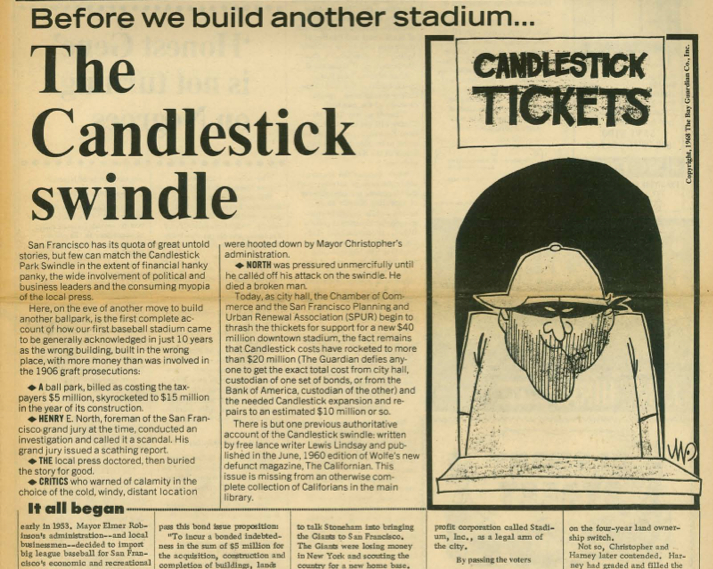
San Francisco spent this week saying goodbye to its beloved foggy stadium, Candlestick Park. Amidst the farewells, the Guardian spotted a post from sports blog Deadspin, which reprinted one of our articles from 1968  titled, “Before We Build Another Stadium… The Candlestick Swindle.” 

When we saw the post, we started thumbing through our archives looking for the article. Though Deadspin said it was from 1972, we found it in Vol. 2, Issue no. 10, May 14, 1968, it’s a down and dirty tale of intimidation, bypassing voters through dummy corporations, profiteering, and racism. Candlestick has a colorful history, to say the least. 

The author, Burton H. Wolfe (Burton, not “Mr. Wolfe,” he wrote via email), gave us permission to re-publish it in full here. Just for fun, we’re also embedding the original issue as a PDF, which can be download and printed. Looking through the issue, it’s heartening (and disheartening) how much, and how little, changes.


The Candlestick Swindle

It all began early in 1953. Mayor Elmer Robinson’s administration—and local businessmen—decided to import big league baseball for San Francisco’s economic and recreational benefit. A downtown stadium was adequate for San Francisco’s AAA minor league club, the Seals, but not for major league fare.

Hence, Robinson asked the Board of Supervisors to approve a $5 million bond proposition to construct a new stadium. Among the supervisors in approval: George Christopher, soon to become mayor; Gene McAteer, headed for the state senate; Francis McCarty, a future judge; Harold Dobbs, restaurateur and budding Republican candidate for mayor, and John Jay Ferdon, future district attorney.

In July of that same year, 1953, a local multi-millionaire contractor named Charles Harney purchased 65 acres of land at Candlestick Point from the city of San Francisco for $2,100 an acre.

Next year, a band of publicists headed by Curley Grieve, S.F. Examiner sports editor, beat the drums and called the natives to pass this bond issue proposition:

To incur a bonded indebtedness in the sum of $5 million for the acquisition, construction and completion of buildings, lands and other works and properties to be used for baseball, football, other sports, dramatic productions and other lawful uses as a recreation center.

Major league baseball, they proclaimed, would bring untold wealth to the city for a mere $5 million, a price that would be returned many times. After voters approved this in November, 1954, the search began for a site. If there were any doubts the stadium would cost more than $5 million, they were dispelled in a personal meeting between Robinson’s successor, Mayor Christopher, and the owner of the New York Giants, Horace Stoneham.

In April, 1957, Christopher and McCarty flew to New York to talk Stoneham into bringing the Giants to San Francisco. The Giants were losing money in New York, and scouting the country for a new home base.

To prove San Francisco’s support for professional baseball, Christopher waved the $5 million stadium bond issue at Stoneham. According to testimony reported by the 1968 grand jury investigation, Stoneham replied contemptuously:

Any figure other than 10 or 11 million dollars shouldn’t even be discussed because there would be no possibility or probability of a major club moving to that particular community.

Back in San Francisco, Christopher reported the need for more money to other city leaders and businessmen. Since the proposition suddenly to double the original bond issue might run into trouble with the voters, they decided to create a non-profit corporation called Stadium, Inc., as a legal arm of the city.

Bypassing the Voters

Operating through this dummy corporation, the Christopher administration could bypass the voters to raise more money.

Harney and two of his employees were selected as the first board of directors of Stadium, Inc. Christopher told Harney that he would be the contractor to build the new stadium, and his 41 acres of Candlestick land would be the heart of the 77-acre location.

In 1957, Harney sold back 41 acres of the parcel he had purchased from the city in 1953 at $2,100 an acre. The 1957 price the city paid to Harney for its own former land was $65,853 an acre. That’s a crisp total of $2.7 million.

The city’s Real Estate Department approved the deal even though other land adjacent to Harney’s was bought at about the same time for just $6,540 an acre. Harney made a profit of $2.6 million on the four-year land ownership switch.

Not so, Christopher and Harney later contended. Harney had graded and filled the land, and so naturally he was paid for his improvements. One fact raised doubts about that explanation: a $7 million fee awarded to Harney to construct the new stadium included $2 million for stadium construction, $2 million for grading and filling and $2.7 million for real estate.

Had it not been for the creation of Stadium, Inc., the Christopher administration would have been required to hold open, competitive bidding for the contract, and voters would have seen the price tags.

By operating through Stadium, Inc., Christopher was able to evade the city charter and arrange the contract in a privately negotiated deal.

Through the same apparatus, his administration was able to float another $5.5 million bond issue without voter approval. The interest rate on these bonds was set at 5% whereas the interest on the original $5 million bond issue was only 2.4%, a difference that would eventually cost the city hundreds of thousands of dollars.

Evading an Investigation

In February, 1958, Harney and his employees were removed from the board of Stadium, Inc., after, as the grand jury report later pointed out, “Three influential men then were substituted to represent the city’s interest—Alan K. Brown, W.P. Fuller Brawne and Frederic P. Whitman.”

The maneuver came too late to prevent Henry E. North from instigating a Grand Jury investigation into the strange transactions.

North, like Christopher, was a Republican and a conservative member of the San Francisco business community. Until his retirement, at 70, he had been executive vice-president of one of the largest property owners in the city: the Metropolitan Life Insurance Company. He had a strong sense of civic duty, however, and the Candlestick Park deal smelled to him of garbage.

The report North issued, as the result of the Grand Jury investigation, was potential dynamite. It showed that, shortly before the city purchased Harney’s land at $65,853 an acre, adjacent pieces of tideland were sold by the city for less that $4,000 an acre. It did not make sense that Harney’s land, partly under water, should have brought $61,000 more from city coffers.

On Dec. 2, 1958, the San Francisco Chronicle carried partial coverage of the Grand Jury report. On page 5, the year Harney purchased the city land was stated as 1933 rather than 1953. Of course, the 20-year difference would provide a reason for the tremendous increase in value, because the initial purchase price would have been at depression levels.

Undoubtedly, it was a typographical error. And no doubt it was by unintentional omission that other salient features of the Grand Jury report were omitted altogether and never printed by the Chronicle or any other major newspaper.

North charged that all bond issues negotiated by Stadium, Inc. were illegal evasions of the city charter. Bond payments had to be made from city funds, not the dummy nonprofit corporation, and so the whole deal amounted to legal subterfuge; a way to make taxpayers foot the bill without letting them vote on it.

The report, drafted by North and signed by 18 other citizens, estimated annual payments on the bonds of $990,000 for the first 15 years of the debt period. Against that, the city was to draw $225,000 a year in rent from the Giants and $225,000 a year from advertising and parking revenues, leaving a balance of $640,000 to be paid annually from taxes or city funds. It was estimated that the city could make up the balance by commanding the juicy television rights; instead, Christopher arranged for rights to go exclusively to the Giants.

Altogether, it was a marvelous deal for the Giants. In their last New York season, attendance at the Polo Grounds plummeted to 684,000. The club had gone broke and it was almost impossible to give away its stock. After the Giants first season in San Francisco in 1958, attendance tripled over its last year in New York, and their stock soared to $1,000 a share. In terms of revenue, the increase in gate receipts alone meant $3 million the first year.

While the Giants were reaping enormous profits at taxpayers expense, City Hall and the local newspapers were trying to make it appear that San Francisco, too, was earning money. The News-Call Bulletin, the now defunct Hearst paper, once stated that when all returns are in, the season just ended (1960) will have yielded the city about $530,000. The fact was that the sole revenue to the city was $50,000 received to maintain buildings and grounds.

The other Hearst paper, the Examiner, stated, on the other hand: City Hall officials said $375,000 of the revenue figure will be used to pay the annual cost of the city’s $5 million bond issue. The Chronicle published this figure: Of the remaining $527,000, the first $375,000 must go toward payment of the city’s $5 million stadium bond issue.

The fact was that all revenues from the ball park and its parking lot had to be used to pay off the $5.5 million worth of bonds issued by Stadium, Inc., with the exception of the $50,000 maintenance income. The other $5 million worth, issued by the city, had to be paid off through real and personal or property taxes collected by the city.

The result: a projected loss, not profit, of $640,000 the city must pay from taxes or other general city revenues (according to the Grand Jury report), and a loss this year of at least $360,000 (according to figures supplied to The Guardian by the city controller’s office and Mike Barrett, the Bank of America executive who handles Stadium, Inc.’s trustee account.)

Some annual loss on Candlestick Park will continue until 1993, when the stadium will finally be free of debt and owned completely by the city—unless, it is torn down before then or reconstructed, which will add more debt.

There was another interesting development at Candlestick: Stevens California Enterprises, which got the food and beverage concession at the ball park, bought all its milk until two seasons ago from Christopher’s milk company, Christopher Dairy Farms. The Borden Co. now has the lucrative contract.

Even though City Hall and the newspapers were misstating facts about the Candlestick story, San Francisco restaurateurs, hotel owners and shopkeepers at least began to realize that they were not making any money from the ball park, as promised by the ballyhooers. Only the Giants, Harney, and Christopher were making money. The Giants were attracting few additional tourists to San Francisco, and area fans who journeyed to isolated Candlestick Point, several miles away, did not stop to patronize downtown establishments. Some downtown business men were angry, and if North’s crusade were given time and publicity, they might cause an uncomfortable controversy.

Christopher sent emissaries to North, but he would not be wooed or pressured from his stand. To the contrary, he made even more vigorous attacks on Christopher and the ball park deal. The lives of future generations had been mortgaged by this shoddy piece of business, he maintained. Christopher was diverting city funds from various departments: $1.4 million from street improvement bonds, $1.2 million from state gasoline taxes given to the city for road improvements, $1.5 million from sewer bonds for services to the Giants ball park.

A Hidden Payoff?

Already the cost was $15 million, and it might exceed $20 million when various exits, entrances, widened access streets and the like were built to handle the anticipated large crowds. Privately, North informed civic and business leaders that there was an underhanded payoff in the deal, and he intended to expose it.

Christopher reacted viscerally to North’s charges. With newspapermen present, he asserted North was drunk, incoherent, and fixable. The description was published in the newspapers.

North went to Nate Cohn, one of the foremost criminal lawyers in California, and they filed a $2 million libel suit against Christopher. In a pre-trial hearing, Christopher’s attorney filed a thick brief with 45 motions for dismissal of the suit, hoping to tie up the case inextricably. In just an hour and a half, Superior Court judge Preston Devine threw out all 45 motions, indicating clearly that Cohn and North had a good case.

Breaking Down North

Christopher’s friends in the business community went to work on North. The publisher of one of the three daily newspapers, North told me, called on him and said, “Henry, why don’t you play ball? You’re giving the city a bad name, stirring things up like this.”

At the Pacific Union Club across the street from the Fairmont Hotel on Nob Hill, where North was already in disfavor for bringing Jewish guests despite the no-Jews-allowed policy, fellow Republican business executives started a snub-North routine. One day, for example, an old business friend greeted North:

“Say, Henry, I see in the papers there’s some fellow named Henry North filing a suit against the mayor and stirring things up. Must be another Henry North in this town, huh?”

“No, that’s me,” North told him.

“Is that so?” the old friend said. He turned his back on North and never spoke to him again.

I talked to North several times during the siege because I was publishing articles about Candlestick Park in my magazine, The Californian (now defunct). In those days he was full of fight, willing to take on City Hall and the entire business establishment even if it meant losing every friend he had. He promised to tell me the names of the men involved in the payoff, and he excoriated Christopher.

“You know what I call men like George Christopher? Black Republicans. Men who never did anything in their lives for the good of the common people. They’ve never realized that this country as a whole is no better off than the great masses of its people.”

The Fateful Fifth

Then they went to work on his wife. Unlike Henry, she was not involved in politics and her life revolved around her friends and social affairs. Her friends snubbed her and she no longer received invitations. She cried, she pleaded, she begged Henry to call off the ball park investigation and the lawsuit, when that did not move him, she threatened him with divorce. Henry began hitting the bottle.

On June 2, 1960, shortly after I published a detailed article by Lewis Lindsay called “The Giants Ball Park: A $15 Million Swindle,” the press broke the story that North had buried the hatchet with Christopher. In its first edition, the Chronicle correctly reported that North and Christopher had drunk a fifth and a half of Scotch together at Christopher’s home, and praised each other for publication. “He’s a great mayor,” North said—and agreed that legal entanglements were finished. The Chronicle dropped mention of the Scotch in later editions that went to most of its readers.

Cohn was outraged. “We had this suit won,” he told me. “North assured me he was going through with this no matter what happened. But they got to him through his wife, the poor old bastard. You see how they do things in this city? It’s so goddamned rotten you can’t believe it.”

When I called on North again, I found a complete transformation in his appearance. The look of a peppery fighter with ruddy cheeks had given way to a physical wreck; a baggy-eyed, tired, meek looking man weighed down by defeat.

The saddest part of the story was that his wife divorced him anyway. Not long afterward, North died of a heart attack. Harney died in December, 1962.

With North out of the way, with the daily newspapers blacking out the most important parts of the Candlestick Park story, with The Californian reaching only a few thousand citizens, it looked as though the scandal would never be investigated. In an effort to stir up something, I personally appeared before the Finance Committee of the Board of Supervisors and urged their help. One committee member, Al Zirpoli, had said before that he would favor an investigation.

No committee member challenged any facts I presented. When I finished, John Jay Ferdon, Committee Chairman, said only that he would not favor an investigation. He did not say why. (Six years later, when he had become District Attorney, he told me I was right about Candlestick.) Zirpoli, later to become a federal judge and the judge to hear draft resistance cases, said, “I agree with what Mr. Ferdon says.” He suggested, “If there is wrongdoing, your best course of action is a taxpayers’ suit.”

I went looking for wealthy liberals to finance a taxpayers suit, but none were in season. Cohn would have taken the suit if I could have found somebody to pay him for his time. All that he could do now was take me to business friends and introduce me.

The typical reaction came from Sam Cohen, owner of a plush restaurant on Maiden Lane said:

“Sorry, Burton, I can’t get involved. Do you know what Christopher can do to me with his power at City Hall? A Health Department inspector can find something wrong with this restaurant any time he wants. A door is too narrow, my stove does not meet regulations, anything to run me out of business. That’s how they do it. You can’t fight them.”

Since nobody in the city would fight, I asked Sen. Estes Kefauver, chairman of the Antitrust and Monopoly Sub-Committee of the Senate Committee on the Judiciary, to investigate. He replied: “As interesting as a study of how the San Francisco ball park deal took place would be, I do not conclude that it is a matter that should be gone into on the federal level. I think that it is entirely a local or state matter, and that the Subcommittee would perhaps be criticized if it moved into this area.”

Now Another Ballpark

Here we are eight years later, with a Candlestick Park that enrages so many people that a new mayor, Joe Alioto, wants to scrap it for a new stadium. His announced philosophy is that great public projects should not be waylaid just because all of the people aren’t getting enough spaghetti and zucchini. And no doubt many San Franciscans believe that a ball park is a great public project, greater than a school, housing complex or a modern transportation system. That attitude could be the most tragic part of this story.


Homeless for the holidays

0

news@sfbg.com

As temperatures dropped in recent weeks, those who care for San Francisco’s homeless snapped into action.

Shelters stopped requiring reservations, making any beds still open after 8pm available to anyone who needed them. General Hospital’s Emergency Room treated the annual uptick of hypothermia cases, working closely with the city’s Homeless Outreach Team. Seven people in the Bay Area died as a result of cold weather in the last month — mercifully, none in San Francisco.

“Just one homeless person passing from being cold is way too many,” Carol Domino, program director at Mother Brown’s Drop-In Center, told the Guardian.

When the cold hit, Mother Brown’s staff could be found scouting encampments near its location in Bayview. Besides a respite from the weather, it offers bathrooms, showers, access to case management services, and other resources, as well as two hot meals a day in its dining room. But there’s one thing it can’t offer: a warm bed.

But that may change. A proposal for a 100-bed homeless shelter next door to Mother Brown’s gained political footing this year, despite controversy and a divided neighborhood.


SHELTER IN BAYVIEW

Behind the shelter effort is Gwendolyn Westbrook, director of the United Council of Human Services. Westbrook says the idea didn’t come from her, but from Barbara J. “Mother” Brown, the local legend who served hot meals out of the back of a Cadillac Seville before founding Bayview Hope Homeless Resource Center and Mother Brown’s Dining Room in 2001.

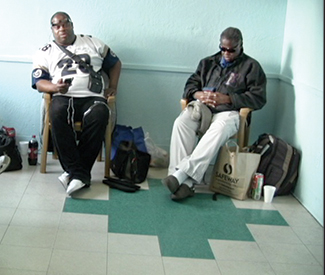
“People have come in here needing a place to sleep for as long as it’s been open,” Westbrook said. Brown’s solution was to set out folding chairs where people could sleep. Nowadays, 80 people rest in the chairs on a typical night.

Before Brown died in 2005, Westbrook remembers, she made it clear to her successor how much she wanted shelter beds where clients could lie down.

Of her clients, Westbrook says, “it’s a lot of people who are from this area, grew up in this area. Some people never leave this district. Their homes might have gone into foreclosure, or somebody died that set them back and triggered something mentally, and now they’re on the street. So this is a safe haven for them. This is a place where they can come and just relax.”

Even as the cost of living soars and the neighborhood changes, Westbrook says, her clients hold on.

“Most of our clients won’t leave the Bayview,” she said. “Some of them have told me, ‘well if I die, just cremate me and put my ashes up on Third Street. Spread them on Third Street.’ That’s how much they love this neighborhood.”

Human Services Agency (HSA) director Trent Rhorer witnessed the chair arrangement during an August 2011 visit to Mother Brown’s. He called the sight “simply not acceptable from a view of humanity.”

When Rhorer learned that a warehouse next door had recently been put up for rent, the shelter idea was born. The HSA applied for a forgivable loan from the state’s Emergency Housing and Assistance Program (EHAP). In January 2012, the project was approved for $978,000.

On Nov. 19, the Board of Supervisors voted to accept the grant, and on Dec. 10, it assigned the next two steps: city adoption of the lease for the property and creation of a special use district. The rezoning process could take six months to a year at the Planning Commission, and if the shelter ultimately goes through, construction is not likely to begin before 2015.

Until then, shelter options in Bayview-Hunters Point will stay slim. There is no single adult shelter with beds in the neighborhood. The closest thing is Providence Baptist Church at 1601 McKinnon. There, staff lay out mats on the gym floor each night.

“In Bayview-Hunters Point, that’s it. Providence is the shelter,” said Nick Kimura, shelter client advocate with the San Francisco Coalition on Homelessness.

In Mayor Ed Lee’s 2013 State of the City address, he said he was “proud to support” efforts to expand services for the homeless in Bayview—specifically “Sup. Cohen’s effort, aided by a federal grant — to build a new 100-bed shelter”

The only problem: that was the first Cohen said she had heard of it.

“My first concern was how the proposal came about,” Cohen told us. “I wasn’t made aware of it until it was announced.”


SHIFTING POLITICS

After Lee’s announcement, there were two community meetings, one in March at the police station and one in April at the YMCA. The idea gained support from the Southeast Community Facility Commission and the San Francisco branch of the NAACP.

A wave of opposition also grew, including the neighborhood organization Bayview Residents Improving Their Environment (BRITE), and a handful of businesses led by David Eisenberg, president of Micro-Tracers, a food testing company next door to Mother Brown’s.

On July 16, Cohen herself came out against the shelter. Cohen said her decision came after “meeting with residents about their concerns and fears.”

Neighborhood residents are a shifting demographic. The African American population has declined by 10 percent since Mother Brown’s was founded in 2001. The Asian population increased slightly in the same time period, and the white population has more than doubled.

Homelessness in the neighborhood has also increased. According to the city’s biannual homeless count, the number hovered around 400 until January 2011, when the number jumped to 1,151. It had 1,278 homeless people in 2013.

After Cohen declared her opposition, the meetings went back behind closed doors. In September, David Curto, director of contracts at the HSA, said that “[city homeless czar] Bevan Dufty and other folks in the Mayor’s Office are trying to revive it.” On Oct. 9, Lee met with a group of neighbors. And on Oct 30, the shelter proposal made its public reappearance.

Sups. John Avalos, Eric Mar, and Mark Farrell of the city’s Budget and Finance Committee heard the issue. They were tasked with voting on whether to accept the EHAP loan, a question that would be put to the Board of Supervisors if it passed.

Out in the gallery, the two sides sat divided down the aisle like squabbling families at a wedding. House left were the shelter’s supporters, a mix of residents and community leaders and staff of Mother Brown’s and their clients, some with their shoes pulled on only half way over feet swollen from sleeping in their chairs. On the right, BRITE members, an ad hoc group called Protect MLK Pool and Playground, Eisenberg, and other community members in opposition.

The shelter became a vehicle for a debate about larger changes in Bayview. BRITE member David Armagnac saw no need for shelter beds in the neighborhood that he has “seen transform and emerge into an ever-increasing vibrant area.” Bayview business owner Carla Eagleton wanted economic and quality of life impact reports on the proposed shelters “as it relates to the city’s only remaining blue collar industrial area, MLK Park, surrounding neighborhoods and the Third Street corridor, which the city of San Francisco has spent billions of dollars to revitalize.”

Meanwhile, resident Sandy Thompson testified that “for you guys to move in and make yourself comfortable,” many of her neighbors have been displaced. “Make the homeless comfortable, just like you guys are making yourself comfortable, because they need a place too,” Thompson said.

A client of Mother Brown’s talked about being homeless in the neighborhood her family had been in for generations. “My grandparents are the ones that migrated from the south, that came up here to work on those shipyards,” she said. “Think about that parent who is working at McDonalds, or working a low, minimum-wage job. They can’t afford the new housing that’s coming in, that’s being developed. Yes, we love it. We love to look at the property that we cannot live in.”

Both sides made passionate pleas, but shelter supporters won over the Budget and Finance Committee.

“It’s very rare that I get moved from hearing public comment. I hear a lot of public comment, and sometimes I feel like my heart is hardened to everything. But not today,” Avalos said.

Farrell agreed: “It’s rare that you get touched here, because we do hear so much public comment all the time. And the personal stories are pretty incredible.”


INSIDE MOTHER BROWN’S

Inside Mother Brown’s cool blue walls, there’s no shortage of incredible personal stories. Lonnel McCall took a break from helping to cook dinner at Mother Brown’s kitchen to describe what the place has meant for him.

“I didn’t have nothing, not even ambitions. I felt I was a loser. I had no self-esteem,” he remembers. “I was smoking crack under the bridge and all that stuff.”

He now has a job as a hotel chef and lives in a HOPE House home. He rolled up his sleeves to reveal cuts and burns, the battle scars of a chef.

“These are my cook wounds,” he said, “instead of dope wounds.”

But for a period, McCall slept in the chairs. “It’s hard. Your ankles swell up,” he said.

Wade Verdun also slept in the chairs and went through HOPE House.

“I’ve got my own place now, got my own car. I’m no longer on drugs. And I’ve got a two-year-old son,” Verdun said. “This place saved my life, to tell you the truth.” Smiling, he patted his belly. “I’ve never been this fat. Trust me.”

If the shelter does get built, Westbrook hopes, it can lead to more happy endings like McCall’s and Verdun’s.There are already too many sad stories.

On Dec. 19, candles lit the dusk on the steps of City Hall in a vigil for the homeless people who have died in San Francisco. The vigil was organized by Night Ministry, a crisis intervention and counseling service that operates in the Tenderloin from 10pm to 4am. Reverend Lyle Beckman, director of Night Ministry, said that he got the names of 22 deceased homeless people from the Department of Public Health, but knew it was low. During the vigil, attendants came forward with the names of more dead, until the number reached 100.

Beckman said the crisis line gets busy this time of year. “We always see more conversations around holiday time,” he said. “When people have memories of it being a family time and then they’re not connected with their family in some way, it can bring isolation and loneliness.”

In a city of chosen families, Mother Brown’s “children” have found a way to heal that kind of loneliness. Perhaps McCall put it best when he described the first time he came back to his native Bayview and found Mother Brown’s after decades of isolation.

“When I came in through the door — this is God’s truth — I felt like I was at home,” he said. Soon, people like McCall may find a bed, too, when they walk through that door. Maybe for Christmas 2015.

San Francisco Holiday Evening Tour

0

Baby…It’s cold outside! But you can’t let the holiday season pass without seeing the City by the Bay decked out in all her splendor.

Gather your friends and family…Join Tower Tours on a festive holiday lights journey through the twinkling neighborhoods of the City by the Bay. Hop aboard our newest fleet of enclosed luxury coaches with warmth and style as you are delighted to some of the most glittering holiday displays in our jolly hillside town. We start our journey at the world famous Ghirardelli Square – bring home a box of chocolate for your friends and family, sample a few seasonal holiday favorites, and even enjoy a warm cup of hot cocoa.  Hop back on our cozy tour coach and we’ll enjoy such sites as: Union Square holiday displays, City Hall, the Golden Gate Bridge, Bay Bridge and Treasure Island – for the Bay Lights show, and other dazzling holiday spectacles throughout San Francisco!

Available: December 26, 27, 28, 29 (Thurs., Fri., Sat., Sun.)
Tour Duration: 3.5 Hours, 6pm Departure
Tour Location: Tower Tours, 288 Beach Street @ Fisherman’s Wharf

For more info or to make reservations, please call 415-345-TOUR (8687) or visit towertours.com.

A century after the Raker Act, San Franciscans are still illegally denied public power

27

The San Francisco Examiner has a good story on today’s 100th anniversary of the signing of the Raker Act, federal legislation that allowed San Francisco to build a dam in Hetch Hetchy Valley, a campaign championed most fervently at the time by the Examiner’s then-Publisher William Randolph Hearst.

The article was a good roundup of issues related to the Raker Act, and it included ongoing efforts by the group Restore Hetch Hetchy to try to tear down the dam, but there was a key aspect of the Raker Act that the Examiner left out, one that has been championed by the Bay Guardian over the years.

The Raker Act specifically called for San Francisco to directly distribute the water and electricity generated by the O’Shaughnessy Dam to its residents and for their benefit. The city does so with the water, through the San Francisco Public Utilities Commission, but Pacific Gas & Electric used its power and connections to take control of the electricity and keep it, corrupting the political system for nearly a century in the process.

“The result: San Francisco has paid through the nose to PG&E for its power and the city loses about $30 million a year in profits it would get from a public system,” journalist J.B. Neilands wrote in the March 27, 1969 issue of the Bay Guardian, the first of dozens of stories we’ve written on the topic, spanning many unsuccessful public power campaigns, each one dominated by millions of dollars in PG&E spending.

Section 6 of the Raker Act says that the city “is prohibited from ever selling or letting to any corporation or individual, except a municipality or municipal water district or irrigation district, the right to sell or sublet the water or the electric energy” generated by the dam.

That long-standing violation could become an issue that threatens San Francisco’s control over its main source of clean water and power if Save  Hetch Hetchy gains traction in the courts with a lawsuit that it is pledging to file.

While PG&E doesn’t wield the same strong influence that it once did at City Hall, thanks partly to years of aggressive overreach that soured many local officials on the powerful utility, it does still retain close ties to former Mayor Willie Brown (an attorney who has been on retainer with PG&E for years) and current Mayor Ed Lee, who has sabotaged the latest half-step toward public power, CleanPowerSF.    

Mayor Lee addresses Google bus controversy

116

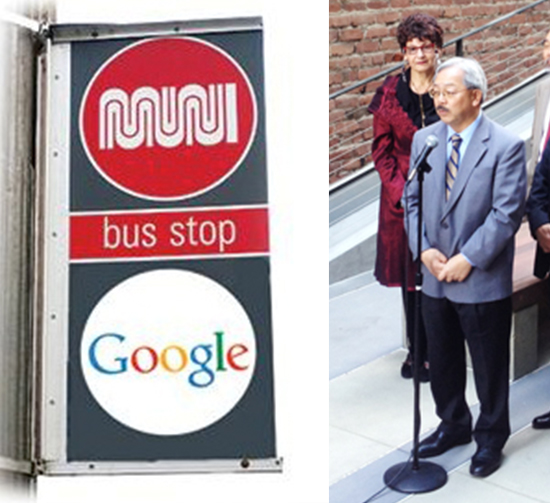
At a press conference on affordable housing today, the Guardian asked Mayor Ed Lee about San Francisco’s favorite pinata: tech buses. The monstrous private shuttles, which daily whisk tech workers away to Silicon Valley, currently use Muni bus stops without paying fines, like most private autos do. 

In Guardian News Editor Rebecca Bowe’s article in the print edition of the Bay Guardian this week, the San Francisco Municipal Transportation Agency spokesperson Paul Rose tells her that although there is a proposal in the works to regulate them, the SFMTA won’t profit a single dime from the plan. 

“We are developing these policies to better utilize the boarding zones for these shuttle providers,” Rose said. “What we’re trying to do is provide a more efficient transportation network.”

But everyone in San Francisco who has ever ridden Muni knows that it struggles to run on time, and chronic underfunding is a perennial Muni problem. It even hurts the city’s bottom line, depressing our economy by over $50 million a year, according a report from the city earlier this May.

The report also highlights the cost to overhaul Muni between now and the year 2020: over $167 million would be needed to overhaul the system.

So why not make a few bucks from tech companies using Muni stops, who, according to the city, cause Muni delays? 

We asked Mayor Ed Lee that very question at a press conference today. You can listen to his answer in the audio embedded below, or read the transcript for yourself. 

San Francisco Bay Guardian: “Housing is one aspect of this, but transportation is another. The MTA’s plan to deal with tech buses is cost neutral. Is that a missed opportunity to get additional funding for Muni?”

Mayor Ed Lee: “Not a missed opportunity. That’s the essence of that 2030 task force, transportation task force, that we put together where they send a report to me, I’m in a process of reviewing all aspects of that. 

Muni officials themselves were directly involved in producing that very comprehensive review along with our Planning Department and many in fact all of the departments here had implemented them.

Transportation is not just about Muni, it’s about all the modes of how people get around the city. You can’t forget that, because that’s a really big part of the task force’s work.

How to get people walking. How to get them bicycling safer and more. How to get cars less, and the cars that do, get them through where they have to go without stalling and congesting. 

How do you invest in Muni? In its assets, in its transportation, in all of its aspects. How do you work with taxis and all the other car-sharing and automobile sharing companies. It’s not just about taxis, by the way. I hear from my taxi friends as I walk around City Hall, they don’t want to be left behind so we want to bring them in to see the new exciting use of Uber carshare and Lyft… all of those modes have to be paid attention to at the highest level, including investing in the assets of Muni.

I want Muni to be the choice.”

Earlier in the press conference Lee voiced his opposition to all of the hatred pointed at tech companies. 

“People, stop blaming tech, tech companies,” he said. “They want to work on a solution. I think it’s unfortunate that some voices want to pit one economic sector they view as successful against the rest of our challenge. The reality is they’re only eight percent of our economy.” 

We tried to ask a follow up question, but at the end of his answer on Muni, the mayor’s spokesperson Christine Falvey told the Guardian “We’re going to go on a tour now, this is off topic.”

Crowdfunding apartments

7

rebecca@sfbg.com

We caught up with Dan Miller at a cafe in San Francisco’s Financial District, where solitary patrons hovered over laptop screens as they sipped coffee.

Sporting a goatee and collared shirt, Miller, 26, seemed to blend in perfectly. The Washington DC native, a product of the East Coast real estate development world whose father had a hand in developing several iconic properties, was in San Francisco for meetings about FundRise, a startup he and his older brother Ben cofounded. The company is frequently described as being like Kickstarter, but for real estate investment.

Miller has been meeting with representatives from San Francisco’s Office of Economic and Workforce Development, a city agency in the Mayor’s Office. While nobody in City Hall was willing to get specific about those meetings, it seems officials are looking to FundRise for help tackling the city’s bedeviling housing affordability crisis.

Miller has been meeting with economic development offices in cities nationwide, and he’s convinced that housing affordability is a problem everywhere. “But it’s more acute in San Francisco than anywhere else I’ve seen,” he said, “just because of an influx of tech jobs.”

In the last six months, he added, OEWD representatives have seemed increasingly concerned.

The idea of crowd funding real estate is new, and the whole enterprise is still coming to fruition. But the underlying idea is intriguing: Take real-estate investment out of the hands of exclusive multimillion-dollar investment firms, and open it up instead to anybody who happens to have 100 bucks or more to throw in.

In an affluent city like San Francisco, the tool could create wiggle room for more housing projects that are tailored to actual needs, through partnerships with affordable housing developers.

It started when Miller and his brother encountered across-the-board rejection from big investment firms. To hear him tell it, the rise of private equity firms — which have no meaningful connection to the communities they develop — has produced blandness on a sweeping scale.

Objectives like preserving economic diversity, or honoring a community’s wishes, don’t factor in when these firms determine what to fund; they only consider whether an investment is deemed safe and profitable. That means predictable: think obscenely expensive, characterless market-rate condos. And since they’re the dominant financiers, their judgment is the final call.

“We spun off from our family business and started buying old auto warehouses, converting them, leasing them to local tenants,” Miller explained. “We took these projects to private equity firms, and they just didn’t get it. All the decisions they made were predicated on the financial pro forma,” he added, referring to documents that project expected returns. “They were really constraining what’s possible.”

Sounding like a tech person, he pronounced the whole system woefully inefficient. FundRise seeks to take advantage of little-known Securities and Exchange Commission regulations, as well as new provisions under the federal Jobs Act, to give people the opportunity to use crowd funding instead. (It doesn’t eliminate the need to apply for bank loans, which is a different part of the financing picture.)

The idea is that FundRise vets a project’s viability to make sure it won’t result in widespread loss, then helps proponents attract contributions through an online social network.

In the investment world, the vast majority of transactions are made by “accredited” investors, whose net worth equals $1 million or more, or with annual incomes of $200,000 or higher. But there are others out there who might have extra cash to put toward projects they believe in, like, say, affordable housing complexes for seniors — who don’t mind making a lower return.

The Miller brothers have built an online system they hope will connect these would-be lenders with projects in their own communities.

“Since you can invest directly, digitally, you’ve cut out so many middle men,” Miller explained. “You can make a 6, 8, 10 percent return. The real estate investment firm targets are 20 percent. But that’s because there’s just people taking a piece all the way down the ladder.”

The cofounders may be idealistic, but at the end of the day, they’re businesspeople, not activists. Since the company takes a cut of all investment earnings, it could succeed financially even if it the platform only winds up getting used to finance pet projects for dot-com millionaires.

Nevertheless, some longtime champions of low-income housing have recognized its potential to help solve a perplexing puzzle: How to secure capital for affordable housing in a world where investors are hardwired to make as much money as possible.

“We are hoping that as the larger movement for crowd funding works with the SEC, we can have more people make these investments in the local community,” said Tracy Parent, executive director of the San Francisco Community Land Trust.

Her organization is the first nonprofit affordable housing developer to test the waters with FundRise, in a bid to raise $1 million to keep Marcus Books, a historic African American-owned business, in its current Fillmore Street location. Due to a short timeline, they’re confined to accepting funding only from accredited investors. But in the future, they could use the tool to structure a public offering that would allow anyone to contribute toward preserving affordable housing.

While public subsidies will still be needed for below-market housing, “FundRise allows affordable housing developers to take properties off the speculative market,” Parent explained. “Any way we can democratize capital investment,” she added, “will be a good thing for our community.”

SF Board of Supervisors approves new tenant protections

11

The Board of Supervisors today (Tues/17) gave unanimous final approval to legislation aimed at giving renters in the city additional protections against being displaced by real estate speculators, and initial approval to legislation protecting tenants from harassment by landlords, both part of a wave of reforms moving through City Hall to address rising populist concerns about gentrification and evictions.

The anti-eviction legislation, created by Sup. John Avalos and co-sponsored by Sups. Eric Mar and David Campos, seeks to preserve rent-controlled and affordable housing by restricting property-owners’ abilities to demolish, merge, and convert housing units, three of the most common ways that affordable housing units are being eliminated in the city.

There was no discussion of the Avalos legislation today as it was approved on second reading, belying last week’s initial discussion, which got a little heated at times. “San Francisco is facing a crisis,” Avalos said last week as he conveyed the importance of passing the ordinance before the end of the year. “We’ve been called on by our constituents to declare a state of emergency for renters in the city.”

Last month, Campos held a high-profile hearing at the board on the city’s affordable housing and eviction crisis, and won approval for his legislation to double how much tenants being evicted under the Ellis Act receive. Today’s board meeting also includes a first reading of legislation by Campos to help protect tenants in rent-controlled apartments from being harassed by landlords seeking to force them out and increasing rents.

“We have heard about tenants being locked out of their apartments. We have heard about loud construction work being done…for the purpose of forcing the tenants out,” Campos said today of his legislation to allow targetted tenants to have complaints heard by the Rent Board rather than having to file a lawsuit. Later, Campos said the legislation sends the message “that is not something that is going to be tolerated in San Francisco.”

Campos’ legislation also received unanimous approval and little discussion, even by supervisors who generally side with landlords over tenants, perhaps including just more potent this issue has become. Board President David Chiu also today introduced a resolution to support his work with Mayor Ed Lee and Sen. Mark Leno to amend the Ellis Act at the state level, hoping to give the city more control over its rent-controlled housing. 

Avalos last week said he is so convinced of the urgency of the current situation that he responded to concerns voiced during the Land Use and Economic Development Committee Meeting on Dec. 9 about how the new legislation would work in the cases of temporary evictions and residential hotels by immediately making amendments to the ordinance without objection.

Nonetheless, further questions arose during the Dec. 10 meeting. Sups. Norman Yee and Katy Tang expressed reservations about the legislation applying in the case of owner move-in (OMI) evictions.

“I would love to support the piece, but this part just doesn’t make sense to me,” Yee concluded. “I’m not getting how it hurts the tenants.”

While Avalos explained that OMI evictions still take affordable housing off the market, he agreed to compromise by reducing the ordinance’s 10-year moratorium on demolishing, merging and converting housing units to five years.

Then, Sup. London Breed spoke up.

“This might not be popular for me to say as a legislator, but I’m very confused,” she began. “I know we have this crisis of Ellis Acts around the city, but I really feel pressured, and that this legislation is being rushed. I can’t support something that I don’t completely understand the impacts of. I just need more time.”

While Breed did not have the chance to review the legislation before the meeting, she had found the time to prepare speeches about President Nelson Mandela’s passing last week and her alma mater Galileo High School’s recent football victory.

Concurring with Breed, Cohen stated, “I understand that we are in a crisis of protecting our rental stock units, but I’m hesitant. Connect the dots for me, how does this save rentals? Or conserve affordable housing? What are we trying to do here?”

Kim reprimanded her fellow board members for not attending the meeting prepared, then stated, “I would support moving the ordinance forward today. The situation we are facing here in the city is extremely challenging…and this legislation is one of the tools we have for it.”

Sup. Scott Wiener and David Chiu echoed Kim’s support, commending Avalos for promptly addressing their former issues with his amendments and additions.

When Cohen used her time on the floor to respond to Kim’s admonition by stating, “I certainly do my homework. I don’t want to be made to feel bad for not getting it on the first time,” Campos suggested that it might be a good time to put the discussion on hold and open the floor for public comments.

While members of the community stepped up to the visitors’ podium, Yee and Campos met at the back of the room while Breed conversed with Sophie Hayward of the Planning Department, who had reviewed the ordinance before it was presented for recommendations. After further discussion with Avalos himself, Yee returned to his seat to speak with Tang. Satisfied with what she learned from Hayward, Breed came over to discuss the ordinance with Campos and Avalos. Cohen remained seated for the duration of the time, speaking with no one.

After the conclusion of public comments, Avalos reiterated the importance of passing the ordinance as soon as possible. “We have been called on by scores, hundreds of people, to preserve this stock,” he stated. “This legislation will help keep families in San Francisco.”

The ordinance was passed unanimously in its first reading, but the fight is not over. Breed for one made it clear that, while she understood the ordinance better after her preceding discussions, she was only giving it her support because she knew the legislation would be up for further review in a week, when all the supervisors will have had time to study it more closely.

With the affordable housing and displacement issues only generating more heat in the last week, today there was only prompt, unanimous approval and no discussion. 

Alerts: December 11 – 17, 2013

0

WEDNESDAY 11

No End In Sight: Artist talk and performance SOMArts Cultural Center, 934 Brannan, SF. www.somarts.org/noend. 7-9pm, free. Justin Hoover, curator of SOMArts exhibition All Good Things… will join featured artists in conversation on time-based art, hitting on themes like community engagement, the life cycle of a sculpture, and upcycling in contemporary art. The evening will include a reveal of Kristin Cammermeyer’s evolving sculptural installation, shown for the first time in full 360-degree fashion, and a performance by Jeremiah Barber, who will create a levitation that floats in the eyes of the audience, something like a gorgeously articulated sunspot.


League of Pissed Off Voters holiday party The Hot Spot, 1414 Market, SF.

tinyurl.com/pissedparty 6:30pm-8:30pm, free. Come have a few drinks with the League Gather round for a toast to 2013, a chat about what fun 2014 may bring, and a celebration of the league’s tenth anniversary!


THURSDAY 12


Ohlone short films New Nothing Cinema, 16 Sherman, SF. 8pm, free. This screening, part of the Incite/Insight Film Series, will feature a collection of short films on the return of Ohlone people to their ancestral lands — the peninsula where San Francisco now sits. You’ll hear the Ohlone’s own voices—in a sunrise healing ceremony at Yosemite Slough, and in asking San Francisco city supervisors for recognition at City Hall—as well as those evoked by the land and history. The story of the Ohlone will be brought right up to the present with a series of short films documenting the latest visits of the Costanoan Rumsen Carmel Ohlone as part of their 4-cycle effort of inclusion, and truth and reconciliation.

Eric Quezada PRESENTE! Mission Neighborhood Centers, Inc., 362 Capp, SF. 6-9pm, $5–$20 donation. center@politicaleducation.org. Friends of Eric Quezada and the Center for Political Education invite you to a community celebration of this beloved community activist’s life, on the occasion of his 48th birthday and the 15th anniversary of The Center for Political Education. Celebrate his contributions to SF-based struggles for social and economic justice, which continue to resonate. Featuring speakers, music and a left memorabilia auction, with light refreshments provided by Sun Rise Restaurant. All proceeds will benefit the Center for Political Education.

SUNDAY 15

A life in struggle: celebrating Elizabeth “Betita” Martinez Galeria de la Raza, SF 2pm, free. A celebration of the life and political activism of Elizabeth “Betita” Sutherland Martínez. On the occasion of Betita’s 88th birthday, Social Justice Journal is releasing a special issue featuring some of Betita’s unpublished works and more. The Dec. 15 celebration and fundraiser will feature readings by some of the contributors to the issue, alongside music, slideshows, and refreshments. Seating will be limited. RSVP at galeriadelaraza.org.

Development must protect the arts

139

By Stephanie Weisman

OPINION Recently, the Bay Guardian ran an article critical of The Marsh theater’s position on the condo development proposed for 1050 Valencia St. (see “Street Fight: Driving us crazy,” 11/12). It incorrectly claimed that we oppose the project. Thank you, Guardian, for now giving us the opportunity to set the record straight.

The Marsh does not oppose a proposal to develop condominiums and commercial space next door to us at 1050 Valencia St. Rather, we are trying to get conditions attached to the project’s building permit — for both during and after construction — that reflect that this developer chose to build up against a world-renowned, community-based theater. We believe it is reasonable to expect the developer to be a good neighbor.

For almost 25 years, The Marsh has developed solo performances, presenting nearly 700 performances annually with 400 in our Mission location alone. We also offer solo performance workshops and year-round after-school classes and camps for youth where no child — toddler through teen — is turned away because of lack of money. We foster risk-taking and diverse artists from novices to those with worldwide acclaim, giving voice to the vital stories of our times.

The construction plans for 1050 Valencia directly affect our theater space and our ability to continue to host live performance. As currently designed, the plans for both construction and occupancy could mean noise that would drown out unamplified solo performance. The project will also reduce theater lighting and ventilation.

We’ve seen the history of new affluent residents in fancy SoMa live/work lofts who didn’t like living next to the loud music and milling crowds they chose to move near. These wealthy newcomers could afford to hire lawyers and fight expensive legal battles, and they successfully closed down entertainment venues that had defined SoMa for decades. We seek conditions to prevent this from happening to us.

We are requesting the large open deck adjacent to our building be moved behind a sound barrier. We are concerned that when residents have a party or open their windows with music blaring, the sound will disrupt our performances. This endangers our existence. We are also asking for conditions prohibiting the commercial space next to us from having live entertainment that would impact our performances.

Without specific legally enforceable conditions attached to the permits, we have no recourse if the developer or subsequent property owners lack good faith. To date, based on developer Mark Rutherford’s treatment of us, we have no reason to believe in his good faith. San Francisco’s development history shows that only legally enforceable conditions really protect the public interest over the “lifetime” of a building’s construction and use.

The Marsh is a metaphor for the current displacement of people and culture in the Mission District. Miraculously, we were able to purchase our building in 1996, a market low, with the support of our artists, patrons, board, and forward-looking foundation and nonprofit and commercial loan entities. Otherwise, The Marsh would not exist today. We would never have been able to afford today’s market-rate rent.

We are now a safe house for artists to develop their work at our space, for the children who take our affordable classes, and the audiences who attend our critically-acclaimed shows. But we are not indestructible. If protective conditions are not written into the building permit, and we end up with disrupted programs and performances, we will not survive artistically or financially.

Will The Marsh go the way of our neighbors? Will we be developed into a bunch of two-bedroom condos selling for $1.75-2.25 million, like the ones at 19th and Valencia? With maybe two below-market rate units set aside, as planned for 1050 Valencia, where “below market” could mean $1 million. But where will the artists go? Where will young aspiring performers go? The audiences?

Please join us and stand up for The Marsh at the Board of Appeals Hearing, City Hall, Dec. 11, 5pm.

Stephanie Weisman is the founder and artistic director of The Marsh


This Week’s Picks: November 27 – December 3, 2013

0

WEDNESDAY 11/27


Snoopy!!!

Charlie Brown and friends come to life in 42nd Street Moon’s holiday show, Snoopy!!!, based on the classic Peanuts comic strip by Charles M. Schulz. Sing along with “Chuck,” Peppermint Patty, Lucy, Linus, and Sally, Woodstock, and — primarily — Snoopy, the focus of this sequel to the evergreen You’re a Good Man, Charlie Brown. From the songwriters who brought you the Marx Brothers musical Minnie’s Boys come sweet little numbers like “Where Did That Little Dog Go?” (hint: check the roof of his dog house). (Kirstie Haruta)

Through Dec. 15, $25-$75

Previews tonight, 7pm and Fri/29, 2 and 8pm

Opens Sat/30, 6pm; runs Wed-Thu, 7pm; Fri, 8pm; Sat, 6pm (family/student matinee Dec 7, 1pm); Sun, 3pm

Eureka Theatre

215 Jackson, SF

www.42ndstmoon.org


4 All Tour with Nadastrom, Salva, and Sinden

Where’s that bag of Thanksgiving-related metaphors? Food? Let me try again. Still food? Every. Fucking. Year. Well, don’t get confused whether this show constitutes a three (one of the acts is a duo) or four-course meal. It’s a pre-holiday smorgasbord of &ldots; ugh, I can’t do this. Listen, you know these guys: SF’s Frite Nite labelhead Salva, UK cross-pollinating producer Sinden, and DC’s “progenitors of moombahton” Nadastrom, all who have seemingly begun collaborating after transplanting to the LA beat scene, releasing an “All Posse Cut” in preparation for this tour. Go eat it up with your ear holes. (Ryan Prendiville)

9pm-3am, $15

Public Works

161 Erie, SF

www.publicsf.com

THURSDAY 11/28


Life Time Turkey Day 5K

Yes, yes, you’ve long designated this day as “Slothfest 2013,” and are planning to stuff yourself with stuffing — and everything else on the table, for that matter. But take a moment (probably about 30 of them, if you’re an average jogger) to rev up your metabolism and help less-fortunate locals by participating in the Life Time Turkey Day 5K, a point-to-point fun run that starts in SOMA and winds down Embarcadero and up Howard, eventually ending at City Hall. Proceeds benefit the SF and Marin food banks, and participants are asked to bring nonperishable items to donate at the starting line. (Cheryl Eddy)

8am, $20-$49

Starts at Terry Francois at Third St (behind AT&T park), SF

www.turkeyday-5k.com

FRIDAY 11/29


The Velveteen Rabbit

I propose we rename Black Friday “Bunny Friday” in honor of ODC/Dance, which for the last 26 years, on the day after Thanksgiving, has welcomed audiences both young and not so young to The Velveteen Rabbit — the company’s delightful, non-sentimental show about love and affection, growing up, and growing old. The 90-minute piece still works because of its quality ingredients. KT Nelson’s smart and clean choreography is demanding but keeps a child’s perspective in mind. Benjamin Britten’s recorded score could have been composed for Velveteen, while Geoff Hoyle’s masterful narration, in fact, was. And if you ever loved Brian Wildsmith’s color-saturated children’s book illustrations, you’ll adore his designs for the stage. (Rita Felciano)

Fri/29-Sun/1 and Dec 8 and 15, 2pm; Dec 5-6 and 12-13, 11am; Dec 7 and 15, 1 and 4pm, $20-$75

Yerba Buena Center for the Arts

Lam Research Theater

700 Howard, SF

odcdance.org/velveteenrabbit


Sing-along Sound of Music

At age five I saw The Sound of Music (1965) for the first time, pressing pause during intermission to go to sleep and dream of Maria’s wedding, while Nazis searched for the Von Trapp family over my bowl of Cheerios the next morning. By age seven I had added the word “confidence” to my vocabulary list. That same year I learned all the words to the soundtrack — which my family owned on vinyl — yodeling in harmony with my sisters. In college I visited the Trapp Family Lodge in Stowe, Vt. Six months ago I went on a Sound of Music bicycle tour in Salzburg, Austria. Do I even have to add that this week you’ll find do-re-mi at the Castro Theatre, in costume, for the annual Sound of Music sing-along? (Kaylen Baker)

Nov 28-Dec 8, 7pm (also Sat-Sun, 1pm; no evening show Sun/1; no shows Mon/2-Tue/3 or Dec 6), $10-$15

Castro Theatre

429 Castro, SF

www.castrotheatre.com


Pretty Lights

Among an increasingly fragmented (and crowded) landscape of popular electronic music, the sound of Colorado’s Pretty Lights has stood out by being assuredly familiar, tied into the fabric of Southern hip-hop, R&B, and blues. So it would make some sense that among his peers Derek Vincent Smith would risk the potentially retrogressive move of bringing a live band into what has now become an arena-sized EDM light show. But for Smith — whose recent A Color Map of the Sun was pressed on vinyl — analog isn’t so much the future but the present. (Prendiville)

Tonight with Tycho, the Grouch and Eligh, Odesza

Sat/30 with Tipper, Ana Sia, Paul Basic

7pm, $45-$70

Bill Graham Civic Auditorium

99 Grove, SF

www.apeconcerts.com

SATURDAY 11/30


Red Fang

Portland, Ore., quartet Red Fang made its name on riff-heavy bangers, clever videos, and constant touring. On Whales and Leeches, the band’s second album for Relapse Records, the hard-charging fuzz is back, and there’s a video featuring “beer zombies” already in the works. Thanks to that hectic touring schedule, though, Red Fang had only two months to write the record, which resulted in a welcome embrace of some of its more idiosyncratic sonic tendencies, glimpsed only briefly in the past. This approach also extends to song titles — listen for hard-charging single “Blood Like Cream” when the band returns to SF, site of some of its earliest successes. (Ben Richardson)

With Shrine, Indian Handicrafts

8:30pm, $18

Slim’s

333 11th St, SF

www.slimspresents.com


Seth Troxler

For the last few years this clown prince of Detroit has reigned like a king. Well, at least concerning Resident Advisor’s annual poll, going from no. 3 to no. 2 to no. 1, consecutively. Depending on what you think of RA’s readership (and popularity contests), this could roughly translate to “Best DJ in the World.” Either way, in the same amount of time Troxler’s releases have reduced to a trickle, likely a result of co-managing a label (Visionquest), starting a restaurant, and, uh yeah, keeping up a busy touring schedule. So catch the charismatically irreverent DJ firsthand, or hold your comments until the next poll comes out. (Ryan Prendiville)

With Felix Dickinson, Galen, Solar, Anthony Mansfield, Rich Korach, Jason Kendig, Dax Lee, Josh Vincent

9pm, $18

Public Works

161 Erie, SF

www.publicsf.com

SUNDAY 12/1


Family Hanukkah Celebration

There’s one more thing to be grateful about this Thanksgiving: Hanukkah’s already begun! This year the Jewish Community Center of San Francisco is throwing a party, with wine and deliciously hot, oil-fried nosh catered by La Mediterranee. Get Bubbie bopping on the dance floor to live music performed by Octopretzel, the five-member kid-friendly genre-hopping Jewish group, and clap your hands to Isaac Zones on the guitar. All are welcome, even the goyim out there, and all are encouraged to bring your hanukkiyah lit with candles to add to the light of the grand menorah, as well as an old favorite book as a donation to JCCSF’s fundraiser for Project Homeless Connect. (Baker)

4pm, $20

Jewish Community Center of San Francisco

Fisher Family Hall

3200 California, SF

www.jccsf.org

MONDAY 12/2


Iconic Hair Movie Night presents Edward Scissorhands

That old shampoo can’t be doing much to flatten your do, especially in this humid weather. Why not play it up then, and roll on down to Morphic Salon for this month’s Iconic Hair Movie Night, where you can curl up for a showing of Tim Burton’s Edward Scissorhands (1990). Starring then-couple Johnny Depp and Winona Ryder, this dark and tender cinematic tale of star-crossed and finger-bladed romance in an unjustly square world might be just the thing to inspire dripping dreads, a bit of ginger fringe, or a frizzy beehive bonnet. The only damage done will be to your heart, which this film will pierce, through the deadly combination of compassion and extremely pointy scissors. (Kaylen Baker)

7pm, free (RSVP requested to info@morphicbeauty.com)

Morphic Salon

660 Market, Suite 210, SF

www.houseofmorphic.com

TUESDAY 12/3


Dodie Bellamy reads Cunt Norton

Patriarchal voices of classic literature getting you down? San Francisco author Dodie Bellamy felt the same way, so she did something about it. In the same vein as her book Cunt-Ups, Bellamy has taken the 1975 Norton Anthology of Poetry and “cunted” it in her own new collection of poetry, Cunt Norton, published by Les Figues. In 33 unabashedly erotic love poems, Bellamy reimagines the history of English poetry, transforming the words of Chaucer, Shakespeare, Emerson, and other celebrated writers into works that throb with fresh vitality. (Haruta)

7pm, free

City Lights Books

261 Columbus, SF

www.citylights.com


The News: Fresh Queer Performance

Head over to the SOMArts Cultural Center the first Tuesday of every month to celebrate new, experimental, and in-progress works culled from the considerable talent lurking among the Bay Area’s queer artists. This month, it’s a showcase of contemporary dance and movement art curated by performer Jesse Hewit: the inimitable Mica Sigourney; drag duo Bellows; “anti-dance” maker Abby Crain; Detour Dance duo Kat Cole and Eric Garcia; Kathleen Hermesdorf, director of La Alternativa/Alternative Conservatory; dancer and explorer of social issues Phoebe Osborne; SALTA members Mara Poliak and Maryanna Lachman; body/age/sex-positive dance troupe Sexitude; and community-building women’s dance group Viv. (Haruta) 7:30pm, $5 SOMArts Cultural Center 934 Brannan, SF www.somarts.org

More than a memorial

16

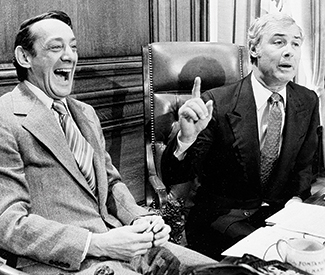
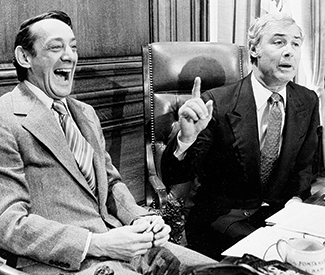
When Mayor George Moscone and Sup. Harvey Milk were assassinated in their City Hall offices on Nov. 27, 1978, San Francisco changed in innumerable ways. Among those ways is the city lost two of the leading progressive advocates for renters and affordable housing ever elected here.

Today, as San Franciscans mark this tragedy with their annual memorial march, organizers and activists have broadened and elevated the event by enlisting the support of 20 community organizations now doing work to combat the eviction, gentrification, and affordable housing crises that are gripping the city.

“We wanted to make this even more than just a candlelight vigil,” David Waggoner, one of the organizers of the event, told the Guardian. “We want to use this time to remember Harvey and George’s legacy in really fighting for the underdog.”

He noted that attendance at the march has waxed and waned from year to year, but the coalition putting this one together promises to have a strong turnout this year because of the surging progressive activism around housing issues and the need to organize the community to save the soul of the city.

“There is very little to stop what’s happening with the rapid gentrification,” Waggoner said, but he also noted, “By building coalitions, the same way Harvey and George did, we can fight.”

“We’re not only honoring the history of Harvey Milk and George Moscone, but we’re honoring their legacy by making them relevant today,” Brian Basinger, head of the AIDS Housing Alliance/SF, told us. “The Milk March is going to be very exciting. We have over 20 community groups invited and helping us put it together.”

Basinger said the progressive activism will continue through the 25th annual World AIDS Day on Dec. 1, and that participants in both events will be asked to present their demands to the city for dealing with the AIDS and housing crises. That list will be presented at City Hall during a noon rally on Dec. 2.

He said that affordable housing issues are LGBT issues given that nearly 30 percent of the city’s homeless population identifies as LGBT, while that identification makes up just 15 percent of the overall city population.

“Those of us who are lucky enough to talk to the folks who knew Harvey remind us that it’s about coalition-building,” Basinger said, noting that many of Milk’s contemporaries are now being forced to leave the city by evictions or economic displacement.

One voice from that era who is still around and active is gay activist Cleve Jones, who was an intern in Milk’s office at the time of the assassination and wrote a poignant guest editorial in the Nov. 21 issue of the Bay Area Reporter about what Milk and Moscone advocated.

“They fought for renters, honored labor, and built coalitions to connect, not divide, us from each other,” Jones wrote. “They would, I’m sure, be pleased by the progress that has been achieved on some of the issues they cared about. But they would be alarmed by the growing chasm between rich and poor, they would be angered by the evictions of the elderly, disabled, and people with AIDS. They would be fighting to keep City College open and they would be outraged by the violence and despair experienced by so many in our city’s neighborhoods.”

Organizers of the event say they think this is just the kind of memorial that Milk and Moscone would have wanted.

“We want the housing crisis to be front and center,” Waggoner said. “We want this to be a time for people to connect with the legacy of Milk and Moscone in a very direct way.”

The march begins at 7pm in Milk Plaza, Castro and Market streets, and continues with a rally outside City Hall.


Activists organize, and some journalists chronicle, a progressive resurgence in SF

131

While Mayor Ed Lee jets around the world, still too focused on fueling the economic fire that is gentrifying San Francisco and displacing its diverse population — and as the San Francisco Chronicle and other downtown boosters niggle on the margins of the city’s biggest issue — local activists and some media outlets are paying attention and pushing back.

The New York Times ran an excellent Sunday piece about the growing populist backlash here against Mayor Lee’s economic policies and his friends and benefactors in the tech industry, a story that the Santa Rosa Press Democrat also put on its front page, but which the Chronicle only briefly mentioned today on its business page in a short story wrapping all the high-end housing now coming online. Instead, on Sunday the Chron ran this pro-landlord garbage

Meanwhile, as we report in tomorrow’s edition of the Guardian, more than 20 local organizations have combined forces this year to organize and promote tomorrow’s (Wed/27) annual memorial march marking the 1978 assassinations of Mayor George Moscone and Sup. Harvey Milk in City Hall, which will this year focus on their legacy of advocating for renters and keeping this city affordable by and welcoming of the working class and outsiders of all types.

We’ve said it before and we’ll say it again: this is a struggle for the very soul of San Francisco, and it’s a struggle that we at the Guardian renew our commitment to with every issue we print. See you all on the streets tomorrow night starting at 7pm in Milk Plaza and Castro and Market.    

Eviction epidemic spurs legislative solutions

3

Tenants, organizers and residents impacted by Ellis Act evictions packed the Board of Supervisors Chambers at San Francisco City Hall Nov. 14 for a hearing on eviction and displacement in San Francisco. As more and more residents face ousters only to be priced out, lawmakers and advocates are floating legislative fixes to try and reverse the trend before it reaches the soaring levels of the displacement epidemic that impacted the city during the first dot-com boom.

“It seems to me that we have a tale of two cities,” Sup. David Campos, who requested the hearing, said at the start of the discussion, held at the Board of Supervisors’ Neighborhood Services and Safety Committee. “We must act urgently to address this crisis, which I believe is a crisis,” he added. “We are fighting, I think, for the soul of San Francisco.”

Fred Brousseau of the San Francisco Budget and Legislative Analyst’s office shared his recent analysis on eviction and displacement trends across the city.

Overall evictions in San Francisco rose from 1,242 to 1,716 over the past three years, he said, reflecting an increase of 38.2 percent. Ellis Act evictions rose by 169.8 percent in that same time frame.

Almost 42 percent of individuals impacted by eviction had some form of disability, Brousseau noted, while 49 percent had incomes at or below the federal poverty level. On the whole, a total of nearly 43 percent of San Francisco households are “rent-burdened,” a term that officially means devoting more than 30 percent of household income toward rent, the study found.

Ted Gullicksen of the San Francisco Tenants Union emphasized that tenant buyouts, frequently offered in lieu of an eviction, are also driving displacement, although those transactions aren’t reflected in city records. “There are about three of them for every Ellis Act eviction,” he said. “When you consider them in combination with Ellis, the numbers are very dramatic.”

Throughout the afternoon, tenants shared their stories and fears about getting frozen out of San Francisco by eviction. “I’m looking at shopping carts, and I’m terrified,” one woman told supervisors during public comment. “You have to do something. It might not be enough for me right now, but you can’t do this to any more people.”

Campos is working with Assembly Member Tom Ammiano on a proposal to grant San Francisco the authority to place a moratorium on Ellis Act evictions. He’s also pursuing legislation that would create a mechanism at the San Francisco Rent Board to allow tenants to register formal complaints about landlord harassment and other kinds of pressure.

“I am eager to introduce a bill in January,” Ammiano noted. “One option might be a law that will allow the local jurisdictions, like San Francisco, to suspend the Ellis Act or establish a moratorium, because of the emergency housing situation. Another possibility is working to make sure that landlords are not skirting Ellis eviction requirements by improperly pressuring tenants to leave. We must do something, but we have to work together to make it successful.”

Meanwhile, Mayor Ed Lee recently announced that he is working with Sen. Mark Leno on legislation to curb Ellis Act evictions by requiring additional permits or hearings before they proceed. They’re also contemplating floating more stringent regulations on the sale and resale of properties where tenants have been evicted under Ellis.

At the end of the day, it’s clear that housing advocates are gaining momentum as the spike in tenant ousters continues in pricey San Francisco, where rents are the highest in the nation.


Hundreds attend hearing to call for action on evictions

Tenants, organizers and residents impacted by Ellis Act evictions packed the Board of Supervisors Chambers at San Francisco City Hall today, Thu/14, for a hearing called by Sup. David Campos on eviction and displacement in San Francisco.

“It seems to me that we have a tale of two cities,” Campos said at the outset of the hearing, which was held by the Board of Supervisors Neighborhood Services and Safety Committee. “The vast majority of individuals are struggling to stay in San Francisco. We must act urgently to address this crisis, which I believe is a crisis.” He added, “We are fighting, I think, for the soul of San Francisco.”

Tony Robles of Senior and Disability Action, who showed up at the hearing wearing a black hooded sweatshirt with pobre (the Spanish word for “poor”) printed across the front, expressed his frustration with the surge of evictions taking place in the booming economic climate. “We have been overlooked – the workers, communities of color … it’s almost as if we are an afterthought,” he said.

Fred Brousseau of the San Francisco Budget and Legislative Analyst’s office delivered a report on his recent analysis of eviction and displacement trends across the city.

Overall evictions in San Francisco rose from 1,242 in 2010 to 1,716 in 2013, reflecting an increase of 38.2 percent, according to San Francisco Rent Board Data highlighted in Brousseau’s report. 

Ellis Act evictions in particular increased by 169.8 percent in that same time frame, he said, with the most recent data showing a total of 162 Ellis Act evictions over the twelve months ending in September 2013. That number reflects units evicted, not how many tenants were impacted.

Ted Gullicksen of the San Francisco Tenants Union emphasized that tenant buyouts, frequently offered in lieu of an eviction, are also driving displacement even though these transactions aren’t reflected in city records.

“We need to get in control of these buyouts,” he said. “There are about three of them for every Ellis Act eviction. When you consider them in combination with Ellis, the numbers are very dramatic.”

Brousseau also showed a slide profiling the people who’ve been impacted by evictions citywide. Almost 42 percent had some form of disability, the data revealed, while 49 percent had incomes at or below the federal poverty level.

On the whole, Brousseau said, a total of nearly 43 percent of San Francisco households are “rent-burdened,” a term that officially means devoting more than 30 percent of household income to monthly rental payments.

Throughout the afternoon, tenants shared their stories and fears about getting frozen out of San Francisco by eviction. “I’m looking at shopping carts, and I’m terrified,” one woman told supervisors during public comment. “You have to do something. It might not be enough for me right now, but you can’t do this to any more people.”

Hene Kelly noted that elderly tenants are being disproportionately impacted by Ellis Act evictions. “They don’t have the reserves, they don’t have the jobs, and they don’t have the money to be able to move if they are evicted,” she said. Referencing landlords and speculators who are driving displacement, she added, “It makes me think of cabaret. Money, money, money, money, money makes the world go round.”

Campos noted that he is working with Assembly Member Tom Ammiano on a proposal to grant San Francisco the authority to place a moratorium on Ellis Act evictions.

He’s also working toward legislation that would create a mechanism at the San Francisco Rent Board allowing tenants to register complaints of harassment or other forms of pressure from landlords seeking to drive them out.

His proposal also envisions doubling the amount of relocation assistance that landlords would have to provide to tenants, in the case of no-fault evictions. He also mentioned the possibility of regulating buyouts, by requiring landlords to record these transactions with the rent board, and possibly prohibiting property owners from charging market-rate rent directly after completing a tenant buyout.

Meanwhile, Mayor Ed Lee recently announced that he is working with Sen. Mark Leno on legislation that is meant to reduce Ellis Act evictions. That proposal would require additional permits or hearings before an Ellis Act eviction could go forward, and place more stringent regulations on the sale and resale of properties where tenants have been evicted under the state law.

Just a couple weeks ago, a coalition of housing advocates proposed a sweeping package to turn the tide on evictions.

At the end of the day, it’s clear that housing advocates are gaining momentum as the spike in tenant ousters continues in pricey San Francisco, where rents are the highest in the nation.

“We’ve never been late on our rent,” noted Beverly Upton, executive director of the San Francisco Domestic Violence Consortium, who is battling an Ellis Act eviction. “We’ve paid for every improvement ever done in 25 years. And now we have to leave.” She appealed for legislators to take action for the sake of the city’s future, asking, “Once the advocates and the organizers and the people who care are gone, who will be left in our city?”

Tale of two parties: Voters reject 8 Washington project

21

From the Election Night victory party for opponents of the 8 Washington waterfront luxury condo project, the overwhelming defeat of developer-backed Propositions B and C seemed to go beyond just this project. It sounded and felt like a blow against Mayor Ed Lee’s economic policies, the gentrification of the city, and the dominion that developers and power brokers have at City Hall.

“What started as a referendum on height limits on the waterfront has become a referendum on the mayor and City Hall,” former Board of Supervisors President Aaron Peskin told the large and buoyant crowd, a message repeated again and again at the Nov. 5 gathering.

Former Mayor Art Agnos also cast the victory over 8 Washington as the people standing up against narrow economic and political interests that want to dictate what gets built on public land on the waterfront, driven by larger concerns about who controls San Francisco and who gets to live here.

“This is not the end, this is the beginning and it feels like a movement,” Agnos told the crowd. “We’ll have to tell the mayor that his legacy,” a term Lee has used to describe the Warriors Arena he wants to build on Piers 30-32,” is not going to be on our waterfront.”

Campaign Manager Jon Golinger also described the victory in terms of a political awakening and turning point: “We are San Francisco and you just heard us roar!”

Campaign consultant Jim Stearns told the Guardian that he thought the measures would be defeated, but everyone was surprised by the wide margin — the initiative B lost by 25 percentage points, the referendum C was 33 points down — which he attributed to the “perfect storm” of opposition.

Stearns cited three factors that triggered the overwhelming defeat: recent populist outrage over the city’s affordability crisis, concerns about waterfront height crossing ideological lines, and “a tone deaf City Hall that didn’t want to hear there were any problems with the project.”

Among the key project opponents who have sometimes stood in opposition to the city’s progressives was former City Attorney Louise Renne, who blasted City Hall and called the Planning Department “utterly disgraceful,” telling the crowd, “Get your rest, more to come, San Francisco.”

Both progressive and political moderates often share a distrust of the close connections between powerful developers and the Mayor’s Office, and that seemed to play out in this campaign and at the polls.

“San Francisco, this victory is for you,” Renne said. “And to all those developers out there: Do not mess with our waterfront. We’re not going to stand for it.”

Meanwhile, it was a very different scene over at the Yes on B and C party.

Developer Simon Snellgrove, whose 8 Washington project was soundly rejected despite his spending almost $2 million on the campaign, was in no mood to comment. “I’m having a little private party tonight,” he told us, “and I don’t want to talk to the press.”

Rose Pak, a consultant for the San Francisco Chinese Chamber of Commerce who is well-known for her ties to powerful interests in the city, had a small circle of guests around her throughout the night and spent some time catching up with Snellgrove. Asked to comment, Pak said, “I don’t know the Bay Guardian,” and stopped making eye contact. At previous events, Pak has lectured Guardian reporters about what she sees as the paper’s shortcomings.

“I think this project got caught up in a lot of other things,” Jim Lazarus, the vice president for public policy at the San Francisco Chamber of Commerce, told us. “There was a lot of I think mistaken concern about the impact.”

He criticized the focus on building heights and the idea that it was about something more than just a waterfront development project. But this was the outcome, he said, because “an unholy alliance of people got together to oppose the project.”

Perhaps “unholy alliance” is in the eyes of the beholder, but the voters of San Francisco seemed to prefer the alliance that opposed 8 Washington and all that it has come to represent in San Francisco. 


Filipino group snubs mayor over evictions

4

The board members of a local Filipino heritage organization, with ties to a high-profile eviction defense battle at San Francisco’s International Hotel in the late 1970s, have declined to an accept an award that San Francisco Mayor Ed Lee had planned to extend to them as part of a Filipino American History celebration because they are angry about a growing trend of senior evictions.

In a written statement sent to the media by board member Tony Robles, the Manilatown Heritage Foundation explained that it couldn’t accept the award as long as “elders are being preyed upon, evicted and given a de facto death sentence thereof.”

The Manilatown Heritage Foundation board members were informed by Board of Supervisors President David Chiu that Lee had planned to recognize the I-Hotel as part of an annual cultural history celebration at City Hall, the statement noted.

“Part of the occasion was to honor the I-Hotel and its many tenants and activists for its contribution to Filipino American history,” board members explained.

In 1976, the I-Hotel was targeted for demolition, prompting a historic eviction defense battle led by housing activists who rallied to the defense of the impacted tenants. As a young attorney who worked with the Asian Law Caucus, Ed Lee was involved in that fight — as an activist defending tenants’ rights to stay. He frequently referred to this chapter of his personal history while running for mayor in 2011, to demonstrate his sensitivity to concerns about affordable housing.

But now that Lee is well into his mayoral term, a surge of evictions of low-income seniors is worsening on his watch. Tenant defense organizations such as Eviction Free San Francisco are showing up outside landlords’ homes and offices to protest eviction notices that threaten to push low-income seniors with few options out of the city.

“The I-Hotel fight was for dignity and it lived by the premise that housing is a human right,” the group’s statement explained. “The fight for the I-Hotel galvanized the community around the fight for affordable housing, particularly for seniors who sacrificed much and on whose shoulders we stand. The fight included tenants, elders, activists, artists and students who recognized that the real estate developers and financial interests were out of control—power unchecked.”