City Hall

Can we rediscover radical action on this marriage equality anniversary?

38

San Francisco’s political establishment will rightly celebrate itself this afternoon [Wed/12] at 5pm with a ceremony in City Hall marking the 10th anniversary of the unilateral decision to start issuing marriage licenses to same-sex couples, kicking off what became known as the Winter of Love.

It was the greatest thing that then-Mayor Gavin Newsom did during his seven-year tenure in Room 200, a bold and principled stand for civil rights that started California down the long and arduous road toward marriage equality.

“It was a proud moment for San Francisco, and some of my most meaningful moments in public service,” Mayor Ed Lee wrote in a guest editorial in today’s Examiner, referring to the minor role that he played as a city administrator at the time.

But that kind of political leadership and willingness to take radical action in the face of injustice — or even the recognition during this kumbaya moment that what Newsom did far exceeded his actual legal authority — seems to be absent in today’s City Hall, which overvalues civility and compromise.

Real estate speculators and greedy capitalists are rapidly changing the face of San Francisco, killing its diversity and some would say its very soul, and the Mayor’s Office hasn’t done anything of any real substance to address the problem. While Mayor Lee gives lip service to protecting the city “for the 100 percent,” it is his supporters from the 1 percent that are acting with impunity to evict our workers, artists, and valued cultural institutions.

So as San Francisco officials pat themselves on the back this afternoon at City Hall, celebrating what was indeed an important and historic effort, our hope is that they will remember the radical spirit of that fateful moment and apply it to the pressing problems that have ignited such populist outrage today.   

Alerts: February 12 – 18, 2014

0

WEDNESDAY 12


10th Anniversary: Winter of Love City Hall Rotunda, Civic Center Plaza, SF. (415) 554-5977. 5-6pm, free. Celebrate 10 years since the historic day when then-Mayor Gavin Newsom took a courageous stand against marriage discrimination in San Francisco, and married thousands of same-sex couples in San Francisco’s City Hall. A decade later, loving same-sex couples can legally marry in San Francisco and throughout California. It’s time to celebrate with family and friends. Lt. Gov. Gavin Newsom and San Francisco Mayor Ed Lee will attend.


Winning Divestment: Student Struggles for Peace and Justice Mission Cultural Center for Latino Arts, 2868 Mission, SF. MEPeaceSF@AFSC.org. 6-8:30pm, free. A panel discussion will bring activists together to address the power, controversy and effectiveness of divestment as a tool for economic activism in different movements: the movement against apartheid in South Africa, the struggle for Palestinian rights, the global movement to avert the climate crisis. Film clips will accompany the panel, followed by an open conversation moderated by journalist, activist, and author Nora Barrows-Friedman.


THURSDAY 13


Kamala Harris: Do Your Job, Prosecute Killer Cops! State Building, 1515 Clay, Oak. www.justice4alanblueford.org. 3-5pm, free. The Justice for Alan Blueford Coalition (JAB) submitted a letter to CA Attorney General Kamala D. Harris at the State March Against Police Brutality on October 22, demanding that she prosecute Miguel Masso for the murder of Alan Blueford. Since then, she has responded by refusing to reopen the investigation. Join in a statewide campaign to demand that Attorney General Harris do her job and investigate citizen deaths.

FRIDAY 14

Dance Across the Golden Gate Bridge Southeast End of Golden Gate Bridge, SF. www.onebillionrising.org/events. 8am, free. One Billion Rising for Justice is a global call to women survivors of violence and those who love them to gather safely in community outside places. This year, they are escalating their efforts, calling on women and men everywhere to rise, release, dance, and demand justice. Join them for an early morning dance across the Golden Gate Bridge.

SUNDAY 16

Radical Women & Freedom Socialist Party Meeting New Valencia Hall, 747 Polk, SF. www.radicalwomen.org. 1pm, free. Obamacare: not as universal as you may think. The focus of this month’s meeting of the Radical Women & Freedom Socialist Party is a leftist critique of the Affordable Care Act, plus cost-effective alternatives that would provide humane treatment to all. Come and discover the criticism you aren’t used to hearing about in the news.

Sue Hestor’s 70th birthday party: “We Shall Overcome.”

110

By Bruce B. Brugmann

Plus: Tim Redmond reports on Sue Hestor and her environmental legacy on his new local  website 48 Hills.org.  

How do you say happy birthday to a San Francisco icon like Sue Hestor?

Some 200 of her friends, allies, pro bono legal clients, political heavies, and fellow warriors against big developers and their pals in City Hall gathered Saturday at Delancey Street for a surprise party to celebrate Sue’s 70th birthday.

When she arrived, she was obviously surprised to find a band playing “We shall overcome” and her friends standing, clapping, cheering, and singing  in admiration for a woman who has spent more than four decades as a citizen activist and attorney fighting for one good cause after another, usually at bad odds against the big guys, often for clients without pay. It was truly a historic moment in the history of San Francisco politics. 

I first knew Sue when she popped up as a feisty volunteer in the Alvin Duskin anti-high rise campaign of the the early 1970s. The Bay Guardian was doing an investigative book, “The Ultimate HIghrise,” on the impact of highrises on the city. She pitched in on the project and was in the book’s  staff photo, jauntily wearing her trademark straw hat, standing next to the hole in the ground for the Yerba Buena Center development.

 We billed a central feature of the book as “the world’s first comprehensive study of the true cost of skyscrapers.” Our research group demonstrated that highrises cost much more in services than they bring back in revenue,  a finding that infuriated the Chamber of Commerce because they could never effectively refute it. We also laid out in detail for the first time the power structure behind pellmell Manhattanizaton, how destructive those policies are, how they shift the tax burden from dowotown to neighborhoods and small business, who profits from them, why there are more muckmakers than muckrakers. Our talented art director Louis Dunn provided brilliant graphics that drove home the damaging points about highrises.

Our conclusion was most prophetic: “The most disturbing finding can’t be quantified–but it should be shouted to the heavens.  It is this: unless the city of San Francisco reverses past practice and immediately enacts an ironclad land-use policy such as Duskin’s proposed height limit, the long scoffed at ‘Manhattanization’ of the entire city is a surefire, 100%-guaranteed inevitability.” 

I like to think this project and its results were a fitting start to Sue’s career in land use litigation and terrorizing big developers, City Hall enablers, and their ever more virulent forms of Manhattanization. 

In the early l990s, I called on Sue again, this time to be the founding chair of the spanking new Sunshine Task Force. It was a new task force formed to enforce the Sunshine Ordinance, which gave citizens the right to make complaints about government secrecy and its tradition of keeping City Hall safe for PG&E, big landlords, and developers etal. The task force would, I knew, drive the bureaucrats nuts and  it thus needed a strong attorney as chair who would be smart enough and tough enough to go up against the city attorney and the crocodiles in the back bays of City Hall.

 The neat thing was that nobody could kick Sue off the task force.  She was one of two members who were “grandfathered” in by the ordinance–an attorney (Sue)  and a media rep (B3) –who were selected by the Northern Chapter of the Society of Professional Journalists, not the supervisors. She performed admirably and got the task force on a firm footing as the first and still the best local open government task force in the country, if not the world. 

Through the years of development battles, it was often Sue and Calvin, Calvin and Sue.  Calvin being Calvin Welch, a crafty environmental and neighborhood strategist who worked with Sue and others in developing counters and initiatives and all kinds of hellish moves to beat or slow down and mitigate development.  He said Sue’s career could be summed up in two words: “cumulative impacts.”  The good thing was that we all knew, when the developers brought up their heavy artillery or their sneaky back alley maneuvers, Sue and Calvin would be there to blow the whistle and take on the fight. Call Sue, call Calvin was the watchword but they usually called us first at the Bay Guardian. 

Let me call now on Tim Redmond, a Guardian reporter who covered Sue and Calvin and the highrise battles from 1982 on, to explain what Calvin meant.  Tim laid out the political points in his piece, “Sue Hestor’s birthday and a lesson in SF environmental history,” on his new local  website “48 Hills.org.”  Read Tim’s first paragraphs for the fun stuff on Sue and the last paragraphs for the really important contributions she has made to the city and urban planning, as explained by Calvin.

As Tim concludes, “In 1964, Hestor, representing San Franciscans for Reasonable Growth, sued and won a stunning decision in the California Court of Appeal mandating that the city start studying the cumulative impacts of development. As Welch noted, ‘there was an obligation for developers to prioritize mitigations.’ That’s where the affordable housing program, the transit-impact fees–and the entire concept of analyzing development on the macro, not the micro level emerged.  That was the idea behind the 1986 measure Prop. M, which included no height limits at all–but did include programs and policies designed to protect neighborhoods from the effects of unlimited growth.” 

Well, the Hestor faithful may not have “overcome” the big developers and their latest monstrous Manhattanization plans.   But they have come pretty damn close. On Sunday, the day after Sue’s party, the Warriors caved on its waterfront project and Matier and Ross did a Chronicle column with the head, “Warriors call for timeout on Waterfront arena plan.” And on Monday, the waterfront warriors marched triumphantly into City Hall and, as the  Chronicle’s John Cote reported,  “turned in more than double the number of signatures needed to qualify a measure for the June 3 ballot that would require voter approval for any development on the San Francisco waterfront to exceed existing height limits.”

That could kill the massively inappropriate project.  “If passed,” the Chronicle continued, “the measure would put a check on high-rise hotels and condo towers along the bay and require voter approval for height increases for three major waterfront development plans, the Golden State Warriors’ proposal for an 18,000-seat arena complex, the San Francisco Giants’ plan for an urban neighborhood on what is their main parking lot and the development of the industrial Pier 70 area.”

Whew! That’s what I call a nifty bit of Hestoring and Calvinizing.   b3

If you don’t like the news, go out and make some of your own. (Wes “Scoop” Nisker on KSAN radio during the dark days of the Vietnam War.) 

(The Bruce blog is written and edited by Bruce B. Brugmann, editor at large of the Bay Guardian.  He is the former editor and co-founder and co-publisher of the Bay Guardian with his wife Jean Dibble, from 1966 to 2012.)


The trouble with compromise

44

“It takes no compromise to give people their rights… It takes no money to respect the individual. It takes no political deal to give people freedom. It takes no survey to remove repression.” — Harvey Milk

OPINION As I sat in the audience at the Jan. 23 San Francisco Young Democrats meeting and watched the first debate between David Campos and David Chiu in their race to represent San Francisco’s 17th Assembly District, I was disturbed to hear the words “compromise” and “consensus” come out of David Chiu’s mouth more often than the words “eviction” and “displacement.”

During the debate, a line in the sand was drawn by the two candidates: Campos was on the side of the underdog, a voice to the voiceless; and Chiu, by his own admission, was all about compromise and “getting things done.”

Don’t get me wrong. True compromise can be a good thing. Unfortunately, what has been coming out of City Hall, from both President Chiu’s Board of Supervisors chamber and the Mayor’s Office, hasn’t been real compromise. It’s been a wholesale selling of our city to the highest bidder. The only thing that our leadership’s compromises have yielded is a compromised San Francisco.

Compromise gave corporations millions of dollars in tax breaks and it has forced nonprofits and small businesses out of our neighborhoods. Compromise has not resulted in any substantive action to curb Ellis Act evictions, instead serving to green light the building of luxury condo towers throughout the city. Compromise has allowed queer youth shelters and our parks to be closed to the people who need them as a last resort, as our bus stops have been opened up to billionaires for little more than pennies.

Chiu’s compromises have cost this city dearly. His compromise with developers on Parkmerced will lead to the demolition of 1,500 units of rent-controlled housing. His compromise on Healthy San Francisco allowed restaurant owners to continue to defraud consumers and to pocket money that should have gone to health care for their employees. His compromise on Muni killed a much-needed ballot initiative that would have resulted in an additional $40 million for the agency — a ballot initiative that he originally co-authored.

Please forgive me if I am fed up with compromise and am demanding actual leadership from my representatives.

Now is the time to stand with people of color, with members of the LGBTQ community, with our youth and elders, with artists and with small businesses, all of whom are being forced out of our city.

Thankfully, we have another choice. Sup. David Campos has shown that real change comes not from compromising your values but standing up for your principles. His legislative accomplishments include providing free Muni for low-income youth, protecting women’s right to choose at the Planned Parenthood Clinic, and preventing teacher layoffs at our public schools.

Campos has demonstrated that he, not Chiu, is the right choice to follow Tom Ammiano’s footsteps to Sacramento. Ammiano, who had 13 of his 13 bills signed into law this past year, is the perfect example of the success that can come from leading with your principles and not compromising your integrity.

San Francisco needs a leader representing us in the capital. Successful victories in reforming the Ellis Act and closing the Prop. 13 tax loophole will take a leader who can stand up to landlords and corporations, not a compromiser who will sit down at the table in a backroom with them.

That is why I will give my all to make sure that David Campos is our next representative in Sacramento. Pardon me if I refuse to compromise.

Tom Temprano is president of the Harvey Milk LGBT Democratic Club.

The future of civic engagement is here (so far it’s not pretty)

Last week, we wrote about San Francisco City Hall’s foray into “civic innovation,” to foster greater governmental openness through web-based technology.

We spotlighted the OpenGov Foundation’s partnership with the city to upload the entire municipal code to a website, SanFranciscoCode.org, to make local laws readily accessible for anyone (regardless of city of residency, apparently) to comb through, offer comments, or suggest legislative tweaks.

Sup. Mark Farrell trumpeted the open city code website as a great way to incorporate citizen feedback to improve government. It earned a mention the San Francisco Chronicle and other news outlets after Farrell proposed doing away with a silly law that effectively bans bicycle storage in garages, prompted by a comment left on SanFranciscoCode.org.

In and of itself, the idea is not bad – transparency and openness are laudable goals.

That being said, judging by the quality of “civic engagement” happening so far, there’s a long road ahead before this particular experiment in digital democracy takes us anyplace we’d like to go.

There’s the guy who rails against the law about curbing the wheels of your car when parking on an incline, who wants it known, sir, that “I resent and object to getting a near $70 fine for not curbing the wheels on my 2011 Prius.” (He argues that the grade of the incline the rule applies to only made sense in a bygone era, when parking brakes and manual transmissions were more likely to fail.)

Other brilliant insights from cantankerous “innovators”: What do we need San Francisco General Hospital for, anyway?

Another comment calls for writing a new law: “I think news racks should be outlawed as people leave garbage around them, graffiti and vandalize them all the time. I have never seen a group of news boxes / racks that were in a good shape anywhere in the city. They just make the city ugly and cluttered.”

I know, I know – this civic innovation experiment is still in a test phase. And after all, anyone is free to comment, and more stimulating ideas could still be on the horizon. 

But still. This is what citizen empowerment through technology looks like, in San Francisco?

H. Brown: Goodbye to all that, we hope

137

OPINION While we mourn the tamping down of the fiery progressive idealism that characterized City Hall in the early 2000s, we celebrate the departure of that era’s dated man-warrior posturing. Last week proved a good occasion to pop a bottle: Misogynist blogger and progressive scene queen H. Brown announced he would soon be leaving San Francisco for destinations unknown.

Brown, a proud bigot famed for hurling invective from behind a double shot of whiskey at ex-Supervisor Chris Daly’s since-closed progressive hangout Buck Tavern, took the occasion to hang out for posterity with an SF Weekly reporter. Joe Eskenazi wrote a lyrical, subtly satiric ode to the aging troll’s legacy, “Last Call for Know-It-Alls: The Departure of a Classic Specimen of Old-San Francisco Bon Vivantery.”

But nuanced pokes at the longtime “character” proved too subtle to the victims of his bullying throughout the years. And since the piece failed to include the voice of a single woman, we thought we’d remedy with a retrospective of our own. Behold, the legacy of a real jerk:

“At a benefit at the Buck Tavern I walked in and there were all these progressive journalists sitting around a table with him. [Brown] said ‘you’re the one with the great ass!’ He started asking me if I had family members he could date. I was standing there horrified. I’m a mouthy lady, and even I couldn’t think of anything to come back with — not just to him, but to every other progressive journalist who was sitting there listening to him who laughed! I said hi to a few people, and then I left the event.”

– Laura Hahn, president of the San Francisco Women’s Political Committee

“H. is a bully and a sexist. If you want to look at why the progressive movement is failing it’s because it alienates youth, women, and people of color. Deifying somebody like him is shutting women out, the message is they aren’t welcome. It’s not separated from the fact that progressives are really faltering right now with no leadership and very little inspiration.”

– Debra Walker, artist and longtime activist

“As a purveyor of alcohol, I found that the man was a lawbreaking mooch and a pain to deal with. As a woman, I found him pathetic, insulting, gross, or all three, depending on his mood. The first time I met him he cussed me out for an imagined slight in a way that was actually shocking — and it takes a lot for cuss words to flummox me. For a time, I simply refused to serve him.”

– Siobhann Bellinger, Buck Tavern bartender

“His behavior symbolized the running joke amongst some progressive men that women were there for their own entertainment to be mocked and harassed with no one blinking an eye. FUCK. THAT.”

– Anonymous ex-City Hall aide

Ah, old San Francisco bon vivantery. Of course, the real reason we’re cheering on whatever Greyhound that will ferry this foul-mouthed sprite from our burg has nothing to do with Brown. Rather, we’re hoping no one will step into his shoes as your supervisor’s personal Bobby Riggs, to invoke the publicity-pig chauvinist who famously challenged tennis legend Billie Jean King to a match, the infamous Battle of the Sexes in which King mopped the floor with her opponent.

We hope that our purported progressive leaders will no longer invite woman-haters and homophobes to their household Sunday salons, or take Speedo-clad dips with them in the bay. That they will no longer think it’s OK to enable the presence of their own yapping id in polite company.

In the middle of City Hall’s current and unfortunate drift toward elite-serving “moderation,” one must wonder about what hangers-on like Brown did to the strength of our political movement. He and his ilk were allowed to establish through constant bullying, both online and off, that only straight men have the right to feel comfortable in our city’s high-powered progressive circles. What heroes did we lose in the process?

Caitlin Donohue is a staff writer at Rookie magazine and editor of AHDM4U.com.


H. Brown: Goodbye to all that, we hope

451

In an SF Weekly piece published yesterday, it was announced that progressive political blogger and gadabout H. Brown – an “irascible” man who has attained a specific sort of fame in equal measure for his political connections, his egregious sexism, and his unfortunate alcoholism — was leaving San Francisco. Where’s he going? The article didn’t see fit to mention. It’s whatever. One can assume Brown’s destination is that netherworld set aside for those whose behavior was enabled by the old school boy’s club blinders of the San Francisco progressive movement, still worn at the dawn of the 21st century.
 
“Last Call For Know-It-Alls: Classic Specimen of Old-San Francisco Bon Vivantery,” the article was called. It was written by a man; if a woman had written it, the title might have been closer to: “I Just Bought an Evil Eye Necklace, Don’t Look at Me You Cursed Troll.”


Do I sound angry? In 2008 at a DCCC, Brown inquired at top volume and in front of an ex-President of the Board of Supervisors if I was the politician’s escort. When said political leader bailed on the situation, Brown interrogated me on camera about my knowledge of local politics. I wrote about it, most names omitted, for the Guardian. In the article’s wake, I received thankful and supportive emails from men and women across the San Francisco political scene. On his part, Brown sent out multiple emails about me to his prodigious correspondence rolls, one in which he shared an communique from his niece calling me an “ignorant cunt,” another in which he addressed an un-cc’ed me about the election night in question: “You tried to make up for your ignorance by wearing revealing clothing. I was mocking you. And rightly so.”
 
Nearly every woman in San Francisco politics has one of these stories. When a male politician was accused of any wrong against a woman, Brown could be depended on to dig through the Internet to find evidence that the victim had been asking for it. Those unwilling to suffer him had to opt out of the hobnobbing happy hours and salons in the homes of city leaders, at which Brown was a constant presence.
 
Ah, old San Francisco bon vivantery. But I’ve said it before and I’ll say it again, you don’t have to care about Brown. You do have to care that this man was your Supervisor’s drinking buddy, that he took Speedo-clad swims in the Bay with progressive leaders. You do have to wonder about what that did to the strength of our political movement. And you might want to wonder about the dynamics behind ubiquitous bigots who are tolerated by people who should know better.
 
“If comedy is indeed tragedy plus time, however, Brown will leave ’em laughing for posterity,” wrote Weekly reporter Joe Eskenazi. “Friend after friend recalled anecdotes of offensive, bourbon-fueled behavior invariably culminating with Brown being instructed to “Get the fuck out, H.!” But, always, these were happy memories, if not happy occasions.”
 
None of these friends — “former supervisors, consultants, academics, political Svengalis, and other city luminaries” – in Eskenazi’s article were women. (The writer, whose work on city issues I do appreciate, told me he did interview women, but apparently none of them said anything printworthy.)
 
Let’s remedy that now with a few female voices. Not coincidentally, most of these bourbon-fueled memories took place in ex-Supervisor Chris Daly’s since-closed Market Street progressive gathering spot, the Buck Tavern. None are happy.
 
“This was the first time I was introduced to H. At a benefit at the Buck Tavern I walked in and there were all these progressive journalists sitting around a table with him. He said ‘you’re the one with the great ass!’ He started asking me if I had family members he could date. I was standing there horrified, I just didn’t know what to say. I’m a mouthy lady, and even I couldn’t think of anything to come back with – not just to him, but to every other progressive journalist who was sitting there listening to him who laughed! I said hi to a few people, and then I left the event.”
– Laura Hahn, president of the San Francisco Women’s Political Committee
 
“Really, I don’t give much of a shit about one sad dude calling me a slut and a spy (for Newsom or Pinkerton Guards, depending on the year), but seeing some (not all) progressive men continue to put up with him was pretty demoralizing.”
– Anonymous volunteer on several progressive political campaigns
 
“The confrontation started because I came in to wish [ex-Supervisor and then-owner of the Buck Tavern] Chris Daly a happy birthday and have a drink, and H. asked Chris ‘Who the hell is she?’ To which Chris said, ‘She’s the President of the Harvey Milk Club.’ To which H began, ‘You’re not even gay, are you?’ I replied, ‘I’m queer.’ ‘Queer?!’ he said, ‘What the fuck is that? Some Shona Gochenauer shit? You’re not gay. I can tell you’re not gay by looking at you. She doesn’t know anything about politics. Look at her — she’s clearly just a vanity president.’ He said something about enjoying things because, “that ass isn’t gonna last forever, sweetheart. They [the other patrons in the bar] are only standing up for you because they want to fuck you.’”
– Stephany Joy Ashley, ex-president of the Harvey Milk LGBT Democratic Club
 
“As a purveyor of alcohol, I found that the man was a lawbreaking mooch and a pain to deal with.  As a woman, I found him pathetic, insulting, gross, or all three, depending on his mood. The first time I met him he cussed me out for an imagined slight in a way that was actually shocking — and it takes a lot for cuss words to flummox me. For a time, I simply refused to serve him.”
– Siobhann Bellinger, Buck Tavern bartender
 
“H. is a bully and a sexist. If you want to look at why the progressive movement is failing it’s because it alienates youth, women, and people of color. Deifying somebody like him is shutting women out, the message is they aren’t welcome. It’s not separated from the fact that progressives are really faltering right now with no leadership and very little inspiration.”
– Debra Walker, artist and longtime activist
 
“His behavior symbolized the running joke amongst some progressive men that women were there for their own entertainment to be mocked and harassed with no one blinking an eye. FUCK. THAT.”
– Anonymous ex-City Hall aide
 
These women – and the progressive men who were their allies – were not laughing at the hijinx of a mouthy old man. But people were, and they will be at the party that will be held in honor of Brown’s departure and attended by member’s of our city’s progressive elite.
 
Supporters say the guy’s behavior was a premeditated mockery of San Francisco’s political correctness, that he was an actor in the grand tradition of political theater. But if he is remembered by generations to come, it will be as the embodiment of an age-old archetype: the dude that other dudes keep around because he says the shit they can’t say to people who aren’t them. After all, who can control their own id?
 
Eskenazi compares Brown to F. Scott Fitzgerald and notwithstanding that both are writers, I’d like to posit an alternative historical precedent for Brown’s passionate trolling. Remember Bobby Riggs, the proud chauvinist who taunted tennis legend Billie Jean King until she wiped the floor with him in the widely broadcast Battle of the Sexes match? Man, that guy should have been in politics.
 
Brown was allowed to establish through constant bullying both online and off that only men have the right to feel comfortable in our city’s high-powered progressive circles. As San Francisco continues to cozy up with its new moderate identity, I hope he is remembered less for being a bon vivant and more as a sign that our once-vaunted avatars of progressivism were spending too much time pounding double shots at the Buck Tavern — while the world changed around them.

Local journalists starting to catch onto Airbnb’s subversion of SF’s rental market

45

Airbnb and other so-called “shared housing” sites allow hundreds of rent-controlled apartments in San Francisco to be essentially removed from the housing market, part of a concern that has caught populist fire recently with protesters and politicians pledging to do something about evictions and displacement.

Yet I’ve been one of the few local journalists to hound Airbnb over its illegal business model and refusal to pay nearly $2 million per year in transient occupancy taxes that it owes the city. But that may be beginning to change, as pair of mainstream local publications in the last week have cautiously waded into what outside journalists from Time magazine (which specifically mentioned my reporting on the issue) to German public television have already seen as a big and important issue.

The San Francisco Chronicle today has a story about a lawsuit from a tenant subjected to an owner-move-in eviction, with said owners then turning around to rent units in the building out through Airbnb. And San Francisco Magazine also mentioned Airbnb in its controversial article criticizing concerns over evictions.

“Isn’t it far more likely that more units are being lost [from the rental market] through Airbnb?” the magazine quoted a UC Berkeley professor as saying, comparing Airbnb to Ellis Act evictions. Hey, SF Mag, don’t you think that’s a good question that might be worth exploring?

Janan New, executive director of the San Francisco Apartment Association, told me this week that she found 1,100 rent-controlled San Francisco apartments listed on Airbnb — almost all of it in violation of local tenant and zoning laws — a fact that she personally conveyed to Mayor Ed Lee, who supports Airbnb, shares a funding source with the company (venture capitalist Ron Conway), and has been dismissive of the issue.

“They need to enforce the law like they do in New York City,” New told us, referring to a city that has cracked down on Airbnb’s subversion of its rent control laws. She’s lobbied City Hall, documented the problem, and threatened to sue the city: “I’ve done everything I can possibly think of.”

Meanwhile, Board of Supervisors President David Chiu has been negotiating with Airbnb for almost a year on legislation that would attempt to legalize and regulate its activities here in San Francisco, telling us “it has been difficult to corral the different stakeholders to get on the same page” and no longer offering any predictions when it might be complete.

I was already working on a story about Airbnb (which still won’t respond to my inquiries) for our next issue [UPDATE: It looks like I’ll hold that story for our Feb. 5 issue], so I’ll have more to say about this then. And in the meantime, here’s my latest message to the Mayor’s Office of Communications trying to get some kind of response to this issue, which it has ignored for the last 24 hours:

“I’m about to write about the rampant illegal behavior by Airbnb customers again, which seems increasingly relevant to the “affordability agenda” that Mayor Lee is touting, so I wanted to check in to see whether the mayor is still offering his unqualified support to this company, despite its violations of local housing, zoning, and planning laws and refusal to collect and pay the transient occupancy tax.

“Janan New with the SF Apartment Association says she’s raised this directly with Mayor Lee, including informing him recently that more than 1,100 rent-controlled apartments in San Francisco are listed on Airbnb, all in violation of local law, and she’s frustrated that he’s unwilling to enforce the law, as New York City has been doing. Meanwhile, the Airbnb legislation that David Chiu has been working on for the last year is hopelessly stalled, at least partly because Airbnb has the mayor’s support and is unwilling to compromise while it’s making some much profits off of its illegal behavior in San Francisco.   

“A recent San Francisco Magazine article (http://www.modernluxury.com/san-francisco/story/the-eviction-crisis-wasnt) even quotes a UC Berkeley professor saying that Airbnb is likely taking more rent-controlled units off the market than the Ellis Act. Considering the mayor is pursuing Ellis Act reform, why does he continue to ignore the impact that Airbnb is having on the city?”


By the people

3

rebecca@sfbg.com

A growing number of people seem to be convinced that “civic innovation” is sexy.

Tech-oriented events at San Francisco City Hall, like hackathons for improving government services, have become increasingly common. App developers are gaga over the idea of revolutionizing government through software, and the concept is gaining momentum.

To borrow an analogy referenced in an essay by tech publisher Tim O’Reilly, some software purveyors are moving away from the idea of government as a vending machine: “When we don’t get what we expect, our ‘participation’ is limited to protest—essentially, shaking the vending machine.”

Instead, they’re latching onto the idea of government as an open platform that citizens can tinker with.

That’s exciting. Can it lead to a government that is more responsive to the people, as enthusiasts predict? Can we really hack away the ineffective and irresponsive parts of the public sector?

Or is some of this just hype and libertarian idealism from a cash-drenched tech sector seeking business opportunities and greater political influence?


HACK THE LAW

Sup. Mark Farrell recently proposed doing away with an outmoded and widely disregarded law disallowing bicycle storage in garages. The legislative tweak matters because it was spurred by feedback submitted through a new website, SanFranciscoCode.org.

Operated by a private nonprofit organization called the OpenGov Foundation, the website presents an interactive, online version of the city’s municipal code with an open platform where anyone can easily comb through the thicket of city laws and leave comments on specific sections, using the software as a magnifying glass.

Farrell touted the website — launched in partnership with Mayor Ed Lee’s Office of Civic Innovation last September — as a tool that could spur “a more transparent and accountable city government.”

“I see this leading to better engagement,” said Jess Montejano, Farrell’s legislative aide. Seamus Kraft, executive director of the OpenGov Foundation, has been compiling all the comments submitted via SanFranciscoCode.org, and recently sent a memo with all user feedback to each member of the Board of Supervisors.

“Our mission is to put as much public information into the public’s hands as possible,” Kraft said, “so that people can access their laws the way they deserve in 2013.”

The idea that a law would be changed instantly based on public comments is a new take on an old concept, with shades of being enamored by that shiny new thing. After all, many supervisors have a habit of turning their backs, or very obviously zoning out, during public comment sessions at weekly board meetings.

Yet anyone with an Internet connection can run with this new portal for citizen engagement. How about a reinvigorated response to San Francisco’s Sit/Lie Ordinance? A torrent of online commentary about the public nudity ban? Not everyone has the same idea about what it means to fix a broken law.

In some respects, City Hall appears to be lending itself out as a laboratory in which to test the wide-ranging theories of civic innovators. Mayor Lee has greeted the technology sector with arms wide open, and empowered the Office of Civic Innovation to foster tech-fueled government fine-tuning.

With the rise of amply funded organizations such as Code for America, droves of programmers stand at the ready, eager to chip in and do their part to help transport the public sector out of the analog ages.

A recent brigade of Code for America fellows partnered with the city’s Department Health and Human Services to create an app that automatically notifies food stamp recipients via text when they are about to be automatically dis-enrolled. The idea is to give recipients advance notice so they can take steps to renew their enrollment.

Other initiatives, such as the Department of Public Health’s release of an open data set to reveal housing inspection records, can arm citizens with useful knowledge — like empowering apartment hunters to spot a slumlord from a mile away.

The use of tech for transparency holds potential: What if each and every public record — down to every last email, calendar appointment, or police report — were instantly uploaded to a publicly accessible database, easy to locate, and fully searchable? Would that be a check against corruption?

Ron Bouganim, a San Francisco-based venture capitalist and mentor to the very Code for America teams industriously improving city government through technology, recently filed paperwork with the Securities and Exchange Commission to create GovTech. It’s a new kind of venture capital fund, specifically devoted to fostering companies looking to find their way in the “civic innovation” sector.

Bouganim laid out the dynamics driving the civic innovation trend: First, “2008-2009 was like a nuclear bomb,” he explained. “The financial crisis was a cataclysmic event. The money is not coming back, ever.”


THE NEW NORMAL?

This new normal, characterized by dramatically depleted public-sector finances, has helped make government more open to working with startups instead of trusted brands like IBM, Bouganim said, since startups can help government “do more with less.”

Bouganim also said adoption of cloud computing has changed the game. Whereas governments were initially hesitant to move their data to the cloud, the recent migration has made it possible for companies seeking government contracts to price below the “procurement threshold,” a price point that triggers a long public approval process before a purchase can go through. Now that technology has helped software developers slice through red tape, startups are flooding in, eager to land public sector contracts.

The city’s Entrepreneurship in Residence webpage (entrepreneur.sfgov.org), which markets a program rolled out by the Office of Civic Innovation, says it all. Sporting a gleaming picture of San Francisco City Hall, it bears the caption: “Develop products & services for the $142 billion public sector market.”

Bouganim wasn’t willing to say much in the way of GovTech’s plans, but he mentioned that his accelerator provides mentorship for startups that are paired with government agencies, and hinted that his initial investments would lead to “a dramatic impact on government savings.”

An underlying goal of the whole civic innovation movement, Bouganim added, “is to fundamentally change this concept that government is over there, and I am over here. We the people are the government, we’ve just lost touch with it.”

Bouganim responded to the Guardian’s call within 15 minutes, mentioning he was in London. “I wanted to get back to you so you didn’t think I was ignoring you,” he said, “because that would be awful.”

But the well-compensated public servants at the Mayor’s Office of Civic Innovation evidently had no such compunction. The Bay Guardian placed multiple calls to that office for this story, only to be met with radio silence.

And that’s a quandary. One cannot trumpet lofty goals of citizen engagement while habitually walling off government critics, and still expect to be taken seriously. And therein lies the rub with civic innovation: Even if technology is neutral, politics will never be so.

Nickels and dimes… or transit for our times?

14

STREET FIGHT Much has been written about the so-called “Google buses” and San Francisco’s latest round of gentrification. It’s a horrible mess and the city’s trifling $1 charge per bus stop will do little to address the broader structural problem that these buses lay bare.

Ordinary people cannot ride them, nor do the people who clean and cook for the tech world. Like tour buses, they are clunky and inappropriate for many neighborhood streets. While they do substitute for some car trips, an ad hoc private transit system does not reflect the kind of thoughtful regional planning needed to truly reduce car use in the Bay Area.

But the controversy over the private commuter buses does show that there is great potential for a public regional express bus system. Consider that in 1980, 9 percent of commuters in San Francisco left the city every day to go to work. In 2010, outbound commuters approached 25 percent. Owing to regional political fragmentation, Muni cannot provide intercounty service and thus is not the travel mode of choice for many of these commuters. And although Caltrain and BART offer some regional service, the sprawling locations of suburban firms often make regional rail impractical or at the very least time-consuming owing to unavoidable multiple transfers to local buses.

So in noteworthy ways, the rise of private transit is an immediate reaction to poor regional transit connections. Yet rather than sidestepping failed regional planning by encouraging an inequitable, two-tiered, private system, we need to expand and regionalize the existing public bus systems. San Francisco’s mayor and Board of Supervisors have seats at the table of regional planning and ought to use the controversy over private buses as an opportunity to kickstart the implementation of a regional public bus system accessible to all.

For example, something like AC Transit’s Transbay routes should be extended through San Mateo and Santa Clara counties, perhaps operated by BART or Caltrain as part of the next iteration of Plan Bay Area. This network would use reallocated express lanes on 101 and I-280 and use transit priority lanes on arterials like 19th Avenue in San Francisco and El Camino Real in San Mateo. Regional property assessments on the corporations and developers, in part already possible within the existing BART district (one should be created for Caltrain), could be used to fund such a system. Congestion charging on 101 and I-280 should also be deployed and those funds used for electrifying Caltrain and developing the parallel and complementary regional bus system.

Of course there will be opposition to a regional public bus system as there already is to progressive regional planning. Transit-connected, walkable communities in the South Bay, for example, have been made all but illegal by decades of conservative middle and upper class, anti-density, anti-tax homeowners in suburban localities. As recently as last year, this Tea Party-style conservative politics dampened Plan Bay Area, resulting in a weak regional housing plan with an underfunded and lackluster transit vision. This conservative approach stifles our collective sense of what is possible and the fear-mongering has rendered regional planners virtually impotent. Yet it can and must be overcome.

Some progressives may find it convenient (and in some cases justifiable) to target tech workers right now, but they could also direct energy into shaping the next round of Plan Bay Area. Remember that Plan Bay Area is a living document, a work in progress. The current version of the plan, weak on transit funding, has been subdued by a loud, irrational mob of Tea Party cranks bent on sabotaging anything that hints of progressive ideas. Plan Bay Area is also stifled by a regional business class that wants to keep the status quo and that is comfortable with the neoliberal model of private transit.

So while a smattering of dedicated and hard-working progressive transit activists showed up and attempted to shape Plan Bay Area last year, in the coming years the plan needs a broader progressive movement — including transit, housing, social justice, and environmental activists — to demand a more visionary regional transportation plan that connects all of the Bay Area. I am hopeful that this would not only steer regional planning in a progressive direction, but many of the tech workers who are now on the private buses would gladly join in the cause.


THE POLITICS OF SUNDAY PARKING

Speaking of hopeful, last month the SFMTA reported that Sunday metering, implemented last January, is a resounding success. Switching-on the meters doubled parking availability on Sundays, which is invariably what small businesses, most of which are open on Sunday, want to see.

Sunday meters increased the number of cars using city-owned garages and decreased the time cars circled in search of parking from an average of four minutes to two — de-cluttering streets in commercial districts. While this might seem like a boon to drivers, it also means less pollution, safer conditions for pedestrians and cyclists, less delay for Muni, and a much needed enhancement of revenue for operating public transit.

So it is mystifying that such success would be ignored by Mayor Ed Lee, who instead has proposed to discontinue Sunday metering. This is doubly confusing because, based on existing travel behavior to many commercial districts, 25 percent of people arrived by driving, while 31 percent took transit and 25 percent walked. So what the mayor is effectively saying to the pedestrian and transit-using majority is you matter little. What does matter is the few whining motorists who called him to complain about being “nickel and dimed.”

The mayor talks a good game when saying he is truly concerned about pedestrian and cyclist safety, and insisting that he wants to fix Muni. But gutting a reliable source of operating funds and pandering to car drivers who will dangerously circle for parking is inconsistent.

Lee says money isn’t an issue because his proposed General Obligation bond (which must be approved by voters) will patch the lost revenue from Sunday metering. But the GO bond will incur further debt and only fund existing capital needs, while parking meters provide a debt-free steady revenue stream for Muni. It’s also slightly misleading because the bond would not cover Muni operations, while revenue from Sunday metering does pay for operations.

The mayor’s pandering also put the SFMTA Board of Directors, which has been working out parking management and Muni finance, on the spot. Ultimately, it has to vote to preserve or scrap Sunday metering in the coming months. Now the directors have to decide if they support transit-first or the mayor’s pandering.

Unfortunately, when it comes to parking policy, the way that the Board of Supervisors has behaved lately suggests it will either jump on the mayor’s bandwagon and pander to motorists or cower in silence as good public policy is trashed. Not a good situation at City Hall, where transit riders seem to be routinely thrown under the bus by the political establishment.

Street Fight is a monthly column by Jason Henderson, an urban geography professor at San Francisco State University.

Double standard for the role of voters in SF waterfront development?

4

As our article on San Francisco waterfront development was hitting the presses last week, California State Lands Commission Chief Counsel Mark Meier made public a letter questioning the legality of a local initiative in circulation that would submit waterfront projects that break height limits to a vote of the people.

Meier argued that such “public trust lands” are managed locally for statewide benefit, and therefore voters can’t meddle with the decisions made in City Hall or the Port of San Francisco offices: “The land use and management decisions that the City makes regarding these public trust land cannot be overriden by the local initiative process…”

State Lands Commission must sign off on most waterfront developments, along with the San Francisco Bay Conservation and Development Commission, so this Jan. 13 letter to the City Attorney’s Office is significant. It’s unlikely to keep the measure off the June ballot if the campaign gets enough qualifying signatures by Feb. 3, but it could be used in later challenges. 

Campaign Manager Jon Golinger said he wasn’t surprised or worried by the threat, calling Meier’s argument flawed. “Our attorneys have already analyzed this and we feel pretty confident,” he told us, summarizing his side’s legal argument as, “Anything that the people’s representatives can do, the people are also allowed to do.”

Golinger also noted a perverse aspect to Meier’s arguments, noting that the initiative seeks to strengthen existing protections of the waterfront, which is exactly what the Burton Act encouraged when transfering authority to the city. And most of the caselaw that Meier relies on for his arguments involved judges ruling against initiatives that sought to weaken local authority and protections.

Golinger also noted the glaring contradiction between the position between taken now by the State Lands Commission, of which Lieutenant Governor Gavin Newsom is one of three elected members, and the Prop. C initiative campaign funded last year by the 8 Washington project developers that was overtly supported by Newsom.

“If this is of question legally, why didn’t Commissioner Newsom raise this last year?” Golinger asked.  

In fact, that initiative would have been a far more glaring violation of the sanctity of local government control considering it would have not only green-lighted the 8 Washington project and all of its variances from local codes, but it would have prohibited “discretionary review” of the project by professional city planners.

We called both Meier and Newsom’s office with questions about the letter, its arguments and contradictions, and the role that Newsom had in ordering, preparing, or reviewing the letter. We never heard back from either of them, but we’ll update this post if and when we do.   


On the waterfront

6

steve@sfbg.com

Who should decide what gets built on San Francisco’s waterfront: the people or the Mayor’s Office and its political appointees? That’s the question that has been raised by a series of high-profile development proposals that exceed current zoning restrictions, as well as by a new initiative campaign that has just begun gathering signatures.

Officially known as the Voter Approval to Waterfront Development Height Increases initiative, the proposal grew out of the No Wall on the Waterfront campaign that defeated Propositions B and C in November, stopping the controversial 8 Washington luxury condo tower in the process.

“The idea was to have a public process around what we’re going to do with the waterfront,” campaign consultant Jim Stearns told the Guardian.

San Franciscans have been here before. When developers and the Mayor’s Office proposed big hotel projects on the city’s waterfront, voters in 1990 reacted by approving Proposition H. It created a temporary moratorium on new hotels and required the city to create a Waterfront Land Use Plan to regulate new development, which was approved in 1997 and hasn’t been updated since.

It was an important transition point for the city’s iconic waterfront, which was still dominated by industrial and maritime uses when the Loma Prieta Earthquake of 1989 led to the removal of the Embarcadero Freeway and opening up of shoreline property controlled by the Port of San Francisco.

Ironically, then-Mayor Art Agnos supported a luxury hotel project at Seawall Lot 330 (which is now part of the proposed Warriors Arena project at Piers 30-32) that helped trigger Prop. H. Agnos stayed neutral on that measure and says he was supportive of setting clear development standards for the waterfront.

Today, Agnos is one of the more vocal critics of the Warriors Arena and how the city is managing its waterfront.

“What’s happened in the last three to four years is all those height limits have been abrogated,” Agnos said of the standards set by the WLUP. “With the sudden availability of big money for investment purposes, there is now funding for these mega-developments projects.”

The trio of high-profile projects that would be most directly affected by the initiative are the proposed Warriors Arena, hotel, and condos at Piers 30-32/Seawall Lot 330; a large housing and retail project proposed by the San Francisco Giants at Pier 48/Seawall Lot 337; and a sprawling office, residential, and retail project that Forest City wants to build at Pier 70. Each project violates parts of the WLUP.

“We need to let the people protect the waterfront and current height limits,” Agnos said, “because clearly there is no protection at City Hall.”


CAMPAIGN LAUNCH

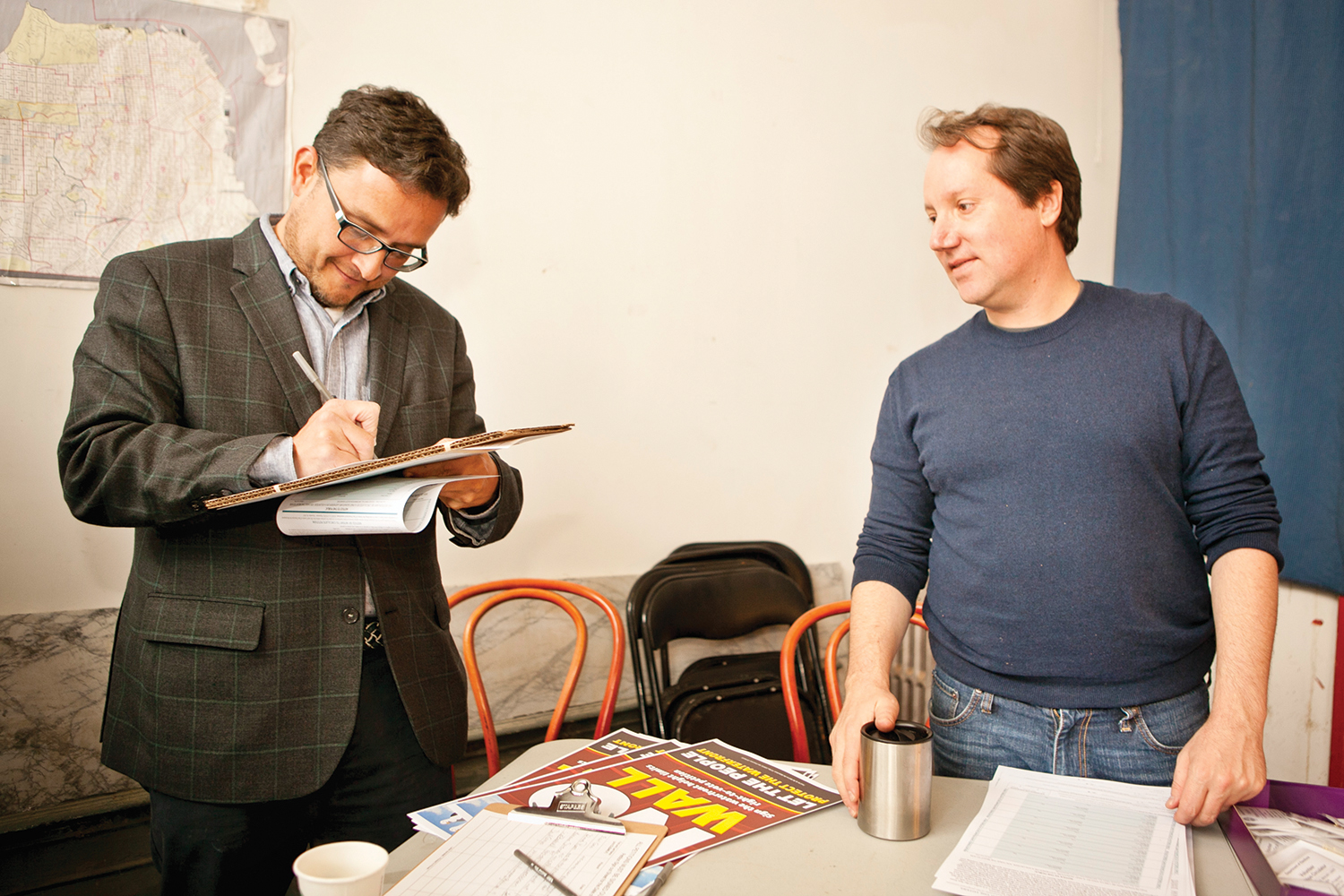
On a drizzly Saturday, Jan. 11, a few dozen activists crowded into the office at 15 Columbus Avenue, preparing to go collect signatures for the new waterfront initiative. It was a space that was already familiar to many of them from their fall campaign against height increases on the 8 Washington project.

“What we’re doing today is launching the next phase of that campaign,” campaign manager Jon Golinger told the assembled volunteers, calling this space “the center of the fight for San Francisco’s future.”

The campaign must collect at least 9,702 valid signatures by Feb. 3 to qualify for the June election, but Golinger said those involved in the campaign actually have six months to gather signatures if they want to wait for the November election.

Golinger said they would prefer June in order to build off of the momentum of the fall campaign and not get caught up in the more crowded November ballot. “There’s a lot of enthusiasm from the last election to ensure the waterfront gets the protection it needs,” he told us.

As for getting the necessary signatures, Golinger said he isn’t worried, noting that almost two years ago, he and other activists collected twice that many signatures — referendums require 10 percent of those voting in the last mayor’s race, but initiatives need only 5 percent — to challenge just the 8 Washington project.

Here, the stakes are much higher, spanning the entire seven-mile waterfront.

“We want the voters to have a say when a project goes beyond the rules that are in place,” said Sup. David Campos, the first elected official to endorse the measure and the first person to sign Golinger’s petition.

Campos also connected the campaign to the eviction crises and tenant organizing now underway, including the first in a series of Neighborhood Tenants Conventions taking place that day, culminating in a Feb. 8 event adopting a platform. “That struggle is part of this struggle,” Campos said. “We have to make sure we’re working collectively.”

The official proponent of the initiative is Becky Evans, who has been working on issues related to San Francisco’s waterfront for more than 40 years. “I remember walking along the waterfront with Herb Caen back in the ’70s,” she said of the late San Francisco Chronicle columnist for whom the promenade on the Embarcadero is now named.

Evans is a longtime Sierra Club member who also served on the city’s first Commission on the Environment, and she believes the shoreline is a critical intersection between the city’s natural and built environments, one where the citizens have an active interest.

“I think the 8 Washington process — including the petition gathering and the vote — awoke a bunch of people to making a difference in what happens to the city,” Evans told us, calling the waterfront a defining feature of San Francisco. “For many people, our skyline is the bay, not the buildings.”


BEYOND THE PLAN

The initiative has few overt critics at this point. Both city and Port officials refused to comment on the measure, citing a City Attorney’s Office memo advising against such electioneering. “I’m incredibly limited as to what I can say,” the Port’s Brad Benson told us.

And none of the spokespeople for the affected development projects wanted to say much. “We’re taking a wait and see attitude,” PJ Johnston, a spokesperson for the Warriors Arena, said when he finally responded to several Guardian inquiries.

“Right now, we’re trying to understand it,” said Staci Slaughter, the senior vice president of communications for the San Francisco Giants, whose proposal for Pier 48 and Seawall Lot 337 includes 3.7 million square feet of residential, commercial, parking, and retail, including the new Anchor Steam Brewery.

That project is just launching its environmental studies, which was the subject of a public scoping meeting on Jan. 13. Slaughter did tell us that “right now, the majority of the site doesn’t have an established height limit,” a reference to the fact that most of the site is zoned for open space with no buildings allowed.

Diane Oshima, associate director of waterfront planning at the Port, told us that during the adoption of the WLUP, “We did not broach the subject of changing any height limits.” But the plan itself says that was because tall buildings weren’t appropriate for the waterfront.

“Maintain existing building height and bulk limitations and encourage building designs that step down to the shoreline,” is the plan’s first design objective. Others include “Improve views of the working waterfront from all perspectives” and “Remove certain piers between Pier 35 and China Basin to create Open Water Basins and to improve Bay views.”

The plan also specifies acceptable uses for its various waterfront properties. Residential isn’t listed as an acceptable use for either Pier 48 or Seawall Lot 337, both of which are slated mostly for open space and maritime uses. Office space and entertainment venues are also not deemed allowable uses on either property, although it does list retail as an allowable use on Pier 48.

By contrast, Piers 30-32 and the adjacent Seawall Lot 330 were envisioned by the plan to allow all the uses proposed for it: “Assembly and Entertainment” and retail on the piers and residential, hotels, and retail on the property across the street — but not at the heights that are being proposed.

The plan calls Pier 70 a “mixed use opportunity area” that allows most uses, but not hotels or residential, despite current plans that call for construction of about 1,000 homes at the site to help fund historic preservation efforts.

Slaughter answered questions about her project’s lack of compliance with the WLUP by saying, “The whole project is going through a community planning process.”

Yet Agnos said that neither that process nor the current makeup of the Port or Mayor’s Office can get the best deal for the public against rich, sophisticated teams of developers, investors, and professional sports franchises.

“They don’t have the expertise for the multi-billion-dollar deals that are in front of them,” Agnos said of the Port of San Francisco. “The new identity for San Francisco’s Port is it has the most valuable land in the country, and maybe the most valuable land in the world.”

Left turn?

27

rebecca@sfbg.com

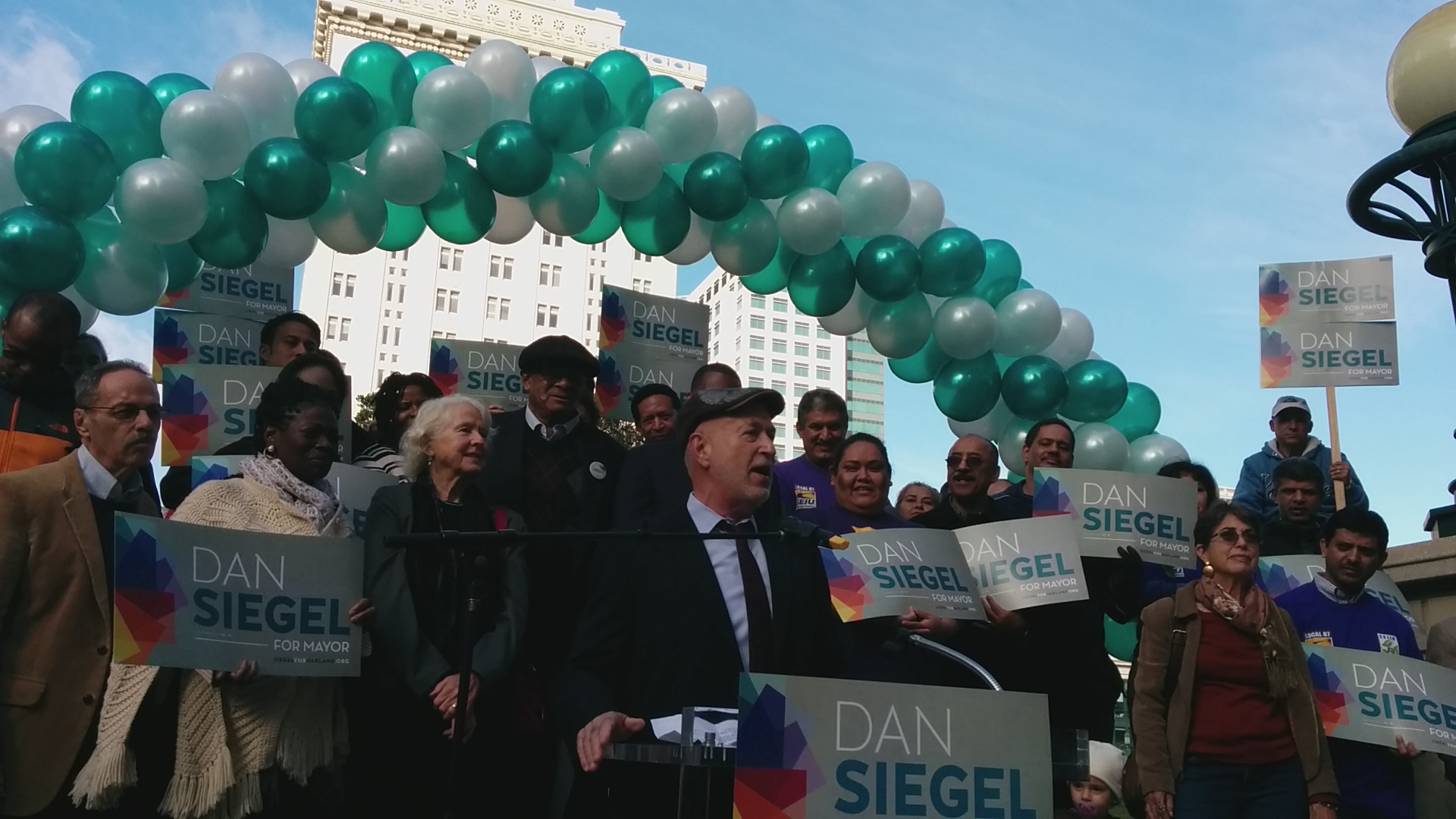
Dan Siegel, an Oakland civil rights attorney and activist with a long history of working with radical leftist political movements, joined a group of more than 150 supporters in front of Oakland City Hall on Jan. 9 to announce his candidacy for mayor.

With this development, the mayor’s race in Oakland is sure to be closely watched by Bay Area progressives. Siegel’s bid represents a fresh challenge from the left against Mayor Jean Quan at a time when concerns about policing, intensifying gentrification, and economic inequality are on the rise.

Siegel is the latest in a growing list of challengers that includes Joe Tuman, a political science professor who finished fourth in the 2010 mayor’s race; Oakland City Councilmember Libby Schaaf; and Port Commissioner Bryan Parker.

In a campaign kickoff speech emphasizing the ideals of social and economic justice, Siegel laid out a platform designed “to make Oakland a safe city.” But he brought an unusual spin to this oft-touted goal, saying, “We need people to be safe from the despair and hopelessness that comes from poverty and long-term unemployment. We need safety for our tenants from unjust evictions and … gentrification.”

Siegel voiced support for raising the city’s minimum wage to $15 an hour. He also called for shuttering Oakland’s recently approved Domain Awareness Center, a controversial surveillance hub that integrates closed circuit cameras, license plate recognition software, and other technological law enforcement tools funded by a $10.9 million grant from the federal Department of Homeland Security.

He spoke about pushing for improvements in public education “to level the playing field between children from affluent backgrounds and children from poor backgrounds,” and described his vision for reorganizing the Oakland Police Department to foster deeper community engagement.

Among Siegel’s supporters are East Bay organizers with a deep history of involvement in social justice campaigns. His campaign co-chair is Walter Reilly, a prominent Oakland National Lawyers Guild attorney who said he’s been involved with civil rights movements for years. “This is a continuation of that struggle,” Reilly told the Bay Guardian, adding that leadership affiliated with “a progressive and class-conscious movement” is sorely needed in Oakland.

Left Coast Communications was tapped as Siegel’s campaign consultant. Siegel’s communications director is Cat Brooks, an instrumental figure in Occupy Oakland and the grassroots movement that arose in response to the fatal BART police shooting of Oscar Grant, whose Onyx Organizing Committee is focused on racial justice issues.

Olga Miranda, an organizer with San Francisco janitors union, SEIU Local 87, also spoke on Siegel’s behalf during the kickoff event. “San Francisco has become for the rich, and we understand that,” she said. “But at the same time, Oakland isn’t even taking care of its own.”

Referencing a recent surge in Oakland housing prices due in part to an influx of renters priced out of San Francisco, she added, “Dan understands that if you live in Oakland, you should be able to stay in Oakland.”

Siegel’s decision to challenge Quan for the Mayor’s Office has attracted particular interest since he previously served as her legal advisor, but their relationship soured after a public disagreement.

In the fall of 2011, when the Occupy Oakland encampment materialized overnight in front of Oakland City Hall, Siegel resigned from his post as Quan’s adviser over a difference in opinion about her handling of the protest movement. Police crackdowns on Occupy, which resulted in violence and the serious injury of veteran Scott Olsen and others, made national headlines that year.

“I thought that the Occupy movement was a great opportunity for this country to really start to understand the issues of inequality in terms of wealth and power,” Siegel told the Bay Guardian when queried about that. “And I thought the mayor should embrace that movement, and become part of it and even become a leader of it. And obviously, that’s not what happened.”

Since then, his relationship with Quan has been “Cool. As in temperature, not like in hip,” he said during an interview. “I don’t want to make this personal. But we have a difference about policy and leadership.”

With Oakland’s second mayoral election under ranked-choice voting, the race could prove fascinating for Bay Area politicos. Also called instant runoff voting, the system allows voters to select their first, second, and third choice candidates. If nobody wins more than 50 percent of the vote, the last-place candidates are eliminated in subsequent rounds and their vote redistributed until one candidate crosses the majority threshold.

Quan, who ran on a progressive platform in 2010, was elected despite winning fewer first-place votes than her centrist opponent, former State Senate President Don Perata. She managed to eke out an electoral victory with a slim margin (51 percent versus Perata’s 49), after voting tallies buoyed her to the top with the momentum of second- and third-place votes, many gleaned from ballots naming Councilmember Rebecca Kaplan as first choice.

Early polling conducted by David Binder Research showed Quan to be in the lead with the ability to garner 32 percent of the vote, as compared with 22 percent for Tuman, who placed second. That’s despite Quan’s incredibly low approval ratings — 54 percent of respondents said they disapproved of her performance in office.

When Schaaf announced her candidacy in November, Robert Gammon of the East Bay Express opined, “Schaaf’s candidacy … likely will make it much more difficult for Quan to win, particularly if no true progressive candidate emerges in the months ahead.” But Siegel’s entry into the race means there is now a clear progressive challenger.

The Guardian endorsed Kaplan as first choice in 2010, and gave Quan a second-place endorsement. While there has been some speculation as to whether Kaplan would run this time around — the David Binder Research poll suggested she would be a formidable opponent to Quan — Kaplan, who is Oakland’s councilmember-at-large, hasn’t filed.

Siegel, meanwhile, cast his decision to run as part of a broader trend. “I feel that not only in Oakland, but across the country, things are really ripe for change,” he told the Guardian.

Indeed, one of the biggest recent national political stories has been the election of Kshama Sawana, a socialist who rose to prominence during the Occupy Wall Street movement, to the Seattle City Council.

“When you have a city like Oakland where so many people are in poverty or on the edge of poverty, or don’t have jobs or face evictions,” Siegel told us, “it’s no wonder that the social contract falls apart. It seems to me that what government should do is elevate the circumstances of all people, and particularly people who are poor and disadvantaged.”

Lies, damned lies, and statistics

0

When is a public opinion poll a valid representation of how people feel? That turns out to be a tricky and ever-evolving question, particularly in San Francisco — thanks to its prevalence of tenants and technology — and even more particularly when it concerns the approval rating of Mayor Ed Lee.

Traditionally, the central requirements for public opinion polls to be considered valid is that respondents need to be representative of the larger population and they need to be selected at random. Polls are often skewed when people need to opt-in, as is the case in most online polls.

So the Guardian took issue with claims that 73 percent of voters approve of the job that Mayor Lee is doing, a figure derived from an opt-in online poll focused on “Affordability and Tech” that was conducted by University of San Francisco Professors Corey Cook and David Latterman and released to the San Francisco Chronicle on Dec. 9. That figure quickly wallpapered the comment section of the Guardian’s website as the answer to any criticism of Mayor Lee, his policies, or the city’s eviction and gentrification crises.

“Any survey that relies on the ability and/or availability of respondents to access the Web and choose whether to participate is not representative and therefore not reliable,” is how The New York Times Style Guide explains that newspaper’s refusal to run such polls, a quote we used in our Jan. 10 Politics blog post on the subject, and we quoted an academic making a similar point.

We also interviewed and quoted Latterman discussing the challenges of doing accurate and economical polling in a city with so many renters (64 percent of city residents) and so few telephone landlines. “San Francisco is a more difficult model,” Latterman told us. “So Internet polling has to get better, because phone polling has gotten really expensive.”

So we ran our story dubbing the poll “bogus” — and the next day got angry messages from Cook and Latterman defending the poll and educating us on efforts within academia to craft opt-in online polls that are as credible as traditional telephone polls.

“The author is so quick to dismiss the findings of the study, which is based upon accepted methodology, and which had nothing to do with mayoral approval scores, that he actually misses the entire thrust of the study — that voters in San Francisco are deeply ambivalent about the current environment, concerned about the affordability crisis, and not trusting of local government to come up with a solution,” Cook wrote in a rebuttal we published Jan. 13 on the Politics blog.

Cook told us the survey’s methods are endorsed by the National Science Foundation and peer-reviewed academic papers, including a Harvard University study called “Does Survey Mode Still Matter?” that concludes “a carefully executed opt-in Internet panel produces estimates that are as accurate as a telephone survey.”

That study went to great lengths to create a sample group that was representative of the larger population, while Cook and Latterman both admit that their survey’s respondents had a disproportionate number of homeowners. But they say the results were then weighted to compensate for that and they stand by the accuracy of their work.

Yet Cook also notes that the mayoral approval rating number wasn’t even part of the package they developed from this survey, it was just a finding that they decided to give the Chronicle. “I don’t think the 73 percent means anything,” Cook told us, noting that snapshot in time doesn’t reflect Lee’s actual popularity going forward, despite how Lee supporters focused on it. “The number they use politically is not a meaningful number.”

What Cook found more significant is the “tepid support” for Lee indicated by the poll, including the 86 percent that expressed concern about affordability in the city, a concern that cuts across all demographic groups. Most respondents had little faith in City Hall to address the problem and many felt the tech industry should be doing more to help, particularly companies that have received tax breaks.

Dan Siegel announces candidacy for Oakland mayor

Oakland attorney Dan Siegel, known for a long history of involvement in Bay Area social justice movements, joined a group of more than 150 supporters in front of Oakland City Hall this morning to announce his candidacy for mayor.

In a speech emphasizing his campaign ideals of social and economic justice, Siegel called for shutting down Oakland’s recently approved Domain Awareness Center, raising the city’s minimum wage to $15 an hour, making improvements in public education “to level the playing field between children from affluent backgrounds and children from poor backgrounds,” and shifting the city’s approach to policing by reorganizing the police department to foster deeper community engagement. We caught a few moments from his speech here:

Guardian video by Rebecca Bowe

Siegel’s campaign co-chair is Walter Reilly, a prominent attorney affiliated with the National Lawyers Guild who said he has a long history of involvement with civil rights and social justice movements. “This is a continuation of that struggle,” he said, adding that Siegel’s affiliation with “a progressive and class-conscious movement” is sorely needed in Oakland.

Left Coast Communications was tapped as Siegel’s campaign consultant. Siegel’s communications director is Cat Brooks, who was previously an organizer and sometimes spokesperson for Occupy Oakland.

In 2011, when the Occupy Oakland encampment sprung up in front of Oakland City Hall, Siegel resigned as a legal advisor to Mayor Jean Quan over a difference in opinion about her handling of the protest movement. Police crackdowns on Occupy, which resulted in violence and the serious injury of veteran Scott Olsen, made national headlines that year. 

Olga Miranda, an organizer with San Francisco janitors union, SEIU Local 87, also spoke on Siegel’s behalf. “San Francisco has become for the rich, and we understand that,” she said. “But at the same time, Oakland isn’t even taking care of its own.” Referencing gentrification, a term that seemed to be everyone’s lips, she added, “Dan understands that if you live in Oakland, you should be able to stay in Oakland.”

Asked why he’d decided to run, Siegel told the Bay Guardian, “I feel that not only in Oakland but across the country, things are really ripe for change. When you have a city like Oakland where so many people are in poverty or on the edge of poverty, or don’t have jobs or face evictions … it’s no wonder that the social contract falls apart. It seems to me that what government should do is elevate the circumstances of all people, and particularly people who are poor and disadvantaged.”

Protect pedestrians, crack down on red light runners

36

It’s good to see City Hall finally focusing on pedestrian safety in San Francisco, where the streets are more dangerous than ever for their most vulnerable users, with the number of pedestrians and cyclists killed by motorists spiking last year.

Better streetscape design is part of the solution, and the advocacy group WalkSF will be holding the latest in its series of focus groups this Saturday seeking solutions to the problem. It is working with city agencies on a program called WalkFirst to address the issue.

But there’s another solution that’s even more obvious and immediate, and Sup. Scott Wiener hit on it at yesterday’s Board of Supervisors meeting when he said (according to the Examiner), “It’s remarkable how little traffic enforcement we have…I’ve never been in a place with less traffic enforcement than in this city.”

Actually, it isn’t that the San Francisco Police Department doesn’t do traffic enforcement, as we learned this fall when officers pulled over dozens of cyclists slowly cruising through stop signs on the Wiggle. The problem is that SFPD ignores the most obvious and dangerous violations: motorists running red lights and otherwise driving recklessly.

Everyday on my commute home up Market Street, I see at least three anxious drivers running red lights. Everyday! This morning, on my way to work, a driver ran a red light right in front of an SFPD cruiser, and that officer ignored it. These drivers are speeding up within reach of pedestrians, who often wrongly assume green means they are safe to cross.

So drivers need to take a breath and realize the seconds they save isn’t worth the risk they’re taking with other people’s lives. And the SFPD needs to ticket more of these drivers and start sending the message that such selfishness won’t be tolerated.  

Start the mayor’s race now

4

EDITORIAL

We hope you enjoyed last week’s cover package, “The Rise of Candidate X,” a parable about politics and the media in San Francisco. While it was clearly a fantastical tale, it also had a serious underlying message that we would like to discuss more directly here. Bold actions are needed to save San Francisco. It will take a broad-based coalition to keep the city open to all, and that movement can and should morph into a progressive campaign for the Mayor’s Office, starting now.

While 22 months seems like an eternity in electoral politics, and it is, any serious campaign to unseat Mayor Ed Lee — with all the institutional and financial support lined up behind him — will need to begin soon. Maybe that doesn’t even need to involve the candidate yet, but the constellation of progressive constituencies needs to coordinate their efforts to create a comprehensive vision for the city, one radical enough to really challenge the status quo, and a roadmap for getting there.

It’s exciting to see the resurgence of progressive politics in the city over the last six months, with effective organizing and actions by tenant, immigrant rights, affordable housing, anti-corporate, labor, economic justice, LGBT, environmental, transit, and other progressive groups.

Already, they’ve started to coordinate their actions and messaging, as we saw with the coalition that made housing rights a centerpiece of the annual Milk-Moscone Memorial March. Next, we’d like to see progressive transportation and affordable housing activists bridge their differences, stop fighting each other for funding within the current zero-sum game of city budgets, and fully support a broad progressive agenda that seeks new resources for those urgent needs and others.

Yet City Hall is out of touch with the growing populist outrage over trends and policies that favor wealthy corporations and individuals, at the expense of this city’s diversity, health, and real economic vitality (which comes from promoting and protecting small businesses, not using local corporate welfare to subsidize Wall Street). The San Francisco Chamber of Commerce recently gave this Board of Supervisors its highest-ever ranking on its annual “Paychecks and Pink Slips” ratings, which is surely a sign that City Hall is becoming more sympathetic to the interests of business elites than that of the average city resident.

This has to change, and it won’t be enough to focus on citizens’ initiatives or this year’s supervisorial races, which provide few opportunities to really change the political dynamics under the dome. We need to support and strengthen the resurgent progressive movement in this city and set its sights on Room 200, with enough time to develop and promote an inclusive agenda.

San Francisco has a strong-mayor form of government, a power that has been effectively and repeatedly wielded on behalf of already-powerful constituents by Mayor Ed Lee and his pro-downtown predecessors. Lee has used it to veto Board of Supervisors’ actions protecting tenants, workers, and immigrants; and the commissions he controls have rubber-stamped development projects without adequate public benefits and blocked the CleanPowerSF program, despite its approval by a veto-proof board majority.

Maybe Mayor Lee will rediscover his roots as a tenant lawyer, or he will heed the prevailing political winds now blowing through the city. Or maybe he’ll never cross the powerful economic interests who put him in office. But we do know that the only way to get the Mayor’s Office to pursue real progressive reforms is for a strong progressive movement to seek that office.

New York City, which faces socioeconomic challenges similar to San Francisco’s, has exciting potential right now because of the election of Mayor Bill de Blasio, who waged a long and difficult campaign based on progressive ideals and issues. By contrast, San Francisco seems stuck in the anachronistic view that catering to capitalists will somehow serve the masses.

The Mayor’s Office has been a potent force for blocking progressive reforms over the last 20 years. Now is the time to place that office in service of the people.