City Hall

Fizzling energy

129

A plan for a municipal power program that would offer 100 percent green energy to San Francisco customers was stalled on Aug. 13, prompting Sup. John Avalos to explore what legal options might be available to bring the program to fruition without further delay.

Prior to that San Francisco Public Utilities Commission hearing, supporters of CleanPowerSF rallied on the steps of City Hall, urging Mayor Ed Lee and members of the commission to approve a not-to-exceed rate, a technical hurdle that must be cleared before the program can advance. SFPUC staff cannot formalize a contract for purchasing power on the open market until that maximum rate has been formally established, so as long as it goes unapproved, CleanPowerSF lingers in limbo.

“We call on the Mayor’s Office to stop impeding progress with heavy-handed politics,” said Shawn Marshall, executive director of Local Energy Aggregation Network (LEAN) — a group that assists with clean-energy municipal power programs. “And we ask the San Francisco Public Utilities Commission to stay focused on its job of implementing a program that was approved by the San Francisco Board of Supervisors last September. That’s almost a year ago, folks.”

But after more than two hours of public comment in which dozens of advocates voiced support for moving ahead with the program, SFPUC commissioners voted down a motion to approve the rate, leaving CleanPowerSF in limbo with no clear path forward.


COMMISSIONER CONCERNS

Commissioners Francesca Vietor and Anson Moran were the only ones on the commission to favor the rate approval, while Ann Moller Caen, Vince Courtney, and President Art Torres shot it down.

“I feel like today is a historic moment for the SFPUC as well as the city of San Francisco,” Vietor said as she introduced the motion at the beginning of the meeting, “to become a leader in combating climate change.”

Rather than focus on the question of whether or not to establish a top rate of 11.5 cents per kilowatt-hour (a reduced price from an earlier proposal that sparked an outcry from critics because of the sticker shock), Torres and Caen criticized CleanPowerSF before casting “no” votes.

Caen said she’d “always had problems with the opt-out situation,” referring to a system that will automatically enroll utility customers into the program, while Torres criticized the project for changing shape since its inception, saying, “at the end of the day, this is not what San Franciscans had anticipated.”

But after straying well beyond the scope of a discussion about the not-to-exceed rate, commissioners who shot down CleanPowerSF didn’t provide SFPUC staff with any hints on how to allay their concerns. Some might interpret the hearing outcome as a death knell for CleanPowerSF, but Avalos has taken up the cause of pushing for implementation.

Unable to attend the hearing in person, Avalos sent legislative aide Jeremy Pollock to convey his concerns. “We all understand the politics of the situation,” his statement noted. “The Board of Supervisors and every major environmental group in the City support this program. The Mayor, PG&E, and its union oppose it. I know you are feeling a lot of pressure from both sides. But we cannot afford further political gamesmanship to cause additional delays in an attempt to kill this program.”

The effort to implement CleanPowerSF is mired in politics. For Pacific Gas & Electric Co., Northern California’s largest utility, the enterprise represents an encroachment into prime service territory and a threat to the power company’s monopoly.

PG&E has long been highly influential at San Francisco City Hall. It has funded many political campaigns and curried favor with powerful figures (former San Francisco Mayor Willie Brown, known to be a frequent dining companion of the mayor, has been richly rewarded for his consulting services, for instance). Mayor Ed Lee opposes the program, and holds the authority to appoint commissioners to the SFPUC.


CLASH OF CITY BODIES

The City Charter gives the SFPUC the responsibility of establishing fair and sufficient rates for the city’s utility operations. But Avalos charged that “any further delay will essentially show that we are in a constitutional crisis caused by a city department failing to carry out a policy approved by a veto-proof supermajority of the Board of Supervisors.”

The supervisor added that if the rate failed to win approval at the hearing, he would call upon the City Attorney to explore legal options “to resolve this type of stalemate—including the possibility of drafting a Charter Amendment. CleanPowerSF is too important and the threat of climate change is too significant to allow this program to die on the vine. It is time for leadership.”

Pollock said on Aug. 15 that Avalos was still awaiting a response from City Attorney Dennis Herrera’s office.

Meanwhile, activists who’ve attended countless meetings with SFPUC staff to move the program forward expressed frustration in the aftermath of the vote. “Things are in this holding pattern, and the dissenting commissioners did not provide a way forward,” noted Jed Holtzman, an advocate with climate group 350 Bay Area. “They just kind of said, ‘no.'”

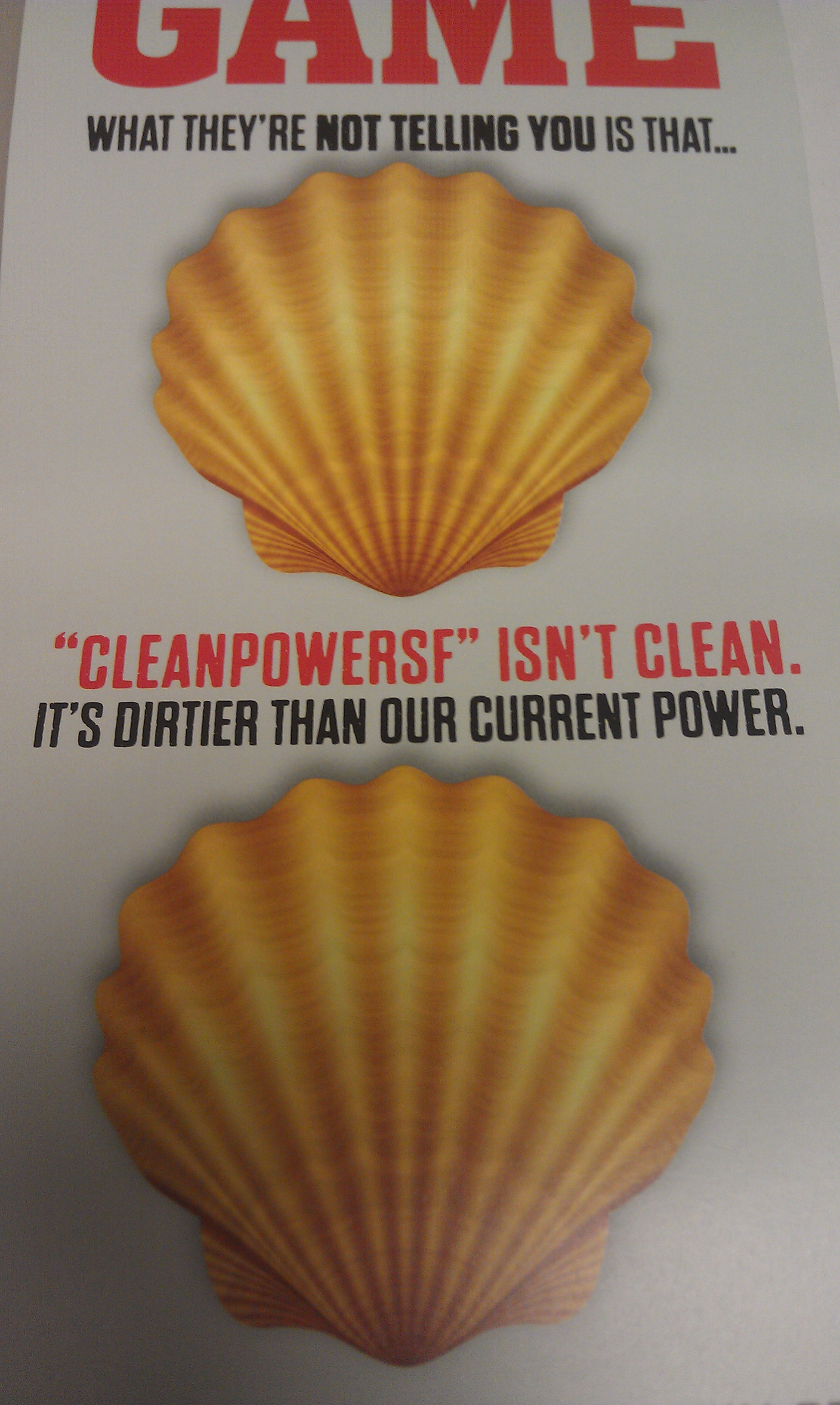
The weekend before the hearing, mailers paid for by International Brotherhood of Electrical Workers Local 1245, a union representing PG&E employees, blanketed Noe Valley residences with fliers. Depicting seashells besmirched with oil, the mailers seized on the involvement of Shell Energy North America, an oil giant with a contract pending with the SFPUC to administer power purchases for the first four and a half years of the program.

Shell’s involvement presents something of a challenge for advocates, who have long advocated for a program that would be run entirely by the SFPUC with a centerpiece of renewable power generation facilities that could double as a source of local job creation.

The initial program phase looked quite different: Shell would purchase green power on the open market, making CleanPowerSF significantly more expensive than PG&E. To address that concern and lower rates, SFPUC staff recently allowed the use of Renewable Energy Credits (RECs), more affordable units accounting for green power produced somewhere in California as opposed to electricity coming straight over the power lines.

Despite the drawbacks of a more watered down start to the program and the involvement of a notorious fossil fuel company, progressives and major environmental organizations strongly advocated for moving forward with the Shell contract to give the SFPUC a shot at positioning itself financially to float revenue bonds for build-outs of a local green energy infrastructure.

“The plan is to completely replace this with the build-out,” noted John Rizzo, who sits on the executive committee of the San Francisco Bay Chapter of the Sierra Club.


BUILDING LOCAL PROJECTS

A 134-page report prepared by Local Power Inc. described in careful detail how the city could use wind, solar, geothermal, energy efficiency, and other measures for a viable program. While SFPUC representatives have indicated that some of those recommendations will still be implemented, the agency is no longer working with Local Power.

“Our draft model was 1,500 jobs per year,” Paul Fenn, founder and president of Local Power, wrote in an email to the Guardian. “But earlier runs show as many as twice that many jobs, and we projected the higher end for the final model.” In the end, though, “SFPUC declined to continue with completion of this work, so we are in limbo — apparently an organization without allies,” Fenn added. Asked about this, Kim Malcom, the SFPUC’s director of CleanPowerSF, told the Guardian that Fenn’s analysis was based on the assumption that the agency would issue bonds totaling $1 billion. “We have no confidence that we could issue a billion dollars worth of bonds in the first few years of the program,” she said, noting that the highest the agency expected to go was closer to $200 million. And at this point, it remains to be seen whether CleanPowerSF will move ahead at all. “One of the difficulties we face is that we can’t move forward without a rate,” SFPUC spokesperson Charles Sheehan noted. “In terms of launching and implementing, we can’t do that until we have a rate structure,” and now that the utility board has blocked that from happening, there is no clear path forward. Still, activists who are serious about CleanPowerSF believe it’s key for positioning San Francisco as a leader in the fight against climate change. “CleanPowerSF is a crucial step for achieving California’s 2020 greenhouse gas goals,” Bill Reilly, chairman emeritus of the World Wildlife Fund and a former EPA administrator, wrote in a letter to Lee. “It’s also an essential model &ldots; as cities and communities are compelled to address the problems fueled by climate change.”

Activists say a pair of Spades could beat culture and small business in the Mission

94

[UPDATE: The Board of Appeals last night voted to 3-2 that Jack Spade should be considered a formula retail business, short of the four-vote supermajority that activists needed to sustain their appeal.]

Progressive activists and small business owners in the Mission are trying to draw the line against the creep the of corporate chain stores — with their homegeneity and tendency to drive up commercial rents — and they’re drawing that line at the old Adobe Bookstore where the Jack Spade corporate clothing chain was trying to quietly sneak in.

“I’m strongly opposed because of its potential to destroy the culture of this area,” Michael Katz, owner of Katz Bagels across 16th Street from the site, told the Guardian. “If they start allowing chains to come, it will be one chain store after another.”

Katz has already been experiencing the flipside of these economic boom times, recently forced to close his shop on Mission Street near 2nd in SoMa because of rising rents and competition from both food trucks and corporate-backed competitors. Now, he’s fighting to defend his Mission District turf against deep-pocketed competitors.

“This will change the special personality of the 16th and Valencia corridors,” Katz said. “It’s turning it into a commodity.”

Katz is among the dozens of people planning to show up tomorrow for the San Francisco Board of Appeals’ hearing (Wed/21, 5:00 PM, City Hall Room 416) on the Jack Spade store. The Valencia Corridor Merchants’ Association is organizing the challenge to the legal standing of a building permit issued to Jack Spade by the Planning Department in June.

Last week, that same group of activists experienced a minor setback when the Board of Appeals denied a late filing request. Tomorrow, however, they’ll get the opportunity they were seeking to argue that the store is “formula retail” and needs to submit to a public hearing before being sanctioned by the Zoning Administrator to open a new Mission location.

Mission resident Kyle Smeallie has been working with the VCMA to oppose the mens’ clothier’s advances on 16th street. In the case of Jack Spade, the Planning Department has enforced only the narrowest definition of “formula retail” as a business with 11 or more locations, while failing to defend the broader spirit of the law.

Since Jack Spade is owned by Fifth & Pacific (aka Liz Claiborne), according to Smeallie, it is a corporate chain store. Though it indeed has only 10 locations, Jack Spade “has a complete imbalance of power and resources, which is exactly what the formula retail legislation aimed to remedy in the first place,” said Smeallie.

Fifth and Pacific also makes clear on its website the Jack Spade is an expanding chain: “Under Fifth & Pacific, Jack Spade has begun to spread its wings and is now poised for broader expansion. Although management would not disclose a precise volume breakdown, Fifth & Pacific’s CEO William L. McComb said on an earnings call last year that Jack Spade ‘can be a $100 million men’s business with very high margins.’”

That’s “margins” as in profit margins, meaning that this corporate chain can has an economies of scale that allows it to buy goods for cheap and sell them for whatever people will pay, which is an ever-increasing amount in the rapidly gentrifying Mission.  

Experts have advised the activists that their best approach is to argue that Kate Spade and Jack Spade are essentially the same store, with well over 11 locations nationwide, since corporate parentage is not explicitly prohibited in the formula retail legislation approved by voters in 2006.

“We’re going to make the case that, since it’s named Spade, it has benefitted from the association with Kate Spade,” Smeallie explained. “Legally, we have a case to say a Spade is Spade and they should be considered one and same.”

In the past, this strategy was successful in thwarting an effort by “Black Fleece by Brooks Brothers” to open a neighborhood location by claiming that it was, effectively, just another Brooks Brothers. In that case, however, the full name of the large-scale retailer was present in the subsidiary’s label.

Alerts: August 21 – 27, 2013

0

WEDNESDAY 21

Breaking News: The future of open news and local storytelling Hub Media Lab, The San Francisco Chronicle Building, 925 Mission, SF. Hubmedialabsf.com. 6:30pm, $15. Local news outlets and mobile app founders will discuss the future of news distribution in the Bay Area in the context of maintaining an informed citizenry. Panelists will include Lydia Chavez, Founder of Mission Local; Laura Ramos, Executive Producer of The Bold Italic; Michael Coren, Co-founder of Publet and Burt Herman, Co-Founder of Storify.

FRIDAY 23

Egypt: A revolution in crisis 2969 Mission, SF. www.answersf.org. 7pm, $5–$10. Since the Egyptian Revolution began in January 2011, hundreds have been killed and thousands more wounded. The Egyptian military seized power on July 3, following massive protests against the government of Mohammad Morsi. What do these developments mean for the future of Egypt and the broader region? What is the role of the U.S.? Panelists include Omar Ali, an Egyptian-American activist with ANSWER, and Mazda Majidi, co-author of Socialists & War.

SATURDAY 24

Women’s Rights Day: A tribute to immigrant women New Valencia Hall, 747 Polk, SF. www.radicalwomen.org. 7:30-9:30pm, $3. This tribute to immigrant women will feature a screening of the documentary “Rape in the Fields,” unmasking the sexual violence against female agricultural workers. Hear from guest speaker, former farm worker and Los Angeles Radical Women member Yolanda Alaniz, co-author of Viva La Raza: A History of Chicano Identity and Resistance. Arrive at 6:30pm for dinner, which will be available for a donation of $8.50.


Rally for civil rights Steps of San Francisco City Hall, SF. bayardrustincoalition.com. 3:30-5:30pm, free. The Bayard Rustin LGBT Coalition is organizing this civil rights rally to commemorate the 50th anniversary of the 1963 March on Washington for Jobs and Freedom, where Dr. Martin Luther King delivered his famed “I have a dream” speech. The event will also honor the memory of Bayard Rustin, a gay man who was a prominent strategist of this historic event.

Backward on climate

After a hearing lasting several hours on Tue/13, members of the San Francisco Public Utilities Commission voted down a motion to approve electricity rates for CleanPowerSF, a municipal energy program designed to offer a 100 percent green energy mix to San Francisco customers.

The approval of that “not-to-exceed” rate, set at 11.5 cents per kilowatt-hour, would have cleared the path to set CleanPowerSF in motion after almost a decade of politically charged debates and setbacks.

“I feel like today is a historic moment for the SFPUC as well as the city of San Francisco,” commissioner Francesca Vietor said as she introduced her motion to approve the rate. “Even though I understand this is only a vote to approve the not-to-exceed rate,” she added, it was a critical first step toward a long-term vision in which “we will also be able to create a new generation of green collar workers and build our own renewable power system.”

In the end, Vietor and Commissioner Anson Moran were the only ones to favor the rate approval, while Ann Moller Caen, Vince Courtney and President Art Torres shot it down. So once again, CleanPowerSF has been kicked back in limbo.

“This is not just about rates today,” Torres said. “If we approve these rates, that would authorize the General Manager [of the SFPUC] to authorize a contract with Shell.”  

Oil giant Shell Energy North America was tapped by the SFPUC to purchase green energy on the open market during the first phase of the program. Although Shell is a fossil fuel company with a disgraceful human rights track record, progressives and environmentalists stand behind a speedy approval of that contract, because they say it is a crucial first step toward realizing the ultimate project vision of constructing city-owned and operated renewable energy facilities while creating local green jobs.

“The deal is that you cannot do that until you move forward, and launch the program,” said Shawn Marshall, executive director of LEAN – a group that assists with clean-energy municipal power programs – speaking at a rally just before the hearing. “You have to live to go local. We call on the mayor’s office to stop impeding progress with heavy-handed politics and we ask the San Francisco Public Utilities Commission to stay focused on its job of implementing a program that was approved by the San Francisco Board of Supervisors last September.”

Rather than focusing on the question of whether or not to approve the rate, Torres and Caen voiced generally negative sentiments about the CleanPowerSF endeavor before casting “no” votes on the rate approval. Caen said she’d “always had problems with the opt-out situation,” referring to a system of automatic enrollment in the program, and Torres criticized the project for having changed shape, saying, “at the end of the day, this is not what San Franciscans had anticipated.”

The bid to establish CleanPowerSF is mired in charged politics. Because the program threatens Pacific Gas & Electric Co.’s monopoly in San Francisco, the utility giant is prepared to shell out whatever it takes to stop the forward momentum. PG&E is deeply influential in San Francisco City Hall, having richly rewarded former San Francisco Mayor Willie Brown, known to be a frequent dining companion of Mayor Ed Lee, for his consulting services, for instance. Lee opposes the program, and the mayor appoints the SFPUC commissioners.

Torres, the commission president, bristled at suggestions from the public that he was merely carrying the mayor’s water, saying, “I do my own homework, and I make up my own mind.”

But Sup. John Avalos has made up his own mind too, and he sent legislative aide Jeremy Pollock to convey the message to the SFPUC that enough is enough. Avalos plans to go to the City Attorney to find out what can be done about the relentless foot-dragging of a commission that just won’t approve a fair rate for a program that was approved by the Board of Supervisors last fall.

During the public comment session of the hearing, Pollock read Avalos’ statement, which characterized the commission’s refusal to approve the rate as a “constitutional crisis” with regard to the body’s responsibilities.

“Any further delay will essentially show that we are in a constitutional crisis caused by a city department failing to carry out a policy approved by a veto-proof supermajority of the Board of Supervisors,” Avalos’ statement noted. “The Board stands ready to approve these rates, but nothing more can happen until you take action. The City Charter is silent on the possibility of the Public Utilities Commission failing to act on a proposed utility rate. Therefore if there is further delay, I feel I have no choice but to request that the City Attorney explore our options to resolve this type of stalemate—including the possibility of drafting a Charter Amendment. CleanPowerSF is too important and the threat of climate change is too significant to allow this program to die on the vine. It is time for leadership. And this vote will be long remembered for the action you take today.”

But instead of just approving that rate – which is lower, by the way, than originally proposed – the commissioners just seized the opportunity to halt the program from moving forward, since CleanPowerSF cannot advance without a contract, and the contract cannot be signed until a rate has been formally approved.

“It seems as if they are essentially refusing to establish a fair rate, so we’re going to ask the city attorney, you know, what’s the recourse if the PUC is failing to carry out their duties?” Pollock noted.

Just before the votes were cast, Vietor, who had urged her colleagues to go forward and approve the rate at the outset of the meeting, was asked to re-state her motion. She returned to the bright and optimistic prepared statement she’d read at the beginning, only this time with a note of frustration because it was clear that the votes weren’t there. “Today is a historic moment for the San Francisco public utility commission,” she read out loud, “to become a leader in combating climate change.”

Note: This post has been updated from an earlier version.

Compromises deliver results

5

OPINION When Guardian Editor Steven T. Jones asked me to respond to his recent columns (“Chiu becomes City Hall’s go-to guy for solving tough problems“, 7/23/13; “Chiu: Centrist Compromiser, Effective Legislator, or Both,” 7/30/13), I reflected on how our Board of Supervisors’ 2013 accomplishments exemplifies the lessons and rewards of working together.

After several decades of intense fights between TIC owners and tenants, I asked both sides to sit down, share perspectives, and brainstorm beyond the impasse. To our surprise, when TIC owners shared their struggles and offered to pay a fee to condo convert, tenant advocates agreed to finally support conversions as long as their core principle of preventing evictions — which I strongly shared — was addressed.

After a decade of failed CEQA reform attempts, the pundits predicted an epic battle between developers and neighbors this year. The breakthrough for unanimous support occurred when both sides acknowledged to me that real neighborhood input and predictability in the planning process are not mutually exclusive, and progressive leaders wanted to ensure that pedestrian, bike, affordable housing, and public projects are not delayed.

After years of controversy, CPMC/Sutter and the coalition of dozens of community-based organizations deadlocked over how to rebuild the Cathedral Hill and St. Luke’s hospital campuses. After exposing financial documents challenging the original proposal, I worked with colleagues for six months at a mediation table that refashioned a CPMC plan to rebuild those 21st century hospitals the right way.

While each story is unique, what all of these accomplishments — along with recently balanced budgets, business tax reform, and pension reform — have in common is hard work and extreme patience by dedicated San Franciscans seeking creative solutions.

As Board President, my job is to build consensus among our diverse supervisors and deliver results. When I first came to City Hall, I asked my colleagues to move beyond past politics that had magnified differences. I am proud that today’s Board has the highest approval ratings in a decade, as we do more together working through our differences.

At the negotiation table, it’s essential to stand firm on core values. My vision for San Francisco has been of a city that protects tenants and families; creates good jobs across the economic spectrum; offers high quality public services with Muni, our schools, and our parks; and embraces our diversity, our immigrants, our seniors, and those who have been historically disenfranchised.

When we can’t always find creative win-wins, it’s still important to fight for what’s right. I’ve taken my political lumps championing the right of noncitizen parents to vote in school board elections, standing up for workers requesting family-friendly workplaces, and taking on a Yellow Pages industry dumping millions of phone books on our streets.

When I hear criticisms of “compromise,” I reflect that the most important federal legislation in recent years — from the Civil Rights Act to the Affordable Care Act, Wall Street reform to comprehensive immigration reform — were also criticized as “compromises.” Critics often forget the big picture: by incorporating different views, reforms actually get done, and if we wait forever for the perfect policy, people will suffer.

San Franciscans are at our best when we unite around shared values — from marriage equality to universal health care to environmental protections. We still have plenty of challenges: housing affordability, struggling workforces, family flight, public transit.

Let’s continue to work together to show the rest of the country how our city can govern.

David Chiu, who represents District 3 (North Beach, Chinatown, Nob Hill), is serving his second term as president of the Board of Supervisors.

PG&E union spreads lies about CleanPowerSF

San Francisco’s municipal power agency is gearing up to launch one of the most climate-friendly alternative energy programs in the country, but the forces behind a misleading opposition campaign seek to torpedo that effort.

This past weekend, glossy ads depicting seashells and spilled oil blanketed the doorknobs of Noe Valley residences. Paid for by IBEW 1245, the union that represents employees of Pacific Gas & Electric Co., the door hangers conveyed the fear-mongering message that CleanPowerSF “isn’t clean. It’s dirtier than our current power.”

To put it bluntly, that’s bullshit.

Taking them at face value, you might conclude that Shell was about to begin drilling offshore in the San Francisco Bay and that city officials were planning to meet the city’s energy needs with a polluting power plant run solely off tar sands oil. They might even club some baby seals while they were at it.

What’s really happening is that the San Francisco Public Utilities Commission is gearing up for a hearing on Tue/13 to discuss rate setting for CleanPowerSF, a municipal green energy program that’s been in the works for years. As the power agency inches closer to a full program launch, PG&E and its employees are worried they’ll lose business when San Francisco customers are automatically enrolled in the CleanPowerSF program.

The new power program will continue to use PG&E infrastructure and its existing billing system, but customers’ homes will be powered with a greener electricity mix procured through the city-run program, which is contracting with Shell Energy North America to purchase electricity on the open market from a variety of green power sources.

Naturally, San Francisco is teeming with savvy environmentalists who aren’t buying the slick oppositional blitzkrieg. On Aug. 13, some will band together to set the record straight when a host of representatives from the Sierra Club and others rally at City Hall at noon to express support for immediate implementation of CleanPowerSF.

“Clean energy aggregation is on the rise across the country, making an immediate and direct impact on climate emissions,” said Shawn Marshall, Director of LEAN Energy US. LEAN works with organizations that use the municipal power-purchasing model that CleanPower SF is based on. “The only thing blocking progress in San Francisco is corporate politics, and we encourage the city to deliver on its environmental promises by pressing ahead with CleanPowerSF.”

In a letter to San Francisco Mayor Ed Lee, former EPA administrator and World Wildlife Fund Chairman Emeritus William K. Reilly emphasized that CleanPowerSF “is a crucial step for achieving California’s 2020 greenhouse gas goals. It’s also an essential model for California and the rest of the country as cities and communities are compelled to address the problems fueled by climate change.”

Back to those misleading ads. While it is true that Shell is an oil company with a shoddy track record of human rights abuses, it is not true that the energy supplied by CleanPowerSF will be dirtier than electricity provided by PG&E.

To the contrary, only 20 percent of PG&E’s energy mix is derived from green power sources, while the majority of its electricity is generated by nuclear facilities or natural gas power plants. PG&E is also the company responsible for the hexavalent chromium groundwater contamination in the California town of Hinkley, in the Mojave Desert, which provided the basis for the movie Erin Brockovich.

And more recently, PG&E was responsible for the deadly pipeline explosion in San Bruno, which leveled an entire neighborhood. In comparison, CleanPower SF will offer a 100 percent renewable energy mix out of the starting gate.

Some of that mix will initially be derived from renewable energy credits. Called RECs, they’re cheaper because they are “credits” accounting for green power generated somewhere, as opposed to actual green power coming straight over the power lines.

But it’s important to note that the initial use of RECs is a pricing strategy designed to put the agency in a financial position to support green power projects here in San Francisco a little further down the road.

The long-term plan of constructing green power facilities locally would create permanent, decent-paying jobs. It would also supply San Franciscans with electricity generated with technology that can harness the unlimited power potential of the California sun, or the wind that blows in off the Pacific Ocean. This is the outcome that PG&E affiliates seek to thwart, because they fear profit loss.

A few months ago, in an interview with the Guardian, SFPUC spokesperson Charles Sheehan emphasized that it had taken many conversations to get to the point that the agency has finally reached.

“We’ve lowered the rate, we’re now more competitive with PG&E’s baseline offering, and we’re on parity with their potential green tariff program,” he explained. Speaking of a dedicated revenue stream that would go toward funding local clean-power projects, he said, “That line item is really critical to get us to the build-out that we’ve all collectively envisioned as a staff, and as a community.”

On the Cheap: August 7 – 13, 2013

0

On the Cheap listings are compiled by Guardian staff. Submit items for the listings at listings@sfbg.com. For further information on how to submit items for the listings, see Selector.

WEDNESDAY 7

David Gilbert Book Passage, 1 Ferry Bldg, SF; www.bookpassage.com. 6pm, free. The author of & Sons discusses his work with fellow author Adam Johnson (The Orphan Master’s Son).

THURSDAY 8

“Contemporary Historians at the Presidio: Edward P. Von der Porten” Presidio Main Post, 135 Fisher Loop, SF; www.presidio.gov. 7-9pm, free. The maritime expert presents an illustrated talk on “Mysteries from the Lost Galleon: The Manila Galleon San Filipe, 1573-1576,” about how the ship was lost and later discovered, wrecked off the coast of Baja California.

Gary Kamiya Booksmith, 1644 Haight, SF; www.booksmith.com. 7:30pm, free. The author and Salon co-founder launches his new book, described as “a love letter to San Francisco” and titled, appropriately enough, Cool Grey City of Love.

Victoria Sweet BookShop West Portal, 80 West Portal, SF; (415) 564-8080. 7pm, free. The author reads from God’s Hotel, about her experiences with “slow” medicine while working at Laguna Honda Hospital.

Michael Walker Books Inc., 2275 Market, SF; www.booksinc.net. 7:30pm, free. The bestselling author (Laurel Canyon) presents his latest rock ‘n’ roll history tome, What You Want Is in the Limo: On the Road with Led Zeppelin, Alice Cooper, and the Who in 1973, the Year the Sixties Died and the Modern Rock Star Was Born.

SATURDAY 10

Bay Area Free Book Exchange 10520 San Pablo, El Cerrito; www.bayareafreebookexchange.com. Every Sat and Sun, 9am-6pm. Free. Yep, you read that right: it’s a free bookstore, with an inventory hovering around 10,000 books — all ripe for the taking. The joint also gladly accepts donations, too, so free up some space for your new acquisitions by donating volumes you’ve already read.

Burlingame ArtzFest Howard Ave, Burlingame; www.burlingamechamber.org. Through Sun/11. 10am-6pm, free. Fifteen minutes south of SF, the city of Burlingame hosts a weekend of live music, art, food booths, kid-friendly activities, and more.

Marcus Ewert Fisher Children’s Center, 100 Larkin, SF; www.ourfamily.org. Noon-2pm, free (advance registration required as space is limited; visit website to sign up). Our Family Coalition hosts this reading by the author of 10,000 Dresses, a book for kids about a transgender child searching for acceptance.

“One Happening Square Mile: Treasure Island Today” Building One lobby, Treasure Island; www.treasureislandmuseum.org. 10:30am, free. Mirian Saez, director of island operations, Treasure Island Development Authority, gives a lecture on the island’s current attractions. Sure, you know about the music festival and the flea market, but there are also wineries, art studios, a job-training center, and more.

“Origami-Palooza” East Japan Center Mall, 1737 Post, SF; www.sfjapantown.org. 1-5pm, free. It’s the first-ever Origami-Palooza, and it’s a riot of paper-foldin’. Stop by to see an exhibit of work by pros, learn some how-to tips from resident experts, enter the Paper Air Plane Challenge (1:30pm, Japantown Peace Plaza), and fold some cranes for the World Tree of Hope in City Hall with Rainbow World Fun.

SUNDAY 11

“A Fair to Remember” Jack Kerouac Alley (near 255 Columbus), SF; www.afairtoremembersf.com. Noon-6pm, free. Visit this petite and well-edited street fair to peruse jewelry, prints, soap, photographs, and other goods made by local artists.

Alexis E. Fajardo Cartoon Art Museum, 655 Mission, SF; www.cartoonart.org. 1-3pm, free. The cartoonist closes out his Small Press Spotlight at the museum — featuring an exhibit of art from his latest book, Kid Beowulf and the Rise of El Cid — with a book-signing and free sketches.

Rob Sheffield Book Passage, 1 Ferry Bldg, SF; www.bookpassage.com. 4pm, free. The author and music journalist reads from his new memoir, Turn Around Bright Eyes: The Rituals of Love and Karaoke. *


Get tough with defiant disrupters

8

EDITORIAL It may sometimes seem like we at the Bay Guardian don’t like the technology industry, but nothing could be further from the truth. We tweet, click, post, and share, playing with all the hot new tech toys that spring from the innovative minds of Bay Area residents. This is an important sector of the local economy, one that often empowers people who were just getting by to remain in expensive San Francisco.

Yes, we do regularly criticize tech (and some of its biggest neoliberal cheerleaders in City Hall), as we do to Airbnb, Lyft, and other so-called “shareable economy” companies in this issue. But that’s only because we strongly believe in open and transparent discussions about public policy and the needs of city residents.

And frankly, that’s not happening these days.

Instead of engaging directly and honestly with the people and our elected representatives, Airbnb has chosen to duck its obligations to the city of its birth and dodge attempts to create a public dialogue about its dangerously flawed business model. Same thing with Lyft, another company that acts as if it’s entitled to undermine civic institutions without so much as a public conversation first.

Yes, these companies have come up with cool ideas that have become popular with Bay Area residents. In a city where it was tough to find a cab on Saturday nights, Lyft made it easier to find rides and allowed people to make some extra cash off their cars. Airbnb was also a great idea that makes travel cheaper and more personal.

The beauty of these ideas is their simplicity — but that is also their main flaw, because San Francisco isn’t a simple city. It’s a complex, dynamic city with difficult landlord-tenant dynamics, and a congested city that tries to achieve the right balance of cabs on the roadways, both systems that are the products of decades-long struggles that have spawned reams of regulations.

These tech-savvy fortune hunters, who don’t understand or appreciate that history, think it’s enough to have a good idea and some rich venture capitalists willing to back it. They espouse vaguely libertarian ideas about “disruptive” technologies empowering people, but then they wait for government officials to solve the problems with their business models, raking in millions of dollars in profits in the meantime and delaying their day of public reckoning as long as possible.

For example, in a May interview on KQED’s Forum, Airbnb’s David Hantman was asked why the company was defying a city ruling that it must pay the transient occupancy tax, he said they were waiting for the city to adopt a new regulatory structure first.

That’s not an acceptable or defensible position, and it is only continuing because Mayor Ed Lee has publicly supported the company’s defiance of city law and rulings. Mr. Mayor, if these are the types of “jobs” you’re creating — part time jobs with no benefits in an underground economy that cannibalizes other industries, breaks city laws, and won’t pay local taxes — then this city is in real trouble.

We’re happy to see Board President David Chiu trying to solve Airbnb’s problems, but he needs the support of other top city officials who are willing to put pressure on the company to bargain in good faith. And yes, we’re talking to Mayor Lee, Tax Collector Jose Cisneros, and City Attorney Dennis Herrera, among others.

If you make the city appear impotent to enforce its own laws or too willing to go easy on wealthy corporations, it will only embolden more young opportunists to disrupt the city’s regulatory authority and its social fabric. You work for us, not the venture capitalists, and it’s time to show some spine.


Surrounded by kids, David Campos files to run for State Assembly

On the morning of Aug. 1, San Francisco District 9 Sup. David Campos joined a group of parents and kids at the 24th Street BART station, climbed aboard the 49-Mission/Van Ness, and rode to City Hall, where he filed paperwork to run for the California Assembly.

“Running for office is not an easy thing. It’s a very personal decision,” he said. “And thinking about it, I am where I am because I was given a lot of opportunity as a kid coming in, as an undocumented kid. It was the opportunity of getting a quality education, the opportunity to really get a degree,” and to stay motivated by the idea that “if you really work hard and play by the rules, that you can really fulfill your potential.”

Campos was elected to represent San Francisco’s District 9, which spans the Mission, Bernal Heights, and surrounding areas, in November of 2008. The gay Latino elected official is regarded as one of the most progressive members of the Board of Supervisors, and he is credited with spearheading Free Muni for Youth, a city program offering free public transit access to some 40,000 low-income kids.

Campos stressed that many of the policies he’s tackled on the Board of Supervisors have been aimed toward aiding low-income families and youth, “whether it’s helping families who are struggling with free Muni for low-income kids, to improving the quality of schools in the Mission, to focusing on public safety in a progressive way that tries to build a relationship between the police and the community.”

Naturally, Muni took longer than expected.

Some of the kids amused themselves with a clapping game while they waited.

Many of the parents were monolingual Spanish speakers, and their kids were Free Muni for Youth participants. Raul Foneza (pictured in the first shot, with his thumbs up), spoke to the Guardian through a translator and said he had come out for the supervisor that day because he respected Campos’ support for the city’s young people and was there with his friend and her two kids.

When the bus arrived at City Hall, another group of kids was there awaiting Campos’ arrival, with signs. So was Assembly Member Tom Ammiano, who has already granted Campos his endorsement.

Ammiano spent a few moments on the steps of City Hall speaking to the kids. “I hope you tell people to vote for David Campos, I hope you all do your homework, be good to your teachers, and go to college. How does that sound?” After they cheered, “yeeeah!” in unison, Ammiano half-jokingly added something about how then they could all get good-paying jobs, so they could afford an apartment.

Once inside, the crowd of kids and parents squeezed into the basement-level Department of Elections office, where Campos filled out the paperwork to make his candidacy for State Assembly official. He turned to face his supporters, most of whom will have to wait eight years till they’re old enough to vote, and explained that he had decided to run “because we want to make sure our state makes you the top priority.”

After Oscar, after Trayvon…

49

rebecca@sfbg.com

Even before Cephus “Uncle Bobby” Johnson picked up the phone on Feb. 27, 2012, he wasn’t having an easy day. His nephew, Oscar Grant, would have celebrated his 26th birthday on that date if he had not been killed by a gunshot wound on Jan. 1, 2009.

Grant was shot by BART police officer Johannes Mehserle while lying face down on a train platform, an incident that was caught on film, prompted riots in Oakland, drew international scrutiny, and became the subject of the award-winning film Fruitvale Station by Oakland filmmaker Ryan Coogler.

In the years since Grant’s death, Johnson and his wife, Beatrice X, founded the Oscar Grant Foundation to develop a support network for families who’ve lost loved ones due to police violence. It was his involvement in this work that led Johnson to be contacted that day, and informed that a 17-year-old boy named Trayvon Martin had been gunned down in Florida one day earlier.

It wasn’t a police shooting but nevertheless, “We knew at this point that we had to go to Florida,” Johnson recalled. “What we’ve decided is that whenever a family experienced that, we would definitely try and get to them.”

Fast forward to July 13, almost exactly three years after violent protests erupted in Oakland following the news that Mehserle, who was charged with second degree murder, had been convicted of involuntary manslaughter instead. A new wave of demonstrations flared up as word spread that George Zimmerman, the neighborhood watch volunteer who killed Martin, had been acquitted.

“We weren’t surprised,” Johnson, who returned to Florida last month to observe the jury selection process for Zimmerman’s trial, told the Guardian. “But it was still painful.”

The verdict in this high-profile case has brought discussions about racial profiling and unequal treatment in the criminal justice system to the forefront. Even President Barack Obama touched on the theme in comments to White House reporters on July 19, saying, “Trayvon Martin could have been me 35 years ago.”

At the national level, new findings on “implicit bias” — unconscious prejudices that research in psychology has shown can persist in individuals (including poorly trained police officers), even if they consciously reject racial stereotypes — has started to inform policy debates around racial profiling.

“Policy needs to recognize that implicit bias exists,” Maya Wiley, founder and president of the New York City-based Center for Social Inclusion, told us. “Rep. John Conyers introduced a bill last year to prohibit racial profiling in law enforcement. That bill, if made law, would collect data on stops by race, as well as provide resources for training. That is a step in the right direction.”

But things get complicated, Wiley says, because “research shows that people of color, women, the elderly, may all experience discrimination as a result of implicit bias. There is no remedy in the law for this. … I think what is important now is to fight Stand Your Ground Laws which empower people to act on their implicit biases.”

At a July 16 rally held on the steps of San Francisco City Hall, Rev. Malcolm Byrd, pastor of San Francisco’s First A.M.E. Zion Church, illustrated his point about racial profiling by donning a hoodie and sneakers at the rally.

“I wanted to come looking suspicious,” he explained. “I wanted to give you an image that America has of young black men. I look suspicious. This is my country. I love my country. Yet, I look suspicious.”

Last year, Mayor Ed Lee’s proposal to introduce a stop-and-frisk policy, which would have allowed police officers to randomly stop individuals who appeared to be suspicious in an effort to get weapons off the streets, was abandoned in the face of widespread community concern.

Officers who undergo training at the San Francisco Police Department Academy must complete 52 hours of “cultural diversity” training, according to SFPD spokesperson Sgt. Dennis Toomer, which includes a mandatory four-hour intensive geared toward preventing racial profiling. State law mandates just 16 hours for such training for law enforcement agencies, Toomer told us.

But despite supplemental police training and the efforts of grassroots organizations that carefully monitor police activity, the Bay Area has witnessed a number of fatal shootings at the hands of police since Grant’s death, and many draw a link between these cases and the broader issue of racial profiling.

When asked about the outreach efforts of the Oscar Grant Foundation, Johnson began to rattle off a long list of names — mostly young black men, from places ranging from Oakland to Vallejo to Stockton to San Leandro — who were killed by police, and whose families his organization has reached out to.

They have also been in touch with several families in New York City who lost loved ones in similar situations, Johnson said. In many cases, the individuals were killed despite being unarmed, and officers later explained their actions by saying they’d mistakenly believed the shooting victims had firearms.

After several years of taking an up-close look at the investigative and legal proceedings that unfold in the aftermath of officer-involved shootings, Johnson has reached the conclusion that from case to case, “The playbook is pretty much the same. The officer first alleges he felt threatened — it’s all about the thought process of the officer. It’s always found to be justifiable because the officer feared for his life.”

One long-term goal of the Oscar Grant Foundation is to build up a coalition that can mount a meaningful challenge to the California Peace Officers Bill of Rights, a law enacted some 30 years ago that affords special protections for law enforcement officers facing misconduct charges. Johnson and others are critical of provisions such as officers’ rights to keep confidential information out of their personnel files, which can prevent significant information from being disclosed during a criminal trial. Meanwhile, others throughout the Bay Area seem primed to push for change in the wake of the Zimmerman verdict. “On Sunday, every black church in the nation was talking about what? Trayvon Martin, and what we need to do,” Andrea Shorter, a member of the San Francisco Commission on the Status of Women, said during the July 16 rally. “Two weeks ago, and we were all standing here as San Franciscans to rejoice … because we knew that LGBT people could be treated as first class citizens. The job is not done.” San Francisco NAACP President Rev. Amos Brown, who organized the rally, vowed that his organization “will push for a civil suit to bring this Zimmerman gentlemen to justice.” The national NAACP is petitioning U.S. Attorney General Eric Holder to open a civil rights case against Zimmerman. Sups. London Breed, Malia Cohen, Jane Kim, and David Campos also delivered speeches at the rally. “For the first time in my life, after growing up and going to funeral after funeral after funeral after funeral, of all boys and black men throughout my life, I see people in this audience who are not African American, who are just as hurt as I am, who are just as sick of this as I am,” Breed said. “And we are all in this together. We have got to work together if we want to change it.”

Striking Out

21

news@sfbg.com

Today marks 1,575 days since concession workers at AT&T Park have had a raise, during which time the San Francisco Giants have been fabulously successful, both on and off the playing field.

The 750 workers represented by UNITE-HERE Local 2 are currently involved in frustrating and fruitless negotiations with their employer, Centerplate, a South Carolina-based food service company contracted by the Giants to sell beer, garlic fries, and other overpriced consumables at games.

The Giants and its front office seem fairly unconcerned about the plight of workers who proudly don the team’s logo and pad its revenues. Not a single concession worker that we interviewed for this article said that they work for Centerplate — each of them said that they work for the Giants.

Since the last contract expired in March 2010, the Giants have won two World Series championships, raised the average ticket price by 20 percent, and have seen the value of the team shoot up by $223 million. The only thing that hasn’t improved are the wages of the concession workers.

Cashiers currently make $16.40 per hour, in-seat runners make $13.40, and some entry-level workers make just $10.45, which is actually less the city’s minimum wage. That’s only legal because those workers were under contract for $10.45 per hour when the wage increased to $10.55 at the beginning of this year. And Centerplate won’t even let Giants workers have a tip jar to augment their substandard wages.

Local 2 reports that revenue from concessions is divided up in a 55-45 split between the team and Centerplate (the Giants PR office disputes this number, but it won’t divulge the actual split). So when a fan spends $17 for a hot dog and 16oz beer, Centerplate and its workers get $7.65 and the Giants get $9.35, all of it pure profit. And the Giants executives even set the concession prices, not Centerplate.

But the team says the plight of these workers isn’t its problem. “We continue to urge both parties to get back to the bargaining table and to have productive discussions so the matter can be resolved as quickly as possible. This dispute is between Centerplate and Local 2, not the Giants,” is the team’s public position on the issue.

The Giants communications office responded with this stance to every question the Guardian asked about the issues involved: What have you done to “urge” Centerplate to settle the contract? Couldn’t the Giants force a settlement if it really wanted to? Why haven’t concessions workers shared in the team’s success and rising revenues? How can you claim to support the community if you can’t even ensure the people who work in your stadium are paid minimum wage?

The Giants had nothing to say about a petition signed by 600 of the workers urging the team and Centerplate to agree to a deal, instituting a company-wide no-comment policy on the standoff with concession workers.

“It would be nice if they would come in and talk—not be a mediator, but to know what we’re asking for and say why they’re not providing it or why they feel they shouldn’t provide certain information,” Billie Feliciano, who has worked as a Giants cashier for more than 30 years, told us. “They could talk to the president of the union on that if they wanted to. You know, we’re not asking you to tell us how you spend your money. We just want to know how much control you have of this situation.”

Feliciano and her fellow workers just want the Giants to be team players.


WHO’S IN CONTROL?

Contrary to what the Giants may say, there is one pressing issue—job security for the workers—that is nearly impossible for the workers and Centerplate to resolve. Every worker interviewed for this story has explicitly said that job security is their most important goal.

Even Centerplate says only the Giants can offer job security to concession workers. If Centerplate goes out of business or loses its contract, the concession workers will likely lose their jobs, which is why they’re advocating for a succesorship clause that would guarantee their employment in that scenario.

When The Guardian inquired with the Giants office about the issue, its spokesperson once again responded, “This is an issue between the workers and Centerplate, not the Giants.”

But with the Giants controlling who runs its concession and how much they charge the fans, is Centerplate just an easy scapegoat for squeezing more profits from workers? Because on the subject of health benefits and wages, the two camps are separated by a wide chasm.

In order to qualify for healthcare, the workers need to work at least 10 games in a month (they’re eligible for health insurance only from June 1 through December 1) to have coverage a month later, which means that the health and well-being of the 750 workers hinges on Major League Baseball’s scheduler.

Workers almost got denied coverage for August because June only had nine games, but they ended up qualifying because they worked a private event at AT&T Park for the biotechnology firm Genentech.

Yet Centerplate wants to raise the number of qualifying games to 12, while Local 2 wants to keep it at 10 and grant healthcare coverage to workers who work every game in months with less than 10 games.

On wages, Centerplate has offered 25-cent increase in hourly pay, no retro raises for the years worked under the expired contract, and a $500 bonus. Though Local 2 has not put out an exact number on their wage demands, its spokesperson says Centerplate’s wage offers are beyond unacceptable; they’re insulting.

Centerplate’s main message in this quarrel is its insistence that the concessions workers are among the highest paid in the nation and that they accrue more benefits than most part-time workers. But the workers say that claim is misleading given the high cost of living in the Bay Area.

“If we were living in Dallas, Texas, I’d say yeah, we’re probably overpaid. But we’re not,” Anthony Wendelburger, who has been a cook for three years, told us.

The Bay Area is among the most expensive metropolitan areas in the nation. Last month, the business consultant Kiplinger published a list of the top 10 most expensive cities in the U.S. San Francisco was third behind Honolulu and New York, with nearby San Jose in fourth and Oakland eighth.

The average concessions worker makes around $11,000 in a year while some make upwards of $13,000 during the regular season. Based on differences in the cost of living, we calculate (using www.bankrate.com) that $11,000 translates to $7,760 if they served food and drinks for the Seattle Mariners, $7,880 for the Chicago Cubs or White Sox, and $6,530 for the Atlanta Braves.


THE OLD BALLGAME

At the Giants-Padres game on June 18, a Tuesday, several hundred protesters gathered at a rally to show support for the Giants concession workers. Most were affiliated with Local 2, but a few off-duty concession workers came to join the demonstration.

They implored the fans—most whom seemed to be just learning about the dispute—to abstain from purchasing any concession stand products. The rally started an hour before game time engulfed fans waiting in line with chants of “No justice, no garlic fries!” and “Ain’t no protest like an union protest because an union protest don’t stop!”

Inside the stadium, 44 protesters (all of whom had purchased tickets) staged a sit-in in front the garlic fries stand situated behind sections 122 and 123. Their numbers withered as the game progressed and by the fourth inning, the area in front of the stand was cleared and business resumed, with 10 protesters arrested for refusing to disperse.

That protest followed a more significant action on May 25, when all of the 750 workers staged an one day strike, authorized by a 500-16 vote by workers. For that game, Centerplate employed volunteer workers who only got paid in tips. Yes, the scabs got the tips that the regular workers are being denied.

Food and drink service during that game was significantly slower than normal, as even the Giants acknowledged. There were reports of fans standing up to 40 minutes in line for a beer, which is usually more than two innings, an amount of playing time that few true baseball fan would ever give up for a beer run.

Critics—including several passerby fans who were loudly expressing their disdain for the demonstrators at the Giants-Padres game—say the workers should be content with what they have, perhaps assuming the workers were getting more from that $10 beer than they really are.

When Pearlie Jones started working concessions at Giants games 22 years ago, hot dogs were $3. Today they sell for twice that amount at the stand that Jones now manages.

We met Jones at the Local 2 building in the Tenderloin. She lives in Daly City, survives on unemployment during the off-season, and has no other source for health insurance. With nervous laughter, Jones told us she “prays to God during [the off season] that I don’t get sick.”

Wendelburger, who has to commute almost two hours each way to the ball park, works as a bartender during the off-season, although he can only get three days a week. When asked about health insurance during the off-season, this husband and father of two says, “Unless I’m going to die, I’m not going to see a doctor.”

But Jones says that as important as improved wages and healthcare benefits are to her and other employees, they really fear losing their jobs: “Our job security is the main issue that we’re pushing for right now.”

One issue that seems telling of the way Centerplate and the Giants are treating concession workers is on the issue of tips. The workers are currently not allowed a tip jar or a tip line on credit card receipts, a standard feature of food service, particularly here in the Bay Area, where even butchers and bakers have tip jars.

Ramirez says she’s utterly baffled by Centerplate’s stubbornness on the issue. “A tip line is something that doesn’t cost management anything and requires a small change in the computer system and is something the customers are actually demanding. We have a great experience with our fans and customers and they want to share their gratitude and they can’t,” she told us.

Another seemingly minor yet deadlocked issue is the request for benches for in-seat food runners. These workers currently have nowhere to sit for breaks or in between food runs, yet Centerplate has refused to budge on that issue.

When asked about these minor demands, a Centerplate spokesperson said that they have not seen any list of demands from Local 2, a statement disputed by workers and Local 2.

Centerplate has cast workers as greedy, even filing a lawsuit against Local 2 claiming that the union and the workers are trying to exploit the Giants’ World Series championships, an action that the union and its workers heard about from reporters, adding to the aura of mistrust hanging over these negotiations.


LONG STANDOFF

Both sides have accused the other of not operating in good faith, something they both hope will change when negotiations resume on July 29.

Centerplate says it wants to give the workers a contract, but blames the deadlocked negotiations on Local 2 head Mike Casey, who also serves as the elected president of the San Francisco Labor Council.

“Unfortunately, Local 2 and its leader Mike Casey have not responded to our economic proposal. Our employees, and Local 2 members, remain without a contract, raise, bonus, and health security all because of Casey’s failures,” Centerplate spokesperson Gina Antonini told us.

But the concession workers seem to strongly support Casey, who was on vacation and unavailable for comment. “I have tremendous faith in our Local 2 union leadership. Mike Casey is brilliant,” Patricia Ramirez, a line cook of 14 years, told us. “I think Casey and [Local 2 organizer] Alphonso Pines are leading us in the right way and I think we’re going to win because of their guidance.”

Centerplate seemed unaware of Casey’s local reputation and community support. “The entire labor community is supporting Local 2 and our message is clear: If you have to go to the games, don’t buy the food” San Francisco Labor Council Executive Director Tim Paulson told us.

Local 2’s tough, deliberate, long-term strategy is one that has paid big dividends numerous times in its history, even if it has resulted in long standoffs with management, as was been the case with hotel workers in San Francisco.

“We have seen plenty of times that they have deadlocked for a period of time, they hold out, they tend to fight as long as it takes, and they tend to win” said Ken Jacobs, chair of the UC Berkeley Labor Center.

For their part, concession workers involved in the negotiations blame Centerplate lawyer and lead negotiator George Aude and his abrasive style for the impasse and the tense relations. Several workers we talked to cited Aude’s disrespectful demeanor, with one worker calling him a “giant hothead”.

In one of the negotiations, Aude made several irate comments, which Local 2 took as a threat. They say Aude demanded of the Local 2, “If you don’t stop all these actions you’ve been doing, we’ll offer you less money.”

We reached Aude to comment on the contract talks, he said simply “unsatisfied,” and when we asked for further details, Aude hung up and refused to answer our calls.


SUPPORTING THE TEAM

Mayor Ed Lee says he’s urging the two sides to settle the standoff and that he has offered to help, although he’s leaving it to the mediators involved. So for those keeping score, City Hall has offered help but the Giants organization has not.

Yet Lee’s half-hearted offer to help Giants workers belies his zealous efforts to promote the Giants and its brand. In February, Lee and the Giants launched a citywide anti-litter program called “The Giant Sweep,” named in honor of the Giants’ sweep of the Detroit Tigers in the 2012 World Series.

“Last year the Giants showed us that winning the World Series took a team effort that went far beyond individual heroics. It required the effort of every player, coach, manager, and support staff — not to mention the fans — to build a championship team. The same approach is needed to attack San Francisco’s litter problem. The Giant Sweep will help San Francisco remain a place where people want to live, work and visit,” the Mayor’s Office said in announcing the program.

Mayor Lee and Gavin Newsom awarded the Giants a “Key to the City” for their World Series wins. Pitcher Matt Cain was awarded a “Key” last year for his perfect game against the Houston Astros. Even disgraced slugger Barry Bonds was given a “Key” after passing Hank Aaron on the all time home run list in August 2007.

“You know, we usually give keys to individual dignitaries who have accomplished great things, whether it was the president of Ireland, or Tony Bennett, or even a Matt Cain on his wonderful perfect game in San Francisco,” Lee said during last year’s celebration. “We normally celebrate those individual accomplishments, but today, we’re gonna break with that tradition and present this key to the entire team and coaching staff, everybody involved in the Giants, the investors, their front office. Congratulations to a team that doesn’t know how to quit, never gives up, and defied the odds at every opportunity.”

Then the city spent nearly a reported quarter-million-dollars to throw its team a massive victory parade and San Franciscans went wild in celebrating the Giants, once again, as the concession workers waited to feel like part of the team.

Could Lee or other City Hall figures help solve the standoff? Other mayors have successfully intervened in situations like this before. In 2004, then-Mayor Newsom sided with the 4,300 picketing hotel workers after the hotels refused his request to end a lockout.

Less than a year before that, Newsom ran for mayor as a “business friendly centrist” who raised millions of dollars from the hotel industry and other downtown business interests. But when he saw that hotel management wasn’t being reasonable, he used the power of his office to help broker an agreement.

It would seem Lee could do the same thing if he wanted, particularly given that the Giants are currently asking the city for land and support to help grow its business.

STADIUM SPRAWL

The Giants organization is currently working on a $1.6 billion, 27-acre development project at Pier 48, located on the opposite side of Mission Creek from AT&T Park. The gargantuan project will include 1,000 housing units, 125,000 square feet of retail, 1.7 million square feet of office space, 2,690 garage parking spaces, and more than eight acres of public space. The project is on public land and will be subject to numerous approval processes, by both the city and the Port of San Francisco. Pier 48 and Seawall Lot 337 are some of the last valuable, easily developable sections of waterfront in San Francisco, so one might say the team is asking a lot from the community. And of course, Mayor Lee offered unqualified, enthusiastic support for the project, telling the Chronicle, “Among my highest priorities is to make sure our homegrown companies can stay, grow, and hire right here in San Francisco, driving job growth, improving our neighborhoods, and in this case our world-class waterfront.” But Lee, Centerplate, and the Giants seem to think that just creating jobs is enough, regardless of pay, benefits, and job security. “The success of a Major League Baseball club is measured by more than game-winning rallies and pennant drives. Beyond the box scores, a ballclub has a unique opportunity to create partnerships to improve the quality of life in its community,” the Giants proclaim on its community page. But for Giants workers, such sentiments have done little to improve their quality of life.

Chiu becomes City Hall’s go-to guy for solving tough problems

60

At the start of this year, when I wrote a Guardian cover story profile of Sup. Scott Wiener (which SF Weekly and San Francisco Magazine followed shortly thereafter with their own long Wiener profiles), he seemed like the one to watch on the Board of Supervisors, even though I noted at the time that Board President David Chiu was actually the more prolific legislator.

Now, it’s starting to seem like maybe we all focused on the wrong guy, because it is Chiu and his bustling office of top aides that have done most of the heavy legislative lifting this year, finding compromise solutions to some of the most vexing issues facing the city (ironically, even cleaning up some of Wiener’s messes).

The latest example is Wiener’s CEQA reform legislation, which the board is poised to unanimously approve at today’s meeting, a kumbaya moment that belies the opposition and acrimony that accompanied its introduction. Rather than a battle between developers and the coalition of progressives, environmentalists, neighborhood activists, and historic preservationists, Chiu and board aide Judson True transformed the legislation into something that benefited both sides.

[UPDATE: For reactions to this post and another perspective on Chiu, read this.]

That effort comes on the heels of Chiu’s office solving another big, ugly, seemingly intractable fight: the condominium lottery bypass legislation sponsored by Wiener and Sup. Mark Farrell. To solve that one in the face of real estate industry intransigence, Chiu showed a willingness to play hardball and practice a bit of gamesmanship, winning over swing vote Sup. Norman Yee to get six votes using some hostile amendments to the legislation.

In the end, Chiu won enough support to override a possible veto by the waffling Mayor Ed Lee, who has always echoed Chiu’s rhetoric on seeking compromise and consensus and “getting things done,” but who lacks the political skills and willingness to really engage with all sides. For example, it was Chiu — along with Sups. Farrell and David Campos — who spent months forging a true compromise on the hospital projects proposed by California Pacific Medical Center, replacing the truly awful CPMC proposal that Lee readily accepted.

“It’s been a very long year,” Chiu told the Guardian. “It’s been important for me to not just to seek common ground, but legislative solutions that reflect our shared San Francisco values.”

Next, Chiu will wade into another thorny legislative thicket by introducing legislation that will regulate the operations of Airbnb, the online shared housing share corporation whose basic business model often violates local landlord-tenant laws, zoning codes, and lease conditions, in addition to openly defying rulings that it should be paying the city’s transient occupancy tax.      

“This challenge has been particularly difficult,” Chiu told us, referring the many hard-to-solve issues raised by companies such as Airbnb, who Chiu and board aide Amy Chan have been working with for several months. In fact, after originally predicting the legislation would be introduced before the board takes its August recess, Chiu now tells us it may need a bit more time to hammer out the details.

We’ll be watching to see how he sorts through the many tough issues raised by Airbnb’s approach, here and in other big cities with complicated landlord-tenant relations, which I will be exploring in-depth in an upcoming Guardian cover story. But if there’s anyone at City Hall capable of solving this one, it’s probably Chiu.

Call to action issued at San Francisco vigil for Trayvon Martin

A group of African American community leaders gathered outside San Francisco City Hall July 16 for a rally and candlelight vigil in memory of Trayvon Martin, the 17-year-old black youth who was gunned down in Sanford, Florida by George Zimmerman. Protests have flared up throughout the nation since Zimmerman was acquitted on a second-degree murder charge this past weekend, spurring renewed dialogue about race.

Rev. Amos Brown, president of the San Francisco NAACP, introduced a host of speakers including pastors from black churches, the San Francisco Interfaith Council, members of the Bayview Hunters Point Community, and others. While speakers touched on a variety of topics including San Francisco’s dwindling black population and the economic pressures facing those unable to find work in an increasingly unaffordable city, much of the discussion revolved around a need to mount a significant challenge against racial profiling and to seek a different outcome in Zimmerman’s case.

The NAACP “will use all of our legal and moral resources at the national level, and will push for a civil suit to bring this Zimmerman gentlemen to justice,” said Brown. The national NAACP has created a petition urging U.S. Attorney General Eric Holder to open a civil rights case against Zimmerman.

Sups. London Breed, Malia Cohen, Jane Kim, and David Campos also delivered speeches at the rally.

“The injustice in Florida is a threat to all of us,” Breed said. “The injustice in Florida is a threat to African American boys. The fact that we have to look our children in the eye and explain why somebody can kill a kid and get away with it and not be charged and walk out of the courtroom a free man, how do you explain that?”

Rev. Malcolm Byrd, pastor of First A.M.E. Zion Church in San Francisco, illustrated his point about racial profiling by wearing a hoodie, jeans, and sneakers to the rally. He opened with comments referencing how Martin was deemed “suspicious” due to his appearance. His comments also alluded to the idea that Zimmerman was allowed to walk free in Florida, the same state where a woman was sentenced to three years in prison for shooting and killing a pit bull.

Despite the very real sense of outrage that many people expressed, some spoke about using the Zimmerman verdict as an opportunity to push for broader social change.

“In San Francisco, we know how to lead the way,” said LGBT activist Andrea Shorter. “On Sunday, every black church in this nation was talking about what? Trayvon Martin.” Shorter added that community members had succeeded in halting a proposal to introduce a stop-and-frisk policing policy that had the potential to increase racial profiling, and that there was momentum in place for a national effort to “dismantle racist profiling policies” and repeal stand-your-ground laws.

“For the first time in my life, after growing up and going to funeral after funeral after funeral after funeral, of all boys and black men throughout my life, I see people in this audience who are not African American, who are just as hurt as I am, who are just as sick of this as I am,” Breed noted. “And we are all in this together. We have got to work together if we want to change it.”

Cohen sounded a similar note. “I think one of the things that have transpired now that the verdict has come out is that there has been a serious call to action,” she said.

“Being black in America is to be the beneficiary of great inheritance,” said Obai Rambo of the San Francisco Black Young Democrats. “History will mark this day as one of the greatest opportunities for building equality and justice.”

Photographs by Justin Benttinen. Audio slideshow by Rebecca Bowe.

Jazzie Collins: forever fighting the good fight

24

Dedicated trans rights and economic equality activist Jazzie Collins passed away this week. She was honored in June in the State Assembly for LGBT History Month, and was on the board of the annual Trans March, among many other honors and activities. There will be a legacy party and fundraiser for Jazzie’s end-of-life expenses at El Rio tomorrow, Sat/13, 3pm-8pm. Below is a remembrance from her good friend Tommi Avicolli Mecca.

Some people die, but they remain with you for the rest of your life. Death just can’t keep them away.

Such a person is Jazzie Collins, African American transgender woman and tireless fighter for social and economic justice for tenants, seniors, people with disabilities, the homeless, those without healthcare, LGBT folks, and so many others. An organizer of the annual Trans March and co-chair of the city’s LGBT Aging Policy Task Force, she recently received an award from the LGBT caucus of the state assembly for her many years of activism.


Born in Memphis, Jazzie, 54, died in the early morning hours of July 11 at Kaiser Hospital, leaving a huge hole in the heart of San Francisco.

I don’t remember when I first met Jazzie. I’m pretty certain it was at one of the countless demos in the late 90s we attended to protest the displacement of working-class and poor people during the dot-com boom. She was involved in so much of the incredible activism happening in the Mission at that time, whether it involved feeding people from Mission Agenda’s food pantry, planning direct action with the Mission AntiDisplacement Coalition, or helping elect fellow activist Chris Daly as the neighborhood’s district supervisor.

Our paths crossed often, sometimes at the monthly meetings of Senior Action Network (now Senior Disability Action) where she worked, or a tenants rights demo on the steps of City Hall just before we went inside to take advantage of our two minutes at the mic during public comment. Jazzie was never at a loss for words.

One of the original members of QUEEN (Queers for Economic Equality  Now), she helped organize several protests, including one outside the store run by the Human Rights Campaign in the Castro. We were furious that the national gay rights group pushed to exclude transgender people from ENDA (Employment Non-Discrimination Act), the federal gay employment rights bill.

When a call went out from the Board of Supervisors for its newly formed LGBT Aging Policy Task Force, Jazzie called me and told me in no uncertain terms that I had to apply. She had already sent in her application and wanted to make sure another strong housing advocate was on the task force.

We sat together at the hearing, waiting for our chance to sell ourselves to the supervisors. After we were both appointed, and as we left the room, Jazzie started talking about what she wanted the task force to do, especially on housing issues. She was always a woman with a vision. Or a cause.

Jazzie called me whenever there was something to be done. She’d say, “We gotta do something about this.” It didn’t matter how busy I was. I knew I could never say no to her.

Jazzie, my sister, wherever you are now, I know you’ll always be beside me when I’m out there fighting the good fight.

In the moment: At City Hall for the Supreme Court’s same-sex wedding decisions

0

Still beaming from the Supreme Court’s DOMA and Prop 8 decisions? If you’ve come down with the Monday blues, here are some great photos from Amanda Rhoades of that historic moment in City Hall on June 26.

Dick Meister: Celebrating July Fourth with the enemy

1

By Dick Meister
Dick Meister is a veteran Guardian columnist and freelance writer.

The Fourth of July, as we all know, is Independence Day. Hurray for George
Washington and the revolutionaries, down with King George and the British.
That sort of thing.

But have you ever wondered what it’s like on the other side? Have you ever
celebrated the Fourth across the border in Canada, in that territory settled
by pro-British “Loyalists” who fled the United States after the
Revolutionary War? It is a most peculiar experience for one accustomed to
the American way of viewing the events of 1776.

My wife Gerry and I observed the Fourth on the other side a few years back
— in Fredericton, the beautiful little capital of New Brunswick, named in
honor of King George’s second son, Frederic. Going into Fredericton meant
going into the camp of a former enemy — a friend now, but a former enemy
who openly hails the “Loyalists” who fought for them against us. I mean
people who opposed our revolution and never even said they were sorry.

Our first stop was the hallowed Loyalist Cemetery near the banks of the
Saint John River at the far end of Waterloo Row, burial ground of
Fredericton’s revered founders — anti-American tories, the lot of them. We
trudged down a muddy path to a ring of trees around a swampy grass clearing
in which the tory heroes lay, prepared to utter a revolutionary sentiment or
two over them in honor of the holiday.

We managed to get a quick look at a couple of thin, well-worn, tottering
slate headstones — but that was all. Before we could even open our mouths,
they struck — angry swarms of dread North woods mosquitoes. Backwards we
dashed. Quickly. Very quickly. We slapped at each other as we squished
awkwardly over the wet ground, batting mosquitoes off hair, face, neck,
arms, clothes. Much buzzing. Much stinging. They were everywhere. The
tories’ revenge. For days afterward, we bore the swollen red marks of the
Loyalists.

More insults were to come, in the Legislative Assembly chambers downtown.
The chambers are elegant: ornately carved desks, elaborately patterned silk
wall covering, thick crimson carpeting. But look up on the walls, in the
places of honor on either side of the Speaker’s chair. To the left there’s a
portrait of George III, the very monarch we made a revolution against, to
the right a portrait of his queen, Charlotte — and both painted by no less
a master than Joshua Reynolds.

George is in fact treated much better in New Brunswick than he generally is
in Great Britain. Historians there ridicule him for being a bit of a loon
and for such loony acts as overtaxing the American colonists and
overreacting to their protests by then waging war against them. In
Fredericton, they think George did the right thing.

In the United States, of course, we celebrate the end of colonialism. But in
Fredericton they seem to yearn for its return. Union Jacks fly from staffs
all over town and portraits of Queen Elizabeth and her consort hang in
government and private buildings everywhere. Ceremonial guards outside City
Hall wear the white pith helmets, long crimson jackets and black uniform
trousers of the British colonial soldier.

Just behind City Hall stand the restored quarters of the British garrison
that was stationed in the city for more than a century, one of the buildings
now housing a museum full of anti-revolutionary twaddle. Captions below
portraits of leading Loyalists praise them for “faith, courage, sacrifices”
against Yankees, who are for the most part described as violent, crude, rude
and vulgar. Here, too, a portrait of George III hangs in a place of honor.
Among the Loyalists singled out is that other fine fellow, Benedict Arnold,
who lived in New Brunswick before slinking off to Mother England in 1791. At
least the museum keepers have the decency to own up to Arnold’s “reputation
for crookedness.”

Loyalists also are favorites in New Brunswick’s neighboring province of Nova
Scotia, particularly in the capital of Halifax. There, the American
revolutionaries are portrayed as bad guys who would have made Nova Scotia a
U.S. colony if the British hadn’t beefed up their garrison on Citadel Hill,
a massive fortress that towers high above the city, guarding every access,
be it by land or by sea.

The champion Loyalist stronghold is the New Brunswick city of Saint John.
“Loyalist City,” it’s called. It has a Loyalist Burial Ground, naturally,
but also a Loyalist Trail, Loyalist Apartments, Loyalist Coin & Collectibles
shop, Loyalist Pub and, among many other things loyalistic, Loyalist Days,
an annual week-long festival honoring Saint John’s founders. At a high point
in the festival 100 or so appropriately costumed Loyalists — “His Majesty’s
Loyal Troops” — fend off a brigade of actors portraying American rebels
attempting to “capture” Saint John.

The latter-day Loyalists claimed to like us nevertheless. In Fredericton,
for instance, a half-dozen U.S. flags fluttered smartly outside the Lord
Beaverbrook Hotel, the city’s finest, and the marquee proclaimed, “We Salute
our American Friends. Happy 4th of July.”

Sure thing. But watch out for the mosquitoes.

Dick Meister is a veteran Guardian columnist and freelance writer.

(Bruce B. Brugmann, or B3 as he signs his emails and blogs, is the editor at large of the Bay Guardian and former editor and co-founder and co-publisher with his wife Jean Dibble, 1966-2012. He can be reached at the Bruce blog at sfbg.com.)


)
       

Celebrating independence, embracing wage slavery

50

On the eve of Independence Day, too many San Franciscans seem eager to give up on the very idea of independence, instead willingly buying into the divide and conquer strategies of those who seek to control and exploit us. Just consider the big news of the day.

On Day Three of the BART strike, mainstream and social media are once again awash with angry anti-union diatribes by people who are resentful of the fact that some workers in this society still manage to earn the pensions and decent salaries that most of us wage slaves are being denied.

Pensions are the one thing that allows the working class some degree of independence during its twilight years. And the average BART salary of $72,000 annually shouldn’t be considered excessive in an expensive city that will chew up at least a third of that in housing costs.

But they are each more than most of us are getting, so it’s easy to turn many people against their fellow workers, even though the real targets of our ire should be the bosses and economic system that are denying us our independence and the means to pursue our happiness.

It’s a similar story with the breaking news of the day: City College of San Francisco losing its accreditation and being turned over to state control. While there are some reasons to criticize how this important institution has been managed over the years, it was still being managed by locally elected trustees who made the best decisions they could under bad circumstances.

They made decisions to maintain a broad-based curriculum that this community wanted and needed, and to avoid exploiting the faculty like so many other educational institutions are doing, in the process taking a gamble with lower reserves than may be needed. And the voters of San Francisco stepped up to support CCSF with a parcel tax that was helping to ease it away from the brink, acting as a proud and independent community does during troubled times.

But a commission of unelected bureaucrats on a ideological mission to transform educational institutions into something less than the broad-based community resources that CCSF has strived to be decided to make an example of San Francisco. And they did so with the full support of Mayor Ed Lee, who issued a statement today criticizing local officials for not embracing even harsher austerity measures than they did, and saying “I fully support” the state takeover.

Lee’s hand-picked panel recommending reforms of the Housing Authority is also proposing to sacrifice the independence of poor San Franciscans in favor of ever-more subsidies to real estate developers, according to a story in today’s San Francisco Chronicle.

Among the “reforms” is a proposal to divert federal money from the Section 8 program that offers rent-subsidies to the poor, as Chron reporter John Cote described like this: “A terribly run program that provides low-income residents with vouchers for private housing would be administered by the city, rather than the federally funded public housing agency. The vouchers would be prioritized for certain affordable housing projects, creating dedicated revenue to help secure loans to build them.”

So the vouchers that allow low-income people some independence — rather than living in squalid, chronically mismanaged public housing projects in San Francisco — will instead subsidize development projects. Yes, we do need to subsidize affordable housing development, which this city is underfunding, but we shouldn’t be taking the meager resources of society’s least fortunate families to do so.  

I have no doubts that Lee will jump at this suggestion (although its unlikely to be so eagerly embraced by federal regulators at HUD) given his penchant for shady real estate schemes that line the pockets of the powerful, like the one that the Center for Investigative Reporting uncovered this week.

CIR reported that the San Francisco Bay Area Regional Center — a for-profit company connected to Willie Brown that is arranging immigration visas for Chinese nationals who invest in Lennar’s Hunters Point housing development — is getting key help from Lee and members of his staff.

This project was already looking like a bait-and-switch scam, as we also reported this week, with Lennar being guaranteed profits without even putting up its own money, thanks to Lee’s willingness to use the power of his office to solicit funds on behalf of the country’s biggest residential developer.

If Lennar wasn’t going to build the affordable housing we need on the front end, or put up the money itself, why didn’t the city just administer this project and give the work to local contractors? What exactly is this Florida-based corporation doing in exchange for being handed some of the most valuable real estate in the city, except for helping its powerful local friends who pulled strings on its behalf?

What’s motivating Lee these days? Well, considering that Brown and other power brokers placed him in the Mayor’s Office after a career at City Hall doing their bidding — a role he seems to be still playing today in his powerful new role — I’d say it was a lack of independence.

It’s all pretty depressing, but at least we have a holiday tomorrow to celebrate our independence. Happy Fourth of July, comrades.  

So now what?

0

EDITORIAL The scene at City Hall on Friday, June 28 could have been a video rewind of 2004’s Winter of Love: a surprise announcement granting same-sex marriage licenses; a breathless rush of couples to the civic altar, led by two brave, symbolic women (lesbian groundbreakers Del Martin and Phyllis Lyon in 2004 and anti-Prop 8 plaintiffs Kris Perry and Sandy Stier in 2013), a city erupting with good will and cheer, dazed by the speed of luck and history. Earlier, Lt. Gov. Gavin Newsom, teeth and hair and all, was making grand pronouncements, strutting about like he was mayor of the place again.

Back in 2004, the city was scarred and drained from the first great Internet bust, and still reeling from the losses of AIDS. San Francisco was a mess, but it was starting to recover. People who had been forced to move out by the city’s skyrocketing rents and evictions in the early 2000s were beginning to trickle back in, and many of those beached by the boom’s collapse were turning into the very freaks, artists, and innovators they had helped displace. When Newsom launched SF’s same-sex marriage rebellion, it was an act of great civic uplift, burnishing SF’s progressive image in the eyes of the world, while boosting the city’s self-confidence. (Not to mention its economy, which benefited greatly from the wedding explosion.)

The act also burnished Newsom’s own reputation. Previously reviled for his “Care Not Cash” policies that demonized the poor and homeless, a significant percentage of LGBTQ people among them, he was suddenly a posterboy for civil rights. Now of course, San Francisco is supposedly on the arc of an economic boom, skyrocketing evictions included, and not in the dregs of a bust. So it was with a regretful shudder that we noticed some more ominous similarities between 2004 and 2013.

A week before this year’s Pride, and right before the wave of marriage elation overtook the festivities, the city’s homeless census was released. Out of the total count of 6,436 homeless people, a figure emerged that stunned many: 29 percent of 1000 people specifically asked identified themselves as LGBTQ, and it’s assumed that the actual percentage of queer homeless people is in fact higher, due to factors like closeting and mental health. A large portion of LGBTQ homeless are youth, still drawn here by San Francisco’s promise of inclusion and shelter from abusive and rejective backgrounds.

While the city celebrates the achievement of grand ideals of equality, we are failing the very people for whom those ideals may be most valuable. Currently, Dolores Street Services, along with help from Sup. David Campos and the city’s “homeless czar” Bevan Dufty, is working towards the building of a 24-bed shelter specific aimed to service LGBTQ homeless people. But that’s just a drop in the bucket. We need much more.

Now that DOMA has been overturned and Prop. 8 kicked to the curb, there’s a lot of discussion about what the powerful, energized “gay lobby” should take on next. Righting the horrible Supreme Court decision gutting the Voting Rights Act and achieving marriage equality in 37 more states are valiant, necessary goals. But turning toward the actual problems in our own backyard is another imperative.

As the Pride celebration in the Civic Center was winding down on the evening of Sunday, June 30, a group of young women emerged seemingly out of nowhere among the trash-strewn streets and beeping trucks being loaded with the party’s massive detritus. The women quietly dispersed among the leftover crowd, hauling sacks of bread on their shoulders. They made their way toward those lying on the street or huddled in doorways, distributing loaves in a matter-of-fact manner to people in need. It was a perfect reminder of the real spirit of Pride — an inclusivity that benefits all, empowered by actions on a one-to-one, human scale.

Wedding bells and Pride protests

0

rebecca@sfbg.com ; steve@sfbg.com

The city of San Francisco was a complete whirlwind from June 26 to June 30. First came the historic Supreme Court ruling that ended the ban on same-sex marriage in California and struck down the discriminatory Defense of Marriage Act. The historic decision, handed down just before the city’s Pride festivities got underway and as a rare heat wave gripped the city, unleashed widespread celebration June 26, culminating with a rally and dance party in the streets of the Castro.

The Supreme Court ruled that the Defense of Marriage Act, which denies federal recognition of same-sex marriage, “is unconstitutional as a deprivation of the equal liberty of persons that is protected by the Fifth Amendment.” According to the majority opinion, “DOMA’s principal effect is to identify a subset of state sanctioned marriages and make them unequal.”

Hollingsworth v. Perry, the Prop 8 case, was dismissed on standing due to the fact that the State of California refused to defend it in court. That meant the previous ruling invalidating Prop 8, by Judge Vaughan Walker and upheld by the Ninth Circuit Court, was upheld.

City Hall was totally packed at 7am when the Court convened, with hordes of journalists, gay and lesbian couples, and sign-wielding activists in the crowd. Cheers erupted when the decision was announced striking down DOMA. When the Prop 8 statement came down, the room went nuts.

“It feels good to have love triumph over ignorance,” said Mayor Ed Lee, who joined Lt. Gov. Gavin Newsom in escorting a fragile Phyllis Lyon down the stairway. When Lyon married the late Del Martin, they became the first same-sex couple to get legally married in California in 2004.

“San Francisco is not a city of dreamers, but a city of doers,” Newsom said. “Here we don’t just tolerate diversity, we celebrate our diversity.” He thanked City Attorney Dennis Herrera and others who’d contributed to the fight to for marriage equality. “It’s people with a true commitment to equality that brought us here.”

When Herrera took the podium, he turned to Newsom, and said, “Now you can say, ‘Whether you like it or not!'” — a joking reference to Newsom’s same-sex marriage rallying cry, which some blamed for boosting the anti-same-sex marriage cause. “We wouldn’t be here today if it wasn’t for Gavin Newsom’s leadership,” Herrera continued. “I remember in 2004 when people were saying it was too fast, too soon, too much.” Herrera also pledged to continue the fight that began here in City Hall more than nine years ago: “We will not rest until we have marriage equality throughout this country.”

Later that afternoon, clergy from a variety of faiths including Christianity, Judaism, Islam, Buddhism and the Church of Latter Day Saints gathered on the steps of Grace Cathedral on Nob Hill for a buoyant press conference to celebrate the court’s rulings.

“For 20 years I’ve been marrying gay and lesbian couples, because in the eyes of God, that love and commitment was real, even when it wasn’t in the eyes of the state,” said Rabbi Michael Lerner of the Beyt Tikkun Synagogue. “We as religious people have to apologize to the gay community,” he added, for religious texts that gave opponents of gay marriage ammunition to advance an agenda of discrimination.

He added that the take-home message of the long fight for marriage equality is, “don’t be ‘realistic.’ Thank God the gay community vigorously fought for the right to be married — because they were not ‘realistic,’ the reality changed. Do not limit your vision to what the politicians and the media tell you is possible.”

Mitch Mayne introduced himself as “an openly gay, active Mormon,” which is significant since the Mormon Church was a major funder of Prop 8. He called it “one of the most un-Christlike things we have ever done as a religion,” but noted that the sordid affair had brought on “a mighty change in heart from inside the Mormon community, with greater tolerance than ever before,” with many Mormons going out and marching in solidary with gay and lesbian couples, he said.

Then on June 28, earlier than expected, the County Clerk started issuing same-sex marriage licenses. Kris Perry and Sandy Stier, plaintiffs in the case against Prop. 8, became the first of dozens of happy couples to be married at City Hall that evening, and the marriages continued in the days that followed.

And as if that weren’t enough excitement, it all happened before the weekend, when Pride festivities got underway. This year featured not only the official Pride parade and myriad performances, but also an “Alternative to Pride Parade,” signifying that a radical Pride-questioning movement has been reawakened in San Francisco.

“Have you had enough with the poor political choices of some community leaders that claim to represent you? Are you over the over-corporatizing of SF Pride? Or just tired of the same old events that don’t reflect who you are, and how you want to celebrate your queer pride?” organizers wrote in a statement announcing the event.

The parade itself, meanwhile, also featured some dissenters. The third annual Bradley Manning Support Network contingent swelled in ranks this year, due to the political maelstrom touched off when the Pride Board rescinded Manning’s appointment as Grand Marshal.

The Bradley Manning Support Network contingent attracted more than 2,000 supporters who marched to show solidarity with the openly gay whistleblower, comprising the largest non-corporate contingent in the Parade. Former military strategist Daniel Ellsberg, who leaked secret government documents known as the Pentagon Papers to the press in 1971, donned a pink boa and rode alongside his wife, Patricia, in a pick-up truck labeled “Bradley Manning Grand Marshal.” Patricia told the Bay Guardian, “There is something about the energy and triumph of this beautiful event … Just as the gays have made a tremendous difference with marriage, we have to do the same with wars and aggression” in U.S. foreign policy.

Pride’s legal counsel, Brooke Oliver — who resigned over the Pride Board’s handling of the Manning debacle — marched along with the Bradley Manning contingent. Bevan Dufty, former SF Supervisor and now the mayor’s point person on homelessness, stepped down as a Grand Marshal, also because of the Pride Board’s actions, but didn’t march with the contingent.

Nor were the Bradley Manning supporters the only protest contingent to take part in the parade. A group seized the opportunity to make a political statement by marching with a faux Google bus, an action meant to call attention to gentrification and evictions in San Francisco. They rented a white coach and covered it with signs printed up in a similar font to Google’s corporate logo, proclaiming: “Gentrification & Eviction Technologies (GET) OUT: Integrated Displacement and Cultural Erasure.”

Some trailed the faux Google bus with an 8-foot banner depicting a blown-up version of an Ellis Act evictions map. Others donned red droplets stamped with “evicted” to signify Google map markers, while a few toted suitcases to represent tenants who’d been sent packing. However, their ranks were thin in comparison with the parade contingents surrounding them, which included crowds of workers representing eBay, DropBox, and, of course, Google — the largest corporate contingent in the parade.

“The organizers of this anti-gentrification and displacement contingent are not ‘proud’ that folks are being kicked out of this city that was once their refuge,” organizers of the faux Google bus contingent wrote in a press statement. “The 2013 SF Homeless Count and Survey shows that 29 percent of the city’s homeless population is ‘LGB and other.’ The Castro is experiencing the highest number of evictions in the city. Meanwhile, the SF Pride Parade is becoming as gentrified as SF. This group is calling on Pride to remember its roots.”


Diversity in motion

37

arts@sfbg.com

DANCE Last weekend, World Arts West’s San Francisco Ethnic Dance Festival closed out four almost completely sold-out weekends of performances. It is tempting to take this 35-year-old celebration for granted. Yet despite universal accolades, excellent audiences, a steadily improving roster of artists, an increase in live music, and ever-better production values, EDF still does not receive the support it deserves.

Consider this: according to its own numbers, EDF’s budget this year was two-thirds of what it was five years ago. Foundation and corporate support is down, between 30 and 50 percent. This time around, even Grants for the Arts — a stalwart champion of the festival since the beginning — had to cut its contribution by close to 20 percent.

Add to these challenges the fact that in 2011, due to the complications of the Doyle Drive construction, EDF lost its home at the Palace of Fine Arts. The much smaller Lam Research Theater at Yerba Buena Center for the Arts cannot make up the lost ticket sales.

Of course, in these mean and lean times, all the arts suffer. But other institutions of similar size, track record, and scope have endowments that help tie them over. Not EDF. It’s paycheck to paycheck. One reason for EDF’s survival, however, is that the biggest supporters of the arts have always been the artists themselves. Most of this year’s 500 dancers and musicians performed for free. (Their companies get a small stipend.)

So perhaps it’s appropriate to give a small bouquet to these eminent artists who may have come from places most of us will never visit — 19 countries on five continents — but are bringing to both fellow dancers and audiences their perspectives on what dance can tell us about being human.

While the Palace’s loss deprived EDF of its preferred stage, spreading the dance to different venues was a successful experiment. On June 7, a free, mid-day gala opening rocked the rotunda at San Francisco City Hall; the following day, Charya Burt’s reimagining of sculptor Auguste Rodin’s 1906 encounter with classical Cambodian dance brought East and West together at the Legion of Honor Museum’s jewel box theater. Later in the festival, one could walk across the lawn at Yerba Buena Gardens, where Patrick Makuakane was teaching light-hearted contemporary hula — and then, at YBCA, watch Halau o Keikiali’i present dignified re-interpretations of sacred Hawaiian rituals, offering an inkling of the complexities of culturally-specific dance.

EDF presents cultural traditions that range from high classicism (Chinese Performing Arts of America) to folkloric community celebrations (Lowiczanie Polish Folk Ensemble). But the fest also embraces change within continuity. It gives newcomers a chance, and welcomes re-interpretations of the past.

Nine of this year’s 33 participants made their EDF debuts. Among them were Colectivo Anqari, which charmed with an urban reinterpretation of popular dance from the Andes in which the men both danced and played the pan pipes. The women’s contribution almost looked like an afterthought. Ceremonially stepping dancers, drummers, and a flute player from Ensohza Minyoushu performed Sansador from Northern Japan, its high degree of formality leavened by a leaping masked “spirit.” Antoine Hunter’s short Risk showed a fascinating mix of jazz and sign language by this deaf dancer. High fives, however, must go to the two dozen youngsters of Mona Khan Company Emerging Performers. Their rousing, Bollywood-inspired Jalsa showed them to be disciplined, tough, and exuberant.

A relatively recent phenomenon is dancers and companies who rethink their heritage and reframe it into the kind of individual expression that Western art encourages. Charya Burt is one of them. Another is La Tania Baile Flamenco, whose Tierra translated the quintessential male farruca into a women’s dance. The trio became a striking expression of female power — rigorous and utterly convincing. Solo artist Oreet incorporated modern and ballet vocabulary into her spunky belly dancing, making it a decidedly contemporary expression of womanhood.

I do find it problematic, however, that dance from Mexico — there are over two dozen folklórico groups in the Bay Area — inevitably is represented by suites that are happy, fast, and loud. Surely there are more varied ways to showcase that culture’s rich variety of traditions.

The Palace of Fine Arts is scheduled to re-open in 2015. The people at World Arts West would like the complex to become a center for art and culture from around the globe. Sounds like a good idea to me.

Images from a big gay victory celebration

0

It was an amazing day of celebration in San Francisco yesterday, from the early morning crowd that gathered in City Hall to hear the ruling legalizing same-sex marriages in California to the evening celebration in the Castro. Here are some of the faces of that celebration by photographer Tim Daw (except the Newsom image, which was taken by Steven T. Jones)