City College

Alerts

0

WEDNESDAY 6

Community Kick-off to Save City College

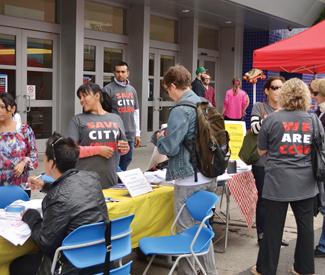
CCSF Mission Campus, Room 109, 1125 Valencia, SF. (415) 412-4183, saveccsfpetition@gmail.com. 6-8pm, free. Join students, faculty and staff at City College of San Francisco in initiating a campus/community coalition to defend the acclaimed school against threat of closure. The college faces severe cuts and sanctions demanded by an accrediting agency. Become part of a united effort to keep CCSF as a key provider of quality education for all communities in the San Francisco Bay Area, and as the primary gateway for poor and working class students and students of color.

SATURDAY 9

Rally Against Genetically Modified Salmon

Justin Herman Plaza, SF. Rachel@labelgmos.com, tinyurl.com/antiGMOsf. 11am, free. The US Food and Drug Administration (FDA) is on the brink of rubber-stamping genetically engineered salmon. Activists are attempting to turn the tide now, during the 60-day comment period before final approval. Environmentalists and those think genetically modified foods should be labeled are calling for supporters nationwide to demonstrate unity against the approval of GE Salmon. Join this march and rally to bring the issue to the front burner.

MONDAY 11

Public Meeting: Speak Out Against Tasers

Bayview Opera House, 4705 Third St., SF. 6-8pm, free. The San Francisco Police Department (SFPD) is once again holding community meetings to talk about arming San Francisco cops with Tasers. The idea has been floated in the past, but community advocates have consistently shot it down, arguing that Tasers can be lethal and are often misused by law enforcement. At this community forum convened by SFPD, an assortment of organizations including the Coalition On Homelessness and the No Tasers Taskforce will turn out against the SFPD’s latest attempt to adopt these so-called nonlethal stun guns.

Is City College’s main critic out of control?

28

The oversight board that’s demanding big, often unpopular changes at City College carries the name of the Accrediting Commission for Community and Junior Colleges of the Western Association of Schools and Colleges, and it’s approval is essential for any school that wants to get taken seriously. Without accreditation, there’s no state funding, students can’t get loans, diplomas don’t count for much — in other words, losing the ACCJA seal of approval is a death sentence.

You’d think a board so important and powerful would have a lot of oversight, be the subject of news stories, get monitored. But that’s not the case with ACCJC; nobody seems to know much about it, except that its board is a fairly obscure group of academics and administrators and its president used to run Berkeley City College and it’s stirred up a bit of anger in past years. The boss, Barbara Beno, seems to like chancellors and presidents a lot more than she likes governing boards — and, from the situation at City College, it’s clear that she’s a big fan of top-down decision-making and doesn’t approve of shared governance.

But there’s a fascinating report done by the former president of the California Federation of Teachers that looks at how ACCJC compares to regional accreditation boards in other parts of the country. Martin Hittelman, an emeritus professor of Mathematics, did a numerical analysis that suggests that ACCJC is a whole lot harsher on schools than its counterparts. Check out the chart below:


As Hittelman notes:

The vast majority of reasons dealt with the adequacy of procedures, reviews of programs, services, and operations as well as whether the college adequately used assessment tools such as student learning outcomes in the evaluation of faculty. Sanctions were rarely, if ever, based on the
actual quality and adequacy of instruction received by students.

He notes:

The ACCJC Commissioners are not representative of the diversity in the California community colleges. The large urban districts such as Los Angeles, San Francisco, San Diego, San Jose – Evergreen, and Long Beach are not represented on the Commission whereas Riverside City College
has two member of the Commission. The faculty of the California Community Colleges are represented by only four of the members of the Commission. The Commission also includes a number of members who were not well respected as administrators at their home campus

For example:

Dr. Sherrill Amador | Chair
Dr. Amador serves as a public member of the Commission. Dr. Amador began her service on the Commission July 1, 2004. She was a very unpopular college president at Palomar College where she received several votes of non-confidence.

Much of the report is academic (not surprisingly), but what I got out of it was that this particular agency, at this particular time, is demanding more from desperately underfunded schools than is normal, and is leaning distinctly toward the side of academia and politics that wants simple tests and hard data to quantify educational outcomes that aren’t always easy to quantify.

Not saying for one second that City College is free of problems. But it’s worth thinking about who the critics are and where they come from.

BTW, I contacted ACCJC for comment on the report, but haven’t heard back.


Discord at City College as accreditation cliff nears

48

More than 300 City College of San Francisco (CCSF) faculty and supporters protested their chancellor’s “state of the school” address at CCSF’s Diego Rivera Theater on Friday (Jan.11) morning as the clock continues to tick down to March 15 — when the community college accrediting commission will decide the future of City College.

Teachers and administrators are now battling over the right way to meet the challenge of staying accredited. The administrators are trying desperately to “cut the fat,” and the teachers contend the baby is being thrown out with the bathwater.

As we’ve reported previously, CCSF’s new divide is over the use of the $14 million a year generated by the parcel tax voters created through Proposition A in November. The school’s administration still wants faculty to take an 8.8 percent pay cut, and already has over 70 faculty and staff “not being rehired” next semester. The school plans to use the money to shore up their fiscal reserves, one of the many sticking points the accrediting commission wanted them to adhere to in order to stay accredited and open.

The teachers see it differently. They volunteered and worked long hours, rallying and passing out flyers about Prop. A for months leading up to the election, with little to no financial support from administrators and the college’s Board of Trustees. They contend that Prop A’s language, which you can read online, specifically outlines that the money should be used to prevent layoffs — which the school has decided to do anyway.

The teachers, understandably, are upset.

“A lot of our teachers work really hard, and this is a slap in the face, frankly,” Greg Keech, the English as Second Language Department chair, said to faculty the day of the rally, outside the college’s Diego Rivera Theater.

The theater houses a giant, elaborate fresco, Diego Rivera’s World War II era mural “Pan-American Unity,” which depicts the 1940s working class laboring toward a common goal, a stark contrast to the college’s divisions. As the cries of the marchers echoed from just outside the door, CCSF’s chancellor Thelma Scott-Skillman stood at the theater’s main stage defending City College’s faculty pay cuts and recent layoffs.

“Over the years, CCSF has managed to serve far more students than they had resources available, a very laudable goal,” Scott-Skillman said to her audience of mostly faculty and staff. “However, harsher austerity measures unfortunately are being implemented to address this imbalance.”

The San Francisco Chronicle seems to think Scott-Skillman has a point, writing an editorial siding with the administration. If the Chronicle and the college’s leadership had their way, the teachers would just shut-up and take their medicine.

“I think the protest today was an unproductive response to a house that’s burning down,” Steve Ngo, the newly re-elected college trustee, told us. “We’re trying to put out the fire, and [faculty] are arguing about the drapes.”

But teachers have good reason to be worried. When a commission with the power to close your school holds a gun to your head and essentially says, “You have one year to implement drastic reforms at your college that will last years, or we’ll close you down,” yeah, of course teachers are going to be worried about the lasting affects on their careers and their students.

Some of those changes are happening already, teachers told us.

“People without academic expertise, who don’t know the field, will lead the departments,” said Kristina Whalen, the director of the speech department at CCSF. “Academic reorganization will have automotive and child development under the same dean — those fields aren’t related.”

The previous model had teachers elected from within their own departments who represented those departments, leading to at least 60 department chairs at CCSF. The college has since consolidated those positions, and is moving to hire a smaller number of deans to handle the same jobs. Faculty who have worked under deans at other colleges didn’t have many kind things to say about the experience.

“I’ve worked at other schools where you reported to a dean,” art teacher Andrew Leone told us as rally-goers marched and yelled behind around him. He’s worked at San Francisco State University, and USF, among other schools, he said.  “The dean has so many responsibilities, there’s no way they can deal with them all.”

The chairpersons at City College were more efficient at taking care of teachers’ needs, he said. Now, “they’re giving us a top down corporate model. They’re turning us into Wal-mart.”

Meanwhile, the tally of concessions made to keep the college open keeps piling up. More than 160 teachers have left the school due to retirement and attrition without being replaced, and more than 50 faculty members and 30 staff have been reported as being let go so far, according to data from the teacher’s union, AFT 2121. The union won’t know the full number of faculty not rehired until early March, and the total amount of “not rehired teachers,” can be hard to track. Additionally, three school sites, Castro, Presidio and Fort Mason, will close soon.

Despite the drastic measures being taken, Interim-Chancellor Scott-Skillman made the case that arguing about them is a moot point.

“This college represents a promise to the surrounding communities that this is a place of quality and opportunity to acquire higher education, “Scott-Skillman said. “Reality check:  unfortunately, we can no longer keep that promise for everyone.”

Trustee Ngo took it a step further, saying that the protest could hurt the school’s chances at keeping its accreditation, especially in light of CCSF asking the state for an extension to the March 15 deadline for accreditation.

“These protests are hurting our chance for an extension,” Ngo said. “If [the accrediting commission] sees protests of our interim chancellor, they’ll think that, chances are, these people aren’t ready for change.”

Ngo could be right. Notably, the accreditation commission’s evaluation report of the college, which is the guiding document of what the college has to fix, called out the school’s divisions: “Despite the unified commitment to the college mission, there exists a veil of distrust among the governance groups that manifests itself as an indirect resistance to board and administrative decision-making authority.”

Beyond just the teachers, at least one person was happy to see the protest. CCSF student Kitty Lui , 26, is a a few units shy of transferring to San Francisco State, and sees the cuts at City College as a threat to her education, she said.

“We need good jobs, especially here in SF, so we’re not living paycheck to paycheck,” Lui said. “It’s inspiring to see so many teachers here — it gives me hope.”

Much weirdness at the City College Board

44

And you thought the election of the new old Board of Supervisors president was odd. Check out what happened with the Community College Board: After weeks of telling everyone in sight how horrible it would be if any of the three old-timers who helped screw up the school (Natalie Berg, Lawrence Wong and Anita Grier) got elected board prez, current board president John Rizzo won another term — with the support of Berg, Wong, and Grier. And left some of his progressive allies either scratching their heads or fuming.

The backstory: A couple of weeks ago, Rizzo got word that prog colleague Chris Jackson was considering supporting Grier for the top post. That would have given Grier the four votes she needed, since Berg, Wong and her all vote together most of the time. And it would have screwed the progressives, who managed with considerable effort to hold onto a one-vote majority at a critical time in the board’s history, while the college is trying to win reaccreditation. Why bother to win at the polls if you’re just going to turn control over to the other side? I mean, the GOP doesn’t vote for Nancy Pelosi for speaker.

So Rizzo asked former sup. Aaron Peskin, who remains one of the town’s most savvy political operators, to help out. Peskin put an immense amount of time into working out the details and cutting through the various interest-group problems. (Example: By tradition, the top vote-getter becomes board president. That would be Steve Ngo. But the teacher’s union is mad at Ngo because he wants to put more money into the school’s reserves even if it means laying off teachers. So Jackson, a longtime labor guy, couldn’t vote for him. Jackson had already told Grier he’d vote for her, so he’d have to be convinced to withdraw that promise. And on and on.) In the end, after a lot of wrangling (while trying to avoid the fact that the Brown Act prohibits the four progressives from talking to each other outside of a public meeting) Peskin managed to find a solution: Four people were willing to vote for newcomer Rafael Mandelman. Okay, that works.

The vote was Jan. 10. The night before, Berg called Rizzo to say that she didn’t want Mandelman, but would agreed to support … Rizzo. Presumably (she won’t take my phone calls so I don’t know for sure) she had already talked to, or was about to talk to, Grier and Wong to seal the deal. That, of course, would be a direct Brown Act problem, but nobody seems to care about the state’s landmark open-government law anyway (witness the BOS leadership fight, where everyone was talking to everyone else behind the scenes).

So Rizzo agrees that would be dandy, never tells his colleagues on the left — and when the vote goes down, he gets nominated by and re-elected with the support of the people he’s been bad-mouthing all over town for the past couple of weeks. In the end, the progs saw the handwriting on the wall and went along and made it unanimous.

I called Rizzo after the vote and he told me that he hadn’t expected Berg’s offer, but that “it avoided a fight at the meeting, and that’s a good thing for the state accreditors. It shows the board isn’t divided.” Actually, the board IS divided, and Rizzo has been part of that divide, and if the special trustee hasn’t figured that out yet, he’s not terribly observant.

He told me he should have given his allies a heads-up, but “that would have violated the Brown Act.” (Clue phone: The whole deal that re-elected him was a blatant violation of the Brown Act.)

Mandelman just joined the board, and wasn’t pushing for the top job, although he’d agreed to do it. So he’s not that upset. But he was a bit bemused when I talked to him. “To have the two-week shitstorm stirred up by John, who then forms a partnership with the people he’s despising, and not to tell any of us, is wierd,” Mandelman said.

Peskin’s more direct. “Politics is all about keeping your word,” he told me. “This is exactly not how you do politics.”


CCSF teachers recruit students from BART/Muni stations

58

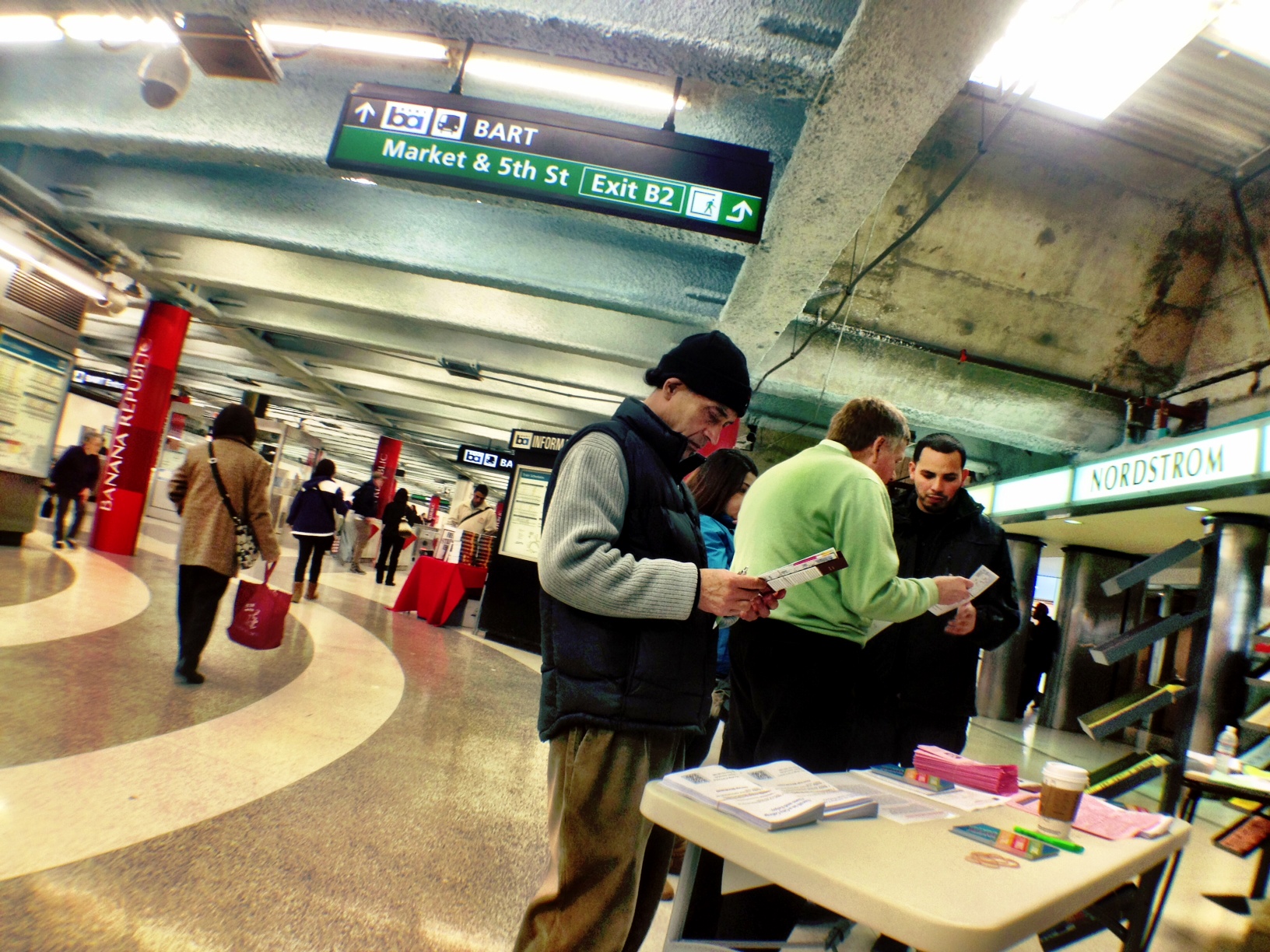
Walking through the Powell BART and Muni station, commuters are used to hearing the cries of a melange of musicians, crazies, and those with something to sell. Today and tomorrow though, commuters will hear something entirely different, as teachers cry “Enroll at City College! Enroll now!” through transit stations across San Francisco.

Teachers and faculty from the equally bedeviled and beloved school, City College of San Francisco, are out in force with flyers and laptops trying to shore up an enrollment deficit of 3,000 students. Today they’re at the Powell, Montgomery, and Embarcadero stations, handing out flyers and enrolling potential students on their laptops. Tomorrow, they’ll be at Civic Center, Mission, and Balboa street Muni and Bart stations doing the same.

The lack of student enrollment would deprive the school of $6.5 million dollars in state funding, which the school has responded to by cutting faculty and administrative salaries by 8.8 percent, and electing not to rehire, essentially letting go, 30-40 part time teachers, 18 part time counselors, and 30 clerical staff.

It’s no wonder these teachers are out on foot, enrolling as many folks as they can — and they say they’ve met with some success.

“I’ve been surprised how receptive people have been,” said Lizzie Brock, a basic skills English teacher at the college. Brock was on her feet handing out flyers for four hours, despite being about six months pregnant with her second child. “It’s a labor of love,” she said.

Though Brock only recently became a tenured teacher at the college, having taught there full-time for six years, she can’t afford to live in San Francisco on her salary from CCSF. She lives in Pacifica, commuting to the city to teach her classes.

Thomas Blair, a foreign language department head at CCSF who also teaches French, organized the two days of outreach. An older gentleman with snowy, neatly combed hair, and a kindly manner, he’s the last person you’d expect to sound the trumpets and gather 90 or so teachers to hit the pavement.

His passion for the college lies in these simple facts: he’s taught there for more than 30 years, and as a department head, he has a responsibility to all of the foreign language teachers at the college, and the thousands of students who open themselves to learning how to communicate with the world.

“I brought the table on the K with me all the way from Ocean Avenue,” Blair said. He thinks he has a pretty good chance of signing up new students from commuters, because those in the 30-55-year-old crowd are often the ones taking new languages at City College, he said. “The office workers are a very good segment for us now,” he said.

Guillermo Romero, a blueprint reading instructor at CCSF, was also there handing out flyers. Streams of people flew past Romero, but he was undeterred. Romero is confident that his classes will meet enrollment, simply because of his philosophy in teaching his class, he said.

Disfrutando euseñando, disfrutando aprendieindo,” Romero said. If you enjoy teaching, they’ll enjoy learning — and hopefully be back for more.

Wait!

1

le.chicken.farmer@gmail.com

CHEAP EATS Anna Yamo has been trying to catch me for it seems like a year now. When she calls it says Restricted Number and that’s how I know it is her, but I am always in New Orleans or Seattle or the bathroom.

“Restricted Number,” it said.

I was sitting on my couch. San Francisco!

“Hello?” I said. This time.

“Danielle!” she said, with her characteristically loaded laugh, which tells me I’m a hard person to catch hold of. And in her characteristic accent, which is, of course, Thai: “When we have lunch?”

“Sunday?”

“Where you want to eat?” she said, then (also characteristically) she told me where: at this crepe place on Valencia, across from City College. News to me.

“It’s a date,” I said, thinking that — who knows — maybe there’d be a check for $3,300 in my mailbox, and I’d be going back to work. Stranger things have happened, although admittedly they usually involve badgers.

Anna and I hadn’t seen each other in over a year and there were so many things I wanted to talk to her about: her son’s restaurant and did she think we could shoot a short movie there … would she teach me how to make duck noodle soup … and why doesn’t she move to Youngstown, Ohio, the town of my birth and the last US city of any size to not have a Thai restaurant in it.

Let the record also show: I love crepes, and these ones were very very very


CHEAP SPORTS

by Hedgehog

The rain. That’s all I have to say about sports this week. Jesus H. Christ is in a mother fucking raft, as my mother always proclaimed He would be. And even He is standing in line for Tartine. Or floating. I know what you’re thinking: He doesn’t need the raft, for He can walk on water, but even our Lord and savior likes a good sit-down now and again (see the Book of Mark, 16:19. Also, the Book of Eames, 12:34).

Neverminding the weather, I’m sick of the line at Tartine. I never go in because I refuse to stand in it. I stood in it once. (Once!)

And not for the stupid goddamn morning rolls (which have too much orange zest in them), but for a sandwich. This was back when I ate things like sandwiches, so you know; it was awhile ago.

Anyway, Chicken Farmer had introduced me to the Tartine pastrami sandwich without making me stand in that god-awful line and I wanted to repay the favor by going and getting them the next time. So I “queued up” (as they would say on Downton Abbey) and 30 minutes later, it was finally my turn to exchange money for goods. But the peopleperson behind the counter cut me off, mid-order, to inform me that they don’t take sandwich orders until 11:30.

It was 11:17.

It was a Five Easy Pieces moment if ever I’ve had one, and I’m all for making a scene, but the 30 minutes of anticipation and herd-member-like treatment backfired and the rage shut down my brain. We got takeout from Pakwan instead.

So when I say “I’m sick of the line at Tartine” (like I just did, up there somewhere), what I mean is, “I’m sick of looking at the line at Tartine.”

We have big windows. And a lovely window seat. Overlooking the line at Tartine.

On Christmas day, after we blew the candles out on the pot roast and dished up the traditional Brussels sprouts, our rag-tag group of holiday orphans were entertained for hours by the comings and nose-pressings and then forlorn goings of a steady stream of Tartinian acolytes. Behold: even Thine Holier Than Thou Bakery is closed on this day.

But the day after, it was busy-ness, as usual. Can you see us in the windows, looking down judgmentically at you from our ellipticating albatross?

Well, enough about what’s-their-faces. We got a Christmas tree! And it nearly caused us to divorce before we could even marry. But that’s neither eats nor sports, so…

R.A. Dickey is now a Toronto Blue Jay.


CHEAP EATS CONTINUED

Wait a minute! I like Tartine, and — being a people peopleperson, love looking at the line. Though I agree their morning buns are overrated. 

DOWNTON ABBEY

www.pbs.org

City College’s new divide

156

Despite recent voter approval of Proposition A, the parcel tax expected to bring $14 million annually to City College of San Francisco, faculty there are enduring pay cuts and layoffs, a reality that has rankled union leaders and others who have rallied to save the school. 

In the face of the school’s accreditation crisis, which if not addressed by March could lead to its closure, the college was a united front to keep the school open and pass Prop. A, which was approved by over 70 percent of San Francisco voters on the same night as President Obama’s reelection.

But a combination of timing (the money won’t roll in until later in 2013), the depth of the district’s fiscal hole, and declining student enrollment have left CCSF with essentially status quo funding. District officials appear to be leaning toward using most of the surplus it does get to beef up its scant reserve funds, which was one of the things that triggered the accreditation crisis.  

After the good news of Prop. A’s passage, CCSF discovered it wasn’t on track to meet its required enrollment numbers — and the number of students enrolled dictates state funding.

“[The administration] was focused on these accreditation reports. It’s a big job. It was very disruptive to change chancellors kind of midstream,” said John Rizzo, the college’s board president. “We had to switch administrations, and that’s been very difficult.”

City College has been through three different chancellors in the past year: longtime Chancellor Don Q. Griffin left in April due to illness, Pamila Fisher was interim chancellor until October, and now Thelma Scott-Skillman is the current chancellor.

Whatever the reason, City College has 3,000 fewer students enrolled than it expected to have for the Spring, potentially putting it $6.5 million in the hole this coming year. It has until the end of summer to boost those numbers. Now, despite all the cards coming up aces for them in the polls, the college still needs to save millions of dollars somewhere else in the budget.

It has started by slashing faculty and administration wages 8.8 percent, and not renewing contracts for more than 30 part time teachers, 18 part time counselors, and 30 clerical staff. Notably, Scott-Skillman — whose office negotiated the plan, which the board discussed on Dec. 13 — will also take a paycut.

Alisa Messer, president of the faculty union at City College, thinks cutting teachers, and therefore classes, flies in the face of what the voters bargained for with Prop. A. “There’s no discussion here about accountability to San Francisco voters,” Messer told us. And with the loss of competitive wages, the faculty has already started to come apart at the seams.

“We have unfortunately heard from quite a few faculty that they will be looking for jobs out of state,” Messer said. “Many said they’ll have to change their living situation or move out of San Francisco.”

She said that would hurt CCSF: “These things have to do with the long term viability of the college.”

Steve Ngo, a trustee on the college’s board, thinks that the Prop. A money should be used to shore up the school’s reserve fund, as dictated by the accreditation team that threatens the school with closure. Unfortunately, this means losing teachers now rather than later.

“If you want to frame it in terms of labor, there’s nothing worse to do than spending money now [to retain teachers] and laying off teachers in the future,” Ngo said. “Those are younger teachers. The people there now will be retired.”

Due to increased focus on diversity in hiring, CCSF’s more diverse and younger teachers tend to be the newer ones, and part time faculty, Ngo said. Those are the teachers most at risk — and the ones that students will end up losing.

Amidst the arguments about proper use of funding, teachers at the school are seeing their wages cut. Some, like Danny Halford, are losing their jobs.

Halford taught English as a Second Language at City College for seven years. A friendly and outgoing middle-aged guy, Halford is a veritable man about town, and can be seen at City College fundraisers, and was among the college’s most ardent Prop. A supporters, waving picket signs and attending rallies.

He was also one of the part time faculty members to lose his job in the Spring.

“Greg Keech, our super-wonderful ESL Dept. chair, wrote me a very nice letter to inform me that due to budget cuts there will be no job for me next semester,” Halford said. He had also recently lost his job as an organist at the College Avenue Presbyterian Church, which he’d had for 10 years, when a new pastor had “a new music concept that I don’t fit,” he said.

One of his favorite memories from City College was of a student named Elmer, from Guatemala. “He came into my Literacy class in May 2006, near the end of my first semester, with almost no English.  He made progress quickly.”

“When he got his G.E.D. diploma, I was so proud of him, I could have bust,” Halford said. “I’ve watched him grow, off and on, for six years now. He has no family here, and I think of him as my nephew.”

He may even be re-hired next fall, but until then he waits in limbo. He’ll try to substitute teach at the college for now, he said, but ruled out looking at other schools for work. As he said, “There are no jobs at other colleges because all colleges are in the same boat.”

Ngo said that the choice is basically between drastic change, or the closure of the school.

“It’s mathematically impossible to keep that payrate now,” Ngo said. “My hope is to provide the best wages and benefits in the long run, but we can’t offer it if it’s a facade. We can’t maintain payrates as they are now because we have too many faculty…There’s no agreement if there’s no college.”

City College’s faculty’s union, American Federation of Teachers 2121, filed an unfair labor practice charge Dec. 21 with the Public Employee Relations Board, a state entity that has the power to enforce labor law in California. The charge alleges that the college’s paycuts are unlawful.

A recent email to their union members outlines the AFT 2121’s grievances with the college: “At Monday’s bargaining session, the District finally outlined its claim that it will cut wages to recover last year’s ongoing state cuts of $13 million—even though the parties bargained in good faith, reaching agreement on June 20, 2012 to address these losses, including the 2.85% wage reduction this year and millions of dollars in savings through attrition and program cuts. The District is essentially overriding the previous agreement by now moving to cut wages to recover $13 million on top of the already agreed to concessions.”

College spokesperson Larry Kamer said he hadn’t seen the charges yet, as the college is on vacation, but that “we respectfully disagree with AFT 2121’s characterization of the situation.”

“City College is facing an immediate budget shortfall due to a second straight year of missed enrollment targets,” he said. “In the past, City College might have papered over such a budget gap with money it didn’t have, but those days are over. The college remains in a perilous situation with regard to accreditation and has no choice but to respond to the crisis with swift action and a request for shared sacrifice.”

And there’s the rub. In the midst of reforming the school to meet the requirements of the accreditation team by March or face closure, the college failed to keep its eye on their enrollment.

“The unions were trying to help, calling prospective students and trying a pitch,” Rizzo said. “‘Hey enroll!’ That kind of thing. They’re helping. A lot of people are trying to chip in to help this.”

“Ultimately it’s the people in the administration who are responsible for the enrollment,” he said.

With City College’s newest Chancellor Scott-Skillman on track to stay for at least a year, some stability may return to college’s administration. But City College’s dilemma, to potentially strain its budget to the breaking point or to lose valued and experienced teachers, has no easy answers  — and either way the losers may end up being the students.

To register for classes at City College, visit ccsf.edu. Enrollment for Spring is open.


CCSF by the numbers:

Prop A - $14 million a year for 8 years starting in 2013
 
3,000 - the number of students city college needs to enroll in order to meet its budget expectations, or lose money
 
$6.5 million - the amount CCSF loses if it doesn't enroll 3,000 students
 
8.8 percent, the amount faculty wages are being cut
 
160 - faculty lost in the past year due to attrition - retirement, quitting
 
30 - part time faculty not rehired next semester, including ESL teacher Danny Halford
 
30 - clerical staff not rehired for next semester
 
18 - part time counselors not rehired next semester
 
3 - number of chancellors running City College over the past year


On the Cheap Listings

0

Submit items for the listings at listings@sfbg.com. For further information on how to submit items for the listings, see Picks.

WEDNESDAY 5

“Hidden in Plain Bite: Overlooked Opportunities for Food System Reform” 371 10th St., SF. (323) 828-7040, www.ffacoalition.org. 6:30-9pm, $8-12. Come for this informative and eye-opening discussion that tackles new and innovative measures to reform our dastardly food system. Organic food offerings and a silent auction will follow the talk.

Lemony Snicket The Booksmith, 1644 Haight, SF. (415) 863-8688, www.booksmith.com. 5-8pm, free. Beleaguered children’s book hero Lemony Snicket will be on hand at the Booksmith this evening for a meet and greet promoting his latest effort, entitled Who Could That Be at This Hour?

FRIDAY 7

“Terra e Asfalfo: Around the World on a Vespa” The Emerald Tablet, 80 Fresno, SF. (415) 500-2323, www.terraeasfalto.it. Through Dec. 16. Opening reception: 6-10pm, free. How anyone can travel all around the world on those speedy little cosmopolitan numbers is beyond us. But Italian couple Giorgio Serafino and Giuliana Foresi did it — and the duo will be presenting their travels via this photo exhibit, where pictures of destinations such as Thailand, South Africa, and Italy will be on display.

Mission Holiday Block Party Various businesses on Valencia from 23rd to 14th Sts. and surrounding blocks, SF. www.valenciastreetsf.com. 5-10pm, free. Get half price on sangria at Locanda, 20 percent off clothes and accessories at Five and Diamond (while Shovel Man plays!), check out a George Chen-hosted comedy program at Lost Weekend Video’s CineCave and more at this holiday celebration in Valencia’s neighborly businesses.

“Snapshot” Southern Exposure, 3030 20th St., SF. (415) 863-2141, www.soex.org. Through Dec/20. Opening reception: 7-9pm, free. The Youth Advisory Board of Southern Exposure’s new exhibit explores the relationship between the medium of photography and the notion of memory. An experimental work, “Snapshot” features young artists’ take on fact and fiction through digital manipulation.

“Aloha on Ice” Embarcadero ice rink, Justin Herman Plaza, SF. (415) 392-2235, tinyurl.com/alohaonice. 4-7pm, free. Come bask in the warm aloha spirit at this pop-up luau. You’ll have a number of ways to get tropical at this event, like sampling Hawaiian food, making fresh flower leis, and mugging in a Hawaii-kitsch photo booth. Drink umbrellas and hellacious sunglasses tan not included.

DIY Library Party Mission Bay Branch Library, 960 Fourth St., SF. (415) 626-7512, www.friendssfpl.org. 7-10pm, free for members and friends of members, $35 for membership. The DIY aesthetic has permeated nearly all facets of our contemporary culture, so it’s past time for our local library to get in on the low budget fun. Get engrossed by an impromptu arts and crafts project, and mingle with cocktail-sipping fellow literary fans at this free event.

Hurricane Sandy Benefit Show Modern Eden Gallery, 403 Francisco, SF. www.hope-beyond.com. 6-9pm, free. We on the West Coast are lucky to not have to deal with terrors of hurricanes, which is why we urge to attend this art show benefiting our fellow Americans on the other side of the nation.

SATURDAY 8

East Bay Alternative Book and Zine Fest Berkeley City College, 2050 Center, Berk. eastbayalternativepressbookfair.blogspot.com. 10am-5pm, free. The good folks behind this event decided to go bigger with the third installment of the East Bay Alternative Book and Zine fest. There’ll be workshops on zines, screen-printing, letterpress, and comic illustration in addition to speeches from dozens of local writers.

Vagabond Indie Craft Fair Urban Bazaar, 1371 Ninth Ave., SF. (415) 664-4422, www.urbanbazaarsf.com. Also Dec/9. Noon-6:30pm, free. Etsy addicts take note! Urban Bazaar in conjunction with Etsy and the SF Etsy team will be putting the third annual holiday-themed Vagabond Indie Craft Fair. Come peruse with your keen shopper’s eye the emporium of hip, fun, and crafty items. Also probably a good idea to do some holiday shopping while you’re at it.

Holiday Indie Mart Speakeasy Brewery, 1195 Evans, SF. www.indie-mart.com. Noon-6pm, free. If you’ve never made it out to Speakeasy’s Bayview brew factory, now’s the perfect time. Indie Mart is assembling over 45 vendors, who will come equipped with DIY giftables you’ll be stocked on for your family and friends. Bonus round: today the brewery will unveil its new taproom, designed by Indie Mart creator Kelly Malone and friends.

KPFA Crafts Fair Concourse Exhibition Center, 635 Eighth St., SF. (510) 848-6767 ext. 646, www.kpfa.org/craftsfair. Also Dec/9. 10am-6pm, free–$10. Go to the Vagabond Crafts Fair on Saturday and the KPFA Crafts Fair on Sunday, or vice versa or do a crafts fair crawl by attending both on the same day! Sponsored by the progressive-minded folk at the KPFA 94.1 radio station in Berkeley, this festivity is going all out by bringing craftwork from over 200 local artisans featuring glass, leather, and stone items.

MONDAY 10

Pladra Holiday Launch 5-8pm, free. 111 Minna, SF. www.pladra.com SF flannel company Pladra shows off its latest line of shirts for men and women at this holiday party and trunk show. Everything’s sourced and made in the Bay Area, for a hyperlocal, winter-ready shopping experience.

TUESDAY 11

A Long Day’s Evening Translation City Lights Bookstore, 261 Columbus, SF. (415) 362-1901, www.citylights.com. 7pm, free. Turkish experimental modernists rejoice! Aron Aji has finally translated A Long Day’s Evening by Bilge Karasu for our literary loving. Attend this talk today by Aji to hear how the process took shape.


Run over by a reindeer

0

culture@sfbg.com

EVENTS

Union Square ice-skating rink Union Square, SF. www.unionsquareicerink.com. Through Jan. 16, 10 a.m.-11:30 p.m. except for when closed for private parties, $10 for 90-minute session. Sweetheart, the rink is open, grab my hand and try not to twist an ankle as we glide in circles around downtown’s living room.

Westin St. Francis sugar castle Westin St. Francis, Landmark Lobby, 335 Powell, SF. www.westinstfrancis.com. Through Jan. 24, on view 24 hours/day. Don’t lick it. For although this ever-growing sweet behemoth which each holiday season occupies the lobby of downtown’s classic luxury digs with its 1,300 pounds, 20 towers, 30 rooms, and sugar replicas of 2012’s movers and shakers has a hold on our heart, its original dimensions were sugar-spun back in 2005. Incredibly made, undeniably festive, but altogether inappropriate for dietary purposes.

Jack London Square holiday tree lighting Jack London Square, Oakl. www.jacklondonsquare.com. Nov. 30, 4:30-7pm, free. Performances by Disney-approved pop stars! Reindeer petting zoo! Miss California 2012 and a kids dress-up station with costumes from the Oakland Ballet! You’ll be hard-pressed not to find some holiday cheer at this annual lighting of Jack London’s fir tree for the masses.

Oakland-Alameda Estuary Lighted Yacht Parade Visible from Jack London Square, Oakl. www.lightedyachtparade.com. Dec. 1, 5:30pm, free. Let those cheeks get rosy, it’s boat-watching time. This yearly tradition sees the yacht owners of the East Bay putting their aquatic rides on display, stringing bulbs galore across decks and sails.

Festival of lights Union between Van Ness and Steiner, Fillmore between Union and Lombard, SF. www.sresproductions.com. Dec. 1, 3-7pm, free. Wiggle your nose at Santa at this explosion of twinkly tinsel and Cow Hollow reindeer — today Union Street puts on the holiday glitz and lays out the welcome mat. Cudworth Mansion (2040 Union) will be hosting a cupcake-decorating session from 3:30-5:30pm, at which Old St. Nick himself will make an appearance out front.

Golden Gate Park holiday tree lighting McLaren Lodge, 501 Stanyan, SF. www.sfrecpark.org. Dec. 6, 5pm, free. A tradition started by Golden Gate Park grandfather and San Francisco’s first park superintendent John McLaren in 1929, the lighting of the tree returns to Fell Street for the 83rd year in a row. Accompanying fanfare includes live performances, carnival rides, and a visit from Saint Nick.

Great Dickens Christmas Fair Cow Palace, 2600 Geneva, SF. www.dickensfair.com. Fri/23 and Sat.-Sun. Sat/24-Dec. 23, 10am-7pm, $21-25. For an ace weekend drunk this holiday season, toodle over to the Cow Palace. Once ensconced in the warm period embrace of the Dickens Fair, you will have the run of five bars (absinthe!), a multitude of meat pie shoppes, hilarious accents, near-constant stage shows, and the company of “famous Victorians,” including Charles Dickens and Her Majesty, the queen herself.

Family holiday crafts day Randall Museum, 199 Museum Way, SF. (415) 554-9600, www.randallmuseum.org. Dec. 1, 10am-3pm, free admission, activities fees vary. Bring the kiddos to the always-free-admission Randall Museum so they can spend the morning making holiday decorations and gifts. Cap off the morning with a performance by Asian American performance troupe Eth-Noh-Tec and its fusion of ancient and contemporary movement.

Community Hanukkah candle lighting Jewish Community Center, 3200 California, SF. (415) 292-1200, www.jccsf.org. Dec. 8-14, 4:30pm, free. Join up with your neighbors for the Jewish Community Center’s daily lighting of the menorah in the building’s atrium. Attend the Shabbat celebration on Dec. 14 for a family storytelling session, grape juice, hallah, and Hanukkah gelt.

Bill Graham Menorah Day Union Square, SF. www.chabadsf.org. Dec. 9, festivities start at 3pm, menorah lighting at 5pm, free. Each day from December 8-15, a candle will be ceremoniously lit on the Bill Graham mahogany menorah, a gift from the famous San Francisco promoter to his city. But on the 9th, Bill Graham Menorah Day festivities will occupy Union Square, a beautiful beginning to the Festival of Lights in the city.

Public library winter celebration Bernal Heights Library, 500 Cortland, SF. www.sfpl.org. Dec. 12, 6:30-8:30pm, free. The library’s got all kinds of free holiday programming this year, from cupcake-decorating and card-making to a magic show with a winter wonderland theme. Today’s no exception: join the Bernal Heights community for a kid-friendly celebration featuring the Bernal Jazz Quintet, refreshments, and children’s movies.

Frosting the Conservatory Conservatory of Flowers, 100 John F. Kennedy, SF. (415) 831-2090, www.conservatoryofflowers.org. Dec. 15, 11am-3pm, $10. Make your own ginger-greenhouse at this event amid the hothouse blooms of the Conservatory of Flowers. This events gets our thumbs-up for guaranteed toastiness, because being warm and cozy is a pre-req for Christmas cheer.

Jewish Christmas with Broke Ass Stuart The Make-Out Room, 3225 22nd St., SF. www.makeoutroom.com. Dec. 25, 5-11pm, $10. Strip dreidel set to the tune of streaming Woody Allen, Larry David, and Sascha Baron Cohen footage sounds like our kind of Christmas. Such was the vision of DJ Matt Haze and host Broke Ass Stuart, who designed this kitschy extravaganza for all of you (Chosen and Left Behind alike) who can’t stomach staying in on a perfectly good day off. Did we mention there will be a Chinese food buffet?

Kwanzaa celebration Bay Area Discovery Museum, 557 McReynolds, Sausalito. www.baykidsmuseum.org. Dec. 26, 9am-5pm, free. A traditional Kwanzaa altar will greet you upon arriving at the kids museum’s celebration of African-American culture, featuring two performance (at 11am and 1pm) by African Roots of Jazz.

PERFORMANCE

The Christmas Ballet Various times and Bay Area locations. www.smuinballet.org. Nov. 23 — Dec. 23, $25-65. Back by popular demand, the Smuin Ballet Company returns with this annual production, split this year into two acts: “Classical Christmas” and “Cool Christmas.” Both promise eye-opening, energetic entertainment set to eclectic tunes from Elvis to klezmer.

A Christmas Carol American Conservatory Theatre, 415 Geary, SF. (415) 749-2228, www.act-sf.org. Nov. 30-Dec. 24, various times, $20–$160. Stressful election year and rumors of apocalypse tightened those purse strings? Exorcise your inner Scrooge at this classic stage production of Charles Dickens’ terrifying ode to generosity and kindness towards diminutive children.

The Golden Girls: The Christmas Episodes Victoria Theatre, 2961 16th St., SF. www.victoriatheatre.org. Dec. 6-30, Thu.-Sat. 8pm, Sun. 7pm, $30. Our cover girl Cookie Dough co-stars as Sophia Petrillo in this now-traditional SF holiday stage production of the classic sitcom that employs more shoulder pads, even, than the original TV show. You’ll never know a catty elderly network television star until you’ve seen her re-enacted by a drag queen. Buy tickets pronto, the shows usually sell out.

California Revels Oakland Scottish Rite Center, 1547 Lakeside, Oakl. (510) 452-8800, www.californiarevels.org. Dec. 7-9, 13-15. Fridays 8pm, Saturdays and Sundays 1 and 5pm, $20-55. Feast and family are cornerstones of this annual interactive period piece performance celebrating the winter solstice. Hoist your mead and turkey leg and sway to the music, friends, good times will be upon ye here.

The Nutcracker Palace of Fine Arts, 3301 Lyon, SF. www.cityballetschool.org. Dec. 8, 2pm & 7pm; Dec. 9, 2pm, $20. Yes, everyone does The Nutcracker. At this point, it’s like the Rocky Horror Picture Show of ballet. (Would that ballet patrons donned Rat King costumes to attend!) Embrace the tradition, and check out the City Ballet School’s production of a classic.

Charles Phoenix Retro Holiday Show Empress of China Ballroom, 838 Grant, SF. www.charlesphoenix.com. Dec. 12, 8pm, $25. The creator of the Cherpumple, a pie-stuffed cake concoction that rises to the dizzying heights of kitsch, humorist Charles Phoenix celebrates the retro in every occasion. Tonight, he regales the crowd with tales of his favorite SF landmarks, road trips, and yes, feats of food fantasy.

Holiday youth mariachi concert Mission Cultural Center for Latino Arts, 2868 Mission, SF. www.missionculturalcenter.org. Dec. 14, 7:30-9pm, $15. Three mariachi troupes made of young people join forces for this exciting holiday program. The hat-dropping, guitar plucking action will be highlighted by Zenon Barron’s Mexican youth folk dance class.

The Snowman Davies Symphony Hall, 201 Van Ness, SF. (415) 864-6000, www.sfsymphony.org. Dec. 22, 11am, $13.50-57. Even the smallest budding season ticket holder will find this film-symphony presentation of Joe Nesbø’s classic children’s book a welcome boost to their holiday cheer. The animated version of this story of a youg’n’ whose bud is a Frosty-like chap will soar when paired with the world-class musicians of the SF Symphony.

Kung Pao Kosher Comedy New Asia Restaurant, 772 Pacific, SF. www.koshercomedy.com. Dec. 22-25, various times, $44-64. There’s nothing like having dinner on Christmas to up your alterna (or simply, not pan-Christian) cred. Add stand up comedy and you have a winning formula, which is obvious from the longevity of Lisa Gedulig’s annual show. This year features yucks from Judy Gold, Mike Capozzola, and Adrianne Tolsch.

Clairdee’s Christmas Yoshi’s San Francisco, 1330 Fillmore, SF. (415) 655-5600, www.yoshis.com. Dec. 24, 8pm, $20. Everything could use a little soul in lives and the holidays are no exception. Come hear the sounds of soul-jazz vocalist Clairdee, and soak in her ensemble’s rhythmic takes on Christmas standards.

“Holiday Memories” double feature A rare 16mm showing of Dylan Thomas’ A Child’s Christmas in Wales will be accompanied by a screening of The Sweater, a tale of a young hockey player’s passion for the sport, and the dangers that come of wearing the wrong jumper. Dec. 22, 2pm, Exploratorium, 3601 Lyon, SF. (415) 563-7337, www.exploratorium.edu

PEACE ON EARTH

Darkness and Light: A Hanukkah Meditation Retreat Jewish Community Center, 3200 California, SF. (415) 292-1200, www.jccsf.org. Dec. 9, 10am-5pm, $50-60. No prior experience is needed for this day-long workshop on finding the light within during the Hanukkah season. Sitting and walking meditation will be covered — the perfect primer for a month that can try the patience of even the most festive reveler.

Winter solstice ceremony San Francisco Zen Center, 300 Page, SF. (415) 863-3136, www.sfzc.org. Dec. 21, 6:15pm, free. Recharge on the longest night of the year in the peaceful confines of the SF Zen Center. The crowd here promises to be made of meditation newbies, Zen Center students, and all those in-between. It will also be your best bet to avoid jingles and tinsel, if that’s what your body is craving at this point.

Reclaiming’s Sing Up The Sun ritual Inspiration Point parking lot, Tilden Park, Berk. www.reclaiming.org. Dec. 21, 6:30am, free. Wake up before the sun does to greet it on this, the day of the year when it spends the least time out of its bed. A pagan celebration, you’re welcome to bring musical instruments and a warm Thermos of liquid to the community gathering.

GIFTS

Celebration of Craftswomen Herbst Pavilion, Fort Mason Center, SF. (650) 615-6838, www.celebrationofcraftswomen.org. Nov. 24-25, Dec. 1-2, 10am-5pm, $9 or $12 two-day pass. The first edition of this alternative holiday fair took place 34 years ago at the now-defunct Old Wives’ Tales Bookstore on Valencia Street with 22 female makers-of-things. Today, the event fills the Herbst Pavilion, features 150 juried artists and a mini-film festival. It’s still the best place for feminist shopping, some things don’t change.

Holiday Design Bazaar Intersection for the Arts, 925 Mission, No. 109, SF. www.artsedmatters.org. Nov. 30, 5-8pm; Dec. 1, noon-6pm, free. An arts fair with 25 local creators, plus live music and refreshments that may well make a difference in our kids’ art education. The event is a benefit for Arts Ed Matters, a group that is looking to build community support for art in schools.

Creativity Explored holiday art sale Creativity Explored, 3245 16th St., SF. www.creativityexplored.org. Dec. 1-2, noon-5pm, free. Shop at this studio for developmentally-disabled artists and half of your bill will go straight into their pocket — standard practice for Creativity Explored, which has been the real-deal spot for outsider art in San Francisco since 1983.

Paxton Gate holiday party Dec. 1, 3-6pm at Paxton Gate’s Curiosities for Kids, 766 Valencia; 8-10pm at Paxton Gate, 824 Valencia, SF. (415) 824-1872, www.paxtongate.com. One of the city’s most beloved families of taxidermy/kid’s toys/nursery shops, Paxton Gate is turning two decades of age this weekend. What better time to shop there? And what better to get your face painted “Victorian-style” (?!), check out stilt walkers and an accordionist-ballerina duo, and eat snacks during the day at its kids location — then walk two doors down later that night for more circus freakery, door prizes and a Hendrick’s gin open bar at 826 Valencia’s pirate shop?

Palestinian Craft Fair Middle East Children’s Alliance office, 1101 Eighth St., Berk. www.mecaforpeace.org. Dec. 1-2, 10am-5pm, free. Sip Arabic coffee while you paw through painted ceramics from Gaza, children’s book, scarves, West Bank olive oil, and more at this chance to support a nonprofit benefiting craftspeople living in Palestine — a particularly salient cause in this year of war and turmoil.

Bazaar Bizarre Concourse Exhibition Center, East Hall, 620 Seventh St., SF. www.bazaarbizarre.org. Dec. 1-2, 11am-6pm, free. This traveling indie craft fair stocks all the twee and yippee you need to get your gift recipients in your pocket. New in 2012: a mini-version of Forage SF’s Underground market, for all your small biz-sourced holiday edible needs.

Muir Beach Quilters Holiday Arts Fair Muir Beach Community Center, 19 Seascape, Muir Beach. www.muirbeach.com/quiltersfair. Dec. 1, 10am-5pm, Dec. 2 10am-4pm, free. Make a blustery beach journey that has time to spare for handicraft browsing. This annual gift fair stocks locally-made knickknacks by local groups (Muir Beach Garden Club included), and has more than retail opportunities. Hands-on crafts bars will stoke the creative fire of kids and big person shoppers alike.

La Cocina Gift Bazaar Crocker Galleria, 50 Post, SF. www.giftbazaarsf.com. Dec. 7, 1-7pm, free. You’re not going to have problems finding foodie-friendly presents at this fair — but getting them safely to their intended destination sans bite marks might be a problem. La Cocina business incubator program graduates Clairesquares, Onigilly, Love & Hummus Co., Chiefo’s Kitchen, and more will all have their wares for sale.

East Bay Alternative Book and Zine Fest Berkeley City College, 2050 Center, Berk. Dec. 8, 10am-5pm, donations suggested. www.eastbayalternativebookandzinefest.com. For the indie comic nerds on your list, you’ll want to check out this expo of all things zine. Talks by New Yorker illustrator Erik Drooker and Go the Fuck to Sleep author Adam Mansbach spice up the fair’s schedule and there’s rumor of a dance party to take place at day’s end.

KPFA Crafts Fair Concourse Exhibition Center, 635 Eighth St., SF. www.kpfa.org/craftsfair. Dec. 8-9, 10am-6pm, $10. Our public radio station hosts 220 artists and their wares for this no-brainer shopping weekend. Pick up unique wrapables from leather fashion to gourmet snacks to lotions and creams to pamper your loved ones.

Mercado de Cambio/The Po’ Sto’ market and knowledge exchange 2940 16th St., SF. www.poormagazine.org. Dec. 15, 3-7pm, donations suggested. We can pretty much guarantee you that there is no other gift fair that will have better hip-hop music. The Mercado de Cambio organized by POOR Magazine aims to counterbalance the corporatization of our holiday season. Go here for aforementioned live beats, indigenous crafts, Occupy gear, and POOR-published literature.

Renegade Craft Fair holiday market Concourse Exhibition Center, 635 Eighth St., SF. www.renegadecraft.com. Dec. 15-16, 11am-6pm, free. A DIY gift wrap station is one of the attractions at this one stop for cute gift shopping, which makes one of its two yearly appearances in the Bay Area for the holiday season. The Oakland Museum of California will truck out its mobile “we/customize” exhibit, and of course, there will be crafters: over 250 will have booths hawking clothes, accessories, home stuff, kid stuff — most handmade, and most awesome.


Sorting out a strange election

120

steve@sfbg.com, tredmond@sfbg.com

The way the San Francisco Chronicle pundits put it, Mayor Ed Lee was the clear winner in a grand San Francisco election. “All his measures on the ballot won hands down,” noted Willie Brown, the high-paid lawyer and political operative who also functions as a Chron columnist. “It was a great day for Ed Lee,” proclaimed columnist C.W. Nevius.

Well, not really.

There are a lot of ways to explain and analyze the inconsistent results of one of the most heavily propagandized elections in recent San Francisco history. But no matter how you look at it, the election was at best a wash for the mayor. Indeed, we’d argue that voters rejected the basic premise of the mayor’s political agenda – that tax cuts and favors for big business are the best economic policy – despite record-breaking outside spending selling that agenda and targeting those who stood in its way.

Let’s take a look at the real facts:

• Every single initiative backed by the mayor, the ones he’s getting credit for – from the City College parcel tax to the housing fund to the business tax – was either a compromise with progressives or a measure that originated on the left. There was nothing the mayor pushed that had any significant progressive opposition; his wins were equally, if not more dramatically, wins for the left.

• Both people the mayor appointed to office were soundly rejected by the voters. Rodrigo Santos, his high-profile appointee to the troubled City College Board of Trustees, spent almost $200,000 and finished a distant sixth. Sup. Christina Olague lost to the candidate Lee had rejected for appointment, London Breed, in a complicated race where the mayor’s actual role was unclear (he never withdrew his endorsement of Olague even as his allies trashed her in nasty ways).

• A million-dollar effort funded by some of the mayor’s allies to oust Sup. Eric Mar was a spectacular failure, suggested some serious problems in the mayor’s political operation, and undermined his emphasis on “civility.”

• The voters made clear on every level that they believe higher taxes on the wealthy and closing tax loopholes on big business are the right approach to the economy and to funding government. From Prop. 30 to Prop. 39 to Prop. A to Prop. E, the message was pretty clear: The tax revolt that started in California in 1978 may be winding down, and the notion of making property owners and the wealthy pay for education and public services is no longer a radical idea.

Robert Cruikshank, who writes for the Calitics blog, argues that the November election signals a major sea change in California. “[The] vote to pass Prop 30 — by a larger margin than most observers expected — does more than just provide $6 billion of badly needed funding to the state’s public school,” he wrote. “It brings to a close a 34-year long tax revolt that came very close to destroying California’s middle class, locking its low income families into permanent poverty, and left the state on the edge of financial ruin.”

That sounds like a progressive message. The agenda put forward by the mayor’s closest allies, including right-wing billionaire Ron Conway, who played a heavy-handed role in this election, not only failed to carry the day; the big-money types may have overplayed their hand in a way that will shape the political narratives going forward.

A LOT OF CONSENSUS

Let’s start with the ballot measures (before we get to the huge and confusing mess that was D5).

Proposition A, the parcel tax for City College, didn’t come out of the Mayor’s Office at all; it came from a City College board whose direction the mayor tried to undermine with the appointment of Santos, a pro-development engineer so conservative that he actually endorsed the Republican opponent of Assembly member Tom Ammiano.

Lee didn’t even endorse Prop. A until a few weeks before the election, and played almost no role in raising money or campaigning for its passage (see “Words and deeds,” 9/11/12). Yet it got a higher percentage of the vote than any of the three measures that Lee actively campaigned for: Props. B, C, and E.

Then there’s Prop. C, the Housing Trust Fund. Lee’s office played a central role in drafting and promoting the measure -– but it wasn’t exactly a Lee initiative. Prop. C came out of the affordable housing community, and Lee, who has strong ties to that community, went along. There were tough negotiations -– the mayor wanted more guarantees and protections for private developers -– and the final product was much more what the progressives who have spent decades on the housing front wanted than what the mayor would have done on his own.

The way the mayor envisioned business-tax reform, the city would have eliminated the payroll tax, which tech firms hate, and replaced it with a gross-receipts tax -– and the result would have been revenue-neutral. It was only after Sup. John Avalos and the progressives demanded that the tax actually bring in more money that the outlines of Prop. E were drafted and it received strong support from groups across the ideological spectrum.

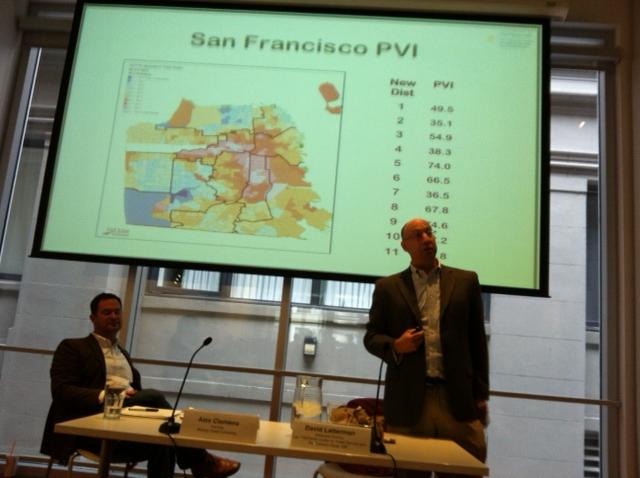
“You had a lot of consensus in the city about these ballot measures,” political consultant David Latterman, who usually works with downtown-backed campaigns, said at SPUR’s post-election round-up.

The supervisorial races were a different story, with unprecedented spending and nasty messaging aimed at tipping the balance in favor of real estate and development interests. Mayor Lee didn’t get directly involved in the District 1 race, but he was clearly not a supporter of incumbent Sup. Eric Mar.

The real-estate and tech folks who are allied with Lee spent more than $800,000 trying to oust Mar — and they failed miserably, with Mar winning by 15 points. While Mar did have the backing of Chinatown powerbroker Rose Pak, who raised money and helped organize ground troops to help, Mar’s victory was primarily the result of a massive outpouring of support from labor and progressive activists, many reacting to the over-the-top effort to oust him.

Mar, who voted to put Lee in office, won’t feel a bit indebted to the mayor for his survival against a huge money onslaught. But in District 5, the story was a whole lot more complicated, and impact more difficult to discern.

THE D5 MESS

Before we get into what happened in D5, let’s dispel some of the simplistic and self-serving stories that circulated in the wake of this election, the most prominent being that Olague’s loss -– the first time an incumbent was defeated in a ranked-choice election –- was payback for crossing Mayor Lee and voting to reinstatement Sheriff Ross Mirkarimi.

It’s certainly true that Lee’s allies went after Olague and supported London Breed, and that they tried to make an issue of domestic violence, but there was much, much more to this district election. Breed is an SF native with a compelling personal story who ran a strong campaign –- and that three strongest progressive candidates in the race each had major flaws that hurt their electability. By most accounts, the Olague campaign was a disaster until the very end. Equally important, the progressive community was divided over D5, leaving room for Breed to slip in.

“It’s hard to unravel what happened here,” Latterman said.

San Francisco Women for Responsibility and an Accountable Supervisor was an independent expenditure group fronted by domestic violence advocates and funded by more than $100,000 from the families of Conway and fellow right-wing billionaire Thomas Coates. It attacked Olague’s Mirkarimi vote as being soft on domestic violence — but it also did a last minute mailer criticizing Olague’s vote for CleanPowerSF, muddling its message of moral outrage.

On election night, Olague told us she believed her split with the Mayor’s Office really had more to do with CleanPowerSF –- which the board approved with a veto-proof majority over the objections of Lee and the business community –- and with her insisting on new revenue from Prop. E than it did with Mirkarimi, whose ouster she dismissed as “a power play” aimed at weakening progressives.

“They don’t want to say it, but it was the whole thing around CleanPowerSF. Do you think PG&E wanted to lose its monopoly?” she said.

Yet Olague said the blame from her loss was also shared by progressives, who were hard on her for supporting Lee, courting his appointment to the D5 seat, and for voting with him on 8 Washington luxury condo project and other high-profile issues. “The left and the right both came at me,” she told us. “From the beginning, people were hypercritical of me in ways that might not be completely fair.”

Fair or not, Olague’s divided loyalties hurt her campaign for the D5 seat, with most prominent progressives only getting behind her at the end of the race after concluding that John Rizzo’s lackluster campaign wasn’t going anywhere, and that Julian Davis, marred as he was by his mishandling of sexual impropriety accusations, couldn’t and shouldn’t win.

Olague told us she “can’t think of anything I would have done differently.” But she later mentioned that she should have raised the threats to renters earlier, worked more closely with other progressive candidates, and relied on grassroots activists more than political consultants connected to the Mayor’s Office.

“The left shouldn’t deal with consultants, we should use steering committees to drive the agenda,” Olague said, noting that her campaign finally found its footing in just the last couple weeks of the race.

Inside sources say Olague’s relations with Lee-connected campaign consultant Enrique Pearce soured months before the campaign finally sidelined him in the final weeks, the result of his wasteful spending on ineffective strategies and divided loyalties once a wedge began to develop between Olague and the Mayor’s Office.

Progressive endorsements were all over the map in the district: The Harvey Milk Club endorsed Davis then declined to withdraw that endorsement. The Tenants Union wasn’t with Olague. The Guardian endorsed Rizzo number one. And none of the leading progressive candidates had a credible ranked-choice voting strategy — Breed got nearly as many second-place votes from Davis and Rizzo supporters as Olague did.

Meanwhile, Breed had a high-profile falling out with Brown, her one-time political ally, after her profanity-laden criticism of Brown appeared in Fog City Journal and then the San Francisco Chronicle, causing US Sen. Dianne Feinstein to withdraw her endorsement of Breed. That incident and Olague’s ties to Lee, Brown, and Pak may have solidified perceptions of Breed’s independence among even progressive voters, which the late attacks on her support from landlords weren’t ever able to overcome.

Ironically, while Breed and some of her prominent supporters, including African American ministers in the district, weren’t happy when Lee bypassed her to appoint Olague, that may have been her key to victory. Latterman noted that while Olague was plagued by having to divide loyalties between Lee and her progressive district and make votes on tough issues like reinstating Mirkarimi –- a vote that could hurt the D5 supervisor in either direction -– Breed was free to run her race and reinforce her independence: “I think Supervisor Breed doesn’t win this race; challenger Breed did.”

But even if Breed lives up to progressive fears, the balance of power on the Board of Supervisors could be up in the air. District 7 soundly rejected Mike Garcia, the hand-picked successor of the conservative outgoing Sup. Sean Elsbernd.

At press time, progressive favorite Norman Yee seemed headed for victory, although FX Crowley was within about 30 votes, making this too close to call. But either way, the once-solid conservative seat will now be a swing vote on many issues, just as Breed will be in the once-solid progressive D5.

“The Board of Supervisors as a whole is becoming a helluva lot more interesting,” was how political consultant Alex Clemens put it at SPUR election wrap-up. “Determining what’s going to happen before it happens just got more difficult.”

GOBS OF MONEY

The other big story of this election was money, gobs of it, and how it can be spent effectively — or used to raise suspicions about hidden agendas.

Third-party spending on D1 loser David Lee’s behalf was $454,921, with another $219,039 to oppose Mar, pushing total spending to defeat Mar up over the $1 million mark, roughly doubling the previous record. Labor groups, meanwhile, spent $72,739 attacking Lee and $91,690 backing Mar. But many political analysts felt that lop-sided spending only served to turn off voters and reinforce the idea that powerful interests were trying to buy the seat.

In District 5, the landlords, Realtors, and tech moguls spent $177,556 in support of Breed, while labor spent $15,067 attacking her as a shill for the landlord lobby. The only other D5 candidate to attract significant spending by outside groups was Olague, who had $104,016 spent against her, mostly by the families of Conway and Coates, and $45,708 spent in support of her by SEIU 1021. Yet ultimately, none of these groups bought very much with their money. Conway, Salesforce CEO Marc Benioff, and San Francisco Association of Realtors each spent hundreds of thousands of dollars of their money, and the most obvious result was to convince San Franciscans that they’re working together to move an agenda in San Francisco. They may have the mayor on their side, but in a politically sophisticated city like San Francisco –- with its cost of living being driven up by the schemes of Lee, Conway, and the Realtors -– they seem to have a long way to go before they achieve they’re stated desire of destroying the progressive movement, particularly with its rising new leaders on the left, including Matt Haney and Sandra Fewer on the school board and Steven Ngo and Rafael Mandelman on the City College board. As Haney said on Election Night, “It was a good night for progressive San Francisco,” which stands for important egalitarian values. “We are the ones about equity and compassion. That’s what this city is about.”

Voters affirm progressive leadership at City College

5

San Francisco voters this week reinforced their support for progressive leadership at City College, re-electing incumbents Steve Ngo and Chris Jackson (assuming Jackson’s 549-vote margin over Amy Bacharach holds), and bringing newcomer Rafael Mandelman into the fold during a period where the school will make drastic, transformative changes. 

At the same time, voters rejected a monied, politically connected, fiscally conservative board member, Rodrigo Santos, who was appointed by Mayor Ed Lee in August to fill the vacancy created by Milton Marks’ death. Longtime board member Natalie Berg was also re-elected, likely buoyed by her decades of incumbency, but finishing third behind the more-progressive Ngo and Mandelman.

As the college airs all of its dirty laundry, showing its worst practices to the world, San Francisco voters also showed faith that the college could spend money wisely in the future: they passed Proposition A with more than 72 percent of the vote, delivering $14 million a year in parcel taxes, for the next eight years, to the money-starved institution.

The lack of money means more than just numbers on a page — real classes will be cut, real campuses are already being closed, and the diverse communities the colleges serve will either be given smaller portions, or excused from the dinner table entirely.

Rejecting politicians that represent these kind of austerity measures, Santos was one of the casualties of this voters’ swing away from conservative politicians (despite what Chuck Nevius may think).

Santos, who head the pro-development Coalition for Responsible Growth, had all the odds stacked in his favor: he was an incumbent appointed by the mayor himself, and had a huge  campaign war chest. He raised $192,000 for his college board race, an unheard of for a local college board member.

 It did nothing for him: ultimately, Santos got slightly more than half the votes of candidates with as little as $30,000 in their campaign chests. By voting in mostly progressive candidates, and overwhelmingly reaffirming Prop. A, San Francisco has said loud and clear: they want the college to protect education in their individual communities, and for the college to maintain as many classes as possible, despite cuts urged by lack of state funds.

Steve Ngo and Chris Jackson earned their progressive bona fides in pushing forward the “Placement Plus One” program, a policy giving students taking placement tests the ability to “bump up” a class higher than they placed. Students, mainly from the local nonprofit Coleman Advocates, complained that placement tests were disproportionately unfavorable to minorities.

The consequences for placing low in math or English are huge — a student placing in a rudimentary English class could delay transferring to a four year school by years. Ngo and Jackson fought for a student’s right to decide their own futures, and importantly, fought for minority students who were falling behind.

But don’t think that just because Ngo is progressive, that he isn’t afraid to make the cuts he feels he needs to make. He notably did not support his colleagues on the board as they voted to reject the Student Success Task Force, which advocated for lowering class registration prioirty for students who took too long to get out of community colleges statewide, accruing over 100 credit units.

Mandelman as well is a figure whose professional, calm demeanor lends himself to a new progressive movement. He may have lost his past bid for supervisor of District 8, but as Chris Daly noted, Mandelman is a consensus builder with the backing of many groups and associations in San Francisco. The same was true of his City College bid, and likely why he won.

The college desperately needs someone like him that can build unity right now. The school, highly politicized and villainized in the media, needs allies. With Mandelman and his calm demeanor on the new progressive bloc on the board and a clear strong mandate from the city to back up classes with millions of dollars in taxes, there is now hope that the changes at City College may not only be transformative, but serving its diverse community through solid progressive values.

What the fuck, Chuck: No, Ed Lee is not God

76

So who were the big winners in the election? You could argue Ron Conway; you could argue surprise D5 winner London Breed. But to say it was all about Ed Lee?

Actually, no.

Every one of the initiatives that Lee backed was also supported by the entire progressive leadership on the board and almost every progressive group in the city, and other than Prop. B, there was little in the way of funded or credible opposition. The Yes on C campaign was run by the affordable housing folks, not the mayor. The mayor didn’t even endorse Prop. A, the City College parcel tax, until late in the game.

Oh, and the mayor’s appointee to the Community College Board? Got clobbered. The guy the mayor wanted in District 7? Out of the running.

The real story here — aside from the supervisors races, where I don’t think any one operation or political alliance won overall — was the remarkable civic consensus on the ballot measures. If Ed Lee had been out of town all fall, they all still would have won.

I know Chuck thinks the mayor is the greatest ever, but in this case, his impact was at best a wash.


Election makes the Board of Supervisors tougher to predict

20

I’m still a bit too bleary-eyed for serious political analysis on D5 or other races today, but I’ll offer a few of my own post-election observations and those that politicos Alex Clemens and David Latterman delivered during their usual political wrap-up at the SPUR office this afternoon, noting how this election has altered local political dynamics.

“The Board of Supervisors as a whole is becoming a helluva lot more interesting,” Clemens said, noting that progressive District 5 just elected London Breed, the most moderate candidate in that race, while conservative District 7 gave the most progressive candidates, Norman Yee and FX Crowley, its top two spots (with Crowley the likely winner once ranked choices ballots are tallied).

The result is that both the progressive and moderate blocs lost their most reliable votes to the squishy center, so that “determining what’s going to happen before it happens just got more difficult,” a dynamic that could play out most strongly on land use issues.

“I think land use politics is going to be even more interesting,” Clemens said, with Latterman adding, “In this city, all politics really comes down to land use.”

Assessor Phil Ting’s election to the Assembly also now paves the way for Mayor Ed Lee to appoint his replacement, with Sup. Carmen Chu widely considered the clear favorite, which would in turn give Lee an appointment to her District 4 seat on the board.

Yet Clemens speculated that Lee may wait to replace Chu until after the next Board of Supervisors is seated in early January – which would allow that person to finish her final two years and still run for an additional two full terms, whereas the Charter would otherwise limit that person to one more term – which could complicate an already complicated election for board president. Sups. Jane Kim and Scott Wiener are the likeliest contenders, but anything could happen.

“Counting to six from 10 is going to be so much fun to watch,” Clemens said, although he added, “I believe in the era of Ed Lee, it’ll all be worked out beforehand.”

Neither Clemens nor Latterman agreed that the overwhelming expenditures on political hit pieces (mostly against D1 Sup. Eric Mar, who won a surprisingly big margin of victory) by allies of Lee, or the fact that they turned on Sup. Christina Olague in nasty fashion, would diminish Lee’s public standing or the aura of civility he’s tried to cultivate.

Personally, I don’t agree, and it think progressives have been given an opportunity to highlight the money-driven nature of the agenda that Lee and his billionaire backer Ron Conway have for San Francisco. It’s also significant that the most anti-progressive candidates – Lee’s City College appointee Rodrigo Santos, D1’s David Lee, and D7’s Mike Garcia – all fell far short of victory.

Progressives now have a chance to set a positive, proactive agenda for the city, of the kind eloquently voiced by new school board member Matt Haney, whom Clemens thanked for running such a strong and positive campaign, as well as top City College finisher Steve Ngo and Sup. David Campos, who shared an election night campaign party and positive message about progressive prospects.

“That’s what me, Steve, and David were saying here tonight,” Haney told me, calling for an end to the adversarial style of practicing politics. “Our values are love and compassion.”

Latterman and Clemens did acknowledge that that record-breaking spending against Mar may have backfired, but they gave more credit to Mar’s campaign. “You don’t bet against [Mar campaign manager] Nicole Derse in a ground game in the last week of the campaign,” Latterman said.

Derse, who was there, noted its innovative voter identification efforts and strong grassroots volunteer push, a drive partially helped by those reacting to the big-money attacks. Latterman also acknowledges that the strange and controversial videos attacking Mar didn’t help, telling the crowd, “And tactically, don’t have the Realtors make the videos.”

As for District 5, neither politico claimed to fully understand the complex variables that shaped the race.

“It’s hard to unravel what happened here,” Latterman said of the D5 race, noting the complicated dynamics created by Olague’s mayoral appointment, her vote to reinstate Sheriff Ross Mirkarimi, Julian Davis’ problems, and the outside spending. He praised Breed’s campaign, calling it a “a solid win,” but he also said Breed’s independence helped her and she might have suffered the same fate as Olague if she had gotten the appointment from Lee back in January: “I think Supervisor Breed doesn’t win this race; challenger Breed did.”

Matt Haney jumping for joy over school board results

1

At a party at the Brick and Mortar club in the Mission — a combined celebration for David Campos, Matt Haney, and Steve Ngo —  school board nominee Matt Haney currently stands at 13.29% of the vote, enough to get him on the board. And he was jumping up and down with delight when he saw the numbers were turning in his favor.

After he calmed down (a bit) he talked to us about the teachers union boycotting endorsements for sitting members of the board. “For me, it was never a negative dynamic. I got along with everyone on the board, and I respect the teachers union and what they do.

“They just want better education here in San Francisco, and I’m going to try my best to help with that.”

I talked to David Campos about Measure C, the affordable housing trust fund proposal. “I’m very excited, I always knew that we needed a secure source for affordable housing. It’s not fully what we need, but it’s going in the right direction.”

He went on to say that we shouldn’t settle for less and when it comes to these measures, “the devil is in the details.”

Campos was also happy for Haney: “Matt ran a strong campaign, and I personally think his voice is needed on the board.”

Haney said about winning, “I’m very excited. I have a job where I am responsible to the youth and students. I couldn’t wish for a more humbling position.”

he said about his campaign, “It was tough today, because a lot of people didn’t make their decision until the end, so it’s hard to assess where you stand. But we had a grassroots campaign that went door to door, and that may have been the difference.”

Steve Ngo, who was the top finisher in his reelection to the City College of San Francisco Board of Trustees, talked to us about his priority, now that he’s serving again: “To save City College. To do that we have to stick to the plan we put together in September. To reassure the opportunities for our students.” 


Rep Clock

0

Schedules are for Wed/7-Tue/13 except where noted. Director and year are given when available. Double and triple features marked with a •. All times pm unless otherwise specified.

ARTISTS’ TELEVISION ACCESS 992 Valencia, SF; www.atasite.org. $6-10. “Bruised Jewels: Films and Slide Works by Luther Price,” Thu, 7:30. With Price in person; presented by SF Cinematheque. “Bright Mirror: An Evening of Sound and Image,” with Jeff Surak, Sylvia Schedelbauer, Jefre Cantu-Ledesma, and Paul Clipson, Fri, 8. “Other Cinema:” “Live A/V” with works by Lori Varga, Kerry Laitala, Anne McGuire, and more, Sat, 8:30. “Small Press Traffic: A Reading and Conversation with kathryn l. pringle, Erin Moure, and Andrea Rexilius,” Sun, 5. “Alain LeTourneau and Pam Minty: Empty Quarter,” Sun, 7:30. With LeTourneau and Minty in person; presented by SF Cinematheque.

BALBOA 3630 Balboa, SF; www.cinemasf.com. $10. The Doors: Live at the Bowl ’68, Thu, 8.

CASTRO 429 Castro, SF; (415) 621-6120, www.castrotheatre.com. $8.50-11. •The Game (Fincher, 1997), Wed, 1:30, 7, and Zodiac (Fincher, 2007), Wed, 4, 9:25. “An Evening with Ken Burns:” The Dust Bowl (2012), Thu, 7:30. Advance tickets ($12-18) at www.cityboxoffice.com. “Forever Natalie Wood:” •Rebel Without a Cause (Ray, 1955), Fri, 2:30, 7, and This Property is Condemned (Pollack, 1966), Fri, 4:45, 9:15; •Gypsy (LeRoy, 1962), Sat, noon, and Love With the Proper Stranger (Mulligan, 1963), Sat, 3; Splendor in the Grass (Kazan, 1961), centerpiece event with Natalie Wood’s sister, Lana Wood, in person, Sat, 7:30; West Side Story (Robbins and Wise, 1961), presented sing-along style (this event, $10-15), Sun, 2; •Bob & Carol & Ted & Alice (Mazursky, 1969), Sun, 7, and Inside Daisy Clover (Mulligan, 1965), Sun, 9:05. •Lawless (Hillcoat, 2012), Tue, 7, and Killer Joe (Friedkin, 2011), Tue, 9:10.

CHRISTOPHER B. SMITH RAFAEL FILM CENTER 1118 Fourth St, San Rafael; (415) 454-1222, www.cafilm.org. $6.75-$10.25. All Together (Robelin, 2011), Wed-Thu, call for times. A Liar’s Autobiography: The Untrue Story of Monty Python’s Graham Chapman (Jones, Simpson, and Timlett, 2012), call for dates and times. The Other Son (Lévy, 2012), call for dates and times. “Johnny Legend’s TV in Acidland, Thu, 7 and Sun, 2. A Late Quartet (Zilberman, 2012), Nov 9-15, call for times. Sister (Meier, 2012), Nov 9-15, call for times. The Welcome (McMillan, 2011), Sun, 7. With Bill McMillan in person.

COUNTERPULSE 1310 Mission, SF; www.sftff.org. $12-15. San Francisco Transgender Film Festival: “Performance Extravaganza,” Thu, 8; films, Fri-Sat, 8; Sun, 7.

EMBARCADERO One Embarcadero Center, SF; www.sffs.org. $12-25. “New Italian Cinema:” “An Evening with Valeria Golino,” Sun, 5:30; Texas (Paravidino, 2005), Sun, 9; A Tale of Love (Maselli, 1986), Mon, 6:15; Respiro (Crialese, 2002); The Greatest of Them All (Virzi, 2011), Tue, 6:15; Kryptonite! (Cotroneo, 2011), Tue, 9. Series continues through Nov. 18.

FIRST UNITARIAN CHURCH OF SAN FRANCISCO 1187 Franklin, SF; www.billviola.com. $50-125. “Transformation from Within,” with video art pioneer Bill Viola and curator John Walsh, Fri, 7:30.

“NAPA VALLEY FILM FESTIVAL” Various North Bay venues; www.napavalleyfilmfest.org. First-run films and documentaries, plus tributes to Alan Cumming, James Marsden, and more, Wed-Sun.

NEW PEOPLE CINEMA 1746 Post, SF; www.sffs.org. $12-25. “Cinema By the Bay:” Trattoria (Wolos, 2012), Fri, 7 and 9:30; Casablanca mon amour (Slattery, 2012), Sat, 2:30; “Essential SF,” Sat, 5 (free admission); Jason Becker: Not Dead Yet (Vile, 2012), Sat, 7; Amity (Adams, 2012), Sat, 9:30; “Moving Image at the End of the World: Shorts from Headlands Center for the Arts,” Sun, 2; “A Conversation with Lucy Gray,” Sun, 4:15; The Revolutionary Optimists (Grainger-Monsen and Newnham, work in progress), Sun, 6; CXL (Gillane, 2011), Sun, 8:30.

PACIFIC FILM ARCHIVE 2575 Bancroft, Berk; (510) 642-5249, bampfa.berkeley.edu. $5.50-9.50. “Alternative Visions:” “The Films of John Smith,” Wed, 7. “Afterimage: The Films of Kidlat Tahimik, Indigenous:” Who Invented the Yoyo? Who Invented the Moon Buggy? (1979), Thu, 7; Perfumed Nightmare (1977), Tue, 7. “Grand Illusions: French Cinema Classics, 1928-1960:” Children of Paradise (Carné, 1945), Fri, 7; Grand Illusion (Renoir, 1937), Sat, 6:30; The Story of a Cheat (Guitry, 1936), Sat, 8:45; Toni (Renoir, 1934), Sun, 2. “Art for Human Rights: Ai Weiwei:” Ai Weiwei: Never Sorry (Klayman, 2012), Sun, 4:30.

ROXIE 3117 and 3125 16th St, SF; (415) 863-1087, www.roxie.com. $6.50-11. Bigfoot: The Lost Coast Tapes (Grant, 2012), Wed, 9:30; Thu, 9. Kiss Kiss Bang Bang (Black, 2005), Wed, 7:15. The Magnificent Pigtail Shadow (Cerio, 2012), Wed, 7:15. Miami Connection (Kim, 1986), Wed, 6:45. The Waiting Room (Nicks, 2012), Thu, 7. “City College’s Second Annual Festival of the Moving Image,” Thu, 7 and 9. San Francisco Documentary Film Festival, Nov 9-21. Visit www.sfindie.com for complete schedule.

VICTORIA 2961 16th St, SF; www.sfcult.org. $10. •Slaughter in San Francisco (Wei, 1974), Fri, 7, and The Warriors (Hill, 1979), Fri, 9.

YERBA BUENA CENTER FOR THE ARTS 701 Mission, SF; www.ybca.org. $10. “Animating Dark Dreams: The Films of Jan Svankmajer:” Alice (1989), Thu, 7:30; Lunacy (2006), Sun, 2; Little Otik (2000), Sun, 4:30. “Constancy of Change: Films of John Smith,” Fri, 7:30.

Listen to the comic! Save CCSF, vote yes on Prop A

10

San Franciscans were bummed when, this summer, it looked for a second like we’d lose our only community college. And we weren’t the only ones who would have been affected — City College of San Francisco isn’t just the biggest school in the city, it’s the biggest school in the entire state, providing vital job training, family development classes, continuing education, and a springboard into four-year university for undergrads. 

The folks at Mission Mini-Comix sent us this comic stating the case for Prop A, which would ensure that CCSF gets the funds it needs to keep educating us. (You can check it out in its full glory on their website, or snag one of the free mini-books they’ve been handing out around town.

>>PRINT OUT OUR QUICK ‘N’ GUIDE TO THE CITY, STATE, AND NATIONAL RACES

>>READ UP ON THE FULL GUARDIAN ENDORSEMENTS 

Here’s the skinny on the panels, from Mini-Comix artist Rio Roth-Barreiro (who won an all-ages Guardian comics contest when he was younger — says mom Robin Roth the recognition “got him started on this path!”): 

So, this is another comic that attempts to tackle local San Francisco issues. We do tend to do this every couple years or so, with mixed results, but we’re normally drawing a comic against whatever legislation is being voted on. In this case, we’re happy to do a comic supporting Proposition A and City College of San Francisco.

City College is a very personal issue for me. Not only are my mom and god-cousin teachers there, but I got my AA degree and most of my job skills training there which did end up setting me up well with a career in the tech industry (newsflash, cartooning doesn’t really pay the bills) and I’d like to see every young person in this city, county and larger bay area have access to the same opportunity and resources I did. This goes to the larger issue of where our priorities are in this country, with trillions being spent on our military, foreign wars and tax cuts for the rich while schools at home are literally falling apart (both physically and financially). Even in the liberal “hotbed” of San Francisco, we’re seeing the same tired arguments that are being trotted out all over the country to justify the systematic dismantling of public education.

“Teacher’s are getting paid too much!” “It’s all the Teacher’s Unions’ fault!” I see this sentiment getting echoed with infuriating regularlity in the Chronicle and in online news sources such as SFGate, but it doesn’t really mesh with the actual facts of life for City’s teachers, who have seen their classes double in size (twice the work) with many not having seen a raise in 5+ years. Having California cut money to education every year isn’t helping things. CCSF is being starved for funds and then the fact that they can’t meet their budget is being used as an excuse to take away their accreditation and/or close them down. Teachers are being painted as being greedy when every year they are getting less and having to work more.

Meanwhile, crushing education is going to have long term negative impact on local and national economies as our schools prepare less kids with the skills they need for technical and skilled jobs. People getting paid less means there will be even less government income to pay for things in the next budget and having a less skilled workforce will only lead to more jobs getting outsourced to India and China. It’s a vicious cycle pulling our economy down the drain, but some can’t see beyond the latest budget or the need to invest in our (and our children’s) future.

Proposition A on the San Francisco ballot and Proposition 30 on California’s ballot both seek to raise funds and prioritize education and I hope y’all be voting for them. And if you aren’t registered to vote yet, go get yourself registered, son! California now has online registration so you can be ready to stand by our schools and CCSF’s mission statement for a affordable and high quality education to be available for all. Registration deadline is October 22nd and voting is on November 6th

Oh yeah, I almost forgot our own accreditations, but this comic was written by me with a lot of help and input from Robin Roth, Leslie Simon and Amber Straus (and my wife Beth came up with the subtitle) and was drawn by me, Mike, Audrey and Justin.


Man for the moment?

25

steve@sfbg.com

This year’s supervisorial race in District 5 — representing the Haight, Panhandle, and Western Addition, some of the most reliably progressive precincts in the city — has been frustrating for local leftists. But as the long and turbulent campaign enters its final week, some are speculating that John Rizzo, whose politics are solid and campaign lackluster, could be well-positioned to capitalize on this strange political moment.

Appointed incumbent Sup. Christina Olague has been a disappointment to some of her longtime progressive allies, although she’s now enjoying a resurgence of support on the left in the wake of her vote to reinstate Sheriff Ross Mirkarimi. Now two allies of the mayor — tech titan Ron Conway and landlord Thomas Coates — are funding a $120,000 last-minute attack on Olague.

The campaign of one-time left favorite Julian Davis lost most of its progressive supporters following his recent mishandling of accusations of bad behavior toward women (see “Julian Davis should drop out,” 10/16).

The biggest fear among progressive leaders is that London Breed, a well-funded moderate candidate being strongly supported by real estate and other powerful interests, will win the race and tip the Board of Supervisors to the right. The final leg of the campaign could be nasty battle between Breed and Olague and their supporters, who tend to see it as a two-person race at this point.

But in a divisive political climate fed by the Mirkarimi and Davis scandals and the unprecedented flood of hundreds of thousands of dollars in real estate and tech money, it’s hard to say what D5 voters will do, particularly given the unpredictably of how they will use ranked-choice voting to sort through this mess.

Running just behind these three tarnished and targeted candidates in terms of money and endorsements are Rizzo and small business person Thea Selby, who described their candidacies as “the grown-ups in the room, so there’s an opportunity there and I’m hopeful.”

Selby hasn’t held elective office and doesn’t have same name-recognition and progressive history as Rizzo, although she has one of the Guardian’s endorsements. It probably didn’t help win progressive confidence when the downtown-backed Alliance for Jobs and Sustainable Growth recently did an independent expenditure on behalf of both Selby and Breed.

And then there’s Rizzo, who has been like the tortoise in this race, quietly spending his days on the streets meeting voters. Between fundraising and public financing, Rizzo collected about $65,000 as of Oct. 20 (compared to Breed’s nearly $250,000), but he’s been smart and frugal with it and has almost $20,000 in the bank for the final stretch, more than either Olague or Davis.

But perhaps more important than money or retail politics, if indeed D5 voters continue their strongly progressive voting trends, are two key facts: Rizzo is the most clear and consistent longtime progressive activist in the race — and he’s a nice, dependable guy who lacks the oversized ego of many of this city’s leaders.

“I see consistency there and a lack of drama,” Assembly member Tom Ammiano, an early Rizzo endorser, told us. “He’s looking not like a flip-flopper, not like he owes anyone, and he doesn’t have a storied past.”


PROGRESSIVE HISTORY

Rizzo, who was born in New York City 54 years ago, is downright boring by San Francisco standards, particularly given his long history in a local progressive movement known for producing fiery warriors like Chris Daly, shrewd strategists like Aaron Peskin, colorful commenters like Ammiano, bohemian thinkers like Matt Gonzalez, and flawed idealists like Ross Mirkarimi.

Rizzo is a soft-spoken family man who has lived in the same building on Waller Street in the Haight-Ashbury for the last 27 years. Originally, he and Christine, his wife of 25 years, rented their apartment in a tenancy-in-common building before they bought it in the early 1990s, although he’s quick to add, “In all the years we’ve owned it, we never applied for condoship.”

He supports the city’s limits on condo conversions as important to protecting working-class housing, although he said, “The focus should be on building new affordable housing.” That’s an issue Rizzo has worked on since joining the Sierra Club’s San Francisco Bay Chapter more than 20 years ago, an early advocate for broadening the chapter’s view of environmentalism.

He’s a Muni rider who hasn’t owned a car since 1987.

Michelle Myers, director of the Sierra Club’s San Francisco Bay Chapter, said Rizzo brings a wealth of experience, established relationships, and shrewd judgment to his role as the group’s political chair. “We really rely on John’s ability to weigh what is politically feasible, not just what’s ideal in our minds,” she told us.

Yet that political realism shouldn’t be confused for a lack of willingness to fight for big, important goals. Rizzo has been an advocate for public power in San Francisco for many years, strategizing with then-Sup. Ammiano in 2001 to implement a community choice aggregation program, efforts that led to this year’s historic passage of the CleanPowerSF program (with a key vote of support by Olague) over the objections of Mayor Lee and some business leaders.

“CleanPowerSF was carried by John Rizzo, who has been working on that issue for 10 years,” Myers said.

Rizzo is a technology writer, working for prospering computer magazines in the 1990s “until they all went away with the dot.com bubble,” as well as books (his 14th book, Mountain Lion Server for Dummies, comes out soon).

He sees the “positives and the negatives” of the last tech boom and this one, focusing on solving problems like the Google and Genetech buses blocking traffic or Muni bus stops. “On the one hand, these people aren’t driving, but on the other hand, they’re unregulated and using our bus stops,” he said. “We need to find some solution to accommodate them. Charge them for it, but accommodate them.”

That’s typical of how Rizzo approaches issues, wanting to work with people to find solutions. As president of the City College of San Francisco Board of Trustees, Rizzo suffered the bad timing of the district having its accreditation threatened just as his supervisorial race was getting underway, but he’s steadily worked through the administrative problems that predated his tenure, starting with the criminal antics of former Chancellor Phil Day and continuing with “a management structure still in place, and it had calcified.”

Despite being on the campaign trail, Rizzo called the trustees together six times in August to deal with the accreditation problems. “We now have a plan that shows all the things the district needs to do to keep it afloat. City College is back on track.”


WEAKNESS BECOMES STRENGTH

Eileen Hansen — a longtime progressive activist, former D8 supervisorial candidate, and former Ethics Commissioner — gave her early endorsement to Rizzo, who never really seemed to catch fire. “There hasn’t been a lot of flash and I would love for there to be more energy,” she admitted.

So, like many progressive leaders, she later offered her endorsement to Davis, believing he had the energy needed to win the race. But after Davis’ problems, Hansen withdrew that endorsement and sees Rizzo as the antidote to its problems.

“We are in such a mess in D5, and I’m hoping they will say, ‘enough already, let’s find someone who’s just good on the issues, and that’s John,” Hansen said. “As a progressive, if you look at his stands over many years, I’d be hard-pressed to find an issue I don’t agree with him on. He’s a consistent, strong progressive voice, someone you can count on who’s not aligned with some power base.”

Other prominent progressive leaders agree.

“What some people may have viewed as his weak point may end up being his strength,” said former Board President Aaron Peskin, who endorsed Rizzo after the problems surfaced with Davis. “A calm, steady, cool, collected, dispassionate progressive may actually be the right thing for this moment.”

Sup. Malia Cohen, a likable candidate who rose from fourth place on election night to win a heated District 10 supervisorial race two years ago, is a testament to how ranked-choice voting opens up lots of new possibilities.

“Ranked choice voting defies conventional wisdom,” Peskin said. “There may be Julian Davis supporters and Christina Olague supporters and London Breed supporters who all place John Rizzo as their second.”

In fact, during our endorsement interviews and in a number of debates and campaign events, nearly every candidate in the race mentioned Rizzo as a good second choice.

Yet Rizzo doesn’t mince words when he talks about the need for reconstitute the progressive movement after the deceptions and big-money interests that brought Mayor Lee and “his fake age of civility” to power. Lee promised not to seek a full term “and he broke the deal,” Rizzo said. “And it was a public deal he broke, not some backroom deal.” 

That betrayal and the money-driven politics that Lee ushered in, combined with the divisive political climate that Lee’s long effort to remove Mirkarimi from office created, has deeply damaged the city’s political system. “I think the climate is very bad It’s bad for progressives, and just bad for politics because it’s turning voters off,” Rizzo said.

He wants to find ways to empower average San Franciscans and get them engaged with helping shape the city’s future.

“We need a new strategy. We need to regroup and think about things long and hard. I think it’s not working here. We’re doing the same things and it’s not working out. The money is winning.” He doesn’t think the answers lie in continued conflict, or with any individual politicians “because people are flawed, everyone is,” Rizzo said.

Yet Rizzo’s main flaw in the rough-and-tumble world of political campaigns may be that he’s too nice, too reluctant to toot his horn or beat his chest. “That kind of style is not me. That aggressive person is not who I am,” Rizzo said. “But I think voters like that. Voters do want someone who is going to focus on policy and not themselves.”

Profiling those who rely on HANC, which the city is evicting (VIDEO)

6

The Haight Ashbury Neighborhood Council’s (HANC) Recycling Center has fought for the past decade to stay in its tiny corner of Golden Gate Park, behind Kezar stadium, and it may be days from closing. It’s been served with eviction notices from the city and weathered political tirades from politicians on pulpits, and most recently, saw its eviction appeal denied by California’s Supreme Court.

The recycling center, which has been in operation since 1974, wouldn’t be the only loss to the Haight either. Both a community garden and San Francisco native plant nursery are on the site, under the umbrella name of Kezar Gardens. After an eviction for the recycling center, all three would go.

So in what may be their last days, the Guardian decided to take a look at  who is a part of the recycling center’s community. What keeps them coming back – even in the face of eviction? While the final eviction date is nebulous, the reasons for it are not: as the Haight gentrified, more and more neighbors complained about the site’s surrounding homeless population, the noise the recycling center makes, and every other NIMBY complaint in the book.

Contrary to the usual complaints of the recycling center and gardens attracting numerous homeless people, the people detailed in the stories below reflect a diverse community. And there were far more stories that we didn’t include: the busy head of a nonprofit who gardens to keep his sanity, or the two brothers who bring in their recyclables every week as a way for their parents to teach them responsibility. And they’re not the only people who depend on the recycling center and gardens.

“One of the problems [with evicting HANC] is that the small businesses in the area depend on the service of the center,” Sup. Christina Olague, who representing the area, told us. “We don’t want to see it relocated out of the area.”

Olague said that although ideas for a mobile recycling center or a relocation have been batted around, nothing is concrete yet. The Mayor’s Office, the Recreations and Parks Department, and HANC were all going to have more meetings and try to come to a solution that would benefit all sides, she said.

The recycling center and gardens aren’t going down without their supporters making a clamor. They developed a feature documentary about their struggles, titled 780 Frederick. Directed by Soumyaa Kapil Behrens, the film will play at the San Francisco International Film Festivals “Doc Fest” on Nov. 11.

Until then, here’s a glimpse at some of the people who make up the community at the HANC Recycling Center and Kezar Gardens.


Greg Gaar, Native Plant Nursery Caretaker

Longtime groundskeeper and recycling guru Greg Gaar will soon be out of a job, only a year after single-handedly starting a native plant nursery in the Haight Ashbury that serves more than 100 people.

Gaar is the caretaker of the Kezar Garden nursery. He raises Dune Tansy, Beach Sagewort, Coast Buckwheat and Bush Monkey –  all plants originally born and bred from the dunes of old San Francisco.

“I do it because I worship nature, to me that’s god,” Gaar said. He spoke of the plants reverently.

The native plants aren’t as bombastically colorful as the rest of Golden Gate Park, he said, which Gaar calls “European pleasure gardens,” but they’re hearty and durable, like Gaar himself.

Gaar has a weathered face from years of working in the open air, and he grinned large as he talked about his plants. His grey beard comes down a few inches, giving him the look of a spry Santa Claus. Gaar has a history of embracing the counterculture, much like the Haight itself. In 1977, he made his first foray into activism.

At the time, wealthy developers in the city wanted to develop buildings and houses on Tank Hill, one of the few remaining lands of San Francisco with native growth. “Two percent of the city right now has native plants,” he said. It’s a travesty to him, but he did his part to prevent it.

Gaar led the charge against the redevelopers by putting up posters and flyers, and fighting them tooth and nail for the land through old fashioned San Francisco rallying.

In the end, the counterculture activists won, and the city of San Francisco bought the land back from the developers, keeping it for the public trust. The long-ago battle over Tank Hill was a victory, but the fight for the Haight Ashbury Recycling Center may already be lost.

Gaar has deep ties to the recycling center. Among his friends are two ravens, Bobbie and Regina, who recognize Gaar since the first time he fed them 16 years ago. Occasionally, he says, they’ll accompany him on his rounds around the park. The ravens aren’t the only friends he’s made through the recycling center.

They have many patrons looking to make a few bucks off of cans and bottles, many of which are poverty-struck or homeless. Gaar darkened as he spoke of them, because over the years he has lost many friends he’s made through work. The recycling center is a community, and those that are lost are often memorialized in the garden that Gaar grew with his own hands.

In the San Francisco Chronicle, columnist C. W. Nevius frequently calls out the nursery as a “last ditch effort” on the part of the recycling center to stave off closure and legitimize its own existence. In reality, the nursery was brainstormed years before the controversy through Gaar’s inspiration.

Though Nevius may not agree with the ethos Gaar has brought to the recycling center, the city of San Francisco must trust him. The Recreation and Parks Department has offered him a job planting native plants around Golden Gate Park, which is Gaar is welcome to after the recycling center closes. But taking care of native plants is more than a job to Gaar, it’s a calling.

“Isn’t it amazing that we exist on one of the sole planets we know of that supports life?” Gaar said with wide eyes. He sees his job as preserving the natural order, working to keep alive the plants that were part of the city before the first arrival of the spaniards.

Gaar, much like his plants, is part of a shrinking population of the city: the San Francisco native. When the recycling center closes, he’ll be able to spread native plants across Golden Gate Park, another rebel cause in a life of green activism.


Kristy  Zeng, loyal daughter

Kristy Zeng, 30,  talked about everything she does for her family in a matter of fact tone, as if none of it took effort, patience or loyalty.

As she talked, Zeng unloaded over six trash cans worth of recyclables into colored bins. At home, she has two young girls waiting for her, ages three and one, she said. The money she gets from the recyclables is small, but necessary – not for herself, but for her mother.

“My mom’s primary job is this one,” she said. Zeng’s mother is 62 and speaks no English. In the eight years she’s been in San Francisco since immigrating from China, she hasn’t been able to find a job.

“People look at her and say she’s too old,” Zeng said. “She’s too near retirement age.”

So Zeng’s mother hauls cans in her shopping cart every day to earn her keep. She’s one of the folks you can spot around town foraging in bins outside people’s homes, collecting recyclables from picnic-goers in parks, and asking for empties from local bars. The money she earns is just enough to pay for her food.

Even between her husband’s two jobs, Zeng said her family doesn’t have quite enough to fully support her mother. The recyclable collecting is vital income, Zeng said. She and her extended family all live in the Sunset and Outer Richmond, though she wishes they could find a place big enough to live together.

The Haight Ashbury Recycling Center is just close enough to make the chore worth the trip. Zeng was surprised to hear that the center was near closure.

“I would have to find a job,” she said. She usually watches her infant and toddler while her husband is at work. “Mom can’t babysit them, her back isn’t so good. It’s too hard.”

It’s not so bad though, she said, because at 30 years old, Zeng is still young and can handle the extra work. But if the recycling center closed, Zeng and her mom would both have to find a new way to make ends meet.


Steven and Brian Guan learn responsibility

At about five feet tall, wearing an oversized ball-cap and dwarfed by the man-sized jacket he wore, Brian Guan, 12,  definitely stood out at the Haight Ashbury Recycling Center. All around him, grisly old men hauled bins full of cans and bottles – but he didn’t pay them any mind.

Brian had his older brother Steven Guan, 14, to look out for him. Together they hauled in four bags worth of recyclables in plastic bags, walking straight to the empty bins as if it were a routine they’d done a dozen times before.

Which, of course, they had.

“I’ve been doing this for at least a year,” Steven said. Though he looks totally comfortable, the chore definitely introduced him to a different crowd than he’s used to.

The recycling center’s clientele of homeless folks, and people generally older than 14, don’t really bother him, he said. “It’s kinda weird, but it’s no big deal.” Besides, he said, he’s happy to help out his family, who spend a lot of time working.

“My mom works in a hotel, and she collects the cans and stuff there.” His dad does the same.

Their mom is a maid, and dad is a bellhop, working in separate hotels downtown. Steven didn’t know if the money they collect each week was vital for his family’s income, but he does know that the haul isn’t very much.

“It’s usually only like $10,” he said.

So was it even worth the trip? Steven said that if he wasn’t helping out his parents by bringing in recyclables, he’d probably be “at home doing nothing.” A Washington High School student, he doesn’t play on any sports teams and isn’t in any clubs. He spends the majority of his time helping out his family.

The way he figures it, he said, the chore is meant to teach him responsibility.

It looks like it worked.


Dennis Horsluy, a principled man

A lot of the patrons haul cans and bottles to the Haight Ashbury Recycling Center out of need: to feed themselves, clothe themselves, and live. Dennis Horsluy, 44, does not count himself as one of those people.

“It’s pocket change,” Horsluy said. But despite the cost, he’s going to get every red penny back from the government that he’s owed through the California Redemption Value charges on cans and bottles. “It’s just the right thing to do.”

Horsluy said that Sunset Scavenger, now known as Recology, has a stranglehold on San Francisco’s recycling and trash.

“If you leave your recyclables on the curb, it’s like taxation without representation,” he said. You pay for it whether you want to or not. In his own version of “sticking it to the man,” Horsluy makes sure his recycling dollars get back into his hands.

Horsluy is a displaced auto-worker who has only just recently found work again. “I made plenty, and now I make nothing,” he said.

A family man, he has a daughter at Lowell High School, and a son at Stuart Hall High School. He thinks San Francisco has problems much weightier than closing the recycling center, such as the school lottery system that almost had him sending his kids far across town for school.

Horsluy wasn’t surprised that some of the Haight locals had managed to finally oust the recycling center, considering they’ve been complaining for years about how it attracts many of the local homeless population to the area. “I’m sure it’s a problem for the neighbors with their million-dollar homes,” he said.

But the homeless were a problem long before the Haight Ashbury Recycling Center, Horsluy said. San Francisco has a history of generosity, and so it draws more of the needy. Horsluy will be fine without the recycling center, he said, but the more poverty stricken patrons of the center may not be.

“They’re just trying to survive.”


Chris Dye, gardening his troubles away

Some people drink to forget. Chris Dye, 44,  does something similar — he gardens to forget.

While watering the plot of greens he calls his own, Dye spun a yarn that sounded like a San Francisco version of a country song. His ex-wife bleeds his paychecks dry, and he had to leave his dream job at the National Parks Service to make ends meet in Information Technology, a job he pictures as the last place he’d like to be.

He regained a bit of peace in his ordeals through a hardcore passion for San Francisco native plants. “I found a rare kind of phacelia clinging to life in the cement at City College,” Dye said. “You know, down by the art building? When I saw it, I sketched it.”

A day later though it was gone, he said. He fell silent in what was almost a reverent moment for the rare native plant he spotted. Dye is on a personal mission to revive native San Franciscan plants.

The Kezar Gardens give Dye a chance to grow for himself all the interesting native plants he’s interested in. Inspired by the native plant nursery’s caretaker, Greg Gaar, he rattles off all the near-extinct species he’s been able to see and raise. “For me, it’s a personal experiment to figure all this out.”

It’s not all about leafy activism though. Sometimes, it’s just about a good meal. Dye snapped off a leaf and crushed it with his fingers. “This is Hummingbird Sage,” he said, holding it up to his nose for a sniff. “Mix this into a little olive oil, and rub it all over your pot roast, or whatever. It’s fucking amazing.”


Lael and Genevieve Dasgupta

Four-year-old Genevieve marched around the table by the garden, watching as a woman carves a pumpkin for Halloween.

Genevieve and her mother, Lael Dasgupta, recycle there in the Haight once a week, as part of Dasgupta’s hope to get her to learn at a young age about eco-responsibility. They don’t use one of the garden plots in the community garden, because they have a communal backyard at home. They do use some of Greg Gaar’s native plants in their garden, for decoration.

Dasgupta has mostly practical reasons for recycling. “It brings us about $40 to $50 a week… That’s a lot of money,” Dasgupta said.

But despite the location of several other recycling centers in the city, why does Dasgupta bring Genevieve here?

“Dirt, dirt dirt,” she said. “Its just good for her to play in the dirt, and build a healthy immune system. The other recycling centers aren’t as charming.”

Dasgupta said that if Kezar Gardens and the Haight Ashbury Recycling Center were to close, she wouldn’t relish taking her daughter out to the Bayview recycling center. She’s been there, and didn’t enjoy the experience. It’s easy to see that the two are comfortable at Kezar Gardens. Folks around the gardens all seem to know Genevieve, who marches around the place without fear.

The woman who was carving the pumpkins handed one to Genevieve for her to play with. The young girl promptly set to the pumpkin with a marker, making what could be either a set of incomprehensible squiggly lines, or the Milky Way galaxy, depending on your perspective.