City College

Dick Meister: Labor’s wise election choices

2

By Dick Meister

Dick Meister, former labor editor of the SF Chronicle and KQED-TV Newsroom, has covered labor and politics for more than a half-century. Contact him through his website, www.dickmeister.com, which includes more than 350 of his columns.

No issue on the November election ballot anywhere is of greater importance to working people and their unions than Proposition 32 on the California ballot.

As the State AFL-CIO notes in its call for an all-out campaign against Prop 32, it’s “a brazen power play” by billionaire corporate interests and other anti-union forces to all but silence labor’s political voice, while at the same time greatly increasing the political strength of labor’s wealthy opponents.

Prop 32’s corporate sponsors deceptively call their measure an even-handed attempt to limit campaign spending. Yet it would only limit – and severely limit – the political spending of unions. There would be no limit on the political spending of corporations and other wealthy interests.

A Prop 32 victory would have a serious national impact, since passage of the measure in the country’s largest state would certainly lead to attempts to enact similar measures elsewhere.

California Propositions 30 and 38 also could have major, though less direct, effects nationally.  Both measures would raise badly needed new funds for education.

Prop 30, which is widely supported by unions and a broad base of community organizations, would do it through a tax increase that would be levied on wealthy Californians with annual incomes of $250,000 or more.

But Prop 38, bankrolled by some of the same billionaire interests that are contributing heavily to the Yes on 32 campaign, would raise money by taxing everyone, including the poor. And while Prop 30 specifically calls for added education funds to go to schools at all levels, including the community colleges that train workers for jobs that are heavily unionized, Prop 38 does not apply to community colleges.

There are, of course, other state as well as local and national issues and candidates that are of particular interest to labor. That includes, as it very well should, labor-friendly President Obama and just about any other Democrat.

Although the odds are heavily against Democrats regaining control of the House or adding to their narrow margin in the Senate, that has not kept labor and its supporters from trying to beat the odds.

National Democratic strategists are relying on California to be a leader in raising funds to make that happen. They’re sending out an unprecedented barrage of requests to Californians for money for Democratic candidates in general and especially for candidates in battleground states.

Unions are playing an important role in that effort and in many local elections as well. That naturally includes the voting in San Francisco, long one of the country’s premier labor cities and national pacesetter for labor.

As usual, the SF Labor Council and SF unions generally have endorsed all of the Democrats running for national and state offices. It would be hard to quarrel with that or with most of labor’s other choices of who and what to back and oppose on the city’s election ballot.

Locally, labor is backing incumbent Supervisors Eric Mar (District One) and David Campos (District Nine) and newcomer F.X. Crowley, a longtime union leader and activist who’s running in District Seven. All have consistently supported labor.

Labor is rightly eager to defeat Crowley’s opponent, Mike Garcia, a candidate of the downtown interests that have consistently opposed labor.

Voters would be wise to follow the guidance of the teachers union on candidates for the SF Board of Education. The union has endorsed Matt Haney, Beverly Popek, Sam Rodriguez and Shamann Walton. All would be new to the board.

The teachers union and the Service Employees Union local that represent SF City College workers agree that the best candidates for the Community College Board that governs City College are Hanna Leung, Rafael Mandelman and incumbents Natalie Berg and Chris Jackson.

As far as local propositions go, labor’s support for a parcel tax to raise badly needed funds for City College (Prop A) and for a trust fund to help lower and middle income families secure affordable housing (Prop C) makes very good sense.

Unfortunately, labor did not take an official position on Prop G, the policy statement that calls for a Constitutional amendment to reverse the U.S. Supreme Court’s Citizens United decision that has allowed unlimited political spending by corporations and wealthy individuals.

Otherwise, however, labor has provided voters with an invaluable election guide.

Dick Meister, former labor editor of the SF Chronicle and KQED-TV Newsroom, has covered labor and politics for more than a half-century. Contact him through his website, www.dickmeister.com, which includes more than 350 of his columns.

SF Stories: Benjamin Bac Sierra

5

46TH ANNIVERSARY SPECIAL 

Puro San Fran: These words have inspired me to somewhere beyond my city and to someone beyond myself. Puro San Fran, I have howled into our smashed streets, into the lush jungles of Okinawa, death deserts of Saudi Arabia, the overly intellectual classrooms at U.C. Berkeley — into barrios worldwide.

Puro San Fran can be literally translated into Pure San Francisco, but what exactly is so pure about this Golden Gated city is the subject for this musing.

As an adolescent homeboy from our Mission district, I shouted Puro San Fran with anger, as a demand to combat. In different evolutions, though, St. Francis blessed me with different powers that forced me to confront profound paradoxes, within myself and my home.

Puro San Fran is more than a battle-cry; it is a meditation, a mantra that has soothed me and granted me an identity that has fueled my consciousness. I like to pride myself as a Missionero and Cortlandero before gentrification of those gritty hoods, but it is idealistic impurity to tell the tale that the Mission district is all I knew. I liked to claim those territories as if I, we, owned those streets, but those streets were only half my story.

A veteran Muni bus rider by age 11, I would graffiti tag my name and the name of our break dance crew all over every neighborhood — the Haight, Noe Valley, Soma (back when all that existed there were dull warehouses), the Sunset, Excelsior, etc. At 14 years old, we, brown skinned, would blow white angel-dust smoke halos into San Francisco’s spitting seashore at Ocean Beach. During the crack-era 1980s, we would drink and fight at rat-infested Union Square, a home for black-bearded bums who we would share our Mad-Dog 20/20 wine with. Parading our poverty on 30th street after our many 49ers Superbowl victories, we proclaimed the streets as ours, not knowing or understanding that the actual tar and cement would be “rehabilitated” (gentrified) before we would be, so that now almost all of my former San Franeros have vanished outside its borders.

Except for very brief stints in backyard cities, I did not truly explore outside of San Francisco until I was seventeen and joined the Marine Corps. Before then, I had never even heard of other major Bay Area cities called Santa Rosa, Richmond, Berkeley, or Menlo Park. My world, my life was Puro San Fran, but it was that spirit that also charged me forward, so that now I have trumpeted our unique city everywhere I have traveled. With San Fran spirit, I thrust myself into becoming a student, a writer, a professor, a father, a sinner, and a fuller human being.

San Francisco is changing, as it has always been changing, but we are at our roots Native American hippie Missionary 49er Giant locos. Thanks to our counterculture tradition, we believe in peace and diversity as an essence, yet we contradict ourselves by also being hedonistic kings and queens who wear the golden crown of capitalism on the West Coast. What goes on in Vegas may stay in Vegas, but what goes on here in San Fran becomes a permanent tattoo on our souls, and we like to believe we have them, that stuff of souls. We live in the moment trusting it is forever. Go to AT&T Park during the Giants playoffs; you will feel the forever, and you will fall in love with it. Puro San Fran, therefore, is a hopeless romantic nostalgia for something that never really existed but that always is possible. With that purity, that hopeless possibility, that profound paradox, I write and represent us all. Con Safos.

Benjamin Bac Siera is a San Francisco City College English composition and literature professor and author of Barrio Bushido, an ode to Mission District vato locos.

Endorsements 2012: San Francisco propositions

85

PROPOSITION A

CITY COLLEGE PARCEL TAX

YES

The scathing accreditation report by the Western Association of Schools talks about governance problems at the San Francisco Community College District — a legitimate matter of concern. But most of what threatens the future of City College is a lack of money.

Check out the accreditation letter; it’s on the City College website. Much of what it says is that the school is trying to do too much with limited resources. There aren’t enough administrators; that’s because, facing 20 percent cuts to its operating budget, the college board decided to save front-line teaching jobs. Student support services are lacking; that’s because the district can barely afford to keep enough classes going to meet the needs of some 90,000 students. On the bigger picture, WASC and the state want City College to close campuses and concentrate on a core mission of offering two-year degrees and preparing students to transfer to four-year institutions. That’s because the state has refused to fund education at an adequate level, and there’s not enough money to both function as a traditional junior college and serve as the training center for San Francisco’s tech, hospitality and health-care industry, provide English as a second language classes to immigrants and offer new job skills and rehabilitation to the workforce of the future.

It’s fair to say that WASC would have found some problems at City College no matter what the financial situation (and we’ve found more — the nepotism and corruption under past boards has been atrocious). But the only way out of this mess is either to radically scale back the school’s mission — or to increase its resources. We support the latter alternative.

Prop. A is a modest parcel tax — $79 dollars a year on each property lot in the city. Parcel taxes are inherently unfair — a small house in Hunters Point pays as much as a mansion in Pacific Heights or a $500 million downtown office building. But that’s the result of Prop. 13, which leaves the city very few ways to raise taxes on real property. In the hierarchy of progressive tax options, parcel taxes are better than sales taxes. And the vast majority of San Francisco homeowners and commercial property owners get a huge benefit from Prop. 13; a $6 a month additional levy is hardly a killer.

The $16 million this tax would raise annually for the district isn’t enough to make up for the $25 million a year in state budget cuts. But at least the district would be able to make reasonable decisions about preserving most of its mission. This is one of the most important measures on the ballot; vote yes.

PROPOSITION B

PARKS BOND

YES

There are two questions facing the voters: Does the San Francisco Recreation and Parks Department need money to fix up badly decrepit, sometimes unsafe facilities, and build out new park areas, particularly in underserved neighborhoods? Has the current administration of the department so badly mismanaged Rec-Park, so radically undermined the basic concept of public access to public space, so utterly alienated neighborhoods and communities all over the city, that it shouldn’t be trusted with another penny?

And if your answer to both is yes, how the hell do you vote on Prop. B?

It’s a tough one for us. The Guardian has never, in 46 years, opposed a general obligation bond for anything except jail or prisons. Investing in public infrastructure is a good thing; if anything, the cautious folks at City Hall, who refuse to put new bonds on the ballot until old ones are paid off, are too cautious about it. Spending public money (paid by increased property taxes in a city where at least 90 percent of real estate is way under taxed thanks to Prop. 13) creates jobs. It’s an economic stimulus. It adds to the value of the city’s resources. In this case, it fixes up parks. All of that is good; it’s hard to find a credible case against it.

Except that for the past few years, under the administrations of Mayors Gavin Newsom and Ed Lee and the trusteeship of Rec-Park Directors Jared Blumenfeld and Phil Ginsburg, the city has gone 100 percent the wrong way. Parks are supposed to be public resources, open to all; instead, the department has begun charging fees for what used to be free, has been turning public facilities over to private interests (at times kicking the public out), and has generally looked at the commons as a source of revenue. It’s a horrible precedent. It makes us sick.

Ginsburg told us that he’s had no choice — deep budget cuts have forced him to look for money wherever he can find it, even if that means privatizing the parks. But Ginsburg also admitted to us that, even as chief of staff under Newsom, he never once came forward to push for higher taxes on the wealthy, never once suggested that progressive revenue sources might be an option. Nor did any of the hacks on the Rec-Park Commission. Instead, they’ve been busy spending tens of thousands of dollars on an insane legal battle to evict the Haight Ashbury Neighborhood Council’s recycling center — entirely because rich people in the Haight don’t want poor people coming through their elite neighborhood to cash in bottles and cans for a little money.

So now we’re supposed to cough up another $195 million to enable more of this?

Well, yes. We’re not happy to be endorsing Prop. B, but the bottom line is simple: The bond money will go for things that need to be done. There are, quite literally, parks in the city where kids are playing in unsafe and toxic conditions. There are rec centers that are pretty close to falling apart. Those improvements will last 50 years, well beyond the tenure of this mayor of Rec-Park director. For the long-term future of the park system, Prop. B makes sense.

If the measure fails, it may send Lee and Ginsburg a message. The fact that so many neighborhood leaders are opposing it has already been a signal — one that so far Ginsburg has ignored. We’re going Yes on B, with all due reservations. But this commission has to go, and the sooner the supervisors can craft a charter amendment to give the board a majority of the appointments to the panel the better.+

PROPOSITION C

AFFORDABLE HOUSING TRUST FUND

YES

This measure is about who gets to live in San Francisco and what kind of city this will be in 20 years. If we leave it up to market forces and the desires of developers, about 85 percent of the housing built in San Francisco will be affordable only by the rich, meaning the working class will be forced to live outside the city, clogging regional roadways and transit systems and draining San Francisco of its cultural diversity and vibrancy. And that process has been accelerated in recent years by the latest tech bubble, which city leaders have decided to subsidize with tax breaks, causing rents and home prices to skyrocket.

Mayor Ed Lee deserves credit for proposing this Housing Trust Fund to help offset some of that impact, even if it falls way short of the need identified in the city’s Housing Element, which calls for 60 percent of new housing construction to be affordable to prevent gentrification. We’re also not thrilled that Prop. C actually reduces the percentage of housing that developers must offer below market rates and prevents that 12 percent level from later being increased, that it devotes too much money to home ownership assistance at the expense of the renters who comprise the vast majority of city residents, and that it depends on the passage of Prop.E and would take $15 million from the increased business taxes from that measure, rather than restoring years of cuts to General Fund programs.

But Prop. C was a hard-won compromise, with the affordable housing folks at the table, and they got most of what they wanted. (Even the 12 percent has a long list of exceptions and thus won’t apply to a lot of new market-rate housing.) And it has more chance of actually passing than previous efforts that were opposed by the business community and Mayor’s Office. This measure would commit the city to spending $1.5 billion on affordable housing projects over the next 30 years, with an initial $20 million annual contribution steadily growing to more than $50 million annually by 2024, authorizing and funding the construction of 30,000 new rental units throughout the city. With the loss of redevelopment funds that were devoted to affordable housing, San Francisco is a city at risk, and passage of Prop. C is vital to ensuring that we all have a chance of remaining here. Vote yes.

PROPOSITION D

CONSOLIDATING ODD-YEAR LOCAL ELECTIONS

YES

There’s a lot of odd stuff in the San Francisco City Charter, and one of the twists is that two offices — the city attorney and the treasurer — are elected in an off-year when there’s nothing else on the ballot. There’s a quaint kind of charm to that, and some limited value — the city attorney is one of the most powerful officials in local government, and that race could get lost in an election where the mayor, sheriff, and district attorney are all on the ballot.

But seriously: The off-year elections have lower turnout, and cost the city money, and it’s pretty ridiculous that San Francisco still does it this way. The entire Board of Supervisors supports Prop. D. So do we. Vote yes.

PROPOSITION E

GROSS RECEIPTS TAX

YES

Over the past five years, Board of Supervisors President David Chiu estimates, San Francisco has cut about $1.5 billion from General Fund programs. It’s been bloody, nasty, awful. The budget reductions have thrown severely ill psych patients out of General Hospital and onto the streets. They’ve forced the Recreation and Parks Department to charge money for the use of public space. They’ve undermined everything from community policing to Muni maintenance.

And now, as the economy starts to stabilize a bit, the mayor wants to change the way businesses are taxed — and bring an additional $28.5 million into city coffers.

That’s right — we’ve cut $1.5 billion, and we’re raising taxes by $28.5 million. That’s less than 2 percent. It’s insane, it’s inexcusable, it’s utterly the wrong way to run a city in 2012. It might as well be Mitt Romney making the decision — 98 percent cuts, 2 percent tax hikes.

Nevertheless, that’s where we are today — and it’s sad to say this is an improvement from where the tax discussion started. At first, Mayor Lee didn’t want any tax increase at all; progressive leaders had to struggle to convince him to allow even a pittance in additional revenue.

The basic issue on the table is how San Francisco taxes businesses. Until the late 1990s, the city had a relatively rational system — businesses paid about 1.5 percent of their payroll or gross receipts, whichever was higher. Then 52 big corporations, including PG&E, Chevron, Bechtel, and the Gap, sued, arguing that the gross receipts part of the program was unfair. The supervisors caved in to the legal threat and repeal that part of the tax system — costing the city about $30 million a year. Oh, but then tech companies — which have high payrolls but often, at least at first, low gross receipts — didn’t want the payroll tax. The same players who opposed the other tax now called for its return, arguing that taxing payroll hurts job growth (which is untrue and unfounded, but this kind of dogma doesn’t get challenged in the press). So, after much discussion and debate, and legitimate community input, the supervisors unanimously approved Prop. E — which raises a little more money, but not even as much as the corporate lawsuit in the 1990s set the city back. It’s not a bad tax, better than the one we have now — it brings thousands of companies the previously paid no tax at all into the mix (sadly, some of them small businesses). It’s somewhat progressive — companies with higher receipts pay a higher rate. We can’t argue against it — the city will be better off under Prop. E than it is today. But we have to look around our battered, broke-ass city, shake our poor bewildered heads and say: Is this really the best San Francisco can do? Sure, vote yes on E. And ask yourself why one of the most liberal cities in America still lets Republican economic theory drive its tax policy.

PROPOSITION F

WATER AND ENVIRONMENT PLAN

NO, NO, NO

Reasonable people can disagree about whether San Francisco should have ever dammed the Tuolumne River in 1923, flooding the Hetch Hetchy Valley and creating an engineering marvel that has provided the city with a reliable source of renewable electricity and some of the best urban drinking water in the world ever since. The project broke the heart of famed naturalist John Muir and has caused generations since then to pine for the restoration of a valley that Muir saw as a twin to his beloved nearby Yosemite Valley.

But at a time when this country can’t find the resources to seriously address global warming (which will likely dry up the Sierra Nevada watershed at some point in the future), our deteriorating infrastructure, and myriad other pressing problems, it seems insane to even consider spending billions of dollars to drain this reservoir, restore the valley, and find replacement sources of clean water and power.

You can’t argue with the basic facts: There is no way San Francisco could replace all the water that comes in from Hetch Hetchy without relying on the already-fragile Delta. The dam also provides 1.7 billion kilowatt hours a year of electric power, enough to meet the needs of more than 400,000 homes. That power now runs everything from the lights at City Hall to Muni, at a cost of near zero. The city would lose 42 percent of its energy generation if the dam went away.

Besides, the dam was, and is, the lynchpin of what’s supposed to be a municipal power system in the city. As San Francisco, with Clean Power SF, moves ever close to public power, it’s insane to take away this critical element of any future system.

On its face, the measure merely requires the city to do an $8 million study of the proposal and then hold a binding vote in 2016 that would commit the city to a project estimated by the Controller’s Office to cost somewhere between $3 billion and $10 billion. Yet to even entertain that possibility would be a huge waste of time and money.

Prop. F is being pushed by a combination of wishful (although largely well-meaning) sentimentalists and disingenuous conservatives like Dan Lungren who simply want to fuck with San Francisco, but it’s being opposed by just about every public official in the city. Vote this down and let’s focus our attention on dealing with real environmental and social problems.

PROPOSITION G

CORPORATE PERSONHOOD

YES

If San Francisco voters pass Prop. G, it won’t put any law into effect. It’s simply a policy statement that sends a message: Corporations are not people, and it’s time for the federal government to tackle the overwhelming and deeply troubling control that wealthy corporations have over American politics.

Prop. G declares that money is not speech and that limits on political spending improve democratic processes. It urges a reversal of the notorious Citizens United vs. Federal Elections Commission Supreme Court decision.

A constitutional amendment, and any legal messing with free speech, has serious potential problems. If corporations are limited from spending money on politics, could the same apply to unions or nonprofits? Could such an amendment be used to stop a community organization from spending money to print flyers with political opinions?

But it’s a discussion that the nation needs to have, and Prop. G is a modest start. Vote yes.

This year, Banned Books Week matters more than ever

25

Have you ever listened to KPFA’s “Flashpoints”? A friend described it to me, as we listened to an episode featuring San Francisco’s newest poet laureate – our first Latino laureate – Alejandro Murgía, as a “very pointed” radio show. The host, poet Dennis Bernstein, asked a very pointed question about Obama and Romney’s reactions to the anti-Muslim video that’s causing uproar in the Middle East. 

But Murgía changed the subject. What about the racism of the Tucson Unified School District, he asked? Why doesn’t its removal of the Mexican American studies program, and with it books like The Tempest and Pedagogy of the Oppressed, and other books that “emphasize students’ ethnicity rather than their individuality” get talked about more? The more he talked, the more I became convinced that yes, this was a very big deal. 

Luckily, the country has an opportunity to talk about the issue of free speech repression via next week’s 30th annual national celebration of Banned Books Week, Sun/30-Oct. 6.

Ethnic studies isn’t the only literature with targets on its back. The national Banned Books Week site has a handy list of the top 10 titles banned in 2011. People get riled up about Hunger Games? Whoa, we’re still incensed by To Kill A Mockingbird and Brave New World?

Free speech suppression is real! Here’s where you can go to break the ban next week. You’ll also want to keep your eyes on the City Lights blog, where you’ll see talks by famous authors on their fave banned books – we’re waiting eagerly for them to post the John Waters’ reading of Lady Chatterly. On a national level, check the Banned Books Week website for information on joining the country-wide “virtual read-out” that the group is organizing.

“Cracking the News with Project Censored”

Every year, the Guardian publishes Project Censored’s list of the top most suppressed stories in the news. (Because sometimes banning starts before publishing does.) On Monday, get a sneak peek with Mickey Huff from PC, who will break down the big events of the year that you didn’t get to hear about. 

Mon/1, 7:30pm, free

The Booksmith

1644 Haight, SF

www.booksmith.com

“Let’s Talk 50 Shades of Grey”

Perhaps, given the issues we’ve already discussed, the fact that the soccer mom version of a BDSM novel getting restricted in libraries across the country doesn’t seem quite so dire. But sexuality, of course, is still very much a part of us. The library’s conscripted Emily Morse, star of Bravo’s Miss Advised reality show and local self-styled sexpert, to lead a discussion of this bestselling, racy tale of a CEO and his virginal submissive. 

Tue/2, 6pm, free

San Francisco Main Library

100 Larkin, SF

www.sfpl.org

“Out of Print” art reception

The students at City College respond to free speech issues with their art at this Banned Books Week group show.

Tue/2-Wed/5, opening reception Tue/2, 5-8pm, free

Cesar Chavez Student Center gallery, City College of San Francisco 

1650 Holloway, SF

www.ccsf.edu

“Read Banned Books Naked”: Naked Girls Reading 

Ophelia Coeur de Noir, Carol Queen, and members of the Twilight Vixen Revue strip down and start turning pages for you from their favorite piece of restricted literature at the SF edition of this national network of nudie-bookworm readings. 

Tue/2, 8pm, $20-25/$35 for two

Stagewerx Theater

446 Valencia, SF

www.nakedgirlsreading.com

City College has too many teachers. Damn.

12

So the state auditors have determined that City College is in serious financial trouble, which we knew, and has ascertained the reason: There are too many teachers, and they get paid too well.

Damn. That sounds like a terrible situation. Too many teachers! Horrors! Let’s fire some of them today!

Seriously: I know the district has problems, and I know that a lot of people inside the district feel that department heads have too much power, and there’s an awful lot of political patronage going around. It’s been a nightmare for more than a decade, with too many incompetent and corrupt people controlling the College Board, protecting their allies in administration, and treating the place as a personal fiefdom.

I think things have gotten a little better since the ascension of a more progressive majority on the board and the departure of Chancellor Phil Day and his crooked crew, but it’s still a mess.

But isn’t it a sad statement on San Francisco, and California, and the United States today that an auditor could look at a college that serves working-class and poor kids, immigrants, people who need jobs skills, and a broad, diverse community and say: You  have too many teachers? Isn’t is sad that the auditors, in a city that has about the highest cost of living in the Western United States, think teachers — teachers — are getting paid too much money?

Makes you want to throw up.

Yeah, let’s get the City College house in order, and recognize that expenses have to meet revenues, and make the tough decisions. But along the way, let’s ask ourselves: Is this what we really want?


In the face of protest, City College moves forward with tough decisions

11

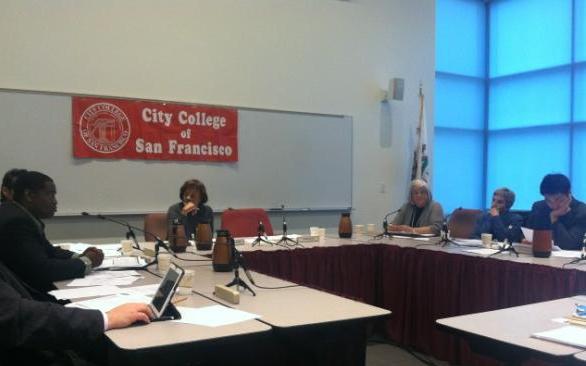
The City College Board of Trustees passed the college’s budget and new mission statement yesterday, as well as a proposal to request a special trustee to work with the board as they face an accreditation process and dire financial situation.

The special trustee will advise the board on decision making. But they also have the power to overrule board decisions, something opponents called an undemocratic process.

About 40 of those opponents stormed the meeting. The activists, from the Save CCSF coalition, surrounded the trustees and, when several walked out of the room, sat down at their meeting table.

“I propose that we convene the People’s Board of Trustees. All in favor, say aye,” CCSF journalism student Alex Schmaus declared with a bang of the board’s gavel.

The “People’s Board of Trustees” then passed a few proposals. They passed a proposal that “students appoint ourselves special trustee and oppose any other kind of special trustee,” and that “we stand in solidarity with the teachers’ strike in Chicago.”

The dissenters left the table voluntarily, but were briefly confronted by campus police when they continued to march, chant and hold banners inside the meeting room.

Afterwards, the Board of Trustees resumed their meeting. Trustees William Walker and Chris Jackson voted against calling the question to vote on the special trustee, citing a lack of sufficient information about the powers of the special trustee, such as details about how and when their vote would supersede board decisions and the process for firing the special trustee.

The proposal to invite a special trustee passed 6-1, with Chris Jackson voting no.

“This is a monumental step for the lack of information we have in this process,” Jackson told the board concerning his vote.

http://www.youtube.com/watch?v=O25Xnjj4RmY&feature=youtu.be

Video by Joe Fitzgerald

Tension and passion at the meeting underlined the community’s commitment to CCSF and dismay at the situation it faces. As SEIU 1021 representative Angela Thomas said during public comment, “None of us are happy. None of us.”

Save CCSF certainly isn’t happy. Many students involved had already been fighting the Student Success Act, which prioritizes those students who get through school in two years rather than those who take longer, as well as those in non-credit classes, ESL classes, and lifelong learners. Now, they fear that the accreditation process will cause City College to make cuts along similar lines.

“We are not a junior college. We are a community college,” said Shanell Williams, Associated Students president at Ocean campus.

Teachers and staff are also hurting. The 2012-2013 budget, passed at last night’s meeting, includes reductions in pay for both groups of college employees. During public comment at the board meeting, American Federation of Teachers 2121 Alisa Messer engaged the protesters in dialogue.

“Difficult decisions are coming down on us. We need to fight against them when appropriate and work with them when appropriate,” said Messer.

“The faculty of this college has voted for the pay cut at 89 percent. We did it because we love this college and we want to turn it around,” she later added.

Thomas also made comments directed at the protesters. “I see the same things you guys see,” she said. But she added that the trustees were forced into difficult decisions, and called protesters’ anger towards the board misplaced.

“I don’t have time for fighting folk that ain’t my enemy,” said Thomas.

At the meeting, the board also approved a revised mission statement. The new mission statement does not mention lifelong learning as a goal of the college, a concern for some of the public present at the meeting.

“I’m a senior who found City College towards the end of my career. We have a lot of seniors who are lifelong learners. And the mission statement just got rid of them,” said Al Yates, Vice President of the Associated Students at the Southeast campus.

One of the disagreement that permeated the meeting was the choice between working together to meet the accreditation requirements or coming together to protest and somehow resist those requirements, which many in Save CCSF say could lead to austerity measures and privatization.

Board members delayed the vote on the issue of requesting a special trustee at their last meeting after a smaller protest. They were provided with a packet of documents with information about the special trustee, but some critical questions remained unanswered.

The special trustee will advise the board on decision making. But they also have the power to overrule board decisions–to “stay and/or rescind board actions where such actions are inconsistent with the developed recovery plan, accreditation standards, and the fiscal health of the district,” according to a letter from Executive Vice Chancellor for Programs Erik Skinner.

What process and criteria define that “inconsistency” remain unclear.

“We can only go on the language that we have in the letter. We don’t have any additional or special knowledge other than what the state chancellor has told us,” said City College spokesperson Larry Kamer.

Those questions may come to the forefront as the board selects and begins to work with a special trustee.

“Now that the vote passed, its important to have an open and transparent process to select the trustee,” said Jackson after the meeting.

Words and deeds

4

steve@sfbg.com

When Mayor Ed Lee appointed engineer and pro-development activist Rodrigo Santos to fill a vacant seat on the City College of San Francisco Board of Trustees, both men talked about the urgent need to save this troubled but vitally important institution.

“Our economic future is directly tied to the success of City College,” Lee said at a press conference, touting the school’s critical job-training role.

But when you cut through all the politics and hyperbole, the school’s biggest single problem is a lack of money — and the mayor and his new trustee aren’t doing much to help.

Neither Lee nor Santos have yet endorsed or publicly supported Proposition A, the $79-per-parcel tax that would stave off deep cuts to a district whose accreditation has been threatened over its anemic cash reserves and reluctance to scale back its course offerings (see “City College fights back,” July 17).

Nor have they appealed for support from their deep-pocketed allies in the business community, which City College supporters say should be doing more to support the district.

And while some say Lee is finally getting ready to endorse Prop. A, he’s done nothing to help the campaign.

“It’s a shame because [the mayor] has pledged to support City College,” John Rizzo, president of the Board of Trustees and a supervisorial candidate from District 5.

Lee also refused a request the trustees made last year to ease the more than $2.5 million in rent and fees that the district pays annually to the city. That’s a stark contrast to the city’s generous support of the San Francisco Unified School District, which gets an annual subsidy from the city of around $25 million, thanks to a ballot measure pushed by city officials of various ideological stripes.

“K-12 is important, but when we try to get help from the city, it falls on deaf ears and I don’t know why. Maybe little kids are cuter,” Rizzo told us.

Sup. Eric Mar said that dichotomy is a real problem, particularly given City College’s current challenges and the important role it plays in providing low-cost training to local workers. Mar has called for a hearing this month before the Joint City and School District Select Committee, which oversees SFUSD’s relationship with the city.

“I support stronger city support for City College,” Mar told us.

Asked about Lee’s unwillingness to help with City College’s fiscal situation, mayoral Press Secretary Christine Falvey said Lee has offered logistical support from city officials to help City College overcome the threats to its accreditation and has been carefully monitoring the situation, but she didn’t directly address why he has withheld financial support or endorsed Prop. A.

“The mayor has not taken a position on the parcel tax and is focusing his efforts on supporting the college’s need for serious fiscal and management changes and protecting its accreditation,” she told us by email Sept. 7. “The mayor knows it is more important than ever that the City support City College to make sure they get back on their feet for the sake of current and future City College students and for all San Francisco residents.”

But City College officials aren’t buying it. “Talk and nice words don’t mean anything anymore,” Rizzo said.

Other Prop. A supporters agree.

“The mayor needs to step up and support this,” Trustee Chris Jackson told the Guardian, arguing that most of the district’s problems stem from steadily declining financial support from the state. “We have a revenue problem.”

“It is the workforce training vehicle for the city,” said Rafael Mandelman, a candidate for trustee who has been actively supporting Prop. A. “Maybe now is the time when the city shouldn’t say no to that.”

Falvey responded by saying, “The City supports all of our public education institutions in some capacity. Each public education institution also pays the city for some of the required services it is provided.”

Other Prop. A supporters say they are hopeful that Lee may still come around. Alisa Messer, president of American Federation of Teachers Local 2121, which represents City College faculty, told us, “The mayor says he supports City College and we’re hoping he will support the measure soon.”

Gabriel Haaland, who has been working on the measure for SEIU Local 1021, also told us as we were going to press on Sept. 10, that Lee seems to be coming around: “From what I understand, the mayor is about to endorse it.”


PROMISE OF SUPPORT

When Lee appointed Santos — who has raised an unprecedented amount of money for his race, $113,153 as for July 1, mostly from the real estate and development interests he represents as president of Coalition for Responsible Growth — some argued that it would bring needed financial support for the district and the Prop. A campaign.

“He is expected to bring his allies in these fields into the fight to save City College, which faces a critical 2/3 vote on a parcel tax this November,” Tenderloin Housing Clinic Director Randy Shaw wrote on his Beyond Chron blog on Aug. 22, a day after telling the Guardian how the parcel tax was essential to City College’s future and Santos was uniquely positioned to support it.

But Santos, whose campaign didn’t return Guardian calls on the issue, hasn’t appeared at any Yes on A campaign events or offered any discernible support for the measure, whose supporters had only raised a little over $20,000 as of July 1. While there is little organized opposition to Prop. A, the fact that it needs approval by two-thirds of voters is a challenge that requires strong support.

Rizzo said Shaw’s argument doesn’t hold up. “It’s a nice theory,” he said, “but I haven’t seen evidence of that, and I haven’t seen Rodrigo at any Prop. A events.”

Santos hadn’t been involved with City College or educational issues before deciding to run for trustee, and he’s widely perceived as an ambitious politico setting himself up to run for the Board of Supervisors. At his press conference, Santos pledged to aggressively fight for City College.

“I join an institution that must be saved, and I’m absolutely committed to that goal,” Santos said.

Lee assembled a variety of representatives from “the city family” at his press conference, including trustees Natalie Berg and Anita Grier, Interim Chancellor Pamila Fisher, representatives from the Controller’s Office, Board of Education, Department of Children Youth and their Families, and the Mayor’s Budget Office.

“They, after all, need our help, need our support and they will not be able to accomplish it all by themselves,” said Lee, who pointedly didn’t say anything about the parcel tax at the event, even though he sang the praises of the district. “It empowers those economic sectors that we consider most valuable to our future, especially in the area of health care, hospitality, biotech, and now technology in general. We have become dependent on City College for their ability to prepare future workforces.”

Lee also sounded a tough love theme, saying “any improvement means a change from the status quo” and praising Santos as “someone who shares my vision of reform and will support the tough decisions ahead.”

Indeed, the board members face a number of tough decisions in the coming weeks, from whether to abdicate some of their authority to a special trustee empowered to make unilateral decisions about what programs to cut or campuses to close. The college is responding to a threat from the Accrediting Commission for Community and Junior Colleges to live within its means or lose its accreditation.

Santos didn’t mention Prop. A during the press conference that followed his swearing in, instead offering vague platitudes and promises that he’s willing to work hard and make tough decisions, while also making some puzzling statements about the district’s current situation.

“We must support the interim chancellor, Pamila Fisher,” he said. “Our primary duty is to ensure she enjoys the support and tools needed to implement difficult reforms. At the same time, we will hold her accountable, we will help her, we will challenge her.”

He appeared unaware that Fisher’s tenure ends in just a few weeks, well before any reforms could possibly be approved or implemented.

Some Prop. A supporters are hoping Santos will also challenge his allies in the business community to open their wallets and support both Prop. A and ongoing operations at City College.

“It would be great for the businesses to step up in a big way because they are really benefiting from our workforce training programs,” Messer said. “It’s clear to me the business community understands how important City College is to this city.”

Now, City College’s biggest supporters say it’s time for the city and the business community to put their money where their mouths are.

“City College certainly gives back to the people of San Francisco,” Rizzo said, “and it’s time for the city to give back to City College.”

Endorsement interviews: Norman Yee for D. 7 supervisor

28

Norman Yee, president of the School Board, is running in the tighly contested race for District 7, one of the most conservative districts in the city. Yee talked about the sorts of things you’d expect a district candidate to talk about — public safety (and pedestrian safety, an issue particularly important to Yee, who was seriously injured by a car), public schools, keeping libraries open, and parks.

But he also talked about citywide concerns — he’s a supporter of Local Hire, supports the City College parcel tax, and wants to see an audit of city-owned land to look for places to build affordable housing. He supports a program to legalize existing in-law units if they’re brought up to code.

You can listen to the entire interview here:


Yes on Prop. A rally urges support for City College parcel tax measure

18

Those who work at, attend and support City College of San Francisco have a lot of work ahead of them. The school’s budget has been regularly slashed, losing $20 million last year alone. The school cut 700 classes this semester. After receiving notice that they faced losing accreditation, students, faculty, staff and administrators have been working tirelessly to save the school.

A rally yesterday highlighted one issue of importance to City College: Proposition A.

Prop. A would create a parcel tax of $79 per year for eight years for San Francisco tax payers. The revenue, estimated at $15 million per year, would go to City College.

Prop. A will be one of three ballot measures that increase taxes in November, including Prop 30 and Prop 38. The second two are statewide measures that also raise taxes to fund schools. 

If both Prop. A and Prop. 30 pass it would restore much of the funds cut from City College. If either measure doesn’t pass, the college would face a large deficit.

Several members of the board of supervisors, the school board, and candidates for those seats spoke in support of City College. 

As Community College Board President John Rizzo mentioned at the rally, the school has cut 700 classes this semester alone. For many of those classes, the school still offers the subject but in far fewer class sections, lengthening wait lists and making it more difficult for students to get into the classes they need to graduate.

“This does not restore all the funding, but it goes a good way forward,” said Norman Yee, president of the board of education. Yee attended City College before going on to UC Berkeley, and taught ESL classes at City College for 10 years.

“If it wasn’t for City College I would have gone down a different path,” said Yee.

Alex Tom, Executive Director of the Chinese Progressive Association, emphasized that support for Prop A should be a citywide issue. He also pointed out that supporting City College “Is a big issue for Asian Americans.”

“Most people don’t know that half of the population of City College is Asian students,” said Tom.

Students, labor, and Democratic Party members also lended their voices to support Prop A. “It’s so important and critical for students to have this resource,” said Shanell Williams, president of the Associated Students organization at City College. 

Sup. John Avalos told Guardsman reporter Joe Fitzgerald that the accreditation process is related but separate from the need to pass Prop A. 

“We need to actually fund it, and make sure it’s around,” said Avalos. “If the parcel tax fails, we’ll see a real diminishment of the effectiveness of City College, and that’s something that I think would further deteriorate its ability to get accredited.”

Video by Joe Fitzgerald

Alerts

0

WEDNESDAY 29

Bernal Heights outdoor cinema Roccapulco Supper Club, 3140 Mission, SF; www.bhoutdoorcine.org. 7pm, $10 suggested donation. The first of five nights of film screenings in Bernal Heights. At this kickoff party, enjoy drinks, food and music from the Bernal Jazz Quintet before a lineup of short films celebrating community and organizing in the Bay Area. Films include Berkeley High School students on heritage and identity, "Occupy the Auctions Dance Party!" in which Occupy Bernal and ACCE stop evictions on the steps of City Hall, and a tour of Alemany Farm (also the beneficiary of the event’s ticket price), among others. The event also includes the announcement of winners of the Best of Bernal and Spirit of Bernal Awards and the first-year recipients of the Mauricio Vela Youth Film Scholarship.

Occupy, the state of the movement Mediterranean Café, 2475 Telegraph, Berk; www.occupyoakland.org. 7-10pm, free. Einar Stensson, a sociologist at Stockholm University and activist at Occupy Stockholm during the fall of 2011, studied Occupy Oakland for two months. Why did the movement start and spread so quickly around the globe? How is Occupy organized? Who matters in the movement and why? What is the future of Occupy? Come hear his perspectives on where Occupy is, locally and internationally.

FRIDAY 31

Occupy the Bay The 25th Street Collective, 477 25th St., Oakl; www.occupyoakland.org. 6pm, $25. "This week in Oakland, California will go down as a watershed moment. People across America were disgusted by what they saw here. Average Americans trying to stand up and peacefully assemble, to be brutally savaged and attacked by the police department that they pay for." So said Michael Moore to a fired up crowd in the wake of the Oct. 26 Occupy Oakland eviction that rained tear gas and rubber bullets on demonstrators. This is just one of the many historic events caught on tape by filmmakers Jonathan Riley and Kevin Pina, whose documentary Occupy the Bay is screening around the Bay Area before it starts showing in film festivals. On Friday, stick around for special musical performances from Jabari Shaw, Shareef Ali and Super Natural.

Enemies of the state: In their own words Station 40, 3030B 16th St., SF; station40events.wordpress.com. 7pm, free. After a year of Occupy and years more of struggle by people who are not down with the state, there are a lot of people in jail and prison. At this event, organizers will read writing from those locked up. Poems and statements from Truth and Kali of Occupy Oakland and a statement from Jesse Nesbitt, the May Day brick-thrower we profiled ("Who is the Brick Thrower?" 5/8/12). As the event description says, "Any effort at anti-repression in the face of lengthy prison terms must be aimed at bringing down separation at all costs." Come fight the separation and connect.

Original Plumbing birthday celebration Elbo Room, 647 Valencia, SF; www.originalplumbing.com. 10pm, $3-6. Original Plumbing, the trans male quarterly magazine, is throwing a party celebrating its third year on this planet. It now lives in the Brooklyn part of the planet, but it all started in San Francisco, and they’re coming back here to party. "We feel that there is no single way to sum up what it means to be a trans man because we each have different beliefs, life experiences, and relationships to our own bodies," say the organizers, and they started the magazine to document this diversity of experiences. Celebrate with the editors Amos Mac and Rocco Katastrophe, and performances by Rocco Katastrophe with special guests Billie Elizabeth, Nicky Click & Jenna Riot. Birthday cupcakes available!

TUESDAY 4

Rally to save City College City Hall steps, 1 Polk, SF; ProtectOurCityCollege@gmail.com. 12pm, free. A rally in support of Prop A, the local ballot measure that would create a parcel tax for revenue to City College of San Francisco. "If City College is to survive and maintain accessibility, educational quality and the mission of serving low-income and underrepresented students with the best educators and staff, we must pass Prop A," say organizers of the rally, which include students, teachers, staff and supporters.

Alerts

0


Wednesday 29

Bernal Heights outdoor cinema Roccapulco Supper Club, 3140 Mission, SF; www.bhoutdoorcine.org. 7pm, $10 suggested donation. The first of five nights of film screenings in Bernal Heights. At this kickoff party, enjoy drinks, food and music from the Bernal Jazz Quintet before a lineup of short films celebrating community and organizing in the Bay Area. Films include Berkeley High School students on heritage and identity, “Occupy the Auctions Dance Party!” in which Occupy Bernal and ACCE stop evictions on the steps of City Hall, and a tour of Alemany Farm (also the beneficiary of the event’s ticket price), among others. The event also includes the announcement of winners of the Best of Bernal and Spirit of Bernal Awards and the first-year recipients of the Mauricio Vela Youth Film Scholarship.

Occupy, the state of the movement Mediterranean Café, 2475 Telegraph, Berk; www.occupyoakland.org. 7-10pm, free. Einar Stensson, a sociologist at Stockholm University and activist at Occupy Stockholm during the fall of 2011, studied Occupy Oakland for two months. Why did the movement start and spread so quickly around the globe? How is Occupy organized? Who matters in the movement and why? What is the future of Occupy? Come hear his perspectives on where Occupy is, locally and internationally.

Friday 31

Occupy the Bay The 25th Street Collective, 477 25th St., Oakl; www.occupyoakland.org. 6pm, $25. “This week in Oakland, California will go down as a watershed moment. People across America were disgusted by what they saw here. Average Americans trying to stand up and peacefully assemble, to be brutally savaged and attacked by the police department that they pay for.” So said Michael Moore to a fired up crowd in the wake of the Oct. 26 Occupy Oakland eviction that rained tear gas and rubber bullets on demonstrators. This is just one of the many historic events caught on tape by filmmakers Jonathan Riley and Kevin Pina, whose documentary Occupy the Bay is screening around the Bay Area before it starts showing in film festivals. On Friday, stick around for special musical performances from Jabari Shaw, Shareef Ali and Super Natural.

Enemies of the state: In their own words Station 40, 3030B 16th St., SF; station40events.wordpress.com. 7pm, free. After a year of Occupy and years more of struggle by people who are not down with the state, there are a lot of people in jail and prison. At this event, organizers will read writing from those locked up. Poems and statements from Truth and Kali of Occupy Oakland and a statement from Jesse Nesbitt, the May Day brick-thrower we profiled (“Who is the Brick Thrower?” 5/8/12). As the event description says, “Any effort at anti-repression in the face of lengthy prison terms must be aimed at bringing down separation at all costs.” Come fight the separation and connect.

Original Plumbing birthday celebration Elbo Room, 647 Valencia, SF; www.originalplumbing.com. 10pm, $3-6. Original Plumbing, the trans male quarterly magazine, is throwing a party celebrating its third year on this planet. It now lives in the Brooklyn part of the planet, but it all started in San Francisco, and they’re coming back here to party. “We feel that there is no single way to sum up what it means to be a trans man because we each have different beliefs, life experiences, and relationships to our own bodies,” say the organizers, and they started the magazine to document this diversity of experiences. Celebrate with the editors Amos Mac and Rocco Katastrophe, and performances by Rocco Katastrophe with special guests Billie Elizabeth, Nicky Click & Jenna Riot. Birthday cupcakes available!

Tuesday 4

Rally to save City College City Hall steps, 1 Polk, SF; ProtectOurCityCollege@gmail.com. 12pm, free. A rally in support of Prop A, the local ballot measure that would create a parcel tax for revenue to City College of San Francisco. “If City College is to survive and maintain accessibility, educational quality and the mission of serving low-income and underrepresented students with the best educators and staff, we must pass Prop A,” say organizers of the rally, which include students, teachers, staff and supporters.

Political corruption is “trumped up?”

7

The truly shocking aspect of the latest fallout from the City College scandal is the response of incumbent Trustee Natalie Berg, who is up for re-election.

Bad enough that Berg allowed Stephen Herman, who was directly involved in the scandal and pled guilty to two felonies, to hold a fundraiser for her. But his offenses were reduced to misdemeanors, he’s paid his fine — and Berg has every right to say that he’s learned his lesson and deserves a chance to continue in the political world.

That’s not what she’s saying, though:

Berg, first elected to the college’s board in 1996, saw nothing wrong with having Herman host the fundraiser, calling him, “completely honest and honorable.” Of the criminal charges, she said: “The whole thing was trumped up. Nobody benefited from that, and it ruined people’s careers.”

Trumped up? Seriously?

Nobody has thus far disputed the basic evidence: Former Chancellor Phil Day and Herman diverted tens of thousands of dollars in public money into political campaigns. They never denied doing it. The documents showing what happened were completely clear. And just about everyone with any sense of law or ethics agrees it was a serious problem.

Nobody benefited? How about the taxpayers and the students, who have the right to honest oversight of their money?

Wow. I knew Berg was a bad trustee, but this is over the top.


City College board takes first step toward scaling back its mission

21

[CORRECTED BELOW] The first step was taken in changing City College of San Francisco’s educational mission at last night’s Board of Trustees meeting, a decision that would drastically alter what programs the college funds and who it serves.

The college’s mission statement is an overarching funding guideline, according to Gohar Momjian, the college’s accreditation liaison officer. She presented the mission statement workgroup’s findings to the college’s board and a packed room of faculty and students last night.

Momjian oversees the 15 workgroups responsible for addressing the major areas the Accrediting Commission of Community and Junior Colleges told the school it has to rectify. A failure to do so by March 2013 could result in the revocation of the school’s accreditation, which is necessary for the college’s degrees to be recognized and for the school to receive federal funding.

Simply put, City College was tasked by the ACCJC to gets its mission in line with current fiscal realities. The workgroups, tasked with brainstorming ways to reshape the college and meet the criteria of the accreditation team’s findings, will use the new mission statement as a guide for what programs are viable, said Momjian.

So what was cut out of the new mission statement? Completion of adult high school diplomas, GED’s (which help students test out of high school), active engagement in the social fabric of the community, lifelong learning, life skills, and enrichment courses were all dropped from the revised mission statement. [[8/27 CORRECTION: Transitional Studies, which includes GEDs and basic adult education, ended up being in included in the primary mission]].

In their place was a statement making these things “conditional” on available resources. “In addition, the college offers other programs and services consistent with our primary mission, only as resources allow and whenever possible in collaboration with partnering agencies and community-based organizations,” reads the new draft statement of the college’s mission.

Essentially, the college promises to enrich the community only if the resources are available to do so. Students and faculty from classes geared towards older adults and also disabled students came out to oppose changes to the mission statement, and a loss of their funding.

“We have students that will wait 40 minutes in the rain in a wheelchair for a bus to get to class,” Disabled Students Programs and Services faculty Katherine Brown said to the board.

Shelly Glazer, faculty in the older adults program, left the board with a warning. “Here are the almost 2,000 letters written to the Student Success Task Force when they tried to cut our dollars,” Glazer said, dropping the huge stack of paper on the top of the podium. “They need your support, and you need theirs.”

Importantly, English as Second Language classes and basic skills classes were preserved in the primary mission guideline. “There are compromises made in the mission statement. There are things we can do under [better] conditions,” said Momjian in her report to the board. “That was our compromise.”

The board made a motion to approve the new draft mission statement, and voted unanimously in favor. The board will look at a second revised mission statement on Sept. 11, and take a final vote to amend the mission statement on Sept. 27. The draft mission statement can be read at the City College website here.

Forty-five problem areas were found in City College’s financial structures by a financial consulting group at the same college board meeting last night. The findings left the college board nearly speechless once the report was complete.

The Financial Crisis Management Team, known as FCMAT, was paid for by the state community college chancellor’s office and assigned to City College to help it review its finances. This was good timing with the recent accreditation troubles, but officially has no connection to the recent accreditation team visit or with any direction from the state chancellor’s office, FCMAT Chief Analyst Michelle Plumbtree told the college board.

Plumbtree and her associate Mike Hill made the presentation to the board on behalf of the four members of the “financial SWAT team,” as they’ve been dubbed by the board in the past. The report it gave to the board that night was only the tip of the iceberg.

“The report itself is going to be in the realm of 65 pages. There are about 45 specific recommendations,” said analyst Mike Hill. “But we do want to give you a sense of some of our observations first, and some of our recommendations grouped together.”

The hit list was read in a bullet point fashion, and as he rattled off each of the findings, the silence in the room deepened:

  • The district has made a cost structure over time that can’t be sustained in this economy.
  • The district opted for short term solutions.
  • Employee contracts have been made without long-term analysis.
  • Decision making has been made by power and political whim rather than logic and fairness.
  • The conduct of key leaders and the culture within the district have greatly diminished the role and the effectiveness of the management team.
  • The district lacks data to assess sites.
  • The district supports much more faculty than its closest peers.
  • There’s a history of maintaining a small fund balance, with 90-92 percent of the budget being committed to salary and benefits, the college needs to make adjustments.
  • The department chair structure is not cost effective nor administratively sound.
  • We’re recommending a reduction in full time faculty through attrition.
  • We’re recommending the district not subsidize categorical programs, and that current subsidies be reassessed (the state cut funding for some categorical programs, like the second chance program, and City College has been eating that cost to the tune of around $20 million a year, according to AFT 2121 president Alisa Messer).
  • Consider either elimination of department chairs or diminish them while empowering deans and giving them the ability to act.”

“There’s a lot there, it covers a lot of territory, and you need to see the context and data and analysis in order to have informed questions, or else you’ll be spinning our wheels,” Hill said to the stunned board.

Chief Analyst Michelle Plumbtree concluded by cautioning the board against inaction. “The circumstances the district found itself did not happen overnight, decisions made over many years brought you here,” she said. “You’re going to have to move quicker than you want to, but that’s what’s needed.”

“Some of these things are new to me, but some of these things have come up in work groups. Some of these things are things we’ve known for years,” board President John Rizzo said after the report concluded. Financial administrators at City College declined to comment before the release of the full report. The 65-page final report will be made public on Sept. 18, and given to the college board a few days before that, Plumbtree said.

The City College Board of Trustees motioned to delay one of their most controversial votes at last night’s board meeting.

The board hopes to bring in a “special trustee,” who would be provided by the state, to help guide them through their recent accreditation woes. A special trustee is not simply a guide. A special trustee has veto power over the college board, giving the trustee unilateral decision making powers, according to college officials that night.

Most of the board welcomed the notion of outside help. The board has asked for $1.5 million dollars in cuts that never got made, Rizzo said, arguing for the need for the special trustee.

“It’s an enormous wealth of expertise that we do not have…We need someone from the outside to tell us where that mistake was made,” Rizzo said.

Trustee Chris Jackson wasn’t sure that the board had full knowledge of what it was asking. “I support a special trustee, but I have questions…How long would a trustee be here? What’s the process of asking them to leave?” Jackson asked, to the applause of the audience.

It was student Trustee William Walker who clarified the students’ position. He had a meeting with students the previous day, and they strongly disagreed with bringing in a special trustee to help run the school.

Given the history of special trustees in college districts, it’s not surprising why. A report by the LA Sentinel shows the discord brought by one special trustee to the Compton community college district, also facing accreditation woes. To read a report of Compton College’s and how it mirrors City College, check out the Guardian report “Saving City College.”

Special trustee Dr. Genethis Hudley-Hayes, was removed from her position as special trustee by State Community College Chancellor Jack Scott last September, according to the Sentinel article. The article cites multitudes of complaints against her by the community, who wrote a six page letter to Gov. Jerry Brown and Scott asking for Hayes’ removal.

“Who do you serve and why are you here?” Associated Students President Shanell Williams said to the board during its public comment session. “It’s shameful… If you can’t make decisions without a special trustee, then we need a new board.”

Student Kitty Lui said that the board’s decision to bring in a special trustee would undercut the democratic will of the community.
“If you don’t know how to move forward, I don’t know why you’re still here,” she said.

Despite students’ objections, if the board does not choose a special trustee, the likelihood is that one will be imposed on them, Jackson said. The board ultimately decided to shelve the decision until a special meeting on Sept. 11.

Interestingly, the “financial SWAT team,” FCMAT, thinks that a special trustee is a good idea. “To have an outside expert is always good,” FCMAT Chief Analyst Michelle Plumbtree told The Guardian. “Sometimes, you’re just too close.”

Good propaganda ain’t cheap. Sorry, no rebates for errors.

27

UPDATED AND CORRECTED BELOW It wasn’t surprising to read Randy Shaw’s misleading praise of Mayor Ed Lee for appointing Rodrigo Santos to the City College board. Much of Shaw’s salary comes from the city contracts that his Tenderloin Housing Clinic administers, so he has turned his Beyond Chron mouthpiece into the equivalent of Pravda in touting the party line of Lee and his supervisorial apparatchiks.

For that blind loyalty, Shaw has been handsomely rewarded. On July 31, the Board of Supervisors even approved a Lee-proposed balloon payout of $91 million to THC for its contract administering the Mayfair Hotel that was retroactive all the way back to 2009. Can anyone imagine another nonprofit that could dig so deeply into city coffers, for work that has supposedly already been done, who wasn’t giving a little something back to these ambitious politicians who sponsored it?

But apparently Shaw – who used to have some progressive credibility before so blatantly selling the movement out a couple years ago – doesn’t need to even get the facts right in his propaganda posts. When I asked him at yesterday’s Lee/Santos press conference whether and why he supported Santos – a villain in most progressive circles – he argued Santos was needed to help win support for Prop. A, the parcel tax for City College.

Shaw said the measure needed a two-thirds vote to be approved, a claim he also made in today’s piece. That didn’t sound right to me, and the Elections Department confirms that it isn’t: Prop. A needs only a simple majority to pass. [[8/23 UPDATE AND CORRECTION: Ernestine at the Department of Elections told me yesterday Prop. A needed only a simple majority, but she called back today to say she was mistaken and that it does indeed require a two-thirds vote.]] Shaw also claimed a couple weeks ago that the Board of Supervisors would delay the Mirkarimi decision until after the election, which also wasn’t true: the Charter requires the board to act within 30 days of receiving the Ethics Commission recommendations.

I sent Shaw a message asking about whether his erroneous beliefs affected his analysis, and to explain the basis for THC’s $91 million kickback, and he hasn’t responded to the questions, as usual. But when you’re a poverty pimp feeding off of political patronage, you’re probably golden as long as you get the politician praise right. Cha-ching!


Lee appoints Santos, a staunch development advocate, to CCSF board

22

Rodrigo Santos, a structural engineer who heads the pro-development advocacy group San Francisco Coalition for Responsible Growth, had already raised an unheard of amount of money in his race for the City College of San Francisco Board of Trustees, $113,153 in just six months, mostly from real estate and development interests.

Today, he got another big boost when Mayor Ed Lee appointed Santos to fill the vacancy on that board created by the recent death of Milton Marks, giving the ambitious Santos a big advantage in the fall contest and perhaps signaling Lee’s support for making deep program cuts to satisfy the accrediting commission’s demand that CCSF cut expenditures and beef up its reserves.

“Tough decisions and reform are what City College needs at this time,” Lee said at a press conference this afternoon, calling Santos “someone who shares my vision of reform and will support the tough decisions ahead.”

Although Lee said Santos “is committed and passionate about education,” Santos hasn’t been active on education issues before running for this office. His passions seem to lie mostly with advocating for developers and opposing government regulations in front of the Planning Commission and other bodies, where he regularly testifies, and in helping fellow conservatives gain power on city boards and commissions.

The appointment continues Lee’s pattern of appointing and relying on controversial conservatives in key areas, from his chief fundraiser and economic adviser, venture capitalist Ron Conway, to his recent reappointment to the Planning Commission of Republican Michael Antonini, who gave Santos the maximum $500 contribution in his CCSF race.

“I join an institution that must be saved. I am absolutely committed to that goal,” Santos told a press conference in the Mayor’s Office. He said that he will work to “achieve consensus” around solutions to the troubled institution’s problems, while also declaring, “We must support the interim chancellor, Pamila Fisher.”

But rather than someone who seeks political compromise, Santos’ reputation is as more of polarizing and ideologically conservative firebrand who regularly criticizes government and progressives as part of the downtown alliance that includes Plan C, Committee on Jobs, Building Owners and Managers Association, the SF Chamber of Commerce, and the Board of Realtors PAC

“I actually find him to be pretty divisive in trying to work on issues at [the Department of Building Inspection],” Debra Walker, who served with Santos on the Building Inspection Commission. “He always seems to come into a situation attacking and I hope he doesn’t bring that to this board.”

Walker, a longtime progressive activist and former supervisorial candidate, said that she and her political allies have long endured nasty attacks from Santos and his CRG bretheren.

“They spend all of their time attacking progressives and he gets pretty intense about attacking rather than working with people,” she said. “CRG is about getting people elected who are conservative, that’s their whole reason for existence, perpetuating the real estate industry’s impact of city policies, which has had a negative impact on the middle class.”

Asked about that reputation by the Guardian, both Lee and Santos denied it and refused to answer follow-up questions. Santos said CRG has a “diverse membership” and told us, “I don’t know why you would cast that as polarizing.”

Yet its board is made up almost exclusively of real estate and development interests who have shown themselves to be politically ambitious, winning key mayoral appointments to the Building Inspection and Small Business commissions and working with mayoral staffers to hold onto key leadership positions, edging out supervisorial appointees in the process.

Sup. John Avalos, who was targeted by a CRG independent expenditure campaign in 2008, said that he researched Santos’ background on education issues and was a little surprised not to find anything. “More than anything, the appointment says more about Lee’s pro business leanings,” Avalos told us.

It was also telling that Lee included two of the most conservative CCSF trustees in his press conference, Natalie Berg and Anita Grier, but that more liberal trustees Chris Jackson and John Rizzo were neither consulted nor notified directly about the appointment. “I’m sorry the mayor didn’t involve us more or let us know,” Rizzo told us.

While Rizzo didn’t endorse Santos – instead backing Jackson, Steve Ngo, and Rafael Mandelman (who Rizzo said “really does have the best interests of the district at heart”) – he didn’t want to offer an opinion on Santos, saying that he wants to work constructively with him to solve the district’s problems: “I welcome him to the board and hope he will welcome the work we’ve been doing.”

Santos told reporters that he starts every work day with an “open house” at his office from 5:20-8am, discussing various issues with anyone who wants to stop by, before getting into his engineering and administrative work for his firm, Santos & Urrutia. “I will bring that same commitment to City College,” he pledged.

As classes begin again, CCSF reconsiders its mission

0

Fall classes at City College of San Francisco began yesterday.  Students streamed through all nine campuses, navigating their schedules.

But they are coming back to a different school than they left. On July 3, Interim Chancellor Pamila Fisher received a letter from the Accrediting Commision of Community and Junior Colleges saying that the school could lose it’s accreditiaton, leading to its closure, unless it is able to succesfully “show cause” for staying open. The letter laid out 14 “major problems” that the accreditation board says CCSF must fix.

Now, the race is on, as students, faculty, staff, administrators, trustees, and community members rush to keep the school open without compromising its unique and succesful qualities.

Welcome Weeks

At the Ocean and Mission campuses, student organizers put on rallies that thousands of passers-by saw on their way to class. Volunteers holding “welcome weeks” events hosted music and speakers, and implored students walking past to talk into the mic about what CCSF means to them. Organized by the Save CCSF coalition that formed in July, the welcome weeks activities, which may include speakers, music, litterature, film screenings, and other events will continue until August 31.

“This is a community, not just a college. And right now, our community is under attack,” said Robert Chu, a former CCSF student who was volunteering with the welcome weeks events.

For Jason Bowden, another student who spoke at the rally, yesterday was the first day of college. Bowden said he is planning to earn his EMT certification and Associate Degree in fire science. “The dream is to be a firefighter,” Bowden said at the rally.

Bowden said he is confident the school will stay open. “Initially, I was freaked out,” he said. “But with 90,000 students, from a sociological perspective it would be disastrous. But I don’t want to say its not going to happen. Stupider things have happened.”

Chu said he was assisted by the Extended Opportunities Programs and Services Program (EOPS).“I’m actually an orphan,” said Chu. “EOPS supported me graciously and helped me out.”

The EOPS office is in a building near Ram Plaza, where the Ocean Campus rally took place yesterday. The adjacent Student Union building houses other programs that aid students, such as Students Supporting Students and the Multi Cultural Resource Center. Nearby, offices of the Veterans Educational Transition Services and Guardian Scholars program, which supports students coming to CCSF from the foster care system.  Some expressed concern that programs like these will be deprioritized for funding as the school tries to meet its accreditation requirements.

The rally’s backdrop was a banner reading “Keep community in community college. Accessibility and affordability are non-negotiable.”

Mission statement

The evening before classes began, at an August 14 special board of trustees meeting, the trustees were discussing their priorities for CCSF moving forward.

The first recommendation in the accreditation board’s report regards CCSF’s mission statement.

“The team recommends that the college establish a prescribed process and timeline to regularly review the mission statement and revise it as necessary,” the text of the reccommendation reads. “The college should use the mission statement as the benchmark to determine institutional priorities and goals that support and improve academic programs, student support services and student learning effectively linked to a realistic assessment of resources”

In the wake of the accreditation crisis, the school set up 15 working groups to focus on different aspects of the process. The mission statement working group, tasked with evaluating the mission statement, and potentially, changing it, presented their work August 14– a new mission statement for the board to consider.

The board approved the first version of the new mission statement, which will be revisted at an August 23 meeting.

The new version includes a few changes. The new mission statement lists four goals: “transfer to baccalaureate institutions; acheivement of Associate Degrees in Art and Science; Acquisition of certificates and career skills needed for success in the workplace;” and “Basic Skills, including learning English as a Second Language.”

The goals that have been cut out of the mission statement: “Active engagement in the civic and social fabric of the community, citizenship preparation; completion of requirements for the Adlt High School Diploma and GED; Promotion of economic development and job growth” and “lifelong leaning, life skills, and cultural enrichment.”

The mission statement already read “CCSF provides educational programs and services to meet the following needs of our diverse community”; the new version adds the phrasing “that promote succesful leaning and student achievement.” Another phrase was added: “the college offers other programs and services supplementrary to our mission, only as resources allow and whenever possible in collaboration with partnering agencies and community business organizations.”

The mission statement working group was one of the first to complete their initial work. As Chancellor Fisher explained in the board of trustees meeting, “We need to finish recommendation one as early as possible because it will affect out planning.”

The working group that wrote the mission statement was comprised of faculty, administrators, trustees, and community members. No students were involved, until two– Associated Students president Shanell Williams and Student Senator Diamond Dave Whitaker– were added to the working group last week. Today, the mission statement working group, with its two new additional members, meets to discuss the ongoing process of documenting CCSF’s priorties. Their meeting is public and will take place 1:30-2:30pm at Batmale Hall.

Rafael Mandelman enters City College board race

6

After the really bad news that Community College Board member Milton Marks died, there’s some good news: Rafael Mandelman, an energetic, smart, progressive lawyer and member of the DCCC, has decided to run for that board.

City College badly needs the help. There’s a real chance that a state monitor could be placed over the district, robbing the board of much of its ability to set policy and spend money. And even if that doesn’t happen, the state — which disagrees with San Francisco on how community colleges should be run — is going to keep tyring to mess with CCSF.

So it would be nice to have someone like Mandelman, who has political experience but also works for a law firm that does a lot of public-sector work, around to help.

Marks’s untimely and tragic death leaves an open seat and he hadn’t filed to run for re-election. So the mayor has the ability to appoint someone to serve out Marks’s term — and if he does it before Aug. 15, that person can file and run as an incumbent. But for those of us who are getting sick of having so much of our government appointed for us, it would be nice if Mayor Lee would wait until after the filing deadline then name a real caretaker — Mandelman suggests former trustee Tim Wolford, who is now in the business of helping troubled nonprofits. The board will need help in the next four months, and someone qualified — and skilled in dealing with fiscal and political problems — would be an immense help.

But appointing a political hack who is pals with the mayor’s inner circle and sees a shot at running as an incumbent would be a big mistake.

Of course, Lee hasn’t done too well in the “caretaker” department. We’ll see what happens.

Big week ahead as City College classes start

2

Classes at City College of San Francisco start for the fall on August 15. That makes this a big week for the coalition of students, staff, and community working on its future. 

As the college welcomes students back, this coalition will set up on the Ocean campus in Ram Plaza and at the Valencia entrance of the Mission Campus. With litterature from community groups, music and speakers, they hope to let incoming students get the chance to learn about the efforts to save the college- making sure it continues to exist, as well as maintaining its academic standards, accessibility, and other core values. The celebration will include music and speakers.

There’s also plenty happening before Wednesday. Today, a student organizing meeting will take place at the student union at the CCSF Ocean Campus. Then, at 6pm, CCSF will be the focus of the weekly Occupy Forum, an open space to discuss issues of importance to the occupy movement. William Walker, CCSF student trustee, will speak at this week’s forum, called “Education Under Attack: Austerity, Privatization and Profit.”

On Tuesday, the CCSF Board of Trustees will hold a special meeting at CCSF’s Ocean Campus. They are scheduled to discuss the progress of the working groups that have been set up to work towards meeting accreditation requirements. The meeting is public, and stakeholders and community members will definitely be making an appearance. The meeting is at 4pm in multi-use building room 140.

“There are a lot of people that have opinions on how we need to move forward,” said Walker. “It’s the job of students to come together to figure out what austerity is actually going to mean for city college, and what our must-have demands.”