Board of Supervisors

Making CleanPowerSF work

4

EDITORIAL The way the San Francisco Chronicle describes it, the city’s new green power program “won’t come cheap.” That’s a line that Pacific Gas and Electric Co. will use over and over again in the next few months as the city finally prepares to get into the retail electricity business, 98 years after Congress mandated public power for San Francisco. Clean Power SF will offer 100 percent clean energy — and yes, right now, this spring, it will cost a little bit more than buying nuclear and coal power from PG&E.

But that price differential will change dramatically in the next few years — if the city goes forward not just with buying and aggregating power from the commercial market but developing renewable energy on its own.

That’s the key to the future of CleanPowerSF — and as a proposed contract to get the system up and running comes to the Board of Supervisors, the need for a city build-out of at least 210 megawatts of energy generation capacity is, and must be, an essential part of the plan.

The fact that the city, at long last, is moving toward implementing this program is a testament to the work of Sup. Ross Mirkarimi, who pushed it for years, and Sup. David Campos, who more recently took over the lead role. Both deserve immense credit for their work.

As Rebecca Bowe reports in this week’s issue, there’s some disagreement about the contract proposed by the San Francisco Public Utilities Commission. The deal with Shell Energy North America would have the energy giant buy green power wherever it can, deliver it to San Francisco customers along PG&E’s lines — and charge enough to pay for the power and overhead expenses. That, initial reports say, could raise the bill of an average customer somewhere between $7 and $50 a month, depending on use. For most residential customers, the increase is going to be on the low end.

The problem is that the PUC estimates from the start that two-thirds of the potential customers will drop out of the program and stick with PG&E. That’s an abysmal projection, reflecting in part the PUC’s long reluctance to take the program seriously, in part a failure to plan an aggressive marketing campaign — and in part the lack of a long-term vision for the program.

The bottom line is simple: As long as the city is buying energy from somebody else, there are going to be problems. Right now, renewable energy demand exceeds supply, so prices are high. That’s going to fluctuate over the next decade.

But it’s entirely possible for the city to build its own renewable infrastructure and generate power that will beat PG&E’s prices in the short-term future — and will be far, far less expensive a decade down the road. Clean Power SF will never work to its full potential unless the city owns a significant part of the generation system. (Ultimately, the city will never see the full economic benefits of public power until it buys out PG&E or builds its own delivery system.)

The PUC included — at the demand of public-power advocates — a clause in the contract stating that a city build-out was part of the plan. The proposal before the board only includes the contract with Shell — but the final deal should include specific plans for how much local power will be generated, how it will be funded — and how it will ultimately replace the power Shell is providing. The city should start right now looking for sites (there’s lots of surplus city land) and seeking bids for construction, and if the PUC can’t come up with enough revenue-bonding money, the board should put a comprehensive clean energy bond on the November ballot.

The Local Clean Energy Alliance estimates that building 210 megawatts of clean power in San Francisco would generate nearly 1,000 direct jobs and as many as 4,300 indirect jobs. That sort of program would be a boost to the economy and guarantee the city stable energy sources for the future. And it would allow the PUC to market Clean Power SF not as a plan that will cost consumers more today — but as a plan that the city can all-but guarantee will save you money, substantial amounts of money, over the next 10 years.

Lots of buzz and politicking around D5 appointment

65

There is eager speculation – and lots of public and private pressure being applied to Mayor Ed Lee – over the question of who he will appoint to fill the District 5 seat on the Board of Supervisors that is being vacated by Sheriff-elect Ross Mirkarimi.

Anti-progressive entities from the San Francisco Chamber of Commerce to the San Francisco Chronicle are urging Lee to appoint a fellow moderate to the solidly progressive seat, despite the outrage that would trigger on the left and the difficulty that appointee would likely have keeping the seat after the November election.

Chron columnist CW Nevius today published a weird little puff piece plugging London Breed – a moderate who wants the D5 seat, a fact he strangely didn’t mention – and her leadership of the African American Art & Cultural Center. Chron columnist Leah Garchik also pumped up Breed as a D5 appointee last week. Nevius’ column in particular seemed to be a thinly veiled attempt to influence the decision, despite the regular insistence by Nevius and others at the Chron that they never have a political agenda or try to influence City Hall. Yeah, right – at least we at the Guardian are honest about our advocacy for more progressive city leadership.

Breed is being strongly pushed by Willie Brown, the former mayor and current Chron columnist, as well as most of the city’s African American ministers, such as Revs. Amos Brown and Arnold Townsend, who showed up at last week’s Board of Supervisors meeting and followed Lee back to his office after his appearance before the board.

Sources connected to the ministers told us that Lee hadn’t returned their phone calls in recent weeks and they were angry about the snub, so they showed up to let him know and mau-mau him into appointing Breed. Indeed, Brown did get a private meeting with Lee after his followers wedged their way into the office.

Reporters had asked Lee about the D5 appointment just moments before and he said that he was in no hurry to make a decision. “I want to pay my respects to many groups in District 5,” Lee said.

While many names have been floated as D5 contenders, there are a few that rise to the top. Malcolm Yeung, public policy director of the Chinatown Community Development Center, is being pushed by Rose Pak, the Chinatown power broker who worked with Brown to get Lee into Room 200.

But given Lee will probably avoid simply choosing between the Brown and Pak choices – unless they can privately coalesce around someone, which is certainly a possibility – most City Hall speculation these days falls on Christina Olague. The Planning Commission president comes from the progressive camp but she also served as a co-chair of Progress for All, creators of the Run, Ed, Run campaign that persuaded Lee to run for a full term.

Speaking to the Guardian in October, Olague denied that her early endorsement of Lee had anything to do with the D5 seat, which she said she wasn’t seeking but would take if offered. “If we get progressives to support him early on, maybe we’ll have a seat at the table,” was how she explained her support for Lee.

On Friday, Olague showed up for Mirkarimi’s art opening and holiday party in his City Hall office, and she chatted with other possible contenders for the D5 seat, including Quintin Mecke, Julian Davis, Gabriel Haaland, Jason Henderson, and Michael O’Connor. Asked by the Guardian if she had any insights into how the appointment was going, she said all she knows is what she’s read online and in the newspapers.

And so we wait.

Guardian editorial: Making Clean Power SF work

1

EDITORIAL The way the San Francisco Chronicle describes it, the city’s new green power program “won’t come cheap.” That’s a line that Pacific Gas and Electric Co. will use over and over again in the next few months as the city finally prepares to get into the retail electricity business, 98 years after Congress mandated public power for San Francisco. Clean Power SF will offer 100 percent clean energy — and yes, right now, this spring, it will cost a little bit more than buying nuclear and coal power from PG&E.

But that price differential will change dramatically in the next few years — if the city goes forward not just with buying and aggregating power from the commercial market but developing renewable energy on its own.

That’s the key to the future of Clean Power SF — and as a proposed contract to get the system up and running comes to the Board of Supervisors, the need for a city build-out of at least 210 megawatts of energy generation capacity is, and must be, an essential part of the plan.

As Rebecca Bowe reports in the Guardian, there’s some disagreement about the contract proposed by the San Francisco Public Utilities Commission. The deal with Shell Energy North America would have the energy giant buy green power wherever it can, deliver it to San Francisco customers along PG&E’s lines — and charge enough to pay for the power and overhead expenses. That, initial reports say, could raise the bill of an average customer somewhere between $7 and $50 a month, depending on use. For most residential customers, the increase is going to be on the low end.

The problem is that the PUC estimates from the start that two-thirds of the potential customers will drop out of the program and stick with PG&E. That’s an abysmal projection, reflecting in part the PUC’s long reluctance to take the program seriously, in part a failure to plan an aggressive marketing campaign — and in part the lack of a long-term vision for the program.

The bottom line is simple: As long as the city is buying energy from somebody else, there are going to be problems. Right now, renewable energy demand exceeds supply, so prices are high. That’s going to fluctuate over the next decade.

But it’s entirely possible for the city to build its own renewable infrastructure and generate power that will beat PG&E’s prices in the short-term future — and will be far, far less expensive a decade down the road. Clean Power SF will never work to its full potential unless the city owns a significant part of the generation system. (Ultimately, the city will never see the full economic benefits of public power until it buys out PG&E or builds its own delivery system.)

The PUC included — at the demand of public-power advocates — a clause in the contract stating that a city build-out was part of the plan. The proposal before the board only includes the contract with Shell — but the final deal should include specific plans for how much local power will be generated, how it will be funded — and how it will ultimately replace the power Shell is providing. The city should start right now looking for sites (there’s lots of surplus city land) and seeking bids for construction, and if the PUC can’t come up with enough revenue-bonding money, the board should put a comprehensive clean energy bond on the November ballot.

The Local Clean Energy Alliance estimates that building 210 megawatts of clean power in San Francisco would generate nearly 1,000 direct jobs and as many as 4,300 indirect jobs. That sort of program would be a boost to the economy and guarantee the city stable energy sources for the future. And it would allow the PUC to market Clean Power SF not as a plan that will cost consumers more today — but as a plan that the city can all-but guarantee will save you money, substantial amounts of money, over the next ten years.


Mayor Lee, Sharp Park, and Gavin Newsom

43

So Ed Lee’s going to veto the Board of Supervisors resolution on Sharp Park. Of course he is. And there’s more than snakes and frogs at issue here.

The veto, I think, sets the tone for what we’re going to see over the next four years, which is: Gavin Newsom.

For four years, the progressive bloc on the board — that is, the shaky sometimes-majority that can pull together six votes on an issue — is going to run slam into a mayoral veto a good deal of the time.

In this case, John Avalos, David Campos, David Chiu, Jane Kim, Eric Mar and Ross Mirkarimi — that’s the list of the six — all supported a plan to negotiate with the National Park Service to take over the property, which would probably mean the end of the golf course. It’s an environmental issue, mostly, and also a public-resource issue — but the main thing is that it’s an issue that split the board along the left-center/right lines that we’ll see again and again over Lee’s term. And Lee is siding with the right.

That’s what we came to expect from Newsom — every progressive initiative was a struggle; often, bill sponsors had to line up eight votes, not six, because there was always the threat that Newsom would shoot it down. And I’m getting the feeling that we’ll be facing the same thing with Mayor Lee.


Warren Hellman, the 1 percent exception

103

San Francisco lost a piece of its soul when Warren Hellman died last night. In a deeply polarized city, where Occupy’s paradigm of the 99 percent versus the 1 percent resonates more than anywhere, Hellman showed how an extremely wealthy investment banker could champion the interests of all San Franciscans.

I first got to know Warren in 2007 when I did a series of in-depth interviews with him for a Guardian cover story. Before that, he had been a bit of a villain to progressives as he worked with his downtown friends, such as the late Gap founder Don Fisher, to fund political initiatives and groups that aggressively pushed a pro-business agenda, from the Committee on Jobs to the parking garage under Golden Gate Park.

Born into the family that founded Wells Fargo Bank, he became the youngest partner to join Lehman Brothers before founding one of San Francisco’s largest investment banking firms, Hellman was solidly in the 1 percent. But he was a curious man with a good heart, compassionate soul, nimble mind, and strong sense of integrity.

So when the progressives he previously battled over the parking garage pushed for more car-free hours in the park – something Hellmann and his allies had pledged to support if the garage was built – he joined them and battled with his former garage allies who had abandoned that pledge, eventually forcing a compromise when it seemed the car-free crowd was headed for defeat.

That was the reason I got to know him and the focus on my “Out of downtown” story, but it was only the beginning. I came to know about how he was spending his money to help the schools and the poor, about his generous/selfish gift of the Hardly Strictly Bluegrass Festival, and about his belief that George W. Bush and other neo-conservatives – those who so shamelessly and short-sightedly helped consolidate this country’s wealth in fewer and fewer hands – were sullying his Republican Party.

So we stayed in touch and had early morning breakfasts together every six months or so, talking about the issues of the day. We talked about Burning Man, an event he loved and one I was covering and writing a book about. He listened as I complained about my shrinking staff at the Guardian and how the contraction of journalism was bad for San Francisco, and we talked through some possible solutions.
It bothered Warren to see the San Francisco Chronicle being decimated by an out-of-town corporation, and he wanted to help. So he took that kernel of an idea, mulled it, and discussed it with a wide variety of people who had expertise on the topic, just as he would do with his myriad investment banking ideas.

And with that steady heat that he applied to this kernel, he popped it into The Bay Citizen, a non-profit professional newsroom that has already done a great service to San Francisco, and which owes its existence to Hellman, who subsidized it with millions of dollars of his own money and encouraged his rich friends to give millions more. That is among his many legacies, although he was probably most proud of the Hardly Strictly Bluegrass Festival, probably the country’s best free concert. Warren loved that music, and he told me it was mostly because it told the stories of common people so beautifully. “The kind of music is the conscience of our country,” he told me. The San Francisco Board of Supervisors last week offered a bit of appreciation for Warren’s gift, renaming the main venue of Speedway Meadows as Hellman’s Hollow.

I’ll let the Bay Citizen and other media outlets write Warren’s full obituary. What I’m choosing to think about now is the man, and he is someone who I will truly miss. San Francisco just won’t be the same place without the example he set, but I hope it lives on in the hearts and minds of those in a position to help San Francisco find its heart and realize its potential.


End war, bring that money home — a controversial proposition, even in SF?

9

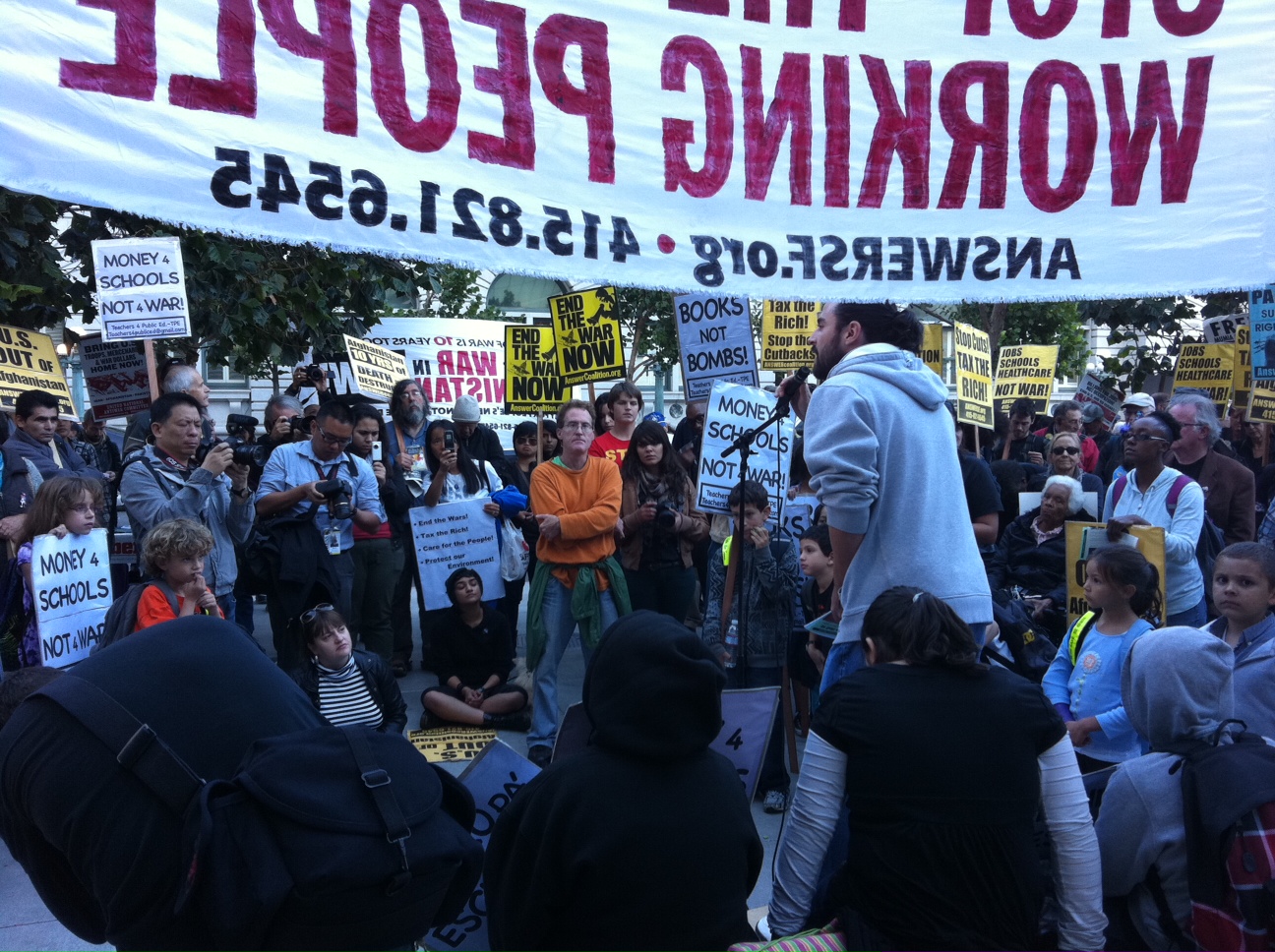
A substantial majority of Americans support ending the war in Afghanistan, decreasing the military budget, and redirecting that money to domestic needs, a position held even more strongly in liberal San Francisco. Yet three members of the Board of Supervisors this week still opposed a resolution in support of that position, a resolution that was mocked on the cover of today’s San Francisco Examiner.

So-called political “moderates” here love to deride progressives and label them out-of-touch with the rest of the country or with what they consider the “real world.” But how sensible and fiscally responsible is it to continue spending more than half of the federal budget on the military, a dollar amount that has more than doubled since Bill Clinton left the White House, when domestic conditions are so bad that tens of thousands of people across the country have been willing to spend months occupying their town squares?

The resolution approved Tuesday on a 8-3 vote – with Sups. Sean Elsbernd, Mark Farrell, and Carmen Chu, consistently the board’s most conservative members, in dissent – was similar to resolutions approved in dozens of jurisdictions across the country, most recently in Los Angeles and Pittsburgh, Penn. In May, a similar resolution was also approved by the U.S. Conference of Mayors, the first such action since the Vietnam War.

The resolution calls for members of Congress to “reduce the military budget, end the wars in Iraq and Afghanistan, and redirect the savings to domestic needs.” In support of that position, it notes that we’re spending almost $1 trillion per year on the military and war debt, more than 50,000 U.S. troops have been killed or injured in the two conflicts, and that everything from schools to public services to the country’s infrastructure needs are severely underfunded.

“It’s a way to signal to the federal government – in this case, particularly [Reps.] Nancy Pelosi and Jackie Speier – that people are fed up with their local economies being plundered to support war,” Janet Weil, who works on resolution like this as part of Code Pink’s Bring Our War Dollars Home campaign, told us. San Francisco’s resolution was developed by the New Priorities Campaign, a nationwide coalition that includes Code Pink.

But during this week’s approval of the measure – which included no discussion and lasted less than a minute – Elsbernd rolled his eyes as the measure came up and then voted against it. Afterward, I asked him why, and he gave a two-pronged answer. He generally opposes local resolutions on international issues, and on this one, he said that pulling all troops out of Afghanistan is an unrealistic position that is out of the national mainstream.

“Is this the appropriate forum to discuss how many troops we should have in Afghanistan? Probably not,” he said.

Yet most people clearly see the connection between lack of resources at home and trying to fight two simultaneous wars and maintain a military presence in 63 countries, something that Weil said has fed the Occupy movement around the country, where signs and public statements have repeatedly made that connection.

“I visited OccupySF and I saw very eloquent anti-war messages on dozens of signs, and that had nothing to do with organizing by Code Pink or other anti-war groups,” Weil said. “For a lot of people, it’s such a no-brainer that people don’t even bring it up.”

Yet she said that many politicians and mainstream media outlets have been out-of-touch with that reality. For example, while there has been some popular outcry over this week’s approval of a provision in the latest defense authorization bill that allows for indefinite military detentions of suspected terrorists captured on U.S. soil, the fact that the bill principally authorizes a whooping $662 billion in new military expenditures has gotten less attention.

“But the Occupy movement has pulsed energy and people into the anti-war movement across the country,” Weil said, predicting that the connection between domestic needs and wasteful military spending will put increasing pressure on the federal government to address the issue.

As for whether local resolutions will help with that process, even moderate political consultant Jim Ross – who mocked this week’s anti-war resolution in the Examiner article – correctly noted that San Francisco helped lead the international effort to boycott South Africa and end its apartheid regime, a movement that began with a resolution approved by the San Francisco Board of Supervisors.

Or, to put it in the bumper sticker mentality that conservatives seem to appreciate: think globally, act locally.

A step forward and step back for SF’s homeless families

26

As San Francisco grapples with a record-high number of homeless families seeking shelter space during the holiday season, a pair of homeless policy discussions at yesterday’s Board of Supervisors meeting highlighted shortcomings and missed opportunities in the city’s approach to the issue.

Mayor Ed Lee announced that he is opening up more shelter space and public housing units for homeless families, finally relenting to weeks of pressure to address the pressing problem. Yet the board also narrowly approved turning surplus city property over to neighborhood residents rather than using proceeds from selling it to benefit homeless families, as city policies call for.

The property in question, 341 Corbett Avenue, is a vegetated hillside near Upper Market that the city declared a surplus property in 2004, transferring it to the Mayor’s Office of Housing to either develop as housing for poor families or to put the proceeds from its sale toward that purpose. Providing housing for the homeless is what city policy calls for surplus property to be used for, according to 2002’s Surplus City Property Ordinance. The property was assessed at $2.2 million, but it wasn’t developed because of costs associated with the steep hillside, nor was it listed for sale.

Neighbors of the property have sought to use the property for open space and a community garden, so the district’s Sup. Scott Wiener authored legislation to facilitate a community garden by transferring it to the Department of Public Works. The transfer would involve no money, leaving homeless advocates concerned about depriving homeless families of any revenues from the property.

“There are a lot of public assets we could sell if we wanted to fund this need or that,” Wiener told his colleagues, noting that neighbors would rather see a community garden on the site and that Upper Market lacks adequate open space.

But Sups. Jane Kim and Eric Mar led the opposition to the move, saying they didn’t object to that kind of community use of this property, but that city policies need to be followed, particularly considering the dire need for more resources to address the needs of homeless families. “I do have concerns about the precedent we set and also being consistent,” she said, arguing for a delay in the action until city officials find a way to compensate MOH for at least some of the property’s value.

“Overriding the surplus property ordinance is not something I want to do right now,” Sup. John Avalos said.

But the board voted 6-5 to approve the transfer, with progressive Sups. Kim, Avalos, Mar, David Campos, and Ross Mirkarimi in dissent. Housing advocates upset by the action directly their ire at the swing vote, one-time progressive Sup. David Chiu, with activist Tommi Avicolli Mecca sending out an e-mail blast saying, “david chiu betrayed us again — he wouldn’t support continuing the 341 Corbett item so that affordable housing advocates could try and work out a better deal with the Mayor’s Office on Housing and others.”

Meanwhile, the skyrocketing number of homeless families has become a big issue in town since the Guardian broke the story on Oct. 13, with repeated stories in the Chronicle, Examiner, and other media outlets, and homeless advocates staging rallies outside City Hall and unsuccessfully pushing for a meeting with Mayor Lee on the issue.

During yesterday’s monthly mayoral question time, Kim asked Lee what he was doing to address the “alarming rate” of homeless families in the city – with 267 families now on a wait list for emergency shelter space, a 356 percent increase since 2007 – specifically challenging him to expand the city’s Rental Subsidy Program by 50 families and open new emergency winter shelters. She also noted three recent suicides in the city by individuals facing homelessness.

“I share your concern about family homelessness in San Francisco. My staff has been hard at work for a long time now trying to proactively respond to this very serious challenge and I’m proud to offer some very constructive, tangible solutions,” Lee said. He announced that his administration had just this week starting expediting the placement of homeless families into vacant public housing units, with 18 families now being processed and a goal of placing about 30 of the 79 families now in shelters into public housing units.

Lee also said that SalesForce.com CEO Marc Benioff is donating $1.5 million to the Home for the Holidays program the city is creating to provide rent subsidies and case management to 160 families, a donation that the city will match. “Their generosity is inspiring,” Lee said.

He also pledged to open up an unspecified number of new family shelter spots and, somewhat bizarrely, tried to wrap this issue into his relentless focus on promoting private sector job creation, mostly through tax breaks that actually cut into the city’s ability to provide direct assistance to homeless families. As Lee said, “The long-term goal is to increase these families’ incomes and to place them into permanent unsubsidized housing.”

SF supervisors urge city to defy federal immigration holds

57

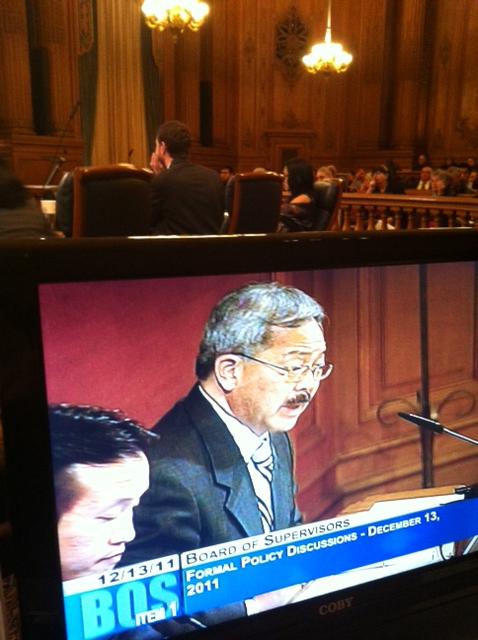
The San Francisco Board of Supervisors yesterday (Tues/13) approved a resolution calling for the city to adopt stronger policies for resisting federal efforts to deport undocumented immigrants who live here. It is the latest move to support the city’s Sanctuary City status and counter the federal Secure Communities (S-Com) program, a new database that allows the feds to circumvent local policies protecting local immigrants who have been arrested but not convicted of any crimes.

The resolution urges the Sheriff’s and Juvenile Probation departments not to honor civil immigration detainer requests from U.S. Immigration and Customs Enforcement until there is a written agreement to have ICE pay for all local costs associated with the incarcerations. The Santa Clara County Board of Supervisors adopted a similar policy in October, a move also being pursued in Chicago, New York City, Washington DC, and other jurisdictions.

“It doesn’t make communities safer. In fact, it makes immigrant communities less safe,” Sup. Eric Mar, who authored the resolution, said of S-Com, noting that it makes immigrants less likely to report crimes or cooperate with police. “I urge you to support this message and to follow the lead of jurisdictions like Santa Clara and Chicago, Cook County.”

Sups. David Campos and Jane Kim asked to join Mar and Board President David Chiu as co-sponsors of the measure, which was then approved on an 8-3 vote, with Sups. Sean Elsbernd, Mark Farrell, and Carmen Chu in dissent. Members of the San Francisco Immigrant Right Defense Committee, who had lobbied hard for the resolution and who packed board chambers, erupted in a sustained standing ovation after the vote.

Angela Chan, an attorney with Asian Law Caucus who helped lead the effort, afterward told supporters, “It’s because of this group’s hard work that we got a lot more votes than we thought we’d get,” noting they only had six solid votes going in. “Thank you, happy holiday, and we have lots more work to do.”

Chan hopes the resolution will give political cover to Ross Mirkarimi – who supported the measure as a supervisor and who takes over as sheriff at the end of the month – to expand policies created this year by Sheriff Michael Hennessey to resist some immigration detainer requests. Mirkarimi hasn’t yet returned calls for comment on the issue.

San Francisco has a fraught recent history on how to handle undocumented immigrants accused of crimes. Two years ago, the board adopted a policy of refusing to report them to the feds until they had been convicted of serious crimes, approving the Campos-authored legislation on a veto-proof 8-3 vote, only to have then-Mayor Gavin Newsom refuse to enforce the policy. After that highly charged fight, the creation of the S-Com program allowed the feds to circumvent those restrictions by directly finding out whether local inmates are undocumented, making moot Mayor Ed Lee’s agreement to partially implement the Campos legislation.

As we report in this week’s paper, this is one of a number of issues related to local control and an overreaching police state where Bay Area communities such as Berkeley, San Francisco, Richmond, and San Jose are trying to push back on the federal government. Sup. Jane Kim is currently working on an ordinance to restrict the participation of San Francisco http://www.sfbg.com/2011/04/26/spies-blue. Advocates say she plans to introduce the measure next month, but Kim told us she’s have some difficulty getting sign-off from the City Attorney’s Office.

Lack of charity

8

news@sfbg.com

Activists and city officials are challenging California Pacific Medical Center — which a new study shows provides far less charity care than other San Francisco hospitals — to do more for all city residents if it wants approval for the massive new high-end hospital and housing project it is seeking to build on Cathedral Hill.

That $2.2 billion project, which the city will consider sometime next year, would also rebuild or modify four other CPMC hospitals in town, including St. Luke’s Hospital, which serves low-income Mission District residents, but which will see its number of beds cuts from 130 now down to 80.

Community groups opposed to the CPMC project as it now stands — including the Good Neighborhood Coalition, Jobs with Justice, and Coalition for Health Planning-San Francisco — commissioned the UC Hastings College of Law to study how CPMC’s charity care compares with other nonprofit hospitals in the city.

The result, “Profits & Patients: the Financial Strength and Charitable Contributions of San Francisco Hospitals,” was released Dec. 8 and was scheduled to be the subject of a public hearing at the Board of Supervisors on Dec. 13 after Guardian press time. Activists planned to use the hearing to highlight some of the report’s most damning conclusions about CPMC and its nonprofit parent company, Sacramento-based Sutter Health.

“Mainly due to Sutter Health’s plan to alter its current hospital structure within San Francisco, the provision of community health benefits by San Francisco hospitals is now a major issue before the Planning Commission and Board of Supervisors,” the report reads.

The report compares CPMC’s hospitals with St. Francis Memorial Hospital, St. Mary’s Medical Center (both are Catholic Healthcare West facilities), and Chinese Hospital, as well as noting how the city-run General Hospital provides by far the most charity care in town. The report finds CPMC is only spending about 1 percent of its revenues on charity care while the city sets a minimum standard of 3 percent.

Even before that project, CPMC/Sutter is the dominant health provider in town, and by far the most profitable. Between 2006-2010, the report says the company made $743.9 million in profits from its San Francisco operations, compared to St. Mary’s $22.6 million in profits and the $14.8 million loss by St. Francis.

“Our analysis shows that CPMC has the financial capacity to provide more of a share of services for uninsured and underinsured San Franciscans than it presently does, and that it is crucial for CPMC to do so in order to meet the city’s health care needs,” said Jeff Ugai, a Hastings student who worked on the study.

In 2010 CPMC’s three oldest campuses — Pacific, Davies, and California — provided charity care at a patients per bed rate less than half that of St. Francis, even though CPMC is triple St. Francis’s size and has much greater financial stability.

“St. Francis meets a huge amount of charity care patients. CPMC clearly can and should meet healthcare needs,” said Emily Lee, a member of the Chinese Progressive Association who spoke at a press conference announcing the report. “From the position of the coalitions, we want to see a project, and we want to see a good project.”

But CPMC, which has been resisting calls by Mayor Ed Lee and other city officials to commit to more charity care as a condition for its project, isn’t even accepting the report’s damning conclusions that it is extracting huge profits from San Francisco and giving little back.

“It depends on how you calculate it,” said CPMC spokesperson Kevin McCormack. “As a dollar amount, we give more in charity care than any other hospital except for General Hospital.”

That’s not surprising given that CPMC makes more money in San Francisco than any other hospital, enough that it has become a cash cow for the entire chain.

“CPMC-St. Luke’s is not only the most profitable hospital in San Francisco, but it is also the most profitable hospital in the Sutter Health statewide network. Out of twenty-one hospital groups within the Sutter Health network, CPMC/St.Luke’s brought in nearly one quarter of Sutter Health’s average net income over the last five years,” the report reads.

But McCormack says Sutter reinvests its profits back into the system.

“It goes back into the system itself,” he said. “It goes back into the hospital, into salaries, building new facilities, repairing old ones.” Yet the activists are unconvinced. Even before this report on charity care, they were critical of a CPMC project that includes housing on Van Ness with low rates of affordability, and which they say doesn’t rebuild St. Luke’s large enough to meet the community’s needs. It is also agreeing to operate St. Luke’s for only 20 years. “I like to call it a stay of execution,” said Jane Sandoval, who’s been a nurse at St. Luke’s for 26 years. “When CPMC took over with their master plan, it was an enigma to me how they concluded what the community needed. I know what the community needs, and I wonder who they asked.”

Progressives split on bag ban, ex-cons

12

A couple of interesting votes at the Board of Supes Dec. 6. Sup. Ross Mirkarimi lost two pieces of legislation — a mandate that stores charge for bags at checkout counters and a tax credit for companies that hire ex-offenders.

The bag ban went down 7-4. Well, actually, it was continued to February, by which time Mirkarimi will be gone. Sup. Jane Kim said she wanted to see more outreach to minority businesses, and was quoted in the press saying she would support it at a future date, but I suspect the delay marks the end of the bill. Without Mirkarimi around to push it, the measure will probably just die. It’s odd because San Francisco used to be on the cutting edge of environmental issues; the bag ban is getting picked up by other cities and will probably be law all over the country in a decade.

Voting for the continuation were three supes who said they supported the “concept” — Scott Wiener, David Chiu and Kim.

The ex-offender tax credit went down 6-5 — and on this one, Sup. Malia Cohen, who is not always with the progressives but whose district has the largest number of parolees in the city, supported Mirkarimi. So did Kim, Eric Mar, and David Campos. The swing vote: Sup. John Avalos, the progressive leader in the mayor’s race and one of the most solid left votes on the board.

Avalos told me that he doesn’t support tax breaks; he’s been consistent on that, and I understand. I don’t support tax breaks, either. I don’t think they’re very effective and they cost the city money. But there are two elements that make this unusual — for one, if anyone actually used the tax credit and hired an ex-offender, the money the city would likely save by keeping that person from going back to jail would greatly exceed the amount of the tax reduction.

Besides, I was waiting to see Lee come up with an excuse to veto the bill — particularly at a time when more and more ex-offenders are going to be released in San Francisco. I know this is just petty politics and all that, but this was a tough decision involving a very unpopular group (nobody wants to be nice to former criminals) — and Lee got off easy.

Michael Goldstein, 1953-2011

7

news@sfbg.com

San Francisco lost a valued champion of progressive causes on Dec. 2 when Michael Goldstein lost his battle with stage 4 lymphoma after surviving nearly 20 years living with HIV, a disease that helped awaken his political activism.

Michael was born in 1953 in New Mexico, where he was raised. His grandparents had come to New Mexico after surviving the Holocaust, and Michael came to the San Francisco in the early 1980s. Like many gay men of his generation, Michael came here to find community, to create family, and to be welcomed when much of the country was still hostile to the LGBT community.

He worked at Neiman Marcus, dressing “the San Francisco A list,” as he used to say. He studied at City College towards a paralegal certificate and was heavily involved in student politics. He landed a job at AIDS Legal Research Panel, where he worked when he was diagnosed HIV-positive in the mid-’80s.

The news hit hard, and the treatment he began took its toll. The HIV drugs were harsh then and there were many horrible side-effects with these early drugs. At that time, there was very little information or education about HIV/AIDS and there was even less support, from families and from the public.

Our San Francisco political community became Michael’s family. He was also blessed with an amazing friend in Lorae Lauritch. They worked together at NM, became roommates, and lived together with some incredible cats that were dear to him, including Paloma, Huey, Cadeau, and Missy.

Michael was a proud feminist who valued the women in his life and community, leading him to endorse a pair of successive female candidates for the Castro’s District 8 seat on the Board of Supervisors: Eileen Hansen in 2002 and Alix Rosenthal in 2006.

Over the years, Michael served as an elected member of the Democratic County Central Committee (serving as vice president), served as President of the Harvey Milk LGBT Democratic Club, and was appointed to a San Francisco City College citizen oversight board, where his questioning helped bring attention to mishandling of funds at that institution.

Michael was determined, opinionated, persistent, intolerant of bullshit, prickly, always questioning. He challenged us all to move a common agenda, come together beyond our own personal ambitions, but to also never back down out of convenience or feigned civility. “Civility doesn’t make change,” he often said.

I came to know Michael as many came to know him. Michael always showed up in support of every one of our causes. He not only showed up, he advised, opined, debated, argued, protested, got arrested, drafted policy, and so much more. Campaign after campaign, issue after issue — our friendships grew around our passion for politics, our deep concerns about everything, and a strong and unwavering belief that anyone can help make change.

Michael believed that and Michael lived that.

In the past few years, many of us noticed that Michael wasn’t feeling well. We pushed him to go to the doctor. This is a man who spent hours fighting to push through HIV/AIDS policy and funding, healthcare reform, Healthy SF — and he did not have healthcare, had not seen a doctor in nearly 10 years, and was not treating his HIV.

As many know, Michael and I were like brother and sister…often bickering back and forth on whatever was going on. We “debated” like the dear friends we had become. His lack of healthcare was one of the more important issues I would bring up often. As a long term survivor of this condition, Michael knew the score.

As the symptoms of this disease ravaged his body, he retreated from us and attempted to make sense of the unimaginable alone.

Finally at the end of September, Michael was admitted to General Hospital. With the amazing care of Ward 5A, Diane Jones, and all the amazing General Hospital workers, as well as Laguna Honda Staff and at his final resting place UCSF — his care, though coming too late, was the best in the world and gave Michael a fighting chance. He was clearly comforted and supported by his community in his final days, support that mattered so much to him.

If you knew Michael, you know there is a “what comes out of this” part. We all got to really see the results of the hard work we all participated in to rebuild General Hospital, to rebuild Laguna Honda, and to provide healthcare access to everyone, even the poorest among us. Michael, personally, was able to experience the fruits of our collective labor over these years.

He also experienced some areas where there really is a need for some work. We need to remember that AIDS/HIV is still killing people every day. We must improve people’s access to healthcare. We need to protect patients’ access to medical cannabis, even in General Hospital. We need services and we need housing, particularly affordable housing for those who need it, people struggling through this bad economy.

These are our issues and this is our agenda on the left that we have been fighting for.

I will never forget Michael. One of the last real discussions we had about politics was around election time, with Michael remembering the 2010 elections. Michael was probably more upset about what has come out of that election — the beginning of a political shift to the right in San Francisco — than many.

He has been such an integral part of the work that brought our progressive community together and he was devastated by the events tearing it apart. More than anything, he wanted to bring us together, but he ran out of time.

Michael had an agenda. His agenda was to move forward our agenda. It is time to come together and do that.

Debra Walker is an artist, activist, DCCC member, and city commissioner who ran for the District 6 seat on the Board of Supervisors last year.

CPMC provides little charity care despite huge profits

30

A new study has found that the California Pacific Medical Center (CPMC), an affiliate of nonprofit Sutter Health, provides far less charity care per paying patient than other hospitals in San Francisco even as it makes by far the most in profits, highlighting an issue that many city officials have raised as CPMC seeks permission to build a high-end new hospital on Cathedral Hill.

The study by UC Hastings College of Law is called “Profits & Patients: the Financial Strength and Charitable Contributions of San Francisco Hospitals,” and the Guardian reviewed an advance copy before its official release this Thursday. It compares CPMC’s hospitals with St. Francis Memorial Hospital, St. Mary’s Medical Center (both are Catholic Healthcare West facilities), and Chinese Hospital.

“Mainly due to Sutter Health’s plan to alter its current hospital structure within San Francisco, the provision of community health benefits by San Francisco hospitals is now a major issue before the Planning Commission and Board of Supervisors,” the report reads.

Even before that project, CPMC/Sutter is the dominant health provider in town, and by far the most profitable. Between 2006-2010, the report says the company made $743.9 million in profits from its San Francisco operations, compared to St. Mary’s $22.6 million in profits and the $14.8 million loss by St. Francis.

CPMC runs four of the largest hospitals in the city – St. Luke’s Hospital and CPMC’s Davies, California, and Pacific campuses – behind only San Francisco General Hospital, the city-run facility that does by far the most charity care. But while the other hospitals in the study are smaller, with much less staffed bed counts, they still manage to see the same or more charity care patients than CPMC.

For example, from the report, Saint Francis has 150 staffed beds and sees approximately 31 charity care patients per bed per year. CPMC has 514 staffed beds and sees only 14 patients per bed per year. “In 2010, CPMC’s three oldest campuses (Davies, California, and Pacific campuses) saw charity care patients at a patients per bed rate less than half that of Saint Francis, despite being more than 3 times the size of Saint Francis and having significantly greater financial stability,” read the report.

St. Mary’s and Chinese Hospital also see approximately 13 charity care patients per year per staffed bed, and their staffed beds are 160 for St. Mary’s and 31 for Chinese Hospital. If CPMC has so many more staffed beds, why aren’t their charity counts any higher than a hospital with only 31 beds to their 514 beds?

Hastings Professor Mark Aaronson, who put together the study, said that charity care is supposed to be at least 3 percent, the minimum expectation for the San Francisco Board of Supervisors. CPMC’s is closer to 1 percent.

Why is it so low? If you ask CPMC, it’s not. “It depends on how you calculate it,” said CPMC spokesperson Kevin McCormack. “As a dollar amount, we give more in charity care than any other hospital expect for General Hospital.”

Well, obviously. CPMC is a massive conglomerate that has four campuses to maintain and put money into to have the beds and staff available. Having so much more space than any other hospital, they would have to put in more as a dollar amount just to sustain those campuses.

Given that CPMC is a non-profit organization, where does that extra few tens of millions of dollars go? Well, some of it goes to hire the huge team of consultants and lobbyists who are now trying to win approval for the Cathedral Hill project. But McCormack said it also gets absorbed into CPMC operations.

“It goes back into the system itself,” said McCormack. “It goes back into the hospital, into salaries, building new facilities, repairing old ones.”

Even so, the report shows CPMC to be in a different category than other hospitals when it comes to supporting San Francisco’s full population. It also found that the profits extracted from San Francisco’s hospital subsidize the whole chain, a situation that will only become more pronounced as it builds a hospital at Cathedral Hill that seeks to draw patients from around the country.

“CPMC-St. Luke’s is not only the most profitable hospital in San Francisco, but it is also the most profitable hospital in the Sutter Health statewide network. Out of twenty-one hospital groups within the Sutter Health network, CPMC/St.Luke’s brought in nearly one quarter of Sutter Health’s average net income over the last five years,” the report reads.

The report was prepared for the Good Neighbor Coalition, Coalition for Health Planning — San Francisco, and Jobs with Justice. The official public release of “Profits & Patients” will be at 11 am on Thursday, Dec. 8, at the UC Hastings College of the Law, 100 McAllister St., Room 300, San Francisco.

Steven T. Jones contributed to this report.

Stop downtown’s attack on RCV

52

OPINION The long-time foes of political reform at the Chamber of Commerce and San Francisco Chronicle have launched an effort to repeal ranked choice voting (RCV) and public financing of campaigns. Supervisors Sean Elsbernd and Mark Farrell have introduced a June 2012 charter amendment to repeal RCV, with public financing also in their crosshairs.

Many of us fought hard to pass these reforms, and I am reminded of when the downtown corporate interests repealed district elections in 1980. They blamed the assassinations of Harvey Milk and George Moscone on district elections and the election of Supervisor Dan White. San Francisco has a history of the anti-reformers waiting for their moment of opportunity. Now these same corporate interests think that moment has arrived again.

The Bay Guardian first reported about an anti-RCV campaign in 2009, when a meeting of downtown business leaders was hosted by Steve Falk, Chamber of Commerce CEO (and past publisher of the Chronicle) to discuss repealing RCV.

As part of that effort, polling also was done to see if they could repeal district elections and public financing. They also filed a bogus anti-RCV lawsuit which was unanimously rejected by two courts. Elsbernd’s repeal legislation is the culmination of their calculated efforts.

It’s clear what these special interests want: a return to the days when local races were decided in low-turnout December elections, and those who had the most money pounded their opponents into submission. An Ethics Commission report in 2003 found that independent expenditures increased by a factor of four during December runoffs, while another study found that voter turnout dropped by more than a third in 10 of the 14 December runoff races held from 2000-2003. Turnout in one city attorney runoff dropped to 16 percent.

Just as importantly, the December electorate did not represent the diversity of San Francisco’s population. Voters in the runoffs were overwhelmingly whiter, older and more conservative than the city as a whole, as voter turnout plummeted in December among racial minorities, the poor and young people. Simply put, a return to December runoffs will allow groups like the Chamber and its allies to dump huge amounts of money into negative campaigns aimed at the more conservative December electorate when most San Franciscans don’t vote.

In the era of unlimited independent expenditures by corporations (thanks the Supreme Court decision in Citizens United), political reforms like RCV are crucial for protecting our democracy. Both RCV and public financing have greatly improved local elections — since their inception San Francisco has doubled the number of racial minorities elected to the Board of Supervisors. Elections are now decided in higher turnout November contests, allowing more people to have a voice in choosing their local representatives. Winning candidates in RCV contests have won with an average of 30 percent more votes than winners in the old December runoffs.

San Francisco has saved $10 million in taxes by not holding second elections, money used for other public needs. Candidates also haven’t needed to raise money for a second election, which helps level the playing field. Progressive candidates have never done well in citywide elections, but this year in RCV contests Ross Mirkarimi was elected sheriff and John Avalos mobilized and finished a strong second. That bodes well for progressives’ future.

It’s no coincidence that Supervisor Elsbernd is trying to get his charter amendment on a low-turnout June ballot, when the electorate is more conservative. The downtown corporate interests are clear on what they must repeal in order to elect the candidates they want — RCV, public financing, and ultimately district elections. Progressives need to be just as clear on what reforms we must defend.

Assemblymember Tom Ammiano represents the 13th District.

A new name in District 5

73

There’s a new name popping up in the cattle call that is the District Five supervisorial appointment. He’s not terribly well known in city political circles (his chief claim to local fame is serving on the Library Commission), but he’s got a powerful patron: U.S. Senator Dianne Feinstein.

His name is Michael Breyer. Yes, from that Breyer family.

In a Nov 30 letter to Mayor Ed Lee, Feinstein lauds Breyer and says he has her endorsement for the job. You can read the letter here (pdf).

Feinstein notes that Breyer’s grandfather, Irving, was chief counsel for the San Francisco Unified School District and that his aunt was a president of SEIU. She doesn’t mention his closer, and better-known, political connections. Nor does she mention that his uncle was a partner in a law firm that was once among the most politically connected in the city, run by William Coblentz, who when Feinstein was mayor was routinely considered one of the two or three most powerful people in San Francisco.

Among the great qualities the senator sees in Michael Breyer? He can raise money. “He can count on financial support from the high tech community and others,” Feinstein notes.

Would Ed Lee seriously consider someone who has this little local political experience and no real history of activism in the district — but really, really strong family political ties? I can’t imagine it. But Senator Feinstein isn’t doing this just for fun.

Whose park?

150

news@sfbg.com

Golden Gate Park and Ocean Beach have long been destinations for locals and tourists to take in natural beauty within an urban setting, but a controversial plan to build a complex of artificial turf soccer fields at their intersection is drawing opposition from neighbors and environmentalists.

The project seems to belie the original intent of Golden Gate Park as a uniquely wild setting. The Master Plan for Golden Gate Park, drafted in 1995, emphasizes environmental stewardship and maintaining the park in a natural, multi-use way. Among its provisions are “major meadows and lawns should be adaptable to host a wide variety of activities, rather than designed for a specific use.”

But the Recreation and Park Department (RPD) and sports advocates are pushing a plan to install seven acres of synthetic turf fields, complete with 60-foot, 150,000-watt lighting that will shine until 10 p.m. year-round.

The project will have its first major public hearing before the Planning Commission on Dec. 1 at 5 p.m. in Room 400 at City Hall. Public comments on the project’s Draft Environmental Impact Report, which was released in October, will be accepted at the Planning Department until 5 p.m. on Dec. 12.

Critics of the plan, including the Ocean Edge Steering Committee, have been distributing educational materials and trying to energize people to oppose a project that the group says runs counter to the park’s purpose and which will harm wildlife and cause other negative impacts.

The fields are slated to be installed over the four existing run-down grass fields in the Western Edge of Golden Gate Park, which sits directly across from Ocean Beach and next to the Beach Chalet historical building and restaurant. The project is projected to cost up to $48 million, about $20 million of which comes from the Clean and Safe Neighborhood Parks bond measure approved by city voters in 2008.

Advocates for the synthetic fields — most notably the City Fields Foundation, the main proponent of converting grass to turf in city parks (see “Turf wars,” 10/13/09) — say that this project will only take up a fraction of the natural space in the park, and that turf has many benefits over natural parkland.

“You can put a grass field in, but then you have to limit public access,” said Patrick Hannan, communications director for the City Fields Foundation. “If you want to have grass, there’s only so much sports play that can happen.”

Hannan says that this project is a response to the high demand for usable athletic fields and the limited play provisions of grass fields and availability of usable fields also limits the number of adults and children able to play sports.

RPD spokesperson Connie Chan was not responsive to Guardian questions about the project’s consistency with the Master Plan, and on the main project, she referred to a statement on the RPD website: “We are proposing to renovate the dilapidated Beach Chalet Athletic Fields in the western end of Golden Gate Park with synthetic turf, field lights and other amenities because Beach Chalet is one of three primary ground sports fields in San Francisco but unfortunately, these fields are in abysmal condition, often closed, and lacking spectator seating.”

But activists say the RPD shouldn’t disregard its own planning documents. “It took a long time to draft the Master Plan,” said Shawna McGrew, an activist who worked at RPD for 30 years. “They have no legal obligation, but a moral obligation to uphold the Master Plan.”

The grass soccer fields have been run down due to lack of maintenance and a continuing gopher problem. But environmental advocates argue that installing the planned light fixtures and synthetic turf will interfere with the wildlife, particularly the nesting birds.

“It’s been referred to as the mothership landing,” said Nature Trip tour guide and bird watcher Eddie Bartley, discussing the impact of the proposed lighting fixtures.

Environmentalists are seeking a greener alternative to this project.

“We feel that there’s a compromise alternative that should really satisfy the concerns that everyone has,” said Katherine Howard of the Ocean Edge Steering Committee. She said her group’s goal is “to renovate the athletic fields, but to do it with real grass. They need a good drainage system, a state of the art irrigation system, gopher control barriers, and top notch grass.”

Howard has spent a significant amount of time approaching people at Golden Gate Park to inform them of the upcoming plans. She believes that not enough park users have been notified about the proposal to install the synthetic turf.

“I had no idea that they were going to do that,” native San Francisco resident Rick Rivero said in response to Howard’s description of the plans. “I played soccer in this field myself and I don’t want to see them changed.”

Rivero said that he hadn’t seen any flyers around the park mentioning plans to change the soccer fields.

RPD originally tried to do the project with conducting an EIR to study alternatives and environmental impacts, but groups like the Golden Gate Audubon Society and Ocean Edge objected. The resulting DEIR stated that, after a few alterations and formal recommendations, the project will have a “less than significant impact” on the biological resources of the area. But environmentalists are dissatisfied with the report.

Among their objections was the report labeling some trees as “tall shrubs” in order to allow for their removal. Studies cited in the DEIR state that water toxicity from the runoff of synthetic turf fields — which can contains plastic and other waste products — “decreased over time” and should have no effect on those using them.

But there have been conflicting studies of that issue, the subject of controversy through the country. Environmentalists noted that water used in natural fields filters down into the underground aquifer where it can be reused, whereas runoff from the turf will be need to be treated as wastewater, a fact given short shrift in the DEIR.

“In our opinion, the EIR is inadequate and incomplete,” Howard said. “And we will be submitting letters to that effect before Dec. 12th, as well as testifying to that on Dec. 1st.”

But the DEIR doesn’t wholly endorse the project. For example, it also states that the project’s impact on cultural resources, referring to the original intent of Golden Gate Park, will be “significant and unavoidable.”

Some parents and sports enthusiasts are disappointed with this backlash and argue that the turf fields will provide an important asset to the city.

“I’m 60, but a few decades ago I played soccer on the Beach Chalet Fields. They were in crappy condition [then] and they’re still in crappy condition,” said Tim Colen, a “soccer parent” we were referred to by Hannan. Colen is also executive director of the San Francisco Housing Action Coalition and someone who regularly testifies at City Hall in favor of large development projects.

“It surprises me that a small minority of people has been able to obstruct this project,” Colen said, noting that many parents support the project because the shortage of fields is forcing families out of the city and toward the readily available fields in the suburbs.

Community meetings and even mayoral forums have addressed the proposed Beach Chalet fields. As reported by the RichmondSF blog, mayoral candidate Joanna Rees showed up to a debate wearing her daughter’s soccer jersey and voiced opposition to the artificial turf. Board of Supervisors President David Chiu also reminisced about the joy of playing soccer on grass fields.

Other community meetings have been flooded with youth soccer players from San Francisco and beyond advocating the installation of the turf fields. But local environmentalists say Golden Gate Park was meant to be a refuge for all city residents and visitors.

“Golden Gate Park was created as a place for people to get away from the city,” Howard said. “The amount of contiguous park land is very important.”

Period Piece: A fight we won

0

As steadfast Occupiers confront growing police and official opposition comparisons to historical protest movements are cropping up. 

San Francisco, of course, has been home to more than a few spirited speeches, many of which have resulted in real protest-driven change. Local protests here have long been loci of larger nationwide movements. One cool example: the freeway revolt movement, a national pushback against the autofication of cities in the 1960s and ’70s which reached its peak in San Francisco in the fight against the Western Freeway.

Many of the 1955 organizers who battled the freeway that would have connected 101’s march up Octavia Boulevard all the way to the Golden Gate Bridge hadn’t protested anything before. They included pastors and churchgoers, housewives, concerned parents, World War II veterans, middle-class San Franciscans working and living in the path of a projected freeway.

The proposed Western Freeway would have included a major interchange around 7th and Irving Streets before heading into Golden Gate Park. Image courtesy San Francisco Public Library

The last addition to a city-wide highway plan, the double-decker Western Freeway would have snaked through West Portal, the Sunset District, and the Richmond (with, of course, a little jog through Golden Gate Park, devouring the Rose Garden and the Hall of Flowers). Three huge arteries would have tangled and clogged where Irving and Seventh Streets now intersect in a tree-lined corner. 

Obviously, the protesters who assembled to challenge the Board of Supervisors at Lincoln High School in December of 1955 weren’t just speaking out against the views and noise that were to accompany the proposed concrete ribbon. They were challenging the disruption of a settled post-war life, the bisection of their parishes by eight lanes of concrete, the impossibility of getting their kids to previously accessible neighborhood schools. Thousands of homes were to be demolished, and businesses to be relocated. 

“The turnout was enormous, and the angry crowd unanimous in opposing the freeway plan. The politicians were stunned,” writes Frank Dunnigan in a recollection of the 1955 meeting.

The struggle against the freeway lasted four years and was replicated, again and again, and with growing momentum by neighborhood groups across the entire city. Resolution 45-59, which passed in 1959, squashed plans for the Western Highway as well similar nasty proposals. It was the direct result of efforts by ordinary people with full-time jobs, families, and livelihoods that threatened by the powers that were. And they won.


Editor’s notes

0

tredmond@sfbg.com

Occupy Oakland has been very good at exposing one local problem — police brutality. The first raids, and the tear gas and rubber bullets that flew afterward — showed the world how poorly trained the Oakland cops are and how unprepared they were for a largely peaceful demonstration.

But overall, the Occupy movement has been about national issues — or rather, The National Issue, which is income inequality. Nothing else going on in the United States compares. On an economic level, I could argue that nothing else matters — until we resolve the wealth and income gap, the recession will never end, the deficit will never improve, the unemployment rate won’t stabilize, the nation will grow weaker and weaker and more and more unstable … basically, we’re doomed.

But while there have been marches on local banks and corporations, not a lot of Occupy attention has gone to local inequality — to what the folks at San Francisco City Hall, and Oakland City Hall are doing to make the one percent in our own backyards pay its fair share for the services that most impact many of our lives. Mayor Jean Quan got booed for calling in the riot cops, but Mayor Ed Lee isn’t getting booed for corporate tax breaks.

The OccupySF people came out in force to a Board of Supervisors hearing to demand that their camp be left alone. But they aren’t out in force to demand, say, a local fee on bank foreclosures.

That’s not a criticism of a movement that continues to inspire me every day; it’s just a statement about tactics and strategy. And it’s one we all ought to be thinking about.

In a brilliant opinion piece this week, Raj Jayadev, director of Silicon Valley Debug, notes:

“In San Jose, the city that used to promote itself as the capitol of Silicon Valley, city budget cuts have either eliminated or dramatically slashed hours for youth sanctuaries like libraries and community centers. … For us, the one percent are just up the street -– the 101 to be precise. Those tech giants exist in the same Silicon Valley that cannot even keep its library doors open. Why have they not given? Why have we not demanded?”

Good question.

Rank complaints

27

steve@sfbg.com

Even before all the votes had been cast on election day, the two most conservative members of the San Francisco Board of Supervisors proposed a ballot measure to repeal the city’s ranked-choice voting (RCV) system, prompting all the usual critics of this voter-approved electoral reform to denounce it as confusing and undemocratic.

Those same two supervisors, Sups. Sean Elsbernd and Mark Farrell, were also the ones who unsuccessfully pushed for a weakening of the public financing system last month, changes that will likely be wrapped into discussions in the coming weeks over how elections are conducted in the city. And progressive supporters of both systems warn that district supervisorial elections will probably be the next target of this concerted push to roll the clock back on electoral reforms in the city.

"The [San Francisco] Chronicle and the [San Francisco] Chamber [of Commerce] have been at it from day one," Steven Hill, who helped crafted both the RCV and public financing systems, told us. "They’re really clear about what they want to eliminate, so we should be clear about what we need to defend and we can’t get confused by this."

Indeed, the Chronicle ran an editorial Nov. 14 advocating the repeal of ranked-choice, calling it "a fundamentally flawed system that is fraught with unintended consequences." The paper, as well as its allies at the Chamber and other downtown institutions, has been equally vociferous in criticizing public financing and district elections.

Hill said that’s because moneyed interests prefer systems that they can manipulate using the millions of dollars in unregulated independent expenditures they can summon — an ability they demonstrated again in his election on behalf of Mayor Ed Lee — such as low-turnout runoff elections, citywide supervisorial races, and elections without the countervailing force of public financing. "They’ve been doing this steadily and looking for ways to chip away at it," Hill said.

But conservatives aren’t the only ones raising questions about RCV; some progressives say the system needs adjustment, too.

Although Farrell opposes all three of those electoral reforms, he insists that his concerns about RCV are about voter confusion and the perception that winners don’t have majority support and could be viewed as illegitimate. "There is just so much voter confusion out there," Farrell said, citing comments from voters who don’t understand how their votes are tabulated to produce a winner.

Hill counters that voters do have a clear understanding of how to rank their choices, downplaying the importance of whether they understand all the details of what happens next. But Farrell said that and the majority rule issue have undermined people’s faith in the elections.

"People get very upset when they realize someone didn’t get a majority of the vote," he told us, referring to how the majority threshold drops as voters’ top three candidates are eliminated. "To me, it’s just simpler to go back to the runoff system."

Many moderate politicians agree. "I don’t like ranked choice voting and I never have," City Attorney Dennis Herrera, who finished third in the mayor’s race, told us on election night. "I defended it all the way to the 9th Circuit [Court of Appeals in his role at City Attorney], but I think it’s bad policy."

Sup. Scott Wiener, a Herrera supporter we spoke to at the same election night party, also wants to see a change. "I supported ranked-choice voting and until recently I continued to support it, but this race changed by mind," Wiener said, attributing the large mayoral candidate field and free-for-all debates to RCV. "There is no way most voters will be able to distinguish among the candidates."

But Hill says it’s a mistake to attribute the large field to RCV, or even to the public financing system that some are also trying to blame, a problem he said can be addressed in other ways, such as changing when and how candidates qualify for public matching funds.

Wiener said he hasn’t made up his mind about repealing RCV, and he said that he absolutely opposes a return to the December runoff election. One alternative he suggested was a system like that in place in New York City, with the initial election in September and the runoff during the general election in November. But he does think some change is needed, and he’s glad Elsbernd and Farrell proposed an RCV repeal.

"They’re starting a conversation with the repeal, but that’s not where it’s going to end," Wiener said.

Indeed, the system still has the support of most progressives, even Sup. John Avalos, who finished second in the mayor’s race and would now be headed into a runoff election against Ed Lee under the old system. "I continue to support ranked choice voting," Avalos told us. It takes six supervisors to play the charter amendment repealing RCV on the ballot.

Sup. Ross Mirkarimi, who was narrowly elected sheriff in the ranked-choice runoff despite a 10-point lead in first place votes, said of the Farrell and Elsbernd proposal, "I do want to hear their criticisms."

"I understand the larger discussion, which was a bit of a misguided approach that some of our colleagues used to go after ranked choice voting on election day," Mirkarimi said. "But they are good politicians and they seized an opportunity."

Mirkarimi did say he was open to "maybe some tweaks. I do think ranked choice works better when you have many choices." Others, such as former Sup. Matt Gonzalez, have also recently advocated a ranked-choice system that allows more choices, which would address the majority-vote criticism because fewer ballots would be exhausted.

Hill said the legislation that voters approved back in 2002 already calls for more choices, but the technology used in the city’s current system only allows three choices. Yet he said the city’s vendor, Dominion Voting Systems, has developed a system allowing up to 11 choices, for which it is currently seeking federal certification.

Although he said various tweaks are possible, "I think the system worked well in this election," Hill said, noting that few San Franciscans would have wanted to drag this long campaign out by another month or to pay for another election.

Lee, Mirkarimi, and Gascon win first ranked choice tally

67

San Francisco’s first run of ranked choice voting tallies for yesterday’s election shows Ed Lee winning the mayor’s race (with progressive favorite John Avalos in second), George Gascon remaining district attorney, and Ross Mirkarimi becoming the new sheriff in town.
“Progressive victory, citywide, that’s huge,” Sup. David Campos told Mirkarimi this afternoon outside the Elections Department, where a scrum of journalists and politicos gathered to get the results. It would indeed be a rare citywide victory for progressives, which analyst David Latterman says constitute about 19 percent of the electorate, compared to 39 percent who identify as moderate and 36 percent who call themselves liberals.   
About 7,500 provisional and 24,000-25,000 absentee ballots remain to be counted over the next few days, said Elections Chief John Arntz, telling reporters, “I’m not saying these are the final results by any stretch.” But there is good reason to believe these winners will stick.
In the sheriff’s race, where Mirkarimi faced off against three candidates with long law enforcement backgrounds, David Wong was the first to be eliminated, and the lion’s share of his 9,487 votes went to fellow Sheriff’s Deputy Paul Miyamoto rather than Chris Cunnie, the former head of the San Francisco Police Officers Association, knocking Cunnie out of the race.
Of Wong’ votes, 3,828 went to Miyamoto, 2,637 were exhausted (meaning Wong voters had no second choice), 1,682 went to Mirkarimi, and just 1,325 went to Cunnie, who had been in second place. That gave Mirkarimi almost 40 percent of the vote, compared with 30.7 percent for Miyamoto and 29.8 percent for Cunnie.
On the next round, Cunnie’s 42,877 votes were redistributed as follows: 16,820 to Miyamoto, 14,675 exhausted, and 11,322 to Mirkarimi, giving him 53 percent of the vote. “I’m optimistic, but I’m not declaring victory,” Mirkarimi told reporters. He said that he hopeful that he’ll get the chance to continue the 30-year progressive legacy of retiring Sheriff Michael Hennessey, who endorsed Mirkarimi.
The only real variable in the sheriff’s race is how Cunnie’s second place votes break in the event that incoming ballots change who gets eliminated after Wong, but Mirkarimi said he was happy with how well progressive campaigns did in this election.  
“I want to say how proud I am of the Avalos campaign. It did a good job at getting people out who have felt disenfranchised,” Mirkarimi added.
Indeed, Avalos surprised much of the political establishment by finishing strongly in second place with 18.3 percent of the vote compared to Lee’s 31.5 percent and Dennis Herrera’s 11.3 percent. In the first ranked choice run, it took 11 rounds of eliminations for Lee to break the 50 percent threshold of victory. And when he did, he jumped all the way to 61 percent, mostly because voters who chose Herrera as their third choice exhausted their ballots.
When Herrera was eliminated in Round 10, 18,276 of his 29,717 votes were exhausted, and of the balance, 6,683 went to Avalos and 4,705 went to Lee, where they had been at 28 percent and 49 percent respectively. Avalos then finished second with 39 percent of the vote.
Other notable rounds in the mayoral runoff were when fourth place finisher David Chiu was eliminated and his nearly 20,000 votes broke most heavily in favor of Ed Lee and being exhausted, reinforcing the idea that he draws his support mostly from moderates and is no longer part of the progressive movement that helped elect him to the Board of Supervisors.
Avalos got just 2,376 of Chiu’s second place votes, compared to 5,894 for Lee and 3,832 for Herrera. By contrast, when Leland Yee was eliminated a round earlier, his votes were redistributed fairly evenly among Lee, Chiu, Herrera, and Avalos. Part of the reason that Avalos never gained ground on Lee was that the mayor got more second place votes than his progressive challenger on every elimination between Round 3 and the final round.
In the DA’s race, Gascon’s 42 percent total of first place votes is an insurmountable lead, particularly given that he also did well on the second place votes, showing that attacks on his secrecy and police connections didn’t do much to hurt him. When third place finisher Sharmin Bock was eliminated in the third round, Gascon got 13,301 of her votes, compared with 10,430 for David Onek, and 11,840 exhausted.
The Elections Department will run new totals every day at 4 pm

The odd evictions at Parkmerced

8

rebeccab@sfbg.com

The San Francisco City Attorney’s Office has started investigating conditions at Parkmerced in the wake of housing advocates’ concerns that tenants have been issued a high volume of notices warning that they could face eviction due to unpaid utility fees.

The questions surrounding back payments and pending evictions, many of which impact low-income renters, have emerged only a few months after the Board of Supervisors narrowly approved a controversial redevelopment project at the neighborhood-scale housing complex. When it was under consideration, project opponents voiced concerns that housing for low-income residents could be jeopardized under the plan if tenant protections guaranteed by the developers did not stand up in court.

“The timing of it is a little suspicious,” said Tyler McMillan, executive director of the San Francisco-based Eviction Defense Collaborative. “A lot of folks suddenly are moving toward the eviction process … right after they got approved for this big development. It all just smells really bad.”

Parkmerced spokesperson PJ Johnston told the Guardian the notices had nothing to do with the development approval, and were simply a consequence of unpaid bills. “I don’t think the city attorney is going to find anything of particular interest,” he said. “This is an issue of a property owner telling people who owe bills that they have to pay their bills.”

Stellar Management, Parkmerced’s property management company, issued 196 notices this past summer and in September warning tenants that they could face eviction if they did not take steps to bring their accounts current within three days.

In some cases, back payments had piled up for more than a year, and the bills ranged from around $400 to $1,200 — a burdensome dilemma for very low income residents getting by on fixed incomes.

The issue wasn’t payment of rent; most of the charges stemmed from water, sewer, and trash pick-up fees administered by a third-party billing company called American Utility Management (AUM). Parkmerced cited breach of the lease agreement as grounds for eviction.

Some tenants dispute the charges, and have told the San Francisco Rent Board and other agencies that they were surprised to receive the bills and didn’t know they had past-due amounts until they were presented with the high bills.

In any case, it’s an unusual situation — San Francisco tenants rarely face eviction over water or garbage bills.


A HUGE GROUNDSWELL

Many tenants have since been given a chance to set up payment plans and were granted a 45-day timeline to work out a payback system, noted San Francisco Rent Board director Delene Wolf. But not everyone was lucky enough to dodge the bullet. Since the notices went out, the Eviction Defense Collaborative has taken on cases for 14 separate eviction proceedings at Parkmerced, McMillan said.

“They are evicting a lot more people in the last couple months than they were at this time last year,” McMillan noted. Wolf confirmed this, saying, “We saw a huge groundswell.”

The city attorney has been responsive to advocates’ concerns. “We met with the City Attorney’s office, and they’re collecting cases,” explained Sara Shortt, executive director of the Housing Rights Committee. “A key question is, why are these low-income renters behind?”

So far, the answer remains unclear. Tenant advocates remain skeptical that the charges are legitimate, in part because they have questions about how fees were assessed. There have also reports of monthly parking fees charged to tenants who don’t own vehicles. “They’re really questionable amounts … that are years and years old,” McMillan noted. “There’s so much doubt about whether they owe this money.”

Some of the 196 tenants who received warning notices claimed they didn’t know they were responsible for the fees. John Martinek tried to help his friend, a 55-year-old Parkmerced resident and veteran, after he was hit with a bill totaling more than $600.

“He might’ve owed it, but here’s the thing: They never told him anything about paying water and garbage,” Martinek said. “They never once asked him, they never once said a word. They were trying to scare him, there’s no question about it. They were trying shake him out of there.” He said his friend had been spared from eviction thanks to legal assistance.

Johnston, meanwhile, dismissed the idea that tenants were in the dark on how much they owed. “It’s patently ridiculous to suggest that residents who have signed a lease weren’t aware that they had to pay their bills,” he said.

In most cases, garbage charges in San Francisco are either included in the rent or are completely separate from rent, collected by a private company and can’t be grounds for eviction. Water bills are typically included in monthly rent or collected by the city — and thus aren’t grounds for eviction either.


WHERE IS DAVID CHIU?

Of the 14 eviction proceedings that are going forward, McMillan said, 10 involve tenants who receive Section 8 housing assistance, a federal program administered by the San Francisco Housing Authority. Of those 10, eight concerned disputed fees, he said.

There are a total of 170 Section 8 tenants at Parkmerced, according to figures cited by Megan Baker of Catholic Charities CYO, and 82 of them were among the 196 tenants who received three-day notices.

While Parkmerced previously attracted renters enrolled in the Section 8 program, Stellar stopped accepting those housing applications about a year ago, Baker said. Her organization provides emergency financial assistance for families at risk of homelessness and has been working with Parkmerced tenants since October 2009.

Baker added that she’d met with some tenants who were charged attorney’s fees on top of the back-payments. “They don’t have the means to pay legal costs,” she said. “These very large charges are not going hand-in-hand with their monthly statements. It’s all of a sudden. It leads us to think that in the process of changing management and gearing up for redevelopment, they really don’t want low-income tenants.”

In the wake of recent coverage about the trend of eviction notices in the Guardian and other publications (See “Low Income Tenants Face Possible Eviction at Parkmerced,” Politics Blog, Oct. 7, 2011), the three-day notices have slowed, reports Wolf, of the Rent Board. “There were no notices this month,” she said, referring to October, which could be a sign that management had taken a different tack under pressure from housing advocates and media scrutiny.

Shortt, of the Housing Rights Committee, noted that she had sought assistance from Board President David Chiu after her organization began working with impacted tenants. Chiu cast the swing vote on Parkmerced, sparking the ire of tenant advocates, but professed to be looking out for tenant interests.

Chiu introduced 14 pages of amendments to the Parkmerced development agreement intended to strengthen tenant protections, and used those changes to justify his support for the project. However, the Sunshine Ordinance Task Force determined Nov. 1 that members of the Land Use and Economic Development Committee violated the San Francisco Sunshine Ordinance when it considered Chiu’s amendments, because the public wasn’t provided with full documentation of the proposed changes.

Chiu’s office contacted Parkmerced with questions about the eviction notices, but Shortt said she came away with the impression that the board president was not about to exert pressure on Stellar Management or Parkmerced developers over this issue. Chiu’s office indicated to Shortt that they planned to collaborate with Sup. Sean Elsbernd, whose District 11 includes Parkmerced, to decide how to proceed.

“We haven’t seen any evidence that this is connected to the development in any way,” Judson True, Chiu’s legislative aide, told the Guardian. “We’re committed to working with Parkmerced, Sup. Elsbernd’s office, and the residents to keep as many people in their homes as possible.”

The San Francisco City Attorney’s office is urging any Parkmerced tenants experiencing questionable late-payment charges to contact the Code Enforcement Hotline at 415-554-3977.

Impertinent questions to Sup. Sean Elsbernd

9

 At Tuesday’s Board of Supervisors meeting, Sup. Sean Elsbernd voted against a sensible resolution supporting regulated and safe patient access to medical cannabis in San Francisco.

He was on the losing end of an an 8-3 vote, with Sups. Carmen Chiu and Mark Farrell also voting against.

I was curious why, in San Francisco in November of 2011, he would vote against what I and many others considered a sensible but restrained resolution supporting local small businesses that are regulated and paying taxes and about the only business showing growth in the city.

So I emailed him some Impertinent Questions:

“Why do you continue to support a federal crackdown on medical marijuana? Why do you do this as a purported advocate of small business and bringing in more tax revenue to the city?”

I  also asked Elbernd who he now supported for mayor, since the last time I heard from him he said he would support Mayor Ed Lee only if there were no other candidate who could beat State Sen. Leland Yee. He replied that had not endorsed a candidate for mayor, but if I contacted him after the election he would tell me who he voted for. “Rest assured,” he said, “the Bay Guardian endorsements will certainly influence my decision making process.”

On the marijuana issue, Elsbernd objected strenuously to my statement that he “supported the federal crackdown. Please send me the recording, clip, reporter’s notes, or any other documentation you have that demonstrates t hat I specifically said I supported the federal crackdown.”

Elsbernd asked if I was referring to his note vote on the resolution. (B3 answer: I was.)

“Are you erroneously extrapolating an opinion of mine based on my ‘no’ vote. Is that journalism or is that political spin? Would not a journalist simply ask the question like this, ‘Why did you vote no” on the resolution Making assumptions without any fact to back it up seems a bit irresponsible and lazy for a journalist. While you e-mail me under the guise of being a constituent, and your certainly live in District 7, we both know that this email discussion will be posted very soon on your Bay Guardian website (hello to all of who have time in your day to read Bruce’s blog) with additional edits and snide comments to which you will not me the opportunity to respond. (B3 comment: Elsbernd knows that I send him Impertinent Questions from time to time and that the Q and A will appear on my blog. And he knows he can answer in the blog comments or in a letter to the Guardian. To his credit, Elsbernd always answers me and I enjoy hearing from him. And I keep inviting him to talk things over at tapas night on Thursday night at the Que Syrah wine bar in West Portal in his district. I even offer to buy the first flight, but alas  he never shows.)

Elsbernd then says he will answer my real question. “Why did I vote ‘no’ on the resolution?

Did you read the entire resolution? (B3 answer: yes.) Did you agree with every ‘whereas’ clause and every ‘resolved’ clause? (B3 answer: Yes.) Elsbern continued, “I do not. In particular, I strenuously object to the ‘whereas’ clause on page l, line 12-16, which implies that all licensed medical cannabis dispensaries in San Francisco are ‘clearly acting in good faith,’ and that they ‘take every measure possible to be safe and professional members of the community.’

Elsbernd then gets specific: “I suggest you talk to your neighbors on the other side of Portola/Junipero Serra who live near the dispensary on Ocean Avenue and ask them if ‘every measure’ has been taken to to be safe and professional members of their community. I suggest you read the police reports in and around the area over the last five years and compare those same reports o before the opening of the dispensaries and ask whether or not ‘every measure possible’ has indeed been taken. If you take the time and do that work, I think you’ll understand, why, as the representative of those neighborhoods, I voted against that resolution. (B3 answer: I am always take note  when Elsbernd purports to represent his constituents in his district. But he could have amended the motion in committee (he was absent on the committee vote) or at the board. Instead, he used this single example to justify his opposition to a timely resolution putting the city squarely on record as being opposed to the ridiculous, expensive, job-killing, and tax-killing crackdown by the federal government on medical marijuana and its use in treating debilitating diseases and chronic pain in thousands of patients in San Francisco and throughout the state. The resolution also resolved that the supervisors “encourage the President and Congress of the United States to enact legislation requiring federal law enforcement to respect state medical cannabis laws.”)

Elsbernd also argued that the resolution called “for a massive tax reduction for all dispensaries in its resolved clause to support HR 1985, a bill by Rep.Stark granting a tax exemption for all such businesses? I know the Guardian typically opposes all business tax exemptions. Do you guys support this one.” (B3 answer: The Stark bill is not a a tax reduction bill. It is a bill aimed at reversing an IRS crackdown on many large dispensaries—including Harborside Health Center in Oakland, the largest in Northern California, that they cannot write off normal business expenses and must pay a 35 per cent levy on those claims going back for three years. Harborside’s Steve DeAngelo told the Guardian that this IRS attack would put Harborside—or any company with high overhead costs—out of business.  http://www.sfbg.com/2011/10/11/feds-crack-down

Stark’s bill would reverse that IRS decision and allow dispensaries to deduct expenses according to state law just like all other businesses in California.
http://americansforsafeaccess.org/downloads/Stark_bill_2011.pdf

And so my original Impertinent Question remains: why is Elsbernd (and Chiu and Farrell)  supporting in effect a federal crackdown aimed at killing off marijuana dispensaries and killing off a growing sector of small business and a valuable source of tax revenue? If he isn’t supporting the federal crackdown with this vote, what is his position on medical marijuana dispensaries?  Wine and tapas, Sean?  B3)

Correction: Prop. E isn’t retroactive

10

In the hustle-bustle of getting our last pre-election issue out the door, we made a significant error in describing Prop. E in the “Buying power” section of this story. The measure does not apply retroactively, but would allow the Board of Supervisors to change measures that voters approve after January 2012. Sorry for the mistake.

Dick Meister: Searching for Joe

2


By Dick Meister

Dick Meister, former labor editor of the SF Chronicle and KQED-TV Newsroom, has covered labor and politics for more than a half-century. Contact him through his website, www.dickmeister,com, which includes more than 300 of his columns.

San Francisco’s unions have been looking for another Joe Alioto ever since he left the mayor’s office in 1976 after eight years of being one of the best political friends organized labor ever had – anywhere.

Unions certainly have no chance of finding such a staunch supporter among the candidates for mayor in Tuesday’s election – not even in former Supervisor Michela Alioto-Pier, Alioto’s granddaughter. She reflects the conservative views of her former supervisorial district, which encompasses the upscale Pacific Heights and Marina neighborhoods.

Some of the other candidates claim to be labor-friendly, and some actually are. But none have gained anything approaching the all-out, almost unprecedented support that unions gave Alioto. Not surprisingly, unions have in turn been promised only relatively little post-election support by Tuesday’s candidates.

Alioto’s rewards to labor were based in part on the fact that, as he declared, “the controlling and decisive factor in my election was the support of organized labor.”

His administrations, he said, were “first of all sympathetic to labor.”

Alioto appointed union representatives to all of the city’s boards and commissions, some of which previously had little or no union representation, and helped unions in major strikes against recalcitrant employers, often stepping in to convince the employers to settle.

Probably the greatest benefits to union members came from the downtown building boom that Alioto launched, creating thousands of construction jobs.

So, with no Alioto-like union supporter in this year’s mayoral race, who are unions supporting? And how is labor likely to influence the outcome as well as the votes for ballot propositions, particularly Props C and D that involve the pensions and health care of public employees that have come to preoccupy municipal and state governments everywhere?

It seems clear that labor’s influence on the election outcome will turn out to be relatively slight, certainly considerably less than in Alioto’s time – less, in fact than in just about any other city election since the 1930s, when San Francisco was celebrated as one of the country’s premier “union towns.”

But no more. It’s sometimes hard to believe that San Francisco was ever a union town in the same league as New York, Chicago and Detroit.

The general public hardly hears from the city’s once vibrant and highly influential Labor Council and its leaders these days. Individual unions such as the Service Employees, Longshore and Warehouse Union, Nurses Association and Unite-Here, the hotel workers union, still have considerable clout, as do a few others. But that’s about it.

It’s partly the fault of the news media, but their scant coverage of organized labor reflects the failure of unions to take the leading position in politics as in economics that they once had, and must have if they are to prosper.

Unions are staging something of a comeback with the growth of public employee unions, which now dominate organized labor in numbers and influence – though locally unions probably do not yet have enough influence to play the role that once put them in a position to help elect politicians who considered them indispensable.

Public Defender and mayoral candidate Jeff Adachi and his conservative backers are trying hard to seriously weaken the growing strength of San Francisco’s public employee unions and their members, mainly through Proposition D. The apparent frontrunner in the mayor’s race, acting Mayor Ed Lee, is no particular friend of labor, either. Neither was Lee’s predecessor, Gavin Newsom.

Labor wasn’t helped by last year’s elections that gave the Board of Supervisors a strong minority of members on the political right who are at best indifferent to unions. Only five of the 11 supervisors can be legitimately considered pro-labor progressives.

It would help labor greatly to have a strong pro-union mayor, but none of the major candidates would play that role. The Labor Council endorsed Dennis Herrera and Leland Yee. The Building and Construction Trades Council went with Alioto-Pier and Yee.

But what about me? Glad you asked. I say it should be Herrera, who’s an excellent city attorney, has a broad base of supporters and, as a Hispanic, would give that underrepresented minority an important voice in City Hall. All the major candidates for sheriff and district attorney have solid credentials, and I’m sure any of them would do a good job.

Can’t see any reason not to vote for Prop A, a much needed school bond measure, and Prop B that would authorize bonds to pay for needed road and street repair. A big no on the foolish Prop E that would allow the Board of Supervisors to undo measures previously approved by voters.

No on F, another foolish and unnecessary measure. But Prop. G’s a good one. It raises the sales tax by half a percent to finance public safety programs and services to children and seniors.

Prop H is bad news. It would take away parental choice of schools and force students to attend only their neighborhood schools. Since many neighborhoods are still segregated by race or along socio-economic lines, it also would re-segregate schools citywide.

The main event includes, of course, Props C and D, and we should reject both measures. Don’t be confused by those who say, “I can’t vote no on C, because if D gets more votes, Adachi will win.” That ain’t necessarily so, for if neither measure gets at least 50 percent+one of the votes, then both would be defeated.

Make no mistake: Both propositions would be extremely harmful, because both would needlessly increase the financial burden of city employees by limiting the pensions of many new employees, while at the same time requiring them to make higher contributions to city pension funds. Both measures would also require some current employees to contribute more, although Prop D’s rates are somewhat higher, especially for higher income employees. Both C and D would also limit cost-of-living raises for current retirees.

Ever since voters in 2004 approved a badly needed reform of the City Health Service System that oversees the health care of employees and retirees, their elected representatives have had a genuine voice, with four members on the service’s seven-member governing board. The other three have been City Hall appointees.

Prop C would reverse the numbers, substituting another City Hall appointee for one of the elected members and otherwise limiting the voice of the elected members. Sponsors of Prop C would have you believe that the proposition is a “consensus” measure agreed to by all parties. But don’t you believe it.

Retirees, who make up a large part of those in the Health Service System, were not allowed to be part of the consensus negotiations, presided over by acting Mayor Lee.

It’s certain Joe Alioto would never have allowed that to happen.

Dick Meister, former labor editor of the SF Chronicle and KQED-TV Newsroom, has covered labor and politics for more than a half-century. Contact him through his website, www.dickmeister,com, which includes more than 300 of his columns.