Board of Supervisors

Powerful, mostly peaceful Oakland action ends badly

19

After a long day of mostly peaceful demonstrations by thousands of protesters who joined OccupyOakland’s General Strike and Day of Action yesterday, it’s still unclear why the Oakland Police – which had stood down the entire day, leaving the movement to self-police – massed in riot gear around midnight and used tear gas and other projectiles to clear the streets and make a reported 80 arrests.

Spokespersons for the Oakland Police Department and Mayor Jean Quan haven’t returned Guardian phone calls, and reports in the Oakland Tribune and other media outlets don’t indicate exactly what prompted police to change tactics and aggressively confront the demonstration. Protesters had taken over a vacant building and erected barricades in the streets shortly before riot police showed up, and it appears from a Tribune video that a dumpster was set on fire after the police showed up.

Before the standoff between city officials and demonstrators in Oakland again took a violent turn, the day was notable for its lack of police presence around the occupied Oscar Grant Plaza and nearby 14th and Broadway epicenter. And despite a small number of masked agitators who broke bank windows and sprayed graffiti – much to the chagrin of most protesters who actively opposed such tactics – the movement was remarkably nonviolent and self-policing, particularly given a crowd of what seemed to be around 10,000 people at its peak. Protesters even handled traffic control, using a megaphone to help motorists through intersections congested with passing demonstrators.

“This is an extraordinarily peaceful collection of diverse people,” Sen. Loni Hancock (D-Oakland) told the Guardian just after 5 pm as a massive march left the encampment to shut down the Port of Oakland. “I feel like they’re doing what no elected person can do: they’re putting economic equity issues in front of the American people.”

“This is beautiful and powerful. This I love,” agreed Oakland City Council member Libby Schaaf, beaming as the peaceful march took off, although she told us that she was disappointed to see Oakland businesses vandalized, including her beloved Noah’s Bagels. “Fight greed, not bagels.”

Most of the crowd condemned the violence, and many openly worried that it would undercut the positive demonstration of people power and the airing of frustration with economic injustices in the country. But even Hancock said a few bad apples shouldn’t spoil people’s understanding of what an important day it was.

“I’m very grateful to them for calling attention to economic inequality. It is in the interests of cities that this issue take center stage,” Hancock told us. “There are so many things that have been talked about that are now on the stage and it’s a very important conversation to have.”

But many in the movement were disappointed nonetheless, despite the myriad successes in shutting down business nonviolently. Around 3 pm, a crowd of thousands marched past a Chase Bank at 20th and Berkeley streets where the front window had been shattered, as was the case with at least six other businesses. Taped to the windows were signs reading “We are better than this” and “This is not the 99%. Sorry, the 99%”.

As the huge crowd repeatedly chanted “peaceful protest,” Ryan, a 31-year-old Oakland resident, expressed his frustration over vandalism he blamed on out-of-town instigators. “People from Oakland would not damage their city like that,” he told me. “Last week was beautiful, we were dancing and singing in the streets,” he said, referring to the largely nonviolent response to police violence, “but this is bullshit.”

Large protests almost always have members who want to escalate the conflict and who see breaking windows as a legitimate tactic, and yesterday there were sometimes tense conflicts between protesters who disagreed on the issue. Another complex issue is how to now view Oakland Mayor Jean Quan, whose support for last week’s violent police crackdown prompted calls for her recall or resignation, although her subsequent apology, the re-encampment of Frank Ogawa Plaza, and yesterday’s police stand down caused some to rethink whether to actively oppose her.

“My goal for today is to spur the international movement forward and to show what we’re capable of,” said 23-year-old Iris Brilliant, who got more actively involved in OccupyOakland after the crackdown and said she was happy to see the police kept at bay. “It’s important to push this forward.”

But Tania Kappner, a 41-year-old teacher from Oakland, still hadn’t forgiven Quan or the police for the violent excesses in last week’s raid. She was camped out in Oscar Grant Plaza in a tent with the sign “Mayor Quan Must Go!”

“It’s good she’s not sending them in on us today, but she never should have done it in the first place,” Kappner told us. “We’re calling for her to go and the police who did it to be jailed.”

With the decision to again unleash the riot police and tear gas and arrest big numbers of people – which was the very thing that prompted such huge numbers of people to turn out yesterday, giving OccupyOakland the numbers and power to easily shut down the port and dozens of businesses – Oakland and the larger Occupy movement might again find itself back at square one.

The National Lawyer’s Guild, which had observers on hand to witness the late-night police crackdown, issued a statement today condemning the city’s actions and saying they violate a crowd control police the NLG helped the city write to settle lawsuits stemming from the OPD’s use of rubber bullets to clear anti-war protesters from the Port of Oakland back in 2003.

“Like we saw last Tuesday, the OPD actions in the late night hours violated numerous provisions of the Crowd Control Policy and the Constitutional rights of activists,” explained NLG’s San Francisco Bay Area chapter president Michael Flynn. “Our legal observers did not disobey any police orders and neither did many of the other arrestees.”
“The Crowd Control Policy clearly prohibits shooting munitions into a crowd,” added NLG attorney Rachel Lederman. “While the police are allowed to use tear gas, they are supposed to use a minimum amount and only where other crowd control tactics have failed.  It is not at all clear that less violent and less provocative measures would not have sufficed to achieve any legitimate law enforcement objectives last night.”

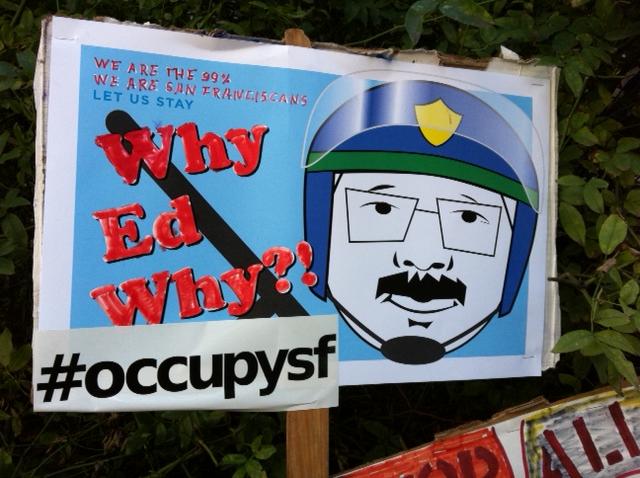
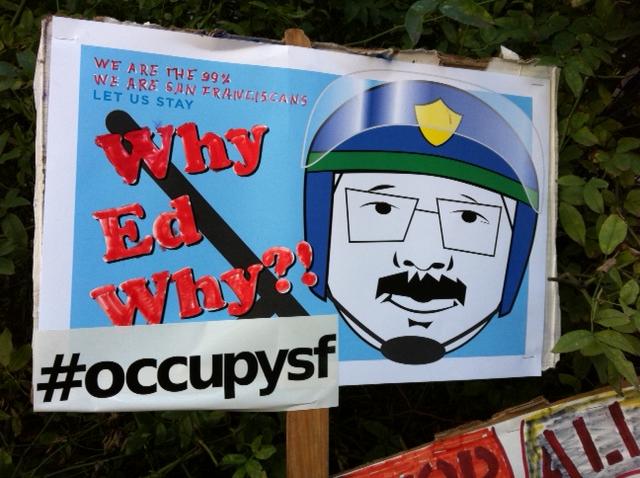
Meanwhile, in San Francisco, Mayor Ed Lee has reportedly assured OccupySF that he won’t follow through on threats to raid the camp if tents aren’t removed, at least not anytime soon (many observers speculate that he’ll at least wait until after next week’s mayoral election). But Lee has been unwilling to make a clear public statement that raids are now off the table.

When we sought to clarify Lee’s position and get his reaction to a Board of Supervisors resolution calling for the city to allow a 24/7 encampment, his Press Secretary Christine Falvey wrote: “The mayor has not focused on the resolution, but has been focusing on meeting with clergy, labor, occupysf demonstrators and his department heads to make sure that the site is kept clean, safe and accessible for everyone. He remains concerned about overnight camping and the public health and safety issues that brings. That said, he has seen some good progress over the last few days because of his open communication with the group. DPW cleaned up the site over the weekend and the demonstrators helped facilitate the cleanup. Tents were moved off the Bocce Ball Court as well. The group is working with Fire and Public Health officials to make some improvements. The dialogue is ongoing.”

Photos by Steven T. Jones

On Guard!

4

news@sfbg.com


VICTORY’S MUDSLINGING

Hit pieces are common in San Francisco politics. So, sadly, are negative mailers funded by outside independent expenditure committees that can raise unlimited money.

But it’s highly unusual for an organization devoted to electing queer candidates to fund an attack on a candidate who is endorsed by both leading LGBT organizations and is, by all accounts, an ally of the community.

That’s what happened last week when the Washington-based Victory Fund — the leading national organization for LGBT political candidates — sent out a bizarre mailer blasting City Attorney Dennis Herrera for taking money from law firms that do business with the city.

The Victory Fund has endorsed former Sup. Bevan Dufty, who is the most prominent LGBT candidate in the mayor’s race. That’s to be expected; it’s what the Victory Fund does.

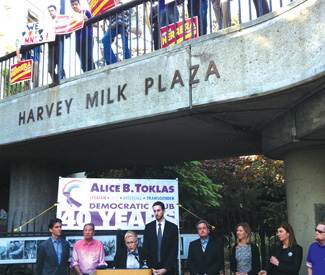
But why, in a race with 16 candidates, would the fund go after Herrera, who has spent much of the past seven years fighting in court for marriage equality? Why try to knock down a candidate who has the support of both the Harvey Milk Club and the Alice B. Toklas Club?

It’s baffled — and infuriated — longtime queer activist Cleve Jones, who is a Herrera supporter. “I have long respected the Victory Fund,” Jones told us. “But I’ve never seen them do what they did here. And it’s going to undermine the fund’s credibility.”

Jones dashed off an angry letter to the fund’s president, Chuck Wolfe, saying he was “appalled that this scurrilous attack, in the waning days of a mayoral campaign, would go out to the San Francisco electorate under the name of the Victory Fund.

“You really screwed up, Chuck, and I am not alone in my anger.”

We couldn’t get Wolfe on the phone, but the fund’s vice president for communications, Denis Dison, told us that the mailer “is all about fighting for our endorsed candidates.”

So how does it help Dufty, in a ranked-choice election, to attack Herrera? (In fact, given the dynamics of this election, the person it helps most is probably Mayor Ed Lee). Dison couldn’t explain. Nor would he say who at the fund decided to do the attack mailer.

But there are a couple of interesting connections that might help explain what’s going on. For starters, Joyce Newstat, a political consultant who is working for the Dufty campaign, is active in the Victory Fund, sits on the board of the fund’s Leadership Institute, and, according to a March 24 article in the Bay Area Reporter, was among those active in helping Dufty win the Victory Fund endorsement.

But again: Supporting Dufty is one thing. Attacking Herrera is another. Who would want to do that?

Well, if there’s one single constituency in the city that would like to sink Herrera, it’s Pacific Gas and Electric Co. And guess what? PG&E Governmental Affairs Manager Brandon Hernandez chairs the Victory Fund’s Leadership Institute. PG&E’s corporate logo appears on the front page of the fund’s website, and the company gave the Victory Fund more than $50,000 in 2010, according to the fund’s annual report.

Dison insisted that neither Hernadez nor anyone else from PG&E was involved in making the decision to hit Herrera and said the money went to the Leadership Institute, which trains LGBT candidates, not directly to the campaign fund.

Maybe so –- but the folks at the private utility, who are among the top three corporate donors to the Victory Fund, have to be happy. (Tim Redmond)


HERRERA HIT BACKFIRES

Herrera was also the target of another attack on his LGBT credentials last week, this one by the San Francisco Chronicle, which ran a front page story on Oct. 26 in which anonymous sources said he raised doubts in private City Hall meetings about San Francisco’s decision to issue same-sex marriage licenses in 2004. It was entitled, “Fight turns ugly to win gay votes in mayor’s race.”

Despite trying to couch the hit in passive language, writing that ” a surprise issue has emerged” based on accusations “leveled by several members of former Mayor Gavin Newsom’s administration,” it was clear that it was the Chron that made it an issue, for which the newspaper was denounced by leaders of the LGBT community from across the political spectrum at a rally the next day.

“Those who are saying this now anonymously are as cowardly as Dennis and Gavin were courageous back then,” said Deputy City Attorney Theresa Stewart, the lead attorney who defended San Francisco’s decision in 2004 to unilaterally issue marriage licenses to same-sax couples, in defiance of state and federal law, which eventually led to the legalizing of such unions. “We can’t have our community turn on us for petty political gain.”

“WTF, Chronicle?” was how Assemblymember Tom Ammiano began his speech, going on to lay blame for the attack on surrogates for Mayor Ed Lee. Ammiano also called out the mayor for campaign finance violations by his supporters, for undermining the Healthy San Francisco program that was created by Ammiano’s legislation, and for repeatedly ordering police raids on the OccupySF encampment.

“How about some fucking leadership?!” Ammiano said.

Cleve Jones, an early gay rights leader who marched with Harvey Milk, also denounced Lee and his supporters for cronyism, vote tampering, money laundering, and the “fake grassroots” efforts of the various well-funded independent expenditure campaigns, which he said have fooled the Chronicle.

“To the Chronicle and that reporter — really? — this is what you do two weeks before the election? You should be ashamed of yourself,” Jones said. “How stupid do you think we are?”

Yet Chronicle City Editor Audrey Cooper defended the article. “Clearly, I disagree [with the criticisms],” she told the Guardian. “I personally vetted every one of the sources and I’m confident everything we printed is true.” She also tried to cast the article as something other than a political attack, saying it was about an issue of interest to the LGBT community, but no LGBT leaders have stepped up to defend the paper.

Beyond criticizing the obvious political motivations behind the attack, speakers at the rally called the article bad journalism and said it was simply untrue to suggest that Herrera didn’t strongly support the effort to legalize same-sex marriage from the beginning.

“I can tell you that Dennis never once shrank from this fight. I was there, I know,” Stewart said, calling Herrera “a straight ally who’s devoted his heart and soul to this community.”

Sen. Mark Leno, who introduced the first bill legalizing same-sex marriage to clear the Legislature, emphasized that he isn’t endorsing any candidates for mayor and that he didn’t want to comment on the details of the article’s allegations. But he noted that even within the LGBT community, there were differences of opinion over the right timing and tactics for pushing the issue, and that Herrera has been a leader of the fight for marriage equality since the beginning.

“I am here to speak in defense of the character and integrity of our city attorney, Dennis Herrera,” Leno said, later adding, “I do not appreciate when the battle for our civil rights is used as a political football in the waning days of an election.”

Molly McKay, one of the original plaintiffs in the civil lawsuit that followed San Francisco’s actions, teared up as she described the ups and downs that the case took, working closely with Herrera throughout. “But this is one of the strangest twists I can imagine,” she said of the attack by the Chronicle and its anonymous sources. “It’s ridiculous and despicable.”

Representatives for both the progressive Harvey Milk LGBT Democratic Club and fiscally conservative Alice B. Toklas LGBT Democratic Club also took to the microphone together, both saying they often disagree on issues, but they were each denouncing the attack and have both endorsed Herrera, largely because of his strong advocacy for the LGBT community.

Sup. Scott Wiener called Herrera, “One of the greatest straight allies we’ve every had as a community.”

When Herrera finally took the microphone, he thanked mayoral opponents Joanne Rees and Jeff Adachi for showing up at the event to help denounce the attack and said, “This is bigger than the mayor’s race. It’s bigger than me.”

He criticized those who would trivialize this issue for petty political gain and said, “It was my pleasure and honor to have been a part of this battle from the beginning — from the beginning — and I’ll be there in the end.” (Steven T. Jones)


BUYING REFORM

UPDATE: THIS ITEM HAS BEEN CHANGED FROM THE PRINT VERSION TO CORRECT INACCURATE INFORMATION DEALING WITH WHETHER PAST INIATIVES CAN BE CHANGED

October yielded tremendous financial contributions from real estate investors and interest groups for Yes on E, feeding fears that the measure will be used to target rent control and development standards in San Francisco.

Sup. Scott Wiener has been the biggest proponent for Prop E since May 2011. He argues that the Board of Supervisors should be able to change or repeal voter-approved ballot measures years after they become law, saying that voters are hampered with too many issues on the ballot. Leaving the complex issues to city officials rather than the voters, makes the most sense of this “common sense measure”, Wiener calls it.

But how democratic is a board that can change laws approved by voters? Calvin Welch, a longtime progressive and housing activist, has his own theory: Wiener is targeting certain landlord and tenant issues that build on the body of laws that began in 1978, when San Francisco voters first started adopting rent control and tenants protection measures. Yet the measure will only allow the board to change initiatives approved after January 2012.

“That is what the agenda is all about — roughly 30 measures that deal with rent control and growth control,” he said. Critics say  the measure will leave progressive reforms vulnerable to a board heavily influence by big-money interests. Although Wiener denies Prop E is an attack on tenants, who make up about two-thirds of San Franciscans, the late financial support for the measure is coming from the same downtown villains that tenant and progressive groups fight just about every election cycle. High-roller donations are coming straight from the housing sector, which would love a second chance after losing at the ballot box.

Contributions to Yes on E include $15,000 from Committee on Jobs Government Reform Fund, $10,000 from Building Owners and Managers Association of SF PAC, another $10,000 from high-tech billionaire Ron Conway, and $2,500 from Shorenstein Realty Services LP. Then — on Oct. 28, after the deadline for final pre-election campaign reporting — the San Francisco Association of Realtors made a late contribution of another $18,772, given through the front group Coalition for Sensible Government.

Prop. E is organized so that the first three years, an initiative cannot be subject to review. However after four years, a two-thirds majority vote by the board could make changes, and after sevens years, a simple majority could do so.

 (Christine Deakers)

Lee benefits from vetoing health care reform

25

Downtown groups that pressured Mayor Ed Lee to veto legislation that would have prevented businesses from raiding their employees’ health savings accounts have been funneling big bucks into independent expenditure campaigns formed to keep Lee in the Mayor’s Office.

Meanwhile, the Board of Supervisors today strengthened a weak alternative to the vetoed legislation by Board President David Chiu, which it then continued for two weeks. The amendments by Sup. Malia Cohen were unanimously approved by the board, but her five allies in supporting the vetoed legislation – David Campos, John Avalos, Ross Mirkarimi, Jane Kim, and Eric Mar – preferred that the measure be returned to committee for more analysis, losing on a 6-5 vote.

“We need more time to understand the implications of the amendments. We’re not sure if it actually closes the loophole,” Campos, the vetoed measure’s sponsor, said of provisions in the Health Care Security Ordinance – the city’s landmark measure that required employers to provide some health coverage to employees – that allowed businesses last year to pocket more than $50 million from health savings accounts they created for their employees.

One Cohen amendment specifically addressed one of the more egregious violations – restaurants that charge customers at 3-5 percent surcharge for employee health care and than pocket that money at the end of the year – which Chiu had addressed only by calling for more scrutiny of the tactic by the Office of Labor Standards. She also would require businesses to keep two years worth of contributions in the account, rather than the one year sought by Chiu to address the so-called “January problem” of businesses draining the account at the end of every year and leaving nothing for employees who get sick or injured at the start of the year.

It was perhaps a sign of the heat that Lee took from labor and consumer groups for his veto that he quickly issued a press release today praising the supervisors for addressing the issue. “I applaud President Chiu, Supervisor Cohen, organized labor, small business owners, and the Department of Public Health for finding the solutions to this important public policy that can strengthen our City’s landmark Health Care Security Ordinance. By closing the loophole through these proposed amendments, we can increase access to health care, protect jobs in our small businesses and protect consumers while growing our economy at the same time,” it read.

But Lee appears to have already benefited from heeding the demands of downtown – particularly the San Francisco Chamber of Commerce and Golden Gate Restaurant Association (GGRA) – who made defeating the Campos legislation a top priority, casting it as a new “fee” that would drain $50 million from the local economy.

The San Francisco Alliance for Jobs and Sustainable Growth PAC, created by notorious downtown bagman Jim Sutton, is the best-funded on the four independent expenditure groups that are supporting Lee, taking in $390,000 this fall, including $27,000 from the GGRA and $25,000 from the Chamber’s SF Forward group. Both groups also support the Committee on Jobs, which kicked in $110,000 to the Alliance campaign. GGRA also gave another $10,000 to the pension reform campaign that Lee is pushing, support the Chamber had threatened to withhold if the Campos measure was approved.

GGRA Executive Director Rob Black denied this was pay-to-play politics, noting that the Alliance is also supporting DA George Gascon, Sheriff candidate Chris Cunnie and two ballot measures. “But absolutely, the mayor’s name is on there and the organization voted to endorse him,” Black said.

GGRA voted in August to endorse Lee, Chiu, and Michela Alioto-Pier for mayor. Black said the organization is “generally supportive of Sup. Chiu’s approach to reforming the Health Care Security Ordinance,” and Black specifically said it supports improving requirements that businesses notify employees about the health savings accounts and how to use them.

The GGRA led the original fight against the HCSO in 2006, which was sponsored by then-Sup. Tom Ammiano, who lined up a veto-proof majority on the progressive-dominated board and eventually persuaded then-Mayor Gavin Newsom to support it. The measure created the Healthy San Francisco program and required employers to spend a minimum amount per employee on health care, although federal ERISA law bars cities from prescribing how that money is spent.

GGRA challenged the employer mandate all the way to the U.S. Supreme Court on the grounds that it violated ERISA, losing the case. Many of its members restaurants then opted to use health savings accounts rather than paying into Healthy San Francisco or private health insurance, even though health experts say such accounts are the worst option.

Campos and his allies have maintained that money in these health savings accounts belongs to employees and that businesses that use and raid them gain an unfair competitive advantage at the expense of their employees, customers, and city taxpayers, who are often forced to foot the bill for the uninsured.

Campos and the coalition that supports him has said they may take this issue to voters if the Chiu/Lee legislative fix doesn’t address their concerns.

SF supervisors support OccupySF’s 24/7 encampment

56

The San Francisco Board of Supervisors today approved a resolution supporting Occupy Wall Street and the right of OccupySF to maintain a 24/7 encampment in Justin Herman Plaza, although sponsors of the measure narrowly lost a fight over amending the measure to allow police to use force if “there is an objective threat to safety or health.”

The sponsors of the measure – Sups. John Avalos, David Campos, Eric Mar, and Jane Kim – noted that heath and safety concerns were used as a pretext for both police raids on OccupySF and for last week’s violent police crackdown on the Occupy Oakland encampment, something San Francisco officials uniformly say they want to avoid here. Those four sponsors were joined by Sup. Ross Mirkarimi in opposing the amendment by Sup. Scott Wiener, which passed on a 6-5 vote.

But the overall measure – which urges Mayor Ed Lee to drop his opposition to tents and other camping infrastructure and not order another police raid on the camp – was then approved on an 8-3 vote, with Sups. Mark Farrell, Carmen Chu, and Sean Elsbernd in dissent. Farrell and Chu both expressed support for the movement’s call for addressing severe economic inequities in the country, but they oppose the tactic of occupation.

Board President David Chiu, the swing vote on allowing the resolution to be watered down, said his vote was an effort to get as much support for the measure as possible. “For me, it was important to build consensus here at the board,” he said, praising the work that city officials and OccupySF participants have done to resolve their differences. “I have been very impressed with the behavior of individuals involved in this movement.”

Wiener had made a number of amendments to the resolution that Avalos accepted without objection, drawing the line only at the change that would specifically allow for police to use force to dislodge the protesters. While the nonbinding resolution doesn’t compel any action by Lee or the SFPD, Avalos praised the mayor for meeting privately with OccupySF members after he seemed to take a firm public stand again allowing camping.

“I do want to thank the mayor for coming to the table on how our public spaces can be used,” Avalos said. Kim echoed the point, noting that, “A ton of progress has been made.” The Mayor’s Office has not yet responded to Guardian requests for comment on the resolution or his current position on OccupySF, but we’ll update this post when we hear back.

Wiener and others also thanked Avalos for taking the lead role in addressing this issue. “I want to thank Sup. Avalos for being so open and collaborative,” Wiener said, noting that he’s been very impressed with how OccupySF has handled itself throughout the standoff. “I’m very supportive of OccupySF…It’s been incredibly peaceful and people have been friendly and passionate.”

Vote for three but not Ed Lee

16

OPINION Halloween 2011. Next week San Francisco will choose a new mayor. Is this a masquerade? Who is behind Mayor Ed Lee’s mask?

I’ll call it exactly how I see it: I am disappointed in Ed Lee. I’ve known him since before I was first elected to the Board of Supervisors in 2000. I wanted to be hopeful, but I actually can’t say that I’m surprised. Ed Lee has always been a go-along-to-get-along bureaucrat who has moved up the feeding chain by doing the bidding of former Mayor Willie Brown and Willie’s loyal lieutenant Rose Pak. I had a fantasy that maybe Ed would rise to the occasion, become his own person, and emerge as an independent leader free of those that orchestrated his appointment to “interim” mayor.

But in the first year since appointment (in one of the most masterful political plays since Abe Ruef got Eugene Schmitz installed as mayor in 1902), Ed has consistently sided with the powers and their “City Family” that “made” him. Even I was astounded when Ed moved legislation to displace hundreds of hotel workers at San Francisco’s Fairmont Hotel. And I was actually shocked when he did the bidding of the right-wing Restaurant Association and vetoed common-sense legislation to stop the exploitation of local restaurant workers.

His list of disappointments grow. He orchestrated the demolition of more than 1,500 units of rent controlled housing at Park Merced. Then he had the audacity to laud Pacific Gas and Electric Co. as a “great local corporation” on the anniversary of the lethal San Bruno pipeline explosion.

Several pols have been credited with the statement that “money is the mother’s milk of politics.” Well, Willie and Rose and their friends at the Chamber of Commerce got milk! Willie Brown is fundraising for three different committees to get Lee elected, Rose Pak started two different fundraising committees of her own, and right-wing Republican billionaires like Ron Conway and right wing corporations like Pacific Gas and Electric are lining up to throw money into the coffers.

Why? Because Ed is their guy.

The proof is right in front of us. All of Willie’s trademark slights of hand are resurfacing in Ed Lee’s friends’ bag of tricks: money laundering, pay to play politics, allegations of voter fraud. These are all hallmarks of Brown and his cronies, all executed under the visage of the supposedly humble Ed Lee. And voters shouldn’t fall for it. Because if we do, we’ll go back to the days before Gavin Newsom when backroom deals, self-dealing, cronyism and out-and-out corruption were the rule of the day.

It is no coincidence that in a year gripped by the divide between the 99 and 1 percent, the latter is working feverishly to elect Lee. If you don’t believe me, look it up on the Ethics Commission website (sfgov.org/ethics). PG&E alone has contributed at least $50,000 to one such “independent” committee.

I know this is the first race for mayor with ranked choice voting—and it is confusing. That’s a concern. But frankly, at this point all I care about is that voters understand not to mark Ed Lee anywhere on their ballot.

The good news? The outcome of the Mayor’s race is far from a foregone conclusion. San Franciscans are seeing through the millions of corporate dollars being spent on behalf of Lee.

You have a choice—three, in fact. And you should use them strategically, because you can make a difference by voting not just with your heart, but also with your mind. That means making sure you do your research and vote for three candidates who represent your values—and have a chance to win.

The Guardian has endorsed three candidates—Avalos, Herrera, and Yee—who have demonstrated enough of a commitment to progressive values and an aversion to the powers of the once-dormant machine that, like a vampire, is attempting to rise from the crypt. These three candidates also happen to have the best shot to beat Lee. Your votes for all three—in any order—are your best guarantee not to elect Ed Lee.

Vote for three and don’t vote for Lee!

Aaron Peskin chairs the San Francisco Democratic County Central Committee.


Survey shows Lee aligned with tenant advocates only half the time

The results of a mayoral candidates’ survey created by the Council of Community Housing Organizations (CCHO) offered some surprises. Based on candidates’ responses, venture capitalist Joanna Rees, one of the more conservative contenders, came across as a stronger advocate for affordable housing and tenants’ rights than interim Mayor Ed Lee, who previously defended tenants as an attorney with the Asian Law Caucus.

The survey posed 25 yes-or-no questions to mayoral hopefuls, formulated by CCHO, the San Francisco Tenants Union, and the Housing Rights Committee. A “Yes” answer meant the candidate was aligned with the housing advocates’ standpoint, a “No” response was frowned upon as contrary to advocates’ housing agenda, and a “?” signified the response, “I’ll consider it.”

All told, Lee responded “No” to six questions, “I’ll consider it” to seven questions, and “Yes” to 12 questions, demonstrating consistency with the housing advocates’ agenda about half the time. Rees, on the other hand, responded “No” to three questions, and “Yes” to every other question.

Other respondents included Public Defender Jeff Adachi, Sup. John Avalos, green party candidate Terry Joan Baum, Board President David Chiu, former Sup. Bevan Dufty, City Attorney Dennis Herrera, and Sen. Leland Yee.

Candidates who answered in the affirmative to every survey question were Avalos, Baum, and Yee. Dufty responded “No” to eight questions, and “I’ll consider it” to one. Chiu responded “Yes” to most questions and “I’ll consider it” to four questions, though there was some confusion as his response wasn’t listed every time.

There you have a summary of the scorecards. So what were the questions?

Every single candidate answered “Yes” to this one: “To make up for the huge State and Federal cutbacks in affordable housing funding, will you commit to placing a dedicated affordable housing funding measure on the November 2012 ballot of at least $100 million?”

So no matter who’s elected, housing advocates will have an opportunity to advance this idea.

Among the more divisive issues was the question of reforming condo conversion laws to regulate tenancies-in-common conversions, in order to stem depletion of affordable housing stock. Lee, Rees, and Dufty responded that they would not seek such reforms; Yee, Avalos, Adachi, and Baum said they would. Herrera declined to answer.

Candidates were also divided on whether the San Francisco Rent Board, which mitigates disputes between tenants and landlords, ought to be reformed to “increase tenant representation and balance appointments between the Mayor and Board of Supervisors?” Yee, Lee, Dufty, and Adachi rejected that idea.

And Lee stood alone in answering “no” to this question: “Will you enforce a balance between market-rate housing and affordable housing that fulfills the City’s adopted housing goals, even if such a linkage slows down the overproduction of luxury condos until a minimum level of affordable and middle income housing catches up?”

All others said they would, except Chiu, who said, “I’ll consider it.”

View the full results of the survey here.

Superviors and labor leaders challenge Lee’s OccupySF stance

41

Mayor Ed Lee has put the city and its police force on a collision course with not only OccupySF, but also several members of the Board of Supervisors and top labor leaders who support the movement and want the city to allow its encampment to continue.

They spoke at a special hearing of the City Operations and Neighborhood Services Committee that was convened by Chair John Avalos this morning, supporting a resolution that Avalos created to allow OccupySF to have tents and other infrastructure that Lee opposes. The resolution – which is co-sponsored by Sups. Eric Mar, David Campos, and Jane Kim – was approved by the committee and is set to be considered by the full Board of Supervisors tomorrow (Tues/1).

“It is something I am wholeheartedly supporting because it is an expression of great frustration and concern about the economic system,” Avalos said. “We need to speak with a greater voice about changing our economic system so it works for the many and not just the few,” Avalos said, explaining why he is “wholeheartedly supporting” the OccupySF movement.

But Avalos said he’s been frustrated that Lee and the police have raided the camp twice and are threatening more, something that Avalos has been trying to mediate since the first raid on Oct. 5. He also said the city should learn from Oakland that using the police force to stop the movement only makes it stronger.

“If we were to try to stop it from happening, it would just encourage more people to take part in it,” he said, noting that more midnight raids are dangerous for both police and protesters. “We have to figure out as a city how we’re going to facilitate, encourage, and accommodate this movement.”

But instead, Avalos said Lee’s stand against allowing tents or an kind of encampment, while claiming to support the message OccupySF, has created a tense standoff. “I’ve seen very mixed messages come out of this administration,” Avalos said, adding that nobody believes police statements that the massing of SFPD cops in riot gear on Oct. 26 was only a training exercise.

Mar said OccupySF deserves tremendous credit for holding the space and being responsive to the health and safety concerns raised by city officials. “I’ve seen a transformation in the movement in the last three weeks that is truly impressive,” Mar said. “I’ve also seen, during the General Assemblies, an incredible exercise in democracy.”

He also disputed accusations that the camps are dirty and that the movement is unfocused. “Don’t believe the hype from the mainstream media but look at the messages coming out of this movement,” said Mar, who was wearing a “We are the 99 percent” sticker.

“We should allow OccupySF to do what they’re doing,” Campos said. “It’s good for San Francisco.”

Campos also called out Lee and Oakland Mayor Jean Quan for ordering violent raids on the peaceful encampment, disputing the idea that “somehow it’s okay for us to spend the limited resources we have on these kinds of police actions…I hope we don’t have Mayors Quan and Lee wasting resources that could be better spent elsewhere.”

During the public comment portion of the hearing, each of the more than two dozen speakers supported the resolution.

“What this resolution does is it calls on the other supervisors and the mayor to decide how they want to deal with OccupySF,” said Gus Feldman of SEIU Local 1021.

Representatives of several labor unions and the San Francisco Labor Council that have voted to endorse OccupySF spoke at the hearing, include Ken Tray with United Educators of San Francisco, who gave a rousing speech in support of the movement.

“The times have changed and the political landscape has shifted,” Tray said, ticking off a long list of reasons for supporting the movement, from San Francisco’s long tradition of advocating for progressive change to the fact that “the schoolchildren of San Francisco are being denied resources because the 1 percent refuse to pay their fair share.”

Frank Martin del Campo of the SF Labor Council displayed the bruises on his arm inflicted by police during the raid on the Occupy Oakland, saying “this was an attempt to criminalize dissent…It represents the politicization of the police.”

Labor Council Executive Director Tim Paulson said, “I just want to be clear that we are the 99 percent….We want Occupy San Francisco to be there 24/7.” He and others say the Occupy movement is highlighting deep economic inequities that the labor movement has long been raising as well. “OccupySF has called the question on really important issues we’ve been struggling with for years,” said Gabriel Haaland of SEIU Local 1021

“Here is a peaceful protest being answered with violence,” said Pilar Schiavo of California Nurses Association, which has been supporting the occupations. This is an important political struggle, she said, and “It’s time for the mayor to decide what side he’s on.”

Many speakers focused their criticism on Lee, such as Brad Newsham, who said, “Any official who would send in the riot police to deal with this camp does not deserve to be mayor of San Francisco.” He said the city should set an example for the country by formally allowing the encampment to continue, and he turned to the young protesters in the room and said, “Hold your ground and we’ll try to get your back.”

Sean Semans, an active member of OccupySF since the beginning, thanked Avalos and the other progressive supervisors for “saving us when nobody would,” and he expressed frustration with the Mayor’s Office.

“The mayor still doesn’t recognize us, he won’t come down and see the work we’re doing,” Semans said. “We can do all kinds of work when we’re not fighting to protect our First Amendment rights.”

He was part of an OccupySF delegation that met with Lee last week, and Semans said the mayor offered to help get the protesters rooms in SRO hotels or meals from local soup kitchens, showing that he has a fundamental misunderstanding about what this occupation is about.

As Semans said, “It shows what we’re dealing with here.”

Mayor Lee still moving toward showdown with OccupySF

22

Mayor Ed Lee continues to insist that OccupySF break down its encampment in Justin Herman Plaza and threaten to send in riot police if that doesn’t happen, even as this week’s violent police raid on Occupy Oakland has sparked international outrage, condemnation, and solidarity with other occupations.

Reporters packed into the Mayor’s Office for a photo op with a good samaritan who recently helped rescue an injured truck driver, clearly waiting for the chance to interview Lee and Police Chief Greg Suhr about last night’s aborted police raid on the OccupySF encampment, asking repeated questions seeking to clarify Lee’s confusing political doublespeak before his communication staff shuffled him out of he room after about 10 minutes.

“I, like all of you, were watching in somewhat of very big deep concern as I saw things unveiled in Oakland, certainly in constant communication with not only our chief of police, Chief Suhr, but also all of our departments to say that’s not what we want to happen in San Francisco,” Lee began. “We’re trying to enforce all the laws here, and of course it’s public health stuff that we’re emphasizing. We need to make sure our public spaces are clean and healthy, and to protect their First Amendment rights. But we didn’t want to get into a situation where we’re just busting heads because then it’s all lost.”

Yet neither Lee nor Suhr could articulate why they think Oakland’s raid turned so violent or how to guard against a similar fate here in San Francisco, particularly because they reiterated their position that the encampment must go and held open the possibility that another police raid – there have been two so far, the second more violent than the first, and the camp has only grown in size since then – could come at any moment.

They also offered shifting explanations for last night’s massing of SFPD troops in riot gear in buses on Treasure Island, which protesters believe was turned back only because of the huge presence in the camp, which included five members of the Board of Supervisors and various labor leaders, a group that Lee says he would be meeting with shortly after the event (“We’re seeing if they’d like to propose some additional solutions,” Lee said).

When asked about plans for yesterday’s raid, Suhr initially said it was simply a normal Wednesday evening training exercise. “There were that many police amassed last Wednesday, there will be that many police amassed next Wednesday. Wednesday is a standard training day for the Police Department,” Suhr said.

But when reporters expressed skepticism – many aware of the busloads of police in riot gear massing on Treasure Island, the last minute changes in police staffing schedules, and the notices of possible police activity sent to businesses around Justin Herman Plaza – Suhr said police were preparing to either assist in Oakland or deal with trouble from OccupySF.

“Out of deference for what was going on in Oakland, we felt that the more pressing need was whether we needed to assist Oakland and/or whether that situation was going to come to us,” Suhr said. “I didn’t say it was a training exercise, we took advantage of the presence on what was training day and to train to what we may have to do down the line.”

Lee also raised the concern that violent agitators might come to San Francisco: “They had to get ready for what they saw in downtown Oakland. They had to get ready for hundreds of people coming to San Francisco, either walking over the bridge or coming through the BART system. So they were trying to get ready for that particular activity because we didn’t know what was going to happen. We saw a lot of anger and a lot of frustration by people who wanted to come over to San Francisco and we didn’t know what their intention was.”

But reporters noted that Lee ordered OccupySF to take down its encampment two weeks ago, that he told reporters this week that they must do so “within days,” and that Suhr circulated a memo in the camp yesterday entitled “You are Subject to Arrest” if they didn’t heed city codes regarding overnight camping. Given all that, we again asked if there was any intention to go into the camp last night?

“That was not our intention, but I’ve always asked the chief to be ready. I’ve been insistent that we have to be ready to enforce our laws so he’s been under that instruction for quite some time. But the tactical decisions are the chief’s responsibilities,” Lee said.

Yet later in the press conference, after Lee had left the room, Suhr made it clear that the decision about if and when to stage another raid on OccupySF is the mayor’s. “Make no mistake about it, Mayor Lee is in charge of this situation,” Suhr said.

In fact, when we asked Suhr about this constant threat of a violent police raid in the middle of the night hanging over the protesters – which is a wearying distraction from the main economic justice purpose at best, and at worst what some protesters told us was akin to psychological warfare – Suhr said that even he didn’t know when a raid might come.

“There’s nobody more anxious that I am because I don’t know when the raid is coming either, so I can attest to the fact that it makes me anxious. We are working painstakingly and patiently to make sure that area is safe and sanitary,” Suhr said.

But while Lee insists that dialogue and compromise could still avert another crackdown, he refuses to accept that occupation is a tactic that protesters aren’t likely to abandon anytime soon. So Lee’s insistence that the camp be broken down seems to be putting the city and OccupySF on a collision course that most members of the Board of Supervisors – including those sponsoring resolution urging the city to allow overnight camping – fear could be a disastrous stain on the city.

“Our message to OccupySF is we’re still wanting you to comply,” Lee said. “That’s been the consistent message we’ve been sending clearly these last couple weeks…We’re trying to ensure that [the ban on] overnight camping is still enforced, but also respecting their rights to protest.”

I and other reporters tried to push Lee on the potentially harmful standoff he was creating, and he tried to make it sound as if the OccupySF movement could avoid another police crackdown, something he said depends on protesters submitting to his demands.

“It’s optimistic on our part that we would get some sensible minds who want to help us find a way to clean up the area, because that ultimately what we want to do,” he said.

But for all his statements of support for the Occupy Wall Street movement and stated desire to avoid the violent confrontation in Oakland, he refuses to allow tents on the site.

“There’s a fine line between occupying public space within your First Amendment rights and sleeping overnight and causing health conditions that we’ve been very concerned about. So we’re going to take it step by step,” Lee said. When asked about whether tents would still be allowed if the camp was clean and otherwise compliant, he said, “We’re still saying no tents.”

So then when and how will you be enforcing that, reporters kept asking.

“Let’s see what can voluntarily be done through the dialogue that trying to establish. We’ve given them a lot of notices. I want to be sure that if we have to do things to enforce our laws, that we’re quite justified and that everybody knows,” Lee said.

Yet that was the same stance that Oakland Mayor Jean Quan took, and it’s one that she is reportedly backtracking on in the wake of the violence and international condemnation. And Lee couldn’t explain how a crackdown might go differently in San Francisco, particularly none that OccupySF has grown larger and more empowered by defying Lee’s edict for so long.

“Everyone agrees that we don’t want to Oakland situation to happen here,” Lee said, at which point Press Secretary Christine Falvey said he would take only two more questions.

“We’re putting a responsible burden on the occupiers to work with us so we can avoid situations like Oakland,” Lee said. “They have to take responsibilities for what they’ve done.”

“Frankly, it sounds like you’ve said nothing, and I think some other reporters are feeling the same way,” KCBS reporter Barbara Taylor, the senior journalist stationed at City Hall, said with a tone of exasperation. “So can you just outline, when you say to do the right thing, what is the right thing? Do you expect them to voluntarily take down the tents, clean up the camp, only be there within certain hours?”

“Yes. The right thing for them to begin showing responsibility,” Lee responded.

“But what does that mean?” Taylor persisted.

Lee said they need to clean up the camp, saying that “cleanliness has been our number one concern….They have to show signs that they’re willing to work with us.” But the protesters have been diligent about regularly cleaning the camp, and they have complied with other city requests such as no open flames. And when the city refused to make porta-potties available at night, supporters of the camp rented four of their own after the city and its daily newspapers complained about public urination and defecation.

“I’ve said all along that public safety is our number one concern,” Lee said.

Fire Chief Joanne Hayes-White reinforced Lee’s point, complaining about open flames, car batteries, and generally “unhealthy and unsafe conditions.” When we noted that the protesters have already addressed and abated many of these issues in recent days, she admitted that she hasn’t been to the site recently, but said, “The tarps and the tents are not something we’re going to tolerate.”

Suhr made it clear that police action would be done in support of other city departments who ordered hazards to be abated. As for when and how officers would do so: “If we believe we could go into the camp safely, if we think we can go in and support the agencies that will be doing the cleanup, without having to go past a measured response, we would do that,” Suhr said. “That opportunity did not present itself last night.”

And so the standoff continues.

Mixed messages

0

steve@sfbg.com

In San Francisco — the first major city to launch a midnight police raid to break up an Occupy encampment, which it repeated Oct. 16 — city officials are struggling with contradictions between claims of supporting the movement but opposing its tactic of occupation. Protesters have reacted to those mixed messages by erecting a growing tent city in defiance of Mayor Ed Lee’s public statements on the issue.

The situation remained fluid at Guardian press time, with OccupySF members unsure when and whether to expect another raid. That sort of standoff has repeated itself in cities around the country. But it seems particularly fraught here in the final weeks of a closely contested mayor’s race as Lee’s stated belief that “a balance is possible” is put to the test.

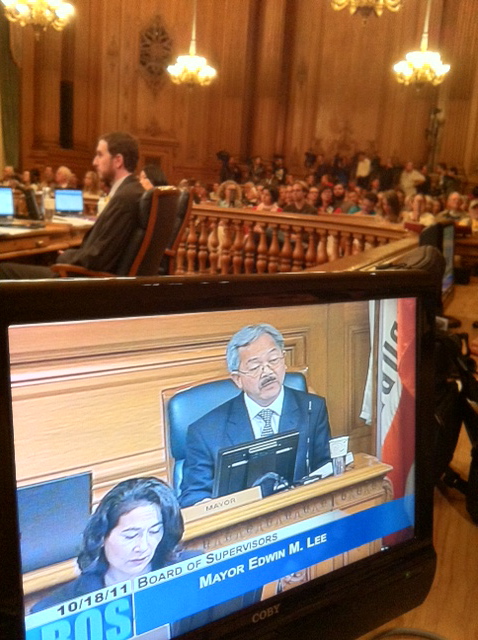
On Oct. 18, when hundreds of OccupySF protesters and their supporters entered City Hall to testify at the Board of Supervisors hearing — where Lee appeared for the monthly question time and was asked by Sup. Jane Kim to “describe the plan that our offices have been developing” to facilitate the OccupySF movement — it became clear there was no plan and that Lee was standing by the city’s ban on overnight camping.

“From the very beginning, I have fully supported the spirit of the Occupy movement…To those who have come today and who come day after day as part of this movement, let me say now that we stand with you in expressing anger and frustration at the so-called too big to fail and the big financial institutions,” Lee said at the hearing.

“Then don’t send the police in to destroy it,” yelled a woman from the crowd.

“Well, we are working with you,” Lee responded as Board President David Chiu banged his gavel at the interruption and said, “excuse me, you are out of order” and the packed hearing room erupted in shouts and applause at calling out the contradiction in the mayor’s position.

“Well, we are working with you. We are working with you to help raise your voice peacefully and will protect and defend your right to protest and your freedom of speech,” Lee continued, eliciting scattered groans from the crowd. “But that’s not the same thing as pitching tents and lighting fires in public places and parks that are meant for use by everyone in our city. But we can make accommodations and we have, and we can do this while not endangering public safety in any way.”

Afterward, as Lee was surrounded by a scrum of journalists asking about the issue, he made his stand even more clear. “We’re going to draw the line with overnight camping and especially structures,” Lee told reporters. Asked why the police raids have taken place in the middle of the night and why San Francisco is banning practices being allowed in other occupied cities, such as tents and kitchens, he offered only nonresponsive answers before being whisked away by his security detail.

Back inside the hearing room, Sup. John Avalos — who has led efforts to mediate the conflict and prevent police raids — called Lee’s comments “very frustrating. I’m alarmed that he is moving toward nightly standoffs with the Occupy movement.” After watching video of the chaotic Oct. 16 raid, at which several protesters were injured by police officers, Avalos called the situation “unsafe for both sides.”

Six of the 11 supervisors voiced support for OccupySF during the meeting, although Kim — who supports OccupySF and Lee’s mayoral campaign and whose District 6 includes the two protest encampments, in Justin Herman Plaza and outside the Federal Reserve — said at the hearing, “We’re all struggling to figure out the best way to accommodate it.”

Indeed, when the Guardian sought details on “the plan” Kim said she was developing with Lee, her staffers told us there was nothing in writing or major tenets they would convey. And mayoral Press Secretary Christine Falvey told us, “There’s not really a plan, per se, because the movement is so fluid,” although she confirmed that the city would not allow tents or other structures: “The tactic of camping overnight, he does not support.”

But OccupySF protesters were defiant as they streamed to the microphone by the dozens during public comment, decrying the city’s crackdown and claiming the right to occupy public spaces and to have the basic infrastructure to do so. As a woman named Magic proclaimed, “This can be a celebration or a battle, but we will not back down.”

The next afternoon, a large group of OccupySF protesters took their complaints about mistreatment by officers to the Police Commission meeting. Previously, Police Chief Greg Suhr had taken the same stance as Lee, with whom he had consulted before ordering the raid, claiming to support OccupySF but oppose overnight camping (see “Crackdown came from the top,” Oct. 11).

“We will surgically and as best as possible and with as much restraint as possible try to deal with the hazards while protecting people’s First Amendment rights,” Suhr had said, reiterating a ban on tents and infrastructure.

But by the end of the long Police Commission hearing — which was peppered by angry denunciations and chants of “SFPD where is your humanity?” — Suhr seemed to soften his position: “We have no future plans to go into the demonstration. We know that it’s for the long haul.”

OccupySF members interpreted Suhr’s remarks, which went on to raise concerns over potential future public health hazards that a growing encampment might present, as a change in the policy Lee had outlined a day earlier, erupting in the cheer, “Now that’s what I’m talking about!”

In the wake of that meeting, more than 40 tents — including a working kitchen and fully stocked medical tent — have been erected in Justin Herman Plaza, although neither the Police Department nor Mayor’s Office have answered Guardian inquiries seeking to clarify what current city policy is regarding OccupySF. But for now, protesters have declared victory over the city and are happy to be turning their full attention back toward powerful banks, corrupt corporations, and the rest of “the 1 percent.”

“I’m really proud of the OccupySF participants who went to the meeting today,” Zoe D’Hauthuille, a 19-year-old protester, told the Guardian after the Oct. 18 meeting. “I feel like they were really honest and super effective at getting people to realize that we need certain things, and that the city is violating our rights.”

Avalos offers resolution supporting OccupySF and its camp

57

In the wake of last night’s violent police raid on the Occupy Oakland encampment (a still-tense situation that we’re now on the scene covering) and two similar late-night police crackdowns on OccupySF in recent weeks, Sup. John Avalos and co-sponsors Eric Mar and David Campos are introducing a resolution at today’s San Francisco Board of Supervisors meeting that calls for the city to explicitly allow the OccupySF encampment and its related infrastructure to remain.

That resolution (the full text follows below), which Avalos legislative aide Raquel Redondiez says will be the subject of a special hearing on Monday before being considered by the full board on Tuesday, Nov. 1, grew out of testimony from OccupySF participants that Avalos solicited at last week’s board meeting following a late night police raid on Oct. 16 that resulted in five arrests and many injuries.

As we report in this week’s paper (see “Mixed messages,” to be posted this evening, Tues/25), at that Oct. 18 board meeting, Mayor Ed Lee took the position that no tents, kitchens, or other infrastructure would be permitted, a stance that Police Chief Greg Suhr seemed to soften slightly at a raucous Police Commission hearing the next day. In the face of those mixed messages, OccupySF grew into a full-blown tent city in Justin Herman Plaza and there have been no real conflicts with police since.

Both the San Francisco Police Department and the Mayor’s Office were slow to respond to messages we left all week seeking to clarify the city’s policy toward OccupySF, but both finally got back to us last night after the article had gone to press.

SFPD spokesperson Daryl Fong told us, “We’re still currently doing daily safety inspections at Justin Herman Plaza and continuing to provide leafletting…We’re educating the campers about violations and concerns for public safety,” such as unsanitary conditions or unsafe camping structures.

But he said OccupySF hasn’t been given any deadlines for removing structures and there are no current plans for another raid. “Our goal is to get compliance from the campers voluntarily,” he said. “This situation is being continually monitored as it progresses.”

When we asked the Mayor’s Office about the contradiction being Lee’s stance and the city’s reaction to the growing tent city, Press Secretary Christine Falvey wrote, “The mayor’s position on Occupy SF has not changed. He has directed his departments to facilitate peaceful protest, but not allow structures, tents, or a permanent campsite. He wants to ensure the area is safe for demonstrators and the general public. If you have been to the site, you may have seen the Fire and Public Health Departments conducting inspections for public health and safety concerns and you may have seen Recreation and Park and Police staff informing people of the parks and public safety codes that prohibit camping equipment. Individuals are being informed daily of this and the city’s Homeless Outreach Team is offering services to anyone in the area who may need it. The policy stands and departments are educating the group about what is and is not allowed and the mayor expects those who want to use the space to protest, to follow the rules.”

But OccupySF protesters say they have no intention of leaving the space, believing it’s their right to be there as part of a national movement spotlighting the greed and corruption of the wealthiest 1 percent of Americans. And when I told Falvey that the encampment seems to defy the mayor’s stated position, she wrote, “The mayor has asked several departments to enforce the existing codes, and I understand a number of informational contacts have gone out daily to educate those using the plaza about what is allowable in addition to Fire and Public Health inspections to make sure open flames or dangerous materials are not being used or stored at the site.”

I told her that didn’t address my question, and I asked for a reaction to the Avalos legislation that would explicitly allow “tents, tarps, First Aid supplies, environmentally clean and fire-safe energy sources, and the ability to store, prepare, and serve hot food,” which is the reality now on the ground. I’ll update this post when I get a response.

In the meantime, here’s the full text of the resolution:

[Expressing Support for Occupy Wall Street Protest Movement and the People’s Right to Peaceful Assembly in San Francisco]

Resolution Supporting the Occupy Wall Street Protest Movement and Urging Mayor Lee to Uphold People’s Right to Peaceful Assembly and Collaborate with Occupy SF to Ensure Safety of the Protestors, their Supporters, and the Greater Public.

WHEREAS, “Occupy Wall Street” was formed by a broad spectrum of people coming together to protest the corporate-serving economic and political system controlled by the 1 percent, profiting at the expense of 99 percent of the people; and

WHEREAS, Three years after the current financial crisis caused by Wall Street speculators and profiteers, the unemployment rate in the United States is still at the highest level since the Great Depression with the unemployment rate in San Francisco currently at 8.3 percent; and,

WHEREAS, The United States’ major banking institutions, which have been bailed-out by the government and United States taxpayers, have done little to prevent massive foreclosure of residential properties or support the revitalization of local economies by sustaining small businesses; and,

WHEREAS, Since 2008, there have been 1.2 million foreclosures in California, with 12,410 homes in San Francisco alone; and,

WHEREAS, The “Occupy Wall Street” protest movement has struck a chord with the people of the United States and around the world, inspiring over 900 similar protests and solidarity actions across the country, where tens of thousands of people have come out to express their deep indignation against Wall Street greed and systemic socio-economic injustices; and,

WHEREAS, The “Occupy” demonstrations are a rapidly growing movement of people from all walks of life with the goal of occupying public space in order to create a shared dialogue and assert demands for economic justice; and,

WHEREAS, The “Occupy” demonstrations have been supported by the California Nurses Association/ National Nurses Association, American Federation of Labor -Congress of Industrial Organizations, Change to Win, International Longshore and Warehouse Union-International, Teamsters Joint Council 7, Services Employees International Union, Laborers International Union of North America, and many others; and,

WHEREAS, The OccupySF demonstrations began in September with small gatherings of people and have since grown and gained supported from thousands of individuals, community and faith-based organizations, and unions; and,

WHEREAS, On October 12, a 500-person march and civil disobedience organized by local community groups received national media attention, exposing the struggles of San Francisco residents against foreclosure, corporate control, and spiraling unemployment; and,

WHEREAS, The October march and protest action culminated in civil disobedience and, despite the arrest of 11 people, lacked any antagonistic conflict between the police and protestors; and,

WHEREAS, Similar to demonstrations in hundreds of cities across the United States, OccupySF demonstrators are asserting their rights to free speech and peaceful assembly 24 hours a day, seven days a week, in order to create public dialogue around corporate control of the political process and public space; and,

WHEREAS, Numerous and various groups continue to join the protesters at OccupySF, including an interfaith clergy contingent and the California Nurses Association, which has set up a First Aid tent to support the protestors and help ensure public safety; and,

WHEREAS, The City of San Francisco has a right and duty to ensure the safety and security of the general public including the protestors and their supporters; and,

WHEREAS, Since the beginning of the protest, City actions have resulted in the confiscation of food, tents, sleeping bags, and other belongings from the OccupySF demonstrators as well as causing preventable injuries and arrests; and,

WHEREAS, The City has a lengthy and proud history of political protest and has upheld the rights of people to free speech, freedom of assembly, and peaceful protest; and,

WHEREAS, With clear leadership from the Mayor, City departments can set a tone of cooperation and collaboration with OccupySF protestors and supporters, help mitigate harm, and address any public safety, health and sanitation concerns, all while avoiding unnecessary conflict; now, therefore, be it

RESOLVED, That the Board of Supervisors supports the Occupy Wall Street protest movement and the rights of all who protest to assemble peacefully and enjoy free speech in the City and County of San Francisco; and, be it

FURTHER RESOLVED, That the Board of Supervisors recognizes that Free Speech and Freedom of Assembly should not be limited to daytime nor short-term activities and we deem the need of protesters to have tents, tarps, First Aid supplies, environmentally clean and fire-safe energy sources, and the ability to store, prepare, and serve hot food reasonable; and, be it

FURTHER RESOLVED, That the Board of Supervisors urges the Mayor, the Police Department, and other City agencies to uphold the rights of protestors to political speech and public assembly, and to recognize that the full exercise of such rights requires that participants are able to attend to the needs of everyday life, and have a space free from harassment; and, be it

FURTHER RESOLVED, That the Board of Supervisors urges Mayor Ed Lee to direct the Recreation and Park Department, the Department of Public Works, the Police Department, and other City agencies, as relevant, to be flexible and to collaborate with protestors for the safe sharing of public spaces, in which demonstrators can exercise their political rights and the City can address legitimate safety concerns while avoiding unnecessary antagonism; and, be it

FURTHER RESOLVED, That the Board of Supervisors urges Mayor Ed Lee, in order to prevent further harm and conflict to any members of the public, including protestors of OccupySF, to direct the Police Department to ensure that there will be no use of force to dislodge the OccupySF demonstrators and confiscate their belongings.

SFPD allows OccupySF to grow into a tent city

14

Photos by Steven T. Jones, who also contributed to this report.

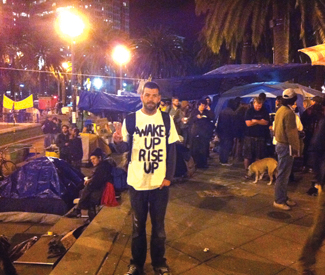
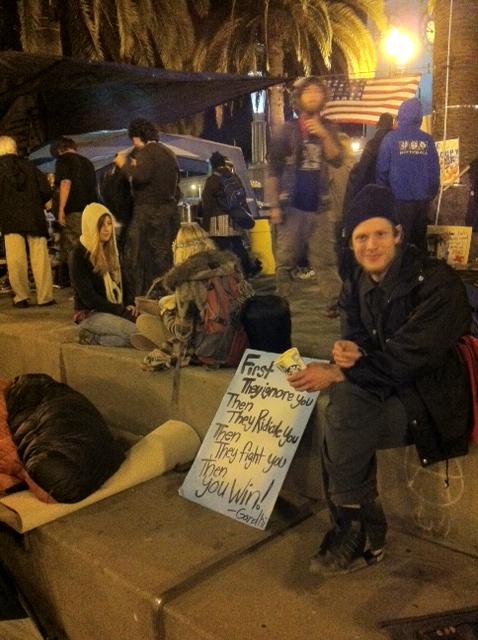
It seems the San Francisco Police Department is laying off the OccupySF encampment, at least for now. After top city officials sent mixed messages to the occupiers during a pair of high-profile hearings in City Hall this week, a full-blown tent city with working kitchen and medical tent has now been erected in Justin Herman Plaza.

During the Board of Supervisors meeting on Tuesday, Mayor Ed Lee voiced support for the movement’s message, but said that tents, tarps, and cooking in the plaza or in OccupySF’s presence on the sidewalk in front of the Federal Reserve wouldn’t be tolerated.

A string of protesters testified against the policy and the two recent police crackdowns, which was also criticized by John Avalos and other progressive supervisors who are working on a legislative solution to the standoff. But at the Police Commission hearing the next night, Police Chief Greg Suhr seemed to announce that police would stand  down and allow the encampment to continue.

Protesters packed the meeting and disrupted the proceedings with chants of “SFPD where is your humanity” and accusations of police brutality at several recent raids of their camp. Many representatives made public comments condemning police brutality and repression of the protests, and many speakers also connected it with a broader problem of police harassment, notably in Bayview-Hunters Point.

Said OccupySF protester Christopher Ray: “Obama himself does not have the right to come tell us to stop, to tell us to take down our tarps, to tell us we can’t eat, to cook food, to sleep there. Period. You would have change the Constitution of the United States in order to do that. We’re not leaving.”

By the end of the long meeting, Suhr expressed support in what seemed like a promise to OccupySF: “We have no future plans to go into the demonstration. We know that it’s for the long haul. We did work, or, I’m told that we were trying to work all day Sunday to take down the tarps and the structures. We did meet last week and I did provide a written notice that’s been provided wholesale since down there. We realize that this movement could go on indefinitely, and as such, I’m actually working with the Mayor’s Office personally to put the port-o-potties and the handwashing stations down there to provide sanitation. I don’t know that anybody’s doing that. And in other towns where this movement has grown and is very large, they’re already experiencing things like dogs that have bitten people, rats, sanitation issues, the lack of running water so I can assure you that our efforts are to keep it safe and to facilitate the First Amendment demonstration.”

His statement was meant with a cry of “Now that’s what I’m talking about!” and thunderous applause from the chamber, and the OccupySF movement has interpreted the remarks as permission for the encampment to continue without further police harassment. Guardian calls to the SFPD Public Affairs Office to clarify the policy have not yet been returned.

By last night, the encampment’s numbers and infrastructure had grown — with a kitchen producing group dinners and new tents being added throughout the evening — and there seemed to be only a cursory police presence. Many protesters were essentially declaring victory, telling the Guardian that the numbers only grew after each police raid, expressing hope that the city has now had a change of heart. 

This comes after a rocky history of SFPD relations with the protest. On October 5, police issued a notice requiring all tents at the encampment to be removed. Protesters complied, but police still moved in, confiscated all the protest’s materials, and ended up making one arrest in the ensuing altercation. Since, OccupySF has mostly refrained from erecting any structures; instead, the growing numbers, now an average of 200 per night, sleep on the sidewalk. When they put up two tarps when weather turned rainy on Sunday the 16th, the result was another nighttime police raid, this time with five arrests and several injuries to demonstrators.

Yet the next morning, protesters had strung up more tarps.  And in the past few days, many have pitched tents. Now, tents number over 40, and the police are yet to raid.

On Thursday, California Nurses Association and the National Nurses Association worked with OccupySF’s medic team to set up a medical tent. The tent has been sorely needed for a while, but it is only recently that supporters of the protest felt safe creating it.

When the tent was put up, police came and circulated a notice that had been issued on Oct. 1 stating, “Tents, overhead tarps, and/or wooden pallets are not to be within the demonstration area unless appropriate permits are obtained because of the potential hazard they present.” But police exited without attempting to enforce this notice, and as of now the medical tent, complete with a cot and a growing stock of supplies, is still in place.

Said Pilar Schiavo, an organizer with CNA who has been working with OccupySF: “We were able to provide treatment to a bunch of occupiers today.” She says there are many at OccupySF with no other access to health care besides the new tent. “It’s just basic first aid so far, but a little goes a long way here. One had a broken finger from Sunday’s raid.”

Schiavo says when they set up the tent early Thursday morning, protesters Tweeted, Facebooked, and otherwise put out calls for needed medical supplies. Shiavo was proud to report that “supplies started showing up an hour later.”

Just a short BART ride away, city officials in Oakland have accommodated Occupy Oakland and it has grown into a large tent city with ever-improving infrastructure and organization. Perhaps OccupySF is now headed down the same path.

Editorial: Mayor Lee is tough as hell on Occupy SF protestors, but keeps City Hall safe for PG@E and the downtown gang

70

And so Mayor Ed Lee once again shows his true colors:  he is tough as hell on Occupy SF protestors and, unlike every other mayor in every other U.S. city,  sends in the cops to roust them out in  two midnight raids and trumpets the word  by bullhorn from the mayor’s office that he will harass them until the end of time. Meanwhile, he is is quietly sending  sending out the message that under his stewardship that City Hall will be safe for PG@E, the downtown gang, the big developers, the bailed banks, and the feds who are going after the dispensers of medical marijuana and the newspapers who run their ads.  (Full disclosure: that’s us at the Guardian.)  B3

EDITORIAL This is what civility and compromise looks like:

At a little after 10 P.m. Oct 16, a squadron of San Francisco police equipped with riot gear raided and attempted to shut down the OccupySF protest. It was the second time San Francisco has embarrassed itself, becoming the only major U.S. city to attempt to evict members of the growing Occupation movement — and this time, the cops used a lot more force.

The first crackdown, on Oct. 5, was supposedly driven by concerns that the activists were using an open flame for their communal kitchen without the proper permits. This time around, the alleged lawbreaking was confined to a Park Code section that bans sleeping in city parkland after 10 p.m. And since Justin Herman Plaza, where OccupySF is camped, is technically under the jurisdiction of the Recreation and Park Department, that ordinance could be enforced.

But let’s be serious: The encampment endangered nobody, and if any Rec-Park officials had actually complained, the police couldn’t provide their names. This was all about rousting a protest against corporate greed and economic injustice. It came with police batons, several beatings and five arrests.

And the mayor of what many call the most liberal city in America hasn’t said a word. Mayor Ed Lee was clearly consulted on the raid, clearly approved it — and now becomes unique among the chief executives of big cities across the country, most of whom have worked to find ways to avoid police confrontations.

David Chiu, the president of the Board of Supervisors, issued a ridiculous statement saying that “Both the Occupy SF protesters and the San Francisco Police Department need to redouble their efforts to avoid confrontations like the ones we saw last night.” No: The protesters didn’t start it, didn’t provoke it, didn’t want it — and frankly, did their best to avoid it. The crackdown is all about the folks at City Hall trying to get rid of one of the most important political actions in at least a decade — and doing it with riot police.

This is what the civility and compromise so touted by Mayor Lee and Board President Chiu looks like. And it’s a disgrace.

In Oakland, where the encampment at Frank Ogawa Plaza, renamed Oscar Grant Plaza for the event, has far more people than Occupy SF, city officials approached the activists and offered to issue whatever permits were needed. Mayor Jean Quan visited the general assembly, waited her turn to speak, and then politely asked the group not to damage the somewhat fragile old oak tree on the site. In deference to her wishes, the group surrounded the tree with a fence.

In New York, the private owner of the park where Occupy Wall Street is camped agreed not to evict the demonstrators — or even move some of them to all for a regular park cleaning.

Why is San Francisco acting so hostile? Is this not a city with a reputation for political activism and tolerance? Is it really that big a problem to allow activists to peacefully occupy public space to denounce the greatest corporate thievery in a generation?

San Francisco ought to be supporting the OccupySF movement, not harassing it. Lee should immediately call off the police raids. The Board of Supervisors should have a hearing on this, bring Police Chief Greg Suhr, Mayor Lee and representatives of Rec-Park and the Department of Public Health and work out a solution that doesn’t involve repeatedly rousting the protesters in the middle of the night. And if this continues, perhaps OccupySF should move to the plaza in front of City Hall.

Sup. John Avalos is the only person at City Hall who is making an outspoken effort to protect the protest; he needs some support.


The selling of Ed Lee

0

steve@sfbg.com

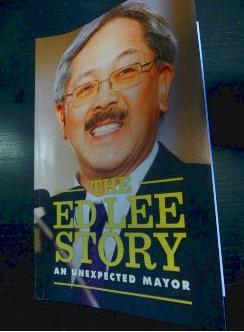
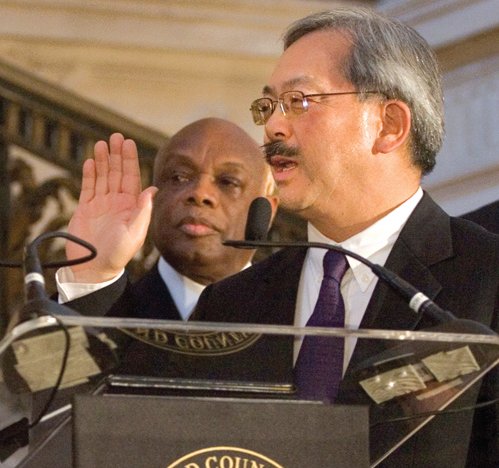
Ed Lee has gone through a remarkable makeover in the last year, transformed from the mild-mannered city bureaucrat who reluctantly became interim mayor to a political powerhouse backed by wealthy special interests waging one of the best-funded and least transparent mayoral campaigns in modern San Francisco history.

The affable anti-politician who opened Room 200 up to a variety of groups and individuals that his predecessor had shut out — a trait that won Lee some progressive accolades, particularly during the budget season — has become an elusive mayoral candidate who skipped most of the debates, ducked his Guardian endorsement interview, and speaks mostly through prepared public statements peppered with contradictions that he won’t address.

The old Ed Lee is still in there somewhere, with his folksy charm and unshakable belief that there’s compromise and consensus possible on even the most divisive issues. But the Ed Lee that is running for mayor is largely a creation of the political operatives who pushed him to break his word and run, from brazen power brokers Willie Brown and Rose Pak to political consultants David Ho and Enrique Pearce to the wealthy backers who seek to maintain their control over the city.

So we thought it might be educational to retrace the steps that brought us to this moment, as they were covered at the time by the Guardian and other local media outlets.

Caretaker mayor

The story begins quite suddenly on Jan. 4, when the Board of Supervisors convened to consider a replacement for Gavin Newsom, who had been elected lieutenant governor but delayed his swearing-in to prevent the board from choosing a progressive interim mayor who might then have an advantage in the fall elections. Newsom and other political centrists insisted on a “caretaker mayor” who pledged to vacate the office after serving the final year of the current term.

It was the final regular meeting of the old board, four days before the four newly elected supervisors would take office. What had been a bare majority of progressive supervisors openly talked about naming former mayor Art Agnos, or Sheriff Michael Hennessey, or maybe Democratic Party Chair Aaron Peskin as a caretaker mayor.

When then-Sup. Bevan Dufty said he would support Hennessey, someone Newsom had already said was acceptable, the progressive supervisors decided to coalesce around Hennessey. That was mostly because the moderates on the board had suddenly united behind a rival candidate who had consistently said didn’t want the job: City Administrator Ed Lee.

Board President David Chiu was the first in the progressive bloc to breaks ranks and back Lee, saying that had long been his first choice. Dufty became the swing vote, and he abstained from voting as the marathon meeting passed the 10 p.m. mark, at which point he asked for a recess and walked down to Room 200 to consult with Newsom.

At the time, Dufty said no deals had been cut and that he was just looking for assurances that Lee wouldn’t run for a full term (Dufty was already running for mayor) and that he would defend the sanctuary city law. But during his endorsement interview with the Guardian last month, he confessed to another reason: Newsom told him that Hennessey had pledged to get rid of Chief-of-Staff Steve Kawa, a pro-downtown political fixer from the Brown era who was despised by progressive groups but liked by Dufty.

Chiu and others stressed Lee’s roots as a progressive tenants rights attorney, the importance of having a non-political technocrat close the ideological gap at City Hall and get things done, particularly on the budget. So everyone just hoped for the best.

“Run, Ed, Run”

The drumbeat began within just a couple months, with downtown-oriented politicos and Lee supporters urging him to run for mayor in the wake of a successful if controversial legislative push by Lee, Chiu, and Sup. Jane Kim to give million of dollars in tax breaks to Twitter and other businesses in the mid-Market and Tenderloin areas.

In mid-May, Pak and her allies created Progress for All, registering it as a “general civic education and public affairs” committee even though its sole purpose was to use large donations from corporations with city contracts or who had worked with Pak before to fund a high-profile “Run, Ed, Run” campaign, which plastered the city with posters featuring a likeness of Lee.

Initially, that campaign and its promotional materials were created by Pak (who refuses to speak to the Guardian) and political consultant Enrique Pearce (who did not return calls for this article) of Left Coast Communications, which had just run Kim’s successful D6 victory over progressive opponent Debra Walker, along with Pak protégé David Ho.

During that campaign, the Guardian and Bay Citizen discovered Pearce running an independent expenditure campaign called New Day for SF, funded mostly by Willie Brown, out of his office, despite bans of IEs coordinating with official campaigns. That tactic would repeat itself over the coming months, drawing criticism but never any sanctions from the toothless Ethics Commission. Pearce was hired by two more pro-Lee IEs: Committee for Effective City Management and SF Neighbor Alliance, for which he wrote the book The Ed Lee Story, a supposedly “unauthorized biography” filled with photos and personal details about Lee.

Publicly, the campaign was fronted by noted Brown allies such as his former planning commissioner Shelly Bradford-Bell, Pak allies including Chinatown Community Development Center director Gordon Chin, and a more surprising political figure, Christina Olague, a progressive board appointee to the Planning Commission. She had already surprised and disappointed some of her progressive allies on Feb. 28 when she endorsed Chiu for mayor during his campaign kickoff, and even more when she got behind Lee.

Olague recently told us the moves did indeed elicit scorn from some longtime allies, but she defends the latter decision as being based on Lee’s experience and willingness to dialogue with progressives who had been shut out by Newsom, noting that she had been asked to join the campaign by Chin. Olague also said the decision was partially strategic: “If we get progressives to support him early on, maybe we’ll have a seat at the table.”

Right up until the end, Lee told reporters that he planned to honor his word and not run. During a Guardian interview in July when we pressed him on the point, Lee said he would only run if every member of the Board of Supervisors asked him to, although about half the board publicly said that he shouldn’t, including Sup. Sean Elsbernd, who nominated him for interim mayor.

And then, just before the filing deadline in early August, Lee announced that he had changed his mind and was running for mayor, the powers of incumbency instant catapulting him into the frontrunner position where he remains today, according to the most recent poll by the Bay Citizen and University of San Francisco.

Lee the politician

With his late entry into the race and decision to forgo public financing and its attendant spending limits, one might think that Lee would have to campaign aggressively to keep his job. But most of the heavy lifting has so far been done by his taxpayer-financed Office of Communications (which issues press releases at least daily) and by corporate-funded surrogates in a series of coordinated “independent” groups (see Rebecca Bowe’s story, “The billionaires’ mayor”).

That has left Lee to simply act as mayor, where he’s made a series of decisions that favor the business community and complement the “jobs” mantra cited relentlessly by centrist politicians playing on people’s economic insecurities.

Yet Lee has been elusive on the campaign trail and to reporters who seek more detailed explanations about his stands on issue or contradictions in his positions, and his spokespersons sometimes offer only misleading doublespeak.

For example, Lee’s office announced plans to veto legislation by Sup. David Campos that would prevent businesses from meeting their city obligation to provide a minimum level of employee health benefits through health savings accounts that these businesses would then pocket at the end of the year, taking $50 million last year even though some of that money had been put in by restaurant customer’s paying 5 percent surcharges on their bills.

Although Campos, the five other supervisors who voted for the measure, four other mayoral candidates, and its many supporters in the labor and consumer rights movements maintained the money belonged to workers who desperately needed it to afford expensive health care, the San Francisco Chamber of Commerce said it was about “jobs” that would be protected only if businesses could keep that money.

Lee parroted the position but tried to push the political damage until after the election, issuing a statement entitled “Mayor Lee Convenes Group to Improve Health Care Access & Protect Jobs,” saying that he would seek to “develop a consensus strategy” on the divisive issue — one in which Campos said “we have a fundamental disagreement” — that would take weeks to play out.

After a frustrating back-and-forth with Lee Press Secretary Christine Falvey by email, it’s still unclear how to resolve the contradiction between whether businesses could seize these funds or whether they belonged to employees, with her latest statement being, “The Mayor absolutely wants these funds spent on providing access to quality primary and preventative health care because this is the business’s obligation under HCSO. Making sure that these funds go to pay for health care is the most important objective.”

Similarly, when police raided the OccupySF encampment on Oct. 5, Lee’s office issued a statement that was a classic case of politicians trying to have it both ways, expressing support for the movement and its goal to “occupy” public space, but also supporting the need to police to clear the encampment of those same occupiers.

But now, in the wake of a repeat raid on Oct. 16 that has inflamed passions on the issue, the question is whether Lee can run out the clock and retain the office he gained on the promise of being someone more than a typical politician.

The bad old days

0

tredmond@sfbg.com

Willie L. Brown, according to the Chronicle’s John Cote, is “a tremendously popular figure in the city, viewed by many as an avuncular man-about-town, elder statesman and a uniquely San Franciscan character.” The Ed Lee Story, a hagiographic campaign book, refers to Brown’s “characteristic showmanship and hypnotic charm.” Even Randy Shaw, the housing activist who clashed with Brown over gentrification once upon a time, now says in BeyondChron that Brown’s first term “was the most progressive of any mayor in modern San Francisco history.”

I feel as if I’m living in some sort of strange parallel universe, something out of Orwell or North Korea or the Soviet Union of the 1950s. It’s as if history never happened, as if the years between 1996 and 2004 have just vanished, have been deleted from San Francisco’s collective memory. It’s crazy.

I wonder:

What about the thousands and thousands of people who lost their homes and were tossed out of the city like refugees from a war? What about the rampant corruption at City Hall? What about the legions of unqualified political cronies who got good jobs and commission posts? What about the iron-fisted machine rule that kept local politics closed to all but the loyal insiders? Doesn’t any of that count?

Here are some things that absolutely, undeniable, demonstrably happened while Willie Brown was mayor:

Rents on the East Side of town, particularly in the Mission, tripled and sometimes quadrupled between 1996, when Brown took office, and 2004, when he left. Evictions more than tripled, too, and at one point more than 100 people a month were losing their homes. Most of those people were low-income, long-term tenants. They were forced out because richer people were moving into town during the dot-com boom and could pay more for those apartments. We called it the “Economic Cleansing of San Francisco.”

Every day, it seemed, we’d be out at another rally as the Tenants Union and the Mission Antidisplacement Coalition tried to save another family from the forces of gentrification. Every week, it seemed, another group house full of artists would be served an eviction notice. Everywhere you looked, nonprofits and small businesses were losing space to high-tech companies with plenty of money.

I watched the wrecking crew tear down a studio complex on Bryant Street, forcing more than 100 painters and photographers to leave, to make way for a high-tech office project that was approved even though it violated the local zoning laws — and then was never built. For two years, I walked to get my lunch past the empty hole in the ground that had once been a thriving community.

That was typical. Every developer who waved money in front of the mayor got a building permit, no matter how crazy, illogical or illegal the project was. The Planning Department and the Bureau of Building Inspection were little more than fronts for the lobbyists and Brown cronies who determined development policy in the city.

In October, 1999, the author Paulina Borsook wrote a famous piece in Salon called “How the Internet Ruined San Francisco.” I agreed with the sentiment; the influx of the dot-commers was wrecking all that was cool and weird about the city. But she got one point wrong: The Internet didn’t ruin anything. The Internet was, and is, a technology, a tool, something that, like most technological advances, can be used for good or evil.

Mayor Brown didn’t create the dot-com boom. Although he took credit for an awful lot of things, even Willie didn’t claim to have invented the Internet.

But what he did — and what ruined many San Francisco neighborhoods, and ruined the lives of many San Franciscans — was to let the economic cleansing of the city happen, without raising a finger to slow it down or prevent the evictions or protect the most vulnerable people in the city. Over and over, he encouraged it — by appointing commissioners and supervisors and department heads who allowed evictions and development and displacement in the name of growth and prosperity.

In fact, when reporters from the zine Maximum Rock ‘n’ Roll asked Brown about the problems facing poor people, he told them that the city had become so expensive that poor people would be better off living somewhere else.

Because he didn’t care about poor people, or tenants, or artists, or anyone who lacked money and flash and dazzle and clout. He was the worst kind of imperial mayor.

Here’s how we put in it in our 33rd anniversary issue in 1998:

“Let’s say the next major earthquake that hits San Francisco is of roughly the same magnitude of the Loma Prieta quake of 1989, or maybe just a bit stronger. Let’s say it wipes out right 1,000 houses and leave some 5,000 people homeless … and lets say a few unscrupulous profiteers take advantage of the shortages of critical supplies and charge desperate residents triple the normal rate for food, blankets and drinking water….

“The profiteers, speculators and charlatans would be exposed in the press and roundly, loudly denounced by every political and community leader in the city. The ones who didn’t wind up in jail would be forced to leave town in disgrace.”

Or else they wouldn’t. Because when an economic earthquake ravaged San Francisco during his term, Brown — the most powerful mayor in modern history, a guy who could have had an immense impact on what was happening — went to meet the speculators and profiteers with outstretched arms, welcomed them to the city and partied with them at night.

And when he ran for re-election, they thanked him by funding an astonishing $5 million campaign.

Then there was the corruption. Not only did Brown raise pay-to-play to a new art form, he filled the city payroll and key commissions with campaign workers, former political allies, and cronies, subverting the civil service system and undermining both the function of city agencies and public respect for local government. At least seven Brown appointees were indicted or investigated for criminal misconduct. While sentencing a Housing Authority official to five years in prison, U.S. District Judge Charles Legge decried what he called Third World-style corruption at San Francisco City Hall.

When Mayor Ed Lee, who is now seeking a full four-year term, was asked to give Brown a grade for his eight years in Room 200, Lee said: A-Plus.

Which makes us a little nervous. To say the least.

I’ve been going back through the Guardian archives over the past couple of weeks, picking out some great covers to reproduce (see page 18) and looking at four and a half decades of alternative news coverage of San Francisco. And if there’s one theme that emerges from the stacks and stacks and stacks of papers, it’s that local government matters.

In the 1960s, when the underground press was talking about sex, drugs and dropping out, the Guardian was talking about the ways big corporations were stealing the taxpayers’ money at City Hall. (Okay, the Guardian wrote about sex and drugs too. But sex and drugs and political scandals.)

The difference between the independent alternative press and the underground papers of the era was more than just thematic. The underground publishers were having a great time and celebrating culture, but none of those publications was built to last. From the day they published their first issue in October, 1966, Guardian founders Bruce Brugmann and Jean Dibble intended their paper to become a permanent part of San Francisco.

The Guardian quickly demonstrated that it had a different approach than a lot of the “New Left” — particularly when it came to electoral politics. At a time when some were saying that it made no difference whether Ronald Reagan or Pat Brown won the 1966 governor’s race, the Guardian made the key point about Reagan.

“California cannot afford the luxury of this kind of conservatism,” a Nov. 7, 1966 editorial stated. “Because of the millions of people coming to California, because San Francisco and Los Angeles soon will have the greatest concentration of urban power in history, because farm land and open space is vanishing at a suicidal rate, because technology is putting vast populations out of work, because of the social neglect of our cities and the uglification of our countryside, because we now have the knowledge to bridge the gap between the rich and the poor.”

And while the paper devoted considerable space to reporting on and opposing the war in Vietnam, it was also developing a reputation for local investigative reporting. One June 7, 1971 story showed how the city had all of its short-term deposits in local banks that paid no interest at all. The story parked an investigation by the city’s budget analyst, the resignation of the city treasurer — and a new investment policy that brought the city at least $1 million more revenue a year. (Adjusted for inflation, that’s about $5 million a year, times 40 years is a lot of money that the Guardian brought into the city coffers).

And from the start, the Guardian was a nonpartisan, independent foe of corruption, secrecy and undue influence at City Hall. So while the paper eagerly endorsed Phil Burton (and later his brother, John) for Congress and lauded their antiwar and environmental policies, the Guardian also blasted the Burtons for exercising undue influence back home. The paper strongly endorsed George Moscone for mayor — then denounced him when he fired Harvey Milk from a commission post after Milk had the gall to challenge the Moscone/Burton candidate for state Assembly.

The 1999 Sunshine Ordinance, which dramatically opened up City Hall records, was sponsored and promoted by the Guardian. Willie Brown and his cronies hated it.

It’s probably a misnomer to say that the Burtons, who were a dominant force in local politics in the 1970s and 1980s, ran an old-fashioned machine. They didn’t have the iron control over local politics and the patronage jobs system that the word “machine” implies.

But when Brown became mayor of San Francisco, he had all of that. Brown controlled eight solid votes on the Board of Supervisors (and through various political machinations, had managed to appoint most of them). “He ruled the building,” Assemblymember Tom Ammiano, who was a supervisor during those years, recalled. “If you defied him, you were radioactive.”

And one of the people who rose through the ranks as a loyal Brown appointee was Ed Lee. Who to this day thinks things in that administration were just dandy.


The Lee campaign complains about “guilt by association,” and that’s a legitimate point. Ed Lee isn’t Willie Brown. He’s a lot more open, a lot (a lot) more humble, and as numerous progressives have pointed out to us, his door is open. He doesn’t have the history of sleaze that pretty much defined Brown’s political career.

There will be no “Ed Lee Machine.” In fact, with district elections of supervisors pretty much guaranteeing more diffuse political power in the city, there will never be another mayor able to rule the way Brown did.

And these days, Brown’s clout could easily be overstated. Until he engineered the selection of Ed Lee as mayor, his power seemed to be waning. And even Mayor Lee hasn’t done everything that Brown wanted.

Of course, the Chronicle, which he helped immensely when Hearst Corp. bought the paper and had trouble with federal regulators, has helped Brown by giving him a column that created a new, sanitized persona.

But the important thing about the Brown administration was not so much who was in charge but who benefited. The landlords, the developers, the big corporations got pretty much what they wanted from City Hall. The rest of us got screwed.

And now those same interests — in some cases, the exact same people — who supported, promoted and worked with Willie Brown are backing Lee for mayor. If they thought he was going to be an independent progressive, that money and support wouldn’t be coming in. There are people who miss the machine days — and if they think Ed Lee is their guy, it’s reason to worry.

Corruption matters. When people lose faith in local government because they see the kind of sleaze that was daily business under Brown, then they stop wanting to pay taxes for public services. After all, the mayor is wasting our money already. Lee may be a decent guy — but some of the people he hangs out with, some of the people who are supporting him, have a long and very unpleasant history in this town. And all the time he was sitting there at City Hall, while Brown was running a corrupt operation that did lasting damage, Lee never raised a public finger in protest. I hate to see all the history forgotten when people decide who to support for mayor in November, 2011.

OccupySF appeals to City Hall, but the standoff continues

40

Frustrated by repeated late-night police raids on their encampments and empty statements of support by top city officials, hundreds of protesters with OccupySF entered City Hall today – under the watchful eyes of a large police presence with riot gear at the ready – to testify at today’s Board of Supervisors meeting.

The meeting began with the scripted monthly question time session with Mayor Ed Lee, who was asked by Sup. Jane Kim – whose District 6 includes the OccupySF encampment, which she visited for a couple hours last night – to “describe the plan that our offices have been developing” to facilitate the OccupySF movement.

But in Lee’s response and in exchanges with journalists after the meeting, as well as Guardian interviews with people in both offices, it doesn’t seem city officials have a coherent plan for carrying out Lee’s contradictory goals of supporting the Occupy movement and keeping sidewalks and parks clear of encampments.

Kim seemed to acknowledge as much later in the meeting when she said voiced support for OccupySF and for city officials who object to tents, kitchens, and other basic infrastructure that the month-old movement needs to continue. “We’re all struggling to figure out the best way to accommodate it,” she said.

Lee’s message was even more muddled, saying he supported the movement and agreed with its economic justice message. “From the very beginning, I have fully supported the spirit of the OccupySF movement,” Lee told the crowd, transitioning into reciting a litany of economic development efforts with little relevance to the demands of the movement.

“Then don’t send the police in to destroy it,” a protester shouted from the audience, which was filled to capacity and had a line out front and an overflow room. “We are working with you,” Lee responded, but then went on to complain about the lack of consistent contacts in the leaderless movement and emphasizing his bottom line that any kind of encampment with infrastructure is an impermissible violation of city codes.

“I need to make sure our public spaces are open to be used by anyone,” he said. Later, his Press Secretary Christine Falvey clarified the mayor’s stance by saying he supports the message but not the movement: “The tactic of camping overnight, he does not support.”  

Afterward, talking to reporters, Lee couldn’t really explain why the police needed to do their raids in the middle of the night, why San Francisco is cracking down on conditions that are being allowed in many other Occupy cities, or how the movement might be able to avoid future crackdowns if it continues, ignoring questions about where OccupySF might be able to go to avoid police raids.

Sup. John Avalos, who has been working to try to mediate the dispute between OccupySF and the city, responded to Lee’s speech by calling it “very frustrating. I’m alarmed that he is moving toward nightly standoffs with the Occupy movement.” Avalos says he supports protesters’ right to peacefully occupy public spaces and acknowledges their need for basic supplies to do so, calling the current standoff, “unsafe for both sides.”

“I’m proud to say that we are the 99 percent,” Sup. Eric Mar said, echoing the movement’s mantra and saying he would defer to Avalos’ leadership to create a “resolution strongly holding the police accountable for the crackdowns.”

Avalos had invited OccupySF participants to raise their concerns during the public comment portion of the meeting, and he said that he plans to use their input to form a resolution or plan for how the city should accommodate a movement that six of the 11 supervisors professed to support at the meeting.

When the long line of OccupySF protesters finally took to the microphone for public comment, they made it clear that the issue wasn’t as complicated as some city officials were trying to make it.
“It is outrageous and inhumane to see our camp raided in the middle of the night by San Francisco Police,” Magic, a middle-aged woman and lifelong activist, told the supervisors, closing with, “This can be a celebration or a battle, but we will not back down.”

Several speakers were dismissive of city claims to be protecting public health and safety, noting how dangerous the midnight confrontations have been, saying food and shelter are basic human needs, and noting how peaceful and cooperative OccupySF has been with the escalating series of city demands as the protest’s numbers have grown.

Michael Goldman said police have asked them to return to the sidewalk in front of the Federal Reserve, where they are densely packed in what he called unsafe conditions. “We have too many people to fit in front of 101 Market,” he said.

That was what prompted the move to nearby Justin Herman Plaza, where police cracked down Sunday night, citing a violation of the park’s 10 pm curfew. Another protester who works at the Ferry Building angrily noted that even before OccupySF began, he regularly watched city crews chase the homeless away from the site at 3 am with water trucks.

“We are a peaceful and nonviolent people and we do not deserve to be treated this way by our city and our country,” he said.  

“They were waiting to be talked to and not just run over by the police,” said iconic San Francisco activist Father Louie Vitale, who gestured to the waiting protesters and said, “We’re very proud of these people, very proud.”

It was a point echoed by others like local resident Andy Blue, who said, “They are doing a great service to this city and the world.”

SF values and OccupySF

5

EDITORIAL This is what civility and compromise looks like:

At a little after 10 P.m. Oct 16, a squadron of San Francisco police equipped with riot gear raided and attempted to shut down the OccupySF protest. It was the second time San Francisco has embarrassed itself, becoming the only major U.S. city to attempt to evict members of the growing Occupation movement — and this time, the cops used a lot more force.

The first crackdown, on Oct. 5, was supposedly driven by concerns that the activists were using an open flame for their communal kitchen without the proper permits. This time around, the alleged lawbreaking was confined to a Park Code section that bans sleeping in city parkland after 10 p.m. And since Justin Herman Plaza, where OccupySF is camped, is technically under the jurisdiction of the Recreation and Park Department, that ordinance could be enforced.

But let’s be serious: The encampment endangered nobody, and if any Rec-Park officials had actually complained, the police couldn’t provide their names. This was all about rousting a protest against corporate greed and economic injustice. It came with police batons, several beatings and five arrests.

And the mayor of what many call the most liberal city in America hasn’t said a word. Mayor Ed Lee was clearly consulted on the raid, clearly approved it — and now becomes unique among the chief executives of big cities across the country, most of whom have worked to find ways to avoid police confrontations.

David Chiu, the president of the Board of Supervisors, issued a ridiculous statement saying that “Both the Occupy SF protesters and the San Francisco Police Department need to redouble their efforts to avoid confrontations like the ones we saw last night.” No: The protesters didn’t start it, didn’t provoke it, didn’t want it — and frankly, did their best to avoid it. The crackdown is all about the folks at City Hall trying to get rid of one of the most important political actions in at least a decade — and doing it with riot police.

This is what the civility and compromise so touted by Mayor Lee and Board President Chiu looks like. And it’s a disgrace.

In Oakland, where the encampment at Frank Ogawa Plaza, renamed Oscar Grant Plaza for the event, has far more people than Occupy SF, city officials approached the activists and offered to issue whatever permits were needed. Mayor Jean Quan visited the general assembly, waited her turn to speak, and then politely asked the group not to damage the somewhat fragile old oak tree on the site. In deference to her wishes, the group surrounded the tree with a fence.

In New York, the private owner of the park where Occupy Wall Street is camped agreed not to evict the demonstrators — or even move some of them to all for a regular park cleaning.

Why is San Francisco acting so hostile? Is this not a city with a reputation for political activism and tolerance? Is it really that big a problem to allow activists to peacefully occupy public space to denounce the greatest corporate thievery in a generation?

San Francisco ought to be supporting the OccupySF movement, not harassing it. Lee should immediately call off the police raids. The Board of Supervisors should have a hearing on this, bring Police Chief Greg Suhr, Mayor Lee and representatives of Rec-Park and the Department of Public Health and work out a solution that doesn’t involve repeatedly rousting the protesters in the middle of the night. And if this continues, perhaps OccupySF should move to the plaza in front of City Hall.

Sup. John Avalos is the only person at City Hall who is making an outspoken effort to protect the protest; he needs some support.

Editor’s notes

0

tredmond@sfbg.com

I feel like was just getting over the 40th anniversary party, and now here comes 45. Guardian anniversaries are like birthday parties; they keep creeping up on you. Except that, in this case, getting older isn’t something to worry about. It’s a sign of strength that a weekly paper founded with a little money scraped together by two Midwesterners in 1966 has survived, grown, and become a standard-bearer for the alternative press in America.

I missed 15, but I was here for 16, and 20, and 25, and 30, and 40, and I’ve watched the Guardian — and San Francisco — emerge and change. And I can say, after almost 30 years as a reporter and editor here, that the demise of the old Brown Machine and the advent of district elections in 2000 were the most important advances in modern local political history.

District elections diffused power at City Hall. You didn’t need a huge downtown-funded campaign war chest to get elected supervisor. You didn’t need the support of the power brokers. And all parts of the city were represented.

By the time Willie Brown left office in 2004 — mostly in political disgrace — a long era of corrupt machine politics was ending. He had lost control of the Board of Supervisors. Almost none of the candidates he endorsed got elected. His approach to running the city was utterly repudiated by the voters. It was like the city drew a collective breath of very fresh air.

Yeah, we had to fight with Gavin Newsom. Yeah, we lost some critical battles. Yeah, the city’s till building housing just for millionaires. But at least with Brown gone and district supervisors calling the shots, I always thought we had a chance.

And maybe we will with Mayor Ed Lee, too, if, as projected, he wins in November. Maybe he can show some independence. Maybe the Ed Lee who started as a tenant lawyer will arise again in Room 200.

But Brown doesn’t think so. Neither do the billionaires and lobbyists and a cast of dozens from the old Brown Machine. They think they’re coming back into power.

And these folks are savvy, experienced and clever. They don’t put this sort of money and personal clout into candidates unless they’re pretty damn sure they’ll get a return on their investment. That’s how it works in Willie’s World.

On Guard!

1

news@sfbg.com

ORACLE’S DIRTY SECRET

If wealth trickled down from Oracle’s OpenWorld conference in San Francisco last week, very little of it reached a small group of low-wage laborers hired from out of state to set up for a concert hosted as an event highlight on Treasure Island.

Oracle is a prominent Bay Area tech company helmed by Larry Ellison, the billionaire CEO who worked closely with top city officials to bring the America’s Cup sailing regatta to San Francisco.

The Oct. 5 Oracle OpenWorld concert on Treasure Island featured Sting and Tom Petty as headliners. Registration packages for the weeklong tech conference, which drew some 45,000 attendees to San Francisco, ranged from $1,395 to $2,595.

A member of the carpenters union contacted the San Francisco Office of Labor Standards & Enforcement (OLSE) Sept. 16 to formally complain that a construction crew assembling a large seating structure for the event was being paid less than the city-mandated minimum wage of $9.92 per hour, city documents show.

Josh Pastreich, an OLSE official, went to the worksite to interview crew members. Their names were redacted from public records, but Pastreich described them as monolingual Spanish speakers who travel from city to city building seating arrangements for major events.

“Everyone is being paid $8 an hour (except for the supervisors),” he reported in a city document. “Workers generally started at 6:30 am but there was a little confusion about quitting times.” At least one work day lasted 11 and a half hours, according to a timesheet. The workers were hired by subcontractors brought in by Hartmann Studios, an events management outfit working directly for Oracle.

“We made a phone call, and sent them some emails,” OLSE director Donna Levitt explained. “Nobody said, ‘we intended to pay them the [legal] rate,'” but the subcontractors increased workers’ hourly wages to comply with San Francisco minimum wage ordinance requirements, Levitt said. Since the company adjusted the rate immediately, no fines were issued. There were fewer than 20 workers on the project.

OLSE did not correspond with Oracle directly, but spoke to the subcontractors. One was T & B Equipment, a Virginia-based company. “We were not aware of the minimum wage there, but we fixed it before the payroll was done,” a T & B representative identified only as Mr. Waller told the Guardian. Lewmar, a Florida-based subcontractor, assisted with staffing for the job. Oracle, Hartmann Studios, and Lewmar did not respond to Guardian requests for comment.

Since the enforcement agency intervened, the laborers earned $9.92 per hour instead of $8 — still well below the average Bay Area payscale for similar work. Building bleachers is comparable to raising scaffolding for major construction projects, and the prevailing wage for unionized scaffolding erectors in California is $37.65 per hour, or $62.63 when benefits are factored in.

None of the workers were from San Francisco, which likely spurred the carpenters union complaint — Carpenters Local 22 has faced significant losses in membership since the economic downturn due to high levels of unemployment disproportionately impacting the construction sector. Represenatives from Local 22 did not return calls seeking comment.

Boosters of the America’s Cup have hailed the upcoming sailing event as an engine for local job creation, but Oracle’s use of low-wage, out-of-state laborers at its pricey, high-profile OpenWorld event raises questions. While the tech company is a separate outfit from the America’s Cup organizing team, Ellison holds leadership positions at both.

Ellison was named the world’s sixth wealthiest individual in a Forbes profile in 2010, with a net worth of $28 billion. His total compensation last year was listed as $70,143,075. That’s 3,399 times the amount a person earning $9.92 an hour would make in a year working 40 hours every week — before taxes, of course. (Rebecca Bowe)


LEE’S TELLING VETO

The Board of Supervisors approved legislation to close a gaping loophole in the city’s landmark Health Security Ordinance on Oct. 4, in the process forcing Mayor Ed Lee to promise his first veto and reveal his allegiance to business interests over labor and consumer groups.

Sup. David Campos sponsored legislation that would prevent SF businesses from pocketing money they are required to set aside for employee health care, seizures that totaled about $50 million last year. These health savings accounts are often used by restaurants who charge their customers a 3-5 percent surcharge, ostensibly for employee health care, instead simply keeping most of the money.

Despite aggressive lobbying against the measure by the San Francisco Chamber of Commerce — which went so far as to threaten to withdraw support for Prop. C, the pension reform measure it helped craft with Lee and labor unions — the Board of Supervisors approved the measure on a 6-5 vote on first reading (final approval was expected Oct. 11 after press time).

But then Lee announced that he would veto the measure, claiming it was about “protecting jobs,” a stand that was criticized in an Oct. 5 rally on the steps of City Hall featuring labor unions, consumer advocates, and mayoral candidates John Avalos, Leland Yee, Dennis Herrera, and Phil Ting.

Lee and Board President David Chiu — who voted against the Campos legislation, along with Sups. Sean Elsbernd, Mark Farrell, Carmen Chu, and Scott Wiener — have each offered alternative legislation that lets businesses keep the money but make some minor reforms, such as requiring businesses to notify employees that these funds exist.

Both Lee and Chiu talk about seeking “compromise” and “consensus” on the issue, but Campos and his allies say it’s simply wrong for businesses to take money that belongs to the employees, to gain a competitive advantage over rivals who actually offer health insurance or pay into the city’s Healthy San Francisco program, and to essentially commit fraud against restaurant customers.

“This money belongs to the workers and it’s something that consumers are paying for,” Campos said. “We have a fundamental disagreement.” (Steven T. Jones)


ET TU, DAVID CHIU?

In a press release on Oct. 6, mayoral candidate David Chiu stated his concerns over Mayor Ed Lee’s potentially illegal campaign contributions from employees of the GO Lorrie airport shuttle service. That company benefited from a decision by airport officials in September and then offered to reimburse employees for making $500 contributions to Lee, according to a Bay Citizen report.

“These revelations raise deeply troubling questions that merit a full investigation by state authorities. City Hall cannot be for sale. Pay-to-play politics has no place in San Francisco, and will have no place in a Chiu administration — you can count on that,” he said in the release.

But has Chiu — one of the top fundraisers in the mayoral field — been engaging in a little pay-to-play of his own? That was the question we had after we saw that he had received lots of donations from restaurant owners, whose side he took last week in opposing Sup. David Campos’ legislation to keep them from raiding their employee health care funds.

The Golden Gate Restaurant Association (GGRA) waged unsuccessful legal battles against the Health Care Security Ordinance and lobbied against Campos’ recent reforms of its loophole. And in the latest donation cycle, the GGRA donated the maximum $500 to the Chiu campaign. Other Bay Area food services contributed up to $5,950.

So the question remains, despite Chiu’s posturing against “pay-to play politics”— are these food service companies contributing to Chiu’s campaign because he’s doing their bidding in opposing the Campos measure and sponsoring an alternative that lets them keep most of the money?

When Liane Quan, co-owner of SF’s Lee’s Deli, was asked if the health care legislation was a reason she donated, she said, “Yes, that’s one reason.” She then hesitated to elaborate why. Members of the Quan family associated with Lee’s Deli contributed a total of $1,000 to the campaign.

Maurizio Florese, an Italian-speaking co-owner of Mona Lisa’s Restaurant who contributed $100, didn’t want to talk about his contribution or employee health care. Neither did his wife and co-owner, Filomena Florese, who is also President of Mona Lisa Inc., which manufactures chocolate and pastry products.

In fact, despite leaving messages at seven local restaurants who donated to Chiu, none wanted to talk. But we did finally get ahold of Chiu campaign manager Nicole Derse, who said Chiu has a broad array of supporters and his donations from restaurants had nothing to do with his stance on the Campos legislation.

“There definitely is no correlation at all,” she told us. “Any suggestion to the contrary is ludicrous.” (Christine Deakers)

Low-income tenants face possible eviction at Parkmerced

At least nine eviction proceedings have started at the Parkmerced housing complex, the site of a controversial new housing development, in response to an effort by the property management company to collect back payments on rent and utility bills, the Guardian has learned.

In recent months, nearly 200 residents received official notices warning that they would face eviction if they did not take steps to bring their accounts current within three days, according to Sara Shortt, executive director of the Housing Rights Committee of San Francisco. About 80 three-day notices were issued to tenants who are on Section 8, a federal low-income housing assistance program that subsidizes rental payments using public funds provided by the local housing authority.

“They’re extremely low-income renters, and they’re suddenly being asked to pay large balances,” Shortt explained. “It’s blood from a turnip.” Most of the amounts owed ranged between $600 and $800, she added.

Shortt said that while some tenants were being allowed to set up payment plans, this measure wasn’t guaranteed for every tenant attempting to address the problem within the three-day timeframe. And she was skeptical that the payment-plan arrangements being presented by management were realistic in every case.

“I don’t know if Parkmerced is doing anything illegal,” Shortt said, acknowledging that she was receiving conflicting accounts of the situation. “But they’re executing something about legitimate recovery of money in an unfair manner. To allow people to slide for years and suddenly come at them for back bills is a one-way ticket for eviction.”

The Guardian was unable to reach Stellar Management, the real-estate management company at Parkmerced, but Shortt said she had spoken with Stellar representatives on behalf of tenants who were contacting the Housing Rights Committee in a panic.

Stellar representative Bryce Boddie explained the situation to her by saying a previous property management company had left billing records in disarray, and the company was finally getting around to straightening out its books by demanding payments that had long since been owed. “Their contention was that they basically decided it was time to clean house and recoup payments,” she said. Shortt said she’d also been told that Stellar had come under pressure from Fortress Investment Group, a firm that took ownership of the property last year, to get payments in order.

But P.J. Johnston, a public relations representative for Parkmerced, rejected that account, saying, “We absolutely follow up with residents who are not paying their bills.” Johnston said the number of three-day notices served this year were in keeping with last year, indicating that there had been no drastic changes in policy since the approval of the new housing project. He did not know how many Section 8 tenants received the warning notices in 2010. “Whether someone is a Section 8 certificate holder or just a regular resident, everybody’s got to pay their rent,” he said.

Johnston bristled at the criticism that renters were being asked to fork over unrealistically high sums on the spot for payments that had lapsed for long periods, saying, “If we had moved swiftly to evict residents sooner, we’d be hearing that we didn’t give them a chance.”

The issue comes on the heels of Board of Supervisors approval for a controversial housing development project at Parkmerced that tenant groups opposed because they felt it didn’t go far enough to protect renters. A development agreement negotiated between Parkmerced Investors and the city guarantees that rent-controlled tenants will be able to move into brand-new units at the same rent-controlled rate once the old units are demolished. Some residents are suspicious that management’s decision to issue three-day notices and take steps to evict tenants who cannot pay is a strategy for skirting these requirements.

Shortt said she couldn’t be sure that this was the case, but worried nevertheless that low-income tenants could wind up being tossed out of Parkmerced, which is just the scenario that tenant advocates had feared. “The end result really is in clear conflict with the spirit of negotiations and tenant protections,” she said.

Endorsement interviews: Bevan Dufty

1

Bevan Dufty’s been running for mayor for about two years now. He’s often the star of the debates — if only because he has an engaging personality and is willing to laugh at himself, a rare trait in a politicians. And although he way typcially aligned with the fiscal conservatives on the Board of Supervisors, he has the support of the progressive SEIU Local 1021 — in large part because he’s talking about working with city employees instead of demonizing them. He also told us that the next mayor of San Franciisco needs to have a black agenda — to address the alarming outmigration of African Americans and the economic damage that’s been done to that community. You can listen to the full interview and watch video after the jump.


Dufty by endorsements2011


http://www.youtube.com/watch?v=GPohsxUCQao

Lee seeks to lessen political damage from his promised veto

3

Mayor Ed Lee says he will veto legislation that the Board of Supervisors approved yesterday that would have banned San Francisco businesses from keeping money they’re required to set aside for employee health care costs. But he seems to be worried about how that move will be seen by voters, touting his support for a “consensus strategy” that doesn’t yet exist and might not be possible given the fundamentally different way both sides see the issue.

The legislation by Sup. David Campos addresses the $50 million per year that businesses have been taking from their employees’ health savings accounts, which they set up to comply with city law requiring them to cover employee health care costs and which many restaurants subsidize by placing a 3-5 percent surcharge on their customers’ bills.

The San Francisco Chamber of Commerce and opponents of the Campos legislation defend the practice and cast efforts to reserve that money for employee health care as a job-killing loss to the business community, although some have finally come around to calling the practice a “loophole” that should be addressed with minor reforms. Yet labor groups and consumer advocates say businesses have no valid claim to that money, making it difficult to see where this elusive common ground might lie.

Supporters of the legislation – including mayoral candidates Leland Yee, Dennis Herrera, John Avalos, and Phil Ting, as well as Assemblymember Tom Ammiano, who authored the Health Care Security Ordinance as a supervisor – rallied on the steps of the City Hall today, calling for Lee to sign the legislation.

Shortly thereafter, the Mayor’s Office issued a press release with the headline “Mayor Lee Convenes Group to Improve Health Care Access & Protect Job,” announcing a “consensus building effort” that includes business groups and Campos and other supporters of the measure. Campos tells the Guardian that he did get a call from the Mayor’s Office today and he agreed to take part in the effort – just as he did in fruitless negotiations with Chamber officials – but he still has a fundamental disagreement with Lee and other Chamber allies over the issue.

“I talked to the Mayor’s Office about their proposal and I have indicated my concerns,” Campos said. He noted that both Lee’s proposal and another alternative by Board President David Chiu – who was quoted in Lee’s press release saying “I am committed to continuing the collaborative effort to ensure health care access to workers while protecting jobs.” – let businesses profit from money that’s supposed to be dedicated to employee health care

“So far, none of the proposals except for mine ensure that whatever consumers pay goes to health care,” Campos said, expressing confidence that public opinion is on his side. “It’s one of those issues that the more everyday San Franciscans hear what’s happening, the more outraged they are.”

But while Lee and Chiu each use the language of seeking compromise and trying to “close the loophole,” both rely on the basic Chamber paradigm that this money belongs to the businesses and setting it aside for employee health care as city law calls for would hurt “jobs.”

When Lee was asked about the issue by a group of reporters today, he said: “Next week, we’re forging a labor and management entities’ meeting with the Mayor’s Office and supervisors to try to forge changes to the Campos legislation. I cannot sign it the way it is now, because of two reasons. One, it does not focus on the healthcare needs of the employees; and two, it will force the employers to just keep millions of dollars lying around without any use and that will decrease the efforts to create more jobs. So both objectives have to be reflected in the ordinance, and I want to make the changes appropriate for that.”

The first reason seems to ignore the fact that the city is barred by federal ERISA law from telling businesses how to provide health coverage, which is why so many of them opted to create these health savings accounts – which are almost useless for people facing serious medical costs – rather than providing health insurance or paying into the city’s Healthy San Francisco program. And supporters of the legislation simply reject the validity of Lee’s second reason.

“That position is based on a false premise. This money belongs to the workers and it’s something that consumers are paying for,” Campos said. “We have a fundamental disagreement.”