Berkeley

Film Listings: April 23 – 29, 2014

0

Film listings are edited by Cheryl Eddy. Reviewers are Kimberly Chun, Dennis Harvey, Lynn Rapoport, and Sara Maria Vizcarrondo. For rep house showtimes, see Rep Clock.

SF INTERNATIONAL FILM FESTIVAL

The 57th San Francisco International Film Festival runs April 24-May 8. Screening venues include the Castro Theatre, 429 Castro, SF; New People Cinema, 1746 Post, SF; Pacific Film Archive, 2575 Bancroft, Berk; and Sundance Kabuki Cinemas, 1881 Post, SF. For tickets (most shows $15) and complete schedule, visit festival.sffs.org. For coverage, see film section.

OPENING

Alan Partridge Steve Coogan recently took a serious-movie detour in last year’s Philomena, but he’s primarily a comedian — famed stateside for roles in cult movies like 24 Hour Party People (2002) and The Trip (2011). In his native England, he’s also beloved for playing buffoonish, image-obsessed host Alan Partridge in multiple TV and radio series — and now, a feature film, in which a giant media conglomerate takes over Alan’s North Norwich Digital radio station and gives it a cheesy corporate makeover. When he learns staffing cuts are afoot, Alan secretly throws his longtime friend and fellow DJ Pat (Colm Meany) under the bus. Though he’s oblivious to Alan’s betrayal, the depressed and disgruntled Pat soon bursts into the station, toting a shotgun and taking hostages, and Alan is designated the official go-between — to his utter delight, since he becomes the center of the surrounding media circus (“I’m siege-face!” he crows), and his already-inflated head balloons to even more gargantuan proportions. Along the way, he and Pat continue broadcasting, taking calls from listeners, spinning Neil Diamond records, and occasionally interfacing with an increasingly annoyed police force. Fear not if you haven’t seen any previous Alan Partridge outings — this film is stand-alone hilarious. (1:30) Embarcadero, Shattuck, Smith Rafael. (Eddy)

Brick Mansions This Luc Besson-produced thriller about an undercover Detroit cop stars Paul Walker in one of his final roles. (1:30) Presidio.

Dancing in Jaffa World champion ballroom dancer Pierre Dulaine, possessed of perfect posture and a flamboyant personality, returns to his native Jaffa, a city he hasn’t laid eyes on since his family (Palestinian mother, Irish father) fled in 1948. His love of teaching was dramatized in 2006’s Take the Lead — hey, if someone’s gonna make a movie about your life, you could do worse than being played by Antonio Banderas — but his task in Dancing in Jaffa is a far less glitzy one. Here, the real-life Dulaine aims to train a group of 11-year-olds how to merengue, rumba, tango, and jive, which is tall order under any circumstances, since these kids are still firmly entrenched in the awkward “boys/girls are icky” zone. Complicating matters even further is Dulaine’s determined quest to pair up tiny dancers from both Jewish and Palestinian Israeli schools, despite skeptical parents and religious restrictions against mingling with the opposite sex; it’s his fervent hope that performing together will help the kids see past their differences, and signal hope for the future. Though her documentary hits the expected beats — a depressed youngster we meet early in the film is delightfully (yet unsurprisingly) transformed by the power of dance — director Hilla Medalia (2007’s To Die in Jerusalem) does an admirable job contextualizing the students’ stories, capturing the cultural tensions that permeate everyday life in Jaffa. And a hat-tip to the kids themselves, who become surprisingly graceful hoofers despite all initial suggestions to the contrary. (1:28) Opera Plaza. (Eddy)

The German Doctor Argentine writer-director Lucía Puenzo (2007’s XXY) adapts her novel Wakolda for this drama imagining a post-World War II chapter in the life of Nazi doctor Josef Mengele. It’s 1960, and there’s a new doctor residing in Bariloche, Argentina — a stunningly picturesque town in the Andean foothills that seems to harbor an awful lot of Germans. Polite, well-dressed “Helmut” (Alex Brendemühl) befriends innkeepers Eva (Natalia Oreiro) and Enzo (Diego Peretti), taking a special interest in their 12-year-old daughter Lilith (Florencia Bado), whose petite frame (cruel classmates call her “dwarf”) awakens his let’s-experiment impulses. He gets even more attached when he finds out a pregnant Eva is carrying twins. Meanwhile, Israeli agents are moving in, having just snagged Mengele’s fellow war criminal Eichmann in Buenos Aires, and Lilith’s family soon catches on to their new friend’s true identity. Measured, multi-lingual performances — Brendemühl is both suave and menacing as the “Angel of Death,” forever penciling in his grotesque medical sketchbook — and the contrast between The German Doctor‘s dark themes and the Patagonian beauty of its setting bring haunting nuance to Puenzo’s twisted-history tale. (1:33) Embarcadero, Shattuck. (Eddy)

“Human Rights Watch Film Festival” The 2014 fest wraps up with a pair of nightmarish tales about men who endured wrongful imprisonment. Marc Wiese’s Camp 14 — Total Control Zone follows the solemn Shin Dong-hyuk, who was born in a North Korean death camp and managed to escape not only the camp, but the country itself; he’s thought to be the only person ever to do so. He endured unimaginable horrors both physical (beatings, starvation, torture) and mental (being forced to watch his mother and brother’s executions), and finally gathered the courage to flee when he met a recent detainee who was full of tales from the outside world. These days, he no longer lives in fear; he’s based in South Korea but travels the world speaking with human-rights groups. But he’s a man understandably scarred by his past, living in a nearly empty apartment and rarely raising his voice above a whisper. Meanwhile, American injustice gives a showcase performance in An Unreal Dream: The Michael Morton Story, Al Reinert’s emotional documentary about an innocent man convicted of killing his wife, thanks to some shoddy good ol’ boy police work. Though his own son turned against him as his years behind bars stretched into decades, Morton — now free and reconciled with his family, thanks to the Innocence Project — remains an inspiring, almost beatific example of the power of forgiveness. In Morton’s case, it helps that the real murderer was eventually nabbed and punished; in Camp 14, we meet a pair of former guards who shrug off the horrific cruelty they regularly inflicted on prisoners — and we’re reminded of the hundreds of thousands of North Koreans who remain behind bars, serving life sentences for made-up “crimes.” Not a shred of closure to be found in that one. Yerba Buena Center for the Arts. (Eddy)

Next Goal Wins World Cup fever is imminent — first game is June 12! — so there’s no better timing for this doc, which chronicles the transformation of American Samoa’s soccer team from international joke (thanks to a record-breaking 31-0 drubbing by Australia in 2001) to inspirational underdogs. Filmmakers Steve Jamison and Mike Brett visit the close-knit island nation just as Dutch hired-gun coach Thomas Rongen swoops in to whip the team into shape. Though he’s initially unimpressed, Rongen soon realizes that what his players lack in athletic ability, they make up for in heart, particularly beleaguered keeper Nicky Salapu (coaxed out of retirement, he’s still haunted by the 2001 loss) and upbeat Jaiyah Saelua, who is 100 percent accepted by her teammates, even though she happens to be transgender (“I’m not a male or a female — I’m a soccer player!”) Next Goal Wins is ultimately as much a window into American Samoan culture as it is a sports saga, adding richness to a tale that’s already heart-poundingly rousing. (1:30) Roxie. (Eddy)

The Other Woman Cameron Diaz, Leslie Mann, and Kate Upton star in this comedy about a trio of women who gang up on the man (Game of Thrones’ Nikolaj Coster-Waldau) who’s been playing them all. (1:49) Presidio.

The Quiet Ones Jared Harris (Mad Men) stars in this spooky Hammer Films drama about an Oxford professor studying the supernatural. (1:38)

Teenage This collage documentary by Matt Wolf (2008’s Wild Combination: A Portrait of Arthur Russell) is based on Jon Savage’s Teenage: The Creation of Youth Culture, spanning the adolescent experience from 1875-1945. First-person narrators (voiced by Jena Malone and Ben Whishaw, among others) reflect on the lives of teens from the US, the UK, and Germany, emphasizing current events (notably the stock market crash and World Wars I and II, the latter including segments on the Hitler Youth), and social problems (child labor, racial intolerance) and changes (the rise of Hollywood idols and teen gangs), as well as dance, fashion, nightlife (London’s Bright Young Things get a special spotlight), and music fads. Stock footage, vintage images, textured sound design, and creative reenactments shape this unusually artistic look at the rise of an age group that didn’t merit distinct status 150 years ago — but has since become popular culture’s most influential force, for better and worse. (1:17) Opera Plaza, Shattuck. (Eddy)

Walking with the Enemy Movie history abounds with dramas about the obvious dangers and complicated delights of passing during World War II — Agnieszka Holland’s Europa Europa (1990) and Paul Verhoeven’s Black Book (2006) come immediately to mind. But despite the inherent interest in this story (based on a real person, Pinchas Tibor Rosenbaum), Walking with the Enemy doesn’t hold its own next to those efforts. Elek (Jonas Armstrong), the handsome, intrepid son of a rabbi, is working in Budapest doing what any red-blooded young man of any era might, joking with his boss and flirting with the adorable Hannah (Hannah Tointon). When Hungary’s relations with the Nazis sour, the country’s Jewish citizens are gradually packed off and subjected to deadly crackdowns instigated by Adolf Eichmann, and Hungary’s Regent Horthy (Ben Kingsley) seems powerless to do very much, apart from allowing the neutral Swiss consulate to issue a stream of documents claiming the city’s Jewish denizens as its own. When two SS officers come calling in the Jewish quarter, attack Hannah, and are ultimately killed, fluent German speaker Elek and his friends snatch at the desperate measure of donning their uniforms to spy on their oppressors and save as many Jews as they can. What may have made for a fascinating tale, however, is reduced to broad strokes, awkward choices like onscreen IDs, and comically simplistic characterization, making Walking feel more like a TV movie or an educational film than anything with real power. (2:08) (Chun)

ONGOING

Bears (1:26) 1000 Van Ness, Shattuck.

Captain America: The Winter Soldier Marvel’s most wholesome hero returns in this latest film in the Avengers series, and while it doesn’t deviate from the expected formula (it’s not a spoiler to say that yes, the world is saved yet again), it manages to incorporate a surprisingly timely plot about the dangers of government surveillance. Steve Rogers (Chris Evans), hunkiest 95-year-old ever, is still figuring out his place in the 21st century after his post-World War II deep freeze. Nick Fury (Samuel L. Jackson) has him running random rescue missions with the help of Black Widow (Scarlett Johansson), but SHIELD is working on a top-secret project that will allow it to predict crimes before they occur. It isn’t long before Cap’s distrust of the weapon — he may be old-fashioned, but he ain’t stupid — uncovers a sinister plot led by a familiar enemy, with Steve’s former BFF Bucky doing its bidding as the science-experiment-turned-assassin Winter Soldier (Sebastian Stan). Anthony Mackie, Robert Redford, and series regular Cobie Smulders are fine in supporting roles, and Johansson finally gets more to do than punch and pose, but the likable Evans ably carries the movie — he may not have the charisma of Robert Downey Jr., but he brings wit and depth to a role that would otherwise be defined mainly by biceps and CG-heavy fights. Oh, and you know the drill by now: superfans will want to stick around for two additional scenes tucked into the end credits. (2:16) Balboa, Marina, Metreon, 1000 Van Ness, Sundance Kabuki. (Eddy)

Cesar Chavez “You always have a choice,” Cesar Chavez (Michael Peña) tells his bullied son when advising him to turn the other cheek. Likewise, actor-turned-director Diego Luna had a choice when it came to tackling his first English-language film; he could have selected a less complicated, sprawling story. So he gets props for that simple act — especially at a time when workers’ rights and union power have been so dramatically eroded — and for his attempts to impact some complicated nuance to Chavez’s fully evident heroism. Painting his moving pictures in dusty earth tones and burnt sunlight with the help of cinematographer Enrique Chediak, Luna vaults straight into Chavez’s work with the grape pickers that would come to join the United Farm Workers — with just a brief voiceover about Chavez’s roots as the native-born son of a farm owner turned worker, post-Depression. Uprooting wife Helen (America Ferrera) and his family and moving to Delano as a sign of activist commitment, Chavez is seemingly quickly drawn into the 1965 strike by the Mexican workers’ sometime rivals: Filipino pickers (see the recent CAAMFest short documentary Delano Manongs for some of their side of the story). From there, the focus hones in on Chavez, speaking out against violence and “chicken shit macho ideals,” hunger striking, and activating unions overseas, though Luna does give voice to cohorts like Dolores Huerta (Rosario Dawson), growers like Bogdanovitch (John Malkovich), and the many nameless strikers — some of whom lost their lives during the astonishingly lengthy, taxing five-year strike. Luna’s win would be a blue-collar epic on par with 1979’s Norma Rae, and on some levels, he succeeds; scanning the faces of the weathered, hopeful extras in crowd scenes, you can’t help but feel the solidarity. The people have the power, as a poet once put it, and tellingly, his choice of Peña, stolidly opaque when charismatic warmth is called for, might be the key weakness here. One suspects the director or his frequent costar Gael García Bernal would make a more riveting Chavez. (1:38) Metreon. (Chun)

Divergent Based on the blockbuster dystopian-future YA novel by Veronica Roth (the first in a trilogy), Divergent is set in a future city-state version of Chicago in which society is divided into five character-based, color-coded factions: Erudite, Amity, Candor, Abnegation, and Dauntless. Like her peers, Beatrice Prior (Shailene Woodley), the film’s Abnegation-born teenage heroine, must choose a permanent faction — with the help of a standardized aptitude test that forgoes penciling in bubbles in favor of virtual reality psychic manipulation. When the test fails to triangulate her sole innate personality trait, she learns that she belongs to a secret, endangered sixth category: Divergent, an astonishing set of people who are not only capable of, say, acts of selflessness but can also produce intelligent thought, or manifest bravery in the face of danger. Forced to hide her aberrant nature in a society whose leaders (Kate Winslet) are prone to statements like “The future belongs to those who know where they belong,” and seemingly bored among Abnegation’s hive of gray cardigan-wearing worker bees, Beatrice chooses Dauntless, a dashing gang of black-clad, alterna-rock music video extras who jump on and off moving trains and live in a warehouse-chic compound whose dining hall recalls the patio at Zeitgeist. Fittingly, a surly, tattooed young man named Four (Theo James) leads Beatrice, now Tris, and her fellow initiates through a harsh proving regimen that, if they fail, will cast them into an impoverished underclass. Director Neil Burger (2006’s The Illusionist, 2011’s Limitless) and the behemoth marketing force behind Divergent are clearly hoping to stir up the kind of madness stoked by the Twilight and Hunger Games series, but while there are bones a-plenty to pick with those franchises, Divergent may have them beat for pure daffiness of premise and diameter of plot holes — and that’s after screenwriters Evan Daugherty and Vanessa Taylor’s major suturing of the source material’s lacunae. The daffiness doesn’t translate into imaginative world-building, and while a couple of scenes convey the visceral thrills of life in Dauntless, the tension between Tris and Four is awkwardly ratcheted up, and the film’s shift into a mode of crisis is equally jolting without generating much heat. (2:20) Metreon, 1000 Van Ness. (Rapoport)

Dom Hemingway We first meet English safecracker Dom (Jude Law) as he delivers an extremely verbose and flowery ode to his penis, addressing no one in particular, while he’s getting blown in prison. Whether you find this opening a knockout or painfully faux will determine how you react to the rest of Richard Shepard’s new film, because it’s all in that same overwritten, pseudo-shocking, showoff vein, Sprung after 12 years, Dom is reunited with his former henchman Dickie (Richard E. Grant), and the two go to the South of France to collect the reward owed for not ratting out crime kingpin Mr. Fontaine (Demian Bichir). This detour into the high life goes awry, however, sending the duo back to London, where Dom — who admits having “anger issues,” which is putting it mildly — tries to woo a new employer (Jumayn Hunter) and, offsetting his general loutishness with mawkish interludes, to re-ingratiate himself with his long-estranged daughter (Emilia Clarke). Moving into Guy Ritchie terrain with none of the deftness the same writer-director had brought to debunking James Bond territory in 2006’s similarly black-comedic crime tale The Matador, Dom Hemingway might bludgeon some viewers into sharing its air of waggish, self conscious merriment. But like Law’s performance, it labors so effortfully hard after that affect that you’re just as likely to find the whole enterprise overbearing. (1:33) Metreon, Sundance Kabuki. (Harvey)

Draft Day (2:00) 1000 Van Ness, Presidio, SF Center, Sundance Kabuki.

Faust It’s taken nearly three years for Aleksandr Sokurov’s Faust to get to the Bay Area. That seems apt for what was surely, in 2011, the least popular recipient of the Venice Film Festival’s Golden Lion in decades. Sokurov is a bit of a weirdo; even his popular triumphs — 1997’s rhapsodic Mother and Son; 2002’s extraordinary 300-years-of-history-in-one-traveling-shot Russian Ark — are very rarefied stuff, disinterested in conventional narrative or making their meanings too clear. In production scale, Faust is Sokurov’s biggest project, which hardly stops it also being possibly his most perverse. It rings bells redolent of certain classic 1970s Herzog features, and of course Sokurov’s own prior ones (as well as those by his late mentor Tarkovsky). But it has a stoned strangeness all its own. It’s not 140 minutes you should enter lightly, because you are going to exit it headily, drunk off the kind of questionable homebrew elixir that has a worm floating in it. In a clammy mittle-Yurropeon town in which the thin margin between pissy bourgeoisie and dirty swine is none too subtly delineated when a funeral march collides with a cartful of porkers, Professor Faust (the marvelously plastic Johannes Zeiler) dissects a corpse in his filthy studio. Impoverished and hungry, the questionably good doctor is an easy mark for Mephistophelean moneylender Mauricius Muller (physical theater specialist Anton Adasinsky), an insinuating snake who claims the soul is “no heavier than a coin,” and will happily relieve Faust of his in return for some slippery satisfactions. Coming complete with the director’s trademark distortion effects (in both color tinting and image aspect), Faust has a soft, queasy, pickled feel, like a disquieting dream too fascinating to wake yourself from. (2:14) Roxie. (Harvey)

Finding Vivian Maier Much like In the Realms of the Unreal, the 2004 doc about Henry Darger, Finding Vivian Maier explores the lonely life of a gifted artist whose talents were discovered posthumously. In this case, however, the filmmaker — John Maloof, who co-directs with Charlie Siskel — is responsible for Maier’s rise to fame. A practiced flea-market hunter, he picked up a carton of negatives at a 2007 auction; they turned out to be striking examples of early street photography. He was so taken with the work (snapped by a woman so obscure she was un-Google-able) that he began posting images online. Unexpectedly, they became a viral sensation, and Maloof became determined to learn more about the camerawoman. Turns out Vivian Maier was a career nanny in the Chicago area, with plenty of former employers to share their memories. She was an intensely private person who some remembered as delightfully adventurous and others remembered as eccentric, mentally unstable, or even cruel; she was a hoarder who was distrustful of men, and she spoke with a maybe-fake French accent. And she was obsessed with taking photographs that she never showed to anyone; the hundreds of thousands now in Maloof’s collection (along with 8mm and 16mm films) offer the only insight into her creative mind. “She had a great eye, a sense of humor, and a sense of tragedy,” remarks acclaimed photographer Mary Ellen Mark. “But there’s a piece of the puzzle missing.” The film’s central question — why was Maier so secretive about her hobby? — may never be answered. But as the film also suggests, that mystery adds another layer of fascination to her keenly observed photos. (1:23) Clay, Shattuck. (Eddy)

The Galapagos Affair: Satan Came to Eden Extensive archival footage and home movies (plus one short, narrative film) enhance this absorbing doc from San Francisco-based Dayna Goldfine and Dan Geller (2005’s Ballets Russes). It tells the tale of a double murder that occurred in the early 1930s on Floreana — the most remote of the already scarcely-populated Galapagos Islands. A top-notch cast (Cate Blanchett, Diane Kruger, Connie Nielsen, Josh Radnour) gives voice to the letters and diary entries of the players in this stranger-than-fiction story, which involved an array of Europeans who’d moved away from civilization in search of utopian simplicity — most intriguingly, a maybe-fake Baroness and her two young lovers — and realized too late that paradise isn’t all it’s cracked up to be. Goldfine and Geller add further detail to the historic drama by visiting the present-day Galapagos, speaking with residents about the lingering mystery and offering a glimpse of what life on the isolated islands is like today. (2:00) Embarcadero, Shattuck. (Eddy)

The Grand Budapest Hotel Is this the first Wes Anderson movie to feature a shootout? It’s definitely the first Anderson flick to include a severed head. That’s not to say The Grand Budapest Hotel, “inspired by” the works of Austrian novelist Stefan Zweig, represents too much of a shift for the director — his intricate approach to art direction is still very much in place, as are the deadpan line deliveries and a cast stuffed with Anderson regulars. But there’s a slightly more serious vibe here, a welcome change from 2012’s tooth-achingly twee Moonrise Kingdom. Thank Ralph Fiennes’ performance as liberally perfumed concierge extraordinaire M. Gustave, which mixes a shot of melancholy into the whimsy, and newcomer Tony Revolori as Zero, his loyal lobby boy, who provides gravitas despite only being a teenager. (Being played by F. Murray Abraham as an older adult probably helps in that department.) Hotel‘s early 20th century Europe setting proves an ideal canvas for Anderson’s love of detail — the titular creation rivals Stanley Kubrick’s rendering of the Overlook Hotel — and his supporting cast, as always, looks to be enjoying the hell out of being a part of Anderson’s universe, with Willem Dafoe, Jeff Goldblum, and Adrien Brody having particularly oversized fun. Is this the best Wes Anderson movie since 2001’s The Royal Tenenbaums? Yes. (1:40) Balboa, California, 1000 Van Ness, Piedmont, Presidio, SF Center, Sundance Kabuki, Vogue. (Eddy)

A Haunted House 2 (1:26) 1000 Van Ness, SF Center.

Heaven is for Real (1:40) Metreon.

Jodorowsky’s Dune A Chilean émigré to Paris, Alejandro Jodorowsky had avant-garde interests that led him from theater and comic book art to film, making his feature debut with 1968’s Fando y Lis. Undaunted by its poor reception, he created El Topo (1970), a blood-soaked mix of spaghetti western, mysticism, and Buñuellian parabolic grotesquerie that became the very first “midnight movie.” After that success, he was given nearly a million dollars to “do what he wanted” with 1973’s similarly out-there The Holy Mountain, which became a big hit in Europe. French producer Michel Seydoux asked Jodorowsky what he’d like to do next. Dune, he said. In many ways it seemed a perfect match of director and material. Yet Dune would be an enormous undertaking in terms of scale, expense, and technical challenges. What moneymen in their right mind would entrust this flamboyant genius/nut job with it? They wouldn’t, as it turned out. So doc Jodorowsky’s Dune is the story of “the greatest film never made,” one that’s brain-exploding enough in description alone. But there’s more than description to go on here, since in 1975 the director and his collaborators created a beautifully detailed volume of storyboards and other preproduction minutiae they hoped would lure Hollywood studios aboard this space phantasmagoria. From this goldmine of material, as well as input from the surviving participants, Pavich is able to reconstruct not just the film’s making and unmaking, but to an extent the film itself — there are animated storyboard sequences here that offer just a partial yet still breathtaking glimpse of what might have been. (1:30) Embarcadero. (Harvey)

The Lunchbox Ila (Nimrat Kaur) is a self-possessed housewife and a great cook, whose husband confuses her for another piece of furniture. She tries to arouse his affections with elaborate lunches she makes and sends through the city’s lunchbox delivery service. Like marriage in India, lunchbox delivery has a failure rate of zero, which is what makes aberrations seem like magical occurrences. So when widow Saajan (Irrfan Khan) receives her adoring food, he humbly receives the magical lunches like a revival of the senses. Once Ila realizes her lunchbox is feeding the wrong man she writes a note and Saajan replies — tersely, like a man who hasn’t held a conversation in a decade — and the impossible circumstances lend their exchanges a romance that challenges her emotional fidelity and his retreat from society. She confides her husband is cheating. He confides his sympathy for men of lower castes. It’s a May/December affair if it’s an affair at all — but the chemistry we expect the actors to have in the same room is what fuels our urge to see it; that’s a rare and haunting dynamic. Newcomer Kaur is perfect as Ila, a beauty unmarked by her rigorous distaff; her soft features and exhausted expression lend a richness to the troubles she can’t share with her similarly stoic mother (Lillete Dubey). Everyone is sacrificing something and poverty seeps into every crack, every life, without exception — their inner lives are their richness. (1:44) Albany, Opera Plaza. (Vizcarrondo)

Noah Darren Aronofsky’s Biblical epic begins with a brief recap of prior Genesis events — creation is detailed a bit more in clever fashion later on — leading up to mankind’s messing up such that God wants to wipe the slate clean and start over. That means getting Noah (Russell Crowe), wife Naameh (Jennifer Connelly), and their three sons and one adopted daughter (Emma Watson) to build an ark that can save them and two of every animal species from the imminent slate-wiping Great Flood. (The rest of humanity, having sinned too much, can just feed the fishes.) They get some help from fallen angels turned into Ray Harryhausen-type giant rock creatures voiced by Nick Nolte and others. There’s an admirable brute force and some startling imagery to this uneven, somber, Iceland-shot tale “inspired” by the Good Book (which, needless to say, has endured more than its share of revisions over the centuries). Purists may quibble over some choices, including the device of turning minor Biblical figure Tubal-Cain (Ray Winstone) into a royal-stowaway villain, and political conservatives have already squawked a bit over Aronofsky’s not-so-subtle message of eco-consciousness, with Noah being bade to “replenish the Earth” that man has hitherto rendered barren. But for the most part this is a respectable, forceful interpretation that should stir useful discussion amongst believers and non believers alike. Its biggest problem is that after the impressively harrowing flood itself, we’re trapped on the ark dealing with the lesser crises of a pregnancy, a discontented middle son (Logan Lerman), and that stowaway’s plotting — ponderous intrigues that might have been leavened if the director had allowed us to hang out with the animals a little, rather than sedating the whole menagerie for the entire voyage. (2:07) 1000 Van Ness, SF Center, Shattuck, Sundance Kabuki. (Harvey)

Oculus Tim (Brenton Thwaites) and Kaylie (Karen Gillan) are grown siblings with a horrible shared past: When they were children, their parents (Rory Cochrane, Katee Sankhoff) moved them all into a nice suburban house, decorating it with, among other things, a 300-year-old mirror. But that antique seemed to have an increasingly disturbing effect on dad, then mom too, to ultimately homicidal, offspring-orphaning effect. Over a decade later, Tim is released from a juvenile mental lockup, ready to live a normal life after years of therapy have cleaned him of the supernatural delusions he think landed him there in the first place. Imagine his dismay when Kaylie announces she has spent the meantime researching aforementioned “evil mirror” — which turns out to have had a very gruesome history of mysteriously connected deaths — and painstakingly re-acquiring it. She means to destroy it so it can never wreak havoc, and has set up an elaborate room of camcorders and other equipment in which to “prove” its malevolence first, with Tim her very reluctant helper. Needless to say, this experiment (which he initially goes along with only in order to debunk the whole thing for good) turns out to be a very, very bad idea. The mirror is clever — demonically clever. It can warp time and perspective so our protagonists don’t know whether what they’re experiencing is real or not. Expanding on his 2006 short film (which was made before his excellent, little-seen 2011 horror feature Absentia), Mike Flanagan’s tense, atmospheric movie isn’t quite as scary as you might wish, partly because the villain (the spirit behind the mirror) isn’t particularly well-imagined in generic look or murky motivation. But it is the rare new horror flick that is genuinely intricate and surprising plot-wise — no small thing in the current landscape of endless remakes and rehashes. (1:44) Metreon, 1000 Van Ness, Shattuck. (Harvey)

On My Way Not for nothing too does the title On My Way evoke Going Places (1974): director Emmanuelle Bercot is less interested in exploring Catherine Deneuve’s at-times-chilled hauteur than roughing up, grounding, and blowing fresh country air through that still intimidatingly gorgeous image. Deneuve’s Bettie lost her way long ago — the former beauty queen, who never rose beyond her Miss Brittany status, is in a state of stagnation, working at her seafood restaurant, having affairs with married men, living with her mother, and still sleeping in her girlhood room. One workday mid-lunch hour, she gets in her car and drives, ignoring all her ordinary responsibilities and disappearing down the wormhole of dive bars and back roads. She seems destined to drift until her enraged, equally lost daughter Muriel (Camille) calls in a favor: give her son Charly (Nemo Schiffman) a ride to his paternal grandfather’s. It’s chance to reconnect and correct course, even after Bettie’s money is spent, her restaurant appears doomed, and the adorable, infuriating Charly acts out. The way is clear, however: what could have been a musty, predictable affair, in the style of so many boomer tales in the movie houses these days, is given a crucial infusion of humanity and life, as Bercot keeps an affectionate eye trained on the unglamorous everyday attractions of a French backwater and Deneuve works that ineffable charm that draws all eyes to her onscreen. Her Bettie may have kicked her cigarette habit long ago, but she’s still smokin’ — in every way. (1:53) Embarcadero. (Chun)

Only Lovers Left Alive Jim Jarmusch has subverted genre films before — you don’t have to dig deep to find fierce defenders of 1995 Western Dead Man — but his latest, Only Lovers Left Alive, is poised to be his biggest commercial hit to date. That’s not merely because it’s a vampire film, though this concession to trendiness will certainly work in its favor, as will the casting of high-profile Avengers (2012) star Tom Hiddleston. But this is still a Jarmusch vampire movie, and though it may be more accessible than some of the director’s more existential entries, it’s still wonderfully weird, witty, and — natch — drenched in cool. The opening credits deploy a gothic, blood red font across a night sky — a winking nod to the aesthetics of Hammer classics like Horror of Dracula (1958). Then, the camera begins to rotate, filming a record as it plays, and symbolizing the eternal life of the two figures who’ve entered the frame: gloomy Adam (Hiddleston, rocking a bedhead version of Loki’s dark ‘do), who lurks in a crumbling Detroit mansion, and exuberant Eve (Tilda Swinton, so pale she seems to glow), who dwells amid piles of books in Tangier. These two live apart, partially due to the hassle of traveling when one can’t be in the sun (red-eye flights are a must). Yet they remain entangled in spirit, a phenomenon referenced amid much talk of what Einstein called “spooky action at a distance,” and when at last they reunite, it’s glorious. Unlike those old Hammer films, there’s no stake-wielding Van Helsing type pursuing these creatures of the night; if there’s a villain, it’s actual and emotional vampire Ava (Mia Wasikowska), Eve’s bad-penny sibling, who swoops in for a most unwelcome visit. But Only Lovers Left Alive‘s biggest antagonist is simply the outside world, with its epidemics of dull minds and blood-borne diseases. The delight Jarmusch takes in tweaking the vampire mythos is just as enjoyable as his interest in exploring the agony, ecstasy, and uneventful lulls of immortality. (2:03) Embarcadero, Shattuck, Sundance Kabuki. (Eddy)

Particle Fever “We are hearing nature talk to us,” a physicist remarks in awe near the end of Particle Fever, Mark Levinson’s intriguing doc about the 2012 discovery of the Higgs boson particle. Earlier, another scientist says, “I’ve never heard of a moment like this in [science] history, where an entire field is hinging on a single event.” The event, of course, is the launch of the Large Hardon Collider, the enormous machine that enabled the discovery. Though some interest in physics is probably necessary to enjoy Particle Fever, extensive knowledge of quarks and such is not, since the film uses elegant animation to refresh the basics for anyone whose eyes glazed over during high-school science. But though he offers plenty of context, Levinson wisely focuses his film on a handful of genial eggheads who are involved in the project, either hands-on at the European Organization for Nuclear Research (CERN), or watching from afar as the mighty LHC comes to life. Their excitement brings a welcome warmth to the proceedings — and their “fever” becomes contagious. (1:39) Opera Plaza, Shattuck. (Eddy)

The Raid 2 One need not have seen 2011’s The Raid: Redemption to appreciate this latest collaboration between Welsh director Gareth Evans and Indonesian actor, martial artist, and fight choreographer Iko Uwais — it’s recommended, of course, but the sequel stands alone on its own merits. Overstuffed with gloriously brutal, cleverly choreographed fight scenes, The Raid 2 — sometimes written with the subtitle “Berendal,” which means “thugs” — picks up immediately after the events of the first film. Quick recap of part one: a special-forces team invades an apartment tower controlled by gangsters. Among the cops is idealistic Rama (Uwais). Seemingly bulletproof and fleet of fists and feet, Rama battles his way floor-by-floor, encountering machete-toting heavies and wild-eyed maniacs; he also soon realizes he’s working for a police department that’s as corrupt as the gangster crew. The Raid‘s gritty, unadorned approach resonated with thrillseeking audiences weary of CG overload. A second Raid film was inevitable, especially since Evans — who became interested in Indonesian martial arts, or pencak silat, while working on 2007 doc The Mystic Art of Indonesia — already had its story in mind: Rama goes undercover within a criminal organization, a ploy that necessitates he do a prison stint to gain the trust of a local kingpin. Naturally, not much goes according to plan, and much blood is shed along the way, as multiple power-crazed villains set their sinister plans into motion. With expanded locations and ever-more daring (yet bone-breakingly realistic) fight scenes aplenty — including a brawl inside a moving vehicle, and a muddy, bloody prison-yard riot — The Raid 2 more than delivers. Easily the action film of the year so far, with no contenders likely to topple it in the coming months. (2:19) Metreon, 1000 Van Ness, Sundance Kabuki. (Eddy)

The Railway Man The lackluster title — OK, it’s better than that of director Jonathan Teplitzky’s last movie, 2011’s Burning Man, which confused sad Burners everywhere — masks a sensitive and artful adaptation of Eric Lomax’s book, based on a true story, about an English survivor of WWII atrocities. As Railway Man unfolds, we find Eric (Colin Firth), a stammering, attractive eccentric, oddly obsessed with railway schedules, as he meets his sweet soul mate Patti (Nicole Kidman) in vaguely mid-century England. Their romance, however, takes a steep, downward spiral when Patti discovers her new husband’s quirks overlay a deeply damaged spirit, one with scars that never really healed. As Eric grows more isolated, his best friend Finlay (Stellan Skarsgard) reveals some of their experiences as POWs forced to toil on the seemingly impossible-to-build Thai-Burma Railway by Japanese forces. The brutality of the situation comes home when the young Eric (played by Jeremy Irvine of 2011’s War Horse) takes the rap for building a radio and undergoes a period of torture. The horror seems rectifiable when Finlay discovers that the most memorable torturer Nagase (played at various ages by Tanroh Ishida and Hiroyuki Sanada) is still alive and, outrageously, leading tours of the area. Revenge is sweet, as so many other movies looking at this era have told us, but Railway Man strives for a deeper, more difficult message while telling its story with the care and attention to detail that points away from the weedy jungle of a traumatic past — and toward some kind of true north where reconciliation lies. (1:53) Albany, Embarcadero, Piedmont. (Chun)

Rio 2 (1:41) Four Star, Metreon, 1000 Van Ness.

That Demon Within Hong Kong action director Dante Lam’s latest resides firmly within his preferred wheelhouse of hyper-stylized cops-and-robbers thriller, though this one’s more ghoulish than previous efforts like 2008’s Beast Stalker. Merciless bandits — identities concealed behind traditional masks — have been causing all kinds of trouble, heisting diamonds, mowing down bystanders, blowing up cars, exchanging mad gunfire with police, etc. After he’s injured in one such battle, sinister Hon (Nick Cheung), aka “the Demon King,” stumbles to the hospital, where cop Dave (Daniel Wu) donates blood to save the man’s life, not realizing he’s just revived HK’s public enemy number one. The gangster is soon back to his violent schemes, and Dave — a withdrawn loner given to sudden rage spirals — starts having spooky hallucinations (or are they memories?) that suggest either the duo has some kind of psychic connection, or that Dave is straight-up losing his mind. Meanwhile, a police inspector everyone calls “Pops” (Lam Kar-wah) becomes obsessed with taking Hon down, with additional tension supplied by crooked cops and infighting among the criminal organization. Does an overwrought, mind-warpingly brutal finale await? Hell yes it does. (1:52) Metreon. (Eddy)

Transcendence Darn those high-tech romantics, hiding out and planning global takeover in their shadowy Berkeley Craftsmen and hippie-dippie leafy grottos. That’s one not-so-great notion emanating from this timely thriller, helmed by a first-time director (and veteran cinematographer) Wally Pfister and writer Jack Paglen. In line with the dreamy, brainy idealism of its protagonists — and the fully loaded promises of artificial intelligence — Transcendence starts with a grand idea teeming with torn-from-the-tech-headlines relevancy, only to spiral off course, seemingly far out of the control of its makers. Ray Kurzweil-like scientist Will Caster (Johnny Depp) is in the midst of refining his work on artificial intelligence when Luddite terrorists shoot him, using a bullet coated with radioactive material, after a lecture on the UC Berkeley campus. That tragedy allows Will and devoted wife Evelyn (Rebecca Hall) a chance to put his ideas into action and to attempt to preserve that beautiful mind, with the help of friend and kindred researcher Max (Paul Bettany). Yet once his intelligence gets online, out to a Burning Man-like tabula rasa desert, and in the cloud, quite literally, there apparently are no limits in sight. Transcendence‘s stoppers, however, are all too human, including technical flubs that betray its newbie filmmaker’s limitations; script slip-ups that, for instance, highlight a rather dated fear of “Y2K”; and a narrative that ends up reading a bit too much like a technophobic Invasion of the Body Snatchers. (1:59) California, Four Star, Marina, Metreon, 1000 Van Ness, Sundance Kabuki. (Chun)

Under the Skin At the moment, Scarlett Johansson is playing a superhero in the world’s top blockbuster. Her concurrent role in Jonathan Glazer’s Under the Skin — the tale of an alien who comes to earth to capture men, but goes rogue once her curiosity about the human world gets the better of her — could not be more different in story or scope. Her character’s camouflage (dark wig, thickly-applied lipstick) was carefully calibrated to make her unrecognizable, since Glazer (2000’s Sexy Beast) filmed the alien’s “pick-up” scenes — in which Johansson’s unnamed character cruises around Glasgow in a nondescript van, prowling for prey — using hidden cameras and real people who had no idea they were interacting with a movie star. The film takes liberties with its source material (Michel Farber’s novel), with “feeding” scenes that are far more abstract than as written in the book, allowing for one of the film’s most striking visual motifs. After the alien seduces a victim, he’s lured into what looks like a run-down house. The setting changes into a dark room that seems to represent an otherworldly void, with composer Mica Levi’s spine-tingling score exponentially enhancing the dread. What happens next? It’s never fully explained, but it doesn’t need to be. When the alien begins to mistakenly believe that her fleshy, temporary form is her own, she abandons her predatory quest — but her ill-advised exploration of humanity leads her into another dark place. A chilling, visceral climax caps one of the most innovative sci-fi movies in recent memory. (1:47) California, SF Center, Sundance Kabuki. (Eddy)

Watermark Daring to touch the hem of — and then surpass — Godfrey Reggio’s trippy-movie-slash-visual-essays (1982’s Koyaanisqatsi, 2013’s Visitors) and their sumptuous visual delights and global expansivenesses, with none of the cheese or sensational aftertaste, Watermark reunites documentarian Jennifer Baichwal and photographer Edward Burtynsky, the latter the subject of her 2006 film, Manufactured Landscapes. Baichwal works directly with Burtynsky, as well as DP Nick de Pencier, as the artist assembles a book on the ways water has been shaped by humans. Using mostly natural sound and an unobtrusive score, she’s able to beautifully translate the sensibility of Burtynsky’s still images by following the photographer as he works, taking to the air and going to ground with succinct interviews that span the globe. We meet scientists studying ice cores drilled in Greenland, Chinese abalone farmers, leather workers in Bangladesh, and denizens on both sides of the US/Mexico border who reminisce about ways of life that have been lost to dams. Even as it continually, indirectly poses questions about humans’ dependence on, desire to control, and uses for water, the movie always reminds us of the presence and majesty of oceans, rivers, and tributaries with indelible images — whether it’s a time-lapse study of the largest arch dam in the world; the glorious mandalas of water drilling sites related to the Ogallala Aquifer; or a shockingly stylized scene of Chinese rice terraces that resembles some lost Oskar Kokoschka woodcut. While striking a relevant note in a drought-stricken California, Watermark reaches a kind of elegant earthbound poetry and leaves one wondering what Baichwal and Burtynsky will grapple with next. (1:31) Opera Plaza, Shattuck. (Chun)

Le Week-End Director Roger Michell and writer Hanif Kureishi first collaborated two decades ago on The Buddha of Suburbia, when the latter was still in the business of being Britain’s brashest multiculti hipster voice. But in the last 10 years they’ve made a habit of slowing down to sketching portraits of older lives — and providing great roles for the nation’s bottomless well of remarkable veteran actors. Here Lindsay Duncan and Jim Broadbent play a pair of English academics trying to re-create their long-ago honeymoon’s magic on an anniversary weekend in Paris. They love each other, but their relationship is thorny and complicated in ways that time has done nothing to smooth over. This beautifully observed duet goes way beyond the usual adorable-old-coot terrain of such stories on screen; it has charm and humor, but these are unpredictable, fully rounded characters, not comforting caricatures. Briefly turning this into a seriocomedy three-way is Most Valuable Berserker Jeff Goldblum as an old friend encountered by chance. It’s not his story, but damned if he doesn’t just about steal the movie anyway. (1:33) Embarcadero, Shattuck. (Harvey) *


 

Alerts: April 23 – 29, 2014

0

WEDNESDAY 23


SF Public Defender’s Justice Summit

Koret Auditorium, San Francisco Public Library. www.tinyurl.com/justsummit. 30 Grove, SF. 9am-3pm, free. The Jury Is Out: The San Francisco Public Defender’s Justice Summit is a free public event exploring today’s most compelling criminal justice issues. Speakers will include San Francisco Public Defender Jeff Adachi, Nell Bernstein, author of Alone in the World: Children of the Incarcerated, Quentin Kopp, retired judge and former San Francisco supervisor, and more. The keynote speaker will be Gloria Killian, who was unjustly convicted of masterminding the 1981 robbery and murder of an elderly man and exonerated in 2002. Today, Killian is an attorney and the author of Full Circle: A True Story of Murder, Lies and Vindication.


THURSDAY 24


Forum on economic inequality

Unitarian Universalist Center, 1187 Franklin, SF. 7-9pm, free. San Francisco now ranks as the second most economically unequal city in the country. Tech companies get tax incentives. Rents rocket. So what’s next? Join Tim Redmond, editor of 48 Hills and past editor of the San Francisco Bay Guardian, to discuss this critical question.


Postal workers against privatization

Staples, 1700 Van Ness Avenue, SF. 10am-4pm.free. www.stopstaples.com. U.S. Postal Service workers unite again in an effort to combat the growing tide of privatization. The U.S. Postal Service and office-supply retail chain Staples have cut a deal that will replace some full-service post offices with smaller centers inside Staples stores — not staffed by USPS employees. Thus, postal service union members are organizing a national day of action targeting Staples stores nationwide.


FRIDAY 25


Poetry against displacement

Manilatown Heritage Foundation, 868 Kearny, SF. manilatown-heritage-foundation.org. 6-8pm, $5. In the spirit of activists Al Robles and Bill Sorro, the Manilatown Heritage Foundation invites you the community to join poets and musicians as they speak out against eviction and displacement in San Francisco. This event will honor tenants who are fighting eviction in San Francisco with poetry and music. Poets/Performers include: Alejandro Murguia, Avotcja, Caroline Calderon, Luta Candelaria, Luis J. Rodriguez, Jorge Argueta, Oscar Penaranda, Lou Syquia, James Tracy, Rupert Estanislao, Michael Warr, Po’ Poets of POOR Magazine, Marvin K. White, Neeli Cherkovski, Alan Kaufman, Genny Lim, Pete Yamamoto, Jack Hirschman, Agneta Falk, Pearl Ubungen, E Bone 415, Tommi Avicolli Mecca, and more.


SATURDAY 26


California on fire: climate chaos, inequality, urban transformation

McCone Hall, UC Berkeley campus, Berk. Californiastudiesassociation.berkeley.edu. 9am-5:30pm, free. Registration required. This daylong annual conference of the California Studies Association will examine fire from a wide variety of perspectives. How is it linked to climate change? Insurance policies? Real-estate prices? Join a wide array of academic experts for what promises to be a day of fascinating discussion.


SUNDAY 27


People’s Park 45th Anniversary

Celebration People’s Park, 2556 Haste, Berk. noon-6pm, free. Join the celebration of People’s Park’s 45th anniversary with live music, speakers, dancing, drumming, free food courtesy of Food Not Bombs and more — all in honor of one of the world’s most unique social experiments.

Moscow weather report

0

THEATER Moscow’s temperatures had been climbing up to 70 degrees just a week before my arrival, but by the first of April, it had slipped back into the 30s and 40s, collecting snow on the ground and clouds overhead in a gloomy replay of winter. In a novel this would have looked like a cheap literary device: nature manifesting a political climate that had also grown decidedly chillier. But with Russia’s recent reabsorption of Crimea, and talk everywhere of a new Cold War, it was pretty apt nonetheless.

At the same time, theatrical fires were burning brightly in the weeklong Russia Case, an annual mini-festival spotlighting (for an international audience of presenters, journalists, and others) exceptional theatrical work from the much larger national Golden Mask Festival, with some additional offerings thrown in for good measure.

Curated by Kristina Matvienko, theater critic and member of the Golden Mask board of experts, this year’s Russia Case included 20 productions, in addition to other public events, such as an absorbing tour of Moscow’s famed Taganka Theatre, the country’s center of theatrical innovation and radicalism in the 1960s–70s under founding director and actor Yuri Lyubimov. It’s now celebrating its 50th year with a special jubilee program of exhibitions, projects, and new work headed by a group of young theater artists, managers, and critics commissioned by the city’s Culture Committee and Cultural Minister Sergei Kapkov.

Things began auspiciously with a sparkling new piece by famed director Kama Ginkas at Moscow TYuZ (pronounced “tooz” and standing for Young Generation Theater), the theater led by his wife, Henrietta Yanovskaya, also an acclaimed director with a production in the festival. Lady Macbeth of Our District, based on a short story by 19th-century Russian writer Nikolai Leskov that was also adapted into an opera by Shostakovich, concerns the ebullient young wife of a village merchant whose lust for life entangles her with a brash laborer with tragic results. Staged with muscular precision and effortless invention — including a shrewd use of winter coats as malleable second-skins and visceral bursts of song and energetic movement — this excellent ensemble piece, led by the vibrant Elizaveta Boyarskaya in the title role, cut right through the serious jetlag of the hour.

Among other highlights was a new work by internationally renowned director Dmitry Krymov (whose In Paris premiered locally at the Berkeley Rep in 2012). The captivating Honoré de Balzac: Notes About Berdichev derives its title from a line in Three Sisters, and this inspired riff on Chekhov’s characters sneaks in a fitting depth of thought and emotion beneath its macabre comical surface. With the consummate attention to design and ensemble playing that Krymov and his collaborators have rightly become known for, the production unfolds as a kind of Grand Guignol spectacle, holding up a funhouse mirror to the iconic figures of Chekhov’s oeuvre in order to see them afresh as the pitiful, horrifying, hilarious, and beautiful creations they are. The production then shifts into a prolonged denouement in which the actors remove their elaborate makeup and converse and play with one another in a wistful and teasing middle ground between art and life that speaks quietly of that communion that is the essence of theater.

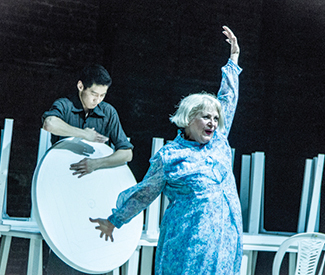
Equally effective was a timely adaptation of a Rainer Werner Fassbinder film at the vibrant Gogol-Centre, a new and leading venue with four resident companies and a popular youthful following. Fear, adapted by young playwright Lyubov Strizhak from Fassbinder’s Ali: Fear Eats the Soul, is one in a trilogy of works by Latvian director Vladislav Nastavshev that adapt famous films (the others being Visconti’s Rocco and His Brothers and Lars Von Trier’s The Idiots, each in some way dealing with the negotiation of borders and the plight of outsiders). The story concerns the socially unsanctioned love affair between a young Tajik migrant worker and an elderly Moscow widow. Unfolding with a bold, forceful grace on a spare arena-style stage that made dynamic use of a set of white plastic tables, this well acted and moving piece was also among the most overtly political, dealing head-on with the rising xenophobia that has plagued Russia in general and Moscow in particular in recent years. (The one other piece in the program with comparable political punch came from the tiny but intrepid Theater.doc, an independent documentary theater, run by Elena Gremina. Documentary theater is the mode of choice for much political work on Moscow stages, and perhaps not surprisingly Fear‘s playwright Strizhak is well associated with the form.)

In all, I took in half of the total program of the Russia Case, in a packed week of theater and discussion, as part of a group of Americans traveling under the auspices of the Center for International Theatre Development. Needless to say, politics were in the air throughout, and not only because of recent events in Ukraine. The theater in Russia is far more culturally important and influential than theater tends to be here. And while not overtly political in what it stages (except in some notable instances like those just mentioned), it remains a site of many progressive and antiauthoritarian voices as well as big personalities and vested interests. Even the Taganka jubilee was marked by internal turmoil and public scandal, stemming in part from Lyubimov’s contentious public departure from the theater in 2011 but sparked by a historical exhibition on the walls of the theater that provoked defacement from outraged members of the company.

More broadly and urgently, however, the Russians and their international guests mulled over the future of theater in a country drifting rapidly toward ultranationalist extremes. All seemed to agree that whatever happens, this year’s Russia Case will likely not look like next year’s, and that artists and audiences are in for a wild ride.


Record Store Day: Where to get your (musical) high tomorrow

0

You did it! It’s Friday!

This weekend will see a convergence of two holidays that, come to think of it, overlap rather nicely given their impact on chocolate sales. Whether you’re celebrating the resurrection of Christ by donning an elaborate hat for church or the recent renewal of your medical marijuana card by finding new and creative ways to mainline THC (word to the wise: be careful in public this year), Sunday, April 20 is shaping up to be a fine day for people-watching in this city.

But hey, fellow music nerds: We all know both of those pale in comparison to what’s going down on Saturday. Yes, like the first esoteric, vinyl-collection obsessed, possibly slightly-condescending-at-times robin of Spring, Record Store Day is upon us once again. Tomorrow, Sat/19, will be a pretty good day to visit just about any (actual, brick-and-mortar, non-Internet-based) record store in the Bay Area. Now in its seventh year, the holiday — which, its website notes, was kicked off in 2008 at San Francisco’s Rasputin, by none other than the boys from Metallica — is celebrated at stores on every continent except Antarctica.

No need to pack your bags though: Here’s what’s going down at a few Bay Area establishments that sell music in all its excellent tangible, physical forms.

From the Mission’s Aquarius Records, owner (and Minor Forest drummer) Andee Connors wrote us the following when we asked what he was stoked on this year:

1. A Minor Forest, Flemish Altruism / Inindependence, 4 LP reissue on Thrill Jockey, both albums from this nineties math/post/noise rock band [acknowledgement of personal bias here]

1. The Ghostbusters‘ glow-in-the dark 10″

3. Ron Jeremy, Understanding and Appreciating Classical Music With Ron Jeremy, 7″ (only a 7″??)

4. Cardinal 2/t LP, vinyl reissue of this seminal baroque indie-pop classic

5. Scharpling & Wurster, Rock, Rot & Rule LP, vinyl reissue of maybe the funniest record ever, especially for music nerds

I think our customers are probably excited for those, but they’re / we’re also looking forward to the Heatmiser (Elliott Smith’s old band) LP reissues, the four soundtrack LPs on Death Waltz, Pussy Galore reissue, Rodion G.A. reissue, the Space Project compilation…also, we have a new release from local band Twin Trilogy, featuring Sean Smith, the first in a series, ONLY available at aQ on RSD, and on Sunday, Twin Trilogy will be playing a special in-store at aQ. Record store day part 2!!! [Ed. note: Should pair well with your other Sunday celebrations].

ron

Across the Bay at Oakland’s 1-2-3-4 Go!, a full-day party will kick off when the store opens at 8am. “Last year people started lining up around 4:30am, to give you a heads-up if you plan on coming for the opening,” advised owner Steve Stevenson, adding that they’ll have coffee from SubRosa and donuts from Pepples (while supplies last) for those of you who line up early.

Giveaway: A test pressing of the Green Day Demolicious 2xLP, autographed by Berkeley boy Billie Joe Armstrong. The first 100 people in line will get a raffle ticket; once the 100th person has handed in their ticket, the drawing will commence.

James Williamson of The Stooges will be doing a signing and chatting with fans from 10am to 11ish. (Ed. note: !!!!)

Hella Vegan Eats will be on hand making breakfast and lunch throughout the day. “Not free, but well worth it even if you’re not vegan,” says Steve. They’ll also have a couple of kegs from Linden Street Brewery for over-21 folks, for free, after noon.

Bands: Ghoul will be playing a very special “surf” set from their RSD Hang Ten 10″ out on Tank Crimes at 3pm, with Occultist opening. 

gd

An entirely non-comprehensive list of what’s happening at other stores:

Amoeba Berkeley — In-store DJ sets from Jonah Nice and DJ Inti; 20 percent off all turntables, posters, and some other accessories; giveaways TBA.

Amoeba SF — Same sales as above, plus live silk-screening from 11am to 2pm with special RSD 2014 designs, one by Zach of Saintseneca; t-shirts and totes available for purchase, with all proceeds going to the San Francisco Rock Project. Plus a full day of guest DJs, including folks like Andy Cabic of Vetiver and Ezana Edwards and Ryan Grubbs from Blood Sister.

Rasputin Berkeley: Free acoustic show by Phillip Phillips.

Groove Merchant Records (Haight): Cool Chris’ hand-picked “batch of 300+ Rock, Soul, Jazz, Italo Disco, and Post-Punk records (LP’s, 12”s, & 7”s),” selected especially for RSD.

And now a word from your Record Store Day 2014 ambassador, Public Enemy’s Chuck D, whose duties coincide with an RSD reissue of a very fine 1988 album. Happy crate-digging!

Happy hump day music news!

0

Hiatus, schmiatus: Thee Oh Sees have been added to an already-dreamy Burger Boogaloo lineup. Catch ’em alongside OFF!, Shannon and the Clams, Nobunny, Terry Malts, and of course the inimitable Miss Ronnie Spector herself, July 5-6 at Mosswood Park in Oakland.

Who needs Coachella anyway? In between their two weekend stints at that shitshow of a music festival down south, Waxahatchee is playing a free show at UC Berkeley’s Sproul Plaza today at 5pm. Are you in Berkeley? It’s goddamn beautiful out. You should go.

Start your itinerizing: Outsidelands just announced each day’s lineup and put single-day tickets on sale. Are you in more of a Kanye-Disclosure-Warpaint-Mikal Cronin kind of mood? Or a Tom Petty-Tycho-Big Freedia head space? These are the tough questions.

Cocktails grow up: Don’t worry, one of SF’s favorite fuzz-power-pop bands hasn’t gone and gotten lame, though. This new track, “Tough Love,” off Adult Life, suggests the five-piece has gotten a little tighter and just a little slicker, in a good way. That record won’t be out until June 17, but you can probably hear a lot of it at the Rickshaw Stop this Fri/18, when they open at the EP release party for The She’s.

“My brain is a little addled in terms of my long-term memory.” That’s Courtney Love, in an excellent oral history of Hole’s Live Through This, in honor of the album’s 20th anniversary. No matter what you think of her or her Dave Grohl reconciliation or her mediocre missing airplane-finding skills, this album is still gorgeous and important and yes I will fight you about that.

Also, this interview.

Save the world, work less

56

steve@sfbg.com

Save the world, work less. That dual proposition should have universal appeal in any sane society. And those two ideas are inextricably linked by the realities of global climate change because there is a direct connection between economic activity and greenhouse gas emissions.

Simply put, every hour of work we do cooks the planet and its sensitive ecosystems a little bit more, and going home to relax and enjoy some leisure time is like taking this boiling pot of water off the burner.

Most of us burn energy getting to and from work, stocking and powering our offices, and performing the myriad tasks that translate into digits on our paychecks. The challenge of working less is a societal one, not an individual mandate: How can we allow people to work less and still meet their basic needs?

This goal of slowing down and spending less time at work — as radical as it may sound — was at the center of mainstream American political discourse for much of our history, considered by thinkers of all ideological stripes to be the natural endpoint of technological development. It was mostly forgotten here in the 1940s, strangely so, even as worker productivity increased dramatically.

But it’s worth remembering now that we understand the environmental consequences of our growth-based economic system. Our current approach isn’t good for the health of the planet and its creatures, and it’s not good for the happiness and productivity of overworked Americans, so perhaps it’s time to revisit this once-popular idea.

Last year, there was a brief burst of national media coverage around this “save the world, work less” idea, triggered by a report by the Washington DC-based Center for Economic and Policy Research, entitled “Reduced Work Hours as a Means of Slowing Climate Change.”

“As productivity grows in high-income, as well as developing countries, social choices will be made as to how much of the productivity gains will be taken in the form of higher consumption levels versus fewer work hours,” author David Rosnick wrote in the introduction.

He notes that per capita work hours were reduced by 50 percent in recent decades in Europe compared to US workers who spend as much time as ever on the job, despite being a world leader in developing technologies that make us more productive. Working more means consuming more, on and off the job.

“This choice between fewer work hours versus increased consumption has significant implications for the rate of climate change,” the report said before going on to study various climate change and economic growth models.

It isn’t just global warming that working less will help address, but a whole range of related environmental problems: loss of biodiversity and natural habitat; rapid depletion of important natural resources, from fossil fuel to fresh water; and the pollution of our environment with harmful chemicals and obsolete gadgets.

Every day that the global workforce is on the job, those problems all get worse, mitigated only slightly by the handful of occupations devoted to cleaning up those messes. The Rosnick report contemplates only a slight reduction in working hours, gradually shaving a few hours off the week and offering a little more vacation time.

“The paper estimates the impact on climate change of reducing work hours over the rest of the century by an annual average of 0.5 percent. It finds that such a change in work hours would eliminate about one-quarter to one-half of the global warming that is not already locked in (i.e. warming that would be caused by 1990 levels of greenhouse gas concentrations already in the atmosphere),” the report concludes.

What I’m talking about is something more radical, a change that meets the daunting and unaddressed challenge that climate change is presenting. Let’s start the discussion in the range of a full day off to cutting our work hours in half — and eliminating half of the wasteful, exploitive, demeaning, make-work jobs that this economy-on-steroids is creating for us, and forcing us to take if we want to meet our basic needs.

Taking even a day back for ourselves and our environment will seem like crazy-talk to many readers, even though our bosses would still command more days each week than we would. But the idea that our machines and other innovations would lead us to work far less than we do now — and that this would be a natural and widely accepted and expected part of economic evolution — has a long and esteemed philosophical history.

Perhaps this forgotten goal is one worth remembering at this critical moment in our economic and environmental development.


HISTORY LESSON

Author and historian Chris Carlsson has been beating the “work less” drum in San Francisco since Jimmy Carter was president, when he and his fellow anti-capitalist activists decried the dawning of an age of aggressive business deregulation that continues to this day.

They responded with creative political theater and protests on the streets of the Financial District, and with the founding of a magazine called Processed World, highlighting how new information technologies were making corporations more powerful than ever without improving the lives of workers.

“What do we actually do all day and why? That’s the most basic question that you’d think we’d be talking about all the time,” Carlsson told us. “We live in an incredibly powerful and overarching propaganda society that tells you to get your joy from work.”

But Carlsson isn’t buying it, noting that huge swaths of the economy are based on exploiting people or the planet, or just creating unproductive economic churn that wastes energy for its own sake. After all, the Gross Domestic Product measures everything, the good, the bad, and the ugly.

“The logic of growth that underlies this society is fundamentally flawed,” Carlsson said. “It’s the logic of the cancer cell — it makes no sense.”

What makes more sense is to be smart about how we’re using our energy, to create an economy that economizes instead of just consuming everything in its path. He said that we should ask, “What work do we need to do and to what end?”

We used to ask such questions in this country. There was a time when working less was the goal of our technological development.

“Throughout the 19th century, and well into the 20th, the reduction of worktime was one of the nation’s most pressing issues,” professor Juliet B. Schor wrote in her seminal 1991 book The Overworked American: The Unexpected Decline of Leisure. “Through the Depression, hours remained a major social preoccupation. Today these debates and conflicts are long forgotten.”

Work hours were steadily reduced as these debates raged, and it was widely assumed that even greater reductions in work hours was all but inevitable. “By today, it was estimated that we could have either a 22-hour week, a six-month workyear, or a standard retirement age of 38,” Schor wrote, citing a 1958 study and testimony to Congress in 1967.

But that didn’t happen. Instead, declining work hours leveled off in the late 1940s even as worker productivity grew rapidly, increasing an average of 3 percent per year 1948-1968. Then, in the 1970s, workers in the US began to work steadily more hours each week while their European counterparts moved in the opposite direction.

“People tend to think the way things are is the way it’s always been,” Carlsson said. “Once upon a time, they thought technology would produce more leisure time, but that didn’t happen.”

Writer David Spencer took on the topic in a widely shared essay published in The Guardian UK in February entitled “Why work more? We should be working less for a better quality of life: Our society tolerates long working hours for some and zero hours for others. This doesn’t make sense.”

He cites practical benefits of working less, from reducing unemployment to increasing the productivity and happiness of workers, and cites a long and varied philosophical history supporting this forgotten goal, including opposing economists John Maynard Keynes and Karl Marx.

Keynes called less work the “ultimate solution” to unemployment and he “also saw merit in using productivity gains to reduce work time and famously looked forward to a time (around 2030) when people would be required to work 15 hours a week. Working less was part of Keynes’s vision of a ‘good society,'” Spencer wrote.

“Marx importantly thought that under communism work in the ‘realm of necessity’ could be fulfilling as it would elicit and harness the creativity of workers. Whatever irksome work remained in realm of necessity could be lessened by the harnessing of technology,” Spencer wrote.

He also cited Bertrand Russell’s acclaimed 1932 essay, “In Praise of Idleness,” in which the famed mathematician reasoned that working a four-hour day would cure many societal ills. “I think that there is far too much work done in the world, that immense harm is caused by the belief that work is virtuous, and that what needs to be preached in modern industrial countries is quite different from what always has been preached,” Russell wrote.

Spencer concluded his article by writing, “Ultimately, the reduction in working time is about creating more opportunities for people to realize their potential in all manner of activities including within the work sphere. Working less, in short, is about allowing us to live more.”


JOBS VS. WORK

Schor’s research has shown how long working hours — and the uneven distribution of those hours among workers — has hampered our economy, hurt our environment, and undermined human happiness.

“We have an increasingly poorly functioning economy and a catastrophic environmental situation,” Schor told us in a phone interview from her office at Boston College, explaining how the increasingly dire climate change scenarios add urgency to talking about how we’re working.

Schor has studied the problem with other researchers, with some of her work forming the basis for Rosnick’s work, including the 2012 paper Schor authored with University of Alabama Professor Kyle Knight entitled “Could working less reduce pressures on the environment?” The short answer is yes.

“As humanity’s overshoot of environmental limits become increasingly manifest and its consequences become clearer, more attention is being paid to the idea of supplanting the pervasive growth paradigm of contemporary societies,” the report says.

The United States seems to be a case study for what’s wrong.

“There’s quite a bit of evidence that countries with high annual work hours have much higher carbon emissions and carbon footprints,” Schor told us, noting that the latter category also takes into account the impacts of the products and services we use. And it isn’t just the energy we expend at work, but how we live our stressed-out personal lives.

“If households have less time due to hours of work, they do things in a more carbon-intensive way,” Schor said, with her research finding those who work long hours often tend to drive cars by themselves more often (after all, carpooling or public transportation take time and planning) and eat more processed foods.

Other countries have found ways of breaking this vicious cycle. A generation ago, Schor said, the Netherlands began a policy of converting many government jobs to 80 percent hours, giving employees an extra day off each week, and encouraging many private sector employers to do the same. The result was happier employees and a stronger economy.

“The Netherlands had tremendous success with their program and they’ve ended up with the highest labor productivity in Europe, and one of the happiest populations,” Schor told us. “Working hours is a triple dividend policy change.”

By that she means that reducing per capita work hours simultaneously lowers the unemployment rate by making more jobs available, helps address global warming and other environmental challenges, and allows people to lead happier lives, with more time for family, leisure, and activities of their choosing.

Ironically, a big reason why it’s been so difficult for the climate change movement to gain traction is that we’re all spending too much time and energy on making a living to have the bandwidth needed to sustain a serious and sustained political uprising.

When I presented this article’s thesis to Bill McKibben, the author and activist whose 350.org movement is desperately trying to prevent carbon concentrations in the atmosphere from passing critical levels, he said, “If people figure out ways to work less at their jobs, I hope they’ll spend some of their time on our too-often neglected work as citizens. In particular, we need a hell of a lot of people willing to devote some time to breaking the power of the fossil fuel industry.”

world

That’s the vicious circle we now find ourselves in. There is so much work to do in addressing huge challenges such as global warming and transitioning to more sustainable economic and energy systems, but we’re working harder than ever just to meet our basic needs — usually in ways that exacerbate these challenges.

“I don’t have time for a job, I have too much work to do,” is the dilemma facing Carlsson and others who seek to devote themselves to making the world a better place for all living things.

To get our heads around the problem, we need to overcome the mistaken belief that all jobs and economic activity are good, a core tenet of Mayor Ed Lee’s economic development policies and his relentless “jobs agenda” boosterism and business tax cuts. Not only has the approach triggered the gentrification and displacement that have roiled the city’s political landscape in the last year, but it relies on a faulty and overly simplistic assumption: All jobs are good for society, regardless of their pay or impact on people and the planet.

Lee’s mantra is just the latest riff on the fabled Protestant work ethic, which US conservatives and neoliberals since the Reagan Era have used to dismantle the US welfare system, pushing the idea that it’s better for a single mother to flip our hamburgers or scrub our floors than to get the assistance she needs to stay home and take care of her own home and children.

“There is a belief that work is the best form of welfare and that those who are able to work ought to work. This particular focus on work has come at the expense of another, far more radical policy goal, that of creating ‘less work,'” Spencer wrote in his Guardian essay. “Yet…the pursuit of less work could provide a better standard of life, including a better quality of work life.”

And it may also help save us from environmental catastrophe.


GLOBAL TIPPING POINT

The Intergovernmental Panel on Climate Change, the top research body on the issue recognized by the United Nations, recently released its fifth report summarizing and analyzing the science and policies around climate change, striking a more urgent tone than in previous reports.

On April 13 at a climate conference in Berlin, the panel released a new report noting that greenhouse gas emissions are rising faster than ever and urgent action is needed in the next decade to avert a serious crisis.

“We cannot afford to lose another decade,” Ottmar Edenhofer, a German economist and co-chairman of the committee that wrote the report, told The New York Times. “If we lose another decade, it becomes extremely costly to achieve climate stabilization.”

After the panel released an earlier section of the report on March 31, it wrote in a public statement: “The report concludes that responding to climate change involves making choices about risks in a changing world. The nature of the risks of climate change is increasingly clear, though climate change will also continue to produce surprises.”

The known impacts will be displaced populations in poor countries inundated by rising seas, significant changes to life-supporting ecosystems (such as less precipitation in California and other regions, creating possible fresh water shortages), food shortages from loss of agricultural land, and more extreme weather events.

What we don’t yet know, these “surprises,” could be even scarier because this is such uncharted territory. Never before have human activities had such an impact on the natural world and its delicate balances, such as in how energy circulates through the world’s oceans and what it means to disrupt half of the planet’s surface area.

Researchers have warned that we could be approaching a “global tipping point,” in which the impact of climate change affects other systems in the natural world and threatens to spiral out of control toward another mass extinction. And a new report funded partially by the National Science Foundation and NASA’s Goodard Space Center combines the environmental data with growing inequities in the distribution of wealth to warn that modern society as we know it could collapse.

“The fall of the Roman Empire, and the equally (if not more) advanced Han, Mauryan, and Gupta Empires, as well as so many advanced Mesopotamian Empires, are all testimony to the fact that advanced, sophisticated, complex, and creative civilizations can be both fragile and impermanent,” the report warned.

It cites two critical features that have triggered most major societal collapses in past, both of which are increasingly pervasive problems today: “the stretching of resources due to the strain placed on the ecological carrying capacity”; and “the economic stratification of society into Elites [rich] and Masses (or ‘Commoners’),” which makes it more difficult to deal with problems that arise.

Both of these problems would be addressed by doing less overall work, and distributing the work and the rewards for that work more evenly.


SYSTEMIC PROBLEM

Carol Zabin — research director for the Center for Labor Research and Education at UC Berkeley, who has studied the relation between jobs and climate change — has some doubts about the strategy of addressing global warming by reducing economic output and working less.

“Economic activity which uses energy is not immediately correlated with work hours,” she told us, noting that some labor-saving industrial processes use more energy than human-powered alternatives. And she also said that, “some leisure activities could be consumptive activities that are just as bad or worse than work.”

She does concede that there is a direct connection between energy use and climate change, and that most economic activity uses energy. Zabin also said there was a clear and measurable reduction in greenhouse gas emissions during the Great Recession that began with the 2008 economic crash, when economic growth stalled and unemployment was high.

“When we’re in recessions and output and consumption slow, we see a reduction in impact on the climate,” Zabin said, although she added, “They’re correlated, but they’re not causal.”

Other studies have made direct connections between work and energy use, at least when averaged out across the population, studies that Rosnick cited in his study. “Recent work estimated that a 1 percent increase in annual hours per employee is associated with a 1.5 percent increase in carbon footprint,” it said, citing the 2012 Knight study.

Zabin’s main stumbling block was a political one, rooted in the assumption that American-style capitalism, based on conspicuous consumption, would continue more or less as is. “Politically, reducing economic growth is really, really unviable,” she told us, noting how that would hurt the working class.

But again, doesn’t that just assume that the pain of an economic slowdown couldn’t be more broadly shared, with the rich absorbing more of the impact than they have so far? Can’t we move to an economic system that is more sustainable and more equitable?

“It seems a little utopian when we have a problem we need to address by reducing energy use,” Zabin said before finally taking that next logical step: “If we had socialism and central planning, we could shut the whole thing down a notch.”

Instead, we have capitalism, and she said, “we have a climate problem that is probably not going to be solved anyway.”

So we have capitalism and unchecked global warming, or we can have a more sustainable system and socialism. Hmm, which one should we pick? European leaders have already started opting for the latter option, slowing down their economic output, reducing work hours, and substantially lowering the continent’s carbon footprint.

That brings us back to the basic question set forth in the Rosnick study: As productivity increases, should those gains go to increase the wages of workers or to reduce their hours? From the perspective of global warming, the answer is clearly the latter. But that question is complicated in US these days by the bosses, investors, and corporations keeping the productivity gains for themselves.

“It is worth noting that the pursuit of reduced work hours as a policy alternative would be much more difficult in an economy where inequality is high and/or growing. In the United States, for example, just under two-thirds of all income gains from 1973-2007 went to the top 1 percent of households. In that type of economy, the majority of workers would have to take an absolute reduction in their living standards in order to work less. The analysis of this paper assumes that the gains from productivity growth will be more broadly shared in the future, as they have been in the past,” the study concludes.

So it appears we have some work to do, and that starts with making a connection between Earth Day and May Day.


EARTH DAY TO MAY DAY

The Global Climate Convergence (www.globalclimateconvergence.org) grew out of a Jan. 18 conference in Chicago that brought together a variety of progressive, environmental, and social justice groups to work together on combating climate change. They’re planning “10 days to change course,” a burst of political organizing and activism between Earth Day and May Day, highlighting the connection between empowering workers and saving the planet.

“It provides coordinated action and collaboration across fronts of struggle and national borders to harness the transformative power we already possess as a thousand separate movements. These grassroots justice movements are sweeping the globe, rising up against the global assault on our shared economy, ecology, peace and democracy. The accelerating climate disaster, which threatens to unravel civilization as soon as 2050, intensifies all of these struggles and creates new urgency for collaboration and unified action. Earth Day to May Day 2014 (April 22 — May 1) will be the first in a series of expanding annual actions,” the group announced.

San Mateo resident Ragina Johnson, who is coordinating events in the Bay Area, told us May Day, the international workers’ rights holiday, grew out of the struggle for the eight-hour workday in the United States, so it’s appropriate to use the occasion to call for society to slow down and balance the demands of capital with the needs of the people and the planet.

“What we’re seeing now is an enormous opportunity to link up these movements,” she told us. “It has really put us on the forefront of building a new progressive left in this country that takes on these issues.”

In San Francisco, she said the tech industry is a ripe target for activism.

“Technology has many employees working 60 hours a week, and what is the technology going to? It’s going to bottom line profits instead of reducing people’s work hours,” she said.

That’s something the researchers have found as well.

“Right now, the problem is workers aren’t getting any of those productivity gains, it’s all going to capital,” Schor told us. “People don’t see the connection between the maldistribution of hours and high unemployment.”

She said the solution should involve “policies that make it easier to work shorter hours and still meet people’s basic needs, and health insurance reform is one of those.”

Yet even the suggestion that reducing work hours might be a worthy societal goal makes the head of conservatives explode. When the San Francisco Chronicle published an article about how “working a bit less” could help many people qualify for healthcare subsidies under the Affordable Care Act (“Lower 2014 income can net huge health care subsidy,” 10/12/13), the right-wing blogosphere went nuts decrying what one site called the “toxic essence of the welfare state.”

Chronicle columnist Debra Saunders parroted the criticism in her Feb. 7 column. “The CBO had determined that ‘workers will choose to supply less labor — given the new taxes and other incentives they will face and the financial benefits some will receive.’ To many Democrats, apparently, that’s all good,” she wrote of Congressional Budget Office predictions that Obamacare could help reduce hours worked.

Not too many Democratic politicians have embraced the idea of working less, but maybe they should if we’re really going to attack climate change and other environmental challenges. Capitalism has given us great abundance, more than we need and more than we can safely sustain, so let’s talk about slowing things down.

“There’s a huge amount of work going on in society that nobody wants to do and nobody should do,” Carlsson said, imagining a world where economic desperation didn’t dictate the work we do. “Most of us would be free to do what we want to do, and most of us would do useful things.”

And what about those who would choose idleness and sloth? So what? At this point, Mother Earth would happily trade her legions of crazed workaholics for a healthy population of slackers, those content to work and consume less.

Maybe someday we’ll even look back and wonder why we ever considered greed and overwork to be virtues, rather than valuing a more healthy balance between our jobs and our personal lives, our bosses and our families, ourselves and the natural world that sustains us.

Watch: Can you spot all the East Bay locales in this new Atmosphere video?

0

Okay, so maybe I’m a little biased because how often does a music video shoot take place in yours truly’s little podunk hometown of Albany, California — which is where the dollar-beer-covered racetrack glory that is Golden Gate Fields technically lies, friends, not Berkeley — but this new Atmosphere video for the song “Kanye West,” which the hip-hop duo premiered today on Noisey, does feel a little like a “spot the East Bay shooting location” rendition of Where’s Waldo.

There’s plenty else to like, though: That’s also Oakland writer-superstar Chinaka Hodge in the role of leading lady, and local comedian/erstwhile Guardian opiner Nato Green as a scared-shitless corner store worker. Check it out below.

The duo’s new album Southsiders drops May 6 on Rhymesayers; this song will also be on The Lake Nokomis Maxi Single, released exclusively on vinyl for Record Store Day (that’s next Saturday, April 19, kiddos). They’ll be in town in August for Outsidelands


Report details how brown and black communities are decimated, step by step

104

Gentrification is a word so oft-used in conversations about San Francisco that it’s easy to forget what it means.

A report released yesterday by the advocacy group Causa Justa/Just Cause titled “Development Without Displacement” breaks down gentrification into a set of digestible, understandable policy decisions, while identifying which communities even now are still at risk of displacement.

“This report shows that there are many reasonable policies at the local and regional levels that can help hold back the tide of gentrification and modify the worst effects of urban transformation,” said one of its authors, UC Berkeley Geography Professor Richard Walker, in a statement on its site.

The report provides many solutions, but is largely a 100-plus page tale of 20 years of the destruction of brown and black communities in San Francisco, beginning in 1990, and the ripple effects of that displacement on the people of Oakland.

The “Stage of Gentrification” map in particular details San Francisco and Oakland Neighborhoods as being in early, middle, late and ongoing stages of gentrification. Each of these classifications is determined by the population — are they susceptible to displacement? — as well as the housing market prices in the neighborhood. Not surprisingly, the Mission and the panhandle are labeled as ongoing gentrification zones, with the southern neighborhoods of San Francisco are labeled as in early stages of gentrification marked by a rise in property value.

Robbie Clark, 33, the housing rights campaign lead organizer at Causa Justa, said the map details the challenges facing the Latino and African American communities today, a challenge she’s also facing herself.

“For me, I’m born and raised in Oakland, and it’s been a challenge as an adult to find stable affordable housing,” she told the Guardian. She has a huge family that used to live in Oakland right near one another. The displacement broke them up. “Everyone is spread out throughout the greater Bay Area and beyond. It used to be very normal for every weekend to have family dinners, and now that happens much less.”

In recent years she’s moved seven times as rents in both cities skyrocketed, and she was even in the process of moving again while we interviewed her. The need for the report, she said, was stark.

The findings put specific numbers to a story of loss we all know well. Between 1990 and 2011, over 1,400 Latinos left the Mission district. In the same time, white households increased by 2,900 in the Mission. In the same period, Oakland’s black population declined from 43 percent of the city to 26 percent. Many in San Francisco argue that increased affluence helps beautify neighborhoods and makes them safer, but that misses the point: the neighborhoods may be safer for newcomers, but the old residents get kicked out in the process.

The report states that outright: “While gentrification may bring much-needed investment to urban neighborhoods,” it states, “displacement prevents these changes from benefitting residents who may need them the most.”

Causa Justa Just Cause displacement report EXECUTIVE SUMMARY by FitztheReporter

A summary version of the 110 page report.

And the responsibility of these injustices should be laid squarely at the feet of neoliberal policies, the report states, including reduced public funding, privatization of public programs, relying too much on the private sector to drive economic growth, and a political system susceptible to hugely influential private corporations. 

But ultimately, Causa Justa concludes, there is still hope.

“Gentrification can be stopped!” the report states. To right the wrongs done to communities, “We also recommend policies that regulate government, landlord and developer activity to promote equitable investment, affordability and stability, and maximum benefits for existing residents.” 

Causa Justa, Just Cause, is selling the report for $25, but also includes a form for those who cannot afford it to apply for a free copy.

A high resolution version of the “Stage of Gentrification” map: 

map1


This Week’s Picks: April 9 – 15, 2014

0

WEDNESDAY 9

Haim

The flower children of the 21st century will be playing at the Fillmore tonight and tomorrow night kicking off their North American tour. Haim, an LA-based rock band, consists of three sisters that look like they jumped out of a fashionable Tumblr. An edgy rock sound with breathy vocals and ’80s beats, the band’s debut album Days Are Gone was touted as one of the best rock albums of 2013. The trio has often been compared to Fleetwood Mac — in some circles, the highest of compliments in the music world. Three Stevie Nicks for the price of one!

7pm, $25

The Fillmore

1805 Geary, SF

(415) 346-6000

www.thefillmore.com


THURSDAY 10

‘Invidious’

Installations are a way of reaching audiences bored with buying a ticket and sitting down for the next two hours. They give the viewer a choice of how she might want to see a work — a sort of slow motion or fast-forwarding button on a TV remote control. Sometimes, however, putting a piece into a specific context makes a lot of sense. Take FACT/SF’s new Invidious, choreographer Charles Slender’s “domestic dance theater piece,” which hits home (if you’ll excuse the language) with issues surrounding the so-called American dream and the price it exacts emotionally, intellectually and financially on all those who still believe in it. What better way than to plant such work in an actual home? (Secret revealed: it’s in the Mission). (Rita Felciano)

Through April 13, 6:30 and 9pm, $40

Exact location in SF revealed after ticket reservation

www.brownpapertickets.com/event/596283


Matt Taibbi

Known for calling Goldman Sachs “a great vampire squid wrapped around the face of humanity,” former Rolling Stone contributing editor Matt Taibbi has dedicated his entire career to revealing the slimy underbelly of our country’s key institutions and formative events. Furthering his mission is Taibbi’s new book The Divide: American Injustice in the Age of the Wealth Gap. In it, he draws a scathing portrait of American injustice, denouncing how the country turned poverty into a crime and wealth into a “get out of jail free” card. Tonight, he’ll speak about the connection between mass incarcerations of the poor and the unpunished crimes of the rich, with guest speaker Clara Jeffrey, co-editor of Mother Jones, joining the conversation. (Laura B. Childs)

6:30pm, $20

Commonwealth Club

595 Market St, SF

(415) 597-6700

www.commonwealthclub.org


FRIDAY 11

Future Islands

Future Islands’ frontman Samuel T. Herring is so awesome he’s achieved one of the internet’s highest levels of honor — he’s now a meme. Herring ascended to memedom after Future Islands’ bonkers performance on Letterman last month, at the end of which, Letterman — who feigns interest for a living — expressed genuine excitement about their performance, exclaiming “I’ll take all of that you got!” Watching Herring perform is like witnessing someone doing a rain dance while being exorcised at the same time; if you watched the show without sound you’d likely still enjoy it. The band is touring of their latest synth-punk LP, Singles. (George McIntire)

8pm, $20

The Chapel

777 Valencia, SF

www.thechapelsf.com


Harold Ramis Tribute

The world lost a comic genius far too soon when Harold Ramis — writer-director of Caddyshack, National Lampoon’s Vacation, and Groundhog Day, as well as acting in Ghostbusters, among others — passed away in February at the age of 69. Lucky for us, his sweetly irreverent, deceptively smart work lives on, not only on the big screen but in the films of countless younger writers and directors who took their comic cues from him (see: the majority of screwball comedies made since 1990). This two-day tribute starts out with the subtly brilliant Groundhog Day and classic golf send-up Caddyshack on Friday, followed by a triple-feature Saturday with National Lampoon’s Vacation, Stripes, and Animal House. We think Ramis would be pleased, though that’s wholly unnecessary; it’s likely he’s already achieved total consciousness. (Emma Silvers)

7 and 8:55pm, $11

Castro Theatre

429 Castro, SF

www.castrotheatre.com


Teen Night: “Visions of an Abolitionist Future”

Hey, let’s build more jails and put everyone who we don’t like in them! That seems to be America’s M.O. at the mo’. The intrepid youth of YBCA’s Young Artists at Work program are looking at the malignant growth of the prison-industrial complex and the moral and economic price of mass incarceration — and theorizing strategies for intervention, change, and liberation. They do this through provocative art, producing video, illustration, sculpture, multimedia installation, and performance (including one stunning dance piece utilizing live, beamed-in choreography performed by prisoners themselves). The YAAW program gathers together youth from high schools around the Bay Area for a year-long artistic inquiry into hot topics: This Teen Night is where you can hear and support the creative, inspiring, and so far free voice of our youth today. (Marke B.)

6pm-10pm, free

YBCA

701 Mission, SF

(415) 978-2700

www.ybca.org


SATURDAY 12

Willie Nelson

This octogenarian still has a lot to say. With a six-decade career and over 200 albums in his catalog, and more than 200 nights per year spent on the road, Willie Nelson has earned every bit of the retirement he has no interest in taking. Performing with his two wickedly talented sons, Nelson has lost none of his charm and still plays all the hits. Well, not all the hits — that might take all night. For those who’ve never seen Nelson live, don’t miss what might be one of your last chances to see his incredibly tender and heartfelt act. Nelson still cares about a lot of things —farm workers’ rights, the legalization of marijuana, gay rights —and his fans clearly rank toward the top of this list. So fire up a joint and raise it (and pass it) to this living legend tonight. (Haley Zaremba)

With Drive-By Truckers, Shovels and Rope

7pm, $49.50

Greek Theatre

2001 Gayley, Berkeley

(510) 548-3010

www.apeconcerts.com


Goat

According to members of the band Goat, the group’s origins can be traced back to a remote village in Sweden, and an ongoing collective of different group members over the years, each remaining somewhat anonymous behind masks and costumes, both in photos and during live performances. Goat’s first major release, World Music, came out in Europe in 2012, and Sub Pop Records released the band’s first North American single, “Dreambuilding,” last year; expect a wild mix of ritual drumming, chanting, and a bit of voodoo mythology strewn over dizzying psychedelic rock. (Sean McCourt)

9pm, $20

Slim’s

333 11th St, SF

(415) 255-0333

www.slimspresents.com


Northern California Cherry Blossom Festival

If your allergies are too much to handle this spring, rejoice in this year’s Cherry Blossom Festival in Japantown. You won’t be a victim of itchy eyes, sneezing, or a red nose during this weekend’s celebration of Japanese culture. From sumo-e ink painting, calligraphy and origami demonstrations to classical and folk performances, indulge in a two weekend-long affair. Traditional Japanese music will fill the air as well as taiko and karaoke concerts. Just in case, pack an extra Claritin for the bonsai and ikebana flower arranging exhibits!

11am-5pm, free

April 12-13, 19-20 (parade is 1pm on April 20)

SF Japantown

(415) 563-2313

www.sfcherryblossom.org


SUNDAY 13


KUSF’s Rock ‘N’ Swap

For over 25 years, this record swap has promised (and delivered) some of the best hard-to-find vinyl, CDs, posters, and other music paraphernalia that any good audiophile could ask for. Out-of-print jazz records from 1932? The original Annie soundtrack on cassette? Stickers from that punk show you’re too young to have actually been to? Step right up and state your case at this KUSF-organized staple, and don’t be afraid to strike up a conversation — if you have esoteric tastes, this is a pretty good place to make new friends, too. (Emma Silvers)

7am-4pm, $3-$10

McLaren Hall, USF Campus

2130 Fulton, SF

(415) 386-5873

www.usfca.edu/kusf/rock-n-swap


MONDAY 14

Toy Dolls

Fun-loving British punk band The Toy Dolls are celebrating 35 years of joyfully madcap songs like “James Bond Lives Down Our Street,” “Yul Brenner Was A Skinhead,” and their biggest hit, a cover of an old English children’s song, “Nellie The Elephant.” Though the band has gone through innumerable lineup changes over the years, they continue to be lead by founding member and singer-guitarist Michael “Olga” Algar, and now perform as a power trio, having toured across the world. The Toy Dolls come to the states this month in support of their latest album, 2012’s cheekily titled The Album After The Last One. (Sean McCourt)

With Swingin’ Utters

8pm, $25-$27

The Regency Ballroom

1300 Van Ness, SF

www.theregencyballroom.com


MS MR

Thanks to their 2012 single “Hurricane,” MS MR have exploded into buzz blogs and newsfeeds internationally. Even if you think you you’re not familiar with this nascent New York duo, you are. “Hurricane” was a runway favorite at Fashion Week and on every pop station, while “Bones” was featured in the trailers for Game of Thrones’ third season — you’ve probably even caught yourself humming along to the band’s mega-catchy sound. Comprised of two Vassar alums, one singer-songwriter and Neon Gold founder and one dancer-choreographer, MS MR is a both a dream team of immediately accessible alt-pop and an explosive stage presence. And hey, if Westeros approves, what is there left to discuss? (Zaremba)

With Jagwar Ma

8pm, $25

The Fillmore

1805 Geary, SF

(415) 346-3000

www.thefillmore.com

Theater Listings: April 9 – 15, 2014

0

Stage listings are compiled by Guardian staff. Performance times may change; call venues to confirm. Reviewers are Robert Avila, Rita Felciano, and Nicole Gluckstern. Submit items for the listings at listings@sfbg.com.

THEATER

OPENING

Fences Marin Theatre Company, 397 Miller, Mill Valley; www.marintheatre.org. $37-58. Previews Thu/10-Sat/12, 8pm; Sun/13, 7pm. Opens Tue/15, 8pm. Runs Tue and Thu-Sat, 8pm (also April 19, May 3, and May 10, 2pm; April 24, 1pm); Wed, 7:30pm; Sun, 2 and 7pm. Through May 11. Marin Theatre Company performs August Wilson’s Pulitzer- and Tony-winning drama, with an all-star cast of Bay Area talent: Carl Lumbly, Steven Anthony Jones, and Margo Hall.

Smash Dragon Theatre, 2120 Broadway, Redwood City; www.dragonproductions.net. $30. Previews Thu/10, 8pm. Opens Fri/11, 8pm. Runs Thu-Sat, 8pm; Sun, 2pm. Through May 4. Dragon Theatre performs Jeffrey Hatcher’s political comedy.

Tribes Berkeley Repertory Theatre, Roda Theatre, 2015 Addison, Berk; www.berkeleyrep.org. $29-99. Previews Fri/11-Sat/12 and Tue/15, 8pm; Sun/13, 7pm. Opens April 16, 8pm. Runs Tue and Thu-Sat, 8pm (also Sat, 2pm); Wed and Sun, 7pm (also Sun, 2pm). Berkeley Rep performs Nina Raine’s family drama about a young deaf man who comes of age.

ONGOING

Bauer San Francisco Playhouse, 450 Post, SF; www.sfplayhouse.org. Tue-Thu, 7pm; Fri-Sat, 8pm (also Sat, 3pm); Sun/13, 2pm. Through April 19. San Francisco Playhouse presents the world premiere of Lauren Gunderson’s drama about artist Rudolf Bauer.

E-i-E-i-OY! In Bed with the Farmer’s Daughter NOHSpace, 2840 Mariposa, SF; www.vivienstraus.com. $20. Fri-Sat, 8pm. Through May 10. Vivien Straus performs her autobiographical solo show.

Every Five Minutes Magic Theatre, Fort Mason Center, Marina at Laguna, SF; www.magictheatre.org. $20-60. Tue, 7pm; Fri-Sat, 8pm (also Wed/9, 2:30pm); Sun, 2:30pm. Through April 20. Magic Theatre presents the world premiere of Linda McLean’s drama about a man’s homecoming after years behind bars.

Feisty Old Jew Marsh San Francisco Main Stage, 1062 Valencia, SF; www.themarsh.org. $25-100. Sat, 8pm; Sun, 7pm. Extended through May 4. Charlie Varon performs his latest solo show, a fictional comedy about “a 20th century man living in a 21st century city.”

Foodies! The Musical Shelton Theater, 533 Sutter, SF; www.foodiesthemusical.com. $32-34. Fri-Sat, 8pm. Open-ended. AWAT Productions presents Morris Bobrow’s musical comedy revue all about food.

The Habit of Art Z Below Theatre, 470 Florida, SF; www.therhino.org. $15-25. Wed/9-Sat/12, 8pm; Sun/13, 3pm. Theatre Rhinoceros performs a “very British comedy” by History Boys author Alan Bennett.

Hundred Days Z Space, 450 Florida, SF; www.zspace.org. $10-100. Thu/10-Sat/12, 8pm; Sun/13, 7pm. Married musical duo the Bengsons (Abigail and Shaun) provide the real-life inspiration and guiding rock ‘n’ roll heart for this uneven but at times genuinely rousing indie musical drama, a self-referential meta-theater piece relating the story of a young couple in 1940s America who fall madly in love only to discover one of them is terminally ill. As an exploration of love, mortality, and the nature of time, the story of Sarah and Will (doubled by the Bengsons and, in movement sequences and more dramatically detailed scenes, by chorus members Amy Lizardo and Reggie D. White) draws force from the potent musical performances and songwriting of composer-creators Abigail and Shaun Bengson (augmented here by the appealing acting-singing chorus and backup band that also feature El Beh, Melissa Kaitlyn Carter, Geneva Harrison, Kate Kilbane, Jo Lampert, Delane Mason, Joshua Pollock). Playwright Kate E. Ryan’s book, however, proves too straightforward, implausible, and sentimental to feel like an adequate vessel for the music’s exuberant, urgent emotion and lilting, longing introspection. Other trappings of director Anne Kauffman’s elaborate production (including an inspired set design by Kris Stone that echoes the raw industrial shell of the theater; and less-than-inspired choreography by the otherwise endlessly inventive Joe Goode) can add texture at times but also prove either neutral figures or distracting minuses in conveying what truth and heft there is in the material. Ultimately, this still evolving world premiere has a strong musical beat at its core, which has a palpable force of its own, even if it’s yet to settle into the right combination of story and staging. (Avila)

I Never Lie: The Pinocchio Project Phoenix Theatre, 414 Mason, SF; www.99stockproductions.org. $15. Thu/10-Sat/12, 8pm. 99 Stock Productions performs Meredith Eden’s bold fairytale retelling.

Lovebirds Marsh San Francisco Studio, 1062 Valencia, SF; www.themarsh.org. $15-50. Thu/10-Fri/11, 8pm; Sat/12, 8:30pm. Theater artist and comedian Marga Gomez presents the world premiere of her 10th solo show, described as “a rollicking tale of incurable romantics.”

Painting the Clouds With Sunshine Eureka Theatre, 215 Jackson, SF; www.42ndStMoon.org. $25-75. Wed-Thu, 7pm; Fri, 8pm; Sat, 6pm (also Sat/12, 1pm); Sun, 3pm. Through April 20. 42nd Street Moon performs a world premiere, a first for the company: Greg MacKellan and Mark D. Kaufmann’s tribute to songs from 1930s movie musicals.

Pearls Over Shanghai Hypnodrome Theatre, 575 10th St, SF; www.thrillpeddlers.com. $30-35. Thu-Sat, 8pm. Through May 31. Thrillpeddlers present the fifth anniversary revival production of its enormously popular take on the 1971 Cockettes musical.

The Scion Marsh San Francisco, 1062 Valencia, SF; www.themarsh.org. $15-60. Thu-Fri, 8pm; Sat, 5pm. Through April 18. In his latest solo show, Brian Copeland (Not a Genuine Black ManThe Waiting Period) explores an infamous crime in his hometown of San Leandro: the 2000 murder of three government meat inspectors by Stuart Alexander, owner of the Santos Linguisa Factory. The story is personal history for Copeland, at least indirectly, as the successful comedian and TV host recounts growing up nearby under the common stricture that “rules are rules,” despite evidence all around that equity, fairness, and justice are in fact deeply skewed by privilege. Developed with director David Ford, the multiple-character monologue (delivered with fitful humor on a bare-bones stage with supportive sound design by David Hines) contrasts Copeland’s own youthful experiences as a target of racial profiling with the way wealthy and white neighbor Stuart Alexander, a serial bully and thug, consistently evaded punishment and even police attention along his path to becoming the “Sausage King,” a mayoral candidate, and a multiple murderer (Alexander died in 2005 at San Quentin). The story takes some meandering turns in making its points, and not all of Copeland’s characterizations are equally compelling. The subject matter is timely enough, however, though ironically it is government that seems to set itself further than ever above the law as much as wealthy individuals or the bogus “legal persons” of the corporate world. The results of such concentrated power are indeed unhealthy, and literally so — Copeland’s grandmother (one of his more persuasive characterizations) harbors a deep distrust of processed food that is nothing if not prescient — but The Scion’s tale of two San Leandrans leaves one hungry for more complexity. (Avila)

She Rode Horses Like the Stock Exchange Thick House, 1695 18th St, SF; www.crowdedfire.org. $15-35. Wed/9-Sat/12, 8pm. Crowded Fire offers a fine West Coast premiere of a clever if less than satisfying satire of the nouveaux riche and pauvre by American playwright Amelia Roper, in which two married couples meet on the grass of their neighborhood park and unravel their tangled, starkly childlike relations and dreams. Amy (a sharp and spirited Zehra Berkman) is a smart and restless woman who knows what she wants and can get it too, but without the slightest idea of how to sit comfortably still and enjoy a sunny Sunday morning. Her husband, Henry (a droll, unfussy, good-natured George Sellner), is clearly the antidote to the corporate jungle Amy works in, an agreeably boyish nurse and nurturer, who alleviates the stress of his own workweek in a children’s cancer ward with a scoop of strawberry-flavored ice cream on a cone. Soon they are sharing their modest picnic blanket with a bounding, slightly older couple, well-pampered housewife Sara (Marilee Talkington, alternately splendid and deflated in a beautifully modulated performance) and bank-owning breadwinner Max (an equally dynamic Kevin Clarke, outwardly suave yet reveling in Ubu-esque paroxysms of infantile yearning). Against a backdrop of post-pastoral suburban ease (succinctly evoked in scenic designer Maya Linke’s dangling mobiles, a lovely abstraction of dappled light and trees), we see the couples first commiserate then trade places, like pirate ships on the high seas of finance capitalism. Yet their viciousness has a gentleness around it too, like children playing pirates. In their jockeying, they seem both utterly willful and beyond their ken, while the triumphs and possibilities of a bygone innocence reassert themselves in unguarded moments like a lost Eden. If anything, the play hits its themes (including this sandbox metaphor) a little too forcefully even for satire, and its fleet 80 minutes get only so far in producing a sense of personal and systemic exhaustion as well as transcendence. The play’s agile humor and director M. Graham Smith’s strong and astute cast make the going a pleasure, however, even if we leave wanting a deeper excavation of that pristine lawn. (Avila)

Shit & Champagne Rebel, 1772 Market, SF; shitandchampagne.eventbrite.com. $25. Fri-Sat, 8pm. Open-ended. D’Arcy Drollinger is Champagne White, bodacious blond innocent with a wicked left hook in this cross-dressing ’70s-style white-sploitation flick, played out live on Rebel’s intimate but action-packed barroom stage. Written by Drollinger and co-directed with Laurie Bushman (with high-flying choreography by John Paolillo, Drollinger, and Matthew Martin), this high-octane camp send-up of a favored formula comes dependably stocked with stock characters and delightfully protracted by a convoluted plot (involving, among other things, a certain street drug that’s triggered an epidemic of poopy pants) — all of it played to the hilt by an excellent cast that includes Martin as Dixie Stampede, an evil corporate dominatrix at the head of some sinister front for world domination called Mal*Wart; Alex Brown as Detective Jack Hammer, rough-hewn cop on the case and ambivalent love interest; Rotimi Agbabiaka as Sergio, gay Puerto Rican impresario and confidante; Steven Lemay as Brandy, high-end calf model and Champagne’s (much) beloved roommate; and Nancy French as Rod, Champagne’s doomed fiancé. Sprawling often literally across two buxom acts, the show maintains admirable consistency: The energy never flags and the brow stays decidedly low. (Avila)

The Speakeasy Undisclosed location (ticket buyers receive a text with directions), SF; www.thespeakeasysf.com. $70 (gambling chips, $5-10 extra; after-hours admission, $10). Thu-Sat, 7:40, 7:50, and 8pm admittance times. Extended through May 24. Boxcar Theater’s most ambitious project to date is also one of the more involved and impressively orchestrated theatrical experiences on any Bay Area stage just now. An immersive time-tripping environmental work, The Speakeasy takes place in an “undisclosed location” (in fact, a wonderfully redesigned version of the company’s Hyde Street theater complex) amid a period-specific cocktail lounge, cabaret, and gambling den inhabited by dozens of Prohibition-era characters and scenarios that unfold around an audience ultimately invited to wander around at will. At one level, this is an invitation to pure dress-up social entertainment. But there are artistic aims here too. Intentionally designed (by co-director and creator Nick A. Olivero with co-director Peter Ruocco) as a fractured super-narrative — in which audiences perceive snatches of overheard stories rather than complete arcs, and can follow those of their own choosing — there’s a way the piece becomes specifically and ever more subtly about time itself. This is most pointedly demonstrated in the opening vignettes in the cocktail lounge, where even the ticking of Joe’s Clock Shop (the “cover” storefront for the illicit 1920s den inside) can be heard underscoring conversations (deeply ironic in historical hindsight) about war, loss, and regained hope for the future. For a San Francisco currently gripped by a kind of historical double-recurrence of the roaring Twenties and dire Thirties at once, The Speakeasy is not a bad place to sit and ponder the simulacra of our elusive moment. (Avila)

“Standing On Ceremony: The Gay Marriage Plays” New Conservatory Theatre Center, 25 Van Ness, SF; www.nctcsf.org. $25-45. Wed-Sat, 8pm; Sun, 2pm. Through April 27. New Conservatory Theatre Center performs short plays about marriage equality by Mo Gaffney, Neil LaBute, Wendy MacLeod, Paul Rudnick, and others.

Top Girls Gough Street Playhouse, 1620 Gough, SF; www.custommade.org. $15-35. Thu/10-Sat/12, 8pm; Sun/13, 7pm. Custom Made Theatre Company performs Caryl Churchill’s celebration of powerful women.

The Two Chairs Bindlestiff Studios, 185 Sixth St, SF; www.performersunderstress.com. $10-30. Thu/10-Sat/12, 8pm; Sun/13, 2pm. In this world premiere by Performers Under Stress of its co-founder Charles Pike’s play, two chairs, per title, come matched with two cameras projecting two angles on two characters — He (Vince Faso, alternating nights with Duane Lawrence) and She (Juliana Egley, alternating nights with Valerie Fachman) — who sit at right angles to one another in a series of terse, vaguely clinical encounters. Introduced and concluded each time with cheeky inter-titles (à la Beckett) and the sound of a buzzer (à la Beckett — pretty much everything here is à la Beckett), their interactions unfold as progressive variations on a theme, freighted with references to the Goldberg Variations and other pretentious class markers (belied somewhat by the characters’ less than wholly sophisticated demeanors). Each mysterious not to say unorthodox session also concludes with a limp slap and the exchange of an envelope, as a banal male heterosexual masochist fantasy is jokily and tediously pursued to the point of He’s final erasure. Directed by PUS’s Scott Baker, the production adds a generational variation too across the alternating casts. But at least with the younger cast (Faso and Egley), the exploration comes across as glib and lifeless, and Pike’s self-conscious regression to an old-school avant-garde style feels too ersatz to be persuasive. (Avila)

Venus in Fur Geary Theater, 415 Geary, SF; www.act-sf.org. $20-120. Wed/9-Sat/12, 8pm (also Sat/12, 2pm); Sun/13, 7pm. American Conservatory Theater performs a new production of David Ives’ 2012 Tony-nominated play.

The World’s Funniest Bubble Show Marsh San Francisco, 1062 Valencia, SF; www.themarsh.org. $8-11. Sun, 11am. Extended through May 25. The popular, kid-friendly show by Louis Pearl (aka “The Amazing Bubble Man”) returns to the Marsh.

BAY AREA

Accidental Death of an Anarchist Berkeley Repertory Theatre, Roda Theatre, 2015 Addison, Berk; www.berkeleyrep.org. $29-99. Tue and Thu-Sat, 8pm (no show April 18; also Sat and April 17, 2pm); Sun, 2 and 7pm. Through April 20. Berkeley Rep presents comic actor Steven Epp in Dario Fo’s explosive political farce, directed by Christopher Bayes.

Arms and the Man Barn Theatre, 30 Sir Francis Drake, Ross; www.rossvalleyplayers.com. $13-26. Thu/10, 7:30pm; Fri/11-Sat/12, 8pm; Sun/13, 2pm. Ross Valley Players perform George Bernard Shaw’s romantic comedy.

The Coast of Utopia Ashby Stage, 1901 Ashby, Berk; www.shotgunplayers.org. $20-35 (three-show marathon days, $100-125). Part One: Voyage runs through April 17; Part Two: Shipwreck runs through April 19; Part Three: Salvage runs through April 27. Three-play marathon April 26. Through April 27. Check website for showtime info. Shotgun Players performs Tom Stoppard’s epic The Coast of Utopia trilogy, with all three plays performed in repertory.

East 14th Marsh Berkeley, 2120 Allston, Berk; www.themarsh.org. $20-50. Fri, 8pm; Sat, 8:30pm. Through April 26. Don Reed’s hit autobiographical solo show returns to the Marsh Berkeley.

Geezer Marsh Berkeley, 2120 Allston, Berk; www.themarsh.org. $25-50. Thu, 8pm; Sat, 5pm. Through April 26. Geoff Hoyle moves his hit comedy about aging to the East Bay.

The Hound of the Baskervilles Mountain View Center for the Performing Arts, 500 Castro, SF; www.theatreworks.org. $19-73. Tue-Wed, 7:30pm; Thu-Sat, 8pm (also Sat, 2pm); Sun, 2 and 7pm. Through April 27. TheatreWorks performs Stephen Canny and John Nicholson’s comedic send-up of Sherlock Holmes.

Johnny Guitar, the Musical Masquers Playhouse, 105 Park Place, Point Richmond; www.masquers.org. $22. Fri-Sat, 8pm; Sun, 2pm. Through April 26. Masquers Playhouse performs the off-Broadway hit based on the campy Joan Crawford Western.

Sleuth Center REPertory Company, 1601 Civic, Walnut Creek; www.centerrep.org. $33-54. Wed, 7:30pm; Thu-Sat, 8pm (also April 26, 2:30pm); Sun, 2:30pm. Through April 26. Center REPertory Company performs Anthony Shaffer’s classic, Tony-winning thriller.

The 25th Annual Putnam County Spelling Bee Julia Morgan Theater, 2640 College, Berk; www.berkeleyplayhouse.org. $18-60. Fri, April 24, and May 1, 7pm; Sat, 1 and 6pm; Sun, noon and 5pm. Through May 4. Berkeley Playhouse performs the Tony-winning musical comedy.

Vampire Lesbians of Sodom and Sleeping Beauty or Coma Live Oaks Theater, 1301 Shattuck, Berk; www.viragotheatre.org. $28. Thu-Sat, 8pm; Sun, 2pm. Through April 19. Virago Theatre Company performs Charles Busch’s outrageous double bill.

Wittenberg Aurora Theatre, 2081 Addison, Berk; www.auroratheatre.org. $32-60. Previews Wed/9, 8pm. Opens Thu/10, 8pm. Runs Tue, 7pm; Wed-Sat, 8pm; Sun, 2 and 7pm. Through May 4. Aurora Theatre Company performs David Davalos’ comedy about reason versus faith.

PERFORMANCE/DANCE

BATS Improv Bayfront Theater, B350 Fort Mason Center, SF; www.improv.org. $20. “Super Scene,” Fri, 8pm. Through April 25. “Spring Musical,” Sat, 8pm. Through April 26.

“The Big Gay Comedy Show” Marines’ Memorial Theater, 609 Sutter, SF; www.richmondermet.org. Sun/13, 7:30pm. $35-70. Benefit for the Richmond/Ermet AIDS Foundation with Bruce Vilanch, Marga Gomez, Shann Carr, Ali Mafi, and others.

Caroline Lugo and Carolé Acuña’s Ballet Flamenco Peña Pachamama, 1630 Powell, SF; www.carolinalugo.com. Sat/12, April 19, 30, May 4, 10-11, 17, and 25, 6:15pm. $15-19. Flamenco performance by the mother-daughter dance company, featuring live musicians.

“CubaCaribe Festival of Dance and Music” Dance Mission Theater, 3316 24th St, SF; www.brownpapertickets.com. Fri/11-Sat/12, 8pm; Sun/13, 7pm. $27. “Week One: Moving Forward” with Alafia Dance Ensemble (Haiti), Alayo Dance Company (Afro-Cuban), Cunamacué (Peru), Duniya Dance and Drum Company (West Africa), Las Que Son Son (Cuba), Las Puras (US), and Nicole Klaymoon’s Embodiment Project (African Diaspora).

“Dream Queens Revue” Aunt Charlie’s Lounge, 133 Turk, SF; www.dreamqueensrevue.com. Wed/9, 9:30pm. Free. Drag with Collette LeGrande, Ruby Slippers, Sophilya Leggz, Bobby Ashton, and more.

Feinstein’s at the Nikko 222 Mason, SF; www.feinsteinssf.com. Fri/11, 8pm. $60-75. Joan Collins in “One Night with Joan.”

“Invidious” Private Mission District home, SF; www.brownpapertickets.com. Thu/10-Sun/13, 6:30 and 9pm. $40. Contemporary dance company FACT/SF performs a new, site-specific work.

“The Life You’ll Never Have” Stage Werx Theatre, 446 Valencia, SF; www.foulplaysf.com. Wed/9, 7pm writing party; 8pm performance. $20. The audience crafts each evening’s soap opera-inspired play at this interactive, immersive performance by Exquisite Corpse Theatre.

“Magic at the Rex” Hotel Rex, 562 Sutter, SF; www.magicattherex.com. Sat, 8pm. Ongoing. $25. Magic and mystery with Adam Sachs and mentalist Sebastian Boswell III.

“Mischief” Skylark Bar, 3089 16th St, SF; www.hunnybunnyburlesque.com. Fri/11, 8pm. Free. Burlesque and variety show.

“Mission in Motion” Brava Theater Center, 2781 24th St, SF; www.brava.org. Sun/13, 3pm. $5-10. Mission Academy for the Performing Arts presents a showcase and benefit for Brava youth performing arts programs.

“Mortified” DNA Lounge, 375 11th St, SF; www.getmortified.com. Fri/11, 7:30pm. $21. Also Sat/12, 8pm, $20, Uptown, 1928 Telegraph, Oakl. Fearless storytellers share their most adorably embarrassing childhood writings.

“Rotunda Dance Series” San Francisco City Hall, 1 Carlton B. Goodlett Place, SF; www.dancersgroup.org. Fri/11, noon. Free. This month, the Tiruchitrambalam School of Dance performs classical Indian dance.

“San Francisco Comedy College” Purple Onion at Kells, 530 Jackson, SF; www.purpleonionatkells.com. $5-10. “New Talent Show,” Wed-Thu, 7. Ongoing. “The Cellar Dwellers,” stand-up comedy, Wed-Thu, 8:15pm and Fri-Sat, 7:30pm. Ongoing.

“Shotz: EarthTax” Tides Theatre, 533 Sutter, SF; www.amiosnyc.com. Tue/15, 8pm. $10. Seven plays, five minutes each, created in less than a month, and united under the theme “EarthTax.”

Terminator Too: Judgment Play DNA Lounge, 373 11th St, SF; www.dnalounge.com. May 1, 9pm. $25-50. The creators of Point Break Live! take on James Cameron’s 1991 sci-fi classic, with an audience member picked on the night of the show to embody Schwarzenegger’s iconic role.

“Yuri and Friends presents Thai Rivera” Punch Line Comedy Club, 444 Battery, SF; www.punchlinecomedyclub.com. Tue/15, 8pm. $15. Stand-up comedy.

BAY AREA

AXIS Dance Company Malonga Casquelourd Center for the Arts, 1428 Alice, Oakl; axisdance.brownpapertickets.com. Fri/11-Sat/12, 8pm; Sun/13, 2pm. $10-25. The company performs Yvonne Rainer’s iconic Trio A.

Diablo Ballet Hillbarn Theatre, 1285 E. Hillsdale, Foster City; www.diabloballet.org. Fri/11-Sat/12, 8pm. $45. The company’s 20th season continues with Emotions into Movement.

“IMPACT” Odell Johnson Theater, Laney College, 900 Fallon, Oakl; www.destinyarts.org. Fri/11-Sat/12, 7:30pm (also Sat/12, 2pm). $13-30. Destiny Arts Youth Performance Company celebrates the youth arts and violence prevention organization’s 25th anniversary with this world-premiere show, a mix of dance, theater, spoken word, rap, and song.

“MarshJam Improv Comedy Show” Marsh Berkeley, 2120 Allston, Berk; www.themarsh.org. Fri, 8pm. Ongoing. $10. Improv comedy with local legends and drop-in guests.

“A Month in the Country” Ashby Stage, 1901 Ashby, Berk; www.shotgunplayers.org. Tue/15, 7pm. $20. Staged reading of Ivan Turgenev’s play presented by Shotgun Players.

“Stand-Up Sit-Down” La Peña Cultural Center, 3105 Shattuck, Berk; www.lapena.org. Fri/11, 8pm. $15. Comedy and interview show with Karinda Dobbins and Dhaya Lakshminarayanan.

*


Mozart meets Method Man

0

By Micah Dubreuil

arts@sfbg.com

Sitting cross-legged on a pillow on the hardwood floor of a bare room in East Oakland, Korean-born, conservatory-trained composer JooWan Kim is doing two things that aren’t usually paired together: Conducting an elaborate, traditional tea ceremony and expressing his passion for N.W.A. Kim thrives on unexpected combinations: The composer, who spent seven years in Berkeley studying Zen meditation and Taoist internal alchemy (breathing exercises, he explains), has just finished his second of three arrangements of songs from Enter the 36 Chambers, the Wu-Tang Clan‘s seminal 1993 debut.

Kim leads Ensemble Mik Nawooj (his name backwards), a composer’s ensemble that could be termed a hip-hop orchestra, a chamber rap group, or maybe just the oddest band west of the Mississippi. Kim simply says: “We play pop music.” Of course, most people don’t imagine a pop group consisting of flute, clarinet, violin, cello, piano, a Soprano opera singer, upright bass, drums, and two MCs.

Most people are not JooWan Kim.

The result is a sound that juxtaposes the rapid-fire staccato of rap with the bombastic percussiveness and dramatic tension of western classical music. It’s unapologetic and truly like nothing else.

Kim, who moved to the US from Korea at age 20, had a somewhat different upbringing from your average hip-hop enthusiast. “My parents listened to classical music, and just like all Asian kids, I had the choice of playing piano or violin,” he says. ” I liked the piano.” He emigrated to study at Boston’s prestigious Berklee College of Music, then followed it up with a masters in composition from the SF Conservatory of Music. It was while at the Conservatory that Kim first began experimenting with a classical/hip-hop hybrid, presenting the first live piece “as a joke” in 2005. He began to consider doing it seriously when the performance received some unexpected attention from local press and musicians.

His first experience as a hip-hop listener, however, was less encouraging. “I hated them. I hated them so much, with a passion,” Kim says of the first songs he heard. Not a native to the language, he struggled to interpret the music. As his English began improving, however, his attitude towards hip-hop changed. “Once I realized the social context and the kind of things that they were saying, it blew me away. I could understand the necessity in the music — it’s a very sincere and powerful expression,” he says. “If you listen to concert music, it doesn’t have the same urgency,” says Kim, who has decided to prioritize making music for a broad audience (what he calls “pop”).

A broad audience is indeed front and center for EMN. The orchestra is returning to Yoshi’s Oakland on April 17 to preview the Wu-Tang arrangements, in addition to an upcoming residency at the Red Poppy Art House. The group has been performing in rooms normally considered rock clubs — Milk Bar, Brick & Mortar Music Hall, The New Parish — and are raising funds for their debut EP.

Kim’s hardly alone in his embrace of cross-cultural pollination. To celebrate their 21st anniversary, the Yerba Buena Center for the Arts commissioned the orchestra to arrange a total of six pieces for a November show called Clas/Sick Hip Hop II: 93 Til’ (a nod to local hip-hop legends Souls of Mischief, and the significance of the year 1993 in hip-hop). YBCA Director of Performance Marc Bamuthi Joseph affirms: “It is part of my gig to authentically recognize hip-hop as a great canonical American form.”

Joseph picked Kim as an arranger for his project in part because of his fresh perspective, coming from Korea and the conservatory — “there’s a playfulness that’s possible,” not being weighed down by certain historical precedents, he says. Though Joseph recognizes the s substantial history of both hip-hop and classical music in the Bay Area, he says he wasn’t entirely surprised that it took an outsider to fuse the two.

“When I came here, I realized it was very different in the sense that pop music was deeply associated with subcultures,” explains Kim. “Koreans don’t have that. Europeans don’t even have that either, in terms pop music. I thought that was weird, so I continued to listen to whatever I wanted to.” What marks EMN as unique is the marriage of classical techniques to this omnivorous disregard for cultural authority (a definitively hip-hop attitude).

mik nawooj

Indeed, JooWan Kim has a bit of a rebellious streak. “I decided to add drums and MCs to make people pissed off, and certainly I did,” Kim says of his first performance with the Ensemble. As he walks over to a grand piano to play selections of Wu-Tang’s “Shame on a Nigga,” there is a striking contrast between Kim’s clear delight in ruffling feathers and his calm, controlled demeanor, maintained through two to three hours of meditation each morning — a practice Kim began after studying with Taoist master Hyonoong Sunim at the Zen Center in Berkeley.

Kim believes meditating has transformed both him and his music. “It’s the most valuable thing I’ve ever done,” he says. “I don’t feel angry or depressed that often anymore. I’m at a point where I can let things pass.”

He reflects on the artistic potential that has opened up as he finishes his tea. “A lot of times people have it backward in terms of understanding art or music — that you’re learning all these techniques and then you’ll somehow write this great music,” he says. “It’s actually the other way around. All these qualities that you have, anger or depression or love: they come out in the music. That’s why people who didn’t learn anything about music can write great music, because they somehow overcame themselves.”

Ensemble Mik Nawooj

Thu/17, 10pm, $15
Yoshi’s Oakland
510 Embarcadero West, Oak.
(510) 238-9200
www.yoshis.com

https://www.youtube.com/watch?v=O84Yv6OVP8s

Events: April 9 – 15, 2014

0

Listings are compiled by Guardian staff. Submit items for the listings at listings@sfbg.com. For further information on how to submit items for the listings, see Selector.

WEDNESDAY 9

Poetry reading Pegasus Books Downtown, 2349 Shattuck, Berk; (510) 649-1320. 7:30pm, free. With Raina Leon, Erica Lewis, Alexandra Mattraw, and Val Witte.

Tom Fitzgerald and Lorenzo Marquez Booksmith, 1644 Haight, SF; www.booksmith.com. 7:30pm, free. The fashion bloggers discuss Everyone Wants to Be Me or Do Me: Tom and Lorenzo’s Fabulous and Opinionated Guide to Life and Style.

THURSDAY 10

Arlo Crawford Booksmith, 1644 Haight, SF; www.booksmith.com. 7:30pm, free. The author discusses A Farm Dies Once a Year: A Memoir.

Emma Donoghue Alexander Book Co., 50 Second St, SF; www.alexanderbook.com. Noon-1pm, free. The author reads from her new mystery novel Frog Music, with musicians Patrice Haan and Tony Marcus playing tunes that were popular during San Francisco’s Barbary Coast days.

Leslie Jamison City Lights Bookstore, 261 Columbus, SF; www.citylights.com. 7pm, free. The author reads from her new essay collection, The Empathy Exams.

Fred Martin BookShop West Portal, 80 West Portal, SF; (415) 564-8080. 7pm, free. The author discusses his new book, Abraham Lincoln’s Path to Reelection in 1864.

“Off the Grid: Twilight at the Presidio” Main Post, Presidio, SF; www.offthegridsf.com. 5-9pm, free. Every Thursday through June 26. This ongoing evening event features lantern-lit dining cabanas, cocktails, fire pits, and food trucks galore.

FRIDAY 11

“Chomp! They Came from the Swamp” Conservatory of Flowers, 100 JFK Dr, Golden Gate Park, SF; www.conservatoryofflowers.org. 10am-4pm, $1.50-8. Tue-Sun through Oct 19. Explore the oddly alluring world of meat-eating plants at this exhibit, starring California’s own cobra lilies and the ever-popular Venus flytrap. Who’s hungry?

“An Evening with Nightboat Books: Mostly New Work” Green Arcade, 1680 Market, SF; www.thegreenarcade.com. 7:30pm, free. With Brian Blanchfield, Laura Moriarity, George Albon, Brandon Som, and Kevin Killian.

“Walk to Work Day” SF; www.walksf.org. Hoof it to work today and get a reward (snacks, Clipper cards, etc.) at a number of “hubs” stationed around SF. All of the supervisors will be hanging out in cafés in their districts (7:45-9am) to encourage walkers; check the website for more deets.

“YBCA Teen Night 2014: Visions of an Abolitionist Future” Yerba Buena Center for the Arts, 701 Mission, SF; www.ybca.org. 6-10pm, free. Youth-created performance and exhibition that looks at the crisis of mass incarceration in America.

SATURDAY 12

Berkeley Bay Festival Berkeley Marina, Berk; cityofberkeley.info/bayfestival. 11am-4pm, free. Live music, environmentally-themed exhibitors, boating, and “green” vendors highlight this event celebrating the bay.

“Jack of All Trades” Jack London Square, 55 Harrison, Oakl; www.jackofalltradesoakland.com. 11am-5pm, free. Treasure Island Flea hosts this gathering of local makers, indie designers, artists, and more.

“Nicolas Cage Art Show” Balancoire, 2565 Mission, SF; eventbrite.com/e/nicolas-cage-art-show-san-francisco-tickets-11103499867. 8pm, $8-10. Group art show paying tribute to the many nuances of the Oscar-winning, delightfully odd actor.

Northern California Cherry Blossom Festival Japantown, SF; www.sfcherryblossom.org. April 12-13 and 19-20, free. Celebrate Japanese culture and the Japanese American community at this 47th annual street fair, boasting food booths, live music, martial arts demonstrations, and more.

“SiteWorks: Archaeologies of San Francisco Performance, 1969-85” Yerba Buena Center for the Arts, 701 Mission, SF; www.ybca.org. 3-4:40pm, free. Artist Nick Kaye discusses an ongoing, site-specific Google Maps project gathering “archival remains of past ephemeral art and performance in the present city of SF.”

“Writers with Drinks” Make-Out Room, 3225 22nd St, SF; www.writerswithdrinks.com. 7:30-9:30pm, $5-10. With Eileen Gunn, April Sinclair, Caitlin Donohue, Nona Caspers, and Siouxsie Q.

SUNDAY 13

“Foster Family Fun Day” Habitot Children’s Museum, 2065 Kittredge, Berk; www.habitot.org. 2-5pm, free. Foster, kinship, and adoptive families are welcome to visit the museum and enjoy free, exclusive access to the hands-on exhibits and creative art activities.

Darick Robertson Two Cats Comic Book Store, 320 West Portal, SF; www.twocatscomicbookstore.com. 3pm, free. The comics artist (Transmetropolitan, The Boys, Marvel Knights) discusses his work with Comic Vine’s Corey Schroeder.

MONDAY 14

Market Street Kiosk Youth Poster Series Bus kiosks along Market Street, SF; www.sfgov.org. Through July 7. Budding photographers working with San Francisco Arts Commission photo-mentoring program First Exposures exhibit scenes snapped in their neighborhoods — the Tenderloin, SoMa, and Central Market — in public displays along Market Street.

TUESDAY 15

Matthew Zapruder City Lights Bookstore, 261 Columbus, SF; www.citylights.com. 7pm, free. The poet celebrates the release of his new collection, Sunbear. *


Icon and on

0

arts@sfbg.com

DANCE Alvin Ailey American Dance Theater is the country’s most financially successful dance enterprise. Apparently, it regularly ends with a surplus, something most everyone else can only sigh over. But the success comes with a price: it tours like no one else. That makes it hard to keep performances fresh, a repertoire fluid, and dancers focused. And yet, the dancers showed little wear and tear on this 14th stop of their current 23-city US tour.

Two reasons account for the dancers’ success. They have one of the great masterpieces of 20th century art in their repertoire, and they never hit the road without it: Alvin Ailey’s 1960 Revelations. Audiences around the world want it. Again, and again, and again. There are times when I am tempted to skip it. I never do, and I never regret it. The only piece of choreography I feel similarly about is Giselle (and that music is not half as good).

Ailey dancers are also an extraordinarily beautiful lot — fierce technicians, with immaculate ensemble work, the women as strong as the men. For speed, attack, sense of space, and range of motion, they have little competition. Most of them stay with the company until they quit dancing, so an audience feels like it gets to know them over the years.

But Ailey dancers also look like they come out of one mold — the Ailey mold. One of the issues that has plagued the company for years is the rest of the repertoire. Bringing in new choreography has been a hit-and-miss affair. Robert Battle, artistic director for the last three years, has made valiant efforts to cast his net wider. Judging from the company’s opening night at UC Berkeley’s Zellerbach Hall this year, it still is something of a hit-and-miss affair.

Aszure Barton’s LIFT and Ronald K. Brown’s Four Corners are Battle commissions from 2013. Watching these two works — the first of which clocked in at 26 minutes, the second at 24 minutes — offered radically different experiences of time passing. LIFT flattened out thin ideas long beyond their welcome, and despite Curtis Macdonald’s assertive beat, the work began to drag quickly. Four Corners spun its sturdy gossamer web to the point where you didn’t want to let it go.

Barton, whose own company performed somewhat more successfully as part of San Francisco Performances in February, appears to have looked at the Ailey dancers and decided on the kind of suit that she wanted to tailor for them. While it fit them physically, it constrained their expressivity. LIFT’s vocabulary is somewhat reminiscent of African traditions — wide stances, articulated shoulders and hips, strong flat-footed stepping, and arms that fly away when not engaged in body-clapping. But Barton didn’t succeed in pulling these elements into a coherent statement.

A prominent male trio, with powerful Jermaine Terry as its leader, appeared to search the ground for something. Often the dancers performed with their backs to us. Men and women moved in and out of the shadows, arms often flailing, feet fussily engaged when not stomping.

Two duets were oddest of all. Matthew Rushing — still dancing fabulously — and Hope Boykin engaged each other in a hysterically laughing and screaming match. Ghrai DeVore’s lips became a suction cup against Marcus Jarrell Willis’ chest, turning the two of them in a four-legged creature of uncertain origin. Is that what those male searchers were trying to escape from?

Brown’s Four Corners, apparently, is inspired by the apocalypse’s four horsemen. I didn’t see it except when some unseen forces, perhaps launched by a divine spirit, perhaps just a strong wind, appeared to animate and propel the performers on some kind of journey toward ecstasy. Brown’s vocabulary has integrated modern dance and African influences like no other choreographer whom I can think of; it has become a language that starts inside and ripples out so that every part of the body seems to sing. The dancers open their torsos in every direction, giving in to the momentum, with their flexible arms turned into wings that keep them buoyed. Yet periodically, like birds alighting, they fold them on their backs and focus on the ground ahead of them.

Rushing is the leader on the lookout for his group of congregants; eventually, he leads them in a single-file procession toward who knows where. He is joined by the regal Linda Celeste Sims and the astounding Belen Pereyra, in an earth-colored outfit that lets you see every tremor, every shift of weight, and every searching glance.

Revelations is what it is, or perhaps not. This was the first time that I remember seeing a white dancer in this quintessential tribute to African American culture. The finale of the piece once again turned into a competition between the audience and the dancers. The audience won. “Rocka My Soul” got a repeat. *

From brushes to bytes

0

joe@sfbg.com

CAREERS AND ED Matt Burdette is a video game environment artist, crafting expansive alien vistas by tapping out ones and zeroes the way a painter flourishes a brush. But unlike paint on canvas, Burdette’s vistas are meant to be explored by video game avatars hunting computerized enemies.

He’s crafted trees and bushes, and paid loving attention to every stem and every leaf, but his proudest project was not nearly so serene. While employed at LucasArts he worked on a later-cancelled project: Star Wars 1313.

Burdette was tasked with blowing up a spaceship.

“They said to me, ‘This needs to look photoreal,'” he told me. “I was all, ‘Hell yeah, let’s do that.'” The video game trailer that played at the 2013 Electronic Entertainment Expo featured a laser toting hero jumping through a burning spaceship. It was hailed by the national press as the most impressive looking new video games on the horizon.

But Burdette was not always a digital craftsman. At one point, he was a pencil and paper artist.

For artists facing hard times in a dwindling San Francisco art scene, the Bay Area’s burgeoning video game industry is rife with possibility. About 100 video game studios call the Bay Area home, according to Game Job Hunter, from Electronic Arts to Zynga. And many of these studios need artists and composers. Burdette made the digital leap from traditional art by studying film visual effects at Savannah College, in Georgia.

Above is the E3 trailer for Star Wars: 1313. 


“To bring a more artistic sensibility to what is maybe a technical, rigid kind of space is valuable and a lot of fun,” Burdette, 28, said.

Disney later bought LucasArts and laid off many of its staff, and Burdette found a new job at Visceral games crafting environments for Battlefield 4. But despite the video game industry reputation for grueling work hours, he still manages to find time for personal art.

Lately he’s slowly built a virtual island, like a hobbyist building a model ship during off hours.

“It was nice to come home and think, ‘I’ll make a tuft of grass today,'” he said. He then plugged his island into a new virtual reality device known as Oculus Rift, VR goggles that show the player a 3D world that looks eerily real, sensing the player’s head movements and portraying a sense of depth.

“I put on the Oculus and thought I was going to cry. You are there,” he said. “I walked up to a bush and felt physically uncomfortable, like this is impugning on my personal space.”

Burdette may get to play inside virtual worlds some artists haven’t dreamed of, but his reality is the same: Business can be tough.

He noted that many video game designers and artists are laid off after projects are complete, a standard industry practice. Most industry workers, he said, “are very much more mercenaries now.”

Some opt out of the boom and bust system altogether. Liz Ryerson, 26, is an independent game designer, visual artist, and music composer. She’s had hard times, crashing on couches and bordering on homelessness, but found a new way to raise money for her work. She now solicits support on Patreon, a Kickstarter for artists.

Thanks to contributions from fans, she has a spiffy new place by downtown Berkeley where she crafts her indie games.

“Indie game” is a nebulous phrase, of course. But if the multi-million-dollar video game Halo is comparable to the blockbuster film Avatar, Ryerson’s version of indie is closer to the DIY digital videographers of the local Artists’ Television Access. She makes video games for expression’s sake, not necessarily for profit.

Not to say Ryerson isn’t successful. She composed music for the immensely popular Dys4ia, a flash game detailing the lead designer’s gender transition. Ryerson’s own game, Problem Attic, tackles her own personal demons.

Floating crosses pursue the avatar, a stick figure, across a 2D plane. The game world resembles an 8-bit rendering of a brain merged with a nightmare, and the player must traverse frightening but intentional digital glitches. In an industry filled with shoot-’em-up games, it’s esoteric and strange, and that’s how Ryerson likes it.

“The game is definitely David Lynch-inspired, without a doubt,” she said. “Things that are more indefinable, with more of a sensibility to them. That’s what I respond to.”

A trailer for Liz Ryerson’s game, Problem Attic.


She’s mostly self-taught, sometimes building games in flash, and scoring the games using computer software like Reason. Though her design ethos couldn’t be further from Burdette’s blockbuster Star Wars games, they share a common bond: They were artists before they were game makers.

“I used to record songs and play guitar,” Ryerson said. “That was one of the biggest things I wanted to do, was be a pop musician.”

Eventually she started remixing video game compositions and posting them to the web via video game music website OCRemix. She studied film in school and made a documentary. The music from a Gus Van Sant film, the visual presentation of comic books, and the movement inherent in a game controller — all of these concepts inspire her work.

“That’s what you can do with video games, you can create these abstract, very different worlds,” she said. “You can do this more easily with video games than you can represent reality.”

Consumers spent over $20 billion on video games in 2012, according to the Entertainment Software Association. But for artists looking for an easy transition to an industry flush with cash, Ryerson and Burdette made one thing abundantly clear: The video game industry is extremely competitive.

“It’s hard to make games,” Burdette said. “You’ve got to want it real bad.”


Get action

4

cheryl@sfbg.com

CAREERS AND ED Ah, the bright lights of Hollywood — so close, and yet thankfully far enough away to allow Bay Area filmmakers to develop their own identities. The SF scene thrives thanks to an abundance of prolific talent (exhibit A: have you noticed how many film festivals we have?), and continues to grow, with a raft of local programs dedicated to teaching aspiring Spielbergs — or better yet, aspiring Kuchars — the ins and outs of the biz.

San Francisco’s big art schools all have film programs. California College of the Arts offers both a BFA and an MFA in film, with an eye toward keeping students trained not just in cinema’s latest technological advancements, but its ever-changing approaches to distribution and exhibition. One look at the staff roster and it’s not hard to see why CCA’s program is so highly-acclaimed, with two-time Oscar winner Rob Epstein (1985’s The Times of Harvey Milk; 1995’s The Celluloid Closet; 2013’s Lovelace); indie-film pioneer Cheryl Dunye (1996’s The Watermelon Woman; 2001’s The Stranger Inside); and noted experimental artist Jeanne C. Finley, among others. www.cca.edu

The Art Institute of California has a Media Arts department that offers a whole slew of programs, including BS degrees in digital filmmaking and video production, digital photography, and media arts and animation, as well as an MFA in Computer Animation. The school, which offers a number of online courses, is affiliated with the for-profit Argosy University system and aims for “career-focused education.” www.artinstitutes.edu/san-francisco/

The San Francisco Art Institute has this to say about its programs: “The distinguished filmmaker Sidney Peterson initiated filmmaking courses at SFAI in 1947, and the work made during that period helped develop “underground” film. From the 1950s to the early 1970s, filmmakers at the school such as Bruce Conner, Robert Nelson, Stan Brakhage, and Gunvor Nelson brought forth the American avant-garde movement. Our current faculty is internationally renowned in genres including experimental film, documentary, and narrative forms.” The school has embraced new technology and offers extensive digital resources, but it also supports artists who prefer working with celluloid. 16mm and Super 8 filmmaking lives! www.sfai.edu/film

The Academy of Art University may be largely known around SF for the number of buildings it owns downtown, but it does have a School of Motion Pictures and Television that offers AA, BFA, and MFA diplomas, augmented by an extensive online program. Its executive director is Diane Baker, eternal pop-culture icon for her role in 1991’s Silence of the Lambs (“Take this thing back to Baltimore!”) Other faculty members include acclaimed choreographer Anne Bluethenthal. Students can also take classes from Guardian contributor Jesse Hawthorne Ficks, who programs the popular “Midnites for Maniacs” series at the Castro Theatre and is the school’s film history coordinator.

“I teach 11 different theory classes, including the evolution of horror, Westerns, melodramas, musicals, and ‘otherly’ world cinema, as well as a close-up on Alfred Hitchcock,” Ficks says. “But bar none, the History of Female Filmmakers class seems to create the biggest debates. Some find it sexist to emphasize gender — as artists, why can’t we transcend that concept? Except why have the majority of textbooks forgotten, ignored, or even re-written these women out of history? If the argument is that female filmmakers just aren’t good enough to be ranked alongside their male counterparts, how about watching more than one film by Alice Guy, Lois Weber, Frances Marion, Dorothy Arzner, Maya Deren, Ida Lupino, or Agnes Varda? And that’s just the first six weeks of class.” www.academyart.edu

The eventual fate of the City College of San Francisco is still being decided, but for now, its cinema department offers students a mix of hands-on (classes in cinematography, editing, sound, etc.) and theory (film theory, film history, genre studies, etc.) classes. The spring 2014 course catalog included such diverse offerings as “Focus on Film Noir,” “The Documentary Tradition,” “Pre-Production Planning,” and “Digital Media Skills.” Since 2000, the department has showcased outstanding student work in the City Shorts Film Festival, which last year screened both on-campus and at the Roxie Theater. www.ccsf.edu

Tucked into the city’s foggiest corner is San Francisco State University, whose cinema department remains strongly tied to the school’s “core values of equity and social justice,” according to its website, with a special focus on experimental and documentary films. The faculty includes acclaimed filmmakers Larry Clark and Greta Snider, and students can earn a BFA, an MFA, or an MA (fun fact: like I did!) www.cinema.sfsu.edu

On the newer end of the spectrum is the eight-year-old Berkeley Digital Film Institute, which offers “weekend intensives” to smaller groups of students. Dean Patrick Kriwanek says the school teaches “LA-style,” or commercial-style, filmmaking. “Our teachers all come from the American Film Institute or have worked on features,” he says. “We’re trying to train our kids to produce the same level of work that you’d see out of UCLA or USC grad schools — excellent work that’s thoughtful.”

The school also takes the practical side of entertainment into account. “I always joke that we try to be 51 percent art school and 49 percent business school, but it’s really true,” he adds. “You really have to be a business person if you want to succeed.” www.berkeleydigital.com

On this side of the bay, at Mission and Fifth streets to be precise, there’s the San Francisco School of Digital Filmmaking, which aims to “create filmmakers with careers in the entertainment industry.” Faculty members include Frazer Bradshaw, director of the acclaimed indie drama Everything Strange and New (2009) and screenwriter Pamela Gray (1999’s A Walk on the Moon). In addition to months-long programs, the school offers workshops like a crowd funding how-to (an essential area of expertise for any independent artist these days) and a single-day “boot camp-style” intro to digital filmmaking. www.filmschoolsf.com *


Spread your wings

0


ABSOLUTE BEGINNING TAIKO WORKSHOP

Dance Mission Theater has kept itself going by offering some of the most cutting-edge and exciting classes around. (Even the cast of The Real World dropped in recently for some schooling on how to vogue.) Here, instructor Bruce “Mui” Ghent of the Maikaze Daiko dojo will teach you how to bang your own beat out — on very, very large drums. The rigorously physical class (dress to sweat) introduces the basics of the ancient Japanese musical art form, taught with martial arts etiquette and discipline.

April 13- May 18, Sundays, 10:30am-noon, $99. Mission Dance Theater, 3316 24th St, SF. www.dancemission.com


METHOD WRITING

Be the Brando of poets, as Alexandra Kostoulas — student of famed Method Writing sage Jack Grapes — “strips away the artifice of writing, the baggage that keeps us from the most essential building block of any writing: the Deep Voice.” The class is based on journal entries which are transformed using Method Writing techniques into stories and poems. Help your writing to leap from the page and roar with fire! Or at least try something passionate and different.

April 29-June 17, Tuesdays, 6:30-9:30pm, $395. Emerald Tablet, 80 Fresno, SF. Also April 30-June 18, Wednesdays, 6:30-9:30, $395. Wework Building, 25 Taylor, SF. www.methodwritingsf.com


INTERACTIVE AUDIO

Give your music 3D expression — and a big boost of digital career potential — at this intensive course at Ex’pression Digital College. Students get an earful of learnin’: music production, electronic music and beat production, audio and visual composition, live performance engineering, audio engineering, recording and mixing, audio and music programming, and video game audio creation and integration. You get to make shapes with your sounds, very cool.

Classes start May 19 in Emeryville and San Jose. See www.expression.edu for more information


STENCILING 1.0

Downtown SF street art nexus 1:AM, aka First Ammendment (winner of a Guardian Best of the Bay Award) offers this supercool class with artist Strider. “Learn to make your ‘mark’ on the world” by designing, cutting, and spraying intricate stencils — including on your own T-shirts. Ages 14+ are welcome: This class is great for budding protesters, free spirits, and guerilla artists.

June 28, 12:30-3:30pm, $55. 1:AM, 1000 Howard, SF. www.1amsf.com


NATURAL CHEF

Have you heard about this whole slow food movement thingie? Nonprofit Bauman College has spent the last 25 years teaching health and wellness through holistic nutrition and culinary arts. This 450-hour course is the whole megilla — kitchen basics, farm-to-table sourcing, world cuisine, client services, therapeutic applications, and more. Everyone’s gotta eat, so the field continues to grow. Graduates can go on to work as personal chefs or start their own delicious business.

Classes start in September and are offered in Berkeley and Santa Cruz, See www.baumancollege.org for more information.


DRAMA THERAPY

No, this program doesn’t consist of screaming at your ex. A graduate program at the California Institute for Integral Studies, regionally accredited and approved by the North American Drama Therapy Association, drama therapy draws on dramatic play, theater, role-play, psychodrama, and dramatic ritual, to free the mind and bring healing to others. “Freedom and possibility are two key words that begin to describe the essence of drama therapy. Life is finite; there are only so many experiences we can have. But in drama, the opportunities and options are endless.”

Register for fall 2014 semester by July 10. See www.ciis.edu for more information.


Brains, robots, and their evolution

1

rebecca@sfbg.com

The Bay Area is fully engaged with the technology industry, triggering political flare-ups over Google Glass, tech buses, and larger debates over how the tech industry is morphing the Bay Area’s social and economic landscape. Meanwhile, university researchers are busily putting technology to use in service of their studies, or carefully examining how technology is shaping people’s lives.

A pair of recent events in San Francisco and Berkeley illuminate how web-based technology has become deeply embedded in everyday life, helping to shape human realms as personal and unique as emotions, brain health, and behavior.

Medical researchers at the University of California San Francisco have devised a tool they hope will advance our understanding of neuroscience and brain disease. On April 8, UCSF researchers launched a new project called the Brain Health Registry, which uses the Internet to recruit volunteer research subjects who play online brain games as part of the enrollment.

Across the bay at UC Berkeley’s Center for New Media, a recent symposium explored the implications of living in a world increasingly populated with robots and “smart” technologies that are designed to anticipate and respond to human behavior and dynamic environments. The April 4 event, called Robots and New Media, highlighted some thorny and intriguing questions about how robots “play a critical new role as extensions of ourselves,” according to the event description.

With discussion from cognitive neuroscientists about what happens to the human brain during interactions with robots, the talk also dived into questions about how much trust people should be willing to lend to emerging technologies.


BRAIN TRUST

Michael Weiner often wonders whether swimming in the San Francisco Bay can be credited with sharpening the mind. “I can tell you this: It sure makes you feel good,” said Weiner, who frequently plunges into the frigid bay waters as a member of the Dolphin Club.

For Weiner, a professor of radiology at the University of San Francisco who specializes in Alzheimer’s research, the curiosity goes beyond idle speculation. He’d like to conduct a clinical study to explore the impact that swimming in cold water has on mental functioning. But at the moment, he and a team of UCSF researchers are focused on a much bigger project.

Weiner is the founder of UCSF’s Brain Health Registry, designed to answer these brain impact questions by making it easier to do clinical studies. Realizing that the high cost of recruiting volunteers can slow down cognitive research, he’s turned to the Internet to build a database of volunteer subjects.

“The idea is to collect tens of thousands of people into a registry and then use it to select subjects for clinical trial,” he explained. To enroll, participants provide their names and other personal information, and answer questions about their patterns around sleep, mood, exercise, medications, use of alcohol, and other behaviors. They also take online cognitive tests provided by Lumosity, a brain-game company.

Their test results and personal information are then entered into the registry, which can be used to aid research in several ways. It can be analyzed to detect trends — for example, are there patterns suggesting a linkage between sleep disorders and poor cognitive functioning? It could be used to help researchers detect people with very early Alzheimer’s, Weiner noted. And UCSF researchers can contact registry volunteers to invite them in for clinical studies.

“I want 50,000 people of all ages within the San Francisco Bay Area,” Weiner said of his initial goal. By the end of 2017, the recruitment goal is 100,000. So far, 2,000 have signed up as volunteer subjects.

The Brain Health Registry could turn out to be a tool for facilitating long-term goals like finding a cure for Alzheimer’s. But having this giant database filled with sensitive personal information brings up at least one important question: What if there’s a data breach?

“I’ve been doing research for a long time, and never has there been a loss of data,” Weiner responded, vouching for the system’s ability to keep data safe. “I’m in there, my two children are in there.”


LIKABLE ROBOTS

Carla Diana spoke at Berkeley’s Center for New Media symposium on April 4. A designer whose work involves playing around with the expressive elements of technology, she helped create a robot called Simon with a team of researchers at the Georgia Institute of Technology.

She said the purpose of designing Simon was “to study how we can interact with the machine in the most natural way possible.”

Simon is cute and looks like a doll. With an all-white head and torso designed by Meka Robotics, a San Francisco-based robotics company that was recently acquired by Google, Simon has expressive droopy eyes outfitted with cameras, light-up ears that flop up and down, and mechanical hands that grip things.

He (it?) is programmed to track people as they interact with him, understand spoken sentences, and respond with expressive sound and movement that mimics human social behavior. Diana said the robot was designed with diminutive features on purpose, as a way of conveying that he has a lot to learn.

Diana is a fellow at Smart Design, where she oversees the Smart Interaction Lab. Her work isn’t just about making machines — it’s also about studying how people interact with smart technologies, and thinking carefully about things like how the “personality” of a machine can excite people, motivate them, or push their buttons, so to speak, by designing for a sensory experience.

Asked during the question-and-answer period about the ethical implications of designing machines meant to reach people on an emotional level, Diana acknowledged that this is precisely what smart technology designers are up to.

“It’s the responsibility of the designer to realize that we are doing that,” she replied. “We are creating entities that have the ability to manipulate humans’ emotions. And that’s that.”


WELCOME TO THE MACHINE

Mireille Hildebrandt, a lawyer, researcher, philosopher, and professor who flew in from the Netherlands to speak at the symposium, offered a big-picture view of what it means for people to interact with “smart” technologies or robotic machines, and she threw out questions about the overarching implications.

“We’re moving toward something called ubiquitous computing,” she explained. “The environment starts to adapt to your assumed, preferred preferences.”

Common examples of this adaptable technology abound on the Internet: Targeted advertising is based on individuals’ unique preferences. Google search tries to guess what you’re looking for before you finish typing.

What happens when this kind of “smart,” predictive tech goes beyond the computer screen? In some cases, that’s already happening: Think facial recognition technology that can scan an environment to detect a specific person. A less creepy example is smart appliances such as thermostats or robotic vacuum cleaners.

Bringing it up a notch, Hildebrant asked the audience to imagine that everyone had a personal robot. “What if your robot does some A/B design, testing your moods, susceptibility to spending, voting, and other behaviors?” she asked. “What if your robot is online with its peers, sharing your behaviors to improve the user experience? … However smart they are, they aren’t human. They have no consciousness, let alone self-consciousness.”

In a robotic environment, she said, “You can be calculated. When I, as a robot, act like this, then [a person’s] behavior will likely be like that. … We would have to realize that they are continuously anticipating us.”

To live in this kind of souped-up environment brings up big questions, Hildebrant said: “Who’s in control? What’s the business model? And how will it affect our privacy?”

Locals Only: Teenager

0

If the music industry gave out awards for patience or persistence, Bevan Herbekian would have a healthy handful of trophies to his name. The multi-instrumentalist has lent his songwriting and frontman skills to everything from loose punk bands to a highly orchestrated indie pop quartet over the course of the past decade and a half, in addition to playing bass on other people’s songs — at the moment, he’s part of fellow Berkeleyite M. Lockwood Porter‘s band — so he’s no stranger to the realities of trying to “make it” as a musician. But Teenager, the moniker under which Herbekian has decided to release his first truly solo album, represents something new for the songwriter: A chance to blend every genre he’s ever loved, to talk about his travels to New York and subsequent, requisite disllusionment with it, a musical space where he doesn’t have to bend to anyone else’s desires.

The resulting joy is contagious — The Magic of True Love, which comes out April 29, is full of unabashedly earnest, tightly crafted pop songs with seriously big instrumentation. There are head-bobbers, there’s high-flying falsetto, there are shout-along soul choruses. His voice carries the energy of someone very young, but these aren’t songs written by a newbie. Herbekian decided to realease one new song off the album each week leading up to the release, which means you can listen to quite a bit of it online. To be real, though, you should probably buy it. It’s catchy as shit, and the guy’s been at it long enough.

We caught up with him this week to hear about songwriting influences, going solo, and exactly how much time he spent listening to Nevermind.

San Francisco Bay Guardian Your bio says you’re from a small Northern California town. Where, exactly?

Bevan Herbekian I was born in Bennett Valley and raised there until I was 13. It’s that small stretch of countryside/small town between Petaluma & Santa Rosa proper that hides behind the hills off the 101. When I was in junior high, my family moved to Avila Beach, which is a tiny beach town on the central coast. It’s got two streets and a population of a few hundred. It made Bennett Valley look like a real urban center.

SFBG When and how did you first start playing music? What instrument was the first? How many do you play now?

BH I started playing music when I was about 12. My dad taught me the riff to Nirvana’s “Come As You Are” and I urgently learned the rest of the album on an acoustic guitar. It was one of those aha! moments for me. I was totally hooked and immediately wanted to start a punk band, but everyone I knew played guitar, so I hopped over to bass. Since then I’ve taken to the other rock ‘n’ roll instruments — piano, organ/keyboards, simple synth stuff, various percussion — I humor myself on drums and basically anything else I can get my hands on.

SFBG What’s the first record you really remember loving?

BH Unquestionably, Nirvana’s Nevermind. Around the same time I picked up the guitar, I borrowed a cassette of Guns & Roses’ Use Your Illusion from a friend’s ‘cool’ older brother — he was in high school so he was automatically cool. My dad caught me walking through the front door with it and said something along the lines of ‘you don’t want to listen to that garbage’ and took the tape, but not in the normal parents-are-a-drag sort of way. An hour later he gave it back to me having recorded Nevermind over it. I remember sitting on the floor of my room hearing those drums kick in and thinking what is this?! It was so loud and aggressive and passionate and vulnerable and somehow just as catchy as the early Beatles stuff that I loved as a little kid. Overnight, I became obsessed. I couldn’t stop listening to it. I literally listened to it every day before school for a year.

SFBG Can you name some of the bands you’ve been in before? The last time the Bay Guardian checked in with you, you were in The 21st Century.

BH Yeah, I’ve spent much of the last 15 years playing in bands. Prior to Teenager I was leading The 21st Century which was this highly orchestrated Indie-Pop/Rock octet with horns and harmonies and big songs in general. Before that I was working on solo stuff similar to what I’m doing now and playing in a fun experimental art-rock(?) band called The Tea Set and of a band/friendship club called World’s Best Dad. Right now, I’m also playing bass in M. Lockwood Porter which is a really sweet Americana/rock ‘n’ roll band led by fellow 21st Centurier Max Porter.

SFBG How was making an album on your own different from with a group? What made it feel like time to do that? It’s interesting, because so many people, when they decide to “go solo,” put out a really stark and stripped-down album, but this record sounds really BIG on all levels, in the best possible dramatic power-pop sense….got some ’70s arena-rock guitar riffs, soul jams with big backup vocals, some choruses that sound like younger (less cheesy) Billy Joel stuff.

BH Ha, that’s funny and pretty true! Yeah, this album came on the heels of being in a band with a lot of people. As is the case whenever working with a large group, there are many competing ideas and opinions. This can be a tremendous strength, but the songs that became this record were incredibly personal and I just found myself wanting to work on them in a solitary way. I had a strong sense of where I wanted to take them — kind of a ‘more is more’ philosophy — and when you have that sort of clarity, it’s best to do it yourself. It’s true, many of these songs are BIG and that’s been something I’ve been chasing for a few years. These songs grew out of some very big feelings so it seemed like the right way to bring them to life. There’s love and loss and desire and deep disappointment running through them so I wanted them to sound as large as it all felt.

SFBG On that note — how would you describe your genre on this album? Who would you point to as your biggest influences?

BH I love so much music and I like trying my hand at a lot of different types, so there’s a handful of genres represented here. I see this album almost like a mixtape of my life. There’s nods to many of my musical loves. There’s some rock ‘n’ roll, ’60s soul, indie pop, folk, and ’90s alternative (do people still say that?). In terms of musical influences, I gravitate towards songwriting. I love the melodies and arrangements of Brian Wilson and Motown. The literary and lyrical precision of Leonard Cohen and Belle & Sebastian blow my mind. Bands like The Pixies, Big Star, Harry Nilsson, and Beck — they’re all staples too…and like many of us, I was indoctrinated at an early age into the ultimate Beatles fan club by my dad so that’s a part of my musical DNA too.

SFBG Where does the moniker Teenager come from?

BH With The 21st Century, I was unapologetically ambitious. Even the band name was a kind of over-the-top statement of bravado and staking claim on something bold and large. Coming out of that, I veered the opposite direction. I thought, what’s one of the more misunderstood, under-appreciated, and generally dismissed groups around? And I arrived at Teenager. I think it was also a chance to acknowledge how long I’ve been writing and recording music at home. In a lot of ways, I’ve been doing the same thing for about 16 years so I thought in a way, my time as a musician and songwriter is dead center in those teenager years. Given the pair of meanings, it somehow felt strangely appropriate.

SFBG Plans for the next year? 

BH Well, I’ve been putting together a new lineup to play these songs out. I’m quite excited about that. I’m eager to tour come early Fall. Also, because this album was such a labor of love and took such a long time, I’m sitting on a lot of backlogged material. My hope is to get into the studio and cut it all by the end of the year and then whittle it down — maybe to a double album. I’ve never made one and have always been a bit against them in principle — I like editing – -but I think it might be time to give it a try.

SFBG Where do you live in the Bay Area? How does being from Northern California/living here influence your music?

BH I lived in San Francisco for a few years and had a stint in Oakland, and now I’m living in Berkeley. Honestly, I’m not sure how Northern California plays a part in my music. To me, it’s home and sometimes it’s hard to see your home for what it really is. But I love the city and the redwoods and the ocean and the mountains. Being surrounded by all that beauty can really instigate some large dreams and make you feel like the world is an astounding place.

SFBG Bay Area meal/restaurant/food item you couldn’t, hypothetically, live without?

BH Without hesitation, La Taqueria followed by banana cream pie and a cup of coffee from Mission Pie. I’ve dubbed it the ‘double threat’ and there are times when I do it twice a week. No joke, I did it today.

;

Billionaire helps poke holes in oil industry’s argument for drilling Monterey Shale

“We’ve been told that there’s a great oil boom on the immediate horizon,” billionaire investor and Pac Heights resident Tom Steyer noted at the start of a March 27 talk in Sacramento. 

But Steyer (who has pledged to spend $100 million on ad campaigns for the 2014 election to promote action on climate change) wasn’t there to trumpet the oil industry’s high expectations. Instead, he introduced panelists who dismissed the buzz on drilling the Monterey Shale as pie-in-the-sky hype.

Dr. David Hughes, a geoscientist with the Post Carbon Institute, and researcher Robert Collier had been invited to speak by Next Generation, a policy group focused on climate change that was co-founded by Steyer.

Last year, researchers from the University of Southern California released a study that wound up being cited time and again as the basis for the oil industry’s arguments in the context of a statewide debate on fracking ignited by environmentalists.

Partially funded by the Western States Petroleum Association, oil industry lobbyists, the USC report outlined a rosy economic outlook stemming from oil extraction in the Monterey Shale, a vast geologic formation touted as “a new, economy-spurring natural resource.”

The Monterey Shale spans 1,750 square miles, running beneath much of the San Joaquin Valley and into Southern California. Authors of a private-sector report produced by INTEK, referenced by the USC report, estimated that 15.4 billion barrels of oil could be extracted from the shale formation – mostly through nontraditional methods such as fracking or acidizing, a process that involves pumping acid underground.

But Hughes, the geoscientist, characterized this estimate as unrealistic. “The Monterey Shale certainly will produce more oil and gas, but likely only a very small fraction of what’s been reported in the INTEK report,” he said. “Projections are highly unlikely to be realized.” The Post Carbon Institute and Physicians, Scientists and Engineers for Healthy Energy published their own report, Drilling California: A Reality Check on the Monterey Shale.

Also unlikely to be realized are the optimistic figures on job creation and economic activity, Collier noted.

California is the nation’s fourth largest oil producer, but its production has been on a steady decline for the past two decades. “So the hopes for the Monterey Shale come in the context of a gradual decline, and the hopes that California will echo the big boom of North Dakota and Texas,” he said.

The USC report contained sensational projections, predicting that 2.8 million net new jobs would be created statewide in sectors indirectly or directly associated with oil. The most optimistic scenario predicted 4.4 million net new jobs. The report also predicted that opening up the Monterey Shale for drilling would result in a 14 percent increase in per capita GDP, as well as  $24 billion in state and local tax revenues.

And as the debate about regulating fracking raged on, the findings in this study were “echoed by politicians of both parties,” Collier noted.

But prominent economists, tapped by Next Generation to analyze the study, said they could find no basis for certain claims.

Next Generation researchers turned to University of California economists Jerry Nickelsburg of UCLA, Jesse Rothstein of UC Berkeley and Olivier Deschênes of UC Santa Barbara. “They said: ‘We cannot see any justification for these incredible numbers,” Collier reported. “They seem too big to be believable.”

Instead, the economists believed the potential job creation was closer to 100,000 in total direct and indirect employment, he added. More information is presented in Next Generation’s report.

So arguments that the oil industry has been using in favor of opening up the Monterey Shale might be based on flimsy math. 

Steyer, at the close of the talk, put in a plug for focusing on clean-energy sector growth instead.

“When we sit here and talk about jobs, let’s remember that the clean energy jobs are most likely to solve our employment problems,” he said. “If we want a boom in energy production, then we have a boom in energy production. I think it’s clear, our future is in advanced energy.”