Art

On the Cheap Listings

0

On the Cheap listings by Caitlin Donohue. Submit items for the listings at listings@sfbg.com. For further information on how to submit items for the listings, see Picks.

WEDNESDAY 13

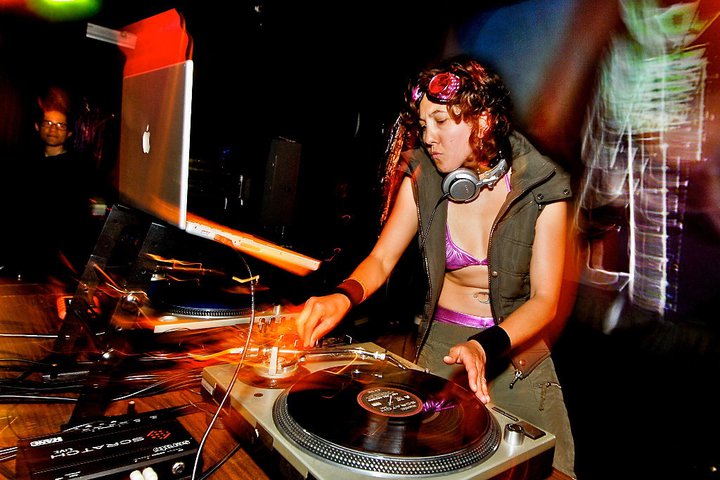
Beats for Lunch Monarch 101 Sixth St., SF. www.sunsetpromotions.com. Noon-2pm, free. It has to be the best party deal in town. Not only do you get in free with pre-registration for this lunchtime disco, but upon entering Monarch’s dark haven from the harsh noon sun, attendees receive their very own organic brown bag lunch. How you’ll eat it neatly while dancing to co-founder of global fusion group Delhi to Dublin, Boogiemeister and DJ Matt Haze is your own challenge to deal with.

Crossroads Irish American Festival reading California Historical Society, 678 Mission, SF. www.irishamericancrossroads.org. 6pm, free. Readings of little-known Irish immigrant writers who lived in San Francisco are interspersed with live harp music at an event perfect for adding cultural learning to your St. Patty’s season.

THURSDAY 14

A Simple Revolution book launch Modern Times Bookstore, 2919 24th St., SF. www.mtbs.com. 6:30pm, free. Judy Grahn celebrates the release of her memoir and raps today about her life as a lesbian in the Bay Area during the 1960s and ’70s.

“Hooch, Harlots, and History: Vice in San Francisco” Old Mint, 88 Fifth St., SF. www.sfhistory.org. 6:30-9:30pm, $10. Rapscallions Broke Ass Stuart, historian Woody LaBounty, and more spin tales of vintage shenanigans, while audience members sip classic cocktails and 21st Amendment Brewery beer.

Ask a Scientist’s Pi Day puzzle party SoMa StrEat Food Park, 428 11th St., SF. www.askascientistsf.com. 7pm, free entry, food purchase suggested. A math and logic puzzle contest in which solo and team competitors (up to six on a side) are invited to bust out the pencils, erasers, and pocket protectors.

FRIDAY 15

“Shifted Perception” Fouladi Projects, 1803 Market, SF. www.fouladiprojects.com. Through May 11. Opening reception: 6-8pm, free. Will painter Marcus Payzant’s work inspire a level-jump in your gray matter? Payzant’s into animist beliefs, instilling deep meaning in relics from the natural world.

“The Art of Dr. Seuss” Dennis Rae Fine Art, 781 Beach, SF. www.dennisraefineart.com. Through March 31. Opening reception: 5-8pm, free. Curator Bill Dreyer will be on hand to introduce the Bay Area to this touring exhibition of the beloved children’s author and illustrator’s hat collection, which are displayed alongside the works of art they inspired.

SATURDAY 16

“Cloth, Clouds, and Survival: Weavers’ Tales from East Timor” de Young Museum, 50 Hagiwara Tea Garden Drive, SF. www.famsf.org. 10am, $10. Cultural anthropologist Jill Forshee presents on her 12 years collecting oral histories from the textile workers who live in one of the world’s poorest countries.

Commonplace Birthday weekend Castle in the Air, 1805 Fourth St., Berk. www.castleintheair.biz. In celebration of Karima Cammel’s picture book Commonplace Birthday, an installation in the author’s Commonplace Mouse children’s series, Castle in the Air studio and art supply shop is hosting a weekend of raising support for Oakland Children’s Hospital. Drop-in crafting sessions for all ages will give visitors the chance to make decorations for sick kids’ birthdays,

St. Patrick’s Day parade and festival Parade starts at Market and Second St., SF. 11:30am, free; festival at Civic Center Plaza, SF. 10am-5pm, free. www.saintpatricksdaysf.com. High step your way downtown today for the biggest leprechaun of all: St. Patty’s Day celebrations. This week’s theme is “Celebrating the Celtic Woman” — SF Fire Department chief Joanna Hayes-White presides over the processional, and will hopefully keep the pub louts in line.

Brain Health Expo Samuel Merritt University Health Education Center, 400 Hawthorne, Oakl. www.samuelmerritt.edu. 10am-3pm, free. Care for your cranium with this day-long event, where you can dig on stress management pointers, ways to prevent hurting that noggin, and tricks for beefing up your memory.

G.I. Joe cosplay at the Cartoon Art Museum Cartoon Art Museum, 655 Mission, SF. www.cartoonart.org. 1-5pm, $7. In celebration of the new G.I. Joe: Retaliation movie, local cosplay group Cobra 1st Legion is taking over the Cartoon Art Museum, providing soldier models for live drawing sessions, and presiding over beaucoup giveaways of comic nerd manna.

“Tarot: Art of Fortune” Modern Eden Gallery, 403 Francisco, SF. www.moderneden.com. Through April 9. Opening reception: 6-10pm, free. Immerse yourself in woo this weekend at this group exhibition curated by local art website Warholian’s founder, Michael Cuffe. The creative works comprise an alternative look at the all-knowing tarot deck.

TUESDAY 19

“Feast of Words: A Literary Potluck” SOMArts Cultural Center, 934 Brannan, SF. www.somarts.org. 7-9pm, $5 with a potluck dish, $10-12 without. Every third Thursday, gourmands and writers congregate at this sit-down reading and eating event. Maggie Weber-Striplin of Pachamama provides the culinary centerpiece at this edition, with a plate inspired by the name of Quiet Lightning, the local reading series that delivers quick bolts of author greatness.

“Colors of Sao Paolo” Glama-rama Salon, 304 Valencia, SF. www.glamarama.com. The Mission salon bedecks its walls with Seren Moran’s vivid color block paintings of sights she took in teaching English in Indaiauba, Brazil.


Family plot

0

cheryl@sfbg.com

FILM None of the characters in Park Chan-wook’s English-language debut, Stoker, devour a full plate of still-squirming octopus. (For that, see Park’s international breakthrough, 2003’s Oldboy; chances are the meal won’t be duplicated in the Spike Lee remake due later this year.)

But that’s not to say Stoker — with its Hitchcockian script by Wentworth Miller — isn’t full of unsettling, cringe-inducing moments, as the titular family (Nicole Kidman as Evelyn, the dotty mom; Mia Wasikowska as India, the moody high-schooler) faces the sudden death of husband-father Richard (Dermot Mulroney, glimpsed in flashbacks) and the equally sudden arrival of sleek, sinister Uncle Charles (Matthew Goode). With a translator’s help, I recently spoke to Park about his latest thriller.

San Francisco Bay Guardian Especially with Stoker, it’s clear that Hitchcock has influenced you as a director. Do you have a favorite of his films?

Park Chan-wook Vertigo (1958) was a big film in my life. Before Vertigo, I wanted to be a filmmaker, but I had only thought about it. After seeing it, I decided that I must become a filmmaker. It’s my favorite Hitchcock film. But ever since that first time I saw it, I’m scared of seeing it again, out of fear that it might be less than I remember it.

SFBG Stoker also reminded me of The Bad Seed (1956) — particularly when a voice-over suggests “we are not responsible for what we come to be.” What are your thoughts on that? Is evil hereditary?

PCW I saw Bad Seed when I was little, with my parents on TV. But it was such a long time ago that I can’t really recall any of the details from it. So I wasn’t consciously bringing anything from it here. Maybe subconsciously I was influenced by it, though — if I see it again, I might realize that.

As far as evil being hereditary, I want to leave Stoker open to different interpretations. That’s part of the joy I want to give to the audience. That’s why I don’t really want to define it in any way. But if I was to give you one possible interpretation of what [that voice-over means], perhaps I intended the opposite, which is to say, does India not feel any responsibility about her actions? No, actually — maybe she feels acutely responsible. She knows it very well, but she doesn’t want to admit it. But there are many other interpretations of this.

SFBG A lot of your films, including Stoker, are about families with unusual dynamics. What attracts you to these kinds of stories?

PCW Family relationships are something that every audience member can identify with, and can understand. But a happy family is a boring story to tell!

SFBG Due to the costumes and the production design, I was convinced at first that Stoker was taking place in the 1950s or 60s — but then it’s revealed that India was born in the 1990s, and this is in fact a very contemporary story. Was this a deliberate choice to make the story feel even more otherworldly than it already does? It kind of felt like the whole thing was taking place in a parallel reality.

PCW The moment you see a cell phone, you realize this is a contemporary story — but even then, if you go back and look at the film from the beginning again, you may actually realize that the clothes they wear, and the way the house is decorated, are actually not completely anachronistic. They are still modern-day.

However, I do admit that it’s one of the first things I talked about with the producer after I read the script: the timelessness of this film. And the same goes for the location as well. It was deliberate in how I didn’t tie the story down to any particular location in America; you can’t really tell where the story takes place. That was intentional, and the reason I was trying to achieve this was that I was trying to create a more archetypical story.

SFBG I have to ask: Harmony Korine has a cameo as India’s art teacher. How did that come about?

PCW Well, we shot in Nashville, and Harmony is based there. He’s also good friends with Mia [Wasikowska]. So we met, and became friends. And the high school where we shot the art-class sequence was actually the high school where Harmony was once a student. *


STOKER opens Fri/15 in Bay Area theaters.

Ay, muchacha

1

marke@sfbg.com

SUPER EGO Can’t talk long, chicas grandes, I’m winging off to Oaxaca to dance with some gorgeous muxes, hike up lost pyramids, dive into cauldrons of darkest mole, and wooze along to the ethereal, chromatic-marimba sounds of son istmeño, one of my favorite musics in the world. (If I don’t come back, give my turquoise witchy retro-’70s thrift store jewelry to Juanita More, to distribute to wee drag newbies in need as she sees fit. And somebody play an accordion by the light of the equinox moon, because.)

Did you know that Oaxaca has one of the largest concentrations of pipe organs in the world? I did not. It’s a meta-calliope! In any case, I’ll need you to represent hard at the following parties, since I Mexican’t. See y’all in Abril.

DEEP EAST

The deep house domination of the East Bay continues with this new weekly, put on by some of pretty damned good DJs: Mo Corleone, Indy Niles, Alixr, and Nackt. Mo tells me they’re meaning to attract “house enthusiasts looking for something fresh (and maybe a little bit raw).” I’m so down.

Thursdays, 9:30pm, free. Lounge 3411, 3411 MacArthur, Oakl. www.lounge3411.com

THREE-NIGHT ELECTRONIC EXTRAVAGANZA

Maybe there could be a better name for this thingie, but if you’re bonkers for that poppy yet sensual tech house sound that’s dominated the past four years and helped form an accessible corrective to corporate EDM — well, your head’s about to explode. Kindly remove your fedora! Rebel Rave Thu/14 (not really a rave) with Art Department and Damian Lazarus, Detroit’s Seth Troxler Fri/15 with Cosmic Kids, and Israeli cutie Guy Gerber Sat/16 with Cassian. ‘Nuff said.

Thu/14-Sat/16, various prices, 9pm-late. Public Works, 161 Erie, SF. www.publicsf.com

AFROLICIOUS

Our favorite weekly Latin soul and Afro funk party, headed by those too-cute McGuire brothers, just released a zazzy album of live music, which is awesome. Check out the full band to celebrate, well, life and everything. You must dance to the beat of the drums.

Fri/15, 8pm, $15. Great American Music Hall, 859 O’Farrell, SF. www.gamh.com

BACK TO LIFE :: BACK TO REALITY

Vogue for life! The original dance form (not so much the Madonnified version) is back in full swing — here’s the second vogue ball this month. This time around there won’t be much shade, as our local representatives of the mighty House of Aviance (plus NYC’s fearsome Icon Mother Juan Aviance) present this showcase ball. Open to all newbies and welcoming of everyone, it should be a real hoot. Check out the link for the competition categories and bring it like a legend. With DJs Gehno Sanchez, Sergio, and Steve Fabus — and appearances by Vigure and Tone, Manuel Torres Extravaganza, many more.

Fri/15, 8pm, $10. Abada, 3221 22nd St., SF. www.theAdance.com/ball

GREG WILSON

One of the absolute greats of DJing returns from the UK to bring his pitch-perfect electro funk and old-school soul, seasoned for three+ decades, to the lovely Monarch’s tables. Maybe this time the club’s lighting system won’t project an error screen onto him for half his incredible set? That was neat for a minute, then weird.

Fri/15, 9pm-3am, $10–<\d>$20. Monarch, 101 Sixth St., SF. www.monarchsf.com

“HOOCH, HARLOTS, AND HISTORY: VICE IN SAN FRANCISCO”

I can tell by the title that this gathering was simply made for you. Super-cool old-timey event with complimentary native drinks pisco punch and 21st Amendment beer, plus “tales of dubious moonshine, dirty roadhouses, and nefarious characters” told by scene players like Broke-Ass Stuart and Woody LaBounty. Live music, rare film footage, and a gaggle of real characters for sure.

Thu/14, 6:30-9:30pm, $10. Old Mint, 88 Fifth St., SF. flipsidesfvice.eventbrite.com

THE QUEEN IS DEAD: THE SMITHS VS. SUEDE

The name says it all for this installment of the stylish yet dour monthly Morrisseypalooza. And with both Suede and Johnny Marr pimping new albums, it’ll be a twee bloodbath. They will play “Suedehead”? They must play “Suedehead.”

Sat/16, 9pm, $5–<\d>$8. Milk, 840 Haight, SF. thesmithsvssuede.eventbrite.com

From the Rocketship to Bay Lights, “temporary” is the key that unlocked public art in SF

11

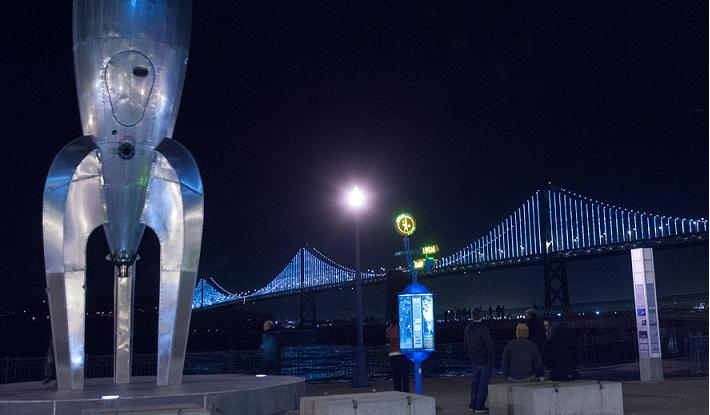
In the wake of The Bay Lights coming on to rave reviews and mesmerized gazes last week, next weekend the Raygun Gothic Rocketship will be taken down from the Pier 14 launch pad it’s occupied since 2010, the latest transitions in San Francisco’s trend of using temporary public art placements to bypass the protracted, emotional, and expensive battles that once defined the siting of sculptures on public lands in San Francisco.

By partnering with private arts organizations and calling the pieces “temporary” – even though almost all of them have been extended past their initial removal deadlines, sometimes by years – the San Francisco Arts Commission, the Port of San Francisco, and other local entities have allowed public art to flourish in the City.

The commission’s longtime public art director Jill Manton told us that temporary public art placements go back to the early ’90s, usually involving smaller pieces while big, years-long controversies continued to rage on over bigger pieces such as “the foot” that never went in on the Embarcadero, the Cupid’s Span piece that Don Fisher did finally place on the waterfront (and which many critics wish had been only a temporary placement), and a big, ill-fated peace sign in Golden Gate Park.

“It’s not as threatening to the public, not as imposing, so it doesn’t seem like a life-or-death decision,” Manton said of the trend toward temporary placements.

But the real turning point came in 2005 when then-Mayor Gavin Newsom, Manton, and other city officials began to embrace the Burning Man art world by bringing a David Best temple into Patricia Green in Hayes Valley, Michael Christian’s Flock into Civic Center Plaza, and Passage by Karen Cusolito and Dan Das Mann onto Pier 14 (a transition point that I chronicle in my book, The Tribes of Burning Man).

Each piece was well-received and had its initial removal deadlines extended. Since then, temporary placements of both original art and pieces that returned from the playa – including Cusolito’s dandelion in UN Plaza, the rocketship, Kate Raudenbush’s Future’s Past in Hayes Valley, and Marco Cochrane’s Bliss Dance on Treasure Island, which is now undergoing a renovation to better protect it against the elements during its longer-than-expected and now open-ended run – have enlivened The City.

“They get to rotate art and people get excited about what’s next,” said Tomas McCabe, director of the Black Rock Arts Foundation, a Burning Man offshoot organization that has helped with fundraising and logistics for most of the burner-built placements.

We spoke by phone on the afternoon of March 8 as he was working with Christian to install The Bike Bridge – a sculpture using recycled bicycle parts that local at-risk teens helped Christian build thanks to a grant from the National Endowment for the Arts – at the intersection of Telegraph and 19th in Oakland as a temporary placement.

The Bike Bridge will officially be unveiled on April 5 during the increasingly popular monthly Art Murmur, and the party will get extra pep from a conference of Burning Man regional representatives that is being held just down the block that day.

McCabe said the connection between Burning Man and the temporary art trend doesn’t just derive from the fact that Bay Area warehouses are filled with cool artwork built for the playa that is now just sitting in storage. It’s also about an artistic style and sensibility that burners have helped to foster.

“We try to help the art pieces have a life after Burning Man, but it’s more the style of community-based art that we promote,” McCabe said, noting that BRAF also helps with fundraising and other tasks needed to support these local art collectives. “We like to see the artists get paid for their work, we’re funny like that.”

Manton said there are currently discussions underway with San Francisco Grants for the Arts (which is funded by the city’s hotel tax) and other parties to put several large pieces built for Burning Man on display in either UN Plaza or Civic Center Plaza, a proposal Manton called UN Playa. “We bring the best of Burning Man to the city,” she said.

Most of the art placements in San Francisco have been labors of love more than anything, and a chance to win over new audiences. When the Five-Ton Crane crew and other artists placed the Raygun Gothic Rocketship on the waterfront in 2010, they had permission from the Port to be there for a year. Then it got extended for another year, and then another six months, and it will finally come down this weekend.

There will be final reception for the Rocketship this Friday evening (with music from the fellow burners in the Space Cowboys’ Unimog) and then the crane will come up on Sunday morning to remove it, in case any Earthlings want to come say hello-goodbye.

“The Rocketship and its crew have had a fantastic 2.5 years on display at Pier 14. Maintenance days were always a pleasure, giving us a chance to talk to people – and see the smiles and joy people got from the installation,” one of its artists, David Shulman, told us. “We’ve had tremendous support from, and would like to thank, the people of San Francisco, the Port of San Francisco, and the Black Rock Arts Foundation. But Pier 14 is intended for rotating displays, and we’re excited to see what comes next.”

Dan Hodapp, a senior waterfront planner for the Port district, said they don’t currently have plans for the site, although he said it will include more temporary art in the future. “The Port Commission and the public are supportive of public art at that location,” Hodapp told us. “But right now, we’re just reveling in the new Bay Lights and we’re not in a hurry to replace the Rocketship.”

Manton said The Bay Lights – the Bay Bridge light sculpture by art Leo Villareal that began what is supposed to be a two-year run (but which Mayor Ed Lee is already publicly talking about extending) on March 5 – has already received overwhelming international media attention and is expected to draw 55 million visitors and $97 million of additional revenue to the city annually.

“It is public art as spectacle. It’s amazing,” Manton said of the piece, which the commission and BRAF played only a small roles in bringing about. “It’s so good for the field of public art.”

She that the success of recent temporary art placements and the role that private foundations have played in funding them have not only caused San Franciscans to finally, truly embrace public art, but it has ended the divisive old debates about whether particular artworks were worth the tradeoff with other city needs and expenditures. And it has allowed the Hayes Valley Neighborhood Association and other neighborhood organizations to curate the art in their public parks.

Meanwhile, even as the Port gives Pier 14 a rest, Hodapp said another temporary artwork will be going up this fall at Pier 92, where old grain silos will be transformed into visual artworks, and that Pier 27 will be turned into a spot for a rotating series of temporary artworks once the Port regains possession of the spot from the America’s Cup in November.

As he told us, “The public really enjoys art on the waterfront, and they’re most supportive when we do temporary art, so there’s a freshness to it.”

Chinese Historical Society celebrates golden anniversary as neighborhood’s memory bank

0

In 1963 a publicist, an art collector, an actor, a newspaper publisher, and a dentist joined forces to form San Francisco’s Chinese Historical Society of America. The group’s mission was simple: to preserve and document Chinese culture in the US. Now celebrating its 50th anniversary this year, it has the same goal it always has had with one major difference: a museum to house the fruits of its labor.

The CHSA moved into its Chinatown digs 12 years ago. The building was built in 1932 by funds raised by a group of Chinese women who traveled up and down the Pacific Coast visiting various Chinese communities to raise funds to construct a small gym and women’s dormitory in Chinatown. In the midst of the Great Depression they somewho drummed up $25,000 for the cause, and the gym provided athletic space to its urban community until it was struck by the 1989 earthquake. 

As the CHSA’s executive director Sue Lee takes me on a tour she speaks with almost an encyclopedia-like knowledge of Chinese history on the West Coast. Her animated descriptions of each and every exhibit make it clear that the enthusiasm for preserving Chinese culture that drove the Historical Society’s original founders hasn’t been lost over the generations. 

In the CHSA’s early days, the founders’ sense of urgency stemmed from the immigration restrictions put in place during the Cold War due to the Chinese’s association with the Soviet Union, which were resulting in a withering Asian population.

Lee explains, “[the founders] thought, ‘this is all we’ve got’. Lee explains. “They were visiting dying Chinese communities up and down the west coast, collecting stuff, interviewing old timers, and picking up stories, and artifacts.” 

That drive to preserve has been augmented by new goals for the Historical Society in the modern era. “We also want to engage local artists to use our history and to be inspired by Chinese-American history for their artistic endeavors,” says Lee.

One direct way the CHSA is putting that plan in action is through its “Creative Spaces” program. Currently in its second year, “Creative Spaces” invites artists, designers, curators, and educators to propose concepts for interpreting and presenting history in the museum. This year Leland Wong, an artist and Chinatown native, has been chosen as one of the featured artists.

A stage inside the museum has been transformed into a working studio for Wong. Visitors can peek in whether Woing is working or not.

A playful collection of intricate Qing Dynasty children’s hats temporarily donated by collector Leslie Selcow in memory of Jade Snow Wong, a Chinese-American ceramic artist and author, fills another exhibition space. In another area, a small suitcase contains the sparse belongings Chinese immigrants commonly brought with them when traveling to America: a notebook, a few pieces of clothing, an umbrella. Visitors are invited to write which items they’d bring on paper luggage tags and attach them to the trunk. History’s tidal changes are visible in the tags that I glimpse on my visit — everything from video games to iPods to the maybe-not-so-portable family cat is scribbled on the tags.

Lee tells me that the lessons learned at the CHSA are certainly not confined to Chinatown residents, or even to Chinese Americans. “Our challenge is always to reach out to our own community as well as to educate the greater community.”  Last year, the Historical Society partnered with the Israeli consulate to honor Dr. Feng Shan Ho, a Chinese diplomat who saved thousands of Jews in Vienna from being deported to Nazi concentration camps during World War II. 

In the over-informed, distracting era we live in, making people care about history is a constant challenge, but it seems clear that Lee and her crew are up for the challenge. “We’re trying to be more active,” she says. “We can’t be a mausoleum, we have to be engaged. We have to try to inspire people.” 

Land of (nearly) 10,000 new movies

0

Literally something for everyone this week: pregnant women, environmentalists, Mumia supporters, World War II buffs, Latin American history buffs, Abbas Kiarostami fan club members, German and French-film devotees, and anyone who’s ever dreamed of going over the rainbow (in 3D). I hope you don’t sleep much because this weekend is jammed up with new flicks.

Barbara The titular figure (Nina Hoss) looks the very picture of blonde Teutonic ice princess when she arrives — exiled from better prospects by some unspecified, politically ill-advised conduct — in at a rural 1980 East German hospital far from East Berlin’s relative glamour. She’s a pill, too, stiffly formal in dealings with curious locals and fellow staff including the disarmingly rumpled, gently amorous chief physician Andre (Ronald Zehrfeld). Yet her stern prowess as a pediatric doctor is softened by atypically protective behavior toward teen Stella (Jasna Fritzi Bauer), a frequent escapee from prison-like juvenile care facilities. Barbara has secrets, however, and her juggling personal, ethical, and Stasi-fearing priorities will force some uncomfortable choices. It is evidently the moment for German writer-director Christian Petzold to get international recognition after nearly 20 years of equally fine, terse, revealing work in both big-screen and broadcast media (much with Hoss as his prime on-screen collaborator). This intelligent, dispassionate, eventually moving character study isn’t necessarily his best. But it is a compelling introduction. (1:45) (Dennis Harvey)

http://www.youtube.com/watch?v=doXpyxbSZFs

Birth Story: Ina May Gaskin and the Farm Midwives When Ina May Gaskin had her first child, the hospital doctor used forceps (against her wishes) and her baby was sequestered for 24 hours immediately after birth. “When they brought her to me, I thought she was someone else’s,” Gaskin recalls in Sara Lamm and Mary Wigmore’s documentary. Gaskin was understandably flummoxed that her first experience with the most natural act a female body can endure was as inhuman as the subject of an Eric Schlosser exposé. A few years later, she met Stephen Gaskin, a professor who became her second husband, and the man who’d go on to co-found the Farm, America’s largest intentional community, in 1971. On the Farm, women had children, and in those confines, far from the iron fist of insurance companies, Gaskin discovered midwifery as her calling. She recruited others, and dedicated herself to preserving an art that dwindles as the medical industry strives to treat women’s bodies like profit machines. Her message is intended for a larger audience than granola-eating moms-to-be: we’re losing touch with our bodies. Lamm and Wigmore bravely cram a handful of live births into the film; footage of a breech birth implies this doc could go on to be a useful teaching tool for others interested in midwifery. (1:33) Roxie. (Sara Maria Vizcarrondo)

Dead Man Down Noomi Rapace reunites with her Girl With the Dragon Tattoo (2009) director, Niels Arden Oplev, for this crime thriller co-starring Colin Farrell. (1:50)

http://www.youtube.com/watch?v=4Htr2B1EBj4

Emperor This ponderously old-fashioned historical drama focuses on the negotiations around Japan’s surrender after the bombings of Hiroshima and Nagasaki. While many on the Allied side want the nation’s “Supreme Commander” Emperor Hirohito to pay for war crimes with his life, experts like bilingual Gen. Bonners Fellers (Matthew Fox) argue that the transition to peace can be achieved not by punishing but using this “living god” to wean the population off its ideological fanaticism. Fellers must ultimately sway gruff General MacArthur (Tommy Lee Jones) to the wisdom of this approach, while personally preoccupied with finding the onetime exchange-student love (Kaori Momoi) denied him by cultural divisions and escalating war rhetoric. Covering (albeit from the U.S. side) more or less the same events as Aleksandr Sokurov’s 2005 The Sun, Peter Webber’s movie is very different from that flawed effort, but also a lot worse. The corny Romeo and Juliet romance, the simplistic approach to explaining Japan’s “ancient warrior tradition” and anything else (via dialogue routinely as flat as “Things in Japan are not black and white!”), plus Alex Heffes’ bombastic old-school orchestral score, are all as banal as can be. Even the reliable Jones offers little more than conventional crustiness — as opposed to the inspired kind he does in Lincoln. (1:46) (Dennis Harvey)

Greedy Lying Bastards Longtime activist Craig Rosebraugh (a former spokesperson for radical groups the Animal Liberation Front and the Earth Liberation Front) makes his directorial debut with Greedy Lying Bastards, a doc that examines the climate-change denial movement. The briskly-paced film — narrated in first person by Rosebraugh, and jam-packed with interviews — begins with stories from homeowners devastated by recent Colorado wildfires, and visits a tribal community perched on Alaska’s eroding shores. But while it touches on global warming’s causes, and the phenomenon’s inevitable outcome (see also: 2006’s An Inconvenient Truth), the film’s particular focus is lobbyists who’ve built careers off distorting the facts, leading Tea Party rallies, and chuckling condescendingly at environmentalists on Fox News — and the fat cats who’re pulling the strings: the dreaded Koch brothers, ExxonMobil execs, and others. Rosebraugh owes a hefty stylistic debt to Michael Moore — right down to his film’s attention-grabbing title — and, like Moore’s films, Greedy Lying Bastards seems destined to reach audiences who already agree with its message. Still, it’s undeniably provocative. (1:30) (Cheryl Eddy)

Harvest of Empire This feature spin-off from Juan Gonzalez’s classic nonfiction tome aims to temper anti-immigration hysteria with evidence that the primarily Latino populations conservatives are so afraid of were largely invited or driven here by exploitative US policies toward Latin America. Dutifully marching through countries on a case-by-case basis, Peter Getzels and Eduardo Lopez’s documentary covers our annexing much of a neighboring country (Mexico) and using its citizens as a “reserve labor force;” encouraging mainland immigration elsewhere to strengthen a colonial bond (Puerto Rico); covertly funding overthrow of progressive governments and/or supporting repressive ones, creating floods of political asylum-seekers (Guatemala, Cuba, Nicaragua, El Salvador); and so on and so forth. Our government’s policies were often justified in the name of “fighting the spread of Communism,” but usually had a more pragmatic basis in protecting US business interests. The movie also touches on NAFTA’s disastrous trickle-up effect on local economies (especially agricultural ones), and interviews a number of high achievers from immigrant families (ACLU chief Anthony Romero, Geraldo Rivera) as well as various activists and experts, including Nobel Peace Prize winner Rigoberta Menchu, while sampling recent years’ inflammatory anti-immigrant rhetoric. There’s a lot of important information here, though one might wish it were packaged in a documentary with a less primitive, classroom-ready episodic structure and less informercial-y style. (1:30) (Dennis Harvey)

Like Someone in Love A student apparently moonlighting as an escort, Akiko (Rin Takanashi) doesn’t seem to like her night job, and likes even less the fact that she’s forced into seeing a client while the doting, oblivious grandmother she’s been avoiding waits for her at the train station. But upon arriving at the apartment of the john, she finds sociology professor Takashi (Tadashi Okuno) courtly and distracted, uninterested in getting her in bed even when she climbs into it of her own volition. Their “date” extends into the next day, introducing him to the possessive, suspicious boyfriend she’s having problems with (Ryo Kase), who mistakes the prof for her grandfather. As with Abbas Kiarostami’s first feature to be shot outside his native Iran — the extraordinary European coproduction Certified Copy (2010) — this Japan set second lets its protagonists first play at being having different identities, then teases us with the notion that they are, in fact, those other people. It’s also another talk fest that might seem a little too nothing-happening, too idle-intellectual gamesmanship at a casual first glance, but could also grow increasingly fascinating and profound with repeat viewings. (1:49) (Dennis Harvey)

Long Distance Revolutionary: A Journey with Mumia Abu-Jamal Or, almost everything you ever wanted to know about the guy who inspired all those “Free Mumia” rallies, though Abu-Jamal’s status as a cause célèbre has become somewhat less urgent since his death sentence — for killing a Philadelphia police officer in 1981 — was commuted to life without parole in 2012. Stephen Vittoria’s doc assembles an array of heavy hitters (Alice Walker, Giancarlo Esposito, Cornel West, Angela Davis, Emory Douglas) to discuss Abu-Jamal’s life, from his childhood in Philly’s housing projects, to his teenage political awakening with the Black Panthers, to his career as a popular radio journalist — aided equally by his passion for reporting and his mellifluous voice. Now, of course, he’s best-known for the influential, eloquent books he’s penned since his 1982 incarceration, and for the worldwide activists who’re either convinced of his innocence or believe he didn’t receive a fair trial (or both). All worthy of further investigation, but Long Distance Revolutionary is overlong, fawning, and relentlessly one-sided — ultimately, a tiresome combination. Director Vittoria in person at the film’s two screenings, Fri/8 at 6:30pm and Sat/9 at 3:30pm. (2:00) New Parkway. (Cheryl Eddy)

Oz: The Great and Powerful Providing a backstory for the man behind the curtain, director Sam Raimi gives us a prequel of sorts to 1939’s The Wizard of Oz. Herein we follow the adventures of a Depression-era Kansas circus magician named Oscar (James Franco) — Oz to his friends — as he cons, philanders, bickers with his behind-the-scenes assistant Frank (Zach Braff), and eventually sails away in a twister, bound for a Technicolor land of massively proportioned flora, talking fauna, and witches ranging from dazzlingly good to treacherously wicked. From one of them, Theodora (Mila Kunis), he learns that his arrival — in Oz, just to clarify — has set in motion the fulfillment of a prophecy: that a great wizard, also named Oz, will bring about the downfall of a malevolent witch (Rachel Weisz), saving the kingdom and its cheery, goodhearted inhabitants. Unfortunately for this deserving populace, Oz spent his last pre-twister moments with the Baum Bros. Circus (the name a tribute to L. Frank Baum, writer of the Oz children’s books) demonstrating a banged-up moral compass and an undependable streak and proclaiming that he would rather be a great man than a good man. Unfortunately for the rest of us, this theme is revisited ad nauseam as Oz and the oppressively beneficent witch Glinda (Michelle Williams) — whose magic appears to consist mainly of nice soft things like bubbles and fog — stand around debating whether he’s the right man for the task. When the fog clears, though, the view is undeniably pretty. While en route to and from the Emerald City, Oz and his companions — among them a non-evil flying monkey (voiced by Braff) and a rather adorable china doll (Joey King) — wander through a deliriously arresting, Fantasia-esque landscape whose intricate, inventive construction helps distract from the plodding, saccharine rhetoric and unappealing story line. (2:07) (Lynn Rapoport)

Chocolate, symbolism, polka dots at this weekend’s quilt show

0

The San Francisco Quilters Guild’s biennial show is back and ready to prove needle arts are alive and kicking – and not just in grandma’s eyes. The exhibit will cozy up the Concourse Exhibition Center this Sat/9 and Sun/10 with a display of over 400 quilts.

Twenty quilts made by members of the Israel Quilters Association comprise a special exhibition dealing in the symbolism of daily life in Israeli society through textile. Former film costumer and seasoned quilter Eleanor Dugan will be showing off the elaborate dot motifs characteristic of her work. Pieces by this year’s two featured artists Laura Lee Fritz, and Roberta Walker will also be on display exhibiting a fresh spin on classic techniques. 

The show will also include a special exhibit on wearable art as well as two quilting challenges, a SFQG tradition that goes out to members prior to the biennial so that completed challenge quilts can be on display through the weekend. For this year’s challenges, the guild gang designed 20-inch square quilt based on the theme “chocolate.” Others crafted from two required fabrics designated by the challenge committee, creating pieces that celebrate the guild’s 30th anniversary.

Roberta Walker is a longtime member of the SFQG, but this is the first year she has been selected as a QUILT San Francisco featured artist – and she has a pretty good idea what has helped earn her spotlight.

“What I do as a quilter that’s different from other quilters is, I am very involved in the Japanese stitchery called sashiko,” she tells the Guardian. Sashiko is a big running stitch that can be seen in Walker’s pieces made from Japanese fabric as well as in her quilts crafted from more conventional materials – the combination of which is Walker’s own adaptation of the technique. 

“I think that’s why people really like my quilts,” Walker explains. “I’ve put a different spin on them by doing that stitching. That has sort of been my specialty. In fact, people go to quilt shows and they say they don’t even have to look at the name to see whose quilt it is, they know [it’s mine].”

Twenty of Walker’s pieces will be on display this weekend. Featured artists will conduct twice-daily walkthroughs of their quilts.

The Quilters Guild biennial requires almost a year of planning. In other words: prepare your eyes.

“People walk into our show and they sort of gasp,” Walker says. “When you see that many quilts hanging, it’s overwhelming.” 

“Quilt San Francisco”

Sat/9-Sun/10

Concourse Exhibition Center

635 Eighth St., SF

www.sfquiltersguild.org 

#OpenData just got a teeny bit more open

We were disheartened when, after submitting some fairly innocuous questions to the Mayor’s Chief Innovation Officer, Jay Nath, we received zero answers. By the time the Guardian’s annual Freedom of Information issue hit stands yesterday, we were still out in the cold. (Shameless plug: Pick up a print edition of this week’s paper for our flow chart on how to file Sunshine requests, designed by our illustrious Art Director Brooke Robertson.)

Nath, who helped start the city’s Open Data program, responded to our emails and tweets (apologetically) by saying he was awaiting the green light from the Mayor’s Office of Communications. Which begs the question: In a city so outwardly committed to transparency, why can’t the Mayor’s Office of Communications entrust a program expert to share information about information-sharing software?

Anyway, the day after we ran our story, Nath did respond in an email. The first objective of Open Data is to “increase transparency,” he told us.

Other goals are to “drive economic development” and “foster the creation of new services and analysis by our community.” The inspiration behind it came from President Barack Obama, who on his first day in office “issued a memo on open government that heralded their open data program Data.gov,” Nath explained. “With this precedent, the city recognized an opportunity to share local data with the public.” 

Head over to the city’s Open Data Portal and you can poke around for info on everything from real-estate development, to restaurant health inspection scores, to city salary ranges by job classification.

As Nath pointed out, there are also over 30 datasets around campaign finance. That’s a good thing – but there’s still room for improvement. Last year, after attending a city hackathon where transparency advocates hoped to spur creation of an app to track lobbying, campaign contributions and real-estate development, Adriel Hampton of the San Francisco Technology Democrats noted that this was impossible due to a lack of information. “Despite millions in spending on … online transparency measures, access to data in these areas is woefully lacking,” Hampton wrote.

Nath said the annual cost is $40,000 per year for software. He also shared his vision for future expansion. “In terms of new services, I see applications that mash up data from multiple public and private sources to create a seamless experience,” he said. “For example, imagine a tourism app that helps you navigate the city via public transit, taxis, car / bike sharing, biking, walking, etc.”

So how does Open Data affect public records requests under the San Francisco Sunshine Ordinance? “Government can use open data to reduce costs by pro-actively providing information that is often requested through FOIA,” Nath told us, referring to the Freedom of Information Act. “For example, by releasing real-time transit data, transit riders have dozens of ways to know when their next bus is coming. This new and immediate access to information has resulted in 21.7% fewer SF 311 calls – and at $2 per call – that yielded a savings of over $1 million a year.”

An interesting thing about data is that it can be totally neutral until it’s harnessed for a particular purpose, with clever visualization and presentation. Just ask the producer of this video on wealth distribution, which has been making the rounds.

Who am I?

0

arts@sfbg.com

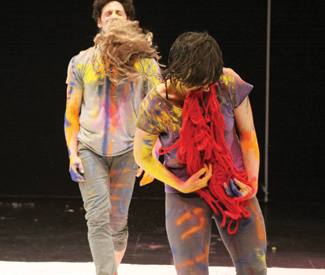
DANCE CounterPULSE always makes a point of thanking its volunteers. One can only hope that they’ll turn up en masse to help clean up after Faye Driscoll and Jesse Zaritt step off the stage this coming weekend. Their You’re Me is not exactly what might be called a clean show. Still, if the work-in-progress preview, presented at the end of their residency at the Headlands Center for the Arts almost two years ago, is any indication, the mess is more than worth it. After all, most of us will recognize a mess when we see it.

The Los Angeles-born Driscoll lived in San Francisco from 2003 to 2005. She put in a shift at the ODC/Pilot Program — for on-the-verge choreographers — even though dance was not her primary focus at the time. As she explained in a recent phone conversation from her home in Brooklyn, in San Francisco, “I really was inspired by the music and art scene, hanging out with people who were putting band together that were kind of art bands.” At the time, she was in recovery mode from two years of performing and touring with Doug Varone and Dancers. Apparently it had not been all that happy a match — too much structure, too much energy from the top down.

So San Francisco — where the mantra is “you can do anything you want,” and where you go “to find yourself” — proved to be liberating experience for her, particularly because she had been so “serious and disciplined about dance” since her childhood.

In some ways Driscoll is still trying to find herself. On the most visible level You’re Me is a piece about a relationship — after all, it is performed by a man and a woman. But it’s also a work looking at identity: the one you claim for yourself, that one you are working toward, or the one that is imposed on you by the outside world. For many people that is unstable territory that tends to slide away from under your feet.

Partly because she “had a lot going on in my home that was kind of crazy,” and because she remembered people reflecting an identity back to her that was quite different than the one she experienced herself, Driscoll was drawn to dance early on. “Dance had the structure that allowed me to express what I am in the world,” she says. “It was the place where I could go and practice my movements and make myself open to other people’s bodies.”

You’re Me is inspired by the in-between spaces Driscoll observes in non-verbal human communication, as well as by fixed historic representations she and Zaritt collected in the visual arts, from Renaissance paintings to contemporary magazines. In the process they became fascinated by how ideas of what is masculine and feminine have changed over time. Finding much that resonated but also created dissonance within themselves, the experience fed into their appetites for trying out other identities.

To do that choreographically, in one section of the five-part 80-minute duet, the two performers also draw on one of the earliest ways kids try to tell us something about who they are. A little girl who wobbles around in her mother’s heels is considered cute. A little boy who prefers dresses to pants rings alarm bells. Role-playing, fantasy games, make-believe, dress-up —whether in a playgroup or the theater — are serious business. They present way of talking about being or becoming in the world. But they are also a lot of fun.

Driscoll describes her working process as taking “things and blowing them up, creating them to excess and putting them into rhythmic structure and try to pull them apart and grapple with them.” Here, in addition, to the physically demanding movement interactions, the dancers have to don, strip off, and exchange parts of props and costumes, often at dizzying speed. They rehearsed a lot, she says, and they have a prop master who makes sure that the final mess is nicely controlled.

Pulling You’re Me together, however, was a different challenge. Like many artists, Driscoll is homeless, scurrying around from one studio to another. “I could never rehearse with all that stuff I had to lug around.” That’s why the residency at Headlands became such a respite: they gave her a closet. *

YOU’RE ME

Thu/7-Sun/10, 8pm, $20-$30

CounterPULSE

1310 Mission, SF

www.counterpulse.org


Trip history

0

SUPER EGO As Maria von Trapp sang at the climax of The Sound of Music, “Whenever the goddess closes a rave cave, somewhere she reopens a gay leather biker bar.”

That sad closure is upon us, as the wonderful 222 Hyde (www.222hyde.com), the city’s thumping bass-ment in the Tenderloin, wings into history. Owner EO emailed me a couple Saturdays ago to tell me he was closing the precious, risk-taking little venue due to pressure from the ABC state liquor board over a license technicality and uncertainty about cooperation from the 222 building’s new owners. In short: sucks.

But EO’s off to pursue his musical destiny — he killed it playing live at Robotspeak at Saturday’s Lower Haight Art Walk — as one half of upcoming analogue electronic duos Moniker (with Kenneth Scott) and Polk and Hyde (with Jonah Sharp). And you can say farewell to the lovely space, rumbly Turbo Sound system, twinkly LED dance floor ceiling, and gorgeous staff this week: a special guest superstar (cough DJ Fark Marina cough) is supposed to drop by Thu/7, the As You Like It crew brings in Dutch techno wiz San Proper on Fri/8 (9pm-2am, $20) and 222 hosts a huge closing blowout on Sat/9 (10pm-late) full of surprise guests, gushing tears, and yummy pizza. The space itself has an amazing history — as the “Three Deuces” from the 1940s-’60s, it played hst to jazz greats and wild gals. Whatever it becomes now, 222 will live 444 ever in our raving hearts.

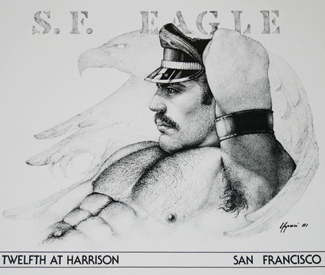
Throwing open its gay SoMa leather biker bar sash, however, is legendary rock ‘n roll watering hole SF Eagle (www.sf-eagle.com), reopened after a final passing grade on inspections last weekend, just in time for a Sunday beer bust of epic proportions — and 45-minute-wait lines — celebrating the victory of our new Mr. SF Leather, Andy Cross. (The true crown, I heard, went to anyone who made it through the four-hour Mr. SF Leather competition.)

I latched on my Nasty Pig kneepads and checked out the space (and the returned staff!) on Saturday night, and happily found myself there all Sunday as well. New owners Alex and Mike, inheriting the gutted space once slated for a pizza restaurant, have really opened it up by exposing the vaulted ceiling of the interior, pushing the main bar against the wall, and removing the trees from the patio (sad face). Everything is painted semi-gloss black — it looks like a beerhall designed by Anselm Kiefer. Although the mirrored bar is a wee bit ultralounge and there is as of yet no crusty, comfy decor, that good ol’ Eagle spirit is alive and well-drink drunk.

The beer bust was roiling delightfully with grateful scruffs and old school fetishists. Indie kids will rejoice at the return of Thursday Night Live on Thu/7 (8pm, $7, www.tinyurl.com/thursnightlive) with bands Beard Summit, the Galloping Sea, and Reliic, hosted by the Eagle’s ace music programmer Doug Hilsinger. (The space’s new layout is perfect for live music, and more regular parties will pop up soon, I’m sure). The Eagle reopened on the final weekend of fabulously festive Hayes drag dive Marlena’s, set to become another concept bar eesh, and the tail end of Soma’s fetish-friendly Kok Bar, also closing very soon. It’s a bittersweet trade-off for sure. Meet me at the Eagle’s patio trough and we’ll commiserate.


STACEY HOTWAXX HALE

I am freaking the funk out that Detroit’s own Godmother of House is going to vibe up the Housepitality weekly’s dancefloor — along with Chicago legends Gene Hunt and CJ Larsen? Try to pry me away!

Wed/6, 9pm, $5 before 11 p.m., $10 after. F8, 1192 Folsom, SF. www.housepitalitysf.com


DJ PIERRE

Following the Godmother of House comes the Godfather of Acid, one of the ones who started it all, Chicago Afro-Acid pioneer Pierre, whose sets are blissful rollercoasters to another, darker side.

Fri/8, 8pm-3am, $15. 1192 Folsom, SF. djpierre.eventbrite.com


DELHI 2 DUBLIN

Kick off your weeklong St. Patty’s Day binge the bhangra way, as great monthly Non Stop Bhangra brings in this beloved five-piece live band, a true multiculti mashup that meshes the Celtic with the Indian. Somehow, it works splendidly.

Sat/9, 9pm, $15. Public Works, 161 Erie, SF. www.publicsf.com


PARIS IS BURNING

“Shoot and arrow and it goes real high, well good for you.” SF’s Mistress of the Gay Night Peaches Christ and formidable NYC queen Patrice Royale host a screening of the all-the-rage-again 1990 doc and a vogue ball to die for. It’ll be an ex-travaganza.

Sat/9, 8pm, $22. Castro Theatre, 429 Castro, SF. www.peacheschrist.com


The Nonconformist

0

arts@sfbg.com

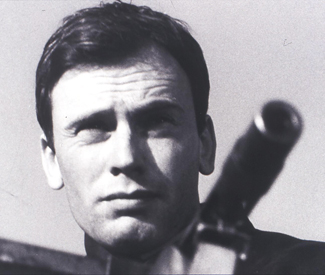
FILM Most observers of last week’s Oscar telecast assumed elegant 86-year-old Emmanuelle Riva was the star of the movie she’d gotten a Best Actress nomination for. Conspicuously absent — from that and most other awards events — was Amour‘s real performing lead, who’d gotten crowded out of the field by the usual surplus of major English-language roles for men. As the dignified elderly husband decreasingly able to care for a longtime spouse’s dignity-robbing failing health, Jean-Louis Trintignant grows more dominant in his character’s helplessness as Riva’s recedes into illness. It’s a powerful performance made all the more so by the simple shock of seeing him. Hasn’t he been, er, away a while? Or to put it bluntly: he’s still alive?!

The last time wide audiences would have seen him was in the large ensemble of Patrice Chéreau’s 1998 Those Who Love Me Can Take the Train. Already nearing 70 then, he remained somewhat active in theater while staying mostly off screen for the next 14 years. In honor of his return, the Pacific Film Archive is providing a retrospective that runs through April 21.

“And God Created Jean-Louis Trintignant” offers a mix of popular hits, agreed-upon masterpieces, and rarities that give fair measure of a long, prolific yet discriminating career. It’s surprising to see the wide range of films he’s played in, since Trintignant is so often the still center of them — he communicates such reserve, thoughtfulness, and economy of craft that it takes seeing numerous roles back-to-back like this to realize how very different his performances are. They’re just not flamboyantly different, in the way of a Daniel Day-Lewis or Meryl Streep. He’s said “The best actors in the world are those who feel the most and show the least,” a rule one could argue with — but it’s certainly true in his case.

Short, slight, handsome in a slightly nondescript way, he couldn’t have struck anyone at first as natural movie star material. But he did intrigue Roger Vadim, when the latter was looking for a newcomer to play off his female discovery in 1956’s …And God Created Woman. The woman was Brigitte Bardot, introduced completely nude (albeit laying on her stomach); it was Bardot and Vadim’s shared gift that though she spent the rest of the story clothed, one imagined with an indolent shrug those rags might tumble at any moment and she’d be starkers again. As the village lad who marries “that little slut” lest she be sent back to the orphanage (!), while she exerts a siren pull toward every other man around, Trintignant sounded a modest note in one of the most garishly silly yet influential films ever made. Yet the global sensation Bardot caused cast a public glare on anyone with a connection, let alone a purported inamorato. He voluntarily fled for military service.

When he returned — with rather less fanfare than Army-sprung Elvis — he set about building a serious actor’s resume with diverse projects and interesting directors. He was suddenly blond and uncharacteristically glamorous as a golden youth of Italy’s fascist elite in Valerio Zurlini’s Violent Summer (1959), so in love with an older woman (Eleanora Rossi Drago) they’re barely aware there’s a World War going on. But more typically he was creating anti-romantic characters typical of the 1960s — variably neurotic, eccentric, conflicted, always with more going on under the surface than one could fully grasp. One lesser-remembered PFA selection is Alain Cavalier’s 1962 New Wave triangle Le combat dans l’ile, in which his marital discord with Romy Schneider is eventually explained by his secretly belonging to a far-right terrorist cell.

https://www.youtube.com/watch?v=0WQhJyse4hg

Trintignant was in two of the most wildly popular “art” export hits of the decade, Claude Lelouch’s gauzy swoonfest A Man and a Woman (1966) and Costa Gavras’ political thriller Z (1969). Yet his race-car driver in the former tempers its Eurokitsch atmosphere with impenetrable cool, while in the hyperbolic latter he’s almost monastically austere as the investigator who patiently picks apart an assassination cover-up. Perhaps his ultimate role as a man of decisive inaction was as The Conformist (1970), again as a Mussolini-era fascist — one who betrays his friends as ruthlessly and usefully as director Bertolucci does the original Moravia novel. Amid that film’s ravishing baroque excesses, he’s as reptilian, quease-making, and pitiable as a Gollum, if better-dressed.

While he continued to make the odd all-star purely commercial project — a good one being rare 1973 American foray The Outside Man — he usually chose riskier fare. Thus he was the first major star to work with Eric Rohmer (as the Catholic fussbudget sorta-seeking romance in 1969’s My Night at Maud’s), and an early ally to figures as disparate as Jacques Demy, Claude Chabrol, Tinto Brass, Umberto Lenzi, Alain Robbe-Grillet, and André Téchiné.

Barely slowing despite the transition to character support, he’d found perhaps a definitive pre-Amour farewell role (and chronological end to the PFA series) as the retired judge busy bending laws for his personal amusement in Krzysztof Kieslowski’s Three Colors trilogy (and career) finale Red (1994). It might have served as a perfect capper — but you’ve got to hand it to any 83-year-old savvy enough to realize Michael Haneke was worth coming out of retirement for. *

“AND GOD CREATED JEAN-LOUIS TRINTIGNANT”

Through April 21

Pacific Film Archive

2575 Bancroft, Berk.

bampfa.berkeley.edu


Film listings

0

Reviewers are Kimberly Chun, Dennis Harvey, Lynn Rapoport, and Sara Maria Vizcarrondo. For rep house showtimes, see Rep Clock.

OPENING

Adventures of Serial Buddies Self-description: “the first serial killer buddy comedy.” (1:31) 1000 Van Ness.

Barbara The titular figure (Nina Hoss) looks the very picture of blonde Teutonic ice princess when she arrives — exiled from better prospects by some unspecified, politically ill-advised conduct — in at a rural 1980 East German hospital far from East Berlin’s relative glamour. She’s a pill, too, stiffly formal in dealings with curious locals and fellow staff including the disarmingly rumpled, gently amorous chief physician Andre (Ronald Zehrfeld). Yet her stern prowess as a pediatric doctor is softened by atypically protective behavior toward teen Stella (Jasna Fritzi Bauer), a frequent escapee from prison-like juvenile care facilities. Barbara has secrets, however, and her juggling personal, ethical, and Stasi-fearing priorities will force some uncomfortable choices. It is evidently the moment for German writer-director Christian Petzold to get international recognition after nearly 20 years of equally fine, terse, revealing work in both big-screen and broadcast media (much with Hoss as his prime on-screen collaborator). This intelligent, dispassionate, eventually moving character study isn’t necessarily his best. But it is a compelling introduction. (1:45) Embarcadero. (Harvey)

Birth Story: Ina May Gaskin and the Farm Midwives When Ina May Gaskin had her first child, the hospital doctor used forceps (against her wishes) and her baby was sequestered for 24 hours immediately after birth. “When they brought her to me, I thought she was someone else’s,” Gaskin recalls in Sara Lamm and Mary Wigmore’s documentary. Gaskin was understandably flummoxed that her first experience with the most natural act a female body can endure was as inhuman as the subject of an Eric Schlosser exposé. A few years later, she met Stephen Gaskin, a professor who became her second husband, and the man who’d go on to co-found the Farm, America’s largest intentional community, in 1971. On the Farm, women had children, and in those confines, far from the iron fist of insurance companies, Gaskin discovered midwifery as her calling. She recruited others, and dedicated herself to preserving an art that dwindles as the medical industry strives to treat women’s bodies like profit machines. Her message is intended for a larger audience than granola-eating moms-to-be: we’re losing touch with our bodies. Lamm and Wigmore bravely cram a handful of live births into the film; footage of a breech birth implies this doc could go on to be a useful teaching tool for others interested in midwifery. (1:33) Roxie. (Vizcarrondo)

Dead Man Down Noomi Rapace reunites with her Girl With the Dragon Tattoo (2009) director, Niels Arden Oplev, for this crime thriller co-starring Colin Farrell. (1:50) Presidio.

Emperor This ponderously old-fashioned historical drama focuses on the negotiations around Japan’s surrender after the bombings of Hiroshima and Nagasaki. While many on the Allied side want the nation’s “Supreme Commander” Emperor Hirohito to pay for war crimes with his life, experts like bilingual Gen. Bonners Fellers (Matthew Fox) argue that the transition to peace can be achieved not by punishing but using this “living god” to wean the population off its ideological fanaticism. Fellers must ultimately sway gruff General MacArthur (Tommy Lee Jones) to the wisdom of this approach, while personally preoccupied with finding the onetime exchange-student love (Kaori Momoi) denied him by cultural divisions and escalating war rhetoric. Covering (albeit from the U.S. side) more or less the same events as Aleksandr Sokurov’s 2005 The Sun, Peter Webber’s movie is very different from that flawed effort, but also a lot worse. The corny Romeo and Juliet romance, the simplistic approach to explaining Japan’s “ancient warrior tradition” and anything else (via dialogue routinely as flat as “Things in Japan are not black and white!”), plus Alex Heffes’ bombastic old-school orchestral score, are all as banal as can be. Even the reliable Jones offers little more than conventional crustiness — as opposed to the inspired kind he does in Lincoln. (1:46) Embarcadero. (Harvey)

Greedy Lying Bastards Longtime activist Craig Rosebraugh (a former spokesperson for radical groups the Animal Liberation Front and the Earth Liberation Front) makes his directorial debut with Greedy Lying Bastards, a doc that examines the climate-change denial movement. The briskly-paced film — narrated in first person by Rosebraugh, and jam-packed with interviews — begins with stories from homeowners devastated by recent Colorado wildfires, and visits a tribal community perched on Alaska’s eroding shores. But while it touches on global warming’s causes, and the phenomenon’s inevitable outcome (see also: 2006’s An Inconvenient Truth), the film’s particular focus is lobbyists who’ve built careers off distorting the facts, leading Tea Party rallies, and chuckling condescendingly at environmentalists on Fox News — and the fat cats who’re pulling the strings: the dreaded Koch brothers, ExxonMobil execs, and others. Rosebraugh owes a hefty stylistic debt to Michael Moore — right down to his film’s attention-grabbing title — and, like Moore’s films, Greedy Lying Bastards seems destined to reach audiences who already agree with its message. Still, it’s undeniably provocative. (1:30) Grand Lake, Metreon. (Eddy)

Harvest of Empire This feature spin-off from Juan Gonzalez’s classic nonfiction tome aims to temper anti-immigration hysteria with evidence that the primarily Latino populations conservatives are so afraid of were largely invited or driven here by exploitative US policies toward Latin America. Dutifully marching through countries on a case-by-case basis, Peter Getzels and Eduardo Lopez’s documentary covers our annexing much of a neighboring country (Mexico) and using its citizens as a “reserve labor force;” encouraging mainland immigration elsewhere to strengthen a colonial bond (Puerto Rico); covertly funding overthrow of progressive governments and/or supporting repressive ones, creating floods of political asylum-seekers (Guatemala, Cuba, Nicaragua, El Salvador); and so on and so forth. Our government’s policies were often justified in the name of “fighting the spread of Communism,” but usually had a more pragmatic basis in protecting US business interests. The movie also touches on NAFTA’s disastrous trickle-up effect on local economies (especially agricultural ones), and interviews a number of high achievers from immigrant families (ACLU chief Anthony Romero, Geraldo Rivera) as well as various activists and experts, including Nobel Peace Prize winner Rigoberta Menchu, while sampling recent years’ inflammatory anti-immigrant rhetoric. There’s a lot of important information here, though one might wish it were packaged in a documentary with a less primitive, classroom-ready episodic structure and less informercial-y style. (1:30) Opera Plaza. (Harvey)

Like Someone in Love A student apparently moonlighting as an escort, Akiko (Rin Takanashi) doesn’t seem to like her night job, and likes even less the fact that she’s forced into seeing a client while the doting, oblivious grandmother she’s been avoiding waits for her at the train station. But upon arriving at the apartment of the john, she finds sociology professor Takashi (Tadashi Okuno) courtly and distracted, uninterested in getting her in bed even when she climbs into it of her own volition. Their “date” extends into the next day, introducing him to the possessive, suspicious boyfriend she’s having problems with (Ryo Kase), who mistakes the prof for her grandfather. As with Abbas Kiorostami’s first feature to be shot outside his native Iran — the extraordinary European coproduction Certified Copy (2010) — this Japan set second lets its protagonists first play at being having different identities, then teases us with the notion that they are, in fact, those other people. It’s also another talk fest that might seem a little too nothing-happening, too idle-intellectual gamesmanship at a casual first glance, but could also grow increasingly fascinating and profound with repeat viewings. (1:49) Opera Plaza. (Harvey)

Long Distance Revolutionary: A Journey with Mumia Abu-Jamal Or, almost everything you ever wanted to know about the guy who inspired all those “Free Mumia” rallies, though Abu-Jamal’s status as a cause célèbre has become somewhat less urgent since his death sentence — for killing a Philadelphia police officer in 1981 — was commuted to life without parole in 2012. Stephen Vittoria’s doc assembles an array of heavy hitters (Alice Walker, Giancarlo Esposito, Cornel West, Angela Davis, Emory Douglas) to discuss Abu-Jamal’s life, from his childhood in Philly’s housing projects, to his teenage political awakening with the Black Panthers, to his career as a popular radio journalist — aided equally by his passion for reporting and his mellifluous voice. Now, of course, he’s best-known for the influential, eloquent books he’s penned since his 1982 incarceration, and for the worldwide activists who’re either convinced of his innocence or believe he didn’t receive a fair trial (or both). All worthy of further investigation, but Long Distance Revolutionary is overlong, fawning, and relentlessly one-sided — ultimately, a tiresome combination. Director Vittoria in person at the film’s two screenings, Fri/8 at 6:30pm and Sat/9 at 3:30pm. (2:00) New Parkway. (Eddy)

Oz the Great and Powerful Sam Raimi directs James Franco, Michelle Williams, and Rachel Weisz in this fantasy that imagines the origin story of L. Frank Baum’s Emerald City-dwelling wizard. (2:07) Balboa, Cerrito, Presidio.

Three Worlds A trio of lives intersect after a tragedy in French director Catherine Corsini’s drama. (1:51) Four Star.

ONGOING

Amour Arriving in local theaters atop a tidal wave of critical hosannas, Amour now seeks to tempt popular acclaim — though actually liking this perfectly crafted, intensely depressing film (from Austrian director Michael Haneke) may be nigh impossible for most audience members. Eightysomething former music teachers Georges and Anne (the flawless Jean-Louis Trintignant and Emmanuelle Riva) are living out their days in their spacious Paris apartment, going to classical concerts and enjoying the comfort of their relationship. Early in the film, someone tries to break into their flat — and the rest of Amour unfolds with a series of invasions, with Anne’s declining health the most distressing, though there are also unwanted visits from the couple’s only daughter (an appropriately self-involved Isabelle Huppert), an inept nurse who disrespects Anne and curses out Georges, and even a rogue pigeon that wanders in more than once. As Anne fades into a hollow, twisted, babbling version of her former self, Georges also becomes hollow and twisted, taking care of her while grimly awaiting the inevitable. Of course, the movie’s called Amour, so there’s some tenderness involved. But if you seek heartwarming hope and last-act uplift, look anywhere but here. (2:07) Elmwood, Opera Plaza, Smith Rafael. (Eddy)

Argo If you didn’t know the particulars of the 1979 Iranian Revolution, you won’t be an expert after Argo, but the film does a good job of capturing America’s fearful reaction to the events that followed it — particularly the hostage crisis at the US embassy in Tehran. Argo zeroes in on the fate of six embassy staffers who managed to escape the building and flee to the home of the sympathetic Canadian ambassador (Victor Garber). Back in Washington, short-tempered CIA agents (including a top-notch Bryan Cranston) cast about for ways to rescue them. Enter Tony Mendez (Ben Affleck, who also directs), exfil specialist and father to a youngster wrapped up in the era’s sci-fi craze. While watching 1973’s Battle for the Planet of the Apes, Tony comes up with what Cranston’s character calls “the best bad idea we have:” the CIA will fund a phony Canadian movie production (corny, intergalactic, and titled Argo) and pretend the six are part of the crew, visiting Iran for a few days on a location shoot. Tony will sneak in, deliver the necessary fake-ID documents, and escort them out. Neither his superiors, nor the six in hiding, have much faith in the idea. (“Is this the part where we say, ‘It’s so crazy it just might work?'” someone asks, beating the cliché to the punch.) Argo never lets you forget that lives are at stake; every painstakingly forged form, every bluff past a checkpoint official increases the anxiety (to the point of being laid on a bit thick by the end). But though Affleck builds the needed suspense with gusto, Argo comes alive in its Hollywood scenes. As the show-biz veterans who mull over Tony’s plan with a mix of Tinseltown cynicism and patiotic duty, John Goodman and Alan Arkin practically burst with in-joke brio. I could have watched an entire movie just about those two. (2:00) Elmwood, SF Center, Sundance Kabuki. (Eddy)

Beautiful Creatures In the tiny South Carolina town of Gatlin, a teenage boy named Ethan Wate (Alden Ehrenreich) finds himself dreaming about a girl he’s never met (Alice Englert), until she shows up at school one day with an oddly behaving tattoo on her wrist and the power to disrupt local weather patterns when she loses her temper. Thus begins Richard LaGravenese’s adaptation of the first installment in Kami Garcia and Margaret Stohl’s four-book YA series the Caster Chronicles. The girl of Ethan’s dreams, Lena Duchannes, is the youngest member of a reclusive local family long suspected by the town’s inhabitants of performing witchcraft and otherwise being in league with Satan. They’re at least half right, though Lena and her relatives (among them Jeremy Irons, Emma Thompson, and Emmy Rossum) prefer the term caster to witch, a slur inflicted on them by mortals. As for the diabolical part, casters are, it seems, slaves to essentialism: their coming-of-age rite at age 16 entails learning whether their true nature will turn them toward the forces of darkness or light. Lena’s special birthday, as it happens, is coming up, a circumstance complicating the romance that sparks between her and Ethan. Though the altitude is lower, and the sweeping pans of coniferous forests have been replaced by claustrophobic shots of swampland and live oaks draped with Spanish moss, comparisons to the Twilight franchise are inevitable. But while we’re not unfamiliar with the arc of a human teenage protagonist who is drawn into the orbit of an alluring supernatural and finds life forever changed, Beautiful Creatures‘ young lovers are more relatable, less annoying and creepy, and smaller targets for an SNL spoof. (2:04) SF Center. (Rapoport)

Dark Skies The Barretts are a suburban family stuck together with firm-enough glue of love and habit, even if they’re suffering from some unfortunately typical current problems: architect dad (Josh Hamilton) has been out of work for some time, mom’s (Keri Russell) own job isn’t going gangbusters, they’re mortgaged to the hilt, and the fiscal prognosis is not good. These issues are stressing their marriage, and that vibe is stressing their sons, a 13-year-old (Dakota Goya) and a 6-year-old (Kadan Rockett). So initially it seems somebody might be acting out when they begin experiencing nocturnal disturbances that could be chalked up to an intruder if there were any sign of forced entry. But soon the disturbances grow inexplicable by any normal standard, and it begins to seem they might be having unwelcome “visitors” of the evil-E.T. kind. Writer-director Scott Stewart’s prior features were breathless, ludicrous, FX-cluttered fantasy action films (2010’s Legion, 2011’s Priest); this goes in the opposite direction by carefully building atmosphere, character, and credibility while withholding spectacle for as long as possible. That’s an admirable approach, and Dark Skies duly holds attention — but one wishes the basic ideas were a little more original, and the payoff a little more substantial. (1:35) Metreon, 1000 Van Ness. (Harvey)

Django Unchained Quentin Tarantino’s spaghetti western homage features a cameo by the original Django (Franco Nero, star of the 1966 film), and solid performances by a meticulously assembled cast, including Jamie Foxx as the titular former slave who becomes a badass bounty hunter under the tutelage of Dr. Schultz (Christoph Waltz). Waltz, who won an Oscar for playing the evil yet befuddlingly delightful Nazi Hans Landa in Tarantino’s 2009 Inglourious Basterds, is just as memorable (and here, you can feel good about liking him) as a quick-witted, quick-drawing wayward German dentist. There are no Nazis in Django, of course, but Tarantino’s taboo du jour (slavery) more than supplies motivation for the filmmaker’s favorite theme (revenge). Once Django joins forces with Schultz, the natural-born partners hatch a scheme to rescue Django’s still-enslaved wife, Broomhilda (Kerry Washington), whose German-language skills are as unlikely as they are convenient. Along the way (and it’s a long way; the movie runs 165 minutes), they encounter a cruel plantation owner (Leonardo DiCaprio), whose main passion is the offensive, shocking “sport” of “Mandingo fighting,” and his right-hand man, played by Tarantino muse Samuel L. Jackson in a transcendently scandalous performance. And amid all the violence and racist language and Foxx vengeance-making, there are many moments of screaming hilarity, as when a character with the Old South 101 name of Big Daddy (Don Johnson) argues with the posse he’s rounded up over the proper construction of vigilante hoods. It’s a classic Tarantino moment: pausing the action so characters can blather on about something trivial before an epic scene of violence. Mr. Pink would approve. (2:45) Elmwood, Metreon, New Parkway, 1000 Van Ness, Sundance Kabuki. (Eddy)

Escape from Planet Earth (1:35) Metreon, 1000 Van Ness.

56 Up The world may be going to shit, but some things can be relied upon, like Michael Apted’s beloved series that’s traced the lives of 14 disparate Brits every seven years since original BBC documentary 7 Up in 1964. More happily still, this latest installment finds nearly all the participants shuffling toward the end of middle-age in more settled and contented form than ever before. There are exceptions: Jackie is surrounded by health and financial woes; special-needs librarian Lynn has been hit hard by the economic downturn; everybody’s favorite undiagnosed mental case, the formerly homeless Neil, is never going to fully comfortable in his own skin or in too close proximity to others. But for the most part, life is good. Back after 28 years is Peter, who’d quit being filmed when his anti-Thatcher comments provoked “malicious” responses, even if he’s returned mostly to promote his successful folk trio the Good Intentions. Particularly admirable and evidently fulfilling is the path that’s been taken by Symon, the only person of color here. Raised in government care, he and his wife have by now fostered 65 children — with near-infinite love and generosity, from all appearances. If you’re new to the Up series, you’ll be best off doing a Netflix retrospective as preparation for this chapter, starting with 28 Up. (2:24) New Parkway. (Harvey)

The Gatekeepers Coming hard on the heels of The Law in These Parts, which gave a dispassionate forum to the lawmakers who’ve shaped — some might say in pretzel form — the military legal system that’s been applied by Israelis to Palestinians for decades, Dror Moreh’s documentary provides another key insiders’ viewpoint on that endless occupation. His interviewees are six former heads of the Shin Bet, Israel’s secret service. Their top-secret decisions shaped the nation’s attempts to control terrorist sects and attacks, as seen in a nearly half-century parade of news clips showing violence and negotiation on both sides. Unlike the subjects of Law, who spoke a cool, often evasive legalese to avoid any awkward ethical issues, these men are at times frankly — and surprisingly — doubtful about the wisdom of some individual decisions, let alone about the seemingly ever-receding prospect of a diplomatic peace. They even advocate for a two-state solution, an idea the government they served no longer seems seriously interested in advancing. The Gatekeepers is an important document that offers recent history examined head-on by the hitherto generally close-mouthed people who were in a prime position to direct its course. (1:37) Embarcadero. (Harvey)

A Good Day to Die Hard A Good Day to Die Hard did me wrong. How did I miss the signs? Badass daddy rescues son. Perps cover up ’80s era misdeeds. They’re in Russia&ldots;Die Hard has become Taken. All it needs is someone to kidnap Bonnie Bedelia or deflower Jai Courtney and the transformation will be complete. What’s more, A Good Day is so obviously made for export it’s almost not trying to court the American audience for which the franchise is a staple. In a desperate reach for brand loyalty director John Moore (2001’s Behind Enemy Lines) has loaded the film with slight allusions to McClane’s past adventures. The McClanes shoot the ceiling and litter the floor with glass. John escapes a helicopter by leaping into a skyscraper window from the outside. John’s ringtone plays “Ode to Joy.” The glib rejoinders are all there but they’re smeared by crap direction and odd pacing that gives ample time to military vehicles tumbling down the highway but absolutely no time for Bruce’s declarations of “I’m on VACATION!” Which may be just as well — it’s no “Yipee kay yay, motherfucker.” When Willis says that in A Good Day, all the love’s gone out of it. I guess every romance has to end. (1:37) Metreon, 1000 Van Ness, Sundance Kabuki. (Vizcarrondo)

Happy People: A Year in the Taiga The ever-intrepid Werner Herzog, with co-director Dmitry Vasyukov, pursues his fascination with extreme landscapes by chronicling a year deep within the Siberian Taiga. True to form, he doesn’t spend much time in the 300-inhabitant town nestled amid “endless wilderness,” accessible only by helicopter or boat (and only during the warmer seasons); instead, he seeks the most isolated environment possible, venturing into the frozen forest with fur trappers who augment their passed-down-over-generations job skills with the occasional modern assist (chainsaws and snowmobiles are key). Gorgeous cinematography and a curious, respectful tone elevate Happy People from mere ethnographic-film status, though that’s essentially what it is, as it records the men carving canoes, bear-proofing their cabins, interacting with their dogs, and generally being incredibly self-reliant amid some of the most rugged conditions imaginable. And since it’s Herzog, you know there’ll be a few gently bizarre moments, as when a politician’s summer campaign cruise brings a musical revue to town, or the director himself refers to “vodka — vicious as jet fuel” in his trademark droll voice over. (1:34) Magick Lantern, Smith Rafael. (Eddy)

Identity Thief America is made up of asshole winners and nice guy losers — or at least that’s the thesis of Identity Thief, a comedy about a crying-clown credit card bandit (Melissa McCarthy) and the sweet sucker (Jason Bateman) she lures into her web of chaos. Bateman plays Sandy, a typical middle-class dude with a wife, two kids, and a third on the way. He’s always struggling to break even and just when it seems like his ship’s come in, Diana (McCarthy) jacks his identity — a crime that requires just five minutes in a dark room with Sandy’s social security number. Suddenly, his good name is contaminated with her prior arrests, drug-dealer entanglements, and mounting debt; it’s like the capitalist version of VD. But as the “kind of person who has no friends,” Diana is as tragic as she is comic, providing McCarthy an acting opportunity no one saw coming when she was dispensing romantic advice on The Gilmore Girls. Director Seth Gordon (2011’s Horrible Bosses) treats this comedy like an action movie — as breakneck as slapstick gets — and he relies so heavily on discomfort humor that the film doesn’t just prompt laughs, it pokes you in the ribs until you laugh, man, LAUGH! While Identity Thief has a few complex moments about how defeating “sticking it to the man” can be (mostly because only middle men get hurt), it’s mostly as subtle as a pratfall and just as (un-)rewarding. (1:25) 1000 Van Ness, SF Center. (Vizcarrondo)

Jack the Giant Slayer (1:55) Balboa, Cerrito, Metreon, 1000 Van Ness, Presidio.

The Jeffrey Dahmer Files Chris James Thompson’s The Jeffrey Dahmer Files, a documentary with narrative re-enactments, is savvy to the fact that lurid outrageousness never gets old. It also plays off the contrast between Dahmer’s gruesome crimes and his seemingly mild-mannered personality; as real-life Dahmer neighbor Pamela Bass recalls here, the Jeff she knew (“kinda friendly, but introverted,” Bass says) hardly seemed like a murdering cannibal. Though homicide detective Pat Kennedy and medical examiner Dr. Jeffrey Jentzen both share compelling details about the case, Bass’ participation is key. Not only did she have to deal with the revelation that she’d been living next to a killer (“I remember a stench, an odor”), she found herself surrounded by a media circus, harassed by gawkers, and blamed by strangers for “not doing anything.” Even after she’d moved, the stigma of having been Dahmer’s neighbor lingered — lending a different meaning to the phrase “serial-killer victim.” Essental viewing for true-crime fiends. (1:16) Roxie. (Eddy)

The Last Exorcism Part II When last we saw home-schooled rural Louisiana teen Nell (Ashley Bell), she had just given birth to a demon baby in an al fresco Satanic ritual that also saw the violent demise of her father and brother, not to mention the visiting preacher and film crew who’d hoped to debunk exorcisms by recording a fake one. (They were mistaken on many levels.) We meet her again now … about five minutes later, as a traumatized survivor placed in a New Orleans halfway house for girls in need of a “fresh start.” Encouraged to view her recent past as the handywork of cult fanatics rather than supernatural forces, she’s soon adjusting surprisingly well to independence, secular humanism, and life in the big city. But of course malevolent spirit “Abalam” isn’t done with her yet. This sequel eschews the original’s found-footage conceit, stoking up a goodly fire of more traditional atmospherics and scares, albeit at the cost of simplified character and plot arcs. As PG-13 horror goes, it’s quite creepy — even if the finale paints this series into a corner from which it will require considerable future writing ingenuity to avoid pure silliness. (1:28) 1000 Van Ness, SF Center. (Harvey)

Life of Pi Several filmmakers including Alfonso Cuarón, Jean-Pierre Jeunet, and M. Night Shyamalan had a crack at Yann Martel’s “unfilmable” novel over the last decade, without success. That turns out to have been a very good thing, since Ang Lee and scenarist David Magee have made probably the best movie possible from the material — arguably even an improvement on it. Framed as the adult protagonist’s (Irrfan Khan) lengthy reminiscence to an interested writer (Rafe Spall) it chronicles his youthful experience accompanying his family and animals from their just shuttered zoo on a cargo ship voyage from India to Canada. But a storm capsizes the vessel, stranding teenaged Pi (Suraj Sharma) on a lifeboat with a mini menagerie — albeit one swiftly reduced by the food chain in action to one Richard Parker, a whimsically named Bengal tiger. This uneasy forced cohabitation between Hindu vegetarian and instinctual carnivore is an object lesson in survival as well as a fable about the existence of God, among other things. Shot in 3D, the movie has plenty of enchanted, original imagery, though its outstanding technical accomplishment may lie more in the application of CGI (rather than stereoscopic photography) to something reasonably intelligent for a change. First-time actor Sharma is a natural, while his costar gives the most remarkable performance by a wild animal this side of Joaquin Phoenix in The Master. It’s not a perfect film, but it’s a charmed, lovely experience. (2:00) Elmwood, 1000 Van Ness, SF Center, Sundance Kabuki. (Harvey)

Lincoln Distinguished subject matter and an A+ production team (Steven Spielberg directing, Daniel Day-Lewis starring, Tony Kushner adapting Doris Kearns Goodwin, John Williams scoring every emotion juuust so) mean Lincoln delivers about what you’d expect: a compelling (if verbose), emotionally resonant (and somehow suspenseful) dramatization of President Lincoln’s push to get the 13th amendment passed before the start of his second term. America’s neck-deep in the Civil War, and Congress, though now without Southern representation, is profoundly divided on the issue of abolition. Spielberg recreates 1865 Washington as a vibrant, exciting place, albeit one filled with so many recognizable stars it’s almost distracting wondering who’ll pop up in the next scene: Jared Harris as Ulysses S. Grant! Joseph Gordon-Levitt as Robert Lincoln! Lena Dunham’s shirtless boyfriend on Girls (Adam Driver) as a soldier! Most notable among the huge cast are John Hawkes, Tim Blake Nelson, and a daffy James Spader as a trio of lobbyists; Sally Field as the troubled First Lady; and likely Oscar contenders Tommy Lee Jones (as winningly cranky Rep. Thaddeus Stevens) and Day-Lewis, who does a reliably great job of disappearing into his iconic role. (2:30) Metreon, Sundance Kabuki. (Eddy)

Lore Set in Germany amid the violent, chaotic aftermath of World War II, Lore levels some brutally frank lessons on its young protagonist. Pretty, smart 14-year-old Lore (Saskia Rosendahl) is tasked with caring for her twin brothers, sister, and infant brother when her SS officer father (Hans-Jochen Wagner) and true-believer mother (Ursina Lardi) depart. Her seemingly hopeless mission is to get what’s left of her family across a topsy-turvy countryside to her grandmother’s house, a journey that’s less a fairy tale than a kind of inverted nightmare — yet another dystopic vision — as seen by children who must beg, barter, and scrounge to survive when they aren’t singing songs in praise of the Third Reich. Enter magnetic mystery man Thomas (Kai Malina), who offers Lore life lessons about the assumed enemy. Tarrying briefly to savor the sensual pleasure of a river bath or the beauty of a spring landscape, albeit one riddled with bodies, director and co-writer Cate Shortland rarely averts her eyes from the sexual and psychological dangers of her charges’ circumstances, making us not only care for her players but also imparting the dark magic of a world destroyed then born anew. (1:48) Embarcadero. (Chun)

No Long before the Arab Spring, a people’s revolution went down in Chile when a 1988 referendum toppled the country’s dictator, Augusto Pinochet, thanks in part to an ad exec who dared to sell the dream to his countrymen and women — using the relentlessly upbeat, cheesy language of a Pepsi Generation. In No‘s dramatization of this true story, ad man Rene Saavedra (Gael Garcia Bernal) is approached by the opposition to Pinochet’s regime to help them on their campaign to encourage Chile’s people to vote “no” to eight more years under the brutal strongman. Rene’s well-aware of the horrors of the dictatorship; not only are the disappeared common knowledge, his activist ex (Antonia Zegers) has been beaten and jailed with seeming regularity. Going up against his boss (Alfredo Castro), who’s overseeing the Pinochet campaign, Rene takes the brilliant tact in the opposition’s TV programs of selling hope — sound familiar? — promising “Chile, happiness is coming!” amid corny mimes, dancers, and the like. Director-producer Pablo Larrain turns out to be just as genius, shooting with a grainy U-matic ’80s video camera to match his footage with 1988 archival imagery, including the original TV spots, in this invigorating spiritual kin of both 2012’s Argo and 1997’s Wag the Dog. (1:50) Embarcadero. (Chun)

Phantom (1:37) 1000 Van Ness.

A Place at the Table Obesity gets all the concern-trolling headlines, but America’s hunger crisis is also very real — and the two are closely related to each other, as Kristi Jacobson and Lori Silverbush’s sobering, informative documentary investigates. A Place at the Table assembles a mix of talking-head experts, celebrities (actor and longtime hunger activist Jeff Bridges; celebrity chef Tom Colicchio, who’s married to Silverbush), and (most compellingly) average folks dealing with “food insecurity:” a Philadelphia single mom who joins the Witnesses to Hunger advocacy project; a pastor in small-town Colorado who oversees his struggling community’s crucial food bank; the Mississippi elementary-school teacher who uses her own struggles with diabetes to educate her students about nutrition. The film digs into the problem’s root causes (one being a government that prefers to subsidize mega-farming corporations that produce ingredients used in processed food), and conveys its message with authentic urgency. (1:24) Opera Plaza. (Eddy)

Quartet Every year there’s at least one: the adorable-old-cootfest, usually British, that proves harmless and reassuring and lightly tear/laughter producing enough to convince a certain demographic that it’s safe to go to the movies again. The last months have seen two, both starring Maggie Smith (who’s also queen of that audience’s home viewing via Downton Abbey). Last year’s The Best Exotic Marigold Hotel, in which Smith played a bitchy old spinster appalled to find herself in India, has already filled the slot. It was formulaic, cute, and sentimental, yes, but it also practiced more restraint than one expected. Now here’s Quartet, which is basically the same flower arrangement with quite a bit more dust on it. Smith plays a bitchy old spinster appalled to find herself forced into spending her twilight years at a home for the elderly. It’s not just any such home, however, but Beecham House, whose residents are retired professional musicians. Gingerly peeking out from her room after a few days’ retreat from public gaze, Smith’s Jean Horton — a famed English soprano — spies a roomful of codgers rolling their hips to Afropop in a dance class. “This is not a retirement home — this is a madhouse!” she pronounces. Oh, the shitty lines that lazy writers have long depended on Smith to make sparkle. Quartet is full of such bunk, adapted with loving fidelity, no doubt, from his own 1999 play by Ronald Harwood, who as a scenarist has done some good adaptations of other people’s work (2002’s The Pianist). But as a generator of original material for about a half-century, he’s mostly proven that it is possible to prosper that long while being in entirely the wrong half-century. Making his directorial debut: 75-year-old Dustin Hoffman, which ought to have yielded a more interesting final product. But with its workmanlike gloss and head-on take on the script’s very predictable beats, Quartet could as well have been directed by any BBC veteran of no particular distinction. (1:38) Clay, Marina, Smith Rafael. (Harvey)

Safe Haven Over a decade and a half, as one Nicholas Sparks novel after another has hit the shelves and inexorably been adapted for the big screen, we’ve come to expect a certain kind of end product: a romantic drama that manages, in its treacly messaging and relentless arc toward emotional resonance, to give us second thoughts about the redemptive power of love. The latest, Safe Haven, directed by Lasse Hallström (2011’s Salmon Fishing in the Yemen, 1993’s What’s Eating Gilbert Grape), follows the formula fairly dutifully. Julianne Hough (2012’s Rock of Ages) plays Katie, a Boston woman on the run from the kind of terrifying event that causes a person to dye their hair platinum blond and board a Greyhound in the middle of the night, a trauma whose details are doled out to us in a series of flashbacks. Winding up in a small coastal town in North Carolina, she meets handsome widower and father of two Alex (Josh Duhamel), who runs the local general store and takes a shine to the unfriendly new girl. Viewers of last year’s Sparks adaptation The Lucky One will find some familiar elements (the healing balm of a good man’s love, cloying usage of the paranormal), as will viewers of 1991’s Sleeping with the Enemy, another film that presents the fantasy of a fresh start in Smalltown, U.S.A. (1:55) SF Center. (Rapoport)

Side Effects Though on the surface Channing Tatum appears to be his current muse, Steven Soderbergh seems to have gotten his smart, topical groove back, the one that spurred him to kick off his feature filmmaking career with the on-point Sex, Lies, and Videotape (1989) and went missing with the fun, featherweight Ocean’s franchise. (Alas, he’s been making claims that Side Effects will be his last feature film.) Here, trendy designer antidepressants are the draw — mixed with the heady intoxicants of a murder mystery with a nice hard twist that would have intrigued either Hitchcock or Chabrol. As Side Effects opens, the waifish Emily Taylor (Rooney Mara), whose inside-trading hubby (Tatum) has just been released from prison, looks like a big-eyed little basket of nerves ready to combust — internally, it seems, when she drives her car into a wall. Therapist Jonathan Banks (Jude Law), who begins to treat her after her hospital stay, seems to care about her, but nevertheless reflexively prescribes the latest anti-anxiety med of the day, on the advice of her former doctor (Catherine Zeta-Jones). Where does his responsibility for Emily’s subsequent actions begin and end? Soderbergh and his very able cast fill out the issues admirably, with the urgency that was missing from the more clinical Contagion (2011) and the, ahem, meaty intelligence that was lacking in all but the more ingenious strip scenes of last year’s Magic Mike. (1:30) Four Star, Metreon, 1000 Van Ness, Presidio, Sundance Kabuki. (Chun)

Silver Linings Playbook After guiding two actors to Best Supporting Oscars in 2010’s The Fighter, director David O. Russell returns (adapting his script from Matthew Quick’s novel) with another darkly comedic film about a complicated family that will probably earn some gold of its own. Though he’s obviously not ready to face the outside world, Pat (Bradley Cooper) checks out of the state institution he’s been court-ordered to spend eight months in after displaying some serious anger-management issues. He moves home with his football-obsessed father (Robert De Niro) and worrywart mother (Jacki Weaver of 2010’s Animal Kingdom), where he plunges into a plan to win back his estranged wife. Cooper plays Pat as a man vibrating with troubled energy — always in danger of flying into a rage, even as he pursues his forced-upbeat “silver linings” philosophy. But the movie belongs to Jennifer Lawrence, who proves the chops she showcased (pre-Hunger Games megafame) in 2010’s Winter’s Bone were no fluke. As the damaged-but-determined Tiffany, she’s the left-field element that jolts Pat out of his crazytown funk; she’s also the only reason Playbook‘s dance-competition subplot doesn’t feel eye-rollingly clichéd. The film’s not perfect, but Lawrence’s layered performance — emotional, demanding, bitchy, tough-yet-secretly-tender — damn near is. (2:01) Four Star, Marina, 1000 Van Ness, SF Center, Sundance Kabuki. (Eddy)

Snitch (1:35) Metreon, 1000 Van Ness.

The Sweeney Based on the 1970s British TV series, Nick Love’s action drama is bolstered enormously by Ray Winstone’s snarling-bulldog lead performance. He plays skull-cracking cop Regan, head of an elite unit that has relied upon freely violent, rule-bending methods to bust many an in-progress armed robbery. As his worried boss (Homeland‘s Damian Lewis) warns, internal affairs has taken an interest in Regan’s activites, and the situation isn’t helped by the fact that Regan is having an affair with a comely co-worker (Hayley Atwell) who is married to IA’s prick-in-chief (Steven Mackintosh). When a Serbian assassin enters the picture and monkey-wrenches Regan’s career, love life, and tenuously calibrated moral compass, all hell predictably breaks loose. Shot in moody, London-appropriate gray and blue monochrome, and featuring bravura set pieces (a shootout in Trafalgar Square) and a supporting cast that includes rapper Ben Drew (a.k.a. Plan B) and Downtown Abbey‘s Allen Leech, The Sweeney doesn’t surprise much with its beat-by-beat plot. But it’s enjoyable — maybe not enough to travel to Antioch (its only local theatrical opening) to see it, but worth a look on its simultaneous VOD release. (1:52) AMC Deer Valley. (Eddy)

21 and Over (1:33) Metreon, 1000 Van Ness.

Warm Bodies A decade and a half of torrid, tormented vampire-human entanglements has left us accustomed to rooting for romances involving the undead and the still-alive. Some might argue, however, that no amount of pop-cultural prepping could be sufficient to get us behind a human-zombie love story for the ages. Is guzzling human blood really measurably less gross than making a meal of someone’s brains and other body parts? Somehow, yes. Recognizing this perceptual hurdle, writer-director Jonathan Levine (2011’s 50/50, 2008’s The Wackness) secures our sympathies at the outset of Warm Bodies by situating us inside the surprisingly active brain of the film’s zombie protagonist. Zombies, it turns out, have internal monologues. R (Nicholas Hoult) can only remember the first letter of his former name, but as he shambles and shuffles and slumps his way through the terminals of a postapocalyptic airport overrun by his fellow corpses (as they’re called by the film’s human population), he fills us in as best he can on the global catastrophe that’s occurred and his own ensuing existential crisis. By the time he meets not-so-cute with Julie (Teresa Palmer), a young woman whose father (John Malkovich) is commander-in-chief of the human survivors living in a walled-off city center, we’ve learned that he collects vinyl, that he has a zombie best friend, and that he doesn’t want to be like this. We may still be flinching at the thought of his and Julie’s first kiss, but we’re also kind of rooting for him. The plot gapes in places, where a tenuous logic gets trampled and gives way, but Levine’s script, adapted from a novel by Isaac Marion, is full of funny riffs on the zombie condition, which Hoult invests with a comic sweetness as his character staggers toward the land of the living. (1:37) 1000 Van Ness, SF Center. (Rapoport)

Zero Dark Thirty The extent to which torture was actually used in the hunt for Osama Bin Ladin may never be known, though popular opinion will surely be shaped by this film, as it’s produced with the same kind of “realness” that made Kathryn Bigelow’s previous film, the Oscar-winning The Hurt Locker (2008), so potent. Zero Dark Thirty incorporates torture early in its chronology — which begins in 2003, after a brief opening that captures the terror of September 11, 2001 using only 911 phone calls — but the practice is discarded after 2008, a sea-change year marked by the sight of Obama on TV insisting that “America does not torture.” (The “any more” goes unspoken.) Most of Zero Dark Thirty is set in Pakistan and/or “CIA black sites” in undisclosed locations; it’s a suspenseful procedural that manages to make well-documented events (the July 2005 London bombings; the September 2008 Islamabad Marriott Hotel bombing) seem shocking and unexpected. Even the raid on Bin Ladin’s HQ is nail-bitingly intense. The film immerses the viewer in the clandestine world, tossing out abbreviations (“KSM” for al-Qaeda bigwig Khalid Sheikh Mohammed) and jargon (“tradecraft”) without pausing for a breath. It is thrilling, emotional, engrossing — the smartest, most tightly-constructed action film of the year. At the center of it all: a character allegedly based on a real person whose actual identity is kept top-secret by necessity. She’s interpreted here in the form of a steely CIA operative named Maya, played to likely Oscar-winning perfection by Jessica Chastain. No matter the film’s divisive subject matter, there’s no denying that this is a powerful performance. “Washington says she’s a killer,” a character remarks after meeting this seemingly delicate creature, and he’s proven right long before Bin Ladin goes down. Some critics have argued that character is underdeveloped, but anyone who says that isn’t watching closely enough. Maya may not be given a traditional backstory, but there’s plenty of interior life there, and it comes through in quick, vulnerable flashes — leading up to the payoff of the film’s devastating final shot. (2:39) 1000 Van Ness, Presidio, SF Center, Sundance Kabuki. (Eddy)


On the Cheap listings

0

Submit items at listings@sfbg.com. For further information on how to submit items for listings, see Picks

WEDNESDAY 6

RayKo’s sixth annual plastic camera show RayKo Photo Center, 428 Third St., SF. www.raykophoto.com. Through April 22. Opening reception: 6-8pm, free. You’d never these cameras’ non-pro status by the breathtaking images they are capable of creating. Highlighted in this year’s RayKo show is LA-based artist Thomas Alleman, who began using a Holga camera in 2001 to document the aftermath of 9/11. His dreamy, dramatic prints perfectly pinpoint the dysfunctional beauty of these toy cameras.

“Beyond THC: Cannabidiol and the future of medical marijuana” Commonwealth Club of California, 595 Market, SF. www.commonwealthclub.org. 5:30pm, $12 members, $7 students, $20 nonmembers. Martin A. Lee, author of Smoke Signals — which focuses on the social history of cannabis — will be speaking about the benefits of cannabidiol (CBD), a non-psychoactive component of marijuana that lacks the “high” effect of THC and contains key medicinal benefits. Lee will discuss how the medical marijuana industry has responded to the discovery of CBD and sign copies of his book afterward.

THURSDAY 7

Robot NightLife California Academy of Sciences, 55 Music Concourse, SF. www.calacademy.org. 6-10pm, $12. This beloved weekly museum soiree delves into sci-fi this evening with a focus on robots. Managing director of Silicon Valley Robotics will speak to the local innovation and commercialization of robots and Academy curator Gary Williams will show off footage of deep-sea corals from Pillar Point Harbor. A robotic performance by art group Survival Research Labs and exceptional designs by robot design studio BeatBots are also on tonight’s schedule.

“Art Star” Otis Lounge, 25 Maiden Lane, SF. www.otissf.com. 10pm-2am, free. If you’re looking to submerge yourself into the city’s art community, head over to Otis Lounge to meet and network with artsy individuals at this monthly first Thursday event. Whether you make, buy, sell, or just love art, all creatives are welcome.

Community dinner St. Cyprian’s Episcopal Church, 2097 Turk, SF. www.saintcyprianssf.org. 7pm, free. Hungry, cash-strapped health nuts listen up. This free dinner created from USF’s garden and local farmers markets is open to everyone and anyone interested. The event lacks any motivation beyond a heartfelt effort to bring the community together through wholesome food.

Writerscorps Live with Tamim Ansary Contemporary Jewish Museum, 736 Mission, SF. www.sfartscommission.org. 6:30-7:30pm, free. Award-winning youth writing program WritersCorps has partnered with the CJM for a multi-generational live reading. Author Tamim Ansary will read from his memoir West of Kabul, East of New York, based on his family’s immigration from Afghanistan to San Francisco. The reading will also showcase WritersCorps teaching artist Minna Dubin and students from Downtown High School, Aptos Middle School, Mission High School, and more.

First Thursday with OM Cocktails Hang Street Gallery, 567 Sutter, SF. www.hangart.com. 6-8pm, free. Organic mixology — premixed in the bottle? Will wonders never cease. Check out this brand’s coconut-lychee cocktails and more at Hang Street’s First Thursday reception.

FRIDAY 8

East Bay Bike Party, location TBA. 7:30, free. eastbaybikeparty.wordpress.com. It’s time to go green, literally. The theme of this month’s East Bay group rideout is the favored color of enviro-fans and Kermit the Frog alike. Whether you want to channel your inner leprechaun or bike around as giant pot leaf, the possibilities are endless. If you’re a Bike Party virgin make sure to also look over the code of conduct to help keep the event as community-friendly as possible.

SATURDAY 9

White Walls gallery 10th anniversary show White Walls, 886 Geary, SF. www.whitewallssf.com. Through April 6. Opening reception 7-11pm, free. Town’s best-known “urban art” gallery hosts this retrospective of a decade of boundary-breaking work within its wall (kind of — the gallery recently moved to a larger space on Geary Street). Check out works from Shepard Fairey, ROA, Apex, Ferris Plock, and of the best who have plied works there.

“Doctors on Board” Oakland Marriott City Center, 1001 Broadway, Oakl. www.pmfmd.com/doctors-on-board. 6am-6:30pm, free to students. Application required. The Physicians Medical Forum is hosting a day of workshops and skills training session helping African American students to attend medical school and residency programs. Prominent physicians will provide information about medical school preparation, medical specialties, and life as a physician.

“Quilt San Francisco” Concourse Exhibition Center, 635 Eighth St., SF. www.sfquiltersguild.org Also Sun/10. 10am-4pm, $10 for two-day pass. This two-day exhibit, organized by the San Francisco Quilters Guild, vividly showcases the revitalization of the traditional art form. 400 quilts and special exhibits will shown the many artistic dimensions of wearable art and modern stitching. There will also be a children’s corner, where kids can get marching orders for a treasure hunt that will lead them to special quilts in the show.

Irish-American children’s hour of music, song and dance San Francisco Public Library, Fisher Children’s Center, 100 Larkin, SF. 11am, free. www.sfpl.org. Crossroads, an annual Irish-American festival timing to open up St. Patrick’s Day season, invites the kiddos to learn traditional Irish dance taught by instructors from the Brosnan School of Irish Dance.

Fourth annual World Naked Bike Ride Meet at Justin Herman Plaza, Market and Embarcadero, SF. www.worldnakedbikeride.org. 11am-4pm, free. Protest global dependency on oil and find out what its like to pedal through Fisherman’s Wharf in the buff. All are welcome to take part — even clothed riders — but those in the buff earn extra badass points, given the uncertain status of the ride under the city’s new anti-public nudity ordinance.

“Permutation Unfolding” Root Division, 3175 17th St., SF. www.rootdivision.org. Opening reception 7-10pm, free. Bring the kids to the opening of this group exhibition exploring the biomorphic formations that can spring from the artistic process (we’re not sure what that means either.) There will be an all-ages creativity station, a perfect place to craft while Markus Hawkins spins an auditory web in an 8pm performance.

SUNDAY 10

Exploratorium’s On the Move Fest Mission District location: Buena Vista Horace Mann School, 3351 23rd St., SF. 11am-4pm, free; Bayview location: Bayview Opera House Ruth Williams Memorial Theatre, 4705 Third St., SF. 11am-4pm; Embarcadero location: Pier 15, 11am-10pm. www.exploratorium.edu. All locations offer free admission. Everyone’s favorite on-hiatus science museum is sending 10 trucks tricked out with the kind of wacky, hands-on exhibits its know for to the Mission, Bayview, and the Embarcadero for a day of science, music, and food. In both Bayview and the Mission, enjoy itinerant filmmaking, projects that encourage attendees to sport costumes and act out a special script which will then be chopped, screwed, and shown to the public.

TUESDAY 12

“Stars of Stand-up Comedy” Neck of the Woods, 406 Clement, SF. www.dannydechi.com. 8pm, $10. Comedian and pencil musician (exactly what that means we are not quite sure, please report back if you go) Danny Delchi is hosting tonight’s show. Long-time Niners field announcer Bob Sarlatte and the quirky Mr. Mystic will be performing alongside a number of other top Bay Area comedians.

Persian New Year Festival Persian Center, 2029 Durant, Berk. www.anotherbullwinkelshow.com. What better way to welcome spring than to jump over a bonfire? Head over to the Persian Center to take part in this ritual that has been passed down since Zoroastrian times. Accompanying the fiery activity will be Persian food, music, and dancing.

Leo Villareal’s magical Bay Lights

Tonight, March 5, the western span of the Bay Bridge will be illuminated in the much-anticipated Bay Lights installation, created by internationally acclaimed artist Leo Villareal.

The project will incorporate an “intelligent lighting” system, powered by 25,000 individually programmable LEDs that will be illuminated according to “abstract sequences inspired by the kinetic activity around the bridge,” Villareal explained at a press conference at the San Francisco Ferry Building this afternoon. “It’s not a light show,” the artist noted, and added that he preferred to think of it more as “the equivalent of a digital campfire.”

Villareal, who has worked in software in addition to being an artist, emphasized that the lighting system is highly efficient, using only enough power to cost about $15 per night.

The project has been in the works for two and a half years and under construction for the last six months. Private funders have raised $6 million of the total $8 million needed. The presenting organization is Illuminate the Arts, a nonprofit organization.

San Francisco Mayor Ed Lee, speaking at the press conference, emphasized an economic projection finding that the installation could result in $97 million in local economic activity. He expressed support for it as an important project for generating private support for public art. “This project has unleashed incredible generosity,” showing funders that “art is something exciting, and cool to get behind as a sponsor,” Lee said. “I think it will release even more generosity” for art in San Francisco, he added.

When the Guardian took the opportunity to ask Lee what could be done to help make San Francisco more affordable for artists in general, he responded, “I am very sensitive to that,” and said he was making an extra effort to work with the arts community, particularly those who “want to create art homes and art locations in mid-Market.” Lee added that even tech employees have expressed to him that they value living in a city where arts are thriving, so “we have to make sure there’s the right balance for that.”

Shannon and the Clams awaken ‘Rip Van Winkle’

0

Our beloved kings and queen of trash rock and doo-wop hybrid Shannon and the Clams released “Rip Van Winkle,” the first single off their upcoming Hardly Art release, Dreams in Rat House (coming May 21).

The song, which features back-up by Magic Trick’s Noelle Cahill, is again the perfect blend of garage pop and beachy surf punk a la the Trashwomen, and has that cool hiccuping guitar effect kicking off the hip-shaking, foot-stomping, hand-clappy new track. As expected, chainsaw vocalist-bassist Shannon Shaw’s distinctive pipes stand out above all else. This all just serves to further excite us for the release of Dreams in Rat House.

Check the new song HERE.

Shaw, vocalist-bassist Cody Blanchard (King Lollipop), and drummer Ian Amberson also this week announced a tour with fellow Bay Area favorite, Mikal Cronin, which takes the bands through SXSW and back. Unfortunately that schedule does not yet include a local show upon return, though that can’t be far behind, right? (Alas, Shannon and the Clams plays its SXSW kickoff last night at Elbo Room.)

https://www.youtube.com/watch?v=S0PBWuqRrpg

While the new album has yet to produce an official video, this seems like a good time revisit the Shannon and the Clams mini movies we’ve loved since the beginning (many directed by Shaw’s brother, Dan), way back when we just knew of Shaw as of Hunx’s Punkettes, and after the devotion solidified with 2010’s glorious Ruin Christmas EP and 2011’s Sleep Talk LP (1-2-3-4 Go!):

https://www.youtube.com/watch?v=K5Mk03QVeCg

https://www.youtube.com/watch?v=8NrAWAxE5dM

https://www.youtube.com/watch?v=57KUgVsM8rw

Game on

1

arts@sfbg.com

DANCE Unlike more commercially competitive markets, the Bay Area is, fortunately, still a place where young choreographers have the freedom to grow. This past weekend, two who are primarily known for dancing other people’s works showed their own promising premieres.

Katharine Hawthorne graduated from college with degrees in physics and dance. On February 22, its opening night at the Joe Goode Annex, you could not possibly miss Analog’s dual pedigree. This startlingly intense quintet opened on the quietest of notes but built its trajectory like a smoldering volcano that finally erupted into a threatening destructive force.

Looking at movement through a scientist’s lens, in conjunction with knowing it to be the dancer’s basic tool, allowed Hawthorne — and her fearlessly athletic dancers — to offer a fascinating perspective on how art and science can elegantly coexist with each other. However, why the dancers repeatedly lugged around an overhead project (and barely used it) remains a mystery.

A 19th century illustration of a mechanical hand, against which Katherine Disenhof wiggled her fingers, set the tone. Those tiny live gestures led other dancers (Hawthorne, Jesse Chin, Luke Taylor, and Megan Wright) to use their arms in almost machine-like ways, as if to demonstrate speed, direction, level, and space. Movements changed with sharp angles, trajectories were linear, and collisions avoided. Dancers also looked like planets circling a sun. Chin and Taylor repeatedly repulsed each other like two positively charged particles. Wright found herself in a whirling circle — a tornado about to take off.

But more and more the movements’ relentless and increasing intensity began to look like threats to the dancers’ well being. Several times I thought Chin was about to collapse though touches and handholds seemed to suggest temporary respite. Yet Analog resembled a nightmarish perpetuum mobile until finally the clock began to slow everything down. We were left with darkness descending on the two dancers left. I couldn’t decide whether that meant peace or the ultimate catastrophe.

As a performer, Tanya Bello brings a ferocious appetite for space, soaring elevations, and dizzying spins to her dancing. So it was almost expected that as a young choreographer she brought many of these characteristics to GamesWePlay(ed), which premiered at the ODC Dance Commons this past weekend. The half-hour piece is a nicely calibrated essay on play as both an innocent activity but also as a means to manipulate those around us. Bello wisely engaged dancers from top local companies: Vilte Bacinskaite, Tristan Ching Hartmann, Kelly Del Rosario, Norma Fong, Chin-chin Hsu, Mei-ling Murray, and Katherine Wells. The work also greatly benefited from Judy Hansen’s costumes, which were elegant, tiny dresses with just a wisp of a tutu suggestion.

GamesWePlay(ed) consisted of a number of distinct episodes which included versions of tag, races, imitation, and mirroring activities, but also pure dance sections. Some looked highly structured only to explode; others involved repeated and fast partner changes. Woven wicker balls were passed around but also hung onto. When Del Rosario curled up on the floor, a tiptoeing Wells gently sent him back into the fracas. I couldn’t help but wonder whether there was a joke here since as the ensemble’s only male, Del Rosario had to do all of the heavy lifts.

Though the work was not particularly fresh in terms of the vocabulary used, Bello showed an already impressive control in the way she used the dancers on stage. The choreography — from solos to septets — flowed and dissolved with almost filmic quality. A mirroring duet opened up into a group, loosing its architecture but gaining breath. Two dancers approaching each other from opposite corners became a double duet. But the piece also had its moments of (ballet?) humor when Fong released a quartet of shadowing women from their monotonous tasks. At another point dancers flopped over received a magic touch to blossom again like those eternal flowers in the Nutcracker.

Towards the end Bello went back to material used earlier in the piece. Was that just to lead up to a finale? There must be better ways to end a show.

Performing on the same program was Karen Reedy Dance from Washington, D.C. Reedy’s Sleepwalking (2008) was a beautifully danced septet, a work that gently yet penetratingly considered what makes us panic and silently scream at night.

Giving consent to capitalism

15

caitlin@sfbg.com

SEX “BDSM so quickly and easily gets painted with a broad brush,” said porn performer and author (her piece this week on Jezebel, “How I Became a Feminist Porn Star” is not to be missed) Dylan Ryan.

I’d called her in the wake of last week’s SF Weekly cover story (“Gag Order,” 2/20/13), which included some healthy critiques of Kink.com, the local porn company often held up as the standard when it comes to shooting kinky sex.

The piece also included testimony that was run without being fact-checked from certain ex-Kink employees — and that aside, the article was clearly timed to capitalize on controversy surrounding owner Peter Acworth’s recent drug and gun arrest. (ATTN: Weekly, you need not call into question the “strict code of ethical behavior and transparency” a pornographer is known for when it is discovered that said pornographer does cocaine, nor when he fires guns in the bowels of a building made for that purpose.)

The Weekly’s investigation continues. Hopefully it will help move conversation forward on how to make better porn.

As Ryan — who has shot for Kink.com for nearly 10 years — pointed out, the trouble with porn wars is that they can be skewed into a referendum on whether such-and-such porn (and often, by extension, the sexual desire it portrays) should exist.

So real quick, let’s use this moment to convene members of our occasionally dysfunctional, but forever-forward thinking sex work community. The question: can sexual consent exist when you’re doing it for the money? Who is in charge of making sure everyone’s needs are respected?

“When capitalism is involved, it makes the situation…interesting,” wrote performer Maxine Holloway [after protesting and ceasing to shoot for Kink.com when it removed base pay for web cam models, Holloway settled out of court with the company. Her voice appears in the Weekly article.] “As models we want to perform well, we want to push our boundaries, we want to get paid, and we want to be hired again and again.”

But, she continued, “money can be a perfectly legitimate reason to consent. Most people would not agree to show up at their nine-to-five job if they were not being paid an agreed amount of money.”

Ryan re-enforced the importance of the shoot’s producers stating clear run times, expectations, and other matters with performers before filming. After that point: “it’s a fine line, but so much of the onus is on the person to be their own agent.”

Locally, performer Kitty Stryker has examined these issues in her “Safe/Ward” consent workshops. And Holloway wrote she hopes to create an “industry standards” rating system that could guide performers to responsible producers. “Porn performers are not inherently victims and producers are not inherently exploitive,” she cautioned.

“These things can be positive, sexually healthy,” Ryan continued. “Every performance I do is about showing women how much fun I’m having.” Would that all debate on ethical porn started off with how its participants want to demystify, and excise shame from, sexuality — instead of drug charges.

THIS WEEK’S SEX EVENTS

“Bling My Vibe” Fri/1-March 31, free. Good Vibrations, 1620 Polk, SF. tinyurl.com/blingmyvibe.

Who says no to creating a work of art with a $3 vibrating dildo? Not this writer — check out my handiwork, and that of other Bay Area artists and sexy local celebs at this sex toy art show on view ’til the end of the month.

The Great Church of Holy Fuck Fri/1-Sun/3, 8pm, $15. Counterpulse, 1310 Mission, SF. www.counterpulse.org. The name, the fact that this production is helmed by Annie Danger, queer trans utopia-seeker, the promise of nudity — surely these will add to a truly religious interactive theater experience.

International Sex Workers Rights Day picnic Sun/3, 11am-2pm, free. Dolores Park, 19th St. and Guerrero, SF. www.swopbay.org. The Sex Workers Outreach Project and St. James’ Infirmary are hosting this gathering of past and present sex workers and their allies in celebration of this day of commemoration, which started in 2001 at sex worker festival in Calcutta, India.