Art

Mike Shine’s “Flotsam’s Harvest” at White Walls

2

By Molly Champlain

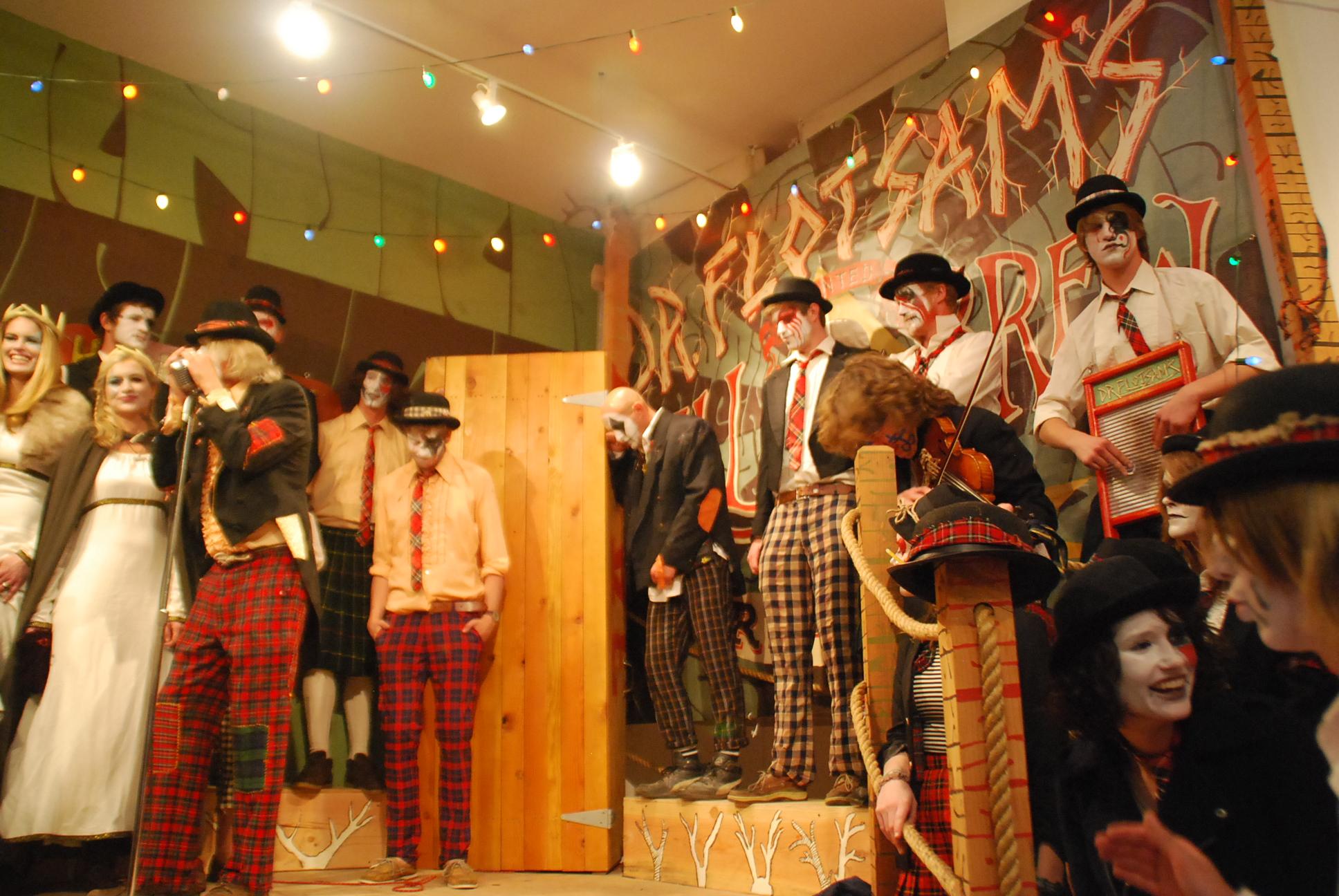
A promise that all our ailments will disappear and our wildest dreams will come true … for a small price. Or for the price of your soul? Dr. Flotsam and his self-described “crew of carny bastards,” sprung from the wild mind of San Francisco artist Mike Shine, ask us the worth of that exchange. The question is scattered through the paintings, performance, and graphic novel of his show, “Flotsam’s Harvest,” up now through April 6 at White Walls.

According to the show’s press release:

“‘Flotsam’s Harvest’ will be a sweeping installation of street art, paintings, films, a medicine show performance and the launching of Shine’s graphic novella. Each aspect of the show will provide different coded tips and hints, offered to help viewers solve the dark ‘World Riddle’ posed by Friedrich Nietzsche in his book, Thus Spake Zarathustra.”

Intrigued? The opening at White Walls Sat/16 had enough stimulation to dissolve even the hardest anti-consumerist into clapping, grinning, and Irish drinking-song singing. But the mystical “Hell Brew” the medicine show promoted wasn’t for sale. Whether it was ploy to sell the art or vice versa is still up for debate.

Shine’s devilish paintings of animals and figures fuse illustration and graffiti styles. Their rustic colors are blockish and thickly lined like cartoons, while the dripping paint, stray marks, collaged tickets, and spray paint give an urban art feel. These hip but simple paintings are enhanced by frames carved with animal figures and hung on walls painted with radiating text that’s as inscrutable as gang tags. Similar murals are also painted around in the city with Banksy-esque portraits of the “carny bastards.” But despite how cool they are, the artworks were not the selling point for me.

Shine’s opening night performance (similar to those he has done at Outside Lands and SFMOMA), was equally as rich and cryptic. It began in some form of Gaelic or Old English with subtitles on cards and continued with Dr. Flotsam selling his mystical tonic in a thick, comical accent. We all knew the audience volunteer selected to test the brew was a plant (in the form of YouTube dance star takesomecrime): he hobbled on stage but was “cured” after swigging from Dr. Flotsam’s flask, and began shuffling to electro swing by Skewiff.

This wildly entertaining evening can’t be isolated as the meat of what Shine has made either, but it began to make sense of what was going on. The sense of irony was ripe when Dr. Flotsam noted that the government doesn’t permit medicine shows because they “lie to you.” (This sense of danger in the promise was deepened in his disclaimer that you can have your widest dreams come true, if you’re willing to part with your soul.)

A similar theme emerges in the accompanying graphic novel, in which Dr. Flotsam intervenes in the lives of people who have notably impacted history, like the caveman who made fire, Jesus, or the inventor of penicillin. But each one pays a heavy price for the advice they receive. The conflation of good and bad creates a wild sense of anarchy which gives reason for, and holds the key to, the intense and scattered information Shine draws upon for his work.

In a culture where added dimension in art and immersive stimulation in film are often confused with creative quality, Shine has created a show which uses both to convey his meaning. But after the whole experience puzzling out the riddle, I was left wanting. The entertaining trail of information ended in a simple answer, but opened up a number of new questions: was it about merging the body and soul by processing his art in order to gain a stronger sense of identity? Or about how commodities are sold with flair and gusto, but in their mass production fail to truly appeal to the individual? Or is Shine just trying to fuck with people? Maybe you should take a look at the riddle and figure it out for yourself.

Mike Shine, “Flotsam’s Harvest”

Through April 6

White Walls Gallery

886 Geary, SF

www.whitewallssf.com

“It just gets different”: Ali Liebegott on her third book ‘Cha-Ching!’

1

When you’ve spent long, smelly months in a bus traveling the world sharing words with pockets of alternative community, the issue of place takes the fore. As she releases her third book Cha-Ching!, and as her decades-old Sister Spit collective embarks upon yet another tour of spoken word, queer revelry, and cramped living conditions, author Ali Liebegott is getting academic about it.

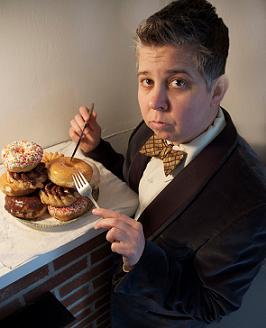
“I’m kind of obsessed with how artists can live,” she tells me in a SoMa coffeehouse. She had texted me for clarification the night before on whether it was okay to look “scummy” at our interview, but she looks pretty neat in her white tee, motorcycle helmet sitting next to her on a bench. “And how queer people can live. I always think, where would I live if I couldn’t live in San Francisco or New York?”

Liebegott teaches Sarah Schulman’s Gentrification of the Mind — a book that looks at how economic displacement changes our brain’s wiring — in her fiction class at Mills College. And in Cha-Ching!, the economy is an ever-present force, guiding protagonist Theo into shitty apartments in both NY and SF neighborhoods where there are few out gay people. (Not to mention a ludicrously depressing janitor job at a junk mail factory.) The book is Liebegott’s third after The Beautifully Worthless and The IHOP Papers

When I ask whether they’re getting easier to write as time goes on she just laughs. “If I had been a plumber, I’d be able to fix things in my sleep. It doesn’t get easier, it just gets different.”

Liebegott reads from Cha-Ching! at City Lights in October

In an ever-more-caffeinated manner, she and I discuss how those higher rents are coinciding with an era in which publishing houses are more hesitant about what they throw their weight behind. “[Queer literature] is the first to go,” Liebegott says. “All the queer books at Barnes and Noble are behind a potted plant, there’s like four of them, and one of those is Best Lesbian Erotica 1994.”

So it’s good that, as poor queers and creatives and poor creatives and queers get kicked out of their urban homes and prime shelf space, Sister Spit is on the rise. Once restricted to queer female writers, the tour now includes a variety of genders, and different kinds of artists.  

Liebegott’s book is one of the first to come out on the imprint that the group’s founder Michelle Tea was able to start through City Lights Books in the fall of 2012 — The Beautifully Worthless was also released through the imprint, as well as the amazing Sister Spit anthology from earlier this year. Tea’s fantastical young adult novel Mermaid in Chelsea Creek, set to drop this summer, is delicious. The collective’s gig at the main library on Sun/31 is in advance of yet another of its fabled tours. This time the path lies up and down the coasts, up to Canada, and into the Mid-West. 

>>LISTEN TO CITY LIGHTS BOOKS’ RECENT PODCAST INTERVIEW WITH ALI LIEBEGOTT 

Along the way, the Sister Spit artists will meet audience members in places where there is no queer community, places where people fundraised to get them there. 

“I don’t want to say we’re a beacon of hope, but it is nice to give people this connection that they might not have,” Liebegott says. 

And that connection, more and more, may not be associated with any specific urban area. San Francisco, for example, would be beyond Liebegott’s reach as a home if it weren’t for her and her girlfriend’s rent control. “I kind of feel like we’re headed towards hell,” Liebegott muses, taking in our swank, caffeinated surroundings. “I feel like we’re already there.”

Regardless, art. Cha-Ching! deals in gambling addiction, drug addiction, poverty, ennui, animal abuse, powerlessness — but nonetheless, can be laugh out loud funny even, especially, when characters hit their low points.

She’s already planning her next book, about a war vet obsessed with feeding ducks. “I feel like I’m so mired in depressing things!” Liebegott says. “My threshold for that is much higher than most people.”

Cha-Ching!‘s ending, though, leaves room to hope that queers can triumph over today’s adversities. Or does it? At any rate, you have ample chances to buy the book at this week’s readings (Liebegott is one of the featured artists at the Sister Spit reading on Sun/31 as well.)

In other news, Liebegott’s big into Sizzler. She told me to write that.

Ali Liebegott’s Cha-Ching! release party

Wed/27, 7pm, free

City Lights Bookstore

261 Columbus, SF

www.citylights.com


Sister Spit tour kick-off reading

Sun/31, 2-5pm, free

San Francisco Main Library

100 Larkin, SF

www.sfpl.org

Artists respond to hate-speech ads with “fabulous” alterations

When it comes to countering hate speech, there’s nothing like creative expression mixed with direct action. Activists affiliated with art collectives Bay Area Art Queers Unleashing Power (BAAQUP) and Street Cred declared yesterday to be “Hate Free Monday,” and celebrated by modifying hate speech ads recently plastered on Muni buses.

Purchased by the pro-Israeli American Freedom Defense Initiative (AFDI), the ads contain bigoted, inflammatory quotations directed at LGBT people, attributed to prominent Muslims. Although city officials have condemned the advertisements, they were nevertheless allowed to be displayed because Muni determined them to be within First Amendment guidelines.

Headed by conservative blogger Pamela Geller, AFDI has been deemed a hate group by the Southern Poverty Law Center and the Anti-Defamation League. Geller herself is the target of the activists’ handiwork.

“We believe that all public spaces, including public transit, should be welcoming and safe for all members of our community,” the artists, who did not give their names, wrote to the Guardian in a statement sent from baqupower@gmail.com. “The hate-filled messages purchased by Pamela Geller’s AFDI defame and vilify Muslims and are harmful and offensive to residents and visitors in San Francisco, both Muslim and non-Muslim. 
Since the city will not take action against these ads on city buses, we have.”

To read BAAQUP’s full description of the motivations behind their action, go here.

Their statement concludes: “As long as these advertising outrages continue to appear on our streets, we will continue to reconstitute them to reflect something more truthful, just, and ideally fabulous.”


Vintage riffs: “Maiden England ’88” on DVD

1

Attention Iron Maiden fans: today, the seminal NWOBHM band releases a DVD version of Maiden England ’88, a concert film shot on the seminal tour’s stop in Birmingham, England (with never-before-seen encore footage to boot).

The two-disc set, which is full of stuff you’ve probably never seen at all unless you take really good care of your VHS tapes and still have a working VCR, also includes Twelve Wasted Years, a 1987 doc about Maiden’s humble beginnings and rise to metal god status; The History of Iron Maiden Pt. 3, a 40-minute doc focusing on the band in the late 1980s; and promo videos of hits from that period, including “Can I Play With Madness” and “The Evil That Men Do.”

http://www.youtube.com/watch?v=91EAEKF2plE&list=PLCfCU1Ok5NVu3Reb4c8x1Q3ah9WFInhl5&index=2

The 110-minute live show, however, is the superstar here; it’s been digitally remastered with a glorious new sound mix, keeping true to director (also the band’s bassist) Steve Harris’ goal of creating a you-are-there experience for fans — particularly useful if, in 1988, you were a small-town American tween who didn’t get to see the tour in person. Ahem.

At any rate, the set list contains all the jams you want to hear; high points include a particularly energetic “Die With Your Boots On” and sing-alongs featuring excited audience members (jean jackets, feathered hair) on the oh-oh-oh part on “Heaven Can Wait.” The set looks like an ice planet (albeit an ice planet with occasional pyro explosions), and band members all seem to be enjoying themselves — Nicko McBrain has clearly mastered the art of drumming while mugging for the camera — despite wearing pants crafted out of the tightest Spandex known to humankind.

Singer Bruce Dickinson, whose trademark 37-octave (-ish) voice and limber stage antics are in fine form here, offers cheeky between-song banter that includes clowning with a hand puppet tossed onstage, humblebragging about Maiden’s prodigious success, and dubbing the controversial-to-some song “Seventh Son of a Seventh Son,” “a very difficult song.”

Dickinson also imitates fans’ displeasure with the 1988 album of the same name (which came out the same year as the concert, so it would have been a piping-hot bugaboo for him at the time) — “You can’t have keyboards in Iron Maiden!” — and advises any haterz to “Fuck off and listen to some other shit!” For good measure, band mascot Eddie makes his first appearance during “Seventh Son,” gazing into a crystal ball with enormous glowing eyes as smoke machines do their thing and, yeah, keyboards happen. So many keyboards. Up the keyboards!

And just in case any of those haterz can’t be lured back around by Andrew Lloyd Webber-level theatrical showmanship, the band goes right into “The Number of the Beast,” pretty much the biggest crowd-pleaser in the set, enhanced by the sight of guitarist Dave Murray riding around on Dickinson’s shoulders while a.) still playing and b.) Dickinson continuing to operatically belt it out. Laws of physics, songcraft, and gravity are all defied … again, while wearing seemingly circulation-crushing garments.

A different configuration of Eddie, this time with moving parts, returns for “Iron Maiden,” the finale that leads into a trio of encores: “Run To the Hills,” a hit so massive you can’t quite believe it was left off the original VHS version; and first-album tracks “Running Free” and “Sanctuary.” The whole shebang concludes with an avuncular Dickinson — clearly not as spooky IRL as the band’s signature album art might suggest — wishing the screaming crowds “Have a good Christmas, yeah?” YEAAAAHHHHHHHHHHH!

Internet Cat Video Festival pussyfoots its way to Oakland

1

The druggish trip of a heavy Youtube session: you start out looking for that innovative new TED Talk and find yourself, hours later, fixated on a video of sloths in a bucket. How you got there you don’t know.

Sleepy sloths are dangerous to productivity but delve into the endless abyss of cat videos on the web and you might not see the sun for a week. This brings us to our next point of fact: The Internet Cat Video Festival is coming to Oakland May 11, and you can buy tickets starting today.

The EVENT will be held at the Great Wall of Oakland – the large-scale urban projection installation on West Grand Avenue between Broadway and Valley Streets. Proceeds will benefit the East Bay SPCA, so you can feel marginally good about the obsession you share with every other person within swiping distance of an Internet device.

Last year’s fest

The festival got its start last year as a modest award ceremony event organized by the Walker Arts Center in Minnesota. Modest as in over 10,000 people showed up to the center’s grassy field for furry fun. Turns out people really like cats. This year the festival is touring nationally. 

The main event doesn’t start until 8:30pm on May 11, but there will be enough feline festivities to occupy the entire day. Jewelry, clothing, artwork, and meow kitsch will be available from an array of vendors as part of the fest’s “arts and cats” area. Live bands will be playing cat-themed music – more specifics on this later. There will even be a cat-themed aerial performance by the Great Wall’s artist in residence Bandaloop – a pioneer in vertical dance group. Food trucks, etc. 

Those who like their cat vids screened in a more, ahem, exclusive environment should check out the VIP preview screening of the festival’s offerings at the Oakland Museum of California on May 10 at 7pm in the James Moore Theatre. Following the screening will be short talks from the Walker Art Center’s program director Scott Stulen and OMCA’s senior art curator Rene deGuzman. 

The VIP screening may be your best bet if you’re not a crowd kitty. 5,000 or so people are expected to head to Oakland for the big day. 

Internet Cat Video Festival

May 11, festival starts at 2pm, screenings at 8:30pm, $10-75

Great Wall of Oakland

Broadway and W Grand, Oakl.

www.oaklandcatvidfest.com

IRN-FST-MFG presents: Friendly Fire

0

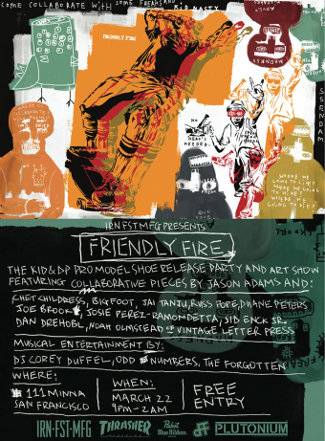
IRN-FST-MFG – the San Diego-based clothing and shoe manufacturer known for their impulsive, raw, and unapologetic designs – presents: Friendly Fire, a celebration of the launch of Jason Adams and Duane Peters’ pro model shoes.

The event features collaborative art pieces by Jason Adams and Chet Childress, Bigfoot, Jai Tanju, Russ Pope, Duane Peters, Joe Brook, Josie Perez-Romandetta, Sid Enck Jr., Dan Drehobl, and Noah Olmstead of Vintage Letter Press.

Music will be provided by The Forgotten and Odd Numbers with DJ Cory Duffell. There will also be PBR specials and free event koozies while supplies last! Visit the venue site for more info here.

Friday, March 22 at 9pm @ 111 Minna Gallery SF, CA | FREE


Art: It’s like money in the bank

3

The panic that grips you in those moments when you need to open a new checking account, but really needed a double shot of espresso are over. Yes, my moneyed mates, greetings and welcomes to the Financial District’s somewhat recently opened Capital One 360 Cafe.

Within the gleaming walls, one can perform banking transactions and caffiene transactions with well trained bank staff-baristas. You can plan ahead and reserve a workspace at which you will enjoy free WiFi thanks to corporate America’s largess. And for a limited time on those gleaming walls, you can enjoy artist Nick Mancilla‘s commentary on the transience of wealth while you bask in the endless future of your own, unfurling before you like a expensive, woven, cheerful, infinite Stars and Stripes.

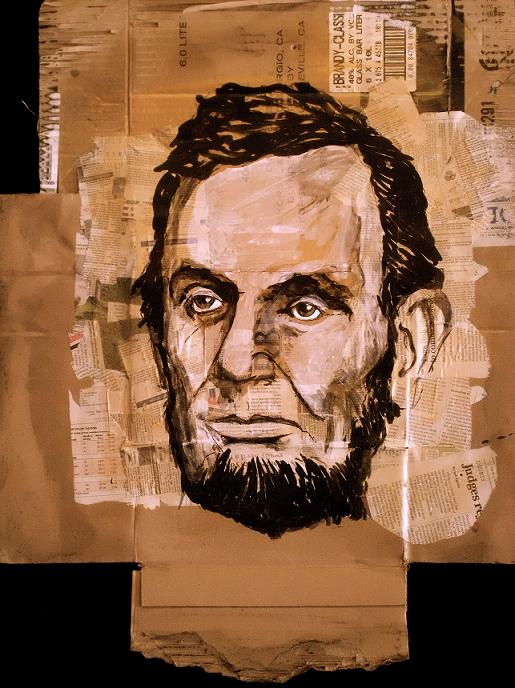
Yes, Mancillas’ portraits of our nation’s money men — Lincoln and the rest of his dollar bill brothers — on recycled cardboard from his “Cardboard Currency” series will star in a Capital One 360 Cafe art show that opens on March 28. We got in touch with the Sonoma art teacher via email to chat about how weird the whole thing is.

The cafe bank art gallery art bank cafe. Photo by Yelp user Luis C.

SFBG How did this show come about? Did Capital One contact you or vice versa?

NM It was serendipitous, because a friend told me about an interesting new financial institution in downtown SF (which fit my theme) with a gallery space for artists. I’ve been Sonoma County art educator for over 19 years by day and working artist by night — who’s just completed my MFA – so I’m always looking for venues to show. I went and walked through the space and immediately loved the concept of the marriage of a show like mine about money being at a big bank. Contacted them, gave them my website, and a few months later they gave me the green light.

This is exactly my message — because I have a Capital One account, I’m involved with capitalism, I’m just like every other American … we have to believe in money to live. The pieces are meant to tell the story about the fact that although trying, we have to have faith that even though money is no longer really backed by gold and is re-printed by the government by the billions we still believe (to live our lives) that this money we have in our pockets and bank accounts will still continue to hold value. This act of faith which is so scary is part of what inspired my “Cardboard Currency” collection.

SFBG Have you spent time in the cafe?

NM Yes, before I approached them and I’ve been back several time since to both measure the space and sit for a cup of coffee to witness how folks interact with the space.

SFBG When you were making these pieces, did you have intentions for them to be shown in a bank?

NM The collection was created before the show was booked – it was inspired by the financial calamities of 2007, 2008, 2009, 2010, 2011 … and on. When I saw the space in a bank I thought, “wow that would be an thought-provoking message to have the ‘Cardboard Currency’ show at a banking institution.”

SFBG Do you think that their intended message will come across in that setting?

NM Not sure. People have a variety of responses to seeing them. What’s interesting is two pieces that already sold, both to financial industry professionals.

It’s a subtle yet powerful message. The paintings are on cardboard commercial packaging — [they talk about] the ethereal, transient nature of money.

Ultimately I think the work will be appreciated. If you look closely you can see the message in the materials and work. The cardboard on which each piece is created for example still shows the bar codes, packaging instructions, and transit information that delineates the origins of the piece of cardboard.

This is a message onto itself which I’m very fond of. That these boxes come from Thailand, Malaysia, Mexico, and all across the world in the flow of global commerce. These cardboard boxes in my small town from across the world brings to light how interconnected (our) money is with the world and world-wide economy and community. The vast expansiveness of our world and yet how small a world it is. More importantly, how connected we all are on this very basic level as humans, the human race, and as financial partners. When one family loses a home in California, it’s intrinsically connected to other financial tragedies across the globe and back again. I’ve also got plans for collections depicting presidents/figure heads on other nations currency’s in the near future. 

“Cardboard Currency”

Through April 4

Capital One 360 Cafe

101 Post, SF

cafes.capitalone360.com/san_francisco

www.nickmancillas.com

The Performant: Oakland, We’re For You

0

Oakland Nights….LIVE! makes a scene

Clear your calendars everybody, Oakland’s own untelevised late-night talk show has returned from a wintry hibernation and found itself some indoor digs, all the better to display their charmingly populist showcase.

The brainchild of art teacher and science nerd Julie Crossman, and sound artist Jeremy Dalmas, Oakland Nights…LIVE! is a giddy mashup of brief lectures/guest speakers, interviews, contests, music, and general goofing around, loosely adhering to a pre-determined theme. Newly located in the recently outfitted hackerspace, the Sudo Room (it used to play in Dalmas’ backyard, and once, memorably, on BART), ONL’s spartan “set” resembles a picked-over yard sale in the late afternoon: a few mis-matched chairs, a desktop crowded with knickknacks, a rotary telephone, a pile of seemingly random toys, including an old fashioned porcelain doll named Spooky Lucy, a basket of (vegan) cookies for participants. A video screen hovers behind the stage, primed for live-cam action, and a winningly upbeat house band, the Hats, stand at the ready.

After an opening monologue about hemorrhoids and hot doctors delivered by Channing Tatum (just kidding, it was Oakland comedian Channing Kennedy who also provides most of the onscreen visuals) the show begins in earnest. There were cue cards (applause, maniacal laughter, awkward cough), and the first oddience competition of the evening “Who’s New?” — the highlight of which was a video of baby goats at the Oakland Zoo, because the highlight of just about everything in this cruel world is a video of baby goats.

The theme of the evening was “The Human Body,” so the first guest lecturer was a dermatologist, Ingrid Roseborough. First thing I learned over the course of the evening from the opening monologue is that there are four kinds of hemorrhoids (lovely). The second, during Roseborough’s Q&A, was about the lines of Blaschko, invisible stripes on the human body that become visible only in conjunction with certain skin conditions. Education and entertainment. It doesn’t get much better.

Except that it does. Among the guests wrangled by the impossibly buoyant Crossman and her laid-back co-conspirator Dalmas are Exploratorium Explainer Raha Behman who dissects a cow eye on the live-cam to predictable gasps and giggles, a duo of intensely-focused dancers, Christine Bonansea and Justin Morrison, whose aggressively industrial soundtrack would fit right in on a Throbbing Gristle album, swallowing expert Lauren Scheiner, who leads the room in a series of tongue exercises, and comedian David Cohen whose stated goal is to uncover  what constitutes the perfect smooch.

He raises some hackles with his San Francisco-based safari video, the popular sentiment being that Oakland should be the representative demographic at ONL, a stance that comes off sounding somewhat defensive to my own San Francisco-dwelling perspective (relax, guys, we all know you’re awesome!), but is enthusiastically supported by the general majority.

Cohen promises an Oakland edition, and the crowd settles back down just in time for the grand finale sing-along “Oakland, We’re For You,” a perfect tongue-in-cheek ending to the evening’s many shenanigans. Best of all, ONL’s quirky good fun is scheduled to continue indefinitely on each first Saturday, so plan to tune in, turn it up, and drop by soon.

http://www.youtube.com/watch?v=DujCHFWHKQI


Stage listings

0

Stage listings are compiled by Guardian staff. Performance times may change; call venues to confirm. Reviewers are Robert Avila, Rita Felciano, and Nicole Gluckstern. Submit items for the listings at listings@sfbg.com. For further information on how to submit items for the listings, see Picks.

THEATER

OPENING

BAY AREA

The Coast of Utopia: Voyage & Shipwreck Ashby Stage, 1901 Ashby, Berk; www.shotgunplayers.org. $20-35. Shipwreck previews Fri/22-Sat/23 and March 29, 8pm; March 27-28, 7pm; Sun/24, 5pm. Opens March 30, 8pm. Runs Wed-Thu, 7pm; Fri-Sat, 8pm; Sun, 5pm. Through May 5. Voyage previews March 27, 7pm. Opens April 3, 3pm. Runs April 13, 20, 27, and May 4, 3pm. Shotgun Players perform the first two parts of Tom Stoppard’s revolutionary trilogy.

ONGOING

Assistance NOHspace, 2840 Mariposa, SF; www.opentabproductions.com. $20. Thu-Sat, 8pm; Sun, 6pm. Through March 30. Over the past three years, things we’ve come to expect from plucky OpenTab Productions — whose annual offerings deal in aggressively contemporary themes such as media spin, business fraud, and job (in)security — include tight ensemble acting, minimal tech, and snappy direction, and in all these regards, Assistance does not disappoint. A crew of desperate office drones whose lives basically revolve around the abuse dished out by their unseen employer, Daniel Weisinger (who may or may not resemble playwright Leslye Headland’s old boss, Harvey Weinstein), hold down their airless fort, fielding calls at 11 p.m. and shirking responsibility whenever possible. Though Headland doesn’t do much to make her emotionally and professionally stunted characters palatable, the capable cast and director Ben Euphrat do manage to wring something resembling humanity out of them. From Nick (Tristan Rholl,) the frustrated slacker supervisor, to Nora (Melissa Keith), the-new-girl-turned-cynical-old-hand, to Justin (Nathan Tucker), the unctuous winner of the title of "last man standing," to Jenny (Michelle Drexler) a pragmatic yet annoyingly bubbly Brit, what stands out in each performance are the perfectly captured quirky nuances and barely-concealed neuroses of people caught in the process of losing their souls. Nothing about Assistance is likely to change your view of the business world, but if you’ve yet to experience the frenetic fun of an OpenTab show, it’s a perfect primer to the madness behind their method. (Gluckstern)

The Chairs Exit on Taylor, 277 Taylor, SF; www.cuttingball.com. $20-45. Thu, 7:30pm; Fri-Sat, 8pm (also Sat, 2pm); Sun, 5pm. Extended through April 7. In Rob Melrose’s new translation of Eugene Ionesco’s The Chairs, an elderly couple sit in the austere parlor of their lonely lighthouse, chortling over a spate of private wordplay and reminiscing of sprightlier times, until their initially frantic and disjointed dialogue settles into a smooth flow, well-polished by decades of endearments and gentle bickering. Possibly the last two survivors of a not entirely explained apocalypse, the isolated nonagenarians (magnificently played by David Sinaiko and Tamar Cohn) nevertheless make it known that important guests are expected to arrive at any moment in order to hear a hired orator (Derek Fischer) deliver the Old Man’s "message," which he has spent a lifetime honing. As the doorbell begins to ring, a jarring squall, and invisible guests and dozens of mismatched chairs begin to crowd their peaceable empire in claustrophobia-inducing numbers, their companionable seclusion is shattered for good. Director Annie Elias manages to coax both gravitas and decorum out of this little-produced, yet influential absurdist relic, imbuing her protagonists with a depth of character that belies their farcical circumstances, while Theodore J.H. Hulsker’s murmuring sound design of crashing waves, angry winds, and the strident doorbell could almost be another character in the play, so thoroughly does it set the tone in ways that Ionesco might not have approved of, but is all the better for. (Gluckstern)

Dead Metaphor ACT’s Geary Theater, 415 Geary, SF; www.act-sf.org. $20-95. Wed/20-Sat/23, 8pm (also Sat/23, 2pm); Sun/24, 2 and 7pm. American Conservatory Theater performs George F. Walker’s dark comedy about postwar living.

Foodies! The Musical Shelton Theater, 533 Sutter, SF; www.foodiesthemusical.com. $30-34. Fri-Sat, 8pm. Open-ended. AWAT Productions presents Morris Bobrow’s musical comedy revue all about food.

The Great Big Also Z Space, 450 Florida, SF; www.zspace.org. $15-30. Thu/21-Sat/23, 8pm; Sun/24, 5pm. The Rift is coming, and when it does, you’ll have to decide for yourself, will you stay or will you go? But stay for what? Go where? These are just a couple of the big questions underlying Mugwumpin’s latest devised occurrence The Great Big Also, a tour de prophétie, on the conundrum that is survival. Split up from the outset, each audience member must undergo a sort of personal journey through the play, sequestered in a kind of labyrinth of inter-locking white walls (cunningly designed by Sean Riley) that lead equally nowhere, and subjected to the roving attentions of the eight ensemble members, who chatter amiably about their individual pasts and the history of their tenuous confederation — the New Settlers. Punctuated by bursts of exposition coming from above, and the cacophonous underpinnings of Theodore Hulsker’s dramatic sound design, their spirited discourse creates more questions than answers, and random snatches of eavesdropped-upon conversation gleaned from other rooms in the labyrinth only serves to muddle their objectives even more. As the tightly-knit, New Settler community becomes increasingly stretched and frayed, the physical walls of the set stretch too and eventually collapse, (once the audience is seated, somewhat more traditionally in a ring of folding chairs that encircle the wide parameter of the Z Space stage). Interesting resonances abound with FoolsFURY’s production of Doug Dorst’s futuristic Monster in the Dark and Banana Bag and Bodice’s neo-sci-fi melodrama The Sewers, yet Mugwumpin’s exploration of a possibly brave, possibly new world, manages to be both maddeningly cryptic and exuberantly profound all on its own. (Gluckstern)

God of Carnage Shelton Theater, 533 Sutter, SF; www.sheltontheater.org. $38. Thu-Sat, 8pm. Through March 30. Shelton Theater presents Yasmina Reza’s Tony-winning comedy about upper-middle-class parents clashing over an act of playground violence between their children.

Inevitable SF Playhouse, 533 Sutter, SF; www.sfplayhouse.org. $20. Thu/21-Sat/23, 8pm. SF Playhouse’s "Sandbox Series," enabling new and established playwrights to stage new works, kicks off its third season with Jordan Puckett’s drama about a woman trying to make sense of her life.

Just One More Game Exit Theatre, 156 Eddy, SF; www.tripleshotprodutions.org. $25. Thu-Sat, 8pm. Through March 30. With the rise of the programmer as pop culture hero, it was probably inevitable that we’d start writing plays about them too. In local playwright Dan Wilson’s Just One More Game our programmer protagonist is Kent (Christopher DeJong) whose mission is to find love, and his co-player is Marjorie (Linda-Ruth Cardozo), who wields her own geek credentials like a Mortal Kombat wrath hammer. Where Wilson’s comedy excels is in the witty gamer banter that defines much of their attraction and commonality — references to Zork, Oregon Trail, Dungeons and Dragons, and The Secret of Monkey Island abound, while a series of meticulous video game animations (also Wilson’s) lend colorful counterpoint to the action on the stage. DeJong plays his role of emotionally-inhibited loner with a degree of laconic detachment that unfortunately eliminates all traces of chemistry between him and Cardozo, who is especially good at capturing the cheerfully aggressive awkward of a woman accustomed to being "one of the boys" because there was nothing about "the girls" she could relate to. Both the comedy and pace flag by the time the first NPCs (non-player characters) enter the room, broadly clichéd parents yammering for grandchildren and obnoxious college buddies armed with too many baby photos, who conspire to stunt the growth of Kent and Marjorie’s relationship and wind up stunting the growth of the play. If the quest for love is a game, as the title suggests, it’s one that could use a little more back-end development, and a much greater degree of playfulness. (Gluckstern)

A Lady and a Woman Eureka Theatre, 215 Jackson, SF; www.therhino.org. $15-30. Wed/20-Sat/23, 8pm; Sun/24, 3pm. Life wasn’t easy in the South of the 1890s, particularly for single black women, but in Shirlene Holmes’ A Lady and a Woman the focus is emphatically on rising above circumstance. When itinerant hog-cutter Biddie Higgins (Dawn L. Troupe) swaggers into the village inn run by Miss Flora Devine (Velina Brown) and demands a room, sparks fly almost instantaneously, as the two pragmatic and independent women become drawn to the strength they see in the other. A healer and midwife as well as an innkeeper, Miss Flora has endured enough abuse at the hands of men in her life to make her grateful to be able to live without one around, while Biddie, the only daughter in a household of fourteen, has become accustomed to a life of manual labor and clandestine trysts with willing women, never sticking around one place long enough to run out of either, declaring "it’s been easier to live a hard life then a lie." Both Brown and Troupe embody their multi-dimensional characters with grace and backbone, never striking a false note as their tender courtship unfolds and they discover that the greatest strength of all is the ability to love freely. (Gluckstern)

The Lisbon Traviata New Conservatory Theatre Center, 25 Van Ness, SF; www.nctcsf.org. $25. Wed/20-Sat/23, 8pm; Sun/24, 2pm. New Conservatory Theatre Center performs Terrence McNally’s play, a mix of comedy and tragedy, about the relationship between two opera fanatics.

Sex and the City: LIVE! Rebel, 1760 Market, SF; trannyshack.com/sexandthecity. $25. Wed, 7 and 9pm. Open-ended. It seems a no-brainer. Not just the HBO series itself — that’s definitely missing some gray matter — but putting it onstage as a drag show. Mais naturellement! Why was Sex and the City not conceived of as a drag show in the first place? Making the sordid not exactly palatable but somehow, I don’t know, friendlier (and the canned a little cannier), Velvet Rage Productions mounts two verbatim episodes from the widely adored cable show, with Trannyshack’s Heklina in a smashing portrayal of SJP’s Carrie; D’Arcy Drollinger stealing much of the show as ever-randy Samantha (already more or less a gay man trapped in a woman’s body); Lady Bear as an endearingly out-to-lunch Miranda; and ever assured, quick-witted Trixxie Carr as pent-up Charlotte. There’s also a solid and enjoyable supporting cast courtesy of Cookie Dough, Jordan Wheeler, and Leigh Crow (as Mr. Big). That’s some heavyweight talent trodding the straining boards of bar Rebel’s tiny stage. The show’s still two-dimensional, even in 3D, but noticeably bigger than your 50" plasma flat panel. (Avila)

Steve Seabrook: Better Than You Marsh San Francisco, 1062 Valencia, SF; www.themarsh.org. $15-50. Fri, 8pm; Sat, 8:30pm, through March 30. Starting April 4, runs Thu, 8pm; Sat, 8:30pm. Extended through May 18.

Self-awareness, self-actualization, self-aggrandizement — for these things we turn to the professionals: the self-empowerment coaches, the self-help authors and motivational speakers. What’s the good of having a "self" unless someone shows you how to use it? Writer-performer Kurt Bodden’s Steve Seabrook wants to sell you on a better you, but his "Better Than You" weekend seminar (and tie-in book series, assorted CDs, and other paraphernalia) belies a certain divided loyalty in its own self-flattering title. The bitter fruit of the personal growth industry may sound overly ripe for the picking, but Bodden’s deftly executed "seminar" and its behind-the-scenes reveals, directed by Mark Kenward, explore the terrain with panache, cool wit, and shrewd characterization. As both writer and performer, Bodden keeps his Steve Seabrook just this side of overly sensational or maudlin, a believable figure, finally, whose all-too-ordinary life ends up something of a modest model of its own. (Avila)

The Voice: One Man’s Journey Into Sex Addition and Recovery Stage Werx Theater, 446 Valencia, SF; thevoice.brownpapertickets.com. $10-18. Fri-Sat, 8pm. Through April 6. Ticket sales for David Kleinberg’s autobiographical solo show benefit 12-step sex addiction recovery programs and other non-profits.

The Waiting Period Marsh San Francisco, 1062 Valencia, SF; www.themarsh.org. $25-50. Fri, 8pm; Sat, 5pm. Through March 30. Brian Copeland (comedian, TV and radio personality, and creator-performer of the long-running solo play Not a Genuine Black Man) returns to the Marsh with a new solo, this one based on more recent and messier events` in Copeland’s life. The play concerns an episode of severe depression in which he considered suicide, going so far as to purchase a handgun — the title coming from the legally mandatory 10-day period between purchasing and picking up the weapon, which leaves time for reflections and circumstances that ultimately prevent Copeland from pulling the trigger. A grim subject, but Copeland (with co-developer and director David Ford) ensures there’s plenty of humor as well as frank sentiment along the way. The actor peoples the opening scene in the gun store with a comically if somewhat stereotypically rugged representative of the Second Amendment, for instance, as well as an equally familiar "doood" dude at the service counter. Afterward, we follow Copeland, a just barely coping dad, home to the house recently abandoned by his wife, and through the ordinary routines that become unbearable to the clinically depressed. Copeland also recreates interviews he’s made with other survivors of suicidal depression. Telling someone about such things is vital to preventing their worst outcomes, says Copeland, and telling his own story is meant to encourage others. It’s a worthy aim but only a fitfully engaging piece, since as drama it remains thin, standing at perhaps too respectful a distance from the convoluted torment and alienation at its center. Note: review from an earlier run of the same production. (Avila)

BAY AREA

Dostoevsky’s The Grand Inquisitor Berkeley City Club, 2315 Durant, Berk; www.centralworks.org. $15-28. Thu-Sat, 8pm; Sun, 5pm. Through March 31. Central Works performs Gary Graves’ adaptation of the story-within-a-story from The Brothers Karamazov.

Fallaci Berkeley Repertory Theatre, 2015 Addison, Berk; www.berkeleyrep.org. $29-89. Tue, Thu-Sat, 8pm (also Sat, 2pm); Wed and Sun, 7pm (also Sun, 2pm). Through April 21. Berkeley Rep performs Pulitzer-winning journalist Lawrence Wright’s new play about Italian journalist Oriana Fallaci.

The Mountaintop Lucie Stern Theatre, 1305 Middlefield, Palo Alto; www.theatreworks.org. $23-75. Tue-Wed, 7:30pm; Thu-Sat, 8pm (also Sat, 2pm), through March 31. Starting April 3, runs Wed-Thu, 11am (also Thu, 8pm); Sat, 8pm; Sun, 2pm. Through April 7. TheatreWorks performs Katori Hall’s play that re-imagines the events on the night before Dr. Martin Luther King, Jr.’s assassination.

The Real Americans Marsh Berkeley, 2120 Allston, Berk; www.themarsh.org. $25-50. Fri, 8pm; Sat, 5pm. Through April 6. Dan Hoyle shifts his popular show about small-town America to the Marsh’s Berkeley outpost.

PERFORMANCE/DANCE

BATS Improv Bayfront Theater, Fort Mason Center, Marina at Laguna, SF; www.improv.org. $20. "Theatresports," Fri, 8pm. Through March 29. "Double Feature," Sat, 8pm. Through March 30.

"The Buddy Club Children’s Shows" Randall Museum Theater, 199 Museum Wy, SF; www.thebuddyclub.com. Sun/24, 11am-noon. $8 (under two years old, free). Comedy magician Robert Strong performs.

Caroline Lugo and Carolé Acuña’s Ballet Flamenco Peña Pachamama, 1630 Powell, SF; www.carolinalugo.com. Sun/24, 6:15pm. $15-19. Flamenco performance by the mother-daughter dance company, featuring live musicians.

"Mission Position Live" Cinecave, 1034 Valencia, SF; www.missionpositionlive.com. Thu, 8pm. Ongoing. $10. Stand-up comedy with rotating performers.

"New Works by Artists in Residence" CounterPULSE, 1310 Mission, SF; www.counterpulse.org. Thu-Sun, 8pm. Through March 31. $20-30. With richien (Rowena Richie and Jennifer Chien) performing Twindependent, and Sense Object (Miriam Wolodarksi) performing Of Limb and Language.

"Ninth Annual Conceptual Public Art Performance: Dance Anywhere" Various locations, SF; www.danceanywhere.org. Fri/22, noon. Free. This worldwide movement presents simultaneous performance art in over 45 countries; check the website for local events and to connect with other participants.

"ODC/Dance Downtown 2013" Yerba Buena Center for the Arts Theater, 700 Howard, SF; www.odcdance.org. Wed/20-Thu/21, 7:30pm; Fri/22-Sat/23, 8pm; Sun/24, 4pm. $20-75. The company celebrates its 42nd season with three world premieres from Brenda Way and KT Nelson.

"ODC Pilot 62: Kinetoscope…This Time With Pictures" ODC Theater, 3153 17th St, SF; www.odctheater.org. Fri/22-Sat/23, 8pm. $15. Rising dance film artists present dance films and live, multimedia performances.

"San Francisco Magic Parlor" Chancellor Hotel Union Square, 433 Powell, SF; www.sfmagicparlor.com. Thu-Sat, 8pm. Ongoing. $40. Magic vignettes with conjurer and storyteller Walt Anthony.

"Shen Wei Dance Arts: Undivided Divided" Yerba Buena Center for the Arts, 701 Mission, SF; www.ybca.org. Thu/21-Sat/23, 8pm (also Sat/23, 5pm); Sun/24, 2 and 5pm. $10-30. The choreographer for the 2008 Beijing Olympics opening ceremony, Shen Wei, also heads up China’s first contemporary dance company; this performance is an installation featuring 18 dancers and multimedia elements.

"Snow White and Her Merry Men" Davies Symphony Hall, 201 Van Ness, SF; www.sfgmc.org. Mon/25-Tue/26, 8pm. $15-75. The San Francisco Gay Men’s Chorus and Steve Silver’s Beach Blanket Babylon come together for this special joint concert.

"2013 Rhino Benefit Celebration" Eureka Theatre, 215 Jackson, SF; www.therhino.org. Sun/24, 7:30pm. $25. Theatre Rhinoceros celebrates 35 years of queer theater with this benefit bash, featuring Connie Champagne, Dave Dobrusky, Mike Finn, Casey Ley, Matthew Martin, and more.

Film listings

0

Film listings are edited by Cheryl Eddy. Reviewers are Kimberly Chun, Dennis Harvey, Lynn Rapoport, and Sara Maria Vizcarrondo. For rep house showtimes, see Rep Clock.

OPENING

Admission Paul Weitz directs Tina Fey in this comedy about a Princeton admissions officer who tracks down the son she gave up for adoption years before. (1:50) Marina.

The Croods DreamWorks’ latest animated tale is about prehistoric cave-people, with the requisite array of celebrity voices (Nicolas Cage, Emma Stone, Ryan Reynolds, etc.) (1:38) Balboa, Presidio.

Ginger and Rosa It’s the 1960s, nuclear war is a real possibility, and nuclear-family war is an absolute certainty, at least in the London house occupied by Ginger (Elle Fanning), her emotionally wounded mother (Mad Men‘s Christina Hendricks), and her narcissistic-intellectual father (Alessandro Nivola). In this downbeat coming-of-age tale from Sally Potter (1992’s Orlando), Ginger’s teenage rebellion quickly morphs into angst when her BFF Rosa (Beautiful Creatures‘ Alice Englert) wedges her sexed-up neediness between Ginger’s parents. Hendricks (playing the accordion — just like Joan!) and Annette Bening (as an American activist who encourages Ginger’s political-protest leanings) are strong, but Fanning’s powerhouse performance is the main focus — though even she’s occasionally overshadowed by her artificially scarlet hair. For an interview with writer-director Potter, visit www.sfbg.com/pixel_vision. (1:30) Albany, Embarcadero, Smith Rafael. (Eddy)

Hitler’s Children What’s in a name? A lot, when it’s Himmler, Goering, Hoess, or Goeth. Chanoch Ze’evi’s doc — comprised of interviews with direct descendants of high-ranking Nazis, all of whom condemn the actions of their relatives — unearths universally strong emotions and plenty of psychological baggage. Various coping mechanisms abound: Hermann Goering’s great-niece moved to rural New Mexico and casually remarks that both she and her brother voluntarily sterilized themselves, so there’d be "no more Goerings." Amon Goeth’s daughter recalls being kept in the dark about her father’s true role in the Holocaust — until she went to see Schindler’s List (1993), and realized he’d been a sadistic monster. The film’s most stirring sequence follows Rainer Hoess, look-alike grandson of Auschwitz commandant Rudolf, as he nervously journeys to the concentration camp-turned-museum for the first time. There, he encounters an elderly Auschwitz survivor who assures him, "You didn’t do it." But Hitler’s Children — which offers a unique, inspired angle on World War II — doesn’t allow itself a tidy last act. Hoess’ travel companion, a journalist who (like filmmaker Ze’evi) is a third-generation Holocaust survivor, remarks to the camera that he doesn’t believe there can be ever be closure to Hoess’ story, or by extension any of these stories — too much history, too much horror. (1:23) Yerba Buena Center for the Arts. (Eddy)

K-11 As her daughter’s middling On the Road adaptation cruises into theaters (see review, below), Jules Stewart’s directorial debut rolls out at the Roxie; it’s a high-camp-but-with-horrifying-rape-scenes drama set in a Los Angeles jail unit reserved for gay and transgender prisoners. The top bitch in the joint is Mousey (Kate del Castillo, one of several women-playing-men-playing-women), who struts around with Divine-style eyebrows, hurling threats ("You play with me, you get uglier") through her heavily-lined lips. There’s also a sadistic guard with a Hitler haircut (D.B. Sweeney) who controls the prisoners’ much-needed drug supply; a massive bully (Tommy "What Bike?" Lister); a sinewy hustler (Kevin Smith pal Jason Mewes); and a baby-voiced innocent who calls herself Butterfly (Portia Doubleday). Into this lurid set-up stumbles Raymond (Goran Visnijc), who is straight, but is also coked-out and maybe a murderer, so perhaps that’s why he lands there — it’s never really clear. Nothing’s really clear here, not least how a movie that’s so unpleasant most of the time manages also to be puzzlingly entertaining some of the time. Props go to del Castillo, I suppose, for attacking her role with nothing less than Nomi Malone levels of commitment. (1:30) Roxie. (Eddy)

The Manson Family See "The Devil’s Business." (1:35) Clay.

Olympus Has Fallen Gerard Butler, Morgan Freeman, and Aaron Eckhart (as the POTUS) star in this action thriller set amid White House intrigue. (2:00) Presidio.

On the Road Walter Salles (2004’s The Motorcycle Diaries) engages Diaries screenwriter Jose Rivera to adapt Jack Kerouac’s Beat classic; it’s translated to the screen in a streamlined version, albeit one rife with parties, drugs, jazz, danger, reckless driving, sex, philosophical conversations, soul-searching, and "kicks" galore. Brit Sam Riley (2007’s Control) plays Kerouac stand-in Sal Paradise, observing (and scribbling down) his gritty adventures as they unfold. Most of those adventures come courtesy of charismatic, freewheeling Dean Moriarty (Garrett Hedlund of 2010’s Tron: Legacy), who blows in and out of Sal’s life (and a lot of other people’s lives, too, including wives played by Kristen Stewart and Kirsten Dunst). Beautifully shot, with careful attention to period detail and reverential treatment of the Beat ethos, the film is an admirable effort but a little too shapeless, maybe simply due to the peripatetic nature of its iconic source material, to be completely satisfying. Among the performances, erstwhile teen dream Stewart is an uninhibited standout. (2:03) Embarcadero, Shattuck. (Eddy)

Somebody Up There Likes Me A textbook illustration of what’s so frequently right and wrong with Amerindie comedies today, Bob Byington’s feature starts out near-brilliantly in a familiar, heightened Napoleon Dynamite-type milieu of ostensibly normal people as self-absorbed, socially hapless satellites revolving around an existential hole at the center in the universe. The three main ones meet working at a suburban steakhouse: Emotionally nerve-deadened youth Max (Keith Poulson), the even more crassly insensitive Sal (Nick Offerman), and contrastly nice but still weird Lyla (Teeth‘s estimable Jess Weixler). All is well until the film starts skipping ahead five years at a time, growing more smugly misanthropic and pointless as time and some drastic shifts in fortune do nothing to change (or deepen) the characters. Still, the performers are intermittently hilarious throughout. (1:24) Roxie. (Harvey)

Spring Breakers See "The Devil’s Business." (1:34) Shattuck.

The We and the I See "Emotion in Motion." (1:43) Opera Plaza, Shattuck.

ONGOING

Amour Arriving in local theaters atop a tidal wave of critical hosannas, Amour now seeks to tempt popular acclaim — though actually liking this perfectly crafted, intensely depressing film (from Austrian director Michael Haneke) may be nigh impossible for most audience members. Eightysomething former music teachers Georges and Anne (the flawless Jean-Louis Trintignant and Emmanuelle Riva) are living out their days in their spacious Paris apartment, going to classical concerts and enjoying the comfort of their relationship. Early in the film, someone tries to break into their flat — and the rest of Amour unfolds with a series of invasions, with Anne’s declining health the most distressing, though there are also unwanted visits from the couple’s only daughter (an appropriately self-involved Isabelle Huppert), an inept nurse who disrespects Anne and curses out Georges, and even a rogue pigeon that wanders in more than once. As Anne fades into a hollow, twisted, babbling version of her former self, Georges also becomes hollow and twisted, taking care of her while grimly awaiting the inevitable. Of course, the movie’s called Amour, so there’s some tenderness involved. But if you seek heartwarming hope and last-act uplift, look anywhere but here. (2:07) Four Star, Smith Rafael. (Eddy)

Barbara The titular figure (Nina Hoss) looks the very picture of blonde Teutonic ice princess when she arrives — exiled from better prospects by some unspecified, politically ill-advised conduct — in at a rural 1980 East German hospital far from East Berlin’s relative glamour. She’s a pill, too, stiffly formal in dealings with curious locals and fellow staff including the disarmingly rumpled, gently amorous chief physician Andre (Ronald Zehrfeld). Yet her stern prowess as a pediatric doctor is softened by atypically protective behavior toward teen Stella (Jasna Fritzi Bauer), a frequent escapee from prison-like juvenile care facilities. Barbara has secrets, however, and her juggling personal, ethical, and Stasi-fearing priorities will force some uncomfortable choices. It is evidently the moment for German writer-director Christian Petzold to get international recognition after nearly 20 years of equally fine, terse, revealing work in both big-screen and broadcast media (much with Hoss as his prime on-screen collaborator). This intelligent, dispassionate, eventually moving character study isn’t necessarily his best. But it is a compelling introduction. (1:45) Opera Plaza, Shattuck. (Harvey)

Birth Story: Ina May Gaskin and the Farm Midwives When Ina May Gaskin had her first child, the hospital doctor used forceps (against her wishes) and her baby was sequestered for 24 hours immediately after birth. "When they brought her to me, I thought she was someone else’s," Gaskin recalls in Sara Lamm and Mary Wigmore’s documentary. Gaskin was understandably flummoxed that her first experience with the most natural act a female body can endure was as inhuman as the subject of an Eric Schlosser exposé. A few years later, she met Stephen Gaskin, a professor who became her second husband, and the man who’d go on to co-found the Farm, America’s largest intentional community, in 1971. On the Farm, women had children, and in those confines, far from the iron fist of insurance companies, Gaskin discovered midwifery as her calling. She recruited others, and dedicated herself to preserving an art that dwindles as the medical industry strives to treat women’s bodies like profit machines. Her message is intended for a larger audience than granola-eating moms-to-be: we’re losing touch with our bodies. Lamm and Wigmore bravely cram a handful of live births into the film; footage of a breech birth implies this doc could go on to be a useful teaching tool for others interested in midwifery. (1:33) New Parkway, Roxie. (Vizcarrondo)

The Call (1:34) 1000 Van Ness, Shattuck, SF Center.

Dead Man Down Pee. Yew. This Dead Man reeks, though surveying the cast list and judging from the big honking success of director Niels Arden Oplev’s previous film, 2009’s The Girl With the Dragon Tattoo, one would hope the stench wouldn’t be quite so crippling. Crime boss (Terrence Howard) is running panic-stricken after a series of spooky mail-art threats — and it isn’t long before we realize why: his most handy henchman Victor (Colin Farrell) is the one out to destroy him after the death of his wife and daughter. The wrinkle in the plot is the moody, beautiful, and scarred French girl Beatrice (Noomi Rapace) who lives across the way from Victor’s apartment with her deaf mom (Isabelle Huppert) and has plans to extract her own kind of vengeance. Despite Rapace’s brooding performance (Oplev obviously hopes she’ll pull a Lisbeth Salander and miraculously hack this mess — unsure about whether it’s a shoot-’em-up revenge exercise or a Rear Window-ish misfit love story — into something worthwhile) and cameos by actors like Dominic Cooper and F. Murray Abraham, they can’t compensate for the weak writing and muddled direction, the fact that Victor conveniently dithers instead of putting an end to his victim’s (and our) agony, and that the entire mis-en-scene with its Czechs, Albanians, et al, which reads like a Central European blood feud played out in Grand Central Station — just a few components as to why Dead Man stinks. (1:50) Metreon, 1000 Van Ness. (Chun)

Django Unchained Quentin Tarantino’s spaghetti western homage features a cameo by the original Django (Franco Nero, star of the 1966 film), and solid performances by a meticulously assembled cast, including Jamie Foxx as the titular former slave who becomes a badass bounty hunter under the tutelage of Dr. Schultz (Christoph Waltz). Waltz, who won an Oscar for playing the evil yet befuddlingly delightful Nazi Hans Landa in Tarantino’s 2009 Inglourious Basterds, is just as memorable (and here, you can feel good about liking him) as a quick-witted, quick-drawing wayward German dentist. There are no Nazis in Django, of course, but Tarantino’s taboo du jour (slavery) more than supplies motivation for the filmmaker’s favorite theme (revenge). Once Django joins forces with Schultz, the natural-born partners hatch a scheme to rescue Django’s still-enslaved wife, Broomhilda (Kerry Washington), whose German-language skills are as unlikely as they are convenient. Along the way (and it’s a long way; the movie runs 165 minutes), they encounter a cruel plantation owner (Leonardo DiCaprio), whose main passion is the offensive, shocking "sport" of "Mandingo fighting," and his right-hand man, played by Tarantino muse Samuel L. Jackson in a transcendently scandalous performance. And amid all the violence and racist language and Foxx vengeance-making, there are many moments of screaming hilarity, as when a character with the Old South 101 name of Big Daddy (Don Johnson) argues with the posse he’s rounded up over the proper construction of vigilante hoods. It’s a classic Tarantino moment: pausing the action so characters can blather on about something trivial before an epic scene of violence. Mr. Pink would approve. (2:45) Metreon. (Eddy)

Don’t Stop Believin’: Everyman’s Journey The director of 2003’s Imelda returns with this portrait of a way more sympathetic Filipino celebrity: Arnel Pineda, plucked from obscurity via YouTube after Journey’s Neil Schon spotted him singing with a Manila-based cover band. Don’t Stop Believin‘ follows Pineda, who openly admits past struggles with homelessness and addiction, from audition to 20,000-seat arena success as Journey’s charismatic new front man (he faces insta-success with an endearing combination of nervousness and fanboy thrill). He’s also up-front about feeling homesick, and the pressures that come with replacing one of the most famous voices in rock (Steve Perry doesn’t appear in the film, other than in vintage footage). Especially fun to see is how Pineda invigorates the rest of Journey; as the tour progresses, all involved — even the band’s veteran members, who’ve no doubt played "Open Arms" ten million times — radiate with excitement. (1:45) Sundance Kabuki. (Eddy)

Emperor This ponderously old-fashioned historical drama focuses on the negotiations around Japan’s surrender after the bombings of Hiroshima and Nagasaki. While many on the Allied side want the nation’s "Supreme Commander" Emperor Hirohito to pay for war crimes with his life, experts like bilingual Gen. Bonners Fellers (Matthew Fox) argue that the transition to peace can be achieved not by punishing but using this "living god" to wean the population off its ideological fanaticism. Fellers must ultimately sway gruff General MacArthur (Tommy Lee Jones) to the wisdom of this approach, while personally preoccupied with finding the onetime exchange-student love (Kaori Momoi) denied him by cultural divisions and escalating war rhetoric. Covering (albeit from the U.S. side) more or less the same events as Aleksandr Sokurov’s 2005 The Sun, Peter Webber’s movie is very different from that flawed effort, but also a lot worse. The corny Romeo and Juliet romance, the simplistic approach to explaining Japan’s "ancient warrior tradition" and anything else (via dialogue routinely as flat as "Things in Japan are not black and white!"), plus Alex Heffes’ bombastic old-school orchestral score, are all as banal as can be. Even the reliable Jones offers little more than conventional crustiness — as opposed to the inspired kind he does in Lincoln. (1:46) Embarcadero, Sundance Kabuki. (Harvey)

Escape from Planet Earth (1:35) Metreon.

A Fierce Green Fire: The Battle for a Living Planet San Franciscan Mark Kitchell (1990’s Berkeley in the Sixties) directs this thorough, gracefully-edited history of the environmental movement, beginning with the earliest stirrings of the Audubon Society and Aldo Leopold. Pretty much every major cause and group gets the vintage-footage, contemporary-interview treatment: the Sierra Club, Earth Day, Silent Spring, Love Canal, the pursuit of alternative energy, Greenpeace, Chico Mendes and the Amazon rainforests, the greenhouse effect and climate change, the pursuit of sustainable living, and so on. But if its scope is perhaps overly broad, A Fierce Green Fire still offers a valuable overview of a movement that’s remained determined for decades, even as governments and corporations do their best to stomp it out. Celebrity narrators Robert Redford, Ashley Judd, and Meryl Streep add additional heft to the message, though the raw material condensed here would be powerful enough without them. (1:50) Shattuck, Smith Rafael. (Eddy)

56 Up The world may be going to shit, but some things can be relied upon, like Michael Apted’s beloved series that’s traced the lives of 14 disparate Brits every seven years since original BBC documentary 7 Up in 1964. More happily still, this latest installment finds nearly all the participants shuffling toward the end of middle-age in more settled and contented form than ever before. There are exceptions: Jackie is surrounded by health and financial woes; special-needs librarian Lynn has been hit hard by the economic downturn; everybody’s favorite undiagnosed mental case, the formerly homeless Neil, is never going to fully comfortable in his own skin or in too close proximity to others. But for the most part, life is good. Back after 28 years is Peter, who’d quit being filmed when his anti-Thatcher comments provoked "malicious" responses, even if he’s returned mostly to promote his successful folk trio the Good Intentions. Particularly admirable and evidently fulfilling is the path that’s been taken by Symon, the only person of color here. Raised in government care, he and his wife have by now fostered 65 children — with near-infinite love and generosity, from all appearances. If you’re new to the Up series, you’ll be best off doing a Netflix retrospective as preparation for this chapter, starting with 28 Up. (2:24) Magick Lantern. (Harvey)

The Gatekeepers Coming hard on the heels of The Law in These Parts, which gave a dispassionate forum to the lawmakers who’ve shaped — some might say in pretzel form — the military legal system that’s been applied by Israelis to Palestinians for decades, Dror Moreh’s documentary provides another key insiders’ viewpoint on that endless occupation. His interviewees are six former heads of the Shin Bet, Israel’s secret service. Their top-secret decisions shaped the nation’s attempts to control terrorist sects and attacks, as seen in a nearly half-century parade of news clips showing violence and negotiation on both sides. Unlike the subjects of Law, who spoke a cool, often evasive legalese to avoid any awkward ethical issues, these men are at times frankly — and surprisingly — doubtful about the wisdom of some individual decisions, let alone about the seemingly ever-receding prospect of a diplomatic peace. They even advocate for a two-state solution, an idea the government they served no longer seems seriously interested in advancing. The Gatekeepers is an important document that offers recent history examined head-on by the hitherto generally close-mouthed people who were in a prime position to direct its course. (1:37) Embarcadero, Shattuck. (Harvey)

A Good Day to Die Hard A Good Day to Die Hard did me wrong. How did I miss the signs? Badass daddy rescues son. Perps cover up ’80s era misdeeds. They’re in Russia&ldots;Die Hard has become Taken. All it needs is someone to kidnap Bonnie Bedelia or deflower Jai Courtney and the transformation will be complete. What’s more, A Good Day is so obviously made for export it’s almost not trying to court the American audience for which the franchise is a staple. In a desperate reach for brand loyalty director John Moore (2001’s Behind Enemy Lines) has loaded the film with slight allusions to McClane’s past adventures. The McClanes shoot the ceiling and litter the floor with glass. John escapes a helicopter by leaping into a skyscraper window from the outside. John’s ringtone plays "Ode to Joy." The glib rejoinders are all there but they’re smeared by crap direction and odd pacing that gives ample time to military vehicles tumbling down the highway but absolutely no time for Bruce’s declarations of "I’m on VACATION!" Which may be just as well — it’s no "Yipee kay yay, motherfucker." When Willis says that in A Good Day, all the love’s gone out of it. I guess every romance has to end. (1:37) Metreon. (Vizcarrondo)

Happy People: A Year in the Taiga The ever-intrepid Werner Herzog, with co-director Dmitry Vasyukov, pursues his fascination with extreme landscapes by chronicling a year deep within the Siberian Taiga. True to form, he doesn’t spend much time in the 300-inhabitant town nestled amid "endless wilderness," accessible only by helicopter or boat (and only during the warmer seasons); instead, he seeks the most isolated environment possible, venturing into the frozen forest with fur trappers who augment their passed-down-over-generations job skills with the occasional modern assist (chainsaws and snowmobiles are key). Gorgeous cinematography and a curious, respectful tone elevate Happy People from mere ethnographic-film status, though that’s essentially what it is, as it records the men carving canoes, bear-proofing their cabins, interacting with their dogs, and generally being incredibly self-reliant amid some of the most rugged conditions imaginable. And since it’s Herzog, you know there’ll be a few gently bizarre moments, as when a politician’s summer campaign cruise brings a musical revue to town, or the director himself refers to "vodka — vicious as jet fuel" in his trademark droll voice over. (1:34) Magick Lantern, Roxie, Smith Rafael. (Eddy)

Identity Thief America is made up of asshole winners and nice guy losers — or at least that’s the thesis of Identity Thief, a comedy about a crying-clown credit card bandit (Melissa McCarthy) and the sweet sucker (Jason Bateman) she lures into her web of chaos. Bateman plays Sandy, a typical middle-class dude with a wife, two kids, and a third on the way. He’s always struggling to break even and just when it seems like his ship’s come in, Diana (McCarthy) jacks his identity — a crime that requires just five minutes in a dark room with Sandy’s social security number. Suddenly, his good name is contaminated with her prior arrests, drug-dealer entanglements, and mounting debt; it’s like the capitalist version of VD. But as the "kind of person who has no friends," Diana is as tragic as she is comic, providing McCarthy an acting opportunity no one saw coming when she was dispensing romantic advice on The Gilmore Girls. Director Seth Gordon (2011’s Horrible Bosses) treats this comedy like an action movie — as breakneck as slapstick gets — and he relies so heavily on discomfort humor that the film doesn’t just prompt laughs, it pokes you in the ribs until you laugh, man, LAUGH! While Identity Thief has a few complex moments about how defeating "sticking it to the man" can be (mostly because only middle men get hurt), it’s mostly as subtle as a pratfall and just as (un-)rewarding. (1:25) Metreon, 1000 Van Ness. (Vizcarrondo)

The Incredible Burt Wonderstone Steve Carell dips into the men-at-work comic genre so associated with Will Ferrell: he’s Burt Wonderstone, who starts out as a picked-on kid discovering his powers via a kit by Las Vegas magician Rance Holloway (Alan Arkin). The ensuing years have not been kind to Burt, a relatively decent guy struggling to shed the douchey buildup of ego, corn, and dated moves à la David Copperfield (ta-da, who magically appears), while working for benevolently threatening casino boss Doug Munny (James Gandolfini) with his childhood best friend Anton (Steve Buscemi, reviving the naifitude of The Big Lebowski‘s Donny) and side fox Jane (Olivia Wilde). The shot of adrenalin to the moribund heart of Burt and Anton’s act: Jim Carrey’s "Brain Rapist," who aims to ream his colleagues by cutting playing cards from his flesh and going to bed on fiery coals. How can the old-schoolers remain relevant? Hard work is key for Carell, who rolls out the straight-man sweetness that seem to make him a fit for romantic comedies — though his earnestness and need to be liked, as usual, err on the side of convention, while taking for granted the not-quite-there chemistry with, in this instance, Wilde. Fortunately whatever edge is lacking materializes whenever Carrey’s ridiculously ombré-tressed daredevil is on screen. Using his now-battered, still-malleable features to full effect, he’s a whole different ball of cheese, lampooning those who will go to any lengths — gouging, searing, and maiming — to entertain. (1:40) Marina, 1000 Van Ness, SF Center, Vogue. (Chun)

Jack the Giant Slayer (1:55) Metreon, 1000 Van Ness.

Life of Pi Several filmmakers including Alfonso Cuarón, Jean-Pierre Jeunet, and M. Night Shyamalan had a crack at Yann Martel’s "unfilmable" novel over the last decade, without success. That turns out to have been a very good thing, since Ang Lee and scenarist David Magee have made probably the best movie possible from the material — arguably even an improvement on it. Framed as the adult protagonist’s (Irrfan Khan) lengthy reminiscence to an interested writer (Rafe Spall) it chronicles his youthful experience accompanying his family and animals from their just shuttered zoo on a cargo ship voyage from India to Canada. But a storm capsizes the vessel, stranding teenaged Pi (Suraj Sharma) on a lifeboat with a mini menagerie — albeit one swiftly reduced by the food chain in action to one Richard Parker, a whimsically named Bengal tiger. This uneasy forced cohabitation between Hindu vegetarian and instinctual carnivore is an object lesson in survival as well as a fable about the existence of God, among other things. Shot in 3D, the movie has plenty of enchanted, original imagery, though its outstanding technical accomplishment may lie more in the application of CGI (rather than stereoscopic photography) to something reasonably intelligent for a change. First-time actor Sharma is a natural, while his costar gives the most remarkable performance by a wild animal this side of Joaquin Phoenix in The Master. It’s not a perfect film, but it’s a charmed, lovely experience. (2:00) 1000 Van Ness, SF Center, Sundance Kabuki. (Harvey)

Like Someone in Love A student apparently moonlighting as an escort, Akiko (Rin Takanashi) doesn’t seem to like her night job, and likes even less the fact that she’s forced into seeing a client while the doting, oblivious grandmother she’s been avoiding waits for her at the train station. But upon arriving at the apartment of the john, she finds sociology professor Takashi (Tadashi Okuno) courtly and distracted, uninterested in getting her in bed even when she climbs into it of her own volition. Their "date" extends into the next day, introducing him to the possessive, suspicious boyfriend she’s having problems with (Ryo Kase), who mistakes the prof for her grandfather. As with Abbas Kiarostami’s first feature to be shot outside his native Iran — the extraordinary European coproduction Certified Copy (2010) — this Japan set second lets its protagonists first play at being having different identities, then teases us with the notion that they are, in fact, those other people. It’s also another talk fest that might seem a little too nothing-happening, too idle-intellectual gamesmanship at a casual first glance, but could also grow increasingly fascinating and profound with repeat viewings. (1:49) Opera Plaza. (Harvey)

Lincoln Distinguished subject matter and an A+ production team (Steven Spielberg directing, Daniel Day-Lewis starring, Tony Kushner adapting Doris Kearns Goodwin, John Williams scoring every emotion juuust so) mean Lincoln delivers about what you’d expect: a compelling (if verbose), emotionally resonant (and somehow suspenseful) dramatization of President Lincoln’s push to get the 13th amendment passed before the start of his second term. America’s neck-deep in the Civil War, and Congress, though now without Southern representation, is profoundly divided on the issue of abolition. Spielberg recreates 1865 Washington as a vibrant, exciting place, albeit one filled with so many recognizable stars it’s almost distracting wondering who’ll pop up in the next scene: Jared Harris as Ulysses S. Grant! Joseph Gordon-Levitt as Robert Lincoln! Lena Dunham’s shirtless boyfriend on Girls (Adam Driver) as a soldier! Most notable among the huge cast are John Hawkes, Tim Blake Nelson, and a daffy James Spader as a trio of lobbyists; Sally Field as the troubled First Lady; and likely Oscar contenders Tommy Lee Jones (as winningly cranky Rep. Thaddeus Stevens) and Day-Lewis, who does a reliably great job of disappearing into his iconic role. (2:30) Metreon, New Parkway. (Eddy)

No Long before the Arab Spring, a people’s revolution went down in Chile when a 1988 referendum toppled the country’s dictator, Augusto Pinochet, thanks in part to an ad exec who dared to sell the dream to his countrymen and women — using the relentlessly upbeat, cheesy language of a Pepsi Generation. In No‘s dramatization of this true story, ad man Rene Saavedra (Gael Garcia Bernal) is approached by the opposition to Pinochet’s regime to help them on their campaign to encourage Chile’s people to vote "no" to eight more years under the brutal strongman. Rene’s well-aware of the horrors of the dictatorship; not only are the disappeared common knowledge, his activist ex (Antonia Zegers) has been beaten and jailed with seeming regularity. Going up against his boss (Alfredo Castro), who’s overseeing the Pinochet campaign, Rene takes the brilliant tact in the opposition’s TV programs of selling hope — sound familiar? — promising "Chile, happiness is coming!" amid corny mimes, dancers, and the like. Director-producer Pablo Larrain turns out to be just as genius, shooting with a grainy U-matic ’80s video camera to match his footage with 1988 archival imagery, including the original TV spots, in this invigorating spiritual kin of both 2012’s Argo and 1997’s Wag the Dog. (1:50) Embarcadero, Piedmont, Shattuck. (Chun)

Oz: The Great and Powerful Providing a backstory for the man behind the curtain, director Sam Raimi gives us a prequel of sorts to 1939’s The Wizard of Oz. Herein we follow the adventures of a Depression-era Kansas circus magician named Oscar (James Franco) — Oz to his friends — as he cons, philanders, bickers with his behind-the-scenes assistant Frank (Zach Braff), and eventually sails away in a twister, bound for a Technicolor land of massively proportioned flora, talking fauna, and witches ranging from dazzlingly good to treacherously wicked. From one of them, Theodora (Mila Kunis), he learns that his arrival — in Oz, just to clarify — has set in motion the fulfillment of a prophecy: that a great wizard, also named Oz, will bring about the downfall of a malevolent witch (Rachel Weisz), saving the kingdom and its cheery, goodhearted inhabitants. Unfortunately for this deserving populace, Oz spent his last pre-twister moments with the Baum Bros. Circus (the name a tribute to L. Frank Baum, writer of the Oz children’s books) demonstrating a banged-up moral compass and an undependable streak and proclaiming that he would rather be a great man than a good man. Unfortunately for the rest of us, this theme is revisited ad nauseam as Oz and the oppressively beneficent witch Glinda (Michelle Williams) — whose magic appears to consist mainly of nice soft things like bubbles and fog — stand around debating whether he’s the right man for the task. When the fog clears, though, the view is undeniably pretty. While en route to and from the Emerald City, Oz and his companions — among them a non-evil flying monkey (voiced by Braff) and a rather adorable china doll (Joey King) — wander through a deliriously arresting, Fantasia-esque landscape whose intricate, inventive construction helps distract from the plodding, saccharine rhetoric and unappealing story line. (2:07) Balboa, California, 1000 Van Ness, Presidio, SF Center, Sundance Kabuki. (Rapoport)

Quartet Every year there’s at least one: the adorable-old-cootfest, usually British, that proves harmless and reassuring and lightly tear/laughter producing enough to convince a certain demographic that it’s safe to go to the movies again. The last months have seen two, both starring Maggie Smith (who’s also queen of that audience’s home viewing via Downton Abbey). Last year’s The Best Exotic Marigold Hotel, in which Smith played a bitchy old spinster appalled to find herself in India, has already filled the slot. It was formulaic, cute, and sentimental, yes, but it also practiced more restraint than one expected. Now here’s Quartet, which is basically the same flower arrangement with quite a bit more dust on it. Smith plays a bitchy old spinster appalled to find herself forced into spending her twilight years at a home for the elderly. It’s not just any such home, however, but Beecham House, whose residents are retired professional musicians. Gingerly peeking out from her room after a few days’ retreat from public gaze, Smith’s Jean Horton — a famed English soprano — spies a roomful of codgers rolling their hips to Afropop in a dance class. "This is not a retirement home — this is a madhouse!" she pronounces. Oh, the shitty lines that lazy writers have long depended on Smith to make sparkle. Quartet is full of such bunk, adapted with loving fidelity, no doubt, from his own 1999 play by Ronald Harwood, who as a scenarist has done some good adaptations of other people’s work (2002’s The Pianist). But as a generator of original material for about a half-century, he’s mostly proven that it is possible to prosper that long while being in entirely the wrong half-century. Making his directorial debut: 75-year-old Dustin Hoffman, which ought to have yielded a more interesting final product. But with its workmanlike gloss and head-on take on the script’s very predictable beats, Quartet could as well have been directed by any BBC veteran of no particular distinction. (1:38) Albany, Four Star, Clay, Smith Rafael. (Harvey)

Side Effects Though on the surface Channing Tatum appears to be his current muse, Steven Soderbergh seems to have gotten his smart, topical groove back, the one that spurred him to kick off his feature filmmaking career with the on-point Sex, Lies, and Videotape (1989) and went missing with the fun, featherweight Ocean’s franchise. (Alas, he’s been making claims that Side Effects will be his last feature film.) Here, trendy designer antidepressants are the draw — mixed with the heady intoxicants of a murder mystery with a nice hard twist that would have intrigued either Hitchcock or Chabrol. As Side Effects opens, the waifish Emily Taylor (Rooney Mara), whose inside-trading hubby (Tatum) has just been released from prison, looks like a big-eyed little basket of nerves ready to combust — internally, it seems, when she drives her car into a wall. Therapist Jonathan Banks (Jude Law), who begins to treat her after her hospital stay, seems to care about her, but nevertheless reflexively prescribes the latest anti-anxiety med of the day, on the advice of her former doctor (Catherine Zeta-Jones). Where does his responsibility for Emily’s subsequent actions begin and end? Soderbergh and his very able cast fill out the issues admirably, with the urgency that was missing from the more clinical Contagion (2011) and the, ahem, meaty intelligence that was lacking in all but the more ingenious strip scenes of last year’s Magic Mike. (1:30) Metreon, 1000 Van Ness, Shattuck, Sundance Kabuki. (Chun)

Silver Linings Playbook After guiding two actors to Best Supporting Oscars in 2010’s The Fighter, director David O. Russell returns (adapting his script from Matthew Quick’s novel) with another darkly comedic film about a complicated family that will probably earn some gold of its own. Though he’s obviously not ready to face the outside world, Pat (Bradley Cooper) checks out of the state institution he’s been court-ordered to spend eight months in after displaying some serious anger-management issues. He moves home with his football-obsessed father (Robert De Niro) and worrywart mother (Jacki Weaver of 2010’s Animal Kingdom), where he plunges into a plan to win back his estranged wife. Cooper plays Pat as a man vibrating with troubled energy — always in danger of flying into a rage, even as he pursues his forced-upbeat "silver linings" philosophy. But the movie belongs to Jennifer Lawrence, who proves the chops she showcased (pre-Hunger Games megafame) in 2010’s Winter’s Bone were no fluke. As the damaged-but-determined Tiffany, she’s the left-field element that jolts Pat out of his crazytown funk; she’s also the only reason Playbook‘s dance-competition subplot doesn’t feel eye-rollingly clichéd. The film’s not perfect, but Lawrence’s layered performance — emotional, demanding, bitchy, tough-yet-secretly-tender — damn near is. (2:01) 1000 Van Ness, Piedmont, Presidio, SF Center, Shattuck, Sundance Kabuki. (Eddy)

Stoker None of the characters in Park Chan-wook’s English-language debut, Stoker, devour a full plate of still-squirming octopus. (For that, see Park’s international breakthrough, 2003’s Oldboy; chances are the meal won’t be duplicated in the Spike Lee remake due later this year.) But that’s not to say Stoker — with its Hitchcockian script by Wentworth Miller — isn’t full of unsettling, cringe-inducing moments, as the titular family (Nicole Kidman as Evelyn, the dotty mom; Mia Wasikowska as India, the moody high-schooler) faces the sudden death of husband-father Richard (Dermot Mulroney, glimpsed in flashbacks) and the equally suddenly arrival of sleek, sinister Uncle Charles (Matthew Goode). Lensed with an eerie elegance and an exquisite attention to creepy details, this tale of dysfunctional ties that bind leads to a rather insane conclusion; whether that bugs you or not depends on how willing you are to surrender to its madness. (1:38) California, Metreon, Piedmont. (Eddy)

21 and Over (1:33) Metreon, 1000 Van Ness.

Upside Down This sci-fi romance from Argentine-French director Juan Solanas is one of those movies that would look brilliant as a coffee-table photo book — nearly every shot is some striking mix of production design, CGI, color grading, and whatnot. Too bad, though, that it has to open its mouth and ruin everything. Jim Sturgess and Kirsten Dunst play star-crossed lovers who live on adjacent twin planets with their own opposing gravitational forces. Nonetheless, they somehow manage to groove on one another until the authorities — miscegenation between the prosperous residents of "Up Top" and the exploited peasants of "Down Below" being forbidden — interfere, resulting in a ten-year separation and one case of amnesia. But the course of true love cannot be stopped by evil energy conglomerates, at least in the movies. Sturgess’ breathless narration starts things off with "The universe…full of wonders!" and ends with "Our love would change the entire course of history," so you know Solanas has absolutely no cliché-detecting skills. He does have a great eye — but after a certain point, that isn’t enough to compensate for his awful dialogue, flat pacing, and disinterest in exploring any nuances of plot or character. Dunst is stuck playing a part that might as well simply be called the Girl; Sturgess is encouraged to overact, but his ham is prosciutto beside the thick-cut slabs of thespian pigmeat offered by Timothy Spall as the designated excruciating comic relief. If the fact that our lovers are called "Adam" and "Eden" doesn’t make you groan, you just might buy this ostentatiously gorgeous but gray-matter-challenged eye candy. If you think Tarsem is a genius and 1998’s What Dreams May Come one of the great movie romances, you will love, love, love Upside Down. (1:53) Opera Plaza. (Harvey)

War Witch They should give out second-place Oscars. Like, made of silver instead of gold. In that alternate-universe scenario, Canadian writer-director Kim Nguyen’s vivid, Democratic Republic of the Congo-shot drama might’ve picked up some hardware (beyond its many film-fest accolades) to go with its Best Foreign Language Film nomination. War Witch couldn’t stop the march of Amour, but it’s deeply moving in its own way — the story of Komona (played by first-time actor Rachel Mwanza), kidnapped from her village at 12 and forced to join the rebel army that roams the forests of her unnamed African country. Her first task: machine-gunning her own parents. Her ability to see ghosts (portrayed by actors in eerie body paint) elevates her to the status of "war witch," and she’s tasked with using her sixth sense to aid the rebel general’s attacks against the government army. But even this elevated position can’t quell the physical and spiritual unease of her situation; idyllic love with a fellow teenage soldier (Serge Kanyinda) proves all too brief, and as months pass, Komona remains haunted by her past. The end result is a brutal yet poetic film, elevated by Mwanza’s thoughtful performance. (1:30) Roxie. (Eddy)

Warm Bodies A decade and a half of torrid, tormented vampire-human entanglements has left us accustomed to rooting for romances involving the undead and the still-alive. Some might argue, however, that no amount of pop-cultural prepping could be sufficient to get us behind a human-zombie love story for the ages. Is guzzling human blood really measurably less gross than making a meal of someone’s brains and other body parts? Somehow, yes. Recognizing this perceptual hurdle, writer-director Jonathan Levine (2011’s 50/50, 2008’s The Wackness) secures our sympathies at the outset of Warm Bodies by situating us inside the surprisingly active brain of the film’s zombie protagonist. Zombies, it turns out, have internal monologues. R (Nicholas Hoult) can only remember the first letter of his former name, but as he shambles and shuffles and slumps his way through the terminals of a postapocalyptic airport overrun by his fellow corpses (as they’re called by the film’s human population), he fills us in as best he can on the global catastrophe that’s occurred and his own ensuing existential crisis. By the time he meets not-so-cute with Julie (Teresa Palmer), a young woman whose father (John Malkovich) is commander-in-chief of the human survivors living in a walled-off city center, we’ve learned that he collects vinyl, that he has a zombie best friend, and that he doesn’t want to be like this. We may still be flinching at the thought of his and Julie’s first kiss, but we’re also kind of rooting for him. The plot gapes in places, where a tenuous logic gets trampled and gives way, but Levine’s script, adapted from a novel by Isaac Marion, is full of funny riffs on the zombie condition, which Hoult invests with a comic sweetness as his character staggers toward the land of the living. (1:37) Metreon, New Parkway, 1000 Van Ness. (Rapoport)

Zero Dark Thirty The extent to which torture was actually used in the hunt for Osama Bin Ladin may never be known, though popular opinion will surely be shaped by this film, as it’s produced with the same kind of "realness" that made Kathryn Bigelow’s previous film, the Oscar-winning The Hurt Locker (2008), so potent. Zero Dark Thirty incorporates torture early in its chronology — which begins in 2003, after a brief opening that captures the terror of September 11, 2001 using only 911 phone calls — but the practice is discarded after 2008, a sea-change year marked by the sight of Obama on TV insisting that "America does not torture." (The "any more" goes unspoken.) Most of Zero Dark Thirty is set in Pakistan and/or "CIA black sites" in undisclosed locations; it’s a suspenseful procedural that manages to make well-documented events (the July 2005 London bombings; the September 2008 Islamabad Marriott Hotel bombing) seem shocking and unexpected. Even the raid on Bin Ladin’s HQ is nail-bitingly intense. The film immerses the viewer in the clandestine world, tossing out abbreviations ("KSM" for al-Qaeda bigwig Khalid Sheikh Mohammed) and jargon ("tradecraft") without pausing for a breath. It is thrilling, emotional, engrossing — the smartest, most tightly-constructed action film of the year. At the center of it all: a character allegedly based on a real person whose actual identity is kept top-secret by necessity. She’s interpreted here in the form of a steely CIA operative named Maya, played to likely Oscar-winning perfection by Jessica Chastain. No matter the film’s divisive subject matter, there’s no denying that this is a powerful performance. "Washington says she’s a killer," a character remarks after meeting this seemingly delicate creature, and he’s proven right long before Bin Ladin goes down. Some critics have argued that character is underdeveloped, but anyone who says that isn’t watching closely enough. Maya may not be given a traditional backstory, but there’s plenty of interior life there, and it comes through in quick, vulnerable flashes — leading up to the payoff of the film’s devastating final shot. (2:39) Metreon, 1000 Van Ness. (Eddy)

Music listings

0

Since club life is unpredictable, it’s a good idea to call ahead or check the venue’s website to confirm bookings and hours. Prices are listed when provided to us. Visit www.sfbg.com/venue-guide for venue information. Submit items for the listings at listings@sfbg.com. For further information on how to submit items for the listings, see Picks.

WEDNESDAY 20

ROCK/BLUES/HIP-HOP

Chelsea Light Moving, Grass Widow Great American Music Hall. 8pm, $21.

H is 4 Hector, Elephant Listening Project, Anju’s Pale Blue Eyes, Gordon Welch Red Devil Lounge. 7pm, $14.

Lee Huff vs Greg Zema Johnny Foley’s Dueling Pianos. 9pm, free.

Ivan and Alyosha, Lemolo, Branches Brick and Mortar Music Hall. 9pm, $9-$12.

Koruscant Weekend, Y Axes, Curious Quail Bottom of the Hill. 9pm, $8.

Mindless Things, John Moremens Floatation Device, Tomorrow Men, DJ Sid Presley Elbo Room. 9pm, $5.

Dawn Richard Yoshi’s SF. 8pm, $24.

Terry Savastano Johnny Foley’s. 9pm, free.

Trapped Under Ice, Soul Search, Caged Animal Thee Parkside. 8pm, $10.

Yi, G. Green Hemlock Tavern. 8:30pm, $7.

JAZZ/NEW MUSIC

Dink Dink Dink, Gaucho, Eric Garland’s Jazz Session Amnesia. 7pm, free.

Terry Disley’s Mini-Experience Burritt Room, 417 Stockton, SF; www.mystichotel.com. 6-9pm, free.

Freddie Hughes Royal Cuckoo, 3203 Mission, SF; www.royalcuckoo.com. 7:30-10:30pm, free.

Ricardo Scales Top of the Mark, 999 California, SF; www.topofthemark.com. 6:30pm, $5.

Transcription of Organ Music, Michael Beach, Michael Tapscott Rite Spot Cafe. 9pm.

Craig Ventresco and Meredith Axelrod Cafe Divine, 1600 Stockton, SF; www.cafedivinesf.com.7-9pm, free.

DANCE CLUBS

Booty Call Q-Bar, 456 Castro, SF; www.bootycallwednesdays.com. 9pm. Juanita MORE! and Joshua J host this dance party.

Cash IV Gold Double Dutch, 3192 16th St, SF; www.thedoubledutch.com. 9pm, free.

Coo-Yah! Slate Bar, 2925 16th St, SF; www.slate-sf.com. 10pm, free. With Vinyl Ambassador, DJ Silverback, DJs Green B and Daneekah.

Hardcore Humpday Happy Hour RKRL, 52 Sixth St, SF; (415) 658-5506. 6pm, $3.

Martini Lounge John Colins, 138 Minna, SF; www.johncolins.com. 7pm. With DJ Mark Divita.

Soul Train Revival with Ziek McCarter Boom Boom Room. 8pm, $5.

THURSDAY 21

ROCK/BLUES/HIP-HOP

Aggrolites, Struts, Pinstripes Thee Parkside. 9pm, $17.

Books on Fate, Dandelion War Cafe, In Letter Form, Upstairs Downstairs Cafe Du Nord. 8:30pm, $8.

Gunshy Johnny Foley’s. 9pm, free.

Freddie Jackson Yoshi’s SF. 8pm, $35; 10pm, $25.

Theo Katzman, Joey Dosik, Caleb Hawley Brick and Mortar Music Hall. 9pm, $12-$15.

Landmine Marathon, At Our Heels, Apocryphon, Man Among Wolves DNA Lounge. 9pm, $10.

Lonesome Locomotive, Twin Engine Boom Boom Room. 8pm, $5.

Midnite Independent. 9pm, $27.

Rin Tin Tiger, Emily Bonn and the Vivants, Denim Wedding, Dull Richards Hotel Utah. 9pm, $8.

Lia Rose, Arann Harris and the Farm Band Bottom of the Hill. 9:30pm, $12.

Rudimental, Charlotte Church, Kidnap Kid, popscene DJs Rickshaw Stop. 9pm, $15-$17.

Swells, Torns ACLs, Sunrunners Hemlock Tavern. 8:30pm, $6.

Greg Zema vs Lee Huff Johnny Foley’s Dueling Pianos. 9pm, free.

JAZZ/NEW MUSIC

De Akokan feat. Pavel Urkiza and Ricardo Pons SFJazz Center, 201 Franklin, SF; www.sfjazz.org. 7:30pm, $20-$40. John Santos Presents.

Stompy Jones Top of the Mark, 999 California, SF; www.topofthemark.com. 7:30pm, $10.

Midnight Flyte Rite Spot Cafe. 9pm.

Chris Siebert Royal Cuckoo, 3203 Mission, SF; www.royalcuckoo.com. 7:30-10:30pm, free.

FOLK/WORLD/COUNTRY

“Accordion Babes Revue” El Rio. 9pm, $7.

Craig Ventresco Cafe Divine, 1600 Stockton, SF; www.cafedivinesf.com. 7pm, free.

DANCE CLUBS

Afrolicious Elbo Room. 9:30pm, $8. DJs-hosts Pleasuremaker and Senor Oz spin Afrobeat, Tropicália, electro, samba, and funk.

All 80s Thursday Cat Club. 9pm, $6 (free before 9:30pm). The best of ’80s mainstream and underground.

Base: Pezzner, Gabriel I, Quinn Jerome Vessel, 85 Campton Place, SF; www.vesselsf.com. 10pm, $10.

Ritual Temple. 10pm-3am, $5. Two rooms of dubstep, glitch, and trap music.

Tropicana Madrone Art Bar. 9pm, free. Salsa, cumbia, reggaeton, and more with DJs Don Bustamante, Apocolypto, Sr. Saen, Santero, and Mr. E.

FRIDAY 22

ROCK/BLUES/HIP-HOP

Hoodie Allen Regency Ballroom. 8pm, $24.

Aloha Screwdriver Knockout. 10pm, $7.

Body and Soul Johnny Foley’s. 9pm, free.

Django Django Public Works. 9pm, $20.

Ducktails Chapel, 777 Valencia, SF; www.thechapelsf.com. 9pm, $12-$15.

Finish Ticket, holychild, Ghost and the City, Nikolaus Bartunek Rickshaw Stop. 8pm, $10.

Frail, Night Club, Happy Fangs DNA Lounge. 9pm, $12.

Hotel Eden Milk Bar. 8pm, $10.

Freddie Jackson Yoshi’s SF. 8pm, $35; 10pm, $25.

Jesus and the Rabbis Boom Boom Room. 8pm, $10.

Lianne La Havas, Jamie N Commons Great American Music Hall. 9pm, $21.

Life Stinks, Sex Church, Shark Hemlock Tavern. 9:30pm, $6.

Moonfox, Cusses, Tzigane Society, Cheers Elephant Thee Parkside. 9pm, $8.

Murs, Prof, Fashawn, Black Cloud Slim’s. 9pm, $21.

Pimps of Joytime, Vokab Kompany Independent. 9pm, $22.

Ponies, Kelly McFarling, Gareth Asher Cafe Du Nord. 8:30pm, $12.

Kermit Ruffins and the BBQ Swingers, Billy Iuso and the Restless Natives Brick and Mortar Music Hall. 9pm, $15-$20.

Jeff V., Lee Huff, Greg Zema Johnny Foley’s Dueling Pianos. 9pm, free.

JAZZ/NEW MUSIC

Audium 1616 Bush, SF; www.audium.org. 8:30pm, $20. Theater of sound-sculptured space.

Black Market Jazz Orchestra Top of the Mark, 999 California, SF; www.topofthemark.com. 9pm, $10.

Hammond Organ Soul Jazz, Blues Party Royal Cuckoo, 3203 Mission, SF; www.royalcuckoo.com. 7:30-10:30pm, free.

Michael McIntosh Rite Spot Cafe. 9pm.

Connie Sheu Unitarian Universalist Society of San Francisco Chapel, 1187 Franklin, SF; (415) 776-4580. 7:30pm, $10-$15.

Emy Tseng Red Poppy Art House. 7:30pm.

Papa Vazquez’ “Pirates and Troubadours” SFJazz Center, 201 Franklin, SF; www.sfjazz.org. 7:30pm, $25-$50. John Santos Presents.

FOLK/WORLD/COUNTRY

Baxtalo Drom Amnesia. 9pm, $7-$10. Gypsy punk, belly dance, and more.

La Clave Cigar Bar and Grill, 850 Montgomery, SF; www.cigarbarandgrill.com. 10pm, $10.

DANCE CLUBS

Ghostly International Showcase 1015 Folsom, SF; www.1015folsom.com. 10pm, $20. With secret headliner, Com Truise, Shigeto, Dauwd, Heathered Pearls.

Joe Lookout, 3600 16th St.,SF; www.lookoutsf.com. 9pm. Eight rotating DJs, shirt-off drink specials.

Odyssey Public Works. 9:30pm, $10. With Eli Escobar, Guy Ruben, Robin Simmons.

Old School JAMZ El Rio. 9pm. Fruit Stand DJs spinning old school funk, hip-hop, and R&B.

120 Minutes Elbo Room. 10pm, $10-$15. With Blue Sky Black Death, Deniro Farrar, Child Actor, DJs S4NtA_MU3rTE, Chauncey CC.

Paris to Dakar Little Baobab, 3388 19th St, SF; (415) 643-3558. 10pm, $5. Afro and world music with rotating DJs including Stepwise, Steve, Claude, Santero, and Elembe.

Twitch DNA Lounge. 10pm, $5-$8. With Lebanon Hanover, Jewels of the Nile, DJs Justin, Omar, Rachel Aiello.

Oliver Twizt, SteelE vs Whitock, Tech Minds Vessel, 85 Campton Place, SF; www.vesselsf.com. 10pm, $20-$30.

SATURDAY 23

ROCK/BLUES/HIP-HOP

Nigel Bennett Sub-Mission. 8pm, $5-$7.

Benjamin Brown Shine Lounge, 1337 Mission, SF; www.shinesf.com. 8pm, $8.

Peter Case, Deep Ellum Chapel, 777 Valencia, SF; www.thechapelsf.com. 9pm, $18-$20.

Matt Costa, Carly Ritter Slim’s. 9pm, $16.

Deer Tracks, Magic Wands, RXCCXXNS Thee Parkside. 9pm, $8.

Dengue Fever, Jhameel, DJ Vinroc Rickshaw Stop. 9pm, $25-$35.

Elektrik Sunset, Copper Tones Thee Parkside. 4pm, free.

Equipto, Michael Marshall, Z-Man, Lroneous, Otavo Dubb Elbo Room. 10pm, $15.

Lee Huff, Greg Zema, Jeff V. Johnny Foley’s Dueling Pianos. 9pm, free.

Jinx Jones Riptide. 9pm, free.

Loose Interpretations, Hookslide Amnesia. 6pm.

Andrew McMahon, Barcelona Great American Music Hall. 8pm, $28.50-$30.

Makeunder, Glass Gavel, Freigher El Rio. 9pm.

Milk Music, Gun Outfit, Neon Piss Bottom of the Hill. 9:30pm, $10.

Moira Scar, Lady Bear and Her Dark Dolls, DJ Necromos, Le Perv, Omar Perez Cafe Du Nord. 9:30pm, $7.

Pimps of Joytime, Vokab Kompany Independent. 9pm, $22.

Kermit Ruffins and the BBQ Swingers, Billy Iuso and the Restless Natives Brick and Mortar Music Hall. 9pm, $15-$20.

Specials, Little Hurricane Warfield. 8pm, $37-$47.

Will Sprott, La Luz, Anna Hillburg Hemlock Tavern. 9:30pm, $8.

Steel Panther, Hillbilly Herald Regency Ballroom. 9pm, $25.

Tall Shadows Johnny Foley’s. 9pm, free.

JAZZ/NEW MUSIC

Afro-Cuban Jazz Project with Jimmy Branly Yoshi’s SF. 8pm, $30; 10pm, $25.

Audium 1616 Bush, SF; www.audium.org. 8:30pm, $20. Theater of sound-sculptured space.

Hammond Organ Soul Jazz, Blues Party Royal Cuckoo, 3203 Mission, SF; www.royalcuckoo.com. 7:30-10:30pm, free.

Mario Flores Latin Ensemble Cigar Bar and Grill, 850 Montgomery, SF; www.cigarbarandgrill.com. 10pm, $10.

Ramshackle Romeos Rite Spot Cafe. 9pm.

John Santos’ “Filosofia Caribena” SFJazz Center, 201 Franklin, SF; www.sfjazz.org. 7:30pm, $25-$65.

Ryan Gregory Tallman, Waxy Tombs, Black Spirituals, IN/S Lab, 2948 16th St., SF; www.thelab.org. 9pm, $6-$10.

FOLK/WORLD/COUNTRY

Craig Ventresco and Meredith Axelrod Atlas Cafe, 3049 20th St, SF; www.atlascafe.net. 4-6pm, free.

DANCE CLUBS

Bootie SF: Request Night DNA Lounge. 9pm, $10-$15. Mashups with A Plus D, Dada, Smash-Up Derby.

David Garcia, Justin Milla Vessel, 85 Campton Place, SF; www.vesselsf.com. 10pm, $20-$30.

Opel 11 Year Anniversary Mighty. 10pm, $20. With Felguk, Syd Gris, Melyss, Kimba, and more.

Paris to Dakar Little Baobab, 3388 19th St, SF; (415) 643-3558. 10pm, $5. Afro and world music with rotating DJs.

Re: Edit Underground SF, 424 Haight; www.undergroundsf.com. 10pm. With James Demon, Larry Gonnello Jr., Loryn, and Zenith.

Temptation Cat Club. 9:30pm. $5-$8. Indie, electro, new wave video dance party.

SUNDAY 24

ROCK/BLUES/HIP-HOP

Nigel Bennett Red Devil Lounge. 9pm, $10.

Dirty Hand Family Band, Vans, Angel and the Badman Bottom of the Hill. 7:30pm, $10.

Hans Eberbach Castagnola’s, 286 Jefferson, SF; www.castagnolas.com. 2pm, free.

“Japan Nite 2013” Independent. 8pm, $15. With Pirates Canoe, Jake Stone Garage, JOSY, and more.

Alexz Johnson, Charlene Kay, Jay Stolar, Misty Boyce Brick and Mortar Music Hall. 7pm, $15-$35.

Low Cut Connie Cafe Du Nord. 8pm, $10.

“Markscheider Kunst 20 Year Anniversary” Rickshaw Stop. 7:30pm, $40-$50.

Mutilation Rites, Inter Arma, Embers, Wild Hunt DNA Lounge. 8:30pm, $10.

Nile, Insanity Slim’s. 8pm, $21.

Reptiel, Cassowary, Heroic Trio Hemlock Tavern. 6:30pm, $6.

Terry Savastano Johnny Foley’s. 9pm, free.

JAZZ/NEW MUSIC

Bone Cootes, Barneys Rite Spot Cafe. 9pm.

Citizens Jazz Red Poppy Art House. 7pm, $8-$10.

Gypsy Allstars feat. Gipsy King Family Yoshi’s SF. 7pm, $25; 9pm, $20.

“Switchboard Music Festival” Brava Theater, 2718 24th St., SF; www.switchboardmusic.com. 2-10pm, $20. With Zofo, Subharmonic, Rob Reich Quintet, and more.

Uncommon Time SFJazz Center, 201 Franklin, SF; www.sfjazz.org. 7:30pm, $25-$50. John Santos Presents.

FOLK/WORLD/COUNTRY

Heel Draggers Amnesia. 8pm, $5-$10.

Twang Sunday Thee Parkside. 4pm, free. With Tin Roof Sundae.

DANCE CLUBS

Beats for Brunch Thee Parkside. 11am, free.

Dub Mission Elbo Room. 9pm, $6. With DJ Sep, DJ Theory.

Jock Lookout, 3600 16th St, SF; www.lookoutsf.com. 3pm, $2.

MONDAY 25

ROCK/BLUES/HIP-HOP

Cool Ghouls, Meat Market, Buffalo Tooth, Locomotives Brick and Mortar Music Hall. 8pm, $6.

Damir Johnny Foley’s. 9pm, free.

James Finch Jr., Night Drives, David and Joanna Bottom of the Hill. 8:30pm, $10-$20. SF Bike Coalition benefit in the memory of Rob Koziura.

French Montana, Chinx Drugz Regency Ballroom. 8pm, $27.

Iceage, Merchandise, Wet Hair, DJ Omar Rickshaw Stop. 8pm, $12.

Laura Meyer Osteria, 3277 Sacramento, SF; www.osteriasf.com. 8pm, free.

Today is the Day, Black Tusk, Ken Mode, Fight Amp Elbo Room. 7pm, $15.

JAZZ/NEW MUSIC

Mike Burns Rite Spot Cafe. 9pm.

DANCE CLUBS

Crazy Mondays Beauty Bar, 2299 Mission, SF; www.thebeautybar.com. 10pm, free. Hip-hop and other stuff.

Death Guild DNA Lounge. 9:30pm, $3-$5. Gothic, industrial, and synthpop with Joe Radio, Decay, and Melting Girl.

M.O.M. Madrone Art Bar. 6pm, free. DJs Timoteo Gigante, Gordo Cabeza, and Chris Phlek playing all Motown every Monday.

Soul Cafe John Colins Lounge, 138 Minna, SF; www.johncolins.com. 9pm. R&B, Hip-Hop, Neosoul, reggae, dancehall, and more with DJ Jerry Ross.

Vibes’N’Stuff El Amigo Bar, 3355 Mission, SF; (415) 852-0092. 10pm, free. Conscious jazz and hip-hop with DJs Luce Lucy, Vinnie Esparza, and more.

TUESDAY 26

ROCK/BLUES/HIP-HOP

“#BOTH (Aimee Mann and Ted Leo), John Vanderslice Bottom of the Hill. 9pm, $20.

Caveman, Pure Bathing Culture Independent. 8pm, $15.

Clutch, Orange Goblin, Lionize, Scorpion Child Regency Ballroom. 7:30pm, $24.

Crashdiet, Crucified Barbara, Snakeskyn Whiskey DNA Lounge. 8pm, $13.

Gravy’s Drop, Acid Baby Jesus, Hellshovel, Primitive Hearts Hemlock Tavern. 8pm, $8.

Hopi Astronaut Riptide. 9:30pm, free.

Off With Their Heads, Roll the Tanks, Sydney Ducks, Hear the Sirens Thee Parkside. 8pm, $10.

Papa Bear and the Easy Love, Quiles and Cloud, Mama D and the Dirty Suns Amnesia. 9:30pm, $5-$7.

Schematic, Treehouse Cafe Du Nord. 7:30pm, $10-$12.

Shannon and the Clams, Paint Fumes, Las Ardillas, Lose Vigilantes Knockout. 9:30pm, $8.

Stan Erhart Band Johnny Foley’s. 9pm, free.

Veronica Falls, Brilliant Colors, Golden Grrrls Rickshaw Stop. 8pm, $12-$14.

JAZZ/NEW MUSIC

Terry Disley’s Mini-Experience Burritt Room, 417 Stockton, SF; www.mystichotel.com. 6-9pm, free.

FOLK/WORLD/COUNTRY

Boca do Rio Yoshi’s SF. 8pm.

Toshio Hirano Rite Spot Cafe. 9pm.

DANCE CLUBS

Scraps! DJ Night Chapel, 777 Valencia, SF; www.thechapelsf.com. 8:30pm, free.

Stylus John Colins Lounge, 138 Minna, SF; www.johncolins.com. 9pm. Hip-hop, dancehall, and Bay slaps with DJ Left Lane.

Takin’ Back Tuesdays Double Dutch, 3192 16th St,SF; www.thedoubledutch.com. 10pm. Hip-hop from the 1990s.


On the Cheap listings

0

Submit items for the listings at listings@sfbg.com. For further information on how to submit items for the listings, see Picks.

WEDNESDAY 20

1960’s Go-Go Groove Make-out Room, 3225 22nd St., SF. www.1960sgo-go.com. 7pm, free. Bust out those white go-go boots and learn some standard ’60s dance moves like the twist, jerk, pony, watusi, hully gully — even the tighten up! If you’re in need of some liquid courage before you shake it, head over to the Make-out Room at 6pm for some sweet happy hour deals.

THURSDAY 21

“Bold Local NightLife” California Academy of Sciences, 55 Music Concourse, SF. www.calacademy.org. 6-10pm, $12. Art and science converge as the Bold Italic website takes over this week’s Nightlife at the Academy of Sciences. Meet the local merchants, designers, artists, and producers from the ‘hoods we know and love. Folks from Misdirections Magic Shop, bakery co-op Arizmendi, wine delivery service Rewinery, and more will all have tables alongside the alligators, jellyfish, and penguins.

“Growing Pains, The Business of Cannabis in San Francisco” San Francisco Planning and Urban Research Association, 654 Mission, second floor, SF. www.visityerbabuena.org/events 6:30-7:30pm, free. RSVP suggested. SF Appeal editor Eve Batey and writers Heather Donahue and Chris Roberts will explore the state of marijuana in SF, and possible impacts of proposed cannabis legislative reforms. If you have a specific topic or question you would like addressed, email growingpains@sfappeal.com before tonight’s talk.

FRIDAY 22

“Dance Anywhere” Various locations throughout the Bay Area. www.danceanywhere.org. Noon, free. Why wait until tonight to get your groove on? In this global event — offshoots are taking place in major cities around the globe — participants are encouraged to stop whatever they’re doing when the clock strikes 12, and bust a move. Performances by professional dancers will take place at the SFMOMA, City Hall, and Yerba Buena Center.

“PhotographsPlus” Dogpatch Café and Art Gallery, 2295 Third St., SF. www.dogpatchcafe.com. Through May 10. Opening reception 6-8pm, free. This exhibit features local artist Shawn Ray Harris includes three distinct series of works created over the last 15 years. Endowed with a whimsical charm, Harris’ work offers a look into urban landscapes and the creatures that inhabit them.

“Game On” 1AM Gallery, 1000 Howard, SF. www.1amsf.com. Through April 20. Opening reception: 6:30-9:30pm, free. We need not remind you that nerds are the new cool kids. Instead, we’ll let the new show at street art-centric 1AM Gallery lend more evidence to prove the point. Its new group show highlights videogame characters rendered in vinyl doll and canvas by graf artists like Vogue TDK, Estria, and Mike “Bam” Tyau.

SATURDAY 23

Easter egg hunt for dogs Golden Gate Park, Marx Meadow, SF. www.waghotels.com. Noon-2pm, $15. Purchase tickets online. Help your pup sniff out some of the 2,000-plus plastic eggs containing treats and prizes at dog and cat resort, Wag Hotel’s fourth annual fundraiser benefiting local animal rescue organizations. Attendees will also enjoy complimentary hor d’oeuvres and beverages, have a chance to see how their doggie bud feels about the Easter Bunny.

Art Explosion spring open studio Art Explosion Studios, 2425 17th St., SF. www.artexplosionstudios.com. 7-11pm, free. Also Sun/24, noon-5pm. One of San Francisco’s largest art collectives will be holding its 13th annual spring open studio this weekend. Check out work from over 140 artist, painters, photographers, fashion designers, jewelers, and textile designers from around the city.

SUNDAY 24

Backyard Foraging book signing Omnivore Books, 3885A Cesar Chavez, SF. www.omnivorebooks.com. 3-4pm, free. You don’t need to trek into the forest to forage edible plants. Ideal for first-time foragers, Backyard Foraging: 65 Familiar Plants You Didn’t Know You Could Eat by Ellen Zachos features 70 edible weeds, flowers, mushrooms, and ornamental plants typically found in urban or suburban neighborhoods. Head over to Omnivore Books today to meet Zachos, listen to her speak about her book, and get a signed copy.

SF Mixtape Society exchange The Make-Out Room, 3225 22nd St., SF. www.sfmixtapesociety.com. 4-6pm, free. The San Francisco Mixtape Society is dedicated to the art of making and exchanging music mixes. Attendees are invited to assemble a mix according to the theme (this month is “anchors and sails”) in cassette, CD, or USB form. Come ready for newness: a magically random raffle will send you home with someone else’s mix at the end of the night. Record yours in cassette form and score yourself a free drink.

MONDAY 25

Izzies Awards Ceremony Z Space, 450 Florida, SF. www.zspace.org. 6-8pm, free. The Oscars may be over but award season has not come to a close just yet. The 27th Annual Izzies awards will take place tonight, honoring outstanding achievements in dance across the Bay Area. Hosting the ceremony is AileyCamp director David McCauley, and CounterPULSE executive and artistic director Jessica Robinson. After the ceremony, mingle with some dance big shots over dessert and coffee.

TUESDAY 26

French cinema class Alliance Française, 1345 Bush, SF. alliance-francaise-sf.weebly.com. 6:45pm, $5. To help non-French speakers discover French cinema, the Alliance Française of San Francisco is offering this weekly Tuesday night class, which includes a French film screening followed by a discussion. The class will take place in the Alliance Française’s intimate theatre where free wine, refreshments, popcorn (and English subtitles) will be provided.

“Remnants of San Francisco: Pieces of the Bygone City” St. Philip’s Catholic Church, 725 Diamond, SF. www.sanfranciscohistory.org. 7:30pm, $5. San Francisco’s architecture is decorative, meticulous, and often begs the question of passers-by: “what is the story here?” Get that tale tonight as historian Christopher Pollock will present before and after photos of significant architecture around the city, explaining the buildings’ significance and why they were built the way they were.


Spring’s best fairs and festivals

0

caitlin@sfbg.com

Corn Dog Day (March 23, free entry with RSVP. SoMa StrEat Food Park, SF) Observe this very important holiday with savory dogs from SoMa’s superb outdoor food truck court and catch the game while you’re at it — the first weekend of March Madness will be showing on several screens around this gourmand parking lot. Sponsored by that online encyclopedia of awesome, FunCheapSF. sf.funcheap.com/corn-dog-day-funcheap

International Chocolate Salon (March 24, $25-30. Fort Mason, SF) With over 40 purveyors of dark, milk, white, bitter, etc., you will most likely be a mess of sugar high halfway through your tour of this expo’s floor. Take a break to inhale artisan perfume in the connected fragrance salon, or check out an expert talk by food critics and chocolatiers. www.sfchocolatesalon.com

Whiskies of the World (April 6, $120. Hornblower Yacht, Pier 3, SF) Thank goodness for the world’s heaviest buffet (steak and potatoes like whoa) at this world-class whiskey expo. You’ll need that tummy padding to tackle the hundreds of rare and delicious scotches, bourbons, etc. This year it’s on a boat, so you can blame your swerve on faulty sea legs. www.whiskiesoftheworld.com

DogFest (April 13, free. Duboce Park, SF) McKinley Elementary scored big when it thought up this daylong parkside dog-a-thon fundraiser for its kiddos. Daniel Handler, author of the Lemony Snicket series, hosts contests for the pup with the best tail, trick, bark, lookalike, and other superlatives. Bouncy castle and other activities to boot! www.mckinleyschool.org/dogfest

Northern California Cherry Blossom Festival (April 13-14, 20-21) Check out Japantown’s premier celebration of neighborhood culture. You can watch this year’s Cherry Blossom Queen crowned on April 13 and on April 21, the fest’s grand parade. Drop by the Sanrio kid’s corner with your little guy for sand painting and kawaii games. www.sfcherryblossom.org

Earth Day (April 20, free. Civic Center Plaza, SF) A “trashion” show by Truckee High School students, a sustainable cooking showcase, and mass yoga classes will be highlights of this year’s city celebrations for Mother Earth’s big day. www.earthdaysf.org

Maker Faire (May 18-19, early bird prices: $25 one-day, $45 weekend pass. San Mateo Event Center) DIY heads of all stripes will swoon for this mega-collection of self-made projects. Last year featured weird food, wacky wiring art, sports mania, and more. www.makerfaire.com

Bay to Breakers (May 19, race registration $58. See website for route) You need to mark this costumed wackadoo of a footrace on your calendar for one of two reasons: to prep your liver for definitely not drinking on the parade route or so you can set up cyclone fencing to prevent errant streams of urine from over-hydrated toga partiers and people in gold bodypaint. www.baytobreakers.com

North Beach Festival (June 15-16, free. North Beach neighborhood, SF) Tell us that all the neighborhood street fairs are essentially the same amalgamation of elephant ears, “quirky” accessory vendors, and pleasant live music. Untrue — North Beach’s massive edition of the tradition includes a church dispensing blessings for animals, so bring your bush python through! www.sresproductions.com


Reports of new director appointment at SF arts museums follow critical NYT piece

A report in the New York Times this past weekend highlighted troubles at the Fine Arts Museums of San Francisco (FAMSF), which were also outlined in twin reports in the Guardian two weeks ago. On the heels of that critical news story, reports are surfacing that the museums may be poised to announce the appointment of a new director after a 15-month gap in leadership.

The New York Times piece highlighted internal museum tensions, which staff members say have persisted since former director John Buchanan passed away at the end of 2011:

“For 15 months, since the death of John Buchanan, their last director, the museums have been without a leader. Longtime staff members have been ousted. Unhappy employees have leaked internal e-mails to embarrass management … Several trustees, major donors, former board members and staff members blame the powerful board president, Diane B. Wilsey, an art collector, philanthropist and a hub of San Francisco society, for creating some of the problems.”

This last point was underscored with a quote from trustee Denise B. Fitch, who told the New York Times “one person is in control.” 

In a new twist, the museums may now be on the verge of naming a new director. Journalist and cultural commentator Lee Rosenbaum issued this report in a March 17 blog post:

“Someone with strong ties to the Fine Arts Museums of San Francisco told me today that he had it on good authority that Colin Bailey, who is deputy director and curator at the Frick Collection, New York, is soon to be officially named as director of the Fine Arts Museums of San Francisco. I have tonight confirmed this with an unimpeachably reliable art professional (not from the Frick or FAMSF), who has knowledge of the imminent appointment. As you may remember, I had been told last month by an inside source at FAMSF that the museum was then in negotiations with its leading candidate. It is now thought to be on the verge of making that announcement.”

Ken Garcia, spokesperson for the museums, could not immediately be reached by phone. The Guardian left a voice message with Bailey seeking comment, and soon heard back from a representative of the Frick Collection press office, who said she had no information about it.

The New York Times piece also included an interview with Wilsey herself. (The San Francisco philanthropist did not respond to Guardian requests for comment.)

“No one person has authority to do anything,” Wilsey told the New York Times. “I serve at the will of the board, and all decisions are made through the staff. We are a public institution and we are totally transparent.” She added: “I almost have to give 72 hours of public notice if I want to gain weight.”

The Performant: Our selves

1

The body does not lie — Anne Sexton

So often in the arts it seems like we spend an inordinate amount of time focused on how art engages our minds as opposed to our bodies, as if body were a mere vessel whose primary function was to shelter and nourish the brain. In fairness, this is how we treat our bodies in a non-artistic settings too, at best a cumbersome weight which anchors us to the physical world, at worst, a burden we long someday to be free of.

This constant mental disavowal of the body is one of the reasons the art of dance can appear so bold and so transgressive—the encumbrances of the body transformed into its greatest triumphs. In Brontez Purnell Dance Company’s “The Episodes,” playing at the Garage through March 16, everyday routines become ritual, and Purnell, Anthony Lucas, and Sophia Wang explore the mundane with an evening of choreographed mayhem and experiential frolic.

The evening begins with Gary Fembot-Brontez Purnell collaborative dance film “Free Jazz,” a hodge-podge of footage from various dance improvisations and “happenings” organized by Purnell over the course of an unspecified amount of time. In one scene, Punell races shirtless through the city streets carrying an immense tree branch over his head which he lays at the feet of a waiting coterie of fellow dancers, who encircle it solemnly and bend low to the ground.

In another he jumps around, fully clothed, in the midst of a wriggling, ecstatic house party, where dewy youths in hip sunglasses gyrate to the rhythm-heavy soundtrack. Bodies of every shape and size become vehicles of the beat, and the beat becomes a framework to encompass the onslaught of bodies, who strut and leap and cringe and embrace in riotous abandon.

Onstage, seated in galvanized washtubs, the dancers immediately draw attention to their bodies by forcing our brains to imagine the clammy indignity of sitting around in wet jeans. Wordlessly they mimic the functions of cleansing, stripping down and wringing the water out of their sopping denim, before rushing across the stage to put on their dance attire. On the video screen, a hand without a body scrawls chalk circles on the pavement, while the dancers roll deliberately on the ground, contracting and expanding their circle on the floor like breaths. To a cacophony of bells and crashing gongs, they leap into the air and slam themselves back to the ground, embodying the everyday frustration of reaching up only to be dragged back down, the constant tension between the possible versus the probable.

This tension thus established, the piece develops it further in several directions — relationship ruts versus artistic creation, morning rituals versus dreaming, avoidance versus acceptance.

In one scene the stage becomes scattered in drifts of crumpled paper, discarded words, like fallen leaves that can never be completely cleared away. A wave of Sisyphean hopelessness washes over the scene as Lucas doggedly chases every last scrap and Wang continually adds to the disarray. In another, the three sit on a striped couch, stupefied, static playing on the video screen, studio applause ringing hollowly across the stage before they “melt” away from each other and into their own fantasies.

The final scene brings the focus back on human interrelationship, a disembodied voice muses on being “torn between two lovers” while the trio collides in a series of twos and threes on a messy mattress, ending with all of them together in a nurturing cuddle puddle that appears to simultaneously define a connection between the three, without shutting out the oddience which surrounds their stage like a empathetic embrace. A body of bodies in a communion of flesh.

Angels in Budapest

0

arts@sfbg.com

THEATER On two old VHS tapes in the collection of San Francisco’s Museum of Performance and Design you can watch the Eureka Theater’s 1991 world premiere of Tony Kushner’s Angels in America, a response to the AIDS epidemic and the reactionary politics of the Reagan era. It’s a low-fi document, with poor sound quality, but it’s completely riveting. Something more than the play’s words and images, as striking as they are, cling to that worn magnetic tape: there’s the electric excitement of a work of art cracking open its historical moment.

A similar frisson passed through the main auditorium of the National Theatre of Budapest last week, where I joined a group of international guests and a local audience for Romanian-born American director Andrei Serban’s production of Angels in America, starring as Prior Walter the National’s celebrated yet politically embattled artistic director, Robert Alföldi, an award-winning international director in his own right and one of the country’s most famous actors.

The production was the capstone of an impressive weeklong festival featuring some of the best work in contemporary Hungarian independent and state-sponsored repertory theater. Presented by the Hungarian Critics Association, in international partnership with Philip Arnoult’s Center for International Theatre Development and the Trust for Mutual Understanding, the Hungarian Showcase (March 2–9) encompassed a revelatory range of styles and talents. It also highlighted a theater actively responding to a rising tide of reactionary politics — reminiscent (especially in its overt anti-Semitism, homophobia, and anti-Roma racism) of the ultra-nationalism of the 1930s — even as the arts in general and theater in particular reel under the economic strain of the conservative government’s neoliberal agenda and attempted curbs on free expression.

The National’s production of Angels is just one instance of theater’s critical role in public dialogue in Hungary today, but in many ways it was the most poignant instance encountered. That’s in large part owed to Alföldi’s powerhouse performance in the lead — a muscular, charismatic performance, extremely witty and wrenching by turns — and simultaneously to his history as artistic director over the last five years. Since Alföldi’s government appointment in 2008, something extraordinary has been underway at the country’s premier stage. Previously, Budapest’s National Theatre had been better known for its kitschy postmodern edifice (opened in 2002 and made to resemble a rather gaudy ship aimed vaguely at the nearby Danube) than for the unexceptional productions on display inside. Under Alföldi’s brilliant and maverick leadership, the theater has come to be widely regarded as one of the best — if not the best — in the country, and attendance has grown dramatically, including among younger audiences.

Alföldi’s attempts to make the theater a place of inclusion and dialogue, meanwhile, as well as his lively and provocative interpretations of classic Hungarian nationalist texts like The Tragedy of Man and John the Valliant, have earned the disfavor of rightwing politicians — including members of the ultra nationalist Jobbik party, who were not above demonstrating noisily outside the theater to demand his ouster, and slandering Alföldi on the floor of the Parliament. Alföldi, popular and unprecedentedly successful in the post, has managed to stay on for his five-year term, but the government denied his application for a second term in favor of a well-known director with conservative political opinions.

In Serban’s considerably pared down version, Millennium Approaches and Perestroika together come in at just under four hours, separated by a short intermission. There are naturally some sacrifices entailed. The subplot involving Roy Cohn (played by the National’s brilliant János Kulka), for example, takes a big hit in terms of stage time. But whatever the faults of the production, the exuberant, ironical tone feels aptly knowing, as does the rotating stage set up like a cross between a dance floor and a merry-go-round.

In just one example of the production’s winking conversation with the audience, an announcement over the PA system at the outset of Part II reminds patrons in this former Soviet bloc country that the play is set in a far off land bearing little resemblance to anything close by — only to be followed by the familiar twang of an electric guitar as the Beatles’ “Back in the USSR” creates a musical bridge to a speech by the Oldest Living Bolshevik. Like Prior’s heavenly counselors, the Bolshevik urges a halt to history. The significance of the theme is unlikely to be lost on an audience facing the atavistic return to authoritarian models of the past.

While this isn’t the first time a Hungarian theater has essayed Kushner’s play, enough has changed politically in Hungary in the last few years to make this production, in which Alföldi assumes the role of the play’s cross-dressing openly gay hero, an act of brazen defiance as well as solidarity with all “outsiders” in the right wing’s narrow compass of nationhood.

“The world only spins forward. We will be citizens. The time has come,” says Alföldi as Prior. “The great work begins.” In its own call for “more life,” the National’s production captures something of the original life of the play all over again — defining the nation and its theater as a place of empathy and inclusion, of harmony in difference.

Meanwhile, tickets for Angels in America, widely seen as Alföldi’s farewell bow, are completely sold out.


Our Weekly Picks: March 13-19, 2013

0

WEDNESDAY 13

VOWS

The legend of San Francisco band VOWS includes heartbreak, cross-country travel, and a little gambling in Reno. All that occurred nearly six years and a couple of albums ago. Since then, it has more finely tuned its breed of psych-pop comprised of punchy guitar riffs, seamless transitions between raspy yelps and bright three-part harmonies, and depth couched in catchy lyrics that all fits perfectly into a distinctly West Coast tradition. In the midst of recording its third album, VOWS comes to Rickshaw Stop to show it all off. (Laura Kerry)

With Standard Poodle, the Goldenhearts

8pm, $10

Rickshaw Stop

155 Fell, SF

(415) 861-2011

www.rickshawstop.com


“Hooch, Harlots, and History: Vice in San Francisco”

Those who’ve moved to San Francisco from other regions (admit it, most of you) are often endlessly curious about the city’s seedier past: the sailors, roadhouses, moonshine-makers, and generalized underground happenings that helped shape our weird little city by the bay. At this Flipside (an offshoot of the the San Francisco Museum and Historical Society) event inside the historic Old Mint building — a docent tour of which is worth the ticket price, alone — there will be historical presentations by Duggan McDonnell, Stuart “Broke-Ass” Schuffman, Woody LaBounty, and Laureano Faedi, along with live music and rare archival footage of old SF. Plus, there’ll be eats on hand for purchase, and entry includes one complimentary boozy beverage. Bring on the vices. (Emily Savage)

6:30-9:30pm, $5–$10

Old Mint

88 Fifth St., SF

flipsidesfvice.eventbrite.com


THURSDAY 14

“Ask A Scientist Pi Day Puzzle Party”

What is it about this particular entity? Throughout the ages, people have composed odes for its elegance, books about its ubiquity, and formulas to try to grasp its ineffability. We’re talking about Pi, of course, and Thursday’s the day to celebrate it (3.14). And whether or not you have memorized three or three-hundred digits (or zero) of the mathematical constant, Ask A Scientist has the perfect pi-worship for you. Come to SoMa StrEat Food Park, grab some nourishment, and settle down alone or with a team to get your blood pumping with a rowdy puzzle competition. You probably won’t pin down the mystery of that wonderfully irrational number, but you just might earn a bit of glory. (Kerry)

7pm, free

SoMa StreEat Food Park

428 11th St., SF

www.askascientistsf.com


Odesza

Somewhere between SF and the Mojave desert, between midnight and three in the morning, it started to get to me. Not the physical tiredness, but the boredom that comes with staring down a couple of yellow lines perpetually receding into the darkness. I needed stimulation, and found it in Summer’s Gone, a free LP from Pacific North West electronic duo Odesza. Headphones were one thing, but hearing it in the car gave new dimension to the production: swelling bass lines emerged and pulled back, light strings and chimes moved about the interior, and the melodic, frequently chopped vocals seemed like passengers along for the ride. (Ryan Prendiville)

With Emancipator, Little People

9pm, $20

Mezzanine

444 Jessie, SF

(415) 625-8880

www.mezzaninesf.com


FRIDAY 15

“Labayen Dance 18th Anniversary Season”

In a couple of years Labayen Dance/SF will celebrate its 20th anniversary. That would be a remarkable achievement for any company, particularly a smallish one working in a town where new companies pop up like crocuses. Enrico Labayen was an excellent dancer and now creates intimate work but also tackles big ambitious pieces around often-painful issues — imprisonment, environmental disasters. child abuse, violence against women. He has choreographed to original music but also well-known scores like Carmina Burana. In this concert he’ll present the American premiere of his Rite of Spring, first shown in his native Philippines. He clearly attracts very fine dancers rarely seen anywhere else. Labayen’s own pieces will be joined by works from his own dancers. (Rita Felciano)

Also Sat/16, 8pm; Sun/17, 7:30pm, $20

Dance Mission Theater

3316 24th St. S.F.

(415) 826-4441

brownpapertickets.com/event/319623


The Chop Tops

Santa Cruz rockers the Chop Tops have been tearing up stages for nearly two decades now, taking traditional rockabilly and chucking out the owner’s manual, boosting the power, streamlining the chassis, and hot rodding it into something that’s all their own. Perennial favorites at the Viva Las Vegas festival, the trio has toured across the country and performed as far away as Australia — but local fans can check out the action tonight at “Handsome Hawk Valentine’s Rock N’ Rumble,” where Sinner, Shelby and Brett are guaranteed to blow the roof off the joint with their always incendiary set of what they call “revved-up rockabilly.” (Sean McCourt)

With Slim Jenkins, Tony T. and the Pendletons, the Bastard Makers

8:30pm, $16

Slim’s

333 11th St., SF

(415) 255-0333

www.slimspresents.com


A Wilhelm Scream

A Wilhelm Scream, named for the stock scream sound byte used in slasher films and classic horror movies, originally formed under the name Smackin’ Isaiah in New Bedford, Mass. The band emerged in a deluge of likeminded acts (Hot Water Music, Propaghandi) formed in the glorious heyday of oldschool emo, post-hardcore, and serious young adult angst — otherwise known as the mid-’90s. Through its decades of inventive melodic hardcore, name changes, shifting lineups, and five studio albums, A Wilhelm Scream never managed to attain that “big break.” Its lack of mainstream success, however, is irrelevant when compared to its incredible stamina and quietly influential presence in the punk scene. (Haley Zaremba)

With Heartsounds, Stickup Kid, I Don’t Wanna Hear It

9pm, $10

Thee Parkside

1600 17th St, SF

(415) 252-1330

www.theeparkside.com


Michael Mayer

“No hesitation, no obligation. Let’s just have a good time,” WhoMadeWho’s Jeppe Kjellberg intones on Michael Mayer’s “Good Times.” The lyrics could be creepy and pushy, but the immaculate underlying beat is strictly 4/4, familiar and reliable as a friend. An all-too-occasional producer in his own right, Mayer is a trusted name as co-owner of Germany’s Kompakt, one of the most dependable labels in the world. At one of techno’s hubs, Mayer should have a lot to pull from for his set, but make sure to arrive in time for the chill house live vocal duo Benoit and Sergio, to be assured an extra good time. (Prendiville)

9pm, $16.50

Mezzanine

444 Jessie, SF

(415) 625-8880

www.mezzaninesf.com


SATURDAY 16

“Lucidity: Fariba Bogzaran, A Retrospective” In our dreams we fly, we have intimate moments, and we travel. In our dreams we also sometimes see ourselves dreaming. Fariba Bogzaran, Ph.D. has studied lucid dreams for decades. And if that wasn’t cool enough, she has also created corresponding artwork for about the same amount of time. In Meridian Gallery’s three-story retrospective of the artist’s work, Bogzaran’s surrealist paintings will shed some light on the consciousness-expanding possibilities of dreams. Everyone dreams but no one can adequately express the images once they wake. Bogzaran presents an intriguing way to do so. (Kerry)

Through April 30

6pm, free

Meridian Gallery

535 Powell, SF

(415)398-7229

www.meridiangallery.org


MONDAY 18

“Math Films Mathathon”

Mathematicians in films are usually portrayed as wack jobs (Russell Crowe in 2001’s A Beautiful Mind; that dude in 1998’s Pi), though you could make a case for the “hunky-yet-emotionally-damaged” blackboard bandit in Good Will Hunting (1997). Bay Area filmmaker George Csicsery’s “Math Films Mathathon” docs sidestep the clichés, thankfully. Tonight brings the local premiere of Taking the Long View: The Life of Shiing-Shen Chern, about the co-founder of Berkeley’s Mathematical Sciences Research Institute, as well as Julia Robinson and Hilbert’s Tenth Problem, notable not just for its famous equation but also for focusing on a female numbers whiz. March 20’s docs spotlight both the legendary (N is a Number: A Portrait of Paul Erdos) and the up-and-coming (Hard Problems: The Road to the World’s Toughest Math Contest). (Cheryl Eddy)

Also March 20

Roxie Theater

3117 16th St., SF

www.roxie.com


The Black Lips

Cole Alexander and Jared Swilley have been making deliciously dirty, cacophonous garage rock together since they were teenagers in Atlanta. In high school, their onstage antics and outlandish humor had already earned them a reputation extreme enough to get them expelled in the anti-outcast hysteria that swept the nation after the Columbine High School massacre. This abrupt turn led them to create the group that would become the Black Lips, one of the industry’s most respected, feared, and least predictable rock bands. Vomit, urine, nudity, etc. were more or less standard in the band’s early, awe-inspiring performances. Though they’ve mellowed a bit over the years, they still provide one of the most frenetic, energetic, and thoroughly worthwhile performances out there. (Zaremba)

With Night Beats

8pm, $16

Great American Music Hall

859 O’Farrell, SF

(415) 885-0750

www.slimspresents.com


Sound Tracks: Music Without Borders

After several years as the Guardian’s art director, Mirissa Neff (already a popular DJ in her spare time) left in 2012 to pursue other avenues for her talents — including co-hosting Sound Tracks: Music Without Borders, a PBS show focusing on world music. Tonight, the latest episode premieres, featuring performances by Youssou N’dour, Wynton Marsalis, Icelandic popsters Of Monsters and Men, and Scottish musician Julie Fowlis — whose crooning on the Brave soundtrack just might have helped the 2012 Pixar hit win an Oscar for Best Animated Film. (Eddy)

10pm, KQED

pbs.com/soundtracks


The Guardian listings deadline is two weeks prior to our Wednesday publication date. To submit an item for consideration, please include the title of the event, a brief description of the event, date and time, venue name, street address (listing cross streets only isn’t sufficient), city, telephone number readers can call for more information, telephone number for media, and admission costs. Send information to Listings, the Guardian, 225 Bush, 17th Flr., SF, CA 94105; or e-mail (paste press release into e-mail body — no attachments, please) to listings@sfbg.com. Digital photos may be submitted in jpeg format; the image must be at least 240 dpi and four inches by six inches in size. We regret we cannot accept listings over the phone.

Film Listings

0

Film listings are edited by Cheryl Eddy. Reviewers are Kimberly Chun, Dennis Harvey, Lynn Rapoport, and Sara Maria Vizcarrondo. For rep house showtimes, see Rep Clock.

CAAMFEST

The Center for Asian American Media Fest runs March 14-24. Venues include the Castro Theatre, 429 Castro, SF; New People Cinema, 1746 Post, SF; Great Star Theater, 636 Jackson, SF; Pacific Film Archive, 2575 Bancroft, Berk; and Sundance Kabuki Cinemas, 1881 Post, SF. For tickets (most films $12) and complete schedule, visit www.caamedia.org. For commentary, see "Truth and Daring" and "In the Blood."

OPENING

The ABCs of Death Variety is the spice of life, yet this international omnibus with 26 directors contributing elaborate micro-shorts on various methods of death — one per alphabetical letter — is like eating dried dill or cilantro for two-plus hours. It’s pungent, but what might color a complex stew proves insufferable in this narrow one. Just why it seems narrow is anyone’s guess — this should have been a genius idea. Yet there are almost no outstanding or memorable contributions, despite the wide-open invitation to extreme content. Filmmakers include Jorge Michel Grau (2010’s We Are What We Are), Simon Rumley (of brilliant 2006 feature The Living and the Dead), Srdjan Spasojevic (2010’s A Serbian Film), cult-favorite actress Angela Bettis, and many more. Nearly all seem to have spent far more than their allotted $5000 budget. There are segments parodying exploitation cinema and video games; offering hyperbolic Terminator-style sci-fi; line-drawing and claymation segments; plus plenty of gross-out narratives. Yet it’s all surprisingly crappy (not least an episode called "Toilet"), with precious few more than halfway decent episodes. The sum impact is of a mean-spirited project that brings out the vacuously shock-value prone worst in everyone involved. (2:03) Clay. (Harvey)

Beyond the Hills Cristian Mungiu — one of the main reasons everyone’s all excited about the Romanian New Wave — follows up his Palme d’Or winner, 2007’s 4 Months, 3 Weeks and 2 Days, with another stark look at a troubled friendship between two women. Beyond the Hills‘ Voichita and Alina (Cosmina Stratan and Cristina Flutur, who shared the Best Actress prize at the 2012 Cannes Film Festival; for his part, Mungiu won Best Screenplay) were BFFs and, we slowly realize, lovers while growing up at a Romanian orphanage. When they aged out of the facility, the reserved Voichita moved to a rural monastery to become a nun, and the outburst-prone Alina pinballed around, doing a stint as a barmaid in Germany before turning up in Voichita’s village, lugging emotional baggage of the jealous, needy, possibly mentally ill, and definitely misunderstood variety. It can’t end well for anyone, as all involved — dismissive local doctors, Alina’s no-longer-accommodating foster family, the priest (Valeriu Andriuta), and the other nuns — would rather not spend any time or energy caring for a troubled, destitute outsider. Even Voichita can only look on helplessly as an exorcism, a brutal and cruel procedure, is decided upon as Alina’s last, best hope. Based on a real 2005 incident in Moldavia, Mungiu’s unsettling film is a masterpiece of exquisitely composed shots, harsh themes, and naturalistic performances. For an interview with Mungiu, visit www.sfbg.com/pixel_vision. (2:30) Embarcadero, Shattuck. (Eddy)

The Call Brad Anderson (2004’s The Machinist) directs Halle Berry as a 911 operator who has to save a girl (Abigail Breslin) from a killer. (1:34) Shattuck.

Don’t Stop Believin’: Everyman’s Journey The director of 2003’s Imelda returns with this portrait of a way more sympathetic Filipino celebrity: Arnel Pineda, plucked from obscurity via YouTube after Journey’s Neil Schon spotted him singing with a Manila-based cover band. Don’t Stop Believin‘ follows Pineda, who openly admits past struggles with homelessness and addiction, from audition to 20,000-seat arena success as Journey’s charismatic new front man (he faces insta-success with an endearing combination of nervousness and fanboy thrill). He’s also up-front about feeling homesick, and the pressures that come with replacing one of the most famous voices in rock (Steve Perry doesn’t appear in the film, other than in vintage footage). Especially fun to see is how Pineda invigorates the rest of Journey; as the tour progresses, all involved — even the band’s veteran members, who’ve no doubt played "Open Arms" ten million times — radiate with excitement. (1:45) Sundance Kabuki. (Eddy)

A Fierce Green Fire: The Battle for a Living Planet San Franciscan Mark Kitchell (1990’s Berkeley in the Sixties) directs this thorough, gracefully-edited history of the environmental movement, beginning with the earliest stirrings of the Audubon Society and Aldo Leopold. Pretty much every major cause and group gets the vintage-footage, contemporary-interview treatment: the Sierra Club, Earth Day, Silent Spring, Love Canal, the pursuit of alternative energy, Greenpeace, Chico Mendes and the Amazon rainforests, the greenhouse effect and climate change, the pursuit of sustainable living, and so on. But if its scope is perhaps overly broad, A Fierce Green Fire still offers a valuable overview of a movement that’s remained determined for decades, even as governments and corporations do their best to stomp it out. Celebrity narrators Robert Redford, Ashley Judd, and Meryl Streep add additional heft to the message, though the raw material condensed here would be powerful enough without them. (1:50) Opera Plaza, Shattuck, Smith Rafael. (Eddy)

The Incredible Burt Wonderstone Steve Carell, Steve Buscemi, and Jim Carrey star in this comedy about rival Las Vegas magicians. (1:40) Presidio.

Reincarnated Reinvention is the name of the game for some mercurial, inventive pop artists, but for rapper Snoop Dogg, now going by the moniker Snoop Lion — you get the scoop on the name change in this doc — transformation turns out to be unexpectedly serious, earnest business. Flirting with Cheech and Chong travelogue comedy, Reincarnated ostensibly spins off the making of the hip-hop artist’s forthcoming 12th album of the same name in Jamaica, with smokin’ production help from Diplo’s Major Lazer gang. The camera is there for many standard behind-the-music moments — sessions with family and adulation in the musical-fertile Trenchtown — along with many not-quite-ready-for-prime-times spent lighting up with other musicians, growers up in the mountains, and reggae forebears like Bunny Wailer. But there’s more going on beneath the billowing smoke: providing the context for today’s high times and ultimately chronicling the rhyme-slinger’s life and times and his path to Jamaica, reggae, and Rastafarian spirituality and culture, Vice Films director Andy Capper lays the foundation for Snoop’s shift from rap to Rastafari by revisiting his gangster youth, the rise and fall of Death Row Records, the passing of 2Pac and Nate Dogg, and the music that made the man’s name —and continues to give us a reason to care. The easy, sexy charisma that made Snoop a star is on full display here, and doubtless his latest experiences on reality TV have made Capp’s job that much easier when it came to digging deeper, while the clouds of herb, Cali and Jamaican alike, give viewers a taste of the fun, and possibly healing, attendant with life with the Doggfather. (1:36) Opera Plaza. (Chun)

Stoker See "Family Plot." (1:38) California.
Upside Down This sci-fi romance from Argentine-French director Juan Solanas is one of those movies that would look brilliant as a coffee-table photo book — nearly every shot is some striking mix of production design, CGI, color grading, and whatnot. Too bad, though, that it has to open its mouth and ruin everything. Jim Sturgess and Kirsten Dunst play star-crossed lovers who live on adjacent twin planets with their own opposing gravitational forces. Nonetheless, they somehow manage to groove on one another until the authorities — miscegenation between the prosperous residents of "Up Top" and the exploited peasants of "Down Below" being forbidden — interfere, resulting in a ten-year separation and one case of amnesia. But the course of true love cannot be stopped by evil energy conglomerates, at least in the movies. Sturgess’ breathless narration starts things off with "The universe…full of wonders!" and ends with "Our love would change the entire course of history," so you know Solanas has absolutely no cliché-detecting skills. He does have a great eye — but after a certain point, that isn’t enough to compensate for his awful dialogue, flat pacing, and disinterest in exploring any nuances of plot or character. Dunst is stuck playing a part that might as well simply be called the Girl; Sturgess is encouraged to overact, but his ham is prosciutto beside the thick-cut slabs of thespian pigmeat offered by Timothy Spall as the designated excruciating comic relief. If the fact that our lovers are called "Adam" and "Eden" doesn’t make you groan, you just might buy this ostentatiously gorgeous but gray-matter-challenged eye candy. If you think Tarsem is a genius and 1998’s What Dreams May Come one of the great movie romances, you will love, love, love Upside Down. (1:53) Embarcadero. (Harvey)

War Witch They should give out second-place Oscars. Like, made of silver instead of gold. In that alternate-universe scenario, Canadian writer-director Kim Nguyen’s vivid, Democratic Republic of the Congo-shot drama might’ve picked up some hardware (beyond its many film-fest accolades) to go with its Best Foreign Language Film nomination. War Witch couldn’t stop the march of Amour, but it’s deeply moving in its own way — the story of Komona (played by first-time actor Rachel Mwanza), kidnapped from her village at 12 and forced to join the rebel army that roams the forests of her unnamed African country. Her first task: machine-gunning her own parents. Her ability to see ghosts (portrayed by actors in eerie body paint) elevates her to the status of "war witch," and she’s tasked with using her sixth sense to aid the rebel general’s attacks against the government army. But even this elevated position can’t quell the physical and spiritual unease of her situation; idyllic love with a fellow teenage soldier (Serge Kanyinda) proves all too brief, and as months pass, Komona remains haunted by her past. The end result is a brutal yet poetic film, elevated by Mwanza’s thoughtful performance. (1:30) Elmwood, Roxie. (Eddy)

ONGOING

Adventures of Serial Buddies (1:31) 1000 Van Ness.

Amour Arriving in local theaters atop a tidal wave of critical hosannas, Amour now seeks to tempt popular acclaim — though actually liking this perfectly crafted, intensely depressing film (from Austrian director Michael Haneke) may be nigh impossible for most audience members. Eightysomething former music teachers Georges and Anne (the flawless Jean-Louis Trintignant and Emmanuelle Riva) are living out their days in their spacious Paris apartment, going to classical concerts and enjoying the comfort of their relationship. Early in the film, someone tries to break into their flat — and the rest of Amour unfolds with a series of invasions, with Anne’s declining health the most distressing, though there are also unwanted visits from the couple’s only daughter (an appropriately self-involved Isabelle Huppert), an inept nurse who disrespects Anne and curses out Georges, and even a rogue pigeon that wanders in more than once. As Anne fades into a hollow, twisted, babbling version of her former self, Georges also becomes hollow and twisted, taking care of her while grimly awaiting the inevitable. Of course, the movie’s called Amour, so there’s some tenderness involved. But if you seek heartwarming hope and last-act uplift, look anywhere but here. (2:07) Four Star, Smith Rafael. (Eddy)

Argo If you didn’t know the particulars of the 1979 Iranian Revolution, you won’t be an expert after Argo, but the film does a good job of capturing America’s fearful reaction to the events that followed it — particularly the hostage crisis at the US embassy in Tehran. Argo zeroes in on the fate of six embassy staffers who managed to escape the building and flee to the home of the sympathetic Canadian ambassador (Victor Garber). Back in Washington, short-tempered CIA agents (including a top-notch Bryan Cranston) cast about for ways to rescue them. Enter Tony Mendez (Ben Affleck, who also directs), exfil specialist and father to a youngster wrapped up in the era’s sci-fi craze. While watching 1973’s Battle for the Planet of the Apes, Tony comes up with what Cranston’s character calls "the best bad idea we have:" the CIA will fund a phony Canadian movie production (corny, intergalactic, and titled Argo) and pretend the six are part of the crew, visiting Iran for a few days on a location shoot. Tony will sneak in, deliver the necessary fake-ID documents, and escort them out. Neither his superiors, nor the six in hiding, have much faith in the idea. ("Is this the part where we say, ‘It’s so crazy it just might work?’" someone asks, beating the cliché to the punch.) Argo never lets you forget that lives are at stake; every painstakingly forged form, every bluff past a checkpoint official increases the anxiety (to the point of being laid on a bit thick by the end). But though Affleck builds the needed suspense with gusto, Argo comes alive in its Hollywood scenes. As the show-biz veterans who mull over Tony’s plan with a mix of Tinseltown cynicism and patiotic duty, John Goodman and Alan Arkin practically burst with in-joke brio. I could have watched an entire movie just about those two. (2:00) SF Center, Sundance Kabuki. (Eddy)

Barbara The titular figure (Nina Hoss) looks the very picture of blonde Teutonic ice princess when she arrives — exiled from better prospects by some unspecified, politically ill-advised conduct — in at a rural 1980 East German hospital far from East Berlin’s relative glamour. She’s a pill, too, stiffly formal in dealings with curious locals and fellow staff including the disarmingly rumpled, gently amorous chief physician Andre (Ronald Zehrfeld). Yet her stern prowess as a pediatric doctor is softened by atypically protective behavior toward teen Stella (Jasna Fritzi Bauer), a frequent escapee from prison-like juvenile care facilities. Barbara has secrets, however, and her juggling personal, ethical, and Stasi-fearing priorities will force some uncomfortable choices. It is evidently the moment for German writer-director Christian Petzold to get international recognition after nearly 20 years of equally fine, terse, revealing work in both big-screen and broadcast media (much with Hoss as his prime on-screen collaborator). This intelligent, dispassionate, eventually moving character study isn’t necessarily his best. But it is a compelling introduction. (1:45) Opera Plaza, Shattuck. (Harvey)

Birth Story: Ina May Gaskin and the Farm Midwives When Ina May Gaskin had her first child, the hospital doctor used forceps (against her wishes) and her baby was sequestered for 24 hours immediately after birth. "When they brought her to me, I thought she was someone else’s," Gaskin recalls in Sara Lamm and Mary Wigmore’s documentary. Gaskin was understandably flummoxed that her first experience with the most natural act a female body can endure was as inhuman as the subject of an Eric Schlosser exposé. A few years later, she met Stephen Gaskin, a professor who became her second husband, and the man who’d go on to co-found the Farm, America’s largest intentional community, in 1971. On the Farm, women had children, and in those confines, far from the iron fist of insurance companies, Gaskin discovered midwifery as her calling. She recruited others, and dedicated herself to preserving an art that dwindles as the medical industry strives to treat women’s bodies like profit machines. Her message is intended for a larger audience than granola-eating moms-to-be: we’re losing touch with our bodies. Lamm and Wigmore bravely cram a handful of live births into the film; footage of a breech birth implies this doc could go on to be a useful teaching tool for others interested in midwifery. (1:33) New Parkway, Roxie. (Vizcarrondo)

Dead Man Down Pee. Yew. This Dead Man reeks, though surveying the cast list and judging from the big honking success of director Niels Arden Oplev’s previous film, 2009’s The Girl With the Dragon Tattoo, one would hope the stench wouldn’t be quite so crippling. Crime boss (Terrence Howard) is running panic-stricken after a series of spooky mail-art threats — and it isn’t long before we realize why: his most handy henchman Victor (Colin Farrell) is the one out to destroy him after the death of his wife and daughter. The wrinkle in the plot is the moody, beautiful, and scarred French girl Beatrice (Noomi Rapace) who lives across the way from Victor’s apartment with her deaf mom (Isabelle Huppert) and has plans to extract her own kind of vengeance. Despite Rapace’s brooding performance (Oplev obviously hopes she’ll pull a Lisbeth Salander and miraculously hack this mess — unsure about whether it’s a shoot-’em-up revenge exercise or a Rear Window-ish misfit love story — into something worthwhile) and cameos by actors like Dominic Cooper and F. Murray Abraham, they can’t compensate for the weak writing and muddled direction, the fact that Victor conveniently dithers instead of putting an end to his victim’s (and our) agony, and that the entire mis-en-scene with its Czechs, Albanians, et al, which reads like a Central European blood feud played out in Grand Central Station — just a few components as to why Dead Man stinks. (1:50) Metreon, 1000 Van Ness, Presidio, Shattuck. (Chun)

Django Unchained Quentin Tarantino’s spaghetti western homage features a cameo by the original Django (Franco Nero, star of the 1966 film), and solid performances by a meticulously assembled cast, including Jamie Foxx as the titular former slave who becomes a badass bounty hunter under the tutelage of Dr. Schultz (Christoph Waltz). Waltz, who won an Oscar for playing the evil yet befuddlingly delightful Nazi Hans Landa in Tarantino’s 2009 Inglourious Basterds, is just as memorable (and here, you can feel good about liking him) as a quick-witted, quick-drawing wayward German dentist. There are no Nazis in Django, of course, but Tarantino’s taboo du jour (slavery) more than supplies motivation for the filmmaker’s favorite theme (revenge). Once Django joins forces with Schultz, the natural-born partners hatch a scheme to rescue Django’s still-enslaved wife, Broomhilda (Kerry Washington), whose German-language skills are as unlikely as they are convenient. Along the way (and it’s a long way; the movie runs 165 minutes), they encounter a cruel plantation owner (Leonardo DiCaprio), whose main passion is the offensive, shocking "sport" of "Mandingo fighting," and his right-hand man, played by Tarantino muse Samuel L. Jackson in a transcendently scandalous performance. And amid all the violence and racist language and Foxx vengeance-making, there are many moments of screaming hilarity, as when a character with the Old South 101 name of Big Daddy (Don Johnson) argues with the posse he’s rounded up over the proper construction of vigilante hoods. It’s a classic Tarantino moment: pausing the action so characters can blather on about something trivial before an epic scene of violence. Mr. Pink would approve. (2:45) Metreon, Sundance Kabuki. (Eddy)

Emperor This ponderously old-fashioned historical drama focuses on the negotiations around Japan’s surrender after the bombings of Hiroshima and Nagasaki. While many on the Allied side want the nation’s "Supreme Commander" Emperor Hirohito to pay for war crimes with his life, experts like bilingual Gen. Bonners Fellers (Matthew Fox) argue that the transition to peace can be achieved not by punishing but using this "living god" to wean the population off its ideological fanaticism. Fellers must ultimately sway gruff General MacArthur (Tommy Lee Jones) to the wisdom of this approach, while personally preoccupied with finding the onetime exchange-student love (Kaori Momoi) denied him by cultural divisions and escalating war rhetoric. Covering (albeit from the U.S. side) more or less the same events as Aleksandr Sokurov’s 2005 The Sun, Peter Webber’s movie is very different from that flawed effort, but also a lot worse. The corny Romeo and Juliet romance, the simplistic approach to explaining Japan’s "ancient warrior tradition" and anything else (via dialogue routinely as flat as "Things in Japan are not black and white!"), plus Alex Heffes’ bombastic old-school orchestral score, are all as banal as can be. Even the reliable Jones offers little more than conventional crustiness — as opposed to the inspired kind he does in Lincoln. (1:46) Albany, Embarcadero, Piedmont, Sundance Kabuki. (Harvey)

Escape from Planet Earth (1:35) Metreon.

56 Up The world may be going to shit, but some things can be relied upon, like Michael Apted’s beloved series that’s traced the lives of 14 disparate Brits every seven years since original BBC documentary 7 Up in 1964. More happily still, this latest installment finds nearly all the participants shuffling toward the end of middle-age in more settled and contented form than ever before. There are exceptions: Jackie is surrounded by health and financial woes; special-needs librarian Lynn has been hit hard by the economic downturn; everybody’s favorite undiagnosed mental case, the formerly homeless Neil, is never going to fully comfortable in his own skin or in too close proximity to others. But for the most part, life is good. Back after 28 years is Peter, who’d quit being filmed when his anti-Thatcher comments provoked "malicious" responses, even if he’s returned mostly to promote his successful folk trio the Good Intentions. Particularly admirable and evidently fulfilling is the path that’s been taken by Symon, the only person of color here. Raised in government care, he and his wife have by now fostered 65 children — with near-infinite love and generosity, from all appearances. If you’re new to the Up series, you’ll be best off doing a Netflix retrospective as preparation for this chapter, starting with 28 Up. (2:24) Magick Lantern, Opera Plaza. (Harvey)

The Gatekeepers Coming hard on the heels of The Law in These Parts, which gave a dispassionate forum to the lawmakers who’ve shaped — some might say in pretzel form — the military legal system that’s been applied by Israelis to Palestinians for decades, Dror Moreh’s documentary provides another key insiders’ viewpoint on that endless occupation. His interviewees are six former heads of the Shin Bet, Israel’s secret service. Their top-secret decisions shaped the nation’s attempts to control terrorist sects and attacks, as seen in a nearly half-century parade of news clips showing violence and negotiation on both sides. Unlike the subjects of Law, who spoke a cool, often evasive legalese to avoid any awkward ethical issues, these men are at times frankly — and surprisingly — doubtful about the wisdom of some individual decisions, let alone about the seemingly ever-receding prospect of a diplomatic peace. They even advocate for a two-state solution, an idea the government they served no longer seems seriously interested in advancing. The Gatekeepers is an important document that offers recent history examined head-on by the hitherto generally close-mouthed people who were in a prime position to direct its course. (1:37) Embarcadero, Shattuck. (Harvey)

A Good Day to Die Hard A Good Day to Die Hard did me wrong. How did I miss the signs? Badass daddy rescues son. Perps cover up ’80s era misdeeds. They’re in Russia&ldots;Die Hard has become Taken. All it needs is someone to kidnap Bonnie Bedelia or deflower Jai Courtney and the transformation will be complete. What’s more, A Good Day is so obviously made for export it’s almost not trying to court the American audience for which the franchise is a staple. In a desperate reach for brand loyalty director John Moore (2001’s Behind Enemy Lines) has loaded the film with slight allusions to McClane’s past adventures. The McClanes shoot the ceiling and litter the floor with glass. John escapes a helicopter by leaping into a skyscraper window from the outside. John’s ringtone plays "Ode to Joy." The glib rejoinders are all there but they’re smeared by crap direction and odd pacing that gives ample time to military vehicles tumbling down the highway but absolutely no time for Bruce’s declarations of "I’m on VACATION!" Which may be just as well — it’s no "Yipee kay yay, motherfucker." When Willis says that in A Good Day, all the love’s gone out of it. I guess every romance has to end. (1:37) Metreon. (Vizcarrondo)

Happy People: A Year in the Taiga The ever-intrepid Werner Herzog, with co-director Dmitry Vasyukov, pursues his fascination with extreme landscapes by chronicling a year deep within the Siberian Taiga. True to form, he doesn’t spend much time in the 300-inhabitant town nestled amid "endless wilderness," accessible only by helicopter or boat (and only during the warmer seasons); instead, he seeks the most isolated environment possible, venturing into the frozen forest with fur trappers who augment their passed-down-over-generations job skills with the occasional modern assist (chainsaws and snowmobiles are key). Gorgeous cinematography and a curious, respectful tone elevate Happy People from mere ethnographic-film status, though that’s essentially what it is, as it records the men carving canoes, bear-proofing their cabins, interacting with their dogs, and generally being incredibly self-reliant amid some of the most rugged conditions imaginable. And since it’s Herzog, you know there’ll be a few gently bizarre moments, as when a politician’s summer campaign cruise brings a musical revue to town, or the director himself refers to "vodka — vicious as jet fuel" in his trademark droll voice over. (1:34) Magick Lantern, Smith Rafael. (Eddy)

Harvest of Empire This feature spin-off from Juan Gonzalez’s classic nonfiction tome aims to temper anti-immigration hysteria with evidence that the primarily Latino populations conservatives are so afraid of were largely invited or driven here by exploitative US policies toward Latin America. Dutifully marching through countries on a case-by-case basis, Peter Getzels and Eduardo Lopez’s documentary covers our annexing much of a neighboring country (Mexico) and using its citizens as a "reserve labor force;" encouraging mainland immigration elsewhere to strengthen a colonial bond (Puerto Rico); covertly funding overthrow of progressive governments and/or supporting repressive ones, creating floods of political asylum-seekers (Guatemala, Cuba, Nicaragua, El Salvador); and so on and so forth. Our government’s policies were often justified in the name of "fighting the spread of Communism," but usually had a more pragmatic basis in protecting US business interests. The movie also touches on NAFTA’s disastrous trickle-up effect on local economies (especially agricultural ones), and interviews a number of high achievers from immigrant families (ACLU chief Anthony Romero, Geraldo Rivera) as well as various activists and experts, including Nobel Peace Prize winner Rigoberta Menchu, while sampling recent years’ inflammatory anti-immigrant rhetoric. There’s a lot of important information here, though one might wish it were packaged in a documentary with a less primitive, classroom-ready episodic structure and less informercial-y style. (1:30) Shattuck. (Harvey)

Identity Thief America is made up of asshole winners and nice guy losers — or at least that’s the thesis of Identity Thief, a comedy about a crying-clown credit card bandit (Melissa McCarthy) and the sweet sucker (Jason Bateman) she lures into her web of chaos. Bateman plays Sandy, a typical middle-class dude with a wife, two kids, and a third on the way. He’s always struggling to break even and just when it seems like his ship’s come in, Diana (McCarthy) jacks his identity — a crime that requires just five minutes in a dark room with Sandy’s social security number. Suddenly, his good name is contaminated with her prior arrests, drug-dealer entanglements, and mounting debt; it’s like the capitalist version of VD. But as the "kind of person who has no friends," Diana is as tragic as she is comic, providing McCarthy an acting opportunity no one saw coming when she was dispensing romantic advice on The Gilmore Girls. Director Seth Gordon (2011’s Horrible Bosses) treats this comedy like an action movie — as breakneck as slapstick gets — and he relies so heavily on discomfort humor that the film doesn’t just prompt laughs, it pokes you in the ribs until you laugh, man, LAUGH! While Identity Thief has a few complex moments about how defeating "sticking it to the man" can be (mostly because only middle men get hurt), it’s mostly as subtle as a pratfall and just as (un-)rewarding. (1:25) 1000 Van Ness, SF Center. (Vizcarrondo)

Jack the Giant Slayer (1:55) Metreon, 1000 Van Ness.

The Jeffrey Dahmer Files Chris James Thompson’s The Jeffrey Dahmer Files, a documentary with narrative re-enactments, is savvy to the fact that lurid outrageousness never gets old. It also plays off the contrast between Dahmer’s gruesome crimes and his seemingly mild-mannered personality; as real-life Dahmer neighbor Pamela Bass recalls here, the Jeff she knew ("kinda friendly, but introverted," Bass says) hardly seemed like a murdering cannibal. Though homicide detective Pat Kennedy and medical examiner Dr. Jeffrey Jentzen both share compelling details about the case, Bass’ participation is key. Not only did she have to deal with the revelation that she’d been living next to a killer ("I remember a stench, an odor"), she found herself surrounded by a media circus, harassed by gawkers, and blamed by strangers for "not doing anything." Even after she’d moved, the stigma of having been Dahmer’s neighbor lingered — lending a different meaning to the phrase "serial-killer victim." Essental viewing for true-crime fiends. (1:16) Roxie. (Eddy)

The Last Exorcism Part II When last we saw home-schooled rural Louisiana teen Nell (Ashley Bell), she had just given birth to a demon baby in an al fresco Satanic ritual that also saw the violent demise of her father and brother, not to mention the visiting preacher and film crew who’d hoped to debunk exorcisms by recording a fake one. (They were mistaken on many levels.) We meet her again now … about five minutes later, as a traumatized survivor placed in a New Orleans halfway house for girls in need of a "fresh start." Encouraged to view her recent past as the handywork of cult fanatics rather than supernatural forces, she’s soon adjusting surprisingly well to independence, secular humanism, and life in the big city. But of course malevolent spirit "Abalam" isn’t done with her yet. This sequel eschews the original’s found-footage conceit, stoking up a goodly fire of more traditional atmospherics and scares, albeit at the cost of simplified character and plot arcs. As PG-13 horror goes, it’s quite creepy — even if the finale paints this series into a corner from which it will require considerable future writing ingenuity to avoid pure silliness. (1:28) 1000 Van Ness, SF Center. (Harvey)

Life of Pi Several filmmakers including Alfonso Cuarón, Jean-Pierre Jeunet, and M. Night Shyamalan had a crack at Yann Martel’s "unfilmable" novel over the last decade, without success. That turns out to have been a very good thing, since Ang Lee and scenarist David Magee have made probably the best movie possible from the material — arguably even an improvement on it. Framed as the adult protagonist’s (Irrfan Khan) lengthy reminiscence to an interested writer (Rafe Spall) it chronicles his youthful experience accompanying his family and animals from their just shuttered zoo on a cargo ship voyage from India to Canada. But a storm capsizes the vessel, stranding teenaged Pi (Suraj Sharma) on a lifeboat with a mini menagerie — albeit one swiftly reduced by the food chain in action to one Richard Parker, a whimsically named Bengal tiger. This uneasy forced cohabitation between Hindu vegetarian and instinctual carnivore is an object lesson in survival as well as a fable about the existence of God, among other things. Shot in 3D, the movie has plenty of enchanted, original imagery, though its outstanding technical accomplishment may lie more in the application of CGI (rather than stereoscopic photography) to something reasonably intelligent for a change. First-time actor Sharma is a natural, while his costar gives the most remarkable performance by a wild animal this side of Joaquin Phoenix in The Master. It’s not a perfect film, but it’s a charmed, lovely experience. (2:00) 1000 Van Ness, SF Center, Sundance Kabuki. (Harvey)

Like Someone in Love A student apparently moonlighting as an escort, Akiko (Rin Takanashi) doesn’t seem to like her night job, and likes even less the fact that she’s forced into seeing a client while the doting, oblivious grandmother she’s been avoiding waits for her at the train station. But upon arriving at the apartment of the john, she finds sociology professor Takashi (Tadashi Okuno) courtly and distracted, uninterested in getting her in bed even when she climbs into it of her own volition. Their "date" extends into the next day, introducing him to the possessive, suspicious boyfriend she’s having problems with (Ryo Kase), who mistakes the prof for her grandfather. As with Abbas Kiorostami’s first feature to be shot outside his native Iran — the extraordinary European coproduction Certified Copy (2010) — this Japan set second lets its protagonists first play at being having different identities, then teases us with the notion that they are, in fact, those other people. It’s also another talk fest that might seem a little too nothing-happening, too idle-intellectual gamesmanship at a casual first glance, but could also grow increasingly fascinating and profound with repeat viewings. (1:49) Opera Plaza. (Harvey)

Lincoln Distinguished subject matter and an A+ production team (Steven Spielberg directing, Daniel Day-Lewis starring, Tony Kushner adapting Doris Kearns Goodwin, John Williams scoring every emotion juuust so) mean Lincoln delivers about what you’d expect: a compelling (if verbose), emotionally resonant (and somehow suspenseful) dramatization of President Lincoln’s push to get the 13th amendment passed before the start of his second term. America’s neck-deep in the Civil War, and Congress, though now without Southern representation, is profoundly divided on the issue of abolition. Spielberg recreates 1865 Washington as a vibrant, exciting place, albeit one filled with so many recognizable stars it’s almost distracting wondering who’ll pop up in the next scene: Jared Harris as Ulysses S. Grant! Joseph Gordon-Levitt as Robert Lincoln! Lena Dunham’s shirtless boyfriend on Girls (Adam Driver) as a soldier! Most notable among the huge cast are John Hawkes, Tim Blake Nelson, and a daffy James Spader as a trio of lobbyists; Sally Field as the troubled First Lady; and likely Oscar contenders Tommy Lee Jones (as winningly cranky Rep. Thaddeus Stevens) and Day-Lewis, who does a reliably great job of disappearing into his iconic role. (2:30) Metreon, Sundance Kabuki. (Eddy)

Lore Set in Germany amid the violent, chaotic aftermath of World War II, Lore levels some brutally frank lessons on its young protagonist. Pretty, smart 14-year-old Lore (Saskia Rosendahl) is tasked with caring for her twin brothers, sister, and infant brother when her SS officer father (Hans-Jochen Wagner) and true-believer mother (Ursina Lardi) depart. Her seemingly hopeless mission is to get what’s left of her family across a topsy-turvy countryside to her grandmother’s house, a journey that’s less a fairy tale than a kind of inverted nightmare — yet another dystopic vision — as seen by children who must beg, barter, and scrounge to survive when they aren’t singing songs in praise of the Third Reich. Enter magnetic mystery man Thomas (Kai Malina), who offers Lore life lessons about the assumed enemy. Tarrying briefly to savor the sensual pleasure of a river bath or the beauty of a spring landscape, albeit one riddled with bodies, director and co-writer Cate Shortland rarely averts her eyes from the sexual and psychological dangers of her charges’ circumstances, making us not only care for her players but also imparting the dark magic of a world destroyed then born anew. (1:48) Embarcadero, Shattuck. (Chun)

No Long before the Arab Spring, a people’s revolution went down in Chile when a 1988 referendum toppled the country’s dictator, Augusto Pinochet, thanks in part to an ad exec who dared to sell the dream to his countrymen and women — using the relentlessly upbeat, cheesy language of a Pepsi Generation. In No‘s dramatization of this true story, ad man Rene Saavedra (Gael Garcia Bernal) is approached by the opposition to Pinochet’s regime to help them on their campaign to encourage Chile’s people to vote "no" to eight more years under the brutal strongman. Rene’s well-aware of the horrors of the dictatorship; not only are the disappeared common knowledge, his activist ex (Antonia Zegers) has been beaten and jailed with seeming regularity. Going up against his boss (Alfredo Castro), who’s overseeing the Pinochet campaign, Rene takes the brilliant tact in the opposition’s TV programs of selling hope — sound familiar? — promising "Chile, happiness is coming!" amid corny mimes, dancers, and the like. Director-producer Pablo Larrain turns out to be just as genius, shooting with a grainy U-matic ’80s video camera to match his footage with 1988 archival imagery, including the original TV spots, in this invigorating spiritual kin of both 2012’s Argo and 1997’s Wag the Dog. (1:50) Embarcadero, Piedmont, Shattuck. (Chun)

Oz: The Great and Powerful Providing a backstory for the man behind the curtain, director Sam Raimi gives us a prequel of sorts to 1939’s The Wizard of Oz. Herein we follow the adventures of a Depression-era Kansas circus magician named Oscar (James Franco) — Oz to his friends — as he cons, philanders, bickers with his behind-the-scenes assistant Frank (Zach Braff), and eventually sails away in a twister, bound for a Technicolor land of massively proportioned flora, talking fauna, and witches ranging from dazzlingly good to treacherously wicked. From one of them, Theodora (Mila Kunis), he learns that his arrival — in Oz, just to clarify — has set in motion the fulfillment of a prophecy: that a great wizard, also named Oz, will bring about the downfall of a malevolent witch (Rachel Weisz), saving the kingdom and its cheery, goodhearted inhabitants. Unfortunately for this deserving populace, Oz spent his last pre-twister moments with the Baum Bros. Circus (the name a tribute to L. Frank Baum, writer of the Oz children’s books) demonstrating a banged-up moral compass and an undependable streak and proclaiming that he would rather be a great man than a good man. Unfortunately for the rest of us, this theme is revisited ad nauseam as Oz and the oppressively beneficent witch Glinda (Michelle Williams) — whose magic appears to consist mainly of nice soft things like bubbles and fog — stand around debating whether he’s the right man for the task. When the fog clears, though, the view is undeniably pretty. While en route to and from the Emerald City, Oz and his companions — among them a non-evil flying monkey (voiced by Braff) and a rather adorable china doll (Joey King) — wander through a deliriously arresting, Fantasia-esque landscape whose intricate, inventive construction helps distract from the plodding, saccharine rhetoric and unappealing story line. (2:07) California, 1000 Van Ness, Presidio, SF Center, Sundance Kabuki. (Rapoport)

Quartet Every year there’s at least one: the adorable-old-cootfest, usually British, that proves harmless and reassuring and lightly tear/laughter producing enough to convince a certain demographic that it’s safe to go to the movies again. The last months have seen two, both starring Maggie Smith (who’s also queen of that audience’s home viewing via Downton Abbey). Last year’s The Best Exotic Marigold Hotel, in which Smith played a bitchy old spinster appalled to find herself in India, has already filled the slot. It was formulaic, cute, and sentimental, yes, but it also practiced more restraint than one expected. Now here’s Quartet, which is basically the same flower arrangement with quite a bit more dust on it. Smith plays a bitchy old spinster appalled to find herself forced into spending her twilight years at a home for the elderly. It’s not just any such home, however, but Beecham House, whose residents are retired professional musicians. Gingerly peeking out from her room after a few days’ retreat from public gaze, Smith’s Jean Horton — a famed English soprano — spies a roomful of codgers rolling their hips to Afropop in a dance class. "This is not a retirement home — this is a madhouse!" she pronounces. Oh, the shitty lines that lazy writers have long depended on Smith to make sparkle. Quartet is full of such bunk, adapted with loving fidelity, no doubt, from his own 1999 play by Ronald Harwood, who as a scenarist has done some good adaptations of other people’s work (2002’s The Pianist). But as a generator of original material for about a half-century, he’s mostly proven that it is possible to prosper that long while being in entirely the wrong half-century. Making his directorial debut: 75-year-old Dustin Hoffman, which ought to have yielded a more interesting final product. But with its workmanlike gloss and head-on take on the script’s very predictable beats, Quartet could as well have been directed by any BBC veteran of no particular distinction. (1:38) Albany, Clay, Marina, Smith Rafael. (Harvey)

Safe Haven Over a decade and a half, as one Nicholas Sparks novel after another has hit the shelves and inexorably been adapted for the big screen, we’ve come to expect a certain kind of end product: a romantic drama that manages, in its treacly messaging and relentless arc toward emotional resonance, to give us second thoughts about the redemptive power of love. The latest, Safe Haven, directed by Lasse Hallström (2011’s Salmon Fishing in the Yemen, 1993’s What’s Eating Gilbert Grape), follows the formula fairly dutifully. Julianne Hough (2012’s Rock of Ages) plays Katie, a Boston woman on the run from the kind of terrifying event that causes a person to dye their hair platinum blond and board a Greyhound in the middle of the night, a trauma whose details are doled out to us in a series of flashbacks. Winding up in a small coastal town in North Carolina, she meets handsome widower and father of two Alex (Josh Duhamel), who runs the local general store and takes a shine to the unfriendly new girl. Viewers of last year’s Sparks adaptation The Lucky One will find some familiar elements (the healing balm of a good man’s love, cloying usage of the paranormal), as will viewers of 1991’s Sleeping with the Enemy, another film that presents the fantasy of a fresh start in Smalltown, U.S.A. (1:55) Metreon. (Rapoport)

Side Effects Though on the surface Channing Tatum appears to be his current muse, Steven Soderbergh seems to have gotten his smart, topical groove back, the one that spurred him to kick off his feature filmmaking career with the on-point Sex, Lies, and Videotape (1989) and went missing with the fun, featherweight Ocean’s franchise. (Alas, he’s been making claims that Side Effects will be his last feature film.) Here, trendy designer antidepressants are the draw — mixed with the heady intoxicants of a murder mystery with a nice hard twist that would have intrigued either Hitchcock or Chabrol. As Side Effects opens, the waifish Emily Taylor (Rooney Mara), whose inside-trading hubby (Tatum) has just been released from prison, looks like a big-eyed little basket of nerves ready to combust — internally, it seems, when she drives her car into a wall. Therapist Jonathan Banks (Jude Law), who begins to treat her after her hospital stay, seems to care about her, but nevertheless reflexively prescribes the latest anti-anxiety med of the day, on the advice of her former doctor (Catherine Zeta-Jones). Where does his responsibility for Emily’s subsequent actions begin and end? Soderbergh and his very able cast fill out the issues admirably, with the urgency that was missing from the more clinical Contagion (2011) and the, ahem, meaty intelligence that was lacking in all but the more ingenious strip scenes of last year’s Magic Mike. (1:30) Four Star, Metreon, 1000 Van Ness, Presidio, Shattuck, Sundance Kabuki. (Chun)

Silver Linings Playbook After guiding two actors to Best Supporting Oscars in 2010’s The Fighter, director David O. Russell returns (adapting his script from Matthew Quick’s novel) with another darkly comedic film about a complicated family that will probably earn some gold of its own. Though he’s obviously not ready to face the outside world, Pat (Bradley Cooper) checks out of the state institution he’s been court-ordered to spend eight months in after displaying some serious anger-management issues. He moves home with his football-obsessed father (Robert De Niro) and worrywart mother (Jacki Weaver of 2010’s Animal Kingdom), where he plunges into a plan to win back his estranged wife. Cooper plays Pat as a man vibrating with troubled energy — always in danger of flying into a rage, even as he pursues his forced-upbeat "silver linings" philosophy. But the movie belongs to Jennifer Lawrence, who proves the chops she showcased (pre-Hunger Games megafame) in 2010’s Winter’s Bone were no fluke. As the damaged-but-determined Tiffany, she’s the left-field element that jolts Pat out of his crazytown funk; she’s also the only reason Playbook‘s dance-competition subplot doesn’t feel eye-rollingly clichéd. The film’s not perfect, but Lawrence’s layered performance — emotional, demanding, bitchy, tough-yet-secretly-tender — damn near is. (2:01) Marina, 1000 Van Ness, Piedmont, SF Center, Shattuck, Sundance Kabuki. (Eddy)

Snitch (1:35) Metreon.

21 and Over (1:33) Metreon, 1000 Van Ness.

Warm Bodies A decade and a half of torrid, tormented vampire-human entanglements has left us accustomed to rooting for romances involving the undead and the still-alive. Some might argue, however, that no amount of pop-cultural prepping could be sufficient to get us behind a human-zombie love story for the ages. Is guzzling human blood really measurably less gross than making a meal of someone’s brains and other body parts? Somehow, yes. Recognizing this perceptual hurdle, writer-director Jonathan Levine (2011’s 50/50, 2008’s The Wackness) secures our sympathies at the outset of Warm Bodies by situating us inside the surprisingly active brain of the film’s zombie protagonist. Zombies, it turns out, have internal monologues. R (Nicholas Hoult) can only remember the first letter of his former name, but as he shambles and shuffles and slumps his way through the terminals of a postapocalyptic airport overrun by his fellow corpses (as they’re called by the film’s human population), he fills us in as best he can on the global catastrophe that’s occurred and his own ensuing existential crisis. By the time he meets not-so-cute with Julie (Teresa Palmer), a young woman whose father (John Malkovich) is commander-in-chief of the human survivors living in a walled-off city center, we’ve learned that he collects vinyl, that he has a zombie best friend, and that he doesn’t want to be like this. We may still be flinching at the thought of his and Julie’s first kiss, but we’re also kind of rooting for him. The plot gapes in places, where a tenuous logic gets trampled and gives way, but Levine’s script, adapted from a novel by Isaac Marion, is full of funny riffs on the zombie condition, which Hoult invests with a comic sweetness as his character staggers toward the land of the living. (1:37) Metreon, 1000 Van Ness. (Rapoport)

Zero Dark Thirty The extent to which torture was actually used in the hunt for Osama Bin Ladin may never be known, though popular opinion will surely be shaped by this film, as it’s produced with the same kind of "realness" that made Kathryn Bigelow’s previous film, the Oscar-winning The Hurt Locker (2008), so potent. Zero Dark Thirty incorporates torture early in its chronology — which begins in 2003, after a brief opening that captures the terror of September 11, 2001 using only 911 phone calls — but the practice is discarded after 2008, a sea-change year marked by the sight of Obama on TV insisting that "America does not torture." (The "any more" goes unspoken.) Most of Zero Dark Thirty is set in Pakistan and/or "CIA black sites" in undisclosed locations; it’s a suspenseful procedural that manages to make well-documented events (the July 2005 London bombings; the September 2008 Islamabad Marriott Hotel bombing) seem shocking and unexpected. Even the raid on Bin Ladin’s HQ is nail-bitingly intense. The film immerses the viewer in the clandestine world, tossing out abbreviations ("KSM" for al-Qaeda bigwig Khalid Sheikh Mohammed) and jargon ("tradecraft") without pausing for a breath. It is thrilling, emotional, engrossing — the smartest, most tightly-constructed action film of the year. At the center of it all: a character allegedly based on a real person whose actual identity is kept top-secret by necessity. She’s interpreted here in the form of a steely CIA operative named Maya, played to likely Oscar-winning perfection by Jessica Chastain. No matter the film’s divisive subject matter, there’s no denying that this is a powerful performance. "Washington says she’s a killer," a character remarks after meeting this seemingly delicate creature, and he’s proven right long before Bin Ladin goes down. Some critics have argued that character is underdeveloped, but anyone who says that isn’t watching closely enough. Maya may not be given a traditional backstory, but there’s plenty of interior life there, and it comes through in quick, vulnerable flashes — leading up to the payoff of the film’s devastating final shot. (2:39) Metreon, 1000 Van Ness, Presidio, Sundance Kabuki. (Eddy)