Advice

Inside a panda gang bang, from a woman who has been there

5

Last month, Kink.com director Princess Donna (perhaps you remember her Guardian advice column?) took a risk and made a gangbang movie featuring bad, bad pandas. Per usual, change was hard. Some members rebelled — “I haven’t even watched this because there is nothing about pandas fucking a girl that would make me get remotely aroused,” said one user in the video’s comments section.

“The reaction was exactly what I expected it to be,” Donna told us in a email interview. “Some people think it’s the best thing that ever happened, some people think it’s the worst porn ever made. That’s what happens when you take risks.” People, can’t a woman take risks every once in awhile? She didn’t get to be the director of three Kink.com subsites for nothing. “My ideas make money for the company, that is my role,” Donna said when we asked her about the part she plays at the Armory. “But my focus was never on what people would think, my focus was on feeling free to express myself creatively and allowing myself the freedom to create things regardless of what the response would be.” 

The video is kind of gorgeous, especially (and perhaps this is our ignorance showing but) for a gang bang porn. You get a full storyline — panda hallucinations! Freakouts at the bank! — before porn starlet Ashli Orion is subjected to five panda penises. Well, human penises (including that of porn crossover star James Deen, whose participation is the subject of our cover story next week) sticking through custom-designed cock holes in panda suits, but you get the idea. 

>>GET BEHIND THE SCENES OF THE PANDA GANGBANG WITH KINK.COM’S “MAKING OF” VIDEO 

 What would it be like to be in a Kink.com panda gang bang? To the best of Donna’s knowledge this was the first, so really only one woman knew the answer to our question: the baby-faced Ashli Orion, star of PANDAMONIUM!!! PANDA LULLABY!!! PANDA PORNO!!!!! So duh, we called her up. 

SFBG: So tell me about how you found out about the panda porn.

AO: I didn’t find out I was doing the panda porn until I got to Kink that morning. I got off the plane and I saw Princess Donna and she was like “guess what, we’re going to do a panda porn!” and I was like are you serious? Oh my gosh. Because it was Gang Bang, so I was like pandas? This is gonna be great. I was so excited, I was so stoked. 

SFBG: Have you shot for that site before?

AO: I have actually, I shot a scene with Lily Labeau – James was also in that one, we were actually just bound up. It was Bound Gang Bangs, there was no panda suits. 

SFBG: Damn. What was it like shooting the panda porn?

AO: You know what, it was really fun. We got to do an intro, kind of like a movie monologue, like montage at the beginning. I saw the pandas, they’re so cute, and I totally forgot I was there for bondage, and then they start smacking me around. I was like oh fuck, I forgot I’m getting beat up now. I’m like, I thought pandas were nice! 

SFBG: Right, I watched the movie and your lines in it were the best. 

AO: I haven’t watched – only the trailers. 

SFBG: You haven’t watched the thing?

AO: I watched the beginning, but I hate watching myself. You know, I don’t know I hate seeing myself naked. 

SFBG: Yeah, I hear you. That’s unique, though.

AO: It was pretty cool and crazy because all the guys, they’re, you know, they’re all fit, but they have these big [panda] bellies so their cocks couldn’t come out all the way. And there was hair everywhere, in my mouth, on their cocks, in my pussy, in my ass. It was nuts, it was just like – I don’t even know how it turned out. It was like, whoa pandas!

SFBG: Pandas everywhere. Did Princess Donna tell you why she wanted to shoot with pandas?

AO: She just told me she wanted to do something crazy, like out of the box. Is there a real reason I don’t know?

SFBG: No no, I was just asking. 

AO: Yeah, she just wanted to do something different because she was sick of doing the same old thing. She used me because I’m down for anything usually. 

SFBG: Yeah totally. When you were shooting it did you think at all of what the audience reception was going to be like?

AO: I was actually really excited. I don’t know, I thought it was funny. I figured if I was younger and not in porn I would show it to my friends, like viral porno. Look at these pandas fucking this girl!

SFBG: Have you kept track of the member comments on the website?

AO: Yeah, I did actually. I saw how horrible they were because they were like “we want to see a Bound Gang Bang, not pandas. This is a different site, I’m canceling my membership, I’m not into furries.” And then other people were like “ooo I have a new fetish. I love furries.” Everyone has their opinions, mine is just like, we created something creative and cool and I was down for it.

SFBG: Are you open to these types of projects in the future?

AO: Oh, totally! 

SFBG: Kitties!

AO: Oh my gosh, I would love kitties. I’m a crazy cat lady. 

Best of the Bay 2012: BEST SQUEAKY-CLEAN QUEENDOM

4

BEST SQUEAKY-CLEAN QUEENDOM

Just as though it were real hamlet, Norge Laundry and Cleaning Village is guarded by two watchful matriarchs. The funky pair of female sovereigns, Lorene Howard and Genny Bruggen, have owned Norge for eight years, and recently started hosting live concerts for their people. Frequently delighting the masses are endearing glam rockers the Clarences, who set a joyful tone with Bowie face paint and handfuls of glitter confetti. They alternate with various singer-songwriters and one-man bands that defy categorization. Howard brags that Norge has the “hottest dryers in town,” but more importantly, she and Bruggen are the warmest proprietors you’re likely to find. Added bonus: get on a regular cleaning schedules and the ladies will pass you life advice, and even switch your load from washer to dryer if they find you a welcome addition to the fabric of their lives.

3908 Grand, Oakl. (510) 653-3435

A surprisingly sentimental evening with Chuck Palahniuk

0

“I write so that I don’t forget the fascinating and heartwarming things people tell me,” explained Chuck Palahniuk. He was at the Castro Theatre Mon/16 to chat about his newest book, Invisible Monsters Remix. Some audience members were disappointed that the event didn’t include a book signing — but no one could deny Palahniuk’s earnest nature and his deep connection to his fans.

To those who only know Palahniuk as the author of the cult hit Fight Club, one might think the man behind this contemporary classic of anarchy and disgust at our capitalist society could be a shady character. But the mind that concocted that (and other) twisted fables anchors his outlandish tales with an incredibly human element to his characters. If you look beyond Fight Club‘s bloody mayhem (vividly depicted in its popular film version), you’ll find a story of how a white-collar businessman combats loneliness and isolation, and finds fulfillment in embracing chaos. Palahniuk is certainly not afraid of being politically incorrect in his books, but he is a much more relatable guy than you might think.

He did not disappoint in entertaining the audience with his eccentric ways, but he also told many touching stories, and a few that incited guilty laughter. Palahniuk has been one of my favorite authors since I was 16, and listening to him read his short story “Romance” to the crowd was a complete dream come true. It was like Palahniuk was the coolest dad you’ve ever met, reading the kind of story you were never allowed to get your hands on. His pacing was impeccable, and he sat with his legs crossed and a giant stuffed tiger perched on his lap. (Anyone who asked a question received a tiger of his or her own, sometimes tossed into the audience by the author himself.)

Palahniuk has certainly had ample personal experiences that have shaped his explorations of the dark side of the human psyche — his grandfather murdered his grandmother before killing himself, and his father was killed by a vengeful ex of a woman he met through a personal ad in the newspaper. While completing an endless cycle of interviews and red carpet events with Fight Club stars Brad Pitt, Helena Bonham Carter, and Ed Norton, Palahniuk learned that his father had been killed and had to identify his body and deal with the proceedings.

He explained what a chaotic time it was — he loved the movie version of his novel, but his personal life was just too much to handle. He told us that while driving back home during the press onslaught of Fight Club, he decided he needed to pull over and get out of the car to lie down in the road. The audience at the Castro became incredibly silent as we all hoped this was not Palahniuk’s description of considering suicide.

Instead, he explained that all he wanted was for someone to notice him and call the police. When the policeman would arrive, Palahniuk imagined this figure of authority would carefully hold him and tell him everything was going to be all right.

“That’s all I wanted, for someone with authority to tell me everything was going to be OK, and then I could get up and move on. And so that’s what I did, I laid on the ground in my fancy suit … and I waited. And I waited … and no one came for a very long time. So I started to think, what would be an acceptable way that someone could be given a bit of affection in public, from a stranger. And that’s how I thought of choke: someone who would pretend to choke in public places to have that essential few moments of human connection. So I got up, dusted myself off and went home to begin writing Choke.” (Choke was made into a feature film in 2008.)

Fans were excited to learn that Fight Club was partially inspired by a group Palahniuk himself participated in called the “Cacophony Club,” made up of young professionals who needed a bit of organized chaos that could fit into a planned amount of time each week. (Their various pranks and shenanigans were, of course, to a much less violent degree than those enacted by Tyler Durden and his crew.) Another highlight of the night was the waves of laughter that greeted Palahniuk’s recounting of his struggle to get the book published, especially since it remains his biggest hit and became a ’90s classic.

During the question and answer period, Palahniuk gave this fantastic advice to a young man about becoming a writer: “Take the best part of a story idea you have and bring it to party. Tell all your friends and see what variations they have on it. That’s how most of my best work has grown. Friends can offer really interesting additions to the story, and you can make sure your idea has potential.”

At the end of the Q&A, tigers were distributed to those who could make baby shapes out of balloons. Popping balloons and pandemonium ensued as fans eagerly presented Palahniuk with their balloon children, or tried to snag a signature. Books were sold pre-signed, but Palahniuk graciously tried to sign a few books and agreed to a few photos with fans before being ushered off. He told us that the baby balloons will make sense next year — and with over 15 books so far in his highly successful career, I cannot wait to see what he has in store for us next.

On the Cheap Listings

0

Submit items for the listings at listings@sfbg.com. For further information on how to submit items for the listings, see Picks.

WEDNESDAY 18

Free comedy showcase Café Royale, 800 Post, SF. www.comikazelounge.com. Third Wednesdays, 8pm, free. Much-loved SF funny people Jessica Sele, Duat Mai, Chris Remmers, and Miles K. Bandie Posey will get their comedy on alongside tonight’s headliner Kaseem Bently.

Pint Sized Plays Plough and Stars, 116 Clement, SF. sftheaterpub.wordpress.com. 8pm-10pm, free. 10 new plays by local playwrights will take you on a whirlwind of adventures, all packed into a one-and-a-half hour show. Kick back with live music and beer, and enjoy the ride.

THURSDAY 19

Evening Telegraph Hill stairway hike Marconi Monument, Lombard and Kearny, SF. www.sfcityguides.org. 5:30pm, free. Panoramic views of the Bay will greet you when you summit the 300-plus steps at Filbert Street. Keep your eyes peeled for a glimpse of wild parrots that live in the florid gardens of the 1850s cottages that dot the way.

Roller disco party Mighty, 119 Utah, SF. www.119utah.com. 9pm, $5. Strap on your disco attire and groove on wheels to the funky beats of the 1980s and ’90s. Bring your own quads, or rent a pair from the man who calls himself David “Skate Godfather” Myles.

FRIDAY 20

Friday nights at the de Young: African Diaspora and Gaultier de Young Museum, 50 Hagiwara Tea Garden, SF. deyoung.famsf.org. 5pm-8:45pm, free. This evening is about Africa and her American descendents. Dance to traditional African music in Wilsey Court, take in an artist demonstration by artist-in-residence alumnus Ramekon O’Arwisters, and create art of your own. Later, C. Derrick Jones of aerial troupe Catch Me Bird will give a special lecture entitled “Love Letters” to celebrate his uncle Aaron Douglas, a pioneer of the Harlem Renaissance movement.

Rock piano and “That 80s Show” Madrone, 500 Divisadero, SF. www.madroneartbar.com. 4pm, free. Okay so gag us with a spoon, but this night is going to be totally killer. Girls (and boys) who just want to have fun can meet the beat with DJ Lebowitz in honor of all things 1980s. Strap on the spandex, neon leggings, shoulder pads, plastic bracelets, and retro specs. DJ’s Dave Paul and Jeff Harris want to take you there.

James Connolly, a Working Class Hero ILWU Local 34, 801 Second St., SF. www.laborfest.net. 7pm, free. James Connolly fought to set up a working-class republic in Ireland, and in the US. He was a trade unionist, Irish Republican, and socialist internationalist who founded the Irish Republican Socialist Party and supported the Easter Rising as commander of the Dublin Brigade. In the course of that battle, he was wounded and then executed by the British military. Learn about the man behind the movement at this film screening about his life, put on by Labor Fest.

SATURDAY 21

Renegade Craft Fair Fort Mason Center, SF. www.renegadecraftfair.com. Also Sun/22. 11am-7pm, free. Unless your beloved harbors a fierce dislike for handmade items (they exist, trust) you will be able to find them a perfect present at this twee explosion of 250 crafters and their wares. In its fifth year of San Francisco, it will be stocked with goodies — not to mention a bar to loosen your consumerism inhibition.

Literary Death Match Elbo Room, 647 Valencia, SF. www.literarydeathmatch.com. 6:30pm, $7. An assortment of literati will light up the stage with bookish hijinks and whimsy. Tonight’s four readers include Tinsel Town bard Steve Abee (King Planet), Iranian fiction force Siamak Vossoughi , the sizzling Veronica Christina (Sex and Design Magazine), and poetic pacesetter Chiwan Choi

(The Flood and Abductions). Three celebrity judges include Ethel Rohan (Cut through the Bone), femme fatale chanteuse Veronica Klaus, and the Guardian’s own managing editor and social flutterpuss, Marke B.

“The Queen is Dead”: Morrissey and The Smiths Dance Party Milk Bar, 1840 Haight, SF. www.milksf.com. 9pm, $5 There is a light that never goes out at tonight’s Brit pop dance party featuring the music of the Smiths, Morrissey, and other post punk, new wave sounds.

Midnight Mystery Ride Secret location (posted to their website the day of the ride), SF. www.midnightmystery.org Third Saturdays, 11:59pm, free. Do you enjoy surprises? Plan to ride your bicycle somewhere in the city tonight for this mysterious two-wheeled journey. Watch the event website the day of the ride to find out which local bar will serve as a rendezvous point for your fellow adventurers. Bring a sense of adventure (and, if you want, some provisions to share at the ride destination).

SUNDAY 22

LaborFest Book Fair and Poetry Night Mission Cultural Center for Latino Arts, 2868 Mission, SF. www.laborfest.net. 10am-9pm, free. For the fifth year in a row, this all-day event features a wide range of local speakers and authors. Their topics are united in the common theme of labor justice. Ruth Goldstein will touch on the history of the Coit Tower, John Curl on the cooperative movement’s history in the US, and Sean Burns will talk about his book, Archie Green: The Making of Working Class Hero. Other topics include (but are not even close to limited to) the 100th anniversary of the Bread and Roses strike, autoworkers under the gun, and the class struggles of print workers and artists.

Pioneers of Early Stop Motion Animation The Tannery, 708 Gilman, Berk. www.berkeleyundergroundfilms.blogspot.com. 7:30pm-9:30pm, free. Archivists Tom Stathes of the Bray Animation Project and Steve Stanchfield of Thunderbean Animation bring you a cartoon parade of rare silent films from the early pioneers of stop motion animation.

East Bay SPCA Adoptathon Jack London Square, 70 Washington, Suite 207, Oakl. www.eastbayspca.org. 10am-3pm, free. Before you peruse the nearby Jack London Square Farmers Market today visit this pet adoption extravaganza. The Adoptathon features more than 300 adoptable animals from 35 Bay Area rescue groups and shelters. Meet cats, dogs, rabbits, birds, and reptiles available for adoption, and enjoy a variety of activities like arts and crafts for kids, professional behavior advice at an “Ask the Trainer” booth, and dog training demonstrations. Purchase a low-cost microchip to track your pooch, or browse 13 local animal supply vendors selling everything from organic food to specialty pet accessories.

TUESDAY 24

Meow Mix: Avant Garde Performance Art The Stud, 399 Ninth St., SF. www.thestudsf.com. 11pm, free. This variety show provides just that: a variety. Pippi Lovestocking kicks off a night of acts that range from elegant to sleazy. Hosts Ferosha Titties and DJ Dirty keep the balls of all size rolling all night, and promise a fabulous time.

Live Shots: US Air Guitar SF Regional

2

The US Air Guitar Championships held their SF Regionals at the Independent Saturday night. As such, a sold-out crowd of air-thusiests and the competitors’ family members gathered to see who would be crowned the SF champ and be given the opportunity to participate at Nationals in Denver.

As it was the final regional stop and only a matter of time before a 2012 Air Guitar World Champion would be crowned at the end-all event in scenic Oulu, Finland, “master of airemonies” Bjorn Turoque opened the night with a performance of “The Finland Countdown” (including the timely addition of a bit of “Zou Bisou Bisou”), accompanied by 2008’s World Champion, Hot Lixx Hulahan.

Hulahan would also judge the night’s competition – along with comedian Caitlin Gill and the Mr.T Experience’s “Dr. Frank” Portman – on the basis of technical merit, stage presence, and, of course, airness.

And the competition – full of requisite punny names, terribly great outfits, and ridiculous faces – was fierce, particularly the local rivalry between former SF regional champs Alex “Awesome” Koll and Matthew “Cold Steel Renegade” Feldstein.

As the event went on, it felt as though the faux-guitarists were going to attempt almost anything to up the take their performance to 11, particularly when Texan (and Jack Black/Norman Reedus love child) Taylor “Brock McRock” Fullbright precariously wobbled on a stage speaker only inches above my head.

Overcoming out-of-town disadvantage, NYC’s Justin “Seth Leibowitz” Hypes won the night, making a strong start with a heavy metal rendition of “Call Me Maybe” before seemingly levitating over the crowd in the final round. It was an impressive night, particularly if you followed Turoque’s advice at the start: “Don’t be sober, otherwise it’s just going to look kind of stupid.”

Under oath

19

steve@sfbg.com

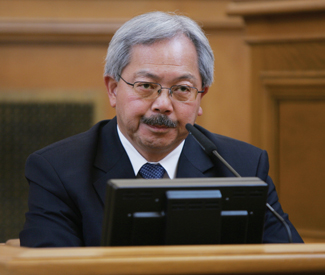
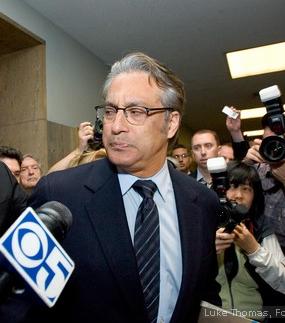
Mayor Ed Lee and suspended Sheriff Ross Mirkarimi each took some lumps on June 29 as they were cross-examined by opposing attorneys in front the Ethics Commission, which is conducting the official misconduct case that Lee brought against Mirkarimi over a Dec. 31 domestic violence incident. But the hearings proved unexpectedly dramatic when the room was suddenly cleared for an undisclosed security threat — following testimony by Lee that a city commissioner alleges included perjury.

The incident raises a number of issues that officials hadn’t yet answered by Guardian press time. Was the security threat real? If so, why wasn’t the room or the rest of City Hall properly secured after the mayor was whisked away? If not, who ordered the room cleared and why?

Undersheriff Paul Miyamoto, who ran against Mirkarimi last year, told the Guardian that the San Francisco Police Department notified his office that a caller claimed to have planted bombs outside of City Hall and on the Golden Gate Bridge. Deputies conducted a search and found nothing, and his office didn’t order the recess of the hearing. “We did not evacuate anyone,” he told us.

Speculation about the incident was heightened during the break when Debra Walker, a Mirkarimi supporter and longtime member of the city’s Building Inspection Commission, told the Guardian that Lee committed perjury when he denied speaking with any members of the Board of Supervisors before filing official misconduct charges. Lee was responding to a direct and pointed question from Mirkarimi attorney Shepherd Kopp — one that that Lee’s attorneys had unsuccessfully objected to.

Specifically, Walker said that her longtime friend and political ally Sup. Christina Olague — who Lee appointed to serve the last year of Mirkarimi’s term for the District 5 seat — had told her repeatedly that Lee had asked her advice before filing the charges against Mirkarimi, and that Olague’s advice was that Lee should ask for Mirkarimi’s resignation but drop the matter if he refused.

That allegation, which was first reported on the Guardian’s Politics blog shortly after the commission went into recess (Olague had not yet returned a call from the Guardian asking whether she had spoken to Lee about Mirkarimi), prompted reporters to confront Olague in the hallway outside her supervisorial office, where she tersely denied the allegation and then took refuge behind closed doors.

When the reporters lingered and persisted, waiting for a more complete answer, Olague finally emerged, reiterated her denial, refused to speculate about why her friend Walker would make that claim, and said, “We’re not allowed to discuss this matter with anyone before it comes to the board…I may have to recuse myself from voting on this.”

It was unclear why she thought recusal might be necessary, but if she does disqualify herself from voting on Mirkarimi’s removal later this summer after Ethics completes its investigation and makes its recommendations to the board, that would hurt Lee’s effort to get the nine votes needed to remove Mirkarimi.

When the Ethics Commission hearing resumed after a couple hours, Lee was again placed in a position of denying specific factual allegations that others have made, again raising the possibility that he committed perjury in his sworn testimony, which could expose him to felony criminal charges while undercutting his moral authority to remove Mirkarimi over the single misdemeanor count of false imprisonment that he pleaded guilty to in March.

The second instance was when Kopp asked Lee, “Did you ever extend any offer through third parties that you would find him another job if he resigned?”

“I don’t recall offering Sheriff Mirkarimi any job,” Lee replied.

Kopp specifically asked whether that job offer had been extended on Lee’s behalf by permit expediter Walter Wong or by San Francisco Democratic Party Chair Aaron Peskin, to which Lee replied, “Absolutely not.”

Mirkarimi supporters have told the Guardian that Peskin had made that offer, which Mirkarimi refused, shortly before the party chair publicly called for Mirkarimi’s resignation. The outgoing message on Peskin’s cell phone said he was unavailable and wouldn’t be checking his messages until July 5. Mirkarimi’s attorneys said they’re still figuring out how to respond to the developments and had no comment, but Walker said she’s willing to testify under oath.

But the dramas underscore the treacherous grounds opened up by these unprecedented proceedings, the first involving the Ethics Commission and the broadened definition of official misconduct placed into the City Charter in 1996. As baseball great Barry Bonds and former President Bill Clinton learned, being forced to testify under oath about sensitive topics can be a tough trap to negotiate.


MIRKARIMI TESTIMONY

Deputy City Attorney Peter Keith also seemed to be trying to spring that perjury trap on Mirkarimi as he took the stand on the morning of June 29 following an hour on the stand at the previous night’s hearing. Keith reminded Mirkarimi that he was advised not to discuss his testimony with anyone and asked, “Who have you spoken to since last night?”

“My attorneys,” Mirkarimi answered.

“What did you say to them?” Keith asked, drawing objections about attorney-client privilege that Commission Chair Benedict Hur sustained.

“Did you stop for coffee?” Keith then asked, seemingly concerned that Mirkarimi may have discussed his testimony with someone at the coffee shop that morning, which Mirkarimi denied. Keith let the allegation go but maintained an accusatory, hectoring tone throughout the next three hours that he had Mirkarimi on the stand, two more hours than he had told the commission he would need.

Much of the time was spent trying to establish support for the allegation that Mirkarimi had dissuaded witnesses and sought to thwart the police investigation, which was triggered by a call from Ivory Madison, a neighbor to whom Mirkarimi’s wife, Eliana Lopez, had confided. But the testimony yielded little more than the city’s unsupported inference that Mirkarimi must have directed Lopez and his campaign manager, Linnette Peralta Haynes, to contact Madison after she had called the police and urged her to stop cooperating with them.

Mirkarimi has maintained that he did nothing to dissuade Madison or anyone from talking to police, and that he wasn’t aware of the investigation or that Madison had made a videotape of Lopez showing a bruise on her arm until hours after the police were involved. He even sent a text to Lopez saying there was nothing he could do, as he noted.

“It was after 4pm on January 4 when I first learned of any of this,” Mirkarimi testified, later adding, “I was very clear to her in saying you can’t unring the bell, we have to follow through with this.”

Yet Lee and the deputy city attorneys who are representing him also maintain that they needn’t prove witness dissuasion or other allegations they have made, and that the Dec. 31 incident and Mirkarimi’s guilty plea to a single misdemeanor count of false imprisonment are enough to constitute official misconduct and warrant his removal, an interpretation that Mirkarimi’s attorneys dispute.

Keith sought to hammer home how Mirkarimi should have admitted to and publicly atoned for his crime right away rather than telling reporters it was a “private family matters” (which Mirkarimi admitted was a mistake) or fighting the charges by trying to discredit Madison publicly, an allegation he denies.

After unsuccessfully trying to get Mirkarimi to admit to directing efforts to question Madison’s credibility in local media accounts, Keith asked, “Did you ever direct anyone not to attack Ivory Madison?”

“I never directed anyone to attack or not attack,” Mirkarimi replied.

Keith also clarified that Mirkarimi denies the allegation Madison made that the physical abuse on Dec. 31 went beyond grabbing Lopez’s arm once in the car, as the couple has maintained. “It’s your testimony there was no punching, pulling, or grabbing in the house?” Keith asked, which Mirkarimi confirmed.

Yet Keith said that given the totality of what happened, Mirkarimi should have known he couldn’t continue on as sheriff. “Under those circumstances, wouldn’t resigning be the honorable thing to do?” Keith said, to which Mirkarimi replied that it’s a hard question and that he’s doing what he thinks is right.

Faced with friendlier questions from his own attorney, David Waggoner, Mirkarimi apologized for his actions, saying “I feel horrible and ashamed,” but that he was “sad and scared” to have his family torn apart against their will. He also said that he believes he can still be effective as sheriff because “what makes San Francisco special is our forward-thinking approach to criminal justice.”

Longtime Sheriff Michael Hennessey — who endorsed Mirkarimi and continues to support him — established a variety of programs emphasizing redemption and rehabilitation, hiring former convicts into top jobs in the department to emphasize a belief in restorative justice that Mirkarimi ran a campaign promising to continue.

“Never in my wildest dreams did I think I would be an example of what this redemption process looks like,” Mirkarimi said, choking back tears.

But Keith had the last word before Mirkarimi left the stand, belittling the idea that Mirkarimi offers an example to follow by noting how much probation time and court-ordered counseling he still has to undergo and asking, “The process of redemption doesn’t happen overnight, right?”


LEE ON THE STAND

Under questioning by Kopp, Mayor Lee admitted that he doesn’t have a written policy on what constitutes official misconduct, that his decisions are made on “a case by case basis,” and that he’s not sure whether conviction of a crime would always constitute official misconduct “because I’ve never confronted this before.”

“Were you aware that many members of the Sheriff Department have criminal convictions?” Kopp asked. Lee said he was not aware. Asked whether he was aware that Sheriff Hennessey had hired a convicted murderer into a top command staff position (see “The unlikely sheriff,” 12/21/11), Lee said he wasn’t.

Lee’s insistence that Mirkarimi’s crime makes him unable to deal effectively with other officials was also attacked by Kopp, who asked, “Isn’t it true that people get elected who have disagreements with other city officials?” He pointed out that City Attorney Dennis Herrera had nasty conflicts with Lee when they ran against each other for mayor last year, but that they’re working well together now.

Kopp also drilled into Lee about his decision to bring official misconduct charges before conducting an investigation or speaking with any witnesses besides Madison — an answer Lee blurted out just as city attorneys objected to the question. Much of Madison’s written testimony has been rejected by the commission as prejudicial hearsay evidence (see “Mayor vs. Mirkarimi,” July 27).

But the public’s perception of this case, if not it’s outcome, could turn on whether Lee is holding Mirkarimi to standards that he himself — as someone appointed mayor on a later-broken promise not to run for a full term — couldn’t meet. It was what Kopp seemed to be driving at before the bomb scare.

“You have asserted in your written charges that Sheriff Mirkarimi’s conduct fell below the standard of decency, good faith, and right action that is impliedly required of all public officials, correct?” Kopp asked.

“Yes,” Lee replied.

“We expect certain things of our elected officials, right?” Kopp asked.

After a long pause, in which Lee appeared to be thinking through his answer, he replied, “That’s generally true, yes.”

“And when the charter speaks of official misconduct, it doesn’t say we expect a certain standard for the sheriff, a different standard for the mayor, a different standard for the DA, a separate standard for the assessor, it just speaks in general terms about official misconduct for public officials, right?” Kopp asked.

Kaiser objected to the question on three counts, sustained on the grounds that it calls for a legal conclusion.

“Do you yourself believe there’s a separate standard for sheriff than for other elected officials?” Kopp asked, and this time the city’s objection was overruled and Lee replied, “It should be the same standard.”

“And would you agree with me that one of the things that is expected of elected officials is for them to be honest and forthright when dealing not only with their constituents, but with other elected officials?” Kopp asked, his final question before Chair Benedict Hur announced that the hearing would be suspended and the room would need to be cleared.

After the hearing reconvened, Kopp drew parallels to other city officials who remained on job after scandals, including former Mayor Gavin Newsom (who had an affair with a subordinate who was married to his campaign manager), former Sheriff Dick Hongisto (who was jailed for refusing to carry out a court’s eviction order), and current Fire Chief Joanne Hayes White (whose husband reported that she hit him in the head with a pint glass).

Asked about the latter case, Lee responded, “I don’t know all the circumstances around that and I don’t believe I was mayor at the time.”


Scandinavian prudishness surprises Extra Action Marching Band

0

By Lasse Lundberg Andreasen
Photos by Pelle Rink

The young festival worker only offers one piece of advice: “Do not enter their hotel room. They are wack. They will flip you upside down and snort coke from your ass. Also, they might be gay”.

The rumours about Oakland’s 27-piece Extra Action Marching Band (EAMB) had arrived in Copenhagen long before the band. EAMB was invited to the Danish capital to perform at the Distortion street festival in early June this year.

Performances by this massive ensemble include a flag team, barely dressed male and female dancers and a bullhorn performer. A combination, which led to some confusion among the audience. “I’m pretty sure one of them was a transvestite”, a woman says out loud after the show, clearly in doubt about the appropriateness of her own statement.

The Bay Area band was somewhat perplexed about the sexual focus. “This is so weird. It’s the second time someone has asked us about homosexuality since we arrived,” says Violet Angell, a drummer in the band.

“Yes, some in the band are homosexuals, others are brothers or someone’s aunt. It’s not an issue for us at all. The time we just spent on this question is the longest time we have ever spent talking about it. Ever. We have started wondering what the Danish people are hiding in their closets”, Violet Angell adds.

In the US, the bands performances spark other kinds of reactions. “After a gig in the US a woman wanted to know why our female dancers was dancing the way they do. She thought it was degrading for the women. I just told her: You got issues – I play music. That’s it”.

One of the founding members of EAMB, Simon Cheffins, explains, “Our performances are not about entertaining. Rather we want to blur the lines between a band performing and an audience passively receiving. That’s why the dancers and musicians get so intimate with the crowd.”

Later in the evening, it’s time for the second act at the festival. However, this time the performance is not in a hotel and the crowd has been drinking for hours.

“We like to play late gigs. People are more drunk”, a band member says just before EAMB push their way into the massive crowd.

A poly push?

0

culture@sfbg.com

QUEER ISSUE Is San Francisco’s polyamorous community experiencing a renaissance? Pepper Mint, organizer of the recent sex education conference Open SF (www.open-sf.org), suspects the non-monogamous in the Bay Area have finally reached a critical mass. His proof? Over the weekend of June 8, OpenSF was attended by over 500 of the poly-curious and practicing.

It might be, however, that they’ve finally found something to relate to. Sonya Brewer, a somatic psychotherapist, OpenSF lecture facilitator, and queer woman of color, has been a practicing polyamorist for 15 years. Brewer pegged the high attendance numbers on Mint’s efforts to diversify the conference and include sexual minorities and other oppressed groups on its planning committee.

Those values were reflected in the conference’s keynote address, delivered by trans-identified sex educator Ignacio Rivera and transgender health educator and social justice activist Yoseñio V. Lewis. The two hosted a lecture entitled “Kink, Race, and Class,” which sought to inspire dialogue about how social forces play into the world of kink. It was one of the many unique talks over the weekend that both celebrated and critiqued the diversity and spread of the polyamorous community.

Looking over the list of lectures for the weekend — “Sex Work and Non-Monogamy,” “Fat Sluts, Hungry Virgins,” and “Trans Queering Your Sex,” to name a few — it was hard to decide which talks to attend.

I settled on two: Kathy Labriola’s “Unmasking the Green-Eyed Monster: Managing Jealousy in Open Relationships” and the Maggie Mayhem-led “Second Generation Poly.” Labriola’s hour-long talk examined jealousy from an anthropological perspective, highlighting it as a universal experience that manifests itself depending on one’s cultural upbringing. The bad news? Jealousy is unavoidable. The good news? It’s a learned behavior, and you can learn to manage it. Labriola provided us with a handy checklist to use in determining whether insecurities are based in fact or freak-out.

“Identify a situation that makes you jealous and ask the questions,” Labriola advised. “One, [do] I have a resource I value very much and I’m fearful of losing? Two, [does] another person wants that resource.? Three, [do] you believe you are in direct competition for something you want? Four, [do] you believe if push comes to shove you will lose out?” Unless you answered yes to all four, she counseled, your jealousy can be worked through.

Mayhem, dressed in a fluorescent orange space suit (a representation of her “out-of-this-world” situation, she said) sat on a panel with her partner in life and in porn Ned (www.meetthemayhems.com) and his polyamorous family: his father, and his father’s second partner — a non-hierarchical term, Maggie was quick to clarify. Maggie and her family discussed negotiating boundaries at sex parties, raising children with more than two parents, and the stigma parents of sex-positive offspring can encounter.

Given the general focus of Open SF, Maggie’s key advice had resonance: “Be the author to your own happily ever after,” she told us.

Fixing SF’s sunshine problems

8

EDITORIAL Open-government advocates are circulating a series of amendments to the city’s landmark Sunshine Ordinance, and a lot of them make perfect sense. In general, the changes bring the law up to date — and deal with the ongoing and increasing frustration over the lack of enforcement that has rendered toothless one of the most progressive open-government laws in the nation.

The advocates are trying to find four supervisors to place the measure on the November ballot. It won’t be easy: Already, the City Attorney’s Office has circulated a memo arguing that some of the amendments conflict with state law or the City Charter.

And in the background, Sup. Scott Wiener is looking to take another approach to open-government, asking city departments to examine the costs of complying with the existing law — which could easily become an argument for loosening the rules.

The new disclosure rules are relatively modest. A policy body would have to release all documents relevant to a decision 48 hours in advance of a meeting. Documents that include metadata — tracked changes and other digital information — would have to be released in full. Regulations on closed meetings around pending legal issues would be tightened.

But the bulk of the changes have to do with enforcing the law — and that’s where the battle lines are going to be drawn. The measure would create a powerful supervisor of public records, appointed by the city attorney, who would be directed to review all denials of public records — and who, by law, would be ordered to “not consider as authority any position taken by the city attorney.” That seeks to address a key shortfall in existing law — the City Attorney’s Office, which (like most law firms) is often driven by privacy and confidentiality, advises city agencies on what records can be withheld, and city officials who refuse to release documents simply say they were following the advice of their attorney.

The proposal would turn the Sunshine Task Force into an independent commission, some of whose appointments wouldn’t be subject to any official review. The commission would have extensive new authority to levy fines on city employees who it finds in violation of the sunshine law and to force the Ethics Commission — which routinely ignores sunshine violations — to take action against offenders.

The idea, of course, is to mandate consequences for violating the Sunshine Ordinance, which is flouted on a regular basis by public officials who pay no penalty and thus have no real reason to comply. But increasing the scope and certainty of punishment is one side of the coin — and if there were better ways to ensure compliance, none of that would be necessary.

In Connecticut, a state Freedom of Information Commission has the statutory authority to require any government agency to release a document or open a meeting. The panel doesn’t punish people; it obviates that whole process. And it would be much, much easier to get beyond the penalties and simply create a legal process that allowed the Sunshine Commission full authority to order public agencies to comply with its rulings. The commission rules that a meeting was illegally closed? Tapes of that meeting must be released, at once. Documents improperly withheld? Cough them up, now. The only appeal city officials would have: go to court and seek a secrecy order. If the supervisors and other city officials think the proposed rules go too far, they can refuse to put this measure on the ballot, but that be ducking the clear and obvious problems. And there’s an easy solution: Give the Sunshine Commission the same power as the FOI panel in Connecticut, which has operated just fine for more than 30 years.

The Mirkarimi case: Did the city want to settle?

132

The real news in the Ross Mirkarimi case isn’t the sheriff attempting to get the city to pay his legal fees; that’s just something he had to try but it was a long shot at best. The story that’s come out in bits and pieces since we broke it is far more interesting:

City Attorney Dennis Herrera, with or without the knowledge of his client the mayor, offered to begin discussions with Mirkarimi around settling the case — and the conflicting accounts of what went on show haw harsh this legal proceding has become.

Whatever you think about Mirkarimi’s actions on New Year’s Eve — and I’ve said many times that what he did was unacceptable — the intensity of the prosecution, particularly in the removal proceding, is unprecedented.

Some of the political fallout is clearly Mirkarimi’s fault. He bruised his wife, got bad advice early on, said the wrong things, and didn’t do enough to repair the damage. But now Mirkarimi’s lawyer is charging that the city attorney used a nasty legal gambit to try to convince the embattled sheriff to resign.

David Waggoner, in a TV interview with KGO’s Dan Noyes, and later in discussions with me, said that City Attorney Dennis Herrera offered to look for a way to keep the video of Mirkarimi’s wife out of the public eye — if Mirkarimi would take a financial settlement and resign from his elected position.

Mirkarimi told me the offer he heard from his lawyer put him in a terrible bind: Franky, the video contains nothing that hasn’t already been out, and won’t be the defining issue in the official misconduct case now before the Ethics Commission. But his wife, Eliana Lopez, was adamant that she didn’t want the 45-second clip on the Internet, where she — and more important, their three-year-old son — will have to live with it forever.

“They were using the needs of my family to pressure me,” Mirkarimi said.

Waggoner was pretty specific about his recollection of the settlement discussions. He said that after Herrera contacted him to say that he was willing to discuss settling the case, Waggoner made it clear that keeping the video sealed had to be part of any deal.

“We hung up, and then he called me back five minutes later to say that his government team was working on it, and he thought they could keep the video under seal,” Waggoner said. “The mayor and the city attorney were using the video as leverage.”

Hererra confirmed that he reached out to Waggoner to see if Mirkarimi’s legal team was interested in settlement discussions. But told me that Waggoner’s story was “absolutely, categorically untrue.” He insisted that he had no choice but to release the video, since several media outlets had requested it under the San Francisco Sunshine Ordinance.

In a statement issued June 8, Hererra attacked not only Mirkarimi but his attorneys:

“Everyone involved in this case was well aware of the City’s legal obligations under the Sunshine Ordinance (which Ross Mirkarimi himself had a hand in drafting).  The City invoked the maximum allowable two-week extension after receiving Sunshine requests for the video, to allow other parties to seek a protective order.  But opposing counsel dropped the ball.  They didn’t get a protective order.  They didn’t seek Supreme Court review.  They didn’t raise the issue at the Ethics Commission hearing.  And as far as I know, [Lopez’s counsel Paula] Canny didn’t even bother to show up at the hearing.  So, I think it’s a little absurd now to be playing martyr.  These are lawyers representing a former lawmaker.  They have no excuse for not knowing the law.”

Wow. Sounds like the usually level-headed Herrera is one pissed-off attorney.

Interestingly, Mayor Lee told Noyes that he didn’t know anything about any settlement discussions. Either that’s false (the mayor could have been instructed by Herrera not to say anything) or Herrera was going ahead without the mayor’s knowledge or permission.

So let’s set aside for the moment the back-and-forth about who’s telling the truth and what was really involved in the negotiations. Here’s what’s not in any serious dispute:

Herrera, representing the mayor, was sufficiently motivated to settle the case before it got to the Ethics Commission that he personally called Mirkarimi’s attorney to see if there was any possibility of finding a way out. Again: Attorneys in the most bitter lawsuits are advised to seek settlement. But this isn’t in court, and no judge mandated a settlement conference.

Which suggests that the city attorney and possibly the mayor would be a lot happier if this case just went away. Maybe Lee doesn’t like the drama. Maybe Herrera thinks it would be best for Mirkarimi and the city to put this in the past and move on.

Or maybe they aren’t sure this case is such a slam-dunk winner.

There’s another interesting twist, too: Mirkarimi told me that he asked the Probation Department for permission to fly to Venezuala to see his son. There were no conditions on his guilty plea barring him from travelling outside of the country (what — they think he won’t come back? That he has run through all of his money and put himself heavily in debt to fight a case that he’s now going to run away from?) But when he made a formal request, it was denied.
That’s right — probation officials refused to let him go visit his son. Forget Mirkarimi — that’s not fair to the three-year-old kid who did nothing wrong at all and is suffering for it.

City attorney responds on sunshine task force attacks

4


B3 note: Here are responses from City Attorney Dennis Herrera to Impertinent Questions from B3 on why the city attorney helped facilitate the supervisorial attack on the sunshine ordinance and task force (See previous B3 sunshine blogs).

Regarding recommended SOTF candidates

Section 67.30 (a) of the San Francisco Sunshine Ordinance provides that the Sunshine Ordinance Task Force’s eleven voting members be “appointed by the Board of Supervisors.”  That same section designates that a total of four members be appointed by the Board from names submitted for consideration by: the local chapter of the Society of Professional Journalists; the League of Women Voters; and New California Media.  I’m informed that when the Board’s Rules Committee conducted its hearing and interviewed SOTF applicants, only one person was recommended for each seat by these entities.  The Rules Committee then continued action on those seats until the entities submitted additional names.  Legally, there is nothing problematic about such a continuance.

Regarding designated seats

Section 67.30 (a) includes specific designations for each of the seats on the SOTF.  It additionally provides that one of those seats be a person with a disability, although it does not prescribe which of the 11 seats be designated to a person with a disability.  I’ll be honest here: I’m not aware of whether Mr. Todd has a disability or not.  But given that the Board still has to fill four remaining vacant SOTF seats, it will comply with the Sunshine Ordinance so long as one of the SOTF seats is timely filled by “a member of the public who is physically handicapped and who has demonstrated interest in citizen access and participation in local government.”

Regarding public comment

Public comment occurs in board committees.  Each SOTF applicant spoke at the Rules Committee, and members of the public had the opportunity there to offer their comments on all of the applicants.  Although the Rules Committee forwarded six recommendations out of committee, the record transmitted to the full Board included the entire file — including all the other applicants.  The City Attorney’s Office has long advised the Board of its authority to amend appointing motions, and to instead appoint someone else, so long as that appointee’s name and application was before the Rules committee, and so long as it was subject to public comment.  That was indeed the case here.  At the committee level, applicants speak; members of the public speak about the applicants; and then public comment is closed.  The committee then decides on its recommended appointments — but public comment is not reopened to comment on the committee’s choices.  

Regarding the role of the City Attorney

With respect to your question about why the City Attorney is “allowing” certain actions by clients, I should briefly address the role of the City Attorney under San Francisco Charter § 6.102.  Beyond the particular set of circumstances addressed in this email, most questions about what the City Attorney “allows” or “disallows” really misinterpret the office’s function.  In many contexts over many years, the office has reiterated that “[t]he City Attorney is not a policy maker.”  (See: http://www.sfcityattorney.org/modules/showdocument.aspx?documentid=953 )  The City Attorney’s Good Government Guide (pages 19-21) addresses at length the role the City Attorney plays in providing legal counsel to the City and its elected officers, commissions and employees (See: http://www.sfcityattorney.org/Modules/ShowDocument.aspx?documentid=686 )  

This office provides legal advice to clients, while also acknowledging that the policy-making authority of the Board and Mayor includes the prerogative to assess for itself the relative legal risks of its actions, understanding that this office will defend its actions “so long as there are legally tenable arguments to support doing so.”  In that sense, the role is no different from that of any lawyer providing advice to a client: attorneys counsel; but clients, ultimately, decide.

Best,
MATT DORSEY
Press Secretary to City Attorney Dennis Herrera

B3 comment: The city attorney has made the case for the task force to get independent legal advice and to bring in an independent attorney to represent the task force. More: It is yet another reason to have an independent attorney as a task force member who is strong enough to go up against the city attorney as appropriate on critical issues.   This was the original reason for SPJ, with its experience in public access and First Amendment issues and litigation, to nominate an experienced attorney. This was the first time the supervisors rejected the SPJ nominee (and nominees from other organizations as mandated by the charter)  without a proper explanation or apology or a nice word of thanks. .He helped Willie Brownism prevail for the first time with the sunshine ordinance and task force.

Fit as a fig

0

le.chicken.farmer@gmail.com

CHEAP EATS On my birthday I saw a lot of water. I took a bath. I drove over the longest continuous bridge over water in the world. It was 90 degrees on the North Shore. I drank a lot of water, used water to wash the fish sauce out of my skirt, and bought a new car.

The Honda Fit! It’s not only the best kind of car to have if you live in a city, it’s the best kind of car. Period. It’s such a good car, I have now bought one twice! And I’ve only ever bought two new cars in my life.

This time it’s a different kind of blue. Less subtle, less sexy, but intensely fun, and even more lickable — in a cotton-candy-y way — than my last Honda Fit.

I left our rental car behind and drove this very shade of blue back onto the Causeway, and back over Lake Pontchartrain. Nothing to look at. Nothing but water, and the road seems to just float on it for 25 miles. It’s like the Salt Flats: terrifyingly boring. And beautiful in its relentlessness, drive drive drive drive drive.

For my birthday, Hedgehog went to wd-50 without me. What the hell, she was in New York, spotting sessions or sessioning spots or some such, and she and her co-writer have to eat, too, don’t they? So while I was eating leftover bad North Shore Vietnamese for dinner, she was sending along pictures of plate after plate after plate of fancy high-falutin’ dishes. I never felt more like a chicken farmer than I did on my 49th birthday.

After dinner I made some popcorn and found Chelsea vs. Bayern Munich on TV. Mother fucking molecular tom-chef-ery, who needs it you got popcorn? Hot dogs …

Vietnamese leftovers.

Egg sandwich.

Oh, hey, this reminds me about Blue Fig, on Valencia Street. Well, technically it was my li’l friend Hoolibloo who reminded me. She and her even li’l’er sis are holding down our Mission digs while Hedgehog and me crash bang boom our way through the home stretch here in New Orleans.

Before I left this last time, Hooli and me dropped onto Blue Fig for lunch or some such. I don’t remember anything. I remember the coffee was good.

I remember we talked about Life, and Careers, how Hooli hoped to produce the theater one day, and I’m pretty sure I encouraged her in this. I’m pretty sure I said, Do what is in your heart, at all costs. Never mind rent.

She wasn’t asking for advice, but — for the record — people do. These days. Me being 49 and all. Maybe this is just the chicken shit talking, but I think I might even have an air of wisdom about me, when there isn’t hay in my hair.

But after the accident, all my memories got erased — except how to make frittatas, oddly enough, since I didn’t know I knew how to make them before the accident. Also worth noting: I didn’t hit my head. At all. So apparently my memories were being stored in my left arm.

Anyway, when wind got back to SF that we were hurting down here, and how, Hooli wrote and said, “Can I help?”

“You can write my review!” I said. “Remember that meal?”

“Blue Fig?” she said.

I said tell me.

“You got the egg sandwich,” she said.

She wrote: I like Blue Fig because the food is very fresh and flavorful. I’ve always been greeted by a smile, she wrote.

She wrote: they cook the food right there in the tiny kitchen behind the counter. It’s all open. It’s fun to watch them. They make the eggs for the egg sandwich on the little burner right behind the cash register.

The first time we went there, she wrote, they were sugaring the pecans for one of the salads, which made the whole restaurant smell so —

Thank you, I wrote. That’ll be enough. I have me a new favorite restaurant. *

BLUE FIG

Mon-Fri 7am-7pm; Sat-Sun 7:30am-7pm

990 Valencia St., SF

(415) 875-9622

Cash only

No alcohol


Landlocked

1

arts@sfbg.com

MUSIC Pavement. That’s all I really associate with Stockton. Personally, I’ve only been there once, few weeks back on my way to Yosemite, and I just drove through — 205 to 120 — stopping once for gas. So pavement all the way. Yet, despite the lack of waves, it’s home to Surf Club, a sunny four-piece that’s recently released its debut EP, Young Love, on Death Party Records.

“It’s not that bad living in Stockton,” says guitarist Eddie Zepeda. “You make the best of it.” Zepeda barely finished this optimistic assessment before bassist Fonso Robles offers a conflicting view: “Uh, it’s pretty bad.” Earlier in the week, Robles had been pulled out of his car, in the middle of the day, and held up at gunpoint. Before taking off, the robber cautioned, “Don’t let me catch you slippin’,” a combined threat and unsolicited piece of street advice.

Early last year, Justin Vallesteros of Craft Spells moved his project from Stockton to Seattle (where he was born), citing the former city’s number one placement on Forbes Magazine’s 2011 list of “America’s Most Miserable Cities” among the reasons. Surf Club’s Frankie Soto, then guitarist for Craft Spells, stayed behind in his own hometown. “It wasn’t really a hard decision. It was Justin’s band, so I was just like go ahead, dude,” Soto says.

There doesn’t appear to be bad blood between the groups: “Justin still comes over and we all jam,” Zepeda says, and a few days after the interview I run into Soto and Robles at the Great American Music Hall, where Craft Spells is opening for the Drums.

Still, after the split, Soto tells me he spent a few months depressed in his room, trying to find his own sound. When he re-emerged it was with Zepeda and Robles, as well as drummer Jose Medina, who the rest of the group insists is its most talented member. “He’s probably the best drummer and guitarist in the band, and he doesn’t even play guitar for us,” Soto says.

With individual experience in a variety of other bands, the four switched around on instruments, trying to find the right configuration. Medina went from bass to drums, Soto took on vocals in addition to guitar, and Robles — in a Tina Weymouth move — started learning bass from the beginning.

When the band first started coming together, Zepeda had been listening to a lot of surf rock and Beach Boys. It’s certainly an influence on the sound of material released so far, but they didn’t set out or plan to be a Dick Dale revival band.

“I can’t even swim,” Soto says, in a moment of irony recalling Brian Wilson’s fear of the water. “Of all the band names, Surf Club just seemed the easiest to hear.” (Robles angled for Faucet Water, presumably in reference to Stockton’s E. coli contamination warning a couple years back, and Youth Wave was another aquatic option.) “I don’t consider us a surf band. It’s just pop, and that’s what we focus on for all of our songs,” Soto asserts.

True to its name, Young Love is full of open-hearted lyrics with youthful longing. In addition to vocal harmonies, the biggest surf aspect is the tidal wave tempo, where bouncy guitar rhythms get carried by the super tight drumming, speedy fill, and shifts in patterns that reveal Medina’s background in metal and jazz. Soto sings with a light voice, and comes off as a bit of a tender softy. “I guess I’m still kind of shy,” he explains, “I took choir in high school, but it’s still kind of weird being in front of everyone with them paying attention to what you’re saying.”

Barely in their twenties, friends since fifth grade, a band for less than a year, with less than a dozen shows performed so far, Surf Club is clearly still figuring out how to make it work.

As Zepeda puts it, “we’re pretty young, we really don’t have any money, and we all have bills to pay.” That’s the point where people might give you advice, besides slippin’ or not slippin’. When they played with the Soft Pack a couple months back, singer Matt Lamkin gave them some. “He was telling us to move out of Stockton,” Soto says. But ignoring that kind of advice has worked so far.

SF Popfest Day 2

With Surf Club, Kids On A Crime Spree, Manatee, Dead Angle, Cruel Summer

Sat/26, 4pm, $10

Knockout

3223 Mission, SF

(415) 550-6994

www.theknockoutsf.com

SF-born legend Terry Bozzio on UK’s reunion, his dad’s accordion, and the importance of drum lessons

1

Bay Area-born and raised drummer extraordinaire Terry Bozzio (who plays the Regency Ballroom Fri/18 with reunited band UK) has performed with Frank Zappa, Missing Persons, Jeff Beck, Fantomas, and a host of other musicians over the years. Recognized as one of the best modern drummers, he has recorded a variety of instructional videos, been honored by Guitar Center’s RockWalk in Hollywood, and has created some of the most insane custom drum sets ever seen on stage.

Bozzio’s amazing talents will be on display live tonight as he performs with the reunited prog rock super group UK — with whom he originally played from 1978 through 1980 — which also features John Wetton (King Crimson, Asia) and Eddie Jobson (Frank Zappa, Roxy Music).

Born in San Francisco, Bozzio’s family moved to Marin County when he was in third grade. His father had been a child musical prodigy, playing the accordion on stage in San Francisco when he was only four years old, and continued to occasionally play when he was older and had a family.

“People would come over for a Sunday dinner, and they’d beg him to play the accordion — he would begrudgingly pull it out, but within a few chords he would silence the room, he could just hold them in the palm of his hand,” says Bozzio over the phone during a recent tour stop in Portland. “To witness that power was something I was very jealous of at an early age, and now having experienced being able to do that — so I’m told — I credit him with having inspired it.”

When Bozzio started playing a musical instrument himself a few years later — the drums — his father would often give advice to him and his band mates when practicing in one of his first groups, Blue Glass Radio, a combo comprised of friends from middle school. “I was pretty much a rock’n’roll, play by ear kind of guy until I took six months of drum lessons which were very, very key and important for me, when I was 15 or so,” says Bozzio.

“My last year at Drake High School I started to study music seriously, and continued to study jazz and classical at College of Marin; I graduated from there with a commercial music degree — just an A.A. degree — but that was enough to prepare me for what was going to happen within a very short time.”

Bozzio soon began playing a wide variety of musicians, in many different styles, and after some time found himself with a reputation as being one of the best drummers in the Bay Area, which eventually led him to being asked to join Frank Zappa’s band. From there, Bozzio has gone on to perform with an incredible amount of world-class musicians over a nearly four decade long career.

With this UK reunion, Bozzio says he is having fun looking back and re-examining that particular portion of his musical legacy.
“I’ve always been proud of that music, and I think both John and Eddie are tremendous musicians with a great history in rock’n’ roll, making great contributions. When you listen back to some of this stuff, it impresses you because you kind of listen with fresh ears.”

Performing at the Regency Ballroom in San Francisco will have a special hometown meaning for Bozzio — he saw his first rock concert at the Avalon Ballroom, which was what the venue was called in its first incarnation back in the ’60s.

“My dad and my uncle took me down, I remember clearly, we saw It’s A Beautiful Day, Canned Heat, and Vanilla Fudge. I’ve never been back, so this will be the first the first time since 1965 that I’ll be there!”

With UK set to play in Europe and Japan after the U.S. leg of the tour is finished, Bozzio’s schedule shows no signs of slowing down, and the talented musician is grateful for the opportunities he’s been given.

“The power of music is a very spiritual and amazing thing—I’m 61, and for almost 40 years I’ve been making a living as a musician, without having to get a day job—I consider myself very lucky, the stars have been lined up for me.”

Terry Bozzio with UK
Fri/18, 8pm, $65-$99
Regency Ballroom
1290 Sutter, SF
www.theregencyballroom.com

Sex Talk with Princess Donna: Squirting and the ass icon

1

You have to have communication skills if you’re going to responsibly wield the amount of sexual power that Princess Donna holds in her sexy little hands in the depths of the Mission District’s very own porn palace, Kink.com. The director-actor of such sites as Kink’s Ultimate Surrender, Bound Gang Bang, and Public Disgrace knows about expanding sexual horizons — which is why it’s so rad we’ve tapped her for this new love and sex advice column.

Submit to it! Really — the email address where you can send questions of your own is at the end of this post. 

Dear Donna, 

I’ve heard a lot about female ejaculation, but I haven’t seen much evidence of it in real life. Is this something that anyone with a vagina should aspire to?

Signed, Hot Springs

Dear Hot Springs,

I am not in the business of telling people what specific sexual acts they should aspire to. I think what’s important is finding out what fulfills you sexually and doing that. So yes, if squirting is something you think looks fun, go for it!

I personally think squirting orgasms are rad. As for the conversation about whether it is piss or ejaculate I would like to quote my dear friend Jeremiah Finklestein Brown, “I don’t care if it’s chicken salad coming out of there, it’s still awesome!”

xo, Donna

Dear Princess, 

I am from Turkey. 33 years old a doctor. I love your movies but it is very hard for me. Because i want to have sex only with you.

I have never fuck an ass, but after your movies sex is only your ass for me. I am far away, but i must fuck u. Please answer me anything. I need you.

Dear Turkish doctor,

Hi! I don’t see a question in there, but it seems you have excellent taste in women.

xo, Donna

DON’T MAKE DONNA RELY ON LOVESICK TURKISH DOCTORS FOR MATERIAL — ASK HER A QUESTION YOURSELF! Sex, love, a combination of the two, a lack of both? Email sextalkwithprincessdonna@gmail.com for the best possible solution


City case speculates about Mirkarimi’s interference with investigation

111

The City Attorney’s Office laid out much of its case against suspended Sheriff Ross Mirkarimi yesterday when it released a list of witnesses and their expected testimony, as requested by the Ethics Commission, and it offers little support for the city’s accusation that Mirkarimi dissuaded witnesses or sought to destroy evidence of a crime, which are among the most serious allegations in the official misconduct case against him.

The longest and most significant section in the brief was the testimony of Ivory Madison, the neighbor who initiated the police investigation into whether Mirkarimi physically abused his wife, Eliana Lopez, during a Dec. 31 incident that she subsequent reported to Madison, who made a video of her story and a bruise on her arm.

It was the most detailed account yet of what happened from the perspective of Madison, who has refused media interviews, and it differs in some key areas from accounts that Mirkarimi gave to the Guardian and other media outlets.

For example, Mirkarimi said he grabbed his wife’s arm in the car during a heated argument and that tempers had cooled by the time they went inside. But Madison is expected to testify that, “Inside the house, Sheriff Mirkarimi pushed, pulled and grabbed Ms. Lopez, who was crying and screaming, as was their son. Ms. Lopez asked Sheriff Mirkarimi to stop, and said look what you’re doing to our son. Ms. Lopez then ran out of the house. While both inside and outside the house, Lopez was yelling, do you want me to call the police. When Ms. Lopez yelled about calling the police while outside, Sheriff Mirkarimi said no, come inside. Ms Lopez went back inside.”

It is unclear from the memo whether Madison was a direct witness to those events or whether they were relayed to her by Lopez, but it sounds like the latter given that the story is in a paragraph that began with the phrase “According to Ms. Lopez.” Since the incident, Lopez has consistently denied that Mirkarimi abused her and downplayed the conflict. The only other neighbor on the witness list, Callie Williams, wasn’t at home during the conflict, but she’s expected to testify that Lopez told her about that and an earlier instance of abuse and that “Sheriff Mirkarimi was scared that she was going to tell people what happened.”

While Madison’s expected testimony confirms Lopez’s account that the video was made to be used in the event of a child custody battle if the couple divorced, Madison’s account paints Lopez as actively worried about her safety: “Ms. Madison suggested calling the police. Ms. Lopez was afraid that the police would not believe her and would not protect her from Sheriff Mirkarimi, and was concerned about what the police could do to protect her.”

It also confirms what journalist Phil Bronstein, a friend Madison called for advice, told the Guardian about Madison’s initial call to police being a simple inquiry and that she didn’t intend to initiate a police investigation just yet. And it indicates that “Ms. Lopez was unhappy about the investigation. Ms. Lopez called Linnette Peralta Haynes (Sheriff Mirkarimi’s campaign manager in the November 2011 election) on her mobile phone. After speaking with Ms. Haynes, Ms. Lopez handed her phone to Ms. Madison. Ms. Haynes attempted to dissuade Ms. Madison from cooperating with the police and attempted to persuade Ms. Madison to lie to the police.”

Yet there is nothing in Madison’s expected testimony to indicate Mirkarimi was behind any of these efforts, and he denies it and says that he wasn’t even aware that Lopez had talked to Madison or made a video or that police had been called at that point. Peralta Haynes, who sources say is in the late stage of a difficult pregnancy, hasn’t cooperated with the investigation so it’s obviously speculative on the city’s part to indicate that she was acting as Mirkarimi’s “agent” in thwarting the investigation, as the city is claiming.

The only “evidence” that the city seems to offer in support of its accusation that Mirkarimi tried to thwart the criminal investigation comes from Madison’s husband, Abraham Mertens, who is expected to repeat the claim he first made in a controversial March 20 op-ed in the San Francisco Chronicle that, “During the time that SFPD inspectors were interviewing Ms. Madison on January 4, Mr. Mertens received a telephone call from Eliana Lopez urging him to make Ms. Madison stop talking to the police. Mr. Mertens heard Sheriff Mirkarimi’s voice in the background,” a more resolute version than Mertens had previously given when he wrote in the op-ed: “I recognized what I thought was Ross’ voice in the background.” Mertens also has not answered Guardian calls.

Mirkarimi categorically denies that he was present during that phone call and says that he was in meetings at City Hall and that he wasn’t aware that any of this was happening at the time. And he has denied urging Peralta Hayes to get involved, but her testimony could evolve into evidence if the city can show they talked before she spoke to Madison, but that’s still speculative. The city is seeking live testimony from Peralta Haynes about her communications with Mirkarimi on Jan. 4 and before.

During the recent Ethics Commission hearing on setting up procedures for the hearing, Mirkarimi attorney Shepherd Kopp noted that the city hadn’t done key interviews or collected physical evidence (such as phone records or the Lopez video) to support its charges against Mirkarimi before making its allegation, something that Deputy City Attorney Peter Keith didn’t dispute, noting that the the city had not yet received much of the evidence that it intends to present, such as the video.

The city appears to be banking on compelling incriminating testimony from Lopez and Mirkarimi, who they plan to treat as hostile witnesses. The other interesting name on the city’s witness list was Mayor Ed Lee, who the city is recommending give live testimony and who could also likely be subjected to a vigorous cross-examination that could have interesting political ramifications.

Sex Talk with Princess Donna: Sugar daddies and the perils of bromance

1

One might imagine that there is hardly a personal entanglement that Princess Donna, director and star of Kink.com‘s Public Disgrace, Bound Gang Bangs, and Ultimate Surrender sites, can’t handle with a strong wrist and flogger. While that may be true, the BDSM power player is also a master of the kind of communication involving words. And unlike your standard sex advisor, she’s that frank kind of sex-positive feminist that can help with whatever you want to do in bed (/dungeon) that is safe and consensual. And be real sexy through the processing, to patent leather boot. We had to give her her very own Guardian sex advice column.

Dear Princess,

How do you get a sugar daddy or mommy? And once you get one, how do you keep them happy?

Signed, Broke’s Not Cute Anymore

Dear Broke,

I’ve never personally had a sugar mommy or daddy, but I do know that there are websites out there were you can find them! As far as keeping them happy goes, I’d tell you the same thing that I’d tell you for any relationship, communicate! Talk about what your expectations for one another are, set boundaries, etc.

My other advise for you would be to think about exactly what kind of relationship you want before seeking out your sugar parent. Are you looking for love and someone to take care of you financially, or are you looking to exchange sex for money in a more straight-up way?

As the name implies, these kind of relationships can have a built in power dynamic as one person financially supports the other. Be sure that you have thought about what that implies and that that is truly what you are looking for!

xo, Donna

Dear Princess,

My brother and I have a lot of the same, amazing, sex-positive friends. The chances that we may find ourselves at the same sex party are high — what can we do to avoid weirdness (and incest) between the two of us?

Sincerely, Family Fun

Dear Family Fun,

Avoiding incest should be pretty easy, just don’t get it on with each other.

As far as avoiding weirdness, the first step is to establish what you think is weird. Is it weird for you guys to bang in the same room? Is it weird for you guys to share the same sex partners? Is it weird just to be at the same sex party? Once you have established exactly what makes you uncomfortable you can set boundaries. I know, I’m boring. I’m all boundaries and communication over here…

The only thing is that, in my experience sex parties can often occur spontaneously, so you are going to want to establish the ground rules before you find yourself in a potentially awkward situation. You don’t want to happen upon an awesome sex party and spend the night fighting with your twin when you could be getting laid!!

xo, Donna

>>IF YOU HAVE A QUESTION for Princess Donna on sex, love, or a combination of the two, email her at sextalkwithprincessdonna@gmail.com


The Bay Citizen divorces NYT to marry CIR

2

This Sunday is the last day The Bay Citizen – the nonprofit San Francisco newsroom started two years ago by Warren Hellman, the local philanthropist who died in December – will be producing content for The New York Times, as it has been doing throughout its existence. The question now is what are Bay Area citizens losing and what are we gaining?

The Bay Citizen was taken over by the Berkeley-based Center for Investigative Reporting, creating the country’s largest nonprofit news organization, a merger that will be completed next week. Under the direction of veteran local journalists Phil Bronstein, Robert Rosenthal, and Mark Katches, the combined newsrooms won’t be covering breaking news or press conferences, focusing instead on investigations and “accountability journalism” delivered under those two brands and CIR’s California Watch, in collaboration with newspapers and broadcast outlets around the state (read our previous stories for more details on each entity).

“In the end, how does journalism survive and how do you define journalism?” Bronstein told us, relaying the questions his organization is trying to answer. “We’re betting on the idea that quality journalism is something people are willing to pay for.”

But with CIR focused on an inclusive model of partnering with news outlets to do deep reporting and widely offering the resulting work, and The Bay Citizen providing content to The New York Times under an exclusive contract, the new entity decided to end that contract and focus The Bay Citizen on CIR’s mission.

“The Bay Citizen has done a lot of things really well – accountability, watchdog journalism – but they’ve also done breaking news and tried to do too many things,” Katches, the editorial director for the merged newsrooms, told us. “We want to figure out what our lane is and stay in it.”

CIR, with a 35-year history of award-winning investigations, undoubtedly has strong journalistic chops and a talented team of reporters. Its “On Shaky Ground” series on the seismic vulnerabilities of schools throughout the state won a number of big awards and was a finalist for this year’s Pulitzer Prize in Public Service. But in many ways, this is the biggest and best newsroom that most people have never heard of.

“People on the street might know The Bay Citizen, but not the Center for Investigative Reporting,” Bronstein said. That was something that he hoped the merger would help compensate for, with CIR also benefiting from the base of donors and technological expertise that The Bay Citizen had developed.

“CIR isn’t the brand, its stories are the brand, which it distributes to scores of publications,” said Peter Lewis, an longtime journalist who joined The Bay Citizen at its inception.

Lewis spent 18 years with The New York Times and seven with Fortune magazine, then he studied and taught journalism and new media at Stanford University before joining The Bay Citizen. During merger talks, he advocated for a marriage of equals and was “disappointed” that CIR took the lead role, and that it subsequently didn’t create a position for him (veteran local reporter John Upton and a few others were also let go).

While Lewis said that The Bay Citizen has had about eight times the Web traffic as CIR, which is pretty astounding given the age difference in the two entities, it’s unclear how much of The Bay Citizen’s brand identity – something that Rosenthal and Bronstein cited as an important component of the merger – had to do with its now-severed relationship with the Old Gray Lady.

“The decision was made to launch The Bay Citizen simultaneously with The New York Times relationship. That gave it an instant cache and respectability that most startups don’t get,” Lewis said, but it was a “double-edged sword” that also strained the resources of the nascent newsroom to the limits of its capabilities.

“To be honest, The Bay Citizen never reached its potential. It never had time to establish its own voice,” Lewis said. And now that the decision was made to eliminate much of the focus that it has had, covering breaking news and local happenings, Lewis says he unsure what it will mean: “Anytime you reduce coverage, it’s not good for citizens, but they’ll be doing a different kind of journalism.”

Rosenthal said he’s excited about the merger’s possibilities, drawing on the strengths of each entity, but that it will be a work in progress. “It’s going to be a very inclusive model, and it’s going to keep evolving,” he said. “The real measure is not three to six months, but looking at this a year from now will be very interesting.”

“It’s uncharted territory for both of us, but there’s an air of excitement,” Katches said. “We may do some things that are fabulous and some things that flop.”

He said the decision to drop The New York Times was the result of “a thoughtful process,” and they ultimately concluded, “We feel like we can reach even more readers in the Bay Area in a non-exclusive way…If the goal of your work is impact, then you broaden the impact if you broaden your readership.”

The model has worked well at CIR and its California Watch project, which has sought to beef up statehouse coverage that had been waning for years. Katches noted that the “On Shaky Ground” series had the impact it did precisely because it ran in so many media outlets around the state (many of which did localized stories based on the research) and reached millions of readers and viewers.

But CIR wasn’t as successful as The Bay Citizen in creating a stable, long-term financial base. Starting with Hellman and a handful of his wealthy friends, The Bay Citizen sought donations from a wide variety of sources that totaled more than $15 million. By contrast, CIR had limited term foundation funding for a staff of talented journalists.

“How we sustain that and can we do it long term was not something we thought out,” Bronstein (president of the CIR board) said of the efforts he and Rosenthal (CIR’s executive director) made to beef up CIR’s newsroom with foundation funding a couple years ago. “We didn’t have a business structure, we had a journalism structure.”

As newspapers have been hurt by the Internet and corporate consolidations and cuts, Bronstein said said the mission of news organizations has never been more vital.

“With fewer journalists, everything is harder, but it also becomes more important,” he said. Bronstein said the basic question that their journalists will address in San Francisco are: “Who are the people controlling our lives and how are they doing it?”

We spoke to Bronstein on the same day that the Guardian announced Publisher Bruce Brugmann is stepping down from day-to-day operations and that we’re negotiating the Guardian’s sale to a consortium that also owns the San Francisco Examiner. Despite a history of clashes between him and the Guardian, which has always done media coverage and often criticized Bronstein and his newspapers, he had only positive things to say.

“You cannot underestimate Bruce’s affect on San Francisco,” Bronstein said, calling him one of the most influential San Francisco journalists of his era.

“I have a lot of respect for Bruce. He’s yelled at me, like everyone else – it’s a rite of passage in San Francisco. But you’ve stuck to your ideological roots,” he said.

As for advice to the Guardian during this period of transition, Bronstein offered a few questions to ponder: “Can you afford to stick with the base of readers you’ve got? Can you be more digital? Can you give readers more than you’re giving them?”

While he was the editor of the Examiner, Bronstein said his mantra to reporters was, “You have to have an intense curiosity about things and an open mind.” It was something that fit his own belief about the world he was covering.

“Life is never like Walt Disney,” he said, eschewing the idea that there are clear heroes and villains. “The truth is more complicated, but also more interesting.”

“This was such a wipeout psychologically”: Mirkarimi tells the story Lee didn’t want to hear

89

As Ross Mirkarimi and his legal team prepare for a trio of legal hearings that could determine the future of his career, the suspended sheriff sat down with the Guardian for nearly two hours in his first extended interview recounting what happened during that fateful New Year’s Eve conflict with his wife, their actions in its aftermath, and whether any of it should cost him his job.

As the story continues to unfold, and the facts come out, it’s becoming more and more clear that neither of two central players – Mirkarimi’s wife, Eliana Lopez, and the neighbor who called the police, Ivory Madison – had any idea how this would play out, or, apparently, any desire for the incident to bring down the elected sheriff.

Mirkarimi has been in a bind for much of the last four months: Because of a pending criminal case, he hasn’t been able to tell his side of the story. And since he pled guilty instead of going to trial, his version of events is only now beginning to trickle out.

And the interview made clear that the man who has in the past been accused of arrogance has lost a lot of his ego.

“This was such a wipeout psychologically,” Mirkarimi said. “It makes me immensely insecure and has left me in vulnerable state.”

He looks it – the elected sheriff’s face is drawn, almost haggard. His once-frequent smile and laughter is almost gone.

>>Read our full Mirkarimi coverage here.

He’s a politician who freely admits he had marital troubles, was in some ways a bad husband, treated his wife poorly and, in an incident sparked by his own anger, physically hurt her. He knows he’s let down his supporters and damaged his once-bright political future.

He’s struggling to keep his job, arguing that the incident has been blown out of proportion and inappropriately used to remove him from elected office, with Mayor Ed Lee showing a reckless disregard for the truth before making the rare decision to institute official misconduct proceedings.

And you don’t have to endorse Mirkarimi’s actions or even agree that he should stay in office to find indications that the mayor’s case against him is shaky and at times clearly unfair.

Judge Harold Kahn will hear arguments today [April 19] that the City Attorney’s Office should be barred for overseeing the official conduct proceedings, and the next day he will hear Mirkarimi’s main challenges to Lee’s actions, including the arguments that the city’s official misconduct statute is unconstitutionally broad and that Mirkarimi was denied due process before being suspended without pay.

Then, on April 23, the Ethics Commission will convene to discuss procedures for handling the case.

Some key issues that could affect the outcomes of the city and court processes involve what Mirkarimi actually did – as opposed to what others have suggested he did. The whole thing may hinge on whether the sheriff did anything to hinder the domestic violence investigation, what his plea deal to official misconduct entailed – and whether the mayor made efforts to differentiate between fact and rumor.  

But let’s start at the beginning, just before lunchtime on New Year’s Eve, with a story that Mirkarimi told in great detail as we peppered him with questions seeking details on what happened, what his motivations and thoughts were at critical junctures, and what it all meant.

Around 11:45 am on Dec. 31, Mirkarimi, Lopez, and their nearly three-year-old son, Theo, got into their red 1998 Dodge Caravan to go to lunch at Delfina Pizzeria. Just before leaving their house on Webster Street, the couple had started talking about how Lopez wanted to take Theo on a trip to her native Venezuela to visit her father, who is battling cancer.

“It was not an unfamiliar topic,” Mirkarimi said, recounting how it had become an issue of increasing concern by him after her three previous trips had each been extended. They had been having marital problems, and he told us he was concerned that she might not come back – or that Theo could be at risk of kidnapping.

“We didn’t have a plan and there was no permission,” Mirkarimi said, with “permission” meaning his written permission to take their son out of the country, which he had learned from a lawyer was required. “The body of our quarrel on Dec. 31 is we need a plan.”

But Lopez told him in the car than she had also talked to an attorney and she contested that it was as clear-cut as Mirkarimi claimed. He later learned that the “attorney” Lopez was referring to was their neighbor, Ivory Madison, a writer who had attended law school and noted her “legal training” on the www.redroom.com website she ran with her husband, lawyer Abraham Mertens. But Madison hadn’t taken the bar exam and wasn’t licensed to practice law in California.

“This was a sucker punch, it really walloped me,” Mirkarimi said of the news that Lopez was speaking with an attorney, and it made him angry. “I was acting inappropriately, I swore at my wife and said ‘where is this coming from?’ So I could have handled it better.”

“I decided, because we were quarreling, to make the unilateral decision against Eliana’s wishes to turn the car around,” he said.

This, he contends, was the act that constituted false imprisonment, the misdemeanor charge that he pled guilty to last month in exchange for prosecutors dropping misdemeanor charges of domestic violence, dissuading a witness, and child endangerment. Mirkarimi contends this was the only point in their conflict in which he restrained his wife’s freedom. Other reports suggest that he didn’t let her leave the house shortly after the conflict, which he denies.

Mirkarimi’s criminal attorney, Lidia Stiglich, told us false imprisonment is a very broad term, and because it was such low-level charge, there wasn’t a specific action it covered. In other words there’s nothing factual in the legal record or anywhere supporting the notion that Mirkarimi actually held his wife against her will.

“You don’t need to agree to a factual basis to plead to a misdemeanor,” Stiglich said, noting that Mirkarimi’s interpretation is reasonable, but prosecutors might mean something different by it. “We can agree to disagree,” she said, although she acknowledges that vagueness has opened him up to a variety of interpretations in the political arena.

In other words, the notion that a sheriff, who oversees the jails, has pled guilty of false imprisonment looks just terrible, and has been been played up in the press. But it’s not clear that he actually imprisoned anyone, beyond refusing to take his wife and son to lunch. It’s an oddity of law, and the nuance doesn’t play well in a scandal-crazed media.  

But back to the day of the incident.

“I was loud, I was gruff, I was just pissed off, and I am ashamed of my behavior,” Mirkarimi said. By the time they got back home, the sheriff-elect had calmed down, but Lopez was getting increasingly angry at being mistreated.

He said she quickly got out of the car and was brusquely trying to remove Theo, who was crying and upset over his parents’ conflict, from his car seat. “I got scared because Theo was in danger a little bit,” he said, his voice choking up and eyes filled with tears, saying that he reached back and grabbed Lopez’s right arm, with three fingers under her arm, while he was still seatbelted into the front seat.

“Eliana reacted like, get away from me, and she tugged her arm,” he said. “The incident was minutes.”

Inside the house, tensions quickly de-escalated, he said, and they didn’t discuss the conflict again that day. They went grocery shopping together, brought home takeout for dinner, and Lopez went out briefly that night while Mirkarimi stayed home with their son.

But the next morning, she showed him the bruise that had formed on her right bicep where he grabbed her. “She said, ‘Look,’ and it just crushed me,” Mirkarimi said, adding that he apologized for hurting her and that he agreed to go to couples counseling.

Lopez had been asking her husband to seek counseling for some time, he acknowledged, and he’d been putting it off. “I take full blame that that didn’t happen earlier,” he said.

Then, mid-morning, Lopez told him that she was going to talk with their neighbors, Madison and Mertens, who Mirkarimi considered “nice people. They were supporters during my race, but I didn’t know them that well.” He said that he didn’t think much of it or worry that she might talk about the previous day’s incident, although he said he did make the connection after she left that perhaps this was the “lawyer” Lopez has referred to the day before – something she later confirmed.

From Mirkarimi’s perspective, the next few days were uneventful. The family left for a long-planned vacation to Monterey the next day, staying at the Intercontinental Hotel and taking Theo to the Monterey Bay Aquarium. He said they talked “a little” about their New Year’s Eve conflict. “We were trying to gauge each other and our comfort level in talking about this,” he said. 

But Mirkarimi didn’t know about the storm that was brewing. He said he had no idea that Lopez had heeded Madison’s suggestion on Jan. 1 to make a video in which Lopez tearfully recounted the grabbing incident and displayed her bruise. Lopez, a former Venezuelan soap opera star, has consistently denied publicly that Mirkarimi ever abused her and has said, directly and through attorney Paula Canny, that the video was intended solely to be used in child custody proceedings if their marriage continued to devolve and that Lopez assumed she was getting legal advice and that the communications were private and subject to attorney-client privilege.

But Madison, who has not returned calls from the Guardian or other media outlets, wrestled with whether to go to the police and sought counsel on the question from several people, as information obtained by Mirkarimi’s team during discovery showed, including Phil Bronstein, the former editor for the Examiner and Chronicle who now chairs the board of the Center for Investigation and Bay Citizen.

Madison had two phone conversations with Bronstein, the veteran journalist told us. He said he knew Madison socially and “she gave me a brief narrative of the events.

“I said you should do whatever you think you should do to keep Eliana safe,” Bronstein told us.

Bronstein said he doesn’t know what happened between Mirkarimi and Lopez, but he understood from Madison that she was acting on behalf of Lopez, that the two women were communicating by text and e-mail, and that “I got the impression that Eliana was still trying to figure out what she wanted to do.”

“Eliana was continuing to e-mail with Ivory, saying he was being nicer now,” Bronstein said, but Madison was still concerned enough that she didn’t want to let the incident go, so Bronstein said she decided to call the San Francisco Police Department on Jan. 4 to get information on whether domestic violence incidents could be reported several days after they occurred, a decision he learned about after the fact.

“Ivory called the police hotline hypothetically to get information on when they can file,” Bronstein said, recounting a phone conversation they had on the afternoon of Jan. 4. But he said Madison was told by police that she could be charged with obstruction of justice for not reporting a crime – which isn’t exactly true under California law – and that SFPD had sent officers to her house to discuss the matter.

Shortly after that visit from police, Madison called Bronstein to tell him the story. “She was surprised that an inquiry had triggered a police investigation,” Bronstein said. Madison’s initial refusal to turn the videotape over to police, who needed a court order to seize it, is another indication that perhaps she didn’t want this case to explode the way it did.

In one version of events that Bronstein has discussed, Madison told him she wanted to help Lopez get in touch with three people who might be able to talk to Mirkarimi and convince him to seek counseling. Madison asked Bronstein if he had phone numbers for Aaron Peskin, Mike Hennessey and Art Agnos.

The odd thing about that is that Lopez already knew the three, and that their contact information was in the couple’s house.

But Mirkarimi had no idea any of this was going on, or even that his wife had discussed their conflict with Madison and made the videotape. “Everything happened on the 4th of January and literally I was the last one to know,” Mirkarimi told us.

Months later, Mertens wrote an op-ed for the Chronicle (“A neighbor’s side of Ross Mirkarimi case,” 3/20) in which he alleges Mirkarimi “paid a team of lawyers to relentlessly attempt to discredit, dissuade, and harm my wife,” although he didn’t return Guardian calls seeking comment or clarification of what he meant.

“The last time I spoke to Eliana was when she called me on Jan. 4. I recognized what I thought was Ross’ voice in the background as Eliana pressured me to destroy evidence and lie to the police. Then she repeatedly called Ivory, demanding that Ivory destroy the video, e-mail and texts from Eliana about the incident,” Mertens wrote. The allegation was parroted in the city’s official misconduct charges against Mirkarimi, which claim he “or his agents” sought to destroy evidence and obstruct the investigation.

But Mirkarimi and his lawyers say the charge is simply untrue. “The idea that he sought to get the videotape back or destroy it is nonsense,” Waggoner said, noting that Mirkarimi wasn’t even home as these events unfolded – on that fateful January day, he attended a ceremony marking the demolition of the old jail and then was in a long Budget Committee meeting, followed by a farewell celebration from the Local Agency Formation Commission. In other words, he couldn’t have been “in the background” during that call.

In fact, as far as we can tell, there is no evidence anywhere that Mirkarimi ever contacted Madison or Mertens. “I never talked to Ivory Madison and I never talked to her husband, Abraham Mertens, after any of this happened,” Mirkarimi said.

Mirkarimi said that Lopez first told him that she had told Madison about the grabbing incident by phone on the afternoon of Jan. 4, shortly after Madison told her in the street that she had called the police and they were on the way. Lopez didn’t know what to do and wanted to come meet her husband near City Hall. The officers that came tried to talk to Lopez, but she refused.

“She was panicked because she thought things were getting out of control with this neighbor and she asked for my recommendation,” Mirkarimi said, noting that Lopez literally ran from their home to City Hall and met Mirkarimi outside on Grove Street. It was then, he said, that Lopez first told Mirkarimi about making the videotape.

Mirkarimi said he greeted the news with stunned disbelief, and that his first instinct was to try to help his panic-stricken wife, but that he didn’t know what to do. “She was petrified about what was going on…She was frantic and I was getting frantic too,” he said. “I didn’t have a remedy, except oh my God, I think we need an attorney.”

They made a couple calls to find an attorney, and he said Lopez had the idea of having their friend, Linnette Peralta Haynes, a domestic violence advocate with the Our Family Coalition, reach out to Madison about why she had gone to police and what could be done at that point. “I had no idea what they were going to talk about,” Mirkarimi claims. Peralta Haynes didn’t return our calls and she is reportedly being sought as a witness by the City Attorney’s Office in the official misconduct proceedings.

Mirkarimi is adamant that he never did anything to gain possession of the videotape, dissuade his wife or any other witnesses from talking to police or prosecutors, or otherwise interfere with the investigation, even though Lopez was appealing to him to do something.

“She really wanted me to stop it, and I was like, dear, this bell has already rung and I don’t think we can unring it,” Mirkarimi said.

Lopez has said publicly that she felt betrayed by Madison, and Canny filed motions to suppress the video on the grounds of attorney-client privilege, conflicts that seem to have soured the relationship between the two women and fed feelings by Mertens that Madison was wronged for doing the right thing during the media circus that followed.

As a result, as part of Mirkarimi’s plea deal last month, the District Attorney’s Office insisted that Mirkarimi publicly apologize to Madison. It was an odd demand, since nobody (other than an op-ed writer in the Chron who gave no substantiation for his charges) had ever said that Mirkarimi had any contact at all with Madison.

DA’s spokesperson Stephanie Ong Stillman explained the insistence to us this way: “Ivory Madison’s actions were courageous. She found herself in a difficult situation trying to protect a friend who was in danger. In a surprising and disappointing turn, she was vilified for this act of courage. She suffered much unnecessary public scrutiny.”

Stillman wouldn’t deviate from that prepared statement when we asked specifically what Mirkarimi had done to Madison – or if there was any indication that the sheriff had ever done anything to “vilify” her – but she did said that the insistence on that direct apology was about encouraging witnesses of domestic violence, an underreported crime, to come forward. “We didn’t want other witnesses to be discouraged from reporting crimes after seeing what Ivory Madison went through,” she said.

Yet Stiglich said Canny’s motions and the divisions that developed between Lopez and Madison had nothing to do with Mirkarimi: “There were lot of actions taken by Eliana’s lawyers that caused a backlash that affected Ross.”

It’s not a minor issue: The allegation that Mirkarimi attempted to dissuade witnesses and used his official position to gain advantage is central to the mayor’s formal misconduct charges. But Mirkarimi and Stiglich maintain that there is nothing in the public record that supports the charge that he dissuaded witnesses or that he used his position as sheriff to gain advantage either before or after the incident.

“I was very surprised to see the allegation from the Mayor’s Office about dissuasion [of witnesses or interfering with the investigation] because there was no evidence of that,” Stiglich said. “He was the last person to know there was a video and that police were involved.”

It appears that Mirkarimi thought his guilty plea would end the case – and it was crafted not to give the mayor any grounds for removal. “I would not have entered a plea in a way that would inhibit my ability to be sheriff,” Mirkarimi said. “This was a very lucid conversation.”

In fact, he said, his instinct was to fight the charges all the way. “We were dying to go to trial,” Mirkarimi said.

But the cops and the DA’s Office did an excellent job of creating pre-trial publicity that made it almost impossible for Mirkarimi to get an impartial jury pool. Jury surveys showed that more than 70 percent of the potential jurors had already formed a negative opinion about Mirkarimi based on news coverage, he said.  

He has belatedly sought to address other oft-repeated misimpressions, disputing telling his wife that he would get custody because “I am a powerful man” (he says he told her the U.S. has powerful child custody laws) and saying journalists have distorted his comment that the conflict was “a private matter.”

In a charge that will be central to the upcoming legal battles, Mirkarimi and his attorneys say Mayor Lee wasn’t interested in hearing from Mirkarimi or discovering the truth about what happened before deciding to suspend Mirkarimi without pay and bring official misconduct charges against him. That, they say, denied the elected sheriff his due-process rights.

In his sworn affidavit in the case, Lee characterized his March 19 meeting with Mirkarimi – which he began by asking Mirkarimi to resign within 24 hours or be suspended – this way: “I explained to Sheriff Mirkarimi that I wanted to give him an opportunity to talk to me about this issue. It was a free flowing conversation with no time constraints. Sheriff Mirkarimi told me that he has not yet told his side of the story. I said, Okay, and waited for him to tell me his side of the story. He did not. Instead, after pausing, he asked me whether the suspension was based on his conduct as Sheriff. I responded that it was based on his conduct as a public official. I paused again and waited for Sheriff Mirkarimi to give me whatever information he thought important. He did not. Instead, Sheriff Mirkarimi asked me whether the suspension would be with or without pay. I told him it would be without pay. After giving him another chance to ask questions or give more information, I told Mr. Mirkarimi to consider my instruction to resign over the next 24 hours.”

But Mirkarimi said that narrative isn’t accurate or complete. He had sought to talk with Lee the previous week to explain what happened, but Lee refused. And when he showed up to talk to Lee on the March 19, he brought Sheriff’s Department legal counsel Freya Horne with him and asked that she be included in the conversation, but Lee refused, so there were no witnesses to the conversation.

“I went into that meeting with the express purpose to tell the mayor everything…As soon as I walk in the door, he gives me a little bit of preamble and then asks me to resign,”Mirkarimi said. “I said I’d really like you to talk to Eliana, can I give you her phone number? Nothing…I was asking questions and I wasn’t getting answers.”

Asked why he didn’t just start telling the full story, as Lee’s narrative indicates he was ready to hear, Mirkarimi insists that Lee simply informed him of the decision he had made and didn’t want to hear anything else. “He wanted the meeting to end after a minute, and I dragged it out by asking questions,” Mirkarimi said of the 15-minute meeting. Asked why he didn’t take a more forceful position, insisting on Horne being there or telling his full story, Mirkarimi said, “I’m the guy who’s trying to be contrite, not the one to walk in there with muscle.”

But now that those lines have been drawn, Mirkarimi says he intends to mount a vigorous defense, and he has some serious muscle on his legal team, including Waggoner and Shepard Kopp, who has worked on a variety of high profile cases.

Waggoner said the mayor’s affidavit, which he made under penalty of perjury, “is not truthful,” noting the inconsistency between telling Mirkarimi that he had made a decision to suspend him and saying he wanted to hear his side of story.

“That claim is undermined by his statements after when he describes how the meeting went down,” Waggoner said, saying he’s hopeful that the courts will agree that Lee acted inappropriately. “All that language undermines his initial claim that the purpose of the meeting was to gather information.”

That’s a central question: Did the mayor give the sheriff a chance to defend himself before making the highly unusual decision to suspend him? Or did Lee base that decision on evidence (like Mertens’ opinion piece) that lacked substantiation without giving Mirkarimi a chance to rebut it?

In other words, was Lee’s decision already made when he met with Mirkarimi? And if so, did the city’s chief executive deny another elected official the basic legal right to a fair hearing?

That’s what the courts will address.

Then if the case moves forward, the Ethics Commission will hold hearings –and again, Mirkarimi is at a disadvantage. The Mayor’s Office, through the city attorney, is already sending subpoenas to witnesses and preparing testimony. The defense can’t do that – because there are, at this point, no rules of evidence, no rights for the defense to compel testimony and, frankly, nothing for Mirkarimi’s lawyers to go on.

Four of the five members of the Ethics Commission are lawyers. At some point, they’re going to have to find a way to make this case comply to the rule of law.


Talking with Etgar Keret (supposedly)

0

You can’t imagine the writerly crisis I experienced typing up the questions for my Etgar Keret interview. What responses could I possibly elicit from Israel’s most prominent fabulist that would rival the odd, sparkling stories of his latest, Suddenly, a Knock on the Door (FSG Originals, 208pp, $14)? Better just to publish one of his pieces, perhaps the titular account of a man forced at gunpoint to overcome writer’s block or the story of the guy who falls (via a buried gumball machine) into a world populated by characters from the fibs he’s told over the year.

But running through the — dare I say — whimsy of his work, there is a metallic vein of reality about life in the Middle East. Far be it for me to deprive Guardian readers of the chance to hear original thought from Keret. And so I wrote, and he wrote back, and I wrote again, and he wrote back again, and so it went until we had fashioned a call-and-response that just nearly did justice to his books. He’ll be in town, in conversation with Michael Chabon at the Jewish Community Center on Mon/23. That’ll be a fun thing to hear, also.

>>Ira Glass reads the titular story from Suddenly, a Knock on the Door. For more information on the book’s star-studded audio release featuring Willem Dafoe, Ben Marcus, Gary Shteyngart, Michael Chabon, and others, click here

SFBG: Hi Etgar. We’re conducting this interview via email, can you please tell me how my readers and I know it’s really you answering the questions?

EK: Well, to be honest, it isn’t really me answering this. It is the same guy who writes my stories. He is really good and hardworking and starting June 1 he’ll start walking the dog and playing with the kid too.

SFBG: Speaking of language boundaries. Do you ever chat with the folks who translate your work before they start? What advice do you give them?

EK: I always try to have a dialogue with my translators. Some of them are happy with it, others openly admit that they prefer translating dead authors who are not trying to befriend them or send them 15 consecutive emails about a story’s title. The bottom line is that translator is the boss but I’m very happy to help if they are willing to let me. 

SFBG: How do Israeli and United States audiences react to the work? Can you sense a national difference in its reception?

EK: There is something very intimate with a Israeli audience, the most common Israeli question I get is if a certain story is about a guy that served in the army with them. It is fun to be close to your readers but it is also very rewarding to have a dialogue with readers who come to my stories tabula rasa and who don’t personally know your mom.

SFBG: You went through a spate of writer’s block before writing Suddenly, a Knock on the Door that you once attributed to the change in lifestyle you underwent when you became a family man. How did that writer’s block feel?

EK: Most of the time I didn’t feel it. But there were those moments when I thought I had a story to write but when I sat down in front of the computer I found out I didn’t, which felt very much like a phantom pain.

SFBG: How did you pull out of it?

EK: I’m not sure. After a very long time thinking that I have a story to tell and then discovering I don’t know how to tell it, I sat down next to a computer and a story did come out.

SFBG: Have you gone through spates since in which you weren’t inspired?

EK: I hardly wrote any fiction in the past 18 months. But know, after I’ve overcame a block, it feels slightly less fatal. (But it is still very scary.)

SFBG: Do we get the full experience of your stories when we read them in English?

EK: They read very differently in any language which isn’t Hebrew. The thing I like the most about Hebrew colloquial speech is that it allows you to switch between registers mid-sentence. A typical Hebrew slang sentence would be reconstructed both from ancient biblical words and from Russian, English, Arabic, or simply made-up ones. There is something about this tension between the ancient and the traditional on the one hand and the chaotic and the contemporary on the other that creates an amazing and explosive energy in almost any random sentence. Many times my stories intentionally and unintentionally tap into that energy and this is one thing that inherently doesn’t pass translation. I couldn’t wish myself for better translators to English but there are times in which the only thing that we can all do after looking together at some Hebrew sentences is to start crying or to bang our head into a wall.    

SFBG: Tell us about your writing routine. Has it changed over time?

EK: For me, the term “writing routine” sounds like an oxymoron. It is a bit like saying “having-a-once-in-a-lifetime-insight-which-makes-you-want-to burst-into-tears routine.” There has never been anything routine-like about writing for me. I sit down and start writing only when I have a story in mind. In my 20s this could have happened three times a week, these days it happens much less often but when it does, it feels much more like getting an unexpected present than like something I actually initate.

Etgar Keret in conversation with Michael Chabon

Mon/23 7pm-8:30pm, $17-$25

Jewish Community Center

3200 California, SF

(415) 292-1200

www.jccsf.org

Different galaxies of hip-hop at Paid Dues

0

Under the sweltering San Bernardino sun this past Saturday, more than 40 artists came together to pay homage to hip-hop at the Paid Dues Festival.

Odd Future grilled raw meat on stage, intermittently lighting the bloody slab with a cucumber–sized blunt. Tyler the Creator sputtered out dribbles of water in between his lines — casually yet methodically, right as the camera appeared — making one wonder if there really is a synchronized reasoning behind the madness. Moments later, he leaped off the stage and sailed deep in to the moshing crowd, which accepted the Goblin with elation.  


On the other side of the festival — which felt like a completely different galaxy — Brother Ali captured the roots of spoken word hip-hop, performing a refreshingly simple set on an empty stage with just his DJ spinning behind him. Contrasting this profoundly tranquil execution was the whirlwind energy of Three 6 Mafia, which jumped from one side of the stage to the other, arms swaggering, voice booming, and collars popping.

Hip-hop has gone through many cycles since its origins as a social and political outlet for underrepresented minorities, and the sheer diversity of the performers at Paid Dues Festival showed just how broad the genre has become.

During a Guardian interview, Los Rakas member Raka Dun explained that he views the creation of subgenres within hip-hop as a “progressive evolution,” comparing Drake’s “R&B hip-hop” to Odd Future’s “punk rap” as merely a stylistic difference. Raka Rich, the second member of the Panamanian duo, added “that hip-hop has always been about expressing yourself, so you can’t tell someone that their music is or isn’t hip-hop.” 

DJ Paul of Three 6 Mafia agreed that the growth of hip-hop is a positive development, yet admitted that the genre has lost some of its vigor. He holds politics responsible, stating that “hip-hop used to be harder back in the day, but the government wanted the world to be in peace, so they made the music be more in peace.”

Thes One of People Under the Stairs says corporations are at fault for taking critical substance out of mainstream hip-hop, as “music is a lot more marketable when you don’t have to cosign a message.” Double K (also of People Under the Stairs) feels that young people do not have the same insightful experience listening to music anymore. “In school, we were taught the same lesson on Martin Luther King Jr. year after year, but it was from hip-hop that we learned about people like Marcus Garvey and H. Rap Brown,” he added.

The role of women — specifically the rise of female MCs — is significantly influential in how the current road of hip-hop is being paved. Nicki Minaj, although nowhere in the Nos Event Center’s vicinity, was a looming presence throughout the night. The general consensus over the self-proclaimed Black Barbie was that she has undeniable talent, but there were contrasting opinions on how extensively her sex appeal influenced her success.

The members of Hieroglyphics said they feel the issue of sex in music should not be marginalized to a gender issue, as “the industry as a whole is exploiting sex to promote music.” The crew contemplated over whether you have to be as visually appealing as Minaj for people to appreciate your talents — finding it ironic that a lot of artists are actually unwilling to give her credit for her lyricism because of her overt sexuality.

There was a collective nostalgia over non-pink-wigged women rappers the artists grew up listening to — such as Queen Latifah and Ice Cream Tee — who rapped wearing just a hoodie and baggy jeans.  As essential as it is to have prominent women that the female audience can identify with, artists questioned if current women MCs were truly communicating a positive message to young girls.

Luckyiam of Living Legends gave a final word of advice for all burgeoning artists bedroom producers, regardless of gender:

“When I lived in East Oakland, I thought there was a glass ceiling there. Now, with the Web, there’s no reason you can’t get your content out there. But don’t just be Tumblr famous. Go out to the streets or in the clubs, and pay your dues. And stop rapping over your vocals and wear some looser fitting jeans.”

If I could do it all over

2

If had to re-start your academic career today, what would you study? In this era of budget cuts to education and general economic miasma, some Bay Area academics would be reconsidering their options, some would stay their course — and some have important advice for today’s budding scholars. 

MELINDA STONE, UNIVERSITY OF SAN FRANCISCO ASSOCIATE PROFESSOR

FILM STUDIES

I would first take some time off from school, jump into the world, and try it out for a year or two. I would WWOOF (Willing Workers on Organic Farms) around the country and around the world. Once I had some out of school experience, I would be ready and willing to pursue a higher education — not just because my parents or society said it was the thing to do, but because I was excited and eager to learn more. I would study urban agriculture — funnily enough, my colleagues and I just created an urban agriculture program at USF. We need to be thinking and engaging critically and creatively to shape our urban spheres into sustainable systems. Programs like urban agriculture are doing just that.

JAMES MARTEL, SAN FRANCISCO STATE UNIVERSITY PROFESSOR

POLITICAL SCIENCE

I’d ideally do exactly what I am doing now: studying political theory. I really love my job and feel very grateful that I get paid to do this. However, I don’t think that I could have had the career I had if I was starting out today.

What I’d probably do is to bolster my study of political theory with more courses in continental philosophy and critical thinking, that way I could present myself to more kinds of jobs and broaden my reach. I also think it would help to focus on something concrete — an area study, a specific tradition, a specific thinker, because I think generalists don’t do so well these days. In graduate school I would concentrate more on publishing and going to conferences than I did when I was getting my own Ph.D.

When I was in grad school, the belief was that we lived in a meritocracy and good work would get good jobs; even then (the mid-’90s), the profession was changing, but I didn’t pay any attention and got lucky. Not that I had it that easy, I was a visiting professor at three universities before I got a tenure track job. Even so, I don’t think a newly minted Ph.D. can have the same luxury anymore. Today you can’t hide in your ivory tower. My younger peers are much less starry-eyed about academia than I was at their age. Maybe that is one small silver lining to the horrendous academic job market.

VINCENT BARLETTA, STANFORD UNIVERSITY ASSOCIATE PROFESSOR

IBERIAN AND LATIN AMERICAN CULTURES

At the end of Don Quijote, the eponymous main character emerges from his book-induced delirium, renounces chivalry, and dies. I’m not ready to die, so I’m reluctant to imagine a career course other than the wholly quixotic, book-filled one that I chose over two decades ago. The Quijote teaches us that all imagining has consequences. If I begin to imagine another less difficult life, what will become of me? Will this life begin to crack and splinter? While I’m not simple enough to believe that flirtations and daydreams can hasten death, why tempt fate?

If imagination is a lethal pin, history is a cushion. When I was a kid growing up in the East Bay, an aluminum bat under my bed and a stack of bootlegged Elvis Costello cassettes in a shoebox, I dreamed of being lots of things: a private eye in Honolulu, a blade runner, the president. I dreamed of a playing guitar like Marc Ribot. Of being rich. Does Barack Obama play guitar? If so, he’s realized all of my adolescent dreams, and I hope they make him happy. As for my life, Don Quijote was born only for me, and I for him.

DINA IBRAHIM, SAN FRANCISCO STATE UNIVERSITY ASSOCIATE PROFESSOR

BROADCAST AND ELECTRONIC COMMUNICATION ARTS

If I were starting my career all over again, I would still get a bachelor’s degree in journalism with a minor in international relations. I would also get a master’s degree in Middle East studies, followed by a Ph.D. in journalism. The only thing I would change is making up my mind a little faster. I was undeclared during my freshman year, with no clue what I wanted to study. I met a bunch of cool kids who were working at the college newspaper and as I began hanging out in the newsroom, suddenly it all made sense. I was naturally nosy, I love writing, and get a huge kick out of talking to strangers and telling stories. Journalism was the perfect career for me. I always had a fascination with global politics so I looked forward to attending every IR class. I’m glad I didn’t get a master’s in journalism, because I don’t think that would have advanced my career at all. But the Middle East studies degree gave me an in-depth understanding of the region’s history, societies, economies and political systems. It was an excuse to read a lot about subjects I was passionately interested in, and being required to read and write papers kept me in line and gave me the discipline I needed. I got the Ph.D. because I wanted to teach at the university level, and I enjoyed learning to do research. 

I tell my students all the time that it is really important to study what you love, but I know it isn’t easy to figure out what that is, and whether they can actually make a decent living out of it. I often begin advising sessions by asking my student “what’s your dream job?” and if they give me a specific answer, it makes it much easier to help them pick the right classes that they are paying a lot of money for. I knew I wouldn’t necessarily get rich as a journalist, but I knew it would be fun and rewarding. My parents are both medical doctors and wanted me to be a physician as well. I have no regrets whatsoever, because I know I would have made a great doctor, and definitely made more money than I do now, but I would have been miserable. A college degree is increasingly expensive, and it is crucial that a lot of thought and consideration goes into choosing a field of study that is a good investment. A good degree of study should train you to acquire actual skills that you can use to market yourself in today’s competitive job market.