2012

Can the tech boom solve our housing crisis? No, but it can make it worse

64

 San Francisco Housing Action Coalition and San Francisco Magazine posed an intriguing question at a forum they sponsored last night in the W Hotel: “San Francisco’s Housing Crisis: Can the Tech Boom Help Us?” Unfortunately, it wasn’t a question they ever really addressed at an event of, by, and for developers and their most ardent supporters.

Instead, the event was mostly just pro-development boosterism supporting HAC’s goal of building 100,000 new homes in SF over the next 20 years, and the discussion seems to show that the tech boom will exacerbate the housing crisis without ever addressing it, particularly given the local tax breaks and subsidies Mayor Ed Lee keeps giving the industry.

“San Francisco must radically increase its anemic housing production,” HAC Executive Director Tim Colen said during the introduction.

The pro-development cheerleading was slightly offset by the dose of reality offered by panelist Peter Cohen of the San Francisco Council of Community Housing Organizations, who noted that market rate developers aren’t building for today’s San Franciscans, 61 percent of whom make less than 120 percent of the Area Median Income. 

“We don’t believe the market will ever touch the 120 and lower,” Cohen said, later offering, “How do we build for the kind of San Francisco we have now?”

San Francisco Magazine Editor-in-Chief Jon Steinberg, who moderated the panel, said this event grew out of an important and widely acclaimed story that David Talbot wrote for the magazine last fall, “How Much Tech Can One City Take?” that raised critical questions about the wisdom of the big bet that San Francisco has placed on an industry driven by speculative bubbles.

“We got more responses from readers than anything we published in our history,” Steinberg said of the article, before shamefully expressing second thoughts on publishing it. “I felt the writer had been a little hard on our friends in the tech industry.”

He introduced UC Berkeley Economics Professor Enrico Moretti, whose 2012 book “The New Geography of Jobs” argues for reducing regulations that hinder housing production in cities, by saying that if he’d read it before publishing Talbot’s excellent article, “I think it would have had a little different tenor.”

Yet Moretti’s presentation was an overly simplistic Economics 101 argument that housing prices go up when demand is strong and supply is weak. “It doesn’t take a degree in economics to know those workers will bid up the price of housing,” Moretti said after noting San Francisco added 21,500 job but just 2,548 new housing units last year.

That’s the basic line we hear a lot these days, that only a massive housing construction boom will keep housing prices down and prevent mass displacement. “The only answer is to radically increase the supply,” said SPUR Executive Director Gabriel Metcalf, noting that means tossing out many of the city’s historic preservation and height and density restrictions. “All we have to do is get out of the way and allow housing to increase to make it normal again.”

Metcalf confidently predicted that housing prices and rents would drop if the city pursued that kind of unfettered housing boom, offering to buy Cohen a beer if he was wrong. Yet even Moretti’s research shows that Metcalf would probably lose that bet.

Moretti compared San Francisco to Seattle, which is also experiencing a comparable high-tech job boom that exacerbated a housing supply shortage, which Seattle responded to by following the prescription of HAC and building thousands of new condos in the downtown core.

The result was that rents in Seattle have increased 31 percent less than San Francisco’s, which he called significant, despite the fact that rents are still on the rise there even with a massive influx of new people and condos and all the infrastructure challenges that presents (it’s widely accepted that new development in San Francisco doesn’t pay for the full cost of infrastructure needed to serve it, which is a huge issue in the transportation sector alone).

Nobody had a good answer to Cohen’s point that building tons of market rate housing won’t actually do much to prevent the displacement of a majority of current city residents. As he put it, “What’s missing is who is that housing for, who is it actually serving?”

Metcalf welcomes the wholesale transformation of San Francisco – “It will be a change, a total change, and guess what? That could be great.” – but even he argues for the importance of policies that protect those on the bottom half of the economic scale, from rent control to more government-subsidized affordable housing production.

As Metcalf, one of the biggest market rate development cheerleaders in city, said, “If it were not for rent control, I would have been forced out of the city by now.”

Small Business Awards 2013: Hi Tops

2

Would there have been a better time for an explicitly gay sports bar to open in SF than late 2012? You can bet your sweet basketballs there would not. First the Giants win the World Series, packing Castro’s spanking new Hi Tops with fans eager for some specialty drafts, juicy burgers, and same-sex camaraderie. The Niners hit the Super Bowl, and a groundbreaking pic of kissing male fans in Hi Tops’ gorgeously retro ball-court-locker room interior runs in Sports Illustrated. And now, with the Warriors in the playoffs, two major league basketballers, Jason Collins and Brittney Griner, have come out in very big ways.

But the plan behind Hi Tops’ phenomenally successful concept took several years to come to fruition — in these economic times, a gay sports bar was a bit of a tough sell, even in the Castro. Jesse Woodward, who owns the bar with Dana Gleim and Matt Kajiwara, told us back in November that he wanted to help “reinvigorate the neighborhood’s potential by opening it up to different crowds, while still respecting its heritage.” Hi Tops draws a mixed crowd of sports enthusiasts with its large-screen TVs and inventive bar menu. But it also attracts those who don’t consider themselves sports fans, through its relaxed vibe, creative cocktails, and general sense that this is the cool place to be. Also, it’s usually full of hotties.

2247 Market, SF. (415) 551-2500, www.hitopssf.com

Small Business Awards 2013: Mothership HackerMoms

0

It should be no surprise that here in the veritable center of the tech universe, we hear the word “hackerspace” and flash on a roomful of programmers, busily coding the building blocks of our Internet universe.

But a group of East Bay women have taken the term’s original meaning (as codified by Germany’s Chaos Communication Club in the 1990s) and applied the concept of open community lab to the experience of professional mamas.

“A hackerspace is not an office,” says Sho Sho Smith, co-founder of HackerMoms. “It’s a blank canvas. When you walk into it, it becomes the thing you want it to be.”

For freelance writer Smith and co-founder, film set decorator Karen Agresti, who opened their 1,000 square foot space in April 2012, HackerMoms was to be a place for self-employed mothers to come for community, to share inspiration, to help each other achieve professional and artistic dreams.

Today, about 25 women and a handful of men contribute to the space, where they hold social media workshops, teach each other about mom-specific workplace ergonomic issues, sell their art — many of the HackerMoms once had tech careers and now are “makers,” and bring families together for kids’ “mini-maker” classes and BBQ hang-out sessions. Members include spoken word artists, graphic designers, animators, software engineers, and nonprofit workers.

If you go, stuff bills into the mannequin wearing the vintage lace bra — that’d be where the group collects donations towards keeping the space running.

The space, Smith says, is an important hub for women who might otherwise feel isolated at home with the kids and their work.

“What binds our membership is less our income, or social status, or color, or sexual orientation,” says Smith. “It’s an attitude where you must create or die. That is a core characteristic of a hacker mom.”

3288 Adeline, Berk. (415) 295-0742, mothership.hackermoms.org

Rep Clock

0

Schedules are for Wed/15-Tue/21 except where noted. Director and year are given when available. Double and triple features marked with a •. All times pm unless otherwise specified.

ARTISTS’ TELEVISION ACCESS 992 Valencia, SF; www.atasite.org. $6. "Other Cinema:" "Notebook Filmmaking," book release party and screening with Bill Brown, Sat, 8:30.

BALBOA 3630 Balboa, SF; www.cinemasf.com/balboa. $7.50-10. Rockshow: Paul McCartney and Wings (1980), Thu, 7:30.

CASTRO 429 Castro, SF; (415) 621-6120, www.castrotheatre.com. $8.50-13. "Harvey Milk 2013: Living the Legacy," free discussion and performance by the SF Gay Men’s Chorus, Wed, 7. •Happy Together (Wong, 1997), Thu, 7, and Fallen Angels (Wong, 1996), Thu, 8:55. "Midnites for Maniacs: Dirty Little Munchkins Triple Bill:" •The Bad News Bears (Ritchie, 1976), Fri, 7:30; Gummo (Korine, 1997), Fri, 9:30; and The Garbage Pail Kids Movie (Amateau, 1987), Fri, 11:30. Tickets are $13 for one or all three films. •Rear Window (Hitchcock, 1954), Sat, 2, 4:30, 7, and Body Double (De Palma, 1984), Sat, 9:10. Oz: The Great and Powerful (Raimi, 2013), Sun, 2, 5, 8. •Stoker (Park, 2013), Tue, 7, and Shadow of a Doubt (Hitchcock, 1943), Tue, 8:55.

CHRISTOPHER B. SMITH RAFAEL FILM CENTER 1118 Fourth St, San Rafael; (415) 454-1222, www.cafilm.org. $6.75-$10.25. The Angels’ Share (Loach, 2012), call for dates and times. Blancanieves (Berger, 2012), call for dates and times. In the House (Ozon, 2012), call for dates and times. The Reluctant Fundamentalist (Nair, 2012), call for dates and times. Renoir (Bourdos, 2012), call for dates and times. Rockshow: Paul McCartney and Wings (1980), Thu, 7, and Sat, 1. This event, $15. Midnight’s Children (Mehta, 2012), May 17-23, call for times. Stories We Tell (Polley, 2012), May 17-23, call for times. "World Ballet on the Big Screen:" Giselle, from the Royal Ballet, London, Sun, 1; Tue, 6:30.

"HIMALAYAN FILM FESTIVAL" Various SF and East Bay venues; www.himalayanfilmfest.com. $8-25. First annual festival featuring narrative and documentary "films from the roof of the world," Wed-Sun.

JOE GOODE ANNEX 401 Alabama, SF; www.rawdance.org. $5-10. "One Night, Three RAWdance Films," dance films, Thu, 7:30.

MECHANICS’ INSTITUTE 57 Post, SF; (415) 393-0100, milibrary.org/events. $10 (reservations required as seating is limited). "CinemaLit Film Series: Paddy Chayefsky: Scenes from American Lives:" The Goddess (Cromwell, 1958), Fri, 6.

NEW PARKWAY 474 24th St, Oakl; www.thenewparkway.com. $6-10. "New Parkway Classics:" Shaun of the Dead (Wright, 2004), Thu, 9pm. "Thrillville:" Foxy Brown (Hill, 1974), Sun, 6.

NINTH STREET INDEPENDENT FILM CENTER 145 Ninth St, SF; www.thespaceinvaders.org. $10. The Space Invaders: In Search of Lost Time (Von Ward, 2012), Sat, 8.

"PLAYGROUND FILM FESTIVAL" Various Bay Area venues; playground-sf.org/filmfest. $10-25. Showcasing Bay Area filmmakers and writers and their short work. Through May 25.

PACIFIC FILM ARCHIVE 2575 Bancroft, Berk; (510) 642-5249, bampfa.berkeley.edu. $5.50-9.50. PFA closed through June 5.

ROXIE 3117 and 3125 16th St, SF; (415) 863-1087, www.roxie.com. $6.50-11. The Source Family (Demopoulos and Wille, 2012), Wed-Thu, 7. Upstream Color (Carruth, 2013), Wed-Thu, 9. "I Wake Up Dreaming 2013:" •Bewitched (Oboler, 1945), Wed, 6:30, 9:45, and Five (Oboler, 1951), Wed, 8; •Undertow (Castle, 1949), Thu, 6:30, 9:40, and Shakedown (Pevney, 1950), Thu, 8; •Pickup (Haas, 1951), Fri, 6:15, 9:45, and Wicked Woman (Rouse, 1953), Fri, 8; •All Night Long (Dearden, 1961), Sat, 1:30, 5:30, 9:30, and Sweet Smell of Success (Mackendrick, 1957), Sat, 3:30, 7:30; •Female on the Beach (Pevney, 1955), Sun, 1:15, 5:30, 9:30, and Autumn Leaves (Aldrich, 1956), Sun, 3:15, 7:30; •Killer at Large (Beaudine, 1947), Mon, 6:40, 9:30, and Key Witness (Lederman, 1947), Mon, 8; •The Tattooed Stranger (Montagne, 1950), Tue, 6:40, 9:45, and My Gun is Quick (Victor and White, 1957), Tue, 8. Sun Don’t Shine (Seimetz, 2012), May 17-23, 7:15, 9:15 (also Sat-Sun, 5).

SAN FRANCISCO STATE UNIVERSITY McKenna Theater, Creative Arts Building, 1600 Holloway, SF; www.sffilmfinals.com. Free. "53rd Film Finals," Fri, 7. Award ceremony and reception follows.

YERBA BUENA CENTER FOR THE ARTS 701 Mission, SF; www.ybca.org. $8-10. "Girls! Guns! Ghosts! The Sensational Films of Shintoho:" The Horizon Glitters (Doi, 1960), Thu, 7:30; •Vampire Bride (Namiki, 1960), Sun, 2, and Ghost Cat of Otama Pond (Ishikawa, 1960), Sun, 3:45.

Film listings

0

Film listings are edited by Cheryl Eddy. Reviewers are Kimberly Chun, Dennis Harvey, Lynn Rapoport, and Sara Maria Vizcarrondo. For rep house showtimes, see Rep Clock.

OPENING

The Iceman See “Assassination Character” at www.sfbg.com. (1:46) Embarcadero, Shattuck.

Midnight’s Children Deepa Mehta (2005’s Water) directs and co-adapts with Salman Rushdie the author’s Booker Prize-winning 1981 novel, which mixes history (India’s 1947 independence, and the subsequent division of India and Pakistan) with magical elements — suggested from its fairy-tale-esque first lines: “I was born in the city of Bombay, once upon a time.” This droll voice-over (read by Rushdie) comes courtesy of Saleem Sinai, born to a poor street musician and his wife (who dies in childbirth; dad is actually an advantage-taking Brit played by Charles “Tywin Lannister” Dance) but switched (for vaguely revolutionary reasons) with Shiva, born at the same moment to rich parents who unknowingly raise the wrong son. Rich or poor, it seems all children born at the instant of India’s independence have shared psychic powers; over the years, they gather for “meetings” whenever Saleem summons them. And that’s just the 45 minutes or so of story. Though gorgeously shot, Midnight’s Children suffers from page-to-screen-itis; the source material is complex in both plot and theme, and it’s doubtful any film — even one as long as this — could translate its nuances and more fanciful elements (“I can smell feelings!,” Saleem insists) into a consistently compelling narrative. Last-act sentimentality doesn’t help, though it’s consistent with the fairy-tale vibe, I suppose. (2:20) Opera Plaza, Shattuck, Smith Rafael. (Eddy)

Something in the Air After accidentally causing a guard serious harm during a Molotov-cocktail revenge attack on high school campus police, floppy-haired Gilles (Clément Métayer) and his baby anarchist comrades have to scatter for summer vacation. He heads to Italy along with potential new girlfriend Christine (Lola Créton), the last one (Carole Combes’ Laure) having tripped off to London and Ibiza with her artist parents. Gilles wants to be an artist, too. As much of a narrative arc as there is here details his gradual shift from dedication to political ideology toward decisions that might help further his career and define his aesthetic as a painter (or maybe a filmmaker). Always interesting but never involving, Olivier Assayas’ somewhat autobiographical feature is a portrait-of-a-young-man exercise that’s ultimately a little too much like everyone’s freshman college year: Fascinating and life-changing if you were there, not so much if you’re just hearing someone else’s counter cultural reminiscences. Gilles is a petulant blank whose revolutionist convictions seem borrowed rather than felt — which may be the writer-director’s intent, but it’s hard to tell. Originally titled Apres Mai — a much more useful reference to the French far-left political tumult of May 1968 and its aftermath — this is one more cinematic attempt to encapsulate the “turbulent” 1960s (extending here into the mid-’70s) that at least fleetingly captures the era’s fluidity of sex, love, community, and ideology. And that’s far less successful at convincing us the beliefs our protagonists tout are anything more than an immature following of cultural fashion. It’s an incongruously passive movie about a time in which passion reigned. (2:01) Opera Plaza, Shattuck. (Harvey)

Star Trek Into Darkness CUMBERBATCH! (2:07) Balboa, Presidio.

Stories We Tell Actor and director Sarah Polley (2011’s Take This Waltz) turns the camera on herself and her family for this poignant, moving, inventive, and expectation-upending blend of documentary and narrative. Her father, actor Michael Polley, provides the narration; our first hint that this film will take an unconventional form comes when we see Sarah directing Michael’s performance in a recording-studio booth, asking him to repeat certain phrases for emphasis. On one level, Stories We Tell is about Sarah’s own history, as she sets out to explore longstanding family rumors that Michael is not her biological father. The missing piece: her mother, actress Diane Polley (who died of cancer just days after Sarah’s 11th birthday), a vivacious character remembered by Sarah’s siblings and those who knew and loved her. Stories We Tell‘s deeper meaning emerges as the film becomes ever more meta, retooling the audience’s understanding of what they’re seeing via convincingly doc-like reenactments. To say more would lessen the power of Stories We Tell‘s multi-layered revelations. Just know that this is an impressively unique film — about family, memories, love, and (obviously) storytelling — and offers further proof of Polley’s tremendous talent. (1:48) Embarcadero, Shattuck, Smith Rafael. (Eddy)

Sun Don’t Shine Prolific indie producer and actor (Upstream Color) Amy Seimetz’s debut as feature writer-director is a intriguingly ambiguous mumblecore noir about a couple on the run, à la Bonnie and Clyde. Crystal (Kate Lyn Sheil) and Leo (Kentucker Audley) are driving south through Florida — a state that seemingly always relaxes demands on intelligence and legality — with a handgun, innumerable anxieties, and something problematic hidden in the trunk. We gradually realize she’s unstable, though to what extent remains unclear. Seimetz’s refusal to spell out that and other basic narrative elements lends her film a compelling aura of mystery, one that heightens some striking, tense sequences but also can prove somewhat frustrating in the long run. (A little more insight would have made it easier to understand why the seemingly level-headed Leo has hitched his wagon to the increasingly off-putting Crystal.) Overall, though, it’s the kind of first feature that makes you eager to see what she’ll come up with next. (1:20) Roxie. (Harvey)

ONGOING

Aftershock Dumped into theaters without fanfare or advance screenings, this collaboration between co-scenarist/producer/star Eli Roth and Chilean director Nicolás López deserves better — it’s possibly the most luridly entertaining of numerous recent jokey homages to retro grindhouse cinema. Roth plays a character known only as Gringo, a divorced Yank lawyer on vacation traveling around Chile with two local friends, brash Pollo (Nicolás Martínez) and mopey Ariel (Ariel Levy). Their tour of raves, clubs, drugz, and tail-chasing — the rare warm-up half-hour that’s actually very funny and enjoyable — comes to an abrupt halt in Valparaiso. Partying with three newly met multinational lady friends (Lorenza Izzo, Andrea Osvárt, Natasha Yarovenko) they find themselves caught in a major earthquake — and the carnage that it causes is just the beginning of their woes, as crisis piles upon crisis. Spinning ’70s disaster-flick tropes toward crass gore-horror, Aftershock is gleefully trashy enough to get away with outrageous cruelties, including mortal harm served out to characters shockingly high on the cast list. (1:30) (Harvey)

The Angels’ Share The latest from British filmmaker Ken Loach (2006’s The Wind that Shakes the Barley) and frequent screenwriter collaborator Paul Leverty contains a fair amount of humor — though it’s still got plenty of their trademark grit and realism. Offered “one last opportunity” by both a legal system he’s frequently disregarded and his exasperated and heavily pregnant girlfriend, ne’er-do-well Glaswegian Robbie (Paul Brannigan) resolves to straighten out his life. But his troubled past proves a formidable roadblock to a brighter future — until he visits a whiskey distillery with the other misfits he’s been performing his court-ordered community service with, and the group hatches an elaborate heist that could bring hope for Robbie and his growing family … if his gang of “scruffs” can pull it off. Granted, there are some familiar elements here, but this 2012 Cannes jury prize winner (the fest’s de facto third-place award) is more enjoyable than predictable — thanks to some whiskey-tasting nerd-out scenes, likable performances by its cast of mostly newcomers, and lines like “Nobody ever bothers anybody wearing a kilt!” (not necessarily true, as it turns out). Thankfully, English subtitles help with the thick Scottish accents. (1:41) Smith Rafael. (Eddy)

At Any Price Growing up in rural Iowa very much in the shadow of his older brother, Dean Whipple (Zac Efron) cultivated a chip on his shoulder while dominating the figure 8 races at the local dirt track. When papa Henry (Dennis Quaid) — a keeping-up-appearances type, with secrets a-plenty lurking behind his good ol’ boy grin — realizes Dean is his best hope for keeping the family farm afloat, he launches a hail-mary attempt to salvage their relationship. This latest drama from acclaimed indie director Ramin Bahrani (2008’s Goodbye Solo) is his most ambitious to date, enfolding small-town family drama and stock-car scenes into a pointed commentary on modern agribusiness (Henry deals in GMO corn, and must grapple with the sinister corporate practices that go along with it). But the film never gels, particularly after an extreme, third-act plot twist is deployed to, um, hammer home the title — which refers to prices both monetary and spiritual. A solid supporting cast (Kim Dickens, Heather Graham, Clancy Brown, Red West, newcomer Maika Monroe) helps give the film some much-needed added weight as it veers toward melodrama. (1:45) SF Center. (Eddy)

The Big Wedding The wedding film has impacted our concepts of matrimony, fashion, and marital happiness more than all the textbooks in the world have affected our national testing average; but it’s with that margin of mediocrity I report from the theater trenches of The Big Wedding. With this, the wedding movie again peters to a crawl. Susan Sarandon (an actress I love with a loyalty beyond sense) is Bebe, the stepmother/caterer swept under the rug by the selfishness of her live in lover Don (De Niro), his ex-wife/baby momma Elle (Diane Keaton) and their racist wackjob future in-laws. When Don and Elle faced the end of their marriage, they tried to rekindle with a Columbian orphan. Cue Ben Barnes in brownface. Alejandro is set to wed Amanda Seyfried and when his mother ascends from Columbia for the wedding, he decides Don and Elle have to act like their marriage never ended &ldots; which makes Bebe a mistress. Surprise! A decade of caring selflessly for your lover’s kids has won you a super shitty wedding you still have to cater! To give you a sense of the conflict management on display, Bebe — the film’s graceful savior —drops a drink on Don before fleeing the scene in her Alfa Romeo; she’s the one character not determined to act out her more selfish urges in the style of an MTV reality show. Despite some less imaginative conflicts and degrading “solutions,” this blended family still speaks some truth about the endearing embarrassment of the happy family. (1:29) SF Center. (Vizcarrondo)

Blancanieves If you saw the two crappy overblown Hollywood takes on Snow White last year, my condolences. This is probably its best cinematic incarnation ever not made by someone called Walt. Pablo Berger’s Blancanieves transplants the tale to 1920s Spain and told (à la 2011’s The Artist) in the dialogue-free B&W style of that era’s silent cinema. Here, Snow is the daughter of a famous bullfighter (a beautiful performance by Daniel Giménez Cacho) who’s paralyzed physically in the ring, then emotionally by the death of his flamenco star wife (Inma Cuesta) in childbirth. He can’t bring himself to see his daughter until a grandmother’s death brings little Carmencita (the marvelous Sofía Oria) to the isolated ranch he now shares with nurse-turned-second-wife Encarna — Maribel Verdú as a very Jazz Age evil stepmother. Once the girl matures (now played by the ingratiating, slightly androgynous Macarena García), Encarna senses a rival, and to save her life Carmen literally runs away with the circus — at which point the narrative slumps a bit. But only a bit. Where The Artist was essentially a cleverly sustained gimmick elevated by a wonderful central performance, Blancanieves transcends its ingenious retro trappings to offer something both charming and substantiative. Berger doesn’t treat the story template as a joke — he’s fully adapted it to a culture, place, and time, and treats its inherent pathos with great delicacy. (1:44) Opera Plaza, Smith Rafael. (Harvey)

The Company You Keep Robert Redford directs and stars as a fugitive former member of the Weather Underground, who goes on the run when another member (Susan Sarandon) is arrested and a newspaper reporter (Shia LaBeouf) connects him to a murder 30 years earlier during a Michigan bank robbery. Both the incident and the individuals in The Company You Keep are fictive, but a montage of archival footage at the start of the film is used to place them in the company of real-life radicals and events from the latter days of the 1960s-’70s antiwar movement. (The film’s timeline is a little hard to figure, as the action seems to be present day.) Living under an assumed name, Redford’s Nick Sloan is now a recently widowed public interest lawyer with a nine-year-old daughter, still fighting the good fight from the suburbs of Albany, NY — though some of his movement cohorts would probably argue that point. And as Nick heads cross-country on a hunt for one of them who’s still deep underground, and LaBeouf’s pesky reporter tussles with FBI agents (Terrance Howard and Anna Kendrick) and his besieged editor (Stanley Tucci) — mostly there to pass comment on print journalism’s precipitous decline — there’s plenty of contentious talk, none of it particularly trenchant or involving. Redford packs his earnest, well-intentioned film with stars delineating a constellation of attitudes about revolution, justice, and violent radical action — Julie Christie as an unrepentant radical and Nick’s former lover, Nick Nolte and Richard Jenkins as former movement members, Brendan Gleeson as a Michigan police detective involved in the original investigation, Chris Cooper as Nick’s estranged and disapproving younger brother. But their scrutiny, and the film’s, feels blurry and rote, while the plot’s one major twist seems random and is clumsily exposed. (2:05) Albany, SF Center, Sundance Kabuki. (Rapoport)

The Croods (1:38) Metreon.

Disconnect (1:55) Presidio, SF Center.

Evil Dead “Sacrilege!” you surely thought when hearing that Sam Raimi’s immortal 1983 classic was being remade. But as far as remakes go, this one from Uruguayan writer-director Fede Alvarez (who’d previously only made some acclaimed genre shorts) is pretty decent. Four youths gather at a former family cabin destination because a fifth (Jane Levy) has staged her own intervention — after a near-fatal OD, she needs her friends to help her go cold turkey. But as a prologue has already informed us, there is a history of witchcraft and demonic possession in this place. The discovery of something very nasty (and smelly) in the cellar, along with a book of demonic incantations that Lou Taylor Pucci is stupid enough to read aloud from, leads to … well, you know. The all-hell that breaks loose here is more sadistically squirm-inducing than the humorously over-the-top gore in Raimi’s original duo (elements of the sublime ’87 Evil Dead II are also deployed here), and the characters are taken much more seriously — without, however, becoming more interesting. Despite a number of déjà vu kamikaze tracking shots through the Michigan forest (though most of the film was actually shot in New Zealand), Raimi’s giddy high energy and black comedy are replaced here by a more earnest if admittedly mostly effective approach, with plenty of decent shocks. No one could replace Bruce Campbell, and perhaps it was wise not to even try. So: pretty good, gory, expertly crafted, very R-rated horror fun, even with too many “It’s not over yet!” false endings. But no one will be playing this version over and over and over again as they (and I) still do the ’80s films. (1:31) Metreon. (Harvey)

42 Broad and morally cautious, 42 is nonetheless an honorable addition to the small cannon of films about the late, great baseball player Jackie Robinson. When Dodgers owner Branch Rickey (Harrison Ford) declares that he wants a black player in the white major leagues because “The only real color is green!”, it’s a cynical explanation that most people buy, and hate him for. It also starts the ball curving for a PR shitstorm. But money is an equal-opportunity leveling device: when Robinson (Chadwick Boseman) tries to use the bathroom at a small-town gas station, he’s denied and tells his manager they should “buy their 99 gallons of gas another place.” Naturally the gas attendant concedes, and as 42 progresses, even those who reject Robinson at first turn into men who find out how good they are when they’re tested. Ford, swashbuckling well past his sell-by date, is a fantastic old coot here; his “been there, lived that” prowess makes you proud he once fled the path of a rolling bolder. His power moves here are even greater, but it’s ultimately Robinson’s show, and 42 finds a lot of ways to deliver on facts and still print the legend. (2:08) Metreon, 1000 Van Ness, Sundance Kabuki. (Vizcarrondo)

From Up on Poppy Hill Hayao (dad, who co-wrote) and Goro (son, who directed) Miyazaki collaborate on this tale of two high-school kids — Umi, who does all the cooking at her grandmother’s boarding house, and Shun, a rabble-rouser who runs the school newspaper — in idyllic seaside Yokohama. Plans for the 1964 Olympics earmark a beloved historic clubhouse for demolition, and the budding couple unites behind the cause. The building offers a symbolic nod to Japanese history, while rehabbing it speaks to hopes for a brighter post-war future. But the past keeps interfering: conflict arises when Shun’s memories are triggered by a photo of Umi’s father, presumed lost at sea in the Korean War. There are no whimsical talking animals in this Studio Ghibli release, which investigates some darker-than-usual themes, though the animation is vivid and sparkling per usual. Hollywood types lending their voices to the English-language version include Jamie Lee Curtis, Christina Hendricks, Ron Howard, and Gilllian Anderson. (1:31) Shattuck. (Eddy)

The Great Gatsby Every bit as flashy and in-your-face as you’d expect the combo of “Baz Luhrmann,” “Jazz Age,” and “3D” to be, this misguided interpretation of F. Scott Fitzgerald’s classic tale is, at least, overstuffed with visual delights. For that reason only, all the fashion-mag fawning over leading lady Carey Mulligan’s gowns and diamonds, and the opulent production design that surrounds them, seems warranted. And in scenes where spectacle is appropriate — Gatsby’s legendary parties; Tom Buchanan’s wild New York romp with his mistress — Luhrmann delivers in spades. The trade-off is that the subtler aspects of Fitzgerald’s novel are either pushed to the side or shouted from the rooftops. Leonardo DiCaprio, last seen cutting loose in last year’s Django Unchained, makes for a stiff, fumbling Gatsby, laying on the “Old Sports” as thickly as his pancake make-up. There’s nothing here so startlingly memorable as the actor and director’s 1996 prior collaboration, Romeo + Juliet — a more successful (if still lavish and self-consciously audacious) take on an oft-adapted, much-beloved literary work. (2:22) California, Four Star, Marina, 1000 Van Ness, Presidio, SF Center, Sundance Kabuki, Vogue. (Eddy)

In the House In François Ozon’s first feature since the whimsical 2010 Potiche, he returns somewhat to the playful suspense intrigue of 2003’s Swimming Pool, albeit with a very different tone and context. Fabrice Luchini plays a high school French literature teacher disillusioned by his students’ ever-shrinking articulacy. But he is intrigued by one boy’s surprisingly rich description of his stealth invasion into a classmate’s envied “perfect” family — with lusty interest directed at the “middle class curves” of the mother (Emmanuelle Seigner). As the boy Claude’s writings continue in their possibly fictive, possibly stalker-ish provocations, his teacher grows increasingly unsure whether he’s dealing with a precocious bourgeoisie satirist or a literate budding sociopath — and ambivalent about his (and spouse Kristin Scott Thomas’ stressed gallery-curator’s) growing addiction to these artfully lurid possible exposé s of people he knows. And it escalates from there. Ozon is an expert filmmaker in nimble if not absolute peak form here, no doubt considerably helped by Juan Mayorga’s source play. It’s a smart mainstream entertainment that, had it been Hollywood feature, would doubtless be proclaimed brilliant for its clever tricks and turns. (1:45) Opera Plaza, Shattuck, Smith Rafael. (Harvey)

Iron Man 3 Neither a sinister terrorist dubbed “the Mandarin” (Ben Kingsley) nor a spray-tanned mad scientist (Guy Pearce) are as formidable an enemy to Tony Stark (Robert Downey, Jr.) as Tony Stark himself, the mega-rich playboy last seen in 2012’s Avengers donning his Iron Man suit and thwarting alien destruction. It’s been rough since his big New York minute; he’s been suffering panic attacks and burying himself in his workshop, shutting out his live-in love (Gwyneth Paltrow) in favor of tinkering on an ever-expanding array of manned and un-manned supersuits. But duty, and personal growth, beckon when the above-mentioned villains start behaving very badly. With some help (but not much) from Don Cheadle’s War Machine — now known as “Iron Patriot” thanks to a much-mocked PR campaign — Stark does his saving-the-world routine again. If the plot fails to hit many fresh beats (a few delicious twists aside), the 3D special effects are suitably dazzling, the direction (by series newcomer Shane Black) is appropriately snappy, and Downey, Jr. again makes Stark one of the most charismatic superheros to ever grace the big screen. For now, at least, the continuing Avengers spin-off extravaganza seems justified. (2:06) Marina, Metreon, 1000 Van Ness, Presidio, Sundance Kabuki. (Eddy)

Jurassic Park 3D “Life finds a way,” Jeff Goldblum’s leather-clad mathematician remarks, crystallizing the theme of this 1993 Spielberg classic, which at its core is more about human relationships than genetically manufactured terrors. Of course, it’s got plenty of those, and Jurassic Park doesn’t really need its (admittedly spiffy) 3D upgrade to remain a thoroughly entertaining thriller. The dinosaur effects — particularly the creepy Velociraptors and fan-fave T. rex — still dazzle. Only some early-90s computer references and Laura Dern’s mom jeans mark the film as dated. But a big-screen viewing of what’s become a cable TV staple allows for fresh appreciation of its less-iconic (but no less enjoyable) moments and performances: a pre-megafame Samuel L. Jackson as a weary systems tech; Bob Peck as the park’s skeptical, prodigiously thigh-muscled game warden. Try and forget the tepid sequels — including, dear gawd, 2014’s in-the-works fourth installment. This is all the Jurassic you will ever need. (2:07) 1000 Van Ness. (Eddy)

Kon-Tiki In 1947 Norwegian explorer and anthropologist Thor Heyderdahl arranged an expedition on a homemade raft across the Pacific, recreating what he believed was a route by which South Americans traveled to Polynesia in pre-Columbian times. (Although this theory is now disputed.) The six-man crew (plus parrot) survived numerous perils to complete their 101-day, 4300-mile journey intact — winning enormous global attention, particularly through Heyderdahl’s subsequent book and documentary feature. Co-directors Joachim Roenning and Espen Sandberg’s dramatization is a big, impressive physical adventure most arresting for its handsome use of numerous far-flung locations. Where it’s less successful is in stirring much emotional involvement, with the character dynamics underwhelming despite a decent cast led by Pal Sverr Hagen as Thor (who, incredibly, was pretty much a non-swimmer). Nonetheless, this new Kon-Tiki offers all the pleasures of armchair travel, letting you vicariously experience a high-risk voyage few could ever hope (or want) to make in real life. (1:58) Albany, Embarcadero, Piedmont. (Harvey)

Love is All You Need Copenhagen hairdresser Ida (Trine Dyrholm) has just finished her cancer treatments — with their success still undetermined — when she arrives home to find her longtime husband Leif (Kim Bodnia) boning a coworker on their couch. “I thought you were in chemo” is the closest he comes to an apology before walking out. Ida is determined to maintain a cheerful front when attending the Italian wedding of their daughter Astrid (Molly Blixt Egelind) — even after emotionally deaf Leif shows up with his new girlfriend in tow. Meanwhile brusque businessman and widower Philip (Pierce Brosnan), the groom’s father, is experiencing the discomfort of returning to the villa he once shared with his beloved late wife. This latest from Danish director Susanne Bier and writing partner Anders Thomas Jensen (2006’s After the Wedding, 2004’s Brothers, 2010’s In a Better World) is more conventionally escapist than their norm, with a general romantic-seriocomedy air reinforced by travel-poster-worthy views of the picturesque Italian coastline. They do try to insert greater depth and a more expansive story arc than you’d get in a Hollywood rom com. But all the relationships here are so prickly — between middle-aged leads we never quite believe would attract each other, between the clearly ill-matched aspiring newlyweds, between Paprika Steen’s overbearing sister in-law and everyone — that there’s very little to root for. It’s a romantic movie (as numerous soundtracked variations on “That’s Amore” constantly remind us) in which romance feels like the most contrived element. (1:50) Embarcadero, Shattuck. (Harvey)

Mud (2:15) California, Metreon, 1000 Van Ness, Piedmont, Sundance Kabuki.

Oblivion Spoiler alert: the great alien invasion of 2017 does absolutely zilch to eliminate, or at least ameliorate, the problem of sci-fi movie plot holes. However, puny humans willing to shut down the logic-demanding portions of their brains just might enjoy Oblivion, which is set 60 years after that fateful date and imagines that Earth has been rendered uninhabitable by said invasion. Tom Cruise plays Jack, a repairman who zips down from his sterile housing pod (shared with comely companion Andrea Riseborough) to keep a fleet of drones — dispatched to guard the planet’s remaining resources from alien squatters — in working order. But Something is Not Quite Right; Jack’s been having nostalgia-drenched memories of a bustling, pre-war New York City, and the déjà vu gets worse when a beautiful astronaut (Olga Kurylenko) literally crash-lands into his life. After an inaugural gig helming 2010’s stinky Tron: Legacy, director Joseph Kosinski shows promise, if not perfection, bringing his original tale to the screen. (He does, however, borrow heavily from 1968’s 2001: A Space Odyssey, 1996’s Independence Day, and 2008’s Wall-E, among others.) Still, Oblivion boasts sleek production design, a certain creative flair, and some surprisingly effective plot twists — though also, alas, an overlong running time. (2:05) Balboa, Metreon, 1000 Van Ness, Sundance Kabuki. (Eddy)

Oz: The Great and Powerful Providing a backstory for the man behind the curtain, director Sam Raimi gives us a prequel of sorts to 1939’s The Wizard of Oz. Herein we follow the adventures of a Depression-era Kansas circus magician named Oscar (James Franco) — Oz to his friends — as he cons, philanders, bickers with his behind-the-scenes assistant Frank (Zach Braff), and eventually sails away in a twister, bound for a Technicolor land of massively proportioned flora, talking fauna, and witches ranging from dazzlingly good to treacherously wicked. From one of them, Theodora (Mila Kunis), he learns that his arrival — in Oz, just to clarify — has set in motion the fulfillment of a prophecy: that a great wizard, also named Oz, will bring about the downfall of a malevolent witch (Rachel Weisz), saving the kingdom and its cheery, goodhearted inhabitants. Unfortunately for this deserving populace, Oz spent his last pre-twister moments with the Baum Bros. Circus (the name a tribute to L. Frank Baum, writer of the Oz children’s books) demonstrating a banged-up moral compass and an undependable streak and proclaiming that he would rather be a great man than a good man. Unfortunately for the rest of us, this theme is revisited ad nauseam as Oz and the oppressively beneficent witch Glinda (Michelle Williams) — whose magic appears to consist mainly of nice soft things like bubbles and fog — stand around debating whether he’s the right man for the task. When the fog clears, though, the view is undeniably pretty. While en route to and from the Emerald City, Oz and his companions — among them a non-evil flying monkey (voiced by Braff) and a rather adorable china doll (Joey King) — wander through a deliriously arresting, Fantasia-esque landscape whose intricate, inventive construction helps distract from the plodding, saccharine rhetoric and unappealing story line. (2:07) SF Center. (Rapoport)

Pain & Gain In mid-1995 members of what became known as the “Sun Gym Gang” — played here by Mark Wahlberg, Dwayne Johnson, and Anthony Mackie — were arrested for a series of crimes including kidnapping, extortion, and murder. Simply wanting to live large, they’d abducted one well-off man (Tony Shalhoub) months earlier, tortured him into signing over all his assets, and left him for dead — yet incredibly the Miami police thought the victim’s story was a tall tale, leaving the perps free until they’d burned through their moolah and sought other victims. Michael Bay’s cartoonish take on a pretty horrific saga repeatedly reminds us that it’s a true story, though the script plays fast and loose with many real-life details. (And strangely it downplays the role steroid abuse presumably played in a lot of very crazy behavior.) In a way, his bombastic style is well-suited to a grotesquely comic thriller about bungling bodybuilder criminals redundantly described here as “dumb stupid fucks.” There have been worse Bay movies, even if that’s like saying “This gas isn’t as toxic as the last one.” But despite the flirtations with satire of fitness culture, motivational gurus and so forth, his sense of humor stays on a loutish plane, complete with fag-bashing, a dwarf gag, and representation of Miami as basically one big siliconed titty bar. Nor can he pull off a turn toward black comedy that needs the superior intelligence of someone like the Coen Brothers or Soderbergh. As usual everything is overamped, the action sequences overblown, the whole thing overlong, and good actors made to overact. You’ve got to give cranky old Ed Harris credit: playing a private detective, he alone here refuses to be bullied into hamming it up. (2:00) Metreon, 1000 Van Ness. (Harvey)

Peeples (1:35) 1000 Van Ness.

The Place Beyond the Pines Powerful indie drama Blue Valentine (2010) marked director Derek Cianfrance as one worthy of attention, so it’s with no small amount of fanfare that this follow-up arrives. The Place Beyond the Pines‘ high profile is further enhanced by the presence of Bradley Cooper (currently enjoying a career ascension from Sexiest Man Alive to Oscar-nominated Serious Actor), cast opposite Valentine star Ryan Gosling, though they share just one scene. An overlong, occasionally contrived tale of three generations of fathers, father figures, and sons, Pines‘ initial focus is Gosling’s stunt-motorcycle rider, a character that would feel more exciting if it wasn’t so reminiscent of Gosling’s turn in Drive (2011), albeit with a blonde dye job and tattoos that look like they were applied by the same guy who inked James Franco in Spring Breakers. Robbing banks seems a reasonable way to raise cash for his infant son, as well as a way for Pines to draw in another whole set of characters, in the form of a cop (Cooper) who’s also a new father, and who — as the story shifts ahead 15 years — builds a political career off the case. Of course, fate and the convenience of movie scripts dictate that the mens’ sons will meet, the past will haunt the present and fuck up the future, etc. etc. Ultimately, Pines is an ambitious film that suffers from both its sprawl and some predictable choices (did Ray Liotta really need to play yet another dirty cop?) Halfway through the movie I couldn’t help thinking what might’ve happened if Cianfrance had dared to swap the casting of the main roles; Gosling could’ve been a great ambitious cop-turned-powerful prick, and Cooper could’ve done interesting things with the Evel Knievel-goes-Point Break part. Just sayin’. (2:20) Embarcadero, Four Star, 1000 Van Ness, Presidio, Shattuck, Sundance Kabuki. (Eddy)

The Reluctant Fundamentalist Based on Pakistani novelist Mohsin Hamid’s award-winning 2007 novel, and directed by the acclaimed Mira Nair (2001’s Monsoon Wedding, 2006’s The Namesake), The Reluctant Fundamentalist boasts an international cast (Kate Hudson, Martin Donovan, Kiefer Sutherland, Liev Schreiber, Om Puri) and nearly as many locations. British-Pakistani actor Riz Ahmed (2010’s Four Lions) stars as Changez Khan, a Princeton-educated professor who grants an interview with a reporter (Schreiber) after another prof at Lahore University — an American citizen — is taken hostage; their meeting grows more tense as the atmosphere around them becomes more charged. Most of the film unfolds as an extended flashback, as Changez recounts his years on Wall Street as a talented “soldier in [America’s] economic army,” with a brunette Hudson playing Erica, a photographer who becomes his NYC love interest. After 9/11, he begins to lose his lust for star-spangled yuppie success, and soon returns to his homeland to pursue a more meaningful cause. Though it’s mostly an earnest, soul-searching character study, The Reluctant Fundamentalist suddenly decides it wants to be a full-throttle political thriller in its last act; ultimately, it offers only superficial insight into what might inspire someone’s conversion to fundamentalism (one guess: Erica’s embarrassingly bad art installation, which could make anyone hate America). Still, Ahmed is a compelling lead. (2:08) Opera Plaza, Shattuck, Smith Rafael. (Eddy)

Renoir The gorgeous, sun-dappled French Riviera setting is the high point of this otherwise low-key drama about the temperamental women (Christa Theret) who was the final muse to elderly painter Auguste Renoir (Michel Bouquet), and who encouraged the filmmaking urges in his son, future cinema great Jean (Vincent Rottiers). Cinematographer Mark Ping Bin Lee (who’s worked with Hou Hsiao-hsein and Wong Kar Wai) lenses Renoir’s leafy, ramshackle estate to maximize its resemblance to the paintings it helped inspire; though her character, Dédée, could kindly be described as “conniving,” Theret could not have been better physically cast, with tumbling red curls and pale skin she’s none too shy about showing off. Though the specter of World War I looms in the background, the biggest conflicts in Gilles Bourdos’ film are contained within the household, as Jean frets about his future, Dédée faces the reality of her precarious position in the household (which is staffed by aging models-turned-maids), and Auguste battles ill health by continuing to paint, though he’s in a wheelchair and must have his brushes taped to his hands. Though not much really happens, Renoir is a pleasant, easy-on-the-eyes experience. (1:51) Shattuck, Smith Rafael. (Eddy)

The Sapphires The civil rights injustices suffered by these dream girls may be unique to Aboriginal Australians, but they’ll strike a chord with viewers throughout the world — at right about the same spot stoked by the sweet soul music of Motown. Co-written by Tony Briggs, the son of a singer in a real-life Aboriginal girl group, this unrepentant feel-gooder aims to make the lessons of history go down with the good humor and up-from-the-underdog triumph of films like The Full Monty (1997) — the crucial difference in this fun if flawed comedy-romance is that it tells the story of women of color, finding their voices and discovering, yes, their groove. It’s all in the family for these would-be soul sisters, or rather country cousins, bred on Merle Haggard and folk tunes: there’s the charmless and tough Gail (Deborah Mailman), the soulful single mom Julie (Jessica Mauboy, an Australian Idol runner-up), the flirty Cynthia (Miranda Tapsell), and the pale-skinned Kay (Shari Sebbens), the latter passing as white after being forcibly “assimilated” by the government. Their dream is to get off the farm, even if that means entertaining the troops in Vietnam, and the person to help them realize that checkered goal is dissolute piano player Dave (Chris O’Dowd). And O’Dowd is the breakout star to watch here — he adds an loose, erratic energy to an otherwise heavily worked story arc. So when romance sparks for all Sapphires — and the racial tension simmering beneath the sequins rumbles to the surface — the easy pleasures generated by O’Dowd and the music (despite head-scratching inclusions like 1970’s “Run Through the Jungle” in this 1968-set yarn), along with the gently handled lessons in identity politics learned, obliterate any lingering questions left sucking Saigon dust as the narrative plunges forward. They keep you hanging on. (1:38) Piedmont, Shattuck. (Chun)

Scatter My Ashes at Bergdorf’s This glossy love letter to posh New York City department store Bergdorf Goodman — a place so expensive that shopping there is “an aspirational dream” for the grubby masses, according to one interviewee — would offend with its slobbering take on consumerism if it wasn’t so damn entertaining. The doc’s narrative of sorts is propelled by the small army assembled to create the store’s famed holiday windows; we watch as lavish scenes of upholstered polar bears and sea creatures covered in glittering mosaics (flanking, natch, couture gowns) take shape over the months leading up to the Christmas rush. Along the way, a cavalcade of top designers (Michael Kors, Vera Wang, Giorgio Armani, Jason Wu, Karl Lagerfeld) reminisce on how the store has impacted their respective careers, and longtime employees share anecdotes, the best of which is probably the tale of how John Lennon and Yoko Ono saved the season by buying over 70 fur coats one magical Christmas Eve. Though lip service is paid to the current economic downturn (the Madoff scandal precipitated a startling dropoff in personal-shopper clients), Scatter My Ashes is mostly just superficial fun. What do you expect from a store whose best-selling shoe is sparkly, teeteringly tall, and costs $6,000? (1:33) Clay. (Eddy)

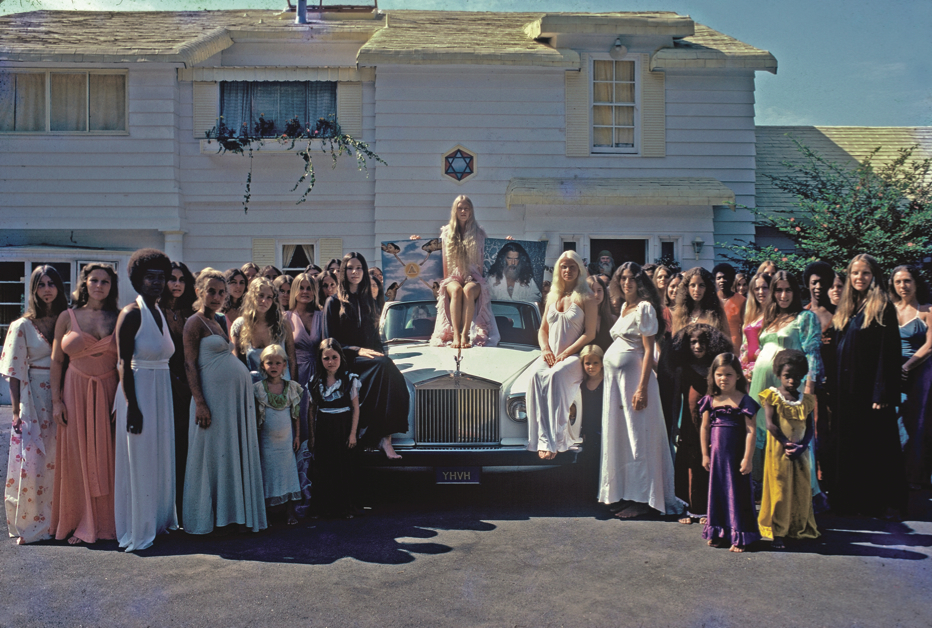
The Source Family Under the guidance of charismatic, luxuriously-bearded leader Father Yod (once named Jim Baker, later known as YaHoWha), the Source Family operated one of the country’s first health food restaurants. They lived in a Hollywood Hills mansion, wore flowing robes, assumed dreamy new names, meditated, and studied Father Yod’s custom blend of Eastern and Western philosophy and mysticism. As the home movies that comprise Maria Demopoulos and Jodi Wille’s documentary, The Source Family, suggest, there were golden moments aplenty, even as the mainstream began to view the group with suspicion (and an aging Father Yod’s decision to take multiple wives confused some members — particularly the woman he was already legally married to). Tapping into the group’s extensive film and psych-rock music archives, as well as interviews with surviving members, The Source Family offers a captivating look at what had to be the most earnest (and most photogenic) cult of the 1970s. (1:38) Roxie. (Eddy)

Upstream Color A woman, a man, a pig, a worm, Walden — what? If you enter into Shane Carruth’s Upstream Color expecting things like a linear plot, exposition, and character development, you will exit baffled and distressed. Best to understand in advance that these elements are not part of Carruth’s master plan. In fact, based on my own experiences watching the film twice, I’m fairly certain that not really understanding what’s going on in Upstream Color is part of its loopy allure. Remember Carruth’s 2004 Primer? Did you try to puzzle out that film’s array of overlapping and jigsawed timelines, only to give up and concede that the mystery (and sheer bravado) of that film was part of its, uh, loopy allure? Yeah. Same idea, except writ a few dimensions larger, with more locations, zero tech-speak dialogue, and — yes! — a compelling female lead, played by Amy Seimetz, an indie producer and director in her own right. Enjoying (or even making it all the way through) Upstream Color requires patience and a willingness to forgive some of Carruth’s more pretentious noodlings; in the tradition of experimental filmmaking, it’s a work that’s more concerned with evoking emotions than hitting some kind of three-act structure. Most importantly, it manages to be both maddening and moving at the same time. (1:35) Roxie. (Eddy)

Changing the metaphor

2

news@sfbg.com

With my partner-in-crime Keith Chandler at the wheel, we’re driving through San Francisco on our way to Stanford University Law School for the Three Strikes Summit, a deeply personal topic to both of us. Three Strikes is partly why I served 15 years in prison, and Stanford’s Three Strikes Project is a big reason why I was released earlier this year.

Chandler is a renowned activist, ex-lifer, and my comrade in the struggle to reintegrate inmates back into life in the outside world. I have become a fanatic on a mission, and this May 2 event will feature many of the top criminal justice players responsible for last year’s Three Strikes reform measure, from Attorney General Kamala Harris to San Francisco District Attorney George Gascon.

So the path we carve through the City takes us deep into the heart of the reform movement that changed my life. Change is in the air, and I’m following the scent back to its roots.

POSTER CHILD

Three Strikes as a metaphor made perfect sense. In the 1980s, the justice system was a revolving door. Relatively short sentences for serious and/or violent crimes were the norm, sentences often cut in half by parole. Lengthy records of arrests and convictions fueled a movement to get tough on crime.

As per usual, bad things happened. In 1993, sexual predator Richard Allen Davis killed Polly Klaas, a 12-year-old girl from Petaluma. A general consensus formed that repeat offenders needed to be punished to the fullest. So prison industrialists came up with a catchy solution: three strikes and you’re out. Commit three violent crimes, the authors sold to the public in 1994, and you’ll serve 25 years to life.

However, the fine print expanded the concept to any third felony — even crimes that would be misdemeanors to non-parolees — and California’s prisons swelled.

In many ways, I was a Three Strikes poster child. As a wild youngster in Sacramento, I was a menace. At 18 in 1984, I began a four-year spree of crimes that included armed robbery, assault with a deadly weapon, and residential burglary. For those transgressions, among others, I received a 12-year sentence in 1988.

I embraced sobriety, college, and writing as I served six discipline-free years. Back then, we had a right to participate in rehabilitative endeavors. Effective programs like cognitive restructuring and life-skills classes might have been foreign concepts, but I benefitted from college, weight training, and family visiting.

But I was still trapped by my criminal thinking — plagued by my nefarious associations. Though I hid it well, I was all fucked up.

In 1994, I was paroled into a whole new ball game: the era of three strikes. As soon as the law passed, the horror stories began to amass. Guys were being struck out for stealing from stores or possessing small amounts of drugs. California became the republic of the intolerant. Mired by myriad imperfections, I stepped up to the plate and swung for the fences.

A 28-year-old undergraduate with a range of goals, I started a construction company and contemplated graduate school. And instead of taking my construction company seriously, or even finishing my undergraduate education, I started using and selling meth — partying like there was no tomorrow.

In my broken way of thinking, I convinced myself that supplementing my income made perfect sense. In reality, it was an excuse to get high for free and it all fell apart. Two parole violations for drug cases seamlessly lead to a felony drug case in 1999. I went from baller to squalor, and hit a line drive right to the catcher. I struck out and faced a lifetime behind bars.

When my life came to an end, I chose to change the rules of my game. I found purpose by advocating for my demographic. As the system began to shift towards smart-on-crime principles in the mid-’00s, I managed to shift with it. My two-pronged litigious and literary activism — a lifestyle that regularly put me at odds with my captors — morphed into rehabilitative advocacy.

As a result of voters approving Prop 36 last fall, my life sentence was lifted on March 22. The merits of my rehabilitative record coalesced with a successful one-time review. As I walked out of prison a week later and jumped into the arms of my childhood sweetheart, I told Charlotte, “Let’s get the hell out of here before they change their minds.”

ROAD TO REFORM

After all the craziness of 15 years of incarceration, I have been decompressing in a transitional housing program. With a bachelor’s degree and multiple drug counseling certifications, I’m establishing myself as rehabilitative consultant. Moreover, I received the ultimate welcome home gift when The Sacramento Bee covered my reentry.

As we arrived on the Stanford campus, I thought of the friends and foes I left behind in prison. To me, this is serious business, a personal progression of nonstop advocacy. Keith’s gig as a criminal justice consultant now includes a new task — delivering me into the apex of reform.

Stanford Law School started the Three Strikes Project in 2006. The human lessons learned from securing the release of 26 three strikers motivated project director and law professor Mike Romano to shift tactics. He decided to take a bigger swing at a very bad law. By avoiding the mistakes from a catastrophic 2004 reform initiative, Romano could secure the release of thousands rather than dozens.

The project decided a narrowly drafted initiative would have the best chance for success. To qualify for a reduced sentence, minor third strikers without murder or sex offenses in their backgrounds would be vetted by the courts to determine whether they currently posed an unreasonable risk to public safety. He took down one of the nation’s toughest laws with 69 percent of the vote.

Of the 9,000 three strikers in California prisons, Prop. 36 made nearly 3,000 eligible for review. On the day of the summit, a prison official reported 460 had already been released — a number that will climb daily. While most counties have over 100 candidates — and some hotly contested cases are on the horizon — Los Angeles has a staggering 1,325 cases. San Francisco, by contrast, only has two, the result of SF’s sober, compassionate approach to charging three strikes cases.

Hearing the statewide cries from their landmark measure, Stanford invited all relevant parties to discuss how to move forward. Harris, the keynote speaker, wrapped her entire speech around a unique prosecutorial career that began in San Francisco.

As the author of Smart on Crime: A Career Prosecutor’s Plan To Make Us Safer, Harris models cutting-edge thinking as the state’s top cop. She pursued data-driven policies as she learned to look at “other issues through the lens of public safety.” By doing so, Harris avoided the sensationalism mentality that leads to hyper-incarceration.

Her successor, Gascon, followed her approach. Research showed Gascon that “higher levels of incarceration don’t translate into increased public safety.” So he teamed up with Stanford, the NAACP, and other like-minded officials as early supporters of the Three Strikes Reform Act of 2012.

Overall, the summit included a range of panelists who discussed a number of relevant topics. But how to adjudicate all these cases was juxtaposed by the need to find resources for reentry services. Stanford professor Joan Petersilia has been instrumental in every recent criminal justice policy change in California, and she warned of the need for more reentry programs.

“What goes down can easily go up,” Petersilia said, warning the crowd about prison populations and crime rates. “Roughly $1 million is being spent on the average three striker, and zero is being spend on their reentry.”

FREEDOM

Most of us are being released without any supervision or any type of state or county funds associated with probation or parole. Since we have far exceeded our sentences, the average three striker is leaving prison with little to no resources, let alone being able to tap into existing programs. I’m paying for my program out of my own pocket.

While it took decades to create the worst justice and prison system in the country, it’s definitely going to take years to correct. I advocated for more than a decade while buried under draconian measures buttressed by dreadful prison policies. Thus, I am excited groundbreaking issues are being discussed by people like this.

For those officials still trapped in their broken thinking, I also know how hard it is to abandon criminal thinking. However, like Gascon said, “Prop 36 is changing the metaphor.”

Seated in Keith’s sports car with the top down, we are making our way up 280 towards the city. Heading back home to Sacramento, I felt like a passenger on the Titanic with an alternate ending. While I am still in the honeymoon stage of my reentry — and reluctant to let this feeling go — I am at the beginning of a new era. We all have work to do.

My life of crime and activism has been an open book — and so is my reentry. After spending the day with journalists and actors in the field of justice, now I feel an even greater obligation to repay my debts. For the first time the light at the end of the tunnel is no longer blurred by the cold hard steel of the penitentiary, or maintained by tone-deaf policy-makers.

I still can’t believe it — I am free.

DPH: Unaffordable housing is bad for your health

To cover rent on a two-bedroom apartment at “fair market value” in SoMa, a San Francisco minimum-wage earner would have to work 7.4 full-time jobs.

That jaw-dropper of a statistic is just one tidbit in a fascinating dataset featured in a recently published interactive map plotting housing affordability in San Francisco neighborhoods. Combining data from Craigslist and PadMapper, the U.S. Census Bureau’s American Community Survey, and the local minimum wage ($10.24 per hour, widely regarded as generous), the map isn’t the handiwork of affordable housing activists. [Note: this reflects the 2012 minimum wage, the rate now stands at $10.55.]

Instead, it was created by the San Francisco Department of Public Health’s Program on Health, Equity and Sustainability. To view the full map and dig around for data on your neighborhood of interest, go here.

The embedded dataset reveals that the median income in SoMa is $91,000 lower than the $158,000 one would need to afford renting a market-rate two-bedroom. This figure, expressed as $-91,000, is known as the “affordability gap,” and the map plots these gaps neighborhood by neighborhood.

It was rolled out as part of a weeklong effort to raise public awareness about the link between affordable housing and public health, explains Cyndy Comerford, manager of planning and fiscal policy at the Environmental Health division of DPH. The reason? “Unmet housing needs in San Francisco can result in significant public health concerns,” Comerford says.

A lack of affordable rental housing can push more tenants into substandard or overcrowded living situations, she adds. Housing units within reach for lower income residents might be squeezed up against a highway, for instance, putting tenants in close proximity to noise, traffic, or air pollution, thus increasing their risks for experiencing heart or respiratory problems. Substandard housing also makes lead or mold exposure more likely, possibly triggering serious health issues over time.

For residents who fork over a significant percentage of their income for rent, other problems can arise. “It leaves little money for other provisions,” such as healthy food or preventative health care, Comerford adds, so low-income tenants have a higher likelihood of malnourishment or preventable disease related to nutrition.

The map is part of a broader DPH initiative known as the Sustainable Communities Index, which provides datasets for more than 100 health indicators. There’s a whole section on housing, which even covers the negative health effects of eviction: “Involuntary displacement contributes to stress, loss of supportive social networks and increased risk for substandard housing conditions and overcrowding,” DPH points out.

More information is yet to come: “Every day this week, we’ll put out a new bit of information around health and housing,” Comerford says.

Taking a broader view, it appears that sweeping cuts to public programs will present a whole new set of challenges for lower-income populations who have a higher risk of housing-related health problems. As a New York Times opinion piece highlighting the public health ramifications of austerity measures notes, “there are warning signs … that health trends are worsening. Prescriptions for antidepressants have soared. Three-quarters of a million people (particularly out-of-work young men) have turned to binge drinking. Over five million Americans lost access to health care in the recession because they lost their jobs.”

Amid all this, as a consequence of the $85 billion “sequester” that began on March 1, “Public housing budgets will be cut by nearly $2 billion this year,” the New York Times piece continues, “even while 1.4 million homes are in foreclosure.”

Those overpaid, underworked public employees

49

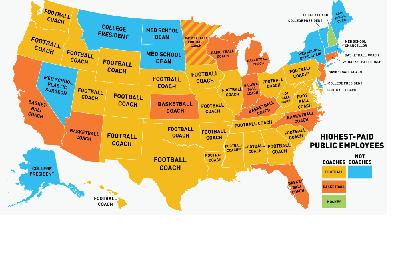
Before you start griping about ovepaid Muni drivers and public employee unions, you might want to take a look at this neat-o map that shows who the highest-paid public employees are in every one of the 50 states. Hint: It’s not a bus driver. Or even a cop or firefighter:

You may have heard that the highest-paid employee in each state is usually the football coach at the largest state school. This is actually a gross mischaracterization: Sometimes it is the basketball coach.

In fact in 40 of the 50 states, the highest-paid person runs a collegiate sports operation. The other ten are doctors running medical centers or, in a couple of places, college presidents.

Oh, but aren’t those people earning their money by bringing in the big bucks? Maybe; maybe not:

In 2011-2012, Mack Brown was paid $5 million to lead a mediocre 8-5 Texas team to the Holiday Bowl. The team still generated $103.8 million in revenue, the most in college football. You don’t have to pay someone $5 million to make college football profitable in Texas.

Just sayin.

(Oh, and what’s up with New Hampshire, where the guy making the most money coaches hockey?)

The Pulitzer Prize Board surrender – and how the New York Times blew the Ed Kennedy story (Part l)

10

In the May 19, 1945 edition of the New Yorker magazine, the legendary press critic A. J. Liebling wrote a prescient article on what happened when Edward Kennedy, an Associated Press combat correspondent, defied military censorship to break one of the century’s biggest and most important stories.

His lead said that “the great row over Edward Kennedy’s Associated Press story of the signing of the German surrender at Reims served to point up the truth that if you are smart enough you can kick yourself in the seat of the pants, grab yourself by the back of the collar and throw yourself out on the sidewalk. This is an axiom that I hope will be taught to future students of journalism as Liebling’s Law.” Liebling titled his piece, “The AP surrender,” because AP, caving in to government pressure, led the attack on its own reporter by publicly censuring and then firing him. He cited the New York Times as leading the charge with a nasty editorial blasting Kennedy only two days after it had splashed Kennedy’s story on the front page with huge heads. Kennedy, the editorial intoned solemnly, had done a “grave disservice to the newspaper profession.”

Liebling, a mid-1920s  student at the Graduate School of Journalism at Columbia University in New York City, was presumably aiming his axiom at his alma mater, which was in a building endowed by Joseph Pulitzer, a crusading liberal publisher in New York at the turn of the century.  Pulitzer also endowed the prestigious Pulitzer Prizes, which are housed in the school and administered by a senior member of the faculty.

I especially enjoyed Liebling’s Law as a Columbia journalism graduate (’58) and as a charter member of the committee working to get Kennedy a posthumous Pulitzer prize this year for his story. The axiom was timely because my wife Jean and I were at the journalism school in April to attend my 55th class reunion and the school’s centennial celebration. The event was full of Pulitzer references and remembrances, highlighted by an address by James McGrath Morris, a respected Pulitzer biographer, speaking in the World room, named after Pulitzer’s newspaper.

The day after the centennial weekend, the Pulitzer Prize Board announced its Pulitzers and rejected the two Kennedy nominations without comment. One nomination was for his story, the other for a previously unpublished book by Kennedy on his career as a WWII foreign correspondent. The rejections demonstrated a serious flaw in the Pulitzer Prize process.

The point of quoting Liebling today, in May of 2013, is that almost seven decades after his article, the Pulitzer Prize Board and the New York Times have once again left Kennedy out on the sidewalk for doing his job as a reporter who, in a favorite Pulitzer phrase, knew “the  right and had the courage to do it.” Since this is a historic story of military censorship for political reasons, it is as timely and relevant now as it was then, since the Pulitzer Board and the Times still do not get the point.

So let me put the issue in context. Let me start by quoting Liebling’s main arguments and link his full six page piece, written in the heat of the censorship battle.

Liebling, who was himself a distinguished World War II correspondent, wrote,  ”The important aspect of the story of the row, I am sure, is not that Kennedy got his dispatch out of Europe before the SHAEF Public Relations bosses wanted him to but that only three representatives of the American press were admitted to one of the memorable scenes in the history of man, and only on condition that they promise not to tell about it until the brigadier general in charge of public relations gave them permission.

“No correspondent of a newspaper published in the United States was invited to the signing; besides Kennedy, Boyd Lewis of United Press, and James Kilgallen, of Hearst’s International News Service, the official list included four radio men, an enlisted correspondent for the Stars and Stripes, and a collection of French, Russian, Australian, and Canadian correspondents.

“Whether a promise extorted as this one was, in an airplane several thousand feet up, has any moral force is a question for theologians…I suppose Kennedy should have refused to promise anything and thus made sure of missing an event that no newspaperman in the world would want to miss, but I can’t imagine any correspondent doing it.

“I do not think Kennedy imperiled the lives of any Allied soldiers by sending the story, as some of his critics   have charged. He probably saved a few, because by withholding the announcement of an armistice you prolong the shooting, and, conversely, by announcing it promptly you make the shooting stop. Moreover, the Germans had broadcast the news of the armistice several hours before Kennedy’s story appeared on the streets of New York, and Alsie, the OWI’s American Broadcasting Station in Europe, broadcast it in 24 languages, including English, within an hour after.”

Liebling noted that the Russians “had their own surrender show in Berlin, and probably had a better publicity break on it than they would have had if the two surrenders has been announced simultaneously… One unconditional surrender of the Reich a day is as much as the public can absorb.” 

Liebling brought out the crucial political censorship point. “Moreover, the row can do a lot of good if it brings into the clear the whole disturbing question of military censorship imposed for political, personal, or merely capricious reasons and reveals the history of the prodigious amount of pure poodle-faking that has gone under the name of Army Public Relations.” Liebling was right on because it later turned out that a secret agreement between Stalin, Roosevelt, and Churchill had imposed a 24 hour embargo on the surrender story so the Russians could announce it the next day in Berlin. Kennedy’s story was in effect the start of the Cold War.

Last year, almost 70 years later,  Tom Curley, as president and CEO of AP,  backed up Liebling’s Law and apologized publicly on behalf of  AP. for the way it treated Kennedy. “tt was a terrible day for AP,” he was quoted as saying on the AP wire.  “It was handled in the worst possible way,.” He wrote a strong  defense of Kennedy in an introduction to a book published last year by the Lousiana State University Press,  titled “Ed Kennedy’s War: V-E Day, Censorship & the Associated Press.” The book was a personal account by Kennedy of his career as a foreign correspondent and a detailed account of his side of the controversy. His daughter, Julia Kennedy Cochran, found Kennedy’s manuscript in his papers after he died in a pedestrian accident in Monterey in 1963 at age 58 where he was editing the Monterey Peninsula  Herald. 

Curley wrote that “Kennedy and his editors performed superbly. They delivered one of the most significant scoops in journalism history. They did four things right. A great correspondent was assigned to the story. He kept reporting even after the censors tried to shut him down. The London desk moved the news without hesitation. The correspondent and editors adhered to the wartime rules as they knew them.  Finally, Kennedy wins the argument on a technicality. With the signing of a surrender treaty, there was no longer a war in Europe and not any excuse to submit to censors.”

Curley said “the book matches the best memoirs by World War II combat reporters for the quality of writing and telling detail, some of it gripping.  And in one way it surpasses the others. Not only does Kennedy give his final, thoughtful explanation for what happened on May 7, 1945. In describing his struggles with censorship and bureaucratic red tape and stupidity over many months, not just on May 7, he provides the fullest first-person account we have of the difficulties World War II correspondents encountered every day trying to do their jobs.

“Perhaps in some small way we bring posthumous recognition to an American hero and embrace – too belatedly – what McClean and Cooper (B3: AP executives) and the AP board could not admit. Edward Kennedy was the embodiment of the highest aspirations of the Associated Press and American journalism.” Curley said his account drew upon newly available records held in the Associated Press Corporate Archives.

Curley’s co-author was John Maxwell Hamilton, founding dean of the Manship School of Mass Communications at LSU.  He is the editor of “From Our Correspondent,” a series of books that features forgotten works and unpublished memoirs by pioneering foreign correspondents and illuminates “the development of foreign news gathering at a time when it has never been more important.” Hamilton, once a foreign correspondent himself, is currently the executive vice chancellor and provost of LSU. The book was submitted by LSU Press for a Pulitzer in the book category but the board rejected the nomination and, in keeping with tradition, rejected it without comment.

Following V-E Day, Kennedy was out at AP and the big  mainstream dailies. He became a managing editor for two years at the Santa Barbara News-Press and then edited the Monterey County Herald, later the Monterey Peninsula Herald.   The Herald won lots of journalism awards under Kennedy and he wrote many international commentaries under the initials E.K. He loved his community and he loved his job. .A memorial to Kennedy stands in the form of a sundial in Laguna Grande Park in nearby Seaside. It reads: “He saved the world an extra day of happiness.”

Meanwhile, Ray March, editor of the Modoc (Calif.) Independent News  and a former reporter under Kennedy on the Herald, decided it was time to nominate Kennedy for a posthumous Pulitzer prize and help right a historic journalistic and public policy wrong. With the help of Eric Brazil, a former Examiner editor and reporter, he put together a committee and petition.  I signed up immediately when Brazil called me.  And I helped put together the first ever panel anywhere on the Kennedy story for last year’s annual meeting of the California Press Association. It featured as moderator Ward Bushee, the Chronicle editor whose father had been recruited by Kennedy to work on the Herald. (He turned down the offer.)  Ward’s father had earlier won a Pulitzer as editor of the Watsonville Register-Pajaronian for exposing corruption involving the local district attorney.

The historic panel included March, Kennedy’s daughter, and Dave Perlman, a Chronicle reporter at 93, who was in Paris as a reporter at the time of the surrender. Jim Ewert, general counsel of the California Newspaper Publishers Association, drafted  a stirring resolution supporting the nomination and the members approved it unanimously.  It was submitted as part of the nomination package, put together by the Chronicle’s promotion department. March, Brazil, and  Frank McCulloch, former bureau chief for Time magazine in Vietnam who later held top editorial positions at the LA Times, the Sacramento Bee, and the old San Francisco Chronicle, wrote the nomination letter. It stressed that Kennedy had been the victim of military censorship for political reasons.  Meanwhile, the nomination got much media coverage, including the Chronicle, Washington Post, Sacramento Bee, Atlantic Magazine, Portland Oregonian, Editor and Publisher, and many other print and online venues.

When the New York Times announced this year’s Pulitzers, the paper gushed that  it got four Pulitzers, giving it a total of 112 Pulitzers, ”far more than any other newspaper,” as trumpeted in full page promotion ads. Margaret Sullivan, the public editor, was even more glowing in her Sunday column (4/21/2013). Her lead:  “The Times, it is safe to say, had a very good week. On Monday, it won four Pulitzer prizes – “the third most in its history and twice a many as any other news organization this year.”  (She also quite properly gave credit to the Times for its coverage of the Boston bombings and in particular for staying on the safe side of the “Rubicon of inaccuracy” by not reporting that an arrest had been made and a suspect was in custody.) She concluded her appraisal by saying that “The Times is far from perfect.  But last week, in its intelligent and restrained handling both of images and facts, it looked like a newspaper worthy of this year’s Pulitzer glory.”

However,  I and many others weren’t as smitten by Pulitzer glory. We were disappointed to see that the Pulitzer Board  not only rejected a Pulitzer for Kennedy, but that it did so without reference or mention of the Kennedy nominations, made no special citation (such as the special citation to the late Chronicle columnist Herb Caen) and gave no reasons nor acknowledgment of any kind for the rejections or to the historic importance of righting a major  journalistic and public policy wrong on one of the most crucial issues of our time:  military censorship for political reasons of news the public needs to know. I couldn’t find any evidence that the Times ever changed its editorial opposition to Kennedy and that it ever properly covered Kennedy’s side of the story. And the Times, unlike AP and so many other papers, didn’t cover the current story of the nominations to award Kennedy a posthumous Pulitzer prize or the censorship issues, before or after the Pulitzer awards were announced. Will it do so now? I am sending this report to the public editor and other Times editors and public  for comment.

I emailed Sig Gissler, the former Milwaukee Journal editor who now administers the Pulitzers.as a journalism professor. I put the above points to him and asked why the committee “instead of coming down on the side of the free press that Pulitzer and his school and prizes represented, the committee in effect came down on the side of government censorship for political reasons and supported a politically charged embargo agreement that would allow Stalin to catch up on the surrender announcement and hold his own press conference in Berlin.” 

Specifically, I asked Gissler  “was there any discussion on the Kennedy nominations, was there a vote and what was it, who voted for and against, what were the reasons for the rejection, was there any real internal debate on the importance and timeliness of this issue, and anything else that you or the Columbia officials (Outgoing Dean Nicholas Lemann or incoming Dean Steve  Coll, President Lee Bollinger) or the committee chairs or member would like to add. Is there a spokeperson I can talk to?”  I also asked for the names and contact information of the full Pulitzer committee and subcommittees and the appropriate Columbia spokespeople.

Gissler is a good man in a tough job burdened with honoring a dated policy. He emailed me back promptly and thanked me for my “interesting note.”  He said that, “regarding Kennedy, your desire for an explanation is testimony to your earnestness. However, each year the Pulitzer process produces many similar situations. Entrants desire to know why they did not become finalists. Finalists desire to know why they didn’t become winners. Petitioners for special citations desire to know why no special citations were bestowed. The Board declines to provide explanatory details, consistent with its tradition of basically not discussing, debating or defending its decisions.

“I understand your disappointment. However, at the risk of eternal irritation, I can only reiterate that the request for a special citation for Ed Kennedy was duly considered and that we do not issue statements when a request does not result in a citation.” He didn’t send me the names or contact information of the board or Columbia spokespeople. 

To give Gissler every opportunity to explain, I emailed him again and asked more questions: “So, after all these years, are you saying that the Pulitzer Board has no way for anyone (entrants or journalists or the public) to comment on the awards or the contest or the process? If not, why not?” I also asked again how the Kennedy nominating committee and others could make comments this year, right now. I ended by saying there was now much interest in “making the Pulitzer process more transparent, representative, and accountable.” I hope you agree, I told Gissler, and that you “at least present the issue to the board and the proper Columbia officials.”  I got no further comment from Gissler.

The Pulitzer School of Journalism and the Pulitzer prizes are endowed by Joseph Pulitzer. The school has the venerable Columbia Journalism Review magazine with a mission to “encourage excellence in journalism in the service of a free society.” And it has the excellent  CJR.org website that “weighs in daily, hosting a conversation that is open to all who share a commitment to high journalistic standards in the U.S. and around the world” and that could, let me suggest,  display the Pulitzer winners properly and host a lively forum for congratulations and comment  on the Pulitzers and the Pulitzer process,  It has a large and distinguished faculty and hosts a wide array of newsworthy panels and programs. It attracts each year an excellent class of students. It has a huge statue of Thomas Jefferson, paid for by Pulitzer, standing as a beacon of press freedom in front of the entrance to the journalism building. It is situated in the media capital of the world and promotes itself as the best journalism school in the country and a source of many of the country’s best journalists. It can do better, much better, with the prizes that the New York Times proclaimed, in its full page ad promoting its four Pulitzers, as “widely considered journalism’s highest honor.” .

And so I recommend that Columbia, the Graduate School of Journalism, and its Pulitzer Prize Board use the rejected nominations of Edward Kennedy, the reporter who was tarred and feathered for the crime of committing journalism, as the catalyst for major Pulitzer reforms. I recommend making the Pulitzer process more transparent, more responsive, and more prepared in our militarized age to fight government censorship and more prepared to promote and defend the First Amendment values of free speech and free press.

I will keep you posted. B3

POSTSCRIPT:  THE RUSSIAN PLAN TO PREEMPT THE SURRENDER STORY:   Ed Kennedy writes in his book that in the turmoil over his dispatch the correspondents overlooked another story almost as big as the surrender story. It came from  “no less august an official spokesman”  than Brig. Gen. Frank A. Allen Jr., the SHAEF commanding officer,  who told the corresponents in a May 8 meeting that “the official announcement might be delayed even further beyond the time set for it–3 p.m., Paris time.  He revealed that the Russians, having induced Washington and London to hold up the announcement, until the hour set for their own ceremony in Berlin, now were asking that news of the real surrender at Reims be suppressed until some hours after the phony surrender of Berlin. HIs disclosure was ‘off the record’ at the moment but could have been legitimately been reported the following day. It never was. 

“The sole purpose of the Soviet request, it was later established–and even then was obvious–was to convince a large part of the world that the Russians had obtained the surrender of Germany, with but contributory help from the Western Allies, whom they had generously invited to share in the final honor.  The Berlin ceremony was staged purely for Soviet propaganda purposes. Although a Russian correspondent was one of those whom General Allen had invited to Reims to the exclusion of any reporter of an American newspaper, no word of the Reims surrender appeared in the Russian press. So far as I know, none has to this day.

“The Russian action was the inauguration of the propaganda build-up for the course of expansion on which the Soviet Union was shortly to embark in Europe. Its importance as news was that it was the first clue to Moscow’s postwar policy.  But it went unreported at that time.”

Bruce B, Brugmann, writing as editor at large of the San Francisco Bay Guardian, as editor and co-founder and co-publisher of the Guardian with his wife Jean Dibble (1966-2012, now  retired), as a graduate of the Columbia Graduate School of Journalism (’58), as a recipient of  the Columbia Journalism School’s  Distinguished Alumnus award (2011), as a former bureau chief of the Korea Bureau of the Pacific edition of Stars and Stripes who encountered milItary censorship  (1959-60), and as a charter member of the Kennedy nominating committee. 


Rep Clock

0

Schedules are for Wed/8-Tue/14 except where noted. Director and year are given when available. Double and triple features marked with a •. All times pm unless otherwise specified.

ANSWER COALITION 2969 Mission, SF; www.answersf.org. $5-10 (no one turned away for lack of funds). The Battle of Chile: The Power of the People (Guzmán), Wed, 7.

ARTISTS’ TELEVISION ACCESS 992 Valencia, SF; www.atasite.org. $6-10. "Revelcade Applause Night," shorts by Bay Area filmmakers, Fri, 8.

CASTRO 429 Castro, SF; (415) 621-6120, www.castrotheatre.com. $8.50-13. •Badlands (Malick, 1973), Wed, 7, and Electra Glide in Blue (Guercio, 1973), Wed, 8:50. San Francisco International Film Festival, Thu. See festival.sffs.org for schedule. •John Dies at the End (Coscarelli, 2012), Fri, 7, and The Rambler (Reeder, 2013), Fri, 8:55. "Marc Huestis presents: Mother’s Day with Mommie Dearest:" Mildred Pierce (Curtiz, 1945), Sat, 2; Mommie Dearest (Perry, 1981), Sat, 7:30. Evening event ($15; www.ticketfly.com) includes a live appearance by actress Rutanya Alda, with host Matthew Martin. •The Red Shoes (Powell and Pressburger, 1948), Sun, 2:55, 8, and The Life and Death of Colonel Blimp (Powell and Pressburger, 1943), Sun, 5. The Master (Anderson, 2012), Tue, 2, 5, 8.

CHRISTOPHER B. SMITH RAFAEL FILM CENTER 1118 Fourth St, San Rafael; (415) 454-1222, www.cafilm.org. $6.75-$10.25. The Angels’ Share (Loach, 2012), call for dates and times. Blancanieves (Berger, 2012), call for dates and times. In the House (Ozon, 2012), call for dates and times. The Reluctant Fundamentalist (Nair, 2012), call for dates and times. Renoir (Bourdos, 2012), call for dates and times.

GREAT WALL OF OAKLAND West Grand between Broadway and Valley, Oakl; www.oaklandcatvidfest.com. $10-75. "Oakland Internet Cat Video Festival," benefit for the East Bay SPCA with pre-screening events (cat-themed music, animal rescue groups, food trucks, and more), plus an appearance by special guest Dusty the Klepto Kitty, Sat, 3-10.

JEWISH COMMUNITY CENTER OF SAN FRANCISCO Kanbar Hall, 3200 California, SF; www.jccsf.org. $8-12. Under African Skies (Berlinger, 2012), Mon, 7.

MECHANICS’ INSTITUTE 57 Post, SF; (415) 393-0100, milibrary.org/events. $10 (reservations required as seating is limited). "CinemaLit Film Series: Paddy Chayefsky: Scenes from American Lives:" The Catered Affair (Brooks, 1956), Fri, 6.

NEW PARKWAY 474 24th St, Oakl; www.thenewparkway.com. $6-10. "New Parkway Classics:" Wild at Heart (Lynch, 1990), Thu, 9pm. "Thrillville:" Mothra (Honda, 1961), Sun, 6.

OAKLAND PUBLIC LIBRARY 1021 81st Ave, Oakl; www.oaklandlibrary.org. Free. Just a Piece of Cloth (Henze), Sat, 2.

"PLAYGROUND FILM FESTIVAL" Various Bay Area venues; playground-sf.org/filmfest. $10-25. Showcasing Bay Area filmmakers and writers and their short work. Through May 25.

PACIFIC FILM ARCHIVE 2575 Bancroft, Berk; (510) 642-5249, bampfa.berkeley.edu. $5.50-9.50. San Francisco International Film Festival, Wed-Thu. See festival.sffs.org for schedule. "Film and Video Makers at Cal: Works from the Eisner Prize Competition," Fri, 7. PFA closed through June 5.

ROXIE 3117 and 3125 16th St, SF; (415) 863-1087, www.roxie.com. $6.50-11. CXL (Gillane, 2012), Wed, 7:15. The Source Family (Demopoulos and Wille, 2012), Wed-Thu, 7, 9:30. Upstream Color (Carruth, 2013), Wed-Thu, 9. The Crumbles (Boch, 2012), Sat, 3, 5, 7, 9. "I Wake Up Dreaming 2013:" •I Wake Up Screaming (Humberstone, 1941), Fri, 6:15, 9:45, and Blues in the Night (Rossen, 1941), Fri, 8; •Under Age (Dmytryk, 1941), Sat, 2, 6:30; Johnny O’ Clock (Rossen, 1947), Sat, 3:15, 8; and The Monster and the Girl (Heisler, 1941), Sat, 5, 9:45; •Fall Guy (Le Borg, 1947), Sun, 1:30, 6:15; Night Has a Thousand Eyes (Farrow, 1948), Sun, 2:50, 7:45; •Club Havana (Ulmer, 1945), Mon, 6:40, 9:30, and Island of Doomed Men (Barton, 1940), Mon, 8; •Nightmare (Whelan, 1942), Tue, 6:15, 9:50, and All Through the Night (Sherman, 1942), Tue, 8.

VICTORIA THEATRE 2961 16th St, SF; www.peacheschrist.com. $30-35. "The Rocky Horror Show 40th Anniversary Concert Tribute," with Patricia "Magenta" Quinn performing live and other special guests, Fri-Sat, 8 (also Sat, 3).

YERBA BUENA CENTER FOR THE ARTS 701 Mission, SF; www.ybca.org. $8-10. "Girls! Guns! Ghosts! The Sensational Films of Shintoho:" Ghost Story of Yotsuya (Nakagawa, 1959), Thu, 7:30; Flesh Pier (Ishii, 1958), Sun, 2.

Film listings

0

Film listings are edited by Cheryl Eddy. Reviewers are Kimberly Chun, Dennis Harvey, Lynn Rapoport, and Sara Maria Vizcarrondo. For rep house showtimes, see Rep Clock.

SAN FRANCISCO INTERNATIONAL FILM FESTIVAL

The San Francisco International Film Festival runs through Thu/9 at the Castro Theatre, 429 Castro, SF; New People Cinema, 1746 Post, SF; Pacific Film Archive, 2575 Bancroft, Berk; and Sundance Kabuki Cinemas 1881 Post, SF. For tickets (most shows $10-15) and complete schedule, visit festival.sffs.org.

OPENING

The Crumbles The awkward slackers and damaged hipsters of The Crumbles live in a sun-strafed, paved-over Los Angeles habitat of coffee shops, taco trucks, bookstores, budding filmmakers, and living room band practice. Darla (Katie Hipol) is slouching nowhere fast when her zany, charismatic cool-girl chum Elisa (Teresa Michelle Lee) enters the picture, looking for a place to crash. Elisa’s wacky, erratic, and unreliable, but she’s also capable of generating real excitement — and a mean little keytar hook — and the girls’ band, the Crumbles, gets off the couch and threatens to get all involved to bust out of their shells. Though director Akira Boch never quite dips into the deep background of his characters’ various dysfunctions — the threatened readings of Darla and Elisa’s psychic friend never quite sheds light — the first-time feature filmmaker has a real feel for the drifting, up-for-anything quality of Cali 20-somethings and an appreciation for their highs and lows that makes this familiar, loving, lets-put-on-show-kids update compelling. (1:13) Roxie. (Chun)

The Great Gatsby Baz Luhrmann reunites with his Romeo + Juliet (1996) star Leonardo DiCaprio for this long-awaited 3D adaptation of F. Scott Fitzgerald’s classic novel. (2:22) California, Four Star, Marina, Presidio, Vogue.

Kiss of the Damned This first feature by Xan Cassavetes isn’t remotely like the Method-y angstfests her late father John used to direct (although he did act in upscale genre movies like 1968’s Rosemary’s Baby and 1978’s The Fury). Instead, it’s an homage to the erotic European horror movies of the late 1960s through early ’80s, with further nods to Dario Argento, 1983’s The Hunger, and other fan-bait. Mysterious Djuna (Joséphine de La Baume) is immediately attracted to hunky screenwriter Paolo (Milo Ventimiglia), and vice versa. But she’s reluctant to follow through, and when he presses, she explains why: she’s a vampire, albeit the respectable kind who only "hunts" wild animals. When he decides that is a drawback he can deal with, they seem set to spend an undead eternity together. Unfortunately, they soon get an unwelcome guest in Djuna’s sister Mimi (Roxane Mesquida), a classic "bad girl" type who has no such compunctions about feasting on "stupid humans," and whose recklessness threatens the cover of any associated fellow vampire. Like its models, Kiss drags at times, and probably will seem too arty and slow to those attuned to mainstream current horror cinema. But if you’re a dweeb enough to know who the likes of Jean Rollin and Jess Franco are, this aesthetically slavish (on a faithfully low budget) salute to their sexy-bloody vintage schlock should amuse, with Steven Hufsteter’s original score an encyclopedia of vintage Eurotrash soundtrack tropes. (1:37) Shattuck. (Harvey)

Love is All You Need Copenhagen hairdresser Ida (Trine Dyrholm) has just finished her cancer treatments — with their success still undetermined — when she arrives home to find her longtime husband Leif (Kim Bodnia) boning a coworker on their couch. "I thought you were in chemo" is the closest he comes to an apology before walking out. Ida is determined to maintain a cheerful front when attending the Italian wedding of their daughter Astrid (Molly Blixt Egelind) — even after emotionally deaf Leif shows up with his new girlfriend in tow. Meanwhile brusque businessman and widower Philip (Pierce Brosnan), the groom’s father, is experiencing the discomfort of returning to the villa he once shared with his beloved late wife. This latest from Danish director Susanne Bier and writing partner Anders Thomas Jensen (2006’s After the Wedding, 2004’s Brothers, 2010’s In a Better World) is more conventionally escapist than their norm, with a general romantic-seriocomedy air reinforced by travel-poster-worthy views of the picturesque Italian coastline. They do try to insert greater depth and a more expansive story arc than you’d get in a Hollywood rom com. But all the relationships here are so prickly — between middle-aged leads we never quite believe would attract each other, between the clearly ill-matched aspiring newlyweds, between Paprika Steen’s overbearing sister in-law and everyone — that there’s very little to root for. It’s a romantic movie (as numerous soundtracked variations on "That’s Amore" constantly remind us) in which romance feels like the most contrived element. (1:50) Embarcadero. (Harvey)

Peeples Kerry Washington and Diahann Carroll star in this Tyler Perry-produced family drama set in the Hamptons. (1:35)

Scatter My Ashes at Bergdorf’s This glossy love letter to posh New York City department store Bergdorf Goodman — a place so expensive that shopping there is "an aspirational dream" for the grubby masses, according to one interviewee — would offend with its slobbering take on consumerism if it wasn’t so damn entertaining. The doc’s narrative of sorts is propelled by the small army assembled to create the store’s famed holiday windows; we watch as lavish scenes of upholstered polar bears and sea creatures covered in glittering mosaics (flanking, natch, couture gowns) take shape over the months leading up to the Christmas rush. Along the way, a cavalcade of top designers (Michael Kors, Vera Wang, Giorgio Armani, Jason Wu, Karl Lagerfeld) reminisce on how the store has impacted their respective careers, and longtime employees share anecdotes, the best of which is probably the tale of how John Lennon and Yoko Ono saved the season by buying over 70 fur coats one magical Christmas Eve. Though lip service is paid to the current economic downturn (the Madoff scandal precipitated a startling dropoff in personal-shopper clients), Scatter My Ashes is mostly just superficial fun. What do you expect from a store whose best-selling shoe is sparkly, teeteringly tall, and costs $6,000? (1:33) Clay, Shattuck. (Eddy)

ONGOING

The Angels’ Share The latest from British filmmaker Ken Loach (2006’s The Wind that Shakes the Barley) and frequent screenwriter collaborator Paul Leverty contains a fair amount of humor — though it’s still got plenty of their trademark grit and realism. Offered "one last opportunity" by both a legal system he’s frequently disregarded and his exasperated and heavily pregnant girlfriend, ne’er-do-well Glaswegian Robbie (Paul Brannigan) resolves to straighten out his life. But his troubled past proves a formidable roadblock to a brighter future — until he visits a whiskey distillery with the other misfits he’s been performing his court-ordered community service with, and the group hatches an elaborate heist that could bring hope for Robbie and his growing family … if his gang of "scruffs" can pull it off. Granted, there are some familiar elements here, but this 2012 Cannes jury prize winner (the fest’s de facto third-place award) is more enjoyable than predictable — thanks to some whiskey-tasting nerd-out scenes, likable performances by its cast of mostly newcomers, and lines like "Nobody ever bothers anybody wearing a kilt!" (not necessarily true, as it turns out). Thankfully, English subtitles help with the thick Scottish accents. (1:41) Opera Plaza, Smith Rafael. (Eddy)

At Any Price Growing up in rural Iowa very much in the shadow of his older brother, Dean Whipple (Zac Efron) cultivated a chip on his shoulder while dominating the figure 8 races at the local dirt track. When papa Henry (Dennis Quaid) — a keeping-up-appearances type, with secrets a-plenty lurking behind his good ol’ boy grin — realizes Dean is his best hope for keeping the family farm afloat, he launches a hail-mary attempt to salvage their relationship. This latest drama from acclaimed indie director Ramin Bahrani (2008’s Goodbye Solo) is his most ambitious to date, enfolding small-town family drama and stock-car scenes into a pointed commentary on modern agribusiness (Henry deals in GMO corn, and must grapple with the sinister corporate practices that go along with it). But the film never gels, particularly after an extreme, third-act plot twist is deployed to, um, hammer home the title — which refers to prices both monetary and spiritual. A solid supporting cast (Kim Dickens, Heather Graham, Clancy Brown, Red West, newcomer Maika Monroe) helps give the film some much-needed added weight as it veers toward melodrama. (1:45) SF Center. (Eddy)

The Big Wedding The wedding film has impacted our concepts of matrimony, fashion, and marital happiness more than all the textbooks in the world have affected our national testing average; but it’s with that margin of mediocrity I report from the theater trenches of The Big Wedding. With this, the wedding movie again peters to a crawl. Susan Sarandon (an actress I love with a loyalty beyond sense) is Bebe, the stepmother/caterer swept under the rug by the selfishness of her live in lover Don (De Niro), his ex-wife/baby momma Elle (Diane Keaton) and their racist wackjob future in-laws. When Don and Elle faced the end of their marriage, they tried to rekindle with a Columbian orphan. Cue Ben Barnes in brownface. Alejandro is set to wed Amanda Seyfried and when his mother ascends from Columbia for the wedding, he decides Don and Elle have to act like their marriage never ended &ldots; which makes Bebe a mistress. Surprise! A decade of caring selflessly for your lover’s kids has won you a super shitty wedding you still have to cater! To give you a sense of the conflict management on display, Bebe — the film’s graceful savior —drops a drink on Don before fleeing the scene in her Alfa Romeo; she’s the one character not determined to act out her more selfish urges in the style of an MTV reality show. Despite some less imaginative conflicts and degrading "solutions," this blended family still speaks some truth about the endearing embarrassment of the happy family. (1:29) 1000 Van Ness, SF Center. (Vizcarrondo)

Blancanieves If you saw the two crappy overblown Hollywood takes on Snow White last year, my condolences. This is probably its best cinematic incarnation ever not made by someone called Walt. Pablo Berger’s Blancanieves transplants the tale to 1920s Spain and told (à la 2011’s The Artist) in the dialogue-free B&W style of that era’s silent cinema. Here, Snow is the daughter of a famous bullfighter (a beautiful performance by Daniel Giménez Cacho) who’s paralyzed physically in the ring, then emotionally by the death of his flamenco star wife (Inma Cuesta) in childbirth. He can’t bring himself to see his daughter until a grandmother’s death brings little Carmencita (the marvelous Sofía Oria) to the isolated ranch he now shares with nurse-turned-second-wife Encarna — Maribel Verdú as a very Jazz Age evil stepmother. Once the girl matures (now played by the ingratiating, slightly androgynous Macarena García), Encarna senses a rival, and to save her life Carmen literally runs away with the circus — at which point the narrative slumps a bit. But only a bit. Where The Artist was essentially a cleverly sustained gimmick elevated by a wonderful central performance, Blancanieves transcends its ingenious retro trappings to offer something both charming and substantiative. Berger doesn’t treat the story template as a joke — he’s fully adapted it to a culture, place, and time, and treats its inherent pathos with great delicacy. (1:44) Opera Plaza, Shattuck, Smith Rafael. (Harvey)

The Company You Keep Robert Redford directs and stars as a fugitive former member of the Weather Underground, who goes on the run when another member (Susan Sarandon) is arrested and a newspaper reporter (Shia LaBeouf) connects him to a murder 30 years earlier during a Michigan bank robbery. Both the incident and the individuals in The Company You Keep are fictive, but a montage of archival footage at the start of the film is used to place them in the company of real-life radicals and events from the latter days of the 1960s-’70s antiwar movement. (The film’s timeline is a little hard to figure, as the action seems to be present day.) Living under an assumed name, Redford’s Nick Sloan is now a recently widowed public interest lawyer with a nine-year-old daughter, still fighting the good fight from the suburbs of Albany, NY — though some of his movement cohorts would probably argue that point. And as Nick heads cross-country on a hunt for one of them who’s still deep underground, and LaBeouf’s pesky reporter tussles with FBI agents (Terrance Howard and Anna Kendrick) and his besieged editor (Stanley Tucci) — mostly there to pass comment on print journalism’s precipitous decline — there’s plenty of contentious talk, none of it particularly trenchant or involving. Redford packs his earnest, well-intentioned film with stars delineating a constellation of attitudes about revolution, justice, and violent radical action — Julie Christie as an unrepentant radical and Nick’s former lover, Nick Nolte and Richard Jenkins as former movement members, Brendan Gleeson as a Michigan police detective involved in the original investigation, Chris Cooper as Nick’s estranged and disapproving younger brother. But their scrutiny, and the film’s, feels blurry and rote, while the plot’s one major twist seems random and is clumsily exposed. (2:05) Albany, SF Center. (Rapoport)

The Croods (1:38) Metreon, 1000 Van Ness.

Disconnect (1:55) 1000 Van Ness, Presidio, SF Center.

Evil Dead "Sacrilege!" you surely thought when hearing that Sam Raimi’s immortal 1983 classic was being remade. But as far as remakes go, this one from Uruguayan writer-director Fede Alvarez (who’d previously only made some acclaimed genre shorts) is pretty decent. Four youths gather at a former family cabin destination because a fifth (Jane Levy) has staged her own intervention — after a near-fatal OD, she needs her friends to help her go cold turkey. But as a prologue has already informed us, there is a history of witchcraft and demonic possession in this place. The discovery of something very nasty (and smelly) in the cellar, along with a book of demonic incantations that Lou Taylor Pucci is stupid enough to read aloud from, leads to … well, you know. The all-hell that breaks loose here is more sadistically squirm-inducing than the humorously over-the-top gore in Raimi’s original duo (elements of the sublime ’87 Evil Dead II are also deployed here), and the characters are taken much more seriously — without, however, becoming more interesting. Despite a number of déjà vu kamikaze tracking shots through the Michigan forest (though most of the film was actually shot in New Zealand), Raimi’s giddy high energy and black comedy are replaced here by a more earnest if admittedly mostly effective approach, with plenty of decent shocks. No one could replace Bruce Campbell, and perhaps it was wise not to even try. So: pretty good, gory, expertly crafted, very R-rated horror fun, even with too many "It’s not over yet!" false endings. But no one will be playing this version over and over and over again as they (and I) still do the ’80s films. (1:31) Metreon, 1000 Van Ness. (Harvey)

42 Broad and morally cautious, 42 is nonetheless an honorable addition to the small cannon of films about the late, great baseball player Jackie Robinson. When Dodgers owner Branch Rickey (Harrison Ford) declares that he wants a black player in the white major leagues because "The only real color is green!", it’s a cynical explanation that most people buy, and hate him for. It also starts the ball curving for a PR shitstorm. But money is an equal-opportunity leveling device: when Robinson (Chadwick Boseman) tries to use the bathroom at a small-town gas station, he’s denied and tells his manager they should "buy their 99 gallons of gas another place." Naturally the gas attendant concedes, and as 42 progresses, even those who reject Robinson at first turn into men who find out how good they are when they’re tested. Ford, swashbuckling well past his sell-by date, is a fantastic old coot here; his "been there, lived that" prowess makes you proud he once fled the path of a rolling bolder. His power moves here are even greater, but it’s ultimately Robinson’s show, and 42 finds a lot of ways to deliver on facts and still print the legend. (2:08) Metreon, 1000 Van Ness, Sundance Kabuki. (Vizcarrondo)

From Up on Poppy Hill Hayao (dad, who co-wrote) and Goro (son, who directed) Miyazaki collaborate on this tale of two high-school kids — Umi, who does all the cooking at her grandmother’s boarding house, and Shun, a rabble-rouser who runs the school newspaper — in idyllic seaside Yokohama. Plans for the 1964 Olympics earmark a beloved historic clubhouse for demolition, and the budding couple unites behind the cause. The building offers a symbolic nod to Japanese history, while rehabbing it speaks to hopes for a brighter post-war future. But the past keeps interfering: conflict arises when Shun’s memories are triggered by a photo of Umi’s father, presumed lost at sea in the Korean War. There are no whimsical talking animals in this Studio Ghibli release, which investigates some darker-than-usual themes, though the animation is vivid and sparkling per usual. Hollywood types lending their voices to the English-language version include Jamie Lee Curtis, Christina Hendricks, Ron Howard, and Gilllian Anderson. (1:31) Shattuck. (Eddy)

GI Joe: Retaliation The plot exists to justify the action, but any fan of badass-ness will forgive the skimpy storyline for the outlandish badassery in GI Joe: Retaliation. Inspired by action figures and tying loosely to the first flick, Retaliation starts with a game of "secure the defector," followed by "raise the flag," but as soon as the stakes aren’t real, the Joes outright suck. They don’t have "neutral," which is maybe why a mission to rescue and revive the Joes as a force is the most ferocious fight that ever pit metal against plastic. The set pieces are stunning: a mostly silent sequence with Snake Eyes (Ray Park) and Jinx (Elodie Yung) on a mountainside will leave the audience gaping in its high speed wake, and a prison break featuring covert explosives is nonstop amazing. You’ll notice an emphasis on chain link fences and puddles (terra nostra for action figures) and set pieces conceived as if by kids who don’t have a concept of basic irrefutable truths like gravity. It’s just that kind of imagination and ardor and limitlessness that makes this Joe incredible, memorable, and a reason to crack out your toys again. (1:50) Metreon. (Vizcarrondo)

In the House In François Ozon’s first feature since the whimsical 2010 Potiche, he returns somewhat to the playful suspense intrigue of 2003’s Swimming Pool, albeit with a very different tone and context. Fabrice Luchini plays a high school French literature teacher disillusioned by his students’ ever-shrinking articulacy. But he is intrigued by one boy’s surprisingly rich description of his stealth invasion into a classmate’s envied "perfect" family — with lusty interest directed at the "middle class curves" of the mother (Emmanuelle Seigner). As the boy Claude’s writings continue in their possibly fictive, possibly stalker-ish provocations, his teacher grows increasingly unsure whether he’s dealing with a precocious bourgeoisie satirist or a literate budding sociopath — and ambivalent about his (and spouse Kristin Scott Thomas’ stressed gallery-curator’s) growing addiction to these artfully lurid possible exposé s of people he knows. And it escalates from there. Ozon is an expert filmmaker in nimble if not absolute peak form here, no doubt considerably helped by Juan Mayorga’s source play. It’s a smart mainstream entertainment that, had it been Hollywood feature, would doubtless be proclaimed brilliant for its clever tricks and turns. (1:45) Albany, Embarcadero, Smith Rafael. (Harvey)

Iron Man 3 Neither a sinister terrorist dubbed "the Mandarin" (Ben Kingsley) nor a spray-tanned mad scientist (Guy Pearce) are as formidable an enemy to Tony Stark (Robert Downey, Jr.) as Tony Stark himself, the mega-rich playboy last seen in 2012’s Avengers donning his Iron Man suit and thwarting alien destruction. It’s been rough since his big New York minute; he’s been suffering panic attacks and burying himself in his workshop, shutting out his live-in love (Gwyneth Paltrow) in favor of tinkering on an ever-expanding array of manned and un-manned supersuits. But duty, and personal growth, beckon when the above-mentioned villains start behaving very badly. With some help (but not much) from Don Cheadle’s War Machine — now known as "Iron Patriot" thanks to a much-mocked PR campaign — Stark does his saving-the-world routine again. If the plot fails to hit many fresh beats (a few delicious twists aside), the 3D special effects are suitably dazzling, the direction (by series newcomer Shane Black) is appropriately snappy, and Downey, Jr. again makes Stark one of the most charismatic superheros to ever grace the big screen. For now, at least, the continuing Avengers spin-off extravaganza seems justified. (2:06) Marina, 1000 Van Ness, Presidio, Sundance Kabuki. (Eddy)

Jurassic Park 3D "Life finds a way," Jeff Goldblum’s leather-clad mathematician remarks, crystallizing the theme of this 1993 Spielberg classic, which at its core is more about human relationships than genetically manufactured terrors. Of course, it’s got plenty of those, and Jurassic Park doesn’t really need its (admittedly spiffy) 3D upgrade to remain a thoroughly entertaining thriller. The dinosaur effects — particularly the creepy Velociraptors and fan-fave T. rex — still dazzle. Only some early-90s computer references and Laura Dern’s mom jeans mark the film as dated. But a big-screen viewing of what’s become a cable TV staple allows for fresh appreciation of its less-iconic (but no less enjoyable) moments and performances: a pre-megafame Samuel L. Jackson as a weary systems tech; Bob Peck as the park’s skeptical, prodigiously thigh-muscled game warden. Try and forget the tepid sequels — including, dear gawd, 2014’s in-the-works fourth installment. This is all the Jurassic you will ever need. (2:07) 1000 Van Ness, SF Center, Shattuck. (Eddy)

Kon-Tiki In 1947 Norwegian explorer and anthropologist Thor Heyderdahl arranged an expedition on a homemade raft across the Pacific, recreating what he believed was a route by which South Americans traveled to Polynesia in pre-Columbian times. (Although this theory is now disputed.) The six-man crew (plus parrot) survived numerous perils to complete their 101-day, 4300-mile journey intact — winning enormous global attention, particularly through Heyderdahl’s subsequent book and documentary feature. Co-directors Joachim Roenning and Espen Sandberg’s dramatization is a big, impressive physical adventure most arresting for its handsome use of numerous far-flung locations. Where it’s less successful is in stirring much emotional involvement, with the character dynamics underwhelming despite a decent cast led by Pal Sverr Hagen as Thor (who, incredibly, was pretty much a non-swimmer). Nonetheless, this new Kon-Tiki offers all the pleasures of armchair travel, letting you vicariously experience a high-risk voyage few could ever hope (or want) to make in real life. (1:58) Embarcadero. (Harvey)

Mud (2:15) California, Metreon, 1000 Van Ness, Piedmont.

No Long before the Arab Spring, a people’s revolution went down in Chile when a 1988 referendum toppled the country’s dictator, Augusto Pinochet, thanks in part to an ad exec who dared to sell the dream to his countrymen and women — using the relentlessly upbeat, cheesy language of a Pepsi Generation. In No‘s dramatization of this true story, ad man Rene Saavedra (Gael Garcia Bernal) is approached by the opposition to Pinochet’s regime to help them on their campaign to encourage Chile’s people to vote "no" to eight more years under the brutal strongman. Rene’s well-aware of the horrors of the dictatorship; not only are the disappeared common knowledge, his activist ex (Antonia Zegers) has been beaten and jailed with seeming regularity. Going up against his boss (Alfredo Castro), who’s overseeing the Pinochet campaign, Rene takes the brilliant tact in the opposition’s TV programs of selling hope — sound familiar? — promising "Chile, happiness is coming!" amid corny mimes, dancers, and the like. Director-producer Pablo Larrain turns out to be just as genius, shooting with a grainy U-matic ’80s video camera to match his footage with 1988 archival imagery, including the original TV spots, in this invigorating spiritual kin of both 2012’s Argo and 1997’s Wag the Dog. (1:50) Shattuck. (Chun)

Oblivion Spoiler alert: the great alien invasion of 2017 does absolutely zilch to eliminate, or at least ameliorate, the problem of sci-fi movie plot holes. However, puny humans willing to shut down the logic-demanding portions of their brains just might enjoy Oblivion, which is set 60 years after that fateful date and imagines that Earth has been rendered uninhabitable by said invasion. Tom Cruise plays Jack, a repairman who zips down from his sterile housing pod (shared with comely companion Andrea Riseborough) to keep a fleet of drones — dispatched to guard the planet’s remaining resources from alien squatters — in working order. But Something is Not Quite Right; Jack’s been having nostalgia-drenched memories of a bustling, pre-war New York City, and the déjà vu gets worse when a beautiful astronaut (Olga Kurylenko) literally crash-lands into his life. After an inaugural gig helming 2010’s stinky Tron: Legacy, director Joseph Kosinski shows promise, if not perfection, bringing his original tale to the screen. (He does, however, borrow heavily from 1968’s 2001: A Space Odyssey, 1996’s Independence Day, and 2008’s Wall-E, among others.) Still, Oblivion boasts sleek production design, a certain creative flair, and some surprisingly effective plot twists — though also, alas, an overlong running time. (2:05) Metreon, 1000 Van Ness, Sundance Kabuki. (Eddy)

Oz: The Great and Powerful Providing a backstory for the man behind the curtain, director Sam Raimi gives us a prequel of sorts to 1939’s The Wizard of Oz. Herein we follow the adventures of a Depression-era Kansas circus magician named Oscar (James Franco) — Oz to his friends — as he cons, philanders, bickers with his behind-the-scenes assistant Frank (Zach Braff), and eventually sails away in a twister, bound for a Technicolor land of massively proportioned flora, talking fauna, and witches ranging from dazzlingly good to treacherously wicked. From one of them, Theodora (Mila Kunis), he learns that his arrival — in Oz, just to clarify — has set in motion the fulfillment of a prophecy: that a great wizard, also named Oz, will bring about the downfall of a malevolent witch (Rachel Weisz), saving the kingdom and its cheery, goodhearted inhabitants. Unfortunately for this deserving populace, Oz spent his last pre-twister moments with the Baum Bros. Circus (the name a tribute to L. Frank Baum, writer of the Oz children’s books) demonstrating a banged-up moral compass and an undependable streak and proclaiming that he would rather be a great man than a good man. Unfortunately for the rest of us, this theme is revisited ad nauseam as Oz and the oppressively beneficent witch Glinda (Michelle Williams) — whose magic appears to consist mainly of nice soft things like bubbles and fog — stand around debating whether he’s the right man for the task. When the fog clears, though, the view is undeniably pretty. While en route to and from the Emerald City, Oz and his companions — among them a non-evil flying monkey (voiced by Braff) and a rather adorable china doll (Joey King) — wander through a deliriously arresting, Fantasia-esque landscape whose intricate, inventive construction helps distract from the plodding, saccharine rhetoric and unappealing story line. (2:07) SF Center, Shattuck. (Rapoport)

Pain & Gain In mid-1995 members of what became known as the "Sun Gym Gang" — played here by Mark Wahlberg, Dwayne Johnson, and Anthony Mackie — were arrested for a series of crimes including kidnapping, extortion, and murder. Simply wanting to live large, they’d abducted one well-off man (Tony Shalhoub) months earlier, tortured him into signing over all his assets, and left him for dead — yet incredibly the Miami police thought the victim’s story was a tall tale, leaving the perps free until they’d burned through their moolah and sought other victims. Michael Bay’s cartoonish take on a pretty horrific saga repeatedly reminds us that it’s a true story, though the script plays fast and loose with many real-life details. (And strangely it downplays the role steroid abuse presumably played in a lot of very crazy behavior.) In a way, his bombastic style is well-suited to a grotesquely comic thriller about bungling bodybuilder criminals redundantly described here as "dumb stupid fucks." There have been worse Bay movies, even if that’s like saying "This gas isn’t as toxic as the last one." But despite the flirtations with satire of fitness culture, motivational gurus and so forth, his sense of humor stays on a loutish plane, complete with fag-bashing, a dwarf gag, and representation of Miami as basically one big siliconed titty bar. Nor can he pull off a turn toward black comedy that needs the superior intelligence of someone like the Coen Brothers or Soderbergh. As usual everything is overamped, the action sequences overblown, the whole thing overlong, and good actors made to overact. You’ve got to give cranky old Ed Harris credit: playing a private detective, he alone here refuses to be bullied into hamming it up. (2:00) Metreon, 1000 Van Ness, Shattuck. (Harvey)

The Place Beyond the Pines Powerful indie drama Blue Valentine (2010) marked director Derek Cianfrance as one worthy of attention, so it’s with no small amount of fanfare that this follow-up arrives. The Place Beyond the Pines‘ high profile is further enhanced by the presence of Bradley Cooper (currently enjoying a career ascension from Sexiest Man Alive to Oscar-nominated Serious Actor), cast opposite Valentine star Ryan Gosling, though they share just one scene. An overlong, occasionally contrived tale of three generations of fathers, father figures, and sons, Pines‘ initial focus is Gosling’s stunt-motorcycle rider, a character that would feel more exciting if it wasn’t so reminiscent of Gosling’s turn in Drive (2011), albeit with a blonde dye job and tattoos that look like they were applied by the same guy who inked James Franco in Spring Breakers. Robbing banks seems a reasonable way to raise cash for his infant son, as well as a way for Pines to draw in another whole set of characters, in the form of a cop (Cooper) who’s also a new father, and who — as the story shifts ahead 15 years — builds a political career off the case. Of course, fate and the convenience of movie scripts dictate that the mens’ sons will meet, the past will haunt the present and fuck up the future, etc. etc. Ultimately, Pines is an ambitious film that suffers from both its sprawl and some predictable choices (did Ray Liotta really need to play yet another dirty cop?) Halfway through the movie I couldn’t help thinking what might’ve happened if Cianfrance had dared to swap the casting of the main roles; Gosling could’ve been a great ambitious cop-turned-powerful prick, and Cooper could’ve done interesting things with the Evel Knievel-goes-Point Break part. Just sayin’. (2:20) Embarcadero, Four Star, 1000 Van Ness, Piedmont, Presidio, Shattuck, Sundance Kabuki. (Eddy)

The Reluctant Fundamentalist Based on Pakistani novelist Mohsin Hamid’s award-winning 2007 novel, and directed by the acclaimed Mira Nair (2001’s Monsoon Wedding, 2006’s The Namesake), The Reluctant Fundamentalist boasts an international cast (Kate Hudson, Martin Donovan, Kiefer Sutherland, Liev Schreiber, Om Puri) and nearly as many locations. British-Pakistani actor Riz Ahmed (2010’s Four Lions) stars as Changez Khan, a Princeton-educated professor who grants an interview with a reporter (Schreiber) after another prof at Lahore University — an American citizen — is taken hostage; their meeting grows more tense as the atmosphere around them becomes more charged. Most of the film unfolds as an extended flashback, as Changez recounts his years on Wall Street as a talented "soldier in [America’s] economic army," with a brunette Hudson playing Erica, a photographer who becomes his NYC love interest. After 9/11, he begins to lose his lust for star-spangled yuppie success, and soon returns to his homeland to pursue a more meaningful cause. Though it’s mostly an earnest, soul-searching character study, The Reluctant Fundamentalist suddenly decides it wants to be a full-throttle political thriller in its last act; ultimately, it offers only superficial insight into what might inspire someone’s conversion to fundamentalism (one guess: Erica’s embarrassingly bad art installation, which could make anyone hate America). Still, Ahmed is a compelling lead. (2:08) Embarcadero, Shattuck, Smith Rafael. (Eddy)

Renoir The gorgeous, sun-dappled French Riviera setting is the high point of this otherwise low-key drama about the temperamental women (Christa Theret) who was the final muse to elderly painter Auguste Renoir (Michel Bouquet), and who encouraged the filmmaking urges in his son, future cinema great Jean (Vincent Rottiers). Cinematographer Mark Ping Bin Lee (who’s worked with Hou Hsiao-hsein and Wong Kar Wai) lenses Renoir’s leafy, ramshackle estate to maximize its resemblance to the paintings it helped inspire; though her character, Dédée, could kindly be described as "conniving," Theret could not have been better physically cast, with tumbling red curls and pale skin she’s none too shy about showing off. Though the specter of World War I looms in the background, the biggest conflicts in Gilles Bourdos’ film are contained within the household, as Jean frets about his future, Dédée faces the reality of her precarious position in the household (which is staffed by aging models-turned-maids), and Auguste battles ill health by continuing to paint, though he’s in a wheelchair and must have his brushes taped to his hands. Though not much really happens, Renoir is a pleasant, easy-on-the-eyes experience. (1:51) Opera Plaza, Shattuck, Smith Rafael. (Eddy)

The Sapphires The civil rights injustices suffered by these dream girls may be unique to Aboriginal Australians, but they’ll strike a chord with viewers throughout the world — at right about the same spot stoked by the sweet soul music of Motown. Co-written by Tony Briggs, the son of a singer in a real-life Aboriginal girl group, this unrepentant feel-gooder aims to make the lessons of history go down with the good humor and up-from-the-underdog triumph of films like The Full Monty (1997) — the crucial difference in this fun if flawed comedy-romance is that it tells the story of women of color, finding their voices and discovering, yes, their groove. It’s all in the family for these would-be soul sisters, or rather country cousins, bred on Merle Haggard and folk tunes: there’s the charmless and tough Gail (Deborah Mailman), the soulful single mom Julie (Jessica Mauboy, an Australian Idol runner-up), the flirty Cynthia (Miranda Tapsell), and the pale-skinned Kay (Shari Sebbens), the latter passing as white after being forcibly "assimilated" by the government. Their dream is to get off the farm, even if that means entertaining the troops in Vietnam, and the person to help them realize that checkered goal is dissolute piano player Dave (Chris O’Dowd). And O’Dowd is the breakout star to watch here — he adds an loose, erratic energy to an otherwise heavily worked story arc. So when romance sparks for all Sapphires — and the racial tension simmering beneath the sequins rumbles to the surface — the easy pleasures generated by O’Dowd and the music (despite head-scratching inclusions like 1970’s "Run Through the Jungle" in this 1968-set yarn), along with the gently handled lessons in identity politics learned, obliterate any lingering questions left sucking Saigon dust as the narrative plunges forward. They keep you hanging on. (1:38) Opera Plaza, Piedmont, Shattuck. (Chun)

Scary Movie 5 (1:35) Metreon.

The Source Family Under the guidance of charismatic, luxuriously-bearded leader Father Yod (once named Jim Baker, later known as YaHoWha), the Source Family operated one of the country’s first health food restaurants. They lived in a Hollywood Hills mansion, wore flowing robes, assumed dreamy new names, meditated, and studied Father Yod’s custom blend of Eastern and Western philosophy and mysticism. As the home movies that comprise Maria Demopoulos and Jodi Wille’s documentary, The Source Family, suggest, there were golden moments aplenty, even as the mainstream began to view the group with suspicion (and an aging Father Yod’s decision to take multiple wives confused some members — particularly the woman he was already legally married to). Tapping into the group’s extensive film and psych-rock music archives, as well as interviews with surviving members, The Source Family offers a captivating look at what had to be the most earnest (and most photogenic) cult of the 1970s. (1:38) Roxie. (Eddy)

Trance Where did Danny Boyle drop his noir? Somewhere along the way from Shallow Grave (1994) to Slumdog Millionaire (2008)? Finding the thread he misplaced among the obfuscating reflections of London’s corporate-contempo architecture, Boyle strives to put his own character-centered spin on the genre in this collaboration with Grave and Trainspotting (1996) screenwriter John Hodge, though the final product feels distinctly off, despite its Hitchcockian aspirations toward a sort of modern-day Spellbound (1945). Untrustworthy narrator Simon (James McAvoy) is an auctioneer for a Sotheby’s-like house, tasked with protecting the multimillion-dollar artworks on the block, within reason. Then the splashily elaborate theft of Goya’s Witches’ Flight painting goes down on Simon’s watch, and for his trouble, the complicit staffer is concussed by heist leader Franck (Vincent Cassel). Where did those slippery witches fly to? Simon, mixed up with the thieves due to his gambling debts, cries amnesia — the truth appears to be locked in the opaque layers of his jostled brain, and it’s up to hypnotherapist Elizabeth (Rosario Dawson) to uncover the Goya’s resting place. Is she trying to help Simon extricate himself from his impossible situation, seduce Franck, or simply help herself? Boyle tries to transmit the mutable mind games on screen, via the lighting, glass, and watery reflections that are supposed to translate as sleek sophistication. But devices like speedy, back-and-forth edits and off-and-on fourth-wall-battering instances as when Simon locks eyes with the audience, read as dated and cheesy as a banking commercial. The seriously miscast actors also fail to sell Trance on various levels — believability, likeability, etc. — as the very unmesmerized viewer falls into a light coma and the movie twirls, flaming, into the ludicrous. (1:44) SF Center. (Chun)

Upstream Color A woman, a man, a pig, a worm, Walden — what? If you enter into Shane Carruth’s Upstream Color expecting things like a linear plot, exposition, and character development, you will exit baffled and distressed. Best to understand in advance that these elements are not part of Carruth’s master plan. In fact, based on my own experiences watching the film twice, I’m fairly certain that not really understanding what’s going on in Upstream Color is part of its loopy allure. Remember Carruth’s 2004 Primer? Did you try to puzzle out that film’s array of overlapping and jigsawed timelines, only to give up and concede that the mystery (and sheer bravado) of that film was part of its, uh, loopy allure? Yeah. Same idea, except writ a few dimensions larger, with more locations, zero tech-speak dialogue, and — yes! — a compelling female lead, played by Amy Seimetz, an indie producer and director in her own right. Enjoying (or even making it all the way through) Upstream Color requires patience and a willingness to forgive some of Carruth’s more pretentious noodlings; in the tradition of experimental filmmaking, it’s a work that’s more concerned with evoking emotions than hitting some kind of three-act structure. Most importantly, it manages to be both maddening and moving at the same time. (1:35) Roxie. (Eddy)

On the Cheap listings

0

For information on how to submit events for listing consideration, see the guidelines in Selector.

THURSDAY 9

Bike to work day Various SF locations. www.sfbike.org. 5:30am-7pm, free. Trade in a cramped morning Muni commute for an open-air bike ride today in honor of bike to work day. The SF Bicycle Coalition knows biking the hills of SF is not always an easy task, which is why it has set up 26 "energizer stations" all around the city to serve free snacks, beverages, and reusable, goodie-filled tote bags to use on your to-and-froms. Check the Coalition’s site to find a station along your regular route.

Thirsty Thursday Toga Party Atmosphere, 447 Broadway, SF. www.a3atmosphere.com. 9:30pm, free. RSVP required. Revive your Animal House-esque days with a toga party. Travelers, locals, au pairs, and international students will be decked out in the finest bed sheets around. Show up before 10pm and score a free bingo card with a $3 shot offered every time you check off a square.

Britweek Design Series San Francisco Design Center, 2 Henry Adams, SF. www.babcsf.org. 4:30-10pm, $20-25 advance. The British-American Business Council hosts this design-driven evening. The event will kick off with a panel of British and American architects and interior designers, followed by a second international panel of innovators working in product design and technology, finishing up with an after party at Project One Gallery, just down the street from the design center.

FRIDAY 10

Spirit: A Century of Queer Asian Activism Mission Cultural Center, 2868 Mission, SF. www.queerrebels.com. 8pm, $12-20. Queer Rebels’ organization for queer artists of color brings movers and shakers of the community together to celebrate 100 years of queer Asian activism. The two-day event begins tonight with performances by Eli-Coppola award winning poet Ryka Aoki, performance artist Genevieve Erin O’Brien, and more. The festivities will continue tomorrow night with a panel discussion and film screenings.

SATURDAY 11

Pet Week kick-off Little Marina Green, Marina and Baker, SF. www.marinatimes.com. 11am-3pm, free. Soak up some sun and get your puppy fix today at Pet Week’s kick-off event. Bring your favorite four-legged friend for free microchipping, watch police K-9s show off their detective skills, pick up some free goodies for Fido, and maybe even adopt a new friend. Pet adoption will be available from eight organizations including Pets Unlimited, Muttville, and Rocket Dog Rescue.

Bluegrass Pickin’ Picnic Dahlia Picnic Area, Golden Gate Park, SF. www.countryroundupsf.com. Noon-6pm, free. If you’re a fan of Golden Gate Park and bluegrass but the giant mobs of the Hardly Strictly festival bruise your gentle nerves, here is your second chance. Sponsored by the California Bluegrass Association, this afternoon is an open jam session for all who play or just like listening to bluegrass. Set up your picnic blanket early and score some free hamburgers and hot dogs while supplies last.

SUNDAY 12

Wanderlust Festival Marina Green. sf.wanderlustfestival.com. 12-5pm, free. Register online. If the daily grind of city life is taking its toll, head over to the Marina for a stress-relieving day of yoga and music. The day will begin with yoga sessions led by Pradeep Teotia and Susan Hauser, Lululemon 2012 ambassador. The evening will conclude with musical performances by DJ Drez and the fittingly named MC Yogi.

TUESDAY 14

Cakespy book signing Book Passage, 1 Ferry Building, SF. www.bookpassage.com. 6pm, free. Ever been stuffing your face with a red velvet cupcake or Girl Scout cookie and wondered where the recipe originated? Self proclaimed "dessert detective" Jessie Oleson Moore has these answers and more in her new book The Secret Lives of Baked Goods: Sweet Stories & Recipes from America’s Favorite Desserts. Head over to the Ferry Building to meet Moore and get a signed copy of this sweet literary treat.

"Ask a Scientist: Origins of the Universe" SoMa StrEat Food Park, 428 11th St., SF. www.askascientistsf.com. In this lecture hosted by UC Berkeley Professor Eliot Quataert science fanatics will learn how the universe evolved from its smooth beginnings to its current state. Quataert will focus on how gravity reigns supreme and builds up the planets, stars, and galaxies required for biological evolution. If digesting all this scientific chatter works up an appetite, fuel up at one of the ten gourmet food trucks at SoMa StrEat Food Park.

Secret San Francisco: Adventures in History Balboa Theatre, 3630 Balboa, SF. www.cinemasf.com/balboa. 6:30pm, $10. The history of the downtown neighborhoods of San Francisco are well photographed and documented, but head further west and things tend to get a bit foggy. That’s where the Western Neighborhood Projects comes in. The nonprofit has been documenting all things west of Stanyan Street since 1999. Head to the Balboa Theatre tonight for a dose of SF history — west and east — short films, archival TV footage, and other historic surprises.

Why the PG&E settlement is lame

3

One of the factors that the state regulators took into account when they decided how much PG&E should be fined for the San Bruno blast was the company’s financial situation — that is, how much of a fine could the utility “safely absorb.” That’s the first sign that something screwy is going on here.

If I run a red light, the traffic court doesn’t ask how much of a fine I can “safely absorb.” A crook who embezzles money not only has to pay the money back, but suffer a financial penalty that can greately exceed what he or she can afford. A murderer doesn’t get to go before a judge and say, gee, two years in prison is all I can “safely absorb.” That’s not how it works.

PG&E is a giant company that has a guaranteed annual rate of return exceeding ten percent on everything it spends. It’s shareholders are large investment banks and stock funds. Its executives are very well paid. And gross negligence — that is, intential mismanagement at the level of criminal activity — on the part of the company led to the deaths of eight people and the destruction of an entire neighborhood.

The penalty ought to be MORE than the company can “safely absorb.” It ought to be enough to make shareholders wonder whether PG&E is a good investment. It ought to really, really hurt PG&E.

Instead, the CPUC staff is just telling the company to spend $2.25 billion doing what it should have been doing all along, and needs to do anyway: Fix the pipelines.

Sure, that money will come from profits, not from the ratepayers. But again, as the mayor of San Bruno pointed out on KQED’s Forum this morning, PG&E, as a regulated monopoly utility, has a guaranteed rate of return — and can borrow money at less than half that rate. The company reported revenues of $15 billion and profits of $830 million for 2012. PG&E seems to have plenty of money to fight CleanPowerSF and offer its own “green energy” program for less than the city will charge — and that’s guaranteed to be a money-loser, covered by some of those profits.

The CPUC ought to order the company to fix the pipes — then assess a fine high enough to wipe out all profits for, say, five years, which is how long it’s going to take San Bruno to fully repair the damage and recover from the explosion.

That would be a suitable “punishment.” Would it drive PG&E into bankruptcy? No — lots of companies operate with little or no profit margin these days. Let the killer utility cover its costs, do its job, pay its employees … and nothing more. The staff report is scathing; the penalty sounds stiff. But it’s not going to send enough of a message.


The warriors arena: How are you going to get there?

51

The Warriors and the all-star lineup of nearly every political consultant in town launched a new public relations offensive this week with the release of a new, spiffy set of drawings and a rewritten plan for a waterfront arena. And opponents of the project pretty much shrugged and said: So, what?

Sure, it looks nicer than it did before. Sure, there’s a pedestrian walkway around the arena. Yeah, there’s glass on the inside that will give spectators a nice view of the Bay. Oh, and there’s room for a cruise ship terminal, to give the whole thing a veneer of maritime use.

But the problems with this project have never been the architecture of the 12-story structure or the inevitably dubious links to the water. “The design was never the point,” Randy Shandobil, a spokesman for the Waterfront Alliance, told us. “Is this the best place to put a big arena?”

The new plan calls for a slightly smaller arena — 125 feet high instead of 135 — with slightly less retail space and seating inside. The glass sides will not only allow fans to look out, but allow people walking around the outside to view in and see something going on inside. The scoreboard will probably be visible; the actually play on the floor less so.

The visuals presented by the architects, Snøhetta and AECOM, indicate that the arena will perch on a large pad raised significantly above the level of the current Piers 30-32. From the ground level, the arena looks like a giant flying saucer, taller than AT&T Park, that’s plopped down below the Bay Bridge.

Craig Dykers, a representative of the architects, told a Board of Supervisors committee May 6 that the arena will fill a need for some sort of project along the open stretch of waterfront from the Ferry Building to AT&T Park. His presentation made it sound as if that undeveloped area was by nature a blight; thousands of joggers, walkers, bicyclists and people enjoying the unimpeded views of the Bay might disagree.

In fact, the project will change more than the two piers; it will create a busy residential and commercial shopping district that will increase foot and vehicle traffic even when there are no games or concerts scheduled.

This is, by any standard, a very different project from what the Warriors first proposed back in November, 2012. That’s why the Waterfront Alliance is asking that the scoping sessions for the environmental impact report on the project ought to go back to square one.

No matter what you think about the design, or the views, or the impact on the city’s priceless waterfront, there’s a problem that’s glaringly obvious, and Sup. Scott Wiener made the point very clearly:

This absolutely has to be a transit-first arena. There’s no way that part of the city can handle even half of the 5,000 cars that have been counted at the Warrior’s current home, Oracle Arena in Oakland. And much of that impact is going to fall on the subway, or light-rail vehicle system.

“It absolutely has to have good LRV service,” Wiener said.

The problem: “Our current system is not even meeting our current needs. I have a lot of constituents who say, when there’s a Giants game you just don’t take the subway because there’s not going to be any capacity. We’re close to a breaking point now, even past it. and our ten-year capital plan puts to the side most of Muni’s unmet capital needs.”

Jennifer Matz, the Mayor’s Office point person on waterfront development, said she agreed with Wiener. “I recognize this challenge,” she said. “There needs to be more of a holistic approach.”

But Wiener wasn’t backing down. Adding the capacity that will be needed to serve the new arena, and the new Giants development, and the new residents moving into the waterfront neighborhood, is not going to be cheap. “Where,” he asked, “is the money going to come from?”

Peter Albert, who works for the Municipal Transportation Agency, is looking into the number of passengers that will be riding Muni — and BART, and Caltrain — and the capacity those systems plan to add. But he had no answer to Wiener’s question.

That’s because there is only one answer: The taxpayers will have to come up with something in the range of a billion dollars to solve Muni’s capacity problems in the next few years — or else the developers will. And right now, there’s not a lot of political will at City Hall to ask for either.

‘Iron Man 3’ and everything else: new movies!

1

This week: the 56th San Francisco International Film Festival continues (our second week picks here); hippie cult doc The Source Family opens at the Roxie (my interview with the filmmakers, who were able to access vast amounts of archival footage shot by the group itself, here); and Iron Man 3 follows the exploits of Tony Stark, Lord of Winterfell. My review of that low-budget indie that you probably haven’t heard of below, plus more!
http://www.youtube.com/watch?v=JNMljhftcWY

At Any Price Growing up in rural Iowa very much in the shadow of his older brother, Dean Whipple (Zac Efron) cultivated a chip on his shoulder while dominating the figure 8 races at the local dirt track. When papa Henry (Dennis Quaid) — a keeping-up-appearances type, with secrets a-plenty lurking behind his good ol’ boy grin — realizes Dean is his best hope for keeping the family farm afloat, he launches a hail-mary attempt to salvage their relationship. This latest drama from acclaimed indie director Ramin Bahrani (2008’s Goodbye Solo) is his most ambitious to date, enfolding small-town family drama and stock-car scenes into a pointed commentary on modern agribusiness (Henry deals in GMO corn, and must grapple with the sinister corporate practices that go along with it). But the film never gels, particularly after an extreme, third-act plot twist is deployed to, um, hammer home the title — which refers to prices both monetary and spiritual. A solid supporting cast (Kim Dickens, Heather Graham, Clancy Brown, Red West, newcomer Maika Monroe) helps give the film some much-needed added weight as it veers toward melodrama. (1:45) (Cheryl Eddy)

Bert Stern: Original Mad Man Mad man, cad man: both describe photographer Bert Stern, famed for his groundbreaking vodka ads as well as his “Last Sitting” session with Marilyn Monroe (a series he recently re-created, rather regrettably, with Lindsay Lohan). Now in his 80s, he’s coaxed in front of the camera by longtime muse Shannah Laumeister; though their closeness (despite a 40-year age difference) means Bert Stern: Original Mad Man contains a few uncomfortably intimate moments, it also makes for some remarkably candid interviews. And what a life he’s had, melding his voracious appetite for women with a talent for capturing them in stunning, creatively innovative photographs. Though his parade of exes (including celebrated ballet dancer Allegra Kent) remember him with a certain amount of curled-lip disdain, his iconic work — 1959 documentary Jazz on a Summer’s Day, the poster for former co-worker Stanley Kubrick’s 1962 Lolita (those heart-shaped glasses? Stern’s idea) — speaks for itself. (1:50) (Cheryl Eddy)

Iron Man 3 Neither a sinister terrorist dubbed “the Mandarin” (Ben Kingsley) nor a spray-tanned mad scientist (Guy Pearce) are as formidable an enemy to Tony Stark (Robert Downey, Jr.) as Tony Stark himself, the mega-rich playboy last seen in 2012’s Avengers donning his Iron Man suit and thwarting alien destruction. It’s been rough since his big New York minute; he’s been suffering panic attacks and burying himself in his workshop, shutting out his live-in love (Gwyneth Paltrow) in favor of tinkering on an ever-expanding array of manned and un-manned supersuits. But duty, and personal growth, beckon when the above-mentioned villains start behaving very badly. With some help (but not much) from Don Cheadle’s War Machine — now known as “Iron Patriot” thanks to a much-mocked PR campaign — Stark does his saving-the-world routine again. If the plot fails to hit many fresh beats (a few delicious twists aside), the 3D special effects are suitably dazzling, the direction (by series newcomer Shane Black) is appropriately snappy, and Downey, Jr. again makes Stark one of the most charismatic superheros to ever grace the big screen. For now, at least, the continuing Avengers spin-off extravaganza seems justified. (2:06) (Cheryl Eddy)

Kon-Tiki This Best Foreign Language Film nominee from Norway dramatizes Thor Heyerdahl’s 1947 Kon-Tiki expedition. (1:58)

http://www.youtube.com/watch?v=7SQs2Y8drP8

The Reluctant Fundamentalist Based on Pakistani novelist Mohsin Hamid’s award-winning 2007 novel, and directed by the acclaimed Mira Nair (2001’s Monsoon Wedding, 2006’s The Namesake), The Reluctant Fundamentalist boasts an international cast (Kate Hudson, Martin Donovan, Kiefer Sutherland, Liev Schreiber, Om Puri) and nearly as many locations. British-Pakistani actor Riz Ahmed (2010’s Four Lions) stars as Changez Khan, a Princeton-educated professor who grants an interview with a reporter (Schreiber) after another prof at Lahore University — an American citizen — is taken hostage; their meeting grows more tense as the atmosphere around them becomes more charged. Most of the film unfolds as an extended flashback, as Changez recounts his years on Wall Street as a talented “soldier in [America’s] economic army,” with a brunette Hudson playing Erica, a photographer who becomes his NYC love interest. After 9/11, he begins to lose his lust for star-spangled yuppie success, and soon returns to his homeland to pursue a more meaningful cause. Though it’s mostly an earnest, soul-searching character study, The Reluctant Fundamentalist suddenly decides it wants to be a full-throttle political thriller in its last act; ultimately, it offers only superficial insight into what might inspire someone’s conversion to fundamentalism (one guess: Erica’s embarrassingly bad art installation, which could make anyone hate America). Still, Ahmed is a compelling lead. (2:08) (Cheryl Eddy)

Guest opinion: LGBT supporters of Bradley Manning

33

Editor’s note: At least 24 LGBT community leaders and activists have signed on to the following statement in support of Bradley Manning as a Pride grand marshal.

Recently, it was announced that PFC Bradley Manning would be a grand marshal of the 2013 San Francisco Pride Celebration. We felt this decision was a bold and uplifting choice, bestowing a great honor on a young whistleblower being persecuted for following his conscience.

Much to our disappointment, two days later SF Pride board president Lisa Williams issued a separate announcement that the SF Pride board would not be honoring PFC Manning as a grand marshal after all.  It appears the SF pride board’s reversal was affected by criticism from a recently formed gay military rights group. 

We want the world to know that the SF Pride board’s decision is not reflective of the LGBTQ community as a whole, and that many of us proudly celebrate PFC Manning as a member of our community.  Unfortunately, the statements by Williams, and the group which originally advocated against PFC Manning as grand marshal, continue to perpetuate certain factual inaccuracies with regards to the military prosecution against him. 

The first inaccuracy would be that PFC Manning did not advocate for gay rights.  In fact, while serving in the military, PFC Manning experienced harassment and physical assault because of his perceived sexuality.  He responded by marching against Don’t Ask Don’t Tell in the DC pride parade, where he spoke to reporters about his position, in addition to attending a fundraiser with Gavin Newsom and the Stonewall Democrats so he could discuss the issue of homophobia in the military.  He told a friend in February of 2009 that his experience living under DADT and experiencing the oppression that entailed helped increase his interest in politics more generally.

LGBTQ activists fought hard for years to win the right to live free from the fear that we could be targeted with violence deemed acceptable to society at large, simply for being who we are.  We members of the LGBTQ community would like to stand in solidarity with others around the world who still must live in fear of violence and oppression, simply for being born into a particular group.

Contrary to SF Pride Board president Lisa Williams’s claim, no evidence has been presented that PFC Manning’s actions endangered fellow soldiers or civilians. In fact, the military prosecution has successfully argued in court that it isn’t required to provide such evidence, and former State Department spokesperson P.J. Crowley continues to insist that the “Aiding the enemy” charge is unwarranted. 

In a February 28, 2013, court statement, PFC Manning detailed the due diligence he performed prior to releasing materials to ensure this lack of harm, in addition to explaining,

“I believed the detailed analysis of the [Iraq and Afghanistan war log] data over a long period of time by different sectors of society might cause society to reevaluate the need or even the desire to even to engage in counterterrorism and counterinsurgency operations that ignore the complex dynamics of the people living in the affected environment every day.”

The truth is that President Bush and VP Cheney’s aggressive wars in the Middle East endangered far more LGBTQ service members and civilians than any Army whistle-blower.  Unlike PFC Manning, however, they have never served prison time, and likely never will.

Millions of people around the world support Bradley for the personal risk he took in sharing realities of complicated U.S. foreign conflicts with the American people.  He is the only gay U.S. serviceperson to be nominated three times for the Nobel Peace Prize.  In joining the Army, soldiers take an oath to protect the U.S. Constitution, and we believe that by his actions PFC Manning strengthened our democracy, and fulfilled that oath to a greater degree than most enlisted.

We are proud to embrace PFC Bradley Manning as one of our icons, and intend to march for him in pride contingents across the country this year, as we have in years past.  We think Bradley Manning sets a high standard for what a U.S. serviceperson, gay or straight, can be.

Lt. Dan Choi, 2009 SF Pride Celebrity Grand Marshal, anti-DADT activist
Joey Cain, 2008 SF Pride Community Grand Marshal, former Board Member and President of SF Pride
Gary Virginia, 2012 SF Pride Community Grand Marshal
John Caldera, Commander, Bob Basker Post 315ED, American Legion, SF Veterans For Peace
Peter Tatchell, Peter Tatchell Foundation
Glenn Greenwald, award-winning journalist
Leslie Feinberg, transgender author and activist
Minnie Bruce Pratt, award-winning poet, activist and educator
Dossie Easton, Therapist and Author
Susie Bright, public speaker, educator, writer
Andy Thayer, co-founder, Gay Liberation Network
Becca von Behren, Staff Attorney, Swords to Plowshares Veterans Service Organization
Stephen Eagle Funk, Artistic Director, Veteran Artists
Liz Henry, poet and activist
Lori Selke, author and activist
Rainey Reitman, Steering Committee, Bradley Manning Support Network
Sergei Kostin, Codepink Art Director
Kit Yan, Queer & Trans Asian American Poet
Lori Hurlebaus, Civilian-Soldier Alliance, SF Chapter; Co-founder, Courage to Resist
Evan Greer, radical queer riotfolk musician
Pat Humphries, Emma’s Revolution
Sandy Opatow, Emma’s Revolution
Pamela Means, award-winning OUT musician
Malachy Kilbride, Coordinating Committee, National Campaign for Nonviolent Resistance
Oliver Shykles, Queer Friends of Bradley Manning
Gabriel Conaway, equality activist, Steering Committee of SAME
Adele Carpenter, Civilian-Soldier Alliance, SF Chapter

The most bitter Bradley Manning-Pride piece yet

16

Lots of people angry about the Pride Committee’s decision to fire Bradley Manning as a grand marshal. But the most savage, all-out assault comes from Steven W. Thrasher, a former Village Voice writer who has nothing good to say at all about Pride or the people who run it — or for the more mainstream parts of the LGBT movement:

Listen up, fellow homos—you have been bought, paid-for and sold to the highest bidder. The military industrial complex is so far up the ass of the LGBT movement that it can feel what is being digested in its upper intestines. Talking points and “messaging,” not discussion and debate, are the preferred methods of “communication” in a movement now run and owned by PR-firm trained Professional Homosexuals. Dissent will not be tolerated, and the assimilation of homosexuals into the rest of the militarized American public is complete.

On Manning and Pride:

A regular homosexual can give Dan Savage handjob after handjob for his anti-bully “It Gets Better” campaign if he wants, and he can even scream from the rafters that Savage should be given the Nobel Peace Prize for saying that something must be done to protect the powerless who are bullied by the powerful. But that same homosexual becomes as beholden to the military-industrial complex as the Professional Homosexual when he fails to call out SF Pride as a bully. The powerful group found perhaps the most marginalized, powerless homosexual in the nation, pulled him into the spotlight for a few hours, took a giant shit on him, roughed him up a little, called him names, and then kicked him back into the gutter.

I had to smile when I came to the end of the post, which notes:

Steven W. Thrasher was named Journalist of the Year 2012 by the National Lesbian and Gay Journalists Association for his staff writing for the Village Voice and his freelance contributions to the New York Times and Out magazine. Two weeks after receiving this award, he was laid off by the Voice.

Is he being too harsh? Is he channeling his inner Marc Salomon? Or does the guy have a point here?


Calling all Latino photogs: Accion Latina wants your work on a wall

0

Somehow in the shiny blitz of new restaurants made out of stainless steel, you may have missed the arrival of the Eric Quezada Center for Politics and Culture right in the thick of the Mission. That’d be a shame — the space where the Abandoned Planet bookstore stood until 2010 now hosts some of the most vibrant alternative events in the country. Last time I made it through, it was for a poster show of screenprinted calls for immigration justice. A theater group comprised of Filipina caretakers performed, and in the back you could buy homemade butterfly cookies and sangria.

Speaking of the Quezada Center, if you’re a Latino photographer, you’re in luck — a local non-profit wants to put your snaps up the gallery walls.  

The contest is sponsored by Accion Latina, a local nonprofit intent on empowering the Latino community (the group runs El Tecolote, the well-loved bilingual Mission District newspaper whose editors will judge the shots). The group is looking for photos that capture life here in the Bay for Latinos. Winners will get cash and prizes from local photography contests, and yes, have their shots displayed in an exhibit that will open at the Quezada Center in August. 

All photos must be submitted by the person who took them, taken between March 1, 2012 and July 31, 2013, and not overly digitally manipulated. These are the categories they’re interested in seeing snaps from:

(1) Traditions, rituals, celebrations

(2) Politics, controversy, protests

(3) People, characters, families

(4) Everyday life, people at work, at play, family

(5) Activities representing environmentally friendly concepts.

Full contest rules available here

Short takes: SFIFF week two

0

Prince Avalanche (David Gordon Green, US, 2012) It has been somewhat hard to connect the dots between David Gordon Green the abstract-narrative indie poet (2000’s George Washington, 2003’s All the Real Girls) and DGG the mainstream Hollywood comedy director (2008’s Pineapple Express, yay; 2011’s Your Highness and The Sitter, nay nay nay). But here he brings those seemingly irreconcilable personas together, and they make very sweet music indeed. Paul Rudd and Emile Hirsch play two men — one a fussy, married grown-up, another a short-attention-spanned man child — spending the summer in near-total isolation, painting yellow divider lines on recently fire-damaged Texas roads. Their very different personalities clash, and at first the tone seems more conventionally broad than that of the 2011 Icelandic minimalist-comedy (Either Way) this revamp is derived from. But Green has a great deal up his sleeve — gorgeous wide screen imagery, some inspired wordless montages, and a well-earned eventual warmth — that makes the very rare US remake that improves upon its European predecessor. Wed/1, 4pm, and Fri/3, 6:30pm, Kabuki. (Dennis Harvey)

Fill the Void (Rama Burshtein, Israel, 2012) Respectfully rendered and beautifully shot in warm hues, Fill the Void admirably fills the absence on many screens of stories from what might be considered a closed world: the Orthodox Hasidic community in Israel, where a complex web of family ties, duty, and obligation entangles pretty, accordion-playing Shira (Hada Yaron). An obedient daughter, she’s about to agree to an arranged marriage to a young suitor when her much-loved sister (Renana Raz) dies in childbirth. When Shira’s mother (Irit Sheleg) learns the widower Yochay (Yiftach Klein) might marry a woman abroad and take her only grandchild far away, she starts to make noises about fixing Shira up with her son-in-law. The journey the two must take, in possibly going from in-laws to newlyweds, is one that’s simultaneously infuriating, understandable, and touching, made all the more intimate given director Rama Burshtein’s preference for searching close-ups. Her affinity for the Orthodox world is obvious with each loving shot, ultimately infusing her debut feature with a beating heart of humanity. Wed/1, 6:30pm, and Thu/2, 4pm, Kabuki. (Kimberly Chun)

The Strange Little Cat (Ramon Zürcher, Germany, 2013) There’s a strange music to this light-on-its-toes, rhythmic, and ultimately mesmerizing chamber piece by first-time feature director Ramon Zürcher — one seemingly informed by dance, Gerhard Richter, contemporary opera, and Jean-Luc Godard in a latter-day gimlet-eyed state. The arc of a banal yet odd day is traced, within mostly the close confines of a Berlin apartment, as family members enter, interact, and then retreat in a kind of call and response: the mother runs a kitchen machine, a girl cries out as if to mimic its roar, a cousin who looks as if he’s straight out of a Dutch master painting soberly surveys the scene, while the eponymous feline weaves in and out of the action. In fact, that pet is the most domesticated of the lot populating this riveting domestic scene, all of which makes you want to see what Zürcher cooks up next. Wed/1, 9pm; Sun/5, 7pm; and May 8, 4pm, Kabuki. (Chun)

Salma (Kim Longinotto, England/India, 2012) Kept like a prisoner in her in-laws’ house for more than two decades, Salma is more than the most famed woman poet writing in the Tamil language. She’s also an archetypal South Indian woman of her time and place: married as a teen despite her desire to read and write poetry, her body controlled by her husband and family, and her freedom constricted to the point where she was once forced to write on scraps of paper in the toilet and to smuggle her verse out to have it published. What follows is the stuff of fairy tales, as Salma evolves into a politician and heroine who speaks for those otherwise muffled by their burkas and smothered by circumstance. Documentarian Kim Longinotto keeps a close eye on the oppressive culture that once harbored the writer — and inspired her to express herself — yet also takes the time to notice Tamil Nadu’s many small instances of beauty, in mutable pink and purple skies, a gold-flecked green sari, and showy weddings that mark both the beginning, and end, for so many young girls. Documentarian Longinotto whets one’s appetite for more of Salma’s words, while upholding her story’s relevance amid rising consciousness concerning the rights of all women in India. Thu/2, 6:15pm, Kabuki; Sat/4, 2pm, PFA; Sun/5, 3:45pm, New People. (Chun)

Computer Chess (Andrew Bujalski, US, 2013) Mumblecore maestro Andrew Bujalski (2002’s Funny Ha Ha; 2005’s Mutual Appreciation) makes his first period picture, kinda, with this stubbornly, gloriously retro saga set at an early-1980s computer-chess tournament (with a few ventures into the freaky couples-therapy seminar being held at the same hotel). The technology is dated, both on and off-screen, as hulking machines with names like “Tsar 3.0” and “Logic Fortress” battle for nerdly supremacy as a cameraman, wielding the vintage cameras that were actually used to film the feature, observes. Tiny dramas highlighting the deeply human elements lurking amid all that computer code emerge along the way, and though the Poindexters (and the grainy cinematography) are authentically old-school, the humor is wry and awkwardly dry — very 21st century. Keep an eye out for indie icon Wiley Wiggins, last seen hiding from Ben Affleck’s hazing techniques in 1993’s Dazed and Confused, as a stressed-out programmer. Thu/2, 9pm, and Sat/4, 4pm, Kabuki. (Cheryl Eddy)

The Cleaner (Adrián Saba, Peru, 2011) An austere take on substitute-parental bonding dressed in apocalyptic sci-fi clothing, Adrián Saba’s Peruvian feature finds the world ending not with a bang but with a sickly whimper. (If you’ve ever breathed the toxic air or looked at the shit-brown sea around Lima, you’ll find this pretty credible.) A middle-aged loner (Victor Prada) tasked with cleaning up the death sites of citizens felled by a fatal epidemic finds a surviving young boy (Adrian Du Bois) in one such apartment. Their forced, awkward pairing — because the death toll is so high city services can no longer taken in another orphan — is poignant and terse in what’s a minimalist companion to the underrated 2008 adaptation of José Saramago’s plague saga Blindness. Sat/4, 6:15pm, Kabuki; Tue/7, 8:40pm, PFA; May 9, 8:30pm, Kabuki. (Harvey)

Invasion of the Body Snatchers (Philip Kaufman, US, 1978) Yes, Vertigo (1958) is very nice. But here is my alternate choice for Best San Francisco Movie Ever: 2013 SFIFF tributee Philip Kaufman’s 1978 remake of the 1950s sci-fi classic. Donald Sutherland, Brooke Adams, Jeff Goldblum, Veronica Cartwright, and Leonard Nimoy are among the locals who get very paranoid — with no pot brownies involved — when everyone around them starts turning coldly conformist. Given the film’s fond evocation of the city’s loopy, friendly, countercultural vibe at the time, this shift in the psychological weather really is alarming — arguably much more dramatically so than it was the vanilla small-town setting of Don Siegel’s original or Abel Ferrara’s military-base 1994 version. Wonderfully creepy, eccentric, stylish and humorous, it was Kaufman’s first commercial success. He will appear at the Castro screening to discuss it, his career in general, and to accept his Founder’s Directing Award. Sun/5, 7:30pm, Castro. (Harvey)

Waxworks (Paul Leni, Germany, 1924) Paul Leni’s 1924 omnibus horror feature is considered one of the great classics of German Expressionist cinema. A young man (William Dieterle, who went on to a long Hollywood directing career) answers an ad seeking “an imaginative writer for publicity” work at a wax museum. There he’s asked to write “startling tales” about specific wax figures, envisioning himself and the owner’s comely assistant (Olga Belajeff) as hero and heroine in each narrative. The first and longest tale has the two of them as a couple who get unwanted attention from the tyrannical, lusty Caliph of Bagdad (Emil Jannings). It’s an attenuated comic episode sparked by spectacular abstracted “Middle Eastern” sets. Next, Conrad Veidt (of 1920 Expressionist flagship film The Cabinet of Dr. Caligari) plays Ivan the Terrible in a more macabre story of bloodthirst and madness. Finally, Werner Krauss is “Spring-Heeled Jack” (i.e. Jack the Ripper), terrorizing our protagonists in a brief riot of nightmarish superimposed images. SFIFF’s annual silent film extravaganza at the Castro will be accompanied by a stellar quartet of musicians playing an original score: Mike Patton, Scott Amendola, Matthias Bossi, and William Winant. Expect an eclectic and propulsive evening of sounds equally schooled by punk, prog rock, and jazz. Tue/7, 8:30pm, Castro. (Harvey)

Before Midnight (Richard Linklater, US, 2012) Proving (again) that not all sequels are autonomic responses to a marketplace that rewards the overfamiliar, director Richard Linklater and his co-writers Julie Delpy and Ethan Hawke reconnect with the characters Céline and Jesse, whom we first encountered nearly 20 years ago on a train and trailed around Vienna for a night in Before Sunrise, then met again nine years later in Before Sunset. It’s been nine more years since we left them alone in a Paris apartment, Céline adorably dancing to Nina Simone and telling Jesse he’s going to miss his plane. And it looks like he did. The third film finds the two together, yes, and vacationing in Greece’s southern Peloponnese, where the expansive, meandering pace of their interactions — the only mode we’ve ever seen them in — is presented as an unaccustomed luxury amid a span of busy years filled with complications professional and personal. Over the course of a day and an evening, alone together and among friends, the two reveal both the quotidian intimacies of a shared life and the cracks and elisions in their love story. May 9, 7pm, Castro. (Lynn Rapoport) *

The San Francisco International Film Festival runs through May 9 at the Castro Theatre, 429 Castro, SF; New People Cinema, 1746 Post, SF; Pacific Film Archive, 2575 Bancroft, Berk; and Sundance Kabuki Cinemas, 1881 Post, SF. For tickets (most shows $10-15) and info, visit festival.sffs.org.


Film Listings

0

Film listings are edited by Cheryl Eddy. Reviewers are Kimberly Chun, Dennis Harvey, Lynn Rapoport, and Sara Maria Vizcarrondo. For rep house showtimes, see Rep Clock.

SAN FRANCISCO INTERNATIONAL FILM FESTIVAL

The San Francisco International Film Festival runs through May 9 at the Castro Theatre, 429 Castro, SF; New People Cinema, 1746 Post, SF; Pacific Film Archive, 2575 Bancroft, Berk; and Sundance Kabuki Cinemas 1881 Post, SF. For tickets (most shows $10-15) and complete schedule, visit festival.sffs.org.

OPENING

At Any Price Growing up in rural Iowa very much in the shadow of his older brother, Dean Whipple (Zac Efron) cultivated a chip on his shoulder while dominating the figure 8 races at the local dirt track. When papa Henry (Dennis Quaid) — a keeping-up-appearances type, with secrets a-plenty lurking behind his good ol’ boy grin — realizes Dean is his best hope for keeping the family farm afloat, he launches a hail-mary attempt to salvage their relationship. This latest drama from acclaimed indie director Ramin Bahrani (2008’s Goodbye Solo) is his most ambitious to date, enfolding small-town family drama and stock-car scenes into a pointed commentary on modern agribusiness (Henry deals in GMO corn, and must grapple with the sinister corporate practices that go along with it). But the film never gels, particularly after an extreme, third-act plot twist is deployed to, um, hammer home the title — which refers to prices both monetary and spiritual. A solid supporting cast (Kim Dickens, Heather Graham, Clancy Brown, Red West, newcomer Maika Monroe) helps give the film some much-needed added weight as it veers toward melodrama. (1:45) Sundance Kabuki. (Eddy)

Bert Stern: Original Mad Man Mad man, cad man: both describe photographer Bert Stern, famed for his groundbreaking vodka ads as well as his “Last Sitting” session with Marilyn Monroe (a series he recently re-created, rather regrettably, with Lindsay Lohan). Now in his 80s, he’s coaxed in front of the camera by longtime muse Shannah Laumeister; though their closeness (despite a 40-year age difference) means Bert Stern: Original Mad Man contains a few uncomfortably intimate moments, it also makes for some remarkably candid interviews. And what a life he’s had, melding his voracious appetite for women with a talent for capturing them in stunning, creatively innovative photographs. Though his parade of exes (including celebrated ballet dancer Allegra Kent) remember him with a certain amount of curled-lip disdain, his iconic work — 1959 documentary Jazz on a Summer’s Day, the poster for former co-worker Stanley Kubrick’s 1962 Lolita (those heart-shaped glasses? Stern’s idea) — speaks for itself. (1:50) Opera Plaza, Shattuck. (Eddy)

Iron Man 3 Well, shit. Looks like we got a trilogy on our hands. (2:06) Balboa, Marina, Presidio.

Kon-Tiki This Best Foreign Language Film nominee from Norway dramatizes Thor Heyerdahl’s 1947 Kon-Tiki expedition. (1:58) Embarcadero.

The Reluctant Fundamentalist Based on Pakistani novelist Mohsin Hamid’s award-winning 2007 novel, and directed by the acclaimed Mira Nair (2001’s Monsoon Wedding, 2006’s The Namesake), The Reluctant Fundamentalist boasts an international cast (Kate Hudson, Martin Donovan, Kiefer Sutherland, Liev Schreiber, Om Puri) and nearly as many locations. British-Pakistani actor Riz Ahmed (2010’s Four Lions) stars as Changez Khan, a Princeton-educated professor who grants an interview with a reporter (Schreiber) after another prof at Lahore University — an American citizen — is taken hostage; their meeting grows more tense as the atmosphere around them becomes more charged. Most of the film unfolds as an extended flashback, as Changez recounts his years on Wall Street as a talented “soldier in [America’s] economic army,” with a brunette Hudson playing Erica, a photographer who becomes his NYC love interest. After 9/11, he begins to lose his lust for star-spangled yuppie success, and soon returns to his homeland to pursue a more meaningful cause. Though it’s mostly an earnest, soul-searching character study, The Reluctant Fundamentalist suddenly decides it wants to be a full-throttle political thriller in its last act; ultimately, it offers only superficial insight into what might inspire someone’s conversion to fundamentalism (one guess: Erica’s embarrassingly bad art installation, which could make anyone hate America). Still, Ahmed is a compelling lead. (2:08) Embarcadero, Shattuck. (Eddy)

The Source Family See “Aquarius Rising.” (1:38) Roxie.

ONGOING

The Angels’ Share The latest from British filmmaker Ken Loach (2006’s The Wind that Shakes the Barley) and frequent screenwriter collaborator Paul Leverty contains a fair amount of humor — though it’s still got plenty of their trademark grit and realism. Offered “one last opportunity” by both a legal system he’s frequently disregarded and his exasperated and heavily pregnant girlfriend, ne’er-do-well Glaswegian Robbie (Paul Brannigan) resolves to straighten out his life. But his troubled past proves a formidable roadblock to a brighter future — until he visits a whiskey distillery with the other misfits he’s been performing his court-ordered community service with, and the group hatches an elaborate heist that could bring hope for Robbie and his growing family … if his gang of “scruffs” can pull it off. Granted, there are some familiar elements here, but this 2012 Cannes jury prize winner (the fest’s de facto third-place award) is more enjoyable than predictable — thanks to some whiskey-tasting nerd-out scenes, likable performances by its cast of mostly newcomers, and lines like “Nobody ever bothers anybody wearing a kilt!” (not necessarily true, as it turns out). Thankfully, English subtitles help with the thick Scottish accents. (1:41) Embarcadero. (Eddy)

Arthur Newman (1:41) Metreon.

The Big Wedding The wedding film has impacted our concepts of matrimony, fashion, and marital happiness more than all the textbooks in the world have affected our national testing average; but it’s with that margin of mediocrity I report from the theater trenches of The Big Wedding. With this, the wedding movie again peters to a crawl. Susan Sarandon (an actress I love with a loyalty beyond sense) is Bebe, the stepmother/caterer swept under the rug by the selfishness of her live in lover Don (De Niro), his ex-wife/baby momma Elle (Diane Keaton) and their racist wackjob future in-laws. When Don and Elle faced the end of their marriage, they tried to rekindle with a Columbian orphan. Cue Ben Barnes in brownface. Alejandro is set to wed Amanda Seyfried and when his mother ascends from Columbia for the wedding, he decides Don and Elle have to act like their marriage never ended &ldots; which makes Bebe a mistress. Surprise! A decade of caring selflessly for your lover’s kids has won you a super shitty wedding you still have to cater! To give you a sense of the conflict management on display, Bebe — the film’s graceful savior —drops a drink on Don before fleeing the scene in her Alfa Romeo; she’s the one character not determined to act out her more selfish urges in the style of an MTV reality show. Despite some less imaginative conflicts and degrading “solutions,” this blended family still speaks some truth about the endearing embarrassment of the happy family. (1:29) 1000 Van Ness, Presidio, SF Center. (Vizcarrondo)

Blancanieves If you saw the two crappy overblown Hollywood takes on Snow White last year, my condolences. This is probably its best cinematic incarnation ever not made by someone called Walt. Pablo Berger’s Blancanieves transplants the tale to 1920s Spain and told (à la 2011’s The Artist) in the dialogue-free B&W style of that era’s silent cinema. Here, Snow is the daughter of a famous bullfighter (a beautiful performance by Daniel Giménez Cacho) who’s paralyzed physically in the ring, then emotionally by the death of his flamenco star wife (Inma Cuesta) in childbirth. He can’t bring himself to see his daughter until a grandmother’s death brings little Carmencita (the marvelous Sofía Oria) to the isolated ranch he now shares with nurse-turned-second-wife Encarna — Maribel Verdú as a very Jazz Age evil stepmother. Once the girl matures (now played by the ingratiating, slightly androgynous Macarena García), Encarna senses a rival, and to save her life Carmen literally runs away with the circus — at which point the narrative slumps a bit. But only a bit. Where The Artist was essentially a cleverly sustained gimmick elevated by a wonderful central performance, Blancanieves transcends its ingenious retro trappings to offer something both charming and substantiative. Berger doesn’t treat the story template as a joke — he’s fully adapted it to a culture, place, and time, and treats its inherent pathos with great delicacy. (1:44) Embarcadero, Shattuck, Smith Rafael. (Harvey)

The Company You Keep Robert Redford directs and stars as a fugitive former member of the Weather Underground, who goes on the run when another member (Susan Sarandon) is arrested and a newspaper reporter (Shia LaBeouf) connects him to a murder 30 years earlier during a Michigan bank robbery. Both the incident and the individuals in The Company You Keep are fictive, but a montage of archival footage at the start of the film is used to place them in the company of real-life radicals and events from the latter days of the 1960s-’70s antiwar movement. (The film’s timeline is a little hard to figure, as the action seems to be present day.) Living under an assumed name, Redford’s Nick Sloan is now a recently widowed public interest lawyer with a nine-year-old daughter, still fighting the good fight from the suburbs of Albany, NY — though some of his movement cohorts would probably argue that point. And as Nick heads cross-country on a hunt for one of them who’s still deep underground, and LaBeouf’s pesky reporter tussles with FBI agents (Terrance Howard and Anna Kendrick) and his besieged editor (Stanley Tucci) — mostly there to pass comment on print journalism’s precipitous decline — there’s plenty of contentious talk, none of it particularly trenchant or involving. Redford packs his earnest, well-intentioned film with stars delineating a constellation of attitudes about revolution, justice, and violent radical action — Julie Christie as an unrepentant radical and Nick’s former lover, Nick Nolte and Richard Jenkins as former movement members, Brendan Gleeson as a Michigan police detective involved in the original investigation, Chris Cooper as Nick’s estranged and disapproving younger brother. But their scrutiny, and the film’s, feels blurry and rote, while the plot’s one major twist seems random and is clumsily exposed. (2:05) Albany, SF Center, Sundance Kabuki. (Rapoport)

The Croods (1:38) Metreon, 1000 Van Ness.

Disconnect (1:55) 1000 Van Ness, SF Center, Sundance Kabuki.

Evil Dead “Sacrilege!” you surely thought when hearing that Sam Raimi’s immortal 1983 classic was being remade. But as far as remakes go, this one from Uruguayan writer-director Fede Alvarez (who’d previously only made some acclaimed genre shorts) is pretty decent. Four youths gather at a former family cabin destination because a fifth (Jane Levy) has staged her own intervention — after a near-fatal OD, she needs her friends to help her go cold turkey. But as a prologue has already informed us, there is a history of witchcraft and demonic possession in this place. The discovery of something very nasty (and smelly) in the cellar, along with a book of demonic incantations that Lou Taylor Pucci is stupid enough to read aloud from, leads to … well, you know. The all-hell that breaks loose here is more sadistically squirm-inducing than the humorously over-the-top gore in Raimi’s original duo (elements of the sublime ’87 Evil Dead II are also deployed here), and the characters are taken much more seriously — without, however, becoming more interesting. Despite a number of déjà vu kamikaze tracking shots through the Michigan forest (though most of the film was actually shot in New Zealand), Raimi’s giddy high energy and black comedy are replaced here by a more earnest if admittedly mostly effective approach, with plenty of decent shocks. No one could replace Bruce Campbell, and perhaps it was wise not to even try. So: pretty good, gory, expertly crafted, very R-rated horror fun, even with too many “It’s not over yet!” false endings. But no one will be playing this version over and over and over again as they (and I) still do the ’80s films. (1:31) Metreon, 1000 Van Ness. (Harvey)

42 Broad and morally cautious, 42 is nonetheless an honorable addition to the small cannon of films about the late, great baseball player Jackie Robinson. When Dodgers owner Branch Rickey (Harrison Ford) declares that he wants a black player in the white major leagues because “The only real color is green!”, it’s a cynical explanation that most people buy, and hate him for. It also starts the ball curving for a PR shitstorm. But money is an equal-opportunity leveling device: when Robinson (Chadwick Boseman) tries to use the bathroom at a small-town gas station, he’s denied and tells his manager they should “buy their 99 gallons of gas another place.” Naturally the gas attendant concedes, and as 42 progresses, even those who reject Robinson at first turn into men who find out how good they are when they’re tested. Ford, swashbuckling well past his sell-by date, is a fantastic old coot here; his “been there, lived that” prowess makes you proud he once fled the path of a rolling bolder. His power moves here are even greater, but it’s ultimately Robinson’s show, and 42 finds a lot of ways to deliver on facts and still print the legend. (2:08) Four Star, Marina, Metreon, 1000 Van Ness, Sundance Kabuki. (Vizcarrondo)

From Up on Poppy Hill Hayao (dad, who co-wrote) and Goro (son, who directed) Miyazaki collaborate on this tale of two high-school kids — Umi, who does all the cooking at her grandmother’s boarding house, and Shun, a rabble-rouser who runs the school newspaper — in idyllic seaside Yokohama. Plans for the 1964 Olympics earmark a beloved historic clubhouse for demolition, and the budding couple unites behind the cause. The building offers a symbolic nod to Japanese history, while rehabbing it speaks to hopes for a brighter post-war future. But the past keeps interfering: conflict arises when Shun’s memories are triggered by a photo of Umi’s father, presumed lost at sea in the Korean War. There are no whimsical talking animals in this Studio Ghibli release, which investigates some darker-than-usual themes, though the animation is vivid and sparkling per usual. Hollywood types lending their voices to the English-language version include Jamie Lee Curtis, Christina Hendricks, Ron Howard, and Gilllian Anderson. (1:31) Opera Plaza, Shattuck. (Eddy)

GI Joe: Retaliation The plot exists to justify the action, but any fan of badass-ness will forgive the skimpy storyline for the outlandish badassery in GI Joe: Retaliation. Inspired by action figures and tying loosely to the first flick, Retaliation starts with a game of “secure the defector,” followed by “raise the flag,” but as soon as the stakes aren’t real, the Joes outright suck. They don’t have “neutral,” which is maybe why a mission to rescue and revive the Joes as a force is the most ferocious fight that ever pit metal against plastic. The set pieces are stunning: a mostly silent sequence with Snake Eyes (Ray Park) and Jinx (Elodie Yung) on a mountainside will leave the audience gaping in its high speed wake, and a prison break featuring covert explosives is nonstop amazing. You’ll notice an emphasis on chain link fences and puddles (terra nostra for action figures) and set pieces conceived as if by kids who don’t have a concept of basic irrefutable truths like gravity. It’s just that kind of imagination and ardor and limitlessness that makes this Joe incredible, memorable, and a reason to crack out your toys again. (1:50) Metreon, 1000 Van Ness. (Vizcarrondo)

In the House In François Ozon’s first feature since the whimsical 2010 Potiche, he returns somewhat to the playful suspense intrigue of 2003’s Swimming Pool, albeit with a very different tone and context. Fabrice Luchini plays a high school French literature teacher disillusioned by his students’ ever-shrinking articulacy. But he is intrigued by one boy’s surprisingly rich description of his stealth invasion into a classmate’s envied “perfect” family — with lusty interest directed at the “middle class curves” of the mother (Emmanuelle Seigner). As the boy Claude’s writings continue in their possibly fictive, possibly stalker-ish provocations, his teacher grows increasingly unsure whether he’s dealing with a precocious bourgeoisie satirist or a literate budding sociopath — and ambivalent about his (and spouse Kristin Scott Thomas’ stressed gallery-curator’s) growing addiction to these artfully lurid possible exposé s of people he knows. And it escalates from there. Ozon is an expert filmmaker in nimble if not absolute peak form here, no doubt considerably helped by Juan Mayorga’s source play. It’s a smart mainstream entertainment that, had it been Hollywood feature, would doubtless be proclaimed brilliant for its clever tricks and turns. (1:45) Albany, Clay, Smith Rafael. (Harvey)

Jurassic Park 3D “Life finds a way,” Jeff Goldblum’s leather-clad mathematician remarks, crystallizing the theme of this 1993 Spielberg classic, which at its core is more about human relationships than genetically manufactured terrors. Of course, it’s got plenty of those, and Jurassic Park doesn’t really need its (admittedly spiffy) 3D upgrade to remain a thoroughly entertaining thriller. The dinosaur effects — particularly the creepy Velociraptors and fan-fave T. rex — still dazzle. Only some early-90s computer references and Laura Dern’s mom jeans mark the film as dated. But a big-screen viewing of what’s become a cable TV staple allows for fresh appreciation of its less-iconic (but no less enjoyable) moments and performances: a pre-megafame Samuel L. Jackson as a weary systems tech; Bob Peck as the park’s skeptical, prodigiously thigh-muscled game warden. Try and forget the tepid sequels — including, dear gawd, 2014’s in-the-works fourth installment. This is all the Jurassic you will ever need. (2:07) 1000 Van Ness, SF Center, Shattuck. (Eddy)

Lords of Salem (1:41) Metreon.

Mud (2:15) California, Metreon, Piedmont.

No Long before the Arab Spring, a people’s revolution went down in Chile when a 1988 referendum toppled the country’s dictator, Augusto Pinochet, thanks in part to an ad exec who dared to sell the dream to his countrymen and women — using the relentlessly upbeat, cheesy language of a Pepsi Generation. In No‘s dramatization of this true story, ad man Rene Saavedra (Gael Garcia Bernal) is approached by the opposition to Pinochet’s regime to help them on their campaign to encourage Chile’s people to vote “no” to eight more years under the brutal strongman. Rene’s well-aware of the horrors of the dictatorship; not only are the disappeared common knowledge, his activist ex (Antonia Zegers) has been beaten and jailed with seeming regularity. Going up against his boss (Alfredo Castro), who’s overseeing the Pinochet campaign, Rene takes the brilliant tact in the opposition’s TV programs of selling hope — sound familiar? — promising “Chile, happiness is coming!” amid corny mimes, dancers, and the like. Director-producer Pablo Larrain turns out to be just as genius, shooting with a grainy U-matic ’80s video camera to match his footage with 1988 archival imagery, including the original TV spots, in this invigorating spiritual kin of both 2012’s Argo and 1997’s Wag the Dog. (1:50) New Parkway, Shattuck. (Chun)

Oblivion Spoiler alert: the great alien invasion of 2017 does absolutely zilch to eliminate, or at least ameliorate, the problem of sci-fi movie plot holes. However, puny humans willing to shut down the logic-demanding portions of their brains just might enjoy Oblivion, which is set 60 years after that fateful date and imagines that Earth has been rendered uninhabitable by said invasion. Tom Cruise plays Jack, a repairman who zips down from his sterile housing pod (shared with comely companion Andrea Riseborough) to keep a fleet of drones — dispatched to guard the planet’s remaining resources from alien squatters — in working order. But Something is Not Quite Right; Jack’s been having nostalgia-drenched memories of a bustling, pre-war New York City, and the déjà vu gets worse when a beautiful astronaut (Olga Kurylenko) literally crash-lands into his life. After an inaugural gig helming 2010’s stinky Tron: Legacy, director Joseph Kosinski shows promise, if not perfection, bringing his original tale to the screen. (He does, however, borrow heavily from 1968’s 2001: A Space Odyssey, 1996’s Independence Day, and 2008’s Wall-E, among others.) Still, Oblivion boasts sleek production design, a certain creative flair, and some surprisingly effective plot twists — though also, alas, an overlong running time. (2:05) Metreon, 1000 Van Ness, Presidio, Sundance Kabuki. (Eddy)

Olympus Has Fallen Overstuffed with slo-mo shots of the flag rippling (in breezes likely caused by all the hot air puffing up from the script), this gleefully ham-fisted tribute to America Fuck Yeah estimates the intelligence of its target audience thusly: an establishing shot clearly depicting both the Washington Monument and the US Capitol is tagged “Washington, DC.” Wait, how can you tell? This wannabe Die Hard: The White House follows the one-man-army crusade of secret service agent Mike Banning (Gerard Butler), the last friendly left standing when the President (Aaron Eckhart) and assorted cabinet members are taken hostage by North Korean terrorists. The plot is to ridiculous to recap beyond that, though I will note that Morgan Freeman (as the Speaker of the House) gets to deliver the line “They’ve just opened the gates of hell!” — the high point in a performance that otherwise requires him to sit at a table and look concerned for two hours. With a few more over-the-top scenes or slightly more adventurous casting, Olympus Has Fallen could’ve ascended to action-camp heights. Alas, it’s mostly just mildly amusing, though all that caked-on patriotism is good for a smattering of heartier guffaws. (2:00) 1000 Van Ness, SF Center. (Eddy)

On the Road Walter Salles (2004’s The Motorcycle Diaries) engages Diaries screenwriter Jose Rivera to adapt Jack Kerouac’s Beat classic; it’s translated to the screen in a streamlined version, albeit one rife with parties, drugs, jazz, danger, reckless driving, sex, philosophical conversations, soul-searching, and “kicks” galore. Brit Sam Riley (2007’s Control) plays Kerouac stand-in Sal Paradise, observing (and scribbling down) his gritty adventures as they unfold. Most of those adventures come courtesy of charismatic, freewheeling Dean Moriarty (Garrett Hedlund of 2010’s Tron: Legacy), who blows in and out of Sal’s life (and a lot of other people’s lives, too, including wives played by Kristen Stewart and Kirsten Dunst). Beautifully shot, with careful attention to period detail and reverential treatment of the Beat ethos, the film is an admirable effort but a little too shapeless, maybe simply due to the peripatetic nature of its iconic source material, to be completely satisfying. Among the performances, erstwhile teen dream Stewart is an uninhibited standout. (2:03) Four Star, Smith Rafael. (Eddy)

Oz: The Great and Powerful Providing a backstory for the man behind the curtain, director Sam Raimi gives us a prequel of sorts to 1939’s The Wizard of Oz. Herein we follow the adventures of a Depression-era Kansas circus magician named Oscar (James Franco) — Oz to his friends — as he cons, philanders, bickers with his behind-the-scenes assistant Frank (Zach Braff), and eventually sails away in a twister, bound for a Technicolor land of massively proportioned flora, talking fauna, and witches ranging from dazzlingly good to treacherously wicked. From one of them, Theodora (Mila Kunis), he learns that his arrival — in Oz, just to clarify — has set in motion the fulfillment of a prophecy: that a great wizard, also named Oz, will bring about the downfall of a malevolent witch (Rachel Weisz), saving the kingdom and its cheery, goodhearted inhabitants. Unfortunately for this deserving populace, Oz spent his last pre-twister moments with the Baum Bros. Circus (the name a tribute to L. Frank Baum, writer of the Oz children’s books) demonstrating a banged-up moral compass and an undependable streak and proclaiming that he would rather be a great man than a good man. Unfortunately for the rest of us, this theme is revisited ad nauseam as Oz and the oppressively beneficent witch Glinda (Michelle Williams) — whose magic appears to consist mainly of nice soft things like bubbles and fog — stand around debating whether he’s the right man for the task. When the fog clears, though, the view is undeniably pretty. While en route to and from the Emerald City, Oz and his companions — among them a non-evil flying monkey (voiced by Braff) and a rather adorable china doll (Joey King) — wander through a deliriously arresting, Fantasia-esque landscape whose intricate, inventive construction helps distract from the plodding, saccharine rhetoric and unappealing story line. (2:07) 1000 Van Ness, SF Center, Shattuck, Sundance Kabuki. (Rapoport)

Pain & Gain In mid-1995 members of what became known as the “Sun Gym Gang” — played here by Mark Wahlberg, Dwayne Johnson, and Anthony Mackie — were arrested for a series of crimes including kidnapping, extortion, and murder. Simply wanting to live large, they’d abducted one well-off man (Tony Shalhoub) months earlier, tortured him into signing over all his assets, and left him for dead — yet incredibly the Miami police thought the victim’s story was a tall tale, leaving the perps free until they’d burned through their moolah and sought other victims. Michael Bay’s cartoonish take on a pretty horrific saga repeatedly reminds us that it’s a true story, though the script plays fast and loose with many real-life details. (And strangely it downplays the role steroid abuse presumably played in a lot of very crazy behavior.) In a way, his bombastic style is well-suited to a grotesquely comic thriller about bungling bodybuilder criminals redundantly described here as “dumb stupid fucks.” There have been worse Bay movies, even if that’s like saying “This gas isn’t as toxic as the last one.” But despite the flirtations with satire of fitness culture, motivational gurus and so forth, his sense of humor stays on a loutish plane, complete with fag-bashing, a dwarf gag, and representation of Miami as basically one big siliconed titty bar. Nor can he pull off a turn toward black comedy that needs the superior intelligence of someone like the Coen Brothers or Soderbergh. As usual everything is overamped, the action sequences overblown, the whole thing overlong, and good actors made to overact. You’ve got to give cranky old Ed Harris credit: playing a private detective, he alone here refuses to be bullied into hamming it up. (2:00) Metreon, 1000 Van Ness, Shattuck. (Harvey)

The Place Beyond the Pines Powerful indie drama Blue Valentine (2010) marked director Derek Cianfrance as one worthy of attention, so it’s with no small amount of fanfare that this follow-up arrives. The Place Beyond the Pines‘ high profile is further enhanced by the presence of Bradley Cooper (currently enjoying a career ascension from Sexiest Man Alive to Oscar-nominated Serious Actor), cast opposite Valentine star Ryan Gosling, though they share just one scene. An overlong, occasionally contrived tale of three generations of fathers, father figures, and sons, Pines‘ initial focus is Gosling’s stunt-motorcycle rider, a character that would feel more exciting if it wasn’t so reminiscent of Gosling’s turn in Drive (2011), albeit with a blonde dye job and tattoos that look like they were applied by the same guy who inked James Franco in Spring Breakers. Robbing banks seems a reasonable way to raise cash for his infant son, as well as a way for Pines to draw in another whole set of characters, in the form of a cop (Cooper) who’s also a new father, and who — as the story shifts ahead 15 years — builds a political career off the case. Of course, fate and the convenience of movie scripts dictate that the mens’ sons will meet, the past will haunt the present and fuck up the future, etc. etc. Ultimately, Pines is an ambitious film that suffers from both its sprawl and some predictable choices (did Ray Liotta really need to play yet another dirty cop?) Halfway through the movie I couldn’t help thinking what might’ve happened if Cianfrance had dared to swap the casting of the main roles; Gosling could’ve been a great ambitious cop-turned-powerful prick, and Cooper could’ve done interesting things with the Evel Knievel-goes-Point Break part. Just sayin’. (2:20) California, Embarcadero, 1000 Van Ness, Piedmont, Presidio, Sundance Kabuki. (Eddy)

Quartet Every year there’s at least one: the adorable-old-cootfest, usually British, that proves harmless and reassuring and lightly tear/laughter producing enough to convince a certain demographic that it’s safe to go to the movies again. The last months have seen two, both starring Maggie Smith (who’s also queen of that audience’s home viewing via Downton Abbey). Last year’s The Best Exotic Marigold Hotel, in which Smith played a bitchy old spinster appalled to find herself in India, has already filled the slot. It was formulaic, cute, and sentimental, yes, but it also practiced more restraint than one expected. Now here’s Quartet, which is basically the same flower arrangement with quite a bit more dust on it. Smith plays a bitchy old spinster appalled to find herself forced into spending her twilight years at a home for the elderly. It’s not just any such home, however, but Beecham House, whose residents are retired professional musicians. Gingerly peeking out from her room after a few days’ retreat from public gaze, Smith’s Jean Horton — a famed English soprano — spies a roomful of codgers rolling their hips to Afropop in a dance class. “This is not a retirement home — this is a madhouse!” she pronounces. Oh, the shitty lines that lazy writers have long depended on Smith to make sparkle. Quartet is full of such bunk, adapted with loving fidelity, no doubt, from his own 1999 play by Ronald Harwood, who as a scenarist has done some good adaptations of other people’s work (2002’s The Pianist). But as a generator of original material for about a half-century, he’s mostly proven that it is possible to prosper that long while being in entirely the wrong half-century. Making his directorial debut: 75-year-old Dustin Hoffman, which ought to have yielded a more interesting final product. But with its workmanlike gloss and head-on take on the script’s very predictable beats, Quartet could as well have been directed by any BBC veteran of no particular distinction. (1:38) Smith Rafael. (Harvey)

Renoir The gorgeous, sun-dappled French Riviera setting is the high point of this otherwise low-key drama about the temperamental women (Christa Theret) who was the final muse to elderly painter Auguste Renoir (Michel Bouquet), and who encouraged the filmmaking urges in his son, future cinema great Jean (Vincent Rottiers). Cinematographer Mark Ping Bin Lee (who’s worked with Hou Hsiao-hsein and Wong Kar Wai) lenses Renoir’s leafy, ramshackle estate to maximize its resemblance to the paintings it helped inspire; though her character, Dédée, could kindly be described as “conniving,” Theret could not have been better physically cast, with tumbling red curls and pale skin she’s none too shy about showing off. Though the specter of World War I looms in the background, the biggest conflicts in Gilles Bourdos’ film are contained within the household, as Jean frets about his future, Dédée faces the reality of her precarious position in the household (which is staffed by aging models-turned-maids), and Auguste battles ill health by continuing to paint, though he’s in a wheelchair and must have his brushes taped to his hands. Though not much really happens, Renoir is a pleasant, easy-on-the-eyes experience. (1:51) Opera Plaza, Shattuck, Smith Rafael. (Eddy)

Room 237 What subtexts, hidden meanings, conspiracy theories, and strange coincidences are hidden within Stanley Kubrick’s 1980 horror masterpiece The Shining? Former San Franciscan Rodney Ascher’s wonderfully spooky and unconventional doc burrows deep down the rabbit hole with five Shining-obsessed people, who share their ideas in voice-over as images from that film (and others chosen for reasons both obvious and curious) flow together on the screen. Innovative sound design and a throwback electronic soundtrack contribute to Room 237‘s spellbinding vibe. You’ll never watch The Shining the same way again. (1:42) Roxie. (Eddy)

The Sapphires The civil rights injustices suffered by these dream girls may be unique to Aboriginal Australians, but they’ll strike a chord with viewers throughout the world — at right about the same spot stoked by the sweet soul music of Motown. Co-written by Tony Briggs, the son of a singer in a real-life Aboriginal girl group, this unrepentant feel-gooder aims to make the lessons of history go down with the good humor and up-from-the-underdog triumph of films like The Full Monty (1997) — the crucial difference in this fun if flawed comedy-romance is that it tells the story of women of color, finding their voices and discovering, yes, their groove. It’s all in the family for these would-be soul sisters, or rather country cousins, bred on Merle Haggard and folk tunes: there’s the charmless and tough Gail (Deborah Mailman), the soulful single mom Julie (Jessica Mauboy, an Australian Idol runner-up), the flirty Cynthia (Miranda Tapsell), and the pale-skinned Kay (Shari Sebbens), the latter passing as white after being forcibly “assimilated” by the government. Their dream is to get off the farm, even if that means entertaining the troops in Vietnam, and the person to help them realize that checkered goal is dissolute piano player Dave (Chris O’Dowd). And O’Dowd is the breakout star to watch here — he adds an loose, erratic energy to an otherwise heavily worked story arc. So when romance sparks for all Sapphires — and the racial tension simmering beneath the sequins rumbles to the surface — the easy pleasures generated by O’Dowd and the music (despite head-scratching inclusions like 1970’s “Run Through the Jungle” in this 1968-set yarn), along with the gently handled lessons in identity politics learned, obliterate any lingering questions left sucking Saigon dust as the narrative plunges forward. They keep you hanging on. (1:38) Embarcadero, Piedmont, Shattuck. (Chun)

Scary Movie 5 (1:35) Metreon.

Silver Linings Playbook After guiding two actors to Best Supporting Oscars in 2010’s The Fighter, director David O. Russell returns (adapting his script from Matthew Quick’s novel) with another darkly comedic film about a complicated family that will probably earn some gold of its own. Though he’s obviously not ready to face the outside world, Pat (Bradley Cooper) checks out of the state institution he’s been court-ordered to spend eight months in after displaying some serious anger-management issues. He moves home with his football-obsessed father (Robert De Niro) and worrywart mother (Jacki Weaver of 2010’s Animal Kingdom), where he plunges into a plan to win back his estranged wife. Cooper plays Pat as a man vibrating with troubled energy — always in danger of flying into a rage, even as he pursues his forced-upbeat “silver linings” philosophy. But the movie belongs to Jennifer Lawrence, who proves the chops she showcased (pre-Hunger Games megafame) in 2010’s Winter’s Bone were no fluke. As the damaged-but-determined Tiffany, she’s the left-field element that jolts Pat out of his crazytown funk; she’s also the only reason Playbook‘s dance-competition subplot doesn’t feel eye-rollingly clichéd. The film’s not perfect, but Lawrence’s layered performance — emotional, demanding, bitchy, tough-yet-secretly-tender — damn near is. (2:01) New Parkway. (Eddy)

Spring Breakers The idea of enfant terrible emeritus Harmony Korine — 1997’s Gummo, 2007’s Mister Lonely, 2009’s Trash Humpers — directing something so utterly common as a spring break movie is head-scratching enough, even moreso compounded by the casting of teen dreams Vanessa Hudgens, Selena Gomez, and Ashley Benson as bikini-clad girls gone wild. James Franco co-stars as drug dealer Alien, all platinum teeth and cornrows and shitty tattoos, who befriends the lasses after they’re busted by the fun police. “Are you being serious?” Gomez’s character asks Alien, soon after meeting him. “What do you think?” he grins back. Unschooled filmgoers who stumble into the theater to see their favorite starlets might be shocked by Breakers‘ hard-R hijinks. But Korine fans will understand that this neon-lit, Skrillex-scored tale of debauchery and dirty menace is not to be taken at face value. The subject matter, the cast, the Britney Spears songs, the deliberately lurid camerawork — all carefully-constructed elements in a film that takes not-taking-itself-seriously, very seriously indeed. Korine has said he prefers his films to make “perfect nonsense” instead of perfect sense. The sublime Spring Breakers makes perfect nonsense, and it also makes nonsense perfect. (1:34) New Parkway, 1000 Van Ness. (Eddy)

Starbuck Starbuck has a great (if not entirely original) comedic concept it chooses to play seriocomedically — i.e., less for the laughs it seldom earns than for the heart-tugging it eventually pretty much does. An ingratiatingly rumpled Patrick Huard (a major Quebec star best known for the mega-hit Les Boys series and 2006’s Good Cop, Bad Cop) plays David, erstwhile stellar contributor to a Montreal sperm bank in his salad days. Now older but no wiser, he finds himself confronted by the reality of 533 biologically fathered, now-grown offspring who’ve filed a class action lawsuit to discover his identity even as he deals with mob debt and an exasperated, pregnant semi-ex-girlfriend (Julie LeBreton). This is one of those “loser manboy must semi-grow up fast amid crisis, finding family values en route” scenarios tailor-fit for Adam Sandler. That said, the overlong, stubbornly endearing Starbuck is so much less insufferable than anything Sandler has made since … um, ever? Halfway through, this agreeable movie gets clever — as David stumbles into a meeting of his prodigious anonymous progeny — and remains reasonably so to the satisfyingly hard-won happy ending. It’s still got moments of contrivance, editorial fat (too many montages, for one thing), and more climactic hugs than any self-respecting dramedy needs to get the redemptive point across. Yet it’s also got something few comedies of any national origin have today: a lovely, distinctive, bright yet non-cartoonish widescreen look. (1:48) Four Star. (Harvey)

Tai Chi Hero Six months ago, Tai Chi Zero — Stephen Fung’s nutty tale of a martial arts savant who journeys to an isolated town to learn a top-secret technique — barreled into local theaters. A stylish kung fu flick with a high degree of WTF-ness, Zero ended on a pretty significant cliffhanger, so here’s the cheeky sequel for those who’ve been wondering what happened to Yang Lu Chan (Yuan Xiaochao) — a sweet fool when he’s not in supernatural Hulk-smash mode — and company. A brief intro gets newbies up to speed before the action starts: Lu Chan and the bossy-yet-comely daughter (Angelababy) of the local grandmaster (Tony Leung Ka Fai) have entered into a marriage of convenience — and there’s something fishy about Lu Chan’s brother-in-law, newly returned from a long exile with his own secretive bride. Meanwhile, the family worries about the dreadful “bronze bell prophecy” while the first film’s Westernized villain plots tasty revenge. In addition to all the high-flying, slo-mo scenes of hand-to-hand combat, highlights include a soundtrack filled with unexpected choices (heavy metal, accordion), a cameo by cult actor Peter Stormare (hamming it up big-time), and an army tricked out with steampunky weapons. (1:40) Four Star, Metreon. (Eddy)

Trance Where did Danny Boyle drop his noir? Somewhere along the way from Shallow Grave (1994) to Slumdog Millionaire (2008)? Finding the thread he misplaced among the obfuscating reflections of London’s corporate-contempo architecture, Boyle strives to put his own character-centered spin on the genre in this collaboration with Grave and Trainspotting (1996) screenwriter John Hodge, though the final product feels distinctly off, despite its Hitchcockian aspirations toward a sort of modern-day Spellbound (1945). Untrustworthy narrator Simon (James McAvoy) is an auctioneer for a Sotheby’s-like house, tasked with protecting the multimillion-dollar artworks on the block, within reason. Then the splashily elaborate theft of Goya’s Witches’ Flight painting goes down on Simon’s watch, and for his trouble, the complicit staffer is concussed by heist leader Franck (Vincent Cassel). Where did those slippery witches fly to? Simon, mixed up with the thieves due to his gambling debts, cries amnesia — the truth appears to be locked in the opaque layers of his jostled brain, and it’s up to hypnotherapist Elizabeth (Rosario Dawson) to uncover the Goya’s resting place. Is she trying to help Simon extricate himself from his impossible situation, seduce Franck, or simply help herself? Boyle tries to transmit the mutable mind games on screen, via the lighting, glass, and watery reflections that are supposed to translate as sleek sophistication. But devices like speedy, back-and-forth edits and off-and-on fourth-wall-battering instances as when Simon locks eyes with the audience, read as dated and cheesy as a banking commercial. The seriously miscast actors also fail to sell Trance on various levels — believability, likeability, etc. — as the very unmesmerized viewer falls into a light coma and the movie twirls, flaming, into the ludicrous. (1:44) SF Center, Shattuck, Sundance Kabuki. (Chun)

Upstream Color A woman, a man, a pig, a worm, Walden — what? If you enter into Shane Carruth’s Upstream Color expecting things like a linear plot, exposition, and character development, you will exit baffled and distressed. Best to understand in advance that these elements are not part of Carruth’s master plan. In fact, based on my own experiences watching the film twice, I’m fairly certain that not really understanding what’s going on in Upstream Color is part of its loopy allure. Remember Carruth’s 2004 Primer? Did you try to puzzle out that film’s array of overlapping and jigsawed timelines, only to give up and concede that the mystery (and sheer bravado) of that film was part of its, uh, loopy allure? Yeah. Same idea, except writ a few dimensions larger, with more locations, zero tech-speak dialogue, and — yes! — a compelling female lead, played by Amy Seimetz, an indie producer and director in her own right. Enjoying (or even making it all the way through) Upstream Color requires patience and a willingness to forgive some of Carruth’s more pretentious noodlings; in the tradition of experimental filmmaking, it’s a work that’s more concerned with evoking emotions than hitting some kind of three-act structure. Most importantly, it manages to be both maddening and moving at the same time. (1:35) Roxie. (Eddy) *


 

Stage Listings

0

Stage listings are compiled by Guardian staff. Performance times may change; call venues to confirm. Reviewers are Robert Avila, Rita Felciano, and Nicole Gluckstern. Submit items for the listings at listings@sfbg.com.

THEATER

OPENING

Dirty Dancing: Live! Dark Room, 2263 Mission, SF; dirtydancinglive-fbe.eventbrite.com. $20. Opens Fri/3, 8pm. Runs Fri-Sat, 8pm. Through May 25. Watermelons will be carried, lifts will be attempted, eyes will be hungry, and nobody better put Baby in a corner.

Last Love Mojo Theatre, 2940 16th St, SF; www.mojotheatre.com. $30. Opens Thu/2, 8pm. Runs Thu-Sun, 8pm. Through May 19. Mojo Theatre performs Peter Papadopoulos’ play about two couples struggling through “the landmines of love.”

Little Me Eureka Theatre, 215 Jackson, SF; www.42ndstreetmoon.org. $25-75. Previews Wed/1, 7pm; Thu/2-Fri/3, 8pm. Opens Sat/4, 6pm. Runs Wed, 7pm; Thu-Fri, 8pm; Sat, 6pm. Through May 19. 42nd Street Moon performs Neil Simon’s outrageous musical.

The Merry Wives of Windsor Buriel Clay Theater, African American Art and Culture Complex, 762 Fulton, SF; www.african-americanshakes.org. $10-35. Opens Sat/4, 8pm. Runs Sat, 8pm; Sun, 3pm. Through May 26. African-American Shakespeare Company performs a twist on the Shakespeare classic, set in an urban neighborhood in the 1950s.

“PlayGround Festival of New Works” Various venues, SF and Berk; www.playground-sf.org. $15-40. May 1-26. The 17th fest presented by “San Francisco’s incubator for a new generation of playwrights” includes the PlayGround Film Festival, staged readings of four new full-length plays, a fully-produced program of six short plays, panel discussions, and more.

ONGOING

Acid Test: The Many Incarnations of Ram Dass Marsh San Francisco, 1062 Valencia, SF; www.themarsh.org. $15-50. Fri, 8pm; Sat, 5pm (May 11, show at 8pm). Through May 18. Playwright Lynne Kaufman invites you to take a trip with Richard Alpert, a.k.a. Ram Dass (Warren David Keith), as he recounts times high and low in this thoughtful, funny, and sometimes unexpected biographical rumination on the quest for truth and meaning in a seemingly random life by one of the big wigs of the psychedelic revolution and (with his classic book, Be Here Now) contemporary Eastern-looking spirituality. Directed by Joel Mullennix, the narrative begins with Ram Dass today, in his Hawaiian home and partly paralyzed from a stroke, but Keith (one of the Bay Area’s best stage actors, who is predictably sure and engagingly multilayered in the role) soon shakes off the stiff arm and strained speech and springs to his feet to continue the narrative as the ideal self perhaps only transcendental consciousness and theater allow. Nevertheless, Kaufman’s fun-loving and extroverted Alpert is no saint and no model of perfection, which is the refreshing truth explored in the play, but rather a seeker still, ever imperfect and ever trying for greater perfection or at least the wisdom of acceptance. As the privileged queer child of a wealthy Jewish lawyer and industrialist, Alpert was both insider and outsider from the get-go, and that tension and ambiguity makes for an interesting angle on his life as well as the complexities of his relationships with a homophobic Leary, for instance, and his conservative but ultimately loving father. Perfection aside, the beauty in the subject and the play is the subtle, shrewd cherishing of what remains unfinished. (Avila)

Boomeraging: From LSD to OMG Marsh San Francisco, 1062 Valencia, SF; www.themarsh.org. $15-50. Tue, 8pm. Through May 28. Comedian Will Durst performs his brand-new solo show.

The Expulsion of Malcolm X Southside Theatre, Fort Mason Center, Marina at Laguna, SF; www.fortmason.org. $30-42.50. Fri/3-Sat/4, 8pm; Sun/5, 3pm. Colors of Vision Entertainment and GO Productions present Larry Americ Allen’s drama about the relationship between Malcolm X and Elijah Muhammad.

Foodies! The Musical Shelton Theater, 533 Sutter, SF; www.foodiesthemusical.com. $30-34. Fri-Sat, 8pm. Open-ended. AWAT Productions presents Morris Bobrow’s musical comedy revue all about food.

How To Make Your Bitterness Work For You Stage Werx Theatre, 446 Valencia, SF; www.bitternesstobetterness.com. $15-25. Sun/5, 2pm. Fred Raker performs his comedy about the self-help industry.

I’m Not OK, Cupid 🙁 Shelton Theatre, 533 Sutter, SF; www.leftcoasttheatreco.org. $15-35. Thu/2-Sat/4, 8pm. Left Coast Theatre Co., a new company formed in 2012 from the gay men’s writing group GuyWriters Playwrights, offers this rocky but sometimes clever evening of seven short gay comedies about love, relationships, getting it on, getting it off, and so forth. The evening begins with Andrew Black’s A Small Fishing Village Wedged Between Estonia and Latvia, set in the Castro, where a gay couple (Chris Maltby and Dene Larson) try to foil a mixed couple of would-be robbers (Laura Espino and Richard Sargent) by injecting some homoerotic tension between their otherwise heterosexual vibe. Directed by ShawnJ West, it’s drolly if inconsistently acted, but never very funny, and followed by three more non-starters: James A. Martin’s Lollipops, Rodney “Rhoda” Taylor’s Goodbye, Cupid, and Black’s verse-bound Arlecchino’s Last Prank. The second half of the bill proves more satisfying overall — Rich Orloff’s Chekhov-inspired That Bitch, directed by Joseph Frank and featuring the able trio of Hayley Saccomano, Laura Espino, and Danielle O’Dea; Joseph Frank’s wacky The Parenthetical Trap, directed by Frank and Saccomano, wherein sibling rivalry (i.e., the amusingly puerile duo of Kyle Glasow and Dawson Montoya) meets dysfunctional family (rounded out by Gabrielle Motarjemi and Frank) reunited in musical harmony; and Alex Dremann’s randy and well-acted Four Dry Tongues, directed by ShawnJ West, in which friends Ginny (Angela Chandra) and Tristan (Michael Erickson) compete for the affection of guest Matt (Robert Rushin) by flirting with his gorgeously haughty lesbian friend Laura (Danielle O’Dea). (Avila)

The Lost Folio: Shakespeare’s Musicals Un-Scripted Theater, 533 Sutter, Second Flr, SF; www.un-scripted.com. $10-20. Thu-Sat, 8pm. Through May 18. Un-Scripted Theater Company performs a fully-improvised, full-length musical inspired by Shakespeare.

The Lullaby Tree Phoenix Theater, 414 Mason, SF; www.secondwind.8m.com. $15-35. Thu/2-Sat/4, 8pm. In the face of the ever more extensive and controversial spread of GMO foods worldwide — not to mention last year’s state battle over Prop 37 — Second Wind premieres founding member and playwright Ian Walker’s half-whimsical, half-hardheaded drama about a boy searching for his mother in the underworld and a small band of lawyers and environmentalists going toe-to-toe with a multinational over the ownership of a mysterious crop of genetically engineered corn. It will eventually become plain that the two stories are linked, but first a ten-year-old boy (Samuel Berston) befriends a somewhat shrunken giant (Davern Wright) in an attempt to find his mother (Evangeline Crittenden) in an enchanted and hostile land of dragons. Elsewhere, Tim (Walker) and law partner Nod (Wright) prepare to do legal battle with a modern-day dragon, in the person of a corporate attorney (Cheryl Smith) for the ominous Mendes Corporation (read: Monsanto). They will argue over the ownership of the corn that has sprung up on the banks of a drowned town, and which may spell environmental disaster for the nature preserve surrounding it. In this fight Tim and Nod are in uneasy, ultimately disastrous alliance with activist Callie (Crittenden), whom Nod distrusts and with whom Tim is hopelessly smitten. The result is a convoluted plot and a fitful production (co-directed by Walker and Misha Hawk-Wyatt) in which a three-pronged story precariously balances the fairy tale, the romance, and the legal battle. It’s the last prong that offers the more interesting if formulaic scenes, in which the politics of GMOs mesh with the swashbuckling machinations of the attorneys. But the less compelling strands converge and take precedence, forcing things down a sentimental and forgettable road. (Avila)

reasons to be pretty San Francisco Playhouse, 450 Post, Second Flr, SF; www.sfplayhouse.org. $30-100. Tue-Thu, 7pm; Fri-Sat, 8pm (also Sat, 3pm). Through May 11. Completing a trilogy of plays about body awareness and self-image (along with The Shape of Things and Fat Pig), Neil LaBute’s reasons to be pretty begins with a misconstrued remark that quickly gathers enough weight and momentum to tear three sets of relationships apart in the span of a two-hour play. The SF Playhouse production begins with a bang, or rather an awesomely knock-down, blow-out breakup fight between a righteously pissed-off Steph (Lauren English) and her awkwardly passive boyfriend Greg (Craig Marker), who has inadvertently referred to her as “regular” in a conversation with his jerkish buddy Kent (Patrick Russell), which she takes to mean he finds her ugly. English’s Steph is at turns ferocious and fragile, and her comic timing as she eviscerates Greg’s looks in a mall food court zings, while the hyperkinetic Russell elevates the condition of noxiously irredeemable douchebag to an art form. But terrific acting and polished design can only make up so much for a script that feels not only flawed, barely scratching the surface of the whys and wherefores each character has internalized an unrealistic view of the importance of conventional beauty standards, but also already dated, with its circa-2008 pop culture references. Ultimately it gives the impression of being a rerun of a Lifetime television drama that wraps itself up into a too-neat package just in time for the final credits to roll to its admittedly kickass soundtrack (provided by Billie Cox). (Gluckstern)

Sam I Am: A Processional of Short Plays and Prose About Samuel Beckett Bindlestiff Studio, 185 Sixth St, SF; www.pustheatre.com. $10-20. Fri-Sat, 8pm; Sun, 2pm. Through May 11. Performers Under Stress remounts and revamps its series of short plays and pieces by Samuel Beckett, this time staging it throughout the basement quarters of Bindlestiff Studio, where audiences are led around an economical maze of performance spaces. Opening weekend consisted of too much text and too little in way of staging ideas, especially with several spoken selections of Beckett prose (which have reportedly since been dropped from the program). The best of what remains (in a program of six short plays total) includes Valerie Fachman’s respectable performance as the disembodied “mouth” of the brilliant Not I; and James Udom and Geo Epsilany’s duet in Rough for Theatre I, in which a wheelchair-bound food-hoarder (a softly eccentric Epsilany) strikes up a doomed friendship with a blind beggar (a solid Udom) amid a colorless and barren landscape. The bucket of Beckett dreary gets less satisfying from there, though director Scott Baker’s wordless performance as the titular Joe in Eh Joe proves poised and the doubled voices in his head (by Melissa Clason and Allison Hunter Blackwell) both haunting and intriguing. (Avila)

Sex and the City: LIVE! Rebel, 1760 Market, SF; trannyshack.com/sexandthecity. $25. Wed, 7 and 9pm. Open-ended. It seems a no-brainer. Not just the HBO series itself — that’s definitely missing some gray matter — but putting it onstage as a drag show. Mais naturellement! Why was Sex and the City not conceived of as a drag show in the first place? Making the sordid not exactly palatable but somehow, I don’t know, friendlier (and the canned a little cannier), Velvet Rage Productions mounts two verbatim episodes from the widely adored cable show, with Trannyshack’s Heklina in a smashing portrayal of SJP’s Carrie; D’Arcy Drollinger stealing much of the show as ever-randy Samantha (already more or less a gay man trapped in a woman’s body); Lady Bear as an endearingly out-to-lunch Miranda; and ever assured, quick-witted Trixxie Carr as pent-up Charlotte. There’s also a solid and enjoyable supporting cast courtesy of Cookie Dough, Jordan Wheeler, and Leigh Crow (as Mr. Big). That’s some heavyweight talent trodding the straining boards of bar Rebel’s tiny stage. The show’s still two-dimensional, even in 3D, but noticeably bigger than your 50″ plasma flat panel. (Avila)

Steve Seabrook: Better Than You Marsh San Francisco, 1062 Valencia, SF; www.themarsh.org. $15-50. Thu, 8pm; Sat, 8:30pm. Extended through May 18. Self-awareness, self-actualization, self-aggrandizement — for these things we turn to the professionals: the self-empowerment coaches, the self-help authors and motivational speakers. What’s the good of having a “self” unless someone shows you how to use it? Writer-performer Kurt Bodden’s Steve Seabrook wants to sell you on a better you, but his “Better Than You” weekend seminar (and tie-in book series, assorted CDs, and other paraphernalia) belies a certain divided loyalty in its own self-flattering title. The bitter fruit of the personal growth industry may sound overly ripe for the picking, but Bodden’s deftly executed “seminar” and its behind-the-scenes reveals, directed by Mark Kenward, explore the terrain with panache, cool wit, and shrewd characterization. As both writer and performer, Bodden keeps his Steve Seabrook just this side of overly sensational or maudlin, a believable figure, finally, whose all-too-ordinary life ends up something of a modest model of its own. (Avila)

Talk Radio Actors Theatre of San Francisco, 855 Bush, SF; www.actorstheatresf.org. $26-38. Wed-Sat, 8pm. Through June 15. Actors Theatre of San Francisco performs Eric Bogosian’s breakthrough 1987 drama.

Tinsel Tarts in a Hot Coma: The Next Cockettes Musical Hypnodrome, 575 10th St, SF; www.thrillpeddlers.com. $30-35. Thu-Sat, 8pm. Through June 1. Thrillpeddlers and director Russell Blackwood continue their Theatre of the Ridiculous series with this 1971 musical from San Francisco’s famed glitter-bearded acid queens, the Cockettes, revamped with a slew of new musical material by original member Scrumbly Koldewyn, and a freshly re-minted book co-written by Koldewyn and “Sweet Pam” Tent — both of whom join the large rotating cast of Thrillpeddler favorites alongside a third original Cockette, Rumi Missabu (playing diner waitress Brenda Breakfast like a deliciously unhinged scramble of Lucille Ball and Bette Davis). This is Thrillpeddlers’ third Cockettes revival, a winning streak that started with Pearls Over Shanghai. While not quite as frisky or imaginative as the production of Pearls, it easily charms with its fine songs, nifty routines, exquisite costumes, steady flashes of wit, less consistent flashes of flesh, and de rigueur irreverence. The plot may not be very easy to follow, but then, except perhaps for the bubbly accounting of the notorious New York flop of the same show 42 years ago by Tent (as poisoned-pen gossip columnist Vedda Viper), it hardly matters. (Avila)

The Waiting Period Marsh San Francisco, 1062 Valencia, SF; www.themarsh.org. $25-50. Fri, 8pm; Sat, 5pm. Through May 18. Brian Copeland (comedian, TV and radio personality, and creator-performer of the long-running solo play Not a Genuine Black Man) returns to the Marsh with a new solo, this one based on more recent and messier events` in Copeland’s life. The play concerns an episode of severe depression in which he considered suicide, going so far as to purchase a handgun — the title coming from the legally mandatory 10-day period between purchasing and picking up the weapon, which leaves time for reflections and circumstances that ultimately prevent Copeland from pulling the trigger. A grim subject, but Copeland (with co-developer and director David Ford) ensures there’s plenty of humor as well as frank sentiment along the way. The actor peoples the opening scene in the gun store with a comically if somewhat stereotypically rugged representative of the Second Amendment, for instance, as well as an equally familiar “doood” dude at the service counter. Afterward, we follow Copeland, a just barely coping dad, home to the house recently abandoned by his wife, and through the ordinary routines that become unbearable to the clinically depressed. Copeland also recreates interviews he’s made with other survivors of suicidal depression. Telling someone about such things is vital to preventing their worst outcomes, says Copeland, and telling his own story is meant to encourage others. It’s a worthy aim but only a fitfully engaging piece, since as drama it remains thin, standing at perhaps too respectful a distance from the convoluted torment and alienation at its center. Note: review from an earlier run of the same production. (Avila)

The World’s Funniest Bubble Show Marsh San Francisco, 1062 Valencia, SF; www.themarsh.org. $8-50. Sun, 11am. Through July 21. Louis “The Amazing Bubble Man” Pearl returns after a month-long hiatus with his popular, kid-friendly bubble show.

BAY AREA

The Arsonists Aurora Theatre, 2081 Addison, Berk; www.auroratheatre.org. $35-60. Tue and Sun, 7pm (also Sun, 2pm); Wed-Sat, 8pm. Through May 12. There’s a lot of humor to be found in Alistair Beaton’s crackling translation of Max Frisch’s The Arsonists, playing now at the Aurora Theatre, but much of the laughter it elicits is of the nervous variety, as the play’s mostly protagonist, the effete, bourgeois Herr Biedermann (Dan Hiatt) inadvertently signs off on his own destruction when he invites an uncouth arsonist to come and stay in his attic (Michael Ray Wisely). “If we assume everyone is an arsonist, where does that get us?” becomes his standard deflection, as one arsonist becomes two (adding in the unctuous, nihilistic Tim Kniffin), and the empty attic a repository for giant drums of gasoline, a detonator, and fuse wire — arousing the suspicions of a chorus of firefighters (Kevin Clarke, Tristan Cunningham, Michael Uy Kelly), who act as the conscience and guardians of the township. Although on the surface the scenario is patently absurd, the message that passivity in the face of evil is like helping to measure out the fuse wire that will eventually claim your life, is relatively clear. “Not every fire is determined by fate,” point out the firefighters right in the first act. Hiatt, as Biedermann, strikes an admirable balance between loathsome and powerless, while Gwen Loeb shines as his socialite wife, Babette, as does Dina Percia as his agitated housemaid, Anna. (Gluckstern)

The Coast of Utopia: Voyage & Shipwreck Ashby Stage, 1901 Ashby, Berk; www.shotgunplayers.org. $20-35. Shipwreck runs Wed/1-Thu/2, 7pm; Fri/3-Sat/4, 8pm; Sun/5, 5pm. Voyage runs Sat/4, 3pm. Last year in the Shotgun Players’ production of Voyage, the first part of Tom Stoppard’s The Coast of Utopia trilogy (also playing in repertory through May 4), we were introduced to a tight circle of Russian thinkers and dreamers, chafing against the oppressive regime of Nicholas I. In the second part, Shipwrecked, we find them older, perhaps wiser, struggling to keep their revolutionary ideals alive while also juggling familial concerns and personal passions. Focused mainly on Alexander Herzen (Patrick Kelley Jones) and family, Shipwrecked travels from Russia to Germany, France, Italy, and the English Channel, buffeted from all directions by the forces of the uprisings and burgeoning political consciousness of the European proletariat. It’s an unwieldy, sprawling world that Stoppard, and history, have built (made somewhat more so by the Shotgun production’s strangely languid pace during even the most dramatic sequences) but it’s worth making the effort to spend time absorbing the singular world views of Russian émigré Herzen, his impulsively passionate wife Natalie (Caitlyn Louchard), the cantankerous, influential critic Vissarion Belinsky (Nick Medina), professional rabble-rouser Michael Bakunin (Joseph Salazar) and up-and-coming writer Ivan Turgenev (Richard Reinholdt) as they desperately seek to carve out both their personal identities and a greater, cohesive Russian one from the imperfect turmoil of Western philosophy. (Gluckstern)

The Dead Girl Avant Garde, 1328 Fourth St, San Rafael; www.altertheater.org. $25. Wed, 7:30pm; Fri-Sat, 8pm; Sun, 3pm. Through May 19. AlterTheater performs 90-year-old playwright Ann Brebner’s new family drama.

A Killer Story Marsh Berkeley, 2120 Allston, Berk; www.themarsh.org. $20-50. Thu-Sat, 8pm (pre-show cabaret at 7:15pm). Through May 18. Dan Harder’s film noir-inspired detective tale premieres at the Marsh Berkeley.

Pericles, Prince of Tyre Berkeley Repertory Theatre, 2025 Addison, Berk; www.berkeleyrep.org. $29-77. Tue, Thu-Sat, 8pm (also Sat and May 23, 2pm; no show May 24); Wed and Sun, 7pm (also Sun, 2). Through May 26. Mark Wing-Davey directs Berkeley Rep’s take on the Bard.

PERFORMANCE/DANCE

Simon Amstell Brava Theater, 2781 24th St, SF; www.brava.org. Sat/4, 8 and 10pm. $31. The British comedian performs.

“Baasics.3: The Deep End” ODC Theater, 3153 17th St, SF; www.baasics.com. Mon/6, 7pm. Free (limited seating). Bay Area Art and Science Interdisciplinary Collaborative Sessions produces its third program, featuring artists and scientists discussing and presenting, via artistic methods, various neurodiversities.

“Baile en la Calle: The Mural Dances” Brava Theater, 2781 24th St, SF; www.brava.org. Sun/5, 11:30am, 12:15pm, 1pm, and 1:45pm. Free. Four free dance performances in a variety of styles, presented in front of five Mission District murals. Guided walking tours start at Brava.

“Bound for Glory” Marsh San Francisco, 1062 Valencia, SF; www.themarsh.org. Sat/4, 5pm; Sun/5, 3pm; May 10, 7:30pm; May 11, 2pm. $8-50. Marsh Youth Theater’s MainStage Performance Ensemble presents a musical (written by the ensemble with director Lisa Quoresimo) about a Dust Bowl-era family.

“Cabaret Showcase Showdown: Best Female Crooner” Martuni’s, 4 Valencia, SF; (415) 241-0205. Sun/5, 7pm. $7. With guest judge Linda Kosut and guest entertainer Sabrina Chap.

Caroline Lugo and Carolé Acuña’s Ballet Flamenco Peña Pachamama, 1630 Powell, SF; www.carolinalugo.com. Sat, 6:15pm. Through May 18. $15-19. Flamenco performance by the mother-daughter dance company, featuring live musicians.

“Comedy Stars Showcase” Neck of the Woods, 406 Clement, SF; www.dannydechi.com. Tue/7, 8pm. $10. With host Danny Dechi and guests Bobby Salem, Charlie Ballard, and more.

Company C Contemporary Ballet Z Space, 450 Florida, SF; www.companyballet.org/performances. Thu/2-Sat/4, 8pm. $23-45. Also May 9-11, 8pm; May 12, 1pm, Lesher Center for the Arts, 1601 Civic, Walnut Creek; www.lesherartscenter.org. The company’s spring program features Natoma, a world premiere by Company C dancer David von Ligon.

Hope Mohr Dance ODC Theater, 3153 17th St, SF; www.odcdance.org. Fri/3-Sat/4, 8pm; Sun/5, 2pm. $20-30. The company presents its sixth home season, including the world premiere of Hope Mohr’s Failure of the Sign is the Sign.

Kunst-Stoff Dance Company Old Mint, 88 Fifth St, SF; www.kunst-stoff.org. Wed/1-Thu/2, 7pm, 7:40pm, and 8:20pm. Free. Yannis Adoniou and company celebrate 15 years of Kunst-Stoff with the world premiere of Rapport, presented at the historic Old Mint Building.

“May Day 2013” CounterPULSE, 1310 Mission, SF; www.counterpulse.org. Fri/3-Sun/5, 8pm. $35-5000. Three nights of performances benefit CounterPULSE. The line-up includes Keith Hennessy, Sean Dorsey, Jess Curtis/Gravity, DavEnd, Marc Bamutho Joseph, Monique Jenkinson, and more.

“Mission Position Live” Cinecave, 1034 Valencia, SF; www.missionpositionlive.com. Thu, 8pm. Ongoing. $10. Stand-up comedy with rotating performers.

“Mutiny Radio Comedy Showcase” Mutiny Radio, 2781 21st St, SF; www.mutinyradio.org. Fri/3, 8:30pm. $5-20. Podcast Pamtastic’s Comedy Clubhouse presents this showcase of local comics.

“The News” SOMArts Cultural Center, 934 Brannan, SF; somarts.com/thenews. Tue/7, 7:30pm. $5. This month’s installment in the new and experimental performance series previews four shows from the upcoming National Queer Arts Festival.

Paul Taylor Dance Company Lam Research Theater, Yerba Buena Center for the Arts, 700 Howard, SF; www.sfperformances.org. Wed/1-Sat/4, 8pm; Sun/5, 2pm. $35-60. Local premieres include Kith and Kin, To Make Crops Grow, and The Uncommitted.

“Picklewater Clown Cabaret Benefit for the Medical Clown Project” Stage Werx Theatre, 446 Valencia, SF; ww.brownpapertickets.com. Mon/6, 8pm. $25. Picklewater Clown Cabaret performs to raise money for an ongoing project providing therapeutic clowning for adult and pediatric patients in Bay Area hospitals.

Red Hots Burlesque El Rio, 3158 Mission, SF; www.redhotsburlesque.com. Wed, 7:30-9pm. Ongoing. $5-10. Come for the burlesque show, stay for OMG! Karaoke starting at 8pm (no cover for karaoke).

“Rotunda Dance Series: Chitresh Das Dance Company” San Francisco City Hall, Grove at Van Ness, SF; www.dancersgroup.org. Fri/3, noon. Free. Free performance by the acclaimed Kathak dance troupe under the rotunda at City Hall.

San Francisco Ballet War Memorial Opera House, 301 Van Ness, SF; www.sfballet.org. Fri-Sat, Tue/7, and May 9, 8pm (also May 11, 2pm); Sun, 2pm; May 8, 7:30pm. Through May 12. $45-250. Performing the US premiere of Christopher Wheeldon’s Cinderella.

“San Francisco Magic Parlor” Chancellor Hotel Union Square, 433 Powell, SF; www.sfmagicparlor.com. Thu-Sat, 8pm. Ongoing. $40. Magic vignettes with conjurer and storyteller Walt Anthony.

“A Spaghetti Western” Stage Werx Theatre, 446 Valencia, SF; www.clownsnotbombs.com. Fri-Sat, 8pm (also Sat, 2pm). Through May 11. $15-20. ClownSnotBombs performs a circus adventure about pasta and the Wild West.

“Union Square Live” Union Square, between Post, Geary, Powell, and Stockton, SF; www.unionsquarelive.org. Through Oct 9. Free. Music, dance, circus arts, film, and more; dates and times vary, so check website for the latest.

“Yerba Buena Gardens Festival” Yerba Buena Gardens, Mission between 3rd and 4th Sts, SF; www.ybgfestival.org. Through Oct 15. Free. This week: Anna Halprin’s Planetary Dance (Sun/5, 2-3pm).

BAY AREA

Gamelan Sekar Jaya Julia Morgan Theater, 2640 College, Berk; www.brownpapertickets.com. Sun/5, 7:30pm. $10-20. Music and dance of Bali, featuring the world premiere of Warna.

“Les 7 Doigts de la Main” Zellerbach Hall, UC Berkeley, Bancroft at Telegraph, Berk; www.calperformances.org. Fri/3, 8pm; Sat/4, 2pm; Sun/5, 3pm. $22-52. Canada’s nouveau circus troupe performs.

“Swearing in English: Tall Tales at Shotgun” Ashby Stage, 1901 Ashby, Berk; www.shotgunplayers.org. Mon/6, June 3, and June 17, 8pm. $15. Shotgun Cabaret presents John Mercer in a series of three stranger-than-fiction dramatic readings. *


Special occasion eviction

11

STREET SEEN “My customers are Latin,” says the owner of Latin Bridal Silvia Ferrusquia, entertaining a crowd of mamas, grandmas, and our photographer while we wait for the models for our photoshoot to get their hair and makeup done, and don the massive, fairytale quinceañera dresses and tiaras they bought from her shop for their big days.

“They may not have a lot of money, but they have good taste. There’s nobody that serves this community the way we do.”

Sadly, the community may have to look for other options. After a decade in the Mission Street storefront, Ferrusquia — whose crowded, colorful shop is one of the last of its kind in the neighborhood — has been served an eviction notice.

In the spring of 2012, in the middle of the shop’s busy season, a damaged sewage pipe caused 11 ceiling tiles to fall, ruining close to a hundred of Ferrusquia’s ornate bridal, communion, and quince dresses with foul liquid. She says a representative from Prado Group, her landlord, told her to hold her rent payments until damage could be assessed and reparations made.

“What are we going to do without you?” customer Veronica Ortiz wonders, when she hears of the shop’s predicament. Ortiz was picking up her daughter’s communion dress, with its skirt of carefully-curled tulle roses. Like her sisters and sisters-in-law, Ortiz also bought her wedding dress from Latin Bridal. An extravagant gown inspired by Princess Diana’s famous nuptials, it had 6,000 crystals sewn to it, and a 20-meter train that Ortiz says was mistaken by guests at her hometown wedding in Durango, Mexico for the church aisle’s carpet as she said her vows.

Things went further south for the shop when the Prado representative with which they were communicating was fired. Ferrusquia was told by the company that she had to pay up the three months’ back rent in short order. After the losses sustained while her shop was smattered with sewage, mildew, and subsequent discovery of asbestos during its busy months, she was forced to file for bankruptcy.

After multiple warnings to pay the back rent (which has ballooned to a figure over $25,000 — a number representing six months’ rent that Ferrusquia does not understand and went unexplained by the Prado Group, who declined to comment when contacted for this feature), she was served with a final eviction notice this month. She tells me the building’s other tenants are being pushed out, that the Prado Group would only renew the shoe store next door’s commercial lease for a year and a half, and that she worries for the residential tenants upstairs.

The shop may be gone by the time you read this, if small business advocates are unable to help. At the very least we will have these photos of young customers in the Latin Bridal dresses they wore on the heretofore most important day of their lives — proof positive of Latin Bridal’s importance in a neighborhood that seems to have decided to change. “At least we’ll have gone out big,” says Ferrusquia’s son Eddie, thanking the shoot crew after the lights and curling irons are packed out.

“Don’t worry about anything on your day,” Ferrusquia says in Spanish to one of our customer-models, for whom the shoot is a test drive for her quinceañera next week. “Don’t let anyone rush you! This day will never happen again.” 

Latin Bridal 2631 Mission, SF. (415) 647-4200, www.latinbridal.com


Models: Amaris Tenorio, Brenda Diaz, Michelle Trejo

Art direction: Caitlin Donohue

Photography: Shot in the City

Makeup: Sarina Martinez/porcelainglow@gmail.com

Hair: Vivien Brown/Salon Miel

Assistant: Dick Van Dick


Care clash

13

The first week in April was a rough time for Connie Salguero. The Filipina nursing assistant, who says she would’ve been eligible to retire in two years, reported to her shift at the University of California San Francisco medical center at Mt. Zion on April 1 — and was told she was laid off. Two days after that, she was forced out of her home through an eviction, but fortuitously met an elderly Filipina woman who said Salguero could stay with her until she gets back on her feet.

“This manager said to me, Connie, come here, let’s talk,” and delivered the bad news, Salgeuro recounted, getting a little misty-eyed. Two other Filipina hospital assistants in her unit met with the same fate that day, she said.

“I’m trying to find a job,” Salguero said. “It’s very hard. But I will survive.” She projected a sense of resolve despite the whirlwind of sudden stress, which seemed fitting for someone whose job entailed feeding, bathing, and assisting up to ten bedridden patients at a time, many of them suffering from cancer.

Salguero said management told her the layoffs were necessary because of the most recent wave of federal budget cuts. But Cristal Java, lead organizer for UC patient care technical workers’ union, AFSCME 3299, interjected during an interview with the Bay Guardian to refute that explanation, calling it “total crap. They don’t want to tell workers the truth,” Java said, “which is that the hospitals are extremely profitable.”

UCSF ELIMINATES 300 POSITIONS

Salguero is one of about 25 UCSF certified nursing assistants whose recent layoffs prompted AFSCME to register a formal complaint with the Public Employee Relations Board, an agency that mediates labor disputes. The CNA layoffs hit in March and early April as part of a raft of cutbacks that eliminated a total of 300 full-time equivalent positions. Some of those positions were unfilled while other staffers were reassigned elsewhere or had their hours cut; a total of 75 individuals were laid off.

The cuts prompted union representatives to organize a protest at UCSF’s Parnassus Campus April 4, with San Francisco Sup. John Avalos and California Sen. Leland Yee turning out in support of the workers. Salguero was there too, waving a sign, and she wound up telling her story for an international broadcast by a Filipino news station. Things took a dramatic turn when police arrived on the scene, and Union President Kathryn Lybarger and some others were escorted off the premises in handcuffs.

Asked to explain the rationale behind the layoffs, UCSF spokesperson Karin Rush-Monroe responded, “We evaluated the impact of the Affordable Care Act, expected reductions in Medicare, MediCal and private insurance reimbursements,” as well as employee benefits and rising costs in drugs and medical supplies, and ultimately decided on a 4 percent labor budget cut. “We must make a ‘course correction’ if we are to maintain our resources to care for our patients,” Rush-Monroe said.

But the staffing cuts hit just weeks after AFSCME published a blistering report, titled “A Question of Priorities,” charging that UC has prioritized profit margins at its medical centers since 2009 while needlessly eliminating frontline staff positions, all to the detriment of patient care.

“It feels very much like they’re chasing down the Wall Street model of business,” Randall Johnson, an MRI technologist at UCSF Parnassus Campus who is active with Local 3299, told the Guardian. “We’re pressed to move faster and faster and faster. It’s more about profit than it is about patient care.”

Steve Montiel, spokesperson for UC Office of the President, told us that UCSF is “consistently ranked as one of the top hospitals in the country by U.S. News and World Report,” and pointed out that the AFSCME report coincided with an ongoing contract dispute concerning patient care technical workers, which may lead to a strike authorization in the next few weeks.

DANGEROUSLY LOW STAFFING LEVELS?

Billed as a “whistleblower report,” AFSCME’s 40-page publication portrays an internal environment throughout UC medical centers in which staffers — particularly frontline workers — are exhausted, overburdened, and dangerously likely to make mistakes.

Peppered with anecdotal horror stories describing things like dried blood observed on operating room tables at facilities where custodial staffing was cut to a bare minimum, or an incident in which a mentally altered patient was found on a window sill at a medical facility where harrowed nursing assistants’ attention was divided too many ways, the report portrays an unsafe environment that seems out of sync with the system’s reportedly healthy earnings derived from patient care.

“Bring it up at bargaining, and you get told to kick rocks,” said union spokesperson Todd Stenhouse. AFSCME has called upon state agencies and lawmakers to investigate UC policies on “cutting costs, reducing staff, and maximizing revenue.”

“We’ve been getting lots of reports about short staffing, and no coverage for breaks,” said Tim Thrush, a diagnostic sonographer who works with patients experiencing complications in pregnancy, and has worked at UCSF for years. “If you get a break or a lunch, it seems to be rare — even though it’s state law.” Thrush added. “It looks to us … that UC’s response to us raising concerns … is to say, OK well then let’s make it worse. Let’s lay off a whole bunch of people.

“It’s been very disappointing,” he said, “and it’s getting to be kind of scary.”

The report emphasizes California Department of Public Health findings of violations relating to bedsores from 2008 to 2012. The sores can occur if a patient stays in one position for too long, causing reduced blood flow and damage to skin tissue, and have been linked to infection.

Among those affected by the layoffs were “lift and turn team” members, including care workers tasked with turning immobilized patients to prevent bedsores.

Ironically, Rush-Monroe, the UCSF spokesperson, noted in response to a Guardian query that a $300,000 “incentive pay” bonus CEO Mark Laret received in 2011 was based on multiple “clinical improvement goals” that had to be satisfied in order to qualify for the 2011 compensation increase. One of these targets was a reduction in the number of hospital-acquired bedsores.

While the union report points to rising instances of bedsores, and the UCSF administration claims they were reduced to the extent that the CEO was monetarily rewarded for the accomplishment, a quick look at scores on hospital ranking website California Hospital Compare showed that pressure sore rankings at UCSF are almost exactly even with the statewide average.

Meanwhile, hospital rankings of patient safety indicators on Health Grades, an online consumer ranking website, didn’t reflect any dramatic differences between patient safety scores at UCSF, CPMC or Kaiser Permanente.

QUESTIONS RAISED

In the midst of these staffing cuts, AFSCME charges, the $6.9 billion system has enjoyed robust finances, with UCSF earning $100 million in net revenue last year. Between 2009 to 2012, management positions increased by 38 percent system-wide, while payroll costs for managers grew by 50 percent, with an additional $100 million a year allocated to administrative staffing.

According to a 2013-14 budgetary report prepared at the UC level, the system’s network of public universities have suffered deep financial cuts while its five medical centers “have continued to flourish and grow,” and “enjoy robust earnings.”

A revenue breakdown in the UC budget report shows that 62 percent of medical center earnings system-wide were derived from private health care plan reimbursements, while about a third came from Medicare and MediCal, funded by the federal and state government.

Meanwhile, ASCFME’s report has raised eyebrows in the California Senate. Sen. Ed Hernandez, who represents part of Los Angeles County and chairs the Senate Health Committee, “has expressed an interest in looking at it further,” according to committee consultant Vincent Marchand. “We may decide to call a hearing” sometime in May to see if further action is warranted, he added.

Sen. Yee lambasted the UC system for what he called “blatant disregard for the working staff.” Yee said the layoffs raised concerns about the quality of patient care, saying, “How do you lay off 300 individuals and think that it’s not going to compromise patient care?”

Yee added that he thought the UC budget ought to be scrutinized when it goes before the Senate. “Although the Constitution gives the UCs of California tremendous autonomy via the Board of Regents, ultimately we in the Legislature still allocate dollars … so there is a legislative and moral responsibility that we need to exercise,” he said. “Are the dollars within UC being used appropriately to take care of patients and in ensuring their safety?”

CONSTRUCTION, COMPENSATION AND VIPS

In early 2015, UCSF will open its new Mission Bay complex, a 289-bed facility featuring a children’s hospital with an urgent/emergency care unit and an adult care unit for cancer patients. The estimated price tag for the project is about $1.5 billion, and construction costs associated the project were referenced in an Oct. 12 letter Laret, UCSF’s CEO, issued to hospital staff announcing the pending staffing cuts.

Thrush questions decisions made at the highest administrative levels. Laret is “eliminating 300 jobs, and we’re opening a new facility, and he’s getting a $300,000 bonus,” he said, referring to a “retention bonus” expected to be awarded this year, which could be followed by a $400,000 bonus in 2014. “Why is he getting a huge bonus if we’re having to lay off so much staff?”

With a total compensation of around $1.2 million in 2011, Laret’s salary seems excessive in comparison with that of frontline workers — and it is. At the same time, it seems to be within the realm of a CEO of a major medical facility, a quick Internet search reveals.

ACSFME’s report targets Laret specifically, saying he repeatedly emphasized to hospital staff, “When you see patients, you should see dollar signs.” Johnson, the MRI technician, told the Guardian he heard Laret make this statement years ago, when he first came on as CEO. “I know that some physicians were outraged by it,” he said. “I heard that the physicians told him to stop, and he stopped saying it.” UCSF did not respond to Guardian requests for a comment on this allegation.

The report also focuses on a practice of so-called “VIPs” — patients connected with the UC Regents or other influential persons — receiving preferential care. “I got called in on a Sunday to take care of a celebrity, because they had a headache,” said Johnson. “I’ve seen patients have to be on hold so we can scan the [VIPs]. They definitely get preference. I’ve been told, if one of those VIPs comes in, we have to get them on the scanner.” UCSF didn’t respond to Guardian questions concerning VIP patient treatment, either.

LABOR DISPUTE

Montiel, the media relations director for the UC system, responded to a Guardian query with a wholesale rejection of the detailed 40-page report, without directly addressing any of the allegations. Instead, he said the whole controversy arose from a labor rift over pension reform.

“These claims by AFSCME coincide with a bargaining impasse, and the scheduling of a strike vote by its patient care technical workers,” Montiel wrote in an email. “Quality of care is not the issue. The real issue is pension reform. AFSCME has resisted pension reforms that eight unions representing 14 other UC bargaining units have agreed to. The reforms also apply to UC faculty and staff not in unions.”

AFSCME recently announced that its membership would begin voting on April 30 over whether to authorize a strike, following months of stalled negotiations over a contract that expired last September. Stenhouse, the union spokesperson, called it “the impasse of impasses” yet suggested to the Guardian that the strike authorization vote was a side issue from the concerns raised in the whistleblower report. The workers are there to “provide patient care,” he told the Guardian. “They’re not making Buicks.”

“This report is about something much bigger than our members’ livelihoods,” Lybarger stated when the report was released. “It’s about whether the UC is prioritizing quality care for the millions of Californians who put their lives in our hands.”