SFBG Blogs

Honest Abe and everyone else: Oscar nominations

0

Congratulations, Mr. President. Better luck next time, Ms. Bigelow, Mr. Affleck, and Mr. Anderson.

Yep, as you already know, the Oscar nominations were handed down this AM. Like every year, there were some predictable picks and some shocks, snubs, and head-scratchers. The ceremony is Feb. 24; I predict it’ll be a three-way tie for Best Dressed among Jennifer Lawrence, Denzel Washington, and Quvenzhané Wallis. As for the big five categories … let’s discuss. (Full list of nominees here!)

Best Picture: Nine nominees but no spot for The Master or dark horse The Dark Knight Rises. Lincoln, which raked in the highest number of nominations overall, is a shoo-in. Second place: Silver Linings Playbook, followed by upstart indie Beasts of the Southern Wild.

The rest: Amour (will win Best Foreign Language Film); Argo, Django Unchained, Les Miserables, and my original pick to win, Zero Dark Thirty (these all have lesser chances, since their directors weren’t nominated); and Life of Pi (likely to clean up in the technical categories).

Best Actor: Daniel Day-Lewis for Lincoln. Like, duh. Time to start practicing your “Happy for you, bro!” reaction shots, Bradley Cooper (who should really be stoked just for the invitation, what with The Words and multiple Hangover sequels; here, he’s nominated for Silver Linings Playbook); Hugh Jackman (Les Miserables); Joaquin Phoenix (The Master — though I might wager he won’t even show up, Brando-style); and Denzel Washington (Flight).

Best Actress: I was certain before today that Jessica Chastain was a lock for Zero Dark Thirty. But with the snubbing of Kathryn Bigelow in the director category, I’m starting to think the Academy didn’t love the film as much as I did. So Jennifer Lawrence, so good in Silver Linings Playbook (not to mention her Hunger Games-propelled rise to megastardom in 2012), may sneak in instead. Unless, of course, the Academy’s surprising affection for Amour gets Emmanuelle Riva (who turns 86 the day of the ceremony!) in there.

On the other end of the age spectrum, nine-year-old Beasts of the Southern Wild‘s Quvenzhané Wallis, rocking the “Welcome to the club” nomination, is the youngest Best Actress nominee ever. Naomi Watts should have won for 2001’s Mulholland Dr., in my opinion; she spends half of The Impossible in a coma, so this is looking like one of those “It’s nice to be nominated” nominations. Hold fast, Naomi. You’ll get your gold man eventually.

Best Supporting Actor: Still believe Tommy Lee Jones is gonna podium for Lincoln. Alan Arkin (Argo) and Christoph Waltz (Django Unchained) were both the comedic high points of their respective films, but they’ve won in this category fairly recently, for parts not totally unlike the ones they played in 2012. Robert De Niro could sail in on Silver Linings Playbook love — also, he’s Robert Fucking De Niro, which counts for a lot — or, perhaps the Academy will throw a bone to The Master and let Philip Seymour Hoffman in. Doubt it though.

Best Supporting Actress: Love Jacki Weaver, but why is she in here? Can you remember one thing she did in Silver Linings Playbook, other than look nervous and wear sweatshirts? Shoulda nominated Shirley Maclaine for Bernie instead. At any rate, still a two-woman race: Sally Field (Lincoln) and the dreaded Anne Hathaway (Les Miserables). Will the Academy honor weight gain and veteran status, or weight (and hair) loss and ingenue status? Hathaway might have an advantage, since Oscar loves singing. Thank you for playing, Helen Hunt (The Sessions), Amy Adams (aces in The Master), and Weaver.

Best Director: Pick your jaw off the floor, because Zero Dark Thirty‘s Kathryn Bigelow and The Master‘s PT Anderson are both MIA. Hope Lincoln‘s Steven Spielberg has his speech ready … may I suggest “Four score and seven years ago” as an opener?

Also in the mix: Michael Haneke (Amour), Ang Lee (Life of Pi), and David O. Russell (Silver Linings Playbook), plus surprise entry Behn Zeitlin, who wrangled magic, a teeny star, and an even teenier budget for Beasts of the Southern Wild.

**

And for good measure: PARANORMAN for best animated film! Make it happen, voters!

http://www.youtube.com/watch?v=0zIjLA8NGLY

Despite settlement, Wells Fargo still in housing activists’ crosshairs

Federal regulators cut a deal with 10 major banks to “speed up housing relief,” major news outlets reported earlier this week – but to exactly no one’s surprise, the amount promised to struggling homeowners is a pittance compared with the overwhelming losses sustained during the foreclosure crisis. National consumer advocates criticized the deal as a lost opportunity to demand some accountability from Wall Street. In San Francisco, neighborhood activists with Occupy Bernal dismissed the agreement as falling short and vowed to continue campaigning against Wells Fargo, a primary mortgage lender based in San Francisco and one of the 10 financial institutions to sign on. 

The bank settlement replaced a mandatory, independent foreclosure review process that financial institutions were required to take on following revelations of widespread abuses, like robo-signing. Created to benefit homeowners who faced foreclosure in the wake of these shady lending practices, the program was ultimately chalked up as a failure for being too slow, costly and ineffective. Not only did it reach just a tiny fraction of those eligible to file claims, said Bruce Mirken of the Greenlining Institute, but “as of the end of the year, nobody had actually gotten any money.”

Instead of continuing down that fraught path, big lenders such as Bank of America, Wells Fargo, JPMorgan Chase and others agreed to shell out $8.5 billion to settle the claims. Under a process that remains far from clear, payments are supposed to be distributed among 3.8 million struggling households nationwide – some of whom went through foreclosure in 2009 and 2010, and others currently in danger of losing their homes.

Local housing activists were cynical. “Wells Fargo and the other big banks have agreed to paying principal reductions and affordable permanent loan modifications about 20 times. They haven’t done it yet, and they’re not going to do it unless we make ’em,” said Buck Bagot, a neighborhood activist who has been organizing around foreclosure issues with Occupy Bernal. In San Francisco alone, more than 1,200 foreclosed properties turned up in a quick search on Trulia.com – many listed at prices exceeding $500,000.

The situation is far worse in the East Bay. From 2006 to 2011, one out of every 14 Oakland households faced foreclosure and had their property reverted back to the bank, according to data compiled by the Urban Strategies Council, an Oakland-based nonprofit working on anti-poverty issues. East Oakland was hit hardest, with data visualizations showing between 165 and 409 properties per census tract that had reverted back to lenders in 2008. (You can view detailed geographic foreclosure data compiled by the Council here.)

“The amount of wealth that has been sucked out of communities is astonishing,” said Mirken, of the Greenlining Institute, a Berkeley-based research advocacy organization focused on economic justice. “It’s not at all clear that the $8.5 billion is at all in relation to the trillions in wealth that was drained from communities in the foreclosure crisis.” In California there are currently 208,435 foreclosed homes up for sale, according to data recently accessed on housing tracking site RealtyTrac, with average price listings of around $273,000. The amount that stands to be gained by selling off bank-owned properties exceeds the total settlement payout by many orders of magnitude. 

Mirken said he was glad the banks are promising at least some form of relief to struggling homeowners, even if it’s small potatoes. “I’m not dismissing this as nothing,” he said. “But it feels like the response has never matched the scale of the problem.”

Meanwhile, some nationwide consumer advocates blasted the deal. “The capped pool of cash payments is wholly inadequate in light of the scale of the harm,” said Alys Cohen, staff attorney for the National Consumer Law Center. “If the reviews had been done right the first time, banks would have been on the hook to pay far more to homeowners, even though the planned scheme fell far short of full compensation.”

Occupy Bernal staged a protest at the Bayview branch of Wells Fargo several weeks ago in an effort to draw attention to abusive lending practices that disproportionately affected African American, Asian and Latino homeowners. Bagot told the Guardian there are more to come. As for the bank settlement deal, he scoffed: “These governmental chickens live in the chicken coop that’s run by the fox.”

Appetite: Jumping at Trick Dog

0

The Bon Vivants (Josh Harris, Scott Baird, Jason Henton) need little introduction in the drink world, from humanitarian work with their Pig & Punch events — they’re featured in the latest issue of Imbibe magazine — to unforgettable Bon Vivants’ parties. Last Sunday, I walked through the unfinished space of their long-awaited bar Trick Dog. Though it appeared there was much left to be done, in 24 short hours the bar was looking all grown up and open for business, welcoming a slew of early birds and industry folk at 3pm on January 7th.

Trick Dog buzz is already at fever pitch. The two-level space, designed by the Bon Vivants (they recently launched The Bon Vivants Design–Build) along with Wylie Price Design, boasts thoughtful details like iron banisters from the original Warfield and a seating area upstairs overlooking the action for those who want to sit and dine. The space is both industrial and warm, named after the vintage trick dog piggy banks spotted around the bar.

While cocktails are the Vivants’ expertise, listed on a brilliant menu resembling a Pantone paint color guide-swatch (designed by Camille Robles Ramble & Ride), there’s food from Chef Chester Watson, like a salt cod-wrapped Scotch egg and dreamy, minty Fernet ice cream laden with toasted cacao nibs. Soon I will have worked my way through the menus but for opening day, I tasted half of the 13 Pantone color-named cocktails ($10-$12), each a winner. There are also $8 highballs (like amaro & Moxie soda), $7 alcohol-free drinks, $35 punches to share, and $8 “Neat with a Side” options, like George Dickel #12 Tennessee whiskey with dill pickle gelée.

Behind the bar, lined with Vivants’-designed sliding bottle shelves, a tight team of bartenders is already busy attending to opening week crowds. Here are my opening day highlights and cocktails in photos.

TRICK DOG, 3010 20th Street at Florida, 415-471-2999, open 3pm-2am daily (brunch coming soon) 

Subscribe to Virgina’s twice-monthly newsletter, The Perfect Spot, www.theperfectspotsf.com


CCSF teachers recruit students from BART/Muni stations

58

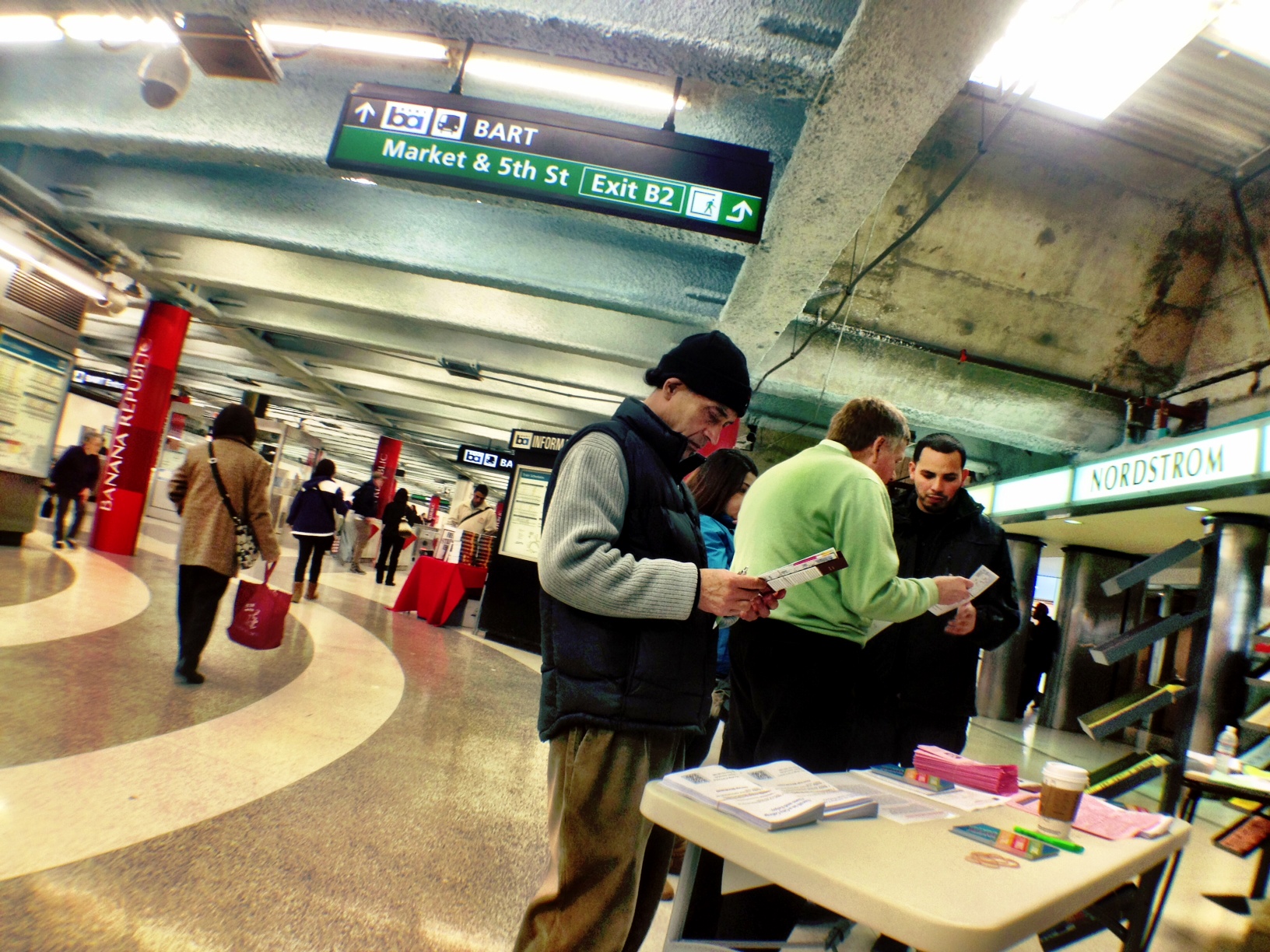
Walking through the Powell BART and Muni station, commuters are used to hearing the cries of a melange of musicians, crazies, and those with something to sell. Today and tomorrow though, commuters will hear something entirely different, as teachers cry “Enroll at City College! Enroll now!” through transit stations across San Francisco.

Teachers and faculty from the equally bedeviled and beloved school, City College of San Francisco, are out in force with flyers and laptops trying to shore up an enrollment deficit of 3,000 students. Today they’re at the Powell, Montgomery, and Embarcadero stations, handing out flyers and enrolling potential students on their laptops. Tomorrow, they’ll be at Civic Center, Mission, and Balboa street Muni and Bart stations doing the same.

The lack of student enrollment would deprive the school of $6.5 million dollars in state funding, which the school has responded to by cutting faculty and administrative salaries by 8.8 percent, and electing not to rehire, essentially letting go, 30-40 part time teachers, 18 part time counselors, and 30 clerical staff.

It’s no wonder these teachers are out on foot, enrolling as many folks as they can — and they say they’ve met with some success.

“I’ve been surprised how receptive people have been,” said Lizzie Brock, a basic skills English teacher at the college. Brock was on her feet handing out flyers for four hours, despite being about six months pregnant with her second child. “It’s a labor of love,” she said.

Though Brock only recently became a tenured teacher at the college, having taught there full-time for six years, she can’t afford to live in San Francisco on her salary from CCSF. She lives in Pacifica, commuting to the city to teach her classes.

Thomas Blair, a foreign language department head at CCSF who also teaches French, organized the two days of outreach. An older gentleman with snowy, neatly combed hair, and a kindly manner, he’s the last person you’d expect to sound the trumpets and gather 90 or so teachers to hit the pavement.

His passion for the college lies in these simple facts: he’s taught there for more than 30 years, and as a department head, he has a responsibility to all of the foreign language teachers at the college, and the thousands of students who open themselves to learning how to communicate with the world.

“I brought the table on the K with me all the way from Ocean Avenue,” Blair said. He thinks he has a pretty good chance of signing up new students from commuters, because those in the 30-55-year-old crowd are often the ones taking new languages at City College, he said. “The office workers are a very good segment for us now,” he said.

Guillermo Romero, a blueprint reading instructor at CCSF, was also there handing out flyers. Streams of people flew past Romero, but he was undeterred. Romero is confident that his classes will meet enrollment, simply because of his philosophy in teaching his class, he said.

Disfrutando euseñando, disfrutando aprendieindo,” Romero said. If you enjoy teaching, they’ll enjoy learning — and hopefully be back for more.

The Guardian, the Examiner, and the Weekly

115

As you can all imagine, I’m getting calls and emails, so let me clear it up: Yes, San Francisco Newspaper Co. has bought SF Weekly.

Yes, Todd Vogt is the co-owner of the Examiner, Guardian and now Weekly, but for the record, I am the editor and publisher of the Guardian.

No, there are no plans to merge the two weeklies or consolidate them or combine the editorial staffs. We will continue to do our best to be the progressive voice of San Francisco; the Weekly, I assume, will continue to do its own different thing.

And no, this doesn’t mean that I’m going to suddenly be BFFs with Joe Eskenazi. We have our view of things; he has his. I fervently believe that we will continue to disagree, and the city will be served by the ongoing debate. (Unless Joe comes to his senses and realizes that I’m always right.)


Feds downgrade troubled Housing Authority

9

The federal government has declared the San Francisco Housing Authority a “troubled” agency and dispatched agents to review the agency’s finances and management failures.

The team of experts from the Department of Housing and Urban Development arrived Jan. 7 and has begun poring over the SFHA’s books.

The federal decision came in an October 31 letter to the city’s Housing Authority Board, with a copy to Mayor Ed Lee.

“The Board of Commissioners of the San Francisco Housing Authority should take immediate action to identify the sources of the performance deficiencies and develop and implement a plan to recover” at an “acceptable level of performance,” wrote HUD in its letter.

The troubled ranking is further bad news for Executive Director Henry Alvarez, who was hired in 2008 to help steady the agency’s management. He has since faced allegations of mistreatment and discrimination by some of his top staff, including the agency’s lawyer. He is the target of three lawsuits by his staff.

In addition to the “troubled” status for public housing, SFHA already faced stepped up monitoring if its Section 8 program that provides rental assistance for program participants in privately owned units. The agency scored zero points in its section 8 program because it failed to submit its report.

San Francisco’s “troubled” status was due to low scores for management of the agency and its finances. On financials, SFHA scored five points out of a possible 30, and on management it scored 12 points out of a possible 25. On physical conditions, SFHA squeaked above the cut-off with 27 out of 40 points. The agency’s total score was 54 out of a possible 100.

The score was a drop from score of 75 the prior year. The SFHA explains the change as new scoring criteria by HUD. The looming issue is the lack of effective management at the agency’s top level.

The arrival of a HUD team this week for a week-long examination of the Housing Authority will produce a plan for the agency to correct its management and financial practices with a set of deadlines and specific actions. Failure to implement the plan can bring new consequences with even tighter oversight.

“HUD is at SFHA offices starting today,” said Bill Ford, SFHA attorney speaking for the agency on Monday. “They are reviewing the situation related to the Troubled status. That’s why they are here. They will help develop a plan to pull the agency out of Troubled status.”

The agency had managed to stay off the troubled list — a designation for those scoring under 60 out of 100 points–for the previous two years. A troubled status can make San Francisco ineligible to compete for special funding beyond what it receives by formula.

HUD scoring lags by several months after the agency’s year-end as local officials and federal officials go through appeals and responses before settling on a final outcome. The current troubled status is for the SFHA year that ended September 30, 2011.

SFHA scores for the year ending September 30, 2012 are tentatively estimated also to be in the troubled category or possibly a point or two higher to earn it a “substandard” ranking. Those results are expected shortly to be followed by additional appeals and reviews.

Some one out of 10 San Francisco households receive some form of federal housing aid, not including those who benefit from lower mortgage interest rates under FHA and other federal homeownership mortgage programs.

SFHA earned high marks in the credit market for its HOPESF program that aims to replace decrepit public housing and expand the number if units. That process involves to outside managers to develop and operate and does not rely on SFHA management.

Behind today’s unanimous vote for Chiu

37

For all the high-minded talk about diversity and working together on behalf of the public – and the relentless praising of their political colleagues and supporters – today’s unanimous re-election of David Chiu as president of the Board of Supervisors once again demonstrated that much of the people’s business is done behind closed doors.

As most of the supervisors acknowledged publicly or in comments to the Guardian, in recent days there was a flurry of meetings about the president vote among the supervisors, despite the prohibition in the state’s Brown Act against “seriatim meetings,” in which elected officials have serial meetings with each other until an quorum of supervisors has illegally discussed some topic.

How else could Malia Cohen, Jane Kim, and Scott Wiener – all hopefuls for the president’s seat who withdrew themselves from consideration before a vote was cast – have all known that Chiu had the votes he needed to win an unprecedented third consecutive term? But they did know, as they all told the Guardian.

“The reality was the support wasn’t there,” Cohen told reporters after the vote when asked why she withdrew her nomination just before the supervisors were about to vote, just after Kim had done the same thing, leaving Chiu as the sole nominee.

I asked whether she was promised anything in return for withdrawing from consideration, and Cohen said, “There’s always negotiations involved in everything, from committee assignments to appointment to regional bodies…The full story will come out later.”

Cohen even obliquely suggested that Chiu – who is known to have his sights set on Tom Ammiano’s Assembly seat, which comes open in two years – may not serve his full two years as president and that was part of the backroom discussions. In the more immediate future, Cohen said she wants to serve on the Land Use Committee, so don’t be surprised if Chiu appoints her as chair of that powerful body.

“It may seem like a small setback today, but it sets the stage for greater conversations going forward,” Cohen said of her decision to voluntarily step down.

Kim also told reporters that she knew Chiu had the votes – saying “we know there was broad support for David for another term” – and that the decision that she and Cohen made to nominate one another was mostly symbolic, intended to make a point about the need for women of color to be in leadership positions: “I thought it was important that we put the dialogue out there.”

Kim said she really appreciated the opportunity to speak with more fellow supervisors privately in the last few days than she had before. “All of this was last minute. There were really only discussions in the last three days,” Kim told me. “I got a good sense of people’s policies and priorities.” As for Kim’s priorities, she said she wants to serve on the Budget Committee, so don’t be surprised when Chiu names her as chair.

Wiener also told me that he realized a couple days ago that he didn’t have the votes but that Chiu did. “It would have been an honor to serve as board president, but it wasn’t in the cards,” Wiener said.

Some of what the cards showed was made clear as the nominations for president opened today and new Dist. 7 Sup. Norman Yee spoke first and nominated Chiu, thus making it clear that Kim probably didn’t have the six votes she needed. As former Sup. Chris Daly, a veteran vote counter, told me, “Norman Yee and Eric Mar could have made Jane Kim board president. They were the deciding bloc, but it would taken both of them.”

Yet Mar told us that he was caught off guard by how the voting unfolded today. “I was surprised that people dropped out before the vote,” he told me.

Yet he acknowledged that it was perhaps a smart move by the progressive supervisors, who voted against Chiu two years ago and were punished with bad committee assignments, to instead get behind Chiu now and hand him a unanimous victory.

“I think that was the hope when people dropped out. It would have been hard if they didn’t, but these negotiations [with Chiu over committee assignments] will go on over the next few days,” Mar said, noting that he will push for strong representation by supporters of labor and other progressive constituencies on key committees.

Asked about his negotiations with fellow supervisors, Chiu would only say, “My conversation with everyone was very consistent.” As for his pending decision on committee assignments, he told me, “We have a board that is very diverse and we’ll have committees that reflect that.”

During his speech in Board Chambers, Chiu talked about running the board in a way that would let each supervisor have her/his moments in the spotlight to provide leadership on issues they care about, comparing it to the San Francisco Giants and the contributions that so many players made to their World Series sweep.

“They took turns making the big plays,” Chiu said, going on to tick off the list of how he’ll help his colleagues shine. “Whether it’s Sup. Mar advocating for a healthy environment, Sup. Farrell addressing out looming health care costs, whether it’s Sup. Chu disciplining our budget, Sup. Breed getting the jobs that young people need, Sup. Kim making sure that all our kids graduate, Sup. Yee making sure that small businesses succeed, Sup. Wiener fighting for better transportation options, Sup. Campos fighting against wage theft, or Sup. Cohen curbing gun violence, and Sup. Avalos delivering on local hire, by the end of our season, if we’re going to help each other succeed in getting these things done, we are all going to win.”

Nudi pics to brighten your day

0

It really doesn’t matter that this National Geographic slideshow is from 2008. The relevancy of the nudibranches featured therein defy space and time and will easily be the most uplifting and forward-thinking thing you see on the Internet today. 

Gascon, Adachi and conviction rates

25

Public Defender Jeff Adachi just released his annual report, and it’s impressive: According to the statistic his office complied, of the 60 felony trials handled by deputy public defenders, 62 percent resulted in acquittals or hung juries. That means that the office of District Attorney George Gascon has a trial conviction rate of just 38 percent when the DA’s office is up against the PD’s office.

That’s a pretty abyssmal conviction rate — and the DA’s office has a different spin. According to DA spokesperson Stephanie Ong Stillman, the overall conviction rate on felonies in 2012 was 67.7 percent. But that includes plea bargains, which officially count as a conviction; she didn’t dispute Adachi’s contention that public defenders win far more than half of their actual trials.

There are a couple of ways to interpret this. Not all criminal trials are handled by public defenders; the better-off defendants hire private counsel. And there’s an old assumtion in the world of criminal justice that rich people get better legal defense because they can hire high-priced private counsel.

But if the DA’s figure are accurate, it’s entirely possible — although nobody has the figures — that the San Francisco PD’s office actually does better in criminal trials than private law firms. Tamara Aparton, spokeperson for Adachi, said she has no data on that, but “I wouldn’t be surprised.”

And there’s no way to dispute the fact that low conviction rates indicate the DA is sending weak cases to trial. If criminal defendants are getting off more than half the time, either the cops are making very bad busts (true all too often) or the DA is trying cases that should have been settled.

Dark side of the Dude

3

More than a year ago, in his rundown on “top substances that have influenced music,” promoter-DJ Marco De La Vega said this: “I…raid my own medicine cabinet, take a couple Vicodin, and listen to a stack of records including [Girls],Tamaryn, King Dude, Chelsea Wolfe, and Zola Jesus.”

Already a fan of the others mentioned in that paragraph, I sought out King Dude (a.k.a T.J. Cowgill) and found that I’d already known his previous work, intimately. I’d seen his black metal band Teen Cthulhu in high school, and for many years had the band’s sticker plastered on my black Nissan Maxima, later discovering his band that rose from the ashes of Teen Cthulhu: Book of Black Earth.

It was his turns as founder-creative director of his own clothing label, Actual Pain (Kanye has worn it, OK?), and solo “darkly spiritual acoustic-folk” singer-songwriter that have been the most surprising. Like previous King Dude releases, 2012’s Burning Daylight (Dais) is a desolate affair, with subtle plucking and Cowgill’s darkly raspy vocals meditating on death, murder, spirituality, and love – or as I wrote in this week’s Tofu and Whiskey print music column (Jan. 9 issue), it sounds like “a gravelly demon inside, clawing to get out.”

Yet, behind that gloomy facade, Cowgill was friendly as hell during our phone call, even in the face of adversity. While his beloved dog was going through tests at the vet, he chatted about the occult, personal influences (John Lomax, prison songs, Death in June), his musical relationship with tour-mate Chelsea Wolfe (they arrive at the Great American Music Hall this Fri/11), the differences between his many bands, and deep-seated psychological fears:

San Francisco Bay Guardian Where are you right now?

T.J. Cowgill  I’m at the vet with my dog, everything’s OK. She’s been dog aggressive a little lately, so we’re just making sure. Dogs don’t have a way to tell you when they’re sick. My dog is really nice. She’s a big black lab, and she’s usually nice but she tried to bite a dog yesterday. She’s seven, and hasn’t been to the vet in a long time, but I’m about to leave on tour, so I want to make sure she’s OK before I go.

SFBG What’s her name?

Cowgill Her name’s Pagan.

SFBG OK, so that leads into my first real question: where did you find this interest in the occult?

Cowgill It’s just how I was raised. My dad and his wife were Born Again Christians – they got saved at this church in a small town in Oregon, and that was probably when I was six or seven. Before that they were basically atheists. My mom though has always been a neo-Pagan Witch, her own breed or religion. She would teach me how to meditate, she had healing crystals. So my mother taught me that stuff sometimes out of the year, and then my dad would be telling me that it’s all devil worship. It was back and forth.

I just had to figure out why all these adults in my life were crazy. And I just had a profound interest in the history of religion in general, because of it. Where do these beliefs come from? How are people so fractured when it comes to spirituality? 

https://www.youtube.com/watch?v=BiSnI8vyxx0

SFBG Can you tell me about the process for ‘Burning Daylight?’ What was influencing you at the time you were making it?

Cowgill That record in particular, I was listening to a bunch of early field recordings, by like, John Lomax, a lot of prison songs, and a lot of early American country-blues. But it’s across the board; some of it is influenced by country stars like Roy Orbison and Johnny Cash. John Lee Hooker, a lot of his guitar playing influenced how I played guitar on that record. In all, I was just going for an early American, turn of the century vibe. An alternate score to maybe There Will Be Blood.

SFBG It does have a little bit of a darker feel to it…

Cowgill Totally, it’s really dark. I thought when I recorded like, ‘this isn’t that dark.’ But then I play it and some songs are the darkest, most depressing shit. When I was writing it, it didn’t feel like that at all. Then of course you send it off to press, to the labels, and you don’t think about it anymore, because you’re sick [of hearing it]..I record, mix, and master everything that I release, or I have so far. And so it’s like, I don’t want to hear those fucking songs for a good amount of time. It was almost three months before I listened to it again, and I was like, ‘Jesus Christ, this is the darkest fucking record.’ Who wants to sit around and listen to this?

SFBG People are drawn to the darker stuff.

Cowgill Definitely. It represents a side of every single human being. The themes were like, love causing people to murder, the need to accomplish something, preventing your own death by any means necessary. And while working on the record, I was going to this incredibly dark place. My wife noticed, everybody noticed. I would get into arguments with people, or fistfights, I got arrested, you know? I’m like, how bad am I trying to get myself into trouble to understand this, or to get this narrative correct. I’m not normally like that.

SFBG Each song does feel like its own narrative, a vignette with a scene of specific characters, like in ‘Barbara Ann,’ there’s a story of murdering for love, but is it really a love song?

Cowgill I think it’s probably the best love song I’ve ever written. Just simply because it is this character, this young kid. It’s from the perspective of this 12-year-old kid singing to another 12-year-old, this girl Barbara Anne. In my mind it takes place in a small town in the ’40s and it’s this kid who’s wildly in love but doesn’t really even know what love is.

He’s more in love than anybody has been in love before, and is willing to do anything for Barbara Anne, who’s not even a bad person but she has had some bad things happen to her in the town. So the kid is like: I’ll kill everybody in the town for you, if that’s alright with you. That’s the most loving thing I think anybody can say for somebody else.

To get into a character, if you’re trying to tell a story – and all my songs have a fairly strong narrative – it helps to give some life to the characters that you might not even talk about in the song.

SFBG How different is that from the way you’d write for your other bands like Teen Cthulhu and Book of Black Earth?

Cowgill Completely different. I have to take into consideration the feelings and religious or political stances of the people I’m in a band with. I don’t feel, in the past, that I’ve ever been able to just write whatever I wanted; there was a bit of a filter – and it’s not like they were asking me, don’t write songs about this or censoring, but I was sort of self-censoring, to not associate them with something they didn’t want to affiliate with.

SFBG Is this the first time then that you’ve really been able to write exactly how you wanted?

Cowgill Exactly. I realized early on the power of that for me, and how much I liked it. I love it. My creativity or output is much higher than it is in other bands. It’s a far more difficult process with a band. I’m in another band called CROSS with Travis [Namamura] from Teen Cthulhu and my friend Larry [Perrigo], who was in Wormwood, and that’s a collaborative band. It’ll take us months to write a single song and with King Dude, I could do a song a day.

Granted, the songs are completely fucking different. My songs are blues and folk-influenced, so the framework’s already there. In CROSS, it’s inspired a lot by Finnish black metal, so it’s a weirder process. Everybody in that band CROSS looks at it as a different band. I look at it as complete Bathory worship as a guitar player, the bass player [Perrigo] listens to Finnish Black Metal, and then [drummer Namamura] listens to hardcore and heavy metal. 

SFBG So how did you choose folk and blues as the direction for your personal project?

Cowgill It just kind of came out that way, I think. I have a strange guitar tuning I use, it’s just a little different than a normal tuning and it forces everything into a minor key, and it makes the song sound sadder, somber, with a sense of longing. When you strum an acoustic guitar with a C chord, it just sounds kind of folky.

Plus I was listening to like, a lot of British folk at the time when I started it. I listened to bands like Trees and Fairport Convention and even Krautrock too. Death in June obviously, and all the neofolk stuff was greatly influential on me.

Although, I didn’t ever really consider myself part of that scene, I just knew a little bit about. I just started discovering it around that time. Actually, I started King Dude before I heard Death in June. My friend Mary – who is a lifelong goth [laughs] –  heard the recording I did and said, ‘This sounds like Current 93 and Death in June.’ And I was like, ‘what are those bands?’ And just dived in and fell in love with both of those bands and it really influenced what I was writing.

SFBG How did you end up working with Chelsea Wolfe? This is your first tour together, but you’ve also recorded together in the past?

Cowgill We recorded a split seven-inch, we wrote two songs together and performed on each other’s material. My wife, Emily, played drums on both of the songs. And Ben Chisholm, her boyfriend who plays bass in the band, played on both songs. So it was very collaborative. That was a year and a half or two years ago. We’ve only done a couple of shows together in our lives. That’s so weird, I’ve known them for so long.

SFBG How did you first meet?

Cowgill There’s this guy Todd Pendu, Pendu Sound Recordings. He put out her early stuff. He also was a big King Dude fan. He thought I should met Chelsea and that we should do a split together. It was weird, meeting Chelsea with a pretense. It was that awkward moment when your friend is trying to set you up with someone.

I was like, I don’t know if she’s an asshole, I don’t know if she’s on heroin. I don’t know anything about her. There’s all kinds of things that would make me not want to work with someone. But as luck would have it, we got on like a house on fire. We’re similar in a lot of aesthetics and things, and Tom was right.

SFBG For the record, she’s not an asshole or a heroin addict...

Cowgill It’s really good that’s she’s not. It’s beyond just, ‘oh she’s cool.’ We’re friends. Ben wrote the intro for my last record, Love. We share music with each other before it comes out. It’s a great friendship. We’re really stoked [for the tour].

https://www.youtube.com/watch?v=bP-MBHdka90

SFBG What else do you have planned for 2013?

Cowgill I have a record called Fear. It’s a lot different than Burning Daylight. The songs are a lot more ’60s pop rock, British Invasion type of stuff. But lyrically it’s much much darker.

Burning Daylight is about death, an angry emotion, but Fear is about your deepest, darkest fears – the things that keep you awake at night; I’m exploring deep-seated psychological stuff. It’s been enlightening. The lyrics are more personal, maybe not such fictional characters. So that’s a huge step for me, I’ve never done that before. Lyrically and musically, I think it’s the best stuff I’ve written.

I’m about to tour for two months, so it’ll probably be a fall release. About a record a year is what I aim for.

SFBG And you’re still doing the Actual Pain [clothing line]?

Cowgill That’s a full-time operation as well. Luckily, [Emily] helps so much. We’re partners in the business as well as in life. And we have a couple of employees now. So it’s a little easier for me to leave and tour. For the past couple of years, it’s been too hard for me to leave for more than a week. Actual Pain is doing really well and growing a lot, and in that growth I experience a little more freedom.

King Dude
With Chelsea Wolfe
Fri/11, 9pm, $15
Great American Music Hall
859 O’Farrell, SF
www.slimspresents.com


Sunday metering begins in SF but few notice

15

Yesterday, after years of heated conflicts over the issue, San Francisco officially began charging motorists to use metered parking spaces between noon and 6pm on Sundays – and nobody seemed to notice.

For the first few weeks, parking control officers with the San Francisco Municipal Transportation Agency are going to be issuing warnings rather than expensive parking tickets. But as Streetsblog SF reported today, even that didn’t seem to be happen. Its street survey in the Haight and Mission districts found that most parkers didn’t pay, and they received no warnings that they were supposed to.

SFMTA spokespersons that didn’t respond to Streetsblog inquiries also haven’t responded to questions from the Guardian about what happened and how many warnings were issued (UPDATED BELOW).

Sunday metering is intended to create more parking turnover in busy commercial corridors and bolster the SFMTA’s budget, capturing more money for Muni. But for now, it seems that everyone involved is still trying to shake off their holiday hangovers and get up to speed.

UPDATE 5:45: SFMTA spokesperson Paul Rose just returned our call to say parking control officers were indeed busy issuing warnings yesterday. “We issued about 4,000 warnings yesterday. That’s part of getting the word out,” he said. As far as Streetsblog’s observations, he said it could have been a fluke of timing or the fact that meters don’t indicate when someone pre-pays or pays by cell phone. “In the Haight, specifically, we issued about 600 warnings, and about 1,000 in the Mission,” he said. In addition to the direct warnings, the SFMTA has been publicizing the Sunday metering on billboards and Muni posters, through merchant groups, in the media, and on the meters themselves. 

Enforcement with actual tickets begins on Jan. 27.

New school lunches: “awesome.”

15

There’s still a lot of controversy around SFUSD’s new school lunch program and how much it’s actually going to cost. But the early reports from Aptos Middle School are very, very positive. I received a text from my son today that says: “Tell the School Board that the new lunches are awesome.”

Much better than the previous fare.

So there’s some good news. 

Heads Up: 6 must-see concerts this week

0

It’s likely your first full week back to work after the holidays – and just how does that feel? Painful? Like a dull, numbing pain creeping up your neck? Fix it with fun, like the kind you’ll have seeing former Das Racist, Kool A.D. at Elbo Room, doom folk friends Chelsea Wolfe and King Dude at the Great American Music Hall, or producer Jerome LOL at Rickshaw Stop, punk act Kicker at Bender’s, or club night Push the Feeling’s one-year anniversary show at Underground SF.

Cheer up, Bay Area. There’s plenty to hear in 2013.

Here are your must-see Bay Area concerts this week/end:

Kool A.D.
Fresh off that announcement that his group, Das Racist, broke up (though it technically fizzled months earlier), Kool A.D., a.k.a Victor Vazquez, seems to be reinvesting himself in Bay life. The rapper-producer grew up here, and in 2012, he reconnected with his roots: releasing a mixtape (51) recorded in Oakland, littered with Bay notables and local references. Here’s to new projects on 2013.
With Safe, Trill Team 6, Trackademicks
Wed/9,  9pm, $10
Elbo Room
647 Valencia, SF
www.elbo.com
https://www.youtube.com/watch?v=ycPbYqLDq4w

Jerome LOL
Remember when Rihanna played SNL and transformed the stage into an IRL URL with a green screen of floating GIFs and animated graphics while singing “Diamonds?” And around the same time Azealia Banks (recently involved in more controversy) released a ’90s-copping video for “Atlantis” as a seapunk mermaid priestess riding a Lisa Frank-like digital dolphin? Those aesthetics were largely reminiscent of LA’s Jerome LOL and his kind of early web archeologist-producers. Jerome has since come out as saying those takes on his flashy style were complimentary, though perhaps not the right formats, as they are void of substance and context. If you want to see the cursor starting point, you’ll make it to his show tonight. Plus, he does a chirpy club remix of “Diamonds.”
With RL Grime, popscene DJs
Thu/10, 9:30pm, $13-$15
Rickshaw Stop
155 Fell, SF
www.rickshawstop.com
https://www.youtube.com/watch?v=oCxkuoRPQJA

Chelsea Wolfe
Ah, the tormented love song. Chelsea Wolfe does it well. Vocally, she transfixes, sometimes sounding like she’s calmly wringing every ounce of blood from a relationship totem, at other points whispering cries of help from a enveloping darkness, the vibrations of the plucked-hard guitar strings reverberating in the distance. This rush of gloom and pain, in a genre she’s past described as “doom folk,” came forth in a fierce package in 2011’s electric Apokalypsis, and steadily zigzags beautifully through 2012’s meandering Unknown Rooms: A Collection of Acoustic Songs.
With King Dude
Fri/11, 9pm, $15
Great American Music Hall
859 O’Farrell, SF
www.slimspresents.com

https://www.youtube.com/watch?v=mgWb1d001FI

Push the Feeling with Yacht (DJ set)
Push the Feeling, Kevin “epicsauce” Meenan’s affordable dance night at Underground SF – which I profiled in last year’s “Post-Everything” cover story – is turning one-year-old this weekend. Over the past 12 months the Lower Haight party has seen live performances and DJ sets from the likes of Les Sins (Toro Y Moi), High Places, Shock, Blackbird Blackbird, Heathered Pearls, Silver Hands, Yalls, and Chautauqua. This time, there’s a Yacht DJ set, and a live Jeffrey Jerusalem along with resident DJs YR SKULL and epicsauce.
Fri/11, 9pm, $5-$8
Underground SF
424 Haight, SF
facebook.com/pushthefeeling
https://www.youtube.com/watch?v=vHNtMWKqMeg

Mister Lies
“Nick Zanca played in several punk bands in high school until he was introduced to electronic music and production in college. This happened about a year ago. Since then he’s caused quite the stir, catching a record deal and tour as Mister Lies. The deep, almost spiritual electronica, or “experimental avant-garde pop” as he prefers, draws inspiration from diverse artists — spanning Steve Reich to Missy Elliot.“ — Molly Champlin
With Some Ember
Fri/11, 9:30pm, $12
Bottom of the Hill
1233 17th St., SF
(415) 621-4455
www.bottomofthehill.com
http://www.youtube.com/watch?v=xc1u9X4HFAE

Kicker
Newish Bay Area band Kicker features members of Neurosis, Filth, and Dystopia, and sounds like late ’70s anarcho-punk à la Subhumans. Which makes perfect sense, really, as lead vocalist Pete the Roadie grew up in England, went to the same school as Subhumans and Organized Chaos, and has been a part of the worldwide punk scene since that formative year of ’77. Really need another reason to go to this $5 Bender’s show? OK: Bad Cop/Bad Cop — the LA rock’n’roll band with members of Cocksparrer tribute act Cunt Sparrer — opens the whole thing up.
With Pang!
Sat/12, 10pm, $5
Bender’s
800 S. Van Ness, SF
(415) 824-1800
www.bendersbar.com
http://www.youtube.com/watch?v=2MPFQE5h-lE

“Weren’t they all circus shots?” Weegee’s crime scene photography

1

In a slight departure from his job as founder of the Noir City film festival (coming up at the Castro Theater Jan. 25-Feb. 3), Eddie Muller pays homage to a dark auteur of a different medium with a talk at the Contemporary Jewish Museum on Thu/10. The object of Muller’s affection is famed crime scene photographer Arthur Fellig, a.k.a. Weegee. Weegee introduced artistry — often by way of extra-journalistic manipulation — into the documentation of extra-legal happenings during the 1930s and ’40s, so perhaps Muller’s fascination with the subject should come as no surprise. We caught up with Muller via the Interwebs to find out more about why he wants to draw upon Weegee’s dark arts in this week’s presentation.

San Francisco Bay Guardian: Why Weegee? What initially drew you into his work?

Eddie Muller: It’s about time I paid some public lip service to the guy. I’ve been fascinated by his images and the man himself since I was in high school and first saw his work — about the same time I became interested in film noir. The initial attraction to his photos is their grotesque aspect, the death, and the despair. But when you wise up a little and look deeper into the images, you see the incredible humanity … and the humor. And for many years unseen work would surface, so he’s remained fascinating. 

“Their First Murder” by Weegee

SFBG: How were his shots different from those of other crime scene photographers at the time?

EM: He was a storyteller. Other shooters were just looking for the cold facts, a documentary record of an event. Weegee was on the prowl for stories, ones you could grasp in a glance — and of course he wasn’t above manufacturing a news photo to get the story he wanted. There is a lot of editorializing in his work, so he wasn’t lying when he described himself as an artist. I love that bit in The Public Eye — in which Joe Pesci essentially plays Weegee in a film noir version of his career — he’s shooting a murder victim and he tells the cop “put the guy’s hat in picture. People like to see the dead guy’s hat.” He was a newspaper photographer whose singular style brought out the deeper meaning in his images. That was his art. What’s curious is that when he quit journalism to focus exclusively on his art, the work became less interesting, less humane.

“The Critic” by Weegee

SFBG: What about his circus shots? How would you characterize the kinds of themes that Weegee worked with?

EM: Weren’t they all circus shots? His nocturnal images of Manhattan are evidence of high-wire acts gone wrong. Not a bad description of life in the big city at 3am. I think his theme, if you want to call it that, was capturing the dread and danger lurking right below the surface of everyday life — but his genius was focusing as often on the people around the murder, the suicide, the tenement fire. The observers, the survivors. That’s where you see the courage, the determination, and the humor in “Weegee’s People.”

SFBG: Do you think he’s had a lasting impact on photography? How so?

EM: Absolutely! More than practically any photographer I can think of. Weegee was doing irony way ahead of that curve. He wasn’t only influencing news photography, he was influencing movie cinematography. I believe his vision of the big city after dark has a direct impact on the development of film noir in Hollywood. And not just on the camerawork, but on writers. He influenced the way other artists looked at the city, and the people in it. And he brought an entirely new attitude along with the good eye. He was a poor street kid who didn’t trust the rich and wanted to rub their noses in all the stuff they’d find impolite and inappropriate for public consumption. I think his attitude, the acceptance of humor and grace and grit amongst the horror and despair has been a huge cultural influence, as much on writing as on any other medium. Weegee was a writer, of sorts. Here’s a thumbnail of how he’d work: he wanted the perfect photo of street drunk, so he’d always be on the lookout for guys passed out in the gutters. But it had to be perfect! One night he finds a guy, flat on his back, under the awning for a funeral home. He gets the shot, and of course titles it: Dead Drunk. That’s not a news photographer at work. That’s not an artist with a camera—the picture isn’t even that good. That’s a writer—one who uses a camera, not a pen.

“Eddie Muller on the Art and Legacy of Weegee”

Thu/10, 6:30pm, $5 museum admission

Contemporary Jewish Museum

736 Mission, SF

www.thecjm.org

Eviction of activist/gardener squatters follows HANC’s eviction

55

About 20 activist gardeners were thrown out of the old Haight Ashbury Neighborhood Council (HANC) Recycling Center space today, when Sheriff’s Department deputies and four park rangers surrounded the old HANC site and ordered them to leave.

It’s the second eviction on the same site this winter, as the recycling center that has been there for over 30 years before being ousted by city officials responding to neighborhood complaints about low-income recyclers. HANC was initially evicted on Dec. 27. In the wake of its closure, about 20 or so renegade gardeners set up a campground with their own urban gardening center in the space — with free seeds, soil, mulch and borrowable gardening tools for the community. 

The gardeners, wrapped in sleeping bags and inside tents, had a rude awakening this morning around 6am. At least 30 members of the Sheriff’s Department, led by Sheriff Ross Mirkarimi, announced that they were trespassing and had five minutes to leave. 

“It was right at sun-up, and I was in my sleeping bag,” said Joash Bekele, a 28 year old environmental activist. “We thought they were coming [yesterday], we were up all night — worrying that they’d come.”

They didn’t have long to gather their gear, and a lot of their tools were left in the now locked HANC site, said Ryan Rising, one of the key organizers of the group. Most importantly, they lost their newly built miniature greenhouse, which they constructed themselves.

“A lot of this is about food justice,” Rising said. It’s a better alternative to the community garden that the Recreation and Parks Department (RPD) plans to build in the space, he said, because it would encourage community input in everything they do. 

“It would be a neighborhood space,” he said. 

RPD officials did not respond to emails before press time (UPDATED BELOW).

The group is now out on the sidewalk beside HANC, on Frederick Street. Along the fence of the old recycling center sits bags of soil and mulch, books on gardening, and a sign that reads “Welcome to the Golden Gate Recology Center.” 

The now-evicted gardeners answered questions about gardening from passers by, and offered tips on sustainable cooking and gardening to anyone who happens by with a question.

The group of “renegade gardeners” are meeting tonight to discuss their next plan of action, which may include staying on the sidewalk outside HANC, or finding a new space altogether, Rising said. 

The Sheriffs Department didn’t reach us by press time for comment (UPDATED BELOW), nor did Mirkarimi. A park ranger at the site, William Ramil, said that the eviction was a peaceful, orderly one.

As Ramil described the scene, we stood outside the locked gate to HANC. Three cars pulled up, a Lexus, a Saturn, and a Honda Hybrid, all customers looking for the recycling center.

Andrew Herwitz, behind the wheel of the Saturn, was surprised to see HANC closed. “Having places that are community-run are so important,” he said.

He said he was heading to the Safeway on Market Street with his recycling now, begrudgingly.

UPDATE 1/7: Sheriff’s Department spokesperson Kathy Gorwood disputed reports that there were about 30 deputies at the scene, but confirmed that the evictions were peaceful and with no arrests made, declining further comment. RPD spokesperson Sarah Ballard told us, “The Department is pleased to be moving forward with the neighborhood-supported plan for a community garden at the site.”

Corporations and carpools

60

I absolutely love this story: A Marin activist named Jonathan Frieman, who runs a small nonprofit corporation (the JoMiJo Foundation) was driving in the carpool lane on highway 101 in Marin when he was stopped by a cop and given a $478 ticket. Ah, but Frieman insists he wasn’t driving alone; beside him in the car were the articles of incorporation and other relevant corporate paperwork for his foundation — and in the United States, corporations are considered people. In fact, the California Vehicle Code refers to “natural persons or corporations.”

So Frieman is challening his ticket in traffic court, and is willing to spend his own money to appeal the case as far as he can. He wants to force the courts to decide: If a corporation is a person, then it gets to ride with a driver in the carpool lane, and his ticket has to be dismissed. If it’s not a person, then maybe it can’t make political contributions.In fact, if a corporation isn’t a person, a whole lot of evil stuff might come to an end.

Could a traffic fine be the ticket to that ruling? Who knows — and at the very least, Frieman is helping point up the absurdity of the current state of the law.

This is no fluke, by the way: Frieman, a longtime community activist, has been looking for ways to challenge corporate personhood for more than a decade. He’s convened legal scholars, looked for avenues to challenge the notion that corporations have the same rights as the rest of us — and along the way, came up with this idea.

It’s taken a while because the California Highway Patrol hasn’t been all that vigilant. “I’ve been driving up and down 101 in the carpool lane with my corporate papers for years,” Frieman told me. “I never got a ticket until October 2.”

His first hearing is in Marin’s traffic court in San Rafael on Jan. 7.


A tale of police priorities

116

By Anh Lê

On Friday afternoon, November 9th, as I was walking on Howard St. near 3rd, I was physically assaulted twice by a Caucasian man walking with an accomplice, an African American woman. I was punched in the jaw the first time while I was still on the sidewalk; the assailant followed me into the street traffic to punch me in the jaw again. Many people passed by, yet none stopped to help. 

I called 911 from the a nearby restaurant. The first oSan Francisco police officer to arrive ordered me to sit down, and then quickly left. Then two other officers arrived, one of whom told me that he was already on assignment at the Moscone Convention Center. Even though I had an eyewitness, and we both provided the officers with a description of the assailant and his accomplice, and I told the officers that the two were still in the vicinity on Howard St., the police did nothing. One of the cops told me, “I think the guy looks like someone from the Tenderloin.”

Compare that to another incident and you get a sense of the city’s police priorities.

On Thursday afternoon, December 13, at the Muni island bus stop on Market St. at 5th, I saw two young African American men in handcuffs. They were detained by an SFPD officer, and two Muni fare inspectors. Both African American men were calm, poised, and respectful in their behavior.

One of the handcuffed men had a cell phone in his mouth while the police officer was questioning him. I thought that it was an odd situation, since the officer could have assisted him by removing the cell phone from his mouth.  I also thought that the dynamics of the situation seemed degrading and demeaning to this young man.

Within five minutes, several additional SFPD officers arrived on the scene, and then several more arrived in an unmarked large black SUV. Nearly all of the police officers were Caucasian. None was African American. 

One of the officers unzipped the second detainee’s backpack.  He calmly said to the officer, “I don’t have any weapon in there.” I could see that the situation involved a simple Muni fare situation. Yet I saw more than ten SFPD officers responding.

I spoke with two of the passengers waiting at the bus stop to ask them what they had seen. Semetra Hampton and Laversa Frasier told me that they saw the two young males handcuffed, and that these young men never acted in any aggressive manner.

I spoke with the two young men, Wayne Price and Jamal Jones. Each received citations, one for paying a youth fare as an adult, the other for misuse of a Clipper card. Hardly serious crimes.

I contacted Officer Michael Andraychak in the Media Relations Unit at SFPD and Paul Rose, spokesperson for San Francisco Municipal Transit Authority to ask why so many officers were involved in such a minor incident.

Rose emailed to tell me that transit fare inspectors saw that the men were using youth passes and asked for identification. When they refused, the fare inspectors contacted police. Andraychack said a Muni fare inspector tried to detain the suspects, but they refused to comply and ran onto the Muni bus island. The inspectors flagged down a nearby police officer, who radioed his location and told dispatch that he was being summoned by Muni personnel for an undetermined problem. Additional officers heard this radio transmission and responded to the scene.

He noted that “Fifth Street / Market is on the border of Tenderloin and Southern Districts. Officers from both districts patrol this area and the MTA K9 officers routinely patrol the Market Street Muni Metro Stations and surface transit stops.”

I appreciate the efforts by Rose and Andraychack to provide me with the information requested.  However, their statements only tell part of the story. Some of their information does not match what I observed, nor what the eyewitnesses told me at the Muni bus stop.

I was there; I counted more than ten SFPD officers who descended on these two young men. Neither of them had done anything violent to anyone, yet their fare evasion elicited massive response.

On the other hand, there was no diligent effort by SFPD to locate, apprehend, and arrest the assailant who assaulted me, on November 9th when he and his accomplice were still in the vicinity of the attack.

Mayor Ed Lee recently proposed a policy permitting police officers to detain and search certain individuals on the street if police deemed it necessary. After vigorous protests from San Franciscans and the Board of Supervisors on the grounds that such a policy would encourage racial profiling, the mayor withdrew the plan.

Still, I have to wonder: Is sending that many officers to handle a simple Muni fare situation involving two young African American males necessary — or is it racial profiling at its extreme? Is this how we as San Franciscans want to see our tax dollars spent — and wasted?

Will narrow business interests continue to dominate SF’s political agenda?

44

Will the narrow, deceptive, and disempowering “jobs” rhetoric of the last two years continue to dominate San Francisco politics in 2013? Or can San Franciscans find the will and organizing ability to create a broader political agenda that includes livability, sustainability, and affordability?

If it’s up to the San Francisco Chamber of Commerce – whose perspective has been aired in both the Examiner and Chronicle over the last two days – private sector profits will continue to be our only metric of civic success.

Just take a look at the “Pinkslips and Paychecks Scorecard” that the Chamber released yesterday, rating members of the Board of Supervisors based on a series of 16 votes for tax cuts and public subsidies for businesses, approvals of projects serving the rich, rollbacks of government regulations, business surcharges on consumers, maintaining PG&E’s dirty energy monopoly, and blocking an expansion of developer fees to improve Muni.

That aggressive neoliberal agenda, which is shared by Mayor Ed Lee and his big corporate backers, was reinforced by Chamber VP Jim Lazarus in an op-ed in today’s Examiner. Ignoring the rising housing and other living costs that plague the average San Francisco, Lazarus uses hopeful language about how we’re all “poised for success in 2013,” burying the Chamber’s aggressive and exclusive agenda in the subtext.

At the top of his agenda are: “Approval of the California Pacific Medical Center rebuild, reforming San Francisco’s California Environmental Quality Act appeals process, and rule-making for the upcoming gross-receipts tax.” In other words, let CPMC have what it wants, make it more difficult to challenge developers on environmental grounds, and ensure business taxes remain as low as possible.

And to ensure supervisors get the message, he closes by noting that business leaders are “energized and ready” to push their agenda with tools such as the Alliance for Jobs and Sustainable Growth, which waged some of the nastiest and most deceptive political attack ads on progressive candidates in the last election cycle.

The progressive movement of San Francisco has its problems and issues, including a recently widening schism between environmental and transportation activists on one side and the nonprofit housing and social justice faction on the other. And in the current economic and political climate, both sides too often find themselves partnering with corporate and neoliberal interests to get things done.

But now, more than ever, San Francisco needs to broaden into political dialogue, and that means a reconstitution and expansion of its progressive movement. That’s something that the Guardian has long focused on facilitating and publicizing – something that will be my personal focus as well – and we have some idea percolating that we’ll discuss in the coming weeks and months.

Then maybe all San Franciscans can be poised for success in 2013 and beyond.

Oscar contender ‘Zero Dark Thirty’ opens today! Plus (a few) more new movies

7

At last, the movie most likely to challenge Lincoln for Best Picture opens in San Francisco, with an even wider release coming next week. Check out my review of Zero Dark Thirty here. Highly recommended, and even if it doesn’t snag the top trophy, look for Jessica Chastain to win Best Actress. (More Oscar predictions here, in case you’re getting your pool in order extra-early.)

Also this week: Texas Chainsaw 3D (the first two films in this series, I’ll defend to the death … no interest in seeing this one, frankly), a re-release of Luis Buñuel’s 1970 drama Tristana, and freewheeling New Orleans doc Tchoupitoulas (reviews of the latter two after the jump).

http://www.youtube.com/watch?v=bcW2EKnzXxE

Tristana The morality tale rarely gets as twisted as it does in Luis Buñuel’s 1970 late-in-the-day beauty Tristana. Working with Benito Perez Galdos’s novel, the filmmaker gleefully picked up a thread entwining erotic politics and S&M — explored to exquisite effect in 1967’s Belle de Jour and again offset by the immaculate bone structure of anti-heroine Catherine Deneuve — while bringing a corrosive intimacy to his black-humored disembowelment of a self-serving aristocracy, hypocritical church, and Franco-era fascism. Today it feels like one of Buñuel’s most personal and Spanish films, with the director-cowriter basing the impressionable Tristana on his sister Conchita. The starting point is an archetypal innocent “strange flower” clad in black, Tristana (Deneuve). She has been placed in the care of the aristocratic Don Lope (Buñuel regular Fernando Rey), a dissolute “senorito” (akin to Buñuel’s own father) who lives off his inheritance and espouses a kind of anti-clerical, antiauthoritarian, albeit elitist, libertine lifestyle. The patriarch can hardly deny himself anything, let alone his gorgeous ward, who is confined to the house like a prisoner and learns at Don Lope’s feet to despise the man who admits he’s her father or her husband, depending on when it suits him. Enter a dashing young artist Horacio (Franco Nero, the original Django) to spirit the increasingly embittered Tristana away from the battered, mazelike streets of Toledo, Spain. But that feat is far from easy when the “fallen” woman’s daydreams of teaching piano pale in comparison to a recurring nightmare of Don Lope’s head at the end of a rather phallic church bell clapper. What follows — photographed with disciplined, earthy beauty by cinematographer Jose Aguayo and now restored to its dusky, lustrous good looks—is a de-evolution of sorts, as both an innocent and corruptor are defiled, though Tristana’s psychosexual reverberations, which would have given both Freud and the Marquis de Sade palpitations, echo out beyond the closing montage, its tolling bell, and the repeated heavy thud of a prosthetic slamming into the floor. (1:38) (Kimberly Chun)

Tchopitoulas Three adolescent brothers enjoy a dusk-to-dawn night in the Big Easy — New Orleans, baby — in this impressionistic documentary that blurs the line between staged and sampled lyricism. Bill and Turner Ross’ film sets the trio loose in the French Quarter and beyond, where they sample the company of various drunks, buskers, oyster shuckers, painted ladies, and so forth. No laws are conspicuously broken, though a few get bent — it’s safe to say these kids probably won’t be visiting several environs again until they’re of legal drinking age. The long night is an inebriate dream of color and sound, strange but seldom menacing. Like the “city symphony” movies of the 1920s and 30s, this is less nonfiction cinema in a strict vérité vein than a poetically contrived ode to life — a life that’s sturdier than it looks, since Tchoupitoulas finds NO back to the business of partying like Katrina never happened. If you’re looking for a harder-edged portrait of the burg’s status quo, there are plenty of other documentaries to choose from; the Ross’ provide a woozy mash note rather than a sober pulse-taking. You’ll definitely want to go bar-hopping afterward. (1:20) (Dennis Harvey)

Why the GOP gets away with obstructing Congress

91

There’s an interesting piece on Calitics talking about what California can teach the nation in terms of ending Republican obstructionism. Robert Cruickshank, as usual, is right on target — and he points to the real problem in Washington. Republicans in the House no longer worry about losing their seats to Democrats; the GOP has been so good about gerrymandering that only maybe 30 or 40 seats in the entire nation are still competitive. What these increasingly right-wing loonies worry about is a primary challenge from an even loonier, even right-wingier candidate — so they refuse to vote for any taxes and they’re willing to bring down the entire economy if that’s what it takes.

The problem is it’s not as easy to fix nationally as it was in California. We’re talking long-term efforts to change governors and state Legislatures so they can rewrite Congressional districts (or create California-style independent redistricting, which I initially opposed but hasn’t turned out so bad). The Constitution mandages redistricting every ten years, but I don’t think there’s any rule saying you can’t draw new districts more often, or that you can’t create a new way of drawing them and put that in place right away. But again, that’s not immediate.

Meanwhile, Obama’s going to have to force as much as he can through a reluctant Congress and do as much as he can with executive orders.