SFBG Blogs

The rent is too damn high

270

You look at numbers like this and you go: Whoa. The rent really, really is too damn high. Median rent in San Francisco is now over $3,000 a month. WHo can pay that? Seriously.

The federal government says your rent payment shouldn’t be more than a third of your income. That means to qualify for the median — not the highest, but the median — rent in this town, you need to be earning $9,000 a month, or $108,000 a year. That is NOT, by any standard, the median income in town.

So let’s say you spend half your income on rent. You still have to make $72,000 to afford the median apartment. Crazy stuff. And when local politicians say they support “rent control,” that’s nice but it’s not the point. Controlling rent at $3,000 a month doesn’t make the city affordable.

If rent controls applied to vacant apartments, then rents overall, across the city, would rise at the level of inflation — and people on fixed incomes (social security, disability, SSI) would be able to keep pace. You want to know why there are so many homeless people in this city? One reason: Two decades ago, SSI paid enough every month to cover the cost of an apartment and leave enough to buy clothes and eat. Now, it doesn’t pay enough for an SRO hotel, even if you don’t buy anything else.

So people wind up on the street.


Appetite: 12 reasons to love Nevada City and Grass Valley

22

Imagine if the Wild West collided with a European village. There might be winding, narrow streets through neighboring towns, plotting through pine trees. Old West saloons, wood sidewalks and columns, classic homes in walkable small towns. Not far from Lake Tahoe, at the foothills of the Sierra Mountains, there are two such tiny towns. The Gold Country towns of Grass Valley, a charming, relaxed Old West town, and its sister merely four miles away, Nevada City, the smaller, more funky-artsy and visually striking of the two. Historically, I’d trek 30 minutes off the 80 on the way back from Lake Tahoe to spend an afternoon in these towns, particularly when fall leaves are at their peak. This fall, I decided to spend the weekend here instead of Tahoe – and a restorative weekend it was.

While you’re in Grass Valley, foodies and cooks don’t miss Tess’ Kitchen Store, three floors of every cooking accoutrement you can think of, and Back Porch Market, a small but well-curated gourmet deli of cheese, salumi, wine and gourmet foods (P.S. inhaling the house pasta sauce cooking as you enter is intoxicating).


In Grass Valley, Big A Drive In may look a little forlorn, a historic drive-in serving freezes, malts, burgers and hot dogs, but their cheeseburger is unexpectedly classic and satisfying – some even say the best in the area. If there in the fall, take the slower but lovely drive along Colfax Highway at least one way to and from the 80 freeway so you can stop off at Bierwagen’s Donner Trail Fruit & Farm Market, an idyllic apple farm selling jams, pies, an array of seasonal produce, and, yes, apples.

Between nature, architecture, food, and even unexpected nightlife, here are just a few reasons to love these Gold Country towns.

1. NEW ENGLAND VIBRANT FALL COLORS AND CHRISTMAS CELEBRATIONS – When friends from New England told me this was THE spot they’d go for equally radiant fall colors, I was skeptical. But from my first visit in November years past, I walked through neighborhoods of old Victorians and 1800s homes, awash in the brilliant reds, yellows and oranges of my favorite season, dramatically cast against the green of mountain pines.

Besides warm fall days, crisp mountain nights and stunning fall colors, winter is a festive time in these two towns that pull out all the stops for Christmas. There’s a Victorian Christmas street festival complete with horse-drawn carriages and wandering carolers, and the Sierra Foothills Christmas Festival, known locally as Cornish Christmas, as the early, late 1800s population of Grass Valley was predominantly Cornish. Now just wish for snow for added magic.

2. ROADHOUSE EXTRAORDINAIRE: THE WILLO The Willo has been around for decades, a roadhouse on Highway 49, about 15 minutes drive from Grass Valley. Part redneck party in the rowdy bar, part retro dream with neon sign shining like a beacon from a dark, two-lane road in the middle of the pines, it is easily my favorite restaurant in the region.

Locavores and dainty eaters beware. This place is about thick cuts of NY steak (you cook or they cook on the big grill between the restaurant and bar) and local character. For less than $20, one can pig out on hearty, old school fare. Although requested “cheese” with a $1.85 baked potato is a deli slice, taste does not suffer here. When you ask for medium rare steak, you get it: juicy, delicious.

In fact, after numerous meals at more modern restaurants in the area, even those with local ingredients and attention to produce and meat sources, most were highly inconsistent and well behind  even average big city standards. With The Willo, I felt like I got exactly what I came for: local flair, delicious food appropriate for bracing mountain air. We brought our own bottle of wine ($10 corkage), well worth it considering what was on offer, although the festive bar was doing just fine with big name liquor brands and country on the jukebox.

The dated, wood-paneled dining room is lined with Elvis, The Duke (John Wayne), and scripture verse clocks, while a Friday night only special of BBQ pulled pork sandwich ($12) is surprisingly good ‘que, and hard-working waitresses ensure you’re right at home with a “hon” and a smile. Dining at this packed roadhouse felt like the kind of meal my grandparents would have enjoyed, of the celebratory, unfussy kind in my childhood.

3. UNEXPECTED NIGHTLIFE AND MUSIC SCENE – Though I struggled to find strong restaurants outside of The Willo or Sushi in the Raw, Nevada City nightlife, though not in the same breath as a big city, can get surprisingly rowdy. Being here days before Halloween meant Day of the Dead parties, concerts at historic Miners Foundry with everyone in costume, revelers wandering the streets, reminiscent of raucous nights in party towns like Savannah and New Orleans.

There wasn’t an evening I didn’t catch street musicians singing along the streets, a few of them exceptional, like a girl with a soulful, R&B voice belting along to one guy beatboxing, the other with a guitar. On sleepier nights, the historic Mine Shaft Saloon is the dive bar in town. Crusty bartenders, chatty locals, plenty of personality, and bowls of hot and sour soup arrive through the swinging door at next door’s Fred’s Szechuan Chinese Restaurant.

4. WINE COUNTRY – As with many parts of California, the Sierra Foothills is home to a strong community of wineries. The best afternoon of my recent weekend was spent driving around local vineyards, off scenic country roads, tucked in between valleys and mountain views. My other afternoon highlight was an hour tasting wine with Alex Szabo of Szabo Vineyards in his downtown Nevada City tasting room. With big personality and opinionated passion for wine, he’s lived in Europe and San Francisco, now winemaking here. He knew every local who came through the door, his friendly repartee and stories of his Hungarian family with winemaking roots back to 1780 particularly engaging – he grew up taking “a few pulls of wine from the jug” in his Grandpa’s basement.

His tasting room is full of hand-crafted pieces like a striking bar made from red gum eucalyptus trees salvaged in Berkeley’s Tilden Park after a fire. Launching Szabo in 2003 with 40 acres (15 of them vines, the rest sustainable forest), Szabo’s winemaking style is “balanced wines that you can still grab onto.” He mentioned being the only winemaker in area growing all his own grapes on premises, and his wines do represent balance rather than merely bold fruit. Tasting through a flight ($6), I noted the pleasant funkiness of a 2010 Grenache ($23 a bottle) which he describes as a “dusty Spanish road”, but was surprised to find I preferred the Zinfandel, a varietal I rarely gravitate towards ($18 a bottle). Though there are intense blackberry notes, there’s no residual sugar and the berry is balanced by tannins and an earthiness. Balance is also found in a sweet dessert wine, an off-dry 2011 Muscat redolent of orange blossom with a creamy mouthfeel. Best of all, his Voila, at $28 a bottle, is the highest priced of any of Szabo wine.

5. GOURMET ICE CREAM – Every time I’m in Nevada City, I don’t miss ice cream at Treats. Gourmet flavors hit the mark, like plum shiso or saffron rose pistachio. Childhood favorites like Swiss orange chip, and a handful of daily gelatos (such as chocolate cherry), are made with big city-quality and standards.

6. CORNISH HISTORY
– With over 60% of Grass Valley’s population being Cornish in the late 1800’s, the influence of Cornwall, England, can be felt in the fact that this small town has more than one pasty shop. But there is only one you need to visit: Marshall’s. These flaky, filled pastries are certainly old school – even the tiny shop evokes 1970’s. Marshall’s has been churning them out for decades, with your choice of vinegar or ketchup alongside a classic beef and potato or sweet, spiced apple in sugary vanilla sauce.

7. CAFFEINE FIX
– Hipsterization has even reached this small foothills town, but it’s a pleasure at Curly Wolf, an espresso house with Victorian wallpaper and couches on Nevada City’s main street. This form of retro/Old World hipster feels right home off wood sidewalks, serving properly prepared cappuccinos, coffees, cold brew iced coffee, even a chocolate orange espresso reminiscent of a Caffe Nico at LA’s Caffe Luxxe.

In Grass Valley, Caroline’s Coffee Roasters is a roaster and shop of the old school kind, not necessarily a coffee geek’s dream. But when in Grass Valley, it’s where locals congregate on a Saturday morning talking arts and sports (the SF Giants, naturally) over bracing cups of coffee.

8. SUSHI HOTSPOT – One doesn’t expect to find a sushi haven in towns this small. In fact, I’ve been to bigger towns around the country that lack a sushi restaurant as good as Sushi in the Raw. The fish is fresh and pristine and the environment in a converted Victorian boasts quirky charm, feeling like a hidden big city gem.

That being said, sushi aficionados and purists, while delighting at house pickled ginger and only sustainable fish will also notice an excess of sauce on or with most sushi, a “no-no” many a hardcore sushi master from Japan has warned us against. Though wishing I could taste the cleanness of fish apart from muddles of sauce (and this is coming from a sauce fanatic), Sushi in the Raw is still one of the better meals to be found in the area, though good luck getting a reservation. You MUST call ahead no matter the night of the week – they book weeks in advance. Husband/wife owners, Susan Frizzle and Executive Chef Kaoru “Ru” Suzuki, have created that small town rarity: a coveted hot spot everyone seems dying to get into.

Octopus/tako salad ($11.50), though thoughtfully presented, was surprisingly bland  drowning in spicy sauce with kelp, carrots and shredded nori, and the popular black truffled sashimi ($10/17), made with “best fish of the day” (each piece was different: salmon, yellowtail, kanpachi, albacore, trout) was overwhelmed by Italian black truffle, truffle salt, soy vinaigrette and French black truffle oil (tasting a number of truffle sashimi dishes over the years, a light hand is needed). While a sashimi platter arrives with five different bright cuts of fish, again, one is served a generous side of three sauces… with sashimi! So the drowning continues.

Rolls/maki are solid, like the Susan Roll ($14.50) of avocado, mango, smelt roe, crab mix, green onion, ginger, while scallop shooters ($3 each or $4 “drunken”) are vividly fresh with green mussel, mango and quail egg, particularly fun ordered drunken with a shot of shochu. On the drink side, a plum refresher ($4) is a lovely way to go with organic plum wine, lightened but not diluted by lemon, ice and sparkling water. “Ru’s pick” for sake, Kikusui KaraKuchi Dry ($5.50 glass/$33 bottle) is a crisp, pleasant accompaniment.

9. JUICE CENTRAL – As with a number of small California towns, you’ll find a healthy dose of hippies and back-to-the-earth folk. In Nevada City, Fudenjuce is a blissed out roadside hut with outdoor picnic tables, serving wraps, salads and rice bowls – but go for the juice. Though you may reek afterwards, a garlic heavy Immune Enhancer is an eye-opener with carrot, apple, parsley, spinach, ginger, while Planet Favorite is tart with lots of lemon, carrot, apple. Unlike most juice shops, everything, even 24 oz. pours, are affordably under $7. Only downside is that wheatgrass shots tasted sickly sweet – I like wheatgrass for that fresh-cut grass taste and wished it had been noted that it was sweetened so I could opt out. http://www.fudenjuce.com

Flour Garden Bakery
is mainly a bakery but also whips up a few fresh (and a couple thankfully green) juices in the Neal Street shopping center location of downtown Grass Valley.

10. GRAB A PINT – Though far from my top California brewery, Ol’ Republic Brewery is the first local brewery in town. The sterile, low ceiling space does have a front patio and Saturday nights draw live bands and crowds. The IPA English Ale strikes a fine balance of hoppy notes, and their range includes Bavarian Black Lager, Dead Canary (German lager), Celtic Red, Schwarzbier and Export Stout. Pretty much across the street from Ol’ Republic, Jernigan’s Tap House & Grill has a rotating draft selection of beers from around California.

11. AND ONE MORE ROADHOUSE: THE OLD 5 MILE HOUSE – Just follow the bikers (motorcycles parked out front) who congregate at The Old 5 Mile House, an 1890 roadhouse and former stagecoach stop off forested Highway 20 just 5 miles out of Nevada City. You’ll find a cozy, dark wood respite with fireplace, bocce area and back patio under massive trees. It’s a bar with decent beer selection and surprisingly tart, tasty margaritas, and a restaurant with far better-than-expected food. Recommended dishes: Piadine (aka pizza crust topped with salad) – the arugula version with tender skirt steak, chimichurri sauce, red onions and blue cheese ($14.99), the pizzas (some are better than others), and hearty 5 Mile Corned Beef Hash ‘n Eggs ($10.99).

12. HOT TUBBING UNDER THE STARS
– Though my room felt a bit cavelike on the bottom floor with only one small window and minimal light at Grass Valley Courtyard Suites (ask for an upstairs room with more windows), the room was otherwise comfortable, the owners and service exceptionally friendly, with an unexpectedly pleasant hotel breakfast in a cozy dining room, a day spa and comfortable gym,  easily walkable in old town Grass Valley, and best of all, the hot tub next to the pool was the ideal way to unwind every night. The stars appeared in all their glory and crisp foothill air invigorated as I relaxed in soothing, hot waters. http://www.gvcourtyardsuites.com

Subscribe to Virgina’s twice-monthly newsletter, The Perfect Spot, www.theperfectspotsf.com

The Performant: One for the road

0

Baxtalo Drom’s happy trails — and the Performant’s faves of 2012

With 2012 finally behind us, apocalypse thwarted, we have to get back to the business of preparing for a future we were told not to expect. Stretched out before us, a ribbon of Alfred Noyes moonlight looping the landscape of possibility, the road of the future beckons us onward, final destination unknown. What lies ahead, nobody knows for sure. But at least we know that for the moment there *is* an ahead.

During both the best and worst of times, the heady mystique of the open road is always in fashion, imbued with an undeniable glamour that monthly “gypsy punk cabaret” Baxtalo Drom is all too happy to exploit. Baxtalo Drom translates to “Lucky Road” — happy trails, if you like — and it plays out very much like a quick-and-dirty variety show performed by a high-spirited caravan-load of traveling players. A showcase for pretty girls, hobo bands, and eclectic DJ’s, Baxtalo Drom’s shabby chic and Balkan streak make it a perfect fit for Amnesia’s convivial ramshackle allure, its dark corners and hardwood floors.

The weather was cold, but the action onstage was hot for Baxtalo Drom’s last show of the year. Saucily MCed by Mz. K., and featuring a sizzling playlist courtesy of guest DJ, Wolfgang von Cope, the show starred two very different dancers and one eclectic band, with a cameo by “The Human Cortex” — SF’s most cerebral sword swallower.

First up was Amberetta, billed as a second-generation belly dancer, who first performed to a blues version of “You Shook me All Night Long” and later in the evening to The Prodigy while balancing two curved swords on top of her regally poised head. Burlesque firecracker Bunny Pistol showed off her tasseled pasties and tattooed midriff, and Thee Hobo Gobbelins, armed with squeezebox, banjo, and guitarrón, rollicked their way through a setlist of junkyard anthems and phantasmagoric drinking songs. Swords being somewhat a theme, an appearance by “The Human Cortex” (Hernan Cortez) who gave an impromptu lesson on sword swallowing to an excitable oddience member, was a fitting complement to the evening’s entertainments, infusing the stage with a bit of dramatic vaudevillian bombast.

And as both the evening and the year drew to a close, a momentarily prophetic vision of the Lucky Road lurching forward into the future rose to mind, making said future seem less daunting, more familiar, even worth looking forward to — roadblocks, ruts, unexpected twists and all.

*******

Five for the road: five awesome events the Performant checked out in 2012 that you can still catch in 2013:

1) The San Francisco Tape Music Festival, January: www.sfsound.org/tape

2) Bay One Acts, TBD: www.bayoneacts.org

3) Robogames, April: www.robogames.net

4) KC Turner House Concerts, monthly or more: www.kcturnermusic.com

5) Popcorn Anti-Theater, monthly: www.antitheater.com

New Year’s Day special: How to watch the Nebraska bowl game!

1

I emailed my relatively reliable Nebraska source to get an inside line on the big Nebraska vs. Georgia Capital One bowl game on New Year’s Day Tuesday morning in Orlando, Florida.

“It will be tough,”  reported my grandson Nicholas Perez, a freshman in mechanical engineering at the University of Nebraska in Lincoln.

He’s right. Nebraska ought to be in the Rose Bowl, replaying Stanford and the game they lost to Stanford  in the Rose Bowl in 1941–and a game Nebraska fans never forgot.

But Nebraska got slaughtered by Wisconsin, 70-31, in its last game, the Big Ten championship game, and so had to take a consolation bowl game prize.

And the Huskers are playing a tough Georgia team, with an 11-2 record, and a 81/2 point odds advantage.

Game time is 10 a.m Tuesday  on ABC (Channel 7) in San Francisco.

Meanwhile, for those hardcore Husker fans who like to congregate and cheer in a bar,  Final Final will be showing the game on its premiere screen at l0 a.m. Tuesday.

Final Final is a Nebrask stronghold owned amd operated by a loyal Nebraskan,  Arnie Prien of Lyons, Nebraska.  The game comes with inexpensive beer and free popcorn and the Husker faithful.  Final Final is situated at 2900 Baker St., San Francisco, 415-931-7800. Street parking is always a problem in this neighborhood, so try the nearby Presidio.

There is no place like Nebraska. Especially in San Francisco and Orlando.  Go Big Red!


Off to Pompei’s Grotto for our 26th anniversary New Year’s Eve dinner

2

In a couple of hours, the former Jean Dibble  and I will be going to the delightful Fisherman’s Wharf restaurant we have  frequented for the past quarter century on New Year’s Eve.

Twenty-six  or so years ago, we happened to be strolling along on Fisherman’s Wharf looking for a place to eat New Year’s Eve dinner, We happened upon Pompei’s Grotto. in the heart of the Wharf at 340 Jefferson St.

It looked warm and inviting and beckoned to us with colorful holiday decorations and a friendly demeanor and so we went in.  We found it the perfect place for us on New Year’s Eve and we’ve never missed a New Year’s Eve dinner at Pompei’s.

Red-checked table cloths. Lamps on each table.  Lots of greenery. Lots of Dungeness crab. Reasonably priced and nicely prepared fish dishes. Superb martinis.  And always members of the founding Pompei family on hand to insure good service and quality meals and drinks and the friendly atmosphere of a family-owned and operated restaurant at the same location where Frank and and wife Marian started Pompei’s in 1946 from a tiny place with a couple of counters. Last year,  daughter Nancy was running things, son Tom was cooking most days, and son-in-law Gayne, who has been cooking for 40 years or so, was making cameo appearances in the kitchen.

Jean and I have the same meals. We are both cognizant of the quintessential San Francisco meal that Carl Nolte touted so deliciously in his vintage San Francisco column in the Chronicle introducing the crab season. Except for one crucial point. We have gin martinis, no vermouth, instead of a crisp white wine as Nolte recommended.  We both have the largest Dungeness crab in stock, with lots of drawn butter and fresh sour dough bread.  We each have very dry martinis, one for Jean and at least two for me. Jean has a shrimp cocktail and I have half a dozen oysters with a hearty mix of cocktail sauce and horseradish. We  finish things off  by asking for two spoons and sharing a good old-fashioned Midwestern-style chocolate sundae with a perched cherry on top.  Somehow, we never vary the routine and we don’t intend to do so this year.    And we have, I assure you, the best New Year’s Eve dinner in town.

We’re off.  I’ll keep you posted on Pompei’s 2013.  Meanwhile, take a virtual tour of Pompei’s: http://www.pompeisgrottosf.com/tour.html

P.S. After reading Carl’s column, I invited him to celebrate with me the best traditional San Francisco crab meal at the restaurant that we could agree upon to do the job for us.

I’m holding out for Pompei’s. B3


Help Bliss Dance stay on Treasure Island

1

Bliss Dance, the 40-foot-tall sculpture of nude woman built to dance at Burning Man in 2010, became a beloved, iconic local art installation when it was placed on Treasure Island later that year. What was meant to be a temporary placement has been repeatedly extended by the Treasure Island Development Authority and artist Marco Cochrane’s crew.

But she was never meant to dance in these foggy elements for such a long song. So if she’s going to remain there for the extra year that TIDA has authorized, she’s going to need some help in the form for a rust-proof protective coating and an overhaul of her lighting system.

And that’s where we all come in — at least those of us who want to see her continue dancing there, framed against the San Francisco waterfront and skyline. Cochrane and his crew have started a Kickstarter campaign to raise the $16,000 they need by Jan. 10.

At this point, they’re more than halfway to the goal, so take some of that extra cash that grandma sent you for the holidays and apply it to a worthy cause: supporting local art and artists, and ensuring this place remains a hub of creativity. Or if that’s not good enough, do it for nude dancing women everywhere. 

Dick Meister: Good news for our neediest workers

13

By Dick Meister

Bay Guardian columnist Dick Meister, former labor editor of the SF Chronicle and KQED-TV Newsroom has covered labor and politics for more than a half-century. Contact him through his website, www.dickmeister.com, which includes more than 350 of his columns.

Here’s some good news for the new year: Ten states are set to raise their minimum wage rates on January first.

The National Employment Law Project (NELP) calculates that the increased rates will boost the pay of more than 850,000  low-income  workers in Arizona, Colorado, Florida, Missouri, Montana, Ohio, Oregon, Rhode Island, Vermont and Washington.

The rates, raised in accord with state laws requiring automatic adjustments to keep pace with the rising cost of living, will go up by 10 to 35 cents an hour depending on the state. NELP figures that will mean $190 to $510 more a year for the four million workers who are paid at the minimum in those states.

That may not seem like much in today’s economy, but most of the workers are living at or near the poverty level, and it will mean a lot to them and their families. Another 140,000 needy low-paid workers will get indirect raises as pay rates are adjusted upward to reflect the new minimum wage in their states.

Nineteen states, including California, plus the District of Columbia will now have rates higher than the federal minimum. But though the increases in state minimum wages are vital, what’s needed now is also to raise the federal minimum so that all minimum wage workers are paid at a higher and uniform rate.  The federal rate has remained at $7.25 an hour  – about $15,000 a year for the average minimum wage worker – since it was set in 2007, although inflation has continued to erode its purchasing power

A bill now pending in Congress would raise the federal rate to $9.80 an hour by 2014, set the rate for tipped workers at 70 percent of that, and provide for the rates to rise to match future increases in the cost of living.

Federal action is badly needed, notes NELP’s executive director, Christine Owens, to “make sure workers earn wages that will at the very least support their basic needs. But earning an income that meets basic needs shouldn’t depend on the state where a working family lives.”

OK, but won’t increasing the pay of minimum wage workers discourage employers from hiring more workers and thus weaken the economy and hurt jobless workers? That’s often claimed by fiscal conservatives, but it’s simply not so.

NELP cites a large body of research clearly showing that “raising the minimum wage is an effective way to boost the incomes of low-paid workers without reducing employment.” NELP notes in particular research showing that “even during times of high unemployment, minimum wage increases did not lead to job loss.”

On the contrary. NELP estimates that increased spending by workers paid at the new state minimums will pump an estimated $183 million into the economy, creating the equivalent of more than 100,000 full-time jobs. Other estimates indicate that every dollar increase in wages for workers at the minimum rate would trigger more than $3000 in new spending.

But can employers afford to pay a higher minimum? Wouldn’t it be a burden on small businesses, as those opposing a raise often claim? No. NELP found that more than two-thirds of minimum wage workers are employed by large companies, and that many of the companies could easily afford a raise, especially since they “have fully recovered from the recession and are enjoying strong profits.”

There’s no excuse for inaction.  Ten states have done the right thing for their neediest working citizens. It’s time for Congress and President Obama to do their part.

Bay Guardian columnist Dick Meister, former labor editor of the SF Chronicle and KQED-TV Newsroom has covered labor and politics for more than a half-century. Contact him through his website, www.dickmeister.com, which includes more than 350 of his columns.

Manhattanization forgotten, Transbay Tower moves without the trains

101

Times in San Francisco have changed since the battles in the ‘80s against increased high-rise development and the “Manhattanization of San Francisco,” which peaked in 1986 with the passage of Prop. M placing limits on the rapid development pushed by then-Mayor Dianne Feinstein and her downtown allies.

Now, in 2012, the tallest building on the West Coast — Transbay Tower, the first in a series of new high-rises envisioned for downtown — gathered its final approvals with only scattered opposition (such as Quentin Kopp, the former judge and legislator, who derides the project as nothing but a “real estate scheme” involving lucrative publicly owned land being turned over private developers).

Whether we were all too distracted by a year of political scandals real and contrived, or whether it was the project proponents’ savvy marriage of the real estate deal to the high-speed rail project and Caltrain extension that environmentalists want to see become a reality, this behemoth building is now all but a done-deal.

Yet despite the slick and compelling interactive videos and project descriptions on the Transit Joint Powers Authority website, San Franciscans aren’t really on the verge of realizing this utopian urban vision of 21st century high-speed rail burrowing its way into SoMa over the next few years.

“The projection of that is less clear now. The delays with the high-speed rail have created some challenges for us,” said Adam Alberti of the high-powered communications firm Singer Associates, which represents the TJPA. Contributing to the delay and uncertainty is the indefinitely delayed plan for the electricification of Caltrain tracks that would be a precursor to bringing the trains downtown.

Now, even though the current Transbay Terminal rebuild (scheduled for completion in 2017) includes a “train box,” funding hasn’t yet been identified for the tunneling to get the trains there. That depends on federal allocations and the New Starts program administered by the Metropolitan Transportation Commission.

“Those things take awhile. It’s a long process,” Alberti said.

But the 930-foot Transbay Tower has its approvals, with the property scheduled to be formally transferred to the Hines/Boston Properties building team in the next couple months, followed in the coming years by other parcels in the area for more high-rises.

“The other parcels will be metered out and put out when we get maximum return for taxpayers,” Alberti said. “The transit center itself is on schedule and on budget, so it’s moving forward.”

That’s great, even if it’s just going to be a glorified bus station for the foreseeable future as the high-rises that are being built as part of this trade-off for trains help inch San Francisco a bit closer to Manhattanization

The new board president

204

The last time the San Francisco supervisors elected a new board president, the progressives got a swift kick in the ass. David Chiu, who had been elected to the top slot two years earlier with the unanimous support of progressives, disappointed some of his allies and wasn’t going to get their votes. But he wanted to keep his job, so he turned to the conservatives — and with the support of the folks on the right, he won another term. The he turned around and put the center-right folks in charge of some key committees. Price of the deal.

Now he’s looking for a third two-year term — but this time there aren’t any easy alliances. Several of his colleagues are also in the running, from across the political spectrum. And nobody right now has the magical six votes.

Scott Wiener on one side, David Campos on the other, Jane Kim closer to Chiu … somebody’s going to have to back down or cut a deal. And that’s where these things tend to get squirrly.

Me, I think Campos would be perfect for the job, not only because I agree with him most of the time but because he’s reliable, fair, and cares about public empowerment and input. That wouldn’t be to Chiu’s advantage — the two are likely to be facing off in a tough state Assembly contest when Tom Ammiano is termed out in two years, and the last thing Chiu would want is to have his rival in such a high-profile spot. So it’s not likely either of those two will be voting for the other.

I haven’t always agreed with Kim, but she’s more on the progressive side than not, and she’s really smart. You could see that as she took apart the city attorney’s arguments during the Ross Mirkarimi debate. Wiener has one of the most ambitious legislative agendas of any current board member and has proven to be an effective (sometimes dangerously effective) politician.

Wiener can probably get votes from the most conservative side, Mark Farrell and Carmen Chu, and might be able to line up, say, Malia Cohen and possibly even newcomer London Breed. But that’s not six — and that assumes that Chiu doesn’t make a play for those votes the way he did last time. Campos will get the progressives (John Avalos and likely Eric Mar), but that’s not six either. And with Kim and Chiu going after some of the same people, nobody’s going to come close in the first round.

That is, unless somebody cuts a series of backroom deals.

So my suggestion is this: Let’s demand that all of them tell us up front who they would put on which committees. Sure, it looks like pandering if Wiener promises Budget and Finance Chair to Cohen, who then votes for him — but that stuff is going to happen anyway, and I’d rather have it out in the open.


City College’s new divide

156

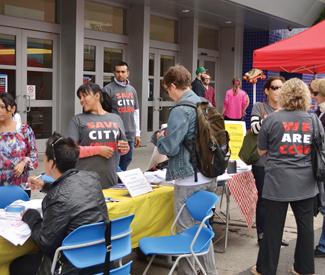
Despite recent voter approval of Proposition A, the parcel tax expected to bring $14 million annually to City College of San Francisco, faculty there are enduring pay cuts and layoffs, a reality that has rankled union leaders and others who have rallied to save the school. 

In the face of the school’s accreditation crisis, which if not addressed by March could lead to its closure, the college was a united front to keep the school open and pass Prop. A, which was approved by over 70 percent of San Francisco voters on the same night as President Obama’s reelection.

But a combination of timing (the money won’t roll in until later in 2013), the depth of the district’s fiscal hole, and declining student enrollment have left CCSF with essentially status quo funding. District officials appear to be leaning toward using most of the surplus it does get to beef up its scant reserve funds, which was one of the things that triggered the accreditation crisis.  

After the good news of Prop. A’s passage, CCSF discovered it wasn’t on track to meet its required enrollment numbers — and the number of students enrolled dictates state funding.

“[The administration] was focused on these accreditation reports. It’s a big job. It was very disruptive to change chancellors kind of midstream,” said John Rizzo, the college’s board president. “We had to switch administrations, and that’s been very difficult.”

City College has been through three different chancellors in the past year: longtime Chancellor Don Q. Griffin left in April due to illness, Pamila Fisher was interim chancellor until October, and now Thelma Scott-Skillman is the current chancellor.

Whatever the reason, City College has 3,000 fewer students enrolled than it expected to have for the Spring, potentially putting it $6.5 million in the hole this coming year. It has until the end of summer to boost those numbers. Now, despite all the cards coming up aces for them in the polls, the college still needs to save millions of dollars somewhere else in the budget.

It has started by slashing faculty and administration wages 8.8 percent, and not renewing contracts for more than 30 part time teachers, 18 part time counselors, and 30 clerical staff. Notably, Scott-Skillman — whose office negotiated the plan, which the board discussed on Dec. 13 — will also take a paycut.

Alisa Messer, president of the faculty union at City College, thinks cutting teachers, and therefore classes, flies in the face of what the voters bargained for with Prop. A. “There’s no discussion here about accountability to San Francisco voters,” Messer told us. And with the loss of competitive wages, the faculty has already started to come apart at the seams.

“We have unfortunately heard from quite a few faculty that they will be looking for jobs out of state,” Messer said. “Many said they’ll have to change their living situation or move out of San Francisco.”

She said that would hurt CCSF: “These things have to do with the long term viability of the college.”

Steve Ngo, a trustee on the college’s board, thinks that the Prop. A money should be used to shore up the school’s reserve fund, as dictated by the accreditation team that threatens the school with closure. Unfortunately, this means losing teachers now rather than later.

“If you want to frame it in terms of labor, there’s nothing worse to do than spending money now [to retain teachers] and laying off teachers in the future,” Ngo said. “Those are younger teachers. The people there now will be retired.”

Due to increased focus on diversity in hiring, CCSF’s more diverse and younger teachers tend to be the newer ones, and part time faculty, Ngo said. Those are the teachers most at risk — and the ones that students will end up losing.

Amidst the arguments about proper use of funding, teachers at the school are seeing their wages cut. Some, like Danny Halford, are losing their jobs.

Halford taught English as a Second Language at City College for seven years. A friendly and outgoing middle-aged guy, Halford is a veritable man about town, and can be seen at City College fundraisers, and was among the college’s most ardent Prop. A supporters, waving picket signs and attending rallies.

He was also one of the part time faculty members to lose his job in the Spring.

“Greg Keech, our super-wonderful ESL Dept. chair, wrote me a very nice letter to inform me that due to budget cuts there will be no job for me next semester,” Halford said. He had also recently lost his job as an organist at the College Avenue Presbyterian Church, which he’d had for 10 years, when a new pastor had “a new music concept that I don’t fit,” he said.

One of his favorite memories from City College was of a student named Elmer, from Guatemala. “He came into my Literacy class in May 2006, near the end of my first semester, with almost no English.  He made progress quickly.”

“When he got his G.E.D. diploma, I was so proud of him, I could have bust,” Halford said. “I’ve watched him grow, off and on, for six years now. He has no family here, and I think of him as my nephew.”

He may even be re-hired next fall, but until then he waits in limbo. He’ll try to substitute teach at the college for now, he said, but ruled out looking at other schools for work. As he said, “There are no jobs at other colleges because all colleges are in the same boat.”

Ngo said that the choice is basically between drastic change, or the closure of the school.

“It’s mathematically impossible to keep that payrate now,” Ngo said. “My hope is to provide the best wages and benefits in the long run, but we can’t offer it if it’s a facade. We can’t maintain payrates as they are now because we have too many faculty…There’s no agreement if there’s no college.”

City College’s faculty’s union, American Federation of Teachers 2121, filed an unfair labor practice charge Dec. 21 with the Public Employee Relations Board, a state entity that has the power to enforce labor law in California. The charge alleges that the college’s paycuts are unlawful.

A recent email to their union members outlines the AFT 2121’s grievances with the college: “At Monday’s bargaining session, the District finally outlined its claim that it will cut wages to recover last year’s ongoing state cuts of $13 million—even though the parties bargained in good faith, reaching agreement on June 20, 2012 to address these losses, including the 2.85% wage reduction this year and millions of dollars in savings through attrition and program cuts. The District is essentially overriding the previous agreement by now moving to cut wages to recover $13 million on top of the already agreed to concessions.”

College spokesperson Larry Kamer said he hadn’t seen the charges yet, as the college is on vacation, but that “we respectfully disagree with AFT 2121’s characterization of the situation.”

“City College is facing an immediate budget shortfall due to a second straight year of missed enrollment targets,” he said. “In the past, City College might have papered over such a budget gap with money it didn’t have, but those days are over. The college remains in a perilous situation with regard to accreditation and has no choice but to respond to the crisis with swift action and a request for shared sacrifice.”

And there’s the rub. In the midst of reforming the school to meet the requirements of the accreditation team by March or face closure, the college failed to keep its eye on their enrollment.

“The unions were trying to help, calling prospective students and trying a pitch,” Rizzo said. “‘Hey enroll!’ That kind of thing. They’re helping. A lot of people are trying to chip in to help this.”

“Ultimately it’s the people in the administration who are responsible for the enrollment,” he said.

With City College’s newest Chancellor Scott-Skillman on track to stay for at least a year, some stability may return to college’s administration. But City College’s dilemma, to potentially strain its budget to the breaking point or to lose valued and experienced teachers, has no easy answers  — and either way the losers may end up being the students.

To register for classes at City College, visit ccsf.edu. Enrollment for Spring is open.


CCSF by the numbers:

Prop A - $14 million a year for 8 years starting in 2013
 
3,000 - the number of students city college needs to enroll in order to meet its budget expectations, or lose money
 
$6.5 million - the amount CCSF loses if it doesn't enroll 3,000 students
 
8.8 percent, the amount faculty wages are being cut
 
160 - faculty lost in the past year due to attrition - retirement, quitting
 
30 - part time faculty not rehired next semester, including ESL teacher Danny Halford
 
30 - clerical staff not rehired for next semester
 
18 - part time counselors not rehired next semester
 
3 - number of chancellors running City College over the past year


The Performant: How Grinches save Christmas

0

Jeff Garrett and Will Franken overcome holiday saccharine.

Is that a collective sigh of relief in the air as another frenzied holiday season winds down to its usual end and whatever apocalypse was scheduled to go down seems to have spared at least our physical reality?

As we drift back into the routines of our regularly scheduled lives, the brief illumination of whatever lessons we were meant to be learning on the eve of our potential destruction and the supposed birthday of our salvation, flickers out without so much as a whimper. It’s a bit of a stretch anyhow, to weight a single stretch of calendar with so much cosmic significance, yet we do it year after year, grasping superstitiously at the shimmering notion of redemption, the hidden catalyst underlying our frantic excess.

It’s no wonder that the literature of the season is so full of characters in need of said redemption. The curmudgeons of Christmas have populated the landscape since long before jolly old St. Nick appeared on the scene, all the way back to the mean-spirited innkeeper of biblical infamy, who forced history’s holiest matriarch to give birth to her saintly son in a stable. Next to his casual crime, our own feckless peccadilloes seem so tame in comparison. And almost no act of pernicious revenge we could practically carry out quite stacks up to the hilarious inventiveness of the Grinch’s Christmas-in-reverse plot, and the wisdom we can glean from such a tale is twofold. Firstly, that if redemption is possible for such miserable wretches, then it’s certainly within our own grasp, and secondly, we have a collective need for these bad boys of winter to balance out the more saccharine elements of the holidays and keep them palatable, even plausible.

Thus spending an evening with a misanthrope so iconic his moniker is also a descriptor, is as seasonally-appropriate as trimming a tree or eating Chinese food. That misanthrope, of course, is one Ebenezer Scrooge, and in Jeff Garrett’s solo rendition at Boxcar Studio (“Scrooge, the Haunting of Ebenezer”), he undergoes the preordained transformation with a fearsome intensity that spills over the modestly appointed black box stage that struggles to contain him and the multitudes (more than twenty characters worth) he portrays. Judiciously edited down into a lean hour, stripped of the sumptuous Victorian accoutrements of big budget/big cast renditions, Garrett’s version, directed by Peter Ruocco, clearly revels in its dark origin—that of a ghost story, predating the trend of scary movies at Christmastime by almost a hundred and fifty years. True, the compressed timeline makes the eventual reformation of the reprobate seem a little hasty, but not to the extent that one would begrudge him his exultant transformation.

A more modern Christmastide tradition for San Francisco’s orphans and miscreants, is Will Franken’s annual holiday foray, an evening which rarely has much to do overtly with the actual holidays, but much to do with the need to distract ourselves from their inevitability. At Saturday’s edition, Franken’s signature stream-of-(sub)consciousness vignettes featured a bevy of characters in patently absurdist situations: a 39 year-old man without health insurance attempting to rediscover penicillin in time to cure his own strep throat, an Irish construction crew foreman left shorthanded by a few actors (Liam Neeson, Colin Ferrell), authors (Oscar Wilde, James Joyce), and Bono, a murder trial defendant confessing to murder in order to be allowed to smoke a cigarette, an obnoxious professional eavedropper with a broad Scottish accent plying his trade on the train, a talkative Southerner cursed with the rare condition of “jelly feet”. Scant attention was paid by Franken, or his many manic onstage personalities, to the pending festivities (despite being flanked onstage by a plywood Christmas Tree and hearth), offering a welcome respite from the otherwise continuous onslaught of holi-mania, and a tradition well worth hanging on to.


Synthesis 2012 Festival marks Mayan date with a creative contribution

23

The Synthesis 2012 Festival near Chichen Itza, Mexico got off to a rocky start, but by the time the Mayan Long Count calendar ended on Dec. 21, it had transformed into an inspiring example of working through adversity to build community and connect with another culture.
According to a variety of volunteers and performers associated with the festival, Executive Producer Michael DiMartino over-promised and under-delivered just about everything: hotel rooms, shuttles to and from Cancun and other cities, food for volunteers, and local permission for a stage at Pyramid Kukulkan and the camping area where thousands of festival-goers stayed. On top of that, the bus carrying the sound system and other supplies got turned around by authorities at the border, causing the crew to scramble locally for sound and building equipment and supplies.
“Not everything came together the way we planned, because it’s Mexico, but everyone came together and created community,” Debra Giusti, the Harmony Festival founder who helped DiMartino with Synthesis (and who calmly and creatively resolved many of its problems, say several sources) told me on Dec. 23, the festival’s final day. “There was so much love and unity and can-do spirit.”
At one point before the festival officially began on Dec. 20, federal police and local officials shut down work on the Ascendance stage, blocked access to the adjacent camping area, and gathered everyone there into a group, dressing down DiMartino and taking him away in a police car to resolve their differences.
The crew of mostly Northern California residents that showed up more than a week before the festival began to build the Ascendance Stage that would host the DJs and other musicians worked through their frustrations with event organizers to forge strong connections with the mayor and other locals, throw a great party, and leave a lasting gift for the Mayan people.
“We fed everyone, spent almost $16,000, dealt with the authorities, made friends with all the locals, and stayed with our intention to build this temple for the galactic alignment,” Ken Currington, aka Shombala — one of the project leaders working beside Tulku, the main guy — told me. He said he felt proud and humbled by the experience.
The impressive and ornate pyramid-style temple was built with locally sourced wood, bamboo, and steel in the parking lot of a Mayan stone-carving business in Xcalacoop — just over 9km from the main festival hub in Piste Pueblo, past the Pyramid Kukulkan in Chichen Itza — after the locals embraced their offer to leave it as a permanent display structure for the Mayan artwork.
“One local Mayan who came by was in tears and he said this was the one of the best offerings to the Mayan people,” Currington said.
The visitors helped prepare and participate in a locally produced festival marking the end of the Mayan calendar on Dec. 21, a gesture of goodwill that helped overcome initial missteps. Some local Mayan elders also took part in a Synthesis ceremony at the pyramid in Chichen Itza at sunrise that day.
At the all-night dance party that began on Dec. 22, which featured a long list of Bay Area DJs and other performers, local families came to see the spectacle, which also  included live creation of paintings, mandalas, and other artworks and aerial yoga swings. All the locals I talked to seemed to enjoy and appreciate the event, except for one stern-faced police officer who simply said, “No se (I don’t know),” when I asked what he thought.
“This was amazing because it drew people from all over who felt called to be here,” Giusti said. “They went into the jungle and made art.”
One area where DiMartino (who hasn’t yet responded to my questions about problems with the festival) did seem to deliver was in booking and delivering keynote speakers, who spoke from the stage at the Hacienda restaurant and hotel complex in Piste Pueblo, where meals were also provided to VIPs and those who bought the most expensive tickets.
Keynote speaker Don Miguel Ruiz, a Toltec author and thinker, told the Synthesis 2012 Festival crowd that changing the world starts with an internal change, a change in consciousness. “If we can change our own story, if we can find that peace and that joy,” he said, then we can project that out into the world. “The change we want to see in the entire society starts with us. We can’t give what we don’t have.”
At this point, it’s our collective responsibility to seize the moment and help bring about the transformation that the world is waiting for. “We can be part of the solution for humanity or we can be a part of the problem,” he said.
Manifesting the solutions begins by tapping our creative energies. “Whatever we create first begins in our imagination,” Ruiz said. “Then we make it real.”
“In my imagination, humanity has already changed. We are going in the right direction. We can make it happen. Day one is today,” Ruiz said on Dec. 22, drawing a raucous reaction from the large crowd. “Everything we did in life is completely irrelevant. Right now is the moment.”
Another keynote speaker, Caroline Casey of KPFA’s “The Visionary Activist” show, also talked about the importance of healing the world by transforming ourselves, and an ancient Hawaiian concept called ho’oponopono, a practice of reconciliation and forgiveness.
As she said, “To love disharmony back into harmony makes the harmony so much more.”

A Christmas story for our time

2

The annual holiday card arrived from Jess Brownell and Sbirley Conlon, longtime Guardian friends from Milwaukee. As usual, their message was timely, relevant, and laden with insights.  B3

Dear Friends,

      It’s been a memorable year, which is way too much like living in interesting times. 

     But enough sordid details.  The holiday season is here, when fantasy always trumps reality.  We can pretend, pretend that our wins outnumber our losses, pretend that wisdom and decency prevail, pretend that peace and benevolence are ascendant, pretend . . .

     . . . that Ebenezer Scrooge is in his counting house, busily making trades for his billion dollar Merry Christmas to Me hedge fund when he is visited by a delegation of Santa’s elves.  The elves explain that in the digital era Santa has no need for the simple toys they used to make so he has outsourced manufacturing to China and sent them packing.  They are now desperate for work.

     “You’re very small,” Scrooge points out.  “You’ll have to work for a lot less than the people I’m employing now.”

     The elves, unable even to see over the counter at McDonalds’s to take orders, agree to his terms.

     “Excellent,” says Scrooge.  “Now go crouch under desks and hide behind heating vents.  Get some inside information.  Make me some money . . .

     . . . I want a Red Ryder air rifle for Christmas,” says Ralphie Parker to the department store Santa Claus, “You know, the pump-action kind with the compass and the thing that tells time.”

       “They don’t make those these days,” explains Santa wearily.  “That takes elves.  What you want is this Grand Theft Auto video game.”

     “Noooo,” Ralphie wails.  “You’re not the real Santa . . .

     . . Sorry, but we don’t do that anymore,” the Ghost of Jacob Marley tells the inquisitive novelist.  (They always come around this time of year, craving material.) 

“I mean, look at us.”  He jabs a finger at the Spirit of Christmas Past, dozing fitfully in a chair in a corner of the retirement home rec room.  At a table near the window the Spirits of Christmas Present and Future are engaged in an extremely slow-moving cribbage game.  “We’re past it, man.  Besides, Scrooge’s insurance only covered one intervention.  He’s on his own this time . . .  

(And you thought Cloud Atlas was hard to follow.)

 . . . I’m busted,” says Scrooge, standing hat in hand before Mr. Potter in his Bedford Falls office.  “Those elves ruined me.  They made a huge gamble on sleigh bells, shorted coal, and took an unnatural position in red-nosed reindeers.  I’ve lost it all, and I need a job.”

     “You’re in luck,” Potter tells him.  “Our Building and Loan manager, George Bailey, just jumped in the river.  You can take over.  Go sell those mortgages.  Make me some money . . .

     . . But I am the real Santa,” insists the real Santa to the judge.  “I had to take this job at Macy’s because somebody hacked into my computer files, erased the Christmas list, and transferred all my funds into an anonymous account in the Cayman Islands . . .

      . . . I’m not responsible for what happened,” says Mr. Potter with chagrin, addressing the dark-suited gentlemen from the SEC.  “I bought the mortgages, yes, but it was that idiot Scrooge – you know, the guy who just jumped off the bridge — all our Building and Loan managers seem to jump off bridges, for some reason — who bundled them.  How was I to know that ninety percent of the loans went to insolvent elves?  He said there was big money in little houses, really little houses . . .

     . . . I just love it here in the Cayman’s,” says George Bailey to his computer whiz guardian angel, Clarence, who has helped him fake his death.  “And I think everything just worked out great.  We got all the money, and the kids all got their presents.”

      “That’s right,” Clarence replies.

      “Even that dumb kid in Indiana.  We sent him his BB gun.”

     “He’ll shoot his eye out.”

     “Well, we can’t control everything.  It’s a pretty wonderful life, I’d say.”  George chuckles as he watches the elves frolic in the surf.   “Are those little guys having a good time or what?”

     So have a good time or what.

Merry Christmas and Happy New Year
Shirley and Jess


Haley Zaremba’s Top 10 Concerts of 2012

0

For our annual Year in Music issue, I asked local musicians, rappers, producers, and music writers to sound off on the year’s best songs, album releases, shows – pretty much anything they wanted, music-wise. For the next few days, I’ll be posting them up individually on the Noise blog. You can also check the full list here.

Haley Zaremba, Guardian
Top 10 Concerts of 2012

1. El Ten Eleven at the New Parish
http://www.youtube.com/watch?v=ltdqEoyjnz0

2. Good Old War at Slim’s

3. Girls at Bimbo’s
http://www.youtube.com/watch?v=JxHZ63dr0aI

4. St. Vincent and Tune-Yards at The Fox
https://www.youtube.com/watch?v=Et2IOb5HpaA

5. Bomb the Music Industry! at Bottom of the Hill

6. Fucked Up at Slim’s

7. Amanda Palmer and the Grand Theft Orchestra at the Fillmore
https://www.youtube.com/watch?v=4AyAmSBQscI

8. Ariel Pink at Bimbo’s

9. Conor Oberst at the Fillmore
http://www.youtube.com/watch?v=fzUhb_QI6kA

10. Titus Andronicus at the Great American Music Hall

The screams of dead children — everywhere

167

The screams of a thousand dead children wail through my mind. Children in Afghanistan, Iraq, Palestine and Libya killed by empires’ drones; thousands of young men of color America killed by white supremacist occupying armies called police, security guards and neighborhood watch agents; teenage workers from Bangladesh and China killed by corporations for profits; countless babies and young people killed by drive-by shootings and gun violence in communities of color intentionally ghettoized, destroyed and preyed upon by devil-opers, bank gangsters, gentriFUKators; and hundreds of white, middle-class children, youth, and adults killed by more gun violence perpetration, mental illness and the mental vacancy of wite culture.

Thousands of children die for corporate profits, war profits, and prison industrial profits every year in this country. Dead because gun violence is glorified and the sale of guns make some people rich, because parents are tired and don’t have the energy to fight with their kids to turn off the video games, because video games, un-conscious rap, Hollywood movies and corporate news with people killing each other make death look like entertainment — and with each sale make more profits for tech corporations in Silicon Valley run by the new technological colonizers. Because guns are exciting, especially when you have little else to be excited about.

So shouldn’t the grief for all of our children be the same? Shouldn’t our actions to stop the rise in death by gun violence everywhere be equally urgent and comprehensive?

The president shed tears in a prime-time speech for the 20 white middle-class children from Connecticut. But what about crying for babies killed by drive-by shooters, youth killed by police, and hundreds of teenage workers from China who react to mercury poison and throw themselves out the window while US tech companies make billions in profit? Why aren’t thousands of people shedding tears and sorrow and sympathy for the children in Gaza who die everyday?

In the bizarre naming of poverty positions there is a terrifying concept called the deserving vs undeserving poor rooted in the US crums (welfare) policies that were originally set up for white widows of World War II veterans in the 1930s and 1940s. Due to overt and systemic white supremacist institutional values that undergird everything in the US from its stolen beginnings to now, these white, hetero-normative women were viewed as the deserving poor, or “legitimate” poor people, who had come upon bad times from no “fault” of their own and therefore were deserving of our aid and our sympathy. In contrast, indigenous sisters, sisters of color in diaspora, or divorced, poor or unmarried women were viewed as aberrant, pathological or “lazy,” who had inherently done something to “deserve” their poverty and therefore deserved none of the US crums, only criminalization, incarceration or disgust.

I think we have come to a time, with the meteoric rise in death by gun violence of so many of us of all ages, colors, cultures and regions of the country, where we now have the deserving vs undeserving dead. How about little baby Hiram, 1 year old, who died because he happened to be in the line of fire from a passing car in Oakland? Or Ayana Jones, a 7-year-young innocent baby shot when Detroit police stormed their home with assault rifles to “find a suspect.” Or Derrik Gaines, a young disabled man who was killed by Daly City police? Or the countless children killed in Afghanistan, Palestine, Iraq or Libya by colonizing empire armies attempting to steal more indigenous resources for the ever-hungry jaws of capitalism? Did they deserve to die because someone calls their innocent bodies “collateral damage?”

What about all of our poor children of color — sorted, separated, tested, and arrested out of schools — who roam the streets with no jobs, no hope and endless violent images pumped into their heads from corporate media lies and mythologies in the holding tanks called our ghettoized neighborhoods, pick up guns and shoot each other for something to do until the police arrive to place them into the plantation prisons that await their profitable arrival? Do they deserve to die?

There are many reasons why children and adults are killing each other. My Black Indian Mama Dee used to say, white supremacy and capitalism isn’t good for any human, even white people. People have talked about the proliferation and glorification of guns to all young people through mass media, as well as the deep wounds of the cult of independence on a human’s psyche, not to mention the gutting by Republicrats of the mental health system. But one of the deepest ones that I see is the factory schools themselves, the separation of youth from elders’ wisdom and the ways that our children no longer even vaguely understand the respecting, honoring, and neccessary reverance of their elders.

Om this society, we are taught how to ghetto-ize and separate our elders from our children in as many ways as possible. This separation and lack of reverence is valued in capitalism as it sets up more products and capital to trade on. I pray and send love and strength to these families and little ancestors to help their still living families decolonize from this myth of separation and capital-inspired death so their may be healing for them.

From this moment and so many more like it, I am drawn to believe that when people like me and my mixed race family in poverty die, we deserve to. My hope and vision is that with this moment of so much sorrow for the families in Connecticut, perhaps the oddly democratizing impact of death will free us all from the unspoken but clearly existent concept that some of us deserve to die and awaken us all to the real-ness that none of us do.

Honoring Edward Kennedy for defying and defeating political censorship in WWII

2

The campaign to award a posthumous Pulitzer Prize to Edward Kennedy, the Associated Press reporter who defied political censorship to break the story of the German surrender on May 7, 1945, was given a historic boost at the 135th annual meeting of the California Press Association on Dec. 7, 2012 at the Marines Memorial Building in San Francisco.

See the video of the Cal Press panel on Kennedy after the jump.

Honoring Edward Kennedy from The Intermountain News on Vimeo.

Video Credit: Craig Harrington, publisher of the Intermountain News in Burney

The association unanimously approved the first ever resolution by a news organization in support of Kennedy and it hosted the first ever panel discussion on Kennedy. Cal Press, as it is affectionately known in the newspaper business, is the oldest press organization west of the Mississippi and one of the oldest in the country. It was founded in 1876 at the Palace Hotel in San Francisco.

The resolution noted what happened to Kennedy after he broke the 36-hour embargo on the story. “Whereas the story made page one in nearly every newspaper, it angered General Dwight Eisenhower, the supreme allied commander, and all the other newsmen Kennedy had scooped. The military lifted his war correspondent’s credential, he was threatened with court martial and was fired by the Associated Press.”

The resolution explained that “unbeknownst to the reporters at the time, that suppression was the result of an agreement between U.S. President Harry Truman and British Prime Minister Winston Churchill to allow Russian Premier Joseph Stalin to hold a second surrender ceremony in Berlin.”

Kennedy broke the embargo, Cal Press explained, after “he learned that news of the German surrender was being broadcast to Germany from a radio station in Flensburg, Germany. He contacted military censors and said that since the story was being reported in Germany, the security of Allied troops was no longer an issue and he intended to defy censorship and report the news, which he proceeded to do by using a military phone line thereby registering the biggest scoop of the entire war.”

The resolution noted that Kennedy’s story is now the subject of two major efforts to “rectify the journalistic injustice by awarding him a Pulitzer Prize posthumously.” The resolution was written by Jim Ewert, general counsel of the California Newspaper Publishers Association.

One effort is a campaign launched from Modoc County by Ray A. March, editor of the Modoc Independent News monthly newspaper, to win a posthumous Pulitzer Prize for Kennedy’s hard news international reporting. March worked for Kennedy as a reporter on the Monterey Peninsula Herald a half century ago. Kennedy was the editor and associate publisher of the Herald until his death at age 58 in November 1963 when he was struck by a car while a pedestrian in Monterey.

The Kennedy campaign, the resolution stated, “is supported by 54 noteworthy professional reporters, editors, and photographers, that include San Francisco Chronicle editor Ward Bushee, Pulitzer-prize winning photographers Kim Komenich and Sal Veder, San Francisco Chronicle Science editor David Perlman, former San Francisco Bay Guardian owner Bruce Brugmann, former AP legal reporter Bob Egelko and Frank McCulloch, former senior editor at the Los Angeles Times and the Sacramento Bee, and Eric Brazil,  a retired Examiner and Chronicle reporter, who co-chairs the effort with March.”

The panel gave life and substance to the resolution. Brugmann introduced Bushee as the moderator, who read the eloquent Pulitzer nominating letter from McCulloch. Bushee introduced March, and Perlman, 93, who was a reporter for the old New York Herald-Tribune shortly after World War II,  and Julia Kennedy Cochran, Kennedy’s daughter who discovered her father’s unpublished memoir among his belongings after his death. She got the manuscript published as a major book by Louisiana State University Press. It is titled “Ed Kennedy’s War: V-E Day, Censorship, and the Associated Press.”

The LSU Press and Tom Curley, former AP president and CEO, entered the book in the Pulitzer competition on the basis of its literary qualities. Curley had issued a formal apology in 2011, saying that AP’s repudiation of Kennedy “was a terrible day for the AP. It was handled in the worst possible way…Kennedy did everything right.” In a later interview, he elaborated, “Once the war is over, you can’t hold back information like that. The world needed to know.”

Sixty seven years after Kennedy defied and defeated political censorship, the Cal Press sent its resolution to the Pulitzer board as a formal part of the Kennedy nomination. It said that Cal Press “honors Edward Kennedy for his distinguished example of reporting on international affairs and his courage in the face of potential personal and professional hardship to share with the world one of the most important events of the 20th century.”

 Cal Press concluded that it “applauds and endorses the efforts of Ray A. March, Eric Brazil, and the 54 noteworthy journalists and calls upon the Pulitzer Prize Board and Columbia University to recognize Edward Kennedy for journalistic excellence and posthumously award him with a Pulitzer prize for his groundbreaking coverage of the end of WWII in Europe.”

The 135th meeting of the California Press Association was an historic occasion with an historic pronouncement to right an historic wrong in American history. We’ll keep you posted.  B3


Emily Savage’s Top 10 Albums and Shows of 2012

37

For our annual Year in Music issue, I asked local musicians, rappers, producers, and music writers to sound off on the year’s best songs, album releases, shows – pretty much anything they wanted, music-wise. For the next few days, I’ll be posting them up individually on the Noise blog. You can also check the full list here.

So, I (Emily Savage, Guardian music editor) included my top albums list in my Ty Segall cover story (also a part of the Year in Music issue). For easier access, here’s that list below, along with my “Top Live Shows That Created The Most Post Memories in 2012” list. Whew, what a year:

Emily Savage, Guardian

New Albums I Listened to Endlessly in 2012
1. Grass Widow, Internal Logic (HLR)
2. Cloud Nothings, Attack on Memory (Carpark)
https://www.youtube.com/watch?v=6X1URP5eg6I
3. Ty Segall, Slaughterhouse (In the Red)
4. Dum Dum Girls, End of Daze EP (Sub Pop)
https://www.youtube.com/watch?v=q3f9ZiH6Euw
5. Frankie Rose, Interstellar (Slumberland)
6. Godspeed You! Black Emperor, Alleluja! Don’t Bend! Ascend! (Constellation)
https://www.youtube.com/watch?v=IEsdiiYkhT8
7. The Fresh and Onlys, Long Slow Dance (Mexican Summer)
8. THEESatisfaction, awE naturalE (Sub Pop)
https://www.youtube.com/watch?v=qGWFBt_IPOg
9. Terry Malts, Killing Time (Slumberland)
10. Guantanamo Baywatch, Chest Crawl (Dirtnap Records)


Live Shows that Created the Most Posi Memories in 2012
1. Feb. 14: Black Cobra, Walken, Yob at New Parish
https://www.youtube.com/watch?v=33TPqjurEsE
2. Feb. 23: Budos Band and Allah-Lahs at the Independent
3. March 30: Hot Snakes at Bottom of the Hill
https://www.youtube.com/watch?v=VOj3sW6Tm38
4. April 10: Jeff Mangum at the Fox Theater
5. July 21: Fresh and Onlys and La Sera at Phono Del Sol Music Fest
6. July 28: Total Trash BBQ Weekend at the Continental Club
7. Aug. 11: Metallica at Outside Lands
https://www.youtube.com/watch?v=hjfpBPItgoM
8. Aug. 31: Eyehategod at Oakland Metro
9. Oct. 9: Saint Vitus at the Independent
10. Oct. 27: Coachwhips and Traditional Fools at Verdi Club
 

Time’s a wastin’, but Craigslist Casual Encounters can help you go out with a bang

11

Think you’ve outfoxed the apocalypse because it’s almost noon on 12.21.12? Sorry to burst your bubble, but the Mayan armadoomsdaypaclypse may still be on.

The land of the ancient Mayans, which lies in present-day southeastern Mexico, is subject to the -6 UTC time zone (same time as Chicago and Houston.) Which means for us in the Pacific realm – probably the most dangerous place to be considering the fault lines and tsunami vulnerability – 10:00pm will be the moment of truth. So spend your last moments with loved ones, reading what could possible be the Guardian’s last cover story ever, or getting some of that sweet dirty Craiglist sex that you’ve heard so much about but were too afraid to try.

Time is obviously of the essence, so we picked out five possible sexual encounters that we believe will be worthy of your last moments on earth. Interestingly enough, some ads require you to be disease free.

– These guys don’t even want sex, they just want to see some boobs! 

– He genuinely wants to be with you for the company, though you’ll have to be the host because he has roommates. 

– It’s end times, so go on — hook up with someone from the Marina.

– Finally! A reason to visit Redwood City! (NSFW)

Dick Meister: Michigan is just the beginning

6

By Dick Meister
Bay Guardian columnist Dick Meister, former labor editor of the SF Chronicle and KQED-TV Newsroom, has covered labor and politics for more than a half-century. Contact him through his website, www.dickmeister.com, which includes more than 350 of his columns.

Be alert, American workers: The passage of right-to-work legislation in Michigan means serious trouble for unions and their supporters everywhere. Yet there’s legitimate hope that it also could lead to a revitalized labor movement.

You can be sure the action by Michigan, long one of the country’s most heavily unionized states, home of the pioneering and pace-setting United Auto Workers and iconic labor leader Walter Reuther, will inspire anti-labor forces in other states to try to enact right-to-work laws.

They aren’t likely, however, to try in California, where voters rejected a right-to-work proposition in 1958 and this November rejected the viciously union-busting State Proposition 32.  But union foes here as elsewhere are certain to seize on the Michigan vote, and the passage earlier this year of a right-to-work statute in Indiana, as evidence of labor weakness that they will try mightily to exploit, politically and otherwise.

They’re already seeking right-to-work laws in Ohio and Wisconsin and planning other steps around the country to weaken  the economic and political clout of unions and their supporters and thus weaken the basic rights and economic position of all working people.

As contradictory as it might seem, that could lead to a badly needed revitalization of labor. For it should make it unmistakably clear to unions and their supporters that there’s a very serious need for a greatly stepped-up mobilization against their political and economic enemies.

 True, unions lost a major campaign this year in trying to recall Wisconsin Gov. Scott Walker for his attacks on the collective bargaining rights of public employees. But that should not dissuade labor from waging other efforts against union opponents. They came close to recalling Walker and, in doing so, laid the groundwork for future campaigns and proved that unions are quite capable of waging major campaigns against their opponents. That surely discouraged at least some others from taking anti-labor actions that would anger labor and its powerful supporters.

Notably impressive as well was labor’s role in helping elect – and re-elect – President Obama. Labor opponents and supporters alike learned from that, if they didn’t already know it, that unions have the money and the manpower to seriously mount major campaigns. They put millions of dollars and millions of campaign workers into their extraordinary efforts on Obama’s behalf.

Obama has responded by appointing a pro-union secretary of labor, Hilda Solis, and other pro-labor men and women to run the Labor Department, plus issuing executive orders that have strengthened the rights and legal protections of working Americans .

But unions are of course doing less well in Michigan and most other states, and that’s being reflected in Congress, where labor has had a rough time getting approval of national measures such as a higher minimum wage.

Most importantly, labor has been unable to garner the votes for passage of the Fair Employee Free Choice Act that has long topped labor’s political agenda. The act, which has been stalled in Congress for three years, would give workers the absolute right to unionization, by making it easier for them to form and join unions.

Also high on labor’s agenda is the pressing need to modify the 1947 Taft-Hartley Act. It has allowed states to enact right-to-work laws, even though the laws, now in Michigan and 23 other states, are clearly designed to weaken – if not destroy – unions by denying them the right to collect the money from members that is essential to effectively represent them in bargaining.

Bay Guardian columnist Dick Meister, former labor editor of the SF Chronicle and KQED-TV Newsroom, has covered labor and politics for more than a half-century. Contact him through his website, www.dickmeister.com, which includes more than 350 of his columns.

A moratorium on progress

30

My friend Johnny, who lives in Seattle, tells the story of the day years ago when he saw an older woman standing on a hillside near his house, watching while bulldozers knocked down trees and tore up part of the hill to put in a freeway extension. He was pretty new to town, so he asked the woman what was going on.

She shook her head, and with a bitter smile, said: “Progress.”

If you want to look at the environmental history of the United States, you can pretty much define most of our problems as an obsession with that sort of “progress.” In the postwar Bay Area, “progess” meant turning farmland and open space into suburban housing developments, building more freeways to connect the commuters to downtown San Francisco, and erecting tall buildings in the city to fill with workers from the burbs.

At the time, those crazy people who opposed that vision were told they were opponents of progress. Now, we celebrate what they’ve saved.

In other words, not all change is good, not all development is progress, and the march of capitalism doesn’t always take us in the right direction

So please, Chuck Nevius: You can oppose a one-year moratorium on Valencia Street restaurants if you want, but don’t give me crap like this:

The same transition seems to be happening along Valencia Street. My guess is they will learn the same lesson as Noe – you can’t put a moratorium on progress.

Is it progress to turn a diverse shopping district into a monocrop of one type of business? Or is it prudent to do what we pay city planners to do, and … plan? The restaurant limit in Noe Valley worked when it was instituted, a long time ago, when people who lived there wanted to keep shoe repair places and other community-serving merchants on 24th Street. When it was no longer needed or effective, it was repealed. All we’re talking about on Valencia is ONE YEAR, to give people a chance to think about the future of their neighborhood.

Progress. Bah humbug.


http://www.sfgate.com/bayarea/nevius/article/Valencia-restaurant-ban-not-the-answer-4133529.php

Waiting for the end of the world (2)

19

TULUM — So rather than taking the 2:45pm bus today from Tulum to Chichen Itza for the Synthesis 2012 Festival and tomorrow’s end of the Mayan Long Count calendar as planned, my sweetie’s bout with some bad ceviche has delayed us by a day.
And frankly, I can’t say that I’m disappointed as I hear the stories flowing back from the festival. The universe does indeed seem to give us what we need.

The promised shuttles from here and other Yucatan cities have been “wonky” at best, says my festival contact. Performers and others promised rooms by the festival say they’ve been given away. Even the sound system for the festival’s DJs, bands, and speakers was turned around by locals threatening violence, the performers say they were told yesterday.

(The festival’s Candice Holdorf told me: “Apparently another sound system was found locally so festival is proceeding as planned.”)

“If it’s a mess, we’ll come back here and make the best of it,” Jeff Scroggins, a musician with Minneapolis-based Earthshake World Rhythm Ensemble (whose drums don’t need amps), told me as he related the lowdown while waiting for a private shuttle they arranged.

He wants to be in Chichen Itza for the big day, but he says he’s perfectly happy to just come back to Tulum if they aren’t feeling the Synthesis scene. “We’ve been staying on the beach all week and just manifesting gigs. We’ll be fine.”

So will I. There’s either the wonky morning shuttle, or our afternoon tickets on the luxurious Ado bus to Chichen Itza. Or there are various festivals in Tulum, Playa del Carmen, and other Yucatan spots celebrating the Mayan moment, winter solstice, and galactic alignment.

Whatever it happens, I plan to just be present for this moment and let energies of the universe take me where they will.