Many things have changed since Sebadoh released its last full-length album, The Sebadoh, 14 years ago. We’ve seen three respective presidents hold terms, have started and ended wars, and the Backstreet Boys have broken up and reunited once again.
Taking influences from proto-punk masters such as Captain Beefheart and noise bands like Unwound, Sebadoh comes together to form a delightful trio with varying musical influences. With its latest full-length release, Defend Yourself, expected to drop in September, Sebadoh is returning to do-it-yourself ethics, recording the album on its own terms on a smaller record label, Joyful Noise.
Sebadoh is coming to the Bay Area on July 31, playing with San Diego garage rock revivalists Octa#grape at Cafe Du Nord. Here’s what Sebadoh’s vocalist and bass player Jason Loewenstein had to say about the new record, Sebadoh-as-food, Courtney Love, and returning to the DIY:
San Francisco Bay GuardianWhy hasn’t there been an album in 14 years? Will this album be extra-special?
Jason Loewenstein We’re not trying to make up for extra years we went without having an album, but it is a a little bit special because we made it by ourselves, unlike our past six albums. The album returns to the early days of Sebadoh.
SFBG What are some influences for the new album? What has changed since the last album?
JW Since we made our last record, I’ve indulged in country music, so there will be a few songs on there that have that feel. As always, we’re a fan of noisy bands like Unwound. When it comes to guitar, there’s some nods at Captain Beefheart. But all of this would be fairly obvious listening to Sebadoh. Also having a new member of the band has influenced this album. We went from having Russell [Pollard] on drums to Bob [D’Amico], and it’s changed the way the band sounds. So, Bob is the main influence. SFBGWhy have you returned back to DIY ethics on this record?
JW We spent the most money we ever spent on last record, and we’ve learned about what we don’t need and do need. Since the last record I’ve done a lot of engineering and have helped other bands record. We’re saving a tremendous amount of money by doing it ourselves and doing what we want.
SFBGIf Sebadoh was food, what would it be and would you eat it?
JW Sebadoh is chili over spaghetti with oyster crackers, chopped onion and hot sauce. The reason is because there’s a lot of random stuff that goes into Sebadoh, and you don’t think it would go good together but it turns out pretty good…I’d definitely eat it.
SFBGWhat was it like being on Sub Pop Records during its heyday?
JW They were a big label with the excitement held for fan zines. It was a coup of underdogs! Possibilities were a big question mark, and there was the possibility that what you did could get on the radio, though it wasn’t what we really expected or wanted. You just couldn’t expect or predict bands like Nirvana (Sub-Pop label mates) exploding the way they did.
SFBGWhat’s the oddest thing that has happened while on tour?
JW We were playing in front of 5,000 people, and strings (on the guitars) just started breaking. Lou (Barlow, vocalist and guitarist) got so frustrated he broke his guitar, so they handed him a new guitar. Trying to keep the crowd entertained, Bob Fay (the drummer at the time) just started jamming and and I started yelling into mic. All while this was happening Courtney Love was at the side of the stage intoxicated yelling “Don’t disrespect Kurt!” I don’t know why. He had died a year ago? Yeah, that was really weird.
SFBGAre there any grand plans in the future for Sebadoh?
JW We’re just hoping to hit the road a lot in 2014. We want to do a couple US tours and keep super busy. We’ve been waiting for our turn with Lou [Note: Barlow has been touring with his other band, Dinosaur Jr.]
Sebadoh With OCTA#Grape July 31, 9pm, $15 Café Du Nord 2170 Market, SF www.cafedunord.com
Last May I “blew through” the huge International Mr. Leather Competition gathering in Chicago and, after I’d cleaned up a bit, had the pleasure of visiting one of the coolest Boystown spots, Wang’s, a tiny, fog-filled opium den of a gay bar which, back then at least (it’s since seen some upscale hetero incursion) was the place to be, at least if you were looking to somewhat escape the macho IML scene and get down to some sweet, sweet music.
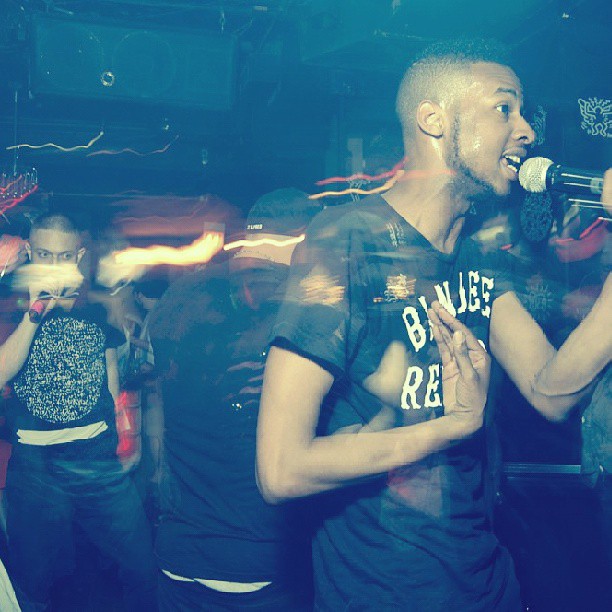
One of the things that made Wang’s pop for me was the totally hot guy at the door. “Oh he’s from Banjee Report,” DJ P-Play told me as we entered. “They’re pretty much going to rule the queer hip-hop world in a couple years.” Oh, hi there!
P-Play’s crew Honey Soundsystem put out a pretty killer (and awesomely challenging) Banjee Report mixtape soon afterwards, introducing them to SF. And now here come the three Banjee rappers themselves, to Marco De La Vega’s great 120 Minutes party at the Elbo Room this Sat.
If you want to see what’s going on in the queer hip-hop world, beyond the incredibly diverse Mykki Blanco (multigender artsy), Le1f (avante-dark musing), Frank Ocean (ambiguous pop soul), and Big Dipper (novelty sex-rap) styles, Banjee’s great combo of vogue sensibility, street delivery, and sexy swagger may turn up your boots.
Also, I’m sorry for objectifying them but they are really cute, so wut.
This week: the 33rd San Francisco Jewish Film Festival takes off with screenings all over the Bay Area; check out my take on some of the documentary selections here. Also, the harrowing documentary Blackfish opens, a film that will make you never want to visit SeaWorld again (with good reason). My interview with the film’s director, Gabriela Cowperthwaite, here.
Elsewhere, Hollywood hopes you’re ready for yet more claw-bearing Hugh Jackman (in The Wolverine), Danish actor Mads Mikklesen shines as a falsely-accused man in The Hunt; indie darling Andrew Bujalski delivers what may be his finest film to date with Computer Chess; a majorly great/bad/quotable/mind-blowing cult film plays the Clay’s midnight series; and more. Read on for our short takes.
http://www.youtube.com/watch?v=vnoHSnJsy6Q
Computer ChessMumblecore maestro Andrew Bujalski (2002’s Funny Ha Ha; 2005’s Mutual Appreciation) makes his first period picture, kinda, with this stubbornly, gloriously retro saga set at an early-1980s computer-chess tournament (with a few ventures into the freaky couples-therapy seminar being held at the same hotel). The technology is dated, both on and off-screen, as hulking machines with names like “Tsar 3.0” and “Logic Fortress” battle for nerdly supremacy as a cameraman, wielding the vintage cameras that were actually used to film the feature, observes. Tiny dramas highlighting the deeply human elements lurking amid all that computer code emerge along the way, and though the Poindexters (and the grainy cinematography) are authentically old-school, the humor is wry and awkwardly dry — very 21st century. Keep an eye out for indie icon Wiley Wiggins, last seen hiding from Ben Affleck’s hazing techniques in 1993’s Dazed and Confused, as a stressed-out programmer. (1:32) (Cheryl Eddy)
http://www.youtube.com/watch?v=qNHPB-dS1t0
Fame HighThis doc by Scott Hamilton Kennedy (2008’s The Garden) steps behind the doors of the LA County High School for the Arts, where teens toil in (and out of) the classroom to achieve their artistic dreams. There’s the jazz pianist with the overbearing stage dad; the sheltered ballerina whose Juilliard aspirations depend on her learning to loosen up on the dance floor; the sparkplug actress who hails from a theatrical family; and the harpist-singer whose mother moved with her from small-town Wisconsin to nurture her talents. As the year progresses, Fame High tracks each teen’s struggle to negotiate academics and arts, their relationships with their parents, budding romances, and rebellions both tentative and full-blown. In a culture in which insta-fame seems the norm, thanks to reality TV competitions and the internet, Fame High serves as a reminder that most show-biz careers are built on hard work and difficult lessons — with the added bonus of likeable, well-chosen subjects, all of whom happen to be easy to root for. (1:41) Elmwood. (Cheryl Eddy)
http://www.youtube.com/watch?v=ieLIOBkMgAQ
The HuntMads Mikkelsen has the kind of face that is at once strikingly handsome and unconventional enough to get him typecast in villain roles. Like so many great foreign-accented actors, he got his big international break playing a bad guy in a James Bond film — as groin-torturing gambler Le Chiffre in 2006 franchise reviver Casino Royale. Currently, he’s creeping TV viewers out as a young Dr. Lecter on Hannibal. His ability to evoke both sympathy and a suspicion of otherness are particularly well deployed in Thomas Vinterberg’s very Danish The Hunt, which won Mikkelsen the Best Actor prize at Cannes last year. He plays Lucas, a lifelong small-town resident recently divorced from his son’s mother, and who currently works at the local kindergarten. One day one of his charges says something to the principal that suggests Lucas has exposed himself to her. Once the child’s misguided “confession” is made, Lucas’ boss immediately assumes the worst. She announces her assumptions at a parent-teachers meeting even before police can begin their investigation. By the time they have, the viral paranoia and suggestive “questioning” of other potential victims has created a full-on, massive pederasty scandal with no basis in truth whatsoever. The Hunt is a valuable depiction of child-abuse panic, in which there’s a collective jumping to drastic conclusions about one subject where everyone is judged guilty before being proven innocent. Its emotional engine is Lucas’ horror at the speed and extremity with which he’s ostracized by his own community — and its willingness to believe the worst about him on anecdotal evidence. Engrossing, nuanced, and twisty right up to the fade-out, The Hunt deftly questions one of our era’s defining public hysterias. (1:45) (Dennis Harvey)
http://www.youtube.com/watch?v=S4uPcFRBJbM
Plimpton! Starring George Plimpton as HimselfTom Bean and Luke Poling’s Plimpton! Starring George Plimpton as Himself, an affectionate portrait of the longtime Paris Review editor and “professional collector of experiences” who wrote books, articles, and made TV specials about his delight in being “the universal amateur.” His endeavors included playing football with the Detroit Lions, hockey with the Boston Bruins, and the triangle with the New York Philharmonic, among even more unusual pursuits. Some called him a dilettante (to his face while he was alive, and in this doc, too), but most of the friends, colleagues, and family members here recall Plimpton — born to an upper-crust New York family, he was friends with the Kennedys and worshipped Hemingway — as an irrepressible adventurer who more or less tailored a journalism career around his talents and personality. (1:29) Roxie. (Cheryl Eddy)
http://www.youtube.com/watch?v=R6OoZNdAQuA
Samurai Cop Terrible movies deserve restoration too! Such is the case with this under-the-radar 1989 direct-to-video atrocity whose slowly accumulated cult audience now has a newly restored print to watch in apt contexts like the Clay’s midnight series. It’s a martial arts movie shot in the US by an Iranian director (Amir Shervan), with at least one porn star (Krista Lane of such classics as Fatal Erection, Days Gone Bi, Mammary Lane, and The Bitches of Westwood) in the cast. Shervan also wrote the script, and to say the dialogue is a tad ESL would be a very kind way of putting it. Low-end Miami Vice-like duo Joe (Matt Hannon) and Frank (Mark Frazer) are cops on the trail of Japanese gangsters led by Mr. Fugiyama (Gerard Okamura), with Robert Z’Dar (from 1988’s Manic Cop) as their main enforcer. Joe acts like the slimiest swingin’-dick stud on the fern bar scene, his spray-tanned, long-feathered-hair vanity just partially excused when he takes off his shirt to reveal Tarzan-worthy musculature. (Hitherto a film-crew carpenter, Hannon understandably never acted again.) Frank is, er, African American. (Black sidekicks never require much character definition in this sort of movie.) Between fight scenes that feature some of the most ludicrous martial-arts howls ever (personal favorite: “Wafu!”), we get numerous gratuitous soft core sex scenes that briefly provide a female full-frontal glimpse. Other highlights include the peppy aerobics-workout synth score, an outrageously swishy “comedy gay” Costa Rican waiter, and the opening credit “Hollywood Royal Pictures presents.” You will laugh, you will cry (from the pain). While Samurai Cop will no doubt be an experience to remember watched on the big screen with an unruly crowd, you might also want to check out its DVD extras, the most memorable of which is an interview with today’s Z’Dar — a huge, burly actor now incongruously hair-dyed, rouge-painted and otherwise completely weird-looking. (1:36) Clay. (Dennis Harvey)
http://www.youtube.com/watch?v=7UrOOoOXLV8
The To Do List Mistress of deadpan Aubrey Plaza stars in this raunchy comedy about a recent high-school grad determined to go all the way (and then some) before she ships off to college. (1:44)
http://www.youtube.com/watch?v=AWemNKXIou4
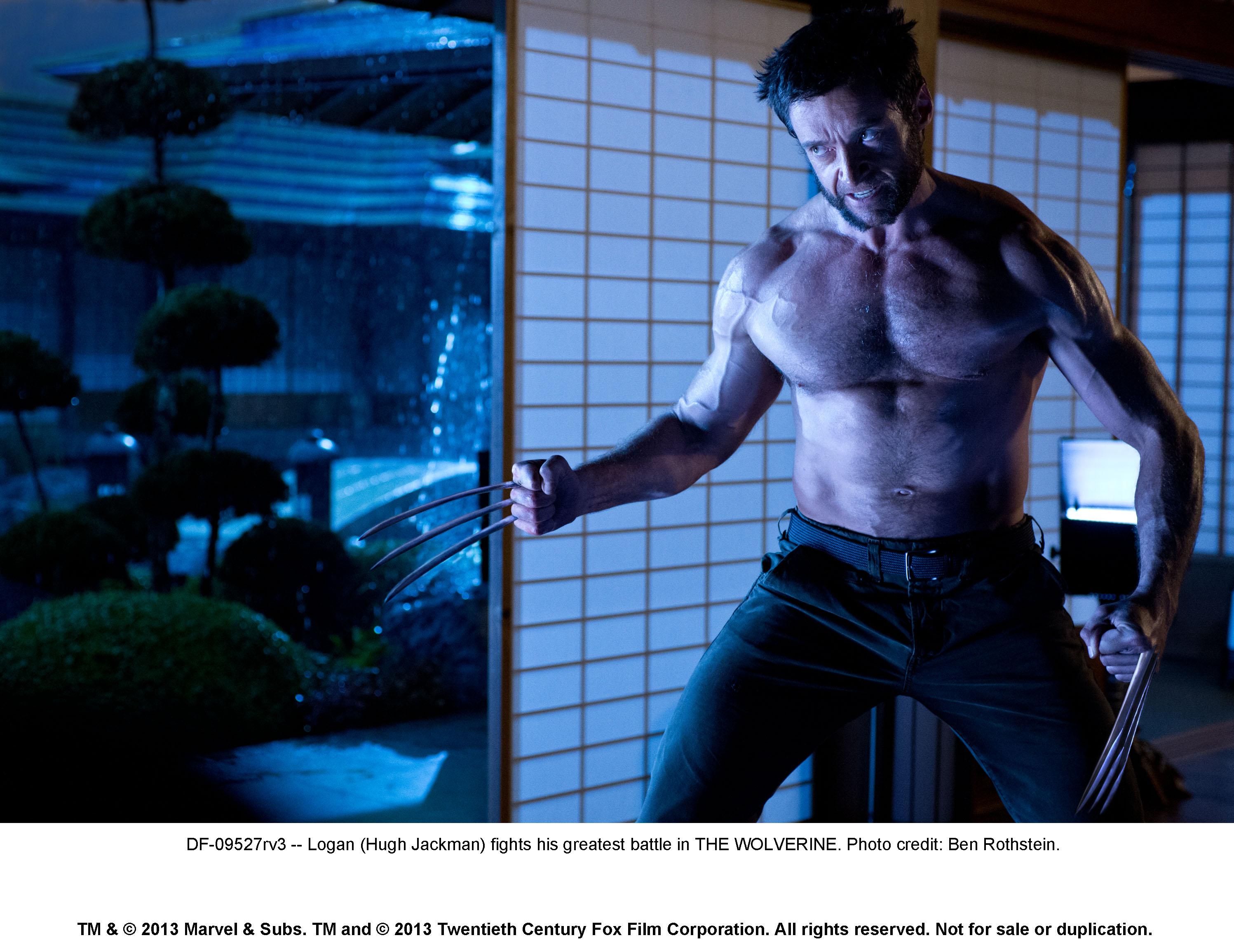
The Wolverine James Mangold’s contribution to the X-Men film franchise sidesteps the dizzy ambition of 2009’s X-Men Origins: Wolverine and 2011’s X-Men: First Class, opting instead for a sleek, mostly smart genre piece. This movie takes its basics from the 1982 Wolverine series by Chris Claremont and Frank Miller, a stark dramatic comic, but can’t avoid the convoluted, bad sci-fi plot devices endemic to the X-Men films. The titular mutant with the healing factor and adamantium-laced skeleton travels to Tokyo, to say farewell to a dying man who he rescued at the bombing of Nagasaki. But the dying man’s sinister oncologist has other plans, sapping Wolverine of his healing powers as he faces off against ruthless yakuza and scads of ninjas. The movie’s finest moments come when Mangold pays attention to context, taking superhero or Western movie clichés and revamping them for the modern Tokyo setting, such as a thrilling duel on top of a speeding bullet train. Another highlight: Rila Fukushima’s refreshing turn as badass bodyguard Yukio. Oh, and stay for the credits. (2:06) (Sam Stander)
There was an interesting moment at last night’s Harvey Milk LGBT Democratic Club’s Annual Dinner and Gayla, when Pentagon Papers leaker Daniel Ellsberg, all dolled up in a hot-pink feathered boa, reflected on Pfc. Bradley Manning’s “manliness” during his award acceptance speech on the gay whistleblower’s behalf.
When Manning, who sometimes reportedly self-identified as female and went by Breanna, courageously exposed government secrets, it exemplified what “a real man” would do, Ellsberg said. Yet when Lyndon B. Johnson (disastrously) vowed to forge ahead in Vietnam, it was partly because he feared being seen as “an unmanly man,” he added, all of which throws into question the very concept of masculinity. Earlier this year, Ellsberg and his wife, Patricia, joined the Bradley Manning contingent of the San Francisco Pride Parade to represent Manning following the heated debate over the Pride board’s decision to rescind Manning’s Grand Marshal appointment.
Meanwhile, deconstructing what it means to “be a man” is apparently becoming a thing. On a different end of the spectrum, Jennifer Siebel Newsom, wife of Lt. Gov. Gavin Newsom, surpassed her $80,000 target on Kickstarter for a film delving into the “crisis” surrounding masculinity. The pitch starts with a clip of the Newsoms’ blond, blue-eyed tot, Hunter, while mom questions whether he’ll grow up to be “caring and compassionate” or “a depressed, disconnected portrayal of masculinity.”
We dig the concept and all, but jeez – was it really necessary for an affluent celebrity married to one of the most powerful men in California to use Kickstarter?
We are all very excited about our July 31 public forum on the future of the Bay Guardian and progressive journalism in the Bay Area. We’ve already received lots of great community support and input since our recent turmoil and leadership transition — and we want even more feedback as we work to rejuvenate the paper.
But there is one piece of advice that we’ve received over and over again from readers: do something about the trolls that pollute our comments section. So we’ve decided to turn that input into a little week-long experiment starting on the day of the forum. As we post next week’s Guardian here at sfbg.com, we will disable the comments on the stories and in our blog posts that week.
Unfortunately, under the Guardian’s bridge live a few nasty trolls who hate everything that we and our progressive community do and are usually the quickest to comment on the things we write, often making the same pointed, off-topic criticisms, over and over again. Sometimes it’s racist, usually it’s reactionary, often it’s self-indulgent, and it always lowers the level of debate on our site.
Many of our regular readers and supporters have repeatedly told us the often toxic nature of these discussions chases them away and needlessly undermines the reporting and information that precedes it. Sometimes, we’ve seen organized misinformation campaigns from anonymous but clearly self-interested parties that post to our site, as we’ve seen in our coverage of Airbnb’s legal troubles and tax avoidance.
So in addition to all of our proud, loyal, flesh-and-blood readers, we’re hereby inviting all of our trolls — Matlock, Lucretia Snapples, Anon, and all the rest — to come to our forum and defend your domain. Among the many orders of business at the forum, we will consider changing our online comment policies and registration system, particularly as we redesign our website this fall.
If you want to comment next week, you’re going to have to come to our forum. Or you can always send us good, old-fashioned letters to the editor, either through email (steve@sfbg.com or marke@sfbg.com) or snail mail. Then, in our Aug. 7 issue, we’ll devote a page or two in the paper to those letters and the input that we receive at the forum.
We’ll probably just leave our comments turned off for one week — but you never know. So for now, let us know what you think as we rethink our approach at the Guardian. And please stop by our event page on Facebook and let us know that you’re coming to the event on July 31 from 6-8pm on the fourth floor of the LGBT Center, 1800 Market Street … if you dare.
Up Your Alley Fair, happening this Sun/28, is the scruffier, cruisier, gayer (yes, it’s possible) version of Folsom Street Fair. It has a wonderful history, but will forever be known to a certain generation, ahem, as Dore Alley Fair — as it was known in the ’90s, before it expanded into the several-block to-do it is today.
It also, of late, has attracted a filthy halo of fun parties. Besides the huge, official Bay of Pigs fundraiser party on Sat/27 (usually just a mite too shirtless and circuit music-y for me, but hey, whatever floats your rimseat!) here are some tasty-nasty treats for your “manly” perusal.
Thu/25 (tonight) night sees a special Thursday Night Live: Dore Alley Editionof live bands at the Eagle (Thursday nights at the Eagle are one of the coolest things going, for all sexualities) with “down and dirty” performances by Beard Summit, Dramady, Everyone Is Dirty, and RLLRBLL. Also Thursday night, if you’re more into reliving the gloryhole days of the Miracle Mile cruising and bathhouse scene, Bus Station John’s weekly Tubesteak Connection at Aunt Charlie’s in the Tenderloin brings you steamy underground disco and Hi-NRG classics. Or truss yourself up in your favorite fetish suit and hop to Powerhouse for Gearwear, at which one of our favorite bootblacks, Luna, will shine up your kicks real good.
Speaking of steamy, Fri/26 gives us Steam Goes Up You Alley, in which spunky promoter Walter Gomez’s monthly Steam party takes a turn for dirty disco with DJ Juan Garcia, probably my one gym-going amigo with the biggest pecs. Will he use them to cue up his records? Find out with a couple hundred sexy, cool people. Meanwhile, over at the Eagle, Flag gives you a chance to fly your freak flap according to the ancient signals of the Hanky Code. It’s like the Da Vinci Code, but with more priests and Crisco.
While the big boys are playing at Bay of Pigs on Sat/27, get a little dark electronic action of the dance floor variety at Dark Room, which not only biasts Ladytron DJ Ruben Wu, but a big performance by the fierce chanteuse San Cha, launching her new album Off Her Throne with a full band.
On Sun/28, don’t miss mysterious deep-n-hard techno entity LUTHER‘s set, 2pm-4pm, at the dance area of the Fair itself. LUTHER is excellent. And feel free and breezy to take a break from the fair at Walter Gomez’s nearby awesome-sounding all day party Glory Hole, which has an unlikely and exciting location: Tank 18, the huge new winery and BYOB meeting hall in SoMa. Awesome DJs like Rolo and Robin Malone Simmons of Odyssey will spin, accompanied by some fabulously fucked-up drag performances. Afterward, roll on down to Honey Soundsystem, where one of my favorite people (and DJs), Bil Todd from DC, will spin you right out of your sling, with deep disco edits and cutting edge house.
The part of the First Amendment that prohibits “abridging the freedom … of the press” is now up against the wall, as the Obama administration continues to assault the kind of journalism that can expose government secrets.
Last Friday the administration got what it wanted — an ice-cold chilling effect — from the Fourth Circuit Court of Appeals, which ruled on the case of New York Times reporter James Risen. The court “delivered a blow to investigative journalism in America by ruling that reporters have no First Amendment protection that would safeguard the confidentiality of their sources in the event of a criminal trial,” the Guardianreported.
The Executive Branch fought for that ruling — and is now celebrating. “We agree with the decision,” said a Justice Department spokesman. “We are examining the next steps in the prosecution of this case.” The Risen case, and potentially many others, are now under the ominous shadow of the Appeals Court’s pronouncement: “There is no First Amendment testimonial privilege, absolute or qualified, that protects a reporter from being compelled to testify … in criminal proceedings.”
At the Freedom of the Press Foundation, co-founder Trevor Timm calls the court ruling “the most significant reporter’s privilege decision in decades” and asserts that the court “eviscerated that privilege.” He’s not exaggerating. Press freedom is at stake.
Journalists who can be compelled to violate the confidentiality of their sources, or otherwise go to prison, are reduced to doing little more than providing stenographic services to pass along the official story. That’s what the White House wants.
The federal Fourth Circuit covers the geographical area where most of the U.S. government’s intelligence, surveillance and top-level military agencies — including the NSA and CIA — are headquartered. The ruling “pretty much guts national security journalism in the states in which it matters,” Marcy Wheeler writes.
That court decision came seven days after the Justice Department released its “News Media Policies” report announcing “significant revisions to the Department’s policies regarding investigations that involve members of the news media.” The report offered assurances that “members of the news media will not be subject to prosecution based solely on newsgathering activities.” (Hey thanks!) But the document quickly added that the government will take such action “as a last resort” when seeking information that is “essential to a successful investigation or prosecution.”
Translation: We won’t prosecute journalists for doing their jobs unless we really want to.
Over the weekend, some news accounts described Friday’s court decision as bad timing for Attorney General Eric Holder, who has scrambled in recent weeks to soothe anger at the Justice Department’s surveillance of journalists. “The ruling was awkwardly timed for the Obama administration,” the New York Timesreported. But the ruling wasn’t just “awkwardly timed” — it was revealing, and it underscored just how hostile the Obama White House has become toward freedom of the press.
News broke in May that the Justice Department had seized records of calls on more than 20 phone lines used by Associated Press reporters over a two-month period and had also done intensive surveillance of a Fox News reporter that included obtaining phone records and reading his emails. Since then, the Obama administration tried to defuse the explosive reaction without actually retreating from its offensive against press freedom.
At a news conference two months ago, when President Obama refused to say a critical word about his Justice Department’s targeted surveillance of reporters, he touted plans to reintroduce a bill for a federal shield law so journalists can protect their sources. But Obama didn’t mention that he has insisted on a “national security exception” that would make such a law approximately worthless for reporters doing the kind of reporting that has resulted in government surveillance — and has sometimes landed them in federal court.
Obama’s current notion of a potential shield law would leave his administration fully able to block protection of journalistic sources. In a mid-May article — headlined “White House Shield Bill Could Actually Make It Easier for the Government to Get Journalists’ Sources” — the Freedom of the Press Foundation shed light on the duplicity: As a supposed concession to press freedom, the president was calling for reintroduction of a 2009 Senate bill that “would not have helped the Associated Press in this case, and worse, it would actually make it easier for the Justice Department to subpoena journalists covering national security issues.”
Whether hyping a scenario for a shield law or citing new Justice Department guidelines for news media policies, the cranked-up spin from the administration’s PR machinery does not change the fact that Obama is doubling down on a commitment to routine surveillance of everyone, along with extreme measures specifically aimed at journalists — and whistleblowers.
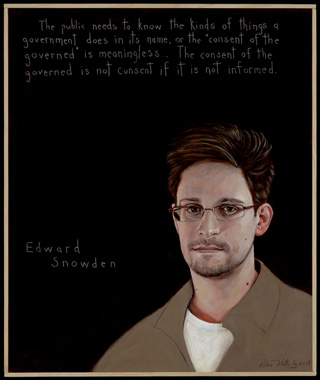
The administration’s efforts to quash press freedom are in sync with its unrelenting persecution of whistleblowers. The purpose is to further choke off the flow of crucial information to the public, making informed “consent of the governed” impossible while imposing massive surveillance and other violations of the First, Fourth and Fifth Amendments. Behind the assault on civil liberties is maintenance of a warfare state with huge corporate military contracts and endless war. The whole agenda is repugnant and completely unacceptable.
Norman Solomon is co-founder of RootsAction.org and founding director of the Institute for Public Accuracy. His books include “War Made Easy: How Presidents and Pundits Keep Spinning Us to Death.”
(Bruce B. Brugmann, who signs his emails and blogs b3, edits and writes the Bruce blog on the Guardian website at SFBG.com. He is the editor at large and former co-founder and co-publisher with his wife Jean Dibble, 1966-2012.)
San Francisco renter Deborah Silverman has found herself in a kind of mousetrap. Silverman says she was driven out of her apartment of more than 10 years because of a mouse infestation caused by the unit below her, and she alleges that her landlord, Bart Murphy – who is also a Rent Board Commissioner – failed to address the problem after numerous complaints.
Silverman has filed suit against Murphy, charging that he purposefully let the infestation in her apartment run rampant in order to force her out. She’s seeking more than $125,000 in damages, according to her attorney Eric Lifschitz. That would cover the $700 difference between what she was paying for rent and what it was raised to (multiplied by the years she lived there) and property damages from the infestation, as well as emotional and punitive damages. Murphy is the president of a property management company that runs more than 500 buildings.
Silverman’s lawsuit caught the attention of Tenants Together, a statewide organization that advocates for renter’s rights. Dean Preston, founder and executive director that organization, sees the dispute between Murphy and Silverman as part of a broader trend in San Francisco.
“We see a lot of landlords that don’t make repairs in order to drive tenants out,” Preston told the Guardian. He said Murphy should resign if he is in fact forced to fork over the thousands of dollars for Silverman’s settlement.
“If these allegations are found to be true, Murphy should resign,” Preston said. “Bart Murphy has no business serving on a commission in this city, especially a commission that passes judgment on tenant claims against landlords.”
Murphy could not be reached to comment on the matter, but we will update this post if we hear from him.
Delene Wolf, executive director of the San Francisco Rent Board, told us the case does not warrant the possibility of Murphy resigning as a commissioner on the Rent Board. “He is a landlord and is entitled to have disputes with his tenant,” Wolf said. “He has not been found guilty of any crimes. Nobody is being found guilty of anything, this is a civil litigation.”
But Lifschitz echoed Preston’s stance, saying Murphy should either resign or be forced off of the Rent Board if the trial does not go in his favor. “The best case scenario is that my client is vindicated and is able to find a new home in San Francisco,” Lifschitz said. “The worst outcome is if the jury determines that what Murphy did was reasonable. Every time we learn something new about this case we’re shocked that this happened.”
According to Lifschitz, Murphy has since rented out the abandoned units for a higher price. The next court hearing on the case is scheduled for tomorrow (Thu/25), and the trial is set to begin once a courtroom becomes available.
A self-identified “anonymous ballpark worker” has emailed the Guardian a poem in response to this week’s cover story by George McIntire. Read it after the jump.
Bad Karma Giants
The Giants are getting blown away. It seems that they have lost their way.
What should the Giants do? Sign that contract with Local 2!
The bad karma is just too strong. Giant’s management must right this wrong.
Ballpark workers can’t live on garlic fries. Give us our due, that’s what is wise.
Larry Baer, this is your call. Make it right, or suffer and fall.
Do it now, do what’s right. And put that pennant back in sight!
There’s a pricey event in San Francisco this evening “exploring the past, present, and future of Burning Man,” with all proceeds going to The Burning Man Project, the nonprofit vessel that Black Rock City LLC created to supposedly take over operations of this venerable cultural phenomenon. With the murky, ever-evolving plan for what that allegedly imminent transition looks like and what the new governance structure will be, the forum could shed some light on the subject — but I wouldn’t bet on it.
For my latest cover story on Burning Man and its leadership, which ran last month, I sat down with founder Larry Harvey and LLC board member Marian Goodell to discuss the transition at length. Even after listening to the recording of that interview several times, I still had a hard time discerning what the plan is, mostly because I don’t think they even really know at this point.
Even though Harvey told me “we’re pretty much on schedule” to turn operations of the late summer event over to the new nonprofit board next year, it doesn’t seem that the hand-picked nonprofit board will have any real authority. And the relationship of the nonprofit to the LLC — which will continue to control all things Burning Man, despite Harvey indicating otherwise when he announced the plan two year ago — is still being defined.
“I would answer that a little more completely by saying what we’re really in the middle of doing is looking at the structure for Black Rock City LLC, which is an event production company and its infrastructure and doing the outreach to the world,” Goodell told me, adding the six current board members will still guide the event and culture and that “we’re more necessary than ever.”
Some veteran burners consider that to be a fairly bold statement coming from a business that derives its value mostly from the volunteer efforts of the 60,000 people who create Black Rock City every year, and whose “10 principles” (prominently posted on the front page of the Survival Guide circulated to all attendees this year) include Participation, Radical Inclusion, Communal Effort, Civic Responsibility, and Decommodification.
In the wake of my last story, I heard from sources within the LLC who appreciated me raising these issues and trying to keep the organization honest and true to its principles, but they’re all afraid to speak out publicly, mostly of Goodell’s wrath. They said that while four of the six LLC board members do seem willing to give up some control over the event and culture, Harvey and Goodell have gone the opposite direction and seem to be expanding their control as they travel the world as burner ambassadors.
In their interview with me, both Harvey and Goodell made clear their indispensible roles in protecting the event from “meddling” by the nonprofit board and with sheperding the larger burner culture.
“Oh no. We are giving up managing the event in favor of managing the culture in the greater world, that’s what we’re doing. And we can hardly do it fast enough because we don’t have time to manage the event,” Harvey said, later noting the LLC could become essentially a consulting firm that Burning Man regional organizations around the world pay for services. “That’s how things work in the real world.”
Tonight’s event is entitled “This is Burning Man,” named after the seminal burner book penned by the host of the event, Brian Doherty, who will lead the discussion with Harvey and co-founder Michael Mikel, aka Danger Ranger. The 7pm event is at Z Space Theater, 450 Florida, with tickets ranging from $20-$125.
I’ve always appreciated Doherty and his book, which I drew from for my own book on the culture’s modern era, The Tribes of Burning Man, and he contacted me after my last article to say he was glad to see me raising these issues. And he did tell me that one of the topics he plans to cover tonight is “the original corporate structure and why that might be changing.”
Yet Doherty, a libertarian who is a senior editor at Reason Magazine, doesn’t really share the view that the burner community has sweat equity in the event and therefore a right to help guide a culture that has evolved significantly since the LLC was formed in 1997.
“I no longer approach the event with a close-focus journalists eye, but do still consider it a fascinating unfolding story not just of a bunch of interesting people trying to ride a tiger they’ve let loose — and this applies to organizers and attendees — but about the most fun thing one can do with your time. I also maintain, I know controversially, that in most respects any attendee should care about, the event has been in most important respects the same since it got its current shape in 1998,” he told me. “Yes if you are dealing with the bureaucracy or burning big art or trying to get it funded or working for BMorg, a lot has changed. If you are one of the blessed 90 percent who are buying tickets and enjoying or paricipating in a way that does not have to intersect any of that, well, you still have the same Burning Man us boring old folk had, and please enjoy it. I would say preserve it; you can certainly try to evolve it, but it seems resistant to change in some respects.”
That may be true, but that isn’t what Harvey told the burner community two years ago, when he promised to “gift the event back to the community,” a meme that was uncritically repeated and amplifed in the documentary “Spark: A Burning Man Story,” that is now making the theatrical rounds.
“Arguments welcome, thanks for caring, the story of how this thing was built is still one of the great American culture stories of our time, with characters as fun and deep and resonate of great pantheonic virtues as you’ll find,” Doherty says. “This does not mean I worship them as Gods — merely respect them as representing virtues, vices, and concerns and ideas as old as human civilization.”
It may not always seem like it, but I also respect Harvey, Goodell, and the rest of the Burning Man leadership, even if I think a little more clarity and open public discussion is necessary now, so let me close with some more of their comments from our interview.
“We want to make sure the event production company has sufficient autonomy, they can function with creating freedom and do what it does best, which is producing the Burning Man event, without being unduly interferred with by the nonprofit organization,” Harvey said.
“That’s why you heard it one way initially, and you’re hearing it slightly differently now, and it could go back again,” Goodell said. “We don’t think it’s sensible, either philosophically or fiscally, to essentially strip away all these entities and take all these employees and plop them in the middle of The Burning Man Project.”
“So there’s directly administered by this huge collossus at the center,” Harvey added.
“That looks like the US government,” Goodell interjected. “We think it would look like a many tentacled beast. That’s what we’re all afraid of in the world, a government putting their paws into us too much.”
Yet it wouldn’t be a government, but a bunch of nonprofit board members and experienced burners who would represent Burning Man’s constituent communities. Harvey said something like that might eventually work, but for now, that’s not what’s happening.
“We might change our minds at any time, that’s our perogative, but right now we’re absolutely on the path that you heard at the talk at the Bently Reserve two years ago,” Goodell said.
“We are in fact relinquishing our control,” Harvey said. “We are delegating the authority that the partners held as executives to the staff that operates it.”
When setting up an interview with Jello Biafra, I got this light-hearted warning: “There is no such thing as a short interview with Jello.” It’s true, the legendary punk showman/spoken word enthusiast is full of political ideas, historical references, and elder-punk-dude tales. How can he be expected to keep it brief?
Below, we spend an intense half hour discussing the media, corruption, spoken word, Jello Biafra and the Guantanamo School of Medicine, Jello Biafra and the New Orleans Raunch and Soul All-Stars, and the future of underground rock’n’roll. (For the feature on Jello Biafra and the Guantanamo School of Medicine, see this week’s paper): San Francisco Bay Guardian Where do you gather your news? What are your sources for political commentary in your songs?
Jello Biafra Why, the Bay Guardian, of course! Where would a local voter be without your fine rag? I just hope the new ownership and staff goes pedal to the metal to keep up the standard of muckraking and ethics. There’s so much corruption to dig up in this area.
I think the real renaissance was before the Weekly was sold to New Times/VVM, when the Guardian and the Weekly were both muckraking papers concentrating on local issues and were trying to out-scoop each other. That’s what I’d like to see continue and come back.
But basically I’d read a lot of periodicals. Locally, we have you folks, among others. And then you know Nation, Progressive, Mother Jones, interesting things people send me in the mail, digitally or otherwise, talking to people, putting two and two together — trying to write songs about stuff that no one else has! Or at least not in the same way.
SFBGWhy is that? Why choose to write songs about something no one else has?
JB It’s just filling in the gaps with what’s interesting. I’m proud that no two of my music albums sound alike. Not even the Lard albums sound alike. From Dead Kennedys onward my mission as the main lyricist and composer of the damn tunes, I kind of stick to my punk core — whether I intend to or not, it’s just who and what I am — and but kind of widen the base of the pyramid to what you can do with that energy.
http://www.youtube.com/watch?v=NQpPvFPegdE
SFBG What are some the topics you focused on when writing White People and the Damage Done?
JB I guess it was a little more focused as a semi-concept album, than anything since Frankenchrist. It’s basically about grand theft austerity, and how unnecessary it is, what a scam it is. People have asked me when we go to play different cities or countries, what I think is the biggest problem in the world today and they expect me to say something like “climate change” which I prefer to call “climate collapse” because that’s what it is, or inequality, or war, or whatever, and I say you know, there’s a worse one, it’s corruption. Because that is what’s blocking anything constructive being done about all the other problems. There’s a thread through White People and the Damage Done about that.
The title track is not so much about race specifically, but about this attitude of the higher ups in the United States, the EU, and others, is that other countries, especially ones run by people of color, where we call them “Third World” or whatever, are somehow unfit to govern themselves and need us to pull the strings, plant the puppets, and tell everyone what to do. And it’s often for the purposes of looting their resources and exploiting their people. And what kind of unintended consequences that can have.
For example, we talk about why we need more democracy in Iran, and we don’t have the big bad Soviet Empire to freak out everyone anymore so we have Iran and North Korea instead. Wait a minute, you want democracy in the Middle East? Well Iran was a democracy in the early 1950s, guess who decided to overthrow the democratically-elected leader Mohammad Mosaddegh, and put the most hated person in the country, the Shah, back into power? But he was our policeman for the gulf basically, and he got overthrown anyway. And now it’s a theocratic regime. Where would be today if we had just left that region alone in the 1950s?
Same for Afghanistan. I nearly went through the roof when I found out about an interview with Jimmy Carter’s old national security advisor, Zbigniew Brzezinski’s, whose daughter is on one of the morning cartoon pundit shows, bragged on an interview with French media about what a great thing we did by arming, training, and financing the guerrillas in Afghanistan before the Soviet Union invaded, and how we cracked apart the evil empire, hooray for us, we win.
But look what we created for crying out loud. We were even helping back a young hothead with a trust fund named Osama Bin Laden. And then once the Soviets were out, we didn’t lift a finger to help rebuild the country, let alone take back the guns and rocket-launchers. And now look where we are. That’s another example of white people and the damage done.
[Pause] hold on my juice machine, now I have to turn it off, it’s bouncing all over the counter.
SFBGWhat kind of juice are you making?
JB Oh, just a mixture of stuff. Spinach, apples, other things.
SFBGCan you tell me about forming Guantanamo School of Medicine?
JB Here we go again. I wanted to have another band ever since Dead Kennedys, it just never quite happened. Either people weren’t available, or I was off doing spoken word or other adventures, but of course I never stopped making albums, there was Lard, two with the Melvins, one with DOA, Mojo Nixon, NoMeansNo.
I kept the music out there, I just didn’t have a performing vehicle. And then when I was down at the Warfield seeing the Stooges on Iggy’s 60th birthday, it occurred to me, “oh shit, I turn 50 next year. I better do something or I may never get another chance.” If it’s half as good as the Stooges, I’ll declare victory.
SFBGDo you have any other projects coming up?
JB I started getting back into spoken word. I did a tour in Australia after the band’s tour was done. And at some point, something that will probably see the light of day: some of the New Orleans guys from Cowboy Mouse and Dash Rip Rock dared me to come down there during the jazz fest a few years ago and do a whole set of New Orleans soul and rhythm and blues songs, which I did with some badly needed garage rock added in and we got Mojo Nixon’s keyboard wizard with all the Jerry Lee Lewis moves, and quite the cacophonous horn section, as well as [Cowboy Mouth’s] Fred LeBlanc, and [Dash Rip Rock’s] Bill Davis.
The multitrack recording was a trainwreck, but then Ben Mumphrey who works with Frank Black and the Pixies and many others, called me up and said he could rescue this recording. Slowly but surely he has been rescuing it. So Jello Biafra and the New Orleans Raunch and Soul All-Stars will see the light of day somehow. We haven’t been able to pull it together to play a show though.
http://www.youtube.com/watch?v=as8Y2HWzUwI
SFBG I was wondering your opinion of this new, kind of second tech bubble taking over in areas like the Mission?
JB Again, I refer you to one of my songs. It came out on the EP of the rest of the recording session when we recorded The Audacity of Hype with Billy Gould. The song is called “Dot Com Monte Carlo.” And sure enough there was a little mini firestorm on the Internet of course. A lot of people writing in were too chicken-shit to sign their own names, but they said ‘oh that’s such an old topic, it doesn’t matter anymore.’
Well I had this funny feeling we weren’t done with the Dot Com Holocaust. Sure enough, now it’s more aggressive and obnoxious than ever. Dot Com Monte Carlo — that’s kind of what Willie Brown’s puppets are trying to turn this city into, yet again.
It has been really sad for me to see so many cool people and artists and service-workers and people of color just bull-dozed out of this town to make room for more mini little yuppies who treat San Francisco as a suburb of Silly-clone Valley.
And now you don’t see people like me when I was 19, just moving out to San Francisco chasing a dream. There was a time when the vitality of the underground was maintained by entire bands moving here as a unit. Everybody from MDC and the Dicks to DRI and later, Zen Guerilla, the only one I can think of in recent years, who dare tried to relocate to San Francisco were I believe No Doctors and Sixteen Bitch Pile-Up, and I’m not sure either one of them exist at this point. Maybe they all packed up and left. A lot of that underground fire, and that’s not just confined to rock of course, but a lot is going on in Oakland now.
SFBG Yeah, I’ve had a lot of bands telling me they can’t afford San Francisco anymore, so they’ve been moving to the East Bay or beyond…
JB I mean, I’d hate to see San Francisco turn any further into a giant Aspen, Colorado, or even Boulder, Colorado, which is where I fled from in order to come here [in ’78.]
SFBG Are there current East Bay or San Francisco bands that you feel like are doing good things?
JB Of course I always brain-fart on this question. Well, of course I’m going to support my label bands, I love Pins of Light.
SFBG How involved are you with Alternative Tentacles? Are you going out and finding bands?
JB Well I’m still the absentee-thought-lord, the buck stops with me. Someone deeply suspicious of capitalism has wound up owning a business by default, whether I should or not. Luckily there’s still money to pay a shrinking staff and to make sure we can keep putting out cool things. But it’s becoming harder and harder because of the combination of a crashed economy, rents going through the ceiling all over country, and file-sharing on the other hand. Of course, one feeds the other when people don’t have any money.
That doesn’t mean I support these misguided efforts, these major label RIAA scams to blackmail people and sue them for file-sharing. They’ve raked in over a hundred million dollars doing that and no artist has seen a penny. That’s not the way to solve this.
On the other hand, when I see one of the best bands we’ve seen in years like the Phantom Limbs break up way too soon, I can’t help but wonder whether file-sharing might be a part of the problem, with so many people going crazy over them and going to their shows all over the place, and then hardly anybody buys the album.
When you’ve got people in the age of high housing and transportation cost trying to keep themselves fed or also sustain a family, that hurts. I wonder how many people save up money from their shitty jobs for years in order to make some really cool piece of music only to find that nobody actually gives anything back; they’re that much more likely to quit making anything.
Maybe the solution is, for people who want to get their friends into really cool music, don’t just send them the whole album, pick some favorites and send them a little teaser package, a little file to inspire them to check out them more.
Not to mention, be conscious of whose file you’re sharing. Major labels go so far out of their way to rip off their artists anyways, with an army of lawyers to back them up. But when it’s an underground artist or label, that’s different. I never would have thought that GSL would’ve stopped, for example. Or that Touch and Go would draw mainly into reissues and back catalogue. It’s not just the economy and music industry crashed that’s to blame, it’s also people who don’t think artists should get any of their support.
SFBGDo you still love performing in front of a crowd? Do you have any recent performances with this band that you’ll take with you?
JB I’m not sure I’d be doing it if there wasn’t this inner need to do it. I’m really greatful that at my age anybody even cares about what I have to say, or new stuff I’ve been making.
We’ve been able to play a lot of places Dead Kennedys weren’t, because countries hadn’t opened up yet and they were still under the boot of Communist dictators or Latin American military or whatever. And we get to play for people in those places now. I don’t have the kind money where I can go jet-setting around to these places, I have to play my way to places like Buenos Aires or Slovenia, or I’ll never get there.
Bringing these musical riffs in my head to life and to have them actually work and getting to play them for people, that’s always pretty cool.
Some of the stranger moments were last time we were in Geneva we had a stage-diver in a wheelchair. The crowd was very gentle with him, passing him around, and making sure he was reunited with the chair, which was floating somewhere else in the crowd. Three or four songs later, he’d be back again! That was good.
Also, being able to scrape together just enough of my high school Spanish to be able to talk to people in Buenos Aires from the stage about some songs that were written with them in mind. I mean, “Bleed for Me,” the old Dead Kennedys song, was written about the Dirty Wars. And this was the first time I could actually dedicate “Bleed for Me” to the Desaparecidos in Argentina and explain it a little bit.
So this week the Internet laughed at the Bronies, or rather at a devilishly edited video of a Bronycon rave somewhere, probably, in the upper Midwest. I admit I laughed and laughed — it is impossible not to break down when the guy implores everyone to come to “Brony-Can, Canada’s premiere My Little Pony convention” — but not so much out of mean-spiritedness, at least in my own estimation.
http://www.youtube.com/watch?v=6haPehPNPUk
I think most of us cracked up out of recognition of our younger, gloriously naive selves, and the middle-aged possibilities we may fear becoming. Ah c’mon man, let the little kids have their unselfconscious fun. Who the hell doesn’t wish they had Bronycons when they were 12? (I readily admit I may be alone in this.)
And as for the middle-aged guys who never let go of the Happy Hardcore/NIN crossover dream: well, at least they’ve got an audience. For those hailing from the elder rave days, we all knew guys like this, setting up the sound, staffing the Smart Drink booth, always talking about their plans to hit every rave in Ohio in one night. I love that they still exist, really!
No Bronycons here this weekend, alas, although we’ll probably be feeling the effects of last week’s Comicon just fine, thanks. Anyway, besides being washed over by a Minimal Wave on Sat/27 and Sun/28, we’ve got these parties to look forward to. (Click on the titles for Facebook etc. invites.)
I’ve been meaning to write about Bodyshock, awesome-sounding EBM (electronic body music) and Belgian New Beat monthly for the past few month. Mastermind Elbo Room boker Matt Shapiro has been bringing in some awesome acts, including members of Nitzer Ebb and Meat Beat Manifesto. This time around seems Psychic TV-mate and +8 Records legend Fred Giannelli, aka the Kooky Scientist, performing alongside High Functioning Flesh, a new band out of LA. With resident DJs BLK Rainbow and Crackwhore. Really cool stuff for dark moods.
http://www.youtube.com/watch?v=VpKpLkvthyo
Wed/24, 10pm, $10. Elbo Rom, 647 Valencia, SF. www.elbo.com
One of my (and the underground world’s) favorite slowburn deep-disco DJ is renowned for his long-format parties, during which he’ll spin for eight hours or more. But the Berliner proved himself equally adept at melting the floor for shorter periods at Honey Soundsystem earlier this year. He’s sure to be just as much a hit at the ever-amazing Housepitality party. PS the guy in the red hat in the video below actually owns the world, all of it.
Wed/24, $5 before 11 p.m., $10 after (free before 11 p.m. with RSVP at www.housepitalitysf.com/rsvp). F8, 1192 Folsom, SF.
The ever-delightful As You Like It Party pricks up our ears with this pair of experimental-minded technoists: Regis has been running the British, degenerate art leaning label Downward since 1993, while Max Cooper has been building a name for himself with ethereal productions for the past few years. (His last appearances here have drawn raves from techno cognescenti.) Oh, and you’ll dance, too.
Fri/26, 9pm-4am, $20. Public Works, 161 Erie, SF. www.ayli-sf.com
Great underground NYC techno club the Bunker has been roving over to SF of late, under the auspices of the Gray Area Foundation for the Arts. This live audio-visual extravaganza from abstract electronic popper Atom™ brings recent album HD to life, with support from Bunker resident Darek Plaslaiko and local favorites Carlos Souffront, P-Play, and Galen.
Oh yes, there is indeed a group of belovedly eccentric individuals dedicated to the worship of David Bowie circa Spiders from Mars to Thin White Duke days. This Bowie exultation burlesque and drag extravaganza features an 11-piece live band and over-the-top glam rock sensibility.
Nothing beats the gypsy-inspired whirling and stomping of traditional Balkan music in a club setting, courtesy of DJ Zeljko— and he’s upped his monthly Kafana Balkan party ante by marrying the gorgeous Jill Parker, whose Foxglove Sweethearts belydance troupe helps steam up the proceedings. Add in the live brass antics of this month’s guest band Fanfare Zambaleta, and it’s all a doozy.
The second wave Detroit techno innovator hits the Public Works loft as part of a huge and eclectic party from the Face, Icee Hot, and PW crews that also features Pat Mahoney, Tim Sweeney, and Mike Simonetti. It’s the best kind of sausagefest — a groovy one.
http://www.youtube.com/watch?v=PQBwZwHzXyU
Sat/27, 9:30pm-3:30am, $13 advance. Public Works, 161 Erie, SF. www.publicsf.com
In San Francisco Sup. John Avalos’ District 11, half of all residents were born outside the U.S. In Sup. Jane Kim’s District 6, more than a third of residents are foreign-born, and almost half speak a language other than English.
Given the sizable immigrant population in San Francisco, it may not come as a surprise that Secure Communities (S-Comm), a federal immigration program administered by the U.S. Immigration and Customs Enforcement (ICE), is highly unpopular. What might not be so obvious is how dramatically S-Comm can impact the lives of foreign-born women who are survivors of domestic violence.
The reason for this is simple. “If you are a victim or a survivor of domestic violence and you call the police, you do not want to end up deported,” Beverly Upton of the San Francisco Domestic Violence Consortium explained at a rally this afternoon, where advocates from organizations such as Mujeres Unidas Activas, Causa Justa, the Filipino Community Center and others stood and held banners demonstrating opposition to S-Comm. “We want it to be safer to call the police, not less safe.”
A member of Mujeres Unidas y Activas who introduced herself as Lourdes and spoke through a translator delivered a personal account of feeling fearful of police as well as an abusive partner. “Many times, abusers tell us not to call the police, because the police will not believe us. They say the police will probably deport us.”
The domestic violence and immigrant community advocates were there to champion Avalos’ Due Process for All Ordinance, which is being introduced at today’s Board meeting and is co-sponsored by seven other supervisors, essentially guaranteeing its passage. Avalos himself didn’t speak, and Sups. David Campos and Board President David Chiu, who were co-sponsors of the legislation, sent female staff members to make statements on their behalf as part of the all-female roster of speakers.
The legislation prohibits law enforcement officials from detaining individuals solely in response to immigration detainer requests issued by immigration authorities under S-Comm. As things stand, “the request has been honored in many cases,” Avalos explained in comments to the Guardian, even though California Attorney General Kamala Harris has affirmed that local law enforcement agencies are not obligated to comply with ICE detainers because they are mere “requests” and not legally binding. Since 2010, according to data provided be Avalos’ office, 784 San Franciscans have been deported after being turned over to federal authorities due to ICE detainers.
Sup. Jane Kim called S-Comm “a giant step backward when it comes to equality and fairness,” and added that S-Comm “makes our neighborhoods less safe.”
Legal Counsel Freya Horne read a statement on behalf of San Francisco Sheriff Ross Mirkarimi, stating that the sheriff has reduced the number of ICE detainers leading to deportations, and was supportive of Avalos’ legislation. She added that Mirkarimi had made it a policy to honor immigration detainer requests only in cases of criminal convictions of serious or violent felonies.
Avalos said he was compelled to move the legislation forward because “I’ve talked to so many people whose families have been separated, and have been devastated,” due to deportations under S-Comm. “We want to make sure we’re maintaining a level of due process,” he added, since the detainer requests are routinely issued without warrants or a requirement to show probable cause.
At the start of this year, when I wrote a Guardian cover story profile of Sup. Scott Wiener (which SF Weekly and San Francisco Magazine followed shortly thereafter with their own long Wiener profiles), he seemed like the one to watch on the Board of Supervisors, even though I noted at the time that Board President David Chiu was actually the more prolific legislator.
Now, it’s starting to seem like maybe we all focused on the wrong guy, because it is Chiu and his bustling office of top aides that have done most of the heavy legislative lifting this year, finding compromise solutions to some of the most vexing issues facing the city (ironically, even cleaning up some of Wiener’s messes).
The latest example is Wiener’s CEQA reform legislation, which the board is poised to unanimously approve at today’s meeting, a kumbaya moment that belies the opposition and acrimony that accompanied its introduction. Rather than a battle between developers and the coalition of progressives, environmentalists, neighborhood activists, and historic preservationists, Chiu and board aide Judson True transformed the legislation into something that benefited both sides.
[UPDATE: For reactions to this post and another perspective on Chiu, read this.]
That effort comes on the heels of Chiu’s office solving another big, ugly, seemingly intractable fight: the condominium lottery bypass legislation sponsored by Wiener and Sup. Mark Farrell. To solve that one in the face of real estate industry intransigence, Chiu showed a willingness to play hardball and practice a bit of gamesmanship, winning over swing vote Sup. Norman Yee to get six votes using some hostile amendments to the legislation.
In the end, Chiu won enough support to override a possible veto by the waffling Mayor Ed Lee, who has always echoed Chiu’s rhetoric on seeking compromise and consensus and “getting things done,” but who lacks the political skills and willingness to really engage with all sides. For example, it was Chiu — along with Sups. Farrell and David Campos — who spent months forging a true compromise on the hospital projects proposed by California Pacific Medical Center, replacing the truly awful CPMC proposal that Lee readily accepted.
“It’s been a very long year,” Chiu told the Guardian. “It’s been important for me to not just to seek common ground, but legislative solutions that reflect our shared San Francisco values.”
Next, Chiu will wade into another thorny legislative thicket by introducing legislation that will regulate the operations of Airbnb, the online shared housing share corporation whose basic business model often violates local landlord-tenant laws, zoning codes, and lease conditions, in addition to openly defying rulings that it should be paying the city’s transient occupancy tax.
“This challenge has been particularly difficult,” Chiu told us, referring the many hard-to-solve issues raised by companies such as Airbnb, who Chiu and board aide Amy Chan have been working with for several months. In fact, after originally predicting the legislation would be introduced before the board takes its August recess, Chiu now tells us it may need a bit more time to hammer out the details.
We’ll be watching to see how he sorts through the many tough issues raised by Airbnb’s approach, here and in other big cities with complicated landlord-tenant relations, which I will be exploring in-depth in an upcoming Guardian cover story. But if there’s anyone at City Hall capable of solving this one, it’s probably Chiu.
Tyler Bryant and the Shakedown are tearing up the stage, and people are taking notice. The Nashville-based country and blues-rock group released its well-crafted, guitar-heavy, debut album Wild Child in January of this year, and just wrapped a lengthy tour through the States, which included a stop in San Francisco.
Following its gritty performance at Brick and Mortar Music Hall late last month, the group talked about how it arrived at its raw, high-energy performances, first loves, and non-musical hobbies.
One of beer’s most intriguing qualities is that it’s an incredibly easy elixir to get nerdy about. In fact, it’s almost like a double gateway — attracting regular folk to the wide wonderful world of microbiology and science-minded folk to the bar scene. What’s more, beer as a social catalyst has been bringing people together for possibly over 10,000 years and is the third most popular beverage in the world after water and tea, providing plenty of opportunity for historical insight and cultural exchange. All of which made hosting a beer-tasting event at San Francisco’s 38th edition of Nerd Nite kind of a no-brainer … except with brains.
Nerd Nite San Francisco has been running strong at the Rickshaw Stop since its local inception in 2010 (Nerd Nite as a phenomenon having been founded in Boston in 2003 by Chris Balakrishnan), regularly packing the place to the literal rafters with fans who flock to witness talks on such phenomena as “The World’s Weirdest Fungus,” the science behind circus sideshow acts, the inevitability of the zombie apocalypse, and the intricacies of video game design. But this month, beer. Ok, and video game design. But mostly beer.
After an informative lecture on the history of beer delivered by Jim Withee of GigaYeast (a company producing and packaging a variety of beer yeast strains for professional and home-brewers) came the beer-tasting portion of the evening. An ingrained beer-brewing rivalry between the Bay Area Science Festival and the Philadelphia Science Festival led to three experimental batches being brewed by local craft brewer (and scientist), Bryan Hermannsson of Pacific Brewing Laboratory, the winner voted on by the crowd to become the beer entered into the official 2013 competition. So not just tasting for the sake of tasting, but a group experiment to determine the beer with the best flavor and presentation. Yay for science!
What made the experiment even more intriguing from a beer science standpoint was the fact that all three batches were brewed with the same base recipe of two-row malt and simcoe hops, and under the same temperature conditions, what made the flavor of each different was strictly the yeast strain used in each (courtesy of GigaYeast, natch). The first was a pale ale, so reminiscent of the Bay Area they even called it the “Norcal”. This one was my personal favorite, the way it embodied both the beer style and the region that brews some of the best of that style in the country, possibly the world. People were less enthusiastic about the Kölsch-style beer, which one member of the oddience likened to “cat pee” and one of the panel judges, Ken Wever, to “Band-Aids”. I just found the flavor and body flat, uninteresting. But the third brew, a Belgian-style with pear, was definitely more inspired. The nose was the best — fruity, rich, and herbal — plus a creamy mouthfeel and a lingering note of bramble and spice. It was a little sweeter than I usually like, but the crowd response to it was generally positive.
The taster cups were generous and the crowd response to free boozing was as enthusiastic as you might expect. But calling the winner was less easy, although the Bay Area Science Festival’s Kishore Hari attempted to do just that (in favor of the Belgian-style) amid loud protesting coming from the back of the room where votes were still rolling in. So clearly some bugs still remain in the scientific process of vote tallying, but you’ll be glad to know that as far as the science of beer-brewing goes, things appear to be better than ever.
Kevin Carducci and Sage Fifield of the Easy Leaves really are pretty easy-going. But take away their opportunity to do what they love and you might have a problem. Luckily, they’re currently living their dream. And lucky for us, it makes for some well-crafted, enjoyably smooth folk tunes.
The Sonoma County duo recently played at the Independent with Langhorne Slim and the Law and will be playing the Petaluma Music Festival, and Outside Lands next month (Aug. 9-11 in Golden Gate Park).
I talked to the Easy Leaves about the power of folk, musical inspirations, and their love of performing:
SF Bay GuardianHow does it feel to be playing with Langhorne Slim at the Independent?
Kevin Carducci Really excited about it. I actually know Langhorne from way back West. I saw him when I went out West. When I moved out here, it was one of the first shows I went to. One of the problems of being in music is we never get to go to shows because we’re always playing them. But I’ve been a really big fan of his for a long time. It feels like a full circle thing to play with him. One of those cool moments, feels like a little milestone.
Sage Fifield I love that stuff; it’s super exciting. Every person you get to play with always feels like an honor. To be on the same bill with him it’s genuinely exciting, like in a big way. I’ve actually listen to one of his early albums a lot of times, one of the albums Kevin introduced me to.
SFBG What’s the best show you’ve ever been to?
SF I’m just going to reach to something relatively recent within the last few years. I went to an Avett Brothes show in South Carolina, it was not too many years after Kevin and I started playing. We got tickets and went to it. It was one of those shows where you’re transfixed by the performance itself, just the energy of it. The energy was just hot the whole night, I just literally stood almost in one spot the entire show. I think they’re great.
KC I think I maybe have seen them more than any other band. I think I’ve seen the Avett Brothers 12 or more times, they’re a huge inspiration for me. Back when they were just touring up and down the East Coast, the energy they brought every time. Me and my friends would drive hundreds of miles just to see them perform. They would just transform crowds. The energy would be so powerful, a big sweaty dance party. Certain fans would just stop and stare and be sucked into it. They’re such engaging performers. They were working their asses off, you could see it in the lines in their faces – that hardworking attitude that really resonated.
SFBGWhat drew you to making folk music?
SF To really give an honest answer, for me it’s become the culmination of everything that I’ve wanted to do with my time here. It’s sort of like on a bigger level, to be able to perform things that you’ve created, it’s just really amazing. And so I just think it’s like a lifestyle thing, I love performing, it’s fun. When the energy’s right, it can be the best thing – very enjoyable.
KC Collaborative energy with crowd, that’s a defining factor that goes back to roots about what the music’s all about. Country music and folk music is just about passing on stories and connecting with folks, sitting around and playing songs. We started this band just sitting around the fire sharing songs with each other and eventually it became something.
Ideally we’d have a crowd of folks who sing along. That’s the thing that just makes the shows that much more exciting for us, when we’re playing to have folks on board and something they can connect with. We feel lucky people feel that way about our music.
SFBGFavorite song to perform live, cover or otherwise?
SF Right now I’ve really been enjoy playing some of our more traditional country-type tunes like one that jumps to mind is called “Since You Gone,” it’s not on any albums. It’s a really straightforward country song. We almost always play it. When you play a song that much it almost becomes more than muscle memory, almost like the song plays itself. When that happen you can really relax into it in a way. For me “Get Down” got to that point. Of course, after saying this I’ll probably totally blow off the bridge.
KC I agree with what Sage said. Constantly changing tunes like “Get Down”. Another one is “Purgatory,” which I like because I get to sing lead. We’ve been playing it for so long; it’s become a fan favorite. And “Get Down,” we’ve gotten really tight on it. You have room, you get to play around and take chanced you wouldn’t take on a new song.
SFBGAny groups you’re for sure not going to miss at Outside Lands?
KC We’re so bummed we can’t go on Saturday because we have a wedding that whole day. At the top of the list for Sunday is Hall and Oats and Willie Nelson.
SF Same here, Willie Nelson. I’ve never seen [him]. I’m always excited to see someone for the first time because you’re on the same bill.
Last week’s adoption of Plan Bay Area by the Metropolitan Transportation Commission was a watershed moment in regional planning. The plan links regional planning to state policies mandating reductions in greenhouse gas emissions, and aims to limit future sprawl by accommodating 2.1 million people, 1 million jobs, and 660,000 housing units largely within the existing built-up areas of the nine-county region.
Newly designated priority development areas (PDAs) will enable modest-density, walkable development in city and suburb alike, while preserving both existing single-family neighborhoods and open space. In a time of urgent need to address global warming, the Bay Area has once again proved a leader by enabling compact housing around transit, and its supporting studies expect the per capita greenhouse gas emissions from driving to decline by 15 percent in 2040.
This will not save the world and it’s not without some challenging byproducts — such as preventing displacement of low-income residents from San Francisco and other urban centers — but it is a start. And in a nation hell-bent on denying the urgency of global warming, it is refreshing and inspiring that someone, somewhere, is trying to do something.
Yet the transportation component – the lynchpin and impetus of Plan Bay Area, according to many local leaders –is mediocre, uninspiring, and inadequate. Despite land use policies enabling compact development, 80 percent of all travel in the Bay Area will still be in cars in 2040, not much different from today, and far short of the real change that is needed in this time of urgency. With 2 million more people, this is a recipe for gridlock, inequity, and ecological disaster – not sound public policy.
It should be no surprise that a big part of the problem is funding. The MTC, charged with assessing future regional transit potential, identifies just $289 billion between now and 2040 for roads, bridges, and transit — far short of what’s needed. At $10.3 billion a year that may seem like a lot, but upwards of 87 percent of this is already committed to maintenance of existing roads and transit– not transit capacity expansion. New homes and jobs might be focused around BART and Caltrain stations, but because there’s no real capacity expansion, the current iteration of Plan Bay Area can’t even reach its own modest goal of 74 percent of trips by car in 2040.
With 2 million more people, cumulative emissions from driving will actually increase by 18 percent because so few new residents will be able to squeeze onto our already crowded transit systems. Today BART is breaking ridership records but it is crowded. Extensions to far flung suburbs might be worthwhile but they don’t expand capacity in the system’s core. What we need is a second BART line and/or Amtrak service between San Francisco and Oakland, but this is absent from the plan. Meanwhile, most mainline Muni buses and railcars are currently jam-packed, yet San Francisco is somehow expected to absorb 92,000 housing units in Plan Bay Area.
Supervisors David Campos and Scott Weiner, representing San Francisco in the Plan Bay Area process, are to be commended for drawing attention to the transit problem and for asking MTC staff to show how to meet future funding gaps. By broaching the subject, they show that San Francisco might be poised to lead on this critical issue. But Campos and Weiner, working within the “fiscally constrained envelope” as framed by MTC planners, were only seeking to cover deficits for existing service – not visionary expanded service. In the end, there was no real vision for adequate transit capacity expansion.
This foretells a troubling transit future – and one that will likely be more and more private. While many San Franciscans decry the proliferation of Google buses and other private corporate shuttles hogging Muni stops, these buses do lay bare the transit conundrum in the Bay Area. Without well-funded, visionary capacity expansion of public transit, those with the means (and high wage jobs) will shift to private buses while everyone else is left to duke it out on crowded highways, buses, and trains.
This conundrum demands that progressives in the Bay Area ramp up their transit politics to lead locally and nationally. The debate about transit finance needs to be redirected – away from regressive local sales tax measures (which often include more roads) back towards more progressive measures, such as transit assessment districts – which could require developers who profit from Plan Bay Area’s growth incentives to adequately finance transit expansion.
The debate needs to move away from demonizing public transit employees to a discussion of the role and responsibility of corporate health care, banks, and the real estate industry in causing economic instability (which has harmed public transit finance more in the last decade than a bus driver expecting a living wage and healthcare). The debate needs to move away from creating new roadway capacity, such as exclusive toll lanes, and focus on how to convert existing highway lanes into transit-only lanes with fast, frequent, reliable regional bus service open to all.
Plan Bay Area is a living document, a work in progress. Within the next four-five years it will need to be revised and can be improved. The current version of the plan, weak on transit funding, has been dominated by a loud, irrational mob of Tea Party cranks bent on sabotaging anything that hints of progressive ideas. They were successful in diluting Plan Bay Area. While a smattering of progressive transit activists showed up and attempted to shape the plan, next time the plan needs a broader progressive movement — including housing, social justice, and environmental activists — to demand a truly visionary transportation plan.
Jason Henderson is a geography professor at San Francisco State University and the author of Street Fight: The Politics of Mobility in San Francisco. We’ll be sharing his perspective regularly in the Bay Guardian.
Hiatus Kaiyote, Yassou Benedict, Elvis Christ with Pookie and the Poodlez, Jello Biafra and the Guantanamo School of Medicine — this week’s must-sees are a mouthful. A salty, appetizing taste of old school punk, the young and shoegazy, Australian future soul-makers, and more. There’s also locals Wild Moth, and the reliably bubbly J-POP Summit, which includes a performance by Kyary Pamyu Pamyu.
Not listed below, but there’s also a mid-‘90s nostalgia wave hitting our shores this week, with Courtney Love’s sold-out Independent show and Weezer at the America’s Cup Pavilion (both Thu/25) — tickets to the latter are $47.50.
Here are your must-see Bay Area concerts this week/end:
Wild Moth “To understand SF’s Wild Moth, it’s much easier to describe what it’s not. The band’s fuzzy, electric guitar styling is wild, but not sloppy. Wild Moth’s EP Mourning Glow isn’t long, it’s also not lacking in kick. Distorted guitar and rough vocals have never been so appealing. The group’s big bang is its general lackluster attitude juxtaposed with its tight percussion and surged guitar licks. It’s all about the raw emotional energy that often accompanies its tunes. Wild Moth very much leaves it up to the listener — are you there to hear about the black void of blind compliance, or to feel it?” — Hillary Smith With Speedy Ortiz Thu/25, 9pm, $10 Bottom of the Hill 1233 17th St., SF www.bottomofthehill.com http://www.youtube.com/watch?v=egkSza2EXeM
Jello Biafra and the Guantanamo School of Medicine Jello Biafra could be your theatrical political science professor. The still-charismatic frontperson has long spewed knowledge deep from the underbelly of political theater, from his influential early 1980s Bay Area punk band Dead Kennedys, and projects like the band Lard, through his nine dense spoken word albums, and up to his newest musical endeavor, louder than ever in his 50s, Jello Biafra and the Guantanamo School of Medicine. That band, which also includes Victims Family guitarist Ralph Spight, plays the Uptown this weekend with D.I., the Divvys, and Gir-illa Biscuits — an excellent local Gorilla Biscuits tribute act. Fri/26, 9pm, $15 Uptown 1928 Telegraph, Oakl. www.uptownnightclub.com http://www.youtube.com/watch?v=6f66EqCyPOE Yassou Benedict The shoegazing dreampop group of 20-somethings Yassou Benedict recently released its debut EP, In Fits in Dreams, a moody, complex, emotionally fraught record that leaves the listener itching for a full-length, and touches on themes of “anxiety, and wanting to be weightless, the desire to run through wide open spaces.” The album release party was actually a few weeks back, but you can catch the band this week at Milk Bar. With Beautiful Machines, Hotel Eden, NVO Fri/26, 8:30pm, $10 Milk Bar 1840 Haight, SF www.milksf.com http://www.youtube.com/watch?v=MrEejzbeYbI
J-POP Summit Festival “The theme of the fifth annual J-POP Summit Festival is “Making Kawaii Universal” — which seems a certainty. What warm-blooded, sweet-tooth-having human could resist this two-day explosion of film, art, fashion, pop culture, and pop stars, chiefly feather-bedecked glamour girl Kyary Pamyu Pamyu, “Japan’s Official Ambassador of Kawaii”? (For those not in the know, “Kawaii” = “cute,” and its influence goes way beyond whatever Gwen Stefani co-opted and repackaged for the American masses a few years back.) She’ll be performing live (along with other acts, including a human beat box); other J-POP attractions include a film festival (with a hefty anime component), a Harajuku fashion show, live art events, sake tasting, a dance contest, and a whole lot more.” — Cheryl Eddy Sat/27-Sun/28, 11am-6pm, prices vary Japantown (near Geary and Webster), SF www.j-pop.com http://www.youtube.com/watch?v=yzC4hFK5P3g
Elvis Christ, Pookie and the Poodlez “Looking at the bands’ names on this lineup is enough to make your head spin. From quirky to downright dumb, it won’t matter much because the performance will prove they all take playing live seriously. Elvis Christ may sound familiar if not for his new cassette on Burger Records, then for recording troves of trash rockers including Nobunny and Pookie and the Poodlez (also on the bill). Be sure to catch Yogurt Brain, an earnest act with a solid songwriter (though he does have an affinity for covering Springsteen and Gram Parsons songs). Expect some country-punk style shredding (fingerpicks and all) on guitar and if you’re lucky he may even do the kick splits on stage!” — Andre Torrez With Yogurt Brain Sat/27, 8pm, $5 Eli’s Mile High Club 3629 Martin Luther King Jr., Oakl. (510) 350-7818. www.elismilehigh.com http://www.youtube.com/watch?v=6SdZUC5QaPI Hiatus Kaiyote “Hiatus Kaiyote might identify as a “future soul” ensemble, and Nai Palm’s impassioned, show-stopping vocals surely establish a strong R&B foundation, but in the end, Tawk Tomahawk sounds less like a soul LP than an unfiltered rush of creative energy, heaping countless ideas and influences into an ecstatic vision of musical possibility.” — Taylor Kaplan With the Seshen, Bells Atlas Sun/28, 9pm, $22 Independent 628 Divisadero, SF (415) 771-1421 www.theindependentsf.com http://www.youtube.com/watch?v=ghw26g3h6L0
Many people say that the Star Wars movies are phenomenal, and I’m sure that if I’d seen any of them, I’d agree. Although I don’t know much about the series, there is one thing I do know – the fashion of Star Wars fans is vastly underrated.
A couple Wednesdays ago, die-hard fans ran in Course the Force, an Olympic-style torch relay benefitting the Make-A-Wish Foundation. They started at Pier 50, and ran across the Golden Gate Bridge, and then joined “Conival” at Justin Herman Plaza for games, food, expo booths, and live music.
Thirteen year-old Morgan McCarthy sported an outfit resembling Barriss Offee. “Barriss was a background character in the movies, but became a major player in the cartoon,” McCarthy said. McCarthy may have worn a new costume, but her sister, ten year-old Isabel, proved that hipsters come in all shapes and sizes as she wore a thrifted costume, handed down by her older sister.
One of the most talked about costumes of the event came from Traci Degerman, who dresses as a Jedi knight of the old republic. Not only did Degerman put in more elbow grease in dressing up by doing her own engravements on her outfit, but she still looked fierce and ready to kick ass even after participating in the Course the Force Relay. “Well, it was only half a mile,” Degerman said modestly of her triumph. “I’m just excited to see the video of us running.” I guess you can’t look fine and run gracefully.
I wish we could focus only on the cute children and over achievers, but with the bad always tags along with the good. “In all fairness, I’m dressed as myself,” Leif Bryor said. Bryor was technically dressed as a Jedi, as his robe had an official emblem on it. He described his attire choice as “Just a way to find granny,” as he handed over a business card and walked away. Bryor didn’t put any effort into his look but, Sith happens.
The minimal synth movement — which revives obscure (and launches new) careers in the Cold Wave, analogue electronic DIY synthesizer sound of the early ’80s — has been going strong since it first hit the Internet radio and underground club scene nearly a decade ago. While SF no longer has a night really dedicated to the sounds of such overlooked yet amazing acts like Ausgang Verboten, Esplendor Geometrico, Eleven Pond, Xex, and Zwischenfall, we’ve managed to work tunes from their ilk onto the rosters of regular parties like OK Hole, Haceteria, Dark Room, and more.
Best of all for SF, we have DJ Josh Cheon’s Dark Entries Records, leading the way with reissues and new works that beckon that chilly underground feeling of yore. Seriously, spend a minute browsing the catalogue and you’re sure to be intrigued.
And now it’s time for a minimal mini-fest, huzzah.
This weekend will bring together some major minimal players at the Lab for a two-day Minimal Wave Fete extravaganza (if extravaganza is not too strong a word for the atmosphere at these types of things). ON Sat/27, Cheon will be there to spin records — and so will the godmother of the movement, NYC’s Veronica Vasicka, whose extraordinary Minimal Wave site kicked the whole movement off in 2005. Also appearing: enormously influential Central American dark dance music master Silent Servant and Allessandro Adriani of Italy’s great Mannequin label. Oh, and neato, a live performance by Streetwalker.
The second day, Sun/28, appropriately entitled “B-Side.” sees an afternoon party with a plethora of DJs including Holly Herndon, Matthew Dryhurst, Elon Katz, Justin Anastasi, C.L.A.W.S., and Rachel Aiello. Plus lots of great, glum, and shivering swag for sale. Cannot wait — and here, of course, is my favorite minimal wave song of all:
Norman Solomon is co-founder of RootsAction.org and founding director of the Institute for Public Accuracy. His books include “War Made Easy: How Presidents and Pundits Keep Spinning Us to Death” and “Made Love, Got War: Close Encounters With America’s Warfare State.”
Why have Edward Snowden’s actions resonated so powerfully for so many people?
The huge political impacts of the leaked NSA documents account for just part of the explanation. Snowden’s choice was ultimately personal. He decided to take big risks on behalf of big truths; he showed how easy and hazardous such a step can be. He blew the whistle not only on the NSA’s Big Brother surveillance but also on the fear, constantly in our midst, that routinely induces conformity.
Like Bradley Manning and other whistleblowers before him, Snowden has massively undermined the standard rationales for obedience to illegitimate authority. Few of us may be in a position to have such enormous impacts by opting for courage over fear and truth over secrecy—but we know that we could be doing more, taking more risks for good reasons—if only we were willing, if only fear of reprisals and other consequences didn’t clear the way for the bandwagon of the military-industrial-surveillance state.
Near the end of Franz Kafka’s The Trial, the man in a parable spends many years sitting outside an open door till, near death, after becoming too weak to possibly enter, he’s told by the doorkeeper: “Nobody else could have got in this way, as this entrance was meant only for you. Now I’ll go and close it.”
That’s what Martin Luther King Jr. was driving at when he said, in his first high-risk speech denouncing the Vietnam War: “In this unfolding conundrum of life and history, there is such a thing as being too late. Procrastination is still the thief of time. Life often leaves us standing bare, naked, and dejected with a lost opportunity.”
Edward Snowden was not too late. He refused to allow opportunity to be lost. He walked through the entrance meant only for him.
When people say “I am Bradley Manning,” or “I am Edward Snowden,” it can be more than an expression of solidarity. It can also be a statement of aspiration—to take ideals for democracy more seriously and to act on them with more courage.
The artist Robert Shetterly has combined his compelling new portrait of Edward Snowden with words from Snowden that are at the heart of what’s at stake: “The public needs to know the kinds of things a government does in its name, or the ‘consent of the governed’ is meaningless. . . The consent of the governed is not consent if it is not informed.” Like the painting of Snowden, the quote conveys a deep mix of idealism, vulnerability and determination.
Edward Snowden has taken idealism seriously enough to risk the rest of his life, a choice that is to his eternal credit and to the world’s vast benefit. His decision to resist any and all cynicism is gripping and unsettling. It tells us, personally and politically, to raise our standards, lift our eyes and go higher into our better possibilities.
Norman Solomon is co-founder of RootsAction.org and founding director of the Institute for Public Accuracy. His books include “War Made Easy: How Presidents and Pundits Keep Spinning Us to Death” and “Made Love, Got War: Close Encounters With America’s Warfare State.” [This work is licensed under a Creative Commons Attribution-Share Alike 3.0 License.]
(Bruce B. Brugmann, who signs his emails and blogs B3, writes and edits the bruce blog on the Bay Guardian website at sfbg.com He is the editor at large and was editor and co-founder and co-publisher of the Bay Guardian, 1966-2012), He can be reached at bruce@sfbg.com b3
Those long, well-dressed lines wrapping around the Castro Theatre signal the advent of the annual San Francisco Silent Film Festival, now in its 18th year and popular as ever. Though the fest opened last night, programming continues through the weekend; check out my take on some of the films (including one of tonight’s selections, 1928 rom-com The Patsy) here.
Elsewhere, in first-run and rep theaters, it’s a robust week for openings. There’s something for nearly every age and appetite (plus a few recommendations on what to avoid) in the short reviews below.
Big Star: Nothing Can Hurt MeThe ultimate pop-rock cult band’s history is chronicled in Drew DeNicola and Olivia Mori’s documentary. Alex Chilton sold four million copies of 1967 Box Tops single “The Letter,” recorded when he was 15 years old. After years of relentless touring, he quit that unit and returned home just as fellow Memphis native and teenage musical prodigy Chris Bell was looking to accentuate his own as-yet-unnamed band. Big Star’s 1973 debut LP #1 Record, like subsequent years’ follow-ups Radio City and Third/Sister Lovers, got great reviews — but won no commercial success whatsoever, in part due to distribution woes, record-company politics, and so forth. The troubled Bell struggled to get a toehold on a solo career, while barely-more-together Chilton changed his style drastically once invigorated by the punk invasion. At the least the latter lived long enough to see Big Star get salvaged by an ever-growing worshipful cult that includes many musicians heard from here, including Robyn Hitchcock, Matthew Sweet, and Tav Falco, plus members of the Posies, Flaming Lips, Teenage Fanclub, Yo La Tengo, R.E.M., Mitch Easter, the dB’s, and Meat Puppets. Unfortunately the spoken input from Chilton and Bell is mostly limited to audio (didn’t anyone actually film interviews back then?) Still, this semi-tragic story of musical brilliance, commercial failure, and belated “legendary” beknighting is compelling — not to mention a must for anyone interested in the annals of power pop. Now, would somebody please make documentaries about Emitt Rhodes, Game Theory, and SF’s own Oranger? (1:53) Roxie. (Dennis Harvey)
http://www.youtube.com/watch?v=Vjk2So3KvSQ
The Conjuring Irony can be so overrated. Paying tribute to those dead-serious ‘70s-era accounts of demonic possession — like 1973’s The Exorcist, which seemed all the scarier because it were based on supposedly real-life events — the sober Conjuring runs the risk of coming off as just more Catholic propaganda, as so many exorcism-is-the-cure creepers can be. But from the sound of the long-coming development of this project — producer Tony DeRosa-Grund had apparently been wanting to make the movie for more than a dozen years — 2004’s Saw and 2010’s Insidious director James Wan was merely applying the same careful dedication to this story’s unfolding as those that came before him, down to setting it in those groovy VW van-borne ‘70s that saw more families torn apart by politics and cultural change than those ever-symbolic demonic forces. This time, the narrative framework is built around the paranormal investigators, clairvoyant Lorraine Warren (Vera Farmiga) and demonologist Ed Warren (Patrick Wilson), rather than the victims: the sprawling Perron family, which includes five daughters all ripe for possession or haunting, it seems. The tale of two families opens with the Warrens hard at work on looking into creepy dolls and violent possessions, as Carolyn (Lili Taylor) and Roger Perron (Ron Livingston) move into a freezing old Victorian farmhouse. A very eerie basement is revealed, and hide-and-seek games become increasingly creepy, as Carolyn finds unexplained bruises on her body, one girl is tugged by the foot in the night, and another takes on a new invisible pal. The slow, scary build is the achievement here, with Wan admirably handling the flow of the scares, which go from no-budg effects and implied presences that rely on the viewer’s imagination, to turns of the screws that will have audiences jumping in their seats. Even better are the performances by The Conjuring’s dueling mothers, in the trenches of a genre that so often flirts with misogyny: each battling the specter of maternal filicide, Farmiga and Taylor infuse their parts with an empathetic warmth and wrenching intensity, turning this bewitched horror throwback into a kind of women’s story. (1:52) (Chun)
http://www.youtube.com/watch?v=expPMt-TX_k
Crystal Fairy Mysteriously given a tepid reception at Sundance this year, Chilean writer-director Sebastián Silva’s new film is — like his 2009 breakout The Maid — a wickedly funny portrait of repellent behavior that turns unexpectedly transcendent and emotionally generous in its last laps. Michael Cera plays a Yank youth living in Santiago for unspecified reasons, tolerated by flatmate Champa (José Miguel Silva) and his brothers even less explicably — as he’s selfish, neurotic, judgmental, hyper, hyper-annoying, and borderline-desperately in endless pursuit of mind-altering substances. At a party he meets a spacey New Age chick who calls herself Crystal Fairy (Gaby Hoffman). The next morning he’s horrified to discover he’d invited her on a road trip whose goal is to do drugs at an isolated ocean beach, but despite their own discomfort, Champa and company insist he honor his obligation. What ensues is near-plotless, yet always lively and eventually rather wonderful. If you have an allergy to Cera, beware — he plays a shallow (if possibly redeemable) American brat all too well here. But it would be a shame to miss a movie as spontaneous and surprising as this primarily English-language one, which underlines Silva’s stature as a talent likely well worth following for the long haul. (1:40) (Dennis Harvey)
http://www.youtube.com/watch?v=NqNgrsxcwiY
Girl Most Likely Even an above-average cast (Kristen Wiig, Annette Bening, Matt Dillon) can’t elevate this indie entry from Shari Springer Bergman and Robert Pulcini (2003’s American Splendor) above so many life-crisis comedies that have come before. Blame the script by Michelle Morgan (who also cameos), which never veers from the familiar, except when it dips into cliché. After she’s dumped by her suit-wearing boyfriend, failed playwright Imogene (Wiig) realizes her life is superficial and meaningless. Oopsies! A faux suicide attempt forces her to leave the cold sparkle of NYC for the neon glimmer of the Jersey shore, where her batty mother (Bening, in “tacky broad” mode) lives with her says-he’s-a-CIA-agent boyfriend (Dillon) and Imogene’s older brother (Christopher Fitzgerald), an Asperger’s-y sort obsessed with hermit crabs. Also in the mix — because in a movie like this, the adorably depressed lead can only heal with the help of a new romance — is Glee‘s Darren Criss; by the time you realize his character is a Backstreet Boys impersonator who also happens to be a fluent-in-French Yale grad with the patience and kindness to help a bitchy stranger work through her personal drama, you’re either gonna be OK with Girl Most Likely‘s embrace of the contrived, or you’ll have given up on it already. The takeaway is a fervent hope that the talented Wiig will write more of her own scripts in the future. (1:43) (Cheryl Eddy)
http://www.youtube.com/watch?v=JtdYdT17Vuk
The Look of Love Though his name means little in the US, in the UK Paul Raymond was as famous as Hugh Hefner. Realizing early on that sex does indeed sell, he (played by Steve Coogan) began sticking half-naked girls in 1950s club revues, then once the Sexual Revolution arrived, helped pull down a prudish country’s censorship barriers with a variety of cheesy, nudie stage comedies, “members-only” clubs, and girly mags. En route he abandoned a first wife (Anna Friel) for a bombshell actress-model (Tamsin Egerton), all the while continuing to play the field mightily. Nothing — lawsuits, police raids, public denunciations of his smutmongering — seemed to give him pause, save the eventually tragic flailing about of a daughter (Imogen Poots) who was perhaps the only person he ever loved in more than a physical sense. This fourth collaboration between director Michael Winterbottom and actor Coogan is one of those biopics about a driven cipher; if we never quite learn what made Raymond tick, that may be because he was simply an unreflective man satisfied with a rich (he was for a time Britain’s wealthiest citizen), shallow, hedonistic life. But all that surface excess is very entertainingly brought to life in a movie that’s largely an ode to the tackiest decor, fashions, and music of a heady three-decade period. (1:41) Smith Rafael. (Dennis Harvey)
Only God ForgivesJulian (Ryan Gosling) and Billy (Tom Burke) are American brothers who run a Bangkok boxing club as a front for their real business of drug dealing. When the latter kills a young prostitute for kicks, then is killed himself, this instigates a chain reaction bloodbath of retribution slayings. Their primary orchestrators: police chief Chang (Vithaya Pansingarm), who always has a samurai-type sword beneath his shirt, pressed against his spine, and incongruously sings the most saccharine songs to his cop subordinates at karaoke; and Crystal (Kristin Scott Thomas, doing a sort of Kabuki Cruella de Vil), who flies in to avenge her son’s death. (When told he’d raped and slaughtered a 16-year-old girl, she shrugs “I’m sure he had his reasons.”) Notoriously loathed at Cannes, this second collaboration between director-scenarist Nicolas Winding Refn and star-producer Gosling certainly isn’t for those who found their 2011 Drive insufferably pretentious and mannered. But that movie was downright gritty realism compared to this insanely stylized action abstraction, which blares its influences from Walter Hill and Michael Mann to Suzuki and Argento. The last-named particularly resonates in Suspira-level useage of garishly extreme lighting effects, much crazy wallpaper, and a great score by Cliff Martinez that duly references Goblin (among others). The performances push iconic-toughguy (and toughmutha) minimalism toward a breaking point; the ultraviolence renders a term like “gratuitous” superfluous. But there’s a macabre wit to all this shameless cineaste self-indulgence, and even haters won’t be able to deny that virtually every shot is knockout gorgeous. Haters gonna hate in the short term, but God is guaranteed a future of fervent cult adoration. (1:30) (Dennis Harvey)
http://www.youtube.com/watch?v=COpJwAeuWHo
An Oversimplification of Her Beauty Terence Nance’s original, imaginative feature is a freeform cinematic essay slash unrequited-love letter. He and Namik Minter play fictionalized versions of themselves — two young, African American aspiring filmmakers in Manhattan, their relationship hovering uneasily between “just friends” and something more. To woo her toward the latter, he makes an hour-long film called How Would You Feel?, and the movie incorporates that as well as following what happens after he’s shown it to Minter. En route, there’s a great deal of animation (in many different styles), endless ruminative narration, and … not much plot. The ephemeral structure and general naval-gazing can get tiresome, but Beauty‘s risk-taking plusses outweigh its uneven qualities. (1:24) Roxie. (Dennis Harvey)
Red 2 Sequel to the 2010 action hit starring Bruce Willis about a squad of “retired, extremely dangerous” secret agents. (1:56)
http://www.youtube.com/watch?v=X07xNrVd7DU
R.I.P.D. Expect to see many reviews of R.I.P.D. calling the film “D.O.A.” — with good reason. This flatly unfunny buddy-cop movie hijacks elements from Ghost (1990), Ghostbusters (1984), and the Men in Black series, but even 2012’s lackluster third entry in the MIB franchise had more zest and originality than this sad piece of work. Ryan Reynolds plays Boston police officer Nick, recruited into the afterlife’s “Rest In Peace Department” after he’s gunned down by his crooked partner (Kevin Bacon). His new partner is Wild West casualty Roy, embodied by a scenery-chomping Jeff Bridges in an apparent parody of both his own turn in 2010’s True Grit and Sam Elliott’s in 1998’s The Big Lebowski. Tasked with preventing ghosts who appear to be human (known as “deados”) from assembling an ancient artifact that’ll empower a deado takeover, Nick and Roy zoom around town cloaked by new physical identities that only living humans can see. In a joke that gets old fast, Roy’s earthly form resembles a Victoria’s Secret supermodel, while Nick is stuck with “Chinese grandpa.” That the latter’s avatar is portrayed by James Hong — deliciously villainous as Lo Pan in 1986’s Big Trouble in Little China, a vastly superior supernatural action comedy — is one bright spot in what’s otherwise the cinematic equivalent of a shoulder shrug. (1:36) (Cheryl Eddy)
http://www.youtube.com/watch?v=Mv_Rl0CBPNs
Still MineCanadian production Still Mine is based on the true story of Craig Morrison (James Cromwell), an elderly man whose decision to build a new house on his own land — using materials he’d harvested himself, and techniques taught to him by his shipwright father — doesn’t go over well with local bureaucrats, who point out he’s violating nearly every building code on the books. But Craig has a higher purpose than just challenging the system; he’s crafting the home for the comfort of his physically and mentally ailing wife of 61 years (Geneviève Bujold). It’s pretty clear from the opening courtroom scene how Still Mine will end; though it’s well-crafted — and boasts moving turns by Cromwell and Bujold — it ultimately can’t overcome its sentimental, TV-movie vibe. A heartfelt tale, nonetheless. (1:43) (Cheryl Eddy)
http://www.youtube.com/watch?v=ADuKkRTiCfI
TurboIt’s unclear whether the irony of coupling racing — long the purview of white southern NASCAR lovers — with an animated leap into “urban” South Central LA is lost on the makers of Turbo, but even if it is, they’re probably too busy dreaming of getting caught in the drift of Fast and Furious box office success to care much. After all, director David Soren, who came up with the original idea, digs into the main challenge — how does one make a snail’s life, before and after a certain magical makeover, at all visually compelling? — with a gusto that presumes that he’s fully aware of the delicious conundrums he’s set up for himself. Here, Theo (voiced by Ryan Reynolds) is your ordinary garden snail with big, big dreams — he wants to be a race car driver like ace Guy Gagne (Bill Hader). Those reveries threaten to distract him dangerously from his work at the plant, otherwise known as the tomato plant, in the garden where he and brother Chet (Paul Giamatti) live and toil. One day, however, Theo makes his way out of the garden and falls into the guts of a souped-up vehicle in the midst of a street race, gobbles a dose of nitrous oxide, and becomes a miraculous mini version of a high-powered race car. It takes a meeting with another dreamer, taco truck driver Tito (Michael Pena), for Theo, a.k.a. Turbo, to meet up with a crew of streetwise racing snails who overcome their physical limitations to get where they want to go (Samuel L. Jackson, Snoop Dogg, Maya Rudolph, Michael Bell). One viral video, several Snoop tracks, and one “Eye of the Tiger” remix later, the Indianapolis 500 is, amazingly, in Turbo’s headlights — though will Chet ever overcome his doubts and fears to get behind his bro? The hip-hop soundtrack, scrappy strip-mall setting, and voice cast go a long way to revving up and selling this Cinderella tall/small tale about the bottommost feeder in the food chain who dared to go big, and fast; chances are Turbo will cross over in more ways than one. (1:36) (Kimberly Chun)
http://www.youtube.com/watch?v=o2i6gJjzX2Y
V/H/S/2 This surprisingly terrific sequel to last year’s just-OK indie horror omnibus rachets up the tension and energy in each of its four segments, again connected by a thread involving creepy “home videos” found in a seemingly abandoned house. Adam Wingard and Simon Barrett’s Phase 1 Clinical Trials is a straightforwardly scary tale in which the former stars as a wealthy slacker who finds himself victim to predatory ghosts after surgery changes his physiological makeup. Reunited Blair Witch Project (1999) alumni Eduardo Sanchez and Gregg Hale’s A Ride in the Park reinvigorates zombie clichés with gleefully funny bad taste. The most ambitious narrative, Timo Tjahjanto and Gareth Huw’s Safe Haven, wades into a Jonestown type cult and takes it a few steps beyond mere mass suicide. Finally, Hobo With a Shotgun (2011) auteur Jason Eisener’s Slumber Party Alien Abduction delivers on that title and then some, as hearty-partying teens and their spying little brothers face something a whole lot more malevolent than each others’ payback pranks. The found-footage conceit never gets old in this diverse and imaginative feature. Plus, kudos to any horror sequel that actually improves upon the original. V/H/S/3? Bring it on. (1:36) Clay. (Dennis Harvey)
A group of African American community leaders gathered outside San Francisco City Hall July 16 for a rally and candlelight vigil in memory of Trayvon Martin, the 17-year-old black youth who was gunned down in Sanford, Florida by George Zimmerman. Protests have flared up throughout the nation since Zimmerman was acquitted on a second-degree murder charge this past weekend, spurring renewed dialogue about race.
Rev. Amos Brown, president of the San Francisco NAACP, introduced a host of speakers including pastors from black churches, the San Francisco Interfaith Council, members of the Bayview Hunters Point Community, and others. While speakers touched on a variety of topics including San Francisco’s dwindling black population and the economic pressures facing those unable to find work in an increasingly unaffordable city, much of the discussion revolved around a need to mount a significant challenge against racial profiling and to seek a different outcome in Zimmerman’s case.
The NAACP “will use all of our legal and moral resources at the national level, and will push for a civil suit to bring this Zimmerman gentlemen to justice,” said Brown. The national NAACP has created a petition urging U.S. Attorney General Eric Holder to open a civil rights case against Zimmerman.
Sups. London Breed, Malia Cohen, Jane Kim, and David Campos also delivered speeches at the rally.
“The injustice in Florida is a threat to all of us,” Breed said. “The injustice in Florida is a threat to African American boys. The fact that we have to look our children in the eye and explain why somebody can kill a kid and get away with it and not be charged and walk out of the courtroom a free man, how do you explain that?”
Rev. Malcolm Byrd, pastor of First A.M.E. Zion Church in San Francisco, illustrated his point about racial profiling by wearing a hoodie, jeans, and sneakers to the rally. He opened with comments referencing how Martin was deemed “suspicious” due to his appearance. His comments also alluded to the idea that Zimmerman was allowed to walk free in Florida, the same state where a woman was sentenced to three years in prison for shooting and killing a pit bull.
Despite the very real sense of outrage that many people expressed, some spoke about using the Zimmerman verdict as an opportunity to push for broader social change.
“In San Francisco, we know how to lead the way,” said LGBT activist Andrea Shorter. “On Sunday, every black church in this nation was talking about what? Trayvon Martin.” Shorter added that community members had succeeded in halting a proposal to introduce a stop-and-frisk policing policy that had the potential to increase racial profiling, and that there was momentum in place for a national effort to “dismantle racist profiling policies” and repeal stand-your-ground laws.
“For the first time in my life, after growing up and going to funeral after funeral after funeral after funeral, of all boys and black men throughout my life, I see people in this audience who are not African American, who are just as hurt as I am, who are just as sick of this as I am,” Breed noted. “And we are all in this together. We have got to work together if we want to change it.”
Cohen sounded a similar note. “I think one of the things that have transpired now that the verdict has come out is that there has been a serious call to action,” she said.
“Being black in America is to be the beneficiary of great inheritance,” said Obai Rambo of the San Francisco Black Young Democrats. “History will mark this day as one of the greatest opportunities for building equality and justice.”
Photographs by Justin Benttinen. Audio slideshow by Rebecca Bowe.