

We’re huge fans of local rapper MicahTron — so when she FBed us about her new video “Bumper” we knew we were about to wear a hole in the SFBG carpet. With twerking.
Get it girl:


A reprieve in BART negotiations has given the Bay Area time to breathe before the next possible strike, but a lot of public concerns and animosity toward BART still remains. So the Guardian decided to take a look at BART workers themselves (we found them through their union) and ask, “How would your life change if the unions adopted BART management’s offers on safety, pensions, wages and health care?”
Note: The audio interviews are summarized in this post, but give them a listen to get a fuller picture of the impact of labor negotiations on worker’s lives.
First we met Robert Earl Bright, a 47-year-old transit vehicle mechanic at the Hayward yards, where he’s been for three years. BART trains seem tame compared to the machines he used to work with, as he started out as an Air Force mechanic working on cargo planes.
It’s that experience he draws from when he said BART’s policies are becoming increasingly dangerous.
Bright is tall but soft-spoken, and while we sat at a bench in a courtyard at Lake Merrit BART station, he talked about the shortcuts BART has taken lately, and how overtime and consolidation are bad practices for everyone involved.
There used to be specific workers called Power & Way controllers who looked out for workers on the train tracks and made sure they were safe, he said, but those responsibilities were consolidated into a separate train controller position. Since then, Bright saw the death of a colleague, a mechanic who switched from a graveyard shift to a day shift and was hit by an oncoming train.
Only after the death did BART take steps to ensure parts of the track where there was less clearance safe from trains were marked, he said.
“The problem is BART seems to wait until someone gets killed until they want to do something about it,” he said.
Bright is a new grandfather. He helps support his daughter and her two toddlers, and he supports his older brother who suffers from dementia. Bright has a home that his fiance bought, but is “upside-down,” as he says, because of a predatory loan.
He’s one of the lucky ones though, as the military pays for his health care, and the negotiations don’t impact him as far as that goes. But he does worry about his pension, and thinks he may have to cut back on supporting his elderly brother and his grandchildren. Even with those cutbacks in his life, he’ll likely have to look for a part time job as a car mechanic, he said.
While contemplating that future, his four-hour daily commute, and the new expectations BART asked of his crew to repair more cars in less time, he started to develop an ulcer.
“They’re short on people, and it’s cheaper for the managers to pay for overtime than to pay for another person,” he said. The stress pressed on him and one day at work he grew dizzy and collapsed, and that’s when he started to be a little more zen about what BART asked of him. But he still said it’s not right.
“Our shop is a mod [modification] shop, but we got tasked with doing preventive maintenance. Our shop isn’t set up for that,” he said. And that means workers who aren’t trained for that particular job are pushed to fix up cars when normally they’re doing an entirely different job. That can be dangerous, he said.
“We have to make sure that those trains not only run, we also have to make sure they’re safe,” Bright said. “Something could happen, like a panel popping off. It touches the third rail, it could catch on fire. If we could miss something… it could cause a derailment.”
As far as Bright goes, he said he’s seeing more people working over time at the request of managers, working longer hours that could lead to unsafe conditions — not just for the mechanics, but for the people who ride BART every day.

Phyllis Alexander, a BART systems service worker, cleans up in the Mission. Photo courtesy of Mark Mosher, SEIU 1021
Phyllis Alexander
Phyllis Alexander has been with BART for 16 years in systems service, which she said basically means, “cleaning, cleaning, cleaning.”
“Wherever they need me, that’s what I do,” she said.
Alexander often starts her days cleaning the elevators and escalators at Powell Street Station, and if you’ve been reading the news lately, you know what that means.
She doesn’t mince words about it: “I clean the urine and the feces out of the elevators and make sure it’s clean and smelling good for the patrons.”
But Alexander doesn’t hold it against the homeless. When she first started at BART, she had little contact with them. But over the years, she’s made good friends out of some of the homeless at Powell and 16th St. stations, and the latter is where she sat and told her story.
“As the years passed it got worse. People living in their cars on the streets, in their doorways. I’ve met a lot of wonderful homeless people, wonderful people,” she said. And as the years went by, it got harder for the cleaning crew, too. She’s one of two systems service folk who take care of Powell Street Station at any one time.
“Sometimes it can be tough, it can get hectic, but we get it done. It’s hecka huge, and there’s only two of us, but we have to do the best we can do.”
But she keeps with it for herself and her daughter.
Her daughter just finished medical school and is still living with her. Alexander makes about $52,000 a year, she said, and couldn’t figure out major cuts she’d make in her lifestyle to make room for paying more into her pension or health care.
“It would hurt me,” she said. She said that though people in the Bay Area demonize BART workers for wanting a raise, she feels it’s simply been too long since they’ve had one.
“I think I haven’t gotten a raise in two contracts. Its been like seven or eight years,” she said.
Devoutly religious, ultimately she keeps faith that the workers will prevail in negotiations.
“(God) is going to bring this through … this thing with management, it’s going to be all right,” she said.
It’s been a big couple of years for El-P, Killer Mike, and the twosome’s recent musical courtship. In 2012, nothing but praise seemed to follow both El-P’s Cancer 4 Cure (guest starring Killer Mike) and Killer Mike’s R.A.P. Music (produced by El-P).
The momentum gained by those two albums led to this summer’s Run the Jewels, a collaborative project and eponymous album that further solidified the hard-edged, spaced-out vibe they’ve been after together. The pair brought this new material as well as solo sets to the Independent last Tuesday night.
Kool A.D. kicked the night off with a set bolstered by a committed air guitarist furiously playing along to god knows what beside him. Anyone familiar with Kool A.D.’s solo mixtapes or Das Racist’s somewhat polarizing brand of meta-rap probably knew what they were in for — a mix of lackadaisical indifference, sarcastic charm, witty punchlines, and occasional moments of locked-in inspiration — and he pretty much made good on those expectations.
A big Das Racist fan myself, I personally enjoyed the set, particularly a remixed run-through of the hyphy-inspired “Town Business,” though outside of the die-hards going nuts up front, the overall reception was a bit lackluster.
New York-based Despot brought the energy level up a bit with a solid set of fiery raps laid over vaguely old-school, soul sample-infused beats. He earned one of the funnier moments of the night when he brought El-P, Kool A.D., and the rest of the crew out for a brief “aerobics routine” that involved the seven or eight of them on stage clumsily working through synchronized dance moves.
Killer Mike’s set was punctuated by a heart-on-sleeve social conscience and glowing appreciation for his recent resurgence to go along with his lively Southern rap. The setlist was unsurprisingly full primarily of tracks from R.A.P. Music and all of them sounded fantastic. He dropped the beat and supplemental instrumentation out entirely for “Reagan,” leading to a deliberate, a cappela reading of the song and a venue-wide call and response of “FUCK RONALD REAGAN!” afterward.
Between songs, he strengthened his rapport with the crowd via his description of a spiritual connection he’s always felt with San Francisco and multiple references to Oscar Grant and the importance of finding common ground, be it racially, socially or religiously, with one another.
El-P hit the stage next, burning through a set full of Cancer 4 Cure tracks. Highlights included “The Full Retard,” which he jokingly introduced as “the most pussy song he’s ever written.” While I enjoy El-P’s flow, I’ve always loved the dense murkiness of his production even more, so it was great to hear his beats in a live environment, which, strengthened by the Independent’s sound system and a shit-ton of low end, sounded massive.
It was nearly three hours after the show started by the time El-P and Killer Mike hit the stage together for their Run the Jewels set, but most everyone in attendance hardly seemed to care. The addition of a guitarist, keytarist, and multiple percussionists amped up the feel of the set as the two ran through their excellent new album.
Tracks like “36” Chain” and “Banana Clipper” stood out a little extra, as the two enthusiastically stalked around on stage, seamlessly trading off verses. Aside from being a solid and engaging set from start to finish, you couldn’t help also view it as a giddy celebration of the pair’s recent successes and mutual admiration for one another.
http://www.youtube.com/watch?v=c_rwa4ZbKgA
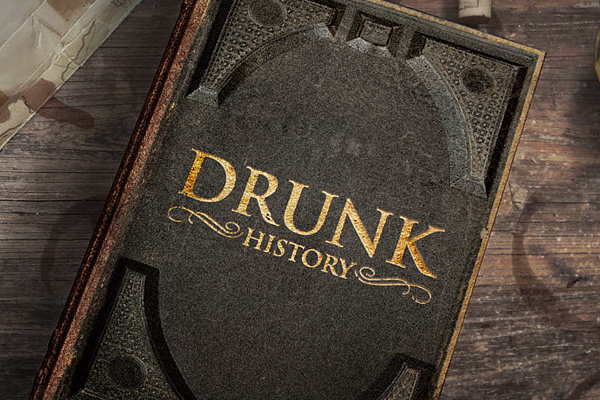
Calling all boozehounds! Tomorrow night, Comedy Central’s popular Drunk History series takes on the great, liquid courage-infused city of San Francisco.
Host Derek Waters — a veteran guest of the San Francisco International Film Festival, with this past year’s “Inside the Drunken Mind of Derek Waters” and 2010’s “A Drunken Evening with Derek Waters” (sense the theme?) — guides this weekly stumble through history, which features sloshed, slurring storytellers narrating re-enactments of great (or not-so-great) moments in time.
For the San Francisco theme, we get the story of Mary Ellen Pleasant (played by Lisa Bonet), popularly known as “the Mother of Human Rights in California,” or — as storyteller Artemis Pebdani of It’s Always Sunny in Philadelphia calls her — “the head bitch in charge.” Later, Pebdani confuses Godfather of Soul James Brown with abolitionist John Brown, and tries to blame sudden fart noises on the chair she’s sitting in.
Moving on, actor Derrick Beckles spins the tale of Mark Twain (played by Eastbound & Down’s Steve Little), “master provocateur,” whose inflammatory San Francisco newspaper articles made him “straight-up America’s Most Wanted.” We learn how Twain came to write his breakthrough story, “The Celebrated Jumping Frog of Calaveras County” (apparently there was a laptop involved), with an assist from Waters playing a drunk as narrated by a drunk. Meta!
Finally, comedian Natasha Leggero breaks down the Patty Hearst saga, with the infamous heiress-kidnap victim-bank robber played by Kristen Wiig in a series of, uh, wigs. (Terry Crews cameos as a beefy SLA member. “Symbionese isn’t a word,” Leggero informs us. “They made it up.”) It’s a rambling tale, maybe the most rambling here, punctuated by a party scene where Waters does his first Jell-O shot, and a tequila-chugging Leggero drifts into her final thought: “[Patty Hearst] was really…attractive. [Long pause.] I have to get some water.”
Drunk History airs Tuesdays at 10pm on Comedy Central.
Cool local electro-dream trio Pixel Memory puts all that recent construction scaffolding to use in its latest, consisting of “sleek, cyberpunk visuals” from director Sean Gillane.
Bonus: Pixel Memory are pretty awesome live — check them out performing a version of 2501 live at SUBmission:
Love the look:

The smells of deliciousness were overwhelming. Where do we start?!
As Sam Love and I wandered around the La Cocina media preview for August 17’s San Francisco Street Food Festival, everywhere we looked there were delightful taste treats, colorful, fresh and also deep fried. I’ll take four of each, thank you.
We made the rounds, chatting with fantastic chefs who are living their dreams, whipping up flavors from around the world. We tried everything and, while we enjoyed it all, becoming clean plate champions many times over, there were three highlights that made our short list. If you don’t have the stomach to make it to all the vendors at the Street Food Festival, we’d recommend trying these first:
Chiefo’s Kitchen
Chiefo served plantain and chocolate bread pudding that was soft and heavenly, but also punched back with a sinful slap of rum. Chiefo’s Kitchen West African flavors are not to miss. Check her out at the Night Market!
Azalina’s Malaysian
I live for Azalina’s smile. She could hand me a slice of cold leftover pizza, and with that smile, it would taste like the most exquisite dish. The fact is, Azalina cooks with tremendous love and care, and eating her food is therapy for the soul. She is an amazing chef, from a long family line of street vendors from Penang, and her food explodes with the island’s spices, but also takes advantage of our freshest local California produce. She prepared sweet potato dumplings, decorated with colorful fruit and veggie bonnets. So yum!
Hella Vegan Eats
Two words: doughnut burger. Wait — it’s not what you’re thinking! It’s a doughnut sandwich stuffed with a beet and kamut patty, topped with kale, pickled red onions and dill weed, and squirted with secret sauce. It’s pretty much the cutest thing ever, perfectly balancing the most unhealthy and healthy food items in a few giant bites, and worth unhinging your jaw for. Vegan can definitely be bad-ass.
Almost exactly a year ago, an explosion and chemical fire at Chevron’s Richmond refinery sent a toxic plume of smoke billowing into the air. Visible for miles, the blaze sent 15,000 to the hospital with respiratory and other health problems.
On the eve of the anniversary of that disaster, Chevron faces mounting pressure from all sides as everyone from city officials to environmentalists continue to seek accountability.
On Aug. 2, Richmond city officials held a press conference to announce that the city is suing the multinational oil giant for damages related to the refinery fire. Richmond Mayor Gayle McLaughlin joined other officials and representatives from the firm Cotchett, Pitre & McCarthy in announcing the legal action, which was unanimously approved by City Council.
The complaint charges that Chevron’s failure to address safety issues at the plant is reflective of a deeper problem.
“In our view, the incident on Aug. 6, 2012 was not an isolated incident – it really is one that followed a period of dozens of prior incidents” of harmful chemical releases, attorney Frank Pitre told the Guardian. “These aren’t coincidences, they’re indicative of a problem of corporate culture at Chevron that ignores safety.”
Pitre added that the very year that Chevron’s refinery blaze occurred, it recorded record profits with the Securities and Exchange Commission exceeding $26 billion, and its top executives were paid around $100 million apiece. Additionally, the company recorded about $10 million in spending on political campaigns and lobbying. Meanwhile, Chevron’s spending on City Council races in Richmond alone hovers at around $1 million, according to local activists.
The lawyer refused to speculate on how much Richmond plans to seek in damages, but noted that the city had been impacted by factors like mounting an emergency response to the blaze as well as “intangibles,” like the effect the incident had on the comfortable use and enjoyment of public spaces. “You had people who had to run into their homes, as if they were imprisoned.”
Pitre also said that the suit aims to correct Chevron’s lax attitude toward safety, and to “send a very loud and clear message into the corporate board room that they have to change their behavior.”
That message is also coming from grassroots organizations.
On Saturday, Aug. 3 at 10 a.m., activists with a broad coalition of Bay Area environmental and labor organizations will converge in Richmond for a march and rally to call on Chevron to improve its safety practices.
The event, which is expected to draw quite a crowd, is part of 350.org’s national Summer Heat campaign, which seeks to foster climate change activism at the local level. The march will by led by Idle No More, an indigenous rights organization, and organizers have hinted that there will be some form of civil disobedience at the refinery.
Andres Soto, a Richmond organizer with the environmental justice organization Communities for a Better Environment, explained that the safety issues at the refinery stem from Chevron’s failure to address pipe corrosion, which is worsened by the practice of refining dirty crude oil with high sulfur content. Roughly 80 percent of the crude that is processed in Richmond originates in the Persian Gulf, Soto said, and contains high levels of sulfur.
Refining this type of crude oil can result in worse air pollution, and also makes it harder for the company to predict the degree of corrosion that will result from processing.

This graph is from a report issued by the Chemical Safety Board, showing the steadily increasing levels of sulfur content in the piping circuit that failed and caused the refinery blaze.
“The blast on Aug. 6, 2012 was caused by a failed carbon steel pipe,” Soto explained. A report issued by the federal Chemical and Safety Board contained urgent recommendations directing the company to use pipes that are more resistant to corrosion, Soto said, but not all of those recommendations have been implemented, even after the failed unit was brought back into service.
The safety board report went into great detail about just how bad things were allowed to get before the blast occurred. “The 52-inch component where the rupture occurred had experienced extreme thinning,” the safety board found. “The average wall thickness near the rupture location was approximately 40 percent thinner than a dime.” (A dime.)
Soto regards this level of deterioration as par for the course at Chevron. “It’s about a management culture that allows the equipment to fail,” he told the Guardian. “They’re just waiting until the pipes fail, and then they’re going to replace them.”
Remember that brief, exciting period last year when Woody Allen sightings were being breathlessly reported on ’round town, particularly in the Mission? Here’s your chance to see Allen’s take on San Francisco (it ain’t exactly glossy) in Blue Jasmine, which boasts a stellar performance by likely Oscar nominee Cate Blanchett as someone you would not want to have as a houseguest. Dennis Harvey’s take on the film here.
Also opening today: a doc about Napster, a so-so biopic of political theorist Hannah “Banality of Evil” Arendt, an action flick for Denzel Washington completists, and likely Oscar nominee (um…) Smurfs 2. What can I say…if you’re not a Woody Allen fan, it’s kind of a slower week. Read on for short reviews.
Downloaded The startlingly fast rise and even more abrupt demise of Napster is chronicled in this entertaining documentary by Alex Winter (yes, of Bill & Ted fame). Shawn Fanning dropped out of college in 1999 to work on an idea of greatly improving the then-tortuous downloading and sharing of MP3 files, soon moving to the Bay Area and drawing other friends (including co-founder Sean Parker) to launch Napster for real. When the program launched in mid-1999, it quickly took the world of music fans by storm, allowing any user to post or access any song for free — rapidly building a massive library that won tens of millions of fervent participants. But what the company saw as a “community building” global-record-swapping-party was viewed by an ill-prepared and appalled record industry itself as blatant copyright infringement. Artists themselves were sharply divided, with some (like Seal here) thinking Napster brought “true democracy back into the music business” while others, most notably Metallica and Dr. Dre (who both sued, as did various labels) loudly proclaimed that it was blatant theft of their work. (It’s worth noting that these were among the comparatively few acts who’ve gotten rich rather than screwed by the biz.) The somewhat one-sided thesis in this doc (on which Fanning is an executive producer) supports the founders’ continued plaint that “sharing” wasn’t “piracy” and that they always intended to integrate themselves with the established industry as legitimate fee-charing digital distributors — though each side says the other wouldn’t negotiate. In any case, after little more than two years, Napster was shut down by court decisions — though file sharing continues, and the industry’s poor adjustment to new technologies has seen it in fiscal freefall ever since. Napster staff, musicians, executives, and others offer their two cents here, with DJ Spooky providing an original score. (1:46) Roxie. (Dennis Harvey)
http://www.youtube.com/watch?v=iIUbQR9b1P8
Hannah Arendt New German Cinema’s Margarethe von Trotta (1975’s The Lost Honor of Katharina Blum, 1986’s Rosa Luxemburg) delivers this surprisingly dull biopic about the great German-Jewish political theorist and the heated controversy around her New Yorker article (and subsequent book) about Israel’s 1961 trial of Nazi Adolph Eichmann. Played with dignified, slightly vulnerable countenance by the inimitable Barbara Sukowa, Arendt travels from her teaching job and cozy expat circles in New York to Jerusalem for the trial. There she comes face to face with the “banality of evil” in Eichmann, the petty careerist of the Holocaust, forcing her to “try and reconcile the shocking mediocrity of the man with his staggering deeds.” This led her to further insights into the nature of modern society, and triggered a storm of outrage and vitriol — in particular from the Commentary crowd of future neocons — all of which is clearly of relevance today, and the impetus for von Trotta’s revisiting this famous episode. But the film is too mannered, too slick, too formulaic —burdened by a television-friendly combination of posture and didacticism, and bon mots from famous and about famous figures in intellectual and literary history to avoid being leaden and tedious. A mainstream film, in other words, for a very unconventional personality and dissident intellectual. While not exactly evil, there’s something dispiriting in so much banality. (1:49) (Robert Avila)
http://www.youtube.com/watch?v=vQbSGLaVJ5c
The Smurfs 2 Look at it this way: any enterprise that employs Neil Patrick Harris can’t be all bad. (1:45)
http://www.youtube.com/watch?v=LyruH2JikwM
2 Guns Rob a bank of cartel cash, invade a naval base, and then throw down against government heavies — you gotta expect to find a few bullet-hole-sized gaps in the play-by-play of 2 Guns. The action flick is riddled with fun-sized pleasures — usually centered on the playful banter and effortless chemistry between stars Denzel Washington and Mark Wahlberg — and the clever knot of a narrative throws a twist or two in, before director Baltasar Kormákur (last year’s Wahlberg vehicle Contraband) simply surrenders to the tidal pull of action. After visiting Mexican mafia kingpin Papi (Edward James Olmos) and finding the head of their contact in a bag, Bobby (Washington) and Stig (Wahlberg) decide to hit Papi where he’ll feel it: the small border bank where his men have been making drops to safe deposit boxes. Much like Bobby and Stig’s breakfast-time diner gab fest, which seems to pick up where Vincent and Jules left off in Pulp Fiction (1994), as they trade barbs, truisms, and tells, there’s more going on than simply bank robbery foreplay. Both involved for different reasons: Bobby is an undercover DEA agent, and Stig is a masquerading navy officer. When the payout is 10 times the expected size, not only do Papi, Bobby’s contact Deb (Paula Patton), and Stig’s superior Quince (James Marsden) come calling, but so does mystery man Earl (Bill Paxton), who seems to be obsessed with following the money. We know, sort of, what’s in it for Bobby — all fully identifiable charm, as befits Washington, who makes it rain charisma with the lightest of touches. But Stig? The others? The lure of a major payday is supposed to sweep away all other loyalties, except a little bromantic bonding between two rogue sharp shooters, saddled, unfortunately, with not the sharpest of story lines. (1:49) (Kimberly Chun)
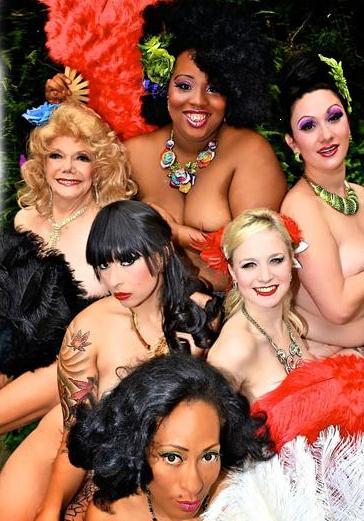
Red Hots Burlesque — the longest running queer burlesque show in the country, according to founder and producer Dottie Lux — moves out of the bars and into the theater with Burlesque and WHY (The Naked Truth), a show-and-tell built around the biographies and personalities of its performers, an eclectic group of burlesque artists comprised of Dottie Lux, the Lady Ms. Vagina Jenkins, Magnoliah Black, Lay-Si Luna, Alexa Von Kickinface, and Burlesque Hall of Famer Ellion Ness. It runs through Sun/4 at StageWerx.
As Lux suggests in her introduction to the show, the theater as a venerated space for storytelling provides a rare opportunity to ‘class up’ the act a little — by talking about class for these working bodies, as well as about race, body issues, feminism, aging, and much more — all in direct address and various states of undress, through two 35-minute sets of vignettes and straight-up striptease that run the gamut from playful eroticism to defiant meditations on self-worth and solidarity with the outcast and oppressed.
Sure, the acting and stagecraft can be stilted, erratic, and a little shaky — everything beyond the burlesque numbers themselves, that is, which are generally sure and precise. But then it’s a theatrical outing like no other. And the performers redeem the rough edges with their agile curves as well as the pride, confidence, and natural charm they bring to the enterprise. These women have strong voices and compelling stories. And away from the barroom din, to the supportive calls of audience members, they ring out clearly, with lots of sass, well-earned brazenness, and even self-effacing humor. But then a burlesque performer knows a little modesty can go a long way.
http://www.youtube.com/watch?v=oVjcX8mkl4w
Red Hots Burlesque Presents: Burlesque and WHY (The Naked Truth)
Tonight, 10pm; Sat/3, 7 and 10pm; Sun/4, 5 and 8pm, $5-$35
Stage Werx
446 Valencia, SF
On the morning of Aug. 1, San Francisco District 9 Sup. David Campos joined a group of parents and kids at the 24th Street BART station, climbed aboard the 49-Mission/Van Ness, and rode to City Hall, where he filed paperwork to run for the California Assembly.
“Running for office is not an easy thing. It’s a very personal decision,” he said. “And thinking about it, I am where I am because I was given a lot of opportunity as a kid coming in, as an undocumented kid. It was the opportunity of getting a quality education, the opportunity to really get a degree,” and to stay motivated by the idea that “if you really work hard and play by the rules, that you can really fulfill your potential.”
Campos was elected to represent San Francisco’s District 9, which spans the Mission, Bernal Heights, and surrounding areas, in November of 2008. The gay Latino elected official is regarded as one of the most progressive members of the Board of Supervisors, and he is credited with spearheading Free Muni for Youth, a city program offering free public transit access to some 40,000 low-income kids.
Campos stressed that many of the policies he’s tackled on the Board of Supervisors have been aimed toward aiding low-income families and youth, “whether it’s helping families who are struggling with free Muni for low-income kids, to improving the quality of schools in the Mission, to focusing on public safety in a progressive way that tries to build a relationship between the police and the community.”

Naturally, Muni took longer than expected.

Some of the kids amused themselves with a clapping game while they waited.
Many of the parents were monolingual Spanish speakers, and their kids were Free Muni for Youth participants. Raul Foneza (pictured in the first shot, with his thumbs up), spoke to the Guardian through a translator and said he had come out for the supervisor that day because he respected Campos’ support for the city’s young people and was there with his friend and her two kids.

When the bus arrived at City Hall, another group of kids was there awaiting Campos’ arrival, with signs. So was Assembly Member Tom Ammiano, who has already granted Campos his endorsement.

Ammiano spent a few moments on the steps of City Hall speaking to the kids. “I hope you tell people to vote for David Campos, I hope you all do your homework, be good to your teachers, and go to college. How does that sound?” After they cheered, “yeeeah!” in unison, Ammiano half-jokingly added something about how then they could all get good-paying jobs, so they could afford an apartment.
Once inside, the crowd of kids and parents squeezed into the basement-level Department of Elections office, where Campos filled out the paperwork to make his candidacy for State Assembly official. He turned to face his supporters, most of whom will have to wait eight years till they’re old enough to vote, and explained that he had decided to run “because we want to make sure our state makes you the top priority.”
We had a packed house last night for our community forum on the future of the Bay Guardian and the progressive movement in the Bay Area, with lots of great input, advice, gratitude, and just a bit of acrimony. It was even more informative and inspiring than we had hoped for and we appreciate everyone coming out and speaking so frankly.
As Sup. David Campos (who just announced his candidacy for the California Assembly) said last night, “The Bay Guardian has been the conscience of the [progressive] movement and I think it’s important for the Guardian to continue to play that role,” and that’s a role that the new generation of Guardian leaders will continue playing while also reaching out to a new generation of Guardian readers.
We’ll have a full rundown in next week’s paper, along with an extended letters to the editor section to make up for shutting down online comments this week, so for now let me just offer a brief overview. In addition to Campos, the crowd of around 100 people included Sup. John Avalos, Sheriff Ross Mirkarimi, and City College of San Francisco Trustees Rafael Mandelman and Chris Jackson.
The crowd also included Todd Vogt, CEO of the San Francisco Print Media Company, who got an earfull from progressive activists Gabriel Haaland, Chris Cook, and others over the abrupt departure of longtime Guardian Editor Tim Redmond in June, with concerns expressed over the Guardian’s credibility and editorial autonomy.
Both Vogt and those on the Guardian’s panel — which included (from right in the photo above) Publisher Marke Bieschke, Editor Steven T. Jones, Music Editor Emily Savage, Senior A&E Editor Cheryl Eddy, Art Director Brooke Robertson, and News Editor Rebecca Bowe — emphasized that the Guardian has full editorial autonomy and control over what we cover and how, and who we endorse. The mission of the paper — “To print the news and raise hell,” and to be an indispensible guide to Bay Area arts and culture — hasn’t changed.
We’re all still digesting everything what was said last night (both at the forum in the LGBT Center and an informal session afterwards at Zeitgeist that went late), and we will be factoring it into what we do and continuing this ongoing conversation with all of you. We also welcome everyone’s input and advice, which you can send to us at news@sfbg.com.
A special thanks to Alix Rosenthal for moderating the public input — and to everyone who came — for somehow keeping the comments and questions clear, concise, and constructive.
Onward!
UPDATE: Journalist Josh Wolf has written an excellent summary of the forum here at on the Journalism That Matters website. Check it out.
8/6 UPDATE: We just turned comments back on after shutting them off for a week-long experiment.
San Francisco based duo Midi Matilda has managed to worm its way into a corner of electro-pop music that is highly accessible. As the musicians put it, they aren’t DJs and they aren’t a live band either.
Whatever they are, they seem to be catching. After an early spring tour with Shiny Toy Guns, the pair released a cover of the Temptations “Just My Imagination,” in June which garnered close to 30,000 views in just two days. Plus, Midi Matilda’s debut EP Red Light District has acquired similar mass attention on YouTube.
As Midi Matilda’s Skyler Kilborn and Logan Grime are also set to play Outside Lands next week (Aug. 9-11 in Golden Gate Park), I chatted with them about live shows, the songwriting process, and their can’t-miss Outside Lands recommendations:
San Francisco Bay Guardian What was the last great live show you went to?
Skyler Kilborn In Sacramento at a place called Ace of Spades we saw Gold Fields, it was really awesome. The crowd [seemed] engaged the entire time. They got off stage, danced around, got on the bar, and kicked over somebody’s drink.
Logan Grime We’ve done a number of shows with guys from Capital Cities, it’s awesome to see how they’ve progressed over time, how much bigger their following has become. It was inspiring to see them.
SFBG What separates your performances from that of other artists?
LG A lot of people tell us they really enjoy the energy we bring to the stage. Our show has a lot of electronic elements to it; we don’t have people playing on stage. We both love to DJ and just make it a unique experience that‘s different from a lot of the things we’ve seen. We’re trying to push it in a new direction. We’re not DJs, or a full live band either. We’re trying something new and it’s working out so far.
SFBG What would you say is the best show you’ve performed this year, or any that really stick out?
LG For me it was headlining a show in San Francisco. We had played a lot more shows than we ever had in a year so far just in this year alone and so we were put in front of a lot of audiences that didn’t know who we were. After all that, playing a sold out show at a venue we really like in front of a lot of people.
SK It felt like the tour we just finished we played so many shows it got our performance to a new level. That show is a good example of us bringing ourselves to a level we hadn’t really achieved before, and the tour was a good way for us to practice.
SFBG Could you talk a little bit about song “Red Light District”? It’s also your EP title so it seems to have some significance.
SK It’s a very introspective tune, not really about the Red Light District. It can be if you want it to be, but it’s more about a state of mind. Bringing yourself up as opposed to bringing yourself down. Red Light District is a metaphor for bringing yourself down. It’s about connecting in a place where it’s better to bring yourself up than bring yourself down. Songwriting, at least for myself, it’s always about something I’m going through at the time. I think it’s important to access something real to you, at least as foundation for the idea. But I also think it’s fun to be a little more poetic and bring people directly to the point. Leading them there, but also giving them the opportunity to meet it at their level, wherever that is.
SFBG Are you guys looking forward to Outside Lands, are there any artists you’re definitely not going to miss?
LG The lineup this year is pretty amazing compared to some of the other years. This year’s strong in every day’s lineup. I know that no matter what I will not miss Paul McCartney. I’m excited to see so many bands.
SK I’ve been fantasizing about playing the festival since the first time I went in 2009. A group I actually love is Vampire Weekend. I have not seen them perform but I’ve listened to their music quite a bit and would love to see how they do it.
http://www.youtube.com/watch?v=QVJqevdtaZQ
“Oh it’s hot and it’s sticky and it’s naaaaasty,” said drag goddess Lady Bunny of the current New York City summer weather. “And that’s just how I like it. The kind of men I like can’t afford to leave the City when it’s hot, so they just have to strip down and stay put, right where I can get at ’em.
“Let those other queens got to Provincetown or Fire Island or wherever. Lady Bunny’s got everything she needs right here: sweaty men and a big can of hairspray.”
Watch you don’t explode there, Bunion! We need you to make that flight to San Francisco to star at the weekly Some Thing party on Fri/2 (10pm-late, $8. The Stud, 399 Ninth St., SF.)
Speaking of which, does Miss Bun-Bun have to buy an extra seat on the plane for her trademark ginormous blonde wig?
“No, just for my fat ass! And then I have to buy another seat for the scabies.”
But then her voice dropped into a more serious register — these were her wigs after all — and she said, “You know, it’s sometimes nervewracking to travel with my priceless hair sculptures. But I’ve just learned to stack them in a carry-on and then I just tease them when I bring them out. I don’t know how to do all the hot rollers and other things the queens all do.
“Marke, I’m just a tomboy with makeup and a poor taste in clothes.”

Lady Bunny was off and running in her trademark perky Southern drawl from the second she picked up her landline for our chat. Landline? Please tell me at least she has a Princess Phone. “Oh no, just a regular old phone. I heard Carol Channing still had her landline and I just love her. Of course, mine has those big buttons for seniors.”
I’ve known Bunny since way back in her Wigstock days, when she hosted the huge outdoor drag festival that ruled the NYC gay scene for like 3000 years (1984-2005).
And it’s kind of wonderful, the way she moved to NYC from Atlanta on a wing and a prayer in the ’80s with RuPaul — and adorable DJ Larry Tee, who invented electroclash and has been seen here a bunch of times lately — and now, she’s a TV personality as Dean of Drag on RuPaul’s Drag U. show and celebrity judge on Drag Race, as well as remaining one of Ru’s besties. Clubkids: all grown up!
“I got on fabulously with every queen on Drag Race that I met — except one, who shall remain nameless, but I think everyone knows who she is,” drops Bunny casually. “I mean, I know nothing about reality TV. I grew up with Lucille Ball and Leave It To Beaver. But I do love a paycheck, so why not?”
As ever though, Bunny is appearing all over with her comedy parodies of hit songs, her filthy double-entendres — and now with a cute club-ready song of her own, “Take Me Up,” which showcases her more serious singing talents. In as much as Bunny can ever be serious.
Oh, wait on that — Lady Bunny does have a second reputation, beyond the wigs and parodies, as an outspoken political commentator. Her blog is usually aflame with her acerbic sentiments, some of which can cause even seasoned political observers to grasp their burning ears. (For her recent thoughts on SF, check this out.)
“How can I keep my mouth shut when there’s so many travesties, so much injustice going on. I mean, take that incident recently when Michelle Obama told the protesting lesbian to be quiet or leave that fundraiser — and it was like the whole gay community was saying, ‘Go Michelle!’ But that woman was raising attention about how we don’t have rights, how we still don’t have the same rights as everybody else. And the gay community was telling her to be quiet! These kinds of things enrage me, so I let it all out. Anger is a very potent emotion!”
Does she ever let it all out on stage? “Oh you know, people want the comedy, they want the parodies, and to be entertained. They don’t want some queen browbeating them about political stuff in the middle of their party.”
So what can we expect when she hits Some Thing on Friday? “I’m so excited to be back in SF — I’m an ooooooold friend of [Some Thing party founders] Glamamore and Juanita More. And I even patched things up regarding an old fight with Heklina. I’ll have to find something else to fight with her about now!
“But, you know, it’s just going to be me up there with my dirty jokes and my filthy mind and a little music — straight out of the gutter and on your face!”
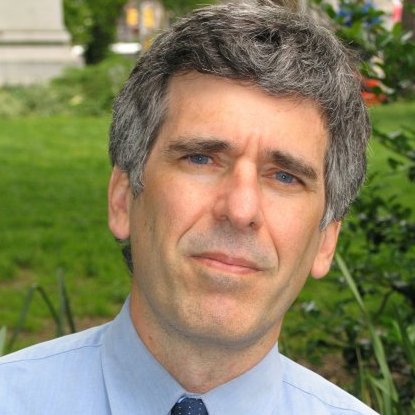
Norman Solomon is co-founder of RootsAction.org and founding director of the Institute for Public Accuracy. His books include “War Made Easy: How Presidents and Pundits Keep Spinning Us to Death.”
The sun rose with a moral verdict on Bradley Manning well before the military judge could proclaim his guilt. The human verdict would necessarily clash with the proclamation from the judicial bench.
In lockstep with administrators of the nation’s war services, judgment day arrived on Tuesday to exact official retribution. After unforgiveable actions, the defendant’s culpability weighed heavy.
“Our apologies, good friends, for the fracture of good order, the burning of paper instead of children, the angering of the orderlies in the front parlor of the charnel house,” another defendant, Fr. Daniel Berrigan, wrote about another action that resulted in a federal trial, 45 years earlier, scarcely a dozen miles from the Fort Meade courtroom where Bradley Manning faced prosecution for his own fracture of good order.
“We could not, so help us God, do otherwise,” wrote Berrigan, one of the nine people who, one day in May 1968 while the Vietnam War raged on, removed several hundred files from a U.S. draft board in Catonsville, Maryland, and burned them with napalm in the parking lot. “For we are sick at heart…”
On the surface, many differences protrude between those nine draft-files-burning radical Catholics and Bradley Manning. But I wonder. Ten souls saw cruelties of war and could no longer just watch.
“I prefer a painful truth over any blissful fantasy,” Manning wrote in an online chat. Minutes later he added: “I think I’ve been traumatized too much by reality, to care about consequences of shattering the fantasy.” And he also wrote: “I want people to see the truth … regardless of who they are … because without information, you cannot make informed decisions as a public.”
Those words came seven weeks after the world was able to watch the “Collateral Murder” video that Manning had provided to WikiLeaks. And those words came just days before military police arrived to arrest him on May 29, 2010.
Since then, huge numbers of people around the world have come to see Bradley Manning as personification of moral courage. During the last several months I’ve read thousands of moving comments online at ManningNobel.org, posted by signers of the petition urging that he receive the Nobel Peace Prize. The comments are often stunning with heartfelt intensity of wounded idealism, anger and hope.
No verdict handed down by the military judge can change the moral verdict that has emerged from people all over the world, reciprocating what Bradley Manning expressed online a few days before his arrest: “I can’t separate myself from others.” And: “I feel connected to everybody … like they were distant family.”
The problem for the U.S. government was not that Bradley Manning felt that way. The problem came when he acted that way. Caring was one thing. Acting on the caring, with empathy propelling solidarity, was another.
Days ago, in closing argument, the prosecutor at Fort Meade thundered: “He was not a whistleblower, he was a traitor.”
But a “traitor” to what? To the United States … only if the United States is to be a warfare state, where we “cannot make informed decisions as a public.” Only if we obey orders to separate ourselves from the humanity of others. Only if authoritative, numbing myths are to trump empathy and hide painful truth.
Norman Solomon is co-founder of RootsAction.org and founding director of the Institute for Public Accuracy. His books include “War Made Easy: How Presidents and Pundits Keep Spinning Us to Death.”
(Bruce B. Brugmann, who signs his blogs and emails b3, writes and edits the bruce blog on the Bay Guardian website at sfbg.com. He is the former editor and co-founder and co-publisher of the Bay Guardian with his wife, Jean Dibble, 1966-2012).
As promised, we’ve disabled reader comments this week, at least on all the stories in this week’s paper, fresh blog posts, and those stories and posts that were still actively being commented on. It’s a week-long experiment and encouragement for those who don’t require anonymity to send give your feedback directly at our forum tonight (6-8pm at the LGBT Center, 1800 Market) or by email (news@sfbg.com) or snail mail. We’ll publish a lot of that feedback in next week’s paper.
It’s not our intention to be doctrinaire about this or play cat-and-mouse with trolls who want to comment on older posts and feel like they’re getting away with something. Knock yourselves out and we’ll come shut down comments on those posts when we get around to it or if things run amuck.
One avenue for comments that we aren’t shutting down this week is our Facebook page, where it’s tougher to troll anonymously, and we encourage you to go and comment there if you have something to say. Or you can tweet at us. And if the demand seems to be there to allow for a discussion on our site of the issues raised in tonight’s forum, we may even consider opening up a channel for that.
The Bay Guardian has been a work in progress since 1966, and that’s never been more true than the current moment we find ourselves in as we seek to revive and rejuvenate the paper and the Bay Area’s larger progressive movement. So thanks for your support and we hope to see you tonight.
A recent controversy has been brewing around San Francisco’s Health Care Security Ordinance, the 2006 legislation authored by then-Sup. Tom Ammiano that created Healthy San Francisco, the city’s medical services safety net program for the uninsured.
As we explain in greater depth in an article for tomorrow’s issue of the Guardian, influential forces in the business community such as the San Francisco Chamber of Commerce and the Golden Gate Restaurant Association have been publicly raising questions about the Health Care Security Ordinance in light of the federal implementation of the Affordable Care Act, aka Obamacare.
In a recent article in the San Francisco Business Times, Small Business California President Scott Hauge was quoted as saying, “We question whether Healthy San Francisco should continue in its current form with the ACA coming in.” And an article published today suggests that some are continuing to question whether the HCSO can legally coexist alongside the federal requirements under the ACA despite clarification given by Jon Givner of the San Francisco City Attorney’s Office last Thursday stating that the ACA expressly allows jurisdictions like San Francisco to adopt health-care policies such as the HCSO.
Meanwhile, the message from defenders of the city’s health care policy at a hearing called by Sup. David Campos last week was clear: Funding for employee health care generated by employer contribution provisions under the HCSO will be needed more than ever once the ACA is implemented, because many people who now rely on the low-cost Healthy San Francisco for medical care will suddenly find themselves ineligible for that program and automatically funneled into a new system where they are eligible to sign up for subsidized health care, but won’t necessarily be able to afford it.
The ACA will begin enrollment in October, and will take effect in January of 2014. At that point, roughly two-thirds of current enrollees in Healthy San Francisco will either transition to Medi-Cal (if they earn up to 138 percent of the federal poverty level) or qualify for subsidized health care coverage under Covered California, the health benefit exchange created under the ACA. Things are apt to be the most complicated for Healthy San Francisco enrollees who discover they cannot actually afford to take advantage of the options offered under Covered California.
For this reason, Campos stressed that the HCSO should remain in place without being scaled back or tampered with, because medical reimbursement accounts provided by employer contributions under the ordinance could serve to fill those gaps and help low-wage earners obtain coverage regardless of income. As things stand, Campos and Healthy San Francisco advocates said, gaps created under the ACA will be filled by stronger HCSO provisions, so the programs stand to complement one another.
But the business community, seeking what GGRA executive director Rob Black described to the Guardian as “guidance” from the city on how to move forward given the pending implantation of federal health care reform, wishes instead to open up a new policy dialogue about the HCSO. The mayor has been receptive to their concerns, and recently reconstituted the Universal Healthcare Council, a body that was previously formed to hash out local health care policy.
A key question is who will be appointed serve on that board: Department of Public Health Director Barbara Garcia will chair it, but so far the only indication of who else will be named is that it will consist of “community, healthcare, labor and business stakeholders,” according to a quote attributed to Garcia in the Business Times. Will the makeup include members of the GGRA, the business organization that sued the city to overturn the employer contribution mandate under the HCSO?
In response to questions about whether the mayor believed the employer spending requirement ought to be revisited in light of ACA implementation, and who would be appointed to the newly convened healthcare council, mayoral spokesperson Christine Falvey responded ot the Guardian with the following statement: “Everything is on the table as the City develops a plan to best implement [the Affordable Care Act]. This is a great opportunity to see how the city can continue to be a leader in making sure San Franciscans have access to quality healthcare. We are currently updating a membership list for the Universal Healthcare Council. More information on that as it becomes available.”
With high demand for office space in San Francisco these days — thanks largely to the latest technology bubble, Mayor Ed Lee’s economic development focus, and its amplification by the San Francisco Chronicle — Hearst Corp., which owns both the paper and the Chronicle Building, seems to be more focused on property management than journalism these days.
Following up on blogs that broke the story, Chronicle Technology Columnist James Temple today reported that Yahoo is negotiating with Hearst to move its headquarters into the Chronicle Building at 5th and Mission streets. What Temple didn’t say — and what sources at the Chronicle confirmed to the Guardian, despite the fact that it hasn’t yet been announced to Chronicle staff — is that the third floor newsroom will soon be relocated while the space undergoes a renovation.
It’s not clear whether the two pieces of news are related, and we’re still waiting for a response to our questions on the subject from Chronicle Editor Ward Bushee. But it certainly seems true that Hearst and the Chronicle are doing everything they can to profit from the commercial real estate market that they have helped to heat up while operating a newspaper that has struggled to become profitable in recent years.
Valued at more than $30 million and covering nearly a full city block in the heart of the city, the Chronicle Building has been steadily taken over by outside companies in recent years, many of them technology corporations such as Square, the online payment company. The newsroom that used to occupy the second and third floors has already been squeezed onto the third, and now even that space is getting an overhaul.
Meanwhile, Hearst has been working with Forest City and Strada Investment Group on a plan to redevelop the property, reportedly replacing the old Hearst headquarters and other buildings that share the block with an office and residential tower and trying to win historic landmark status for the Chronicle Building itself.
Chronicle staffers tell the Guardian that they were surprised to hear about the newsroom relocation last week and they don’t have many details, except that they will remain in the building. And given how valuable it has become, they say they’re just happy to not be totally squeezed out by the tech boom.
Tweaking tradition with Minor Empire and Thingamajigs
There are as many roads down the path of “world music” as there are countries represented within that nebulous category. And while there’re still plenty of purists adhering strictly to the musical traditions of the past, it’s just as common for today’s world musicians to use those traditions as a kind of jumping-off point for their compositions, in much the same way that the 12-bar blues have been the foundation for numerous offshoots of “American” music.
A good example of this conscious hybridization between past and present, old word and new, is Toronto-based Turkish-Canadian combo Minor Empire, who blend sinuous Eastern folk tunes with Western jazz-jam, desert rock, and pulsing electronica, providing multiple entrance points to their specific sound.
In an intimate show at Yoshi’s San Francisco, the touring band seemed simultaneously dwarfed by the lofty ceiling and genteel table seating and yet musically unconfined as they introduced their set with building blocks of drone, guitar, bass, percussion, and kanun (a kind of zither), creating an elegant setting for the jewel-like vocals of Ozgu Ozman. Gracious and grounded, Ozman took time to translate some of the lyrics later in the set, but the first songs were left tantalizingly ambiguous, layering different kinds of familiarity on top of one another.
Plaintive traditional melodies of love and loss, an undercurrent of electronic glitch, the occasional flourish of Calexico-style guitar riffs and funky bass lines, the insistent twinned rhythms of the kanun and the doumbek. The resultant mélange sounded to my ears a little like Wovenhand’s Eastern-tinged album The Threshing Floor, a little like Baba Zula, an alt-jazz/psychedelic combo from Istanbul, and a lot like a band I’d want to get to know better in slightly less refined surroundings — a sweatier nightclub, perhaps, or a sunlit outdoor stage. A space where not just the ears could be transported by the complex compositions, but the body entire.
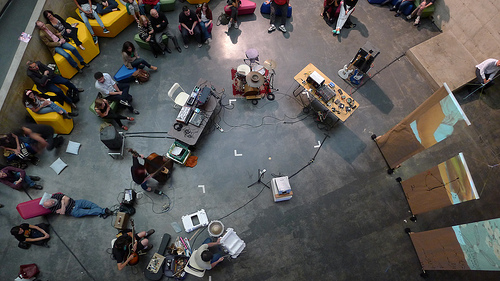
Architecture favored Thingamajigs Performance Ensemble better at the Berkeley Art Museum on Friday, where a trio of trios performed experimental music in the cavernous atrium of Gallery B. Although, like Yoshi’s, the ceiling soared far above the huddle of intently concentrating musicians, and the room sprawled far beyond the tight confines of their performance area, they managed to fill in the gaps with their judicious addition of a multimedia dimension. From the ground to the lofty balconies above, three long scrolls marked with arcane symbols, half-recognizable words, and morse-code like rhythm tablature were slowly unfurled before each trio in sedate counterpoint to the deliberately atonal improvisations.
Live video projections of a poet at work (Sasha Hom) further helped to fill the empty spaces above, while below the oddience was encouraged to shift position and wander the wings during the concert. Scattered about the room, brightly-colored, padded shapes — trapezoids and triangles — designed by Rebar served as seating and further added another playful visual aspect to the event.
Using a variety of traditional instruments in some very non-traditional ways, Thingamajigs has been experimenting with the creation of differently-structured sound since the mid-nineties. It’s an artform with a long lineage, and as such cannot be championed as an entirely new concept. But given the rare confluence of disparate factors in any given concert — space, spectators, ever-evolving interpretations of the potential locked within each instrument and each composition — every performance is in itself as new and as fleeting as the first few moments of a half-remembered dream. Thingamajigs will be in residence at BAM through August 16; check out the website for ways to dream along.
There will be R. Kelly “Trapped in the Closet” sing-alongs all weekend long at the Castro Theatre. It’s not quite a show, though I wouldn’t dare describe it as a standard film either. It’ll be an experience, so it’s on the list of must-sees. Sorry not sorry.
Add to that El-P and Killer Mike, Sebadoh, Rye Rye’s Hard French “After Party,” Rancid, and more — and you won’t be hurting for choices this week. Hop to it, furry friends.
Here are your must-see Bay Area concerts this week/end:
El-P and Killer Mike
Last year, Brooklyn producer-rapper El-P told the Guardian, “I want to make music that is the signifier of fighting to live, fighting for sanity, recognizing that it ain’t what it should be. So…I’m going to run into the middle of the street, and take my clothes off, and scream.” This year, he and frequent collaborator rapper Killer Mike released shiny yet hart-hitting Run the Jewels through an eponymous project, in which the two swiftly exchange verses — which should make for a poppin’ live show. (Note: they also play the Indy Tue/30, but it’s sold out. Try your luck elsewhere on the web for tickets to that one.)
With Despot, Kool AD
Wed/31, 8pm, $20
Independent
628 Divisadero, SF
www.theindependentsf.com
http://www.youtube.com/watch?v=c_rwa4ZbKgA
Al Lover
Experimental electronic producer Al Lover has been quoted as saying “the psych music of today is what the producers of tomorrow will sample.” So the local music-maker recently cut out the middle man, and went straight to the source, creating his own tripped out electro-psych tracks. That meant collaborating with Tim Presley a.k.a. White Fence on this month’s seven-inch “Snake Hands,” released through the UK’s PNKSLM Records, which is Lover’s first ever solo vinyl release. (Note that White Fence also has a show coming up Aug. 7 at the Rickshaw Stop.) “Snake Hands” is a single from Lover’s forthcoming LP Space Magick.
With Coo Coo Birds, Face Tat, Bubblegum Crises.
Wed/31, 9pm, $8
Bottom of the Hill
1233 17th St., SF
www.bottomofthehill.com
http://www.youtube.com/watch?v=zn_32zQmOn4
Sebadoh
“Attention fuzz pedal enthusiasts and indie rock fans alike: Lo-fi godfathers Sebadoh are coming to town! Formed as an offshoot of vocalist and guitarist Lou Barlow’s band, Dinosaur Jr., Sebadoh takes influences from proto punk and noise bands and presents it in a tight, dissonant package. The band has two sides: Barlow’s folk-infused songs and vocalist and bass player Jason Loewenstein’s more aggressive punk tunes. Both combine for an energetic, all be it schizophrenic set. Sebadoh will be hitting the Bay Area, promoting its newest EP, Secret EP and building up hype for its first full length album in 14 years, Defend Yourself, expected to drop in September.” — Erin Dage
With Octa#grape
Wed/31, 9pm, $15
Cafe Du Nord
2170 Market, SF
(415) 861-5016
www.cafedunord.com
http://www.youtube.com/watch?v=OG_YsBHWVag
R. Kelly Trapped in the Closet: The Interactive Sing-Along
“What’s the only thing better than watching R. Kelly’s “Trapped in the Closet”? Packing in the Castro with hundreds of like-minded hip-hopera fans and singing along to that shizz. That’s right: “R. Kelly Trapped in the Closet: The Interactive Sing-Along” brings the controversial, inimitable R&B star’s soapy extravaganza (well, the first 22 chapters of it, anyway) to the big screen for all to croon along, complete with “custom subtitles.” Prepare your pipes for “Bump ‘N Grind,” “Ignition (Remix),” and other hits — plus cliffhangers galore (“Oh my god, a rubber!”), careless gunplay, a little-person stripper named “Big Man,” a Will Oldham cameo, and further lurid, hilarious, and — at last! — participatory insanity.” — Cheryl Eddy
Fri/2-Sun/4, 8pm, $12
Castro Theatre
429 Castro, SF
www.ticketweb.com
http://www.youtube.com/watch?v=zFosUj6A22c
Rancid
Don’t you remember hearing …And Out Comes the Wolves (1995) hit “Time Bomb” over the crackling speakers of Tower Records and your friend’s older, cooler sibling behind the counter telling you the pop-punk band was formed after the demise of Operation Ivy, and by the way, that was a very important ska-punk band that fizzled before its time? Just me? Most now-grownup kids of a certain breed, of certain suburban pockets, went through this period of connection to Tim Armstrong, Matt Freeman, and Co., be it “Ruby Soho,” “Roots Radicals,” or the endless conversations about why Rancid will never be Op Ivy/Op Ivy would never have made it big like Rancid. Blah, blah, blah. Relive youth, and blast out of guilty pleasureville.
Fri/2-Sat/3, 7:30pm, $28
Warfield
982 Market, SF
www.thewarfieldtheatre.com
http://www.youtube.com/watch?v=DhKHAopx7D0
Rye Rye
After a great many guest spots and collaborations, Rye Rye came roaring back solo in 2012 with the release of debut, Go! Pop! Bang!, and an acting gig in the film remake of 21 Jump Street. She popped up again in 2013 with her spring-released track “After Party” off casually impending mixtape RYEde or Die, and this June as a guest star on Asher Roth’s “Actin Up” (which later ended up also including Justin Bieber and Chris Brown). She’ll be back in the Bay Area this week, after swinging through Oakland as the opener for Scissor Sisters last year at the Fox. This Hard French after-party with Micahtron, however, should be a much more intimate, Rye Rye-centric event.
Sat/3, 9pm, $20
Public Works
161 Erie, SF
www.publicsf.com
http://www.youtube.com/watch?v=zJez9DKoxX0
Space Vacation
You guys, Space Vacation is like SF’s own Spinal Tap, distilling the many aspects of theatrical heavy metal into an entertaining metal act you must see live. The group plays actual sing-along heavy metal (in the vein of Iron Maiden and Def Leppard) but also brings along show-enhancing efforts like smoke and lasers. The quartet plays the all-day, all-ages Summer Throwdown event at DNA Lounge this weekend With Son of a SuperCar, Systemic Decay, Look a Flying Pig, Dammit, Serville, and more
Sun/4, 4:30pm, $15
DNA
375 11th St, SF
www.dnalounge.com
http://www.youtube.com/watch?v=6SUrYbxHZ-k
Warning: slight spoilers ahead.
I will say it and I will say it loudly: Gore Verbinski’s The Lone Ranger is perhaps the most subversive Hollywood film since Paul Verhoeven’s still misunderstood sci-fi masterpiece, Starship Troopers (1997).
Not only does this sneaky, revisionist epic attempt to recontextualize the history of Western films, screenwriters Justin Haythe, Ted Elliott, and Terry Rossio — working directly from Zane Grey’s 1915 novel The Lone Star Ranger — have designed an ambitious journey through America’s tainted, tattered history. And like Starship Troopers, the combination of ruthless “all-American” violence, ironic historical references, and off-beat slapstick comedy give The Lone Ranger legs that audiences will get to uncover for decades to come. (Sadly it will have to happen after the film leaves US theaters this week.)
http://www.youtube.com/watch?v=Myl32ezlRSo
I watched this uniquely uncompromising popcorn-pleaser three times. By my second viewing, I caught even more references to old Westerns, ranging from the countless scenes set in John Ford’s Monument Valley to the ironic singing of the Christian hymn “Shall We Gather at the River” (as in Sam Peckinpah’s 1969 The Wild Bunch). But what surprised me even more than the homages to, say, the beginning of Sergio Leone’s Once Upon a Time in the West (1966), or the train-chase climax of Buster Keaton’s The General (1926), was the feeling that Verbinski and company were exploring not just the different styles from different decades, but the historical themes of those films.
Consider the nod to Frank Capra’s Mr. Smith Goes To Washington (1939): “Willet Creek” — the name of a corrupt government dam project in the Capra film — is hinted at as a conquest by the corrupt railroad boss played by Tom Wilkinson. Or, during a bank-robbing sequence that’s reminscent of Arthur Penn’s Bonnie & Clyde (1967), the scene suddenly freeze-frames, challenging the morality of the heroes by even having a character in the film stating his own confusion.
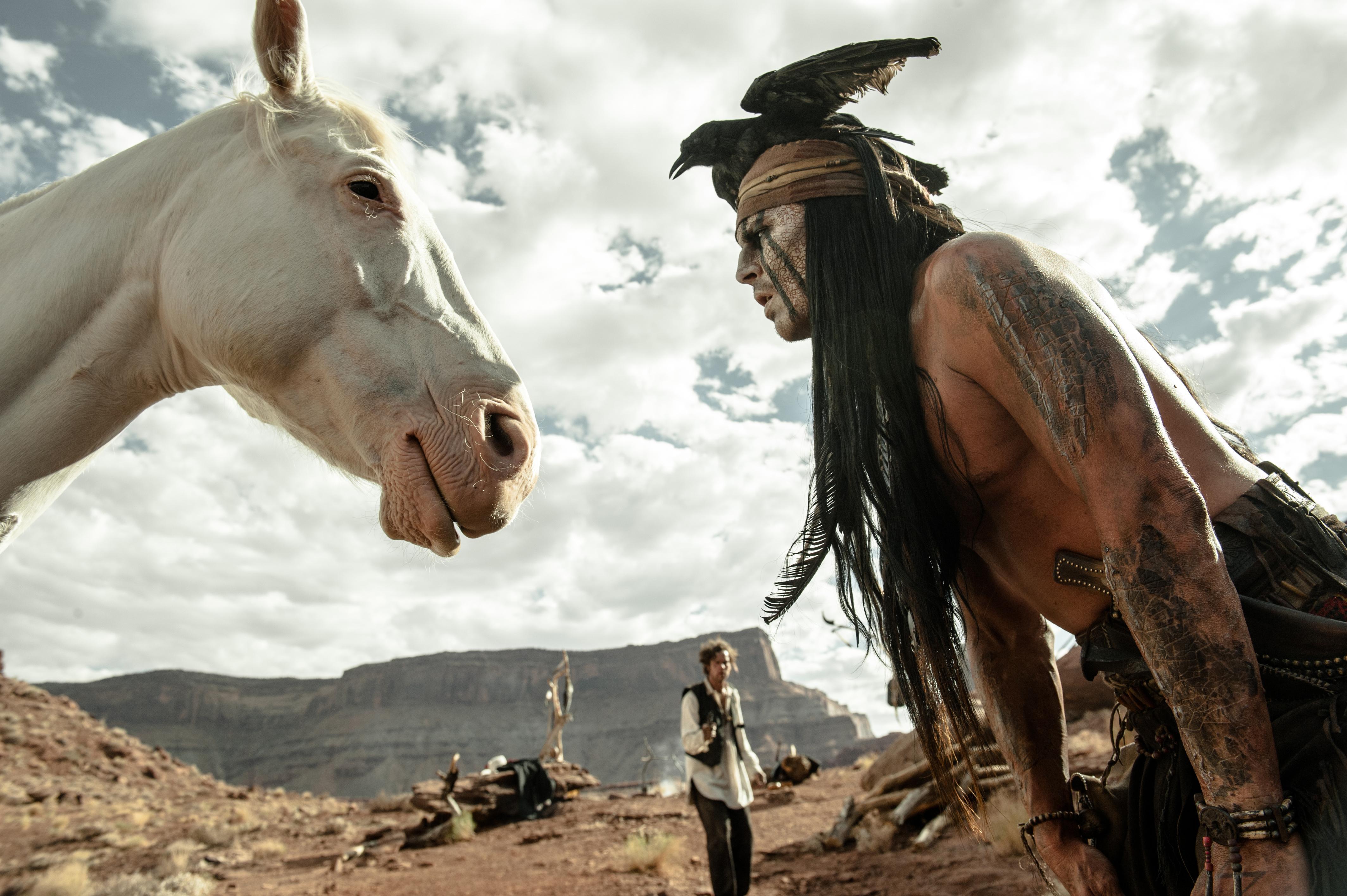
Another consistent theme throughout The Lone Ranger‘s big-budget spectacle is “nature is out of balance.” A spirit horse drinks bottles of alcohol and chooses the “wrong” hero as its master, while innocent fluffy bunnies suddenly sprout fangs and launch attacks on scorpions. While these sudden shifts in tone may feel off-beat or random, I would argue that these screwball comedy moments are in fact motivated allegorical references to the traumatic events that coincided with the building of America’s cross-country railroad. The film rebounds from an horrific event — as when a very bad dude cuts the heart out of a character we’re rooting for — by leaping right into the Buster Keaton-esque antics of Johnny Depp’s surreally wacked-out Tonto, which are inevitably played for dark comedy laughs.
Consider also the scene in which Tonto and the Lone Ranger (played stupendously stupid by the subtly subdued Armie Hammer) follow a horse, presumably returning to its wanted-outlaw master, through miles of empty desert. At a crucial juncture, the horse suddenly keels over. The cruelty is purposeful, even relentless — and what does Tonto do? He shuffles up to it, gives it a knock (literally, kicking a dead horse), and states to his partner, “He’s dead.”
Another example comes when Tonto and the Lone Ranger have been buried neck-deep in sand. Suddenly, a potential rescuer appears on the horizon. “The US Army! Finally, someone who’ll listen to reason!” our optimistic hero exclaims — only to barely avoid getting his skull hoof-clopped when the military men gallop right over them. The two feel like they are channelling Laurel and Hardy, or perhaps Jack and Wang from John Carpenter’s Big Trouble in Little China (1986).
The film’s unrelenting flair for layered irony regarding “How the West Was (Actually) Won” is solidified with its revisionist narrator in the form of an ancient Tonto, miraculously still alive in Depression-era San Francisco. The true complexity of The Lone Ranger is due to its frame story, in which Old Tonto spins his Wild West yarn for a wide-eyed youngster who represents the audience. Is he sharing truth, or are they all tall tales? Are Tonto’s truth-stretching stories in fact emblematic of how America chooses to interpret its own history?
Often, when the film cuts from the 1860s to 1933, Tonto slips items between the eras: a rock, an arrow, a bag of peanuts. This sort of inconsistency is quite purposeful in its awareness of how often American history is re-written by its storyteller — it’s also a bold attempt of this subversive masterpiece to undo as many of our history’s inaccuracies as possible.
Though a common criticism of The Lone Ranger was its nearly two and a half hour running time, I’m actually curious to know what Verbinski cut from the film. There’s a shocking amount of mindless bloodshed among the film’s innocent bystanders: Chinese railroad workers, American Indians, random townsfolk. This is perfectly punctuated when digging beneath the seemingly irrelevant prostitute played by Helena Bonham Carter (who is cleverly named Red Harrington.) Her ivory leg (which conceals a lascivious leg-gun) is yet another bloodied byproduct of the men who are blazing their train-of-terror across America. Ironically, the train is named The Constitution.
At one point Tonto wonders, “What does the white man kill for?” The Lone Ranger makes it clear: in this case, heartless slaughter is a necessary step in acquiring as much silver as possible. This “gold rush” allegory is perhaps even unpleasant to consider, and even more so to watch on the big screen for 149 minutes. (Remember, The Lone Ranger wasn’t exactly showered with glowing reviews.)
Which brings us to the final shot of this magnus opus of sorts. It arrives — in the fashion of other blockbuster-type movies these days — after the credits have started to roll. Tonto appears, all dressed up in a white-man’s suit and heading back into Monument Valley. This melancholic, even transcendental sequence delivers a different kind of message as opposed to hinting at what characters will appear in the sequel. (Given the film’s disastrous box-office take, Lone Ranger 2 seems nigh impossible, anyway.)
This meditative walk can be interpreted as history (represented by Tonto) slipping back into the past, or perhaps the truth leaving without anyone noticing. For me, it proved how intricately thoughtful The Lone Ranger truly is. Perhaps this film about two old-school heroes (who urge anyone who’d listen never take their own masks off) was a bit too modern for audiences in 2013. Hopefully, eventually, viewers will come to appreciate this inspired, unlikely, uncompromised, maniacal treasure.
Jesse Hawthorne Ficks runs MiDNiTES FOR MANiACS, a series devoted to celebrating dismissed, underrated, and overlooked films. He is also the Film History Coordinator at Academy of Art University.
For further reading, check out Cheryl Eddy’s Guardian review of The Lone Ranger here.
UPDATE: Bradley Manning has been found not guilty of aiding the enemy, guilty on five espionage charges, and guilty on five theft charges. You can find detailed coverage on Democracy Now.
A verdict in the trial of gay whistleblower Pfc. Bradley Manning is expected to be announced tomorrow, July 30, at 1pm Eastern time. Local activists with the Bradley Manning Support Network are gearing up to converge in San Francisco at 5pm at Market and Powell streets to respond publicly to the judge’s ruling.
Manning was arrested in 2010 in Iraq on suspicion of having passed classified material to Wikileaks, the whistleblower website that publicized secret U.S. diplomatic cables and aired classified footage capturing a military helicopter strike that fatally struck journalists and civilians.
U.S. Army Judge Denise Lind recently refused to dismiss the government charge of aiding the enemy. If found guilty on this charge, Manning could face life in prison.
After the verdict is announced, a month-long sentencing process will begin.
I came to an Undisclosed Cavernous Area (let’s call it U.C.A from here out) on Saturday in the greater Bay Area with the promise of two things. First, that I would see an array of garage and surf punk bands for free — and second, that I would be going to something possibly illegal, which is fairly punk, as well.
The setting was, as mentioned, a fairly damp U.C. A. The stage was to be determined by the bands that played. Powered by a generator and dimly lit with a couple of clamp lamps, the show boasted dozens of people gathered close to hear the bands and to (literally) be kept in the light.
The first band up was Primitive Hearts, a garage-pop band from Oakland. Airing on the side of Ramones-worship, the trio cranked through its set playing selections from its latest full length released this year, High and Tight. Throwing a bunch of glow sticks into the audience, Primitive Hearts set the party-like atmosphere of the show.
Up next was Pinkslime, yet another band from Oakland via Portland, Ore. (definitely a trend for this show). The duo served up good and sludgy surf-punk. Some songs were similar to Thee Oh Sees with buckling riffs, and vocals that take a backseat to said riffs. Either way, the audience ate it up, and things got a little rowdy with a few po-goers. Unfortunately, this was Pinkslime’s last show for the next few months.
Lunch, which is a messy garage pop-punk band from Portland, pretty much killed it. The touring group, hot off the release of its newest full length cassette, Quinn Touched The Sun on Resurrection Records, ripped through its set, ending with a cover of “Skulls” by the Misfits.
Last was San Francisco’s Sweat Lodge, self-described “pow wow punk”. With overwhelming bass lines, sleepy vocals, and fits of thrashy-ness, Sweat Lodge draws from psych, punk, and garage rock influences.
The nature of the band, loud and sloppy, was greatly reflected in the U.C.A. The singer beckoned people to get as close as possible to the group. But this caused problems. The vocalist darted in and out of the audience, every which way, falling and leaning into the crowd-goers pinned against craggy walls.
In a turn of events, he fell and knocked over Lunch’s sound equipment, possibly damaging it irreparably (according to one member from Lunch). Though he apologized, the atmosphere in the U.C.A was tense as Sweat Lodge cranked out its last few songs.
But still, I commend Sweat Lodge for taking the no boundaries approach — it brought everybody closer in an actual and sentimental sense, and ended the show on an interesting note.
All the folks that played that night were solid, and all had one thing in common: they were all people of the punk ilk trying to jam in a U.C.A.
Also of note: On August 3, Sweat Lodge is playing with Nobunny and The Shrills at El Rio in San Francisco for $8. The show starts at 10 p.m. and is 21+.
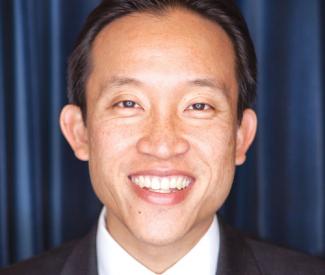
I’ve been hearing lots of back channel complaints and concerns from progressive San Franciscans since last week’s blog post on Board of Supervisors President David Chiu and the role he’s played forging compromises on controversial pieces of legislation this year.
Some have even suggested that the Guardian has gone centrist under my freshly minted editorship, which I actually find kinda funny given my history, perspective, and the righteously anti-corporate and progressive perspective stories that I’ve written and edited in recent weeks. I can honestly tell you that I call ‘em like I see ‘em, now as always, even if that doesn’t always hew to the progressive orthodoxy of some.
Nobody really wants to speak on the record against Chiu, which is understandable given the powerful and pivotal position that he’s carved out for himself as a swing vote between the two ideological poles and on the Land Use Committee, whose makeup he personally created to enhance that role.
So for now, let me just air some of the criticisms and offer some responses and perspective. The main issue seems to be that Chiu allows both progressive and anti-progressive legislation to be watered down until it is palatable to both sides, empowering the moderates over the progressives.
That’s a legitimate point, it’s certainly true that Chiu’s worldview is generally more centrist than that of the Guardian and its progressive community, and we’ve leveled that criticism at Chiu many times over the years. The fact that he ends up in a deciding role on controversial legislation is clearly a role that Chiu has carved out from himself, no doubt about it. And that’s certainly why he played the pivotal role that he has this year.
But when he uses that role to empower and support tenant groups, as he did on the condo lottery bypass measure, I think that’s something worth noting and praising, particularly in my quick little blog post that seems to have grown in perceived significance beyond what I may have intended.
Many of the criticisms involved the CEQA reform legislation that was unanimously approved by the board last week after progressives opposed its initial iteration by Sup. Scott Wiener.
As some have suggested, Sup. Jane Kim does deserve tremendous credit for resisting the initial legislation and working with activists on an alternative, and I included that recognition in my initial story on the legislation. And it’s valid criticism of Chiu to note that Kim had five votes for her legislation and that it was only Chiu who stood in the way of its passage (whether Mayor Ed Lee would have vetoed it, necessitating the need for two more votes, is another question).
But I quoted Eric Brooks, an activist who spent months working on the compromise, as saying the CEQA legislation ultimately does make it easier to oppose bad projects. And when it was approved unanimously by the board, I figured it was safe to place that piece of legislation on the list of Chiu legislative accomplishments for the year.
We at the Guardian will make mistakes, as we always have from time to time. But I’m going to try to err on the side of open, transparent public debates — while supporting a rejuvenation of the city’s progressive movement, so that it is able to start playing offense and protecting this city’s diversity, vitality, and progressive values.
And if you have any criticisms or advice for the Guardian, please come to our forum on Wednesday or offer them to me directly. Thanks for reading.