• No categories

Politics Blog

Breaking the fast

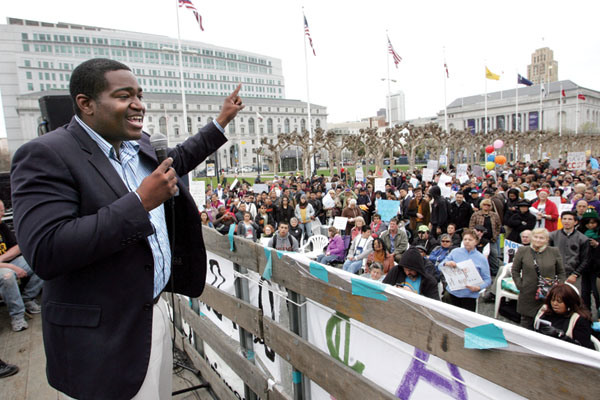
Vincent Pan barely had the energy to speak, and seemed to fall asleep before the eyes of the 30 or so activists gathered in Chinatown last night.

Pan, executive director of Chinese for Affirmative Action, was on the 11th day of a fast he’d started in solidarity with immigration activists who fasted for 22 days in Washington DC, all with a common goal — to push Congress to pass comprehensive immigration reform.

Last evening, Mon/9, marked his last night depriving himself of food. Before taking his first bite in nearly two weeks, he reflected on what the fast meant for him.

“The first few days I was very, very hungry, and had terrible headaches,” he said. “I kept reminding myself, if [the DC protesters] had been fasting for two weeks, I can manage three days. I stopped thinking about [them] and started thinking about the suffering in our country. Thousands of families have been split by deportations. We’re on track to have 400,000 deportations this year.”

He added, “We’re not asking for a privilege or for special favors. We’re asking to be treated as human beings.”

Many others joined in, with a one-day fast. One undocumented college student, who gave her name only as Beatrice, said she’d made the decision to fast for more personal reasons.

“In these holidays i don’t have my family here with me,” she said. “Its tough being undocumented because you can’t spend time with your families because they’re working or being detained. I fasted to keep families together.”

The Chinese Progressive Association and Women’s Collective (Colectiva de Mujeres) were also on hand, presenting a united front of Asian and Latino activists standing together for a common cause.

The Chinese for Affirmative Action headquarters is just a few blocks from the Betty Ong Recreation center, where, only a few weeks ago, President Obama spoke and was interrupted by immigration activists who demanded an end to deportations.

“It’s fitting we’re here in Chinatown just a few miles away from Angel Island,” Obama said that night. “In the early 1900s about 300,000 people, maybe some of your ancestors, passed through on their way to a new life in America. For many it represented the end of a long and arduous journey.”

But for many, that arduous journey clearly isn’t over yet.

With one sip of hot soup, Pan ended his 11-day fast. Yet the larger battle for immigration reform is far from over.

Folsom Street gets a bike-friendly makeover

54

In the wake of some high-profile cases of motorists running over cyclists in San Francisco this year, including the Aug. 14 death of Amelie Le Moullac at the intersection of Folsom and 6th Streets, the San Francisco Municipal Transportation Agency has taken a lane from drivers to create safer cycling along seven key blocks of fast-moving Folsom Street.

The project on one-way Folsom Street between 11th and 4th streets creates an extra wide bike lane with bright green cycling signage on the roadway, with that green lane narrowing and breaking up as it approaches the right turns on 10th, 8th, and 6th streets. The idea is communicate with both motorists and cyclists about how to safely merge and avoid having cars make the unsafe “right hook” turns that are dangerous to cyclists.

“Right now, the project is almost complete and it should be complete by the end of the month,” SFMTA spokesperson Paul Rose told the Guardian.

He said the design was discussed and subject to community outreach efforts during community plan meetings in recent years, but that it was recently accelerated as a $250,000 pilot project with help from Sup. Jane Kim’s office following public concerns about how dangerous that fast-moving strip is to cyclists.

Rose said the traffic flows in the project area will be carefully monitored to see how it’s working, and the agency hopes to learn from that data “so it will inform future projects.”

While San Francisco planners try to learn from other bike-friendly cities, particularly in Europe, Rose also said the agency is on the cutting edge in this country of trying to create safer conditions for the rapidly growing community of cyclists in San Francisco.

“A lot of the work we do in San Francisco generally is the first around country. One of those is sharrows,” Rose said, referring the cyclist shared arrow (sharrow) markings that are ubiquitous around San Francisco, and which remind motorist to safety share the road. 

On displacement, journalism, and the Guardian’s fake Google-buser video

56

It’s been a whirlwind morning here in the Guardian newsroom. First our coverage of the surprise Google bus blockade and protest, along with a video that appeared to show a Google bus rider shouting at protesters, went viral (congratulations to getting onto our site now, it’s been hard to keep it up). Then we discovered the guy was actually protester Max Alper, who staged this intriguing bit of street theater on the spot, unbeknowst to protest organizers who had tipped us off to their event in advance.

As the editor of the Guardian, it’s tempting to second guess how we handled this incident, but I believe that we did everything right, with full transparency at every stage in the process. For better or worse, we live in an age of Internet immediacy, and sometimes stories unfold in unexpected ways right before readers’ eyes.

We were clear in our original post that we couldn’t confirm his identity as a Google employee, noting only that he had been on the bus and got off to confront the protesters. And as we pushed to confirm who he was and authenticate the video, we were the first to learn and report that he was actually a protester. We also got and ran the first interview with him. So we maintained a proper journalistic skepticism and diligence throughout the process.  

Besides, this is still a good and telling story about the current San Francisco moment. First of all, in the long and proud history of political theater in San Francisco, this is a great video. Sure, in retrospect, perhaps his comments were a little over the top, but they resonated because they seemed to represent a persistent attitude among some who want to let market forces determine who gets to live here.

“This is a city for the right people who can afford it, and if you can’t afford it, it’s time for you to leave,” Alper said, a comment that echoes posts regularly made on the Guardian website in reaction to our coverage of gentrification, eviction, and displacement issues.

As a protest tactic, I think this stunt is open to interpretation about whether it helps or hurts a housing rights movement that has caught populist fire in recent months, quickly altering this city’s political dynamics and making politicians scurry to address these issues.

But I think it does point to the need for San Franciscans to have a serious public conversation about who we are, what we value,  and where we’re headed, as we’re calling for our house editorial this week. And because print deadlines are immutable compared to the online world, I’d better turn my attention back to the paper now, thanks for reading.

UPDATE: Union organizer shouts down protesters as they block private Google shuttle

228

Protesters blocked a private Google shuttle on Valencia street today, decrying private shuttle’s use of public bus stops without paying fees or fines.

The group of 20 or so neon-yellow vested protesters called themselves the “San Francisco Displacement and Neighborhood Impact Agency.” The company doesn’t pay San Francisco a dime to use the Muni stops — fines that private auto drivers pay regularly.

UPDATE 3:58pm: Just how does a story go from breaking, to verification, to “holy shit it’s all over the internet now?” Here’s our interview with Fake Google Employee Max Alper, and our recount of how it all went down: http://www.sfbg.com/politics/2013/12/09/whyd-you-do-it-we-ask-fake-google-employee-max-bell-alper

UPDATE 12:32pm: Various tips have streamed in that this shout-out was staged. Protest organizer Leslie Dreyer talked to us on the phone and verified that this person’s identity was Max Bell Alper, a union organizer from Oakland. This person was not a Google employee, and Dreyer was not able to verify if Alper was there in the morning with the group of 20-30 protesters. The Guardian is attempting to contact Alper for comment. Dreyer said she, as an organizer, was unaware that the “performance” had been planned. We are following this as it develops.

UPDATE 1:06pm: Within an hour of our original post, the Guardian learned that Max Bell Alper, a union organizer with Unite Here Local 2850 was the man shouting down Google bus protesters earlier this morning. We asked Alper what motivated him to impersonate a Google employee.

This is political theater to demonstrate what is happening to the city. It’s about more than just the bus. These are enormous corporations that are investing in this community. These companies, like Google, should be proud of where they’re from and invest in their communities,” he said.

When asked if he intentiionally intended to deceive media, he replied “People are talking all over the country about what’s happening in San Francisco (referring to evictions and displacement). That’s the debate we need to have here. The more we talk about it, the more we think about it, the more we’re going to see the tech companies need to contribute.”

 Alper said that he did not intend to engage in theater before going to the protest, but when there made the decision, “spontaneously,” to stage the argument. When he maintained his story that this was political theater, we again asked why he did not verify his name at the protest itself — and only after the story blew up in national and local media.

This was improv political theater,” he said.

Original post follows:

The SFMTA has a pilot plan in the works to regulate private use of public bus stops.

Though the private shuttles were the crux of the day’s protest, the heart of the fight is over gentrification. As the tech revolution in SF leads to rising rents and longtime San Franciscans are being displaced.

In the video, a union organizer who hopped off the bus shouts down Erin McElroy, staging an argument with a protester who also heads the eviction mapping project. “How long have you lived in this city?” McElroy asked him. He shouted back “Why don’t you go to a city that can afford it? This is a city for the right people who can afford it. You can’t afford it? You can leave. I’m sorry, get a better job.”

“What kind of fucking city is this?” he shouted, and then walked off. He mentioned repeatedly that he couldn’t get to work because the bus was blocked, and did exit the bus (indicated he was a Google employee), but the Guardian (nor a nearby Al Jazeera reporter) could not verify his job title or name. If anyone has any tips as to the identity of this man, please contact us at news@sfbg.com. 

(UPDATE 12:12 PM — The Guardian amended the headline to reflect our story more accurately, that though this man exited the bus and claimed he was late for work, we have not yet verified his employment at Google)

We’ll have more on this story later in the day, for now, check out footage from the protest.)

Holiday shopping, anti-gentrification style

Anti-gentrification isn’t just a hot-button issue in San Francisco. It’s core-of-the-sun hot.

And that’s why Prensa POBRE/POOR Magazine, a magazine dedicated to giving marginalized populations a voice, is hosting the “Anti-Gentrification Arts Market in the Gentrified Mission District of San Francisco” on Saturday (12/7).

The event, taking place at POOR Magazine (2940 16th Street in San Francisco) from 4-7pm, is prominently featuring a lineup of artists that have been directly affected by the rapid gentrification of San Francisco.

The idea is to support folks who have been hard hit by evictions, displacement and gross speculation that has been plaguing Mission District, said Lisa “Tiny” Gray-Garcia, of the PoorNews Network.

“There has been a war on poor black and brown folks, and for us to even be here as artists and as poor folk is an act of resistance in itself,” said Tiny. “All of us artists are poor mommy’s and daddy’s and young people and it takes a lot to get us off the hustle even for a day to be here.”

The event will begin with a prayer said by Ohlone First Nations People of the Bay, then transition into a combination of live performances and a gallery-style art exhibition.

The featured art will be for sale, and in addition to the diverse collection of artwork, there will be performances by Fly Benzo, a local rapper/mentor, and a play put on by the Youth Skolaz Revolutionary Puppet Theatre.

There will also be food, which promises to be both diverse in origin and healthy in content. It will be available on a sliding scale, which, according to Tiny, essentially means, ‘Pay what you can.’ “If you can afford to pay for it, then sure,” said Tiny. “But if you can’t, then don’t worry.”

But the featured event-within-the-event will undoubtedly be a lengthy reading from Born N’ Raised in Frisco, a book compiled and workshopped in part by Tiny and Tony Robles. The book, chronicling the lives of native San Franciscans, tells the stories that, according to Tiny, are always talked about, but rarely are they told from the actual perspective of those who lived it.

“It’s a power thing for us poor people, many of us who have been gentri-fucked out of our own communities, to be able to share our voices, our artwork and our stories,” said Tiny.

“It’ll be a really good time, with some really good food and really great art.”

Oakland joins 100 cities in national fast food strike

28

It was a bad day for Big Macs, but a good day for workers. 

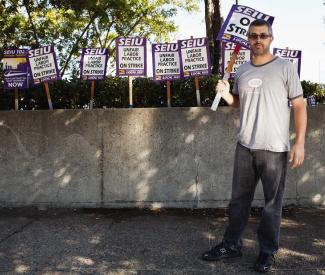
Joining a nationwide day of action, a wave of over a hundred protesters crowded into a Oakland McDonald’s, on Jackson street, demanding fast food workers to join in the strike.

Four employees joined in the strike, and others briefly joined the march outside.

100 cities across the country held similar strikes, with workers in Detroit, New York City and more demanding a livable wage of $15 an hour. 

The protest was nationally led by labor unions, including the SEIU, but locally it was led by men like Jose Martinez. Martinez led the strike at KFC some time back, and was one of the organizers at the forefront of today’s action at McDonald’s and other fast food outlets. 

“It’s a movement for all fast food workers to come together and fight for our rights,” he said.

Standing with Martinez in Oakland, rapper, performer and music producer Boots Riley said he was in support of the fast food workers’ movement.

“Fighting to raise wages of anyone helps everyone, a high tide raises all boats,” he told the Guardian. “You help make that profit, your labor is worth more than minimum wage.”

Inside, the fast food joint was bursting at the seams, the workers hungry for justice.

“Markeisha! Markeisha! Markeisha!” they screamed, bursting into cheers as the five-foot tall girl hobbled around the counter to join the strike. Markeisha, who did not want her last name used, said she tore her ACL a week ago tripping over one of her children’s toys. She can’t afford not to be at work though, and worked the register from a chair.

We asked if she was afraid to be on strike.

“Afraid? Kind of,” she said. If she lost her job, “I wouldn’t have a way to pay my bills and support her family.”

She has two children, a five year old and an 11 month old. But to her this is important, because she isn’t earning a living wage.

“I haven’t had a raise in three years,” she said. That’s the entire time she’s worked there. Only now that she’s training to be a shift manager is she going to make $8.50 an hour. That’s a raise of fifty cents.

“McDonald’s and our owner-operators are committed to providing our employees with opportunities to succeed,” McDonald’s stated on its website. “We offer employees advancement opportunities, competitive pay and benefits.”

One worker we talked to said they had to visit food banks to eat, even though they were fully employed. McDonalds also wanted to correct the media.

“To right-size the headlines, however, the events taking place are not strikes. Outside groups are traveling to McDonald’s and other outlets to stage rallies,” they wrote.

But contrary to their statements, eventually four workers did join the protesters in their strike, and together they poured out of the McDonalds into the adjoining parking lot. They danced and screamed, all advocating for their right to a livable wage.

Nationally the SEIU has taken the lead in organizing the workers, but locally the protest was organized as a coalition between a number of groups, including the ReFund & ReBuild Oakland Community-Labor Coalition, ACCE, EBASE, the East Bay Organizing Committee, UNITE-HERE Local 2850, OUR WALMART, SEIU 1021, and SEIU ULTCW. 

Marcus Books can stay if it can raise $1 million

Marcus Book Store continues to be threatened with the loss of its Fillmore Street location – but if an ambitious community-based campaign can succeed in raising $1 million by Feb. 28, the institution will be able to remain where it is for the foreseeable future.

At a Thu/5 press conference at the bookstore’s 1712 Fillmore Street location, attorney Julian Davis announced that the bookstore proprietors and the San Francisco Community Land Trust had reached an agreement with the current property owners, Nishan and Suhaila Sweis, enabling the land trust to purchase the property for $2.6 million.

If the money is raised, the property will be transferred to the trust, which will preserve the bookstore as a tenant in perpetuity and keep the upstairs flats as permanent affordable housing.

“This is an opportunity,” Davis told reporters. If the campaign succeeds, “That is going to be a rare victory for retaining cultural diversity in San Francisco.”

Tomiko Johnson, daughter of Karen and Gregory Johnson, said she was proud of her family for securing the agreement.

Marcus Book Store has been facing eviction since earlier this year, when the building was sold to the Sweis family in a bankruptcy sale after a family member of the proprietors got behind on payments after taking out a bad loan.

The new owners operate a taxicab business in San Francisco and had planned on living there, according to Joe Sweis, who spoke at the press conference. But after a wide range of community supporters mobilized to halt the bookstore eviction, “We felt that the best solution was really to just come to the table. We saw that their property meant so much,” Sweis said.

Raising $1 million in less than three months is a tall order, but the land trust is using a new, web-based fundraising tool it hopes will help attract support.

Called FundRise, the tool is similar to a real-estate investment version of the microloan website Kiva.org. It offers some intriguing potential for re-shaping the way real-estate investment happens in practice, particularly in a city like San Francisco where market pressure is so intense that droves of low and middle-income tenants are being priced out.

Taking advantage of new federal financial regulations, it works by allowing anyone – not just bankers or finance professionals – to contribute investment funding of any amount toward property acquisition.

By opening the doors for a broader subset of individuals to invest, the platform can offer greater potential for community residents to pool their resources toward ownership of significant buildings or critical housing.

“It sort of opens up a new power to change the face of a city,” said Ben Miller, who started FundRise three years ago with his brother, Daniel, in Washington, D.C. The brothers said they started it because “The idea that you could invest in a Japanese company but you can’t invest across the street made no sense. I think it’s a revolution in how a city can develop.”

In the case of the FundRise campaign that is being created by the San Francisco Community Land Trust to save Marcus Books, any “accredited investor” who wants to invest in the bookstore can provide a loan in the amount they choose and expect an annual return of four percent.

“We are the first nonprofit affordable housing developer to use this platform,” said Tracy Parent of the Land Trust, adding that the plan is to look to “investors across San Francisco and the nation to achieve this fundraising goal.”

Under federal guidelines, investors are considered “accredited” if they have assets totaling more than $1 million, or an annual income of $200,000 a year or higher.

If Marcus Book Store had more time, it might have been possible to open the door for supporters of any income level to become investors, Miller said. “That usually takes three to four months for regulators to give the green light,” he explained. “February’s too fast – you can’t get the regulators to sign off that quickly.”

But Parent noted that nevertheless, the Land Trust is investigating ways to incorporate contributions from anyone who wants to donate toward the effort of saving Marcus Books, be they accredited investors or not.  

Ever since the prospect of losing Marcus Bookstore surfaced this past spring, neighbors and supporters from the surrounding community have pitched in to help preserve the cultural institution. It is the oldest African American bookstore in the nation, housed in an historic building where, decades ago when it was Jimbo’s Bop City jazz club, luminaries from Dizzy Gillespie to Charlie Parker held late-night jam sessions.

Karen Johnson, a co-owner of the bookstore, remembers when her parents, Raye and Julian Richardson first discovered the building, which had been sitting vacant. “When I found out it was the Bop City building, I figured it was waiting for us,” she said. They had opened the business in 1960 and moved to a series of locations before settling into the Victorian, which averted demolition during redevelopment because it was put on a truck and transported around the corner.

Johnson said she was overwhelmed by support from the community in recent months. “It’s heartwarming, and it’s a witnessing that humanity is still in San Francisco,” she said. “Humanity is a verb,” she added. “You can’t just think it. It’s an action verb.”

Karen Kai is a community member who helped round up supporters for the months long campaign to save the bookstore. When news that the store could be evicted started to spread, “there was such an outpouring,” she said. “People said, we can’t lose this. Because if we lose this, we lose a little piece of our soul.”

No poetry or magic in being a robot

I felt yesterday like I had been scooped after reading Jennifer Maerz’s post in the Bold Italic, which asked: Is Talking About High Rents So Often Crippling Our City?

She linked to the blog of “robotics genius” Kal Spelletich, who is a friend of mine. We’ve been getting into heated discussions on this very topic for months. Kal makes fantastical interactive machines that do things like spit fire, harness random mechanical motion to produce musical notes on a piano or a violin, or engulf you in an aromatic bundle of fennel, just for an instant. His creations are robots.

I spent a bit of time in his studio, a giant waterfront warehouse in the southeastern part of the city where strange, sharp-edged contraptions hang from the ceilings. I shared stories about the articles I was writing, increasingly on evictions and the dearth of affordable housing in San Francisco. But as we dissected the problem, Kal rejected what he saw as a narrative of desperation that has been formulated in response to the city’s affordable housing crisis.

He had his own rant, saying his community’s impulse to make art was being hindered by anxiety-producing discussions over loss of living space. These constant, embittered discussions were not only tiresome but toxic to creativity, he said, and distracting people from actually engaging in their life’s work.

But something about his argument irked me, since the idea that people should bow out gracefully and pursue their creative endeavors someplace else sounded akin to surrender, while the stories I gravitate toward feature individuals who find a way to dig in and stand their ground. And taken as a whole, the greater the exodus of artists and idealists from San Francisco, the more watered-down the city’s cultural soup starts to feel. We debated it endlessly.

Here’s how Kal phrased it on his blog. “We don’t hang and talk about the revolution or our exciting new piece we are working on any more. The wind has been taken out of our sails.  We react to the corporatists and capitalists, we are not proactive. Our dialogue has been taken from us. I feel like we have played right into their hands in more ways than one.”

He concluded it by saying, “The head fuck, stress and wasted energy. … There is nothing poetic or magic about it. And I do not see any answer for it in the Bay Area.”

I reflected on our discussions again when I read Mayor Ed Lee’s interview in the New York Times a couple weeks ago, in which Lee commented that “tech workers aren’t robots.” In a city bursting at the seams with makers and dreamers with high aspirations, those who possess coding skills are favored, since their work is perceived as having economic potential. Lee seemed very concerned with creating an environment in which they can thrive.

As the mayor told interviewer Willy Staley: “What I learned with tech companies is I gotta give people room to experiment, and also to make what might later on be a mistake. This is the attitude I want to build within San Francisco — give some time to the tech community. At the end of the day, tech workers are not robots: they feel, they think, they have values.”

That philosophy – the idea that people are people, and need room to breathe, experiment, maybe even maybe mess up – actually makes sense as a core value. The problem, as I see it, is that the economic reality of San Francisco makes it such that this recognition is extended exclusively to the tech set, while the same leeway is not granted to other kinds of makers, or to those pursuing a kind of success that can’t be defined strictly in financial terms. At the end of the day, all San Franciscans feel, think, and have values – but only some are receiving support for their work in the form of funding or policies that facilitate their success.

While one class is being encouraged to try, and forgiven when they fail, a different set – the creative or activist types who aren’t doing it for the money – are being sent the message that they must behave like tightrope walkers, or maybe robots, if they want to remain.

There are some signs of creative resistance – a community rallying together in memory of its heroes, some mischievous comic relief, here and there. By tapping into imagination instead of draining it all away with worry, this could prove to be the start of something.

Unions suing BART board over contract disagreement today, no strike yet

35

Two of BART’s largest unions will announce a lawsuit against the BART board of directors today on the steps of the Alameda County Superior Court at 11am, which they plan to file shortly before the press conference.

The suit will directly challenge the board’s Nov. 21 decision to ratify a contract between the unions and BART management without a hotly contested provision on family leave.

In their announcement of the suit, SEIU Local 1021 and ATU Local 1555 allege the board made “illegitimate and unprecedented actions” in ratifying the contract while removing a section on family leave, which was signed off on by BART management in July. Under the provision, workers who go on leave under the federal Family and Medical Leave Act would be paid for six of the 12 weeks the law allows them to take unpaid. 

Management has since called signing off on family leave a “mistake,” and the board asked all sides to ratify a contract without the provision, hence the lawsuit.

But would a lawsuit mean a new strike?

“That’s what everybody is asking,” SEIU Local 1021 spokesperson Cecille Isidro told the Guardian. “The unions aren’t ruling out any options, but no strike is being called or scheduled at this time.”

BART spokesperson Luna Salaver told the Guardian last month that “it was a mistake that a provision rejected twice by BART management ended up in the stack of approved documents.” She noted that it was caught as the district prepared to give the contract final approval on Nov. 21, though it was already signed by the two unions.

“We were never confused as to the status of the Family and Medical Leave Act agreement,” Local 1021 Political Director Chris Daly told the Guardian, in our earlier coverage, which you can read here.

Isidro said more details on the lawsuit would be available at the press conference at 11am. 

ATU Local president Antoinette Bryant responds to family leave “mistake” at a press conference.

Albany Bulb dwellers speak out on temporary shelter arrangement

The ongoing eviction saga at the Albany Bulb, which the Guardian has covered extensively in recent weeks, previously hinged on a debate around conflicting ideas over what was considered appropriate use for a waterfront park.

Environmentalists and others wanted encampments cleared so the Bulb could be a strictly recreational area, while longtime Bulb dwellers fought to stay on the waterfront land, which offered them a safe harbor where they could live peacefully in D.I.Y. spaces cobbled together with whatever materials they could find.

Now that the city has gotten the green light to move forward with clearing homeless residents’ camps, however, the ongoing saga is shaping up to be a study in how a city ought to deal with a newly uprooted population that has been, or is about to be, forcibly removed from self-styled dwellings that were at least safe and stable, if technically illegal and unconventional.

The city of Albany, working with a group called Operation Dignity, has installed temporary shelters at the Bulb that will remain there for six months. However, that approach has prompted the 49 organized homeless residents to issue a press release essentially condemning the arrangement as inadequate, dehumanizing, and ultimately ineffective at addressing homelessness.

In a press release issued today by Share the Bulb, a group of residents and supporters who’ve sought to defend their right to stay, residents described conditions in the newly installed shelters as prison-like, and labeled them “internment trailers.”

The Guardian was unable to reach the city of Albany or representatives from Operation Dignity for a response to the Bulb dweller’s complaints. But here’s an excerpt from Share the Bulb’s public statement:

“There are 49 current residents at the Bulb, but the internment trailers have room for only thirty people, stacked on top of each other in bunk beds. The trailers will only be open for six months. After that six-month period, Bulb residents who haven’t found housing elsewhere will be forced onto the streets of Albany or surrounding municipalities…

“The trailers open each day at 5:30pm and participants must be inside by 8pm, after which they are not permitted to step outside the trailers. Participants must then be out by 8:30am, without access to the facilities throughout the day…

“The rules also prohibit sexual interaction between participants and require gender separation, even for intimate partners who currently live together on the Bulb. One such couple has been together for 32 years.

“There are a total of four kennels for dogs of shelter participants, which is insufficient for the twenty dogs Bulb residents own. There are no accommodations for cats, effectively excluding the seven ESAs which are cats, and their owners.”

Uncomfortable as these conditions may be in comparison with what residents had built and settled into for years, the shelters are merely a temporary measure. The ultimate question is whether or not these individuals will succeed in finding housing once the camps have all been cleared, and the shelters cease to be an option.

Port of Oakland work stoppage gets chaotic

A work stoppage at the Port of Oakland became somewhat chaotic this morning.

An Oakland police officer had his foot run over by a vehicle crossing a picket line, but opted not to press charges against the driver.

“He’s fine,” said Officer Johnna Watson, a spokesperson for OPD. “He continues to work.”

The incident occurred in front of the gate area of Berths 57, 58 and 59, near 1999 Middle Harbor Road. Picketers gathered early this morning (Wed/27) as part of a work stoppage staged by independent truck drivers who fear job loss on Jan. 1, when their trucks fall out of compliance with new clean-air regulations that will take effect at the port.

Asked for the name of the police officer and the identity of the driver, Watson said, “We’re not going to share any of that information.” She added, “It’s an unfortunate accident. The officer does not want to charge the driver with anything. His primary goal and function was the safety of the protesters in the roadway.”

One of the picketers said a vehicle struck her as it drove across the picket line, but police did not apprehend the driver.

“It all happened really quickly,” said Effie Rawlings, the woman who was struck.  “We were on the picket line. We were walking in circles. There were police there. This one person in a car was trying to pass through. The car lurched into the picket line and hit me. It knocked me off my feet into some other people.” Rawlings said she was bruised and sore but not seriously injured.

She said she did not get a good look at the driver or the vehicle, which continued driving after the collision occurred.

It is unclear whether this was the same vehicle that also ran over the police officer’s foot, but Rawlings said both incidents occurred in the same timeframe. While she did not see the police officer get his foot run over, Rawlings said she did witness the officer’s reaction. “I saw him walking away, making some noise about it. He was kind of cursing and whatnot.”

Watson said police did not receive any reports of anyone else being struck by a vehicle.

The picket began a little after 5am today (Wed/27). The work stoppage was staged by independent truck drivers who are seeking emergency assistance to help them comply with clean-air regulations that will take effect on Jan. 1. Since many cannot afford engine upgrades that would bring them into compliance with the rule change, many will be unable to work at the port as a result.

The Oakland Police Department issued at least five citations to picketers, for blocking traffic. Elizabeth Flynn, who served as a spokesperson for the picketers, estimated that between 50 and 70 gathered at entranceways throughout the port. Watson said police estimated there were 30 to 40 picketers as of 6:30am.

As the Guardian reported in this week’s paper, the California Air Resources Board made $58 million available in 2011 to assist financially strapped truck drivers in obtaining compliant vehicles. Although only $10 million was spent for this purpose, the remainder of that funding was reallocated, and is no longer available for truckers facing possible job loss.

City College Trustee resigns, protesting state takeover

28

Democracy is a thing of the past at City College of San Francisco, and now one member of its elected board has had enough. City College Trustee Chris Jackson announced today that he is resigning from the college board to protest the state takeover of the school, and he explains his reasoning in an op-ed in this week’s Guardian.

“I came to City College to do good work,” Jackson told the Guardian. “At this point it’s impossible to do that work I set out to do. That’s why I’m leaving.”

Jackson was first elected to City College’s board in 2008, but in 2013 he was a trustee in name only. The day City College was told it would lose its accreditation was also the day it lost its Board of Trustees. Those democratically elected by San Francisco voters to lead City College were pushed aside by California Community College Chancellor Brice Harris.

It was a state takeover, and the board was rendered powerless.

The seven-member board holds no more meetings, drafts no more legislation, casts no more votes. The public cannot hold elected officials accountable when things go wrong — because the man in charge is no longer someone San Francisco elected.

Robert Agrella is the “super” trustee, appointed by the state chancellor to make unilateral decisions regarding City College’s future, something they say is necessary to save the school. Agrella holds no public comment sessions, and told the Guardian previously that personal emails to him would suffice. Agrella hardly ever answers his phone, we’ve found.

Paul Feist, a spokesperson for the California community college state chancellor’s office, said that the takeover was necessary to make the hard decisions needed to save City College quickly.

Tremendous progress has been made since July, with key positions having been filled, collective bargains agreements reached and fiscal controls implemented,” Feist told the Guardian. 

To Jackson, it’s a mockery of democracy.

“If my resignation can bring a light to this public policy issue, I hope it does,” he said.

In the last month a vote by the California Community College Board of Governors made Agrella’s stay indefinite. Legally, he won’t leave until the state tells him he has to.

There is not a formal timeline for returning governance of CCSF to local trustees, but it is hoped that this happens soon after the college demonstrates it has addressed the deficiencies identified by [its accreditors],” Feist said. “The state has no interest in running City College indefinitely under a special trustee arrangement.” 

To those who wonder what this all means, and to understand Jackson’s grievance, one look only as far as two of Agrella’s latest unilateral decisions.

A performing arts center long planned to be built by City College was canned by the super trustee, citing funding concerns.

“Clearly, the college is in no position to make this commitment at this time,” Agrella told the San Francisco Chronicle when he cancelled the project. It was $6 million shy of its estimated $95 million cost.

The school’s only performance venue is the Diego Rivera Theater. It is the lone theater serving a school of 85,000 students (and sometimes more) but it seats only hundreds, and is dilapidated and crumbling.

That was the first of Agrella’s motions to overturn decisions by the Board of Trustees, but his next decision was directly challenged by Trustee Chris Jackson.

Just last month the super trustee overturned a decision by the board to drop Wells Fargo as its bank. Last year, the board voted to find a more ethical bank to do business with, instead of one that foreclosed San Francisco homes and held questionable ties to the student loan industry.

An investigation by the San Francisco Examiner found that after Wells Fargo exerted pressure on Agrella and promised the school at least $500,000 in grants, the super trustee repealed the decision to shop for a new bank.

The unilateral decisions of Agrella make Jackson furious, but it’s not as if he didn’t see it coming.

In a September 2012 meeting, the Board of Trustees faced a decision: Does it ask the state for a special trustee? It was quickly communicated to the trustees that if they didn’t ask for one, one would be imposed anyway.

It was a false choice. A public relations move designed to make the board look like they sought help when newspapers and TV stations asked them about the super trustee. In the end, no matter what decision they made the state would take control of the school.

“This special trustee, while not ideal, I don’t personally like, I think it’s appropriate for right now. But we need to understand how long they’ll be there, and what position need to be in for them to leave,” Jackson said.

“I hope this board doesn’t just cede power to the special trustee,” he said.

That was a year ago. Now five months without the board, City College has lost the vision a local politician can bring.

“I’ve certainly called him the conscience of the board,” Alisa Messer, the faculty union president at the college, said of Jackson.

“Chris made himself accessible to those who felt besieged. He’s for the underdog, regardless of being black or brown,” former student trustee William Walker told us.

“I’m just really sad to see Chris go,” said the current student trustee, Shanell Williams, who first met Jackson while on San Francisco’s youth commission.

All of them mentioned Jackson’s work to secure childcare for the two City College campuses in the Bayview. When City College’s accreditors tasked them with scaling down its mission of who to serve, Jackson championed the college’s GED program and won. He also worked closely with the group Students Making a Change, which endeavors to close the achievement gap for students of color at City College.

Jackson’s departure leaves a seat open on the board which Mayor Ed Lee can make an appointment to fill. But the legality of an appointment while the board is effectively out of power is an open question. The Guardian contacted the mayor’s office to find an answer, but did not hear back from them before press time.

“I think the thing San Franciscans ought to be asking is: Do we even have a board, and when are we going to?” Messer said.

As for Jackson, he’s looking forward to concentrating on his family and his career. He currently works at a nonprofit which helps people in Africa and India find new jobs in tech.

“I’ll have more time to spend with my daughter,” he said.  “I’ll have more time to focus on my own professional career, and am looking to go to law school.”

The 30 year old Jackson said he wants to be an attorney to help young men like D’Paris Williams, who was stopped for a traffic citation at Valencia Gardens in a case of alleged racial profiling. Jackson, who lives in the Bayview, wants to defend the people in his community.

“I want to be a part of that,” he said.

Update: Commenters and sources that called the Guardian rightly asked what Chris Jackson’s Ethics Commission fines had to do with his stepping down. Jackson was late filing his campaign reports and was fined about $3,000 by the commission. When the Guardian spoke to them a few months ago about this, they told us it was a routine matter and that Jackson was complying with their requests for payment. Jackson had already reached a payment agreement well before his resignation, which does not affect the fine, he said. 

City and teachers seek injunction against City College closure

16

The plan to save City College of San Francisco took a proactive turn yesterday (Mon/25) as two separate-but-similar preliminary injunctions were being sought against the Accrediting Commission for Community and Junior Colleges (ACCJC). 

The injunctions, filed for yesterday by City Attorney Dennis Herrera and the California Federation of Teachers (CFT), would seek to keep the embattled school open for at least the duration of the impending litigation. A judge will consider the requests next month. 

The two sought-after injunctions come in the context of the civil lawsuits filed by both groups back in August, and would prevent the ACCJC from stripping CCSF’s accreditation on July 31, 2014, in addition to keeping the school both accredited and open while the civil lawsuits are heard and legislative challenges play out. ACCJC representatives didn’t return our calls for comment. 

Both the City Attorney’s Office and the CFT lawsuits hinge on the August findings of the US Department of Education. The determination made then said that the ACCJC violated two separate provisions of federal law: Failing to maintain effective controls against conflicts of interest and failing to have reasonable academic representation amongst the evaluation teams tasked to evaluate the school. 

If those two violations are upheld in federal court, then the City Attorney’s Office will simply need to prove that the “balance of harm” is negatively swinging toward the students of CCSF. And that unjust balance isn’t an under-the-rug number: 80,000 students go to CCSF, while 19 board members work at the ACCJC, something they do whether or not CCSF is open. Conversely, it’s not like those 80,000 students have 80,000 places to go. 

Both the CFT and the City Attorney’s Office are confident that the injunction will be granted by a San Francisco Superior Court judge, an arena of equitable governing both groups say hasn’t been seen from the ACCJC.

“We were trying to figure out our options. How do we defend the college?” said Alisa Messer, AFT Local 2121 president and English teacher at CCSF. “So how do you get a fair hearing? How do you get due process? Unfortunately the courts are the only way to do that under this scenario.”

If either interim injunction is granted by the courts, the school wouldn’t be stripped of its accreditation on July 31 — the ACCJC-appointed Doomsday for an educational institution that contributes nearly $300 million a year to the local economy, among other things — pending conclusions of the underlying court cases, which could take years. That would allow CCSF to offer at least a fall course-load. The injunction would also put the recently-maligned accrediting agency’s authority on hold.

And while an injunction simply delays the final determination and extends the school’s accredited status, both the city’s and the CFT’s plan to hold up the final determination elegantly mirrors the strategy most assume the ACCJC is employing.  

“What we’ve seen is the ACCJC essentially engaging in delay tactics,” said Therese Stewart, chief deputy of the City Attorney’s Office. “This [injunction] isn’t to resolve the whole thing, but rather to freeze the situation so it doesn’t get worse.”

According to a press release from Herrera’s office, the injunction would also, “prevent the Novato, Calif.-based ACCJC from taking similarly adverse actions against other California colleges until its policies and practices fully comply with state and federal law.”

But even if they can implore the ACCJC to reinstate CCSF’s accreditation, Messer says that the injunction the CFT filed on Monday is about much more than “stop gap measures.”

“Actually, I see it as much more than that. It’s not just about getting an injunction for what happens on [July 31, 2014],” said Messer. “This about getting an injunction now, to stop the actions toward closing the college and toward taking our accreditation. Now. Not for July, for right now. Because what we’re seeing is harm being done to the college even as we speak.”

The harm Messer is referring to isn’t just accreditation-related. She says that the reputation of a school is as important as anything, and right now students are unsure of the status of CCSF.

“It’s not about sitting on our hands and waiting and hoping that some of these things will right themselves,” said Messer. “It’s about saying that right now, because of the harm being done to the college, that we need San Francisco to know, and we need everybody to know that this college will not be closing.”


Serial evictors named in mapping project

The San Francisco Anti-Eviction Mapping Project – the same tenant advocates who produced this time-lapse of Ellis Act evictions – have published a new interactive data visualization, displaying locations of properties where seniors and disabled tenants were ousted by no fault of their own.

Showing data over the last three years, the map plots locations of where tenants were evicted under the Ellis Act, and displays the identities of the responsible landlords for each affected unit.

“Waiting lists for public senior housing take years. Often senior and/or disabled tenants are forced to leave San Francisco altogether, or end up on the street homeless,” Anti-Eviction Mapping Project organizers wrote in a statement accompanying the interactive map. “If dispossessed from the city, they often lose access to vital city-subsidized healthcare and community support that they had been reliant upon.”

At today’s (Tue/26) Board of Supervisor’s Meeting, legislation seeking to assist seniors affected by Ellis Act evictions won preliminary approval by the full board. Called the Ellis Act Displaced Emergency Assistance Ordinance, it prioritizes evicted seniors when they seek to access affordable housing programs administered by the city.

“We need this measure to keep residents who have no other means of permanent housing from becoming homeless,” said Board President David Chiu, who cosponsored the legislation along with Sups. David Campos, Jane Kim, Eric Mar and London Breed.

The Anti-Eviction Mapping Project also released a time-lapse plotting the total number of no-fault evictions from 1997 to 2013. A counter that starts when you hit the play button breaks down the number of units where evictions were carried out under the Ellis Act, via owner move-in evictions, and through demolition.

The grand total for that timeframe is 11,766 no-fault evictions. That’s counting units, not individual tenants. Owner move-in evictions made up the lion’s share, with 6,952 units affected. Watch the visualization here.

Meanwhile, tenant advocates who are developing these data-driven presentations are also conducting a survey to gather information for another mapping project in the works.

Activists organize, and some journalists chronicle, a progressive resurgence in SF

131

While Mayor Ed Lee jets around the world, still too focused on fueling the economic fire that is gentrifying San Francisco and displacing its diverse population — and as the San Francisco Chronicle and other downtown boosters niggle on the margins of the city’s biggest issue — local activists and some media outlets are paying attention and pushing back.

The New York Times ran an excellent Sunday piece about the growing populist backlash here against Mayor Lee’s economic policies and his friends and benefactors in the tech industry, a story that the Santa Rosa Press Democrat also put on its front page, but which the Chronicle only briefly mentioned today on its business page in a short story wrapping all the high-end housing now coming online. Instead, on Sunday the Chron ran this pro-landlord garbage

Meanwhile, as we report in tomorrow’s edition of the Guardian, more than 20 local organizations have combined forces this year to organize and promote tomorrow’s (Wed/27) annual memorial march marking the 1978 assassinations of Mayor George Moscone and Sup. Harvey Milk in City Hall, which will this year focus on their legacy of advocating for renters and keeping this city affordable by and welcoming of the working class and outsiders of all types.

We’ve said it before and we’ll say it again: this is a struggle for the very soul of San Francisco, and it’s a struggle that we at the Guardian renew our commitment to with every issue we print. See you all on the streets tomorrow night starting at 7pm in Milk Plaza and Castro and Market.    

Obama speech interrupted by Bay Area immigration activists

21

Ju Hong just wants to see his family for Thanksgiving, and that may be why he shouted down the president of the United States.  

Hong interrupted President Barack Obama’s nationally televised speech in Chinatown today, shouting for justice at the tail end of the president’s call for immigration reform. 

San Franciscans and politicos gathered in the Betty Ong Recreation Center to hear the president call on congress to pass new laws regulating immigration, something sorely needed, as Obama is widely known for deporting record numbers of immigrants. The Pew Research Center shows he’s deported more per year than George Bush ever did, with over 392,000 deported in 2011 alone, 80,000 more than Bush’s highest year. 

Obama called for a greater focus on the plight of Asian immigrants, as most of the country’s discussion around deportations focuses on the southern border. 

“It’s fitting we’re here in Chinatown just a few miles away from Angel Island,” Obama said. “In the early `1900’s about 300,000 people, maybe some of your ancestors, passed through on their way to a new life in America. For many it represented the end of a long and arduous journey.”

“Maybe I started out washing dishes, but my son can become mayor of San Francisco,” Obama said, to laughter. “If we stay true to this history, if we can cross that finish line, and go ahead and do what needs to be done, were going to grow that economy,” Obama said, and then was interrupted by Hong, shouting across the room. 

“My family is separated for Thanksgiving. Our families are separated,” Hong shouted. “I need your help. There are thousands of deported immigrants. Mr. President please use your executive order to halt deportations for all 11.5 undocumented immigrants in this country right now. When you have the power to stop deportations for all.”  

Obama turned around and replied, “Actually I don’t.”

“Stop deportations!” Hong and his friends started to chant. 

Likely to the Secret Service, Obama said “No no, don’t worry about it guys. These guys don’t need to go.” Then he spoke to Hong. “Let me finish. You can stay there. It won’t be as easy as just shouting, it requires lobbying and getting it done,” he said.

Outside the rec center, Hong said he felt that Obama’s speech had lots of flash but no substance. 

juhong

Ju Hong interviewed by reporters outside of the Betty Ong Recreation Center.

“Families are still being torn apart,” he said. “I’m not satisfied at all. He said he didn’t want to violate the law, but he has the power to stop deportations.” 

Hong, 24, is an Alameda resident from Korea who came to the United States when he was 11 years old. When his grandfather died back home, he was unable to pay his final respects. Now he wants to fly back to South Korea to see his family, but can’t risk not being able to return.

The fear of deportation has touched him in many ways. In 2010 his home was burglarized, he said, but his mother said not to call the police. She feared they would discover they were undocumented.

“I was a strong support of Obama in 2008,” he said. But now, he’s lost hope. 

Hong was one of the students protesting Janet Napolitano’s appointment to head the University of California system, which we covered a few weeks ago (Undocumented and Unafraid, 11/12). 

Civil rights attorney John Burris to sue SFPD over alleged Valencia Gardens profiling

164

Prominent civil rights lawyer John Burris will sue the SFPD on behalf of the family of D’Paris “DJ” Williams, after a neighborhood brawl involving police at the Valencia Gardens housing project that Burris called “outrageous.” 

Last Friday, 20 year old D’Paris Williams was bicycling to his cousins’ house from the Batkid festivities downtown when plainclothes police officers from the Violence Reduction Team, a narcotics and firearms reduction squad, attempted to detain him for riding his bike on the sidewalk. In the confusion, a brawl broke out with the police, Williams, and three neighbors. Video was recorded of the incident, which quickly went viral. 

After seeing a bloody and beaten Williams carried to a squad car by police in the video clip, his family and the residents of Valencia Gardens have posed the question: why? 

Why did plainclothes officers tasked with the mission of seizing guns stop a young man coasting on his bike on a sidewalk for a few feet? The family said they believe Williams was targeted because he was a young man of color visiting a housing project.

“When young people are brutally assaulted by the police, there must be accountability,” Burris told the Guardian.

Williams’ step-father, Frank Williams, an ex-offender who now works with the Center on Juvenile and Criminal Justice, was shaken when he first heard what happened to his son, DJ. “I know there are some good cops, some are my friends,” he said.  “But there are some bad cops. What ran through my mind was how he got profiled like that, just because. I don’t like how it happened, and how they justified it.”

The SFPD was unavailable for comment at press time. All they found on DJ Williams was juice and a cupcake. 

A protest defending D’Paris Williams and the three other men hurt and detained in the brawl marched in the Mission Tuesday, and another protest is planned for tonight at 5pm at 15th and Guerrero. 

Click here for our previous coverage of the Valencia Gardens incident

Presidio Trust critical of museum proposals

4

The three museum proposals for a hotly contested Presidio site need significant revisions, the Presidio Trust announced today.

Teams with three museum proposals are vying for a Presidio space just behind Crissy Field (See The Presidio Strikes Back, this week’s cover story): A museum on sustainability, a museum celebrating the history of the Presidio, and a tech and popular art museum holding the personal collection of filmmaker George Lucas, the creator of Star Wars. The trust had this to say about the proposals: 

On The Bridge/Sustainability Institute

“We are concerned, however, about the institutional capacity of the team to … deliver and sustain the project financially. We encourage the … team to bring more clarity to the question of who might fund the building and early programming, and what institution will be created to operate and sustain the Bridge. While the building is ‘light on the land,’ it is also too large and we urge some consolidation of the building program.” 

On the Lucas Cultural Arts Museum

“The Trust is particularly excited about the potential of exceptional educational programming to draw diverse audiences to the museum and the greater Presidio. Despite this, we have significant issues with the proposed building – its massing and height, and its architectural style – and believe it should be redesigned to be more compatible with the Presidio.” 

On the Presidio Exchange (PX)

“The Presidio … is replete with examples of the Conservancy’s good work and of its ethos of partnership in the public interest. The Conservancy’s approach to programming … intended to be varied, flexible, and relevant over time to park audiences – is fascinating. Yet, these attributes also make it harder to understand what the PX is truly striving for programmatically. What is the master narrative? Is there an overall theme or focus that can be better articulated?”

Lucas museum spokesperson David Perry did not offer a detailed response when contacted by the Guardian, saying only that his team would comply with the Trust’s Jan. 3 deadline to submit additional information.

SF General reduces psychiatric care

A 22-bed psychiatric unit at San Francisco General Hospital will be taken out of service, and re-opened only if the facility experiences a high caseload of patients exhibiting the worst signs of psychiatric crisis, the Bay Guardian has learned.

As of Nov. 19, five patients were receiving care in that unit, 7B, according to spokesperson Rachael Kagan. None had symptoms that rose to the level of requiring acute care. Instead, they were classified as sub-acute patients, a distinction that essentially means they didn’t present an immediate threat to themselves or others.

But under a new policy that will take effect after they have been released, all 22 beds in 7B will be closed – unless they are needed for acute patients who do reach that critical threshold. The unit will be staffed only if patients can’t be accommodated in the hospital’s other acute psych unit, which has 21 beds.

The decision was made in response to a changing financial picture under federal health care reform, Kagan explained.

“There is a big push … to ensure hospitals are only providing acute care,” Kagan said, and this trend is driving efforts to reduce sub-acute patients. “It fiscally makes more sense,” she added, because insurers pay higher rates for acute care than for lower levels of treatment.

Yet some hospital staff members are nervous about the implications of this shift, because it means fewer patients will be able to access psychiatric care at SF General until they represent a danger to themselves and/or the general public – at a time when demand for these services is on the rise.

“To us, it’s a matter of priority for the city,” said Brenda Barros, an employee at SF General who is active with hospital union SEIU 1021. “Do you want to take care of these people, or don’t you?” 

Some staff members are doubtful that 7B will reopen. An internal SF General memo issued Nov. 18 informed 7B staff: “Our census will be gradually reduced until we won’t have any more patients. Then 7B will be closed.” The memo added, “this came from [SF General CEO] Sue Currin due to budgetary constraints.”

However, a second internal memo went out the following day, to “clarify” the first one. In that message, Nursing Director Kathy Ballou wrote: “We are not closing psych beds or any beds.” Instead, beds in 7B would be closed unless “we get acute patients needing that level of care,” she wrote. “As in other hospitals, we are accountable to our operating budget.”

Further complicating matters, said Barros, is that patients can fluctuate rapidly between needing acute care and a lower level of attention. “They absolutely can swing back and forth.” She added that patients initially requiring a lower level of care could experience worsening conditions if they’re unable to secure an appointment in time to get help, and delays are very common.

Kagan emphasized that the unit wasn’t being closed down, but did confirm that sub-acute patients would no longer be able to receive treatment in 7B. Instead, those patients will be placed with various service providers throughout the city, she said. “The goal is to move the patients to their appropriate placement.”

Meanwhile, this shift coincides with an overall rise in citywide demand for psychiatric services. According to a report delivered to the Police Commission earlier this year, SF General had 6,293 patient admissions for psychiatric holds in 2012, a sharp increase from 5,837 in 2009.

While there were deep cuts to the city’s Department of Public Health during the economic downturn, Mayor Ed Lee has recently trumpeted a boost to city coffers thanks to growing economic activity. But if the city’s financial health has improved, it seems odd that its flagship safety-net hospital would be put into the position of reducing psych care due to budgetary pressures when that kind of care is sorely needed.

For Barros, it’s a matter of whether or not city officials will decide to allocate more funding for mental health services. “If they don’t have enough money in Public Health,” she said, “then they need to put more into Public Health.”

BART board approves labor contract, minus the district’s “mistake” UPDATED

36

The BART Board of Directors has voted 8-1, with conservative young Director Zakhary Mallett in dissent, to approve a hard-won contract with its unions, after removing Section 4.8, the paid family leave section that the district says was inserted by mistake. The motion also directed management to negotiate a settlement over that issue with its unions, which have already approved the contracts and now must decide whether they are willing to do so again without that provision or whether the possibility of another BART strikes is once again looming.

Shortly after the meeting, SEIU Local 1021 Executive Director Pete Castelli issued the statement saying, “We’re disappointed that the BART Board of Directors had decided not to fulfill their commitment to the workers and the riders by approving contracts without the provision on family medical leave. The unions have voted on and ratified these contracts in their entirety.”

He accused the district of over-inflating the cost estimates of the family leave provision and said the unions were willing to discuss it, but the district instead chose “to prolong the process and hold the fate of the riders, the workers, and the Bay Area in the balance.”

“Right now we are considering all options, meeting with workers who have ratified this contract, and working to find a way to reach a resolution to BART management’s alleged mistake in the agreement it made with its workers,” he said.

After meeting in closed session for about two hours this morning, the BART board opened the meeting up around 11:45am to discuss and vote on the contract. Vice President Joel Keller opened with a motion to remove Section 4.8 from the contract, approve the rest, and direct management to negotiate with the unions.

Mallett, the 25-year-old newbie who lives in unincorporated West Contra Costa County but whose Dist. 7 includes part of San Francisco, spoke first: “Even before this hiccup, I was not in the position to support this contract. I find it too costly.”

But he was the only one to take that stance, with the rest of the directors calling the underlying contract a fair compromise, even if all said they couldn’t support the paid family leave provision that would add anywhere between $4 million and $44 million to a contract that was already going to cost the district an additional $67 million.

Director Gail Murray even chided Mallett’s certitude given his age and inexperience, noting that the union had given up raises for years when BART had budget deficits, and now that the district is running surpluses, it’s reasonable to give workers raises that amount to about 2 percent per year for four years, particularly given the union also gave on their benefit packages.

“Our employees kept the system going…They’re the reason why we keep 40-year-old cars still running,” Murray said, later adding, “To say this contract is not a good contract is wrong.”

The rest of the board agreed, even why acknowledging it is more than they hoped to pay given the district capital needs and aggressive expansion plans.

“We’re probably paying more for this than we anticipated we would pay, and labor is probably going up more than they want to, but that’s the nature of collective bargaining,” Keller said, who also began what turned into a chorus of criticism for how district negotiators signed off on a provision the board never agreed to.

“We ended on a sloppy note and that’s regretable,” Keller said, pledging that if he’s elected president next month — an ascension that is customary for the vice president — he plans to lauch a full investigation into what happened.

“I’m pained that we put ourselves in such adversarial positions with each other and that we lost the lives of two employees,” Director John McPartland said of the protracted labor negotiations and the fatalities that occurred while the unions were on strike Oct. 19. He called the contract “more than fair and equitible.”

Director James Fang, who represents western San Francisco, sounded the strongest criticisms of BART management and negotiators. “Yes, it was a mistake, but nobody has come forward and said ‘there was a mistake and I’m responsible,” Fang said, later adding, “The ones who signed this must be held to account.”

Fang then went further, albeit without specifics, when he said, “Every bit of management advice we’ve received has not worked out to the district’s best interests.” Given the looming investigations by the California Legislature and National Transportation Safety Board of BART culpability in the Oct. 19 deaths — the result of management preparing to break the strike by training replacement drivers and contesting longstanding demands by state regulators to make safety improvements that likely would have prevented the tragedy — Fang’s comment could ultimately prove to be a huge understatement.

Director Robert Raburn echoed Fang’s calls for accountability: “I’m still not clear on how that [contract provision] arrived and it hasn’t been accounted for by anyone at the district who said ‘I am responsible.’”

But he also said that the provision was clearly an error and not something arrived at through the negotiations: “Both parties agreed on a $67 million package and we should keep that intact because it’s fair.”

Reached by the Guardian this afternoon while union leadership was conferring to plan next steps, SEIU Local 1021 Political Director Chris Daly told us, “We are about as up in the air as we’ll ever been.”

As a first step, he said the unions are consulting with their attorneys on the legality of today’s vote. “We think the action might be an unfair labor practice and illegal under labor law,” Daly said.

He also called it “unlikely” that union leadership would simply submit the board-revised contract to an up-or-down vote by union membership, saying that he doesn’t think it would be approved.

And Daly echoed the concerns expressed by several BART directors about how this mistake happened and why nobody has taken responsibility or been held accountable: “If I were on that board, I’d have the general manager’s head, there’s no two ways about it.”  

UPDATE 11/22: Today BART’s largest unions, SEIU 1021 and ATU 1555, issued the following joint statement on the BART Board’s recent vote regarding whether to ratify the labor contracts:

“We consider the Board’s actions to be unprecedented and illegitimate, and we’re considering our next steps, including possible legal action.

“The BART Board of Directors has disregarded the vote of more than two thousand BART workers and has chosen to subvert the collective bargaining process, and we take their actions seriously.”