• No categories

Politics Blog

A radical proposal: Squat Airbnb hosts’ homes to create affordable housing

139

When I interviewed attorney Joseph Tobener for the story in our current issue on Airbnb being used to take affordable housing units off of the apartment market, he had a interestingly radical idea for get the attention of this scofflaw company and its political supporters, striking a blow for housing justice in the process.

What if hundreds of people, including many who are now homeless, rented out apartments in San Francisco for a night or two and then simply refused to leave?

Under tenant laws in San Francisco, renters have rights from the very beginning, and legally getting rid of someone who paid for just one night through Airbnb could require a long, difficult, and costly eviction process. Hundreds at once would overwhelm the courts and the deputies who carry out evictions for the Sheriff’s Department.

“That tenancy on day one law to me as a radical seems like a great way to address homelessness,” said Tobener, who got a call for advice from a doctor who sometimes hosts guests through Airbnb and faced that precise problem.

He isn’t the only one, as we at the Guardian learned and reported last summer, when San Francisco Rent Board spokesperson Robert Collins confirmed Tobener’s interpretation of the law and said the agency has already seen several such cases.

As I wrote in “Into Thin Air” on Aug. 6, “Tenants who rent out their apartments for a few days can even lose their rights to reclaim their homes. Collins cited multiple cases where subletters refused to leave and returning tenants had little legal recourse because ‘they would not have a just cause to evict the subtenant because, if they’ve rented the entire unit, they aren’t themselves a resident in the unit.’”

Even in cases where landlords rent out units they own, San Francisco’s 1979 rent control ordinance gives tenants rights to due process from the very beginning, making it difficult to get rid of Airbnb guests who decide to become squatters.

Sure, such a radical response to Airbnb’s impacts on the city may be breaking a few rules and hurting the credit records of those involved — but is that really any worse than the whole host of laws that Airbnb and its customers are violating in San Francisco everyday? It’s at least interesting food for thought. 

UPDATE 2/11: Just to clarify, Tobener isn’t actually advocating or organizing a campaign to squat in Airbnb apartments. This idea was, as I wrote, “food for thought,” something to ponder, a little thought experiment as we try to address Airbnb’s illegal business model and the city’s affordable housing crisis. 

Advocates for higher minimum wage celebrate past success and look ahead

Balloons, snacks, cake, live music, an open wine bar and nearly 100 guests marked a Thu/6 celebration at the Women’s Building in San Francisco’s Mission district. You might never guess a party this fun would be held to celebrate the birthday of a city ordinance.

February marks the 10-year anniversary of San Francisco’s minimum wage ordinance, passed by voters in 2003 with Proposition L. The landmark initiative not only raised the minimum wage in San Francisco to $8.50 per hour, but stipulated that the amount would rise every year to reflect inflation. Thanks to Prop. L, San Francisco now boasts the highest minimum wage in the nation, at $10.74.

But being the nation’s highest still isn’t enough.

“Who thinks living in San Francisco is really expensive?” asked one of the event organizers and staff member of the Chinese Progressive Association, Shaw San Liu. All hands in the room shot up before the Spanish and Mandarin translators even had a chance to repeat the question.

Raising the minimum wage in San Francisco has been a hot topic recently, and Mayor Ed Lee even endorsed a significant increase back in December. The number that keeps floating around is $15 per hour, but nothing has been set in stone.

In addition to celebrating the 10-year anniversary of the minimum wage ordinance, Thursday’s event was also the official launch of the Campaign for a Fair Economy, a push to support the city’s lowest-paid workers and close the ever-growing wealth gap.

Raising the minimum wage is only part of the campaign, and advocates are also fighting for accountability from large chain businesses, stricter enforcement of existing labor standards, and expanding access to jobs for disadvantaged workers.

“San Francisco has led the way for employment policies in the past,” said Kung Feng, lead organizer for Jobs With Justice, a group that fights for workers’ rights. “We need to continue that.”

To say that San Francisco is leading the way is no understatement. In addition to having the highest minimum wage in the country, SF was also the first place in the U.S. to mandate paid sick leave, and the Health Care Security Ordinance works to guarantee medical benefits for all workers in the city.

Despite San Francisco’s long legacy of championing workers’ rights, there is still a tough battle ahead. Currently, minimum wage in the city automatically goes up every year to match inflation (on Jan. 1, 2014, it rose from $10.55 to $10.74). Any further increase requires voter approval.

While it seems a higher minimum wage does have strong support and has already been endorsed by major political figures, there’s still a powerful lobby against it from some businesses and restaurant associations. Despite the upcoming battle, advocates seemed optimistic.

“Who in here can tell me the significance of the Year of the Horse?” Liu of CPA asked the audience, referring to the ongoing Lunar New Year. A small woman sitting in the front row excitedly responded, “Maa dou gung sing!”

“Success comes in the horse year,” Liu explained. “And this will be a year of success and accomplishments for workers rights in San Francisco.”

Google ferry’s last ride is today

13

The Google-hired ferries skimming Bay Area waves are coming to the end of their pilot period, with their last scheduled rides running today, according to the Contra Costa Times.

Amidst the ire of San Francisco protesters fuming over Google buses, the company opted to experiment with alternatives to the buses: ferries. Two ferries from San Francisco and one from Alameda scooped up Google employees day by day for the month of January.

A Google spokesperson confirmed with the Bay Guardian that the pilot was ending. A source close to Google confirmed that they would “evaluate the results and viability of ferries as a more permanent solution.” 

No word from the protesters yet on if they’d block Google ferries via kayak, rowboat, or sloop.

For the full story, check out the Contra Costa Times piece, here.  

Uber neighborhood pricing surge charges Marina most

43

Uber charges the Marina and Pacific Heights districts up to three times as much for a ride as the rest of the city in its new “neighborhood surge” program, according to leaked emails and screen captures. 

The surges happen during rush hour, weekend night bar crawls, and also around concerts and other events that would draw riders to Uber’s app. 

Uber has caught a lot of flak for its New Year’s Eve “surge pricing,” a practice where the company raised rates during peak hours. Hell, it even looks like they’ve been raising rates when it rains. Just last month the Wall Street Journal reported that Uber would spike rates in neighborhoods of cities with the most demand, a practice called geo-surging.

The rates seem to go at least as high as $4 per mile in surge times, drivers told us, while SF taxis generally charge about $2.25 per mile. 

marina4

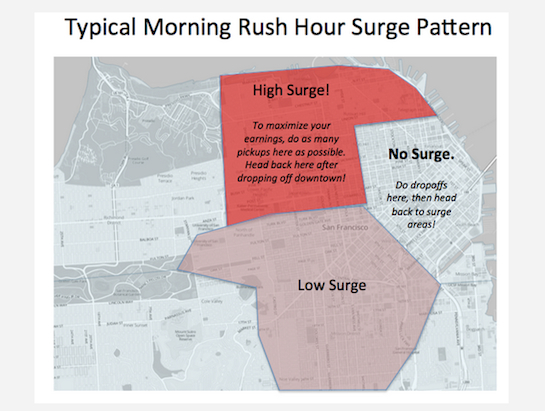
A driver sent a screenshot of a 9am morning surge. This particular morning the Richmond and Mission districts seemed to get a spike in pricing as well.

“If they’re upset about the price they accepted, that’s a different conversation than, say, a driver took a wrong turn,” Uber CEO Travis Kalanick told the Wall Street Journal, about neighborhood pricing in general. “The price must go up for these rides to happen. If surge pricing doesn’t happening, there’s no availability. You can’t get a ride.”

We emailed Uber but did not get a response.

In San Francisco, that demand is apparently highest in the Marina. In the leaked emails, Uber wrote to drivers to explain its reasoning behind the neighborhood pricing:

“Instead of rates being the same everywhere in SF, surge rates will be higher in busier parts of the city. 

Typically, the most demand comes from the Marina (and surge pricing is the highest), with some demand in the Mission neighborhood. 

We’re excited about this change, since this means surge pricing will happen in the areas that need it most.”

A look at their “typical morning rush hour surge pattern” has Uber labeling the Marina “high surge,” the Mission “low surge” and no mention for the rest of the city. Maybe the Outer Sunset and Excelsior folks just don’t use Uber? (Or maybe they’re bigger fans of pink mustaches.)

After we obtained the emails, we verified them with Uber driver Zach Hudson, who’s employed with a private limo company but uses the Uber app to find his riders. 

“The morning rush is in the Marina,” he said. “It’ll be near up to three times the normal rate. I don’t think there’s a limit. But near New Year’s Eve it’s been known to go up to 500 percent.”

marina1

In this screencap of an Uber email, the company advises goign to the “outer” neighborhoods. From the context of the rest of the email, it seems “outer” is anywhere not downtown. 

Uber seems to want to lure more drivers to in-demand areas, but it’s not a total loss for the western and southern neighborhoods, Hudson said. 

 “The avenues are pretty dead most of the time,” he explained. 

And besides, can’t the Marina dwellers afford it? Though the surge pricing may not be great for consumers, Hudson said it was good for drivers.

“After Uber cut fares and essentially our commission by 20 percemt, surge pricing is the only way we can survive,” he said.

http://www.youtube.com/watch?v=wvRuaNr5DKY

San Francisco landlords targeted for elder abuse

Lisa Gray-Garcia, aka “Tiny,” led a press conference outside the San Francisco Hall of Justice Feb. 5 to announce that she and fellow activists were filing elder abuse charges against San Francisco landlords.

Clad in a gray pantsuit and flanked by activists and senior citizens who were facing eviction or had lost housing in San Francisco, the Poor News Network founder condemned landlords who’ve invoked the Ellis Act as “dangerous criminals.”

Gray-Garcia said criminal charges were being filed against the landlords in accordance with California Penal Code 368, which creates a special category for crimes – such as infliction of pain, injury or endangerment – committed against elders and dependent adults.

The theory is that carrying out an Ellis Act eviction against a senior citizen qualifies as a criminal act under that law, since an elder can suffer physical harm as a result of being turned out of his or her home.

The targeted landlords were taken from a list compiled by the San Francisco Anti Eviction Mapping Project, a volunteer-led group that published names, property ownership, and identifying information of 12 landlords who had repeatedly invoked the Ellis Act in San Francisco. Garcia read out their names as part of the press event.

Beyond that, however, the announcement was short on specifics. Gray-Garcia told the Bay Guardian she did not want to share the names of the affected seniors because she did not feel comfortable exposing the elderly tenants to potential backlash.

Joining the group of activists was an 82-year-old woman who used a walker and declined to share her name. She told the Bay Guardian she had lived in her Richmond District flat for more than 30 years, and had recently received a verbal warning from her landlord that if she did not move out, he would invoke the Ellis Act.

When Gray-Garcia and others filed into the San Francisco District Attorney George Gascon’s office inside the Hall of Justice, however, Chief Assistant District Attorney Sharon Woo first told them that they should complain to the police department, then scheduled a meeting with them at a later date.

Here’s how it went:

Guardian video by Rebecca Bowe

In order of appearance, speakers include Erin McElroy, a tenants’ rights advocate; Gray-Garcia; a District Attorney staff person whose name we didn’t catch; Woo, and Anthony Prince (there because he is campaign manager to Green Party gubernatorial candidate Luis Rodriguez, who spoke at the press conference).

Board of Education president calls out thousands of “invisible suspensions”

39

K-12 student advocates have suspensions in their crosshairs.

At last night’s (Tue/4) Board of Education meeting, young students rallied against suspensions they see as unfair. Advocates negotiated rule changes. San Francisco Unified School District Board of Education commissioners shook their fists at injustice. 

“Willful defiance” suspensions are cited nationwide as a problematic category of suspension because of their subjective nature. Wearing a backwards cap, having a bad day, talking back, all of those fall under the umbrella of willful defiance.

The suspension ban is monumental, SFUSD Superintendent Richard Carranza told the board.

“We’re talking about culture change. A culture where it’s not okay for an adult to say ‘get out,’” Carranza said.

The point of the Board of Ed’s meeting last night was to discuss banning suspensions for willfully defiant behavior, and to refocus SFUSD resources on improving student-teacher relationships instead. 

But new data shows that a different form of punishment, which was previously unrecorded, may cause almost as much harm as suspensions. 

Ever been sent to the principal’s office? That’s a form of referral, and in California it’s enshrined in state education code. Students can be sent to a counselor, principal, or even another classroom. But President Sandra Lee Fewer said the numbers of referrals are getting out of hand, and must be addressed. 

Fewer made an amendment to the controversial resolution to ban suspensions at last night’s meeting, calling for it to also require a reduction of in-school referrals.

The punishment, she said, deprives students of needed classroom time — and is ineffective.

“We can’t pass a resolution like this without including referrals,” Fewer said. “These are in the thousands. Some schools have three times the amount of black children with referrals.”

She called them “invisible suspensions,” because this school year is the first time they’ve been thoroughly tracked, thanks to a new system called the Counselor Online Referral Form. 

The new data shows thousands of middle school students (high school data is still being collected), mostly black and Latino, were sent out of the classroom for “non-compliance” referrals since the last school semester alone. “Non-compliance” referrals are nebulous, advocates allege, a subjective catch-all category for bad behavior. 

referraldata

SFUSD referral data. This is incomplete data collected from the first semester and portion of the second semester of all SFUSD middle schools, but only a few high schools. Completed multi-year data of SFUSD high school suspensions show similar disparities in enforcement of punishments, however.

The board will vote on the proposed amendment and willful defiance resolution at their Feb. 25 meeting.

Fewer’s amendment would not go so far as to eliminate referrals entirely. That would be legally problematic, United Educators of San Francisco President Dennis Kelly said. 

“The teachers have a right under law to send a child to the office if there is a disruption in the classroom,” he said in a phone interview.

“There is a concern that an awful lot is being dumped on teachers and counselors,” Kelly added. “More and more people are having very good ideas and saying ‘you do it now.’” 

Reforms need to be backed by resources that help a teacher enact needed changes, he said. “Without those supplements, this is only so much talk.”

But in the meantime, students are suffering. Many students took to the podium at last night’s meeting, decrying policies they said were detrimental to their education.

Alexandria Berliner, now 22, said suspensions and referrals as a high schooler derailed her education. “I’ve been suspended so many times, I ended up dropping out of high school.”

Laura Faer is an attorney and director of the statewide education rights at the nonprofit Public Counsel. Faer told the Bay Guardian that though referrals could be problematic, it was less clear cut of an issue than suspensions.

“The question is: what is happening to the child who is referred?” she said. “If a referral goes to counseling and it’s productive, that could be a good thing.”

But the non-compliance category of referrals was a red flag for Faer. 

“Noncompliance is not specific, and I would say that’s a huge problem” she said. “It’s entirely subjective, from what we’re looking at right now. It could lead to a child losing instructional time.”

That was commissioner Fewer’s concern as well. At the meeting, she said she’s talked to kids as young as third-grade level who felt school administrators and teachers did not want them there in the schools. She blames policies that send kids out of the classroom. 

“We have a school-to-prison pipeline here, (while) we pat ourselves for our good work,” she said at the end of the meeting. 

“The impact these suspensions have is social isolation. We break spirit, and we are very good at breaking spirit.” 

Marcus Books approaching landmark status as fundraising continues

It may be a long shot, but there is still time.

Marcus Books, which faces eviction from its Fillmore Street location, seeks to raise $1 million to remain in Jimbo’s Bop City building, the violet-colored Victorian it has operated out of since 1981. If Marcus Books succeeds in its fundraising endeavor, the building will be turned over to the San Francisco Land Trust and the bookstore will remain as a tenant in perpetuity.

Its fundraising campaign is titled Keep It Lit, and co-owners Karen Johnson and Tomiko Johnson have framed it this way: If 50,000 supporters donated $20 apiece, the bookstore could hit its goal by the fast-approaching Feb. 28 deadline. So far, the fundraising website reflects an amount of $5,660 raised so far.

Marcus Books has been doing business for 54 years and is the nation’s oldest continuously operating black-owned, black-themed bookstore.

Today the San Francisco Board of Supervisors is expected to approve historic landmark designation for the bookstore’s Fillmore Street address, on account of “its long-term association with Marcus Books … and for its association with Jimbo’s Bop City, one of the City’s most famous, innovative and progressive jazz clubs.”

The memory of Jimbo’s lives on, as it hosted the likes of John Coltrane, Dizzy Gillespie, Charlie Parker and other jazz greats for after-hours jam sessions.

The Board of Supes’ ordinance also highlights the contributions of Julian and Raye Richardson, Karen Johnson’s parents and the founders of Marcus Books, “who for many years served the city’s rapidly expanding Black community in a myriad of ways, from small-scale publishing and book-selling to academic instruction and mentorship.”

Presidio Trust decides on museum proposals

The Presidio museum showdown has come to an end for now, and the winner of the hotly contested mid-Crissy Field site is (drum roll, please) … no one.

Not the Golden Gate National National Park Conservancy. Not the Bridge Institute. And no, not Star Wars creator George Lucas.

At an impromptu press conference this afternoon, Presidio Trust Chair Nancy Hellman Bechtle said the board unanimously voted to not move forward with any of the museum proposals.

“This is the most spectacular site in the country,” Bechtle told reporters. “We simply do not believe any of the projects were right for this location.”

Since November of 2012, The Bridge Institute, the Golden Gate National Parks Conservancy’s Presidio Exchange, and filmmaker and Star Wars creator George Lucas’ personal pop art collection have all competed for a patch of uber-desirable real estate a stone’s throw from the Golden Gate Bridge.

The site is currently occupied by Sports Basement, whose planned move will be unaffected by the decision to reject the museum proposals, a spokesperson for the Presidio told the Guardian.

In January the three teams were made to re-submit their three proposals to the Presidio Trust, which cited Goldilocks reasons for not liking the various proposals. The Lucas Cultural Arts Museum was too big, the Presidio Exchange was too programmatically vague, and the Bridge Institute didn’t have enough of the green stuff (money).

But unlike Goldilocks, in the end the Presidio Trust did not find any porridge that was just right. However, it did offer to assist with finding alternative sites in the Presidio for the museums to find homes.

“There are a number of sites in the Presidio that are possible places to build,” said Presidio Trust Executive Director Craig Middleton. “We are really early in these conversations.”

The Lucas Cultural Arts Museum’s spokesperson, David Perry, said there are many cities vying for Lucas’ pop and cultural art museum.

“We’ve been getting requests to look at other sites for this museum, we’re going to look at those sites,” Perry said. We asked if he was referring to Chicago, where Lucas has expressed interest in building the museum before.

“I’ve heard all kinds of cities,” Perry said.

When we asked Perry how Lucas felt when he heard the news, he answered a bit oddly, if candidly.

“I spoke with George this morning,” he said.  “And as my grandmother used to say, if ‘ifs’ and ‘buts’ were candies and nuts, we’d all have a Merry Christmas.”

Above: Hit “play” to hear Lucas Cultural Arts Museum spokesperson David Perry tell us how his grandmother would have reacted to the Presidio Trust’s decision. 

Okay then.

Notably, the Lucas proposal was endorsed by Mayor Ed Lee, tech venture captalist Ron Conway, and a host of other well-heeled and monied backers. In a letter to the Trust, Congresswoman Nancy Pelosi publicly urged its members to hurry up on a decision, and to choose something that would bring in “a vibrant cross section of visitors to the Presidio, with particular attention to inner-city youth.”

We asked Becthle what influence, if any, opinions from powerful politicians had on the Trust’s ultimate decision.

“They’re very interested in California and the city,” she responded. “Sure I listen to [Sen. Dianne Feinstein], and to Nancy, but I think it was most important to do what was right with the park, and not to please one side or the other.”

Monologos de la Vagina finds new actress to replace controversial conservative

62

Following national controversy over the resignation of a politically conservative actress from the local Spanish-language production of The Vagina Monologues, producer Eliana Lopez announced yesterday that the production has found a replacement.

Actress Alba Roversi, a veteran of the Spanish language Monologos de la Vagina, will take the place of Maria Conchita Alonso, whose departure from the play had Fox News crying foul over her being “forced out” for her conservative political views. 

Any chance to needle San Francisco, right? 

Roversi starred in over 20 Spanish language soap operas, though she may not have the same name recognition in the US as Alonso, whose filmography includes Predator 2 and The Running Man (with our former Governator). Roversi is in, and Alonso is out.

Alonso stirred the pot when she backed Tea Party gubernatorial candidate Tim Donnely in an ad on YouTube that garnered just over 100,000 hits. Donnely is running a long-shot campaign to unseat the ever popular Jerry Brown this November on a core right-wing platform.

“We’re Californians, I want a gun in every Californian’s gun safe, I want the government out of our businesses and our bedrooms,” he says in the controversial ad, standing in a cowboy hat next to Alonso. 

“He has ‘big ones,’ and he is angry,” Alonso says in Spanish, by way of translation.

The ad had San Franciscans fired up, diverting attention away from a performance celebrating women to a political shouting match, Lopez told the Guardian. Threats of boycotts put Monologos de la Vagina in the crosshairs. Alonso told media outlets she stepped down from the play to protect her fellow performers.

The video in question, a campaign ad for Donnely starring Alonso and her dog Tequila. 

“The other actors don’t have to go through this,” she said to Fox News & Friends host Clayton Morris. “They don’t deserve this. It’s on me only, they can do whatever they want with me.” 

Why so pissed, San Francisco? Well, the historically Latino Mission district has good reason to not be a fan of Donnely. The Tea Party wunderkind rose to fame as a former member of the gun toting border-patrollers, the Minutemen. From the LA Weekly circa 2010

Tim Donnelly took two handguns on his first tour with the Minutemen, back in ’05. His Colt .45 was photogenic, like that of an Old West gunslinger. But before heading to the Mexico border, Donnelly took it to the range and couldn’t hit the target. So he bought a Model 1911c — a semiautomatic that would shoot straight, if it came to that.

The key to Donnelly’s primary election victory was his pledge to introduce Arizona’s immigration law here. If elected, he will be Sacramento’s leading foe of illegal immigration.

Donnely was geared up to fire off his Colt by the US-Mexico border and essentially promised to bring a culture of fear to California immigrants. Is it a wonder that Eliana Lopez felt that Alonso’s endorsement of him didn’t quite jibe with the politics of San Francisco? 

“Of course she (Alonso) has a right to say whatever she wants. But we’re in the middle of the Mission. Doing what she is doing is against what we believe,” Lopez, who is also starring in the play, said in her most oft-mentioned quote in national media outlets. 

In particular, it didn’t jibe with reasons for bringing the Spanish-language Monologos de la Vagina to the Mission’s Brava Theater, a message that may be lost in the controversy surrounding Alonso’s controversial departure. 

It’s a time of increasing gentrification, when the city’s Latinos/as fear displacement and a loss of their history and esteem. She sees it through the eyes of her young son, Theo, as fewer and fewer Spanish speakers surround his daily life in San Francisco. Lopez wanted to send a clear message: our culture matters. 

Latinas are worthy of celebration.

“I’ve been working on this show for almost a year trying to raise the money, find the venue, the sponsors,” she said. “My feeling was, as Latinas we have such beautiful things to offer. We have great actors and actresses who can bring things to the Mission and feel proud of. Inside me I felt, I want to bring that here, I want to do it. We can bring attention to our culture in a beautiful way, a high quality way.” 

With a new actress in place, she’s ready to move beyond the controversy, she said. 

“How do you say in English? The show must go on.” 

CCSF students angered by class cancellations

Despite a day of misty downpours and gray skies, students, faculty members and their supporters gathered in the lobby of the City College of San Francisco’s Conlan Hall on Wed/28 in anticipation of a sit-down with the school’s chancellor, Dr. Arthur Q. Tyler.

The meeting had been requested to discuss increasing displacement at CCSF, with the number of eliminated classes on the rise every day. Yet questions were still swirling about whether college administrators had used much-needed funds to approve higher administrative pay scales without public notice.

Students and faculty delivered a petition signed by nearly 2,500 students opposing the recent course cancellations. When they unrolled the long list of signatures, it reached from the lobby all the way up the stairs to the chancellor’s office door, a physical display of growing dissent. And with the cuts’ affect already resulting in the cancellation of 27 foreign language courses alone, student anger over the course cancellations is building.

Matt Lambert, a CCSF student for several years, said he’d been informed just that morning that his photography class had been cancelled. He said he’d “spent all day this morning talking to people who were in a similar situation as I am, everybody has a class being cut somewhere. So how come classes are being cut, when supposedly City College is getting cash from Proposition A, how come with all that cash classes are still being cut?”

Proposition A, a special tax approved by voters in November of 2012, provides for a new channel of funding for CCSF with a $79 parcel tax. This tax was intended to help the relieve a bit of the struggle that’s burdened the college as of late, but now students and faculty are finding themselves fending off class cuts as enrollment declines under the ongoing threat that the school could lose its accreditation.

The meeting with the chancellor was intended to be an open discussion, but in the end, only three individuals were permitted to speak to Tyler face-to-face. A chancellor’s assistant informed the crowd the only three members–including faculty union AFT 2121 president Alisa Messer–were allowed to enter the office and represent the instructors and staff. While students were told they would have to follow the proper channels in order to arrange a formal meeting, many students regarded the move as a cop-out.

Following the meeting, Messer provided a recap. “They say they’re looking at the class numbers, and looking at what they did cut, and making sure they didn’t make any big mistakes,” she told the Bay Guardian. “And maybe they should reconsider or learn something from what they do cut. They did say that they will be setting up quite a number late start classes, which is all news to us. But we made it really clear about the quality of education, and the trust that students have in getting their education at City College, and that it is not the right time to be cutting classes.”

Despite an agenda item that was hastily withdrawn last week after being up for approval, recommending salary scale increases of 19.25 percent for certain administrative positions, Tyler is said to have denied the amount this increase, telling Messer, along with two colleagues, that “there was no intention to raise salaries by 20 percent,” that there was confusion about the lower approved salary ranges posted on the school’s website, and that Tyler is working to clarify this.

On Monday, AFT 2121 submitted formal records requests to learn the exact amount administrators are being paid.

The future of civic engagement is here (so far it’s not pretty)

Last week, we wrote about San Francisco City Hall’s foray into “civic innovation,” to foster greater governmental openness through web-based technology.

We spotlighted the OpenGov Foundation’s partnership with the city to upload the entire municipal code to a website, SanFranciscoCode.org, to make local laws readily accessible for anyone (regardless of city of residency, apparently) to comb through, offer comments, or suggest legislative tweaks.

Sup. Mark Farrell trumpeted the open city code website as a great way to incorporate citizen feedback to improve government. It earned a mention the San Francisco Chronicle and other news outlets after Farrell proposed doing away with a silly law that effectively bans bicycle storage in garages, prompted by a comment left on SanFranciscoCode.org.

In and of itself, the idea is not bad – transparency and openness are laudable goals.

That being said, judging by the quality of “civic engagement” happening so far, there’s a long road ahead before this particular experiment in digital democracy takes us anyplace we’d like to go.

There’s the guy who rails against the law about curbing the wheels of your car when parking on an incline, who wants it known, sir, that “I resent and object to getting a near $70 fine for not curbing the wheels on my 2011 Prius.” (He argues that the grade of the incline the rule applies to only made sense in a bygone era, when parking brakes and manual transmissions were more likely to fail.)

Other brilliant insights from cantankerous “innovators”: What do we need San Francisco General Hospital for, anyway?

Another comment calls for writing a new law: “I think news racks should be outlawed as people leave garbage around them, graffiti and vandalize them all the time. I have never seen a group of news boxes / racks that were in a good shape anywhere in the city. They just make the city ugly and cluttered.”

I know, I know – this civic innovation experiment is still in a test phase. And after all, anyone is free to comment, and more stimulating ideas could still be on the horizon. 

But still. This is what citizen empowerment through technology looks like, in San Francisco?

San Francisco and its cycletracks lead the way toward safer biking statewide

39

San Francisco has been blazing the trail toward safer cycling with innovative designs such as cycletracks, or bike lanes that are physically separated from cars, which have been installed on Market Street and JFK Drive. But cycletracks aren’t legal under state law, something that a San Francisco lawmaker and activist are trying to solve so that other California cities can more easily build them.

“Right now, many cities are not putting in cycletracks for fear they don’t conform to the Caltrans manual,” says Assemblymember Phil Ting, whose Assembly Bill 1193 — which would legalize and set design standards for cycletracks — cleared the Assembly yesterday [Wed/29] and is now awaiting action by the Senate.

Ting is working on the issue with the California Bicycle Coalition, whose executive director Dave Snyder is a longtime San Francisco bike activist. Snyder says Caltrans doesn’t allow bike lanes that include physical barriers against traffic, even though they are widely used in other countries and states and considered to be safest design for cyclists.

“San Francisco is technically breaking the law because they have the best traffic engineers in the state and a good City Attorney’s Office and they know they can defend it in court if they have to,” Snyder said. “Most places in the state won’t do that.”

In addition to the direct benefits of the legislation in San Francisco and other cities, Snyder said the legislation seems to be triggering a long-overdue discussion at Caltrans and other agencies about how to encourage more people to see cycling as an attractive transportation option, with all the environmental, public health, and traffic alleviation benefits that brings.

“It’s opened up a conversation about bike lane design and Caltrans’ role in encouraging safe cycling,” Snyder told the Guardian, praising Ting for championing the legislation. “It’s having an impact beyond its immediate impact.”

The Guardian is waiting for a reponse from Caltrans and we’ll update this post if and when we hear back. [UPDATE 1/31: A Caltrans spokesperson got back to us and said, “It’s our policy not to comment on pending legislation.”]

Surveys by the San Francisco Bicycle Coalition have shown safety is the top concern of those considering riding to work or school more often. Ting said he hopes this legislation will address that concern: “By building more cycletracks in California, there will be increased ridership.”

Controversy still brewing over CCSF administrative pay raises

A string of recent emails have led City College of San Francisco faculty members to believe that college administrators are already being paid according to the higher salary ranges that were proposed and then hastily withdrawn from an action agenda last week. Now, they’re waiting for answers about a controversy that has only ballooned since Fri/24, when it seemed that a proposal to raise administrative pay had been brought to a halt and tabled for further discussion.

The retraction was made just as a protest by students and faculty members was getting underway. The recommendation called for increasing salary ranges for certain administrative positions by 19.25 percent, sparking an outcry from faculty members who have endured cutbacks in recent years. 

In an email that was widely circulated among CCSF faculty members, City College of San Francisco Chancellor Arthur Tyler seemed to imply that the recommendation was put forth to reflect current pay ranges – in order to comply with an audit requirement.

“We had not published an approved schedule that matched what people were being paid,” Tyler wrote in an email obtained by the Bay Guardian, which had a timestamp showing it was sent a couple hours after the Fri/24 protest and was addressed to Special Trustee Bob Agrella and several faculty members. “There wasn’t any intent to increase Administrative pay.”

In another email obtained by the Guardian, Tyler wrote, “The existing salaries did not match the schedule which was outdated. That inconsistency needed to be fixed before the audit.”

Tyler’s explanation seemed to imply that the proposed higher salary ranges, for the classifications Vice Chancellor, Associate Vice Chancellor and Chief Information Technology Officer, had already gone into effect – even though they were higher than the formally approved pay schedule that can be found on CCSF’s website.

As of 5pm today (Tue/28), faculty members and reporters were still waiting for Tyler, Special Trustee Bob Agrella, and other top administrators to offer a clear explanation as to what, exactly, what was going on with this supposed pay increase.

“This is what I surmise from your email and other comments: This outrageous increase in pay for administrators listed is a fait accompli because you say the old pay scale is outdated for the upcoming audit. The employee who published did so innocently, thinking it was already known by the employees, since in the past there was a great deal of transparency in the policy changes here,” faculty member Patricia Arack wrote in an email to the chancellor that was widely circulated.

“I think it safe to say we are all very concerned about this divisive situation,” she went on. “The release of this pay scale has incited very strong emotions among employees, and I hope that you and Dr. Agrella, in the [swiftest] and most transparent way possible, confirm that the true administrator pay scale is the one currently online on the Pay Roll web page, and clearly explain why that pay scale released last Friday exists at all. All explanations have seemed very ambiguous to me. Please provide clarity so the speculations will cease and harmony can be restored and we can move forward to restore the reputation of CCSF.”

The Bay Guardian also sought clarity on this situation, but we have not yet received a response from CCSF administrators. Last we heard, communications director Peter Anning had forwarded our questions to Chancellor Tyler and Special Trustee Agrella and they were planning to respond.

Faculty members and students are scheduled to meet with Chancellor Tyler tomorrow, Wed/29, to discuss recent class cancellations. “This is not the time to close the door to students eager and willing to enroll at City College,” organizers with AFT 2121 wrote in an email newsletter to CCSF faculty. “Displacing students undermines their confidence in our college and interrupts their educational progress.”

In related news, Assembly Member Tom Ammiano introduced legislation Mon/27 seeking to “end undemocratic power grabs,” specifically the sort that stripped CCSF’s Board of Trustees of its voting powers.

Under the new system, Agrella, in his capacity as special trustee, can unilaterally make decisions that previously required the approval of the entire board. Approving the salary range modification on last week’s action agenda is one such example of what the special trustee may approve independently.

“Under a vague section of California code, the 17-seat Community Colleges Board of Governors has taken over faltering community colleges and effectively deposed the elected trustees of those colleges,” Ammiano’s office wrote in a statement announcing the proposed legislation. “They appoint a special trustee to make decisions in place of the elected board.”

Ammiano’s bill seeks to eliminate arbitrary actions that can lead to the disempowerment of an elected board, by clarifying and restricting conditions under which the state’s Board of Governors may take control.

“Aside from being undemocratic, I think it’s pretty criminal,” Ammiano told the Bay Guardian in a phone interview. “People can vote people out, people can recall people, and acknowledge that they’ve made mistakes. But it’s very upsetting to think that some appointed board can capriciously remove duly elected people.”

Labor protests Postal Service privatization amid deal with Staples

15

Bearing blue T-shirts and banners stating “Stop Staples! The U.S. mail is not for sale!” 70-plus protesters from the United States Postal Service Union, along with members of the American Federation of Teachers and the National Union of Healthcare Workers, today [Tues/28] rallied outside the Staples store on Van Ness Avenue in opposition to USPS’s “Retail Partner Expansion Program” that began in November.

This program allows the creation of  postal counter centers in 80 Staples stores nationwide, which provide limited USPS services at the same rates as the post office. But the drawback — and a major point of contention among protesters — is that they are staffed by Staples employees, not unionized USPS workers.

The pilot program is seen as stripping jobs from postal workers and starting down a road to the privatization of the post office. This comes in a time when jobs at the USPS have been cut by 44 percent, according to Postmaster General Patrick Donahoe. This on top of the Bureau of Labor Statistics’ projection of a 26.8 percent drop between 2012 and 2022.  The protesters and affiliates, know these numbers all too well, and consider the matter all the more  imperative to allow Staples’ USPS service windows to be staffed by real postal workers.

Supporter Lynda Beigel was employed by the USPS for 33 years before retiring in 2002, and noted how the Staples counter centers could drastically affect workers locally. “Staples doesn’t pay as much as the post office, and the post office’s employees aren’t getting enough to live on in San Francisco,” she told us.

Beigel also described fear of being in competition with a private company that doesn’t have to follow the rules and regulations that burden the post office when “there is a Staples store in San Bruno right across the street from the post office,” she said, noted that she “was horrified to find there was no security for the mail, it was just sitting around.”

City College of San Francisco Professor Rodger Schott and his colleagues in the AFT stood with the USPSU members against potential privatization , stating “we support them very much because they’re, in a way, facing the same privatization threat that we are.”

Commenting on the issue of the service’s being staffed by private, non-union workers, he said, “If the postal service wanted to have its employees at Staples, we don’t have any problem with that. However we feel very strongly [opposed to] Staples taking postal [workers’ jobs] and giving people a much lower rate without any kind of bargaining process…The threat to the postal worker is very, very serious. It’s certainly a threat against minorities and the poor people of the country. The postal service has good jobs, and it’s something that we, the nation, need. We see them as comrades in a similar struggle and we will do everything we can.”

The Stapes employees themselves, looking out at the crowd from an almost empty store, were sworn to silence, and would only reveal the number to a corporate public relations office, where we left a message and we’re still awaiting a response.

Like the post office, Staples is also struggling financially, closing 40 stores in 2013. Whether or not the union can get a foothold, and possibly add much needed reforms to the program and fight the risk of possible privatization, is gathering momentum as the public becomes more aware of its danger.

Public weighs in on dueling museum proposals at Presidio Trust hearing

2

The fate of development Crissy Field is still up in the air after a townhall meeting last night [Mon/27] at the Presidio, where nearly 150 community leaders and residents spoke out on three rival museum proposals, in addition to a large group that supports no proposal at all.

“I don’t think any of them are taking history into consideration,” said SF resident Mike Brassington. “It’s a national historic landmark, and to my knowledge none of the groups care about the history.”

The three groups in question are vying for the highly coveted spot on mid-Crissy Field now occupied by Sports Basement, and each has submitted a proposal to the Presidio Trust laying out its development plans. The first is a project from Star Wars creator George Lucas, who hopes to open an interactive museum dedicated to illustration, digital art, and animation. The proposed facility, which would be funded from Lucas’ personal finances, has already been endorsed by influential leaders such as Rep. Nancy Pelosi, Gov. Jerry Brown, and SF Mayor Ed Lee.

“Arts education is critical to our students, and the whole city of San Francisco is their classroom,” said SF Board of Education Vice President Hydra Mendoza on behalf of the Mayor’s Office, speaking to the Presidio Trustees during the meeting. “The Lucas Cultural Arts Museum will create a rich new environment for our students.”

The Golden Gate National Park Conservatory (GGNPC) is the official sponsor for the second proposal, the Presidio Exchange, which is more commonly referred to as the PX. The PX — which is endorsed and funded by powerful groups such as National Geographic, the California Academy of Science, and the Aspen Institute — would be a conservatory and cultural center for both locals and tourists. The PX building, at 55,000 square feet, is the smallest facility and just over half the size of the other two.

“All of our partners can bring a lot of content to the Presidio,” said David Shaw, member of the GGNPC. “This is the most important issue of our time: the intersection of human culture and the natural world.”

The third and final proposal, known simply as The Bridge, is seen as the least competitive due to its lack of funding. Indeed, a spokesperson for The Bridge admitted to the Trustees that while the project had “no firm or solid” financial resources, they “do have the right idea.” While their efforts are noble, the “right idea” isn’t likely to earn a vote of confidence when millions of dollars are on the line.

Using the couple hundred members in the audience as a gauge, the PX project seemed to be the most popular, receiving the most robust applause out of the proposals. During the public comment portion, when any community member can hold the floor for up to two minutes, many people asked the Trustees to hold off on a decision. Virtually everyone who suggested a postponed decision also made clear that the PX was the least of the three evils, and if something had to be built, it should be the Presidio Exchange.

Charlotte Hennessy, who is on the board for the Presidio Historical Association and carries a sign that reads, “May the farce be with you,” agrees that the best solution is to put Crissy Field back as it used to be before all of the over-development. Just as a police officer arrives to escort Hennessy off of the premises toward the “First Amendment area” for carrying a sign, she shares her ideal vision for the future of the Presidio.

“Space,” Hennessy said. “Just open space.”  

The Presidio Trustees gave no timeframe for making a decision.

Google bus breakdown: a metaphor for our times?

52

From Mikey B, owner of Vinyl Dreams in the Lower Haight, comes this epic pic of a sleek shuttle being towed through the rough-and-tumble streets.

City College Special Trustee withdraws proposal for administrative pay hike

Students and faculty at City College of San Francisco staged an emergency protest today (Fri/24) after discovering that a generous salary increase had been proposed for top administrators and was headed to the desk of Special Trustee Bob Agrella for approval. 

Since he was appointed and infused with the voting power of the full board of trustees in the wake of CCSF’s threatened loss of accreditation, which the Guardian has covered extensively, Agrella can unilaterally decide on such matters.

But just as word of the proposed pay increase got out and angry protesters gathered to oppose it, Agrella announced that the item would be withdrawn from the action agenda.

The recommendation was to increase salary ranges for the college’s Associate Vice Chancellor, Chief Information Technology Officer, and Vice Chancellor by a generous 19.25 percent, “based on the positions’ level of responsibilities and duties.”

“This is absolutely outrageous,” said faculty union president Alisa Messer. “We have students being pushed out of classes, instructors losing jobs, and faculty are still 4 percent below 2007 level salaries. Giving 20 percent raises to the one per centers around here? This college administration’s priorities are upside down.”

Ona Keller, an organizer with the faculty union, said some classes had already been cancelled due to low enrollment. “Agrella came out and said it was a mistake,” Keller said. “I think it was because there were so many people contacting him.” She said roughly 100 protesters had turned out on campus between 2:30 and 3:30.

Student trustee Shanell Williams sounded a similar note. “The students aren’t making a San Francisco minimum wage. … Everyone at the college is suffering. This is outrageous.”

City College’s communications director, Peter Anning, said he’d first learned of the proposal from a reporter. Seems that was right around the time protesters and news vans turned up outside.

Anning insisted that the proposal had not originated with Agrella and that the special trustee had not even seen it prior to the alerts going out that he would approve it.

The agenda went out Thu/23 around 5:30pm, Anning said, with the deadline for community input set for 24 hours later, at which point Agrella would make a final decision. “When Bob received it and saw it, he withdrew it,” according to Anning.

However, the proposal seems to have been tabled for future consideration. Anning said he did not know whether Agrella had been holding any prior conversations about the proposed salary range increases before the recommendation found its way onto the action agenda.

Anning said the proposal originated with City College Associate Vice Chancellor of Human Resources Clara Starr. We called Starr’s office to find out more, but her assistant told us she was taking the day off.

H. Brown: Goodbye to all that, we hope

451

In an SF Weekly piece published yesterday, it was announced that progressive political blogger and gadabout H. Brown – an “irascible” man who has attained a specific sort of fame in equal measure for his political connections, his egregious sexism, and his unfortunate alcoholism — was leaving San Francisco. Where’s he going? The article didn’t see fit to mention. It’s whatever. One can assume Brown’s destination is that netherworld set aside for those whose behavior was enabled by the old school boy’s club blinders of the San Francisco progressive movement, still worn at the dawn of the 21st century.
 
“Last Call For Know-It-Alls: Classic Specimen of Old-San Francisco Bon Vivantery,” the article was called. It was written by a man; if a woman had written it, the title might have been closer to: “I Just Bought an Evil Eye Necklace, Don’t Look at Me You Cursed Troll.”


Do I sound angry? In 2008 at a DCCC, Brown inquired at top volume and in front of an ex-President of the Board of Supervisors if I was the politician’s escort. When said political leader bailed on the situation, Brown interrogated me on camera about my knowledge of local politics. I wrote about it, most names omitted, for the Guardian. In the article’s wake, I received thankful and supportive emails from men and women across the San Francisco political scene. On his part, Brown sent out multiple emails about me to his prodigious correspondence rolls, one in which he shared an communique from his niece calling me an “ignorant cunt,” another in which he addressed an un-cc’ed me about the election night in question: “You tried to make up for your ignorance by wearing revealing clothing. I was mocking you. And rightly so.”
 
Nearly every woman in San Francisco politics has one of these stories. When a male politician was accused of any wrong against a woman, Brown could be depended on to dig through the Internet to find evidence that the victim had been asking for it. Those unwilling to suffer him had to opt out of the hobnobbing happy hours and salons in the homes of city leaders, at which Brown was a constant presence.
 
Ah, old San Francisco bon vivantery. But I’ve said it before and I’ll say it again, you don’t have to care about Brown. You do have to care that this man was your Supervisor’s drinking buddy, that he took Speedo-clad swims in the Bay with progressive leaders. You do have to wonder about what that did to the strength of our political movement. And you might want to wonder about the dynamics behind ubiquitous bigots who are tolerated by people who should know better.
 
“If comedy is indeed tragedy plus time, however, Brown will leave ’em laughing for posterity,” wrote Weekly reporter Joe Eskenazi. “Friend after friend recalled anecdotes of offensive, bourbon-fueled behavior invariably culminating with Brown being instructed to “Get the fuck out, H.!” But, always, these were happy memories, if not happy occasions.”
 
None of these friends — “former supervisors, consultants, academics, political Svengalis, and other city luminaries” – in Eskenazi’s article were women. (The writer, whose work on city issues I do appreciate, told me he did interview women, but apparently none of them said anything printworthy.)
 
Let’s remedy that now with a few female voices. Not coincidentally, most of these bourbon-fueled memories took place in ex-Supervisor Chris Daly’s since-closed Market Street progressive gathering spot, the Buck Tavern. None are happy.
 
“This was the first time I was introduced to H. At a benefit at the Buck Tavern I walked in and there were all these progressive journalists sitting around a table with him. He said ‘you’re the one with the great ass!’ He started asking me if I had family members he could date. I was standing there horrified, I just didn’t know what to say. I’m a mouthy lady, and even I couldn’t think of anything to come back with – not just to him, but to every other progressive journalist who was sitting there listening to him who laughed! I said hi to a few people, and then I left the event.”
– Laura Hahn, president of the San Francisco Women’s Political Committee
 
“Really, I don’t give much of a shit about one sad dude calling me a slut and a spy (for Newsom or Pinkerton Guards, depending on the year), but seeing some (not all) progressive men continue to put up with him was pretty demoralizing.”
– Anonymous volunteer on several progressive political campaigns
 
“The confrontation started because I came in to wish [ex-Supervisor and then-owner of the Buck Tavern] Chris Daly a happy birthday and have a drink, and H. asked Chris ‘Who the hell is she?’ To which Chris said, ‘She’s the President of the Harvey Milk Club.’ To which H began, ‘You’re not even gay, are you?’ I replied, ‘I’m queer.’ ‘Queer?!’ he said, ‘What the fuck is that? Some Shona Gochenauer shit? You’re not gay. I can tell you’re not gay by looking at you. She doesn’t know anything about politics. Look at her — she’s clearly just a vanity president.’ He said something about enjoying things because, “that ass isn’t gonna last forever, sweetheart. They [the other patrons in the bar] are only standing up for you because they want to fuck you.’”
– Stephany Joy Ashley, ex-president of the Harvey Milk LGBT Democratic Club
 
“As a purveyor of alcohol, I found that the man was a lawbreaking mooch and a pain to deal with.  As a woman, I found him pathetic, insulting, gross, or all three, depending on his mood. The first time I met him he cussed me out for an imagined slight in a way that was actually shocking — and it takes a lot for cuss words to flummox me. For a time, I simply refused to serve him.”
– Siobhann Bellinger, Buck Tavern bartender
 
“H. is a bully and a sexist. If you want to look at why the progressive movement is failing it’s because it alienates youth, women, and people of color. Deifying somebody like him is shutting women out, the message is they aren’t welcome. It’s not separated from the fact that progressives are really faltering right now with no leadership and very little inspiration.”
– Debra Walker, artist and longtime activist
 
“His behavior symbolized the running joke amongst some progressive men that women were there for their own entertainment to be mocked and harassed with no one blinking an eye. FUCK. THAT.”
– Anonymous ex-City Hall aide
 
These women – and the progressive men who were their allies – were not laughing at the hijinx of a mouthy old man. But people were, and they will be at the party that will be held in honor of Brown’s departure and attended by member’s of our city’s progressive elite.
 
Supporters say the guy’s behavior was a premeditated mockery of San Francisco’s political correctness, that he was an actor in the grand tradition of political theater. But if he is remembered by generations to come, it will be as the embodiment of an age-old archetype: the dude that other dudes keep around because he says the shit they can’t say to people who aren’t them. After all, who can control their own id?
 
Eskenazi compares Brown to F. Scott Fitzgerald and notwithstanding that both are writers, I’d like to posit an alternative historical precedent for Brown’s passionate trolling. Remember Bobby Riggs, the proud chauvinist who taunted tennis legend Billie Jean King until she wiped the floor with him in the widely broadcast Battle of the Sexes match? Man, that guy should have been in politics.
 
Brown was allowed to establish through constant bullying both online and off that only men have the right to feel comfortable in our city’s high-powered progressive circles. As San Francisco continues to cozy up with its new moderate identity, I hope he is remembered less for being a bon vivant and more as a sign that our once-vaunted avatars of progressivism were spending too much time pounding double shots at the Buck Tavern — while the world changed around them.

Judge says state erred in 8 Washington property transfer

3

A San Francisco judge has ruled that the California State Lands Commission illegally exempted from environmental review a property transfer it approved in 2012 to facilitate the controversial 8 Washington project — a ruling that casts doubt over a dubious tactic the agency commonly uses to expedite development, as well as the legal judgment of an agency that is trying to subvert a new initiative that would subject waterfront height increases to a public vote.

Superior Court Judge James Robertson yesterday found the commission improperly cited obscure provisions that allow it to avoid a full review under the California Environmental Quality Act for cases involving “settlement of a title or boundary problem” when it transferred Seawall Lot 351 to developer Simon Snellgrove for his 8 Washington luxury condo project.

“The SLC in approving this exemption has acted contrary to the clear language of the statute,” Robertson ruled, finding that property transfers are far more significant than rare cases involving contested property boundaries or titles.

“The State Lands Commission involves this exemption routinely for land exchanges [through the state],” said attorney Susan Brandt-Hawley, who represented opponents of the project, which was stopped by voters in November with the defeat of Prop. B, a referendum, and Prop. C, a developer-written initiative supporting the project.

State Lands Commission Sheri Pemberton confirmed that the agency commonly uses this exemption for property transfers, but she said that she couldn’t comment on the ruling or the underlying issues because she said the litigation is ongoing. Asked whether that means the commission plans to appeal, she wouldn’t comment.

Former San Francisco City Attorney Louise Renne, a key opponent of the 8 Washington project, told the Guardian that the commission has clearly been misusing this exemption and abusing its authority over “public trust” waterfront lands in order to expedite development proposals.

“I believe the State Lands Commission has lost sight of the importance of public trust lands,” Renne told us. “How can you possibly say there was a title and boundary dispute? I’ll be blunt: I think the fix was in.”

She was also critical of the commission for sending a Jan. 13 letter to the city contesting the authority of San Francisco voters to use the initiative process to be able to protect waterfront heights limits by requiring a vote on projects that exceed those limits.

“What in the world would possess them to get involved in this matter at this time? Who is talking to whom over there?” Renne said.

We asked Pemberton whether Lt. Gov. Gavin Newsom, a commission member who was a strong supporter of 8 Washington, had any role in requesting the letter and she said that she didn’t know. Newsom hasn’t returned our calls on the issue, but the Guardian today made a California Public Records Act request to the commission for all communications related to that letter, so stay tuned.  

The SFMTA could legally charge commuter shuttles a higher fee

Under a newly approved pilot program that sanctions private commuter shuttles’ use of San Francisco public bus stops, shuttle operators will be made to pay a fee of $1 per stop, per day.

Many community members have criticized this fee as being too low. In response, city officials have indicated that their hands are tied due to a state law prohibiting them from charging any more than that.

But we’ve just learned that under Proposition 218 – the state law that limits local governments’ ability to impose new fees – the city has more discretion about how to calculate “cost recovery” than officials have let on.

“Prop. 218 is part of a legal scheme that doesn’t so much limit how we calculate cost recovery,” said spokesperson Gabriel Zitrin, of the San Francisco City Attorney’s office, “but limits the city to cost recovery.”

At the San Francisco Municipal Transportation Agency Board meeting yesterday afternoon (Tue/21), Project Manager Carli Paine explained very clearly how her team had arrived at the $1 per stop, per day fee amount.

“We identified everything it would take to implement this program,” Paine said. After identifying all the program components, the agency “took the number of stop events and came up with a ‘per stop event’ cost.” Further clarifying, Paine said, “The kinds of costs we included are upfront costs, ongoing program costs.”

Even while remaining within the limitations of Prop. 218, however, the SFMTA could determine whether there are other costs associated with allowing private commuter shuttles to use public transportation infrastructure, beyond just the cost of issuing permits and placards.

It would be well within the legal rights of the city to recover identified costs, as long as they were not already being recovered elsewhere, according to Zitrin’s explanation.

If shuttles’ use of public bus stops cause transit delays, for instance, what are the costs associated with those delays? More overtime pay for bus drivers?

Low-income kids getting to school late and missing breakfast? What’s the cost of that?

If rents rise in neighborhoods located along the shuttle routes (studies show they do), what are the associated costs of that phenomenon? What’s the cost of displacement resulting from those higher rents, which can create a new class of commuters originating from the East Bay?

There are no simple answers, of course. But thanks to data and technology (two things Google seems to know an awful lot about) many costs associated with the private use of public infrastructure can likely be identified.

Zitrin said it was tough to say more without having the details. 

“As far as our office is concerned,” he said, “we would need full detail on what costs are being recovered.”

Local journalists starting to catch onto Airbnb’s subversion of SF’s rental market

45

Airbnb and other so-called “shared housing” sites allow hundreds of rent-controlled apartments in San Francisco to be essentially removed from the housing market, part of a concern that has caught populist fire recently with protesters and politicians pledging to do something about evictions and displacement.

Yet I’ve been one of the few local journalists to hound Airbnb over its illegal business model and refusal to pay nearly $2 million per year in transient occupancy taxes that it owes the city. But that may be beginning to change, as pair of mainstream local publications in the last week have cautiously waded into what outside journalists from Time magazine (which specifically mentioned my reporting on the issue) to German public television have already seen as a big and important issue.

The San Francisco Chronicle today has a story about a lawsuit from a tenant subjected to an owner-move-in eviction, with said owners then turning around to rent units in the building out through Airbnb. And San Francisco Magazine also mentioned Airbnb in its controversial article criticizing concerns over evictions.

“Isn’t it far more likely that more units are being lost [from the rental market] through Airbnb?” the magazine quoted a UC Berkeley professor as saying, comparing Airbnb to Ellis Act evictions. Hey, SF Mag, don’t you think that’s a good question that might be worth exploring?

Janan New, executive director of the San Francisco Apartment Association, told me this week that she found 1,100 rent-controlled San Francisco apartments listed on Airbnb — almost all of it in violation of local tenant and zoning laws — a fact that she personally conveyed to Mayor Ed Lee, who supports Airbnb, shares a funding source with the company (venture capitalist Ron Conway), and has been dismissive of the issue.

“They need to enforce the law like they do in New York City,” New told us, referring to a city that has cracked down on Airbnb’s subversion of its rent control laws. She’s lobbied City Hall, documented the problem, and threatened to sue the city: “I’ve done everything I can possibly think of.”

Meanwhile, Board of Supervisors President David Chiu has been negotiating with Airbnb for almost a year on legislation that would attempt to legalize and regulate its activities here in San Francisco, telling us “it has been difficult to corral the different stakeholders to get on the same page” and no longer offering any predictions when it might be complete.

I was already working on a story about Airbnb (which still won’t respond to my inquiries) for our next issue [UPDATE: It looks like I’ll hold that story for our Feb. 5 issue], so I’ll have more to say about this then. And in the meantime, here’s my latest message to the Mayor’s Office of Communications trying to get some kind of response to this issue, which it has ignored for the last 24 hours:

“I’m about to write about the rampant illegal behavior by Airbnb customers again, which seems increasingly relevant to the “affordability agenda” that Mayor Lee is touting, so I wanted to check in to see whether the mayor is still offering his unqualified support to this company, despite its violations of local housing, zoning, and planning laws and refusal to collect and pay the transient occupancy tax.

“Janan New with the SF Apartment Association says she’s raised this directly with Mayor Lee, including informing him recently that more than 1,100 rent-controlled apartments in San Francisco are listed on Airbnb, all in violation of local law, and she’s frustrated that he’s unwilling to enforce the law, as New York City has been doing. Meanwhile, the Airbnb legislation that David Chiu has been working on for the last year is hopelessly stalled, at least partly because Airbnb has the mayor’s support and is unwilling to compromise while it’s making some much profits off of its illegal behavior in San Francisco.   

“A recent San Francisco Magazine article (http://www.modernluxury.com/san-francisco/story/the-eviction-crisis-wasnt) even quotes a UC Berkeley professor saying that Airbnb is likely taking more rent-controlled units off the market than the Ellis Act. Considering the mayor is pursuing Ellis Act reform, why does he continue to ignore the impact that Airbnb is having on the city?”


SFMTA Board approves tech shuttle plan

The San Francisco Municipal Transportation Agency Board of directors approved a pilot program today that allows operators of private commuter shuttles to use public bus stops, something they’ve been doing illegally for years on a very predictable basis.

The program will establish an “approved network” of 200 designated San Francisco stops where private shuttles may pick up and drop off passengers. It will issue permits and identifying placards to the private buses and require them to adhere to certain set of rules, like yielding to Muni buses if they approach the stop at the same time. (There’s already a Curb Priority Law stating that any vehicles not operated by Muni will be fined $271 for blocking a bus zone. But the city has chosen to ignore that law when it comes to private commuter shuttles.)

Finally, the program will charge shuttle operators $1 per stop per day, which covers the costs of the program implementation and no more.

The meeting drew a very high turnout that included the protesters who have been blockading the buses, Google employees, private commuter shuttle drivers, and residents of various San Francisco neighborhoods.

Sup. Scott Wiener spoke at the beginning of the meeting, saying he was fully supportive of the pilot program, which was developed over the course of many months in collaboration with tech companies who operate the shuttles.

“These shuttles are providing a valuable service,” Wiener said. He said he was sensitive to widespread “frustration and anxiety” around the high cost of housing and rising evictions, but thought it was unfair to blame tech workers. “We need to stop demonizing these shuttles and these tech workers,” Wiener said.

Then Sup. David Campos addressed the board. “I think it’s really important for us to have a dialogue to find common ground,” Campos said, adding that pushing shuttle riders into private automobiles was not a good outcome. But he also urged the SFMTA board to send the proposal back to the drawing board. “It’s a proposal that simply does not go far enough,” he said.

Campos was also critical of the SFMTA’s process of studying the growing private shuttle problem for years, drafting a proposal in collaboration with members of the tech community, and waiting until the eleventh hour once the plan had already been formulated to seek comment from community members who are impacted.

“Public input is being sought after the fact,” he said.

That feeling of being frozen out of the process was echoed in comments voiced throughout the public comment session, which went on for hours.

“I’m opposed to the $1 charge,” one woman said. “I believe it’s way, way, way too low.” She told a story of receiving a ticket for being parked in a bus zone very briefly. “It wasn’t a $1 ticket,” she said.

Another woman, who said she was born and raised in SF, said she’d been riding Muni since she was in diapers. “It makes me really sad that we have regional shuttles and corporations that are saying, you can’t just fix that system, we’re going to go around it,” she said. She urged members of the transit agency board to find a better system that would work for everyone, “because you are in charge.”

A Google employee told board directors that she is very pleased that the shuttles have made it possible for her to live in San Francisco. “Not everyone at Google is a billionaire,” she said. “Ten years after the fact I am still paying my student loans. This is a choice, I know, to live in San Francisco and commute to Mountainview. But I wouldn’t have it any other way.”

Her perspective, however, came in sharp contrast to that of Roberto Hernandez, who spoke on behalf of Our Mission No Eviction and said he was worried that displacement caused by rising rents have forced many members of his community to move to the East Bay.

Hernandez also brought up a little-known consequence of transit delays caused by private shuttle buses.

In the elementary schools near 24th Street in the Mission, he said, “They have the breakfast program for people who are low-income. So if you show up late, you don’t get breakfast.”

Here’s Hernandez addressing the SFMTA board members.

In the end, the transit directors approved the pilot with very little discussion. “At the end of the day, this is before us as a transit issue,” said board member Malcolm Heinicke. “And we’re better with something than nothing.”