• No categories

Politics Blog

Debunking SF Mag’s Ellis Act apologist article, point by point

107

Well, everyone’s got an opinion. And when it comes to San Francisco’s housing crisis, that’s doubly true.

San Francisco Magazine’s opinion though, amounts to a cry for help for (they say) the oft-demonized landlords from what they call the ever-overblown Ellis Act eviction crisis.

In his Tweet earlier today, San Francisco Magazine Editor-in-Chief Jon Steinberg said “We’re calling BS on San Francisco’s eviction crisis.” The article, by San Fran Mag Web Editor Scott Lucas, lays out a San Francisco that’s hard to recognize, one where evictions and rental increases aren’t displacing people in droves. At least, not enough to qualify as a “crisis.”

Sorry Jon, we’re calling BS on your article.

The Guardian reached out to Ted Gullicksen, executive director of the San Francisco Tenant’s Union and Erin McElroy, the head of the Anti-Eviction Mapping Project, to debunk some of the claims made in SF Magazine’s attempt to de-fang the threat of Ellis Act evictions. 

You can read the full article here, but we’ve reproduced lines from the piece and included responses from Gullicksen and McElroy addressing their points one by one. 

San Francisco Magazine The narrative was a straightforward one: Because the Bay Area has seen an influx of people—largely young, white, and working in tech—who need housing (and can pay for it), greedy landlords, many of them out-of-town speculators, are throwing longtime San Franciscans into the streets and turning the city over to gentrification. It looked cut-and-dried.

It’s not. In fact, Ellis Act evictions represent only a small proportion of the city’s total evictions—and they’re not even historically high to begin with. 

Ted Gullicksen That is incorrect on a couple levels. First off, it’s important to understand that the main way people are evicted these ways are via the Ellis Act followed by a buyout. The reason for that is that San Francisco passed strict condominium conversion prohibitions several years ago. If you do an Ellis, you generally are not going to be able to convert to condos ever. 

(You need to) include the Ellis threats… for every single Ellis Act eviction filed with the rent board, they’re where the speculators tried to get the tenants to bite… for every Ellis Act eviction, there are about five buyouts where Ellis Act was used as a club.

I come to that number by the number of people coming to the Tenants Union concerned about buyouts, and comparing those with the rent board’s numbers. Pretty consistently we see 33 percent of what the rent board sees. 

Erin McElroy California is the only state where the Ellis Act is utilized, it’s hard to say whether it’s historically high or not. We also see it’s being utilized by landlords repeatedly. It’s being used as a business model, not a way of going out of business which was its intended use in 1986. 

SFM In the 12-month period ending on February 28, 2013, the total number of Ellis Act evictions was 116—an almost twofold increase over the previous year, but a nearly 70 percent decrease since 2000, when such evictions hit an all-time high of 384. All told, the Ellis Act was behind less than 7 percent of the 1,716 total evictions in the city between February 2012 and February 2013. “Isn’t it far more likely,” asks Karen Chapple, a professor of city planning at UC Berkeley, “that more units are being lost [from the market] through Airbnb?”

TG That number, the 1,716 number, includes “for fault” evictions. If you just include no-fault evictions, Ellis Act evictions are the highest amounts. No-fault evictions are the ones we’re all talking about here. There are a number of rental units lost from the market and that’s a big problem, but the TIC and condominium conversions far surpass tourist conversions (like AirBNB).

EM First of all, for every Ellis Act being recorded, there is not a recording of the units evicted. While you can say there is a number of evictions, it doesn’t represent the units or people being displaced: it doesn’t record the number of people losing their homes.

What we’ve done through the Anti-Eviction Mapping Project is to match those petitions with the number of units. If you go to our website you can see the number of units lost since 1997 in each petition. While the city (of San Francisco) only recorded about 1,300 Ellis Act evictions since then, there have been at least 4,000 units lost. We don’t know how many people are in each unit. There could be between 1 and 6 people in each on average. 

SFM Laying the blame on nefarious Rich Uncle Pennybags types isn’t exactly right either. A recent report commissioned by Supervisor David Campos is clear on that point: The increase in Ellis Act evictions, it found, “occurred simultaneously with significant increases in San Francisco housing prices.” In other words, the problem isn’t speculators. It’s the market. 

TG The problem is indeed the speculators. Most of these buyouts are done by speculators, of the current Ellis Act evictions right now, most of the buyouts are done by one of twelve speculators. 

The Anti-Eviction Mapping Project showed that these real estate speculators form Limited Liability Corporations for each building. The Anti Eviction Mapping Project went through all these LLC’s and identified actual owners and compared them to Ellis Act evictions at the rent board. One person involved is doing six Ellis evictions right now. 

EM Speculators are taking advantage of the market. If there weren’t people to buy luxury condos, Ellis Act evictors wouldn’t buy up the units and turn them into condos. 

It’s one thing for a landlord to issue an Ellis Act one time because they’re done being a landlord, it’s another to see serial evictors use it over and over again through Limited Liability Corporations. Urban Green has 40 or so LLC’s, they’re using them all to push the Ellis Act. See our serial evictor chart and you’ll see 12 different people that use that serial evictor model. It’s a way for them to make money. 

SFM The city simply doesn’t have enough housing to keep up with job growth. And as real estate values rise, the incentive for a property owner to sell grows considerably. No villainy. Just economics.

TG The city is building a ton of housing, as anyone can tell you. The city, though, is building nothing but luxury condos. There’s plenty of housing, but nothing affordable.

EM If displacing long term residents and folks with disabilities and seniors is just economics, it’d be an argument against our economic system. The city offers services for trans folk, queer folk, people with HIV, all reasons people moved to San Francisco and it has a popular place in people’s imagination. Native San Franciscans are also not being valued. If that’s economics, San Francisco has lost its heart and its soul.

SFM Even if incremental changes happen, San Francisco’s affordability problem will likely continue almost unabated. Ellis Act evictions are, in Chapple’s words, not a cause of the housing crisis, but rather “a symptom. Fixing it is like using a Band-Aid for brain cancer.”

TG The Ellis Act is in fact a cause, because it’s taking thousands of units off the rent control market. When we’re losing more and more rent control units, supply dwindles and the rents go up. 

EM I would agree the Ellis Act isn’t the cause of the problem. The problem is it’s being utilized with other forms of evictions for landlords to take advantage of a political economy with the relationship between the city and tech. The problem is the relationship with the new tech class and the impunity it maintains through city government.


Talking points for Google busers

TechCrunch is reporting that a Google employee leaked an internal memo the Silicon Valley tech firm circulated to its employees, urging them to provide public comment on the controversial proposal to sanction its private shuttles’ use of city bus stops.

Here are the talking points Googlers were supposedly told to highlight in comments to the San Francisco Municipal Transportation Agency at tomorrow’s (Tue/21) meeting, when the transit board will vote on the proposal.

  • I am so proud to live in San Francisco and be a part of this community
  • I support local and small businesses in my neighborhood on a regular basis
  • My shuttle empowers my colleagues and I to reduce our carbon emissions by removing cars from the road
  • If the shuttle program didn’t exist, I would continue to live in San Francisco and drive to work on the peninsula*
  • I am a shuttle rider, SF resident, and I volunteer at…..
  • Because of the above, I urge the Board to adopt this pilot as a reasonable step in the right direction

The leaked memo, according to TechCrunch, also noted that “While you are not required to state where you work, you may confirm that Google is your employer if you are so inclined. If you do choose to speak in favor of the proposal we thought you might appreciate some guidance on what to say. Feel free to add your own style and opinion.”

According to the article, the memo was leaked to the activists who have been organizing tech bus blockades by an employee who found it “a bit high handed.” In turn, the activists sent it to TechCrunch.

*Not according to the study that was mentioned by the SFMTA at the SF Environment Commission last week.

Double standard for the role of voters in SF waterfront development?

4

As our article on San Francisco waterfront development was hitting the presses last week, California State Lands Commission Chief Counsel Mark Meier made public a letter questioning the legality of a local initiative in circulation that would submit waterfront projects that break height limits to a vote of the people.

Meier argued that such “public trust lands” are managed locally for statewide benefit, and therefore voters can’t meddle with the decisions made in City Hall or the Port of San Francisco offices: “The land use and management decisions that the City makes regarding these public trust land cannot be overriden by the local initiative process…”

State Lands Commission must sign off on most waterfront developments, along with the San Francisco Bay Conservation and Development Commission, so this Jan. 13 letter to the City Attorney’s Office is significant. It’s unlikely to keep the measure off the June ballot if the campaign gets enough qualifying signatures by Feb. 3, but it could be used in later challenges. 

Campaign Manager Jon Golinger said he wasn’t surprised or worried by the threat, calling Meier’s argument flawed. “Our attorneys have already analyzed this and we feel pretty confident,” he told us, summarizing his side’s legal argument as, “Anything that the people’s representatives can do, the people are also allowed to do.”

Golinger also noted a perverse aspect to Meier’s arguments, noting that the initiative seeks to strengthen existing protections of the waterfront, which is exactly what the Burton Act encouraged when transfering authority to the city. And most of the caselaw that Meier relies on for his arguments involved judges ruling against initiatives that sought to weaken local authority and protections.

Golinger also noted the glaring contradiction between the position between taken now by the State Lands Commission, of which Lieutenant Governor Gavin Newsom is one of three elected members, and the Prop. C initiative campaign funded last year by the 8 Washington project developers that was overtly supported by Newsom.

“If this is of question legally, why didn’t Commissioner Newsom raise this last year?” Golinger asked.  

In fact, that initiative would have been a far more glaring violation of the sanctity of local government control considering it would have not only green-lighted the 8 Washington project and all of its variances from local codes, but it would have prohibited “discretionary review” of the project by professional city planners.

We called both Meier and Newsom’s office with questions about the letter, its arguments and contradictions, and the role that Newsom had in ordering, preparing, or reviewing the letter. We never heard back from either of them, but we’ll update this post if and when we do.   


New, final Presidio museum proposals are in

9

The final round of project proposals for the Crissy Field Presidio site are in, and boy do they sure look… almost exactly the same as the last round. 

The Presidio Trust was fairly critical of each of the three finalists for the current site of the Sports Basement, which will soon lose its prime real estate. The Bridge Institute, the Golden Gate National Parks Conservancy’s Presidio Exchange, and Star Wars creator George Lucas’ personal pop art collection are all duking it out for a little patch of green (which is worth a lot of green) by the Golden Gate Bridge. 

Everyone in San Francisco has an opinion on who should win the spot: Mayor Ed Lee and tech venture capitalist Ron Conway want George Lucas’ museum to win (as do most tech folks with money), every environmental group out there wants the Presidio Exchange to get the space (including the Sierra Club), and the Chronicle’s design writer John King just wants Lucas to use the old Palace of Fine Arts site, dammit.

The Presidio Trust, a presidentially appointed entity, has the final say. And what it said last time was this: give us new proposals.

The Lucas proposal was too big, and the Trust felt it needed to be “redesigned to be more compatible with the Presidio.” The Presidio Exchange, it said, struggled to find a theme programatically. It lacked focus. As for the Bridge Institute? The Trust was worried it didn’t have the money to build with at all. 

Now everyone is back with new plans, in force.

George Lucas responded to the critique that his museum was just too darn big:
“Relative to the issue of ‘ensuring the building’s compatibility with the Presidio’ we are submitting two new design concepts for your consideration that we believe address the issues of massing and height. We have worked diligently the past few weeks with our architects at Urban Design Group and other members of our team to develop a new design that we believe will meet the criteria outlined by the Trust while providing the best home for the collection and its diverse cultural and educational programs. We are submitting two designs for your consideration, with the intent that if the Lucas Cultural Arts Museum is chosen for the Crissy Field site, you will identify the design you would like to see further developed.”

So it’s the same beast, just you know, smaller.

The Presidio Exchange folks, on the other hand, decided that since their programs lacked clarity, they’d make a flow chart. It’s good to know that they strive for consistency.

pdxgraph

pdxfinal

The final conceptual image of the PDX.

And as for funding the Bridge Institute? It wants to put a member of the Presidio Trust to work helping it raise money.

“The trust and Trust Board would make its network of contacts available to the BRIDGE fundraising team, and assist in making positive contacts with those contacts as part of the fundraising efforts of the organization,” it wrote. In other words, Presidio Trust, help us raise the dough, please. Presidio Trust President Nancy Hellman Bechtle is wealthy, but there’s no telling if she’d tap her wealthy friends to help the Bridge Institute. 

“We appreciate the effort each team has made to further develop its proposal for the Mid-Crissy Field site,” Becthle said, in a press release. “In the weeks ahead we will evaluate the revised proposals, weigh the wide range of public comments, and make a decision that will stand the test of time. This is a remarkable opportunity for the Presidio and San Francisco and we look forward to the public’s continued engagement.”

Love the designs or hate them, the public’s last chance to comment will be at the Public Board  of Directors Meeting to be held on Monday, Jan. 27, 6:30 pm in Herbst at the Presidio.

You can read all the museum proposals for yourself, here.

And while you’re at it, check out our front page story covering the founding of the Presidio, and how that history shaped the museum proposals.


State of the City speech filled with unsupported promises

178

It was maddening to watch Mayor Ed Lee deliver his annual State of the City address this morning. This was pure politics, from the staged backdrop of housing construction at Hunters Point Shipyard to the use of “regular people” props to the slate of vague and contradictory promises he made.

“This place, the shipyard, links our proud past to an even more promising future,” was how Lee began his hour-plus, invite-only address.

Later, he touted the housing construction being done there by Lennar Urban as emblematic of both his promise to bring 30,000 new housing units online by 2020 — the cornerstone to what he called his “affordability agenda” — and the opposition to unfettered development that he is pledging to overcome.

“A great example is the place we’re standing right now. This took us too long,” Lee said after decrying the “easy slogans and scapegoating” by progressive activists who place demands on developers.

But that implication was complete bullshit. As we and others have reported, progressive and community activists have long encouraged Lennar Urban (which has a close relationship to Lee) to speed up development on this public land that it was given almost a decade ago, particularly the long-promised affordable housing, rather than waiting for the real estate market to heat up.

That was just one of many examples of misleading and unsupported claims in a speech that might have sounded good to the uninformed listener, but which greatly misrepresented the current realities and challenges in San Francisco.

For example, Lee called for greater investments in the public transit system while acknowledging that his proposal to ask voters this November to increase the vehicle license fee isn’t polling well. And yet even before that vote takes place, Lee wants to extend free Muni for youth and repeal the policy of charging for parking meters on Sundays without explaining how he’ll pay for that $10 million per year proposal.

“Nobody likes it, not parents, not our neighborhood businesses, not me,” Lee said of Sunday meters, ignoring a study last month by the San Francisco Muncipal Transportation Agency showing the program was working well and accomplishing its goals of increasing parking turnover near businesses and bringing in needed revenue.

Lee also glossed over the fact that he hasn’t provided funding for the SFMTA’s severely underfunded bicycle or pedestrian safety programs, yet he still said, “I support the goals of Vision Zero to eliminate traffic deaths in our city.”

Again, nice sentiment, but one that is totally disconnected from how he’s choosing to spend taxpayer money and use city resources. And if Lee can somehow achieve his huge new housing development push, Muni and other critical infrastructure will only be pushed to the breaking point faster.  

Lee acknowledges that many people are being left out of this city’s economic recovery and are being displaced. “Jobs and confidence are back, but our economic recovery has still left thousands behind,” he said, pledging that, “We must confront these challenges directly in the San Francisco way.”

And that “way” appears to be by making wishful statements without substantial support and then letting developers and venture capitalists — such as Ron Conway, the tech and mayoral funder seated in the second row — continue calling the shots.

Even with his call to increase the city’s minimum wage — something that “will lift thousands of people out of poverty” — he shied away from his previous suggestion that $15 per hour would be appropriate and said that he needed to consult with the business community first.

“We’ll seek consensus around a significant minimum wage increase,” he said, comparing it to the 2012 ballot measures that reformed the business tax and created an Affordable Housing Fund (the tradeoff for which was to actually reduce the on-site affordable housing requirements for developers).

But Mayor Lee wants you to focus on his words more than his actions, including his identication with renters who “worry that speculators looking to make a buck in a hot market will force them out.”

Yet there’s little in his agenda to protect those vulnerable renters, except for his vague promise to try to do so, and to go lobby in Sacramento for reforms to the Ellis Act. While in Sacramento, he says he’ll also somehow get help for City College of San Francisco, whose takeover by the state and usurpation of local control he supported.   

“City College is on the mend and already on the path to full recovery,” Lee said, an astoundingly out-of-touch statement that belies the school’s plummeting enrollment and the efforts by City Attorney Dennis Herrera and others to push back on the revocation of its accreditation.

Lee also had the audacity to note the “bone dry winter” we’re having and how, “It reminds us that the threat of climate change is real.” Yet none of the programs he mentions for addressing that challenge — green building standards, more electric vehicle infrastructure, the GoSolar program — would be as effective at reducing greenhouse gas emmisions as the CleanPowerSF program that Lee and his appointees are blocking, while offering no other plan for building renewable energy capacity.

Far from trying to beef up local public sector resources that vulnerable city residents increasingly need, or with doing environmental protection, Lee instead seemed to pledge more of the tax cutting that he’s used to subsidize the overheating local economy.

“Affordability is also about having a city government taxpayers can afford,” Lee said. “We must be sure we’re only investing in staffing and services we can afford over the long term.”

How that squares with his pledges to put more resources into public transit, affordable housing development, addressing climate change, and other urgent needs that Lee gives lip service to addressing is anybody’s guess.  

SFUSD backs supervisors’ sugary beverage tax, with concerns

8

A San Francisco ballot initiative to levy a tax on sugary beverages got a boost last night as the San Francisco Unified School District Board of Education voted 5-2 to endorse it.

“The school district has done amazing work around nutrition for kids,” said Supervisor Scott Wiener, one of the initiative’s authors, shortly after the meeting. “This is a big win.” 

The initiative is proposed by Supervisors Mar, Wiener, Cohen and Avalos, and is estimated to generate up to $31 million annually, according to data from the supervisors, but its main aim is to curb the consumption of beverages they believe contributes to obesity in San Franciscans. The supervisors will be introducing a final, unified measure at the Board of Supervisors in the coming weeks, they said. 

Advocates at the meeting said sugary drinks contribute to a crisis in children’s health. “Our community suffers some of the highest rates of diabetes and hospitalizations from diabetes,” said Roberto Vargas, a Bayview resident and Mission high graduate of 1989. “I ask you to support these policies for San Francisco’s children, and San Francisco’s families.”

The resolution to support the tax initiative passed, but not easily. The ensuing argument may even have given a peek inside the mayor’s insecurities around the upcoming November ballot.

Commissioner Hydra Mendoza McDonald, who works in the Mayor’s Office as his education advisor, thought backing the “soda tax” could put a ballot initiative regarding SFUSD funding in jeopardy. 

“I don’t have a political or personal agenda, but I think we’d be remiss if we didn’t think this would be a political fight,” Mendoza McDonald said. “I have a tremendous amount of respect for Supervisor Wiener… but I have to say my priority right now is the public education enrichment fund, and that’s it.”

She’s referring to the city’s supplemental funding to the school district, PEEF, which the SFUSD depends on to pay for over 50 librarians, 200 PE coaches and more. That fund is about to sunset in 2015 — meaning no more money for the SFUSD from the city. In the 2013-2014 fiscal year, the city is set to provide the SFUSD over $50 million.

A ballot initiative is slated for November that would renew the PEEF funding agreement. That’s a lot of money at stake. 

Mendoza McDonald expressed fear that support of the soda tax would put the SFUSD in the crosshairs of Wiener and Mar’s deep-pocketed opponents, the beverage industry. 

“It makes me nervous,” she said. “It’s in everyone’s mind a slam dunk to pass the (PEEF funding initiative)…People have voted time and time again for children’s issues. But in every single measure, we’ve cleared the field and made sure we haven’t had any opposition, and that’s what makes us successful. I’m worried if the people who have historically supported us would do so again knowing there’s a bigger pot of money going against us.”

This 13 minute audio recording features some of the main arguments made against backing the sugary beverages tax initative. 

The board then asked Wiener to respond.

“If I could be blunt, the arguments that I’m hearing from people not comfortable supporting this are going to be the same in June as they are today,” Wiener said. “The idea that this would generate a campaign against the Children’s Fund and PEEF, has no basis, with respect. This is about the sugary beverage industry.”

“In San Francisco we don’t shy away from big business trying to threaten us,” he added.

Ultimately the board voted to back the sugary beverage tax initiative. Its reasons were many. Some commissioners described the early onset of puberty children are facing due to the effects of sugary drinks, others brought up the growing rates of obesity in children. 

They all echoed the sentiment that the benefits of supporting the resolution outweighed the risks. Commissioner Rachel Norton probably echoed their myriad positions most succinctly. 

“I have no idea whether this legislation will ultimately pass at the ballot box, but I think what’s important is that we support this resolution,” she said. “This is the right thing to do, and be fearless about.”

Lee panders to motorists and undermines SFMTA with Sunday metering repeal

36

First Mayor Ed Lee ignores the rising cost of living in San Francisco (fueled partly by his own corporate welfare for the tech industry and commercial landlords), and now he’s using his sudden concern about gentrification as an excuse to make parking meters free again on Sundays, a blatant bit of political pandering that blows a $6 million annual hole in Muni’s budget.

Maybe it’s understandable that a politician worried about his reelection prospects with restive voters would take a page from the playbook of former Gov. Arnold Schwarzenegger, who slashed the state’s vehicle license fee to win that office. But what makes this move stink even more is it’s being supported by the San Francisco Municipal Transportation Agency, a supposedly independent (yet mayoral appointed) body whose top officials methodically and courageously have made a strong case for Sunday metering.

“We’re just willing to partner with the mayor to address affordability,” SFMTA spokesperson Paul Rose told us, admitting the agency hasn’t yet identified a funding source to fill that gap if Sunday metering is repealed on July 1 as proposed. Sunday meters were budgeted for $1 million in revenue, but they actually brought in $6 million in the last year because of more tickets than expected, feeding the outrage of motorists who feel entitled to use public roads for free. 

We’re waiting for calls back from SFMTA Executive Director Ed Reiskin and Chairman Tom Nolan to find out whether they no longer stand by the arguments they’ve been making for Sunday metering, claiming it helps the local economy by making parking spaces available in neighborhood commercial districts and that it’s consistent with the city’s official transit-first policy.

“What does this say about the city’s commitment to the policy of promoting transit first?” San Francisco Bicycle Coalition Executive Director Leah Shahum said, saying she was shocked by the announcement given how underfunded the SFMTA’s transit, bicycle, and pedestrian improvement programs all are. “Why in the world are we even talking about this?”

Lee claims this is about affordability, telling the Chronicle “it was just nickel-and-diming people to death,” yet his own plans call for asking voters to approve more than $6.3 billion in taxes to fund Muni’s needs over the next 15 years, including a proposal to increase the sales tax in 2016, a regressive tax that will hit those already struggling harder than Sunday metering does to the 70 percent of San Francisco households that have an automobile.

Lee has also proposed ballot measures for this November that would increase the vehicle license fee and issue a $500 million general obligation bond, paid for on the property taxes of all city households. His own polls show the measures could be difficult sells to voters, and it’s not clear why he won’t wait for those results before ending Sunday metering.

When we asked mayoral Press Secretary Christine Falvey about all this, she selectively answered our questions with the following response: “The mayor believes a comprehensive funding strategy to not just maintain, but improve Muni performance, pedestrian and bike safety and the condition of our roads is what will finally turn the corner on improving San Francisco’s Transportation System. That’s why he has spent the better part of a year with the Transportation 2030 Taskforce, that recommended several ways to support these goals, including a $500 million general obligation bond, which the mayor supports. Because of a strong economy, the mayor believes it’s time to eliminate parking fees for six hours on Sundays and permanently fund Free Muni for low income youth to help working families in San Francisco and ease the affordability issues he hears about from families across the City.”

But at this point, that’s just political rhetoric, and Lee’s “comprehensive funding strategy” remains a vague and distant dream — one that will soon be $6 million a year tougher to make a reality. 

SFUSD students may get new police protections

0

Students who run afoul of the police may gain new protections under an agreement between the San Francisco Police Department and San Francisco Unified School District up for vote at tomorrow’s Board of Education meeting

The new agreement explicitly calls for parents to be notified when their children are taken into the custody of police, or are questioned as a victim or a witness. The agreement also introduces graduated steps that increase the burden on school administrators and the police to exhaust all other options before arresting a student.

“What we’re outlining in this policy is that the school system has the first responsibility to ensure discipline and safety, but we don’t want to overreact or push students toward the criminal justice system unless it’s absolutely necessary,” Board of Education Commissioner Matt Haney told the Guardian.

Under the current rules, police officers have been known to discipline kindergartners in San Francisco public schools at the behest of school administrators.

The Guardian touched on this issue briefly in our coverage of suspension reform (“Suspending Judgement,” Vol. 48, Issue 10, Dec. 4): 

He was five years old, and as kindergartners sometimes do, he threw a temper tantrum. In the school’s desperation to contain him, officials called the SFPD.

‘The police only came one time,’ Desamuel, now seven, told the Guardian. Sitting in his San Francisco home with his uncle Lionel, Desamuel sounded ashamed. ‘But I didn’t go to jail because they only put kids in jail for being bad, like kids taking guns to school.’

(Desamuel’s uncle and guardian) Lionel struggled with the school’s administration, and asked them to try less punitive ways of handling his nephew. ‘I told them to just hug the boy. Their response was ‘it’s hard to hug someone swinging at you.’

But it wasn’t just that the police were called in to handle his five year old nephew that set off Desamuel’s uncle and guardian, Lionel Hill. It was that they were brought in without his knowledge. 

If the new agreement passes a vote by the board, parents and guardians will be in the disciplinary process with police from the beginning. The disciplinary process itself may change too.

Before the police can bring students into the juvenile justice system, the new rules would allow them a series of graduated offenses. A first offense would bring an official warning notice, a second offense allows the officer to recommend the student into a diversion program, and only on the third offense can an officer bring that student to juvenile probation. 

Since 2009, over 50 students aged 12 or younger have been arrested at school, according to SFPD data compiled by Huckleberry Youth Services. 

United Educators of San Francisco President Dennis Kelley praised the potential for better communication among all involved. “You don’t want things going on with kids that are isolated from the parents,” he told us. “I think having coordination between the board, parents, and police is a positive step.” 

Coleman Advocates, an education and social justice group in San Francisco, was a driving force behind the new changes. 

“We’re putting the responsibility for student behavior back where it belongs, with educators, students, and parents, not with police,” said Karn Saetang, director of Student Organizing at Coleman Advocates. “When police get involved in school discipline, it sends all the wrong messages to students and makes it more likely they will fall behind, fail to graduate, or get involved in the juvenile justice system.” 

These changes come on the heels of new disciplinary reforms tasking the SFUSD with implementing new “restorative practice” interventions in lieu of suspensions, ending zero tolerance discipline that is falling out of favor nationally, according to a recent editorial by the New York Times

It looks like better days are ahead for students in the SFUSD. 

Article overlooks key findings and new academic research

43

By Corey Cook

I am writing in regard to Reed Nelson’s story “’Poll’ showing 73 percent approval for Mayor Lee was flawed.” As one of the two authors of the survey, I am deeply disappointed in the many insinuations in the article and the author’s cavalier abandonment of evidence or reason in order to make his politically expedient, but otherwise inane, point.

In fact, the author is so quick to dismiss the findings of the study, which is based upon accepted methodology, and which had nothing to do with mayoral approval scores, that he actually misses the entire thrust of the study – that voters in San Francisco are deeply ambivalent about the current environment, concerned about the affordability crisis, and not trusting of local government to come up with a solution.

You’d think the Bay Guardian might find that an interesting subject. Under a previous editor I have little doubt it would have. Instead, the author mind numbingly asserts that the mayor’s approval rate – a largely irrelevant number – is clearly overinflated and the survey must then be “bogus” (meaning fake or phony). While other scholars might find the popular characterization of their work as “fake” somewhat amusing. I do not.

The author relies on two main sources to claim that an on-line panel survey is “bogus”, the New York Times “style guide” and the “website publication” of Southeast Missouri State University Political Scientist Russell D. Renka, who is neither a survey researcher nor a political methodologist, and who does not seem to have published anything in this field (or even in political science based on his on-line vita), but who does seem to have a fairly robust home page that includes cute photos of his grandkids.

It’s not the kind of “source” that I would utilize to deride another academic’s work as “bogus”, and I could suggest some other (actual) publications to consider, including Harvard political scientist Stephen Ansolabehere’s peer reviewed article in Political Analysis titled “Does Survey Mode Still Matter?” from 2011 that compares national surveys fielded at the same time over the Internet (using an opt-in Internet panel), by telephone with live interviews (using a national RDD sample of landlines and cell phones), and by mail (using a national sample of residential addresses).

The authors of that study conclude that “comparing the findings from the modes to each other and the validated benchmarks, we demonstrate that a carefully executed opt-in Internet panel produces estimates that are as accurate as a telephone survey and that the two modes differ little in their estimates of other political indicators and their correlates.” But unfortunately that peer reviewed publication by a Harvard political scientist seems to contradict the simple assertion that a survey result the author doesn’t like must be phony.

Let me say that I don’t considered this issue “settled” in the scholarly community, but it is far from the case that serious on-line panel surveys ought to be derided as “bogus.” My preference would be to do a 1,200 person phone survey. If the Bay Guardian would like to commission such a survey, I would enjoy working with you on that project. But given the various cost limitations that preclude such a robust research design, this is not an altogether bad alternative.

That said, feel free to poke at the methodology and suggest that the numbers for Lee might not reflect that of the overall population because of the timing of the survey or because it was only conducted in English (though I’d disagree with you there – that likely holds down his numbers), or frankly just that surveys do often get it wrong. Even the best random sample is outside the margin of error one time out of 20 according to basic probability theory.

But the other thing I’d like to draw your attention to is that you’ve missed the entire point of the survey. Why do you focus on mayoral approval when it’s a survey about attitudes towards affordability and tech? In fact the article notes that “(i)nterestingly, the USF “poll” also found that 86 percent of respondants (sic) said that lack of affordability was a major issue in the city, while 49.6 percent of that same group considered housing developers to be most at fault for the astronomical real estate prices.” So apparently that part of the survey wasn’t bogus.

Here were our four findings:

* San Franciscans are of two minds: a clear majority of respondents say the city is going in the right direction, yet affordability is seen as a significant, and newly exacerbated problem.

* Most respondents see the tech boom as most strongly helping tech executives and workers. Though there is little sense that respondents and their families benefit from the tech boom, a clear majority say that tech is also good for other white collar workers and the city overall.

* The public strongly supports the idea that the city government ought to enact policies to preserve affordability but were skeptical of public officials’ ability to deal with these issues.

* Despite these concerns, there was little interest in making it harder for tech companies to come to San Francisco. For now, keeping the economy strong appears to be the priority, and we expect that feelings about the economy will likely stave off a substantial political “backlash” at least at the present time.

While Ed Lee has high approval scores, they are tepid – much more “good” than “excellent”. And those numbers erode on affordability, what the voters regard as the city’s most important issue. And we found that people don’t articulate a high degree of trust in mayor in dealing with affordability. Yes, they trust him more than they do others (like developers, or the Board of Supervisors), but not much. This survey help me understand what happened on the 8 Washington vote. Voters like the mayor, as they do Newsom incidentally, but don’t buy their argument that the development would address housing affordability. His popularity didn’t have coattails on this issue.

It strikes me as a real missed opportunity for your journalists to trash the poll, based on really flimsy grounds, rather than address it’s important, and yes, ambivalent findings.

Sincerely,


Corey Cook, Ph.D.

“Poll” showing 73 percent approval for Mayor Lee was flawed

78

There was a poll conducted in late November by the University of San Francisco, the results of which were released in conjunction with the San Francisco Chronicle, claiming that 73 percent of San Franciscans approve of Mayor Ed Lee’s performance.

It didn’t take long for Lee’s supporters to begin touting the figure as fact; soon after the poll appeared on SFGate.com on Dec. 9, the results wallpapered the comment section of the Guardian’s website as the answer to any criticism of Mayor Lee, his policies, or the city’s eviction and gentrification crises. 

After all, it was a big number that seems to suggest widespread support. But closer analysis shows this “online poll” wasn’t really a credible poll, and that number is almost certainly way over-inflated. [Editor’s update 1/13: The authors of this survey contest the conclusions of this article, and we have changed the word “bogus” in the original headline to “flawed.” The issue of the reliability of opt-in online surveys is an evolving one, so while we stand by our conclusions in this article that the 73 percent approval figure is misleading and difficult to support, we urge you to read Professor Corey Cook’s response here and our discussion of this issue in this week’s Guardian.]

The problems with the USF “poll” are numerous, but the most glaring of those issues has to do with its lack of random selection. According to the New York Times Style Guide, a poll holds value in what’s called a “probability sample,” or the notion that it represents the beliefs of the larger citizenry.

The USF poll registered responses from 553 San Franciscans. That number itself isn’t the issue, or it wouldn’t be if those 553 individuals were procured through a random process. But they weren’t, and it wasn’t even close.

The survey participants were obtained via an “opt-in” list that, according to David Latterman — a USF professor, co-conductor of the poll, and downtown-friendly political consultant — meaning that anyone who participated in this particular poll had previously stated they were willing to participate in a poll. This phenomenon is known as self-selecting.

“We work with a rather large national firm and they have a whole series of opt-in panels,” Latterman told the Guardian. “So they’ve got lists of thousands of people who have basically said, ‘Yes, we’ll take a poll.’ And the blasts go out to these groups of people.”

That means that even prior to conducting the poll, results had already been tailored toward a certain set of citizens and away from anything that could be classified as “random.” And even the Chronicle acknowledged in the small type that “Poll respondents were more likely to be homeowners,” further narrowing the field down to one-third of city residents, and generally its most affuent third.

Even if pollsters could match the demographics of the polled with the “true demographics” as Latterman called them, it still wouldn’t address the issue of self-selection. But that’s not all: The list of “opt-in” participants, which was acquired through a third party vendor, according to Latterman, only contained English-speaking registered voters. And anyone contacted was contacted via email, another red flag in the world of accurate of polling data.

Interestingly, the USF “poll” also found that 86 percent of respondants said that lack of affordability was a major issue in the city, while 49.6 percent of that same group considered housing developers to be most at fault for the astronomical real estate prices. So, to recap: This poll, touted by many people as gospel in the comment section of this site, found that while the City is totally unaffordable, the man in charge of the City is barely culpable for that situation, and he remains incredibly popular.

According to the NYT Style Guide, “Any survey that relies on the ability and/or availability of respondents to access the Web and choose whether to participate is not representative and therefore not reliable.” 

Uh oh. 

Russell D. Renka, professor of Political Science at Southeast Missouri State, conveyed far stronger feelings on the matter in his paper “The Good, the Bad, and the Ugly of Public Opinion Polling,” saying that a self-selected sample “trashes the principle of random selection… A proper medical experiment never permits someone to choose whether to receive a medication rather than the placebo.”

Strike two.

He then writes, “Any self-selected sample is basically worthless as a source of information about the population beyond itself.”

Strike three.

So then why were such frowned-upon methods used in this poll?

Latterman attributes the tactics to many things, but mostly to the rapidly changing technological landscape of San Francisco, coupled with the high costs of alternative methods and a large renters market. 

“San Francisco is a more difficult model,” Latterman said. “So Internet polling has to get better, because phone polling has gotten really expensive.”

But even if Internet polling needs to improve, it is still important to prominently note that in original source material, lest you give folks the wrong ideas. Or even just misinformed ones. Unless what you’re trying to present is less about polling that trying to sell San Franciscans on the idea that Mayor Lee enjoys widespread support.


Here’s what the new FCC chairman heard when he came to Oakland

Last night (Thu/9), the newly appointed chairman of the Federal Communications Commission, Tom Wheeler, visited Oakland’s Preservation Park for a town hall meeting.

It was the first time in more than five years that the head of the FCC engaged in this kind of face-to-face community dialogue in Oakland, Chancellar Williams of Free Press said at the start of the meeting. The event was hosted by the Free Press, the Center for Media Justice, the National Hispanic Media Coalition and the Voices for Internet Freedom Coalition.

Social justice advocates from Oakland and San Francisco greeted Wheeler with a wide variety of concerns, asking him to help close the digital divide and improve access to basic phone and Internet service for low income people.

Some spoke out about media consolidation, which Williams said has given rise to cost barriers resulting in abysmally low representation of broadcast station ownership by people of color. Others asked Wheeler to address the high cost of telephone calls in immigration detention.

Before people started lining up to share their thoughts with Wheeler, Malkia Cyril, founder and executive director of the Center for Media Justice, captured everyone’s attention by delivering an impassioned speech on issues of media ownership, democracy, and racial inequality. Here’s a sample of what she said:

Dan Siegel announces candidacy for Oakland mayor

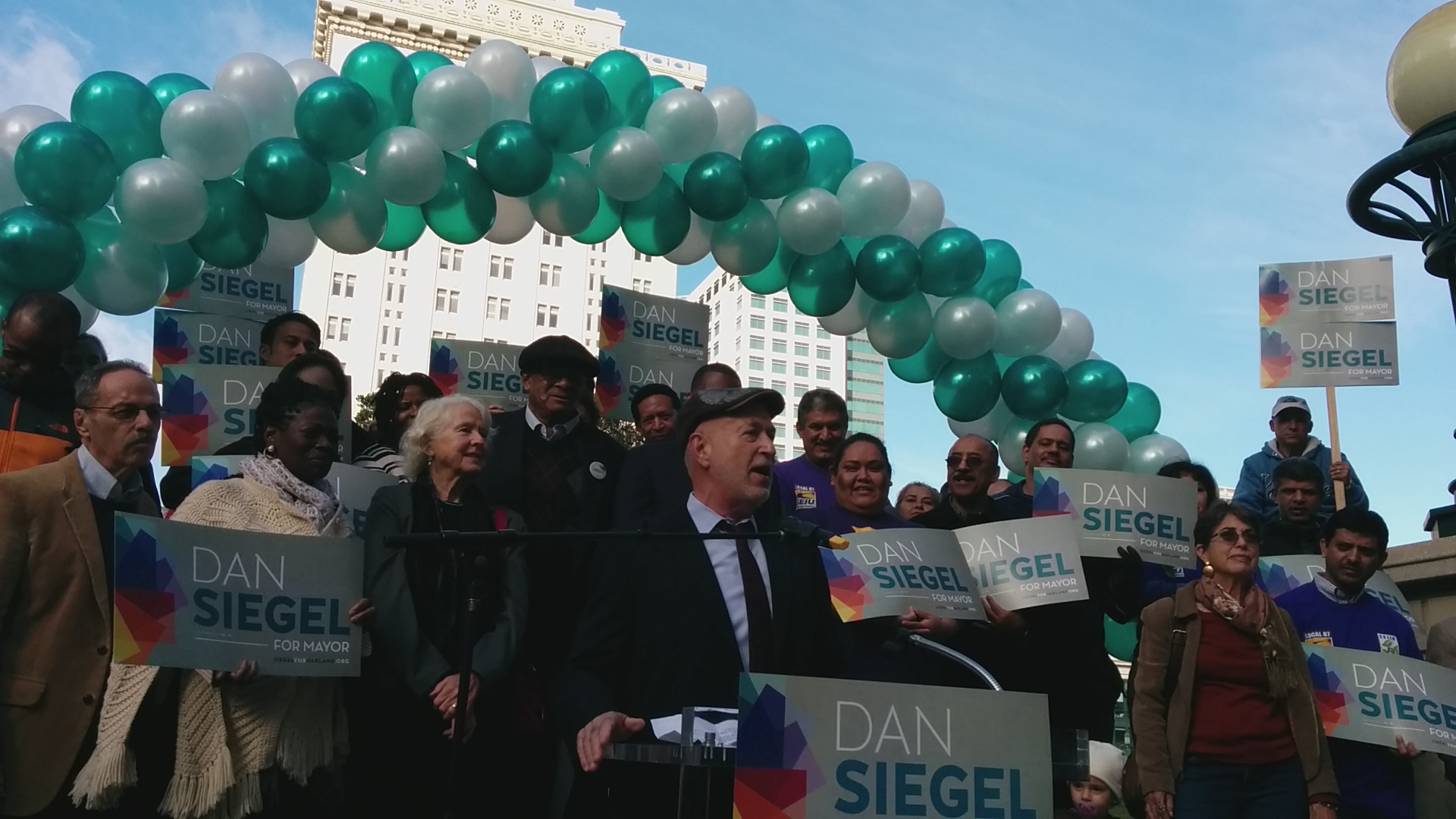
Oakland attorney Dan Siegel, known for a long history of involvement in Bay Area social justice movements, joined a group of more than 150 supporters in front of Oakland City Hall this morning to announce his candidacy for mayor.

In a speech emphasizing his campaign ideals of social and economic justice, Siegel called for shutting down Oakland’s recently approved Domain Awareness Center, raising the city’s minimum wage to $15 an hour, making improvements in public education “to level the playing field between children from affluent backgrounds and children from poor backgrounds,” and shifting the city’s approach to policing by reorganizing the police department to foster deeper community engagement. We caught a few moments from his speech here:

Guardian video by Rebecca Bowe

Siegel’s campaign co-chair is Walter Reilly, a prominent attorney affiliated with the National Lawyers Guild who said he has a long history of involvement with civil rights and social justice movements. “This is a continuation of that struggle,” he said, adding that Siegel’s affiliation with “a progressive and class-conscious movement” is sorely needed in Oakland.

Left Coast Communications was tapped as Siegel’s campaign consultant. Siegel’s communications director is Cat Brooks, who was previously an organizer and sometimes spokesperson for Occupy Oakland.

In 2011, when the Occupy Oakland encampment sprung up in front of Oakland City Hall, Siegel resigned as a legal advisor to Mayor Jean Quan over a difference in opinion about her handling of the protest movement. Police crackdowns on Occupy, which resulted in violence and the serious injury of veteran Scott Olsen, made national headlines that year. 

Olga Miranda, an organizer with San Francisco janitors union, SEIU Local 87, also spoke on Siegel’s behalf. “San Francisco has become for the rich, and we understand that,” she said. “But at the same time, Oakland isn’t even taking care of its own.” Referencing gentrification, a term that seemed to be everyone’s lips, she added, “Dan understands that if you live in Oakland, you should be able to stay in Oakland.”

Asked why he’d decided to run, Siegel told the Bay Guardian, “I feel that not only in Oakland but across the country, things are really ripe for change. When you have a city like Oakland where so many people are in poverty or on the edge of poverty, or don’t have jobs or face evictions … it’s no wonder that the social contract falls apart. It seems to me that what government should do is elevate the circumstances of all people, and particularly people who are poor and disadvantaged.”

Voter Approval to Waterfront Development campaign officially underway

25

The campaign to subject big projects proposed for San Francisco’s waterfront to popular approval is officially underway, with the City Attorney’s Office today issuing the ballot title and summary for what is now officially known as the Voter Approval to Waterfront Development Height Increases initiative.

The effort, which grew out of the successful No Wall on the Waterfront campaign that stopped the 8 Washington luxury condo towers in November, must collect at least 9,702 signatures by Feb. 3. Those interested in signing or circulating petitions can start at noon this Saturday with a launch event at 15 Columbus Avenue, the same campaign headquarters as the fall campaign.

“The idea was to have a public process around what we’re going to do with the waterfront,” campaign consultant Jim Stearns told the Guardian.

The trio of high-profile projects that would be most directly affected by the initiative are the proposed Warriors Arena, hotel, and condos at Piers 30-32, a large housing and retail project proposed by the San Francisco Giants at Pier 48, and a sprawling office, residential, and retail project that Forest City wants to build at Pier 70.

For a complete rundown of those projects, this initiative, its chances of success, and its larger political implications, pick up a copy of next week’s Bay Guardian.   

Got pests? Open data project reveals housing code violation data

Thanks to a handy new online platform created by the city’s Department of Public Health, in collaboration with the Mayor’s Office of Civic Innovation and Code for America, you can now determine whether the rental you’re eyeing is moldy, pest-ridden, or otherwise hazardous to your health – before signing a lease.

Investigating a potential landlord’s track record is just one application for the House Facts data set, an open data tool rolled out six months ago that instantly provides building owners’ names, code violation data, property assessment information and other relevant information associated with San Francisco addresses, all in one place.

Let’s say, for example, you were contemplating paying $1,650 a month to inhabit a 300-square-foot studio, right in the center of the Tenderloin. Now there’s a bargain in a red hot housing market! 

But before you get all excited and drain your bank account to plunk down a security deposit, surf on over to HouseFacts and punch in the building address. With this simple search, you might discover that this building has undergone inspection by city agencies a grand total of 73 times, most recently 11 months ago, with a total of 23 violations recorded.

Skim the list of violations and you’ll notice the words “rodents,” “insects,” “unsanitary conditions,” and even (big red flag here!) “biohazards (human feces).”

As they say, knowledge is power.

To be fair, some of those violations were recorded practically an eternity ago, and things could well have been cleaned up since – but having instant access to these track records could prove to be a check against negligent landlords.


A map of housing inspection data prepared by DPH.

The initiative to develop a uniform format and open platform for San Francisco housing inspection data was spearheaded under the environmental health division of the Department of Public Health in collaboration with city government’s growing tech innovation wing, and it’s now being emulated by several other cities nationwide.

DPH’s former Environmental Health Director, Dr. Rajiv Bhatia – who recently resigned after being targeted with a mysterious investigation that resulted in no findings of misconduct – was instrumental in advancing the open-data project under the Program on Health, Equity and Sustainability.

“We decided releasing this data would have the potential to improve government regulation,” notes Cyndy Comerford, manager of planning and fiscal policy in the environmental health division, who’s continued to move it forward since Bhatia’s departure. “Within San Francisco, there are many people who live in dilapidated and poor housing.” 

Residences plagued with rodents, cockroach infestations, lead, or mold present higher risks for health afflictions, such as allergies, respiratory conditions or cancer.

The enhanced transparency can strengthen code compliance and lead to an overall reduction in medical costs for preventable conditions, Comerford said.

Slumlords, beware: The tool has also been implemented at a time when the city is signaling that more aggressive code enforcement is on the horizon.

At the Jan. 7 Board of Supervisors meeting, Sups. Scott Wiener and Malia Cohen called for a hearing to get a better handle on building code enforcement.

“There’s not really any clear procedure for when these cases are closed, or how they’re closed,” said Jeff Cretan, a legislative aide for Sup. Scott Wiener.

“Our complicated code inspection system lacks sufficient coordination and communication among the different departments,” Wiener noted in a statement. “In addition, departments sometimes appear to be reluctant to pursue enforcement due to budget concerns.”

While the health department’s actions seem geared toward preventing ailments arising from poor housing conditions, the supervisors’ effort seems to stem from a quality-of-life concern. Cretan said his office regularly receives complaints from “really wired-in, aggressive Noe Valley neighbors.” He added, “People will call because they’re worried about hoarders.”

Protect pedestrians, crack down on red light runners

36

It’s good to see City Hall finally focusing on pedestrian safety in San Francisco, where the streets are more dangerous than ever for their most vulnerable users, with the number of pedestrians and cyclists killed by motorists spiking last year.

Better streetscape design is part of the solution, and the advocacy group WalkSF will be holding the latest in its series of focus groups this Saturday seeking solutions to the problem. It is working with city agencies on a program called WalkFirst to address the issue.

But there’s another solution that’s even more obvious and immediate, and Sup. Scott Wiener hit on it at yesterday’s Board of Supervisors meeting when he said (according to the Examiner), “It’s remarkable how little traffic enforcement we have…I’ve never been in a place with less traffic enforcement than in this city.”

Actually, it isn’t that the San Francisco Police Department doesn’t do traffic enforcement, as we learned this fall when officers pulled over dozens of cyclists slowly cruising through stop signs on the Wiggle. The problem is that SFPD ignores the most obvious and dangerous violations: motorists running red lights and otherwise driving recklessly.

Everyday on my commute home up Market Street, I see at least three anxious drivers running red lights. Everyday! This morning, on my way to work, a driver ran a red light right in front of an SFPD cruiser, and that officer ignored it. These drivers are speeding up within reach of pedestrians, who often wrongly assume green means they are safe to cross.

So drivers need to take a breath and realize the seconds they save isn’t worth the risk they’re taking with other people’s lives. And the SFPD needs to ticket more of these drivers and start sending the message that such selfishness won’t be tolerated.  

SF food bank short 2,200 volunteers

13

Well, that was fast.

As it does every year, the cheery holiday season brought thousands of volunteers to the San Francisco and Marin Food Banks. Hungry folks were fed (despite some controversy), bellies were filled, hearts were warmed.

So much for that.

The holidays are over, the Christmas songs no longer play in our stores, and the barrage of volunteers is now at a standstill. The food bank is now short 2,200 volunteers, the part time work equivalent of about 60 full time employees, a food bank spokesperson said.

foodstats“Our volunteers are crucial to our mission and on average help us in sorting, bagging, gleaning, and boxing food. They on average help to sort over 1 million pounds (of food) per month,” Volunteer Services Manager Sean Rosas told us. “Heading into January, the Food Bank isn’t as top of mind for people as it was during November and December. We have lots of empty shifts on our calendar.”

Yes, this happens every year, but a new report from the city shows San Franciscans are at greater risk of food insecurity than ever.

One of the most expensive and wealthy cities in the nation still grapples with a hunger problem, highlighted in a recent report from the city’s Food Security Task Force. One in four San Franciscans are “food insecure,” meaning they’re starving or eating dangerously unhealthily due to poverty. 

The food bank fights this every day. It doesn’t need volunteers in its pantries, but for processing food in a giant warehouse nestled on Pennsylvania Avenue, behind Potrero Hill. There, volunteers package dried goods and sort produce.

That food then is shipped to over 200 food pantries in San Francisco and Marin, serving most all of San Francisco’s neighborhoods. From Glide Memorial Church in the Tenderloin to the Women’s Building in the Mission, more than 200,000 hungry San Franciscans are fed by the organization annually. 

Frighteningly, without volunteers, some of their fresh food will go to waste. 

“Currently, we distribute over 60 percent of our produce to nonprofit partners,” Rosas said. “A drop in volunteers would significantly impact our gleaning and distribution of fresh produce like oranges.  Ultimately this would lead to more food waste and composting costs for our organization.” 

For more information on how you can help, visit http://www.sfmfoodbank.org/

Pelosi denounces City College’s accreditors

41

Rep. Nancy Pelosi denounced the accreditors seeking to close City College at a press conference held yesterday at the school’s Chinatown campus.

“You can be sure it will be subjected to harsh scrutiny in terms of how they do what they do, who they are and why is it the Department of Education cannot do more,” she said to the crowd of local luminaries and City College faculty. 

City College of San Francisco is one of the state’s largest community colleges, home to a student body of over 85,000. The school came under fire from its accreditors, the Accrediting Commission for Community and Junior Colleges, last July, who moved to revoke the school’s accreditation. Such a move would force the college to close. 

Since then the ACCJC has been beaten back from many directions: it’s tangled in three lawsuits, as well as a state inquiry from the Joint Legislative Audit Committee. Arguably the highest profile thrashing the agency received was from Congresspeople Anna Eshoo and Jackie Speier in November.

“I think the ACCJC has run amok, they have lost their vision — if they ever had one,” Speier told the Guardian. “They are riddled with conflicts of interest and arbitrariness.”

Pelosi voiced support for those views yesterday.

“I want to associate myself with remarks Congresswoman Jackie Speier and Anna Eshoo,” she told the crowd, to cheers. 

Singing the praises of City College is all well and good, but the Guardian asked her directly: what can you do, and what is your next step?

Pelosi indicated that Congresspersons Speier, Eshoo, and George Miller, would review the role of the Department of Education regarding accreditors at a congressional higher education committee. This is something they’ve looked at before

“We’ll see what is recommended when we go there,” she said. “Suffice to say this is not something that will be ignored.”

New FCC boss coming to Oakland

On Thu/9, Voices for Internet Freedom, Free Press and the Center for Media Justice are hosting Tom Wheeler, the recently installed Federal Communications Commission chairman, for a town hall-style meeting about the state of communication policy, both in the Bay Area and nationally.

The event, which will be held in Nile Hall of Preservation Park, runs from 7-9pm and will feature a panel discussion, commentary from influential community members and remarks from Wheeler. There also will be a lengthy time slot reserved for public comments and questions. While the event has sold out, viewers can catch a live webstream here during the event.

“It’s going to be a fairly short event, but power packed,” said Malkia Cyril, founder and Executive Director of the Center for Media Justice. “We want to bring the frame of consciousness about the role of media and culture to the dialogue with the FCC, [because] that generally isn’t there.

“Generally, when it’s those kind of conversations they have, we are not the kind of people they’re talking to. And we want to make sure that the voices of folks that are usually in the margins of debate really get heard.”

Preceding the main event will be a smaller, more focused meeting between Wheeler and “a few leaders of social justice in the Bay Area,” according to Cyril. The purpose is to give local leaders a chance to share the types of conditions affecting their communities in a small group setting, she added.

But it will be during the main town hall meeting that Wheeler, who was officially named FCC Chairman on Nov. 4 of 2013, will face a litany of questions from Oakland-area community members.

The topics expected to be broached during the meeting range from broad — net-neutrality, ownership of broadband, corporate ownership of broadcast mediums — to specific — like the fact that, according to Cyril, “there are zero African-Americans who own a full power television station in this country.”

And they’ll also want to discuss the abject employment bridge between the FCC and big-money corporations. “Given the fact that previous FCC Chair, [Julius] Genachowski just got a huge Wall Street job, I think they’ll also raise questions about this revolving door at the FCC between companies and policy makers,” said Cyril, who was referring to Genachowski’s transition from FCC Chair to the Carlyle Group, which is (naturally) a global asset management firm.

“I think we see that as a critical issue right now, so that will probably come up.”

For more information about the event, or to be added to the waitlist, visit tinyurl.com/OaklandFCCMeet.

Stealing secret records about government spying used to be way more complicated

In 1971, a group of radicals broke into an FBI office in Media, Pennsylvania and stole a bunch of documents about J. Edgar Hoover’s surveillance program targeting dissidents and antiwar activists.

Thanks to their criminal act, which they followed up by anonymously sending copies of the files to major media outlets, awareness of FBI spying under Cointelpro penetrated mainstream consciousness.

More than 40 years later, the people behind that theft have unmasked themselves in a new book, The Burglary: The Discovery of J. Edgar Hoover’s Secret FBI, authored by Betty Medsger. The former Washington Post reporter convinced some of the burglars to come forward and tell their tale. Medsger previously served as chair of the journalism department at San Francisco State University.

A New York Times piece spotlighting the book describes the historic event and draws a comparison with modern day whistleblower Edward Snowden, who used access granted to him as a National Security Agency contractor to shed light on secret documents detailing NSA surveillance programs.

“Unlike Mr. Snowden, who downloaded hundreds of thousands of digital N.S.A. files onto computer hard drives, the Media burglars did their work the 20th-century way: they cased the F.B.I. office for months, wore gloves as they packed the papers into suitcases, and loaded the suitcases into getaway cars. When the operation was over, they dispersed.”

The burglary also entailed lock picking, opening a window with a crowbar, and memorization of FBI staff’s comings and goings; also, they never again met as a group after making off with the files.

Even as technology has given intelligence agencies the ability to build a once unfathomable surveillance system that regularly sweeps in the communications of millions of law-abiding Americans, it’s also made it easier for information about such activities to be brought into the light of day – with just a few simple keystrokes.