News and Politics | San Francisco Bay Guardian

News & Opinion

Desegregate our schools

8

By Matt Haney

OPINION

Sixty years after the landmark Supreme Court decision Brown v Board of Education, we face the shocking reality that our nation’s schools are more racially and economically segregated today than they have been in more than four decades.

The vast majority of public school students attend schools where students look like them and share their socioeconomic background. Even areas where significant progress has been made are experiencing resegregation, including here in San Francisco.

For over 20 years, 1983-2005, San Francisco schools were under a federal court-ordered consent decree to eliminate segregation and accelerate racial equity, including a controversial assignment policy that limited enrollment of any ethnic group to no more than 45 percent in any school.

This policy ended after it was found unconstitutional in 2001. Since then, San Francisco schools have experienced a steady resegregation. A quarter of our schools have more than 60 percent of a single ethnic group, even though the district is highly diverse and lacks a majority group.

After three years of a new student assignment system, despite holding the reduction of racial isolation as a central goal, there has been little change. In the face of neighborhood segregation and displacement, family request patterns, language pathways, and elimination of school buses, our current student assignment system, absent additional interventions, may be outmatched in addressing this challenge.

Thus, 60 years after Brown, we must ask ourselves the question: Is racial and economic integration still a priority? And what does this mean for our ability to provide educational opportunity for all students, regardless of race or socioeconomic status?

While Brown is best known for helping end legalized segregation and sparking the Civil Rights Movement, Brown’s foundational premise is that all students have a right to educational opportunity.

In San Francisco, as in other cities, racial isolation and concentration of underserved students in the same school are highly correlated with other school factors that define school quality, including average years of teacher service, teacher turnover, attendance, and suspension rates. San Francisco’s most racially isolated and underserved schools are, thus, also those that are the most persistently low achieving.

As daunting as it may seem, there are things we can do now to restore the promise of Brown.

First, we should acknowledge that establishing racially and economically diverse schools still matters, and draw on creative and intentional tools at our disposal to work towards them. Segregated schools should not be accepted as a foregone conclusion, particularly in light of the well-documented challenges of ensuring educational opportunity in these contexts. We should look to diverse school models here in San Francisco, especially those where parental involvement is central.

Second, we must be honest about the resources needed to ensure equal opportunity for every student, particularly those in racially and economically segregated schools. This will take much more than small reforms or even equalizing funding; in fact, San Francisco has long had a system where schools with higher needs are given additional funding.

Ensuring true opportunity for every student in racially isolated schools requires transformation of what schools look like in these contexts, including longer school days, much smaller classes, high quality early childhood education and after school programs, experienced and highly paid teachers, and full-service school health clinics.

Third, we should recognize the interconnectedness of education with other forces, particularly poverty. Students come to school with deep trauma and stress caused by violence, poor nutrition, and economic instability, which deepen segregation and educational inequities. Anyone who is an education advocate must also be an antipoverty advocate, a worker’s rights advocate, a housing advocate, and a health care advocate.

These days it seems our collective outrage around race is applied in short bursts, often to sound bites and celebrity comments. We need to channel that energy and dialogue instead to a sustained focus on what is truly most unacceptable — the persistent unequal and segregated education of our children. Sixty years after Brown, equal education in diverse contexts for all children may be past due, but not past solving.

Matt Haney is an elected member of the San Francisco Unified School District Board of Education.

Neighborhood papers tell the story of SF

1


By Jessica Lipsky

news@sfbg.com

Before many San Francisco residents traded their newspaper subscriptions for Internet media, a dozen monthly papers covered the beat of the city’s distinct neighborhoods. Nine of these papers, whose heyday came with radical changes in the ’70s and ’80s, are being digitally archived by local historical organization Found SF.

“The papers all have their own personalities,” said Found SF organizer LisaRuth Elliott. “You get a sense of even how those change over time too, whether it’s a hard hitting article or it’s talking about the evolution of how the street businesses changed in Noe Valley. Archiving these papers opens up the gates for all the stuff we don’t know, and that you want to find out about, in San Francisco.”

Over the course of six months, Found SF volunteers will archive two decades’ worth of content from papers published throughout the city — the Noe Valley Voice, Tenderloin Times, Visitation Valley Grapevine, Richmond ReView, Potrero View, the New Fillmore, El Tecolote, North Mission News, and the Glen Park Perspective — in partnership with the Internet Archive and San Francisco Public Library. Since beginning the project in January, Found SF has scanned over 200 issues and tagged each with searchable keywords.


BILINGUAL VOICES

While several of the papers have come and gone, the publication that inspired the project is still going strong. Born from 1968 riots at San Francisco State for relevant ethnic education, the Mission’s El Tecolote was founded in 1970 as a bilingual paper dedicated to social activism. The paper made great inroads in the mid-’70s fighting for equitable health services, such as a bilingual emergency phone system, while covering Latino arts and civil wars in Nicaragua and El Salvador.

“We started El Tecolote to fill the gap of the mainstream media, which wasn’t covering this neighborhood with any real consistency; if it did it was often times negative news,” founder Juan Gonzales said. “The mission was to really be a voice for the neighborhood and hopefully move the spirit of organizing ahead to make some social change.”

In addition to taking a hard line on local politics and immigrant issues, the archives document the evolution of San Francisco from various perspectives. Residents of lower-income neighborhoods were displaced, and many districts leveled, during urban renewal projects in the 1950s and 1960s, while a 1973-75 recession caused further damages. The resulting plight set the stage for journalism driven by demand for hyper-local coverage of LGBT and feminist rights, gentrification, and third-world issues.

“In the mid-’70s there was consciousness around neighborhoods as social centers and places where community organizing was happening,” Elliott said. “People are facing eviction, they’re protesting, there are these vigils happening, and people talking about gaining rights for long-term things. We’re still working with the legacy of some of the housing decisions [San Francisco] made around that time due to the activism,” she added, citing the Tenderloin Times’ advocacy for SROs in the face of hotel development west of Union Square.


RESILIENCE IN HARD TIMES

The New Fillmore — established in 1986 as the city became inflicted with crack and AIDS epidemics, just as Reaganism swept in — was at the heart of socioeconomic changes that transformed parts of San Francisco from what felt like a blue-collar town to an increasingly white-collar city. Approximately 30 blocks in the Fillmore and Western Addition were leveled and left vacant until the ’80s, and the monthly paper played an important role in chronicling the return of businesses to the once thriving neighborhood.

“We ended up with the worst of both worlds in the Fillmore,” said Thomas Reynolds, who took over publishing the New Fillmore in 2006. Redevelopment efforts initially provoked no organized public protest, he said, but later “generated a lot of activism. The New Fillmore managed to capture a lot of the change that was coming to the neighborhood, and a lot of the flavor and history of the neighborhood that was being lost.” The paper encouraged civic engagement through a regular architecture column that featured local homes and helped owners register their historic buildings.

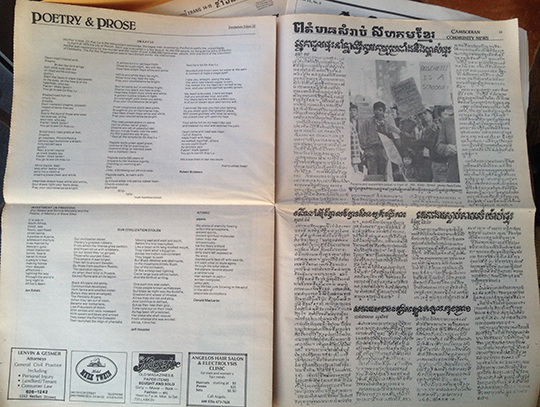
Several papers served neighborhoods with large refugee and immigrant populations, many of whom didn’t speak or read English. The Tenderloin Times promoted social services and encouraged activism through coverage of Southeast Asian and local politics, while publishing simultaneously in English, Lao, Cambodian, and Vietnamese over its two-decade run. Others chronicled changes in demographics, including an influx of Chinese residents into Visitation Valley and a population shift in the Mission from predominately Chicano to more Central Americans.

The Noe Valley Voice also took an international turn when escaped Irish prisoner Liam Carl toured the U.S. to expose harsh conditions in British jails. Carl entered the country illegally and was housed in a Noe Valley home in the fall of 1980, telling the Voice, “If [prisoners] thought that perhaps there was a chance that they could be heard through less drastic measures … and maybe bring about some change without so many people having to die, perhaps I can save lives.”

While the newspapers often differed in their coverage, each featured complementary stories chronicling the 1989 Loma Prieta earthquake. Common features included how to check for damage, profiles on restaurants that fed the neighborhood or, as one Noe Valley Voice headline described the experience of meeting neighbors during a power outage: “We Could See the Stars.” Ahead of the 25th anniversary in October, Found SF has examples of quake coverage online.

“It makes me think that the city is comprised of all these little villages and it’s a little hard to say San Francisco has one direction, one value system,” Elliott said. “The papers show the wide variety of people who live in the city … but it’s all very much at a very personal level. They know each other. They’re telling stories about each other.”

For more information on the neighborhood newspaper archiving project, or to volunteer, visit foundsf.org.


Bernal blows up

21

rebecca@sfbg.com

When Herb Felsenfeld and his wife, Gail Newman, look out the window of the Bernal Heights home they’ve lived in for more than 30 years, they see a vacant hilly lot grown in with tall grass, stretching up in the direction of nearby Bernal Heights Park.

The surrounding area has become quite popular. Earlier this year, real estate firm Redfin crowned Bernal Heights the nation’s No. 1 “hottest neighborhood,” its desirability ranked using “a combination of big-data analysis and real-life human experience,” according to the company blog.

There are plans to build two new single-family homes on the slope directly above them, causing a bit of a neighborhood stir. But one detail about this particular site — perched high atop Folsom Street on the eastern slope of Bernal Hill — has neighbors on edge.

Below the surface, extending up a 35 percent grade, is a natural gas pipeline owned and operated by Pacific Gas and Electric Co.

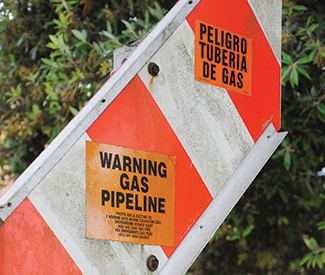
Property records designate it as Line 109, and it traverses the Bernal Heights neighborhood from farther south, running up Folsom Street. Two orange-and-white striped markers stake out its trajectory uphill, with an orange sticker on the back proclaiming, “Warning: Gas Pipeline.”

It’s serviced the area for at least 30 years, perhaps much longer, qualifying it as an aging piece of infrastructure. Felsenfeld, Newman, and neighbor Deborah Gerson say they’re worried that performing excavation on the slope for a road and new home foundations poses a safety threat.

Newman said she was especially perplexed by the San Francisco Planning Department’s issuance of a waiver of an environmental impact review, which is routine for a project of this size, citing no unusual circumstances. “I’m like, wait a minute,” she said. “There’s a pipeline here.”

One would think that any sort of risk would be eliminated by routine safety protocols. But it gets complicated when one considers that PG&E is under federal indictment for criminal negligence for its alleged failure to keep up with pipeline maintenance, due in part to sloppy recordkeeping. There may indeed be little risk involved with the new construction at this site — but then again, the neighbors’ concerns raise questions about whether adequate measures are in place to guarantee safety in this and other situations.

The criminal charges facing PG&E that were filed March 31 stem from an investigation launched in the wake of a fatal 2010 explosion in San Bruno caused by a pipeline rupture, which killed eight people and destroyed an entire neighborhood. The utility is fighting the charges in court and has reportedly invested $2.7 billion in shareholder dollars toward safety improvements since.

But according to the results of a regulatory audit on PG&E’s assessment of its own pipeline records that was undertaken to set things straight after the tragic explosion, crucial pipeline information is still missing or flawed, as the San Francisco Chronicle recently reported.

“Given the San Bruno disaster and the recent media revelations about PG&E’s pipes, we are wondering what information you have gathered on this subject,” Felsenfeld wrote in a letter to one of the housing developers, Fabien Lannoye. “Where exactly is Pipeline No. 109? How deeply is No. 109 buried? What is Pipeline No. 109 composed of? How big in diameter is Pipeline 109? How/with what are the pipe seams welded?”

He sent the same set of questions to PG&E. So far, Felsenfeld hasn’t received any answers. PG&E has also been stonewalling the developer’s information requests.

Lannoye, who is building one of the two new houses, described the project as a two-story, single-family home where he hopes to live with his wife and two children. He said he understands the neighbors’ concerns about safety, but also believes they are organizing in an effort to prevent him from moving forward.

When it comes to his communications with the utility company, however, Lannoye is a bit more baffled. “It’s kind of a little bizarre that we’re not getting clear information,” he said. “I’ve contacted like 15 different people from PG&E, and every time, they send me to someone else. Either they don’t want to give me the information, or they don’t know what it is.”

PG&E did not respond to the Bay Guardian‘s request for comment.

In general, the only parties who seem to be directly involved when there is construction near natural gas pipelines are the utility company and the project developer. An association called the Common Ground Alliance maintains the 811 phone line — a service known as Call Before You Dig — to ensure the location of underground lines are marked prior to any excavation.

When the Guardian phoned San Francisco’s Department of Public Works to ask if the agency has a pipeline risk assessment procedure in place when new construction is planned, we were told that such a thing might fall under the scope of the Department of Building Inspection.

But in a voicemail, DBI spokesperson Bill Strawn responded that such a thing might be up to the Department of Public Works, adding, “There’s no restriction about somebody building a project or a house somewhere in the vicinity of a natural gas pipeline.”

All of which means it falls to PG&E to ensure that high-pressure underground lines are safe, with no chance of rupture when new foundations are being installed close by. But PG&E doesn’t always know what it’s got. According to charges in the federal indictment, the utility created a GIS database in the late 1990s based on pipeline survey sheets that contained erroneous or incomplete information. PG&E then relied on that database to make integrity management decisions.

The indictment noted that prior to the San Bruno disaster, PG&E had been intentionally elevating pressure levels on Line 132, the one that ruptured, as well as Line 109, to maintain peak pressure levels in accordance with federal regulations. But experts have noted that this spiking practice could erode the integrity of a line if there are vulnerable welds.

“Our plan,” Lannoye explained, “is not to dig where the gas line is.” Line 109 would run beneath a sidewalk, he added.

Marilyn Waterman, another neighbor, outlined the situation in an email to University of California Berkeley professor Robert Bea, a nationally renowned civil engineer. She asked Bea if concern is warranted.

“Given the background you provided in your email, yes — you should be concerned,” he responded. It’s an old line, Bea pointed out, in an area with highly variable topography, with no available records detailing its operation and maintenance.

“This list is identical to the list of concerns that summarized causation of the San Bruno Line 132 gas pipeline disaster,” Bea wrote. “The fundamental ‘challenge’ associated with your concern is tied to the word ‘safe.'”

His rule of thumb? “If the potential consequences associated with a failure are low, then the likelihood of the failure can be high. If the potential consequences are very high, then the probability of failure must be very low.”

Fast food workers strike in the Bay Area and worldwide

0

Bay Area fast food workers who walked out and picketed their stores last year are set for a repeat performance in their battle against the house that Big Mac built, timed to debut right as the Guardian hits the streets. And this strike is also set to expand.

On May 15, fast food workers worldwide plan to rise up in protest of unfair labor practices and punitive actions by their bosses. Fast food workers in the Bay Area will be joining the strike. Labor sources tell us their numbers may double thanks to new workers joining the movement in Pleasanton, Livermore, and Oakland.

The new Oakland march is twofold: One will picket a McDonald’s on East 12th Street, and another a McDonald’s on 14th and Jackson.

“I haven’t had a raise in three years,” a McDonald’s worker who identified herself as Markeisha told us just after she went out on strike from an Oakland McDonald’s in December. And contrary to the common narrative of fast food workers being independent teenagers, Markeisha said she has two children, and she is their sole provider.

Another common misconception is that workers are merely fighting for higher wages. Although raises are among their needs, fast food workers also contend they are a vulnerable workforce. Wage theft, low salaries, slashed hours, and punitive measures for speaking out are among the grievances fast food workers allege against their bosses at chains including McDonalds, Burger King, and Taco Bell.

“One thing we found when talking to fast food workers was wage theft issues were high,” Service Employees International Union Local 1021 Political Director Chris Daly told the Guardian. “When you’re making $8-11 an hour, a couple shifts can be the difference between paying the rent or not.”

Workers we talked to at the last strike alleged their jobs at McDonald’s and Kentucky Fried Chicken paid so low they had to also enroll in CalFresh (food stamps) to afford food. That sort of government subsidy for big business puts a strain on the taxpayer, former Labor Secretary and current UC Berkeley professor Robert Reich noted on his blog.

McDonalds alleges last year’s actions were strikes-in-name-only. “To right-size the headlines, however, the events taking place are not strikes. Outside groups are traveling to McDonald’s and other outlets to stage rallies,” McDonald’s wrote in a press statement.

Counter to the corporate narrative, the Bay Guardian witnessed multiple Oakland McDonalds workers joining picket lines (captured on video: “Oakland joins 100 cities in national strike,” Dec. 5,www.sfbg.com).

The next Fast Food Strike will have a world focus. Earlier this month, Salon.com reported the strike will reach cities including Karachi, Casablanca, London, Bangkok, Buenos Aires, Geneva and San Salvador.

“The fast food organizing across the country speaks to how this issue is capturing not just the public imagination,” Daly told us, “but speaking to low-wage workers realities to struggling simply to live.” 

Bimbo’s 365 club

0

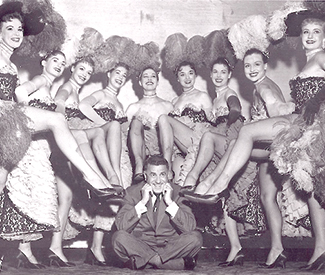
When Agostino “Bimbo” Giuntoli first arrived in San Francisco from Italy in 1922, the 19-year-old found work as a janitor and then as a cook at the swanky Palace Hotel. He likely didn’t think that, within 10 years, he’d be running one of the hottest Prohibition-era speakeasies in the city — where well-heeled guests came to drink, gamble, and watch a young Rita Hayworth dance in the chorus line. Even tougher to believe, most likely, would be the fact that his club is still in business, and run by his family, nearly 85 years later.

Bimbo’s 365, named for its owner (whose nickname was born of a boss not knowing how to pronounce Italian) and its original address on Market Street, is one of a dwindling number of family-owned businesses in San Francisco — and at a time when other historic venues like Café du Nord are shuttering or getting a yuppified overhaul, Bimbo’s seems (knock on wood) to be going strong.

“We work really hard, and we’re very fortunate to be where we are,” says Michael Cerchiai, who reopened the club as a live venue in 1988 after nearly two decades of it being available only as a rental for private parties. Soon after, Bimbo’s served as a hub for the burgeoning swing revival of the ’90s and the growing acid jazz scene. Erykah Badu played there on her first national tour, as did Fiona Apple; the last time George Clinton and the P-Funk All-Stars came through, Stevie Wonder showed up unannounced and sang too.

“We’re a tight-knit Italian family, so it’s a lot of tough love. We get things off our chest, and I think sometimes you can’t do that when it’s not a family-run business,” says Cerchiai, who recalls going to shows with his siblings when they were small children — back when the club was black-tie only. “We had a Felix [tuxedo rental] down the street, so we’d get dressed up and check out the show, and that was a way to see our grandfather and our dad.”

Michael’s brother Gino, and their father, Graziano Cerchiai (Mr. Bimbo’s 83-year-old son-in-law), are three of the seven staff members running the present-day Bimbo’s — whose stage has most recently seen Nicki Bluhm and the Gramblers, Flaming Lips, and the White Stripes, among others.

Says Cerchiai, “Having grown up here, loving music, it’s just gratifying to see people coming out, enjoying a show, and having a good time.”

1025 Columbus Ave, SF

(415) 474-0365

bimbos365club.com

Trouble Coffee

0

Inscribed on the window at the Yosemite Avenue location of Trouble Coffee & Coconut Club is the phrase: “Serving guts and honor.”

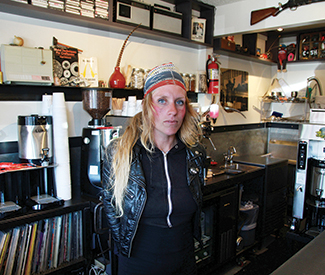
Proprietor Giulietta Carrelli, who opened the Bayview location on April Fools Day of 2013, six years to the day after opening the first Trouble Coffee location on Judah Street in the Outer Sunset, said she started it “to build a community.”

It’s not a café where patrons sit silently on laptops. Nor should one post Instagram photos of the signature cinnamon toast (which costs $3.50, by the way, despite being credited with touching off the $4 toast madness as a signifier of gentrification, something antithetical to what Trouble stands for).

No, Trouble is “a community built via word of mouth instead of technology,” explained Carrelli, a petite blonde whose skin is covered in tattoos, including freckles splashed across her cheekbones. “I knew I was going to build a place that was just face-to-face conversation, as an art form.”

The coffee shop was created with the help of friends and Carrelli explained that she built Trouble “because I couldn’t hold a job.” And for good reason: For years, she’d experienced schizophrenic breakdowns that made it impossible to work steadily. Over time, she’s developed coping mechanisms to get through the worst: Swimming in the ocean. Eating coconuts. Structure.

“Trouble is a survival tool,” both for her and her customers, Carrelli explained. “Everyone needs a place that they trust.” She’s known for her mantra, build your own damn house. What’s it mean? “Your house is your psyche,” she says. “Your house is your truth.”

Carrelli and her coffee shop were recently featured on This American Life, converting her into a celebrity. At first, she says she felt odd having the whole world know about her struggle with mental illness. But one day, she received something in the mail that changed all of that. It was a postcard sent by a schizophrenic, covered in feathers and flowers. On the back was the message: “I’ve lit myself on fire three times. After hearing your story, I don’t think I’ll do it again.”

4033 JUDAH ST., SF

1730 YOSEMITE AVE., SF

TROUBLECOFFEE.COM

Tobener Law Center

0

San Francisco attorney Joseph Tobener has been doing tenants rights work in San Francisco for more than a decade, starting his own practice in 2002, where he currently employs three other attorneys and two paralegals. Another pair of attorneys who used to work there recently spun off their own practice.

In the last year of so that Tobener came onto our radar with the work he’s done fighting evictions and displacement, including representing an organization leading those fights, San Francisco Tenants Union, and paying attorney to do one day a week of volunteer work for SFTA, the San Francisco Housing Rights Committee, and other organizations. 

“We’re busier than we’ve ever been. We get about 60 calls a week and we always give free consultations,” Tobener told us.

Among those calls have been tenants displaced so landlords can use Airbnb to rent rooms to tourists and get around local rent control laws and other tenants protections, an increasingly high-profile issue that Tobener has helped elevate through stories in the San Francisco Chronicle and Bay Guardian (see “Residents vs. tourists,” Feb. 4).

“I feel like we’ve made some progress in getting people aware of this issue,” he told us.

Under contract with SFTU, Tobener has gone on to sue seven more landlords who have evicted longtime tenants in favor of short-term tourist rentals that are illegal under city law, and he says that he’s preparing to file many more such cases (see “Lawsuits target Airbnb rentals,” April 29).

After also scoring a big recent victory by getting the city to finally fix elevators in public housing projects, Tobener has made a thriving small business out of defending the longtime residents from displacement.

21 Masonic Ave, SF

(415) 504-2165

Tobenerlaw.com

Thee Parkside

0

Once upon a time, the Bay Guardian was headquartered in a giant converted warehouse at the bottom of Potrero Hill. Since Thee Parkside was just a short walk away, at 17th and Wisconsin streets across from Jackson Park, it was only natural for the music venue and pub to become a regular destination for Guardian staff.

Many classes of interns were welcomed to the newspaper via pitchers of beer filled (and filled again) by Parkside bartenders. Departing staff members were sent off in style with farewell bashes staged at Thee Parkside. So it’s with nostalgia for the days when we could amble over to this venerable dive any time we pleased that we honor Thee Parkside with a small business award.

A music venue that hosts a mix of metal, punk, country, and garage rock performers, Thee Parkside has patrons who tend not to be overly concerned with frills — think tater tots paired with Happy Hour specials such as $1 Natural Light in a can or $3 PBR tall boy specials. The dim interior is often filled with ecstatic sweaty music fans getting lost in a musical crush of sound, the back patio a glorious outdoor refuge, the bathroom doors well-loved with layers upon layers of graffiti and band stickers.

Aside from the punk and metal acts it’s probably most well known for, Thee Parkside also hosts Free Twang Sundays beginning at 4pm. The all-ages shows feature the Bay Area’s best country, western, bluegrass Americana, and rockabilly acts — if it’s twang, it’s Thee Parkside’s thang.

1600 17TH STREET

THEEPARKSIDE.COM

(415) 252-1330

Panchita’s Pupuseria

0

In the gentrifying heart of the Inner Mission District — near the corner of 16th and Valencia streets, where longtime bookstores, markets, bars, and restaurants have all been forced out by rising rents in the last year or so — a simple Salvadorean restaurant has continued to thrive by serving one dish, pupusas, to customers old and new.

Panchita’s Pupuseria is a wonderfully unassuming little restaurant that spills out of its own doors on busy weekend nights, with its family members joining the street food vendors on the sidewalk flipping these tasty treats, as they’ve been doing in a series of Mission locations over the last 24 years.

“My grandma and mom started it there with a bunch of my uncles,” Doris Vargas tells us of the original location on 17th Street that has since closed. She and her family don’t mind the challenging evolution of the Mission, with its influx of high-paid tech workers. “It has expanded our customer base. My mom loves that pupusas have been exposed to a larger crowd.”

The pancake-like pupusas are served right off the grill with hot sauce and curtido, a slaw-like mix of cabbage, carrots, and spices soaked (the word actually mean “soaked” in Spanish) in a vinegar that Vargas’ namesake mother makes herself, infused with pineapple, something she learned before emigrating from El Salvador at the age of 25.

Simple, delicious, family-run — and a survivor appreciated by us and the large crowds of newbies that have begun to discover it.

3091 16th St., SF

(415) 431-4232

SF LGBT Center Economic Development Department

0

The first initiative in the nation to “comprehensively address the economic barriers faced by low- and moderate-income LGBT individuals and families,” the 10-year-old San Francisco LGBT Center’s Economic Development Department (EDD) takes on a huge task.

More than a third of SF’s homeless people are LGBT. Transgender individuals often face huge amounts of discrimination in the workplace, and suffer from some of the highest unemployment rates as a result. Prejudice and, often, a lack of a structured environment due to homophobia, can discourage LGBT people from starting their own business or cause them to fear coming out at work.

The LGBT Center EDD energetically addresses these issues with a vast array of programs, events, collaborative workshops, and innovative actions. The center’s Small Business Services arm helps guide LGBT entrepreneurs all the way from pre-startup to expansion: free, one-on-one technical assistance, collaborative workshops, a credit-building micro-loan program, loan packaging, small business mentorship, and referrals to its huge small business development network.

Soon to launch: a “fun, intuitive, and user-friendly” business plan development app; B-Lab, a free drop-in incubator to share ideas, receive mentoring, and engage in mini-workshops; a “Capital Within Reach: How to Empower Your Small Business With Alternative Funding” seminar, including crowdsourcing tips, May 21 at 6:30pm; and, in October, the 2014 Bicoastal Economic Empowerment Week, with a chance to schmooze and learn from New York start-ups. The center’s Small Business Services’ keystone event, its Fall LGBT Career Fair, attracts thousands of attendees and hundreds of employers looking to make connection with LGBTs.

“Eighty-three percent of employers who participated in one of our recent career fairs said they plan to follow up with the candidates they met there,” Kevin Fu, the center’s public relations coordinator, says. “And during the 2012-2013 fiscal year, our Small Business Services Program provided technical assistance to 89 businesses, worked with 50 entrepreneurs to develop business plans, connected seven businesses to mentors and helped 12 small businesses secure $140,000 in growth capital.”

When grouped with the Economic Development Department’s other initiatives — including the LGBTQ Employment Services Program (which features the nation’s first specifically transgender-oriented employment program, TEEI), and the Financial Services Program, which supports asset-building and helps with credit repair and homebuying assistance —the LGBT Center is working overtime to keep the LGBT community on its financial feet.

1800 Market, SF

(415) 865-5664 (front desk); (415) 865-5555 (main line)

www.sfcenter.org

HeartZilla

1

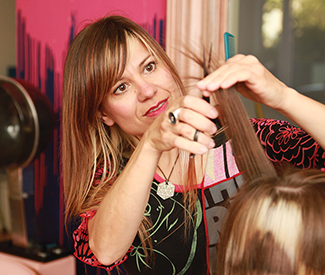
Hidden in a strange, inward-facing compound at 18th and Folsom streets that is filled with small art galleries, hair salons, and oddly themed storefronts, Pirate Salon has always been groovy spot to get a killer hairdo with a rogue flair, particularly by the Barcelona-born-and-trained queen of color and style Ana Rivero Rossi for the last four years.

While Pirate Salon is still a small business worth recognizing and visiting, Rivero Rossi’s brand new salon on Valencia Street between 24th and 25th, HeartZilla, is really something special. Along with her boyfriend Todd Hanson, also a fellow artist, Rivero Rossi has scoured the Bay Area for groovy vintage chairs, fixtures, and other funky decor that ooze the same unique flair (for example, we dig the colorfully drip-painted walls) that she brings to her clients’ hair.

“It is important that each hair style that I do is custom designed, with love, to the desires and idiosyncrasies of the client. I collaborate with every client to create a look that allows each person to feel uniquely themselves, their inside worlds expressed outwardly, with freshness and finesse,” she said, describing the concept behind her new salon at “a love-hair monster.”

As a visual and conceptual artist (anariverorossi.blogspot.com), Rivero Rossi (who is my stylist) has created some interesting street art pieces, including Aqui Love, a series of artistic custom hearts connected by shoestrings hanging from overhead electrical wires around the city — a play off of the hanging pairs of shoes that are the stuff of urban legends.

Now, Rivero Rossi is pouring her own heart into HeartZilla — which is just now getting off the ground in this high-profile location, and she’s still in the process of selecting the right stylists to fill out her other chairs — so we thought this newcomer to Valencia Street deserves some love from us and from you.

1380 Valencia Street, SF

www.heartzillasalon.com

GameShop Classic

0

One of the original Internet viral videos, the “Nintendo 64 kid,” features a familiar Christmas scene cranked to 11. A pajama-clad brother and sister jointly tear open a wrapped box sitting under the tree, and the present spurs a sudden, joyous, but frighteningly excited squeal. “IT’S A NINTENDO SIXTY-FOOOOOOOUR!” the brother screams, at a pitch that’s not-quite human. “OH MY GODDDDD!” His eyes nearly pop out of his head.

Walking into GameShop Classic is just like that.

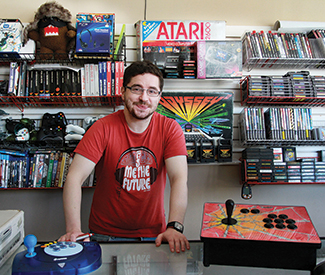
Old-school video games line the walls, from the common to the rare: a Magnavox Odyssey 2 (circa 1978); the NES classic, Duck Hunt; a Sega Genesis CDX (built to resemble a DiscMan); and even an Atari Lynx (1989), one of the last console creations from the company that started the video game craze.

Gene Pereverzev, the owner, is humble about his store’s collection (first derived from his personal collection). Through trades and Internet hunts, he’s built a small arsenal of retro-gaming goodies.

For now, he said, GameShop Classic is a pop-up inside of his FixLaptop.com store on Taraval Street, nestled in the sleepy, foggy, Sunset District. But even a fledgling startup is worthy of note.

The video game industry’s emphasis on major titles and blockbuster sales have all but demolished mom-and-pop video game stores. San Francisco is littered with Gamestops, a national corporate behemoth filled with pushy clerks selling unnecessary video game warranties, stocking only the newest and bloodiest digital creations.

GameShop Classic harks back to a time when daring digital stories were lovingly told with pixels so few they could be counted with the naked eye. Pereverzev, 28, has high hopes for GameShop Classics’ future: Soon it may play host to classic video game tournaments (Soul Calibur! Smash Brothers!). He wants to bring the video game community together.

And should you want to re-create one of the Internet’s first viral videos, Pereverzev has you covered. In the window of his store sits an originally boxed Nintendo 64.

2101 Taraval St. 415-242-9990

Asmbly Hall

2

Over the last few weeks, we’ve solicited input from visitors to SFBG.com about their favorite small businesses in San Francisco, and by far the leading vote-getter was Asmbly Man, a clothing boutique in the Fillmore District that was opened in 2011 by the husband and wife team of Ron and Tricia Benitez, who are veterans in the apparel industry.

We gave them our Best Fresh Prep award in our 2012 Best of the Bay issue, so rather than just hearing us again sang the praises of this cool spot to get some stylish duds from the best local designers, here are some of the reader comments that we received:

“They have the best selection of clothes, friendliest owners ever, and a great curation of local art.”

“I love the lines they carry and appreciate all the local brands support. The owners are very nice and welcoming to the customers and community.”

“I love the owners and their merchandise. They are extremely friendly with their customers. They are also supporters of local designers. The vibe is nothing but laid back with the cool ambiance and music.”

And finally, a word from Tricia Benitez: “We really appreciate this honor and we love SF Bay Guardian for the support!”

We love you too, and all of the small businesses that help make San Francisco such a special place.

1850 Fillmore St, SF (415) 567-5953 www.asmblyhall.com

Guardian Small Business Awards 2014

1

San Francisco’s small businesses are being threatened by the forces of gentrification and displacement like never before — at the same moment that they are more important than ever. This is the troubling paradox at the center of this year’s San Francisco Small Business Week.

Economists warn the city needs to diversify an economy that has become too concentrated in the vulnerable technology, finance, and land development sectors. Small businesses epitomize diversity. They are the backbone of the local economy, circulating far more of their revenues here than any corporate chain, while distinguishing San Francisco’s commercial corridors from their sterile counterparts in other cities.

The San Francisco Chamber of Commerce and fiscally conservative politicians love to trot out the plight of small businesses to elicit public sympathy or attack progressive regulations benefitting workers or the environment, but it is the self-interested pursuits of wealthy corporations and investors that really poison the pond in which small businesses flourish.

Just consider the headlines in San Francisco’s daily newspapers. On May 8, the San Francisco Chronicle had a story about Flax, an awesome art supply store that’s been in business for 37 years, being displaced from its iconic store at Market and Valencia streets by a 160-unit condo project. The story described the waves of new condo projects hitting the Upper Market area that are displacing small business such as Home Restaurant and the Arthur J. Sullivan Funeral Home. “They are just rolling over us — it’s unstoppable,” Judy Hoyem of the Castro/Eureka Valley Neighborhood Association told the Chronicle.

The cover story of the next day’s San Francisco Examiner was about the eviction of Marcus Books, the country’s oldest African American bookstore. Inside that issue, Mayor Ed Lee wrote a guest editorial ironically entitled “Small businesses shaping our city’s future.”

It was a happy-talk celebration of the same small business community that his economic development policies — with big Wall Street corporations worth billions of dollars driving up rents on small business and getting local tax breaks in the process — have been threatening.

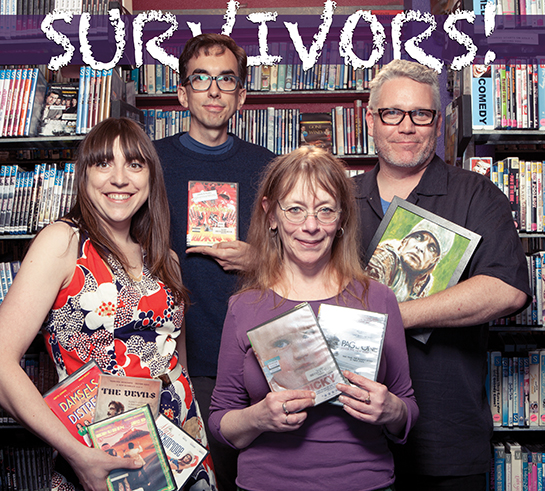
“San Francisco’s commitment to small businesses and local manufacturing continues to gain momentum,” Lee wrote. Yes it does, like a tidal wave of corporate cash sweeping through the city. So during this year’s annual Guardian Small Business Awards, we’re saluting the survivors, those small business people who are riding out the storm through their tenacity, creativity, and refusal to let the forces of gentrification drive them out.

The current business cycle will pass, along with its upward pressure on commercial rents and unfair competition from chain stores. But until it does, please continue to support these and other homegrown small businesses, the soul of San Francisco commerce.

Guardian Small Business Awards 2014

Asmbly Hall

GameShop Classic

HeartZilla

Le Video

LGBT Center

Panchita’s Papuseria

Thee Parkside

Tobener Law Center

Trouble Coffee

Bimbo’s 365 Club

Getting the Kink out

2

joe@sfbg.com

The spotlights shone down, the athletes tussled, and the crowd screamed.

The toned and tattooed female wrestler tackled the topless, tanned, blond wrestler from behind, pulling her down like a tumbling tower. The mat thumped. Cheers erupted. In a sudden reversal, the tanned wrestler gained leverage with her right arm and slammed the tattooed fighter’s shoulders onto the mat, giving the blond the win.

What happened next was definitely not standard wrestling fare.

The tanned wrestler, triumphant, digitally penetrated the tattooed fighter. Her moans silenced the crowd, who listened, rapt. The fight wasn’t sport, but porn, America’s real favorite pasttime. Ultimate Surrender is just one of San Francisco-based studio Kink.com’s 30 or so paid subscription porn websites, including Fucking Machines, Everything Butt, and Hogtied.

But a new series of proposed state laws threatens the state’s porn industry, and the freakiest city on the West Coast may soon say goodbye to its highest profile porn purveyor, Kink.com, which for years has operated out of the historic Armory building on 14th and Mission streets.

The situation raises a question: Is Kink.com breaking up with San Francisco? If legislation requiring condoms on-set in porn and stricter state safety requirements become law, Kink.com CEO Peter Acworth tells the Guardian he has no choice but to leave California entirely.

“We can’t do business under those circumstances,” Acworth told us. “We can’t make a product that can compete.”

The tussle between pornographers, porn actors, and state lawmakers is a crucible where worker safety — and the right to choose how that safety is implemented — may soon be decided. Caught in the crossfire, freaky and sex-positive San Francisco stands to get a whole lot less kinky.


ECHOES OF LOS ANGELES

California Assembly Bill 1576 would legally require condom use while shooting porn, mandatory STD testing, and pornographic studios required to hold health records of their talent. The bill cleared the Assembly’s Committee on Labor and Employment just last month, the first step on a short road to gaining the governor’s signature.

Assemblymember Isadore Hall (D-Los Angeles), sponsored the bill, and the day it cleared committee he was triumphant.

“For too long, the adult film industry has thrived on a business model that exploits its workers and puts profit over workplace safety,” Hall said in a press statement. “The fact is, adult film actors are employees, like any other employee for any other business in the state. A minimum level of safety in the workplace should not have to be negotiated.”

The concern is largely over HIV infection on the sets of porn studios, and two parallel statewide efforts are working towards safety on porn sets. The state bill is the first, and the second is the renewed vigor in enforcing longstanding California Division of Occupational Safety and Health regulations.

In the early 1990’s, the federal Occupational Safety and Health Administration adopted a bloodborne pathogens regulation, and DOSH adopted a similar regulation soon after. DOSH’s standard requires employers to take measures to prevent employees’ eyes, skin, and mucous membranes from coming in contact with blood and “other potentially infectious materials,” including semen and vaginal secretions.

To some industries, the standard mandates rubber gloves and goggles. For the porn industry, the DOSH regulations are a moratorium on porn stars ejaculating on each others’ faces, deeming facials a workplace hazard. That standard porn finale can have life-changing ramifications.

“In 2004, there was a big (HIV) outbreak in the industry,” Eugene Murphy, senior safety engineer at DOSH, told the Guardian. “It was demonstrated HIV was clearly contracted on set.”

These infections mostly occurred in Los Angeles, once the center of the porn universe until Measure B arguably changed that. Los Angeles voters mandated porn studio condom use in 2012, and two years later, LA newspapers reported many pornographers have relocated to Las Vegas to escape the regulatory requirements.

The statewide pushback on porn is largely driven by the AIDS Healthcare Foundation, whose President Michael Weinstein has smiled for the cameras alongside Hall and other lawmakers every step of the way.

DOSH began its part in the porn crackdown in Los Angeles, but Murphy was charged with looking into San Francisco’s Kink.com, where Acworth is chafing against the idea of mandatory condoms.


RUBBERS REBUFFED

Acworth said he used to believe condoms should be mandatory for performers. After the porn set HIV infections in 2004, Kink.com buckled down.

“I attempted to run the business as condom mandatory for about a year,” Acworth told us. He even pronounced their necessity in an interview on CNN. But there were complications.

“There was pressure from the models themselves because of the chaffing issues,” he said. Porn performers have echoed those sentiments as well.

In an interview with entertainment site Nerve, popular porn star James Deen (see “Dick and smile,” 7/31/12) said he had no problem with personal condom use, but women he’s worked with often complained of chafing.

“I was talking to a girl about it and she was like, ‘Dude, I’m in pain everyday and constantly swollen,'” he told Nerve. “Condoms are intended to be used on an average-sized penis for average sex, and we have entertainment sex, for anywhere from 20 minutes to four hours.”

The condom effort tanked at Kink. Acworth said he withdrew the policy after listening to his performers’ wishes. The studio does adhere to 14-day HIV tests, and condoms are available in a “double-blind” agreement, by which actors can purportedly safely ask for condoms and not fear retaliation.

Despite those efforts, Kink was later awash in condom controversy. Earlier this year, DOSH fined Kink $78,000 in violations connected with the alleged on-stage HIV infections of two actors in 2013, one of whom alleged that a shoot continued despite one actor having a bleeding cut on his penis.

Acworth adamantly asserts the HIV transmission happened in these actors’ personal lives, and says the issue is used as a wedge by the AIDS Healthcare Foundation to push a political agenda. The Guardian attempted to contact the foundation but did not hear back by press time.

Regardless, Murphy said, DOSH is pursuing regulatory requirements around bloodborne pathogens at Kink, and the enforcement of those regulations is not tied to the whether the initial HIV infection case was verified or not.

“My concern,” Murphy said, “is whether there is a healthy and safe workplace.”


COMMUNITY TIES

Acworth came to San Francisco for the reasons many do: he wanted a place to be weird, or in his case, kinky.

He wanted a new home from which to shoot his leather porn site, Hogtied.com. New York City was big, but at the time (the ’90s), he felt San Francisco had a more established leather scene in the Folsom Street Fair and leather shops like Mr. S.

“San Francisco,” Acworth said, sitting across from us in a leather bondage chair, “appeared to be more geared up.”

Although not universally loved within the BDSM community, the studio is popular in San Francisco. Part of the credit may go to Kink’s recent revitalization of one of the largest spaces in its 200,000-square-foot historic brick fortress: the Drill Court.

The vast, arch-roofed space was outfitted with modern sound proofing for the benefits of performers and neighbors, but its life as a performance space is not new. In the 1920s, boxers traded blows under its lights, and history may repeat itself, Armor Community Center Sales Manager Quincy Krashna told us.

He’s in talks with Golden Boy Promotions (boxer Oscar De La Hoya’s company) to bring prize fighting back to this historic space. In recent months, the Drill Court played host to a massive New Year’s Eve party, a Game of Thrones-themed dance night and cancer fundraiser, and even an evangelical medical conference, where missionaries offered free dental and doctor checkups to the public.

“The Holy Spirit was truly present at this event,” a doctor from the program, Building Bridges, wrote on the program’s website.

Even bigger changes could be in store. Last month, Acworth filed an application with the city to convert most of the historic Armory into office space, what he called a “last ditch” plan in case the state condom ban passes and Kink decamps for Nevada.

“This move represents an insurance policy,” he told us.

In a public May 11 letter to Weinstein of the AIDS Healthcare Foundation, Acworth asked the foundation for a truce: “I am reaching out to you and AHF, in the hopes of a day where we may sit across the table from one another and agree on common goals and strategy on protecting performers as opposed to continuing this battle.”

As he notes in his letter, if pornographers lose this battle, the companies may relocate. If Acworth finds himself uncomfortably bound and gagged by new regulations, his safe word may be: Nevada.

Alerts: May 14 – 20, 2014

0

WEDNESDAY 14


Growing Green Awards

Berkeley City Club, 2315 Durant, Berk. www.nrdc.org. 6-9pm, $30/$20 for students. Author and advocate Anna Lappe serves as master of ceremonies for this year’s multimedia awards ceremony, celebrating leaders in sustainable food and agriculture. Presented by the Berkeley Food Institute and Natural Resources Defense Council. Food and wine reception follows.

THURSDAY 15


Global Day of Action Against Fast Food Industry

Downtown Oakland. sandra.eboc@gmail.com. 11am, free. Join fast food workers and allies from 36 countries and 150 U.S. cities for a day of action to call attention to some of the worst corporate behavior and income inequality. The first action will be in East Oakland at 6am and the second will be downtown at 11 am.


Community Forum on Proposed Development for 16th and Mission Plaza

Victoria Theater, 2961 16th St., SF. www.plaza16.org. 6-8pm, free. The proposed housing development near Mission and 16th Sts. will be too expensive and too big, shadowing Marshall Elementary School for five months of the year. Learn more about how this project will negatively impact neighborhood residents, community organizations, and mom and pop businesses. Be part of a community-based effort where the needs of people come before the needs of multimillion-dollar profits.


Fundraiser to support farming veterans

Goldman Theater, David Brower Center, 2150 Allston Way, Berk. 5:30-7:30pm, $100. Show your support and celebrate the accomplishments of the Farmer Veteran Coalition, portrayed in the award-winning documentary Ground Operations: Battlefields to Farmfields. Meet the veterans in the film who are part of a new generation of sustainable farmers, ranchers and artisan food producers.The evening will feature veteran-produced, farm-fresh tapas, beverages (wine, beer and mead!), as well as stories told by vets-turned-farmers. Meet the filmmakers, and watch the film, documenting how vets with post-traumatic stress disorder have found peace through sustainable agriculture.


Income gap

4

news@sfbg.com

It seems like San Francisco may surpass itself as the city with the highest minimum wage in the country, as labor activists and business groups are each pitching their own fall ballot measures to raise wages for the lowest paid workers.

The city’s current minimum wage of $10.74 is the highest in the country, but that still isn’t enough, according the labor activists, not in the city with the most expensive rent in the US and one of the largest income gaps.

“We have the highest growing gap between the rich and the poor, and the economic disparity is so high right now,” said José Argüelles of Young Workers United. He said the raising the minimum wage “isn’t the whole solution, but it’s part of it. Folks working full time in San Francisco should be able to afford to live in San Francisco.”

But sometimes even working full time in San Francisco isn’t enough to live here. A 2012 study by the San Francisco Department of Health found that even in the most inexpensive neighborhoods of the city, one would have to work 3.4 full-time minimum wage jobs to afford rent in a two-bedroom market rate apartment. In the priciest neighborhoods, one would have to work up to eight full-time jobs to afford rent.

All of this is occurring at a time when minimum wage debates are taking place across the country. President Obama has suggested raising the federal minimum wage from the current $7.25/hour to $10.10/hour, although Congress has been less receptive. Here in California, the state minimum wage of $8/hour will rise to $9/hour this July, and $10/hour by 2016.

The San Francisco ballot measure favored by labor activists is an initiative to raise the hourly minimum wage to $15 by 2017, with a sliding time frame depending on the size of the business. Proponents of the measure, dubbed the Minimum Wage Act of 2014, are just beginning to collect the necessary 9,702 signatures to qualify for the November ballot, and a recent poll found that 59 percent of likely voters supported the increase, while only 36 percent were opposed.

Business groups are usually the first ones to object to higher wages, but the San Francisco Chamber of Commerce and other small business-leaders are working with Mayor Ed Lee to craft their own, albeit more watered-down, ballot measure to increase pay. Despite their efforts, the $15/hour initiative took them by surprise and they are “outraged,” according to a statement released by the Chamber.

“This initiative is nothing more than a thinly veiled attempt to influence the outcome of the consensus-building process that will begin this week under the leadership of Mayor Ed Lee,” Chamber President Bob Linscheid said in the statement.

But many small businesses actually want to see the minimum wage increased, said John Eller of Alliance of Californians for Community Empowerment, one of the labor groups sponsoring the $15/hour initiative.

“What we heard when we talked to small businesses was that big money is coming in to buy up properties, that prices are getting jacked up, and that they are getting displaced, just like the residents of San Francisco,” Eller said. “But genuine interest in San Francisco, supporting young people, getting people out of poverty, and dealing with displacement were the themes that kept coming up.”

The business community wants to see the higher minimum wage phased in over a longer period of time and supports a more “moderate” wage, although an exact rate has not been decided, according to an email sent by Henry Karnilowicz, president of the San Francisco Council of District Merchants Associations. Other concessions that business leaders ask for include a separate, lower minimum wage for tipped servers and new hires in-training.

Raising the minimum wage “is about being fair and being reasonable,” said Karnilowicz. “It’s not true that small businesses are making a fortune, and I’d hate to see a big Walmart or Target coming into town to take their place.”

But Argüelles says that including special exceptions and a piecemeal law is a step in the wrong direction.

“In the past, San Francisco has led the way [with fair labor laws],” he said. “I think we can set a higher standard than that.”

Opponents to raising the minimum wage often claim that doing so hurts jobs and the economy, but a study from economists at UC Berkeley says otherwise. Unemployment in San Francisco has dropped since the last major minimum wage increase, and businesses absorb the extra labor costs through reduced employee turnover and improved efficiency.

The study also found that affected workers are largely adults and disproportionately women and people of color, two groups for whom the income gap is especially vast.

A measure qualifies for the ballot in one of two ways: either by garnering enough signatures through the initiative process, or being placed on the ballot directly by the mayor or a group of four or more supervisors. As of now, it seems plausible that San Franciscans will have two minimum wage measures to choose from this year, one from signatures and another from Mayor Lee.

On May 7, the Chamber released a press release stating that it’s seeking a single, consensus measure rather than two competing ordinances. Labor activists also hope to see one measure, Argüelles said.

There are no details yet on what Lee’s minimum wage ordinance would look like, if he sponsors one. There’s potential for a compromise between labor activists and business leaders, meaning one ballot measure with wide support. Otherwise, it will likely be one measure pitted against the other.

The deadline for Lee to submit his ordinance to the Department of Elections is June 17.

Stored power

0

rebecca@sfbg.com

BASED ON EARTH

For this second installment of our environmental news column, we’re looking at climate change from wildly different perspectives. We’ll explore whether local green-tech manufacturing firms can help wean California off fossil fuels, highlight some key data from the National Climate Assessment, and hear from an Amazonian shaman who’s fed up with white people making a mess of the planet and his home territory.


STASHING ELECTRONS

A new green technology sector in the Bay Area could help find the missing puzzle piece needed to establish a sustainable clean-energy mix for the state’s future.

Californians continue to rely on a majority of electricity sources that are environmentally unfriendly: natural gas, nuclear power, and even coal. Generating electricity by burning fossil fuels contributes to air pollution, consumes vast quantities of freshwater, and releases greenhouse-gas emissions, exacerbating global climate change.

But this is all starting to change. Since California requires utilities to convert one-third of their energy mix to renewable sources by 2020, there’s incentive for investment in carbon-free alternatives, such as wind and solar. Meanwhile, procurement decisions at the California Public Utilities Commission have pushed utilities to purchase more renewable power.

“Solar is succeeding beyond people’s expectations around the world,” because pricing has come down, said Julie Blunden, a consultant and energy-sector expert who formerly served as vice president at SunPower. “California set itself up to say, ‘we’re for changes to our power sector.'”

But renewables have an inherent problem — the power they produce can’t always be tapped just when it’s needed. Without some way to store the electricity generated by a wind or solar array, to be kept on hand for when demand hits a peak, wind and solar are unreliable for primary energy generation because they’re subject to fluctuations in wind and natural light. This is where energy storage comes in.

Throughout the Bay Area, companies specializing in battery manufacturing are starting to gain traction, with 11 regional battery manufacturers enrolling in CalCharge, an accelerator program for energy storage created with help from the U.S. Department of Energy and the California Clean Energy Fund.

CalCharge gives regional energy-storage companies access to national laboratories such as Lawrence Berkeley National Lab, facilities described by DOE renewables expert David Danielson as “science and engineering powerhouses at the forefront of clean energy innovation.”

One of the first grid-scale energy storage firms to join CalCharge is EnerVault, a flow battery manufacturer that’s working on a major installation in Turlock that will be co-located with a tracking solar system and an electric irrigation pump.

“The little dark secret about solar is that it’s intermittent,” explained Tom Steipen, CEO of Primus Power, a flow battery manufacturing firm based in Hayward that recently joined CalCharge.

On cloudy days, solar arrays won’t produce as much power. Wind presents similar challenges: “Wind in North America is stronger at night — but we don’t need it at night, we need it in the afternoon. So anything you can do to de-couple the instantaneous supply from demand is good for the environment, good for the economy, and that’s what energy storage does. … I like to describe it as a warehouse of electrons.”

Primus makes energy pods — an array of batteries that stand about six feet tall, placed in two rows within a shipping container — fed by renewable power arrays and tied in with the grid.

The pods can be stacked in Lego-like fashion, enabling more energy storage. They are then positioned beside a second shipping container, outfitted with equipment to convert stored DC power to AC power that can be sent over transmission lines.

Primus Power plans to make one of its first energy pod shipments to Miramar, the site of a marine base near San Diego where the movie Top Gun was filmed. The base is powered with its own contained micro-grid, but it was impacted by brownouts a couple years ago. With this project, Primus faces a test for its energy pods, which are estimated to last up to 20 years: Can the flow batteries, in combination with solar, produce reliable electricity for three full days?

If the pods can supply a smooth power supply, Primus wins — but more importantly, it will be a vote of confidence for carbon-free energy sources as significant sources of electricity generation.


“MONEY WON’T SAVE THE WORLD”

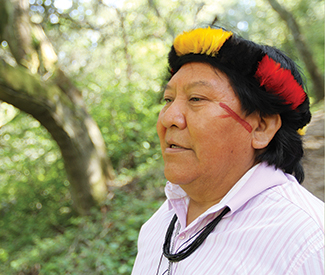
Davi Kopenawa is sometimes called the “Dalai Lama of the Rainforest.” He’s a shaman, activist, and spokesperson for his Yanomami tribe, the largest relatively isolated tribe in South America, which lives according to traditional indigenous ways in territory located within the Brazilian Amazon.

After years of battling the Brazilian government, Kopenawa and his people won a successful campaign for demarcation of the Yanomami territory in 1992. He co-wrote a book, The Falling Sky, with French anthropologist Bruce Albert, recently published by the Harvard University Press.

Today, the Yanomami are facing new pressures. Mining speculators are encroaching into their indigenous territory, causing fears of displacement, environmental destruction, and disease. In the past, exposure to disease brought dire consequences, resulting in widespread fatalities.

Kopenawa recently made a rare visit to San Francisco, giving talks at the Presidio Trust, UC Berkeley, and City Lights Books — and we got the chance to interview him while he was here.

Speaking via translation provided by Fiona Watson, research director of the human rights organization Survival International, Kopenawa talked about the Yanomami’s looming worries of environmental destruction and displacement that could be ushered in by mining companies.

“People are returning, invading it again, and repeating exactly what happened 20 years ago,” he told us. “These people are mainly gold miners who are looking for the riches of the Earth … They’re looking for oil, diamonds, and other precious materials, which is what white people want.”

He travels in part to seek support from the international community. “The majority of Yanomami have never left their land — they haven’t come out like I have,” he said. “So they don’t really see at close quarters how we are fighting against the politicians. However, the Yanomami and I, we continue to fight.”

Kopenawa had a lot to say about climate change and what has been done so far to address it: “All of you, the governments, the white people, need to listen to us, if you want to control the rich people who are always there … seeking raw materials from the earth, cutting down the forests, destroying the rivers.”

Indigenous leaders have spoken out internationally on the issue of climate change, he added, but the message has fallen on deaf ears. “They had the big UN climate meeting in Copenhagen,” he said. “But that didn’t result in anything. They only wasted money. They made us think that the city people would resolve things, but they couldn’t. The problem is the governments don’t listen. … The problem really is about capitalism, that’s at the root of the problem.”

Kopenawa’s perspective as a shaman in an indigenous culture is radically different from the world of government and politics, and he shakes his head at what he sees as utter complacency when it comes to implementing meaningful change.

“They’re only interested in the Internet, in paper, building more roads, stripping out the riches of the earth, destroying the trees,” he said. “We are different. We see the dangers, and we see that they are getting nearer. The cities are growing, the population is growing, and so the pollution is growing. There’s a lot of money in the world…But money won’t save the world.”

He advocates a new way of thinking about human progress.

“People have to stop thinking about ‘progress,’ which is pulling out the riches of the earth, and negotiating and doing business and having money all the time,” he said. “This is the error of the city people. I’ve tried to tell the city people, you need to minimize this problem of the climate, or else it will stop raining. And it will keep getting hotter.”


MORE WILDFIRES, LESS WATER

The Obama Administration unveiled the third National Climate Assessment on May 6, a hefty document detailing climate change impacts facing every region of the U.S.

Unsurprisingly, California’s own climate-related woes stem from water scarcity. Here are some details:

More money needed for drinking water. “Climate change will increase the cost of maintaining and improving drinking water infrastructure [estimated at $4.6 billion annually as things stand], because expanded wastewater treatment and desalinating water for drinking are among the key strategies for supplementing water supplies.”

Market impacts on delicious agricultural products. “California produces about 95 percent of U.S. apricots, almonds, artichokes, figs, kiwis, raisins, olives, cling peaches, dried plums, persimmons, pistachios, olives, and walnuts, in addition to other high-value crops. Drought and extreme weather affect the market value of fruits and vegetables more than other crops because they have high water content.”

More wildfires. “Numerous fire models project more wildfire as climate change continues. Models project … up to a 74 percent increase in burned area in California, with northern California potentially experiencing a doubling under a high emissions scenario toward the end of the century.”

Based on Earth is a monthly column by Guardian News Editor Rebecca Bowe.

Stop wiggling around the bike debate

118

EDITORIAL

Our blog post last week about traffic cops ticketing bicyclists riding the Wiggle on Bike to Work Day (see “Bike sting on BTWD,” page 13) triggered heated reader reactions on both sides, as stories about bikes often do. Many are angry that cyclists routinely run stop signs, while cyclists argue police should focus enforcement on motorists who present a far greater danger to the public.

When we finally heard back from the San Francisco Police Department this week, a spokesperson said that targeted enforcement on the Wiggle is being driven by complaints, and that the SFPD is compelled to act on those complaints and can’t selectively enforce traffic laws. A few people in the neighborhood have pledged in online forums to put a stop to the scofflaw behavior of cyclists there.

This presents an ideal opportunity for San Francisco to finally have a long-overdue discussion about traffic safety and how to encourage more people to ride bikes, which is official city policy — and for good reason in this era of global warming, fiscal austerity, and increasing traffic congestion.

The Wiggle — a series of city-posted turns snaking their way through Lower Haight — is a crucial east-west connection that is one of the most well-traveled bike routes in the city. But it also includes stop signs at the end of every block, six in all, that almost every cyclist slowly rolls through.

Rather than let a few people undermine the city’s voter-approved policies promoting cycling, we should see this standoff as an opportunity to use intersection designs and traffic enforcement strategies that recognize it unnecessarily clogs up intersections for everyone when cyclists lose their momentum and have to start pedaling from a full stop.

So as part of the study of Wiggle intersections that is now underway, the city should give serious consideration to installing traffic circles at each of these intersections, something it should then consider for intersections throughout the city that have high volumes of cyclist traffic.

San Francisco should also start pushing statewide reforms like Idaho-style laws allowing cyclists to treat stop signs as yield signs and red lights as stop signs, which wouldn’t change when motorists or pedestrians have the right-of-way, simply enshrining into law how cyclists already ride.

In the meantime, the SFPD should focus on dangerous intersections and behaviors, as Police Chief Greg Suhr has already pledged, and clearly communicate that priority to traffic cops. As it does with marijuana laws, San Francisco should make a deliberate decision to not make criminals of otherwise law-abiding citizens.

If thousands of San Franciscans are breaking the same law everyday, in the same intersections that actually have low collision rates, perhaps the problem is systemic. We should make changes that foster a respect for the law, not pursue crackdowns that will only feed division and hostility on our streets.

Carmageddon cometh

42

news@sfbg.com

STREET FIGHT

San Francisco — already overwhelmed with private automobiles — faces a grim future of gridlock unless there is a radical change in how we think about city streets, parking, and regional transportation.

The facts are clear. Every day there are 1.7 million private car trips to, from, or within the city, according to the city’s transportation plan. Coupled with almost 10,000 vehicles registered per square mile, San Francisco today has one of the densest concentrations of cars on the planet, more than any peer city in the United States. In the business-as-usual scenario, the streets are forecast to absorb another half-million car trips. By 2040 there will be 2.2 million car trips on the exact same street grid we have today.

This is madness and it is dysfunctional for everyone. If you think Muni is unreliable now, it will be useless in 2040 as it stalls in the morass of 2.2 million car trips jammed onto city streets. Pedestrian injuries and deaths will rise with another 160 cars hitting pedestrians annually, simply due to oversaturation of automobiles. Cyclists might be able to weave around the stalled traffic, but it will be an ugly scene that fouls the air. Motorists will be stuck in their own gridlock, evermore impatient, distracted, honking, lurching through blocked intersections, sneaking through yellow lights, blocking crosswalks, double parking, and irritated with fellow drivers and everyone around. No one will be happy

This does not have to be. The city’s transportation agency hopes to reduce car trips from 1.7 to 1.6 million by 2018, a modest goal but barely holding the line. Reducing existing car trips by 100,000 while also adding thousands upon thousands of housing units and jobs, most coming with more parking, will quickly undo this humble ambition. The city can do more and the data shows us that there are many opportunities.

Consider that 68 percent of car trips within San Francisco are less than three miles. That’s 650,000 car trips per day that are generally pretty short — with a bicycle it’s less than a half-hour ride on relatively even terrain. If the city were able to get half of those car trips to switch to bicycle trips, it would be well on its way to averting carmageddon.

A more ambitious goal, increasing cycling to 20 percent of all trips, is the official city policy adopted by the Board of Supervisors. That’s 500,000-600,000 trips by bicycle every day, most of which can take place within that three-mile range, especially if cleverly arranged “wiggles” (level routes circumventing steeper hills) are laid out on the most logical corridors. But to carry that many cyclists, real space has to be allocated for them.

Out at San Francisco State University, where I teach a new Bicycle Geographies course that aims to increase cycling to the campus, there is tremendous opportunity to shift these kinds of short trips to bicycling. For students, faculty, and staff, bicycling is compatible with rapid transit, particularly for the “last mile” segments, such as between BART and SF State.

Bicycling is also a way to relieve local bus and light rail transit crowding — the 28 bus line on 19th Avenue, for example, is often jam packed and the city has only modest goals to improve that key line. Unlike transit or highways, bicycles do not require costly, long-term capital investment or operating funds and so can be deployed much more quickly.

It will be decades and cost hundreds of millions to improve the M-line, only now in the planning phase. We can lay down cycletracks much more quickly. Bicycling is also among the most equitable forms of urban transportation because it is affordable and accessible to almost everyone. This is obviously relevant to working-class students at SF State.

SF State has a memorandum of understanding with the city that obliges the university to reduce drive-alone automobile trips to campus, and the campus will not build any more car parking. With 4 percent of commute trips to SF State by bicycle (and only 2 percent among faculty) there is potential to increase the mode-share of bicycling as a path to reducing greenhouse gas emissions and auto trips.

The spatial proximity to Daly City and Balboa Park BART stations, as well as the Excelsior and Sunset, all under three miles from campus, means that the bicycle is well-suited to be a substitute for many short-range automobile trips and help the campus meet its goals. Yet what my students have found this semester is that it is all but impossible to bike safely to and from SF State, and the southwestern quadrant of San Francisco is largely left out of current bicycle planning in the city.

Taking multiple bicycle field trips over the past few months, we surveyed the opportunities for making safe routes to campus and envisioned what it would take to increase cycling to 20 percent of trips to and from SF State. Starting with the Balboa Park station, which is next to a deplorable tangle of freeway ramps, we ask what it would look like if fully-separated cycletracks were built on Geneva or Ocean avenues. These could connect City College and the Excelsior, and by way of a westward and southward jog, to a bicycle boulevard on Holloway Avenue, enabling a safe and convenient, 1.7-mile, 15-minute bike ride to SF State. Expanding the nascent Bay Area Bike Share to connect SF State and Balboa Park BART would create even more opportunity for cycling.

To the south of SF State, Daly City BART is a 1.4-mile, 10-minute bike ride that is daunting and poorly signed. It could be made safe and inviting with bicycle boulevards on streets parallel to traffic-clogged 19th Avenue and Junipero Serra. Borrowing from signature bicycle and pedestrian bridges in Pleasant Hill and Berkeley, perhaps there is an opportunity to build a bridge across Brotherhood Way toward the BART station, leveling an otherwise steep climb that discourages cycling.

To the north of campus, describing the designated 20th Avenue bicycle route as “a bit of a challenge” is an understatement. Cyclists must thread a cluttered shopping mall parking lot and overbuilt wide streets, and then confront a median blockading the way across Sloat Boulevard. While the megaproject to improve the M-line could include a cycletrack on this stretch of 19th Avenue, we should not wait a generation to increase cycling between SF State and the Sunset. The 20th Avenue route can be made welcoming now, with a fully-separated cycletrack and fixes on the Sloat intersection.

SF State, probably one of the most diverse campuses in the nation, has highly motivated students seeking real solutions to the huge problems society faces. The students are coming of age under extreme pressure of economic inequity and ecological duress, but they also see ways out of the mess created by the wasteful car culture and its linkages to ecological and social problems. They want to act now, and unlike past generations, they are shunning driving and many of them desire to reside in livable cities that offer choices for how they get around.

But what we have found this semester is that the campus is extremely isolated, difficult to access by bicycle, and walled-off by car sewers. Older, uninviting bicycle lanes are fragmented, disjointed, and seem to be an afterthought. With imagination, ingenuity, and political will, this can be remedied with bicycle improvements that cost far less than adding more car lanes and parking to the campus or surrounding area. And this would go much further at improving quality of life for neighbors who now have to put up with campus-generated traffic. Keeping the status quo, which means even more car trips but within the same space, is a dead end.


TRANSBAY DREAMS

Speaking of dead ends, San Francisco seems to specialize in dead-end train projects. The Central Subway, which is experiencing cost overruns and possible mismanagement, is one of these dead ends. There is no current option to have trains exiting to Geary or onto Columbus and possibly running on Lombard into the Marina, and that is a shame. Having the subway exit to the surface is probably the only way to make this project worthwhile.

There’s another dead end train project at the Transbay Terminal in downtown San Francisco. Yet unlike the Central Subway quagmire, I am impressed with the scale and possibilities for the Transbay Terminal project and there is opportunity to fix this dead end. Going back to the city’s business-as-usual traffic forecast, in 2040 car trips into the city from the Bay Bridge would increase 18 percent, and by 21 percent from San Mateo County. Aside from scratching my head wondering where exactly all of these cars are supposed to go, we simply need to stop this onslaught before the city becomes too dumb to move.

BART cannot solve it alone, as it will probably approach half a million riders per day by 2016, placing many downtown stations at or near capacity. BART also does not run all the way down the peninsula. Sometimes there are back-of-the envelope proposals to build a second BART tunnel under the bay, but this idea should be weighed against another idea. Rather than build a second BART tunnel to Oakland, how about a joint Amtrak California/Caltrain tunnel under the bay, and creating a true Grand Central Station of the West at Transbay? Let’s punch through the dead end currently planned for the east end of the Transbay Terminal “train box” and truly connect Northern California by rail.

This does not need to be high-speed rail, but rather the conventional, off-the-shelf electric rail already planned for Caltrain, of the variety that operates in the Northeastern US and much of Europe — efficient, high capacity trains that can travel 100-120 mile per hour comfortably and safely. In conjunction with a new transbay rail tunnel, the Capitol Corridor should be electrified and right of way captured from the freight railroads. One could take an electrified “baby bullet” from San Jose, through San Francisco, and continue to the East Bay and Sacramento. As Caltrain is electrified to the south, let’s also electrify the Altamonte Commuter Express trains, bring them across a rebuilt Dumbarton Bridge, and run high-frequency rail service into the new Transbay Terminal.

Understanding that this will take time to build, in the short term the Bay Bridge should be reconfigured to have bus-only lanes (and a bicycle lane on the bottom deck of the west span) and a greatly expanded AC Transit service that can relieve the looming BART crowding to the East Bay.

How to pay for these transbay dreams? A transbay rail project could get funding from Amtrak and other federal sources, requiring our congressional delegation to work for it. The state gasoline tax or eventual carbon taxes, and revenue from tolling Bay Area freeways, should be in the mix. The 101 and 280 should be tolled as well as the Caldecott Tunnel and I-80 in the East Bay, with revenue directed at electric rail in the long term and regional buses short term. And while people are talking about reforming Proposition 13 to end the artificially low property taxes on commercial land, let’s remember that transit — whether Muni, BART, or Caltrain — brings massive value to commercial property owners. They should be realistically expecting to pay in. In short, there are possibilities and ways to do this.

Here’s one small additional idea for raising seed money: In the wake of the Google bus controversy, the SFCTA, SFMTA, SF Planning Department, and City Attorney’s Office should assemble a crack team of California Environmental Quality Act experts and send them (on Caltrain and bike share!) down to comment on every large-scale suburban office project proposed in Silicon Valley. For example, Mountain View, where Google has its campus, is effectively displacing part of its transportation and housing responsibility to San Francisco.

As part of the CEQA mitigation for these suburban office projects, San Francisco ought to be demanding that Google/ Mountain View contribute to paying for the Transbay Terminal and electrifying Caltrain (a separate fund would be directed to affordable housing as mitigation for displacement). This is a similar line of reasoning to the May 1 lawsuit against the Google bus pilot, but it draws in those responsible for the poor planning in suburban sprawl. Regardless, the city ought to take a look at a CEQA mitigation angle for addressing the impacts these suburban decisions are having on the city.


PRAYING FOR ENLIGHTENMENT

One last point about transit finance: I sure hope Mayor Ed Lee, his political advisors, and all those religious ministers who complained about paying for metered parking on Sundays (see “Politics over policy,” April 22) have a plan to advocate for the November ballot proposals to help finance Muni.

They sold out sustainable transit advocates, their biggest ally on the November ballot initiatives, and have offered no rational explanation for their strategy, just an emotional hunch that somehow some people can’t cope with Sunday metering, and that making it free again will convince them to support increased public transit funding.

I imagine there is a well-thought-out campaign strategy, whereby every Sunday between now and November, the mayor is visiting all the churches in the city, and cajoling the ministers to use their pulpits to enthusiastically preach the merits of increasing the vehicle license fee (as well as approving a related general obligation bond).

After all, the VLF is a progressive tax — the more expensive your car, the more you pay. The older and cheaper your car, the less you pay. And bringing in $73 million annually would contribute to making God’s green earth cleaner, and help transport God’s children safely to work and on their errands. Praise the Lord and free parking on Sunday! Amen.

Street Fight is a monthly column by Jason Henderson, a geography professor at SF State and the author of Street Fight: The Politics of Mobility in San Francisco.