News and Politics | San Francisco Bay Guardian

News & Opinion

Editor’s Notes

14

tredmond@sfbg.com

August is a bad time to split town. When I left for vacation a couple of weeks ago, Ed Lee was just starting to act like a candidate in a slow-developing mayor’s race. Nobody except my lunatic pal h. brown had any inkling that Public Defender Jeff Adachi would jump into the Room 200 sweepstakes at the last minute. And the Giants were three games up.

Now Lee is the clear front-runner, Adachi — a guy who defends criminals for a living — is the darling of a some anti-government conservatives, there are Avalos signs all over the Mission, and nobody knows exactly how to figure this all out.

Oh, and Arizona — which I hate (yeah, I hate the entire state, including the governor, the baseball team and the newspaper chain that’s based there) — is leading the National League West.

Welcome home, I guess.

The first thing I want to say about the mayor’s race is that none of this would be possible without ranked-choice voting and public financing. Think about it: Five serious Asian candidates, two of them leading in the polls and at least three of them real contenders — and nobody’s complaining that Adachi or Lee will “split” the Asian vote. If anything, several strong Asian candidates help each other; the supporters of Ed Lee and Leland Yee may be trashing the opposition day and night, but in the end, a lot of Chinese voters will probably still rank the incumbent mayor and the man who’s been elected citywide four times as two of their three choices.

And without public financing, the race would be dominated by one or two contenders — the ones who could privately raise $1 million or more to stay in the game. Instead, we have at least four and perhaps as many as five or six candidates who have a real chance of finishing on top. Already, the Chron and the Ex are complaining about the cost of public financing; the cost of closed elections where only those with big-business connections could win was much, much higher.

The other factor that will make this fascinating is that Lee’s job just got much, much harder. He’s not the amiable technocrat who comes to work early and gets the job done anymore; now he’s an ambitious pol who has never had to stand up to the heat of a tough campaign. He’s going to have to be a candidate, and campaign, and answer some hard questions about some of his political allies and supporters. That’s not the gig he wanted in February. And I don’t know how well he’s going to handle it.

You can’t trust Ethics

2

By Larry Bush

OPINION Proposition F, a measure on the November ballot, is supposed to clean up some provisions of the law that requires political consultants to register and make disclosures about their clients and their work. It was approved by all 11 supervisors.

But Prop. F has some serious problems. For starters, it grants authority to the Ethics Commission to make any other changes it wants in the law.

As the Voter Handbook says:

“A yes vote means: You also want to allow the City to change any of the campaign consultant ordinance’s requirements without further voter approval.”

Why should you oppose that? Because the Ethics Commission can’t be trusted.

The reason San Francisco has a law forcing political consultants to register and make disclosures is because the voters demanded one. City Hall fought against it every step of the way.

Former Supervisor Tom Ammiano introduced the measure in 1996, and it won board approval. Then-Mayor Willie Brown vetoed it. Ammiano rewrote the measure 1997 to meet Mayor Brown’s objections. Brown vetoed it again. And the supervisors who had voted for the law refused to vote for it again and overturn the veto.

So Ammiano and several other supervisors put the measure on the ballot. The political consultants raised a war chest to defeat it and spent more than $100,000 in direct mail, billboards and other voter contacts.

It passed with 61 percent of the vote.

What kind of clean up does Ethics plan now on the political consultant law? You can bet it won’t come down on the side of greater disclosure.

In 2009, two years ago, the Ethics Commission decided to write a clean up of the city lobbyist law. Just like they want to do with the political consultant law now.

And what happened with that law?

It changed one little aspect that didn’t get any real attention. It changed what is defined as a lobbyist — a person or entity who seeks to influence administrative or legislative decisions.

And what is the result?

Now the San Francisco Chamber of Commerce no longer has to file and disclose its lobbying. Neither does Lennar. Neither does the America’s Cup or Larry Ellison.

All those groups had to file under the old rules.

The bottom line is that a sleeping watchdog that can’t be trusted wants the right to change the laws governing political consultants — without any further oversight or public vote.

The former Ethics Commissioners who also are opposing this measure are Paul Melbostad, who served on the commission when the political consultants act was passed; Bob Dockendorff; Joe Julian; Bob Planthold; and Eileen Hansen, who just completed her term and was the only commissioner who voted against the pay-to-play rewrite.

I urge you to join them in opposing this measure.

Larry Bush is the publisher of Citireport.com, a City Hall watchdog.

Green buds

56

steve@sfbg.com

CANNABIS Most marijuana sold in Bay Area dispensaries is grown indoors, where the ability to precisely control conditions creates the kind of buds — strong, dense, crystal-covered, fragrant, beautiful — that consumers have come to expect. But that perfection comes at a high price, both financially and environmentally.

So some local leaders in the medical marijuana movement have begun to nudge the industry to return to its roots, to the days before prohibition and the helicopter raids of the Campaign Against Marijuana Planting chased the pot growers indoors. They say it’s time for California to start growing more of its cannabis outdoors again, in the soil and sunlight, just like the rest of the state’s crops.

Growers have long known how inefficient it is to grow indoors. All they need to do is look at their huge monthly energy bills. Between the powerful grow lights, constantly running air conditioners, elaborate ventilation systems, pumps and water purifiers, and heaters used for drying and curing, this is an energy-intensive endeavor.

But a widely circulated study released in April — “Energy Up in Smoke: The Carbon Footprint of Indoor Cannabis Production” by Evan Mills, a researcher with Lawrence Berkeley National Laboratory — revealed just what a huge cumulative toll the practice was taking on California and the planet.

It found that indoor pot production accounts for about 8 percent of California household energy use, costing about $3 billion annually and producing about 4 millions tons of greenhouse gases each year, the equivalent of 1 million automobiles. Producing one joint was the equivalent of driving 15 miles in a 44 mpg car.

“The emergent industry of indoor Cannabis production results in prodigious energy use, costs, and greenhouse-gas pollution. Large-scale industrialized and highly energy-intensive indoor cultivation of cannabis is driven by criminalization, pursuit of security, and the desire for greater process control and yields,” Mills wrote in the report’s summary.

Yet while opponents of marijuana seized on the report to condemn the industry, proponents say there’s a very simple solution to the problem: grow it outdoors. And with the artisanship and quality in the fields and greenhouses now rivaling that of indoor buds, the biggest barriers to moving most marijuana production outdoors are federal laws and the biases of pot consumers.

“There’s a misconception out there that indoor is better marijuana than outdoor, but we don’t think that’s true,” Erich Pearson, who runs the San Francisco Patient and Resource Center (SPARC) dispensary and sits on the city’s Medical Cannabis Task Force. “Marijuana is a plant that came from the earth and that’s where we should grow it, just like our food.”


INDOOR VS. OUTDOOR

There are definitely some benefits to growing indoors, beyond just the ability to hide it from the prying eyes of law enforcement. The grow cycles are shorter, allowing for multiple harvests around the year. The generally small operations and precise control over growing conditions also tend to produce the best-looking buds, which command the highest prices and win the top prizes in competitions.

Kevin Reed, who runs Green Cross — a venerable medical marijuana delivery service that works closely with an established group of growers — told us there are several reasons why indoor buds have dominated the marketplace.

“The most important factor is local laws and regulations and the enforcement of those various laws. A second factor is space and climate — obviously outdoor cultivation will flourish is some places better than other. And, a final factor is sustainability of the market; indoor cultivators can produce crops on a year-round basis, providing some stability in the market over the long-term, especially in the event of crop failure or other unforeseen and unexpected disasters,” Reed told us.

Yet he also said, “If cultivated correctly and with care, there should be no difference between the same strain grown in- or outdoors.” And he said that from an environmental standpoint, outdoor is clearly superior: “So far as environmental factors are concerned, there is little doubt in my mind that outdoor cultivation is kinder to Mother Earth.”

Wilson Linker, with Steep Hill Laboratories, Northern California’s largest tester of medical marijuana, said that outdoor plants generally have more vegetative growth because of the longer light cycles, meaning that “indoor tests generally higher in cannabanoids, with THC [marijuana’s main psychoactive compound] in particular.”

But he and other marijuana experts also say that the quality of the buds ultimately depends on a wide variety of factors, from the strain used to the expertise of the cultivators to the time and care taken by the trimmers.

“I’ve seen outdoor that can compete with the best indoor strains,” said David Goldman, who runs San Francisco’s Americans for Safe Access (ASA) chapter, sits on the city’s Medical Marijuana Task Force, and is active in rating the various dispensaries and pot strains in terms of quality, using magnifying glasses to investigate the trichomes and other characteristics. “I would match the best outdoor I know up with anybody’s indoor, any day.”

Even when indoor buds look better, Pearson said, that doesn’t means they are better. Looks can be deceiving, he said, noting how local consumers now accept that those perfect-looking, genetically modified apples and tomatoes in the store aren’t as tasty or good for you as their ugly, organic counterparts.

“It’s not all about appearance,” he said, noting that marijuana grown in the sunshine is more robust and complex than its indoor cousins.

“We’re starting to find [outdoor] strains that were scoring just as high as indoor,” says Rick Pfrommer, the purchasing manager for Oakland’s Harborside Health Center.

And that’s especially true when the cannabis is grown in greenhouses, where it gets natural sunlight but growing conditions can be controlled better than in the fields.

“Greenhouses can attain a level of cosmetic attractiveness that is right up there with indoor,” Pfrommer said.

“There are a lot of products coming out of greenhouses that even trained eyes can’t tell the difference with [compared to indoors],” Linker said. “Greenhouses are the future.”

Or at least they might be the future if there is a change in the federal laws, which still view any marijuana cultivation as a crime — which is why indoor grows flourished in the first place.


LINGERING PROHIBITION

Rising demand for medical marijuana has created some regulatory pushback, even in pot-friendly San Francisco, where the Department of Public Health announced earlier this year that it wanted to create a registry of growers that work with the dispensaries in order to weed out the illegal growing operations.

“In the last few years, there’s been a proliferation of both illegal and legal cultivators,” Dr. Rajiv Bhatia, San Francisco’s environmental health director, told us earlier this summer. “We’re asking for this information to try to steer them back toward legal cultivation.”

Reed, Goldman, and other industry representatives strongly condemned the move, mostly on the grounds that creating lists of growers could subject them to federal prosecution, so the idea was shelved for now. But Bhatia said the problem remains, and in San Francisco, it’s a problem created largely by the demand for cannabis grown indoors.

But allowing for a more widespread conversion to sustainably grown marijuana will require a relaxation of the federal enforcement to allow for more land cultivation and the development of high-tech greenhouses.

“A lot of that rests in the hands of law enforcement,” Pearson said.

But it isn’t just the cops. Consumers are also supporting indoor grows.


SUPPLY AND DEMAND

Pfrommer said there are many factors that influence whether customers choose indoor or outdoor, or what he calls the “bag appeal” that causes customers to zero in on one strain among the 40 or so that can be offered at one time.

Generally, indoor grows are smaller operations, allowing greater care in the tending and processing of the buds, whereas outdoor grows usually produce large crops harvested all at once, “so frequently people won’t manicure it as well,” Pfrommer said.

Smell is another big factor, Pfrommer said, and that’s one area where he thinks outdoor actually has an advantage. “Outdoor generally has a more pungent smell,” he said. “Cannabis is very sensitive to the environment, so it can pick up elements from the soil, the wind, and the surroundings. It picks up different qualities.”

For that reason, he also said, “I personally find outdoor to taste better when it’s grown well,” comparing it to the subtle qualities that various appellations can give to fine wines.

The final factor is price, and that’s one area where outdoor has a distinct advantage. SPARC is currently selling quarter-ounces of greenhouse-grown Big Buddha Cheese with a THC content of more than 17 percent for just $70. And when the buds from open outdoor fields arrive this fall, they’ll be as low as $50.

“This,” Pearson said, holding up a beautiful bud of greenhouse-grown Green Dragon, “was grown at a fraction of the cost of indoor and it’s outstanding.”

“That’s why indoor sells for so much more,” Goldman said, ” because it costs so much more to grow.”

So if outdoor cannabis is cheaper, better for the environment, less risky for the industry, and just as good, why are the indoor stains still so much more popular?

“You’re looking a 20-plus years of indoor being the standard,” Pfrommer said, noting that the hardest part of creating a more substantial changeover in people’s buying habits is their expectations.

He said Harborside started offering more outdoor strains three years ago, “but the market wasn’t responding as strongly.” In other words, people still preferred indoor.

Yet things are changing, prompted partly by the Mills study. “That was what kicked off this latest round,” Pfrommer said. “There is a small but growing awareness among the regular marijuana consumers about the costs of growing indoors…The consciousness is starting to shift, but it’ll be slow, probably over the next two seasons.”

Harvests usually take place during the full moons in September and October, after which they are cured and processed for about four weeks, finally coming to market around Thanksgiving.

“It’s mostly an education process,” Pfrommer said. “We’re going to have a vigorous push around harvest time this year.”

“We’re trying to transition completely to outdoor because the environmental toll is less, the cost is less, the yield is higher, and our testing is showing that the quality is just as good,” said Nick Smilgys, who has done both marketing and purchasing at SPARC. “It just makes more sense to grow it outdoors.”


Editor’s notes

0

marke@sfbg.com

“We live in turbulent times,” my uncle observed last Saturday. He’s right: the world is roiling.

This past week alone: 100,000 students marched in Santiago, Chile to protest education cuts. (The protest turned violent on Friday when police used excessive force and tear-gassed the crowd.) On Saturday, 300,000 people from across the political spectrum marched in Israel, mainly to protest rising housing costs. (A million-person march is planned for next week.)

Syria saw probably its bloodiest weekend of protests yet, as the government sent in more forces to crush anti-authoritarian uprisings. In Spain, a resurgent M-15 — the huge yet ambiguous protest organization that occupied Madrid’s main square this summer — was blocked by anti-riot police from re-occupying Puerto del Sol. And, in Tottenham, London, a peaceful vigil for a man slain by police was stoked into a weekend of riots that is spreading throughout the city as of this writing.

The swelling protests are all unique in their ways, but we certainly seem to be in the midst of a global “protest movement movement.” Many of the demonstrations — at least the nonviolent ones — have been presented in the media as a continuation of the Arab Spring, due to the important role of online social media and the peaceful, game-changing aspirations of participants. And in most of the recent protests, there is evidence of a frightened and over-reactive government (the Chinese government, quaking over growing unrest due to its cover-up of a train crash last month, is flailing at online censorship) or a woefully unprepared police force (the Tottenham police were severely late in addressing public questions about the shooting, and failed to heed community leader warnings about potential violence).

But all have to do with economic inequality, an overwhelming feeling of powerlessness in the face of ineffectual governance, and an onslaught of austerity cuts imposed from above. Last week’s odious debt ceiling charade by American “leaders” has just ensured massive national austerity cuts, and made the economy a lot more anxious (and unequal). Hands up if you feel powerless.

I think of two recent large examples of Bay Area economic unrest: the 2009 student demonstrations against University of California tuition hikes and the reaction to the Mehserle verdict last year. Are we prepared to channel the coming frustration into an expansive, nonviolent popular movement that builds on positive momentum, includes everyone, and brings a whiff of the Arab Spring to our shores?

Shelter from the storm

0

rebeccab@sfbg.com

Ms. Li has a petite build, but she’s physically strong. Hauling around dish bins and boxes of produce weighing 50 pounds was part of her daily routine when she worked shifts lasting 12 hours a day, six days a week, at a San Francisco Chinatown eatery that later made headlines for its poor labor standards.

Li, who did not share her full name for fear of retaliation, says things have improved slightly since the days she worked at King Tin Restaurant, which closed its doors abruptly in 2004 after workers who hadn’t seen paychecks in months filed an onslaught of complaints. At the time, her husband was unemployed and she was struggling to support her two teenagers on a single paycheck totaling $950 a month.

It took about five years before the San Francisco Office of Labor Standards Enforcement (OLSE), the City Attorney’s Office, and grassroots advocates with the Chinese Progressive Association (CPA) finally succeeded in forcing the restaurant’s previous owner to grant Li and other workers the back wages they were owed.

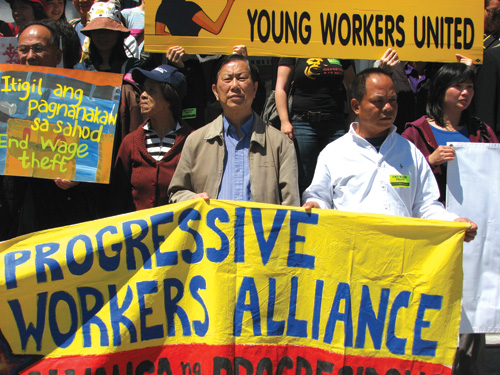
Now, she’s working 12 hour shifts, five days a week at a different restaurant, but says she still isn’t receiving minimum wage or overtime pay. Li aided in the efforts of the Progressive Workers Alliance (PWA) to urge members of the Board of Supervisors to pass the Wage Theft Prevention Ordinance, which aims to strengthen enforcement of local labor standards by empowering OLSE to take a more proactive role against employers who don’t pay workers what they’re owed.

As a kitchen worker at a high-end restaurant in downtown San Francisco, Li receives a monthly paycheck totaling a little more than $1,400 before taxes. Take-home pay is less, because the employer deducts for meals, a requirement that cannot be dodged even if employees bring their own food.

Li told the Guardian her coworkers are angry about the working conditions, but fear of job loss keeps them silent. “Some of my coworkers work so hard that they cry,” she said, speaking through a translator. “One worker was burned badly in the kitchen, and didn’t receive worker’s compensation or paid sick leave.” That person uses their own ointment to treat the burns, she added.

As she described her predicament at the CPA office in Chinatown, student volunteers were creating a banner to be displayed during a press event at City Hall. They arranged folded red and yellow petitions signed by workers in similar situations to spell out PWA, for Progressive Worker’s Alliance, to urge city officials to crack down on employers who violate local labor laws.

PWA has been meeting regularly since last year, but the organizations that are part of the advocacy group have been engaged in organizing low-wage workers for much longer. Over the course of more than three years, CPA interviewed hundreds of restaurant workers in Chinatown, and their surveys revealed that about half were not receiving San Francisco’s minimum wage, while about 75 percent weren’t being paid overtime when they worked more than 40 hours a week. Yet the problem of wage theft in San Francisco extends well beyond Chinatown.

PWA includes representatives from CPA, the Filipino Community Center, Young Workers United, People Organized to Win Employment Rights (POWER), the San Francisco Day Labor Program, and Pride at Work, among others. On August 2, workers and organizers with PWA burst into thunderous applause after the Board of Supervisors voted unanimously to pass the Wage Theft Prevention Ordinance on first reading. This represented a major victory.

“With the economic crisis, and the backlash against workers, we felt that as a small grassroots organization, we needed to have a more powerful voice and a specific space for worker issues to be brought to light,” CPA lead organizer Shaw San Liu said of the impetus behind PWA.

“You’re talking about workers who are pretty vulnerable — not knowing the laws, not speaking the language. People who need a job and cannot afford to lose it are vulnerable to exploitation,” Liu said.

While labor laws in San Francisco are uniquely strong, with mandatory paid sick leave and local minimum wage established at $9.92 per hour, “When it comes to implementation and enforcement, there’s still a lot left to be desired,” Liu said. As things stand, investigation of employer violations are predicated on worker complaints, and it can take years for a worker to get a hearing if they’re owed back wages.

The Wage Theft Prevention Ordinance doubles the fines for employers who retaliate against workers who file complaints. It allows OLSE investigators to issue immediate citations if they detect a problem in a workplace. When an employer comes under investigation, it requires them to post a notice informing workers that they have a right to cooperate with investigators — and imposes a fine for failing to post the notice. It also establishes a one-year timeline in which cases brought to OSLE’s attention must be resolved.

Under the new law, employers would also be required to provide contact information to their workers, an important change for day laborers who are sometimes taken to job sites where they perform manual labor, only to be dropped off later without payment and no way to get in touch with their temporary bosses.

“You have raised awareness about the crisis of wage theft,” OLSE director Donna Levitt told workers at an Aug. 2 rally outside City Hall. “And we have made it clear that wage theft will not be tolerated in our city.”

The ordinance was spearheaded by Sups. David Campos and Eric Mar, with Sups. Jane Kim, John Avalos, Ross Mirkarimi, and Board President David Chiu signing on as co-sponsors. Members of PWA met with supervisors to win their support, and even succeeded in bringing on board the influential Golden Gate Restaurant Association.

“The fact is that even though we have minimum wage laws in place, those laws are still being violated not only throughout the country, but here in San Francisco,” Campos told the Guardian. “Wage theft is a crime, and we need to make sure that there is adequate enforcement — and that requires a change in the law so that we provide [OLSE] more tools and more power to make sure that the rights of workers are protected.”

Victoria Aquino, 66, spent several years working 16-hour hours without minimum wage or overtime pay as the sole live-in caregiver for six disabled patients at a San Francisco care center. Her duties included feeding patients, bathing them, changing diapers, and cleaning.

“The patients would knock to wake me up and ask me for cigarettes or food in the middle of the night,” she recounted, “and I wasn’t paid for that.” She first complained to OLSE after one of the patients physically attacked her, leaving her black and blue with a permanently injured finger, and later sought the help of the Filipino Community Center to file a claim demanding back wages. It took months, but her employer eventually settled, agreeing to pay $60,000 in back wages and reduce her shifts to eight hours a day.

Aquino said she became involved with the Filipino Community Center because “there are a lot of caregivers still suffering, and more than I suffered — especially those who don’t know the laws. I sympathize for them. It hurts me when I hear some caregivers who are no longer supposed to work. They’re past their 70s, and they’re still working.”

View from the middle

4

OPINION Editor’s Note: Between the well-funded, politically connected campaign pushing Ed Lee to run for mayor and the high-profile critics who say he should keep his word and step down, it’s hard to tell how the average city resident feels. So to reflect that perspective, we’re reprinting a letter that was sent to Lee on July 29.

Dear Mayor Lee,

My name is Peter Nasatir; I’m a middle-aged, middle class San Franciscan who works in middle management. I’m not an activist and I have no political ax to grind. In fact, I rarely write letters like this, but felt compelled to do so because I’ve been reading how you are considering a run for mayor this November. For your own integrity, and the good of the city, I urge you not to run.

One of the reasons you have been able to achieve the successes you’ve enjoyed this year is because San Franciscans know your time is finite, thus giving you the ability to avoid the kind of hard slog other mayors have found themselves in. You have been able to stay above the fray and receive near-universal support precisely because you’ve been able to do the amazing job you’re doing without having an eye on the upcoming election.

If you run, you’ll look like another cynical politician, who promises one thing and does another. Plus, with your experience, think how much political capital you’ll have when you return to your old position. And if you decide to run in 2015, you’ll already have on-the-job training no other candidate would have and have proven yourself to be a real leader for taking the high road.

I know Willie Brown and Rose Pak, who are considered influential community leaders, have been at the forefront of your bid to run. However, they also carry a lot of damaging baggage. Just look at the front page of today’s (July 29th) Chronicle. With their names attached to your run for mayor, your image in the eyes of many San Francisco voters is already tainted before you even have a chance to file your papers.

As much as I respect you and the incredible job you are doing, I can say without hesitation that if your name is on the ranked-choice ballot this November, I will not vote for you in any of the three positions.

On behalf of many like-minded San Francisco voters, I urge you to do the right thing and not run for mayor this November.

Thanks you for your consideration of this matter.  

Sincerely, 

Peter Nasatir

Alerts

0

alerts@sfbg.com

WEDNESDAY 10

Protesting another police shooting

Raheim Brown Jr., 20, was killed on Jan. 22 by an Oakland school district police officer, after a fellow police officer was allegedly attacked with a screwdriver. This rally protests the latest in a series of killings by police, and supports Brown’s family, who will be confronting the Oakland School Board for its part in the death. After the rally, protestors will march to the Oakland School District headquarters where the family members will be making their address.

3:30 p.m., free

Lake Merritt Bart Station

Oak & 9th St., Oakland


THURSDAY 11

Mayoral debate

Watch the mayor mayoral candidates face off in a debate. The forum will be hosted by the San Francisco Young Democrats, Alice B. Toklas LGBT Democratic Club and the City Democratic Club, who have partnered with the Huffington Post and YouTube to broadcast and discuss the event. Melissa Griffin will be the evening’s moderator, with commenting by Beth Spotswood and Pollo de Mar.

6 p.m., free

African American Art & Cultural Complex

762 Fulton St., SF

www.sfyd.org


SATURDAY 13

Climate change and the EcoHouse

Learn how to reduce your carbon footprint on a tour of Berkeley’s EcoHouse, a toolshed built with straw bale, rammed earth, clay, and cob. The center has a living roof, laundry greywater system, 1100-gallon rainwater cistern, a native rain garden and three kinds of compost. The tour features tips on the best ways to save energy and reduce climate impact, with the EcoHouse as its prime example.

10 a.m.-noon, free

Ecohouse

1305 Hopkins St., Berkeley

(510) 548-2220 x239

www.ecologycenter.org


SUNDAY 14

Iraq War Veterans Speak Out

This event organized by March Forward!, an organization of veterans and soldiers on active duty, gives Iraq War Veterans a chance to speak out about their experiences, and against war. A former Marin Corps infantryman, former Army infantryman and former Army intelligence operative will share eyewitness accounts of their time in Iraq. They will explain how their Iraq war experiences turned them into anti-war activists, the current situation for veterans and veteran care, and how they are building an anti-war resistance among active duty troops within the military.

5-7 p.m., $5-10 donation, no one turned away

2969 Mission St., SF

www.answersf.org


Mail items for Alerts to the Guardian Building, 135 Mississippi St., SF, CA 94107; fax to (415) 437-3658; or e-mail alert@sfbg.com. Please include a contact telephone number. Items must be received at least one week prior to the publication date.

Replacing the Concourse

4

news@sfbg.com

In one of the few remaining San Francisco neighborhoods untouched by gentrification, there is a proposal to demolish the Concourse Exhibition Center and replace the quintessential Showplace Square building with a market-rate residential project, which the developer says will be rental apartments.

This is the first major project in the new Eastern Neighborhoods Plan that will change the light industrial neighborhood where brick and mortar meet interior design, raising questions about whether the development would be sustainable, transit-oriented, and family-friendly.

Home to annual events like the Green Festival and the KPFA Craft Fair, the Concourse is where mom and pop vendors share their wares in an affordable venue — one of the few remaining in the city.

“Since ’96,” recounted Alan Van De Kamp, director of sales for the Green Festival, “they’ve been trying to sell it, to tear it down. You never know from year to year … You imagine at some point, somebody’s gonna say it’s time.”

Though nothing has been approved, the current proposal by developer and Concourse owner Bay West Development, first introduced in 2000, has come the farthest yet. The project will be considered for approval by the Planning Commission once the environmental review process is complete, which could take up to six months. Public comments on the project will be accepted until August 8.

The proposed project contains two sites, one at 801 Brannan Street and one at 1 Henry Adams Street, which would result in a total development of up to 674 residential units, 43,037 square feet of retail space, and 673 parking spaces. Under the city’s inclusionary housing laws, 221 of those units would be affordable (71 to be built on site and 150 dedicated to the city for development). Of the total parking spaces, 166 spaces would replace existing parking spots at the site.

Bay West, developer of the San Francisco Design Center, has owned the Concourse building for 30 years and wants to demolish and rebuild as part of the Eastern Neighborhoods Rezoning and Area Plans, the blueprint for development in a part of the city dominated by working class residents.

That controversial plan was in development for years, during which there was a moratorium on approval of large projects, and it was finally adopted in 2008. It was created to redevelop The Mission, Showplace Square/Potrero Hill, East SoMa, and the Central Waterfront — 7 percent of the city’s 47 square miles — over 20 years.

“It’s our feeling that the building itself is beyond its use as an exhibit hall and we’re replacing it with housing units,” said Sean Murphy, a partner at Bay West.

The Planning Commission heard the draft Environmental Impact Report for the proposal on July 28. At the hearing, the commissioners expressed interest in seeing the progression of the development, but not all were convinced.

“There is a certain amount of vagueness,” said Commissioner Kathrin Moore. “This EIR is ultimately tempered by the strong policy issues that underlie building in the Eastern Neighborhoods and at this moment I don’t quite see that.”

The proposal has left some questions unanswered, such as, where will the small vendors go to sell their wares? Bay West has suggested exhibition halls like the Cow Palace or Moscone Center, but Green Festival organizers say that isn’t realistic for everyone. “We would lose some of our vendors if we went to Moscone,” said Van De Kamp. “There’s some people that can’t come. A lot of the green economy is about mom and pops. They can’t afford it.”

Sue Hestor, a land-use attorney who opposes the development, asked vendors who use the Concourse how important leaving the center would be. “For a lot of people,” she said, “it meant the difference for them being viable or not.”

It would be a major challenge to move, said Robbie Kowal, the co-director of Sea of Dreams, a huge party and concert that will hold its seventh annual celebration this New Years Eve at the Concourse. “There’s the Cow Palace, and the Design Center, but it’s not that big, not a place where you can put a proper concert on one side and a multitude of different kinds of spaces [on the other]. The Sea of Dreams’ success is attributable to the proper use of the Concourse.”

With 125,000 square feet of space that can be split into its west and east halls and a mezzanine, the Concourse building has catered to annual festivals and events for more than 20 years, holding as many as 6,800 people at once.

“There’s room for so many different communities in there. We love our home,” said Kowal. “It’s a really unique and wonderful space.”

The redwood frame of the Concourse, accented by glass fronts that allow for natural lighting, used to be a furniture mart and then a fashion and jewelry mart before it was an event center. The project proposal’s architect, David Baker and Partners, has already designed many of the new buildings in Showplace Square.

Bay West isn’t worried about where the Concourse shows will go. “Most of our shows use less than 20,000 square feet,” said Murphy. “The larger shows would go to the 100,000 square foot San Mateo County Event Center.”

Tony Kelly of the Potrero Boosters Neighborhood Association says the intention of the plan is to reduce the light industrial area by zoning more of it for residential uses, protecting only about half of it and converting the remainder.

“This is an area where we don’t have enough parks, or transit. The project would double the population, and we don’t have enough new infrastructure to handle it,” he said. “It’s essentially a ticking time bomb that the city’s going to have to get a handle on at some point, or these residents are going to be miserable.”

Though the project would create at least an acre of publicly accessible open space, some residents wonder if it’s enough, and the concern about insufficient transit remains.

“It seems to me that once again there is too much parking near a freeway entrance, inadequate transit that is not likely to improve significantly once the Transit Effectiveness Project [a city plan for improving Muni service] is implemented,” said activist Sue Vaughan, who rides her bike at least part way during her commute from the Richmond District to REI at 840 Brannan Street for work.

“This is exactly the kind of place that attracts (commuters),” said Hestor. “There’s too much parking. There’s crappy transit. It totally undermines any idea of sustainable development.”

But at the commission hearing, Commissioner Hisashi Sugaya didn’t think Hestor’s argument had merit. “Parking is not an environmental impact as far as the city is concerned,” he said.

Vaughan says that Muni managers have been absent from several development meetings in the Eastern Neighborhoods area. “No one from Muni was represented on this panel discussion about the Sustainable Communities Strategy,” she said, referring to a July 6 meeting convened by the Planning Department to discuss the importance of building housing next to accessible transit.

The Concourse is scarcely accessible by bus lines 10 and 19, but with a growing population in Showplace Square, it wouldn’t be enough, says Vaughan. “We’re moving forward with all these projects with lots of parking near freeway entrances, which makes it seems like SF is becoming a bedroom community for Silicon Valley. You have an impact on Muni when that happens. With more cars, there’s more congestion for buses.”

Bay West argues that the apartments it plans to build at the Concourse site would be “workforce housing” with less than 1:1 parking (actual parking would work out to .79:1 at the 801 Brannan site and .64:1 at the One Henry Adams site). More than 40 percent of the units would be larger two-bedroom units intended for families.

Yet Kelly says that that by offering the apartments at market rates, none are appropriate for new families. “For all the talk about keeping families here, then how come we’re not building family housing?”

It’s a max-out project, says San Francisco architect Dick Millet, of the Potrero Boosters Neighborhood Association. “In the end, under their breath, they’re all going to say, I wouldn’t live there myself.”

Editor’s Notes

0

steve@sfbg.com

When a crowd of less than two dozen people watched an eight-foot wooden man burn on Baker Beach during the Summer Solstice of 1986, could any of them have possibly imagined that the ritual would repeat itself 25 years later in Nevada’s Black Rock Desert before a sold-out crowd of more than 50,000 people?

Even if man-builder Larry Harvey could have dreamed that big and strangely — and, most assuredly, he did not — it’s even harder to imagine the dimensions, staying power, and creativity of the massive temporal city that has formed up around the Man, Black Rock City, or the impact that it’s had on the hundreds of thousands of people who have cycled through it.

I first attended Burning Man in 2001, when the event was half its current size and when the country’s sociopolitical landscape was about to undergo a profound and lasting change, with 9/11 and the launching of a war in Afghanistan that continues to his day. It is against that backdrop that this culture — with its core values of self-expression, communal effort, and rejection of commodification — has flourished.

I’ve had the privilege of closely covering Burning Man and its many leaders and luminaries continuously since 2004, when I launched a long series of Guardian articles that later evolved into my book, The Tribes of Burning Man: How an Experimental City in the Desert is Shaping the New American Counterculture (2011, CCC Publishing), so I’ve had plenty of time to ponder what has always seemed to me the central question: Why?

Why do so many people devote so much of their time, energy, and resources to preparing for the pilgrimage to the playa? And we’re talking months worth of work, in drab workspaces around the Bay Area, sacrificing other social and economic opportunities and sometimes even their sanity. Why do they do it, and why do so many burners find that experience so transformative?

There are, of course, the obvious answers. There’s the mind-blowing art pieces, which seem to get more ambitious and innovative each year. It’s also the greatest party on the planet, a truly 24-7 city with engaged citizens exploring endless options, all offered for free. Then there’s the surreal setting, the DIY spirit, the gift economy, the experiments in urbanism and community, its smoldering sensuality, and an endless list of other appeals.

And that’s all great, but I’ve come to believe that there’s something else at the core of the question: Why do we do this? We do it because we have to, because we can’t think of any sane way to respond to the insanity of modern American life. So we pursue our mad visions, and organize our lives and social circles around that pursuit, collectively building a fake, doomed city in the desert that seems to us so much more real and authentic and purposeful than anything the default world is providing.

We do it because it’s become our home, a place that is now an important part of who we are. And we at the Guardian hope the burners among you find some useful tidbits in our first-ever playa prep guide.


Step up and save CCA

6

EDITORIAL Two things became abundantly clear at the San Francisco Public Utilities Commission meeting July 26th: The Community Choice Aggregation program is off track — and General Manager Ed Harrington has no interest in making it work. The supervisors need to move aggressively to save CCA.

Since 2007, when a draft implementation plan was released, the goals of the program — which is supposed to offer a cleaner alternative to Pacific Gas & Electric Co. — have shifted fairly dramatically. No longer does the plan seek to meet PG&E’s rates. It won’t be aimed at the entire city to start. And the PUC is putting most of its effort into a short-term contract to buy green power from Shell Energy North America — and all-but ignoring the more important moves to build a publicly owned energy-generation infrastructure.

CCA, which allows cities to buy power in bulk and resell it to customers, is a step in the right direction. The program now before the PUC would put San Francisco in the public power business — to a degree. But as the financial projections for the program demonstrate, the real savings and the real revenue won’t come until San Francisco replaces PG&E as the owner and operator of the local grid. A full-scale public power system would allow the city to both increase renewable power and cut rates — and would bring hundreds of millions into the treasury in the process (see “Mud Money,” 6/26/08).

Still, CCA offers many benefits — including the chance for the city to build local renewable energy facilities. And that’s where the PUC’s efforts ought to be focused.

During discussion of the proposed contract July 26th, Harrington was largely negative and talked repeatedly as if he didn’t think the original program could work. He kept saying that renewable power was more costly (true, today — but not after the city starts building its own facilities). He said that the goals the “advocates” (who include a majority of the Board of Supervisors) have demanded were unrealistic. And most of the commissioners seemed clueless.

That’s a terrible way to launch one of the most important environmental and financial initiatives in modern San Francisco history. Marin County is already well on the way to creating a working CCA system. Other counties are moving forward. And San Francisco, the only city in the nation with a federal mandate for public power, can’t get its civic act together.

The supervisors need to get involved, quickly. The Local Agency Formation Commission, which is overseeing this project, should haul Harrington in for a hearing as soon as possible. Among other things, the LAFCO members should ask why Harrington is so determined that the project won’t work; why his proposal is geared to a small number of residents and businesses who would face higher rates for power; and what his plans are to create a local energy generation infrastructure that over the long run would be dramatically cheaper and greener than anything PG&E (which has been in the background here trying to undermine CCA) will be able to offer.

The problems with CCA reflect the immense challenges of putting this program in the hands of a commission a majority of whose members were appointed by a mayor who opposed public power, managed by someone who has never supported municipalization efforts. Harrington and the SFPUC appear to be setting CCA up to fail. The supervisors need to step in before that happens — and every candidate for mayor needs to be pushed to publicly support CCA and make this an important campaign issue. And they need to promise that they’ll appoint people with real public power credentials who will replace Harrington and shake up the next PUC.

is Rec-Park really broke?

16

By David Looman

OPINION The senior staffers at the Recreation and Park Department routinely cry that the department is poor and going broke. Is it possible they are lying?

Conspicuously lacking in discussions of Rec-Park funding is any kind of hard data about how well or poorly San Francisco Rec-Park is really funded. Whether it’s the mainstream media, the alternative press, or our elected representatives on the Board of Supervisors, nobody seems to know how our park system compares with other park systems in California or the U.S.

And nobody seems to want to check up on Rec-Park’s sad-sweet story.

This lack of real information is particularly surprising, since the data is readily available. Every year, the Trust for Public Land, a well-respected, San Francisco-based park advocacy organization, conducts a meticulous and comprehensive survey of how well recreation and park systems across the country are being funded. The survey is always available on the Web, at www.tpl.org.

Surprise!

In the TPL’s 2000 book, Inside City Parks, by Peter Harnik, San Francisco was among the three best-funded systems, measured either per acre or per resident. In every annual survey after that, San Francisco continued to rank in the top three, until 2006. In 2006, the TPL found San Francisco to be the best-funded park system in America.

That’s right, the best-funded department in the entire U.S.!

This year’s survey, based on the 2008 figures, has changed its methodology a bit, and expenditures are no longer calculated per acre. With the new methodology, San Francisco has slipped a bit. The city is now only the fourth-best funded park system in the country for cities with populations larger than 500,000, and the sixth best for cities over 250,000.

For operating expenditures (total budget minus capital spending) San Francisco is the fourth best funded among all cities. We don’t have as many capital expenditures as, say, Seattle, whose newer park system is still growing.

The question of where that money goes is another matter. I think I can offer a few suggestions about what happens.

Problem number one is the long and glorious history of absolutely incompetent management, particularly in the last 15 years, under the administrations of mayors Willie Brown and Gavin Newsom. Second is that longstanding Rec-Park Department practice of ignoring and rejecting any public input, including factual input, from people who actually use and know the parks. This has led to a number of costly mistakes.

The department has more ethically dubious faults too—the wages spent organizing so-called “public support” for some of its unpopular projects; more wages spent having employees testify about what a great job the department is doing, etc.

The department presently is trying to privatize everything within reach. Its poor-mouth rational for doing so is false. It’s time we all faced the fact that Rec-Park isn’t giving us the whole truth.

David Looman is a longtime San Francisco political consultant and parks user.

The foodie crackdown

3

news@sfbg.com

Yet another blow was dealt to the San Francisco’s free-thinking food scene on June 11 when the final Underground Market was staged by ForageSF, at least for the time being. The market was shut down by the San Francisco Department of Public Health (SFDPH) in a clash between small-time food businesses and city officials over permitting and regulatory issues.

“I was ready for this for a while,” ForageSF founder Iso Rabins told us. “I thought someone would show up eventually to say something about this, and now they have.”

Rabins began the Underground Market in 2009 as a monthly venue for food entrepreneurs to share their goods without financial and bureaucratic red tape. It’s basically a farmers market without the permits, fees, and commercial kitchen requirements that add thousands of dollars to the cost of staging an event. Throw in live music, drinks, a little subversive thrill, and you’ve got a gathering that has proven enormously popular.

Until now, the market has operated as a private event. It is held in a private space and attendees are required to sign a membership form and pay a $5 entrance fee. It’s become a huge draw for foodies, with 1,500 to 3,200 patrons per event, according to Rabins, so the state government got wind of its largely unregulated operations.

Alicia Saam, the temporary events coordinator with SFDPH, says her department was asked by state officials to observe the market. It’s now too big to be considered private, she says, so it must adhere to health code and public safety regulations just like any other public event.

“One of the things that differentiate private versus public events is how much advertisement goes out there,” Saam said. “Something that is advertised and has grown big enough to have a following, that becomes a concern for us as a public event.”

Without official oversight, rules are bound to be broken. As with any novice venture, mistakes are made. When officials came to the Underground Market, they saw some vendors acting more like friends at a house party than professional food vendors, which is the complicated line that the market tries to toe.

“We observed operators and vendors eating and then handling the food, and that’s a huge contamination hazard for us,” Saam said. “They weren’t washing their hands before continuing food service, nor did they have a hand-washing set-up right there at their booth. There looked to be temperature issues as far as some of the food that was being stored, such as protein foods, sausages, and dairy. Some foods were not protected but were displayed on the table uncovered. People come up and they’re excited and curious, there’s a lot of creativity there, so they’re hovering over the food and possibly contaminating it with all sorts of things. The source of food, such as the kitchen where the food is coming from, needs to be an approved space where there are no animals, or cats like in some homes. It needs to be a commercial space that is properly cleaned and sanitized.”

According to the U.S. Center for Disease Control, one in six Americans get sick each year from eating contaminated food. Salmonella infection is of particular concern because food can be contaminated anywhere from the fields to kitchen surfaces.

The SFDPH has already allowed the Underground Market to operate unregulated for more than a year without any reported food illnesses, but Rabins is quick to agree that these health concerns are real.

“I do believe that these issues of health are important, and although I feel that all the vendors at the market are very careful about what they make, we do want to institute some Serve-Safe classes, basic food safety,” Rabins says.

He says that on the whole, people cooking small batches pay much more attention to their ingredients and processes than industrial food companies do. Rabin said that while the country’s food safety system works pretty well, it doesn’t allow for much locally based innovation in new models for making and sharing food.

“The Health Department’s position makes sense because this is the system that has existed, this is the system that they know and that their jobs support, and it’s a system that works in a lot of ways. But it’s also a system that was really created for industrial processes,” Rabins says. “Unfortunately the way regulations work, top-down is one-size-fits-all, but that’s just not the way it is.”

That gets to the meat of the issue: whether and how much the city should get involved in people’s food habits. Where is the line between public restaurants and private homes — and are there ways of creating hybrids of the two? It’s an ongoing battle in San Francisco between regulating restaurants (and netting taxes) while still promoting an innovative food industry that attracts locals and tourists alike.

In the past few years, the mobile food truck craze has hit San Francisco with little bits of foodie culture from all over the world. Entrepreneurs say it’s too difficult and expensive to start a successful restaurant in SF, so they’re trying small-time pop-ups instead.

At first they went unregulated, but now laws define what they can sell, the permits they need, and limit their mobility. Permits are expensive too, starting at $1660 for initial basic coverage, which is why Rabins says the Underground Market provides an additional support for motivated locals. As city officials have closed big budget deficits year after year without any substantial increases in general tax revenue, fees and permit costs have risen substantially in recent years.

According to Rabins, getting the Underground Market up to code means, “getting all the vendors commercial kitchen space, making them get catering licenses, which is around $600, making them pay for vendor event permits, which is $140 per event, and then I would have to buy a sponsor permit which is another $1200 per event plus event insurance plus, plus, plus all these things that would essentially destroy the spirit of the event. It would make the bar way too high.”

Tightening the membership rules is another option, such as making people sign up weeks in advance or requiring member cards. Richard Lee, the director of environmental health regulatory programs at SFPHD, says that regardless of the vendor’s complaints, the regulations must be met.

“We think that these are reasonable options,” Lee said. “Anyone who is going to sell to the public needs to meet certain requirements, and unfortunately some of those requirements are going to be costly. They have to pay for permits and whatever those permits cost they’re going to have to pay.”

Until some agreement can be reached, the Underground Market won’t be operating, and San Franciscans will have to find their fix at the numerous above ground markets and restaurants. Lee says that he hopes that the market meets city demands, and soon, as this kind of entrepreneurial innovation is essential to a thriving food economy.

“We do encourage the micro-enterprises, and there are possible ways to have that started in San Francisco,” Lee said. “It is possible that there may be legislation in the future that might be supported by the Board [of Supervisors] to make it easier for them to get permitted, so there are things that can be done. For us, though, it is food safety and public health that are the most important things.”

But Rabins is already looking far beyond just the small market model.

“They just want to make it another farmers market,” Rabins said. “I’m not interested in running another farmers market. There are plenty of farmers markets around and people who have been doing them for years and know how to do them.”

He also isn’t interested in conforming to the pre-set expectations and sees the motivation behind the market taking it to new heights. In addition to reopening, he says that ForageSF has secured a kitchen space for helping entrepreneurs launch their small businesses and host public classes.

“We are going to hopefully have a rooftop garden with a movie screen, a retail space in front that sells products being made in the kitchen by vendors, and possibly a small-scale brewery in back,” Rabins said.

He is also reaching out to other similar market organizers, such as some in Los Angeles, to brainstorm ways to make this business model more acceptable across the country. He says they are in the initial phases of creating a model that is reproducible for others who want to start their own markets.

Once again, in the place where the organic food movement first bloomed, people are coming together to create new interactions between producers, consumers, and their food.

Taking out the trash

1

sarah@sfbg.com

A controversial city waste disposal contract appeared primed for final approval by the Board of Supervisors on July 26 (after Guardian press time) — despite being challenged by a lawsuit and initiative campaign — after two progressive supervisors rescinded their initial vote in a July 20 committee hearing and supported awarding the contract to Recology.

City staff had recommended awarding the 10-year, $112-million landfill disposal and facilitation agreement to Recology (formerly NorCal Waste Systems, Inc.), which has grown from a locally based company to the 10th largest waste management firm in the US, with $652 million in annual revenue, according to Waste Age magazine.

If the full board follows the unanimous recommendation of its Budget & Finance Committee, the vote will authorize Recology to transport and dispose up to 5 million tons of the city’s solid waste at the company’s Ostrom Road landfill in Wheatland, Yuba County. The contract will take effect when San Francisco’s disposal agreement at Waste Management Inc.’s Altamont landfill in Livermore expires — estimated to occur in 2015.

The deal will cement Recology’s control, at least for a 10-year period, over all aspects of the city’s solid waste stream, at a cost of about $225 million per year, even as the company faces significant challenges, many related to the city’s 1932 refuse collection and disposal ordinance.

That law, approved during the Great Depression to prevent conflict between competing garbage haulers, has resulted in Recology’s exercising complete control over trash collection and transportation in San Francisco, without having to bid on those contracts or pay the city franchise fees.

During the negotiations over the city’s next landfill contract — the only aspect of San Francisco’s waste stream put out to bid — this 79-year-old law was invoked to explain why Recology has the sole authority to transport trash and compostables to Wheatland, which is 130 miles from San Francisco.

The move also comes as Yuba County is contemplating significantly increasing dumping fees at the landfill — from $4.40 per ton to $20 or $30 per ton — a hike that could erase the $100 million that the Department of the Environment (DoE) claims the Recology deal would save over a competing bid by Waste Management Inc. WM is the largest waste firm in the U.S., according to Waste Age, with about $12.5 billion in annual revenues.

On July 18, WM filed a lawsuit in San Francisco Superior Court to prevent the city from approving the agreements with Recology on the grounds that they violate the city’s competitive bid laws.

“The Department of the Environment inappropriately and unlawfully expanded the scope of its 2009 ‘request for proposal for landfill disposal capacity’ and, therefore, violated the city’s competitive procurement laws,” WM alleges in the suit.

WM has long held that DoE inappropriately issued a tentative contract award for both the transportation and disposal of solid waste to Recology without soliciting any other transportation bids. But DoE, which gleans $7 million annually (to operate recycling, green building, and environmental justice programs and long-term planning for waste disposal) from rates that Recology’s customers pay, ruled last year that WM’s objections are “without merit.”

Now WM is asking the court to require DoE to scrap its award to Recology and issue a new request for proposals to comply with competitive bidding requirements.

“There is ample time for the department to issue a new RFP,” WM stated July 18, noting that there is plenty of room at its Altamont landfill to accommodate the city’s waste after the contract expires.

That same week, a coalition led by retired Judge Quentin Kopp, community activist Tony Kelly, and Waste Solutions CEO David Gavrich announced that it had submitted enough signatures to qualify an initiative on the June 2012 ballot requiring competitive bidding and franchise fees from any company that seeks to win any aspect of the city’s solid waste business.

Kelly says his group was unable to collect enough signatures in time for the November election because Recology hired the city’s two biggest signature-gathering firms to circulate what he calls a “phony petition” in support of Recology’s performance in San Francisco. And signature gatherers say they were harassed by Recology boosters while trying to petition citywide.

“But I believe the question of whether candidates support competitive bidding will continue to be a defining issue this fall,” Kelly said.

The board’s decision on the landfill agreements has already been delayed several months, following a February 2011 Budget and Legislative Analyst report recommending that the board consider submitting a proposition to the voters to repeal the 1932 refuse ordinance so that future collection and transportation services be put to bid. The report also recommended that future residential and commercial refuse collection rates be subject to board approval.

But with two progressive supervisors running in citywide elections this fall, and with Recology exerting massive pressure on elected officials, the Kelly coalition could not find four supervisors to place such a charter amendment on the November ballot, forcing them to launch their own initiative.

And at the July 20 meeting of the board’s Budget and Finance Committee, Sup. Ross Mirkarimi, who is running for sheriff, and Sup. Jane Kim rescinded their initial decision to send the agreements to the full Board without recommendation. Instead, after the committee had moved on to other business, they joined Chair Carmen Chu, one of the most conservative supervisors, in forwarding the Recology agreements to the full board with unanimous support.

Mirkarimi interrupted the committee’s next discussion to rescind the landfill vote. “I think there was some misunderstanding a little bit in wrapping up the landfill agreements with Recology, ” Mirkarimi said. He said that he asked for the vote to be rescinded, “so we can accurately reflect some of the sentiments being articulated here. I think we just learned some things on the fly.”

In many respects, the switch by Kim and Mirkarimi made sense: prior to their initial vote, they made positive statements about the proposed agreements, but also stated an interest in exploring the appropriateness of the city’s 1932 law.

“Overall, I think this was a good contract,” Kim said. But she noted that, thanks to the 1932 ordinance, the city doesn’t get franchise fees. And she claimed that it only gets half of what other Bay Area cities get from their waste contractors. “So, I’m really interested in continuing that conversation, but I think it’s a separate conversation,” she said.

Mirkarimi said it was his concerns that led the committee to “put a pause” on the Recology agreements until it could “undertake more homework.” He also noted that his office “held a number of meetings” and he tried to “leverage this opportunity to reanimate activity at the Port.”

“I was hoping that we might be able to arrive at something much more deliverable,” Mirkarimi said, presumably referring to the fact that these efforts resulted in DoE unveiling an amendment to include two “possible changes” to operations and facilities at the Port of San Francisco in the agreements.

These changes involve utilizing other modes of transportation, including barges, as alternatives to the rail-haul plan proposed in the agreement. They also call for developing new facilities at the Port for handling waste, recyclables, organics, and other refuse. The cost of such alternatives would be passed onto the rate payers.

“I think that, cost-effectively, we may be able to insert the Port into this equation, but it’s not ready for prime-time yet,” Mirkarimi said. He concluded by saying that Recology has been innovative in reducing the city’s waste stream.

“This should be a front-burner conversation,” Mirkarimi said, noting that former Mayor Gavin Newsom focused on making San Francisco “the greenest city” in the United States. He added that San Francisco claims to have a 77 percent diversion rate, the highest in the U.S., and said, “That comes at a cost, it doesn’t come for free.”

After the meeting, DoE deputy director David Assmann said that the City Attorney’s Office is reviewing WM’s filing. “But it’s too soon to comment,” Assmann said.

He also claimed that, thanks to the 1932 ordinance, “there was no practical way” for another company to transport San Francisco’s waste to its designated landfill, “other than building a second transfer station outside the city.”

But Kelly continued to express concerns that the agreements are not competitive, and that the city lacks a contract and ensuing franchise fees. “They are running this as if it’s still the 1950s,” he said.

Kelly claimed that Recology Vice President John Legnitto, who is the 2011 chair of the SF Chamber of Commerce’s Board of Directors, recently told him that Recology has been in negotiations with City Hall around a $4 million franchise fee, but that the money would now be spent opposing Kelly’s competitive bidding initiative.

Anger erupts over police shootings

11

rebeccab@sfbg.com

As the murky details of two recent police shootings emerge, a palpable anger surging through targeted communities points to a deeper issue than the particular circumstances surrounding each of these deaths. Simply put, many Bay Area communities are fed up with police violence.

For many activists who descended on transit stations to protest the fatal BART police shooting of Oscar Grant III, the 20-year-old unarmed Hayward man who was killed on New Year’s Day 2009, an upwelling of rage was rekindled after BART cops shot and killed a homeless man named Charles Blair Hill on July 3 in Civic Center Station.

Then, on July 16, San Francisco police officers in the Bayview shot 19-year-old Kenneth Wade Harding Jr. multiple times after he ran from the T-Third train platform because he’d been stopped for fare evasion, leaving him dead on the sidewalk.

The recent officer-involved shootings occurred under two different law enforcement bodies, and both incidents remain under police investigation with many questions still unanswered. BART police say Hill was brandishing a knife; the San Francisco Police Department (SFPD) said its response was justified because Harding fired at officers first. The investigation in Harding’s case took a bizarre twist July 21 when SFPD issued a press release based on a medical examiner’s report stating that Harding had died not from rounds fired by police, but a self-inflicted gunshot wound.

But among communities distrustful of the police, the particulars of each case seemed to matter less than the perception that officers are too quick to escalate conflicts into deadly standoffs. Both incidents provoked intense anger because they resulted in marginalized transit passengers suffering sudden, violent deaths following interactions that were initiated by police. The shootings sparked angry protests, prompting standoffs at Civic Center BART Station, along the T-Third line in the Bayview, on Valencia Street, in Dolores Park, inside the Castro Muni Station, and at the cable car turnaround on Powell Street.

A group of activists staged protests in the Mission following the Bayview police shooting, snaking through the streets as they disrupted traffic and public transit service. “The march began at Dolores Park where nearly 200 of us departed,” an anonymous post on the anticapitalist Bay of Rage website recounted, describing the events of a July 19 protest that resulted in 43 arrests. “Upon reaching the Castro Muni Station, all hell broke loose…. What had now become a mob moved effortlessly past the bewildered cops … Trash was set alight and thrown down onto the tracks below … ticket machines, the fare checkpoints, and the agent booth were all smashed with hammers and flags — totally ruined. Smoke bombs and fireworks were thrown throughout the station.”

This display occurred just eight days after protesters shut down BART stations in downtown San Francisco during rush hour to condemn the fatal shooting of Hill, the homeless BART passenger.

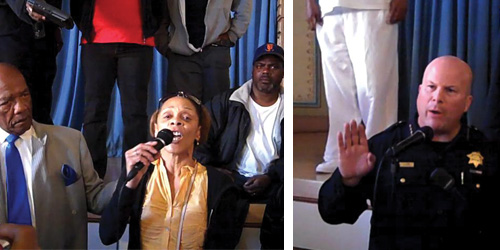
The message from outraged Bayview residents at a chaotic and emotionally charged community forum staged July 20 at the Bayview Opera House was not that people were upset that this had happened to Harding, a Washington state resident, in particular. Instead, people expressed outrage that police had gunned down yet another African American youth, and that unless some complicated and long-standing issues were addressed, it could happen again, to anyone. The forum was organized in partnership with the SFPD and clergy members from the Bayview. Police had prepared a PowerPoint presentation, but never managed to get that far.

At the meeting, Police Chief Greg Suhr tried to provide an explanation for the July 16 shooting. “During this foot pursuit, at some point in time, the suspect … fired at the officers, and the officers returned fire. This is the account that we have so far,” he said. “I cannot tell you how badly that I feel … as captain of this station for two years,” Suhr continued, as an angry crowd shouted him down.

Police escorted Suhr out of the meeting before everyone who had signed up to speak had a chance to be heard. Once outside, the police chief told reporters that he planned to return.

After Suhr and other city officials departed from the meeting, District 10 Supervisor Malia Cohen stayed at the Bayview Opera House and addressed the crowd that remained, she later told the Guardian, and engaged in discussion with Bayview homeowners, merchants, and other community stakeholders.

“We had a very thoughtful conversation,” she said. “People had questions about [Municipal Transportation Agency] policy over the SFPD riding the bus. We talked about the importance of attending Board of Supervisors meetings, Police Commission meetings, and giving public comment. And there will be future conversations, without obstruction.”

Many who attended the meeting voiced concerns that went well beyond the July 16 incident. Several said they believed youth were unduly harassed by law enforcement over Muni fares on a regular basis. Elvira Pollard spoke about how her son was shot 36 times by police and killed seven years ago. Another woman complained that police had used abusive language when she was arrested in the Bayview four years ago.

Mayor Ed Lee told the Guardian that a bigger police presence at the Oakdale/Palou stop on the T-Third line was part of the city’s strategy to prevent violence in that area. “I actually asked the chief to pay more attention to areas that had a history of gun violence and shootings and other kinds of violence … and it just so happens that this particular area, Third and Palou, is a place where there’s a lot of violence,” Lee said. “So we had more uniformed officers on that specifically at not only my request, but with the understanding of the police chief, too.”

Responding to acts of violence by sending in more police sounds simple enough, yet it seems a toxic environment has arisen out of a heightened police presence in a community where tensions between police and residents already run high, fueled by anxiety and bad past experiences. Add to this dynamic a trend of youth who lack other transportation alternatives riding public transit even if they don’t have enough money to pay the fare, and the situation feeds ongoing strife, particularly when fare evaders are asked for identification and searched by police.

Lee, in partnership with Cohen, called a meeting in City Hall July 19 with leaders of the Bayview community. The press was not allowed to attend, but participants said later that officials gave a presentation about the shooting and played an audio of gunfire from the SFPD’s SpotShotter program to offer evidence that Harding had fired first. Later that day, the SFPD reported that gunshot residue had been detected on Harding’s hand, supporting the police account of what happened. Yet the July 21 press release, suggesting that Harding had shot himself because a .380-caliber bullet that police said could not have come from SFPD firearms had entered the right side of Harding’s neck, made it even less clear what really happened.

By July 22, confusion was still swirling over why a gun hadn’t immediately been recovered from the scene of the shooting, and there still wasn’t any clarity on whether an online video of a passerby removing a silvery object from the sidewalk showed a person who retrieved Harding’s firearm after the shooting, as police have claimed. Police recovered a gun that was initially believed to be Harding’s, but later reported that the gun could not have been the same weapon that discharged a .380 caliber round into the victim’s head.

Chris Jackson, a Bayview resident who sits on the board of City College of San Francisco and ran for District 10 supervisor in 2010, said after the City Hall meeting that he felt it had amounted to little more than a lecture from the city’s top officials. Jackson said he perceived a need for a policy shift in terms of how to deal with fare evasion and violence prevention. “We need a better approach,” he said. “We cannot address this with more cops on the T line.”

After Harding’s death, it came to light that the 19-year-old Washington state man had served time for attempting to promote prostitution, and had been named as a person of interest in connection with the fatal shooting of a 19-year-old Seattle woman. Yet a widely circulated online video showing him writhing on the sidewalk in a pool of blood after being shot, while a handful of officers continued to stand around with weapons drawn, sparked outrage. Once the forum at the Bayview Opera House had broken up, LaDonna Callaway condemned the police response, saying, “They didn’t have to shoot him as many times as they did.”

Angelique Mayhem, a Bayview resident who stood nearby, told the Guardian that she didn’t think the meeting had solved anything. “A boy gets gunned down. We don’t know if there was a gun there, but we do know that for 40 damn years, people have been getting gunned down in this community,” Mayhem said. “People are angrier now than when they were when they walked in the door. We’re a community that’s truly in pain, that’s truly frustrated, and really needs some respect.”

Alerts

0

alert@sfbg.com

WEDNESDAY, JUNE 27


Discussion of contemporary Afghan women

To mark the publication of the book Land of the Unconquerable: The Lives of Contemporary Afghan Women, coeditor and sociologist Ashraf Zahedi and contributor Amina Kator discuss this portrait of a misunderstood people. The book features essays from scholars, humanitarian workers, politicians, and journalists who abandon stereotypes or clichés, focusing on the women’s struggle for peace and justice instead.

5:30–7:30 p.m., $5 members/$10 nonmembers

Russ Building

235 Montgomery, SF

www.imow.org

THURSDAY, JUNE 28


Unsung heroes of U.S. history

This event spotlights the lesser-known Philippine heroes of U.S. history and features stories told by descendants of the Buffalo Soldiers who helped the U.S. win World War II; a discussion of the Filipino farm workers in Delano who fought fair wages and ethical working conditions; and a tribute to Al Robles —SF’s Manilatown community leader who was instrumental in the fight against the eviction and demolition of the famed I-Hotel — a refuge for Filipino laborers.

5–9 p.m., free

Manilatown Center

868 Kearny

www.laborfest.net

Operation Recovery: Right to Heal tour

Support the Iraqi Veterans Against the War, a nonprofit that fights for adequate medical and mental health care as well as G.I. rights for returning soldiers. The organization is on tour to share their stories while on the road fighting to win veterans “the right to heal.” The events also features musical performances by Ryan Harvey and Nomi.

7–10 p.m., sliding scale donation

766 Fell, SF

www.ivaw.org

SATURDAY, JUNE 30


Walk through labor history

Revisit the sites involved in the 1946 strike that was started spontaneously by the mostly women retail clerks at Kahn’s and Hastings department stores in Oakland. More than 100,000 workers strong, the so-called “Work Holiday” strike shut down all city commerce for 54 hours. Also, along the way you can learn about the five other general strikes across the U.S. that same yea — the year that set the record for the most strikes in our country’s history.

10:30 a.m.–12:30 p.m., free

Latham Square fountain

Broadway and Telegraph, Oakl.

www.laborfest.net 2

Mail items for Alerts to the Guardian Building, 135 Mississippi St., SF, CA 94107; fax to (415) 437-3658; or e-mail alert@sfbg.com. Please include a contact telephone number. Items must be received at least one week prior to the publication date.

Shuttle wars at SFO

1

news@sfbg.com

It’s a misty morning at San Francisco International Airport, with the fog breaking into a slight drizzle. At the ground transportation area, travelers were repeatedly running in to each other in their head-down dash across packed taxi lanes.

The biggest bottleneck wasn’t the cars, though; it was the confused populace staring up at multicolored, multiarrowed transportation-related signs. Taxi? No. Shuttle? Yes, but which shuttle — reserved, hotel, or shared-ride?

I watch the collective confusion from the shared-ride zone, itself a tricolor ménage. A small sign shows that the red, yellow, and blue zones each correspond to a set of shuttle companies, but it takes some time to figure out which is which. Someone (official or not, I can’t tell) has crossed out and reassigned companies with a permanent marker. Good thing I don’t actually need a ride.

I ask a curb coordinator on duty, Carlos Marenco, about the colored zones. He explains that there are eight small shuttle companies that share the yellow zone — they rotate every five minutes. Two companies use the red zone and rotate every seven minutes. And one company, SuperShuttle, has its own blue zone. Why are the zones distributed like this, I ask?

“SuperShuttle and Lorrie’s (a red zone company) are bigger. More people know them, so they need more space,” Marenco said.

Just then a bewildered couple approached the shared-ride zone. They began talking to the driver of a small yellow zone company who is about to finish his allotted five minutes.

“No,” a coordinator shouts as he comes bustling toward passengers. “You need to go down to the blue zone.”

“Why?” the man asks.

“It is not this driver’s turn. You need to go to the blue zone,”

The coordinator takes their bags from the driver and begins wheeling them to the blue zone.

“They want to ride with me!” he shouts.

The couple is already down the sidewalk though, guiltily following their bags to a waiting SuperShuttle — and the next yellow zone driver idles nearby waiting for their spot at the curb. The driver curses, slams his door, and drives off empty.


AT THE CURB

Curb space at SFO is prime real estate, and a battle is underway between the giant SuperShuttle — owned by a French conglomerate — and a group of small, locally owned airport shuttle companies that say that they’re being pushed aside.

It gets heated out at the curb — when I talked to him after the unlucky driver left without his potential passengers, Marenco explained that the coordinators are often yelled at by enraged drivers.

“They think we cheat them, but we do not,” Marenco said. He says his job is to make sure drivers do not solicit passengers and that each zone gets an equal number of walk-up customers. He has come up with his own system — three large rectangular red, yellow, and blue magnets he puts on a pole at the front of the line to show drivers who gets the next passenger.

But Aaron Chan, owner of Advance Airporter, a small company stuck in the yellow zone, said that “the drivers are always telling me that the curb coordinators give many more passengers to SuperShuttle, even when it is not their turn.” And some small companies say that the big outfit pays the coordinators for more favorable treatment.

Marenco insists he never took money (which you can call tips or bribes, depending on your attitude). But Matt Curwood, San Francisco SuperShuttle general manager, acknowledged that “there have been a number of situations where our drivers are forced into circumstances where coordinators will only escort passengers to their shuttle if they are provided with payment of some form.”

There are no shining angels here. Both parties blame the other side; both deny bribery themselves (but claim the others do it), and the coordinators deny it happens at all.

And the whole mess is getting dropped in the lap of the Airport Commission, which in the past has been very friendly to SuperShuttle.


GET RID OF THE LITTLE GUYS

When the new Terminal 2 opened in April, airport staff asked each shuttle company to submit a letter discussing how zoning should be organized at the new curb. SuperShuttle responded — and took the opportunity to push a topic it has been trying to get SFO officials to adopt since the early 1990s: limiting the number of shuttle companies allowed to serve SFO to no more than two or three.

Curwood says that of the airports SuperShuttle operates in, SFO is the most difficult for customers to navigate. In the letter, he proposed the solution of “a competitive RFP process [that] enables competition and improves the quality of service the customer currently experiences. The essence of the problem SFO faces is that it is trying to accommodate too many substandard operators at the jeopardy of the public’s experience and safety.”

Gil Sharabi, general manager of Airport Express, a yellow zone company his father started in 1979, told me that his company has a perfect safety record and is just as qualified to serve the public as SuperShuttle. Sharabi says that SuperShuttle is really aiming to eliminate local business competition.

SuperShuttle’s corporate offices are in Illinois, and it serves 36 airports in the United States.

Curwood says it’s unfair to make this about the big company versus the little guy. “When you see one of those SuperShuttles on the road, that’s its own business. That’s its own franchise. I want that to be clear because we talk about small companies, and in fact what we are is a franchise for over 100 small companies.”

SuperShuttle may be made up of franchises, but the company itself is owned by Veolia Transportation, part of French multinational company Veolia Environment. Veolia is a Fortune 200 company with four divisions — water, energy, environmental services, and transport — and is the 34th-largest employer in the world. Its website boasts that it is the leading private water service provider in the world and the “No. 1 private transportation operator in Europe and North America.” So much for the little guy.

Sharabi says that aside from monopolization threats, the real problem is the special treatment SuperShuttle is given by airport staff.

The current tricolor system began in 1993 when the airport tried to terminate space in the yellow zone. The issue went to the Board of Supervisors, which directed the airport to give yellow zone companies their space back.

Since then, the companies in the yellow zone have been forced to share their space eight ways, which means fewer customers for them. If each colored zone gets one-third of walk-up customers, a company in the yellow zone — if it’s lucky — one out of every 24. SuperShuttle, on the other hand, gets all blue zone customers and can wait to pile in passengers, saving on gas and time. Furthermore, the eight yellow zone companies pay more of the third-party curb coordinator’s salaries than SuperShuttle.


A FREE BILLBOARD

Ray Sloan-Zayotti of the local lobbying firm Public Policy Advocates, which has represented the eight yellow zone companies since 1993, said that by not making SuperShuttle rotate, “they essentially have a free billboard right outside the terminal — and they don’t have to pay the fees the others pay to loop through the airport.”

Sharabi said the situation at SFO is unusual. “There are even more shuttles at Oakland Airport, but no one complains there,” Sharabi said. “It’s because everyone over there is treated fairly — and that’s all we’re asking for.”

Indeed, Sharabi said, one of the most aggravating parts of this debate is that the day after airport staff received SuperShuttle’s letter, it led to a long discussion at the Airport Commission. He said his and other yellow zone companies have been trying for years to get the commission and staff to listen to their complaints of unequal treatment.

“They don’t want to listen to us,” Sharabi said. “They have decided that they want SuperShuttle here, and not us. And they haven’t given us a reason why.

“We’ve been sending letters and doing proposals and lots of work for years,” he added. “And they have not only never cared for us, they have never forwarded anything to the commission,” Sharabi said.

In exasperation, the eight yellow zone companies sent a response letter directly to the Airport Commission outlining their position. “For nearly two decades a majority of companies — many that have been around much longer than SuperShuttle — have sent letters to SFO and the commission that have been received with little or no interest,” it stated. The letter went on to ask the commission to consider giving all 11 companies equal time at the curb.


A MATTER OF SURVIVAL

Sharabi and Sloan-Zayotti both point out that SuperShuttle hired Platinum Advisors, a well-known local lobbying firm. Curwood confirmed that SuperShuttle has hired the company, adding that it’s common for businesses dealing with the city to hire lobbyists. (Indeed, yellow zone companies have a lobbyist of their own.) He said SuperShuttle’s proposal will benefit passengers, but that it is ultimately up to the commissioners and airport staff.

“The system is right now catering to the small companies to ensure their survival rather than catering to the public,” Curwood said. “[The letter is] not saying ‘I want to kick everyone out of business,’ it’s saying that these are serious issues our customers say they face and proposing a way to put standards in place that will change it.”

“In all honesty, we understand what SuperShuttle is doing — and that’s reducing the competition for them,” Sharabi said. “It’s business, right? But what’s not right is that unelected officials get to make decisions that affect small business owners like us without having to answer to the public. That right there is the problem.”

“I do not know where that’s coming from,” said Michael McCarron, director of the SFO Bureau of Community Affairs. “We listen to everyone. We can’t make everyone happy, but we try to listen to everyone and work out the best possible arrangements for all the operators.”

Sharabi disagreed. “Everybody drops the line ‘You know we support the local people.’ But it couldn’t be further from the truth.”


The long wait for sleep

7

rebeccab@sfbg.com

Rodney Palmer is 52, and he uses a cane because he has a bad hip. Walking is painful for the homeless native San Franciscan, but to reserve a bed at a shelter, he’s got to get up early and cover a lot of ground. “I get up at 4 a.m. and go to Glide” in hopes of getting a long-term shelter bed, he told the Guardian. “By the time I get there, there’s people sleeping on the ground.”

People arrive at the homeless assistance center so early because the shelter beds that can be reserved for 90 days free up at 7 a.m. on a first-come, first-served basis — and they’re quickly snapped up.

Palmer reached into his sock and pulled out a small plastic bag full of painkillers to demonstrate how he copes. Lately he hasn’t had any luck getting a long-term bed, so he’s devoting many hours a day to getting on wait lists for overnight beds. That means heading to drop-in centers in SoMa and the Mission, where at least there are chairs he can rest in. “It’s an all-day job,” he said. When it comes to waiting outside, “I feel vulnerable. People can die like that when the winter comes.”


BEYOND SHELTER

A coalition of homeless advocates is trying to change the way shelter beds are allocated in San Francisco, and District 6 Supervisor Jane Kim has taken up their cause, spearheading an initiative for the Nov. 8 ballot. The Fair Shelter Initiative would eliminate “shelter” from the definition of housing under Care Not Cash, the signature homeless policy created under former Mayor Gavin Newsom.

Since about 41 percent of shelter beds are set aside as housing for Care Not Cash recipients — who represent an estimated 7 percent of the city’s homeless population — advocates say the move would effectively free up long-term shelter space for veterans, disabled people, seniors, and others who don’t qualify for Care Not Cash. It would, they say, give everyone an equal shot at getting a bed.

At the same time, proponents say, it would solve a recurring problem of beds going unfilled even as shelter seekers wait for hours on end only to be turned away or to finally give up, discouraged by the system.

Cyn Bivens, a peer advocate at Mission Neighborhood Resource Center, says roughly 60 people sign up for shelter beds on a given day at his facility. People who are trying for the 90-day beds show up before 7 a.m.

“They may drop between one and five beds, but we may have 50 people in line,” Bivens explains. “Usually, by 7:15, I’m saying sorry, they’ve only dropped two beds.” People then continue to sign up all day in hopes of reserving overnight beds, which are released later in the day. Bivens estimates that about half the people who start out seeking a bed don’t wind up getting one.

While Kim and supporters of the Fair Shelter Initiative view the proposed change as a simple adjustment that would improve a dysfunctional system, they face opposition from Mayor Ed Lee and Human Services Agency Director Trent Rohrer, who have described it as a bid to dismantle Care Not Cash.


$59 A MONTH

As things stand, several hundred indigent adults in San Francisco benefit from County Adult Assistance Programs (CAAP), an umbrella encompassing General Assistance and several other programs intended for people who are waiting to receive Social Security Income (SSI) or seeking employment.

Each month, CAAP beneficiaries are allocated a maximum of $422, or $342 in the case of General Assistance recipients, but they never actually see that money. Instead, under Care Not Cash, they receive $65 and $59, respectively, since the rest is deducted for housing. Some CAAP recipients have actual housing in single-room occupancy (SRO) hotels, but roughly two-thirds are guaranteed shelter beds to meet their housing needs, according to an estimate from the Coalition on Homelessness.

The upshot of this system is that most CAAP recipients are effectively made to pay up to $357 a month from their benefits to sleep on a cot in a shelter, provided they make it there by curfew. For one frustrated homeless man on General Assistance who spoke at a July 14 hearing about the proposed initiative, living on less than $2 a day rather than closer to $11 a day was making it very difficult for him to improve his situation.

“I’m trying to look for work,” he said, adding that he’d seen job postings in other cities. “How am I going to subsidize my trip to Emeryville or San Jose? I’m stuck, and there are things that I cannot do.”

Mark Leach, another homeless CAAP beneficiary, said the low cash grant posed a vexing problem for him too: “I can’t afford to pay my phone bill.” Living on nothing more than $65 a month can mean living in isolation, with no way to receive calls in case work becomes available.

Another issue arising from the current system, according to Bob Offer-Westort of the Coalition on Homelessness, is that a disproportionately high number of beds are reserved for the relatively small number of CAAP recipients citywide, and those program beneficiaries don’t always use their beds. Some don’t make it to the shelter in time for curfew, others couch surf, and still others may prefer to sleep outside, far from the confines and crowds of the shelters. If they don’t show up to claim the bed, it will eventually become available to someone else for the night — but that can take hours. So people who either aren’t enrolled in CAAP or don’t already have long-term beds are reduced to waiting, day after day, for space to free up overnight.

If the Fair Shelter Initiative were in place, CAAP recipients “won’t be guaranteed a shelter bed” as part of Care Not Cash, says Offer-Westort. “But they’ll be competing for more beds,” he added, which “should reduce the wait time.”

In the meantime, CAAP recipients who aren’t being housed in SROs or some other transitional housing would receive the full amount of their benefits. Rohrer, the HSA director, seized on this point as problematic, saying that doling out the full cash grants would draw people to San Francisco from other counties where benefits are lower. “If we start to get folks from other counties and states … the result will be more homeless people in San Francisco and less access for folks,” Rohrer said.

Jennifer Friedenbach of the Coalition on Homelessness countered this, saying, “they have never been able to prove that people will come from out of town.” She addressed the notion that the Fair Shelter Initiative would dismantle Care Not Cash by saying, “It’s news to me — big news — that shelter is the entirety of Care Not Cash.”

Opponents of the measure who spoke at the hearing argued that $422 a month was too much to give to a homeless person because it could feed addiction. While it’s true that many homeless people in San Francisco have substance-abuse issues, many others are disabled or have just fallen on hard times. Advocates say they’ve noted a surge in newly homeless people accessing services, particularly women.


HUNDREDS OF BEDS CUT

Compounding the overall problem is that more than 300 shelter beds have been lost since 2004. During the hearing, L.J. Cirilo ticked off a long list of homeless service programs and facilities that had vanished in recent years due to budget cuts, going on for several minutes.

Palmer falls into the category of people who might benefit from a shorter wait time if Kim’s initiative were in place. He was just one of many who turned up at the Mission Neighborhood Resource Center — a homeless drop-in center that offers a clinic, shower, and laundry facilities — to watch a movie and eat supper. Two of the others there said they had experienced traumatic brain injuries and had been victims of identity theft. A construction worker explained that he was seeking odd jobs with little luck. Another man shuffled impatiently back and forth as he spoke, scratching incessantly, while he condemned the entire homeless services system as corrupt.

The measure has drawn opposition from Mayor Lee, who is “concerned that changes to Care Not Cash may begin a process that would unravel the program,” according to Christine Falvey, Lee’s spokesperson. “He wants to make sure we don’t do anything to prevent our department from providing the program.”

Falvey also noted that Lee was interested in meeting with advocates to find an administrative fix, rather than a ballot initiative, that could address concerns about the shortcomings of the shelter system. Kim expressed some openness to that idea at a hearing, but seemed committed to moving forward with changing the system that’s in place. “We do want to address inequity,” she said. “There absolutely should be no vacant beds.”

Killed for riding while poor

113

OPINION We sat together: elders, youth, workers, students, and folks. We were on our way to a low-paid job, an overpriced university, a pre-gentrified home and a public school. There was laughter and shouts, murmurs and silence. Then suddenly, there were nine heavily armed police officers and fare inspectors walking through the crowded 14 Mission Muni line. One stopped in front of me and my son.

“I don’t have a transfer, I lost it,” I tentatively answered a cop who asked to see my paperwork as I clutched my son’s stroller and tried to see how close I was to the back door of the bus.

“We will have to write you a citation and you will have to step off the bus — now.” He was yelling at me and was flanked by another officer. I knew I couldn’t make a run for it, but I almost tried.

I thought of this moment when I heard about the 19-year-old man shot by the SFPD while running away from a Muni bus because he didn’t have a transfer in the Bayview July 16.

Shot and killed for not having $2 bus fare.

At a press conference held July 18 at the scene of the shooting, Joanne Abernathy from People Organized to Win Employment Rights made the point: “No one should be shot for not having enough money to ride the bus.”

For the last few years, police presence on Muni has increased — as have attacks on poor people and people of color whose only crime is not having enough money to ride the increasingly expensive so-called public transportation known as Muni. From fare inspectors working for Muni to fully armed officers, they form a terrifying mob waiting menacingly at bus stops in the Mission, Ingleside, Bayview, and Tenderloin, and then enter buses to harass, eject, and cite anyone too poor to ride.

The police said the man pointed a gun. That’s what they consistently claim when rationalizing involved shootings. Several eyewitnesses said otherwise.

But before we get caught up in whether he had a gun or not, let’s stay with the real point: this young man was shot for not having a transfer. He was shot for not having $2. How did we get here?

Even if you are a supporter of the police, you have to see the Les Miserables-esque insanity in this shooting.

Police culture enables, allows, and encourages the use of deadly force — so much so that it seems at times as if killing can happen for any old thing. Throw in institutional racism and classism, and more and more people will not only be incarcerated but killed with impunity.

“Don’t get on the bus again if you don’t have the fare or you might be arrested,” the cop on Muni told me. He ended by giving me a citation and kicking me off the bus. He should have added “killed” to his threat of what would happen to us for riding while poor.

Tiny, also known as Lisa Gray-Garcia, is coeditor of POOR Magazine.


Editor’s notes

0

So now I’m really confused.

State Assemblymember Tom Ammiano met July 18 with representatives of BART and the BART Police (three BART lobbyists, a deputy chief, and a sergeant). He wanted to get some sense of what’s going on with the investigation into the Civic Center shooting. Ammiano had pushed last year for legislation forcing BART to create a civilian oversight agency for the cops; instead, BART created its own police auditor position.

Ammiano asked when BART would start releasing information, starting with the station video of the event, which ended with a homeless man dead on the platform. BART, Ammiano told me, said the whole thing had been turned over to the San Francisco Police Department.

But the SFPD Public Affairs Office tells me that it won’t release anything — that all information has to come from BART. Linton Johnson, BART’s public affairs person, tells me that it’s SFPD’s investigation and nothing will be forthcoming until SFPD turns its files over to the district attorney — but yes, even then, thanks to an interagency deal, all info will have to come from BART.

Round and round and round we spin. And nobody tells us anything.

There are some serious questions here. BART officials told Ammiano that Charles Hill, the dead man, was “armed with two knives and a bottle.” That’s the current narrative — that the guy was a mortal threat to the officers, who had the discretion to use lethal force.

Quintin Mecke, Ammiano’s press aide, asked the obvious question: Was Hill in fact wielding the weapons in a threatening way? Were the knives later found on his body? Did he throw the bottle or was it in his hand?

BART’s response: “They told me that was part of the investigation,” Mecke said.

As for the SFPD, Mecke said he’s been told that the investigation should be concluded in 45 days — which is crazy. I can’t imagine why it takes that long to review a police shooting that took place on a public train platform — and was recorded on video. “It is,” Mecke told me, “a stonewall all around.”

The good news is that BART now has an official police auditor. His name is Mark Smith. He has no staff at all, so he can’t investigate the case — but that’s okay, because the BART police are offering to help him.

For the record, I remain dubious.