News and Politics | San Francisco Bay Guardian

News & Opinion

Bay Bridge turns Brown

15

The California Senate gave its blessing to the rename the western span of the Bay Bridge after former San Francisco Mayor Willie Brown on Sept. 12, blatantly disregarding its own rules and strong local opposition to the proposal.

Since ACR 65 is a nonbinding resolution, Gov. Jerry Brown cannot veto it even though he went on record earlier this week saying the 77-year-old bridge should keep the same name it’s always had.

San Francisco Sens. Mark Leno and Leland Yee both voted in favor of the resolution.

As the Senate gave final approval to the measure, attorneys G. Whitney Leigh and Lee Hepner filed a complaint seeking injunctive relief to overturn the resolution on behalf of their client, good government advocate Bob Planthold.

At a press conference, Planthold said the lawsuit “has nothing to do with Willie,” but rather sought to remedy what he perceived as state lawmakers ignoring their own rules, including reserving such honors for the deceased, a state of affairs he characterized as “Orwellian.”

Leigh questioned why Sacramento legislators were in such a rush to rename part of the Bay Bridge when construction of the eastern span had only just been completed, following long delays and overruns partly caused by Brown when he was mayor.

“There is a shadiness and irregularity to this procedure,” Leigh said.

The suit alleges “arbitrary suspension and/or violation of legislative rules and policies” to fast track the legislation. Specifically, Hepner said, lawmakers ignored an established timeline for introducing new proposals, instead allowing ACR 65 to be submitted four months after the formal deadline.

Formal Assembly criteria states that clear community consensus must be in place when a major piece of public infrastructure is renamed. Yet in the case of the Willie L. Brown Jr. Bridge, no such consensus exists.

Leigh is the former law partner of Matt Gonzalez, a former president of the San Francisco Board of Supervisors, who joined former board presidents Quentin Kopp and Aaron Peskin to formally call on Senate pro Tem Darrell Steinberg to stop the resolution from going forward.

On Aug. 29, the trio fired off an open letter to Steinberg in an attempt to halt the proposal from going any further, claiming “there exists significant concern in our community that naming the Bay Bridge for him is not appropriate.”

Peskin had a more colorful take on Brown and bridge when he spoke to the Guardian: “I think they should name the old eastern span, that they’re demolishing, after him. You know why? Because it’s old and crooked and a danger to society.”

Fighting foreclosures

1

joe@sfbg.com

It will be a long war, but for now, Richmond is winning.

Two battles in the start of the city of Richmond’s war on foreclosures were fought and won in the past week. A US District Court of Appeals judge dismissed Wells Fargo’s lawsuit against Richmond’s controversial plan to use eminent domain to save residents with underwater mortgages (see “Not for sale,” Sept. 3). And Mayor Gayle McLaughlin successfully fought off legislation at the Richmond City Council to torpedo the plan before it started.

“I’m willing to go as high as the Supreme Court to settle this on behalf of our community,” McLaughlin told us. These are the first fledgling steps in that long fight, a fight McLaughlin calls a just cause.

Half of all mortgages in Richmond are underwater, and as homes get foreclosed upon, the problems stack up: blighted neighborhoods, declining property tax revenues, public employee layoffs, rising crime, and homeless families. To stem the tide of foreclosures, Richmond teamed with Mortgage Resolution Partners (MRP) to attempt to buy the loans of 624 underwater mortgages and allow the owners to keep their homes.

Richmond’s government sent out offers, and it is still waiting to hear back from the owners of the loans.

The controversy comes when the banks that hold the loans refuse to sell. In that case, Richmond would invoke the power of eminent domain to seize the mortgage loans.

Wells Fargo said in its lawsuit that this is a plan to line the pockets of MRP and the city of Richmond, a greedy and unconstitutional land grab. Eminent domain has never been used for this purpose, but as the judge noted in the lawsuit’s first hearing Sept. 12 in San Francisco, the plan has yet to be acted on.

“Okay, let’s end the suspense, I don’t believe (the case) is ripe for determination,” Judge Charles Breyer told the attorneys from Wells Fargo. “There are a series of steps that can or cannot take place…. If they do take place, that’s the time for the court to take a look at it.”

Breyer noted that if and when Richmond wanted to use eminent domain to seize mortgage loans, the council would need to file a resolution of necessity through state court. At that point, he could act.

On Sept. 16, the case was dismissed. Too little has happened, and it is entirely too early to make any decisions, Breyer said.

Stacey Leyton, a lawyer representing Richmond in the lawsuit, explained the judge’s decision plainly: “Courts are not supposed to review legislative actions before the (legislative body) has decided which action to take.”

The Guardian reached out to Wells Fargo but we were told that it had nothing to say beyond its court filings, and referred us to the investors in the loans, of which Wells Fargo is a trustee.

But why is Wells Fargo pushing so fast for the courts to intervene? The eminent domain plan could mean a possible loss of revenue for Wells Fargo and the investors it represents, sending chills down the spine of Wall Street, a representative of MRP said.

MRP founder John Vlahoplus told us the eminent domain tactic is powerful because for Wells Fargo, legally challenging every municipality in the United States is much tougher than paying off a few fat cats in Congress.

So the stakes are high: if Richmond wins the eminent domain battle, cities across the country could use the tactic to rescue underwater mortgages, and the families that would otherwise lose their homes, swinging the balance of power from Wall Street toward cities.

Score one for Richmond, and zip for Wells Fargo, so far.


LOCAL FRONT

But the real drama happened closer to home. Before Richmond could fight the enemies from without, it fought the enemies within.

On Sept. 10, Richmond’s controversial plan for preventing home foreclosures using eminent domain was almost torpedoed at the Richmond City Council meeting, where its members waged a nasty fight before more than 300 attendees.

Advocates for city intervention against the banks won when the council voted 5-2 against a resolution to rescind the city’s offer to purchase 624 underwater mortgages and halt any effort by the city to seize those mortgages through eminent domain.

A separate resolution by Mayor McLaughlin to establish a joint powers authority, uniting cities to battle litigation against the eminent domain plan, also passed.

Vice Mayor Courtland “Corky” Boozé and Councilmember Nathaniel Bates sponsored the resolution attacking the plan, and cast the only votes in its favor.

Boozé and Bates said the city risks bankruptcy if Well Fargo wins its lawsuit, putting Richmond’s financial solvency on the line, but their colleagues were dubious.

“My vote is not supposed to be if (Wall Street investors) are a bunch of jerks and I want to stick it to them,” Councilmember Jim Rogers said to the audience.

After the city laid off a third of the government’s workforce in lean economic years, Rogers has reason to worry. City Manager Bill Lindsay laid out the risks for those in the auditorium.

Because no city has ever tried this before, he said, no liability insurance exists for this kind of work, which MRP has acknowledged. “If you believe the potential loss (of a lawsuit) is catastrophic, it’s important to acknowledge that’s an issue,” he said.

He also said it was tough for the city go it alone as a single entity, explaining the need for a joint powers authority, which would build a coalition of cities against Wells Fargo and other litigants.

State law requires a supermajority of the council, five members, to back any eminent domain action and only at the time that it would take place, he said.

Hours of back and forth passed between the city manager and Boozé who, after some arguing, asked the audience in frustration, “Are 110,000 people worth fighting Wall Street for?”

The crowd roared its answer immediately: “YES!”

The ideological split of the audience was clear: Eminent domain supporters wore yellow shirts with a logo of the activist group Alliance of Californians for Community Empowerment, and those against wore red shirts branded “Stop Investor Greed.”

Those sporting the red shirts were mostly from the real estate industry, and in public comment they generally expressed that if someone were to lose their home, well, “so what?”

Lisa Johnson, clad in red, said, “My house is an investment, not a right.”

A representative from Richmond’s Council of Industries asked the mayor to reconsider the eminent domain plan, and to rescind the initiative.

Jerry Feagley, whose Feagley Realtors has sold homes since 1966, said the plan risks damaging all of Richmond’s ability to get credit. He was a seemingly mild-mannered man who is exactly who you’d picture if you think of a businessman from the ’50s, gray suit and all. “If this would go into effect, this would change loans in the entire country,” he said, passionately.

Well, that’s the idea, the supporters countered.

“I was at the March on Washington with Martin Luther King 50 years ago. Yes, I’m that old,” said one woman. She was bent over with age but spoke with volume. “That’s exactly what we have to do. We’re going to have to meet power with power and challenge the status quo.”

More than 50 supporters spoke at the podium. The meeting started at 7pm, and stretched on well past 1am. If there was one central theme to their sentiments, it was this: Richmond has hit rock bottom, and now is the time to fight back.

Councilmember Tom Butt put it in plain terms. “What we’re voting for is a giant game of chicken, and it’s clear two of my colleagues have blinked,” he said, referring to Boozé and Bates. “I’m not blinking.”

The council voted, and amid the turmoil and arguing and anger, the Boozé and Bates measure was rejected.

Having already lost once that night, Bates did not fare well when time came to vote on forming a joint powers authority. El Monte may be the first to join, McLaughlin said, which would help homeowners in need who are often people of color. Bates countered that McLaughlin should look out for “her people” and not try to use “his people” as a front for her legislation. “You don’t speak for my community,” he said, referring to African Americans. When another black council member, Jovanka Beckles, spoke up to thank her “white brothers and sisters” for joining in a fight for justice, Bates was uncompromising. “You are not African American,” he told her. Boozé also had words for the other dissenting African American Councilmember Jael Myrick. “One day you’ll have to stand up and be black,” he said. McLaughlin’s measure then passed 4-3, with council members Boozé, Bates and Rogers dissenting. The last remaining supporters waved their yellow flags and the dwindling crowd clad in yellow shirts left victorious, for now.

Pelosi defies history and her district

57

OPINION How is it that, despite deep congressional opposition to an American-led war on Syria, the representative for one of the nation’s most progressive districts, House Minority Leader Nancy Pelosi, has been among President Obama’s most ardent backers of war?

While Russia’s deal for Syria to turn over its chemical weapons offers a temporary pause in the march to war, the arrangement is fragile and Obama — with support from Pelosi — continues to threaten military action that could lead to a disastrous widening of bloodshed and chaos in Syria and beyond.

What’s particularly outrageous about the pro-war push from Pelosi and US Sens. Barbara Boxer and Dianne Feinstein, also from the Bay Area, is their willful dismissal of history. Did they somehow miss the well-documented memos on US wars and interventions? You know, the ones that list American lies on Iraq’s WMDs, provocations in Vietnam’s Gulf of Tonkin, and the long, long list of CIA-backed coups of democratically elected leaders in Iran, Guatemala, Chile, and beyond?

The nightmare in Syria needs an international solution—but given our ugly track record, how can anyone place faith in American-led military intervention?

This history offers a distressingly reliable prologue to the present. In Afghanistan and Iraq, the US expended vast amounts of blood and treasure attacking brutal thugs it supported for years. How can we expect different results from the same military-security state apparatus that has, for decades, undermined democracies, aided thugs and dictators, and trumped up wars based on lies? How can anyone believe that the US military and security state complex has suddenly found a veracity and moral center it has always profoundly lacked?

There is no question that international pressure and diplomacy must be brought to bear on Bassar al-Assad’s sickening Syrian regime, and that chemical weapons, and nukes for that matter, must be wiped off the planet. But the US has an unrivaled record of using these tools of mass killing, and has zero credibility as a force for peacemaking.

The hypocrisies Pelosi chooses to ignore run deeper. The US refuses to enforce the chemical weapons ban on Israel, for instance. And remember the saber-rattling last year over Iran’s nuclear program? Not a word about Israel’s nukes, not to mention America’s. Yet both Israel and the US have a well-documented history of outright aggression, where Iran has none.

The San Francisco Chronicle explained Pelosi’s war support as part of her Democratic Party leadership duties, quoting UC Berkeley professor Eric Schickler: “One of the jobs of the party’s leader is to support the president of your party, except under the most extenuating circumstances. If she didn’t have such liberal credentials already, she would be in much more vulnerable position.”

While party leadership and allegiance may be a factor, consider also that Pelosi, Boxer, and Feinstein take in far more dollars from pro-Israel lobbies than do their counterparts (Boxer got more than twice the Senate average, and Pelosi roughly six times the congressional average, according to research by MapLight and Open Secrets).

Despite some loud and colorful protests by Code Pink and other groups, it’s sadly true that Pelosi hasn’t been very vulnerable: San Francisco’s political leadership has done little to let her know how deeply out of step she is with her district.

In years past, the Board of Supervisors has passed resolutions opposing US military interventions; now, they and the Democratic County Central Committee are silent. Where is the outrage and pushback within Pelosi’s district? Pelosi’s hawkish stance on Syria follows her lamentable defense in July of the NSA spying program. In both cases, these are policies that Pelosi opposed and so many progressives protested vigorously when they were enacted by President George W. Bush. Where is the mass outrage now?

Legal foes invited to weigh in on healthcare policy

4

A few years ago, the Golden Gate Restaurant Association lost a legal battle it waged over the employer mandates in the city’s landmark Health Care Security Ordinance, a universal healthcare program that has provided safety-net services for the city’s uninsured since its passage in 2006, partially through the Healthy San Francisco program.

Composed of San Francisco restaurant owners, GGRA took issue with a mandatory employer spending contribution designed to help employees cover healthcare costs. While the city’s flagship healthcare program ultimately emerged unscathed, the lawsuit went all the way to the U.S. Supreme Court and consumed city staff time and legal expenses.

Now that the federal Affordable Care Act is poised to begin, with enrollment in low-income programs starting in October, a new debate has surfaced over whether current employer requirements should stay the same under Obamacare. While ardent supporters of HCSO have urged the city not to make any drastic policy changes because the existing system can help low-wage workers take advantage of federally subsidized healthcare options, local business interests have signaled that they think it’s time to scale back employer contributions.

In late August, representatives from the city’s Department of Public Health sent out invitations to various stakeholders to join an advisory body called the Universal Healthcare Council, which will be charged with “reviewing local policies against the backdrop of the federal law.” Despite the failed, messy legal battle that nearly undermined Healthy SF just a few years ago, and the more recent scandals involving restaurants fraudulently using customer surcharges and still stiffing employees (see “Check please,” April 23), an invitation was sent to Rob Black, executive director of GGRA. For the sake of uninsured employees throughout San Francisco, let’s hope the restaurant association doesn’t have another lawsuit up its sleeve.

Challenge Mayor Lee and his lies

67

EDITORIAL In the long history of San Francisco political corruption caused by Pacific Gas & Electric’s willingness to do and spend whatever it takes to hold onto the energy monopoly that it illegally obtained generations ago, in violation of the federal Raker Act, there have been countless ugly and shameful episodes, many of them chronicled in the pages of the Bay Guardian.

Mayor Ed Lee’s misleading Sept. 10 testimony to the Board of Supervisors, where he deliberately distorted CleanPowerSF and defended the dubious actions of his appointees to kill the program, ranks right up there with some of the worst episodes (see “Power struggle,” page 12). If there were any doubts about Lee’s lack of political integrity and independence, about his unwillingness stand up to his corporate benefactors on the behalf of the people he was elected to serve, this appalling performance should settle them.

It was bad enough when PG&E used money from San Francisco ratepayers to bury public power advocates under an avalanche of lies, fear-mongering, and the testimony of paid political allies every election when its monopoly was being challenged, making it virtually impossible to have an honest conversation about the city’s energy and environmental needs.

But now that advocates for consumer choice and renewable energy have spent more than a decade developing a program that doesn’t require a popular vote, is competitive with PG&E’s rates, would create city-owned green energy projects serving residents for generations to come, and which was approved by a veto-proof majority on the Board of Supervisors, Mayor Lee has stooped to new lows in a desperate and transparent ploy to stop it.

Once again, as he did during his rash decision to remove Sheriff Ross Mirkarimi from office before even investigating his most serious official misconduct allegations, Mayor Lee has blithely created what Sen. Mark Leno calls a “Charter crisis.” Then, it was over the question of when one elected official should remove another; now, it is whether a trio of mayoral appointees can usurp the authority of the elected Board of Supervisors, the top policymaking body under the City Charter.

Relying on tortured logic and Clinton-esque legalese backflips doesn’t justify the SFPUC commissioners refusal to do their jobs — and it would be deemed official misconduct by a less corrupt mayor. But this mayor sees his job as simply carrying water for the people who put him there, whether that be Willie Brown and his longtime client PG&E, or venture capital Ron Conway and the companies that Lee is heaping with unprecedented tax breaks (see “Corporate welfare boom,” page 14). Please, isn’t there someone out there willing to challenge this corruption and run for mayor? This city, and the future generations living in the warming world we’re creating, deserve better.

Power struggle

51

steve@sfbg.com

Jason Fried could barely believe what was coming out of the squawk box in his office at the San Francisco Local Agency Formation Commission on Sept. 10, as he listened to Mayor Ed Lee describe the CleanPowerSF program Fried had spent years helping to develop.

The program would give San Franciscans the choice of buying their electricity from clean, renewable energy sources rather than Pacific Gas & Electric’s oil, coal, hydro, and nuclear dominated power portfolio, a program that was finally able to become competitive with PG&E on price and still fund the creation of local clean energy projects.

But the program that Lee described — which three of his appointees on the San Francisco Public Utilities Commission have recently decided to block, against the wishes of the Board of Supervisors supermajority that approved it (see “Fizzling energy,” Aug. 21) — sounded nothing like the program that Fried, LAFCo’s senior program officer, knows so well.

As Lee described it, CleanPowerSF is “based on vague promises” and has “questionable environmental benefits,” claiming it has “gotten progressively more expensive” and “creates no local jobs.”

“What the San Francisco Public Utilities Commission did was in the best interests of the city,” Lee said. The city has spent untold hours and dollars over the last decade developing and approving CleanPowerSF.

“It was very frustrating to watch, particularly when you see him just making stuff up,” said Fried. “If he wants to be against CCAs [Community Choice Aggregation, that state-created program the CleanPowerSF is a part of], fine, just say that…But he wasn’t even getting his numbers right.”


LIES, DAMN LIES, AND STATISTICS

Questioned by the Guardian following his monthly mayoral policy discussion at the board, where all five questions from frustrated supervisors were about CleanPowerSF, Lee cast himself as sticking to the facts.

“I know that elements of this are somewhat complicated because you have to actually read a lot of volumes of materials to understand the choice aggregation program,” Lee said, claiming, “I’m taking it exactly from facts that were presented.”

But in reality, Lee was cherry-picking facts that were either out-of-date or presented in a misleading way, while ignoring inconvenient questions like how the city can still achieve its clean energy goals without it, or why his appointees are subverting broadly supported public policy on technical grounds that appear to exceed their authority.

Take Lee’s claim that the CleanPowerSF program approved by the board “was 95 percent renewable on day one,” which he used to support his argument that “when the final project is so vastly different than the original intent, the SFPUC has to intervene.”

Lee is referring to the “three buckets” from which the program will draw its energy, as defined by the California Public Utilities Commission. Bucket 1 is the gold standard: juice coming directly from certified renewable energy sources in California. Bucket 2 is renewable energy that isn’t reliable and must be “firmed and shaped” by other energy sources, such as wind or solar farms supplemented by fossil fuels when there’s little wind or sunshine. And Bucket 3 is Renewable Energy Credits, which support creation of renewable energy facilities or green power purchased from other states.

When the board approved the program in September 2012, the SFPUC called for it to secure 10 percent of the power from Bucket 1, 85 percent from Bucket 2, and 5 percent from Bucket 3, although these were just guidelines and the SFPUC was specifically authorized to change that mix.

Lee and other critics of the program decried the program’s cost of more than 14 cents per kilowatt-hour, while supporters worried the price would cause more customers to opt-out, so the SFPUC decided to allow more RECs, while also substantially increasing the amount of guaranteed green power.

“The difference between buckets two and three is not that big a difference,” Fried said, noting the Bucket 2 can actually include a substantial amount of dirty energy. “It really depends on how you’re firming and shaping.”

So the SFPUC increased the size of Bucket 1 to 25 percent and Bucket 3 to 75 percent, with idea being that RECs are only an interim step toward issuance of revenue-bonds to build renewable energy projects that would eventually fill Bucket 1 to overflowing. All for the not-to-exceed rate of 11.5 cents per kilowatt-hour that the SFPUC is refusing to approve.

“Our entire mix would be 100 percent greenhouse-gas-free, but the mayor is ignoring that because it doesn’t fit his ‘green’ argument,” Fried said, also noting that it would be generated in-state by union workers. “PG&E can’t make that same claim.”

CPUC statistics show PG&E derives less than the state-mandated 20 percent of its energy from clean, renewable sources, and that the percentage of its portfolio that is greenhouse gas-free actually dropped in 2012, to 51 percent from 59 percent in 2011. And despite Lee’s emphasis on local jobs, PG&E’s three largest solar projects built in 2012 are outside California.

By contrast, CPSF contractor Shell Energy North America wrote in an Aug. 12 letter that in addition to setting aside $1.5 million for local buildout after its first year, which “should create local jobs,” it is now negotiating in-state wind and hydroelectric (“operated by union labor”) contracts to meet the program’s demands.

But at this point, supporters of the program are running out of options to get that contract approved.


“CHARTER CRISIS”

CleanPowerSF has broad political support in San Francisco, from Sups. David Campos, John Avalos, and other progressives, to moderates including Sup. Scott Wiener and state Sen. Mark Leno, who authored legislation to protect nascent CCAs from PG&E meddling and has been a steadfast supporter of CleanPowerSF.

“There’s a constitutional crisis, or a [City] Charter crisis, of sorts,” Leno said, referring to the standoff. “The legislative body has been unequivocal in its desire to proceed and it’s not for this commission to interfere with that decision.”

Leno said PG&E and its allies have played strong behind-the-scenes roles in sabotaging this program. “They are definitely exerting their influence,” Leno said, “they have never stopped trying to derail this.” SFPUC Chair Art Torres, who is leading the obstruction, didn’t return a Guardian call for comment.

If there is a silver lining, Leno said it’s that “PG&E has had to present its own version of green energy. But the two can coexist. We want competition.”

So does Fried, LAFCo, and all of the supervisors who sit on that commission, which has long tried to break PG&E’s monopoly.

“It’s close to checkmate, but we’re trying to breathe new life into this,” Sup. John Avalos, who sits on LAFCo, told us. “Part of the politics can be seen in the mayor’s statements, which are full of misinformation.”

Sup. David Campos, also on LAFCo, told us CleanPowerSF is “a good program, and it’s consistent with what the Board of Supervisors approved. I think it’s a mistake for the city not to move on this and it’s a bad thing for consumers.”

The newest member of LAFCo, Sup. London Breed, authored a resolution supporting CPSF that the Board of Supervisors was set to consider on Sept. 17, after Guardian press time. It recites a history of strong support for the program by the Board of Supervisors, starting with a unanimous votes in 2004 and 2007 to launch the CCA and continuing through the supermajority approval of CleanPowerSF and a $20 million appropriation to launch it in September 2012.

It noted that the SFPUC held 18 meetings on the program between September 2012 and August 2013, and that its Rate Fairness Board determined that rates for the Phase 1 are “technically fair.”

The resolution emphasizes an important governance issue at stake: “Irrespective of the particular policy decision, the Board of Supervisors must protect and defend its authority to make policy decisions.”

Yet there’s been a concerted effort to undermine CleanPowerSF this summer, led by appointees and allies of Lee and PG&E.

At the Aug. 6 Commission on the Environment meeting, Commissioner Joshua Arce pushed Department of the Environment head Melanie Nutter to renounce CPSF as no longer a green power program, something she refused to do. Arce fell a vote short of approving a resolution characterizing the program as not meeting “all of the commission’s original goals” and urging the SFPUC “to work with the Department of the Environment to craft a program that is acceptable to the San Francisco Environment Commission.”

Breed said she was disappointed in Lee’s approach, although she takes him at his word when he says he’s open to alternatives.

“The questions were answered, but there wasn’t any closure in terms of what this means for the future,” Breed said. “If not this program, what’s the alternative?”

If the city is going to meet its greenhouse gas reduction goals, which call for reducing 1990’s carbon emissions by 25 percent by 2017 and 40 percent by 2025, it’s going to have to offer some alternative.

“We need to be aggressive about moving in this direction,” Breed said, “and we need to make sure the public has an alternative to PG&E.”


Alerts: September 18 – 24

0

WEDNESDAY 18

Discussing Art and Social Change Mission Cultural Center for Latino Arts (MCCLA), 2868 Mission, SF. missionculturalcenter.org. 7-9 p.m., free. The MCCLA is hosting a discussion on the use of art to take a stand against oppression, and to bring about change in public policy. A panel of six local, Latino artists will discuss their work and influences, including Paz De La Calzada and Eliza Barrios — who re-purposed newspaper stands in Downtown SF to display messages about economic problems.

THURSDAY 19

Spiritual support for the Trust Act Alameda County Sheriff’s Office, 1401 Lakeside Dr., Oakland. www.icir-clue.blogspot.com. 8:30-10am, free. Join The Interfaith Coalition for Immigrant Rights (CLUE-CA), Faith for a Moral Economy and the East Bay Interfaith Immigration Coalition (EBIIC) as they stand together in support of the Trust Act (AB 4), a bill that directly opposes the repressive Secure Communities program. Since 2008, S-Comm has deported more than 160,000 Californians and detained countless others. The Trust Act’s main opposition is the CA State Sheriff’s Association, and the president of the association, Sheriff Gregory Ahern, is based in Alameda County. The group will be sharing testimonials, prayer and meditation in favor of the Trust Act. RSVP by sending an email to either dlee@clueca.org or kristi@workingeastbay.org.

FRIDAY 20

Affordable Care Act information workshop SF Public Library Chinatown Branch, Chinatown Meeting Room, 1135 Powell, SF. tinyurl.com/ACA920. 3-4pm, free. Spokespeople from the Chinese Community Health Plan (CCHP) will explain the Affordable Care Act and Covered California, new options for health care coverage under federal healthcare reform. Learn what options are available to you, whether financial assistance is available and how to enroll. Information will be available for individuals, families and small businesses. The presentation will also be given in Cantonese 2-3 p.m. For more information and resources, visit http://tinyurl.com/m8zl2hx.

SATURDAY 21

Baile Annual de MUA El Rio, 3158 Mission, SF. mujeresunidas.net 3-8 p.m., $15. Join Mujeres Unidas y Activas for its annual benefit and dance party, featuring Latin American food and DJs spinning the best of Latin contemporary, banda, punta, Durangense, salsa, and cumbia. MUA is a nonprofit organization based in SF and Oakland that works with Latina immigrants, and is dedicated to both the personal transformation and working toward social and economic justice.

SUNDAY 22

4 Little Girls 1187 Franklin, SF. tinyurl.com/4Lgirls. 12:30-2pm, free. Spike Lee’s 1997 documentary, 4 Little Girls, is showing at the Unitarian Universalist Center on Sun/22, the 50th anniversary of the 16th Street Baptist Church bombing in Birmingham. The documentary chronicles the tragic 1963 attack, which took the lives of four young girls of color. Sponsored by the Unitarian Universalists for Peace (San Francisco) and Sensible Cinema. Lunches are available for a suggested donation of $5.


Alerts: September 11-16, 2013

0

ALERTS

Wednesday 11

Vandana Shiva on biotechnology Goldman Theater, David Brower Center, 2150 Allston, Berk. www.kpfa.org. 7:30pm, free. Join world-renowned environmental philosopher and author Vandana Shiva for a forum on the biotechnology industry. Shiva will illuminate the corporate assault on biological and cultural diversity, in conversation with Gopal Dayaneni of Movement Generation: Justice and Ecology Project. She’ll help concerned activists to connect the dots: What is the East Bay “Green Corridor,” who’s behind it, and what are the implications for communities here and around the globe?

Friday 13

Oil and unions in Iraq SEIU 1021 office, 350 Rhode Island, SF. 1021.seiu.org. 6:30pm, free. Listen as Hassan Juma’a Awad, president of the Iraq Federation of Oil Unions, shares his experience in struggling for basic labor rights for Iraqi workers. Iraq’s public sector workers (including the oil sector) lack the legal right to organize or engage in collective bargaining, more than a decade after the end of the dictatorship. Earlier this year, Hassan faced criminal charges in retaliation for worker strikes, and was accused of undermining Iraq’s economy.

Saturday 14

North by Northwest bike ride Velo Rouge Cafe, 798 Arguello, SF. 1:30pm, free. Interested in street design, bikeways, traffic calming, and other kinds of improvements along San Francisco city streets? Join a group of cyclists on this afternoon ride to learn about the history and current projects that shape the streets on which we walk and bike. This ride will feature a series of stops and information about how the 2009 Bike Plan and other ongoing projects are shaping the northwestern parts of San Francisco.


Monday 16

Mexican Independence Day 2940 16th St., SF. Livingwage-sf.org. 7pm, $10–$15. Join the San Francisco Living Wage Coalition for a concert and celebration of Mexican Independence Day. “Songs of Healing for Juarez” will provide an emergency benefit concert for Las Hormigas, an organization that has been working to address violence and poverty in Ciudad Juarez. The concert will feature Diana Gameros, Francisco Herrera and other guests, as well as a live art auction. For more information, call (415) 863-1225.

Jill Stein on movements vs. money Unite Here Local 2, 209 Golden Gate, SF. 6-9pm, free. Jill Stein, the Green Party Presidential Candidate of 2012, will discuss the creation and intent of The Green Shadow Cabinet, an organization that includes nearly 100 prominent community and labor leaders, physicians, cultural workers, veterans and others with the goal of providing an ongoing opposition and alternative voice to dysfunctional Washington, DC politics. Stein will speak on current political dynamics and strategies for creating good jobs, ending student debt, cultivating democracy and breathing new life into the environmental movement. Hosted by OccupyForum.


Alerts

0

ALERTS


Wednesday 11

Vandana Shiva on biotechnology Goldman Theater, David Brower Center, 2150 Allston, Berk. www.kpfa.org. 7:30pm, free. Join world-renowned environmental philosopher and author Vandana Shiva for a forum on the biotechnology industry. Shiva will illuminate the corporate assault on biological and cultural diversity, in conversation with Gopal Dayaneni of Movement Generation: Justice and Ecology Project. She’ll help concerned activists to connect the dots: What is the East Bay “Green Corridor,” who’s behind it, and what are the implications for communities here and around the globe?


Friday 13

Oil and unions in Iraq SEIU 1021 office, 350 Rhode Island, SF. 1021.seiu.org. 6:30pm, free. Listen as Hassan Juma’a Awad, president of the Iraq Federation of Oil Unions, shares his experience in struggling for basic labor rights for Iraqi workers. Iraq’s public sector workers (including the oil sector) lack the legal right to organize or engage in collective bargaining, more than a decade after the end of the dictatorship. Earlier this year, Hassan faced criminal charges in retaliation for worker strikes, and was accused of undermining Iraq’s economy.


Saturday 14

North by Northwest bike ride Velo Rouge Cafe, 798 Arguello, SF. 1:30pm, free. Interested in street design, bikeways, traffic calming, and other kinds of improvements along San Francisco city streets? Join a group of cyclists on this afternoon ride to learn about the history and current projects that shape the streets on which we walk and bike. This ride will feature a series of stops and information about how the 2009 Bike Plan and other ongoing projects are shaping the northwestern parts of San Francisco.


Monday 16

Mexican Independence Day 2940 16th St., SF. Livingwage-sf.org. 7pm, $10–$15. Join the San Francisco Living Wage Coalition for a concert and celebration of Mexican Independence Day. “Songs of Healing for Juarez” will provide an emergency benefit concert for Las Hormigas, an organization that has been working to address violence and poverty in Ciudad Juarez. The concert will feature Diana Gameros, Francisco Herrera and other guests, as well as a live art auction. For more information, call (415) 863-1225.

Jill Stein on movements vs. money Unite Here Local 2, 209 Golden Gate, SF. 6-9pm, free. Jill Stein, the Green Party Presidential Candidate of 2012, will discuss the creation and intent of The Green Shadow Cabinet, an organization that includes nearly 100 prominent community and labor leaders, physicians, cultural workers, veterans and others with the goal of providing an ongoing opposition and alternative voice to dysfunctional Washington, DC politics. Stein will speak on current political dynamics and strategies for creating good jobs, ending student debt, cultivating democracy and breathing new life into the environmental movement. Hosted by OccupyForum.


Expand protections for small businesses

40

EDITORIAL Corporations and chain stores are crafty, and they can always find creative ways to get around whatever barriers that cities and counties erect to protect their local small businesses. And such barriers are important because most large corporations enjoy economies of scale, the ability to absorb sustained losses while gaining market share, and other unfair competitive advantages.

San Francisco voters and legislators have approved and expanded so-called formula retail legislative protections over the last decade, requiring stores with 11 or more locations that want to open in neighborhood commercial districts to obtain a conditional use permit, allowing the public to weigh in and city officials to reject disfavored projects.

But as we observed in last month’s saga involving chain store men’s clothier Jack Spade’s planned move into the old Adobe Bookstore space on 16th Street near Valencia, it’s still too easy for deep-pocketed corporations to make stealthy inroads into some of San Francisco’s most beloved and sensitive commercial districts.

First, Jack Spade disguised its corporate connections in pulling a building permit, then it won over the zoning administrator by claiming only 10 stores (despite the fact that it’s a national chain owned by Fifth & Pacific, aka Liz Claiborne, which also has a string of Kate Spade women’s clothing stores), and then, even when activists and small businesses won the argument and a 3-2 vote by the Board of Appeals on Aug. 21, that wasn’t the supermajority needed to overturn the flawed decision.

As they say in the neighborhood: That shit ain’t right.

Clearly, something needs to change because Jack Spade isn’t the first, and it won’t be the last, corporate-owned chain store that wants to move into the Mission and other gentrifying commercial districts in the city, including Western SoMa (where development forces have been unleashed by the city’s approval of its local area plan earlier this year), Hayes Valley, Polk Gulch, and the Divisidero corridor.

And when one deep-pocketed chain store moves in — a corporation that is willing to invest early in an up-and-coming neighborhood — it creates a strong upward pressure on commercial rents that forces out small businesses, nonprofits, and community-based organizations. And then residential rents follow suit.

Only governmental and political will can break this pattern, and it’s a pattern that must be broken if San Francisco is going to retain its economic vitality. Study after study shows that small businesses circulate their revenues within the community instead of siphoning them off to Wall Street and the corporate headquarters, and that helps the overall local economy.

Flawed ideas about consumer choice and the supposed wisdom of the supposedly free market shouldn’t distract San Francisco and other cities from focusing their economic development efforts on local small businesses, a sympathetic symbol that gets disingenuously trotted out in the rhetoric of Mayor Ed Lee and his allies even as he stacks the Small Business Commission with bankers and right-wing ideologues.

Now, with the Board of Supervisors back from its summer recess, is the time to redouble our efforts to resist corporate dominance. That should include support for Sup. Eric Mar’s legislation to change the metrics for what’s considered “formula retail,” support for Sup. London Breed’s efforts to expand protections in Hayes Valley and Sup. Jane Kim’s similar efforts along Market Street, and consideration of changing the vote threshold for the Board of Appeals and giving neighborhoods more tools to resist stores like Jack Spade.

Nothing less than the soul and face of San Francisco is at stake, and it’s up to all of us to fight for it and not be fooled by self-serving and simplistic “jobs” rhetoric. We need to call a Spade a Spade, and a corporation a corporation, and defend what makes San Francisco special: real, local people serving real, local people, not the interests of Wall Street.


Street Fight

218

(Editor’s Note: Welcome to our new monthly transportation column by Jason Henderson, an urban geography professor at San Francisco State University and the author of Street Fight: The Politics of Mobility in San Francisco (UMass Press, 2013). Onward!)

San Francisco is in a mobility stalemate that is becoming increasingly inequitable.

In this supposedly “transit-first” city, the political establishment can’t bring itself to just say “no” to vocal minorities of over-entitled motorists. In the process, it is breaking decades-old promises to improve Muni, enhance bicycling, and make the city more walkable — creating dysfunction on the streets of San Francisco.

This dynamic is on vivid display in several planning initiatives now underway, including the SFMTA’s Transit Effectiveness Project (for which public comments on the EIR are due Sept. 17) and the overly complicated efforts to establish Bus Rapid Transit on Van Ness Avenue and Geary Boulevard and cycletracks on Polk Street.

In each case, officials are dancing around the sensitivities of a handful of motorists and merchants — even to the point of ignoring actual data showing that San Franciscans just aren’t as dependent on the automobile as some believe. For example, studies show 85 percent of people arrive to the Polk Street corridor without a car.

Not only does this disconnect leave San Franciscans stuck in traffic, it is making our city less equitable for car-free households (which make up 30 percent of the city), as well as bicyclists and transit passengers who own cars but use them sparingly.

On Van Ness Avenue, buses crawl along at 5.2 miles per hour, on average. Mixing with cars slows buses, causes bunching and irregular reliability for the 16,000 passengers boarding along this two-mile corridor, and the 38,000 who ride the 47 & 49 routes daily.

Half of the households on Van Ness between Market and Lombard are car-free, yet they have poor transit service and are saturated with other people’s car traffic and pollution.

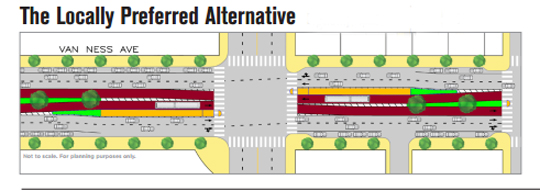
Franklin and Gough are car sewers and Van Ness is not much better, as the city historically prioritized moving cars over all else. Now the city plans to modernize the corridor by creating bus-only lanes in the middle of Van Ness, providing extensive pedestrian improvements and landscaping, and large, visible bus stops that dignify the transit experience.

Buses will be faster and more efficient, carrying 36 percent more people than each mixed traffic lane and cutting operating costs by 30 percent. Giving a lane to buses will also smooth traffic flow for cars and trucks, because buses would no longer be shifting in and out of mixed traffic in the third outside lane, a classic win-win solution.

But for the plan to work, it also comes with a tradeoff of limiting left turns from Van Ness (except at Broadway) and removing 105 parking spaces, causing a small minority of car activists to howl.

Yet these are the sorts of tradeoffs it takes to become a functional city. Will San Francisco prioritize the wishes of a few dozen drivers over tens of thousands of transit riders? That’s the choice, along this and other key corridors.

On the 5-Fulton, it now takes 50 minutes to go from the Transbay Terminal to Ocean Beach, about the same time it takes to get from San Francisco to Pittsburgh/Bay Point on BART. During rush hour, the buses are often jam-packed, so the 20,000 daily passengers on that line receive less than dignified service.

Muni proposes to fix the 5-Fulton with a practical, modest approach to re-allocate street space. By reworking bus stops and removing some curbside parking, the 5-Fulton pilot proposal will improve reliability and make the bus 10 minutes faster, and add 20 to 30 percent more capacity to the route during rush hour.

Improving the 5-Fulton would relieve traffic on the parallel Fell and Oak corridor. Like Van Ness BRT, this is the transit we were promised when the Central Freeway was removed and the city approved massive amounts of new housing in its place.

The 5-Fulton pilot is critical for the 60 percent of households in the Western Addition that are car-free, and the project would remove just 30 parking spaces. Assume that each of those parking spaces turns over four times per day (a generous assumption considering that cars sit for days in some parking spaces), that’s 120 car owners. Compare that to the 20,000 bus passengers on the 5-Fulton, and we start to see the glaring inequities in the effort to preserve street parking.

At two recent public meetings on improving the 5-Fulton, motorists predictably protested the lost parking. Like the “Save Polk” debacle that sank cycletracks on that street, some of the opponents of the 5-Fulton plan tried to block the Fell-Oak bicycle improvements last year and are currently trying to sink safety improvements on Masonic.

The city will likely bend over backward to placate these motorists. Already it has considered introducing angled parking, as was done at the Panhandle on Baker, to ensure no motorist is inconvenienced. But that makes no sense given the goals that the city has set for itself of 30 percent of all trips by transit and 20 percent of all trips by bicycle in the next decade.

The city should consider the tens of thousands of car-free households and hundreds of thousands of transit passengers before caving in to the automobile extremists.

If the city caves to a minority of parking enthusiasts, as it did on Polk Street, there really is no hope for improving Muni for the majority. Ask any parent, rewarding whiners only leads to more whining — and in this case, more gridlock.

Pumped up

3

marke@sfbg.com

ON THE MOVE The epic Pacific Crest Trail winds 2,650 miles from Mexico to Canada, through sun-roasted desert expanse and snow-covered mountain pass, past rushing waterfalls and over wildflower-studded Alpine plateau, roughly tracing the Sierras and Cascades, always out of sight of civilization. It takes most hikers roughly half a year to make the whole trip, an isolating, immersive communion with nature that foregrounds self-reliance, endurance, and more than a little ingenuity when it comes to where you’re going to sleep and what you’re going to eat.

On June 21, Alex Falcioni, a massage therapist and teacher, took to the 1,230-mile leg of the trail running from Tuolumne Meadow, Yosemite, to Portland. In high heels.

“I’d always dreamed of doing the trail — but the most I could take off would be three months, so I knew I couldn’t do the whole thing” he told me over a “beat-up” phone from Ashland, hitchhiking his way back to the Bay Area after completing his high-heeled hike on Aug. 31st at Cascade Locks, Ore. “And then I heard that my dear friend Sarah had been diagnosed with multiple sclerosis and was having trouble covering her medical bills, so I decided to make the hike a fundraiser.

“I needed a gimmick, though, to draw attention. And that’s where the pumps came in — it really just came to me one day. I’d start in Yosemite, and wear the pumps to Portland. Mostly for the alliteration, ha ha.”

Falcioni’s project, Pumps 2 Portland, was partly inspired by Hiking26, a 2012 performance art piece by Ron Ulrich, who completed the entire PCT wearing 26 wedding dresses along the way. So far, Falcioni has managed to raise over $2,500. (Interested parties can still donate and read firsthand about Falcioni’s adventures at www.pumps2portland.com.)

The first obvious question: What kind of pumps were they? “Oh, a strappy white pair of size-12 slingbacks from a drag queen shoe store. They’re completely destroyed,” Falcioni said. “My toes look like little Vienna sausages. But my calves are rocks.”

The second obvious question: Come on, did he really wear high heels the whole time?

Falcioni laughs. “No way! There are ascents up to 10,000 feet and sometimes I felt afraid for my life in hiking shoes. Plus, often ‘trail’ is a relative word — it’s not like clicking down a paved sidewalk. But I wore them when I could, and I strapped them on my backpack for all the other hikers to see when I couldn’t.

“They were there to keep me inspired and add a little spark when the trail got so monotonous it was like sensory deprivation — like, ‘if I see another Ponderosa pine I’m going to go insane!'” With the heels it all became a outdoor runway.

“The pumps really opened doors, too,” Falcioni continued. “People I’d encounter on the trail would ask about them and that would help along a conversation. Or when I’d go into town… One of the ways you survive the trail is to mail food ahead for yourself. (You learn little tricks, like mixing spicy ramen with a spoonful of peanut butter equals Thai food!) So I’d have to go down into towns to pick that up, and I hadn’t bathed in a week — same shirt, same pants, covered in dirt and smoke. But showing off these huge pumps.

“That not only got the attention of the Trail Angels — people who dedicate themselves to opening their homes and helping out PCT hikers — but of random strangers, too. I made so many real friendships, had so many actual conversations about real things in these places of enormous beauty. Not to mention some free showers.

“It was an incredible experience to just put yourself out there at the mercy of nature, other people, and even yourself. I’d urge anyone to do it, giant man-heels or no.”

Nevertheless: Hey, Rupaul — I think we have your next location for Drag Race.

Where’s my car?

8

By Rebecca Bowe

rebecca@sfbg.com

There’s a great scene in The Big Lebowski that my friend reminded me of when I lamented that the San Francisco Police Department didn’t seem to care that my car had been stolen.

Of course they don’t, silly, this friend responded with a hearty laugh. It’s like when The Dude asks a Los Angeles cop whether there are any “leads” on the whereabouts of his stolen car (along with the briefcase full of money inside).

“I’ll just check with the boys down at the crime lab,” the cop responds, a grin spreading across his face. “They’ve got four more detectives working on the case. They’ve got us working in shifts!” Then he bursts into peals of laughter.

When a San Francisco police officer arrived to take a report three hours after my initial call reporting a stolen vehicle, he seemed sympathetic. And he was totally honest: “We’re not going to look for it,” he assured me. “But we’ll let you know if we find it.”

Fair enough, I thought. It was a Saturday night in San Francisco. The SFPD probably had bigger problems on its hands, like shootings or armed robberies or naked acrobats. Clearly, the last thing SFPD was going to focus on was ferreting out my poor little mid-’90s Honda Civic.

Car theft, it turns out, is extremely common in San Francisco. Crime stats provided by SFPD show that from March 1 to Aug. 31 of 2013, a grand total of 2,784 cars were either stolen or almost stolen in San Francisco (the stats include attempted theft). The Ingleside District was the most heavily impacted, while the Mission and the Bayview weren’t far behind.

Why do people drive off with other people’s cars? “Suspects that steal cars have used them for other crimes,” SFPD spokesperson Gordon Shyy explained. “There are also suspects that steal cars simply to ‘joy ride.'”

Another lesson learned the hard way: If you think your car will not be stolen just because it looks like crap, you are mistaken. Shyy said that, nationwide, Hondas made in the 1990s are the most stolen vehicles.

“The reason being that the ignition is worn out over time, and a shaved key or other similar apparatus can be used to start the vehicle easily,” he explained.

Becoming a victim of car theft was an eye-opening experience. For one, it appears that the closed circuit cameras blanketing my neighborhood were basically functioning as seagull perches, taken out of commission the day before for maintenance. So those expensive-looking security cameras served neither as a deterrent for car theft, nor a crime-fighting tool. At least I can rest easy in the knowledge that Big Brother has not, in fact, been recording my every movement.

SFPD stats show just 139 vehicles were stolen and recovered from March 1 to Aug. 31, roughly 5 percent of the total stolen (or almost stolen) in the same time frame. I got lucky, mine was recovered.

SFPD gave me just 20 minutes to retrieve it before calling for a tow truck, notifying me that my Honda had been located as I was on Muni. Looking for an exercise in futility? Promise that you’ll be somewhere in 20 minutes, and then rely on Muni to get there.

But here’s where faith in humanity was restored. Not only did the officers agree to accommodate me by staying put until I could get there, but a random fellow bus passenger — by the name of Carma (for real!) — offered me a lift.

And just as I got to the place where my Civic had been found, a neighbor who lived in an apartment just above the street popped his head out the window to ask if it was my car. I told him it was, and he said it had been sitting there abandoned for days, so he’d phoned the police. Lesson learned: Forget surveillance cameras. If your car gets stolen, just hope somebody out there is paying attention.

Waiting for BRT

18

By Joe Fitzgerald Rodriguez

joe@sfbg.com

You’re on Muni’s underground line, the train stalled just shy of your stop, just stuck there, the light at the end of the tunnel right in front of you. It’s a frustrating feeling, right?

With more than six years worth of delays in three major transit overhauls — the Van Ness, Geary and Geneva Bus Rapid Transit Projects — it’s beginning to feel just like that.

The projects are designed to speed up the most trafficked transit routes in the city by making the buses run like trains. For the Van Ness Bus Rapid Transit, the 47 and 49 would drive in dedicated bus-only lanes shuttling riders north and south, reducing travel time by a third, according to project estimates.

Van Ness BRT was initially announced in 2004 with a planned unveiling of 2012. Eight years later, the new debut is set for 2018. The Geary Project is even worse, with a completion date slated for 2020.

The Van Ness BRT is finally getting its wheels turning this month, with the Environmental Impact Report set to be approved by a number of governmental bodies: the Van Ness BRT Citizen’s Advisory Committee, the Transit Authority board, and the San Francisco Municipal Transportation Authority.

Why the hell has this bus project taken nearly a decade to start its engine? As is customary in politics, fingers are pointed at all sides.

At a citizen’s meeting for the Van Ness BRT on Sept. 4, two angry factions gathered in the Old First Church Fellowship Hall on Van Ness. The SFMTA’s spokesperson for the project, Lulu Feliciano, wrapped up her presentation to the crowd of about 100, and that’s when they pounced.

“Van Ness’ three lanes will be limited to two, but it’s a highway, isn’t it?” asked Carole Holt, owner of Russian Hill Upholstery. “Why do cars have no consideration?” She told the Guardian she worried her customers from Marin would have trouble getting to her store.

Another Polk Street activist, Kelly Gerber, walked right up to Feliciano’s face and gestured with his hand like an angry schoolteacher. “Why has no one ever heard of this?” he bellowed, telling us he opposes the loss of parking spaces.

Ironically, transit planners say car traffic would move faster, partially because of the elimination of all left turns along Van Ness except Broadway.

“They’re just angry and zooming in on every little detail,” Mario Tanez, spokesperson for the SF Transit Riders Union, said of BRT’s opponents.

The mostly younger crowd of transit activists showed up in equal force to counter the Polk Street merchants, hoping to stem the tide of NIMBYism.

“We’re the generation that will actually see these improvements,” Teo Wickland told us. He’s an urban planning student who hopes to see Muni running on time.

Feliciano said the project was complicated by having to coordinate multiple city agencies, all with their own goals.

Instead of digging up the same stretch of concrete a dozen times in a decade, San Francisco tries to include as many agencies as possible when cement is broken in any part of the city, she said. Since the Van Ness project is a two-mile stretch between Lombard and Mission streets, many are involved.

infographic showing different city agencies involved in the reconstruction of Van Ness

Graphic by Brooke Robertson

Peter Gabancho, the project manager for Van Ness BRT, said that the San Francisco Public Utilities Commission will put in new water lines, institute a rainwater catch system, and do sewer work. The Department of Public Works plans to repave, and the SFMTA will replace overhead bus lines and light poles.

When asked how much the city would save by combining work, he couldn’t give an exact dollar amount but said it was in the tens of millions, at least.

He also said that the process requires community meetings at many steps in the process. City officials visited Mexico City to see how they planned and built its BRT in just three years, and Gabancho said it’s because that city didn’t really consult the community.

“We can’t do business like that in San Francisco and I don’t think we want to do that in San Francisco,” he said.

All of that governmental insanity had a member of the Geary BRT’s Citizen Advisory Council calling it quits in a fury — he even wrote about it in his blog.

“What I’ve seen in the past six years has been a severe disappointment during which I have lost trust in America’s regulatory framework to enact effective transit improvements,” Kieran Farr, the CEO and co-founder of VidCaster, wrote. He described the process as fraught with starts and restarts, slips and delays, mostly due to a lack of leadership. And that’s the rub: There is no point person on this project with strong political will, according the SFTRU. “The mayor is not saying this is high priority,” Tanez told us. “He’s at all the Central Subway events, but getting political clout behind this by writing to our supervisors is the only way to do this.” The Van Ness project runs through the districts of Sups. Mark Farrell and David Chiu, who were both unavailable at press time. The SFMTA is slated to approve the Van Ness BRT EIR on Tue/17 at 1pm in City Hall, Room 400.

A bridge so far

46

By Steven T. Jones

steve@sfbg.com

Pedaling onto the Bay Bridge over the weekend, I was suspended between our industrial past and sleek present. But my ride into the future was abruptly stopped just before I reached the island.

All the experts say we should all just be happy with the world’s longest bike and pedestrian pier, and it certainly is a wondrous thing to behold, this spacious and beautiful two-mile path that pasted big grins on the dozens of faces that I rode past on its sunny first Friday in operation.

But just as the duality of riding between the old Bay Bridge and the new invoked myriad metaphors, so too did the fact that my fellow taxpayers and I just spent $6.4 billion on a bridge from Oakland to San Francisco built almost exclusively for the private automobile.

Is this the future we’ve embraced? Are global warming, economic equity, and collective responsibility such distant abstractions that we can fill this beautiful new bridge with people sitting alone in expensive, deadly, polluting, space-hogging machines?

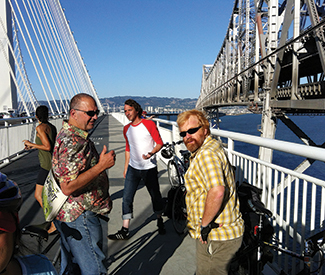
I looked into their work-weary eyes as I rode my bicycle out from Oakland with a few of my friends during rush hour, on a path wide enough to facilitate conversations among a pair of cyclists in each direction and strolling pedestrians, six abreast. It was lovely, like we had finally arrived in the civilized, people-powered present that we Guardianistas have been working toward for decades.

And then it ended, a vivid reminder that we’re not there yet.


SHARING THE ROAD

The past is blocking our progress, literally and metaphorically, at least for now.

The old Bay Bridge stands between the stubbed-off end of the new bike/pedestrian path and its intended touchdown spot on natural Yerba Buena Island, the conjoined twin of the artificial Treasure Island, where developers dream of building high-rise condo towers buffered against the rising sea.

Officials tell the Guardian that the path will likely be completed in early 2015, after the old bridge comes down. Then, we’ll be able to ride our bikes onto the island and cruise our way to the west side, with its beautiful views of our beloved city, San Francisco, shimmering just out of reach.

Next month, the Metropolitan Transportation Commission will release its latest study of how to complete the ride/walk, examining the placement of pathways balanced on either side of the Bay Bridge’s western span, their added weight compensated for with lighter decks for the cars, all at a cost approaching a billion bucks, with a capital B.

“Everything about this is going to be hard,” MTC spokesperson John Goodwin told me when I asked about allowing cyclists and pedestrians onto the Bay Bridge’s western span, citing an array of engineering, financial, and political obstacles.

“It’s a 10-year project even if a local billionaire decides to put up the money,” Goodwin said, noting that there is no public funding identified for the project except for maybe raising automobile tolls again, which would be a tough sell to voters for a bike and pedestrian project. “It’s an uphill climb and I’m not sure it will ever reach its intended goal.”

But completing this journey is really only as difficult as we make it. Just ask local activist/author Chris Carlsson, who says that he and some of his buddies could fix the problem in a day for a few thousand dollars. All we need to do it take the righthand lane, install some barriers, done.

“The bridge is more malleable than people treat it as and we need to have this discussion publicly,” Carlsson, a founder of Critical Mass and author of Nowtopia, told us. “Let’s solve this problem today. The idea that they would open this bridge without completing this path is insulting.”

To Carlsson and others of his radical ilk, this is an equity issue, and the opening of a car-only bridge is symbolic of our societal myopia. To believers in the automotive status quo, the idea of giving up one of five traffic lanes for the final, two-mile-long descent into San Francisco makes their heads explode.

“That’s just wildly unrealistic,” Goodwin said of Carlsson’s idea, even instituted on a temporary basis, noting that the Bay Bridge handles more than 270,000 cars per day, by far the busiest state-run bridge in California.

To many modern minds, automobiles are essential to our personal freedom and economic vitality — bikes are toys, public transit is for the poor, walking is what you do in your neighborhood or on the treadmill at the gym — but San Francisco is a voter-approved “transit-first” city that supposedly gives each of these modes priority over cars.

“The idea that the five lanes of automobile traffic is inviolable is ridiculous,” Carlsson said, calling it a relic from the days before the freeway revolts of the 1950s and ’60s, when San Franciscans rejected the conception of The City as just another stop along the fast and efficient interstate highway system.

In fact, it was that cars-first vision — before it was rejected by a populist revolt — that helped lead officials to remove the passenger trains that operated on the lower decks of this New Deal/WPA bridge for its first 17 years of life, turning the whole Bay Bridge over to cars, trucks, and the occasional bus.

The era of unfettered automobility had begun, and the idea that capitalism/industrialism and the health of our world might someday, somehow come into conflict with one another also seemed wildly unrealistic.


BRIDGING THE GAP

The Bay Bridge was my bridge growing up in the East Bay, our link to the big city that I traversed while safely cocooned in the backseat of my parents’ car, windows up, car filled with what we’d later call secondhand smoke, buffered against the wilds of West Oakland as we launched over the bay.

Today, my perspective has changed and so has my access through the old industrial waterfront, which has been opened up to all by a pair of new paths leading bikers and hikers to the bridge, both short rides from the West Oakland BART station.

One starts on Maritime Street, near the Port of Oakland and the remnants of the old railyard on what the Realtors have started calling Oakland Point; the other starts on Shellmound Street right across from Ikea, best accessed from West Oakland along 40th Street, where crews were in the process of placing tall cones to protect the bike lane as we rode past.

After the trails merge, it proceeds past the yards for the government agencies set up to serve the motoring public: CalTrans and its freeway maintenance facilities, and the California Highway Patrol, which has doubled its local bicycle brigade (which had worked just the Golden Gate Bridge) to police the new path.

“Best job in the world,” a smiling Officer Sean Wilkenfeld told me as he arrived at the end of the Bay Bridge path, where a couple dozen people stood watching the new Bay Bridge and the old, which took on a ghostly feel as we hovered next to its newfound lifelessness.

Personally, I really like the new Bay Bridge, with its elegant modern architecture and unobstructed bay views. But some of the friends and strangers that I chatted up there at the end of the line disagreed, singing the praises of the old, industrial, seismically unsound original.

“The new bridge is beautiful, but in some ways I like the old bridge better because you can see its functionality,” Joel Fajans, a physics professor at UC Berkeley, told me.

Conversation among the cyclists turned to our beautiful new path and its untimely end. “What a dream come true to have a bike path on the Bay Bridge. I already wrote to my representatives about completing the route to San Francisco,” said Kurt Vogler, a 47-year-old environmental consultant from Oakland who rode the bridge with Fajans.

That was the phrase that everyone used, this notion of completion, conveying the sense that we’re somehow stuck between where we were and where we should be, suspended between the old and the new, waiting to catch up.

“I think it’s beautiful. It’s an engineering marvel, a miracle,” Garris Shipon, a engineer from Berkeley, said halfway through his bike ride on the Bay Bridge. “I’m glad they launched with a bike path at all, and I hope they finish it because I’d love to ride all the way across.”


TWO BRIDGES

The San Francisco-Oakland Bay and Golden Gate bridges were built at the same time, started in 1933. But the Bay Bridge — the industrial, utilitarian bridge connecting The City to its biggest, most diverse nearby population centers — was done first. The tall, pretty one — with its Art Deco flourishes and tourist appeal — took longer.

On its opening day, the Golden Gate Bridge was filled with pedestrians, while the Bay Bridge hosted its first traffic jam as it was unveiled, “with every auto owner in the Bay Region, seemingly, trying to crowd his machine onto the great bridge,” the San Francisco Chronicle reported.

It’s been the same story ever since, with cyclists and walkers crowding onto the Golden Gate daily, salty winds howling through their hair, while travelers on the Bay are caged behind steel and glass.

But not anymore. In fact, it’s far more pleasant to ride on the Bay than the Golden Gate, where the bike path is narrow and cluttered. Now, it’s the golden one that seems to belong to another age, with the Bay Bridge designed to be personally experienced.

“It’s really a spectacular excursion,” Renee Rivera, executive director of the East Bay Bicycle Coalition, told me. “I was taken by surprise by what fun it is to be on a bike on that bridge.”

But the stirring sensation of riding or walking the Bay Bridge only accentuates its main shortcoming; at least the noisy, harrowing Golden Gate Bridge goes all the way across.

“We just spent $6 billion on that,” Fajans said, gesturing to the new Bay Bridge, “and you’re saying we can’t spend a little more to complete the bike lane? That’s not fair.”

Goodwin and others say that motorists paid for the new Bay Bridge with their tolls, but Fajans calls bullshit, noting that BART passengers pay more than drivers for a round trip across the bay without buying exclusive access in the future.

In this age of austerity, with government funding for transportation projects drying up and people reluctant to raise their own tolls or taxes, it’s hard to do what’s needed. That’s one reason cycling advocates take what they can get, such as an expensive western span proposal with one of two paths reserved for maintenance vehicles to smooth the automotive flow.

“If we have to sell it to the public to increase tolls, we’ll have to show that it benefits everyone,” Rivera said.

Completing this path, somehow, is a top priority for the cyclists.

“It was a little tough to get people’s attention on the western span for the last couple years, but now is the time,” Leah Shahum, executive director of the San Francisco Bicycle Coalition, told us.

Neither director seems willing to embrace Carlsson’s radical approach of simply seizing a lane.

“Like Chris, we feel strongly about equity on the bridge,” Rivera said. “At the same time, it needs to function smoothly as a bridge and I would be concerned about it bottlenecking at Treasure Island.”

Carlsson rejects the neoliberal approach of begging for scraps as we ride into a future that simply can’t continue to be dominated by automobiles. He says the Bay Pier must not rest there for another decade.

“Both bike coalitions have a resistance to appearing anti-car,” Carlsson says, “so they aren’t willing to say the obvious thing.”

Carlsson talks about the Bay Bridge as part of the free Shaping San Francisco lecture series at 7:30pm, Sept. 11, Eric Quezada Center for Culture and Politics, 518 Valencia, SF.




Still secret

22

news@sfbg.com
A high-profile local civil rights ordinance passed last year to shine light on the San Francisco Police Department’s joint activities with the FBI has been undermined by the SFPD’s refusal to disclose its surveillance activities. This comes at a time when the public is learning more than ever about the federal government’s intrusion into the privacy of law-abiding US citizens.

In May 2012, the Board of Supervisors unanimously passed the Safe San Francisco Civil Rights Ordinance, which Mayor Ed Lee signed in a photo-op ceremony with Police Chief Greg Suhr and the activists who supported it. They claimed the board’s passage of the ordinance ushered in a new era of transparency over the SFPD’s previously secretive work with the FBI-led Joint Terrorism Task Force.

“The ordinance basically requires three things,” Nasrina Bargzie, a civil rights attorney at the Asian Law Caucus who worked on the measure, told the Bay Guardian. “The first part requires that the Police Department work with the JTTF has to follow the California constitutional rights of privacy, so they’re not following the lax standards of the [US] Department of Justice. The second part is that they can no longer enter into any secret agreements with the FBI; it has to go before the Police Commission in a public setting. The final part of the ordinance exists to make sure the rules are being followed, so there is a requirement for a yearly report.”

At the time of its passage, activists told the Guardian that the ordinance was only as strong as the SFPD’s willingness to disclose its activities (see “Mayor Lee signs watered-down limits on SFPD spying,” 5/9/12). But the SFPD’s refusal to disclose even minimal, basic information calls into question the ordinance’s value.

After the release of multiple reports earlier this year that activists called inadequate, Suhr is now maintaining silence regarding the JTTF, while claiming the department is in full compliance with the ordinance. According to Bargzie, Suhr told her the FBI is barring him from disclosing the requested information.

Following multiple efforts by the Guardian to get a comment out of SFPD about the ordinance and whether the department was indeed taking a subservient role to the FBI, SFPD Sgt. Dennis Toomer told us, “We’re not talking about that at all.”

LACK OF RESPONSE

Activists have sparred with Chief Suhr over implementation of the ordinance and its required annual report since at least the beginning of 2013.

Deputy Chief John Loftus presented the first report to the Police Commission on Jan. 23, which claimed the SFPD was in “full compliance” with the ordinance without providing any details. Activists and the public quickly demanded a real response.

“The commission presented this short oral report, which was a little short of two minutes long,” Bargzie told us. “There was no data that we were not already aware of. It was just basic statements claiming that they were complying with the ordinance.”

Suhr apologized for the omissions while stating his department was still in compliance with the ordinance’s guidelines, pledging to be more forthcoming. At this time, SFPD Sgt. Michael Andraychak told the Guardian: “The Chief’s Office is in the process of scheduling meetings with Nasrina Bargzie [of the Asian Law Caucus] to develop a report with more detail so those concerned and the public can be as informed as possible. Chief Suhr is committed to remain in compliance with the ordinance.”

The Coalition for Safe San Francisco, an activist group consisting of Muslim Legal Fund of America, Asian Law Caucus, and dozens of other groups, met with Suhr to discuss setting up a template for the reports.

Suhr then released a second report, which contained more relevant information, stating that SFPD officers did not act as informants in 2012 and three full-time SFPD officers were assigned to the JTTF.

But the report still omitted key oversight information, such as whether any prosecutions resulted from JTTF and SFPD investigations, which would allow the Muslim Legal Fund of America and other groups to determine who the SFPD is arresting and why.

Last year, Suhr told a San Francisco Examiner reporter that his officers followed up on 2,000 tips regarding counterterrorism activities. However, this information curiously did not make it into the official report.

“We contacted the chief to let him know we were not okay with this. We had another meeting with him and he said he’d think about it and get back to us and now he is claiming he cannot honor a basic component of the ordinance,” Bargzie told us. “He asserts in writing this is because the FBI will not let him share the basic information.”

WEAKENED LEGISLATION

The weak efforts behind the implementation of the SSFCRO date back to Mayor Lee’s veto of a stronger ordinance in April 2012, which would have codified privacy protections and given the Police Commission more power to stop FBI-SFPD activities that did not comply with Department General Order (DGO) 8.10, the 1990 policy aimed at protecting First Amendment activities. After Lee’s veto, the Board of Supervisors passed a weaker version. Both were sponsored by Sup. Jane Kim.

John Crew, a former police practices expert with the Northern California American Civil Liberties Union, raised concerns to the Guardian about the weakened legislation. “It is a step in the right direction, there’s no doubt it’s progress,” Crew told us at the time. “But whether it’s real progress depends on the implementation. Ultimately, it will come down to political will at the Police Commission to enforce privacy protections.”

Much of the ordinance’s failure stems from the apparent lack of real intent to disclose what the activists sought. Critics painted the SSFCRO signing ceremony as a hollow symbolic act, a way for Mayor Lee and Chief Suhr to publicly promote civil rights and progressive ideals with an ordinance they purposefully weakened.

“My sense is that [the SFPD] is not taking this seriously,” Bargzie told us. “I think they probably believe that they are providing as much information as the FBI will let them and Chief Suhr thinks it’s fine that the FBI can tell him to share what they tell him to.”

The lack of transparency regarding the JTTF’s work with the SFPD requires the public to trust the federal government to safeguard civil liberties. But in the wake of whistleblower Edward Snowden’s leak exposing the expansive surveillance system by the National Security Agency and the SFPD’s notorious history of illegal surveillance and racial profiling, the public has little reason to trust the authorities.

HISTORY OF SPYING
The passage of the SSFCRO is the latest effort to counter a long history of racial profiling, spying on radical political groups, and other constitutional violations, episodes that have been followed by progressive reforms in San Francisco.
Prior to the passage of DGO 8.10 in 1990, the SFPD notoriously participated in the surveillance of non-criminal, pacifist political organizations. During the 1984 Democratic National Convention, the SFPD carried out surveillance on law-abiding organizations and, throughout the 1980s, it created files on civil, labor, and special interest groups in the Bay Area, revelations that led to the adoption of DGO 8.10.
But even after that, disclosures surfaced showing that the SFPD was blatantly violating its own rules. They included then-Police Chief Tony Ribera admitting that files on non-criminal political activity were not destroyed (as required by the ’90s reforms), the selling of confidential intelligence material to foreign governments and private entities, and the actions of SFPD Intelligence Officer Tom Gerad, who informed on local political groups for the FBI.
In the subsequent years following the Gerad scandal, San Francisco sought to strengthen DGO 8.10, requiring more transparency and oversight. But this progress was undercut in 2007 when the SFPD secretly signed a secret JTTF Memorandum of Understanding (MOU) undermining DGO 8.10.
San Francisco’s Human Rights Commission held hearings in which the community voiced concerns over illegal police and federal surveillance. In response, the SFPD said they were unable to discuss arrangements with the JTTF without the permission of the FBI.
In 2011, the previously secret MOU was unearthed by the ACLU (see “Spies in blue,” 4/26/11), prompting Suhr to issue Bureau Order #2011-07, which reinforced that SFPD personnel were under the jurisdiction of local and state privacy protections and did not spy on law-abiding groups. SFPD Public Information Officer Albie Esparza said the order reversed the language of the 2007 memo.
Part of Suhr’s amendment to SFPD policy at the time included the necessity of a predicate offense in all SFPD investigations. Thus, the SFPD could not investigate or spy on those who were not suspected of violating the California Penal Code or federal law.
Activists wanted those protections enshrined in city law, which resulted in last’s vetoed ordinance and passage of the watered down Safe San Francisco Civil Rights Ordinance in 2012, which activists now say they feel duped by.
“We have been extremely disappointed at the lack of information that has been included in the reports,” Summer K. Hararah, Regional Director for the Greater San Francisco Area Muslim Legal Fund of America told us. “If the SFPD is going to violate rights of Arab-Americans, the police chief has a responsibility to stand up to the FBI.”

POST 9/11 WORLD
Lax federal guidelines for counterterrorism have been building since the Bush Administration began implementing emergency measures after 9/11 terrorist attacks in 2001. In San Francisco’s case, the FBI has subjected local law enforcement to these rules.
Since 9/11, both the ACLU of Northern California and the Human Rights Commission have publicized cases of racial profiling and surveillance of pacifist, non-criminal Muslim and Middle-Eastern groups in San Francisco. A 2007 FBI memorandum illustrated a prominent instance of this profiling in which FBI agents attended Ramadan Iftar dinners in San Francisco purportedly as part of the FBI’s mosque outreach program. Under this guise, the agents collected data on certain attendants, including names, the content of conversations, and other information covered by the First Amendment. According to the FBI Domestic Investigations and Operations Guide, the JTTF is permitted to conduct surveillance of this nature, by identifying “locations of concentrated ethnic communities in the Field Office’s domain, if these locations will reasonably aid in the analysis of the potential threats and vulnerabilities, and, overall assist domain awareness for the purpose of performing intelligence analysis.” These policies directly contradict SSFCO, DGO 8.10, and the California Constitution’s privacy protections. In Portland, Ore., the local government successfully fought this issue by bifurcating local law enforcement from the JTTF after the public and the ACLU raised concerns over similar constitutional violations and racial profiling. This Portland model is now a precedent for activist groups nationwide, seeking to end the lack of oversight permeating their local police departments. “Portland has been a great model,” Hararah told us. “When the FBI began to interview Muslim men in mass after 9/11, Portland was one of the few that said ‘absolutely not.'” But in San Francisco, Lee (whose office also didn’t respond to our request for comment) and Suhr’s symbolic promotion of civil rights has diminished into a case of them basically bullshitting the public. “Civil rights is not a symbolic issue,” Hararah told us. “The mayor backed this legislation and we want to see that the commitment is put forth with global insurance. The first step is having info about what the JTTF is doing to be sure it abides by human rights protections and is appropriate.”

Put the Warriors Arena atop CalTrain

21

OPINION Numerous problems with the proposed location of a new Warriors stadium and surrounding complex are obvious. What we need is a better solution, not just laments about the folly of it all. Is there a better solution for everyone?

We can take a page from Warriors co-owner Peter Guber’s book, “Tell To Win.” He explains how a business proposal lives or dies in terms of the story it embodies. The story trumps piles of statistics or litanies of problems. This is what tries men’s souls and glazes eyes. But there is an alternative story to tell in this case, one that is win-win for everyone.

Let’s create a great sports complex at the heart of our public transportation system. We don’t need to clog the waterfront when we can build a great sports mecca elsewhere. Let’s take a cue from New York City and how Madison Square Garden perches directly above Penn Station.

Right now CalTrain has an ideally located terminus in the core of the city, but it’s unsightly. Why not put the new stadium directly above the CalTrain station? The same solution is being applied right now to the new Time Warner headquarters at Hudson Yards on the west side in New York: several skyscrapers will rise on platforms above an existing rail yard.

Consider the advantages: CalTrain passengers can walk upstairs to see a game! Muni and BART riders can take a short walk to the stadium. Soon they’ll be able to ride the Central Subway to it as well. It’s the perfect place for a major indoor arena that could host diverse events.

AT&T Park is just a block away and already lends enormous appeal to this entire area. The train yard extends from 4th to 7th St and the space above this great expanse could house a sizeable parking garage, less than a block from the 280 access ramp, as well as a hotel, restaurants, condos, offices and perhaps a shopping complex.

It’s everything Peter Guber and his partners dream of, that the city needs, and that we can embrace, now that it’s in the right place.

Let’s welcome the Warriors by all means. But do we want a Titanic on the waterfront when we can have a jewel above the CalTrain station that will simultaneously overcome the gulf that now exists between the western part of SOMA and Mission Bay?

This location could establish a sports complex the rival of any in the country. An essential, but dreary space turns into a great sports oasis, like Cinderella at midnight but in reverse. Perhaps the city will even want to include a large, well-equipped community recreation center for all of us who like to play as well as watch.

Bill Nichols is a consultant for documentary filmmakers and has published a dozen books related to the cinema. He lives in San Francisco.

Slipping away

10

By Amy Yannello

Note: This article has been corrected from an earlier version.

As she had done countless times before, Gloria Davidson sat and waited for her son to be brought into the courtroom. His hands and feet were shackled, and his blue uniform branded him as different — someone to be judged apart from the rest of the crowd in this room.

His crime? Aaron Davidson has schizophrenia.

On that day earlier this year, which Gloria recounted and shared with the Guardian in a recent interview, he faced charges for violating one of five restraining orders against him — but he didn’t understand what he’d done to deserve them, his mother said.

“The neurons and synapses in his brain fire inappropriately and he sees and hears things that are not really there,” Gloria explained. “As a result, his responses to his perceived reality are often unwarranted or make no sense,” she continued, “or frighten the people around him.” Aaron could neither speak coherently nor acknowledge that his actions had led to restraining orders, she said.

In his case, the judge deemed Aaron “incompetent to stand trial” and sent him to Napa State Hospital for treatment. He remains there, where he’ll turn 36 later this month.

Davidson is one of three Bay Area mothers with adult sons at NSH to push for full, statewide implementation of Laura’s Law.

Known formally as “assisted outpatient treatment” (AOT), the law is named for Laura Wilcox, a 19-year-old college student who lost her life when Scott Harlan Thorpe, a man with a persistent and severe mental illness who had stopped taking his medication, shot and killed her and a coworker at a Nevada City mental health clinic.

While Thorpe, then 41, was in too deep of a state of psychosis to benefit from AOT at the time of the shootings, his family, psychiatrist, and the Wilcoxes all believed that if the legislation had been in effect even six months earlier, when Thorpe’s family first noticed he’d stopped taking medication, the tragedy could have been averted.


DEBATE ON INVOLUNTARY TREATMENT

Through AOT, an individual’s family, doctor, or trusted third party may advocate to a judge that a patient is at risk of decompensation — serious psychological deterioration making it impossible to function independently — if left untreated. In very narrow circumstances, a judge may order a person to receive AOT as a condition of being allowed to continue living independently.

Currently, only Nevada, Los Angeles and Yolo counties have embraced the law, which allows courts in very limited circumstances to compel into treatment those residents who are too ill to know they are ill.

This “lack of insight” — a neurological condition known as “anosognosia” — is said to affect upward of 40 percent of people with serious mental illnesses.

Gloria Davidson and Teresa Pasquini, another mother of a mentally ill NSH patient, are now pushing for Laura’s Law implementation in Contra Costa County. They’re joined by a third mother, Candy DeWitt, who founded a project called Voices of Mothers Project to bring together parents of people suffering from anosognosia. Alameda County’s Behavioral Health Care Services has issued a report recommending to its Board of Supervisors that it approve a one-year AOT pilot project. The issue is expected to be taken up at the BOS’ Oct. 28 meeting, where it would need a majority vote to be approved, DeWitt said. 

Laura’s Law isn’t without its detractors. “Where does it end?” asked Dan Brzovic, an attorney based in the Oakland office of Disability Rights California. “Pretty soon, we’ll have people saying that anyone with a mental illness cannot think for themselves.”

“The moral issue is that people who are competent to make choices for themselves must be given that right,” he continued. “That’s if they have the capacity. If they don’t, then there are involuntary treatment options already on the books, like conservatorship.”

But the debate surrounding Laura’s Law and mental health service delivery goes deeper, since underlying questions remain about whether dedicated funding has translated to sufficient levels of care. Each of the three mothers told the Guardian that their sons — all deemed to be suffering from “serious mental illness” — never received adequate treatment as they moved through California’s fragmented and broken public mental health system, despite the advent of Proposition 63, the 2004 ballot initiative that created California’s Mental Health Services Act.

A staggering report released in mid-August by State Auditor Elaine Howle brings this claim into focus. According to the audit, the California Department of Mental Health and the Oversight and Accountability Commission have exercised such “minimal oversight” since MHSA went into effect that the state has “little assurance” that $7.4 billion has been used “effectively and appropriately.” That amount represents the total funding generated by the MHSA — which imposes a 1 percent tax on personal income in excess of $1 million — from 2006 to 2012.

In response to these revelations, Rose King, a co-author of Prop. 63 who previously served as a consultant for then-Attorney General Bill Lockyer, stated, “No county has been required to demonstrate its accountability for any spending or program choices. The public — and state officials — have no idea whether counties have improved county mental health systems, whether spending complies with the law, and whether private contractors have delivered promised services.”


“WASTE, FRAUD, MISMANAGEMENT”

The MHSA ramped up services for some 600,000 adults and children in the public mental health system, bringing in $1 billion per year in dedicated funding for the treatment of serious mental illness.

But beyond patients tracked via Medi-Cal, no one tracks the true number of uninsured patients served. There isn’t a data system capturing all the clients or services tied to MHSA funds, making outcomes impossible to track with accuracy.

Some funding has gone to client advocacy groups who actively oppose Laura’s Law. Disability Rights California and the California Network of Mental Health Clients, both opponents of AOT, received $3 million and $1.5 million in MHSA grants respectively. These groups believe voluntary services should be the only programs to receive funding through MHSA and have actively threatened to sue counties that have tried to implement Laura’s Law.

Some of the very people who campaigned hardest for MHSA have since become watchdogs monitoring its implementation. They include King, who lost both a husband and son to suicide due to lack of treatment for their severe mental illnesses, and Pasquini — whose only son is languishing in NSH with a diagnosis of schizophrenia and a felony charge for an alleged assault on a fellow patient while on the incorrect medication.

These embattled mothers say they’ve observed a system awash in “waste, fraud and mismanagement.” They also charge that the system results in disproportionate services for what King terms the “worried well” — people merely experiencing life’s ups and downs — in many cases to the neglect of those struggling with what’s classified as “serious mental illness.”


MISSPENDING OF FUNDS DESIGNATED FOR PREVENTION?

Under the MHSA, only a specified population may receive treatment using these funds. Patients must have been diagnosed with “serious mental illness,” amounting to psychological problems that are severe enough to prevent an individual from functioning independently without assistance should they go untreated.

But critics like King and DJ Jaffe of the Mental Illness Policy Org. (MIPO), a national think tank that has been critical of California’s management of MHSA monies, contend that the 20 percent of MHSA funds designated for Prevention and Early Intervention (PEI) programs are instead being funneled into programs with little connection to mental illness treatment.

The MHSA specifically limits PEI dollars to programs that “prevent mental illnesses from becoming severe or disabling” or that “limit the duration of untreated mental illness.”

Yet King contends that these funds have been used instead to underwrite social service programs ranging from domestic violence prevention and parenting classes, to social skills for disadvantaged youth — all good causes that are nevertheless “not legitimate recipients” of money intended for mental illness treatment, King says.


CONFLICT-OF-INTEREST ALLEGATIONS

Jaffe’s organization has seized on the PEI expenditures as a violation of the MHSA, turning a skeptical eye on the 16-member Mental Health Services Oversight and Accountability Commission.

In 2011, according to a MIPO analysis, more than $23 million in PEI grants went to advocacy organizations and service providers with direct financial ties to both OAC commissioners and committee members. MIPO characterized it as “insider dealing” and a violation of California conflict-of-interest laws.

OAC committee member Rusty Selix, a lobbyist and Prop. 63 co-author, dismissed the MIPO report, saying, “I don’t see any conflict.”

Selix added that unpaid OAC board members recuse themselves from voting whenever it’s deemed to be necessary. And he defended a system where stakeholders, such as consumers and family members, also serve on committees, saying, “You can’t expect to include them in the process without crisscrossing some stakeholders who also receive MHSA grants.”

Jaffe took a different tack. “The problem, besides the blatant conflict-of-interest,” countered Jaffe, “is how these PEI monies are being spent. And they’re not being spent to help the seriously mentally ill,” he continued. “Yet year after year, they’re getting approved. Millions and millions of taxpayer dollars that were supposed to go to treat the sickest among us are being spent on social programs.”


NOT ENOUGH BEDS

Some believe the broad issue of funds not making it to the intended target population might be playing out within the microcosm of San Francisco. In 2010-11, the most recent available data, San Francisco County received $23 million in MHSA funding, 75 percent of which was earmarked for direct services.

But that money hasn’t gone toward ensuring that there are enough beds for treating mentally ill patients, according to Geoff Wilson, president of the Physicians’ Organizing Committee. Wilson’s organization reported that as of August, San Francisco General Hospital had dropped to 19 emergency psychiatric beds, down from 88 two years ago.

“It’s unconscionable. We’ve got the highest 5150 rate in the state,” Wilson told The Guardian, referring to 72-hour psychiatric holds imposed by law enforcement. We’re not saying ‘lock everyone up,’ we’re just saying that for people who need it, the beds need to be there, and there’s barely any left in the city.”

Wilson explained the cuts by saying that when Medi-Cal stopped paying for the care — essentially “raising the bar” for what it took to keep someone in a psychiatric inpatient bed — the county slashed the number of beds because it “simply wasn’t profitable” to keep them open.

Asked to respond to this claim, SFDPH spokesperson Eileen Shields told the Guardian that only Barbara Garcia, the agency director, was in a position to respond. But Garcia was out of town and unavailable for comment.

According to the POC’s Dr. Cameron Quanbeck, it costs $250 per day to house inmates in jail, compared with $1,700 per day for hospital care. In March, Sheriff Ross Mirkarimi testified before the Mental Health Board that the jail system had become the “default” place for people with mental illness, identifying more than 70,000 contacts with Jail Psychiatric Services in 2012 alone.


LAW ENFORCEMENT AND LAURA’S LAW

According to the U.S. Department of Justice, 16 percent of inmates have a severe mental illness, making jails and prisons the largest de facto psychiatric treatment facilities. The National Sheriff’s Association has come out in support of AOT laws in all 50 states.

Pasquini says her son could have benefited from AOT, and she believes that “AOT should be a mandated MHSA program in every county to prevent tragedy and intervene with the criminalization of mental illness.”

Since his initial diagnosis of schizo-affective disorder at 16, Pasquini’s 31-year-old son has had more than 70 emergency contacts with law enforcement and/or ambulance personnel, most of them resulting in 5150 holds.

He is now a patient at NSH, where “he wants to die every day, and I don’t blame him,” continued Pasquini. “It’s a reality for him. His illness has progressed, because every time you have a ‘break,’ you get a little worse. He’s the perfect candidate for Laura’s Law.”


Alerts: September 4 – 10, 2013

0

THURSDAY 5

Dems feeling blue Trace Bar, W San Francisco Hotel, 181 Third St, SF. www.sfyd.org. 7-9pm, $40. RSVP. Join the San Francisco Young Democrats for a swanky soiree, the Ball in Blue. SFYD is a passionate group of young people, ages 18 to 35, working to promote the interests of San Franciscans 35 and under. Comprising one of the largest clubs in SF, the group is made up of young professionals, students, legislative staff members, and organizers invested in San Francisco. For more information, send an email to sfydpresident@gmail.com.

FRIDAY 6

Memorial for Absolute Empress I de San Francisco Grace Cathedral, 1100 California Street, SF. 11am. Legendary San Francisco drag queen Jose Julio Sarria, aka The Widow Norton, died Aug. 19, and his memorial is sure to be packed with followers mourning the loss. Sarria, who was performing in drag in North Beach in the 1950s and 60s, became the first out gay person to run for San Francisco supervisor in 1961. Immediately following the memorial, Sarria will be interred in his final resting place, beside famed 19th Century San Francsican Emperor Joshua Norton, whose Colma gravesite Sarria led annual pilgrimages to. Cemetary services will be followed by a reception at San Francisco’s The Lookout.

SATURDAY 7

POWERful Bayview 2145 Keith Street, SF. power@peopleorganized.org. 1:30-4:30pm, free. RSVP. People Organized to Win Employment Rights (POWER) is hosting an office warming at its new space in San Francisco’s Bayview Hunter’s Point neighborhood. This is an opportunity to view POWER’s new space, meet the neighbors, and learn about upcoming campaigns. For years, POWER’s Bayview Organizing Project (BVOP) has sought to aid low-income residents and workers in shaping decisions that are made on issues ranging from affordable housing to environmental justice, all within the context of a ferocious attempts to gentrify the community.

SUNDAY 8

Sunday Streets Western Addition Fillmore from Geary to Fulton; Fulton from Fillmore to Baker, SF. sundaystreetssf.com. 11am-4pm, free. In partnership with Livable City and the City of San Francisco, Sunday Streets opens up main thoroughfares to pedestrians, cyclists and community members. The Western Addition edition will feature a climbing wall, SF Skate Club exhibit, and a project of re-imagining Fulton Street that will tap community imagination to create a lightweight model of the street, six feet long by 30 inches wide, capturing the street’s historical topography and urban form.


Forget the Willie Brown Bay Bridge

73

EDITORIAL As the California Legislature prepares to wrap up before fall recess, a resolution is working its way through the approval process to rename the western span of the Bay Bridge the “Willie L. Brown Jr. Bridge.”

Brown, who formerly served as mayor of San Francisco and speaker of the California Assembly, is known for boasting about his hobnobbing with the rich and famous in his San Francisco Chronicle column, “Willie’s World.” But to longtime progressive San Franciscans who spent decades trying to stem the tide of gentrification, he was the powerful figure that rolled out the welcome mat for high-end developers and corporate interests, whose interests in San Francisco revolved around profit alone.

As mayor, Brown presided over land-use policies that resulted in high-end developments at a time when evictions were rampant, a trend that rings familiar in today’s tech-saturated San Francisco. Once, when pressed on the idea that his approach was making the city increasingly unaffordable, Brown’s famous retort was: “If you don’t make $50,000 a year in San Francisco, then you shouldn’t live here.”

It’s not just Brown’s insensitivity to struggling tenants, deep ties to corporate interests and high-end real-estate developers, or continued behind-the-scenes influence in San Francisco politics that cause us to squirm when we think about the San Francisco-Oakland Bay Bridge bearing this politician’s name. There’s also the key question of whether Bay Area residents actually want to see this happen — and, given Brown’s historic role as a divisive figure, the idea that there is universal support for such an idea is laughable.

A legislative analysis presented to the Assembly Committee on Transportation a few weeks ago noted that lawmakers actually came up with ground rules for big decisions like whether a bridge ought to be named after someone, to “promote fairness.” The rules stipulate that such a proposal “must reflect a community consensus” — and guess what? Even Brown’s editors over at the Chronicle issued a June editorial opposing the idea.

Not only that, but proposals like this are only supposed to come from representatives of the district where the thing being renamed is located — yet this scheme came from Assemblymember Isadore Hall, a Democrat from Compton. But despite clear failure to adhere to these basic rules, only a single committee member voted against naming the bridge after Brown.

Interestingly enough, the bill even includes a request for Caltrans to determine the cost of posting signs commemorating Brown, which would evidently be funded by donations from unspecified private sources.

If the San Francisco-Oakland Bay Bridge is going to be named after anyone, we agree that the honor should be reserved for beloved 19th-century San Francisco eccentric Joshua Abraham Norton, the Scotsman who proclaimed himself Emperor of the United States in 1859 and printed his own currency.

So far, a Change.org petition calling on Gov. Jerry Brown to name it the Emperor Norton Bay Bridge has garnered 1,800 signatures. “He was a champion of racial and religious unity, an advocate for women’s suffrage [and] a defender of the people,” the petition notes. That sounds more like something motorists can be proud of when they drive back and forth across the bay.


A pair of Spades wins

8

A strong showing by small businesses and activists concerned about chain stores and gentrification in the Mission won over a 3-2 majority on the Board of Appeals on Aug. 21, but their appeal of a city ruling that Jack Spade isn’t a formula retail business was denied anyway because it needed four votes.

The Valencia Corridor Merchants’ Association challenged the Planning Department’s June decision to issue a building permit to Jack Spade, a men’s clothing chain moving into the old Adobe Bookstore location on 16th Street. Officials ruled that chain has fewer than 11 locations, so it wasn’t required to go through the conditional use hearing required of “formula retail” businesses.

Though it indeed has only 10 locations, Jack Spade “has a complete imbalance of power and resources, which is exactly what the formula retail legislation aimed to remedy in the first place,” Mission activist Kyle Smeallie told the Guardian. Jack Spade is owned by Fifth & Pacific (aka Liz Claiborne), which also owns the Kate Spade women’s clothing chain. “We’re going to make the case that, since it’s named Spade, it has benefitted from the association with Kate Spade,” Smeallie explained. “Legally, we have a case to say a Spade is Spade and they should be considered one and same.”

Local business owners fear that an influx of chain stores will drive up commercial rents in the Mission and force them out of business. “I’m strongly opposed because of its potential to destroy the culture of this area,” Michael Katz, owner of Katz Bagels across 16th Street from the site, told the Guardian. “If they start allowing chains to come, it will be one chain store after another.”

Activists say they’re considering their options and not yet ready to give up.

Uber sued for denying drivers tips

25

A class action lawsuit filed against Uber, a tech-based service that connects riders to drivers and has filled San Francisco streets with sleek black town cars, alleges that the company is cheating its drivers out of tips.

The suit also charges that drivers have been misclassified as independent contractors under California law.

Uber’s website tells customers there is “no need to tip,” and drivers are prohibited from accepting any extra cash. The complaint alleges that “drivers do not receive the tips that are customary in the car service industry and that they would otherwise receive were it not for Uber’s communication to customers that they do not need to tip.”

The lawsuit was filed in San Francisco’s Northern District on Aug. 16. Attorney Shannon Liss-Riordan told us that by withholding tips, “Uber is artificially trying to make the total price look lower — and in doing so, they’re hurting the drivers.”

Douglas O’Connor, named as a plaintiff in the lawsuit, said that when he started working as an Uber driver in San Francisco about 10 months ago, he was told not to accept tips because they were included in the service fees automatically charged to customers’ credit cards. But there’s nothing in his paycheck to indicate whether he has received a gratuity or for what amount, O’Connor said.

“For some of the drivers there has been a line item, but that line item that’s called the gratuity has not gone to the drivers,” Liss-Riordan explained. In those cases, it appears Uber takes half, she said. And in cases like O’Connor’s, “There is no separate gratuity that’s going to the drivers,” Liss-Riordan said, so the representation that any tip was included in the first place is “a lie.”

Uber spokesperson Andrew Noyes told the Guardian, “While we have not yet been served with this complaint, the allegations made against our company are entirely without merit and we will defend ourselves vigorously… Frivolous lawsuits like this cost valuable time, money, and resources that are better spent making cities more accessible.”

Memorial for cyclist marred by SFPD harassment

4

A memorial and informational event on Aug. 21 at the Sixth and Folsom corner where a bicyclist was fatally run over by a delivery truck a week earlier was marred by a tense and unsettling confrontation with an SFPD sergeant who showed up to block the bike lane with his cruiser, lecture the cyclists, and blame the victim.

The event was organized by the San Francisco Bicycle Coalition to raise awareness of the incident and that dangerous intersection and to call for the city to make improvements. It included friends and co-workers of 24-year-old Amelie Le Moullac, who was riding in the Folsom Street bike lane on the morning of Aug. 14 when an unidentified truck driver turned right onto Sixth Street, across her path, and ran her over.

SFPD Sgt. Dennis Toomer tells the Guardian that the department has completed the traffic incident report, information from which can only be shared with the parties involved, but that the investigation of the fatality is still ongoing and will be forwarded to the District Attorney’s Office for review once it’s done.

But SFBC Executive Director Leah Shahum said that SFPD Sgt. Richard Ernst, who showed up at the event a little before 9am, had already drawn his own conclusions about the crash and showed up to make his apparent disdain for “you people,” bicyclists, disturbingly clear.

Shahum said that she tried to be diplomatic with Ernst and asked him to please move his patrol car out of the bike lane and into an available parking space that was right next to it, saying that it presented an unnecessary hazard to bicyclists riding past.

But she said Ernst refused to do so for almost 10 minutes, telling the group that he has “a right” to leave his car there and that he was “making the point that bicyclists need to move around” cars parked in bike lanes, according to Shahum’s written account, which she prepared to file about the incident with the Office of Citizens Complaints.

“He then told me explicitly that he ‘would not leave until’ I ‘understood’ that ‘it was the bicyclist’s fault.’ This was shocking to hear, as I was told just a day ago by Commander [Mikail] Ali that the case was still under investigation and no cause had yet been determined,” Shahum wrote.

And apparently Ernst didn’t stop at denouncing Le Moullac for causing her own death, in front of people who are still mourning that death. Shahum said Ernst also blamed the other two bicyclist deaths in SF this year on the cyclists, and on “you people” in the SFBC for not teaching cyclists how to avoid cars.

“I told him the SF Bicycle Coalition does a significant amount of safety work educating people biking and driving about sharing the road, and that I’d be happy to share more information with him. I again urged him to move his car out of the bike lane. He again refused, saying it was his right and he wasn’t moving until I ‘understood,'” Shahum wrote.

Shahum said there were multiple witnesses to the incident, including three television reporters who were there to cover the event.

“In addition to the Sgt’s inappropriate and dangerous behavior of parking his car in the bike lane and blocking safe passage for people bicycling by, it was deeply upsetting to see him unnecessarily disrupt and add tension to what was already an emotional and difficult time for many people who lamented this sad loss of life,” Shahum wrote.

Asked about the actions and attitudes expressed by Ernst, who we could not reach for comment, Toomer told us he “cannot talk about personnel issues.”

Compounding Ernst’s insensitive and judgmental approach, it also appears the SFPD may have failed to properly investigate this incident, which Shahum and the SFBC have been tracking closely, and she said the SFPD told her that there were no video surveillance tapes of the collision.

After the event, SFBC’s Marc Caswell decided to check in at businesses on the block to see if they had any video cameras aimed at the intersection, and he found an auto body business at the intersection whose workers said they did indeed have revealing footage of the crash that the SFPD hasn’t requested, but which SFBC delivered to investigators.

“He had the time to come harass us at a memorial, but he didn’t have the time to see if anyone had footage of this incident,” Shahum told us. “It’s very unsettling.”