News and Politics | San Francisco Bay Guardian

News & Opinion

Making it fit

300

joe@sfbg.com

San Francisco’s overheating housing market has polarized the city. While progressive activists push to protect rent-controlled apartments and encourage construction of new below-market-rate housing, moderates, Realtors, and developers say any new housing helps keep prices in check, calling on the city to build 5,000 units per year.

But there is a hidden side to the housing issue in San Francisco, one that offers both complex challenges and enormous potential as a source of housing for low-income city residents, and it’s getting a fresh look with desperate eyes.

Secondary units — also known as granny flats or in-law housing — dot the city by the thousands, and are for the most part illegal. They’re tucked behind garages, in basements, or in backyards, most of them single serving sized and largely ignored.

Such units are legal under California law, and the reasons they’re quasi-legal in San Francisco are complex. It mostly boils down to the fact that often these units aren’t up to Building or Planning codes, but there have also been decisions to deliberately limit density in some neighborhoods, sometimes driven by concerns about more competition for street parking spaces.

Tenants in such units can be reluctant to report housing code violations for fear of losing cheap apartments in this rapidly gentrifying city, even if that means living in substandard housing. And the owners of those units often can’t afford to bring them up to code or pay the fines. It remains an underground industry with few watchdogs.

Caught between conflicting realities of housing shortages, poverty, and safety, the city has largely turned a blind eye to in-law units, adopting what housing advocates call a “don’t ask, don’t tell” policy around inspecting in-law units. Now that may change.

Board of Supervisors President David Chiu and Sup. Scott Wiener have plans in the works that could spur development of secondary units in the city. San Francisco has been there and done that though, and the bodies of failed past granny flat campaigns litter the political wasteland.

“In-law legalization has been for a lot of housing advocates the holy grail, but for a lot of politicians, it’s been a third rail,” said Tom Radulovich, executive director of Livable City, a nonprofit group that advocates for a more walkable, livable San Francisco.

Despite the many failed jump starts over the years, Radulovich sees hope in the prospects of legalizing more secondary units because “it’s a good, cheap, and green way to add housing.”


BUILD SMALL

So what’s different now? First off, unlike past efforts, the politicians involved are taking some small but significant steps.

Wiener’s plan could directly spur the creation of new secondary units, but it’s limited to only the Castro District. It basically lifts caps on the number of units that can be built in a single residence, waiving some density and other Planning Code requirements.

Wiener views his plan as a pilot program. “I decided to try a more limited geographic area to show that it can work,” he told us, saying that the past failed campaigns tried to force the issue citywide.

The Castro is a prime candidate for more affordable housing. The neighborhood has many tenants who are single, Wiener said. And as gentrification slammed the Castro, the vulnerable were hurt as well. Jeremy Mykaels, a 17-year Castro tenant living with AIDS, recently fought back an Ellis Act eviction that would have cost him his home.

“I am not looking for pity,” Mykaels wrote on his website, addressing his eviction. “I just want to shed a light on a growing problem in this city for many senior and disabled tenants like myself.”

Wiener’s office declined to say how many secondary units could be built. But as he introduced the legislation to the Board of Supervisors on Oct. 22, he said that many longtime residents in the Castro, in terms of housing, “are living on the edge.”

Castro residents like Mykaels have lived under rent control for years, and once folks like him are pushed out, they often can’t afford to stay in the city.

Fair market rent in the Castro for a two-bedroom apartment is $3,295 a month, according to the Department of Public Health. According to its rental affordability map, a tenant would need 6.2 full-time minimum wage jobs to afford to live there.

“It’s a neighborhood in desperate need of additional housing options,” Wiener said.

Enter in-law units, which are often more affordable. Though there have been no citywide studies of their affordability, a study this year by the Asian Law Caucus, “Our Hidden Communities,” said the average cost of those units in the Excelsior neighborhood is between $1,000–$1,249 a month, way below average rents.

Wiener’s legislation was turned over to the Land Use and Economic Development Committee, where it will be evaluated for impacts to the neighborhood. The supervisors will hear it again in 30 days.


GO BIG

One housing advocate thinks Wiener is thinking too small and needs to expand his vision.

“I think Wiener’s proposal is creating a patchwork of regulation, but this will create a mess, which the board is accomplished at doing,” Saul Bloom, head of Arc Ecology, told the Guardian. He thinks a citywide proposal to legalize in-law units is the only way go to — because the city is in a housing crisis right now, he said, and we don’t have time for just a pilot.

One big advantage is the units are far cheaper to construct than traditional houses or condominiums. Bloom notes the Lennar Urban will be spending about $400,000 for each of the thousands of homes it will build at Hunters Point Shipyard and surrounding areas, but that small secondary units can be built in existing neighborhoods for $75,000 to $200,000 each.

“We’re not expanding units in affordable housing through existing strategies,” Bloom said, and he’s right.

San Francisco has mostly built about 1,500 new housing units a year, which is much less than needed to keep up with demand, according to San Francisco Planning and Urban Research Association (SPUR) and the Housing Action Coalition.

To keep up with the frantic demand, San Francisco would need to build 5,000 new units a year, the groups argue. If the city could keep up with demand for housing, the price of housing itself could go down — meaning lower rents for everyone.

“If we want to actually make the city affordable for most people — a place where a young person or an immigrant can move to pursue their dreams, a place a parent can raise kids and not have to spend every minute at work — we have to fix the supply problem,” SPUR Executive Director Gabriel Metcalf wrote in a recent article for The Atlantic (“The San Francisco Exodus,” Oct. 14).

Yet progressive housing activists have long said that the city can’t build its way to affordability, arguing that demand for market rate units is essentially insatiable, and that what the city needs to do is build housing specifically for low-income residents.

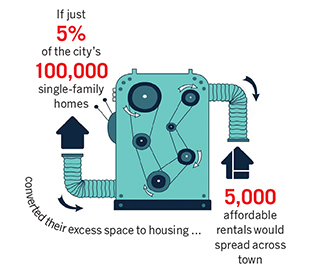
Bloom put out a study from Arc Ecology, suggesting that if just 5 percent of the city’s 100,000 single family homes converted their excess space into in-law units, an additional 5,000 affordable rentals would spread across town.

Wiener’s proposal looks at making new units in just a slice of the city, but another proposal will look at the issue citywide. Chiu’s legislation seeks to take that sea of hidden and unlawful granny flats and bring them up to code, but it wouldn’t look to build new ones.

“The big picture is that we’re exploring legalizing existing [in-law] units that are illegal, to make sure they become safe and protect residents there,” said Amy Chan, an aide in Chiu’s office.


UP TO CODE

Safety isn’t the only consideration, as this could also help the housing supply in the city, those involved told the Guardian. Often these in-law units are rented out to friends and family, and once up to code they’d open up to the market.

But safety is important because these units also often lack city permits because they’re dangerously constructed. Sometimes that can lead to death.

“A lot of time (the units) may not have proper egress for an emergency,” said Dan Lowrey, deputy director of inspection services at the Department of Building Inspection. “We just had a fire last month where three people died because of that.”

Lowrey is part of Chiu’s workgroup that’s navigating the complexities of his new legislation. Just how do you make these units legal? There’s a number of challenges, he said.

When looking at a unit, housing inspectors have a checklist to look through, and some of it is real garden variety stuff. Smoke detectors? Check. Proper floor covering? Check. Those are easy. The real challenge is when there are ceilings that are too low, hallways not wide enough to navigate in an emergency, or the unit has no windows from which to escape in a fire.

That’s when you have an in-law apartment that requires total reconstruction to be brought up to code, a straight up illegal unit. As the law stands now, the only recourse for the city in that case is to evict the people living there.

“That’s the challenge, what do we do with the [in-law apartments] that can’t be legalized?” said Bill Strawn, a spokesperson for DBI. Those are some of the questions that Chiu’s workgroup is tackling now.

The good news, he said, is that there are a good number of units that are up to the Building Code, but not the Planning Code — that’s a much easier hurdle to clear.

The Planning Code basically separates neighborhoods of the city into zones for one, two, or three families in a housing unit. This looks at the amount of available free space, sunlight, air, and parking. With those lifted, many units could be more easily converted to living use.

But finding the units that aren’t up to code is important, said Omar Calimbas, a senior staff attorney at the Asian Law Caucus.

He led the “Our Hidden Communities” study that revealed 33 percent of homes in the Excelsior district contained in-law units, far above the city’s estimates.

His team went door to door and found out for itself. What Calimbas saw was that those living in unregulated units often lived in substandard conditions with nowhere to go for help.

There are some units with no heating, he said. Other times the in-law unit is in a basement barely renovated for use as a living space. Sometimes the bathrooms and shower are really tiny cubes. There are mold and dampness problems.

“You’re living in a space that doesn’t make you feel protected from the elements,” he said. And when the units are made without permits, tenants feel they can’t go to the city for help.

To put it in a nutshell, they are in dire need of regulation. Calimbas is also working with Chiu on his legislation to do just that. But ultimately, each of the two ordinances around secondary units takes small bites out of the housing pie.

Bloom is calling for the city to move aggressively on this issue. “We’re rapidly becoming a more expensive city to live in, more and more so every year.” As more and more San Franciscans are priced out of their homes, time may soon run out.


Ahhh…colors!

8

news@sfbg.com

A whopping 8 percent of the population is colorblind. This not only means that approximately 26 million people in the United States have never seen the subtle color variation of a sunset, but that many of the motorists on our roadways are following traffic signs based on memorization of light placement.

So far, options to offset color vision deficiency, or CVD, have been limited. Most work-arounds use single filters of solid red or purple hues to provide a contrast. That allows those with CVD to detect differences in color, but not without a heavy red or purple saturation over everything they see.

EnChroma, a small, Berkeley-based company, has now created a product that allows wearers with CVD to see full, untinted colors — and it all happened quite accidentally during an Ultimate Frisbee tournament.

EnChroma Vice President Dr. Don McPherson, an avid Frisbee fan, first came up with the idea for CVD-offsetting glasses while creating safety eyewear for laser surgeries. The glasses being provided surgeons at the time were, as McPherson puts it, “terrible. They distorted the vision so much that surgeons would learn to adapt [during operations] based on the morphology,” much like CVD-afflicted drivers with the shape of stop signs. That’s not the most reassuring thought.

So McPherson and Bay Glass Research, his company at the time, created a thousand-dollar pair of protective glasses with filters designed for the exact formula of the laser wavelengths. This gave the wearer what he calls “true color” and “heightened confidence” during surgeries.

“But [the surgeons] kept stealing the eyewear and using them as sunglasses,” explained McPhereson. “So I started wearing them [outside the lab].”

McPhereson noticed his color vision improve in the sunshine with the laser surgery eyewear. But he didn’t realize their full potential until, while warming up with a color blind friend before an Ultimate Frisbee tournament in Santa Cruz, his friend exclaimed that with the glasses he could see the field’s orange cones so brightly they looked “fluorescent.”

An inspired McPherson wrangled a National Institute of Health grant and recruited mathematician Andrew Schmeder to create one of the most comprehensive mappings of the human ocular system in the world using the computer modeling program Mathmatica.

After countless clinical tests held at their Berkeley laboratory, McPhereson and Schmeder created the Super Color Enhancing (SCE) lenses used in their CVD glasses. The lenses have a microns-thick layer of more than 100 different filters laid atop each other in what’s called a dielectric stack. This allows for precise wavelengths of light, determined to the decimal by the computerized model, to be filtered through to the wearer.

“You might not see anything right away if you have really strong color vision deficiency,” Schmeder noted. In clinical trials, those who worked in graphic design fields or anywhere that required one with CVD to overcome absent colors, it took up to days of wearing the SCE lenses before noticing color.

“Most people with color blindness have learned to deal with it in such a way that they question what we can bring to them,” said EnChroma Marketing head Kat Dykes.

But the SCE sunglasses, which retail for $600, offer much more than just color vision to wearers on sunny days. The glasses can actually retrain your brain over time to see color more intricately.

“It’s like if you’re a chef and you go to culinary school, your senses of taste and smell get better” explained McPherson, who says he has “super color vision” after wearing the Enchroma lenses for the last 10 years.

Additionally, the SCE lenses have allowed CVD wearers to now “think” with a full color palate like a multi-linguist dreaming in a foreign tongue. “When I think of an apple, I see something red in my brain,” a patient told McPherson. “He’d never seen red before and now he’s thinking with it.”

By the end of the year, EnChroma will release pediatric lenses made of durable trivex, not glass as they’ve been producing so far. This will present an opportunity to examine color correction in the human eye from a young age as well as expand the rather skeletal collection of eyewear produced by the Berkeley company.

Right now EnChroma has their two types of adult SCE glasses (for the most prominent conditions of colorblindness), SCE glasses for those with normal vision (no one on staff at EnChroma is actually colorblind), and extreme solar protection glasses which not only enhance colors, but keep ultraviolet and blue light from damaging the eyeballs. www.enchroma.com

The next election

15

EDITORIAL This week’s dismal election in San Francisco is a symptom of deeper problems in our political system, both here and across the country. It isn’t voter apathy that caused what is expected to be record low turnout at the polls. It was an understandable loss of faith in an electoral system dominated by money and insider political games. And that’s what we need to address before the next election.

Three of the four officeholders on the Nov. 5 had no opposition, while Dist. 4 Sup. Katy Tang had only token opposition from someone new to town with no relevant experience. Why would these important, coveted, well-paying jobs have no applicants? Because the cost of admission is just too high, and it looks to many observers like the fix is in.

Tang and Assessor-Recorder Carmen Chu were each appointed to their posts by Mayor Ed Lee, and it is because of that connection that they were able to raise nearly $200,000 each, the most in this field of experienced office-holders. They also unfairly benefited from the power of incumbency, which can be formidable (as Lee knows, given that he was appointed mayor on the condition that he wouldn’t run for office, breaking that pledge and spending millions of dollars to win the 2011 mayor’s race).

We need a better system, one that the power brokers who put Lee into office can’t game as easily as they do. Maybe we should hold special elections for each vacancy, with shorter campaigns requiring less fundraising and thus opening up the field. Alternatively, we could make all appointees temporary caretakers and prohibit them from immediately running for a full term.

We should also limit how much developers can spend on political campaigns pushing their projects. The $2 million that Pacific Waterfront Partners just spent selling the 8 Washington luxury condo project to voters — particularly the deceptions and limits on reviews by the Planning Department in Prop. B — was obscene and unfair. But it was a smart investment on seeking profits of more than 50 times that figure.

In the post-Citizens United world, where money equals speech, there are legal barriers to doing what needs to be done. But we need to be creative and aggressive at pushing for political reform, from public financing, spending caps, and greater disclosure on campaigns to reforming the City Charter to end our strong mayor form of government, from his appointments to commissions and elective offices to the unchecked power that he has to control the spending of public money.

If we want to woo voters back to the polls, we need to give them something to vote for, and a package of political reforms would be a good place to start.

UPDATE: This editorial was corrected to fix a misspelling of Katy Tang’s last name. 


Betting on Graton

15

news@sfbg.com

The route to Wine Country was chock-full of gamblers on Nov. 5. They came in cars and limos. And they came on buses, just like hundreds of San Franciscans do every evening, many of them older Asian and Latino immigrants hoping to win big — or at least enjoy a diversion and a few free drinks.

But this day was a little different. It was the grand opening of Graton Resort & Casino, which is closer to San Francisco than the other casinos, both in distance and in its pro-labor progressive values.

Normally, Northern California tribes and even Harrah’s in Reno pay private bus companies to bring Bay Area customers to their doors. Graton hasn’t contracted these services yet, but the buses came anyway.

“Graton’s not paying us,” said Rocio Medrano, coordinator at Kenny Express, which planned to send three buses from Mission and 15th streets — where buses to various casinos line up every evening — to the opening. “But we had to go. Everyone was so excited.”

FADA Tours, which leaves from Kearny and Sacramento streets, sent six buses, every seat sold out in advance. Xin Jing Service dispatched three buses from downtown Oakland. Walter Wooden, a driver at Xin Jing, gave the same reason for the not-so-chartered bus service as Medrano: “The people want to go.”

Graton’s counting on it. California’s newest casino has steep profit projections, based largely on its proximity to the Bay Area. “Winning Just Got Closer,” Graton’s homepage screams. Next to the purple slogan, a map shows directions from San Francisco to the casino’s Rohnert Park address.

Odds are, most of the estimated 10,000 people who are swarming Graton in its opening days didn’t take home much winnings. But for a 1,300-person Native American tribe, and an Oakland-based labor union, winning really just got closer.


RARE UNION CASINOS

“Graton is very important,” said Marty Bennett, research and policy analyst at UNITE HERE Local 2850. “Now that it’s open, our organizing drive will begin soon.”

The 2,000-member local represents food service, hotel, and gaming workers, mostly in the East Bay. In a recent campaign, it organized a strike of 180 food service workers at Oakland International Airport. Its only current North Bay location is the Petaluma Sheraton, but Graton is poised to become its newest shop.

The likely unionization of Graton stems from an agreement signed in 2003 by Local 2850 and the tribal chairman who made Graton happen, Greg Sarris. The agreement guarantees card check neutrality, the union’s preferred way of organizing.

The other path to unionization is a secret ballot election overseen by the National Labor Relations Board (NLRB). But these elections are generally announced months before their dates, and notoriously offer a window of time for management to harass and intimidate workers.

The difference between card check and secret ballots is “night and day,” according to Wei-Ling Huber, president of Local 2850.

“It’s not even close. In a secret ballot election that’s run by the NLRB, about 50 percent of all organizing drives include termination of organizers,” Huber said.

If Graton workers vote to unionize with a card check, it could grow Local 2850’s 2,000-person membership by more than 50 percent. Huber said that about 1,200 of Graton’s 2,200 workers have jobs that would be represented by UNITE HERE, including bartenders, servers, and cleaning staff.

“It’s incredibly exciting,” Huber said. “The office is definitely abuzz.”

So is the Las Vegas office of Station Casinos. Members of the Federated Indians of Graton Rancheria own the casino, but Station has the contract to manage it. And it’s a lucrative property. Graton is projected to bring in $300 to $400 million in its first year.

Station spokesperson Lori Nelson told us by email the company is “excited to welcome residents from the Bay Area as we invite them all out to check out the newest entertainment destination created just for them.”

Nelson emphasized that Graton is targeting Bay Area customers.

“In fact, our advertising campaign that’s been on the air and on billboards the past few weeks even reads ‘From Bay to Play in 43 Minutes,'” Nelson wrote.

That “43 minutes” can be more like a couple hours on traffic congested days such as opening day. But increased congestion aside, Graton’s location 50 miles from San Francisco is a jackpot for Station. It was also key to the leverage Sarris had when he hired Station to manage Graton, using that leverage to require a worker-friendly operation.

When Sarris was looking to hire a management company, he invited representatives from the many interested firms to his living room, pitting them against each other.

“I did create what I like to call a cock fight,” Sarris tells us.

Sarris’ conditions were audacious. He wanted full tribal control of the development board, a LEED-certified green building, and $200 million upfront. But the condition that made most companies back down, he said, was his demand for living wages and benefits right off the bat, and the option for workers to unionize once the casino opened.

“The union thing was a deal breaker for everyone else. Station even had a problem with it,” Sarris said. “But it was my way or the highway on that one.”


RIPPLE EFFECT?

In Las Vegas, Culinary Union Local 226 — a UNITE HERE affiliate — has been waging a campaign against Station since 2010. Its website devoted to Station workers’ struggle includes a list of 88 instances of alleged unfair labor practices committed by Station and calls the company called “rabidly anti-union.”

But in Rohnert Park, UNITE HERE and Station have been working together.

“We’re optimistic that our relationship here can be very different,” said Huber. “I think that the tribe has had a really positive influence on bringing us together in California in a way that is not the case in Las Vegas.”

At Sarris’ urging, the casino was built with 100 percent union labor. It created about 700 jobs. And Jack Buckhorn, president of the North Bay Labor Council, said that 75 percent of people hired to build Graton were Sonoma County residents.

“These were long-term jobs. It really helped out as we’re recovering from this great recession,” Buckhorn said. “These were all really good jobs.”

That 75 percent local hire rate is impressive compared to some construction projects with similar price tags in San Francisco. After neighborhood activism, the $1.5 billion UCSF Mission Bay Hospital has maintained a rate of 20 percent local hire. And the Golden State Warriors have been praised for its promise of 25 percent local hire for construction of its proposed arena on Piers 30-32.

Sarris says that his commitment to good working conditions at Graton is rooted in history.

“I believe in dignity in the workplace,” Sarris said. “Let’s not forget the way we labored in kitchens and fields with low wages and no benefits.”

Workers’ rights are just one part of the vision Graton’s tribal council has for the casino, which also includes a bevy of social programs, more than $25 million annually for parks and open spaces in Sonoma County, and an organic farm.

“We see Graton as a means to an end,” said Joanne Campbell, a 12-year tribal council member.

With Graton’s opening, Sarris isn’t just the leader of a tribe that’s about to get rich. He has influence in Sonoma County, and he says he intends to use it to fight injustice.

The Oct. 22 death of 13-year-old Santa Rosa boy Andy Lopez at the hands of Sonoma County Sheriff’s Deputy Erick Gelhaus sparked weeks of protests in Santa Rosa, including a march Oct. 29 attended by hundreds from the East Bay and San Francisco.

“There was a 13-year old boy who was just shot up here. We now have the power to put people in and out of office, and we will,” Sarris said in a conversation last week. He declined to specify which officials might be a target of such a campaign, but said that “it’s not just police and sheriffs, it’s elected officials.”

“We can elect a spotted Chihuahua into office if we want,” Sarris said. “Look at all the money we’re going to have.”


KEEPING THE TURKEY

Sarris reiterated those ideas at a Nov. 3 meeting of the North Bay Organizing Project that was focused on Lopez. He then presented Lopez’s family with a check for $8,000.

“From day one, the only reason I got into it is to create something here that will benefit Indian and non-Indian alike,” Sarris said. “I’m especially concerned about people of color.”

After the genocide of Native Americans and centuries of oppression that followed, getting wealth back into indigenous communities is a complicated task. And with Graton, Sarris may achieve it for a tribe made up of descendants of those who first populated Novato, Marshall, Tomales, San Rafael, Petaluma, Bodega, and Sebastopol.

“It’s Thanksgiving again. But this time, we’re keeping the turkey,” Sarris said. “We’ll share it, but we’re keeping it.”

The people slogging up 101 this week were financing more than a glitzy new casino. Graton’s profits could fund serious progressive causes in Sonoma County. But first, its Bay Area customers will need to empty their pockets.

Someone has to lose for the house to win. Which demographics will most frequent Graton remains to be seen. One indication could be the clientele of Kenny Express.

“The seniors that are retired, they go on a daily basis. We also have people who work during the day and take the bus at night,” Medrano said. “They’re mostly Filipino, Hispanic, Chinese.”

Alerts: November 6 – 12, 2013

0

WEDNESDAY 6

Talk on Ohlone history 518 Valencia, SF. shapingsf.org. 7:30pm, free. This free public talk sponsored by Shaping San Francisco is about ongoing history. Doesn’t European and American history in San Francisco begin with genocide? Today, we have the chance to talk with people who descended from some of those who lived here before 1775, when Europeans arrived. We can’t change what happened, but what can we learn about San Francisco, the US, Europe, the Ohlone and Native America from this dialogue? This is part of a larger conversation spearheaded by the Ohlone Profiles Project, to counteract a history of discrimination.


Big Oil in the East Bay Berkeley Ecology Center, 2530 San Pablo, Berk. 7-9pm, free. A panel discussion with scientists and community activists about East Bay refineries, which export more petroleum than any other metropolitan region in the country, their plans for expansion, their impact on local communities’ health and the climate, and what can be done to combat them. The event will be hosted by 350 Bay Area, the Sunflower Alliance, Idle No More, and the Ecology Center.


THURSDAY 7


Film Screening: “Call Me Kuchu” Roxie Theater, 3117 16th St, SF. 7-9pm, free. Screening of the award-winning documentary chronicling the life and death of the first openly gay man in Uganda, activist David Kato. The film follows Kato’s fight for the human rights of the LGBT community within one of the most homophobic countries in the world, where a bill making homosexuality punishable by death was proposed in 2009. Directors Katherine Fairfax Wright and Malika Zouhali-Worrall are expected to attend the San Francisco screening of the documentary.

SATURDAY 9

San Francisco Green Festival Concourse Exhibition Center, 635 8th St, SF. 10am-6pm Sat/9, 11am-5pm Sun/10. www.greenfestivals.org. $10–$25, free for cyclists who park with Clif Bar Bike Valet and youth under 18. This weekend-long festival features talks by leaders in the social justice and environmental community, an organic beer and wine pavilion, live cooking demos, hundreds of eco-friendly businesses and informational workshops on green living. The Green Festival is a project of Green America and Global Exchange.  

Poets and speakers on human trafficking Emerald Tablet Gallery, 80 Fresno, SF. 7pm, free. As part of social justice month, the Revolutionary Poets Brigade will host speakers such as filmmaker Jeffrey Brown and poets Alejandro Murguia, Agneta Falk, Mahnaz Badihian and others. The focus of the evening will be seeking justice for victims of human trafficking.

The Guardian’s Clean Slate Voter Guide

0

Print this out and take it to the polls for the Nov. 3 election!

Prop. A: YES

Prop B: No, no, no! on Prop. B

Prop. C: No

Prop D: Yes

City Attorney: Dennis Herrera

Treasurer: Jose Cisneros

D4 Supervisor: Katy Tang

Assessor: Carmen Chu 

Read our full endorsements here.


Alerts Oct. 30-Nov. 5, 2013

0

THURSDAY 31

March to protect City College CCSF Civic Center Campus, 750 Eddy, SF. 3:30pm, free. Join supporters of the embattled City College of San Francisco for a major mobilization to protect this critical educational resource. A week of action will culminate with this march to deliver several thousand postcards to Mayor Ed Lee, urging him to protect City College. Advocates say City College is crucial and must be preserved to protect educational access for low-income and immigrant communities, veterans, older adults, displaced workers, and so many others.


FRIDAY 1


Conference on media and democracy University of San Francisco, 2130 Fulton, SF. www.udcconference.org. 9am with sessions through Sun/3, $125 registration. More than 200 radical media activists, scholars and students will convene for “The Point is to Change It: Media Democracy and Democratic Media in Action,” a three-day conference sponsored by The Union for Democratic Communications, Project Censored and the Department of Media Studies at the University of San Francisco. Researchers, activists and media-makers will present their investigations of the most pressing problems with top-down corporate- and government-controlled media; showcase exemplars of independent, alternative media; and share some of the latest methods in media education. This conference represents a unique partnership, bringing together academic and independent researchers, educators, students, and media justice activists from across the U.S. and Canada, the Middle East, China, Africa and Latin America.

SATURDAY 2


What is Social Justice? Art Internationale Gallery, 963 Pacific Ave., SF. www.socialjusticemonth.org. 7pm, free. November is social justice month, and the Revolutionary Poets Brigade is hosting this event to explore some key questions. What is Social Justice? What is Social Injustice? Speakers include Jack Hirschman, former SF poet laureate, Ethel Long-Scott of the Women’s Economic Agenda Project, John Curl, author of For all the People, and poets Sarah Page, Sarah Menefee, Ayat Jalal-Bryant and Aja Couchois Duncan. SUNDAY 3 Hottest bike party of the year City View at the Metreon, 135 Fourth St., SF. www.sfbike.org. 6-10:30pm, $20–$60. The San Francisco Bicycle Coalition’s Winterfest celebration will bring thousands of bike-loving people together for a bash in celebration of cycling. Festivities will include an art auction, a bike auction and a community silent auction.

Fight back to save your home

36

By Tommi Avicolli Mecca and Fred Sherburn-Zimmer

OPINION The good news from San Francisco these days is that tenants are fighting back in a big way to save their homes. Speculators and investors intent on making a killing in a sizzling real estate market are not always having an easy time getting rid of those who stand between them and obscene profits.

While tenant resistance has become a hot ticket item in the local mainstream media, legislators are introducing a slew of new laws aimed at curbing speculation and the housing crisis. Even the Mayor’s Office has gotten into the act, intervening in at least two recent high-profile evictions: the Lee family and 1049 Market.

A low-income elderly Chinese couple and their disabled daughter, the Lee family chose to stay and fight when the Sheriff’s Department gave them notice that it was coming to lock them out after an Ellis Act eviction. Hundreds showed up in support, with a large number of people willing to block the door and risk arrest. TV went live from the protest. Within no time at all, the Mayor’s Office stepped in to negotiate with the landlord for more time so that the Lees could find an affordable place to live. While the Lee family didn’t ultimately get to stay, their struggle brought public attention to what is happening here in San Francisco.

When the tenants in the artist live/work lofts at 1049 Market received letters from their new landlord saying that the city was forcing him to evict them because of an outstanding code violation from 2007 that he inherited when he bought the building, they didn’t take it lying down. It wasn’t true that the city was making him evict anyone. He had the option to bring the building up to code, something he found “economically infeasible.”

Tenants from 1049 Market contacted Housing Rights Committee where we work, and we helped them organize. We were afraid the landlord’s other two buildings on the same block might meet the same fate. The story made the cover of the San Francisco Examiner about a week later.

Suddenly, the Department of Building Inspection announced that it had discretion in terms of the code violations, especially the costliest of them. DBI’s deputy director sent the notice of violation back to its staff for review. The city began meeting with the landlord to try and prevent the tenants from being evicted.

Negotiations are still in progress, but the fact that the City has stepped in so aggressively on the side of the tenants is a major victory. Of course, it’s due to tenants fighting back when so many people told them they couldn’t win.

Jeremy Mykaels, a gay disabled man who’s lived in the Castro for the past 40 years and in his current apartment for almost 18, decided not to move when new owners (investors from Atherton and Union City) threatened him with an Ellis eviction. They went through with it after he turned down a buyout.

Eviction Free San Francisco, a direct action group, organized protests in SF, Atherton, and Union City. Attorney Steve Collier of Tenderloin Housing Clinic challenged the eviction in court. A judge just threw out the eviction on a technicality. The jury is out on whether the investors will start the process all over again. Fight back. It could save your home. 

Tommi Avicolli Mecca and Fred Sherburn-Zimmer work at the Housing Rights Committee.

Shit happened (Oct. 23-29)

6

Tenant proposals and Guardian forum address eviction crisis

Tenant advocates have proposed a sweeping set of legislative proposals to address what they’re calling the “eviction epidemic” that has hit San Francisco, seeking to slow the rapid displacement of tenants by real estate speculators with changes to land use, building, rent control, and other city codes.

“In essence, it’s a comprehensive agenda to restrict the speculation on rental units,” Chinatown Community Development Center Policy Director Gen Fujioka told the Guardian. “We can’t directly regulate the Ellis Act [the state law allowing property owners to evict tenants and take their apartments off the rental market], but we’re asking the city to do everything but that.”

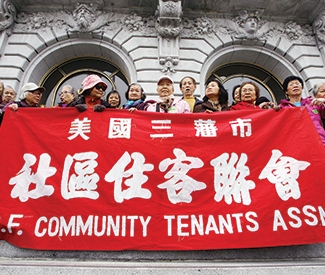
The package was announced Oct. 24 on the steps of City Hall by representatives of CCDC, San Francisco Tenants Union, Housing Rights Committee of SF, Causa Justa-Just Cause, Tenderloin Housing Clinic, UNITE HERE Local 2, Community Tenants Association, and Asian Americans Advancing Justice.

“San Francisco is falling into one of the deepest and most severe eviction crises in 40 years,” SFTU Director Ted Gullicksen said. “It is bad now and is going to get worse unless the city acts.”

The announcement came a day after the Lee family — an elderly couple on Social Security who care for their disabled daughter — was finally Ellis Act evicted from its longtime Chinatown home after headline-grabbing activism by CCDC and other groups had twice turned away deputies and persuaded the Mayor’s Office to intervene with the landlord.

But Mayor Ed Lee has been mum — his office ignored our repeated requests for comment — on the worsening eviction crisis, the tenant groups’ proposals, and the still-unresolved fate of the Lees, who are temporarily holed up in a hotel and still hoping to find permanent housing they can afford.

The package proposed by tenant advocates includes: require those converting rental units into tenancies-in-common to get a conditional use permit and bring the building into compliance with current codes (to discourage speculation and flipping buildings); regulate TIC agreements to discourage Ellis Act abuse; increase required payments to evicted tenants and improve city assistance to those displaced by eviction; require more reporting on the status of units cleared with the Ellis Act by their owners; investigate and prosecute Ellis Act fraud (units are often secretly re-rented at market rates after supposedly being removed from the market); increase inspections of construction on buildings with tenants (to prevent landlords from pressuring them to move); prohibit the demolition, mergers, or conversions of rental units that have been cleared of tenants using no-fault evictions in the last 10 years (Sup. John Avalos has already introduced this legislation).

“The evidence is clear. We are facing not only an eviction crisis but also a crisis associated with the loss of affordable rental housing across the city. Speculative investments in housing has resulted in the loss of thousands affordable apartments through conversions and demolitions. And the trend points to the situation becoming much worse,” the coalition wrote in a public statement proposing the reforms.

Evictions have reached their highest level since the height of the last dot-com boom in 1999-2000, with 1,934 evictions filed in San Francisco in fiscal year 2012-13, and the rate has picked up since then. The Sheriff’s Department sometimes does three evictions per day, last year carrying out 998 court-ordered evictions, Sheriff Ross Mirkarimi told us, arguing for an expansion of city services to the displaced.

At “Housing for Whom?” a community forum the Guardian hosted Oct. 23 in the LGBT Center, panelists and audience members talked about the urgent need to protect and expand affordable housing in the city. They say the current eviction epidemic is being compounded by buyouts, demolitions, and the failure of developers to build below-market-rate units.

“We’re bleeding affordable housing units now,” Fred Sherburn-Zimmer of Housing Right Committee said last night, noting the steadily declining percentage of housing in the city that is affordable to current city residents since rent control was approved by voters in 1979. “We took out more housing than we’ve built since then.”

Peter Cohen of the Council of Community Housing Organizations actually quantified the problem, citing studies showing that only 15 percent of San Franciscans can afford the rents and home prices of new housing units coming online. He said the housing isn’t being built for current city residents: “It’s a demand derived from a market calculation.”

Cohen said the city’s inclusionary housing laws that he helped write more than a decade ago were intended to encourage developers to actually build below-market-rate units in their projects, but almost all of them choose to pay the in-lieu fee instead, letting the city find ways to build the affordable housing and thereby delaying construction by years.

“It was not about writing checks,” Cohen said. “It was about building affordable units.”

Discussion at the forum began with a debate about the waterfront luxury condo project proposed for 8 Washington St., which either Props. B or C would allow the developer to build. Project opponent Jon Golinger squared off against proponent Tim Colen, who argued that the $11 million that the developer is contributing to the city’s affordable housing fund is an acceptable tradeoff.

But Sherburn-Zimmer said the developer should be held to a far higher standard given the obscene profits that he’ll be making from waterfront property that includes a city-owned seawall lot. “Public land needs to be used for the public good.”

Longtime progressive activist Ernestine Weiss sat in the front row during the forum, blasting Colen and his Prop. B as a deceptive land grab and arguing that San Francisco’s much ballyhooed rent control law was a loophole-ridden compromise that should be strengthened to prevent rents from jumping to market rate when a master tenant moves out, and to limit rent increases that exceed wage increases (rent can now rise 1.9 percent annually on rent controlled apartment).

“That’s baloney that it’s rent control!” she told the crowd. (Steven T. Jones)

Students fight suspensions targeting young people of color

Sagging pants, hats worn indoors, or having a really bad day — the list of infractions that can get a student suspended from a San Francisco Unified School District school sounds like the daily life of a teenager. The technical term for it is “willful defiance,” and there are so many suspensions made in its name that a student movement has risen up against it.

The punishment is the first step to derailing a child’s education, opponents said.

Student activists recognize the familiar path from suspensions to the streets to prisons, and they took to the streets Oct. 22 to push the SFUSD to change its ways. Around 20 or so students and their mentors marched up to City Hall and into the Board of Education to demand a stop of suspensions over willful defiance.

A quarter of all suspensions in SFUSD for the 2011-12 school year were made for “disruption or defiance,” according to the California Department of Education. Half of all suspensions in the state were for defiance.

When a student is willfully defiant and suspended, it’s seen as a downward spiral as students are pushed out of school and onto the streets, edging that much closer to a life of crime.

“What do we want? COLLEGE! What are we gonna do? WORK HARD!” the students shouted as they marched to the Board of Education’s meeting room, on Franklin Street.

They were dressed in graduation gowns of many colors, signs raised high. They smiled and danced and the mood was infectious. One driver drove by, honked and said “Yes, alright!” Assorted passersby of all ethnicities cheered on the group. The students were from 100% College Prep Institute, a Bayview tutoring and mentoring group founded in 1999 aiming to educate students of color in San Francisco. Their battle is a tough one. Though African American students make up only 10 percent of SFUSD students, they accounted for 46 percent of suspensions in 2012, according to SFUSD data. Latinos made up the next largest group, at 30 percent. (Joe Fitzgerald Rodriguez)

Techies to NSA: Stop spying on us!

Thousands of privacy and civil liberties activists, including many from the Bay Area, headed to Washington DC for an Oct. 26 rally calling for surveillance legislation reform, in response to National Security Agency spying programs. It was organized by more than 100 groups that have joined together as part of the Stop Watching Us coalition. The group has launched an online petition opposing NSA spying, and planned to deliver about 500,000 signatures to Congress. Many of the key drivers behind Stop Watching Us, from the Electronic Frontier Foundation to Mozilla, are based in San Francisco. (Rebecca Bowe)

What jobs?

16

For all its shiny gadgets and gleaming new luxury condo towers, San Francisco nevertheless houses a huge demographic that lives at or below poverty.

Officially, it affects about 12 percent of the city’s population, according to the most recent US Census data. Experts from the Stanford Center on Poverty and Inequality calculated an adjusted poverty figure to capture a more accurate portrait of economic disadvantage. According to that alternative yardstick, which factors in location-based costs such as the price of housing, a full 23.4 percent of San Franciscans live in poverty.

City agencies have documented ethnic identities, languages, neighborhoods of residence, and other data concerning poor people who seek assistance through city-administered services. But even though millions of dollars have flowed through city coffers to boost prospects for those who lack steady work, there’s scant documentation showing what this has actually achieved.

Despite budgeted expenditures totaling nearly $70 million for workforce development in 2013-14, not a single San Francisco city official can say how many individuals managed to rise above poverty as a result.


FIVE YEARS, NO IMPROVEMENT

At the behest of Board of Supervisors President David Chiu, the city’s Budget & Legislative Analyst recently analyzed the city’s myriad workforce development programs. It found that there is no standard measure to track the results of the programs, which are administered across 14 city departments.

The analysts recommended convening a committee to get a handle on it, “so there would be somebody accountable for compiling that information,” noted Severin Campbell, a principal at city budget analyst Harvey Rose Associates.

The analysis was a follow-up to a similar audit performed in 2007. The previous study concluded that the system to help struggling people obtain job skills and get hired “was fragmented, with inconsistent planning and coordination of resources and inadequate monitoring of programs to ensure that the programs’ goals and outcomes were achieved.”

Analysts who examined the workforce development system in 2007 discovered a lack of evidence that “individuals receiving services were eventually placed into jobs leading to economic self-sufficiency.”

To cure this dysfunction, the Board of Supervisors formulated a plan. In November 2007, it created Administrative Code Section 30, a new policy centralizing oversight of all workforce development initiatives under the Office of Economic and Workforce Development, overseen by the Mayor’s Office.

In 2007, OEWD’s annual budget for its workforce division was $547,841. By 2012-13, that amount had swelled to $19.3 million. The federal government contributes a lot, but citywide, about 65 percent of workforce development spending comes from local funds.

“Since 2007, the city has worked hard to incorporate the recommendations that came from the audit,” OEWD spokesperson Gloria Chan told the Bay Guardian earlier this year. She said the workforce division of OEWD “has made significant strides and progress to improve the city’s workforce system.”

But the latest Budget & Legislative Analyst report tells a different story. “The city continues to lack citywide policy and oversight of its workforce development system,” it notes. “Many of the key provisions of Administrative Code Section 30 have not been implemented.”

Five years have passed, and little seems to have changed. “We didn’t find a broken system,” Campbell said, “but it wasn’t what the city had envisioned.”

The report noted that the shortcomings could be partially attributed to constraints on funding provided by outside entities like the federal government, making collaboration among departments difficult.

Nevertheless, the lack of a cohesive citywide workforce development strategy coincided with one of the worst economic downturns in US history. While certain sectors have experienced recovery by now, many low-income San Franciscans are still grappling with losses sustained during the Great Recession.

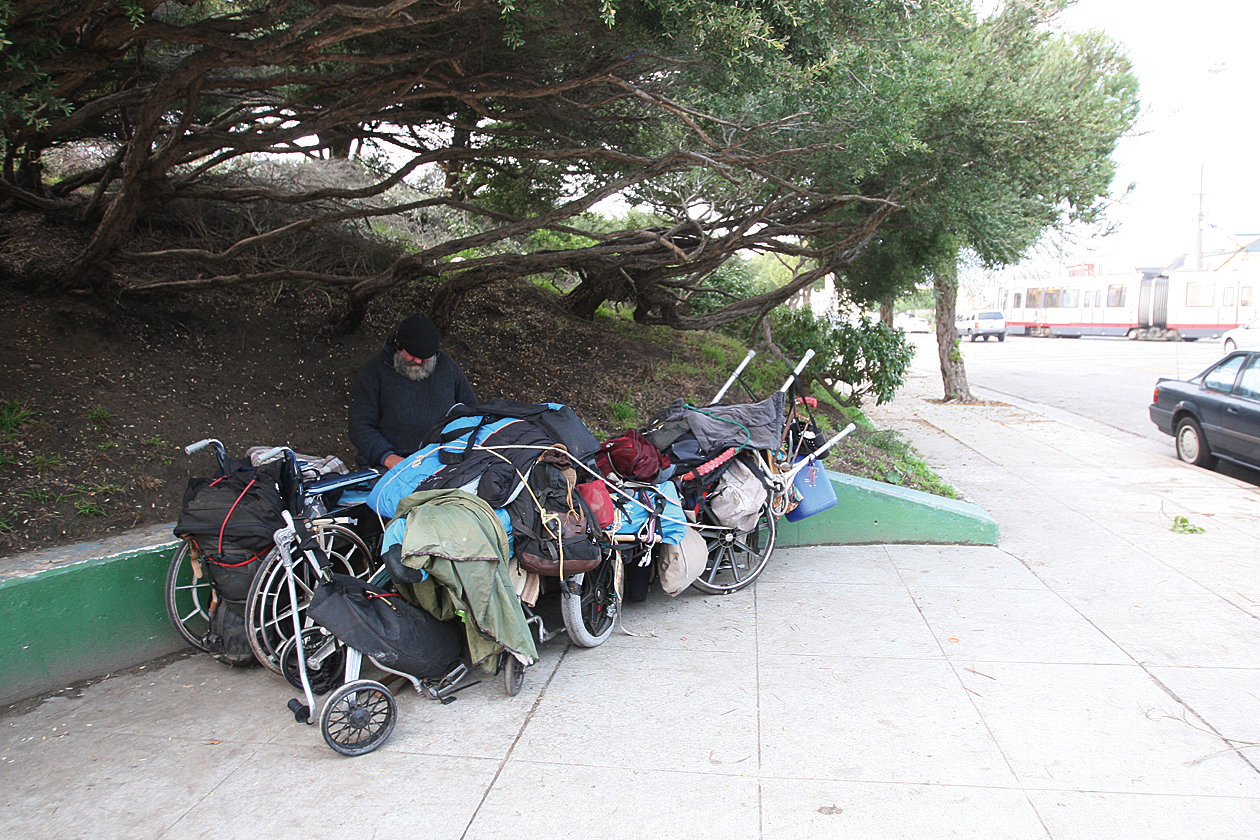
A recent survey of panhandlers, commissioned by Union Square business owners, found that the majority were homeless individuals who said they didn’t have jobs, and thus couldn’t afford rent. Some apparently interpreted these findings as a revelation; the survey results were recently spotlighted on the front page of the San Francisco Chronicle.


LOOKING FORWARD TO WHAT?

Tiffany Green is one of the 10,883 clients served by San Francisco’s workforce development system in 2012-13. She’d previously worked at the security desk of a Tenderloin services provider, but left that job because she couldn’t find anyone to look after her young son during her shifts — and the job didn’t pay enough to cover child care costs.

So she enrolled in CalWORKS, a state program administered by the city’s Human Services Agency, which offers subsidized child care, food stamps, and cash aid for low-income parents while they complete six-month job training gigs with employers who have partnerships with the city.

She was less than optimistic when asked if she thought it would lead to a steady job. “The outcome is going to be everybody else’s outcome, which is nothing to look forward to,” she said, adding that for all her friends and family members who’d completed similar six-month job training programs, she didn’t know of any who’d landed full-time jobs as a direct result.

Karl Kramer, director of the San Francisco Living Wage Coalition, said his organization has been working with city agencies to build pathways to help participants in the programs connect with opportunities for full-time employment in civil service positions.

His organization is pushing for legislation to reform one of those initiatives, the Community Jobs Program, “to make it a real job training program that fast tracks participants into available entry-level city jobs. The reports that we get is, for people who have been through the programs, it leads to very few full-time jobs,” Kramer said. So far, his group hasn’t gotten much traction with city officials.

Steve Arcelona, deputy director in charge of Economic Support and Self-Sufficiency at the Human Services Agency, didn’t respond to multiple voicemails seeking comment.


UNEVEN RECOVERY

The report comes at an odd time — in San Francisco’s current economic climate, new jobs are being created all the time, and the unemployment rate has declined. But experts note that recovery has been uneven, and only certain sectors have reason to be optimistic about the future.

“The San Francisco region is doing better than most,” Chris Haney, executive director of the California Budget Project, told us.

The city boasts a rise in “high-scale, high-production, better paying jobs” in the flourishing tech sector, accompanied by a rise in “lower-paying service jobs,” he said. “But we’re not seeing a tremendous amount of growth in the middle class, middle paying categories.”

The dilemma follows a broader trend of wage inequality that’s persisted over the last couple decades, he added, giving rise to what economists have dubbed the “missing middle.” A decline in the unemployment rate can mask this dysfunction, he said, because “you may have folks who are employed, but they’re employed at lower wages than before … What’s coming back isn’t as solid as it was previously.”

It’s against this precarious backdrop that, despite $70 million dedicated to connecting the low-income or disadvantaged with decent jobs over the past year, the city’s workforce development system appears to be plagued by dysfunction. Chiu recently introduced legislation to implement the Budget Analyst’s recommendations of undertaking yet another system overhaul.

But for many still struggling to get by, few short-term solutions are in sight. Ever-increasing housing costs make the “missing middle” phenomenon especially thorny in the Bay Area, Haney noted. “It’s harder and harder for low and middle income folks to live in the region,” he said. “They are being given clear signals that they need to move.”

Gilded Age of Austerity breaks down

9

It was a week when it seemed that civil society in the US was on the verge of collapse.

Most of the federal government was already shutdown when Congress came without hours of letting the US default on its debts, a fate avoided late on Oct. 16 with legislation to limp along for a few months before repeating the partisan budget standoff again.

That same day, both BART and the AC Transit were headed for strikes that would hobble the Bay Area’s transportation system after long contract impasses between workers and management. Gov. Jerry Brown then ordered a 60-day cooling off period for AC Transit, just like the one he imposed on BART that had just ended, leading BART to be shut down by a strike that started Oct. 18 (for more on BART, including what caused two fatalities in the system on Oct. 19, see related story).

It may not be the End of the World as We Know It (the title and subject of our 12/18/12 cover story), but this is a striking confluence of events that should cause us all to take stock of the things we take for granted, from reliable public transit systems to a functional federal government to the ability of politics to resolve our differences.

This era could be called the Gilded Age of Austerity, a duality marked by huge and growing concentrations of wealth for the few, but for the rest of us: increasing economic insecurity, a tattered social safety net, crumbling public infrastructure, and few signs of hope that things will get better.

Democracy is a fragile experiment that needs to be regularly reaffirmed by all sides. The US electoral system was already heavily skewed toward the interests of the wealthy, who sponsor both major political parties, to the point where many consider elections to be a sham. But there was still a political system, a basic framework for running the country even during tough times, and that seems to be breaking down.

For the radical right-wingers responsible for hobbling the federal government, this might appear to be a dream come true: Most of the regulators furloughed, funding for most social services stopped, and only the police state remained largely intact (86 percent of Department of Homeland Security employees were on the job and soldiers were still getting paid).

But these anti-government ideologues have never fully understood or appreciated the myriad things that government does to keep civil society functioning over the long term. Our economy relies on federal spending, our health relies on the CDC spotting coming epidemics and the FDA inspecting our food, justice needs a civil court system, our travels depend on roads, and our future depends on today’s young people getting educated (ie Head Start) and fed (ie Food Stamps), and that’s all come to a grinding halt.

It’s a similar situation with public employee unions, like those that operate BART trains and AC Transit buses. As we’ve reported (see “Last train,” July 9), private sector wages and benefits often rise or fall with those negotiated by unions. So when unions can’t win good contracts or maintain funded pensions for workers, we’re all dragged down.

The Gilded Age gets better for the bosses as the Age of Austerity gets worse for the workers.

BART’s unions had an understandable expectation that they would share in the agency’s recent budget surpluses, particularly after accepting wage and benefit concessions of $100 million over the last four years to help with projected budget deficits that never materialized.

BART managers argue that the district has offered enough and that the rest of the money is needed for its ambitious expansion plans, but there should have been a solution here somewhere short of ultimatums (strike vs. the district’s “last, best, and final offer”). When the center still held, before the new Gilded Age fused with the Age of Austerity, people of goodwill could find common ground.

Maybe we’ll pull ourselves back from the brink and learn our lessons. Or maybe we’ve entered the endgame, a place where the desperation of those living in the Age of Austerity finally matches the greed and self-interest of those living in the Gilded Age, where one must defeat the other to survive, like two fighting birds plummeting to the ground in a death spiral.

And if that’s the case, are we ready for the next era? Have we sown our seeds and tended our gardens? It took World War Two to really get us out of the Great Depression, and I’d like to think we’ve evolved since then. But given recent events I’m not so sure.

Homeless advocates fight Wiener on park closures

83

The Coalition on Homelessness has launched a campaign to defeat Sup. Scott Wiener’s legislation to close down all city parks and most major plazas from midnight to 5am, which the Board of Supervisors is set to consider on Oct. 29. Activists are targeting three swing votes who could decide the controversial issue: Sups. London Breed, Norman Yee, and Katy Tang.

In an email blast to supporters, COH urged people to contact those three supervisors to raise their concerns, even suggesting a script that includes these arguments, “It further eliminates access to public space for all, it will displace homeless people, and is a waste of city funds.” [UPDATE: To protest the proposal, the Harvey Milk LGBT Democratic Club is hosting a “sleep-in” protest at Dolores Park tonight (Mon/28) starting at 9pm.]

COH Executive Director Jennifer Friedenbach told the Guardian that she has the support of the four most progressive supervisors — John Avalos, David Campos, Jane Kim, and Eric Mar — and that she just needs two of the three swing votes that COH is targeting to kill the measure outright and avoid the kind of compromise that has become Board President David Chiu’s specialty this year.

She said the measure would be particularly harmful to the homeless LGBT community and other vulnerable populations that seek refuge at night in Golden Gate Park and other hidden spots, but that it’s bad for everyone. “It forces them out into the storefronts and streets and neighborhoods and nobody will be happy with that,” she said.

Wiener denies that the measure is aimed at the homeless, telling the Guardian that his intent is to address graffiti, illegal dumping, and damage done to park facilities overnight. “We’ve had an epidemic of vandalism in our parks and it’s getting worse,” Wiener told us. “It’s a significant problem and it absolutely degrades people’s ability to use the parks.”

Friedenbach said she appreciates that Wiener isn’t aiming his rhetoric at the homeless, even though she said that’s who will be most effected by it.

“It’s great in terms of not bashing homeless people, but we know every time something like this comes up, it increases public anger toward homeless people,” she told. And she notes that the measure is being trumpeted by people who do want to use it to go after the homeless, including Mayor Ed Lee, who went off script last month and told the Examiner that he hopes the measure will be a tool to clear the homeless from Golden Gate Park.

“The mayor said it was a great idea because we need to get the homeless people out of the park,” Friedenbach told us, noting also that, “Wiener has had a thing of going after homeless people.”

Wiener denies that this is about the homeless, and he responded to Lee’s comments by telling us, “I can’t speak for anyone else.” He also said that it’s already illegal to sleep in the parks and “to the extent the police want to do sweeps in the parks, they can already do so.”

The measure would apply the closing hours to all property controlled by the Recreation and Parks Department, which includes every city park and the city’s largest plazas, including Civic Center Plaza, Justin Herman Plaza, and Union Square.

“One thing people don’t think about is this also applies to the plazas,” Friedenbach told us. “A lot of our plazas are hangout spots late at night, and there’s no reason they shouldn’t be.”

Wiener said that small plazas, such as Harvey Milk and Jane Warner plazas in the Castro, aren’t under RPD jurisdiction and therefore aren’t effected by his legislation. And he said the ordinance was already modified to allow people to walk through the affected plazas without stopping, and that he’s open to further amendments.

As for his chances of success in the face COH’s activism on the issue, he told us, “I’m not sure what’s going to happen on the 29th.”

Vote “no” on everything

13

All this year’s candidates are unopposed incumbents, which is lame. It’s a sign of an unhealthy democracy that we don’t even have a choice. Why isn’t anyone running? The citywide races on this ballot have no term limits and no public financing, so we’re stuck with career politicians until they decide to move on. Even if they’re okay at their jobs, that’s problematic.

We aren’t necessarily opposed to Treasurer Jose Cisneros or City Attorney Dennis Herrera. They each have admirable accomplishments on their résumés, but they aren’t the type of pioneering progressive leaders that we’re comfortable endorsing in uncontested elections — and Herrera has a couple ugly marks on his record (gang injunctions and invalidating a people’s referendum on Bayview/Hunters Point development).

We are, however, strongly opposed to the Guardian’s endorsements of Carmen Chu and Katy Tang. Back in the day, they worked together in Mayor Gavin Newsom’s budget office. Then he appointed Chu as District 4 supervisor and Tang became her legislative aide. Then Mayor Ed Lee appointed Chu as Assessor and it was Tang’s turn to be District 4 supervisor.

Are you sensing a trend? If Tang goes on to serve two full terms, the Sunset will go from 2007 until 2022 without a contested election. That’s crazy pants!

Odds are that will also mean 15 years without the District 4 supe ever disagreeing with the mayor. Chu was on the opposite side of virtually every contested vote The League has ever cared about: free Muni for youth, the Sit-Lie law, increasing the hotel tax, Election Day voter registration, and CleanPowerSF.

Tang hasn’t been around long, but she’s already voted against CleanPowerSF and carried the mayor’s water by trying to weaken John Avalos’s Due Process for All ordinance. She attempted to insert exceptions that would’ve made undocumented San Franciscans unsure if they could call the police without risking family members’ deportation. When she used the fearmongering image of the city becoming a “safe haven for criminals,” she was rightfully booed by hundreds of immigration and domestic violence advocates in the audience.

And then there’s the golden rule of politics: Follow the money! Chu and Tang have racked up over $150,000 each. Huge chunks of that money come from developers, property managers, consultants, and others looking to strike it rich with land use deals approved by the new board.

That’s especially troubling for Assessor-Recorder Chu. She’s responsible for assessing property taxes, most of which come from skyscrapers downtown. She should be all up in the business of those corporations: Every time a building changes hands or a company’s ownership changes, the company owes a real estate transfer tax. But Chu is buddy-buddy with the Building Owners and Managers Association, taking piles of cash from the real estate industry. That sucks.

This business of the mayor appointing his buddies who then go on to win uncontested races has got to stop. It’s troubling that the mayor — our executive branch — unilaterally fills out our legislative branch. Hello? Did the folks writing our City Charter ever hear of “checks and balances?”

We think all mayoral appointees should be placeholders, legally prohibited from running in the following election. None of this pledging not to run and then “changing your mind” (we’re looking at you, Ed Lee). That reform would be a proposition we could say yes to — and a welcome change of pace from this November’s ballot.

The San Francisco League of Pissed Off Voters is an all-volunteer local chapter of the National League of Young Voters.

Lessons of the BART standoff

99

EDITORIAL BART and its unions reached a tentative deal on new contracts late Monday (10/21) night, the next day restoring service that had been disrupted by the second four-day strike this year. Now, it’s time for everyone to move on from this impasse — and the ugly demonization of workers that accompanied it — and try to heal the damage that was done.

Sadly, it appears to have taken the senseless deaths of two BART employees on Oct. 19 to reinforce the safety concerns that unions have raised from the beginning, undermine critics’ belittling claims that “the trains run themselves” and don’t need trained workers, and back the district down from its aggressive brinksmanship and preparations to run limited service during what could have been a long strike.

There are still many questions to be answered. Was the district forcing a strike with its “final offer” and last minute decision to seek more authority over work rules? Would it really have offered service to the public using scab drivers? Was the driver training that was happening on that ill-fated train a factor in the tragedy?

We may not have a definitive answer to that last question for quite awhile, but we already learned from the NTSB that BART officials were deceiving the general public when they claimed the train was simply on a maintenance run to remove graffiti and when they offered misleading answers to the Guardian’s direct questions about whether driver training was being done.

Unfortunately, that was just the latest example of a pattern of behavior unbefitting of officials in a public agency. It began with the decision to pay almost $400,000 to a notoriously anti-union contract negotiator. It continued through stall tactics and an aggressive public relations strategy. And it culminated with seeking sweeping authority over work rules at the 11th hour and following up with training new drivers as soon as a strike was underway, apparently hoping to run enough service that the unions would be forced to accept a bad contract.

None of that should have happened, and it was only possible because the financially healthy district played off of the conservative campaigns against public employee unions of recent years to undermine the public image of their workers and deny them reasonable raises and safety improvements.

The media is also culpable, particularly the editorial writers at the San Francisco Chronicle and Bay Area News Group, which ran vitriolic and false rants condemning workers and unions, even supporting Republican calls to outlaw strikes by transportation workers.

Only in the funhouse mirror they created was it possible to credibly push the ridiculous claim that unions were striking because they were afraid of using email. It’s not necessary to dehumanize and demean our adversaries. We in the progressive Bay Area are better than that, and maybe now we can act like it.

In charge … sort of

5

joe@sfbg.com

Former Compton Community College Special Trustee Dr. Arthur Q. Tyler was formally announced as City College of San Francisco’s new chancellor on Oct. 16. The decision ends a months-long search and comes at a time when CCSF is under state control and facing the loss of its accreditation.

As everyone fears for the future of City College, the key to understanding its new chancellor may lie in his history with similarly troubled community colleges, and to CCSF’s own turbulent history.

City College is in the fight for its life as the deadline of July 2014 looms, at which point the Accrediting Commission of Community and Junior Colleges says it will revoke CCSF’s accreditation. But Tyler has been in a similar position before, in Compton.

Tyler held the same position overseeing the troubled Compton Community College that Special Trustee Bob Agrella held as CCSF lost its accreditation. But more importantly, Tyler was at the helm when it was told its accreditation was revoked in 2005.

In a letter to the community, Compton’s Board of Trustees outlined what they’d need to do: regain their footing and win an appeal to the accreditation commission. They filed for review, much like City College of San Francisco recently did. And they lost.

Compton Community College never regained its accreditation. It was absorbed into a neighboring district, El Camino College, and is now known as The El Camino Compton College Center, essentially another campus in the El Camino system.

“They had problems with integrity,” he said at the Oct. 16 press conference, addressing Compton’s failure under his watch. “It was a different situation.”

Tyler is now tasked with saving San Francisco’s only community college. At the ceremony, Tyler was told that he’d be held liable for CCSF’s future.

“Dr. Tyler, you have many people here, whether they’re students, faculty, staff, and administrators… to stand behind you as you take on this important responsibility,” said Hydra Mendoza, Mayor Ed Lee’s education advisor. “We’re also here to hold you accountable.”

After CCSF was notified it would lose accreditation in a year, the state gave Agrella the full powers of City College’s Board of Trustees, leaving San Francisco’s elected board powerless.

Just exactly how much power and influence Tyler will have while the state-appointed trustee remains at City College is still a mystery. But then again, the history of leadership of CCSF has been cloaked in secrecy and dubious dealings.


DAY’S LEGACY


Former Chancellor Philip Day was head of City College in 1998, and he left under a criminal indictment, pleading guilty and later convicted of misuse of $100,000 of college funds. His chancellorship ended in 2008, but his scandal was not his only contribution to the school.

“In a lot of ways he was a great chancellor. He had some vision,” Fred Teti, who was City College’s Academic Senate president under Day, told the Guardian.

Day was a divisive figure, and the politics around him has split the college to this day. Teti said that rightly or wrongly, Day’s legacy was mainly tied to the construction boom at City College.

“When the state Legislature passed (a law allowing) bonds for schools, he jumped on it immediately. It was really him that got all those buildings up,” Teti said.

The construction boom built the college’s new Multi-Use Building, and the towering Chinatown Campus. Many we talked to attributed this to Day’s coalition style leadership, bringing together disparate groups of the college to a single purpose.

It was also what led him to falter, as Day’s misuse of funds conviction was directly centered around funding he was using to promote more bonds for City College. He put laundered district money into an ad campaign for a facility related bond measure, and he was caught.

Even after Day was gone, the legacy of bitter divisions among trustees and lack of proper fiscal checks-and-balances that Day fostered contributed to CCSF’s downward spiral — and now, the hiring of a hobbled new chancellor to try to pick up the pieces.

Tyler may not have the chance to enact his own City College vision for awhile, and when asked at his introduction to the school “What can and will you do here?” he said “I’ll make recommendations to the board, in this case to Dr. Agrella, on the things we believe… will heal and fix this institution.”

Former City College administrator Stephen Herman, who shared a criminal conviction with Day over the misuse of district funds, told us that Tyler will have few powers until Agrella steps aside.

“Dr. Tyler is going to be a little hamstrung to begin with,” Herman said. “Ultimately, if the college gets its accreditation and is able to survive, then (Tyler) can spread his wings and take over some policy decisions.”

But the history around Tyler’s policy decisions are equal parts heartening and worrisome.


TYLER’S HISTORY

Tyler was charming and self-effacing at his press conference, saying “I’m privileged to stand before you as your new chancellor,” building on what he called “the legacy” that the interim-chancellor Thelma Scott-Skillman will leave for him: “I know I’m filling a large pair of lady shoes.”

Tyler’s resume seems to glow. He’s an anti-terrorism expert who served in the US Air Force, was vice president at Los Angeles City College, and was in charge at Sacramento City College. He also speaks Farsi.

But it was his time as deputy chancellor of Houston Community College where he walked through fire, allegedly resisting bribes and sexual advances from contractors in the corruption-plagued district. Dave Wilson, 66, runs the investigative website “Inside HCCS” in Texas that’s a tell-all about alleged dirty dealings at Houston Community College.

One gold mine of documents he obtained came when the Harris County District Attorney’s Office was investigating alleged corruption at HCC. Family members and friends allegedly helped questionable construction contracts get approved by the HCC Board of Trustees, according to the Houston Chronicle’s stories at the time.

Ultimately, those accused had to take ethics training courses, but it’s the investigation itself that’s really revealing.

Law Firm Smyser Kaplan & Veselka interviewed college officials at the behest of HCC’s board in 2010. Its goal was to get to the bottom of who had anything to do with getting the dirty contracts passed. Houston Community College’s attorney turned investigator, Larry Veselka, interviewed Tyler as part of this investigation and Wilson obtained Veselka’s notes.

When looking into a construction project, Tyler told Veselka he found about $14 million in questionable spending. The interview details allegations that Tyler was receiving vague promises of sexual favors and bribes from a pair of would-be contractors, which he refused.

Veselka would not return phone calls from the Guardian, but the Harris County District Attorney’s Office, which was involved in the investigation of Houston Community College, confirmed that it had documents regarding the college from Veselka’s law firm but would not release them to the Guardian.

The documents paint a rosy picture of Tyler, who cleaned house, and even claimed to have shrugged off shady dealers at Houston Community College.

“I can tell you I did speak to the law firm,” Tyler said when the Guardian asked him about the alleged attempted bribe. “Because that was a violation of trust. Anyone who knows anything about me can confirm that I’ve been about trusting my own instincts about what’s right and what’s wrong. It’s a keynote of my value set that I will never compromise, now and in the future.” But in the same documents that confirmed Tyler talked to attorneys about the alleged bribe, one trustee was concerned enough about Tyler’s close relationship with another trustee that Tyler’s future authority regarding contracts was limited. And while different news outlets reported that Tyler resigned from Houston Community College, that’s not exactly the story the Houston Chronicle told in July. “The trustees agreed Thursday to a settlement with Deputy Chancellor Art Tyler for $600,000, confirmed his attorney, Vidal Martinez. Tyler relinquished all duties Friday,” the paper wrote. “Art is part of the old chancellor’s team. This was part of finishing the past,” Vidal Martinez, Tyler’s attorney, told the Houston Chronicle. Ultimately, they reported, the buyouts of the two administrator’s contracts cost Houston Community College over a million dollars. Tyler would not return follow-up phone calls on the matter. When asked if he was worried about Tyler’s history, CCSF Board President John Rizzo said that none of it came up in the chancellorship interviews — but even if there was truth to it, he wasn’t worried. “He’s going to have a lot of eyes on him,” Rizzo said. “He’ll have the state chancellor and special trustee looking over his shoulder, more than a normal chancellor would.”

On the line

31

rebecca@sfbg.com

Nobody knew exactly when the bus would leave. It was the afternoon of Oct. 17, and a group of about 60 immigrant rights activists were gathered in the shade of some tall trees in a park by the TransAmerica Pyramid in downtown San Francisco.

Many were young, Latino or Asian Pacific Islander, dressed in hooded sweatshirts, baseball caps, and slim-fitting jeans. They chatted and milled about, perhaps trying to ease a gnawing sense of anticipation over what was about to happen.

Half a block away and out of view, federal Immigration and Customs Enforcement officers were leading passengers onto a white bus, parked at the ICE building at 630 Sansome St., with a “Homeland Security” label inscribed on the front. All the passengers were ICE detainees; some were about to embark on long deportation journeys, while others were being sent to detention centers where they would remain in limbo until either being deported or exonerated.

Back at the park, organizer Jen Low was peering at her phone every 10 minutes. “They’re locking the bus!” she exclaimed after reading a text sent by someone on the lookout. That meant it was almost time to go. The activists started organizing themselves into two groups: Those willing to risk arrest, and those planning to rally in support.

The ones facing arrest were planning to engage in peaceful civil disobedience, by placing their bodies in front of the bus to prevent it from going anywhere. “About half of the people who will be blocking the bus are undocumented,” Low told the Guardian as they prepared to exit the park. “That’s why some of us are so on edge right now.”

They headed toward the ICE building en masse, slowly at first and then quickening their pace, some hastily peeling off top layers to reveal handmade T-shirts underneath proclaiming, “Not one more.” Others were already stationed at the bus, and as 10 protesters linked arms and settled onto the street in front of it, someone had already started up a chorus of “We Shall Not Be Moved.”


INTO ICE CUSTODY

They’d been inspired by a recent ICE bus blockade carried out by Arizona activists, organizer Jon Rodney said, and the civil disobedience was meant to send a message to President Barack Obama that it’s unfair to continue deporting undocumented people as long as a resolution on federal immigration reform remains stalled in Congress. Rodney’s organization, the California Immigrant Policy Center, has emphasized family unity as a guiding principle that should inform immigration reform efforts.

A variety of organizations had been involved in planning the action, including the California Immigrant Policy Center, Causa Justa/Just Cause, POWER (People Organized to Win Employment Rights), ASPIRE (Asian Students Promoting Immigrant Rights through Education), and the Asian Law Caucus.

Among the protesters was Dean Santos, a 23-year-old originally from the Philippines who had been brought to the US when he was 12. Not so long ago, he’d been transported out of San Francisco on a white deportation bus leaving from that very building. Faced with a trumped-up felony that was later downgraded to a misdemeanor, Santos was taken into federal custody in late 2010 because the initial serious charge triggered ICE involvement.

He was given the choice of voluntary deportation or indefinite detention while he fought his case. Santos chose the latter. He called his mother in San Bruno, where they lived, and apologized for what had happened.

Locked in a cramped cell in the San Francisco ICE building, he started to feel overcome with fear, but an elder man he was detained with offered comforting words. “He told me he had also decided to stay and fight, and he said he was doing it for the sake of his daughters,” Santos recalled.

That’s when it hit him that he wasn’t the only one whose life was potentially about to be upended due to deportation. The realization eventually fueled his activism, he said. He was inspired to participate in the undocumented youth movement to call for just and inclusive immigration reform, and he’d joined the ICE blockade as a member of ASPIRE and the Asian Pacific Islanders Undocumented Youth Group.


TWO MILLION DEPORTATIONS

In just a short time, the scene outside the ICE building had become zoo-like. Television news crews appeared, police cars raced up with lights flashing, and a few young ICE guards, sporting thick black vests and belts with holstered weapons, stood by the bus in wide defensive stances.

More than 100 supporters formed a procession and encircled the vehicle, waving signs and chanting as they went round and round. “Down, down with deportation! Up, up with liberation!” Some chants were in Spanish: “Obama, escucha, estamos en la lucha!” (Obama, listen, we’re in the struggle.)

Obama delivered comments that very day, as the federal government was reopening after being shut down by Congress, signaling that immigration reform was the next major agenda item.

“We should finish the job of fixing our broken immigration system,” the president said in a televised address from the Rose Garden. “There’s already a broad coalition across America that’s behind this effort — from business leaders to faith leaders to law enforcement. The Senate has already passed a bill with strong bipartisan support. Now the House should, too. It can and should get done by the end of this year.”

California has the largest immigrant population of any other state, with an estimated 2.8 million undocumented Californians. Advocates are calling for the creation of a path to citizenship that isn’t overly burdensome, and for immigration policy that doesn’t rely on detention and deportation as cornerstones of immigration enforcement.

“We were really hoping immigration reform would pass and reduce deportations,” Asian Law Caucus staff attorney Anoop Prasad told the Bay Guardian just before the protest got underway. Instead, “Obama is closing in on his two millionth deportation since becoming president,” he said, a higher number than those carried out under President George H.W. Bush when he’d been in office for the same duration.

Much of that steep increase has to do with technological capability and information sharing under Secure Communities (S-Comm), which has resulted in an estimated 90,000 deportations of undocumented people in California alone.

Prasad said he had reviewed the roster of detainees loaded onto the bus earlier that day. They’d been taken into ICE custody in various Northern California cities, including San Francisco, and they had origins in Russia, Mexico, Ethiopia, Vietnam, El Salvador, India, and other countries. Some had children, and a few were minors themselves.

“One guy has been here since he was 11 months old,” Prasad said. “Now he’s in his 40s.”

There are three immigration courts inside 630 Sansome. Undocumented detainees are transported there from ICE facilities in Richmond, Bakersfield, Sacramento, and Yuba County, often roused around 3am. They aren’t allowed any books or personal property when they’re locked up awaiting court appearances, Prasad said/

“In court,” he said, “a lot of times people have their legs and hands shackled.”

Sometimes the early-morning departures and daytime detentions can disrupt medication routines, he added. That’s a problem for people taking medication to combat mental illness — especially when they’re headed for anxiety-inducing appearances in court.


FALSE IMPRISONMENT, REAL CONSEQUENCES

Around 5:30pm at the ICE bus blockade, the SFPD closed off the intersection and told activists they would risk arrest if they didn’t move out of the way. The larger group of supporters squeezed onto the sidewalk, but those who had set out to perform civil disobedience stayed planted where they were.

It seemed the SFPD would arrest them at any time. A police officer crouched down and spoke with them in a conversational tone as they sat with their hands clasped. “I know what you guys are trying to do,” he said, adding that he wasn’t trying to stop them from speaking out about their cause. But he asked them to stand up and let the bus get on its way. They refused.

San Francisco has been a Sanctuary City since 1989, which means city employees are prohibited from helping Immigration and Customs Enforcement (ICE) with immigration investigations or arrests except in cases where it’s required by federal or state law, or a warrant.

If they were taken into custody by the SFPD and charged with misdemeanors, the activists had reason to believe they would be spared from deportation. Added protection for undocumented San Francisco residents will soon take effect under legislation recently approved by the San Francisco Board of Supervisors.

Authored by Sup. John Avalos, it prohibits local law enforcement from honoring ICE requests to hold detainees for an additional 48 hours, except in very narrow circumstances. Federal authorities issue those requests to allow enough time to take those undocumented individuals into custody — even if they lack probable cause showing that the person was involved in criminal activity. Their status is detected via S-Comm, an information-sharing program between federal agencies that links fingerprint databases.

But a debate had apparently started between the two agencies over whether the protesters were under SFPD’s jurisdiction, or ICE’s. Prasad said federal agents threatened the activists with charges of felony false imprisonment if they did not end their protest immediately. That charge essentially means holding someone against his or her will, but “they’re not blocking the door,” he pointed out. (Some armed ICE agents, meanwhile, did happen to be standing in front of the bus door.)

The prospect of facing federal felony charges carried potentially grave consequences. Just before the start of the protest, Santos described what his own ICE bus trip had been like. He’d boarded it with about 35 other passengers, mostly men. As they crossed the Bay Bridge, he felt a pit in his stomach as he looked back at the Ferry Building, wondering if he was going to be separated from his family for good.

Santos and the other detainees were transported to Oakland International Airport, brought through a special security area, and led onto a plane. The flight stopped in Bakersfield, Los Angeles, and San Bernardino, picking up more detainees at each location. Then the flight touched down in San Diego, where some were taken off the plane and sent across the border to Tijuana.

Santos’ journey ended at an ICE detention center in Florence, Ariz. He said there were 14 bunks in a room with a single toilet, which was not well maintained. He had no idea how long he was going to remain there, but it ultimately turned out to be two weeks.

Extended family on the East Coast helped his parents locate a lawyer in Arizona, and the lawyer helped him qualify for bail, which his parents posted. He was released, and finally returned to San Francisco after 16 hours on a Greyhound bus.

Eventually, the whole matter was dropped because he benefitted from prosecutorial discretion under Deferred Action for Childhood Arrivals, federal policy enacted in June 2012 directing ICE to give special consideration to individuals who immigrated illegally to the US as children.


STILL UNAFRAID

Protesters at the blockade were having an intense consultation with Prasad, the Asian Law Caucus attorney, as he explained what was potentially at stake. Heads together and eyes wide as they talked it out, they ultimately opted to hold firm.

“We will do whatever is necessary for our community!” Alex Aldana bellowed into a megaphone while the supporters cheered. The group erupted into wild chanting: “Undocumented, unafraid!”

Not long after that, all were brought to their feet and led away from the bus by men in uniforms — it was federal ICE officers who escorted them away, not SFPD officers.

They brought them past the crime tape and around the corner from where the bus was parked. Then they lined them up, wrote out tickets, and let them go. Prasad said he guessed that the agency was worried about the backlash it might receive had it gone through with taking them into custody and pressing charges. Energy was high as it dawned on the activists that they were getting Certificates of Release instead of handcuffs. Still in the line police had arranged them, they jumped up and down on the sidewalk, still chanting, while a federal officer filled out the forms and placed them into their hands. As evening fell, the bus passengers remained shackled in their seats, invisible to all but the driver. Once the activists had been cleared from the scene and the authorities regained control of the situation, the bus backed up and left.

Alerts

0

WEDNESDAY 23

An Evening with the Authors of DOLLAROCRACY First Congressional Church, 2345 Channing Way, Berk. 7:30-9:30pm, $15. John Nichols and Robert McChesney will discuss their new book, DOLLAROCRACY: How the Money and Media Election Complex is Destroying America. The authors will address issues such as the forces they believe have robbed national elections of their meaning, the far-reaching and drastic consequences of these developments for the American democratic process, and proposed solutions.


THURSDAY 24

8 Washington Debate First Unitarian Universalist Society, Martin Luther King Room, 1187 Franklin, SF. Doloresmp@gmail.com. 7-9pm, free. Jon Golinger, campaign manager of No Wall on the Waterfront, will debate Alec Bash, supporter of the 8 Washington project. The luxury waterfront development is the subject of Ballot Propositions B and C, which will appear on the Nov. 5 ballot. Golinger is an attorney and environmental activist; Bash is a former city planner. The San Francisco chapters of Progressive Democrats of America and Unitarian Universalists for Peace are sponsors of this event.


FRIDAY 25


MisLEAD: America’s Secret Epidemic San Francisco Main Library, 100 Larkin, SF. www.misleadmovie.com 2-5pm, FREE. Screening of the new feature-length documentary directed by Tamara Rubin, an Oregon mother whose sons were poisoned by lead. The film follows Rubin as she travels around the country meeting with experts and other parents of poisoned children. It showcases the on-the-ground effects of the lead-poisoning epidemic and investigates how lead poisoning was ever allowed to become such a serious problem in the US. Free lead check swabs will be given to all attendees and the event will include an educational session on how to properly use the swabs. SATURDAY 26 Our Mission: No Eviction! Brava Theater, 2781 24th St, SF. tinyurl.com/noevict. 8pm, $10–$35. An evening of art, performances, and tributes to Mission artists Rene Yañez and Yolanda Lopez. All proceeds will go to the artists’ legal expenses in fighting their eviction from the Mission home where they have lived for thirty-five years. Their plight is part of a rash of evictions of artists and working class communities from San Francisco in recent years, especially in the Mission District. Yañez and Lopez are pillars in the San Francisco arts community, and rallying around them is an opportunity to protest the larger issue of evictions throughout San Francisco.

Parking and the gentrification of food

74

STREET FIGHT Professor Don Shoup, an icon in San Francisco planning circles, is famous for illuminating that there is no such thing as free parking. In his voluminous book The High Cost of Free Parking, Shoup breaks-down the costs of building parking spaces and the land underneath.

Beyond that there’s lighting, insurance, security, maintenance, ventilation, financing, contracting, and surveying costs. There’s also the additional property tax on the parking, and piling onto that, the vast external costs to society with congestion and pollution from car trips generated by parking.

While all of this might seem obvious, the virtue in Shoup’s work was to show how the costs of parking are regressive and passed onto communities, especially low income households and non-drivers. For example, a grocery store bundles parking into the price of food and this is disproportionately borne by non-drivers.

In a sense, free parking causes the gentrification of food.

In San Francisco, underground parking costs anywhere from $80,000 to $100,000 per space to construct. In the proposed supermarket at 555 Fulton Street, the 77 spaces proposed underneath the store will cost anywhere from $6.1 million to $7.7 million to build.

That’s millions that will be passed on to a grocery store tenant and ultimately to shoppers. And that’s just to build, not operate, the parking. This adds more burden to the already tight pocketbooks in a gentrifying city like San Francisco.

Parking also complicates the issue of grocery stores and formula retail, making developers prefer a chain store because it can access the financing to build parking. So parking literally “drives-up” the rents for tenants seeking to lease the space. This makes it more difficult to find an affordable, local, non-chain grocer while also translating into higher food prices, since grocers transfer the cost of parking onto all shoppers regardless of how they got there and regardless of the shoppers’ income.

All of this came to a head last week at the San Francisco Planning Commission hearing on 555 Fulton, a proposed mixed use development that might include a grocery store. The Commission voted 4-2 to lift a formula retail ban on this site, concluding that only a chain store is “economically viable.” (Disclosure: I publicly advocated against that exemption as a member of the Hayes Valley Neighborhood Association).

This was not just a blow to the city’s unique character in terms of guarding against chain stores. It undercuts sustainable and affordable urbanism and will lead to gentrified food. Here’s a brief summary of what happened:

In the early 2000s, the old Christopher Dairy at 555 Fulton, between Laguna and Octavia, was identified as a good location for a supermarket as part of a larger mixed-use development. The site was folded into the Hayes Valley formula retail ban to encourage an independent, community-based supermarket with fresh produce, high quality food affordable to nearby residents, and jobs for locals.

In 2010, the Planning Commission approved the first iteration of this project, with 136 housing units above a non-chain grocery store. Neighbors were very excited to have a local supermarket to serve the whole community and the developer did not try to circumvent the chain store ban. The community and Planning Department were working together.

In late 2012, the site and its entitlements were sold to a new developer, Fulton Street Ventures. It immediately informed the community that it would seek to lift the ban. HVNA unanimously opposed lifting the ban and Planning Department staff supported HVNA’s position. At that point, it seemed that the planners had read and understood Shoup.

For its part, HVNA compiled a list of potential non-chain store candidates and proposed creative ways to make the site work for a locally owned business, with perhaps some space allotted to a hardware store or other neighborhood-serving shops. HVNA also proposed reducing the parking at the site in order to make the store affordable.

The Market and Octavia Plan, which includes 555 Fulton, allows a grocery store to have less parking than the 77 the developer wants, and even zero parking. The developer could eliminate some or all of the parking, reduce construction costs, and reduce the asking price for a lease. This area is flat, incredibly walkable and proximate to thousands of existing residents, with thousands more on the way.

A car-free or car-lite grocery store can deploy innovative ways of delivering groceries, such as a jitney service or delivery vans, for those who need such service, and to limit the amount of store parking to a small number of car share and disabled parking stalls. This kind of grocery store would be at the cutting edge of truly sustainable urbanism, while also providing more affordability to all residents of the community.

Yet another Shoup axiom is “Planning for parking is more a political than a professional activity.” Instead of being creative, Fulton Ventures balked at the parking ideas and employed divisive race-baiting to push its profit-driven agenda. It financed a quiet campaign to accuse anyone supporting the formula retail ban and reducing parking as racist and elitist. It leaned heavily on City Hall and somehow got the Planning Department to suddenly retract its support for upholding the chain store ban. Sup. London Breed, who remained publicly detached, insisted that all she cared about was an affordable supermarket, but she offered no path to achieve it.

In a confusing Oct. 3 hearing, supporters of Fulton Ventures LLC made below-the-belt public comments that seemed to come straight out of a Tea Party playbook. It was tough to watch. Their position was that a chain store with excessive underground parking was the only way to an affordable grocer — anything short of that was racist. The commission voted 4-2 to lift the ban.

By lifting the formula retail ban, the city lost leverage for making the store affordable while also providing fresh food for thousands of people within walking distance. And the many car-free households of the Western Addition and Hayes Valley will get to breathe the car fumes from upscale shoppers. The commission gentrified food.

All is not lost though. The damage done by the Planning Commission can be overturned or fixed at the Board of Supervisors. Breed states she cares about affordability, local small business, and the city’s transit-first policies. She can put conditions on this project that reduces the parking, or decouples the parking from the lease for the commercial floor space, thus making the project economically viable for an affordable grocer. She can demand other creative and sustainable solutions which planners so far have not considered. She doesn’t have to give it away to a chain store. And if you care for affordable groceries with less driving, and want to stop the gentrification of food, write her and let her know.

Lock-up shake up

21

rebecca@sfbg.com

Should San Francisco spend $290 million on a modernized jail to replace the old ones that will be demolished when the Hall of Justice comes down?

That’s been the plan for years, but the Board of Supervisors Budget & Finance Committee started to ponder that question at its Oct. 9 meeting, setting the stage for a larger debate that hinges on questions about what it means to take a progressive approach to incarceration.

The Department of Public Works, in collaboration with the Sheriff’s Department, is preparing to submit a state grant application for $80 million to help offset the cost of rebuilding County Jails 3 and 4, outmoded facilities that are located on the sixth and seventh floors of the Hall of Justice.

That building is seismically vulnerable, and slated to be razed and rebuilt under a capital plan that has been in the works for the better part of a decade. With a combined capacity of 905 beds, Jails 3 and 4 were built in the 1950s and are in deplorable condition.

At the hearing, when supervisors considered whether to authorize the $80 million grant application, Sheriff Ross Mirkarimi said the current state of affairs is so bad that his department had to convert a bathroom to a visitation area because there was nowhere else for inmates to spend time with their kids in the same room. In other areas of the jail, temporarily vacant holding cells sometimes double as classroom space, since the department lacks dedicated areas for conducting classes.

The new jail would be built with somewhere between 481 and 688 beds, based on a lower calculated projected need, and more space would be devoted to programs like substance abuse education, parenting programs, or counseling.

San Francisco currently has five jails, but only one — a San Bruno facility built in 2006 — has what the Sheriff’s Department considers to be adequate space for rehabilitative services. Inmates there can opt to earn a high school diploma or take a course in meditation, and the department wants to build on that design in the new facilities.

Mirkarimi urged committee members to sanction the funding request as a first step toward that goal. “Whether it’s parenting programs or something that goes much deeper, then we need that space to make it happen,” he said.

At the same time, some community advocates questioned the very premise of spending millions on a new jail, arguing that scarce public resources could be better spent on services to prevent people from winding up in the criminal justice system to begin with.

In late August, the American Civil Liberties Union and the Lawyers’ Committee for Civil Rights of the San Francisco Bay Area called for the plan to be reexamined. “We agree that Jails 3 and 4 in the Hall of Justice should be torn down,” they wrote, “[but] we question the need to replace them with a new facility.”

Micaela Davis, criminal justice and drug policy attorney at the ACLU of Northern California, told the Guardian that advocates are seeking to reframe the debate by questioning why a new jail should even be built, rather than focusing on what kind of jail should replace the old ones.

She and other advocates are pushing for the county to explore alternatives to jailing arrestees who haven’t yet gone to trial, or look at ways of reorganizing housing for existing inmates. Given that the jail has been in the capital plan for so many years, she said, “it just seems necessary to reevaluate before moving forward with this project.”

While Sup. David Campos hasn’t taken a position so far, he submitted a request at the Oct. 1 board meeting for a hearing “to have an open discussion about what is being proposed, and to really examine if what is proposed makes sense,” he said. It’s expected to take place in early December at the Neighborhood Services and Safety Committee.

If San Francisco is awarded the $80 million in state funding, it must agree to dedicate $8.9 million of its own funds toward the project, which would be spent on preliminary designs, studies, environmental review, and other early costs, according to a board resolution approving the request.

Speaking at the Oct. 9 committee hearing, Sup. John Avalos responded to activists’ concerns by saying: “The last thing I want to do is build out the prison industrial complex. … I’ve always wanted to make sure we were minimizing what would lead to incarceration of more people.” While he did support the idea of applying for the grant, he did so with a caveat. “I would certainly want to uphold the right to vote against a jail in the future,” Avalos said.

Sup. Eric Mar, on the other hand, would not consent to allowing the funding request. “I can’t, under clear conscience, support this,” he said. In the end, the committee authorized the grant application with Avalos and Sup. Mark Farrell supporting it, and Mar opposed.

No room left in San Francisco for an artist who helped make the Mission what is

74

After four decades living and creating art in the Mission, iconic San Francisco artist and curator Rene Yañez is being threatened with eviction.

Yañez made local history in 1972 when he brought Dia de los Muertos, the Mexican holiday honoring the dead, to San Francisco. The parade through the Mission District every Nov. 2 quickly became a Bay Area tradition, drawing thousands of people each year.

He founded the Galeria de la Raza and brought Latin America’s premier artists and photographers to showcase their work there. When the Museum of Modern Art rejected the work of a little-known Mexican woman, it was Yañez who gave a young Frida Kahlo a space to exhibit her paintings. He taught art classes for youths in the community and offered crucial support to many of the Mission’s mural projects.

In 1998, the San Francisco Foundation awarded Rene the “Special Trustees Award in Cultural Leadership.” Now, the man who has contributed so much to the culture of this city finds himself on the verge of being expelled from it.

Rene’s impending eviction from the house on San Jose Avenue where he has lived for the for 35 years is producing a fierce reaction. Fellow artist and personal friend Guillermo Gómez-Peña recently released an open letter expressing his outrage and rallying for public support of Rene’s cause.

“You are being physically and culturally evicted,” Gómez-Peña writes. “Shame on this city! Shame on the greedy landlords and politicians! Your sadness is ours…A city without Rene Yañez…can’t be called San Francisco.”

Gómez-Peña’s cry to action will be answered tomorrow (Sat/12) at 2pm at the Brava Theater on 24th Street with Our Mission: No Eviction, a march in protest of the Ellis Act, the law used to evict all of the tenants living in the five-unit house on San Jose, including Rene, his partner Cynthia, his former wife Yolanda, and his son Rio. (For more on tomorrow’s event and the city’s eviction trend, see our Politics blog).

On Saturday, Oct. 26, Brava Theater in the Mission will host “Our Mission: No Eviction!” a fundraiser in honor of Rene and Yolanda featuring art and performances.  All proceeds from ticket sales to the event will go to the legal expenses of fighting the eviction, as well as Rene and Cynthia’s medical bills; both the artist and his partner are currently battling cancer.

“They were kind of at peace that this would be their home when they passed away, in the community they’ve put so much into,” Rio told us. “Cynthia could be dying or dead while they are in the process of moving.”

Under the Ellis Act, Rene and Cynthia qualify for a year-long postponement of their eviction because of their illness, a fact which their landlord, Sergio Iantorno of Golden Properties, LLC, neglected to tell Rene when he offered him $21,000 and a years’ free rent if he accepted his eviction immediately.

Consulting his lawyer, Raquel Fox, Yañez was informed about the legal extension and proceeded to successfully apply for it. Even without her advice, though, Yañez would not have accepted Iantorno’s offer. As Rio explained, that amount is nowhere near enough for Rene and Cynthia Yañez to get another place in San Francisco, especially in the neighborhood that they call home.

“They are in their 70s. They aren’t looking for a huge buyout so that they can start a new life,” Rio told us.

When their original landlord died 13 years ago, Yañez and his fellow tenants pooled their money to make a bid for the house. Golden Properties saw their offer, and doubled it. Now, they are banding together again to refuse Iantorno’s money and fight  the eviction.

“I would rather take my chances and fight it,” Yañez told the Guardian. “And also I see it as resistance to what is going on and affecting a lot of people.”

On Oct. 1, the San Francisco Rent Board released its Annual Statistical Report for fiscal year 2012-2013. The report revealed a 36 percent increase in eviction notices since the year before. Evictions from rent-controlled apartments in particular are at an 11-year high.

The Ellis Act was used 81 percent more than last year, providing the basis for almost 10 percent of all evictions. The law was used with greatest frequency by landlords in the Mission District. Meanwhile, city public health officials estimate that someone earning minimum wage would need to work more than eight full-time jobs to be able to afford a two-bedroom apartment downtown.

“It is a disaster,” states Christopher Cook, an organizer with the nonprofit group Eviction Free Summer. “Individuals, families, and increasingly small businesses are being hammered by these twin tsunamis of evictions and dramatic rent increases. Those two factors have been driving people out of the city in ever greater numbers for the past 10 to 15 years.”

Gómez-Peña blames these changes on the mass of high-paid young people produced by the second dot-com boom. They may work in Silicon Valley, but they play in San Francisco, and this new class of wealthy young techies can and will pay any price to live in the city—especially the Mission District.

“I see them everyday, the hordes of iPad and iPhone texting zombies, oblivious to us and our lives, our inspirations and tribulations,” he writes. “I see them in my building and on the street, invading the city with an attitude of unchecked entitlement, taking over every square inch and squeezing out the last drops of otherness.”

It is no easy task to make room for all that wealth when the majority of the city’s residents are renters protected by law against unfair rent increases, landlord mistreatment, and unwarranted evictions. The actual strength of these safeguards may be waning, though, leading Gómez-Peña to warn the public in his letter that, “As renters our hours here are numbered.”

The only way to evict a tenant in San Francisco is by claiming one of 15 “just cause” reasons for removing them. Among those 15, the Ellis Act is something of a landlord’s dream date, skipping all the talking to get straight to the action—eviction. Established in 1985, the California law gives landlords the unconditional right to evict tenants if they are “going out of business.”

In order to implement the Ellis Act, a landlord must evict all of the tenants in his or her building, giving them 120 days notice, and wait five years before they can put the units back on the rental market at an increased price. However, the law does not prevent landlords from renting the units out as short-term lodgings, or converting them to be sold as one massive unit, tenancies in common or condominiums.

“Ellis Act evictions are impossible to fight,” admitted Ted Gullickson, the head of the San Francisco Tenants Union. This makes them an ideal weapon against rent control, which has allowed residents from lower income brackets to hold onto their homes in San Francisco for decades while the values of the real estate grew and grew. Even then, many tenants do not feel secure. Guerra has heard stories about people with rent control living for decades without hot water, working windows, heat, or even a stove. “To have this amazing rent control,” she concludes, “they put up with substandard living.”

When something broke in their building, Yañez and his family often did not even tell the landlord about it. If they did ask him to fix something, and he ignored their request, no complaints were ever made. “Because of rent control, we tried to keep a low profile,” Yañez acknowledges. “We tried not to bother the landlord or make too much of a fuss, because we did not want to find ourselves in this position.”

Rene has been aware of how precarious his situation is for years. Iantorno attempted to evict him multiple times. He watched as neighbors, nonprofit organizations, and local artists accepted their own eviction notices without a fight. When he first opened the Galeria in 1970, Yañez had a list of artists living in the Mission that neared 200 names. Today, it does not even reach 20.

“Since 2000, they’ve started this thing in the Mission,” he states. “They were very quiet about it at first, but now it’s accelerating. Willie Brown started it, this trend of redevelopment, eviction, displacing people without consideration. He opened up this gaping wound in the Mission, and now these developers are throwing salt on it, trying to kill the patient,” he chuckles. “People get really upset when somebody paints over a mural, like, ‘It has history, it has value, it’s been here for years,’ but they don’t have anything to say if the muralist gets evicted.”

Legally, there is not much that Yañez and his family can do in the coming year to stop their eviction. Even an advocate like Cook admits, “You can’t reverse an Ellis Act. All you can do is fight it, try to make it clear that it’s not worth the landlord’s while, that they’re gonna be in for a world of headaches, costs, and public shaming if they do this.”

Yañez has not accepted the eviction, but he is preparing for the worst, searching for a new home for Cynthia and himself. He continues to scour the Mission, in vain. “I love the Mission,” he explains. “I’ve been there 40 years. I adopted it, it adopted me. And it needs cultural preservation,” he says, curling his hands into fists that bang the air. “We saved the community from really greedy people who had absolutely no interest in who we were as a people. They just saw us as savages standing in the way of them making money. That attitude is still here. It’s actually worse than ever—unregulated and devastating. When I see the trucks moving people out, older people who have no idea where they’re going, sometimes they go downtown to the hotels—I just think it’s really heartless,” he finishes, his eyes wide in earnesty.

Guardian of San Francisco culture that he may be, Rene and Cynthia Yañez will be forced to leave the city in search of somewhere more affordable if their eviction occurs. In that event, there is little chance that the elderly man will be able to return to the city to curate SOMArts annual Dia de los Muertos exhibition as he has every year since he began it.

“I’m hoping that I can hang in. It’s a throw of the dice, but I still have some miles left in me,” he says, his eyes drooping wearily.

There is a chance that the exhibition, which opened today (Friday/11), might be Yañez’s last. Every year, he changes the theme. This November, the Dia de los Muertos exhibition is dedicated to all the living battling cancer, and  all the dead for whom that battle is over. Each piece is haunting, and all together it is a stunning collection encompassing a range of ages and races to touch any and every person that sees it. Like a loved one lost to cancer, the exhibit leaves you wanting more, yet so grateful fpr what you have experienced.

His last or not, it is something that Yañez can be very proud of.

Supervisors examine anti-cyclist bias at SFPD

17

The Board of Supervisors Neighborhood Services and Safety Committee held a high-profile and well-attended hearing Oct. 3 to examine how the San Francisco Police Department investigates motorist versus bicyclist collisions. Sup. Jane Kim called the hearing following revelations about shoddy police work and anti-cyclist bias in the Aug. 14 death of cyclist Amelie Le Moullac.

Dozens of cyclists told horror stories of being hit by cars and then treated badly by police, which routinely absolves motorists of responsibility even in cases where they are clearly at fault.

Deputy Police Chief Mike Biel admitted some shortcomings in their investigations and promised to do better, and he apologized for the absence of Police Chief Greg Suhr and Sgt. Richard Ernst, who showed up at an Aug. 21 memorial event for Le Moullac to make inaccurate and insensitive comments criticizing cyclists. Kim had requested testimony from both men. Sup. David Campos pledged to hold another hearing on the issue, this time at a rare joint hearing of the Board of Supervisors and Police Commission.

San Francisco Bicycle Coalition Executive Director Leah Shahum urged the SFPD to, “Focus limited traffic enforcement resources on known dangerous intersections and known dangerous behaviors.” (Read Shahum’s op-ed on the hearing.)

Concerns about selective enforcement and anti-cyclist bias by the SFPD were heightened in the week before the hearing when officers started enforcement stings focused on stop sign-running cyclists riding the Wiggle, one of the city’s most popular and heavily traveled bike routes.

Among those stopped and given a written warning — one of 534 written warnings and 16 citations the SFPD reported giving out to cyclists in September — was Guardian Editor Steven T. Jones, whose Oct. 1 blog post on whether SFPD should strictly enforce laws requiring cyclist to completely stop at stop signs was the most commented SFBG.com post of the last week.

Shahum told us that the Bike Coalition has done education campaigns urging cyclists to yield to pedestrians on the Wiggle, but that none of the seven intersections on the Wiggle meet the SFPD’s own stated goals of focusing enforcement on the five most dangerous intersections in each police district. “When you look at the data on the Wiggle,” Shahum said, “it’s not a high collision area.”