Bay Guardian Archives

Alerts: July 9 – 15, 2014

0

WEDNESDAY 9


Talk on gun control

Commonwealth Club SF Club Office, 595 Market, SF. 6pm, $20 non-members, $12 members, $7 students. Michael Waldmanpresident of the Brennan Center for Justice at NYU School of Law and author of The Second Amendment: A Biography will recount the raucous public debate surrounding the Second Amendment and gun control policy in the United States. In 2008, the U.S. Supreme Court ruled for the first time that the Constitution protects an individual right to gun ownership. Waldman argues that our view of the amendment is set, at each stage, not by a pristine constitutional text, but by the push and pull, the rough and tumble of political advocacy and public agitation. Moderated by Mark Follman, Senior Editor of Mother Jones.

SATURDAY 12


Survival Adaptations

Adobe Books Backroom Gallery, 3031 24th St., SF. www.rootdivision.org/071214. 7-10pm, free. This exhibition explores “the creative ways in which artists are responding to the challenge” presented by the changes in the Bay Area’s socio-economic landscape, and what the relocation of cultural administrators and institutions means for San Francisco’s future. The purpose of the project is to “reflect on our changing city” and “celebrate those who have chosen to stay and fight.”


Laborfest: SF waterfront labor history walk

Meet at Hills Brothers Coffee, 75 Folsom, SF. www.laborfest.net. 10am-noon, free. Join this walk and learn the stories of San Francisco’s labor struggles, affecting the maritime industry from 1835 until 1934. Labor historian Larry Shoup will discuss the 1901 transportation workers strike, led by the Teamsters, which the San Francisco police failed to quell.

Sunday 13


Greening the Economy, the Emerging Green Job Sector and Making Your Own Life Eco-Friendly

First Unitarian Universalist Society of San Francisco, MLK Room, 1187 Franklin, SF. http://tinyurl.com/qhw7jjq. 9:30am, free (light breakfast offered for a slight fee). Sierra Club managing editor Tom Valtin will give a talk on how our economy is becoming increasingly “green” and how to live a more eco-friendly life. Part of the society’s Sunday FORUM Speaker Series, this event will highlight new opportunities in the ever-growing green job sector.

San Francisco to provide right to counsel for tenants facing eviction

34

OPINION San Francisco is the second most unequal city in the nation. Working and middle-income people and families are being forced to flee the city they love. Between 2010 and 2013, Ellis Act evictions alone increased by 170 percent.

In 2013, a total of 3,662 San Franciscans were served with eviction notices. Over 1,000 of these tenants went to court without lawyers. According to court statistics, 90 percent of landlords hire attorneys, while only 10 percent of tenants have a lawyer. This inequity has made it more difficult for tenants to adequately assert their rights.

To level the playing field, the San Francisco Board of Supervisors Budget and Finance Committee just designated $1 million to fund 10 nonprofit housing attorneys to perform full scope legal services for any tenant facing eviction in San Francisco. We teamed up with tenant rights organizers and attorneys to fight for this budget allocation in order to address San Francisco’s affordability crisis. This funding will ensure that all San Franciscans facing eviction will receive legal assistance if they need it.

Crucial to ensuring economic diversity in this city is protecting our rent-controlled housing stock. Every time a tenant is evicted from his or her apartment, we lose another unit of price-controlled housing that is safe from the current astronomical market rental and sale prices. The board has passed local legislation that helps tenants remain in the city after an eviction, including Sup. Campos’ legislation increasing relocation assistance amounts after an Ellis Act eviction.

However, only the state Legislature has the power to change the law in a manner that would make a large impact on the frequency of evictions. Sadly, last week, Sen. Mark Leno’s bill that would have curbed Ellis Act evictions died in the Assembly Housing Committee. Leno said he will not further pursue the bill this year. Therefore, we must continue to act locally to deal with our housing crisis.

Legal representation for tenants is a crucial part of the fight against displacement. Several academic studies have shown that tenants are five to 10 times more likely to stay in their homes after receiving an eviction notice if they are represented by an attorney throughout the eviction process. Furthermore, having an attorney protects the tenants against abusive practices by landlords.

Tenant advocates report that illegal harassment by landlords is on the rise in an effort to force out tenants without having to resort to the formal eviction process. It is common practice for landlords to attempt to “buy out” tenants by offering a monetary sum to vacate a unit outside of the legal process. Vulnerable tenants, including immigrants and tenants who live in Section 8 housing, are often forced out of their units because they do not understand or assert their rights. Even if the action results in the tenants leaving, an attorney can help tenants avoid having an eviction on their record, which makes it much more difficult for the tenants to rent again.

We are fortunate to have 14 excellent nonprofit organizations in San Francisco that provide no- or low-cost legal services to tenants. However, these organizations have been woefully underfunded and do not have sufficient staff to address this housing crisis. The budget allocation of $1 million to fund 10 additional tenant attorneys will have a profound impact on San Francisco’s housing crisis. It will also make San Francisco one of the first cities in the country to provide a right to legal assistance to tenants facing eviction. Just as the Constitution allows an attorney for a person accused of a crime, a person threatened with the loss of his or her home should have legal assistance. San Francisco can and should lead the way when it comes to providing legal assistance to those tenants who need it.

Public Defender Jeff Adachi and Supervisor David Campos are elected officials in San Francisco.

Taxing speculators

18

steve@sfbg.com

Political tensions over evictions, displacement, real estate speculation, and rapidly rising housing costs in San Francisco are likely to heat up through the summer and autumn as a trio of November ballot measures are debated and combated by what’s expected to be a flood of campaign cash from developers and other real estate interests.

Topping the list is a tax measure to discourage the flipping of properties by real estate speculators. Known generally as the anti-speculation tax — something then-Sup. Harvey Milk was working on at the time of his assassination in 1978 — it was the leading goal to come out of a citywide series of tenant conventions at the beginning of this year (see “Staying power,” 2/11/14).

“To be in a position to pass the last thing Harvey Milk worked on is a profound opportunity,” AIDS Housing Alliance head Brian Basinger told us, arguing the measure is more important now then ever.

The measure has been placed on the ballot by Sups. John Avalos, David Campos, Jane Kim, and Eric Mar and is scheduled for a public hearing before the Board of Supervisors Rules Committee on July 10 at 2pm.

“It’s an absolutely key issue for San Francisco right now. Passing this measure will create a seismic shift in what we’re seeing with evictions and displacement in the city,” Sara Shortt, director of the Housing Rights Committee, told the Guardian.

The measure creates a supplemental surcharge on top of the city’s existing real estate transfer tax, a progressive rate ranging from a 24 percent tax on the sale of a property within one year of its purchase to 14 percent if sold between four and five years later.

In addition to levying the tax, the measure would also give the Board of Supervisors the power to waive that tax “subject to certain affordability-based restrictions on the occupancy of the real property,” giving the city leverage to expand and preserve deed-restricted affordable housing.

Meanwhile, there’s been a flurry of backroom negotiations surrounding the City Housing Balance Requirement measure sponsored by Sup. Jane Kim, which would require market rate housing projects to get a conditional use permit and be subjected to greater scrutiny when affordable housing falls below 30 percent of total housing construction (with a number exemptions, including projects with fewer than 24 units).

That measure is scheduled for a hearing by the Rules Committee on July 24 and, as an amendment to the City Charter, it needs six votes by the Board of Supervisors to make the ballot (the anti-speculation tax is an initiative that requires only the four supervisorial signatures that it now has).

Mayor Ed Lee and his allies in the development community responded to Kim’s measure by quickly cobbling together a rival initiative, Build Housing Now, which restates existing housing goals Lee announced during his State of the City speech in January and includes a poison pill that would invalidate Kim’s housing balance measure.

Together, the measures will draw key battle lines in what has become the defining political question in San Francisco these days: Who gets to live here?


COMBATING SPECULATORS

In February, Mayor Lee and his allies in the tech world, most notably venture capitalist Ron Conway, finally joined housing and other progressive activists in decrying the role that real estate speculators have played in the city’s current eviction and displacement crisis.

“We have some of the best tenant protections in the country, but unchecked real estate speculation threatens too many of our residents,” Lee said in a Feb. 24 press release announcing his support for Sen. Mark Leno’s Ellis Act reform measure SB 1439. “These speculators are turning a quick profit at the expense of long time tenants and do nothing to add needed housing in our City.”

The legislation, which would have prevented property owners from evicting tenants using the Ellis Act for at least five years, failed in the Legislature last month. So will Lee honor his own rhetoric and support the anti-speculation tax? His Communications Director Christine Falvey said Lee hasn’t yet taken a position on the measure, but “the mayor remains very concerned about real estate speculators.”

Peter Cohen of the Council of Community Housing Organization said Lee and his allies should support the measure: “It seems so clearly aligned with the same intent and some of the same mechanics as Ellis Act reform, which had the whole city family behind it.”

“I think it would be very consistent with their position on Ellis Act reform to support the anti-speculation tax,” Shortt told us. “If the mayor and tech companies went to bat for the anti-speculation tax, and not against it, that would show they have real concern about displacement and aren’t just giving it lip service.”

Conway’s pro-tech group sf.citi didn’t returned Guardian calls on the issue, nor did San Francisco Planning and Urban Research Association, but their allies in the real estate industry strongly oppose it.

“As Realtors, our goals are to increase housing availability and improve housing affordability,” San Francisco Association of Realtors CEO Walk Baczkowski told the Guardian. “We don’t believe the proposal from Sup. Mar, which is essentially a tax on housing, will accomplish either of those goals.”

But supporters of the measure say real estate speculation only serves to drive up housing costs.

“We have been successful at bringing people around on the issue of real estate speculation,” Basinger told us. “But of course, there will be financed opposition. People will invest their money to protect their interests.”

“We know it’s going to be a fight and we’ll have to put in a lot of resources,” Shortt said, adding that it’s a fight that tenant activist want to have. “Part of what fuels all of this [displacement] is the rampant real estate speculation. We can’t put profits above people.”


MAYOR’S MEASURE

Falvey denies that Lee’s proposal is designed simply to negate Kim’s measure: “Build Housing Now specifically asks the voters to adopt as official city policy the Mayor’s Housing Plan to create 30,000 new homes by 2020 — the majority within reach of low, moderate, and middle income residents. This is not a reaction, but a proactive measure that lets voters weigh in on one of the mayor’s most important policy priorities.”

Yet the most concrete thing it would do is sabotage the housing balance measure, an intention it states in its opening words: “Ordinance amending the Planning Code to prohibit additional land use requirements such as conditional use authorizations, variances or other requirements on housing projects…based on a cumulative housing balance ratio or other similar criteria related to achieving a certain ration of affordability.”

Beyond that, it would have voters validate Lee’s housing goal and “urge the Mayor to develop by December 31, 2014 a Housing Action Plan to realize this goal.” The measure is filled with that sort of vague and unenforceable language, most of it designed to coax voters into thinking it does more than it would actually do. For example, it expands Lee’s stated goal of 30 percent of that new housing being affordable by setting a goal of “over 50 percent within reach of low and middle income households.”

But unlike most city housing policies that use the affordable housing threshold of those earning 120 percent of area median income (AMI) and below, Lee’s measure eschews that definition, allowing him and his developer allies to later define “middle income households” however they choose. Falvey told us “he means the households in the 50-150 percent of AMI range.”

The measure would also study the central premise of Mayor Lee’s housing policy, the idea that building more market rate housing would bring down the overall price of housing for everyone, a trickle-down economic argument refuted by many affordable housing advocates who say the San Francisco housing market just doesn’t work that way because of insatiable and inelastic demand.

“Within 60 days of the effective date of this measure, the Planning Department is directed and authorized to undertake an economic nexus analysis to analyze the impact of luxury development on the demand for middle income housing in the City, and explore fees or other revenue sources that could help mitigate this impact,” the measure states.

Shortt thinks the mayor’s measure is deceptive: “It’s clever because for those not in the know, it looks like a different way to solve the problem.” But she said the housing balance measure works well with the anti-speculation tax because “one way to keep that balance is to make sure we don’t lose existing rental stock.”

And advocates say the anti-speculation tax is the best tool out there for preserving the rental housing relied on by nearly two-thirds of city residents.

“It’s the best measure we have going now,” Basinger said of the anti-displacement tax. “Mayor Ed Lee and his tech supporters were unable to rally enough support at the state level to reform the Ellis Act, so this is it, folks.”

Garbage game

8

San Francisco elected officials frequently celebrate the ambitious citywide goal of sending zero waste to the landfill by 2020, an environmental feat widely viewed as attainable since the current waste diversion rate stands at a stellar 80 percent.

Official city numbers — based on reporting by Recology, a company that has a monopoly on trash collection and curbside recycling in San Francisco — demonstrate that only 20 percent of all city dwellers’ trash ends up in a landfill, that unenlightened dead end for matter discarded from our lives, never to be reprocessed.

Yet a lawsuit against Recology exposed some inconsistencies in the company’s record keeping. It also shed light on how some material counted as “diverted” is routinely sent to a landfill anyway, a practice that muddies the concept of the city’s Zero Waste program but is nevertheless legal under state law.

On June 17, a San Francisco jury determined that Recology misrepresented the amount of waste diverted from the landfill in 2008, enabling it to collect an incentive payment of $1.36 million for meeting the goal. The verdict compels Recology to pay the money back to the city, since it was obtained after submitting a false claim.

The outcome of this lawsuit — brought by a former manager of the Tunnel Road recycling Buy Back facility, who also claims he was retaliated against for trying to expose fraud — highlights some larger questions. Was this inaccuracy unique to 2008, or are Recology’s numbers always a little fuzzy? Are there adequate safeguards in place to prevent the company from fudging the numbers, particularly when both company and city officials have an incentive to exaggerate the diversion rate? And if what’s on paper doesn’t quite square with reality, is San Francisco really keeping as much garbage out of the landfill as the city’s Department of the Environment says it is?

Attorney David Anton, who represented the former Recology employee, Brian McVeigh, said he found it odd that San Francisco officials didn’t show much interest in collaborating to recover the bonus money, even though millions of dollars was potentially at stake. Since damages are trebled under the False Claims Act, cited in the lawsuit, Recology could ultimately be made to fork over the incentive payment three times over.

“The city’s representative in the Department of the Environment actually testified that he hoped this lawsuit would be unsuccessful,” Anton recounted. He guessed that officials remained on the sidelines because in San Francisco’s political power centers, “relationships with Recology are so close and tight. It was a very strange thing,” he went on, “to be pursuing this lawsuit, trying to get money to the city, and the city’s representatives are saying, ‘we don’t want it.'”

Recology has filed post-trial motions in a bid to have the penalty reduced, “asking the court to decide whether there was any evidence at trial that there were public funds in the Diversion Incentive Account, and if so, how much,” explained Recology spokesperson Eric Potashner. “We expect a ruling this summer.”

Department of the Environment spokesperson Guillermo Rodriguez told the Guardian that Robert Haley, manager of the department’s Zero Waste team, was unavailable for comment before press time. With regard to the lawsuit, Rodriguez noted, “The city has been following the trial closely and is awaiting the judge’s ruling on post-trial motions before determining any reaction.”


FALSE CLAIMS

The False Claims Act is designed to recover damages to government when false statements are made to obtain money or avoid making payments. It has a provision allowing whistleblowers, such as McVeigh, to lead the charge on seeking civil enforcement action. The whistleblower may be eligible to receive a share of recovery.

Under the bonus incentive program, Recology sets aside extra cash — collected from garbage customers’ payments — in a segregated account. But it cannot withdraw funds from that account unless it hits the city’s established waste-reduction targets. Recology submitted paperwork to the city in 2008 showing that it met the diversion goals, so it was allowed to withdraw the money.

But the lawsuit demonstrated that Recology actually fell short of those goals — and apparently, nobody in city government ever followed up to check whether the reporting was accurate.

A key reason the jury ruled against Recology on this particular claim, according to Anton, was that it was found to have misclassified some construction and demolition waste as “diverted” material. Under state law, when ground-up construction debris is used to cover the top of a landfill — to prevent pests, fires, and odors, for example — it’s counted as “alternative daily cover.” Trash in this category winds up in a landfill, just like any other trash. But state law allows garbage companies to count it as “diverted,” just as if it were an aluminum can tossed into the blue bin.

The lawsuit claimed that Recology tried to count a great many tons of construction and demolition waste as “alternative daily cover” when in reality, it should have been counted as just plain trash.

Solano County records show that a landfill inspector had flagged an “area of concern” after discovering solid waste mixed in with construction debris Recology shipped to a landfill for use as that top layer. “It looks like they didn’t do a good enough job of cleaning out that material,” CalRecycle spokesperson Mark Oldfield noted as he pulled up the report from 2008 at the Guardian’s request.

Had the material gone to the landfill as just plain garbage, instead of “alternative daily cover,” Recology would have had to count it as waste sent to the landfill, instead of waste diverted from the landfill. That would have meant falling short of the waste diversion goal, hence losing out on the $1.36 million.

“Recology kept this completely secret from San Francisco,” according to Anton.

Potashner said it was actually a bit more complicated — the company challenged the inspector’s findings, he said. “The local enforcement agency in Solano County had questions about that material,” but Recology never received a cease-and-desist order, he added. “When we had talked to jurors after the fact, that was the issue that seemed to sway them. In 2008 we didn’t make that bonus by that much. They thought we shouldn’t have been able to count that as diversion because of this issue.”

Either way, the incident exposes a strange reality: When San Francisco city officials trumpet the citywide success of “diverting” 80 percent of all waste from the landfill, some portion of that 80 percent actually winds up in a landfill anyhow. Whether the construction debris counted as “alternative daily cover” has trash mixed into it or not, it’s still destined to wind up in a big, environmentally unfriendly trash heap.


CONCRETE NUMBERS

The lawsuit highlighted a few other red flags, too, raising more questions about the city’s true diversion numbers. For instance, the suit claimed that Recology was involved in a system of digging up concrete from its own parking lots, to be handed over to concrete recyclers as “diverted” waste.

“Recology facilities have large areas of concrete pads,” the complaint noted. “Management of Recology … directed Recology work crews in 2005, 2006, 2007, and 2008 to cut out sections of concrete pads and deliver the removed concrete to concrete recyclers, to falsely inflate the diversion incentive reported to SF.”

The waste management company then “solicited cement companies to deliver and dispose of excess and rejected concrete loads to Recology, to fill in the removed concrete pad sections,” according to the complaint. Those shipments were brought in on trucks that weren’t weighed at entry, and then placed in the concrete pads. Management then had work crews remove the same concrete that had been delivered, shipped it to the concrete recyclers, and reported it “as diverted from being disposed in a landfill,” the complaint noted.

This account was corroborated by a Guardian source unrelated the lawsuit, but nonetheless familiar with the inner workings of the company. “They would take the concrete across the road — right across the street,” this person confirmed.

Asked to provide an explanation for this, Recology’s Potashner said, “it is clear, and wasn’t even challenged by the plaintiff at trial, that recycled concrete is diverted, whether it had been from Recology’s lots or anywhere else.”

McVeigh’s case stemmed from his realization, while working as a manager at Recology’s Tunnel Road recycling buyback facility, that employees there were routinely marking up the weights of recyclable materials brought in, in order to pay out certain customers more than they were actually owed. The suit suggests that these routinely inflated California redemption value (CRV) tags contributed to Recology missing its waste-diversion targets, but the jury ultimately sided against the plaintiff on this question since it amounted to a financial loss for Recology, not the city.

The complaint included tag numbers and logs of scale weights that didn’t match up, showing a pattern of fraudulent dealings at the buyback center. In November 2007, for example, “ticket reports showed that 23.4 tons of aluminum CRV cans were purchased at the Bayshore Buyback Center, yet only 16.56 tons existed and were shipped.”

Asked about these claims, Potashner acknowledged that there may have been some “knuckleheads” involved in messing with the scales at the buyback center, but asserted that such activity had since been addressed. He added, “If there were any staffing issues around theft, that was actually affecting Recology’s books,” not the public.

Oldfield, the CalRecycle spokesperson, noted that a long list of paperwork violations had been recorded in 2010, but he said the company appeared to have been in compliance since then — based on logs from inspectors’ visits once a year.

Another problem uncovered in the trial, Anton said, had to do with Recology misrepresenting tons of garbage from out of county, so that it would be counted outside the parameters of the waste diversion program. Potashner said that had been corrected, adding, “the out-of-county waste is really a small volume.”

But he confirmed that yet another practice brought to light in this lawsuit is ongoing, revealing a surprising end for some of the stuff that gets tossed into the green compost bins.


MANY SHADES OF GREEN

According to every colorful flier sent out by Recology, the stuff that goes into the green bin gets composted. The green bin is for compost. The blue bin is for recycling. The black bin is for trash that goes to the landfill. This is the fundamental basis of Recology’s waste collection operation and, taking the company and the Department of the Environment at face value, one would assume that 80 percent of all waste was being processed through the blue and green waste streams.

Instead, some of what gets tossed into green bins makes its way to a landfill.

The green-bin waste is shipped to a Recology facility where it’s turned into compost, a process that involves sifting through giant screens. But some of what gets processed, known as “overs” because it isn’t fine enough to drop through the screens, is routinely transferred to a nearby landfill, where it’s spread atop the trash pile. Once again, this six-inch topper of neutralizing material is known as “alternative daily cover.”

Although Recology could convert 100 percent of its green-bin waste into soil-nourishing compost, the practice of using partially processed green-bin waste for “alternative daily cover” is cheap — and it’s perfectly legal under California law. Roughly 10 percent of what gets tossed into the compost bins is used in this way, Recology confirmed.

“There are some people who will say using green waste isn’t really diversion,” acknowledged Jeff Danzinger, a spokesperson with CalRecycle, which oversees recycling programs in California counties. “There’s some people who say we should stop that practice because that just incentivizes a landfill solution for green waste. But if somebody’s saying green waste shouldn’t go into a landfill and get counted as diversion, it’s an opinion.”

Nor is it something the city objects to. The Department of the Environment is aware of this practice, Recology’s Potashner told the Bay Guardian. Yet the city agency has never raised formal concerns about it, despite a mandate under its composting program agreement that the company use green-bin waste for the highest and best possible use.

But there’s no incentive for anyone in city government to complain: Recology may legally count this discarded material as “diverted” in official reporting, thus edging it closer to an annual bonus payment. San Francisco, meanwhile, may count it as part of the 80 percent that was successfully diverted — thus edging it closer to the ambitious Zero Waste program goal.

“It’s great PR to say you’re the highest recycling,” noted the person who was familiar with the company, but wasn’t part of the lawsuit. “It’s almost a movement more than reality. But who’s really watching for the public on these numbers? There’s no watchdog. It’s all about bragging rights.”


Recology is “a political business”

Recology’s political connections in San Francisco run deep. Years ago, when former San Francisco Mayor Willie Brown served as speaker of the California Assembly, he also worked as a lawyer for Recology, which was then known as Norcal Waste Systems.

Campaign finance archives show that when Brown ran for mayor in 1995, he received multiple campaign contributions from Norcal employees in what appeared to be a coordinated fashion.

Brown continues to be influential in the city’s political landscape due to his close relationship with Mayor Ed Lee, who himself came under scrutiny in his capacity as head of the Department of Public Works in 1999 when he was accused of granting Norcal a major rate increase as a reward for political donations to Brown.

In 2010, when Recology submitted a bid for a lucrative waste-disposal contract proposing to haul waste to its Yuba County landfill, Lee reviewed its proposal in his then-capacity as city administrator. As the Guardian reported (see “Trash talk,” 3/30/10), Lee recommended far higher scores for Recology than his counterparts on the contract review team, a key to the company winning the landfill contract over competitor Waste Management Inc. Before Lee declared his mayoral candidacy in 2011, news reports indicated that powerful Chinatown consultant Rose Pak had worked in tandem with Recology executives on a campaign effort, “Run Ed Run,” organized to urge Lee to launch a mayoral bid. Company employees had also been instructed to help gather signatures to petition Lee to run for mayor, news reports indicated, but Pak publicly denied her role coordinating this effort. David Anton, the attorney for Brian McVeigh, emphasized that Recology’s close ties to powerful city officials might have something to do with the city’s lack of interest in targeting the company for the improperly received incentive payments. Yet Recology spokesperson Eric Potashner called this assertion “completely untrue. Recology meets with the various city departments and regulators weekly. We are constantly improving our controls and practices for handling the city’s ever-changing waste stream; often at the behest of city regulators.” Recology and its predecessor companies have maintained the exclusive right to collect commercial and residential refuse in San Francisco since 1932, and rates are routinely raised for city garbage customers, based on the company’s own reporting that its costs are increasing. “I can tell you today, there will be another significant increase on July 21, 2016” — five years after the last rate increase — “because they have a monopoly,” said neighborhood activist and District 10 supervisorial candidate Tony Kelly, who previously worked on a ballot measure that sought to have the city’s refuse collection contract go out for a competitive bid. “When you have a closed system … then it’s entirely a black box. It’ll all be self-reported. It’s too powerful of an incentive.” An industry insider familiar with Recology echoed this point, adding that cozy relationships with local officials make it easier for the self-reporting to escape scrutiny. “It’s a political business,” this person said. “In San Francisco, they’re really a political organization.” Since the rate is guaranteed, this person added, the mentality is that there’s plenty of wiggle room for financial losses and expenditures such as generous political contributions. “If you’re losing any money, you just ask for it back when you do your next rate increase. The city doesn’t have any objection. The ratepayers just get stuck with it.” (Rebecca Bowe)


Stop Big Tech sprawl

0

EDITORIAL The footprint of Big Tech companies and their employees continues to spread through San Francisco, gobbling up the vast majority of commercial office space this year, driving up rents, and creating pressure to build ever more office towers. With Wall Street and Silicon Valley investors focusing so much wealth on this one economic sector, in this one once-dynamic city, this trend is threatening to squeeze out every other civic interest and sector in its path.

For example, city officials have long-struggled with how to preserve light industrial spaces in the city, known as Production Distribution and Repair (PDR) in the parlance of planners, who recognize the importance of such jobs and services to a city, even though they have a hard time competing with other economic sectors on rent. Indeed, despite efforts to protect it, San Francisco now has one of the lowest proportions of PDR uses of any big city in the US, a worrying sign for future economic prosperity.

Nonetheless, the new out-of-town investor-owners of the PDR-zoned San Francisco Design Center are trying to improperly use a loophole to evict most of its tenants to let Pinterest take over most of the building (which it bought at a bargain because of the zoning). Only the political will of politicians — who crave the campaign cash of capitalists — stands in the way of perversions like this. And without that will, which is severely lacking in the city right now, the economically strong will roll over everyone.

Let’s call it: Big Tech sprawl. Like urban sprawl — in which developers covered the cheapest land with housing and shopping malls, then let the public sector subsidize the roads and other infrastructure to serve it and passed the environmental costs on to future generations — the Big Tech firms favored by the Mayor’s Office will continue to expand ever outward if left unchecked.

Even conservative City Economist Ted Egan has warned against the city putting too many eggs in the basket of an industry known for its volatility and boom-bust cycles, repeatedly calling for the city to diversify its economy. As in nature, healthy ecosystems are marked by their diversity, while monocultures can be quickly destroyed by shocks to the system. Just like housing developers will build nothing but luxury condos if we let them — capital always seeks to maximize its returns, the most basic law of economics — Big Tech will continue to sprawl outward, greasing its path with political contributions, if San Franciscans don’t fight to maintain this great city’s diversity.

Recycle-pocalypse

16

Joe@sfbg.com

Red explosions and yellow starbursts lit the sky, accompanied by the requisite oohs and aahs.

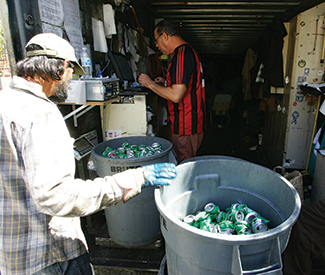
San Franciscans sat by the beach at Aquatic Park celebrating our nation’s independence, eyes fixed upwards. But all around them, a team of independent scavengers, mostly ignored, methodically combed the wharf, plucking cans and bottles from the ground and overflowing trash bins.

Often derided as thieves or parasites, these workers are cogs in a grand machine instituted by California’s Bottle Bill in 1986, forming a recycling redemption economy meant to spur environmentalism with market principles.

The concept is simple. Taxpayers pay an extra five cents when they buy a can or bottle, and may redeem that nickel by trading the used can or bottle in at a recycling center. Thus, more recycling is spurred.

But now a wave of recycling center evictions is causing San Francisco’s grassroots recycling economy to crumble, and newly released numbers reveal just how much stands to be lost by the trend.

San Franciscan recyclers may miss out on millions of dollars in redemption, local mom-and-pop stores could wind up on the hook for millions of dollars in state fees, and neighborhoods stand to be besieged by recyclers flocking to the few remaining recycling centers.

Recycling activists and local businesses are pushing for change, but NIMBY interests are pushing for more of the same.


SOLUTION IS THE PROBLEM

San Francisco Community Recyclers is on the parking lot of Safeway’s Church and Market location, and after months of legal entanglement, the recycling center’s eviction draws near. Still, SFCR is making a show of resistance.

The San Francisco Sheriff’s Department is set to evict the recycling center within a week or so, as the rebel recyclers have so far refused to vacate voluntarily.

Sup. Scott Wiener says he’ll be glad to see them gone.

“This recycling center caused enormous problems in our neighborhood,” he told the Guardian. This particular Safeway lies within the boundaries of his district, and Wiener says his constituents complain the recycling centers draw too many unruly patrons, who are often homeless.

“There is problem behavior around the center in terms of camping and harassing behavior, defecation, urination in a much more concentrated way,” he said.

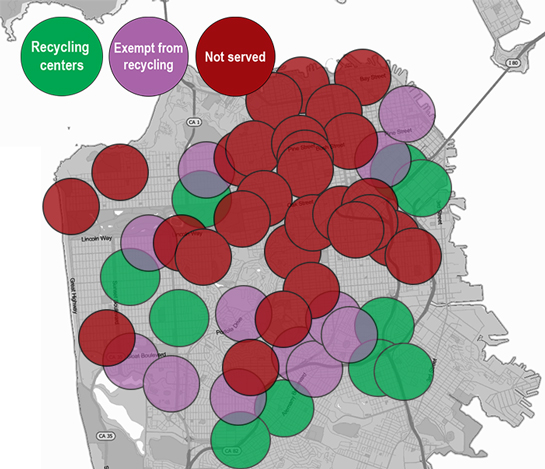
This animation shows the areas around San Francisco where recycling centers remain, which are often overburdened with customers as other centers close. The red zones indicate areas where supermarkets are mandated by state law to host recycling centers, but have chosen to pay fees instead.

But others say the not-in-my-backyard evictions only serve to create a ripple effect. The catalyst is a story we’ve reported on before: As well-heeled Golden Gate Park neighbors complained of homeless recycling patrons and waged a successful campaign to shutter the Haight Ashbury Recycling Center two years ago, the clientele adjusted by flocking to the Church and Market recycling center. New numbers illustrate this outcome.

Susan Collins is the president of the Container Recycling Institute, a nonprofit that conducts analysis on recycling data. On average nationwide, Collins said, one recycling center serves about 2,000 people.

But since 2012 the number of recycling centers in San Francisco has been reduced from 21 to 7, causing Church and Market’s service population to boom closer to 40,000, a difference that has more to do with the closures than the density of the area. Data from CalRecycle shows almost half of the city’s populace lacks a recycling center within close proximity, forcing patrons to overwhelm the few remaining centers.

“This makes it a chicken and egg process,” Collins told us. “For people to have the perception that the site is attracting so many people, they have to realize it’s because there are so few sites to begin with.”

Late last month, Assemblymember Tom Ammiano wrote to Safeway Chief Executive Officer Robert L. Edwards, urging the grocery chain to reverse its decision to evict San Francisco Community Recyclers from the Church and Market Safeway.

“Safeway has such a long history of supporting sustainability efforts,” Ammiano wrote, “and I truly believe that it can do so again.” Safeway, however, has other concerns.

“As curbside recycling has increased in San Francisco and around the state,” Safeway Director of Public Affairs Keith Turner wrote to Ammiano, “Safeway’s focus on recycling has evolved as well.”

Safeway is now also flouting local and state laws to throw recyclers off its back. CalRecycle, the state’s recycling agency, performed an inspection in April of the Diamond Heights Safeway. It found that the grocer failed to accept recyclables and offer state guaranteed redemption, despite signing an affidavit with CalRecycle pledging to do just that. CalRecycle cited that location and two other San Francisco Safeways for noncompliance with the bottle bill.

And that’s just the violations CalRecycle has documented so far. Ed Dunn, owner and operator of San Francisco Community Recyclers, has initiated his own investigation into Safeway statewide, filing complaints with CalRecycle alleging that as many as 75 Safeway stores aren’t following the mandates of their affidavits and offering redemption for recyclables.

On the other side of the fence, Safeway and other recycling-center critics (such as Chronicle columnist C.W. Nevius) are essentially saying, who cares? Don’t we all just use blue bins nowadays?

The short answer: Nope.


MAKING GREEN, GOING GREEN

“Why do we need recycling centers if we have curbside recycling?” Sup. Eric Mar asked the deputy director of recycling at CalRecycle, point blank.

Jose Ortiz responded in less than a beat. “While some communities think curbside operations ensure the state’s goals of collecting [recyclables], the reality is that 90 percent of recycling volume is collected through recycling centers, not curbside programs,” he said from the podium.

That number came as a shock to many at the Board of Supervisors Neighborhood Services and Safety Committee June 19, including Sups. Mar, David Campos, and Norman Yee. Only 8 percent of recycling statewide comes through blue bins, CalRecyle confirmed to the Guardian.

Nor is that limited to California: Data from the Container Recycling Institute shows that the 10 states with recycling redemption laws produce such a high rate of return that they account for 46 percent of the nation’s recycling. And since California Redemption Value recycling is pre-sorted, experts note, the bottles are often recycled whole (as opposed to broken) which can be used for higher-grade recycling purposes.

So for the city with a mandated goal of zero waste by 2020, the case for keeping recycling centers open is an environmental one. It’s also fiscal.

San Franciscans make $18 million a year selling back recyclables, Ortiz said, most of which went directly into the pockets of recyclers. Those scavengers at the Fourth of July festivities may have only collected five cents per can, but that’s enough to buoy the income of many poor San Franciscans.

At the recycling hearing, David Mangan approached the podium to speak. His red hat was clean and his grey sweatshirt was ironed, but his face was worn with worry-lines and creases.

“I can’t walk more than about eight blocks at a time, and I’m unemployable because of my disabilities,” he told the committee. Recycling centers are a lifeline, he added. “I need this job, I’m on a limited income. I need the help they offer. I need them to stay open, please.”

Critics say some poor and homeless depend on a black market of recycling truck drivers who trade drugs for cans and bottles, then turn to recycling centers to make a profit. But those at the hearing said the extinction of recycling centers actually helps the mobile, black market recycling fleets bloom, as motorists have an easier time shuttling recyclables across the city.

So recyclers are increasingly forced to rely on these so-called “mosquito fleets” for far-flung trips to cash in their bottles.


SMALL BUSINESS BUST

Meanwhile, recycling center evictions are becoming a source of anxiety within the small business community.

State law establishes a half-mile radius called a “convenience zone” around any supermarket that annually makes more than $2 million. The supermarket is mandated to provide recycling on-site, accept recyclables in-store, or opt to pay a $100 a day fee.

With the eviction of SFCR from Church and Market, Safeway may opt to pay the fee. But that gap would leave surrounding businesses inside that convenience zone with the same options: accept recyclables in-store or pay $36,000 a year.

Miriam Zouzounis of the Arab-American Grocer Association said those options are daunting for liquor stores and mom-and-pop grocers.

“We just don’t have the space for [recycling],” she said at the hearing. If SFCR were to close, the total of small businesses shouldering the burden of state recycling fees would jump from 100 to more than 360, said Regina Dick-Endrizzi, director of the city’s Office of Small Business.

All told, San Francisco small businesses would be made to send $12.96 million in annual fees to California coffers because a few supermarkets didn’t want to handle recyclables. Mar is now calling upon all involved to step up and solve this glaring problem.


SOLUTIONS ON THE WAY

This week the Board of Supervisors is tentatively set to vote on a moratorium of recycling center evictions, introduced by Mar on June 24. The pause would give Mar time to form a work group with those involved: Department of the Environment, Department of Public Works, CalRecycle, local supermarkets, grocers, the Coalition on Homelessness, and others to come together to form a compromise solution.

Department of the Environment proposed a mobile recycling center, which Wiener called an equitable solution that would help distribute recycling responsibility evenly across the city. While that agency did not provide a timeline on the creation of a mobile recycling center before our deadline, it’s been in the works since 2012, when then-District 5 Sup. Christina Olague said it was the answer to the Haight Ashbury Recycling Center’s closure.

It’s been a long wait for a solution. And in the meantime, many more stand to lose.

Live Shots: Burger Boogaloo 2014, Take #1

3

About 30 minutes into this year’s Burger Boogaloo, I noticed a guy walking around in a Tool shirt. Ten minutes later, I saw another dude walking around in a Meshuggah shirt. This wouldn’t be so remarkable at most concerts, but it’s worth keeping in mind that this was ostensibly an indie rock concert. Most fans of progressive metal wouldn’t dare enter that often rigid and snobbish universe, just as most indie fans would consider those heavy-but-impeccably-produced bands well outside the accepted parameters of “cool.”

But Burger Babes, Burger Boppers, Burger Bitches, Burger Boys, and Burger Heads are not most indie fans. This is a community that has room for 5-year-olds and 70-year-olds, for classic-rock bar bands and summery beach-pop groups, for queer-as-fuck punk rockers and dudes with handlebar mustaches and chain-link guitar straps. In the often overly cool-conscious world of indie rock, it was not only refreshing but relieving to see a community this accepting. Messrs.Tool and Meshuggah might have been wearing those shirts ironically, but at an event like Burger Boogaloo, it would have been less cool to do so than to wear them with pride and earnesty.

boo

Burger seemed to be willing to throw anything at the audience. And at a single-stage festival with ample seating and few extraneous distractions (a “music & arts festival” this was not), there wasn’t much reason to ignore any of the bands. Given how few of these artists were recognized names outside of very underground regional circles, it seemed like the primary purpose of such a diverse lineup was to introduce the audience to as much new music as possible.

The most striking thing about the Burger Boogaloo lineup was how much older the artists were than at most indie showcases. Of the four headliners, none had a frontperson under 30.  Shannon Shaw of Shannon & The Clams is 31; Thee Oh Sees’ John Dwyer is 39; OFF!’s Keith Morris is 58; Ronnie Spector is 70. Milk ‘n’ Cookies have been around since 1973, The Gizmos since 1976, Phantom Surfers since 1988, the Muffs since 1991, and Bananas since 1993. Danny James’ Pear and Reigning Sound both seemed like middle-aged ensembles stuck in the rock era, and they could have as easily opened for Santana as Thee Oh Sees — yet this was not to their detriment, as they were all incredible musicians.

But with the exception of Spector (and Morris to some extent — more on this later), these artists weren’t cross-generational juggernauts or revered influences but rather veteran bands who had honed their craft in obscurity for years.  Though the audience could roughly be split into hip kids and older music-scene stalwarts, it was interesting to see both sides of the audience devour such unhip music with equal relish.  This indicated to me that Burger fans aren’t looking for the coolest, most cutting-edge music.  They’re just looking for a solid supply of rock ‘n’ roll to dance and party to, and Burger Boogaloo provided that and more.

* * *
DAY 1

The first day opened with White Fang, who were either the best or the worst festival opener I’ve ever seen. Frontman Erik Gage walked out in an American flag T-shirt, kissing his guns like the most cartoonish male lover imaginable, before tearing into a short set of songs chiefly about partying and marijuana.  Though they were sloppy and lacked any semblance of self-seriousness, they all but blew the two bands that followed offstage. Though Terry Malts and the Trashies were both competent bands with fine instrumentalists, their singers lacked any of White Fang’s charisma.

Wand upped the energy substantially; though they were a good band, I could not get past their uncanny sonic resemblance to Ty Segall, particularly his Fuzz project. But it was Thunderroads that pumped the energy back into the festival. Hailing from Japan, the trio rolled through a set of unhinged, ’50s-style rockabilly songs sung through thick accents that rendered most words incomprehensible except for rock’s great buzzwords — “rock ‘n’ roll,” “tonight,” “everybody.” Needless to say, they didn’t need much more to get their point across.

thunderroads

Next came the aforementioned bar band Reigning Sound, the extremely good surf band Phantom Surfers, and Sacramento punk band Bananas, whose caterwauling vocalist culled the crowd enough to secure me a prime audience position for Nobunny. Though his spirits were significantly lowered by the audience’s refusal to catch him were he to jump from the amplifier stack, the man in the bunny mask still put on one of the best shows of the night. He more than made up for his admittedly lacking vocal skills through a menacingly cartoonish stage presence, ample crotch-bulge display, and above all else, a set of great rock songs.

nobunny

Next came Milk ‘n’ Cookies, a ’70s power-pop band who could not distinguish themselves from the festival’s more pedestrian pop acts despite their clout. Finally, the big two headliners: OFF! and Thee Oh Sees.

OFF!, the current project of Circle Jerks frontman and founding Black Flag member Keith Morris, was by far the most interesting act at the festival. Morris has long given up adhering (or pretending to adhere) to punk’s staunch anti-commercial aesthetic, evident in his recent promotions with major brands like AOL and Vans (and Burger — OFF! isn’t actually on the label).  But he plays punk because it’s the music he loves — and he performs it with as much fury as in any of his previous projects.

And what fury. Despite his short stature, Morris seemed to tower over the sea of moshing kids at which he directed his harangues. It was an invigorating performance in part because of how tight the band was and in part because of how in love with the music Morris seemed — as pissed-off as his songs were, he looked genuinely happy to be up there.

off

Even better were Thee Oh Sees, whose recent departure for L.A. sent waves of dismay through the Bay Area music community but who are showing no signs of abandoning their hometown fans. Bar none, Thee Oh Sees were the best live band I’ve seen all year. Despite being a relatively new incarnation of the band (singer/lead guitarist John Dwyer being the only constant), they rocked as hard as ever, with Dwyer’s almost Hendrix-like guitarwork carrying the bulk of the sound this time around. But the true star of the show was Dwyer’s voice, a tiny coo that can nonetheless hold an entire crowd captive. He can scream as well as anyone, but why would he need to when he can do so much with so little?

thee

Thee Oh Sees’ music seemed to transcend genre. It was hard to say exactly where the roots of such music lay — there were elements of punk, metal, garage rock, and grunge, but none seemed like an apt signifier. Rather, the hallmarks of each genre combined into a monolithic slab of rock ‘n’ roll that encouraged the audience to move and engage with it rather than analyze it. This focus on rock as a form of music rather than an aesthetic or a concept unified all the bands of the day. At Burger Boogaloo, it didn’t matter how old or how uncool a band was — at the end of the day, it was all about getting down. And isn’t that what a rock show is supposed to be about?
 
DAY 2
 
After the head rush of Day One, it was hard not to be a bit disappointed with Day Two. The lineup pulled a lot of the same tricks to diminished effect. A lot of the bands seemed to be the equivalents of bands from the first day. Pookie & The Poodlez played White Fang’s role as the silly, punky opening act; Meatbodies played Wand’s role as the heavy, grooving jam band; The Gizmos filled Milk ‘n’ Cookies’ role as obscure power-pop legends unearthed from the annals of history. But the day also brought with it some pleasant surprises — not least of which was Ronnie Spector, whose dynamite set ran completely contrary to my expectations.

Pookie, a member of Nobunny, showed up onstage still brushing his teeth. (Apparently he’d overslept but luckily lived a few blocks away–though this is a fun story, the aesthetic appeal of a cute, skinny man walking out onstage with a toothbrush in his mouth to open a festival is just a little bit too good.)  His set was brief but fun, though the similarities to White Fang’s set were a bit obvious — especially after he introduced one of the songs as being about “Slurpees and kissing and marijuana cigarettes.”

The next run of bands was thoroughly disappointing. Summer Twins were, if possible, even more generic than their name suggests. Though my friend theorized they would sound like “Best Coast but less mainstream,” they sounded more like a Best Coast ripoff hastily assembled for a commercial by someone whose grasp on indie aesthetics was limited to 500 Days Of Summer. I was surprised a label like Burger (or any label) would sign such a band. The beach-rock fad has been over for over three years, and it’s easy to tell when a band is still clinging to it — usually they have words like “Summer” or “Twins” in their name.

Dirty Ghosts were interesting only because they were difficult to pin down in a genre — their music wasn’t quite funk, rock, punk, or psychedelia, but it was largely forgettable and didn’t benefit from its implacability. Danny James was similar to the previous day’s Reigning Sound but a lot tighter. La Sera was essentially a better version of Summer Twins. Meatbodies sounded like a less heavy Wand, while the Gizmos played with little effort or enthusiasm and could only have been there because of their clout as an obscure but veteran protopunk band.

Of the mid-day acts, folk singer Juan Wauters was the most enjoyable, but it was hard to tell if it was because of the quality of his music or because he was by far the most unique attraction of the day — he initially performed as a solo artist before being augmented by a bassist, a guitarist, and a percussionist. San Francisco band Personal & the Pizzas were likewise entertaining, but their schtick–pop songs about pizza and brass knuckles played by three tough-looking dudes–got old very quickly.
 
The Muffs ramped up the energy substantially. Fronted by Kim Shattuck (best-known these days for her brief stint in the Pixies), the group started out playing tough yet grooving pop songs driven by Shattuck’s ferocious voice. (She screamed an average of about 10 times per song.)  Yet their set never recovered from an ill-advised mid-performance slow song, which disrupted what could have evolved into full-on moshing but never progressed beyond a lot of enthusiastic bouncing and head-nodding.

shannon

Shannon & The Clams were a fine act, but they were disappointingly low-energy for their late placement in the lineup.  Their show was better because the crowd, desperate to mosh, took it upon themselves to have a good time. The result was a bizarre sort of mix of moshing and slow-dancing that mainly entailed a bunch of people shoving into each other at very deliberate speeds.  Being in the mosh enhanced the performance substantially; the Clams’ girl-group balladry was best suited for slow dancing, and brushing up against a bunch of random strangers with romantic music in the air is pretty much the second-best thing to that. Nonetheless, the fast-paced “The Cult Song” was the undoubted highlight.

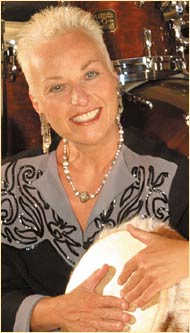
I was expecting Ronnie Spector‘s set to be mostly just a glorified celebrity appearance from the woman whose run of Sixties records with the Ronettes inspired a substantial chunk of the festival’s acts.  Instead, I was surprised to be treated to the night’s most electrifying performance.  Over a top-caliber band of stern, professional-looking musicians, Spector let loose with her vocals in a way she was never able to do as part of the homogeneous Wall of Sound her ex-husband/producer Phil Spector pioneered.  Some of her vocal turns were absolutely haunting.  Though she may not sound like the twenty-year-old starlet she once was, she sounds now like what she is–an incredibly gifted vocalist with a natural presence as an entertainer and a long and tumultuous life behind her.

ronnie

But the true star of Spector’s set wasn’t her or her beehive hairdo but the songs, and one song in particular.  The words “Be My Baby” had been placed over the stage in gold balloons hours before, and the inevitability that she would perform it created a natural climax to the festival.  Either directly or indirectly, that song had inspired nearly every act there.  Its maelstrom production practically launched psychedelic rock, while its unmistakable drum opening has become an obvious way for backwards-looking pop acts from The Jesus And Mary Chain to Girls to pay tribute to their influences.

True, that drum opening was the most scream-inducing moment of the entire festival.  But I felt she played it too soon.  Her set was much shorter than it should have been, and deploying the ultimate weapon after only five songs ruined a bit of the song’s climactic nature.  Furthermore, her shout of “my favorite part!” over the reprise of the drum opening defused its impact. But I forgive her — I don’t know if she realizes how revered that song is in the indie community. 

ronnie

Furthermore, treating that song like a sacred artifact would be incongruous with what made Spector’s set so effective — that she wasn’t treated like a sacred artifact. As massive as her influence pop music is, I believe she was there because of her skills as a performer, not for the baggage her name carries. It would be contradictory to Burger’s ethos to bring such a revered artist on if she wasn’t a great performer. Burger Boogaloo isn’t about the mythology of old-school rock ‘n’ roll, but about the sound — and just how great it is to hear that sound live.

crowd

Supervisors reject Pinterest proposal, protect PDR businesses from eviction

5

A spirited hearing before the Board of Supervisors Land Use and Economic Development Committee yesterday [Mon/7] on the San Francisco Design Center’s application for landmark status kept social networking site Pinterest out of the building, for now.

A number of tenants facing eviction from the building appeared before the committee, with a large contingent voicing its opposition and concern over the application and a separate group favoring the proposal for its alleged revitalization of the Showplace Square district.

The proposal — which was tabled by the committee, effectively killing it unless district Sup. Malia Cohen has a change of heart — would have declared the Design Center a landmark, which would have allowed the new owner to get around its Production, Distribution, and Repair zoning and allow in more lucrative office tenants, ostensibly to fund renovations with their higher rents. But with the committee rejected the application, with Cohen in particular expressing concerns about the loss of PDR-zoned properties in her district and around the city.

Prior to the lengthy public comment period, members of Bay West Development, the management firm representing building owner RREEF Property Trust, spoke to the committee about the support that would be put in place for the evicted tenants, conceding, “We recognize the communication with the tenants has not been perfect.”

That support would include relocation funding, lease extensions, and hiring commercial realty brokers for the evictees, according to Bay West. When asked by Chair Scott Wiener how realistic it would be for evicted tenants to stay in the district, Bay West didn’t provide specifics, assuring the committee, “There is good quality space in this district and there are tenants who will find homes in adjacent properties.”

That response didn’t satisfy many worried tenants, including Jim Gallagher, who called the Design Center a “shining example of what PDR services should be.”

Though one speaker mentioned Pinterest’s unfairly negative portrayal in the issue, the overwhelming message from the tenants and Cohen was that the “virtual pinboard” company wasn’t necessarily at fault. Rather, the displacement of longtime residents and the loss of PDR space was the main concern for many.

Former Mayor Art Agnos also made an appearance at the hearing, calling the ordinance a “commercial version of the Ellis Act,” the state law that allows residential building owners to evict tenants. Agnos said the proposed ordinance was “replacing people working in blue and white collar jobs” and urged the committee to “close the loophole, kill it, and come back to the issue.”

Some tenants voiced support for the measure, reasoning the addition of Pinterest—and the elimination of what one supporter called the “exclusivity of high-end design”—would revitalize the district and be the “best of both worlds,” with new and old economies coming together.

But Nancy Morgan, a tenant who was previously evicted elsewhere, opined that displacing the tenants would mean that the same customers wouldn’t continue to come back. She also noted that some would be displaced under the nearby freeway, which could be dangerous in addition to driving away customers, although a Dogpatch resident scoffed at this claim.

Cohen gave her own thoughts, saying she ultimately agreed that the Design Center deserves landmark status because it was “impeccably maintained through the downturn,” but she felt uncomfortable going forward with the plans to displace the longtime tenants. She believed the decision wasn’t necessarily about the designation of the building, and that displacing long-term residents wasn’t in the spirit of the code or the landmark legislation.

“This decision today sets an important precedent,” Cohen said, calling it “an added layer of certainty in a world of uncertainty.”

Hearing called for on sudden closure of elder care facility

It’s been several weeks since we reported on the pending closure of San Francisco’s University Mound Ladies Home, a nonprofit elder care facility that has been in operation for 130 years, serving seniors of modest means.

In May, residents – mostly in their 80s or 90s – received eviction notices informing them that they would need to leave by July 10, an announcement that blindsided the elders and their families and caused great concern throughout the broader community. The timeline has since been extended to July 31.

The facility’s administrators, who hired a crisis consultant shortly before announcing the closure, have indicated in meetings with family members and residents that the move was triggered by financial woes.

Sup. David Campos has been working behind the scenes to intervene on residents’ behalf since the announcement, but he’s now called for a public hearing that should finally bring some answers to light. Scheduled for Thu/10, the hearing will take place at the Board of Supervisors’ Neighborhood Services and Safety Committee meeting at 10am.

On July 1, University Mound announced it had reached an agreement with Alta Vista School to sell its facility.

Campos hopes to address the University Mound board regarding plans for residents’ continued care, and on how it envisions helping residents transition out of the facility.

“Closure of this facility places the lives of these residents in jeopardy,” Campos said. “I am gravely concerned with the access to care for these individuals. The closure of the University Mound Ladies Home is endemic of the economic crisis and widening affordability gap that is eroding the values of San Francisco.”  

Anna Stratton, whose mother resides at University Mound and will turn 87 on July 10, is one of many concerned family members affected by the sudden closure.

“I’m concerned that my mother may be one of the residents that does not survive the change from one residence to another,” Stratton said.

She added that when her mother began living in the assisted-care home, they were never given a reason to doubt that University Mound would stay in operation. Stratton’s mother, who has lived in San Francisco since 1957 and volunteered there for 35 years, wanted to live the rest of her life in the city – but won’t be able to do so due to the home’s sudden closure.

“We were not informed of anything,” Stratton said. “It’s very upsetting, not only for my mother, but for all the elders. We have been kept in the dark.”

The Fourth of July: Remembering the good old days in Rock Rapids, Iowa

3

By Bruce B. Brugmann

(Note: In July of 1972, when the Bay Guardian was short a Fourth of July story, I sat down and cranked out this one for the front page on my trusty Royal Typewriter. I now reprint it each year by popular demand on the Bruce blog, with some San Francisco updates and postscripts.)

Back where I come from, a small town beneath a tall standpipe in northwestern Iowa, the Fourth of July was the best day of a long, hot summer.

The Fourth came after YMCA camp and Scout camp and church camp, but before the older boys had to worry about getting into shape for football. It was welcome relief from the scalding, 100-degree heat in a town without a swimming pool and whose swimming holes at Scout Island were usually dried up by early July. But best of all, it had the kind of excitement that began building weeks in advance.

The calm of the summer dawn and the cooing of the mourning doves on the telephone wires would be broken early on July Fourth: The Creglow boys would be up by 7 a.m. and out on the lawn shooting off their arsenal of firecrackers. They were older and had somehow sent their agents by car across the state line and into South Dakota where, not far above the highway curves of Larchwood, you could legally buy fireworks at roadside stands.

Ted Fisch, Jim Ramsey, Wiener Winters, the Cook boys, Hermie Casjens, Jerry Prahl, Elmer Menage, and the rest of the neighborhood gang would race out of  their houses to catch the action. Some had cajoled firecrackers from their parents or bartered from the older boys in the neighborhood: some torpedoes (the kind you smashed against the sidewalk); lots of 2 and 3-inchers, occasionally the granddaddy of them all, the cherry bomb (the really explosive firecracker, stubby, cherry red, with a wick sticking up menacingly from its middle; the kind of firecracker you’d gladly trade away your best set of Submariner comics for.)

Ah, the cherry bomb. It was a microcosm of excitement and mischief and good fun. Bob Creglow, the most resourceful of the Creglow boys, would take a cherry bomb, set it beneath a tin can on a porch, light the fuse, then head for the lilac bushes behind the barn.

“The trick,” he would say, imparting wisdom of the highest order, “is to place the can on a wood porch with a wood roof. Then it will hit the top of the porch, bang, then the bottom of the porch, bang. That’s how you get the biggest clatter.”

So I trudged off to the Linkenheil house, the nearest front porch suitable for cherry bombing, to try my hand at small-town demolition. Bang went the firecracker. Bang went the can on the roof. Bang went the can on the floor. Bang went the screen door as Karl Linkenheil roared out in a sweat, and I lit out for the lilacs behind the barn with my dog, Oscar.

It was glorious stuff – not to be outdone for years, I found out later, until the Halloween eve in high school when Dave Dietz, Ted Fisch, Ken Roach, Bob Babl, Jerry Prahl, Jack McBride, and the  rest of the Hermie Casjens gang and I made the big time and twice pushed a boxcar loaded with lumber across Main Street and blocked it for hours. But that’s another story for my annual Halloween blog.

Shooting off fireworks was, of course, illegal in Rock Rapids, but Chief of Police Del Woodburn and later Elmer “Shene” Sheneberger used to lay low on the Fourth. I don’t recall ever seeing them about in our neighborhood and I don’t think they ever arrested anybody, although each year the Lyon County  Reporter would carry vague warnings about everybody cooperating to have “a safe and sane Fourth of July.”

Perhaps it was just too dangerous for them to start making firecracker arrests on the Fourth – on the same principle, I guess, that it was dangerous to do too much about the swashbuckling on Halloween or start running down dogs without leashes (Mayor Earl Fisher used to run on the platform that, as long as he was in office, no dog in town would have to be leashed. The neighborhood consensus was that Fisher’s dog, a big, boisterous boxer, was one of the few that ought to be leashed).

We handled the cherry bombs and other fireworks in our possession with extreme care and cultivation; I can’t remember a single mishap. Yet, even then, the handwriting was on the wall. There was talk of cutting off the fireworks supply in South Dakota because it was dangerous for young boys. Pretty soon, they did cut off the cherry bomb traffic and about all that was left, when I came back from college and the Roger boys had replaced the Creglow boys next door, was little stuff appropriately called ladyfingers.

Fireworks are dangerous, our parents would say, and each year they would dust off the old chestnut about the drugstore in Spencer that had a big stock of fireworks and they caught fire one night and much of the downtown went up in a spectacular shower of roman candles and sparkling fountains.

The story was hard to pin down, and seemed to get more gruesome every year – but, we were told, this was why Iowa banned fireworks years before, why they were so dangerous and why little boys shouldn’t be setting them off. The story, of course, never made quite the intended impression; we just wished we’d been on the scene.  My grandfather was the town druggist (Brugmann’s Drugstore, “Where drugs and gold are fairly sold, since 1902″) and he said he knew the Spencer druggist personally. Fireworks put him out of business and into the poorhouse, he’d say, and walk away shaking his head.

In any event, firecrackers weren’t much of an issue past noon – the Fourth celebration at the fairgrounds was getting underway and there was too much else to do. Appropriately, the celebration was sponsored by the Rex Strait post of the American Legion (Strait, so the story went, was the first boy from Rock Rapids to die on foreign soil during World War I); the legionnaires were a bunch of good guys from the cleaners and the feed store and the bank who sponsored the American Legion baseball team each summer.

There was always a big carnival, with a ferris wheel somewhere in the center for the kids, a bingo stand for the elders, a booth where the ladies from the Methodist Church sold homemade baked goods, sometimes a hootchy dancer or two, and a couple of dank watering holes beneath the grandstand where the VFW and the Legion sold Grainbelt and Hamms beer  at 30¢ a bottle to anybody who looked of age.

Later on, when the farmboys came in from George and Alvord, there was lots of pushing and shoving, and a fist fight or two.

In front of the grandstand, out in the dust and the sun, would come a succession of shows that made the summer rounds of the little towns. One year it would be Joey Chitwood and his daredevil drivers. (The announcer always fascinated me: “Here he comes, folks, rounding the far turn…he is doing a great job out there tonight…let’s give him a big, big hand as he pulls up in front on the grandstand…”)

Another year it would be harness racing and Mr. Hardy, our local trainer from Doon, would be in his moment of glory. Another year it was tag team wrestling and a couple of barrel-chested goons from Omaha, playing the mean heavies and rabbit-punching their opponents from the back, would provoke roars of disgust from the grandstand. ( The biggest barrel-chest would lean back on the ropes, looking menacingly at the crowd and yell, “ Aw, you dumb farmers. What the hell do you know anyway? I can beat the hell out of any of you.”   And the crowd  would roar back in glee.)

One year, Cedric Adams, the Herb Caen of Minneapolis Star-Tribune, would tour the provinces as the emcee of local  variety shows. “It’s great to be in Rock Rapids,” he would say expansively, “because it’s always been known as the ‘Gateway to Magnolia.” (Magnolia, he didn’t need to say, was a little town just over the state line in Minnesota which was known throughout the territory for its liquor-by-the-drink roadhouses. It was also Cedric Adams’ hometown: his “Sackamenna,” as Caen would say.  Adams kissed each girl (soundly) who came on the platform to perform and, at the end, hushed the crowd for his radio broadcast to the big city “direct from the stage of the Lyon County Fairgrounds in Rock Rapids, Iowa.”

For a couple of years, when Rock Rapids had a “town team,” and a couple of imported left-handed pitchers named Peewee Wenger and Karl Kletschke, we would have some rousing baseball games with the best semi-pro team around, Larchwood and its gang of Snyder brothers: Barney the eldest at shortstop, Jimmy the youngest at third base, John in center field, Paul in left field, another Snyder behind the plate and a couple on the bench. They were as tough as they came in Iowa baseball.

I can remember it as if it were yesterday at Candlestick, the 1948 game with the Snyders of Larchwood. Peewee Wenger, a gawky, 17-year-old kid right off a high school team, was pitching for Rock Rapids and holding down the Snyder artillery in splendid fashion. Inning after inning he went on, nursing a small lead, mastering one tough Larchwood batter after another, with a blistering fastball and a curve that sliced wickedly into the bat handles of the right-handed Larchwood line-up.

Then the cagey Barney Snyder laid a slow bunt down the third base line. Wenger stumbled, lurched, almost fell getting to the ball, then toppled off balance again, stood helplessly holding the ball. He couldn’t make the throw to first. Barney was safe, cocky and firing insults like machine gun bullets at Peewee from first base.

Peewee, visibly shaken, went back to the mound. He pitched, the next Larchwood batter bunted, this time down the first base line. Peewee lurched for the ball, but couldn’t come up with it. A couple more bunts, a shot through the pitcher’s mound, more bunts and Peewee was out. He could pitch, but, alas, he was too clumsy to field. In came Bill Jammer, a farmer now in his late 30’s, but in his day the pitcher who beat the University of Iowa while playing for a small Iowa college called Simpson.

Now he was pitching on guts and beer, a combination good enough for many teams and on good days even good enough  to take on the Snyders. Jammer did well for a couple of innings, then he let two men on base, then came a close call at the plate. Jammer got mad. Both teams were off the bench and onto the field and, as Fred Roach wrote in the Reporter, “fisticuffs erupted at home plate.” When the dust cleared, Jammer had a broken jaw, and for the next two weeks had to drink his soup through a straw at the Joy Lunch cafe, John Snyder, it was said later, came all the way in from center field to throw the punch, but nobody knew for sure and he stayed in the game. I can’t remember the score or who won the game, but I remember it as the best Fourth ever.

At dusk, the people moved out on their porches or put up folding chairs on their lawns. Those who didn’t have a good view drove out to the New Addition or parked out near Mark Curtis’ place or along the river roads that snaked out to the five-mile bridge and Virgil Hasche’s farm.

A hush came over the town. Fireflies started flickering in the river bottom and, along about 8:30, the first puff of smoke rose above the fairgrounds and an aerial bomb whistled into the heavens. BOOM! And the town shook as if hit by a clap of thunder.

Then the three-tiered sky bombs – pink, yellow, white, puff, puff, puff. The Niagara Falls and a gush of white sparks.

Then, in sudden fury, a dazzling display of sizzling comets and aerial bombs and star clusters that arched high, hung for a full breath and descended in a cascade of sparks that floated harmlessly over the meadows and cornfields. At the end, the flag – red, white and blue – would burst forth on the ground as the All-American finale in the darkest of the dark summer nights. On cue, the cheers rolled out from the grandstand and the cars honked from the high ground and the people trundled up their lawn chairs and everybody headed for home. b3

.

Frameline leftovers: Audience Award-winning Barney Frank doc ‘Compared to What’

0

Pride’s Pink Saturday offered a dynamic final morning of the massive 38th annual Frameline, the world’s largest film festival devoted to LGBT films. Compared to What: The Improbable Journey of Barney Frank, a doc that gives an intimate look into the private and political life of the recently retired iconic Congressman, screened to a packed and cheering crowd at the Castro Theater.

The film (trailer here) eschews direct chronology for a thematic look at Frank’s development, from his days as a Harvard political wunderkind to his immensely powerful tenure as a US congressman, during which time he headed the House Financial Services Committee and crafted the 2010 Dodd-Frank Wall Street Reform and Consumer Protection Act. The film, while a love letter to the idiosyncratic and clever Frank, does not shy away from his his tortured time as a closeted public figure and his late-80s prostitution scandal.

Co-directors Sheila Canavan and Michael Chandler received thunderous applause before Frank and husband Jim Ready, who also features prominently in the film, took the stage and fielded questions from the audience. Ready told a hilarious story about how 60 Minutes quasi-outed him to his ex-girlfriend while Frank delivered a rousing declaration of support for equal workplace rights. 

Compared to What picked up Frameline’s Audience Award for Best Documentary. DVDs can be pre-ordered here.

Push the Feeling party organizers launch Push the Feeling, the record label

0

If you’ve ever walked out of a dance party wishing you could take the party home with you, Push The Feeling has a solution to your problem. For the last two years, Kevin Meenan and Drew Marcogliese have hosted dance parties at the Lower Haight’s Underground SF nightclub under that name; they’ve hosted all manner of DJs, from local heroes like Giraffage to blogosphere faves like YACHT and Les Sins (aka Toro Y Moi).

But recently, they’ve expanded their endeavors into the field of recorded sound, launched a label under the Push the Feeling name. This week they released a 12-inch containing “Skulls,” a song by Marcogliese’s band Silver Hands, plus four remixes. Of course, the parties will go on: Most immediately, they’re hosting a release party for the 12-inch on Saturday, July 5 at Underground, featuring performances by Silver Hands, Marcogliese (as YR SKULL), and Meenan (as Epicsauce).

Of the remixers, three (Chautauqua, Woolfy, and YR SKULL) have performed at Push The Feeling. The fourth remix comes from Mike Simonetti, boss of the influential Italians Do It Better label; he hasn’t played yet, but according to Meenan, he’s “on our wishlist.”

Yet Push the Feeling doesn’t plan to release only party regulars. The two are fans of just about anything on the electronic spectrum, and as long as it has an electronic element, they’re game.

Meenan and Marcogliese said they had talked about starting a label for a long time, even before the parties. But the demands of the parties made it difficult to get the project off the ground.

“Every month, it was like ‘Okay, we’re done with this party, let’s focus on the label stuff,’ and then next thing we know we’re booking the next party,” said Meenan.  “Realistically, we’re about six months behind where we wanted to be about a year ago.”

But with the label off the ground, and the duo has no intention of slowing down. (The parties will continue at the same rate and will, the organizers promise, be just as wild as ever. If anything, the launch of the label is just another chance to party.)

Hosting a label carries a certain prestige, and it’s already brought them blogosphere recognition. The 12-inch has been featured on prominent blogs such as XLR8R, Lagasta, and Gorilla vs. Bear. But the parties will be just as cheap and accessible as ever: Admission to Push the Feeling event is rarely more than $6, and the duo plans to keep it that way.

“We go to clubs, but the reality is we’re more neighborhood bar-type guys,” Marcogliese said of the cheap, fun, accessible dance music scene he and Meenan have curated.  “We wanted to make it very laid-back, not like an in-your-face club with expensive drinks and cover. We focus on keeping it cheap, keeping it casual — keeping it a night we would both want to go to.”

PUSH THE FEELING: Silver Hands 12″ Release Party

With YR SKULL and Epicsauce DJs

Sat/5, 9pm, $6

Underground SF

424 Haight, SF

www.undergroundsf.com

Jury rejects civil claim of Oscar Grant III’s imprisoned father

20

When a jury in San Francisco this week rejected the civil lawsuit claims of Oscar Grant Jr., the imprisoned father of Oscar Grant III — who was shot to death by then-BART Police Officer Johannes Mehserle on the platform of Fruitvale Station on New Year’s Day 2009 — were jurors exhibiting a bias against convicted criminals?

That’s the contention of Grant’s attorney, Waukeen McCoy, who tells the Guardian, “I think they were trying to find something to not give him anything because he’s in prison,” adding that, “The jury clearly did not understand the evidence.”

The elder Grant is in prison in Solano County for a 1985 murder in Oakland, and McCoy said he could be granted parole as soon as next year. McCoy said any financial gain in the case would have gone to restitution for the family of Grant’s victim, to help his granddaughter, and to help ease his own transition into civilian life if paroled.

Grant was divorced from his son’s mother, Wanda Johnson, but McCoy said both the mother and son visited Grant regularly in prison. The civil suit and its “loss of familial relations” standard required Grant Jr. to show he was affected by Mehserle killing his son and that the shooting wasn’t justified, as the courts have already concluded.

“The mom clearly wanted her son to bond with the father, and one reason was to keep him out of trouble,” McCoy said, who said prison logs showed Johnson visiting Grant 82 times.

But McCoy said Mehserle’s attorney, Michael Rains, used the log — which didn’t contain the younger Grant’s name — to sow doubts about the father-and-son relationship and deny Grant joined the visits, even though McCoy say Grant III was along on every visit and that was the purpose of Johnson visiting her ex-husband.  

“There was a relationship there,” McCoy said.

That prison log was one of a few possible grounds for appeal, McCoy told us, although they haven’t yet made the decision whether to appeal. Another was possible jury bias after jurors were told of previous civil settlements totaling about $3 million that Johnson and the slain man’s girlfriend, daughter, and friends received from BART and Mehserle, who was convicted of involutary manslaughter in the killing and served about a year in prison.

“There were a lot of things going on here. I think the jury knew about the previous settlements,” McCoy said, “and they didn’t want to award any more.”

Barring a successful appeal, this verdict would seem to end the emotionally wrenching saga involving Mehserle killing Grant, which was dramatized in the film Fruitvale Station and which led to several raucous street demonstrations against police abuse and racism in Oakland, some of which turned into riots (and some of which resulted in their own civil settlements), and state legislation finally creating limited civilian oversight over BART Police

Inspiring doc ‘Keeper of the Beat: A Woman’s Journey into the Heart of Drumming’ airs on KQED

0

“I would get the comment ‘Gosh, you play really good for a girl,’” Barbara Borden admits in the introduction of Keeper of the Beat, which chronicles her lifelong passion for drumming. The documentary, by San Francisco’s David L. Brown, airs Sun/6 on KQED

The Always brand’s empowering #LikeAGirl ad campaign made the rounds on the internet this week, but Borden’s musical sojourn, discouraged for a female at the time, is decidedly more inspiring (especially since it’s delivered by a badass drummer and not a corporation). 

https://www.youtube.com/watch?v=2aABBZ1fl7M&feature=kp

Borden is aptly described in the film as a “drumbeat diplomat” — she bypasses the language barrier (cultural, too, as the film highlights the universality of music during the Yugoslavia Civil War and in a remote part of Siberia) between her and people she meets by quickly finding a way to communicate in the language of drums and punchy beats.

Clips from her past performances are cleanly weaved between interviews, showcasing both Borden and director Brown’s strengths: her story and his storytelling. Lavish camerawork and breathtaking shots are noticeably absent from the film; they’d really only detract from the unadulterated music and dialogue. It’s a shame the documentary only clocks in at a little under an hour long, as the poignant montage of vignettes whizzes right by you. 

Reinstate the 42: SF protest in solidarity with Brazilian transit workers

7

Hey there, lovers and haters of the World Cup, if you missed out on the protest of Google and FIFA at Pride, there’s still time on the clock to score that goal: there will be another protest tomorrow [Thu/3] to support Brazilian transit workers and their quest for higher wages.

In solidarity with Brazilian protestors, a group of queer anarchists blocked the joint Google/FIFA float in the SF Pride Parade on Sunday. The group saw the float protest as an opportunity to draw together two issues linking San Francisco and Brazil: gentrification in the Bay Area and the displacement of Brazilians in order to make this year’s World Cup possible.

As the protestors said, “We couldn’t pass up the opportunity to connect issues of gentrification and evictions in the Bay Area with the violent displacement of Brazilians who live in the Favelas. The Google/FIFA float was a perfect target for direct action to raise awareness about these issues!”

According to Al Jazeera and Solidar Suisse, more than 150,000 people were evicted from their homes to create the World Cup arenas, including parking lots. Following the Brazilian government’s pacification initiative, Brazilian police occupied multiple favelas, or slums, housing around 1.5 million people total, near the airport and roads leading to the World Cup stadiums in order to make the communities more presentable. Besides minimizing gang activity temporarily, there are no programs implemented to help favela residents in the long run.

Brazilian transit workers also felt cheated by World Cup preparations. Despite Brazil’s underfunded transit system and low wages for workers, Brazil’s government poured $11.5 billion into World Cup preparations. Protestors with the Subway Workers Union of Sao Paulo were beaten and attacked with tear gas by police during a five-day strike for higher wages.

Brazilian Justice Ministry declared the strike illegal and implemented a $250,000 per day fee, and allowed the Brazilian government to fire employees that continue to strike. The workers suspended the strike before the Cup, but the 42 transit workers fired during the strike have not been reinstated.

The SF protest joins the Subway Workers Union in asking for the 42 fired workers to be reinstated. You can root for that goal Thu/3 outside the Brazilian Consulate, 300 Montgomery, SF. 4-5pm.

Grimm but not grim: SF Playhouse’s winning fairy tale ‘Into the Woods’

0

Given all traditional parameters of critical experience, SF Playhouse’s production of Into the Woods (now playing through Sept 6) should be at least somewhat irksome. The vocal talent can be inconsistent, the accents are ambiguous, the set looks busy, and the musical is high-strung enough that it can be insufferable without expert work on all fronts. Shockingly, despite the surface-level issues, the Playhouse production is an unqualified technical success and a complete joy to take in.

The watchability may result from the impeccable staging and verbal interplay between the actors, or the reliable and often gorgeous small orchestra that accompanies the singing. Or perhaps the musical’s hilarity comes from the Robert Goulet-esque swagger of the dual princes and the coy and satirically sexualized awakening of Little Red Ridinghood. Or maybe the show is so good because, in addition to his expert instrumental direction, music director Dave Dobrusky helps his cast find their vocal strengths — the entire ensemble navigates the passaggio-shredding score with astonishing tact. All these positives combine to make Into the Woods an atmospheric journey more than worth taking.

Stephen Sondheim and James Lapine’s 1986 work has aged majestically. The book avoids any hint of contemporary cultural referentiality, giving the work a timelessness and broad humor that seems just as applicable in the millennial age as it was 30 years ago. Gender expectation, the limitations of heroics, and the predictability of children’s stories are all over the 2014 liberal zeitgeist and all play big thematic roles in the production.

Sondheim and Lapine manage to boil down these issues to atomic levels — Ridinghood’s titillation at the lascivious Wolf’s advances, Jack’s clueless but powerful desire to traverse the world of the giants, and the witch’s overprotectiveness over Rapunzel all explore basic yearnings and are remarkably Freudian in scope. It’s no wonder that Disney is releasing a blockbuster version of the musical this December.

The plot is a flimsy excuse to combine the stories of Cinderella (Monique Hafen), Rapunzel (Noelani Neal), Jack and the Beanstock (Tim Homsley), and Little Red Ridinghood (Corinne Proctor) into a single entity. A Baker (Tim Pinto) and his Wife (El Beh) are victims of an infertility curse at the hands of a vengeful witch (Safiya Fredericks) and the very convenient antidote is to steal items from each of the other Brothers Grimm icons.

Despite the storyline’s more contrived elements, Sondheim and Lapine, in typically sophisticated fashion, fill the show with fast-talking, convoluted numbers and twists that require actors capable of sudden and realistic emotional shits as well as deft pronunciation. Not one of the lines in the show was garbled or dropped, nor did any of the sudden shifts cause interruptions in the emotional momentum of the piece. For a Sondheim piece, this is an impressive achievement — I hate to think how many run-throughs some of the more word-heavy interchanges took. Whether to credit this more to Dobrusky or director (and Playhouse co-founder) Susi Damilano is unclear, but they both deserve extensive kudos for the verbal and emotional clarity of the play.

Chiefly responsible for this are Hafen’s Cinderella and the Pinto and Beh’s Baker couple, who have the least flashy parts in the production and need to act as its emotional center. Hafen is the stand-out, with a beautiful coloratura voice that floats up effortlessly to the higher notes in her melancholic “Cinderella at the Grave” and the conflicted “On the Steps of the Palace.” She moves with authenticity and humbleness — she never eats scenery or overdoes anything, which allows the other actors to be more flamboyant. Her evasion of the Baker’s Wife’s questions about her courtship with the Prince is a revelatory moment.

Pinto’s Baker is equally full of humanity. He has to deal with the most opposition and tragedy throughout the narrative and retain the full sympathy of the audience —any garish showboating and nobody cares about his trials anymore. Pinto utilizes his creamy baritone voice and telling body language to field an incredibly likable performance.

El Beh is more dynamic than Pinto, but also less consistent. Her decidedly clipped and modern delivery clashes with his more Victorian dictation and some of her more tender moments come off a bit contrived. At her best though, she delivers powerhouse belting and charged emotive complexity that nicely counters Pinto’s down-to-earth style.

Fredericks is another vocal star as the witch. She has both the fastest (her part during the “Prologue”) and slowest (“The Last Midnight”) songs and manages to carry both — her diction is crisp without sounding contrived, her pitch is accurate without sounding clinical, and her intensity is undeniable.

Cinderella’s Prince and Rapunzel almost steal the show and don’t seem like supporting cast members at all despite their slightly briefer stage time. The Prince (Jeffrey Brian Adams) is a delightful archetype; a square-jawed, Jon Hamm look-alike who charms his way into the heart of Cinderella before realizing that he is addicted to “the rescue” of princesses. He hams it up to an extreme degree, but does so with a charming degree of self-referentiality. His vocals and timing in “Agony,” in which he bemoans the elusiveness of the princesses with Rapunzel’s Prince (Ryan McCrary, who is also solid) were perfection and his seduction of the Baker’s Wife in “Any Moment” is truly inspired Space Age Bachelor Pad-esque sexual panache.

Noelani Neal’s Rapunzel has a gorgeous tone, which she shows off during a tongue-in-cheek reoccurring vocalise that could easily have been shrill. Sadly, she fades into the woodwork a bit as the play goes on. When she’s on stage, however, she owns it, and I’m sure she will be in lead roles at the Playhouse and elsewhere before long.

The ensemble enthusiasm, also increased by the every-fiery local theater legend Maureen McVerry as Jack’s Mother and Homsley’s doe-eyed but mostly relatable Jack, carries through the play’s almost three-hour running time. Even as the unnecessarily trite and sappy ending begins to take shape (no fault of the production, just a rare miscue by Sondheim and Lapine), the chemistry and focus onstage is still palpable. All of the detractions alluded to earlier are still detractions — the set could use more space, there could have been a more unified dialect, and the frenetic action of the play is sometimes overwhelming in the weaker moments. The heart of the production, however, makes it irresistible and sure to fill seats throughout its lengthy run. 

INTO THE WOODS

Through Sept. 6

Tue-Thu, 7pm; Fri-Sat, 8pm (also Sat, 3pm); Sun, 2pm, $20-$120

San Francisco Playhouse

450 Post, SF

www.sfplayhouse.org

Workers’ new website demands: Hey, Tech, do better

8

Can Silicon Valley tech companies “do better?” With the launch of a new website, the tech industry’s security guards are coming forward with tales of inequality in Silicon Valley, and asking Google and other big tech companies to do just that.

Protesting security guards outside Google’s IO conference last week used the annual developers’ conference to demand tech companies pay them living wages — as well as to broadcast their new website, TechCanDoBetter.org.

“We’re trying to change the conversation, because so much of the narrative is around tech and what good it’s doing,” said Alfredo Fletes, communications specialist for Service Employees International Union. “Our website is a safe space to learn more about workers who face the challenge of making it.”

Fletes said a Google spokesperson recently agreed to meet with SEIU to address the security guards’ concerns, but also mentioned this was the first the union heard from the spokesperson since last year.

Google hasn’t yet addressed the issue head on. The tech giant’s spokesperson wrote in press statement: “Thousands of Googlers call the Bay Area home, and we want to be good neighbors. Since 2011 we’ve given more than $70 million to local projects and employees have volunteered thousands of hours in the community. We’re excited to be expanding that work in 2014 with the recent Bay Area Impact Challenge winners – several of them have even joined us at I/O!”

The spokesperson added, in reference to the protestors’ Darth Vader-themed attire, “May the force be with them.”

Google’s Bay Area Impact Challenge means that Hack the Hood, Health Trust, Bring Me a Book, and Center for Employment Opportunities will all be receiving awards of $500,000 each. But donations aren’t the same as fair pay: The average Silicon Valley Security guard, Fletes said, will be receiving $22,000 this year.


Charles Justin Wilson, a security guard in Silicon Valley, speaks out about pay equity at the Google I/O conference last week. Photo by Joe Fitzgerald Rodriguez.

In TechCanDoBetter.org’s video game (aptly named Dream Crushers), users are invited to play the role of a struggling security guard. The gameplay forces the player to make tough budget choices. Maybe, for instance, you’d like your security guard to eat. Maybe you’d like him to pay his utility bills. But if you try to do all the basic necessities – transportation, food, utilities, child care – you lose.

“You’re not meant to win. Security officers who played the game said it was frustrating,” Fletes explained. “But they also said their lives were way more difficult.”

It’s not just about wages, either. “Look at at Apple and Google’s security contractor record of harrassment, discrimination, and surveillance,” Fletes said. Those are the kinds of stories security guards are invited to send to TechCanDoBetter.org. Workers can also fill in surveys on the website to help SEIU advocate for them, and sign up to receive text message alerts from SEIU.

Charles Justin Wilson, 31, moved from Chicago to Silicon Valley to build a life for himself. Now he’s a security guard, and he spends his days “dealing with everything from giving someone directions to a [fighting a] knife-carrying nut job.” He said he’d like to see Silicon Valley tech workers “even try to do” what he does. Like many security guards, he makes $12 an hour.

“Anyone who thinks you can survive on $12 in Silicon Valley is either out of touch, really stupid, or just plain evil,” he said.

Google has been the center of a series of protests since January when San Francisco residents began blocking the company’s buses. Google’s profits rose 36.5 percent to $2.9 billion last fall. The average worker wages in Silicon Valley dropped 3 percent even as the cost of basic needs for a family of four in Silicon Valley rose by nearly 20 percent between 2008 and 2012.

“They’re not doing a lot,” Samuel Kehinde, another security guard, said outside Google’s conference. “So, we are just asking them to pay attention to their home and to give back to their community. They cannot turn a blind eye on the community.”

Maybe they can. Or, they could do better. For tech giants, there are options.

Joe Fitzgerald Rodriguez contributed to this report.

Protect light industrial businesses from Big Tech sprawl

15

[Editor’s Note: With the San Francisco Board of Supervisors Land Use Committee scheduled on Monday, July 7, to act on a proposal to allow the new owner of the San Francisco Design Center to evict existing tenants to accommodate tech company Pinterest, Jim Gallagher of Garden Court Antiques, one of those tenants, wrote the following guest editorial for the Guardian.]

The San Francisco Design Center has been a doing business at 2 Henry Adams street for the last 40 years.  During that time it has created thousands of good paying jobs in the city.  We are currently at risk of losing the majority of the building to tech office space.  The building is zoned for PDR-Design but a loophole in the law is being exploited by the new owners, a Chicago based investment firm.  This would lead to the loss of SF based small businesses and the jobs that they create.

 We have worked with countless interior design firms, architects and contractors as a resource for their projects.  In addition, we are an intrinsic part of a network of the PDR(Production, Distribution and Repair) businesses here in San Francisco.  These are the upholsterers, fabrication workrooms, cabinet makers, finishers, metal workers, installers and movers that make up our industry.  This industry offers above average paying jobs to a variety of people from different cultural and ethnic backgrounds that don’t necessarily have college degrees.  These jobs and those that work at them are being squeezed out of this city and when they are gone, we lose yet another piece of the soul of San Francisco.

There is no question that PDR space is being lost in San Francisco.  A recent study of PDR space in SF, showed that we currently have the lowest available PDR space of any major American city at less than 7 percent.  Mayor Lee along with Supervisors Cohen and Campos introduced legislation at the end of last year to expand the amount of PDR space and shore up the manufacturing and light industrial sector in the city.  Why then, would the Board of Supervisors even consider giving up a quarter of a million square feet of PDR space that is currently 90% occupied with viable PDR businesses?

The sad reality is that it is a simple matter of corporate greed.  The new owners of the Showplace Building at 2 Henry Adams bought the building as a PDR building, knowing the use limitations of designated PDR building and immediately began to find ways around the laws.  The loophole that they discovered was the Landmark designation.

The Landmark designation was an exception put into the PDR protections in order to help with the cost maintaining some of the historic architecture that is often found in these PDR buildings.  The idea being that PDR rents do not always bring in enough income to retrofit and maintain these old buildings.  The Landmark status would allow the owners of PDR buildings to rent out part of the building as higher paying office space in order to offset the retrofit and maintenance cost.  This sounds like a good idea until you bring in the greed factor.  This Landmark exception has become the favorite loophole for corporate investors and greedy landlords to move out PDR businesses all over the city.

In the case of the Showplace Building, it is currently 90 percent occupied by PDR-Design businesses.  According to the building owers, there are approximately 262,000 square feet of rentable space in the building.  The Common Area Maintenance or CAM fees that tenants of the building pay beyond their monthly rent is $1.25 per square foot per month.  This would mean that the owners of the Showplace building are currently bringing in nearly $3,500,000 just in Common Area Maintenance fees annually.  In what universe is this not enough money to maintain a building that was fully retrofitted 15 years ago and is only five stories high?

The idea that this building needs to granted Landmark status from the city in order to create enough revenue to maintain the building just does not pass the smell test!  This is a case of simple greed on the part of a Chicago based investment company.  They believe that they can skirt the laws that are in place to protect San Francisco based small businesses and San Francisco workers.  They do not have the best interest of our city or our workers in mind.  They simply want to exploit this Landmark loophole in the PDR protections to line their own pockets.

I would hope that the members of the Board of Supervisors and Mayor Ed Lee do not let this happen.  Please consider the consequences to our city.  Do not choose to allow a Chicago based investment company to skirt our laws and exploit this loophole.  Do not allow this greed to put several San Francisco small businesses out of business. 

This building is 90 percent full of viable PDR businesses.  We pay nearly $3.5 million dollars a year to maintain this building.  This is the perfect example of what a well-run PDR building should look like.  This building is this beautiful and well-maintained because of us.  Please don’t allow the exploitation of the Landmark status to kick us out.  We built our businesses here because we love this place and we want to continue to work and thrive here.

The warm-up

0

culture@sfbg.com

THE WEEKNIGHTER Weekends are for amateurs. Weeknights are for pros. That’s why each week Broke-Ass Stuart (www.brokeassstuart.com) will be exploring a different San Francisco bar, bringing you stories about the places and people who make San Francisco one of the most phenomenal cities in the world. Who wants a drink?

There’s something romantic about San Francisco’s summertime fog. Those damp and chilly nights belong only to us, and the atmosphere they create is what dreams are made of. While the rest of the country simultaneously shares the same experience of panting and sweltering, we bundle up in scarves and coats and hoodies and boots just to run to the store. Maybe that’s the real reason San Francisco feels like a bubble. Maybe it’s not just that we’re this bedrock of progressivism and technological innovation. Maybe it’s that, like living inside a shaken snow globe, our lives are defined by the fact that the rest of the world is obscured from us by the mists floating in the air.

I’ve been telling Noah for a while that I’m gonna go visit him at the Fireside Bar (603 Irving, SF. 415-731-6433). We used to work Thursday nights together at the Golden Gate Tap Room until we didn’t anymore, and I’ve been meaning to catch up with him during one of his shifts at the Fireside. Situated at the corner of Seventh and Irving, the Fireside may be the perfect neighborhood bar. It’s got a dive bar feel without being rundown and smelly, the drinks are stiff and cheap, and the regulars are friendly enough. But most importantly it’s got a motherfucking fireplace.

Imagine this: You’ve decided to get out of your regular routine and go explore somewhere else. Maybe you wandered around Golden Gate Park or decided to check out the Inner Sunset. Or you just walked to the end of Upper Haight and decided to keep on going into the unknown. It’s July in San Francisco, and the sun is starting to go down, and you’ve been wandering around all day with someone who makes you feel all warm and gooey inside. Let’s grab a drink, one of you says as your feet start to hurt and your mouth feels parched and the top of the ear where you just kissed your special person is cold to the touch. And then you see the Fireside Bar. While San Francisco summers have been around far longer than the Fireside, it’s weird to imagine one without the other. You think about this as the two of you order drinks before sitting down to make love-eyes at each other near the fireplace.

I first moved to San Francisco in the summertime, and considering I lived in the Upper Haight, the fog was like a visitor who showed up towards the end of each day. My friend Maria lived a block down from me so one night we got drunk at her place and decided to go on an adventure. I grabbed my skateboard, she put on her roller skates and we headed west to explore parts of SF neither of us was familiar with. Cutting through the fog and the shadows of UCSF we eventually found our way to the Fireside, where we stopped for drinks and so Maria could clean up the scrapes she received from falling repeatedly on her skates. We got warm by the fire and then managed to get our drunk asses back to our respective homes without either of us cracking our heads open. It was a romantic night, not in a sexual way, but in a way where we both knew we were two people falling in love with San Francisco and its foggy ways.

I think it’s time I finally get my shit together and go visit Noah. Maybe I need a little fog and the Fireside to remind me of all the reasons I fell in love with this city in the first place.

Stuart Schuffman aka Broke-Ass Stuart is a travel writer, poet, and TV host. You can find his online shenanigans at www.brokeassstuart.com

Making waves

1

arts@sfbg.com

THEATER The Fourth of July kicked off a revolution once; could it happen again? Each year in Dolores Park the San Francisco Mime Troupe gives it a shot, kicking off its touring season of free outdoor shows with a musical-comical call to arms — an appeal to popular solidarity against the very real forces of oppression on a holiday gleefully synonymous with keg-tapping.

It’s a task the legendary 55-year-old artist-run collective pursues with passion and its own unique flair: a larger-than-life mix of Italian commedia dell’arte storytelling and American-style melodrama, with a smattering of original songs thrown in for good measure. It’s an eye and ear catching spectacle that this year hits close to home, wading into the conflicts and displacement churned by a rapidly transforming high-tech, high-cost city.

Ripple Effect is set in present-day San Francisco, or just offshore in the bay, in a small tour boat where three women of very different backgrounds reckon with one another. The boat’s captain is an ardent but paranoid Lefty activist (played by Velina Brown). Her passengers are a Vietnamese beautician and all-American immigrant (Keiko Shimosato Carreiro) and a newbie tech worker from small-town Nebraska (Lisa Hori-Garcia) whose popular app landed her a corporate job in the big city.

Against the backdrop of a yawning wealth gap, real estate speculation, an epidemic of evictions, Google bus protests, and diminishing diversity, Ripple Effect‘s three protagonists (all played by longtime Mime Troupe members) explore the tensions that divide them and the common ground beneath them. (The Mime Troupe is also linking the play to a series of community forums, at its Mission studio and after select performances, in which various community leaders will facilitate public dialogue around the show’s themes and the growing divide in the city.)

“It’s always tough because we do tour the shows, so we don’t want to make them too specific to San Francisco,” says Mime Troupe actor-writer Michael Gene Sullivan, who plays several secondary roles in Ripple Effect, including a certain wily CEO. “But we feel like there are so many issues going on within the city that people around the state, really around the country, will be able to relate to — not just housing and how the cities are changing, but also the struggle within the working class, the way people are being pitted against each other while the incredibly rich are getting incredibly richer. It’s just that it’s more pointed here.”

There is precedent for SF-centric plays in past Mime Troupe offerings. In fact, the company’s 1999 show, City For Sale, took on the housing crisis of the last real estate and dot-com bubble. But Sullivan says the issue has also changed. “This show, while it touches on [housing], is much more about a change in the culture of the city. Not just what does it mean to be living in San Francisco, but what is San Francisco now?”

Ripple Effect is a departure in some other ways too. It’s a more concentrated drama, less concerned with a particular impending disaster to push the plot than in the precise relationship between the main characters. “In this show the dilemma is, to a large extent, how the characters see each other,” notes Sullivan. To this end, Sullivan, head writer for the collective since 2000, shared the writing this time around with Bay Area playwrights Eugenie Chan and Tanya Shaffer, each of whom explored specific aspects of the characters’ back stories. The show also sports two directors (Hugo E. Carbajal and Wilma Bonet) and comes with a new musical team: composer-lyricist Ira Marlowe and musical director Michael Bello, who together fill roles covered in recent years by Pat Moran.

The Mime Troupe has not been immune to the financial upheaval shaking the city. Last year, the collective had to launch an emergency fundraising campaign called the Cost of Free to make up for a serious budget shortfall that jeopardized its ability to offer its annual show. Velina Brown, Sullivan’s life partner as well as fellow artist, explains that the 2008 economic downturn had reduced the offerings of arts foundations by as much as 40 percent. “Being already a really lean organization anyway, 40 percent going away is huge.” But where another theater might have folded up shop, the Mime Troupe, with help from its audience, bounced back.

“One of the things that’s helped us over the years with all these ups and downs is that we are a collective,” says Brown. “It’s not all on one or two people and if they feel like that’s it, then that’s it — there’s a larger group of people that have to agree that that’s it before the doors close. We also own our building, and that has definitely saved our behinds. We haven’t had to be at the mercy of a landlord — who says, “Hey, I could get 10 times what you people are paying” — and kicked to the curb.”

“Because we’re a collective it takes people a lot longer to get burned out,” agrees Sullivan. “Because we’re worker-owners of our company we are willing to put in more time, do things for a little less pay, come to meetings when we’re not paid to be there. We do get paid; it’s an [Actors] Equity company. But we have a sense of ownership you don’t get at other places, and that also helps the company in the most difficult times.” *


THE RIPPLE EFFECT

Through Sept. 1 at various NorCal venues

Fri/4-Sat/5, 2pm, free

Dolores Park

19th St at Dolores, SF

Also Sun/6, 2pm, free

Yerba Buena Gardens

760 Howard, SF

www.sfmt.org

This Week’s Picks: July 2 – 8, 2014

0

WEDNESDAY 2


Be Calm Honcho

As Be Calm Honcho’s lead singer croons about her love of California on the band’s debut album, differences between the SF-based band and an LA-based band quickly emerge. (Yes, LA. You can stop bragging about being able to bath in sunshine at the beach 365 days a year.) Be Calm Honcho recorded the album in Stinson Beach, where Karl the Fog must’ve frequently drifted in, comfortably settling into his guest role on the album. The tunes sound effortlessly dreamy — even a little gloomily hopeful. The band is joined, fittingly, by fellow local bands, The She’s and Owl Paws, at its record release show tonight. (Amy Char)

With The She’s and Owl Paws

8pm, $10

Rickshaw Stop

155 Fell, SF

(415) 861-2011

www.rickshawstop.com


Deafheaven

For the past three years, these hometown heroes have managed to charm the pants off of critics and fans alike with their powerfully emotive mixture of black metal and shoegaze. The band’s most recent album, Sunbather, a sad, seething record about the melancholy of perfectionism and unattainable ideals, was a critical darling that brought Deafheaven onto the national stage in a flood of gushing reviews and end-of-the-year best-of lists. Though they are a relatively new band, with only a few years and two albums under their belt, Deafheaven both record and perform with a masterful confidence and unabashed willingness to break the rules, creating a sound that has been described as “post-everything.” You don’t want to miss the chance to see them shred on their home turf. (Haley Zaremba)

With Wreck & Reference

8pm, $16

Great American Music Hall

859 O’Farrell, SF

(415) 885-0750

www.slimspresents.com


Answer Me! A Comedy Game Show

A thick layer of dust covers your high school quiz bowl trophy in your childhood bedroom. Between Netflix marathons of Orange Is the New Black, you sort of yearn for an intellectually stimulating challenge. Take everything you know about Piper Chapman and head over to the Mission for tonight’s pop culture game show. (While you’re at it, consider renting a video or two to support Lost Weekend Video before the competition begins.) Two teams, each comprised of two local comedians and one randomly selected audience member, duke it out for frivolous fame and useless trinkets. Plus, your teammates are sure to be more entertaining than that awkward mouth-breather back in high school. (Amy Char)

8pm, $10

The Cinecave at Lost Weekend Video

1034 Valencia, SF

(415) 643-3373

www.lostweekendvideo.com


THURSDAY 3


Legendary Stardust Cowboy

Inspired by his obsession with space travel, Norman Carl Odam became the Legendary Stardust Cowboy in 1961 and has been honing his maniacal psychobilly style ever since. “The Ledge” is as interested in cars and girls as he is in sci-fi, toilet humor, and the political issues of whatever era he happens to find himself in (“They signed the treaty in Kyoto, Japan!” he screams on “Global Warming,” as if a UN conference was as exciting as a sockhop.) His absurd subject matter and often incomprehensible vocals have earned him fans from outsider-music guru Irwin Chusid to David Bowie, who covered “I Took A Ride On A Gemini Spacecraft” on his album Heathen. The Ledge’s upcoming Stork Club show should demonstrate why he’s considered one of America’s best — or at least most polarizing — touring musicians. (Daniel Bromfield)

9:30pm, $5

Stork Club

2330 Telegraph, Oakland

(510) 444-6174

www.storkcluboakland.com


FRIDAY 4


Venetian Snares

Winnipeg-based electric music artist Andy Funk, better known as Venetian Snares, has been releasing bass-heavy odysseys of albums since the early 1990s. His artistic diversity and tendency to reinvent himself has led to a scattered but unbelievably prolific output — he’s put out 26 formal full-lengths for 8 different labels since 1998 alongside hundreds of EPs, singles, and mixes. While Venetian Snare’s time signatures, samples, and equipment are constantly in flux, his music stays abrasive and challenging no matter the set-up. His newest album, My Love, is a Bulldozer, released two weeks ago, juxtaposes modern classical elements — particularly strings — with extended drum machine and bass breakdowns and irreverent, often hilarious lyrics. Known for his live mixing and aggressive sets, expect both IDM aficionados and raging moshers to be showing up in full force. Avoid the trite fireworks and head to the Independent for some real explosives. (David Kurlander)

8pm, $15

Independent

628 Divisadero, SF

(415) 771-1421

www.theindependentsf.com


Gilman Benefit

924 Gilman has gotten some flak recently for hiking up the prices of its shows, deviating from its original $5-a-show credo in order to satisfy the demands of its $4,500 rent. Luckily, Gilman will will be hosting not one, but two benefit concerts in the first two weeks of June — and both will only set you back a paper Lincoln. The first will take place on the 4th of July and features a host of local bands, including The SoundWaves (San Leandro), Flip & The European Mutts (San Jose), and Black Dream (San Francisco) — plus Drinking Water, an Arizona ska-punk trio that’s toured in the US and Mexico. Though benefit No. 2 features a higher proportion of indie rockers, this one is as punk as anything the Gilman’s ever put on. (Daniel Bromfield)

7pm, $5

924 Gilman

924 Gilman, Berkeley

(510) 524-8180

www.924gilman.org


SATURDAY 5


The Fresh & Onlys

Though they rose to fame with the San Francisco garage-rock explosion of a few years back, the Fresh & Onlys eschew the punky pulp-horror aesthetic of many of their contemporaries in favor of a romantic sound that’s more Heart Shaped World than “Heart Shaped Box.” Though their early recordings (Grey Eyed Girls, Play It Strange) are as fuzzy as anything Ty Segall or John Dwyer’s ever done, the Fresh & Onlys have always been more pop than rock, more brain than body, more introverted than extroverted. But that doesn’t mean they can’t hold it down live — whether as an opener or headliner, they can bend their style to suit just about any live setting and keep the party going. (Daniel Bromfield)

9pm, $15

The Chapel

777 Valencia, San Francisco

(415) 551-5157

www.thechapelsf.com


SUNDAY 6


“Brakhage, Brakhage, Brakhage!”

Add about 397 more “Brakhages” to the title of this Yerba Buena Center of the Arts tribute to the late, great experimental filmmaker, and you’ll have the approximate number of films he created over the span of his career. Three programs highlight both familiar and rare works from the celluloid wizard. Up first is today’s “Self and Other,” films from 1974-86 that examine “how autobiography and portraiture can be represented with motion pictures.” Later programs are “Sound Films” (1962-74), spotlighting some of the oft-silent artist’s soundtracked pieces; and a vivid, gorgeous array of late-career works represented in “Hand-Painted Films” (1993-2002). (Cheryl Eddy)

2pm, $8-$10

Also July 10, 7:30pm; July 13, 2pm

Yerba Buena Center for the Arts

701 Mission, SF

www.ybca.org


The San Francisco Symphony

The San Francisco Symphony heads west to the Sunset on Sunday for its annual appearance at the free Stern Grove Festival. The outdoor affair, picturesquely located in a green basin of rocks and picnic tables, will feature a mostly 20th-century program conducted by charismatic former Symphony Resident Conductor Edwin Outwater. More unconventional programming, including several offerings from Howard Hansons 1930s opera Merry Mount, join standard overtures and waltzes by Bernstein and Richard Rodgers. A potential second-half highlight comes in the form of Ravel’s heartbreakingly gorgeous “Pavane Pour Une Infante Defunte” and exhilarating “Bolero,” both presented with jazz improvisations from prolific pianist Makoto Ozone — the reworking of these iconic classics into new styles should lead to striking new modalities and moods. Pack up a cheese plate and your best white capris and head down to the Grove for an alternately meditative and rousing journey through the modern classical canon. (David Kurlander)

2pm, free

Sigmund Stern Grove

19th Ave. and Sloat, SF

(415) 252-6252

www.sterngrove.org


MONDAY 7


Cloud Nothings

Cleveland’s Cloud Nothings have been indie darlings since the band’s formation in 2009, but have received special praise for April’s Here and Nowhere Else. The new work sees the group embracing a punchier punk aesthetic — lead singer and rhythm guitarist Dylan Baldi spins confused, remarkably catchy choruses over staccato guitar lines and astonishing drum fills by hitherto unknown new addition Jayson Gerycz. Their present tour, which winds around iconic mid-size theaters in the West and Midwest before a European leg, promises a taut, kinetic setlist that includes all of their new album and a few scattered cuts from their three preceding LPs. These guys may be melodic, but they embrace involved and improvised instrumental interludes onstage that lend each show unpredictability and showcase Gerycz, Baldi, and excellent bassist TJ Duke. The stately Great American Music Hall provides an ideal locale for the group’s blend of flash and homage. (David Kurlander)

8pm, $20

859 O’Farrell, SF

(415) 885-0750

www.gamhtickets.com


TUESDAY 8

Nick Cave and the Bad Seeds

Eccentric doesn’t really being to cover it. Nick Cave is a madman with a burning spark of genius propelling his frenetic presence and unparalleled career, careening from genre to genre, turntable to page to screen, and implanting his gritty, unmistakable thumbprint into everything he touches. With an almost four-decade career, the onetime frontman of Australian punk and post-punk bands the Lost Boys and the Birthday Party, and current frontman of Grinderman and the Bad Seeds, Nick Cave is a legendary force of nature. Everything about Cave’s musical style is unique, but it is his lyrics that set him apart as one of the most imaginative and unapologetically confrontational artists in the industry. Stained pink with blood, sweat, and semen, his songs are a visceral journey that only Cave, one of the most energetic and impassioned performers alive, could properly deliver. His sneer and snarl are a sight to behold. (Haley Zaremba)

With Jonathan Richman

8pm $53

The Warfield

982 Market, SF

(415) 673-4653

www.thewarfieldtheatre.com

The Guardian listings deadline is two weeks prior to our Wednesday publication date. To submit an item for consideration, please include the title of the event, a brief description of the event, date and time, venue name, street address (listing cross streets only isn’t sufficient), city, telephone number readers can call for more information, telephone number for media, and admission costs. Send information to Listings, the Guardian, 225 Bush, 17th Flr., SF, CA 94105; or e-mail (paste press release into e-mail body — no attachments, please) to listings@sfbg.com. Digital photos may be submitted in jpeg format; the image must be at least 240 dpi and four inches by six inches in size. We regret we cannot accept listings over the phone.