Bay Guardian Archives

Guardian Intelligence: August 20 – 26, 2014

0

LIVE AND LET DIE

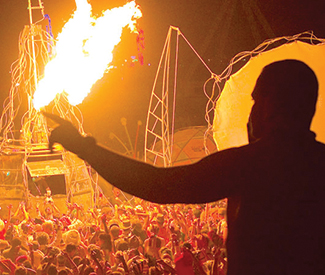
No one better to close out the cold, remote, history-filled behemoth that is Candlestick Park than Sir Paul McCartney, who played a an energetic three-hour set at the stadium Aug. 14 — nearly 48 years to the day after the Beatles played their final live show there. In a week of depressing headlines, a 45,000-person sing-along to “Hey Jude” was exactly what we needed. Check out our Noise blog at SFBG.com for a full review. PHOTO BY RYAN HOLMES

CROONING FOR A CAUSE

The Help is On the Way gala concerts — put on by the Richmond/Ermet AIDS Foundation to benefit various local AIDS service agencies — have been happening for awhile; Sun/24’s edition at the Palace of Fine Arts marks the series’ 20th anniversary. But this lineup might be the most sparkling of them all, with Florence “Mrs. Brady” Henderson sharing top billing with fellow TV legend Richard Chamberlain. Plus! Maureen “The Morning After” McGovern, and a list of Broadway and cabaret stars you may not recognize by name, but are guaranteed to be possessed of dazzling pipes. www.helpisontheway.org

GROVER NORQUIST’S BUCKET LIST

Burning Man’s most notorious attendee, arch conservative Grover Norquist, has been confirmed as a speaker at a playa camp called Palenque Norte. And get this: Norquist’s scheduled talk will be directly preceded by that of a faux guru, Kumare, star of the eponymous documentary Kumare: The True Story of a False Prophet. Kumare, aka Vikram Gandhi, is a New Jersey-born Indian American who gained a following in the US after posing as a fake swami, according to a New York Times profile, growing his hair long and imitating his grandmother’s voice. Can a fake swami melt Norquist’s ice-cold libertarian heart?

STREET EATS

The sixth annual SF Street Food Festival took place — and lots of plates — on Saturday, Aug. 16. Some highlights: octo okono (fried octopus popsicle) from Stones Throw, aquavit-cured salmon and fennel crostinis from Chef Pelle Nordic, ahi tuna kitfo from Radio Africa Kitchen, Thai iced coffee ice cream from Secret Scoop. Also: gorgeous weather, chill vibes, and shorter lines (except for the ever-popular Nombe ramenburger, of course). More pics on the Pixel Vision blog at SFBG.com

BACTERIAL MIND CONTROL

Your gut is host to millions of bacteria, and they might be controlling your mind. So say researchers from UC San Francisco, Arizona State University, and the University of Mexico, who published an article in the journal BioEssays concluding that microbes influence humans’ eating behavior to favor the nutrients they thrive on. “Bacteria within the gut are manipulative,” said co-author Carlo Maley, who directs UCSF’s Center for Evolution and Cancer. “Our diets have a huge impact on microbial populations in the gut. It’s a whole ecosystem, and it’s evolving on the time scale of minutes.” Armed with this information, ask yourself: Do you really want to chow down on that bacon-wrapped hot dog, or is that just your itty-bitty masters talking?

MOMENT OF SILENCE FOR FERGUSON

As many of us watch in horror as Ferguson, Missouri police lob tear gas grenades and fire rubber bullets into crowds of their own citizens, demonstrations in Oakland and San Francisco sprouted to support victims of police violence. In Frank Ogawa Plaza hundreds gathered for a moment of silence in Thursday, Aug. 14 to honor the death of Mike Brown, as well as those killed by police in the Bay Area: Oscar Grant, Alex Nieto, Andy Lopez, and more.

VIOLENCE ON THE BRAIN

No one is hooking police officers’ brains up to electric diodes, but this is almost as cool. A group of scientists from UC Berkeley are building a massive database of news accounts and social media to find patterns in police and protester interactions, hoping to discover what actions (or even political situations) spur violence on both sides. We don’t know what motivates police, but it’s safe to say when cops roll through a small suburban town in tanks armed with military grade weapons, protesters might be spurred to defend themselves.

TEENS FAST FOR KIDS

If you’ve ever seen teenagers swarm a stack of pizzas, this might shock you: Last week, 10 Bay Area teens (and one 20 year old) finished a five-day fast to bring awareness to the plight of Central American child refugees. Over 1,900 child refugees are in the Bay Area now, according to federal data, and few of them have been placed with families. Nonprofits designed to help them are stretched to the limit. Those that return home are met with violence and potentially, death, in their home countries of Guatemala, El Salvador, and Honduras.


More time, same crime

0

joe@sfbg.com

Roll up a dollar bill, snort a line of coke, sit back and smile: If your cocaine use leads to a conviction, your drug of choice will be spared from the harsher penalties associated with inhaling the substance through a glass pipe. When it comes to busts for cocaine possession and dealing, those caught with a rock instead of the powdered stuff are kept behind bars longer. But that could soon change.

The drug is the same, the punishment is not — and a new bill may soon end that decades-long disparity, one that critics have called racist. But crack cocaine use is now at a historic low in San Francisco, raising a question: What took so long?

The California Assembly voted 50-19 Friday [8/16] to pass the Fair Sentencing Act, which aims to lower the sentence for possession with intent to sell crack cocaine to be on par with that of powder cocaine.

The bill, authored by Sen. Holly Mitchell (D-Los Angeles), is seen as championing racial justice.

“The Fair Sentencing Act will take a brick out of the wall of the failed 1980s drug-war era laws that have devastated communities of color, especially black and Latino men,” Lynne Lyman of the Drug Policy Alliance said in a prepared statement.

Crack cocaine rocks have tended to be more heavily used by African Americans, while powdered cocaine tends to be the province of rich white folks. The bill would lessen the maximum sentence for crack cocaine possession with intent to sell to four years, down from five. It would still constitute a felony.

In California, having a drug-related felony on record can prevent the formerly incarcerated from accessing housing assistance and food stamps, further feeding a cycle of poverty. The Fair Sentencing Act now awaits Gov. Jerry Brown’s pen. But some say this disparity should have been addressed some 30 years ago.

The 1980s gave rise to the “crack epidemic” narrative, a supposedly sweeping addiction promulgated by media reports on crack’s outsized harm to pregnant women and newborn babies. But those health impacts are now understood to be on par with tobacco use during pregnancy, rather than the terrifying danger it was presented to be.

Still, the images and narratives from that era were powerful.

In a television news report that aired in the 1980s, an unnaturally tiny baby quivers and shakes on the screen. Then-First Lady Nancy Reagan appears and hammers the point home: “Drugs take away the dream from every child’s heart, and replace it with a nightmare.” Flash forward to the future, and university researchers have produced studies showing that the babies born to crack-using mothers that so frightened the country were simply prematurely born, and went on to lead healthy lives.

True or not, people were outraged. The change in laws happened “virtually overnight,” Public Defender Jeff Adachi told us. Crack cocaine hit San Francisco hard.

Paul Boden, executive director of the Western Regional Advocacy Project, remembers it well. He had just come out of homelessness in the Tenderloin in the ’80s. Just prior to starting as a staffer at Hospitality House, he saw the worst of it.

“People were killing each other over the stupidest shit. It got really violent,” he said. “What crack cocaine did is it divided a community against itself. I never thought I’d get to a point where I missed heroin.”

But, he added, “I do think the advent of crack and the assumption that every black male was doing crack gave the cops carte blanche for all of their racist patterns.”

According to the Drug Policy Alliance, people of color accounted for over 98 percent of men sent to California prisons for possession of crack cocaine for sale. Two-thirds were black, and the rest were Latino.

Long since the days when cops regularly raided the Tenderloin on a hunt for every glass crack pipe, the SFPD is now a somewhat more lenient beast in the drug realm. Drug arrests in the city dropped by 85 percent in the last five years, according to California Department of Justice data. Police Chief Greg Suhr downsized his narcotics unit, shifting to focus on violent crime.

“People that sell drugs belong in jail because they’re preying upon sick people,” Suhr told the Guardian, although he added, “People with a drug problem need to be treated, as it’s a public health issue.”

Suhr said he supports the lower sentencing for crack cocaine to make it on par with powder.

“Cocaine,” he said, “is cocaine.”

District Attorney George Gascon’s office also prosecutes mostly violent and property crimes as opposed to drug possession, reflecting a rare show of agreement between the Public Defender’s Office, the SFPD, and the DA. San Franciscans battling drug problems are often diverted to drug courts and rehabilitation programs.

Crack cocaine has largely moved on from San Francisco, leaving its ugly legacy. Meanwhile, heroin use is on the rise, but nevertheless carries the same harsh sentence as crack cocaine for possession with intent to sell.

“It’s the pathetic state of politics today that it took this long for this to happen,” Boden told us, on sentencing reform. “Now it won’t cost me anything, I’ll show what a great liberal I am.”


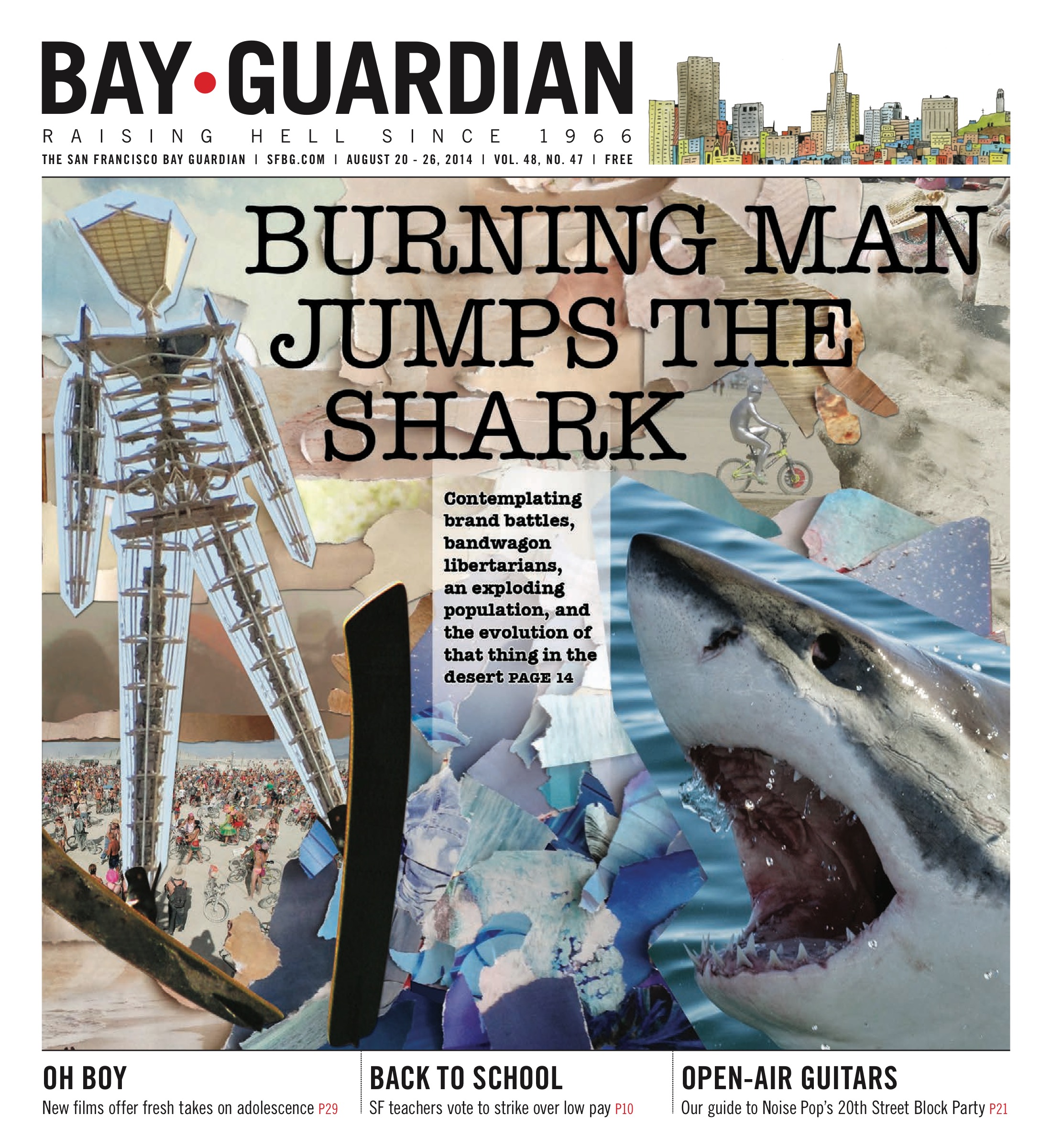
Burning Man jumps the shark

0

steve@sfbg.com

The question of when Burning Man jumped the shark is a matter of perspective, or perhaps it’s a philosophical question, but these are waters worth wading into as burners pack up this week for their annual pilgrimage to the playa.

The meme that Burning Man has jumped the shark — that is, that it’s gotten ridiculous or strayed from its original ethos — circulated more strongly this year than most after conservative firebrand Grover Norquist last month tweeted that he was “off to ‘Burning Man’ this year. Scratch one off the bucket list.”

But burners and media commentators have been saying it for years, sparked by developments ranging from the increasingly top-down control over a temporary city built with volunteer labor from the bottom-up to the sheer scale and inertia of an event that is now pushing 70,000 participants.

John Law, who co-founded the artsy Nevada desert bacchanal, walked away from Burning Man after the deadly and chaotic 1996 event, believing that the commercial and regulatory structure that followed was antithetical to the countercultural, DIY values on which burner culture was based.

The population of Black Rock City then doubled in size within two years, and doubled again within four more, prompting some burners to say 30,000 people — including a growing number of straight-laced newbies drawn by mainstream media coverage — was just too many.

At the end of 2004, dozens of the event’s marquee artists and performers launched a high-profile revolt against how Black Rock City LLC was running the event (see “State of the art,” 12/20/04). “The fix must address many issues, but the core issue for the fix is the art,” they wrote in a petition that ran as a full-page ad in the Guardian. “Art, art, art: that is what this is all about.”

But little changed. Burning Man had caught fire and the LLC was more interested in stoking the flames than controlling the conflagration. It promoted more regional burns around the world, created new offshoot organizations to spread the burner art and ethos, consolidated control of the brand and trademarks, and spelled out the “Ten Principles” that all Burning Man events would live by.

The burner backlash against that trend took many forms, but the most fiery dissent came on Monday night during the 2007 Burning Man when Paul Addis torched the eponymous Man to bring the chaos back to an event that he felt had grown too staid and scripted.

Burner officialdom responded by simply building a new Man and helping secure a four-year federal prison sentence for Addis — both decisions made without soliciting any input from the larger burner community. Coming after some corporate-style chicanery earlier that year involving control of the event’s trademark and logo (see “Burning brand,” 1/16/07), that’s when Burning Man seemed to peak, like the ramp that launched Fonzie over the sharks.

At the time, I was deeply involved with covering Burning Man culture for the Bay Guardian, reporting that would later go into my 2011 book, The Tribes of Burning Man: How an Experimental City in the Desert is Shaping the New American Counterculture.

But if jumping the shark is an idiom based on when things get really ridiculous, a point at which self-awareness withers and something becomes a caricature of what it once was, then the events of 2007 were just warm-up laps for the spectacle to come.


COMMUNITY VS. THE COMPANY

At this point, let me be clear that Burning Man is still one of the greatest parties on the planet. The Black Rock Desert is a spectacular setting, much of the art created for Burning Man each year is innovative and mind-blowing, and the experience of spending a week in a commerce-free, open-minded temporary city can truly be transformative, especially for those doing it for the first time.

I also have a tremendous amount of respect and admiration for the community members who give so much of themselves to creating Black Rock City’s art and infrastructure. And I give credit to founder Larry Harvey and other event leaders for creating such a wondrous vehicle for creative expression and community-building and keeping it running for nearly three decades.

But when an organization asserts a set of high-minded utopian values, it’s only fair to judge it by those standards. And when it claims the economic value of the labors of tens of thousands of voluntary participants as its own company assets, questions of accountability and commodification naturally arise.

For example, Burning Man has always asserted the value of “Decommodification,” which is one of its Ten Principles: “In order to preserve the spirit of gifting, our community seeks to create social environments that are unmediated by commercial sponsorships, transactions, or advertising. We stand ready to protect our culture from such exploitation.”

Yet the LLC has closely guarded its control over the Burning Man name, logo, images, and associated brands, resisting efforts to place them in the public domain and even waging legal battles against longtime burners who try to use them, including a current conflict with Canadian burners over how much the company can control a culture there that it didn’t actually create.

Licensing of the Burning Man brand and images has been a secret source of income for the company, which doesn’t publicly disclose its revenues, only its expenditures. In recent years, those brands and commodities have been transferred to a new entity controlled by the original six LLC board members, ironically named Decommodification LLC.

Some of the other Burning Man principles can seem just a farcical, including Radical Inclusion (“No prerequisites exist for participation in our community,” except the $380 ticket), Communal Effort (but “cooperation and collaboration” apparently don’t apply to decisions about how the event is managed or how large it gets), and Civic Responsibility (“We value civil society,” says the organization that eschews democratic debate about its direction and governance structure).

Meanwhile, Harvey and company have promised greater transparency and accountability at some future point, through The Burning Man Project, a nonprofit organization formed a few years ago ostensibly to take over running the event from BRC LLC (see “The future of Burning Man,” 8/2/11) .

But it hasn’t exactly rolled out that way. As I’ve reported (see “Burning questions,” 6/4/13), the original six board members have maintained tight control over all aspects of the event, appointing new nonprofit board members mostly for their fundraising ability and willingness to toe the company line, rather than seeking representation from the various constituent burner communities.

Even then, with a board hand-picked for its loyalty (which apparently goes both ways, given how the LLC has supported hagiographic Burning Man film and book projects by two of its new nonprofit board members), Harvey still remains wary of “undue meddling” by the new board, as he put it to me.

On top of that sundae, add the cherry that is Harvey’s public admission that all six board members have, as part of this transition, awarded themselves large financial settlements in amounts that will never be disclosed, and one might expect burners to revolt.

But they haven’t. Most just don’t care about these internal company dynamics (except for a few brave souls at the excellent Burners.me blog), no matter how questionable, as long as their beloved Burning Man still happens on schedule. And that’s why I think Burning Man has truly jumped the shark, launching from the ramp of a high-minded experiment and splashing down into the tepid waters of mass-consumed hedonism.


BUCKET LIST

Today, almost every bucket list on the Internet — those things that everyone is advised to do before they die — includes Burning Man. It has become the ultimate commodity, a product that everyone, from all walks of life, is encouraged to consume. Doing so is easier than ever these days.

After tickets sold out for the first time ever in 2011 — and a flawed new ticketing system unilaterally created by the LLC in 2012 triggered widespread criticism and anxiety — the company opted to just increase the population of Black Rock City by more than 20 percent, peaking at 69,613 last year.

Everyone felt the difference. Popular spots like the dance parties at Distrikt on Friday afternoon or Robot Heart at dawn on Saturday reached shit show proportions, with just way too many people. And this year will be more of the same.

In the old days, going to Burning Man was difficult, requiring months of preparation with one’s chosen campmates to create internal infrastructure (shade, showers, kitchen, etc.) and something to gift the community (an art car, a bar, a stage and performances to fill it, etc.).

But with the rise of plug-and-play camps in recent years, those with money can fly into Black Rock City and buy their way into camps that set up their RVs, cook their meals, stock their costumes and intoxicants, decorate their bikes, and clean it all up at the end. Such camps have become a source of employment for entrepreneurial veteran burners, but they cut against the stated principles of Participation and Radial Self-Reliance.

While LLC board member Marian Goodell told me that “we’re big into listening mode at the moment” as they decide what’s next for Burning Man, she also claims to have heard no concerns from burners about the event’s current size or direction, and she denies the nonprofit transition was ever about loosening their grip on the event.

“We’ve never talked about turning Burning Man back to the community,” Goodell told me last week, accusing me of misinterpreting comments by Harvey when he announced the transition, such as, “We want to get out of running Burning Man. We want to move on.”

This is the world that Grover Norquist will enter next week, after being personally encouraged to attend Burning Man by Harvey, as Norquist told the National Review last month. Norquist was drawn to the event’s libertarian image rather than its stated communitarian values, a dichotomy that its leaders have never sought to resolve. Norquist even compared Burning Man to his right-wing Americans for Tax Reform, which has pressured most Republican politicians to sign pledges never to raise taxes.

“There’s no government that organizes this,” Norquist said of Burning Man, an event held on federal land, accessed by public roads, and actively regulated by local, state, and federal agencies. “That’s what happens when nobody tells you what to do. You just figure it out. So Burning Man is a refutation of the argument that the state has a place in nature.”

Yes, kiddies, the shark has been jumped. But I hope all my burner friends still have a great week in the desert.


Live shots: Pro-Palestine activists block ship at the Port of Oakland

6

Pro-Palestine activists marched on Saturday to block an Israeli ship scheduled to dock at the Port of Oakland, protesting Gaza violence.

Well over 1,000 protesters marched from the West Oakland BART station to the port to block the Zim Piraeus, operated by Zim Integrated Services, Ltd., from docking and unloading its goods. As of last night the ILWU respected the Block the Boat picket line. A police line met the protesters when they arrived.

Check out the Bay Guardian’s print edition, Wednesday, for in-depth coverage of the protest. Until then, here are some live shots from Saturday.  

All photos below by Joe Fitzgerald Rodriguez. 

1

2

3

4

5

6

7

cops

8

Film festival organizers call for safer San Francisco streets

Editor’s Note: Aug. 19 marks the Bay Area Global Health Film Festival, hosted by the Institute for Global Orthopaedics and Traumatology. The theme of this year’s festival is “Road Traffic Safety Locally … and Globally,” and is geared toward raising awareness about the need for road traffic safety improvements. In this opinion piece, representatives from the University of California at San Francisco Orthopaedic Trauma Institute, at San Francisco General Hospital, describe how all-too-common accidents can permanently injure pedestrians and bicyclists. And they voice support for Proposition A, the San Francisco Transportation and Road Improvement Bond.

By Amber Caldwell and Nick Arlas

San Francisco is a transit-first city. Everyone shares the need to get safely from point A to point B, preferably quickly. And the various options for doing so span the full spectrum from driving, biking, and walking, to public transit like MUNI and Bart, rideshare programs, taxis, and companies like Uber and Lyft.

As we go about our daily lives, transportation is one of the most important public infrastructure systems that San Francisco relies upon. It encompasses many controversial issues and is linked to other social equity campaigns including housing advocacy and urban gentrification.

Yet the issue of pedestrian and bike safety in San Francisco has made disheartening headlines as of late. 2013 was an especially deadly year, with 21 pedestrian and four bicyclist fatalities. San Francisco General Hospital alone cared for over 1,000 road traffic injuries, with an estimated $60 million annual cost. Organizations like the SF Bicycle Coalition and WalkSF have made biking and walking leading issues in debates over transportation policy and traffic safety. Mayor Ed Lee and our city government have responded by introducing a $500 million transportation bond measure for the Nov. 4th ballot. If it passes, a portion of the funding will be allocated for improving pedestrian and cyclist safety.

Less often discussed, however, is what happens to the pedestrians and bicyclists who are hit while going about their daily routines and permanently affected by all-too-common accidents. At the UCSF SFGH Orthopaedic Trauma Institute (OTI), these patients fill our wards, the operating room schedule and our hearts as we help to heal them from these injuries. We struggle with the balance between doing what we can and what should be done to curb the growing volume of patients we see annually due to preventable accidents.

What is alarming is the socio-economic impact these accidents have, not only on the person affected, but on the hospital and our city as a whole. Even in cases where the driver is at fault, it is rare for them to even be cited for a traffic violation in most cases. More importantly, personal injury insurance and health coverage barely cover the emergency services needed for these accidents, and most services offered at the hospital are subsidized by taxpayer dollars, which means we are paying for this on all sides. This is unacceptable.

There is currently a wave of momentum to address these complex issues and attempt to tease through how we as a city can rebuild, redefine and reinforce the safety in our city. This movement is supported by a global platform addressing road traffic safety as a public health campaign, through the World Health Organization’s Decade of Road Traffic Safety. This campaign tackles the myriad polices and resource investments needed to address the enormous impact road traffic accidents have on the world. 

Injuries, mainly those resulting from road traffic accidents, account for greater disability and death than HIV, TB and Malaria combined.  An average 5.8 million die annually, and for every death caused by these accidents, eight to 10 more are permanently injured.

To bring collective awareness around this issue and to change the landscape, the community needs to stand together not only in San Francisco but also around the world, to demand safer streets. The city is doing its part to outline a roadmap to curbing these alarming statistics, and a greater global campaign is underway to promote awareness and inspire activism.

We must stand up for the injured and for ourselves as local citizens to demand safer streets and protection from when accidents occur.  We may not be able to prevent every accident, but we can improve the choreography of their outcome if we work together.    

Amber Caldwell and Nick Arlas are Director of Development and Community Outreach Coordiator, respectively, at the Institute for Global Orthopaedics and Traumatology, UCSF Orthopaedic Trauma Institute, San Francisco General Hospital.

The Bay Area Global Health Film Festival begins Tue/19 at 6 p.m. at Public Works, 161 Erie, in San Francisco.

Paul McCartney bids Candlestick a fiery goodbye

5

My earliest memories of Candlestick are formative ones. Like any Bay Area kid who cut her baseball teeth on Giants games at the notoriously frigid stadium, I thought every family prepared for sporting events by piling on 17 strategic layers and stuffing their car full of sleeping bags and other accoutrements that could double as equipment for scaling Mount Kilimanjaro.  

This has been, of course, most of the park’s (limited) charm: By default, it’s for die-hards only — very few folks want to deal with that traffic and that wind and that fog and that everything else just to sit at the bar and not pay attention to a game — because the place ain’t easy to love. Like so many ex-boyfriends throughout history, it’s been cold, distant, difficult to reach. And, like all great exes, Candlestick needed one last night. 

candlestick

Paul McCartney, who bound around the stadium’s stage for nearly three straight hours last night [Aug. 14], clad in black dad jeans, a white collared shirt, and red-and-black-striped suspenders, making silly faces, reading from the signs in the front row, punctuating the ends of songs with a double thumbs-up, and giving the people what they wanted by way of Beatles anecdotes as stage banter, filled that sentimental need in a way it’s difficult to imagine anyone else pulling off.

“I don’t know if you know this, but the Beatles played our last gig at Candlestick,” Sir Paul said casually, about an hour into the set, after an energetic, check-your-pulse-if-you-don’t-find-this-uplifting rendition of “We Can Work It Out,” to a roaring crowd of people from all over the world who definitely did know that. “We got so pissed off we never did it again.”

“No, there are some great memories here,” he continued, “and it’s sad to see the old place closing down. But we’re gonna close it down in style.”

And then he led the entire stadium in a sing-along of “And I Love Her,” turning his back to the crowd and shaking his butt during the sweet, brief guitar solo.

aul

If you were among the 44,000 people lucky enough to actually make it inside the park (in a timely illustration of one reason the Niners are departing for greener pastures, as many as 6000 frustrated ticket-holders reportedly either turned around and went home after being stuck in traffic for four hours or didn’t get in until nearly 11pm, as the stadium’s one remaining parking lot took on Lord of the Flies undertones), you were treated to what you’d been promised: a 72-year-old living legend — a cliche, but it applies in this instance — reminding you exactly why he’s a legend, and also kind of making you wonder what he’s on that he has this much energy at 72. Vegetarianism?

With a backing band of four — a lead electric guitarist, a bassist, a keyboard player who took care of strings, horns, and all other instrumentation with the somewhat disorienting press of a key, and the super-animated Abe Loboriel Jr. on the drums (who by all appearances was snatched from a Sublime cover band but has in fact toured with McCartney for 13 years) — each of them singing their asses off, as you can only imagine you would do if given the responsibility of filling in for John Lennon and George Harrison on harmonies that used to make girls literally pass out — Sir Paul led a dialed-in, bombastic rock ‘n’ roll show last night.

And it was a rock ‘n’ roll show, from the show-opener of “Eight Days a Week” to the show-ender (rather, second encore-ender) medley of “Carry That Weight,” “You Never Give Me Your Money,” and “The End,” aka a condensed version of the ending suite from side two of Abbey Road. In between, there was “Paperback Writer,” with McCartney playing the same guitar he used on the original record (one of at least a dozen he played over the course of the night). There was “All My Lovin’,” there was “Lady Madonna.” There was a story about Jimi Hendrix learning Sgt. Pepper’s within two days after it was released in 1967, but using so much whammy bar on it when he played in London that his guitar was then miserably out of tune, and he had to ask Eric Clapton, who was in the crowd, to come tune it for him. 

paul

There was “Eleanor Rigby” and “Being for the Benefit of Mr. Kite,” and “I Saw Her Standing There,” and “Yesterday,” and “Back In the USSR,” and a stadium full of gleeful adults who pay their taxes and run large companies and get the senior discount at the movies singing their faces off to “Ob-La-Di, Ob-La-Da” and the Look at meeeee part of “All Together Now.” (“One of my most serious compositions,” McCartney allowed at that one’s conclusion). There was a ukulele-led “Something” as a tribute to George Harrison. There were unreleased black-and-white photos of the Beatles at Candlestick in 1966 projected behind him as McCartney jumped into the last song they performed that night nearly 50 years ago, “Long Tall Sally.”

He did a handful of Wings songs, prefacing each one with a smirking, self-indulgent “Wings” hand signal. Were they fine? Sure, they were fine. Are they Beatles songs? They are not Beatles songs. They are not “Blackbird,” which he played solo in a spotlight, on top of an elevated portion of the stage (after an introduction that stopped disappointingly short of getting political when he mentioned being inspired by the Civil Rights movement, and terrible things happening “in the Southern part of the United States”). Nor were they “Maybe I’m Amazed,” off his 1970 solo album, which would have sent chills down spines even without the standard “I wrote this for Linda” opening. Songs off the new record (New) played well, with McCartney perched behind a psychedelic rainbow-colored piano: the title track, the jumpy keys-driven “Queenie Eye,” and “Everybody Out There,” from which the “Out There” tour draws its name. Huge-screen videos of Natalie Portman and Johnny Depp signing the lyrics during “My Valentine” were, well, huge-screen videos of Natalie Portman and Johnny Depp. No complaints. 

The highlights, though? You could point to the the fireworks that shot out of the stadium and the five-foot flames that burst forth from the front of the stage on the first chorus of a super-heavy “Live and Let Die” — though I couldn’t help but think it all would have been cooler if they actually began demolition on the park during that song, maybe letting Paul take the first swing of the sledgehammer?

fireworks
Instagram // alexaikochan

But no. The highlight was — look, this was a pretty awful week to be a person who reads the news. There are awful things happening in Ferguson, Missouri; there are awful images still pouring out of the Middle East; and one of the world’s most reliably uplifting, warm-hearted class clowns decided he didn’t want the job anymore. We want comfort food at times like these. We want things that we know and love to keep on being the way we know and love them.

You know what’s more reassuring than tomato soup and a grilled cheese sandwich? Paul McCartney singing “Hey Jude” to an entire stadium as a campfire lullaby. Couples in their 70s and 80s with their arms around each other, remembering, looking like they don’t mind the cold one bit. The knowledge that the sight and sound of 44,000 humans of all ages all holding their stupid iPhone lights and singing along to a Beatles song nearly involuntarily, because the melodies are in their bodies, because of the way Beatles songs have transcended the pop canon and are now seemingly passed down to children through DNA or the public water supply, apparently has the power to make you feel like maybe humanity isn’t doomed after all.

We needed that this week. And for Candlestick, it was one hell of a one last time.

paul

Notes:

— Tailgaters: Well-off middle-aged people in heels and/or NorthFace jackets drinking white wine and microbrews outside of their luxury SUVs in the nearby business park parking lots.

— His set list was not all that different from the one he played exactly a year ago at Outside Lands, several people have noted. None of these people have seemed especially upset by that.

— Shout-out to the people “looting” on their way out (trying to tear a “wine bar” sign off a second-story concrete wall).

— Paul McCartney is starting to look a little like a grandma, yes. But his skin is eerily smooth and there was no denying his energy last night. I do wish he would ditch the hair dye.  

Old guys, touchy-feely teens, and rep-house picks you don’t wanna miss: weekend movies!

0

Outside of the multiplex this week, don’t miss Midnites for Maniacs curator (and Guardian contributor) Jesse Hawthorne Ficks’ very special tribute to William Lustig at the Yerba Buena Center for the Arts. Exploitation icon Lustig will appear in person to chat about his films, and they’re screening the entire Maniac Cop trilogy … so why haven’t you gotten tickets yet?

Also, check out the Turkish Film Festival, which runs August 19-21 at the Embarcadero and screens new films from Turkey for free! You can reserve seats here.

Meanwhile, Hollywood would like to remind you that age ain’t nothing but a number (The Expendables 3), that feelings are important (The Giver), and that not all cops are evil (Let’s Be Cops, which technically is about fake cops). Reviews, trailers, and more below!

https://www.youtube.com/watch?v=4xD0junWlFc

The Expendables 3 Patrick Hughes — the guy tapped to helm the remake of 2011’s The Raid — directs a cast of thousands (more or less) in this third installment of Sylvester Stallone’s retro action franchise. By now, the Expendables movies have their formula down, not that it was particularly original to begin with, and all the marks are duly hit in part three: sinister bad guy (Mel Gibson — a solid choice, since who doesn’t love to hate him?) angers mercenary Barney (Stallone) and his team of graying, gun-wielding, shit-talking badasses (Jason Statham, Dolph Lundgren, Randy Couture, and Terry Crews). Revenge is sought, bullets fly, buildings explode, a government operative sticks his nose in (here, it’s Harrison Ford), and Arnold Schwarzenegger shows up to save the day. Fortunately, Expendables business as usual also happens to be stupidly enjoyable, especially with the addition of a just-out-of-prison (onscreen and off) Wesley Snipes. There are also fun roles for Antonio Banderas, Kelsey Grammar, and Robert Davi, but the crew’s next-generation recruits (rebel Kellen Lutz, hacker Glen Powell, weapons master Victor Ortiz, and ladybro Ronda Rousey) seem rather unnecessary. Isn’t the point of these movies to remind us that old guys still rule? (2:07) (Cheryl Eddy)

Finding Fela Having taken on Enron, WikiLeaks, Hunter S. Thompson, Ken Kesey, Eliot Spitzer, and Lance Armstrong, documentarian Alex Gibney (an Oscar winner for for 2007 torture exposé Taxi to the Dark Side) turns his attentions to yet another fascinating figure: Afrobeat pioneer and political activist Fela Kuti. Finding Fela incorporates the making of Bill T. Jones’ Tony-winning musical Fela! into its tale of the late lightning rod, but footage of the real Kuti is more compelling than any staged recreation; his performances at Lagos nightclub the Shrine are legendary, and rightfully so, as we see here. But despite its dynamic, complicated subject — being a musical visionary would be doc-worthy enough, but he was also regularly persecuted by the Nigerian government, and was both free-living polygamist (with some regressive views on women’s rights) and spiritual explorer — Finding Fela is disappointingly conventional, presenting the expected mix of vintage clips and contemporary interviews (with Kuti’s children and fellow musicians, among others). Enlightening, but not essential. (2:00) (Cheryl Eddy)

The Giver Lois Lowry’s classic YA novel gets a veteran helmer for its big-screen adaptation, but Philip Noyce’s ability to attract top adult talent (Meryl Streep, Jeff Bridges) can’t outweigh his heavy-handed interpretation of what was never a subtle work to begin with. In a vaguely post-apocalyptic society so regulated and dulled that nobody has emotions or empathy, a young man named Jonas (Maleficent‘s Brenton Thwaites, bumped up in age from the book’s 11-year-old) is tasked with becoming the “receiver of memories.” Basically this means that he gets to hang out with Bridges’ character and learn things about the world and human history in the form of Koyaanisqatsi-meets-National Geographic montages (music — it’s a thing! Also: war is hell, etc.) This is life-changing stuff, but part of the deal is that he must never, ever tell anyone else about it, at least until he’s as grizzled as Bridges and has his own successor in need of a thorough mind-blowing. Of course, he immediately loops in pretty BFF Fiona (Odeya Rush), who he’s been seeing in a new light since catching wind of a concept called “love.” Soon, his awakening draws the ire of his mother-esque guardian (Katie Holmes), as well as the community’s leader (Streep). If you’re looking for suspense, or any curve balls (duuuude … once Jonas’ mind starts expanding, he starts seeing the black-and-white world in color!), best backtrack to one of Noyce’s 1990s thrillers (1992’s Patriot Games, perhaps). About the only surprise in The Giver is that Taylor Swift’s much-hyped role is smaller than expected, and not nearly as distracting. (1:40) (Cheryl Eddy)

Kink Itching for more than the run-of-the-mill tour behind the forbidding doors of the Armory? Kink.com may seem like old news to Missionites, but fewer still have, ah, penetrated the actual sanctum sanctorums of BDSM videos in production. Director Christina Voros teams up here with producer James Franco, for whom she served as cinematographer on As I Lay Dying, to look in on the process and some of the issues and personalities behind Kink’s brand of porn, and attempts to make her way through the tangled complex of desire that seems to parallel both the Armory’s fortress and the city’s labyrinthine counterculture. Ever wonder how to step on a penis without eliciting a scream — be it from pleasure or pain? We learn that and look in on former farm boy turned porn star and director Van Darkholme in action, teaching his dom how to pummel his sub hard enough to deliver a satisfying thump but not hurt. Meanwhile, other filmmakers go to town in ways that should press more than a few buttons when it comes to, say, rape fantasies. Pungent stuff, complete with full frontal male and female nudity and explicit acts with sanders and the like, although Kink would have only been better with a more honed focus on the humans behind the mechanical phalluses. Voros is obviously on Team Kink, though the multiple on-camera quasi-apologies regarding BDSM culture in general give the appearance of players and pornographers protesting a smidge too much. (1:19) Roxie. (Kimberly Chun)

Let’s Be Cops Another buddy cop comedy — except this time, the cops (Jake Johnson and Marlon Wayans Jr.) are faking it. (1:44)

Scenes from a Faerie farewell

2

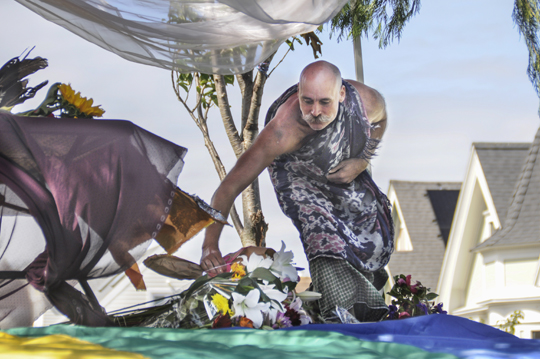
An unseasonably warm afternoon breeze wafted the scent of burning sage over Duboce Park yesterday, as a crowd of 200 or so mourners joined hands in a giant prayer circle to celebrate the life of Feather — the Radical Faerie community member found beaten nearby on Sunday morning.

Chimes rang in the sunshine, and colorful swaths of cloth twirled from a makeshift altar, heaped with flowers, perched atop the park’s central hill. A large, iridescent feather stood up from the grass.

Faerie friends and spiritual conductors spoke of Feather’s life and led a ritual of letting go. Passersby stopped to partake in the ritual or watch the particularly San Franciscan scene.

At 3:33 — the moment Feather was being detached from life support at SF General Hospital with his family and husband present — Faerie Justime asked the crowd to observe several minutes of silence.

Then declaring that Feather’s “spirit is free,” he led everyone in taking three deep breaths. Flowers were distributed to the crowd, which collapsed into a mass of hugs and remembrance, after raising linked hands and vowing that “Faeries meet again.”

Police are investigating the case as a homicide, and looking for a white male in a dark-colored hoodie. Security footage that may have captured the assault has not been released by the police. They are asking anyone with relevant info please contact 415-575-4444 or text TIP411 with “SFPD” at the start of the message.     


San Francisco Democratic Party decides on endorsements for November election

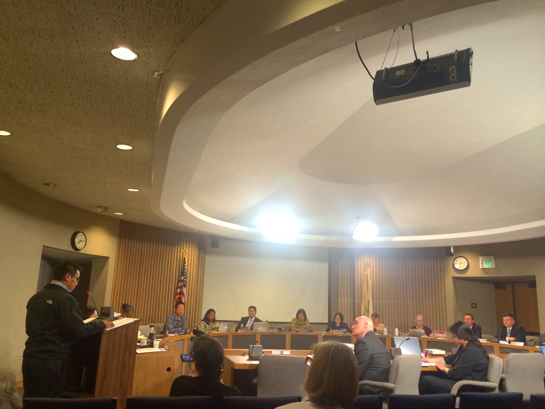
At a meeting lasting about four hours last night [Wed/13], the San Francisco Democratic County Central Committee, the steering committee of the city’s Democratic Party, decided on its endorsements for the Nov. 4 election.

A lengthy round of voting followed nearly two hours of public comment, in which San Franciscans chimed in on everything from school board nominations to Proposition L, a motorist-friendly proposal that amounts to a step backward for the city’s transit-first policy. (The formal oppositional campaign slogan is “No on Gridlock, No on L,” but opponents who spoke at the meeting shortened it to the edgier “’L No.”).

Prop. L went down handily. Prop. E, the sugary-beverage tax, easily won the DCCC’s endorsement, as did Prop. J, the proposal to increase the city’s minimum wage.

But Prop. G – a measure crafted to stem the tide of Ellis Act evictions, known as the anti-speculation tax – was a close contest.

Before the DCCC members got down to the business of voting, many local advocates voiced support for Prop. G.

Housing activists lined up across the room while Dean Preston, executive director of Tenants Together, called for meaningful action on the city’s housing affordability crisis.

But the proponents’ show of support was followed by the opposite plea from a second group, which included a contingent of Asian property owners, who crowded into the front of the room to tell DCCC members that they felt the proposed increase was unfair. “We don’t deserve this!” A speaker said, conveying anger and frustration. “Look at our faces, we work hard for our properties.”

In the end, the vote came down to four abstentions, 13 votes for “no endorsement,” and 15 votes in support, tipping the scales in favor of Prop. G by a tiny margin.

Among those who abstained on that vote were Rep. Nancy Pelosi, Rep. Jackie Speier, and Assemblymember Phil Ting, all of whom voted by proxies. Sup. Scott Wiener voted “no endorsement,” while Sup. Malia Cohen abstained.

Decisions in the races for Board of Education and the city’s Community College Board were time-consuming, since it took several elimination rounds before the final candidate lists were settled.

The school board candidates to emerge with DCCC endorsements were Shamann Walton, Emily Murase, and Trevor McNeil. Notably, that list didn’t include Hydra Mendoza, an incumbent who also serves as education advisor to Mayor Ed Lee.

Endorsements for Community College Board, meanwhile, went to Amy Bacharach for a two-year term, and Thea Selby, Anita Grier, and Rodrigo Santos for four-year terms.

Things got interesting in the contest for BART board of directors, between longtime Republican director James Fang and a well-funded Democrat, Nick Josefowitz, who is in his early 30s.

The vote was complicated since SEIU Local 1021, a labor union with a long history of backing progressive causes in San Francisco, is pulling for Fang, who supported workers during last year’s BART strike. Yet Josefowitz has the backing of other progressive organizations, including the Sierra Club. “I think that BART needs new blood,” Sierra Club representative Rebecca Evans said during public comment.

In the end, the DCCC voted “no endorsement,” with that selection getting 17 votes, five abstaining, and 10 voting in favor of Josefowitz. The votes followed a round of comments.

“The Democratic Party is a means to an end,” DCCC member Rafael Mandelman said. “And the end that we are using the Democratic Party to achieve is a more socially just and better world… There are few local entities [to advance that] than SEIU Local 1021. I think it is acceptable for us to take ‘no’ position in this race.”

Several piped up to say they thought Josefowitz deserved the endorsement of the Democratic Party simply because he’s a viable candidate and registered Democrat in a race against a Republican.

But DCCC member Arlo Hale Smith weighed in to critique of Fang’s performance as a director. “I used to hold this BART Board seat 24 years ago,” Smith said. “He’s missed a third of the meetings and he doesn’t return phone calls. He hasn’t returned my calls in a year. This is not the kind of person who should be reelected. Period.”

In races for the San Francisco Board of Supervisors and citywide offices, endorsements went to incumbents Carmen Chu for assessor-recorder, Jeff Adachi for public defender, Sups. Mark Farrell for District 2, Katy Tang for District 4, Jane Kim for District 6, Wiener for District 8, and Malia Cohen for District 10. No second- or third-place endorsements were made in the Board of Supervisors races despite multiple challengers.

Just before voting for endorsements began, DCCC member Alix Rosenthal admonished her colleagues for scant attendance during the candidate endorsement interviews, which were held the previous Saturday. “Only 12 out of 32 people showed up for interviews,” she noted. Half-jokingly, she added, “I know Outside Lands was happening.”

Lee and Pelosi talk middle class jobs in unequal SF

House minority leader Nancy Pelosi (D-SF) joined Mayor Ed Lee at a press conference yesterday [Tue 12] at Yerba Buena across from the construction site of a Central Subway station. It was billed as an event highlighting how “San Francisco has been in the lead” on creating middle-class jobs, investing in transportation, and ensuring fair wages for workers.

But as these words in the press advisory leapt out at us, we at the Bay Guardian responded with raised eyebrows. Really? It has?

The point of this media appearance, we learned upon arrival, was to promote House Democrats’ newly unveiled Middle Class Jumpstart agenda – a legislative package floated to bolster the middle class, in advance of the upcoming midterm election. Pelosi and Lee also sought to highlight the Central Subway as a transportation infrastructure project that’s spurring middle-class job creation (The $1.6 billion Central Subway project has also spurred mystifying questions as to how the money is actually being spent, but that’s a different story).

Creating middle class jobs

The message was clear: San Francisco Democrats are here to support the middle class. But that’s a tough sell. Everyone knows that the middle class is vanishing from San Francisco as skyrocketing property values make it increasingly untenable for middle-income earners to reside here.

Instead, recent studies have shown that what’s really on the rise is income inequality: Even the San Francisco Chronicle pointed out that the city’s own customized Gini Coefficient, a formula used to measure wealth distribution, puts San Francisco on par with Rwanda in terms of its economic inequality.

Earlier this year, a Brookings Institute report found that the income gap between the city’s rich and poor is growing faster than in any other US city.

We asked Lee about that growing income inequality trend at the press conference.

Here’s what he said in response: “These union jobs – and [Building Trades Council Secretary-Treasurer] Mike Theriault knows this better than anybody else here – are middle class jobs for all workers that just want to earn their way forward. And I think the more projects that we have that are infrastructure related, that are transportation related, that are water infrastructure related … are all part of reestablishing and making sure that we don’t lose that middle class. … I think in San Francisco, we simply need to do more, and part of my responsibility is to build enough housing aimed at that sector, along with helping our low-income families.”

So if you want to be on a public-works construction crew, there may be hope. Except if you live in the Bayview, where unemployment stands at a stark 17 percent as compared with the citywide level of 4.5 percent, where it appears these opportunities still aren’t resulting in job creation.

That Lee mentioned building new housing is interesting, too, given that he recently came under fire by for intervening to weaken an affordable housing measure proposed by Sup. Jane Kim for the November ballot. His agenda has sought to advance a goal of building 30,000 new housing units, but Kim’s proposal would have further strengthened the city’s commitment to building affordable housing.

Investing in transportation 

Central Subway construction may well have created union jobs – but the decision to emphasize transportation funding as a solution for saving San Francisco’s middle class seems to ignore Lee’s backlash against San Francisco Sup. Scott Wiener for advancing a ballot measure to automatically increase funding for Muni in correlation with population growth, a significant public transit investment.

As the Guardian previously reported, Lee went so far as to issue memos calling for possible budget cuts as payback for Wiener’s bid to increase transit funding. But when we asked the mayor what his position was on the measure, which will appear on the ballot as Proposition B, he said he didn’t have a position on it.

“My big focus on transportation is trying to get the $500 million Proposition A because that requires two-thirds, which his does not, and I need to focus my full attention on passing that transportation bond,” Lee told us. “I’m not going to spend a whole lot of time on Proposition B, to be quite candid with you. … At this point, I’m not prepared to [take a position] because I don’t want it to be confusing for the public … and in a few months, I think you’re going to see some departments have to come back with revised budgets, to the non-delight of nonprofits, and programs that we had all agreed to fund.”

Ensuring fair wages for workers

Throughout the press conference, Lee and Pelosi repeatedly trumpeted a November ballot measure that seeks to raise the city’s minimum raise to $15 an hour by 2018. But it should be noted that this measure is a watered-down version of an earlier proposal put forward by a progressive coalition that hoped to get workers $15 an hour a year earlier.

It was scaled back after Lee convened a stakeholder dialogue to hash out a “compromise” measure, ostensibly to avoid a ballot battle between the bolder progressive measure and a competing proposal that business interests had contemplated rolling out to thwart the passage of a wage hike they deemed unacceptable. Technically, the measure headed to the ballot still holds the promise of designating San Francisco as having the highest nationwide minimum wage. But as a point of comparison with other cities where minimum-wage hikes are moving forward, median rent in Seattle is $1,190 – while median rent in San Francisco is $3,200. 

Pelosi: “Income inequality is a reality”

Finally, in response to our question on income inequality, Pelosi also decided to weigh in, delivering a very depressing history lesson.

“The income inequality is a reality, it’s a growing gap, it’s something that must be addressed,” she said, mentioning a proposed change to the federal tax code that would prevent CEOs from taking tax write-offs if they increased CEO pay by $1 million annually without also increasing workers’ wages.  “What’s happening now, it’s important to note, this is structural,” Pelosi said. “It’s not anecdotal. It’s real. Go back 40 years ago, the disparity between the CEO and the workers was about 40 times. … And as productivity rose, CEO pay rose, and workers’ pay rose. … That was called stakeholder capitalism.

“Somewhere around a dozen or so years ago, or maybe nearly 20, it became shareholder capitalism, which only had one thing: The bottom line. And that means that now, as productivity rises, workers’ wages stagnate and the CEO’s goes up like this.” Here Pelosi made a gesture indicating a sharp upward increase. “Now it’s about, I say 350, others say 400 times, the CEO pay versus the worker. It’s a right angle going in the wrong direction. It must be addressed.”

So there you have it, straight from Pelosi: CEOs who used to make 40 times their workers’ pay now earn 10 times more than that, while wages stagnate and the cost of living continues to rise. And leading San Francisco politicians are standing in front of the Central Subway construction site to say that projects like this, coupled with a provision to encourage CEOs to remember the little people when they get million-dollar raises, will restore the middle class.

Thank goodness the Democrats are looking out for the vanishing middle class in San Francisco and other cities. Don’t you feel better?

San Francisco rent explosion: Median rent for two-bedroom apartment tops $4K

84

Hold onto your butts, a new study on San Francisco’s rental market (yes another one) reveals the city’s newest most expensive neighborhoods. 

Priceonomics went pretty darn viral last year upon release of its first study of San Francisco’s rental explosion, and round two is certain to blast through SF social media as well. And deservedly so, as the new high rental numbers are staggering.

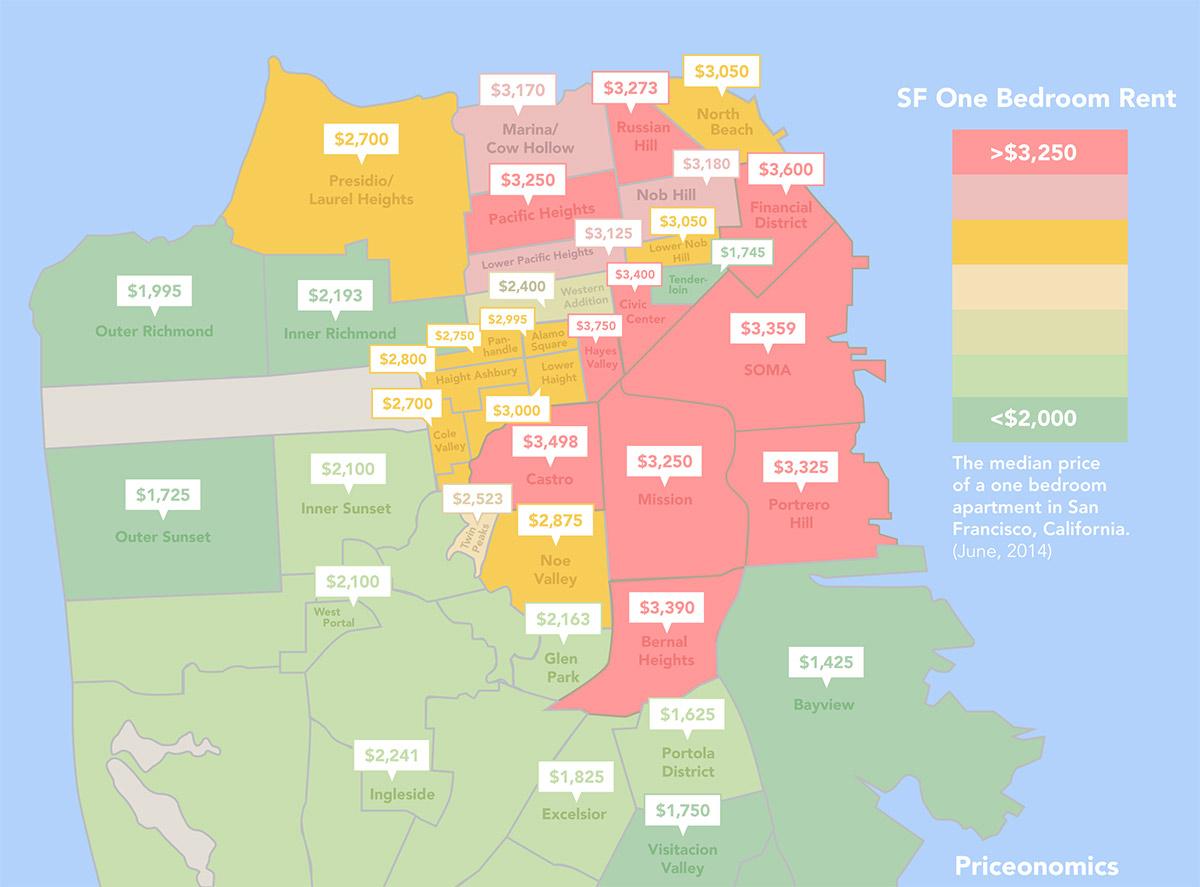
Median rent for a one-bedroom apartment in San Francisco is now $3,120. The median rent for a two-bedroom is now $4,000, and the median rent for a three-bedroom is $4,795, Priceonomics found.

It’s not a wonder widespread evictions are sending protesters onto the streets (and into the offices of real estate agents). The numbers are a good indicator of why any eviction from a rent-controlled unit today is also an eviction from San Francisco entirely: prices are just too damn high to find a new apartment at a comparable rate. 

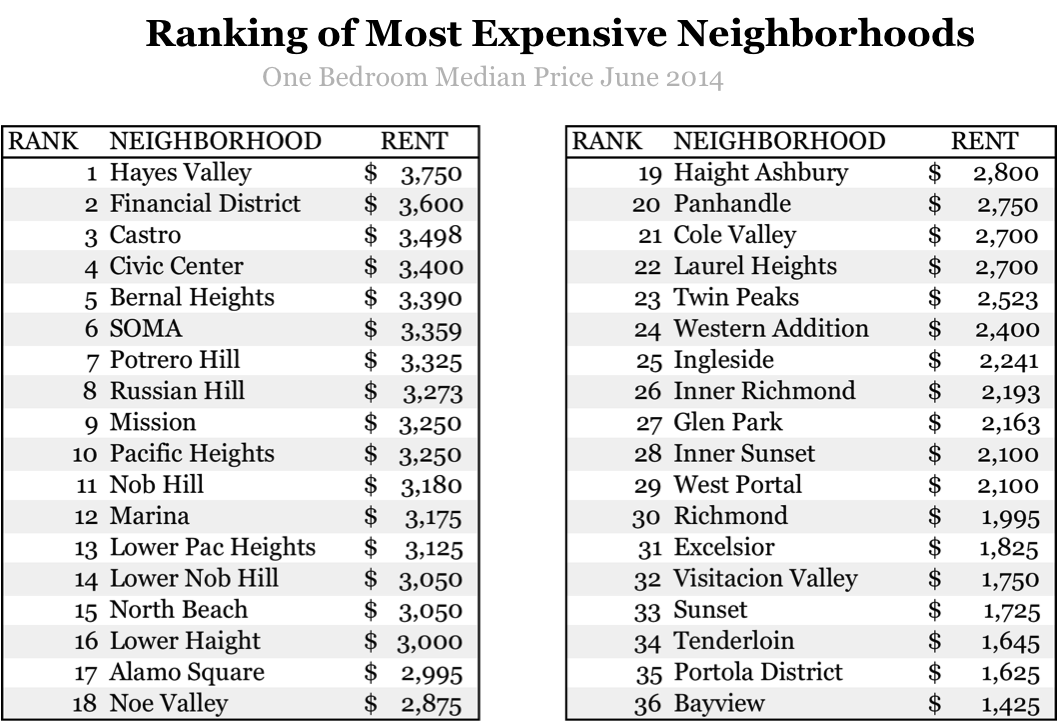
The study breaks the data down by neighborhood. Hayes Valley topped the list, with a median rent of $3,750 for a one-bedroom apartment. The Financial District and the Castro were second and third most expensive, with the Bayview coming in last at $1,425 a month. 

neighborhoods

The study also noted that historically poor areas (derisively termed “backwaters”) have jumped in price, largely in part due to an influx of tech workers and their shiny UFO-like private shuttles. 

As the rents rise and turmoil bubbles over evictions, city legislation like Supervisor Jane Kim’s Housing Balance Measure was defanged by Mayor Ed Lee during negotiations over the past month. Still, there is some hope on the November ballot for relieving San Francisco’s housing crisis. Proposition G, the Anti-Speculation Tax, would discourage speculators from “flipping” properties for a profit by taxing them harshly. 

Of course that’s no silver bullet, and San Francisco will need to take a hard look at its affordable housing policies to stop these prices from rising, rising, rising. 

It seems like they couldn’t possibly go up higher, but then again, we always think that, don’t we? 

For more on Priconomics’ findings, check out the article here

rental map

Click the map for a higher-res version.

Ruling provides more access to SFPD misconduct files

3

A California appellate court issued a ruling this week [Mon/11] opening up San Francisco Police Department personnel files to prosecutors, who then must disclose to defense attorneys when officers have criminal or other misconduct issues that may affect their credibility when testifying during trials.  

The decision builds on the 1963 Brady v. Maryland US Supreme Court case, which requires police to share all potentially significant evidence with the prosecutors. But the SFPD hasn’t always done so to an extent that passed legal muster, citing officer confidentiality issues, so the court has now found that prosecutors must have direct access and bear the responsibility of disclosure.  

The San Francisco District Attorney’s Office resisted the change, joining with the SFPD to appeal the lower court ruling in Superior Court of San Francisco vs. Daryl Lee Johnson, a defendant whose attorney has sought more information about the officers testifying against him. The appellate court supported the earlier ruling and said that any relevant documents must be shared.

The appellate justices specified that, since the police are part of the prosecution, documents may legally be shared without breaking any officer confidentiality rules. SFPD did not immediately return calls for comment, but we’ll update this post if and when we hear back.

In a press release from the San Francisco Public Defender’s Office, Public Defender Jeff Adachi said, “A fair trial requires that before a police officer testifies, any history of dishonest or abusive behavior is turned over to the defense…[The prosecutors] are ultimately responsible for providing any information about a police officer that could exonerate an innocent person.”

The Guardian spoke to Adachi about the implications of this decision. While the ruling will place fewer obstacles in the way of obtaining evidence and will create a clearer process, Adachi is concerned about accountability since there’s no way to know that the prosecutors are making all relevant documents available. But he said the ruling is still a step in the right direction.

“This decision means that the defense will have access to information to a case where police officers’ credibility is concerned,” Adachi said. “If the officer has been disciplined for lying [or] use of excessive force…that reflects on the police officer’s credibility.”

According to Acachi, around 100 cases have been dismissed due to lack of evidence, and 90 officers involved in various cases had flawed records.

Monday’s ruling will play a role in the case that inspired it. Daryl Lee Johnson was charged with two felonies in November 2012. His investigating officers had records of misconduct, but their files were not available to Johnson’s attorney. This ruling will even out the playing field and help ensure that Johnson trial and others are truly fair.

Adachi told the Guardian that two court decisions were preventing defense attorneys from accessing misconduct files.

“The Johnson case establishes that yes, they can,” Adachi said, noting that the ruling will also help defense attorneys in other cases going forward.

SF school board votes to aid Central American child refugees, hopes to spark national movement

14

Waves of Central American child refugees are landing in San Francisco, fleeing violence in their home countries. A growing number of supporters are lending aid, and now the San Francisco Unified School District is the newest group to join the cause. 

Last night [Tues/12], the SFUSD Board of Education unanimously approved a resolution to bolster services in city public schools for child refugees fleeing Guatemala, El Salvador, and Honduras.

“We are a nation of immigrants, which is often forgotten when we talk about ‘those kids,'” SFUSD Superintendent Richard Carranza said to the board. “These are our children.”

To help them, he said, “we will move heaven and earth.” Carranza then pledged to forward the text of the resolution far and wide, saying he hoped the SFUSD’s efforts would cross the desk of President Barack Obama, and set an example for the rest of the country.

Child refugees coming to San Francisco face language barriers, inadequate city services, and major gaps in their education. The resolution, authored by board member Matt Haney, will beef up teaching resources for child refuegees, connect these children with counseling services, and enroll them in specific classes geared towards new English learners. The district will also soon hire an administrator to coordinate these new and existing services for refugees. This new administrator will need the qualifications of a social worker, the district said, and it’s easy to see why. 

One counselor put the kids’ needs this way: normal teenagers have it hard enough, but adjusting to school with the trauma of near-death behind you can be almost impossible.

“These kids have a set of needs which are at a higher level than any set of kids we deal with,” Haney said. 

Most of these new services will wrap into SFUSD’s Newcomer Pathways program, an already existing framework which bolsters the success of new immigrant children in San Francisco, who often face steep language and cultural barriers.The effort joins a rising tide of SF officials pledging to aid these refugees, including Supervisor David Campos, Mayor Ed Lee, Public Defender Jeff Adachi, and USF School of Law Dean John Trasvina.

The US Department of Health and Human Services reported 175 unaccompanied minors were released into custody of San Franciscans, though federal data shows many hundreds more wait in the wings for aidSome of these refugee children will join school in the new year, which starts Monday, but many are already in attendance.

Dawn Woehl, a counselor with the Newcomer Pathways program at Mission High School, told the board during public comment she started noticing more child immigrants who spent time in detention centers in New York and Texas. 

“We may not know much about each individual family, but we know enough about the trauma they’re facing,” she said. After she spoke to the board, she told the Guardian that wraparound services for mental health are most needed. 

“We take care of the basic needs first,” she said, “but counseling is where we get stretched.”

These children and teenagers often come from towns where gangs recruit new members through high schools. Those that refuse to join up meet violent fates: rape, dismemberment, and death. With those challenges, it’s no wonder that many of these kids show up in San Francisco with gaps in their learning, and significant need of counseling.

“The need for Spanish-speaking therapists is high,” Woehl told us. 

The Newcomer Pathways program is a successful one, and alumni of the program came to the board to laud the proposal to aid the refugees.

“I was born and raised in Guatemala, I emigrated here when I was 14 years old,” Anna Avalos Tizol, now 21, told the Board of Education. “I had to learn the language, the culture, and work to help my family back in Guatemala. It was a culture shock.”

But in the end, the young student found success at Mission High School. She’s now a senior at UC Santa Cruz, and interned in Washington DC, where she witnessed child refugees testifying before Congress, telling them of the cold hard floors and thin sheets of their detention centers.

“When we come here, we give up everything. Our home and our loved ones,” she said. “Remember: all children are sacred.”

Snarky Puppy brings sweet fusion to the SF Jazz Center

0

By Paul Kenyon Krantz

While hordes of people were packed into Golden Gate Park for Outside Lands Aug. 9, the all-American quasi-collective known as Snarky Puppy made the walls of the SF Jazz Center made ring with their particular frequencies of jazzy, instrumental fusion.

It had been a long day, one in which Snarky Puppy set a personal record by playing a total of four shows in 24 hours. The shows were split between three venues; they started the day in San Jose and closed out the night with two back-to-back sets at the SF Jazz Center. Despite how tired the band members must’ve been, their riffs kept the audience on the edge of their seats, literally leaning forward to watch the band members’ hands and mouths make music.

Beyond the awe-inspiring amount of technical skill SP demonstrates, what makes their live show special is their brotherly presence on stage. It comes through in their interactions, like when Cory Henry shouted, “Take your time” at guitarist Bob Lanzetti, as he began a long, soulful solo. Or when the two keyboardists of the evening — Cory Henry, in bronze-rimmed glasses, and Mike Maher, with sunglasses hanging from his shirt — battled it out on stage, taking turns trying to out do each other with ever faster riffs, until their fingers were twirling so quickly through the notes that it felt like the whole room was flying through space.

Or in the middle of each song, when they’d really start to get into it. The band’s composer and bassist Michael League bobbed with a coy smile while Mike Maher rolled his head around as if he was sniffing a glass of wine, and the guitarists had practically become the strings they were playing. Corey Henry started to clap, and the horn players’ cheeks were puffed out to nearly full capacity, and Robert Seawright was smiling like he was the definition of happiness from behind his drum set, and percussionist Nate Werth was shaking a hand as if to signify “it’s okay.” Then suddenly what had seemed to be a runaway train of never-ending rhythm fell off a cliff, and a split second of silence was filled by someone in the audience shouting, “YEAH!” before the rest of the song dropped over everyones’ heads like chains shattering around the room.

All of this to say that the members of SP demonstrate of level of intimacy that can only be explained by the fact that many of the band members met in college, and have since spent roughly a decade touring and playing music together.

Sometime between the middle and the end of their first set at the SF Jazz Center, Michael League made the audience groan by announcing that this would be the “last tune of the show.” Then he clarified, “It’s okay, cause it’s 46 minutes long,” and the groans were replaced by cheers. Already, anticipation of the last song hung like static in the air around the room, with many of the audience members knowing which song was coming.

SP recently was awarded a Grammy for “best R&B performance” with Lalah Hathaway, but they are still in the process of garnering attention from mainstream listeners. Hence the creation of “Lingus,” the catchiest tune from their latest album, We Like It Here.

Michael League said onstage that the song was his attempt at writing the SP version of a dubstep song, adding that it was named after an airline on which he had been riding when he composed the song — while an obnoxious fellow passenger drank beer after beer in the seat next to him and left a pile of cans by his feet.

The fact that the track isn’t in the right time signature for dubstep, as League pointed out, makes it all the more impressive that the influence of computer-generated music comes through on a song played entirely on live instruments. As the song began and the horns came in, lurking behind the beat like a secret agent, I closed my eyes to take it in and, had I not known better, I might’ve imagined that the sounds I was hearing were the result of Beats Antique pairing up with Miles Davis’s band. Sweet fusion, indeed.

Outside Lands 2014: The view from the photo pit

0

Were you there? Were you among the approximately 200,000 human bodies smashed together for warmth at Golden Gate Park this past weekend, because you somehow couldn’t stand the idea of wearing anything but your midriff-baring tube top with your whimsical animal hat and/or flower crown?

Whether you spend this week recuperating from 72 straight hours of partying at Outside Lands or patting yourself on the back for steering clear of the whole thing — never fear, we were there to capture the weekend for you. Check our review here, and click through the slideshow above for some of our favorite live shots by Guardian photographers Matthew Reamer and Brittany M. Powell.

Vigil at 3:33pm tomorrow for Feather, faerie found beaten near Duboce Park

45

The life of Bryan Higgins, 31, know among his radical faerie community as Feather, will be celebrated tomorrow at 3:33pm with a vigil at Duboce Park — the exact moment his family wishes to remove him from life support at SF General Hospital.

Feather is the John Doe whom police were attempting to identify this weekend in a viral campaign, whose unconscious, critically injured body was found near Duboce and Church streets at 7:30am on Sunday morning, and who has been sustained through life support at SF General while friends, family, and fellow faeries have streamed through to wish their goodbyes. Until now, Feather has not been identified in the press. In a personal interview today with his husband, Brian Hagerty, I learned more about how this central figure in the faerie community will be ushered into the next life. 

Feather’s family has not been talking to the police or the press — Feather’s husband spoke to me in an effort to get the word out about the vigil tomorrow. Police are now considering Feather’s death an attempted homicide via assault with a deadly weapon; according to sources, they are looking for a white male in a dark-colored hoodie, who was captured on Muni and surrounding businesses’ security footage around the time of the assault. (Anyone with relevant info please contact 415-575-4444 or text TIP411 with “SFPD” at the start of the message.)

 “We haven’t been in contact with anyone other than those immediately involved in Feather’s passing,” Hagerty told me today as we walked near New Rosenberg’s Deli, where Feather worked, and where mourners were gathered wearing “I Believe: Feather 1983-2014” t-shirts sporting Feather’s image.    

Hagerty, visibly shaken but acknowledging tremendous support of family and the faerie community, said he didn’t have any other information about the circumstances of Feather’s horrendous beating. “Right now, we are just concerned with his spirit, and making sure everyone has a chance to say goodbye,” he said. “Too many factors came together in this situation. But the truth is he has left us.”

Hagerty declined to reveal any more medical information, and no more information was available from the police at the time of this writing. The Guardian will be following the case as it develops.

Feather’s case has drawn attention from the media as violent crime in San Francisco seems to be taking an upswing, especially in the gay-friendly Castro District. Supervisors and gay community members are weighing the possibility of radical changes to June’s Pink Saturday celebration, and the area around Church and Duboce has become especially fraught with crime lately, as the surrounding neighborhoods undergo profound changes.

But mostly the shock of such a stalwart of the faerie community — one dedicated to gentleness, peace, and spiritualism — being beaten, possibly to death, is what’s drawing attention and disbelief.

A friend who was in the hospital room as Feather’s husband said goodbye described the scene in a series of texts:

“There are young gay men going in and out of the room holding and kissing his hands; whispering in his ear; family walking in and crying and massaging his feet; relatives encouraging their crying children to say goodbye to him. People meeting each other and hugging, watching TV in the waiting room, handing each other Kleenex in the hospital room. It is so fucking beautiful and sad.

“His husband put a black, white, and tan African dye-print scarf around Feather’s neck, and stretched it out over his shoulders and arms and body with his beautiful face above it…. like he is a bird/spirit preparing to fly.”     

Update 8/14: Photos and coverage of Feather’s memorial can be found here.

Real estate speculators physically push out Ellis Act eviciton protesters

55

Native San Franciscan Benito Santiago, 64, joined a protest Aug. 12 in an attempt to remind his evictors that he’s a human being – not a roadblock to profit.

Santiago is facing an Ellis Act eviction from his 47-year Duboce Triangle home, where his monthly rent is just below $600.

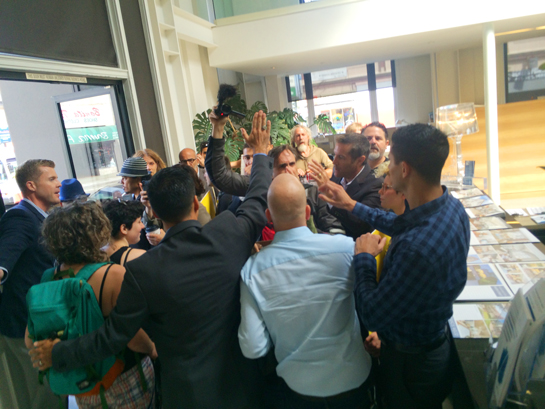
Clad in a stylish blue fedora, Santiago and a dozen or so protesters filed into Vanguard Properties to deliver a letter asking Vanguard co-founder Michael Harrison to rescind his eviction. Harrison initiated an eviction proceeding against Santiago last December through his corporation, Pineapple Boy LLC. But by the end of the protest, Santiago and other tenant activists were physically pushed out of the building by Vanguard representatives in a show of aggression.

Before it got to that point, protesters called out Harrison for exploiting the Ellis Act for profit.

From the letter:

“We do not believe that you, Michael Harrison, are ‘going out of business’ which is the purpose of using the Ellis Act. We know that instead you are exploiting a loophole in state law for your greed.”

Suffice to say, Vanguard representatives didn’t accept the letter. But the message still got across: The protesters brought a bullhorn.

“My name is Benito Santiago,” Santiago blared, standing at the front desk, but was soon interrupted. A young-looking man in a grey suit approached protesters and asked them to leave.

“I’m calling the San Francisco police,” he said. Santiago may have approached the business with a bullhorn, but he has much to lose. 

While Vanguard may perceive Santiago merely as someone who doesn’t offer monetary value, he’s of much value to the developmentally disabled children he teaches at San Francisco Unified School District. 

The protesters intended to make these points to the folks at Vanguard. But before words could be exchanged, a crowd of Vanguard workers (real estate agents or employees, perhaps?) swooped in and physically carried out the protesters.

Fred Sherbun-Zimmer held her protest sign and chanted as one Vanguard agent placed hands on her back and swiftly pushed her out. Peter Menchini, a videographer, held his camera high and away from the snatching hands of real-estate experts turned vigilantes. Poet and activist Tony Robles had a paper slapped out of his hand by a Vanguard employee, before protesters were pushed out in a wave behind him.

Vanguard Properties Employees Assault Photographers & Activists 12 Aug 2014 from Peter Menchini on Vimeo.


As you can see from the video, things turned downright nasty as the real-estate representatives shoved and pushed the anti-eviction protesters as well as journalists there to document the event. (They even tried to yank my phone out of my hand.)

By the time the SFPD arrived, things had settled down. No arrests were made, and after a few sidewalk declarations by bullhorn, the protesters cleared the scene.

Afterwards, Santiago told us his housing prospects aren’t looking good. The Bill Sorro Housing Program helped him file many affordable housing applications, but he hasn’t gotten any word back yet. The rent he pays now eats up a hefty chunk of his paycheck, leaving little for basic expenses by the end of the month.

“I’m getting lots of positivity from family,” he said. And he does have an extension, until December, to find a new apartment. But, he noted, with median rents almost reaching $4,000 in San Francisco (they’re actually at $3,200, but that’s still bad), his chances of staying in the city are slim.

“I might be bad at math,” he told us, “but that seems like shooting for the moon.”

Vanguard Properties co-founder Michael Harrison was dubbed a “property flipper” by the Anti-Eviction Mapping Project. 

From its brief on Harrison:

Michael Harrison is the co-founder of Vanguard Properties, where he specializes in “residential investment properties.” He is a property flipper: his shell company Pineapple Boy LLC bought the building in November 2013 and tried to evict Benito and the two other tenants immediately. Vanguard Properties is currently involved in a number of luxury property developments in the Mission District and Duboce Triangle area including the development at 19th and Valencia that in February 2014 set record sale prices for the neighborhood. 

Santiago did have some flickering hope when an in-law unit behind a garage next door went on the market for rent. His hope was deflated, though, when his friend told him the rent for the single room.

“Eduardo said, ‘guess how much it is?'” Santiago told us. “It’s going for $4,000 a month.”