Volumes

Who bombed Judi Bari?

5

THE GREEN ISSUE Darryl Cherney is determined. “I have a mission in life,” he says. “And that is to find out who bombed Judi Bari.” This week, a judge may have gotten him closer to that goal, ordering evidence in the case be sent to a lab for forensic testing.

Cherney was in the car with Bari, a fellow environmental activist from Earth First, when a pipe bomb wrapped with nails exploded, maiming Bari and leaving Cherney with serious injuries.

It was 1990, and the two were in Oakland on their way to speak about the upcoming Redwood Summer, three months of picketing, tree-sitting, and otherwise blocking the clear-cutting of the California redwoods.

The Redwood Summer went on, but not before Bari and Cherney were arrested: The Oakland Police Department said they had constructed the bomb themselves and were transporting it in the back seat.

Before Bari and Cherney went to trial, it became clear that the bomb had been under the front seat (Exhibit A: Bari’s shattered pelvis and the unscathed backseat), and that there was absolutely no evidence Bari or Cherney had known it was there, and the charges were dropped. But the true culprit was never found.

In 2002, Cherney sued the FBI for attempting to frame him and Bari (who died of breast cancer in 1997), and won. But he’s still set on testing the remaining evidence for DNA.

“We rely on the government to examine physical evidence in a violent criminal case, and when they fail to do that, we have to react,” Ben Rosenfeld, Cherney’s attorney, told the Guardian.

“It should be an open attempted-murder investigation.”

But the authorities not only weren’t investigating, they were seeking to destroy the evidence, something Cherney and his lawyers have been fighting. On April 2, they scored an important victory when U.S. District Court Judge Claudia Wilkens issued an order preserving the material and allowing its transfer to a Hayward forensic lab for testing.

In August 2010, government lawyers had unceremoniously announced that they planned to destroy the case’s remaining evidence, which includes remnants of this bomb and another one that partially exploded in Cloverdale two weeks earlier, as well as a hand-lettered sign that was near the Cloverdale bomb. The Cloverdale bomb and the bomb that exploded in Bari’s car were constructed similarly, and no one has been convicted of either attack. Because they contain unintentionally intact evidence, partially exploded bombs are “considered to be the Holy Grail in bombing investigations. That slightly exploded bomb in Cloverdale is key to solving the case,” said Cherney. Lawyers for Cherney responded with a motion calling instead for testing of the evidence; the government opposed the motion.

But at a Sept. 8, 2010 hearing, Magistrate Judge James Larson ordered the FBI to turn the evidence over to an independent analyst for testing.

Again, the feds opposed the order, and asked for a de novo review of the case, essentially asking that the court go over all previous briefings once again. The motion seemed like a stalling tactic, and it worked; the motion was pending in court for a year.

Recently, it was brought back up again, when the plaintiff’s motioned to move forward with testing the evidence. They suggested a lab in Hayward, Forensic Analytics Laboratories, and Wilkens agreed on April 2.

Bari’s case came out at the start of what became a large-scale FBI crackdown on environmental justice movements in the 1990s and throughout the 2000s. Activists protesting companies that they thought were harmful towards animals and the earth became a special target of the FBI in what became known as the “Green Scare.”

The era was characterized by crackdowns on the Earth Liberation Front and the Animal Liberation Front, although it also affected groups like Food Not Bombs and Earth First.

“The case was an early forerunner of what we call the Green Scare cases, where the government sets out to make examples of people it perceives as leaders to try to chill activism in the environmental movement,” said Rosenfeld. “It was quite a scary season for environmental activists.”

The Green Scare did a lot to quell environmental activism, and some who were arrested at its peak remain in prison. But it didn’t stop many — including Bari and Cherney — from continuing their work.

“Both Judi and I continued right out of jail. Actually, in jail the police wrote in their police report that I was trying to convert them to environmentalism,” laughed Cherney.

“I participated in Redwood Summer and the Headwater Forest Campaign right through 1999 and continued through 2003. And now I’m making a movie about it.”

The movie, Who Bombed Judi Bari? has been doing well since it had its world premiere at the SF Green Film Festival March 2.

The film’s reception is “definitely very gratifying,” says Mary Liz Thomson, the film’s director, who “spent a lot of time editing it living in a cabin on [Cherney’s] land up in the woods, using solar power.”

Now she’s touring California with sold-out screenings, as well as some free screenings, including a well-attended March 26 screening at Occupy Oakland.

Thomson says she has gotten positive feedback from occupiers and others currently working in social movements.

“We’re just at the beginning of our launch and people are saying that it’s really relevant right now. The timing was great”

Indeed, laws that build on the Green Scare have been rapidly passed in recent months, targeting other political groups.

Controversy flared after President Obama signed the National Defense Authorization Act, which allows the U.S. to detain suspects without charge. Attorney General Eric Holder claimed that the government can kill its own citizens abroad without trial. And on Feb. 27, The House of Representatives voted in favor of HR 347, the so-called “Anti-Occupy Bill.”

Who Bombed Judi Bari? is an important history lesson for those faced with these new challenges. And Cherney may finally be on track to finding out the answer to the title’s question.

Guardian exclusive: the health-care scam chart

17

We’ve always found it a bit annoying when restaurants charge an additional fee to pay for Healthy San Francisco, the law that mandates health care for workers. If the cost of eggs goes up, there’s no “special breakfast cost pass-along surcharge.” So it seems to us more like a political statement in opposition to the law than a business expense.

That said, we’re happy to pay an extra 3 percent for a nice meal — if it means the people who cook and serve it get health insurance.

But it’s more than annoying to find that a lot of restaurants charge a special HSF fee — but it never goes for employee healthcare. Attached is an Excel file, based on data from the San Francisco Department of Labor Standards Enforcement, that shows which restaurants charge extra for health care — and how much of that money actually goes to employees.

We’ve also pulled out a list of the top 10 offenders — the restaurants who put the lowest percentage of their Health Savings Account money into actual employee health care. A caveat: Some of these places may just be lucky — maybe none of their employees got sick all year. But still, they’re collecting a surcharge for employee health care, and that’s not where the money’s going.

>>CLICK HERE FOR OUR EXCLUSIVE CHART OF RESTAURANTS WITH SURCHARGES — AND WHERE THE MONEY GOES (xls)

TOP 10 RESTAURANT OFFENDERS
 
Eagle Café

Surcharge: 3%

Reimbursement plan (total allocated): $ 55, 768

Reimbursement plan (total reimbursed): $425.00

 
Tres Agraves

Surcharge: 4%

Reimbursement plan (total allocated): $ 103,503.00

Reimbursement Plan (total reimbursed): $1,497

 
Amici’s

Surcharge: 4.85%

Reimbursement plan (total allocated): $ 125,763.00

Reimbursement plan (total reimbursed): $1,995

 
Blue Plate

Surcharge: 4%

Reimbursement plan (total allocated): $ 41,859.00

Reimbursement plan (total reimbursed): $723

 
Park Chow

Surcharge: 2%

Reimbursement plan (total allocated): $ 93,072.00

Reimbursement plan (total reimbursed): $1,680

 
2223 Restaurant

Surcharge: 4%

Reimbursement plan (total allocated): $79, 817

Reimbursement plan (total reimbursed): $ 1,687

 
Johnny Foleys Irish House

Surcharge: 4%

Reimbursement plan (total allocated): $73, 133

Reimbursement plan (total reimbursed): $ 1,550

 
MarketBar

Surcharge: 3%

Reimbursement plan (total allocated): $ 76,404.00

Reimbursement plan (total reimbursed): $1,673

 
Andalu

Surcharge: 3%

Reimbursement plan (total allocated): $ 122,742.00

Reimbursement plan (total reimbursed): $3,762

 
Wayfare Tavern

Surcharge: 3.5%

Reimbursement plan (total allocated): $ 60,114.00

Reimbursement plan (total reimbursed): $2,403

Reject the CPMC deal

0

EDITORIAL For most of the past year, Mayor Ed Lee had been taking a tough line with California Pacific Medical Center, the health-care giant that wants to build a state-of-the-art 555-bed hospital on Cathedral Hill. The mayor had been telling a stunningly recalcitrant CMPC management that the outfit would have to put upwards of $70 million into affordable housing and spent millions more on transit, neighborhood and charity-care programs to mitigate the impacts of the massive project.

But late in March, something happened. Under immense pressure from the Chamber of Commerce and other big business groups, the mayor buckled and agreed to a deal with woefully inadequate mitigation measures. The supervisors should reject the plan and force CPMC to do better.

The biggest problem with a project this size is the mix of jobs and housing. Lee is properly concerned about creating jobs in a city where unemployment in some neighborhoods is stubbornly high. But the proposed deal only guarantees a tiny fraction of the 1,500 permanent new jobs for San Francisco residents.

That means a city that has almost zero vacancy in affordable housing is going to have to absorb a workforce much of which won’t be able to buy or rent anything at current market rates. That means more competition for scarcer housing and higher rents and home costs for everyone.

By any basic planning logic, CPMC should be on the hook for providing enough affordable housing for at least some reasonable percentage of its workforce. Instead, the hospital chain is offering about $33 million, only $3 million of which will be paid up front. That won’t even address half of the housing impact. Besides, the jobs will be there when construction starts, and more when the hospital opens; the limited affordable housing money will come much later. The highest-paid doctors and administrators may be able to afford the pricey new market-rate condos the city is madly approving — but where, exactly, are the nurses, orderlies, clerks, janitors and other health-care workers going to live?

CPMC has agreed to provide charity care at the same level is currently does — which is abysmally low, among the lowest of all nonprofit hospital chains in California. So that’s not an advantage.

And it has promised to keep open St. Luke’s Hospital in the Mission — the only full-service hospital other than SF General in the southeast part of town. But the proposal calls for cutting the number of beds by nearly two-thirds, from 229 to 80. And it allows for the closure of that hospital if CPMC’s system-wide operating margin falls below 1 percent (something that will be hard for the city to challenge, since CPMC handles the books).

It’s cynical how CPMC is using this critical medical facility in an underserved area as a bargaining chip. Already, hospital lobbyists are warning that St. Luke’s will be shut down if they don’t get what they want on Cathedral Hill.

Meanwhile, CPMC has labor trouble and is refusing to guarantee that existing employees at facilities that will be demolished will be able to keep their jobs and seniority at the new hospital.

We realize that CPMC needs to build a new facility to replace aging and seismically unsafe structures elsewhere in town. But the hospital chain also has a responsibility to address the impacts this project will have on San Francisco. And right now, it’s not a good deal.

End the health-care scam

15

OPINION Last year, after receiving data from San Francisco, the Wall Street Journal reported on an investigation into the use of health reimbursement accounts by several local restaurants. It showed a group of employers evading the city’s health care law while charging their customers a “Healthy San Francisco” surcharge that is never actually spent on employees’ health care.

Rather than providing health coverage to their workers, as customers are led to believe, the restaurants are allocating funds for HRAs — and taking back the funds before they can be used.

The numbers speak for themselves: Of the $62 million that was set aside for health care accounts in 2010, more than $50 million was kept by employers.

>>WHO’S GAMING THE SYSTEM? CLICK HERE FOR OUR COMPLETE GUIDE TO RESTAURANTS WITH SURCHARGES — AND WHERE THE MONEY GOES

Workers spoke about never being notified about the accounts; being forced to jump through numerous, often onerous hoops to receive reimbursements or never receiving reimbursements; facing severe restrictions on use of the funds; and fearing retaliation for seeking to access the funds. It was clear that as long as employers can take back unspent funds they have a large incentive to restrict workers’ access.

In response, Supervisor Campos drafted an amendment to the Health Care Security Ordinance (known as Healthy San Francisco) that would have closed this loophole, which was being exploited by a small number of employers. The Chamber of Commerce, accompanied by the San Francisco Chronicle, made hysterical claims about impending job loss and business closures, and after the Board of Supervisors approved the legislation on a 6-5 vote, Mayor Ed Lee vetoed it.

Supervisors Malia Cohen and David Chiu then authored “compromise” legislation that actually didn’t address the problem. Their version merely allowed employers to take back workers’ health care dollars after two years instead of one. This cosmetic change did, however, provide enough window dressing to please the Chamber, so the supervisors approved it and Mayor Lee signed it into law.

Now, just a few months later, an article in the Public Press showed exactly why we opposed the Cohen/Chiu amendment in the first place: It doesn’t really close the loophole. Employers can still take money back from the HRAs. This creates a clear incentive to choose HRAs over insurance — the worst option for workers. Furthermore, the loophole leaves responsible businesses that provide health coverage to employees through insurance or HSF competing against employers that exploit it by paying less into HRAs.

We find it unconscionable that there are businesses charging customers a health-care surcharge and then keeping the money for profit. What is more unconscionable is that City Hall passed an amendment that continues to let it happen.

The Department of Labor Standards Enforcement compliance data for 2011 will be available next month — and if that continues to show abuse of the HRA provision, then it’s time for the Board of Supervisors to end the charade and truly close the loophole once and for all. Healthy San Francisco is about providing health care for workers — not creating additional profit for businesses.

Assemblymember Tom Ammiano represents the 13th District. Supervisor David Campos represents District 9.

Playing God?

6

steve@sfbg.com

THE GREEN ISSUE When Richmond was selected as the site for Lawrence Berkeley National Laboratory’s huge second campus in January, city officials and community leaders celebrated the “green” jobs it would create, hundreds of them, diversifying an economy dependent on Chevron and its massive oil refinery. But a new coalition called Synbiowatch (www.synbiowatch.org) is questioning how green those jobs really are and raising fears about the new scientific realm on which they rely.

It’s called synthetic biology, which combines engineering and computer science with the biological sciences to design new microbes that don’t exist in nature — living, self-replicating organisms — taking the field of genetic engineering to another level by allowing scientists to actually write new DNA codes and incubate new life forms.

Proponents tout myriad potential benefits from the approach, from medical treatments (such as developing new anti-malarial drugs or creating new viruses that would attack cancer cells in humans) to the creation of renewable energy sources that might eventually replace fossil fuels, a major focus of the new lab and its main partner, the U.S. Department of Energy’s Joint BioEnergy Institute (JBEI).

“JBEI researchers are engineering new types of microbes using the latest tools in biotechnology,” notes a cartoonish video on its website (www.jbei.org) explaining how these engineered organisms will turn grasses and other abundant biomass matter into powerful fuels — a task that is not yet possible — which can run cleaner burning internal combustion engines.

But the environmentalists, labor organizers, scientists, and community activists who make up Synbiowatch say this technology not only doesn’t live up to its speculative hype, but that it is being developed too rapidly and without adequate oversight given its potential to alter natural ecosystems in unpredictable ways.

“We need a precautionary approach to health and safety,” Jim Thomas — program manager for ETC Group (which stands for Erosion, Technology, and Concentration) and lead author of the 2007 report “Extreme Genetic Engineering: An Introduction to Synthetic Biology” — told journalists during a March 28 briefing at Center for Genetics and Society in Berkeley.

He was joined by UC Berkeley microbial ecologist Ignacio Chapela, a researcher who has publicized environmental impacts of the biotechnology industry; Nnimmo Bassey, executive director of Environmental Rights Action in Nigeria and chair of Friends of the Earth International; molecular biologist Becky McClain, who won a $1.4 million civil lawsuit against her old employer, Pfizer, after blowing the whistle on safety violations in its biotech research; Henry Clark of the West County Toxics Coalition; and Richmond activist Gopal Dayaneni of Movement Generation Justice and Ecology Project. All took part in a conference the next day entitled “Unmasking the Bay Area Bio Lab and Synthetic Biology: Health, Justice, and Communities at Risk.”

Thomas said this coalition formed in recent years to counter the rapid development of what he says is now a $1.6 billion industry that has successfully resisted meaningful government regulation and oversight, despite the fact that the microbes it produces “have no analog in nature, and they will grow and reproduce.”

With no natural predators, the new microbes could reproduce unchecked. “We cannot allow these corporations to play God. They are not God,” said Bassey, who has spent a career combating the false claims and environmental degradation of some of the same big energy corporations (such as Chevron, Shell, and BP) sponsoring this new research. “It’s reckless, it’s out of control, it’s all about money.”

The biggest target of these activists’ ire is Jay Keasling, who directs the JBEI program, helped found the Richmond lab, and has pioneered synthetic biology research for LBNL and UC Berkeley, in addition to starting several companies to take advantage of that research. His latest is Lygos, which he formed in February to develop commercial applications for JBEI’s work on developing new fuels.

Keasling tells us that his critics are wrong and that these new microbes are basically just modifications of substances that scientists have worked with for decades and know how to safely handle. “What we’re trying to do is make the engineering of biology more reliable, so it’s safer and more predictable,” Keasling told us.

He dismissed the idea that these new microbes could threaten ecosystems if they escape from the lab, noting that microbes whose genetic sequencing has been altered in experiments over the last 40 years haven’t proven to be resilient in nature. “When they’re exposed to the environment, they generally don’t survive,” he said. “They get eaten by the other microbes completely.”

But the fear raised by Synbiowatch is that these rapid technological advances could produce a more durable new microbe, and that these scientists are essentially playing God with the basic building blocks of life before they really understand the implications of what they’re creating. Does Keasling think it’s possible that one of his new microbes might be more of a survivor than its predecessors?

“There’s always a possibility, but in 40 years of doing research in this area, that has not been found,” Keasling told us.

That’s not good enough for Synbiowatch and other critics, who say that it’s important to practice the Precautionary Principle — which places the burden of proof on innovators to prove that new technologies won’t be harmful to the environment or human health — before this new lab ramps up its research and development.

The new facility is expected to produce more than 800 jobs. Dayaneni said it’s understandable that Richmond officials embraced the new lab and the prospect of green jobs, but he called the promises of synthetic biology “a wolf in sheep’s clothing, or a wolf genetically engineered to look like a sheep.” He called the new lab “a shell institution for a host of corporate interests” seeking to “synthesize fuel in a petri dish” as much to create an economic bubble as a long-term energy solution.

But he and Bassey said the nascent industry isn’t focused on the many potential downsides of its pursuit, including the degradation of vast tracts of land and consumption of natural resources in order to acquire the sugars needed to fuel the process. “They will need a massive amount of land,” Bassey said. “This is what the progenitors of synthetic biology have failed to acknowledge.”

Keasling does acknowledge that to develop large-scale energy production of the new technology — something he said is still decades away from being viable — will indeed require vast tracts of land growing crops such as jatropha that have been developed for their fuel production potential, something Bassey said will displace poor people around the world.

“Farmers are being tricked to grow crops that are only for industrial uses,” he said. “Farmers that would normally grow crops for food will now be growing it for machines.”

Bassey ridiculed claims that such crops would only utilized marginal lands, but Keasling said the idea is to make use of currently nonproductive vegetation such as switchgrass, using the new microbes to extract sugars from their cellulose. “My hope is the plants will be grown on marginal land and the people who own it will make money from growing it,” Keasling said. “In some ways, it’s giving something back to the farmers.”

Dayaneni compared the new facility and industry to the short-sighted hubris of the nuclear industry before Japan’s Fukushima disaster: “You don’t build a nuclear power plant on the edge of the ring of fire and you don’t build a synthetic biology laboratory on the edge of the ring of fire either.”

Yet Keasling said he and his colleagues are far more aware of these issues and the need for safety and security than activists are giving them credit for. “The synthetic biology community is made up of people who are really concerned about the environment,” Keasling told us.

But McClain said her case shows corporations will often disregard worker safety and environmental consequences in pursuit of profits, often with the complicity of scientists enamored by new discoveries. “There is a lack of integrity and leadership in our scientific leadership,” she said, later adding, “The bottom line is we’re giving the scientific community the right to self-regulate, but that comes with responsibility.”

Keasling said he thinks there is a middle ground possible because “we’re not against regulation, we believe in regulation, it’s important, but it has to be sensible.” He also defended the role that large energy and biotechnology corporations have played in funding this research and licensing the patented new technologies it produces.

“We live in a capitalist system, somebody has to fund this research and science,” Keasling said. “The government doesn’t have the money.”

Restaurant 1833

0

virginia@sfbg.com

APPETITE There’s nothing quite like Monterey’s Restaurant 1833 in San Francisco. Yes, we boast fantastic food, cocktails, wine and beer lists that are competitive with the best in the world. But 1833’s magical setting sets it apart, truly the whole package. Housed in an adobe structure from 1833 (hence the name), I was captivated from the moment I stood on the patio lined with firepits, beneath a sprawling oak. A giant palm tree and redwoods tower over an expansive side deck. 1833 evokes New Orleans or haunted Savannah in Spanish-influenced California architecture.

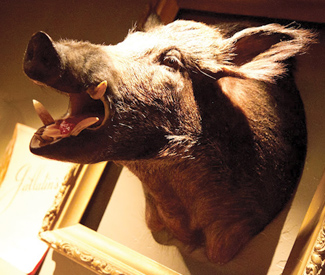
A broad wood door opens onto a series of enchanting rooms. Red velvet antique couches sit in front of a roaring library fireplace, an absinthe bar is tucked away upstairs, dining rooms are presided over by ghosts that have haunted the house over a century (note Hattie’s Room upstairs). There’s an intimate, one-table dining room, Gallitan’s Room, with a boar’s head guarding relics from the restaurant’s former incarnation as Gallatin’s, a restaurant where presidents and movie stars dined in decades past. The bar is mesmerizing — an illuminated white onyx top glows under slanted roof rafters, imbibers perched in coveted raised booths gaze down at the scene.

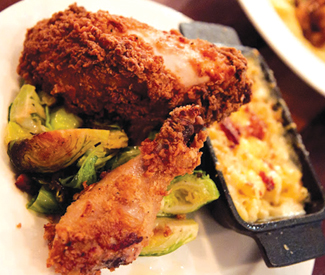
But what about the food? This no style-over-substance scenario. Chef Levi Mezick’s menu wanders from whole-roasted meats to pizzas and pastas. There’s bone-in ribeye for two ($75) or a real splurge (temporary until the foie ban kicks in this June) of whole roasted lobe of foie gras ($150). Whole truffle chicken ($38) is blissfully decadent. The chicken is brined for two days with truffle butter injected under the skin. Pizzas ($16-17) are topped with Dungeness crab and leeks or pineapple and sopressatta, while dense, pillowy gnocchi ($22) rest in Parmesan cream with Swiss chard, chanterelles, pickled onions, and crispy croutons.

Appetizers shine, like a delicate beet salad ($12) accented with Greek yogurt and hazelnuts, or a heartwarming helping of bone marrow ($16) with horseradish crust. Bites offer more gourmet delights, particularly fresh, raw hamachi ($6) dotted with pickled jalapenos, avocado, oranges. Among the best items on the entire menu are $4 biscuits: sundried tomato feta biscuits with roasted garlic basil butter or a bacon cheddar biscuit with maple chili butter. Both are flaky, dreamy delights, warm and soft under a smear of butter.

Generous portions leave you fat and contented, while drink offerings threaten to outshine the food. Wine director Ted Glennon curates a playful, sophisticated wine list highlighting the best of the Central Coast and the world. His passion and palate have deservedly led to accolades such as being named one of 2012’s Food and Wine’s top 10 sommeliers. Glennon’s wine list is whimsically annotated with comments such as this one about Chardonnay: “The blonde bombshell has taken the hearts of so many…”

http://www.youtube.com/watch?v=kKY1F0jQank

There’s no slacker in any of his pairings. I was absolutely smitten with 2000 López de Heredia Viña Tondonia Rosé ($50 bottle). This stunning rosé is unlike any I’ve ever had, crisp and acidic, yes, but also funky, earthy, with notes of mushroom and ripe cheese. As it sits it sweetens, evoking sherry while maintaining its crispness.

Local highlights were 2006 Caraccioli Cellars Santa Lucia Highlands Brut Rosé, a dry, floral, sparkling beauty, and 2007 Pelerin Wines Rosella’s Vineyard Pinot Noir, from a Santa Lucia micro-winery producing age-worthy California Pinot. With acidity and body, green tea and licorice notes play with cranberry and dark cherry — lovely with the truffled chicken.

As a cocktail destination, 1833 has no equal in the entire area. Bar manager Michael Lay oversees aging cocktails in barrels with colonial names like Betsy and Abigail. Lay’s talent is apparent in a range of classically influenced cocktails like Commander in Chief ($11), Bulleit Rye whiskey, Carpano Antica sweet vermouth, Campari, Cherry Heering, and orange bitters with a peaty Laphroaig Scotch rinse.

Besides a tableside absinthe cart (brilliant), offering some of my favorites like Duplais or Vieux Pontarlier, Lay makes a mean Hot Buttered Rum prepared tableside. His recipe is perked up with pumpkin pie spice and lemon peel. My favorite cocktail here is a twist on the Penicillin, a Penicillin No. 2 ($11). Instead of Scotch, Lay uses Tres Agaves Reposado Tequila and tops the drink with smoky mezcal, alongside the usual lemon and candied ginger. Further fun is had comparing barrel-aged Negronis, a nine-week-aged Abigail ($12) using Tanqueray gin, Campari, Amaro Nonino, Carpano Antica sweet vermouth, and Ruth-Anne, a more gin-forward Negroni.

We’ve seen each of these parts, yes, but not this exact whole. I long for more settings in my own city as bewitching and multifaceted as 1833. Thankfully, Monterey is not too far away. *

RESTAURANT 1833

500 Hartnell, Monterey

(831) 643-1833

www.restaurant1833.com

Subscribe to Virgina’s twice-monthly newsletter, The Perfect Spot, www.theperfectspotsf.com


Parks and leaks

0

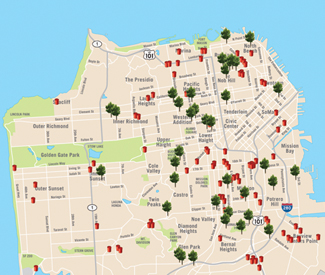
THE GREEN ISSUE It happens suddenly, unexpectedly: you turn a corner or hike up a street and notice, almost out of the blue, a well-kept spot of green, a surreal bit of nature sliced out of all the housing and concrete. According to a list provided to us by San Francisco Recreation and Parks (www.sfrecpark.org), there are 46 designated mini-parks, or pocket parks, nestled in various SF neighborhoods: publicly maintained, accessible areas usually no bigger than the size of a single vacant lot. We set off to discover five perhaps lesser known ones, described in the map below.

Then, in a nod to one of our all-time favorite cartographic-experimental books, Infinite City by Rebecca Solnit (UC Press, 2010, www.rebeccasolnit.com) we decided to overlay a map of locations of leaking underground storage tank (“LUST”) cleanup sites, found at geotracker.waterboards.ca.gov. LUSTs are buried tanks of toxic material, usually containing petroleum but sometimes solvents or other hazardous waste, that threaten groundwater, soil, and air and must be cleaned up — often with the help of state and federal funds — before the land they’re beneath can be built on or repurposed. We’ve plotted 85 LUST sites, many of them former or current gas station locations, whose statuses are under assessment or being monitored or remediated.

There is no direct connection between mini-parks and LUST cleanup sites; we think, though, that there is the suggestion of an environmental tale, a hidden history maybe, in the visual juxtaposition of the two.

>>CLICK HERE TO SEE THE MAP (PDF)

Sea, here

0

arts@sfbg.com

>>See more astounding images from Beneath Cold Seas here.

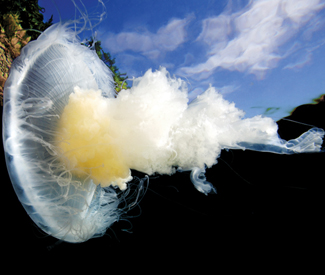
THE GREEN ISSUE Most people associate underwater photography with the tropics, but the beautiful shots that appear in Beneath Cold Seas (University of Washington, $45, 160pp) were shot in the Pacific Northwest. What’s most striking about the book is the color and vibrance that photographer David Hall was able to capture. It’s a bit mind-blowing to imagine that the hooded nudibranches and grasping octopi found in the book live in the inky depths abutting our very own rocky shores. The next time you take a dip at Baker or Muir Beach don’t forget that you’re frolicking with some seriously stunning fauna. 

SFBG: Where did you shoot Beneath Cold Seas?

DAVID HALL: I shot Beneath Cold Seas in British Columbia. The water tends to be more clear and there’s less pollution because of the small population density. But the same animals in the book are found in Northern California, they don’t recognize international borders. Technically biologists say the ecosystem extends from Southern Alaska down to Point Conception (north of Santa Barbara). That entire area is referred to as the Pacific Northwest.

SFBG: What environmental issues are facing the Pacific Northwest?

DH: One problem is the introduction of alien species. For instance farm-raised salmon taken from New England genetic stock occasionally escape and interbreed with the five or six Pacific species. So you’re getting a genetic mixture which endangers the original Pacific species. But the environmental issues that most people are worried about are overfishing and pollution, like oil spills. As more Canadian oil is being developed and exported to places like China, it will have to be shipped across these waters. So that becomes a concern, especially after what happened in the Gulf of Mexico last year.

SFBG: When did you start taking photos underwater?

DH: Many years ago I took a trip to the Virgin Islands. I’d never seen a coral reef before and was completely overwhelmed by what I saw while snorkeling. I felt that I had to photograph it because I’m not so good at describing things. I went out and bought the best camera I could afford which was a Kodak Instamatic in a plastic housing with flashbulbs. That was how it all started. In those days the bar was very low, if you got an underwater photograph that was somewhat recognizable you could get it published.

http://www.youtube.com/watch?v=NgDfA61OpFI

SFBG: What would you say inspired this project?

DH: At first I started going because I loved the diving, I enjoyed being there and getting photographs. But after the first half dozen trips I realized that the material I was getting was good enough for a book. I got the idea for the book about five years ago, but all in all it took about 15 years.

SFBG: What was a typical shoot like?

DH: I was living on a small boat for a couple of weeks at a time, doing three dives a day, and then reviewing photos at night. The days would be consumed with getting ready for the dive, getting all the equipment on, waiting until the current was just right, getting into the water, diving for an hour, getting back to the boat, getting warm — which takes another hour or two — and then getting ready to dive again. Altogether I made about 500 dives from 1995 to 2010.

Photographing underwater is much more difficult than photographing in air, and photographing in cold water is that much more difficult than photographing in warm water. No one had ever published a good book on underwater photography from a cold water destination in North America before. There are plenty of field guides, and fish ID books for fisherman, but no one had ever published a photographic book that tried to show the character of the ecosystem in an artistic way.

The book required getting a lot of wide angle shots to include the scenery as well as the animals. Getting good clear, colorful photographs in cold water is difficult because of visibility issues. Also cold water filters out all of the warm colors in the spectrum (red, orange, yellow) so to see the colors you have to add light back. So I dive with a pair of powerful flash units that attach to the camera by way of articulated arms that keep my hands free.

SFBG: So there wasn’t someone handling lighting for you?

DH: If I were a National Geographic contract photographer I’d probably have had a few assistants holding lights for me, but I wasn’t so lucky. I had to do everything myself. And in most cases I was diving completely alone.

SFBG: People don’t associate such colorful and exotic creatures with our coast. It’s really wonderful that your book is changing that perception.

DH: I certainly hope that’s what’s happening. The book has been very well received, largely because nobody was aware of what was down there. I mean marine biologists and divers were, but ordinary people had no idea.

People tend to protect what they know and value. Most Americans and Canadians are familiar with the aquatic species that we eat, but there’s a whole ecosystem there that the great majority of us are completely unfamiliar with. I hope my book will make people aware that these things exist and want to feel more protective toward that whole environment.


Rollercoaster

0

arts@sfbg.com

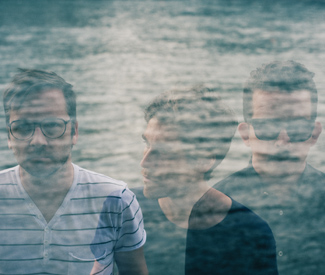
MUSIC “I get frustrated when things are repeating in life,” says Jon Philpot of Brooklyn trio Bear In Heaven. “I feel like I’m always trying to find ways to push people into doing things that maybe they don’t feel comfortable with or haven’t done before.”

Phlipot’s penchant for pushing boundaries is likely why each release from these experimental indie rockers is a metamorphosis from one sound to the next. For its third full-length, I Love You, It’s Cool, out yesterday on Dead Oceans/Hometapes, Bear In Heaven embraced a pop sensibility that transformed its inventive layering of swirling, cosmic textures into its most approachable work thus far.

“I wanted to make a dance record, that’s for damn sure,” Philpot explains. “We didn’t make a dance record, so we ended up with a record that’s somewhere in between [that] and what we are.” Philpot’s catchy vocal melodies lend an element of familiarity to the epic arrangements of pulsing, otherworldly synthesizers, distorted guitars, and dizzying percussion on I Love You, It’s Cool.

It’s a far cry from the bizarre, down-tempo dissonance of 2007’s abstract debut Red Bloom of the Boom, but the transition is apparent on its sophomore effort, Beast Rest Forth Mouth, which looked toward a new pop sound while one foot remained firmly planted in droning, avant-garde territory.

A surprisingly warm reception to the second album culminated in a year and a half of extensive touring, which also helped shape the band’s current aesthetic. “We used to be like — we didn’t want the audience to enjoy themselves,” says Philpot. “Like, ‘You’re gonna come to our show? Alright, prepare. We’re gonna shred your ears open.’ [Now] we’re into it. When the crowd’s into it, it’s nice.”

In making I Love You, It’s Cool, Bear In Heaven was unfazed by the weighty expectations that came with Beast Rest Forth Mouth‘s success. “We sort of closed our eyes and ears to all that noise and just made a record that we felt good about,” he says. “We wouldn’t do that kind of thing, try and make something that doesn’t feel natural. There’s not enough incentive in it for us to do that. This is what we are, this is what we’ve done, this is what we’re gonna continue to do. If you like that, welcome aboard.”

On board with these straight-shooters is a curious number of fellow musicians. “I don’t know why that is, but musicians love us,” he remarks when I mention spotting drummer David Prowse of Canadian rock duo Japandroids in a Bear In Heaven t-shirt. “I guess we’re pretty fun to hang out with, that’s one thing. We’re getting a steady normal people fanbase, too.”

Fans recently got a taste of the new tracks at South By Southwest in Austin, TX. “I was nervous,” Philpot admits. “There was a lot to figure out still. At each [show], we fucked up at least once during a song, but I think all in all it was really good. There were a lot of people there.” Philpot also tells me he’s building a light show the band can manipulate from on stage, sounding a little uneasy when he says, “It could be chaos.”

In the kaleidoscopic video for the album’s charming lead single, “The Reflection of You,” cameras zoom in and out on Philpot, guitarist Adam Wills, and drummer Joe Stickney at a rapid pace as strobe lights flash beneath them. It’s a hyper-stimulating, entirely accurate depiction of the band’s sound; once the rollercoaster ride is over, you can think of nothing but jumping back in line and doing it all over again.

BEAR IN HEAVEN

With Blouse, Doldrums

Sun/8, 8pm, $15

Independent

628 Divisadero, SF.

(415) 771-1421

www.theindependentsf.com

Dream Layers

0

arts@sfbg.com

MUSIC Unable to resist a siren song with dark underpinnings, hanging low with heartbreak then taking you higher? Let Chairlift co-founder Caroline Polachek love you down when it comes to “Take It Out on Me,” off her Brooklyn band’s second album, Something (Kanine/Sony).

Maybe it has to do with the choked-up soul with which Polachek wraps her hollowed-out vocals around the fat, round syllables of the chorus, “Forget forgiveness / Forget all the rules / Just please don’t do it here / Bring on the fire / Cause business is cruel.” Or the way that the track’s clear, bell-like synth tones shiver delicately in the background — icicles pelted by a thunder shower of arpeggios. But the overall effect sounds like a consummate sad girl’s hit, à la Bonnie Tyler’s “Total Eclipse of the Heart.”

“That’s one of my favorite songs on the record,” Polachek, 26, says sincerely as her band’s vehicle makes its way to Montreal for a show. “I don’t want to get all emo on you in an interview, but it was about a frightening series of events in a dream. My dream family was being threatened, and I offered up myself in exchange for them and I was killed. I witnessed my own funeral at the end, too…”

She abruptly stops. “Wow, we just saw an eagle, a big white raptor!” A moment later she’s back. “There’s all kinds of vultures circling above us. Well, if our vehicle goes missing, you’ll know where we were!”

Edging away from that particular blackened fantasy, Polachek — part visionary with a watchful, Patti Smith-like eye for opportune inspiration and part down-to-earth every-girl happy to start an interview late so she can eat a sandwich — quickly picks up her thread once more: the blazing hot August 2010 day she and bandmate Patrick Wimberly, 27, worked on the song.

“The idea for the vocal movement came into my head, and I got excited about how it was sounding together, but all I could think about this was this horrible dream I had. The mood of the song was so sexy and fun and grooving, but this mood was so dry and awful and dark — somehow the two things happening at once was what that was. I think that’s one of the neat things about this record — there are layers like that, and darker songs have elements of lightness.”

The feeling of willingly bearing adulthood’s burdens — Chairlift co-founder Aaron Pfenning is long gone — combined with Polachek’s tendency to gravitate to the uncanny has rarely sounded so sumptuously effervescent than with the compulsively listenable, synth-dominated, and undeniably ’80s-hued Something.

If you’re itching for pop hooks, discover “Met Before” and “Amanaemonesia,” but if you’re yearning for aural thrills and spills, you’ll find those, too — in the spiraling Slinky keyboard runs of opener “Sidewalk Safari” and the tinkling, buzzing textures of “Frigid Spring.” The feeling of hermetic sonic richness, combined with Polachek’s undulating jazz- and R&B pop-touched vocals, stands alongside nothing less than Kate Bush’s The Dreaming (EMI, 1982) in its epic scope, tapestry of fictions, and blending of pop and prog.

“I was thinking a lot about textures when I was working on this record,” explains Polachek. “I kind of have a mental genre in my own head that kind of sounds like swimming pool music — with a chorus on it that makes everything sound not culturally cool but literally refreshing. Things that sound frosty and crystalline.

“And I got into a mental genre of sounds that were acidic and driving, like a dragon opening its mouth and hissing,” she continues. “I was gathering playlists, and some of those ideas found their way into the record. We’re living in a really playlist-y age, digging through the crates of history. I’m really into new age bath-time music.”

Unfortunately while the pair was busy drawing Something‘s warm bath, Polachek’s art-making has fallen by the wayside, apart from Chairlift videos. Still, her creative energies have obviously found a consuming outlet in her band. “It’s about all the desire,” she says, “to play like little kids play.” 

CHAIRLIFT

With Nite Jewel, Seventeen Evergreen

Tues/10, 8pm, $15

Independent

628 Divisadero, SF.

(415) 771-1422

www.theindependentsf.com

Outer outer space

0

FILM Nothing dates faster than yesterday’s futurism. Yet particularly at a moment when half the country seems bent on ordering us back to the past — a past that might variably be identified as the Victorian era, the Inquisition, and the Dark Ages — there is something comforting in revisiting old visions of the future. For the next seven Thursdays the Vortex Room boldly goes a few places you’ve probably been before, several that earn brownie points for foreknowledge, and others that separate the sci-fi nerd from the sci-fi mega scholar.

The familiar titles are still on the cultish side, like the intentional-camp nirvana created by a double bill of 1980’s Flash Gordon and 1968’s Barbarella. Likewise on the spoofy side is John Carpenter’s 1974 feature debut, Dark Star. Also fairly famous is horror specialist Mario Bava’s 1965 Planet of the Vampires, a gorgeous color nightmare.

But the rest of the “Starship Vortex” series dwells in forgotten netherworlds of cosmic fantasy from the advanced minds of Italian and Danish exploitationists, as well as Communist bloc filmmakers with higher budgets and less strictly-commercial aims. The sole all-Yank effort here is also the earliest, 1961’s endearing The Phantom Planet, whose brave new universe of 1980 finds an ever-belligerent Ugly American astronaut stranded among Lilliputians (who shrink him down to their size — the nerve!), whose females fight over this rugged lunk. The assertively bad acting, quaint FX, heavy (and heavy-handed) religious-philosophical overtones, dorky monster, and credit for “Electronic Space Equipment by Space Age Rentals” make this a classic of black and white sci-fi silliness.

On the other side of the Iron Curtain, however, people were taking space exploration very seriously — and no wonder, since the films were state funded, and the U.S.S.R.’s space program was one indisputable success in which (for a while) it even outpaced the West. Typically earnest was 1963’s Czech Voyage to the End of the Universe. Satellite “town” Ikaria XB-1 and its 40 inhabitants are liberated from Earth orbit and sent to the closest star outside our solar system. There’s much attention to interpersonal relationships (as well as scantily clad gymnastics in the exercise lounge — hey, fitness is important), and despite desultory suspense around radiation exposure, our interplanetary future ultimately looks bright.

Interestingly, an assumption shared by nearly all the features here is that any future enemies we faced would be from “out there.” The inevitable sprinkling of jerks aside, humanity would have long since been joined in peace and prosperity by a one-government body à la the United Nations. Try floating that concept now.

http://www.youtube.com/watch?v=4PQjCyMfFi8

In the Me Decade and after even Socialist sci-fi lightened up, discounting the thesis statements made by Tarkovsky and his ilk. The East German-Romanian In the Dust of the Stars (1976) is a fair riot of silliness as Earth voyagers sample the high life on Tem 4 — interpretive dancing, flavored inhalers, snakes slithering around party smorgasbords — until our heroes discover the planet’s secret slave underbelly, prompting revolutionary class struggle. Just a bit more sober is 1981’s Soviet To the Stars by Hard Ways, in which an ethereal sole survivor is found on an alien spaceship and brought to Earth, then taken back to save her home planet from death by industrial pollution. It’s a rare post-1977 sci-fi film not influenced by Star Wars, which was imitated more shamelessly the further you went down the exploitation-cinema tunnel — at least by anyone not using 1979’s Alien as their model. Italy, second only to the U.S. as the drive-in era’s international trash exporter, ground out countless grade-C space operas like 1979’s Star Odyssey (featuring such spectacular budget-sparing action as two people using their minds to open a door); even Star Pilot, originally shot in 1966, was retitled, re-edited with footage “borrowed” from other movies, and re-released in the U.S. 11 years later to cash in on George Lucas’ bonanza.

Nothing, however, will ever equal the plagiaristic zeal of 1982’s The Man Who Saved the World, a.k.a. Turkish Star Wars, which took full advantage of Turkey’s disinterest in copyright law to slap together an unforgettable contraption combining acres of actual Star Wars footage, other stolen elements, and new scenes putting a distinctive bargain-basement regional spin on the whole affair. Gauze too expensive for your zombie-mummies? Use toilet paper!

If you haven’t overdosed on “futuristic” pastel track suits or annoying comedy robots yet, elsewhere in the Vortex series there’s the relatively big budget 1969 British Journey to the Far Side of the Sun, a “parallel planet” tale at its best when flaunting the obvious influence of the prior year’s psychedelic “trip” sequence in 2001: A Space Odyssey. Way down the production-values scale, 1967 European co-production Mission Stardust features then-hot Swedish sexpot Essy Persson, who utters the line “Those robot creatures are great tailors, but they haven’t a clue how to put buttons on.” Denmark’s 1961 English-language Journey to the Seventh Planet adheres to the lava-lamp school of color design in portraying astronauts under mind control that materializes their thoughts — all of which seem to run toward pin-up girls (including a former Miss Denmark!) in lingerie. 

“STARSHIP VORTEX”

Through May 17

Thu, 9pm, $7

Vortex Room

1082 Howard, SF

www.myspace.com/thevortexroom

Cooking without borders

0

By Cynthia Salaysay

arts@sfbg.com

VISUAL ARTS The aura of old wars was in the room. Sock-footed, sitting on the floor eating bowls of ramen in the old barracks of the Marin Headlands, we were cozy and well-defended from the coastal fog. Once, these barracks were used to keep the Japanese out. But now we were welcoming them in, with every slurp of soup.

This was an art event about food and Japan. OPENrestaurant, an art collective of restaurateurs and cooks from the community around Chez Panisse, has been hosting events like these for the past four years. It’s the Alice Waters ethos applied to social practice art — creating food happenings where participants forge new connections, and a deeper understanding of food can hopefully occur.

This particular night, a foggy one at the Marin Headlands Center for the Arts, was a quiet one — no pigs butchered, or poultry running amok. It was a show-and-tell of the collective’s OPENharvest project of last fall, in which members — such as Jeremy Tooker from Four Barrel, Kayoko Akabori of Umamimart, and Sam White and Jerome Waag (current head chef) of Chez Panisse — met with people from the Tokyo food scene, to cook and eat beside them during rice harvest season.

Scattered throughout the room were mementos of the trip that spoke of the commonalities and the strange differences between the two cultures. eatlip gift: Cook book for Cooking People showed page after page of Saveur-esque snapshots of food — but no text. A stack of Café Sweet magazines sat next to the Four Barrel coffee cart, one of which featured photos from the Four Barrel café on Valencia. A small bottle of extra virgin olive oil was labeled in traditional Japanese brush script.

Ramen was served, the meaty broth spiked with Meyer lemon, and topped with gushy, soft-boiled egg. So were Japanese whiskey highballs, ubiquitous in Tokyo bars.

“There is this parallel community of people out there, who appreciate art and food in the way we do,” said White, a principle organizer of OPENharvest. “In the Bay Area it’s like preaching to the choir, people appreciate foodie-artsy-whatever. But to take it to a different culture, with a different food style, plug in some of our philosophy and have it work — that was super rewarding.”

During their trip, they made collaborative dinners with local chefs. Making bouillabaisse involved fishing in Tokyo Bay and calling farms for produce — an uncommon practice there. Local olive oil and wine was used. Dishes combined Japanese and California influences, for example using chestnuts, and kabocha squash as a stuffing for ravioli. Wild deer was butchered in front of their guests, and served.

“Everything tasted sweeter there,” said Waag.

Jonathan Waters, wine director at Chez Panisse, also took part. “The Japanese approached wine with an open palate. They were not conditioned to attach flavors to a construct — like dry or sweet. They were more open to the ethereal, mysterious qualities in wine.”

The Japanese were just as receptive to learning from OPEN members. “It seemed like it was a good time in the psyche of their country to talk about food,” said White. Sourcing of ingredients take on new meaning in a country dealing with the effects of radiation on agricultural areas.

But, said White, “Our Japanese friends said to us, ‘We don’t want to make this [event] a memorial to Japan.’ They didn’t want it to be just about radiation. That definitely exists, that’s a real thing, but there’s also a whole country with a future, stuff to hope for, and work towards.”

Last fall’s trip continues to have socio-cultural impact. The restaurants they worked with continue to call farmers directly for produce. And Japanese chefs and artists have since come to learn, cook, and do projects here in the Bay Area.

“Part of me feels like it’s not over,” said White. “Because what happened was we opened a door.” 

www.openharvestjapan.com


We and Mr. Jones

1

caitlin@sfbg.com

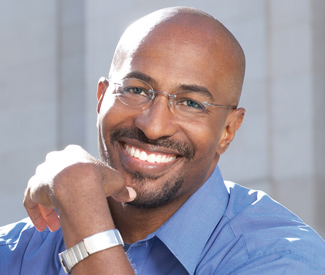
THE GREEN ISSUE No one can accuse Van Jones of being a one trick pony. In the early days of his activist career he monitored police violence in the Bay Area, and from there gradually widened the frame of his activist efforts. Jones formed the Ella Baker Center for Human Rights in Oakland in 1996, then became a green jobs pioneer, promoting environmentally-friendly work in low income communities — a revolutionary tactic that eventually landed him a short-lived adviser position within President Obama’s Council on Environmental Quality.

In his new book Rebuild the Dream (Nation Books, 278pp, $25.99) Jones has expanded his talking points to include the ways in which the financial sector has let us down, how Obama only did what we forced him to do (we gotta yell louder, Jones says), and how we can help fix the economy by focusing on “collaborative consumption.” Call it holistic activism. He’s launched a national junket to talk Rebuild that will bring him to the Commonwealth Club on April 16.

It is perhaps this kind of nuanced approach that scared the bejeezus out of the conservative demagogues whose smear campaign convinced Jones to resign from his White House post in 2009. Leave it to Glenn Beck to shame someone for saying he wanted “a whole new system” (as Jones proclaimed in a speech at a youth climate change conference.) The conservative media accused Jones of a communist past — which was accurate enough — and of signing a 9/11 truther petition that said that George Bush had prior knowledge of the World Trade Center attacks. He was innocent of this last point, the organization in question admitted months later, to a deafening media silence.

But Jones hasn’t retracted his call for a new system. In fact, in the pages of Rebuild the Dream he seems to step into a post-resignation hybrid role, in which he is no longer an outsider activist, but still has no formal role in Washington, D.C. Accordingly, he seems less fired up by the actions of national politicians as the agenda-pushing energy of the Tea Party and Occupy movements, which his new book spends entire chapters analyzing and critiquing. Even certain innovative businesses get a shout-out.

“You have Kiva, Kickstarter, Airbnb, and Zip Car already beginning to point to a future economy where more people are sharing fewer things,” Jones told the Guardian in a phone interview last week. “That’s good for people and the planet. You are also are saving money and you’re relying on people and relationships rather than dollars, you’re refinancing your social capital.”

He calls this economic ethos “collaborative consumption,” and it’s a heady idea for proponents of self-sustaining communities. Building a new economy on this business model, however, will take some tweaking that’s not covered in Rebuild — the city-level debate on whether SF Airbnb users should be subject to the city’s 14 percent hotel tax is one current-day example of how things can get complicated.

Rebuild offers a fairly honest critique of Obama’s successes and failures during the president’s first year in office. Nonetheless, the timing of the book, with it’s underlying message that we need to stay engaged in the political system to achieve real change, seems somewhat cagily timed. Is Rebuild the Dream part of Obama’s re-election campaign?

“The answer is no,” Jones is quick to reply. “We’re a non-partisan organization, we don’t endorse political candidates.”

But the election year publication is no coincidence: he wants all candidates to start talking about fixing the institutional reasons behind inequality.

“The two factors once used to pull people out of poverty were home ownership and education,” he says. “Those have now become the two factors by which people are being pulled into poverty because of the underwater mortgage problem and the fact that kids are coming away from college with massive debt and no ability to get a job. We think that these are issues that the politicians need to be forced to respond to and rethink.”

VAN JONES

April 17, 7pm, $20

Commonwealth Club

595 Market, second floor, SF.

(415) 597-6700

www.commonwealthclub.org


Solo mio

0

FILM The phenomenon of grown children remaining under (or returning to) mom and dad’s roof well after the customary sell-by date has been a regular topic of late in American entertainment and pop sociology.

In Italy, however, that situation is hardly seen as representing some sort of domestic evolutionary failure. In fact it’s pretty normal, for reasons that include differing attitudes toward real estate (few would sell a flat that’s been in the family for generations), perpetually bleak employment prospects (all the worse sans nepotistic connections), and the umbilical cord seemingly never severed between mothers and sons.

It’s not for nothing that the country where the Pope lives is Ground Zero for the Madonna-whore complex. Art and life have so frequently reinforced notion that for Italian men, there are only two relevant kinds of women: the kind they want to fuck, and Mama.

Gianni Di Gregorio is both a triumph over and cautionary illustration of the aging uomo, racking up decades of experience yet still infantilized by that most binding tie. He’s a late bloomer who’s long worked in theater and film in various capacities, notably as a scenarist for 2008’s organized crime drama Gomorrah. That same year he wrote and directed a first feature basically shot in his own Rome apartment. Mid-August Lunch was a surprise global success casting the director himself as a putz, also named Gianni, very like himself (by his own admission), peevishly trying to have some independence while catering to the whims of the ancient but demanding mother (Valeria De Franciscis) he still lives with.

Di Gregorio thus entered the rarefied realm of writer-director-actors who make lightly fictionalized but essentially autobiographical movies about themselves. That kind of enterprise can go either way — insufferable or delightful, indulgent or insightful. Fortunately, Lunch was charming in a sly, self-deprecating way, and The Salt of Life is more of the same minus the usual diminishing returns. The creator’s barely-alter ego Gianni is still busy doing nothing much, dissatisfied not by his indolence but by its quality. But his pint-sized, wig-rocking, nearly century-old matriarch has moved to a plush separate address with full-time care. That plus her extravagant generosity to friends and employees is eating up Junior’s hopeful inheritance.

Having exhausted his own pension (he was forcibly “retired” at 50, and one senses he didn’t exactly knock himself out looking for other work), Gianni views mom’s spendthrift twilight with whiny but helpless dismay. Under his own roof, there’s more functional disorder: daughter (Teresa Di Gregorio) comes and goes, often less visibly than the on-off boyfriend (Michelangelo Ciminale) who stays here overnight more often than at his own parents’ place. It takes some time to figure out that Gianni’s wife (Elisabetta Piccolomini) lives here too, since their relationship has obviously long ceased to extend co-parenting and tenancy. He is, as they say, at liberty.

Salt‘s main preoccupation is Gianni’s discovery that while he’s as available and interested in women as ever, at age 63 he is no longer visible to them. Surrounded by femininity in low-cut dresses — while lower-key, this movie stares open-mouthed at breasts as fervently as Italian sexploitation king Tinto Brass does asses — he is depressed to find they perceive him in asexual terms. (It is particularly wounding when a sexy neighbor says she had a “beautiful dream” about him … in which he was her grandfather.) A still randy lawyer friend (Alfonso Santagata) trying to get him back into circulation advises, “An old engine that’s been abandoned for years and gone rusty needs time to start working again.” The screenplay attempts lubricating Gianni’s gears via Viagra and, later, an accidental dosing of some party hallucinogenic.

While Fellini confronted desirable, daunting womanhood with a permanent adolescent’s masturbatory fantasizing, Di Gregorio’s humbler self-knowledge finds comedy in the hangdog haplessness of an old dog who can’t learn new tricks and has forgotten the old ones. Nearly as food-focused as his first film, The Salt of Life is like a rich home-cooked meal lent gentle absurdity by the cook’s constant worrying aloud whether his digestion can still take the strain. *


THE SALT OF LIFE opens Fri/30 in Bay Area theaters.

Mister Vengeance

0

FILM Iran is the kind of nation where political protest in public art has to be muted or disguised. It was well buried in recent hit A Separation, and is just slightly more apparent in Rafi Pitts’ The Hunter. Shot and set during the contentious 2009 Presidential campaign — Pitts is a rare expat filmmaker allowed to shoot in the country his family left decades ago — it starts as a Kafka-esque portrait of quiet desperation in a cold, empty Tehran, then turns into a sort of existential thriller. The precise message may be ambiguous, but it’s no surprise this two-year-old feature has so far played nearly everywhere but Iran itself.

Ali (Pitts) is released from prison after some years, his precise crime never revealed. Told that with his record he can’t expect to get a day shift on his job as security guard at an automotive plant, he keeps hours at odds with his working wife Sara (Mitra Haijar) and six-year-old daughter Saba (Saba Yaghoobi). Still, they try to spend as much time together as possible, until one day Ali returns to find them uncharacteristically gone all day.

After getting the bureaucratic runaround he’s finally informed by police that something tragic has occurred; one loved one is dead, the other missing. When his thin remaining hope is dashed, with police notably useless in preventing that grim additional news, Ali snaps — think Peter Bogdanovich’s 1968 Targets. He’s soon in custody, albeit in that of two bickering officers who get them all lost in the countryside, the terse but strikingly shot film now recalling elements of Jerzy Skolimowski’s Essential Killing (2010) and Nuri Bilge Ceylan’s Once Upon a Time in Anatolia (2011) in its endless pursuit through imposing landscapes.

Pitts, a long-ago child performer cast here only when the actor originally hired had to be replaced, makes Ali seem pinched from the inside out, as if in permanent recoil from past and anticipated abuse. This thin, hunched frame, vulnerable big ears, and hooded eyes — the goofily oversized cap he wears at work seems a deliberate affront — seems so fixed an expression of unhappiness that when he flashes a great smile, for a moment you might think it must be someone else. He’s an everyman who only grows more shrunken once the film physically opens up into a natural world no less hostile for being beautiful.

Ali actually does hunt game, earlier on — but in The Hunter, we glean he’s been the hunted one way or another his whole life. The film’s score is sparse percussion that, like the drums in Eugene O’Neill’s The Emperor Jones, count down toward an inexorable extinction that bears mythological (or authoritarian) fate’s hand. 


THE HUNTER opens Fri/30 at the Roxie.

Domestic violence: A Latina, feminist perspective

0

Earlier this week, we posted an Op-Ed piece by Myrna Melgar which has been receiving a lot of attention. The piece was orginially published on the blog of publisher Bruce Brugmann, and then in this week’s paper. Click here to read the original post

Inside-outside

0

le.chicken.farmer@gmail.com

CHEAP EATS One of my favorite places to be is at the foot of Potrero Hill in Jackson Park, where I played pick-up baseball in the 1990s and soccer in the 2000s. It’s very unclaustrophobic around there, maybe you’ve noticed. Although: the air is thick with Anchor Steam hops and, for me, memories of athletic style glory such as grounding out to third.

Shit, I got old. Wait. Did I? I am sappy and nostalgic. My foot hurts and I have to “put it up.” I take fiber supplements. Loud music annoys me. I’m almost always cold. We are looking into getting a camper.

Very soon, if all goes as planned, I will be able to stick my hands in boiling water like Grandma Rubino did. And then I will know that I have made it.

Meanwhile, there’s laundry to do. I have a football game tonight and all my sports bras are stinky from playing soccer and soccer and racquetball and ping-pong, so — wait a minute — maybe I’m not old.

Yeah. Maybe loud music only annoys me when it isn’t the Verms. Which it was one time, at Thee Parkside. At the foot of Potrero Hill. Across from Jackson Park.

One of my favorite things about San Francisco these days is that bar food is stepping up — and in interesting ways such as crawfish grits and wedding soup at Broken Record, the whiskey-infused bacon burgers at Bender’s, and fried pickles and chili-cheese tater tots at Thee Parkside.

The burgers aren’t as good as the ones at Bender’s, though. Come to think of it, the tater tots aren’t either. But the music is better, especially on Twang Sundays. That must have been what it was when I saw the Verms there.

Now, the Verms. The Verms are by miles and miles my new favorite band. It’s Earl Butter! What this means is the songs are about underwear and pork sandwiches. In fact, as serendipity would have it, they played the pork sandwich song while we were eating ours.

We were me, Hedgehog, and Kayday, sitting and standing around a small, tall table near the door. Kayday wasn’t eating, and Hedgehog wouldn’t tell me what she wanted.

“Surprise me,” she said.

So I went out to the patio and stared at the menu for about a half hour. There were kids running around, people eating, people waiting to eat, people dancing.

It’s really nice, the indoor-outdoor layout of the place. You can adjust your volume, light, and air intakes simply by poking around the premises. In fact, there used to be a ping-pong table in the way-back, but I forgot to notice if it was still there.

Anyway: pork sandwich. Yes. And a bacon burger with barbecue sauce. Skinny fries. Tater tots. The idea being a 50-50 split.

This was before the goddamn gluten-free garbage, praise Jesus, or I’d have had to eat all the buns and none of the meat. As it was, I messed up anyway.

See, I love barbecue sauce on burgers. Hedgehog — surprise! — does not. Worse, when we halved the burger, luck would have it, she drew the slathered half and mine had next to none — just the first bite, so that I would know what I was missing for the rest of them.

Bite. Damn! Bite. Damn!

I wish we’d have worked it all out in advance, like communicative adults, but it’s hard in bars. The loud music. Lack of light.

By the time we even knew each other’s disappointment, it was too late: The burger was gone.

Ironically, while everyone loves barbecue sauce on barbecue, the pulled pork sandwich came without. Just coleslaw was on it, by which they mean pickled purple cabbage, and a special mayo-y mix, so… hold that.

Good food, great place, amazing show.

Hedgehog still has the set list. She takes it out sometimes, and looks at it.

Me, I’ve gotta go catch some footballs and pull some flags. Tomorrow, hopefully victorious, I set sail for Frisco — and will see you all in the flesh (or thereabouts) next week. At my new favorite restaurant!

THEE PARKSIDE

Mon.-Fri. 2pm-2am; Fri.-Sat. 3pm-2am

1600 17th St., SF

(415) 252-1330

Cash only

Full bar

www.theeparkside.com

Southern obsession

2

virginia@sfbg.com

APPETITE Southern food has a profound hold on me. No, I’m not a Southerner — but few cuisines the world over elicit in me such yearning and comfort. Finding the real deal in the Bay Area is tricky, although a recent Southern trend has helped. Aside from my beloved Brenda’s and delightful Boxing Room, the following spots fulfill cravings.


HOPS AND HOMINY

Recently opened downtown, Hops and Hominy has the charm of being tucked away at the end of an alley off bustling Grant Ave. I must admit, when I saw packed crowds and a neon maraschino cherry (versus a quality brandied one) in my cocktail, I doubted H&H, opened by three Florida natives. But in this early stage, it shows promise.

Despite the cherry and too much ice, a Smoked Bacon Old Fashioned was more balanced than I expected. Using Bulleit bourbon infused with bacon, the drink is thankfully light on maple syrup. This is not exactly a cocktailian’s destination but you can get a decent beverage. Better to go with the beer menu: Dogfish Head 90 Minute IPA and Ommegang Hennepin Saison are examples of the greats they have on tap.

In terms of food, a couple dishes jump out. The most unusual for this setting is espresso-cured chocolate duck ($12). Rare duck is perched on a potato pancake with mascarpone drizzled on top. Chocolate and coffee notes are subtle, adding an unexpected seductiveness to the dish. While the potato pancake doesn’t exactly fit, it doesn’t detract either. Mac ‘n cheese is so common, but here, served piping hot in a skillet ($8), it’s oozing with cheddar goodness and typical house cured bacon. Crispy sage leaves elevate it.

Buttermilk battered chicken ($19) is not the best in town, but free-range chicken is tender and generously portioned. This dish is an ideal way to also try the mac and cheese, a companion along with Brussels sprouts. Deep water shrimp and cheesy Southern grits ($19) work but don’t recall the best of the South.

1 Tillman Pl., SF. (415) 373-6341, www.hopsandhominy.com


HOG AND ROCKS

Hog and Rocks has grown into one of our great casual gathering spots, with better-than-ever cocktails and food, and a winning American whiskey selection. I’ve been a huge fan of the ham platters (the hog) and oyster selection (the rocks) since they opened, particularly when H&R offer such incredible Southern hams as one from Tennessee’s G&W Hamery, lightly drizzled with sweet Fresno chili syrup.

The impetus for recent visits was a new Scott Beattie-designed cocktail menu and new bar manager Michael Lazar. There are longtime Beattie favorites on the menu, like the fall-influenced, whiskey-apple-ginger lushness of his John Chapman. (Oh, that Thai coconut foam!)

Two original drinks are Lazar’s bright Calabria ($11) — Old Grandad 114 bourbon, bergamot, honey, and Averna, bright with ginger beer — and Beattie’s Coastal Collins ($10.50) which stood out with St. George’s fabulous Terroir gin, lemon, soda, bay laurel and huckleberries. It’s a refreshing, herbaceous sipper. Ask Lazar to make you a Hanky Panky, a classic London Savoy cocktail. Lazar tweaks the measurements of gin, sweet vermouth, and Fernet Branca for a more complex, sexy whole.

Foodwise, I’ve long found the pimento cheese in a jar ($7.50) the best in town — bordering on addictive. Recent enjoyments include hefty meatballs ($12.50) in whiskey barbecue sauce over cheddar cheese grits and white cabbage, and fat cheddar beer sausages ($13.50). Standout dish: a Berkshire pork cutlet ($16), prepared like German schnitzel (pounded flat, breaded), in a smoky maple syrup and hot pepper relish alongside Red Russian kale evoking collard greens. Here’s to chef Scott Youkilis’ upcoming BBQ venture across the street, Hi-Lo, due to open this Summer.

3431 19th St., SF. (415) 550-8627, www.hogandrocks.com


THE FRONT PORCH

The Front Porch’s garage sale, drafty charm still works. Over the years, it’s been a consistent source of quality, quirky Southern eats in cozy, worn red booths beneath pressed tin ceilings.

Crab fritters ($9) won me over immediately, packed with fresh, flaky crab meat, dipped in remoulade. Discounting Brenda’s incomparable take and 1300 on Fillmore’s refined twist, Front Porch serves the best shrimp n’ grits in town ($18.50). Bacon and less traditional wild mushrooms add heft to white wine-doused arbuckle grits. The Porch does right by fried chicken ($17 for 3 pieces, $34 for 9 pieces). Though it’s not the ultimate version, tender Rocky Jr. organic chicken satisfies alongside garlic mashed potatoes and collard greens.

You could do worse than finishing with an Abita root beer float — add in bourbon, if you like. Then head across to the street to new sister location, the comfy, divey Rock Bar for a nightcap.

65A 29th St., SF. (415) 695-7800, www.thefrontporchsf.com *

Subscribe to Virgina’s twice-monthly newsletter, The Perfect Spot, www.theperfectspotsf.com


Past, present, future

0

arts@sfbg.com

DANCE This weekend choreographers Robert Moses and Sean Dorsey present new dances. Moses’ Helen, inspired by the myth of the beautiful Greek whose face launched a thousand ships, is at Yerba Buena Center for the Arts; Dorsey’s The Secret History of Love, based on how LGBT people used to meet, plays Dance Mission Theater. Both choreographers started dancing in their hometowns — Philadelphia for Moses, Vancouver for Dorsey — and began choreographing professionally in San Francisco. They recently talked to the Guardian about how they came to be where they are now.

SFBG Do you remember how dance entered your life?

Robert Moses We danced the way kids do. My sister and family members all danced. As teenagers we would get together in clubs where you showed your steps, and you had a contest. You couldn’t just jump around a little bit. You had to be the very best dancer that you could be.

Sean Dorsey My first memory is spinning round the living room in a leotard to “Free to Be … You and Me.” There was a lot of music in my house, lots of artists in my family, and there was a lot of space and encouragement for that kind of activity.

SFBG How did your formal training in dance start?

RM In my last semester in high school, I ended up in a dance class when another class was cancelled. At university, I started training in West African, Haitian, ballet, contemporary, tap, and musical theater. I did all of it because I knew that’s what I wanted to do.

SD My big childhood hero was Carol Burnett; my dream was to go into comedy. I was in graduate school in Community Development when I was invited to audition for the dance department. So I started to study dance at 25. It was going to be recreational, but I found that it was my deepest love.

SFBG We all bring our cultural background and life experiences to our work. If and in what way does that influence what you do?

RM Of course, it influences what you do; there is no way that it couldn’t. You are a member of group but you are also an individual who is changing and maturing. Sure, I have put perspectives on American, African American, and displacement issues. The thing to remember is what you do is not who you are.

SD As a transgendered person, a queer person, and an immigrant person, an outsider’s consciousness charges my art-making, and I hope that brings a heightened awareness and sensitivity to the kind of themes that I explore in my work such as family, love, or searching for a place in the world.

SFBG How does the process of making a new piece start?

RM It’s different each time. Sometimes it starts with a topic; sometimes with just a movement. A work might also tell me to lean more on the music or talk more about a subject. I also consider how a piece will be presented within a particular frame. The movement itself is created in the studio by the dancers and myself.

SD My process feels ridiculously long. All my pieces are accompanied by a sound score of narration and music. It takes four to six hours in the studio to make one minute. It’s always music, music, music and words, words, words. Once that is finished, I take the draft to the dancers and we make the movement together.

SFBG What would you like us to know about the upcoming premieres?

RM We are talking about the Greek Helen and the notion of an idealized woman, but also about the way people are the playthings of the gods. I am a fan of Carl Hancock Rux’s spoken word and music; he alludes to the Iliad but I am really interested in how women react to the situations they are in.

SD The show is based on archival research and features the real-life stories and voices of eight LGBT elders, from 1920s speakeasies to wartime love affairs, and the really repressive 1950s.

ROBERT MOSES’ KIN

Fri/30-Sun/1, 8 p.m., $25-$45

Novellus Theater

Yerba Buena Center for the Arts

700 Howard, SF

www.robertmoseskin.org

SEAN DORSEY DANCE

Thurs/28-Sun/1, 8 p.m. (also Sat/31-Sun/1, 4 p.m.), $10-$25

Dance Mission Theater

3316 24th St., SF

www.brownpapertickets.com

www.seandorseydance.com

Sis hop

0

marke@sfbg.com

SUPER EGO Like many of the great, oldish-school Bay Area hip-hop party collectives, the Sisterz of the Underground core crew has skedaddled — founder Sarah Smalls to LA, creative director Traci P. and organizer Crykit to Las Vegas — following their fortunes to other, perhaps fresher climes. But just like those spectacular b-girl (and -boy) cypher dance circles that have been popping up on finer San Francisco floors of late, the Sisterz are returning, hopefully bringing more of that fly feeling back with them.

A huge Sisterz of the Underground 10th Anniversary Celebration on Sat/31 (sisterzunderground.eventbrite.com) includes not just a dazzling nighttime party at Public Works with music by Kid Sister, DJ Shortee, Butterscotch, La Femme Deadly Venoms, Jeanine Da Feen, Green B, Pony P, and more, plus a gallery show of all-female artists, nail art, vendor fair, live painting, and a one-on-one female all-styles dance battle — but also afternoon production tech and dance workshops and a panel discussion about female empowerment and multiculturalism at CellSpace. The Bay is going to get some phenomenal femme in its face, and not a moment too soon OK?

Talking with the Sisterz is a trip — see my full interview on our SFBG Noise blog — with nostalgic name-drops like storied rap and turntablism venue Justice League, the Extra Credit Kru dance battlers (still in effect), graffiti artist Arouz, emcee Inchant, and Def Ed, the incredible education and empowerment program the Sisterz started that reached schools in six counties in the Bay Area before it was disbanded a couple years ago. The general Sisterz network itself is still slamming, with chapters up and down the West Coast, as well as in New Mexico and Brazil.

http://www.youtube.com/watch?v=zOgLK4t-Rts

And the Sisterz still aren’t shy about expressing themselves. When asked about the state of hip-hop, Traci P says, perhaps with a certain super-hyped Bay Area MC in mind, “There is less and less attention paid to substance and more to image and look. Half of these girls can’t even perform live and are in a sense disposable because they have no stage presence. Just a pretty face with flashy clothes and jewelry. At a time when everything seems so fabricated, it’s essential that people be exposed to the roots of the music and the culture.” Werrrd.


SUBB-AN

I caught this UK house wunderkind last year in Berlin at the awesome Tresor club — he played a pumping, expansive set that eventually set off for deeper currents, intricate grooves ride over each other for long periods and innovative technology put into the service of the steamy atmosphere rather than just being “showy.” And he’s cute.

http://www.youtube.com/watch?v=ewt5hS3todw

Thu/29, 10pm, $10. Vessel, 85 Campton Pl., www.vesselsf.com


FORWARD 10TH ANNIVERSARY

Another 10-year banger — this one for adorably talented Adnan Sharif’s Forward tech-house collective, bringing in an absolutely bonkers lineup to move us into the next. Deep and wiggy Clockwork from Milan co-headlines with Seattle smart-techno fave Pezzner, plus Nikola Baytala, the No Way Back crew, and a Silent Disco space out side with Star Kommand and more.

Fri/30, 10pm-5am, $10-20. Mighty, 119 Utah, SF. www.forwardsf.com


LEXINGTON 15TH ANNIVERSARY

Time flies when you’re a flaming hot lesbian! Can it be 15 years already since the proudly dive-y Lex threw open its doors to the gorgeously rough-and-tumble dykes of the Mission and their humble admirers (like yours truly)? Oh hell yes. Congratulate owner Lila and crew on keeping one of the few lesbars in homocity open, with filthy music, smokin’ go-gos, kinky quinceanera shenanigans, and lipstick-obliterating drink specials.

Sat/31, 9pm, free. Lexington Club, 3464 19th St., SF. www.lexingtonclub.com

Two incidents

0

caitlin@sfbg.com

UPDATE: The District Attorney’s office has retracted the memo detailed in this article, and told the Guardian that D.A. George Gascon “unequivocally supports medical marijuana.” Full story here

HERBWISE “If they can successfully take out San Francisco, then medical marijuana is gone,” said spokesperson of SF’s Medical Cannabis Task Force Stephanie Tucker. I had given Tucker a call because I was trying to salvage some meaning from last week.

It was a confusing one for followers of local cannabis news. News broke of the district attorney’s memo calling marijuana sales illegal (more on this later). They canceled Discovery Channel’s Weed Wars reality TV show. Thieves dressed as ninjas robbed a cannabis deliveryperson in West Covina, Calif. Anti-cannabis driving laws were proposed by Chino Assemblymember Norma Torres. In a long-awaited KQED interview with US Attorney Melinda Haag, Haag pegged the blame for the threatening letters she’s sent to the landlords of cannabis dispensaries on unsubstantiated crime spates such businesses invite to their communities. News reports circulated that Florida teen Trayvon Martin had been suspended from school for petty cannabis possession, as if that explained his murder at the hands of a racist crank. In the middle of it all, SF’s Department of Public Health launched a campaign against the sale of hash and medicated edibles — but only for nine hours.

Well then, that’s something. Of this last incident, at least, Tucker could offer some small clarification. On Tuesday, March 20, someone at the DPH sent out a memo outlining steps that could be taken to reduce the unspecified “potential hazards” of cannabis edibles. One of these counseled against selling products that “required concentrating cannabis active ingredients” — products like hash or kief, which is composed of sifted cannabis trichomes.

“Immediately after the advisory was issued, activists were alerted,” Tucker said. The curtailing of concentrated products and edibles especially worried patient advocates because many can’t — or choose not to — ingest marijuana by smoking it. After informal dialogue with the Department, the matter was squashed, the memo’s message retracted by the agency.

That responsiveness is heartening for those concerned with safe and easy cannabis access, though the thought that a city agency would harsh on medical marijuana particularly now, at a time of heightened scrutiny by the federal government, is disquieting. Or perhaps the agency saw the memo as a way to patrol commercialization and increased branding of edible products. In recent years, everything from chocolate-covered waffle tacos to peanut butter energy bars have been infused with cannabis for commercial sale. Ironically, this kind of increased professionalization has also led to tighter quality control testing in analytical labs around the Bay Area — hypothetically making those products safer.

At any rate, cannabis patients won that office memo battle. The same has yet to be determined in regards to another recent threat to patient rights: a 14-page review that district attorney George Gascon’s office produced this month calling out the “marijuana mega-myth.” Stoners will be surprised to learn Gascon used the colorful term (he also employs the use of “semantogenic shell game” to describe efforts to normalize sales, vivid!) in reference to the belief that dispensary sales of cannabis are legal.

What will this mean for the future of SF dispensaries? Without a doubt there will be many more angry phone calls from patients. But it’s already having legal ramifications. The memo was a response to an objection from a dispensary’s attorney who was perturbed by an incident in which the collective’s delivery driver was arrested by law enforcement en route to making a delivery. Gascon’s assertion that the entire business was illegal was surely not the reaction the attorney had hoped for.

Marathon of sound

1

emilysavage@sfbg.com

MUSIC There is just no easy way to define longtime Oakland band, Faun Fables. But here goes: send a classically-trained dark folk duo into the brush and bramble of a snow-tipped forest as part of a nefarious fairy tale, then ask them to sing for their supper. See? It’s difficult.

That’s precisely why the band (Dawn McCarthy and Sleepytime Gorilla Museum’s Nils Frykdahl) was chosen as one of the headliners for the fifth annual Switchboard Music Festival — the eight-hour-long marathon of fearless composers and bands making music that doesn’t fit neatly anywhere elsewhere in the Bay. “The idea with the programming is that a lot of this music doesn’t really have a home because it doesn’t fall easily into one genre or another, so Switchboard is trying to be that home for these groups,” explains co-organizer Ryan Brown.

The day will include 13 dizzying sets: some at just 15 minutes, most at 30 minutes, and two headliners at 45 minutes. Along with Faun Fables, the other headliner is Volti, an a capella chamber choir. “They do this incredible modern music for choir with all these extended vocal techniques and different sounds from around the world,” says Brown. “We’ll have them together on stage [with Faun Fables] for a song or two as well — that’s what I’m really looking forward to.”

Other acts this year include Dominique Leon, Cornelius Boots, Ramon and Jessica, Mercury Falls, Jeff Anderle, Beep, the Hurd Ensemble, and Grains. The SF Conservatory Guitar Ensemble will play a piece composed by Brown on six classical guitars, electric guitar, electric bass, and percussion.

“The sets are short enough that… you hear things back to back and you can sort of start to make these connections between different genres and styles that you might not otherwise make if you were exploring on your own,” says Brown.

Now completing their PhDs in music composition at Princeton, Brown and pal Jonathan Russell first came up with the Switchboard concept shortly after receiving their masters from the San Francisco Conservatory of Music. The two hung around the school after graduating — teaching and working in the box office — and routinely ate lunch together, which is where they discussed a desire to showcase the musicians they’d met. Jeff Anderle, a clarinetist at the school, came in to the discussion and the three came up with Switchboard.

“We wanted to do something that brought together all the amazing musicians, different scenes, and genre-blending zeitgeist that that seemed to be happening in the city,” says Brown. “Genre lines were being deliberately broken down, things were being mixed in strange ways.”

That first year the three organizers just made a list of people they knew who were breaking down those barriers and programmed the event. The first three years the event was held at the Dance Mission Theater, capacity 135, and last year it jumped to Brava Theater, which can house around 350 people. “The sound there is incredible, it’s just a really cool space and size,” Brown says.

And in that space there will be nearly 100 musicians milling about, both in the proper concert room where bands will be playing, and out in the lobby, where there will be merch, food and drink, and a projection of the live music. Attendees will be given wristbands, so they may also mill about during the eight-hour stretch.

As in years past, nearly every band playing the festival is from the Bay Area. It’s been a deliberate choice, as Brown and his co-organizers feel the region doesn’t get the attention it deserves for having such an innovative music scene. And, they feel like they’re filling a niche in that scene.

“There are other festivals here that are doing what they do really well,” says Brown. “Outside Lands, showcasing a certain type of rock music, Other Minds, showcasing a certain type of contemporary music, the jazz festival — but what about the music that doesn’t fit into any of these distinctions?” 

SWITCHBOARD MUSIC FESTIVAL

Sun/1, 2-10 p.m., $15

Brava Theater

2781 24 St., SF

(415) 641-7657

www.switchboardmusic.com


End the healthcare scam

7

OPINION Last year, after receiving data from San Francisco, the Wall Street Journal reported on an investigation into the use of health reimbursement accounts by several local restaurants. It showed a group of employers evading the city’s health care law while charging their customers a “Healthy San Francisco” surcharge that is never actually spent on employees’ health care.

Rather than providing health coverage to their workers, as customers are led to believe, the restaurants are allocating funds for HRAs — and taking back the funds before they can be used.

The numbers speak for themselves: Of the $62 million that was set aside for health care accounts in 2010, more than $50 million was kept by employers.

Workers spoke about never being notified about the accounts; being forced to jump through numerous, often onerous hoops to receive reimbursements or never receiving reimbursements; facing severe restrictions on use of the funds; and fearing retaliation for seeking to access the funds. It was clear that as long as employers can take back unspent funds they have a large incentive to restrict workers’ access.

In response, Supervisor Campos drafted an amendment to the Health Care Security Ordinance (known as Healthy San Francisco) that would have closed this loophole, which was being exploited by a small number of employers. The Chamber of Commerce, accompanied by the San Francisco Chronicle, made hysterical claims about impending job loss and business closures, and after the Board of Supervisors approved the legislation on a 6-5 vote, Mayor Ed Lee vetoed it.

Supervisors Malia Cohen and David Chiu then authored “compromise” legislation that actually didn’t address the problem. Their version merely allowed employers to take back workers’ health care dollars after two years instead of one. This cosmetic change did, however, provide enough window dressing to please the Chamber, so the supervisors approved it and Mayor Lee signed it into law.

Now, just a few months later, an article in the Public Press showed exactly why we opposed the Cohen/Chiu amendment in the first place: It doesn’t really close the loophole. Employers can still take money back from the HRAs. This creates a clear incentive to choose HRAs over insurance — the worst option for workers. Furthermore, the loophole leaves responsible businesses that provide health coverage to employees through insurance or HSF competing against employers that exploit it by paying less into HRAs.

When the landmark Healthy San Francisco legislation passed five years ago, it never occurred to us that some businesses would be so obvious in their attempts to game the system. We find it unconscionable that there are businesses charging customers a healthcare surcharge and then keeping the money for profit. What is more unconscionable is that City Hall passed an amendment that continues to let it happen.

The Department of Labor Standards Enforcement compliance data for 2011 will be available next month — and if that continues to show abuse of the HRA provision, then it’s time for the Board of Supervisors to end the charade and truly close the loophole once and for all. Healthy San Francisco is about providing healthcare for workers — not creating additional profit for businesses.

Assemblymember Tom Ammiano represents the 13th District. Supervisor David Campos represents District 9.