Volumes

Phantasms

1

marke@sfbg.com

SUPER EGO Scene: Midnight, Tiara Sensation drag pageant, Rickshaw Stop, September. A naked, enormously white-and-purple-bewigged figure in two-foot-high Plexiglass heels, laid across three raised Plexiglass pillars, faces away from us. The pitched down strains of Frank Ocean’s “Pyramid,” his voice syrupped into a slo-mo Judy Garland phantasmagoria, drown us in waves of bass. Sheee’s wooorkiiing at the Pyyyramid toniiiight.

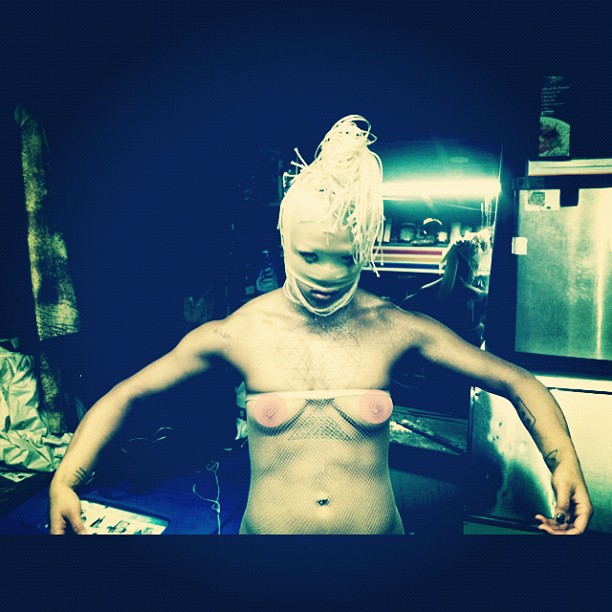
Awkwardly, riskily the figure rises almost to the rafters, its back still to us, spreads its legs, and begins to pull a tangled string of multicolored Christmas lights from her crotch. It performs this deliberately, turning the Rickshaw stage into a pressure cooker of strobe lights, sexual horror, and incipient danger — a strip club where no one can hear you scream. The atmosphere is so tense that when the figure finally turns around to reveal her eyeless, bloody-mouthed, death-pale self, as Ocean’s voice tweaks a level higher, shivers and gasps run right through the audience. Shiva the Great Destroyer, her tits bound with duct tape, a makeshift pouch at her crotch the source of her glittering lights.

It’s an out-of-body look that works. And it’s emblematic of a new glitchy-nightmare drag style (or the reboot of one) that’s bewitching clubgoers.

DIA DEAR

The performer was the amazing Dia Dear, one of a number of recent young arrivals who’ve zapped nightlife to another level by unselfconsciously — and quite organically — raiding the shelves of performance art, horror films, contemporary R&B, club kid history, and the Walgreen’s down the street to create striking personae for themselves, and electrify the city’s drag stages. They’re also so freaking smart it scares me, no Christmas crotch lights required.

Drag as confrontational, sometimes blood-spilling performance art has a long history here, of course, from the Cockettes in the 1970s, through the Popstitute and Club Uranus scenes in the early ’90s, through Trannyshack into the ’00s. It’s currently found a home at the Some Thing party every Friday at the Stud, High Fantasy every Tuesday at Aunt Charlie’s, and the Dark Room monthly party at Hot Spot. Iconic, sensibility-scrambling club kid styles like those of Michael Alig, Desi Monster, James St. James, our own Phatima Rude and Ggreg Taylor, and the ultimate drag inverter-perverter Leigh Bowery are all the rage in this retro-minded, post-Gaga moment. But something about this fresh wave, something about how it’s coming from people with no nightlife background at all, is different. Drag stages have become the affordable breeding ground for committed performance artists, expressing essential truths about our moment. Mere lipsyncing is so last century.

boychild

“I never even knew who Leigh Bowery was until people started mentioning his name this summer,” boychild, another of this new tribe, told me over the phone. (I live next door to boychild, and it’s not rare to find a neon-yellow spray-painted birdcage, a chandelier made of wigs, or an entire store display case sitting outside, waiting to become part of a perspective-shattering outfit or brandished onstage in a cyber-Wiccan, dystopian android ritual.) Like Dia, boychild just started going out to clubs very recently — pretty much arriving out of nowhere, both of them declining to share their pasts — and when she did she was almost fully formed as a stage presence, with a genius sense of makeup and a cerebral agenda.

http://www.vimeo.com/49244470

“Everything I do is a reaction to being categorized: as a person of color, as a female-bodied queer,” she said. “It’s really bad right now, because it’s so hip to be black, “urban culture” is being fetishized to an enormous extent. I feel I encounter so much that makes me angry just existing in this world as a queer creature. My performance and look ties everything to my experience through my body. That’s where I express myself most fluidly, more acutely and vividly than through language.”

“Horror is where I’m coming from and where I exist,” Vain Hein, another performer, told me. Unlike Boy Child and Dia Dear, Vain Hein is open about his past: raised as a Born Again Christian in both Puget Sound and Phoenix, Arizona — “My childhood consisted of traveling between extremes” — he eventually found his way to the San Francisco Art Institute to study New Genres (this is actually a program there!) Vain Hein, who also performs to music he chops and screws at home, most explicitly ties sex to horror in his work — it’s chockful of surprise lactations, menstrual blood, live births, prosthetic triple breasts, and weird asses.

VAIN HEIN (Photo by Eric Harvieux)

“I think a lot about the apocalypse, it’s how I filter and understand the world. Decay, destruction — everything I wear is just what’s at hand around my house, held together with scotch tape and nail glue, the shitty, shitty, shittest things ever that just fall apart during the night, even when I’m not performing. I literally shed my skin.”

Yet even as a queer art student in San Francisco, liberated from fundamentalism, he never went out until last year. “I just had preconceived notions about what going to a gay club involved. Then my friend dragged me to a drag show in the spring, and I was like, ‘I can do this.’ I had studied mostly performance art and video so it was a good fit.”

Being a young queer and not going to the clubs is incomprehensible to me — but of course these 20-somethings grew up with the Internet, where you can be gay by yourself, and which looms like a Poltergeist vortex over their work.

“Oh, the vast blessing of the Internet,” boychild half-laughs. “I wish I was better at it. We’re so bombarded with information and images, just so much shit. That can be great because my generation has all of the past available. But we’ve been drowning in this stream of complete crap, too. I can define myself as a freaky-freak just by how I navigate it. But the power of live performance is channeling all that into immediate emotion, a moment when everyone’s together, something that can’t and should never be documented as just images.”

The charming and soft-spoken Dia Dear, who has become kind of a mother the nascent phantasmic drag scene — even though she, like boychild and Vain Hein, operates mostly outside traditional drag house family structures — says, “I haven’t quite figured out my relationship to the Internet. I feel like it’s a positive tool because it can connect us to the spirit of people who are dead. But it’s also this kind of dark rectangle in the corner that can suck out all your energy. It exists for its own sake. But to be on the Internet now, you have to have a certain level of narcissism and self-interest. A lot like you have to have as a performer. Performance and the Internet should be natural lovers, in a sense. Twisted together …entwined.”


DISQUIET NIGHT

This live experimental music concert at the Luggage Store Gallery is the brainchild of one of the brainiest yet approachable people I know, Marc Weidenbaum, who started his fascinating daily music site, Disquiet.com, 15 years ago — way before blogs were invented. His project Disquiet Junto challenges Soundcloud members to respond to a prompt with unique compositions. This round: field recordings of Hurricane Sandy, with Cullen Miller, Subnaught, Jared Smith, and more.

Thu/6, 8pm-10pm, $6–$10 sliding scale. Luggage Store Gallery, 1007 Market, SF. www.luggagestoregallery.org


DEE-TOY

Over the past year we’ve been treated to some tasty South African contemporary dance music flavor, from Black Coffee to Die Antewoord. (Somebody please get the Tshetsha Boys out here!) DJ Dee-toy, of Sebokeng Township continues this great microtrend with deep, deep house vibes and off-your-seat Afrofunk jams.

Fri/7, 10pm-4am, $15–$20. Mighty, 119 Utah, SF. afrofunk.eventbrite.com


GIGAMESH

Yeah, yeah, the phenomenally successful Minneapolitan remixes pop hits into slick little machines of hummable electro-disco bliss. He is also very, very fun.

Fri/7, 10pm-3am, $15–$20. Monarch, 101 Sixth St., SF. www.monarchsf.com


TORMENTA TROPICAL 5-YEAR ANNIVERSARY

This monthly party launched the nu-cumbia sound in SF, splashing some much-needed Latin electronica onto our shores, while introducing global bass to a new generation of underground-minded clubgoers. Some major players have stomped the floor here, and quite a few sonic permutations of TT’s sound have found more mainstream success — but founders Shawn Reynaldo and oro11, who brought their inspiration directly from Argentina, are keeping it crazy and real with a marathon tag-team set in celebration.

Sat/8, 10pm, $5 before 10pm, $10 after. Elbo Room, 647 Valencia, SF. www.elbo.com


ACCIDENTAL BEAR!

Gay people won’t stop rapping and blogging, and that’s OK! Our favorite local blogger (and perpetual crush) Mike “Accidental Bear” Enders covers way too much ground online. Now the super-enthusiastic cutie is celebrating two years of cybergossip by hosting a cartoon-colored gay rapstravaganza with Big Dipper, Rica Shay, and MC Crumbsnatcher, plus singer Tim Carr and DJs Medic and Dav-O of Double Duchess. There’ll be a lot of cute gay guys with beards.

Sat/8, 9pm, $3. Truck, 1900 Folsom, SF. www.accidentalbear.com


ATTACK OF THE TYPEWRITERS

Writer, drinker, arts-minded political activist, and bon vivant Hiya Swanhuyser is combining her interests in this neato, monthly, potentially wonderfully absurd thingie. Come to the Makeout Room, grab a drink, and then bang out a letter to any politician you have beef with. “One letter = 100 votes,” she says. Cocktails and truth to power, yasss. She’ll bring the actual, clickety-clackety typewriters! You bring the drink-fueled rage!

Tue/11, 6pm-8pm, free. Makeout Room, 3225 22nd St., SF. www.tinyurl.com/typeattack


You’ll be a woman soon

0

emilysavage@sfbg.com

Tofu and Whiskey The phrase “‘woman’ is not a genre” has been popping up again. It’s been in articles, board threads, and subsequently, conversations I’ve been a part of. It’s a good one. Kind of an earworm of a saying, because on its face, it’s implicit, simplistic, obvious, even. But it’s a good mantra, for music writers. “Woman” is not a genre.

Maybe it’s a backlash against Rolling Stone’s recent, ridiculous “women who rock” package, which sought out the “best” woman in rock with votes from readers, and somehow ended up with cloying pop act Karmin plastered across the cover, cleavage-y as all Rolling Stone cover ladies. Can you imagine a “best white guy in rock” contest in RS?

But this is nothing new. As far as I can trace it, Little Boots said “‘girl’ is not a genre” in 2009, but — seeing as how it’s so gosh darn simple — it’s got to have been uttered previously, and certainly, undoubtedly, felt since the first time a woman picked up a different instrument from her female neighbor, and got thrown in concert together.

It was the headline and thesis of a piece on Electronic Beats about the rise of thinkpieces sputtering about a supposed rise of women making electronic music, another fallacy; it’s just the cheap shots in feature pieces clumping heterogeneous acts together again.

One of the only things linking all ladies of wildly divergent sounds at this point is the gendered showcases, or gendered comparisons. That’s not to say all comparisons are entirely inaccurate, they just frequently are made based on little more than appearance.

Ash Reiter, the frontperson for her eponymous East Bay band, saw plenty of comparisons after the release of her first album, Paper Diamonds, in 2010, with passing references to Fleetwood Mac and Cat Power, both of whom she admires. The singer-songwriter-guitarist was also hoping to sound like a mix of Paul McCartney, Brian Wilson, Grizzly Bear, and OK, Jolie Holland.

Now, Reiter and her band have taken that sound for a walk in another direction. With the new LP, Hola — which see release on 20 Sided Records Fri/30 with a show at the Rickshaw Stop (8:30pm, $10. 155 Fell, SF. www.rickshawstop.com) — the local musicians took notes more from bubbly 1960s pop and classic Motown cuts, arrangements interspersed with bits of funk and Afro-pop.

“With our first album, I was in a folkier place with a lot of those songs, doing the Jolie Holland thing, which, you know, I cut my teeth singing along to her songs,” says Reiter, remarkably cheerful on the phone the afternoon before her current 54-day tour ends. “But I’ve gotten more excited about writing more upbeat pop songs with grooves to them, and working with my band to write music instead of writing it alone.”

On this tour, Reiter and her drummer Will Halsey went to the Motown Museum in Detroit, which was particularly meaningful because of its influence on Hola: “that’s a lot of the music we look up to. Of course, [we’ve always looked up to] the Beatles and the Beach Boys, but also all these girl groups, the Ronettes, and the Shirelles, and the Crystals. And we definitively imitated a lot of what we heard in the background vocals listening to the Supremes.”

She had just gotten the Supremes box set, but also was listening to early Nigerian pop, and Os Mutantes when she first began work on Hola, and brought those inspirations to New Improved Recording, where the band worked for the first time with engineer Carlos Arredondo, who they met at a party at Anna Ash’s house.

You can hear Ash Reiter’s many complimentary influences on Hola opening track, “I’ve Got Something I Can Laugh About Now,” with jangly guitars, shakers, cooing harmonies, and Reiter’s crystal-clear, honey-sweet lead vocals. Funkier, electro-shot “Ishi,” written about the last member of the Yahi, very much a part of California’s history, follows. Reiter read his biography for that song, but also just liked the phonetic sound of his name.

Raised in Northern California (specifically, Sebastopol), Reiter looked to the state’s history for inspiration lyrically this time around; the former modern lit major was reading voraciously during the making of the record, including Joan Didion’s Where I Was From. The song “Little Sandy” has a chorus that’s a quote Didion included from a pioneer girl’s diary.

While Hola was girl group-influenced, Reiter wasn’t about to write a break-up album — she’s dating the band’s drummer, Halsey, who also plays with Oakland’s the Blank Tapes.

Another Bay Area act — freshly rejiggered and condensed — is headlining the release show with Ash Reiter this week: DRMS. It’s also a new progression for the plucky electro Afro-pop act, formerly known simply as Dreams. Down from eight players, the now-four piece has whittled to bandleader-keyboardist Rob Shelton, vocalist-percussionist Emily Ritz, drummer Ross McIntire, and Mark Clifford on vibraphone, melodica, and backup vocals.


DON’T CALL IT FREAK-FOLK

Local singer-songwriter Jessica Pratt just released a mystical, fleeing-through-a-foggy-forest folk album that’s so stripped down, quavering and personal, crackling yet crisp, it sounds like a rare, weird gem from the early ’70s that you’d unearth in the lower racks of Amoeba. The self-titled LP has such a true-blue timeless quality, however, to call it a throwback would do it injustice. White Fence’s Tim Presley is said to have created new label Birth Records solely to release Pratt’s debut, which came out Nov. 13. Pratt recently told Fader: “I was really afraid of some freak-folk comparisons because I’m from San Francisco, and I play electric guitar, and it’s kind of weird, folky stuff.” I’ll refrain.

TALES FROM THE FRONT LINE

Part of Nayland Blake’s ongoing FREE!LOVE!TOOL!BOX! exhibit, Show and Tell: Queer Punks in Conversation will include conversations with Leslie Mah of Tribe 8, Brontez Purnell of Gravy Train!!! and The Younger Lovers, Jess Scott of Make-A-Mess Records, Brilliant Colors, Index, and Flesh World, and Matt Wobensmith, founder of Goteblüd Vintage Zine Store and Outpunk. Full disclosure, the panel discussion will be moderated by SFBG managing editor, Marke B., but I’d have gone regardless.

Fri/30, 6:30pm, free with admission

Yerba Buena Center for the Arts

701 Mission, SF

www.ybca.org


Fatshion

10

caitlin@sfbg.com

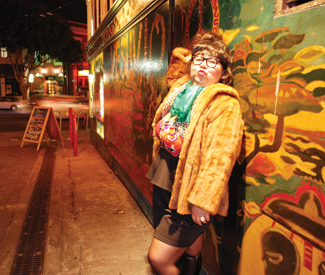
STREET SEEN “Can I do a small rant on boobs?” Fat activist Virgie Tovar’s boobs — I can see most of them in the swank North Beach cocktail bar we’re sitting in — are really big. Many parts of Virgie are, which is kind of her thing. The editor of the recently-published anthology Hot and Heavy: Fierce Fat Girls on Life, Love, and Fashion (Seal Press) talks dirty to telephone sex customers during the day, and carries her curves with a pride that runs completely counter-current to all the ways we are taught to be ashamed of fat in this world.

Obviously, I want to hear her rant about boobs. It turns out to be: Tovar is sick of partners who place their attraction to her squarely on her ample bosom. “I have to have them verbally say that [I’m fat] before we have sex. They can’t accept that they want to have sex with a fat woman.”

So don’t call her busty. Especially since if you do, you’re going to miss the whole point of her look.

“I dress for visibility,” Tovar puts it. You can definitely see her perched somewhat precariously on this North Beach bar stool. Her ample decolletage is emphasized by a floral onesie-now-a-dress, the crotch of which was cut out before our interview for enhanced comfort, a tight skirt, vintage fur coat (“My rule is, I wear fur if it’s 25 years old or older,” she tells me. “I love wearing dead animals”), teal scarf, and knee-high black boots.

You can’t miss Virgie, a fact which our fellow bar patrons quickly learn when we launch into a high-spirited discussion of one of her regular phone sex customers, a “pay pig” who gets off on paying $50 for the pleasure of her telephone voice — $50 every 15 minutes, that is.

She wants you to look at her and see fat, and look at her and see style, and look at her and want to have sex with her — and then she wants you to think about what those things say about your own adherence to normative beauty ideals. Virgie identifies her style as high femme, by her own definition “the intentional performance of femininity in order to subvert masculinity. My fat has become a part of my performance, like jewelery.”

As a chubby child, Tovar shied from glitz and glamour. Girly clothes either didn’t fit, she says, or just plain didn’t fit into her mission to be completely invisible. It was hard to hide, however, from the sartorial impulses of her mother, who loved few things more than embellishing Tovar’s garments with lace and the occasional scene from Disney’s The Little Mermaid, rendered in puff paint.

But Tovar quashed that timidity in adulthood, when she found partners who “found me sexy and wanted to do all these nasty things to me,” she says. “If your liberation comes from somebody eating your ass, by all means necessary.”

She went onto San Francisco State University’s sexuality studies department, where she focused on fat sex, eventually proposing a fat-positive manifesto to Brooke Warner, senior editor at Seal Press. That morphed into Hot and Heavy, a project that Tovar feels coincides with a surge of fat cultural activism, evidence of which she sees popping up, of all places, in retail.

Luscious shopping spots to embrace your own zaftig fabulosity? If you’re down for big brands, Tovar gives high marks to Forever 21’s plus size offerings (“It’s gaudy, it’s slutty. They’ve really tapped into that audience that I’m a part of”), also to ASOS’ Curve line (www.asos.com), Domino Dollhouse (www.dominodollhouse.com), and Cupcake and Cuddlebunny (www.cupcakeandcuddlebunny.com).

Across the country, a smattering of high femme fat vintage stores have popped up: Portland’s Fat Fancy (www.fatfancyfashions.com), Brooklyn’s Re/Dress (whose stock is available online at www.redressnyc.com). And of course, she says, there’s the old standbys: Lane Bryant, Avenue for tights and boots, and the Stonestown Galleria’s most gloriously trashy clothes purveyor, Torrid. Tovar says she finds fat fashion inspiration in Marie Claire writer Nicolette Mason, Marie “Curvy Fashionista” Denee (thecurvyfashionista.mariedenee.com), and the Near-Sighted Owl (www.nearsightedowl.com)

For Tovar, the key to fashion, for girls big, small, and in-between, is ignoring the rules and becoming the fly, fabulous change you want to see. “The tag says no, but the stretch says yes! When I see a garment, I’m seeing hope for all the hopeless situations in the world.”

HOT AND HEAVY READING

with Virgie Tovar, Deah Schwartz, Abby Weintraub, Jessica Judd

Fri/30, 7pm, free

Modern Times Bookstore

2919 24th St., SF

www.moderntimesbookstore.com

www.virgietovar.com


Chopping spree

2

cheryl@sfbg.com

FILM Unlike the San Francisco Independent Film Festival’s flagship event and its popular DocFest, which more or less put roots down at the Roxie, genre fest Another Hole in the Head spreads its horror, sci-fi, and just plain weird wealth around to various venues. Yeah, the Roxie’s still on its list, but HoleHead also hosts events down 16th Street at the Victoria Theater, and at SOMA’s Terra Gallery and the Vortex Room — the latter an inspired addition, given the Vortex’s reputation as a haven for mondo cinema.

This year, HoleHead opens with a screening of Richard Elfman’s 1982 cult musical Forbidden Zone, presented in — holy Tyrrell! — remastered and colorized form. Elfman will be on hand to answer all your Sixth Dimensional questions, and a party (complete with Oingo Boingo cover band) follows.

Closing night looks to be a decidedly less festive affair, with Austrian director Michal Kosakowski’s unsettling Zero Killed — a feature film spun from his video installation and short film project, Fortynine. From 1996 to 2006, Kosakowski interviewed people about their murder fantasies, then used the tales (suicide bombings, school shootings, dog attacks, dinner-party poisonings, stabbings, shoving people into traffic or letting them slip off cliffs, etc.) as short-film inspiration, starring the storyteller as either perpetrator or victim.

A haunting musical score ups the creep factor, as Kosakowski tracks down each participant (many, but not all, are actors by trade) to interview them about their specific fantasies and other troubling topics, like revenge, torture, and “What is evil?” Zero Killed is a uniquely disturbing mix of fiction and documentary, cutting between horrific, blood-soaked vignettes and clinical talking-head interviews — often featuring the same subject.

There’s plenty of blood gushing forth in slick British standout Axed (listed as “Fangoria presents Axed” on the HoleHead schedule, so that right there should assure you of its splatter cred). When a businessman is, uh, axed from the corporate gig that turned him into an uptight prick long ago, he goes all Jack Torrance on his wife and teenage kids. As you might guess, the titular implement figures prominently in his plans, and Ryan Lee Driscoll’s film spirals from satirical to sadistic as each new body drops.

Changing gears, from in-your-face to perhaps too subtle: posting recently to his Observations on Film Art blog, scholar David Bordwell scrutinized what he called “discovered footage” horror films, with a focus on the Paranormal Activity series. Bordwell took particularly interest in the “rewards and risks” of the genre’s “narrow set of stylistic choices.” In these films, the camera itself occupies a heightened presence within the story. By now, everyone knows the psychological effect that’s supposed to have: if we’re aware of the camera, and it seems like an actual person is filming what we see, the images appear more real — and hopefully, “the reward” translates to genuine shrieks in the dark.

But for every Paranormal Activity sequel that’s seen by millions and rakes in hundreds of millions, there are dozens of copycats. And why not? Found-footage horror is non-traditional filmmaking at its most democratic. It can be made on the cheap, and wobbly production values are de rigueur. Unfortunately, it’s a lot easier to get ahold of a camera than to come up with an original idea, much less one that yields actual moments of fright.

With that said, The Garlock Incident does make an effort to tread new, albeit Blair Witch-y, ground. The set-up is that a group of Los Angeles actors — appealing 20-somethings all — are en route to Vegas for a movie shoot. Also in the van is ambitious director Lily (Ana Lily Amirpour), who obsessively films everything. After taking a spontaneous detour to visit a ghost town with a sinister back story, they discover a couple of maybe-abandoned shacks — and soon realize that getting off the main road was a bad idea. Oh, kids. It’s always a bad idea, especially for city slickers who can’t function without cell service.

Garlock‘s frustrating ending, which I wouldn’t dare spoil even if I fully understood it (even after watching it several times), is a letdown. Until its last act, though, Garlock is actually a pretty interesting look at how quickly relationships can break down when circumstances slide from uncertain to dire. But once you start puzzling over the ending, other doubts surface — like, by what logic would the actors’ audition footage be neatly edited into this roughly-shot, “found” chronicle of wilderness terror?

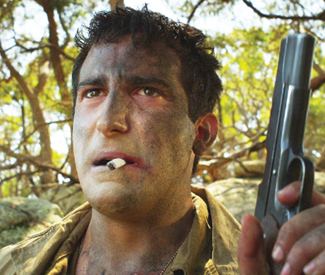
Speaking of wilderness terror and, alas, unsatisfying finales, retro-styled sci-fi adventure The 25th Reich screeches to a halt with a “to be continued” cliffhanger, just when shit is starting to get mind-blowingly insane. Argh! Fortunately, for the most part, the film — about a group of World War II soldiers who time-travel back and forth, squabbling among themselves as they pursue UFOs and Nazis — works just fine as a stand-alone, though its gleeful reliance on stereotypes (the Jew, the Italian, the Southern redneck, etc.) feels less like a nod to classic war films than a way to avoid actual character development.

The best gimmick centers on Captain O’ Brien, an erstwhile matinee idol not above reciting cornball lines from his own films at crucial moments. That he’s played by Jim Knobeloch — who also appeared in 2012’s other Nazi sci-fi flick, Iron Sky — is a perfect bit of obscure-genre synergy.

It wouldn’t be HoleHead without zombies. Comic The Living Corpse gets the (re-)animated treatment in The Amazing Adventures of the Living Corpse, which follows the titular beastie’s existential crisis after he — oops! — rips apart almost his entire family. Spared is a young son who is sent to a creepy boarding school for orphans, though he’s soon plucked from its halls to apprentice under a mad scientist. Meanwhile, the guilt-ridden corpse — real name: John Romero; memo to creative types: naming anyone “Romero” in your zombie-related whatnot is no longer a novel idea — roams the underworld and the land of the living, meting out occasional supernatural ass-kickings but mostly searching for his long-lost offspring.

The haunted-school scenes (complete with a kids vs. demons showdown) are clever, and the catchy soundtrack has punky flair, but the sheer number of plot threads nearly overwhelms the 82-minute film — maybe cool for fans of the comic, but viewers new to the material might wonder why, say, the “Spectral Protection Society” is elaborately introduced and then discarded. The overall effect is not nearly as fun (or “amazing”) as it should be.

Amazing, however, is one of many gushing adjectives I might use to describe my top pick of the festival: Mike Malloy’s Eurocrime! The Italian Cop and Gangster Films That Ruled the ’70s — a jazzy, lovingly-compiled homage to some of the trashiest, most mean-spirited films ever made. Everyone’s heard of Spaghetti Westerns, but poliziotteschi movies have yet to make a true cult breakthrough (or be remade by Quentin Tarantino, but I’m sure he’ll get there eventually). A groovy-sleazy score and endless clips, posters, and still shots set the tone for Eurocrime!, which gathers some of the genre’s biggest stars (laid-back John Saxon; gracious Franco Nero; bratty Antonio Sabàto) to look back at their years chasing each other across rooftops, brawling in junkyards, and working with directors like Umberto Lenzi (“the screaming-est director I ever met in my life,” according to actor Henry Silva).

The doc, a tad long at 137 minutes, also explores why the films became so popular, despite the fact that their scripts were often ripped wholesale from American “angry cop” films (and, later, from each other) — and why that popularity didn’t last (possible culprits: laughable dubbing, distracting mustaches, brutal violence against women). Newcomers won’t believe that such a world of insane film exists, longtime aficionados will dig the nostalgia, and both camps will enjoy Eurocrime!‘s high-energy appreciation of a genre long overdue for this kind of treatment. 

ANOTHER HOLE IN THE HEAD

Nov. 28-Dec.9, $10-$12

Various venues, SF

www.sfindie.com

Midwinter dreaming

0

arts@sfbg.com

DANCE This weekend the parade of holiday entertainments started off on a festive note, and it wasn’t thanks to another interpretation of The Nutcracker or good old Scrooge. It was a brand new charmer from two experienced choreographers who pooled their artistic resources in 2008 to form Garrett + Moulton Productions. Given Janice Garrett and Charles Moulton’s different artistic temperaments, this union sounded like an iffy proposition. But with three hits to their credit, the duo has proved that opposites do indeed attract.

Garrett and Moulton’s newest endeavor for their four dancers, Angles of Enchantment, might not have been quite as consistently involving as their previous collaborations — but it was such a pleasure to watch the skill with which they handled the tasks they had set for themselves.

Angles was a frothy, endearing, and at-times rambunctious quartet that manages to suggest that we may not be doomed to live frantic lives without time or space for fantasy, abandon, and such a thing as pure fun. It was an excellent antidote to holiday anxiety.

The work’s biggest surprise, and one of its chief attractions, was Peter Whitehead’s imaginative score. In dance, music usually fulfills a supportive role. Here its high profile often drew not-unpleasant attention to itself. With his splendid collection of instruments — from kids’ noisemakers to homemade banjos — Whitehead called up a vibrant soundscape. A gentle singer, his lyrics spoke about the small joys and small pains of ordinary people. This kept Angles’ sometimes madcap fancifulness grounded. The music even suggested narrative threads. It made me wonder how effective Angles would be without that emotional backbone.

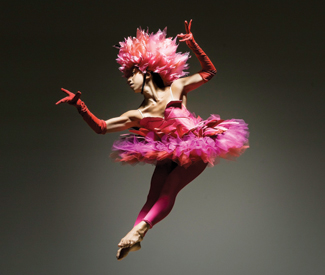
In the beginning, when the four dancers momentarily hooked up one-on-one, only to frantically pursue someone else in the next spotlight, it wasn’t clear whether they were playing or escaping. They leaped and grasped and tumbled, piling up on top of each other. But then, after a blackout — there were several — the dancers reappeared as if kissed by fairy dust, cavorting in the most ridiculous tutus and matching headdresses. The whole thing began to feel like a Midsummer Night’s Dream.

Tegan Schwab became an airborne, mischievous fairy with fingers and feet aflutter, when she was not interfering with Whitehead’s music making. A little later she morphed into a majestically promenading tree under which Nol Simonse found momentary respite. Lanky Carolina Czechowska, perhaps a wood sprite, sported what might have been an acorn hat — until she returned in a black tutu and sexy gloves, as a sexy sorceress whose breath made everyone tremble.

Tanya Bello and Simonse, both of them longtime colleagues in the company, paired up for a series of quasi pas de duex. They were our lovers, teasing each other with playful touches and kicks. Sitting together on a bench, they looked like the end of a Hollywood movie.

Bello barely comes up to Simonse’s chin, but their yearning arms interlocked as equals. And if Bello and Simonse are physically different, temperamentally they are even farther apart. It’s what gave their dancing together such frisson. Bello was a witty whirlwind, whether she spun like a top or raced circles around a partner. Languid and fluid, Simonse could not deliver an inexpressive gesture if he tried. He remains a marvel of a dancer.

There was something vaudevillian about the way Angles’ individual scenes, separated by darkness, followed each other. The structure did not quite sustain itself for a whole hour, delightful as this flight into a world of fairies, pixies, and playful Pucks was. Angles ends on a note of pure hilarity. For the finale, the dancers dressed in ballet wedding outfits: the women in huge white tutus, Simonse equally splendid in half a frock coat. And just to top it off, designer Margaret Hatcher adorned them with strings of Christmas tree lights. Happy holidays to one and all. 

ANGLES OF ENCHANTMENT

Thu/29-Sat/1, 8pm (also Sat/1, 2pm); Sun/2, 2 and 7:30pm, $30-$36

ODC Theater

3153 17th St, SF

www.garrettmoulton.org


E-capitulation

2

le.chicken.farmer@gmail.com

CHEAP EATS Do you want to know how to settle a strike? Here’s how to settle a strike: Capitulate. It’s

fun and easy — just … give ’em what they want. In this case, the letter ‘e.’

Hedgehog, I says, henceforth, you can spell youse however the hell you want. In fact, you can spell all the other words however you want, too. I trust you to get the thing said, however you spell it. We’re all good communicators here.

In fact, we’re in the goddamn bidness of communication, ain’t we.

Yet, my last couple missives to higher ups at the B.G., Maurice and Robin, have been more-or-less dismissived.

If it were me — which it is, but let’s say if, for example, it were me who owed somebody else say, for the sake of argument, $3,300 for services rendered, and I knew it and knew that I was good for it but couldn’t decide which of my bank accounts to take the money from, I would just … pay.

Fun! Easy! Settled! The owe-ee(eee) is all squared away. Then, my lower-downs having been seen to, hypothetical me sleeps real nicely at night. Or, hyperhypothetically speaking, Maurice, Robin, the alive one, or, hell, even Andy for all I care, coughs up the Amount Owed, and then they can bicker amongst themselves until the cows come home.

And sleep at night, if that makes sense. And I kinda hope it doesn’t. Hedgehog?

CHEAP SPORTS Good morning from last Friday! Did youse miss mese like Ise missed youse?

Today I’m thankful for the Chicken Farmer. She’s asleep at the moment but yesterday, when she was awake, she smoked a turkey, baconed up some Brussels sprouts, and baked a gluten-free pie — all in honor of our first little movie taking third prize at the “little movies made in a big hurry” contest down in Hollywood. That her celebratory act of catering happened to fall on Thanksgiving is only a coincidence because she happens to feed me well all the time. It’s not just when the rest of youse are honoring the arrival of the pilgrims and blah blah.

Normally there would be three “blahs” up there, but I’m on a strict word count this week. Because I need all my available words to tell you this:

We’re buying an elliptical. Or not. It’s all very confusing and frustrating and, quite frankly, annoying. The romantic-musical-comedy-sometimes-road-trip that is usually our lives has this albatross circling over it, threatening to dump a load at any moment.

See, Chicken Farmer (aka the Athletic One), tweaked her knee several columns back. And then she spent a lot of time icing it. And then it felt better. And then she tweaked it again. Rinse and repeat for over a month and the end result is a fat Hedgehog. Because, as it turns out, hedgies don’t exercise unless their farmer’s take them out and make them. I don’t have anyone to play racquetball with. Or soccer. And my recently unbroken wrist has not been feeling so great about the bat finding the ball lately. I would ice it, but all available ice has been allocated to Chicken Farmer’s knee and we can’t afford to buy more ice. So naturally, turning our studio apartment into a fitness center is the only way either of us can see out of this morass.

Not that we can afford an elliptical machine either, but the free one at the Mission Rec center is wobbly and sticky and we need to put on clothes in order to get to it. There are elliptical machines in other places (they are called “gyms”) but you have to pay to use them. They are not wobbly or sticky, but you still need to wear clothes and then also, the money. Of which we are low.

So here’s our desperate plan: we’re going out, for the first time in either of our little lives, into the despair that is Black Friday. We’ll drive around until we find a sports supplier in need of a mob. Then we’ll rush in, waving our arms and making lots of noise (so as to give the impression that there are more of us) and run straight to the ellipticals. We’ll pick the one with the best stride length and degree of incline and assure the salesperson that we have the money for it; we just don’t know where exactly we put it.

Surely any salesperson worth their sale-salt will see what good consumers we are and reward us with an interest-free loan and free delivery on-the-spot. Right? That’s how companies do business. Right? Chicken Farmer?

CHEAP EATS continued…

Huh?


Orexi

8

virginia@bayguardian.com

APPETITE West Portal has long warmed my heart. Maybe it’s the removed setting, tucked in the shadow of Twin Peaks where T line ends and the M emerges. Or it’s a sense of stepping back in time to a 1970s San Francisco, a sleepy area unfazed by trends and hipsterization. It’s a family neighborhood, residential and small town in feel — and like any corner of our city, has its food gems, like old school blue cheese buffalo burgers at charmingly dated Bulls Head, or vividly fresh sandwiches and salads at the original location of Market and Rye.

For the past couple months, West Portal residents have been flocking to Orexi, which has quickly made a name for itself and is bustling even on weeknights. It’s Greek… sadly a rarity in the Bay Area despite a plethora of Mediterranean eateries. The upscale Kokkari has long been the Greek queen of San Francisco (sister restaurant Evvia rules Palo Alto) and it has no equal. Downtown’s Ayola also offers Greek favorites, but on the cheaper side. Yet I find myself longing for restaurants like Taverna Kyclades in Astoria, Queens, a mid-range, family-style seafood Greek restaurant typical of New York City’s famed Greek neighborhood, convivial with families, rounds of crisp, Greek white wines, and platters of octopus and grilled fish.

Orexi is a step in the right direction — a comfortable, mid-range neighborhood Greek restaurant using quality ingredients. Owners John and Effie Loufas have created an approachable dining experience — I ate here a couple weeks after opening, returning again one month later to the same waiter who remembered a wine I ordered the month before and a busser who recalled the shirt my husband was wearing last visit. No wonder they’re securing repeat diners.

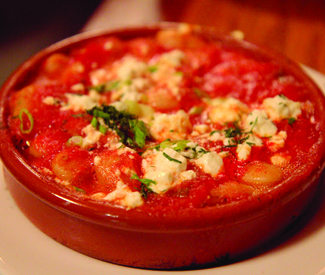
The understated dining room is chic rather than rustic, warm with a honeycomb-like wall hanging and mirrors reflecting the room’s glow. As for the food, first the bad news: grilled octopus ($11 — there’s also an octopus salad for $12.50), typically a favorite of mine, is a bit rubbery over arugula, while gigantes ($7) baked white beans, suffer from blandness but for a dousing of appropriately sweet-savory tomato sauce and crumbled feta on top.

My appetite (the meaning of the Greek word “orexi”) is satiated in unexpected places. House pita bread arrives humbly from the oven, belying its addictive nature, gratifying with small scoops of house dips ($6 each), my favorite being a salty taramosalata, a creamy, fish roe spread laden with olive oil and lemon. The eggplant dip, melitzanosalata, is a balanced expression of the vegetable’s smoky notes, while I wish tyrokafteri, a spicy feta spread dotted with jalapeno, was actually spicy.

Zucchini fritters ($7) with tzatziki (a tangy cucumber yoghurt dip) are a solid starter. Lamb riblets ($9) or lamb carpaccio ($10.75) step it up in tenderness and meaty (not gamey) flavor. In terms of entrees, I’m smitten with homey moussaka ($17). Layers of ground lamb and beef meld with allspice and stewed eggplant under creamy bechamel sauce, reminiscent of the melty, homemade lasagna of my childhood. Simple and also enticing, the “signature” rotisserie chicken ($17) is a generous half-bird (free range, thank you very much), over greens and unremarkable potatoes, marinated in lemon, oil, and spices, tender inside, with slightly crispy, oregano-laced skin.

In the mix with zippy Greek whites and California wines, the wine list holds a rare treat (and I always head straight for the unusual): retsina. Retsina ($6 a glass at Orexi) is a thousands year old Greek tradition of white or rose wine aromatized with pine resin (used to seal ancient wine vessels from excess oxygen). As you might imagine, pine resin gives the wine a foresty flavor, which some describe as turpentine or sap: “Not for everyone,” our waiter clarifies. Its herbal green notes work beautifully with the roasted chicken.

Orexi’s amiable welcome and candelit glow is comfortably gratifying, like slipping on a pair of slippers by the fire. Thankfully not about “the scene” or the next hot trend, the restaurant is about well-executed comfort food in a neglected category with effortless service paramount.

OREXI

Tue.-Thu., 5-9:30pm; Fri.-Sat. 5pm-10:30pm, Sun. 5pm-9:30pm, closed Mon.

243 W. Portal Ave.

415-664-6739

www.orexisf.com

MC, V

Wine

Subscribe to Virgina’s twice-monthly newsletter, The Perfect Spot, www.theperfectspotsf.com

All reflected

3

caitlin@sfbg.com

VISUAL ARTS Glossy and matte stripes alternate across the walls and floor of the 941 Geary gallery in the Tenderloin, occasionally illuminated by striking reflections from the exhibition’s 10 hanging canvases. These are perfectly symmetrical morphs of traditional letter-form graffiti, each done in Easter-ready pastels, save for a black-and-white tag that takes up one enormous gallery wall.

“I just want to continue painting different visions I have,” says the creator of this immersive art experience, visual artist Ricardo “Apex” Richey. He got his start tagging the streets of San Francisco in the early 1980s, perfecting his now-revered, precise hand forms inside Muni buses and walls around the city.

“Reflected,” this new solo show, plays on the entrance into the gallery world of an art form once done covertly on exterior walls. He’s taking graffiti and, like artists before him, skewing and reimagining it. “Abstracting the notion of Apex,” he tells me.

>>CHECK OUT OUR SLIDESHOW OF APEX’S ROOFTOP GALLERY AND SOME OF HIS TECHNICOLOR WORKS FROM AROUND THE SIXTH STREET NEIGHBORHOOD

With the current mania for street art-inspired pieces, Apex has been able to make a career of his work. He capitalizes on the legions of graff-nerd followers on his social networks, and his drive to refract and skew the recognizable shape of graffiti in endless ways. The 941 Geary show was inspired by an iPhone app that allowed him to mirror pre-existing works. After speaking with Justin Giarla, founder of 941 and the rest of the White Walls family of urban art galleries, the two decided the idea merited more exploration.

But during the same week “Reflection” opened, Apex’s personal life was morphing as well. After three years in an epic factory-cum-studio on Market and Sixth Street, his building was sold and he was out. Goodbye to its 13-foot ceilings and the rotating, 10-foot high windows that look out on Market.

http://vimeo.com/21421094

And goodbye to the museum he’d been curating upstairs on the roof, where SF street artists Chez and Neon had contributed massive works, among others. Painted vegetation by muralist Mona Caron curled to the sun in a piece one could nearly see from Trailhead, the pop-up cafe down the street in the Renoir Hotel whose back wall, by chance, is graced by a collaboration mural done by Caron and Apex.

If you wander around the Mid-Market neighborhood, it’s not hard to see that Apex spends his nights working in a neighborhood studio. He’s certainly left his mark. The first piece in the area was Yerba Buena Liquors’ sign, years ago. Since then he’s painted all over the place. The corner of Turk, Mason, and Market Streets is graced by a super-burner of his, a phrase coined to describe his pieces that use hundreds of hues of aerosol.

“I would love to stay there,” he tells me at his new FiDi day job (more on that in a sec.) “In that regard, this is kind of sad.” But Apex knew he was in the studio and roof space on borrowed time — rumors had swirled since he first moved in that the building was for sale. He sees the “gradient” of real estate prices, that Sixth Street was an anomaly in a ridiculously expensive city to live in.

“On one hand it sucks, on the other, I understand it. Overall, it’s better for the city.” He’s looking for a new space anywhere in the “industrial band” that loops between his old studio and Potrero Hill, hoping to get lucky with one of the city’s few remaining industrial spaces.

And, as his solo show is testament, he’s not letting the forced move stop him. That day job? He bought a coffee kiosk. The business is about him “trying to be mature,” he says, laughing as he talks about Otis Cafe, the Four Barrel-equipped stand he’s set up in the Otis Lounge nightclub entryway (25 Maiden, SF) where you can now find him weekdays from 7am to 3:30pm.

“This idea popped into my head,” he says. ‘Coffee cart, that’s a low end startup.” The Maiden Lane micro-‘hood lacks designer coffee, and on the day I visit, new regulars are already lining up.

For Apex, the kiosk is just product of a creative mind. “I feel very blessed, fortunate,” he muses. “Like, I’m an idea person. Painting, art allows me to get the most of those ideas to come to light.” The Otis Cafe sandwich board and cart bear Apex’s signature loops of color — a new home in the downtown area for the artist himself.

“REFLECTED”

Through Jan. 5

941 Geary, SF

(415) 931-2500

www.941geary.com


Art school confidential

0

arts@sfbg.com

LIT If you’re seeking the perfect present for the music obsessive in your life, consider picking up a copy of David Byrne’s How Music Works (McSweeney’s, 332 pp., $32). A thorough exploration of the many facets of music-making, including music industry contracts, philosophical musings on the art of creation, and the scientific principles of tonality, Byrne’s book can be read like a field guide by aspiring musicians, and as an armchair adventure for those whose knowledge of music begins and ends with Pandora.

Intelligent without being overly-analytical, detailed without being didactic, what Byrne conveys most successfully is his own exuberant curiosity for his chosen topic. Like Bill Bryson’s A Short History of Nearly Everything, in which Bryson painstakingly researched the scientific foundations of the universe in order to be able to make sense of them himself, How Music Works often reads like an earnest inquiry conducted by a passionate amateur. That Byrne comes by his knowledge of the workings of the music industry a little more easily — as an elder statesman of art rock, he has decades of personal experience and anecdotes to draw on — fortunately doesn’t render his presentation self-aggrandizing or abstruse.

Although the title of the book seems to indicate a focus on the principles of music theory, a large bulk of the book actually focuses on the technological processes that music has been subjected to over the centuries — from the invention of the first musical instruments to that of Edison cylinder recorders and eventually MP3 players. In his first chapter, “Creation in Reverse,” Byrne presents the theory that specific music has been created to fit certain acoustical contexts. He examines a variety of musical styles — unamplified, percussive ensembles of West Africa, whose music sounds most optimal when heard outdoors, unconfined; long notes and modal structures of Medieval church music, created to fill the vaulted echo chambers of Gothic cathedrals — speculating on how they evolved first to fit the given architecture, and how architecture subsequently evolved to fit the music, as with Wagner’s uniquely-designed opera house in Bayreuth.

He points out how the architecture of even a respected venue like Carnegie Hall might actually be detrimental to the overall sound of a percussion-heavy, experimental rock band, while later he describes the perfect balance of architectural elements that conspire to support such a band and its satellites.

Organized in ten chapters, each tackling a specific thread of thought, the flow of the book can be likened to that of a rock album: a few obvious hits, a couple of minor throwaways. One of the latter is the chapter entitled “How to Make a Scene,” which is also one of the shortest, a moderately interesting rumination on what it takes to create an identifiable music “scene” in terms of architecture, policy, and business philosophy (his exemplar being the now-defunct CBGB). While it makes some interesting points, it could just as easily be missing from the book and no one would particularly mourn its absence. Another, entitled “Collaborations,” is similarly brief, and its appearance between a chapter on the mechanics of recording and the financial realities of the music business doesn’t make for a smooth transition, tonally or thematically.

On the other hand, chapters such as the two entitled “Technology Shapes Music” (covering both analog and digital) are as thorough as they are fascinating. Beginning with the earliest sound recordings in 1878 to an in-depth user’s guide to the music software that has become the industry standard (even for confirmed oddballs such as Byrne), these chapters offer a thoughtful analysis on not just how music works, but also how it’s worked. Finally, in chapter ten (“Harmonia Mundi”), a mere 302 pages in, Byrne turns to the scientific and spiritual principles of music and music theory. Music, it appears, has been around about as long as human beings have, as fragments of 45,000 year-old flutes and pictorial evidence found in Mesopotamia and Egypt help prove. He veers off into Pythagorian territory by expounding upon the so-called Music of the Spheres, and ventures into tantric philosophy, which asserts that the vibration of the universe is generated by Shakti and Shiva having sex.

The book ends on a note of bittersweet optimism, contemplating a future where human composers could actually become obsolete. It’s a future Byrne claims not to fear — while still expressing admiration for music makers past and present, and gratitude for his own place, in this moment, within their ranks.

Sharing the sun

1

news@sfbg.com

Dan Rosen, the co-founder of Solar Mosaic, told us there was an ironic note to the devastation that Hurricane Sandy recently brought to New York City. The same power grid that helps create such fierce hurricanes through the burning of fossil fuels was unable to distribute power to thousands of homes, in mostly low-income neighborhoods, for weeks in the wake of storm.

Sandy brought to the forefront a huge energy challenge: how to move over to renewable energy fast enough to avoid catastrophic climate change and the killer storms in generates, build more efficient and reliable grids, and ensure that everyone can equitably participate in the new renewable energy economy. Bay Area energy entrepreneurs such as Rosen are working on innovative energy models that address those issues.

So far, the solar debate has mostly been between proponents of personal solar projects such as residential rooftop installations, also known as distributed generation, and those who back industrial-scale projects in far away plains and deserts.

But Rosen and other entrepreneurs are championing a middle route: They propose vastly increasing the prevalence of large solar power arrays and other renewable power plants close to where the energy is consumed, and opening up creative new ways for more people to buy into those projects.

This kind of approach to energy has the potential to democratize power production, avoid costly and environmentally unsound transmissions lines, and prevent utilities from monopolizing renewable energy.


CROWD FUNDING SOLAR

One of the barriers to the proliferation of solar is the relatively high upfront cost of purchasing and installing the panels. But with the rising costs of fossil fuel and the government incentives around renewable energy, investments in solar infrastructure can pay off big.

Bloomberg New Energy Finance crunched the numbers and according to a report that came out in June, large solar projects may soon pay a 5-9 percent return on investment. Big financial institutions and other corporate players have taken note of these figures and potential for profit they represent.

For example, Google has invested almost $1 billion in renewable energy that it plans to sell into the grid, including opening a $75 million fund for residential rooftop solar this past September. The problem is that big lenders are only looking for large-scale solar deals in order to cover their costs.

Enter Rosen and Solar Mosaic, who are coming up with a way to harness the power of crowds to fund the local and decentralized projects that big financial institutions tend to overlook. Solar Mosaic specializes in raising seed capital for solar projects by collecting many small investments into one pool.

That idea won Solar Mosaic a $2 million grant from the Department of Energy’s SunShot Initiative, and attracted $3.5 million in venture capital.

“Our job — not just as Mosaic, but as society — is to make sure that the next energy economy has participation and ownership from millions of people and communities around the world,” Rosen said. “Crowd funding is really the beginning of a broader movement to democratize and distribute capital — enabling people to invest in projects they otherwise wouldn’t have had access to.”

This vision proved itself initially with a successful Kickstarter-like crowd funding platform that facilitated the development of five solar projects with the participation of more than 400 small investors and over $350,000 raised. The money went to fund solar panel installations on the roofs of community organizations in California and Arizona, including People’s Grocery in Oakland.

But there’s a catch. As the law currently stands, Solar Mosaic, or any company engaged in crowd funding, cannot offer any interest on the money invested by small online contributors. Since there is only a limited pool of people who believe in an energy revolution enough to shell out money for free, these examples are not entirely replicable. “We chose to start with those ones because they have very strong constituencies and we were using more a philanthropic model,” Rosen said.

The new model the company is developing is “getting people who are not necessarily just environmentalists invested in the clean energy economy,” Rosen said. “I want people who are like, ‘Oh, cool, I can make [a decent return] if I invest in this,’ and that gets more stakeholders than Sierra Club members. Let’s have millions of stakeholders with skin in the game.”

So how to move forward? The controversial federal Jumpstart Our Business Startups (JOBS) Act passed in April by Congress included a much-trumpeted crowd funding provision. The bill charged the Securities and Exchange Commission with the responsibility of putting meat on the legislation’s skeleton.

The SEC has until the Dec. 31 deadline to come up a set of rules allowing start-ups to gather small investments from ordinary people online while still offering provisions to protect the public from fraud. Many are skeptical that the SEC will complete the rule-writing process by the end of year.

Impatient to wait for the SEC and unsure whether the provisions will be practical for their purposes, Solar Mosaic is following a different path. It is using the funds raised already to pay for a lengthy and expensive filing with the SEC to upgrade its financial status.

Rosen said he couldn’t discuss details, but he said the new status should grant Solar Mosaic some leeway on offering financial returns to a wider variety of investors.


ENERGY IN THE CLOUD

Investment opportunities in local solar projects may be a good way to get people financially involved in clean energy but what about Californians who simply wish to purchase renewable energy for their homes or business?

California leads the country in rooftop solar installation, much to the credit of two programs: rebates that offset the cost of the panels through the California Solar Initiative and a program that allows those who own a rooftop with solar panels to offset their utility bills with credit from the energy they produce. California Public Utilities Commission statistics indicate these programs are largely responsible for some 1,379 megawatts of solar that have been installed in California at 131,874 different sites; about as much energy as one large nuclear reactor.

There has been record growth in adoption of solar by homeowners in the past two years, according to the CPUC, including a 364 percent jump in low income areas in since 2007. Yet that’s a far shot from the goal of 12,000 megawatts of local clean energy by 2020 called for by Gov. Jerry Brown in July.

Californians who do not have savings or a high credit score or who have shaded roofs usually can’t participate in the state’s renewable energy programs. But the most significant obstacle to increased participation is that only homeowners are eligible, while renters must contend with whatever power they can get from their utility. In a city like San Francisco, where almost two-third of residents rents, that is the overwhelming majority of citizens.

One solution that would circumvent the property-owning restrictions is allowing people to subscribe to solar gardens and other renewable energy facilities in their area and receive the same credit on their utility bill for their share of energy delivered to the grid. Decoupling where energy is made from who is able to buy it “allows everyone to participate, it makes it so it doesn’t matter if you are rich or poor, the only thing that matters that you have a utility bill,” said Tom Price of CleanPath, a solar project investment firm.

California Senate Bill 843, introduced by Sen. Lois Wolk (D-Davis) and coauthored by Price, attempted to create the legal framework for this kind of virtual transaction. Over the summer, it died in the Assembly Committee on Utilities and Commerce as result of late session lobbying by Pacific Gas & Electric and Southern California Edison. Notably, the state’s other largest utility, San Diego Gas and Electric, supported SB843. Also supporting the bill was a wide and diverse coalition ranging from the US Department of Defense to the Ella Baker Center for Human Rights. Wolk plans to reintroduce SB843 in the next legislative session.

Price and other supporters see the bill’s eventual passage as inevitability: “In an age when so many transaction are virtual [and] we can put so many parts of our lives in the cloud, why can’t we put energy in the cloud and let people virtually subscribe to it? From the grid’s perspective, there is no difference.”


COOPERATIVE ENERGY

Democratizing the green energy industry is about allowing everyone to participate easily, but it is also about empowering those who are typically left out of the conversation.

Low-income and marginalized communities are often the ones most impacted by the environmental and health effects of burning fossils fuels. As the green energy revolution expands, those same communities will potentially be last in line to benefit from or exert influence over the transformation.

Considering that solar can be small scale and still financially sound in the long term, “there is an opportunity to rebuild the energy infrastructure…from the grassroots,” said Shiva Patel who co-founded Energy Solidarity Cooperative. Patel and his partner Dave Ron want to set up multi-stakeholder cooperatives that promote ownership and decision-making by consumers.

In a low-income neighborhood, residents are most likely tenants with little leverage and no eligibility for California’s renewable energy incentives. The cooperative model suggests residents can pool space, financial resources, and labor to become players in small-scale power production.

Normally, consumers considered downstream along the energy supply chain do not have the financial or political means to make decisions about the energy their communities use. “We are flipping that on its head,” said Ron “We want those people to be upstream. We are taking a very horizontal approach.

The nuts and bolts of the coop’s structure may be new, but the distinction between those who own and control the community power project and those who finance it is important. There are three types of members in the cooperative: consumers, workers, and community investors. The consumers initiate the community power project and then maintain ownership of it. They contribute labor and money toward the project according to their ability. The workers are a group of energy experts organized into a collective that provide support and advice for the project. Decisions about the coop and its projects are left to the consumers and workers. Community investors are drawn to the project by crowd funding, but financial support does not buy them a decision making role. Once the upfront costs of the project are paid back to the community investors, consumers can keep the revenue or use it to foster more community power projects.

One source of inspiration for the duo is Co-op Power based in Boston, which has more than 150 full-time green jobs with living wages, spawning 10 businesses in the decade since its founding.

“We had a large number of people trying to solve the puzzle of how communities could come together and create sustainable energy models,” said President and CEO Lynn Benander. “It’s the brain child of many people.”

Hail to the Chief

0

GAMER They say you have to go away in order to make a comeback. To be fair, the Halo series never really “went away,” having released two non-numbered titles and an HD remake in the four years since Halo 3, but those entries lacked the presence of the iconic Master Chief and, compared with the pop-culture phenomenon that was Halo 3, they didn’t exactly set the gaming community on fire.

Perhaps fearful of diminishing returns, series creator Bungie left the franchise in 2010 and Halo 4 (343 Industries/Microsoft; Xbox 360) was left to a new developer, 343 Industries. I’m not sure anyone expected the first-time company to knock it out of the park on their first try, but Halo 4 is a unmistakable grand slam — both a love letter to the franchise’s legacy and a re-introduction to a beloved character that once appeared as fundamentally one-note.

Fittingly, Halo 4 picks up four years after the events of Halo 3. Master Chief is awakened from cryo-sleep by sidekick computer A.I. Cortana and, fearing an attack from villainous alien race the Covenant, the pair set off on a quest that once again endangers Earth and the future of humanity. The first entry in a new trilogy of games, Halo 4‘s story favors mystery over the hollow exposition of past titles, and the relationship between Master Chief and Cortana suggests a truer sense of humanity for the man behind the mask.

Pacing is also revamped, and the game is always barreling towards something new and exciting, as players shuffle from spaceship to alien planet and back again, on the run from a new alien-machine hybrid race called Prometheans. Even when you’re required to perform the same action multiple times, mundane acts like flipping switches rarely play out the same way twice thanks to some impressive artificial intelligence and smart level design. Frankly, it’s surprising that the trusty Halo formula can still be put to such joyous effect; the single player campaign is the most satisfying since the series debuted in 2001.

If you’ve played the multiplayer of the past few entries, you’re largely prepared for the wealth of intuitive maps and game types, solid matchmaking, level editor and ability to save and edit videos of your online escapades. You have new armor and a few new special abilities — like a portable turret — but game play remains easy to learn and challenging to master.

In a field where conventional military shooters top the list each month, it’s exciting to have an invincible space marine blasting up the charts again. After years of releasing games that were essentially two sides of the same space-coin, Halo 4 takes the series back to basics: Master Chief and a whole lot of firepower. Everybody loves a comeback.

HOLIDAY GUIDE 2012

0

We’re sorry to contribute to your stress. We know that our 2012 Holiday Guide is coming out the day before Thanksgiving, and while you are to be accusing for bridling at our anticipation, we think you’re going to like this one. After all, with a list of over 24 presents for your boo, your neighborhood, and more — for under $10! — Marke B.’s explanation of a slightly-scatalogical adopted holiday rite, a full listing of tree lightings and other twinkly November/December happenings, and so much more, you’re going to be better prepped than ever for surviving the next six weeks. Or our name’s not Saint Nick. 

>>THE UNDER $10 GIFT GUIDE: Locally-available trinkets for your partner, your parents, your buddies, and that cranky lady who lives downstairs

>>THE REASON FOR THE SEASON: No, not Jesus. It’s an article about volunteering and gifts that give back

>>GABBA GABBA BUY: What to cop for your headphone-obsessed loved one? Our picks, from boxed sets to lovely local presents

>>BEATING THE POOP LOG: A family adopts an ancient Catalonian tradition

>>THAT’S A WRAP: Gift ideas for your favorite film fan 

>>CREATING OUR OWN TRADITIONS: A guide to the holidays for queer and sex-positive families

>>RUN OVER BY A REINDEER: Holiday events: tree lightings, flamenco concerts, Chinese food buffets, and more

>>9 BOTTLES (AND SOME CHERRIES) FOR UNDER $9: Cask’s store manager makes a list of what to buy if you’re social and strapped

Likes the name

0

caitlin@sfbg.com

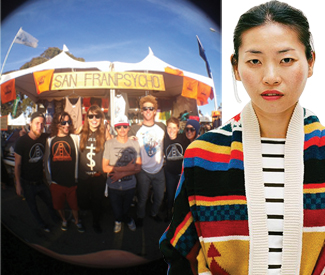
STREET SEEN “People were like, we wanna wear some clothing from you guys,” San Franpsycho owner Christian Routzen tells me from the behind the counter of his DIY brand’s newish (it’s seven months old) location on newly-trendy Divisadero Street. “But we didn’t make clothing.”

I guess sometimes the brand just comes first, and then the product. Or rather, the movie comes first. Routzen made a 2001 Ocean Beach surf film with cohort Andy Olive called, yes, San Franpsycho. Apparently the flick, along with its 2005 follow-up San Franpsycho: Wet and Wreckless, captured the imagination of certain sector of San Francisco. They wanted T-shirts, so Routzen and Olive located some silkscreening gear and a mail truck and became a presence at Indie Marts, bars, and street fairs, silkscreening clothing with their bon mot. I’ve seen them do it, they get slammed.

“We had people taking off their shirts. Men, women, and children,” concludes Routzen. People resonated with the name, he says.

A couple of bangin’ blonde girls interrupt our conversation to buy wristbands for the surf fashion show the brand is hosting at Public Works that night. Later, I see a shot on Instagram involving a runway, a lot of thigh-high American Apparel tube socks, and bikinis. That same weekend, San Franpsycho was hosting a surf tournament and a poker competition.

The girls recede into the distance, banded. And then a guy interrupts us asking about customizing an aqua sweatshirt, as if to complete the San Franpsycho milieu I’ve found myself in the middle of.

But I kind of want Routzen to spell it out. “Can I ask you a less tangible question? Why’d they want to wear clothes from a bunch of guys that don’t make clothes? It’s all the name, really?”

Routzen shrugs, and hands me a DVD copy of Wet and Wreckless ($20, buy a copy at the store.) I watch it with my roommate the next night. It is a Jackass-paced piece of San Francisco bro-moblia, featuring gentlemen named Simo, Doobie, and Brownie, guys bouncing their penises while frying hot dogs in the kitchen, claymation sex, girls making out, an Ocean Beach parking lot shooting, a broken surfboard montage, and an incoherent interview with Andy Dick. Also: barrel rolls.

Most of the SFP dudes are pretty hot, they surf gnarly OB waves, and they straight-boy don’t give a fuck. Ding ding ding! Well yeah, obvs everybody wants San Franpsycho to rub off on them.

Which is a totally unfair analysis, because Olive and Routzen have (in addition to being attractive) created a real cute, real-real, repurposed wood retail galaxy. The Golden Gate Bridge-San Franpsycho logo can now be found on man-tanks, lady tanks, dog sweatshirts, boy shorts, hoodies, aprons, duffel bags, water bottles. The machines they’re printed on are clearly visible in the shop’s workspace.

The boys also sell a host of products made by buddies who live in the immediate neighborhood. The ginger-Afroed Olive holds up an expanse of black Cordura nylon, excitedly gesturing at a bank on the wall of the classic roll-top, leather-strapped Motley Goods backpacks (also available on Etsy) that it will be made into. That brand’s based out of their friend’s apartment, Olive says. “Literally, two blocks away.” The shop also stocks Sea Pony Couture (sea-pony-couture.myshopify.com), a line of delicate gold-chained, be-charmed jewelry by San Franciscan Fatima Fleming.

505 Divisadero, SF. (415) 829-7874, www.sanfranpsycho.com

Far, far away from the San Franpsycho clubhouse sits a Noe Valley clothing store that has absolutely zero hot men in it, but managed to pull me in on the strength of its color palette alone (I am, at my heart, a primary shades kind of person. This is Atlantis and I’m like, nautical.)

Said shop was Mill, and it’s MILF territory — at least, such were the women audibly rhapsodizing over the shop’s stock while I was there, and who were subsequently drawn in by the incredibly informative employees for a conversation about respective kids’ ages, the pleasures of teaching one’s youngster how to give mommy a foot massage, etc.

I was back in the dressing room trying on my Japanese striped/solid BlueBlue boatneck dress, silk drawstring pants with daisy motif by Janezic (a line designed by Michele Janezic, Mill’s store manager whose drapey tank tops are a touch more club-ready and sexy than the rest of Mill’s offerings), and high-waisted, below-the-knee, A-line Levi’s denim skirt.

“I just can’t believe this! It’s amazing,” went the raptures. I should mention that Mill is the brand-new female wear offshoot of beloved Castro store Unionmade. Unionmade was recently dinged by Gawker because its clothes are not, sadly, union-made. Nonetheless, its collection has garnered an enthusiastic following among those who swoon for spendy, high quality denim and other rugged forms of fashion. These followers included females, leading to the birth of Mill, which carries some unisex items in addition to female items from the same brands as Unionmade.

“The philosophy of Mill is to offer classic, quality, and timeless products,” Janezic told me in an email after my visit (I didn’t cop any of the items I tried on, but that was more a question of insufficient funds than personal proclivity because I wanted them all very badly. Even the Barbour “Morris” waxed utility jacket that seemed like a must-have for the drippy SF winter was $379, so I guess I must not-have it sob.)

But I’ll tell you this: if Mill ever needs someone to watch the store at night, say curl up on a pile of goldenrod Levi’s wool trenches lined with poncho material next to its stacks of design mags, wake up in the morning and go out brand representing in some Imogene + Willie jeans (this is cute — manufactured in Tennessee by a twangy couple who started in a gas station basement and still get their fabric from one the country’s last and oldest denim factories) and Gitman Bros. gingham button-ups…

… well, at least now they know my name.

3751 24th St., SF. (415) 401-8920, www.millmercantile.com

Gabba gabba buy

0

emilysavage@sfbg.com

TOFU AND WHISKEY’S HOLIDAY GUIDE Before I expound on anything, I’ve got to spit this out: buy local. If you’re going to buy something; in particular, if you’re going to buy actual vinyl records or CDs or books or musical equipment, get them from an independent store in the Bay Area.

Support Aquarius, Amoeba Music, Black Pancake Records, GROOVES, 1-2-3-4 GO!, Recycled Records, Rooky Ricardo’s, Rasputin’s, Streetlight, and the smaller mom-and-significant-other type stores; otherwise, the brick and mortars will slowly die and we’ll be stuck rifling only through the virtual library, which will inevitably lead to a host of other problems (loneliness, fatigue, hive mindedness).

Making it even easier to shop live, Record Store Day has a Black Friday special releases list (Fri/23), which means there will be lots of specialty music and rare editions on the shelves. And yes, some detractors complain of the single-mindedness of asking shoppers to obsess over rare vinyl jewels just one day a year — actual Record Store Day takes place in April — and that most of the items end up online with jacked up prices anyways. I disagree with this mindset, especially around the holidays. That push can make the difference for a struggling independent shop. Keep in mind, this is not advocating for actual Black Friday shopping at Wal-Mart and the like. End rant.

Last year, all I wanted for Chanukah was the Phil Spector box set, each disc enveloped in tiny cardboard sleeves made to replicate the original records in miniature — like dollhouse versions. I got the CDs, and have listened to the Crystals’ “Frankenstein Twist,” on average, once a day for these past 12 months. This year, I’m just not sure what to covet, so I asked around.

From my non-academic study, I found that musicians tend to be of the practical angle when it comes to gifts. They want extra cables, or picks, headphones, or record needles. One mentioned the Fender Champ amp, which is good for thin-walled apartment use, or the $39 Fireye Mini portable headphone amp. Better yet, a gift certificate to a (local) music shop — try spots like Real Guitars (15 Lafayette, SF; www.realguitars.com), SF Guitar Works (323 Potereo, SF; www.sfguitarworks.com) or Starving Musician (2474 Shattuck, Berk; www.starvingmusician.com).

Those one step apart from the musicians, the quintessential music nerds such as myself, on the other hand, tend to desire the ostentatious and/or extraordinary. They want that rare, hard-to-find seven-inch on white vinyl, the oversized coffee table book, or that carefully curated box set.

Or something else entirely: a gift subscription to Turntable Kitchen’s pairing boxes ($25/month, www.turntablekitchen.com) is a particularly cool gift that’s based right here in the Bay. The boxes ship once a month and include dry ingredients, recipes, and limited edition seven-inches, often by local musicians.

Now on to the music shops. The specialty records, box sets, and CDs in general that stuck out to me as great gifts this year — of course dependent on the listener — are Blackbird Blackbird’s covers of Kate Bush on limited edition vinyl with origami, Castle Face Record’s The Velvet Underground and Nico Tribute, and new box sets from the English Beat, and Death Cab for Cutie. That Castle Face Records full album tribute features covers by a who’s-who of revered locals: Kelley Stoltz, Fresh and Onlys, Warm Soda, Ty Segall, the Mallard, and more (www.castlefacerecords.com).

There’s also Record Store Day’s Black Friday exclusives such as the Fat Boys pizza disc — the record looks like a saucy pie and it comes packaged in a cardboard box — Wanda Jackson’s Capitol Rarities, the Asobi Seksu/Boris split seven-inch,”obscure giants of acoustic guitar” trading cards, and a limited deluxe edition of Joey Ramone’s Ya Know?.

For all the Record Store Day Black Friday specials and to check participating Bay Area shops, visit recordstoreday.com/SpecialReleases.

For the Chanukah specific, I’d recommend ‘Twas the Night Before Hannukah: The Musical Battle Between Christmas and the Festival of Lights. It’s another release from the Idelsohn Society for Musical Preservation, generally the best archivists of vintage Yiddish and Jewish-centric music from the past century or so. The 34-track double CD comp includes Chanukah songs by Woody Guthrie, the Klezmatics, and Mickey Katz, along with Christmas tunes performed by Jewish musicians like Lou Reed, Herb Alpert and the Tijuana Brass, and the Ramones.

An added bonus, there will be a ‘Twas the Night Before Hannukah show at Brick and Mortar Music Hall in December (Dec. 15, 9pm, $15–$18, 1710 Mission, SF. www.brickandmortarmusic.com), with live appearance by Luther Dickinson, Sway Machinery, Thao, Steve Berlin, Ethan Miller, and Ceci Bastida.

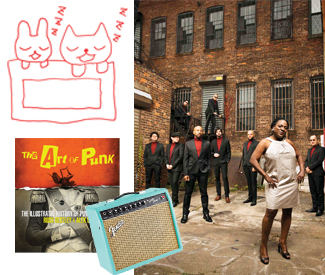
As for books, there’s a new coffee table beast that I’ve been dying to talk about called The Art of Punk: The Illustrated History of Punk Rock Design (Voyageur Press, 224pp, $40), by Russ Bestley and Alex Ogg. It’s a beautiful hardcover with splashy images showcasing the aesthetics of punk; graphic fliers, posters, album covers, patches, and other imagery from the proto-punk era through the present, including international punk art, hardcore designs, and fringe elements (though aren’t they all?). Interesting, there’s another great book on punk graphics released this fall: Jon Savage’s Punk: An Aesthetic (Rizzoli, 352pp, $55).

As The Art of Punk puts it, “The value of such groundbreaking artwork, which continues to have an impact on music, fashion, design, and media to this day, is even now only becoming fully apparent. The visual legacy of punk is extensive and its graphic codes — symbols of struggle and resistance, but also a complex subcultural visual vocabulary, and more cynically, a means to tap into deeply held antiauthoritarian consumer sentiments by lifestyle branders — still have resonance. “

The books will appeal to anyone that ever spent hours carefully sewing garish back-patches to jackets to represent the music they believed in, or those who stared at album covers so long their eyes crossed, and the imagery has been burned in their brains ever since. Basically, the music nerds we’ve been shopping for here today.


SHARON JONES AND THE DAP-KINGS

It’s the swinging, soul-funk group’s first headlining show in San Francisco in more than two years, and in the grand Davies Symphony Hall to boot. The Brooklyn nine-piece Dap-Kings, is of course led by the velvety, luminous Sharon Jones and will likely be belting tracks off 2010’s I Learned the Hard Way LP.

Sat/24, 8pm, $15–$82

Davies Symphony Hall

201 Van Ness, SF

(415) 864-6000

www.sfsymphony.org


DICK DALE

Is there anything more exciting than reverb-heavy surf guitar? It warbles through the veins. Last time the King of Surf Guitar, Dick Dale, popped up at the Uptown he roared through all the hits — yes, “Misirilou” was high on the setlist — and then some, rapidly fingering his custom guitar at a blistering speed, his long white hair whipping around him. Trust me, see the 75-year-old maven while you still can.

With Jonny Manek and the Depressives

Sat/24, 9pm, $20

Uptown

1928 Telegraph, Oakl.

(510) 451-8100

www.uptownnightclub.com


Beating the poop log

0

marke@sfbg.com

Poop log, log of Christmas,

don’t poop herrings, which are too salty,

poop sweet almond cakes, which are much better!

if you don’t poop well, I’ll hit you with a stick,

Poop log!

HOLIDAY GUIDE Despite its media image, Detroit is a vastly diverse place, full of Hmong, Arabs, Christian Lebanese, Chicanos, Jews, Greeks …. but very few Spaniards, at least that I know of.

So it may seem a bit out of place for my family to be kneeling each year around a blanket-covered log that we’ve drawn a smiley face on, beating it until it “poops” out presents — an ancient Catalonian tradition known as tió de Nadal, or the “Christmas poop log.”

We call him by his more informal name, Caga Tió, and he comes to stay with us every year, bringing us a kind of exotic, slightly malicious delight. (Much better we beat up a log than each other.) About two or three weeks before Christmas, we set him out on our hearth and cover him with a small blanket. Each night, just like for Rudolph and friends, we lay a plate of treats and some milk for him. The treats are gone by morning, and Caga Tió starts to swell underneath the blanket. Soon, Caga Tió is one fat, smiling log!

Then, on Christmas morning, we gather around him with sticks and sing a slightly different Spanish version of the song above. (How slightly different depends on how much spiked eggnog we Anglophones have imbibed.) Then we beat him vociferously with the sticks.

We’ve literally beaten the shit out of him! And the shit is presents. We reach under and see what Caga Tió has been kind enough to poop out. One year the gifts were tiny windup toys that we raced down the kitchen table. Another, it was fake mustaches for a hilarious family portrait. And another it was various plastic animal noses, and 3-D puzzles, and chocolates. No sweet almond cakes (a.k.a. turrón) yet, however.

How did my family embrace this strange practice? In January of 2006, I’d just gotten back from attending my friends’ wedding in Madrid, one of the first legal same-sex weddings under Spanish law, performed by the member of parliament who sponsored the bill. In Bush’s America, this was unimaginable. So I brought back an obsession with all things Spanish. The Catalan region lies east and north of Madrid, but one night I fell into a Spanish history Youtube hole (a Yubehole, if you will) and came out with the poop log on the other end. I was determined to try it when visiting my parents for the holidays. They loved it — it was something different we could share as a far-flung family — and we’ve continued ever since. Once he’s pooped out your gifts, you’re supposed to burn the log like a yule log. But we’ve kept the same one: he’s almost part of the family!

Why poop for Christmas? Let’s just say the wonderful people of Catalonia are big on holiday shit. Besides the tió de Nadal, derived from medieval Catalan mythology and beaten for centuries, they’re also keen on exquisitely hilarious caganers, tiny porcelain figurines of well-known personages that they place in the background of nativity scenes. And what are these personages doing? Why taking a dump with their pants around their ankles, of course. Darth Vader, Justin Bieber, Spongebob, Obama, the Queen of England, the Pope — all are fair scatological game. It’s a good-natured note of vulgarity that reinforces the immediacy of life amid all the theological pomp and mysticism.

Caga Tió isn’t so strange to Americans: South Park‘s Mr. Hanky, the Christmas Poo, is a famous manifestation. Soon, maybe, you’ll be beating a poop log for the holidays, too. And you thought you wouldn’t get shit for Christmas.

The reason for the season

1

culture@sfbg.com

HOLIDAY GUIDE With the presidential election over, we are reminded that though our quest for reproductive rights and LGBTQ equality may continue unabated, making a difference must not be limited to a “Ya Voté” sticker every four years. Here’s a brief list of ways to do good this season, including community gardening, beach cleanups, and gift fairs where you can shop for a good cause.

VOLUNTEER

Outdoorsy types take note. SFGRO (www.sfgro.com) has a mission to elevate the profile of community gardening in San Francisco, and to provide support to local gardeners. You can do your part by helping out in the following areas: composting, garden safety and security, resource material development, administrative tasks, and fundraising. Jump into the mix all over the city: the De Haro, Dearborn, Alioto Mini-Park, Page Street, and Potrero Del Sol gardens all need help.

You can also help out at Hayes Valley Farm (450 Laguna, SF. www.hayesvalleyfarm.com) during it’s last winter. The farm is set to be turned back over to the city next year, at which point founder Jay Rosenburg hopes enough people will have learned agriculture skills at the farm to continue its mission elsewhere. “It will create a big fireworks explosion and everything we’ve created here will break off to little pieces all over town,” he recently told Edible San Francisco.

Help maintain the beauty of the five-mile-long Ocean Beach with the Surfrider Foundation‘s regular cleanups. Bonus: they’ll give you a chance to commune with our sandy spaces in the winter, when the waves are at their most ruggedly beautiful (Next events: Dec. 4 and 18, 10am-noon. Ocean Beach, Stairway No. 17, SF; Dec. 31, 10am-noon. Baker Beach, SF. sf.surfrider.org)

In the North Bay, we suggest you peruse the various opportunities available through Volunteer Marin (555 Northgate Drive, San Rafael. (415) 479-5710, www.volunteermarin.org.) The organization solicits requests from local nonprofits for donations or volunteer time. Its altruistic options include preparing and serving holiday meals, donating food, clothing, or requested gifts, and decorating or wrapping presents.

We are very much proud to say that San Francisco is home to the oldest toy drive in the whole country. The organization responsible for this is our beloved San Francisco Fire Department (www.sffirefighterstoys.org.) Find the nearest fire station to you and be part of the effort to get gifts to over 40,000 disadvantaged children.

Although many homeless shelters tend to fill up their volunteer shifts early on during the holiday season, head to At The Crossroads (Dec. 12, 6-8pm. 333 Valencia, SF. (415) 487-0691, www.atthecrossroads.org), when volunteers are needed to assemble care packages for homeless youth in city.

Kids Enjoy Exercise Now (www.keensanfrancisco.org) is an awesome national organization whose mission is promote physical activity among kids and young adults who have developmental disabilities. KEEN is recruiting people to be volunteer coaches, and those who sign up will be paired with an athlete for hours of fun and games — an easy thing to do that’ll make a big difference in a young person’s life.

And finally, for those of us too lazy or computer-bound to do anything besides point-and-click this holiday season, we present to you Games that Give (www.gamesthatgive.net) Play an online game like solitaire or mini-golf and for every 10 seconds you’re occupied — and viewing the site’s sponsors’ ads — a charity of your choice receives a certain amount of funds.

GIFTS THAT GIVE BACK

One thing people in the Bay Area love to brag about is our access to a wide selection of some of the best wines in the world — which many will be taking full advantage of this holiday season. Sometimes the vast number of options can be anxiety-inducing, which is why we recommend ONEHOPE (www.onehopewine.com), a socially-conscious winery that donates 50 percent of its profits to partner charities and has raised over $750,000 to date.

It’s not only one of the largest events recognizing women’s craft in the nation — the Women’s Building’s Celebration of Craftswomen (Dec. 2, 9am-1pm, free. Fort Mason, SF. (650) 615-6838, www.celebrationofcraftswomen.org) is a great place to satisfy your gift-giving needs. Note: an event as big is this requires all hands on deck — the organization would love your help in admissions, crowd monitoring, relief for exhibitors, plus organizing the raffle and silent auction.

One of our favorite entrepreneurship programs in the city puts together an amazing assemblage of its graduates just in time for your eight crazy nights or stocking stuffing. La Cocina’s Gift Bazaar (Dec. 7, 1-7pm, free. Crocker Galleria, 50 Post, SF. (415) 824-2729, www.giftbazaarsf.com) presents a pageantry-filled flea market dedicated to showcasing foodie goodies and handcrafted/artisan gifts.

This is the first year that the Contemporary Jewish Museum (736 Mission, SF. (415) 655-7800, www.cjm.org) has published a gift catalogue featuring its gift shop’s treasures, like modern-eclectic menorahs — one of which is shaped a cable car — artisan jewelry, and children’s toys. All sales proceeds benefit the museum’s ongoing efforts to bring Jewish art, history, and culture to the Bay Area.

Meals on Wheels (www.mowsf.org) would to invite you and yours to put those creative aptitudes to work brightening the holidays for the elderly and handicapped. Wrap and stuff gifts, and make holidays card for distribution to the group’s meal recipients during the first two weeks of December.

Under $10 gift guide: Under the mistletoe

0

Swagger Cosmetic’s founder Blake Karamazov is your holiday girlfriend. See her vegan makeup line at www.swaggercosmetics.com

>>CHECK OUT THE REST OF OUR HOLIDAY GUIDE FOR MORE CHEAP GIFTS, THINGS TO DO, ALTERNATIVE CHEER

BRACELETS, PRICES VARY

You can find vendor Elden Diaz on most weekdays in Civic Center Plaza, with his racks full of friendship bracelets. Get a personalized one for your babe with that nickname you call them that they love to hate.

Civic Center Plaza, SF

LAVENDAR HONEY, $9.99 FOR NINE OUNCES

They just couldn’t get sweeter? Yeah they can – with this little pot of herb-inflected bee juice.

Village Market, One Ferry Building, No. 29, SF. www.villagemarketsf.com

BOOB BOMBS/INFLATING SWAN HEAD PENIS, $1.50

Among the superlative selection of compartmentalized lunch boxes and impressive wall of fake eyelashes, this Japanese dollar store also stocks gag private part prosthetics. Wear them yourself? Strap them on your sweetheart? Insert some levity into December with these goofy gifts.

Daiso, 570 Market and 22 Japantown Peace Plaza No. 400, SF. www.daisojapan.com

DANDELION CHOCOLATE BAR, $8-9

No, it’s not just chocolate. Tell your boo that not only is this the trendiest cocoa in SF right now (its makers just opened a brick and mortar location in the Mission), but also the most holistic. Dandelion makes its bars from the beans themselves, where many other producer create their confections from pre-made chocolate.

Dandelion Chocolate, 826 Valencia, SF. www.dandelionchocolate.com (Also available at Chocolate Covered, 4069 24th St., SF. www.chocolatecoveredsf.com)

BOUND TO PLEASE DUCT TAPE, $8

Truly, there is nothing for which you cannot use duct tape — even jumpstarting your kinkery, which you can do easily with a roll of this skin-safe erotic adhesive.

Good Vibrations, various Bay Area locations. www.goodvibes.com

ROCK CLIMBING ROPE KEYCHAIN, $10

Love watching that ass high in the air? This keychain is perfect for the one who belays your world, and it’s made here in the city by a civil engineer-climber who sells rock-ready accessories to pay off her grad school debt.

AllBeta, www.etsy.com/shop/allbeta


Under $10 gift guide: Parent wrap

0

The Guardian’s parents for the holidays are Mary Camilang and artist Sarah Sass Biscarra-Dilley

>>CHECK OUT THE REST OF OUR HOLIDAY GUIDE FOR MORE CHEAP GIFTS, THINGS TO DO, ALTERNATIVE CHEER

VICTORINOX SERRATED KNIVES, ALL UNDER $8

What better place to replenish your favorite cooks’ supply than this mom and pop shop in North Beach?

Columbus Cutlery, 358 Columbus, SF. (415) 362-1342

RECYCLED TELEPHONE CABLE BANGLES, $1; RINGS, $3

Imported from South Africa, these recycled gems are great for parents who like a little funk and flair.

Lava9, 542 Hayes, SF.

SOU SOU SOCKS, $10

Hyacinth print? Color block motif? Rock your parent-peoples’ worlds with these sure-to-be-found-wacko footsies.

New People, 1746 Post, SF. www.newpeopleworld.com

JARS IN VARIOUS TYPES AND SIZES, $5-10

We all dream of a perfectly organized kitchen, but your ‘rents may just be settled enough for that to become a reality. Snag them some Masons from a superlative vintage cookware store.

Cookin’, 339 Divisadero, SF.

FENNEL AND SALT BLEND, $8

Encourage your pop’s inner gourmand by introducing him to the glories of Ferry Building shopping. Far West Fungi also sells a mean mushroom log, if you think papa is down to grow his own caps.

Far West Fungi, 1 Ferry Building No. 34, SF. www.farwestfungi.com

ZUCCHINI DOG TOY, $9.50

Your parents’ new kid (y’know, that Boston terrier that now lives in your childhood room) will be thrilled to bits by this durable, Bay made veggie plushie.

www.petplay.com

Under $10 gift guide: Neighborly love

0

Our Holiday Guide “neighborhood” is Cookie Dough, who plays Sofia Petrillo in the now-classic annual drag queen production of The Golden Girls: The Christmas Episodes. The show runs Dec. 6-30, get your tickets at goldengirlssf.eventbrite.com

>>CHECK OUT THE REST OF OUR HOLIDAY GUIDE FOR MORE CHEAP GIFTS, THINGS TO DO, ALTERNATIVE CHEER

SAN FRANCISCO MAPKINS, $5.50

Presents for acquaintances should draw on the things you have in common — like a love of your shared territory.

Lola, 1415 Grant, SF. www.lolaofnorthbeach.com

HAND-WOVEN RAAHUNA COLECTIVO CHANGE PURSE, $10

Oaxaca, Mexico’s women-run Raahuna artisan collective makes this beautiful, fair trade purse. It’d make a socially-conscious (and hip) token of your esteem.

Artillery Gallery, 2751 Mission, SF. www.artillery-ag.com

STICKY NOTES BY JUNZO TERADA, $9.95

If your neighbor’s going to be leaving you passive-aggressive memos about placement of recycling bins, they may as well be on these friendly animal and guitar-shaped sticky notes.

Kinokuniya Bookstore, 1581 Webster, SF

NEIGHBORHOOD SOAPS, $10

Associate yourself in their minds with good, clean living with these soaps from San Franpsycho’s Divisadero store. Choose from Golden Gate Park, Mission, Hayes Valley, Potrero Hill, Pacific Heights, SoMa, Nopa, Ocean Beach, and more.

San Franpsycho, 505 Divisadero, SF. www.sanfranpsycho.com

WEE BOWL, $8

In addition to poetry-engraved ceramic necklaces and porcelain buttons, San Franciscan Lynae Zebest sells these sweet little bowls on her Etsy site.

Zebest Pottery, www.etsy.com/shop/zebestpottery

FARMER’S MARKET FLOWER BOUQUET, $3-10

Every Tuesday and Saturday from 9am-1pm Santa Rosa Flowers sells bright bundles of blooms perfecting for brightening your giftee’s foyer, or even cubicle

Alameda Farmers Market, Webster and Haight, Alameda

Under $10 gift guide: Thank you for being a friend

0

Serving time as “friend” for the Holiday Guide photoshoot, Guardian intern George McIntire exudes bike-buddy realness

>>CHECK OUT THE REST OF OUR HOLIDAY GUIDE FOR MORE CHEAP GIFTS, THINGS TO DO, ALTERNATIVE CHEER

LED REAR LIGHT, $9.99

Show your bike gang member you care with the gift of safety. What are you, their mom?

Nomad Cyclery, 2555 Irving, SF. www.nomadcyclery.com

PRINT OF MEXICAN OR COLOMBIAN STREET ART, $6

SF artist Lex Mex traveled Latin America with an eye to the walls. Lucky you, the photo prints that came out of that journey are perfect for the street art fanatic on your list.

Artillery Gallery, 2751 Mission, SF. www.artillery-ag.com

MID-CENTURY FILM SOUNDTRACKS, $3-6

That flick you and your bestie watched as artsy college stoners? They’ve got the score at local music mecca Grooves for insta-trips down memory lane.

Grooves, 1797 Market, SF

BEER MAKING SUPPLIES, UNDER $10/POUND

Do not fear the practical present. If homeboy or girl has a beloved hobby, they’ll never be mad about you re-upping supplies for it. Bags of yeast, hops, or grains will sit perfectly with the homebrew enthusiast.

San Francisco Brewcraft, 1555 Clement, SF. www.sfbrewcraft.com

LAUGH LAUGH BEAR SOCKS, $4

What better gift for your emotional rock and partner in crime than off-brand Sanrio socks?

New People, 1746 Post, SF. www.newpeopleworld.com

SFQ BARBEQUE SAUCE, $6.95 FOR NINE OUNCE

Made locally from the same ingredients as true friendship (chocolate and coffee), SFQ was made as an attempt to foster an SF barbeque style. Made with Californian ingredients like Wine Country red wine vinegar, your bud will want to slather on this vegan treat.

Park and Pond, 1422 Grant, SF. www.parkandpond.com


That’s a wrap

0

cheryl@sfbg.com

HOLIDAY GUIDE “Film fan” can mean many things: that guy who knows the name of every weapon in the Star Wars universe, the late-period Clint Eastwood apologist, the kid who dreams of being the next Joss Whedon, the woman who dresses like a 1940s femme fatale, or the neighbors who just named their new puppy “Kubrick.” What’s more, most people have some love for movies (or at least really good TV), so a cinematic gift is more or less a win-win situation as long as you make a slight effort to tailor it to the individual. Herewith, some ideas to get you started.

Bodacious Blu-ray box set Bond 50: The Complete 22 Film Collection goes from Sean Connery to Daniel Craig, compiling all the 007 flicks to date (with the exception of the current Skyfall, of course). Though not all Bond films are created equal (2002’s Die Another Day vs. suave 1960s Connery? No contest), the set would be a handsome addition to any space-age bachelor or bachelorette pad. For added impact, throw in a snazzy cocktail shaker and some martini glasses. Instant secret agent party!

For the Giants fan who’s already drowning in World Series memorabilia, why not splash out for one or both volumes of the ESPN Films 30 for 30 Gift Set Collection? The films in this Emmy-nominated series transcend typical feel-good sports docs to closely examine specific moments and important (or infamous) figures, with acclaimed directors (John Singleton, Barry Levinson, Barbara Kopple) contributing alongside up-and-comers. Each entry is different from the last, but all the stories are fascinating, focusing on topics as wide-ranging as the death of basketball star Len Bias, a New York City fantasy baseball league, fan love during the Los Angeles Raiders years (directed by Ice Cube), the friendship between Mike Tyson and Tupac Shakur, and the downfall of track athlete Marion Jones.

But maybe you don’t want to risk gifting any DVDs, since you’re not sure what the film fan in question’s collection already contains. To avoid any awkward, “Gee, thanks, but I already own the Deluxe Uncensored Letterbox Edition of Cannibal Ferox” moments ‘neath the mistletoe, seek out something completely unique. Visit the online boutique of local celebrity and film enthusiast Peaches Christ (store.peacheschrist.com) to pick up a t-shirt or tank top illustrated with an eye-catching image of Peaches herself (merry Christ-mas!) For another wearable option, check out the, pardon me, fucking amazing t-shirts offered by Los Angeles’ Cinefile Video (www.cinefilevideo.com), famed for tweaking band logos with names of famous directors — like, say, “Herzog” in Danzig font, with demon skull floating behind. The tees are highly popular and are therefore often out of stock, but as of this writing you can still pick up a Carpenters/John Carpenter/They Live mash-up in either black or cream. (I have the black one; it’s a real conversation-starter.)

With Peter Jackson’s The Hobbit: An Unexpected Journey coming out in December, consider guiding a younger reader back to the source with his or her own copy of the book. Naturally, there’s now a movie tie-in edition, but all that means is that the cover looks like the theatrical poster. For more Middle Earth fun, type “hobbit” into the search bar on Etsy.com, and you’ll find a range of gift ideas, from stocking stuffers (“Shire” scented candles, for pipe-weed aficionados) to big-ticket items, including a pair of Vans fantastically hand-painted with Bilbo’s likeness.

And what goes better with movies (and pipe-weed) than popcorn? San Francisco’s 479° Popcorn is organic and sold in dozens of Bay Area (and beyond) locations, like Rainbow Grocery, Bi-Rite, and even some swankier corner stores. You can also order it online (www.479popcorn.com). Flavors include black truffle and white cheddar, fleur de sel caramel, and Vietnamese cinnamon sugar. Sure beats the radioactive stuff they sell at the megaplex.

If the film fan on your list is local, consider investing in a membership to a local theater or cinema organization on his or her behalf — a rad gift for the recipient, and a boon to the venue or group you’re supporting. Members at the Roxie (roxie.com/support) get perks like free admission to regular screenings. Join the San Francisco Film Society (sffs.org/membership) for access to members-only events and the ability to purchase San Francisco International Film Festival tickets before they go on sale to the public. And San Francisco Cinematheque (www.sfcinematheque.org) members get discount admission to screenings and access to the group’s archives. All gifts that keep on giving, even when the lights come up.

Creating our own traditions

0

culture@sfbg.com

HOLIDAY GUIDE Hold onto your butts, sweethearts, ’tis the season. Your kids are about to be out of school, your extended family is about to fly in, and your alone time is about to dwindle down to a nub.

Don’t fear, we’ve got you covered.

This holiday guide is designed specifically for LGBTQ families, sex-positive families, and other parents who don’t fit into the monogamous, heteronormative mold. Why? Most holiday advice directed at families comes with a heaping dose of heterosexism. Plus, feeling isolated from larger community networks — a common experience for parents — is especially prevalent among parents with sexual identities that reside outside the norm. That feeling of not being connected can result in stress on alt-families during the holiday season.

But not this season! This year we’ve got tips, a recipe, and events to keep you loving your queer, kinky, radical-parenting self.

IT TAKES A VILLAGE

The easiest way to stay sane during the holidays is to maximize the friends and family you’ve already got. If you’re not careful, a house full of holiday guests can seriously cut down on the already limited amount of sexytime parents are allotted.

So don’t think that you have to be the one to take your children to the San Francisco Lesbian/Gay Freedom Band’s Dance-Along Nutcracker. Try to get your in-laws to do it, while you squeeze in a quickie with your partner or have a grown-up play date with your friend with benefits. Sure, you still have to wrap the kids’ presents — but you should really have someone unwrap your clothing first.

In this truly unique SF version of the Nutcracker, the audience dances along while the Freedom Band plays Tchaikovsky’s classical suite. Tutus are available for rent on site.

Dec. 8, 2:30 p.m. and Dec. 9, 1pm, $25 for adults, $16 for children and seniors. sflgfb.townalive.com

HOLIDAY HEALING

The best part about being a non-traditional parent is that we create the rituals. Here’s two family-focused events that each seek to empower parents.

At Rad Dad Zine’s 23rd issue release party — celebrating an end-of-the-year issue appropriately titled “Making Family” — parents will do short readings from the zine, followed by a discussion on radical parenting at this kid-friendly community gathering. Parenting norms? Hmph, let’s go poke at stick at them.

Dec. 15, 5-7pm, free. The Holdout, 2313 San Pablo, Oakl. raddadzine.blogspot.com

You’re encouraged to “bring the foods and holiday traditions that make this season meaningful to your family” to the annual Our Family Winter Solstice Party. This year, the LGBTQ group is partnering with San Francisco Recreation and Parks to hold the celebration at the Eureka Valley Recreation Center, where the party will feature a magician, the group’s legendary multi-table gingerbread-making station, and other arts and crafts.

Dec. 16, noon-2:30pm, free. Eureka Valley Recreation Center, 100 Collingwood, SF. www.ourfamily.org

POTLUCK LIKE A MOFO

I encourage potluck-style casual dinners with other families during the holiday season. It doesn’t have to be a big production, and if it’s other parents who are coming over, your house doesn’t even have to be super-clean. (They get it.) Just offering a space to gather is an important contribution, and if it goes well, next time around a different family can host.

At the best family holiday potluck I ever went to, the kids made all the food. My sons were six and seven at the time, and weren’t allowed to use sharp knives or the stove, as was the case for most of the other children in our little after school collective. We found easy, no-cook recipes that they could make with very little assistance from their grown-ups.

The variety of dishes we wound up with was hilarious and festive — probably not the most balanced meal ever cooked, but nutritional concerns took a back seat to the pride the kids felt in sharing food they had made themselves. The hands-down favorite dish of the evening was this little number:

NO-BAKE HOLIDAY ÉCLAIR CAKE

Ingredients:

1 package instant vanilla pudding mix

1 container frozen whipped topping, thawed

3 cups milk

1 package graham cracker squares

1 package prepared chocolate frosting

1 package holiday M&M’s

Directions:

Whisk together the pudding mix, whipped topping, and milk. Arrange as you would a lasagna, with a single layer of graham cracker squares in the bottom of a 13×9 inch baking pan. Drop spoonfuls of the pudding mixture over the crackers, leaving about half in the bowl. Then add another layer of crackers and the remaining mixture. Top with the last of crackers. Spread the frosting over the whole cake, up to the edges of the pan. Place M&M’s on the frosting. Cover, and chill at least four hours before serving.

GIVE THIS GIFT

No holiday guide would be complete without the perfect gift recommendation. I’m bestowing this honor on Santa Rosa-based Calliope Designs’s personalized holiday ornaments. The company has been making them for over 30 years, and its website specifically states how happy it is to make ornaments for LGBTQ families: “We know that families come in all shapes and sizes and are happy to present ornaments to the gay and lesbian partners and families all over the world.” How can you not adore that?

www.calliopedesigns.com

KEEP IT CLASSY

Regardless of if you’re having sex alone or with a partner, your sexuality matters. That can mean prioritizing some grown-up time at one of the great sex-ed classes offered by Good Vibrations. I’ve heard that sometimes attendees leave with a free gift! The only challenge is that classes are during prime “must be at home with the kids” time. How to resolve? Do a childcare swap that includes dinner. One day a week, you host the brood, then later in the week your parent-ally can host. Maybe you can even attend a Good Vibes “Humpday Happy Hour” workshop. Every Wednesday you can find a free sexuality workshop at one of the store’s Bay Area locations. Here are two upcoming classes that I highly recommend:

“The Art of Clitoral Stimulation” Dec. 6, 6:30-7:30pm, free. Good Vibrations, 1620 Polk, SF;”50 Shades of Play” Dec. 12, 6:30-7:30pm, free. Good Vibrations, 603 Valencia, SF. (415) 522-5460, www.goodvibes.com

Airial Clark is the Sex-Positive Parent, an East Bay sex educator who teaches workshops on raising kids outside heteronormative models of family. Read more about her work at www.thesexpositiveparent.com